Coffee

Independence/Movement: extended interview with Oakland’s SALTA dance collective

1

Note: this is an extended version of an article in this week’s Guardian.

The crowd outside the Niebyl-Proctor Marxist Library in Oakland was hopping. Fidgeting, really. Almost imperceptibly at first, while above it a bulging moon hung in the temperate June sky, just itching to go super as it would the following night. But soon enough bodies were bouncing and flailing, until finally the scrum of dancers packed shoulder-to-front-to-back on the sidewalk morphed their collective way through the front door.

We followed the dancers (choreographed by Abby Crain) inside, swept along by their momentum, and were deposited around the perimeter of the main reading room like dust mice by a strong breeze. On that same floor, a few hours later, choreographer Ronja Ver would be sending her supine audience into dreamland with a couple of Finnish lullabies. Before that, a bowl of liquid nitrogen would send a delicate fog creeping over its wooden surface as the spectators (temporarily wrapped in reflective emergency blankets) braced themselves for a performance by Daniel Stadulis that was part science experiment, part detailed meditation on the fragility of the body.

Much else went on during the event’s roughly four hours, which ended with a dance party. No one stayed put the whole time. Some wandered off to the back rooms to the free bar, or to partake in the desultory clothing swap at the free boutique (both the bar and boutique are voluntarily stocked by the guests). Upstairs, meanwhile, the ebb and flow offered other attractions — a mother and daughter did a duet; a young writer read her first novel aloud for the first time, offering each completed page to anyone who paused to listen…

June 22 marked one year’s worth of PPP, the monthly performance series instigated by Oakland-based dance collective SALTA. As much a scene as a performance platform, PPP has been building a platform for serious, unbridled experimentation in a low-key setting where failure is as valid as success, and no one ever encounters a price tag, a door charge, or a gate keeper.

As an attribute of its headlong dive into experimentation and openness, PPP never sits still but moves restlessly and freely from one donated space to another. Among these have been the Foundry, The Vulcan, The Public School, Subterranean Arthouse, Sri Louise’s Underground Yoga Parlour, private homes, Ellen Webb’s studio, and Zach Houston’s poemstore gallery (site of the inaugural PPP in June 2012). With each space come new networks as well as a growing number of PPP diehards.

Providing room for experimentation and cross-fertilization among artists — from the well known to the unknown, and as disparate as Tere O’Connor (interviewed by Monique Jenkinson), Jmy James Kidd, Peter Max Lawrence, Miriam Wolodorski, Keith Hennessy, Ethan Cowan, Laura Arrington, and Philip Huang, among many others — PPP has also been building a unique audience for contemporary dance/performance, while inspiring dialogue about the nature of art-making in the Bay Area.

The anniversary installment of PPP marked the beginning of a summer hiatus for the series, so that the collective can focus on advancing other projects — all geared to creating space, in the widest sense, for dance in Oakland.

SALTA is very much the restive and searching reflection of its monthly series. What began as necessity — a space for dance — has been embraced as ethic. Not that the two were entirely strangers to begin with. As suggested by the conversation below with the seven women who currently make up SALTA, the realities of dance today imply, more than ever, a confrontation with the values of the dominant culture.

Note: the dancers preferred to speak as members of the collective rather than use their individual names.

SF Bay Guardian Did PPP come first, or SALTA, and what’s the relationship?

SALTA It’s funny, we were just talking about this earlier — it’s so confusing!

SALTA I guess we, as a collective, came first.

SALTA And we named that SALTA.

SALTA But the name SALTA didn’t come until after we had the name PPP.

SALTA We all came together in the idea of making space for dance. We were talking a lot about having an actual space and, in the meantime, [we said] let’s do a performance series. So that came second, and then it eclipsed a lot of what we’d been doing. We’re actually going to take a break over the summer and focus on some other stuff.

SALTA We want to have classes. We would really like a dance publication. We want to work on networking. We’ve had some out of town people, but just because the West Coast can be very isolating. So that’s one of our goals, we’d really like to figure out some way to connect.

SFBG What’s the most urgent or exciting project you’re discussing now?

SALTA I think building a floor.

SALTA And also exploring what it might look like to do a pop-up for one or two months. That would then allow us to do classes and hold performance.

SALTA Yeah, I think classes and workshops and stuff. Not only us — we have a lot of things we’re interested in exploring in teaching — but also, again, people we might invite in from out of town who could come do a workshop and perform. So that kind of thing.

SALTA In that vein of dialogue, it’s important to mention that a lot of our work is multi-generational in curation. We try to reach out to people who have paved pathways for us. And we’ve been a little brazen about cold-emailing, cold-calling people who are in town, like Jeremy Wade.

SFBG I saw his performance at CounterPULSE at that time; really great. What did he do at PPP?

SALTA He tried something new!

SALTA Yeah, he took advantage.

SALTA He did a kind of magic act. He had a crazy magician’s outfit on. Yeah, it was pretty awesome.

SALTA But even he, who is touring at that time with specific ideas, still adhered to this idea of coming and experimenting with us.

SALTA That’s something we’re trying to work more. Inviting people, colleagues, or people whose work we’re interested in that we don’t actually know, from other places but also from the Bay Area. I think last month was a pretty harmonious example of that because we had Ellen Webb. She runs a space for so long and had a company in the ’80s. We didn’t really know her work. We use her space all the time — we’ve actually used it for PPP as well. So we had her come and just share. She showed some video of an amazing piece she did with a hundred dancers on Mandela Parkway, right after the [1989] earthquake. She was there, and then Keith [Hennessy] was there — who’s kind of the next [generation] — and then Jmy [Leary, a.k.a. James Kidd] from LA, who is just a little bit older than us.

SFBG How did you start working together?

SALTA We’re all based in Oakland, and we wanted to have a space for dance to happen here — there are not a lot of venues that are really open for experimental work. That was the big thing: we’re sick of going to San Francisco all the time, and we want to figure out what the community is in Oakland and see what we can build. Something that’s been really cool from the beginning is that a lot of non-dancers come to PPP, a lot of Oakland people who hear about it from different arenas.

SALTA We were also not interested in institutionalizing art, in the way that it’s done. Also, financially, making it a free event — no one is paid, free boutique, free bar  —that was really important to us as artists and the way we want to make art. Not having to play this whole [who do you know] game. It was modeled, or got a lot of guidance from Jmy in LA, who started [dance organizers/activists] AUNTS in New York. That’s been a model that we’ve been in dialogue with.

SALTA She’s a mentor of ours, and a benefactor actually, through the Yellow House fund. So we’ve been working with her. We originally wanted to create a space here in Oakland similar to Pieter Pasd in LA, but the realities of being who we are as artists and where we are in our lives, as transient people, we thought we’d keep the space moving. We figured out that that worked over the past year. We actually made a list before you got here of all the [12] spaces we’ve been in, here in Oakland.

SFBG I like this ethic of moving around, of asking for a free space each time. It seems a good thing to encourage, and it really pushes back against the spirit of the times.

SALTA It’s interesting who has said no, at the proposal, and who has been really willing to donate space and time and their art.

SALTA I feel as we continue to exist and assert ourselves into spaces, it opens up more. We have to find a space, and ask for a free space, because as dancers we don’t have the resources to be renting all the time. So where there’s this huge scene of First Friday or whatever — “art’s happening all the time in Oakland” — we’re not a part of that. It would be interesting at some point. Well, we WILL be a part of that. [Laughter.] But what does that mean? And how much more legit, in a certain sense, do we have to become?

SFBG How did your thinking about a physical space evolve into this broader idea of creating space for dance?

SALTA I live between here and LA. And when I’m in LA I spent a lot of time at Pieter, and I kept asking Jmy questions about how she runs it and how the funding worked. About a year and half ago she asked me to have coffee with her and said, ‘It seems like you really just want to run a space.’ So that planted the seed. I’d danced with some of the people here, so I just brought up the conversation, “Should we start something?” And Ethan [a founding member not currently with SALTA] used to live in New York and we would go to AUNTS events. I think Ethan had an idea to start an event series. So we thought, let’s start an events series and hopefully that will snowball into something bigger.

SALTA Into an actual space.

SALTA Before we even talked about having a performance series, it was very much, “We want a space in Oakland that is about dance/experimental performance.” But, soon we found out: that’s hard!

SALTA I think, too, we like going to different spaces, and we like how that pulls in different people. [We realized] we want to actually make space, however that can happen. One of our ideas — there have been these pop-up spaces; different people have gotten subsidies from the city and empty buildings. We want to see if we can do that kind of thing. Build a moveable floor. So, yeah, it’s just kind of expanded.

SALTA I think too there’s something about the impermanence about it that’s special and that we like. So instead of focusing on the brick-and-mortar — “We’re going to have a space. That’s our jam” — opening it up and being a bit more flexible has allowed us to think a bit more creatively about, “What does it mean to really promote dance and make space for dance in Oakland?”

SALTA All of us are dancers. But something that feels important to us in creating this event is that it’s really not about us, or our agenda as dancers. All of us at some point have performed at a PPP. There’ve been 12, so we’ve all at some point done something. We’ve talked about doing a group dance — there’s this event called Oakland Nights Live that happens once a month. They invited SALTA to perform at it, even though we’ve never made a dance together before. We thought, OK, we’ll go do something there. So there is that fluidity and it definitely feeds into the work that we do, and we’re doing other projects too. But PPP is really about creating space for dance and really trying to open it up to the community.

SFBG It sounds like you’re really creating an audience too. Do you have a lot of return people?

SALTA Yeah! We have diehards.

SALTA We have a following! It’s crazy.

SALTA Our first PPP: Zach Houston had a space in downtown Oakland. It was a poetry space, specifically; he’s a poet…

SALTA That was our first one. And I think because of that we’ve had this nice relationship with the poetry community. And so we’ve had a lot of people from that community that come and watch. So people who are around the arts, or friends of friends — I mean one of the great thing about inviting all these performers is that they bring their people. And their people maybe bring someone else. And they go to the next one. Someone last night was like, “I feel like the more I come to these I get it more, I know how to watch it better.” I thought, wow, that’s a really cool thing.

SALTA It’s very unassuming. We don’t demand a lot. People can come and leave.

SALTA There’s literally an open door policy. Like at Niebyl-Proctor last night, the front door is open and people from the street walk in. That’s happened at a lot of the events we do. And that’s really nice, to have people that are called to it.

SALTA People come to it from so many different places too, which is exciting.

SALTA I think it’s important to us all as dancers, that it is a richer audience with various interests. Because we as dancers are like that, as people, we have varied interests outside of dance that informs our dancing.

SFBG Is performing in this kind of event is more satisfying in some ways? What are the advantages to you and others, as performers, with this kind of format?

SALTA We’ve had performers who are performing on the same night together who maybe have never met each other. There have been connections that have been made there between their work and their interests that might not have happened otherwise.

SALTA It’s a space for experimentation. I think that’s one thing we’re trying to be really intentional about it, how to create a space where people will take experimentation seriously. Not just come do whatever and don’t give a shit. That’s why we were really excited about what Keith [Hennessy] did [at the May PPP at Berkeley’s Subterranean Arthouse]. He was actually late to the pre-performer meeting, saying, “I’m sorry I was late. I was rehearsing!” People come with that mindset often. Not necessarily that they’re creating their masterwork — how can they? We’re not funding them. We don’t have any money. But it’s just a chance to try things out and be able to fail or do something absolutely spectacular, and everything in between. Really, most months, there is something that’s like oh god and also something that’s so inspiring …

SALTA I like that: take experimentation seriously.

SALTA And also it’s not like a critique. We didn’t want that. It’s just a time to try something out, and then you can have conversations about it afterward if you want.

SALTA That said, whenever I’ve performed at PPP there’s always someone who comes up to me who has a really interesting, deep perspective because it’s not your typical dance, performance audience member.

SALTA And I think too that there’s something freeing in that there’s not a whole lot at stake. Oh, you finally got a show at CounterPULSE and you have to make it good if you want to show anywhere else. I think there’s a lot of freedom in knowing that everyone’s there to do the same kind of experiment.

SFBG What’s the financial model that makes possible bringing artists in from out of town, and the other projects you’re looking at?

SALTA I think, at this point, we’re trying to go for the free and grant-supported. That might not be something we continue with.

SFBG So you’ve been getting grants.

SALTA Well, we got one. [Laughter.]

SALTA That’s how it started. It was from Jmy…

SALTA But that’s what we’ve talked about — more than trying to make it a viable business.

SALTA I think it’s really important for it to stay free and non-commodified. [SALTA] has lots of thoughts about the realm of recreation, and dance as recreation rather than something you make money off of.

SALTA One more thing about the name. We had a deadline to submit a fiscal sponsorship application. So there was one meeting where we had to come up with a name. I had the idea of wanting it to be a name, like Pieter, so it could be like a sister or brother [to Pieter Pasd]. But then no one else really liked that idea. So PPP was this compromise where it would be like initials but it wouldn’t refer to a name. But then I was reading a book by Marx and I came across the term, Hic Rhodus, hic salta, which is from an Aesop fable. But Marx translates it as, “Here is the rose, dance here.” Salta is a Latin term that means both to leap and to dance. The way Marx uses it, [the phrase means], “You want to do something? OK, do it. Show the dance. Do the leap.”

So for me it was this nice metaphor for what we were doing. And it’s also something about the dance world, and the disintegration of what it means to be a professional dancer; the eclipse of a company model, where you train and then suddenly there’s this company that will employ you to dance. So it’s also part of this question: What does it mean to dance in this post-Fordist moment when it’s not financially viable to dance? (And also everyone else seemed to like the name SALTA.)

SALTA She even put that on our website: “Hic Oakland, hic salta!”

SFBG In this one year since starting, has the collective or vision changed in ways you didn’t foresee?

SALTA I feel the main change is we’ve let go of trying to have an actual, permanent space. Because a year ago we were looking at Craigslist, and biking around to different buildings, and trying to figure out square footage — and that’s — just the logistics of everyone’s lives …

SALTA And the reality of the rental market right now, it’s insane.

SALTA We were like, “How can we do that with our grant?” The grant is generous but it’s not enough to last over a year of rent.

SALTA And a lot of us do travel a lot, or live in various cities, and we all have different creative projects…

SALTA Originally we had a little flyer saying SALTA is looking for a space. We said that a lot: “PPP is this, a project of SALTA. We are looking for a space. Please contact us.” And we’ve decided we’re just always looking for a space. That’s going to be our new flyer.

Foggy holiday

2

culture@sfbg.com

COCKTAILS Having worked in retail for the past five years, I’ve had Memorial Day off precisely zero times in the past half-decade. That means never enjoying the pleasure of spending the unofficial start of Summer barbecuing in the park, leisurely sipping ice cold beers with friends as the sun gets higher and the shorts get shorter. So when I got the email from the CEO of my new gig telling us all to go out and enjoy the holiday, I was delighted. That is until, in pure San Francisco fashion, the fog rolled in and all my visions of patios, grills, and parks misted over. What to do? My friend. Danielle and I didn’t take too long to figure it out: um, bar crawl.

We started at the Blarney Stone (5625 Geary, SF. (415) 386-9914) in the Outer Richmond. Along with some guys aching to watch a baseball game, I found myself waiting promptly at 2pm for the doors to open. Yes, that’s dedication. After taking my seat, Nathan behind the bar mixed me me a Paloma with freshly squeezed grapefruit juice, and I pulled out my book, waiting for my habitually late partner to arrive.

I’m a Blarney regular (I live a couple blocks away) and over the past four years of frequent Stoning, I’ve gotten to know the bartenders, who have gladly introduced me to some new spirits. And friendly fellow patrons have creatively helped me dodge uncomfortable encounters with any creepy visitors, all while enjoying said spirits. Can’t complain with that.

After several Palomas (at $7 each) and an Irish coffee (which was paid for by a gentleman who was probably a might too caffeinated by Irish coffees himself) — and after Danielle finally showed up — we hit the road and headed for Trick Dog (3010 20th St., SF. www.trickdogbar.com) in the Mission. I’ve been longing to hit up the Dog for some time now. If you’re a cocktail enthusiast, you already know why. Owned by Josh Harris and Scott Baird, otherwise known as swashbuckling bar-consulting duo the Bon Vivants, it’s been the hot spot ever since it opened this January.

Although all the seats were taken, we were lucky enough to be able to grab a standing spot by the window immediately after walking in. Danielle shifted through the cocktail menu made to look like a paint color swatch, while I ordered the mezcal-based Polar Bear ($11). Along with the mezcal, the Polar Bear is made with dry vermouth and Creme de Menthe. It’s a bit like a Glacier mint served up in a stemmed cocktail glass: minty and clear, instantly refreshing and smoky at the same time. I loved it. Danielle ordered the Straw Hat ($11), a Calvados (French apple brandy) drink with chestnut honey, hard cider, vermouth, rosemary, and lime served on the rocks, and I could tell in an instant she was into it. I moved on to a Baby Turtle: reposado tequila, Compari, cinnamon, grapefruit, and egg white (a weakness of mine in cocktails). It was frothy, pink, and lovely.

Blackbird (2124 Market, SF. www.blackbirdbar.com) at Church and Market, has been one of my favorite bars for a while now. Here’s hoping it remains popular but doesn’t get too crowded once the new tenants of all the condos being constructed on Market move in.

I love that the artwork inside changes as much as the drink menu (although I’m longing for the day the amazing Grape Drink returns). But nothing can beat the happy hour special. $5 sours? Yes, please.

Already floating a heavy buzz, we strolled in and easily sat at the bar. Whiskey sours would top off our night just right. Even better, more egg whites topped the yummy sours. I believe I had about three of these frothy treats before our Sidecar arrived to take us home.

After squeezing 10 drinks into six hours, I don’t remember much about the ride home (and I don’t dare look at my bank statement). But a Memorial Day filled with new drinks and new friends — cheers to that.

First lady of fajas

0

caitlin@sfbg.com

STREET SEEN Never in my time writing this style column has a clothing seller interrupted our interview to deal with an inquiry about legal advice or natural medicine.

But then, very few of the stores and designers I’ve featured have served as crucial a function in its community as the small enterprise run by Martina Lopez de Perez, who sells traditional huipils and fajas to her community of indigenous Guatemalan Maya Mam refugees out of her family’s home in Fruitvale.

Lopez de Perez’s husband, Felix Perez Mendoza, is the president of the thousands-strong East Bay community of indigenous Guatemalans, who were forced to flee the highlands of their historically conflict-wracked country during the dirty war that peaked in violence during the 1980s and officially came to a close in 1996.

Their small living room in a Fruitvale duplex is set up for business: a desk with neatly-stacked reams of paperwork, well-worn couch seating, a map of the United States, and smiling family photographs hung on the walls. A long glass case holds the traditional garb Maya Mam wear to religious events — or in everyday life as Lopez de Perez does, she tells me, when it’s not as ridiculously hot as it is on the afternoon I visit.

The first couple of Oakland’s Maya Mam

“I feel great wearing these clothes — it’s my traje,” Lopez de Perez tells me in fluent Spanish (though many Maya Mam speak only their indigenous language, she received formal schooling in Todos Santos, the town from which she and her husband hail).

She shows me the components of a traje típica(traditional outfit) — the round-brimmed sombrero with woven hat band, the square-cut huipil blouse, and corte, a solid floor-length wrap skirt, both made of a thick cotton and secured by an intricately embroidered faja, or belt around the waist. For men, she stocks striped button-downs, cut from a thick cloth and accented with patterned collars. The embroidery is magic, the colors vivid, but the pieces are a far cry from trend items.

Lopez de Perez imports the materials and finished hats from indigenous seamstresses in Todos Santos. “It’s a source of work, both here and there,” says Perez Mendoza, who encourages non-Maya Mam to contact them for a private shopping appointment if they’re interested in buying a summer blouse to support their indigenous community members. (Attention coffee nerds: Perez Mendoza is also looking for Bay Area roasters interested in purchasing the organic coffee beans grown by Maya Mam in their homeland.)

It’s with these traditional outfits that Lopez de Perez and her fellow Maya Mam represent a culture from which they have been separated from by tragic circumstance. Though Efrain Rios Montt, the dictator who murdered thousands of indigenous people throughout the country’s civil war, was sentenced to 80 years in prison last month, his head of military intelligence Otto Pérez Molina is the country’s current leader. My hosts’ daughters and son still live in Guatemala City, where they study at one of the capital’s universities.

In the past, Lopez de Perez says, Oakland’s Maya Mam were too afraid of being targeted by immigration police to wear the outfits proclaiming their heritage. Nowadays, thanks to the battles they and other immigrant groups have waged, they can wear their huipils wherever they like.

Which is not to say that she doesn’t need a little bit of convincing to be my Street Seen model on the unseasonably hot day we visit. But — with the added pleas of the friends who have stopped by the house that day — she eventually ties on her faja. She has to strut, I tell her. After all, she is Oakland’s Maya Mam Michelle Obama.

To set up an appointment to shop Maya Mam style, call (510) 472-6660

Stage listings

0

Stage listings are compiled by Guardian staff. Performance times may change; call venues to confirm. Reviewers are Robert Avila, Rita Felciano, and Nicole Gluckstern. Submit items for the listings at listings@sfbg.com.

THEATER

OPENING

410[GONE] Thick House, 1695 18th St, SF; www.crowdedfire.org. $10-35. Previews Thu/6-Sat/8, 8pm. Opens Mon/10, 8pm. Runs Wed-Sat, 8pm. Through June 29. Crowded Fire Theater presents the world premiere of Frances Ya-Chu Cowhig’s fanciful, Chinese folklore-inspired look at the underworld.

Oleanna Exit’s Studio Theater, 156 Eddy, SF; www.theexit.org. $18-25. Opens Thu/6, 8pm. Runs Fri-Sat, 8pm (also June 15, 2pm); Sun, 4pm. Through June 16. Spare Stage performs David Mamet’s exploration of sexual politics in academia.

BAY AREA

Bubbles for Grown-Ups Marsh Berkeley, 2120 Allston, Berk; www.themarsh.org. $15-50. Opens Wed/5, 8pm. Runs Wed, 8pm. Through June 19. Louis “The Amazing Bubble Man” Pearl presents a show aimed at adults (see listing for his ongoing show for kids, The World’s Funniest Bubble Show, below).

George Gershwin Alone Berkeley Repertory Theatre, Thrust Stage, 2025 Addison, Berk; www.berkeleyrep.org. $29-77. Previews Sat/8, 8pm. Opens Sun/9, 7pm. Runs Tue and Thu-Sat, 8pm (also Sat, 2pm); Wed and Sun, 7pm (also Sun, 2pm). Through June 23. Hershey Felder stars in his celebration of the music and life of composer George Gershwin.

Wild With Happy TheatreWorks at the Mountain View Center for the Performing Arts, 500 Castro, Mtn View; www.theatreworks.org. $23-73. Previews Wed/5-Fri/7, 8pm. Opens Sat/8, 8pm. Runs Tue-Wed, 7:30pm; Thu-Sat, 8pm (also Sat, 2pm); Sun, 2 and 7pm. Through June 30. TheatreWorks presents the West Coast premiere of Colman Domingo’s new comedy, starring the playwright himself.

ONGOING

Arcadia ACT’s Geary Theater, 415 Geary, SF; www.act-sf.org. $20-95. Wed-Sat, 8pm (also Wed and Sat, 2pm; no matinee June 12); Sun, 2pm. Extended through June 16. In Tom Stoppard’s now 20-year-old master work Arcadia, sex and science, and poetry and pastoralism crowd the otherwise uncluttered stage (designed by Douglas W. Schmidt), as two sets of characters separated by 200 years demonstrate themselves to be far more connected then even their immediate descendents suspect. As two modern academics (Gretchen Egolf and Andy Murray) vie over the contents of a country estate library in order to verify their own pet theories about the past occupants — including, briefly, Lord Byron — a 19th-century intellectual prodigy (Rebekah Brockman) discovers the principles of chaos theory more than a hundred years ahead of her time, impressing her raffish tutor (Jack Cutmore-Scott) while the rest of the household busies itself with the mundane intrigues that better typify their aristocratic caste. Although at times the pacing of the nearly three-hour play feels sluggish, the slow unfurling of key plot points and character reveals suits the intricacies of the text, while still allowing for much of Stoppard’s wry humor to shine, if not crackle, through the layers. The delightfully antagonistic chemistry between Egolf and Murray, and the more delicately cerebral connection between Brockman and Cutmore-Scott alone make this a production worth seeing, to say nothing of the rigorous crash course in Latin, landscaping, physics, and Romanticism. (Gluckstern)

Birds of a Feather New Conservatory Theatre Center, 25 Van Ness, SF; www.nctcsf.org. $25-45. Fri-Sat, 8pm (also Sat, 2pm); Sun, 2pm. Through June 29. New Conservatory Theatre Center performs the San Francisco premiere of Marc Acito’s tale inspired by two gay penguins at the Central Park Zoo.

Black Watch Drill Court, Armory Community Center, 333 14th St, SF; www.act-sf.org. $100. Tue-Sat, 8pm (also Wed and Sat, 2pm); Sun, 2pm. Through June 16. American Conservatory Theater presents the National Theatre of Scotland’s internationally acclaimed performance about Scottish soldiers serving in Iraq.

The Divine Sister New Conservatory Theatre Center, 25 Van Ness, SF; www.nctcsf.org. $25-45. Previews Fri/7, 8pm. Opens Sat/8, 8pm. Runs Fri-Sat, 8pm; Sun, 2pm. Through June 29. Charles Busch’s latest comedy pays tribute to Hollywood films involving nuns.

Drunk Enough to Say I Love You? Costume Shop, 1117 Market, SF; www.therhino.org. $15-30. Wed-Sat, 8pm; Sun, 3pm. Through June 16. Theatre Rhinoceros performs Caryl Churchill’s play that asks, “Do countries really behave like gay men?” Included in the program are two one-act plays: Churchill’s Seven Jewish Children: A Play for Gaza and Deborah S. Margolin’s Seven Palestinian Children.

Foodies! The Musical Shelton Theater, 533 Sutter, SF; www.foodiesthemusical.com. $30-34. Fri-Sat, 8pm. Open-ended. AWAT Productions presents Morris Bobrow’s musical comedy revue all about food.

Frisco Fred’s Magic and More Alcove Theater, 414 Mason, Ste 502, SF; www.thealcovetheater.com. $35-50. Thu-Sat, 7pm. Through June 29. Performer Fred Anderson presents his latest family-friendly show, complete with magic, juggling, and “crazy stunts.”

Hedwig and the Angry Inch Boxcar Theatre, 505 Natoma, SF; www.boxcartheatre.org. $27-43. Thu-Sat, 8pm. Open-ended. John Cameron Mitchell’s cult musical comes to life with director Nick A. Olivero’s ever-rotating cast.

Into the Woods Eureka Theatre, 215 Jackson, SF; www.rayoflighttheatre.com. $25-36. Thu-Sat, 8pm (check website for matinee schedule). Through June 29. Ray of Light Theatre performs Stephen Sondheim’s fairy-tale mash-up.

Killing My Lobster Learns a Lesson Stage Werx Theatre, 446 Valencia, SF; www.killingmylobster.com. $10-25. Thu/6-Sat/8, 8pm; Sun/9, 7pm. The sketch troupe performs “comedy vignettes for the avid achievers.”

Krispy Kritters in the Scarlett Night Exit on Taylor, 277 Taylor, SF; www.cuttingball.com. $10-50. Thu, 7:30pm; Fri-Sat, 8pm (also Sat, 2pm; no shows Sat/8); Sun, 5pm. Through June 16. Cutting Ball Theater performs Andrew Saito’s Howl-inspired portrait of San Francisco.

Sex and the City: LIVE! Rebel, 1760 Market, SF; trannyshack.com/sexandthecity. $25. Wed, 7 and 9pm. Open-ended. It seems a no-brainer. Not just the HBO series itself — that’s definitely missing some gray matter — but putting it onstage as a drag show. Mais naturellement! Why was Sex and the City not conceived of as a drag show in the first place? Making the sordid not exactly palatable but somehow, I don’t know, friendlier (and the canned a little cannier), Velvet Rage Productions mounts two verbatim episodes from the widely adored cable show, with Trannyshack’s Heklina in a smashing portrayal of SJP’s Carrie; D’Arcy Drollinger stealing much of the show as ever-randy Samantha (already more or less a gay man trapped in a woman’s body); Lady Bear as an endearingly out-to-lunch Miranda; and ever assured, quick-witted Trixxie Carr as pent-up Charlotte. There’s also a solid and enjoyable supporting cast courtesy of Cookie Dough, Jordan Wheeler, and Leigh Crow (as Mr. Big). That’s some heavyweight talent trodding the straining boards of bar Rebel’s tiny stage. The show’s still two-dimensional, even in 3D, but noticeably bigger than your 50″ plasma flat panel. Update: new episodes began May 15. (Avila)

Steve Seabrook: Better Than You Marsh San Francisco, 1062 Valencia, SF; www.themarsh.org. $15-50. Thu, 8pm; Sat, 8:30pm. Extended through June 29. Self-awareness, self-actualization, self-aggrandizement — for these things we turn to the professionals: the self-empowerment coaches, the self-help authors and motivational speakers. What’s the good of having a “self” unless someone shows you how to use it? Writer-performer Kurt Bodden’s Steve Seabrook wants to sell you on a better you, but his “Better Than You” weekend seminar (and tie-in book series, assorted CDs, and other paraphernalia) belies a certain divided loyalty in its own self-flattering title. The bitter fruit of the personal growth industry may sound overly ripe for the picking, but Bodden’s deftly executed “seminar” and its behind-the-scenes reveals, directed by Mark Kenward, explore the terrain with panache, cool wit, and shrewd characterization. As both writer and performer, Bodden keeps his Steve Seabrook just this side of overly sensational or maudlin, a believable figure, finally, whose all-too-ordinary life ends up something of a modest model of its own. (Avila)

Talk Radio Actors Theatre of San Francisco, 855 Bush, SF; www.actorstheatresf.org. $26-38. Wed-Sat, 8pm. Through June 15. Actors Theatre of San Francisco performs Eric Bogosian’s breakthrough 1987 drama.

Tinsel Tarts in a Hot Coma: The Next Cockettes Musical Hypnodrome, 575 10th St, SF; www.thrillpeddlers.com. $30-35. Thu-Sat, 8pm. Extended through June 29. Thrillpeddlers and director Russell Blackwood continue their Theatre of the Ridiculous series with this 1971 musical from San Francisco’s famed glitter-bearded acid queens, the Cockettes, revamped with a slew of new musical material by original member Scrumbly Koldewyn, and a freshly re-minted book co-written by Koldewyn and “Sweet Pam” Tent — both of whom join the large rotating cast of Thrillpeddler favorites alongside a third original Cockette, Rumi Missabu (playing diner waitress Brenda Breakfast like a deliciously unhinged scramble of Lucille Ball and Bette Davis). This is Thrillpeddlers’ third Cockettes revival, a winning streak that started with Pearls Over Shanghai. While not quite as frisky or imaginative as the production of Pearls, it easily charms with its fine songs, nifty routines, exquisite costumes, steady flashes of wit, less consistent flashes of flesh, and de rigueur irreverence. The plot may not be very easy to follow, but then, except perhaps for the bubbly accounting of the notorious New York flop of the same show 42 years ago by Tent (as poisoned-pen gossip columnist Vedda Viper), it hardly matters. (Avila)

Vital Signs: The Pulse of an American Nurse Marsh San Francisco, 1062 Valencia, SF; www.themarsh.org. $15-50. Sun, 7pm. Through June 16. Registered nurse Alison Whittaker returns to the Marsh with her behind-the-scenes show about working in a hospital.

The World’s Funniest Bubble Show Marsh San Francisco, 1062 Valencia, SF; www.themarsh.org. $8-50. Sun, 11am. Through July 21. Louis “The Amazing Bubble Man” Pearl returns after a month-long hiatus with his popular, kid-friendly bubble show.

BAY AREA

The Beauty Queen of Leenane Marin Theatre Company, 397 Miller, Mill Valley; www.marintheatre.org. $36-52. Tue, Thu-Sat, 8pm (also Thu/6, 1pm; June 15, 2pm); Wed, 7:30pm; Sun, 2 and 7pm. Through June 16. Marin Theatre Company performs Martin McDonagh’s award-winning black comedy about a dysfunctional mother-daughter relationship.

By & By Ashby Stage, 1901 Ashby, Berk; www.shotgunplayers.org. $20-30. Wed-Thu, 7pm; Fri-Sat, 8pm; Sun, 5pm. Through June 23. Shotgun Players presents a new sci-fi thriller by Lauren Gunderson.

Dear Elizabeth Berkeley Rep’s Roda Theatre, 2015 Addison, Berk; www.berkeleyrep.org. $24-77. Wed and Sun, 7pm (also Sun and July 3, 2pm); Thu-Sat, 8pm (also Sat and Thu/6, 2pm; no matinee Sat/8; no show July 4). Through July 7. Berkeley Rep performs Sarah Ruhl’s play in the form of letters between Elizabeth Bishop and Robert Lowell.

Hanging Georgia, a play with music about Georgia O’Keefe Pear Avenue Theatre, 1220 Pear, Mtn View; www.thepear.org. $10-30. Thu/6-Sat/8, 8pm (also Sat/8, 2pm); Sun/9, 2pm. Pear Avenue Theatre marks its 75th show with Sharmon J. Hilfinger and Joan McMillen’s world premiere, a co-production with BootStrap Theater Foundation.

The Medea Hypothesis Berkeley City Club, 2315 Durant, Berk; www.centralworks.org. $15-28. Thu-Sat, 8pm; Sun, 3pm. Through June 23. Medea is perhaps one of the most problematic tragic protagonists in theater history, as even the most flexibly sympathetic viewpoint is severely challenged when faced with a filicidal mother. But at Central Works, rather than just updating an old tale of bloody vengeance, The Medea Hypothesis further takes a page from the pop science book of the same name written by Peter Ward, in which he speculates on the latent suicidal and self-destructive tendencies of the planetary superorganism. As the brittle, middle-aged Em, Jan Zvaifler dominates the stage, holding herself and her glamorous career in fashion together as her husband leaves her for a woman with a “perfect neck” and her daughter Sweetie (Dakota Dry), who appears only as a video projection, becomes contested property in an angry custody battle. Relentlessly egged on by her Mephistophelian flunky Ian (Cory Censoprano), and enraged by the interference of her ex-husband’s prospective father-in-law (Joe Estlack), Em does lash out at the happy couple in the Euripides-approved manner (though with flunky-provided “Plutonium 210” instead of plain old poison) but when it comes to the expected act of ultimate violence playwright Marian Berges provides a surprising twist to the familiar Grecian formula, giving Em a shot at a redemption never allowed the Euripidean matriarch. It’s still undeniably a tragedy, but concurrently, also a triumph. Kind of like the continued presence of multicellular life on earth. (Gluckstern)

PERFORMANCE/DANCE

Caroline Lugo and Carolé Acuña’s Ballet Flamenco Peña Pachamama, 1630 Powell, SF; www.carolinalugo.com. Sat/8, June 16, 22, 30, July 13, 21, and 27, 6:15pm. $15-19. Flamenco performance by the mother-daughter dance company, featuring live musicians.

“Comedy Returns to El Rio” El Rio, 3158 Mission, SF; www.elriosf.com. Mon/10, 8pm. $7-20. With Karinda Dobbins, Bobby Golden, Bob McIntyre, Maggie Dolan, and Lisa Geduldig.

“Free: Queer and Trans People of Color Visions of Freedom” African American Arts and Culture Complex, 762 Fulton, SF; www.brownpapertickets.com. Tue/11, 7:45pm. $12-20. The National Queer Arts Festival and Mangos With Chili present collaborative performances by Cherry Galette, Juba Kalamka and Joshua Merchant, and more.

“Gwah Guy: Crossing the Street” ODC Theater, 351 Shotwell, SF; www.odcdance.org. Fri/7-Sat/8, 8pm. $15-20. Musician Marcus Shelby and visual artist Flo Oy Wong collaborate on this performance inspired by memories from Wong’s husband, Edward K. Wong, a Chinese American who grew up in racially-segregated Georgia.

David Huntsberger and friends Café Royale, 800 Post, SF; www.caferoyale-sf.com. Wed/5, 8pm. $5. Stand-up comedy hosted by Zach Chap.

“Kunst-Stoff Arts Fest 2013” Kunst-Stoff Arts, One Grove, SF; www.kunst-stoff.org. Through Fri/7. Most events $10-15. Morning classes, afternoon workshops, and evening performances are the focus of this festival of dance, film, music, and more.

“L.O.A.D.E.D.” Dance Ground Keriac, 1805 Divisadero, SF; christine@calidance.info (space is limited, so RSVP is required). Sat/8, 7:30pm. $5-25 suggested donation. A new live performance collaboration by Cali & Co dance and the Welcome Matt.

“Mission Position Live” Cinecave, 1034 Valencia, SF; www.missionpositionlive.com. Thu, 8pm. Ongoing. $10. Stand-up comedy with rotating performers.

“Moonlight Cocktail” Feinstein’s at the Hotel Nikko, 222 Mason, SF; (415) 394-1111. Fri/7, 8pm; Sat/8, 7pm. $65-95. Cabaret star Andrea Marcovicci performs.

“Pageantry” CounterPULSE, 1310 Mission, SF; www.counterpulse.org. Fri/7-Sun/9, 8pm. $15. An evening of dance split by Liz Tenuto and Justin Morrison.

Red Hots Burlesque El Rio, 3158 Mission, SF; www.redhotsburlesque.com. Wed, 7:30-9pm. Ongoing. $5-10. Come for the burlesque show, stay for OMG! Karaoke starting at 8pm (no cover for karaoke).

“San Francisco Ethnic Dance Festival: Weekend One” San Francisco City Hall Rotunda, SF; www.sfethnicdancefestival.org. Fri/7, noon. Free. Opening performance with Ballet Folklorico Netzahualcoyotl (presenting a Catholic processional dance) and Fogo Na Roupa Performing Company (Brazilian Carnaval dance and percussion). Also Sat/8, 8pm, $38, Florence Gould Theater, Legion of Honor Museum, 100 34th Ave, SF. With Charya Burt Cambodian Dance.

“San Francisco Magic Parlor” Chancellor Hotel Union Square, 433 Powell, SF; www.sfmagicparlor.com. Thu-Sat, 8pm. Ongoing. $40. Magic vignettes with conjurer and storyteller Walt Anthony.

“Shafted: The Blaqxsploitation Project” African American Art and Culture Complex, 762 Fulton, SF; www.brownpapertickets.com. Fri/7-Sat/8, 7:30pm. $12-20 (no one turned away for lack of funds). Live theater show about 1970s African American cinema; part of the National Queer Arts Festival.

“Take 5” ODC Theater, 3153 17th St, SF; www.odctheater.org. Fri/7, 5pm. $5. Works-in-progress by dance artists Milissa Payne Bradley, Caitlin Hafer, and Astrid Bas, followed by discussion.

“Union Square Live” Union Square, between Post, Geary, Powell, and Stockton, SF; www.unionsquarelive.org. Through Oct 9. Free. Music, dance, circus arts, film, and more; dates and times vary, so check website for the latest.

“Unlock” Zaccho SF, 1777 Yosemite, #330, SF; www.zaccho.org. Fri/7-Sun/9, 8pm. $15-25. Push Dance Company presents its 2013 home season, featuring a world premiere by choreographer-director Raissa Simpson.

“Yerba Buena Gardens Festival” Yerba Buena Gardens, Mission between 3rd and 4th Sts, SF; www.ybgfestival.org. Through Oct 15. Free. This week: AXIS Dance Company (Sun/9, 1-2pm).

BAY AREA

“The Shout: Life’s True Stories” Grand Lake Coffee House, 440 Grand, SF; www.theshoutstorytelling.com. Mon/10, 7:30-9:30pm. $5-20. Amazing but true ten-minute tales from various storytellers.

“Stagebridge Class Showcase” Oakland Asian Cultural Center, 388 Ninth St, Second Flr, Oakl; www.stagebridge.org. Mon/10, 7pm. $10. Musical theater and other skills are showcased by Stagebridge students aged 50 to 90.

“Swearing in English: Tall Tales at Shotgun” Ashby Stage, 1901 Ashby, Berk; www.shotgunplayers.org. June 17, 8pm. $15. Shotgun Cabaret presents John Mercer in a series of three stranger-than-fiction dramatic readings.

SF’s first raw milk coffeeshop opens (raw milk pending)

5

After a successful Kickstarter campaign, Drip’d Coffee is pouring gibraltars and cappucinos on Ninth Avenue and Irving. But one piece of the puzzle remains. The small shop intends to be San Francisco’s first raw milk coffee bar — but is still pouring pasteurized moo for the moment. “We’re essentially on a waiting list for spots to open up,” co-owner Chris Morell writes in an email to the Bay Guardian.

“I’ve been a drinker of raw milk for years,” Morell continues. “After a while, the merge of my coffee craft and raw milk logically came together.” He and co-owner Tae Kim — the two met years ago in the videogame industry — have set up shop alongside enviro-friendly cleaning supply shop Green11 with their refurbished vintage La Marzocco GS/2 espresso machine, use Sightglass beans, and are now open Friday through Sunday (Fri. and Sat., 8am-2pm; Sun. 9am-3pm).

Drip’d hopes to eventually source its milk from Claravale Farm in Paicines, Calif. Once the raw milk comes through, certain tweaks to the formula will include steaming the dairy at a lower temperature, making for drinks that are smoother than your average cup. 

“We’re lucky that in California, raw milk is allowed for sale at retail,” says Morell. “In other states, it’s impossible. We’ve already had people come in and ask us when we’ll offer raw, so the demand is out there. Rainbow Grocery and other small raw milk retailers consistently sell out, so that’s a great sign.”

Milk matters have recently been drawn into the spotlight by the trial of Vernon Hershberger, an ex-member of Wisconsin’s Amish community who was acquited of most charges he copped for producing raw milk for his 200-person buyer’s club, or cow-share co-op without a license. Raw milk is legal in California as long as it holds to certain standards, like being cooled to 50 degrees Farenheit after being drawn from the goat or cow. 

Proponents of raw milk say pasteurization can decrease Vitamin C, iron, copper, and maganese. One study suggested that people who suffer digestive problems while drinking pasteurized milk felt better after making the switch to raw. Certainly, raw milk has more terroir than our now-standard variety, and can range in color and texture. 

But raw’s not the only reason that Kim and Morell wanted to open up Drip’d. “It’s more about giving people choice,” Morell writes. “We’re not the type to force anything on anyone. But we believe having the choice of various high-quality ingredients can only be a benefit to both coffeephiles and casual drinkers.” Morell and Smith are also using their new storefront to teach espresso 101 classes. They must be popular teachers — the Sat/1 class has already sold out.

Drip’d Coffee 1352A Ninth Ave., SF. www.dripdcoffee.com

Clock ticks, ground breaks: SFMOMA kicks off its two years of renovations with 24-hour party, glitter bomb

0

The students from SoMa’s Bessie Carmichael Elementary, against my better judgement, were to ones to push down the level detonating… whatever was going to mark the groundbreak of SFMOMA’s planned two-and-a-half years of closure for massive renovations expansions this morning.

When glitter cannons took the place of the further obliteration of the building behind Supervisor Jane Kim and the museum trustees with their hard hats and decorative shovels, I breathed a sigh of relief. I should have known any cultural institution with the foresight to build a DIY graffiti wall made of cookies wouldn’t allow minors to be injured. 

You’ll probably want to say hasta luego to the Bay Area’s premier contemporary art museum by attending the Countdown Days celebration, which’ll bring ecosexual performance artists Annie Sprinkle and Beth Stephens, dancer-force Marc Bamuthi Joseph, Homobiles, TCHO Chocolate, Guillermo Gómez-Peña, one-canvas docent explorations, and much more, culminating in a 24-hour extravaganza, to the soon-to-be-shuttered atriums and galleries Thu/30-Sun/2.

Dry your eyes though kitty-cat, when the museum returns, it’ll be free to visitors under 18 and larger by 225,000 square feet at an estimated cost of $610 million. 41,000 square feet of free-access public space has been promised, in addition to a new seventh floor outdoor terrace and massive vertical gardens.

While we wait for 2016 to arrive, art fans are invited to enjoy special roaming installations, like the Mark di Suvero sculptures already gracing Crissy Field.

The Contemporary Jewish Museum, Yerba Buena Center for the Arts, and Asian Art Museum, and other venues will be hosting special SFMOMA collaborations. 

Here’s what we have to look forward to with the new design, courtesy its creators, Norway’s Snøhetta architecture firm.

Turn around girl… 

… There it is.

Today’s groundbreaking included aforementioned cookie wall, accompanied by some sadly impotent spray cans of edible spray paint. Groundbreakers were encouraged to spray, then walk off with a souvenir “brick” baker by Blue Bottle Coffee pastry chef Caitlin Freeman. I ate mine when it feel apart in my hands: a delicious impermanence, sonly slightly troubling in that the cookie wall was meant to mimick Snøhetta’s architectural style. 

Delicious cookie wall

I’m sure it will be fine. Here are the little ones charged with ushering the SF arts scene into the future. 

And Supervisor Kim, in a chain metal scarf-necklace that topped off the single best outfit I’ve seen a city politician sport. 

Museum trustees and officials praised the city’s “universal support” towards getting the renovations funded, which was also supported by private donors, including $5 million from anonymous sources. An estimated 1,400 construction jobs wil be created by the project, say museum PR materials. 

Swing through for one last look at the current facilities, and check out the future if you’re so inclined. Download this app by Brooklyn’s Will Pappenheimer and John Craig Freeman and pull out your phone at 10 points throughout the SFMOMA to view: 

Artist-created motifs that riff on features of the museum—such as plants from the new vertical garden and fragments from the current building—merge with iconic images from the Bay Area’s natural and tech environments to create a circling vortex of animation through and around the building, as well as floating off into space. 

SFMOMA Countdown Celebration

Thu/30-Fri/31, 10am-9:45pm; open continuously Sat/1, 10am-Sun/2, 5:45pm

SFMOMA

151 Third St., SF

www.sfmoma.org

Pride reverses course, schedules public meeting May 31

In a surprising but welcome change of course — after it locked out Bradley Manning supporters and press at a meeting last month, and its statement that it would not hold any more public meetings until after Pride because its decision to rescind the grand marshalship from Manning was “final” — the SF Pride board has scheduled a public meeting for May 31, 6:30pm, at the Metropolitan Community Church.

And yet the letter to “community members” couldn’t resist a couple of digs:

***”The SF Pride Board recognizes and regrets the recent error in the announcement of Mr. Bradley Manning as the Electoral College’s Community Grand Marshal” (perhaps it will offer some proof at the meeting that this was, indeed, an error — and more openly address the fact that a beloved staffer was fired over this?)

***Its condescending tone and implication that Manning supporters are violent: “We continue to be open to peaceful and constructive conversation with set ground rules but will not condone violence in any form moving forward.”

Still, with this board, the meeting is at least something.   

Dear Community Members:

For the past four decades, SF Pride has stood firmly to advance its mission to educate the world about LGBT issues, commemorate LGBT heritage, celebrate LGBT culture, and liberate LGBT people.

Thank you for your patience regarding the rescheduling of our community meeting to discuss the recent Electoral College voting. The integrity of the elections process and procedures are very important to SF Pride and the community at large. The SF Pride Board recognizes and regrets the recent error in the announcement of Mr. Bradley Manning as the Electoral College’s Community Grand Marshal. As promised, in the spirit of fairness and transparency, we are calling for an open forum where we can hear the full range of the community’s concerns.

With this in mind, we have secured the Metropolitan Community Church of San Francisco sanctuary for Friday, May 31st starting at 6:30 p.m., which is located at 150 Eureka Street between 18th & 19th Streets in the Castro District.  We encourage all concerned to participate in this public forum that will be facilitated by Scott Shafer, host of KQED’s California Report.

 We continue to be open to peaceful and constructive conversation with set ground rules but will not condone violence in any form moving forward. To ensure that community members have the opportunity to speak along with securing the safety of all attendees, we will have security on the premises.  

Please also note that MCC encourages attendees to be respectful of their space –and their neighbors– and to take their water bottles, coffee cups, etc with them when leaving.  The event cannot go past 9:30 p.m.


Cryin’ wolf

128

This has been a wretched stretch of brutal press for Barack Obama lately. Battered over and over by revelations of IRS malfeasance, aggressive assaults on press freedom at the AP and Benghazi ad infinitum, the hits keep on coming, amplified by the dual forces of the “Conservative Entertainment Complex” (as exemplified by this great pundit) and a “liberal media” that has realized that Internet hits are their most likely saving grace and revenue stream. It has reached such fevered pitch that the media is making a chilling analogy commonplace!

Thing is, once you get out of the fever swamps of the Internet, where seething Caucasian retirees amped up on Fox n Metamucil dominate debates with wildly incoherent snatches of reactionary-babble that sound like bizarre code to the unintiated, nobody–and I do mean NOBODY–gives a rodent’s anus about any of this. Be it at the laundromat, the gym, the coffee shop, kid’s schools, diner—general talk in my neck of the woods is a smorgasbord of the usual celeb/weather thing. And why?

Not just because none of this impacts anyone directly (certainly not as directly as this, which affects everyone that breathes, namely everyone alive), but in reality, because the Republican Noise Machine’s ceasleless elevation of every Obama falter/failure to a matter of the utmost urgency (requiring Obama’s removal) has rendered the public and even a fair amount of the blogosphere numb to their unending pounding. Benghazi–a bloody mess of a tragedy that left four Americans dead has actually been called by one of the GOP’s most repellant figureheads as more significant than 9/11. Another has called for impeachment. As the same level of outrage never existed during the Bush years (and similar attacks that left 60 people dead), this is transparent nonsense. Not to mention the hearings themselves over Benghazi, which deliberately leave out testimony from any key players that might deviate off script.

http://www.youtube.com/watch?v=b3HTaJJugwc

Of greater importance would be the IRS and AP scandals. But even these are revealed to be borderline ridiculous–the IRS didn’t single out only Tea Party groups and the AP’s claim of political persecution is no more than an attempt to deflect a legitmate inquiry into a serious security breach. Let’s get real: Using the IRS to persecute one’s opponents is serious beyond serious–but when the campaign finance laws have been upended, the IRS making legitimate inquiries into an organization’s status is to be expected.

The real issue at hand here is that for over 20 years, the Republican Party has molehilled into mountains every story that they thought would sway public opinion. And it tends to crest at the same time as well–right after a Democratic incumbent shocks them by trouncing a challenger, as was also the case in 1996. Never mind that the kitchen sink was thrown at both Clinton and Obama, whose policies themselves could barely be described as genuinely progressive, the only thing that mattered was wrecking their approval ratings in time for midterms or for the next presidential election–and as the Democrats gained seats in 1998 and their dreadful candidate outpolled the Republican in the popular vote in 2000, it really doesn’t work.

But they’ll cry wolf forever, because at this point “conservative politics” are a lucrative racket. And by playing this bait and switch game, the public tunes out even the things that are critical to them. So, “Benghazi” and the others replace “ACORN” or “Jeremiah Wright” for a spell and then roll back into the sea of noise like so many barking seals. But as the media lock that existed 15 some years ago disappears, these stories will hopefully carry less gravity in the future and pass along with the embittered folks whose panic over cultural changes has turned them into easy marks. Can’t come fast enough for me.


Small Business Awards 2013: La Victoria Bakery

38

When Jaime Maldonado’s dad Gabriel opened the family’s corner bakery in 1951, it was the only Latino-owned business on 24th Street. In the years since, the story of La Victoria and its famous pan dulce has become, more or less, the story of the Mission District.

That’s never been more true than today, when the bakery’s plate glass windows are filled with Mexican classics, but also dulce de leche scones, Mexican chocolate brownies, and prickly pear beignets that reflect the neighborhoods changing palate — in addition to the conchitas, elotittos, and maranitos that made the place a favorite.

Soon, La Victoria will include a full-service restaurant that Jaime tells the Guardian will “skip over the burrito phase and to straight to original La Victoria. It’ll be the food your grandma would cook for special occasions.”

Few businesses have been able to surf the Mission’s changing demographics like La Victoria. The Maldonados found a way to thrive amid racial slurs in the ’50s. The restaurant became a gathering place and haven for Mexicans when the blocks became carved up along the gang lines delineating close-knit immigrant communities, and a training ground for bakers who brought La Victoria’s recipes to panaderias across the neighborhood. In the ’70s, the fern-filled restaurant in the back room was a habitué for SF’s movers-and-shakers — Dianne Feinstein and Cesar Chavez were known to grab tables.

Hippies, Brazilians, and Argentineans were added to La Victoria’s clientele over the years. In 1992, when Jaime took the reins from his aging pop, he was ready to make the business adjustments needed to keep La Victoria relevant. That meant focusing on the joint’s strengths — no more groceries, less reliance on wholesale business.

Maldonado survived the “cherry bomb in an ant farm,” as he refers to the late ’90s dot-com boom, and the business slowdown after 9/11. He made the kitchen available for rent, and has since attracted an impressive list of alumni through his work with Soul Cocina’s Roger Feely: Hapa SF, Sour Flour, Wholesome Bakery, Venga Empanadas. La Victoria started hosting pop-up dinners, and now looks forward to expanding into different kinds of Latin coffee drinks, and a full sit-down menu.

All in keeping with La Victoria’s Mission to connect with the ‘hood’s new techie residents, stay true to the neighborhood’s history, and connect with the “hybrid kids,” as Maldonado dubs his generation of Latinos who grew up in SF’s foodie scene, but can still appreciate a traditional Mission burrito.

“This corner is dying for someone to stand up and say ‘I’m going to show you how,'” he says. “And we’re going to do that — with Latin flair.”

2937 24th St., SF. (415) 642-7120, www.lavictoriabakery.com

Gatsby who? Check out these cool rep flicks instead! Plus: more new movies.

2

This week: two, count ’em two, series dedicated to oft-overlooked films produced outside the mainstream, dedicated to the seamier things in life: “I Wake Up Dreaming 2013” at the Roxie (Dennis Harvey’s take here), and “Girls! Guns! Ghosts! The Sensational Films of Shintoho” at the Yerba Buena Center for the Arts (I drool here.)

Short takes on wider releases below, including The Great Gatsby, a film adaptation that finally realizes F. Scott Fitzgerald’s deathbed wish: that one day, his most beloved work would be shot in garish 3D. Clearly, only suckers read books anymore.

Aftershock Dumped into theaters without fanfare or advance screenings, this collaboration between co-scenarist/producer/star Eli Roth and Chilean director Nicolás López deserves better — it’s possibly the most luridly entertaining of numerous recent jokey homages to retro grindhouse cinema. Roth plays a character known only as Gringo, a divorced Yank lawyer on vacation traveling around Chile with two local friends, brash Pollo (Nicolás Martínez) and mopey Ariel (Ariel Levy). Their tour of raves, clubs, drugz, and tail-chasing — the rare warm-up half-hour that’s actually very funny and enjoyable — comes to an abrupt halt in Valparaiso. Partying with three newly met multinational lady friends (Lorenza Izzo, Andrea Osvárt, Natasha Yarovenko) they find themselves caught in a major earthquake — and the carnage that it causes is just the beginning of their woes, as crisis piles upon crisis. Spinning ’70s disaster-flick tropes toward crass gore-horror, Aftershock is gleefully trashy enough to get away with outrageous cruelties, including mortal harm served out to characters shockingly high on the cast list. (1:30) (Dennis Harvey)

The Crumbles The awkward slackers and damaged hipsters of The Crumbles live in a sun-strafed, paved-over Los Angeles habitat of coffee shops, taco trucks, bookstores, budding filmmakers, and living room band practice. Darla (Katie Hipol) is slouching nowhere fast when her zany, charismatic cool-girl chum Elisa (Teresa Michelle Lee) enters the picture, looking for a place to crash. Elisa’s wacky, erratic, and unreliable, but she’s also capable of generating real excitement — and a mean little keytar hook — and the girls’ band, the Crumbles, gets off the couch and threatens to get all involved to bust out of their shells. Though director Akira Boch never quite dips into the deep background of his characters’ various dysfunctions — the threatened readings of Darla and Elisa’s psychic friend never quite sheds light — the first-time feature filmmaker has a real feel for the drifting, up-for-anything quality of Cali 20-somethings and an appreciation for their highs and lows that makes this familiar, loving, lets-put-on-show-kids update compelling. (1:13) Roxie. (Kimberly Chun)

The Great Gatsby Every bit as flashy and in-your-face as you’d expect the combo of “Baz Luhrmann,” “Jazz Age,” and “3D” to be, this misguided interpretation of F. Scott Fitzgerald’s classic tale is, at least, overstuffed with visual delights. For that reason only, all the fashion-mag fawning over leading lady Carey Mulligan’s gowns and diamonds, and the opulent production design that surrounds them, seems warranted. And in scenes where spectacle is appropriate — Gatsby’s legendary parties; Tom Buchanan’s wild New York romp with his mistress — Luhrmann delivers in spades. The trade-off is that the subtler aspects of Fitzgerald’s novel are either pushed to the side or shouted from the rooftops. Leonardo DiCaprio, last seen cutting loose in last year’s Django Unchained, makes for a stiff, fumbling Gatsby, laying on the “Old Sports” as thickly as his pancake make-up. There’s nothing here so startlingly memorable as the actor and director’s 1996 prior collaboration, Romeo + Juliet — a more successful (if still lavish and self-consciously audacious) take on an oft-adapted, much-beloved literary work. (2:22) (Cheryl Eddy)

Kiss of the Damned This first feature by Xan Cassavetes isn’t remotely like the Method-y angstfests her late father John used to direct (although he did act in upscale genre movies like 1968’s Rosemary’s Baby and 1978’s The Fury). Instead, it’s an homage to the erotic European horror movies of the late 1960s through early ’80s, with further nods to Dario Argento, 1983’s The Hunger, and other fan-bait. Mysterious Djuna (Joséphine de La Baume) is immediately attracted to hunky screenwriter Paolo (Milo Ventimiglia), and vice versa. But she’s reluctant to follow through, and when he presses, she explains why: she’s a vampire, albeit the respectable kind who only “hunts” wild animals. When he decides that is a drawback he can deal with, they seem set to spend an undead eternity together. Unfortunately, they soon get an unwelcome guest in Djuna’s sister Mimi (Roxane Mesquida), a classic “bad girl” type who has no such compunctions about feasting on “stupid humans,” and whose recklessness threatens the cover of any associated fellow vampire. Like its models, Kiss drags at times, and probably will seem too arty and slow to those attuned to mainstream current horror cinema. But if you’re a dweeb enough to know who the likes of Jean Rollin and Jess Franco are, this aesthetically slavish (on a faithfully low budget) salute to their sexy-bloody vintage schlock should amuse, with Steven Hufsteter’s original score an encyclopedia of vintage Eurotrash soundtrack tropes. (1:37) (Dennis Harvey)

Love is All You Need Copenhagen hairdresser Ida (Trine Dyrholm) has just finished her cancer treatments — with their success still undetermined — when she arrives home to find her longtime husband Leif (Kim Bodnia) boning a coworker on their couch. “I thought you were in chemo” is the closest he comes to an apology before walking out. Ida is determined to maintain a cheerful front when attending the Italian wedding of their daughter Astrid (Molly Blixt Egelind) — even after emotionally deaf Leif shows up with his new girlfriend in tow. Meanwhile brusque businessman and widower Philip (Pierce Brosnan), the groom’s father, is experiencing the discomfort of returning to the villa he once shared with his beloved late wife. This latest from Danish director Susanne Bier and writing partner Anders Thomas Jensen (2006’s After the Wedding, 2004’s Brothers, 2010’s In a Better World) is more conventionally escapist than their norm, with a general romantic-seriocomedy air reinforced by travel-poster-worthy views of the picturesque Italian coastline. They do try to insert greater depth and a more expansive story arc than you’d get in a Hollywood rom com. But all the relationships here are so prickly — between middle-aged leads we never quite believe would attract each other, between the clearly ill-matched aspiring newlyweds, between Paprika Steen’s overbearing sister in-law and everyone — that there’s very little to root for. It’s a romantic movie (as numerous soundtracked variations on “That’s Amore” constantly remind us) in which romance feels like the most contrived element. (1:50) (Dennis Harvey)

Peeples Kerry Washington and Diahann Carroll star in this Tyler Perry-produced family drama set in the Hamptons. (1:35)

Scatter My Ashes at Bergdorf’s This glossy love letter to posh New York City department store Bergdorf Goodman — a place so expensive that shopping there is “an aspirational dream” for the grubby masses, according to one interviewee — would offend with its slobbering take on consumerism if it wasn’t so damn entertaining. The doc’s narrative of sorts is propelled by the small army assembled to create the store’s famed holiday windows; we watch as lavish scenes of upholstered polar bears and sea creatures covered in glittering mosaics (flanking, natch, couture gowns) take shape over the months leading up to the Christmas rush. Along the way, a cavalcade of top designers (Michael Kors, Vera Wang, Giorgio Armani, Jason Wu, Karl Lagerfeld) reminisce on how the store has impacted their respective careers, and longtime employees share anecdotes, the best of which is probably the tale of how John Lennon and Yoko Ono saved the season by buying over 70 fur coats one magical Christmas Eve. Though lip service is paid to the current economic downturn (the Madoff scandal precipitated a startling dropoff in personal-shopper clients), Scatter My Ashes is mostly just superficial, fan-service fun. What do you expect from a store whose best-selling shoe is sparkly, teeteringly tall, and costs $6,000? (1:33) (Cheryl Eddy)

Dirty dialect in a small town: A trip to the Boonville Beer Fest

2

I thought that the booming voice yelling across the backyard of Anderson Valley Brewing Company, hosts of the vaunted Boonville Beer Festival, would be bearing tidings of “shut the hell up and go to sleep.” After all, it was 1am and many of the pros camping in the shady glen designated for brewers had a long day of pouring stouts and ambers in the hot sun ahead at the May 4 festival. 

But I had misjudged the staying power of bearded and hop-obsessed hippiefolk.

“I want to hear some partying!” concluded the voice. We beckoned the rambling brewer who’d dropped by our camp to pour another finger of barleywine, double-checked our Ibuprofen cache, and kept one blurry eye on the 24-year old apple farmer talking about oral sex in Boontling, Boonville’s appealingly vulgar indigenous dialect, by the campfire. I heard later accounts of brewers staying up all night communing with toads in the creek that lined the back edge of the Anderson Valley Brewery’s makeshift campgrounds. 

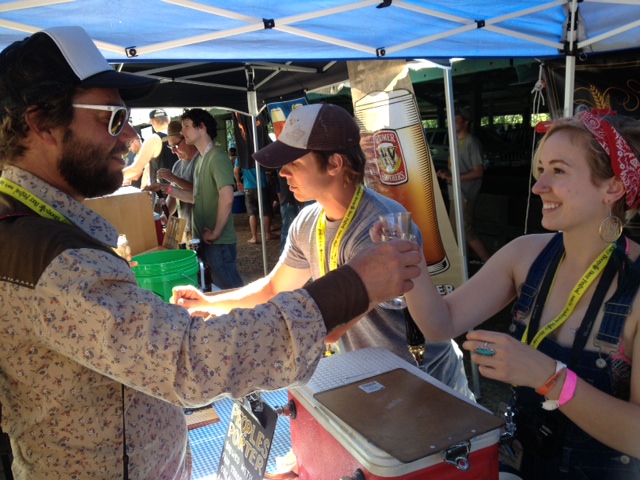
Boonville is no refined urban pourfest. “This is the beer festival you have to go to,” confirmed a crew member of Concord’s Black Diamond Brewing. If you enjoy sweeping mountain landscapes, 90 degree heat, and beer from across the state, you will agree. Boontville is epic, one-day setting for the 60-some breweries on tap each year.

>>CHECK OUT OUR SLIDESHOW FROM BOONVILLE 2012

Tips gathered around the campfire the night before the one-day festival: drink slowly, don’t drop your tasting cup, don’t get stuck in the fairground’s horse corral, keep an eye out for the actual indoors bathrooms for a break from the Port-a-Pots. 

I’ll admit I fell back on the stalwart Hell or High Watermelon Wheat ale from the home team 21st Amendment Brewery. I am not an ironclad beer drinker and by my way of thinking, the 90 degree heat that ruled May 11 in Anderson Valley was not ideal for coffee stouts no matter how delicious. Pro drinkers avoided joining in on the standard beer fest hollering that hails a dropped tasting cup, and focused their energies on finding the off-menu small-batch specialties being poured, like Black Diamond’s brandy barrel-aged Grand Cru. 

SF’s thriving microbrew scene was well-represented by Speakeasy, Magnolia, Pacific Brewing Lab. The city kids were joined by scores of breweries from across the state — Sacramento’s Rubicon, San Diego’s Societe, and the coastal Pizza Port were a few of the exciting new brews we tried. 

Beer’s great and all, but Boonville’s small-town trappings made a bright day of beer-drinking a cultural event.

The Anderson Valley Lion’s Club was selling BBQ tri-tip sandwitches for $10 ($12 with veggies.) I’m not big on the mammal-eating, so my boozy friend suggested I ask them for a grilled cheese. Larry Lombard, a Lion of 25 years and self-described “wingnut over in Boonville — that makes me a flyboy,” told me I was SOL on veg-friendly eats at the Lion’s tent. No big deal — proceeds from the festival go to fund the Club’s two college scholarships, given out yearly to local high school students, and judging from the tent’s traffic, they were going to make some academic dreams come true this year.

“This year it looks like it’s going to be good,” Lombard said. “We try just as hard on the bad years as the good years, though.”

Tucked away in the shade, the well-coiffed ladies of Anderson Valley Historical Society were working hard selling water bottles and Boontling dictionaries for donations and fending off the advances of dehydrated gentlemen. 

Boontling in action

“A lot of the stuff has sexual connotations.” (Forgive me, gray-haired angel, for not writing down your name! Blame the Watermelon Wheat.) The ladies and I were discussing Boontling, whose origins are debated. Was it created by the local fishermen, as written in the dimunitive Boontling dictionary I took home, or as the apple farmer told us and I prefer to believe, invented as a code used by the local wenches to throw shade at the city wife some poor Boont man brought home with him? 

At any rate, the verbal language was first officially studied by a California State University-Chico professor named Charles Adams. The dialect is largely referential, meaning most words originate from local landmarks. Maybe your cousin Sandy is a little slutty (this being the example used by the apple farmer) — you’ll sub in the word “Sandy” for “floozy.” The adding on of new words to see if your conversation partner will catch it is referred to as “sharking,” making Boontling a dynamic language. 

Maybe. “I think it’s gonna die,” said the Historical Society expert. “However, there seems to be interest in it now.” Mainly from the media, she said. She directed me to town’s two premier Boontling linguists for more info. She had one the guys’ digits memorized. 

Here are some of my fave words from the Boontling mini-dictionary I copped, entitled A Wee Deek on Boont Harpin’s (A Little Look at Boont Talking). I advise memorizing them and trying not to irritate the locals using them when you make the trip up north for next spring’s fest: 

Apple head: girl friend

Burlapper: (not actually in dictionary, but the ladies of the Historical Society urged me to write it down, “burlapper” being some sort of four-letter word serving as both noun and verb)

Jeekus: donkey or mule

Jimheady: confused; unclear mentally; suffering from a bad hangover

Tidrik: a party

Wilk: a wild cat

Pickem up billies: dirty men’s socks (!?)

Stage listings

0

Stage listings are compiled by Guardian staff. Performance times may change; call venues to confirm. Reviewers are Robert Avila, Rita Felciano, and Nicole Gluckstern. Submit items for the listings at listings@sfbg.com.

THEATER

OPENING

Black Watch Drill Court, Armory Community Center, 333 14th St, SF; www.act-sf.org. $100. Previews Thu/9-Sat/11, 8pm. Opens Sun/12, 7pm. Runs Tue-Sat, 8pm (Tue/14, show at 7pm; also Wed and Sat, 2pm); Sun, 2pm. Through June 16. American Conservatory Theater presents the National Theatre of Scotland’s internationally acclaimed performance about Scottish soldiers serving in Iraq.

Vital Signs: The Pulse of an American Nurse Marsh San Francisco, 1062 Valencia, SF; www.themarsh.org. $15-50. Opens Sun/12, 7pm. Runs Sun, 7pm. Through June 16. Registered nurse Alison Whittaker returns to the Marsh with her behind-the-scenes show about working in a hospital.

ONGOING

Acid Test: The Many Incarnations of Ram Dass Marsh San Francisco, 1062 Valencia, SF; www.themarsh.org. $15-50. Fri, 8pm; Sat, 5pm (Sat/11, show at 8pm). Through May 18. Playwright Lynne Kaufman invites you to take a trip with Richard Alpert, a.k.a. Ram Dass (Warren David Keith), as he recounts times high and low in this thoughtful, funny, and sometimes unexpected biographical rumination on the quest for truth and meaning in a seemingly random life by one of the big wigs of the psychedelic revolution and (with his classic book, Be Here Now) contemporary Eastern-looking spirituality. Directed by Joel Mullennix, the narrative begins with Ram Dass today, in his Hawaiian home and partly paralyzed from a stroke, but Keith (one of the Bay Area’s best stage actors, who is predictably sure and engagingly multilayered in the role) soon shakes off the stiff arm and strained speech and springs to his feet to continue the narrative as the ideal self perhaps only transcendental consciousness and theater allow. Nevertheless, Kaufman’s fun-loving and extroverted Alpert is no saint and no model of perfection, which is the refreshing truth explored in the play, but rather a seeker still, ever imperfect and ever trying for greater perfection or at least the wisdom of acceptance. As the privileged queer child of a wealthy Jewish lawyer and industrialist, Alpert was both insider and outsider from the get-go, and that tension and ambiguity makes for an interesting angle on his life as well as the complexities of his relationships with a homophobic Leary, for instance, and his conservative but ultimately loving father. Perfection aside, the beauty in the subject and the play is the subtle, shrewd cherishing of what remains unfinished. (Avila)

Boomeraging: From LSD to OMG Marsh San Francisco, 1062 Valencia, SF; www.themarsh.org. $15-50. Tue, 8pm. Through May 28. Comedian Will Durst performs his brand-new solo show.

Dirty Dancing: Live! Dark Room, 2263 Mission, SF; dirtydancinglive-fbe.eventbrite.com. $20. Fri-Sat, 8pm. Through May 25. Watermelons will be carried, lifts will be attempted, eyes will be hungry, and nobody better put Baby in a corner.

Foodies! The Musical Shelton Theater, 533 Sutter, SF; www.foodiesthemusical.com. $30-34. Fri-Sat, 8pm. Open-ended. AWAT Productions presents Morris Bobrow’s musical comedy revue all about food.

Last Love Mojo Theatre, 2940 16th St, SF; www.mojotheatre.com. $17-30. Thu-Sun, 8pm. Through May 19. Will the apocalypse save us from ourselves? Mojo Theater again raises that question as it presents the second installment in director-playwright Peter Papadopoulos’ Love-Gone-Wrong-at-the-End-of-the-World trilogy, the follow-up to last season’s fertile and funny Lost Love. The story centers on a George and Martha-esque couple, Charles (Jonathan Bender) and Lucida (Kimberly Lester), who on the eve of their fifth wedding anniversary declare all-out war, lobbing younger lovers at each other only to find their new partners (played by an increasingly endearing Michael Saenz and an unexpectedly powerful Gloria McDonald) have a past together and unresolved issues of their own. The grimly romantic comedy returns to, without greatly elaborating on, a familiar fantasy: blowing away the haze of our fractious, insecure, and muddled love lives in the clarifying immediacy of disaster. That this may be more than pure fantasy — that the seemingly discrete realms of personal and political trauma may be in some subtle and profound way connected — is an animating dimension of the trilogy, but here in a more superficial and perfunctory fashion than in Lost Love. The strength of the production lies less in its premise than in the penetrating humor and emotional veracity in Papadopoulos’ sure, heightened dialogue, which is played generally well by the cast and exceptionally so by a vibrantly intelligent Lester, Mojo’s co–artistic director. The staging also benefits, albeit inconsistently, from a stylized approach that revels in self-conscious artifice (including a trio of stage managers from “Command Center Communications,” a video-backdrop by Micah Stieglitz, and some light choreography by Lester). These strengths lend a restless, occasionally inspired production a slow-burning charm, but leave one wondering what might be left when all the dust settles. (Avila)

Little Me Eureka Theatre, 215 Jackson, SF; www.42ndstreetmoon.org. $25-75. Wed, 7pm; Thu-Fri, 8pm; Sat, 6pm. Through May 19. 42nd Street Moon performs Neil Simon’s outrageous musical.

The Lost Folio: Shakespeare’s Musicals Un-Scripted Theater, 533 Sutter, Second Flr, SF; www.un-scripted.com. $10-20. Thu-Sat, 8pm. Through May 18. Un-Scripted Theater Company performs a fully-improvised, full-length musical inspired by Shakespeare.

The Merry Wives of Windsor Buriel Clay Theater, African American Art and Culture Complex, 762 Fulton, SF; www.african-americanshakes.org. $10-35. Sat, 8pm; Sun, 3pm. Through May 26. African-American Shakespeare Company performs a twist on the Shakespeare classic, set in an urban neighborhood in the 1950s.

“PlayGround Festival of New Works” Various venues, SF and Berk; www.playground-sf.org. $15-40. Through May 26. The 17th fest presented by “San Francisco’s incubator for a new generation of playwrights” includes the PlayGround Film Festival, staged readings of four new full-length plays, a fully-produced program of six short plays, panel discussions, and more.

reasons to be pretty San Francisco Playhouse, 450 Post, Second Flr, SF; www.sfplayhouse.org. $30-100. Wed/8-Thu/9, 7pm; Fri/10-Sat/11, 8pm (also Sat/11, 3pm). Completing a trilogy of plays about body awareness and self-image (along with The Shape of Things and Fat Pig), Neil LaBute’s reasons to be pretty begins with a misconstrued remark that quickly gathers enough weight and momentum to tear three sets of relationships apart in the span of a two-hour play. The SF Playhouse production begins with a bang, or rather an awesomely knock-down, blow-out breakup fight between a righteously pissed-off Steph (Lauren English) and her awkwardly passive boyfriend Greg (Craig Marker), who has inadvertently referred to her as “regular” in a conversation with his jerkish buddy Kent (Patrick Russell), which she takes to mean he finds her ugly. English’s Steph is at turns ferocious and fragile, and her comic timing as she eviscerates Greg’s looks in a mall food court zings, while the hyperkinetic Russell elevates the condition of noxiously irredeemable douchebag to an art form. But terrific acting and polished design can only make up so much for a script that feels not only flawed, barely scratching the surface of the whys and wherefores each character has internalized an unrealistic view of the importance of conventional beauty standards, but also already dated, with its circa-2008 pop culture references. Ultimately it gives the impression of being a rerun of a Lifetime television drama that wraps itself up into a too-neat package just in time for the final credits to roll to its admittedly kickass soundtrack (provided by Billie Cox). (Gluckstern)

Sam I Am: A Processional of Short Plays and Prose About Samuel Beckett Bindlestiff Studio, 185 Sixth St, SF; www.pustheatre.com. $10-20. Fri/10-Sat/11, 8pm. Performers Under Stress remounts and revamps its series of short plays and pieces by Samuel Beckett, this time staging it throughout the basement quarters of Bindlestiff Studio, where audiences are led around an economical maze of performance spaces. Opening weekend consisted of too much text and too little in way of staging ideas, especially with several spoken selections of Beckett prose (which have reportedly since been dropped from the program). The best of what remains (in a program of six short plays total) includes Valerie Fachman’s respectable performance as the disembodied “mouth” of the brilliant Not I; and James Udom and Geo Epsilany’s duet in Rough for Theatre I, in which a wheelchair-bound food-hoarder (a softly eccentric Epsilany) strikes up a doomed friendship with a blind beggar (a solid Udom) amid a colorless and barren landscape. The bucket of Beckett dreary gets less satisfying from there, though director Scott Baker’s wordless performance as the titular Joe in Eh Joe proves poised and the doubled voices in his head (by Melissa Clason and Allison Hunter Blackwell) both haunting and intriguing. (Avila)

Sex and the City: LIVE! Rebel, 1760 Market, SF; trannyshack.com/sexandthecity. $25. Wed, 7 and 9pm. Open-ended. It seems a no-brainer. Not just the HBO series itself — that’s definitely missing some gray matter — but putting it onstage as a drag show. Mais naturellement! Why was Sex and the City not conceived of as a drag show in the first place? Making the sordid not exactly palatable but somehow, I don’t know, friendlier (and the canned a little cannier), Velvet Rage Productions mounts two verbatim episodes from the widely adored cable show, with Trannyshack’s Heklina in a smashing portrayal of SJP’s Carrie; D’Arcy Drollinger stealing much of the show as ever-randy Samantha (already more or less a gay man trapped in a woman’s body); Lady Bear as an endearingly out-to-lunch Miranda; and ever assured, quick-witted Trixxie Carr as pent-up Charlotte. There’s also a solid and enjoyable supporting cast courtesy of Cookie Dough, Jordan Wheeler, and Leigh Crow (as Mr. Big). That’s some heavyweight talent trodding the straining boards of bar Rebel’s tiny stage. The show’s still two-dimensional, even in 3D, but noticeably bigger than your 50″ plasma flat panel. (Avila)

Steve Seabrook: Better Than You Marsh San Francisco, 1062 Valencia, SF; www.themarsh.org. $15-50. Thu, 8pm; Sat, 8:30pm. Extended through May 18. Self-awareness, self-actualization, self-aggrandizement — for these things we turn to the professionals: the self-empowerment coaches, the self-help authors and motivational speakers. What’s the good of having a “self” unless someone shows you how to use it? Writer-performer Kurt Bodden’s Steve Seabrook wants to sell you on a better you, but his “Better Than You” weekend seminar (and tie-in book series, assorted CDs, and other paraphernalia) belies a certain divided loyalty in its own self-flattering title. The bitter fruit of the personal growth industry may sound overly ripe for the picking, but Bodden’s deftly executed “seminar” and its behind-the-scenes reveals, directed by Mark Kenward, explore the terrain with panache, cool wit, and shrewd characterization. As both writer and performer, Bodden keeps his Steve Seabrook just this side of overly sensational or maudlin, a believable figure, finally, whose all-too-ordinary life ends up something of a modest model of its own. (Avila)

Talk Radio Actors Theatre of San Francisco, 855 Bush, SF; www.actorstheatresf.org. $26-38. Wed-Sat, 8pm. Through June 15. Actors Theatre of San Francisco performs Eric Bogosian’s breakthrough 1987 drama.

Tinsel Tarts in a Hot Coma: The Next Cockettes Musical Hypnodrome, 575 10th St, SF; www.thrillpeddlers.com. $30-35. Thu-Sat, 8pm. Through June 1. Thrillpeddlers and director Russell Blackwood continue their Theatre of the Ridiculous series with this 1971 musical from San Francisco’s famed glitter-bearded acid queens, the Cockettes, revamped with a slew of new musical material by original member Scrumbly Koldewyn, and a freshly re-minted book co-written by Koldewyn and “Sweet Pam” Tent — both of whom join the large rotating cast of Thrillpeddler favorites alongside a third original Cockette, Rumi Missabu (playing diner waitress Brenda Breakfast like a deliciously unhinged scramble of Lucille Ball and Bette Davis). This is Thrillpeddlers’ third Cockettes revival, a winning streak that started with Pearls Over Shanghai. While not quite as frisky or imaginative as the production of Pearls, it easily charms with its fine songs, nifty routines, exquisite costumes, steady flashes of wit, less consistent flashes of flesh, and de rigueur irreverence. The plot may not be very easy to follow, but then, except perhaps for the bubbly accounting of the notorious New York flop of the same show 42 years ago by Tent (as poisoned-pen gossip columnist Vedda Viper), it hardly matters. (Avila)

The Waiting Period Marsh San Francisco, 1062 Valencia, SF; www.themarsh.org. $25-50. Fri, 8pm; Sat, 5pm. Through May 18. Brian Copeland (comedian, TV and radio personality, and creator-performer of the long-running solo play Not a Genuine Black Man) returns to the Marsh with a new solo, this one based on more recent and messier events` in Copeland’s life. The play concerns an episode of severe depression in which he considered suicide, going so far as to purchase a handgun — the title coming from the legally mandatory 10-day period between purchasing and picking up the weapon, which leaves time for reflections and circumstances that ultimately prevent Copeland from pulling the trigger. A grim subject, but Copeland (with co-developer and director David Ford) ensures there’s plenty of humor as well as frank sentiment along the way. The actor peoples the opening scene in the gun store with a comically if somewhat stereotypically rugged representative of the Second Amendment, for instance, as well as an equally familiar “doood” dude at the service counter. Afterward, we follow Copeland, a just barely coping dad, home to the house recently abandoned by his wife, and through the ordinary routines that become unbearable to the clinically depressed. Copeland also recreates interviews he’s made with other survivors of suicidal depression. Telling someone about such things is vital to preventing their worst outcomes, says Copeland, and telling his own story is meant to encourage others. It’s a worthy aim but only a fitfully engaging piece, since as drama it remains thin, standing at perhaps too respectful a distance from the convoluted torment and alienation at its center. Note: review from an earlier run of the same production. (Avila)

The World’s Funniest Bubble Show Marsh San Francisco, 1062 Valencia, SF; www.themarsh.org. $8-50. Sun, 11am. Through July 21. Louis “The Amazing Bubble Man” Pearl returns after a month-long hiatus with his popular, kid-friendly bubble show.

BAY AREA

The Arsonists Aurora Theatre, 2081 Addison, Berk; www.auroratheatre.org. $35-60. Wed/8-Sat/11, 8pm; Sun/12, 2 and 7pm. There’s a lot of humor to be found in Alistair Beaton’s crackling translation of Max Frisch’s The Arsonists, playing now at the Aurora Theatre, but much of the laughter it elicits is of the nervous variety, as the play’s mostly protagonist, the effete, bourgeois Herr Biedermann (Dan Hiatt) inadvertently signs off on his own destruction when he invites an uncouth arsonist to come and stay in his attic (Michael Ray Wisely). “If we assume everyone is an arsonist, where does that get us?” becomes his standard deflection, as one arsonist becomes two (adding in the unctuous, nihilistic Tim Kniffin), and the empty attic a repository for giant drums of gasoline, a detonator, and fuse wire — arousing the suspicions of a chorus of firefighters (Kevin Clarke, Tristan Cunningham, Michael Uy Kelly), who act as the conscience and guardians of the township. Although on the surface the scenario is patently absurd, the message that passivity in the face of evil is like helping to measure out the fuse wire that will eventually claim your life, is relatively clear. “Not every fire is determined by fate,” point out the firefighters right in the first act. Hiatt, as Biedermann, strikes an admirable balance between loathsome and powerless, while Gwen Loeb shines as his socialite wife, Babette, as does Dina Percia as his agitated housemaid, Anna. (Gluckstern)

The Dead Girl Avant Garde, 1328 Fourth St, San Rafael; www.altertheater.org. $25. Wed, 7:30pm; Fri-Sat, 8pm; Sun, 3pm. Through May 19. AlterTheater performs 90-year-old playwright Ann Brebner’s new family drama.

A Killer Story Marsh Berkeley, 2120 Allston, Berk; www.themarsh.org. $20-50. Thu-Sat, 8pm (pre-show cabaret at 7:15pm). Through May 18. Dan Harder’s film noir-inspired detective tale premieres at the Marsh Berkeley.

Pericles, Prince of Tyre Berkeley Repertory Theatre, 2025 Addison, Berk; www.berkeleyrep.org. $29-77. Tue, Thu-Sat, 8pm (also Sat and May 23, 2pm; no show May 24); Wed and Sun, 7pm (also Sun, 2). Through May 26. Mark Wing-Davey directs Berkeley Rep’s take on the Bard.

PERFORMANCE/DANCE

“Bailout! Or can you picture this prophecy? The temperatures are too hot for me.” Dance Mission Theater, 3316 24th St, SF; www.brownpapertickets.com. Fri/10-Sun/12, 8pm. Pay what you can. Navarrete x Kajiyama Dance Theater perform a site-specific multidisciplinary performance inspired by environmental disasters.

“Bitch and Tell: A Real, Funny Show” Garage, 715 Bryant, SF; www.ftloose.org. Sat/11, 8pm. $8-10. Comedy with Tracy Shapiro, Carolé Acuña, Allison Mick, and more.

“Bob’s Burgers Live!” Nob Hill Masonic Auditorium, 1111 California, SF; http://bit.ly/bobssanfrancisco. Sat/11, 8pm. $32.50. The cast of the animated series performs.

“Bound for Glory” Marsh San Francisco, 1062 Valencia, SF; www.themarsh.org. Fri/10, 7:30pm; Sat/11, 2pm. $8-50. Marsh Youth Theater’s MainStage Performance Ensemble presents a musical (written by the ensemble with director Lisa Quoresimo) about a Dust Bowl-era family.

Caroline Lugo and Carolé Acuña’s Ballet Flamenco Peña Pachamama, 1630 Powell, SF; www.carolinalugo.com. Sun/12, 3 and 6:15pm. $29.95-49.95 (includes meal). Flamenco performance by the mother-daughter dance company, featuring live musicians.

“Comedy Returns to El Rio” El Rio, 3158 Mission, SF; www.elriosf.com. Mon/13, 8pm. $7-20. Fourth anniversary show with Frankie Quiñones, Dan St. Paul, Aundre the Wonderwoman, and more.

“The Fantasticks” Mission Dolores Academy Auditorium, 3371 16th St, SF; www.16thstreetplayers.org. Fri/10 and Sat, 7:30pm (also Sat/11, 3pm); Sun, 3pm. Through May 19. Free. The 16th Street Players perform the classic musical.

“I Am a Lie that Always Tells the Truth” Garage, 715 Bryant, SF; www.kingdomofnot.com. Fri/10, 8pm. $10-20. The Kingdom of Not (Dan Carbone and Andrew Goldfarb) perform “music, monologues, and emergency dispatches.”

“ImmigraNation” Punchline Comedy Club, 444 Battery, SF; www.punchlinecomedyclub.com. Tue/14, 8pm. $15. Comedy about the immigrant experience with Dhaya Lakshminarayanan, Samson Koletkar, and more.

“Mission Position Live” Cinecave, 1034 Valencia, SF; www.missionpositionlive.com. Thu, 8pm. Ongoing. $10. Stand-up comedy with rotating performers.

“Mortified” DNA Lounge, 373 11th St, SF; www.getmortified.com. Fri/10, 7:30pm. $21. Also Sat/11, 7:30pm, $20. Uptown, 1928 Telegraph, Oakl. The storytelling series, which specializes in all things embarassing, ups the ante with a Mother’s Day theme this month.

“Mutant Creatures and Unlikely Teachers: Short Plays by Short People” Koret Auditorium, De Young Museum, Golden Gate Park, SF; www.stagewright.org. Tue/14, 11am. Free (advance reservations required). Also May 16, 6:30pm ($10) and May 17, 7pm ($50; fundraiser for StageWright program), Brava Theater Center, 2781 24th St, SF; www.stagewright.org. StageWright presents plays by fifth graders at Starr King Elementary School, performed by professional actors and museums.

“Once in Love with Loesser” Eureka Theatre, 215 Jackson, SF; www.42ndstreetmoon.org. Mon/13-Tue/14, 7pm. $45-70. 42nd Street Moon presents Tony nominee Emily Skinner performing songs by Frank Loesser.

Red Hots Burlesque El Rio, 3158 Mission, SF; www.redhotsburlesque.com. Wed, 7:30-9pm. Ongoing. $5-10. Come for the burlesque show, stay for OMG! Karaoke starting at 8pm (no cover for karaoke).

San Francisco Ballet War Memorial Opera House, 301 Van Ness, SF; www.sfballet.org. Wed/8, 7:30pm; Thu/9-Sat/11, 8pm (also Sat/11, 2pm); Sun/12, 2pm. $45-250. Performing the US premiere of Christopher Wheeldon’s Cinderella.

“San Francisco Magic Parlor” Chancellor Hotel Union Square, 433 Powell, SF; www.sfmagicparlor.com. Thu-Sat, 8pm. Ongoing. $40. Magic vignettes with conjurer and storyteller Walt Anthony.

Smuin Ballet Yerba Buena Center for the Arts, 701 Mission, SF; www.smuinballet.org. Fri-Sat and May 16, 8pm (also Sat, 2pm); Sun, 2pm. Through May 19. $24-65. Also May 22-25, 8pm (also May 25, 2pm); May 26, 2pm. $52-68. Mountain View Center for the Performing Arts, 500 Castro, Mtn View. Also May 31-June 1, 8pm (also June 1, 2pm). $54-70. Lesher Center for the Arts, 1601 Civic, Walnut Creek. The company presents the West Coast premiere of Helen Pickett’s Petal and Darrell Grand Moultrie’s JAZZIN’, among other works.

“A Spaghetti Western” Stage Werx Theatre, 446 Valencia, SF; www.clownsnotbombs.com. Fri/10-Sat/11, 8pm (also Sat/11, 2pm). $15-20. ClownSnotBombs performs a circus adventure about pasta and the Wild West.

“Stretchmarks” Creativity Theater, Children’s Creativity Museum, 221 Fourth St, SF; www.themommadrama.com. Fri/10-Sat/11, 8pm. $25. The Momma Drama presents this play as part of a mom-centric event on Mother’s Day.

“Union Square Live” Union Square, between Post, Geary, Powell, and Stockton, SF; www.unionsquarelive.org. Through Oct 9. Free. Music, dance, circus arts, film, and more; dates and times vary, so check website for the latest.

“Yerba Buena Gardens Festival” Yerba Buena Gardens, Mission between 3rd and 4th Sts, SF; www.ybgfestival.org. Through Oct 15. Free. This week: “Asian Improv aRts: 25th Anniversary: Traditions in Transformation,” Sat/11, 1-3pm; “Taiwan in the Gardens,” Sun/12, 1-2:30pm.

BAY AREA

Company C Contemporary Ballet Lesher Center for the Arts, 1601 Civic, Walnut Creek; www.lesherartscenter.org. Thu/9-Sat/11, 8pm; Sun/12, 1pm. $23-45. The company’s spring program features Natoma, a world premiere by Company C dancer David von Ligon.

Eifman Ballet of St. Petersburg Zellerbach Hall, Bancroft at Telegraph, UC Berkeley, Berk; www.calperformances.org. Fri/10-Sat/11, 8pm; Sun/12, 3pm. $30-92. The company performs the Bay Area premiere of its latest ballet, Rodin.

“A History of the Body” Oakland Asian Cultural Center, 388 Ninth St, #290, Oakl; historyofbody.eventbrite.com. Sat/11, 7:30pm. $15-25. Work-in-progress performance of Aimee Suzara’s new play.

Oakland Ballet Malonga Casquelourd Center for the Arts, 1428 Alice, Oakl; www.oaklandballet.org. Fri/10-Sat/11, 8pm (also Sat, 2pm). $20-35. The company performs its spring season program, “Diaghilev Imagery.”

“The Shout: Life’s True Stories” Grand Lake Coffee House, 440 Grand, Oakl; www.theshoutstorytelling.com. Mon/13, 7:30pm. $5-20. Ten-minute tales from a variety of storytellers.

“Swearing in English: Tall Tales at Shotgun” Ashby Stage, 1901 Ashby, Berk; www.shotgunplayers.org. June 3 and 17, 8pm. $15. Shotgun Cabaret presents John Mercer in a series of three stranger-than-fiction dramatic readings.

Film listings

0

Film listings are edited by Cheryl Eddy. Reviewers are Kimberly Chun, Dennis Harvey, Lynn Rapoport, and Sara Maria Vizcarrondo. For rep house showtimes, see Rep Clock.

SAN FRANCISCO INTERNATIONAL FILM FESTIVAL

The San Francisco International Film Festival runs through Thu/9 at the Castro Theatre, 429 Castro, SF; New People Cinema, 1746 Post, SF; Pacific Film Archive, 2575 Bancroft, Berk; and Sundance Kabuki Cinemas 1881 Post, SF. For tickets (most shows $10-15) and complete schedule, visit festival.sffs.org.

OPENING

The Crumbles The awkward slackers and damaged hipsters of The Crumbles live in a sun-strafed, paved-over Los Angeles habitat of coffee shops, taco trucks, bookstores, budding filmmakers, and living room band practice. Darla (Katie Hipol) is slouching nowhere fast when her zany, charismatic cool-girl chum Elisa (Teresa Michelle Lee) enters the picture, looking for a place to crash. Elisa’s wacky, erratic, and unreliable, but she’s also capable of generating real excitement — and a mean little keytar hook — and the girls’ band, the Crumbles, gets off the couch and threatens to get all involved to bust out of their shells. Though director Akira Boch never quite dips into the deep background of his characters’ various dysfunctions — the threatened readings of Darla and Elisa’s psychic friend never quite sheds light — the first-time feature filmmaker has a real feel for the drifting, up-for-anything quality of Cali 20-somethings and an appreciation for their highs and lows that makes this familiar, loving, lets-put-on-show-kids update compelling. (1:13) Roxie. (Chun)

The Great Gatsby Baz Luhrmann reunites with his Romeo + Juliet (1996) star Leonardo DiCaprio for this long-awaited 3D adaptation of F. Scott Fitzgerald’s classic novel. (2:22) California, Four Star, Marina, Presidio, Vogue.

Kiss of the Damned This first feature by Xan Cassavetes isn’t remotely like the Method-y angstfests her late father John used to direct (although he did act in upscale genre movies like 1968’s Rosemary’s Baby and 1978’s The Fury). Instead, it’s an homage to the erotic European horror movies of the late 1960s through early ’80s, with further nods to Dario Argento, 1983’s The Hunger, and other fan-bait. Mysterious Djuna (Joséphine de La Baume) is immediately attracted to hunky screenwriter Paolo (Milo Ventimiglia), and vice versa. But she’s reluctant to follow through, and when he presses, she explains why: she’s a vampire, albeit the respectable kind who only "hunts" wild animals. When he decides that is a drawback he can deal with, they seem set to spend an undead eternity together. Unfortunately, they soon get an unwelcome guest in Djuna’s sister Mimi (Roxane Mesquida), a classic "bad girl" type who has no such compunctions about feasting on "stupid humans," and whose recklessness threatens the cover of any associated fellow vampire. Like its models, Kiss drags at times, and probably will seem too arty and slow to those attuned to mainstream current horror cinema. But if you’re a dweeb enough to know who the likes of Jean Rollin and Jess Franco are, this aesthetically slavish (on a faithfully low budget) salute to their sexy-bloody vintage schlock should amuse, with Steven Hufsteter’s original score an encyclopedia of vintage Eurotrash soundtrack tropes. (1:37) Shattuck. (Harvey)

Love is All You Need Copenhagen hairdresser Ida (Trine Dyrholm) has just finished her cancer treatments — with their success still undetermined — when she arrives home to find her longtime husband Leif (Kim Bodnia) boning a coworker on their couch. "I thought you were in chemo" is the closest he comes to an apology before walking out. Ida is determined to maintain a cheerful front when attending the Italian wedding of their daughter Astrid (Molly Blixt Egelind) — even after emotionally deaf Leif shows up with his new girlfriend in tow. Meanwhile brusque businessman and widower Philip (Pierce Brosnan), the groom’s father, is experiencing the discomfort of returning to the villa he once shared with his beloved late wife. This latest from Danish director Susanne Bier and writing partner Anders Thomas Jensen (2006’s After the Wedding, 2004’s Brothers, 2010’s In a Better World) is more conventionally escapist than their norm, with a general romantic-seriocomedy air reinforced by travel-poster-worthy views of the picturesque Italian coastline. They do try to insert greater depth and a more expansive story arc than you’d get in a Hollywood rom com. But all the relationships here are so prickly — between middle-aged leads we never quite believe would attract each other, between the clearly ill-matched aspiring newlyweds, between Paprika Steen’s overbearing sister in-law and everyone — that there’s very little to root for. It’s a romantic movie (as numerous soundtracked variations on "That’s Amore" constantly remind us) in which romance feels like the most contrived element. (1:50) Embarcadero. (Harvey)

Peeples Kerry Washington and Diahann Carroll star in this Tyler Perry-produced family drama set in the Hamptons. (1:35)

Scatter My Ashes at Bergdorf’s This glossy love letter to posh New York City department store Bergdorf Goodman — a place so expensive that shopping there is "an aspirational dream" for the grubby masses, according to one interviewee — would offend with its slobbering take on consumerism if it wasn’t so damn entertaining. The doc’s narrative of sorts is propelled by the small army assembled to create the store’s famed holiday windows; we watch as lavish scenes of upholstered polar bears and sea creatures covered in glittering mosaics (flanking, natch, couture gowns) take shape over the months leading up to the Christmas rush. Along the way, a cavalcade of top designers (Michael Kors, Vera Wang, Giorgio Armani, Jason Wu, Karl Lagerfeld) reminisce on how the store has impacted their respective careers, and longtime employees share anecdotes, the best of which is probably the tale of how John Lennon and Yoko Ono saved the season by buying over 70 fur coats one magical Christmas Eve. Though lip service is paid to the current economic downturn (the Madoff scandal precipitated a startling dropoff in personal-shopper clients), Scatter My Ashes is mostly just superficial fun. What do you expect from a store whose best-selling shoe is sparkly, teeteringly tall, and costs $6,000? (1:33) Clay, Shattuck. (Eddy)

ONGOING

The Angels’ Share The latest from British filmmaker Ken Loach (2006’s The Wind that Shakes the Barley) and frequent screenwriter collaborator Paul Leverty contains a fair amount of humor — though it’s still got plenty of their trademark grit and realism. Offered "one last opportunity" by both a legal system he’s frequently disregarded and his exasperated and heavily pregnant girlfriend, ne’er-do-well Glaswegian Robbie (Paul Brannigan) resolves to straighten out his life. But his troubled past proves a formidable roadblock to a brighter future — until he visits a whiskey distillery with the other misfits he’s been performing his court-ordered community service with, and the group hatches an elaborate heist that could bring hope for Robbie and his growing family … if his gang of "scruffs" can pull it off. Granted, there are some familiar elements here, but this 2012 Cannes jury prize winner (the fest’s de facto third-place award) is more enjoyable than predictable — thanks to some whiskey-tasting nerd-out scenes, likable performances by its cast of mostly newcomers, and lines like "Nobody ever bothers anybody wearing a kilt!" (not necessarily true, as it turns out). Thankfully, English subtitles help with the thick Scottish accents. (1:41) Opera Plaza, Smith Rafael. (Eddy)

At Any Price Growing up in rural Iowa very much in the shadow of his older brother, Dean Whipple (Zac Efron) cultivated a chip on his shoulder while dominating the figure 8 races at the local dirt track. When papa Henry (Dennis Quaid) — a keeping-up-appearances type, with secrets a-plenty lurking behind his good ol’ boy grin — realizes Dean is his best hope for keeping the family farm afloat, he launches a hail-mary attempt to salvage their relationship. This latest drama from acclaimed indie director Ramin Bahrani (2008’s Goodbye Solo) is his most ambitious to date, enfolding small-town family drama and stock-car scenes into a pointed commentary on modern agribusiness (Henry deals in GMO corn, and must grapple with the sinister corporate practices that go along with it). But the film never gels, particularly after an extreme, third-act plot twist is deployed to, um, hammer home the title — which refers to prices both monetary and spiritual. A solid supporting cast (Kim Dickens, Heather Graham, Clancy Brown, Red West, newcomer Maika Monroe) helps give the film some much-needed added weight as it veers toward melodrama. (1:45) SF Center. (Eddy)

The Big Wedding The wedding film has impacted our concepts of matrimony, fashion, and marital happiness more than all the textbooks in the world have affected our national testing average; but it’s with that margin of mediocrity I report from the theater trenches of The Big Wedding. With this, the wedding movie again peters to a crawl. Susan Sarandon (an actress I love with a loyalty beyond sense) is Bebe, the stepmother/caterer swept under the rug by the selfishness of her live in lover Don (De Niro), his ex-wife/baby momma Elle (Diane Keaton) and their racist wackjob future in-laws. When Don and Elle faced the end of their marriage, they tried to rekindle with a Columbian orphan. Cue Ben Barnes in brownface. Alejandro is set to wed Amanda Seyfried and when his mother ascends from Columbia for the wedding, he decides Don and Elle have to act like their marriage never ended &ldots; which makes Bebe a mistress. Surprise! A decade of caring selflessly for your lover’s kids has won you a super shitty wedding you still have to cater! To give you a sense of the conflict management on display, Bebe — the film’s graceful savior —drops a drink on Don before fleeing the scene in her Alfa Romeo; she’s the one character not determined to act out her more selfish urges in the style of an MTV reality show. Despite some less imaginative conflicts and degrading "solutions," this blended family still speaks some truth about the endearing embarrassment of the happy family. (1:29) 1000 Van Ness, SF Center. (Vizcarrondo)

Blancanieves If you saw the two crappy overblown Hollywood takes on Snow White last year, my condolences. This is probably its best cinematic incarnation ever not made by someone called Walt. Pablo Berger’s Blancanieves transplants the tale to 1920s Spain and told (à la 2011’s The Artist) in the dialogue-free B&W style of that era’s silent cinema. Here, Snow is the daughter of a famous bullfighter (a beautiful performance by Daniel Giménez Cacho) who’s paralyzed physically in the ring, then emotionally by the death of his flamenco star wife (Inma Cuesta) in childbirth. He can’t bring himself to see his daughter until a grandmother’s death brings little Carmencita (the marvelous Sofía Oria) to the isolated ranch he now shares with nurse-turned-second-wife Encarna — Maribel Verdú as a very Jazz Age evil stepmother. Once the girl matures (now played by the ingratiating, slightly androgynous Macarena García), Encarna senses a rival, and to save her life Carmen literally runs away with the circus — at which point the narrative slumps a bit. But only a bit. Where The Artist was essentially a cleverly sustained gimmick elevated by a wonderful central performance, Blancanieves transcends its ingenious retro trappings to offer something both charming and substantiative. Berger doesn’t treat the story template as a joke — he’s fully adapted it to a culture, place, and time, and treats its inherent pathos with great delicacy. (1:44) Opera Plaza, Shattuck, Smith Rafael. (Harvey)

The Company You Keep Robert Redford directs and stars as a fugitive former member of the Weather Underground, who goes on the run when another member (Susan Sarandon) is arrested and a newspaper reporter (Shia LaBeouf) connects him to a murder 30 years earlier during a Michigan bank robbery. Both the incident and the individuals in The Company You Keep are fictive, but a montage of archival footage at the start of the film is used to place them in the company of real-life radicals and events from the latter days of the 1960s-’70s antiwar movement. (The film’s timeline is a little hard to figure, as the action seems to be present day.) Living under an assumed name, Redford’s Nick Sloan is now a recently widowed public interest lawyer with a nine-year-old daughter, still fighting the good fight from the suburbs of Albany, NY — though some of his movement cohorts would probably argue that point. And as Nick heads cross-country on a hunt for one of them who’s still deep underground, and LaBeouf’s pesky reporter tussles with FBI agents (Terrance Howard and Anna Kendrick) and his besieged editor (Stanley Tucci) — mostly there to pass comment on print journalism’s precipitous decline — there’s plenty of contentious talk, none of it particularly trenchant or involving. Redford packs his earnest, well-intentioned film with stars delineating a constellation of attitudes about revolution, justice, and violent radical action — Julie Christie as an unrepentant radical and Nick’s former lover, Nick Nolte and Richard Jenkins as former movement members, Brendan Gleeson as a Michigan police detective involved in the original investigation, Chris Cooper as Nick’s estranged and disapproving younger brother. But their scrutiny, and the film’s, feels blurry and rote, while the plot’s one major twist seems random and is clumsily exposed. (2:05) Albany, SF Center. (Rapoport)

The Croods (1:38) Metreon, 1000 Van Ness.

Disconnect (1:55) 1000 Van Ness, Presidio, SF Center.

Evil Dead "Sacrilege!" you surely thought when hearing that Sam Raimi’s immortal 1983 classic was being remade. But as far as remakes go, this one from Uruguayan writer-director Fede Alvarez (who’d previously only made some acclaimed genre shorts) is pretty decent. Four youths gather at a former family cabin destination because a fifth (Jane Levy) has staged her own intervention — after a near-fatal OD, she needs her friends to help her go cold turkey. But as a prologue has already informed us, there is a history of witchcraft and demonic possession in this place. The discovery of something very nasty (and smelly) in the cellar, along with a book of demonic incantations that Lou Taylor Pucci is stupid enough to read aloud from, leads to … well, you know. The all-hell that breaks loose here is more sadistically squirm-inducing than the humorously over-the-top gore in Raimi’s original duo (elements of the sublime ’87 Evil Dead II are also deployed here), and the characters are taken much more seriously — without, however, becoming more interesting. Despite a number of déjà vu kamikaze tracking shots through the Michigan forest (though most of the film was actually shot in New Zealand), Raimi’s giddy high energy and black comedy are replaced here by a more earnest if admittedly mostly effective approach, with plenty of decent shocks. No one could replace Bruce Campbell, and perhaps it was wise not to even try. So: pretty good, gory, expertly crafted, very R-rated horror fun, even with too many "It’s not over yet!" false endings. But no one will be playing this version over and over and over again as they (and I) still do the ’80s films. (1:31) Metreon, 1000 Van Ness. (Harvey)

42 Broad and morally cautious, 42 is nonetheless an honorable addition to the small cannon of films about the late, great baseball player Jackie Robinson. When Dodgers owner Branch Rickey (Harrison Ford) declares that he wants a black player in the white major leagues because "The only real color is green!", it’s a cynical explanation that most people buy, and hate him for. It also starts the ball curving for a PR shitstorm. But money is an equal-opportunity leveling device: when Robinson (Chadwick Boseman) tries to use the bathroom at a small-town gas station, he’s denied and tells his manager they should "buy their 99 gallons of gas another place." Naturally the gas attendant concedes, and as 42 progresses, even those who reject Robinson at first turn into men who find out how good they are when they’re tested. Ford, swashbuckling well past his sell-by date, is a fantastic old coot here; his "been there, lived that" prowess makes you proud he once fled the path of a rolling bolder. His power moves here are even greater, but it’s ultimately Robinson’s show, and 42 finds a lot of ways to deliver on facts and still print the legend. (2:08) Metreon, 1000 Van Ness, Sundance Kabuki. (Vizcarrondo)

From Up on Poppy Hill Hayao (dad, who co-wrote) and Goro (son, who directed) Miyazaki collaborate on this tale of two high-school kids — Umi, who does all the cooking at her grandmother’s boarding house, and Shun, a rabble-rouser who runs the school newspaper — in idyllic seaside Yokohama. Plans for the 1964 Olympics earmark a beloved historic clubhouse for demolition, and the budding couple unites behind the cause. The building offers a symbolic nod to Japanese history, while rehabbing it speaks to hopes for a brighter post-war future. But the past keeps interfering: conflict arises when Shun’s memories are triggered by a photo of Umi’s father, presumed lost at sea in the Korean War. There are no whimsical talking animals in this Studio Ghibli release, which investigates some darker-than-usual themes, though the animation is vivid and sparkling per usual. Hollywood types lending their voices to the English-language version include Jamie Lee Curtis, Christina Hendricks, Ron Howard, and Gilllian Anderson. (1:31) Shattuck. (Eddy)

GI Joe: Retaliation The plot exists to justify the action, but any fan of badass-ness will forgive the skimpy storyline for the outlandish badassery in GI Joe: Retaliation. Inspired by action figures and tying loosely to the first flick, Retaliation starts with a game of "secure the defector," followed by "raise the flag," but as soon as the stakes aren’t real, the Joes outright suck. They don’t have "neutral," which is maybe why a mission to rescue and revive the Joes as a force is the most ferocious fight that ever pit metal against plastic. The set pieces are stunning: a mostly silent sequence with Snake Eyes (Ray Park) and Jinx (Elodie Yung) on a mountainside will leave the audience gaping in its high speed wake, and a prison break featuring covert explosives is nonstop amazing. You’ll notice an emphasis on chain link fences and puddles (terra nostra for action figures) and set pieces conceived as if by kids who don’t have a concept of basic irrefutable truths like gravity. It’s just that kind of imagination and ardor and limitlessness that makes this Joe incredible, memorable, and a reason to crack out your toys again. (1:50) Metreon. (Vizcarrondo)

In the House In François Ozon’s first feature since the whimsical 2010 Potiche, he returns somewhat to the playful suspense intrigue of 2003’s Swimming Pool, albeit with a very different tone and context. Fabrice Luchini plays a high school French literature teacher disillusioned by his students’ ever-shrinking articulacy. But he is intrigued by one boy’s surprisingly rich description of his stealth invasion into a classmate’s envied "perfect" family — with lusty interest directed at the "middle class curves" of the mother (Emmanuelle Seigner). As the boy Claude’s writings continue in their possibly fictive, possibly stalker-ish provocations, his teacher grows increasingly unsure whether he’s dealing with a precocious bourgeoisie satirist or a literate budding sociopath — and ambivalent about his (and spouse Kristin Scott Thomas’ stressed gallery-curator’s) growing addiction to these artfully lurid possible exposé s of people he knows. And it escalates from there. Ozon is an expert filmmaker in nimble if not absolute peak form here, no doubt considerably helped by Juan Mayorga’s source play. It’s a smart mainstream entertainment that, had it been Hollywood feature, would doubtless be proclaimed brilliant for its clever tricks and turns. (1:45) Albany, Embarcadero, Smith Rafael. (Harvey)

Iron Man 3 Neither a sinister terrorist dubbed "the Mandarin" (Ben Kingsley) nor a spray-tanned mad scientist (Guy Pearce) are as formidable an enemy to Tony Stark (Robert Downey, Jr.) as Tony Stark himself, the mega-rich playboy last seen in 2012’s Avengers donning his Iron Man suit and thwarting alien destruction. It’s been rough since his big New York minute; he’s been suffering panic attacks and burying himself in his workshop, shutting out his live-in love (Gwyneth Paltrow) in favor of tinkering on an ever-expanding array of manned and un-manned supersuits. But duty, and personal growth, beckon when the above-mentioned villains start behaving very badly. With some help (but not much) from Don Cheadle’s War Machine — now known as "Iron Patriot" thanks to a much-mocked PR campaign — Stark does his saving-the-world routine again. If the plot fails to hit many fresh beats (a few delicious twists aside), the 3D special effects are suitably dazzling, the direction (by series newcomer Shane Black) is appropriately snappy, and Downey, Jr. again makes Stark one of the most charismatic superheros to ever grace the big screen. For now, at least, the continuing Avengers spin-off extravaganza seems justified. (2:06) Marina, 1000 Van Ness, Presidio, Sundance Kabuki. (Eddy)

Jurassic Park 3D "Life finds a way," Jeff Goldblum’s leather-clad mathematician remarks, crystallizing the theme of this 1993 Spielberg classic, which at its core is more about human relationships than genetically manufactured terrors. Of course, it’s got plenty of those, and Jurassic Park doesn’t really need its (admittedly spiffy) 3D upgrade to remain a thoroughly entertaining thriller. The dinosaur effects — particularly the creepy Velociraptors and fan-fave T. rex — still dazzle. Only some early-90s computer references and Laura Dern’s mom jeans mark the film as dated. But a big-screen viewing of what’s become a cable TV staple allows for fresh appreciation of its less-iconic (but no less enjoyable) moments and performances: a pre-megafame Samuel L. Jackson as a weary systems tech; Bob Peck as the park’s skeptical, prodigiously thigh-muscled game warden. Try and forget the tepid sequels — including, dear gawd, 2014’s in-the-works fourth installment. This is all the Jurassic you will ever need. (2:07) 1000 Van Ness, SF Center, Shattuck. (Eddy)

Kon-Tiki In 1947 Norwegian explorer and anthropologist Thor Heyderdahl arranged an expedition on a homemade raft across the Pacific, recreating what he believed was a route by which South Americans traveled to Polynesia in pre-Columbian times. (Although this theory is now disputed.) The six-man crew (plus parrot) survived numerous perils to complete their 101-day, 4300-mile journey intact — winning enormous global attention, particularly through Heyderdahl’s subsequent book and documentary feature. Co-directors Joachim Roenning and Espen Sandberg’s dramatization is a big, impressive physical adventure most arresting for its handsome use of numerous far-flung locations. Where it’s less successful is in stirring much emotional involvement, with the character dynamics underwhelming despite a decent cast led by Pal Sverr Hagen as Thor (who, incredibly, was pretty much a non-swimmer). Nonetheless, this new Kon-Tiki offers all the pleasures of armchair travel, letting you vicariously experience a high-risk voyage few could ever hope (or want) to make in real life. (1:58) Embarcadero. (Harvey)

Mud (2:15) California, Metreon, 1000 Van Ness, Piedmont.

No Long before the Arab Spring, a people’s revolution went down in Chile when a 1988 referendum toppled the country’s dictator, Augusto Pinochet, thanks in part to an ad exec who dared to sell the dream to his countrymen and women — using the relentlessly upbeat, cheesy language of a Pepsi Generation. In No‘s dramatization of this true story, ad man Rene Saavedra (Gael Garcia Bernal) is approached by the opposition to Pinochet’s regime to help them on their campaign to encourage Chile’s people to vote "no" to eight more years under the brutal strongman. Rene’s well-aware of the horrors of the dictatorship; not only are the disappeared common knowledge, his activist ex (Antonia Zegers) has been beaten and jailed with seeming regularity. Going up against his boss (Alfredo Castro), who’s overseeing the Pinochet campaign, Rene takes the brilliant tact in the opposition’s TV programs of selling hope — sound familiar? — promising "Chile, happiness is coming!" amid corny mimes, dancers, and the like. Director-producer Pablo Larrain turns out to be just as genius, shooting with a grainy U-matic ’80s video camera to match his footage with 1988 archival imagery, including the original TV spots, in this invigorating spiritual kin of both 2012’s Argo and 1997’s Wag the Dog. (1:50) Shattuck. (Chun)

Oblivion Spoiler alert: the great alien invasion of 2017 does absolutely zilch to eliminate, or at least ameliorate, the problem of sci-fi movie plot holes. However, puny humans willing to shut down the logic-demanding portions of their brains just might enjoy Oblivion, which is set 60 years after that fateful date and imagines that Earth has been rendered uninhabitable by said invasion. Tom Cruise plays Jack, a repairman who zips down from his sterile housing pod (shared with comely companion Andrea Riseborough) to keep a fleet of drones — dispatched to guard the planet’s remaining resources from alien squatters — in working order. But Something is Not Quite Right; Jack’s been having nostalgia-drenched memories of a bustling, pre-war New York City, and the déjà vu gets worse when a beautiful astronaut (Olga Kurylenko) literally crash-lands into his life. After an inaugural gig helming 2010’s stinky Tron: Legacy, director Joseph Kosinski shows promise, if not perfection, bringing his original tale to the screen. (He does, however, borrow heavily from 1968’s 2001: A Space Odyssey, 1996’s Independence Day, and 2008’s Wall-E, among others.) Still, Oblivion boasts sleek production design, a certain creative flair, and some surprisingly effective plot twists — though also, alas, an overlong running time. (2:05) Metreon, 1000 Van Ness, Sundance Kabuki. (Eddy)

Oz: The Great and Powerful Providing a backstory for the man behind the curtain, director Sam Raimi gives us a prequel of sorts to 1939’s The Wizard of Oz. Herein we follow the adventures of a Depression-era Kansas circus magician named Oscar (James Franco) — Oz to his friends — as he cons, philanders, bickers with his behind-the-scenes assistant Frank (Zach Braff), and eventually sails away in a twister, bound for a Technicolor land of massively proportioned flora, talking fauna, and witches ranging from dazzlingly good to treacherously wicked. From one of them, Theodora (Mila Kunis), he learns that his arrival — in Oz, just to clarify — has set in motion the fulfillment of a prophecy: that a great wizard, also named Oz, will bring about the downfall of a malevolent witch (Rachel Weisz), saving the kingdom and its cheery, goodhearted inhabitants. Unfortunately for this deserving populace, Oz spent his last pre-twister moments with the Baum Bros. Circus (the name a tribute to L. Frank Baum, writer of the Oz children’s books) demonstrating a banged-up moral compass and an undependable streak and proclaiming that he would rather be a great man than a good man. Unfortunately for the rest of us, this theme is revisited ad nauseam as Oz and the oppressively beneficent witch Glinda (Michelle Williams) — whose magic appears to consist mainly of nice soft things like bubbles and fog — stand around debating whether he’s the right man for the task. When the fog clears, though, the view is undeniably pretty. While en route to and from the Emerald City, Oz and his companions — among them a non-evil flying monkey (voiced by Braff) and a rather adorable china doll (Joey King) — wander through a deliriously arresting, Fantasia-esque landscape whose intricate, inventive construction helps distract from the plodding, saccharine rhetoric and unappealing story line. (2:07) SF Center, Shattuck. (Rapoport)

Pain & Gain In mid-1995 members of what became known as the "Sun Gym Gang" — played here by Mark Wahlberg, Dwayne Johnson, and Anthony Mackie — were arrested for a series of crimes including kidnapping, extortion, and murder. Simply wanting to live large, they’d abducted one well-off man (Tony Shalhoub) months earlier, tortured him into signing over all his assets, and left him for dead — yet incredibly the Miami police thought the victim’s story was a tall tale, leaving the perps free until they’d burned through their moolah and sought other victims. Michael Bay’s cartoonish take on a pretty horrific saga repeatedly reminds us that it’s a true story, though the script plays fast and loose with many real-life details. (And strangely it downplays the role steroid abuse presumably played in a lot of very crazy behavior.) In a way, his bombastic style is well-suited to a grotesquely comic thriller about bungling bodybuilder criminals redundantly described here as "dumb stupid fucks." There have been worse Bay movies, even if that’s like saying "This gas isn’t as toxic as the last one." But despite the flirtations with satire of fitness culture, motivational gurus and so forth, his sense of humor stays on a loutish plane, complete with fag-bashing, a dwarf gag, and representation of Miami as basically one big siliconed titty bar. Nor can he pull off a turn toward black comedy that needs the superior intelligence of someone like the Coen Brothers or Soderbergh. As usual everything is overamped, the action sequences overblown, the whole thing overlong, and good actors made to overact. You’ve got to give cranky old Ed Harris credit: playing a private detective, he alone here refuses to be bullied into hamming it up. (2:00) Metreon, 1000 Van Ness, Shattuck. (Harvey)

The Place Beyond the Pines Powerful indie drama Blue Valentine (2010) marked director Derek Cianfrance as one worthy of attention, so it’s with no small amount of fanfare that this follow-up arrives. The Place Beyond the Pines‘ high profile is further enhanced by the presence of Bradley Cooper (currently enjoying a career ascension from Sexiest Man Alive to Oscar-nominated Serious Actor), cast opposite Valentine star Ryan Gosling, though they share just one scene. An overlong, occasionally contrived tale of three generations of fathers, father figures, and sons, Pines‘ initial focus is Gosling’s stunt-motorcycle rider, a character that would feel more exciting if it wasn’t so reminiscent of Gosling’s turn in Drive (2011), albeit with a blonde dye job and tattoos that look like they were applied by the same guy who inked James Franco in Spring Breakers. Robbing banks seems a reasonable way to raise cash for his infant son, as well as a way for Pines to draw in another whole set of characters, in the form of a cop (Cooper) who’s also a new father, and who — as the story shifts ahead 15 years — builds a political career off the case. Of course, fate and the convenience of movie scripts dictate that the mens’ sons will meet, the past will haunt the present and fuck up the future, etc. etc. Ultimately, Pines is an ambitious film that suffers from both its sprawl and some predictable choices (did Ray Liotta really need to play yet another dirty cop?) Halfway through the movie I couldn’t help thinking what might’ve happened if Cianfrance had dared to swap the casting of the main roles; Gosling could’ve been a great ambitious cop-turned-powerful prick, and Cooper could’ve done interesting things with the Evel Knievel-goes-Point Break part. Just sayin’. (2:20) Embarcadero, Four Star, 1000 Van Ness, Piedmont, Presidio, Shattuck, Sundance Kabuki. (Eddy)

The Reluctant Fundamentalist Based on Pakistani novelist Mohsin Hamid’s award-winning 2007 novel, and directed by the acclaimed Mira Nair (2001’s Monsoon Wedding, 2006’s The Namesake), The Reluctant Fundamentalist boasts an international cast (Kate Hudson, Martin Donovan, Kiefer Sutherland, Liev Schreiber, Om Puri) and nearly as many locations. British-Pakistani actor Riz Ahmed (2010’s Four Lions) stars as Changez Khan, a Princeton-educated professor who grants an interview with a reporter (Schreiber) after another prof at Lahore University — an American citizen — is taken hostage; their meeting grows more tense as the atmosphere around them becomes more charged. Most of the film unfolds as an extended flashback, as Changez recounts his years on Wall Street as a talented "soldier in [America’s] economic army," with a brunette Hudson playing Erica, a photographer who becomes his NYC love interest. After 9/11, he begins to lose his lust for star-spangled yuppie success, and soon returns to his homeland to pursue a more meaningful cause. Though it’s mostly an earnest, soul-searching character study, The Reluctant Fundamentalist suddenly decides it wants to be a full-throttle political thriller in its last act; ultimately, it offers only superficial insight into what might inspire someone’s conversion to fundamentalism (one guess: Erica’s embarrassingly bad art installation, which could make anyone hate America). Still, Ahmed is a compelling lead. (2:08) Embarcadero, Shattuck, Smith Rafael. (Eddy)

Renoir The gorgeous, sun-dappled French Riviera setting is the high point of this otherwise low-key drama about the temperamental women (Christa Theret) who was the final muse to elderly painter Auguste Renoir (Michel Bouquet), and who encouraged the filmmaking urges in his son, future cinema great Jean (Vincent Rottiers). Cinematographer Mark Ping Bin Lee (who’s worked with Hou Hsiao-hsein and Wong Kar Wai) lenses Renoir’s leafy, ramshackle estate to maximize its resemblance to the paintings it helped inspire; though her character, Dédée, could kindly be described as "conniving," Theret could not have been better physically cast, with tumbling red curls and pale skin she’s none too shy about showing off. Though the specter of World War I looms in the background, the biggest conflicts in Gilles Bourdos’ film are contained within the household, as Jean frets about his future, Dédée faces the reality of her precarious position in the household (which is staffed by aging models-turned-maids), and Auguste battles ill health by continuing to paint, though he’s in a wheelchair and must have his brushes taped to his hands. Though not much really happens, Renoir is a pleasant, easy-on-the-eyes experience. (1:51) Opera Plaza, Shattuck, Smith Rafael. (Eddy)

The Sapphires The civil rights injustices suffered by these dream girls may be unique to Aboriginal Australians, but they’ll strike a chord with viewers throughout the world — at right about the same spot stoked by the sweet soul music of Motown. Co-written by Tony Briggs, the son of a singer in a real-life Aboriginal girl group, this unrepentant feel-gooder aims to make the lessons of history go down with the good humor and up-from-the-underdog triumph of films like The Full Monty (1997) — the crucial difference in this fun if flawed comedy-romance is that it tells the story of women of color, finding their voices and discovering, yes, their groove. It’s all in the family for these would-be soul sisters, or rather country cousins, bred on Merle Haggard and folk tunes: there’s the charmless and tough Gail (Deborah Mailman), the soulful single mom Julie (Jessica Mauboy, an Australian Idol runner-up), the flirty Cynthia (Miranda Tapsell), and the pale-skinned Kay (Shari Sebbens), the latter passing as white after being forcibly "assimilated" by the government. Their dream is to get off the farm, even if that means entertaining the troops in Vietnam, and the person to help them realize that checkered goal is dissolute piano player Dave (Chris O’Dowd). And O’Dowd is the breakout star to watch here — he adds an loose, erratic energy to an otherwise heavily worked story arc. So when romance sparks for all Sapphires — and the racial tension simmering beneath the sequins rumbles to the surface — the easy pleasures generated by O’Dowd and the music (despite head-scratching inclusions like 1970’s "Run Through the Jungle" in this 1968-set yarn), along with the gently handled lessons in identity politics learned, obliterate any lingering questions left sucking Saigon dust as the narrative plunges forward. They keep you hanging on. (1:38) Opera Plaza, Piedmont, Shattuck. (Chun)

Scary Movie 5 (1:35) Metreon.

The Source Family Under the guidance of charismatic, luxuriously-bearded leader Father Yod (once named Jim Baker, later known as YaHoWha), the Source Family operated one of the country’s first health food restaurants. They lived in a Hollywood Hills mansion, wore flowing robes, assumed dreamy new names, meditated, and studied Father Yod’s custom blend of Eastern and Western philosophy and mysticism. As the home movies that comprise Maria Demopoulos and Jodi Wille’s documentary, The Source Family, suggest, there were golden moments aplenty, even as the mainstream began to view the group with suspicion (and an aging Father Yod’s decision to take multiple wives confused some members — particularly the woman he was already legally married to). Tapping into the group’s extensive film and psych-rock music archives, as well as interviews with surviving members, The Source Family offers a captivating look at what had to be the most earnest (and most photogenic) cult of the 1970s. (1:38) Roxie. (Eddy)

Trance Where did Danny Boyle drop his noir? Somewhere along the way from Shallow Grave (1994) to Slumdog Millionaire (2008)? Finding the thread he misplaced among the obfuscating reflections of London’s corporate-contempo architecture, Boyle strives to put his own character-centered spin on the genre in this collaboration with Grave and Trainspotting (1996) screenwriter John Hodge, though the final product feels distinctly off, despite its Hitchcockian aspirations toward a sort of modern-day Spellbound (1945). Untrustworthy narrator Simon (James McAvoy) is an auctioneer for a Sotheby’s-like house, tasked with protecting the multimillion-dollar artworks on the block, within reason. Then the splashily elaborate theft of Goya’s Witches’ Flight painting goes down on Simon’s watch, and for his trouble, the complicit staffer is concussed by heist leader Franck (Vincent Cassel). Where did those slippery witches fly to? Simon, mixed up with the thieves due to his gambling debts, cries amnesia — the truth appears to be locked in the opaque layers of his jostled brain, and it’s up to hypnotherapist Elizabeth (Rosario Dawson) to uncover the Goya’s resting place. Is she trying to help Simon extricate himself from his impossible situation, seduce Franck, or simply help herself? Boyle tries to transmit the mutable mind games on screen, via the lighting, glass, and watery reflections that are supposed to translate as sleek sophistication. But devices like speedy, back-and-forth edits and off-and-on fourth-wall-battering instances as when Simon locks eyes with the audience, read as dated and cheesy as a banking commercial. The seriously miscast actors also fail to sell Trance on various levels — believability, likeability, etc. — as the very unmesmerized viewer falls into a light coma and the movie twirls, flaming, into the ludicrous. (1:44) SF Center. (Chun)

Upstream Color A woman, a man, a pig, a worm, Walden — what? If you enter into Shane Carruth’s Upstream Color expecting things like a linear plot, exposition, and character development, you will exit baffled and distressed. Best to understand in advance that these elements are not part of Carruth’s master plan. In fact, based on my own experiences watching the film twice, I’m fairly certain that not really understanding what’s going on in Upstream Color is part of its loopy allure. Remember Carruth’s 2004 Primer? Did you try to puzzle out that film’s array of overlapping and jigsawed timelines, only to give up and concede that the mystery (and sheer bravado) of that film was part of its, uh, loopy allure? Yeah. Same idea, except writ a few dimensions larger, with more locations, zero tech-speak dialogue, and — yes! — a compelling female lead, played by Amy Seimetz, an indie producer and director in her own right. Enjoying (or even making it all the way through) Upstream Color requires patience and a willingness to forgive some of Carruth’s more pretentious noodlings; in the tradition of experimental filmmaking, it’s a work that’s more concerned with evoking emotions than hitting some kind of three-act structure. Most importantly, it manages to be both maddening and moving at the same time. (1:35) Roxie. (Eddy)

Get festy: Burger Boogaloo, BottleRock, and nachos

1

Flop, flop, flop. Can you hear that? It could be a burger flipping. Or maybe that’s the sound of your tanned, bloated belly landing between crisp white sheets after long stretches of outdoor music-listening, dirt(y) dancing, craft beer-imbibing, and gourmet food stand-patronizing. It’s festival season, and there’ve been some tasty developments in the past couple of weeks.

Burger Boogaloo (July 6-7) excited Oaklanders and beyond by releasing its delictable lineup full of icons and punks, Outside Lands (Aug. 9-11) announced its even fancier food lineup, and hey, BottleRock is this weekend (May 9-12)

BottleRock Napa (May 9-12)
So BottleRock is a bit of a trek — it’s out in Napa Valley, but it’s a four-day-long fest in a real pretty location (that’s bound to get more unclouded sun than SF). It kicks off this Thu/9 with live music, food, comedy and yes, beer and wine. The top billing on the lineup is a bit ho-hum, with broadly appealing rock’n’roll, blues rock, and folk acts like Kings of Leon, the Black Keys, and Zac Brown Band, but there’s also the Flaming Lips, the Shins, and the thunderous Alabama Shakes. And for a certain breed of ‘90s kid: Primus and Cake.

There’s a safe, solid comedy showing too, with Jim Gaffigan, Demetri Martin, Tig Notaro, Rob Delaney, and Daily Show alums Wyatt Cenac, Kristen Schaal, and Aasif Mandvi (not appearing together).

Tickets: www.bottlerocknapavalley.com.

http://www.youtube.com/watch?v=svZNjhsk2ys

Burger Boogaloo (July 6-7)
Here’s the one to watch. Burger Records just keeps outdoing itself. It has fests around the country (including a recent biggie on its home turf of Orange County, Burgerama II) and brings together an elite mix of sloppy, legendary, and up-and-coming surf, garage, fun punk, and slack doo-wop acts. Burger Boogaloo is even more special because it brings Burger together with our own local slop heroes Total Trash Booking, for a mega-fest created by two equally appealing masters. Plus, the Boogaloo is in a park, so things could get steamy.

Everyone is talking about the disparate headliners early LA punk band Red Kross and Modern Lover/singer-songwriter Jonathan Richman — and rightfully so, they are incredible — but can we also take a minute to thank satan for the Trashwomen addition to the lineup? Epic. For those somehow unaware, the Trashwomen are Bay Area noisy surf-punk royalty, born of the ‘90s, and featuring Tina Lucchesi (of every band ever), Danielle Pimm, and Elka Zolot (Kreayshawn’s hot mama).

Add to that Ty Segall’s early trio Traditional Fools, Audacity, Guantanamo Baywatch (listen to thumping “Barbacoa” now, please), and Pangea. And, with the addition of NY Night Train’s Jonathan Toubin, there will be a Mosswood Park soul clap dance off.

I can hardly wait to kick off these smelly sneakers.

Tickets: www.burgerboogaloo.com.

Outside Lands (Aug. 9-11)
The crème de le crème of foodie-meets-rocker outdoor fêtes, Outside Lands knows what its fan base wants. So with nearly as much fanfare as its band lineup (which this year includes Paul McCartney, Phoenix, D’Angelo, Foals, and Yeah Yeah Yeahs, and around 20 or so others), the fest also releases its noted food vendor roundup.

There are 75 food stuff sellers at Outside Lands’ “A Taste of the Bay Area” 2013 including “returning favorites” like massive pizza truck Del Popolo, carnival fare brick-and-mortar business Straw, 4505 Meats, American Grilled Cheese Kitchen, and Pacific Catch. Newbies this year include newish SF favorite Wise Sons Deli, Rich Table, 1300 on Fillmore, Blue Bottle Coffee Co., and Nopa offshoot, Nopalito. And worry not, my personal favorite from last year (besides Metallica), Azalina’s, will be back with the Malaysian nachos that stole my blackened heart.

The vendors are usually placed in two distinct sections, with somewhat close proximity to the main stages, plus there’s the Wine Lands circus tent, Beer Lands, and Chocolate Lands. So much better than overcooked hot dogs and stale keg beer, right?

Tickets: www.sfoutsidelands.com.

Debt peons, unite!

49

rebecca@sfbg.com

David Graeber is renowned among occupiers and idealists as an intellectual founder, or anti-leader as it were, of the Occupy Wall Street encampment that sprung up in Zucotti Park in the fall of 2011. He’s an organizer, an anarchist, a professor of anthropology and sociology at Goldsmiths University of London, a former instructor at Yale, and the author of several books, including Debt: The First 5,000 Years, a tome tracing the concept of debt back to the roots of Western civilization.

His latest book, The Democracy Project: A History, a Crisis, a Movement (Spiegel & Grau, 2013), chronicles the rise of Occupy, a leaderless economic justice movement Graeber unapologetically characterizes as a success. In honor of International Workers Day, May 1, the Bay Guardian caught up with him over coffee to talk about economic pressures facing today’s workers, particularly the young and marginalized.

Turns out, it’s not a pretty picture out there — but at least Graeber, who has a propensity to collapse into giggles between full throttle ruminations on the absurdity of global economic policy, has a sense of humor about it.

Below are some excerpts.

San Francisco Bay Guardian: Looking at the Occupy movement, the mainstream narrative seems to be that it was a short-lived, failed experiment and now it’s over. But in your book, you ask the question ‘why did it work?’

David Graeber: Let’s put it this way. When was the last time that the issue of social class was put at the center of American politics? Probably the 1930s. Social movements have been desperately trying to do this for 50, 60, 70 years and gotten nowhere. We managed to do it in three months. Um, that’s pretty impressive. … And I’m pretty sure that if it weren’t for us, we’d have a President Romney right now. That whole 47 percent thing? It would not have resonated had it not been for the 99 percent thing.

SFBG: Why do you think the idea of wealth inequality, of all issues, resonated so much?

DG: I think because there’s a basic change in the way capitalism works in America. It’s been going for some time, but it just became unmistakably apparent after 2008. People talk about the “financialization” of capitalism, and it sounds very abstract. Casino capitalism, speculation, they’re playing these games, they’re making money appear out of thin air, which is not entirely untrue. … It’s based on getting everybody into debt. The profits of Wall Street are — they now say a very small percentage is actually based on commerce — it’s now based on finance. But what does ‘based on finance’ actually mean? It means they go into your bank account and take your money.

I’ve been trying to figure out just what percentage of the average American’s income is simply extracted every month by the finance sector. …You count mortgages, you count credit card debt, loan debt, all the fees and penalties that you don’t notice… all that stuff put together comes to about 20 percent at least, and probably higher. For example, families that are in their early 30s, it’s often 40 percent. … I saw a poll the other day that said, for the first time since they’ve been taking statistics, a majority of Americans don’t consider themselves middle class. … And I think the reason for this is because it really never was an economic category. It has to do with how you feel you relate to basic institutions. What middle class first and foremost means is, if you see a policeman, do you feel safer, or do you feel less safe? … Then there’s more going on. For the first time, we found that there is incredible solidarity between students and workers, which have traditionally not been friends — go back to the 60s and it’s hard-hats beating up hippies. Now, the transit workers in New York are suing the police over taking their buses to arrest us [occupiers].

SFBG: How would you reflect on the economic condition that workers are facing, compared with how things were historically over the last several decades?

DG: It’s atrocious. One thing that’s happened is there’s been this disconnect between productivity and wages. This is kind of the deal they struck at the end of World War II in most of the North Atlantic countries: It used to be that you work harder, you produce more, you get a share of the profits. And that was worked out through mass unionization, it was worked out through negotiations, and it was tacit somewhat, but you know, it was understood.

Since the ’70s, that deal is off. So, productivity goes up, wages stay flat. So that’s why they say all profits have now gone to one percent of the population. So workers are working harder and harder, more and more hours, under more and more stress. …It’s all the more difficult because of education, because now it’s gotten to the point where if you don’t have a college degree, your chance of having any benefits at work is basically nil. If you want to have health care, you need to go to college. At the same time, if you want to go to college, you need to pay student loans. So you’re double damned. … You have all these people who are sort of trapped: I’d like to finish, I’m still going, I’ll take night classes — for five or ten years, while you have a working class job. So the line between the students and the proletariat blurs, and this is one of the reasons why the student loan issue actually spoke to people in unions.

And there’s also a shift in the type of work. Did you ever see the “We are the 99 percent” tumblr page? It was all these people talking about their jobs… their debts and difficult medical problems…. One of the things that fascinated me about that was that like 80 percent of the people on that page were women. …They were all doing something where the work was clearly to the benefit of someone else. And I think that those are the people who are the most screwed right now, ironically. The more obviously your work benefits other human beings, the less you’re paid.

SFBG: Going back to this idea of debt — your book [Debt: The First 5,000 Years] looks at debt through the ages of human history. I’m curious to hear your thoughts on debt as it relates to personal freedom.

DG: That’s one of the most pernicious things about the current debt regime in America. Being young is supposed to be a place where you can let your imagination run free and explore your sense of possibility. That’s what college used to be. In a sense, those students who are just out of college, I always call them post-students, they’re the kind of people who are activists, the kind of people who are thinking okay I’ll start a band, maybe I’ll be an artist. That’s where everything comes out of in a generation, where everything new and exciting emerges. What could be more stupid than taking all those people and turning them into debt peons? … I think of it like horror movies — what is it that’s so scary about monsters? It’s that they turn you into them, right? Vampires, werewolves. But you don’t get to be like the really cool super count vampire, you get to be a pathetic minion vampire, where you’re in debt for the rest of eternity, as a flunkie. In a way, that’s what’s scary about debt. It forces you to think like a capitalist, you have to think about money and profit all the time. But it’s even worse, because you’re a capitalist with no capital. It like totally destroys your ability to think of anything but money, and you don’t even have any money.

SFBG: Another thing we’re seeing increasingly is austerity measures and public sector spending cuts. What’s the root cause of these rollbacks, and what do you see as the most appropriate response from economic justice activists?

DG: I am in the peculiar situation at the moment that some members of the ruling class actually talk to me and even ask for my advice. Which, you know they’re in trouble if they’re talking to me, right? Part of the reason for that is that these guys are on a completely self-destructive course. I live in the UK most of the time. They’re going into a triple debt recession because of these austerity programs. Now what are you going to make of it? It has nothing to do with economics.

SFBG: So why is it happening?

DG: It’s moral. It’s political, and moral. Neoliberalism is not basically an economic ideology. It’s about politics … Always prioritize the political advantage over the economic advantage. Breaking unions, getting rid of job security, making people work more and more hours — that’s not economically efficient … So what does it do? Well, it’s the best thing you could possibly do if you want to depoliticize workers … The classic justifications for capitalism are harder and harder to maintain. … So what excuse do they have left? They can say, well, it’s the only thing that’s possible. Basically all they can do is hammer away at our imagination. The only alternative is this, or North Korea. And the amazing thing is that the only war they’ve won, is the war against the imagination.