Bars

On the Cheap

0

On the Cheap listings are compiled by Guardian staff. Submit items for the listings at listings@sfbg.com.

WEDNESDAY 3

“Fuck the Fourth Sale” AK Press Warehouse, 674-A 23rd St, Oakl; www.akpress.org. 4-8pm, free. Need a little inspiration to face tomorrow’s flag-waving masses? The publisher of anarchist and radical books opens up its warehouse for it annual summer sale: 25 percent off everything, plus a sale table of tomes going for $1-5.

“Salsa in the Square” Union Square between Post, Geary, Powell, and Stockton, SF; www.ybgf.org. 2-4pm, free. Cuban-born, Bay Area-based Fito Reinoso brings the party to Union Square in conjunction with the Yerba Buena Gardens festival and Union Square Live.

THURSDAY 4

Fourth of July at the Berkeley Marina 201 University, Berk; www.anotherbullwinkelshow.com. Noon-10pm, free. Doesn’t get more American than pony rides for kids, but Berkeley throws down the gauntlet with even more fun stuff: performances by the Blue Yonders, the John Brothers Piano Company, juggling and magic acts, and more, plus arts and crafts, dragon boats, and (obviously) fireworks.

Fourth of July at Pier 39 SF; www.pier39.com. Noon, free. If you dare to surf the crowds of tourists, turn up early in the day for kid rockers WJM (noon-2pm) and 1980s cover band Tainted Love (4-7pm). The reason for the season starts booming in the sky around 9:30pm, so get yourself situated at your favorite viewing spot and pray to the weather gods that fog doesn’t hide the whole show.

FRIDAY 5

“Oakland Art Murmur First Friday Gallery Walk” Various venues, Oakl; www.oaklandartmurmur.org. 6-9pm, free. Galleries and mixed-use art spaces in Oakland’s downtown, uptown, and Jack London Square areas open for evening hours; visit the event website for a map of venues.

SATURDAY 6

“Beast Crawl” Various uptown venues, Oakl; beastcrawl.weebly.com. 5-9pm, free. This second annual literary festival boasts the participation of over 140 writers at 26 venues (bars, galleries, cafés, etc.) Plan your crawl (and don’t miss any must-see readings) by picking up a map on “leg one” of the event (5-6pm).

SUNDAY 7

Poetry Unbound Art House Gallery and Cultural Center, 2905 Shattuck, Berk; (510) 472-3170. 5pm (sign-up; reading begins at 5:15pm), $5-10 donation (no one turned away for lack of funds). Wordsmiths John Curl, Clara Hsu, and Eanlai Cronin read, followed by a brief open mic.

TUESDAY 9

“Carol Tarlen Tribute” City Lights Books, 261 Columbus, SF; www.citylights.com. 7pm, free. Laborfest 2013 hosts this celebration of the release of Every Day Is an Act of Resistance: Selected Poems by Carol Tarlen, with Aggie Falk, Jack Hirschman, David Joseph, and others reading work by the late activist, a longtime North Beach resident.

Nina Schuyler Booksmith, 1644 Haight, SF; www.booksmith.com. 7:30pm, free. The NorCal author reads from her latest, The Translator, about a woman who forgets her native language after a head injury and can understand only Japanese.

Our Weekly Picks

0

WEDNESDAY 3

PANTyRAiD

Seven years after meeting in Costa Rica, Martin Folb and Josh Mayer are still doing their thing as seductive bass collaboration PANTyRAiD, even while each has achieved solo success as the Glitch Mob’s Ooah and MartyParty respectively. New album PillowTalk has the right touch of move and groove while keeping an arm’s length from booming, bro-centric dubstep or ear-shattering electro. PANTyRAids like to jump from genre to genre, dropping some trap here and some glitch there, keeping listeners on their toes. Standout track “Just For You” showcases the duo’s slick handling of hip-hop drums, brooding basslines, and melodic synths. Call it mood music for the bass-minded. (Kevin Lee)

10pm, $20-25

1015 Folsom

(415) 431-1200

www.1015.com

Fruition

Upright bass, acoustic guitars, and mandolin (quickly strummed and finger-picked) fill out Fruition’s sound, but don’t clutter its performance. And this show will feature Bridget Law of Elephant Revival, an addition that only upgrades the night. Bluegrass itself requires a lot of emotion and passion to sound right, but Fruition harbors a certain old-back-road, last drop of sunlight through the trees kind of passion. “Make me an angel that flies from Montgomery,” sings the group in gorgeous country harmonies, in its cover of John Prine’s “Angel from Montgomery.” (Hillary Smith)

7pm, free

Brick and Mortar Music Hall

1710 Mission, SF

(415) 371-1631

www.brickandmortarmusic.com


THURSDAY 4

Oil and Water

It just wouldn’t be summer in the Bay Area without the San Francisco Mime Troupe — so thank goodness the veteran company was able to raise enough funds (in part through crowdsourcing, a testament to its loyal supporters) for its 54th season. Though the 2013 musical will still be performed mostly for free, and comes complete with a political theme (corporations vs. environmental activists), the format is different this year. The show is broken into two musical one-acts: Crude Intentions and Deal With the Devil, both written by Pat Moran And Adolfo Mejia. Per tradition, the show opens July 4 in Dolores Park before spreading its jolly satire ’round NorCal parks through Labor Day; check website for additional shows this week in Golden Gate Park and beyond. (Cheryl Eddy)

Through Sept. 2

Thu/4, 2pm, free

Dolores Park

18th St. and Dolores, SF

www.sfmt.org


Giraffage

San Francisco-based futuristic dream R&B producer Charlie Yin has made some big leaps in 2013, with a performance at SXSW along with upcoming gigs at Southern California’s Lightning in a Bottle festival and SF’s Treasure Island Music Festival. His new album Needs on Los Angeles label Alpha Pup Records is a thesis in music manipulation, a comprehensive counterargument to straightforward 4/4. Vocal samples are up-shifted in tempo to lend a playful mood. Tracks are sometimes dipped in sonic mud halfway through, decelerating to a crawl before jumping back to normal time. But Needs never feels jerky, which owes to Yin’s tight transitions and harmonious melodies throughout. The sensual, infectious, shifty third track “Money” sounds like it will be played in lounges in 2050. (Lee)

With Mister Lies, Bobby Browser

9:30pm, $13–$15

Rickshaw Stop

155 Fell

(415) 861-2011

www.rickshawstop.com


FRIDAY 5

“Fiestas Fridas”

There’s a reason this three-day event is subtitled “celebrating the 103rd and 106th birthday of Frida Kahlo:” the iconic Mexican painter was actually born in 1907, but she liked to say she was born in 1910 — the year the Mexican revolution began. The fest kicks off with a gala dinner featuring Kahlo’s own recipes (cooked by Puerto Alegre, Gracias Madre, Mijita, and other restaurants), with proceeds going to Cine + Mas; Saturday brings film screenings and Kahlo-inspired performances. The fest wraps up Sunday with an afternoon and evening of live art, dance, DJs, and more family-friendly fun, like a costume contest with a variety of categories: Best Frida and Diego, Best “Little Frida,” and Best “FriDRAG.” (Eddy)

Opening dinner tonight, 6-11pm, $50

Mission Cultural Center

2868 Mission, SF

Film screening and performance, Sat/6, 5-11pm, $35

Victoria Theater

2961 16th St, SF

Community event, Sun/7, 2-9pm, $10 suggested donation

Women’s Building

3543 18th St, SF

www.fiestasfridassf.com


Johnny Mathis with San Francisco Symphony

Legendary crooner Johnny Mathis’ family moved to San Francisco when he was very young, and it was here in the city that he developed his love for music; while studying at San Francisco State University, he began performing at the Black Hawk nightclub and eventually garnered the attention of some high-profile promoters. In early 1956, Mathis recorded his first album, and he continues to this day. Singing hit songs such as “Chances Are,” “Wonderful! Wonderful!,” “A Certain Smile,” and many more, Mathis has been going strong for nearly 70 years now — don’t miss you chance to see a true icon this weekend, performing with the San Francisco Symphony (Sean McCourt)

Also Sat/6, 8pm, $20–$125

Davies Symphony Hall

201 Van Ness, SF

(415) 864-6000

www.sfsymphony.org


Accidental Bear Queer Summer Tour

What, you thought just because DOMA got overturned and same-sex couples might be getting married again this summer that our work was over? And also that we’re too hungover from Pride to start partying again? Queer mental health issues and suicide risk are still a huge concern in the community, and hyperenergetic SF gay blogger Mike Enders, a.k.a Accidental Bear, is trying to break the stigma and bring awareness — by throwing a big, fun, charitable concert and party, of course. Colorful gay novelty rappers Rica Shay and Big Dipper (let the double entendre zingers fly!), dazzlingly alien outfit Conquistador, local electro heartthrobs Darling Gunsel, and soulful tunesmith Logan Lynn fill the bill, with proceeds going to the Stonewall Project, the Ali Forney Center, and more. (Marke B.)

8pm, $15

Beatbox

314 11th St., SF.

www.accidentalbear.com


SATURDAY 6

Beast Crawl

Now in its second year, Beast Crawl is a free literary festival featuring more than 140 writers in one night. It’s probably pretty hard to go wrong with that many options. Spread out over 26 local galleries, restaurants, bars, and cafes, the annual event offers a place and performance for everyone. Beast Crawl has four legs — the first one beginning at 5pm, and the last one (the after-party) starts at 9pm. Visit the Uptown, have a drink at Telegraph Beer Garden, open your eyes at Awaken Café, all while taking in some of the best Bay Area authors, poets, and even stand-ups. You know how you always hear people say “I went to this rad little poetry reading the other night,” and then wonder where the hell they always are? Well, here’s your chance to finally check out one, or 20. (Smith)

5pm, free

Uptown, Oakland

(415) 706-9128

beastcrawl.weebly.com


Audiobus Mission Creek

Properly executed, music should take you on a mental voyage, a mini musical vacation, if you will. It’s not to remove all thought, but to direct your attention elsewhere momentarily, in the direction the sound dictates. The AudioBus, a mobile venue, will delete the figurative from that jaunt, and take you on a literal trip down a specific San Francisco route. For AudioBus Mission Creek — a Soundwave SonicLAB event — sound artists Jeffy Ray and Jorge Bachmann will sonically guide passengers through the old and new Mission District, narrated by Adobe Books’ Andrew Mckinley. Together, they’ll explore “profound themes of the past, from nostalgia to displacement, and the future ideas of technology and possibility.” The sound-tour will leave the temporary station twice tonight, once for a sunset tour and then again on a starry night ride. A reminder: the bus waits for no one, so don’t miss your stop. (Emily Savage)

8 and 9pm, $16

Bus station: Adobe Books

3130 24th St., SF

www.projectsoundwave.com


Fillmore Jazz Festival

Live jazz music, crafts, and gourmet food, all in one place (and most of it is free to check out). The Fillmore Jazz Festival is the largest of its kind on the West Coast, reportedly luring in a mind-blowing 100,000 visitors over the two-day event. Considering the history and popularity of the neighborhood — and the sheer amount of bands and musicians playing the fest — that number starts to make sense. Sultry local vocalist Kim Nalley will bring her jazzy blues blend to the stage, as will instrumentalist-composer Peter Apfelbaum, Mara Hruby, John Santos Sextet, Beth Custer Ensemble, Crystal Money Hall, Bayonics, and Afrolicious, among many others. Stroll through the 12 blocks, and you’re bound to find some acts that give you a reason to pause. (Smith)

Also Sun/7, 10am-6pm, free

Fillmore Street between Jackson and Eddy, SF (800) 310-6563

www.fillmorejazzfestival.com


Woolfy

I miss Kevin Meenan’s show listings at epicsauce.com. At one time it was a go-to for highlights of small shows going on in the city, filler free, and super reliable for finding a new act to see live. Meenan has since dropped the showlist (perhaps made redundant with the availability of social apps), but is still active with his regular event Push The Feeling. This edition features a DJ set by English born, LA musician, Simon “Woolfy” James, whose eclectic and spacey post-punk dance sensibility first got my attention with the caressingly Balearic “Looking Glass” and the recent James Murphy-esque snappy cut on Permanent Release, “Junior’s Throwin’ Craze.” (Ryan Prendiville)

With Bruse (Live), YR SKULL, and epicsauce DJs

9pm-2am, $6, free before 10 w/ RSVP

Underground SF

424 Haight, SF

www.undergroundsf.com


SUNDAY 7

Cleopatra

The backstory that looms over 1963’s Cleopatra is very nearly as glorious as the film itself, which ain’t no small feat; Joseph L. Mankiewicz’s epic take on the legendary Queen of Egypt ran famously over-budget, but damn if all those dollars aren’t one hundred percent visible, with lavish sets, costumes, and blingy whatnots filling every frame. But really, who cares about overapplied eye make-up and historical inaccuracies when you have the Elizabeth Taylor-Richard Burton romance playing out before your very eyes? There’s no better way to relive the drama — oh, the drama — than in this 50th anniversary restored DCP screening, a one-day-only affair at the Castro. (Eddy)

2 and 7pm, $8.50–$11

Castro Theatre

429 Castro, SF

www.castrotheatre.com


TUESDAY 9

Chef Hubert Keller

Hubert Keller is a culinary celebrity as a multiple James Beard Award winner and the owner and executive chef of trendy restaurants across the country, including the highly-praised San Francisco-based Fleur de Lys. But the classically trained French chef is not all expensive, showy cuisine — during the first season of Top Chef Masters, he earned the respect of broke college kids and amateur foodies everywhere when he resourcefully used a dorm room shower to cool a pot of pasta. Last year, he collaborated with co-author Penolope Wisner to publish Hubert Keller’s Souvenirs: Stories and Recipes from My Life, a memoir-cookbook featuring instructions on 120 dishes. (Lee)

In conversation with Narsai David

6pm, $25 (students, $7)

Commonwealth Club

595 Market, SF

(415) 597-6700 www.commonwealthclub.org

‘A’ for effort?

0

culture@sfbg.com

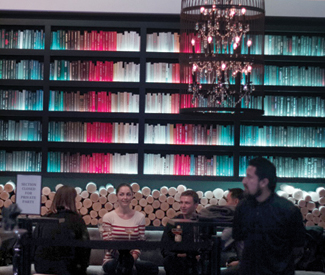
COCKTAILS Novela, the new literary-themed lounge in SoMa, is undoubtedly beautiful: plenty of window light pours in during the evening, highlighting tall black shelves packed full of color-coordinated books. The space, a collaboration between acclaimed bar stars Alex Smith and Kate Bolton, is littered with huge, cozy reading chairs as well as low comfy couches.

But my friend and I just somehow felt out of place.

Perhaps this was a case of misplaced expectations: this wasn’t the bar atmosphere I envisioned at all. With dance music (“Is this MGMT?” my friend asked as we sat down) blaring at around 7pm on a Tuesday, and an all-female service staff dressed in tight black clothing with gold jewelry accents and very high heels, it’s fair to say this place lacked the unshowy intimacy I associate with reading.

Despite our unease in the party environment, we decided to stay and give the libations a try. Novela has several “Cocktails with Character” on its menu, named for famous literary figures (duh). But it prides itself in its punches — six on tap, all made with fresh seasonal ingredients. Since the cognac punch was unavailable, I settled for a glass of the “Tequilla” (as spelled on the menu) punch while my friend, Michelle, tasted the gin one. Both weren’t anything to write home about. Tequilla was just not my cup of tea — the tequila, mezcal, hibiscus, grapefruit, and lime failed to gel — while I don’t remember much about the gin punch. Maybe it had too much rhubarb. Michelle and I pondered the thought of a book-themed bar having a typo on the menu, however deliberate, and realized that it perfectly encapsulated our thoughts of the place so far.

Once the after-work crowd poured out, we settled into some reading chairs near the back of the bar and ordered more drinks. This is when we found ourselves in the middle of a light show — the lights behind the book-filled walls started flashing, as did those along glass and metal liquor shelves. Disco time!

And with that, I suddenly felt like Novela was the one out of place. I can appreciate wanting to expand the notion of the “library bar,” of which our city has many examples, from the library at Bourbon and Branch to Two Sisters in Hayes Valley. But with Novela, I just plain could not see the purpose. San Francisco is a city rich with culture and character, and none of that is reflected here. It felt artificial: all flash and no substance, right down to the cocktail menu (every high school sophomore knows a drink named after Jay Gatsby should be based on gin, not bourbon) and the forced sorority-esque look of the staff.

Back to the drinks: Michelle ordered the Atticus Finch with bourbon, earl grey honey, and bitters — she originally ordered the pisco-based Sherlock Holmes but the birch beer was too overwhelming — while I ordered that Jay Gatsby, with bourbon, scotch, amaretto, calisaya, and nocino. They were both nice but, again, didn’t quite make the grade. In the end, Michelle and I walked out into the night with more questions than answers — a mark of great literature, perhaps, but not of great bars.

NOVELA 662 Mission, SF. (415) 896-6500, www.novelasf.com


Where to next?

0

arts@sfbg.com

DANCE Ben Levy sure knows how to throw a party. For the 10th anniversary celebration of his LEVYdance company, he once again closed off SOMA alley Heron Street, where his studio is located, and hung balloons, speakers, and lights. He put up bars and set out soft sofas, and erected a large stage with a central pit full of pillows (for those who might prefer to recline). It was one of those rare San Francisco evenings with clear skies — and just the slightest of breezes — which made you glad you don’t live across any bridges.

But does Levy know to choreograph? You bet he does. A decade ago he burst onto the San Francisco dance scene with clarity of vision and skills to match, unheard-of in a dancer just barely out of college. But that’s exactly why this festive event lacked an essential ingredient.

Seeing the four works — one from 2002, two from 2004, and one from 2005 — put a damper on the evening. No amount of finessing and rethinking of repertoire can take the place of the risk and excitement involved when a choreographer steps into unknown territory. Looking back on a decade’s accomplishments may be gratifying, but more essential is giving an audience an inkling of where the artistic trajectory is going.

Grant Diffendaffer’s open-air stage, essentially an elevated square of walkways around an open center, necessitated some reconfigurations that diluted what sometimes felt like volcanic forces about to explode in Levy’s choreography. But it also allowed for increased intimacy, depending on where you sat.

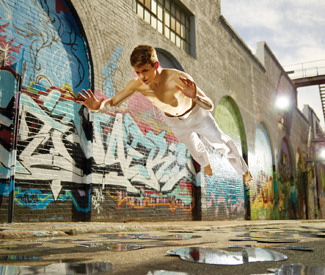
Levy’s four dancers dove into the choreography with an impressive unity of purpose. They attacked complex interactions — often at top speed — with razor sharp timing. Seeing the dancers dressed in brilliant white against the riotous chaos of the graffiti covered brick walls suggested an unexpected symbiotic relationship between dance and murals.

pOrtal, the oldest piece on the program, still fascinated in the way Scott Marlowe, Yu Kondo Reigen, Paul Vickers, and Sarah Dianne Woods upset each other’s balances. They grabbed, yanked, and poked; flipped a partner; or pushed a knee against a belly. When a dancer leaned over a colleague’s knee, it would drop away beneath them. The idea seems to be avoiding stability at any cost — like living in the middle of a non-stop earthquake. What might look like violence or aggression in another case is delivered in such a matter-of-fact way that it becomes a self-contained image of one way of being.

Originally, If this small space, choreographed by Levy and Rachael Lincoln, was performed on a five-by-five lit square that set up limitations. Shifted to the open, the attention immediately shifted onto the internal forces that strained against the confines of Marlowe’s body. Performed magnificently by this beautiful dancer, If this small space might have him look up and push against invisible walls — but it was the small trembles, muscular contractions, currents, and mysterious somethings rolling through his torso that collapsed his knees. The effect indicated just how at the mercy of imprisoning forces this human being was. Perhaps the most touching moment came when Marlowe lifted one leg and it looked like it might try to float away from him.

The engaging Holding Pattern opened with Reigen’s stunningly performed solo, in which warring forces seemed to tear her body apart as Vickers and Woods traced a cautious circle around her. The trio engaged in a contentious give and take, part wrestling match, part karate engagement. For a while it looked like the two women were ganging up on Vickers, but then he gave as good as he got.

That Four Letter Word (apply your own definition) finds the quartet in every possible permutation of relationships between two men and two women. Some of it is quite funny — though I could have done without the balloon jokes — but here the spatial reconfigurations created too much distance. Four ran out of steam though it did showcase Vickers and Marlowe — super-articulate, elegant dancers — exquisitely mirroring each other.

The program also highlighted Levy’s excellent musical choices — many of them commissioned. Let’s hope he’ll soon have an opportunity to use some more.

The Selector

0

WEDNESDAY 19

Camera Obscura

“If you want me to leave, then I’ll go/If you want me to say, let it show/Do you want me to leave, let me know,” pleads Scottish indie pop group Camera Obscura on heartstruck ballad “Fifth in Line to the Throne” off the group’s newest full-length, Desire Lines. It’s the Glasgow five-piece’s first new record in four years (the most recent being My Maudlin Career). And yes, the new one maintains the band’s 17-year-strong streak of stunning, wistful ballads, laced gently through with heartfelt vocal musings. Much like that other lauded Glasgow-based gentle indie pop act, Belle and Sebastian, Camera Obscura has mastered the art of the melancholy pop song, seeped in lovely whispers and lilting moans, gentle strings, soft piano keys, drumming pitter-patters, the works. But we love them for it, like those weepy torch songs of yesteryear. The show gives you the chance to cry in public. Want you to leave? No, we’ll let it show. (Emily Savage)

With Photo Ops

8pm, $25

Regency Ballroom

1290 Sutter, SF

(415) 673-5716

www.regencyballroom.com


Dogcatcher

If Dogcatcher was a brand of alcohol, it’d be Jameson — it’s that smooth. By crafting tight rhythms and jazzy guitar riffs, the San Jose-based trio provides an almost flawless fusion of jazz and rock. And its simple and soft vocals create an intimate experience on stage. Dogcatcher’s songs are well-constructed and the delivery creates a calmer version of traditional jazz. Song “Be Easy” off its most recent album It’s Easy reflects this: “Because tonight you know, it’s all about the sound/Just be easy,” sings Andrew Heine in a lazily seductive voice that makes you believe that for him, it really is just that simple (Hillary Smith)

With the Sam Chase, the Gallery

9pm, $8

Bottom of the Hill

1233 17th St., SF

(415) 861-1615

www.bottomofthehill.com


THURSDAY 20

Fresh Meat Festival

With “Trailblazers,” the 12th annual Fresh Meat Festival — a celebration of transgender and queer performance — is paying tribute to musicians, dancers, and theater people who hoe their own rows. This year they all do it in our own neighborhoods. The dancers, AXIS Dance Company, Barbary Coast Cloggers, Allan Frias’ Mind over Matter and Sean Dorsey Dance and Las Bomberas de la Bahia couldn’t be more different from each other. What they share, beyond working in the Bay Area, is a clear vision of what they want to do and the skill and perseverance to stick to it. Very simply, they have become tops in their field. To see them now in a sort of meta context of their sexual orientation, is a joyous opportunity to add another notch to their trailblazers spirit. (Rita Felciano)

Through Sat/22, 8pm, $15–$25

Z Space

450 Florida, SF

www.brownpapertickets.com


The Ape Woman: A Rock Opera

Step right up and view Dark Porch Theatre’s presentation of The Ape Woman, May van Oskan’s rock opera exploring the life of one Julia Pastrana, an indigenous Mexican woman who achieved fame (infamy?) on the 19th century circus sideshow circuit. Sometimes also dubbed “the Bear Woman,” the diminutive Pastrana suffered from hypertrichosis — resulting in thick, dark hair all over her face and body, a trait that made her a valuable prize for unscrupulous promoters. With a set styled like a Victorian sideshow tent, van Oskan’s opera tells Pastrana’s fascinating live story via 14 original songs, backed up by a seven-piece ensemble. (Cheryl Eddy)

Opens tonight, 8pm

Runs Thu-Sat and June 26, 8pm; Sun/23, 4pm, through June 29, $15–$30

Exit Studio

156 Eddy, SF

www.theapewoman.com


The Bottle Kids

I once saw Bottle Kids frontperson Annie Ulukou at the Stork Club with nothing but a ukulele. This could have gone any which way, but instead of succumbing to the soft, lullaby tone inherent to the miniature instrument, Annie amplified and distorted its sound to backup the heartbreak and pure aggression of her voice. This is indicative of the Bottle Kids sound as a whole. Their shows can be as personal, subtle, soulful and as easy to access as a ukulele in a small room while still sucker-punching you square in the gut. Check this band out while it’s still free to see it live. (Ilan Moskowitz)

9:30pm, free

Grant and Green Saloon

1371 Grant, San Francisco

(415) 693-9565

www.grantandgreensaloon.com


FRIDAY 21

PANSY

Why does nightlife hold us in its timeless spell? And, perhaps more topical, will the nostalgia for the necessary craziness and joy of ’90s nightlife ever let us go? Evan Johnson, one of our most intriguing drag performers (beloved alter-ego Martha T. Lipton, the Failed Actress, is a hoot) goes deeper in solo stage show Pansy, conceived with Ben Randle. His character, Michael, discovers a time capsule full of VHS tapes, cassettes, and flyers documenting ’90s gay club kid Peter Pansy, and finds shivery parallels with his own life emerging. “I want to address the ‘shadows’ of AIDS and queer history and Pride… That time period, 1993-95, became the vehicle for me to address the vital nostalgia and escape of the San Francisco queer fantasy,” he says. Johnson’s been hosting lively Q&As with legendary nightlife biggies after each performance, including Pansy Division’s Jon Ginoli, Dan Nicoletta, Alvin Orloff, and Sister Roma. (Marke B.)

Through June 29th, $10-$15

New Conservatory Theatre

25 Van Ness, SF

(415) 861-8972

www.nctcsf.org


SATURDAY 22

San Francisco Bicycle Music Festival

First of all, can we just enjoy this awesome WTF moment? A music festival. Powered by bicycle pedaling. Even in its seventh year, SF’s annual Bicycle Music Festival is still a wonder to locals. It offers the chance to listen to great music by folk band Laurie Lewis and the Righthands, Bill McKibben, Justin Ancheta Band, Manicato, and more, in a beautiful setting for free. In fact, it’s in three beautiful settings, because the event is packed up and deployed throughout Golden Gate Park. The event is known to draw some crazies, the cool kind who perform synchronized dances or twirl around on cycles while playing the trumpet — so be warned. It is definitely worth checking out, particularly if you’re a bike enthusiast interested in meeting fellow cyclists, or just a live music fan. And if the bicycle-powered music bit doesn’t have the same amazeballs effect on you, there will also be hand-cranked ice cream and smoothies made from the same bike power. (Smith )

Noon-5pm, free

Golden Gate Park

Pioneer Log Cabin Meadow to Stow Lake Drive at JFK Drive, SF

bicyclemusicfestival.com


Grandpa Fest

You don’t know Grindcore Grandpa? Hmm, how to explain to this. Basically, he’s the stoic elder gent who shows up at tons of hardcore and underground punk shows, lives for grind, and has a Lack of Interest shirt with his own face on it (as such, he’s more known as Grandpa of Interest). He’s turning 86, and that’s a big deal, so the Gilman is hosting Grandpa Fest and bringing in some of his favorite acts, legends of the scene including experimental Man is the Bastard offshoot Bastard Noise, and sludge-master Noothgrush, along with Stapled Shut, To the Point, Connoisseur, and Happy Pill Trauma. If you know what’s good for you, you’ll honor the man with a dive in the pit at breakneck speed. (Savage)

7pm, $10–$12

924 Gilman, Berk.

www.924gilman.org


Fete de la Musique

“The music everywhere and the concert nowhere,” declared French composer Maurice Fleuret in 1981. And then e went on to launch “Fete de la Musique” on the summer solstice of 1982, slyly celebrating that pagan holiday by bringing the French population out into the streets to play all the music they could. Soon the festival spread, and became a French tradition. Now, San Francisco’s Alliance Francaise is reviving the tradition with a roisterous day full of bands (Rue 66, Horse Horse Tiger Tiger, Crash Landings, Kiwi Time, more), drum circles, guitarists, and more — plus a few bars stocked with great wine, natch, to keep us in the spirit — on three floors. “Enjoy some Canadian music and food as well,” the Alliance promises, “as we welcome our Quebec cousins to celebrate their national holiday, the Fête de la Saint-Jean Baptiste.” French sounds all round! (Marke B.)

2pm-8pm, free

Alliance Française de San Francisco

1345 Bush, SF

fetedelamusiquesanfrancisco.wordpress.com


SUNDAY 23

City Lights at 60

Bookstore, publishing house, Beat writers hub, San Francisco institution. City Lights, founded by poet Lawrence Ferlinghetti and Peter D. Martin in 1953 (and now co-owned by Ferlinghetti and Nancy Peters), has meant a great many things to several generations of San Franciscans and tourists that flock to its North Beach storefront. It’s published important tomes, hosted readings and acoustic concerts, political conversations and book release celebrations. Just this past year saw a Pussy Riot gathering, Richard Hell reading, and a Sister Spit anthology release party. In celebrating six decades of life (that’s right, City Lights is officially 60 years young), the bookstore will host “City Lights at 60” lectures and readings through the rest of the year (“Howl Legacy: The Continuing Battle for Free Expression,” July 14, “Women of the Beat Generation,” Nov. 19), and an ongoing “Sundays in Jack Kerouac Alley” series. It all kicks off with the official birthday party today at the shop. The fête includes flash readings, archival footage, store discounts, and a live performance by the Latin Jazz Youth Ensemble of San Francisco. (Savage)

2-5pm, free

City Lights

261 Columbus, SF

(415) 863-2020

www.citylights.com


TUESDAY 25

Tyler Bryant and the Shakedown

Listening to Tyler Bryant, I get the sense that music was his first love. And even though he sings, “take my hand/take my heart/now honey, my super lady,” in the song “Lipstick Wonder Woman,” (which, conceivably, is about a human woman) I still believe that his most sultry seductress is the raw power and electricity present in his songs. His Nashville-based group makes authentic rock’n’roll that’s not reliant on over-reverbed guitar tones or a few simple fuzz-laden chords. Bryant can play, and his songs overwhelming reflect this. Reminiscent of the Black Keys, Bryant’s vocals are filled with soul, and the energetic beats anchoring his songs beg you to dance. (Smith)

With Girls and Boys

9pm, $15

Brick and Mortar Music Hall

1710 Mission, SF

(415) 371-1631

www.brickandmortarmusic.com


The Guardian listings deadline is two weeks prior to our Wednesday publication date. To submit an item for consideration, please include the title of the event, a brief description of the event, date and time, venue name, street address (listing cross streets only isn’t sufficient), city, telephone number readers can call for more information, telephone number for media, and admission costs. Send information to Listings, the Guardian, 225 Bush, 17th Flr., SF, CA 94105; or e-mail (paste press release into e-mail body — no attachments, please) to listings@sfbg.com. Digital photos may be submitted in jpeg format; the image must be at least 240 dpi and four inches by six inches in size. We regret we cannot accept listings over the phone.


Foggy holiday

2

culture@sfbg.com

COCKTAILS Having worked in retail for the past five years, I’ve had Memorial Day off precisely zero times in the past half-decade. That means never enjoying the pleasure of spending the unofficial start of Summer barbecuing in the park, leisurely sipping ice cold beers with friends as the sun gets higher and the shorts get shorter. So when I got the email from the CEO of my new gig telling us all to go out and enjoy the holiday, I was delighted. That is until, in pure San Francisco fashion, the fog rolled in and all my visions of patios, grills, and parks misted over. What to do? My friend. Danielle and I didn’t take too long to figure it out: um, bar crawl.

We started at the Blarney Stone (5625 Geary, SF. (415) 386-9914) in the Outer Richmond. Along with some guys aching to watch a baseball game, I found myself waiting promptly at 2pm for the doors to open. Yes, that’s dedication. After taking my seat, Nathan behind the bar mixed me me a Paloma with freshly squeezed grapefruit juice, and I pulled out my book, waiting for my habitually late partner to arrive.

I’m a Blarney regular (I live a couple blocks away) and over the past four years of frequent Stoning, I’ve gotten to know the bartenders, who have gladly introduced me to some new spirits. And friendly fellow patrons have creatively helped me dodge uncomfortable encounters with any creepy visitors, all while enjoying said spirits. Can’t complain with that.

After several Palomas (at $7 each) and an Irish coffee (which was paid for by a gentleman who was probably a might too caffeinated by Irish coffees himself) — and after Danielle finally showed up — we hit the road and headed for Trick Dog (3010 20th St., SF. www.trickdogbar.com) in the Mission. I’ve been longing to hit up the Dog for some time now. If you’re a cocktail enthusiast, you already know why. Owned by Josh Harris and Scott Baird, otherwise known as swashbuckling bar-consulting duo the Bon Vivants, it’s been the hot spot ever since it opened this January.

Although all the seats were taken, we were lucky enough to be able to grab a standing spot by the window immediately after walking in. Danielle shifted through the cocktail menu made to look like a paint color swatch, while I ordered the mezcal-based Polar Bear ($11). Along with the mezcal, the Polar Bear is made with dry vermouth and Creme de Menthe. It’s a bit like a Glacier mint served up in a stemmed cocktail glass: minty and clear, instantly refreshing and smoky at the same time. I loved it. Danielle ordered the Straw Hat ($11), a Calvados (French apple brandy) drink with chestnut honey, hard cider, vermouth, rosemary, and lime served on the rocks, and I could tell in an instant she was into it. I moved on to a Baby Turtle: reposado tequila, Compari, cinnamon, grapefruit, and egg white (a weakness of mine in cocktails). It was frothy, pink, and lovely.

Blackbird (2124 Market, SF. www.blackbirdbar.com) at Church and Market, has been one of my favorite bars for a while now. Here’s hoping it remains popular but doesn’t get too crowded once the new tenants of all the condos being constructed on Market move in.

I love that the artwork inside changes as much as the drink menu (although I’m longing for the day the amazing Grape Drink returns). But nothing can beat the happy hour special. $5 sours? Yes, please.

Already floating a heavy buzz, we strolled in and easily sat at the bar. Whiskey sours would top off our night just right. Even better, more egg whites topped the yummy sours. I believe I had about three of these frothy treats before our Sidecar arrived to take us home.

After squeezing 10 drinks into six hours, I don’t remember much about the ride home (and I don’t dare look at my bank statement). But a Memorial Day filled with new drinks and new friends — cheers to that.

The conversations

0

arts@sfbg.com

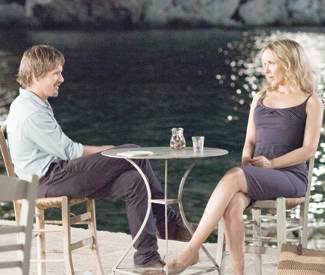
FILM Half a lifetime ago — that is to say, sometime in the mid-’90s — on a train rolling through Austria, a young American man named Jesse (Ethan Hawke) met a young French woman named Celine (Julie Delpy). They were in their early 20s, and maybe that’s why it didn’t seem outlandish when, after some passing miles and some good conversation, he asked her to get off the train with him in Vienna, proposing that they spend the next 12 or so hours wandering the city, until his flight home in the morning. He didn’t scream axe murderer, and he made the case that if she stayed on the train, she might look back on her decision in 20 years, from the vantage of an unsatisfying marriage, and regret it. On paper, it sounds dubious bordering on smarmy. But sometimes it’s all in the delivery, and it didn’t seem too lunatic when Celine said yes.

So for the next hour and a half, we followed them as they traced a meandering itinerary among Vienna’s monuments, cafés, bars, and riverside walkways. Drifting through half a day’s worth of dense conversation (a sort of retort to the typical romantic comedy montage), they told personal anecdotes, took philosophical positions, and did a certain amount of playful flirting, whose intensity crept upward with the passing hours as the parameters of their encounter began to constrict. By morning, we were pretty invested in the last-minute arrangement they made just before Celine boarded her train: to reconvene there, barring personal constraints, in one year’s time. As the sun rose on all the places they’d passed through, empty now, we were left with that ambiguous possibility and our own guesses and projections as to whether Jesse and Celine would ever see each other again.

Since 1995, when director Richard Linklater, Delpy, and Hawke told this story in the film Before Sunrise, they’ve returned to these characters three times: they surface in a disconnected cameo in 2001’s animated Waking Life. The 2004 follow-up Before Sunset, shot in real time, reunites them after nine years in a Paris bookstore, where Jesse, now a successful writer, is reading from his novel about their time together in Vienna; more discursive talk and a beautifully ambiguous ending ensue. And now Before Midnight marks the third installment in a series whose occasional, compressed episodes submerge us so deeply in a particular moment of Jesse and Celine’s lives that we begin to forget how long it’s been since we saw them last.

When the newest film — co-written, like Before Sunset, by Linklater, Delpy, and Hawke; Linklater wrote the first film with Kim Krizan — picks up with Celine and Jesse, another nine years have passed. And it’s possible that they no longer recall with the warm clarity we do that gorgeous, affecting, flirty scene in the last few moments of Before Sunset, when we left them alone in Celine’s Paris apartment listening to Nina Simone, Jesse looking very likely to miss his plane back to the States this time around. It was one of the more perfect movie endings in recent memory, true. But in the intervening years, a lot has happened, including twins, a rancorous divorce and custody fights (for Jesse, whose teenage son lives in Chicago with his ex-wife), another best-selling (and semiautobiographical) novel, various environmental battles (for nonprofit worker Celine), and nine years of steady, unrestricted companionship that have inevitably overshadowed the telescoped intensity and romantic longing of the pair’s early encounters.

Now in their early 40s, Jesse and Celine have formed a web of commitments domestic and professional, and Before Midnight reflects this shift by adopting a more expansive outlook, the camera pulling back to take in a wider circle of family and friends. The film begins with a scene between Jesse and his son, Hank (Seamus Davey-Fitzpatrick), saying their farewells at an airport in Greece’s southern Peloponnese, where the family have been spending the summer at the home of an older expat and writer, Patrick (played by veteran cinematographer Walter Lassally).

When we finally see Celine, waiting curbside at the car with their little girls, she’s on the phone with a colleague in Paris, and her and Jesse’s exchanges as they drive signal a habitual intimacy (new to us but now commonplace to them) — as well as a few recurring sources of tension. Back at Patrick’s, the camera moves amid a crowded intergenerational scene and, at dinner, circles the table in an extended take as these disparate characters reflect on the stages of love and life in the kind of rambling, associative conversation we’ve come to expect of the series.

There’s a neatness to the generational roll call at the dinner table — a couple in their 20s (whose long-distance affair via Skype is juxtaposed to Before Sunrise‘s romantic, chancy gesture); two couples in their 40s; the elderly Patrick and a female friend, both widowed. But the discussion itself is messy like life, and things get messier still when Jesse and Celine finally manage some alone time. We see the people who met half a lifetime ago, but the shock of recognition comes when the fissures in their relationship are fully exposed, cracks we can follow back nearly 20 years, as well as forward. We remember, and so do they, Jesse convincing Celine to get off the train with that fast-forward glance at a possible future, and wonder if we’ll ever see the two of them again.


BEFORE MIDNIGHT opens Fri/31 in Bay Area theaters.

Party Radar: Save Esta Noche!

3

Many of us barely remember growing up there, meeting our first hot papi, trying out our first cha cha heels on stage, and living the Selena dream. And some of us go back every week to relive those experiences! Now, that many-mirrored treasure trove of characters, Esta Noche, may have to close its doors — forever.  

The city’s only (official) Latin gay bar owes the city $7,000 and may be history if it can’t cough it up in the next two weeks. But you know the fundraising party Sat/18 is gonna be fabuloso.

The whole situation’s due to a silly technicality: Last year, the Board of Supes passed widely supported legislation designed to make it easier for bars and clubs to pay their licensing fees. But there was a catch no one properly understood: bars would now have to pay all fees for the year in one large lump sum. Supervisor David Campos is working to change this, but it may be to late for the fantastic characters of this beloved bar.

So his office, via scenester mover and shaker Nate Albee, is helping organize the big time fundraiser — assisted by an all-star cast including Heklina, Anna Conda, Per Sia, Brown Amy, and DJs Carnita and Taco Tuesday.

http://www.youtube.com/watch?v=jXhKc8ntBOw

Changing the metaphor

2

news@sfbg.com

With my partner-in-crime Keith Chandler at the wheel, we’re driving through San Francisco on our way to Stanford University Law School for the Three Strikes Summit, a deeply personal topic to both of us. Three Strikes is partly why I served 15 years in prison, and Stanford’s Three Strikes Project is a big reason why I was released earlier this year.

Chandler is a renowned activist, ex-lifer, and my comrade in the struggle to reintegrate inmates back into life in the outside world. I have become a fanatic on a mission, and this May 2 event will feature many of the top criminal justice players responsible for last year’s Three Strikes reform measure, from Attorney General Kamala Harris to San Francisco District Attorney George Gascon.

So the path we carve through the City takes us deep into the heart of the reform movement that changed my life. Change is in the air, and I’m following the scent back to its roots.

POSTER CHILD

Three Strikes as a metaphor made perfect sense. In the 1980s, the justice system was a revolving door. Relatively short sentences for serious and/or violent crimes were the norm, sentences often cut in half by parole. Lengthy records of arrests and convictions fueled a movement to get tough on crime.

As per usual, bad things happened. In 1993, sexual predator Richard Allen Davis killed Polly Klaas, a 12-year-old girl from Petaluma. A general consensus formed that repeat offenders needed to be punished to the fullest. So prison industrialists came up with a catchy solution: three strikes and you’re out. Commit three violent crimes, the authors sold to the public in 1994, and you’ll serve 25 years to life.

However, the fine print expanded the concept to any third felony — even crimes that would be misdemeanors to non-parolees — and California’s prisons swelled.

In many ways, I was a Three Strikes poster child. As a wild youngster in Sacramento, I was a menace. At 18 in 1984, I began a four-year spree of crimes that included armed robbery, assault with a deadly weapon, and residential burglary. For those transgressions, among others, I received a 12-year sentence in 1988.

I embraced sobriety, college, and writing as I served six discipline-free years. Back then, we had a right to participate in rehabilitative endeavors. Effective programs like cognitive restructuring and life-skills classes might have been foreign concepts, but I benefitted from college, weight training, and family visiting.

But I was still trapped by my criminal thinking — plagued by my nefarious associations. Though I hid it well, I was all fucked up.

In 1994, I was paroled into a whole new ball game: the era of three strikes. As soon as the law passed, the horror stories began to amass. Guys were being struck out for stealing from stores or possessing small amounts of drugs. California became the republic of the intolerant. Mired by myriad imperfections, I stepped up to the plate and swung for the fences.

A 28-year-old undergraduate with a range of goals, I started a construction company and contemplated graduate school. And instead of taking my construction company seriously, or even finishing my undergraduate education, I started using and selling meth — partying like there was no tomorrow.

In my broken way of thinking, I convinced myself that supplementing my income made perfect sense. In reality, it was an excuse to get high for free and it all fell apart. Two parole violations for drug cases seamlessly lead to a felony drug case in 1999. I went from baller to squalor, and hit a line drive right to the catcher. I struck out and faced a lifetime behind bars.

When my life came to an end, I chose to change the rules of my game. I found purpose by advocating for my demographic. As the system began to shift towards smart-on-crime principles in the mid-’00s, I managed to shift with it. My two-pronged litigious and literary activism — a lifestyle that regularly put me at odds with my captors — morphed into rehabilitative advocacy.

As a result of voters approving Prop 36 last fall, my life sentence was lifted on March 22. The merits of my rehabilitative record coalesced with a successful one-time review. As I walked out of prison a week later and jumped into the arms of my childhood sweetheart, I told Charlotte, “Let’s get the hell out of here before they change their minds.”

ROAD TO REFORM

After all the craziness of 15 years of incarceration, I have been decompressing in a transitional housing program. With a bachelor’s degree and multiple drug counseling certifications, I’m establishing myself as rehabilitative consultant. Moreover, I received the ultimate welcome home gift when The Sacramento Bee covered my reentry.

As we arrived on the Stanford campus, I thought of the friends and foes I left behind in prison. To me, this is serious business, a personal progression of nonstop advocacy. Keith’s gig as a criminal justice consultant now includes a new task — delivering me into the apex of reform.

Stanford Law School started the Three Strikes Project in 2006. The human lessons learned from securing the release of 26 three strikers motivated project director and law professor Mike Romano to shift tactics. He decided to take a bigger swing at a very bad law. By avoiding the mistakes from a catastrophic 2004 reform initiative, Romano could secure the release of thousands rather than dozens.

The project decided a narrowly drafted initiative would have the best chance for success. To qualify for a reduced sentence, minor third strikers without murder or sex offenses in their backgrounds would be vetted by the courts to determine whether they currently posed an unreasonable risk to public safety. He took down one of the nation’s toughest laws with 69 percent of the vote.

Of the 9,000 three strikers in California prisons, Prop. 36 made nearly 3,000 eligible for review. On the day of the summit, a prison official reported 460 had already been released — a number that will climb daily. While most counties have over 100 candidates — and some hotly contested cases are on the horizon — Los Angeles has a staggering 1,325 cases. San Francisco, by contrast, only has two, the result of SF’s sober, compassionate approach to charging three strikes cases.

Hearing the statewide cries from their landmark measure, Stanford invited all relevant parties to discuss how to move forward. Harris, the keynote speaker, wrapped her entire speech around a unique prosecutorial career that began in San Francisco.

As the author of Smart on Crime: A Career Prosecutor’s Plan To Make Us Safer, Harris models cutting-edge thinking as the state’s top cop. She pursued data-driven policies as she learned to look at “other issues through the lens of public safety.” By doing so, Harris avoided the sensationalism mentality that leads to hyper-incarceration.

Her successor, Gascon, followed her approach. Research showed Gascon that “higher levels of incarceration don’t translate into increased public safety.” So he teamed up with Stanford, the NAACP, and other like-minded officials as early supporters of the Three Strikes Reform Act of 2012.

Overall, the summit included a range of panelists who discussed a number of relevant topics. But how to adjudicate all these cases was juxtaposed by the need to find resources for reentry services. Stanford professor Joan Petersilia has been instrumental in every recent criminal justice policy change in California, and she warned of the need for more reentry programs.

“What goes down can easily go up,” Petersilia said, warning the crowd about prison populations and crime rates. “Roughly $1 million is being spent on the average three striker, and zero is being spend on their reentry.”

FREEDOM

Most of us are being released without any supervision or any type of state or county funds associated with probation or parole. Since we have far exceeded our sentences, the average three striker is leaving prison with little to no resources, let alone being able to tap into existing programs. I’m paying for my program out of my own pocket.

While it took decades to create the worst justice and prison system in the country, it’s definitely going to take years to correct. I advocated for more than a decade while buried under draconian measures buttressed by dreadful prison policies. Thus, I am excited groundbreaking issues are being discussed by people like this.

For those officials still trapped in their broken thinking, I also know how hard it is to abandon criminal thinking. However, like Gascon said, “Prop 36 is changing the metaphor.”

Seated in Keith’s sports car with the top down, we are making our way up 280 towards the city. Heading back home to Sacramento, I felt like a passenger on the Titanic with an alternate ending. While I am still in the honeymoon stage of my reentry — and reluctant to let this feeling go — I am at the beginning of a new era. We all have work to do.

My life of crime and activism has been an open book — and so is my reentry. After spending the day with journalists and actors in the field of justice, now I feel an even greater obligation to repay my debts. For the first time the light at the end of the tunnel is no longer blurred by the cold hard steel of the penitentiary, or maintained by tone-deaf policy-makers.

I still can’t believe it — I am free.

Ultimate zero

3

rebecca@sfbg.com

In January, Mayor Ed Lee appeared on the PBS NewsHour to talk up the city’s Zero Waste program, an initiative to eliminate all landfilled garbage by 2020 by diverting 100 percent of the city’s municipal waste to recycling or compost. “We’re not going to be satisfied,” with the 80 percent waste diversion already achieved, Lee told program host Spencer Michels. “We want 100 percent zero waste. This is where we’re going.”

But somewhere in Te Anau, New Zealand, an environmental scholar tuning into an online broadcast of the program was having none of it. “I sat there thinking, no, you’re not. It would be great if you were, but you’re not — for obvious reasons,” said Robert Krausz, who’s working toward a PhD in environmental management, describing his reaction during a Skype call with the Bay Guardian.

Krausz, a Lincoln University scholar originally from Canada, spent three years studying municipal zero-waste initiatives internationally, and completed an in-depth, 40-page analysis of San Francisco’s Zero Waste program as part of his doctoral thesis.

He may as well have taken aim at a sacred cow. The city’s Zero Waste program has near-universal support among local elected officials, and has garnered no shortage of glowing media attention. San Francisco’s track record of diverting 80 percent of waste from the landfill is well ahead of the curve nationally, scoring 15 percent higher than Portland, Ore., a green hub of the Pacific Northwest, and 20 percentage points or higher above Seattle, according figures provided by Recology, San Francisco’s municipal waste hauler.

Despite the city’s well-earned green reputation, Krausz arrived at the pessimistic conclusion that “San Francisco’s zero waste to landfill by 2020 initiative is headed for failure.” In seven years’ time, he predicts, the program deadline will be marked with a day of reckoning rather than a celebratory gala. “I think the city is setting itself up,” Krausz told the Guardian. “Somebody’s going to be holding the bag in 2020.”


ANOTHER AFFLUENT CITY

Sporting a goatee and glasses, Krausz comes across as the type you might find locking up his bike outside a natural foods store with canvas bags at the ready. When he visited San Francisco, he said he was ready to be wowed by the example of an ecologically enlightened city, yet ultimately left in disappointment. “It was just another affluent American city, in terms of consumption.”

The problem, he argues, is that people are still buying way too much disposable stuff — and a significant amount can’t be recycled. Plastic bags, food wrapping, pantyhose, plastic film, pet waste, construction materials with resin in them (like the popular Trex decking), and particularly disposable diapers have nowhere to go but into the landfill.

San Francisco produces a total of about six kilograms of trash per person per day before diversion is factored in — three times the U.S. national average. That’s a sobering figure that puts a slight dent in the city’s eco-conscious image. It’s not really fair to denizens of the city by the Bay, because it counts trash generated by 20 million annual visitors, daytime employees, developers, and businesses as well as residents. Nevertheless, the trash output ranks well above the per capita average for the Eurozone, which clocks in at a minimalistic 0.5 kg per person per day.

The city has earned its bragging rights for making strides toward diverting waste from the landfill — yet truckloads of waste still leave the famously green city every day. Since 2003, Krausz notes, San Francisco’s overall waste generation has actually increased, from 1,900 to 2,200 kilograms per person per year. At the same time, the per capita amount of waste going into a landfill has dropped, from about 1,000 to 500 kilograms per year. That’s still a lot of garbage.

Krausz argues that San Francisco has no comprehensive plan for achieving Zero Waste, while at the same time having little control over “top of the pipe” consumption, which generates a glut of trash. “While the city has achieved success at managing waste at the end-of-pipe, it has thus far failed to address the fundamental problem of consumption, which is driving waste generation,” his study notes.

Guillermo Rodriguez and Jack Macy of San Francisco’s Department of the Environment counter that there is a strategy, involving a host of different measures ranging from education, to policy initiatives, to incentive programs aimed at reducing waste. They think zero waste is possible. “We’re probably at 99 percent diversion here in this office,” said Macy, who serves as the city’s Commercial Zero Waste Coordinator. “At least 90 percent of the discard stream is recyclable and compostable,” he added. And as for the last 10 percent, “that pie will be shrinking as we find more markets” for recyclables.

Krausz also raised skepticism about Recology’s bid for a landfill contract that would extend until 2025, five years beyond the deadline for all waste elimination. To that, Recology’s Eric Potashner responded that state law requires 15 years of disposal capacity to guarantee a safety net, regardless of municipal aspirations.

Krausz is critical of San Francisco officials for promising zero waste, but he acknowledges that manufacturers of disposable goods, not city officials, are to blame. Ambitious legislative measures such as San Francisco’s mandatory composting program and a ban on plastic bags have been enacted and achieved tangible results, but for items like ubiquitous thin-film plastics, dirty diapers, synthetic materials, and the like, good solutions have yet to be found.

Krausz’ study also determined that no city on the planet that’s set out to do so has ever actually succeeded at achieving zero waste. “If you are a city that is a member of Western civilization as we know it, you’re not going to be zero waste to landfill, because you participate in the global economy,” Krausz states plainly.


SF’S TRASH PIT

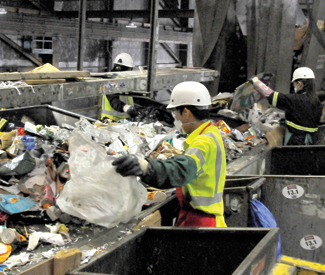
On a recent Friday morning, Recology’s Potashner and Paul Giusti led a tour of the city’s recycling and waste processing facilities. It featured a stop at the transfer station, housed in a large warehouse off of Tunnel Road where all the refuse from the black trash bins is deposited before being carted off to the Altamont Landfill. A sweet, pungent aroma hung in the air. “We call this the pit,” Giusti explained as we approached a sunken area that could have contained multiple Olympic-sized swimming pools, extending a story or two below us into the earth. “This is the last frontier,” Potashner added. “The last 20 percent.”

It was filled with an astonishing quantity of trash, making a tractor that ambled awkwardly over top the mound to compact it down appear toy-like in comparison. The sea of discarded material contained every hue, and floating around in the debris were orange juice containers, cardboard boxes, and thousands upon thousands of (banned) plastic bags. Between 200 and 300 garbage trucks eject their contents into the pit each day, and a single truck can hold up to four tons of trash.

Giusti started working for Recology, formerly NorCal Waste Systems, in 1978, following in the footsteps of his father. Back then, the pit was more like a mountain: “When I would dump my truck, I could walk up this pile,” he said, gesturing toward a set of sprinklers suspended from the ceiling to indicate how high it once extended. State data confirms the story: In 2011, according to CalReycle, San Francisco sent 446,685 tons of waste to the landfill. That number has steadily declined over time; in 2007, it stood at 628,914 tons.

Asked for his reaction to Krausz’s thesis that the Zero Waste program won’t ever actually get to zero, Guisti turned the question around by asking, what’s the harm in trying? “Let’s say you said, zero waste is unattainable,” he said. “Then what’s the number? I think zero waste is an ambitious goal — but if we get to 90 or 95 percent, what a tremendous achievement.” Setting the highest of bars is important, he said, because striving for it provides the motivation to keep diverting waste from the landfill.

In order to actually reduce the city’s garbage from 446,685 tons to zero in the next seven years, Zero Waste program partners Recology and San Francisco’s Department of the Environment face a twofold challenge. First, they must prevent compostable and recyclable material from getting into the landfill pile. Second, they must find solutions for diverting the waste that currently has nowhere else to go but the landfill. With a combination of seeking new markets for recyclables, using technology that can sort out the recyclable and compostable matter, and implementing incentives and educational outreach programs, they’re still focused on the goal. “It’s hard to tell how close we’ll get to zero in 2020,” Macy said. So even if zero waste does not actually mean zero waste in the end, that goal “sends a message that we want to move toward being as sustainable as we can.”

Catch up!

0

SUPER EGO Happy 45th birthday to Specs, my favorite bar in the city. The Capitan cocktail at La Mar is drink of the year so far. I think I finally get Daft Punk. There will probably soon be a “high-end” “gay” “strip” club called the Randy Rooster in the Castro, but you can’t make it rain — tips are donated at entry to a favorite charity, the dancers only strip to g-strings, and there’ll be upscale food. (It sounds positively Mormon.)

The winner of How Weird Street Faire was homegrown genius Larry Gonnello Jr.’s Boombox Affair, the back alley stage with the wired-together boomboxes, this killer six-hour set, and a perfect respite from the overflow of looky-loos this year. And that proposal by Mark Leno for bars in Cali to stay open until 4am? It died in committee, much like Roxxxy Andrews’ hair (I don’t even know who that is) — mostly due to the twisted machinations of the California Police Chiefs Association, who said it would mean more drunks on the road. Absolutely untrue! And this is why we can’t ever have nice things. My goddess, even the bars in Anchorage, Alaska can stay open longer than ours. Guess I’ll just have to keep my Scooby Doo flask polished and at the ready in my tubesock.


BOO WILLIAMS

I am so very excited for this. A Chicago house legend and true sweetie who knows soul biz like nobody — except maybe his Strictly Jazz Unit partner in crime Glenn Underground. The Housepitality weekly does it again.

Wed/8, 9pm, $10. f8, 1192 Folsom, SF. www.housepitalitysf.com


AFROLICIOUS 6-YEAR

Six years of this awesome Latin funk and Afro jazz collective’s dance floor vibes. As always, groovy brothers Pleasuremaker and Senor Oz preside over the festivities, full of live goodies and sweaty hotties, so good it’s taking over two nights.

Thu/9 and Fri/10, $8–$15 per night. Elbo Room, 647 Valencia, SF. www.elbo.com


DERRICK MAY

Oh hi, Detroit originator of techno.

Fri/10, $20. 9:30pm-3:30am. Public Works, 161 Erie, SF. www.publicsf.com


KITSUNE CLUB NIGHT

Poof! It’s the return of that special-smart French hyperdisco feeling, as beloved label Kitsune spreads its pixie dust around with Fred Falke, Chrome Sparks, and our own Aaron Axelsen.

Fri/10, 9pm, $17. Mezzanine, 444 Jessie, SF. www.mezzaninesf.com


ODYSSEY

The best and most freakish roving house party is at it again, this time bringing in the energetic and gorgeous W. Jeremy and Christy Love of NYC’s House of Stank and Get Up Recordings.

Fri/10, $10, 9:30pm-3:30am. Public Works, 161 Erie, SF. www.publicsf.com


PUSH THE FEELING

“An all locals, disco-heavy night of music,” too-cute promoter Kevin Meenan promises, somewhat surprisingly, for this installation of his monthly boundary pushing night, with Beat Broker on decks and plaza performing live.

http://www.youtube.com/watch?v=nUsxpZ_xKyg

Fri/10, 9pm, $5. UndergroundSF. 424 Haight, SF.


TORMENTA TROPICAL

Everyone’s favorite 808cumbia, electro-salsa, and tech-bachata monthly celebrates a bangin’ new release on its Bersa Discos label from Mexican DJ Quality, with DJ Quality! Sat/11, $5–$10, 10pm. Elbo Room, 647 Valencia, SF. www.elbo.com


WOLF + LAMB, SOUL CLAP

The two greatest bromances of the retro-rebuild decade, these male duos melted minds when they Frankensteined tunes from the 1950s-2000s (emphasis on the ’90s) into exotic-sounding hybrids of moody funk and deep house. Now everyone’s taken their cues — what will they pull off next?

Sat/11, 9pm, $20. Mezzanine, 444 Jessie, SF. www.mezzaninesf.com


KIM ANN FOXMAN

She has the tightest style — sound + vision — of anyone going right now, melting late ’80s and early ’90s sonic signifiers into a sophisticated semiotic code that packs the dance floor every time. Funky Mother’s Day!

Sun/12, 10pm, $10. Holy Cow, 1535 Folsom, SF. www.honeysoundsystem.com


The Performant: The real weekend warriors

Holding down the weekend of the weekend with the Dark Room Theatre’s “Ghostbusters: Live” and Har Mar Superstar

Among the true creatures of the night, Saturday Night has always been passé, amateur night if you will, when even the most accommodating of dive bars or clubs are suddenly jammed tight with lightweight dilettantes, whose allegiance to the night life is as superficial as it is truncated. But the real weekend has always begun on Thursday, straddling the line between Wednesday’s hump and Saturday’s slump, a connoisseur’s indulgence.

Though San Francisco is happily full of those who understand that Thursday is when the party starts, any number of theatres can still attest that packing the house on that particular evening can be a tricky prospect, a trend I can attest to from the personal experience of having attended many a Thursday show where the actors outnumbered the oddience. Awkward. Which made entering the oversold, packed to the rafters performance of “Ghostbusters: Live”! at the Dark Room Theatre that much more refreshing. This is one Mission Street outpost that has thus far ably resisted the siren song of gentrification and co-option, and remains a place where silly good fun can be had for the price of cheap, with an additional calendar of ten p.m. comedy shows that caters specifically to the committed night owl crowd.

“Ghostbusters: Live” was a perfect example of the Dark Room aesthetic from start to finish, one which other no-budget production companies would do well to take note of. Eschewing a set, which would really just impede the action on the tiny, 12’ x 8’ stage, but expending just enough effort on costuming, lights, and sound to support the storyline and bolster the humor, “Ghostbusters: Live!” opened with the three researchers (played by Adam Curry, Tim Kay, and Thomas Apley) looking for signs of a haunting in the public library, the best lines about great sponge migrations, family psychosis, and menstruation left intact. With clever puppetry standing in for any number of ghostly apparitions, and a strong supporting cast including Adam Vogel as a pitch-perfect Louis Tully, and Alexia Staniotes as the acerbic Janine Melnitz, “Ghostbusters: Live!” managed to capture both the essence of the movie it was sending up and the heady geist of a Thursday night out on the town, framing the possibilities for the rest of the weekend to come.

If Thursday Night is the prelude to the weekend, then Sunday night is its final salute, and the true testing ground of the dedicated denizens of the dark. Which made it perhaps the perfect day of the week for the rarified talent that is Har Mar Superstar to perform. True, the tough sell that is Sunday night kept the crowd at the Bottom of the Hill from swelling to the epic proportions you might expect for a performer of his caliber, but wasn’t that just more elbow room for the rest of us?

Often compared to the lovably schlubby porn star Ron Jeremy, the Bay Area celebrity Sean Tillmann most closely resembles is Josh Kornbluth, although Tillman’s a whole lot more exhibitionistic. His alter-ego’s double-entendre filled lyrics, funky dance moves, catchy hooks, and unabashed libido combine into a stage persona of pure sweaty id, while his true weapon, a silkily soulful croon, tongue-bathes the oddience in its liquid smooth. While a lot of his songs skew towards the humorous, including the trashy-pop “Tall Boy” and his boy-band ode to “the male camel-toe” “Almond Joy,” when Har Mar gets serious he wields an epic howl such as when he turns on the retro-soul for “Lady, You Shot Me” and further unleashes his formidable upper register on “Sunshine.”

And while there was some initial trepidation on the part of the crowd, perhaps fearful of the unpredictable intentions of the lascivious songster, by the end everyone was getting into the spirit of the moment, rubbing Tillman’s proudly bared belly for luck, swapping saliva, getting down. Rounding out the set with a literally stripped-down (to the briefs) acapella version of “It’s So Hard to Say Goodbye to Yesterday” provided the appropriate closure for the weekend’s last hurrah, and set the mood for all the weekends to come, the sunshine and the rain.    


A win for the tenants

44

EDITORIAL In a stunning victory, tenant advocates have managed to derail a terrible piece of condo-conversion legislation — and replace it with a compromise that actually improves the current situation and could help slow the wave of speculative evictions.

The supervisors need to support the revised version of the bill — and if Mayor Lee wants to have any credibility at all with tenants, he needs to sign it.

For some 30 years, San Francisco has had a strict policy limiting the conversion of rental apartments to condominiums. Only 200 units a year get permission, through a lottery.

But thanks to the popularity of tenancies in common (a backdoor way around the limit) and the state’s Ellis Act, which allows landlords to evict all their tenants and sell the units as TICs, there’s now a long waiting list.

TIC owners say it’s unfair that they have to accept (somewhat) higher mortgage payments and reduced value on their homes because the wait for a conversion permit has grown to ten years or more. Real-estate speculators see huge profits in clearing buildings of long-term tenants with rent-controlled apartments and selling the places as TICs.

When Supervisors Scott Wiener and Mark Farrell first proposed allowing more than 2,000 tenancy-in-common units to bypass the lottery, tenant advocates began organizing to defeat the bill. Nobody thought a compromise was possible — particularly when the landlord-backed Plan C refused to negotiate in good faith and look for a solution everyone could accept.

But with the help of Supervisors Norman Yee, Jane Kim, and David Chiu, the tenants were able to craft a deal that clears up the backlog — and then prevents any further conversions for at least a decade. That’s fair: If the limit is 200 a year, and TIC owners want to clear up a backlog of 2,000 all at once, a ten-year moratorium makes sense. The tenant package also bars conversion of any buildings with more the five units and includes more protections for existing tenants.

If this proposal is really about helping TIC owners who face a long and uncertain time on the conversion list, then the compromise ought to be fine — and indeed, many TIC owners support it. The real-estate speculators who want to see evictions continue at a rapid pace hate it — this would make TICs less appealing and less valuable. But that’s fine: Buying a TIC has never been, and should never be, based on a future promise of condo conversion. And if this slows down the horrifying epidemic of evictions and displacement, it will be a very positive change.

Wiener and Farrell didn’t accept the compromise, but it was amended into their legislation anyway. The new version will come before the supervisors May 7. The supervisors should see this for what it is — greedy speculators against everyone else — and vote yes.

Check, please

44

steve@sfbg.com

San Francisco restaurants that have been cheating their customers and employees — charging diners for city-required healthcare coverage that they aren’t fully providing to workers — will finally be exposed in the coming weeks, with some notable names in foodie circles among the likely culprits.

City Attorney Dennis Herrera is working on settlements with dozens of restaurants that responded to his investigation and partial amnesty offer, which had an April 10 deadline. His effort augments the complaint-driven enforcement actions by the city’s Office of Labor Standards Enforcement, which has collected millions of dollars for thousands of employees of negligent local businesses in recent years.

At issue is the Healthcare Security Ordinance, the landmark 2008 law authored by then-Sup. Tom Ammiano that requires San Francisco businesses to provide a minimal level of healthcare benefits to their workers. Businesses are also required to report spending and surcharge figures to the OLSE annually, with the next report due April 30.

Last year’s data show celebrity chef Michael Mina’s Mina Group LLC — which includes the restaurants Michael Mina, RN74, Bourbon Steak, and Clock Bar — to be the top violator, collecting $539,806 in surcharges from customers and spending just $211,809 on employee healthcare.

Herrera used that list to ask more than 70 businesses to show they are in compliance with the law or reach discounted settlements now to avoid punitive fines or criminal charges later, and Herrera told us he received 60 responses and had his inquiry snubbed by fewer than a dozen.

“It’s too early to talk about how large a recovery we’ll be getting for workers, but I’m pleased with the response rate,” Herrera told us. He refused to estimate how many of the respondents were found to be in violation, but in an April 11 message to reporters covering the issue, his spokesperson Matt Dorsey wrote, “Based on our investigation so far, we anticipate that the majority of these establishments will be required to pay money to compensate their workers.”

WHAT THE FIGURES SHOW

The Guardian contacted many of the restaurants that topped the OLSE list. Some wouldn’t respond, some said they’ve changed their policies since the controversy erupted, and some wouldn’t talk until after a settlement is announced — including the Mina Group. That seems to indicate they’re about to pay for past violations.

Nicole Kraft, who handles public relations for the Mina Group, responded to Guardian inquires by writing, “I wanted to let you know that Mina Group will soon be releasing a joint statement with the City Attorney’s office, which should answer many of your questions. We’ll be sure to send it your way ASAP.” [UPDATE 4/29: Mina Group settled its case for $83,617.]

Sources in the City Attorney’s Office say settlements with as many as 10 restaurants that admit clear violations of the HCSO could be announced in the next week or two, while another 10 or so have provided data showing they are not in violation. The rest are more complicated and could take weeks or months of investigations, which are being led by Deputy City Attorney Sarah Eisenberg.

“There are going to be some that are given a clean bill of health,” Herrera told us. Herrera also told us that his investigation is just getting started and that it will look at businesses that haven’t made required annual reports to the OLSE. “When we get to a place where we’re announcing settlements, we’ll have more to say,” he said when asked for details and dimensions of his investigation.

GGRA Executive Director Rob Black has maintained that the OLSE figures don’t accurately reflect whether businesses are in compliance because the reporting requirements are confusing. GGRA held a compliance workshop on April 17, and Black told us about 40 restaurateurs attended.

“It was very informative and we got really good feedback from the restaurants,” Black told us. “We had people saying, ‘knowing what I know now, we should redo my 2011 form because I did it wrong.”

Black was initially critical of Herrera’s focus on the restaurant industry, but told us last week, “He made a commitment that the process would be efficient and fair, and he’s lived up to that so far….I still believe that the majority [of violators] didn’t have a mal-intent…Many people on the list that was reported have done nothing wrong.”

Cheesecake Factory — which was seventh on last year’s OLSE list, allegedly taking in $159,242 more in surcharges than it spent on employee health care — insists that it is in compliance and expects the City Attorney’s Office to confirm that.

“We believe the City Attorney’s initial review was erroneous,” Richard J. Frings, the company’s vice president of compensation and benefits, told us. “We are in full compliance with HCSO. Our healthcare costs in San Francisco have far exceeded the surcharge that we have collected. Once the City Attorney’s office has an opportunity to review our filings, we believe this matter will be closed without any further action.” He refused to provide figures to support the assertions.

THE HSA PROBLEM

Most of the restaurants that have been accused of stiffing employees use health savings accounts, which health officials say is a far worse option than private health insurance or the city’s Healthy San Francisco plan, which was created in conjunction with HCSO. Federal law bars cities from prescribing how health benefits are delivered.

San Francisco’s restaurant industry has always been hostile to the HCSO’s employer mandate, with the Golden Gate Restaurant Association unsuccessfully challenging the law all the way to the US Supreme Court. Controversy then erupted in 2011 with revelations (first in the Wall Street Journal, followed up by local media outlets) that some of the city’s most high-profile restaurants were shirking their responsibilities even as they charged diners 3 percent to 5 percent surcharges, sometimes essentially pocketing that money at the end of each year.

That verges on consumer fraud, but District Attorney George Gascon has refused to investigate, telling the Guardian and other papers that he was deferring to the OLSE and the City Attorney’s Office.

In 2011, a progressive-led majority on the Board of Supervisors passed legislation authored by Sup. David Campos to require that businesses keep the money they are required to spend on employee healthcare — which is currently $2.33 per employee-hour for large companies or $1.55 per employee-hours for businesses with less than 100 employees — for employees to use as needed.

But under aggressive lobbying by the GGRA and San Francisco Chamber of Commerce — which asserted the right of business owners to raid these funds, calling the set-aside a multi-million-dollar annual loss to the local economy — Mayor Ed Lee vetoed the measure. He later signed watered-down legislation requiring the money be set aside for two years, setting standards for letting employees know how to access the funds, and explicitly calling for all customer surcharges to remain in escrow accounts.

The OLSE, which also monitors compliance with the city’s paid sick leave and minimum wage laws, can only investigate businesses when an employee files a complaint. But then complaints trigger investigations that cover all of a given business’s employees, who are often compensated for past violations. To file a complaint, just write hcso@sfgov.org or call (415) 554-7892.

OLSE figures show the agency has investigated more than 100 complaints since 2008, resulting in $8.1 million in health care benefits provided to more than 6,400 employees and $244,000 in penalties paid to the city. Herrera’s office also reached a $320,000 settlement with the owners of Patxi’s Chicago Pizza in January, just before announcing his broader investigation.

“The vast majority of San Francisco employers have complied with their obligation to make health care expenditures pursuant to the HCSO,” OLSE Manager Donna Levitt told the Guardian. “With respect to the minority of businesses who fail to meet their obligations, the OLSE works tirelessly to ensure that workers receive the benefits to which they are entitled and that all businesses compete on a level playing field.”

Among the restaurants near the top of the OLSE list that did not respond to the Guardian inquires are Squat & Gobble, Wayfare Tavern, and Trinity Building Services.

“We are actually in complete compliance,” Larry Bouchard, manager of One Market restaurant, told us, explaining its inclusion on the OLSE list by saying, “It’s my understanding that we reported the wrong information.” He said the restaurant uses health savings accounts, but that they are widely used by employees, who get their expenditures repaid within three weeks.

Scott Carr, general manager of Boulevard — who sources say was one of the first restaurants to use the healthcare surcharges on customer bills, and whose parent company, Reroute LLC, was fifth on the OLSE list, underspending by $169,777 — told us the figures didn’t fully reflect the company’s spending on employee health care.

He wouldn’t say whether the company will be settling with Herrera for any past violations, but he did say that the restaurants decided to abandon health savings accounts in favor of health insurance policies for employees starting on Jan. 1. As he told us, “We feel we’ve made a positive step.”

Ringside

2

By L.E. Leone

IN THE GAME Gio Camacho, captain of the West Point women’s boxing team, sang the national anthem into the ring announcer’s microphone, wearing boxing gloves. Then she climbed into the ring and beat the beans out of University of Maryland’s Catherine Breslin, who looked a little bewildered.

This was the first fight on a 21-bout card the second night of the inaugural United States Intercollegiate Boxing Association tournament held at USF last weekend. Incredibly, it was the first collegiate tournament to crown women champions, as well as men.

West Point seemed especially excited about this. The academy sent twelve female boxers to San Francisco for the event (and no male ones). Eight out of nine of the women’s bouts featured at least one West Pointer. A couple were West Point vs. West Point.

West Point had coaches. West Point had uniforms. West Point had chants. West Point had Gio Camacho. After a while, it became pretty easy to root against West Point. Everyone from any other college who stepped into the ring with them seemed lonely and intimidated.

It’s reassuring, I suppose, from a national security standpoint, that our country’s future military officers fought with more discipline, confidence, and swagger than (for example) Pat Cannaday of UNC — who I fell in love with when I saw her laughing in her corner between rounds. Something her coach had said to her.

She was clearly being beaten. But didn’t seem fazed by it. At all. The ref interrupted the fight in the middle of the third because her ponytail had come undone. She had to go to her corner and have it taped.

Cannaday lost. Rachel Luba of UCLA lost. Jules Squire, a jangly and wildly strong, free-swinging slugger from UMD, lost, goddamn it. Mei-Le Keck of UCLA lost.

West Point took every weight class from 112 to 152. I started to lose interest. Then I saw three people sitting in another section of bleachers off to the side at the Koret Center gymnasium. They didn’t look “above it all” so much as, yeah, “off to the side” of it.

The woman was wearing a WVU hoody, her hands in the pockets. She wasn’t shadow boxing, chattering nervously, or eating power bars. In fact, it was hard to tell she was a boxer.

Her coach didn’t look like the other coaches, and her boyfriend didn’t look like anyone else in the place: beard, bandanna, shorts and flip-flops . . .

My people! I thought.

When I saw her legs, I knew who was going to take West Point down.

Sadly, though, Jennifer Moreale of WVU never had the chance. She fought Eileen Macias-Mendoza, USF. She fought the home team! And she won, by TKO. First round. Probably the USF boxing coach saw what I’d seen. In fact, he had the best view in the house of where Moreale’s power was coming from, and he threw in the towel. I saw this. It was literal. Towel. Over. First knockout of the night.

The second came in the other 165-pound fight, in which West Point was taken down, finally, by Elizabeth Brunton of Georgetown. Brunton, another likeable fighter, had a strong upper body and an old-fashioned brawler’s demeanor, but bird legs compared to Moreale’s.

Now, the next night, they were going to square off for the 165-pound collegiate title. That’s the heavyweights, for women. Brunton vs. Moreale. It had a ring, for me — like Ali-Frazier or Foreman Grill. I was hooked. Brunton-Moreale. The rest of that evening, and all the next day, it was the only thing I could talk about. West Virginia vs. Georgetown.

In collegiate boxing, they count the punches landed, that’s all, and — barring a knockout — it is how you win or lose. Three rounds. Two minutes apiece. It goes fast, from the outside.

“When you’re the person in the ring, you’re in it alone,” Moreale told me after. “The only voice I hear is the corner. And I feel the punches. And I feel what I am going to do next. But that’s it.”

Brunton went the distance with her, and fought well, but Moreale won. She looked like a different fighter the second night: more bob and weave. “I discovered some things that I always thought I could do,” she said. “I surprised myself, too.”

Counting her half-round TKO the night before, this was her fourth fight ever.

An Italian native, Moreale is two years into her PhD studies. Economics. But she has wanted to box since she was little, when she would practice on a stuffed duffel bag, wearing ski gloves.

“When you believe in something,” she said, two hands on her giant, gaudy, championship belt, “it’s possible.”

I said that I agreed.


Help fund Goldie winner Jamie Meltzer’s latest doc!

0

When I last spoke with filmmaker and Stanford assistant professor Jamie Meltzer, it was at the 2012 Guardian Local Outstanding Discovery (a.k.a. Goldie) awards ceremony. I selected him for that honor — the Goldies are meant to recognize up-and-coming artists who are making impressive work but haven’t yet gotten widespread recognition — based on the two documentaries of his I’d seen: 2003’s cult favorite Off the Charts: The Song-Poem Story, and 2012’s Informant, about a prickly activist-turned-FBI-informant-turned-Tea-Partier, which premiered at the 2012 San Francisco International Film Festival.

Well, chances are, that widespread recognition is soon to come Meltzer’s way. Informant was picked up by Music Box Films for distribution (look for it late summer or early fall in the Bay Area), and his latest project, Freedom Fighters, sounds highly promising: “The film follows three exonerated men from Dallas, with 57 years in prison served between them, as they start their own detective agency to look for innocent people who are still behind bars,” Meltzer wrote in an email late last week. “It’s a documentary detective film — a documentary noir, if you will.” (NPR broadcast a story about the men on April 16; listen here.)

I called him up to learn more, including details on the Kickstarter he just launched to help fund the next phase of shooting.

San Francisco Bay Guardian Sounds like you’ve been busy since the Goldies!

Jamie Meltzer I’m a little harried! Kickstarter is much more stressful than I realized. On top of teaching and actually trying to make the film, too, it’s like piling on this thing where you’re trying to promote the film. It’s a bit tricky.

SFBG Where are you in the process of making Freedom Fighters? What is the Kickstarter campaign for, exactly?

JM We’re a year into shooting. So that whole year was getting to know the guys, and them starting their first cases. And then, trying to come up with the trailer to fundraise, which is the Kickstarter.

The fun thing about it, and the challenge of it as a project, is that you’ve got to follow some cases all the way through. So, I think we have another year of shooting to be able to do that in a good way. The insurance of the project is that the [subjects] can kind of carry it on their own. Each of them has an amazing back story about they were wrongfully convicted, and about how they have transformed their lives since they got out — and they’ve only been out for a few years.

So I’m kind of relying in that, and realizing how big of a part of the story, at least the emotional part of the story, is: what does this do to you, to be in prison for 26 years, and how does that change you in negative and positive ways? I think that’s the kind of the core of the story.

SFBG After checking out the trailer, I got the sense that the subjects of Freedom Fighters were probably more amenable to being filmed than the subject of Informant was. Has it been a different experience getting to know them?

JM Totally. With almost every project I’ve done, I sort of gravitate to things early on and I’m not really sure why I’m gravitating toward it. In some senses, though, it’s always a reaction against the film that I did before. These guys are so fun to hang out with. Their lives are totally inspiring.

There’s some complexity to it that I hope to bring out in the story, but it’s also a very straightforward, inspirational story. It tells a lot of dark things about our justice system, but the guys themselves are super positive. That’s actually one of the things I responded to when I first met them. You’d think they’d be incredibly bitter after all this time in prison, but they figured out a way to turn this really bad situation into something that could be really positive: calling attention to the fact that this is a persistent problem, and trying to free people using their detective agency.

They do all sorts of other things, too, like they have an exoneree support group. When people come out in Dallas — which happens like once or twice a year, at least — these guys bring them into the fold. They support them when they come out, emotionally and sometimes financially, and they rely on one another, because no one else has had their experience.

The ideal of documentary is that you kind of parachute into these amazing circumstances among these amazing characters, and you just get to sort of be in their lives as long as you’re making the film. In the case of Informant, that had its challenges in terms of dealing with the subject. Other times, it’s just nothing but a pleasure, like with these guys.

SFBG When are you heading back down to Texas?

JM Well, there’s someone there [filming] right now; I’m pretty much going back and forth all the time. The reason we’re doing the Kickstarter right now is that they’re about to expand their roster of cases. We want to be able to follow all of those initially, and really hone in on the one most promising, interesting case that has something profound to say about wrongful convictions.

To me, it also doesn’t matter if they get someone off or not. That won’t be the point of the film. The point of the film is, by looking into these different cases, you kind of learn about how a wrongful conviction happens. Like, you see what happens to the eyewitness testimony. And through investigating these cases, you start to think about the larger problem. That said, I hope that they do get someone out!

SFBG Going back to Informant for a minute — it’s been exactly a year since the 2012 San Francisco International Film Festival, so getting picked up by a distributor must feel like coming full circle on that film.

JM It’s crazy how these deals can happen in so many different ways. The lifespan of a film is this weird thing that you don’t have a lot of control over. I’m really excited to bring Informant out to an audience in a theater — I think that’s the way films should be seen.

At the same time, I’m totally invested in this new film and kind of moving on. But obviously, I’m really excited about Informant being seen by more people.

Contribute to the Kickstarter (it ends May 10) and learn more about Freedom Fighters here!

Ish says

0

culture@sfbg.com

STREET SEEN [Caitlin Donohue: Although I originally contacted former Stanford University football offensive guard and current Apple employee Ish “Mr. Marina 2013” Simpson for help in writing a style guide to the Marina, he wrote me back a rundown so evocative that I hated to paraphrase his words. And so this week, I’ve given my style column over to him. Check out sfbg.com for my recap of the glorious March night he was crowned king of SF’s preppiest neighborhood, and don’t forget, you can add flair with a belt.]

I buy a lot of clothes, but not many in person. I love to buy, hate to shop, so I buy mainly online. There are some stores and brands I’ve shopped at in the Marina, but since you asked me to explore I was able to find a lot of cool stores that I didn’t know existed. There are more men’s stores in the Marina than I realized.

My fellow Marina gentlemen don’t usually take too many risks when it comes to fashion. The guys I see downtown or in the Castro are usually very fashion-forward. But some of the best-looking guys in the Marina I’ve seen do rock bespoke suits and shirts. Classy. Men’s fashion here steers toward preppy or sailor styles. The women take way more risks, and Marina women are definitely some of the most fashionable in the city.

>>WHERE IT ALL BEGAN: CHECK OUT OUR COVERAGE OF ISH’S VICTORY AT THE MR. MARINA PAGEANT

G-STAR RAW

“If someone says, ‘Hey, I like your shirt,’ you have to say, ‘Yeah, it’s G-Star Raw!’ Whatever.” All store photos by Anna Latino

This place intrigued me because I saw one in Barcelona when I was there in December 2011. I talked to the guy working here and he said the brand is Dutch and it’s way bigger in Europe. Makes sense: the name is just terrible, and they only sell G-Star Raw clothes. That means if someone says, “Hey, I like your shirt,” you have to say, “Yeah, it’s G-Star Raw!” Whatever. They had a nice selection of belts, which I love. Belts are a great way for conservative dressers to express some flair. I loved the colorful chinos (a staple in my wardrobe). I also loved this one cardigan they had.

2060 Chestnut, SF. (415) 567-7224; 76 Geary, SF. (415) 398-5381, www.theswimminghorses.com

MARINE LAYER

“Cool threads that you’d wear out to bars on a Thursday night.”

This place on Chestnut has cool shirts and hoodies. Also, some nice scarves. The clothes are advertised as being extremely soft and they aren’t lying! The fabrics are nice and I like the bold, yet muted colors. I’ve had some friends buy their stuff and it has a worn-in, vintage look. This is a good place to grab some cool threads that you’d wear out to bars on a Thursday night.

2209 Chestnut, SF. (415) 346-2400; 498 Hayes, SF. (415) 829-7519, www.marinelayer.com

THE BLUES JEAN BAR

I’ve bought a few pairs of jeans from here and it’s always a great experience. I kind of don’t like how all of the jeans are behind the bar and you have to ask for them, but I also kind of like it too. Many hot girls work there, so you’re not shopping by yourself and you get a great female opinion when you try your jeans on. They give you great recommendations on fit and style, and they will tell you how to care for your jeans and whether or not you should have them tailored.

1827 Union, SF. (415) 346-4280, www.thebluesjeansbar.com

HIGH SOCIETY

This shop is one I just discovered that sells both women’s and men’s clothes. They had a great selection of slim-fitting jeans and blazers. They had a cool leather jacket I liked. This is the place to go if you’re looking for a nice outfit for date night with a pretty young lady.

1969 Union, SF. (415) 447-0447, www.highsocietybrand.com

BRANDY MELVILLE

This is for the ladies! I like the style of the women that like shopping here. Every time I walk by there are a lot of good-looking girls in there. The music they have jamming is awesome, the ladies working there are gorgeous, and the clothes are awesome (in this man’s opinion!) I like the material they use for their clothes, very light and breathable; at least it looks like it is. I loved the camo pants, the flowing dresses, and the printed shirts.

2085 Chestnut, SF. (415) 292-7754, www.brandymelvilleusa.com

EYE HEART SF “POP DOWN SHOP”

“They have awesome clothes for Sunday Fundays”

This is your go-to spot for gear that is meant to be worn when partying! This brand was born in San Francisco and the guys behind it take pride in representing this great city. They have awesome clothes for Sunday Fundays (tanks!), holidays (special gear for St. Patty’s, Cinco de Mayo, etc.), sporting events (Giants, Warriors, Niners), and for music festivals (break out your JammyPacks). This should be one of the first places to shop at when you’re going to be out in the sun having a great time.

1980 Union, SF. www.eyeheartsfshop.com

Let it roll

0

le.chicken.farmer@yahoo.com

It’s between the airport and the ballpark in Oakland: the Dry Ice Arena, home of the immediate Bay Area’s thrivingest inline roller hockey scene. There’s a parking lot in back, and a store where you can get you your gear: skates, shirts, helmets. They rent these, too.

Against the windowless outside wall of the building, as you walk along looking for a door, you will find an occasional walk-in rat trap, badly parked cars, and a plastic bag full of crackers, which I wanted very badly to stomp on but didn’t.

Inside, Giant Robot was squaring off with the first-place Gentlemen’s Club in the Sunday Silver League B2 semifinals. The Gentlemen’s Club, top seed going in, had beaten Giant Robot during the regular season. That’s all I knew.

It’s five on five — a goalie, two up, two back — and they have a rule that any player can only score three goals. Which rule came in handy for the Gentlemen’s Club, or they might have lost even worse than 12-3.

Giant Robot team captain Len Amaral, who missed the whole first period on account of Giants’ game traffic, said he didn’t feel comfortable with their lead until near the end of the game.

“They can score in a hurry,” he said. “They’re a fast, good team.”

When he saw 4-1 on the scoreboard coming into the arena, he said, he thought at first his team was losing.

Nah. It was never in doubt. Thanks to some great goalie work by LeMarr Mojica, who had about a gazillion saves, Giant Robot never let the Gentlemen’s Club feel anything other than frustrated.

They extended their lead to 5-1 early in the second period, and by the end of the period it was 8-3.

A nice thing about roller hockey: since it’s not on ice, the puck moves a little slower, or seems to at any rate, and is easier to follow.

Another nice thing: no fights.

Seriously, I don’t believe I’ve watched a whole hockey game since the USA vs. Russia in the 1980 Olympics. And one reason pro hockey has eluded me, fandomwise, is the fighting. Not that I’m a pacifist; it’s not even that I’m a “good sport.” It’s that most of the time, under all that armor, you can’t tell who’s winning.

I’ll have my boxing in a ring, thanks. Without shirts, when possible.

Amateur hockey, though. Roller hockey . . . fun to watch!

We decided to stay for the championship game, but were too hungry to sit through the other semi-final, which would determine Giant Robot’s opponent in the finals.

Dry Ice Arena has a snack bar, but all they have is frozen fried things and candy bars. In retrospect I wish we had stayed put, because the takeout Indian we scored down on International was even inedibler than chicken nuggets.

We should have known. There was a calendar on the wall next to the refrigerator of this joint (which shall remain nameless), and it was still set to March.

“I hope they pay better attention to expiration dates than they do calendar ones,” Hedgehog observed.

“Don’t worry,” I said. I’d seen him take our food out. Of the freezer. It wasn’t going to make us sick. It just wasn’t going to taste any good.

Plus we had to wait forever for it, so we missed the most exciting game of the tournament. Empty Net and Apuckalips went down to the wire, swapping goals in the closing minutes, and Empty Net won by one to advance.

Problem: they didn’t have any subs.

Roller hockey, like the icier kind, is an incredibly strenuous sport. They sub often, when they have them. And Empty Net went into the championship already exhausted.

Giant Robot scored first, and fast. Their initial goal came 14 seconds in, and that was all they’d need. For good measure, they added six more.

Final score: Giant Robot 7, Empty Net 0.

I was them, I’d give the game puck to Mojica. Not only did he pitch a shutout in the Championship game, but he’d skunked the Gentlemen’s Club the final period of the first game. Remember? That’s four straight scoreless quarters! For rec-league hockey, I think, that’s pretty impressive.

Can you skate?

The Dry Ice Arena has beginner leagues, youth and adult leagues, co-ed, and even pickup. Check it out.

Dry Ice Arena, www.dryicehockey.com

When conservatives love Leno

11

State Sen. Mark Leno is used to facing opposition. His efforts to regulate chemicals, end gender discrimination in insurance, and force cell-phone makers to come clean about radiation levels put him up against some of the most powerful interest groups in the state. He’s fought with Republicans over state spending and taxes.

He’s not used to getting support from right-wing media.

Yet that’s what’s happening now: In an odd political reversal, Leno’s (eminently reasonable) bill to allow cities to explore extending drinking hours is getting flak from progressive groups like Alcohol Justice — and support from the Orange County Register and Fox News.

The Register, which hates all forms of regulation, ran an editorial endorsing Leno’s bill on the grounds that it makes perfect sense for a world where people no longer always work 9-5. (Oh, and it makes sense because there are two many damn laws anyway and we should let people drink when they want.)

Neil Cavuto of Fox News interviewed Leno recently, and his only complaint about the bill was that the procedure for actually getting a late-hours license would be so complicated that even hearing about it was driving him to drink.

That’s the thing: Leno’s bill doesn’t force anyone to do anything. It just sets up a long, complicated process that might, in the end, after extensive public input on the state and local level, allow a couple of bars in a few limited areas (in cities that want to pursue this) to stay open until 4am, as bars in many civilized states already do.

So while Bruce Livingston, who is a decent guy and usually works on good issues, is running around the state trying to get progressives to oppose the Leno bill, the conservatives who usually vote against everything Leno does might wind up on board.

And wouldn’t that be an odd way to get a good bill passed?


ABC shows more concern about expanding police video surveillance than Mayor Lee

15

The SFPD has quietly expanded its reach and authority to obtain video surveillance from in and around bars, clubs, and markets through a condition it has begun recommending on new liquor licenses, as I reported in today’s issue, effectively bypassing controls on city-operated surveillance cameras established through extensive public hearings in 2005.

But the Mayor’s Office doesn’t seem concerned about the new trend, echoing SFPD’s point that it is the California Department of Alcoholic Beverage Control that decides whether to heed the SFPD’s request to include the video surveillance condition. “There is no new policy. SFPD makes recommendations as far as I know, not requirements,” Mayoral Press Secretary Christine Falvey wrote to me in an email responses to our questions.

Certainly, everyone from bar owners to the ACLU to Sups. Scott Wiener and David Campos – who have called a hearing on the policy for later this month – consider it a new policy, or at least one that the public has just learned of after it was adopted internally right after the idea was shot down in public hearings in 2011.

ABC spokesperson John Carr had told me the department “routinely denied requests for conditions by SFPD per section 23800(e) of the Californian Business and Professions Code, occasionally these denials include the surveillance condition,” but he wasn’t able to provide me any examples of that happening by press time.

But today, he was able to find one. On Oct. 3, 2012, ABC rejected the SFPD’s request for video surveillance at Bush Market at 820 Bush on a quiet residential block of Nob Hill, noting that state law requires such requests be supported by “substantial evidence” that problems exist at the site that would be mitigated by the condition.

“I regret to inform you that the Department is unable to impose conditions pursuant to your request because no evidence was provided to establish that a problem exists at the premises or in it immediate vicinity,” ABC District Administrator Justin Gebb wrote in what was essentially a form letter.

Carr shared an identical letter that the ABC sent to the SFPD denying some of its requested conditions for another liquor license transfer on Feb. 12, this one for the Space 550 event venue at 550 Barneveld Ave. But in that case, the ABC decided to support the SFPD’s request for video surveillance “that is able to view the inside and outside of the premises” and which must be given to the cops “upon demand.”

As I wrote in this week’s paper, the ACLU considers that kind of extrajudicial expansion of the SFPD’s ability to require and obtain video surveillance to be unconstitutional, and we furnished a copy of the article and the issues it raised to try to get a more substantial comment from the Mayor’s Office, which seems to be less concerned with the civil rights of San Franciscans than the bureaucrats in Sacramento are.

“Balancing public safety with vibrant cultural and nightlife activities is a concern of mayor. He expects the Police Department to work in partnership with the neighborhood and its businesses to lawfully collect evidence that can help keep the public safe and neighborhoods active,” Falvey wrote.

So I had a few follow-up questions, for which I’m still awaiting answers, and I’ll update this post if and when I get them: “The ACLU’s position is that this is not a lawful way to collect evidence, and that it violates the state constitution’s privacy protections and the rules San Francisco established in 2005 regulating when and how the SFPD may request and use video surveillance. Does the mayor reject those concerns and has he sought any legal advice to support his position? In the absence of any judicial review, shouldn’t the city have some guidelines and policies governing this expansion of SFPD’s video surveillance authority? Does the mayor believe the 2005 guidelines should no longer apply? And does the mayor agree with Sups. Wiener and Campos that it would be appropriate to have a public hearing on this issue, particularly given the strong public opposition to requiring expanded video surveillance by bars two years ago?”