Bay Guardian Archives

A look back: The “Candlestick Swindle” in ’68

9

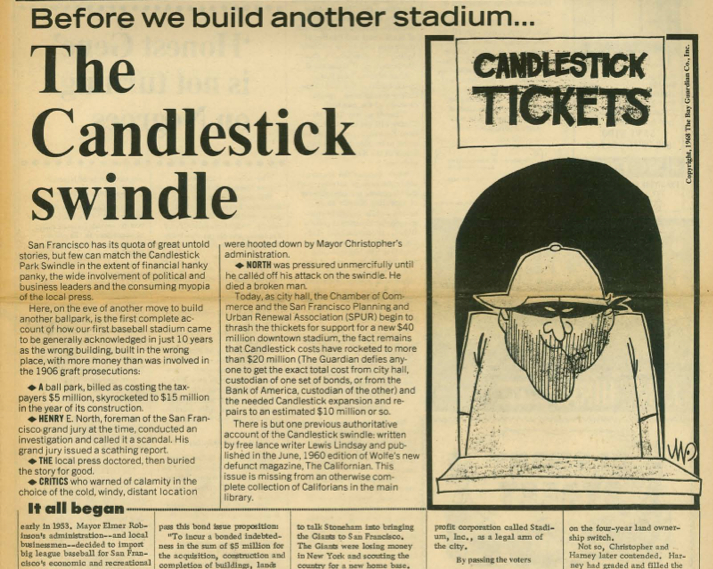
San Francisco spent this week saying goodbye to its beloved foggy stadium, Candlestick Park. Amidst the farewells, the Guardian spotted a post from sports blog Deadspin, which reprinted one of our articles from 1968  titled, “Before We Build Another Stadium… The Candlestick Swindle.” 

When we saw the post, we started thumbing through our archives looking for the article. Though Deadspin said it was from 1972, we found it in Vol. 2, Issue no. 10, May 14, 1968, it’s a down and dirty tale of intimidation, bypassing voters through dummy corporations, profiteering, and racism. Candlestick has a colorful history, to say the least. 

The author, Burton H. Wolfe (Burton, not “Mr. Wolfe,” he wrote via email), gave us permission to re-publish it in full here. Just for fun, we’re also embedding the original issue as a PDF, which can be download and printed. Looking through the issue, it’s heartening (and disheartening) how much, and how little, changes.


The Candlestick Swindle

It all began early in 1953. Mayor Elmer Robinson’s administration—and local businessmen—decided to import big league baseball for San Francisco’s economic and recreational benefit. A downtown stadium was adequate for San Francisco’s AAA minor league club, the Seals, but not for major league fare.

Hence, Robinson asked the Board of Supervisors to approve a $5 million bond proposition to construct a new stadium. Among the supervisors in approval: George Christopher, soon to become mayor; Gene McAteer, headed for the state senate; Francis McCarty, a future judge; Harold Dobbs, restaurateur and budding Republican candidate for mayor, and John Jay Ferdon, future district attorney.

In July of that same year, 1953, a local multi-millionaire contractor named Charles Harney purchased 65 acres of land at Candlestick Point from the city of San Francisco for $2,100 an acre.

Next year, a band of publicists headed by Curley Grieve, S.F. Examiner sports editor, beat the drums and called the natives to pass this bond issue proposition:

To incur a bonded indebtedness in the sum of $5 million for the acquisition, construction and completion of buildings, lands and other works and properties to be used for baseball, football, other sports, dramatic productions and other lawful uses as a recreation center.

Major league baseball, they proclaimed, would bring untold wealth to the city for a mere $5 million, a price that would be returned many times. After voters approved this in November, 1954, the search began for a site. If there were any doubts the stadium would cost more than $5 million, they were dispelled in a personal meeting between Robinson’s successor, Mayor Christopher, and the owner of the New York Giants, Horace Stoneham.

In April, 1957, Christopher and McCarty flew to New York to talk Stoneham into bringing the Giants to San Francisco. The Giants were losing money in New York, and scouting the country for a new home base.

To prove San Francisco’s support for professional baseball, Christopher waved the $5 million stadium bond issue at Stoneham. According to testimony reported by the 1968 grand jury investigation, Stoneham replied contemptuously:

Any figure other than 10 or 11 million dollars shouldn’t even be discussed because there would be no possibility or probability of a major club moving to that particular community.

Back in San Francisco, Christopher reported the need for more money to other city leaders and businessmen. Since the proposition suddenly to double the original bond issue might run into trouble with the voters, they decided to create a non-profit corporation called Stadium, Inc., as a legal arm of the city.

Bypassing the Voters

Operating through this dummy corporation, the Christopher administration could bypass the voters to raise more money.

Harney and two of his employees were selected as the first board of directors of Stadium, Inc. Christopher told Harney that he would be the contractor to build the new stadium, and his 41 acres of Candlestick land would be the heart of the 77-acre location.

In 1957, Harney sold back 41 acres of the parcel he had purchased from the city in 1953 at $2,100 an acre. The 1957 price the city paid to Harney for its own former land was $65,853 an acre. That’s a crisp total of $2.7 million.

The city’s Real Estate Department approved the deal even though other land adjacent to Harney’s was bought at about the same time for just $6,540 an acre. Harney made a profit of $2.6 million on the four-year land ownership switch.

Not so, Christopher and Harney later contended. Harney had graded and filled the land, and so naturally he was paid for his improvements. One fact raised doubts about that explanation: a $7 million fee awarded to Harney to construct the new stadium included $2 million for stadium construction, $2 million for grading and filling and $2.7 million for real estate.

Had it not been for the creation of Stadium, Inc., the Christopher administration would have been required to hold open, competitive bidding for the contract, and voters would have seen the price tags.

By operating through Stadium, Inc., Christopher was able to evade the city charter and arrange the contract in a privately negotiated deal.

Through the same apparatus, his administration was able to float another $5.5 million bond issue without voter approval. The interest rate on these bonds was set at 5% whereas the interest on the original $5 million bond issue was only 2.4%, a difference that would eventually cost the city hundreds of thousands of dollars.

Evading an Investigation

In February, 1958, Harney and his employees were removed from the board of Stadium, Inc., after, as the grand jury report later pointed out, “Three influential men then were substituted to represent the city’s interest—Alan K. Brown, W.P. Fuller Brawne and Frederic P. Whitman.”

The maneuver came too late to prevent Henry E. North from instigating a Grand Jury investigation into the strange transactions.

North, like Christopher, was a Republican and a conservative member of the San Francisco business community. Until his retirement, at 70, he had been executive vice-president of one of the largest property owners in the city: the Metropolitan Life Insurance Company. He had a strong sense of civic duty, however, and the Candlestick Park deal smelled to him of garbage.

The report North issued, as the result of the Grand Jury investigation, was potential dynamite. It showed that, shortly before the city purchased Harney’s land at $65,853 an acre, adjacent pieces of tideland were sold by the city for less that $4,000 an acre. It did not make sense that Harney’s land, partly under water, should have brought $61,000 more from city coffers.

On Dec. 2, 1958, the San Francisco Chronicle carried partial coverage of the Grand Jury report. On page 5, the year Harney purchased the city land was stated as 1933 rather than 1953. Of course, the 20-year difference would provide a reason for the tremendous increase in value, because the initial purchase price would have been at depression levels.

Undoubtedly, it was a typographical error. And no doubt it was by unintentional omission that other salient features of the Grand Jury report were omitted altogether and never printed by the Chronicle or any other major newspaper.

North charged that all bond issues negotiated by Stadium, Inc. were illegal evasions of the city charter. Bond payments had to be made from city funds, not the dummy nonprofit corporation, and so the whole deal amounted to legal subterfuge; a way to make taxpayers foot the bill without letting them vote on it.

The report, drafted by North and signed by 18 other citizens, estimated annual payments on the bonds of $990,000 for the first 15 years of the debt period. Against that, the city was to draw $225,000 a year in rent from the Giants and $225,000 a year from advertising and parking revenues, leaving a balance of $640,000 to be paid annually from taxes or city funds. It was estimated that the city could make up the balance by commanding the juicy television rights; instead, Christopher arranged for rights to go exclusively to the Giants.

Altogether, it was a marvelous deal for the Giants. In their last New York season, attendance at the Polo Grounds plummeted to 684,000. The club had gone broke and it was almost impossible to give away its stock. After the Giants first season in San Francisco in 1958, attendance tripled over its last year in New York, and their stock soared to $1,000 a share. In terms of revenue, the increase in gate receipts alone meant $3 million the first year.

While the Giants were reaping enormous profits at taxpayers expense, City Hall and the local newspapers were trying to make it appear that San Francisco, too, was earning money. The News-Call Bulletin, the now defunct Hearst paper, once stated that when all returns are in, the season just ended (1960) will have yielded the city about $530,000. The fact was that the sole revenue to the city was $50,000 received to maintain buildings and grounds.

The other Hearst paper, the Examiner, stated, on the other hand: City Hall officials said $375,000 of the revenue figure will be used to pay the annual cost of the city’s $5 million bond issue. The Chronicle published this figure: Of the remaining $527,000, the first $375,000 must go toward payment of the city’s $5 million stadium bond issue.

The fact was that all revenues from the ball park and its parking lot had to be used to pay off the $5.5 million worth of bonds issued by Stadium, Inc., with the exception of the $50,000 maintenance income. The other $5 million worth, issued by the city, had to be paid off through real and personal or property taxes collected by the city.

The result: a projected loss, not profit, of $640,000 the city must pay from taxes or other general city revenues (according to the Grand Jury report), and a loss this year of at least $360,000 (according to figures supplied to The Guardian by the city controller’s office and Mike Barrett, the Bank of America executive who handles Stadium, Inc.’s trustee account.)

Some annual loss on Candlestick Park will continue until 1993, when the stadium will finally be free of debt and owned completely by the city—unless, it is torn down before then or reconstructed, which will add more debt.

There was another interesting development at Candlestick: Stevens California Enterprises, which got the food and beverage concession at the ball park, bought all its milk until two seasons ago from Christopher’s milk company, Christopher Dairy Farms. The Borden Co. now has the lucrative contract.

Even though City Hall and the newspapers were misstating facts about the Candlestick story, San Francisco restaurateurs, hotel owners and shopkeepers at least began to realize that they were not making any money from the ball park, as promised by the ballyhooers. Only the Giants, Harney, and Christopher were making money. The Giants were attracting few additional tourists to San Francisco, and area fans who journeyed to isolated Candlestick Point, several miles away, did not stop to patronize downtown establishments. Some downtown business men were angry, and if North’s crusade were given time and publicity, they might cause an uncomfortable controversy.

Christopher sent emissaries to North, but he would not be wooed or pressured from his stand. To the contrary, he made even more vigorous attacks on Christopher and the ball park deal. The lives of future generations had been mortgaged by this shoddy piece of business, he maintained. Christopher was diverting city funds from various departments: $1.4 million from street improvement bonds, $1.2 million from state gasoline taxes given to the city for road improvements, $1.5 million from sewer bonds for services to the Giants ball park.

A Hidden Payoff?

Already the cost was $15 million, and it might exceed $20 million when various exits, entrances, widened access streets and the like were built to handle the anticipated large crowds. Privately, North informed civic and business leaders that there was an underhanded payoff in the deal, and he intended to expose it.

Christopher reacted viscerally to North’s charges. With newspapermen present, he asserted North was drunk, incoherent, and fixable. The description was published in the newspapers.

North went to Nate Cohn, one of the foremost criminal lawyers in California, and they filed a $2 million libel suit against Christopher. In a pre-trial hearing, Christopher’s attorney filed a thick brief with 45 motions for dismissal of the suit, hoping to tie up the case inextricably. In just an hour and a half, Superior Court judge Preston Devine threw out all 45 motions, indicating clearly that Cohn and North had a good case.

Breaking Down North

Christopher’s friends in the business community went to work on North. The publisher of one of the three daily newspapers, North told me, called on him and said, “Henry, why don’t you play ball? You’re giving the city a bad name, stirring things up like this.”

At the Pacific Union Club across the street from the Fairmont Hotel on Nob Hill, where North was already in disfavor for bringing Jewish guests despite the no-Jews-allowed policy, fellow Republican business executives started a snub-North routine. One day, for example, an old business friend greeted North:

“Say, Henry, I see in the papers there’s some fellow named Henry North filing a suit against the mayor and stirring things up. Must be another Henry North in this town, huh?”

“No, that’s me,” North told him.

“Is that so?” the old friend said. He turned his back on North and never spoke to him again.

I talked to North several times during the siege because I was publishing articles about Candlestick Park in my magazine, The Californian (now defunct). In those days he was full of fight, willing to take on City Hall and the entire business establishment even if it meant losing every friend he had. He promised to tell me the names of the men involved in the payoff, and he excoriated Christopher.

“You know what I call men like George Christopher? Black Republicans. Men who never did anything in their lives for the good of the common people. They’ve never realized that this country as a whole is no better off than the great masses of its people.”

The Fateful Fifth

Then they went to work on his wife. Unlike Henry, she was not involved in politics and her life revolved around her friends and social affairs. Her friends snubbed her and she no longer received invitations. She cried, she pleaded, she begged Henry to call off the ball park investigation and the lawsuit, when that did not move him, she threatened him with divorce. Henry began hitting the bottle.

On June 2, 1960, shortly after I published a detailed article by Lewis Lindsay called “The Giants Ball Park: A $15 Million Swindle,” the press broke the story that North had buried the hatchet with Christopher. In its first edition, the Chronicle correctly reported that North and Christopher had drunk a fifth and a half of Scotch together at Christopher’s home, and praised each other for publication. “He’s a great mayor,” North said—and agreed that legal entanglements were finished. The Chronicle dropped mention of the Scotch in later editions that went to most of its readers.

Cohn was outraged. “We had this suit won,” he told me. “North assured me he was going through with this no matter what happened. But they got to him through his wife, the poor old bastard. You see how they do things in this city? It’s so goddamned rotten you can’t believe it.”

When I called on North again, I found a complete transformation in his appearance. The look of a peppery fighter with ruddy cheeks had given way to a physical wreck; a baggy-eyed, tired, meek looking man weighed down by defeat.

The saddest part of the story was that his wife divorced him anyway. Not long afterward, North died of a heart attack. Harney died in December, 1962.

With North out of the way, with the daily newspapers blacking out the most important parts of the Candlestick Park story, with The Californian reaching only a few thousand citizens, it looked as though the scandal would never be investigated. In an effort to stir up something, I personally appeared before the Finance Committee of the Board of Supervisors and urged their help. One committee member, Al Zirpoli, had said before that he would favor an investigation.

No committee member challenged any facts I presented. When I finished, John Jay Ferdon, Committee Chairman, said only that he would not favor an investigation. He did not say why. (Six years later, when he had become District Attorney, he told me I was right about Candlestick.) Zirpoli, later to become a federal judge and the judge to hear draft resistance cases, said, “I agree with what Mr. Ferdon says.” He suggested, “If there is wrongdoing, your best course of action is a taxpayers’ suit.”

I went looking for wealthy liberals to finance a taxpayers suit, but none were in season. Cohn would have taken the suit if I could have found somebody to pay him for his time. All that he could do now was take me to business friends and introduce me.

The typical reaction came from Sam Cohen, owner of a plush restaurant on Maiden Lane said:

“Sorry, Burton, I can’t get involved. Do you know what Christopher can do to me with his power at City Hall? A Health Department inspector can find something wrong with this restaurant any time he wants. A door is too narrow, my stove does not meet regulations, anything to run me out of business. That’s how they do it. You can’t fight them.”

Since nobody in the city would fight, I asked Sen. Estes Kefauver, chairman of the Antitrust and Monopoly Sub-Committee of the Senate Committee on the Judiciary, to investigate. He replied: “As interesting as a study of how the San Francisco ball park deal took place would be, I do not conclude that it is a matter that should be gone into on the federal level. I think that it is entirely a local or state matter, and that the Subcommittee would perhaps be criticized if it moved into this area.”

Now Another Ballpark

Here we are eight years later, with a Candlestick Park that enrages so many people that a new mayor, Joe Alioto, wants to scrap it for a new stadium. His announced philosophy is that great public projects should not be waylaid just because all of the people aren’t getting enough spaghetti and zucchini. And no doubt many San Franciscans believe that a ball park is a great public project, greater than a school, housing complex or a modern transportation system. That attitude could be the most tragic part of this story.


Psychic Dream Astrology: Dec, 25-31, 2013

0

ARIES

March 21-April 19

You are meant to adjust, Aries. There is no value in trying to keeps things the same, no matter how seductive that may feel to you right now. This week will go so much smoother if you don’t resist change; participate in the transformations that are happening within and around you this week.

­TAURUS

April 20-May 20

Trust your instincts, even if you have to get past your ideas about how things are ‘supposed’ to be. If all you’re focused on is preserving peace, you’ll miss out on great opportunities.  As we say goodbye to 2013 this is the right time to take stock of what you want to create and how you’re willing to go about it.

GEMINI

May 21-June 21

No matter how sad or stuck you feel, this is not the time to give up or give in. Your convictions are being tested so don’t let upsets derail you. How you cope with your feelings is as important as what you do this week. Let the things that block you spur you on to new heights and greater self-knowledge.

CANCER

June 22-July 22

Don’t engage in power struggles, Moonchild. No matter how much the holiday season tweaks your mood and mind, now is not the time to take the bait and play into drama. If you can’t take space from what irks you try to remember that if you can’t find anything constructive to say, don’t say anything at all.

LEO

July 23-Aug. 22

It’s OK if your people don’t understand what you’re doing, ‘cause right now you just need to make sense to yourself. This is the right time to take risks and leaps of faith that fortify you, Leo. You don’t need things to be perfect, but you do need them to feel alive and like they are growing towards greater abundance. Dream big.

VIRGO

Aug. 23-Sept. 22

It’s all about your relationships this holiday week, Virgo. Be intentional about how you relate to others, because passivity is a misuse of your energy. Reach out to those you care about, mend broken fences and douse those you love with kindness; find home in the love you share with others.

LIBRA

Sept. 23-Oct. 22

Don’t over think things, Libra! You are on the verge of whipping yourself into such a frenzy that you obsess over too many details, and then impulsively pull some crazy and self-destructive moves. Take responsibility for your actions by taking more loving care of your attitudes, and don’t forget to breathe.

SCORPIO

Oct. 23-Nov. 21

. Prioritize having clear and strong boundaries with folks this week. You are a deep feeler, and when you loose contact with your instincts things can quickly become a mess. You are likely to deepen your relationships or just expertly avoiding real intimacy over the holidays; choose wisely, Scorpio.

SAGITTARIUS

Nov. 22-Dec. 21

Sometimes you’ve got to let go to hold on. There’s no point in lamenting on how things used to be. The past is behind you and your present requires your heartfelt attention. Indulge in a ‘best of’ episode of whatever it is you’re stuck on and then put it down so you can move towards what you want to create next.

CAPRICORN

Dec. 22-Jan. 19

Don’t get penned in by your reactions, Capricorn. Things are going great for you in so many ways so take a minute to feel awesome about it! This week will require you to set some limits, and you can get all riled up about, but that’s just likely to make things worse for everyone. Say your piece and let it go.

AQUARIUS

Jan. 20-Feb. 18

Practice holding your hopes and intentions firmly in your mind, but not being attached to them. This requires willingness to let things play out in their own way and at their own pace, which ultimately requires faith. If you’re pushy this week you just might end up unwittingly pushing excellence away, pal.

PISCES

Feb. 19-March 20

Let yourself gravitate towards what brings you happiness, Pisces. You have worked hard and you need a break from toil to allow yourself to simply receive goodness. As 2013 comes to its close, reflect on how you have gotten in your own way this year and how you plan to step out of it.

Want more in-depth, intuitive or astrological advice from Jessica? Schedule a one-one-one reading that can be done in person or by phone. Visit www.lovelanyadoo.com


Music Listings

0

WEDNESDAY 25
ROCK
Elbo Room: 647 Valencia, San Francisco. 16th Annual Black X Mass, w/ Bite, The Death Medicine Band, Theremin Wizard Barney, Kitten on the Keys, more, 9 p.m., $10.
DANCE
Cat Club: 1190 Folsom, San Francisco. “Bondage A Go Go,” w/ DJs Damon, Tomas Diablo, & guests, 9:30 p.m., $5-$10.
DNA Lounge: 375 11th St., San Francisco. Death Guild: X-Mess Night, w/ DJs Decay, Melting Girl, Joe Radio, Sage, and Lexor, 9 p.m., $5.
F8: 1192 Folsom St., San Francisco. “Housepitality: Free Christmas Party,” w/ Fil Latorre, Joel Conway, Matt Richardson, Michael Tello, Miguel Solari, Mike Bee, Sharon Buck, Sean Murray, Tyrel Williams, Victor Vega, 9 p.m., free.
JAZZ
Amnesia: 853 Valencia, San Francisco. Gaucho, Eric Garland’s Jazz Session, The Amnesiacs, 7 p.m., free.
Jazz Bistro at Les Joulins: 44 Ellis, San Francisco. Charles Unger Experience, 7:30 p.m., free.
Top of the Mark: One Nob Hill, 999 California, San Francisco. Christmas Brunch & Dinner Buffet with Michael Athans & Ricardo Scales, 10 a.m., $59-$109.
Zingari: 501 Post, San Francisco. Barbara Ochoa, 7:30 p.m.
BLUES
Biscuits and Blues: 401 Mason, San Francisco. Craig Horton, 7:30 & 10 p.m., $15.
The Saloon: 1232 Grant, San Francisco. Powell Street Blues Band, 9:30 p.m.

THURSDAY 26
ROCK
Amnesia: 853 Valencia, San Francisco. “Mods v. Rockers: X-Mass Present,” w/ #1 Smash Hits, Pennywhistle Park, 9 p.m., free.
Bottom of the Hill: 1233 17th St., San Francisco. April & The Paradigm, The American Professionals, Matt Jaffe & The Distractions, 9 p.m., $8.
Brick & Mortar Music Hall: 1710 Mission, San Francisco. Caldecott, Spooky Flowers, 9 p.m., $8-$10.
Hotel Utah: 500 Fourth St., San Francisco. Rakehell, 9 p.m., $8.
DANCE
Abbey Tavern: 4100 Geary, San Francisco. DJ Schrobi-Girl, 10 p.m., free.
Aunt Charlie’s Lounge: 133 Turk, San Francisco. “Tubesteak Connection,” w/ DJ Bus Station John, 9 p.m., $5-$7.
The Cafe: 2369 Market, San Francisco. “¡Pan Dulce!,” 9 p.m., $5.
Cat Club: 1190 Folsom, San Francisco. “Throwback Thursdays,” ‘80s night with DJs Damon, Steve Washington, Dangerous Dan, and guests, 9 p.m., $6 (free before 9:30 p.m.).
The Cellar: 685 Sutter, San Francisco. “XO,” w/ DJs Astro & Rose, 10 p.m., $5.
Club X: 715 Harrison, San Francisco. “The Crib,” 9:30 p.m., $10, 18+.
Elbo Room: 647 Valencia, San Francisco. “Afrolicious,” w/ DJs Pleasuremaker, Señor Oz, and live guests, 9:30 p.m., $5-$8.
F8: 1192 Folsom St., San Francisco. “Paradigm: A Shift in Musical Soundscapes,” w/ Method One, Sam Supa, Nebakaneza, Lud Dub, Miss Haze, Shadow Spirit, Cyclopian, 9 p.m., free.
Infusion Lounge: 124 Ellis, San Francisco. “I Love Thursdays,” 10 p.m., $10.
Neck of the Woods: 406 Clement St., San Francisco. Blaus, on the downstairs stage, 10 p.m. continues through, free with RSVP.
Q Bar: 456 Castro, San Francisco. “Throwback Thursday,” w/ DJ Jay-R, 9 p.m., free.
Raven: 1151 Folsom St., San Francisco. “1999,” w/ VJ Mark Andrus, 8 p.m., free.
Ruby Skye: 420 Mason, San Francisco. “Awakening,” w/ R3hab, 9 p.m., $25-$35 advance.
The Tunnel Top: 601 Bush, San Francisco. “Tunneltop,” DJs Avalon and Derek ease you into the weekend with a cool and relaxed selection of tunes spun on vinyl, 10 p.m., free.
Underground SF: 424 Haight, San Francisco. “Bubble,” 10 p.m., free.
Vessel: 85 Campton, San Francisco. “Base: Local Label Night,” w/ Bardia F, ThuyVu, Emanate, Mac Vaughn, Playdoughboy, 10 p.m., free with RSVP.
HIP-HOP
Eastside West: 3154 Fillmore, San Francisco. “Throwback Thursdays,” w/ DJ Madison, 9 p.m., free.
John Colins: 138 Minna, San Francisco. “#Quattro,” w/ DJ Dino, Fourth Thursday of every month, 9 p.m.
Skylark Bar: 3089 16th St., San Francisco. “Peaches,” w/ lady DJs DeeAndroid, Lady Fingaz, That Girl, Umami, Inkfat, and Andre, 10 p.m., free.
ACOUSTIC
Bazaar Cafe: 5927 California, San Francisco. Acoustic Open Mic, 7 p.m.
JAZZ
Bird & Beckett: 653 Chenery, San Francisco. Butterfly Jazz Trio, 3 p.m., free.
Blush! Wine Bar: 476 Castro, San Francisco. Doug Martin’s Avatar Ensemble, 7:30 p.m., free.
Boom Boom Room: 1601 Fillmore, San Francisco. Victor Little’s Big Hit, 9:30 p.m., $5-$8.
Bottle Cap: 1707 Powell, San Francisco. The North Beach Sound with Ned Boynton, Jordan Samuels, and Tom Vickers, 7 p.m., free.
Cafe Claude: 7 Claude, San Francisco. Nova Jazz, 7:30 p.m., free.
Le Colonial: 20 Cosmo, San Francisco. Steve Lucky & The Rhumba Bums, 7:30 p.m.
Pier 23 Cafe: Pier 23, San Francisco. Ned Boynton, 6 p.m., free.
Revolution Cafe: 3248 22nd St., San Francisco. Shimmering Leaves, 8:30 p.m., free.
The Royal Cuckoo: 3202 Mission, San Francisco. Charlie Siebert & Chris Siebert, 7:30 p.m., free.
Savanna Jazz Club: 2937 Mission, San Francisco. Savanna Jazz Jam with Eddy Ramirez, 7:30 p.m., $5.
Top of the Mark: One Nob Hill, 999 California, San Francisco. Stompy Jones, 7:30 p.m., $10.
Zingari: 501 Post, San Francisco. Barbara Ochoa, 7:30 p.m., free.
INTERNATIONAL
Bissap Baobab: 3372 19th St., San Francisco. “Pa’Lante!,” w/ Juan G, El Kool Kyle, Mr. Lucky, 10 p.m., $5.
Cafe Cocomo: 650 Indiana, San Francisco. Danilo y Universal, El DJ X, 8 p.m., $12.
Pachamama Restaurant: 1630 Powell, San Francisco. “Jueves Flamencos,” 8 p.m., free.
Verdi Club: 2424 Mariposa, San Francisco. The Verdi Club Milonga, w/ Christy Coté, DJ Emilio Flores, guests, 9 p.m., $10-$15.
REGGAE
Pissed Off Pete’s: 4528 Mission St., San Francisco. Reggae Thursdays, w/ resident DJ Jah Yzer, 9 p.m., free.
BLUES
50 Mason Social House: 50 Mason, San Francisco. Bill Phillippe, 5:30 p.m., free.
Biscuits and Blues: 401 Mason, San Francisco. Terrie Odabi & Evolution Blues, 7:30 & 9:30 p.m., $15.
The Saloon: 1232 Grant, San Francisco. Chris Ford, 9:30 p.m.; Wendy DeWitt, 9:30 p.m.
COUNTRY
The Parlor: 2801 Leavenworth, San Francisco. “Twang Honky Tonk & Country Jamboree,” w/ DJ Little Red Rodeo, 7 p.m., free.
EXPERIMENTAL
The Luggage Store: 1007 Market, San Francisco. Sugarm, Slither Syndicate, 8 p.m., $6-$10.

FRIDAY 27
ROCK
Bottom of the Hill: 1233 17th St., San Francisco. Great White Buffalo, New Cadence, Northerner, 9:30 p.m., $10-$12.
Brick & Mortar Music Hall: 1710 Mission, San Francisco. Down & Outlaws, Down Dirty Shake, Psychic Jiu-Jitsu, DJ Darragh Skelton, 9 p.m., $5-$7.
Hemlock Tavern: 1131 Polk, San Francisco. Jessie Evans, Moira Scar, DJ Omar, 9:30 p.m., $10.
The Knockout: 3223 Mission, San Francisco. The Boars, The Rantouls, So What!, The Krypters, DJ Medium Rare, 9:30 p.m., $6.
DANCE
1015 Folsom: 1015 Folsom St., San Francisco. Paul van Dyk, DJ Dan, DJ Taj, Dirtyhertz, Sequence, WhiteNoize, Kevin Kind, Niko Zografos, Reverse, Spencer Hardwick, Thrawn, Naughty J, many more, 9 p.m., $50-$60 advance.
Audio Discotech: 316 11th St., San Francisco. Fred Falke, Dr. Fresch, Anoctave, 9:30 p.m., $10 advance.
BeatBox: 314 11th St., San Francisco. “U-Haul,” w/ DJs Ms. Jackson & China G, 10 p.m., $5-$10.
Cafe Flore: 2298 Market, San Francisco. “Kinky Beats,” w/ DJ Sergio, 10 p.m., free.
The Cafe: 2369 Market, San Francisco. “Boy Bar,” w/ DJ Matt Consola, 9 p.m., $5.
Cat Club: 1190 Folsom, San Francisco. “Dark Shadows vs. The Witching Hour,” w/ DJs Daniel Skellington, Sage, Melting Girl, and Tomas Diablo, 9:30 p.m., $7 ($3 before 10 p.m.).
The Cellar: 685 Sutter, San Francisco. “F.T.S.: For the Story,” 10 p.m.
DNA Lounge: 375 11th St., San Francisco. “Trap & Bass,” w/ UltraViolet, Napsty, Harris Pilton, Lé Swndle, 9 p.m., $10-$20.
Elbo Room: 647 Valencia, San Francisco. “120 Minutes,” w/ Chippy Nonstop, Nanosaur, Powwoww, Santa Muerte, Chauncey CC, 10 p.m.
The Grand Nightclub: 520 4th St., San Francisco. “We Rock Fridays,” 9:30 p.m.
Infusion Lounge: 124 Ellis, San Francisco. “Escape Fridays,” 10 p.m., $20.
Lookout: 3600 16th St., San Francisco. “HYSL,” 9 p.m., $3.
Madrone Art Bar: 500 Divisadero, San Francisco. “I ♥ the ‘90s,” w/ DJs Samala, Teo, Mr. Grant, & Sonny Phono, Fourth Friday of every month, 9 p.m., $5.
Manor West: 750 Harrison, San Francisco. “Fortune Fridays,” 10 p.m., free before 11 p.m. with RSVP.
MatrixFillmore: 3138 Fillmore, San Francisco. “F-Style Fridays,” w/ DJ Jared-F, 9 p.m.
Mighty: 119 Utah, San Francisco. “Holidazed,” w/ Doc Martin, Solar, Mark Darby, Kayleigh Nicole, 10 p.m., $15-$20.
Monarch: 101 6th St., San Francisco. Bob Moses, Dave Aju, Elz, 9:30 p.m., $20 advance.
OMG: 43 6th St., San Francisco. “Release,” 9 p.m., free before 11 p.m.
Public Works: 161 Erie, San Francisco. “Resonate,” w/ B. Lewis, RU (AreYou), Insightful, Ruff Draft, Mophono, Citizen Ten, Bdot, Mr. Muddbird, Tone, Joe Mousepad (in the OddJob Loft), 9 p.m., $5-$10; “Playa Favorites,” w/ The Scumfrog, DJ Kramer, Josh Vincent (in the main room), 9 p.m., $10-$15.
Q Bar: 456 Castro, San Francisco. “Pump: Worq It Out Fridays,” w/ resident DJ Christopher B, 9 p.m., $3.
Ruby Skye: 420 Mason, San Francisco. Darude, 9 p.m., $20 advance.
Underground SF: 424 Haight, San Francisco. “Bionic,” 10 p.m., $5.
Vessel: 85 Campton, San Francisco. “Project X,” w/ Feldy, Joey Moretti, 10 p.m., $10-$30.
Wish: 1539 Folsom, San Francisco. “Bridge the Gap,” w/ resident DJ Don Kainoa, Fridays, 6-10 p.m., free.
Women’s Building: 3543 18th St., San Francisco. Winter Wonderland Roller Disco Party, w/ Black Rock Roller Disco, 8 p.m., $10.
HIP-HOP
EZ5: 682 Commercial, San Francisco. “Decompression,” Fridays, 5-9 p.m.
John Colins: 138 Minna, San Francisco. “#Flow,” w/ The Whooligan & Mikos Da Gawd, Fourth Friday of every month, 10 p.m., free befoe 11 p.m.
Slim’s: 333 11th St., San Francisco. Berner, Dave Steezy, Azuré, 9 p.m., sold out.
ACOUSTIC
Bazaar Cafe: 5927 California, San Francisco. Alex Jimenez & Jane Thatcher, 7 p.m.
Cafe Du Nord: 2170 Market, San Francisco. “Old-Time Southern Murder Hour: Holiday Massacre,” w/ The Memphis Murder Men, The Pine Box Boys, Whisky Pills Fiasco, Lester T. Raww’s Graveside Quartet, 8:30 p.m., $11-$13.
Plough & Stars: 116 Clement, San Francisco. Seisiún with Pat O’Donnell, 9 p.m.
The Sports Basement: 610 Old Mason, San Francisco. “Breakfast with Enzo,” w/ Enzo Garcia, 10 a.m., $5.
JAZZ
Atlas Cafe: 3049 20th St., San Francisco. Jazz at the Atlas, 7:30 p.m., free.
Beach Chalet Brewery & Restaurant: 1000 Great Highway, San Francisco. Johnny Smith, 8 p.m., free.
Bird & Beckett: 653 Chenery, San Francisco. Chuck Peterson Quintet, Fourth Friday of every month, 5:30 p.m.
Cafe Claude: 7 Claude, San Francisco. Mad & Eddie Duran Trio, 7:30 p.m., free.
Jazz Bistro at Les Joulins: 44 Ellis, San Francisco. Charles Unger Experience, 7:30 p.m., free.
The Palace Hotel: 2 New Montgomery, San Francisco. The Klipptones, 8 p.m., free.
Pier 23 Cafe: Pier 23, San Francisco. Peter Horvath, 8 p.m., free.
The Royal Cuckoo: 3202 Mission, San Francisco. Jules Broussard, Danny Armstrong, and Chris Siebert, 7:30 p.m., free.
Savanna Jazz Club: 2937 Mission, San Francisco. Carol Luckenbach, 7:30 p.m., $8.
Top of the Mark: One Nob Hill, 999 California, San Francisco. Black Market Jazz Orchestra, 9 p.m., $10.
Zingari: 501 Post, San Francisco. Joyce Grant, 8 p.m., free.
INTERNATIONAL
Amnesia: 853 Valencia, San Francisco. Baxtalo Drom, International shimmying for lovers of Balkan music, bellydancers, and burlesque., Fourth Friday of every month, 9 p.m., $5-$10.
Bissap Baobab: 3372 19th St., San Francisco. “Paris-Dakar African Mix Coupe Decale,” 10 p.m., $5.
Cafe Cocomo: 650 Indiana, San Francisco. Taste Fridays, featuring local cuisine tastings, salsa bands, dance lessons, and more, 7:30 p.m., $15 (free entry to patio).
Cigar Bar & Grill: 850 Montgomery, San Francisco. Mazacote, 10 p.m.
Pachamama Restaurant: 1630 Powell, San Francisco. Cuban Night with Fito Reinoso, 7:30 & 9:15 p.m., $15-$18.
REGGAE
Gestalt Haus: 3159 16th St., San Francisco. “Music Like Dirt,” 7:30 p.m., free.
BLUES
Biscuits and Blues: 401 Mason, San Francisco. Shane Dwight, 7:30 & 10 p.m., $22.
Lou’s Fish Shack: 300 Jefferson St., San Francisco. Little Wolf & The HellCats, 6:30 p.m.
The Saloon: 1232 Grant, San Francisco. Jan Fanucchi, Last Friday of every month, 4 p.m.; Steve Freund, 9:30 p.m.
Sheba Piano Lounge: 1419 Fillmore, San Francisco. Aki Kumar, 9 p.m.
FUNK
Boom Boom Room: 1601 Fillmore, San Francisco. Steppin’, DJ K-Os, 9:30 p.m., $10.
Make-Out Room: 3225 22nd St., San Francisco. “Loose Joints,” w/ DJs Centipede, Damon Bell, and Tom Thump, 10 p.m., $5-$10.
SOUL
The Chapel: 777 Valencia St., San Francisco. “Friday Night Soul Party,” w/ Marc & The Casuals (featuring guests Virgil Shaw, Will Sprott, Bob Reed, Lavay Smith, and more); Viola Booth Group; DJs Andy Cabic & Orb, 9 p.m., $15.
Edinburgh Castle: 950 Geary, San Francisco. “Soul Crush,” w/ DJ Serious Leisure, 10 p.m., free.
Underground SF: 424 Haight, San Francisco. “Sissy Strut,” w/ The Handsome Young Men (DJs Ponyboy, Lil MC, Katie Duck, & Durt), Fourth Friday of every month, 10 p.m., $3-$5.
Yoshi’s San Francisco: 1330 Fillmore, San Francisco. Jon B, 8 & 10 p.m., $29-$34.

SATURDAY 28
ROCK
Boom Boom Room: 1601 Fillmore, San Francisco. Chris Zanardi & The High Beamz, Mark Sexton Band, 9:30 p.m., $10-$15.
Bottom of the Hill: 1233 17th St., San Francisco. Pounders, Fever Charm, Shuttlesworth, 9 p.m., $10.
Brick & Mortar Music Hall: 1710 Mission, San Francisco. Stu Allen & Mars Hotel, Lonesome Locomotive, 9 p.m., $15-$20.
Hotel Utah: 500 Fourth St., San Francisco. Junk Parlor, The Restless Sons, Sad Tires, 9 p.m., $10.
The Independent: 628 Divisadero, San Francisco. Cracker, Camper Van Beethoven, 9 p.m., $25-$27.
Neck of the Woods: 406 Clement St., San Francisco. Signal Number 4, Benefit for Typhoon Haiyan victims with music by Untamed Creatures, Paradox Labyrinth, Jurimiko, and SeptDi (on the downstairs stage)., 9 p.m., $10.
Slim’s: 333 11th St., San Francisco. Matthew Sweet, Cellar Doors, 8 p.m., $21.
DANCE
Audio Discotech: 316 11th St., San Francisco. Touch of Class Holiday Showcase, w/ PillowTalk, Tone of Arc, Signal Flow, Sharon Buck, Sammy D, Joel Conway, 9:30 p.m., $10-$20.
BeatBox: 314 11th St., San Francisco. “Chaos,” w/ DJs Joshua D & Tristan Jaxx, 10 p.m., $20 ($5 before 10:30 p.m.).
Cafe Flore: 2298 Market, San Francisco. “Bistrotheque,” w/ DJ Ken Vulsion, 8 p.m., free.
Cat Club: 1190 Folsom, San Francisco. “Villainy: Grinch Night,” w/ DJs Tomas Diablo, Chris Zachos, Donimo, Melting Girl, and Fact.50, 9:30 p.m., $5-$8.
DNA Lounge: 375 11th St., San Francisco. “Bootie S.F.,” w/ A+D, Airsun, Brass Tax DJs, more, 9 p.m., $10-$15.
The EndUp: 401 Sixth St., San Francisco. Shangri-La, Asian queer dance party., Fourth Saturday of every month, 10 p.m., $15-$20 (free before 11 p.m.).
Infusion Lounge: 124 Ellis, San Francisco. “Set,” Fourth Saturday of every month, 10 p.m., $20.
Lookout: 3600 16th St., San Francisco. “Bounce!,” 9 p.m., $3.
Mighty: 119 Utah, San Francisco. Mr. Carmack, Buku, Great Dane, Penthouse Penthouse, Bogl, 9 p.m., $10-$20 advance.
Milk Bar: 1840 Haight, San Francisco. “Spilt Milk,” w/ Vin Sol, Taylor Fife, Shaky Premise, Etcher/Engraver, 9 p.m., $5.
Monarch: 101 6th St., San Francisco. King Most, Kimmy Le Funk, DJ Omar, 9:30 p.m.
Public Works: 161 Erie, San Francisco. Second Annual As You Like It Ugly Sweater Party, w/ Mathew Jonson, Hrdvsion, Midnight Operator, Kate Simko, Mossmoss, Victor Vega, Ewan Pearson, Bells & Whistles, Jason Greer, Ivy, 9 p.m., $12-$25.
Ruby Skye: 420 Mason, San Francisco. Sultan & Ned Shepard, 9 p.m., $20 advance.
Temple: 540 Howard, San Francisco. “Life,” w/ Sk0step, Mikey Tan, Tigran, Darren Holland, Carlos Alfonzo, Hector Infusion, J Funk, Glade Luco, MoMentum, 10 p.m., $20.
Vessel: 85 Campton, San Francisco. DJ Scotty Boy, Fyasko, 10 p.m., $10-$30.
HIP-HOP
Elbo Room: 647 Valencia, San Francisco. HipHopForChange’s Hip-Hop Holiday Party, w/ BPos, Seneca, 2nd Floor Samurais, Mint Rock, Tahaj the 1st, Bottom Hammer, 9 p.m., $10.
John Colins: 138 Minna, San Francisco. “Nice,” w/ DJ Apollo, Fourth Saturday of every month, 10 p.m., $5.
Slate Bar: 2925 16th St., San Francisco. “So Fresh,” w/ DJs Miles Green & Twin Spin, 10 p.m.
ACOUSTIC
Atlas Cafe: 3049 20th St., San Francisco. Craig Ventresco & Meredith Axelrod, Saturdays, 4-6 p.m., free.
Exit Theatre: 156 Eddy, San Francisco. “Songwriter Saturdays,” hosted by Melissa Lyn, Last Saturday of every month, 8:30 p.m., free/donation.
Giordano Brothers: 303 Columbus, San Francisco. John Rybak, CelloJoe, 9 p.m.
The Riptide: 3639 Taraval, San Francisco. Slow Motion Cowboys, 9:30 p.m., free.
JAZZ
Cafe Claude: 7 Claude, San Francisco. Lori Carsillo, 7:30 p.m., free.
Jazz Bistro at Les Joulins: 44 Ellis, San Francisco. Bill “Doc” Webster & Jazz Nostalgia, 7:30 p.m., free.
The Rite Spot Cafe: 2099 Folsom, San Francisco. Mr. Lucky & The Cocktail Party, 9 p.m., free.
Savanna Jazz Club: 2937 Mission, San Francisco. Savanna Jazz Trio, 7 p.m., $8.
Sheba Piano Lounge: 1419 Fillmore, San Francisco. The Robert Stewart Experience, 9 p.m.
Zingari: 501 Post, San Francisco. Anne O’Brien, Last Saturday of every month, 8 p.m., free.
INTERNATIONAL
1015 Folsom: 1015 Folsom St., San Francisco. “Pura,” 9 p.m., $20.
Bissap Baobab: 3372 19th St., San Francisco. “Paris-Dakar African Mix Coupe Decale,” 10 p.m., $5.
Cafe Cocomo: 650 Indiana, San Francisco. Somos el Son, DJ Good Sho, 9 p.m., $15.
The Chapel: 777 Valencia St., San Francisco. SambaDá, 9 p.m., $15-$18.
Cigar Bar & Grill: 850 Montgomery, San Francisco. Orquesta Borinquen, 10 p.m.
Make-Out Room: 3225 22nd St., San Francisco. “El SuperRitmo,” w/ DJs Roger Mas & El Kool Kyle, 10 p.m., $5 before 11 p.m.
OMG: 43 6th St., San Francisco. “Bollywood Blast,” Fourth Saturday of every month, 9 p.m., $5 (free before 10 p.m.).
Pachamama Restaurant: 1630 Powell, San Francisco. Eddy Navia & Pachamama Band, 8 p.m., free.
Red Poppy Art House: 2698 Folsom, San Francisco. Yumi Tomsha, 7:30 p.m., $15-$20.
Space 550: 550 Barneveld, San Francisco. “Club Fuego,” 9:30 p.m.
REGGAE
Pier 23 Cafe: Pier 23, San Francisco. Native Elements, Last Saturday of every month, 10 p.m., $10-$15.
BLUES
Biscuits and Blues: 401 Mason, San Francisco. Earl Thomas & The Blues Ambassadors, Last Saturday of every month, 7:30 & 10 p.m., $24.
Lou’s Fish Shack: 300 Jefferson St., San Francisco. Robert “Hollywood” Jenkins, 6:30 p.m.
The Royal Cuckoo: 3202 Mission, San Francisco. Big Bones & Chris Burns, 7:30 p.m., free.
The Saloon: 1232 Grant, San Francisco. Dave Workman, Fourth Saturday of every month, 4 p.m.; Ron Hacker, Last Saturday of every month, 9:30 p.m.
SOUL
Cafe Du Nord: 2170 Market, San Francisco. Midtown Social, 9 p.m., $10-$12.
Edinburgh Castle: 950 Geary, San Francisco. “Nightbeat,” w/ DJs Primo, Lucky, and Dr. Scott, Fourth Saturday of every month, 9 p.m., $3.
Yoshi’s San Francisco: 1330 Fillmore, San Francisco. Jon B, 8 & 10 p.m., $34.

SUNDAY 29
ROCK
The Knockout: 3223 Mission, San Francisco. Terry Malts, Violent Change, Quaaludes, Cop Out, DJ Tosh, 3 p.m., $7.
Milk Bar: 1840 Haight, San Francisco. Odd Owl, Kitten Grenade, Unruly Things, 8 p.m., $10.
Sub-Mission Art Space (Balazo 18 Gallery): 2183 Mission, San Francisco. Skitzofrenik, Garrett Miranda, Total Badass, Frailed Sanity, Trecelence, 7 p.m., $5.
DANCE
440 Castro: 440 Castro, San Francisco. “Sunday Furry Sunday,” Last Sunday of every month, 4-10 p.m., $1.
Beaux: 2344 Market, San Francisco. “Full of Grace: A Weekly House Music Playground,” 9 p.m., free.
The Cellar: 685 Sutter, San Francisco. “Replay Sundays,” 9 p.m., free.
The Edge: 4149 18th St., San Francisco. “’80s at 8,” w/ DJ MC2, 8 p.m.
Elbo Room: 647 Valencia, San Francisco. “Dub Mission,” w/ Mista Chatman, DJ Sep, Vinnie Esparza, 9 p.m., $7.
The EndUp: 401 Sixth St., San Francisco. “T.Dance,” 6 a.m.-6 p.m.; “Sunday Sessions,” 8 p.m.
F8: 1192 Folsom St., San Francisco. “Stamina,” w/ Freaky Flow, 10 p.m., free.
The Knockout: 3223 Mission, San Francisco. “Sweater Funk,” 10 p.m., free.
Lookout: 3600 16th St., San Francisco. “Jock,” Sundays, 3-8 p.m., $2.
MatrixFillmore: 3138 Fillmore, San Francisco. “Bounce,” w/ DJ Just, 10 p.m.
Otis: 25 Maiden, San Francisco. “What’s the Werd?,” w/ resident DJs Nick Williams, Kevin Knapp, Maxwell Dub, and guests, 9 p.m., $5 (free before 11 p.m.).
The Parlor: 2801 Leavenworth, San Francisco. DJ Marc deVasconcelos, 10 p.m., free.
Q Bar: 456 Castro, San Francisco. “Gigante,” 8 p.m., free.
HIP-HOP
Boom Boom Room: 1601 Fillmore, San Francisco. “Return of the Cypher,” 9:30 p.m., free.
Brick & Mortar Music Hall: 1710 Mission, San Francisco. Wax, Dumbfoundead, EOM, Anderson Paak, 9 p.m., $15-$20.
Slim’s: 333 11th St., San Francisco. Blackalicious, Jahi & The Life, Antique Naked Soul, 9 p.m., $25.
ACOUSTIC
The Lucky Horseshoe: 453 Cortland, San Francisco. Bernal Mountain Bluegrass Jam, 4 p.m., free; The Kentucky Twisters, 8 p.m.
Madrone Art Bar: 500 Divisadero, San Francisco. “Spike’s Mic Night,” Sundays, 4-8 p.m., free.
Plough & Stars: 116 Clement, San Francisco. Seisiún with the Crooked Road Ceili Band, 9 p.m.
St. Luke’s Episcopal Church: 1755 Clay, San Francisco. “Sunday Night Mic,” w/ Roem Baur, 5 p.m., free.
JAZZ
Bird & Beckett: 653 Chenery, San Francisco. Duncan James & Ray Scott, 4:30 p.m., free.
Biscuits and Blues: 401 Mason, San Francisco. Lavay Smith & Her Red Hot Skillet Lickers, 7 & 9:30 p.m., $20.
Jazz Bistro at Les Joulins: 44 Ellis, San Francisco. Bill “Doc” Webster & Jazz Nostalgia, 7:30 p.m., free.
Madrone Art Bar: 500 Divisadero, San Francisco. “Sunday Sessions,” 10 p.m., free.
Revolution Cafe: 3248 22nd St., San Francisco. Jazz Revolution, 4 p.m., free/donation.
The Royal Cuckoo: 3202 Mission, San Francisco. Adam Shulman, 7:30 p.m., free.
Zingari: 501 Post, San Francisco. Barbara Ochoa, 7:30 p.m., free.
INTERNATIONAL
Atmosphere: 447 Broadway, San Francisco. “Hot Bachata Nights,” w/ DJ El Guapo, 5:30 p.m., $10 ($18-$25 with dance lessons).
Balancoire: 2565 Mission St., San Francisco. “Tardeadas Tropicales,” 3 p.m.
Bissap Baobab: 3372 19th St., San Francisco. “Brazil & Beyond,” 6:30 p.m., free.
Pier 23 Cafe: Pier 23, San Francisco. Miguel Govea, 5 p.m., free.
Thirsty Bear Brewing Company: 661 Howard, San Francisco. “The Flamenco Room,” 7:30 & 8:30 p.m.
REGGAE
Il Pirata: 2007 16th St., San Francisco. “Ragga Ragga,” w/ DJs Vinny Ras, Kure All, & Theory, Last Sunday of every month, 7 p.m., free.
BLUES
Lou’s Fish Shack: 300 Jefferson St., San Francisco. Nat Bolden, 4 p.m.
The Saloon: 1232 Grant, San Francisco. Blues Power, 4 p.m.; Silvia C, 9:30 p.m.
Sheba Piano Lounge: 1419 Fillmore, San Francisco. Bohemian Knuckleboogie, 8 p.m., free.
Swig: 571 Geary, San Francisco. Sunday Blues Jam with Ed Ivey, 9 p.m.
SOUL
Delirium Cocktails: 3139 16th St., San Francisco. “Heart & Soul,” w/ DJ Lovely Lesage, 10 p.m., free.
Yoshi’s San Francisco: 1330 Fillmore, San Francisco. Elliott Yamin, 7 p.m., $24.

MONDAY 30
ROCK
The Independent: 628 Divisadero, San Francisco. Holy Ghost!, Breakdown Valentine, DJ Aaron Axelsen, 9 p.m., $30.
DANCE
DNA Lounge: 375 11th St., San Francisco. “Death Guild,” 18+ dance party with DJs Decay, Joe Radio, Melting Girl, & guests, 9:30 p.m., $3-$5.
Q Bar: 456 Castro, San Francisco. “Wanted,” w/ DJs Key&Kite and Richie Panic, 9 p.m., free.
Underground SF: 424 Haight, San Francisco. “Vienetta Discotheque,” w/ DJs Stanley Frank and Robert Jeffrey, 10 p.m., free.
ACOUSTIC
Amnesia: 853 Valencia, San Francisco. Supermule, 9 p.m., free.
The Chapel: 777 Valencia St., San Francisco. Jessica Pratt, Neal Casal & Lauren Barth, Sarah Bethe Nelson, 8 p.m., $12-$15.
The Chieftain: 198 Fifth St., San Francisco. The Wrenboys, 7 p.m., free.
Fiddler’s Green: 1333 Columbus, San Francisco. Terry Savastano, 9:30 p.m., free/donation.
Hotel Utah: 500 Fourth St., San Francisco. Open Mic with Brendan Getzell, 8 p.m., free.
Osteria: 3277 Sacramento, San Francisco. “Acoustic Bistro,” 7 p.m., free.
The Saloon: 1232 Grant, San Francisco. Peter Lindman, 4 p.m.
JAZZ
Jazz Bistro at Les Joulins: 44 Ellis, San Francisco. Eugene Pliner Quartet with Tod Dickow, 7:30 p.m., free.
Le Colonial: 20 Cosmo, San Francisco. Le Jazz Hot, 7 p.m., free.
Sheba Piano Lounge: 1419 Fillmore, San Francisco. City Jazz Instrumental Jam Session, 8 p.m.
The Union Room at Biscuits and Blues: 401 Mason, San Francisco. The Session: A Monday Night Jazz Series, pro jazz jam with Mike Olmos, 7:30 p.m., $12.
Zingari: 501 Post, San Francisco. Nora Maki, 7:30 p.m., free.
REGGAE
Skylark Bar: 3089 16th St., San Francisco. “Skylarking,” w/ I&I Vibration, 10 p.m., free.
BLUES
Biscuits and Blues: 401 Mason, San Francisco. Tia Carroll & Hard Work, 7:30 & 9:30 p.m., $15.
The Saloon: 1232 Grant, San Francisco. The Bachelors, 9:30 p.m.
SOUL
Elbo Room: 647 Valencia, San Francisco. Jarell Perry, Locksmith, 9 p.m., $10-$12.
Madrone Art Bar: 500 Divisadero, San Francisco. “M.O.M. (Motown on Mondays),” w/ DJ Gordo Cabeza & Timoteo Gigante, 8 p.m., free.

TUESDAY 31
ROCK
Amnesia: 853 Valencia, San Francisco. Loving Cup NYE, w/ French Cassettes, Sugar Candy Mountain, FpodBpod, Jjaaxxnn, 8 p.m., $15.
Bottom of the Hill: 1233 17th St., San Francisco. Generationals, The Frail, Nova Albion, 10 p.m., $22-$25.
Brick & Mortar Music Hall: 1710 Mission, San Francisco. Stu Allen & Mars Hotel, Pat Nevins, 9 p.m., $30-$35.
The Chapel: 777 Valencia St., San Francisco. The Fresh & Onlys, Vetiver, Sun Araw, Pure Bliss, 9 p.m., $25-$30.
Connecticut Yankee: 100 Connecticut, San Francisco. Family, Friends, and Fans New Year’s Eve Party with New Monsoon, 9:30 p.m., $35-$45.
Great American Music Hall: 859 O’Farrell, San Francisco. Melvins, Redd Kross, Frightwig, 9 p.m., $40.
Hemlock Tavern: 1131 Polk, San Francisco. New Year’s Eve Bash with Glitter Wizard, Pins of Light, Owl, 9 p.m., $12.
Hotel Utah: 500 Fourth St., San Francisco. Jeff Cotton’s Gin Joint, Toy House, 9 p.m., $10.
Maggie McGarry’s: 1353 Grant, San Francisco. New Year’s Eve with the UnOriginals, 10 p.m.
Red Devil Lounge: 1695 Polk, San Francisco. The Final Countdown, Red Devil Lounge NYE closing party with Pop Rocks, 9 p.m., $60.
The Riptide: 3639 Taraval, San Francisco. The Remones, 9:30 p.m., free.
Sub-Mission Art Space (Balazo 18 Gallery): 2183 Mission, San Francisco. New Year’s Party with Grimace & The Fakers, 10 p.m., $15.
DANCE
Audio Discotech: 316 11th St., San Francisco. NYE 2014 with Fehrplay, 9 p.m., $35-$75 advance.
Balancoire: 2565 Mission St., San Francisco. Welcome 2014, w/ DJs Mixtek & Jackson, 9 p.m., $25-$35.
BeatBox: 314 11th St., San Francisco. Bearracuda: Eighth Annual NYE S.F., w/ DJs Paul Goodyear & Matt Stands, 8 p.m., $20 advance.
Butterfly: 33 Pier, San Francisco. Butterfly New Year’s Eve: A Great Gatsby Inspired Event, w/ The Les & DJ MytyMyke, 9 p.m., $99+ advance.
The Cafe: 2369 Market, San Francisco. Sugar NYE 2014, w/ DJ Deft, 8 p.m., $25 VIP advance.
Cat Club: 1190 Folsom, San Francisco. ‘80s NYE 2014, w/ DJs Kurt Harland (Information Society), Shindog, Andy T, Porter, Damon, and Ryan, 9 p.m., $20+ advance.
The Cellar: 685 Sutter, San Francisco. The Wild One: NYE 2014, w/ J. Espinosa, Katrina B, Kid Vicious, DJ Midnight, 9 p.m., $25 advance.
DNA Lounge: 375 11th St., San Francisco. Bootie S.F.: NYE 2014 Shit Show, w/ A+D, Smash-Up Derby, DJ Dada, Dcnstrct, MyKill, Meikee Magnetic, Mixtress Shizaam, BishopeMagnetic, Entyme, Airsun, more, 9 p.m., $30-$50.
Edinburgh Castle: 950 Geary, San Francisco. Blow in 2014, 9 p.m., $10.
The EndUp: 401 Sixth St., San Francisco. EndUp NYE & 40th Anniversary Party, w/ Colette & DJ Heather, 9 p.m., $40.
The Grand Nightclub: 520 4th St., San Francisco. A Grand Affair, 9:30 p.m., $89.95+ advance.
Harlot: 46 Minna, San Francisco. The Silver Ball, w/ DJ Spider, Sam Isaac, Ryan Lucero, 9 p.m., $55+ advance.
Harry Denton’s Starlight Room: 450 Powell, San Francisco. New Year’s Eve at the Starlight Room, w/ Club 90, 10 p.m., $100.
Hotel Adagio: 550 Geary, San Francisco. Stardust NYE, With live music by Kiwi Time., 8 p.m., $75+ advance.
Hotel Vitale: 8 Mission St., San Francisco. Catch 2014 If You Can, w/ Traviswild, Jsanty, Deejay Theory, 9 p.m., $149+ advance.
Hyatt Regency San Francisco: 5 Embarcadero Center, San Francisco. Champagne Resolutions, w/ DJs Cobra, Twin Spin, and Intensify, 9 p.m., $100+ advance.
The Independent: 628 Divisadero, San Francisco. Holy Ghost!, Midi Matilda, DJ Vin Sol, 9 p.m., sold out.
Infusion Lounge: 124 Ellis, San Francisco. Masquerade: New Year’s Eve 2014, w/ DJ Miles Medina, 10 p.m., $45+ advance.
The Knockout: 3223 Mission, San Francisco. The Teenage Dance Craze NYE, w/ DJ dX, Okie Oran, and Russell Quan, 10 p.m., $10.
Lexington Club: 3464 19th St., San Francisco. Champagne Showers, w/ DJs Footy & Jeanine Da Feen, 9 p.m., free.
Lookout: 3600 16th St., San Francisco. New Year’s Eve Celebration with DJ Hazmat, 9:30 p.m., $5-$8.
Madrone Art Bar: 500 Divisadero, San Francisco. The No Theme Super New Year’s Dance Jam, w/ DJs Sonny Phono & Facemelter, 8 p.m., $10.
Make-Out Room: 3225 22nd St., San Francisco. Frigo-International Discotheque, 8 p.m., $20-$25.
Mas Sake: 2030 Lombard, San Francisco. Moulin Mas New Year’s Eve Party, Featuring a prix fixe menu plus beats by DJ Leo., 6:30 p.m., $90+ advance.
MatrixFillmore: 3138 Fillmore, San Francisco. NYE 2014 with Jared-F & Kean B, 9 p.m., $25-$40 advance.
Mighty: 119 Utah, San Francisco. Mighty Mammoth Masquerade, w/ Blond:ish, Gravity, Moe Moe, Jonathan Will, Zach Walker, Markie B, Derek Hena, 9 p.m., $35-$100 advance.
Monarch: 101 6th St., San Francisco. The New Year’s Eve Extravaganza Ball 2014, w/ Psychemagik, Sleight of Hands, Shiny Objects, Jason Greer, Tyrel Williams, Miguel Solari, Anthony Mansfield, Mozhgan, Cole, Jimmy B, 8 p.m., $40 advance.
Neck of the Woods: 406 Clement St., San Francisco. NYE Tropical Disco Party, w/ Poolside, Le Youth, Miles the DJ, more, 9 p.m., $50-$85.
OMG: 43 6th St., San Francisco. Glow Me!: UV Blacklight NYE Party, w/ DJ One Man Army, 9 p.m., $15-$25.
The Palace Hotel: 2 New Montgomery, San Francisco. NYE International Ball 2014, w/ One More Time: A Tribute to Daft Punk, Chris Harnett, DJ Aykut, Dr. T, DJ Santero, Juan Data, Kevin Armstrong, 9 p.m., $85+ advance.
The Parlor: 2801 Leavenworth, San Francisco. The Parlor NYE, w/ The Designer Deejays, 8:30 p.m., $45+ advance.
Press Club Wine Bar and Lounge: 20 Yerba Buena, San Francisco. Press Club New Year’s Eve Party, w/ DJ Char Harms, 9 p.m., $65-$100 advance.
Public Works: 161 Erie, San Francisco. Honey Sunset NYE, w/ Matthew Dear, Solar, Galen, Jason Kendig, P-Play, Josh Cheon, Robot Hustle, 9 p.m., $25-$40 advance.
Q Bar: 456 Castro, San Francisco. Switch NYE 2014, w/ DJs Jenna Riot, Andre, Ms. Jackson, and Kidd Sysko, 9 p.m.
Raven: 1151 Folsom St., San Francisco. Club Raven NYE Celebration, w/ DJ Jorge Terez, 8 p.m., $25.
Renaissance Parc 55 Hotel: 55 Cyril Magnin, San Francisco. NYE Massive 2014, 9 p.m., $45+ advance.
Ruby Skye: 420 Mason, San Francisco. New Year’s Eve 2014 with Nervo, 9 p.m., $100-$150 advance.
Slate Bar: 2925 16th St., San Francisco. New Year New Wave, w/ The Certain People Crew, 9 p.m., $15-$20 advance.
Slide: 430 Mason, San Francisco. NYE 2014 with DJ David Carvalho, 9 p.m., $30+ advance.
Sloane: 1525 Mission, San Francisco. Midnight Dreamz NYE 2014, w/ DJ Alex Dreamz, 9 p.m., $25-$100.
Supperclub San Francisco: 657 Harrison, San Francisco. Neon New Year’s 2014, w/ Tall Sasha, 10 p.m., $35+ advance.
Taverna Aventine: 582 Washington, San Francisco. NYE Party with DJ FGLDan, 9 p.m., $85.
Temple: 540 Howard, San Francisco. Temple New Year’s Eve 2014, w/ AraabMuzik, DJ Apollo, St. John, Paul Hemming, IQ, Napsty, Lé Swndle, Teleport, 9 p.m., $25-$150 advance.
Vessel: 85 Campton, San Francisco. All Systems Are Go: NYE 2014, w/ Ken Loi & John Beaver, 10 p.m., $25 advance.
W San Francisco: 181 Third St., San Francisco. NYE 2014 at W S.F., w/ DJ Panic City, Made Monsters, Tech Minds, Brian V, Darker Daze, DJ Antiks, DJ Feldy, 9 p.m., $135+ advance.
Westin San Francisco Market Street: 50 Third St., San Francisco. Epic New Year’s Eve 2014, 9 p.m., $35+ advance.
The Westin St. Francis: 335 Powell, San Francisco. Passport to the World 2014, w/ The Spazmatics, Maikaze Daiko, DJs, fashion shows, live art, more, 9 p.m., $110+ advance.
Wish: 1539 Folsom, San Francisco. Wish New Year’s Eve 2014, w/ DJs Jamie Swing, Mario Dubbz, and Heather B., 5 p.m., $30-$40 advance (free before 8 p.m.).
Yoshi’s San Francisco: 1330 Fillmore, San Francisco. A Red Carpet Celebration with Trent Cantrelle, Pheeko Dubfunk, David Paul, in Yoshi’s lounge, 9 p.m., $35+ advance.
HIP-HOP
Atmosphere: 447 Broadway, San Francisco. Atmosphere NYE, w/ DJs Momix, Parix, J-Kixx, and Kendiesel, 9:30 p.m., $50+ advance.
Bruno’s: 2389 Mission, San Francisco. Bruno’s NYE 2014, w/ White Mike, King Most, Justin Scott, and DJ Tone, 9 p.m., $20+ advance.
The Cosmo Bar & Lounge: 440 Broadway, San Francisco. NYE Explosion 2014, 9 p.m., $20+ advance.
Horizon Lounge: 498 Broadway, San Francisco. Countdown 2014, w/ DJ Andrez, 9 p.m., $20+ advance.
John Colins: 138 Minna, San Francisco. New Year’s Eve 2014 with the Whooligan, 9 p.m., $25-$40.
La Mar Cebicheria Peruana: Pier 1 1/2, San Francisco. Fireworks Over the Bay: NYE 2014, w/ DJ Weapon & King James, 8 p.m., $85+ advance.
Manor West: 750 Harrison, San Francisco. NYE14: Toast a Manor Winter, w/ DJ D-Sharp & Romeo Reyes, 10 p.m., $40-$60.
Mezzanine: 444 Jessie, San Francisco. Danny Brown, Flatbush Zombies, Traxamillion, 9 p.m., $45.
Nickies: 466 Haight, San Francisco. Nickies NYE, w/ DJ I-Cue, 9 p.m., free.
ACOUSTIC
Plough & Stars: 116 Clement, San Francisco. Outlaw Hillbilly New Year’s Eve with the Earl Brothers, 9 p.m., $10-$15.
Slim’s: 333 11th St., San Francisco. NYE with The Brothers Comatose, The Sam Chase, Rainbow Girls, 9 p.m., $30.
JAZZ
Cafe Claude: 7 Claude, San Francisco. Jerry Oakley Trio, 7:30 p.m.
Cafe Du Nord: 2170 Market, San Francisco. Slapsie Maxie’s Speakeasy New Years: A Classic San Francisco Celebration, w/ Slim Jenkins, The Rumble Strippers, 29th Street Swingtet, The Hi-Ball Hotshots, 8 p.m., $30-$50.
The Royal Cuckoo: 3202 Mission, San Francisco. New Year’s Eve with Lavay Smith, Chris Siebert, and Charlie Siebert, 9:30 p.m., free.
Savanna Jazz Club: 2937 Mission, San Francisco. Savanna Jazz Band, 7:30 p.m., $20.
Zingari: 501 Post, San Francisco. Hubert Emerson, 7:30 p.m., $100.
INTERNATIONAL
1015 Folsom: 1015 Folsom St., San Francisco. Pura NYE 2014, 9 p.m., $20+ advance.
111 Minna Gallery: 111 Minna St., San Francisco. BombayLove NYE 2014, w/ DJs Karry, Aalok, and Sukh, 9 p.m., $39-$75.
Bissap Baobab: 3372 19th St., San Francisco. NYE at Bissap Baobab, w/ DJs Marco, Bocard, Claude, and Kabila, 10 p.m., $15-$50.
Cafe Cocomo: 650 Indiana, San Francisco. New Year’s Eve Gala 2014, w/ Orquesta Borinquen, Orquesta La Clave Del Blanco, DJ EMV, El DJ X, 8 p.m., $20-$50 advance.
El Rio: 3158 Mission, San Francisco. Sweet & Sexy Mango NYE 2014, w/ DJs Marcella, Olga T, and guests, 8 p.m., $15.
Pachamama Restaurant: 1630 Powell, San Francisco. New Year’s Eve at Peña Pachamama, w/ music by Eddy Navia & Pachamama Band and dance performances by Fogo na Roupa, 8 p.m., $135.
Treasure Island Event Venue: 401 California Ave., San Francisco. Fantasy Island NYE: Univision Radio’s Second Annual New Year’s Eve Celebration, 8 p.m., $35+ advance.
REGGAE
Milk Bar: 1840 Haight, San Francisco. New Year’s Eve with DJ Jah Yzer, 9 p.m., $20.
BLUES
Biscuits and Blues: 401 Mason, San Francisco. Joe Louis Walker, 8 & 11 p.m., $50-$60.
Johnny Foley’s Irish House: 243 O’Farrell St., San Francisco. Stan Erhart, 10 p.m.
Lou’s Fish Shack: 300 Jefferson St., San Francisco. Jim Moore & Funktional Soul, 8 p.m.
The Saloon: 1232 Grant, San Francisco. Curtis Lawson, 9:30 p.m.
CABARET
Feinstein’s at the Nikko: 222 Mason St., San Francisco. Michael Feinstein, 11 p.m., $135-$395.
FUNK
Boom Boom Room: 1601 Fillmore, San Francisco. Katdelic, Wil Blades Trio, DJ Be Smiley, 9:30 p.m., $40-$50.
SOUL
Elbo Room: 647 Valencia, San Francisco. New Year’s Eve Soul Party, w/ DJ Lucky, Paul Paul, and Phengren Oswald, 9 p.m., $20-$25.
Local Edition: 691 Market St., San Francisco. M.O.M. NYE 2014, w/ The Will Magid Experiment featuring Aima the Dreamer, plus Motown on Monday DJs Gordo Cabeza, Timoteo Gigante, and the Captain Hat, 8 p.m., $40.
Top of the Mark: One Nob Hill, 999 California, San Francisco. New Year’s Eve Dinner & Dance, w/ music by Ascension, 7:30 p.m., $375+.
Yoshi’s San Francisco: 1330 Fillmore, San Francisco. New Year’s Eve with the California Honeydrops, DJ Harry Duncan, 8 & 10:30 p.m., $36-$75. 

Film Listings: December 25 – 31, 2013

0

Film listings are edited by Cheryl Eddy. Reviewers are Kimberly Chun, Dennis Harvey, Lynn Rapoport, Sam Stander, and Sara Maria Vizcarrondo. For rep house showtimes, see Rep Clock.

OPENING

47 Ronin Keanu Reeves, Tadanobu Asano, Rinko Kikuchi, and Cary-Hiroyuki Tagawa star in this action film about a posse of vengeful 18th-century Japanese samurai. (2:00) Shattuck.

Grudge Match If the prospect of watching Rocky go glove-to-glove with Jake LaMotta sounds either tired or exploitive, Grudge Match wants to change your mind. A comedy that delivers a decent bout inside the ring and a worthwhile message about fulfilling your potential at every age, Grudge Match is 100 percent feel-good movie, 100 percent of the time. Yes, the publicity campaign contrived by Kevin Hart’s promoter character is embarrassing. Yes, Alan Arkin plays yet another foul-mouthed curmudgeon. And yes, the boxers have a torn family this match could heal (though fighting threatens to kill them both). But the takeaway is an all-ages lesson our elders are most qualified to teach: having guts is pretty glorious. And at 68 and 70, Sylvester Stallone and Robert De Niro seem delighted to lampoon past greatness. “Kid” (DeNiro) does a puppet show that’s less pathos-filled than the poetry he spouted in 1980’s Raging Bull; the training montages “Razor” (Stallone) slogs through naturally recall 1976’s Rocky. But Grudge Match is about today — not yesterday. Alongside Gravity and The Wolf of Wall Street, Grudge Match is yet another populist lovefest throwaway, but who cares? Few have cornered the market on audience affection like Stallone, and he’s helped De Niro find that love too. (1:53) (Vizcarrondo)

Her Morose and lonely after a failed marriage, Theodore (Joaquin Phoenix) drifts through an appealingly futuristic Los Angeles (more skyscrapers, less smog) to his job at a place so hipster-twee it probably will exist someday: beautifulhandwrittenletters.com, where he dictates flowery missives to a computer program that scrawls them onto paper for paying customers. Theodore’s scripting of dialogue between happy couples, as most of his clients seem to be, only enhances his sadness, though he’s got friends who care about him (in particular, Amy Adams as Amy, a frumpy college chum) and he appears to have zero money woes, since his letter-writing gig funds a fancy apartment equipped with a sweet video-game system. Anyway, women are what gives Theodore trouble — and maybe by extension, writer-director Spike Jonze? — so he seeks out the ultimate gal pal: Samantha, an operating system voiced by Scarlett Johansson in the year’s best disembodied performance. Thus begins a most unusual relationship, but not so unusual; Theodore’s friends don’t take any issue with the fact that his new love is a machine. Hey, in Her’s world, everyone’s deeply involved with their chatty, helpful, caring, always-available OS — why wouldn’t Theo take it to the next level? Inevitably, of course, complications arise. If Her’s romantic arc feels rather predictable, the film acquits itself in other ways, including boundlessly clever production-design touches that imagine a world with technology that’s (mostly) believably evolved from what exists today. Also, the pants they wear in the future? Must be seen to be believed. (2:00) Shattuck. (Eddy)

I Am Divine Bringing joy to a lot of people during his too-brief life was Glenn Milstead, the subject of Jeffrey Schwarz’s I Am Divine. A picked-on sissy fat kid, he blossomed upon discovering Baltimore’s gay underground — and starring in neighbor John Waters’ underground movies, made by and for the local “freak” scene they hung out in. Yet even their early efforts found a following; when “Divine” appeared in SF to perform at one of the Cockettes’ midnight movie/theater happenings, he was greeted as a star. This was before his greatest roles for Waters, as the fearsome anti-heroines of Pink Flamingos (1972) and Female Trouble (1974), then the beleaguered hausfraus of Polyester (1981) and Hairspray (1988). Despite spending nearly his entire career in drag, he wanted to be thought of as a character actor, not a “transvestite” novelty. Sadly, he seemed on the verge of achieving that — having been signed to play an ongoing male role on Married … with Children — when he died of respiratory failure in 1988, at age 42. (1:25) Roxie. (Harvey)

Mandela: Long Walk to Freedom As tough as it is to separate the man from the monument, Idris Elba, Naomie Harris, director Justin Chadwick manage it in this cinematic rendering of Nelson Mandela’s autobiography — perfectly if unintentionally timed, all us cynics recognize, to coincide with the sad passing of the father of the modern South Africa. Chadwick starts slow, and somewhat chaotically, by quickly sketching out Mandela’s relatively wild youth, with plenty of women and clubbing and few specifics on particulars like, say, the fact that he established the first black law firm in South Africa. So when Mandela finally joins forces with the ANC, you wonder at his sudden radicalization — the context is taken for granted. Not so when Mandela is sentenced to life in prison and he turns into an international symbol of anti-apartheid injustice, and the white authorities turn desperately to him for ways to quell a country erupting in violence. Meanwhile wife Winnie (a surprisingly fiery Harris) gets her just share of screen time as Chadwick concentrates on the couple’s romance and marriage. She’s also offered ample reason for her promotion of violence in the struggle when she’s harassed by the police and put in solitary confinement for more than a year, for no cause. Here the Mandelas come to conveniently embody polar opposite approaches in the movement, and it works, as Chadwick attempts to show how political the personal became. When Mandela’s amazing story takes over, it blows away reservations and inconvenient codas, and remembers the leader at his most triumphant. As the film’s iconic lead character, Elba at first seems physically miscast, but nevertheless effortlessly projects Mandela’s authority, gravitas, and charisma. (2:26) Piedmont. (Chun)

The Past Splits in country, culture, and a harder-to-pinpoint sense of morality mark The Past, the latest film by Asghar Farhadi, the first Iranian moviemaker to win an Oscar (for 2011’s A Separation.) At the center of The Past’s onion layers is a seemingly simple divorce of a binational couple, but that act becomes more complicated — and startlingly compelling — in Farhadi’s capable, caring hands. Ahmad (Ali Mosaffa) has returned to Paris from Tehran, where he’s been living for the past four years, at the request of French wife Marie (Bérénice Bejo of 2011’s The Artist). She wants to legalize their estrangement so she can marry her current boyfriend, Samir (Tahar Rahim of 2009’s A Prophet), whose wife is in a coma. But she isn’t beyond giving out mixed messages by urging Ahmad to stay with her, and her daughters by various fathers, rather than at a hotel — and begging him to talk to teen Lucie (Pauline Burlet), who seems to despise Samir. The warm, nurturing Ahmad falls into his old routine in Marie’s far-from-picturesque neighborhood, visiting a café owned by fellow Iranian immigrants and easily taking over childcare duties for the overwhelmed Marie, as he tries to find out what’s happening with Lucie, who’s holding onto a secret that could threaten Marie’s efforts to move on. The players here are all wonderful, in particular the sad-faced, humane Mosaffa. We never really find out what severed his relationship with Marie, but in the end, it doesn’t really matter. We care about, and end up fearing for, all of Farhadi’s everyday characters, who are observed with a tender and unsentimental understanding that US filmmakers could learn from. The effect, when he finally racks focus on the forgotten member of this triangle (or quadrilateral?), is heartbreaking. (2:10) Clay. (Chun)

Reaching for the Moon Brazilian director Bruno Barreto (1997’s Four Days in September) offers a moving account of the romantic relationship between the American poet Elizabeth Bishop (Miranda Otto) and the Brazilian architect Lota de Macedo Soares (Glória Pires), which spanned the 1950s and the better part of the ’60s. The pair meet under inauspicious circumstances: traveling to Brazil, Elizabeth visits her old Vassar friend Mary (Tracy Middendorf) at the gorgeous rural estate where she lives with Lota, a wealthy woman from one of Brazil’s prominent political families. Unfortunately for Mary, Lota’s regard for the timid, restrained Elizabeth moves along a precipitous arc from irritation to infatuation, her subsequent impetuous pursuit of her lover’s friend revealing a heartless egoism — as well as an attitude toward householding that blends a poly sensibility with a ruling-class sense of entitlement. The film tracks Elizabeth and Lota’s enduring affair during a period marked by professional triumphs, personal lows, and political turmoil, all of which take their toll on the relationship. (1:56) Opera Plaza. (Rapoport)

The Secret Life of Walter Mitty Walter Mitty (Ben Stiller) works at the Life magazine archives, where the world’s greatest photojournalists send him images of their extraordinary adventures. Walter lives vicariously. When he imagines his office crush (Kristen Wiig) trapped in a burning building, his inner superhero arrests his faculties and sends him flying through windows, racing up stairs to liberate children from their flaming homes. It’s all a fantasy, of course: the man works in a basement with pictures and George Bailey-styled dreams of travel, what does he have but his imagination to keep him warm? Turns out his workplace is planning to kill off its print edition and become LifeOnline — so facing the end of Life, and imminent quiet desperation, this office-mouse is tasked with delivering the last cover the magazine will ever have. But frame 25 on the contact sheet — the one the magazine’s star photog (Sean Penn) calls “The Quintessence of Life” — is blank. Instead of crying defeat, Walter goes on a hunt for the photographer, his avatar of rugged outdoorsmanship, and the realization of his dreams of adventure. It’s liberating to watch him take risks — Stiller says years of watching Danny Kaye movies (Kaye starred in the 1947 adaptation of James Thurber’s short story) inspired the awkwardly balletic gestures of roving, frightened, ultimately exuberant Walter. The film, which Stiller also directed, is ultimately a dreamy parable about getting caught up in imagination — or just confusing images for real life — both of which feel timely in a world where libraries are cyberplaces and you can play “tennis” in front of your couch. The kind of guy who thought the biggest threat was making the first move, Walter learns differently when he takes actual risks: there is magic in this. (2:05) (Vizcarrondo)

The Wolf of Wall Street Three hours long and breathless from start to finish, Martin Scorsese’s tale of greed, stock-market fraud, and epic drug consumption has a lot going on — and the whole thing hinges on a bravado, breakneck performance by latter-day Scorsese muse Leonardo DiCaprio. As real-life sleaze Jordan Belfort (upon whose memoir the film is based), he distills all of his golden DiCaprio-ness into a loathsome yet maddeningly likable character who figures out early in his career that being rich is way better than being poor, and that being fucked-up is, likewise, much preferable to being sober. The film also boasts keen supporting turns from Jonah Hill (as Belfort’s crass, corrupt second-in-command), Matthew McConaughey (who has what amounts to a cameo — albeit a supremely memorable one — as Belfort’s coke-worshiping mentor), Jean Dujardin (as a slick Swiss banker), and newcomer Margot Robbie (as Belfort’s cunning trophy wife). But this is primarily the Leo and Marty Show, and is easily their most entertaining episode to date. Still, don’t look for an Oscar sweep: Scorsese just hauled huge for 2011’s Hugo, and DiCaprio’s flashy turn will likely be passed over by voters more keen on honoring subtler work in a shorter film. (2:59) California, Vogue. (Eddy)


ONGOING

About Time Richard Curtis, the man behind 2003’s Love Actually, must be enjoying his days in England, rolling in large piles of money. Coinciding with the 10-year anniversary of that twee cinematic love fest comes Curtis’ latest ode to joy, About Time. The film begins in Cornwall at an idyllic stone beach house, as Tim (Domhnall Gleeson) describes his family members (Bill Nighy is dad; Richard Cordery is the crazy uncle) and their pleasures (tea on the beach, ping pong). Despite beachside bliss, Tim is lovelorn and ready to begin a career as a barrister (which feels as out of the blue as the coming first act break). Oh! And as it happens, the men in Tim’s family can travel back in time. There are no clear rules, though births and deaths are like no-trespass signs on the imaginary timeline. When he meets Mary (Rachel McAdams), he falls in love, but if he paves over his own evening by bouncing back and spending that night elsewhere, he loses the path he’s worn into the map and has to fix it. Again and again. Despite potential repetition, About Time moves smoothly, sweetly, slowly along, giving its audience time enough to feel for the characters, and then feel for the characters again, and then keep crying just because the ball’s already in motion. It’s the most nest-like catharsis any British film ever built. (2:03) SF Center. (Vizcarrondo)

American Hustle David O. Russell’s American Hustle is like a lot of things you’ve seen before — put in a blender, so the results are too smooth to feel blatantly derivative, though here and there you taste a little Boogie Nights (1997), Goodfellas (1990), or whatever. Loosely based on the Abscam FBI sting-scandal of the late 1970s and early ’80s (an opening title snarks “Some of this actually happened”), Hustle is a screwball crime caper almost entirely populated by petty schemers with big ideas almost certain to blow up in their faces. It’s love, or something, at first sight for Irving Rosenfeld (Christian Bale) and Sydney Prosser (Amy Adams), who meet at a Long Island party circa 1977 and instantly fall for each other — or rather for the idealized selves they’ve both strained to concoct. He’s a none-too-classy but savvy operator who’s built up a mini-empire of variably legal businesses; she’s a nobody from nowhere who crawled upward and gave herself a bombshell makeover. The hiccup in this slightly tacky yet perfect match is Irving’s neglected, crazy wife Rosalyn (Jennifer Lawrence), who’s not about to let him go. She’s their main problem until they meet Richie DiMaso (Bradley Cooper), an ambitious FBI agent who entraps the two while posing as a client. Their only way out of a long prison haul, he says, is to cooperate in an elaborate Atlantic City redevelopment scheme he’s concocted to bring down a slew of mafioso and presumably corrupt politicians, hustling a beloved Jersey mayor (Jeremy Renner) in the process. Russell’s filmmaking is at a peak of populist confidence it would have been hard to imagine before 2010’s The Fighter, and the casting here is perfect down to the smallest roles. But beyond all clever plotting, amusing period trappings, and general high energy, the film’s ace is its four leads, who ingeniously juggle the caricatured surfaces and pathetic depths of self-identified “winners” primarily driven by profound insecurity. (2:17) Four Star, Metreon, 1000 Van Ness, Sundance Kabuki. (Harvey)

Anchorman 2: The Legend Continues Look, I fully understand that Anchorman 2: The Legend Continues — which follows the awkward lumberings of oafish anchor Ron Burgundy (Will Ferrell) and his equally uncouth team (Paul Rudd, Steve Carell, David Koechner) as they ditch San Diego in favor of New York’s first 24-hour news channel, circa 1980 — is not aimed at film critics. It’s silly, it’s tasteless, and it’s been crafted purely for Ferrell fans, a lowbrow army primed to gobble up this tale of Burgundy’s national TV rise and fall (and inevitable redemption), with a meandering storyline that includes chicken-fried bat, a pet shark, an ice-skating sequence, a musical number, epic amounts of polyester, lines (“by the bedpan of Gene Rayburn!”) that will become quoteable after multiple viewings, and the birth of infotainment as we know it. But what if a film critic happened to be a Ferrell fan, too? What if, days later, that film critic had a flashback to Anchorman 2’s amplified news-crew gang war (no spoilers), and guffawed at the memory? I am fully aware that this ain’t a masterpiece. But I still laughed. A lot. (1:59) Four Star, Marina, Metreon, 1000 Van Ness. (Eddy)

The Armstrong Lie “This is a story about power, not doping,” a talking head points out in Alex Gibney’s latest doc, The Armstrong Lie. Gibney, an Oscar winner for 2007’s Taxi to the Dark Side, set out to make something more along the lines of The Armstrong Return, shadowing Lance Armstrong as he prepped for his 2009 Tour de France comeback. He envisioned crafting a “feel-good movie,” especially when Armstrong notched an impressive third-place finish — a feat intended to silence those performance-enhancing drug rumors once and for all. In the end, it only amplified the skepticism that loomed over his accomplishments. And as the evidence against Armstrong mounted, Gibney scrapped his original concept and went in a decidedly darker direction. Armstrong’s critics, interviewed for Lie, admit they spotted the acclaimed documentarian among Armstrong’s Tour de France entourage and feared he was “buying into the bullshit.” Among these voices are Armstrong’s former US Postal Service teammate, Frankie Andreu, and his wife, Betsy, who’d been excoriated by their former good friend and his supporters for speaking out against him. A feel-good movie, this is not. And ultimately, Gibney’s film probes deeper than Armstrong’s flaws; it’s careful to point out that drug use is widespread among professional cyclists, who are surrounded by an insular, high-stakes culture that encourages it. The sports world lives and dies by the next world record or superhuman achievement. Is it any wonder that elite athletes seek out that extra competitive edge? And that Armstrong, in fully-inflated ego mode, would believe he had the power to rearrange reality to keep his victories intact? (2:03) Smith Rafael. (Eddy)

Bettie Page Reveals All Mark Mori’s affectionate Bettie Page Reveals All is narrated in the form of a rambling, chuckle-punctuated interview with the late pin-up icon herself. (We never actually see her except in archival film and images.) Even die-hards who already know the story behind the legend — a rough childhood, several unsuccessful marriages, mental-health issues — will likely learn some new tidbits. (A friend recalls watching 2005’s unauthorized biopic The Notorious Bettie Page with its subject, who hollered her opinion — “Lies! Lies!” — throughout.) Associates like Hugh Hefner and Dita Von Teese drop by to praise Page’s talents and legacy, but there’s no greater proof of lasting glamour than Page’s famous photographs, which she clearly loved posing for, and never regretted, even after embracing Christianity later in life. (1:41) Smith Rafael. (Eddy)

The Book Thief One of those novels that seems to have been categorized as “young adult” more for reasons of marketing than anything else, Markus Zusak’s international best seller gets an effective screen adaptation from director Brian Percival and scenarist Michael Petroni. Liesl (Sophie Nelisse) is an illiterate orphan — for all practical purposes, that is, given the likely fate of her left-leaning parents in a just-pre-World War II Nazi Germany — deposited by authorities on the doorstep of the middle-aged, childless Hubermanns in 1938. Rosa (Emily Watson) is a ceaseless nag and worrywart, even if her bark is worse than her bite; kindly housepainter Hans (Geoffrey Rush), who’s lost work by refusing to join “the Party,” makes a game of teacher Liesl how to read. Her subsequent fascination with books attracts the notice of the local Burgermeister’s wife (Barbara Auer), who under the nose of her stern husband lets the girl peruse tomes from her manse’s extensive library. But that secret is trivial compared to the Hubermanns’ hiding of Max Vandenburg (Ben Schnetzer), son of Jewish comrade who’d saved Hans’ life in the prior world war. When war breaks out anew, this harboring of a fugitive becomes even more dangerous, something Liesl can’t share even with her best friend Rudy (Nico Liersch). While some of the book’s subplots and secondary characters are sacrificed for the sake of expediency, the filmmakers have crafted a potent, intelligent drama whose judicious understatement extends to the subtlest (and first non-Spielberg) score John Williams has written in years. Rush, Watson, and newcomer Schnetzer are particularly good in the well-chosen cast. (2:11) SF Center. (Harvey)

Blue is the Warmest Color The stars (Adèle Exarchopoulos and Léa Seydoux) say the director was brutal. The director says he wishes the film had never been released (but he might make a sequel). The graphic novelist is uncomfortable with the explicit 10-minute sex scene. And most of the state of Idaho will have to wait to see the film on Netflix. The noise of recrimination, the lesser murmur of backpedaling, and a difficult-to-argue NC-17 rating could make it harder, as French director Abdellatif Kechiche has predicted, to find a calm, neutral zone in which to watch Blue is the Warmest Color, his Palme d’Or–winning adaptation (with co-writer Ghalya Lacroix) of Julie Maroh’s 2010 graphic novel Le Blue Est une Couleur Chaude. But once you’ve committed to the three-hour runtime, it’s not too difficult to tune out all the extra noise and focus on a film that trains its mesmerized gaze on a young woman’s transforming experience of first love. (2:59) Smith Rafael. (Rapoport)

Blue Jasmine The good news about Blue Jasmine isn’t that it’s set in San Francisco, but that it’s Woody Allen’s best movie in years. Although some familiar characteristics are duly present, it’s not quite like anything he’s done before, and carries its essentially dramatic weight more effectively than he’s managed in at least a couple decades. Not long ago Jasmine (a fearless Cate Blanchett) was the quintessential Manhattan hostess, but that glittering bubble has burst — exactly how revealed in flashbacks that spring surprises up to the script’s end. She crawls to the West Coast to “start over” in the sole place available where she won’t be mortified by the pity of erstwhile society friends. That would be the SF apartment of Ginger (Sally Hawkins), a fellow adoptive sister who was always looked down on by comparison to pretty, clever Jasmine. Theirs is an uneasy alliance — but Ginger’s too big-hearted to say no. It’s somewhat disappointing that Blue Jasmine doesn’t really do much with San Francisco. Really, the film could take place anywhere — although setting it in a non-picture-postcard SF does bolster the film’s unsettled, unpredictable air. Without being an outright villain, Jasmine is one of the least likable characters to carry a major US film since Noah Baumbach’s underrated Margot at the Wedding (2007); the general plot shell, moreover, is strongly redolent of A Streetcar Named Desire. But whatever inspiration Allen took from prior works, Blue Jasmine is still distinctively his own invention. It’s frequently funny in throwaway performance bits, yet disturbing, even devastating in cumulative impact. (1:38) Opera Plaza. (Harvey)

Dallas Buyers Club Dallas Buyers Club is the first all-US feature from Jean-Marc Vallée. He first made a splash in 2005 with C.R.A.Z.Y., which seemed an archetype of the flashy, coming-of-age themed debut feature. Vallée has evolved beyond flashiness, or maybe since C.R.A.Z.Y. he just hasn’t had a subject that seemed to call for it. Which is not to say Dallas is entirely sober — its characters partake from the gamut of altering substances, over-the-counter and otherwise. But this is a movie about AIDS, so the purely recreational good times must eventually crash to an end. Which they do pretty quickly. We first meet Ron Woodroof (Matthew McConaughey) in 1986, a Texas good ol’ boy endlessly chasing skirts and partying nonstop. Not feeling quite right, he visits a doctor, who informs him that he is HIV-positive. His response is “I ain’t no faggot, motherfucker” — and increased partying that he barely survives. Afterward, he pulls himself together enough to research his options, and bribes a hospital attendant into raiding its trial supply of AZT for him. But Ron also discovers the hard way what many first-generation AIDS patients did — that AZT is itself toxic. He ends up in a Mexican clinic run by a disgraced American physician (Griffin Dunne) who recommends a regime consisting mostly of vitamins and herbal treatments. Ron realizes a commercial opportunity, and finds a business partner in willowy cross-dresser Rayon (Jared Leto). When the authorities keep cracking down on their trade, savvy Ron takes a cue from gay activists in Manhattan and creates a law evading “buyers club” in which members pay monthly dues rather than paying directly for pharmaceutical goods. It’s a tale that the scenarists (Craig Borten and Melisa Wallack) and director steep in deep Texan atmospherics, and while it takes itself seriously when and where it ought, Dallas Buyers Club is a movie whose frequent, entertaining jauntiness is based in that most American value: get-rich-quick entrepreneurship. (1:58) Embarcadero, 1000 Van Ness, Sundance Kabuki. (Harvey)

Ender’s Game Those entering Ender’s Game in search of homophobic threads or politically unsavory themes will likely be frustrated. After all, Orson Scott Card — once a board member of the National Organization for Marriage, and here serving as a producer intent on preserving the 1985 novel that netted him acclaim — has revisited what was initially a short story multiple times over the years, tweaking it to reflect a new political climate, to ready it for new expedient uses. Who knows — the times are a-changin’ fast enough, with the outcry of LGBT activists and the growing acceptance of gay military members, to hope that a gay character might enter the mix someday. Of course, sexuality of all sorts is kept firmly in check in the Ender’s world. Earth has been invaded by an insect-like species called the Formics, and the planet unifies to serve up its best and brightest (and, it’s implied, most ruthless) young minds, sharpened on first-person-shooters and tactical games, to the cause of defeating the alien “other.” Andrew “Ender” Wiggin (Asa Butterfield) is the knowing hybrid of his sociopath brother Peter (Jimmy Pinchak) and compassionate sister Valentine (Abigail Breslin) — of the trinity, he’s “the One,” as Han Solo, I mean, Harrison Ford, cadet talent-spotter and trainer Colonel Graff, puts it. Ender impresses the leather off the hardened old war horse, though the Colonel’s psychologically more equipped cohort Major Anderson (Viola Davis) suspects there’s more going on within their chosen leader. Director-screenwriter Gavin Hood demonstrates his allegiance to Card’s vision, valorizing the discipline and teamwork instilled by military school with the grim purpose and dead serious pleasure one might take in studying a well-oiled machine, while Ender is sharpened and employed as a stunningly effective tool in a war he never truly conceived of. This game has a bit more in common with the recent Wii-meets-Rock ‘Em Sock ‘Em Godzillas of Pacific Rim than the winking, acidic satire of Starship Troopers (1997), echoing a drone-driven War on Terror that has a way of detaching even the most evolved fighter from the consequences of his or her actions. The question is how to undo, or rewrite, the damage done. (1:54) SF Center. (Chun)

Frozen (1:48) Metreon, 1000 Van Ness, Vogue.

Go For Sisters “Looks like trouble,” grumbles disgraced former LAPD detective Freddy Suárez when he spots Bernice (Lisa Gay Hamilton) and Fontayne (Yolonda Ross) on his front lawn. The women — childhood friends, recently reunited by the awkward circumstance of parole officer Bernice being assigned to recovering drug addict Fontayne’s case — are looking for Bernice’s estranged son, missing and probably in grave danger due to his entanglements with gangsters in Mexico. Suárez, nicknamed “the Terminator” despite his grizzled exterior, agrees to help (for a price), and the unlikely threesome travel to Tijuana on Rodney’s trail. Border tales are the specialty of writer-director John Sayles (1996’s Lone Star), and as usual, “border” doesn’t only refer to a line on a map. Go For Sisters‘ characters are mostly living between worlds, with morals that shift according to the situation. (The constant is the rekindled friendship between Bernice and Fontayne, once so close they could pass for sisters, or “go for sisters,” per the title.) If the resulting film is a little more rambling than Sayles’ best work, it still offers an experience that feels lived-in and authentic. (2:02) Opera Plaza. (Eddy)

Gravity “Life in space is impossible,” begins Gravity, the latest from Alfonso Cuarón (2006’s Children of Men). Egghead Dr. Ryan Stone (Sandra Bullock) is well aware of her precarious situation after a mangled satellite slams into her ship, then proceeds to demolition-derby everything (including the International Space Station) in its path. It’s not long before she’s utterly, terrifyingly alone, and forced to unearth near-superhuman reserves of physical and mental strength to survive. Bullock’s performance would be enough to recommend Gravity, but there’s more to praise, like the film’s tense pacing, spare-yet-layered script (Cuarón co-wrote with his son, Jonás), and spectacular 3D photography — not to mention George Clooney’s warm supporting turn as a career astronaut who loves country music almost as much as he loves telling stories about his misadventures. (1:31) Castro, Metreon, 1000 Van Ness. (Eddy)

The Great Beauty The latest from Paolo Sorrentino (2008’s Il Divo) arrives as a high-profile contender for the Best Foreign Language Film Oscar, already annointed a masterpiece in some quarters, and duly announcing itself as such in nearly every grandiose, aesthetically engorged moment. Yes, it seems to say, you are in the presence of this auteur’s masterpiece. But it’s somebody else’s, too. The problem isn’t just that Fellini got there first, but that there’s room for doubt whether Sorrentino’s homage actually builds on or simply imitates its model. La Dolce Vita (1960) and 8 1/2 (1963) are themselves swaying, jerry-built monuments, exhileratingly messy and debatably profound. But nothing quite like them had been seen before, and they did define a time of cultural upheaval — when traditional ways of life were being plowed under by a loud, moneyed, heedless modernity that for a while chose Rome as its global capital. Sorrentino announces his intention to out-Fellini Fellini in an opening sequence so strenuously flamboyant it’s like a never-ending pirouette performed by a prima dancer with a hernia. There’s statuary, a women’s choral ensemble, an on-screen audience applauding the director’s baffled muse Toni Servillo, standing in for Marcello Mastroianni — all this and more in manic tracking shots and frantic intercutting, as if sheer speed alone could supply contemporary relevancy. Eventually The Great Beauty calms down a bit, but still its reason for being remains vague behind the heavy curtain of “style.” (2:22) Opera Plaza, Smith Rafael. (Harvey)

The Hobbit: The Desolation of Smaug Just when you’d managed to wipe 2012’s unwieldy The Hobbit: An Unexpected Journey from your mind, here comes its sequel — and it’s actually good! Yes, it’s too long (Peter Jackson wouldn’t have it any other way); arachnophobes (and maybe small children) will have trouble with the creepy, giant-spider battle; and Orlando Bloom, reprising his Lord of the Rings role as Legolas the elf, has been CG’d to the point of looking like he’s carved out of plastic. But there’s much more to enjoy this time around, with a quicker pace (no long, drawn-out dinner parties); winning performances by Martin Freeman (Bilbo), Ian McKellan (Gandalf); and Benedict Cumberbatch (as the petulent voice of Smaug the dragon); and more shape to the quest, as the crew of dwarves seeks to reclaim their homeland, and Gandalf pokes into a deeper evil that’s starting to overtake Middle-earth. (We all know how that ends.) In addition to Cumberbatch, the cast now includes Lost‘s Evangeline Lilly as elf Tauriel, who doesn’t appear in J.R.R. Tolkien’s original story, but whose lady-warrior presence is a welcome one; and Luke Evans as Bard, a human poised to play a key role in defeating Smaug in next year’s trilogy-ender, There and Back Again. (2:36) Balboa, Cerrito, Metreon, 1000 Van Ness, Sundance Kabuki. (Eddy)

The Hunger Games: Catching Fire Before succumbing to the hot and heavy action inside the arena (intensely directed by Francis Lawrence) The Hunger Games: Catching Fire force-feeds you a world of heinous concept fashions that’d make Lady Gaga laugh. But that’s ok, because the second film about one girl’s epic struggle to change the world of Panem may be even more exciting than the first. Suzanne Collins’ YA novel The Hunger Games was an over-literal metaphor for junior high social survival and the glory of Catching Fire is that it depicts what comes after you reach the cool kids’ table. Katniss (Jennifer Lawrence) inspired so much hope among the 12 districts she now faces pressures from President Snow (a portentous Donald Sutherland) and the fanatical press of Capital City (Stanley Tucci with big teeth and Toby Jones with big hair). After she’s forced to fake a romance with Peeta (Josh Hutcherson), the two watch with horror as they’re faced with a new Hunger Game: for returning victors, many of whom are too old to run. Amanda Plummer and Jeffrey Wright are fun as brainy wackjobs and Jena Malone is hilariously Amazonian as a serial axe grinder still screaming like an eighth grader. Inside the arena, alliances and rivalries shift but the winner’s circle could survive to see another revolution; to save this city, they may have to burn it down. (2:26) Metreon, 1000 Van Ness, Sundance Kabuki. (Vizcarrondo)

Inside Llewyn Davis In the Coen Brothers’ latest, Oscar Isaac as the titular character is well on his way to becoming persona non grata in 1961 NYC — particularly in the Greenwich Village folk music scene he’s an ornery part of. He’s broke, running out of couches to crash on, has recorded a couple records that have gone nowhere, and now finds out he’s impregnated the wife (Carey Mulligan) and musical partner of one among the few friends (Justin Timberlake) he has left. She’s furious with herself over this predicament, but even more furious at him. This ambling, anecdotal tale finds Llewyn running into one exasperating hurdle after another as he burns his last remaining bridges, not just in Manhattan but on a road trip to Chicago undertaken with an overbearing jazz musician (John Goodman) and his enigmatic driver (Garrett Hedlund) to see a club impresario (F. Murray Abraham). This small, muted, droll Coens exercise is perfectly handled in terms of performance and atmosphere, with pleasures aplenty in its small plot surprises, myriad humorous idiosyncrasies, and T. Bone Burnett’s sweetened folk arrangements. But whether it actually has anything to say about its milieu (a hugely important Petri dish for later ’60s political and musical developments), or adds up to anything more profound than an beautifully executed shaggy-dog story, will be a matter of personal taste — or perhaps of multiple viewings. (1:45) Embarcadero, Sundance Kabuki. (Harvey)

Lenny Cooke In 2001, Brooklyn-raised Lenny Cooke was the number one high school basketball player in America — rated higher than future NBA megastars like Carmelo Anthony and LeBron James. This doc from brothers Joshua and Benny Safdie is largely a cautionary tale, starting with Cooke’s decision to forego college and enter the NBA draft after a much-hyped but unstable high school career. Footage shot by producer Adam Shopkorn — who followed Cooke during his late teenage years, hoping to track a star being born — captures Cooke excitedly watching the 2001 draft, when multiple “prep-to-pro” players were selected in the first round. It also shows him engaged in a fierce basketball camp match-up with the slightly younger James, who gets the better of him. An unlikely voice of reason comes early, when Kobe Bryant advises Cooke and other young players “Don’t rely on basketball for your happiness, because it’s not gonna happen.” Indeed, the 19-year-old Cooke goes undrafted in 2002, instead playing in various lesser leagues (including a stint in Quezon City, Philippines) before drifting away from his dreams. Inevitably, Lenny Cooke catches up with its subject in more recent years: nearing 30, noticeably overweight, and by turns reflective, regretful, angry, and humbled, cooking for his family as a New York Times sports reporter takes notes on what “not making it” looks like. (1:30) Roxie. (Eddy)

Nebraska Alexander Payne may be unique at this point in that he’s in a position of being able to make nothing but small, human, and humorous films with major-studio money on his own terms. It’s hazardous to make too much of a movie like Nebraska, because it is small — despite the wide Great Plains landscapes shot in a wide screen format — and shouldn’t be entered into with overinflated or otherwise wrong-headed expectations. Still, a certain gratitude is called for. Nebraska marks the first time Payne and his writing partner Jim Taylor weren’t involved in the script, and the first one since their 1996 Citizen Ruth that isn’t based on someone else’s novel. (Hitherto little-known Bob Nelson’s original screenplay apparently first came to Payne’s notice a decade ago, but getting put off in favor of other projects.) It could easily have been a novel, though, as the things it does very well (internal thought, sense of place, character nuance) and the things it doesn’t much bother with (plot, action, dialogue) are more in line with literary fiction than commercial cinema. Elderly Woody T. Grant (Bruce Dern) keeps being found grimly trudging through snow and whatnot on the outskirts of Billings, Mont., bound for Lincoln, Neb. Brain fuzzed by age and booze, he’s convinced he’s won a million dollars and needs to collect it him there, though eventually it’s clear that something bigger than reality — or senility, even — is compelling him to make this trek. Long-suffering younger son David (Will Forte) agrees to drive him in order to simply put the matter to rest. This fool’s mission acquires a whole extended family-full of other fools when father and son detour to the former’s podunk farming hometown. Nebraska has no moments so funny or dramatic they’d look outstanding in excerpt; low-key as they were, 2009’s Sideways and 2011’s The Descendants had bigger set pieces and narrative stakes. But like those movies, this one just ambles along until you realize you’re completely hooked, all positive emotional responses on full alert. (1:55) Embarcadero. (Harvey)

Out of the Furnace Scott Cooper is best-known for directing Jeff Bridges to a long-overdue Oscar in 2009 country-music yarn Crazy Heart. Perhaps that’s why his follow-up contains so many stars: Christian Bale, Casey Affleck, Forest Whitaker, Willem Dafoe, Sam Shepard, Zoe Saldana, and Woody Harrelson. That cast is the main draw for Out of the Furnace, a glum fable of dying American dreams co-written by Cooper and Brad Inglesby. Furnace retains Crazy Heart‘s melodramatic tendencies and good ol’ boy milieu, though this time we’re deep in Pennsylvania’s Rust Belt, which manages to be even more depressing than Crazy Horse‘s honky-tonks. Cue gray skies, repeated shots of train tracks and smoke stacks, an emo banjo score, and dialogue that casually mentions that “the mill,” the only source of income for miles around, is about to close. Probably the nicest guy in town is Bale’s character, arrested early on for causing a fatal car accident thanks to his inability to turn down a drink offered by the town heavy (Dafoe). Post-prison, he discovers that his girlfriend (Saldana) has taken up with another man, and that his money-troubled Iraq-vet brother (Affleck) has been entering high-stakes pit fights. Really, this can’t end well for anyone. Adding to Out of the Furnace‘s bleak take on modern masculinity is Harrelson, stealing all his scenes with ease as a psychotically violent redneck. Mickey Knox lives! (1:56) SF Center. (Eddy)

Philomena Judi Dench gives this twist on a real-life scandal heart, soul, and a nuanced, everyday heft. Her ideal, ironic foil is Steve Coogan, playing an upper-crusty irreverent snob of an investigative journalist. Judging by her tidy exterior, Dench’s title character is a perfectly ordinary Irish working-class senior, but she’s haunted by the past, which comes tumbling out one day to her daughter: As an unwed teenager, she gave birth to a son at a convent. She was forced to work there, unpaid; as supposed penance, the baby was essentially sold to a rich American couple against her consent. Her yarn reaches disgraced reporter Martin Sixsmith (Coogan), who initially turns his nose up at the tale’s piddling “human interest” angle, but slowly gets drawn in by the unexpected twists and turns of the story — and likely the possibility of taking down some evil nuns — as well as seemingly naive Philomena herself, with her delight in trash culture, frank talk about sex, and simple desire to see her son and know that he thought, once in a while, of her. It turns out Philomena’s own sad narrative has as many improbable turnarounds as one of the cheesy romance novels she favors, and though this unexpected twosome’s quest for the truth is strenuously reworked to conform to the contours of buddy movie-road trip arc that we’re all too familiar with, director Stephen Frears’ warm, light-handed take on the gentle class struggles going on between the writer and his subject about who’s in control of the story makes up for Philomena’s determined quest for mass appeal. (1:35) Embarcadero, Marina, Sundance Kabuki. (Chun)

The Punk Singer It was strange when Kathleen Hanna — riot grrrl activist, iconic Bikini Kill battle cry leader, electro-popping Le Tigre singer — went silent. Beat down by a mysterious illness, she seemingly tumbled into hardcore self-preservation mode, contributing her personal files of zines, show flyers, and lyrics to the “Riot Grrrl Collection” at New York University’s Fales Library. This archival material would prove key to Sini Anderson’s new documentary about Hanna, The Punk Singer. The film includes many lesser-seen clips from the early days of Bikini Kill, the band’s tours through Europe, and early moments with Hanna’s husband, Beastie Boy Adam Horovitz, and it uses archival footage and present-day interviews to color in Hanna’s childhood, the beginning of the riot grrrl movement, Le Tigre, and her post-Bikini Kill solo project, the Julie Ruin. The bulk of filming was done over the course of a year — and it was a momentous one: Halfway through, Hanna was diagnosed with late-stage neurological Lyme disease. The revelation spurred Anderson (who also has Lyme disease) to focus on the strength in Hanna’s vulnerability, and to depict how her subject chose to view her illness as motivation to return to music. Anderson’s interviews with Hanna are intimate and enlightening; the film also features commentary from Bikini Kill’s Tobi Vail, Billy Karren, and Kathi Wilcox (now of the Julie Ruin); Kim Gordon; Joan Jett; Carrie Brownstein and Corin Tucker; and teenage Rookie Magazine editor Tavi Gevinson. (1:56) Roxie. (Emily Savage)

Saving Mr. Banks Having promised his daughters that he would make a movie of their beloved Mary Poppins books, Walt Disney (Tom Hanks) has laid polite siege to author P.L. Travers (Emma Thompson) for over 20 years. Now, in the early 1960s, she has finally consented to discuss the matter in Los Angeles — albeit with great reluctance, and only because royalty payments have dried up to the point where she might have to sell her London home. Bristling at being called “Pam” and everything else in this sunny SoCal and relentlessly cheery Mouse House environ, the acidic English spinster regards her creation as sacred. The least proposed changes earn her horrified dismissal, and the very notion of having Mary and company “prancing and chirping” out songs amid cartoon elements is taken as blasphemy. This clash of titans could have made for a barbed comedy with satirical elements, but god forbid this actual Disney production should get so cheeky. Instead, we get the formulaically dramatized tale of a shrew duly tamed by all-American enterprise, with flashbacks to the inevitable past traumas (involving Colin Farrell as a beloved but alcoholic ne’er-do-well father) that require healing of Travers’ wounded inner child by the magic of the Magic Kingdom. If you thought 2004’s Finding Neverland was contrived feel-good stuff, you’ll really choke on the spoons full of sugar force-fed here. (2:06) Balboa, Cerrito, 1000 Van Ness, SF Center. (Harvey)

12 Years a Slave Pop culture’s engagement with slavery has always been uneasy. Landmark 1977 miniseries Roots set ratings records, but the prestigious production capped off a decade that had seen some more questionable endeavors, including 1975 exploitation flick Mandingo — often cited by Quentin Tarantino as one of his favorite films; it was a clear influence on his 2012 revenge fantasy Django Unchained, which approached its subject matter in a manner that paid homage to the Westerns it riffed on: with guns blazing. By contrast, Steve McQueen’s 12 Years a Slave is nuanced and steeped in realism. Though it does contain scenes of violence (deliberately captured in long takes by regular McQueen collaborator Sean Bobbitt, whose cinematography is one of the film’s many stylistic achievements), the film emphasizes the horrors of “the peculiar institution” by repeatedly showing how accepted and ingrained it was. Slave is based on the true story of Solomon Northup, an African American man who was sold into slavery in 1841 and survived to pen a wrenching account of his experiences. He’s portrayed here by the powerful Chiwetel Ejiofor. Other standout performances come courtesy of McQueen favorite Michael Fassbender (as Epps, a plantation owner who exacerbates what’s clearly an unwell mind with copious amounts of booze) and newcomer Lupita Nyong’o, as a slave who attracts Epps’ cruel attentions. (2:14) Embarcadero, 1000 Van Ness, Sundance Kabuki. (Eddy)

Tyler Perry’s A Madea Christmas (1:45) Metreon, 1000 Van Ness.

Walking With Dinosaurs Like hungry, fast-moving Chirostenotes, movieland has a habit of poaching from all comers, be it a toy, video game, or here, a hugely successful 1999 BBC documentary miniseries of the same name. This 3D hamburger version of the award-winning six-parter plays to dinos’ most avid audience, traditionally — kids — by anthropomorphizing runt Pachyrhinosaurus, otherwise known as Patchi (voiced by Justin Long), as the scrappy young hero of this adventure and dramatizing life-and-death migrations his herd undertakes each year as rites of passage. Framing the adventure is a present-day dig with archaeologist Zack (Karl Urban), his skeptical nephew (Charlie Rowe), and gung-ho niece (Angourie Rice). With a broken 70 million-year-old tooth in hand — and with help from prehistoric Alexomis bird Alex (John Leguizamo, who provides most of the levity), we learn about Patchi, his brother Scowler (Skyler Stone), and their herd of horned, thick-noised lizards as they make their way south for winter and back, encountering multiple dangers and predators, as well as let’s-make-a-family delights in the form of young female Juniper (Tiya Sircar) along with way. Count on the CGI to be seamless, the 3D to come in handy when it comes to incoming Quetzalcoatlus, and the choice of not having the lizards’ lips move as they speak to seem tasteful and wise — especially when it comes dubbing for a global audience. (1:27) Metreon, 1000 Van Ness. (Chun)

White Reindeer Washington, DC area realtor Suzanne (Anna Margaret Hollyman) is in full Yuletide spirit well before Jesus’ actual b-day, looking forward to moving in the new year to Hawaii with her TV weatherman husband. But holiday cheer goes down the toilet when she comes home one day to find he’s been shot to death during an attempted break-in. While attempting to be supportive, her parents offer further trauma by announcing that they’re about to break up after probably 40 years or so of marriage. And a mourner at the wake unnecessarily unburdens himself of a secret he might well have kept: Suzanne’s late husband was pretty heavily involved with a local stripper, Autumn, a.k.a. Fantasia (Laura Lemar-Goldsborough). Suzanne seeks her out, first to get some closure, then to “hang out” — part of a pretty crazed grieving process that eventually involves much clubbing, drinking, snorting, and some swinging (new neighbors who bought their home through her turn out to be sexually … adventurous). Zach Clark’s bittersweet semi-black comedy set during a very white Christmas delivers outré content in a low-key, attuned to the emotional realities of characters whose actions make a certain internal sense even when they make absolutely none externally. It’s a holiday movie about depression that is not, ultimately, depressing in itself. (1:22) Roxie. (Harvey) *

Rep Clock: December 25 – 31, 2013

0

Schedules are for Wed/25-Tue/31 except where noted. Director and year are given when available. Double and triple features marked with a •. All times pm unless otherwise specified.

CASTRO 429 Castro, SF; (415) 621-6120, www.castrotheatre.com. $8.50-12. The Wizard of Oz (Fleming, 1939), Thu, 1, 3:30, 5:45, 8. •True Romance (Scott, 1993), Fri, 1:45, 7, and Pulp Fiction (Tarantino, 1994), Fri, 4, 9:15. “The Kinsey Sicks: America’s Next Top Bachelor Housewife Celebrity Hoarder Makeover Star Gone Wild!”, Sat, 8. Advance tickets ($25-40) for this performance at www.cityboxoffice.com. •Some Like it Hot (Wilder, 1959), Sun, 2:15, 7, and The Fortune Cookie (Wilder, 1966), Sun, 4:35, 9:15. •A Night at the Opera (Wood, 1935), Mon, 3:45, 7, and Duck Soup (McCarey, 1933), Mon, 2:20, 5:30, 8:45. Singin’ in the Rain (Kelly and Donen, 1952), Tue, 2, 4:15, 6:30.

CHRISTOPHER B. SMITH RAFAEL FILM CENTER 1118 Fourth St, San Rafael; (415) 454-1222, www.cafilm.org. $6.50-$10.75. The Armstrong Lie (Gibney, 2013), call for dates and times. Bettie Page Reveals All (Mori, 2012), call for dates and times. Blue is the Warmest Color (Kechiche, 2013), call for dates and times. The Great Beauty (Sorrentino, 2013), call for dates and times.

CLAY 2261 Fillmore, SF; www.landmarktheatres.com. $10. “Midnight Movies:” Edward Scissorhands (Burton, 1990), Fri-Sat, midnight; The Rocky Horror Picture Show (Sharman, 1975), Tue, midnight.

PACIFIC FILM ARCHIVE 2575 Bancroft, Berk; (510) 642-5249, bampfa.berkeley.edu. $5.50-9.50. PFA closed until Jan 16.

PARAMOUNT THEATRE 2025 Broadway, Oakl; www.ticketmaster.com. $5. Willy Wonka & the Chocolate Factory (Stuart, 1971), Fri, 8.

ROXIE 3117 and 3125 16th St, SF; (415) 863-1087, www.roxie.com. $6.50-11. Is the Man Who is Tall Happy? (Gondry, 2013), Wed-Thu, 7. Lenny Cooke (Safdie and Safdie, 2013), Wed-Thu, 6:45. The Punk Singer (Anderson, 2013), Wed-Thu, 8:45. White Reindeer (Clark, 2013), Wed-Thu, 9:15. I Am Divine (Schwarz, 2013), Dec 27-Jan 2, 7, 8:45 (also Sat-Sun, 5). *

One of us

0

arts@sfbg.com

THEATER Take away their unconventional looks and odd talents, and the eponymous carnival performers of Freaks — Tod Browning’s classic carnie horror movie — were not so unusual. Ordinary folks, for the most part, with ordinary problems and everyday virtues. The title secretly pointed to the monstrous souls of their “normal-looking” but heartless colleagues, corrupt to the point of betrayal and murder.

A similar logic is at work in British playwright Anthony Neilson’s droll sideshow, Edward Gant’s Amazing Feats of Loneliness — now enjoying a first-rate Bay Area premiere courtesy of Berkeley’s Shotgun Players — if only in the sense that here too looks can and do deceive; that the truth can prove an elusive, and illusive, thing.

Very funny and beautifully staged with a whimsical, vaguely mysterious mien by director Beth Wilmurt, Edward Gant trades on the gap between our expectations of real life and the fantasies plied by artist-tradesmen like the title character. He’s a strange showman in top hat and tails (played with a nice balance of the corporeal and ethereal by a vacant-eyed Brian Herndon) who heads up a traveling band of scrappy Victorian-era players: innocent Jack Dearlove (Ryan Drummond), restive Nicholas Ludd (Patrick Kelly Jones), and ennui-laden Madame Poulet (Sarah Moser, rounding out an exceptional ensemble).

The farfetched universe these working-class actors conjure from the back of their roving circus truck (in scenic designer Nina Ball’s handsomely evocative construction) might seem like the most preposterous fluff. Gant is worldly enough, however, to know “the truth of life lies least in the facts.” It’s the illusions that count. And in the hands of these showmen they are ribald, wacky, sometimes gruesome stuff.

Hence we come to take seriously, at least a little seriously, the story of a miserable young woman (Moser, done up in a gorgeously macabre, beaded beard) whose massive pimples divulge pearls. These end up appropriated by her evil, good-looking sister (Kelly Jones in a rich “Italian” accent and one of costume designer Christine Crook’s wonderful period getups). And although they also win her a husband (a diabolically dashing Drummond), he turns out to be wayward (not surprising in itself until you see whom he runs off with).

We also get treated to the sad yet hysterical tale of a bereaved fellow (Drummond) who travels to the peaks of Nepal in search of relief from the memory of his deceased fiancée — but the guru (Kelly Jones) he locates to do the job makes something of a botch of it.

These two stories comprising this sleek, uninterrupted 100-minute production come bridged by two songs, arranged in four-part harmony, and include unexpected encounters and asides with soiled teddy bears and other wildlife of the imagination. The “real” story, meanwhile, unfolds among the band of players, as the tensions and frustrations of their life on the road take their toll, leading to discord, dissension, and revelation.

Although a gentler offering than much in playwright Neilson’s generally disquieting oeuvre, Edward Gant continues a line of attack by the dramatist (and often director) on the complacencies of traditional stage realism and their corollaries in everyday life. (The titles of two of his plays, 2006’s Realism and 2013’s Narrative, highlight the terrain pretty neatly.)

Edward Gant also marks the impressive directorial debut of Shotgun company member and well-known Bay Area actor Wilmurt (co-creator, with Mark Jackson, and co-star of 2011’s memorable The Companion Piece at Z Space; and last seen at Shotgun in Jackson’s production of Woyzeck). The director title may be new, but for those familiar with Wilmurt’s admirable comedic and musical abilities — the way she melds influences from vaudeville to Viewpoints into an understated, balletic form of physical humor and wry between-the-lines commentary — her stamp is all over the strong ensemble playing and choice details of this pearl of a production. *


EDWARD GANT’S AMAZING FEATS OF LONELINESS

Through Jan 11

Wed-Thu, 7pm; Fri-Sat, 8pm; Sun, 5pm, $20-$35

Ashby Stage

1901 Ashby, Berk

www.shotgunplayers.org

Mole and mezcal

1

arts@sfbg.com

FOOD Roughly a month after Sabrosa opened its tinted doors to flocks of the rarer type of Marina patron — one hungry for trend-pushing, flavor-forward cuisine — word got out that the plates outshine the cocktails at this upscale Mexican restaurant and bar.

With Chef Jose Ramos of Nopalito at the stove, braising up a mole-darkened storm of costilla de puerco, it’s easy to taste why. The confit pork short ribs slid off the bone with more ease than it took to scoop up mashed plantains. The Veracruzan Xico mole intertwined spices sweet, savory, and earthy all at once, imbibing the meat with a moisture so viscous (and I say this with only the highest compliments) that I mistook myself for an earthworm and the mole for luscious mud. I wanted to bottle it and drink it through a straw.

Ramos’ dishes manifest from memories of growing up as a child on a small farm in Guanajuato, Mexico. Recipes taught by his mother, aunt, and grandmother surface on the menu, recast as gourmet. The food captures a cultural authenticity of various regions of Mexico while contributing to the newest trend in local eateries: high-end Mexican. Much like the decades-old “California Cuisine” pioneered by Alice Waters, this modern twist on Mexican cooking conjures up a vision of authenticity while keeping a cactus-like claw on top of the fine dining scene.

interior

Take the salpicón de jaiba, where Dungeness crab, chayote squash, carrots, onions, and watermelon radish meld in a kindling of colorful citrus slivers over a turf of guacamole. The dish contains recognizably Mexican elements (guacamole, lime) and familiar American favorites (crab, squash). Yet it also carries hidden flavors — or perhaps creates new ones — through the pairing of exquisite ingredients and techniques.

Chef Ramos was busy the night I was invited to visit. The most I glimpsed of him appeared in the bright green of my salad, which masqueraded briefly as bell peppers, until a slight squish between teeth gave way to delightfully slick, cured nopales amid buttery avocado and sprinkles of cotija cheese. The fresh flavor combination reminded me of my own father’s home-style Mexican cooking — though neither my home nor my father are Mexican.

Matt Stanton, the bar manager, sat down to chat. After opening El Dorado Cocktail Lounge and the Noble Experiment with his brothers in San Diego, Stanton took on the challenge of playing matchmaker between drinks and food at Sabrosa, a position that could be likened to the role of connective tissue in a human body.

drink

First, Stanton had to match the precedence of cocktails set by the previous booze-focused venues of owners Hugo Gamboa, Adam Snyder, and Andy Wasserman. Next, he needed to create a drink menu that would highlight Ramos’ cooking — even create a sort of alcoholic baptism between the varying topographies of the aperitivos, barra fria, tacos y quesedillas, and entradas. Trickiest of all, he hoped to push past the boundaries of swinging saloon doors and run with his ideas, all the while holding hands with the traditional taste buds of the Marina.

“People love their vodka sodas down here,” said Stanton. “But that doesn’t mean the neighborhood isn’t ready to get more adventurous.” Rather than create something revolutionary, he decided to elevate classic cocktails using fresh juices and house-made syrups and grenadines. Next, Stanton incorporated ingredients into the bar that Ramos used in the kitchen, allowing the drink to lead diners into their meals. The Fillmore Añejo cocktail guides your palate into spicy dishes through morita chile-infused honey. With the Macho Margarita, a jalapeño gets lit on fire, then submerged into pueblo viejo blanco, topped with fresh lime, and ringed with cracked salt.

Most of the drinks featured tequila or mezcal, the latter a distillation of agave that many people aren’t yet familiar with. Most who’ve encountered mezcal have drunk a cheap, corn syrup-saturated variety, to which Stanton said, “you might as well stir it with your foot.” (Tip: to test the quality of mezcal, shake the bottle. Bubbles should slowly turn to pearls that cling to the glass, and take a long time to disperse.) So Stanton worked on a few introductory cocktails that would warm diners up to mezcal.

Bartender Adrian Vazquez,however, swore that mezcal is best sipped on its own, the same way it’s drunk in Mexican homes for mystic, medic, and aphrodisiac reasons. Vazquez first gave a salutation to the gods — “Dixeebe!” — then began our mezcal tasting.

Mezcal is made from many different types of agave (not just blue agave, where tequila begins), and is roasted for about five days. The proofs range wildly, as does each flavor. A 42 percent mezcal from an espadin agave grown in the mountains tasted smoky, floral, and pungent, while a 47.8 percent espadin tasted oily and dry from the desert air where it was grown. A third mezcal, smelling of leather, came from a white mountain agave called tobala that grew, as Vazquez put it in his soft accent, “under the shadow.”

When I slipped out of Sabrosa and into the shadows that night, I couldn’t decide which had impressed more: Ramos’ dishes or my newfound taste for mezcal. *


SABROSA


Open daily, 11am-3:30pm (lunch), 5:30-11pm (dinner), bar till 2am

Weekend brunch 10am-3:30pm

3200 Fillmore, SF

(415) 638-6500

www.sabrosasf.com

2014 dreams

0

marke@sfbg.com

SUPER EGO Hey, hey, hey — it’s that time again — New Year’s Eve comes hard upon us. Avoid the amateur hour on the streets and duck (sauce) into these warm ragers. All parties below take place Tue/31. Find more rockin’ NYE shindigs here and general fun events here. Clink!


ARAABMUZIK


Damn, I love this performer, who makes live hip-hop and ’90s big-room beats at lightning speed — and knows how to get a crowd up. He’s with DJ Apollo and St. John at Temple’s grand three-room NYE.

9pm-4am, $50–$60. Temple, 540 Howard, SF. www.templesf.com


BEARRACUDA NYE


Hundreds of hot fat, furry, friendly gay guys dancing 2013 right out the door — how ’bout it? With DJs Paul Goodyear and Matt Stands.

9pm-late, $20 advance. Beatbox, 314 11th St, SF. www.bearracuda.com


BEATPIG NYE


“Pop the Pork” with drag goddess Juanita More and Sidekick on the decks, plus hostess with the mostest chicharrones Walter, at fashionable gay sex dungeon the Powerhouse. Lots of flesh and pretty mess.

9pm-2am, $5–$10. Powerhouse, 1347 Folsom, SF. www.powerhouse-sf.com


BIG QUEER NYE


The gorgeous House of Babes presents this pink hip-hop blowout, hosted by Kelly Lovemonster and Krylon Superstar, with tunes by DJs Pink Lightning, Rapidfire, Boyfriend, Jenna Riot, davO, and more. Get on it!

9pm-late, $10 advance. f8, 1192 Folsom, SF. bigqueernye.eventbrite.com


BOOTIE NYE


Let’s mash all that 2013 ish up and fire only positive vibes — and kooky costumes! — into next year. DJ Adrian and Mysterious D’s inimitable mashup party pulls out all the stops. The theme of this four-room banger? Sh!t show, of course.

9pm-late, $30–$40. DNA Lounge, 375 11th St, SF. www.dnalounge.com


CHAMPAGNE SHOWERS


Lezzies! Queers! Friends! Lend me your New Years: This party at too-cute dyke bar the Lexington will cause you enough fun trouble for the rest of 2014. With DJs Footy and Janine Da Feen.

9pm-2am, free. Lexington Club, 3464 19th St, SF. www.lexingtonclub.com


DANNY BROWN


My favorite rapper of the moment brings his goofball cheer and anarchic antics to Mezzanine — who knows what’s gonna happen? With Traxamillion and Flatbush Zombies.

9pm-late, $45–$85. Mezzanine, 444 Jessie, SF. www.mezzaninesf.com


’80S NYE


The name of this party is far less creative than the wonderful music that will be playing — and that everyone will sing along to. Special guest: Kurt Harland from Information Society! Any guesses as to what they’ll play at midnight? (My money’s on the Human League’s “Fascination” — but you know Kurt will probably have to play “Pure Energy.”)

9pm-4am, $20. Cat Club, 1190 Folsom, SF. www.sfcatclub.com


HOLY GHOST!


Aw, who can resist the sweet, disco-haunted catchiness of this live NYC duo, who met cute in seventh grade. Fun, dancey times.

9pm, $30. Independent, 628 Divisadero, SF. www.theindependentsf.com


MAMMOTH MASQUERADE NYE


Burner royalty the Pink Mammoth crew takes over Mighty, with energetic UK duo Blond:ish headlining a “night of sexiness” (LOL why is it never a “night of sexiness” when there’s a good-looking male headliner?). It’ll be a rampager.

9pm-late, $40. Mighty, 119 Utah, SF. www.mighty119.com


MANGO NYE


The classic soulful ladies’ party is back, as El Rio celebrates a queer New Year. “Hot hip-hop and spicy Latin beats” from Olga T, Marcella, and more (plus yummy gumbo and burgers!) and an even hotter and spicier crowd.

8pm-2am, $15. El Rio, 3158 Mission, SF. www.tinyurl.com/mangonye2014


MATTHEW DEAR


The leather-jacketed, pompadoured pretty boy’s own music has an exquisite dark techno sound descended from Depeche Mode — when he DJs, as he will here, he expands that with an incredibly deep knowledge of house and techno (he’s from Detroit, duh). This Honey Soundsystem + Sunset + Public Works collaboration will bring out an amazing crowd of party freaks.

9pm-4am, $20–$40. Public Works, 131 Erie, SF. www.publicsf.com


MOBY


The annual Streets of SF party is visually stunning and draws great headliners (although the crowd is a little broad). This year, everyone’s favorite vegan techno-punk Moby graces us with his exacting presence on the turntables.

9pm-2am, $160. Fort Mason, 2 Marina Blvd, SF. streetsofsfnye-fb.eventbrite.com


MOM + WILL MAGID NYE


Motown on Mondays, one of SF’s best things, is teaming up with supercute global-funk trumpeter Will Magid and his crew (including vocalist Aima the Dreamer) for a very night of worldly sounds and classy cheer.

8pm-2am, $40. Local Edition, 691 Market, SF. www.momfam.com


NEW BOHEMIA


If you add classic ’90s electronic act Crystal Method to the Kink Armory (transformed from giant porn studio into a “kaleidoscopic wonderland” for the occasion), and pour on the high-flyin’ Vau de Vire Society troupe and Opel rave crew — you will definitely get a party, a new Bohemia, even.

9pm-4am, $50 and up. Kink Armory, 1800 Mission, SF. www.newbohemianye.com


NEW GEAR MASQUERADE BALL


Don your gay fetish apparel — oh wait, that was the last holiday. OK, hit the reset and don your gay fetish apparel again, as Casey Spooner and Ministat host (and DJ DAMnation DJs) this kinky-boots ring-in, the Eagle’s first.

9pm-2am, $15 in gear, $20 without. SF Eagle, 398 12th St, SF. www.sf-eagle.com

POP NYE

“Let love bloom” is the theme of this massive EDM-fest at Oracle Arena. Headiners include Nero, New World Punx, and Bingo Players.

6pm-2am, $100–$140, 18+. Oracle Arena, 7000 Coliseum Way, Oakl. www.popnye.com


PSYCHEMAGIK


Yes! One of my favorite ever DJ duos — their specialty is rare disco and funk edits mixed with sunny, psychedelic house vibes — comes to Monarch for what it’s calling the Extravaganza Ball (no vogueing, confusingly, but OK). Sleight of Hand, Greer, Shiny Objects, and more round off this deliciously breezy outtake on the past year.

9pm-late, $40–$100. Monarch, 101 Sixth St, SF. www.monarchsf.com


RISE & HARMONIZE


Start off the new year on a good foot, as the People crew spreads war soulful house vibes and celebrates the life of Nelson Mandela with a fabulously colorful crowd — a rainbow nation, indeed. With Jayvi Velasco, Patrick Wilson, Cecil, and many more.

9pm-3am, $10–$20. New Parish, 579 18th St, SF. www.thenewparish.com


SEA OF DREAMS


The annual sight-and-sound explosion moves to the cavernous Bill Graham Civic Auditorium, with a huge lineup to match: Thievery Corporation, Little Dragon, A-Trak, Dillon Francis, Emancipator, LowRIDERz, Minnesota, the dirtybird crew, and many, many more.

8pm-3am, $90 and up, 18+. Bill Graham Civic Auditorium, 99 Grove, SF. www.seaofdreamsnye.com


SOUL PARTY!


The Elbo Room brings its tremendously successful soul Saturdays to NYE. Do the mashed potato with Phengren Oswald, Paul Paul, and more.

9pm-2am, $20–$25. Elbo Room, 647 Valencia, SF. www.elbo.com


SF SYMPHONY MASQUERADE BALL


Style, people, style! This Symphony tradition may be one you need to save up for, but it’s dapper, dazzling, and just plain dandy. Everything from classic Viennese songbook tunes (with mezzo-soprano Sasha Cooke) to swing jams with the Peter Mintun Orchestra will be on offer (plus lots of free bubbly, duh.)

8pm-2am, $85-$195. Davies Symphony Hall, 201 Van Ness, SF. www.sfsymphony.org


WILDFIRE


Next year will be pure fiyah if these dub and bass masters from favorite crews like Surya Dub, Dutty Artz, Que Bajo, and Tormenta Tropical have any say in the matter (they do). Cumbia, dancehall, tropical, and afro sounds — plus techno in the yard! — with Chief Boima, Kush Arora, Geko Jones, Mano, Uproot Andy, Ushka, Oro11, and many more. Hotness.

9pm-2am, $10-$20. Riddim, 581 Fifth St, Oakl. www.riddimdancehall.com *

December 25 – 31, 2013

0

WEDNESDAY 25

The Future of Farming Humanist Hall, 390 27th St, Oakl. www.humanisthall.org. 6:30-9:30pm, $5 donation. Following a potluck and social hour, this event will feature a screening of wildlife filmmaker Rebecca Hosking’s documentary, A Farm for the Future. With awareness of the looming implications of peak oil, Hosking returns to her family’s small farm in England with the aim of transforming it into a low-energy operation that is not dependent upon fossil fuels. The hour-long documentary is a valuable addition for broader experimentation with post-fossil fuel agricultural systems, showcasing pioneer farmers who are exploring alternatives like forest gardening and permaculture, while exposing the viewer to how unsustainable the current system is.


THURSDAY 26

Support CCSF in court State Superior Court Room 304, 400 McAllister, SF. 8:30am, free. Show your support for City College at the State Superior Court hearing on the school’s request for injunctive relief from the actions of the ACCJC, the private agency that voted to terminate CCSF’s accreditation this past summer. The lawsuit, filed by City Attorney Dennis Herrera, claims that the ACCJC’s decision was motivated by political biases, conflicts of interest and a flawed evaluation process. If CCSF is successful in court, that decision could be revoked and City College will be saved. The presence of San Francisco residents at the hearing is important because to demonstrate widespread support for this critical institution.


FRIDAY 27

Solidarity action for striking Korea railway workers Korean Consulate, 3500 Clay, SF. www.transportworkers.org/node/961. Noon—2pm, free. Join the Transport Workers Solidarity Committee in collaboration with United Public Workers For Action as they protest firing of 8,565 Korean railway workers. The workers, who have been on strike since Dec. 9, were terminated for striking against the privatization and union busting tactics used by the Korean government.


TUESDAY 31

New Year’s Eve Noise Demo Oscar Grant Plaza, 14th and Broadway, Oakland. http://tinyurl.com/NYENoiseDemo. 9:30 p.m. Free. Help bring noise to the inmates of the North County Jail this New Years Eve by marching from Oscar Grant Plaza to the jail. Those opposed to prison society are hosting a nationwide march as a sign of solidarity with prisoners across the globe, and the local manifestation of this demonstration is in Oakland.


Pop psychology

0

By Sara Maria Vizcarrondo

arts@sfbg.com

YEAR IN FILM When Labor Day‘s sexpot convict Josh Brolin holds Kate Winslet and her son hostage in their home, you know he’s dangerous even though he’s not exactly threatening. He starts cooking and fixing stuff around the house, and quickly slips into the role of surrogate father-husband. He’s not just doing it because Winslet’s hot divorcee could use company or her son could use a manly example, he’s filling a void left by an inferior dad whose apology for leaving began, “If I were a better man…” (Labor Day opens in SF next month.)

From fallen fathers to dishonest daddies, 2013’s movies featured a lot of bad providers. Some were crooks, others were benign fuckups, and their stories didn’t necessarily end with redemption or comeuppance. What’s more, most of the men stumbled into fatherhood — and none more clumsily than Delivery Man‘s David, played with surprising pathos by Vince Vaughn.

David’s just gotten excited about his girlfriend’s pregnancy when he learns that his years-ago decision to bank enough sperm to finance a European vacation has resulted in 533 “surprises.” (Director Ken Scott helmed both Delivery Man and its Canadian inspiration, Starbuck.) Oh, and a group of his offspring have filed a class-action lawsuit, intent on discovering who their father is. Granted, it seems unfair to judge him as a parent. He’s blindsided by the existence of his adult kids — and his reaction is to do the embarrassing, heartwarming shit dads do to get to know their teenagers. He may be dumb enough to pile up mob debt, but he’s sticking his neck out as far as it’ll go for relative strangers. (Now that’s the kind of setup — speaking of Brolin flicks — that could almost make Oldboy plausible.)

And then there’s Irving Rosenfeld, Christian Bale’s upwardly mobile con artist in American Hustle. Irv cheats on his wife, but he’s loyal as hell to his stepson, and he stays on the take to provide for the little guy. The Wolf of Wall Street‘s manic maniac Jordan Belfort (Leonardo DiCaprio) swindles the one percent purely to satisfy his own ego. The obscenely rich Quaalude addict could easily buy an island for the world’s orphans. He hires hookers instead.

Wolf is full of drug-fueled sequences that are played for laughs, until the ugliest, most over-the-top scene, which transpires in front of Jordan’s toddler daughter. Finally, the line is crossed. Long having left that line in the dust, along with his dignity, is Kyle Chandler’s weary dad in The Spectacular Now — an alcoholic whose wasted life serves as a warning to his teenage son, whose own boozy habits suggest history is about to repeat itself.

If all you had to go on was 2013’s movies, you could believe someone had to grift, jerk off, and/or do time to be a man. Even foreign releases featured patriarchs with bad judgment. Asghar Farhadi’s The Past begins as Iranian Ahmad (Ali Mossafa) travels to France to finalize his divorce to anxious Marie (Bérénice Bejo); before long, he’s playing traffic cop and detective in a morass that involves Marie’s new boyfriend (Tahar Rahim) and an array of children (none of whom are Ahmad’s). What some people call help, others call “codependence.”

At least Ahmad’s no Charles Dickens. Betcha didn’t know the man behind Tiny Tim talked a lady into making her daughter his concubine, as depicted in The Invisible Woman (also out next month). Worse, Mom (Kristin Scott Thomas) approves because she knows the pretty lass (Felicity Jones) will never receive a better offer. Ralph Fiennes, who also directs, plays Dickens like a daddy with deep pockets and deeper emotional issues. We know he can always pay the girl’s expenses and return to his baby-wrecked wife — but by all means, let’s celebrate the great writer! While I’m on the tangent of fleeing fathers: someone needs to tell Inside Llewyn Davis‘ title character about condoms. (Preferably not Anchorman 2‘s Brian Fantana, however.)

But the honorary Oscar for Best Portrayal of a Wayward Provider goes to Colin Farrell. It’s mesmerizing how the man can be so lovable and yet so simultaneously disappointing. In Saving Mr. Banks, he’s Travers Goff, a banker who nips bourbon in the office and tells the most drunk-mazing stories. The world he gives his children, including Mary Poppins author P.L. Travers, is filled with wonders; the one he forces his wife to occupy is oppressive and darkly real. When he develops consumption (less insulting than the clap but still bad), an imposing agony aunt (Rachel Griffiths) comes to rescue the family, and a legend is born.

When she’s wooed by Walt Disney (Tom Hanks), who’s intent on bringing the Banks family to the big screen, prim Mrs. Travers (Emma Thompson) resists. She’s protective of Mr. Banks, the father in Mary Poppins — a character she created as an act of catharsis. Meanwhile, Disney assumes the role of patriarch to America’s children for his own bleak-childhood reasons. Banks may be one of the few films about daddy issues that doesn’t look like Girls Gone Wild.

Making a living can be hard and taking care of loved ones can be messy. Enter Spike Jonze’s Her, a movie about the ultimate no-fuss girlfriend: a witty, adoring computer operating system blessed with the voice of Scarlett Johansson. Her is the biggest campaign against childbearing since 1997’s Gattaca. We all have issues with our parents — but between 533 happy endings and the positioning of an escaped convict as the ideal man, we should caution against looking for answers in the movies. If you get confused, ask your father. *

Year in Film: Jesse Hawthorne Ficks’ Eclectic 2013 Countdown

0

16. Oldboy (Spike Lee, US) and Drug War (Johnnie To, China/Hong Kong) Two films from two of the hardest-working filmmakers in the biz. Though close to an hour and 20 minutes were butchered from Lee’s reimagining of Park Chan-wook’s 2003 film, it still offered an audacious look at entitlement in America. And To delivered yet another taut gangsters vs. cops drama that ranks up there with The Mission (1999) and PTU (2003).

15. Computer Chess (Andrew Bujalski, US) and Berberian Sound Studio (Peter Strickland, UK) The best psychedelic mindfucks of 2013.

14. Ida (Pawel Pawlikowski, Poland/Denmark) and Walker and Stray Dogs (Tsai Ming-liang, France/Taiwan) Both filmmakers embody the importance of taking one’s time to do it right. And whoever said transcendental cinema is just for the Dardenne brothers?

13. Like Father, Like Son (Hirokazu Kore-eda, Japan) and Mud (Jeff Nichols, US) Masterful, and medicine for my daddy issues.

12. Bastards (Claire Denis, France/Germany) and Moebius (Kim Ki-duk, South Korea) Jonas Mekas should be proud … Baudelairean cinema is alive and well. And I can’t get the faces of actors Vincent Lindon and Lee Eun-woo out of my head.

11. The Dirties (Matt Johnson, Canada) and Magic Magic (Sebastián Silva, Chile/US) I’m not sure which was nastier: Johnson’s bravado, Dawson’s Creek-meets-Man Bites Dog debut, or Michael Cera’s treatment of a losing-her-marbles Juno Temple in Silva’s Chilean tale.

10. Beijing Flickers (Zhang Yuan, China) and A Touch of Sin (Jia Zhang-ke, China/Japan) “Sixth Generation” Chinese cinema is vibrantly alive and well. Do yourself a favor and get wrapped up in these explosive films.

9. Blue Jasmine (Woody Allen, US) and Before Midnight (Richard Linklater, US) As John Waters says, “Woody Allen makes straight relationships seem interesting.” Not only should both Cate Blanchett and Sally Hawkins get Oscar nods for Blue Jasmine, but Andrew Dice Clay should actually win. Add to that Julie Delpy, Ethan Hawke, and Richard Linklater’s most profound film of their trilogy — I can’t wait for the next three.

8. The World’s End (Edgar Wright, UK) and Sion Sono’s The Land of Hope (Sion Sono, Japan/Taiwan/UK/Germany) Both of these cult directors recognize that the loss of personal relationships are as serious as the end of the world. Multiple viewings are recommended.

7. Miss Lovely (Ashim Ahluwalia, India) and The Canyons (Paul Schrader, US) Exploitation cinema that practices what it preaches seems to always be misunderstood or disrespected upon its initial release. The fact that India even allowed Miss Lovely to be made is as exciting as Paul Schrader’s decision to cast troubled starlet Lindsay Lohan.

6. Manakamana (Stephanie Spray and Pacho Velez, Nepal/US) and Leviathan (Lucien Castaing-Taylor and Verena Paravel, France/UK/US) Be patient and rewards will come in these minimalist, deeply moving journeys.

5. Spring Breakers (Harmony Korine, US) and Michael Bay’s Pain & Gain (Michael Bay, US) Don’t stop with Korine’s ode to the ultimate American neon fever dream. I dare you to experience Bay’s pumped-up screwball satire. Added bonus: Dwayne Johnson turns in one of the funniest performances of the year.

4. 12 Years a Slave (Steve McQueen, US/UK) and Gravity (Alfonso Cuarón, US), plus Aningaaq (Jonás Cuarón, US) Mainstream cinema got it right this year and these Oscar-baiting films deserve more credit than just some awards. They might be changing a whole generation. If you haven’t watched the younger Cuarón’s Greenland-set Gravity companion short, go online ASAP. It’s as good as any feature this year.

3. Ulrich Seidl’s Paradise trilogy: Love, Faith, and Hope (Austria/France/Germany) Hands down, the best political-art-porn trilogy of the decade. I can’t choose which one is my favorite.

2. Norte, the End of History (Lav Diaz, Philippines) Diaz’s four-hour masterpiece about a group of existentialist 20-somethings encapsulates why I fell in love with cinema in the first place.

1. The Lone Ranger (Gore Verbinski, US) I will say it, and I will say it loudly: The Lone Ranger is the most subversive Hollywood film since Starship Troopers (1997). This uncompromising, revisionist Western is surprisingly ruthless with its all-American violence, and is highlighted by offbeat slapstick performances (by both Johnny Depp and Armie Hammer) and action scenes that audiences will get to uncover for decades to come. I’ve watched it four times, and it’s only gotten better with each viewing.

Jesse Hawthorne Ficks writes film festival reviews for the SF Bay Guardian, curates Midnites for Maniacs at the Castro and Roxie, and is the Film History Coordinator at Academy of Art University.


YEAR IN FILM: SAM STANDER’S TOP 13

1. Inside Llewyn Davis (Joel and Ethan Coen, US/France)

2. Frances Ha (Noah Baumbach, US)

3. John Dies at the End (Don Coscarelli, US)

4. Pacific Rim (Guillermo del Toro, US)

5. Stories We Tell (Sarah Polley, Canada)

6. Blue Jasmine (Woody Allen, US)

7. The Punk Singer (Sini Anderson, US)

8. The World’s End (Edgar Wright, UK)

9. [tie] Evil Dead (Fede Alvarez, US) and You’re Next (Adam Wingard, US)

10. [tie] The Bling Ring (Sofia Coppola, US/UK/France/Germany/Japan) and Spring Breakers (Harmony Korine, US)

11. The Act of Killing (Joshua Oppenheimer, Denmark/Norway/UK)

Watch out!

0

cheryl@sfbg.com

YEAR IN FILM What the hell am I watching? I muttered that phrase many times in 2013, with interpretations ranging all over the cinematic map. There was a sense of amazed “How did they do that?” during Gravity; feelings of intrigued unease during Upstream Color and The Act of Killing; and a genuine feeling of befuddlement as a book I thoroughly enjoyed, World War Z, was transformed into a puddle of CG mud with Brad Pitt bobbing at its center.

It was a year full of memorable images, for better and worse. I won’t soon forget The Counselor‘s car-fucking sequence; The Conjuring‘s creepy Annabelle doll; or the sight of Jonah Hill becoming possessed by a demon in This is the End (or by a handful of well-aged Quaaludes in The Wolf of Wall Street). On the other hand, I’ve been struggling to remember anything that happened in the number one movie of the year, Iron Man 3.

That’s not Tony Stark’s fault. Mega-budget films like Iron Man 3 make high box-office numbers their top priority. To sell a lot of tickets, you have to appeal to as many different kinds of filmgoers as possible; the avoidance of sharp edges and left-field insanity is to be expected. But there’s hope to be found in films like Alfonso Cuarón’s Gravity, the sixth-biggest moneymaker of the year, which married crowd-pleasing suspense and technical beauty (that 3D!) to a surprisingly stark, profound story about loneliness and loss.

Gravity was among many films this year that lingered on themes of fear, abandonment, and forced self-reliance. The other big example: J.C. Chandor’s All is Lost, which sets a solo sailor — Robert Redford, one of few movie stars with as much built-in audience goodwill as Gravity‘s Sandra Bullock — adrift on a perilously leaky vessel. Unlike Bullock’s Dr. Ryan Stone, Redford’s unnamed salty dog isn’t gasping for oxygen (yet …), and he’s scrambling to survive sudden storms instead of onslaughts of space junk. But Redford’s plight might actually be the tougher one. All is Lost offers neither exposition nor any room for existential reflection. (Hell, it barely offers any dialogue; no wacky Mardi Gras stories from George Clooney here.) We have no idea who Redford’s character is, or why he’s puttering around alone on the Indian Ocean. Compared to Ryan, he remains calm as each new calamity presents itself. But both characters — she, a rookie in space; he, a seemingly experienced seaman — scramble to read instruction manuals when they find gizmos that might help them survive, even for just a few more moments.

The stakes are less dire for the lonely protagonists of Spike Jonze’s Her and the Coen brothers’ Inside Llewyn Davis. And you kinda get the sense that both Her‘s Theodore (Joaquin Phoenix) and Inside‘s Llewyn (Oscar Isaac) have only themselves to blame for their ennui. But unlike Llewyn, who bumbles his way through a 1960s New York folk scene riddled with mistakes he’s only recently begun to regret, mid-21st century Los Angeleno Theodore finds a coping strategy that brings him joy. Even when the “relationship” he’s cultivated with his computer operating system hits the expected snags, Jonze sneaks a little bit of optimism in there. By the film’s end, Theodore’s intimate brush with technology has guided him toward some very human soul-searching — again, unlike Llewyn, whose story finishes exactly where it began.

Gabriela Cowperthwaite’s Blackfish — a documentary investigating the 2010 death of a SeaWorld trainer at the jaws of a male orca named Tilikum — also brought a tale of isolation to the forefront. It’s capped with a lingering shot of the giant animal hovering, motionless, in a solitary-confinement tank. Home sweet home. Thoughtful and provocative, Blackfish avoids sensationalism, adding interviews with killer-whale experts to its slate of ex-SeaWorld employee talking heads. It’s not simply an exposé of a specific attack, though it does contain footage shot just before the Tilikum incident. It’s an indictment of an amusement-park industry that puts profits above the safety of its employees, and tries mightily to turn intelligent, unpredictable animals into goofy attractions.

And greed, as it happens, was another big theme for 2013. It’s a topic that lends itself to high-energy tales of ill-gotten gains and dramatic tumbles, with stakes as meaningless as the designer handbags snatched from Paris Hilton’s closet by Sofia Coppola’s Bling Ring bandits — or as huge as the political careers toppled by the antics of American Hustle‘s con artists and slippery FBI agents. Nowhere was this familiar story arc so gleefully explored than in Martin Scorsese’s The Wolf of Wall Street, which — like Bling and Hustle — was based on a true story. Even better, its tale of 1990s stock-market swindling is based on the book written by the fiend who lived it (Jordan Belfort, played by Leonardo DiCaprio), and shot by Martin Scorsese with top-of-his-game panache.

In a parallel universe, someone might make a film casting Belfort as the villain. Here, he’s the obnoxious, thieving, narcissistic, witty, scheming, drug-gobbling douchebag you hate to love. What the hell am I watching? The birth of an antihero, 2013-style. *


CHERYL EDDY’S TOP 10

1. The Act of Killing (Joshua Oppenheimer, Denmark/Norway/UK)

2. 12 Years a Slave (Steve McQueen, US/UK)

3. Gravity (Alfonso Cuarón, US)

4. American Hustle (David O. Russell, US)

5. Upstream Color (Shane Carruth, US)

6. Museum Hours (Jem Cohen, Austria/US)

7. Spring Breakers (Harmony Korine, US)

8. Frances Ha (Noah Baumbach, US)

9. Computer Chess (Andrew Bujalski, US)

10. Fruitvale Station (Ryan Coogler, US)


HONORABLE MENTIONS


Blackfish (Gabriela Cowperthwaite, US); Blue Is the Warmest Color (Abdellatif Kechiche, France/Belgium/Spain); Drug War (Johnnie To, China/Hong Kong); Nebraska (Alexander Payne, US); The Wolf of Wall Street (Martin Scorsese, US)


FAVORITE MOMENTS


Leonardo DiCaprio vs. the stairs, The Wolf of Wall Street

“Let’s boo-boo.” — The World’s End

Mastodon’s “cameo” in Monsters University

Louis C.K.’s ice-fishing story, American Hustle

Judi Dench explains the plot of Big Momma’s House to Steve Coogan, Philomena

“I wanna rob!” — Emma Watson, The Bling Ring

Sun Honglei’s transformation into “Haha,” Drug War

Jem Cohen’s musings on Bruegel, Museum Hours

“Everytime” musical number, Spring Breakers

John Goodman’s “Santería” speech, Inside Llewyn Davis John C. Reilly’s cameo, Anchorman 2: The Legend Continues

Bully pulpit

0

arts@sfbg.com 

YEAR IN FILM While teen bullying might be quite topical, it’s far from being a new issue, as evidenced by Stephen King’s first published novel, Carrie. Set in the hormone-jittery corridors of a suburban high school, the 1974 tome details an outsider’s humiliating entrance into womanhood, as well as the ruthless revenge she enacts on her cruel classmates after she discovers she has the power to move objects with her mind.

Dubbed “The Black Prom” by the book, the disastrous dance at which Carrie White is humiliated for the last time takes on the ominous tenor of a terrorist attack or a wholesale massacre — a fictional foreshadowing of Columbine-scale carnage. While the fact that Carrie has been bullied is positioned as the motive for her rampage, her actions suggest far more than just a wounded lashing-out or a classic revenge fantasy. Although the phrase wasn’t yet common, what Carrie most resembles is a weapon of mass destruction, not a misunderstood misfit. What makes Carrie a horror story is the inhuman scale of her murderous frenzy.

The year 2013 marked a revival for the enigma that is Carrie White, with a remake of the 1976 Brian De Palma movie (as well as, incidentally, the 1988 musical). Director Kimberly Peirce had the harder struggle for relevance, as the original film is considered one of the best horror films ever made, garnering Oscar nominations, American Film Institute nods, and a generation of moviegoers who will never forget jumping in their seats at its oft-imitated, last-act “gotcha” scare.

In Peirce’s fitful homage, the dreamy haze of De Palma’s slo-mo sequences is replaced by a glut of clunky CGI shots that shred the screen. Stepping into the role made iconic by Sissy Spacek, the decidedly non-frumpy Chloë Grace Moretz unleashes her telekinetic talent as a sort of wizardry — striking Merlin the Magician poses with outstretched hands. It borders on irritating. And the mean-girl posse’s reliance on their camera phones and YouTube channels stands to date Peirce’s movie for future generations, just as surely as the hairstyles in De Palma’s date his.

Speaking of which, the De Palma movie admittedly has a few eye-rolling moments of its own. It’s so comfortably bound to the conventions of the seventies that trigger-tempered gym teacher Miss Collins (Betty Buckley) both chain smokes and wears raccoon-thick eyeliner to class, and teen heartthrob Tommy Ross (William Katt) sports a mane of ringlets so angelic you’d swear they were spun from pure disco gold. Whenever Carrie uses her burgeoning powers, a Psycho-esque violin riff screeches in the background, and John Travolta’s doltish bad boy barely appears capable of tying his own shoelaces, let alone engineering his patented blood-bucket humiliation device.

But what makes the story of Carrie so horrifying is precisely that which places her beyond reconstruction. What neither De Palma nor Peirce can quite manage is turning Carrie into a righteous anti-hero. The more they try to create empathy for their tortured protagonist, the more cartoonish and exaggerated her destructive frenzy appears — a gratuitous tsunami of blood, blaze, and blade. Ultimately what works against turning Carrie into a victim is simply that the force of her firepower is too great. She might not have plotted her vengeance, but she’s fully aware that she’s packing her own kind of heat. From the first moment she deliberately uses it to kill, she is damned.

Carrie‘s overkill also stunts its potential as a darkly comedic revenge fantasy à la Heathers (1988), since Carrie, like so many real-life teen shooters, winds up dead herself. Only one of her repentant classmates tries to reach out before the inevitable happens. It’s this scene that most stymies both De Palma and Peirce, since King’s quiet dénouement is decidedly uncinematic — yet it’s a powerful one, an exchange of final words and psychic impressions as Carrie’s life ebbs out of her beside the wrecked remains of the roadhouse she was presumably conceived in. Here, at last, is the moment of self-awareness — and yes, regret — that we need in order to recognize Carrie White as another casualty of her own paranormal capabilities. And until someone figures out a way to film it, we’ll never quite be able to believe it on the big screen. *


TEN SELF-CURATED DOUBLE FEATURES (OR, IN PRAISE OF TWO-DOLLAR WEDNESDAY AT LOST WEEKEND VIDEO)


Art world confidential Marina Abramovic: The Artist is Present (2010) and Pina (2011)

Feeling a little peckish Grizzly Man (2005) and Ravenous (1999)

Finding love in all the wrong places Lolita (1962) and The Glamorous Life of Sachiko Hanai (2003)

Traveling blues Schultze Gets the Blues (2003) and Genghis Blues (1999)

Streets of San Francisco The Laughing Policeman (1973) and The Maltese Falcon (1941)

Outsider music The Devil and Daniel Johnston (2005) and American Hardcore (2006)

Entering the zone Stalker (1979) and Sans Soleil (1983)

Morbid fascinations Colma: The Musical (2006) and The Bridge (2006)

Never mind the remakes Let the Right One In (2008) and Oldboy (2003)

My favorite movie mash-up ever Freaks (1932) and Wisconsin Death Trip (1999)

Spiking the box office

0

arts@sfbg.com 

YEAR IN FILM It’s tough to remember much of the ’90s — what with the air horns and kindercore, flannel and Flavor Flav — but I seem to recall Spike Lee giving the orders that seemed to finally, fully come to pass in 2013: “Make black film.”

Irony of ironies, when it seemed like so many black filmmakers were following through and doing just that — telling their communities’ stories, visualizing their own histories, and fearlessly unlocking troubling and painful key themes — Lee sidled away from Red Hook Summer, last year’s murky return to the fabled Brooklyn stomping grounds of 1989’s Do the Right Thing, and seemed to move toward a fallback position as actioner-for-hire with his redo of Park Chan-wook’s Oldboy, as if to prove that, testify, he can crush skulls just like his old Amerindie-boys-club rival Quentin Tarantino.

Yet isn’t Lee’s Oldboy a “black film” concerning unjust incarceration or bondage, as much as Steve McQueen’s 12 Years a Slave and Hunger are? Perhaps. The connections were in place, if you cared to look: the stasis of 12 Year‘s near-still opening shot, as Solomon Northup (Chiwetel Ejiofor) and other slaves facing the audience, waiting and listening to a white foreman’s directions, has its corollary in the multiple shots in Lee Daniels’ The Butler, of Forest Whitaker’s butler Cecil Gaines, face frozen. He’s the veritable “invisible man,” instructed to disappear into the background at White House dinners and forever listening for direction. And waiting — as if wondering when the moviemaking establishment will move on from its habit of bestowing statuettes for African American portraits in servitude, à la The Help (2011) and Driving Miss Daisy (1989).

It’s been a long time coming — much like a certain African American president that butler Gaines had waited a lifetime to meet. Five years into that presidency, the man who tried to “do the right thing” has, intentionally or not, changed the conversation on black representation on screens both big and small. The country’s ready to look at its past and break down the codes, whether they concern slavery, birthers’ loaded allegations about Obama’s “un-American-ness,” Paula Deen’s alleged workplace racism, or Julianne Hough’s wrongheaded Halloween costume — a blackface tribute to “Orange is the New Black” character Crazy Eyes.

This year’s contenders looked to not only historical role models like Jackie Robinson in 42 and Nelson Mandela in Mandela: A Long Walk to Freedom) — in movies made by white filmmakers — but also lighter, aspirational figures such as Tyler Perry (who laid siege on the box office with two efforts, A Madea Christmas and Peeples), as well as the glossy buppies populating popular comedy sequel The Best Man Holiday. Fans blew up the Interwebs with indignation when some misbegotten USA Today editor came up with the headline “Holiday Nearly Beats Thor as Race-Themed Films Soar.”

The Best Man Holiday is bourgie worlds away from Spike Lee favorite Fruitvale Station. (One wonders if the acclaimed indie will serve as a model for Lee’s own Kickstarter-fueled Trayvon Martin project.) Filling out the many shades of his protagonist’s story, and leading with cell phone footage of the fatal shooting, director Ryan Coogler never overplays the naturalistic narrative centered on Oscar Grant, so often writ larger than life all over Oakland in posters and street art. Though it was released at height of Martin-related outrage, the film keeps sensation and sentimentality at bay, apart from a foreboding scene of a stray dog’s sudden death. Like that hound on the run, Michael B. Jordan’s Grant is a driving, hustling, partying study in movement. Fully immersed in a multicultural Bay Area where racism operates in subtler and more complex ways than ever before, he, like any other restless rider, is just trying to get home.

Whitaker threw his weight behind Fruitvale Station as a producer — but his Gaines and The Butler seem wildly different on their stiff, sad surfaces. So much is simmering within Whitaker’s stocky form, his steadfast servant with access to power that he’s forbidden to use, and those blank looks. “We got two faces: ours and the ones that we got to show the white folks. Now to get up in the world, we have to make them feel non-threatened,” mentor Maynard (Clarence Williams III of The Mod Squad) offers. Surrounded by Daniels players like Mariah Carey and Lenny Kravitz, Gaines has one leg in a horrifying sharecropper past and another in upwardly mobile mid-century America, which filmmaker Daniels emphasizes by juxtaposing lynched black men with the stars and stripes at The Butler’s start.

The director goes on to unfurl his showiest stylistic flourishes in a series of jump cuts aimed at the spectacle of hypocrisy perpetually unfolding in the White House, as a table is carefully laid for a excruciating formal state dinner, and the Freedom Riders — Gaines’ son among them — are humiliated while staging a stoic sit-in at a Southern lunch counter. Passive resistance, in all its many forms, is the locus of both tragedy and heroism in The Butler.

Nature, with its dripping moss, strange sunsets, and even Biblical pestilence, provides brief snatches of beauty in 12 Years a Slave, as McQueen foregrounds the mechanistic business of slavery in the tools used for cutting cane, the wheels of a river boat. Free-born violinist Northup is beaten into a kind of tool after he’s kidnapped and sold into slavery. His body, nude and exposed to traffickers and buyers, is transformed into a commodity that doesn’t belong to him. His talents are also forced into new uses, as when he fiddles frantically while a mother is torn from her children in a horror-show of a salesroom floor — and later, during a torturous, late-night dance staged by Michael Fassbender’s damaged, sadistic slave owner. The effect of seeing familiar white actors (like Fassbender, and the stars who play The Butler’s various commanders in chief) reel by in a parade of status quo perpetrators, not saviors. In both 12 Years and The Butler, it’s disorienting — as if everyone in Hollywood is also aching to “make black film.”

12 years a slave

Lupita Nyong’o in 12 Years a Slave

Bridging McQueen’s explorations of physical and psychological abjection, Hans Zimmer’s slow-burning, string-laden score picks up where it left off in McQueen’s 2011 Shame, about Fassbender’s sex addict enchained to his confused desires. In terms of desire, it’s all too clear where Ejiofor’s Northup stands (“I don’t want to survive — I want to live!” he declares), and to his credit, McQueen makes his nightmarish 172-year-old descent all too relevant, especially at a time when the Obama administration addresses the persistent crime of human trafficking. It’s just a small leap of imagination to think of one’s story, name, and legal status blotted out and turned around by force and a gnawing “you’re nothing but a Georgia runaway” counter-narrative, reminding the viewer that no one is truly free when others are enslaved. *


KIMBERLY CHUN’S US-DOMINATED 10 FOR ’13 


 (in alphabetical order)

Best second time around: 12 Years a Slave (Steve McQueen, US/UK)

Luxe clucks: The Bling Ring (Sofia Coppola, US/UK/France/Germany/Japan)

Best off-base SF-by-way-of-Jersey: Blue Jasmine (Woody Allen, US)

Finest funny-sad threesome: Enough Said (Nicole Holofcener, US)

Bay pride: Fruitvale Station (Ryan Coogler, US)

Best flouting of the laws of physics: Gravity (Alfonso Cuarón, US)

Best use of entire songs: Inside Llewyn Davis (Ethan and Joel Coen, US/France)

Best tortured threesome: The Past (Asghar Farhadi, France/Italy)

Inspired grills and thrills: Spring Breakers (Harmony Korine, US) Rapturous apocalypse: This Is the End (Evan Goldberg and Seth Rogen, US)

Clean Power SF still moving forward

10

news@sfbg.com 

Dec. 19 marked the 100th anniversary of the Raker Act, federal legislation that specifically called for San Francisco to directly distribute the water and electricity generated by the O’Shaughnessy Dam to its residents and for their benefit. The city does so with the water, through the San Francisco Public Utilities Commission, but Pacific Gas & Electric used its power and connections to take control of the electricity and keep it, corrupting the political system for nearly a century in the process.

“The result: San Francisco has paid through the nose to PG&E for its power and the city loses about $30 million a year in profits it would get from a public system,” journalist J.B. Neilands wrote in the March 27, 1969 issue of the Bay Guardian, the first of dozens of stories we’ve written on the topic, spanning many unsuccessful public power campaigns, each one dominated by millions of dollars in PG&E spending.

Meanwhile, San Francisco’s longstanding effort to develop a municipal renewable energy program has been stymied by politics, but certain aspects of the plan are advancing nevertheless.

At a Dec. 13 meeting of the Local Agency Formation Commission (LAFCo), a committee comprised of members of the Board of Supervisors that has been working to develop CleanPowerSF for years, Sup. London Breed called for putting out a Request for Proposals to develop a concrete plan for building out local renewable energy infrastructure. LAFCo adopted the motion.

With plans for solar panel arrays or wind power facilities that would generate hundreds of megawatts of electricity for the municipal energy program, the build-out is a key aspect of the plan that could lead to job creation and stable electricity rates in the long term.

Earlier this year, members of the San Francisco Public Utilities Commission, a body composed of mayoral appointees, refused to approve a not-to-exceed rate for the program, effectively obstructing any forward progress.

“This does not get around the political problem we have,” said Eric Brooks, a longtime advocate of CleanPowerSF. “On Aug. 13, from [the SFPUC’s] standpoint, they put the program on hold.” Nevertheless, “the idea is to work on all the other things, and get those things done.”

Project proponents plan to bring on a consultant to hash out more tangible goals with regard to job creation, and then use those shovel-ready plans to bring trade unions on board.

The political pressure against CleanPowerSF, fueled by groups associated with PG&E in political alignment with Mayor Ed Lee, is formidable. Yet Breed and others remain undeterred. “We want labor to be a partner on this,” Breed told the Bay Guardian. “We want to make sure that it’s clear, and more importantly, we want it to be a strong proposal. … My goal is to make it difficult for them to oppose it.”

Lee: Prioritize Affordable Housing

13

joe@sfbg.com 

Mayor Ed Lee announced an executive directive on Dec. 18 for all San Francisco government departments with a hand in housing development, to prioritize construction of affordable units.

The Department of Building Inspection, Mayor’s Office of Housing, Planning Department and others have all been directed to tailor their activities to the directive — a stark indicator of just how potent this issue has become after months of high-profile evictions and progressive organizing and demonstrations.

“It isn’t always on the private sector, we’ve got to have a stake in the action as well,” Lee told reporters. “(San Francisco) is expensive. But we don’t have to accept it. We can do something.”

With the tech-fueled housing crisis pricing out San Franciscans left and right, and Ellis Act evictions surging 170 percent in the last three years, the city is in dire need of housing help. But as progressives have noted before, you can’t simply build your way out of this crisis, as Lee acknowledged.

“The other part of this directive is to also get the other departments to work with me and the private sector to build more housing in all the different spectrums, and middle class housing,” Lee said.

Peter Cohen, co-director of the Council of Community Housing Organizations, said Lee’s plan sounded like a step in the right direction. “The proof’s in the pudding, of course,” he said. “It’s the kind of directive that I wish, honestly, would come out a year ago. The answer has been, let’s keep building and hope it fixes itself.”

Lee made his announcement at the nearly finished Natoma Family Apartments, a new affordable housing development. The building will have 60 units, and will open in January. The number of San Franciscans who applied to live there? 2,806.

Dutch show how SF cycling could grow

16


By Dara Colwell

OPINION During rush hour, seeing the intersection at Weesperzijde and Meester Treublaan in Amsterdam would make a San Franciscan gasp. As cars move forward, cyclists continually pedal past, undisturbed by traffic—20, 30, or 40 at a time, in both directions—onto the narrow Weesperzijde, which runs along the Amstel River.

For the Dutch, this is the norm. In the Netherlands, the average person takes 300 bike rides per year covering roughly 560 miles. Cycling deaths remain the lowest in the world.

If only this were true elsewhere. In San Francisco, four people were hit and killed while biking in and around SoMa in 2013. As of Nov. 14, the fifth person in nine days was killed cycling on London’s roads. On both sides of the Atlantic, the issue raised by such tragedies remains the same: as long as roads favor cars, cyclists are at a dangerous disadvantage.

As a former San Franciscan now living in Amsterdam, I am continually impressed by the comprehensive infrastructure that allows me to bike everywhere safely. But it didn’t come out of nowhere.

The Dutch had their love affair with cars, too. In rebuilding itself after World War II, the country became prosperous, and with more money flooding in, people ditched their bikes for cars. Because Dutch cities are small, densely populated, and hemmed in by canals, there wasn’t a great deal of room to expand. As cars piled onto the streets, traffic-related deaths soared. In 1971 alone, cars killed more than 3,000 people, 450 of which were children. The public, outraged that this was too high a price to pay, started demonstrating.

In 1973, the international oil crisis hit, heightening concerns about oil dependency. This also pushed the Dutch to invest in the cycling infrastructure we see today—where every major street contains separate bike lanes and traffic lights.

Cycling here looks very different from San Francisco: couples hold hands, mothers willingly cart their children from A to B and people hold conversations as they ride along bike paths separated from the road. Legally, too, Dutch cyclists have the right of way on the road. According to the ANWB, the Dutch tourism and car owners’ association, car drivers are liable for accidents unless they can prove they were overpowered by circumstances beyond their control.

Having lived in Amsterdam several years now, I am convinced that recreating the Dutch system elsewhere will take more than better bike lanes. In the Netherlands, cycling regularly (and not just for sport) has been ingrained for generations. Dutch children learn the importance, relevance, and necessity of cycling at an early age, and they learn how to do it well and therefore, safely.

In Dutch schools, cycling proficiency lessons are compulsory. Children have to pass two tests—one, an exam on road rules; the second, cycling through traffic— to earn a bike diploma. When these children cycle along bike paths, they are cycling next to drivers who have also cycled most of their lives, and are looking out for them.

In the USA, getting drivers to think about cyclists sharing the roads is going to be a gradual process. When cycling in San Francisco a decade ago, I was once sideswiped by a driver too busy looking left at oncoming traffic to notice I was on his right side. As he turned right and knocked me over, thank god at only 5 mph, I was so shocked I apologized. But he was at fault. A friend of my mother’s once joked I should be careful “because people like me never look out for cyclists.” Cycling deaths constantly prove this is really no joke.

While it is more challenging to build cycling infrastructure in America as there are greater distances to cover, with no infrastructure, nothing happens. Build it, and yes, the cyclists will come—but then you have to remind everyone else that cyclists are there. Do it repeatedly and years from now, we can boast it really works, just as it does in Holland.

Hairy dilemma

3

news@sfbg.com

It used to be rare to see dogs in restaurants — which many people see as gross and the health codes don’t allow — but not anymore. It’s an increasingly common sight to see dogs in Bay Area restaurants, grocery stores, bars, and others businesses that traditionally haven’t allowed them.

Call it part of our love affair with canines, a loophole in medical privacy laws that stymies inquiries into whether Fido is a service dog needed for some ailment, or a manifestation of some people’s entitlement issues, but more and more pet owners see no problem with bringing their dogs to the dinner or lunch table.

Some have even angrily defended their supposed right to do so when confronted.

The city estimates there are about 120,000 dogs living in San Francisco, which equates to almost one dog per seven people. Sometimes it seems like even more than that given how omnipresent dogs seem to be, popping in places that used to be off-limits to them, such as restaurants.

Some people now see restaurants as dog-friendly zones, but they’re not, and for good reason. Due to public health concerns, dogs are banned by federal law from any establishment that serves or handles food.

The lone caveat to that rule is provided by the Americans with Disabilities Act (ADA), and it allows those who need service dogs to have them at all times, overriding the aforementioned policy established by the US Food and Drug Administration. The existence of the caveat isn’t really a problem — service dogs are necessary, helpful, and are highly trained animals — but the loophole it provides is.

That loophole allows regular, untrained folks to take regular, untrained dogs into restaurants under the guise of service.

“Under those provisions, restaurants are somewhat limited in that they can’t be too forceful in their line of questioning,” said Angelica Pappas, communications manager at the California Restaurants Association (CRA). “So I think that some people who want to bring their dogs know that and might think that they can get around the law that way.”

And in San Francisco, the trend is particularly pronounced, creating a problem for those who work in restaurants.

“The most obvious issue you see [when a dog is in a restaurant] is cross contamination,” said Terrence Hong, senior environmental inspector with the San Francisco Department of Public Health. “A food handler might pet a cute dog, for instance, where service dog handlers go through training themselves and are more prepared for that situation.”

Food can be contaminated with fecal bacteria — something many dogs just love to roll around in — in addition to just the unsightly hairs ending up in people’s meals. The US Centers for Disease Control estimates that one in six people (about 48 million) are sickened by food-borne illness each year. Of those, 128,000 are hospitalized and 3,000 die, according to the CDC’s last comprehensive study of the issue in 2011.

“Safety, too, is an issue,” Pappas said. “There’s no guarantee that all these dogs are well-trained and even having them on a patio is really no different than having them inside when it comes to that.”

Florida became the first state to allow non-service dogs in outdoors seating areas in restaurants in 2006, and California had followed the lead of the Sunshine State by 2012.

“But the application of those laws is far more difficult than the black and white on a piece of paper,” Hong says.

The ADA — the same law that allows service dogs to enter restaurants— is proving to be one of the biggest obstacles when it comes to identifying the fakes. The language in the ADA states that anyone entering a business with a dog claiming to be a service animal can be asked only two questions: Is the dog a service dog? What task is it trained to do for you?

Business owners can’t ask a person in question for identification, because no federally or municipally approved uniform identifier exists, according to Hong. They can’t ask what a customer’s ailment is, because that question violates a privacy clause in the ADA.


DOGS EVERYWHERE

While the restaurants are being unlawfully infiltrated, other areas around the city are experiencing atypical levels of canine traffic as well.

Buses? Sure, why not. As long as your dog has a muzzle, it can legally take part in the herkiest, jerkiest, most claustrophobic ride available in the Muni playground, at least according to the unbothered gentleman with his dog on the 47-Van Ness bus on a recent Saturday.

Cabs? Hop on in, Rover. The mall? Every dog could use an afternoon at Michael Kors. Grocery stores? Screw the food handling laws, dogs gotta eat too.

And if someone gets in the way of you and your pet canine’s umbilical relationship? Just claim it’s a service dog. Sure, it’s considered a federal offense to misrepresent your pet as a service animal, but you can order a super-official looking vest off the Internet easier than you can order a book off of Amazon. The malfeasance is also nearly impossible to report.

Thus, the misrepresentation of service dogs is a rapidly growing problem, and one that seems to be trivialized by a large number of people.

Unfortunately for those who need legitimate service dogs, Hong said the general public has offered little opposition to the fakes. He said that there is no exact figure for dog-related complaints, because they don’t consolidate them, but he also noted that many people are reluctant to speak out against the malfeasant service dog owners.

Whether it’s because they think the business owners will handle the complaint (they won’t, according to the CRA) or if they are just privately, rather than publicly, opposed to the trend (which Hong had said he thinks people are), it still leaves the owners of real service dogs in a tough place.

“We’ve been affected many times by fake service dogs,” said Wallis Brozman, service dog owner from Corporate Advancement Assistant for Canine Companions for Independence, a service dog training academy located in Santa Rosa. “It’s happened to us everywhere, we’ve been attacked right outside of restaurants. We’ve been denied service at restaurants, denied service at hotels.”

Brozman says that she has been denied service at those institutions expressly because of the bad name that poorly trained service dogs have given to the whole industry.

But Brozman needs her dog. She uses a manual wheelchair full-time due to a condition called dystonia, a neurological movement disorder that causes extremely painful and involuntary muscle contractions. Even with her condition, she says that she has been made to pay pet deposits in hotels, even though her dog isn’t even classified as a “pet” by the ADA.

And Caspin, Brozman’s dog, is definitely not a pet. He understands both Sign Language and English, making him a bilingual dog (and more linguistically savvy than this writer). He’s been trained to stay calm in loud, obnoxious public settings. He can pick up anything Brozman might drop. He’s a talented dog, but he’s no pet.


NOT JUST PETS

According to the California Penal Code Section 365.5, a “service dog means any dog individually trained to do work or perform tasks for the benefit of an individual with a disability, including, but not limited to, minimal protection work, rescue work, pulling a wheelchair, or fetching dropped items.”

Service dogs not only provide assistance when necessary, but they provide their handlers with a sense of autonomy that they can’t achieve through other means. That’s why service dogs were included in ADA of 1990.

It was a huge victory for the people that really need service dogs, like Brozman, for instance, or war veterans suffering from post-traumatic stress syndrome. One of the prescribed treatments for PTSD victims happens to be the presence of a service dog.

“It can cost us $5,000 to train these dogs for veterans,” said Robert Misseri, president of a service dog training organization called Guardians of Rescue. “Poorly behaved dogs make things more difficult for the vets who need our dogs.”

But the benefits of owning a service dog can be voided in a hurry if the dog encounters another dog without the same composure, training, and restraint.

“Our graduates have been bitten by dogs in public, provoked, and mistreated by other dogs,” said Angie Schact, an instructor at Canine Companions for Independence, a program that requires a minimum six-month program for their graduates. “They have gone through so much more training than the average dog. We’ve raised the issue with the Department of Justice. We’re serious.”

But when the ADA was originally drafted, according to Paul Bowskill, general manager of ServiceDogsAmerica.com, it “provided for very few mental disabilities. Most of the qualifying disabilities at the time were physical and [visible].”

After the ADA was passed, guidelines were expanded to include mental illness and seizure risk, in addition to physical ailment, so visual cues became far less notable.

“You can’t tell if someone needs a service dog now,” said Bowskill. “The law was written so you can train your own service dog, and by law, you don’t need an ID.” And as we, as a culture, become even more accustomed to steady streams of “Sure you can!” responses and discomfort demolishing inventions, our reluctance to leave pets behind is only trending upwards.

But for service dog owners just trying to lead an autonomous existence and those patrons simply tired of seeing dogs in places previously forbidden, it’s a scary thought. “Sometimes, [people] just assume that my service dog is a fake,” said Brozman. “I explain to people again and again, and I show them that my dog is perfectly trained and there to help me, yet people still stigmatize us.”