Arts & Culture

Arts & Culture

Guide to Pride 2013*

2

WED/26

Pullin’ Pork for Pride The Bay Guardian and Hard French Present the Ninth Annual Queer Pride Happy Hour hosted by Lil Miss Hot Mess with performances by Dick Van Dick, Tara Wrist, and Rotimi Agbabiaka with DJs Carnita and Brown Amy. Celebrate LGBT culture and our progressive heroes that keep San Francisco legit with kick-ass soul jams, free comfort food, and ice cold adult beverages. Plus: bring a dark-colored t-shirt and get your Bradley Manning screen print to wear proudly during Pride. All of the Bay Area’s queer singles, marrieds, residents, visitors, boys, girls, bears, and babydykes are invited to our hottest happy hour of the year! Wed/26 from 6-9pm @ Pilsner Inn, 225 Church, SF | FREE


THU/27

Slow Knights and Bright Light Bright Light Folsom Street Events is throwing one big-ass, sordid concert to help kick off your SF Pride weekend! Slow Knights is the new side project from Del Marquis of Scissor Sisters fame. Check out his bump-and-grind debut album Cosmos now. Bright Light Bright Light is Welsh-born Rod Thomas, a singer, writer, and producer that NME has called “the boy Robyn in all but name.” His debut album Make Me Believe In Hope is a tour-de-force, drawing influences from late 80s electro-pop and early 90s classic house to help get your juices flowing. Honey Soundsystem DJs will keep the sexy vibes going long after the bands are done. This is a must for any Scissor Sisters fan (as other band members may be in attendance). Thu/27 from 9pm-2am @ Public Works, 161 Erie, SF | $25 | showfolsompride.eventbrite.com


FRI/28

Sissy Darlings in the Night Bay Area radical queer dance parties Ships in the Night and Sissy Strut are joined by Darling Nikki for their Fourth Annual Friday Pride party, Sissy Darlings in the Night. Each of these fabulous parties has deep community roots, throwing benefits and raising cash for various local organizations. This Pride, they bring their local style of durty, bumpin’ gay-fabulousness, where every shape, size, color, and flavor of queer and queen can come shake it till they’re sweating glitter. There will be soul music in the early evening followed by hip-hop and booty jams ‘til close, featuring DJ Durt, Pony Boy, Sissyslap, and more to make you weak in the knees. After the Trans March, celebrate all things queer the way we do in the Bay of Gay. Fri/28 from 8am-2am @ Underground, 424 Haight, SF | $5

Original Plumbing Original Plumbing, the trans guy quarterly magazine born in San Francisco (and since moved to Brooklyn) is back for their fourth year in a row to host Unofficial: OP’s Dance Party After the Trans March. After a prideful day in the park stumble over to the Elbo Room to grind, sweat, and cruise with other queerios. Join hosts Rocco Katastrophe and Amos Mac and dance all night with music by DJ Average Jo from New York, Stay Gold’s DJ Rapid Fire, and DJ Chelsea Starr from Portland. Also featuring Go-Go Trans Boy Heart Throbs and Starr Violet at the door, and a creepy colorful Troll Doll photo booth that will ensure you never forget the evening. Fri/28 from 9:30pm-2am @ Elbo Room, 647 Valencia, SF. | $6-$10 | originalplumbing.com

Bearracuda It’s the high-holy gay holiday of Bearracuda Gay Pride at Public Works where 1000 bears from all over pack it into the party and kick off Pride weekend in San Francisco. This year they have a lineup you will go gay for! On the main floor are San Francisco favorites, Craig Gaibler and Steve Sherwood, who together have played for Bearracuda all over the world, from Atlanta to Auckland. Joining them are hot go-go bears Shawn (from RuPaul’s Drag Race pit crew) and Ryan. Upstairs will be two big names from San Francisco’ legendary DJ collective, Honey Soundsystem: P. Play and Josh Cheon! Jump the line with $12 advanced tickets at Body on Castro or at bearracuda.com. Fri/28 from 9pm-3am @ Public Works, 161 Erie, SF | $12| bearracuda.com


SAT/29

Dark Room Dark Room and The Black Glitter Collective Present: Black Hole – The Queer Pink Saturday After Party featuring Believe live on stage with special guest DJ and drag superstar Heklina from Trannyshack along with the debut of Per Sia and Daddies Plastik’s new single “Google Google Apps Apps,” while host Lady Bear and her Dark Dolls give dark drag and sexy looks. Dark Room resident DJs Le Perv, Omar Perez, Rachel Aiello, and Daniel Toribio blend dark electro, techno, industrial, freestyle, and more to keep you dancing all night long. Add custom visuals/art, human art installations, and drink specials, and you have one of San Francisco’s most unique and sexy queer parties ever! Sat/29 from 9:30pm-2am @ Cafe Du Nord, 2170 Market, SF | $10

The House of Babes Three of San Francisco’s beloved queer dance parties – Stay Gold, Fix yr Hair, and Swagger Like Us – present The House of Babes. Walking distance from Dolores Park and the Castro, the party kicks off with drag acts, cheap happy hour drinks, and food vendors. Look forward to performances by Micahtron, Double Duchess, and Vogue & Tone, Baltimore superstar DDm, and local and guest DJs spinning the best in booty dropping jams. Get cute for the photobooth hosted by installation artist Matt Picon and photographer Shot in the City. Feel good knowing that local queer youth heroes, Lyric, are beneficiaries of the event. This promises to be an ecstatic, sweaty Pride party not to be missed. Sat/29 from 7pm-3am @ Public Works, 161 Erie, SF | $12-$15 | thehouseofbabes.eventbrite.com


SUN/30

Hard French Hearts los Homos Hard French is hosting an intergalactic Pride Party at the historic Roccapulco nightclub on Mission Street and will keep you on your feet with a combination of classic all vinyl soul combined with live performances by some of the hottest queer bands and DJs. Hard French has hand picked their favorite artists including Seattle-based funk-psychedelic duo THEESatisfaction, Portland post-punk darlings Magic Mouth, and SF nine-piece neo-soul band Midtown Social. Joining them will be guest DJs Olga T and Taco Tuesday. Of course, no Hard French party would be complete without DJs Brown Amy and Carnita and smoking hot moves from the Hard French Jiggalicious Drag Babes. Sun/30 from 4-11pm @ Roccapulco, 3140 Mission, SF |$20-$65 | hardfrench.com

Queerly Beloved Courtney Trouble’s Queer Pride Pink Sunday Dance Party is back, hosted by Courtney Trouble and Jenna Riot – SF’s Femme Dream Team! Featuring intergalactic space group Icy Lytes, DJs Jenna Riot, Chelsea Starr, and special guest Automaton, video booth by Ajapopfilms and QueerPorn.TV, and the Queer Porn Circus with performances by Courtney Trouble, Jade Phillips, and sexy gender fucking go-go dancers. Plus, if you’re in dire need of a spanking, a smooch, or just a damn good foot rub, the Cum and Glitter Kissing Booth has got you covered with super cheap massage, lap dance, and whatever else you’re perverted heart may desire. Sun/30 from 3-9pm @ El Rio, 3158 Mission, SF | $8 | queerlybeloved.brownpapertickets.com

Big Freedia This is going to be ridiculous. The undisputed Queen Diva of NOLA Bounce is droppin’ by this unofficial Pride after party at Public Works. Words cannot do justice to the all-out sparkle-sweat blast that is a Freedia show. Bring a towel and someone to get freaky with on the dance floor with warrior-stripper-rapper Brooke Candy, the godfather of Detroit Ghettotech DJ Assault, Lady Tragik, Dick Van Dick, Marco de la Vega, and more! This show will be legend. Do. Not. Miss. Sun/30 from 7pm-1am @ Public Works, 161 Erie, SF | $20-$30| publicsf.com

Honey Soundsystem Honey Soundsystem presents its annual Extended Pride event at the Holy Cow Nightclub featuring its line-up of residents Jason Kendig, P-Play, Josh Cheon, and Robot Hustle. In celebration of Pride they will be going after-hours until 4am with the same world class dance music you have come to expect from Honey. Sun/30 from 9pm-4am @ The Holy Cow Nightclub, 1535 Folsom, SF | $10 | honeysoundsystem.com


TUE/2

Switch Tuesdays: Pride Decompression Get nasty with Jenna Riot and Deejay Andre as they present this special post-Pride edition of Switch and what may be your last chance to find the Pride babe of your dreams. QBAR has been keeping the queer-girl dream alive for seven years now, making your Tuesday nights a whole lot hotter. Get wet with DJs Jenna Riot, Andre and guest Leah Mcfly and impress all the babes with your twerkin’ skills, as they spin the hottest Top 40, hip-hop, electronic, pop, and booty bouncing beats. Cruise, werq, twerk, get naughty, and dance ’till you sweat. Tue/2 from 9pm-2am @ QBAR, 456 Castro, SF | $5


Undercover Juggalo

0

arts@sfbg.com

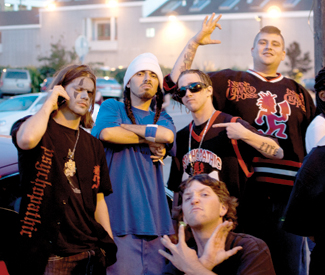
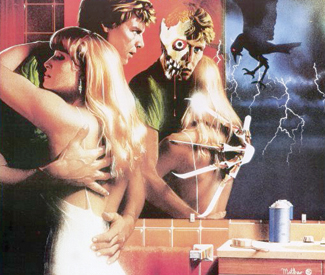
MUSIC When I pitched attending one of the Insane Clown Posse’s shows from its two-night stand at the Oakland Metro as an “undercover juggalo,” I felt the need to make it clear to my editor that I was not a fan. This would just be for a story and fun pics. I wanted documentation of the Detroit “horrorcore”-rap duo’s strange appearance in the Bay Area, but more importantly, of the fucked-up subculture and fan base that ICP has bred over the years.

Given the band’s notoriety for misogynistic lyrics, alleged violence at shows (plus the added element of the FBI’s 14-month investigation of juggalos as a potential gang threat); my perceptions of the band and its followers being a generally trashy bunch who boast bad music had me thinking, this could be my scariest assignment ever.

Going in drag was partly to protect myself. As a native Midwesterner (born and raised in Michigan) I thought I knew damn well what I was getting into. Elements of my past were about to come crashing into my present-day self and surroundings. My preconceived notions of juggalos, largely based on living in Michigan when the group found fame in the mid-to-late ’90s, were superficial and prejudiced, but not completely unfounded (grabbing the nearest trucker hat, donning ugly cargo pants, and putting on a pair of 10-year-old Nikes was totally the right thing to do). I thought hiding behind face paint would be an easy in for acceptance or at least a good cover.

I had important questions: What are Bay Area juggalos like? Why is this happening in Oakland? Would it really just be the Central Valley invading? Black juggalos?! WTF?! Does that even exist?

Beforehand a friend of mine agreed with my concerns and quipped it was going to be like entering some “ultimate societal vortex.” Others warned me to brush up on my juggalo lore as I wouldn’t want to be exposed as a poser. I did my homework, read a few good articles on The Gathering and watched a really sad YouTube video about a juggalette mom who calls in to a radio show to tell the story of her baby who died shortly after birth in the hospital. She uses that story to fulfill her obsession with scoring free ICP merch.

Reverse racist, white-trash poser

Nervous about walking the streets and getting on BART with my face painted, I still had to get from San Francisco to my destination. I wasn’t sure how people would react.

I was glad to have my friend and photographer, Dallis, along for the ride. Although he wouldn’t join me in wicked clown make-up, he did help me feel as if I wasn’t completely alone. He quizzed my knowledge on the topic at hand and casually dropped the term “white trash.” It’s not an epithet I like to use, but I agree there are worse. Unfortunately, this is the one assigned to the juggalo.

Just about everyone looks down upon and ostracizes them like they’re a symbol for what’s wrong with Middle America. I got some strange stares on the train, but that was about it. Once we popped through the tunnel and found our stop, some fellow “ninjas” (who looked like frat boys) noticed me. They asked if I had any more face paint. Unaware if they were legit fans or if this was mockery, I asked if they were going to the show. It turned out they were being un-ironic (I saw them later at the Metro), so I guess I was the poser.

Waiting in a long line wrapped around the building with “The Family” was the best part of the night. Finally, I had power in numbers (though not all juggalos wear the paint). It was familiar to me, not just because of Midwest roots, but because of fanaticism over a music act. Their energy was electric. They wanted to see their heroes, Shaggy 2 Dope and Violent J perform. That’s when it clicked. This was all about inclusion.

We couldn’t get over how nice everyone was. At one point Dallis was trying to get a picture, but was tapped on the shoulder by a juggalo who told him to get closer for a better angle. It was uncharacteristic of the pretense among the crowd at a typical Bay Area show.

Sure, my jaw dropped when I finally deciphered that one of the opening act’s lyrics that I was bopping my head to was, “dead girls don’t say no,” but why is it that I give fellow Detroiter DJ Assault a pass when I laugh hysterically at his raunchy sampled lyrics like “suck my mutha-fucking dick,” or consider “Ass ‘n Titties” to be anthemic? Am I a reverse racist, or is it simply taste in music and the understanding that you don’t have to believe in the lyrics or take them to heart, kill people with a hatchet, etc.?

Shock value and entertainment are nothing new here. Witnessing the unrelenting Faygo shower (Faygo “pop” is from Michigan and comes in a variety of weird flavors) is like being a kid on the Fourth of July watching fireworks. Scary clowns dressed in glittered gowns dance on stage and shake two-liter bottles, letting the candy-scented foam spray onto the audience as it shimmers in the light, and it is a true spectacle. The takeaway: juggalos are the salt of the Earth.

One ringy-dingy

0

marke@sfbg.com

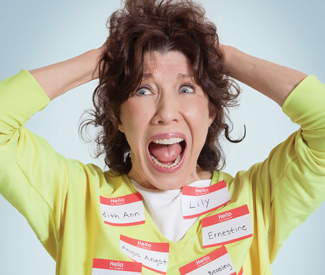
STAGE “Oh, Ernestine has plenty to say about the current phone-surveillance thing,” the irrepressible Lily Tomlin told me, referencing her famous “one ringy-dingy” phone operator character and the recent NSA spying revelations. (Tomlin was driving down an LA freeway on her way to do some errands, popping in and out of coverage on her hands-free.)

In fact, another classic phrase from Ernestine, who’s been snooping on calls since Tomlin’s 1970s days on Martin and Rowan’s Laugh-In, rather appropriately sums up the civilian surveillance clusterbuck: “Have I reached the party to whom I am speaking?”

http://www.youtube.com/watch?v=k9e3dTOJi0o

“Back during the whole Bush wiretapping time, Ernestine became an emblem for political cartoonists,” Tomlin continues. “But her association with government shenanigans goes back through Iran-Contra, all the way to Nixon and Watergate. In fact, during Iran-Contra in the ’80s, I was performing at the Emmys — I was up for one that year — and I called up G. Gordon Liddy to do a skit with Ernestine. He was going to play Oliver North! And I would be eavesdropping on him. He agreed, but then I backed off because I thought I was making too much light of the whole thing.”

The rogue’s gallery in the above paragraph gives some indication of Tomlin’s longevity in the biz, as well as her necessity. “I’ve been performing since I could basically walk,” she says. “When I was growing up in Detroit, I used to hang a blanket as a curtain on my back porch and put on shows for my family and neighbors. And then, because it started to get dangerous on the streets, I immersed myself in afterschool arts programs. I started incorporating film in to my performances, as well as comedy, drama, a little of this and a whole lot of that. I think I was the original performance artist!”   

Along with Ernestine, Tomlin’s essential characters like Edith Ann, Mrs. Beaszley, Sister Boogie Woman — maybe even her characters from 9 to 5 and Big Business, please? — will be in tow for “An Evening of Classic Lily Tomlin” worth trekking up to Napa to catch. The show, a version of which Tomlin performs 30-50 times a year, is a a kind of constantly evolving greatest hits extravaganza. “These characters never leave me; I’m constantly playing with them in my head, like some weird kind of checkerboard,” Tomlin said with a laugh. “But they have to say something, something relevant. Somehow, of course, it always seems like there’s something for them to say, especially lately.”

Now 73, Tomlin’s coming off a season on TV as the pot-happy hillbilly grandma from Reba McEntire’s sitcom Malibu Country and the Tina Fey movie Admission. She’s also a regular as Lisa Kudrow’s mother on web series Web Therapy, an avid social media user, and a crusader for several causes. “Darn good genes,” she says when I gasp at her energy, roughly 1000 times any other human’s. “I had an aunt just pass away at 91. Marke, she would have lived to 120 if the smoker’s emphysema hadn’t slowed her down.”

And her maverick feminist spirit still shines bright. “There’s more opportunity for women in this business now than when I started out. Working with Tina and Lisa was inspirational, and now with new media, the possibilities are really opening up. I mean, people used to think women did comedy only because they were too ugly to do anything else. When I first started getting better known, I can’t tell you how many people came up to me saying, ‘Oh, Lily, you’re so much prettier than you are on television!’ Ha. Can you believe that?”

“AN EVENING OF CLASSIC LILY TOMLIN”

Doors 7pm, show 8pm, $70-$85

The Uptown

1350 Third St., Napa

(707) 259-0123

Father’s day

0

arts@sfbg.com

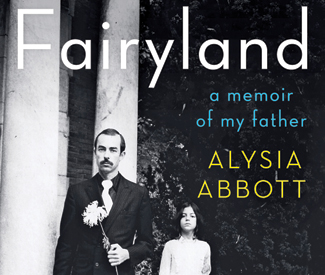
LIT In late-1980s San Francisco, Steve Abbott hosted a gay writer’s workshop at his small apartment at the fabled corner of Haight and Ashbury. One fleeting but reliable occurrence was an appearance by Alysia, the daughter he’d raised since his wife died in a car accident years earlier.

Each week, the teenager stormed about just long enough so we could feel her wrath before slamming the bedroom door. It was funny, but also understandable: at that age, who wants their personal space regularly invaded by strangers? Let alone gay male adults, reinforcing your separation from the heterosexual family norm?

Steve was a significant presence in SF’s literary scene for nearly two decades, publishing his own adventuresome small-press books in various idioms (poems, essays, fiction). He edited small magazines including the influential Poetry Flash; was first to promote such edgy “postmodernist” voices as Kathy Acker and Dennis Cooper; and was an idiosyncratic cultural commentator for local weeklies (including the Bay Guardian). He was unfailingly generous with other fledgling writers, myself included.

He barely kept the rent paid via rote day jobs, while raising a child alone — an awkward match to the carefree gay community he joined upon moving to SF (and coming out) in 1974. As Alysia Abbott writes in her acclaimed new release Fairyland: A Memoir of My Father (W.W. Norton and Company, 352pp., $25.95), there were no role models then for gay single parents. Their very close but turbulent relationship amplified the clash between her often-peevish parental needs and his belated self-discovery in a sexual-artistic bohemia. They found balance as she found her own identity upon leaving for college. But then the AIDS epidemic swept both up in its devastation.

Abbott, now living in Boston with a husband and two children, answered questions in advance of two local appearances this week.

San Francisco Bay Guardian You had an unconventional childhood with an unconventional parent. Has that influenced your own parenting?

Alysia Abbott My father was raised in a strict Catholic household where family members rarely showed affection. He kept his feelings bottled up. By the time he had me, he wanted a completely different family experience, transparent and open. He often shared his romantic and professional woes, sometimes seeking my advice.

I absorbed a lot of my dad’s worry, and sometimes found myself in situations where I had to be more adult than I was ready to be. I want to be my true self with my children. But I also want to protect their innocence to some degree.

SFBG You’re frank about having been an “obnoxious” unhappy teenager. Are there things you or your father could have done differently? Was it a phase you just had to work through?

AA We were trying to create a life with a lot of setbacks, sharing a cramped one-bedroom in the Haight with little money or family help. My father was lonely, and trying to get sober just when I discovered drugs and alternative culture. We did our best under the circumstances. But as often as we clashed, there was a lot of love. This was a period we needed to go through.

SFBG Your father identified so strongly as a writer, but Fairyland doesn’t address how you became one yourself.

AA I’d always wanted to be a writer, or an artist. But after watching him struggle financially, I pursued steady-paycheck work in cushy corporate structures (which I now hate). I also didn’t know if I had his native talent, or could be as intellectually rigorous and pure. I always had our story to tell, but worried I wasn’t worthy of it. The idea of writing Fairyland and having it not meet my own expectations was unbearable. Now I realize perfectionism is the enemy of creativity. To succeed, you have to be willing to fail.

SFBG When Steve was facing mortality, he wrote that you’d probably better appreciate his writing after he’d passed on. What do you think about his literary legacy now?

AA I’m embarrassed to admit I really didn’t read my father’s books until ten years after he died. During his lifetime, the work’s weirdness, its attraction to transgressive figures and ideas threatened me. I accused him of not being a “real writer” because no one had heard of him and he didn’t make any “real money.” What a terrible thing for a daughter to say!

Researching for Fairyland, I came to respect his contributions and integrity. All the writers I know today have to be such master self-promoters. My father was almost embarrassingly naïve in this regard. That may be why few people know his work today. But he was so devoted to writing, and supporting writers that impressed him, even if that effort did nothing for his own career.

I now really love several of his poems and books, especially Lives of the Poets — but some still make me uncomfortable. I’m not sure if it’s because they aren’t good, or still too “out there” for me.

SFBG After so many years, how do you feel about returning to SF? Many of your father’s creative generation are dead. It’s a much yuppie-er burg.

AA San Francisco is very different from the city I knew in 1974, or even 1994. I’ve worried that those who remember the old San Francisco, or appreciate its history, are dwindling — they’ve died or been forced out by Ellis laws. But new residents are attracted by the city’s beauty just as we were. And though much better-heeled, these tech workers and professional types are also trying to reinvent culture, if with much greater odds of profit — and interest in profit.

ALYSIA ABBOTT

Wed/19, 7pm, free

City Lights Books

261 Columbus, SF

www.citylights.com


Thu/20, 6:30pm, free

San Francisco Public Library

100 Larkin, SF

www.sfpl.org

Console prizes

0

arts@sfbg.com

GAMER The days of game consoles being all about pretty graphics are over. The leap in visual fidelity when we went from PlayStation 2 to PlayStation 3 isn’t going to happen this time, which is one reason it’s been seven years since the current consoles have been refreshed. All that changes this year, with the impending release of the Xbox One and the PlayStation 4.

Microsoft had a false start last month, with the reveal of Xbox One occurring ahead of the Electronic Entertainment Expo, better known as E3. Showing off the sleek new console, the One was positioned as a unifying “everything” box, addressing the many Xbox users who regard the system as a gateway to all things movies, TV, and Netflix. However, by ignoring games and being cagey on important issues of DRM (a type of copy protection that has caused much past furor) and positioning the console as a high-speed always-online device, Microsoft willfully alienated a chunk of its audience.

The Xbox conference in Los Angeles last week saw the company hoping to gain ground by backing off its usual focus on sports, Kinect, and kids games and keeping true to “core game” experiences. In this regard, Microsoft was smart to tempt the Metal Gear Solid franchise to launch simultaneously on Xbox for the first time, and likewise big-time Sony-only developer Insomniac Games announced the One-exclusive Sunset Overdrive. Other Xbox-only experiences included Titanfall from the newly formed Respawn Games, which has the chops to be as big as the team’s last huge success — Call of Duty: Modern Warfare. And of course, more Halo is ever imminent.

Initially, Sony’s E3 conference appeared less cohesive, and quite a bit sloppier, than the Xbox conference as it proclaimed a new life for its struggling Vita handheld, but failed to follow its passionate declaration for the console with big game announcements. The company chose instead to revisit previously announced PS4 games, Killzone: Shadow Fall and Infamous: Second Son.

But Sony’s presentation deficiencies were quickly forgotten as the show drew to a close. Directly addressing complaints about Microsoft’s next-gen policies, Sony loosed a salvo of not so subtle digs against Xbox One, announcing the PS4 to be DRM-free and offline-friendly — not to mention the PS4 at $399 would cost $100 less than the One. Such brazen acts of competition are rare between these two, but Sony apparently found the cracks in Microsoft’s strategy too tempting to ignore.

Since the 2011 PlayStation network hack that left many users’ personal data at risk, Sony has performed the humble, pro-consumer act well and, even if it doesn’t always offer a superior console experience, it knows its audience. For once, it didn’t matter who had the better games, the bigger hard drive or the best specs. This E3 was all about attitude.


THE BEST FOR ‘LAST’

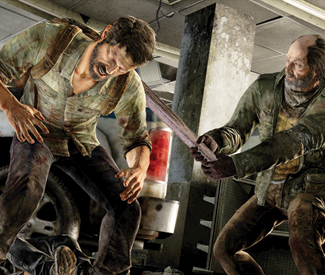
As we wave goodbye to the consoles that have kept us warm for the past seven years, gamers have been looking for a game to dub “the last great game of the generation.” Releasing amid all the hubbub of E3, The Last of Us (Naughty Dog/Sony; PS3) is a fitting final hurrah, capping the reign of the PS3 with not so much a bang but with an assurance and a confidence that are unfamiliar to the medium of video games.

Set a number of years after a worldwide infection has destabilized the country, The Last of Us follows Joel, a no-nonsense smuggler, as he attempts to transport a 14-year-old girl named Ellie out of Boston. From the developers behind the Uncharted series, one might expect big action set-pieces and witty banter, but The Last of Us is more true to the conceits of survival horror. At heart, this is a stealth adventure, until the odds invariably and adamantly force your hand into acts of ferocious brutality. There are bad people, bad monsters, and a whole lot of riveting moments — which I won’t spoil — but it’s not so much the story as how it is told. Despite its gloom, The Last of Us has sweetness and a sense of hope that shapes the characters and makes their journey all the more impactful.

In other words, The Last of Us is the game to beat in 2013.

More to grow on

1

Pit Stop (Yen Tan, US) One of the very best narrative features at Sundance this year, Yen Tan’s drama nonetheless completely flew under the radar of media attention. It’s a beautifully low-key tale of two 40-ish gay men in a Texas small town. Neither are closeted, but they aren’t exactly fulfilled, either, both being in awkward domestic situations. Gabe (Bill Heck) is still living with angry ex-wife Shannon (Amy Seimetz) for the sake of their six year-old daughter. Ernesto (Marcus DeAnda) still shares his apartment with younger, slackerish ex-BF Luis (Alfredo Maduro), who keeps dragging his feet about actually moving out. Everyone is dissatisfied, but not quite willing to risk making a leap into unfamiliar territory. We know Gabe and Ernesto are fated to meet, yet it’s Tan’s terrifically nuanced portrayal of the relationships they must exit first that dominates almost the entire feature. Pit Stop is the kind of slow burner that sneaks up on you, surprising with the force of well-earned climactic joy after so much concise observation of credibly ordinary, troubled lives. Fri/21, 4pm, Castro; June 27, 7pm, Elmwood. (Dennis Harvey)

http://www.youtube.com/watch?v=0rhaXvoGf0s

Free Fall (Stephan Lacant, Germany) A young German police cadet, Marc (Hanno Koffler), finds himself disturbingly drawn to a fellow cadet, Kay (Max Riemelt), during a weekend of training exercises — a regimen that proves to be not quite enough of an outlet to diffuse the erotic tension between them. Back home, though, are Marc’s very pregnant girlfriend, Bettina (Katharina Schüttler), and a circle of friends and family who expect him to continue along his current track of shacking up, forming a family, and demonstrating his loyalty to the macho brotherhood of his colleagues on the force. When Kay transfers into the department, his presence exerts a pressure on Marc that threatens to derail him. Director Stephan Lacant’s film, co-written with Karsten Dahlem, movingly depicts the painful breakdown of a man ruled by impulses he’s unable to face up to, and the consequences that come of remaining paralyzed in an impossible state. Fri/21, 6:30pm, Castro; Mon/24, 9:30pm, Elmwood. (Lynn Rapoport)

C.O.G. (Kyle Patrick Alvarez, US) The first feature adapted from David Sedaris’ writing, Kyle Patrick Alvarez’s film captures his acerbic autobiographical comedy while eventually revealing the misfit pain hidden behind that wit. Tightly wound David (Jonathan Groff), on the run from problematic family relations and his sexual identity, takes the bus from East Coast grad school to rural Oregon — his uninhibited fellow passengers providing the first of many mortifications here en route. Having decided that seasonal work as an apple picker will somehow be liberating, he’s viewed with suspicion by mostly Mexican co-workers and his crabby boss (Dean Stockwell). More fateful kinda-sorta friendships are forged with a sexy forklift operator (Corey Stoll) and a born-again war vet (Denis O’Hare). Under the latter’s volatile tutelage, David briefly becomes a C.O.G. — meaning “child of God.” Balancing the caustic, absurd, and bittersweet, gradually making us care about an amusingly dislikable, prickly protagonist, this is a refreshingly offbeat narrative that pulls off a lot of tricky, ambivalent mood shifts. Sat/22, 9:15pm, Castro. (Harvey)

Bwakaw (Jun Robles Lana, Philippines, 2012) Grumpy old man in the rural Philippines — OK, Jun Robles Lana’s seriocomedy isn’t going to top many lists as the sexiest movie at Frameline. But it’s one of the most deeply satisfying films at this year’s festival. Six-decade Filipino cinema veteran Eddie Garcia plays Rene, a crusty loner who lives alone and works without pay (he’s officially retired) at the local post office just to have something to do. He has cranky relationships — “friendships” would be a stretch — with the area priest, a widowed neighbor, and two over-the-top queens who run a hair salon. His closest bonds are to a rest-home denizen now too senile to remember who he is, and to the stray mutt who’s sort of his dog — though not so much that he’ll actually let it in the house. After decades in denial, Rene finally accepted his homosexuality at age 60, when “my time was [already] passed.” But he gets an unanticipated new surge of hope, possibly misdirected, upon befriending rough-hewn younger bicycle-taxi driver Sol (Rez Cortez). With its leisurely pace and seemingly stereotypical characters who turn out to be much more complex than they initially appear, Bwakaw is a disarmingly modest movie that gradually reveals a rather beautiful soul. Sun/23, 5:45pm, Victoria. (Harvey)

The Out List (Timothy Greenfield-Sanders, US) Documentarian Timothy Greenfield-Sanders, whose previous projects have focused on prominent African Americans and Latinos, supermodels, and porn stars, turns his lens on the LGBTs for a survey film set to air on HBO this month. While there’s no sign of the radical faeries or the poly queers with negative interest in the marriage equality battle, Greenfield-Sanders has gathered a decently varied collection of 16 LGBT individuals, mostly but not only celebrities, whose common thread is having gone public. Milk screenwriter Dustin Lance Black and ex-NFLer Wade Davis describe their time in the closet and their coming-out episodes, while Hollywood stars Neil Patrick Harris and Cynthia Nixon comment on strategies for getting work and fighting the good fight (which for the latter includes closeting her bisexuality). Only an hour long, The Out List merely skims the surface of its subjects’ experiences, but we do get some sense of their scope, which includes finding family in NYC’s ballroom scene, getting elected as a lesbian Democratic sheriff in Dallas County, Texas, and learning to view one’s orientation as a gift from god. Tue/25, 4:30pm, Castro. (Rapoport)

Beyond the Walls (David Lambert, Belgium/Canada/France, 2012) Aptly compared in the Frameline catalog to such intelligent recent gay relationship studies as Weekend (2011) and Keep the Lights On (2012), David Lambert’s finely crafted debut feature charts its protagonists through an unpredictable, rocky romance. Paolo (Matila Malliarakis) is living with an older woman when he meets bartender-musician Ilir (Guillaume Gouix), who’s amused by the young blonde’s drunken antics while wary of the mutual attraction between them. When immature, puppyish Paolo gets thrown out by his exasperated girlfriend, he lands on Ilir’s doorstep as an uninvited instant-boyfriend, and despite some initial grumbling, that’s pretty much how it works out. Yet an unfortunate turn of events forces a long, involuntary separation between the two that their coupledom might not survive. While it requires a certain suspension of disbelief that focused, self-confident Ilir would fall for the flighty, needy Paolo, the eventual complexity of their relationship makes for a powerful cumulative impact. June 27, 9:30pm, Castro. (Harvey)

Reaching for the Moon (Bruno Barreto, Brazil) Brazilian director Bruno Barreto (1997’s Four Days in September) offers a moving account of the romantic relationship between the American poet Elizabeth Bishop (Miranda Otto) and the Brazilian architect Lota de Macedo Soares (Glória Pires), which spanned the 1950s and the better part of the ’60s. The pair meet under inauspicious circumstances: traveling to Brazil, Elizabeth visits her old Vassar friend Mary (Tracy Middendorf) at the gorgeous rural estate where she lives with Lota, a wealthy woman from one of Brazil’s prominent political families. Unfortunately for Mary, Lota’s regard for the timid, restrained Elizabeth moves along a precipitous arc from irritation to infatuation, her subsequent impetuous pursuit of her lover’s friend revealing a heartless egoism — as well as an attitude toward householding that blends a poly sensibility with a ruling-class sense of entitlement. The film tracks Elizabeth and Lota’s enduring affair during a period marked by professional triumphs, personal lows, and political turmoil, all of which take their toll on the relationship. June 28, 6:45pm, Castro. (Rapoport)

Out Here: A Queer Farmer Film Project (Jonah Mossberg, US) Jonah Mossberg’s documentary crosses the country seeking out the perspectives of LGBT farmers, visiting some 30 farms before narrowing the focus to seven disparate subjects growing food in settings that range from a community garden in West Philadelphia to a farmstead in rural Alabama (or what one participant calls “the toenail of the Appalachians”). An allegiance to organics and other sustainable practices establishes some common ground. However, asked to encapsulate how queerness impacts her farming life, a woman raising crops and chickens in the Bronx’s Garden of Happiness observes, “I don’t think the land asks that question — if you’re gay or straight,” while others tease queerness out of acts like turning to permaculture and draw connections between heteronormativity and industrial agriculture. Look for fermentation guru Sandor Katz at Tennessee’s Little Short Mountain Farm, and stay seated for the longish closing credits interspersed with earnest (and otherwise) discussions of which veggie wins the title of queerest piece of produce. June 29, 1:30pm, Victoria. (Rapoport)

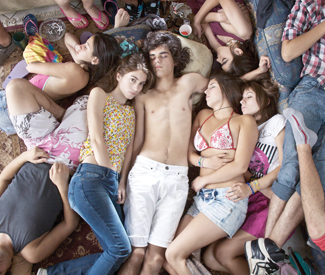
Young and Wild (Marialy Rivas, 2012) Structured around the anonymous and oft-graphic blog posts of a Chilean teenager, director-cowriter Marialy Rivas’s inventive, engaging film depicts a young woman’s navigation — both solitary and very, very public — of her sexual and romantic impulses as they clash with a rigid upbringing of spiritual indoctrination. Raised in an evangelical Christian household, Daniela (Alicia Rodríguez) bluntly documents, under the screen name Young and Wild, a period of upset and exploration during which she is outed as a fornicator and expelled from school, threatened by her hard-edged mother (Aline Küppenheim) with missionary exile, and faced with the sorrow of watching a beloved aunt (Ingrid Isensee) battle cancer. As Daniela begins a relationship with a young man (Felipe Pinto), begins a relationship with a young woman (María Gracia Omegna), and records the proceedings with a complicated mixture of comic insights, lyrical observations, and obscenities, her introspections play with the device of the straightforward voice-over—broadcast to untold numbers of unknown peers who avidly follow and comment on her adventures and misadventures. June 29, 8:30pm, Roxie. (Rapoport)

Frameline37 runs June 20-30 at the Castro Theatre, 429 Castro, SF; Roxie Theater, 3117 16th St, SF; Victoria Theatre, 2961 16th St, SF; and Rialto Cinemas Elmwood, 2966 College, Berk. For tickets (most shows $12) and complete schedule, visit www.frameline.org.

Lives less ordinary

0

arts@sfbg.com

FRAMELINE Each year Frameline’s program vividly reflects issues that of late have seemed most urgent in the LGBT community — for many years, for instance, there was an understandably overwhelming amount of films about AIDS. Most recently, the fights for gay marriage and trans rights have dominated many a dramatic and documentary selection.

It is sometimes nice, therefore, in the fray of pressing public debate and community activism to escape topicality and sink into the achievements and personalities of more distant queer-history eras. Several documentaries at Frameline37 offer just that, as they chronicle the lives and times of five extraordinary men (albeit one normally found in a dress and fright wig).

The most San Francisco-centric of them is Stephen Silha, Eric Slade, and Dawn Logsdon’s Big Joy: The Adventures of James Broughton, about “a golden secret of West Coast bohemia.” The late James Broughton was a poet, prankster, and experimental filmmaker who began making films in the late 1940s “to see what my dreams really looked like.” A significant figure in the pre-Beat San Francisco renaissance of avant-garde art, he won a prize at Cannes for 1953’s typically playful, hedonistic The Pleasure Garden, but declined the commercial directing career offered him — in fact he didn’t make another movie for 15 years, when free-love hymn The Bed became a counterculture smash.

Broughton married and had three children (including one with not-yet-famous local film critic Pauline Kael), but at age 61 found his soulmate in 26-year-old fellow director Joel Singer, thereafter devoting his life and work to celebrations of gay male sexuality. (Interviewed here, his ex-wife Susanna calls this turn of events “a very unwelcome incident from which I never recovered.”) The documentary provides a treasure trove of excerpts from a now little-seen body of cinematic work, as well as much archival footage of SF over the decades.

Bringing joy to a lot of people during his too-brief life was Glenn Milstead, the subject of Jeffrey Schwarz’s I Am Divine. A picked-on sissy fat kid, he blossomed upon discovering Baltimore’s gay underground — and starring in neighbor John Waters’ underground movies, made by and for the local “freak” scene they hung out in.

Yet even their early efforts found a following; when “Divine” appeared in SF to perform at one of the Cockettes’ midnight movie/theater happenings, he was greeted as a star. This was before his greatest roles for Waters, as the fearsome anti-heroines of Pink Flamingos (1972) and Female Trouble (1974), then the beleaguered hausfraus of Polyester (1981) and Hairspray (1988). Despite spending nearly his entire career in drag, he wanted to be thought of as a character actor, not a “transvestite” novelty. Sadly, he seemed on the verge of achieving that — having been signed to play an ongoing male role on Married … with Children — when he died of respiratory failure in 1988, at age 42.

A different kind of tragedy is chronicled in Clare Beaven and Nic Stacey’s British Codebreaker, about Alan Turing — perhaps the most brilliant mathematician of his era, who basically came up with the essential concept of the modern-day computer (in 1936!) He played a huge role in breaking the Nazi’s secret Enigma code, thus aiding an Allied victory. But instead of being treated as a national hero, he was convicted of “gross indecency” (i.e. gay sex) in 1952 and hounded by police until he committed suicide two years later. Half conventional documentary and half reenactment drama (with Ed Stoppard, playwright Tom’s son, as Turing), Codebreaker illustrates the cruel price even an upper-class genius could pay for his or her sexuality in the days before Gay Lib.

Two literary lions are remembered in the last of these historical bio-docs. Daniel Young’s Swiss Paul Bowles: The Cage Door is Always Open recalls the curious life of a successful American composer turned famous expat novelist. He and wife Jane Bowles moved to post-World War II Tangiers, where they entertained a parade of visiting artists — and, by all accounts, a succession of same-sex lovers. Clips from Bernardo Bertolucci’s underrated adaptation of Bowles’ literary masterwork The Sheltering Sky (1990) are here alongside input from acquaintances and observers including John Waters and Gore Vidal.

http://www.youtube.com/watch?v=INW6i6K1NmQ

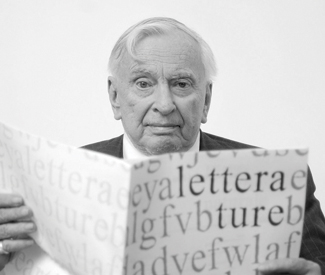
The latter is the whole focus in Nicholas Wrathall’s Gore Vidal: The United States of Amnesia, and what could be better than that? Perhaps undervalued as a frequently very fine novelist because he was so prolific (and popular), he’s considered here primarily as a public intellectual — a term that seems positively antiquated in our climate of pundits and ranters — and fierce lifelong critic of American hypocrisy in all its forms, especially the political. He was a scold (or a “correctionist,” as he put it), albeit of the wittiest, most clear-headed and informed type. Among myriad highlights here are seeing him on TV reduce friend-rival Norman Mailer to sputtering fury, shred the insufferable right-wing toady William F. Buckley, and make poor Jerry Brown squirm under his effortless tongue-lashing.

Endlessly quotable (“We’ve had bad Presidents in the past but we’ve never had a goddam fool,” he said of George W. Bush), obstinately “out” from an early age if never very PC in his views (“Sex destroys relationships … I’m devoted to promiscuity”), Vidal is aptly appreciated here as “a thorn in the American Establishment, of which by birth he is a charter member.” There will never be anyone quite like him — but we sure could use some who are at least in the general ballpark. *

FRAMELINE37

June 20-30, various venues

www.frameline.org

Where to next?

0

arts@sfbg.com

DANCE Ben Levy sure knows how to throw a party. For the 10th anniversary celebration of his LEVYdance company, he once again closed off SOMA alley Heron Street, where his studio is located, and hung balloons, speakers, and lights. He put up bars and set out soft sofas, and erected a large stage with a central pit full of pillows (for those who might prefer to recline). It was one of those rare San Francisco evenings with clear skies — and just the slightest of breezes — which made you glad you don’t live across any bridges.

But does Levy know to choreograph? You bet he does. A decade ago he burst onto the San Francisco dance scene with clarity of vision and skills to match, unheard-of in a dancer just barely out of college. But that’s exactly why this festive event lacked an essential ingredient.

Seeing the four works — one from 2002, two from 2004, and one from 2005 — put a damper on the evening. No amount of finessing and rethinking of repertoire can take the place of the risk and excitement involved when a choreographer steps into unknown territory. Looking back on a decade’s accomplishments may be gratifying, but more essential is giving an audience an inkling of where the artistic trajectory is going.

Grant Diffendaffer’s open-air stage, essentially an elevated square of walkways around an open center, necessitated some reconfigurations that diluted what sometimes felt like volcanic forces about to explode in Levy’s choreography. But it also allowed for increased intimacy, depending on where you sat.

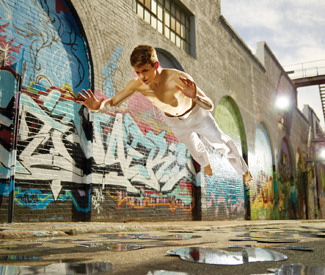
Levy’s four dancers dove into the choreography with an impressive unity of purpose. They attacked complex interactions — often at top speed — with razor sharp timing. Seeing the dancers dressed in brilliant white against the riotous chaos of the graffiti covered brick walls suggested an unexpected symbiotic relationship between dance and murals.

pOrtal, the oldest piece on the program, still fascinated in the way Scott Marlowe, Yu Kondo Reigen, Paul Vickers, and Sarah Dianne Woods upset each other’s balances. They grabbed, yanked, and poked; flipped a partner; or pushed a knee against a belly. When a dancer leaned over a colleague’s knee, it would drop away beneath them. The idea seems to be avoiding stability at any cost — like living in the middle of a non-stop earthquake. What might look like violence or aggression in another case is delivered in such a matter-of-fact way that it becomes a self-contained image of one way of being.

Originally, If this small space, choreographed by Levy and Rachael Lincoln, was performed on a five-by-five lit square that set up limitations. Shifted to the open, the attention immediately shifted onto the internal forces that strained against the confines of Marlowe’s body. Performed magnificently by this beautiful dancer, If this small space might have him look up and push against invisible walls — but it was the small trembles, muscular contractions, currents, and mysterious somethings rolling through his torso that collapsed his knees. The effect indicated just how at the mercy of imprisoning forces this human being was. Perhaps the most touching moment came when Marlowe lifted one leg and it looked like it might try to float away from him.

The engaging Holding Pattern opened with Reigen’s stunningly performed solo, in which warring forces seemed to tear her body apart as Vickers and Woods traced a cautious circle around her. The trio engaged in a contentious give and take, part wrestling match, part karate engagement. For a while it looked like the two women were ganging up on Vickers, but then he gave as good as he got.

That Four Letter Word (apply your own definition) finds the quartet in every possible permutation of relationships between two men and two women. Some of it is quite funny — though I could have done without the balloon jokes — but here the spatial reconfigurations created too much distance. Four ran out of steam though it did showcase Vickers and Marlowe — super-articulate, elegant dancers — exquisitely mirroring each other.

The program also highlighted Levy’s excellent musical choices — many of them commissioned. Let’s hope he’ll soon have an opportunity to use some more.

Psychic Dream Astrology

0

June 19-25, 2013

ARIES

March 21-April 19

The only way to become what you intend to be is by changing. You must let go of attitudes, habits, and relationships that no longer support you in being healthy and happy. Prioritize being authentic this week, and what needs to change will clarify itself, Aries. Even as you let things go, you are becoming more whole.

TAURUS

April 20-May 20

Reflection and contemplation is well starred for you, Taurus. You are putting yourself out there in a way that is much needed and fresh, but as with all new things, you need to stay aligned with yourself in order to make sure it’s right for you. Stay true to yourself even if that gets tricky this week.

GEMINI

May 21-June 21

Feeling trapped is a terrible state to be in. This is not the time to reactively stir up opposition and make big waves, even if you find yourself stuck and unsure how to change your situation, Twin Star. Assert your autonomy in concert with your environment for best results this week.

CANCER

June 22-July 22

Say yes, Moonchild! Walk through your world with an affirming and abundant attitude. Often when we are saying no to an opportunity or a person it is because we can’t say yes to them and ourselves at the same time. Even if you have to set limits and deal with hard stuff, look for the positive in it this week.

LEO

July 23-Aug. 22

The wisest course to stay this week is uber practical. It’s time to consolidate your debt, write those emails you’ve been putting off and finally donate the clothes in the back of your closet that you never wear; in others words, do all the crap you’ve been putting off but will help clarify your life once they’re completed.

VIRGO

Aug. 23-Sept. 22

There are no awards given out for being right, as sad as that may be for you, Virgo. It’s time for you to get present with the conditions you’re submerged in instead of focus on what they are supposed to be (according to you). Make acceptance of reality your number one priority this week.

LIBRA

Sept. 23-Oct. 22

Uncertainty is OK, Libra. What’s not so grand is talking like you have a clear plan when you are secretly freaking out. Own where you’re at, no matter where that may be. You are on the verge of being able to express your boundaries with confidence, so don’t hurry just to get an answer out there this week.

SCORPIO

Oct. 23-Nov. 21

Align your needs and your goals this week, Scorpio. It’s ideal if you can have a healthy work/play balance in your life, but it’s not always possible. Instead of going all in or all out on things, try a little moderation. You can afford to take enough time to consider your next moves.

SAGITTARIUS

Nov. 22-Dec. 21

Coping with frustration is hard for you fire signs, but you must strive to understand the deeper motives beneath your fears, and not react blindly to them. Resist the urge to jump in and make things more complicated than they need to be. Focus on what you value and how you can center your dealings to reflect that, Sag.

CAPRICORN

Dec. 22-Jan. 19

If you’ve been burning he candle at both ends of the wick, then, yes Capricorn, that is the scent of burning flesh you smell. Instead of trying to control or fix things, take a step back for a minute. You need time to gather yourself up before you do anything more. This week the best action is repose.

AQUARIUS

Jan. 20-Feb. 18

This week is a good one to take well-considered risks. You have the energy and power to be successful, the only warning you must heed is to make sure you are striving to attain the things that will improve your life and generate joy, not just pride. Be self-aware enough to think beyond the short term and purse lasting happiness.

PISCES

Feb. 19-March 20

You can’t change your feelings, you can only change your attitude. This week may find you overwhelmed by emotion, but that’s nothing new; what needs to be new is your willingness to be changed by your needs. Don’t worry so much about what others will say, just take care of your insides, Pisces.

Jessica Lanyadoo has been a Psychic Dreamer for 18 years. Check out her website at www.lovelanyadoo.com to contact her for an astrology or intuitive reading.


Music Listings

0

Music listings are compiled by Emily Savage. Since club life is unpredictable, it’s a good idea to call ahead or check the venue’s website to confirm bookings and hours. Prices are listed when provided to us. Visit www.sfbg.com/venue-guide for venue information. Submit items for the listings at listings@sfbg.com. For further information on how to submit items for the listings, see Picks.

WEDNESDAY 19

ROCK/BLUES/HIP-HOP

Joseph Arthur Chapel, 777 Valencia, SF; www.thechapelsf.com. 9pm, $20-$25.

Camera Obscura, Photo Ops Regency Ballroom. 8pm, $25.

Dig, Tambo Rays, Low Magic, Sunfighter Café Du Nord. 8:30pm, $10.

Mark Eitzel, Carletta Sue Kay, Will Sprott Brick and Mortar Music Hall. 9pm, $12.

David Ford Hotel Utah. 8pm, $10.

Geto Boys, Phranchyze Yoshi’s SF. 10:30pm, $36.

Gunshy Johnny Foley’s. 10pm, free.

Craig Horton Biscuits and Blues. 8 and 10pm, $15.

Lust for Life, Pharmakon, DJs Omar and Justin Elbo Room. 9pm, $10.

Sam Chase, Gallery, Dogcatcher Bottom of the Hill. 9pm, $8.

Water Liars, Standard Poodle, Houses of Light Hemlock Tavern. 8:30pm, $7.

JAZZ/NEW MUSIC

Fatoumata Diawara Yoshi’s SF. 8pm, $24.

Dink Dink Dink, Gaucho, Eric Garland’s Jazz Session Amnesia. 7pm, free.

Terry Disley Burritt Room, 417 Stockton, SF; www.burrittavern.com. 6-9pm, free.

Big Bones Royal Cuckoo, 3203 Mission, SF; www.royalcuckoo.com. 7:30-10:30pm, free.

Cecile McClorin Salvant SFJazz Center, 201 Franklin, SF; www.sfjazz.org. 8pm, $18-$25. SF Jazz Festival.

Michael Parsons Trio Revolution Café, 3248 22nd St., SF; www.revolutioncafesf.com. 8:30pm, free.

Reuben Rye Rite Spot. 8:30pm, free.

FOLK/WORLD/COUNTRY

Hans Araki and Kathryn Claire Plough and Stars. 9pm.

Aki Kumar Blues Band Tupelo, 1337 Grant, SF; www.tupelosf.com. 9pm.

Timba Dance Party Bissap Baobab, 3372 19th St, SF; www.bissapbaobab.com. 10pm, $5.

DANCE CLUBS

Booty Call Q-Bar, 456 Castro, SF; www.bootycallwednesdays.com. 9pm. Juanita MORE! and Joshua J host this dance party.

Cash IV Gold Double Dutch, 3192 16th St, SF; www.thedoubledutch.com. 9pm, free.

Coo-Yah! Slate Bar, 2925 16th St, SF; www.slate-sf.com. 10pm, free. With Vinyl Ambassador, DJ Silverback, DJs Green B and Daneekah.

Hardcore Humpday Happy Hour RKRL, 52 Sixth St, SF; (415) 658-5506. 6pm, $3.

Martini Lounge John Colins, 138 Minna, SF; www.johncolins.com. 7pm. With DJ Mark Divita.

THURSDAY 20

ROCK/BLUES/HIP-HOP

Jay Ant Brick and Mortar Music Hall. 10:30pm, $15.

Come, Tara Jane O’Neil Independent. 8pm, $15.

Couches, Boys, Burrows Hemlock Tavern. 8:30pm, $7.

D Pryde, Mike-Dash-E, J. Lately Brick and Mortar Music Hall. 6pm, free.

Hey Champ, popscene DJs Rickshaw Stop. 9:30pm, $12-$14.

Hooded Fang, Record Company DNA Lounge. 8pm, $12.

Chris James and Patrick Rynn Band Biscuits and Blues. 8 and 10pm, $15.

Anya Kvitka and the Getdown, Jonny Craig Great American Music Hall. 8pm, $13.

Dave Moreno and Friends Johnny Foley’s. 10pm, free.

Scary Little Friends, TV Mike and the Scarecrows, Indianna Hale Amnesia. 9pm, $7.

Cody Simpson, Ryan Beatty, Before You Exit Warfield. 7pm, $45.

Strange Vine, Before the Brave, Avi Vinocur Metal Experience Bottom of the Hill. 9pm, $10.

Ugly Winner, C’est Dommage, Future, Space and Time, Hanalei Café Du Nord. 8:30pm, $8.

JAZZ/NEW MUSIC

Will Blades Trio SFJazz Center, 201 Franklin, SF; www.sfjazz.org. 8pm, $18-$25. SF Jazz Festival.

Lucy Horton Revolution Café, 3248 22nd St., SF; www.revolutioncafesf.com. 8:30pm, free.

Gregory Porter SFJazz Center, 201 Franklin, SF; www.sfjazz.org. 8pm, $25-$45. SF Jazz Festival.

Chris Siebert Royal Cuckoo, 3203 Mission, SF; www.royalcuckoo.com. 7:30-10:30pm, free.

Dr. L. Subramaniam Global Fusion Yoshi’s SF. 8pm, $36; 10pm, $28.

FOLK/WORLD/COUNTRY

Hot Einstein Tupelo, 1337 Grant, SF; www.tupelosf.com. 9pm.

Pa’lante! Bissap Baobab, 3372 19th St, SF; www.bissapbaobab.com. 10pm, $5.

Kyle Thayer, Anne Kirrane, Gerry Hanley Plough and Stars. 9pm.

DANCE CLUBS

Afrolicious Elbo Room. 9:30pm, $8. With DJ-hosts Pleasuremaker and Senor Oz.

All 80s Thursday Cat Club. 9pm, $6 (free before 9:30pm). The best of ’80s mainstream and underground.

Ritual Temple. 10pm-3am, $5. Two rooms of dubstep, glitch, and trap music.

Tropicana Madrone Art Bar. 9pm, free. Salsa, cumbia, reggaeton, and more with DJs Don Bustamante, Apocolypto Sr. Saen, Santero, and Mr. E.

FRIDAY 21

ROCK/BLUES/HIP-HOP

Body and Soul Johnny Foley’s. 10pm, free.

Chris Cain Biscuits and Blues. 8 and 10pm, $20.

Cigarette Bums, Virgin Hymns, Bad Vibes Thee Parkside. 9pm, $6.

Ex-Cult, Glitz Hemlock Tavern. 9:30pm, $10.

Hands, Be Calm Honcho, Ally Hasche and the Bad Boys Brick and Mortar Music Hall. 9pm, $10.

Jon Langford, Jean Cook, Jim Elkington-Skull Orchard Acoustic Chapel, 777 Valencia, SF; www.thechapelsf.com. 9pm, $20.

New Trust, Creative Adult, Culture Abuse Bottom of the Hill. 9:30pm, $10.

Petty Theft, Beer Drinks and Hell Raisers Slim’s. 8:30pm, $15-$20.

Josh Rouse, Field Report Great American Music Hall. 9pm, $26.

Staves, Musikanto Independent. 9pm, $12.

Steve Miller Band America’s Cup Pavilion, 27-29 San Francisco Pier 33, SF; americascup.com/concert-series. 7:30pm, $52.

Stripmall Architecture, Books on Fate, Return to Mono DNA Lounge. 8pm, $12.

ZAVALAZ, EV Kain Café Du Nord. 9pm, $15-$20.

JAZZ/NEW MUSIC

Pino Daniele SFJazz Center, 201 Franklin, SF; www.sfjazz.org. 8 and 10pm, $25-$65. SF Jazz Festival.

Roberta Donnay and the Prohibition Mob Trio Live Worms Art Gallery, 1345 Grant, SF; www.sflivewormsgallery.com. 8pm, $10-$20.

Emily Ann Band Revolution Café, 3248 22nd St., SF; www.revolutioncafesf.com. 9pm, free.

Hammond Organ Soul Jazz, Blues Party Royal Cuckoo, 3203 Mission, SF; www.royalcuckoo.com. 7:30-10:30pm, free.

La Chatonne Electrique Rickshaw Stop. 9pm, $15. Electro-swing with Bart and Baker, Delachaux, Kitten on the Keys, and more.

Loose Ends feat. Jane Eugene Yoshi’s SF. 8pm, $34; 10pm, $27.

Dmitri Matheny’s Sagebrush Rebellion Old First Concerts, 1751 Sacramento, SF; www.oldfirstconcerts.org. 8pm, $14-$17.

FOLK/WORLD/COUNTRY

Adria Amenti Atlas Café. 8pm, free.

Bluegrass Bonanza Plough and Stars. 9pm.

Lee Vilensky Trio Rite Spot. 9pm, free.

DANCE CLUBS

DJ What’s His Fuck Riptide Tavern. 9pm, free.

5ive DNA Lounge. 9pm, $5-$15. With Ross FM, Frank Nitty, Switchblade, and more.

Joe Lookout, 3600 16th St.,SF; www.lookoutsf.com. 9pm. Eight rotating DJs, shirt-off drink specials.

Old School JAMZ El Rio. 9pm. Fruit Stand DJs spinning old school funk, hip-hop, and R&B.

Paris Dakar Bissap Baobab, 3372 19th St, SF; www.bissapbaobab.com. 10pm, $5.

Thirsty Third Fridays Atmosphere, 447 Broadway, SF; www.a3atmosphere.com. 10pm, $10.

SATURDAY 22

ROCK/BLUES/HIP-HOP

Battlehooch, Major Powers and the Lo-Fi Symphony, Hungry Skinny Slim’s. 9pm, $14.

Big Blu Soul Revue Park Chalet, 1000 Great Hwy, SF; www.bigblusoulrevue.com. 2pm, free.

BLVD, Pink Mammoth Independent. 9pm, $20.

Daisy World, Space Trash, Naw’m Sayin Knockout. 3:30-8pm, $5.

Delgado Brothers Biscuits and Blues. 8 and 10pm, $20.

Doctor Krapula Brick and Mortar Music Hall. 9pm, $25.

Fake Blood, Alex Metric Mezzanine. 9pm, $12.50.

Fusion Johnny Foley’s. 10pm, free.

Hell Fire, Midnight Chaser, My Victim Thee Parkside. 9pm, $6.

Honey Wilders Riptide. 9pm, free.

Noisia, M Machine Regency Ballroom. 9pm, $30.

Rabbles. Strawberry Smog, Unruly Ones Hemlock Tavern. 9pm, $8.

Record Winter, Imperfections, Casey Jones Thee Parkside. 3pm, free.

“Valencia Film Party” Elbo Room. 9pm, $15. With Need, filmmaker-DJs Snow Tiger, NSFW.

Yadokai, Condominium, White Wards, Provos El Rio. 10pm, $8.

Rachel Yamagata, Sanders Bohlke Great American Music Hall. 9pm, $19-$21.

Yassou Benedict, O Presidente, Campbell Apartment Bottom of the Hill. 9:30pm, $10.

JAZZ/NEW MUSIC

Audium 1616 Bush, SF; www.audium.org. 8:30pm, $20. Theater of sound-sculptured space.

“Gospel Brunch: Oakland Interfaith Gospel Choir” SFJazz Center, 201 Franklin, SF; www.sfjazz.org. 11am, $30-$65. SF Jazz Festival.

Low Behold Revolution Café, 3248 22nd St., SF; www.revolutioncafesf.com. 9pm, free.

Chris Mann Yoshi’s SF. 8pm, $33..

Michael McIntosh Rite Spot. 8:30pm, free.

Anton Schwartz Church of the Advent of Chris the King, 261 Fell, SF; www.sfjazz.org. 5pm, $10. SF Jazz Festival.

John Scofield Uberjam Band SFJazz Center, 201 Franklin, SF; www.sfjazz.org. 8pm, $30-$70. SF Jazz Festival.

Lavay Smith Royal Cuckoo, 3203 Mission, SF; www.royalcuckoo.com. 7:30-10:30pm, free.

FOLK/WORLD/COUNTRY

Mark Hummel Tupelo, 1337 Grant, SF; www.tupelosf.com. 9pm.

La Chilanga Banda, Pata de Perro, Zigzagz Balancoire, 2565 Mission, SF; www.balancoiresf.com. 9pm, $10.

Muddy Roses Plough and Stars. 9pm.

North Beach Brass Band Tupelo, 1337 Grant, SF; www.tupelosf.com. 1pm.

DANCE CLUBS

Bootie SF: Monster Show DNA Lounge. 9pm, $10-$15. With Monster Show mashup drag extravaganza, and more.

Club 1994 Rickshaw Stop. 10pm, $10-$20.

Paris Dakar Bissap Baobab, 3372 19th St, SF; www.bissapbaobab.com. 10pm, $5.

Temptation Cat Club. 9:30pm. $5–<\d>$8. Indie, electro, new wave video dance party.

SUNDAY 23

ROCK/BLUES/HIP-HOP

A Wilhelm Scream, Flatliners, Such Gold Thee Parkside. 8pm, $15.

Michael Barrett Johnny Foley’s. 10pm, free.

“Blue Bear School of Music Band Showcases” Café Du Nord. 7:30pm, $12-$20.

Dot Hacker Chapel, 777 Valencia, SF; www.thechapelsf.com. 8pm, $12-$15.

Hans Eberbach Castagnola’s, 286 Jefferson, SF; www.castagnolas.com. 2pm, free.

Patty Griffin, Max Gomez Fillmore. 8pm, $35.

“Metal Meltdown” DNA Lounge. 4:30pm, $12. With Anisoptera, No More Solace, Holy Blowout, Demacia.

Modern Kicks, February Zero, Requiem for the Dead Bottom of the Hill. 9pm, $8.

Monster Rally, Steezy Ray Vibes, Shortcircles, duckyousucker Brick and Mortar Music Hall. 9pm, $10.

Odd Owl 50 Mason Social House, SF; www.50masonsocialhouse.com. 8pm.

Tomihira, Mosaics, Animal Super Species Hemlock Tavern. 8:30pm, $6.

Two Tone Steiny and the Cadillacs Biscuits and Blues. 7 and 9pm, $15.

JAZZ/NEW MUSIC

Ralph Carney Church of the Advent of Christ the King, 261 Fell, SF; www.sfjazz.org. 5pm, $10. SF Jazz Festival.

Gerald Clayton Trio SFJazz Center, 201 Franklin, SF; www.sfjazz.org. 8pm, $18-$25. SF Jazz Festival.

Howell Divine Revolution Café, 3248 22nd St., SF; www.revolutioncafesf.com. 8:30pm, free.

Ramsey Lewis and Dee Dee Bridgewater with Quadron Sigmund Stern Grove, 19th Avenue and Sloat, SF; www.sterngrove.com. 2pm, free.

“Micro-Concert: Matt Clark” SFJazz Center, 201 Franklin, SF; www.sfjazz.org. 4, 5, 6pm, $5. SF Jazz Festival.

FOLK/WORLD/COUNTRY

Brazil and Beyond Bissap Baobab, 3372 19th St, SF; www.bissapbaobab.com. 6:30pm, free.

Famous Thee Parkside. 4pm, free.

Pat O’Donnell, Sean O’Donnell Plough and Stars. 9pm.

DANCE CLUBS

Beats for Brunch Thee Parkside. 11am, free.

Dub Mission Elbo Room. 9pm, $8. With Prince Fatty Soundsystem, DJ Sep.

Jock Lookout, 3600 16th St, SF; www.lookoutsf.com. 3pm, $2.

MONDAY 24

ROCK/BLUES/HIP-HOP

“Blue Bear School of Music Band Showcases” Café Du Nord. 7:30pm, $12-$20.

Damir Johnny Foley’s. 10pm, free.

JAZZ/NEW MUSIC

Classical Revolution Revolution Café, 3248 22nd St., SF; www.revolutioncafesf.com. 8pm, free.


FOLK/WORLD/COUNTRY

Nobody From Alabama Tupelo, 1337 Grant, SF; www.tupelosf.com. 9pm.

Kyle Williams Osteria, 3277 Sacramento, SF; www.osteriasf.com. 7pm, free.

DANCE CLUBS

Crazy Mondays Beauty Bar, 2299 Mission, SF; www.thebeautybar.com. 10pm, free. Hip-hop and other stuff.

Death Guild DNA Lounge. 9:30pm, $3-$5. With Decay, Joe Radio, Melting Girl.

M.O.M. Madrone Art Bar. 6pm, free. DJs Timoteo Gigante, Gordo Cabeza, and Chris Phlek playing all Motown every Monday.

Soul Cafe John Colins Lounge, 138 Minna, SF; www.johncolins.com. 9pm. R&B, Hip-Hop, Neosoul, reggae, dancehall, and more with DJ Jerry Ross.

Vibes’N’Stuff El Amigo Bar, 3355 Mission, SF; (415) 852-0092. 10pm, free. Conscious jazz and hip-hop with DJs Luce Lucy, Vinnie Esparza, and more.

TUESDAY 25

ROCK/BLUES/HIP-HOP

Big Business, Pins of Light, Grayceon Bottom of the Hill. 9pm, $12.

Blood of Kvasir, Mecury’s Antenna Hemlock Tavern. 8:30pm, $6.

“Blue Bear School of Music Band Showcases” Café Du Nord. 7:30pm, $12-$20.

Tyler Bryant and the Shakedown, Girls and Boys Brick and Mortar Music Hall. 9pm, $15.

John Garcia Band Biscuits and Blues. 8 and 10pm, $15.

Geoff Rickly, Vinnie Cauana, Picture Atlantic, Owl Paws Thee Parkside. 8pm, $10.

Glitter Wizard, Terminal Fuzz Terror, Planes of Satori Elbo Room. 9pm, $7.

Harry and the Potters Brick and Mortar Music Hall. 5pm, $10.

Nordeson/Shelton Duo, NAMES, DJ Special Lord B and Phengren Oswald Amnesia. 9:30pm, $5.

So Many Wizards, Local Hero, Kera and Lesbians Rickshaw Stop. 8pm, $10-$12.

Stan Erhart Band Johnny Foley’s. 10pm, free.

JAZZ/NEW MUSIC

Karl Alfonso Evangelista Revolution Café, 3248 22nd St., SF; www.revolutioncafesf.com. 8:30pm, free.

Terry Disley Burritt Room, 417 Stockton, SF; www.burrittavern.com. 6-9pm, free.

FOLK/WORLD/COUNTRY

Toshio Hirano Rite Spot. 8:30pm, free.

Song Session with Cormac Gannon Plough and Stars. 9pm.

Underground Nomads Bissap Baobab, 3372 19th St, SF; www.bissapbaobab.com. 10pm, $5.

DANCE CLUBS

DJ4AM Laszlo, 2526 Mission, SF; www.laszlobar.com. Boom bap hip-hop, beats, and dub.

Hug Life Tuesdaze Laszlo, 2526 Mission, SF; www.laszlobar.com/. 9pm. With DJ4AM.

Stylus John Colins Lounge, 138 Minna, SF; www.johncolins.com. 9pm. Hip-hop, dancehall, and Bay slaps with DJ Left Lane.

Takin’ Back Tuesdays Double Dutch, 3192 16th St,SF; www.thedoubledutch.com. 10pm. Hip-hop from the 1990s.

Polo in the park

0

le.chicken.farmer@yahoo.com

IN THE GAME The lights at Jose Coronado Playground stay on until 10 p.m. Like most playgrounds, it has a life of its own: a heart, a brain, a bloated liver, and a basketball hoop. In fact: two — but most nights the basketball court is cut in half by an extension of the tennis court to create a bike polo court. Which is cut in half by the slightly grassy crack between tennis-top acrylic and just plain asphalt.

So you don’t always get a clean roll, but that’s life.

Also life: the ragtag collection of drunks and disorderlies congregating on the sidewalk near the 21st St. entrance to the courts most evenings. They bring chairs, or huddle around the trash bin there.

One of their number, long gray hair scare-crowing out from under his hat, saunters onto the empty half-court with a worn black basketball and starts shooting free throws. He’s wearing a suit jacket. After missing four straight from the line, he backs up to almost half court, heaves awkwardly from his rib cage, and finally sinks one.

Nobody cheers.

On the unbicycled part of the next-door tennis court, a couple of much younger folks, a pink-haired woman and a regular ol’ facial-haired man, are riding around in electric-wheelchair-based cardboard robots. They look like something from a sixth-grade science fair, modified boxes with marker-drawn robot features. One has corrugated heating ducts for arms, dangling down to the pavement.

“You go on ahead without me,” I say to Hedgehog.

Jose Coronado is smack between our favorite restaurant (Limon Rotisserie) and our favorite ice cream (Humphry Slocombe).

“Do you want me to bring you something?” she says.

“Your call,” says I. I eat ice cream, but it’s not my thing.

Nor are homemade robots. But I have to ask, so while Hedgehog is walking on to 24th and picking out our flavors, I manage to make my way into the driver’s seat for a test drive. There is a camera mounted high on the chain-link fence surrounding the playground, and you have to drive by video, which is transmitted to a pair of goggles.

It’s like playing a video game from inside the screen. You are the little thing that you’re looking at.

I don’t like video games.

Zipping around pretty much blindly, I get almost immediately dizzy and lost, and almost crash into some bikes.

They’re going to race these funny wheelchair robots next day at SubZERO, San Jose’s annual subcultural festival, and I wish them luck.

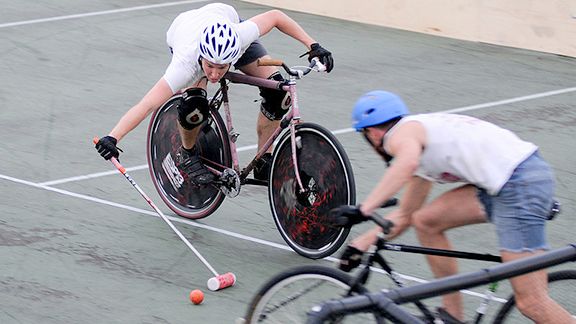
While I’m waiting for Hedgehog to get back with our ice cream, I watch a little bike polo on the other side of the tennis net. It’s a pretty intense pick-up scene. Three-on-three, with a basketball hoop and a light pole in the field of play.

Most of them wear helmets. Some, knee pads and elbow pads. They drink beer, they smoke. One girl is playing with a cigarette in her mouth.

Plastic mallets awhirl, they circle and sprint, skid, bounce, and sometimes fall. If your foot touches the ground, you have to touch one of the mid-court posts with your mallet before returning to play.

It looks goddamn fun.

Another woman scores her second goal of the game and a dude against the fence, waiting his team’s turn, hollers, “My nipples are hard!”

“I didn’t know he had nipples,” quips a guy on a bike, racing back to defend his goal.

On the hard-top soccer pitch other side of the fence from all this, a couple of moms are kicking around with their kids. I fantasize about joining them, but here comes Hedgehog with our ice cream: mango and carrot, and basil lime.

The basketball scarecrow has moved on, and now two short guys are playing one-on-one. Someone else is practicing his fancy dribbling in the shadows, and occasionally pulls up and bounces a shot off of a light pole.

Twenty Major League Baseball players face possible suspension for alleged use of performance enhancing drugs, and these moms, kids, kooks, and badasses are out here every time I walk by, which is often.

Between Shotwell and Harrison on 21st Street in the Mission. Jose Coronado Playground. This has been a night in the life. Of it.

Newcomer Nights are on Wednesdays, in case you’re interested in getting in the game, bike polowise.

Otherwise, it’s not a bad spectator sport. Mondays, Thursdays, and Saturdays they play, from seven to ten. Check it out.

www.sfbikepolo.com


In his footsteps

0

arts@sfbg.com

DANCE If you are even tangentially connected to San Francisco’s dance community, one name will pop up again and again: Ed Mock. He was part of San Francisco’s awakening as a center for arts on the edge before his death from an AIDS-related illness in 1986.

African American and gay, the performer-choreographer was, above all, a free spirit throughout the two decades he lived in SF. During that time, he influenced and shaped a generation of young artists. For dancers like Wayne Hazzard, Victoria Mata, Shakiri, Joanna Haigood, and Pearl Ubungen, he was crucial to who they became. Mock also collaborated with the young Rhodessa Jones; Ntozake Shange’s For Colored Girls Who Have Considered Suicide When the Rainbow Is Enuf premiered in his studio.

One of the dancers whom Mock profoundly marked is Amara Tabor-Smith. To honor him, she created the multi-venue He Moved Swiftly But Gently Down the Not Too Crowded Street: Ed Mock and Other True Tales in a City That Once Was. The piece will wander through the city Sat/15 and June 21-23.

The SF-born Tabor-Smith encountered Mock when, at 14, she tagged along with a friend who had been told that classes with Mock were a must. She joined his Ed Mock Dance Company at 17 and stopped dancing for a year when he died. Eventually, she joined New York’s Urban Bush Women for a decade before returning to her much-changed hometown in 2006.

Talking with her after a rehearsal in early June, it quickly becomes clear that she not only mourns the passing of a pioneering artist but also a period when San Francisco was place for experimentation, openness, and a sense of the possible. The Beats and the hippies may have put their own stamp on the city, but in the 1970s the gay pride movement filled the air with champagne-like effervescence and expectations — until the AIDS epidemic cut it down. Lately, the tech boom has had a negative effect on SF’s artist population.

“Ed was the most fearless person I ever knew,” Tabor-Smith says, “He was the embodiment of freedom, courage, and mischief. I loved the way he embraced the risk of failure and the way he could create on the spot because the spirit moved him. He knew who he was and where he came from. He was an old soul, and he walked with the ancestors.”

Mock left his primary legacy through his classes, teaching wherever he could find studio space. Tabor-Smith remembers them as always packed with all sizes, colors, body shapes, and orientations — unusual for a time when teaching was much more compartmentalized than it is today.

He choreographed for his company, but as a dancer he improvised — a pioneering act in itself. Unfortunately, little documentation has survived. A YouTube search does turn up a video of Possum Slim, an astounding solo from 1979 performed by a naked and body-painted Mock.

Tabor-Smith (in collaboration with Ellen Sebastian Young) conceived of He Moved — part of Dancers’ Group ONSITE Series — as 11 site-specific performances that journey through Mock’s life. Among others, she is working with Jose Navarette on a section about memory; Jesse Hewitt and Laura Arrington will perform “acts of disruption” for Valencia Street’s 24/7 connected crowd.

Hayes Valley’s Salle Pianos and Events — where Tabor-Smith is rehearsing He Moved‘s “A Room of Black Men” section — happens to be next door to one of the studios in Mock’s peripatetic teaching career. She sees its funky elegance, with crystal chandeliers hanging over metal folding chairs, as “an Ed kind of place.” In stark contrast to the traffic roaring by on Market Street, the nine dancers bring a statuesque dignity and stillness to what is a tribute to black manhood. But they also explode into individual solos and help each other find community. At one point the dance becomes what looks like a ceremonial blessing around a seated elder, whose eloquence emanates simply from his presence.

Tabor-Smith also likes the Salle space because it’s located across the alley from Zuni Café, where her piece’s “Window Seat” section will be shown. Appropriately, “Ed was a fixture there. The people who ran it were wonderful. He never paid for a meal. Or a bottle of wine.” *

HE MOVED SWIFTLY BUT GENTLY DOWN THE NOT TOO CROWDED STREET: ED MOCK AND OTHER TRUE TALES IN A CITY THAT ONCE WAS…

Sat/15 and June 21-23, 3:30-8:30pm, free

Various locations (starts at 32 Page), SF

www.dancersgroup.org


The young master

0

cheryl@sfbg.com

FILM After a banner 2012 and early 2013 — in which his 1958 Vertigo was named the best film of all time by Sight and Sound magazine; a critically-panned but still entertaining-enough biopic hit theaters; and a months-long career retrospective, “The Shape of Suspense,” played the Pacific Film Archive — Alfred Hitchcock’s revival continues. Next up is “The Hitchcock 9,” a San Francisco Silent Film Festival showcase of nine silent films — nearly his entire 1920s output, all made before he turned 30.

His best-known films continue to inspire pop culture (see: A&E’s hit Bates Motel), but Hitchcock’s earliest work isn’t widely circulated. That may change thanks to the British Film Institute’s restoration efforts, the fruits of which are unspooling stateside on a multi-city tour (along with the Silent fest, co-presenters include the Brooklyn Academy of Music and the Academy of Motion Picture Arts and Sciences) launching at the Castro Theatre. Live music by acclaimed musicians will enhance each screening, including the five-piece Mont Alto Motion Picture Orchestra, Bay Area pianist-composer Judy Rosenberg, and British silent-film specialist Stephen Horne.

In movie-crazed San Francisco, where Silent fest screenings regularly sell out (this year’s event is July 18-21; start your engines, Louise Brooks fans), the only dilemma will be deciding which of the Hitchcock 9 to see. Opening night offers a tempting option in 1929’s Blackmail, which Hitchcock — always adventurous with filmmaking technology — shot as a silent/sound hybrid.

Her blonde hair hinting at what would become a Hitchcock trademark, saucer-eyed beauty Alice (Anny Ondra) steps out on her inattentive boyfriend, a Scotland Yard detective, with an artist whose intentions prove shockingly lascivious. Alice has no choice but to stab her attacker (and rip one of his creepy clown paintings) and skulk off into the night, leaving the murder scene for her cop beau to find. What happens next is given away by the film’s title, but no matter — Blackmail is suspenseful to the end.

Another fair-haired lass encounters menace in closing-night film The Lodger (1926), a thriller that takes its stylistic cues from German Expressionist films, particularly 1920’s The Cabinet of Dr. Caligari. Sassy model Daisy (June Tripp, credited as “Miss June”) declares “No more peroxide for yours truly!” when London’s headlines begin shrieking about a serial killer, “The Avenger,” who exclusively targets blondes. Enter a gloomy-yet-dreamy stranger (Ivor Novello), who takes a room at the boarding house run by Daisy’s parents; it doesn’t take long before he makes the landlady uneasy (he does wear a cape, after all), though Daisy finds him intriguing. Naturally, her boyfriend — another cop — becomes highly jealous, not to mention suspicious.

Blackmail and The Lodger are stuffed with elements that would later be easily identifiable as “Hitchcockian” (witness Blackmail‘s high-climbing climax — it ain’t Mount Rushmore, but you see where the idea’s heading). But The Ring, about a love triangle between two boxers and the (dark-haired) temptress that motivates their brawls, is Hitch’s only original script penned without collaborators, and it’s hardly chockablock with psychological terrors. It is, however, a charming sports romance with some nifty technical touches, including an early example of a drunken scene being shot in blurry “booze-o-vision.”

http://www.youtube.com/watch?v=F2T4ZrBel6A

The rest of the Hitchcock 9: 1928’s daffy-heiress tale Champagne; 1927’s Downhill, which also stars The Lodger‘s Novello; 1927’s Isle of Man-set The Manxman; 1928 comedy The Farmer’s Wife, with The Ring‘s Hall-Davis; 1927 Noel Coward adaptation Easy Virtue; and Hitchcock’s feature debut, 1926’s The Pleasure Garden. 

THE HITCHCOCK 9

Fri/14-Sun/16, $15–<\d>$20 (nine-film pass, $135)

Castro Theatre

429 Castro, SF

www.silentfilm.org


Hell boys

1

cheryl@sfbg.com

FILM It’s a typical day in Los Angeles for Seth Rogen as This Is the End begins. Playing a version of himself, the comedian picks up longtime pal and frequent co-star Jay Baruchel at the airport. Since Jay hates LA, Seth welcomes him with weed and candy, but all good vibes fizzle when Rogen suggests hitting up a party at James Franco’s new mansion. Wait, ugh, Franco? And Jonah Hill will be there? Nooo!

Jay ain’t happy, but the revelry — chockablock with every Judd Apatow-blessed star in Hollywood, plus a few random inclusions (Rihanna?) — is great fun for the audience. And likewise for the actors: world, meet Michael Cera, naughty coke fiend.

But stranger things are afoot in This Is the End. First, there’s a giant earthquake and a strange blue light that sucks passers-by into the sky. Then a fiery pit yawns in front of Casa Franco, gobbling up just about everyone in the cast who isn’t on the poster. Dudes! Is this the worst party ever — or the apocalypse?

I chatted with Rogen, his co-director and co-writer Evan Goldberg, and co-star Craig Robinson (The Office) when they hit town a few weeks back; their Bay Area visit included stops at multiple social-media HQs (Rogen’s take: “I thought there’d be more Segways.”) Rogen and Goldberg’s often-overlapping, guffaw-laden answers speak to their lifelong friendship — at 13, the Vancouver classmates wrote the first version of what would become the 2007 hit Superbad.

Also in 2007, they made Jay and Seth vs. The Apocalypse, a short film starring Rogen and Baruchel as “two guys arguing in a room, basically,” Rogen says. “The world is ending, but our main problem is that we have to deal with each other, and our histories, and our friendship issues.” The idea expanded and became This Is the End, which marks Rogen and Goldberg’s feature directorial debut. An apocalypse comedy? Well, why not?

“There’s always been apocalyptic movies. It’s the biggest idea you can have: the end of everything. But are there any other funny ones?” Goldberg wonders. “I found moments of Volcano (1997) pretty funny. I suppose Armageddon (1998) would be classified as an apocalypse comedy, by accident.”

It’s important to note that This Is the End relies not on natural disasters, asteroids, aliens, or zombies to signal doomsday. “The whole concept was, full Christian apocalypse,” Rogen says.

“Catholic. Christian. Apocalypse. Book of Revelations. It’s the biggest book ever made,” Goldberg adds. “It’s the most popular version of it, so we might as well ride that gravy train.”

Cult-movie connoisseurs will be familiar with unintentionally hilarious depictions of the Rapture, most famously in “scare films” like 1972’s A Thief in the Night. Rogen’s research was slightly more modern. “Along with two of our producers, I watched all of Kirk Cameron’s Left Behind movies,” he admits. “They are fucking insane. It was one of those things where we were like, “Let’s look at it for five minutes. It’ll be funny!” and we ended up watching the whole trilogy. It was unbelievable.”

Neither Rogen nor Goldberg happens to be Christian, which is part of the joke. “A lot of people think we’re gonna be stuck here as hell comes to earth ’cause we’re Jewish,” Goldberg points out.

“It’s true!” Rogen laughs. “That idea fascinated us. Most people in North America were raised Christian; whether or not they actually believe in it, they’re ingrained from a very young age with the general idea that hell is gonna come to earth one day, and the good people will get sucked up to heaven and the bad people will be laid to waste, basically. Which to us was a fuckin’ disturbing concept, especially since it was implied that we would be the ones left behind. I think that’s really where [the film] came from.”

Goldberg elaborates. “In 11th grade, I had a conversation with a Christian friend, where I asked, ‘Let’s say I save a bus full of children who are falling off a bridge. But there’s this serial killer who believes in the stuff that gets you into heaven, and I don’t. Does he still go to heaven, and I go to hell?’ And she was like, ‘Yeah. Sorry, dude.’ Most Christians don’t really think we’re going to hell. But they all know the story.”

Of course, This Is the End has a lot more to it than religious commentary; there’s also copious drug use, masturbation gags, urine-drinking, bromance, insult comedy, and all of the uber-meta in-jokes fans of its stars will appreciate. (When asked if this is the most self-referential movie ever made, Goldberg cracks, “Maybe … unless, is somebody making a movie about the making of this movie?”)

“You’ve seen people play themselves in a movie before, but not to this level,” Robinson notes. “Though there’s two versions, you know — there’s me, singing ‘Take Your Panties Off,’ which I do in real life, and the me who has killed a man, which is not real. Hopefully the audience will able to differentiate.”

With a large ensemble of funny guys (Rogen, Robinson, Baruchel, Franco, Hill, and Danny McBride), plus a raft of cameos, the filmmakers were careful to split the laughs as evenly as possible.

“For the six main guys, we tried to write the best script we possibly could. But sometimes, the actors won [with their improv], because they’re funnier,” Goldberg laughs. “When it came to the party with all the different deaths and stuff, we had a bunch of ideas and we kind of hashed it out with each actor. We tried to make sure we gave everyone one good bit, and I think we mostly pulled it off.”


THIS IS THE END opens Wed/12 in Bay Area theaters.

Wish you weren’t here

2

arts@sfbg.com

FILM Austrian Ulrich Seidl has been making films since the early 1980s, but didn’t get much attention internationally until 2001’s Dog Days, a bleak and nasty ensemble piece about some seemingly ordinary — but all variably pathetic, ugly and/or perverse — Viennese suburbanites sweating through a heat wave. It was the sort of movie that demanded attention, being grotesque, funny, surprising, meticulously crafted, and arguably just plain mean.

Following decades of mostly documentary work, he’d suddenly joined the ranks of what you might call the New (though not necessarily young) Misanthropes: directors like his fellow countryman Michael Haneke, France’s Gaspar Noé, and the Philippines’ Brillante Mendoza. For some their invariably depressing, often upsetting films illuminate the human capacity for cruelty. For others, they wallow in it.

After taking his time making a Dog Days follow-up (2007’s Import/Export, a predictably grim comment on Europe’s immigration inundation), Seidl is back in atypical bulk with his Paradise Trilogy, three lightly interlocking (there’s no real overall arc) features more tightly focused on hapless individual protagonists. Each are observed — and this director is among the most ruthlessly clinical observers around, as if cinema were a laboratory and characters his test subjects — on vacation. But of course the experience of any earthly paradise is a sour joke in the contexts they find themselves in. Striking if unpleasant, the trio gets its Bay Area debut over the next three weekends at Yerba Buena Center for the Arts.

Paradise: Love (2012) makes the pursuit of pleasure look grim indeed, from the rather cheap-shot opening of Teresa (Margaret Tiesel) overseeing mentally handicapped adults as they enjoy an amusement-park outing on bumper cars — a scene whose “grotesquerie” feels exploitative. But once she’s on her holiday in sunny Kenya, it’s Teresa who does the exploiting. At the urging of a cheerfully horny friend (one among many plus-sized, German-speaking women well into middle age holidaying there), she partakes of the local populace of young men who offer gigolo-type services for a price.

But Teresa wants something more — or at least the illusion of it. Ergo she’s thoroughly suckered when the first seemingly non-predatory beach stud she encounters (Peter Kazungu as Munga) starts asking for money — he’s got no end of needy sick relatives, it seems — once they’ve consummated his declared “love.” Similar disappointments ensue. Teresa’s naiveté isn’t exactly sympathetic, however. She unconsciously brings the full weight of class/racial privilege and condescension with her, and is endlessly, petulantly demanding as a sex tourist who insists on being treated as a lover. (The negotiation around how her breasts should be touched by Munga seem to take half an hour alone.) She just wants to be desired. Yet she acts like a pushy colonialist bargain shopper.

In Paradise: Faith (2012), the spotlight is taken by Teresa’s older sister Anna Maria (Maria Hofstaetter), who most certainly is not looking for romance, let alone sex — without wearing a cowl, this hospital radiologist has become a fervent bride of Christ. She spends her vacation time alone in her over-large house, scrubbing it spotless, flogging herself clean of impure thoughts before Jesus, and singing hymns at the Casio keyboard. She also goes on daily outings to the homes of strangers, frequently immigrants. She barges in with sizable Virgin Mary statues crying “The Mother of God has come to visit you!,” and tries browbeating them into sin-abjuring prayer. Needless to say, this all seems much more about her needs than theirs.

She returns one day to the unwelcome surprise of husband Nabil (Nabil Saleh), an Egyptian Muslim back after an unexplained two-year absence. They’ve both changed greatly — back then he wasn’t yet paralyzed from the waist down, and she wasn’t a born-again fanatic. He’s nonplussed that her vinegary form of “Christian charity” treats him more as a home-nursing burden than a marital partner, and hostilities between them soon escalate to nightmarish proportions.

Ultimately, faith provides no comfort — and that failure induces a crisis of faith. Rigorously controlled in aesthetic terms, Seidl goes over the top content-wise at times — as when Anna Maria stumbles upon a public park orgy, or uses a crucifix à la Linda Blair — yet this cruel portrait of religious fixation has a certain compulsive, often cringe-inducing tension.

Finally, there’s some light at the end of the tunnel with Paradise: Hope (2013). While Teresa is fucking Africans and Anna Maria proselytizing, the former’s teenage daughter Melanie (Melanie Lenz) has been packed off to fat camp, where she and other pudgy youths endure long days of tortuous exercise and other “improving” programs. But the kids have each other; rather surprisingly, Seidl doesn’t rain gloom on their giddy rapport. Melanie also develops a serious crush on the resident doctor, a handsome, friendly, and flirtatious fellow (Michael Thomas) approximately four times her age.

Convinced she’s overdue to lose her virginity, she’s an avid pursuer — and disturbingly, he’s kinda interested. It is the movie’s major failing that seemingly kind, intelligent, grounded Dr. Arzt remains too much of an enigma for us to grasp why he’d even consider taking up a 13-year-old on the offer of herself. Yes, Melanie is cute, vivacious, and likable … but, well, come on. Of course this won’t end well. Still, Hope is indeed the most hopeful of the Paradise trilogy: its main character’s life isn’t ruined already, and she might well survive the hard knocks she’s given here to experience actual happiness.

ULRICH SEIDL’S PARADISE TRILOGY

June 13-30, $8-$10

Yerba Buena Center for the Arts

701 Mission, SF

www.ybca.org


Power plays

0

arts@sfbg.com

THEATER With its storied 35-year history of politically charged and transgressive theater, Theatre Rhinoceros might seem the perfect San Francisco outfit to take on the great English playwright Caryl Churchill’s 2006 political allegory Drunk Enough to Say I Love You? — wherein the “special relationship” between the United States and Great Britain is metaphorically transformed into a sadomasochistic affair between George Bush and Tony Blair. Or rather, their more expansive stand-ins Sam (Rudy Guerrero), described as “a country,” and Jack (Sam Cohen), described as “a man.” (Jack became “Guy” in the Public Theater’s US premiere, suggesting possibly an American everyman as opposed to a specifically British one).

The premise translates into an opportunity to excavate the seductions and corruptions of power, the homoerotic relationship resonating in complex ways with a larger patriarchal order where sex and death are right on the surface and inextricably linked. Unfortunately, despite the harmonizing at the outset of this 45-minute one-act — in a double rendition of American the Beautiful and God Save the Queen — the production directed by the Rhino’s John Fisher rarely seems in tune with the material.

The staging can be amusing even when obvious, as when Sam rams home his points with robust pelvic thrusts to his partner. But it is unnecessarily busy, with multiple entrances and exits and use of a changing photographic backdrop illustrating various settings, iconic images, and bellicose themes. Of course, all of this might have been OK if the tension, sexual and otherwise, were palpably communicated. But the tension is slack, despite the mildly explicit blocking.

Instead, the actors seem to have their hands full with the challenging dialogue — which, in addition to being tightly intermingled, is non-realistic and poetically compact, deploying the argot of geopolitics as if it were the stuff of intimate cooing and romantic tussling. Sam demands “total commitment” from his lover, for instance, but Jack is a family man divided in his loyalties, and moreover has moral qualms about some of Sam’s more outré behavior, despite the carnal lust it can also arouse. It’s a rare moment when Guerrero and Cohen convincingly connect this heightened dialogue with their rambunctious interactions.

The dialogue also makes use of a litany of high crimes committed by the US government, and its ally Britain, since the Second World War — a verbal onslaught that carries its own force by virtue of its magnitude and extent, rescuing from banality the individual crimes (from Vietnam to El Salvador to Guantanamo) made too familiar by repetition. But the power that derives from the juxtaposition of a romantic affair and this index of world-rocking brutality somehow gets lost when the production attempts to act out too much of the relationship. Ironically, the more it tries to show, the less we register the true political pornography on display.

A similar disconnect attends the second half of the evening: a staging of the 10-minute play Churchill wrote in the immediate aftermath of Israel’s devastating 2008 attack on Gaza, Seven Jewish Children: A Play for Gaza, which the Rhino balances with New York playwright Deborah Margolin’s dramatic response to Churchill, Seven Palestinian Children: A Play for the Other.

As in the first play, Churchill’s Seven Jewish Children combines moral outrage with a keen formal logic, and is capable of subtleties that belie its compact and deceptively simple structure. In a series of short, regular phrases, a set of parental voices discuss what to tell a young female child about the world she has been born into. The short scenes begin in Nazi Germany and end in 2008, covering seven decades of Jewish Israeli experience. Its coruscating and certainly provocative evocations seamlessly progress from the Holocaust to the colonizing of Palestine and the repression, in turn, of its indigenous Arab population.

The staging is again probably busier than it needs to be, since the force of the rhythmic dialogue (given histrionic emphasis by Cohen and Kim Stephenson as a married couple) is somewhat dissipated when haltingly delivered across multiple scene changes and the insertion of visual and chronological cues on the screen at the back of the stage. But the short work has raised dialogue and debate internationally, and it’s long overdue for a production by a major Bay Area company. (The Rhino audience is invited to stay and discuss both plays afterward.)

Balance may be the objective in following this piece with Margolin’s Seven Palestinian Children, but there is something lopsided about it just the same. Part of the problem is that Margolin’s tit-for-tat response dulls the force of the impression left by the first play by co-opting its form and yet deploying it in a less muscular way. Indeed, Seven Palestinian Children (performed by Guerrero as a hotheaded Palestinian father and Stephenson as a more compassionate Palestinian mother) not only trades in the kinds of gendered stereotypes eschewed by Churchill’s piece but, in substituting a male child for the female one, raises an uncomfortable gender dynamic in the very representation of Israel vis-à-vis Palestine. That may be latent in the Churchill play to some extent, but in making it explicit the pairing of plays risks being more obfuscating than clarifying of the relevant issues.

DRUNK ENOUGH TO SAY I LOVE YOU?

Wed/12-Sat/15, 8pm; Sun/16, 3pm, $15-$30

Costume Shop

1117 Market, SF

www.therhino.org


Stretch out

3

culture@sfbg.com

On the Om Front The days are getting longer. The college kids who live next door are throwing parties seven nights a week instead of the usual four. Your dog is asking to be walked so early in the morning that you’re not certain you’ve ever actually gone to sleep. It’s summertime! And it’s the perfect time to get out of town for a few days, and do what yogis (and defeated armies) do best: retreat.

Yoga and meditation retreats can take many forms. They can be active and playful (think Acro Yoga on the Yuba River) or tranquil and introspective (like a silent meditation retreat in Santa Cruz). The Bay Area is a prime launch pad for a whole range of extro- and introverted magical adventures that will stretch your body and your mind into dimensions you never knew existed.

Of course the hardest part about planning a retreat or festival getaway is actually planning it. So, here’s a little help for you. Now, all you need to do is whip out your smart phone or old-school paper calendar, flag the summer days on which you’ll say a temporary sayonara to the daily grind, and book it. See you on the flip side.


ACRO YOGA AND YUBA RIVER

You’ve seen those brightly dressed yogis in Dolores Park on summer Sundays balancing on slack lines and doing crazy partner acrobatic tricks. Learn how to do what they do on this high-energy retreat in Nevada City, led by Jason and Chelsey Magness of the YogaSlackers. Retreat includes all-levels training in Acro Yoga and slacklining plus plenty of time on the river.

June 20-23, $400. Nevada City, CA. www.yogaslackers.com


AS-ONE-WE-FLOW RIVER RETREAT

This “Interdepen-dance” retreat, run by River Guidess, will blow your July 4th out of the water. It features yoga, ecstatic dance, seven miles of mellow rafting (all gear provided), deluxe camping accommodations, organic meals, and live music. The Stanislaus river is so otherworldly that you may start dreaming in an alien language. And the best part: no wetsuits required.

July 4-7, $395–$475, Oakdale, CA. www.riverguidess.com/july-4-2013/


YOSEMITE YOGA

The towering mountains of Yosemite are just a hop, skip, and car ride away, but we city-dwellers rarely make it over there. Toss your yoga mat and some hiking shoes into your backseat, and head for the (really big) hills with Back to Earth’s annual Yosemite Yoga trip. Each day includes guided hiking to gorgeous spots, yoga classes, Thai Massage, delicious meals, campfires, and swimming in local creeks.

July 10-July 14, $675. Yosemite, CA. www.backtoearth.org/trips/yosemite-yoga


WANDERLUST

This is pretty much the hottest local-ish yoga festival of the year. Featuring a panoply of talent, this Lake Tahoe event includes world-class yoga instructors (including several Bay Area teachers like Janet Stone and Pete Guinosso) and like-minded musical artists like Moby, Grammatik, DJ Drez, and The Shimmy Sisters. Oh, and jaw-dropping vistas of Lake Tahoe.

July 18-21, $125–$475. Squaw Valley, North Lake Tahoe, CA. squaw.wanderlustfestival.com


SECOND ANNUAL YOGA ESCAPE

If you’re down for something mellower and more introspective, this Cazadero retreat with Danae Robinett offers yoga, delicious food, and deluxe accommodation amongst redwood trees and wandering wild turkeys. You’ll also get to experience Shake Your Asana, Robinett’s unique combo of yoga and rump-shaking.

July 25-28, $650. Cazadero, CA. www.smore.com/2t0b


INTRODUCTION TO MINDFULNESS MEDITATION RETREAT

Looking to shift your perspective on life for more than just a weekend? Try this introductory silent meditation (and Qi Gong) retreat at the Insight Retreat Center in Santa Cruz. Silent retreats give us the opportunity to look at our thoughts and patterns so that we can start shifting them to better our lives. The insights gained on a silent retreat are well worth corking your pie hole for a few days. You may not even want to talk again when you return. Donation-based.

August 15 to 18, free ($100 refunded deposit). Santa Cruz, CA. www.insightretreatcenter.org


DEEP RESTORATION, DEEP HEALING: ZEN MIND, YOGA BODY RETREAT

If relaxation is on your agenda (and not the kind that requires a cocktail), head to Tassajara, a Zen Buddhist retreat center in Carmel Valley. In this retreat, teachers Samantha Ostergaard and Do-On Robert Thomas will combine Restorative Yoga (an effortless, passive yoga practice) and Zen meditation techniques to create a feeling of calm in the body and mind.

August 22-25, $240, Carmel, CA. www.sfzc.org/tassajara


BHAKTI FEST

Indian chanting or “kirtan” is a juicy part of yoga practice for lots of folks, and this festival is the ultimate event to get your kirtan on. Located in Joshua Tree (close to the state park, but not in it), the festival offers four days of music with bands performing on two different stages all day and night, as well as a mad plethora of yoga classes. Hot desert nights plus divine tunes equals a personal favorite of mine.

September 5-8, $200–$400 plus camping fee. Joshua Tree, CA. www.bhaktifest.com