Volumes

Oh, the cutlery

0

le.chicken.farmer@gmail.com

CHEAP EATS This bums me out: hearing straight-phobic comments from queers. It’s a San Francisco thing. I’ll leave it to better minds than mine to figure out why. But in New Orleans, among our queer community, I never heard anything like it. And in New York City, among Hedgehog’s … nope.

Nothing.

But here, home, in San Francisco, it happens repeatedly. And as much as it used to bother me, as a closeted queer, to hear straight friends (assuming my sameness), make trans- and homophobic statements and jokes, it hurts now to hear the reverse.

Plus which, it’s stupid. So stop it. Just: stop.

Seriously, if we’ve become so proud of being queer that we devalue and disrespect “other,” then it’s time to reread Dr. Seuss.

The one with the Star-Bellied Sneetches, I’m thinking. But really they’re all very good, even “Hop on Pop.” Theodore Dreiser may have been a straight white male, but — like a lot of straight white men, including my dad, and possibly yours — he fucking rocked.

See, so it’s never as simple as Us vs. Them. You, dear heterophobe, have allies — important, awesome, straight allies, like

continued after sports section

CHEAP SPORTS

by Hedgehog

Last week was very football-oriented in our little neck of the Mission, what with the NFL and the San Francisco Women’s Flag Football League both kicking off their seasons and all.

Sunday morning, Kayday and I sat on the sidelines and watched Chicken Farmer and the rest of the team play their season-opener, but between the lack of instant replay and the lack of microphones on the refs, we rarely understood what the hell was going on. According to Chicken Farmer, her team lost. We’ll take her word for that.

And I’d tell you all about the 49ers game Sunday afternoon but that would be pointless since, obviously, you all witnessed it with your very own ocular orbs, right?

So what does that leave me with by way of football-orientated conversation? Gay marriage, of course. The nutshell, for those of you who are communists or live in a sports-free cave, is that Baltimore Ravens linebacker Brendon Ayanbadejo supports same-sex marriage. Openly. A certain Maryland State Delegate name of Burns took exception to Ayanbadejo voicing opinions about politics and wrote a letter to the Raven’s owner requesting that he put a muzzle on Ayanbadejo.

Enter Minnesota Vikings punter Chris Kluwe, who is some kind of Good Will Hunting-type genius (except with words instead of numbers). He has a gay brother-in-law, and apparently is really stoked to see an honest man made of him some day because he wrote a doozy of a letter to this Burns fellow. Look it up. It’s the kind of letter that makes State Delegates blush and concede that maybe linebackers have First Amendment rights, too.

So there you have it, sports fans: 24 hours into the NFL regular season and I have not one but two new favorite football players.

continued from before sports section

….Chris Kluwe and Brendon Ayanbadejo.

But speaking of Dr. Seuss, Hedgehog and me get to don Cat-in-the-Hat hats and solicit donations for the Children’s Book Project at Candlestick before the home-opener Sunday. Meaning: Not only do we get to see the game, we get to annoy tailgaters beforehand.

Now, if only I can get Hedgehog a press pass (plus one), for the rest of the — Wait a minute. Isn’t there a connection now between the Guardian and the Examiner?

My new favorite restaurant is Spoon, that awesome Korean joint at the corner of Ashby and something-or-other in Berkeley, where we ate, coincidentally, with Spoonbender, my new favorite unprofessional football player.

I had this fantastic kimchi fried rice, with beef (or bacon), and topped with a sunny-side-up egg. Spoonbender had Jhap Chae, which she loved, and Hedgehog had (and loved) Kimbop and chicken wings.

Then we went to the park and played catch.

SPOON

Daily 8am-8pm

933 Ashby, Berk.

(510) 704-9555

AE,D,MC,V

No alcohol


Pop love

0

emilysavage@sfbg.com

MUSIC There was a time, not so long ago, when the fanzine was a glittering portal. It was the best avenue for learning about new, underground, innovative music across the country, before the all-powerful grip of the Internet forced us to idly click our way through back catalogs. The ink and paper projects were passed to friends in the same manner one traded handmade mixtapes.

High among those infamous fanzines and punk mags was a pioneering indie pop-centric zine called chickfactor — put out by then-New York based editor-writer-photographer Gail O’Hara and Black Tambourine singer Pam Berry (who moved to London in 1995). Perhaps you’ve heard Belle and Sebastian’s song “Chickfactor” about it?

The publication’s print heyday lasted from 1992 through ’02, and is now present mostly as an online museum, but with some hints of movement in the near future. For one, its first paper issue in 10 years will be released next month, October 2012. And two, to celebrate her zine’s 20th anniversary, O’Hara has put together a series of shows around the country — and in London — featuring bands and musicians that came of age on the pages of the publication.

Just last week I saw something about an EDM blog that’s now putting on club nights up and down the coast. That’s not really what this is. This is a more DIY reunion, of bands, of fans, of readers, and of early twee pop enthusiasts (though the bands and the zine’s founders would probably disagree with the twee part).

“It was just an excuse to have a party with great live music,” says O’Hara, now based in Portland, Oreg. “I am pretty good at setting up shows, and it used to be something I did all the time when I lived in New York and London. One reason I’m good at it is that I ask people who never play, and sometimes they say yes. I really missed doing it, and the 20th anniversary seemed a good excuse to plan something in advance.”

“Many of these bands take a lot of prodding, and I was up for the task,” adds O’Hara.

All of the lineups are slightly different, but share in a common thread of the early twee and indie pop scenes in the ’90s Pacific Northwest. One of the headliners in San Francisco, the Softies, are only doing four shows this year, and the one in SF will be the last one.

The Softies, a beloved guitar-and-vocals duo formed in 1994, was one of those bands that hadn’t played in some time. The Pacific Northwest duo was made up of Rose Melberg and Jen Sbragia, both musicians who were in other bands prior to, during, and after their stint as the Softies (Melberg in Tiger Trap and Go Sailor; Sbragia of the All Girl Summer Fun Band). The Softies’ last show was in 2000 on a brief tour for their last LP, Holiday in Rhode Island.

“We had not even thought about the possibility of playing any shows until [O’Hara] asked us,” says Melberg, “and it never even crossed my mind that we could do it. When [Sbragia] said yes, I was amazed and totally excited. It was a lovely, unexpected surprise.”

Both have young kids and there’s a geographic distance between them now — Melberg in Vancouver BC, and Sbragia in Portland — but they made it work for the chickfactor shows.

Plus, they were never really out of touch, says Sbragia. The Softies first began as an intimate friendship between the two, so it came “as an extension of our friendship” says Melberg.

That closeness was apparent in the music of the Softies, a endearing, melodic blend of influences with tender-hearted vocals that inspire a still-dedicated fan base. It also inspired a somewhat dirty word to those involved: twee.

“[The ‘twee’ label] used to really bother me, because we were writing sad love songs with a lot of meaning packed in. We weren’t singing about daisies and ice cream,” Sbragia says. “But we got lumped in with that. Maybe if you weren’t singing about political ’90s issues then you were twee by default. It doesn’t really bother me anymore.”

chickfactor itself was often mentioned in the same breath as twee, but in truth, it was simply intertwined with indie music and indie pop from the start. “I worked at Spin and took full advantage of advance tapes, free concert tickets, and everything else music related in the early ’90s,” O’Hara explains. “Most of my friends were music intensive nerds too. I had a big Manhattan studio so I put a lot of bands up over the years and set up many concerts at Fez, Under Acme, Tonic, and Mercury Lounge…and I hired musicians to work as writers and/or copy editors at Spin and Time Out New York when I was there.”

She also asked musicians to contribute to chickfactor, including Carrie Brownstein and Stephin Merritt — an aside, O’Hara later co-directed and co-produced the documentary Strange Powers: Stephin Merritt and the Magnetic Fields. And many of the interviews in the zine were casual riffs with soon-to-be-famous indie artists (Stephen Malkmus, Superchunk, Neko Case, Cat Power).

So what’s up for the 30th anniversary, next decade? Who’s left for O’Hara to pester for live shows?

“Well, since you asked. I plan to head into the woods in Northern California and find Kendra Smith and ask her to play. That would be my number one dream. I recently read an entry in a journal from 1995: ‘Kendra Smith called and left a message. She is still working on the chickfactor interview I gave her two years ago.'”

We’re still waiting on that interview, Kendra.

CHICKFACTOR 2012: FOR THE LOVE OF POP

With Stevie Jackon (Belle and Sebastian), the Softies, Lilys, Kim Baxter, Allen Clap, and MC Daniel Handler

Sat/22, 7:30pm, $20–$25

Rickshaw Stop

155 Fell, SF (415) 861-2011

www.rickshawstop.com

Beyond the curtain

0

arts@sfbg.com

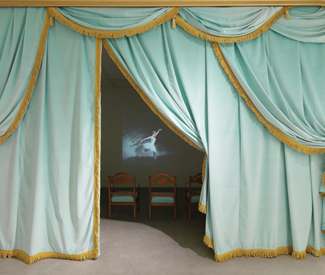
DANCE/VISUAL ART Nineteenth century story ballets raise a lot of questions: how come Prince Siegfried can’t tell the difference between the Black and the White Swans? What’s the matter with La Sylphide‘s James that he runs after the Sylph and foregoes his lovely human bride? In her first West Coast solo exhibit, Philadelphia-based visual artist Karen Kilimnik addresses these issues and more. The works in “Dance Rehearsal: Karen Kilimnik’s World of Ballet and Theatre,” at Mills College Art Museum through December 9, use clever reframing to suggest why these apparently outmoded stories remain popular classics.

Kilimnik works in a variety of mediums — video, live performance, and installation included. In this show, comprised of works from 1988 to the present, she investigates ballet as a 19th century artifact, studying it with her own wary, 21st century eyes. She gives us a complex perspective on an art that aims to transcend human limitations, both physical and intellectual. The result is a kind of double vision in which she simultaneously evokes the objects within their own exquisite context even as she superimposes borders or lenses on them. “Dance Rehearsal,” guest curated by Melissa E. Feldman, is a passionate tribute to this most artificial of genres looked at from a distance.

I am not sure to what extent “Dance Rehearsal” will communicate to a viewer who doesn’t have at least some basic knowledge of and sympathy for ballet. Longing, the otherworldly, sylphs, swans, magicians, and fairy princesses are not everybody’s cup of tea. But if you can play along with Kilimnik’s conceits, the show offers intriguing insights and re-interpretations of still-popular ballets, none of which I found in the least bit questionable. Some were more serious than others, but none of these “re-viewings” were facile.

It helps, for instance, to know that Gelsey Stuck on the Matterhorn, which resembles calendar art, refers to dancer Gelsey Kirkland, here shown as Giselle, a role she frequently played. Kilimnik suggests consanguinity between two dancers — one real, one imagined — who suffered similar fates. The elaborately titled Prince Siegfried Arriving Home in Vienna 1800’s, from Versailles, 1500’s — painted in what looks like roughed-up 18th century French style — shows a young man bowing courteously in a plumed hat and over-the-knee boots, certainly not what Swan Lake‘s Siegfried would ever have worn. Kilimnik is likely commenting on the fact that this most romantic of princes was a descendant of French court ballet at its most artificial.

However, I don’t think I would have understood (though I liked its warm colors) a C-print of two shadowy peasant girls from Giselle without Kilimnik’s title: 2 Peasant Girls, Silesia-future wilis. I had never considered that the cheerful village girls seen in Giselle’s first act might have ended up as haunted, ghostly women.

Some other works have an unexpected poignancy to them. The installation Paris Opera Rats shows three worn ballet slippers, grey tulle seemingly from a dirty tutu, and some plastic mice, all bunched up around a foam curbstone. Paris Opera Ballet’s young dancers are still (affectionately) called rats, and this piece speaks eloquently about who 19th century ballerinas were — poor, working-class women, one step above living in the gutter. The longer you study Kilimnik’s crayon-on-paper Seating Chart of the Paris Opera House, the more you see in the rigidity of its grid patterns, its ranked subdivisions, and careful color allocations a reflection of an implacable hierarchy, not just of ballet patrons, but a critique of a social system.

Perhaps “Dance Rehearsal”‘s most spectacular work, choreographed by Kilimnik, is the video installation Sleeping Beauty and friends. It’s a love letter to ballet as something that aims for an ideal that, inevitably, is held in check by what we are. The video of the stage performance was intentionally wobbly, so was the dancing. Using variations from specific ballets and jumbling them up, Kilimnik tries to help Siegfried distinguish between the Black and White Swans. Here two women dance neck-to-neck, and he still doesn’t get it. What about James in La Sylphide? Truthfully, he and the sylph, who wears tons of Swarovski crystals, are made for each other — each is more self-involved and narcissistic than the other, not far from the truth. Sleeping, which also included perspectives on Don Quixote and Diana and Actaeon, was nothing less than brilliant. A number of lectures and a ballet film series are scheduled concurrently with this exhibit.

DANCE REHEARSAL: KAREN KILIMNIK’S WORLD OF BALLET AND THEATRE

Through Dec. 9

Tue.-Sat., 11am-4pm; Wed, 11am-7:30pm, free

Mills College Art Museum

5000 Macarthur Blvd., Oakl.

mcam.mills.edu


Cocktail harvest

0

virginia@sfbg.com

APPETITE Judging a cocktail contest in Calistoga and sampling Wine Country cocktails early in 2011, I witnessed a rise in quality congruent with the cocktail renaissance exploding across the nation, beyond longtime torchbearers like SF and NYC. This is especially notable in tourist-heavy Wine Country, where shaking off the all-consuming culture of the grape is an uphill battle (so local bartenders tell me). Although you won’t see many cocktail bars opening up, restaurants continue to refine their cocktails and spirits selections. You’ll now find a few city-quality drinks among the vineyards. Here are two intriguing spots in Napa, perfect for harvest-time exploration.


GOOSE AND GANDER

Scott Beattie has long been considered the number one talent in Wine Country — he crafted exquisite cocktails in sleepy, chic Healdsburg at Cyrus long before many of the country’s big cities had clued in, leading the way in farm-fresh, artisanal cocktails (see his book, Artisanal Cocktails, www.scottbeattiecocktails.com), torching kumquats and crisping apple slivers from his backyard as garnishes.

When Beattie left Spoonbar to take over the bar at St. Helena’s Goose and Gander, which opened in April, Sonoma’s loss was Napa’s gain. Goose and Gander is in the former Martini House in a 90-year-old craftsman bungalow with idyllic yard and patio. Red walls, bookshelves, brown leather booths, fireplaces, wood ceilings and floors impart a charming hunting lodge feel. Beattie works alongside talent like Michael Jack Pazdon, who previously supervised the bar program at SolBar and has won numerous cocktail contests. Beattie, Pazdon, and crew serve fantastic drinks from a handful of cocktails (all $11) on the regular menu. Ask for “the book” for a more extensive selection — and peruse an impressive spirits collection lining the bar.

The Mellivora Capensis (a.k.a. honey badger) is a prime example of Beattie-style cocktails: Eagle Rare 10 year bourbon, honey, and lemon sound like a classic base, but it gets interesting with a touch of peat from Ardbeg Scotch, pineapple, black cardamom, and chili, with coconut foam contributing texture, and edible flowers the crowning touch. A Cucumber Collins (Square One cucumber vodka, yuzu, lemon, fresh and pickled cucumber, huckleberries, seltzer) is classic Beattie: striking visuals, artfully refreshing.

Executive Chef Kelly McCown’s food is notable. Spicy whole blue prawns ($16) are large and juicy, skillet-roasted brown, swimming in shallot garlic butter, rosemary, and chilis over polenta. A bright crudo of Hawaiian lemon snapper ($17) is lined up next to heirloom tomatoes dotted with shaved tomatillos and sea beans. As a twist on the ever-gratifying wedge salad, a Berkshire pork belly “wedge” ($15) is an understandable hit: a disc of iceberg topped with a hefty chunk of pork belly and Shaft’s blue cheese dressing. Jersey cow’s milk ricotta gnocchi ($18) melt joyously in the mouth, intermingling with cherry tomatoes, basil, and tomato coulis, crowned by a light Parmesan crisp. Goose and Gander is the whole package and works both as a romantic date locale or relaxed stop for bite and drink.

1245 Spring, St. Helena. (707) 967-8779, www.goosegander.com


THE THOMAS

Follow the vintage neon signage of the former Fagiani’s, where The Thomas opened just last month in a 1909 building restored by New York’s AvroKO Hospitality Group. First visiting during opening week, I dined on the partially covered third floor terrace (although housing a second bar, this floor is for diners only) gazing out over downtown Napa. As the sun set over the river below, rooftops and hills peeking above the the deck, I was transported to Europe, a timeless moment on a summer night.

I was immediately hooked, but I’m waiting to see how the place evolves, particularly with just-launched brunch and recently named bar manager Jim Wrigley of London’s Albannach and the Lonsdale. During my visit, AvroKO cocktail director Naren Young was in town serving drinks from the menu he co-created with Linden Pride, with whom he runs Saxon+Parole in NY. Drinks are classic, simple, playful with the ubiquitous (though not so much in Napa) Negroni on tap ($12), and a generous White Manhattan on tap ($15), utilizing Death’s Door white whiskey, white vermouth, kirschwasser, jasmine bitters. An ideal aperitif is Jasmine ($14), made of Campari, Beefeater Gin, Combier triple sec and lemon juice. Dessert was a winning round of a Grasshopper and an elegant whiskey cocktail with biscotti, ideal alongside dreamy dark chocolate pot de creme with cookies or decadent monkey bread.

Though it’s a bit too early to call, there’s plenty to enjoy on Executive Chef Brad Farmerie’s casual, comfortable American food menu. (he’s formerly of The Public in NYC.) On a warm night with an icy-cool White Manhattan, a raw bar seafood tower (mini $22, medium $67, large $125) suited perfectly with a sampling of East and West Coast oysters, smoked mussels, Dungeness crab, and plump shrimp. Grilled chorizo sausage ($13.50) was lively, with txiki cheese, black bean chocolate puree, and padron peppers.

The three-story space has a big city energy, with much of the staff from NY, imparting a welcome cosmopolitan vibe atypical of the area. The bottom floor boasts a vintage oak bar and pressed-tin ceiling, which looks like it’s been there for 100 years, in keeping with the historicity of the building, freshly incarnated.

813 Main, Napa, 707-226-7821, www.thethomas-napa.com

Subscribe to Virgina’s twice-monthly newsletter, The Perfect Spot, www.theperfectspotsf.com


Life boat

2

THEATER “No one is stupid on a cruise.”

Now that’s a line that puts the dumb in wisdom, which is the point. For no one can be stupid where everyone is by definition stupid. And that, in turn, might become the basis for a transformation of some kind.

Not surprisingly, this refrain drops from the lips of a habitual cruise-line passenger (and, arguably, the goofiest, most awkward member in a set of goofy, awkward passengers) aboard the Crown of the Sea, the sleek tourist liner headed out into international waters and some secrecy-shrouded ritual in Port Out, Starboard Home, a new play by Sheila Callaghan (That Pretty Pretty; or, The Rape Play) developed closely with commissioning company foolsFURY.

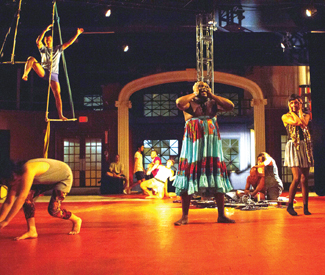
The culmination of a four-year collaboration between San Francisco’s foolsFURY and the New York playwright (whose We Are Not These Hands also premiered locally in a Crowded Fire production in 2006), Port Out is an ensemble-driven work of physical theater in a high-pitched comic-tragic vein, helmed by foolsFURY artistic director Ben Yalom. The production features some fairly elaborate choreographed sequences devised alternately by company and cast member Debórah Eliezer and SF choreographer Erika Chong Shuch (who, among other things, stages a balletic feeding frenzy at the all-you-can-eat buffet). The current run at Z Space marks the first half of a bicoastal world premiere (with the production opening at New York’s La MaMa in November). Cast and crew hail from both coasts too.

It’s an impressive achievement on the surface. Unfortunately, the play that opened last week is practically all surface. Despite its pretense, and operative nautical metaphor, it never ventures into anything deep, but contentedly bobs around the shallows of the familiar — the commodification of spiritual values and experience — in a satirical key that is more flip than ferocious. If there are things to enjoy along the way (the best scene is a group therapy session that allows fuller scope to some dynamic ensemble acting), they never lead to the storm we sense brewing (but which, at least for the audience, never really breaks).

Milling around a smooth, sloping two-tier white fiberglass hull (a marvelous setting in Dan Stratton’s large and impressive minimalist design), we meet an assortment of types — the repressed but giddy loser (Calder Shilling), the unshackled divorcée (Eliezer), the recklessly over-excited plain woman (Angela Santillo), the obnoxiously sloppy rich white guy (Josiah Polhemus), his meticulous and much put-upon son (Benjamin Stuber), and the half-wild and half-bewildered underage teen with a fake ID (Jessica Unker).

Managing the passengers are a brashly exotic cruise director named Johnny O (Brian Livingston) — sporting a tattooed torso reminiscent of Queequeg — and the mysterious Maya (Amy Prosser), a waifish woman with an abnormally small infant in a shoulder sling whose slow, deliberate movements and pacific mien stand in stark contrast to the frenetic and self-conscious energy of her adult charges (who she’s gearing up for some ominous ritual in international waters, where apparently anything goes).

Callaghan endows these characters with choice details often announced by the opining cast in choral unison: “Gary likes to quote movie lines … it’s fucking annoying,” or “Mack believes people need to think of themselves as unique, and they’ll do anything to preserve this façade. This makes him hate everyone. Especially himself.”

Such lines, reveling in unnecessary insights and an arch specificity, too often ring twee and smug, their garish particulars only rarely of more value than the occasional chuckle. The dialogue between characters or in direct address to the audience tends to retain the same superficial tone.

Much of the dialogue was reportedly digested and recast by Callaghan from improvisations and research conducted by the company (including, at one point, aboard a real cruise ship), but there’s little that feels true to life. The portraiture here is a long way, for instance, from the photographic portrait-masquerades in Cindy Sherman’s work from the 1990s and 2000s, currently on view in San Francisco Museum of Modern Art retrospective. Sherman’s art projects a series of worn-out debutantes, former prom queens, backyard pool bunnies, celebratory single ladies, and so on — types you might find on a cruise, in fact, but conveyed with a force wholly missing here because in Sherman’s work we can identify the real in the type, and the type in the real. This dissonance is powerful — mixing horror and humor, compassion and revelation — and it remains in the open seas just beyond Port Out‘s horizon. *

PORT OUT, STARBOARD HOME

Wed/19-Sat/22, 8pm; Sun/23, 2pm, $12-35

Z Space, 450 Florida, SF

www.foolsfury.org

Beyond the video

124

steve@sfbg.com

The Board of Supervisors received the official misconduct case against suspended Sheriff Ross Mirkarimi this week, with a majority of Ethics Commission members urging supervisors to give more weight to the 45-second video that started this sordid saga than the voluminous record they have compiled at great expense over five months of hearings.

Yet Chair Benedict Hur, the commission’s sole vote against finding that Mirkarimi committed official misconduct, last month argued that supervisors shouldn’t take such a narrow view of this decision, expressing concern about the “dangerous precedent” of removing an elected official for conduct unrelated to his job.

Ironically, Hur will be the one presenting the commission’s case to the board later this month, a decision his colleagues made because the other options weren’t good and because they said he has been so knowledgeable and fair-minded through the process. While Hur is likely to play it straight, the supervisors will have an opportunity to elicit his true perspective — raising questions that will be central to the sheriff’s future.

Will supervisors see their decision as a matter of showing zero tolerance for even minor acts of domestic violence, as Mayor Ed Lee and some women’s groups are urging? Or will they see this as governmental overkill in pursuing a punishment that doesn’t fit the crime, overturning an election and giving mayors too much power to go after their political rivals?

Is this just about Mirkarimi and his actions, or are there larger, more important principles involved in this unprecedented decision?

In the video, Mirkarimi’s wife, former Venezuelan soap opera star Eliana Lopez, displays a small bruise on her right bicep and tearfully tells the neighbor who filmed it, Ivory Madison, that Mirkarimi caused it the previous day, Dec. 31, and “this is the second time this is happening.” She also said that she wants to work on the marriage, but that, “I’m going to use this just in case he wants to take [her son] Theo away from me.”

Lopez last month spent more than three hours on the witness stand being grilled by Deputy City Attorney Peter Keith and Ethics commissioners, explaining why she made the video and how she believed Madison was an attorney and their conversations were confidential. She repeatedly insisted that she was not a victim of domestic violence and criticizing city officials and prosecutors for persecuting her family and taking away her husband’s livelihood.

There was nothing in the testimony that obviously impeached Lopez or hurt her credibility. To many observers -– particularly Mirkarimi supporters, who made up the vast majority of those giving public comments to the commission -– her testimony marked the moment when the city’s case began to unravel. Indeed, on Aug. 16 the commissioners voted unanimously to reject most of the charges that Lee filed, including witness dissuasion, abuse of authority, and impeding the police investigation.

In the end, there was just that video, and commissioners on Sept. 11 added a final statement into the record that they believed it more than anything Lopez has said since then. Even Hur said that he found it compelling, and that more may have happened on Dec. 31 than Lopez and Mirkarimi have admitted.

But there really isn’t much evidence to support that belief, and Hur said in August that it shouldn’t matter anyway. If the city’s vague and untested official misconduct language can apply to low-level misdemeanors unrelated to an official’s duties, he said, “we are opening this provision up to abuse down the road.”


Torture, for real

3

OPINION Last week I walked into my favorite café in SoMa and noticed the barista wearing a t-shirt emblazoned with the black and orange word “torture.”

I froze. I knew I was holding up the line but I didn’t care. I had to ask about that shirt.

“Oh, it’s to promote the San Francisco Giants,” he said. He continued speaking, not noticing my umbrage. “So do you want your coffee hot or cold today?”

I wanted to keep talking about that shirt, but I didn’t know what to say. “I will have my coffee cold please,” I told him.

For the past ten years, torture has never been far from me. When I worked at Amnesty International, it was two doors down in the person of my colleague Kumar, who was tortured in Sri Lanka for advocating for Tamil rights. When I was on Capitol Hill as a foreign policy aide in the House of Representatives, I saw lawmakers justify President Obama’s lackadaisical attitude towards US torture.

One of the first things I learned at Amnesty International is the power and the responsibility of words. Human-rights work is about finding and verifying stories and then giving those stories names: war crime, rape, genocide … torture. It’s in the naming that our action begins. When we use the word torture it carries weight—and can heal wounds—because for so many people, their torture is denied, rationalized, or trivialized.

When I see the word torture on a t-shirt I do more than cringe: I mourn how far we are as a nation from a serious discussion of the use of torture by our own government.

Just last week Attorney General Eric Holder announced that the Justice Department was closing the last two cases examining harsh CIA interrogation tactics during the Bush administration.

According to the ACLU, “(CIA) Interrogators were told they could use, among other tactics, extended sleep deprivation; ‘stress positions’ such as forced-standing, handcuffing in painful crouched positions and shackling people to the ceiling, usually for hours or even days; confining prisoners to small, coffin-like boxes with air and light cut off; extended forced nudity; sensory bombardment; extreme temperatures; hooding; and physical beatings, including slamming prisoners into walls.”

I can understand and I can attest that watching your team blow a lead in the bottom of the ninth is painful, excruciating even. It might cause you to drink or curse or smoke more. But it’s not torture. It doesn’t violate the core of your being. It doesn’t terrorize your nights.

Standing in line at the café that day, I thought of my friend Firoze who was tortured so badly he can no longer have sex. I wonder what he would say if were staring at the Barista with the “torture” t-shirt.

He would probably laugh and say it’s just a game. And then he might say what he told me each time we met: “People have no idea.”

Zahir Janmohamed recently completed a fellowship at the San Francisco Writers’ Grotto and is writing a book about Juhapura, the largest ghetto of Muslims in India

.

Locking down reforms

0

steve@sfbg.com

Realignment, California’s year-old program of diverting more inmates and parolees from state prison to county jails and probation offices, was borne of necessity: The state faced a severe budget crisis and had been ordered by the federal courts to reduce the population in its overcrowded prisons. But Realignment is proving to be a real opportunity to address inmates’ needs and reduce recidivism, particularly in San Francisco, where progressive notions of rehabilitation and redemption have deep roots.

“Realignment is the most significant criminal justice reform in decades,” says Assembly member Tom Ammiano, the San Francisco Democrat who chairs the Assembly Public Safety Committee and has helped oversee the process. “The motivation of many of us came from things that were thwarted, like sentencing and parole reform, in Sacramento for many years.”

San Francisco was uniquely positioned to thrive under the new system and to be a model for other counties that seek to improve on the 70 percent recidivism rate among state prison inmates, and the myriad problems and costs that spawns. Former Sheriff Michael Hennessey brought a variety of innovative educational and support services into the jail during his 32-year reign that ended last year (see “The unlikely sheriff,” 12/20/11).

“It’s more than an opportunity. It’s in line with the Michael Hennessey doctrine of enhancing public safety while elevating the idea of redemption, and I subscribe to that,” said suspended Sheriff Ross Mirkarimi, who successfully ran as Hennessey’s endorsed heir before Mayor Ed Lee ousted him over domestic violence allegations. “Michael Hennessey made famous the rehabilitation programs inside the jail and outside the jail.”

San Francisco was also in a good position as both a manageably sized city and county, and one that had room for the influx of inmates. It was ordered by the courts in the 1980s to reduce its crowded jail population – the peak jail population of 2,300 is now down to about 1,550 – and gained even more capacity last year when the SFPD’s crime lab scandal resulted in hundreds of drug cases being thrown out by the courts.

“It’s something that makes sense for San Francisco,” Acting Sheriff Vicky Hennessy told us. “We’re doing better than most other counties because we had the bed space and we had community programs. Michael Hennessey is a visionary…and he got these community programs out there.”

Undersheriff Ellen Brin, who oversees the jail, said the main difference among inmates that San Francisco is dealing with under Realignment – a total of 2,258 in the jail over the last year, staying an average of 60 days each, and another 306 convicts under post-release supervision – is that they’re in local custody longer than before.

“It’s sort of the same population we’ve always dealt with, but maybe we’re dealing with them on a longer term,” she said.

That creates some challenges – Brin said there are more inmates who are a little more hardened and “more sophisticated” – but it also gives local programs more of a chance to help the inmates. That was one of the arguments for Assembly Bill 109, the main legislation that created Realignment, along with five other related bills.

“That was the whole plan about AB 109 is the counties do it better,” Brin said. “For us, we’ve been doing these programs for so long, with reentry and other community programs, so it’s easy for us to manage this population because they’re here longer.”

Realignment has also prompted more collaboration among the affected local agencies – particularly the Sheriff’s Department, Adult Probation Services, and the District Attorney’s Office – and their counterparts on the state level.

“We haven’t had an overarching initiative that we’ve all been required to sit around a table and work on. This has kind of brought us together, and we’ve discovered other areas where we need to work together as well,” Hennessy said.

That has sparked new programs. For example, San Francisco just started to bring those about to be paroled from state prison into the local jail before their release in order to integrate them into the San Francisco rehabilitation system. “We’re creating a reentry cycle for them so they aren’t just getting off the bus and landing here and going directly to Probation for an interview,” Hennessy said. “Now, we’re going to try to bring them here 60 days early and provide them with wrap-around services, so that we can get them established, get them housing, give them the best opportunity we can for a successful reentry.”

With counties now responsible for the people local judges send to jail, there’s more interest in reforming sentencing laws and exploring more progressive and community-based alternatives to incarceration, which is the focus of the new San Francisco Sentencing Commission that held its first meeting last month.

“District Attorney [George] Gascon is very supportive of Realignment, DA’s Office spokesperson Stephanie Ong Stillman told us. “He has said it could have the greatest impact on justice reform in decades. San Francisco is on its way to being a model for the state.”

But the flip-side of San Francisco’s advantages has been a growing backlash against Realignment in conservative counties with disproportionately high incarceration rates and a lack of capacity in their jails – which is often a byproduct of combining tough-on-crimes policies with anti-tax attitudes, something Ammiano is now dealing with in Sacramento.

“There is a lot of push-back from the Republican Party and alarmism over Realignment,” Ammiano said, noting that he’s just waiting to be hit with anecdotal stories about a transferred inmate committing some horrific crime, even though Realignment only involves low-level convicts who committed non-violent and non-sexual crimes.

Ammiano will work with a newly constituted Board of State and Community Corrections that will distribute funds to counties that need to beef up each their jail capacities or their treatment programs. That mix hasn’t been set yet, but Ammiano said he won’t support counties that simply seek more state resources to maintain high incarceration rates.

“In one way, it’s perturbing and the other way, it’s exciting,” Ammiano said. “For me, the more the county has programs, the more sympathetic I’ll be.”

Yet in this era of chronically underfunded government entities, even San Francisco is strained. Hennessy and Brin say Realignment has brought more inmates with serious mental health issues into the jails for longer periods of time — and that has stretched their resources.

“That’s where we lack, even before AB 109, and I’d like to get more people in there who are experts in the mental health field,” Brin said.

Hennessy agreed, but added, “The mental health program we have is extremely good, it’s just overtaxed because we’re seeing many more people, and this is across the state.” Mental health isn’t the only issue. “The other thing that is a concern is housing for people,” Hennessy said, explaining that the city needs both supervised housing and regular low-income housing for former inmates returning to the community. Maintaining the Sheriff’s Department progressive legacy in the face of new challenges is one reason why Mirkarimi sees danger in Lee’s decision to overturn that election and consolidate more power in the Mayor’s Office. “It’s important that the independence of the Sheriff’s Department be preserved,” Mirkarimi said. “Programs can easily be changed by successive mayoral administration if there isn’t that check on power.” But for now, Brin said San Francisco’s various law enforcement officials have been working well to realize the potential of Realignment: “The collaboration between the criminal justice partners has just been really, really great. Everybody is working together to try to accomplish the same thing.”

Ending the mayor’s commission monopoly

2

EDITORIAL Ten years ago, San Francisco voters took a huge step toward decentralizing control of city planning, approving a measure that splits the appointments to the powerful Planning Commission between the mayor and the Board of Supervisors. A year later, a similar change gave the supervisors a role in appointing Police Commission members.

By any rational account, it’s been a complete success. The commissions better reflect the diversity of opinion in the city, function well and are no longer complete rubber stamps for the mayor and his planning director and police chief.

The mayor still controls the majority on both panels; his ability to set the direction of city policy hasn’t been harmed. But there’s a least a chance for a dissenting voice or two.

Compare that to, say, the Recreation and Parks Commission.

Rec-Park is a disaster. The seven members are all appointed by the mayor. Some have little or no past experience in anything related to recreation or parks. One actually works as Mayor Ed Lee’s scheduler. Commission votes are nearly always unanimous and the panel supports the director more than 90 percent of the time.

The mayoral appointees have overseen the rampant privatization of public space and a change in direction that undermines the entire concept of urban parks. Rec-Park staff have been directed to find increased ways to turn the parks into cash machines, prioritizing revenue over public access.

The result: So many people are angry at the department that it’s possible San Francisco voters will reject a bond act in November aimed at providing badly needed money to fix up ailing parks and facilities.

The discontent with Rec-Park stems in significant part from the perception that the commission is inaccessible and uninterested in public input. Since all of the members typically line up in lockstep on every decision, there’s little discussion and less chance for opposing opinions to get heard.

There’s a pretty easy fix — the supervisors could put a charter amendment on the ballot giving the board three of the seven appointments. But that would leave a long list of other key commissions unchanged — and there’s no reason to address the problem piecemeal. It’s time for the supervisors to push a comprehensive reform package that redefines how every policy commission in the city is structured.

The reason district elections of supervisors has been such an unqualified success (and remains incredibly popular) is that it guarantees not only neighborhood input on issues but a diverse board. Fiscal conservatives have a voice; so do left-progressives. You won’t find that on most mayoral commissions; it’s very, very rare for a mayor to appoint someone who doesn’t share his or her policy perspectives.

The mayor of San Francisco — who needs to raise huge gobs of money to get elected, leaving him or her deeply in debt to powerful and wealthy individuals and interests — has too much power. That’s a basic problem in the City Charter. The supervisors should start holding hearings now on alternative approaches to a more equally shared governance. Splitting appointments to all commissions would be a great start.


Convict clinicians

1

news@sfbg.com

Editor’s Note: Dey is an inmate at Soledad State Correctional Facility serving 25 years-to-life for his third strike.

Recidivism is like a circular river of criminality. After picking up toxic momentum in my neighborhood, deviance carves a path of destruction through yours. Being a participant in this tragic affair while defined indefinitely by a rap sheet from hell — it’s a feeling worse than death.

Someone has to put their foot down and say enough is enough. If I only had one wish — I’m almost embarrassed to say — prisons and jails would become factories that turn lawbreakers into advocates for change. Sound crazy? Welcome to my world, where sanity is a luxury. But I’m willing to put up or shut up.

In 2007, the Legislature approved Assembly Bill 900 to bring the smart-on-crime movement to the California Department of Corrections and Rehabilitation (CDCR). An expert panel designed the California Logic Model to evaluate and measure evidence-based methods, which are supposed to combine education, lifeskills, and cognitive restructuring. In theory, it makes perfect sense.

Then the recession hit, and the labor-intensive smart-on-crime movement never got moving. Budget cuts brutalized rehabilitation. About the only austerity measure left to impose, according to conventional wisdom, is to remove the word “rehabilitation” from the agency’s masthead. As the state struggles with a federally imposed prison population cap and counties scramble with Realignment’s influx of prisoners, I’m through waiting. Seventy percent of incarcerated people who still suffer from untreated substance abuse will continue to recidivate 70 percent of the time. It’s not a puzzle. People need help, and lives are at stake — including my own.

OPPORTUNITIES INSIDE

In late 2009, I found myself part of a mass transfer of long-term offenders being sent to the Correctional Training Facility (CTF) in Soledad. Attempts to think outside the box in higher security prisons always fell on deaf ears. However, the abundance of rehabilitative programs being offered in CTF presented a rare opportunity.

Inmate-run groups grew roots in CTF in the mid-’00s, and programming cuts didn’t impact CTF to the same degree as other prisons. In the self-help method, volunteers from the community or correctional employees in their off-hours team up with prisoners to deliver services. Soledad is unique. Seven days a week, seminars and workshops facilitated by inmates for inmates cover 12-steps, anger management, and victim awareness, to name just a few.

One shining example is a self-funded college program that serves almost 300 students a semester. In 2010, a small cohort of determined individuals established an arrangement with Palo Verde College to become specialists in their Alcohol and Drug Studies (ADS) program. Since I’m “struck-out” for a three-strikes drug offense, I have a vested interest in this concept. Thirteen years of bearing witness to political and governmental indifference to public safety has turned me into a fanatic on a mission. We need training and treatment — and we need it now. The CDCR does have a substance abuse certification program in Solano State Prison, but it is too exclusive and expensive, not to mention a logistical nightmare.

Palo Verde College offers ADS to some CDCR prisoners via distance education, but obtaining state credentials requires a larger investment. We found an investor. With the help of a generous nonprofit organization, we intend to use the ADS program to develop an inclusive and mobile method of cost-effective licensing.

As the spring 2011 semester comes to an end, we have almost 20 students ready to begin the final phase of state certification. Twenty guys might not be able to change the world, but if given the chance, we can lay a solid foundation to make an impact on the underworld. I’m excited.

In-custody substance abuse treatment followed by aftercare is most effective when total exposure lasts two to three years. It’s also very expensive. Post-secondary training tied to long-term treatment is fiscally and socially responsible — cutting right to the heart of criminal thinking, anger, and addiction. Our specialized studies empower us to develop promising methods that can be delivered for next to nothing.

We follow the evidence. A rehabilitative oversight committee identified adult education and addiction as the two greatest criminogenic needs not being met. In response, a handful of us formed Inside Solutions, an evidence-based think-tank, and designed a program that addresses these unmet needs.

Starting in the summer of 2011, college-educated tutors began helping illiterate offenders raise their test scores while the ADS students began facilitating cognitive-lifeskills workshops. By establishing a voluntary program that doesn’t impact the budget, we are delivering group-oriented treatment to those who need it the most. One prisoner helping another is power without equal. Delivering programs doesn’t take a lot of money — it takes ingenuity, passion, and tenacity. We do things for pennies on the dollar, and we wouldn’t even know what to do with the type of funds it takes to mismanage a fully-staffed program. Rather than some bunk program ran by a bunch of timecard punching half-assers, we remain true to our cost-effective roots by making something out of nothing. More bang for the buck is the motto of our method. For years, I felt like I was buried alive on the banks of the Recidivism River. Not anymore. Now I’m on a collective sojourn of systemic self-actualization. Accumulating multiple ADS certifications, college degrees and delivering treatment is a life-changing convergence of therapeutic alchemy. I have been transformed by the process of turning convict lead into clinical gold — social justice of the highest order. If we had a budget to match our enthusiasm, I can only imagine. In the here and now, not bad for a bunch of criminals.

1,2,3, kinky

0

caitlin@sfbg.com

SEX 2012 For youse who are considering dipping toes into a pool of liquid latex this weekend, Mollena Williams, co-author of Playing Well With Others: Your Field Guide to Discovering, Exploring and Navigating the Kink, Leather and BDSM Communities (Greenery Press, 312pp, $19.95) and long time player on the Bay Area BSDM scene, has a clarifying statement about making Folsom Street Fair your first kinky sex event.

“It’s probably akin to getting to know the animals on the African plain by visiting the Bronx Zoo,” Ms. San Francisco Leather 2009 told me when I caught her on the phone. “You will have an idea of what the giraffes do when you see them in the Bronx Zoo, but if you travel and see them wandering the plains you’re going to be like, oh my gosh!”

But if the fair that’s launched a thousand sluts isn’t a good place to learn how to be a responsible kinkster, one might ask, how does a nipple clamp-craving individual who just read that book and has a new profile on FetLife (user name: ChristianGreysTie) — or has a yen for rough play that is entirely unrelated to popular fiction — get one’s start on the scene?

Never fear, my corseted dear. Playing Well With Others holds the answer to that question, and then some. Genderqueer leather lad Lee Harrington came up with the idea for the book some years ago, drafting Williams as co-scribe to diversify and deepen the perspective offered in the book. Their voices are perfection — Williams’ experience as a person of color on the scene and Harrington’s as a transperson make for a 101 to the BDSM community that takes very little for granted about the reader.

In straight-forward, friendly language, the book covers basic identity issues such as what and why kinksters exist. There’s a vast chapter that runs down the various kinds of kink events, from woo-woo spiritual retreats to clothing swaps to fetish balls. It’s really all in there: advice on making kinky business cards for passing out to possible paramours, ways to trick out your sexy social networking profile, and how to negotiate safely and sanely with a partner regarding just what your relationship can handle at that pony play conference.

Williams told me there has been a gentle surge in participants in the BDSM scene, offering the real-life, previously-mentioned 50 Shades of Grey-based FetLife handle as proof that popular culture is causing an uptick in online participants, at least. Playing Well With Others offers important tips on the perils and pitfalls of kink community. Williams cited her own sexual assault that occurred during a play scene as an example of something that she had trouble wrapping up into a neat, advice column package for the book. The BDSM scene has its “criminally pathological,” just like every other segment of society, she said.

Boundaries weren’t a real big part of 50 Shades, in which dominant, older Christian Grey does not take no for an answer from his virginal quarry. His doltishness is presented in the book’s pages as the height of romance. “It’s not romantic to stalk someone,” cautions Williams. “I don’t care how wretched hot you are, if someone says they don’t want to see you and you show up on their doorstop — that’s not a thing.”

“We wanted to have a road map, because it is a jungle out there,” she told me.

Sorry to leave you hanging back there if you were waiting to hear what Williams had to say about the perfect starting point for your public pervert-dom. That would be at your local munch, or casual (think streetwear and sneakers, not harnesses) gatherings of kinksters.

The more-intimate affairs take place in non-intimidating public venues and offer a chance to have conversations about who or what you’re trying to kneel to, as opposed to mega-events like this weekend’s fair, where the emphasis is more on show ‘n’ tell peacocking than one-on-one information share.

“I don’t know if Folsom is there to help you find your community,” reflected Williams. “But it’s there to help you celebrate your freakiness. In that, it’s unparalelled. There’s nothing like being able to walk down the street in your corset, bra, and panties, and share that part of you.”


Words and deeds

4

steve@sfbg.com

When Mayor Ed Lee appointed engineer and pro-development activist Rodrigo Santos to fill a vacant seat on the City College of San Francisco Board of Trustees, both men talked about the urgent need to save this troubled but vitally important institution.

“Our economic future is directly tied to the success of City College,” Lee said at a press conference, touting the school’s critical job-training role.

But when you cut through all the politics and hyperbole, the school’s biggest single problem is a lack of money — and the mayor and his new trustee aren’t doing much to help.

Neither Lee nor Santos have yet endorsed or publicly supported Proposition A, the $79-per-parcel tax that would stave off deep cuts to a district whose accreditation has been threatened over its anemic cash reserves and reluctance to scale back its course offerings (see “City College fights back,” July 17).

Nor have they appealed for support from their deep-pocketed allies in the business community, which City College supporters say should be doing more to support the district.

And while some say Lee is finally getting ready to endorse Prop. A, he’s done nothing to help the campaign.

“It’s a shame because [the mayor] has pledged to support City College,” John Rizzo, president of the Board of Trustees and a supervisorial candidate from District 5.

Lee also refused a request the trustees made last year to ease the more than $2.5 million in rent and fees that the district pays annually to the city. That’s a stark contrast to the city’s generous support of the San Francisco Unified School District, which gets an annual subsidy from the city of around $25 million, thanks to a ballot measure pushed by city officials of various ideological stripes.

“K-12 is important, but when we try to get help from the city, it falls on deaf ears and I don’t know why. Maybe little kids are cuter,” Rizzo told us.

Sup. Eric Mar said that dichotomy is a real problem, particularly given City College’s current challenges and the important role it plays in providing low-cost training to local workers. Mar has called for a hearing this month before the Joint City and School District Select Committee, which oversees SFUSD’s relationship with the city.

“I support stronger city support for City College,” Mar told us.

Asked about Lee’s unwillingness to help with City College’s fiscal situation, mayoral Press Secretary Christine Falvey said Lee has offered logistical support from city officials to help City College overcome the threats to its accreditation and has been carefully monitoring the situation, but she didn’t directly address why he has withheld financial support or endorsed Prop. A.

“The mayor has not taken a position on the parcel tax and is focusing his efforts on supporting the college’s need for serious fiscal and management changes and protecting its accreditation,” she told us by email Sept. 7. “The mayor knows it is more important than ever that the City support City College to make sure they get back on their feet for the sake of current and future City College students and for all San Francisco residents.”

But City College officials aren’t buying it. “Talk and nice words don’t mean anything anymore,” Rizzo said.

Other Prop. A supporters agree.

“The mayor needs to step up and support this,” Trustee Chris Jackson told the Guardian, arguing that most of the district’s problems stem from steadily declining financial support from the state. “We have a revenue problem.”

“It is the workforce training vehicle for the city,” said Rafael Mandelman, a candidate for trustee who has been actively supporting Prop. A. “Maybe now is the time when the city shouldn’t say no to that.”

Falvey responded by saying, “The City supports all of our public education institutions in some capacity. Each public education institution also pays the city for some of the required services it is provided.”

Other Prop. A supporters say they are hopeful that Lee may still come around. Alisa Messer, president of American Federation of Teachers Local 2121, which represents City College faculty, told us, “The mayor says he supports City College and we’re hoping he will support the measure soon.”

Gabriel Haaland, who has been working on the measure for SEIU Local 1021, also told us as we were going to press on Sept. 10, that Lee seems to be coming around: “From what I understand, the mayor is about to endorse it.”


PROMISE OF SUPPORT

When Lee appointed Santos — who has raised an unprecedented amount of money for his race, $113,153 as for July 1, mostly from the real estate and development interests he represents as president of Coalition for Responsible Growth — some argued that it would bring needed financial support for the district and the Prop. A campaign.

“He is expected to bring his allies in these fields into the fight to save City College, which faces a critical 2/3 vote on a parcel tax this November,” Tenderloin Housing Clinic Director Randy Shaw wrote on his Beyond Chron blog on Aug. 22, a day after telling the Guardian how the parcel tax was essential to City College’s future and Santos was uniquely positioned to support it.

But Santos, whose campaign didn’t return Guardian calls on the issue, hasn’t appeared at any Yes on A campaign events or offered any discernible support for the measure, whose supporters had only raised a little over $20,000 as of July 1. While there is little organized opposition to Prop. A, the fact that it needs approval by two-thirds of voters is a challenge that requires strong support.

Rizzo said Shaw’s argument doesn’t hold up. “It’s a nice theory,” he said, “but I haven’t seen evidence of that, and I haven’t seen Rodrigo at any Prop. A events.”

Santos hadn’t been involved with City College or educational issues before deciding to run for trustee, and he’s widely perceived as an ambitious politico setting himself up to run for the Board of Supervisors. At his press conference, Santos pledged to aggressively fight for City College.

“I join an institution that must be saved, and I’m absolutely committed to that goal,” Santos said.

Lee assembled a variety of representatives from “the city family” at his press conference, including trustees Natalie Berg and Anita Grier, Interim Chancellor Pamila Fisher, representatives from the Controller’s Office, Board of Education, Department of Children Youth and their Families, and the Mayor’s Budget Office.

“They, after all, need our help, need our support and they will not be able to accomplish it all by themselves,” said Lee, who pointedly didn’t say anything about the parcel tax at the event, even though he sang the praises of the district. “It empowers those economic sectors that we consider most valuable to our future, especially in the area of health care, hospitality, biotech, and now technology in general. We have become dependent on City College for their ability to prepare future workforces.”

Lee also sounded a tough love theme, saying “any improvement means a change from the status quo” and praising Santos as “someone who shares my vision of reform and will support the tough decisions ahead.”

Indeed, the board members face a number of tough decisions in the coming weeks, from whether to abdicate some of their authority to a special trustee empowered to make unilateral decisions about what programs to cut or campuses to close. The college is responding to a threat from the Accrediting Commission for Community and Junior Colleges to live within its means or lose its accreditation.

Santos didn’t mention Prop. A during the press conference that followed his swearing in, instead offering vague platitudes and promises that he’s willing to work hard and make tough decisions, while also making some puzzling statements about the district’s current situation.

“We must support the interim chancellor, Pamila Fisher,” he said. “Our primary duty is to ensure she enjoys the support and tools needed to implement difficult reforms. At the same time, we will hold her accountable, we will help her, we will challenge her.”

He appeared unaware that Fisher’s tenure ends in just a few weeks, well before any reforms could possibly be approved or implemented.

Some Prop. A supporters are hoping Santos will also challenge his allies in the business community to open their wallets and support both Prop. A and ongoing operations at City College.

“It would be great for the businesses to step up in a big way because they are really benefiting from our workforce training programs,” Messer said. “It’s clear to me the business community understands how important City College is to this city.”

Now, City College’s biggest supporters say it’s time for the city and the business community to put their money where their mouths are.

“City College certainly gives back to the people of San Francisco,” Rizzo said, “and it’s time for the city to give back to City College.”

Symptom of the universe

0

cheryl@sfbg.com

TRASH Get ready, Damon Packard fans — the mad genius behind underground cult sensations Reflections of Evil (2002) and SpaceDisco One (2007) unfurls his latest, Foxfur, at Other Cinema’s fall season kickoff (also on the bill: Marcy Saude with a slideshow on ufologist George Van Tassel, free champagne and VHS tapes, and more). I spoke with the Los Angeles-based Packard, who hopes to attend in person, ahead of the event.

San Francisco Bay Guardian How long did it take you to make Foxfur?

Damon Packard A little less than two years. I mean, it should have taken a week, because there were so few shooting days. It just took that long because it’s so difficult when you’re working with no money. I was adding little bits right up to the last minute [before the film’s July 21 premiere in SoCal]. Shots of cats, stuff like that.

SFBG Is that why you have something like six different women playing the lead role?

DP Yes. There were always these short windows of time when we had to shoot, and I had to get whoever was available. It became an experiment in the end, with the multiple actresses.

SFBG When people ask you what Foxfur is about, how do you explain it?

DP It’s difficult to sum it up. I would say it’s a UFO sci-fi fantasy, mostly about the Billy Meier Pleiadian contacts of the 1970s. That was the inspiration.

SFBG Many of your previous films made use of non-original footage, like Carpenters videos and old commercials, but Foxfur is all original, isn’t it?

DP Well, I do use music from Tangerine Dream scores: Firestarter, Wavelength (both 1984), things like that. Also some ambient tracks by Steve Roach and Michael Stearns.

SFBG In addition to Foxfur‘s Billy Meier references, the film also has actors portraying David Icke and Bob Lazar. Why conspiracy theorists?

DP Well, they’re part of the Foxfur universe — I like taking real-life characters and incorporating them into a story. Foxfur is obsessed with New Age elements — crystals, dolphins, the Pleiadians — which includes people like David Icke and Richard Hoagland. She’s an avid Coast to Coast AM listener. So yeah, it was supposed to be about her disillusionment. She’s so devastated when she discovers that it’s not real.

SFBG There’s a line in Foxfur about how “everyone is operating in their own vacuum of reality,” and scenes depicting people zoned out on their phones, unhelpful store clerks, and so on. Were those your 21st century frustrations coming out?

DP It happens a lot in real life — everywhere you go, you sort of run into that. Nobody knows anything about anything and nobody wants to help anyone. It’s a kind of apathetic, clueless, state of mind. Or if you need to call your bank, for example, you’re gonna get transferred to all these different worthless departments where people won’t be able to help you. There are always problems, errors, computer systems going down. You can’t get any answers to anything.

SFBG You’ve said in the past that you’re anti-CGI, and Foxfur (which contains the line “I hate Peter Jackson!”) suggests you still feel this way.

DP I do think there’s room for a good balance between practical and digital effects — there’s no reason not to use modern technology. For the most part, though, I hate it. It usually looks awful. I don’t know why other filmmakers, including veteran filmmakers, don’t see that.

I think practical effects are better and always will be, but there aren’t any companies set up to do practical effects anymore. It’s incredibly difficult to do and there aren’t any filmmakers pushing for it. But real explosions, real pyro, always looks better than any kind of digital explosion.

SFBG Is there any hope for the future of film? Or — since Foxfur takes place on the eve of the apocalypse — of humanity?

DP One of the themes of Foxfur is about the “dead zone” — in the film, it’s the time we’re in now, where everything is revolving in circles. It’s a time that wasn’t meant to exist. We’re in the end of the world already.

To me, it feels like music, fashion, it’s all reaching to the past. There’s no new movements going on. It’s a strange time. And movies feel that way too; it seems like everything’s been done already. Everything is an updated variation. I wanted Foxfur to be really pressing in that sense: that there’s no hope, there’s no point in anything. I can’t imagine there’s any future to cinema, or what movies will be like in even five to ten years from now. Are we going to see reboots of reboots? How many reboots can they keep going on with? If it’s not a reboot or a sequel, it’s a reboot or a sequel in disguise.

OTHER CINEMA

Sat/15, 8:30pm (reception at 8pm), $6

Artists’ Television Access

992 Valencia, SF

www.othercinema.com

Dream of the ’90s

5

emilysavage@sfbg.com

MUSIC By now, Antwon’s mug has probably nestled somewhere in your brain. It’s hard to take your eyes off him in the Brandon Tauszik-directed video for Antwon’s song “Helicopter,” slowly spitting rhymes over a screaming alarm of a beat, wandering Oakland, drinking on porches, pouring hot sauce on breakfast in between scenes from the classic film, Bullit (1968). Or as one media outlet breathlessly noted, “Malt liquor, Steve McQueen, and Sriracha!”

There he is in the Mission District, in the flesh, taking time out to chat with me; the San Jose-based rapper (who’s more often found in Oakland) travels to the city twice a week to work at vintage clothing shop New Jack City, an eye-popping gem of a store, stuffed with letterman’s jackets, button-downs, and gently worn Mickey Mouse sweatshirts, mostly plucked from the 1980s and ’90s.

Now here’s his sturdy frame — which, along with his voice, has inspired not-inaccurate comparisons to Biggie — in a warped movie clip run through a VHS player in yet another music video, this time looking straight out of a ’90s positive hip-hop video for his song “Living Every Dream.”

The track, produced by witch house term-coiner Pictureplane, is on Antwon’s newest mixtape, End of Earth. It’s his third since last September’s Fantasy Beds, which produced “Helicopter.”

“Living Every Dream,” the wobbly reworking of Suzanne Vega’s a capella cinematic earworm, “Tom’s Diner” (Christian Slater with the baboon heart!) is doubtless one of the standout tracks on End of Earth, an album frankly full of surprising turns.

“I had been wanting to sample that song to make a hip-hop song for really as long as I can remember, [since] high school maybe,” says Travis Egady a.k.a Pictureplane. “It is just a great tempo and loop. I wanted to hear Antwon’s voice on it.”

“He is really relatable… no bullshit artist,” Pictureplane says of Antwon. “[He’s] a rapper you want to be friends with. He is a hip-hop everyman.”

Another side of the everyman comes out on End of Earth‘s more playful “Diamond and Pearls,” produced by his longtime DJ Sex Play (formerly Bad Slorp), who produced all of Antwon’s December 2011 release, My Westside Horizon.

Other tracks on End of Earth such as “Laugh Now,” produced by Wounderaser, and Rpldghsts-produced “Cold Sweat” more recall the hardcore scene Antwon grew up in. A scene he credits with teaching him how to perform. “I learned how to play shows by going to hardcore shows,” he says from his post in New Jack City. There are indeed mosh pits and sweaty dogpiles at his shows, which is unexpected at traditional hip-hop club nights, though those lines seem to be blurring across the board.

In particular “Laugh Now” blurs genre and scene, with themes of isolation, anxiety, and personal demons, tethered by actual howls and dragged out vocals growling “La-a-a-gh now,” and lyrics like “This for the people that talk shit about you/But when they see you they walk around you.”

Antown grew up in Sunnyvale — his mom’s from the Philippines and his dad is from Fresno. In middle school he recorded mixtapes with a friend through a karaoke machine, and sold them at school.

He later performed as his own one-man noise act, warping sound on a SP-303 and running his vocals through distortion pedals. In 2009 he traveled to Philadelphia to join the punk band Leather, but he then returned to his roots. He had rapped before, but really got started again when he came back to California. “It really kind of like, took on a life of its own.”

While for now he’s still based in San Jose, he’s most often found in Oakland, where he hangs out with Trill Team 6 (a loose crew of Oakland DJs, producers, and musicians, including figurehead Mike Melero) who rifle through jackets at New Jack City as we talk. He points to the shoppers and says he’s a part of the East Bay scene, “because of those dudes.”

“I played shows in San Jose, but it was really boring,” he adds, eyes widening. “I like the energy more in Oakland. It feels like when I was younger and just threw parties and it was about having fun and shit. It seems like that same energy is in Oakland now.”

While he’s clearly more connected to the East Bay, some of his biggest and most memorable shows yet have been in San Francisco — he opened last month for Theophilus London at the Mezzanine (flashiest) and played in the sandy Sutro Baths caves earlier this summer (unforgettable) as part of the Ormolycka Cave Series.

“That was my favorite,” he says of the beach cave show. “It was real crazy.”

Up next is his first ever show with Pictureplane — the two will play a Future | Perfect and #Y3K-presented show at Public Works. (The first time they met in person was at a massive EDM fest in the Bay Area, says Pictureplane: “We walked around and took pictures of all the teenage ravers. We watched David Guetta along with like, 50 thousand people together”).

After that Public Works date, a Mission Creek show at the Uptown in Oakland with Cities Aviv, Friendzone, and Chippy Nonstop. But then he may go back underground, or at least, play less frequently in the Bay Area for a bit. His mug might be less on your radar for a hot minute, while he gathers tracks for another full-length, just him and DJ Sexplay this time around.

ANTWON

With Pictureplane, Chippy Nonstop

Fri/14, 9pm, $15-$20

Public Works

161 Erie, SF (415) 932-0955

www.publicsf.com


A studied approach

2

caitlin@sfbg.com

HERBWISE In 1992, Donald Abrams was in an Amsterdam hotel room watching the arrest of a volunteer at his hospital, SF General, on TV. 73-year old Mary Jane “Brownie Mary” Rathburn was being taken to jail for providing AIDS patients with THC-infused pastries.

The fact that Abrams, an oncologist who had turned his attention to HIV/AIDS in the midst of the virus’ attack on San Francisco, learned of Rathburn’s plight via international news was particularly biting, given the circumstances. He was in the Netherlands attending the International AIDS Conference, which was originally slated to be held in Boston. The conference had to be moved when it became apparent that many of its most important participants would be unable to attend — in 1987, the US Senate unanimously passed a ban that prevented HIV-positive people from getting into the country. (Kudos to the government, by the way, for lifting that ban. Ahem, last year.)

One can imagine the questions that arose for Abrams regarding his country’s commitment to fighting the disease.

So later, when Rick Doblin of the Multidisciplinary Association for Psychedelic Studies (MAPS) wrote to General’s AIDS program suggesting that “Brownie Mary’s institution” take the lead in researching the effect of cannabis on AIDS wasting syndrome, Abrams swung into action.

He was watching his community waste away from the disease. And he wasn’t happy with existing treatments. The data supporting AZT’s efficacy was faulty, he thought, a quick fix by a government under pressure to come up with a solution to an epidemic.

In the pre-Proposition 215 era, large numbers of AIDS patients were getting pot from illegal cannabis clubs to combat the nausea and vomiting caused by AIDS wasting syndrome. The substance had to be studied, reasoned Abrams.

But organizing investigations into a federally-controlled substance is no easy matter. Since marijuana is a Schedule I drug with no officially-acknowledged medicinal use, research facilities have to get the go-ahead from several different government agencies (which focus on preventing drug abuse, not finding ways to use them to medical advantage) to be able to run experiments that use the stuff.

The process was interminable, though finally Abrams managed to complete important experiments with the drug which suggest marijuana is a useful tool in counteracting painful nerve damage, and that vaporization is just as effective a way to consume THC as smoking, among other findings.

After taking a break from researching pot for years, Abrams has once again submitted grant proposals for a few cannabis-related studies. He’s one half of a pot power couple — his husband, cannabis activist Clint Werner, is the author of 2011’s Marijuana: Gateway to Health and suggested at a June Commonwealth Club lecture that cannabis be as prevalent as ice packs in NFL locker rooms, so useful is the drug in ameliorating brain damage.

Of course, regardless of whether Abrams — who has since stepped down from AIDS research to focus on oncology — secures funding and permission for these new studies, and regardless of his findings thereafter, he hardly thinks his work will convince the government to legalize marijuana. He’s been a little disappointed with our elected officials lack of “backbone” in standing up to federal agencies that are making it harder for his older patients to access dispensaries.

Because see, the War on Drugs isn’t about the drugs at all, but politics. The man who has been researching the power of pot for decades is, sadly, resigned to the fact. Says Abrams one Thursday afternoon, sitting in his office in the SF General oncology ward: “It’s clear to me after doing this for 15 years that science is not driving the train.”

Even if the general public is of the 215-supporting sort — after all, he quips, “more people [in California] voted for marijuana than Meg Whitman.”

Dark and stormy

1

arts@sfbg.com

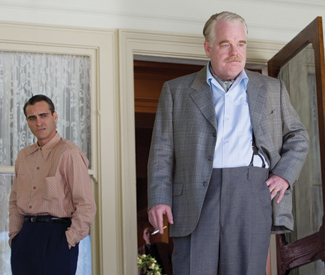
FILM In Ira Sachs’ intensely discomfiting Keep the Lights On, Erik (Thure Lindhardt) is a Danish documentarian in late-1990s New York City, prodding his career along, spending time with friends, having casual sex with strangers. One of the latter is Paul (Zachary Booth), a publishing-house lawyer who first tells him “I have a girlfriend, so don’t get your hopes up.” Yet some time later they’ve become a tentative couple, then a live-in one.

Erik is patient and easygoing, but Paul has secrets and problems all the more difficult to deal with because he denies, hides, or lies about them. He disappears for days at a time, then turns up wrecked. Crack is just the addiction we see; there are evidently others. Erik tries everything — group interventions, rehab, endless attempts at frank conversation that invariably turn into Paul accusing him of being unreasonable — but nothing sticks. On some level, Paul doesn’t want to be saved; drugs are like a bad old boyfriend he can’t help keep going back to, when not crawling back to the current one for forgiveness.

It takes Erik a decade to come to terms with, and extricate himself from, a relationship in which all his best efforts only bring torment, grief, and exasperation. “I have no idea who you are, I have no idea what you’re doing,” he cries during one argument. “I don’t know why you’re focusing on me,” Paul snaps, instinctively trying to shift the blame. Near the end, he questions out loud if Erik ever loved him — the fact that he isn’t doing what Paul wants that very second somehow negating years of sacrifice and worry that could only have been sustained by love.

Keep the Lights On is the kind of excellent movie a lot of people don’t like: it’s not just depressing in the sense of having downbeat, difficult subject matter, it actually sets out to be unpleasant and succeeds. There is a point to that. Leaping forward a couple years at a time, leaving us to figure out how things have shifted in the interim, Sachs’ script (co-written with Mauricio Zacharias) induces in the viewer the disoriented helplessness of dealing with a loved one who can’t or won’t tell the full truth — it’s his best defense.

The film’s somewhat squirm-inducing intimacy comes naturally, as the writer-director lived this story, however much it’s been tweaked into fictive dramatic form. “Paul” is a stand-in for a long-term boyfriend who wrestled with similar demons while somehow sustaining a high-profile career in the publishing industry. (He’s also since written a couple of memoirs about his addiction struggles, though despite that public self-exposure, the film still “created a wedge” between them, according to Sachs.)

“I think all of my films are autobiographical — I only feel excited to tell a story when I’ve lived an experience and have some analytical understanding of what took place,” Sachs said while in San Francisco for the movie’s screening at Frameline 2012.

Still, Lights is clearly a more jarringly personal project than his unsettling coming-out tale debut The Delta (1996) or the Sundance prize winner Forty Shades of Blue (2005), let alone 1950s heterosexual infidelity seriocomedy Married Life (2007). Nonetheless he now “sees them all as the same film — they’re all about people arriving at a point where they’re comfortable with who they are.”

Saying that he himself was “uncomfortable with who I [was, up] until the events in this film,” he now lives “an open life” with husband Boris Torres, a painter whose work is seen under the opening titles. “That’s a consequence of work I’ve done on my own,” Sachs said. “I really feel that secrets almost killed me. It’s very empowering to claim your secrets. I intended to make a film about shame and to do so shamelessly.”

In some ways, “this film is less about addiction than obsession, which is a very comfortable place for many of us to be — it cuts out the rest of the world and narrows the challenges. It’s very addicting to engage in this kind of relationship.” Some nonexploitative but explicit sexual content made Lights hard to cast (one major agency told him not a single one of their actors were “available”), but wound up with bilingual rising star Lindhardt. It’s an extraordinary performance that carries the whole film; by contrast Booth, to the frustration of some reviewers, plays a character deliberately kept somewhat furtive and unknowable.

While making Keep the Lights On afforded Sachs a cathartic way to “free myself from inhibitions around the story itself,” the consequence has been that “in the aftermath of these events I chose to live an honest life, and the result is that the dishonest and illicit is less interesting to me. So having made four films about deceit within a romantic relationship, that is no longer how I live or a story I’m interested in telling.”

He says his next project will be “about a 30-year relationship based on love and complexity between two men who decide to get married at ages 60 and 70.” Lights also pays homage to gay elders: Erik is working on a documentary about real-life photographer and filmmaker Avery Willard (whose still little-known work comprises “a visual anthropology of gay life in New York from the ’40s to the ’90s”), and the score consists of slippery songs by Arthur Russell, the enigmatic cult cellist-composer who died of AIDS 20 years ago. *


KEEP THE LIGHTS ON opens Fri/14 in Bay Area theaters.