Wiener

SF’s newest political pole gets a new name: Moderate progressives

101

A Daily Kos blogger known as Kurykh has posted an interesting and insightful “crash course in San Francisco politics,” in which he correctly identifies the tri-polar dynamic of local politics. Everyone knows the progressives (Ammiano, Avalos, the Guardian) and the so-called moderates (Wiener, Ma, the Chronicle), and so Kurykh dubs the rising third pole (Chiu, Kim, Mayor Lee) “moderate progressives.”

He calls them “the new kids on the block,” noting that they sided with progressives in 2008 but ushered in a new political reality by siding with the moderates in 2010, now serving essentially as the swing votes on major issues and projects.

“Like other progressives, they are pro-tenant and advocate for more social services to the poor. However, they have pro-business and pro-development tendencies and tend to focus on streamlining bureaucracy and effective government,” he wrote of the moderate progressives.

Personally, I think a more accurate label for this rising new power center is “neoliberal” (I just called them “liberals” in my own San Francisco political primer that I wrote a year ago), a political term describing the belief that any reforms or progress needs to be negotiated with capitalists and corporations instead of coming directly through taxes or regulations.

And I think it underestimates the influence that so-called “moderates” who are actually quite conservative when it come to finances and land use – people like Lee fundraiser Ron Conway and Planning Commissioner Michael Antonini – have in influencing Lee and shaping politics in the city.

But I welcome this contribution to helping San Franciscans understand the political dynamics that are governing this city.

The nudists file suit

32

You all know the joke: What did the unsuccessful lawyer who joined a nudist colony never have? (A suit. LOL. Sort of.)

But a successful lawyer just filed a detailed suit trying to stop San Francisco from enforcing a ban on public nudity, and it makes a lot of interesting points. You can read the filing here (pdf). I’ll get beyond the fact that a legal argument over nudism uses the terms “prong” and “thrust” and “penal” all in a few short paragraphs, and get to the substance:

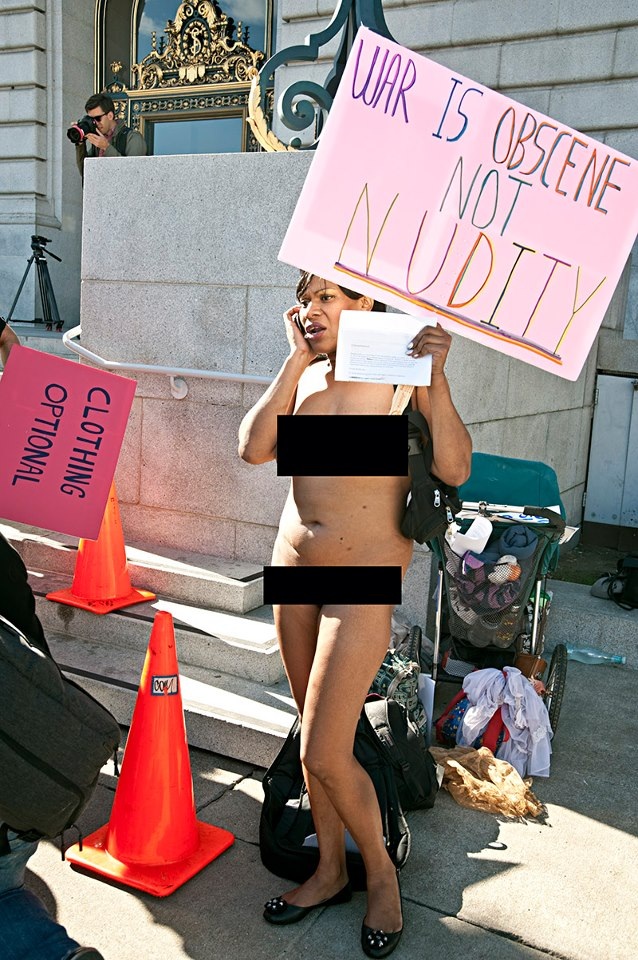
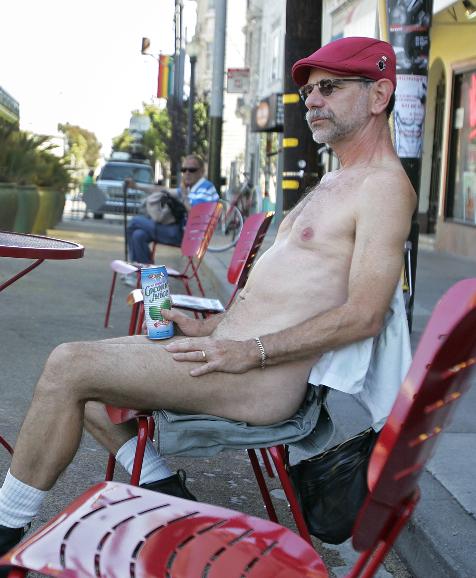
Attorney Christina DeEduoardo claims that her clients use nudity as a form of free speech and protest — and given who they are, it’s a pretty good argument. You’ve got a guy who ran as the nudist candidate for mayor and a woman who took her clothes off at a Board of Supervisors meeting for political reasons, and they contend that they have the right to appear naked in public.

The claim seeks a restraining order prohibiting the Board of Supervisors from enacting the law, but a federal judge already nixed that, according to City Attorney spokesperson Matt Dorsey. Instead, all parties have to wait unitl the supes approve the law, at which point this will become a motion for an injunction against the law taking effect.

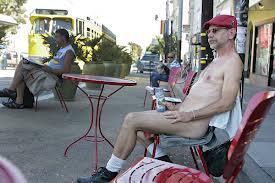
So banning a handful of people, mostly older guys, from hanging out naked on Castro Street is going to become a legal battle that will cost the city a bunch of money. Unless sanity prevails and Sup. Scott Wiener, the city attorney and the nudists can reach a deal, which might be pretty simple:

It’s cool to get all nekkid (although it won’t be happening much in the next few months, way too cold). But maybe the Castro Guys can agree not to wear cockrings that attract attention to their dicks (and seem to be the proximate cause of all the fuss). Just be natural when you go au naturel, and we can all stop fighting over this.

You think?


Oh well, Pelosi’s going to stick around

32

For a while there some of us thought that Rep. Nancy Pelosi, who failed to win back a house majority for the Democrats, might decide her time was up and step down as minority leader (which would probably have meant retiring from Congress). That would have set off one of the hottest political battles in town; just about everyone knows that Pelosi’s daughter is interested in the seat, but there’s no way she was going to get it without a fight. There are lots of ambitious people in this town who would jump at a once-in-a-lifetime chance at a Congressional seat, starting with possibly all of our current state Legislators and a few supervisors.

Would progressives and independents sick of the notion of a Pelosi family dynasty get behind one candidate (say, Mark Leno)? Would Scott Wiener, who Leno has supported and mentored all these years, run anyway, arguing for a younger candidate who could be around for long enough to get seniority? Would Leland Yee, who will be termed out and didn’t get elected mayor, jump in the race? Would Tom Ammiano, who doesn’t seem at all ready to retire?

Lots of crazy speculation — and now it appears we’ll have to wait two more years to go through it again. Because, barring a huge upset in the Democratic Caucus, Pelosi’s sticking around.

I’m not so thrilled about that — and I swear it has nothing (well, almost nothing) to do with the amazing story that a contested race would create for political reporters. It’s just that Pelosi’s been a big disappointment to San Francisco; she cares more about her national constituency that about her district, and her legacy achievement is the privatization of a national park.

It would be nice to get someone representing San Francisco who represented San Francisco values.

Oh well.

Nudists to sue over Wiener law

62

Sup. Scott Wiener’s ban on public nudity hasn’t even come to a vote at the full board, but the nudists who oppose it are already planning to sue. A group of five plaintiffs, including former mayoral candidate George Davis and Gypsy Taub, who disrobed at a hearing on the issue, are arguing that the city lacks the legal authority to enact the ban, which they call a violation of protected free speech.

Christina DeEduoardo, the group’s attorney, told me she plans to file this week in federal court in San Francisco. “We’re going to ask for a temporary restraining order to prevent the supervisors from enacting this law,” she explained.

It’s not easy to get a court to pre-emptively block a law that hasn’t been approved, but DeEduoardo said she’s going to argue that state law pre-empts San Francisco from taking this type of action. “When a municipality does something at odds with state law, there’s a reason to prevent it,” she said.

California law already regulates lewd behavior, and the state courts have consistently held that mere nudity is not a violation of that statute. “Nothing says the city has to power to regulate dress,” she argued. “It’s the equivalent of the Board of Supervisors saying that in October the only colors you can wear are black and orange.”

Even if the state doesn’t pre-empt San Francisco’s right to ban nudity, DeEduoardo said, there’s a First Amendment issue here: “This purports to ban all nude expression. My clients engage in nudity as speech. The law is way over-broad.” There’s even an equal-protection argument: Wiener’s legislation specifically exempts major city events, like Bay to Breakers and the Folsom Street Fair — but those things cost a lot of money. “So the city’s saying if you have the money for a permit, you can engage in nudity, but if you can’t afford that, and you just want to go au naturel, then you are a criminal.”

Matt Dorsey, spokesperson for the City Attorney’s Office, told me he doesn’t expect any sort of injunction. “State law is very clear that injunctions can’t be granted to prevent a legislative act,” he said.

If a federal judge won’t issue a restraining order, the nudists are going to sue to overturn the law the minute it passes. So there’s likely to be a long, expensive legal battle — and it seems so silly. Particularly since it’s getting chilly out and the rainy season is about to start, and Mother Nature will be dealing with the naked guys pretty quickly.

Election makes the Board of Supervisors tougher to predict

20

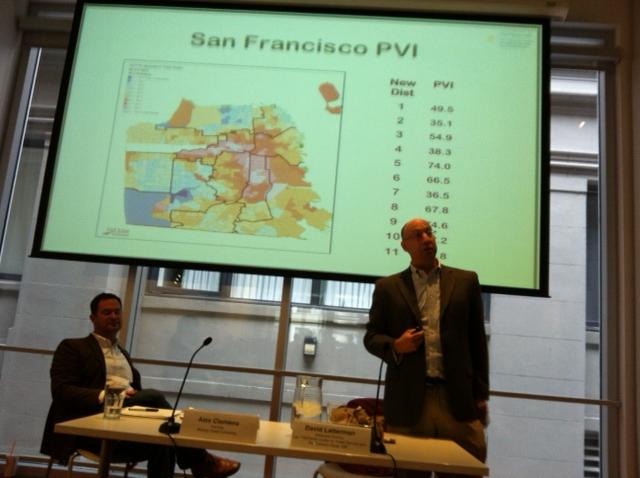
I’m still a bit too bleary-eyed for serious political analysis on D5 or other races today, but I’ll offer a few of my own post-election observations and those that politicos Alex Clemens and David Latterman delivered during their usual political wrap-up at the SPUR office this afternoon, noting how this election has altered local political dynamics.

“The Board of Supervisors as a whole is becoming a helluva lot more interesting,” Clemens said, noting that progressive District 5 just elected London Breed, the most moderate candidate in that race, while conservative District 7 gave the most progressive candidates, Norman Yee and FX Crowley, its top two spots (with Crowley the likely winner once ranked choices ballots are tallied).

The result is that both the progressive and moderate blocs lost their most reliable votes to the squishy center, so that “determining what’s going to happen before it happens just got more difficult,” a dynamic that could play out most strongly on land use issues.

“I think land use politics is going to be even more interesting,” Clemens said, with Latterman adding, “In this city, all politics really comes down to land use.”

Assessor Phil Ting’s election to the Assembly also now paves the way for Mayor Ed Lee to appoint his replacement, with Sup. Carmen Chu widely considered the clear favorite, which would in turn give Lee an appointment to her District 4 seat on the board.

Yet Clemens speculated that Lee may wait to replace Chu until after the next Board of Supervisors is seated in early January – which would allow that person to finish her final two years and still run for an additional two full terms, whereas the Charter would otherwise limit that person to one more term – which could complicate an already complicated election for board president. Sups. Jane Kim and Scott Wiener are the likeliest contenders, but anything could happen.

“Counting to six from 10 is going to be so much fun to watch,” Clemens said, although he added, “I believe in the era of Ed Lee, it’ll all be worked out beforehand.”

Neither Clemens nor Latterman agreed that the overwhelming expenditures on political hit pieces (mostly against D1 Sup. Eric Mar, who won a surprisingly big margin of victory) by allies of Lee, or the fact that they turned on Sup. Christina Olague in nasty fashion, would diminish Lee’s public standing or the aura of civility he’s tried to cultivate.

Personally, I don’t agree, and it think progressives have been given an opportunity to highlight the money-driven nature of the agenda that Lee and his billionaire backer Ron Conway have for San Francisco. It’s also significant that the most anti-progressive candidates – Lee’s City College appointee Rodrigo Santos, D1’s David Lee, and D7’s Mike Garcia – all fell far short of victory.

Progressives now have a chance to set a positive, proactive agenda for the city, of the kind eloquently voiced by new school board member Matt Haney, whom Clemens thanked for running such a strong and positive campaign, as well as top City College finisher Steve Ngo and Sup. David Campos, who shared an election night campaign party and positive message about progressive prospects.

“That’s what me, Steve, and David were saying here tonight,” Haney told me, calling for an end to the adversarial style of practicing politics. “Our values are love and compassion.”

Latterman and Clemens did acknowledge that that record-breaking spending against Mar may have backfired, but they gave more credit to Mar’s campaign. “You don’t bet against [Mar campaign manager] Nicole Derse in a ground game in the last week of the campaign,” Latterman said.

Derse, who was there, noted its innovative voter identification efforts and strong grassroots volunteer push, a drive partially helped by those reacting to the big-money attacks. Latterman also acknowledges that the strange and controversial videos attacking Mar didn’t help, telling the crowd, “And tactically, don’t have the Realtors make the videos.”

As for District 5, neither politico claimed to fully understand the complex variables that shaped the race.

“It’s hard to unravel what happened here,” Latterman said of the D5 race, noting the complicated dynamics created by Olague’s mayoral appointment, her vote to reinstate Sheriff Ross Mirkarimi, Julian Davis’ problems, and the outside spending. He praised Breed’s campaign, calling it a “a solid win,” but he also said Breed’s independence helped her and she might have suffered the same fate as Olague if she had gotten the appointment from Lee back in January: “I think Supervisor Breed doesn’t win this race; challenger Breed did.”

Obama wins: Rejoicing at SF Dem HQ

1

The crowd just went nuts at the SF Democratic Party headquarters on Market Street when the big TV screen flashed, “Obama Re-Elected.”

Downstairs from the rejoicing, a poster on the wall claimed that volunteers made 29,050 calls over the weekend on the Democratic incumbent’s behalf — upstairs, of course, was the payoff for all that hard work and the party.

State Sen. Mark Leno told us “San Francisco was the most productive campaign office in the state,” having hundreds of volunteers a day.

LGBT activist Gary Virginia was happy and relieved by this victory. “I feel there’s so much at stake in the LGBT community in the White House with this election.”

But there’s more to come. “I’m a little worried about the ballot measures,” SF Dem chair Mary Jung tod us.

Sup. Scott Wiener was watching the other races countrywide. “Elizabeth Warren, what an amazing voice to have in the US Senate.” he said.

DCCC member Matt Dorsey was focused on local races like D5 and D7, “I think those are going to be the most exciting races to follow.”

FOLLOW OUR FULL ELECTION COVERAGE ON OUR POLITICS BLOG 


So-called DV group doing PG&E’s dirty work

34

Any pretense that the group called San Francisco Women for for Responsibility and an Accountable Supervisor is anything more than a downtown sham vanished with the arrival in District 5 mailboxes Nov. 3 of a mailer attacking Sup. Christina Olague for supporting public power.

The mailer uses pictures of Olague and Julian Davis — and that alone is a not-so-subtle attack on Olague. Davis has lost all credibility in the race, thanks to a string of allegations that he groped women.

It then goes after the two for “support [ing] a $20 million taxpayer giveaway to Big Oil.” The utterly misleading line is based on Olague’s vote to support Clean Power SF, a community choice aggregation program that has the support of public power advocates all over California.

Olague’s not supporting Shell Oil; she just realized, as did a supermajority of the board (including both left stalwarts David Campos and John Avalos and the far more conservative Scott Wiener) that the program makes sense for San Francisco and will lead in the long term to much greater energy self-reliance. The only ones putting out the Shell Oil line are PG&E and its house union, IBEW Local 1245.

Oh, and now a group that supposedly advocates for domestic violence victims.

This is a disgrace, an embarassment to the district and the city. Ron Conway and Thomas Coates are attacking Olague because they’re afraid she’ll vote against their development and landlord interests, not because they care about domestic violence.

This election matters, a lot. It’s clear where the big-money interests are; I hope D5 residents reject this attempt to buy the election.


Why free Muni for kids makes sense

13

For a moment this morning, Mission Street looked the way it might in a world where the city actually got beyond cars. About a million people were a block away, on Market, and everyone with an ounce of sense knew not to try to drive downtown. So I rode my bike along a busy city street that was given over entirely to pedestrians, bicycles and Muni buses. The buses moved at a rapid clip with no traffic to slow them down. And despite the parade a few hundred feet to the north, it felt … quiet. Peaceful. Yes, Mission Street.

How totally cool.

Imagine how easy it would be for transit to serve the downtown corridor if nobody drove cars. Imagine how comfortable people would be biking and walking to work. It just takes a Giants World Series (and a huge regional parade) to show us that a different urban world is possible.

Which brings me to free Muni for kids.

There’s enough money now, from a federal grant, to do a pilot program in San Francisco. Except that Sup. Scott Wiener thinks the money should go to general system improvements. I get it — Muni has lots of problems and Wiener thinks we should fix the system for everyone before we make it free for some.

I admit I’m biased — I have two kids who go to public school, and ride Muni. The school bus system is nearly gone; most kids can’t get an old-fashioned yellow bus in the morning or at night. So their only option is the have parents or friends drive them, or to ride Muni. Yeah, it would save me a little money if my kids didn’t have to pay, but it’s not making me choose between food and rent.

For a lot of low-income familes, the cost of Muni fare is a real issue — and it’s difficult getting a reduced-fare youth pass. (Among other things, you need a birth certificate or passport to prove your age; you think immigrant families including some members without documents are going to go to a government agency and present that sort of information?) It seems to me it’s the city’s responsibility to help young people get to school, and since we can’t afford school buses, this is one of the best options.

There’s another side of the story, though. Getting kids to ride Muni as a matter of normal course — showing them that it’s the best way to get around town — is a huge investment in the future. We can’t keep going on the way we are with personal automobiles, particularly in urban areas. We want to get to the point where just about everyone uses Muni or rides a bike or walks — and I say, start young.


Nudity and tourism

69

KQED’s Forum weighed in on Sup. Scott Wiener’s anti-nudity law Oct. 18, and I particularly enjoyed the attempts by all to avoid the use of the word “cockring.” I taped a show for KPFA’s morning mix (to air 7:30 am Oct. 19) and host John Hamilton told me that “cockring” wasn’t on the FCC list of unacceptable words and it was ok to use it, but that’s KPFA, not KQED. I also laughed at Michael Krasny confessing that he was beeing “lookist” when he said he’d heard that the men at Jane Warner Plaza weren’t all that good-looking.

At any rate, here’s the real story: A friend’s mom was visiting recently from Switzerland, and what did she want to do in San Francisco? She wanted to go to the Castro and see the naked men. Of course.

You see the buses going down Market Street with all the tourists, sticking their cameras out the window to get a shot? It’s a tourist attraction. 

Remember — when the sea lions first arrived at Fisherman’s Wharf about 20 years ago, and hauled themselves up on the docks, the city tried to get them to leave — they were loud and stinky and unappealing. But they wouldn’t go — and after a few weeks, the merchants realized how good they were for business.

I asked the Convention and Visitors Bureau, now known as SF Travel, if banning nudity might be bad for the tourist industry — and the local economy. The folks there haven’t gotten back to me. But I don’t know; maybe the city economist should study this nudity ban.

Why the parks bond could lose

13

A general obligation bond to improve San Francisco parks ought to be a slam dunk, particularly when it’s getting pushed by Sup. Scott Wiener, who isn’t exactly a pro-tax kind of guy. The left always votes for these things. Wiener’s lining up the moderates. Proposition B would, in normal circumstances, get 70 percent of the vote.

But there’s an awful lot of pent-up anger at the Rec-Park department, and if you want to know why, just check this out. A group of mostly immigrant soccer players, who’ve been using a park in the Mission for pickup games for more than a decade, are now getting kicked out two nights a week — because Rec-Park has turned the place over to a private outfit that charges money to enter the games.

Oh, and you have to register on your smartphone.

So the young white techies who want to play soccer and can afford $7 for a game on parkland our taxes paid for get to play, and the Latino immigrants — who, by the way, were there first — lose out.

You like that? It’s the direction Rec-Park is going under the direction of Phil Ginsburg.

Even the Guardian, which has never opposed a GO bond for anything except prisons, had a lot of trouble with Prop. B. And while Wiener, in a meeting with us, dismissed most of the opposition as marginal, it doesn’t take much to prevent a bond from getting a two-thirds vote. Here’s the question Ginsburg needs to think about:

Would he rather have his park bond — or evict the Haight Ashbury Neighborhood Council recycling center? Would he rather have his $195 million for badly needed capital projects — or privatize recreation facilities? Will he do anything, anything at all, to show some good faith that he’s heard the message from his critics?

Ginsburg and Wiener both support the idea of coming up with a new (tax-based) revenue source for Rec-Park. And we went along with the park bond, reluctantly. But if doesn’t show us any reason to believe there’s hope for the Latino immigrants to play soccer without paying $7, if he isn’t changing his tune at all, he may not get his two-thirds vote Nov. 6. And he’s going to have a hell of a time convincing any of us to give him any more money in the future.


Much ado about nudity

69

There was no public outcry when Pedro Villamore, a 44-year-old homeless gay man, was found dead in a doorway in the 500 block of Castro Street last December, a couple of weeks before Christmas and across the street from the holiday tree that the Merchants of Upper Market and Castro puts up every year to welcome big spenders into the neighborhood.

MUMC, which in years past opposed three homeless queer youth shelters and a free meals program at a local gay church, did not decry the fact that a member of our community died on the street — and where were the city’s homeless outreach teams? Nor did any of the residents of the neighborhood express any concern that others who have a problem with methamphetamine, the area’s drug of choice, might meet a similar fate — and shouldn’t the community be doing something about it?

Of course, if he had been one of the nudists who hang out naked in the Castro these days Villamore would’ve found himself on the front-page of Bay Area Reporter, the city’s gay weekly, while he was still alive. Not to mention the target of diatribes from the SF Chronicle’s chronically right-wing columnist C.W. Nevius.  

Sadly enough, a neighborhood that once stood for sexual and personal freedom has succumbed to anti-nudism hysteria, even to the point of echoing Anita Bryant’s old rallying cry, “Save the children!”

Hysteria it is, of epic proportions. Some Castro residents and MUMC merchants actually persuaded their elected official, Supervisor Scott Wiener, to introduce anti-nudism legislation because a few naked men prance around the hood au natural, even sometimes sporting (horrors!) cock rings on their dicks. In a neighborhood where there’s no dearth of cock rings or any other sex toy, not to mention every variety of gay porn imaginable, and where guys walk around bars in underwear, residents don’t want public nudity. Huh? The neighborhood’s historic live-and-let-live attitude has obviously gone the way of Halloween and being able to walk into Pink Saturday without being scanned by a metal detector.

Has gay marriage and the freedom to “be all that you can be” in the military afflicted residents of the Castro with assimilation fever? What’s next — fundraising parties for Mitt Romney or a Castro chapter of the Moral Majority?

In a community that, according to a recent Williams Institute study, is rampant with poverty and suffers a serious lack of full-time employment for transgender people (75%, according to a report from this paper and the Transgender Law Center), not to mention a major drug and alcohol problem that makes gay men easy targets for muggings as they leave the bars at night, you’d think that public nudity would the last thing on anyone’s mind.  

People with AIDS continue to be pushed out of apartments in the Castro so that landlords and realtors can make tons of dough and LGBT seniors are forced to live with little economic or social support, regular cuts to services and benefits, and discrimination and isolation in nursing care facilities.

Yet from the volume of letters in the BAR and the number of calls Wiener says he’s received, you’d think that public nudity is the biggest problem in the world.

Pedro Villamore might disagree with that.

Tommi Avicolli Mecca has been a queer activist for the past 42 years, and a Castro resident for 20. He is editor of Smash the Church, Smash the State: the early years of gay liberation (City Lights).

Historic, veto-proof vote launches CleanPowerSF

24

The San Francisco Board of Supervisors today cast an historic vote that was more than a decade in the making, approving the CleanPowerSF program – which challenges PG&E’s monopoly by offering 100 percent renewable energy directly to city residents – on an 8-3 vote that would be enough to override an implied veto threat by Mayor Ed Lee.

The outcome was far from certain throughout the two-hour hearing as conservative Sups. Mark Farrell and Carmen Chu led efforts to undermine the program, which was the final work product of retiring San Francisco Public Utilities Commission Executive Director Ed Harrington, who previously served as the city’s controller for 17 years.

The pair of supervisors offered a series of amendments challenging the state requirement that city residents must proactively opt-out of such community choice aggregation (CCA) programs if they want to remain with PG&E, offering convoluted language that would have required people to opt-in to the program before its launch, and requiring that the $13 million in reserve funds from the SFPUC be covered entirely by CleanPowerSF customers, which could increase its rates.

“It looks like the amendments would be harmful to the success of the program,” Sup. Eric Mar observed, prompting Farrell and Chu to flash broad conspiratorial smiles at one another.

Sup. Scott Wiener, who was undecided and considered a key swing vote in reaching a veto-proof majority, said he also had concerns about the opt-out requirement and wanted to better understand how the amendments would work and whether they were legal. “For me, I’m not interested in putting any poison pills in here,” he said.

Wiener posed questions about the amendments to Farrell and to Harrington, who said it was possible for the SFPUC to have CleanPowerSF customers repay the initial allocation of reserve funds over time but that he wasn’t sure how the opt-in change would work without sabotaging the program.

“It harms the ability to have an intelligent conversation with people,” Harrington said, noting that rates are based on the number of customers in the program, so it would be nearly impossible to survey everyone’s potential interest without being able to tell them how their bills would be affected.

As it is, the SFPUC has already done extensive surveys of which neighborhoods and demographics are likely to be interested in taking part in CleanPowerSF, initially paying about $10 more per month for 100 percent renewable energy (PG&E’s portfolio includes less than 30 percent renewable). “We’ve done extensive surveys already,” Harrington said. Based on that research, the city is initially rolling out the program to less than a third of city residents, who will be repeatedly notified about how to opt-out, anticipating about 90,000 customers remain in the initial program. 

The program has been repeatedly tweaked over the last eight years that it’s been in development, during which time Marin County launched a successful version of the CCA concept that was developed in San Francisco by legislators Tom Ammiano, Carole Migden, and Mark Leno.

“I feel pretty comfortable trusting Ed Harrington on whether the numbers add up,” said the measure’s chief sponsor, Sup. David Campos, arguing against the Farrell/Chu amendments, later adding, “With Ed Harrington leading this charge, this is as good as it gets. If you don’t like CCA under Ed Harrington, you’re not going to like CCA.”

Farrell claimed to support CCA in concept, but he strenuously objected to the opt-out requirements that Migden included in the enabling state legislation, which she had argued was the only way to make CCAs viable against PG&E’s proven willingness to spend tens of millions of dollars to sabotage would-be competitors.

“It’s the wrong way to legislate, the opt-out. It smells of coercion,” Farrell said. Campos countered that, “The best thing we can give the consumers in San Francisco is a choice, a meaningful choice.”

Wiener ultimately made a motion to delay the item by a week, something Mayor Lee yesterday told the Chronicle he wanted, in order to further study the opt-out issue, telling Farrell that his amendment “feels a little seat of the pants to me.”

Campos and other progressive supervisors who were supporting CleanPowerSF argued against the continuance, noting that it has been years in development and sitting in board committees since January, while the Farrell/Chu amendments weren’t offered until this meeting had already begun.    

“This is not going to change because we wait a week to make a decision,” Campos said. “The terms of this deal are not going to change.”

The motion for a continuance failed on a 4-7 vote, with Wiener joined by Farrell, Chu, and Sup. Sean Elsbernd (who offered no comments throughout the hearing).

Then, as the vote on the Farrell/Chu opt-in amendment came up for vote, Wiener said, “I don’t feel comfortable voting for amendments that I don’t know what they’ll do,” and it failed on a 3-8 vote.

Sup. Malia Cohen had earlier indicated a willingness to support the other Farrell/Chu amendment: saddling CleanPowerSF customers with paying the SFPUC back for reserve fund costs – which Harrington indicated could be dragged out over many years to minimize the impact on rates, and which might not be necessary at all if the initial program exceeds expectations.

That amendment was then approved on an 8-3 vote, with Sups. Jane Kim, Christina Olague, and John Avalos opposed. Another set of amendments that would keep low-income city residents out of the initial rollout and take other steps to reduce their rates if they opted in – which was developed by Kim, Cohen, and Sup. Eric Mar – was unanimously approved by the board.

Then it was time for the big vote on creating the CleanPowerSF program, approving the contract with Shell Energy Northern California to administer it, and authorizing the initial $19.5 million expenditure. Would there be eight votes to override a veto by Mayor Lee, who has been under pressure by PG&E and their downtown allies to kill the program?

“To be perfectly candid, I struggled mightily with this contract,” Wiener said, reiterating his concern about its opt-in requirement, noting that the measure wasn’t perfect, even though it was significantly improved from earlier versions. It sounded as if he were about to vote against it.

“What we have the opportunity to do is move forward with clean power,” Wiener said, noting that even Marin County supervisors who initially opposed its CCA have come around to supporting it. “This is something I believe we should try.”

And with that, the board voted 8-3 to launch the program in mid-2013, with Chu, Farrell, and Elsbernd opposed.

Campos said he was “pleasantly surprised” by the vote, while key supporters say they are cautiously hopeful it will stand up during next week’s final supervisorial approval on second reading and in a veto override vote, if that becomes necessary. Campos said he was thankful for the work of Harrington, who got a standing ovation after the vote as the board recognized him for his long service to the city.

Earlier in the meeting, Harrington told supervisors that while the program isn’t perfect, and it contains some risks that he considers reasonable, there is no other way the city has identified to meet ambitious greenhouse gas reduction goals it has set for itself over the last decade. It is city policy to reduce emissions by 25 percent below 1990 levels by 2017 and 80 percent below those levels by 2050.

“This program before you has the only chance of reaching those goals. There’s nothing else,” Harrington said. He also said “it’s an incredibly efficient way to spend money,” noting that the city has spent $90 million on solar and other renewable energy projects that power fewer than 7,000 homes, whereas this $19.5 million will power 90,000 households, possibly without ever tapping into that $13 million reserve fund set aside to cover any losses by Shell, which will buy renewable energy, a role the city hopes to eliminate as it develops its own projects.

Harrington said the ultimate goal of CleanPowerSF is to develop a large enough customer base that the city could use revenue bonds to finance a wide variety of renewable energy projects – many using solar arrays along city-owned property connected to its water system stretching all the way to Hetch Hetchy Valley – that would pay for themselves.

“The real issue is can you build a facility that will have this rate structure support it?” Harrington said.

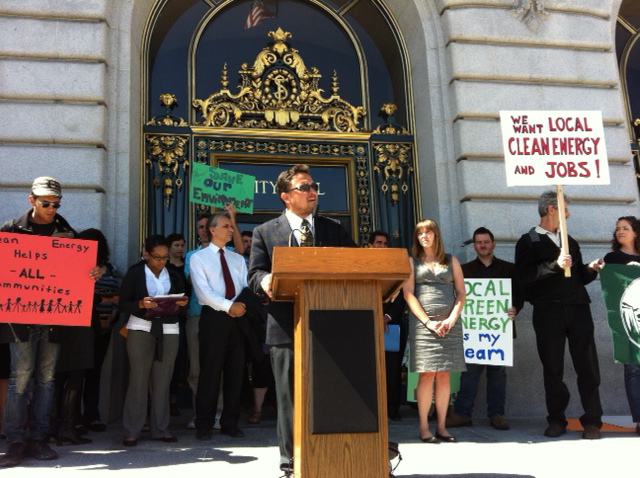
That’s the real power and potential of CleanPowerSF – finally taking action to address global warming, which will have a huge impact on San Francisco and future generations – as supporters noted in a rally outside City Hall before the meeting. Sen. Mark Leno said that he doesn’t usually weigh in on proposals before the board, but that, “This is an exceptional time and this is an exceptional vote. This is the time that we need to address our inconvenient truth.”

Committee approves CleanPowerSF over downtown opposition

51

The question of whether San Francisco creates a renewable energy program that offers an alternative to Pacific Gas & Electric got its first major hearing at City Hall today, with the business community claiming it’s too expensive and supporters arguing that the time has come for the city to address climate change and the long-term energy needs of city residents and businesses.

The Board of Supervisors Budget & Finance Committee voted 2-1 in favor creating CleanPowerSF, entering into a contract with Shell Energy Northern California to administer the program, and devoting $19.5 million from the San Francisco Public Utility Commission’s water fund to help launch it and buy clean power for city residents.

Sups. John Avalos and Jane Kim supported the project, while Sup. Carmen Chu was opposed. It now goes to the full Board of Supervisors next week, where it is expected to have progressive support and be opposed by the fiscal conservatives.

“I do think we will have the necessary majority to get this through,” the measure’s sponsor, Sup. David Campos, told us. But one open question is whether Mayor Ed Lee will veto a measure that his SFPUC appointees developed but his downtown allies are trying to kill, and if so, whether there are eight supervisors willing to override a veto.

But Campos noted that SFPUC officials testified today that CleanPowerSF is the only way they’ve identified to meet the city’s ambitious official goals for reducing greenhouse gas emissions, which call for a reduction of 20 percent below 1990 levels by the end of this year and an 80 percent reduction by 2050.

Supporters who testified today included environmentalists, progressive groups, and young people who cast addressing climate change as the defining struggle of their generation. “This, not to go overboard, is the most important vote you’ll ever do,” said the Sierra Club’s Arthur Feinstein.

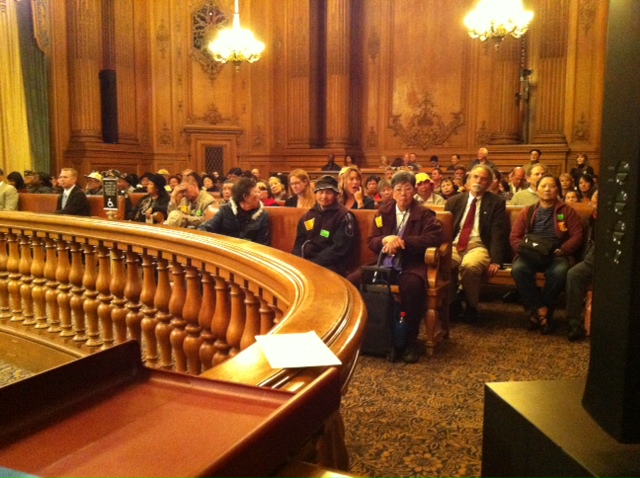
Those who spoke against the program included the usual array of downtown groups that have traditionally defended PG&E’s interests – including the Committee on Jobs, Golden Gate Restaurant Association, and Plan C – and they were joined by an unusually large number of elderly Asian individuals wearing stickers opposing the project.

“It’s a bad program that doesn’t meet even the basic elements of its original promise,” said Chris Wright, executive director of the Committee on Jobs, which PG&E has helped fund since its inception. Like most CleanPowerSF opponents, they have long opposed even the concept of community choice aggregation (CCA), the state law that allowed the city to create CleanPowerSF.

PG&E’s longtime support by local politicians has eroded in recent years because of its overkill campaigns against public power initiatives and supporters and its negligence in the deadly San Bruno pipeline explosion.

Even GGRA Executive Director Rob Black told the committee, “PG&E, a local company, candidly has its problems.” But he and other project opponents – and even a few supporters of the project – centered much of their opposition on the involvement of Shell, which has a bad reputation and environmental record, like almost every other multinational energy company.

“I have the same qualms about Shell that everyone else does,” said Katherine Roberts, who said that she nonetheless supports the project, calling it the only way for most San Franciscans to directly support the development of renewable energy sources. Shell was the sole bidder on a project that requires enormous financial wherewithal.

Campos calls the focus on Shell a diversionary tactic: “PG&E already buys energy from Shell. To the extent people don’t want Shell in the picture, Shell is already in the picture.”

Both the supervisors and the mayor will be under intense pressure to derail CleanPowerSF, with that campaign led by downtown groups and IBEW Local 1245, the union that represents PG&E workers. Sup. Scott Wiener, who says he’s still undecided, told us that his office was flooded with phone calls today, mostly in opposition to the project.

Compromise measures

3

news@sfbg.com

San Franciscans are poised to vote this November on two important, complicated, and interdependent ballot measures — one a sweeping overhaul of the city’s business tax, the other creating an Affordable Housing Trust Fund that relies on the first measure’s steep increase in business license fees — that were the products of intense backroom negotiations over the last six months.

Mayor Ed Lee and his business community allies sought a revenue-neutral business tax reform measure that might have had to compete against an alternative proposal developed by Sup. John Avalos and his labor and progressive allies, who sought around $40 million in new revenue, although both sides wanted to avoid that fight and find a compromise measure.

Meanwhile, Mayor Lee was having trouble securing business community support for the housing trust fund that he pledged to create during his inaugural address in City Hall in January. So he modified his business tax proposal to bring in $13 million that would be dedicated to the Affordable Housing Trust Fund, but that didn’t satisfy the Avalos camp, who insisted the city needed more general revenue to offset cuts to city services and help with the city’s structural budget deficit.

Less than a day before the competing business reform measures came before the Board of Supervisors on July 24, a compromise was finally struck that would bring $28.5 million a year, with $13 million of that set aside for the affordable housing fund, tying the fate of the two measures together and creating a kumbaya moment at City Hall that was reminiscent of last year’s successful pension reform deal between labor and the business community.

But there was one voice raised at that July 24 meeting, that of Sup. David Campos, who asked questions and expressed concerns over whether this deal will adequately address the “crisis” faced by the working class in a city that will continue to gentrify even if both of these measures pass. Affordable housing construction still won’t meet the long-term needs outlined in the city’s Housing Element that indicates 60 percent of housing construction would need public subsidies to be affordable to current city residents.

It’s also worth asking why a business tax reform measure that doubles the tax base — just 8.4 percent of businesses in San Francisco now pay the payroll tax, whereas 16.4 percent would pay the gross receipts tax that replaces it — doesn’t increase its current funding level of $410 million (the $28.5 million comes from increased business license fees). Some industries — most notably the technology and restaurant industries that have strongly supported Mayor Lee’s political ambitions — could receive substantial tax cuts.

Politics is about compromise, and Avalos tells us that in the current political climate, these measures are the best that we can hope for and worthy of progressive support. And that may be true, but it also indicates that San Francisco will continue to be more welcoming to businesses than the working class residents struggling to remain here.


SOARING HOUSING COSTS

As Mayor Lee acknowledged during his inaugural speech, the boom times in the technology industry has also been driving up commercial and residential rents, he sought to create “housing for the 100 percent.”

The median rent in San Francisco has been steadily rising, jumping again in June an astounding 12.9 percent over June of last year, according to real estate monitor RealFacts, leaving renters shelling out on average an extra $350 a month to landlords.

Driven by a booming tech industry and a lag in new housing, the average San Francisco apartment now rents for $2,734. That’s an annual increase of $4,000 per unit over last year, in a city that saw the highest jumps in rent nationally in the first quarter of 2012. Even prices for the average studio apartment have edged up to $1,800 a month.

The affordability gap between housing and wages in the city is stark. Somebody spending a quarter of their income on rent would need to be making $85,000 a year just to keep up with the average studio. With a mean wage of $64,820 in the San Francisco metro area, even middle class San Franciscans have a difficult time affording a modest apartment. For the city’s lowest paid workers, even earning the country’s highest minimum wage of $10.25 an hour, even devoting every earned dollar to rent still wouldn’t pay for the average small studio apartment.

For those looking to buy a home in the city, it can be a huge hurdle to put aside a down payment while keeping up with the city’s high rents. Almost 90 percent of San Franciscans cannot afford a market rate home in the city. The average San Francisco home price was up 1.9 percent in June over May, climbing to $713,500, or a leap of $50,000 per unit over last year’s prices.

In the 2010 census, before the recent boom in the local real estate market, San Francisco already ranked third in the nation for worst ratio between income and home ownership prices, behind Honolulu and Santa Cruz.

But as the city leadership grapples to mitigate the tech boom’s effects, the lingering recession and conservative opposition to new taxes have gutted state and federal funds for affordable housing. Capped off last December by the California Legislature’s decision to dissolve the State Redevelopment Agency, a major source of money for creating affordable housing, San Francisco has seen a drop of $56 million in annual affordable housing funds since 2007.

Trying to address dwindling funding for affordable housing, the Board of Supervisors voted 8-2 on July 24 to place the Affordable Housing Trust Fund measure on the fall ballot. Only the most conservative supervisors, Sups. Sean Elsbernd and Carmen Chu, opposed the proposal. Sup. Mark Farrell, who has signaled his support for the measure, was absent.

“Creating a permanent source of revenue to fund the production of housing in San Francisco will ensure that San Francisco is a viable place to live and work for everyone, at every level of the economic spectrum. I applaud the Board of Supervisors,” Mayor Lee said in response.

At the heart of the program, the city hopes to create 9,000 new units of affordable housing over 30 years. The measure would set aside money to help stabilize the ongoing foreclosure crisis and replenish the funds of a down payment assistance program for those earning 80 to 120 percent of the median income.

To do so, the city anticipates spending $1.2 billion over the 30-year lifespan of the program, with a $20 million annual contribution the first year increasing $2.5 million annually in subsequent years. It would fold some existing funding in with new revenue sources, including $13 million yearly from the business tax reform measure. Language in the housing fund measure would allow Mayor Lee to veto it is the business tax reform measure fails.

The board was forced to delay consideration of the business tax measure until July 31 because of changes in the freshly merged measures. That meeting was after Guardian press time, although with nine co-sponsors on the board, its passage seemed assured even before the Budget and Legislative Analysts Office had not yet assessed its impacts, as Campos requested on July 24.

“I do believe that we have to ask certain questions when a proposal of this magnitude comes forward,” Campos said at the hearing, later adding, “When you have a proposal of this magnitude, you’re not going to be able to adjust it for some time, so you want it to be right.”

The report that Campos requested, which came out in the late afternoon before the next day’s hearing, agreed that it would stabilize business tax revenue, but it raised concerns that some small businesses exempt from the payroll tax would pay more under the proposal and that it would create big winners and losers compared to the current system.

For example, it calculated that between the gross receipts tax and business license fee, a sample full service restaurant would pay 69 percent less taxes and a supermarket 33 percent less taxes, while a commercial real estate leasing firm would pay 46.7 percent more tax and a large engineering firm would see its business tax bills more than double.

Board President David Chiu, who has co-sponsored the business tax reform measure with Mayor Lee since its inception, agreed that it is a “once in a decade reform,” calling it a “compromise that reflects the best sense of that word.” And that view, that this is the best compromise city residents can expect, seems to be shared by leaders of various stripes.


BACKING THE COMPROMISE

The business community and fiscally conservative politicians have long called for the replacement of the city payroll tax — which they deride as a “job killer” because it uses labor costs to gauge the size of company’s size and ability to pay taxes — with a gross receipts tax that uses a different gauge. But the devil has been in the details.

Chiu praised the “dozens and dozens and dozens of companies that have worked with us to fine-tune this measure,” and press reports indicate that representatives of major corporations and economic sectors have all spent hours in the closed door meetings shaping the complicated formulas for how they will be taxed, which vary by industry.

When the Guardian made a Sunshine Ordinance request to the Mayor’s Office for a list of all the business representatives that have been involved in the meetings, its spokespersons said no such list exists. They have also asked for a time extension in our request to review all documents associated with the deliberations, delaying the review until next week at the earliest, after the board approves the measure.

But the business community seems to be on board, even though some economic sectors — including real estate firms and big construction companies — are expected to face tax hikes.

“The general reaction has been neutral to favorable, and I expect we’ll be supportive,” Jim Lazarus, the vice president of public policy for the San Francisco Chamber of Commerce, who participated in crafting the proposal but who said the Chamber won’t have an official position until it votes later this week.

Lazarus noted the precipitous rise in annual business license fees — the top rate for the largest companies would go from just $500 now to $35,000 under the proposal, going up even more in the future as the Consumer Price Index rises — “but some of it will be offset by a drop in the payroll tax,” Lazarus said.

He also admitted that the new tax system will be “hugely complicated” compared to the payroll tax, with complex formulas that differ by sector and where economic transactions take place. But he said the Chamber has long supported the switch and he was happy to see a compromise.

“I’m assuming it will pass. I don’t believe there will be any major organized opposition to the measure,” Lazarus said.

Labor and progressive leaders also say the measure — which exempts small businesses with less than $1 million in revenue and has a steeply progressive business license fee scale — is a good proposal worth supporting, even if they didn’t get everything they wanted.

“We fared pretty well, the royal ‘we,’ with the mayor starting off from the position that he wanted a revenue-neutral proposition,” Chris Daly, who unsuccessfully championed affordable housing ballot measures as a supervisor before leaving office and becoming the political director for SEIU Local 1021, the largest union of city employees.

Both sides say they gave considerable ground to reach the compromise.

“Did we envision $28.5 million in new revenue? No,” said Lazarus, who had insisted from the beginning that the tax measure be revenue-neutral. “But we also didn’t envision the Affordable Housing Trust Fund.”

Daly and Avalos also said the measures need to be considered in the context of current political and economic realities.

“We were never going to be able to pass — or even to craft — a measure to meet all of the unmet needs in San Francisco,” Daly said. “Given the current political climate, we did very well.”

“If we had a different mayor who was more interested in serving directly the working class of the city, rather than supporting a business class that he hopes will serve all the people, the result might have been different,” Avalos said. “But what’s significant is we have a tax measure that really is progressive.”

Given that “we have an economic system that is based on profits and not human needs,” Avalos said, “This is a good step, better that we’ve had in decades.”


THE HOUSING CRISIS

The tax and housing measures certainly do address progressive priorities — bringing in more revenue and helping create affordable housing — even if some progressives express concerns that conditions in San Francisco could get worse for their vulnerable, working class constituents.

“I don’t know if the proposal before us is aggressive enough in terms of dealing with a crisis,” Campos told his colleagues on July 24 as they discussed the housing measure, later adding, “As good as this is, we are truly facing a crisis and a crisis requires a level of response that I unfortunately don’t think we are providing at this point.”

Not wanting to let “the perfect be the enemy of the good,” Campos said he still wanted to be able to support both measures, urging the board to have a more detailed discussion of their impacts.

“I wish this went further and created even more funding for critically needed affordable housing,” Sup. Eric Mar said before joining Campos in voting for the proposal anyway. “I think they need to build 60 percent of those units as below market rate otherwise we face more working families leaving the city, and the city becoming less diverse.”

Yet affordable housing advocates are desperate for something to replace the $56 million annual loss in affordable housing the city has faced in recent years, creating an immediate need for action and potentially allowing Lee to drive a wedge between the affordable housing advocates and labor if the latter held out for a better deal.

Many have heralded the mayor’s process in bringing together developers, housing advocates, and civic leaders to build a broad political consensus for the measure, particularly given the three affordable housing measures crafted by progressives over the last 10 years were all defeated by voters.

“One of the goals of any measure like this is for it to gain broad enough support to actually pass,” Sup. Scott Wiener said at a Rules Committee hearing on the measure.

In the measure’s grand bargain, developers receive a reduction in the percentage of on-site affordable housing units they are required to build, from 15 percent of units to 12 percent. The city will also buy some new housing units in large projects, paying market rate and then holding them as affordable housing — the buying power of which could be a boon to developers while creating affordable housing units.

At its root, the measure shifts some of the burden of funding affordable housing from developers to a broader tax base and locks in that agreement for 30 years, which could also spur market rate housing development in the process.

A late addition to the proposal by Farrell would create funding to help emergency workers with household earnings up to 150 percent of average median income buy homes in the city, citing a need to have these workers close at hand in the event of an earthquake or other emergency.

While some progressives have grumbled about the givebacks to developers and the high percentage of money going to homebuyer assistance in a city where almost two-thirds of residents rent, affordable housing advocates are pleased with the proposal.

“Did we gain out of this local package? Yes, we got 30 years of local funding. We came out net ahead in an environment where cities are crashing. We essentially caught ourselves way early from the end of redevelopment funds,” said Peter Cohen, executive director of the San Francisco Council of Community Housing Organizations.

Without it, Cohen says many affordable housing projects in the existing pipeline would be lost. “This last year was a bumpy year, and we will not be back to the same operation level for a number of years,” Cohen said. “There was a dip and we are coming out of that dip. It will take us a while to get back up to speed.”

The progressive side was also able to eliminate some of the more controversial items in the original proposal, including provisions that would expand the number of annual condo conversions allowed by the city and encourage rental properties to be converted into tenancies-in-common.

With ballot measures notoriously hard to amend, the Affordable Housing Trust Fund measure is a broad outline with many of the details of how the fund would be administered yet to be filled in. If passed, it will be up to Olson Lee, head of the Mayors Office on Housing and former local head of the demised redevelopment agency, to fill in the details, folding what was essential two partnered affordable housing agencies into a single local unit.

But even the most progressive members of the affordable housing community said there was no other alternative to addressing affordable housing in the wings — which is indeed a crisis now that redevelopment funds are gone — making this measure essential.

As Sara Shortt of the Housing Rights Committee of San Francisco told the Rules Committee, “We lost a very important funding mechanism. We have to replace it. We have no choice.”


Best of the Bay 2012: Local Heroes

9

2012 Local Heroes

Alex Tom and Shaw San Liu

Alex Tom and Shaw San Liu — the executive director and lead organizer for the Chinese Progressive Association, which celebrates its 40th anniversary on Aug. 4 — have laid the groundwork for a progressive resurgence in San Francisco by organizing Chinese immigrants and actively building close and mutually supportive relationships with working-class allies throughout the city.

The two have been involved in just about every recent effort to counter the pro-corporate neoliberalism that has come to dominate City Hall these days. They have seized space with Occupy San Francisco and they have supported labor unions and helped to create the Progressive Workers Alliance. They have fought foreclosures and pushed for affordable housing reforms, and they have protected vulnerable immigrant workers from wage theft by unscrupulous employers.

“Shaw San and Alex are incredibly talented organizers and movement builders who are managing to do the nearly impossible,” said N’Tanya Lee, who worked closely with the pair as the director of Coleman Advocates for Children and Youth. “They have built an authentic base of working-class Chinese immigrants who are interested in fighting for change in their community, and are creating a grassroots organization at the forefront of building multi-racial alliances to combat the divide-and-conquer strategies that are confronting us.”

Liu, who joined CPA six years ago, said she’s always inspired to see the old photographs on the walls of CPA’s office, and to read the history of CPA’s organizing and advocacy on behalf of working people. She said the organization has always understood the need to forge alliances with labor unions and other progressive interests.

“The organization itself has been, since its inception, playing a critical role in bridging the needs of Chinese interests with other communities,” Liu said. “I’ve always seen my role as bridge building.”

Today — with stagnant real wages, a deteriorating social safety net, and growing power by corporations that enjoy unprecedented political clout thanks to Citizens United and other court rulings — the need to organize people across cultural lines is more important than ever, even if that begins by addressing the individual needs of each community.

“Always at our core, it’s about empowering our folks to be able to voice their own struggles and visions,” Liu said.

Working to build that capacity within the Chinese immigrant community is hard and important work, Liu said, but it’s equally important to connect with the struggles of working class people from other communities, uniting to effectively counter the political dominance of employers and property owners.

Lui framed the struggle as: “How do we build unity and not have that be lip service?”

Tom and Liu have demonstrated that they know how to do just that, despite the diversity of sometimes-conflicting interests on the left and in a working class squeezed by recession and feelings of economic uncertainty.

“The issue that will unify people is good jobs that are accessible to everyone,” Liu said.

Yet she also said that working class organizing is needed to counter the simplistic “jobs” rhetoric coming from City Hall, which politicians are using to advocate for tax cuts to big corporations.

“More and more, it exposes itself as a total lie,” Liu said of the argument that the city should be facilitating private sector job creation with business tax cuts. “So much points to the fact that the US economic system doesn’t benefit everyone … When we talk about jobs, we talk about what kinds of jobs we want and for whom.”


2012 Local Heroes

Stardust and Ross Rhodes

Ross Rhodes and Stardust, like all of the people involved in Occupy Bernal, are neighbors. But until Stardust helped found the group — a local take on Occupy focused on stopping unjust foreclosures and evictions — they didn’t know each other.

Now they do, and if it wasn’t for Occupy Bernal, Rhodes is sure he would no longer have the house that his parents bought in 1964.

A former college football star, Rhodes injured his knees and back playing. He lives on disability payments, volunteering at the 100 Percent College Prep Club, and bringing home-cooked meals to seniors in his area. He also coached kids in the Junior 49ers program until it became too hard on his injuries.

Stardust, an ESL teacher and oboe player in the Bay Area Rainbow Symphony and the SF Lesbian/Gay Freedom Band, has been working for LGBT rights, women’s rights, and online civil rights for years. When Occupy took off, he gravitated toward the neighborhood fights against foreclosures.

Like people all over the US, Rhodes and his wife were fooled several years ago by a pick-a-payment loan plan. At the time, World Savings was peddling the deals through neighborhoods, promising potential borrowers that they could send their kids to college, buy a car, take vacations — and modify their loans after a year.

But when Rhodes started to apply for loan modifications, he was denied. He kept receiving letters asking for more information, often the same information he had already given — a common story that led to part of the Homeowners Bill of Rights that will guarantee a single point of contact from the bank. He was stumped when he was told he needed more income — the bank said it wouldn’t accept payments that were more than 30 percent of a borrower’s income, and Rhodes was getting a fixed disability check.

He found another income source as a homecare provider, but after all the time that the bank wouldn’t accept his payments, Rhodes was marked as someone who wasn’t making payments, and was tracked for foreclosure.

Meanwhile, Occupy Bernal was working on more than 100 similar cases in its neighborhood. The organizers hadn’t quite convinced Mayor Ed Lee to help at that point, but Rep. Pelosi’s staffers were on their side, getting banks to prioritize the cases of those working with Occupy Bernal. They worked with other community groups like Alliance of Californians for Community Empowerment (ACCE) to do physical occupations of homes. But for those who had received a notice of default and a notice of sale — two steps in the foreclosure process that precede the auction of a property — Stardust was there with another tactic.

He spearheaded Occupy the Auctions. He shows up at City Hall at 1:30 every day and tries to disrupt foreclosure auctions. He’s been there continuously since April 27, 2012, and has stopped dozens of home sales. When fighting the eviction of a neighbor, he is sometimes backed by more than 100 people. But many days it’s just Stardust.

Now, Rhodes is in a loan modification process. Rather than conflicting and confusing machine-generated paper work, he gets regular calls about the status of his modification from a point person in Wells Fargo’s executive complaint office. He testified in Sacramento in favor of the Homeowners Bill of Rights, which passed July 2. He’s also become an Occupy Bernal organizer on top of his other volunteer pursuits.

Stardust battles mega-banks and the city’s wealthiest in his work. But he says the biggest challenge is helping people to get over the shame they feel when they realize they are facing foreclosure. “It’s not their fault,” he says. “It’s the system.”

Friends of Ethics

In the summer of 2011, at the behest of the Ethics Commission, the Board of Supervisors put on the ballot a measure that would have loosened some of the rules for campaign consultant reporting, and would have allowed further changes in the city’s landmark ethics laws without a vote of the people. It had unanimous support on the board — and frankly, technical changes in campaign laws are not the kind of sexy stuff that gets the public angry.

But a small group, led in part by five former ethics commissioners, took on the task of defeating the measure. The activists also took on the challenge of defeating Prop. E, which would have allowed the supervisors to amend future measures passed by the voters.

Despite being outspent by tens of thousands of dollars, Friends of Ethics — a small grassroots operation — prevailed. Both measures were defeated (32 percent to 67 percent in the case of Prop. E, the worst loss of all the local measures on the ballot).

The group is great at forming coalitions: in the case of the No on E and F campaign, Friends of Ethics reached out to some 30 organizations that formally joined in opposing the measures after hearing presentations.

The members of FOE are a fractious group of organizers and shit-disturbers who don’t always get along or agree on other issues. But they’ve come together to do something nobody else does: make protecting and expanding political reform laws a front-line priority.

And the battle goes on. Not long after the November 2011 election, Supervisor Scott Wiener introduced legislation that would have led to less disclosure of political contributions before an election, and would have made it easier to conceal who was making contributions and paying for campaign mailers. The Wiener bill would weaken campaign contribution limit, giving the wealthiest donors greater power in elections.

When the amendments were heard at a well-attended Rules Committee in June (with plenty of public comment from Friends of Ethics), the supervisors sent the amendments back to the Ethics Commission to be rewritten.

The next step for the Friends of Ethics is to work with interested supervisors to push for changes to the city’s campaign laws that will actually benefit the public, such as increased transparency in election contributions and expanded campaign restrictions for those receiving contracts and other benefits from the city.

In an era defined by the US Supreme Court’s Citizens United case and a nationwide assault on fair elections, it’s critical work.

Friends of Ethics can be reached at sfethicsfriend@gmail.com

2012 Local Heroes

The Occupy movement

When Adbusters magazine called for people to show up on September 17, 2011, in New York City to protest the way Wall Street was holding the country hostage, no one could have predicted what would emerge.

It was the start of a movement, and San Francisco heeded the call. About 100 people gathered in the city’s Financial District. They started camping. And the effort exploded.

In the first few weeks, camps sprung up across the country. In Chicago and Los Angeles, in Bethel, Alaska and Tuscaloosa, Alabama, people were drawn together. But, unlike most protests, they stayed together. Night after night.

Along the way, a certain prevailing narrative from outside observers never quite got it right. First the camps were dismissed as nothing but bratty college students and hippies. Then they were called dirty and filled with homeless people. (Occupy challenged the whole idea of a monolithic homeless population. Once they had a home in the Occupy tent cities, homeless people were just — shocker — people.)

By December, when most of the campers had been kicked out, the narrative shifted. Occupy was resting, hibernating, many declared. Some snickered at the fair-weather activists who would only come out in the sunshine.

But in the Bay Area, at least, that hibernation story was simply false. On December 12, Occupy Oakland brought out thousands for its second port shutdown, in solidarity with port workers. On January 20, downtown banks were forced to close for the day and people in the streets celebrated Occupy San Francisco’s shutdown of the financial district. A week later, 400 were arrested when thousands tried to turn a vacant Oakland building into a community center. This was no hibernation.

Actions in some way inspired or fueled by Occupy have continued into the spring and summer. On March 1, Occupy, with a focus on student debt and accessible education, formed the 99 Mile March. Dozens marched from the Bay Area to Sacramento to join thousands of students and supporters in calling for an end to cuts to education; hundreds then occupied the Capitol building. On April 22, Occupy, with a focus on food justice, formed the Gill Tract Occupy the Farm action. Hundreds took a UC Berkeley-stewarded tract of land slated for a baseball diamond and a Whole Foods and planted it, turning it into a farm with rows of crops, a kids space, and a permaculture garden. On June 15, Occupy formed the Lakeview sit-in and Peoples School for Public Education, which taught day camp to children and refused to leave a beloved Oakland elementary school, one of five slated for closure.

Police eventually won the many-months battle with most Occupy groups in the Bay Area. The camps are mostly gone, though a tenacious group keeps its 24-hour protest in front of the Federal Reserve.

But because of Occupy — and its accompanying burst in resistance, creativity, and the belief that we really can, and must, come together to do something — dozens of Bay Area residents remain in homes that were facing foreclosure. Hundreds of people who felt forgotten and abandoned have found community. Thousands have been inspired to start their own projects and work with others.

When Adbusters called Occupy Wall Street to action, it was under the banner of “democracy not corporatocracy.” That ain’t an easy project. But it has already made the world a better and more hopeful place. 

Guardian Voices: The case against RCV

88

“The Cure for the Ills of Democracy is More Democracy”
                                 — old Progressive Party slogan

My friends here at the Guardian have elevated support for ranked choice voting to a defining requirement for being considered a progressive. This is not only historically incorrect,  it is actually politically silly. There are many progressive reasons to oppose RCV — not the least of which is the undeniable fact that it overwhelmingly favors incumbents, has failed to deliver on the 2002 ballot promises, and now poses real threats to progressive political advancement in key supervisor districts. 

First, a little history. 

The two greatest national political victorys  of the Progressive Era were the 1913 adoption of the 17th Amendment of the US Constitution, which required direct elections of US Senators, and, at the tail end of the era,  the 1920 passage of the 19th Amendment, which gave women the right to vote. Both expanded people power in elections, curing the ills of democracy by more democracy.

Historically, to be a Progressive is to favor MORE elections, MORE political opportunities for more people at the local level.  How can it be that it is now progressive to favor FEWER elections at the local level?

In the March, 2002 Voters Handbook, ballot arguments against RCV were authored by several progressive activists (Sue Bierman, Jane Morrison, David Looman, Larry Griffin, David Spiro and me, to name a few). We argued then that replacing local elections with a mathematical formula that few understand and even fewer could explain was political foolishness. While were outvoted, I think we were right a decade ago.

Left-liberals do very well in run-off elections in San Francisco — from 1975, when Moscone beat Bargbagalata in a December run-off, to the run-off victory of the more liberal candidate for City Attorney, Dennis Herrera, over Chamber of Commerce functionary Jim Lazarus in 2001. The reason is that in low-turnout elections, left-liberals vote more heavily that do conservatives, and that’s a verifiable San Francisco political fact.

But it was the 2000  supervisors races that showed just how well left-liberal forces did in run-off elections at the district level: Jake McGoldrick, Aaron Peskin, Matt Gonzales, Chris Daly, Sophie Maxwell, and Gerardo Sandoval, the very heart of the progressive majority, were elected in December run-off elections.

In 2002, three arguments were made for RCV: first, that it would reduce negative campaigning; second, that it would increase turnout in local elections and third, it would reduce costs by eliminating the run off election. Of the three  arguments only the last has been met, a dubious achievement in that even more such savings could be made by eliminating ALL elections.

Can anyone actually claim that last year’s mayoral election, the first contested one conducted under RCV, was anything but a negative free-for-all? Or, how about the 2010 D6 race between Debra Walker and Jane Kim, or the D8 race between Mandelman and Weiner? Or the 2002 D4 Ron Dudum – Ed Jew race? RCV did not end negative campaigns.

How about turnout?  Last year’s mayoral race had the lowest turnout in a contested race for mayor in the modern history of San Francisco. Every supervisorial race in 2008 had a lower turnout than  the citywide average. Turnout in 2010 was below citywide levels in the RCV supervisor races in D4, D6 and D10.

No, the record is clear RCV has not resulted in higher turnout, either.

RCV creates a political system in which candidates make deals with other candidates, behind closed doors, before the voters vote.  Runoff elections result in a system in which voters make deals with candidates AFTER they vote in the polling booth. What’s wrong with giving voters two choices in two elections instead of three choices in one election? Oh, that’s right, we save money by giving voters fewer elections.

Left-liberals tend to field fewer candidates for races than do moderates and conservatives because, especially in San Francisco, left-liberals simply don’t know how to raise political money, while moderates and conservatives do. RCV elections reward multiple candidates of the same political persuasion as these candidate can agree to appeal to their similar voters to vote for them as a block.  Thus, RCV will always favor, in an open contest in which there is no incumbent, moderate to conservative candidates because there are  usually more of them running.

That’s what happened to Avalos in last years mayoral election: he picked up nothing as the moderate candidates’ second and third votes went to the moderate Lee. The same happened in D10 two years ago: moderates voted for multiple moderate candidates and the only real left-liberal in the race did not pick up any of these votes and lost — although he outpolled the eventual, moderate winner.

RCV favors incumbents, and that’s why at least two of the Class of 2000 progressive supervisors told me they voted for it. Lets see how well it works to defeat Sup. Scott Wiener, who is far to the right of the average voter in D8, or Supervisor Malia Cohen in D10 who was supported by less than 30 percent of the election day vote.

What seems to be going on here is an incredibly silly political association game.  Because repealing RCV is supported by conservative supervisors and the Chamber of Commerce we should be opposed since they are for it. Haven’t we seen this year conservative Republicans make one self defeating political move after another?  When your enemy is threatening to shoot himself in the heard why are we trying to pull the gun away? It time to pull the trigger on RCV.

The good old days in Rock Rapids, Iowa, the Fourth of July, 1940-1953

1

(Note: In July of 1972, when the Guardian was short a Fourth of July story, I sat down and cranked out this one for the front page on my trusty Royal Typewriter. I now reprint it each year on the Bruce blog, with some San Francisco updates and postscripts.)

Back where I come from, a small town beneath a tall standpipe in northwestern Iowa, the Fourth of July was the best day of a long, hot summer.

The Fourth came after YMCA camp and Scout camp and church camp, but before the older boys had to worry about getting into shape for football. It was welcome relief from the scalding, 100-degree heat in a town without a swimming pool and whose swimming holes at Scout Island were usually dried up by early July. But best of all, it had the kind of excitement that began building weeks in advance.

The calm of the summer dawn and the cooing of the mourning doves on the telephone wires would be broken early on July Fourth: The Creglow boys would be up by 7 a.m. and out on the lawn shooting off their arsenal of firecrackers. They were older and had somehow sent their agents by car across the state line and into South Dakota where, not far above the highway curves of Larchwood, you could legally buy fireworks at roadside stands.

Ted Fisch, Jim Ramsey, Wiener Winters, the Cook boys, Hermie Casjens, Jerry Prahl, Elmer Menage, and the rest of the neighborhood gang would race out of  their houses to catch the action. Some had cajoled firecrackers from their parents or bartered from the older boys in the neighborhood: some torpedoes (the kind you smashed against the sidewalk); lots of 2 and 3-inchers, occasionally the granddaddy of them all, the cherry bomb (the really explosive firecracker, stubby, cherry red, with a wick sticking up menacingly from its middle; the kind of firecracker you’d gladly trade away your best set of Submariner comics for).

Ah, the cherry bomb. It was a microcosm of excitement and mischief and good fun. Bob Creglow, the most resourceful of the Creglow boys, would take a cherry bomb, set it beneath a tin can on a porch, light the fuse, then head for the lilac bushes behind the barn.

“The trick,” he would say, imparting wisdom of the highest order, “is to place the can on a wood porch with a wood roof. Then it will hit the top of the porch, bang, then the bottom of the porch, bang. That’s how you get the biggest clatter.”

So I trudged off to the Linkenheil house, the nearest front porch suitable for cherry bombing, to try my hand at small-town demolition. Bang went the firecracker. Bang went the can on the roof. Bang went the can on the floor. Bang went the screen door as Karl Linkenheil roared out in a sweat, and I lit out for the lilacs behind the barn with my dog, Oscar.

It was glorious stuff – not to be outdone for years, I found out later, until the Halloween eve in high school when Dave Dietz, Ted Fisch, Ken Roach, Bob Babl, and rest of the Hermie Casjens gang and I made the big time and twice pushed a boxcar loaded with lumber across Main Street and blocked it for hours. But that’s another story for my coming Halloween blog.

Shooting off fireworks was, of course, illegal in Rock Rapids, but Chief of Police Del Woodburn and later Elmer “Shinny” Sheneberger used to lay low on the Fourth. I don’t recall ever seeing them about in our neighborhood and I don’t think they ever arrested anybody, although each year the Rock Rapids Reporter would carry vague warnings about everybody cooperating to have “a safe and sane Fourth of July.”

Perhaps it was just too dangerous for them to start making firecracker arrests on the Fourth – on the same principle, I guess, that it was dangerous to do too much about the swashbuckling on Halloween or start running down dogs without leashes (Mayor Earl Fisher used to run on the platform that, as long as he was in office, no dog in town would have to be leashed. The neighborhood consensus was that Fisher’s dog, a big, boisterous boxer, was one of the few that ought to be leashed).

We handled the cherry bombs and other fireworks in our possession with extreme care and cultivation; I can’t remember a single mishap. Yet, even then, the handwriting was on the wall. There was talk of cutting off the fireworks supply in South Dakota because it was dangerous for young boys. Pretty soon, they did cut off the cherry bomb traffic and about all that was left, when I came back from college and the Roger boys had replaced the Creglow boys next door, was little stuff appropriately called ladyfingers.

Fireworks are dangerous, our parents would say, and each year they would dust off the old chestnut about the drugstore in Spencer that had a big stock of fireworks and they caught fire one night and much of the downtown went up in a spectacular shower of roman candles and sparkling fountains.

The story was hard to pin down, and seemed to get more gruesome every year – but, we were told, this was why Iowa banned fireworks years before, why they were so dangerous and why little boys shouldn’t be setting them off. The story, of course, never made quite the intended impression; we just wished we’d been on the scene My grandfather was the town druggist (Brugmann’s Drugstore, “Where drugs and gold are fairly sold, since 1902″) and he said he knew the Spencer druggist personally. Fireworks put him out of business and into the poorhouse, he’d say, and walk away shaking his head.

In any event, firecrackers weren’t much of an issue past noon – the Fourth celebration at the fairgrounds was getting underway and there was too much else to do. Appropriately, the celebration was sponsored by the Rex Strait post of the American Legion (Strait, so the story went, was the first boy from Rock Rapids to die on foreign soil during World War I); the legionnaires were a bunch of good guys from the cleaners and the feed store and the bank who sponsored the American Legion baseball team each summer.

There was always a big carnival, with a ferris wheel somewhere in the center for the kids, a bingo stand for the elders, a booth where the ladies from the Methodist Church sold homemade baked goods, sometimes a hootchy dancer or two, and a couple of dank watering holes beneath the grandstand where the VFW and the Legion sold Grainbelt and Hamms at 30¢ a bottle to anybody who looked of age.

Later on, when the farmboys came in from George and Alvord, there was lots of pushing and shoving, and a fist fight or two.

In front of the grandstand, out in the dust and the sun, would come a succession of shows that made the summer rounds of the little towns. One year it would be Joey Chitwood and his daredevil drivers. (The announcer always fascinated me: “Here he comes, folks, rounding the far turn…he is doing a great job out there tonight…let’s give him a big, big hand as he pulls up in front on the grandstand…”)

Another year it would be harness racing and Mr. Hardy, our local trainer from Doon, would be in his moment of glory. Another year it was tag team wrestling and a couple of barrel-chested goons from Omaha, playing the mean heavies and rabbit-punching their opponents from the back, would provoke roars of disgust from the grandstand. ( The biggest barrel-chest would lean back on the ropes, looking menacingly at the crowd and yell, “ Aw, you dumb farmers. What the hell do you know anyway? I can beat the hell out of any of you.”   And the crowd  would roar back in glee.)

One year, Cedric Adams, the Herb Caen of Minneapolis and the Star-Tribune, would tour the provinces as the emcee of a variety show. “It’s great to be in Rock Rapids,” he would say expansively, “because it’s always been known as the ‘Gateway to Magnolia.” (Magnolia, he didn’t need to say, was a little town just over the state line in Minnesota which was known throughout the territory for its liquor-by-the-drink roadhouses. It was also Cedric Adams’ hometown: his “Sackamenna.”) Adams kissed each girl (soundly) who came on the platform to perform and, at the end, hushed the crowd for his radio broadcast to the big city “direct from the stage of the Lyon County Fairgrounds in Rock Rapids, Iowa.”

For a couple of years, when Rock Rapids had a “town team,” and a couple of imported left-handed pitchers named Peewee Wenger and Karl Kletschke, we would have some rousing baseball games with the best semi-pro team around, Larchwood and its gang of Snyder brothers: Barney the eldest at shortstop, Jimmy the youngest at third base, John in center field, Paul in left field, another Snyder behind the plate and a couple on the bench. They were as tough as they came in Iowa baseball.

I can remember it as if it were yesterday at Candlestick, the 1948 game with the Snyders of Larchwood. Peewee Wenger, a gawky, 17-year-old kid right off a high school team, was pitching for Rock Rapids and holding down the Snyder artillery in splendid fashion. Inning after inning he went on, nursing a small lead, mastering one tough Larchwood batter after another, with a blistering fastball and a curve that sliced wickedly into the bat handles of the right-handed Larchwood line-up.

Then the cagey Barney Snyder laid a slow bunt down the third base line. Wenger stumbled, lurched, almost fell getting to the ball, then toppled off balance again, stood helplessly holding the ball. He couldn’t make the throw to first. Barney was safe, cocky and firing insults like machine gun bullets at Peewee from first base.

Peewee, visibly shaken, went back to the mound. He pitched, the next Larchwood batter bunted, this time down the first base line. Peewee lurched for the ball, but couldn’t come up with it. A couple more bunts, a shot through the pitcher’s mound, more bunts and Peewee was out. He could pitch, but, alas, he was too clumsy to field. In came Bill Jammer, now in his late 30’s, but in his day the man who beat the University of Iowa while pitching at a small college called Simpson.

Now he was pitching on guts and beer, a combination good enough for many teams and on good days even to take on the Snyders. Jammer did well for a couple of innings, then he let two men on base, then came a close call at the plate. Jammer got mad. Both teams were off the bench and onto the field and, as Fred Roach wrote in the Rock Rapids Reporter, “fisticuffs erupted at home plate.” When the dust cleared, Jammer has a broken jaw, and for the next two weeks had to drink his soup through a straw at the Joy Lunch. John Snyder, it was said later, came all the way in from center field to throw the punch, but nobody knew for sure and he stayed in the game. I can’t remember the score or who won the game, but I remember it as the best Fourth ever.

At dusk, the people moved out on their porches or put up folding chairs on the lawn. Those who didn’t have a good view drove out to the New Addition or parked out near Mark Curtis’ place or along the river roads that snaked out to the five-mile bridge and Virgil Hasche’s place.

A hush came over the town. Fireflies started flickering in the river bottom and, along about 8:30, the first puff of smoke rose above the fairgrounds and an aerial bomb whistled into the heavens. BOOM! And the town shook as if hit by a clap of thunder.

Then the three-tiered sky bombs – pink, yellow, white, puff, puff, puff. The Niagara Falls and a gush of white sparks.

Then, in sudden fury, a dazzling display of sizzling comets and aerial bombs and star clusters that arched high, hung for a full breath and descended in a cascade of sparks that floated harmlessly over the meadows and cornfields. At the end, the flag – red, white and blue – would burst forth on the ground as the All-American finale in the darkest of the dark summer nights. On cue, the cheers rolled out from the grandstand and the cars honked from the high ground and the people trundled up their lawn chairs and everybody headed for home.

Well, I live in San Francisco now, and I drive to Daly City with my son, Danny, to buy some anemic stuff in gaudy yellow and blue wrapping and I try unsuccessfully each year to get through the fog or the traffic to see the fireworks at Candlestick. But I feel better knowing that, back where I come from, everybody in town will be on their porches and on the backroads on the evening of the Fourth to watch the fireworks and that, somewhere in town, a little boy will put a big firecracker under a tin can on a wood porch, then light out for the lilacs behind the barn.

P.S. Our family moved in l965 from Daly City to a house in the West Portal area of San Francisco. There are, I assure you, few visible fireworks in that neighborhood. However, down at the bottom of Potrero Hill, the professional and amateur action is spectacular.

 From any Potrero Hill height, you can see the fireworks in several directions: the waterfront fireworks in the city, fireworks on the Marin side of the Golden Gate bridge, fireworks at several points in the East Bay, fireworks along the Peninsula coast line.

And for the amateur action, parents with kids, kids of all ages, spectators in cars and on foot, congregate after dusk along Terry Francois Boulevard in San Francisco along the shoreline between the Giants ballpark and Kellys Mission Rock restaurant.

The action is informal but fiery, fast,  and furious: cherry bombs, clusters, spinning wheels, high flying arcs, whizzers of all shapes and sizes. The cops are quite civilized and patrol the perimeter but don’t bother anybody. I go every year. I think it’s the best show in town. B3.

CPMC’s new numbers threaten St. Luke’s and the mayor’s deal

9

Can San Franciscans trust California Pacific Medical Center (CPMC) not to shutter St. Luke’s Hospital once the company gets what it wants from the city? And has the Mayor’s Office, in its desire to please the business community and building trades, accepted and promoted a bad deal that doesn’t adequately protect the city’s interests?

Those are some of the questions that arose Monday during a hearing on CPMC’s $2.5 billion, multi-hospital development proposal before the Board of Supervisors Land Use Committee when officials from the Mayor’s Office revealed that the development agreement they negotiated with CPMC might not be good enough to keep St. Luke’s open.

As we’ve reported, CPMC (a subsidiary of Sutter Health, a not-for-profit corporation that nonetheless has a well-earned reputation for profiteering and other bad corporate behavior) is seeking to build a 550-bed regional luxury hospital atop Cathedral Hill. In exchange, the development deal requires CPMC to rebuild St. Luke’s, a seismically unsafe hospital in the Mission District that is relied on by many low-income San Franciscans (as well as the city, which would otherwise have to shoulder more of that burden at General Hospital).

After years of stalled negotiations between CPMC and two consecutive mayors, Mayor Ed Lee announced a deal in March that would have CPMC build a smaller version of St. Luke’s (with just 80 beds) and agree to keep it open for at least 20 years as long as CPMC’s operating margins didn’t dip below 1 percent in two consecutive years.

Activists had criticized the deal as too small, too short, and without enough guarantees, but Mayor’s Office officials have consistently said they were confident it was enough to keep St. Luke’s from being shuttered. But now, based on new revenue projections offered by CPMC, even those officials have lost confidence in the deal and say it needs to be renegotiated.

“These new 2012 projections, while still showing CPMC will not breach the 1 percent margin, do not offer the same comfort level we previously had,” Ken Rich of the Mayor’s Office of Economic and Workforce Development told the committee.

The news hit like a bombshell, shaking the confidence of even supervisors who strongly supported the deal, such as Sup. Scott Wiener, who called it a “surprising, critical piece of information” and said, “It’s very, very important that this issue is quickly resolved.”

For supervisors who were already skeptical of the deal and CPMC – such as Sup. David Campos, whose District 9 includes St. Luke’s – it was further evidence that this was a bad deal that needed more work before being brought to the board. The Planning Commission has already approved the project and the full board was scheduled to consider it in just a few weeks.

“What does that say about the way the negotiation was done?” Campos told us. “How half-baked can something be? What have we done to verify the numbers that CPMC gave us? And what does this say about CPMC?…If the numbers on St. Luke’s aren’t accurate, how can we trust the rest of what they’re telling us?”

Yet during the hearing, when Campos tried to get reassurances from CPMC officials and requested that the board be allowed to review the company’s financial records, he was rebuffed and belittled by CPMC attorney Pam Duffy – who later tersely apologized for her comments after Committee Chair Eric Mar criticized them as “insulting to the board.”

Campos had questioned Rich about why the city was relying on CPMC rather than independently assessing the numbers. “Maybe if you had done an audit, you wouldn’t be in this position of being surprised by the numbers that were given to you,” Campos told Rich.

But Rich said “projections are guesses, we can’t ever guarantee that they are right,” noting that CPMC had revised its revenue estimates downward for the years after St. Luke’s would open (when it would be absorbing the high costs of construction), making its profit margin slimmer. “CPMC took a more conservative approach to forecasting the rate of increase in hospital charges as well as patient volumes in light of the greater uncertainty in health care finance,” Rich said.

So Campos asked whether the supervisors could review CPMC’s data. Rich, who has reviewed it, replied, “The conditions under which we were shown CPMC’s projections is that those are confidential.”

Campos noted that it is the board’s job to review and approval this deal to determine whether it’s in the city’s best interests, which shouldn’t simply involve trusting CPMC. “Why should the executive branch of the government see those numbers but not the legislative branch?” he asked.
“It’s really not our call,” said Rich, noting that he had no objections to the request.

But when Campos asked CPMC’s Duffy, she offered a legalistic refusal, and when Campos tried to explain his reasoning, she said, “I heard your speech a moment ago” and added, “this isn’t really a game of gotcha.”

When Campos said the board was simply exercising its due diligence over an important project. she said “nothing unusual or untoward has occurred here, and the suggestion that might be the case, I think it unfair.”

But Campos wasn’t alone in wanting more reassurance from CPMC, who supervisors, labor leaders, and community activists have criticized for its secrecy and bad faith negotiating tactics with both the city and its employee unions.

“This announcement is shocking, on a number of levels,” Board President David Chiu said at the hearing, noting that he had met with CPMC officials just days earlier and they hadn’t mentioned the new developments, instead assuring him that their operating margins were high and the deal protected St. Luke’s. “It’s not a great way to build the trust we’ll need to move this forward.”

Rich said he had learned of the new numbers 12 days earlier, drawing a rebuke from Campos and others who said the supervisors should have been notified earlier. But Rich said that he was hoping that the problem would be solved through negotiations with CPMC before the hearing, but that talks over the issue have so far been fruitless.

“We would have vastly preferred to have an agreement in hand,” Rich told the committee, reassuring the supervisors that the Mayor’s Office will not support the project until the St. Luke’s issue is resolved to its satisfaction.

But Sup. Malia Cohen criticized CPMC as an untrustworthy negotiating partner. “CPMC has an interesting corporate culture,” she said, noting that the company has repeatedly misled supervisors and community leaders, accusing it of being “disingenuous in its negotiations.”

Chiu emphasized that this is a make-or-break issue: “This is an escape clause that could allow St. Luke’s – and what St. Luke’s means to the city – to not be operational. So this is an incredibly important question.”

Campos said this latest episode only added to his suspicion that CPMC will play games with its finances to shutter St. Luke’s – whose construction must be completed before CPMC can build Cathedral Hill Hospital – once it gets the lucrative regional medical center that it really wants.

“How do we know they aren’t transferring money out of CPMC into Sutter in order to shut down St. Luke’s?” Campos said, adding that he wants to see a clear guarantee that St. Luke’s will remain open as a full-service hospital. “This deal, as far as I’m concerned, is not ready for prime time.”

Avalos emerges as the board’s main progressive champion

23

Sup. John Avalos seems to be the only consistent champion of progressive values at the Board of Supervisors these days, as he demonstrated once again yesterday as he tried to present some alternatives to the neoliberal corporatism that has seized City Hall over the last couple years.

Last week, Avalos was the only vote against a pandering proposal by Sup. Mark Farrell to exempt more small businesses from the city’s payroll tax, which is projected to cost the city $1.5 million next fiscal year and $2.5 million the following one, blowing a $4 million hole in the two-year budget that supervisors are now finalizing for approval in two weeks.

Yesterday, as the measure was about to receive final approval on its second reading, Avalos made a motion to delay it until after the fall election when voters may consider a pair of measures to transition from a payroll to gross receipts tax as the means of assessing local businesses. Mayor Ed Lee and Board President David Chiu introduced one measure that is revenue neutral, while an alternative by Avalos would bring in about $40 million per year.

Avalos didn’t have the votes for the long delay, so he got behind a compromise motion by Sup. Jane Kim to delay the measure until July 10 so the Budget Committee can at least factor it into its deliberations. Farrell opposed the move, insisting that “this is about creating jobs now,” despite the fact that businesses couldn’t apply for the exemption until next February.

A spirited debate followed, in which Avalos criticized City Hall’s current penchant for business tax cuts and questioned whether it really creates the jobs its boosters claim. He also noted that it is the multitude fee increases that local politicians have approved in recent years to balance the budget without raising taxes that have become most onerous for small businesses.

“When we were raising fees over the last five years, we were raising taxes on small businesses,” Avalos said, suggesting that rolling back those fees and taxing larger corporations that can afford it is a better strategy for helping small businesses and encouraging them to create jobs.

Eventually, Avalos won the short delay on a 7-4 vote, with Sups. Farrell, Carmen Chu, Sean Elsbernd, and Scott Wiener opposed.

Meanwhile, Avalos managed to place on the fall ballot an increase in the real estate transfer taxes paid on properties worth $2.5 million or more, convincing Sups. Kim, David Campos, and Eric Mar to support the proposal as the 5 pm deadline for at least four supervisors to place measures on the ballot neared. It would raise $16 million and compete with a similar measure by Lee that would raise $13 million through a smaller increase on properties worth more than $1 million.

Avalos also joined Campos and Chiu in opposing final approval for the 8 Washington housing project for the uber-wealthy. On the same 8-3 vote, the board also rejected Chiu’s efforts to allow opponents of the project to circulate referendum petitions without having to lug around a thick stack of all the studies referenced in the project approval.

Chiu appealed to his colleagues to support “citizens of San Francisco exercising the constitutional right to referendum,” but he won few sympathies on a board that these days seems most concerned with the interests of this city’s wealthiest individuals and corporations.

Fixing SF’s sunshine problems

8

EDITORIAL Open-government advocates are circulating a series of amendments to the city’s landmark Sunshine Ordinance, and a lot of them make perfect sense. In general, the changes bring the law up to date — and deal with the ongoing and increasing frustration over the lack of enforcement that has rendered toothless one of the most progressive open-government laws in the nation.

The advocates are trying to find four supervisors to place the measure on the November ballot. It won’t be easy: Already, the City Attorney’s Office has circulated a memo arguing that some of the amendments conflict with state law or the City Charter.

And in the background, Sup. Scott Wiener is looking to take another approach to open-government, asking city departments to examine the costs of complying with the existing law — which could easily become an argument for loosening the rules.

The new disclosure rules are relatively modest. A policy body would have to release all documents relevant to a decision 48 hours in advance of a meeting. Documents that include metadata — tracked changes and other digital information — would have to be released in full. Regulations on closed meetings around pending legal issues would be tightened.

But the bulk of the changes have to do with enforcing the law — and that’s where the battle lines are going to be drawn. The measure would create a powerful supervisor of public records, appointed by the city attorney, who would be directed to review all denials of public records — and who, by law, would be ordered to “not consider as authority any position taken by the city attorney.” That seeks to address a key shortfall in existing law — the City Attorney’s Office, which (like most law firms) is often driven by privacy and confidentiality, advises city agencies on what records can be withheld, and city officials who refuse to release documents simply say they were following the advice of their attorney.

The proposal would turn the Sunshine Task Force into an independent commission, some of whose appointments wouldn’t be subject to any official review. The commission would have extensive new authority to levy fines on city employees who it finds in violation of the sunshine law and to force the Ethics Commission — which routinely ignores sunshine violations — to take action against offenders.

The idea, of course, is to mandate consequences for violating the Sunshine Ordinance, which is flouted on a regular basis by public officials who pay no penalty and thus have no real reason to comply. But increasing the scope and certainty of punishment is one side of the coin — and if there were better ways to ensure compliance, none of that would be necessary.

In Connecticut, a state Freedom of Information Commission has the statutory authority to require any government agency to release a document or open a meeting. The panel doesn’t punish people; it obviates that whole process. And it would be much, much easier to get beyond the penalties and simply create a legal process that allowed the Sunshine Commission full authority to order public agencies to comply with its rulings. The commission rules that a meeting was illegally closed? Tapes of that meeting must be released, at once. Documents improperly withheld? Cough them up, now. The only appeal city officials would have: go to court and seek a secrecy order. If the supervisors and other city officials think the proposed rules go too far, they can refuse to put this measure on the ballot, but that be ducking the clear and obvious problems. And there’s an easy solution: Give the Sunshine Commission the same power as the FOI panel in Connecticut, which has operated just fine for more than 30 years.

Free Muni for kids: Tough slog at the MTC

15

There are plenty of reasons I like the David Campos free Muni for youth plan. Anything that gets the next generation used to seeing Muni as the primary form of transportation in town is a good idea. It’s a great benefit for low-income kids (and around SF these days, the only ones who we’re giving any benefits to are businesses that get tax breaks, and those breaks are worth far more than the modest cost of the Campos plan). But it’s particularly important this year, because the school district is in serious financial straights and is probably going to eliminate most school-bus transportation next year. So poor kids and kids whose parents don’t have cars will have a harder time getting to school.

The supervisors approved this, and the mayor signed off on it — but some of the money is supposed to come from the Metropolitan Transportation Commission, made up of regional representatives, and Campos is having a tough battle.

The MTC staff recommended that SF get $4 million in regional transit money for the idea, but not all, or even most, of the 16 members of the panel want to see one city get money for something all of them would love to do.

But: Someone has to try this as a pilot project, and SF, with the highest per-capita transit ridership, is a good place to start.

Sup. Scott Wiener is also on the MTC, representing San Francisco, and he’s totally against the free Muni for youth plan. And when it come up at an MTC committee, he was willing to vote for it — “I realize I lost that battle, and at the MTC I’m representing San Francisco,” he said — but only if MTC stipulated that no additional city money would go to the program.

And that kind of screws the whole thing up, since it will be hard to do with just the $4 million.

Ugh. Such a great idea, for a fraction of the money we’re handing out like hot dogs to everyone who asks for a tax break. Why don’t the poor kids get a break for once?