Tech

Workers underpaid by firms renovating fancy mid-Market offices

Union members from San Francisco Carpenters Local 22 were distributing flyers outside a developer’s Bush Street headquarters this week, upset that the company hired contractors who don’t pay union scale wages. “Hurting workers!” The bright orange flyers screamed. “Shame on them!”

The developer is Group I, headed by Joy Ou. In addition to being the CEO of the development firm, Ou is also listed on state licensing records as the principal officer of Construction Studios, Inc., one of the general contracting firms singled out on the flyer. Ou did not return Guardian calls seeking comment.

Group I is conducting office renovations at 988 Market Street, a 1920s-era building located at Sixth and Market streets adjacent to the Warfield Theater. Group I purchased the Warfield office building from David Addington. It is a prominent location: when Mayor Ed Lee ran for election in 2011, his campaign office was headquartered there. The building is also included among mid-Market properties eligible for payroll tax exclusion under a program hashed out in 2011 to revitalize the central Market corridor.

Of the multiple floors under renovation, two will house Benchmark Capital, a venture capital firm that invests in tech startups. Tech startup companies are poised to move in just below. It’s unclear whether these businesses will apply for the payroll tax break.

According to Bill Gerber of Tico Construction Co., a contractor tapped to conduct some of the renovations, the workers he’s hired actually are earning union-scale wages. “Tico is running it as a union job,” he said. “We are paying area wages.”

But Scott Littlehale, a spokesperson for the carpenters’ union, told the Guardian that Gerber never responded when the union asked him if Tico pays area standard wages on all jobs. “What we believe is that the developer in this case, Group I, has not required its contractors to pay area wages all the time on all its jobs,” Littlehale said. “This is a labor market that extends beyond a single job site.”

Under California law, workers employed on city-funded projects must pay the prevailing wage, which is $38.50 an hour for carpenters before benefits are factored in, according to the Department of Industrial Relations. Since 988 Market is not a publicly funded project, it’s not bound to this requirement.

Nevertheless, the idea that construction crews are working for less than the area standard in San Francisco’s burgeoning economic climate – to renovate space for a venture-capital firm that will qualify for a payroll-tax exclusion – raises questions about whether this kind of development is actually helping struggling workers recover from the economic hit of the last several years. Group I stands to make top dollar by renting its office spaces out to tenants heavily invested in the booming tech industry. Meanwhile, San Francisco is becoming increasingly unaffordable for skilled laborers.

Construction gigs are temporary by nature, and Littlehale said many union members earn less than the area median income. “Construction work had been a pathway to fairly stable middle class standards, and that’s under threat,” Littlehale said. “The big picture is: We’re going to hold the folks up the food chain accountable.”

SF approaches 1 million residents

167

So the Association of Bay Area Governments, which plays an outsized role in local planning by making all sorts of projections, based on whatever economists and demographers use to make projections, that are supposed to guide how cities in the region make land-use decisions, says San Francisco should be prepared to see its population grow to 964,000 people by 2035.If you figure that’s only an estimate, and probably off by at least five percent, we could be talking about a million people in this city just 20 years down the road.

Now: Some of those people will be coming here for jobs that are being created. Many will be coming here as immigrants from other countries. Many more will be coming because, well, California is growing, and, as the official motto of the old Redevelopment Agency put it, “Omnes Volunt Habitare in Urbe San Francisco.” Everybody wants to live in the city of San Francisco.

ABAG says we’re going to need to build homes and create jobs for all of those people, and the Chron talks about the new private-sector development that’s going on, and the zoning plans the city has adopted to increase density, particularly on the Eastern and Southeastern side of town. (Yes, it’s crazy, but John Rahaim, the planning director, freely admits that 80 percent of all new development is going into 20 percent of the city.)

Before we decide that this is our fate and our future, though, it’s worth considering a few points.

1. San Francisco is already one of the densest urban areas in the US. Last time I check the data, this city was number three on the list, behind Manhattan and Union City, New Jersey. Clearly, urban areas are going to have to get more dense as population increases in this state; the only other option is suburban sprawl, which works for nobody. But I wonder: Should San Francisco take this much more density when Berkeley (for example) doesn’t want it and won’t take it? Should it all go on the East Side when the more suburban-style areas on the West Side don’t want it?

Is there a way to do density that looks more like North Beach — one of the densest neighborhoods in town, and a really great place to live, work, and visit — and less like the highrise forests of Soma, which are unappealing at ground level, discourage neighborhood interaction, and are lacking in human scale?

I don’t want to live in Manhattan. I don’t want Soma to turn into Manhattan. Downtown is bad enough.

2. Nowhere in the Chron article, or in the comments attributed to Rahaim, is there any mention of affordable housing. That’s crazy. The urban planning train wreck that we’re heading for is all about the balance between jobs and the cost of housing. The vast majority of the jobs in San Francisco today do not pay enough to cover the cost of renting or buying a market-rate home. That’s not going to change radically; tourism and government are, and will be, the city’s major industries, even as tech, which pays better, increases.
If the housing that gets built is not in synch with the needs of the workforce, then the workers will be forced to live futher and further away, which leads to exactly the kind of sprawl and transportation problems that this “infill” and increased density is supposed to prevent.In other words: Affordable housing for the workforce prevents sprawl. Market-rate housing for people who live here and commute to work on the Peninsula is not environmentally sound.

3. Density — both in housing and in commercial development — has huge impacts on existing populations, particularly low-income communities. That’s not part of the planning discussion at all, and it really ought to be the starting point.

I know my trolls — I know you well — and I know you’re all going to say that growth and change is inevitable. Sure. But I think of a city first and foremost as a community, as a place where a diverse group of people live. Protecting that is just as important as giving developers and businesses a chance to make money.

Oh, and Rahaim’s comment —  “This (growth) is going to happen whether we plan for it or not” — is wrong. If we don’t build office space and room for new jobs, if we don’t build housing, the growth isn’t going to happen. San Francisco gets to decide what happens on land in San Francisco. Not saying we want to stop (all) growth, but Rahaim is a planner, and he should know: Growth happens when you encourage it and allow it. Growth doesn’t happen in places where you don’t allow it.

There is no growth in Bolinas, because the people who live there don’t want it. There’s less growth in Berkeley, because the people who live there want less. Again: Not the model I want to use. I don’t want to live in Bolinas any more than I want to live in Manhattan. But San Francisco does control our own fate, and we should never forget that.


Editor’s notes

5

EDITOR’S NOTES Way back in the early 1980s, when I had a lot more hair and it wasn’t so grey, I got a tip that the San Francisco school district had a serious problem with asbestos contamination. My colleague Jim Balderston and I checked it out, and yes indeed — the toxic stuff was in so many classrooms that thousands of students were at risk.

After we broke that news, and the district started scrambling to clean up the mess, we asked ourselves: How were things allowed to get to that point? Who screwed up? Who let it happen?

We knew there was a paper trail, and we were all set to put together a detailed request under the Public Records Act, which would have taken months to process. But first we met with the recently hired school superintendent, Ray Cortines, and asked him how much he knew about the past few years of school maintenance.

“Very little,” he said. “But I know where you can find out.”

He took us to a huge room, filled with maybe 50 filing cabinets. “All of the building history and maintenance records are in here,” he said. “If you need to use the copy machine, just let me know.”

And that was that. No scrutiny from a district lawyer, no redactions, no documents withheld for shadowy reasons … just two reporters with full access to public records. He literally told us to turn out the lights whenever we were done.

We got some amazing stories. I’d like to think we hastened a lagging asbestos abatement program and revealed who was at fault .. but nothing bad happened. I guarantee that the district could have found a way, maybe even an arguably legal way, to keep us from seeing half the records we reviewed — but as Cortines saw it, what would have been the point?

And guess what? It was 1987. There wasn’t any fancy software program or nifty, expensive app. Just an open door.

That’s how a public agency should think about public records.

Now its 2013, and San Francisco is the epicenter of the Information Revolution. And as we note in this issue, it’s harder than ever to get the folks at City Hall — who love the tech world and all it offers — to turn over basic information about how they’re running the city.

That’s about as crazy as it gets.

Leo Villareal’s magical Bay Lights

Tonight, March 5, the western span of the Bay Bridge will be illuminated in the much-anticipated Bay Lights installation, created by internationally acclaimed artist Leo Villareal.

The project will incorporate an “intelligent lighting” system, powered by 25,000 individually programmable LEDs that will be illuminated according to “abstract sequences inspired by the kinetic activity around the bridge,” Villareal explained at a press conference at the San Francisco Ferry Building this afternoon. “It’s not a light show,” the artist noted, and added that he preferred to think of it more as “the equivalent of a digital campfire.”

Villareal, who has worked in software in addition to being an artist, emphasized that the lighting system is highly efficient, using only enough power to cost about $15 per night.

The project has been in the works for two and a half years and under construction for the last six months. Private funders have raised $6 million of the total $8 million needed. The presenting organization is Illuminate the Arts, a nonprofit organization.

San Francisco Mayor Ed Lee, speaking at the press conference, emphasized an economic projection finding that the installation could result in $97 million in local economic activity. He expressed support for it as an important project for generating private support for public art. “This project has unleashed incredible generosity,” showing funders that “art is something exciting, and cool to get behind as a sponsor,” Lee said. “I think it will release even more generosity” for art in San Francisco, he added.

When the Guardian took the opportunity to ask Lee what could be done to help make San Francisco more affordable for artists in general, he responded, “I am very sensitive to that,” and said he was making an extra effort to work with the arts community, particularly those who “want to create art homes and art locations in mid-Market.” Lee added that even tech employees have expressed to him that they value living in a city where arts are thriving, so “we have to make sure there’s the right balance for that.”

Happy International Women’s Day: There’s a long way to go

This coming Friday marks International Women’s Day, an event geared toward promoting gender equality across the globe. As women seek greater representation in politics, media, tech and other professional realms, controversies around gender equality issues continue to arise – even in San Francisco, a city nationally recognized for its progressive commitment to equality.

Last week, San Francisco Mayor Ed Lee landed in hot water with a comment that led some to question if he was implying that women with kids don’t have the time to serve as elected officials.

A few weeks before that, San Francisco blogger and programmer Shanley Kane shook things up with a widely circulated essay blasting Silicon Valley’s “toxic lies about culture,” in which she paints the start-up world as limiting for women despite oft-expressed ideals of inclusivity:

“What your culture might actually be saying is … We have a team of primarily women supporting the eating, drinking, management and social functions of a primarily male workforce whose output is considered more valuable. We struggle to hire women in non-administrative positions and most gender diversity in our company is centralized in social and admin work.” 

And when we dropped by the RSA Security Conference last week at San Francisco’s Moscone Center out of sheer curiosity to hear what the founder of Wikipedia had to say, we learned that even people who strive for an internationally inclusive open-source encyclopedia project are experiencing lopsided gender representation, and struggling to address it.

Jimmy Wales, who started Wikipedia about 12 years ago, asked his audience to “imagine a world in which every single person on the planet is given free access to the sum of human knowledge” as the foundational goal of the global endeavor, which is headquartered in San Francisco. But despite this lofty objective of global inclusivity, he admitted that Wikipedia is struggling to attract more female participation when it comes to the people who are writing articles for it.

As things stand, the people who contribute entries to Wikipedia are 87 percent male, he said. “We’re not happy about that number,” Wales said, noting that it is reflective of the gender imbalance in the tech community in general. “This is a really important goal for us: To improve female participation,” he added.

Dishearteningly, it seems to follow a broader trend of a lack of female representation in traditional media. A report released a couple weeks ago by the Women’s Media Center included some eye-opening stats:

  • At the current pace, it will take until 2085 for women to reach parity with men in leadership roles in government/politics, business, entrepreneurship and nonprofits.
  • By a nearly 3 to 1 margin, male front-page bylines at top newspapers outnumbered female bylines in coverage of the 2012 presidential election. Men were also far more likely to be quoted than women in newspapers, television and public radio. That’s also the case in coverage of abortion, birth control, Planned Parenthood and women’s rights.
  • Forty-seven percent of gamers are women, but 88 percent of video game developers are male.
  • The percentage of women who are television news directors edged up from the previous year, reaching 30 percent for the first time.

This may not sound like a lot to celebrate, but come Friday, the ongoing struggle for gender equality might just give you the inspiration to check out some local activities commemorating International Women’s Day, Women’s History Month or just some remarkable female-driven projects in the Bay Area.

Pick up a copy of the Guardian tomorrow and check out our special Women’s History Month event listings, where we’ll highlight everything from a gathering honoring female media professionals, to meet-ups for female coders, to murals painted by women, courtesy of Guardian Culture Editor Caitlin Donohue.

Threequel blues

0

arts@sfbg.com

GAMER Crysis 3 (Crytek/Electronic Arts; PC, PS3, Xbox 360)is a very familiar experience, and not just for players versed in the story and mechanics of the Crysis series. If you’ve played a futuristic shooter in the past 10 years, you’ve seen everything Crysis 3 has to offer: a hodgepodge of sci-fi clichés, stealth combat, and big alien guns. It’s an exercise in déjà vu that leaves little in the way of a lasting impression, but it’s a really good-looking hodgepodge.

After its moderately successful 2011 home console debut, developer Crytek set out to expand upon Crysis 2 and — to hear the company tell it — it began with the story. Twenty-four years after the events of Crysis 2, Prophet, the last of the original Crysis super-soldiers, infiltrates a post-apocalypse New York City on the hunt for a big bad alien. Half rubble, half jungle, NYC survives within its own ecosystem, thanks to a giant overhead dome controlled by evil corporation CELL.

Prophet himself might as well be a walking cardboard box, but Crysis finally achieves an emotional core in his soldier companion, Psycho, who struggles to deal with the loss of his own super-powered nanosuit. Unfortunately, attempts to wrangle a complicated story into something subtle and meaningful means tossing aside Crysis‘ rich mythos in favor of highlighting character moments that frequently lack context.

So, scrap the drama, let’s talk about how Crysis 3 boasts some of the finest graphics of this generation — especially on PC. Skyboxes are mighty impressive and incidental animations such as swaying grass, smoke, and fire promote the apocalyptic atmosphere. On consoles, the game sets a similar benchmark but it’s one that often reveals how near we are to the end of the road for this hardware. Similar to seeing The Hobbit: An Unexpected Journey (2012) in high-frame rate, the studio’s ambition sometimes exposes flaws and behind-the-scenes trickery that players would otherwise ignore.

Juggling between Prophet’s nanosuit camouflage and his armor powers allows players to choose the kind of combat experience they want, and the ruins of New York allow the freedom to tackle objectives using any number of methods. It’s a nice turn on the traditional run-and-gun format to be given the freedom to move about the environment in any way you choose, but objectives ultimately boil down to moving from point A to point B anyway. If you like the mechanics but find the structure limiting, try multiplayer, where managing stealth and shield adds considerable depth to the traditional death-match game.

Crysis 3 pushes the visual boundaries of first-person shooter, but a $60 game can’t be propped up on graphics alone. If you’re into shooting your friends online, Crysis offers a solid alternative to self-serious war games. The rest of the adventure is too often a tech-demo sandbox with no compelling reason for you to explore it. 


Staff of shut-down Mission dispensary opens SoMa’s newest cannabis club

1

Today was the grand opening for a new dispensary just steps from the front door of Mezzanine and right down the block from a rapidly-changing Sixth Street. Long-time medical marijuana patients may recognize some familiar faces — Bloom Room employs many of the staff and management from Medithrive, the Mission Street dispensary was was forced to close “for the children” back in November of 2011.

“I was the manager of a store, and then I was the manager of a delivery service,” Bloom Room manager Stephen Rechit tells me, sitting in the dispensary vaporizing lounge area. When federal government agencies informed the cannabis club that it was too close to Marshall Elementary School, Medithrive switched to a $50-minimum, delivery-only service that owners continue to operate. 

The Bloom Room’s open for business, with space for on-site vaporizing steps from the cash register

Did Rechit — who says he became Medithrive’s first employee as a new University of San Francisco graduate — consider a career change in the face of unyielding federal agents? Not for a second. 

“I know this is definitely what I want to do,” he reflects. “I just really — I don’t want to get cheesy, but I believe in the plant.”

>>THROUGH MARCH 1, NEW BLOOM ROOM PATIENTS GET A SAMPLER OF THREE MARIJUANA STRAINS WITH ANY PURCHASE OF $50

Bloom Room’s downtown design, with its exposed brick walls and translucent glass marijuana leaf panels reappropriated from the defunct Medithrive storefront, may be the perfect fit for a Sixth Street neighborhood that’s on a definite upward economic swing. Rechit points out the window to the corporate offices of Burning Man, perched atop a skyscraper alongside the rest of the Mid-Market buildings that tech tenants are filling up. Burning Man’s been an earlier contributor to Bloom Room’s “Community Corner,” a space for neighborhood fliers, business cards. 

Bloom Room plans to stock six to 10 strains each of indicas and sativa, and sells blackberry chocolate bars from Kiva, Auntie Dolores caramel corn, and oen of Rechit’s favorites, TerpX concentrates. 

Sticky: TerpX concentrate

“TerpX is like the Girl Scout Cookies of last year,” Rechit comments, unrolling a piece of waxed paper so I can check out the golden goo. 

As we chatted, Tenderloin resident Jim Murray (who, happily, bore a striking resemblance to Bill Murray in The Life Aquatic in his navy beanie) pulled up in the narrow, tall table to inquire about the availability of the clould of OG Kush pumping into the vaporizer bag between Rechit and I. 

I’d seen Murray complaining about the quality of Bloom Room bud he’d picked up previously, and now he was interested in the “toast,” the spent flower already used in the vaporizer that was sitting on a piece of paper in the ashtray. 

“The reason why I’m sensitive to this is because I am a senior living on a VA pension,” he informed me. “What compassionate care programs do you have here?” he asked Rechit. 

FYI, Rechit says the dispensary gives away free product to patient on holidays and keeps prices low in general. Back when Medithrive’s doors were open at its Mission Street location it made monthly donations to the school around the corner that was eventually used as the excuse by the federal government to shut it down. Let’s hope Bloom Room has more luck in its new SoMa spot. 

Bloom Room, 471 Jessie, SF. (415) 543-7666, www.bloomroomsf.com

Solomon: What Obama said–and what he meant–about climate change, war and civil liberties

1

By Norman Solomon

Norman Solomon is co-founder of RootsAction.org and founding director of the Institute for Public Accuracy. His books include “War Made Easy: How Presidents and Pundits Keep Spinning Us to Death.” He writes the Political Culture 2013 column.

The words in President Obama’s “State of the Union” speech were often lofty, spinning through the air with the greatest of ease and emitting dog whistles as they flew.

Let’s decode the president’s smooth oratory in the realms of climate change, war and civil liberties.

“For the sake of our children and our future, we must do more to combat climate change.”

We’ve done so little to combat climate change — we must do more.

“I urge this Congress to get together, pursue a bipartisan, market-based solution to climate change…

Climate change is an issue that can be very good for Wall Street. Folks who got the hang of “derivatives” and “credit default swaps” can learn how to handle “cap and trade.” The corporate environmental groups are on board, and maybe we can offer enough goodies to big corporations to make it worth their while to bring enough of Congress along.

“The natural gas boom has led to cleaner power and greater energy independence. We need to encourage that.”

Dual memo. To T. Boone Pickens: “Love ya.” To environmentalists who won’t suck up to me: “Frack you.” (And save your breath about methane.)

“That’s why my administration will keep cutting red tape and speeding up new oil and gas permits.”

Blow off steam with your demonstrations, you 350.org types. I’ll provide the platitudes. XL Keystone, here we come.

“After a decade of grinding war, our brave men and women in uniform are coming home.”

How’s that for an applause line? Don’t pay too much attention to the fine print. I’m planning to have 32,000 U.S. troops in Afghanistan a year from now, and they won’t get out of there before the end of 2014. And did you notice the phrase “in uniform”? We’ve got plenty of out-of-uniform military contractors in Afghanistan now, and you can expect that to continue for a long time.

“And by the end of next year, our war in Afghanistan will be over.”

If you believe that, you’re the kind of sucker I appreciate — unless you think “our war in Afghanistan” doesn’t include killing people with drones and cruise missiles.

“Beyond 2014, America’s commitment to a unified and sovereign Afghanistan will endure, but the nature of our commitment will change. We’re negotiating an agreement with the Afghan government that focuses on two missions: training and equipping Afghan forces so that the country does not again slip into chaos, and counterterrorism efforts that allow us to pursue the remnants of al Qaeda and their affiliates.”

We’re so pleased to help Afghan people kill other Afghan people! Our government’s expertise in such matters includes superb reconnaissance and some thrilling weaponry, which we’ll keep providing to the Kabul regime. And don’t you love the word “counterterrorism”? It sounds so much better than: “using the latest high-tech weapons to go after people on our ‘kill lists’ and unfortunately take the lives of a lot of other people who happen to be around, including children, thus violating international law, traumatizing large portions of the population and inflicting horrors on people in ways we would never tolerate ourselves.”

“We don’t need to send tens of thousands of our sons and daughters abroad, or occupy other nations. Instead, we’ll need to help countries like Yemen, Libya and Somalia provide for their own security, and help allies who take the fight to terrorists, as we have in Mali. And, where necessary, through a range of capabilities, we will continue to take direct action against those terrorists who pose the gravest threat to Americans.”

We don’t need flag-draped coffins coming home. We’re so civilized that we’re the planetary leaders at killing people with remote control from halfway around the world.

We must enlist our values in the fight. That’s why my administration has worked tirelessly to forge a durable legal and policy framework to guide our counterterrorism efforts. Throughout, we have kept Congress fully informed of our efforts. And I recognize that, in our democracy, no one should just take my word for it that we’re doing things the right way. So, in the months ahead, I will continue to engage Congress to ensure not only that our targeting, detention and prosecution of terrorists remains consistent with our laws and system of checks and balances, but that our efforts are even more transparent to the American people and to the world.”

I’m sick of taking flak just because I pick and choose which civil liberties I want to respect. If I need to give a bit more information to a few other pliant members of Congress, I will. The ones who get huffy about the Bill of Rights aren’t going to get the time of day from this White House. I recognize that some of my base is getting a bit upset about this civil-liberties thing, so I’ll ramp up the soothing words and make use of some prominent Democratic members of Congress who are of course afraid to polarize with me. Don’t underestimate this president; I know how to talk reverentially about our great nation’s “checks and balances” as I undermine them.

“The leaders of Iran must recognize that now is the time for a diplomatic solution, because a coalition stands united in demanding that they meet their obligations. And we will do what is necessary to prevent them from getting a nuclear weapon.”

Maybe it’s just about time for another encore of “preemptive war.”

Norman Solomon is co-founder of RootsAction.org and founding director of the Institute for Public Accuracy. His books include “War Made Easy: How Presidents and Pundits Keep Spinning Us to Death.” He writes the Political Culture 2013 column.


It’s about housing, not taxes

48

Texas Guv Rick Perry made a spectacle of himself trying to take businesses away from California, but as everyone with any sense predicted, his trip was a bust. Fact is, very few businessess anywhere make major relocation decisions because of taxes and regulations. But as Calitics points out (with a nice chart), the real reason people have left California of late is the cost of housing.

The so-called “job creators” have enough money to afford to live here, so they aren’t going anywhere. What’s happening is that the rest of the workforce, particularly the middle-class workforce, is finding the gap between the amount they can earn and the amount they have to pay for a home is getting so radical that they’re leaving altogether.

That’s happening in San Francisco, as evictions are driving people out of the city. Some may move to other parts of the Bay Area, creating what most environmentalists and economists agree is an unsustainable situation: Workers living so far from their jobs that vast amounts of energy have to be expended getting them back and forth. But the data shows that people are leaving California altogether. Calitics:

If we are to really continue our growth, we must address the housing crunch that is going on, especially along the coast. That isn’t accomplished through slashing services and budgets, but rather working to create new affordable housing solutions and ways for young families to stay here in California, where most would rather stay.

And let’s remember: One of the biggest factors that does drive business location decisions is the availability of skilled labor. If people are leaving the state because they can’t afford to live here, who’s going to work in the industries that are the biggest employers in San Francisco (hint: It’s not tech)? Tourism is this city’s greatest economic engine, and jobs in the hospitality industry don’t pay enough for housing in the city that depends on it.

That’s a dilemma we all ought to be talking about — and Rick Perry trying to get businesses to go to Texas is not.


Technical difficulties mar main Burning Man ticket sale

5

So much for the lack of drama around ticket sales for Burning Man this year. Today at noon was when 40,000 tickets went on sale to the general public, and while some burners got their tickets in less than an hour, others endured a frustrating wait of several hours and then found themselves unexpectedly kicked out of line.

There was lots of online grumbling about the bad old days when demand for tickets would often crash the servers and griping about why the generally tech-savvy Black Rock City LLC and their inTicketing partners seem to have such a hard time building a more robust system.

“I think there have been some technical difficulties, but we’ve seen worse,” BRC board member Marian Goodell told the Guardian. She said high demand pushed the system toward a crash, so they slowed the queue and added more servers. “The queue should start moving pretty soon,” she said at 4:30pm.

With people being denied tickets, the rumor circulated online around mid-afternoon that the event had already sold out, as it has each of the last two years, which BRC employees denied. [UPDATE: Tickets sold out that evening, a couple hours after this post wentup.] Some of those who got kicked off received this perplexing message: “At this time Burning Man Tickets does not have any tickets available for purchase for this event. Note: This does not mean this event is sold out. Contact the venue to purchase tickets.”

But Goodell said that as of now, there are still tickets available and she wouldn’t offer a prediction about whether they will sell out today. For those who don’t get tickets now and still want to go, BRC has an online ticket exchange started Feb. 28 and it will make at least another 1,000 tickets available shortly before the late-August event.

Out of place

414

news@sfbg.com 

In his State of the City address last week, Mayor Ed Lee cheerfully characterized San Francisco as “the new gravitational center of Silicon Valley.” He touted tech-sector job creation. “We have truly become the innovation capital of the world,” Lee said, “home to 1,800 tech companies with more than 42,000 employees — and growing every day.”

From a purely economic standpoint, San Francisco is on a steady climb. But not all residents share the mayor’s rosy outlook. Shortly after Lee’s speech, renowned local author Rebecca Solnit published her own view of San Francisco’s condition in the London Review of Books. Zeroing in on the Google Bus as a symbol of the city’s housing affordability crisis, she linked the influx of high-salaried tech workers to soaring housing costs. With rents trending skyward, she pointed out, the dearth of affordable housing is escalating a shift in the city’s cultural fabric.

“All this is changing the character of what was once a great city of refuge for dissidents, queers, pacifists and experimentalists,” Solnit wrote. “It has become increasingly unaffordable over the past quarter-century, but still has a host of writers, artists, activists, environmentalists, eccentrics and others who don’t work sixty-hour weeks for corporations — though we may be a relic population.”

LIMITED OPTIONS

The issue of housing in San Francisco is highly emotional, and there is perhaps no greater flashpoint in the charged debate than Ellis Act evictions.

When the housing market bounces upward, Ellis Act evictions tend to hit long-term tenants whose monthly payments, protected by rent control, are a comparative bargain. Even if they’ve submitted every payment on time and upheld every lease obligation for 20 years, these renters can find themselves in the bind of being forced out.

And they don’t just lose their homes; often they lose their community. San Francisco has become so expensive that many Ellis Act victims are tossed out of this city for good.

Enacted in 1986, the state law allows a landlord to stop renting units, evict all tenants, and sell the building for another purpose. Originally construed as a way for landlords to “go out of business” and move into their properties, the Ellis Act instead gained notoriety as a driving force behind a wave of evictions that slammed San Francisco during the tech boom of the late 90s. Between 1986 and 1995, just 29 Ellis evictions were filed with the San Francisco Rent Board; in the 1999-2000 fiscal year alone, that number ballooned to a staggering 440.

Under the current tech heyday, there are indications that Ellis Act evictions are gaining fresh momentum. The San Francisco Rent Board recorded 81 this past fiscal year, more than double that of the previous year, and there appears to be an upward trend.

TIC CONTROVERSY

Buildings cleared via the Ellis Act are typically repackaged as tenancies-in-common (TIC), where several buyers jointly purchase a multi-unit residence and each occupy one unit. Realtors often market TICs as a path to homeownership for moderate-income individuals, creating an incentive for buyers to enter into risky, high-interest shared mortgages in hopes of later converting to condos with more attractive financing.

The divide between TIC owners and renters came into sharp focus at a contentious Jan. 28 hearing, when a Board of Supervisors committee met to consider legislation that would allow some 2,000 TIC units to immediately convert to condos without having to wait their turn in a requisite lottery system.

One TIC owner said he was financially burdened, but had only entered into the arrangement because “I wanted to stay here and raise my family, but we couldn’t afford a single family home.” Yet tenants brought their own set of concerns to the table, saying the temptation to create TICs was putting a major dent in the city’s finite stock of rent-controlled units — the single greatest source of affordable housing in San Francisco.

“My feeling is, let’s stop doing TICs,” Tommi Avicolli Mecca, a tenants right activist with the Housing Rights Committee, told the Guardian following the hearing. “The city has to just start making sure that the condos that are built are the kind of thing [TIC buyers] can afford. Instead, we cannibalize our rental stock? That’s a reasonable way? You evict one group of people to house another: How does that make sense?”

The grueling five-hour hearing illustrated the sad fact that San Franciscans in a slightly better economic position were being pitted against economically disadvantaged renters. The two groups were bitterly divided, and all seemed weary, furious, and frustrated by their housing situations.

The condo-conversion legislation, co-sponsored by Sups. Scott Wiener and Mark Farrell, did not move forward that day. Instead, Board President David Chiu made a motion to table the discussion until Feb. 25, to provide time for “an intensive negotiation process.” Chiu, who rents his home, added: “While I myself would like to become a homeowner someday … I do not support the legislation in its current form.”

Sup. Jane Kim sought to appeal to the tenants as well as the TIC owners. “It’s very tragic that we have set up a situation where [TICs and renters] are pitted against one another,” she said. She hinted at what a possible alternative to might look like. “We should be looking at a ban of scale,” she said. “If we allow 1,800 potential units to go thru this year, are we willing to do a freeze for the next 8 to 10 years?”

It’s unclear what will happen in the next few weeks, but if this legislation makes it back to the full board in some form, the swing votes are expected to be Sups. London Breed, Malia Cohen and Norman Yee.

CASH OR EVICTION?

New protections were enacted following the late-90s frenzy to discourage real-estate speculators from using the Ellis Act to turn a profit on the backs of vulnerable seniors or disabled tenants. Yet a new wave of investors has discovered they can persuade tenants to leave voluntarily, simply by offering buyouts while simultaneously wielding the threat of an Ellis Act eviction. “The process got more sophisticated,” explains San Francisco Rent Board Deputy Director Robert Collins.

Once a tenant has accepted a check in lieu of eviction, rent-controlled units can be converted to market rate, or refurbished and sold as pricey condos, without the legal hindrances of an eviction blemish. Buyouts aren’t recorded with the Rent Board, and the agency has no real guidance for residents faced with this particular dilemma. “We don’t have the true number on buyouts,” says Mecca. “We don’t know how many people have left due to intimidation.”

Identity-wise, renters impacted by the Ellis Act defy categorization. A contingent of monolingual Chinese residents rallied outside City Hall recently to oppose legislation they believed would give rise to evictions; in the Mission, many targeted tenants are Latinos who primarily speak Spanish. From working immigrants, to aging queer activists, to disabled seniors, to idealists banding together in collective houses, the affected tenants do have one thing in common. When landlords or real-estate speculators perceive that their homes are more valuable unoccupied, their lives are susceptible to being upended by forces beyond their control.

The upshot of San Francisco’s affordability crisis is a cultural blow for a city traditionally regarded as tolerant, forward thinking, and progressive. In the words of Rose Eger, a musician who faces an Ellis Act eviction from her apartment of 19 years, “it changes the face of who San Francisco is.

Out of the Castro

By Tim Redmond

You can’t get much more Castro than Jeremy Mykaels. The 62-year old moved to the neighborhood in the early 1970s, fleeing raids at gay bars in Denver. He played in a rock band, worked at the old Jaguar Books, watched the rise of Harvey Milk, saw the neighborhood transform and made it his home.

He’s lived in a modest apartment on Noe Street for 17 years, and for the past 11 has been living with AIDS. Rent control has made it possible for Mykaels, who survives on disability payments, to remain in this city, in his community, close to the doctors at Davis Hospital who, he believes, have saved his life.

And now he’s going to have to leave.

In the spring of 2011, his longtime landlords sold the building to a real-estate investment group based in Union City — and the new owners immediately sought to get rid of all the tenants. Two renters fled, knowing what was coming; Mykaels stuck around. In September of 2012, he was served with an eviction notice, filed under the state’s Ellis Act.

He’s a senior, he’s disabled, his friends are mostly dead and his life is in his community — but none of that matters. The Ellis Act has no exceptions.

Mykaels spent a fair amount of his life savings fixing up his place. The walls are beige, decorated with nice art. Dickens the cat, who is chocolate brown but looks black, wanders in and out of the small bedroom. Mykaels has been happy there and never wanted to leave; “this,” he told me, “is where I thought I would live the rest of my life.”

There’s no place in the Castro, or even the rest of the city, where he can afford to move. Small studios start at $2,500 a month, which would eat up all of his income. There is, quite literally, nowhere left for him to go.

“A lot of my friends have died, or moved to Palm Springs,” he said. “But this is where my doctors are and where I’m comfortable. I’m not going to find a support system like this anywhere else in the world.”

Mykaels is the face of San Francisco, 2013, a resident who is not part of the mayor’s grand vision for bringing development and high-paying jobs into the city. As far as City Hall is concerned, he’s collateral damage, someone whose life will have to be upended in the name of progress.

But Mykaels isn’t going easily. The former web designer has created a site — ellishurtsseniors.org — that lists not only his address (460 Noe) and the names of the new owners (Cuong Mai, William H. Young and John H. Du) but the addresses of dozens of other properties that are facing Ellis Act evictions. His message to potential buyers: Boycott.

“Do not buy properties where seniors or the disabled have been evicted for profit by real estate speculators using the Ellis Act,” the website states.

Mykaels is a demon researcher — his site is a guide to 31 properties with 94 units where seniors or disabled people are being evicted under the Ellis Act. In some cases, individuals or couples are filing the eviction papers, but at least 14 properties are owned by corporations or trusts.

Mai told me that he knew a disabled senior was living in the building when he and his two partners bought it, but he said his plan all along was to evict all the tenants and turn the three-unit place into a single-family house. He said he hasn’t decided yet whether to sell building; “I might decide to live there myself.” (Of course, if he wanted to live there himself, he wouldn’t need the Ellis Act.)

Mai said he “felt bad about the whole situation,” and he had offered to buy Mykaels out. The offer, however, wouldn’t have covered more than a few months of market rent anyplace else in the Castro.

By law, Mykaels can stay in his apartment until September. If he can’t stave off the eviction by then, San Francisco will lose another longtime member of the city community.


Dark days in the Inner Sunset

By Rebecca Bowe

The living room in Rose and Willie Eger’s Inner Sunset apartment is where Rose composes her songs and Willie unwinds after playing baseball in Golden Gate Park. Faded Beatles memorabilia and 45 records adorn the walls, and a prominently displayed poster of Jimi Hendrix looms above a row of guitar cases and an expansive record collection.

It’s a little worn and drafty, but the couple has called this 10th Ave. apartment home for 19 years. Now their lives are about to change. On Jan. 5, all the tenants in their eight-unit building received notice that an Ellis Act eviction proceeding had been filed against them.

“The music that I do is about social and political things,” explains Rose, dressed from head-to-toe in hot pink with a gray braid swinging down her back. Determined to derive inspiration from this whole eviction nightmare, she’s composing a song that plays with the phrase “tenants-in-common.”

Cindy Huff, the Egers’ upstairs neighbor, says she began worrying about the prospect of eviction when the property changed hands last summer. Realtor Elba Borgen, described as a “serial evictor” in online news stories because she’s used the Ellis Act to clear several other properties, purchased the apartment building last August, through a limited liability corporation. The notice of eviction landed in the mailbox less than six months later. (Borgen did not return Guardian calls seeking comment.)

“With the [average] rent being three times what most of us pay, there’s no way we can stay in the city,” Huff says. “The only option we would have is to move out of San Francisco.” She retired last year following a 33-year stint with UCSF’s human resources department. Now, facing the prospect of moving when she and her partner are on fixed incomes, she’s scouring job listings for part-time work.

The initial notice stated that every tenant had to vacate within 120 days, but several residents are working with advocates from the Housing Rights Committee in hopes of qualifying for extensions. Huff and the Egers are all in their fifties, but some tenants are seniors—including a 90-year-old Cuban woman who lives with her daughter, and has Alzheimer’s disease.

Willie works two days a week, and Rose is doing her best to get by with earnings from musical gigs. Both originally from New York City, they’ve lived in the city 35 years. When they first moved to the Sunset, it resembled something more like a working-class neighborhood, where families could raise kids. The recent tech boom has ushered in a transformation, one that Rose believes “changes the face of who San Francisco is.” Willie doesn’t mince words about the mess this eviction has landed them in. “I call it ‘Scam-Francisco,'” he says.

The trio recently joined tenant advocates in visiting Sup. Norman Yee, their district supervisor, to tell their stories. Yee, who is expected to be one of the swing votes on an upcoming debate about condo-conversion legislation vehemently opposed by tenant activists, reportedly listened politely but didn’t say much.

As for what the next few months have in store for the Egers? “I can’t really visualize the outcome,” Rose says. “I can only visualize the day-to-day fight. And that’s scary.”


Fighting for a home in the Mission

By Tim Redmond

Eleven years ago, Olga Pizarro fell in love with Ocean Beach. A native of Peru who was living in Canada, she visited the Bay Area, saw the water and decided she would never leave.

Fast forward to today and she’s built a home in the Mission, renting a small room in a basement flat on Folsom Street. The 55-year-old has lived in the building for eight years; polio has left her wearing a leg brace and she can’t climb stairs very well, but she still rides her bike to work at the Golden Gate Regional Center. She’s a sociologist by training; the walls in her room are lined with bookshelves, with hundreds of books in Spanish and English.

The place isn’t fancy, and it needs work, but it’s hard to find a ground-floor apartment in the Mission that’s affordable on a nonprofit worker’s salary. Since 2011, when she moved in, she and her three housemates have been protected by rent control. And Pizarro’s been happy; “I love the neighborhood,” she told me.

The letter warning of a pending eviction arrived Jan. 16. A new owner of the building wants to turn the place into tenancies in common and is prepared to throw everyone out under the Ellis Act. There’s no place else in town for Pizarro to go.

“I’ve looked and looked,” she said. “The cheapest places are $2,500 a month or more. Maybe I’ll have to move out of the city.”

Pizarro’s building is owned by Wai Ahead, LLC, a San Francisco partnership registered to Carol Wai and Sean Lundy. I couldn’t reach Wai or Lundy, but their attorney, Robert Sheppard, had plenty to say. “San Francisco is going the way of New York,” he told me. “Manhattan is full of co-ops that used to be rentals, and lower-income people are moving to Brooklyn and Queens. That’s happening here with Oakland and further out.” He argued that TICs, like co-ops, provide home-ownership opportunities for former renters.

Sheppard, who for years represented tenants in eviction cases, said the Ellis Act is law, and America is a capitalist country, and “as long as there is a private housing market, there will be shifts of people as the housing market shifts.” He agreed that it’s not good for lower-income people to lose their homes, but “the poor will always be hurt by a changing economy. It’s called evolution.”

Pizarro told me she’s shocked at how expensive housing has become in the Mission. “It’s gotten so gentrified,” she said. “People show up in their BMWs. It’s starting to feel very isolated.”

She’s fighting the eviction. “I didn’t intend it to be this way,” she explained. “I just want to live here.” Lacking any family in the area, the Mission has become her community — “and I’m frustrated by the violence of how expensive it is.”


Affordability goes out of style

By Rebecca Bowe

Hester Michael is a fashion designer, and her home doubles as a project space for creating patterns, sewing custom clothing, weaving cloth, and painting. She’s lived in her Outer Sunset two-bedroom unit for almost two decades, but now she faces an Ellis Act eviction. Michael says she initially received notice last June. The timing was awful -– that same month, her husband passed away after a long battle with terminal illness.

“I’ve been here 25 years. My friends are here, and my business. I don’t know where else to go, or what else to do,” she says. “I just couldn’t picture myself anywhere else.”

Michael rents the upstairs unit of a split single-family home, a kind of residence that normally isn’t protected by rent control. Yet she leased the property in 1994, getting in under the wire before that exemption took effect. Since she pays below-market-rate rent in a home that could be sold vacant for top dollar, a target was essentially inscribed on her back when the property changed hands in 2004. That’s about when her long battle with the landlords began, she says.

From the get-go, her landlords indicated that she should look for a new place, Michael says, yet she chose to remain. The years that followed brought things falling into disrepair, she says, and a string of events that caused her feel intimidated and to fear eviction. Finally, she consulted with tenant advocates and hired an attorney. A complaint filed in superior court alleges that the property owners “harassed and retaliated [Michael] when she complained about the defective and dangerous conditions …telling [her] to move out of the property if she did not like the dangerous conditions thereat … repeatedly making improper entries into [the] property, and wrongfully accusing [her] of causing problems.”

Records show that Angela Ng serves as attorney in fact for the property owner, Ringo Chung Wai Lee. Steven Adair MacDonald, an attorney who represents both landlords and tenants in San Francisco housing disputes, represents the owners. “An owner of a single family home where the rent is controlled and a fraction of market has virtually no other choice but to terminate the tenancy,” MacDonald said when the Guardian reached him by phone. “They’ve got to empty it, and the only way to empty it is the Ellis Act.”

While Michael received an extension that allows her to remain until June 5, she fears her custom sewing business, Hester’s Designs, will suffer if she has to move. There’s the issue of space. “I have so much stuff in this house,” she says. And most of her clients are currently located close by, so she doesn’t know where her business would come from if she had to relocate. “A lot of my clients don’t have cars,” she says, “so if I live in some suburb in the East Bay, forget it. I’ll lose my business.”

The prospect of eviction has created a major dilemma for Michael, who first moved to San Francisco in 1987. While moving to the East Bay seems untenable, she says renting in San Francisco feels out of reach. “People are renting out small, tiny bedrooms for the same price as I pay here,” she says. With a wry laugh, she adds: “I don’t think there’s any vacant apartments in San Francisco -– unless you’re a tech dude and make seven grand a month.”


Our Weekly Picks: January 30-February 5

0

WEDNESDAY 30

Testament

Bay Area thrash metal legend Testament has been unleashing its sonic assault, and inspiring untold legions of fans, for nearly 30 years now. Propelled by the powerful lead single “Native Blood,” which draws from singer Chuck Billy’s Native American roots and experiences, the band’s newest album, Dark Roots of Earth (Nuclear Blast) was released last summer, and features the band’s signature frenzied formula for pit-inducing anthems. With longtime members Eric Peterson, Greg Christian, and Alex Skolnick joined by former Death drummer Gene Hoglan, don’t miss the band as it kicks off a new titanic tour right here in the city. (Sean McCourt)

With Overkill, 4Arm, the Butlers

6:45pm, $32.50

Fillmore

1805 Geary, SF

(415) 346-6000

www.thefillmore.com


Local Natives

Local Natives stole our collective hearts in 2009 with their self-funded debut Gorilla Manor, an irresistible slice of unearthly folk rock, before cruelly fading into the background. Finally, four years later, they’ve resurfaced with a sophomore effort, Hummingbird. Though the Orange Country-bred group recorded the album in Brooklyn, the California sunshine still shines through its meandering, ethereal soundscapes. The band’s songs draw heavily from indie peers Grizzly Bear and Fleet Foxes, but manage to add a refreshing, summery glow to the reverb-heavy pop murk. The album, which was produced by Aaron Dessner of the National, promises to translate well to a live format, keeping the band’s trademarked harmonies in place while also allowing vocalist Kelcey Ayer’s dreamy falsetto to soar. (Haley Zaremba)

With Superhumanoids

8pm, $25

Fox Theater

1807 Telegraph, Oakland

(510) 302-2250

www.thefoxoakland.com


THURSDAY 31

“The Eyes: San Francisco Beat Film” If you’ve already read Dharma Bums, had a drink at Vesuvio’s, or paid homage to Beat culture in the number of other ways available in San Francisco, here’s something different. Beat artists such as Bruce Conner, Wallace Berman, and ruth weiss made movies that captured the living, breathing world of their generation. Complementing the Jay DeFeo retrospective (on view until February 2), the five short films that SFMOMA will screen tonight are intriguing not only as historical documents, but also as an expansion of the artistic vocabulary of dislocation and spontaneity that contribute to the Beat Generation’s continuing allure. (Laura Kerry)

7pm, $10

SFMOMA, Phyllis Wattis Theater

151 Third St., SF

(415) 357-4000

www.sfmoma.org


Geographer

As a fiercely dedicated San Franciscan, I often feel obligated to rep local acts and tout their worth over artists from, say, Los Angeles. Out of all our hometown heroes, however, few deserve my praise as much as the wonderfully spaced-out indie outfit Geographer. The trio combines digital, analog, and a bit of experimentation to create gorgeous, lush pop songs that break the mold while still managing to stick in your head. Though Geographer has racked up a fair amount of buzz both locally and nationally over five years, it somehow continues to be one of the Bay Area’s best-kept secrets. So throw on your Niners jersey, pedal your fixie to the Fillmore, and show your SF pride by shoegazing your heart out. (Zaremba)

With Midi Matilda, ON AN ON

8pm, $20

Fillmore

1805 Geary, SF

(415) 346-6000

www.thefillmore.com


FRIDAY 1

“Ice Cream Girl”

It’ll be like a Lisa Frank trapper-keeper, come to life. Paint Pens in Purses, an all-female urban art collective, will present its newest collection this weekend: “Ice Cream Girl” — a blend of “urban, contemporary, and low-brow artwork” created by lady-artists from across the country. There will be Lauren Max’s photography, works by Tofusquirrel, who brings vibrant, cartoonish ice cream critters (with cheeky names like Mr. Pattymint Cone, and Sherby Sprinkles); and colorful drawings by curator Shayna Yasuhara, among works by other artists. Oh, and Paint Pens in Purses will raffle off four of Dayna Gilbert and Yasuhara’s two-foot-tall ice cream buddies. Plush! Plus, this thing has free drinks. (Emily Savage)

8pm, free

D-Structure

520 Haight, SF

www.paintpensinpurses.com


Killers

Don’t go to see Killers if you want a smoothly polished performance. Do go to observe two deeply-thinking artists, Jesse Hewit and Laura Arrington, work on finding a vehicle to tackle questions as fundamental as living and dying. The performance is likely to be rough, messy, and fierce. Don’t be surprised if some of it also looks fragile, that’s the nature of living — and performing. Hewit and Arrington —calling themselves Jarry for this project — have worked alongside one another, but separately for several years. Now their energies are flowing together for what at this point is a two-act creation: first a funeral, than a killing. Originally, they had called the project Adult — perhaps not very sexy, but accurately describing the two of them and what they do. (Rita Felciano)

Through Sun/3, 8pm

CounterPULSE

1310 Mission St., SF

$10-30

www.counterpulse.org


Life and Death Label Showcase

I spent a couple weeks of the new year coveting Mexico’s BPM festival; not just the beaches of Playa del Carmen, but some talent-packed, label-centric showcases. Particularly the one from Italy’s Life and Death, an upstart label that’s forging a deep-dug sound somewhere between the soulful, well-paced grooves of NYC’s Wolf+Lamb collective, and the smart, deep tech of Germany’s Kompakt. Luckily, label founder DJ Tennis is taking a scenic trip back to Rome, stopping in town for a stacked lineup that includes ever-playful Thugfucker, Berlin’s rising duo Tale of Us, and SF’s own PillowTalk. With each act individually known for putting its own spin on the party, expectations here are high. (Ryan Prendiville)

With Jimmy Edgar, Adnan Sharif

9pm, $15

Mezzanine

444 Jessie, SF

(415) 625-8880

www.mezzaninesf.com


w00tstock

Geeks were picked on for generations. With the advent of the 21st century computer age and mainstream successes of all manner of tech-related products, and even the acceptance of watching sci-fi and reading comic books, we can now proudly come together for a celebration of our collective nerdiness! Join Adam Savage from Mythbusters, Wil Wheaton from Star Trek: The Next Generation, and singers Paul and Storm for a night of comedy, music, readings, and much more — all embracing geek pride. Be sure to think of clever cover band names and prepare for double-entendre sing-alongs about sailors, because when it comes to being one of the funniest groups of geeks around, they sure ARRGHH! (McCourt)

7pm, $35.

Marines Memorial Theatre

609 Sutter, Second Floor, SF

www.sfsketchfest.com


SATURDAY 2

Driss Ouadah

In Fences IV, Algerian artist Driss Ouadahi depicts a hazy sky with pink-tinted clouds behind the delicate geometry of a fence. Sounds picturesque, right? But the chain-links expand to the borders of the canvas, trapping and disorienting the viewer. In “Trans-Location,” the artist’s latest show largely comprised of cityscape paintings, Ouadahi builds on this tension between promise and enclosure. The gridded and abstracted architectural spaces invite the viewer in but ultimately fail to allow them passage or clarity. Viewable from the comparatively accessible architectural space of Hosfelt Gallery, the works enacts an elegant commentary on modernity’s failure to deliver its political and social promises. And the paintings look cool too. (Kerry)

Through Mar. 23

Reception 4-6pm, free

Hosfelt Gallery

260 Utah, SF

(415) 495-5454

www.hosfeltgallery.com


Adam Green and Binki Shapiro

Opposites do attract. Adam Green is a so-called “anti-folk” Manhattanite with an extensive catalog of foul-mouthed, tongue-in-cheek ballads and admirably humble beginnings as Kimya Dawson’s counterpart in the Moldy Peaches. Binki Shapiro hails from LA, is a retro fashion icon and former member of Brazilian-American supergroup Little Joy, along with her ex-boyfriend and Strokes drummer Fabrizio Moretti. The duo’s vastly different backgrounds and musical leanings don’t seem compatible at first glance, but in practice they blend beautifully. During the writing of the record, both Green and Shapiro were going through romantic rough patches, which ultimately pushed the musicians to help write each other’s breakup albums, creating a finished product rife with earnestness and vulnerability. (Zaremba)

With the Range of Light Wilderness

9pm, $18

The Chapel

777 Valencia, SF

(415) 551-5157

www.thechapelsf.com


SUNDAY 3

Vieux Farka Toure

It should be enough to say that Vieux Farka Touré follows the footsteps of his father, the late, Grammy-winning Ali, or that he’s known as “the Hendrix of the Sahara.” But not quite. In “Gido (featuring John Scofield)” — yes, of jazz-rock fame — an acoustic guitar expertly noodles in a Malian scale, a bend on an electric cues bass and drums, then the two guitars continue to converse. It’s tempting to fashion this into some metaphor about the melding of African music and Western rock, and though this wouldn’t be misplaced, the main takeaway from “Gido” and the whole album, The Secret (2011), is that it sounds great. As Yoshi’s will prove, Touré creates his own breed of music, and he does it well. (Kerry)

With Markus James

7pm, $25

Yoshi’s

1330 Fillmore, SF

(415) 655-5600

www.yoshis.com

The Guardian listings deadline is two weeks prior to our Wednesday publication date. To submit an item for consideration, please include the title of the event, a brief description of the event, date and time, venue name, street address (listing cross streets only isn’t sufficient), city, telephone number readers can call for more information, telephone number for media, and admission costs. Send information to Listings, the Guardian, 225 Bush, 17th Flr., SF, CA 94105; or e-mail (paste press release into e-mail body — no attachments, please) to listings@sfbg.com. Digital photos may be submitted in jpeg format; the image must be at least 240 dpi and four inches by six inches in size. We regret we cannot accept listings over the phone.

Ed Lee’s State of the City: What evictions? What displacement?

196

Mayor Ed Lee punctuated his State of the City speech with a nice little quip: “Every San Franciscan deserves a clean, safe place to call home.” I agree.

So why, in a speech lasting more than an hour, did the mayor not once mention that thousands of San Franciscans are facing the loss of their homes — and will be forced out of the city — because of the same policies that he’s proudly promoting?

These things are always self-congratualtory and full of the requisite bullshit. But Lee’s description of the State of the City was nothing more than a fantasy to the two-thirds of San Franciscans who live in rental housing, many of whom are living with an unacceptable level of insecurity. Much of the city’s rental stock — and the effectiveness of rent control — is at risk at speculators are buying up properties, tossing the tenants out with the Ellis Act, and converting them to tenancies in common. This is a massive civic crisis, brought on in part by the boom in tech jobs and the consequent boom in high-paid young people who want to live in a city that has virtually no vacant housing.

We saw this before, under Mayor Willie Brown; we called it the Economic Cleansing of San Francisco. It was awful, and it’s happening again.

But you wouldn’t know that to hear the mayor completely ignore the issue.

Oh, Lee gave it a toss-off line; gee, the rent is too high, but we can’t ignore the laws of supply and demand. Gee, we’re going to build 45,000 new housing units, and that will fix everything.

But Lee, of all people, ought to know that housing in San Francisco has never followed the laws of supply and demand. This is a highly irregular market, because demand is essentially unlimited. Housing fills us as fast as you build it. And none of the new housing that’s currently under construction or in the pipeline will be affordable to current SF residents who live in rent-controlled units and are at risk for eviction.

When you’re evicted under the Ellis Act in San Francisco today, to make room for someone with more money, you wind up having to leave the city. That’s the bottom line. And everywhere you turn, tenants are facing that ugly prospect.

The mayor spent much of his time talking about jobs. That’s fine; he’s proud that the unemployment rate in the city has fallen to 6.5 percent, but he insists he won’t rest until everyone has a job. Actually, most economists would say that’s impossible; capitalism, by its nature, exists with a structural unemployment rate that rarely falls below 4 percent. In fact, 4 percent is generally considered “full employment.”

More important, the overall rate is 6.5 percent, but it’s way higher for people without college degrees, for youth, and for African Americans. (It’s above 50 percent for transgender people.) The tech boom isn’t providing jobs for all of the unemployed current San Francisco residents; a lot of the jobs are going to people who don’t live here and are moving here for employment. They are putting pressure on the existing housing stock. That always leads to displacement.

None of this is to say that tech jobs are bad or that we shouldn’t have companies that pay high wages locate in San Francisco. What it means is that the city first has to protect its existing vulnerable populations — and that’s not happening.

I would encourage Mayor Lee to talk to the Housing Rights Committee, or the Tenderloin Housing Clinic, or any of the other tenant lawyers who are fighting desperately every day to state off evictions. He’d get a very different picture of the state of the city.

Why Mission Bay isn’t a train wreck

55

Now that the city planning director is comparing neighborhood activists to war mongers and meanies, it’s worth a moment to look back at how the city wound up with what the Chron is now calling a vibrant success of a medical-tech development at Mission Bay.

That site used to be a Southern Pacific railroad yard, but in the early 1980s, the old robber barons realized that a lot of their property had more value as real estate than as railroads. So SP decided to develop Mission Bay, eventually spinning off Catellus Corp. as the developer. The first plan was a disaster, a mix of highrise office buildings, hotels and a little bit of housing. Then-Mayor Art Agnos got it toned down a little, but the proposal he and Catellus put forward in the late 1980s was still a mess — more office space than housing, nowhere near enough in the way of community amenities, something an old-school builder with no concern for public process might have gotten away with in another city, but it wasn’t going to fly here. Of course, Catellus and the mayor both argued that this was the best deal the city could possibly get; more housing or different uses just wouldn’t pencil out.

Those same darn crazy activists that the planning director hates forced a public vote on the plan — and it was overwhelmingly rejected.The next day, Catellus came back to the table — and offered dramatic improvements in housing and amenities. In the end, UC decided to move into the site, building what I consider a hideously ugly campus with not a single decent piece of architecture — but without giant highrises and with at least some open space and community facilities. There’s actually a chance that this could become a viable neighborhood — thanks not to the developer, the mayor, or city planning, but to meddlesome neighborhood people.

Funny how that works.


The end of landlines?

11

news@sfbg.com

The market for smart phones has reached the saturation point in the United States; it’s hard to find anyone who doesn’t have a mobile device. Hard, maybe — but not impossible. There are still thousands of people, many of them seniors, who rely on that old-fashioned, low-tech landline for their inexpensive connection to the world — and they’re about to lose out.

The deregulation of the telecommunications industry has reached the point where phone companies in California and elsewhere are getting ready to pull out and disconnect the copper wires that support traditional landlines — which, by law, have to be made available at dirt-cheap rates to low-income people.

And while so-called Lifeline rates for cell phones are coming, they aren’t available yet.

“It’s extremely important,” Nick Pasquariello, a senior and low-income resident of San Francisco who uses a landline with a Lifeline rate, told us. Like many seniors, Pasquariello says his old phone is cheaper, more reliable and simpler than a wireless plan.

“The technology and rates are changing all the time. It’s confusing,” he says, adding that the end of landlines would be detrimental to many people. “I haven’t heard of Lifeline for cell phones.”

So over the next year or two, seniors could find themselves disconnected. “It’s clear to us that companies like AT&T and Verizon are planning to get rid of their copper networks,” said Paul Goodman of the Greenlining Institute in Berkeley, which conducts public policy research and advocacy. Telecom companies have spent years lobbying to retire those lines, arguing that they’re expensive to maintain, which explains why they’ve been remiss when it comes to their upkeep.

“The phone companies are not repairing or maintaining old copper networks. They don’t want the responsibility,” Goodman explained.

Basic utilities like phone service have long been considered necessities and legislators have ensured that every household has access to them.

But replacing copper with newer technology makes better business sense. “It’s more lucrative to operate the VoIP and wireless networks,” Mark Toney, Executive Director of The Utility Reform Network, or TURN, told us. “They’re able to charge more per month and the profits are greater.”

The deregulation of phone service is nothing new; it started back in 1984 with the break up of AT&T. But it’s reaching the point where there’s little oversight at all.

In 2011, lawmakers in Wisconsin passed the Telecommunications Modernization Act and last year, virtually eliminating state regulation of phone companies. In New Hampshire, Governor John Lynch signed a similar bill into law. In California, SB 1161 went into effect a few months ago, lifting the California Public Utilities Commission’s regulatory power over internet-based phone services like VoIP and IP, among other things.

The bill’s passage caused consumer advocates to argue that deregulation would lead to price gouging and unfair business practices like cramming (or unauthorized third party charges found on a customer’s bill).

“We’re concerned with making sure consumers and seniors still have their protections which we think should apply regardless of the technology,” said Michael Richard, associate state director of advocacy for AARP.

Right now, Lifeline service is only offered through landlines. Retiring copper wire networks, and thus traditional landline service, could eliminate Lifeline altogether.

As the telecommunications industry has upgraded its products and services to accommodate newer technology, the CPUC has been forced to rethink its idea of what basic service looks like. Bill Johnston, Telecommunications Advisor to CPUC Commissioner Catherine Sandoval, told us the commission is working to make improvements.

“The earlier definition of basic service was from 1996 so there was a need to update that definition to include wireless service,” said Johnston, adding that the commission approved redefinition of “basic service” in December. That redefinition included offering Lifeline to “wireless and non traditional providers.” The definition reads: “Any basic service provider offering basic service must offer Lifeline rates on a non-discriminatory basis to eligible customers within the region where the provider offers basic service.”

But the service isn’t yet available for wireless or VoIP — and some fear that the current program will eclipse before a new one is in place. Johnston said a meeting is set for January 29 to discuss the scope of rules for Lifeline, and public hearings will be held around the state later this year to address this and other issues related to telecom deregulation.

The argument that landline phones are dying out may have some validity, but their benefits and practicality are evident — take for instance weather emergencies. After Hurricane Sandy struck the Northeast a few months ago, many towers providing service to cell phones went down. Landline users, however, were unaffected and still able to get in touch with family and emergency services.

According to Johnston, the commission is well aware of the benefits. “They want to make sure the wire line remains available because it has traditionally been the more reliable service.”

The notion that landlines phones are becoming obsolete has some consumer advocates rolling their eyes. “Most people in California have both cell phones and landlines,” said Toney.

Sea-level rise and development in SF

25

It’s good the Chronicle is taking on climate chance and sea-level rise. It’s good that Carolyn Lochhead is writing about the reality that storms like Hurricane Sandy are part of our future and that all types of coastal development are now at risk. It’s scary:

Naval bases, power plants, ports, highways – trillions of dollars of investment – sit on U.S. coasts because it once made sense to put them there. As people flocked to the shores, tiny beach towns became cities. Congress is hardly maintaining roads and bridges; its appetite for giant new sea walls around New York Harbor has yet to be tested. “You may be able to have the government rebuild New Orleans, and maybe you could have the government rebuild from Sandy,” said John Englander, author of “High Tide on Main Street,” a book on how rising seas will affect the coasts. “But as sea level rises and reclaims shoreline all around the United States and all over the world, governments can’t afford to reimburse that. It’s not just Miami, it’s Charleston, it’s downtown Seattle, it’s Sacramento, it’s every coastal city and city on rivers.”

 Oh yes — and it’s San Francisco, where sea-level rise doesn’t seem to be an issue in the city’s plan for massive real-estate development on the waterfront.

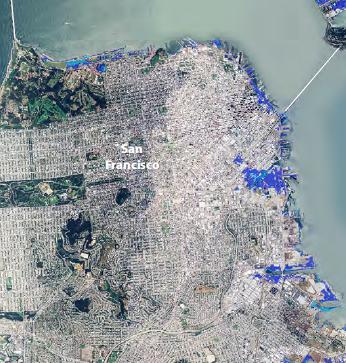
 The Chron has a map of what the Bay Area might look like after a two-foot increase in sea levels and a six-foot increase. It looks like this.

Of course, it might be okay because we can build super-tech levee that will create artificial waterfalls and protect us all from living on islands.

(You could argue that climate change isn’t about new technology, but that would be no fun — and would require actual political leadership.)

Anyway, here’s the problem with the Chron’s map: It makes San Francisco look just fine. The entire city is in white, safe from that pesky inundation that will ruin lesser parts of the bay.

Thing is, the Bay Conservation and Development Commission has spent a ton of time on sea-level rise, and has its own map, that’s a bit more accurate, or at least more detailed — and that shows some major-league problems for this city.

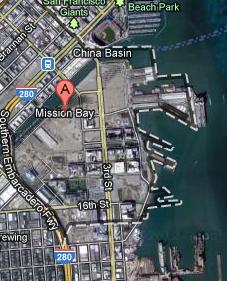
Check out the areas in blue: It’s most of the northen and eastern waterfront. That includes not only Mission Bay, where the city is pinning its hopes for a biotech boom, but also the site of the Warriors Arena, 8 Washington, and 75 Howard. In other words, the plan to make the waterfront into a heavily developed entertainment and residential neighborhood isn’t going to work for very long — unless everyone gives up his or her car and buys a boat. Or unless we, the taxpayers of San Francisco, spend billions protecting all this development that doesn’t make sense in the first place.

Oh, Treasure Island’s going to be a much smaller island, too.

It’s entirely possible — and likely — that state, federal, and local tax money will go to protect some essential, vulnerable coastal areas. It makes no sense to try to move both the San Francisco and Oakland airports; we’re going to build barriers to protect them. But how are we going to protect an arena that’s built out over the water when the water starts to lap up to the doors? Who’s paying for that?

The Chron has done a good job asking the questions at the national level — but, just as we so often see with economic inequality and tax policy, nobody wants to bring the message home.

Spies on the corner

23

rebecca@sfbg.com

In the Netherlands city of Eindhoven, the streetlights lining a central commercial strip will glow red if a storm is coming. It’s a subtle cue that harkens back to an old phrase about a red sky warning mariners that bad weather is on the way. The automated color change is possible because satellite weather data flows over a network to tiny processors installed inside the lampposts, which are linked by an integrated wireless system.

Lighting hues reflecting atmospheric changes are only the beginning of myriad functions these so-called “smart streetlights” can perform. Each light has something akin to a smartphone embedded inside of it, and the interconnected network of lights can be controlled by a central command center.

Since they have built-in flexibility for multiple adaptations, the systems can be programmed to serve a wide variety of purposes. Aside from merely illuminating public space, possible uses could include street surveillance with tiny cameras, monitoring pedestrian or vehicle traffic, or issuing emergency broadcasts via internal speaker systems.

The smart streetlights aren’t just streetlights — they’re data collection devices that have the potential to track anything from pedestrian movements to vehicle license plate numbers. And, through a curious process distinctly lacking in transparency, these spylights are on their way to San Francisco.

BIG PLANS

On Minna between Fourth and Sixth streets in downtown San Francisco, the San Francisco Public Utilities Commission has installed a pilot project to test 14 streetlights that are connected by a wireless control system. The city agency plans to gauge how well this system can remotely read city-owned electric meters, wirelessly transmit data from tiny traffic cameras owned by the Municipal Transportation Agency, and transmit data from traffic signals.

The pilot grew out of San Francisco’s participation in an international program called the Living Labs Global Award, an annual contest that pairs technology vendors with officials representing 22 cities from around the world. At a May 2012 LLGA awards summit in Rio de Janeiro, far outside the scope of the city’s normal bidding processes, a Swiss company called Paradox Engineering won the right to start testing the high-tech lights in San Francisco. Within six months, Paradox Engineering and the SFPUC had the Minna streetlights test up and running.

Meanwhile, the city has issued a separate Request for Proposals for a similar pilot, which will test out “adaptive lighting” that can be dimmed or brightened in response to sensors that register pedestrian activity or traffic volume. The city is negotiating contracts with five firms that will test out this technology in three different locations, according to Mary Tienken, Project Manager for LED Streetlight Conversion Project for the SFPUC.

Under the program, five vendors will be chosen to demonstrate their wireless streetlights on 18 city-owned lights at three test sites: Washington Street between Lyon and Maple streets; Irving Street between 9th and 19th avenues; and Pine Street between Front and Stockton streets.

LED streetlights are energy-efficient and could yield big savings — but the lights do far more than shine. The RFP indicates that “future needs for the secure wireless transmission of data throughout the city” could include traffic monitoring, street surveillance, gunshot monitoring and street parking monitoring devices.

So far, the implications of using this technology for such wide-ranging objectives have barely been explored. “San Francisco thought they were upgrading their 18,000 lamps with LEDs and a wireless control system, when they realized that they were in fact laying the groundwork for the future intelligent public space,” LLGA cofounder Sascha Haselmeyer stated in an interview with Open Source Cities. “Eindhoven is pioneering this with … completely new, intelligent lighting concepts that adapt to the citizen not just as a utility, but a cultural and ambient experience. So many questions remain,” he added, and offered a key starting point: “Who owns all that data?”

LUMINARIES IN LIGHTING

Phillips Lighting, which was involved in installing the Eindhoven smart streetlights system, played a role in launching the San Francisco pilot. Paradox Engineering recently opened a local office. Oracle, a Silicon Valley tech giant, is also involved — even though it’s not a lighting company.

“Oracle, of course, manages data,” Haselmeyer explained to the Guardian when reached by phone in his Barcelona office. “They were the first to say, ‘We need to understand how data collected from lampposts will be controlled in the city.'”

According to a press release issued by Paradox Engineering, “Oracle will help managing and analyzing data coming from this ground-breaking system.” Oracle is also a corporate sponsor of the LLGA program. It has been tangentially involved in the pilot project “because of a longstanding relationship we had with the city of San Francisco,” Oracle spokesperson Scott Frendt told us.

Paradox was selected as the winner for San Francisco’s “sustainability challenge” through LLGA, which is now housed under CityMart.com, “a technology start-up offering a professional networking and market exchange platform,” according to the company website.

In May of 2012, the SFPUC sent one of its top-ranking officials, Assistant General Manager Barbara Hale, to Rio for the LLGA awards summit. There, technology vendors of all stripes showcased their products and mingled with local officials from Barcelona, Cape Town, Glasgow, Fukuoka and other international cities. San Francisco was the only US city in attendance. San Francisco will even host the next summit this coming May at Fort Mason.

In Rio, Paradox was lauded as the winning vendor for San Francisco’s LLGA streetlights “challenge.” It didn’t take long for the company to hit the ground running. “Soon after the Rio Summit on Service Innovation in Cities, where we were announced winners for San Francisco, we started discussing with the SFPUC the objectives and features of the pilot project,” Paradox announced on the LLGA website. “Working closely with the SFPUC, we also had the opportunity to build solid partnerships with notable industry players such as Philips Lighting and Oracle.”

WINNERS’ CIRCLE

On Nov. 15, Paradox hosted an invite-only “networking gala” titled “Smart Cities: The Making Of.” The event brought together representatives from Oracle, the SFPUC, Phillips, LLGA, and the Mayor’s Office of Civic Innovation, “to learn about the challenges of urban sustainability in the Internet of Things era,” according to an event announcement.

“The project we’re piloting with the SFPUC is highly innovative since it puts into practice the new paradigm of the ‘Internet of Things,’ where any object can be associated with an IP address and integrated into a wider network to transmit and receive relevant information,” Gianni Minetti, president and CEO at Paradox, stated in a press release.

The event was also meant to celebrate Paradox’s expansion into the North American urban lighting space, a feat that was greatly helped along by the LLGA endeavor. But how did a Swiss company manage to hook up with a San Francisco city agency in the first place — and win a deal without ever going through the normal procurement process?

San Francisco’s involvement in LLGA began with Chris Vein, who served as the city’s Chief Technology Officer under former Mayor Gavin Newsom. (Vein has since ascended to the federal government to serve as Deputy U.S. Chief Technology Officer for Government Innovation for President Barack Obama.)

To find the right fit for San Francisco’s wireless LED streetlights “challenge” under the LLGA program, a judging panel was convened to score more than 50 applicant submissions received through the program framework. Judges were selected “based upon knowledge and contacts of people in the SFPUC Power Enterprise,” Tienken explained. The scoring system, Haselmeyer said, measures sustainability under a rubric developed by the United Nations.

Jurists for San Francisco’s streetlight program were handpicked from the SFPUC, the San Francisco Department of Technology, Phillips, and several other organizations. An international jurist is designated by LLGA for each city’s panel of jurists, Haselmeyer said, “so as to avoid any kind of local stitch-up.”

He stressed that “the city is explicitly not committing to any procurement.” Instead, vendors agree to test out their technology in exchange for cities’ dedication of public space and other resources. Tienken, who manages the city’s LED Streetlight Conversion Project, noted that “Paradox Engineering is not supposed to make a profit” under the LLGA program guidelines. “We’ll pay them a $15,000 stipend,” she said, the same amount that will be awarded to the firms that are now in negotiation for pilot projects of their own.

“San Francisco is using this to learn about the solution,” Haselmeyer added. “This company will not have any advantage,” when it comes time to tap a vendor for the agency’s long-term goal of upgrading 18,500 of its existing streetlights with energy-saving LED lamps and installing a $2 million control system.

At the same time, the program clearly creates an inside track — and past LLGA participants have landed lucrative city contracts. Socrata, a Seattle-based company, was selected as a LLGA winner in 2011 and invited to run a pilot project before being tapped to power data.SFgov.org, the “next-generation, cloud-based San Francisco Open Data site” unveiled by Mayor Ed Lee’s office in March of 2012.

The mayor’s press release, which claimed that the system “underscores the Mayor’s commitment to providing state of the art access to information,” made no mention of LLGA.

PRIVACY AND PUBLIC SPACE

Throughout this process of attending an international summit in Rio, studying applications from more than 50 vendors, selecting Paradox as a winner, and later issuing an RFP, a very basic question has apparently gone unaddressed. Is a system of lighting fixtures that persistently collects data and beams it across invisible networks something San Franciscans really want to be installed in public space?

And, if these systems are ultimately used for street surveillance or traffic monitoring and constantly collecting data, who will have access to that information, and what will it be used for? Haselmeyer acknowledged that the implementation of such a system should move forward with transparency and a sensitivity to privacy implications.

“Many cities are deploying sensors that detect the Bluetooth signal of your mobile phone. So, they can basically track movements through the city,” Haselmeyer explained. “Like anything with technology, there’s a huge amount of opportunity and also a number of questions. … You have movement sensors, traffic sensors, or the color [of a light] might change” based on a behavior or condition. “There’s an issue about who can opt in, or opt out, of what.”

Tienken and Sheehan downplayed the RFP’s reference to “street surveillance” as a potential use of the wireless LED systems, and stressed that the pilot projects are only being used to study a narrow list of features. “The PUC’s interest is in creating an infrastructure that can be used by multiple agencies or entities … having a single system rather than have each department install its own system,” Tienken said. The SFPUC is getting the word out about the next batch of pilots by reaching out to police precinct captains and asking them to announce it in their newsletters, since “streetlighting is a public safety issue,” as Tienken put it.

Haselmeyer acknowledged that public input in such a program is important: “It’s very important to do these pilot projects, because it allows those community voices to be heard. In the end, the city has to say, look — is it really worth all of this, or do we just want to turn our lights on and off?”

LIGHTS, BUT NO SUNSHINE

One company that is particularly interested in San Francisco pilot is IntelliStreets, a Michigan firm that specializes in smart streetlights. IntelliStreets CEO Ron Harwood told the Guardian that his company was a contender for the pilot through LLGA; he even traveled to Rio and delivered a panel talk on urban lighting systems alongside Hale and a representative from Oracle.

A quick Google search for IntelliStreets shows that the company has attracted the attention of activists who are worried that these lighting products represent a kind of spy tool, and a spooky public monitoring system that would strip citizens of their right to privacy and bolster law enforcement activities.

“It’s not a listening device,” Harwood told the Guardian, when asked about speakers that would let operators communicate with pedestrians, and vice-versa. “So you can forget about the Fourth Amendment” issues.

Harwood seemed less concerned about the activists who’ve decried his product as a modern day manifestation of Big Brother, and more worried about why his company was not chosen to provide wireless LED streetlights in San Francisco. After being passed over in the LLGA process, Harwood said IntelliStreets responded to the RFP issued in the weeks following the Rio summit. Once again, Harwood’s firm didn’t make the cut.

Since his company provides very similar services to those described in the RFP, Harwood said he was “confused” by the outcome of the selection process. IntelliStreets’ Chief Administration Officer Michael Tardif was more direct. “Clearly we think this was an inside deal,” Tardif told the Guardian. Tienken, for her part, declined to discuss why San Francisco had rejected IntelliStreets’ application.

And when a public records request was submitted to the agency last August for details on San Francisco’s participation in LLGA, the response was opaque at best. “After a duly diligent search we find that there are no documents responsive to your request,” an SFPUC public records coordinator responded via email. “The San Francisco Public Utilities Commission is not a participant, nor is involved with Living Labs Global Award. Please know that we take our obligations under the Sunshine Ordinance very seriously.” That was just an honest mistake, Sheehan tells the Guardian now by way of explanation. In the public records division, “Clearly, nobody had any familiarity with LLGA.”