SFPD

Is the War on Fun over, or do we still need to fight for our right to party?

6

On Monday, the Entertainment Commission brings together a slew of City folk and party people at its fourth annual Nightlife Industry Summit. The three-hour affair includes speeches from Police Chief Greg Suhr, Sup. Scott Weiner, and perhaps Mayor Ed Lee, as well as a panel of speakers, and break-out sessions where club owners, security officers, and outdoor event planners can respectively brainstorm, said commission director Jocelyn Kane.

Past summits have resulted in legislation and policy changes, Kane said, pointing to loitering laws and Sup. David Chiu’s parking lot security legislation last year. This year, Kane thinks there aren’t any pressing problems to address or big controversies that have roiled the commission in past years.

“There’s very little violence and our security staff is much more professionalized than they’ve ever been,” she said. “For me, it’s a year when we can raise the bar in terms of programming inside venues and diversifying the patron experience.”

Club owners and event producers will have some free time to swap tips when the structured portion of the day ends. Kane thinks all neighborhoods should attempt to mimic the Mission, where the wide variety of venues allows a partyer to buy a “big fat martini at Blondies, roll down and eat a burritto, and catch some music at the Elbo Room” as opposed to those who spend the evening on Broadway, where “everyone’s offering the same thing.”

Though Kane couldn’t identify any negative issues on the Summit’s agenda, Opel event producer Syd Gris has plenty of grievances he plans to address on Monday. Gris, who will be speaking on the panel for the first time, said what the Guardian coined as the “War on Fun” in 2006 wages on in 2012.

Gris plans to bring up June’s Opulent Temple Massive on Treasure Island, which was designed to be for visitor aged 18 and over, but the San Francisco Police Department captain that oversaw the event insisted it only allow in those of drinking age, “despite ample precedence of events in the city being 18 and over.”

“For them to deny us the ability to do something that happens all the time in the city just because one captain didn’t like it was unfair and had a huge economic impact,” Gris said. “It’s a great example of what’s wrong with how certain things work in the city. Arbitrary decisions that are inconsistent, unfair, and have a deleterious impact on an event producer can be made by small groups of people.”

His was not a stand alone experience, but part of a broader, Gris said. The mellow Fillmore Jazz Festival had to have beer gardens for the first time this year, Power to the Peaceful was cancelled last September, as was LovEvolution this year after the SFPD places onerous restrictions on it.

“I am certainly glad that the conversation is happening with people that need to be hearing about it,” Gris said of the Summit. “Will a real change come out of it? I’m not optimistic but I certainly hope so.”

The event — held in the Main Library’s Koret Auditorium — is free and open to the public, so come fight for your right to party 1-4pm. 

Taser debate takes off once again at Police Commission

11

At a police commission meeting last night, commissioners delayed the vote on a controversial agenda item: adding tasers to the SFPD toolbelt. Specifically, Chief Greg Suhr proposed discussing a pilot program that would allow tasers for the 74 officers who have been trained through the department’s Crisis Intervention Team (CIT) program, created last year.

This is not the first time a police chief has introduced the possibility of tasers. In February of both 2010 and 2011, the police commission discussed adding the less-than-lethal weapon to the SFPD arsenal.  But community opposition, ACLU opinions, and commissioners concerned about the risks of tasers thwarted the effort.

Suhr says he brought up the issue in light of the July 18 killing of Pralith Pralourng. Suhr said he believes that if the officer involved had been equipped with a taser, Pralourng, who wielded only a boxcutter, may be alive today.

Several members of Proalong’s family attended the commission meeting last night. His sister, Savee Pralourng, read a statement asking that her brother’s death not be politicized for police department purposes.

“The SFPD wants to use his death to justify getting tasers,” said Pralourng.

She added other concerns about the police deparment’s handling of the death.“We have not been given any information about his last moments or how he died,” she said. “They need to know how to deal with mental illness, police need to address them differently.”

“This is an issue of the department having options available to them to mitigate the need for lethal force,” Commander Mikail Ali said at last night’s meeting.

But opponennents say that issuing tasers will lead to officers using them in questionable scenarios.

Tasers are called less-than-lethal, but can result in death. The risk of death is increased if the tased individual is child, elderly, pregrant, very thin, has acidoss, or on cocaine or methamphetamine. Police are trained to aim their guns for center mass, but with tasers the risk of death is increased if the subject is hit in the chest– the electric shock’s proxmimity to the heart can cause ventricular fibrillation.

“You have pepper spray, you have billy clubs, you have rubber bullets. What more do you need?” activist Debray “Fly Benzo” Carpenter admonished the police chief.

As a result of last year’s iteration of the year’s-long debate, the police department was tasked with preparing a report on the  potential use of tasers and what other less-lethal options were available.

The report was never completed.

This concerned several commissioners, as well as ACLU attorney Micaela Davis, who presented at the meeting. The ACLU sent a 12-page letter to Mayor Ed Lee outlinging their issues with tasers, and has reported in the past that police use of tasers in Northern California is dangerously unregulated and leads to death at a surprising rate.

Of the top 20 largest police departments in the coutry, San Francisco officers are the only ones without tasers. Even Memphis, the city with a police traning program for interacting with mentally ill people in crisis that has become a national model, recently voted to allow tasers. San Francisco’s CIT program is based on the Memphis model.

The conversation may have been happening for years but, commissioners decided, this new attempt was too hasty. Many were surprised to see the item on this week’s meeting agenda. Many members of the public were angered as well that no public comment period was sheduled for the item, and expressed their opposition to tasers during comment periods meant for other topics.

“The virtue of good government is patience and consideration,” said Commissioner Julius Turma. “I don’t feel fully informed on this issue.” Turman, along with Commissioner Angela Chan, called for a delay on the vote.

Commissioner Petra DeJesus said that if more notice had been given on the vote she would have “asked the city attorney’s office for an opinion on wheather we can tase just a certain population.” The proposed pilot program would put tasers in the hands of only officers who have been through CIT program, a training for interacting with mentally ill people.

Suhr said that was a false characterization. The police department would not be “singling out a demographic of people they might be used on,” he said. Instead, CIT officers simply “have done more training to deal with the mentally ill.”

The CIT program is meant to train officers who will be dispatched to respond to calls involving mentally ill people in crisis. However, these officers do not work exclusively in these situations.

The CIT training, whose formation marked a rare consensus between the police department, commission, community mental health organizations and advocacy groups, have begun but are running behind schedule. Davis argued that to distribute tasers to the officers in the training before they complete it would be premature– and that, if they know that at the end of the training they will get tasers, they may be less inclined to practice crisis intervention using other, less dangerous tools.

Carpenter, who was thrown out of the meeting after he and other activists shouted “he’s lying!” when Suhr reported the number of officer-involved shootings over the past year as well as other interuptions, said the prospect of tasers worries him. “I’ve been pepper sprayed for no reason before,” said Carpenter. “If they had tasers, would they have tased me?”

The comission will continue to research and discuss the issue, and, with more notice, public input into the issue promises to mount. The next police commission meeting will take place August 15. The controversial topic, which has produced what Police Commission Vice President Joe Marshall called “robust conversations” several times before, is likely to produce another in the next few weeks, both in and outside police comission meetings.

“The violence in the southeast sector over the past four days has been devastating to our City– we know we can do much better.  Let’s work together to and create San Francisco solutions to San Francisco problems. The Black Young Democratic Club is open to help facilitate this conversation,” reads a statement the club released yesterday in response to the taser proposal.

“I can guarantee you, you look at the communities of color, those are going to be the folks that are dealing with the police and the tasers,” said Theo Ellington, president of the San Francisco Black Young Democratic Club.

Killing of suspect with box cutter may have been legal. But was it necessary?

12

Police officers have dangerous jobs, and when confronted with subjects who may threaten their lives, they have to think fast under stress. When a subject has something classified as a “deadly weapon,” police are justified by law in shooting to stop the threat.

As SFPD spokesperson Carlos Manfredi explained to me for an article in this week’s paper, the official policy isn’t “shoot to kill.” But subjects are often killed, since officers are trained at the police academy to aim for the body’s center mass and to shoot until any threat to their life is neutralized.

It seems many tools and common items can fall under the “deadly weapon” category. The SFPD’s third fatal officer-involved shooting this year occurred July 18 when Pralith Pralourng apparently lunged at an officer. His deadly weapon? A box cutter.
 
In January 2011, Raheim Brown Jr. was shot by Oakland School Police. He was allegedly wielding a screw driver. Last July, Charles Hill was shot by BART police. He was drunk, lying on the ground, and hurled a pocketknife at police, missing them by 10 feet.

When used just right, a box cutter, a screwdriver, or a pocket knife can certainly be deadly weapons. But when a subject is exhibiting likely mental disability, drunk and lying on the ground, or 20 years old and in a car, isn’t there any other type of combat police could use to neutralize the threat?

At a press conference today Police Chief Greg Suhr said that police do take defensive tactical training, which trains officers in using less than lethal weapons. But the July 18 situation warranted the use of lethal weapons, Suhr said.

“The officer was facing a life or death situation. She had to do what she could to protect herself.,” Suhr said.

Suhr explained that the officer had been on the force 20 years, during which time she had received multiple trainings in crisis intervention training, which he called the “most progressive in the country.”

That training deals with psychology and teaches how to deescalate situations in which a subject is a “danger to himself,” Suhr said. But, since the subject had already allegedly attacked a co-worker, the the officer’s life was considered in danger.

Meanwhile, Occupy San Francisco activists who still protest and sleep outside the Federal Reserve on Market Street attained video and audio of people who claim to be witnesses who contradict the police story. One says that “he was on his back, then [paramedics from] the ambulance turned him facing downwards…they but a bag over his body and his head. Next thing, when everybody started looking at they got nervous and they started acting like they were doing CPR even though the guy was gone. It took the ambulance 20 minutes to get there.”

In a video that has been viewed more than 17,000 times on youtube, another man who claims to be a witness says “they had him in cuffs, and they shot him.” In another video shot by the same man, Robert Benson, another man says “he was in handcuffs and they shot him twice in the chest…I saw it.”

The Bay Guardian has not been able to confirm these accounts.

Pralourng’s death was likely legal. He could likely have injured an officer with the six-inch box cutter he carried, although it may have been difficult to kill her. But his crime did not merit the death penalty, and he now joins the ranks of Hill, Brown and others who’s small blades and screwdriver were considered weapons deadly enough to justify their deaths by the SFPD, BART Police, Oakland School Police respectively. It’s hard not to ask—did Pralourng have to die?

Trust the police?

11

yael@sfbg.com

On July 16, 2011, Kenneth Harding Jr. lay bleeding on the ground. He was surrounded by San Francisco Police officers, who were in turn surrounded by neighbors and community members. The minutes ticked by and no ambulance arrived. After 28 minutes, Harding was dead at 19. The official story: after being stopped in a Muni fare check, Harding ran from police, drew a gun, and shot himself.

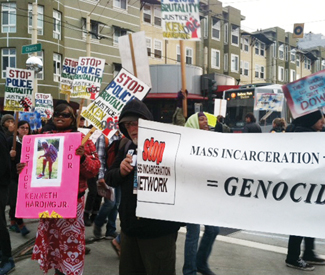
A year later, family members and community supporters maintain that the official story is a lie. A protest on his death’s anniversary this week shut down Muni service for an hour in his honor.

But protesters weren’t speaking of just Harding. Since he was killed by law enforcement officers, so were Charles Hill, Alan Blueford, and Derrick Gaines. All have led to varying degrees of protest that feed tensions between the cops and segments of the community.

Hill’s fatal shooting by a BART cop in San Francisco sparked last summer’s OpBART demonstrations, the energy from which flowed into early manifestations of the Bay Area’s Occupy movement, which was also marked by tense standoffs with cops that were followed by “fuck the police” marches throughout the Bay Area.

Despite such lingering tensions, Mayor Ed Lee recently suggested curbing gun violence by giving cops stop-and-frisk authority, a controversial idea that has been the subject of massive protest movements in New York City where what critics say is widespread racial profiling heightens tensions between police and communities of color.

Lee’s idea was widely criticized, triggering the Board of Supervisors to pass a resolution on July 10 criticizing the idea, urging Lee to abandon it, and saying it would destroy trust between the community and police.

There has always been tension in San Francisco between police and segments of the community, but a series of emotional, high-profile episodes and unsatisfying official responses over the last year has frayed that relationship even more than normal.


HARDING’S CASE

When Harding was killed, his mother Denika Chatman moved from Seattle to San Francisco. She wanted to convict the officers she believes murdered him. But the SFPD announced within weeks of the shooting that Harding had shot himself.

Now, Chatman and attorney John Burris have filed a federal lawsuit. “I know that it was murder,” she said. “I know his human rights had been violated.”

Chatman and other family members and friends maintain that when Harding was stopped while off-boarding the T train by SFPD officers and asked for proof of paying the $2 fair, he was unarmed. Harding ran, and those officers drew guns and shot him.

Police say that Harding had pulled out a gun as he ran and shot at police, prompting their return fire. They didn’t recover a gun at the scene, but after a weeklong “community effort,” police say a neighbor turned in a gun found at the scene.

The gun shot .38 caliber bullets, police reported—smaller than the .40 caliber bullets in a standard-issue SFPD weapon. The police crime lab then concluded Harding’s fatal wound was from a .38 caliber bullet, a finding confirmed later by the Office of the Medical Examiner.

A widely circulated video show’s Harding on the ground, bleeding to death, as police stand around him.

But as SFPD spokesperson Carlos Manfredi tells it, “The officers did not just stand around. Officers had just been involved in a violent confrontation, they were fearful for their lives…A hostile crowd began surrounding the officers.”

“It wasn’t until more officers arrived on scene to assist the primary officers and prevent them from being surrounded by a hostile crowd that could have potentially escalated the situation. Not to mention, the ambulance would not be able to enter a violent scene that could potentially put their lives at risk, until we feel it is safe,” he said. “Remember, the officers did not know if Harding was laying under the gun. Approaching an armed gunmen who was shooting at officers is extremely dangerous and life-threatening.”

But many say the police shouldn’t be afraid of the community it patrols. When Chatman moved to the Bay Area, she says, she found a community in Bayview-Hunters Point. She also found support in a movement against police violence, made up largely of grieving mothers.

When hundreds marched in San Francisco demanding that George Zimmerman be charged with murdering Trayvon Martin in Florida, Chatman joined other African American mothers in condemning police killings of their sons. Since Martin’s death, similar deaths have continued in the Bay Area.

Alan Blueford, 18, was killed May 6 in Oakland three weeks before he graduated high school. Derrrick Gaines was 15 when he was fatally shot June 5 in South San Francisco. Each case feeds anew the fears and resentments some communities feel toward the police.


POLICING THE COMMUNITY

Some Occupy reactions continued a tradition of a certain type of radical response to police: just get them out. For many, police are like foreign occupying forces in neighborhoods, afraid of locals they don’t understand and willing to shoot to kill in mildly threatening situations. Harding and Gaines were running away when they were shot; Blueford was allegedly wielding a screwdriver. In all these situations, shooting to wound likely would have sufficed for self-defense.

When asked how she would like to see police interact differently with Bayview-Hunters Point residents, Chatman didn’t see much potential. “Not at this point,” Chatman said. “There’s been too many murders. Things would have to change drastically. And the mayor trying to implement a stop and frisk? Kenny is a worst example of stop and frisk and racial profiling.”

Indeed, at the end of a tense year, Mayor Lee’s idea of adopting the stop-and-frisk tactics used in New York and Philadelphia has been met with intense dissent. Sup. Malia Cohen — whose District 10 includes Bayview-Hunters Point — and former Mayor Willie Brown, two of the mayor’s supporters, immediately came out against the idea.

“San Francisco should remain focused on community policing that values both law enforcement and building relationships with communities who live with gun violence. Anything less would undermine decades of hard work in building trust between local law enforcement and our neighborhoods,” she wrote in a San Francisco Chronicle op-ed.

Even the SFPD is wary of the idea.

“We are not passing stop and frisk,” Manfredi told the Guardian. “It’s not even an option on the table for the department. We’re using the same method we’ve been using this whole time: probable cause and reasonable suspicion.”


A TROUBLING PATTERN

The anniversary of Harding’s death comes a week after the Malcolm X Grassroots Movement released a highly circulated report that concluded an African American is killed by a police officer or someone “deputized to act in their name” every 40 hours.

“We call [the killings] ‘extrajudicial’,” the report notes, “because they happen without trial or any due process, against all international law and human rights conventions.” The report notes that only nine people have been charged in the 110 killings it looks at, and none convicted.

On paper, San Francisco isn’t having a particulary bad year. Manfredi said there have been “two officer-involved shootings and at least one was a fatality” so far in 2012. That’s compared to eight officer-involved shootings with three fatalities in 2011 and 14 officer-involved shootings with three fatalities in 2010.

But community perceptions and unease can linger for a long time when incidents don’t seem properly investigated or atoned for.

“It’s very alarming. Especially the rate that it’s happening at. And anybody is paying attention, they’re starting use all the same stories for all these young black teenage males that they’re murdering,” Chatman said.

Alan Blueford, 18, was killed by Oakland Police on May 6. He was confronted by police on suspicion of hiding a gun and ran away. Police first said he had drawn a gun and shot an officer as he ran; an investigation later revealed that the officer who was injured shot himself in the foot. There has been no evidence uncovered that Blueford had a gun.

A month later, Derrick Gaines, 15, was confronted by South San Francisco police, again for looking suspicious. Police say he ran away and drew a gun, and that they needed to fire in self-defense. At a community speak-out July 13, Gaines’ mother, Rachel Guido Red, said she had just received the coroner’s report. It’s conclusion? “Derrick was shot in the back.”

She related what she believes happened: “He was running. He was scared. He was tripped by the officer, and he didn’t have a chance to pick himself up because this man played judge, jury, and executioner.”

Over and over, police investigations clear the cops of wrongdoing, as an investigation of Hill’s shooting on a San Francisco BART platform recently did. Chatman said lawsuits like the one she filed are often the only way to seek justice.


DEMANDS FOR CHANGE

Chatman wants to see shoot-to-kill policies changed. “I would like to see a bill passed making these people responsible for murder,” she said. “And then maybe they’ll start going back to original ways, of maybe wounding somebody, firing a warning shot, or doing something to injure the person, instead of shooting to kill. Because now they all come with their guns drawn. How come every police man there has to shoot? Why do they all have to shoot? Why can’t one officer shoot, and just shoot to wound?”

Manfredi said the policy isn’t shoot-to-kill, but it isn’t shoot-to-wound either. Instead, it’s to aim for “center mass” (the torso area) and shoot until there is no longer a threat. “We never, ever had a shoot to kill policy,” he said. “We shoot to stop the threat. And once we assess the threat and realize there’s no longer a threat, then we stop.”

Sharen Hewitt, founder of the Community Leadership Academy and Emergency Response Project (CLAER) is also indignant about Harding’s murder. “I don’t think that I should pay for Kenneth Harding to be shot down in my streets because he didn’t have two dollars,” she said.

In her decade of work with CLAER, Hewitt has overseen many projects that improved conditions for families whose children were killed by police, from funding funerals for families who can’t pay to bury their dead to counseling for family members other than biological parents of murdered kids. CLAER also sends emergency responders to sites of murders.

“We thought it was important to deal with the immediacy of the homicide and provide support so we could mitigate the possibility of retaliation,” Hewitt said.

Hewitt also has ideas for how to increase trust in police. “They need to understand the nuances, so they see Johnny with the hoodie on and know, he’s a star quarterback. I’d like to see my cops, paid by my tax dollars, not going to Sonoma County to spend them. One day the officer might be out running and he’ll have a hood on, and he’ll understand the nuances of what people are going through,” Hewitt said. She also advocates for housing set-aside for police in every neighborhood, insuring that officers live in neighborhoods they patrol.

We asked Manfredi about this idea. “I’m a big proponent of having officers live in the community where they work, because then they can engage with the community,” he agreed. But, he said, “one of the major issues about San Francisco, the cost of living is extremely high. To buy a home out here, we’re talking in the millions of dollars. That’s just too expensive.”

He said that to make the idea work, the city would need to “implement some type of program or plan where they offer discounts for public officials so they can afford to live in the city.” He explained that even in less expensive areas like Bayview and Sunnydale, the cost of housing would be too high for police officers to raise a family.

The current entry-level salary for SFPD officers is $88,842 to $112,164. By comparison, the median household income in San Francisco is about $71,000. According to city-data.com, the median household income in Bayview is $47,147. In Sunnydale, Hewitt’s neighborhood, that figure is $33,641. “I would say, the police are part of the community,” Hewitt said. “And they must be held to community standards. What I’d like to do is make it part of common thought that they are perceived as community members.” She said the African American community has differing ideas on how to address police-related problem, but the tension is widely felt. “It’s not like the black community is monolithic,” she said, “although we are bearing the collective brunt.”

Morning Muni shutdown commemorates death of Kenneth Harding, Jr.

34

More than 50 protesters disrupted Muni service for about an hour this morning before peacefully leaving to march down Market, in commemoration of the death of Kenneth Harding, Jr., on July 16, 2011.

After gathering at 14th and Market, the group marched to the intersection of Duboce and Church, where Muni trains headed outbound exit the tunnel. Soon, at least four outbound trains and two inbound trains were backed up.

Buses replaced their service.

Some passengers were angered, while most took literature from protesters on their way to catch another train. A few joined in the picket line. Drivers, meanwhile, were mostly nonchalant. “I’m just enjoying the show,” said one driver.

“They shoot us down, we shut it down,” protesters chanted. They also mentioned the names of Raheim Brown Jr., Derrick Gaines, Oscar Grant, and other young African American Bay Area men killed by police.

As a police line closed in, one protester shouted at cops, “you are all complicit!” The group left the intersection around 7:30 without much confrontation with police.

Denika Chatman, Harding’s mother, has been organizing a movement demanding that the police who shot him be charged with murder since his death.

Harding, 19, was stopped by police last year as part of a ticket check while exiting the T train at third and Palou. He ran, and police shot at him. He fell and bled for about thirty minutes, while police surrounded him, before he was taken to a hospital.

Police say Harding pulled a gun out as he ran and shot at them, and that the fatal bullet in his neck was his own. They say that, since the bullet that killed him was from a .380-caliber handgun and police carry .40 caliber guns, Harding shot himself. No gun was found on Harding, but police acquired a gun a week after the shooting that they believe Harding used.

Police have pointed to a video which they say shows a man picking up the gun at the scene, while Harding’s family members and supporters say the object is a cell phone.

By no accounts did police know Harding’s identity before shooting.

Officers Richard Hastings and Matthew Lopez have recieved medals of valor for their handling of the incident.

Dorian Maxwell, a whistleblower former Muni driver who refused to operate his bus and made noise about unsafe conditions on Muni, attended the protest as well. He said Labor Black and Brown, one of the organizations who planned the protest, supported him after he risked his job.

“Your life is in danger if you’re riding the Muni,” Maxwell told the crowd, pointing out what he identified as partially flat tires on a nearby 22 Fillmore.

“We wanted to combine the brutality of the police with the workers getting victimized,” said protest organizer Charles Du Bois.

Chatman has also connected her demonstrations to the movement for free Muni tickets for youth.

“I wanted to organize a Muni shutdown, and it just started growing from there,” Chatman said. It was in honor of Kenny, and to unite the community as well. Because a lot of them witness these horrible murders and I wanted to do something to give back to a community that has supported me since this happened.”

After marching down Market stopping traffic every few blocks, the group ended with a speak-out in front of SFMTA headquarters. There were no arrests. A vigil is planned for 5pm at Third and Palou, in Mendell Plaza, the spot when Harding died. Supporters call the plaza Kenny’s Plaza in Harding’s honor.

Alerts

0

WEDNESDAY 11

Students organizing for CCSF Student Union upper level lounge, CCSF Ocean Campus, 50 Phelan, SF; www.ccsfwill.blogspot.com. 5-8pm, free. At an emergency community meeting concerning the threatened closure of City College of San Francisco July 9, many meetings were called, including the organizing to form a student union, to campaign for the parcel tax initiative to get money to CCSF, and to organize in solidarity with labor. This meeting is discussing support for the parcel tax, which could send $15 million City Colleges way if it passes in November. Come organize with labor on this issue. This meeting is a working group on student response to the accreditation report.

THURSDAY 12

It calls you back 826 Valencia, SF; www.826valencia.org. A book reading and film screening with Luis Rodriguez, a poet, journalist, and fiction writer and author of the best-selling memoir Always Running, La Vida Loca, Gang Days in L.A. He will read from his new sequel and screen Rushing Waters, Rising Dreams: How the Arts are Transforming a Community, documenting how Tia Chucha’s Centro Cultural and Bookstore is bringing art and community to the once devastated post-industrial San Fernando Valley.

Happiness Happiness Institute, 1720 Market, SF; www.meetup.com/SF-Free-School. An afternoon of yoga and a workshop on community building. This event is presented by a collaboration between the Bay Area Community Exchange Time Bank, the San Francisco Free School, and the Happiness Institute- three of the organizations that work on spending time and energy in the gift economy.

FRIDAY 13

4 days for Kenneth Harding Jr. around Bayview-Hunters Point, July 13-16; www.tinyurl.com/4days4kenny. On July 16, 2011, 19-year-old Kenneth Harding Jr. was killed. He was stopped by police and asked for his transfer when off-boarding the Muni T train—he ran, and police began shooting. As far as the SFPD is concerned, the case is settled; they say Harding drew a gun and shot back at them, and the fatal bullet was his own. His family, friends, and the movement resisting police murder of black youth disagree. On this anniversary of his death, commemorate Kenny with four days of events. On July 13, a community speak out at NOI Mosque at 26a 3rd & Revere at 7pm. On July 14th, a free community hip hop show. On July 15th a free community meal at 3rd and Palou St from 10am-2pm. And on July 16th, join Kenneth Harding’s mother and a broad coalition of community and labor to shut down Muni in honor of Kenneth Harding.

SATURDAY 14

Occupy Bohemian Grove Monte Rio Amphitheater, 9925 Main, Monte Rio; www.occupybohemiangrove.com. Noon, free. What, you’ve never heard of Bohemian Grove? It’s just the private club of CEOs, politicians, and their favorite performers that meet every year for debauchery and rituals such as the “Cremation of Care” at the Owl Shrine. The rich and powerful go camping among the redwoods every year, and although business talk is frowned upon, they often make deals, including, notoriously, a 1942 Manhattan Project planning meeting that led to the atomic bomb. Many anti-war activists and others who are pissed off that the 1 percent meets in this strange private camping party to plot acts of war and environmental destruction will be setting up their own protest encampment outside Bohemian Grove this year. The kick-off on Saturday will include musical performances and speakers, including the Fukushima Mothers and Cindy Sheehan.

Tardeada/ women’s social for women’s rights, 2969 Mission, SF; www.defendwomensrights.org. 2pm, $3-10. Women Organized to Defend and Resist are planning a nationwide protest August 26 to defend women’s rights. This Saturday, come share food, entertainment and political conversation to meet and bond with others who won’t stand for attacks on women’s rights.

Perjury allegations against Lee gain more support

126

San Francisco Democratic Party Chair Aaron Peskin has confirmed his role in extending a city job offer from Mayor Ed Lee to Sheriff Ross Mirkarimi if Mirkarimi had been willing to resign in March, bolstering allegations that Lee may have committed perjury when testifying under oath before the Ethics Commission on Friday.

But even as more media outlets report the possible perjury (a story we broke first here), which is further complicating the already complicated official misconduct proceedings that Lee brought against Mirkarimi, the Mayor’s Office and key Lee allies have refused to comment on the perjury allegations or the strange circumstances surrounding the alleged bomb threat that temporarily got Lee off the hot seat.

As we reported in this week’s Guardian, Building Inspection Commissioner Debra Walker said Lee was lying when he said that he hadn’t spoken with any members of the Board of Supervisors before charging Mirkarimi with official misconduct. Walker said Sup. Christina Olague told her she had spoken with Lee about the matter, which Olague now denies.

Lee also responded “absolutely not” when asked by Mirkarimi attorney Shephard Kopp whether he authorized Peskin or development consultant Walter Wong, a close Lee ally, “to convey to Sheriff Mirkarimi if he would stop down, you’d get him another job.”

At press time for this week’s article, Peskin was backpacking in the Sierras and couldn’t be reached, but he has now confirmed to the Guardian that he met with Wong at 11:30am on March 19 – just hours before Lee met with Mirkarimi to say he would be removed from office unless he resigned – at Cafe Trieste.

In that meeting, Peskin said Wong asked him to convey to Mirkarimi an offer from the mayor of a job with the San Francisco Public Utilities Commission or the Airport Commission if Mirkarimi would voluntarily resign. Asked whether Wong indicated that he had discussed the offer with the mayor, Peskin told us, “He certainly left me with that impression.”

Mirkarimi refused to accept the offer, insisting on fighting to keep his job, which was one factor in Peskin’s subsequent public statement calling for Mirkarimi to resign. “There were a lot of things that factored into that,” Peskin said of his call for Mirkarimi to step down, although he wouldn’t discuss other factors on the record.

Efforts by both the Guardian and the Examiner to reach Wong have been unsuccessful, and messages to the Mayor’s Press Office on this and related issues also haven’t been answered. But just as Walker has offered to do, Peskin said he’s willing to testify under oath if asked.

“I am prepared, if subpoenaed, to tell the truth, the whole truth, and nothing but the truth,” Peskin told us.

Lee hasn’t had any public events or made any public comments on the matter since the scandal broke on Friday. The other unanswered mystery is why Lee was whisked from the hearing room just 15 minutes into his testimony, shortly after making the statements that Walker alleges amounted to perjury.

As we reported, neither the SFPD nor the Sheriff’s Department ordered the room evacuated, meaning that decision must have been made by someone within the Mayor’s Office. Press Secretary Christine Falvey’s last statement to the Guardian, on July 2, said, “Again, the mayor’s office did not recess the meeting. I still have to refer you to the Police Department which maintains Mayor Lee’s security or the Ethics Commission about the decision to recess the meeting for (I believe) about 90 minutes.”

Yet neither body seems to know who made the call, and follow-up questions asking the Mayor’s Office to disclose any information they have about that decision have gone unanswered. District Attorney George Gascon — whose office would need to pursue the perjury allegations considering the city’s official misconduct rules don’t apply to the mayor — also didn’t return our call asking generally how allegations of this fashion should be handled.

The official misconduct proceeding continue in front of the Ethics Commission on July 18 and 19 when Mirkarimi’s wife, Eliana Lopez, is scheduled to testify. But that has also been complicated by the Mayor’s Office’s refusal to authorize payment for a plane ticket for Lopez to return from her native Venezuela to testify. Mirkarimi and his legal team say they can’t afford to pay for that plane ticket after Lee suspended Mirkarimi without pay.

Stop ‘stop and frisk’

4

EDITORIAL If the San Francisco Police Department put up checkpoints and metal detectors all along lower Market Street and stopped and searched every person who walked by, they’d find some contraband. No question — a certain percentage of people on the city’s main downtown artery are carrying drugs or weapons. Some have warrants out. There would be multiple arrests and criminals taken off the streets.

And it’s hard to imagine that anyone would consider that a good idea.

So how about moving those checkpoints to the Mission and Bayview-Hunters Point? You might get even more weapons and drugs. And it would still be a profound violation of the civil liberties of every San Franciscan.

But what Mayor Ed Lee is now talking about — instituting some version of the notorious New York City “stop and frisk” law — isn’t much different. Under New York Mayor Michael Bloomberg, the police have been given the authority to search, without cause or a warrant, anyone who looks suspicious. The goal is to get guns off the street.

The result: The vast majority of people stopped are African American or Latino — and 88 percent are totally innocent.

It is, in other words, a huge waste of police resources as well as a systematic program or racial profiling and harassment.

Lee told the San Francisco’ Chronicle’s editorial board that he realized the problems with the New York system and wants a better model. And he said, correctly, that there are serious problems with gun violence, particularly in Bayview-Hunters Point. “I think we have to get to the guns,” Lee said. “I know we have to find a different way to get to these weapons, and I’m very willing to consider what other cities are doing.”

But San Francisco has spent huge amounts of time and resources trying (not always successfully) to build a community policing program that would increase trust between the police and communities of color — and any version of “stop and frisk” would instantly undermine that effort. It’s a terrible idea, and Lee should make it clear that he is dropping any discussion or consideration of it.

The mayor and his supporters insist that they’ll only pursue this approach if it can be done without profiling. But that’s almost impossible and it’s a fantasy to think the San Francisco cops, once empowered to stop anyone for any reason, would target white people the same way they do blacks and Latinos. There’s never been an example anywhere in the country where this kind of law was anything but a case study in racial profiling. Even Police Chief Greg Suhr sounds dubious.

The fact that Lee would even suggest this is a sign of how far he’s moved from his progressive roots. Moving even a step further toward this sort of wholesale civil-liberties violation would be a disaster for San Francisco.

They call it gunpowder

13

news@sfbg.com

At needle exchange sites around San Francisco, fliers are handed out to intravenous drug users warning them about a new and very potent form of heroin thought to be responsible for a dramatic increase in recent overdoses.

“Gunpowder heroin,” as it’s often called on the street, began infiltrating the city’s illegal drug market back around February, according to widespread reports from various needle exchange participants. Yet public officials appear to be in the dark about the epidemic, partly because budget cuts have created long backlogs for toxicology tests and partly due to indifference about the safety of drug users.

The reports were gathered by the Drug Overdose Prevention and Education Project from their network of needle exchange programs and analyzed by Project Manager Eliza Wheeler. She noticed the trend in April, and a flood of reports followed through May. It soon became clear that she was witnessing a potentially deadly spike in heroin-related overdoses.

“The whole city is reporting strong stuff,” Wheeler told us. “People are overdosing left and right.”

From January through May, 99 heroin-related overdoses were reported. The largest number of overdoses occurred in May with a staggering 40 reports. Wheeler says that an average month has 12 overdoses.

While those directly involved with San Francisco’s drug-using population seem to know all about the increase in overdoses, city and hospital officials seem to know nothing about it.

After checking with local police precincts in drug zones such as the Mission and Tenderloin, SFPD spokesman Sgt. Michael Andraychak told us officers haven’t come in contact with a strong batch of heroin and they are unfamiliar with the term “gunpowder heroin.”

According to Tenderloin Police Captain John Garrity, undercover and street officers only test controlled substances for positive or negative results. They do not test the drugs’ potency or chemical make-up. Garrity told us that the cops haven’t dealt much with opiate-related overdoses since the widespread availability of naxolone, an opiate overdose antidote commonly known by its brand name Narcan.

“We don’t see the overdoses anymore,” Garrity told us, “not for the last 20 years, not since Narcan came out.”

SF General, St. Mary’s, and St. Francis hospitals all say their emergency rooms haven’t seen an increase in heroin overdoses either and are also unfamiliar with the term “gunpowder heroin.”

It seems the city is content with letting nonprofit needle exchanges and programs like the DOPE Project deal with its opiate-using population. Although the DPH does fund and collaborate with many service providers, it rests the bulk of the responsibility on the drug users themselves.

While needle exchange programs combat blood borne diseases like hepatitis C and HIV, which can be contracted through sharing needles and other paraphernalia, DOPE attempts to educate users and prevent fatal opiate overdoses. The DOPE Project, funded through DPH, works with needle exchange programs to provide opiate users with a take home prescription of naloxone, which can be administered from a nasal spray or injected from a vial. At the exchange, if a returning drug user is re-supplying naxolone, he or she is asked “Did you lose it or use it?” If it was used, a report is made.

All the reports gathered by the DOPE Project are of overdose reversals, none of the reports are fatal, thanks to widespread availability of naxolone and the drug using population who use it. That doesn’t mean people haven’t died. In fact, a rash of fatal overdoses is rumored to have occurred. The suspected culprit: gunpowder heroin.

“There’s a new batch of heroin in town—people are dying,” says Johnny Lorenz, community activist and member of San Francisco Drug Users Union, a members-based organization advocating drug-friendly policies and giving a voice to drug users, who say they are often marginalized and seen as not caring about their community.

Lorenz, a former heroin addict, says a friend recently died from heroin-related causes. Whether it was gunpowder heroin that actually caused his death is unknown.

Wheeler and Lorenz say many people have died from the extra-strength heroin, yet no official records have turned up. The Medical Examiner’s Office hasn’t noticed an increase in heroin-related deaths, but Administrator Bill Ahern admits it was 90 days backlogged on toxicology reports.

The police and medical examiner’s lack of knowledge doesn’t surprise Mary Howe, executive director at Homeless Youth Alliance. She says heroin-related overdoses are indeed a real problem, and she personally knows heroin users who have recently died from overdose, but “unless you actually care about helping drug users you wouldn’t know.” And to receive a toxicology report from the medical examiner’s office takes a couple months, adds Howe.

Wheeler and others are currently waiting on toxicology reports to find out what exactly is in the heroin making it so strong. Without a toxicology report there is no way to be certain about the cause of death or the makeup of the drug.

According to SF Medical Examiner’s 2009-2010 annual report, nine out of the 141 people that died from narcotic analgesics related deaths were found with traces of heroin, down from previous years. However, finding out if heroin is the cause of death can be tricky. According to the report, the unique metabolite that identifies heroin, 6-monoacetamorphine, is very short lived and can metabolize in the body while the person is dying—leaving only traces of morphine or codeine.

Worse, a drug user buying heroin off the street will never know what exactly he or she is shooting.

“No one ever knows what’s in the heroin,” says Lorenz, adding that the label “gunpowder” has become a loose term for a stronger heroin. Lorenz, who spent the majority of his 20s doing heroin, remembers that gunpowder heroin at one time used to be a specific reference to a higher grade heroin from Columbia, off-white or grayish in color and crystal-like—resembling gunpowder.

Others say gunpowder heroin is black tar heroin mixed with fentanyl, a synthetic opiate that can be up to 100 times stronger than morphine. Some disagree entirely and say the overdoses aren’t specific to any one type of heroin.

“Whatever people are calling it—it is strong,” says Wheeler adding that people rarely overdose from of a bad batch of heroin; they overdose from a good, strong batch. “In a world where the drug supplies are unregulated, this is what happens.”

If it is black tar heroin mixed with fentanyl, that could explain why hospitals aren’t reporting an increase in overdoses, says Jan Gurely, doctor at a local homeless clinic. She suggests that the people aren’t making it to the ER’s—they are only making it to the morgues.

“‘Gunpowder is very dangerous,” says Dr. Gurely. “It takes a phenomenal amount of antidote vials to reverse the overdose.”

Naxolone unbinds every molecule of heroin from receptors in the brain, reversing an overdose. The problem with naxolone is when too much is administered the overdose victim goes into withdrawal and comes to sick and vomiting. With a normal heroin overdose only half a vial is needed, but multiple vials are needed when dealing with gunpowder, she adds.

“A person could die on you with a vial in your hand,” Dr. Gurely said. “Most people don’t walk around with six or seven vials of Narcan.”

Pauli Gray believes the type of heroin causing a rash of overdoses and deaths is indeed heroin mixed with fentanyl. However, he doesn’t think it is a pure form of the prescription narcotic, but a homebrewed batch. Gray works for the Syringe Access Services program at the San Francisco AIDS Foundation and also works directly with Eliza Wheeler and the DOPE Program.

“It’s called gunpowder and it’s all over the place,” Gray said, adding that heroin users are now actively seeking the extra-strength street drug. “When they hear dealers yelling ‘gunpowder’ they run and buy it,” he said. The street value has skyrocketed. Normally, a gram of heroin sells for $30, gunpowder is selling for $80 a bag, says Gray, and the bag can weigh as little as a quarter of a gram.

Gray says users have learned to shoot up very small amounts of the drug, although rumors of fatal overdoses are rampant. The other day he saw the drug for the first time. It smelled like vitamins and when cooked up it has small black flecks floating around, he says.

“People are selling it everywhere,” Gray said. “It’s really scary. We’re in overdrive.”

Sonic attack on the poor

3

news@sfbg.com

It was 11pm on Thursday, May 3, and the ballet was just letting out. Affluently dressed dance enthusiasts streamed arm in arm down Grove street towards the Civic Center BART station chatting about the evening performance. That night’s show of Don Quixote at War Memorial and Performing Arts Center was likely excellent judging by the theatergoers’ exuberance.

As they passed by the Bill Graham Civic Auditorium, a half-dozen homeless people seated along the route begged the procession for change. Across the street and a block down Grove, a few homeless individuals had bedded down for the night in front of the Main Library.

It is these encounters, normal to urban life, that are at the center of a controversial strategy by Another Planet Entertainment, which leases the auditorium from the city, to drive the homeless away. They hope that by blasting a late night sampling of industrial noise through the venue’s sound system between the hours of 11pm and 7am, making sleep nearly impossible, that the homeless will be discouraged from congregating there.

A women selling the Street Sheet newspaper on the corner sums up the social tension that invoked the strategy. “They’re doing it to keep the homeless from sleeping there. All these people don’t want to see the homeless when they come through here,” she said, gesturing to the now thin stream from the ballet.

She had heard the noise over the past few nights and described it as deafening. “The first time I heard it I thought the building was under construction, then I thought a motorcycle gang was coming through. It is so bad it makes the windows of the building shake.”

Another Planet had no comment on the racket and would not say if the strategy would continue. But in an interview with the San Francisco Chronicle, company founder Gregg Perloff said the venue has had “an enormous amount of complaints” from their patrons about the homeless.

Late at night, police are powerless to respond to such complaints. The city’s carefully crafted sit-lie ordinance, which bars people from assuming either of those postures on city sidewalks during the day, is lifted between the hours of 11pm and 7am to satisfy constitutional concerns that have overturned similar ordinances in other cities.

“This it the first time I’ve heard of a strategy like this used against the homeless,” Bob Offer-Westort, civil rights organizer with the Coalition on Homelessness, said of the noise. “It is really problematic for a business to say that people on public property not breaking the law are a public nuance. It is a intrusion of a private company on public space.”

Standing in front of the building late on a foggy night, it’s easy to see why the homeless would gravitate to here. The building’s huge awning, covering much of the broad sidewalk, must be the easiest place to stay dry outdoors for many blocks. And since the demolition of the city’s old central bus terminal last year, it is perhaps the largest dry public space in the city’s core.

But is this sonic attack even legal? That’s a question that the Mayor’s Office and the San Francisco Police Department, neither of which answered our repeated inquiries, don’t seem to want to address.

San Francisco’s noise ordinance is a weighty document. Most cities suffice with a paragraph or two to regulate noise, while San Francisco’s ordinance runs nine pages. Noise, or rather the relative lack of it, seems of great importance to the city. There is even a city committee on noise.

The reason for the seriousness the city gives the issue of controlling excess noise is expressed in the very first paragraph of the noise ordinance: “Persistent exposure to elevated levels of community noise is responsible for public health problems including, but not limited to: compromised speech, persistent annoyance, sleep disturbance, physiological and psychological stress, heart disease, high blood pressure, colitis, ulcers, depression, and feelings of helplessness.”

Many of the cities homeless already suffer acutely from conditions on this list. Asked how an already vulnerable population could be affected by random industrial noise known to (and in this case intended to) cause agitation, Offer-Westort said, “It’s crazy to try to create these conditions, they are quite literally trying to create a civil disturbance, and not on their own property, but in a public space.”

With the adverse effects of noise pollution well-outlined, the ordinance goes on to state, “In order to protect public health, it is hereby declared to be the policy of San Francisco to prohibit unwanted, excessive, and avoidable noise.”

The ordinance pays particularly attention to licensed entertainment venues like the Bill Graham auditorium: “No noise or music associated with a licensed Place of Entertainment shall exceed the low frequency ambient noise level defined in Section 2901(f) by more than 8 dBC.”

As a matter of comparison the difference between a whisper and a quiet conversation is roughly an eight decibel increase, a relatively narrow margin. It seems reasonable that if you’re standing outside a venue, and the music coming from inside sounds louder than the person talking next to you, the city’s noise ordinance has been exceeded.

So motorcycles, saws, and other industrial sounds that were described at the auditorium late at night would range around 100 decibels without being amplified. Amplify it enough to shake the window in the building, one can assume it’s louder than a power tool, louder by far than the noise ordinance permits.

Everyone who has ever held a loud late night event in the city know the consequences of breaking the noise ordinance. A knock on the door by the SFPD that comes with a ticket and the end of your gathering. Do it again in a year and the fines doubles.

The strategy at the auditorium seems to be having some effect, but where the homeless will be shuffled off to is anybody’s guess. The reality of the homelessness crisis is there is no place for the homeless to simply move off too. With their numbers in the thousands, only bold political action on behalf of the city’s leadership can solve the problem.

“The root of the problem is that people can’t afford rent. Everyone who rents in San Francisco knows that it is way too expensive to live in this city,” says Offer-Westort. “We stopped creating public housing. Housing has become a commodity, an investment rather then a home, and that has driven up prices.”

Passing back through the area later at night, the building was quiet for the moment. A tow truck was loading a car out front with a beeping alarm, a motorcycle roars by, a boombox is playing across Civic Center Plaza, a man is yelling around the corner only to be drown out by a broken wheeled shopping cart clanking by. If this is the normal late night quiet of the streets, it’s a wonder the homeless get a moments sleep at all. But the building itself remains quiet right now.

A lone homeless man has bedded down in front but has not yet fallen asleep. Young and dreadlocked, he tells me that he has been in town only two days and is unaware of the controversial blasts of noise.

“God I hope they don’t do that,” he said from his sleeping bag. “It’s supposed to rain tonight. Why would they do that? As long as you are up before sunrise and move on, who are you bothering?”

And here in front of the auditorium in the middle of the night, with the concert patrons at home getting a comfortable night’s sleep, the question seemed valid. “It’s mean spirited. I think that we as society agree noise should be maintained at a reasonable level to not bother your neighbors,” said Offer-Westort. “The fact that their neighbors are homeless doesn’t mean they are not part of society.”

Mayor Lee signs watered-down limits on SFPD spying

6

Flanked by members of Coalition for a Safe San Francisco, Police Chief Greg Suhr, and Sup. Jane Kim, Mayor Ed Lee today signed legislation that calls for San Francisco Police officers working with the FBI’s Joint Terrorism Task Force to respect privacy rights in the California Constitution and local laws and calling for annual reports on SFPD-FBI activities.

Coalition members trumpeted what they called “historic civil rights legislation,” but this watered-down version of legislation that Lee vetoed last month doesn’t offer the same guarantees and codification of privacy principles as the previous version, which was approved on a 6-5 vote of the Board of Supervisors, whereas this new version won unanimous approval.

Its endorsement by the most conservative supervisors – those most deferential to the SFPD, politicians who routinely vote against even the most innocuous progressive legislation – is a sure indicator that the legislation doesn’t really do much to clips the wings of the SFPD, which initiated this controversy with a secret 2007 agreement with the FBI that federalized local officers.

That was precisely the objection to the initial legislation that were offered by Lee and Suhr, that it codified local privacy protections with specific limits on SFPD officers engaging in surveillance on citizens who had broken no laws, and that it subjected any future agreements with the FBI to approval by the Police Commission. The new legislation is far more vague.

“It is a step in the right direction, there’s no doubt it’s progress, but whether it’s real progress depends on the implementation,” says John Crew, an expert on police practices with the American Civil Liberties Union-Northern California, which unearthed the 2007 secret memo.

Crew has worked on this issue for years and has been troubled by the FBI’s claims that local laws don’t apply to federalized agents, with the SFPD’s resistance to allowing specific limits to be codified in local law, and with the deferential position Lee has taken to the SFPD. Crew said the strongest part of the new ordinance is the explicit statement that local officers can’t ignore local and state laws, but the details of how that’s applied weren’t really addressed in this new version.

“The question now is will there be a vigilant, meaningful, and sustained effort to implement this law and will there be sufficient transparency,” Crew said.

Two of the strongest advocates for the new law, Nasrina Bargzie of the Asian Law Caucus and Zahra Billoo of CAIR-SFBA, say the compromise version addressed their main issues and is worth celebrating, but they agree with Crew that its strength will ultimately depend on how it is implemented.

“We don’t see this as the end. We need to make sure it is implemented properly,” Billoo said, calling it a “watered down version” of the stronger and more specific initial legislation.

For example, the legislation calls for annual reports on FBI-SFPD activities, but it doesn’t go into much detail on what those reports will include.

“Part of what we’re going to do is communicate with the stakeholders about what we expect those reports to look like,” said Nasrina Bargzie, a coalition member from the Asian Law Caucus, noting that they would like to base them on the work that has been done in Portland, Ore., which has been a leader on the issue. “It’s going to require us to watch those trouble spots during implementation.”

While the vetoed legislation would have given the Police Commission more authority over future SFPD-FBI agreements, the signed version simply calls for public hearing before the Police Commission when there are new agreements. “Ultimately, it will come down to political will at the Police Commission” to enforce privacy protections, Crew said.

He called San Francisco “one of the strongest communities of concern about civil rights in the country,” and as long as that remains the case then this legislation could be an important vehicle for protecting civil rights. But the real question is what happens when there’s another terrorist scare and the JTTP decides civil liberties are secondary to beliefs that the police state and its surveillance efforts needs to be beefed up. Or when the police state decides to simply refuse to disclose is activities.

Who is the brick thrower?

14

Yael@sfbg.com

The brick-throwing man whose projectiles hit two protesters at the Occupy San Francisco takeover of a Turk Street building on May Day has helped spark intense internal debates in the movement about the use of violence.

But nobody has heard the alleged hurler’s side of the story.

Jesse Nesbitt, 34, was arrested on the scene, and is accused of felony assault, assault on a police officer, and vandalism. I interviewed Nesbitt in San Francisco County Jail May 3. He spoke of his associations with drug addicts and revolutionaries; his previous stints in jails, prisons and psych wards; and his countless arrests on the streets of San Francisco for illegal lodging.

What emerged was a picture of a homeless Army veteran who suffers from untreated mental illness and substance-abuse issues — someone who found a degree of help and solace in the Occupy movement but has never fully escaped his problems. His story is, unfortunately, not unusual — there are many thousands of vets who the system has utterly failed.

Nesbitt told me he was diagnosed as schizophrenic at 16. “From bad things happening, my mental illness has snowballed since then,” he explained.

Nesbitt said he grew up in the projects outside Pittsburgh, Pennsylvania during the 1980s. “It wasn’t too nice,” he explained. When he was 18, he joined the Army.

“I wanted to join the military all my life. That’s what I wanted to do,” he said. The schizophrenia could have stopped him — but “I lied my way in.”

His tour in Korea was during peace time, but he says he still saw combat. “We were supposed to be at peace with North Korea, in a ceasefire. But whenever they got a chance, they shot at us. And whenever we got a chance, we shot at them.

“It hardened my heart. And it gave me a sense of duty to uphold our Constitution.”

Nesbitt returned from South Korea in 1996. Afterward, “I hitchhiked from coast to coast twice. I got married three times. I have a kid in Pennsylvania. I went to jail in Pennsylvania for — being young and stupid,” he said.

Later in the interview, he expanded on his prison time in Pennsylvania. “I did four years and eight months for aggravated assault, theft, and possession of an instrument of crime,” said Nesbitt. “I also did time in Georgia for assault. And I did time in Alameda County for vandalism and weapons.”

In fact, as he tells it, Nesbitt’s time in Berkeley was spent mainly in jail, before he got involved with Occupy Berkeley.

“I don’t know how much time I did in total in Alameda County. I’d be in jail two, three weeks, get out five, six days, then get arrested again. That was from last April to July,” he says.

On the days when he was free, “I was doing what I normally do,” said Nesbitt. “I’d squat somewhere. In the daytime I’d panhandle, go to the library. I was doing a lot of drinking. Then I started getting arrested a lot when I started doing meth.”

That was his life before joining Occupy. “A friend of mine who was shooting heroin at the time said, let’s go join the revolution. It will help clean you up. It helped pull me out of a drug addiction and keep me healthy,” said Nesbitt.

But that wasn’t the only reason he joined.

“I’ve always had revolutionary beliefs,” he says. He spoke of his friends in Pittsburgh. They wouldn’t let him go the G20 protests in 2009, fearing he would be incited to violence.

“I’ve been involved with anarchists for a long time. They pointed out documentaries I should watch, things I should read,” said Nesbitt.

But the example he gave me isn’t your classic Emma Goldman. Nesbitt remembered “The Esoteric Agenda” — a conspiracy-theory film that connects stories about corporate greed with apocalyptic prophecies.

“The education was getting me ready for something,” he said.

At Occupy Berkeley, even while Nesbitt recovered from his meth addiction, he continued to live in a cycle of violence.

“It was in Berkeley out at the Occupy camp. I got into a fight with somebody, I was in a black out. It took six cops to hogtie 135-pound me, so I was talking shit. While I was hogtied, they dropped me on my head. I went from talking shit to unconscious. I slept for the next two weeks,” Nesbitt told me.

His involvement with Occupy San Francisco increased after the Occupy Berkeley encampment was taken down.

Occupy San Francisco, however, didn’t quite progress the way he had hoped. “When they started raiding us in December, I was hoping the numbers would go up. Instead they dwindled,” said Nesbitt.

He was part of a small group of people continuing the “occupation” tactic outside the Federal Reserve Building at 101 Market St. Back in the fall, that sidewalk was a spot where dozens of people held protest signs and meetings all day and many slept throughout the night. After a series of police raids, and as most of those organizing with Occupy moved on to different tactics and projects, some decided to remain there.

Even when the Justin Herman Plaza camp was in full functional form, it was derided as “nothing but a homeless camp.” There were homeless people there, but many found food and other resources, as well as security from both police and other people they feared on the street, leading many to devote themselves to the goals of the protest movement.

The 101 Market camp that emerged in February was mostly a homeless camp — and, although the people there remained fiercely political in their convictions, they certainly didn’t enjoy the safety that the Justin Herman camp once provided.

Nesbitt was one of those people. “The SFPD not letting us sleep, telling us sitting on cardboard was lodging, sitting under a blanket to stay warm was lodging, you can only take so much of it,” he said. “They slammed my head against the back of a paddy wagon last time they arrested me for sitting underneath a blanket.”

His story is not unusual.

“Veterans continue to lead the nation in homelessness,” explained Colleen Corliss, spokesperson for the veterans-aid nonprofit Swords to Plowshares. “There are a lot of factors at play. Those who go to war have a higher instance of mental illness and substance abuse, which ultimately can lead to a vicious cycle of homelessness,” she said. “Even if you serve during peace time, you can still have really traumatic experiences.”

Nesbitt’s experience with the city’s mental health facilities wasn’t enough to break this cycle. “I did get 5150-ed,” he said, describing the term for involuntary psychiatric commitment. “I was in the hospital less than 24 hours, they kicked me out.”

Why? “I threatened to kill a doctor,” said Nesbitt.

Nesbitt’s 24-hour stay was in the overburdened, short-staffed psych ward at San Francisco General Hospital. When the psych wards began closing beds in 2007, it was comprised of four units, each with 30 beds; it is now down to one unit, according to Ed Kinchley, a social worker in the medical emergency department at General.

There’s also a floor in the behavioral health center for psychiatric patients with 59 beds, but “they told the staff last week that they’re planning to close 29 of those beds.”

“Since [the beds] are full almost every day, the bar or the standard for who stays there or who goes in-patient is a lot higher than it used to be,” said Kinchley.

Whatever the reason, Nesbitt was not getting treatment the day of the alleged brick-throwing — and he was having problems. “I was getting an episode the day before it all happened,” he said. “I was afraid to go by myself to sleep because I was hearing voices. Normally those voices tell me to hurt people. I try to keep around people I love and trust that wouldn’t let me do anything.”

Mixed with his schizophrenia is a brand of Constitutionalism that’s not common on the left.

“When you join the military or the police department, you take an oath swearing to defend the United States Constitution against all enemies foreign and domestic,” Nesbitt said. “Now they’re passing the NDAA, Patriot Act, and other bills I don’t know about. They’re intentionally taking away our constitutional rights. We’re supposed to defend those rights, not lie down and take it.

“I think Abraham Lincoln said, if the government betrays us, we’re supposed to take them out.” Nesbitt insists he’s “not a terrorist. No matter what they might say about me in the Chronicle or whatnot, I’m not a terrorist. What is he, then? “I’m a freedom fighter,” said Nesbitt. “I’m fighting for the freedom of everyone.”

Only real change can avert more conflict

44

This week’s May Day events brought together immigrant groups, labor unions, and activists with the Occupy movement to confront gross inequities in our economic and political systems. That’s a healthy democratic exercise, even if it sometimes provokes tense standoffs with police and property interests. But the day was marred by violence that didn’t need to happen, and that’s a dangerous situation that could only get worse.

The Oakland Police Department debuted new crowd control policies to manage marches of several thousand people, and there were some improvements over its previous “military-type responses” that have placed the OPD under the oversight of federal courts. For example, when the decision was made to clear Frank Ogawa Plaza around 8:30 p.m., police allowed escape routes (instead of using dangerous kettle-and-arrest tactics), clearly visible public information officers were available to answer questions, and people were allowed to return shortly thereafter.

“We’re not attempting to permanently clear the plaza, we just want things to settle down,” OPD spokesperson Robyn Clark told me at the scene.

But the OPD continues to provoke conflicts and mistrust with its confrontational tactics, even as it argues that such tactics are actually intended to improve its approach to handling large demonstrations. “Today’s strategy focused on swiftly addressing any criminal behavior that would damage property or jeopardize public or officer safety. Officers were able to identify specific individuals in the crowd committing unlawful acts and quickly arrest them so the demonstration could continue peacefully,” OPD wrote in press release late Tuesday night.

That sounds nice, but it’s only partially true, and the entire situation is a lot more complicated and volatile than that. Clark and witnesses told me at the scene that the dispersal order came after police charged into a crowd of several hundred, perhaps more than 1,000, to arrest someone with a stay-away order and were met with an angry reaction from the crowd.

What did they expect? The city decided to seek stay-away orders against many Occupy Oakland protesters – a barely constitutional act that only fans divisions between the city and protesters – and then to execute them at a time when elements of both sides were itching for a fight anyway. Perceptions become reality in a scene like that, which can quickly escalate out of control (which is what happened – almost all the property damage in Oakland occurred after the plaza was cleared by police).

“These pigs can’t wait to come in here and bust us up,” speaker Robbie Donohoe told the crowd shortly before the sound permit ended at 8 pm, warning people to leave soon is they didn’t want to assume the risk of a violent confrontation with police.

It wasn’t an unreasonable expectation after watching police decked out in riot gear, loaded down with tear gas canisters, and gathered around an armored vehicle with military-style LRAD sound weapon since mid-afternoon. Donohoe wasn’t advocating violence, but an important revolutionary and constitutional principle: the right to assemble and seek redress of our grievances.

“They didn’t have a permit in Egypt, they didn’t have a permit in Tunisia, and we don’t need a permit here! If you want to stay, you stay!” he said.

Many Americans share that viewpoint, and they’re frustrated that political corruption and economic exploitation have continued unabated since the Occupy Wall Street movement began almost eight months ago. And many young people – particularly the Black Bloc kids who show up with shields and weapons, ready to fight – are prepared to take those frustrations out in aggressive ways, as we saw Monday night during their rampage through the Mission District.

Witnesses and victims of that car- and storefront-smashing spree are understandably frustrated both with the perpetrators and the San Francisco Police Department, whose officers watched it happen and did nothing to stop it or apprehend those who did it. SFPD spokesperson Daryl Fong told us it just happened too quickly, with less than 20 officers on hand to deal with more than 150 vandals.

“Obviously, you have people with hammers, crowbars, and pipes engaged in this kind of act, with the number of officers involved, it was challenging and difficult to control,” he told us.

In both Oakland and San Francisco, the reasons for the escalation of violence were the same: police officer safety. That’s why OPD asserts the right to use overwhelming force against even the slightest provocation, and it’s why the SFPD says they could do nothing even when the Mission Police Station came under attack.

Now, I’m not going to second-guess these decisions by police, even though we should theoretically have more control over their actions than any of us do those of angry Black Bloc kids, although I do think both of these sides are looking for trouble and invested in the paradigm of violent conflict.

Rather, I think it’s time for our elected leaders, from Mayor Ed Lee to President Barack Obama, to stop giving lip service to supporting the goals and ideals of the Occupy movement and start taking concrete actions that will benefit the 99 percent and diffuse some of these tensions. This is dangerous game we’re all planning, and we’re teetering on the edge of real chaos that will be difficult to reel back in once it begins.

“We are not criminals. We are workers, we pay rent, we own homes,” Alicia Stanio, an immigrant and labor organizer for the Pacific Steel Casting Company, told a crowd of thousands that had gathered in San Antonio Park in Oakland, where three marches converged on their way to City Hall, carefully monitored by a phalanx of cops.

She and thousands like her didn’t march or speak or risk violence on May Day just because they like being in the streets. They’re desperate for change, real change, and it’s time that our leaders begin to deliver it before things really get out of hand in this country.


Shawn Gaynor contributed to this report.

Reflecting on violence at the SF Commune

15

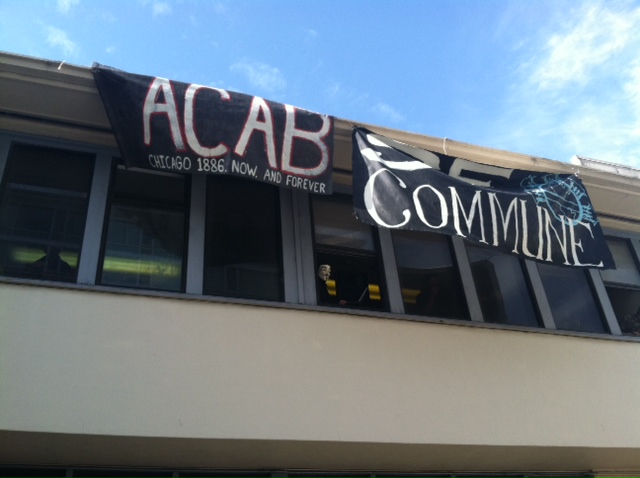
Occupy San Francisco protesters entered Catholic Church-owned properties at 888 Turk last night. This is the same building that a similar group occupied April 1, in a peaceful action that lasted about 24 hours. 

The successful reentry was a testament to the spread of skills and cultures surrounding building takeovers by groups like Homes Not Jails. The resulting “rebirth of the SF Commune” was a mellow and pleasant event at first, as protesters on a march from the celebratory Peoples Street Festival joined in the commune. Some held back in the street while others entered the building in hopes of building a “community center”—most remained outside the building, enjoying a free meal cooked and served by some of the same Occupy SF kitchen volunteers that once fed hundreds of people daily at Justin Herman Plaza.


The building occupation was meant to affirm a strong belief in the rights of people to gather and organize, or at the very least have a warm place to sleep at night. It was also an assertion from Occupy: we’re still here, your warnings to property owners to board up their vacant buildings and the chain-link fence you put up in front of 888 Turk (which protesters casually removed upon arrival) won’t stop us.

“The Catholic church owns it. They’re supposed to be doing charity, but they’re leaving it vacant until they can get high rent out of it,” said Jazzie Collins that afternoon, an organizer with Senior Action Network who was there to support the May Day actions.

“There’s too many vacant buildings in this city, while people sleep on the streets.”

Collins spoke only for herself, but her take on the situation matched the sentiments of many who questioned the importance of property rights in the light of unused building and homelessness throughout the city. That’s the same reason that the SF Commune had sprung up in the same building, exactly one month earlier.

Police spokesperson Sergeant Michael Andraychak seemed to believe that this repeat occupation would turn out the same way. “We’re putting up some barricades attempting to restrict access to the building,” said Andraychak around 5pm. “We’re opening traffic back up.”

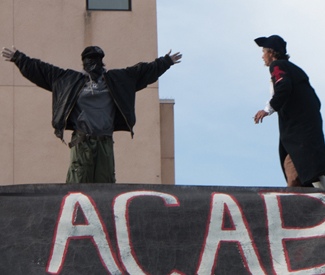
But not half an hour later, when the police put up the final barricades sealing off access to the building, the dozen or so people who got caught inside pushed back at the barricade. Police responded with intimidating and striking a few with batons. Then, a man appeared on the roof.

His face was covered in a black bandanna. He raised his arms, and in each hand, he held a brick. Onlookers began shouting, “don’t throw those!” He did though. He hit one man in the face, a fellow protester who, according to one source, has supported the Occupy SF effort since the camp.  

The mood of the crowd chilled. The brick-thrower held up more bricks, menacingly. 

Police closed the street off to traffic. Soon most protesters, supporters, and interested bystanders were on the other side of Gough or in the park, watching the events. A few spoke to and yelled at police lined up on the corners. Hundreds more police stood ground on Turk in front of the building. A few dozen remained inside, including one who had appeared on the roof, taken the bricks from the assailant, and tossed them off, out of reach.

Police arrested a suspect for the brick throwing as he exited the building out the back. Jesse Nesbitt, 34, is in custody in San Francisco County jail on $150,000 bail. According to sheriff’s department spokesperson Susan Fahey, he has been charged with three penal code violations: felony assault with force likely to cause great bodily injury (245a), assault on a peace officer with force likely to cause great bodily injury (245c), and felony vandalism of more than $400, 594b1.
 
A dozen or so remained in the building during the stand-off. Some poked their faces out an open window, hung down peace sign painted on a piece of cardboard, and talked into a megaphone. “We are not armed, we are completely peaceful,” one man assured. Meanwhile, police told press that they estimated 200 were inside and were “stockpiling pipes, bricks.”

The stand-off continued for a few hours until, at 7:30pm, police cleared out of the area. Most activists had left- thousands were massing in Oakland. But 40 or so people remained and re-entered the building. Many stayed until police came around 5am, arresting 26. Seven remain in custody, and all have been charged with trespassing. (Indicating that the weapon stockpiling concern turned out to be false. Which, as far as I could tell inside the building, it certainly was).

At that point, I entered the building as well to speak with those that remained. How did they feel about the violence? Did they think it was connected to the previous night’s events, when mysterious protesters destroyed numerous Valencia St businesses and cars in what some Occupy SF protesters suspect was an act of provocateurs?

For a response to come from Occupy SF, it must be consented on at a general assembly, a long process. So all the respondents represent only themselves- though most chose to remain anonymous. This structure can lead to a troubling lack of accountability: if something harmful happens at an action, who can be expected to explain it and help to prevent it in the future if everyone is responsible for only themselves? At the same time, each personal answer is less riddled in spin than a form answer would be, since people speak honestly, and for only themselves.

The Valencia St destruction “was enough that I didn’t come out and do anything today, whether it was Occupy or not,” one woman who had been “pretty involved in camp, back when it was at JHP” told me. “They were there to piggy back off an Occupy event, to use the organization of Occupy to organize themselves,”

The brick incident, however, did not caution her against showing up, as she did later that night. “Incidents like this happen often with mentally ill or violent people, but they get more publicity when they’re at an Occupy event.”

D, a longtime Occupy SF organizer, said wearily that “we were all surprised” at the incident.
“We weren’t expecting any bricks to be thrown,” he said, “and we didn’t want anyone to get hurt.”

But in terms of preventing similar actions in the future, D said, “We can only do so much. Everybody’s an autonomous individual and we can’t control what they do.”

“We can try to clean up everything that could be thrown, we did that last time. This time we focused more on stopping graffiti in the building. There wasn’t any.”

“That’s my friend. When I saw the brick flying at his face, I was hurt. Half our crew is in the hospital with him right now,” said another organizer. “But the real violence is the system putting people on the street, and the cops enforcing that. I’ve seen [Nesbitt] beat up by police.”

“What should we do, just turn our backs on people with mental illnesses?” another piped up.

“This whole occupy thing at this point is so spread out and separated,” said a self-described Occupy SF supporter. “There are parts that are revolutionary and parts that are more reform, and they’re trying to bridge that. I don’t know what it is at this point anymore. But I know I support a movement to articulate the rage at what’s happening in our country right now.”

City case speculates about Mirkarimi’s interference with investigation

111

The City Attorney’s Office laid out much of its case against suspended Sheriff Ross Mirkarimi yesterday when it released a list of witnesses and their expected testimony, as requested by the Ethics Commission, and it offers little support for the city’s accusation that Mirkarimi dissuaded witnesses or sought to destroy evidence of a crime, which are among the most serious allegations in the official misconduct case against him.

The longest and most significant section in the brief was the testimony of Ivory Madison, the neighbor who initiated the police investigation into whether Mirkarimi physically abused his wife, Eliana Lopez, during a Dec. 31 incident that she subsequent reported to Madison, who made a video of her story and a bruise on her arm.

It was the most detailed account yet of what happened from the perspective of Madison, who has refused media interviews, and it differs in some key areas from accounts that Mirkarimi gave to the Guardian and other media outlets.

For example, Mirkarimi said he grabbed his wife’s arm in the car during a heated argument and that tempers had cooled by the time they went inside. But Madison is expected to testify that, “Inside the house, Sheriff Mirkarimi pushed, pulled and grabbed Ms. Lopez, who was crying and screaming, as was their son. Ms. Lopez asked Sheriff Mirkarimi to stop, and said look what you’re doing to our son. Ms. Lopez then ran out of the house. While both inside and outside the house, Lopez was yelling, do you want me to call the police. When Ms. Lopez yelled about calling the police while outside, Sheriff Mirkarimi said no, come inside. Ms Lopez went back inside.”

It is unclear from the memo whether Madison was a direct witness to those events or whether they were relayed to her by Lopez, but it sounds like the latter given that the story is in a paragraph that began with the phrase “According to Ms. Lopez.” Since the incident, Lopez has consistently denied that Mirkarimi abused her and downplayed the conflict. The only other neighbor on the witness list, Callie Williams, wasn’t at home during the conflict, but she’s expected to testify that Lopez told her about that and an earlier instance of abuse and that “Sheriff Mirkarimi was scared that she was going to tell people what happened.”

While Madison’s expected testimony confirms Lopez’s account that the video was made to be used in the event of a child custody battle if the couple divorced, Madison’s account paints Lopez as actively worried about her safety: “Ms. Madison suggested calling the police. Ms. Lopez was afraid that the police would not believe her and would not protect her from Sheriff Mirkarimi, and was concerned about what the police could do to protect her.”

It also confirms what journalist Phil Bronstein, a friend Madison called for advice, told the Guardian about Madison’s initial call to police being a simple inquiry and that she didn’t intend to initiate a police investigation just yet. And it indicates that “Ms. Lopez was unhappy about the investigation. Ms. Lopez called Linnette Peralta Haynes (Sheriff Mirkarimi’s campaign manager in the November 2011 election) on her mobile phone. After speaking with Ms. Haynes, Ms. Lopez handed her phone to Ms. Madison. Ms. Haynes attempted to dissuade Ms. Madison from cooperating with the police and attempted to persuade Ms. Madison to lie to the police.”

Yet there is nothing in Madison’s expected testimony to indicate Mirkarimi was behind any of these efforts, and he denies it and says that he wasn’t even aware that Lopez had talked to Madison or made a video or that police had been called at that point. Peralta Haynes, who sources say is in the late stage of a difficult pregnancy, hasn’t cooperated with the investigation so it’s obviously speculative on the city’s part to indicate that she was acting as Mirkarimi’s “agent” in thwarting the investigation, as the city is claiming.

The only “evidence” that the city seems to offer in support of its accusation that Mirkarimi tried to thwart the criminal investigation comes from Madison’s husband, Abraham Mertens, who is expected to repeat the claim he first made in a controversial March 20 op-ed in the San Francisco Chronicle that, “During the time that SFPD inspectors were interviewing Ms. Madison on January 4, Mr. Mertens received a telephone call from Eliana Lopez urging him to make Ms. Madison stop talking to the police. Mr. Mertens heard Sheriff Mirkarimi’s voice in the background,” a more resolute version than Mertens had previously given when he wrote in the op-ed: “I recognized what I thought was Ross’ voice in the background.” Mertens also has not answered Guardian calls.

Mirkarimi categorically denies that he was present during that phone call and says that he was in meetings at City Hall and that he wasn’t aware that any of this was happening at the time. And he has denied urging Peralta Hayes to get involved, but her testimony could evolve into evidence if the city can show they talked before she spoke to Madison, but that’s still speculative. The city is seeking live testimony from Peralta Haynes about her communications with Mirkarimi on Jan. 4 and before.

During the recent Ethics Commission hearing on setting up procedures for the hearing, Mirkarimi attorney Shepherd Kopp noted that the city hadn’t done key interviews or collected physical evidence (such as phone records or the Lopez video) to support its charges against Mirkarimi before making its allegation, something that Deputy City Attorney Peter Keith didn’t dispute, noting that the the city had not yet received much of the evidence that it intends to present, such as the video.

The city appears to be banking on compelling incriminating testimony from Lopez and Mirkarimi, who they plan to treat as hostile witnesses. The other interesting name on the city’s witness list was Mayor Ed Lee, who the city is recommending give live testimony and who could also likely be subjected to a vigorous cross-examination that could have interesting political ramifications.

Lively crowd takes over Financial District

7

Click here for more breaking May Day action coverage

About 1,000 people gathered in the Financial District for a May Day convergence, blocking traffic at the intersection of Market and Montgomery and painting a huge yellow sun on the street with the caption “Rise up 99% Levántese!”

The lively crowd listened to music and speeches and participated in street theater.

Police were on hand in a line in front(415) 517-5910 of the Wells Fargo bank but as of the time of this post, there were no arrests.

In sharp contrast to the violence in the Mission, the actions have been peaceful.

The first march left 24th and Mission at around 10:15. Focused on immigrant rights — long a central tenet of May Day in the US — the event was planned by a large coalition including Mujeres Unides de Activas, HAVOC, SF Pride at Work, Young Workers United, and others.

The upbeat crowd of several hundred made its way to 16th and Mission, where police stood by as protesters took over the intersection for street theater.
A giant puppet representing the Earth held center stage. One player represented a banker; another tried to buy a house, but wound up homeless. When the victim of financial-sector greed sat down on the street, a “police officer” arrived to make a sit-lie arrest.

Tiffany Altamirano, with Young Workers United, told us, “My husband is undocumented. People are here whose brothers sisters and parents have been deported.”

The crowd took the intersection for about 40 minutes.

By mid-day the action had moved downtown, to the Westfield Mall, where a banner was dropped inside and pickets stood outside, showing solidarity with the SEIU Local 87 janitors who are in a dispute with building management.

Soon nearly 1000 converged on Market and Montgomery. Activists with The International Forum on Globalization giving away hundreds of books and pamphlets with critiques on global capitalism. A massive cutout of Goldman Sachs CEO Lloyd Blankfein stood in the middle of Montgomery, looking evil, with a message decrying corporate power.

Almost two dozen SFPD cops stood guard, with six police vans waiting nearby to haul away protesters. But the authorities seemed to be just letting the party happen with no orders to disperse.

Steven T. Jones contributed to this report.

On eve of May Day, Valencia, Mission Police Station vandalized

37

A group of protesters left a trail of broken glass and paint tonight as they made their way from Dolores Park to Duboce on Valencia. Windows were broken, garbage cans overturned, paint bombs thrown, and messages saying “yuppies go home” as well as anarchist symbols were spray-painted on several restaurants, art galleries and cafes.

The façade of the police station on Mission and 17th was vandalized and broken.

A gathering at Dolores Park was advertised as a “a ruckus street party to counter gentrification, capitalism, and the policing of our communities.” About 200 attended, and chatted about their plans for the following day’s May Day activities while music played.

Shortly after 9pm, the group left the park and began to march on Dolores. Some overturned recycling bins and vandalized the windows at Farina restaurant minutes after turning the corner on 18th St, while others held back.

Dozens flocked to the sidewalk and began yelling, “this is not an Occupy SF action!”  while passers-by looked on, concerned.

The group turned on Valencia, continuing to shrink in size and break windows. Within half an hour there were less than 50 people in the march.

About 40 of police on foot followed the march along Valencia, trailing behind as vandalism continued. SFPD representatives were not immediately available for comment, but based on witness accounts there were no arrests.

Neighborhood residents were angered and confused by the destruction. One man who did not wish to be named said, “They kept doing it while other people in the march were trying to get them to stop. It was childish.”

Occupy Oakland protester Jesse Smith told CBS he was “more than a little shaken” by the events. 

“I know Occupiers,” Smith told CBS. “None of us have any idea who they were.”

A message on the Occupy SF website reads, “The march in the Mission Monday night was not an OccupySF event. OccupySF does not endorse this kind of destruction of the 99%’s property. The individuals involved in this destruction are not known to OccupySF, and we believe they are outside provocateurs sent in to tarnish the image of Occupy prior to the May Day actions.”

Fly Benzo sentenced to three years probation

16

Debray Carpenter, aka Fly Benzo, was sentenced in court April 27. He received three years of probation with a long list of conditions.

Benzo, student at City College, was arrested at an Oct. 18 rally in Mendell Plaza. During that incident, police officers John Norment and Joshua Fry of the Bayview precinct apparently unplugged a boombox that they said was not authorized in a street outlet. Then, when officers began videotaping Benzo, he took out his camera phone and began videotaping them as well. He was convicted of misdemeanor assault of a police officer and misdemeanor resisting arrest by Judge Jerome Benson on Feb 22.

April 27, in a courtroom with dozens of supporters, the judge announced that Benzo would serve six months each in county jail for three counts of which we was convicted, but as the six-month sentences for counts one and three could be served concurrently, the jail time would add up to a year total.

However, these sentences were suspended, and barring a change, Benzo will not serve that jail time.

The conditions include a ban on the possession of weapons, a requirement to submit to any search and seizure by police officers with or without a warrant, an order to complete anger management classes, a stay-away order from Third St. between Oakdale and Quesada, a requirement that he be enrolled full time in school and/or work, a requirement to obey all lawful orders by a police officer as well as remain arms-length away from all police officers, and about $1,000 in fees for expenses like booking and court assessment.  

The judge also ordered 30 days in country jail, although 11 days already served brought the sentence to 19. However, Benzo will likely serve those days through the sheriff’s work alternative program (SWAP)—that means 19 days sweeping up the sidewalks in an orange vest. 

Benzo served the 11 days before he was released on $95,000 bail.

Judge Benson also ordered that Benzo apologize to SFPD officers Norment and Fry, although the apology is not a condition of probation.

“A true apology comes from within, and it would not be a true apology if I order it,” said the judge, who came out of retirement to preside over Benzo’s case.

Benzo’s lawyer Severa Keith stated objections to two of the conditions: the requirement to submit to searches and the stay-away order. Keith objected to the search requirement on the grounds that neither contraband nor weapons plays no part in his case, and Benzo was not in the possession of either at the time of his arrest.

The area of the stay-away order includes Mendell Plaza.  An important public square in Bayview, the plaza’s meaning was given new weight when it was the site of the killing of Kenneth Harding, Jr

Harding, 19, was killed in August 2011. Harding was leaving a T train when police asked to see his transfer. Harding presumably panicked and ran away from the police. Officers shot at him as he ran, then, in a video that has circulated widely, stood around him as he bled to death.

Mendell Plaza is directly across the street from the Joseph P. Lee recreation center and the Bayview Opera House, some of the main neighborhood venues for entertainment and community gatherings. This street that divides the plaza from the opera house and rec center- Oakdale- is the cut-off for the stay-away order, so both Keith and Benzo asked Judge Benson to specify whether these locations were included in the stay-away. 

After studying a map of the area, Judge Benson concluded that the opera house and rec center are outside the bounds of the stay-away order. 

“We just did an event a few weekends ago where we fed over 100 people at that location,” said Benzo to the judge. “This order will prevent me from serving the community in the way that I do, as well as providing entertainment and education for the community.”

According to Benson, there’s a chance that the stay-away condition will revoked or altered when it is brought up again at Benzo’s SWAP hearing, scheduled for June 8. 

Keith said of the sentence, “It’s not bad. I was working for probation, not jail time.”

However, she still plans to appeal, in large part due to what she sees as crucial evidence that was excluded from the trial surrounding Benzo’s history with the officers Fry and Norment. 

According to Keith, the jury didn’t hear evidence about “racist and unprofessional things” that the officers said to Benzo on occasions leading up to the incident.

“They deliberated for a long time- four days. And what I heard from the jury was that they though police were baiting him, and didn’t condone the police behavior, but they thought Debray’s reaction was too much under the circumstances,” said Keith.

But Keith said those circumstances include a long history of police harassing Benzo.

“It wasn’t a one-time thing,” she said. “And we have witnesses ready to testify to that.”

As for Benzo, he’s relieved not to be serving jail time, but wary of many of the conditions. 

“They gave me a stay-away order, which they usually don’t give unless you’re caught dealing drugs,” Benzo told the Guardian.

“It will drastically affect my life. Now I can’t even organize in the community.”

Pissed off shareholders, homeowners, and taxpayers converge on Wells Fargo meeting

12

Wells Fargo managed to hold its shareholder meeting April 24, but not without difficulty. A protest against the bank’s ongoing part in the foreclosure crisis, investments in the private prison industry, and record of tax dodging brought some 2,000 people to the West Coast Wells Fargo headquarters at 465 California St. for the meeting.

A broad coalition, including more than 180 Wells Fargo shareholders, as well as organized labor, students, immigrant rights advocates, and Occupy protesters, swarmed the building. Many entered the building, and others blocked its entrances and set up a stage on California, turning the block between Montgomery and Sansome into a combination alternative “stakeholders meeting” and block party.

Streets surrounding the headquarters were closed for more than four hours, as both protesters and some 200 police in riot gear stood their ground; there were 24 arrests, mostly for trespassing.

Participants hailed from across the country, from students from the University of Minnesota to steel workers from Redding, Penn. Demonstrators were explicitly and enthusiastically “non-violent.” One local organizer from the Alliance of Californians for Community Empowerment (ACCE) announced, “This is a non-violent direct action,” to an eruption of cheers from the crowd, at a rally preceding the march.

Police say organizers stuck to their tactical intentions. “I think it was a successful event,” said Sgt. Michael Andraychak, a spokesperson for the SFPD. “They have followed through with their stated objective: to have a peaceful protest.”

The organizers were somewhat less successful in a stated objective to get a large number of discontent Wells Fargo shareholders into the meeting to ask tough questions. More than 180 attended a training to prepare for the meeting on the night of April 23, but less than 30 made it inside.

However, the meeting was cut short, and organizers claim that in barring a number of shareholders, Wells Fargo acted illegally and the result of votes from meeting may be invalid.

Many shareholders were particularly incensed about public subsidies that the company took advantage of in 2008. In an amendment to the tax code that lasted only three months before Congress revoked it, the IRS gave tax breaks to healthy banks that acquired banks that were faring more poorly; Wells Fargo acquired Wachovia during the three month window. As a result, the company received $17.96 billion in tax breaks between 2008 and 2012, significantly more than the cost of the Wachovia deal.

Protesters hoped to disrupt the meeting to demand that the bank pay more taxes. Wells Fargo announced record profits this year, as well as a $19.8 million pay package for CEO John Stumpf. Stumpf has earned $60 million in the past three years.

“If they were paying their taxes, we wouldn’t have to do this” said Al Haggett, a retired San 911 worker who trained dispatchers and police.

Ron Colbert, another shareholder and a worker for Sacramento’s school district, also attempted to enter the meeting. “My sisters and brothers are suffering from foreclosure and they are pocketing our money instead of paying their taxes,” said Colbert.

“Tuition keeps going up every year. I have loans like you wouldn’t believe: $15,000, and it’s just my first year. But I pay my taxes, so why can’t they?” said Andrew Contstas, a psychology major at the University of Minnesota who traveled to San Francisco for the protest.

Determined to shut down the meeting, many groups of protesters entered the building at different times.

Around 10:30 am, about 75 were able to get in and sit down in the lobby, refusing to leave. “They said if we dispersed, they would let the shareholders in,” said SEIU Local 1021 organizer Gabriel Haaland, referring to the shareholders who came to protest and air their grievances. “They still didn’t. But they let shareholders in from either side.”

Many non-protester shareholders were able to enter through back entrances, escorted by police.

Workers from several unions who are currently locked in labor disputes, including janitors with SEIU Local 87 and AT&T technicians with local Communication Workers of America chapters, were also present at the protest. A stage set up in front of Wells Fargo turned California into an arena in which worker, student, homeowners, and immigrants told their stories.

Chris Drioane of CWA Local 9410 said that he is fed up after he worked 80-90 hours per week with no days off though the 2011 holiday season. “I worked from Thanksgiving to Valentine’s Day with no days off,” said Drioane.

The SFPD made 20 arrests, six for “chaining themselves to an object” and 14 for “some form of trespassing” after Wells Fargo asked them to make the arrests. Four were arrested by the Sheriff’s Department for interfering with an officer.

Ruth Schultz, a shareholder who was arrested inside the meeting, said that those who entered were able to speak. Several stood up and spoke individually before they were escorted out; afterward, the remaining protester-shareholders mic-checked the meeting and expressed their desire that Wells Fargo cease investment in private prisons, give principal reduction to all underwater homeowners, and pay “their fair share” of taxes. Police handcuffed them, and they were cited and released after spending 30 minutes in a room inside the Wells Fargo headquarters.

Schultz says the meeting lasted only 15 minutes after the group was detained, and was “ceremonial at best…They went on about their profits this year, how they’re sitting on the most capital they’ve ever had before.”

She says she was particularly frustrated from one statement made by CEO John Stumpf. “He said, ‘we’re proud of our mortgage business. In fact, I love our mortgage business.’”

A press releases from organizers explained that the protest was part of “99% Power, a national effort to mobilize well over 10,000 people, from all walks of life and representing the diversity of the 99%, to engage in nonviolent direct action at more than three dozen corporate shareholder meetings across the country.”

The national group plans to create similar chaos at a Bank of America shareholder meeting in Charlotte, NC May 6.

“This was such a wipeout psychologically”: Mirkarimi tells the story Lee didn’t want to hear

89

As Ross Mirkarimi and his legal team prepare for a trio of legal hearings that could determine the future of his career, the suspended sheriff sat down with the Guardian for nearly two hours in his first extended interview recounting what happened during that fateful New Year’s Eve conflict with his wife, their actions in its aftermath, and whether any of it should cost him his job.

As the story continues to unfold, and the facts come out, it’s becoming more and more clear that neither of two central players – Mirkarimi’s wife, Eliana Lopez, and the neighbor who called the police, Ivory Madison – had any idea how this would play out, or, apparently, any desire for the incident to bring down the elected sheriff.

Mirkarimi has been in a bind for much of the last four months: Because of a pending criminal case, he hasn’t been able to tell his side of the story. And since he pled guilty instead of going to trial, his version of events is only now beginning to trickle out.

And the interview made clear that the man who has in the past been accused of arrogance has lost a lot of his ego.

“This was such a wipeout psychologically,” Mirkarimi said. “It makes me immensely insecure and has left me in vulnerable state.”

He looks it – the elected sheriff’s face is drawn, almost haggard. His once-frequent smile and laughter is almost gone.

>>Read our full Mirkarimi coverage here.

He’s a politician who freely admits he had marital troubles, was in some ways a bad husband, treated his wife poorly and, in an incident sparked by his own anger, physically hurt her. He knows he’s let down his supporters and damaged his once-bright political future.

He’s struggling to keep his job, arguing that the incident has been blown out of proportion and inappropriately used to remove him from elected office, with Mayor Ed Lee showing a reckless disregard for the truth before making the rare decision to institute official misconduct proceedings.

And you don’t have to endorse Mirkarimi’s actions or even agree that he should stay in office to find indications that the mayor’s case against him is shaky and at times clearly unfair.

Judge Harold Kahn will hear arguments today [April 19] that the City Attorney’s Office should be barred for overseeing the official conduct proceedings, and the next day he will hear Mirkarimi’s main challenges to Lee’s actions, including the arguments that the city’s official misconduct statute is unconstitutionally broad and that Mirkarimi was denied due process before being suspended without pay.

Then, on April 23, the Ethics Commission will convene to discuss procedures for handling the case.

Some key issues that could affect the outcomes of the city and court processes involve what Mirkarimi actually did – as opposed to what others have suggested he did. The whole thing may hinge on whether the sheriff did anything to hinder the domestic violence investigation, what his plea deal to official misconduct entailed – and whether the mayor made efforts to differentiate between fact and rumor.  

But let’s start at the beginning, just before lunchtime on New Year’s Eve, with a story that Mirkarimi told in great detail as we peppered him with questions seeking details on what happened, what his motivations and thoughts were at critical junctures, and what it all meant.

Around 11:45 am on Dec. 31, Mirkarimi, Lopez, and their nearly three-year-old son, Theo, got into their red 1998 Dodge Caravan to go to lunch at Delfina Pizzeria. Just before leaving their house on Webster Street, the couple had started talking about how Lopez wanted to take Theo on a trip to her native Venezuela to visit her father, who is battling cancer.

“It was not an unfamiliar topic,” Mirkarimi said, recounting how it had become an issue of increasing concern by him after her three previous trips had each been extended. They had been having marital problems, and he told us he was concerned that she might not come back – or that Theo could be at risk of kidnapping.

“We didn’t have a plan and there was no permission,” Mirkarimi said, with “permission” meaning his written permission to take their son out of the country, which he had learned from a lawyer was required. “The body of our quarrel on Dec. 31 is we need a plan.”

But Lopez told him in the car than she had also talked to an attorney and she contested that it was as clear-cut as Mirkarimi claimed. He later learned that the “attorney” Lopez was referring to was their neighbor, Ivory Madison, a writer who had attended law school and noted her “legal training” on the www.redroom.com website she ran with her husband, lawyer Abraham Mertens. But Madison hadn’t taken the bar exam and wasn’t licensed to practice law in California.

“This was a sucker punch, it really walloped me,” Mirkarimi said of the news that Lopez was speaking with an attorney, and it made him angry. “I was acting inappropriately, I swore at my wife and said ‘where is this coming from?’ So I could have handled it better.”

“I decided, because we were quarreling, to make the unilateral decision against Eliana’s wishes to turn the car around,” he said.

This, he contends, was the act that constituted false imprisonment, the misdemeanor charge that he pled guilty to last month in exchange for prosecutors dropping misdemeanor charges of domestic violence, dissuading a witness, and child endangerment. Mirkarimi contends this was the only point in their conflict in which he restrained his wife’s freedom. Other reports suggest that he didn’t let her leave the house shortly after the conflict, which he denies.

Mirkarimi’s criminal attorney, Lidia Stiglich, told us false imprisonment is a very broad term, and because it was such low-level charge, there wasn’t a specific action it covered. In other words there’s nothing factual in the legal record or anywhere supporting the notion that Mirkarimi actually held his wife against her will.

“You don’t need to agree to a factual basis to plead to a misdemeanor,” Stiglich said, noting that Mirkarimi’s interpretation is reasonable, but prosecutors might mean something different by it. “We can agree to disagree,” she said, although she acknowledges that vagueness has opened him up to a variety of interpretations in the political arena.

In other words, the notion that a sheriff, who oversees the jails, has pled guilty of false imprisonment looks just terrible, and has been been played up in the press. But it’s not clear that he actually imprisoned anyone, beyond refusing to take his wife and son to lunch. It’s an oddity of law, and the nuance doesn’t play well in a scandal-crazed media.  

But back to the day of the incident.

“I was loud, I was gruff, I was just pissed off, and I am ashamed of my behavior,” Mirkarimi said. By the time they got back home, the sheriff-elect had calmed down, but Lopez was getting increasingly angry at being mistreated.

He said she quickly got out of the car and was brusquely trying to remove Theo, who was crying and upset over his parents’ conflict, from his car seat. “I got scared because Theo was in danger a little bit,” he said, his voice choking up and eyes filled with tears, saying that he reached back and grabbed Lopez’s right arm, with three fingers under her arm, while he was still seatbelted into the front seat.

“Eliana reacted like, get away from me, and she tugged her arm,” he said. “The incident was minutes.”

Inside the house, tensions quickly de-escalated, he said, and they didn’t discuss the conflict again that day. They went grocery shopping together, brought home takeout for dinner, and Lopez went out briefly that night while Mirkarimi stayed home with their son.

But the next morning, she showed him the bruise that had formed on her right bicep where he grabbed her. “She said, ‘Look,’ and it just crushed me,” Mirkarimi said, adding that he apologized for hurting her and that he agreed to go to couples counseling.

Lopez had been asking her husband to seek counseling for some time, he acknowledged, and he’d been putting it off. “I take full blame that that didn’t happen earlier,” he said.

Then, mid-morning, Lopez told him that she was going to talk with their neighbors, Madison and Mertens, who Mirkarimi considered “nice people. They were supporters during my race, but I didn’t know them that well.” He said that he didn’t think much of it or worry that she might talk about the previous day’s incident, although he said he did make the connection after she left that perhaps this was the “lawyer” Lopez has referred to the day before – something she later confirmed.

From Mirkarimi’s perspective, the next few days were uneventful. The family left for a long-planned vacation to Monterey the next day, staying at the Intercontinental Hotel and taking Theo to the Monterey Bay Aquarium. He said they talked “a little” about their New Year’s Eve conflict. “We were trying to gauge each other and our comfort level in talking about this,” he said. 

But Mirkarimi didn’t know about the storm that was brewing. He said he had no idea that Lopez had heeded Madison’s suggestion on Jan. 1 to make a video in which Lopez tearfully recounted the grabbing incident and displayed her bruise. Lopez, a former Venezuelan soap opera star, has consistently denied publicly that Mirkarimi ever abused her and has said, directly and through attorney Paula Canny, that the video was intended solely to be used in child custody proceedings if their marriage continued to devolve and that Lopez assumed she was getting legal advice and that the communications were private and subject to attorney-client privilege.

But Madison, who has not returned calls from the Guardian or other media outlets, wrestled with whether to go to the police and sought counsel on the question from several people, as information obtained by Mirkarimi’s team during discovery showed, including Phil Bronstein, the former editor for the Examiner and Chronicle who now chairs the board of the Center for Investigation and Bay Citizen.

Madison had two phone conversations with Bronstein, the veteran journalist told us. He said he knew Madison socially and “she gave me a brief narrative of the events.

“I said you should do whatever you think you should do to keep Eliana safe,” Bronstein told us.

Bronstein said he doesn’t know what happened between Mirkarimi and Lopez, but he understood from Madison that she was acting on behalf of Lopez, that the two women were communicating by text and e-mail, and that “I got the impression that Eliana was still trying to figure out what she wanted to do.”

“Eliana was continuing to e-mail with Ivory, saying he was being nicer now,” Bronstein said, but Madison was still concerned enough that she didn’t want to let the incident go, so Bronstein said she decided to call the San Francisco Police Department on Jan. 4 to get information on whether domestic violence incidents could be reported several days after they occurred, a decision he learned about after the fact.

“Ivory called the police hotline hypothetically to get information on when they can file,” Bronstein said, recounting a phone conversation they had on the afternoon of Jan. 4. But he said Madison was told by police that she could be charged with obstruction of justice for not reporting a crime – which isn’t exactly true under California law – and that SFPD had sent officers to her house to discuss the matter.

Shortly after that visit from police, Madison called Bronstein to tell him the story. “She was surprised that an inquiry had triggered a police investigation,” Bronstein said. Madison’s initial refusal to turn the videotape over to police, who needed a court order to seize it, is another indication that perhaps she didn’t want this case to explode the way it did.

In one version of events that Bronstein has discussed, Madison told him she wanted to help Lopez get in touch with three people who might be able to talk to Mirkarimi and convince him to seek counseling. Madison asked Bronstein if he had phone numbers for Aaron Peskin, Mike Hennessey and Art Agnos.

The odd thing about that is that Lopez already knew the three, and that their contact information was in the couple’s house.

But Mirkarimi had no idea any of this was going on, or even that his wife had discussed their conflict with Madison and made the videotape. “Everything happened on the 4th of January and literally I was the last one to know,” Mirkarimi told us.

Months later, Mertens wrote an op-ed for the Chronicle (“A neighbor’s side of Ross Mirkarimi case,” 3/20) in which he alleges Mirkarimi “paid a team of lawyers to relentlessly attempt to discredit, dissuade, and harm my wife,” although he didn’t return Guardian calls seeking comment or clarification of what he meant.

“The last time I spoke to Eliana was when she called me on Jan. 4. I recognized what I thought was Ross’ voice in the background as Eliana pressured me to destroy evidence and lie to the police. Then she repeatedly called Ivory, demanding that Ivory destroy the video, e-mail and texts from Eliana about the incident,” Mertens wrote. The allegation was parroted in the city’s official misconduct charges against Mirkarimi, which claim he “or his agents” sought to destroy evidence and obstruct the investigation.

But Mirkarimi and his lawyers say the charge is simply untrue. “The idea that he sought to get the videotape back or destroy it is nonsense,” Waggoner said, noting that Mirkarimi wasn’t even home as these events unfolded – on that fateful January day, he attended a ceremony marking the demolition of the old jail and then was in a long Budget Committee meeting, followed by a farewell celebration from the Local Agency Formation Commission. In other words, he couldn’t have been “in the background” during that call.

In fact, as far as we can tell, there is no evidence anywhere that Mirkarimi ever contacted Madison or Mertens. “I never talked to Ivory Madison and I never talked to her husband, Abraham Mertens, after any of this happened,” Mirkarimi said.

Mirkarimi said that Lopez first told him that she had told Madison about the grabbing incident by phone on the afternoon of Jan. 4, shortly after Madison told her in the street that she had called the police and they were on the way. Lopez didn’t know what to do and wanted to come meet her husband near City Hall. The officers that came tried to talk to Lopez, but she refused.

“She was panicked because she thought things were getting out of control with this neighbor and she asked for my recommendation,” Mirkarimi said, noting that Lopez literally ran from their home to City Hall and met Mirkarimi outside on Grove Street. It was then, he said, that Lopez first told Mirkarimi about making the videotape.

Mirkarimi said he greeted the news with stunned disbelief, and that his first instinct was to try to help his panic-stricken wife, but that he didn’t know what to do. “She was petrified about what was going on…She was frantic and I was getting frantic too,” he said. “I didn’t have a remedy, except oh my God, I think we need an attorney.”

They made a couple calls to find an attorney, and he said Lopez had the idea of having their friend, Linnette Peralta Haynes, a domestic violence advocate with the Our Family Coalition, reach out to Madison about why she had gone to police and what could be done at that point. “I had no idea what they were going to talk about,” Mirkarimi claims. Peralta Haynes didn’t return our calls and she is reportedly being sought as a witness by the City Attorney’s Office in the official misconduct proceedings.

Mirkarimi is adamant that he never did anything to gain possession of the videotape, dissuade his wife or any other witnesses from talking to police or prosecutors, or otherwise interfere with the investigation, even though Lopez was appealing to him to do something.

“She really wanted me to stop it, and I was like, dear, this bell has already rung and I don’t think we can unring it,” Mirkarimi said.

Lopez has said publicly that she felt betrayed by Madison, and Canny filed motions to suppress the video on the grounds of attorney-client privilege, conflicts that seem to have soured the relationship between the two women and fed feelings by Mertens that Madison was wronged for doing the right thing during the media circus that followed.

As a result, as part of Mirkarimi’s plea deal last month, the District Attorney’s Office insisted that Mirkarimi publicly apologize to Madison. It was an odd demand, since nobody (other than an op-ed writer in the Chron who gave no substantiation for his charges) had ever said that Mirkarimi had any contact at all with Madison.

DA’s spokesperson Stephanie Ong Stillman explained the insistence to us this way: “Ivory Madison’s actions were courageous. She found herself in a difficult situation trying to protect a friend who was in danger. In a surprising and disappointing turn, she was vilified for this act of courage. She suffered much unnecessary public scrutiny.”

Stillman wouldn’t deviate from that prepared statement when we asked specifically what Mirkarimi had done to Madison – or if there was any indication that the sheriff had ever done anything to “vilify” her – but she did said that the insistence on that direct apology was about encouraging witnesses of domestic violence, an underreported crime, to come forward. “We didn’t want other witnesses to be discouraged from reporting crimes after seeing what Ivory Madison went through,” she said.

Yet Stiglich said Canny’s motions and the divisions that developed between Lopez and Madison had nothing to do with Mirkarimi: “There were lot of actions taken by Eliana’s lawyers that caused a backlash that affected Ross.”

It’s not a minor issue: The allegation that Mirkarimi attempted to dissuade witnesses and used his official position to gain advantage is central to the mayor’s formal misconduct charges. But Mirkarimi and Stiglich maintain that there is nothing in the public record that supports the charge that he dissuaded witnesses or that he used his position as sheriff to gain advantage either before or after the incident.

“I was very surprised to see the allegation from the Mayor’s Office about dissuasion [of witnesses or interfering with the investigation] because there was no evidence of that,” Stiglich said. “He was the last person to know there was a video and that police were involved.”

It appears that Mirkarimi thought his guilty plea would end the case – and it was crafted not to give the mayor any grounds for removal. “I would not have entered a plea in a way that would inhibit my ability to be sheriff,” Mirkarimi said. “This was a very lucid conversation.”

In fact, he said, his instinct was to fight the charges all the way. “We were dying to go to trial,” Mirkarimi said.

But the cops and the DA’s Office did an excellent job of creating pre-trial publicity that made it almost impossible for Mirkarimi to get an impartial jury pool. Jury surveys showed that more than 70 percent of the potential jurors had already formed a negative opinion about Mirkarimi based on news coverage, he said.  

He has belatedly sought to address other oft-repeated misimpressions, disputing telling his wife that he would get custody because “I am a powerful man” (he says he told her the U.S. has powerful child custody laws) and saying journalists have distorted his comment that the conflict was “a private matter.”

In a charge that will be central to the upcoming legal battles, Mirkarimi and his attorneys say Mayor Lee wasn’t interested in hearing from Mirkarimi or discovering the truth about what happened before deciding to suspend Mirkarimi without pay and bring official misconduct charges against him. That, they say, denied the elected sheriff his due-process rights.

In his sworn affidavit in the case, Lee characterized his March 19 meeting with Mirkarimi – which he began by asking Mirkarimi to resign within 24 hours or be suspended – this way: “I explained to Sheriff Mirkarimi that I wanted to give him an opportunity to talk to me about this issue. It was a free flowing conversation with no time constraints. Sheriff Mirkarimi told me that he has not yet told his side of the story. I said, Okay, and waited for him to tell me his side of the story. He did not. Instead, after pausing, he asked me whether the suspension was based on his conduct as Sheriff. I responded that it was based on his conduct as a public official. I paused again and waited for Sheriff Mirkarimi to give me whatever information he thought important. He did not. Instead, Sheriff Mirkarimi asked me whether the suspension would be with or without pay. I told him it would be without pay. After giving him another chance to ask questions or give more information, I told Mr. Mirkarimi to consider my instruction to resign over the next 24 hours.”

But Mirkarimi said that narrative isn’t accurate or complete. He had sought to talk with Lee the previous week to explain what happened, but Lee refused. And when he showed up to talk to Lee on the March 19, he brought Sheriff’s Department legal counsel Freya Horne with him and asked that she be included in the conversation, but Lee refused, so there were no witnesses to the conversation.

“I went into that meeting with the express purpose to tell the mayor everything…As soon as I walk in the door, he gives me a little bit of preamble and then asks me to resign,”Mirkarimi said. “I said I’d really like you to talk to Eliana, can I give you her phone number? Nothing…I was asking questions and I wasn’t getting answers.”

Asked why he didn’t just start telling the full story, as Lee’s narrative indicates he was ready to hear, Mirkarimi insists that Lee simply informed him of the decision he had made and didn’t want to hear anything else. “He wanted the meeting to end after a minute, and I dragged it out by asking questions,” Mirkarimi said of the 15-minute meeting. Asked why he didn’t take a more forceful position, insisting on Horne being there or telling his full story, Mirkarimi said, “I’m the guy who’s trying to be contrite, not the one to walk in there with muscle.”

But now that those lines have been drawn, Mirkarimi says he intends to mount a vigorous defense, and he has some serious muscle on his legal team, including Waggoner and Shepard Kopp, who has worked on a variety of high profile cases.

Waggoner said the mayor’s affidavit, which he made under penalty of perjury, “is not truthful,” noting the inconsistency between telling Mirkarimi that he had made a decision to suspend him and saying he wanted to hear his side of story.

“That claim is undermined by his statements after when he describes how the meeting went down,” Waggoner said, saying he’s hopeful that the courts will agree that Lee acted inappropriately. “All that language undermines his initial claim that the purpose of the meeting was to gather information.”

That’s a central question: Did the mayor give the sheriff a chance to defend himself before making the highly unusual decision to suspend him? Or did Lee base that decision on evidence (like Mertens’ opinion piece) that lacked substantiation without giving Mirkarimi a chance to rebut it?

In other words, was Lee’s decision already made when he met with Mirkarimi? And if so, did the city’s chief executive deny another elected official the basic legal right to a fair hearing?

That’s what the courts will address.

Then if the case moves forward, the Ethics Commission will hold hearings –and again, Mirkarimi is at a disadvantage. The Mayor’s Office, through the city attorney, is already sending subpoenas to witnesses and preparing testimony. The defense can’t do that – because there are, at this point, no rules of evidence, no rights for the defense to compel testimony and, frankly, nothing for Mirkarimi’s lawyers to go on.

Four of the five members of the Ethics Commission are lawyers. At some point, they’re going to have to find a way to make this case comply to the rule of law.


Lee veto protects the SFPD’s ability to spy on you

15

Mayor Ed Lee yesterday vetoed legislation that would have banned San Francisco Police Department officers working with the FBI from conducting covert surveillance on law-abiding citizens. Not terrorists, not criminals, not foreign spies, but people like you (well, people like you who are Muslim, protesters, visitors to certain websites, or people who otherwise have caught the attention of the FBI) who are not even suspected of criminal activity.

While Lee says he will support a so-called “consensus ordinance” introduced yesterday by Sup. Jane Kim, the sponsor of the vetoed measure, his veto letter makes clear that he wants San Francisco to reserve the right to spy on whoever the FBI wants to, echoing post-9/11 fear-mongering and right-wing bait-and-switch tactics while still trying to placate civil libertarians with his rhetoric.

“This ordinance intends to amend the Administrative code to require the San Francisco Police Department to either terminate a counterterrorism Memorandum of Understanding with the Federal Bureau of Investigation or materially restrict the interaction between the two law enforcement bodies,” his veto letter begins.

That MOU with the FBI is the one that the SFPD secretly entered into back in 2007 (which was exposed last year by the American Civil Liberties Union after a long public records court battle) that placed SFPD officers under FBI control without recognizing state and local privacy and civil rights restrictions. The resulting scandal caused the SFPD to apologize and work with the Police Commission on a general order clarifying that local officers must obey those restrictions, which Lee, Police Chief Greg Suhr, and some supervisors have maintained is good enough.

But six members of the Board of Supervisors didn’t agree with this “trust us” approach, noting that future chiefs and Police Commissioners can change the policy at any time, and saying protecting the privacy and civil rights of city residents and visitors is an important enough issue to be formally codified in local law.

John Crew, the police practices expert for the ACLU, has said that the only reason to oppose the ordinance is if officials want to reserve the right to spy on law-abiding citizens, and Lee seemed to signal as much by writing “the restrictions it places on our Police Department overly constrain their ability to protect our City from very real threats.” And he enumerated those “threats” by equating those being spied on for their political beliefs or because of their ethnicity with terrorists who want to blow us up.

“Recently, the United States Department of Homeland Security raised San Francisco’s risk rating – we are now considered the fourth-highest terrorism target risk in the nation along with cities like New York and Washington, DC. Protecting San Franciscans is the most important responsibility I have as Mayor. This goal, however, does not justify a trampling of constitutionally protected principles, and we have a government structure in place to ensure this dichotomy never materializes,” Lee wrote.

See what he did there? There was nothing in this measure that limited the FBI or SFPD’s ability to monitor suspected terrorists, which they’re already free to broadly define, particularly since 9/11 and the USA Patriot Act and other police state changes, including the very creation of the Orwellian-named Department of Homeland Security. But civil libertarians have been trying to hold the line and prevent the FBI – which has a long and sordid history of spying on law-abiding citizens and using that intel for political sabotage – from going after anyone who looks different or criticizes this country’s leaders or policies.

It’s great that Lee, who was a civil rights attorney decades ago, gives lip service to that concern and says he’s willing to work with the Coalition for a Safe San Francisco on legislation that would allow a hearing by the Police Commission of any future JOAs with the FBI after it’s been signed. But Kim’s statement that, “It’s a compromise that essentially will accomplish the same thing” just isn’t true, as the activists who pushed this tell us. The vetoed measure was already a compromise, with Kim making many amendments at the request of Suhr and repeatedly delaying final consideration of the measure so any other concerns could be addressed.

The JOA should have been suspended and rewritten, as the city of Portland, Oregon did when these same concerns were raised there, with no detriment to its relationship with the FBI. But even that request to suspend our JOA had already been removed from the watered down ordinance that Lee vetoed. “When we work together to create solutions that represent our shared values, we make San Francisco a safer, better City together,” Lee piously wrote, glossing over his unwillingness to work with the coalition before vetoing the measure. “He won’t even meet with civil rights groups on this,” Crew told me last week, as the Coalition was trying to talk with Lee to head off a veto.

Activists like Shahid Buttar, executive director of Bill of Rights Defense Committee and a member of the Coalition, are trying to look on the bright side and they say they’re happy that Lee now wants to work with activists on the issue. But the compromise and consensus are what’s been happening over the last several months – now, it’s simply Lee bowing to the SFPD rather than trying to regulate it and trying to save face on a bad veto.

As Buttar told us, “It’s disappointing that Mayor Lee would choose to overrule the voice of residents of the city and their representatives on the Board of Supervisors.”

Was the cyclist who killed a pedestrian reckless?

215

San Francisco’s bicycling community is bracing for a backlash following the second recent case of a cyclist hitting and killing a pedestrian, particularly given a callous online posting by someone claiming to be the cyclist, whose 71-year-old victim this week died of injuries sustained a week ago at the intersection of Castro and Market streets.

The case was a hot topic at last night’s monthly Carfree Happy Hour, a gathering of cyclists, transportation professionals, and alternative transportation activists, many of whom had unearthed new information about a case they’re all grappling with. And the consensus opinion was that the cyclist seemed reckless and may deserve to face criminal charges.

Yet activists also sought to place this case in context, noting that an average of almost three pedestrians are hit by cars everyday in San Francisco, even though that rarely makes headlines. There were 220 pedestrians killed in San Francisco from 2000-2009, the vast majority hit by cars whose drivers rarely faced criminal charges. In fact, the same week that Sustchi Hui was killed there was another pedestrian killed by a motorist and another one by a Muni bus.

But that doesn’t lessen the importance of this latest bike-vs.-pedestrian fatality, which is sure to make news precisely because it’s so rare, and because it comes just weeks after 23-year-old Randolph Ang pled guilty to vehicular manslaughter for running a red light at Embarcadero and Folsom Street in July 2001, hitting a 68-year-old woman who later died from her head injury.

San Francisco Police Department won’t identify the cyclist in the latest incident unless he’s charged with a crime, and its investigation is still ongoing, said SFPD spokesperson Albie Esperanza. “It’s a tragic accident,” he told us, noting that the cyclist was cooperating with the investigation. Once the investigation is complete, the District Attorney’s Office will decide whether to bring criminal charges against the cyclist.

Someone who identified himself as Chris Bucchere posted a note on the Mission Cycling Google group on the afternoon of the incident, March 29, describing an accident that apparently took place at the same time and place. And the description that Bucchere gave of the accident is not likely to garner much public sympathy for him (We contacted Bucchere by e-mail and telephone, we’re waiting to hear back for him, and we can’t independently confirm the authenticity of the message or its contents).

“I wrecked on the way home today from the bi-weekly Headlands Raid today. Short story: I’m fine. The pedestrian I clobbered? Not so much,” the message began.

The post then goes on to describe the incident, which matches the details of other reported accounts of the fatal crash: “Around 8 am I was descending Divisidero Street southbound and about to cross Market Street. The light turned yellow as I was approaching the intersection, but I was already way too committed to stop. The light turned red as I was cruising through the middle of the intersection and then, almost instantly, the southern crosswalk on Market and Castro filled up with people coming from both directions. The intersection very long and the width of Castro Street at that point is very short, so, in a nutshell, blammo.”

Another member of the Carfree Happy Hour group who is a regular competitive cyclist said that Bucchere was a member of the website strava.com, which tracks minute-by-minute data of cyclists for training purposes. And this source said he was able to use the site to determine that Bucchere was traveling through the intersection – which is at the bottom of a steep hill – at approximately 35 mph at the time of the collision.

Bucchere’s message continued: “The quote/unquote ‘scene of the crime’ was that intersection right by the landmark Castro Theatre – it leads from a really busy MUNI station to that little plaza where The Naked Guy always hangs out. It was commuter hour and it was crowded as all getup. I couldn’t see a line through the crowd and I couldn’t stop, so I laid it down and just plowed through the crowded crosswalk in the least-populated place I could find.

“I don’t remember the next five minutes but when I came to, I was in a neck brace being loaded into an ambulance. I remember seeing a RIVER of blood on the asphalt, but it wasn’t mine. Apparently I hit a 71-year old male pedestrian and he ended up in the ICU with pretty serious head injuries. I really hope he ends up OK.

“They asked me a bunch of stupid easy questions that I couldn’t answer, so they kept me for a few hours for observation, gave me a tetanus shot and sent me on my way.

“Anyway, other than a stiff neck, a sore jaw/TMJ, a few bruises and some raspberries, I’m totally fine. I got discharged from the hospital during the lunch hour. The guy I hit was not as fortunate. I really hope he makes it.

“The cops took my bike. Hopefully they’ll give it back.

“In closing, I want to dedicate this story to my late helmet. She died in heroic fashion today as my head slammed into the tarmac. Like the Secret Service would do for a president, she took some serious pavement today, cracking through-and-through in five places and getting completely mauled by the ragged asphalt. May she die knowing that because she committed the ultimate sacrifice, her rider can live on and ride on. Can I get an amen?

“Amen.

“The moral of this little story is: WYFH”

Several members of the newsgroup took issue with the lesson Bucchere claims to have learned : WYFH, or “Wear Your Fucking Helmet.” One poster wrote, “I’m not sure that’s the moral of the story,” to which several others agreed. Another poster wrote: “What were you thinking ? As a 15 year sf resident and a 10 year cyclist and a pedestrian at that intersection every weekday .. I’m kind of embarrassed to wear my mc kit anywhere nearby now. I truly hope you’ve learned your lesson but I’d have to say this is not the end of the story for you, and yes you should get yourself a lawyer.”

Recent studies have shown that San Francisco is a dangerous city for pedestrians, but not as dangerous as many other cities on a per capita basis given our density and high pedestrian populations. A study released in January by the Alliance for Biking & Walking concludes San Francisco has the third highest biking and walking levels among major US cities, but ranks eighth in bicycle and pedestrian fatality rates.

A 2011 study by the group Transportation for America, “Dangerous by Design,” analyzed factors associated with pedestrian deaths – some of which seem to be at play in this case – and concluded, “Especially when combined with unsafe street and road design, vehicle speed presents a deadly threat to pedestrians.”

Arrests after overnight ‘San Francisco Commune’ occupation

14

After at least 100 people remained in a building at 888 Turk for almost 24 hours, police ended the occupation at 1:30 pm today, blocking off the street, and arrested more than 70.

According to a press release from OccupySF, the occupation’s purpose was “creating a community center in the spirit of the buildings original intention, to create a center for health and healing.  In a city with ten thousand homeless people and thirty two thousand vacant but habitable units, it is a crime against humanity that people are prevented from sleeping through the night as part of a political protest or as a basic human right.”

A muni bus carrying police in riot gear pulled up in front of the building and officers ran out, issuing no warning to those inside.

The number of occupiers had jumped since noon, when a march of about 40 supporters arrived. A large group was on the second floor when police entered; according to protesters who remained inside, some had barricaded the stairway.

“For a while, we knew they were inside the building and we could hear a sound like a battering ram,” said one protester, who says that she was transported to the jail in the same vehicle as a man who sustained a broken wrist during the raid.

Some who were outside the building when police arrived were allowed to leave out the front door, and others may have exited from different routes.

Independent journalists were among those arrested.

Protesters say that they were occupying the space to demand rights for the homeless and a community center in which to organize.

The occupation was part of a “National Day of Action for the Right to Exist,” organized by the Western Regional Advocacy Project (WRAP) and USA-Canada Alliance of Inhabitants. According to Paul Boden, an organizer with WRAP, demonstrations in conjunction with the day of action took place in 17 cities.

“The government serves the people. If the laws stops working, and there are people who are homeless on the street and they need a place to stay, they should be able to stay there,” said Shannon Mueller, a sophomore environmental studies major at the University of San Francisco. Mueller and others from Occupy USF joined about 50 others who protested outside police lines as the arrests took place.

Most have been charged with misdemeanor trespass.

Neighbors varied in their responses to the occupation on their street. Some from the Parkview Terraces apartment building across the street expressed support and gave donations to occupiers, while others reproached the group or called, “get a job.”

A group of about 50 supporters gathered at Union Square to at 5pm and marched to 850 Bryant where some of those arrested were being released, blasting music, dancing, and chanting “this is what solidarity looks like.”

Elevating the issue

17

The Mirkarimi saga and the troubling prevalence of domestic violence are disturbing. But if there’s a bright side, it’s that advocacy groups, including La Casa de Las Madres, the San Francisco Domestic Violence Consortium, and SF National Organization of Women (NOW) have been able to use the incident to raise awareness about domestic violence. Now, they may be affecting city policy.

Upset by Mirkarimi’s infamous comment that the incident was a “private matter, a family matter,” La Casa de Las Madres has funded several billboards in English and Spanish declaring that “domestic violence is NEVER a private matter” and directing the public to domestic violence response services.

For some, the next step is to permanently codify a zero-tolerance policy for domestic violence by law enforcement officers.

In 2003, the International Association of Chiefs of Police wrote a model policy on this topic that has been adopted in some California counties. NOW SF Chair Mona Lisa Wallace told us that several feminist and anti-domestic violence nonprofits are currently in talks with the mayor and SFPD about adopting it in San Francisco.

“We want domestic violence victims to trust that the officers in blue are on their side,” said Wallace.

The policy states that “Any officer convicted through criminal proceedings of a domestic violence crime shall be terminated from the department.”

Had the policy been in place already, Mirkarimi likely would not have pled guilty, since it would have automatically cost him his job. It also states: “If the facts of the case indicate that domestic violence has occurred or any department policies have been violated, administrative action shall be taken independent of any criminal proceedings as soon as practicable. “

That clause would involve the discretion of police chiefs, commissioners, and the sheriff. It would be hard to apply it to the sheriff, who is an elected official who reports to nobody.

The policy also makes clear that “Any officer determined through an administrative investigation to have committed domestic violence shall be terminated from the department.”

When police are charged with crimes, they go through administrative hearing investigation. They are first “tried” by the police chief, and then, if need be, the Police Commission. These administrative investigations can lead to dismissal, though they don’t in the majority of cases.

If the policy was in place, and an administrative investigation found that a police officer had engaged in domestic violence, the commission members would have no discretion: they would be obliged to terminate the officer.

In Mirkarimi’s case, an “administration investigation,” as required under the policy, would likely look very much like the procedure he is already undergoing. It’s unlikely that it would have made the process any less drawn-out or consuming of public money, attention, and resources. But, if adopted, the policy would represent a broader city stance on domestic violence beyond terminating Mirkarimi. It includes procedures for screening police candidates with histories of abuse and working with police to prevent them from committing violent crimes.