SFPD

Choose your own police weapon

1

Tonight, Feb. 11, the San Francisco Police Department (SFPD) will hold its third and final informational meeting about a pilot program that could equip officers with stun guns. While Tasers have been a focus of discussions, the SFPD also sent the San Francisco Police Commission a list of other “nonlethal” weapon systems it’s considered, and we got a copy of it this afternoon. Here’s a rundown of the alternatives the cops have contemplated.

Karbon Arms manufactures a “Multi-purpose Immobilization Device,” which is similar to a Taser. Pricetag: $599 per unit.

PepperBall sells a projectile system firing Capsaicin II irritant via a launcher, “similar to a paintball-style weapon,” according to an information sheet provided by SFPD. Pricetag: $900-$1200 per unit.

FN Herstal Group offers a combination chemical or impact launcher that is “offers a very high probability of a torso hit at 50 meters (150 feet),” according to the product description. Pricetag: $775.98 per unit.

Piexon sells the JPX, “a new approach to enhance the performance of common pepper spray canisters.” (No price given)

Phazzer (pronounced “fazer”)sells a variety of “cartridge-loaded holster weapons that can load variable loads,” as the SFPD information sheet eloquently puts it, “including impact, pepper (chemical), and electrical (stun) modes.” (No price given)

Talon This is the weirdest one of them all. Talon makes the Super Talon, a “one-shot launcher that fires a 3 pound, 13.5-foot Kevlar/nylon mix net from an effective range of 10 feet. Net gun spreads an ‘unbreakable’ net over resistor, and the more the subject struggles, the more he becomes entangled.” Pricetag: $1,686 per unit.

Here’s what the Super Talon looks like on the street:


Tonight’s informational hearing is from 6-8pm at the Bayview Opera House, 4705 Third Street in San Francisco.

Alerts

0

WEDNESDAY 6

Community Kick-off to Save City College

CCSF Mission Campus, Room 109, 1125 Valencia, SF. (415) 412-4183, saveccsfpetition@gmail.com. 6-8pm, free. Join students, faculty and staff at City College of San Francisco in initiating a campus/community coalition to defend the acclaimed school against threat of closure. The college faces severe cuts and sanctions demanded by an accrediting agency. Become part of a united effort to keep CCSF as a key provider of quality education for all communities in the San Francisco Bay Area, and as the primary gateway for poor and working class students and students of color.

SATURDAY 9

Rally Against Genetically Modified Salmon

Justin Herman Plaza, SF. Rachel@labelgmos.com, tinyurl.com/antiGMOsf. 11am, free. The US Food and Drug Administration (FDA) is on the brink of rubber-stamping genetically engineered salmon. Activists are attempting to turn the tide now, during the 60-day comment period before final approval. Environmentalists and those think genetically modified foods should be labeled are calling for supporters nationwide to demonstrate unity against the approval of GE Salmon. Join this march and rally to bring the issue to the front burner.

MONDAY 11

Public Meeting: Speak Out Against Tasers

Bayview Opera House, 4705 Third St., SF. 6-8pm, free. The San Francisco Police Department (SFPD) is once again holding community meetings to talk about arming San Francisco cops with Tasers. The idea has been floated in the past, but community advocates have consistently shot it down, arguing that Tasers can be lethal and are often misused by law enforcement. At this community forum convened by SFPD, an assortment of organizations including the Coalition On Homelessness and the No Tasers Taskforce will turn out against the SFPD’s latest attempt to adopt these so-called nonlethal stun guns.

Suhr apologizes for sparse spying report, pledges more info

0

Police Chief Greg Suhr has issued an apology for the sparse report on joint SFPD-FBI surveillance activities that his department gave last week, pledging to work with the activists who had criticized it as failing to comply with a city law adopted last year. But it remains to be seen whether the two sides will agree on the level of detail that would constitute meaningful civilian oversight of sensitive domestic spying operations.

“The report was accurate and complied with the ordinance, but briefer than what he had hoped for,” SFPD Sgt. Michael Andraychak told the Guardian this afternoon. “Chief Suhr has ensured compliance with the ordinance but did not have an opportunity to review the report prior to the presentation to the commission. The chief personally apologizes to those who attended the commission meeting for the brevity of the report and promised to have future reports more developed. The Chief’s Office is in the process of scheduling meetings with Nasrina Bargzie [of the Asian Law Caucus] to develop a report with more detail so those concerned and the public can be as informed as possible. Chief Suhr is committed to remain in compliance with the ordinance.”

While Bargzie said she welcomes the apology and pledge to be more forthcoming, “We disagree that the report that was issued was in compliance with the ordinance.” While that watered down version of a stronger ordinance that Mayor Ed Lee had vetoed was vague, Bargzie said that, “It does require that the commission be given enough information to provide oversight.”

In correspondence between Bargzie and Suhr over the last year, the Coalition insisted that the report include details on the number of investigations or assessments requested by the FBI, how many requests SFPD personnel refused, how disputes were resolved, and other information, which she said Suhr told her last year that he would provide.

But he seemed to dispute that in a Jan. 23 letter to her, writing, “I assured you that the Department’s JTTF report would include all public information required by the ordinance. I did not commit to provide all information requested in your letter dated June 8, 2012.”

Sup. Jane Kim, who sponsored both the stronger original legislation that Lee vetoed and the compromise measure that followed, expressed hope Suhr and the Coalition will find common ground. “The chief himself met with me and apologized for it,” she told us. “He acknowledged that it was not a good report and said he would work with the Coalition on this.”

She acknowledged that the ordinance itself doesn’t spell out the specificity that the Coalition is seeking. “In order for us to get the compromise, we had to work with the Mayor’s Office. It was watered down,” she said. Yet Kim said meaningful oversight is still what she expects to see: “We need a lot more specificity and the details the Coalition would like to see.”

Police gear up for round two on Tasers

On February 4, the San Francisco Police Commission will hold the second of three planned community meetings to gauge support for a pilot program to arm 100 SFPD officers with Tasers. The controversial proposal pits police Chief Greg Suhr, a proponent, against civil liberties organizations and homeless advocates who are mobilizing public opposition to the Taser initiative. 

Shortly after being appointed police chief in 2011, Suhr said arming the SFPD with Tasers would not be a top priority. But following the police shooting of a mentally ill man last July, Suhr has pushed the Police Commission to allow members of the cities Crisis Intervention Team (CIT)—who receive special training to deal with the mentally ill—to carry Tasers.

Since the shooting, Suhr has repeatedly argued that Tasers would help save lives and reduce instances of gun use. “You do have to have as many tools in the tool box before you go to guns,” he said at the first community forum.

The ACLU and local homeless advocates disagree.

“Every time there is an officer-involved shooting, the department uses it as an excuse to outfit officers with Tasers,” ACLU attorney Micaela Davis told the Guardian. “We continue to believe that Tasers are not a good alternative to firearms and we fear that officers run the risk of going to Tasers too early in a confrontation instead of using de-escalation techniques.”

Equipping CIT officers with Tasers would inject the controversial stun guns into already tense confrontations between the mentally ill and the SFPD.

Lisa Marie Alatorre, an organizer with the San Francisco Homelessness Coalition, argues Tasers could have a devastating effect on the city’s homeless population. “The CIT typically deals with people in crisis, people who are mentally ill, and people who are currently destitute and have nowhere to live,” she told the Guardian. “The use of Tasers in the midst of a crisis will cause severe trauma and could inflict significant psychological damage.”

Both the Coalition on Homelessness and the ACLU charge that the SFPD has dragged its feet in implementing the nonviolent components of the CIT program. Less than 75 officers have been trained in nonviolent confrontational strategies since the program’s adoption last summer, and Alatorre charges SFPD has yet to implement protocols that would bring the program to fruition.

Police Commissioner Angela Chan, a longtime proponent of the CIT program, echoed these concerns. “We need to improve our de-escalation tactics with regards to crisis intervention. Many of the steps to train and implement CIT have not yet been implemented and that’s where we need to focus our energies,” she told the Guardian.

Despite strong local opposition to Tasers, they are becoming standard equipment for police departments across the nation. SFPD officers are hopeful that public opposition does not kill this pilot program, like similar attempts before it.

Sgt. Michael Andraychak, a spokesperson with the SFPD, argued that equipping CIT officers with Tasers would give police more flexibility to use force without engaging their firearms.

“On the street, not every situation can be managed in a nonviolent fashion,” he told the Guardian. “CIT is a great program, and the implementation of Tasers would give those officers an additional tool to use before they have to escalate to deadly force.”

Police commissioners will make a final decision about Tasers after the third community meeting, which is scheduled for Feb. 11 at the Bayview Opera House.

The next community forum on the SFPD Taser pilot program will be held on Feb. 4 from 6-8pm at the Scottish Rite Center, 2850 19th Ave, in SF.  

Activists slam hollow report on SFPD-FBI spying

108

UPDATE: SUHR APOLOGIZES FOR REPORT The San Francisco Police Department continues to resist meaningful oversight of its partnership with the FBI’s Joint Terrorism Task Force. After last year pressuring Mayor Ed Lee into vetoing a strong oversight measure and signing a weaker version, the SFPD last week issued a required report that activists are slamming as “grossly inadequate.”

The Coalition for a Safe San Francisco – which includes civil libertarians and members of Muslim groups and other targets of racial and religious profiling by the FBI – last May stood with Police Chief Greg Suhr and sponsoring Sup. Jane Kim as Lee signed what they called this “historic civil rights legislation.”

But at the time, the activists told the Guardian that the value of the watered-down legislation depended entirely on how it was implemented, particularly in the annual reports on SFPD-FBI operations that it required. To ensure they were specific enough to be meaningful, the coalition says it communicated with Suhr several times asking him to include the number of joint investigations undertaken, how many times FBI requests were denied by the SFPD, and possible violations of department policy and how they were handled.

Instead, when Deputy Chief John Loftus gave the first of these annual reports to the Police Commission on Jan. 23, he spoke for only a couple minutes and said the SFPD was in “full compliance” with the ordinance and a Suhr general order banning surveillance of law-abiding citizens, offering no further details.

“We were very clear with the chief about what we expected to see,” Nadia Kayyali of the Bill of Rights Defense Committee, a coalition member, told the Guardian. She also said the report “was slipped on the agenda at the last minute,” despite assurances that the coalition would be notified and given a chance to respond. “It does show a lack of regard for the ordinance and the work that went into it.”

The activists say that Suhr broke his promise to them to include the more specific information that they sought, even after they recently followed up with messages reminding him about that assurance. “I was in the meeting where he said he would,” Nasrina Bargzie with the Asian Law Caucus, another coalition member, told us. Bargzie said she was disappointed and dismayed by what the report included, “but we’re going to keep pushing on it.”

The controversy surrounding possible SFPD-FBI spying on people who haven’t violated any laws – which is illegal under local and state law – broke almost two years ago when the American Civil Liberties Union obtained a secret 2007 SFPD-FBI memorandum of understanding placing SFPD officers under FBI command. It seemed to bypass local restrictions adopted after past SFPD scandals involving police spying on political groups.

Suhr tried to quell the controversy by issuing a general order banning officers from participating in surveillance that violates local rules or the state constitution’s privacy protections, but activists pushed for a stronger assurance. The Board of Supervisors then voted 6-5 to codify those protections into city law, but Suhr objected and Lee vetoed the measure. A weaker version calling for annual reports and Police Commission reviews of future SFPD-FBI MOUs was approved unanimously by the board.

Now, it appears the SFPD has done little to soften the “trust us” stance that it has taken from the beginning, frustrating activists who had pushed for more, here and in other cities that do domestic surveillance with the FBI.

“These policies are explicit and unequivocal. San Francisco Police Department members and their Joint Terrorism Task Force supervisors are aware of and familiar with these policies,” Loftus told the commission, explaining that the SFPD did its required quarterly reviews in November and two weeks ago, finding nothing to report.

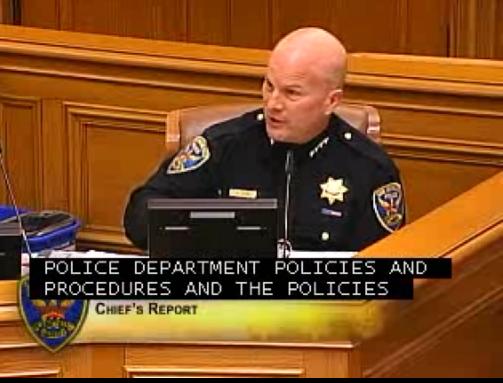
Police Commissioner Suzy Loftus asked if he could “explain a bit more” and Suhr – who was at the stand giving his report as Deputy Chief Loftus (no relation) gave his from the lectern – answered: “All San Francisco police officers are held to the San Francisco Police Department policies and procedures and the policies and laws of San Francisco, whichever is more strict. So depending on wherever they are, their fallback, if you will, is whatever the policies, procedures, laws, ordinances, and all of San Francisco.”

Suhr’s answer seemed to satisfy the commission, which defended the SFPD’s secretive approach rather than asking any more questions.

“Our officers will not participate in any investigation unless there is a predicate offense that is a violation of the California Penal Code or the United States code, so they will not be involved in random surveillance or random assessments or talking to people,” Commission President Thomas Mazzucco said.

Commissioner Joe Marshall also said he trusts Suhr and we all should too: “I want the public to feel reassured that when the chief says that’s going to be the way it is, that’s the way it is.”

But the coalition, which includes 79 organizations, was less than satisfied with that answer. In a statement issued today, it wrote, “Deputy Chief Loftus’ report completely failed to provide the information required to ensure the accountability and transparency required under the Safe San Francisco Civil Rights Ordinance. The Coalition calls on the Chief of Police to promptly issue a public written report containing the information he promised he would provide.”

Neither Kim – who sponsored both the original legislation and weaker alternative – nor the SFPD have returned Guardian calls for comment yet, but I’ll update this post if and when they do. You can watch the hearing yourself here, with that item beginning at the 48:20 mark.


A tale of police priorities

116

By Anh Lê

On Friday afternoon, November 9th, as I was walking on Howard St. near 3rd, I was physically assaulted twice by a Caucasian man walking with an accomplice, an African American woman. I was punched in the jaw the first time while I was still on the sidewalk; the assailant followed me into the street traffic to punch me in the jaw again. Many people passed by, yet none stopped to help. 

I called 911 from the a nearby restaurant. The first oSan Francisco police officer to arrive ordered me to sit down, and then quickly left. Then two other officers arrived, one of whom told me that he was already on assignment at the Moscone Convention Center. Even though I had an eyewitness, and we both provided the officers with a description of the assailant and his accomplice, and I told the officers that the two were still in the vicinity on Howard St., the police did nothing. One of the cops told me, “I think the guy looks like someone from the Tenderloin.”

Compare that to another incident and you get a sense of the city’s police priorities.

On Thursday afternoon, December 13, at the Muni island bus stop on Market St. at 5th, I saw two young African American men in handcuffs. They were detained by an SFPD officer, and two Muni fare inspectors. Both African American men were calm, poised, and respectful in their behavior.

One of the handcuffed men had a cell phone in his mouth while the police officer was questioning him. I thought that it was an odd situation, since the officer could have assisted him by removing the cell phone from his mouth.  I also thought that the dynamics of the situation seemed degrading and demeaning to this young man.

Within five minutes, several additional SFPD officers arrived on the scene, and then several more arrived in an unmarked large black SUV. Nearly all of the police officers were Caucasian. None was African American. 

One of the officers unzipped the second detainee’s backpack.  He calmly said to the officer, “I don’t have any weapon in there.” I could see that the situation involved a simple Muni fare situation. Yet I saw more than ten SFPD officers responding.

I spoke with two of the passengers waiting at the bus stop to ask them what they had seen. Semetra Hampton and Laversa Frasier told me that they saw the two young males handcuffed, and that these young men never acted in any aggressive manner.

I spoke with the two young men, Wayne Price and Jamal Jones. Each received citations, one for paying a youth fare as an adult, the other for misuse of a Clipper card. Hardly serious crimes.

I contacted Officer Michael Andraychak in the Media Relations Unit at SFPD and Paul Rose, spokesperson for San Francisco Municipal Transit Authority to ask why so many officers were involved in such a minor incident.

Rose emailed to tell me that transit fare inspectors saw that the men were using youth passes and asked for identification. When they refused, the fare inspectors contacted police. Andraychack said a Muni fare inspector tried to detain the suspects, but they refused to comply and ran onto the Muni bus island. The inspectors flagged down a nearby police officer, who radioed his location and told dispatch that he was being summoned by Muni personnel for an undetermined problem. Additional officers heard this radio transmission and responded to the scene.

He noted that “Fifth Street / Market is on the border of Tenderloin and Southern Districts. Officers from both districts patrol this area and the MTA K9 officers routinely patrol the Market Street Muni Metro Stations and surface transit stops.”

I appreciate the efforts by Rose and Andraychack to provide me with the information requested.  However, their statements only tell part of the story. Some of their information does not match what I observed, nor what the eyewitnesses told me at the Muni bus stop.

I was there; I counted more than ten SFPD officers who descended on these two young men. Neither of them had done anything violent to anyone, yet their fare evasion elicited massive response.

On the other hand, there was no diligent effort by SFPD to locate, apprehend, and arrest the assailant who assaulted me, on November 9th when he and his accomplice were still in the vicinity of the attack.

Mayor Ed Lee recently proposed a policy permitting police officers to detain and search certain individuals on the street if police deemed it necessary. After vigorous protests from San Franciscans and the Board of Supervisors on the grounds that such a policy would encourage racial profiling, the mayor withdrew the plan.

Still, I have to wonder: Is sending that many officers to handle a simple Muni fare situation involving two young African American males necessary — or is it racial profiling at its extreme? Is this how we as San Franciscans want to see our tax dollars spent — and wasted?

Choked out

0

news@sfbg.com

When a struggle occurs in jail, it happens behind closed doors where the only witnesses are usually on opposite sides of the law. And when a struggle between these adversaries results in death of an inmate, a lot of questions emerge, questions that can linger for years if not publicly addressed.

Three years ago, a 31-year old inmate named Issiah Downes died in a San Francisco jail cell following a confrontation with deputies. After a yearlong investigation, San Francisco Chief Medical Examiner Amy Hart determined the death was a homicide. Weeks later, Downes’ mother Esther filed a wrongful death suit against the city, which was ultimately settled for $350,000, a significant sum that could have been even higher if she wasn’t too ill to pursue a trial.

Yet the deputies involved remain on the job, working in the jail, with nobody ever punished for what at least one witness said was a homicide that should have had consequences for more than just city taxpayers.

According to the lawsuit, on September 7, 2009 Downes complained about the televisions in his unit being turned off. Deemed a disturbance, he was transferred to a segregated area of the jail. The transfer turned into a scuffle involving multiple deputies who forced Downes to the ground. He was then moved into a “safety cell” where another struggle broke out and he was held prone on the floor while deputies allegedly applied pressure to his back and neck. After complaining that he could not breathe, Downes lost consciousness and was soon declared dead.

The lawsuit named the deputies involved with restraining Downes as Mel Song, Juan Guitron, Edward Gutierrez, Ken Lomba, Kevin Macksound, and Dan White. No charges were pressed against anyone. What’s more, the Sheriff Department’s Communications Director Susan Fahey confirmed that all the deputies named as defendants in the civil suit are still employed by the department in the jail.

While the story has slowly faded from the headlines, one witness has been knocking on doors across San Francisco in an attempt to tell his version of events and bring some light to this man’s murky death. Dennis Damato was in jail at the time and remembers it being a quiet day as he and other inmates watched college football. “Miami played Florida State,” Damato told the Guardian. “I was on a top bunk at the end of the row.”

From his bunk, Damato saw Downes step into the hallway outside the cell and he says Downes was not resisting deputies or being confrontational. “There was no commotion. This guy wasn’t doing anything,” says Damato, who saw a deputy approach and stand beside Downes. “He (Downes) was just standing there nice and quiet and [a deputy] was standing to his left. I did not see them communicate.”

Damato says he looked away for a moment to check the score of the game and when he turned back, he saw the deputy attacking Downes, who was in handcuffs. “He was bent over, handcuffs in front of him, and the deputy had him in a choke hold,” Damato told us. “Mr. Downes was saying he can’t breathe. His eyes were bulging while being choked and brought down.”

Damato says Downes was already on the floor when more deputies arrived to assist and roughly 15 minutes passed before they dragged Downes to a secluded room. Convinced that Issiah Downes was murdered, Damato has reached out to everyone from the DA’s office to the Sheriff’s Department but he says he was shut down at every turn: “They’d say ‘it’s over with. Go home.'”

The deputies could not be reached for comment because the Sheriff’s Department didn’t make them available or release their contact information as we requested.

After Downes’ death the Medical Examiner’s Office investigated and the subsequent report confirms that Downes suffered blunt trauma to his neck (in addition to his torso and extremities), consistent with Damato’s claim that Downes was strangled.

“Were it not for the physiologic stresses imposed by the struggle and restraint, there is no reasonable medical certainty that Mr. Downes would have died at the moment he did.” Assistant ME Judy Melinek, M.D. Concluded in her report. “The manner of death, homicide, indicates that the volitional actions of others caused or contributed to this death.”

Although Chief Medical Examiner Amy Hart said her findings did not speak to any unlawful behavior on the part of the deputies, Esther Downes’ attorney, Geri Green, says, “I think it was very brave of her to call it a homicide,” noting that the finding strengthened the family’s case against the city.

That “homicide” call came after a yearlong investigation that included analyzing a prone restraint method called “figure four,” which incident reports from deputies say Downes was placed in moments before his death. In a figure four, a person lies in a prone position, hands held behind his/her back with knees bent and feet held in the air. Prone restraint is not uncommon but it is controversial as its various methods have lead to deaths.

Downes weighed more than 300 pounds and the autopsy found evidence of pressure on his neck and back. The report summarizes an interview with a trainer for the Sheriff’s Department who said the hold is often difficult to accomplish on an overweight person. Additionally, other inmates reported hearing Downes yell that he could not breathe and a jail nurse said she could hear loud moaning coming from the safety cell where Downes was restrained.

Fahey said the department looked into the matter. “The department conducts its own internal investigation but its report is not public record,” Fahey told us. The Police Department also investigated but in an email, spokesperson Albie Esparza said the results are confidential under laws protecting peace officers. “The case file was handled by SFPD, however those are not public records under section 6254(f) of the Government Code, which protects case files, even after a case has been terminated.”

Ellen Hirst, a spokesperson for then-Sheriff Mike Hennessey, told reporters at the time that the department believed all procedures were executed properly. The department’s official “Safety Cell Use” policies, which we reviewed, state “A prisoner may remain restrained, with handcuffs, waist chains, and/or leg irons as necessary, while in the safety cell to prevent self-inflicted injury” for no more than one hour. Yet the department’s “Use of Force” policies state, “Choking and the use of carotid restraint are not allowed by the SFSD.”

The ME concluded the cause of death to be probable respiratory arrest during prone restraint with morbid obesity. That conclusion, along with the report’s other findings, lead Esther Downes’ to charge in her lawsuit that the deputies used excessive force and illegal and unconstitutional restraint procedures on her son and “in an effort to conceal the homicide, conspired to cover up the cause and manner of death.”

Attorney Ben Nissenbaum is an associate with the renowned John Burris Law firm in Oakland, which has done extensive work on civil rights and police brutality including the Rodney King case. He says the need to further subdue an inmate in a segregated area of the jail is suspicious.

“Why would you restrain a person in a safety cell?” says Nissenbaum. “They’re already restrained. All you have to do is close the door.”

He also noted that safety cells — unlike the rest of a jail facility — are not equipped with surveillance cameras. “There are no cameras or video inside the safety cells and that is common knowledge among deputies,” Nissenbaum told us.

Although the Sheriff Department’s investigation report is not public record, it doesn’t appear that it found any criminal conduct. San Francisco District Attorney’s Office spokesperson Stephanie Ong Stillman told us, “We would have to be presented with something showing criminal conduct before we prosecute anyone…When someone dies in jail, it’s a Sheriff’s investigation.”

Over at City Hall, the City Attorney’s Office — which deals with civil suits against the City — wasn’t exactly eager to pursue the matter. “We have to consider the cost for the city of taking the case to trial,” says City Attorney spokesperson Matt Dorsey, adding that a trial is often not in the city’s best interest.

The case didn’t go to trial and was officially closed on May 18, 2011, two months after San Francisco settled with Esther Downes for $350,000. She died last June near her home in Hawaii and her surviving relatives declined comment on the lawsuit or Issiah Downes.

Like many of those who find their way into the judicial system, Downes had personal problems. He was morbidly obese, suffered from schizophrenia, received counseling for suicide (at one point he tried to gouge one of his eyes, leaving him partially blind), and had previous convictions for involuntary manslaughter, robbery, assault with a deadly weapon, and battery of a police officer. Yet he was paying his debts to society and getting help. He was a member of what public officials like to call “society’s most vulnerable”, which might turn out to be a great understatement if his mother’s conspiracy charge and Dennis Damato’s story are true.


Gascon skips valuable reform panel

58

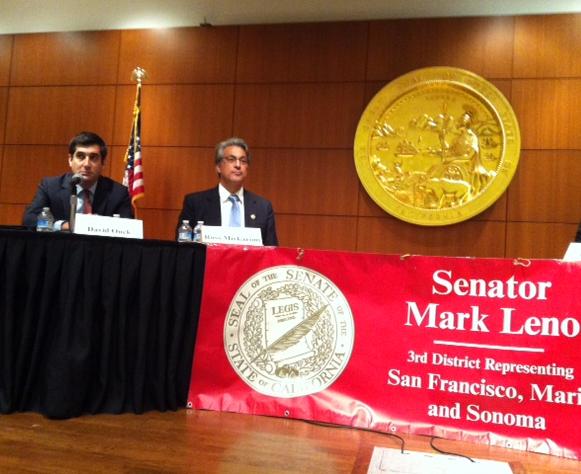
District Attorney George Gascon didn’t show up for the town hall meeting that Sen. Mark Leno held on criminal justice reform last night. Gascon was scheduled to appear on a panel with Sheriff Ross Mirkarimi, Chief Probation Officer Wendy Still, Public Defender Jeff Adachi, and Police Chief Greg Suhr (who also didn’t show, sending Commander John Murphy instead).

Gascon spokesperson Stephanie Ong Stillman minimized the decision to forego appearing on a panel with Mirkarimi, whom Gascon prosecuted for a domestic violence incident and continues to persecute with calls to resign or abdicate some of his official duties, telling us, “There was just a change in his schedule.”

But Gascon, who has only lived and worked in San Francisco for three years, might have benefitted from the discussion, which focused on how San Francisco has for decades pioneered a successful approach to criminal justice emphasizing rehabilitation and redemption rather than the punitive “zero tolerance” approach to crime pushed in Sacramento and other jurisdictions, which has been costly in human and fiscal terms.

“This team of individuals you see in front of you have had the most extraordinary results in leading San Francisco,” Leno said, focusing much of the discussion on how well-prepared San Francisco was for Realignment, the year-old state policy of transferring low-level offenders from the overcrowded state prison system to the local level.

David Onek, the UC Berkeley criminal justice professor who ran against Gascon for DA last year, was added to the panel after Gascon bailed out. He said, “San Francisco by all accounts is way ahead of the curve and can really provide leadership to the rest of the state for how to do Realignment right.”

The main reason for that, as most panelists acknowledged, was because of a variety of programs created by longtime Sheriff Michael Hennessey, who endorsed Mirkarimi to continue his legacy over two traditional law enforcement challengers. Mirkarimi noted that Hennessey didn’t have a law enforcement background when he became sheriff, and that the SFPD and other local agencies long resisted the progressive reforms that he instituted.

“The constellation of what we’re all addressing is unique to San Francisco,” Mirkarimi said, describing the city’s current multi-agency approach as “one that recognizes where redemption comes into the criminal justice system.”

Still, whose department oversees Mirkarimi’s three-year probation for his misdemeanor false imprisonment conviction, emphasized how much her department’s approach has changed in recent years, adopting “evidence-based” approach that respects  probationers, which she now calls “clients,” and addressing their needs.

“We created a plan for success instead of supervising for failure,” Still said. “We changed the culture.”

That cultural change came from the Sheriff’s Department, she said. “Sheriff Hennessey developed a litany of programs over the years, so we were well-positioned for [SB] 678,” the legislation that created Realignment. Despite all the recent talk about having “zero tolerance” for crimes like domestic violence, Hennessey’s controversial approach brought ex-offenders into key leadership positions and refused to dehumanize criminals or see them in black-and-white terms.

“In San Francisco, we kind of live in a bubble. You don’t know how crazy it is outside San Francisco,” Adachi said, noting how politicians in other jurisdictions have aggressively sought to block sentencing reforms and demonize criminals for political reasons.
“In San Francisco, we’ve been so fortunate that we’ve had progressive criminal justice policies,” Adachi said, recognizing that the last three DAs refused to bring the death penalty and Mirkarimi for six years ago creating the Reentry Council to address recidivism.

“It might seem like common sense, but it’s radical to other counties,” Mirkarimi said. “It makes me proud to be part of a criminal justice system that is looking forward.”
  

Giants’ revelers who crossed the line face charges

17

Yesterday’s parade celebrating the Giants’ World Series sweep almost went down without a hitch, no thanks to a handful of inebriated miscreants. Among the estimated one million revelers that attended, the SFPD reports that 22 were arrested, including 13 for public drunkenness. Others were charged for robbery, battery and unlawful possession of a loaded firearm.

Yesterday’s violations, however, paled in comparison to the chaos that ensued after the final game on Sunday night, when even more arrests were made and major damage was done to the city. District Attorney George Gascón is prosecuting nine individuals detained in connection to the shenanigans that occurred around the city last weekend. 

“What occurred last Sunday was inexcusable,” Gascón at a press conference Tuesday afternoon. “We want to send a clear message that we will prosecute all the cases presented to us, to the fullest extent of the law.”

The nine charged so far include eight men and one woman, all of them locals. “So far I believe everyone we have are San Francisco residents,” says Gascón.

Seven are charged with assaulting or threatening a peace officer. SFPD Officer Carlos Manfredi says two officers – whose names he could not release – suffered injuries after confrontations with rioters. “One suffered a hand injury and one suffered lacerations to the leg from a glass bottle that was thrown.”

Tomas Lunsford was arrested on charges of robbery after he allegedly stole a phone from a woman who was filming the celebration. He then allegedly punched her female friend while attempting to evade capture. Additional charges include resisting arrest with force, battery and arson of property.

The latest arrest associated with the carnage occurred Tuesday after police identified a man who was photographed shattering a Muni bus window. Gregory Tyler Grannis, 22, of San Francisco was detained on felony charges of vandalism and destroying a passenger transit vehicle. Police were led to him after tips from social media sites.  Grannis is scheduled to be arraigned Friday.

The DA’s office has been presented with several other individuals who have yet to be reviewed.  Gascón anticipates more violators will be charged in the coming days: “We expect additional cases, including cases involving damage to city vehicles.”

SFPD is currently investigating the torched Muni bus incident.  On Wednesday, Police Chief Greg Suhr released cell phone video and photographs of two suspects wanted in connection with the arson of the bus. “We are now asking for public assistance in identifying these two arsonists and bringing them to justice,” Suhr said.  Photos and video can be viewed at sf-police.org

It is unknown what the ultimate cost of the damage from Sunday night’s chaos will be. City Attorney Dennis Herrera said that in addition to being charged criminally, public offenders will receive civil fines commensurate with their offenses.  “I’m here to tell folks that you will be hit in your pocket book,” he says. “If you damage the city we will seek retribution and damages.”

Celebrations turned chaotic in North Beach and Downtown, but it was the Mission District that saw the most damage. Along Mission Street, 24th Street and Valencia Street vandals tagged several businesses, damaged public property and set fires.  In a statement Monday, Mission District Supervisor David Campos said, “I have been in communication with the Department of Public Works and we are working closely to clean up the streets and help affected businesses.”

SF Stories: Tiny

3

46TH ANNIVERSARY SPECIAL I have a Vision..(Too!)

of poor people-led revolutions and clan mothers wit solutions including the many colored, many spirited, humble people who still remain in San Francisco even though we are systematically incarcerated, profiled, shot or just hated Used by akkkademic institutions, Nonprofiteering, complex over-funded government collusions — From gang ijunctions to sit-lie laws —

Arresting poor folks of color for no just cause

From Ambassador security guards to Stop ‘ n’ Frisk-

using code words like”cleaning up streets”

so frisko is only for the white ‘ n’ Rich The Afrikan population Out-migration caused by Negro Removal, Redlining, Re-Devil-opment and Lennar displacement La Raza en la mission replaced, displaced by condominiums and Eastern Neighborhood Plans, making room for wheatgrass juice and gourmet coffe stands-

And then let’s go back to the Original removal — !st Peoples of the Ohlone Nation — rarely remembered, considered, spoken about or even named..

Caring for Pachamama, mother Earth in a good way, by the teachings of our ancestors every day

So where does this leave us folx who refuse to be cleaned out, incarcerated, profiled or Wheat-grasserated…

We still here, aqui estamos y no nos vamos —

You can’t Frisk, me, Injunct me or incarcerate me cuz let me be clear.

I am staying in my hood, on my corner

and gonna stay seated in my newly gentrifuked park

.. and to Google buses, condominium, devil-opers and un-conscous new-comers,

we will be a thorn in your side for life and up-end your corporate, money-driven hustle

with our feet, our love, our actions …and our ancestors at our side…

“Where we supposed to go, us po’ folks born here, raised here?” said Vietnam vet, disabled, poverty skola and panhandler reporter at POOR magazine, Papa Bear, arrested three times in one day under Sit-lie. “Going to Hell,” thats my vision (of the city) — when they killed the black community — the soul of this city was gone,” said Tony Robles, PNN co-editor, poet, author and organizer and revolutionary son of San Francisco natives of Manilatown. “I don’t care if I’m the last Mexican in the Mission,” said Sandra Sez, indigenous warrior mama and organizer born and raised in the Mission District.

I was born in the back seat of a car, dealt with houselessness and criminalization since I was 11. Ended up in the Bay Area when I was 14. Can’t say San Francisco is my town. But I have had the blessing of meeting and being in family with some of the most powerful revolutionaries from both sides of this beautiful bay. From the I-Hotel resistance to Mission Anti-displacement Coalition to HOMIES to PODER, from The Bay View Newspaper, Idriss Stelley Foundation to the Coalition on Homelessness. Me and my houseless mama along with other landless revolutionaries launched revolutionary projects, POOR Magazine/Prensa POBRE, PeopleSkool, the Po Poets/Poetas POBRE’s , the welfareQUEENs and Theatre of the POOR, to name a few.

I have also been houseless, incarcerated, evicted, profiled, poverty-pimped, gentriFUKed and welfare deformed in the Bay. I have seen beauty and felt resistance in this place in ways I don’t believe would have been possible anywhere else. And yet now it seems like the struggle is just to remain.

Should one fight to stay in a party that no longer includes most of your friends? Neighborhoods filled with people you don’t know and don’t want to know. Schools stripped of their color and cultures. Corporate streets filled with shiney white buses for people who can’t put their deliecate feet on a public bus. Bike lanes filled with $3,000 bicycles and coffee shops that only sell $4 cups of coffee and $3 vegan donuts.

My humble vision for SF includes reparations for black peoples in the Bay View, giving back stolen vacant land to Original Peoples, makng the more than 30,000 empty units in San Francisco available for poor, houseless, and foreclosed on peoples to live in. For landlords to rent at least one apartment per building to families in poverty at reduced or no rent, for doctors and dentists to see at least three patients per practice for a sliding scale starting at $0 — and for people to not question “where their money is going” when they give 50 cents to a panhandler/street newspaper vendor while never questioning where their tax dollars go to politricksters and CEOs of corporations. For the SFPD to arrest, profile, and harass drunken white people who spill out of Bay to Breakers and Golden Gate Park concerts with the same voracity that they do poor youth of color — cause then maybe it would actually have to stop.

And finally for all racist, classist laws that target us poor folks, like sit-lie, gang injunctions and stop and frisk be repealed for their flagrant and disgusting unconstitutionality so that public space will remain truly public and people might truly be free.

Tiny, aka Lisa Gray-Garcia, is a founder of POOR Magazine.

The return of the ugly laws

0

OPINION In the late 19th and early 20th centuries, municipalities across the country passed what have become known as “ugly laws,” often modeling their ordinances word for word on San Francisco’s. According to The Ugly Laws: Disability in Public, Susan Schweik’s comprehensive study of these laws, they were intended to target those who “exposed disease, maiming, deformity, or mutilation for the purpose of begging.” In city after city a pattern emerged of “enactment, reenactment, crackdown, malaise.” As Schweik writes, “what most aligned” the cities “were not the law’s successes, but its failures, the impossibility of removing the unsightly in the form of persons.”

Fast-forward 150 years and “sit lie,” replaces “ugly,” as the name for a category of laws whose intention is to remove the unsightly from our public spaces. Different in form, but nearly identical in intent and justification, these laws are now sweeping through the country, disfiguring the municipal codes of one city after another. San Francisco is not patient zero of this epidemic. But it now threatens to pass that contagion on directly to Berkeley.

Berkeley’s Measure S would prohibit sitting on any commercial sidewalk or on any object placed on the sidewalk without express permission of the city between 7 am and 10 pm. (Since 1998 Berkeley has had an ordinance prohibiting lying on the sidewalk.)

As with the “ugly laws,” the fact that sit lie-laws have been ineffective, has proven no impediment to their spread. Months before the Berkeley City Council voted to place Measure S on the ballot, an independent analysis of San Francisco’s sit-lie ordinance conducted one year after its implementation concluded that it had “on the whole, been unsuccessful at meeting its multi-faceted intentions to improve merchant corridors, serve as a useful tool for SFPD, connect services to those who violate the law, and positively contribute to public safety for the residents and tourists of San Francisco.” Undeterred by the failures of sit-lie in San Francisco, proponents of Measure S, most prominently business improvement districts representing commercial landlords, promise it will rid the city of what they describe as unsightly “encampments” of nomadic street youth.

The fact that Measure S is targeted at homeless youth is an open secret. Ugly laws are a thing of the past. It is not constitutionally permissible to pass laws that target people for who they are as opposed to what they do. The Supreme Court has declared laws against loitering and vagrancy unconstitutionally void for vagueness. The workaround these constitutional obstacles is to pass laws against specific behaviors associated with people whom we don’t want in our public space. Like laws prohibiting sitting on the sidewalk.

Over a hundred years ago, Anatole France famously praised “the majestic equality of the law that forbids the rich and the poor alike to sleep under bridges, to beg in the streets, and to steal bread.” He would no doubt smile at a law that forbids everybody from sitting on the sidewalk. Measure S is supported by people who hide behind its “majestic equality,” but count on a “majestic inequality,” in its enforcement. They believe, without reservation, that it will always be enforced against others.

I don’t like using disease metaphors in politics. Susan Schweik describes the spread of ugly laws as a “contagion,” and it’s hard to resist a similar metaphor for the spread of sit-lie laws. But what is really at stake here is an ugly tendency in national politics, spread not by an anonymous bug, but by people in positions of power and influence, to shift the blame for our sour economy from those who run the system to those who are run over by it: labor unions, public employees, teachers, immigrants, and now, in Berkeley and too many other cities, people who are homeless. If Berkeley passes Measure S, sit-lie laws could be greenlighted across the nation, for who could object that such laws are unfair and mean spirited if oh-so-radical Berkeley passed one. On the other hand, if we defeat measure S Berkeley has a chance to model how a community can come together to find real solutions to real problems in hard economic times.

Osha Neumann is an attorney with the East Bay Community Law Center, and Chair of Berkeley Standing Up for the Right to Sit Down/No on Measure S. For more on the measure, visit www.noonsberkeley.com.

Alerts

0

THURSDAY 18

Culture as a weapon: poetry and storytelling SOUL School of Unity and Liberation, 1904 Franklin Suite 904, Oakl; www.schoolofunityandliberation.org, RSVP at info@schoolofunityandliberation.org. 6:30pm, $5-25. The second in a three-part series exploring how art and culture can be a form of political resistance. At this workshop, learn from poet, writer, artist and organizer Erika Vivianna Céspedes about writing that helps build movements. RSVP is required, and if you can’t get into this one, try their next event in the series, an activist printmaking workshop on Oct. 25.

Fall of the I-Hotel film screening New Nothing Cinema, 16 Sherman, SF; newnothing.wordpress.com. 8pm, free. A screening of a film depicting the historic struggle between residents and supporters of the International Hotel and the landlords that wanted it razed and turned into a parking lot. After massive neighborhood “revitalization,” the I-Hotel was one of the last remnants of the once-lively Manilatown neighborhood. See how residents fought for it at a screening presenting by Shaping San Francisco, New Nothing Cinema, and the CIIS Anthropology and Social Change Department.

FRIDAY 19

Say goodbye to condoms as evidence Jane Warner Plaza, 401 Castro, SF; www.tinyurl.com/condommarch. 6-8pm, free. As we reported this week, SFPD has decided to temporarily end the controversial practice of using possession of condoms as evidence in prostitution cases. For a three to six month trial period, condoms will not be seized or photographed if a cop thinks someone might be a sex worker. A group that was planning to march in opposition to the practice will now march in celebration of the decision, and to urge the city to make the trial period permanent.

Disobeying with great love Powell Street Bart station, Powell and Market, SF; www.tinyurl.com/disobeylove. 6pm, free. A flash mob meditation in the middle of the Disneyland-like shopping district. What better way to relax amongst the chaos?

SATURDAY 20

Op Trapwire Department of Homeland Security, 560 Golden Gate Ave, #36127, SF. WikiLeaks let loose information about Trapwire, the now-notorious company that uses surveillance and tracking to monitor people’s movements and aggregate them into patterns. It does this with a network of security cameras across the country, government and law enforcement uses its information, and the whole thing may be illegal. Some Occupy types have called for a national day of action against surveillance on Oct. 20, and San Francisco is joining in.

Picket Mi Pueblo market Mi Pueblo Mercado1630 High, Oakl; dignityandresistance@gmail.com. 1-4pm, free. Mi Pueblo Market is a successful and beloved grocery store chain. Workers were upset to learn that the company signed up to participate in E-Verify, a voluntary program that tracks the immigration status of all new hires. Managers say that the decision was made after serious pressure from ICE and the Department of Homeland Security. Workers and community supporters will picket the store in protest of the new policy.

SUNDAY 21

Amy Goodman speaks First congregational church of Oakland, 2501 Harrison, Oakl; www.kpfa.org/events. 7pm, $15 in advance. Amy Goodman co founded Democracy Now! The War and Peace Report in 1996. Since then, she has consistently brought progressive, hard hitting reporting to television screens and radios, authored a few books, and established herself as a distinctive voice in journalism. She’s also a kick ass speaker. Come hear her share her wisdom at a benefit for KPFA radio, where she’ll be speaking on “The Silenced Majority: Stories of Uprisings, Occupations, Resistance, and Hope”

MONDAY 22

Tasers forum Hamilton Recreation Center, 1900 Geary, SF; www.tinyurl.com/taserforums. 5pm, free. The SFPD has called a public forum to discuss the possible introduction of tasers into the police arsenal. Come to share your thoughts on the idea. And if you want to hear more, show up a half hour early for a community-led forum. “This summer, ACLU delivered a report of 532 documented Taser related deaths in the US since 2001, but that has not stopped SF Police Chief Greg Suhr from pushing the fourth attempt to spend several million dollars to equip SFPD with these deadly weapons,” say organizers.

NY cops misuse Tasers; would it be different here?

8

In New York State, cops are routinely misusing Tasers, zapping suspects who are laready handcuffed, zapping people in the chest, zapping people who aren’t menacing or carrying any weapon … pretty much, it seems, zapping away at will.

This is the problem with so-called non-lethal weapons, and it’s why I get worried when SFPD Chief Greg Suhr talks about how he’d love to have the little zappers in his armory.  See, in theory, you can stun someone who has, say, a box cutter — which is, yeah, a lethal weapon, in theory, but maybe the person holding it didn’t have to die. So Suhr thinks if the officer had a stun gun, she could have zapped him and he’d still be alive.  (Actually, I wasn’t there, but I would think a professional law-enforcement officer with a nightstick and even basic self-defense training might have been able to keep the box-cutter guy at bay until backup arrived.)

I get it, the cops would rather not have to kill people — but it turns out, at least according the the NY ACLU, that once there’s another less-lethal alternative, it just gets used in a lot of situations where there was no need to shoot anyone with anything. Turns out, according the the ACLU, that if you give a cop a Taser and say it’s a weapon that won’t kill anyone, there’s less reason to use discretion.

So Tasers in SF are on hold for a while, but Suhr ought to take heed: If he wants Tasers, their use should be limited to the same situations where firearms are authorized, that is, to protect the life of an officer or another person — and not, for example, to subdue someone who’s resisting arrest. 

Gascón’s challenge to Mirkarimi belies his own official shortcomings

162

The backlash against Sheriff Ross Mirkarimi’s reinstatement by those who oppose him has often been biting and bitter – an indicator that coming together around real solutions to domestic violence, something most supervisors pledged, could still be difficult – but the most hypocritical reaction came yesterday from District Attorney George Gascón.

“Ross is now reinstated as our Sheriff and I accept that. What I will not accept is any compromise of public safety as a result of his reinstatement. Ross Mirkarimi is on probation in this county for a crime of domestic violence. He is, at a minimum, incapable of adequately performing the functions of his office that relate to crimes of domestic violence,” Gascón said in a public statement, calling for Mirkarimi to “wall himself off” from all domestic violence programs and inmates and hire an independent special administrator to oversee them.

Gascón didn’t explain why he believes Mirkarimi can’t oversee these functions, although that’s been a common refrain among Mirkarimi’s critics, almost an article of faith that to them needs no explanation. I understand the sentiment, but as a practical matter, it still doesn’t make sense to me (I’d welcome comments that could offer insights or explanation). I’ve also posed that and other questions to both Gascón and his spokesperson, Stephanie Ong Stillman, and I’ll include an update when I hear back.

Maybe the issue is a conflict of interest, the belief that Mirkarimi will either be too easy or too hard on domestic violence inmates or programs, which seems to be stretch. But if that’s the case, Gascón should get off his high horse. Gascón was the police chief when then-Mayor Gavin Newsom appointed him as DA, and there were many voices in the community who questioned such an unconventional move, one that raised obvious questions about whether Gascón could be objective about cases of police abuse, evidence tampering, or assorted other cases in which he would be called upon to make tough judgments about the SFPD. There were calls for Gascón to wall himself off from such cases, which he refused to do, even though that was arguably a more serious and direct conflict of interest than Mirkarimi overseeing the jail.

Also, let’s not forget that it was Gascón who started this whole ordeal by deciding to charge Mirkarimi with domestic violence crimes, accept the plea bargain to misdemeanor false imprisonment, and recommend the punishment that the court accepted – which included the highly unusual requirement that Mirkarimi issue a public apology to his neighbor, Ivory Madison, who went to police against the wishes of Mirkarimi’s wife. At the time, Mirkarimi was serving as sheriff and overseeing all the department’s functions – and he wasn’t letting the batterers run free or battering them himself – and Gascón didn’t raise this issue of then or make it a condition of Mirkarimi’s plea, which he certainly could have.

Finally, there was this sanctimonious statement by Gascón: “As the chief law enforcement official in this City and County, I will stand unapologetically with the victims. I will work tirelessly to be sure both victims and witnesses know this city does not tolerate domestic violence.” Yet the record of his office indicates something that falls far short of tireless efforts to combat domestic violence.

As a San Francisco Public Press investigation revealed last month, San Francisco has by far the lowest rate of domestic violation prosecutions of any Bay Area jurisdiction, a terrible record that has gotten even worse since Gascón took over. Whether judged by the number of domestic violence cases filed per capita (29.5 per 10,000 residents, compared with 58.5 in the region) or the number cases it received that it declined to prosecute (it dropped 6,200 of the 8,600 cases that it received from police), Gascón has no business claiming to show zero tolerance for domestic violence. His prosecution of Mirkarimi was more aberration than rule.

We’ve been trying to get a comment out of the DA’s Office on this issue for weeks, and they still haven’t replied (Stillman told me today that “we’re still working on it”). Gascón was also asked about his office’s poor record on domestic violence recently on KQED’s Forum and gave only a deflective non-answer. Perhaps he’d be better off figuring out how his office could so consistently fail the victims of domestic violence rather than worrying so much about the too-few of them that he’s managed to send to jail.

We all understand what an emotional and important issue domestic violence is, and even how unsettling it may be to many to have Mirkarimi as sheriff. But the members of the Domestic Violence Consortium and La Casa de las Madres – those who have led the campaign to oust Mirkarimi – aren’t the only people who care about this issue.

During the public comment portion of Tuesday’s Board of Supervisors meeting, there were many domestic violence victims who expressed more outrage over the failure of these domestic violence groups or the DA’s office to support them than they were about Mirkarimi continuing to be the sheriff. The city just spent $1.3 million trying to remove Mirkarimi and another [[CORRECTED FIGURE: $140,000]] paying his interim replacement, Vicky Hennessy – money that could have been better spent directly responding to domestic violence than this fruitless symbolic stand.

But that’s over now, just like their efforts to remove Mirkarimi, and we all need to move on instead of trying to re-fight this difficult battle over and over again. People can still disagree with what happened and vent and be angry – and from what we’re hearing from City Hall, many of the messages have been quite savage, some even threatening violence. They can even work on a recall campaign or take other political actions.

Yet we all still share a city – a wonderfully diverse city with a wide range of perspectives and opinions – and we’re all forced to accept things about it that we don’t like. Gascón doesn’t get to decide who the sheriff is or how he plays that role any more than Mirkarimi got to tell Gascón how to do his job – despite suffering far more direct impacts.

We each have our roles to play, and we’ll all be better off if we do them well and accept that we live in a rainbow city, not a black-and-white world.

World homeless day protest targets Castro landlord

54

In a protest marking World Homeless Day, the squatter group Homes Not Jails briefly occupied a vacant building on Castro St. tonight. Twenty were arrested.

This is the third year that the group has staged a building occupation to draw attention to buildings that lie vacant while people live on the streets.This year’s demonstration began in Dolores Park, where a group of about 50 held a rally and concert. 

The group then marched up 18th street, chanting “house keys not handcuffs” and “housing is a human right.” 

When the protest arrived at the building, on the 500 block of Castro St., activists opened the building and entered it. From the roof, protesters dropped a banner reading “Gentrification equals assimilation.”

One man who entered the building had seen the march on 18th st. and joined along the way. “I don’t believe there should be this many abandoned houses,” said the man, who identified only as Scott. “I don’t mind being homeless, though,” he added. “I like sleeping under the stars.”

Police lined up across the street and closed Castro between 18th and 19th to traffic. After about 40 minutes, they charged the building. Those on the sidewalk were pushed aside, and those inside the building were arrested. According to SFPD spokesperson Michael Andraychak, there were 20 arrests.

After more than two hours, the police reopened the street.

During that time, Andraychak said, “Several people had run into an annex in the rear. Several had gone downstairs and broke into an adjoining restaurant.” Arrestees were also being searched and processed in the building.

The city’s most recent “Homeless Point-in-Time Count and Survey” finds that there were 6,455 homeless individuals and families living in San Francisco; Homes Not Jails estimates 11,000 homeless individuals. 

In either case, as members of the group often point out, the amount of vacant housing in the city is more than enough to shelter the whole homeless population. The 2011 census finds that San Francisco has 378,261 total housing units, and 9.4 percent, or about 35,000, are vacant.  

Homes Not Jails formed in 1992 to connect these homeless people to these vacant buildings. According to one organizer, the group is “made up of squatters who live in vacant places.”

He said that today’s largely symbolic housing occupation has a purpose. “It’s the experience people have when they come into a vacant, liberated space. There’s no other feeling like that. It’s transformative.”

Last year, the group targeted the Cathedral Hill Hotel , the site of a new hospital project still riled in controversy. They also less conspicuously occupied several other nearby buildings, include the Charlie Hotel. Some of these buildings are still active squats. 

Across the street, a large crowd gathered, watching the action. 

Some neighbors supported the protest. “I think it’s fantastic,” said Jesse Oliver Sanford, who lives two doors down from the building.

Sanford said the building’s long vacancy frustrated him, and the space should instead be used for something beneficial. “You could put a nonprofit soup kitchen there,” said Sanford. “I don’t understand why we’re not providing more services for queer youth. This building is twice the size of LYRIC and just a block away.”

“If the queer history here means anything, we need to have a place with a political base. That means low income and mixed income,” Sanford continued. Instead, he said, low income people are being squeezed out of the neighorhood.  “If you lose your lease, you lose all you have” he said, mentioning that a neighbor of his had recently had his rent increased by $1,000 per month.

The building that protesters occupied, comprised of a ground floor storefront and second floor apartments, has been vacant for more than five years.

The building’s owner, Les Natali, owns several other properties in the Castro. The neighboring Patio Café, the restaurant that protesters allegedly entered, has been vacant for more than ten years. Natali also owns Toad Hall as well as Badlands, where he has come under fire for racist business practices. Natali used to own the Pendulum, “the Castro’s only African American gay bar,” before he closed it, sparking community outrage.

The buiding protesters occupied “used to be the Bakery Café,” remembered a neighbor who didn’t wish to be identified. “It was a great place to hang out and a major employer of young people. It would be great if it was a functioning business or some community benefit, and rent controlled housing on top.”

“This is at least getting a lot close to those real issues,” he said of the protest.

UPDATE: All 20 arrested are being held on charges of burglary, conspiracy and vandalism. Most have bails set at $325,000.

City to cease using condoms as evidence in prostitution cases

25

The San Francisco Police Department announced today that they will stop using condoms as evidence in prostitution cases.

This will address the issue of police searching prostitution suspects for packaged condoms and wrappers. Under current city policy, police cannot confiscate condoms to be used as evidence. They can, however, photograph condoms. But recent reports form the Bay Area Reporter found that police sometimes broke the policy, and did confiscate condoms. 

The SFPD, the District Attorney, the office of the Public Defender, and the office of Sup. David Campos spoke with groups that work with sex workers in meetings that led to the new policy, which will be in place for a three to six month trial period.

Public defenders also agreed to not use lack of condoms as proof of innocence for people facing prostitution charges.

A July report from Human Rights Watch criticized San Francisco, along with New York, Washington, DC and Los Angeles, for using condoms as evidence. Local sex worker health clinic the St. James Infirmary has also implored the police department to stop the practice.

It discourages sex workers from carrying condoms, they say, exposing prostitutes and clients to sexually transmitted diseases

“Cops in four of the major cities that we documented in this report are stopping sex workers on the street and harassing them for carrying too many condoms, and threatening to arrest them,” said Megan McLemore, senior health researcher at Human Rights Watch, in an interview about the report. “And this is a problem because it’s making sex workers less willing to carry and use condoms while they’re working.”

The Human Rights Watch report emphasized that many sex workers, as well as women and transgender people, fear carrying more than one or two condoms with them in public.

“Transgender people have terrible problems with being profiled by the police, being arrested falsely for prostitution, and just being equated with sex work in the mind of many, many police officers,” said McLemore. 

The San Francisco Department of Public Health actually distributes condoms to sex workers as part of the fight against HIV/AIDS and other STDs—and police then photograph and even take them, to use against them in court.

In 1994, city departments agreed on a similar trial period to test the policy of not confiscating condoms. After the trial period, then-District Attorney Arlo Smith declared that condoms could no longer be confiscated for use as evidence.

This trial period could lead to a similar policy change, which would permanently ban the use of condoms, physical of photographed, as evidence in prostitution cases.

Locking down reforms

0

steve@sfbg.com

Realignment, California’s year-old program of diverting more inmates and parolees from state prison to county jails and probation offices, was borne of necessity: The state faced a severe budget crisis and had been ordered by the federal courts to reduce the population in its overcrowded prisons. But Realignment is proving to be a real opportunity to address inmates’ needs and reduce recidivism, particularly in San Francisco, where progressive notions of rehabilitation and redemption have deep roots.

“Realignment is the most significant criminal justice reform in decades,” says Assembly member Tom Ammiano, the San Francisco Democrat who chairs the Assembly Public Safety Committee and has helped oversee the process. “The motivation of many of us came from things that were thwarted, like sentencing and parole reform, in Sacramento for many years.”

San Francisco was uniquely positioned to thrive under the new system and to be a model for other counties that seek to improve on the 70 percent recidivism rate among state prison inmates, and the myriad problems and costs that spawns. Former Sheriff Michael Hennessey brought a variety of innovative educational and support services into the jail during his 32-year reign that ended last year (see “The unlikely sheriff,” 12/20/11).

“It’s more than an opportunity. It’s in line with the Michael Hennessey doctrine of enhancing public safety while elevating the idea of redemption, and I subscribe to that,” said suspended Sheriff Ross Mirkarimi, who successfully ran as Hennessey’s endorsed heir before Mayor Ed Lee ousted him over domestic violence allegations. “Michael Hennessey made famous the rehabilitation programs inside the jail and outside the jail.”

San Francisco was also in a good position as both a manageably sized city and county, and one that had room for the influx of inmates. It was ordered by the courts in the 1980s to reduce its crowded jail population – the peak jail population of 2,300 is now down to about 1,550 – and gained even more capacity last year when the SFPD’s crime lab scandal resulted in hundreds of drug cases being thrown out by the courts.

“It’s something that makes sense for San Francisco,” Acting Sheriff Vicky Hennessy told us. “We’re doing better than most other counties because we had the bed space and we had community programs. Michael Hennessey is a visionary…and he got these community programs out there.”

Undersheriff Ellen Brin, who oversees the jail, said the main difference among inmates that San Francisco is dealing with under Realignment – a total of 2,258 in the jail over the last year, staying an average of 60 days each, and another 306 convicts under post-release supervision – is that they’re in local custody longer than before.

“It’s sort of the same population we’ve always dealt with, but maybe we’re dealing with them on a longer term,” she said.

That creates some challenges – Brin said there are more inmates who are a little more hardened and “more sophisticated” – but it also gives local programs more of a chance to help the inmates. That was one of the arguments for Assembly Bill 109, the main legislation that created Realignment, along with five other related bills.

“That was the whole plan about AB 109 is the counties do it better,” Brin said. “For us, we’ve been doing these programs for so long, with reentry and other community programs, so it’s easy for us to manage this population because they’re here longer.”

Realignment has also prompted more collaboration among the affected local agencies – particularly the Sheriff’s Department, Adult Probation Services, and the District Attorney’s Office – and their counterparts on the state level.

“We haven’t had an overarching initiative that we’ve all been required to sit around a table and work on. This has kind of brought us together, and we’ve discovered other areas where we need to work together as well,” Hennessy said.

That has sparked new programs. For example, San Francisco just started to bring those about to be paroled from state prison into the local jail before their release in order to integrate them into the San Francisco rehabilitation system. “We’re creating a reentry cycle for them so they aren’t just getting off the bus and landing here and going directly to Probation for an interview,” Hennessy said. “Now, we’re going to try to bring them here 60 days early and provide them with wrap-around services, so that we can get them established, get them housing, give them the best opportunity we can for a successful reentry.”

With counties now responsible for the people local judges send to jail, there’s more interest in reforming sentencing laws and exploring more progressive and community-based alternatives to incarceration, which is the focus of the new San Francisco Sentencing Commission that held its first meeting last month.

“District Attorney [George] Gascon is very supportive of Realignment, DA’s Office spokesperson Stephanie Ong Stillman told us. “He has said it could have the greatest impact on justice reform in decades. San Francisco is on its way to being a model for the state.”

But the flip-side of San Francisco’s advantages has been a growing backlash against Realignment in conservative counties with disproportionately high incarceration rates and a lack of capacity in their jails – which is often a byproduct of combining tough-on-crimes policies with anti-tax attitudes, something Ammiano is now dealing with in Sacramento.

“There is a lot of push-back from the Republican Party and alarmism over Realignment,” Ammiano said, noting that he’s just waiting to be hit with anecdotal stories about a transferred inmate committing some horrific crime, even though Realignment only involves low-level convicts who committed non-violent and non-sexual crimes.

Ammiano will work with a newly constituted Board of State and Community Corrections that will distribute funds to counties that need to beef up each their jail capacities or their treatment programs. That mix hasn’t been set yet, but Ammiano said he won’t support counties that simply seek more state resources to maintain high incarceration rates.

“In one way, it’s perturbing and the other way, it’s exciting,” Ammiano said. “For me, the more the county has programs, the more sympathetic I’ll be.”

Yet in this era of chronically underfunded government entities, even San Francisco is strained. Hennessy and Brin say Realignment has brought more inmates with serious mental health issues into the jails for longer periods of time — and that has stretched their resources.

“That’s where we lack, even before AB 109, and I’d like to get more people in there who are experts in the mental health field,” Brin said.

Hennessy agreed, but added, “The mental health program we have is extremely good, it’s just overtaxed because we’re seeing many more people, and this is across the state.” Mental health isn’t the only issue. “The other thing that is a concern is housing for people,” Hennessy said, explaining that the city needs both supervised housing and regular low-income housing for former inmates returning to the community. Maintaining the Sheriff’s Department progressive legacy in the face of new challenges is one reason why Mirkarimi sees danger in Lee’s decision to overturn that election and consolidate more power in the Mayor’s Office. “It’s important that the independence of the Sheriff’s Department be preserved,” Mirkarimi said. “Programs can easily be changed by successive mayoral administration if there isn’t that check on power.” But for now, Brin said San Francisco’s various law enforcement officials have been working well to realize the potential of Realignment: “The collaboration between the criminal justice partners has just been really, really great. Everybody is working together to try to accomplish the same thing.”

Obama’s appeal to SF’s divided Left draws mixed reactions

26

President Barack Obama has a divided political base, as local Democrats who showed up at the Laborers Local 261 hall last night to hear his nomination acceptance speech were immediately reminded by leftist protesters. And despite the belief by some true believers that his speech won over its target audience, I have my doubts.

Courage to Resist and its allies from Code Pink, the Occupy movement, and other groups targeted this Democratic County Central Committee watch party (and 24 others around the country) with an appeal that Obama free Bradley Manning, the US soldier accused of turning over classified documents to Wikileaks who has been kept in solitary confinement for almost two years without trial.

“President Obama needs to live up to his promise to protect whistleblowers,” said Jeff Paterson, founder of Courage to Resist and himself a Gulf War resister (and coincidentally the ex-boyfriend of newly elected DCCC member Kat Anderson). For more on that protest, read this.

DCCC member Hene Kelly (and a phalanx of SFPD cops) helped keep the entrance clear – something the good-natured protesters didn’t seem to threaten – and said she understood their perspective: “They’re here because they have a right to ask President Obama to free Bradley Manning, and I agree with them.”

But inside, DCCC Chair Mary Jung wasn’t so happy about this rain on their parade, telling the Guardian that she supported the ideas behind Occupy but said, “I think the message is misdirected at us,” ticking off Democratic Party positions on same sex marriage, immigration reform, and other issues.

When I told her that the protest was actually about Manning, whose fate is pretty clearly in the hands of Obama and his appointees, she offered this hopeful assessment: “I would hope it’s going to work it’s way through the courts as it’s supposed to. There is a process.”

When I tried to get District Attorney George Gascon’s take on whether that process comports with normal legal and civil rights standards, he told us, “I have no opinion. I need to digest the information a little more.” (That was more than Willie Brown offered, with the former mayor, unregistered political lobbyist, and San Francisco Chronicle columnist responding to my questions with, “I’m a columnist. I don’t make comments to other newspapers,” after he gave a speech to the gathered Democrats.)

But it didn’t take Gascon long to digest Obama’s speech, telling us afterward, “I think he hit it out of park. If this doesn’t get the enthusiasm up, nothing will.”

Yet my reaction, and most that I’ve heard since then from people who listened to the speech, wasn’t quite so enthusiastic. Yes, Obama had some good lines, and yes, he fairly effectively countered many of the Republican misrepresentations of his record and ability to quickly turn around the failing economy he inherited. And yes, I think the substance and messaging were more progressive than his centrist acceptance speech of four years ago.

“Times have changed and so have I,” Obama declared at one point.

But this is a party that still shares the same basic paradigm as the Republican Party, this story of American exceptionalism, protected by noble military “heroes” and guided by altruistic virtues, working within an economic system that can just keep growing and expanding the prosperity of US citizens indefinitely – the kind of rhetoric that still drove the crowd to a jingoistic chant of “USA, USA, USA!” at one point.

Yet it was a crowd where not a single person in the local hall applauded or cheered for this line by Obama: “Our country only works when we accept our obligation to each other and future generations.” He’s right, but he’s also been running the country in a way that robs from future generations in many realms (debt, infrastructure, global warming, energy, education, etc.) and doesn’t address our obligation to the protesters out front and the valid perspective that they represent.

“There are many shades of blue in the Democratic Party. We’re all blue,” Jung told me.

Perhaps that true, because I felt a little blue coming away from this event, but maybe not in the sense that Jung intended.

Jesus-free food

0

“For I was hungry and you gave me food, I was thirsty and you gave me drink, I was a stranger and you welcomed me,” Jesus supposedly said way back when. In San Francisco, there are a multitude of churches that offer free food to the hungry (find a handy list at www.freeprintshop.org).

But what follows is a list of secular organizations that share food — for the planet, for self-determination and providing for community outside of the system, for healthy food untainted by hormones, pesticides and GMOs, for food not grown by exploited workers, and for many other reasons, these groups bring food straight to the people.

FREE FARM STAND

Where: Parque Niños Unidos, 23rd St. and Treat. When: Sundays, 1-3pm. Numbers given out at around noon. The Free Farm Stand gives out food and flowers grown at the Free Farm on Eddy and Gough, where local volunteers grow and harvest produce. They also share local organic surplus produce left over from several farmer’s markets and produce brought in from neighbors and from locally gleaned fruit trees.

The philosophy of the Free Farm is food sovereignty. Why should anyone go hungry, or go broke, feeding themselves and their kids? Instead, they figure, they should get for free what the earth gives. They facilitate this by offering the farm’s harvest — as well free sprouts and plants, that people can use to grow food themselves.

“The solution to the problem of hunger is to share the abundance that’s out there and to encourage people to grow food and share some with those in need.” said a Free Farm Stand organizer. “We can set up neighborhood networks of people growing food and sharing their surplus.” The Free Farm Stand is a step towards that vision.

BETTER DAYS TO COME

Where: Tuesday, 16th and Mission, Thursday, Turk and Taylor. When: 6pm. Some of the folks at Better Days to Come have God in mind, but the organization’s founder, Leonard Fulgham, came from not the churches but the prisons. As its mission statement says, “Mr. Fulgham began mentoring many of the younger inmates, while having the unique opportunity to hear their stories. Many of their stories outlined how they landed in the prison community and why they continued to return. Being homeless upon release back into society is a commonly known contributing factor to these ex-offenders being hungry while being starved by the lack of job training and vocational skills.” Fulgham passed away March 24, 2012, and in his memory, the organization began serving two hot meals a week.

CURRY WITHOUT WORRY

Where: Civic Center Plaza at Hyde and Market. When: Tuesdays 5:45-7pm. Curry Without Worry serves vegetarian food, mostly Nepali and mostly with five courses, in San Francisco every week. It does the same at its other branch in Kathmandu. Shrawan Nepali once owned a restaurant, Taste of the Himalayas, but used the proceeds to start Curry Without Worry and eventually sold it when “I realized I was not a businessmen.” Instead, he’s a man who feeds people a vegan five-course meal, which includes a sauce made from timur, herbs that grow in his Himalayan hometown but are rare in the US. “Our mantra is healthy food for hungry souls,” says Nepali.

FOOD NOT BOMBS

Where and when: Monday, UN Plaza at 6:30pm and 16th and Mission at 7pm. Wednesday, UN Plaza at 6pm. Thursday: 16th and Mission at 7pm. Saturday: Haight and Stanyan at 5pm. After 30 years, Food Not Bombs still serves almost daily in San Francisco at a few locations throughout the city. Volunteers cook meals then bring them out to the people, bringing home the message that there’s enough to go around and you shouldn’t need money to feed yourself. The Saturday team still shares food at Haight and Stanyan, where Food Not Bombs first parked three decades ago.

FOOD BANK OF AMERICA

Where: In front of the Bank of America at 2701 Mission. When: Thursday, 5pm until food runs out. Occupy-related people, carrying on from the giant Food Bank of America action on Jan. 20, when the Bank of America at the Embarcadero locked its doors after activists set up a food table and hung two interactive banners where passers-by could write what fit under the category “person” and what fit under the category “corporation.” They hung a third banner saying Food Bank of America, hundreds ate a hot meal, and the concept caught on. Now, people who have been gathering food donations for Occupy and otherwise give away fresh produce and hand out information about credit unions weekly in front of the bank.

COMMUNITY FEED

Where: Mendell Plaza, at Third and Oakdale. When: Every third Sunday, 10-2. A few organizations, including the Black Star Riders Coalition and the Kenneth Harding Jr. Foundation, work together to put on this food giveaway every other week. It takes place in Mendell Plaza, the square that some have renamed Kenny’s Plaza after Harding, who was killed in the plaza at 19 years old after a dispute with SFPD officers over bus fare. “First, we definitely want to honor Kenny, that’s why we got there,” said Tracey Bell-Borden, one of the organizers of the Community Feed. “But there’s been a lot of activity in that area for a long time. So it’s really about healing the community,” she said. “We have to take care of our community.”

Bullets fly

25

When cops shoot their guns, sometimes they kill or injure bad guys. Sometimes it turns out that the person who was shot didn’t do anything wrong. And sometimes the majority of the carnage involves utterly innocent bystanters.

That’s a side of police shootings that doesn’t get talked about as much. But it’s real — and it’s a matter of concern when cops are firing off rounds in a crowded urban area, in particular when they’re near a school. Which is what happened in Noe Valley Aug. 27. According to my friends at the Ex:

A female officer caught up to the suspect as he tried to climb over a fence on Valley Street. He reportedly moved quickly toward the officer with his hands in the middle of his torso, prompting the officer to fire a single shot, which did not strike the suspect, police Chief Greg Suhr said.

So if the bullet didn’t hit the suspect, where did it go?

It went flying around Noe Valley. In the middle of the day. Near an elementary school. Lucky it didn’t hit anybody. Because officers are trained to fire at someone who they perceive as a lethal threat — but that training doesn’t include looking around behind the perp to see where the rounds will go if they miss.


Removal of large homeless encampment scheduled for tomorrow morning

11

The Coalition on Homelessness received word that a homeless encampment at Fourth and King is scheduled for eviction tomorrow. According to an outreach report from John Gallagher, a human rights organizer at the coalition, about 40 people live in the encampment including at least two children. It has approxamitely 15 tent and 3-4 mobile structures.

Some excerpts from the report:

There are essentially two campsites, one under the overpass on Cal Train property and subject to the jurisdiction on the CHP and a sidewalk next to a bike path subject to SFPD.
4 persons using wheel chairs – and most of the people had at least some disability (their own words).
The camp community is clean and free of any smells and what rubbish there is has been set out of the way. They seem in general to be a law abiding community even keeping their tents away from the fire hydrant. There are bathrooms across the street in a park that is kept neat and clean.
Residents of this small community were proud to tell me that people who park cars next to the camp felt more security than those who parked away from camp. This camp is so peaceful that I saw more that four people on their way to work walk unafraid right down the middle of camp.
I was informed that several of the residents are “working poor.” they get up for 9 to 5 daily. There were two American flags displayed and potted plans are scattered around works of “Art” decoratively in from of most tents. There is a community garden bordered and well keep by the residents at the part of the overpass that receives the most sun. Clean laundry hangs drying on a chain link fence. This is a community of families, Artists, writers (two brothers), displaced persons and pet owners. ( Three healthy well fed dogs)

The eviction will likeley occur at 8 or 9am tomorrow. As Gallagher says in his report, part of the camp is on SFPD turf, and part is CalTrain property policed by the California Highway Patrol. Neither agency could be reached for comment.