San Francisco

Food for thought: 18 Reasons’ class series encourages the slow chew

0

Hippocrates said, “let food be thy medicine and medicine be thy food”. The axiom certainly sounds nice rolling off the tongue, but curative qualities aside, you’ll never stick to healthy if it doesn’t taste good. Luckily here in the Bay Area we have Carley Hauck of Intuitive Wellness, who proves in her “Mindful Eating and Cooking” series at community food hub 18 Reasons that comestibles can indeed be medicinal, and that medicine can taste amazing.

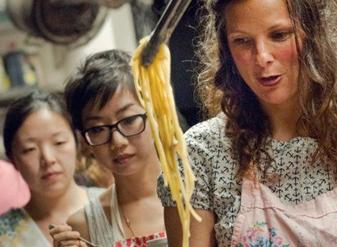
Health nuts and epicureans alike can revel in Hauck’s multi-layered, multi-course classes, in which students learn a comprehensive approach to mindful eating and cooking. This means all hands on deck — as well as all eyes, noses, mouths and minds — everyone in Hauck’s seminars are required to take a participatory role in this adventure for the taste buds. 

“In graduate school, I was teaching a weight-loss class and realized there was something missing,” Hauck told the Guardian in an email interview. When not teaching at 18 Reasons, she’s the president of Intuitive Wellness, where she works as a integrative life coach and wellness consultant in San Francisco and Berkeley.  

“I added the mindfulness component and saw that it really was the missing link,” she continued. “It’s not so much about looking outside of ourselves — adding up calories and exercising — but really about tuning in and understanding physical hunger but also emotional hunger.” Hauck is part of a research group at UCSF’s Osher Center for Integrative Medicine that is pioneering research, and looking at the long-term benefits of mindful eating in relation to stress reduction and weight loss. She also works with with corporate organizations like Pixar and LinkedIn, teaching mindfulness classes to corporate eaters.

“That’s the type of work that I do,” she wrote. “But the piece of work that I love is teaching classes which integrate these same practices into the broader community.”

You don’t have to be a downward-dog yogi to approach the dinner table with a sense of mindfulness. In the most pragmatic sense, Hauck defines mindful eating as the simple process of slowing the mind to pause the mouth from our oft-unconscious snack-shoveling. It’s about bringing intention to the processes of cooking and consuming, cultivating an appreciation for each ingredient’s unique feel, flavor, and smell. From morsel to mouthful, being mindful is about slowing down and savoring, rather than inhaling. 

The first class in Hauck’s 18 Reasons series was held on April 2, but if you missed it not to worry. There are two more on the way, and according to Hauck, each session “is created to be a stand-alone class which builds on techniques in mindfulness.”

Session two, “Food as Medicine”,  takes place on Saturday, and is focused on the healing properties of super foods. The antioxidant-charged menu, which Hauk was putting together right before our phone conversation, is geared to re-invigorate the body and stimulate the mind.

The goal is to “create really healing food varieties and also bring an intention into the process of cooking.” said Hauck. “It’s very experiential. We’re doing guided meditations, having great discussion, and we’re saying ‘Hey! Pick your knives and chop!’”

Hauk’s series opener “Intro to India” turned up the heat, focusing on Southern Indian cuisine while tackling the kitchen-borne insecurities of the average chef. “I hear from people that they are very intimidated by cooking” said Hauk, a fact she intends to put on ice. “This is a cooking class where we’re really teaching them about mindful eating and mindful cooking, but were also teaching them to be good cooks. I want to get people comfortable with something that they may think is hard.”

This love has brought her into the community at 18 Reasons and in a sense, full circle. Her lifework is not only corporate, but it is also deeply rooted in community. The common thread here of course is food — mindfully approaching food as a medicine and taking pleasure in all its gastronomical variations — and you shouldn’t need more than 18 reasons to eat amazing food that is good for the body, mind and soul.

The Mindful Eating Cooking Series: Food as Medicine

May 21, 6:30 pm, $50

18 Reasons

3674 18th St., SF

www.18reasons.org

Red all over

0

SUPER EGO “I’ve been listening a lot to Hulk Hogan’s new comedy album. I hear he has an acid jazz album coming out soon, too — can’t wait for that.” I’m being treated to some good ol’ deadpan Native American leg-pulling from DJ Bear Witness of A Tribe Called Red, performing at Thee Parkside on Fri/19.

Well, more accurately it’s First Nations leg-pulling, as the fascinating and super-fun ATCR DJs — Bear Witness, NDN, and Shub — are of indigenous Canadian descent, calling me from Ottawa, where their monthly party Electric Pow Wow has been slaying for almost five years now. The trio mixes electronic dance beats with contemporary aboriginal tribal drumming and singing, plus a healthy dose of aural and visual sampling both historical (early field recordings of powwow chants and 20th-century sound bites) and ironic (cringe-worthy Hollywood redskin whoops and awkward pop culture quotes ranging from John Wayne to Back to the Future III) to create a deliciously subversive club experience.

The result is what the three call “pow wow step” — a banging, trancey sound mostly rooted in the bass-heavy drops and meticulously constructed plateaus of dubstep, but transcending that too-trendy sound by virtue of the trio’s innumerable global dance music influences. And it’s finally giving a contemporary electronic voice to aboriginal groups from Ojibwe to Nippising.

Bear Witness points out that in Canada and much of the United States, indigenous people are now “urban aboriginals — we’re the people in the hoodies and baseball caps living downtown,” so a distinct, urban musical expression could only come naturally.

“We’re one of the fastest growing demographics, yet we’re still pretty invisible,” NDN added. “It’s a lot different from when our great-great grandparents came off the reservations looking for work. Our grandparents became integrated as much as they were allowed in 1950s and ’60s culture until some of them joined radical movements like Black Power. Then our parents grew up in this kind of unique urban environment full of little telltale signs that they were aborigines.

“And now we come along, raised on tribal identification, but also hip-hop and everything else you got growing up in the city. Including the fact that the whole world’s structured to be against you, from the moment you step out of the house in the morning to get a cup of coffee.

“So we’re representing, while also trying to move it all forward. We want to decolonize some of the references and stereotypes while having a lot of fun with it.”

For all the political subtext and critical theory red meat, ATCR’s emphasis is always on the party. “We’re three energetic DJs up there playing off each other in a totally spontaneous fashion, having a blast with the crowd,” says DJ Shub. Shub’s status as an insanely talented, vinyl-shredding winner of the Canadian DMC DJ championship makes him a star on his own.

When tripled with NDN and Bear, the quick-witted referents from Nusrat Fateh Ali Khan to Q-Tip fly — the group credits mashup culture, a breakdancing revival, and kooky Brit electro duo Radioclit among its inspirations. (And yes, when it comes to the sometimes awkward, culturally-appropriative legacy of tribal house, jungle, and New Age ambient, they love to flip it all back on itself, reclaiming it.)

A Tribe Called Red often draws hundreds to its touring powwow parties in the Great White North and the East Coast, sometimes featuring live drum circles and hoop dancers. Last year’s electrifying self-titled free-download album snagged them a pretigious Polaris prize nomination. The trio works with several organizations to promote aboriginal causes. New album Nation II Nation drops May 7, a cheeky collab with Das Racist, “Indian From All Directions,” just debuted on Pitchfork. And they’ve been buzzing for years. (I first became aware of them after a trip to Navajo Nation, when the morning radio pumped the spacey electro-tribal sounds of what my traveling companion instantly dubbed “tech-navajo.”) But this will be their first full-on West Coast tour.

No qualms about reception in unfamiliar territory, though: “There are aboriginal people everywhere, just like there are party people everywhere,” DJ Shub says. “Word gets out, and people will come for a good time.”

A Tribe Called Red Fri/19, 9pm, $10. Thee Parkside, 1600 17th St., SF. www.theeparkside.com, www.electricpowwow.com


TUBESTEAK CONNECTION NINTH ANNIVERSARY

There’s some kind of size queen joke about this seminal bathhouse disco party finally reaching the big nine, but damned if I know what it is. Let bearded clan king DJ Bus Station John lay it all out for you, as his intimate weekly Tenderloin bacchanal keeps alive the down and dirty spirit of gay San Francisco. Free mustache rides!

Thu/18, 10pm, $5. Aunt Charlie’s Lounge, 133 Turk, SF. www.auntcharlieslounge.com

SIMIAN MOBILE DISCO

Has it really been 10 years since club Mezzanine first mezzed up downtown? Celebrate in wild style with beloved big-room Brit electro duo SMD and a couple thousand others.

Thu/18, 9pm, $25. Mezzanine, 444 Jessie, SF. www.mezzaninesf.com

JOE CLAUSELL

One of the best deep and Latin house DJs of all time, fiddling knobs on one of the best sound systems in the country. That is all.

Fri/19, 10pm-late, $20. Mighty, 119 Utah, SF. www.mighty119.com

TINARIWEN

Gorgeously trance-like, guitar driven tunes from the global nomad reps of Tuareg rock.

Fri/19, doors 8pm, show 9pm, $55. The Chapel, 777 Valencia, SF. www.thechapelsf.com

SILENT SERVANT

Great, dark and dubby techno from a contemporary master will lay waste to one of the city’s most colorful dance floors at Honey Soundsystem. Who will survive? Anyone willing to plumb the secret depths of sound. And do some high kicks.

Sun/21, 10pm, $10. Holy Cow, 1535 Folsom, SF. www.honeysoundsystem.com

Earth Day SF

0

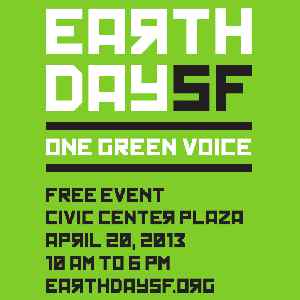
On Saturday, more than 10,000 people from the San Francisco Bay Area Community and beyond, will converge at Civic Center Plaza to celebrate Earth Day San Francisco.
 
This unique celebration packs a powerful day of green sustainability discussions and solutions into one full day of fun, amazing entertainment and excitement for the whole family. Designed to support the Bay Area Community and beyond, Earth Day San Francisco focuses on acknowledging the local and planetary environmental challenges we all face, and inviting the public to integrate sustainable practices into their everyday lives. Find out more here.
 
Saturday April 20 from 10am-6pm @ Civic Center Plaza | FREE

The new Exploratorium opens — are the piers as good as the Palace?

3

As someone who was practically bottle-fed on the old Exploratorium space, I was hesitant approaching the science museum’s opening day at its new home on Pier 15 and 17. Like many other SF natives, I was attached to the old world charm and neo-classical elegance of the Palace of Fine Arts location, opened in 1969 by physics professor Frank Oppenheimer.

But consider me a convert. Where the Palace of Fine Arts’ physical layout seemed to dictate the content of the old museum, the new building, extensively rehabbed to house the famously hands-on exhibits, allows them to exist more organically. The new site now houses the largest pod of solar panels in the city, holds a magnificently vista-ed observatory, and harnesses as a heating source the Bay waters it sits above on 1800 wood and concrete pilings built around a century ago.

Paul Doherty the self-proclaimed “physicist, teacher, author, and rock climber,” has worked at the Exploratorium for 26 years, making the senior staff scientist the perfect person to lead me on a tour through the two-story space yesterday.

“We wanted it to be open, so a flood (of people) could come in, but then,” Doherty says pointing towards the Atrium, the first space visible to museum visitors. For long-time Exploratorium fans, the result is a comforting mix of the familiar and new, and as Doherty tells me for new visitors, it’s meant to be a good intro to what lies beyond. “This space here features classic Exploratorium exhibits that will show people who aren’t necessarily San Francisco natives the kinds of things that they will be experience while they’re here,” he tells me. “We wanted to showcase the best of the best.”

The atrium houses well-loved classic exhibits like “The Turn Table”, originally a physics Ph.D. thesis intended to show how a ball rolls across a spinning metal disc. When the ball crosses the “turntable”, it takes a chaotic, almost torturous path before it unexpectedly exits the table parallel to the point at which it entered.

Doherty said museum attendees, not staff, were the first to wheel coin across its surface. He picks up one of the plastic discs now part of “Turn Table” and wheels it across the moving table. “As you can see, the visitors taught us what this exhibit was really about. We watch our visitors, and we learn from them.”

Traversing the museum floor, we pick up new listeners gravitating towards Doherty’s excitement, almost as tactile at the Exploratorium’s most famous “Tactile Dome” (which will be up and running by Summer 2013). It’s enough to make you a little envious that your own workspace doesn’t inspire raptures like those of Doherty in his new digs.

For another atrium exhibit entitled “Moving Objects” (2012), by Exploratorium artist in residence Pe Lang, suspends rubber rings on vibrating rods, giving the illusion that the rings are passing through each other. “Drip Patterns” is a staff-made offering which illuminates the oozing drip of mineral oil. The effect is surprisingly artsy, and demonstrates the existence of caustics, which in differential geometry are “envelopes of rays either reflected or refracted by a manifold.” True to the spirit of the Exploratorium, no PhD is necessary to enjoy the installations — even to the uninformed onlooker, “Drip Patterns” looks cool, dispelling the idea of science-art dichotomy,

The new space’s innovations are enough to make me wish little Jessica could have seen the space. All the old favorites are present: the giant bubble-maker, live tornado capsule, artist in residence Ed Tannenbaum’s “Recollections” (1981), which freezes your image via a large scale projector in oh-so-’80s-music-video manner. These exhibits — all made in-house, as Doherty reminds me — trick you into learning, entice you into participating, and invite you to interact. I’m not eight anymore (dammit) but they made me feel like a kid again.

According to my guide, over the years, Exploratorium staff has made 2,000 exhibits. 600 are in the new space, 450 classics carried over from the Palace of Fine Arts, refurbished. 150 are brand new.

If you’re going to brave the crowds this weekend — or tonight’s continued opening ceremony celebrations — be sure to bring comfortable shoes and an open mind. If you can catch Doherty passionately explaining the mysterious behaviour of dry ice on water or the density of mineral oil suspended in light, all the better. 

The Exploratorium Piers 15 and 17, SF. (415) 528-4360, www.exploratorium.edu

Catching up with Young Prisms: new video, new process, and those pesky Cure comparisons

0

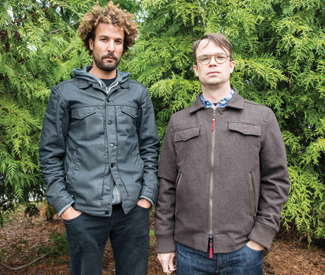
At their show at Elbo Room on Friday, Young Prisms are going to play new material that they’ve never performed in front of an audience.

“It should be interesting,” bassist and singer Gio Betteo told me last week at Mission Pie.

Vocalist Stefanie Hodapp added with a laugh, “Especially for us.”

That sort of relaxed good humor seems to define their whole attitude toward making music (past characterizations have used the word “slacker,” which doesn’t quite fit). The band, currently comprised of four members, including Jordan Silbert on drums and Matt Allen on guitar, produced albums in 2011 and ’12, and now wants to take its time creating a third.

http://www.youtube.com/watch?v=hxvZ65K2IA4

Young Prisms have been experimenting with a new process that removes the pressure and constraints of their past songwriting. Now, they create when something comes to them. Betteo has been the primary writer of new material recently but only because he has been feeling inspired to write.

The result, they say, sounds more like genuine emotion and less like grasping at genre such as psychedelic rock or dream pop.

Not that they attempted to fit into any specific category in the past. When asked about the many comparisons that have been drawn between the band and noisy shoegazers such as My Bloody Valentine or the fuzzier Mazzy Star, Betteo and Hodapp looked at each other warily.

“I’m not dumb. I definitely hear it,” said Betteo. ”Whether it’s bands like No Joy and Weekend, that are currently doing it, or bands like Chapter House and My Bloody Valentine and stuff from 20 years ago, we like those sounds. It plays its own role in our writing and ideas, but never intentionally.”

Once, a fan came up to them after a show and praised the song that sounded like the Cure. Though they didn’t know which the fan meant (and suspected the fan didn’t know which he meant), the comparison was apt; they had spent the entire tour before they wrote the second album listening to the Cure. Though they don’t strive to mimic the band, they admit that they are drawn to certain musical ideas.

Over their years of playing together, these musical ideas have shifted. In the writing of their first album, Friends For Now, they didn’t care about creating relatable songs. “We just wanted to make fucked up sounds,” Betteo said. “I wanted this guitar to sound like a fucking car accident, and this drum beat to sound like a headache, a pulsing headache.”

In Between, the second album, represented a few steps toward developed structure and audience accessibility. They wanted to allow people to “find the song in it.”

Their new material, they say, will be a few steps further in that direction.

But they don’t want to lose their experimentally hazy sound, their relaxed outlook, or the sense that they’re in this to have fun. That seems unlikely.

With three out of four members of the band living together (they assured me that their home lives are too boring to merit a sitcom or reality TV show), one can imagine either the chemistry or the easygoingness required to sustain the bandmate-roommate relationship. Whatever the formula, it seems to have worked in the past and will seemingly continue to work as Young Prisms release their next album, maybe in early 2014.

Until that time, they have a new video for their song, “Runner,” a side project called Breathr that’s going to come out in the next couple of months on the label Dream, and shows around the Bay Area.

Young Prisms
With SISU, Chasms
Fri/19, 9:30pm, $12
Elbo Room
647 Valencia, SF
(415) 552-7788
www.elbo.com

Bay Area groups critical of immigration reform proposal

Olga Miranda, secretary treasurer of the San Francisco Labor Council and president of SEIU Local 87, did not mince words when sharing her initial reaction to the proposed federal immigration reform bill, which was unveiled April 16 by a bipartisan group of senators.

“If it was myself and our members at the bargaining table, we would walk away,” Miranda said. “This proposal is nothing more than an offense to the community.”

Miranda was speaking at an April 17 press conference held by the San Francisco Bay Coalition for Immigrant Justice, staged at the Asian Law Caucus’ San Francisco headquarters. While many speakers said they welcomed the immigration reform bill as an important “starting point,” all were clear that they saw serious flaws in the proposal and planned to spend the next several months pushing for improvements.

“We applaud the inclusion of a path to citizenship in the bipartisan legislation for millions of undocumented people currently living as second class citizens,” said Francisco Ugarte, senior immigration attorney at Dolores Street Community Services. “However, there are problems with the bill, which creates long waiting periods to adjust, excessive fines and unclear language and employment requirements.”

In a statement, coalition members described the bill’s proposed path to citizenship as “long and onerous” due to provisions such as a decade-long wait for a green card, and ineligibility for any undocumented immigrants who arrived in the U.S. after 2011.

Concerns were raised that families would continue to be separated, a frequent consequence of deportation. “The bill, as it is, does not put an end to the deportations,” said Cinthya Muñoz of Causa Justa / Just Cause. “In California, close to 94,000 people were deported” last year, she added. “As Californians, our representatives need to stand strong to call for an end to deportations before negotiations continue.”

Miranda was critical of a proposal to require the use of the federal E-Verify system. “Forcing employers to check all workers’ immigration status against flawed databases like E-Verify reduces the power of all workers,” she said. “And it would threaten the jobs and privacy of many citizens and work-authorized immigrants.”

Anoop Prasad of the Asian Law Caucus criticized proposed changes to the existing process for legal, family-based immigration, saying the elimination of visas for entire groups of family members would particularly impact Asian communities, such as those residing in San Francisco’s Chinatown. The overwhelming majority of Chinatown residents came to the U.S. as sons and daughters or siblings of employment-based immigrants, he explained, but under the proposed rules, meeting the qualifications for a visa would be more difficult due to a the elimination of certain family immigration categories.

Instead of placing emphasis on the presence of a family member in the U.S., a proposed “merit based” visa would be scored on factors like higher education, English proficiency, and employment, Prasad added. But activists also raised concerns that requirements for English language proficiency would inevitably exclude many monolingual immigrants.

Amos Lim, representing Out 4 Immigration, said LGBT couples would face particular challenges too, because no specific language was included to allow same-sex partners the same immigration privileges as heterosexual married couples. “Immigration law in this country has always been about excluding people,” Lim told the Guardian. “We need to make sure that we are included.”

The coalition is planning a May 1 march and rally in San Francisco to call for improvements to the immigration reform bill. It will begin at 24th and Mission at 3pm and proceed to Civic Center for a 5pm rally.

Follow @byRebeccaBowe

Solomon: The Orwellian warfare state of carnage and doublethink

3

By Norman Solomon

Norman Solomon is co-founder of RootsAction.org and founding director of the Institute for Public Accuracy. His books include “War Made Easy: How Presidents and Pundits Keep Spinning Us to Death.” He writes the Political Culture 2013 column.

After the bombings that killed and maimed so horribly at the Boston Marathon, our country’s politics and mass media are awash in heartfelt compassion — and reflexive “doublethink,” which George Orwell described as willingness “to forget any fact that has become inconvenient.”

In sync with media outlets across the country, the New York Times put a chilling headline on Wednesday’s front page: “Boston Bombs Were Loaded to Maim, Officials Say.” The story reported that nails and ball bearings were stuffed into pressure cookers, “rigged to shoot sharp bits of shrapnel into anyone within reach of their blast.”

Much less crude and weighing in at 1,000 pounds, CBU-87/B warheads were in the category of “combined effects munitions” when put to use 14 years ago by a bomber named Uncle Sam. The U.S. media coverage was brief and fleeting.

One Friday, at noontime, U.S.-led NATO forces dropped cluster bombs on the city of Nis, in the vicinity of a vegetable market. “The bombs struck next to the hospital complex and near the market, bringing death and destruction, peppering the streets of Serbia’s third-largest city with shrapnel,” a dispatch in the San Francisco Chronicle reported on May 8, 1999.

And: “In a street leading from the market, dismembered bodies were strewn among carrots and other vegetables in pools of blood. A dead woman, her body covered with a sheet, was still clutching a shopping bag filled with carrots.”

Pointing out that cluster bombs “explode in the air and hurl shards of shrapnel over a wide radius,” BBC correspondent John Simpson wrote in the Sunday Telegraph: “Used against human beings, cluster bombs are some of the most savage weapons of modern warfare.”

Savage did not preclude usage. As a matter of fact, to Commander in Chief Bill Clinton and the prevailing military minds in Washington, savage was bound up in the positive attributes of cluster bombs. Each one could send up to 60,000 pieces of jagged steel shrapnel into what the weapon’s maker described as “soft targets.”

An unusually diligent reporter, Paul Watson of the Los Angeles Timesreported from Pristina, Yugoslavia: “During five weeks of airstrikes, witnesses here say, NATO warplanes have dropped cluster bombs that scatter smaller munitions over wide areas. In military jargon, the smaller munitions are bomblets. Dr. Rade Grbic, a surgeon and director of Pristina’s main hospital, sees proof every day that the almost benign term bomblet masks a tragic impact. Grbic, who saved the lives of two ethnic Albanian boys wounded while other boys played with a cluster bomb found Saturday, said he had never done so many amputations.”

The LA Times article quoted Dr. Grbic: “I have been an orthopedist for 15 years now, working in a crisis region where we often have injuries, but neither I nor my colleagues have ever seen such horrific wounds as those caused by cluster bombs.” He added: “They are wounds that lead to disabilities to a great extent. The limbs are so crushed that the only remaining option is amputation. It’s awful, awful.”

The newspaper account went on: “Pristina’s hospital alone has treated 300 to 400 people wounded by cluster bombs since NATO’s air war began March 24, Grbic said. Roughly half of those victims were civilians, he said. Because that number doesn’t include those killed by cluster bombs and doesn’t account for those wounded in other regions of Yugoslavia, the casualty toll probably is much higher, he said. ‘Most people are victims of the time-activated cluster bombs that explode some time after they fall,’ he said.”

Later, during invasions and initial periods of occupation, the U.S. military dropped cluster bombs in Afghanistan and fired cluster munitions in Iraq.

Today, the U.S. State Department remains opposed to outlawing those weapons, declaring on its official website: “Cluster munitions have demonstrated military utility. Their elimination from U.S. stockpiles would put the lives of its soldiers and those of its coalition partners at risk.”

The State Department position statement adds: “Moreover, cluster munitions can often result in much less collateral damage than unitary weapons, such as a larger bomb or larger artillery shell would cause, if used for the same mission.” Perhaps the bomber(s) who stuffed nails and ball bearings into pressure cookers for use in Boston had a similarly twisted rationale.

But don’t expect explorations of such matters from the USA’s daily papers or commercial networks — or from the likes of NPR’s “Morning Edition” and “All Things Considered,” or the PBS “NewsHour.” When the subject is killing and maiming, such news outlets take as a given the presumptive moral high ground of the U.S. government.

In his novel 1984, Orwell wrote about the conditioned reflex of “stopping short, as though by instinct, at the threshold of any dangerous thought . . . and of being bored or repelled by any train of thought which is capable of leading in a heretical direction.”

The doublethink — continually reinforced by mass media — remains within an irony-free zone that would amount to mere self-satire if not so damaging to intellectual and moral coherence

Every news report about the children killed and injured at the finish line in Boston, every account of the horrific loss of limbs, makes me think of a little girl named Guljumma. She was seven years old when I met her at an Afghan refugee camp one day in the summer of 2009

At the time, I wrote: “Guljumma talked about what happened one morning last year when she was sleeping at home in southern Afghanistan’s Helmand Valley. At about 5 a.m., bombs exploded. Some people in her family died. She lost an arm.

In the refugee camp on the outskirts of Kabul, where several hundred families were living in squalid conditions, the U.S. government was providing no help. The last time Guljumma and her father had meaningful contact with the U.S. government was when it bombed them.

War thrives on abstractions, but Guljumma was no abstraction. She was no more or less of an abstraction than the children whose lives have been forever wrecked by the bombing at the Boston finish line.

But the same U.S. news media that are conveying the preciousness of children so terribly harmed in Boston are scarcely interested in children like Guljumma.

I thought of her again when seeing news reports and a chilling photo on April 7, soon after 11 children in eastern Afghanistan were even more unlucky than she was. Those children died from a U.S./NATO air strike. For mainline American journalists, it wasn’t much of a story; for American officials, it was no big deal.

“Circus dogs jump when the trainer cracks his whip,” Orwell observed, “but the really well-trained dog is the one that turns his somersault when there is no whip.”

Norman Solomon is co-founder of RootsAction.org and founding director of the Institute for Public Accuracy. His books include “War Made Easy: How Presidents and Pundits Keep Spinning Us to Death.” He writes the Political Culture 2013 column.

“Street Fight” examines the politics of mobility in San Francisco

16

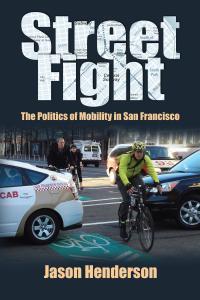
Ideology plays a bigger role in shaping San Francisco than most people realize, as we’ve discussed in this space before. Nowhere is that more true than in the politics of land use and transportation, as my friend Jason Henderson, a San Francisco State University geography professor, discusses in his insightful new book, Street Fight: The Politics of Mobility in San Francisco.

He’ll be discussing his work this Friday, April 19, from 7-9pm during a book launch party hosted by Green Arcade Bookstore across the street at the upstairs loft space of McRoskey Mattress, 1687 Market. Or if you miss that but want to join the discussion, you can catch Henderson’s forum on May 15 at SFSU or what will surely be other local events on this pivotal topic.

Henderson chronicles the seminal events in San Francisco’s history with “automobility” and related transportation issues, from the freeway revolts of the late ’50s through 2000 to today’s continuing political struggles over parking, bicycles, livability, gentrification, and the form, function, and financing of Muni.

Yet the lens that Henderson brings to understanding all of these issues and struggles is ideology, which he breaks down into three major categories: progressive, neoliberal, and conservative. Whether we realize it or not, we can all be fairly easily placed in one of those three categories when it comes to how we think about automobility, or the primacy of cars in modern life.

“A progressive framework conceptualizes mobility as a systemic problem that requires deep social commitment and responsibility. How we get there matters. It posits that there can be too much mobility, as exemplified by high levels of [Vehicle Miles Traveled] in the United States, and that excessive mobility results in both environmental degradation and major social inequality at a local, state, and global scale. The main problem, obviously, is that automobility is part of a wider, systemic moral and social problem of over-consumption and disproportionate materialism,” Henderson writes, sounding themes that I echoed in this week’s cover story.

On the other end of the ideological spectrum are those with conservative views on mobility, who see driving as a basic right, which is the dominant mindset on the west side of supposedly liberal San Francisco. “Unlike progressives, conservatives do not think about responsibility as relating to broader systems such as the economic structure of society. Instead, they think in terms of direct causation and of each individual being responsible for the consequences of his or her actions. For example, poverty is a result of individual shortcomings caused by personal and moral characteristics, not of structural themes like socioeconomic forces beyond an individual’s control. Getting to work on time and providing one’s daily needs are not collective concerns but the responsibility of the individual,” he writes.

Of course, these conservatives still rely on government to build and maintain their transportation infrastructure, which they believe should be centered around cars. “Government should guarantee and accommodate automobility, not seek to discourage it or make it more expensive. Government-sponsored road building and other explicit policies that encourage motoring reflect an optimal use of government to stabilize conservative social relations centered on automobility,” Henderson write of the conservative mindset.

Between those two poles are the neoliberals, who have come to dominate City Hall, particularly in the last few years with the ascendancy of Mayor Ed Lee, Board President David Chiu, and Sup. Scott Wiener, who has taken the lead role on transportation issues. Neoliberals rely on market-based solutions to almost any problem, and they end up partnering with either conservatives or progressives in the politics of mobility depending on the issue.

“Neoliberals, consistent with the broader agenda of the privatization of space and market-based pricing of public access to space, envision a mobility system shaped by pricing and markets rather than by regulation and collective action. Unlike progressives, neoliberals feel the built environment must be allowed to develop with the efficacy of the market. Movement, paid for by the individual user, should be unrestrained. Yet such efficacy can include a commodification of nonmovement or slower movement or the package of quality-of-life goods surrounding the ‘walkability’ and ‘livability’ of the city, a package reserved for those who can afford to enter. To that end, neoliberal mobility includes the aggressive use of government to both enhance mobility and rein it in, but only inasmuch as government policy helps realize the goals of profit and facilitating economic growth and development,” Henderson writes.

It’s fascinating to explore how these three distinct mindsets have shaped San Francisco in recent decades, and how they interact today to create the city that we’ll be moving through in the future.

Ish says

0

culture@sfbg.com

STREET SEEN [Caitlin Donohue: Although I originally contacted former Stanford University football offensive guard and current Apple employee Ish “Mr. Marina 2013” Simpson for help in writing a style guide to the Marina, he wrote me back a rundown so evocative that I hated to paraphrase his words. And so this week, I’ve given my style column over to him. Check out sfbg.com for my recap of the glorious March night he was crowned king of SF’s preppiest neighborhood, and don’t forget, you can add flair with a belt.]

I buy a lot of clothes, but not many in person. I love to buy, hate to shop, so I buy mainly online. There are some stores and brands I’ve shopped at in the Marina, but since you asked me to explore I was able to find a lot of cool stores that I didn’t know existed. There are more men’s stores in the Marina than I realized.

My fellow Marina gentlemen don’t usually take too many risks when it comes to fashion. The guys I see downtown or in the Castro are usually very fashion-forward. But some of the best-looking guys in the Marina I’ve seen do rock bespoke suits and shirts. Classy. Men’s fashion here steers toward preppy or sailor styles. The women take way more risks, and Marina women are definitely some of the most fashionable in the city.

>>WHERE IT ALL BEGAN: CHECK OUT OUR COVERAGE OF ISH’S VICTORY AT THE MR. MARINA PAGEANT

G-STAR RAW

“If someone says, ‘Hey, I like your shirt,’ you have to say, ‘Yeah, it’s G-Star Raw!’ Whatever.” All store photos by Anna Latino

This place intrigued me because I saw one in Barcelona when I was there in December 2011. I talked to the guy working here and he said the brand is Dutch and it’s way bigger in Europe. Makes sense: the name is just terrible, and they only sell G-Star Raw clothes. That means if someone says, “Hey, I like your shirt,” you have to say, “Yeah, it’s G-Star Raw!” Whatever. They had a nice selection of belts, which I love. Belts are a great way for conservative dressers to express some flair. I loved the colorful chinos (a staple in my wardrobe). I also loved this one cardigan they had.

2060 Chestnut, SF. (415) 567-7224; 76 Geary, SF. (415) 398-5381, www.theswimminghorses.com

MARINE LAYER

“Cool threads that you’d wear out to bars on a Thursday night.”

This place on Chestnut has cool shirts and hoodies. Also, some nice scarves. The clothes are advertised as being extremely soft and they aren’t lying! The fabrics are nice and I like the bold, yet muted colors. I’ve had some friends buy their stuff and it has a worn-in, vintage look. This is a good place to grab some cool threads that you’d wear out to bars on a Thursday night.

2209 Chestnut, SF. (415) 346-2400; 498 Hayes, SF. (415) 829-7519, www.marinelayer.com

THE BLUES JEAN BAR

I’ve bought a few pairs of jeans from here and it’s always a great experience. I kind of don’t like how all of the jeans are behind the bar and you have to ask for them, but I also kind of like it too. Many hot girls work there, so you’re not shopping by yourself and you get a great female opinion when you try your jeans on. They give you great recommendations on fit and style, and they will tell you how to care for your jeans and whether or not you should have them tailored.

1827 Union, SF. (415) 346-4280, www.thebluesjeansbar.com

HIGH SOCIETY

This shop is one I just discovered that sells both women’s and men’s clothes. They had a great selection of slim-fitting jeans and blazers. They had a cool leather jacket I liked. This is the place to go if you’re looking for a nice outfit for date night with a pretty young lady.

1969 Union, SF. (415) 447-0447, www.highsocietybrand.com

BRANDY MELVILLE

This is for the ladies! I like the style of the women that like shopping here. Every time I walk by there are a lot of good-looking girls in there. The music they have jamming is awesome, the ladies working there are gorgeous, and the clothes are awesome (in this man’s opinion!) I like the material they use for their clothes, very light and breathable; at least it looks like it is. I loved the camo pants, the flowing dresses, and the printed shirts.

2085 Chestnut, SF. (415) 292-7754, www.brandymelvilleusa.com

EYE HEART SF “POP DOWN SHOP”

“They have awesome clothes for Sunday Fundays”

This is your go-to spot for gear that is meant to be worn when partying! This brand was born in San Francisco and the guys behind it take pride in representing this great city. They have awesome clothes for Sunday Fundays (tanks!), holidays (special gear for St. Patty’s, Cinco de Mayo, etc.), sporting events (Giants, Warriors, Niners), and for music festivals (break out your JammyPacks). This should be one of the first places to shop at when you’re going to be out in the sun having a great time.

1980 Union, SF. www.eyeheartsfshop.com

Stript

1

caitlin@sfbg.com

SEX Last week, local blog SFist reported that a gay strip club named Randy Rooster was in escrow to snag the building formerly occupied by Diesel’s distressed-kneecap denim and elite luggage sets on Harvey Milk Plaza.

Randy Rooster denuded its website of all info before we even had a chance to wonder. But what exactly a gay strip club would mean — much less in a neighborhood where you can’t swing a patent leather mini-backpack without hitting a gyrating go-go — remained to be explained. Surely limos full of bachelorette party “woo!” girls would figure it out for us.

To satisfy our curiosity over the waxed and winking men of the pole, I took the opportunity to chat with Justin Whitfield, who stripped for years at Le Bare (www.lebare.com), a Houston strip club catering to straight ladies. He tells me the club became the country’s premier spot for rich and lonely oil wives during the late 1970s and ’80s.

Whitfield and fellow manmeat Taylor Cole recently published Take It Off!: The Naked Truth About Male Strippers, on the heels of stripper-pride flick Magic Mike. “The movie’s awesome,” Whitfield says. “In my real world, I don’t tell people I was a stripper. Now I can hold my head up.”

The book’s publisher is Ellora’s Cave (www.ellorascave.com), whose catalogue is mainly heavy-breathing romance novels. While I can’t say I recommend Take It Off! as a literary endeavor, I can tell you that the pic of Cole chair-dancing and the “Sexcapades” chapter are looks into world without equal in a Randy Rooster-less San Francisco.

To the South Bay bachelorettes who will surely flock to any future Chippendales-like endeavors in the city, Whitfield counsels enthusiasm: “I cannot stand the women who come in and have made up their mind not to have fun,” he says. “If I’m in a real good mood I can convert these ladies. But sometimes, it’s like I don’t want to be around her because she’s depressing.”

But don’t get too stoked party girls — those jouncing Speedos are not gift bags. “I’ve had my bottoms pulled down,” Whitfield tells me ruefully. “Not fun.”


LAURA ANTONIOU READING

She rose to fame by creating an extensive master-slave society in the pages of her BDSM fantasy series The Marketplace, but Antoniou reads tonight from her latest: The Killer Wore Leather, a kinky mystery novel. The reading kicks off a week of SF engagements for the writer including the Ms. Leather pageant, Bawdy Storytelling on Sun/21 (www.bawdystorytelling.com), and Wicked Grounds on Tue/23 (www.wickedgrounds.com).

Thu/18, 6:30-7:30pm, free. Good Vibrations, 1620 Polk, SF. www.goodvibes.com

INTERNATIONAL MS. LEATHER PAGEANT

Leatherwomen the world over flock to SF for this annual contest crowning the individual who becomes the community’s spokesperson, role model, and mentor. Check out workshops, boots and cigar parties, and of course, Saturday night’s pageant, where 2012 titleholder Sara Vibes makes way for fresh meat.

Thu/18-Sun/21, $35-199. Holiday Inn Golden Gateway, 1500 Van Ness, SF. www.imsl.org

Selector: April 17-23, 2013

0

WEDNESDAY 17

Night Beats

Seattle’s Night Beats has all of the fixings of a good psych-garage act; the lo-fi recordings, the raspy vocals with punctuated yelps, and the noisily manipulated guitar. But the band, which takes its name from Sam Cooke’s best record, has a direct link to the more soulful breeds of music the title suggests, such as R&B. “Dial 666” is simple, 12-bar blues, “High Noon Blues” borrows sentiment and structure from that genre, and “Puppet on a String” seems to call for some old-fashioned dance moves. With the combination of vigorous rock and sensuous roll, Night Beats’ show at Brick and Mortar promises to be satisfying. (Laura Kerry)

With Cool Ghouls, Primitive Hearts, Big Drag

9pm, $10

Brick and Mortar Music Hall

1710 Mission, SF

(415) 800-8782

www.brickandmortarmusic.com


Bad Religion

Mixing aggressive guitar riffs with politically-savvy lyrics and harmony-laden vocals — which the band refers to as “oozin’ aahs” in its liner notes — Southern California’s Bad Religion has been going strong for more than three decades. It just released latest album, True North on founding member Brett Gurewitz’ iconic independent label Epitaph Records last January. And the punk rock stalwarts continue to be driven by singer-author-professor Greg Graffin’s powerful songwriting, which touches on everything from global politics and religion to more personal experiences and emotions that just about anyone can relate to and share in a sense of powerful catharsis. (Sean McCourt)

With the Bronx, Polar Bear Club

8pm, $27.50–$30

Regency Ballroom

1300 Van Ness, SF

www.theregencyballroom.com


The 2 Bears

I don’t need caffeine. My computer just starts playing “Work” by the 2 Bears at 7am, complete with rising organ, a pulsing groove, and motivational chorus: “We’ve got to work harder, for the future, my love we got to work.” It might not even be the best song on Be Strong from the 2 Bears (Hot Chips’s Joe Goddard and the Raf Daddy), as it faces stiff competition from hilarious, cuddly club anthem “Bear Hug” and the uplifting, romantic space dub on “Church.” But, it does the job of getting me moving, and by the time the disco queen vocals kick in I’m likely showered and downstairs having breakfast. (Ryan Prendiville)

With Sleazemore, Richie Panic (Lights Down Low)

10pm, $15 presale

1015 Folsom, SF

www.1015.com


THURSDAY 18

“Touching Art: Tribute to Judith Scott”

Skin, the largest organ, keeps our insides safe from the perils of the outside, but it is also the membrane through which we experience the world. In its tribute to Judith Scott, swissnex will explore this, looking at touch’s role in the creation of art. Scott, who could neither speak nor hear and therefore relied heavily on her sense of touch, made beautiful cocoon structures at Oakland’s Creative Growth Art Center for 20 years. Swissnex, in conjunction with Switzerland’s L’Art Brut, will screen a film about the artist, showcase some of her work, and host a talk by Dr. Sandra Weiss on the connection between touch and emotion. The night promises be a touching intersection of art and science. (Kerry)

6pm, $10

swissnex

730 Montgomery, SF

(415) 912-5901

www.swissnexsanfrancisco.org


FRIDAY 19

An evening with Manlio Argueta

While a hard punishment, exile can also be the place where great works of art are born. “I left with a closed fist and came back with an open hand,” said Rafael Alberti returning to Spain after 38 years of exile. Ostracized in Mexico, Pablo Neruda finished one of his masterpieces Canto General. Exiled in Costa Rica, acclaimed Salvadorean poet Manlio Argueta wrote his most celebrated novel, One Day of Life (Vintage Book, 1983). In line with his mentor, poet Roque Dalton, Argueta vividly writes about the 12-year civil war through a peasant family’s eyes. The book, available in 15 languages, was named one of the best 10 novels in Spanish of the 20th century by NY’s Modern Library. (Fernando Andres Torres)

7pm $10

ANSWER

2969 Mission, SF

(415) 902-4754

www.manlioargueta.com


“We Are Winning, Don’t Forget: Short works by Jean-Gabriel Périot”

Jean-Gabriel Périot developed a painstaking approach to making films. By carefully stitching together archival images, both still and moving, he creates political narratives that are poignant despite (or because of) their brevity. As a part of a US tour that begins at New York’s Museum of Modern Art, the filmmaker comes to the Bay with nine short films, with subjects ranging from Hiroshima to “politics and tomatoes.” The evening at Artist’s Television Access presents a great opportunity to see these stunning films and the man behind the camera. (Kerry)

8pm, $10

Artist’s Television Access

992 Valenica, SF

(415) 824-3890

www.atasite.org


Sheetal Ghandi: Bahu Beti Biwis

Deconstructing cultural artifacts is just about today’s lingua franca. Sometimes you might wish that artists left well enough alone. Yet, at its best it shows creative minds at work that are willing to take the risks inherent in changing lenses. Sheetal Ghandi is one of them. Even though her performance practices are already exceptionally broad —Kathak, modern and West African dance, plus Broadway as well as Cirque du Soleil — she took a lot of imaginative leaps for her solo show Bahu Beti Biwis (Daughter-in-law, daughter, wife), a series of both humorous and poignant portraits of women and the roles traditionally assigned to them. It’s a piece that has been described as empathizing with “Indian women across time and space.” (Rita Felciano)

Fri/19-Sat/20, 8pm; Sun/21, 7pm, $20–$25

ODC Theater

3153 17th St., SF

(415) 863-9834

odctheater.org/buytickets.php


SATURDAY 20

Mishap Psychic Fair

Nothing will make sense on 420 anyway (unless you snagged tickets for Snoop Lion at the Fillmore, in which case: jealous), so you may as well go to the goofiest damn event you can find. Surely the Mishap Psychic Fair is in the running for the honorific — the (is it?) satirical set-up will feature tongue-in-cheek booths where you can align your crystals via rock opera, attune to your inner “sexy anger,” and temper it all with cocktails if you’re not too bleary-eyed from the traditional mode of celebration on this international holiday. Buy tix to the fair in advance and you’ll snag a complimentary photo of your aura, a so-called magic elixir, or henna tattoo. Heal thyself, hippie. (Caitlin Donohue)

Sat/20, 8pm, $10

Geoffrey’s Inner Circle

410 14th St., Oakl.

www.mishapproductions.com


The Last Unicorn screening and birthday celebration

And now for something completely magical: Peter S. Beagle, author of beloved 1968 fantasy novel The Last Unicorn (among dozens of other works), turns 74 today, and he’ll journey from his home in Oakland for a pair of birthday- and unicorn-themed San Francisco events. (Hooves up if you ever had a unicorn-themed birthday party! I know I did … maybe more than once.) First is a screening of the 1982 animated film adapted from the book, with voices by Mia Farrow, Jeff Bridges, and Alan Arkin; Beagle will be on hand to answer questions and sign books. Diehards can continue the festivities at the Cartoon Art Museum, which hosts a reading and further signings by the author, plus an auction of some mighty nifty original artwork to benefit the museum and Beagle’s imminent multi-city tour. Costumes are encouraged, obvi. (Cheryl Eddy)

Screening, noon-3pm, $8.50

Castro Theatre

429 Castro, SF

VIP reception, 6-8pm, $25

Cartoon Art Museum

655 Mission, SF

www.cartoonart.org


“Bill Frisell presents Hunter S. Thompson’s The Kentucky Derby

Jazz guitarist Bill Frisell has tackled many an avant-garde project in his 40-plus year career, and his latest foray beckons fans of music, stage, and literature. Bringing life to Hunter S. Thompson’s memorable “The Kentucky Derby is Decadent and Depraved” this weekend, Frisell will be joined by narrator Tim Robbins in a multimedia production featuring set design by the iconic writer’s longtime collaborator Ralph Steadman. Considered the first of Thompson’s pieces to truly reflect his “Gonzo” style of journalism, the story and production will no doubt envelop audience members in an aural and visual way never before experienced. Buy the ticket, take the ride. (McCourt)

Sat/20, 7:30pm; Sun/21, 4 and 7:30pm, $35–$80

SF Jazz Center

201 Franklin, SF

www.sfjazz.org


Maria Minerva

Minerva was the Roman goddess of wisdom. That’s what I’ve found out on Wikipedia. What I’ve found out about Estonian lo-fi electronic chanteuse Maria Minerva is that she’s an art school graduate/critic/glossolalia expert/comedy student. But, all I really know is that her Bless EP on 100% Silk is excellent. “Soulsearchin’,” focuses on the anxiety of options, built around George Carlin’s “Modern Man,” but it’s the laid-back guitar, slightly off-kilter percussion, and circling vocals on “Symbol of My Pleasure” that stay with me. (Prendiville)

With Butterclock (live), Marco De La Vega, and more

9pm, $10 presale

Public Works

161 Erie, SF

(415) 932-0955

www.publicsf.com


MONDAY 22

Oakland Veg Week

Perhaps you are deluged by the information regarding sustainable eating available today. This is completely understandable — at times, we feel as though we will surely perish under the mountainous weight of fair trade quinoa foisted upon us by Bay Area foodie culture. Luckily, Oakland Veg Week is going on, with its host of events meant to dispel myths about what to eat. Go on a farm field trip, take vegan cheese-making classes (both April 27), attend a talk by Paul Shapiro of the Humane Society on why eating animals is bad for the earth (April 25), snack your way through a delicious grand finale at the Lake Merritt Sailboat House (April 28), or check out the host of other, veg-friendly events this week. (Donohue)

Through April 28

Various Oakland locations

www.oaklandveg.com


The Guardian listings deadline is two weeks prior to our Wednesday publication date. To submit an item for consideration, please include the title of the event, a brief description of the event, date and time, venue name, street address (listing cross streets only isn’t sufficient), city, telephone number readers can call for more information, telephone number for media, and admission costs. Send information to Listings, the Guardian, 225 Bush, 17th Flr., SF, CA 94105; or e-mail (paste press release into e-mail body — no attachments, please) to listings@sfbg.com. Digital photos may be submitted in jpeg format; the image must be at least 240 dpi and four inches by six inches in size. We regret we cannot accept listings over the phone.

Punk democracy

1

arts@sfbg.com

MUSIC When the going gets tougher in the music biz, scrappy little South Bay punk label Asian Man Records has kept on going, downsizing yet sticking to its guns. That means standing by bands that have a chance to jump ship to a bigger imprint — by wishing them well.

Such might be the case with San Francisco’s Wild Moth, which came heavy with its sprawling, epic post-punk on the Mourning Glow EP released by Asian Man last summer, plays this week’s showcase, and has recently completed a full-length. “There’s some bigger labels that might be interested,” says Asian Man’s main man Mike Park, 43, on a recent morning in the office in his mom’s basement garage in affluent, arcadian Monte Sereno, right where it’s been for the past 16 years. “Our thought pattern is we want what’s best for the band. We’re here for you, but we want you to get the best deal.”

DIY, book-your-own-life punk has always hinged on that kind of support to Park, no slouch when it comes to both music-making and community-building. I last spoke to the vet of the South Bay ska scene and linchpin of Skankin’ Pickle about eight years ago when he was embarking on his “Bike For Peace” tour, cycling down the coast along with others to play and raise funds for a local youth center. Five years along from the opening of the first drug- and alcohol-free arts-focused Plea For Peace center in Stockton, Park continues to keep the faith — and to keep Asian Man out of the red — by staying small, though over the years he’s sold more than a 1 million albums by artists as disparate as Alkaline Trio, Andrew Jackson Jihad, the Queers, Kepi Ghoulie, the Lawrence Arms, and Slow Gherkin.

“A lot has to do with, when the music industry started to tank, I had a big jump-start on it,” says Park today. “I felt there was going to be a big turn and I started cutting back quite a bit. Bigger labels were still spending a lot of money and doing well in 2000, but I’ve always been able to turn a profit and, with the present-day music industry, I cut back even more.”

“We’re really upfront with the bands as far as our limitations — and we don’t do much at all!” he continues, chuckling. Yet despite the fact that Asian Man doesn’t harbor a major’s or major-indie’s marketing team (Park employs only one full-time employee besides himself) it does what it can, fostering a space that helps everyone help themselves. “Mostly the bands want to be part of this community. A lot of bands come over and hang out, help us pack records, lend a hand. We try to go to each other’s shows, and bands help out other bands when they tour.”

Park clearly took the lessons of Ian MacKaye’s Dischord Records to heart: keep prices low, maintain integrity, the works. The upcoming show with Wild Moth, the Exquisites, and Shinobu might be considered a good example of punk democracy in action: “They’re all on the same level,” Park says of the groups. “We’re just hoping we get a decent crowd. It’s a test to see how many people we can get out with no real headliner!” He got SF’s Great Apes on the bill because he’s known member Brian Moss since he was a teenager playing music: “He’s a super-talented guy and very supportive of all bands. You can tell some people are into it for what can further their careers, but instead with him, it’s ‘how can I help others?'”

Sounds a little like someone else we know. Still, punks mature, get married, and have kids, much like Park, who, despite an upcoming reunion show for his combo the Chinkees at a ska festival in Las Vegas in May, seems most excited about his latest project: his album of kids music and his kids label, Fun Fun Fun, which aims to release children’s music by punks. So far, the imprint’s Play Date, composed of Greg Attonito of Bouncing Souls and wife Shanti Wintergate, has shown up on NPR, and Park himself won a spot as the “Super Music Friend” on this winter’s Yo Gabba Gabba! Live! tour. “Other than the fact that we try to put out music that isn’t dumbed down, musically, it can pass for any of the records we normally put out,” he explains of Fun Fun Fun’s sounds, “only more G-rated and more educational lyrics.”

Whether he’s teaching kids when it’s safe to cross the street via ska or learning about new hardcore genres from the high schoolers that come by the office to help out, Park certainly can’t be accused of turning into a cranky punk nostalgist, grumbling about awesome mosh pits long gone.

“Punk’s evolved like everything. Things can’t stay the same with technology and the social media tools that artists have,” he says optimistically. “Let’s say there’s an underground show, and it gets canceled. Someone says, ‘Let’s do it at my house and here’s the address,’ and after a social media blast, you have 100 kids in a house in an hour. I remember pre-Internet you’d have to call people, and no one would have a cell phone, and someone would camp out at the old location and say the new location is here. I think it’s kind of cool, to be honest.”

SHINOBU, WILD MOTH, THE EXQUISITES, GREAT APES

Sat/20, 9pm, $9

Bottom of the Hill

1233 17th St., SF

(415) 621-4455

www.bottomofthehill.com

Stage listings

0

Stage listings are compiled by Guardian staff. Performance times may change; call venues to confirm. Reviewers are Robert Avila, Rita Felciano, and Nicole Gluckstern. Submit items for the listings at listings@sfbg.com.

THEATER

OPENING

The World’s Funniest Bubble Show Marsh San Francisco, 1062 Valencia, SF; www.themarsh.org. $8-50. Opens Sun/21, 11am. Runs Sun, 11am. Through July 21. Louis “The Amazing Bubble Man” Pearl returns after a month-long hiatus with his popular, kid-friendly bubble show.

ONGOING

Acid Test: The Many Incarnations of Ram Dass Marsh San Francisco, 1062 Valencia, SF; www.themarsh.org. $15-50. Fri, 8pm; Sat, 5pm (May 11, show at 8pm). Through May 18. Lynne Kaufman’s play (starring Warren Keith David as the spiritual seeker) moves from Berkeley to San Francisco.

The Bereaved Thick House, 1695 18th St, SF; www.crowdedfire.org. $10-35. Wed-Sat, 8pm. Through April 27. Crowded Fire Theater launches its Mainstage season with Thomas Bradshaw’s wicked comedy about “sex, drugs, and the American dream.”

Boomeraging: From LSD to OMG Marsh San Francisco, 1062 Valencia, SF; www.themarsh.org. $15-50. Tue, 8pm. Through May 28. Comedian Will Durst performs his brand-new solo show.

The Bus New Conservatory Theatre Center, 25 Van Ness, SF; www.nctcsf.org. $32-45. Wed-Sat, 8pm; Sun, 2pm. Through April 28. NCTC performs James Lantz’s tale of two young men whose meeting place for their secret relationship is a church bus.

Carnival! Eureka Theatre, 215 Jackson, SF; www.42ndstreetmoon.org. $25-75. Wed/17, 7pm; Thu/18-Fri/19, 8pm; Sat/20, 6pm; Sun/21, 3pm. 42nd Street Moon performs the Tony Award-winning musical.

The Expulsion of Malcolm X Southside Theatre, Fort Mason Center, Marina at Laguna, SF; www.fortmason.org. $30-42.50. Fri-Sat, 8pm; Sun, 3pm. Through May 5. Colors of Vision Entertainment and GO Productions present Larry Americ Allen’s drama about the relationship between Malcolm X and Elijah Muhammad.

Ghostbusters: Live On Stage Dark Room Theater, 2263 Mission, SF; www.darkroomsf.com. $20. Thu-Sat, 8pm. Through April 27. Rhiannastan Productions brings the beloved 1984 comedy to the stage.

Foodies! The Musical Shelton Theater, 533 Sutter, SF; www.foodiesthemusical.com. $30-34. Fri-Sat, 8pm. Open-ended. AWAT Productions presents Morris Bobrow’s musical comedy revue all about food.

The Happy Ones Magic Theatre, Fort Mason Center, Bldg D, Third Flr, SF; www.magictheatre.org. $22-62. Wed/17-Sat/20, 8pm; Sun/21, 2:30pm. An Orange County appliance store owner finds his life turned upside down in Julie Marie Myatt’s drama at Magic Theatre.

How To Make Your Bitterness Work For You Stage Werx Theatre, 446 Valencia, SF; www.bitternesstobetterness.com. $15-25. Sun, 2pm. Through May 5. Fred Raker performs his comedy about the self-help industry.

I’m Not OK, Cupid 🙁 Shelton Theatre, 533 Sutter, SF; www.leftcoasttheatreco.org. $15-35. Thu-Sat, 8pm. Through May 4. Left Coast Theatre Co. presents a new collection of one-act, LGBT-themed comedies about dating and relationships.

The Lost Folio: Shakespeare’s Musicals Un-Scripted Theater, 533 Sutter, Second Flr, SF; www.un-scripted.com. $10-20. Thu-Sat, 8pm. Through May 18. Un-Scripted Theater Company performs a fully-improvised, full-length musical inspired by Shakespeare.

The Lullaby Tree Phoenix Theater, 414 Mason, SF; www.secondwind.8m.com. $15-35. Thu-Sat, 8pm; Sun, 2pm. Through May 4. In the face of the ever more extensive and controversial spread of GMO foods worldwide — not to mention last year’s state battle over Prop 37 — Second Wind premieres founding member and playwright Ian Walker’s half-whimsical, half-hardheaded drama about a boy searching for his mother in the underworld and a small band of lawyers and environmentalists going toe-to-toe with a multinational over the ownership of a mysterious crop of genetically engineered corn. It will eventually become plain that the two stories are linked, but first a ten-year-old boy (Samuel Berston) befriends a somewhat shrunken giant (Davern Wright) in an attempt to find his mother (Evangeline Crittenden) in an enchanted and hostile land of dragons. Elsewhere, Tim (Walker) and law partner Nod (Wright) prepare to do legal battle with a modern-day dragon, in the person of a corporate attorney (Cheryl Smith) for the ominous Mendes Corporation (read: Monsanto). They will argue over the ownership of the corn that has sprung up on the banks of a drowned town, and which may spell environmental disaster for the nature preserve surrounding it. In this fight Tim and Nod are in uneasy, ultimately disastrous alliance with activist Callie (Crittenden), whom Nod distrusts and with whom Tim is hopelessly smitten. The result is a convoluted plot and a fitful production (co-directed by Walker and Misha Hawk-Wyatt) in which a three-pronged story precariously balances the fairy tale, the romance, and the legal battle. It’s the last prong that offers the more interesting if formulaic scenes, in which the politics of GMOs mesh with the swashbuckling machinations of the attorneys. But the less compelling strands converge and take precedence, forcing things down a sentimental and forgettable road. (Avila)

reasons to be pretty San Francisco Playhouse, 450 Post, Second Flr, SF; www.sfplayhouse.org. $30-100. Tue-Thu, 7pm; Fri-Sat, 8pm (also Sat, 3pm). Through May 11. Completing a trilogy of plays about body awareness and self-image (along with The Shape of Things and Fat Pig), Neil LaBute’s reasons to be pretty begins with a misconstrued remark that quickly gathers enough weight and momentum to tear three sets of relationships apart in the span of a two-hour play. The SF Playhouse production begins with a bang, or rather an awesomely knock-down, blow-out breakup fight between a righteously pissed-off Steph (Lauren English) and her awkwardly passive boyfriend Greg (Craig Marker), who has inadvertently referred to her as “regular” in a conversation with his jerkish buddy Kent (Patrick Russell), which she takes to mean he finds her ugly. English’s Steph is at turns ferocious and fragile, and her comic timing as she eviscerates Greg’s looks in a mall food court zings, while the hyperkinetic Russell elevates the condition of noxiously irredeemable douchebag to an artform. But terrific acting and polished design can only make up so much for a script that feels not only flawed, barely scratching the surface of the whys and wherefores each character has internalized an unrealistic view of the importance of conventional beauty standards, but also already dated, with its circa-2008 pop culture references. Ultimately it gives the impression of being a rerun of a Lifetime television drama that wraps itself up into a too-neat package just in time for the final credits to roll to its admittedly kickass soundtrack (provided by Billie Cox). (Gluckstern)

Sex and the City: LIVE! Rebel, 1760 Market, SF; trannyshack.com/sexandthecity. $25. Wed, 7 and 9pm. Open-ended. It seems a no-brainer. Not just the HBO series itself — that’s definitely missing some gray matter — but putting it onstage as a drag show. Mais naturellement! Why was Sex and the City not conceived of as a drag show in the first place? Making the sordid not exactly palatable but somehow, I don’t know, friendlier (and the canned a little cannier), Velvet Rage Productions mounts two verbatim episodes from the widely adored cable show, with Trannyshack’s Heklina in a smashing portrayal of SJP’s Carrie; D’Arcy Drollinger stealing much of the show as ever-randy Samantha (already more or less a gay man trapped in a woman’s body); Lady Bear as an endearingly out-to-lunch Miranda; and ever assured, quick-witted Trixxie Carr as pent-up Charlotte. There’s also a solid and enjoyable supporting cast courtesy of Cookie Dough, Jordan Wheeler, and Leigh Crow (as Mr. Big). That’s some heavyweight talent trodding the straining boards of bar Rebel’s tiny stage. The show’s still two-dimensional, even in 3D, but noticeably bigger than your 50″ plasma flat panel. (Avila)

Sheherezade 13 Exit Theatre, 156 Eddy, SF; www.wilywestproductions.com. $25. Thu-Sat, 8pm. Through April 27. Wily West Productions presents a short play showcase.

Show Me Yours: Songs of Innocence and Experience Alcove Theater, 414 Mason, Ste 502, SF; www.thealcovetheater.com. $27. Thu-Sat, 8pm; Sun, 5pm. Through April 27. New Musical Theater of San Francisco performs a new musical revue written by Pen and Piano, the company’s resident group of writers and composers.

Steve Seabrook: Better Than You Marsh San Francisco, 1062 Valencia, SF; www.themarsh.org. $15-50. Thu, 8pm; Sat, 8:30pm. Extended through May 18. Self-awareness, self-actualization, self-aggrandizement — for these things we turn to the professionals: the self-empowerment coaches, the self-help authors and motivational speakers. What’s the good of having a “self” unless someone shows you how to use it? Writer-performer Kurt Bodden’s Steve Seabrook wants to sell you on a better you, but his “Better Than You” weekend seminar (and tie-in book series, assorted CDs, and other paraphernalia) belies a certain divided loyalty in its own self-flattering title. The bitter fruit of the personal growth industry may sound overly ripe for the picking, but Bodden’s deftly executed “seminar” and its behind-the-scenes reveals, directed by Mark Kenward, explore the terrain with panache, cool wit, and shrewd characterization. As both writer and performer, Bodden keeps his Steve Seabrook just this side of overly sensational or maudlin, a believable figure, finally, whose all-too-ordinary life ends up something of a modest model of its own. (Avila)

Stuck Elevator American Conservatory Theater, 415 Geary, SF; www.act-sf.org. $20-85. Tue-Sat, 8pm (also Wed and Sat, 2pm); Sun, 2 and 7pm (no evening performances Sun/21 or April 28). Through April 28. American Conservatory Theater presents the world premiere of Byron Au Yong and Aaron Jafferis’ musical (sung in English with Chinese supertitles) about a Chinese immigrant trapped in a Bronx elevator for 81 hours.

Tinsel Tarts in a Hot Coma: The Next Cockettes Musical Hypnodrome, 575 10th St, SF; www.thrillpeddlers.com. $30-35. Thu-Sat, 8pm. Through June 1. Thrillpeddlers and director Russell Blackwood continue their Theatre of the Ridiculous series with this 1971 musical from San Francisco’s famed glitter-bearded acid queens, the Cockettes, revamped with a slew of new musical material by original member Scrumbly Koldewyn, and a freshly re-minted book co-written by Koldewyn and “Sweet Pam” Tent — both of whom join the large rotating cast of Thrillpeddler favorites alongside a third original Cockette, Rumi Missabu (playing diner waitress Brenda Breakfast like a deliciously unhinged scramble of Lucille Ball and Bette Davis). This is Thrillpeddlers’ third Cockettes revival, a winning streak that started with Pearls Over Shanghai. While not quite as frisky or imaginative as the production of Pearls, it easily charms with its fine songs, nifty routines, exquisite costumes, steady flashes of wit, less consistent flashes of flesh, and de rigueur irreverence. The plot may not be very easy to follow, but then, except perhaps for the bubbly accounting of the notorious New York flop of the same show 42 years ago by Tent (as poisoned-pen gossip columnist Vedda Viper), it hardly matters. (Avila)

BAY AREA

The Arsonists Aurora Theatre, 2081 Addison, Berk; www.auroratheatre.org. $35-60. Tue and Sun, 7pm (also Sun, 2pm); Wed-Sat, 8pm. Through May 12. There’s a lot of humor to be found in Alistair Beaton’s crackling translation of Max Frisch’s The Arsonists, playing now at the Aurora Theatre, but much of the laughter it elicits is of the nervous variety, as the play’s mostly protagonist, the effete, bourgeois Herr Biedermann (Dan Hiatt) inadvertently signs off on his own destruction when he invites an uncouth arsonist to come and stay in his attic (Michael Ray Wisely). “If we assume everyone is an arsonist, where does that get us?” becomes his standard deflection, as one arsonist becomes two (adding in the unctuous, nihilistic Tim Kniffin), and the empty attic a repository for giant drums of gasoline, a detonator, and fuse wire — arousing the suspicions of a chorus of firefighters (Kevin Clarke, Tristan Cunningham, Michael Uy Kelly), who act as the conscience and guardians of the township. Although on the surface the scenario is patently absurd, the message that passivity in the face of evil is like helping to measure out the fuse wire that will eventually claim your life, is relatively clear. “Not every fire is determined by fate,” point out the firefighters right in the first act. Hiatt, as Biedermann, strikes an admirable balance between loathsome and powerless, while Gwen Loeb shines as his socialite wife, Babette, as does Dina Percia as his agitated housemaid, Anna. (Gluckstern)

Being Earnest Mountain View Center for the Performing Arts, 500 Castro, Mtn View; www.theatreworks.org. $23-73. Tue-Wed, 7:30pm; Thu-Sat, 8pm (also Sat, 2pm); Sun, 2 and 7pm. Through April 28. TheatreWorks performs the world premiere of Paul Gordon’s musical take on Oscar Wilde’s comedy.

The Coast of Utopia: Voyage & Shipwreck Ashby Stage, 1901 Ashby, Berk; www.shotgunplayers.org. $20-35. Shipwreck runs Wed-Thu, 7pm; Fri-Sat, 8pm; Sun, 5pm. Through May 5. Voyage runs Sat/20, April 27, and May 4, 3pm. Last year in the Shotgun Players’ production of Voyage, the first part of Tom Stoppard’s The Coast of Utopia trilogy (also playing in repertory through May 4), we were introduced to a tight circle of Russian thinkers and dreamers, chafing against the oppressive regime of Nicholas I. In the second part, Shipwrecked, we find them older, perhaps wiser, struggling to keep their revolutionary ideals alive while also juggling familial concerns and personal passions. Focused mainly on Alexander Herzen (Patrick Kelley Jones) and family, Shipwrecked travels from Russia to Germany, France, Italy, and the English Channel, buffeted from all directions by the forces of the uprisings and burgeoning political consciousness of the European proletariat. It’s an unwieldy, sprawling world that Stoppard, and history, have built (made somewhat more so by the Shotgun production’s strangely languid pace during even the most dramatic sequences) but it’s worth making the effort to spend time absorbing the singular world views of Russian émigré Herzen, his impulsively passionate wife Natalie (Caitlyn Louchard), the cantankerous, influential critic Vissarion Belinsky (Nick Medina), professional rabble-rouser Michael Bakunin (Joseph Salazar) and up-and-coming writer Ivan Turgenev (Richard Reinholdt) as they desperately seek to carve out both their personal identities and a greater, cohesive Russian one from the imperfect turmoil of Western philosophy. (Gluckstern)

Fallaci Berkeley Repertory Theatre, 2015 Addison, Berk; www.berkeleyrep.org. $29-89. Wed/17 and Sun/21, 7pm (also Sun/21, 2pm); Thu/18-Sat/20, 8pm (also Sat/20, 2pm). Berkeley Rep performs Pulitzer-winning journalist Lawrence Wright’s new play about Italian journalist Oriana Fallaci.

A Killer Story Marsh Berkeley, 2120 Allston, Berk; www.themarsh.org. $20-50. Thu-Sat, 8pm (pre-show cabaret at 7:15pm). Through May 18. Dan Harder’s film noir-inspired detective tale premieres at the Marsh Berkeley.

Love Letters Various Marin County venues; www.porchlight.net. $15-30. Through April 28. Porch Light Theater performs A.R. Gurney’s romantic play at four different Marin venues; check website for addresses and showtimes.

“Pear Slices” Pear Avenue Theatre, 1220 Pear, Mtn View; www.thepear.org. $10-30. Thu-Sat, 8pm; Sun, 2pm. Through April 28. Nine original short plays by members of the Pear Playwrights Guild.

Pericles, Prince of Tyre Berkeley Repertory Theatre, 2025 Addison, Berk; www.berkeleyrep.org. $29-77. Opens Wed/17, 8pm. Runs Tue, Thu-Sat, 8pm (also Sat and April 25 and May 23, 2pm; no matinee April 27; no show May 24); Wed and Sun, 7pm (also Sun, 2). Through May 26. Mark Wing-Davey directs Berkeley Rep’s take on the Bard.

The Whipping Man Marin Theatre Center, 397 Miller, Mill Valley; www.marintheatre.org. $36-57. Wed/17, 7:30pm; Thu/18-Sat/20, 8pm (also Sat/20, 2pm); Sun/21, 2 and 7pm. Marin Theatre Company performs the Bay Area premiere of Matthew Lopez’s Civil War drama.

PERFORMANCE/DANCE

Alonzo King LINES Ballet LAM Research Theater, Yerba Buena Center for the Arts, 700 Howard, SF; www.linesballet.org. Fri/19 and April 26-27, 8pm; Sat/20, 6pm; Sun/21 and April 28, 5pm; April 24-25, 7:30pm. $30-65. The company celebrates its 30th anniversary spring season with a collaboration between choregrapher Alonzo King and composter Edgar Meyer.

“Another Way Home” and “The Fox and the Beast” Joe Goode Annex, 401 Alabama, SF; www.cieloverticalarts.com. Fri/19-Sat/20, 8pm. $18. Cielo Vertical Arts presents a new aerial dance work with music by Jesse Olsen Bay, followed by a new work by Fog Beast.

“Anywhere But Here” SF Community Music Center, 544 Capp, SF; www.goathall.org. Sat/20-Sun/21, 8pm. $15. Goat Hall Productions, San Francisco’s Opera Cabaret Company, presents this show of works by Mozart, Weill, and Menotti.

“The Buddy Club Children’s Shows” Randall Museum, 199 Museum Wy, SF; www.thebuddyclub.com. Sun/21, 11am. $8. Comedy magician Phil Ackerly performs.

“Concert to End Bullying” Palace of Fine Arts, 3301 Lyon, SF; ayayale.tix.com. Sat/20, 8pm. $25-150. Stage and screen star Taye Diggs and the Yale Whiffenpoofs join forces for this show benefitting the New Conservatory Theatre Center’s Youth Aware Program.

“Crosscurrent” Garage, 715 Bryant, SF; www.975howard.com. Fri/19-Sat/20, 8pm. $15. Original dance theater, improvisation, and live music with dancers Daria Kaufman and Bianca Brzezinski, and composer Richard Warp.

CubaCaribe Festival This week: Yerba Buena Center for the Arts, 701 Mission, SF; www.cubacaribe.org. Fri/19, 7pm. $35. Next week: Laney College Theater, 900 Fallon, Oakl. April 26-27, 8pm; April 28, 2 and 7pm. $25. Master artists performing music and dance from the Caribbean Diaspora.

“Goodbye Taxes, Hello Mary Lou” Brick and Mortar Music Hall, 1710 Mission, SF; www.brickandmortarmusic.com. Fri/19, 9pm. $10. Music by Jugtown Pirates, a performance by Salacious Underground Burlesque, and more.

“Mission Position Live” Cinecave, 1034 Valencia, SF; www.missionpositionlive.com. Thu, 8pm. Ongoing. $10. Stand-up comedy with rotating performers.

“The Naked Stage” Bayfront Theater, Fort Mason Center, Marina at Laguna, SF; www.improv.org. Sat, 8pm. Through April 27. $20. BATS Improv performs an improvised stage play.

“The Original Scratch-N-Sniff Variety Show” 50 Mason Social House, 50 Mason, SF; www.questforzest.org. Thu/18, 7pm. $10. Variety show with “scratch-n-sniff elements” between acts.

Red Hots Burlesque El Rio, 3158 Mission, SF; www.redhotsburlesque.com. Wed, 7:30-9pm. Ongoing. $5-10. Come for the burlesque show, stay for OMG! Karaoke starting at 8pm (no cover for karaoke).

“Reverend Billy and the Stop Shopping Choir: Revolt of the Golden Toad Bay Area Tour” Various Bay Area venues; www.revbilly.com. April 22-27. The performance artist and activist visits the Bay Area for book readings from The End of the World, as well as a variety of performances and direct action events.

“San Francisco Magic Parlor” Chancellor Hotel Union Square, 433 Powell, SF; www.sfmagicparlor.com. Thu-Sat, 8pm. Ongoing. $40. Magic vignettes with conjurer and storyteller Walt Anthony.

“Sheetal Gandhi: Bahu Beti Biwi” ODC Theater, 3153 17th St, SF; www.odctheater.org. Fri/19-Sat/20, 8pm; Sun/21, 7pm. $25-35. The North Indian choreographer and performer presents a work that combines dance, vocalization, and percussive text.

BAY AREA

Alvin Ailey American Dance Theater Zellerbach Hall, UC Berkeley, Berk; www.calperformances.org. April 23-27, 8pm (also April 27, 2pm); April 28, 3pm. $30-92. Four programs highlight the company’s annual Cal Performances residancy, including two Bay Area premieres.

“The Divine Game” Ashby Stage, 1901 Ashby, Berk; www.shotgunplayers.org. April 29, 8pm. $20. A spur to thought, to reading, to listening, to sparring over the meaning and magnitude of art — they’re all there in the brilliantly expansive, acute, and sometimes barbed observations of professor Vladimir Nabokov (a delighting, animated John Mercer), as he expounds on the subject of Russian literature in this simply staged but witty, well-honed dramatic reading from First Person Singular and adapter-director Joe Christiano. Presented as part of Shotgun’s Monday night Cabaret series, The Divine Game, drawing verbatim on Nabokov’s Cornell lectures of the 1950s, is an invitation to a heady walk down several byways in the land of great literary art, and there are few more discerning or inspiring guides whether or not you share in every conclusion about the relative merits and demerits of Chekhov (Joshua Han) or Dostoyevsky (Brian Quackenbush) — both of whom appear onstage alongside their idiosyncratic peers Gogol (Colin Johnson) and Tolstoy (Jess Thomas). There’s a frisson of mental joy in a distillation like, “Chekhov’s books are sad books for humorous people,” or the sweet-talking yet penetrating pronouncement that, “Of all the great characters that a great artist creates, his readers are the best,” and their cumulative impact over the course of 90 minutes offers enough inspiration for several reckless bookstore sprees. (Avila)

“Flamencio from Sevilla to Jerez” La Peña Cultural Center, 3105 Shattuck, Berk; www.eventbrite.com. Sun/21, 7:30pm. $25-40. Spanish flamenco artists Javier Herida and Kina Menez perform.

“Man, Oh Man!” Laney College Theater, 900 Fallon, Oakl; www.oebgmc.org. Sat/20, 7pm; Sun/21, 5:30pm. $15-25. The Oakland-East Bay Gay Men’s Chorus performs a program of “music written for men to sing,” from chants to a world premiere.


On the Cheap listings

0

Listings compiled by Cortney Clift and Caitlin Donohue. Submit items for the listings at listings@sfbg.com. For further information on how to submit items for listings, see Picks.

WEDNESDAY 17

My Foreign Cities reading Booksmith, 1644 Haight, SF. www.booksmith.com. 7:30pm, free. In her heartfelt and much discussed piece from the New York Times’ "Modern Love" series, Elizabeth Scarboro shares her experience being married to a terminally ill husband who wasn’t expected to live past 30. Scarboro will be at Booksmith to share her new memoir Foreign Cities, which delves further into her relationship and subsequent widowhood.

Smack Dab open mic Magnet, 4122 18th St., SF. www.magnetsf.org. Signup 7:30pm, show 8pm, free. The featured reader at this monthly open mic night will be William Benemann, a historian who focuses on the history of gay men in America throughout the early 19th century. The evening is also open to musicians or writers who wish to perform.

Ian Svenonius Book Signing City Lights, 261 Columbus, SF. www.citylights.com. 7pm, free. Underground rock musician Svenonius has recently released Supernatural Strategies for Making a Rock N’ Roll Group, a satirical "how-to" guide for aspiring rock stars. Also the author of The Psychic Soviet, Svenonius will be at City Lights tonight to speak and sign copies of his new release.

THURSDAY 18

Poems Under the Dome City Hall, North Light Court, 1 Dr. Carlton B. Goodlett Place, SF. www.poemdome.net. 5:30-8pm, free. Forget dimly lit poetry readings in the corner of the bar, now you can perform your material in a grand manner — under the dome of City Hall. In celebration of National Poetry Month, San Francisco’s poet laureate will read the first ode. Head over early, aspiring bards, to enter the open mic lottery.

FRIDAY 19

Cal Day 2013 UC Berkeley, Sproul Plaza, Berk. www.calday.berkeley.edu. 8am-6pm, free. Whether you’ve always dreamed of going to Berkeley or simply aching to relive your glory days, today is the day. The university hosts 300 free lectures, performances, tours, concerts, and more to showcase the campus and the school’s programs. Chose from activities such as a pre-med information session, a circus exhibit, a make-your-own-antlers project, and much more.

"Goodbye Taxes, Hello Mary Jane" Brick and Mortar, 1710 Mission, SF. www.brickandmortarmusic.com. Doors open at 8pm, show starts at 9pm, $7 advance, $10 door. Relieve yourself from the stress of filing your taxes at this pre-420 event, which includes live music, face and body painting, and dance contests. Underground Burlesque will also be putting on a sultry performance.

SATURDAY 20

Cherry Blossom Festival Japantown, Post between Laguna and Fillmore. www.sfcherryblossom.org. 10am-5pm, free. Also occurring 4/21. Back for its 46th year, the Cherry Blossom Festival in Japantown celebrates Japanese culture and the diversity of the Japanese American community. The festival will include food booths, cultural performances, martial arts, live bands, and more. The grand parade finale will begin at City Hall at 1pm and ends up at the festival around 3pm.

Goat Festival Ferry Plaza Farmers Market, Embarcadero and Market, SF. www.cuesa.org/markets. 10am-1pm, free. Wait, dude — am I petting a goat? Start your 420 the right way, with an adorable baby goat petting zoo at the Ferry Building’s farmers market. It’s the Goat Fest, meaning goat product samples, aforementioned cuties, and talks by goat-oriented business owners about why they like workings with these fine fellows.

Jack London Square Earth Day Festival Jack London Square, Oakl. www.jacklondonsquare.com. 9am-2pm, free. The perfect excuse to visit this sunny plaza’s farmers market — today, you’ll get the chance to enjoy free Popsicles from a solar-powered truck, sustainable living exhibits, crafts for the kiddos, gardening activities, and the weekly free yoga class, all in celebration of this year’s day for the planet.

Pedals, Pipes, and Pizza Cathedral of Christ the Light, 2121 Harrison, Oakl. www.ctlcathedral.org. 11am-1pm, $5 donation requested. Children under 5 are free. Peter and the Wolf is a timeless folktale with a serious honesty lesson. Bring the kids to the Cathedral of Christ the Light for a unique performance in which the story is told through narration, percussion, and organ. After the story wraps, and kids promise never to lie again, head outside for a pizza party on Cathedral Plaza.

Varnish Fine Art 10-year anniversary show Varnish Fine Art, 16 Jessie, SF. www.varnishfineart.com. Through May 18. Opening reception: 6-9pm, free. Gallerists Jen Rogers and Kerri Stephens set out to create a fine space for contemporary art 10 years ago and look at them now — hosting "DECADE-1", a show of 14 artist that commemorate the pair’s decade of success with pieces that reflect mind-soul journeys.

World Naked Bike Ride Ride starts at noon, free. Justin Herman Plaza, Embarcadero and Market, SF. www.sfbikeride.org. Remember the Deepwater Horizon-Macondo Well oil spill? It was only the worst natural disaster in industrial history and wrecked havoc on the coastline of Louisiana and adjacent states. The free spirits behind the World Naked Bike Ride haven’t — this edition of the clothing-optional two-wheeled group ride falls on the spill’s third anniversary.

SUNDAY 21

Swap Not Shop Earth Day Edition Soundwave Studios, 2200 Wood, Oakl. www.swapnotshop.info. Snagging up a bag of new (to you) threads is good for both your wallet and the planet. Celebrate Earth Day with Homeygrown a collective of artist and friends putting on its biannual clothing swap. Bring in a bag of gently used, clean clothes, let Homeygrown separate the good from the bad, and then help yourself to as much as you’d like.

Union Square Live kick-off concert Union Square, SF. www.unionsquarelive.org. 2-4pm, free. The best place in San Francisco to recover from heavy retail migraines is hosting 75 free concerts and performances this summer season, and it kicks off today with Sila, of Afrofunk Experience fame. Breeze through for R&B with Kenyan inflections and a passel of Afro-reggae, Afro-Brazilian, and other references.

Vintage Paper Fair Elks Lodge, 1475 Creekside, Walnut Creek. www.vintagepaperfair.com. 10am-5pm, free. With over a million items for sale, the Vintage Paper Fair has one of the West Coast’s biggest selection of postcards, trade cards, photography, brochures, Victorian memorabilia, and an array of curious, beautiful, and interesting old paper.

TUESDAY 23

Filipino Heritage Festival at AT&T Park Lefty O’ Doul Plaza. SF. sanfrancisco.giants.mlb.com. 5-7pm. Pregame festivities are free. Head to AT&T Park before the Giants play the Diamondbacks to take part in the biannual Filipino heritage celebration. Attendees can expect live music and cultural food vendors outside the stadium. Head inside and sit in one of the Filipino heritage sections to enjoy on-field cultural performers leading up to the start of the game. All special event ticket holders will also receive a limited-edition Tim Lincecum scarf.

Looking over the Overlook

1

cheryl@sfbg.com

FILM Though he’s now living in Los Angeles, Rodney Ascher was a San Franciscan “for years and years,” he says, adding that he used to spend “a lot of time at Craig Baldwin’s Other Cinema.” He also has praise for the Roxie, the venue that’ll be hosting the local premiere of his Room 237 — a fascinating, kinda disturbing documentary that burrows deep down the rabbit hole with people who are obsessed with Stanley Kubrick’s 1980 horror masterpiece The Shining.

The Roxie screens that film Thu/18, and opens Ascher’s doc Fri/19; Ascher hints that he’ll journey to SF for the occasion. I spoke with him about Kubrick, Italian horror, and other mind-bending topics.

San Francisco Bay Guardian How did you find your five subjects?

Rodney Ascher Before I did the first interview, [producer] Tim Kirk and I spent maybe a year researching different theories about The Shining and people who were writing about it. Some people were fairly well-known to us, like Bill Blakemore, who has the Native American [theory]. His article was syndicated in newspapers in 1987, and has been reprinted all over the internet, so he was a person that we always wanted to talk to. Jay Weidner, who talks about subliminal techniques and allusions to the space program — his essay has circulated pretty widely online too.

So we started with them, and we would find other people as we went. The writer Jonathan Lethem, who’s had a lot of interesting things to say about The Shining, turned me on to John Fell Ryan, a guy in Brooklyn who’d been screening the movie backwards and forwards at the same time. Not only was that amazing in and of itself, but like a lot of this other stuff we were finding, it was amazing that it had only happened in the time since we’d started the project. A lot of [Room 237] is about the substance of what people are saying about The Shining — but it’s also very concerned with this phenomenon at the beginning of the 21st century, where an awful lot of people seem obsessed with this movie made in 1980, and isn’t that interesting, and why is that happening?

SFBG What was the interview process like?

RA I mailed [each subject] a digital audio recorder, and I would talk to them via Skype from my studio. I’d have a list of questions based on what I knew about what they had written, but oftentimes the more open-ended questions would lead in more interesting directions: “What was the first time you saw The Shining?” or “When did you figure out this idea? How did it come to you?”

I read someplace that one of the best interview questions is just, “Why?” I don’t have much of a hard-core documentary background, so I haven’t interviewed tons of people, but I figured out pretty quickly that the less I said, the better.

SFBG What role do you think the internet has played in this growing obsession with The Shining?

RA I think it’s got everything to do with it. Things like YouTube videos and digital technology in general allow us to look at movies more carefully. We try to have a little bit of a subplot of people being able to watch the movie in theaters, and then on home video, on DVD, Blu-ray, YouTube. As [the opportunity to watch the film again] increases, the way we watch it changes.

But it’s also things like comment threads and blog postings, which allow people to share ideas with other folks in a way that was never possible before. Even if you could write a newspaper article or a magazine entry, there are very practical length considerations that you’d have to work with. But now, if you feel like writing a 125-page article about the manager of the Overlook Hotel, you can put it up on your blog, and there’s no limit to how much detail you can include.

SFBG Both your 2010 short The S From Hell and Room 237 are about hidden meanings and subtexts. What draws you to those themes?

RA The S From Hell started because I read about these people who had a childhood phobia of the old Screen Gems logo, and I had a flashback to myself at the age of three. Although my experience wasn’t quite as intense, I had a similar strong, confused reaction to that thing. And I’ve watched The Shining again and again, and have been obsessed with it, even if I haven’t come close to deciphering it. So it may be that — although I barely appear in these movies — there’s an autobiographical quality to this, that I’m recognizing aspects of myself in what these folks are doing. But maybe it’s not best for me to try to analyze Room 237 too deeply!

SFBG The Shining isn’t the only film used to illustrate Room 237. How did you decide what else to use? I spotted clips from Lamberto Bava’s Demons (1985), for example.

RA It was kind of instinctual. I tried to [gather] movies from a similar time or place to The Shining, but in all respects, I’m making a connection between The Shining and these other films. Sometimes it might be very literal, sometimes it might be personal to my own history.

In a big-picture sense, I think we’re talking about the ways movies get into our heads. Bill Blakemore, one of our interviewees, has a great phrase where he compares The Shining to a dream, and Stanley Kubrick’s process of filmmaking to dreaming — that you condense everything that’s happened in your life up to that point, and then it comes out in dreams, in some kind of strange new version.

Demons is a movie about the line between what’s happening on the screen, and what’s happening in the audience, getting very blurry. So for people who are familiar with Demons, the connection might play very clearly; but for people who aren’t, they’re still seeing a really stylishly shot scene of people in a theater in the early ’80s who are struggling to understand this very baffling movie they’ve been presented with.

SFBG Room 237‘s sound design is very distinctive. Can you talk about how that came together?

RA The sound design is by Ian Herzon, an amazing guy who was able to create this heavy, atmospheric mix. It was important to me that Room 237 played more as an immersive experience than as a dry piece of journalism. In a weird way I wanted it to be kind of a horror movie in itself. And Ian has worked on some of the Resident Evil movies, so that was a style that he was comfortable with.

The music is by William Hutson and Jonathan Snipes, who specialize in [horror themes]. Jonathan plays in a band called Nilbog, which performs, like, music from Dawn of the Dead (1978) and Suspiria (1977) live in concert. Their studio looks like a museum of analog synthesizers. So when I was discussing the music I wanted for the film, and I was talking about the early ’80s, Italian synthesizer scores, or John Carpenter music, or Tangerine Dream’s score for Sorcerer (1977), we spoke the same language very quickly. I love the way the synth scores have this trance-inducing, meditative effect. They sometimes have even quasi-religious aspects to them, which seemed kind of appropriate, since we’re looking at The Shining the way some people interpret the Bible.

SFBG What is your reaction when you hear people say, “After seeing Room 237, I’ll never watch The Shining the same way again?”

RA That’s great! And another thing that a lot of them say is, “I’m gonna go and immediately re-watch The Shining,” which is awesome. The Shining is a maze that certainly me and the people that we talked to can’t get out of — so there’s something satisfying about luring other people back into the middle of it. 

ROOM 237 opens Fri/19 at the Roxie.

Making CEQA work

10

OPINION In San Francisco, a single person can file an 11th-hour appeal under the California Environmental Quality Act to stop a park, library, transit, or affordable housing project that has broad public support. It’s actually worse: that single person can file the appeal long after the project has been approved and even after it goes into construction. When the appeal is filed, the project must stop construction — creating huge costs — until the Board of Supervisors gets around to ruling on the appeal.

This is government dysfunction at its worst, and it needs to be reformed. Supervisor Scott Wiener is sponsoring legislation to do just that: to allow full public participation and challenges to projects while implementing the common-sense rule that for any project, there must be an end to the process and a clear deadline for filing CEQA appeals. Public participation in decision-making is important, but at some point, the decision is made, the process comes to a conclusion, and the project begins. Open-ended CEQA appeals with no deadlines — San Francisco’s current system — are anti-democratic.

Passed 40 years ago, CEQA is an important state law that requires environmental analysis before approving projects. CEQA has helped stop or modify environmentally problematic projects in our state. Pretty much every project in San Francisco — whether a mega-development or a smaller project, such as a homeowner replacing a rotted-out porch handrail, a playground or library renovation, an affordable housing project, or a bike or pedestrian-safety upgrade — must undergo CEQA evaluation. These myriad CEQA evaluations are then appealable to the Board of Supervisors. Yes, if you are replacing that rotted out handrail or working with your neighbors to renovate your local playground, those projects can be appealed to the Board of Supervisors under CEQA if a single person doesn’t like what you’re doing.

We support CEQA and support the right to appeal projects. What we cannot support is having no firm deadline to file those appeals. We’ve seen excellent projects, with broad public support, get delayed and have dramatically increased costs because of our bad process. A small group abused CEQA to fight the North Beach Library for years. After the Dolores Park renovation underwent dozens of community meetings and attained broad community support, a single person appealed the project, arguing that the dog areas of the park would lead to childhood obesity. San Francisco’s bike plan was delayed for years, costing millions of tax dollars.

By setting a clear deadline to file CEQA appeals — 30 days after the project is approved — and by improving notice to the public, Supervisor Wiener’s legislation will provide opponents every opportunity to challenge a project, but they will have to do so before the project goes into construction. That is a common sense rule, and as a result, the legislation has garnered broad support from affordable housing builders, the San Francisco Bicycle Coalition, Walk SF (our pedestrian safety advocacy group), SPUR, labor unions, and neighborhood associations and leaders.

Supervisor Jane Kim has introduced an alternative to Supervisor Wiener’s legislation. Supervisor Kim’s legislation would make our dysfunctional process even worse. It would allow for multiple CEQA appeals of projects instead of just one and would continue to allow CEQA appeals long after projects are approved and even after they go into construction.

It’s time to bring rationality to our CEQA appeal process. Supervisor Wiener’s CEQA appeal legislation is the right approach and deserves to be passed.

Scott Wiener is a member of the San Francisco Board of Supervisors. Pat Scott is Executive Director of Booker T. Washington Community Service Center in the Western Addition, which provides services and affordable housing to families and youth.


Billy and the golden toads

1

Reverend Billy Talen and his Church of Stop Shopping — which evolved from anti-consumerism street theater in San Francisco in the 1990s into a venerable New York City protest/performance institution — is bringing its creative environmentalist prayers and ploys back to the Bay Area next week.

Talen is a talented talker and writer whose most recent book, The End of the World, is a poetic plea for people to finally get serious about climate change, loss of biodiversity, and other environmental indicators that are passing irreversible global tipping points, all of them fed by the relentless growth of global capitalism.

“When Hurricane Sandy hit New York, there was no discussion of the underlying causes,” Talen told us. “There’s a disconnect. We have a 1,000-mile wide storm that seems to be aimed at Wall Street, and we’re not mentioning Wall Street.”

Billy and his crew are, using street theater to make their point. As he spoke, Talen said he was surrounded by two dozen costumes of the extinct Golden Toad that his crew has been donning to invade and engage in media-friendly civil disobedience at branches of Chase Bank, which the Rainforest Action Network concluded is the leading investor in carbon-emitting projects.

“Amphibians are going extinct around the world, and if I can mix my metaphors, that’s the canary in the coal mine,” Talen said, calling climate change a systemic result of an economic system predicated on consumption and growth. “Corporations are made to not be sustainable. They have to expand every quarter.”

Talen begins his visit on Monday, April 22, with a 7pm reading at Booksmith, 1644 Haight Street, and he wraps up on April 27 at 8pm with a full 17-member Church of Stop Shopping performance at Victoria Theater, 2961 16th St., SF. In between, they’ll be Lone Mountain College in SF on April 24, Pt. Reyes Dance Palace on April 25, the Chalkupy event at Oakland City Plaza on April 26, the Live Coast West taping on April 27 — and perhaps exorcising a Chase Bank or two along the way.

By the numbers

16

rebecca@sfbg.com

77: Years before climate scientists say the Sierra Snowpack, the state’s largest reservoir, could dwindle to half its historic size. [Source: Fact Sheet, California Air Resources Board]

2,500,000,000,000: Barrels of “produced” wastewater generated by onshore oil and gas wells in California in 2011.

[Source: California Department of Conservation]

2,294: New oil and gas wells drilled in California in 2011.

[Source: California Department of Conservation]

565: Gigatons of carbon that can be burned before global average temperatures rise by 2 degrees Celsius, the ceiling target established by the Copenhagen Accord to avert the worst consequences of global climate change.

[Source: 350.org]

2,795: Gigatons of carbon held in reserves by the world’s oil and gas companies, which would emit five times the “safe” amount of carbon into the atmosphere if burned.

[Source: 350.org]

$26,200,000,000: Annual profit reaped by San Ramon-based Chevron last year — the oil company’s second-highest profit ever earned.

[Source: San Francisco Chronicle]

$1,000,000: Approximate amount Chevron was fined by state regulators for the Aug. 6, 2012 Richmond Refinery fire, which resulted in about 200 hospital visits due to exposure to toxic fumes.

[Source: LA Times]

656,576: Miles of waterways, representing 55 percent of all rivers and streams in the U.S., ranked in “poor” condition in the EPA’s latest assessment, meaning they can’t support healthy aquatic life.

[Source: US EPA]

13,144: Miles of U.S. waterways where fish are not safe for human consumption, due to high levels of mercury.

[Source: US EPA]

16: Inches sea level is expected to rise in the San Francisco Bay by 2050, according to climate change scenarios.

[Source: Bay Conservation and Development Commission]

55: Inches sea level is expected to rise in the San Francisco Bay by 2099, according to climate change scenarios.

[Source: Bay Conservation and Development Commission]

234,167: Metric tons of greenhouse gases Pacific Gas & Electric Co. reported emitting in San Francisco in 2011, from natural gas distribution.

[Source: U.S. EPA]

195,061: Acres of pine or fir forest it would take to absorb PG&E’s 2011 San Francisco greenhouse gas emissions, assuming CO2 absorption for one year. (Roughly 6.5 times the land area of SF.)

[Calculation based on California Air Resources Board million metric ton equivalents]

$500,000,000: Estimated San Francisco Employee Retirement System holdings in 81 fossil fuel companies including Chevron, BP, Exxon Mobil, Occidental Petroleum and Arch Coal.

[Source: SFERS]

Indicator city

74

steve@sfbg.com

When biologists talk about the health of a fragile ecosystem, they often speak of an “indicator species.” That’s a critter — a fish, say, or a frog — whose health, or lack thereof, is a signal of the overall health of the system. These days, when environmentalists who think about politics as well as science look at San Francisco, they see an indicator city.

This progressive-minded place of great wealth, knowledge, and technological innovation — surrounded on three sides by steadily rising tides — could signal whether cities in the post-industrial world will meet the challenge of climate change and related problems, from loss of biodiversity to the need for sustainable energy sources.

A decade ago, San Francisco pioneered innovative waste reduction programs and set aggressive goals for reducing its planet-cooking carbon emissions. At that point, the city seemed prepared to make sacrifices and provide leadership in pursuit of sustainability.

Things changed dramatically when the recession hit and Mayor Ed Lee took office with the promise to focus almost exclusively on economic development and job creation. Today, even with the technology and office development sectors booming and employment rates among the lowest in California, the city hasn’t returned its focus to the environment.

In fact, with ambitious new efforts to intensify development along the waterfront and only lackluster support for the city’s plan to build renewable energy projects through the CleanPowerSF program, the Lee administration seems to be exacerbating the environmental challenge rather than addressing it.

According to conservative projections by the Bay Conservation and Development Commission, the Bay is expected to rise at least 16 inches by 2050 and 55 inches by the end of the century. BCDC maps show San Francisco International Airport and Mission Bay inundated, Treasure Island mostly underwater, and serious flooding the Financial District, the Marina, and Hunters Point.

Lee’s administration has commissioned a report showing a path to carbon reduction that involves promoting city-owned renewable energy facilities and radically reducing car trips — while the mayor seems content do the opposite.

It’s not an encouraging sign for Earth Day 2013.


HOW WE’RE DOING

Last year, the Department of the Environment hired McKinsey and Company to prepare a report titled “San Francisco’s Path to a Low-Carbon Economy.” It’s mostly finished — but you haven’t heard much about it. The department has been sitting on it for months.

Why? Some say it’s because most of the recommendations clash with the Lee administration’s priorities, although city officials say they’re just waiting while they get other reports out first. But the report notes the city is falling far short of its carbon reduction goals and “will therefore need to complement existing carbon abatement measures with a range of new and innovative approaches.”

Data presented in the report, a copy of which we’ve obtained from a confidential source, shows that building renewable energy projects through CleanPowerSF, making buildings more energy-efficient, and discouraging private automobile use through congestion pricing, variable-price parking, and building more bike lanes are the most effective tools for reducing carbon output.

But those are things that the mayor either opposes and has a poor record of supporting or putting into action. The easy, corporate-friendly things that Lee endorses, such as supporting more electric, biofuel, and hybrid vehicles, are among the least effective ways to reach the city’s goals, the report says.

“Private passenger vehicles account for two-fifths of San Francisco’s emissions. In the short term, demand-based pricing initiatives appear to be the biggest opportunity,” the report notes, adding a few lines later, “Providing alternate methods of transport, such as protected cycle lanes, can encourage them to consider alternatives to cars.”

Melanie Nutter, who heads the city’s Department of the Environment, admits that the transportation sector and expanding the city’s renewable energy portfolio through CleanPowerSF or some other program — both of which are crucial to reducing the city’s carbon footprint — are two important areas where the city needs to do a better job if it’s going to meet its environmental goals, including the target of cutting carbon emissions 40 percent from 1990 levels by the year 2025.

But Nutter said that solid waste reduction programs, green building standards, and the rise of the “shareable economy” — with Internet-based companies facilitating the sharing of cars, housing, and other products and services — help San Francisco show how environmentalism can co-exist with economic development.

“San Francisco is really focused on economic development and growth, but we’ve gone beyond the old edict that you can either be sustainable or have a thriving economy,” Nutter said.

Yet there’s sparse evidence to support that statement. There’s a two-year time lag in reporting the city’s carbon emissions, meaning we don’t have good indicators since Mayor Lee pumped up economic development with tax breaks and other city policies. For example, Nutter touted how there’s more green buildings, but she didn’t have data about whether that comes close to offsetting the sheer number of new energy-consuming buildings — not to mention the increase in automobile trips and other byproducts of a booming economy.

Tom Radulovich, executive director of Livable City and president of the BART board, told us that San Francisco seems to have been derailed by the last economic crisis, with economic insecurity and fear trumping environmental concerns.

“All our other values got tossed aside and it was all jobs, jobs, jobs. And then the crisis passed and the mantra of this [mayoral] administration is still jobs, jobs, jobs,” he said. “They put sustainability on hold until the economic crisis passed, and they still haven’t returned to sustainability.”

Radulovich reviewed the McKinsey report, which he considers well-done and worth heeding. He’s been asking the Department of the Environment for weeks why it hasn’t been released. Nutter told us her office just decided to hold the report until after its annual climate action strategy report is released during Earth Day event on April 24. And mayoral Press Secretary Christine Falvey told us, “There’s no hold up from the Mayor’s Office.”

Radulovich said the study highlights how much more the city should be doing. “It’s a good study, it asks all the right questions,” Radulovich said. “We’re paying lip service to these ideas, but we’re not getting any closer to sustainability.”

In fact, he said the promise that the city showed 10 years ago is gone. “Gavin [Newsom] wanted to be thought of as an environmentalist and a leader in sustainability, but I don’t think that’s important to Ed Lee,” Radulovich said.

Joshua Arce, who chairs the city’s Environmental Commission, agreed that there is a notable difference between Newsom, who regularly rolled out new environmental initiatives and goals, and Lee, who is still developing ways to promote environmentalism within his economic development push.

“Ed Lee doesn’t have traditional environmental background,” Arce said. “What is Mayor Lee’s definition of environmentalism? It’s something that creates jobs and is more embracing of economic development.”

Falvey cites the mayor’s recent move of $2 million into the GoSolar program, new electric vehicle charging stations in city garages, and his support for industries working on environmental solutions: “Mayor Lee’s CleantechSF initiative supports the growth of the already vibrant cleantech industry and cleantech jobs in San Francisco, and he has been proactive in reaching out to the City’s 211 companies that make up one of the largest and most concentrated cleantech clusters in the world.”

Yet many environmentalists say that simply waiting for corporations to save the planet won’t work, particularly given their history, profit motives, and the short term thinking of global capitalism.

“To put it bluntly, the Lee administration is bought and paid for by PG&E,” said Eric Brooks with Our City, which has worked for years to launch CleanPowerSF and ensure that it builds local renewable power capacity.

The opening of the McKinsey report makes it clear why the environmental policies of San Francisco and other big cities matter: “Around the globe, urban areas are becoming more crowded and consuming more resources per capita,” it states. “Cities are already responsible for roughly seventy percent of global carbon dioxide emissions, and as economic growth becomes more concentrated in urban centers, their total greenhouse gas emissions may double by 2050. As a result, tackling the problem of climate change will in large part depend on how we reduce the greenhouse gas emissions of cities.”

And San Francisco, it argues, is the perfect place to start: “The city now has the opportunity to crystallize and execute a bold, thoughtful strategy to attain new targets, continue to lead by example, and further national and global debates on climate change.”

The unwritten message: If we can’t do it here, maybe we can’t do it anywhere.


ON THE EDGE

San Francisco’s waterfront is where economic pressures meet environmental challenges. As the city seeks to continue with aggressive growth and developments efforts on one side of the line — embodied recently by the proposed Warriors Arena at Piers 30-32, 8 Washington and other waterfront condo complexes, and other projects that intensify building along the water — that puts more pressure on the city to compensate with stronger sustainability initiatives.

“The natural thing to do with most of our waterfront would be to open it up to the public,” said Jon Golinger, who is leading this year’s referendum campaign to overturn the approval of 8 Washington. “But if the lens you’re looking through is just the balance sheet and quarterly profits, the most valuable land maybe in the world is San Francisco’s waterfront.”

He and others — including SF Waterfront Alliance, a new group formed to oppose the Warriors Arena — say the city is long overdue in updating its development plan for the waterfront, as Prop. H in 1990 called for every five years. They criticize the city and Port for letting developers push projects without a larger vision.

“We are extremely concerned with what’s happening on our shorelines,” said Michelle Myers, director of the Sierra Club’s Bay Chapter, arguing that the city should be embracing waterfront open space that can handle storm surge instead of hardening the waterfront with new developments. “Why aren’t we thinking about those kinds of projects on our shoreline?”

David Lewis, director of Save the Bay, told us cities need to think less about the value of waterfront real estate and do what it can to facilitate the rising bay. “There are waterfront projects that are not appropriate,” Lewis said. Projects he puts in that category range from a scuttled proposal to build around 10,000 homes on the Cargill Salt Flats in Redwood City to the Warriors Arena on Piers 30-32.

“We told the mayor before it was even announced that it is not a legal use of the pier,” Lewis said, arguing it violated state law preserving the waterfront for maritime and public uses. “There’s no reason that an arena has to be out on the water on a crumbling pier.”

But Brad Benson and Diana Oshima, who work on waterfront planning issue for the Port of San Francisco, say that most of San Francisco’s shoreline was hardened almost a century ago, and that most of the planning for how to use it has already been done.

“You have a few seawall lots and a few piers that could be development sites, but not many. Do we need a whole plan for that?” Benson said, while Oshima praises the proactive transportation planning work now underway: “There has never been this level of land use and transportation planning at such an early stage.”

The Bay Conservation and Development Commission was founded almost 50 years ago to regulate development in and around the Bay, when the concern was mostly about the bay shrinking as San Francisco and other cities dumped fill along the shoreline to build San Francisco International Airport, much of the Financial District, and other expansive real estate plans.

Now, the mission of the agency has flipped.

“Instead of the bay getting smaller, the bay is getting larger with this thing called sea level rise,” BCDC Executive Director Larry Goldspan said as we took in the commanding view of the water from his office at 50 California Street.

A few years ago, as the climate change predictions kept worsening, the mission of BCDC began to focus on that new reality. “How do we create a resilient shoreline and protect assets?” was how Goldspan put it, noting that few simply accept the inundation that BCDC’s sea level rise maps predict. “Nobody is talking about retreating from SFO, or Oakland Airport, or BART.”

That means Bay Area cities will have to accept softening parts of the shoreline — allowing for more tidal marshes and open space that can accept flooding in order to harden, or protect, other critical areas. The rising water has to go somewhere.

“Is there a way to use natural infrastructure to soften the effect of sea level rises?” Goldspan asked. “I don’t know that there are, but you have to use every tool in the smartest way to deal with this challenge.”

And San Francisco seems to be holding firm on increased development — in an area that isn’t adequately protected. “The seawall is part of the historic district that the Port established, but now we’re learning the seawall is too short,” Goldspan said.

BCDC requires San Francisco to remove a pier or other old landfill every time it reinforces or rebuilds a pier, on a one-to-one basis. So Oshima said the district is now studying what it can remove to make up for the work that was done to shore up Piers 23-27, which will become a new cruise ship terminal once the America’s Cup finishes using it a staging ground this summer.

Yet essentially giving up valuable waterfront real estate isn’t easy for any city, and cities have both autonomy and a motivation to thrive under existing economic realities. “California has a history of local control. Cities are strong,” Goldspan said, noting that sustainability may require sacrifice. “It will be a policy discussion at the city level. It’s a new discussion, and we’re just in the early stages.”


NEW WORLD

Global capitalism either grows or dies. Some modern economists argue otherwise — that a sustainable future with a mature, stable economy is possible. But that takes a huge leap of faith — and it may be the only way to avoid catastrophic climate change.

“In the world we grew up in, our most ingrained economic and political habit was growth; it’s the reflex we’re going to have to temper, and it’s going to be tough.” Bill McKibben writes in Eaarth: Making a Life on a Tough New Planet. “Across partisan lines, for the two hundred years since Adam Smith, we’ve assumed that more is better, and that the answer to any problem is another burst of expansion.”

In a telephone interview with the Guardian, McKibben discussed the role that San Francisco could and should be playing as part of that awakening.

“No one knows exactly what economy the world is moving toward, but we can sense some of its dimensions: more localized, less material-based, more innovative; these are things that San Francisco is good at,” he told us, noting the shift in priorities that entails. “We need to do conservation, but it’s true that we also need to build more renewable power capacity.”

Right now, CleanPowerSF is the only mechanism the city has for doing renewable energy projects, and it’s under attack on several fronts before it even launches. Most of the arguments against it are economic — after all, renewable power costs more than coal — and McKibben concedes that cities are often constrained by economic realities.

Some city officials argue that it’s more sustainable for San Francisco to grow and develop than suburban areas — thus negating some criticism that too much economic development is bad for the environment — and Radulovich concedes there’s a certain truth to that argument.

“But is it as green as it ought to be? Is it green enough to be sustainable and avert the disaster? And the answer is no,” Radulovich said.

For example, he questioned, “Why are we building 600,000 square feet of automobile-oriented big box development on Hunters Point?” Similarly, if San Francisco were really taking rising seas seriously, should the city be pouring billions of dollars into housing on disappearing Treasure Island?

“I think it’s a really interesting macro-question,” Jennifer Matz, who runs the Mayors Office of Economic Development, said when we asked whether the aggressive promotion of economic development and growth can ever be sustainable, or whether slowing that rate needs to be part of the solution. “I don’t know that’s feasible. Dynamic cities will want to continue to grow.”

Yet that means accepting the altered climate of new world, including greatly reduced fresh water supplies for Northern California, which is part of the current discussions.

“A lot of the focus on climate change has moved to adaptation, but even that is something we aren’t really addressing,” Radulovich said.

Nutter agreed that adapting to the changing world is conversation that is important: “All of the development and planning we’re doing today needs to incorporate these adaptation strategies, which we’re just initiating.”

But environmentalists and a growing number of political officials say that San Francisco and other big cities are going to need to conceive of growth in new ways if they want to move toward sustainability. “The previous ethos was progress at any cost — develop, develop, develop,” Myers said, with the role of environmentalists being to mitigate damage to the surrounding ecosystem. But now, the economic system itself is causing irreversible damage on a global level. “At this point, it’s about more than conservation and protecting habitat. It’s about self-preservation.”

Fracking changes everything

31

In December 2012, the federal Bureau of Land Management held an annual auction for oil and gas development rights on federal territory in California, offering up wild lands in Fresno, Monterey, and San Benito counties. It sold off leases to 15 parcels, totaling nearly 18,000 acres. One bidder was a subsidiary of Occidental Petroleum, an oil company that drilled 675 new wells in California in 2011 alone.

The BLM affair works like any other auction: Bids are made verbally, and leasing rights are awarded to the highest bidder. Every last acre was snapped up, locking companies in for 10-year leases.

The average bid per acre? $4.21. The highest bid per acre? Ten bucks. The total federal government revenue? Just over $100,000.

The fact that oil companies can buy up mining rights to such a vast area of public land, for the price equivalent of about a tenth of a house in San Francisco, is nothing new. But this land auction was significant because BLM turned a blind eye to fracking, an oil and gas extraction technique that’s fueled widespread opposition. BLM green-lighted the leases based on an official assessment projecting that no more than a single acre of land would be disturbed by the anticipated oil drilling, the same argument used to justify the previous year’s auction.

Such a scenario may have been realistic in 2006, when the governmental agency drafted the document it relied on to make such a rosy prediction. But technological advancement has transformed the fossil-fuel sector over the past six years, and the oil industry is buzzing about vast untapped potential contained within the Monterey Shale, a leviathan geologic formation that extends across a major stretch of California, including beneath the federal lands in question.

“The Monterey area has become a focal point,” says Brendan Cummings, “because, but for fracking, these areas would never get tapped for oil.” An attorney with the Center for Biological Diversity, Cummings splits his work between offices in Joshua Tree and San Francisco. He led the Center in a lawsuit against BLM over its 2011 oil-and-gas lease auction, which affected 2,500 acres, arguing that the government should have realistically assessed the environmental threats posed by fracking before it started handing out drilling rights.

“Fracking changes the economics of oil,” Cummings says. “Fracking changes everything.”

And it’s happening all over California, and growing at a rapid rate.


DRILLING ON STEROIDS

Sounding more like an approximate substitute to circumvent a television ban on profanity, “fracking” is short for hydraulic fracturing. It consists of pumping high-pressure fluids up to 15,000 feet underground and into “horizontal wells” that can fan outward for a mile or more, with the aim of smashing up the shale formations. While a form of fracking has been in use for decades to “rework” oil wells, the kind of high-pressure, high-temperature operations now being employed represent a departure from traditional methods.

The exact contents of the proprietary fracking fluids are mostly secret, but they’re known to contain high volumes of water, sand, and a patented blend of toxic chemicals, sometimes incorporating acid to make the rock brittle enough to fracture.

“Once they’ve fracked up the shale,” explains Adam Scow, California campaigns director at San Francisco-based Food and Water Watch, “they can pump indefinitely.” It’s a short-term, expensive operation, Scow says, amounting to “drilling on steroids.”

On April 8, a federal judge ruled that the Obama Administration had violated federal law in the 2011 BLM auction by failing to first conduct an environmental impact study on fracking. It’s too soon to say how this will affect the 18,000 acres auctioned off in December, but Cummings says he expects to be back in court before long.

Yet the ruling has no effect on the oil wells already dotting the landscape in places like Kern County, an area already marked by poor air quality that supports the highest concentration of fracking operations in California. And for every acre of federal land now tied up in court, there are thousands more private parcels susceptible to being radically altered by fracking.

The U.S. Energy Information Administration estimates that the Monterey shale formation, which extends from the northern San Joaquin Valley to Los Angeles County and westward to the coast, holds more than 15 billion barrels of oil.

It’s an astounding quantity that dwarfs that of the Bakken Formation, which has helped light up North Dakota’s economy with a fracking boom, or the Eagle Ford Shale in West Texas, each of which are estimated to contain between 3 and 4 billion barrels.


NO SPECIAL PERMIT REQUIRED

Once a company has obtained a permit to extract oil and gas, “the state doesn’t require companies to get a permit to frack,” explains Scow, so it’s unknown just how much it’s currently happening. Voluntarily reported industry data shows that at least 91 wells were fracked in California between January 2011 and April 2012. Yet in 2011 alone, state records show, 2,294 new wells were drilled, while 3,376 notices were filed to “rework” existing wells.

In California, oil and gas drilling is regulated by the Division of Oil and Gas Resources. Speaking at a forum at the Commonwealth Club hosted by Climate One on April 2, Mark Nechodom, director of the California Department of Conservation, said DOGR never required reporting on fracking because it’s “one short blip” in oil production.

“In our historical use of fracturing in California, we have had no evidence that there is any environmental damage or hazard to human health—no evidence, I am saying—and therefore we have not required reporting,” said Nechodom, whose agency presides over DOGR. “Now we are requiring reporting and we are in the middle of developing a regulation for that.”

Nevertheless, the prospect of a pending California fracking boom on top of the loosely regulated activity already underway has galvanized Bay Area environmentalists. A host of environmental organizations are planning to form a coalition in the next several weeks to push for a permanent ban on fracking, targeting Gov. Jerry Brown.

Unchecked fracking could unleash a host of problems, says Scow, including a high risk of tainted groundwater, harmful air emissions, a spike in atmospheric carbon from the release of underground methane, and possibly even more frequent earthquakes due to wastewater disposal deep below the earth’s surface, which can destabilize faults.

“The process is just too dangerous,” he says. “There’s no safe way to frack. In the long term, we want fracking banned.”


OIL AND WATER

Policy discussions about fracking often arrive at the “Halliburton loophole.” In 2005, the story goes, when the federal Energy Bill was being drafted under the Bush Administration, then-Vice President Dick Cheney orchestrated the inclusion of a perplexing provision exempting “hydraulic fracturing” from the Safe Drinking Water Act.

Cheney famously presided over Halliburton, a company that invented a precursor to modern-day fracking in the 1940s. Few understood what it meant at the time, but the ascendance of fracking has made it clear that the loophole amounted to a munificent gift to the oil industry, clearing the way for rigs to bore downward and outward with toxic underground fluid injections unencumbered by regulatory slowdowns — all to the detriment of safe drinking water.

“The Safe Drinking Water Act loophole has really created a problem for us,” Steve Craig, an olive rancher from Monterey County, noted while speaking at the Commonwealth Club panel.

Craig described the frustrating process of trying to get agencies to intervene in a fracking operation nearby his ranch, right along the Salinas River. “At this point, we don’t know what’s in the fracking fluids. How can you know if it’s a problem if you don’t know the content of the chemistry? It’s not fair to the public to hide behind that trade secret veil and expect us to live with it.”

The risk of groundwater contamination tops Scow’s list of nightmarish scenarios. Fracking fluids can contain benzene and other carcinogens, as well as compounds linked with kidney or nervous system problems. “Once fracking fluid is injected underground, much of it stays underground indefinitely,” a Food and Water Watch issue briefing notes. “There is a network of different pathways through which contaminants … could flow into and contaminate groundwater.”

And since groundwater is drinking water in some places, Scow says this possibility is a major concern. “Prevention is really the key here,” he says. “We’re talking about some nasty stuff that could be irreversible.”


TOUGH FIGHT AHEAD

On April 29, the Assembly Resources Committee is scheduled to take up two nearly identical pieces of legislation that would impose indefinite moratoriums on fracking. The practice has already been subject to moratoriums in New York and New Jersey, and was permanently banned in Vermont and nationwide in France and Bulgaria.

But there’s likely to be stiff resistance, because for oil companies, fracking may as well be California’s modern-day gold mine.

“We’ve been a major petroleum state for a number of years, and the governor has indicated strongly that we want to continue to do that,” Dave Quast, head of an industry association called Energy in Depth, noted at the Climate One panel. “It’s been done safely, and it will continue to be done safely, and we should all be excited about that,” because it’s preferable to importing oil from the Middle East or places with weaker environmental regulations, Quast said.

But there’s a larger question: Do we really want to be burning more oil? If every last barrel of oil were extracted from the Monterey shale, says Scow, it could indeed meet the nation’s total oil needs — but based on current consumption rates, it would be entirely burned up in less than three years.

“Burning the 15 billion barrels of oil — even if that were some kind of achievement,” Scow says with a wry laugh, “is still going to make our climate crisis worse.”

Alerts

0

WEDNESDAY 24

Forum: Art and politics with Rebar 518 Valencia, SF. rebargroup.org. 7:30-10:30pm, free. Operating in San Francisco since 2004, Rebar has been transforming cities with urban art and creative actions with an aim toward reclaiming the city by and for citizens themselves. Join founder and principal Blaine Merker for a discussion exploring how people both inside and outside positions of power can help the city benefit from urban art and other creative actions.

THURSDAY 25

Protest Gap sweatshops Gap Headquarters, 2 Folsom, SF. laborrights.org/gappetition. Noon, free. Call on the Gap to pay 10 cents more per garment and to join a fire safety agreement to improve conditions in their overseas garment factories. Sumi Abedin, a Bangladeshi garment worker who survived a factory fire that killed 112 workers producing garments for Walmart, and Bangladeshi labor organizer Kalpona Akter will attend this action. Sponsored by Corporate Action Network, International Labor Rights Forum, San Francisco Jobs with Justice, SumOfUs, SweatFree Communities, and United Students Against Sweatshops.

Muslim women’s transformative activism panel California Institute of Integral Studies, 1453 Mission, SF. tinyurl.com/ciismuslimwmn. 7-9pm, $15. RSVP. Facilitated by Dr. Anshu Chatterjee, this panel aims to spotlight the activism of Muslim women. Panelists include Samina Ali, a novelist, feminist organizer and curator of the International Museum of Women; Ghazala Anwar, a pioneer in the movement of LGBTIQ Muslims, and Jane Sloane, Vice President of Programs at Global Fund for Women.

FRIDAY 26

“Pipeline Paradigm” panel Commonwealth Club, 595 Market, SF. tinyurl.com/pipelinepdgm. 11:30am, $20 or $7 for students. Hosted by Climate One, this talk on the Keystone XL pipeline will focus on why the controversial oil pipeline project has inspired “the largest expression of civil disobedience since the Civil Rights movement of the 1960s.” Featuring Sam Avery, author of The Pipeline and the Paradigm, and others in a conversation about climate and activism.

Conference: Socialism versus capitalism Niebyl Proctor Marxist Library, 6501 Telegraph Ave. Oakl. sfsocialistaction@gmail.com, 510-268-9429. 7pm, $5-$10. This three day event will feature a host of speakers exploring socialist theory, attacks on civil liberties, and movements against the corporate elite.

SATURDAY 27

Annual Walk Against Rape The Women’s Building, 3543 18th St, SF. www.sfwar.org/walk. 11am, free. Registration required. Join the movement against sexual violence by participating in the Walk Against Rape. Registration begins at 10am. Followed by a festival from 1-3pm featuring dance, spoken word and musical performances.

SUNDAY 28

Public forum on education and the forces of gentrification San Francisco Community School, 125 Excelsior, SF. www.politicaleducation.org. 3-6pm, free. Pauline Lipman, an activist scholar and organizer with Teachers for Social Justice in Chicago, will lead a dialogue on the intersection between school closures, the attacks on City College of San Francisco, and the forces of gentrification.


CEQA change moves faster in SF than Sacto

13

So the Guv says he doesn’t think he’s going to be able to gut CEQA this year. I think he’s right: The party he supposedly leads (but doesn’t tend to follow him) won’t go for it, any more than the party Obama leads will got for cuts to Social Security.

It’s partly that both are hard-fought pieces of progressive history. The late 1960s and early 1970s were a good time for the environmental movement — Congress passed both the National Environmental Policy Act and the Endangered Species Act, and Nixon signed both. The California Legislature passed CEQA in 1970, and Gov. Reagan signed it. Back then, even Republicans thought it was a good thing to be on the side of protecting the planet.

But there’s more — and it’s interesting that the state Leg, typically not known as a bastion of progressive thought, is better on this issue than San Francisco, where some sort of changes to CEQA are almost inevitable.

Some background:

What NEPA and CEQA did, first and foremost, was eliminate the problem of “standing” that had plagued environmental lawyers for years. If I couldn’t prove that a horrible development project on the San Francisco waterfront would personally injure me (which would typically mean I had to own adjacent property), I had no right to go to court to oppose it. CEQA mandates a valid, complete environmental review of any major project, which gives anyone the right to sue; I may not be able to describe specific financial damages from a project, but as a citizen, I have a legal right to an adequate Environmental Impact Report.

Likewise, anyone can appeal a development in San Francisco to the Board of Supervisors on the grounds that the EIR was inadequate.

CEQA review slows down projects and costs money. If you “streamline” the process, you make life easier for developers. But there’s a hefty price to pay — because while Sup. Scott Wiener talks about homeowners fixing rotting handrails, very few CEQA suits or appeals are ever filed over that kind of thing. Yeah, there are exceptions; year, one lone bike-hater slowed down the city’s bicycle plan. Yeah, NIMBYs will sometimes slow down affordable housing projects.

But most major CEQA lawsuits and appeals are over big projects, ones that, in San Francisco, tend to slide through the official approval process no matter how horrible they are. Mayors of this city for most of the past half-century have liked developers; mayors appoint the majority of the Planning Commission, and they appoint commissioners who like developers. There’s big money in San Francisco real-estate development, and the savvy builders spread enough of it around that they typically get their way.

CEQA gives the rest of us a way to fight back. Most of the time, it doesn’t work: A CEQA appeal, for example, didn’t stop the atrocious 8 Washington project. CEQA hasn’t stopped developers from building about 50 million square feet of office space in the city since the 1970s. CEQA didn’t stop that hideous Rincon Hill tower. Oh, and it hasn’t stopped a single affordable housing project.

In a city where developers rule and bad decisions are made all the time, for all the wrong reasons, you have to look at tradeoffs. Is it worth accepting a delay in the bike plan and the Dolores Park plan because lone nuts are using CEQA — if that means we can force big commerical projects to mitigate some of the damage their doing? CEQA isn’t perfect, but “reforming” it to make appeals harder is, on balance, a bad idea.

Have at me, trolls. I am a backward-thinking luddite who hates success and never wants anything in the city to change. I am an old curmudgeon. I am whatever you come up with next.

Or maybe I’ve just lived here long enough to see that much of what passes for “progress” in this town does more damage than good.