San Francisco

Why we need Occupy

7

Not than anyone needs this kind of reminder any more, but more reports seem to come out every day highlighting the level of economic injustice in the United States. The Organization of Economic Cooperation and Development reported Dec. 5 that the United States now has the fourth-highest inequality level in the OECD, behind only Mexico, Chile and Turkey. Not distinguished company. Perhaps more important:

Income taxes and cash benefits play only a small role in redistributing income in the United States … only in Korea, Chile and Switzerland is the effect still smaller.

In other words, not only are we among the worst countries on Earth for economic inequality, we aren’t doing shit to change the situation.

Oh, and by the way — San Francisco has the worst income inequality in California.

That’s why we need Occupy. Because nobody else is making us pay attention.

Police arrest 55 in early morning raid at Occupy SF

9

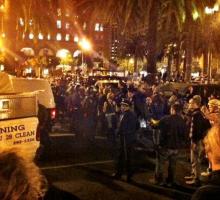
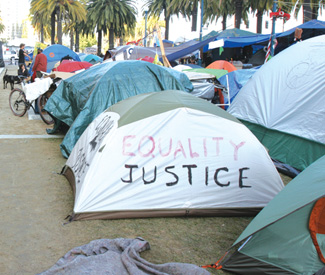
After more than two months, police have successfully cleared out all of the Occupy SF encampment on Market Street between Main Street and the Embarcadero. In an early morning raid, police completely cleared out the Occupy SF protest site at 101 Market St.

More than 50 protesters were present at 101 Market St. on the evening Dec. 10, as well as at a smaller site across the street. No tents, tarps or other structures had been erected; most protesters had sleeping bags and blankets. Following an afternoon march and a small concert that ended by midnight, protesters were quiet and mostly asleep.

Police previously warned protesters that they were in violation of California Penal Code section 647(e), “lodging in a public place.” Police entered the camp and read written notices aloud every 90 minutes or so for more than 24 hours before the raid, but did not give a specific warning as to when enforcement would take place.

Around 4:30 a.m. on Dec. 11, police rushed in, quickly surrounding those who slept in front of the Federal Reserve Building. Without giving them the option to pack up their belongings and leave, police arrested each individual one by one. Protesters who’d set up camp at a smaller site across the street looked on and yelled out in dismay.

Protesters had previously been informed that they were permitted to sleep on the sidewalk between 11 p.m. and 7 a.m., as outlined in San Francisco’s sit-lie ordinance.

Until about 6 a.m., Market Street between Main and Spear streets was blocked off by over 100 police officers in partial riot gear as well as several police vehicles. At about 5 a.m., Department of Public Works crews arrived and started loading all the protesters’ belongings — mostly sleeping bags, blankets, protest signs, and food — into trucks.

Several were arrested on charges other than public lodging. Two protesters, who yelled at police as they lined up on the street, were arrested for obstructing traffic.

One man yelled that he was a homeless war veteran and that he wanted his belongings back, which he’d left on the sidewalk in front of 101 Market. He had been loudly decrying police activity for almost 30 minutes when he jeered that an officer “carried a big stick because he had a small dick,” at which point three officers immediately grabbed him, brought him inside police lines, and were joined by several other officers in pushing him to the ground and zip-tying his wrists. Another man was arrested for spitting near the feet of a policeman.

In one bizarre incident, an officer confiscated a package of bottled water that an individual was carrying at the time of his arrest and then proceeded to distribute the bottles up and down the police line.

A man with a broken foot, who was walking on crutches, was pushed down by police for obstructing the street. He was arrested a few minutes later, after he and several others sat down in a crosswalk in defiance of orders to step onto the sidewalk.

By 6 a.m., everyone who remained at 101 Market St. had been arrested and all of their belongings confiscated; the sidewalk was clear.

Occupy SF began its 24 hour protest at 101 Market St. on Sept. 29. The camp remained until the first police raid on Nov. 20. Protesters subsequently reclaimed the site on Dec. 1.

As things stand, there is no Occupy SF presence at either of the original downtown locations. By 6:45 a.m., about 10 individuals — those who’d evaded arrest — had set up a small protest site, complete with signs and information table, at 532 Market St., in front of the offices of E Trade Financial.

In the past week, Occupy protest sites have also popped up at City College of San Francisco, San Francisco State University, and at the Bank of America at 501 Castro St. Occupy SF State is the only protest camp, complete with tents, still in place today in the city today.

The Performant: Cheap thrills

0

Bargain Basement Mondays and Amoebapalooza

The upside to living in a city as notoriously pricey as San Francisco is that despite the myriad opportunities to blow too much cash on a mediocre time out, there are plenty of options for cheaper entertainments, keeping the broke-ass among us from being eternally housebound. This weekend in particular, a couple of low-budge music showcases offered those too skint to make it to Iggy Pop a way to afford more beer by charging less cover, and one even threw in the pizza! Sure, rocking out with the godfather of punk would have been quite a bang for its buck, but at least Bottom of the Hill and Café du Nord offered economical alternatives to hanging out in a drafty San Francisco flat Google-stalking Mike Watt. Not that I’d know anything about that.

If free’s your price, then Bargain Basement Mondays at Bottom of the Hill is your place. A once-monthly showcase of local musicians with no cover charge, the attitude is chummy and freewheeling. This week’s lineup was intriguing in that it was not just a random assortment of strangers, but instead a loose coalition of one-man bands gathered together to put on a show subdued only in decibels, but certainly not in invention.

I made it just in time to catch Andrew Goldfarb “The Slow Poisoner” halfway through a cluster of bug-themed songs, such as the instrumental “Spastic Maggot” (a personal fave). Goldfarb’s musical sensibility is one part Southern Gothic, one part B-movie creature feature, and one part swampy psychobilly, and in addition to accompanying himself on the electric guitar and kick drum, he also provides a visual “slideshow” of oversized flashcards with the names of each song painted in Goldfarb’s distinctive cartooning style, deceptively simple lines, skewed perspectives, and boneless, Piraro-esque physiology.     

Sean Lee’s 1manbanjo act followed, in which he led a spontaneous conga line of oddience members around the dance floor, beating time on a snare drum strapped to his back while strumming his mandolin-sized banjo, a hobo pied piper in a rumpled suit. A member of Thee Hobo Gobbellins, about half of Lee’s set was comprised of songs from their Alice in Wonderland-themed “Cheshire Rock Opera”—next slated to play the Oakland Metro on Jan 27, 2012. Last but certainly not least, Jordan B. Wilson debuted his very interesting music-making machine, which the other musicians kept referring to as a “squid”. An elaborate array of cables , computers, mixing boards, and drumsticks snaked around an entire drum kit’s worth of percussion, additionally Wilson played a double-necked guitar with keys, and sang, a triumph of multi-tasking, to say nothing of the three-year creation process of his singular contraption. 

Sunday’s Amoebapalooza, the annual open-to-the-public holiday party of Amoeba Music employees, was as quirky and varied as the music selection at our favorite converted bowling alley, during which the employees rocked the stage, and the aforementioned pizza was distributed like the modern equivalent to a Dickenson turkey. With a couple of exceptions (Vanishing Breed being one), most of the bands gave the impression of being hastily assembled for the purpose of playing this one show, but for five bucks, and all-you-can eat, it basically paid for itself, which was ultimately the desired effect..

Give The Performant a reason to Twit. Follow @enkohl for of-the-minute updates from the underground


Style Paige: Be funneled

0

Well-dressed men always make me a little weak in the knees. What can I say; I’m a sucker for fashion. But in a city like San Francisco, where men’s clothing stretches from one end to the style spectrum to the other, it is the simplest of styles that catch my eye.  

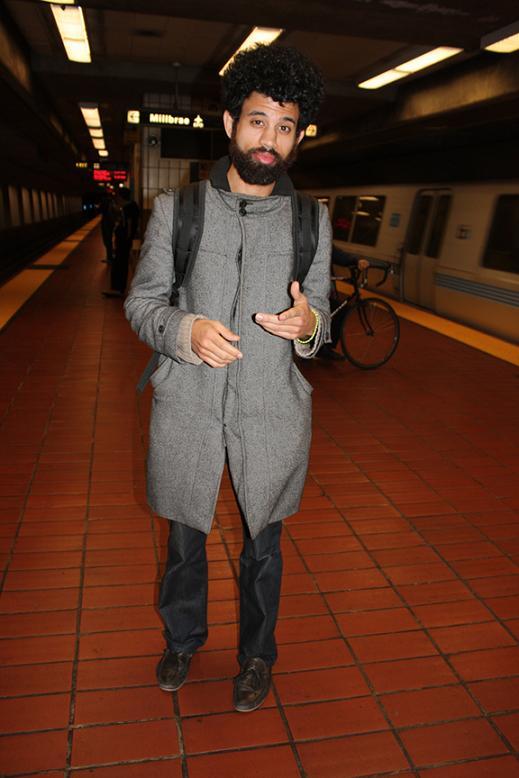
Wearing a wool trenchcoat, dark blue jeans, and tassel loafers, Rolando Brown was waiting for his BART train to arrive when I interrupted him mid-text message.

Making his outfit edgy and modern, Brown wore his funnel collar coat with a black hoody tucked underneath. Designers Richard Chai for Penguin and John Varvatos have created similar looks recently — trenchcoats in tweeds, camel, cashmere, and solids that make it easy for men to be trendy when bad weather arises. 

My be-styled traveler was also wearing brown leather loafers, footwear that you really can’t go wrong with regardless of the decade. I once read in GQ that if Michael Jackson can rock loafers with white socks, then there’s no reason why everyone else can’t follow his lead. 


All will be revealed!

0

The art of storytelling took a hit the day Johannes Gutenberg began fucking around with moveable type (on or around Tuesday, 1450), but stoking a good story by firelight or halogen lamp hangs on as a cultural desideratum in places like Ireland or San Francisco. Arline Klatte and Beth Lisick figured that out a long time ago, of course, with their Porchlight series (nine years running and going strong). But “Previously Secret Information” has lately proved there is plenty more storytelling worth accommodating in this chatty town.
 
Produced by stalwart stand-up comic Joe Klocek and impresarios Bruce Pachtman and Ty Mckenzie, “PSI” slants toward the comic and happens on the odd Sunday at Stage Werx Theatre — including this Sun/11, oddly enough. The new installment features well-known pop music critic Joel Selvin, with consummate insider dish about Bill Graham back in the day; the Dursts (political satirist Will and partner in comedy Debi), recounting an understandably bizarre White House wedding they attended (I’m guessing probably not in the Bush years); and Sammy Obeid, a former UC Berkeley honor roll student turned stand-up comic (it must have been one of those funny majors), relating the story of how a teetotaler gets a DUI.

It’s already an impressive bill. But there’s more: Klocek joins the lineup with his own account of how “Barney the Dinosaur Got My Butt Kicked.” I don’t know if this tail tale can match Klocek’s last “PSI” offering — a near-death experience that changed the course of his life that was at times predictably hilarious, at times surprisingly moving, and always genuine — but I’d be keen to find out.
 
“Previously Secret Information (PSI)”
Sun/11, 7 p.m., $15
Stage Werx Theatre
446 Valencia, SF
www.stagewerx.org

OccupySF retakes plaza to debate whether to keep it

10

OccupySF and its supporters defended Justin Herman Plaza last night (Wed/7) in a strong display of nonviolent action, demonstrating a commitment to the movement. But the unfolding events also showed the group is at a crossroads as it debates its next moves, and whether to continue trying to occupy the plaza after the group’s tent city was removed by police and city workers.

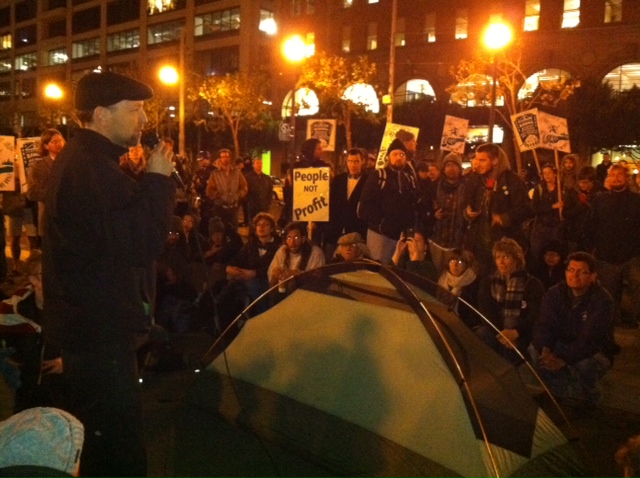
About 250 gathered for a rally at 5 pm at 101 Market Street, marching the half a block to Justin Herman Plaza an hour later. Since the plaza was cleared out that morning, it had been guarded on all sides by a line of police. But as they approached, improbably, the police line parted, letting protesters through.

The group began to hold a general assembly meeting, but after 20 minutes police issued an order to disperse. About 50 sat down in a show of civil disobedience while a couple hundred more surrounded the outskirts.

Clashes with police in the past have been characterized by tension and angry cries from protesters. This one was more peaceful. Protesters held their ground and refused to leave, but besides a few incidents in which police detained and shoved protesters, most supporters were restrained and calm.

At 8:50 pm, police suddenly began to clear out. Jubilant protesters rushed into the plaza, having won it once again. However, from the meeting that followed, it seemed clear that many are restless to put their energies into actions other than defending the plaza.

The meeting consisted of several announcements concerning upcoming actions, such as taking part in the local march in support of International Human Rights Day on Saturday and Monday’s West Coast port shutdown. Occupy groups from Anchorage to San Diego have pledged to shut down their cities’ ports on Dec. 12.

Representatives from Occupy Community College of San Francisco and Occupy SF State University, both of which have now created tent city occupations of their own, were also present. After announcements, the discussion turned to strategy. Many saw a great opportunity to pitch tents and try to take back Justin Herman Plaza. Numbers had dwindled somewhat, but there were at least 150 protesters still present for that discussion. Others argued that OccupySF had successfully shown they could retake the plaza and that they should try and avoid a police clash that night, and instead sleep at and near 101 Market Street, their other recently reclaimed protest site.

Many insisted that OccupySF would be strategically wise to allow their supporters to reserve their energy for upcoming marches and actions; nightly calls to defend camp, said one protester, were wearing many down. In the end it was clear that “OccupySF is a network of autonomous individuals. Some will stay in Justin Herman, some won’t—but we’re all in solidarity.”

All this discussion took place amid reports that police were massing in the garage underneath the nearby Hyatt Hotel and at the police tactical building on 16th and De Haro streets. Many believed that they were staging to come back and make arrests if protesters attempted to re-erect their tent city. During the meeting, protesters put up five tents, but by 11:20 pm, they had voluntarily taken down their tents.

The OccupySF general assembly consented last week to defend Justin Herman Plaza anytime it is threatened. Yet the events of the past few days, as well as the destruction of large Occupy sites throughout the country in the past weeks, many sense that strategy may now be shifting.

Gordon Mar, director of Bay Area Jobs With Justice and OccupySF supporter who risked arrest last night, told us, “There’s a lot of exciting ideas and debate about new directions, including reoccupying JHP, but also moving forward in different ways. Occupy our homes initiatives have taken off recently, as well as occupations on college campuses, different communities and neighborhoods. It’s a really exciting and hopeful moment.”

Shaw San Liu of the Chinese Progressive Alliance issued a public statement saying, “You can raid a camp, but you can’t raid a movement. The movement cannot be stopped. [The occupation] was just the tip of the iceberg.”


Progressives split on bag ban, ex-cons

12

A couple of interesting votes at the Board of Supes Dec. 6. Sup. Ross Mirkarimi lost two pieces of legislation — a mandate that stores charge for bags at checkout counters and a tax credit for companies that hire ex-offenders.

The bag ban went down 7-4. Well, actually, it was continued to February, by which time Mirkarimi will be gone. Sup. Jane Kim said she wanted to see more outreach to minority businesses, and was quoted in the press saying she would support it at a future date, but I suspect the delay marks the end of the bill. Without Mirkarimi around to push it, the measure will probably just die. It’s odd because San Francisco used to be on the cutting edge of environmental issues; the bag ban is getting picked up by other cities and will probably be law all over the country in a decade.

Voting for the continuation were three supes who said they supported the “concept” — Scott Wiener, David Chiu and Kim.

The ex-offender tax credit went down 6-5 — and on this one, Sup. Malia Cohen, who is not always with the progressives but whose district has the largest number of parolees in the city, supported Mirkarimi. So did Kim, Eric Mar, and David Campos. The swing vote: Sup. John Avalos, the progressive leader in the mayor’s race and one of the most solid left votes on the board.

Avalos told me that he doesn’t support tax breaks; he’s been consistent on that, and I understand. I don’t support tax breaks, either. I don’t think they’re very effective and they cost the city money. But there are two elements that make this unusual — for one, if anyone actually used the tax credit and hired an ex-offender, the money the city would likely save by keeping that person from going back to jail would greatly exceed the amount of the tax reduction.

Besides, I was waiting to see Lee come up with an excuse to veto the bill — particularly at a time when more and more ex-offenders are going to be released in San Francisco. I know this is just petty politics and all that, but this was a tough decision involving a very unpopular group (nobody wants to be nice to former criminals) — and Lee got off easy.

The Phil Ting for Assembly campaign is under way

11

Just a few days after the race for mayor of San Francisco ended, Assessor-Recorder (and mayoral candidate) Phil Ting began his next campaign — for state Assembly.

The Westside district now represented by Fiona Ma opens up in 2012, when Ma will be termed out. And Ting was moving to set himself up as the frontrunner almost as soon as the ink had dried on on the final results from the mayoral election (where he finished a disappointing 11th, behind even Green Party candidate Terry Baum). Philting.com, which had been the official website for Phil Ting for Mayor, has been switched over to Phil Ting for state Assembly. I got an email Dec. 7 inviting me to a reception for his Assembly campaign; several prominent local politicians told me Ting had called even earlier than that to ask for support.

And he’s getting it — both state Sen. Mark Leno and Assemblymember Tom Ammiano are on his already-impressive list of endorsments.

Which is no surprise: The 12th District (which will become the 19th under the new redistricting) is the more conservative side of San Francisco, and by the standards of the state Assembly, Ting would be a pretty solid progressive. He actually understands tax policy, and he’s made a huge issue of removing the commercial property loophole from Prop. 13.

So now comes the interesting part: Who’s going to run against him?

Ting has a relatively cordial relationship with Mayor Ed Lee, and didn’t spend much time in the campaign attacking the appointed incumbent. He’s a former executive director of the Asian Law Caucus, where Lee worked in his early days as a tenant and civil-rights lawyer. There shouldn’t be any reason for the mayor or his pals to try to drum up a candidate to take on Ting … or should there?

Ting is not an enemy of the Willie Brown-Rose Pak folks. But he’s not a loyal ally, either. The most obvious conservative/pro-downtown candidate, one the mayor and his big-business pals could count on, would be Sup. Carmen Chu. I couldn’t get her on the phone, but in the past she’s been only lukewarm about running. The other strong potential candidate would be Sup Sean Elsbernd, but he told me he’s absolutely not running. “I was very interested during my first few years on the Board, but since my son was born, there’s no way I would consider it,” he said. “I am not a candidate and shouldn’t be talked about as a candidate.”

So will we see a “Run, Carmen, Run” campaign? Or will Brown and Pak think about it and realize that giving the mayor an appointment to Ting’s office might be a real advantage? Would they rather control a state Assemblymember — of the county assessor?

Stayed tuned to this one.


ILWU attitudes toward port blockade aren’t so simple

The Chronicle’s Andrew Ross describes Occupy organizers as “brilliant” in a sarcastic tone for vowing to move ahead with the Dec. 12 West Coast port blockade, despite public statements from the longshore union’s president criticizing the plan. But Ross’ article misses the mark, and seems to ignore alliances that have been forged between various sectors of labor and the Occupy movement in recent months.

“Trouble is, the folks they purport to be in solidarity with don’t seem hot on the idea to ‘effectively shutdown the hubs of commerce’ at all,” Ross writes. The Chronicle’s narrative is clear: Here you have some everyday working people trying to do their jobs, make ends meet, and put food on the table. They don’t want to see business as usual disrupted by a bunch of out-of-touch radicals who claim to speak for them.

But in reality, workers’ attitudes toward the port shutdown are far more nuanced. After all, longshore and warehouse workers are feeling the pinch as advances in technology reduce the number of jobs to be filled along waterfront shipping facilities, and many truck drivers who haul cargo to and from West Coast ports are barely able to make ends meet since they’re employed as independent contractors and paid low hourly wages without union representation.

The president of the International Longshore and Warehouse Union (ILWU), Robert McEllrath, issued a statement Dec. 6 in which he criticized the plan for a west coast port blockade, which occupiers in Oakland, Los Angeles, Seattle, Portland, Vancouver, and Anchorage have all vowed to participate in on Dec. 12.

The official aim of the Occupy port shutdown is to demonstrate solidarity with longshore workers engaged in a labor dispute against EGT in Longview, Wash., and to stand with port truckers in Los Angeles whose attempts to unionize have been thwarted. The action is also meant as payback for raids against Occupy encampments in Portland, Oakland, Los Angeles, and other major cities, which were carried out in the wake of coordinated teleconferences between metropolitan mayors and a powerful organization of former police chiefs engaged in shaping law enforcement practices.

“Support is one thing,” wrote McEllrath, the ILWU president. “Organization from outside groups attempting to co-opt our struggle in order to advance a broader agenda is quite another and one that is destructive to our democratic process and jeopardizes our over two year struggle in Longview.”

ILWU spokesperson Craig Merrilees echoed McEllrath’s statement, telling the Guardian, “The Occupy Oakland group failed to respect the ILWU’s democratic decision-making structure. It’s unfortunate — it could’ve been handled differently.”

Dan Coffman, president of ILWU Local 21 in Longview, Washington, had just gotten out of a court hearing with grain terminal operator EGT when the Guardian caught up with him by phone. His union has been locked in an ongoing struggle against EGT, stemming from the multinational corporation’s attempts hire non-union workers and erode standard worker benefits such as overtime pay at a new grain terminal built on Port of Longview property.

“The ILWU has no involvement in [the port blockade] whatsoever,” Coffman explained. “We are not organizing this, and we are not promoting it.”

Yet he emphasized that, speaking as individual, “I’m a 99 percenter. Things have got to change. We’ve got to get some sanity back in this country. It’s obscene what they’re doing to working people and poor people in this country.”

Some rank and file members of ILWU said they agreed with the principles of the Occupy movement.

“Longshoremen had a good response to the [Nov. 2 general strike and port blockade],” Anthony, a longshoreman who’s worked at the Port of Oakland for more than a decade, told the Guardian in a phone interview. “It was empowering to a lot of people that so many people came out.” He added, “The rank and file do support the principles of the community and Occupy.”

The Port of Oakland ran full-page ads in major newspapers last week condemning plans for a port blockade, yet incorporating a key phrase of the Occupy movement into its message. “Port of Oakland is where the 99% work,” the ad proclaimed. “Occupy groups have called for a ‘total west coast ports shutdown’ on December 12th. Port of Oakland maritime operations were partially shut down on November 2nd. What did that accomplish? Lost work hours, lost shifts, and lost wages for workers and their families.”

Asked about the ad, Anthony called it “a lot of propaganda.”

Tremaine Waters, another longshoreman at the Port of Oakland, told the Guardian, “The majority of ILWU workers are supportive of what’s going on. They understand the situation occurring in America right now.” He added that if community members organize a picket line on Dec. 12, “I would say, yes, the ILWU members will respect it.”

Clarence Thomas, a third generation Oakland longshoreman, discussed the planned port shutdown in an interview with Worker’s World. Thomas emphasized that ILWU traditions and practices dictate that union members do not cross community picket lines.

“A picket line is a public demonstration — whether called by organized labor or not,” Thomas said in the interview. “It is legitimate. There are established protocols in these situations. To suggest to longshoremen that they shouldn’t follow them demands clarification. It is one thing to state for the record that the union is not involved, but another thing to erase the historical memory of ILWU’s traditions and practices included in the Ten Guiding Principles of the ILWU adopted at the 1953 biennial convention in San Francisco,” Thomas said. He added, “Labor is now officially part of the Occupy movement. That has happened.”

No more Scrooge: A list of nonprofits that still have holiday volunteer slots

1

Mincemeat, Christmas goose, Hannukah gelt, lush sprays of holly bedecking the proverbial halls – traditionally, the December holidays are all about richness, overeating, and expense. But — especially these days — not everyone will be blessed with bounty over the holidays. In trying economic times, the number of San Franciscans struggling to put food on the table let alone buy their loved ones presents is steadily growing. 

So volunteer. San Franciscans have a long-standing tradition of helping out come the holidays, and many of the traditional community meals and grocery hand-outs have filled up their guest lists like a Big Freedia show during Pride Week. Nevertheless, a bunch of opportunities remain for those looking to lend a last-minute hand.

San Francisco Food Bank

Given recent funding cuts to the organization, the San Francisco Food Bank is taking all the help it can get in its quest to feed an ever-growing number of hungry San Franciscans. An enviably efficient volunteer system relies on interested helpers to sign up on an online calendar before showing up for their shift of repackaging food for community distribution.

900 Pennsylvania, SF. www.sffoodbank.org


Glide Memorial Church

Signing up to volunteer with Glide is a bit like jockeying for the last square of fudge. But luckily the organization – a superpower of Samaritan spirit – has a few spots left for December. Chose between an early-morning grocery bag distribution gig or a toy sorting task.

330 Ellis, SF. www.glide.org


St. Anthony’s

Packed to the gills with volunteers for its main events, St. Anthony’s is still calling out for help with two upcoming items: managing curbside drop-offs on December 23rd and 24th and clothing collection throughout the month. Both duties require the volunteer to be at least somewhat physically fit and able to lift 25 pounds of goodies. Shifts are four to five hours long and can be signed up for via a voicemail message to the volunteer hotline (see below). 

150 Golden Gate, SF. (415) 592-2829, www.stanthonysf.org


Tenderloin Tessie

If you’re looking to participate in a volunteer-run, community-oriented holiday dinner, this is one of  the best bets as better-known options are already staffed out the wazoo. Tenderloin Tessie provides holiday meals to homeless, low-income, disabled, and elderly San Franciscans – and has a wide-open sign-up sheet for volunteers. December 24th shifts involve loading and unloading food from the truck while shifts on Christmas Day are dedicated to decorating the dining room, preparing and serving dinner, and cleaning up afterwards. 

First Unitarian Universalist Church, 1187 Franklin, SF. Call Michael Gagne at (415) 584-3252 to register, www.tenderlointessie.com


Meals on Wheels San Francisco

The nationwide organization that delivers healthy meals to homebound seniors is peddling its Chefs of the Bay Area calendar for the next few weeks at various locations throughout the city. Individual volunteers are needed to staff the tables and promote the calendars, the proceeds from which eventually translate into someone’s hot holiday dinner.

1375 Fairfax, SF. Contact Danie Belfield at dbelfield@mowsf.org or call (415) 343-1311, www.mowsf.org


Habitat For Humanity

Habitat Greater San Francisco holds an ongoing inter-faith build on one of their largest projects to date, a 36-unit condominium at 7555 Mission.  No construction experience is necessary, and December 21 marks the start of their Winter Solstice Build, a community-driven effort to get the Daly City residence available to low-income tenants as soon as possible.

7555 Mission, Daly City. Sign up online at www.habitatgsf.org


Little Brothers San Francisco

Not everyone has family around for the holidays, and older San Franciscans can be especially in need of some care and affection. Little Brothers organizes several opportunities for volunteers looking to befriend community elders, from Christmas Day house visits to phone check-ins to help at the office. 

Various locations, SF. Sign up online or at (415) 771-7957, www.littlebrotherssf.org


AIDS Emergency Fund

Unlimited slots for volunteers pretty much guarantees a perfect present of a Christmas Eve dinner for San Franciscans with HIV/AIDS and their families. Last year, more than 1,000 people ate; this year (the 24th such dinner), a similar turnout is expected. Load-in of supplies begins at 10 a.m. on December 23rd and shifts run all day on Christmas Eve, starting at 8 a.m.

War Memorial Veterans Building, 401 Van Ness, SF. www.aef-sf.org, sign up at aefxmas@aol.com.


Jewish Family and Children’s Services

Gather and deliver holiday treats to those who might not otherwise celebrate the holidays on December 16th and 18th at the JFCS. Individuals and groups of volunteers are both welcome; sign up by December 9.

2150 Post, SF. Call (415) 449-3832 or email loril@jfcs.org to sign up. 


SF SPCA

A sprinkling of volunteer spots remains (especially post-Christmas) at the SPCA’s annual window display at Macy’s Union Square. Staff the windows – full of then-and-there-adoptable creatures – to raise money for future SPCA programs. 

Email windowsvolunteer@sfspca.org, use the online calendar, or call (415) 554-3008 to register, www.sfspca.org 


Hayes Valley Farm

Always open to volunteers, Hayes Valley Farm, an off-ramp-turned-urban-ag-oasis, holds special holiday hours for those looking to weed away end-of-year poundage or just engage with some of the happiest plants and gardeners in San Francisco. December 27 marks the first post-holiday gardening session and is sure to host droves of veterans and newbies alike.

450 Laguna, SF. www.hayesvalleyfarm.org


Occupy movement targets foreclosed homes

14

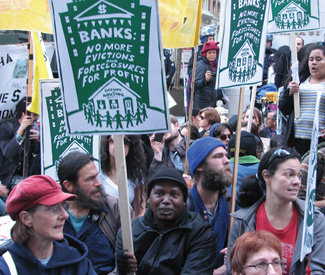
Throughout the Bay Area on Tuesday (Dec. 6), Occupy activists and housing advocates launched what they said will be an ongoing effort to place families back into their foreclosed homes, seizing bank-owned homes to put pressure on the banking industry to cooperate with homeowners in loan trouble.

In San Francisco, San Jose, and Oakland, activists highlighted the nation’s foreclosure crisis by occupying foreclosed homes as part of the Occupy movement’s national day of action against foreclosures. Occupy Oakland activists said the tents are gone in downtown Oakland, but the move toward house occupations represents a new phase for the movement.

“I am here fighting for my home,” said Margarita Ramirez, addressing a crowd of 150 supporters at the West Oakland BART station. Ramirez said her family fell behind on their mortgage payments after her husband was laid off at the onset of the recession. The Ramirez family applied for a loan modification under the federally subsidized Home Affordable Modification Program(HAMP) hoping for some relief, but their lender, Bank of America, denied their request. Though HAMP is a federal program, it is administered though individual mortgage lenders.

According to Ramirez, with time left before her foreclosure, Bank of America urged them to explore other options to save their home. Then, inexplicably, Bank of America sold her home to Fannie Mae, leaving her family out of options despite what Ramirez says is Bank of America’s later admission to the error and willingness to work with the family. Fannie Mae however has held firm that the sale was valid, leaving the Ramirez family in an uncomfortable comprise of renting their own home.

In order to pressure Fannie Mae on behalf of the Ramirez family, activists with Occupy Oakland and Just Cause seized a vacant Fannie Mae owned foreclosure at 1417 Tenth street in West Oakland.

“This house is owned by the federal government, who we pay taxes to,” said Occupy Oakland activist Thaddeus Guidry, who said that he had struggled hard to get by during the recession. As he stood over a grill cooking hotdogs for the crowd gathered in the yard of the newly occupied house, he said he had found new inspiration and hope after becoming part of Occupy Oakland.

“Tonight will be the first night here in the house,” said Guidry. “This is my home now. We hope to house eight people here.”

Fannie Mae, which was effectively foreclosed on by the U.S. Treasury in 2008 under a process know as conservatorship, has received $169 billion in federal bailout money and remains under federal control.

The house on Tenth street is modest but spacious, with electricity and water. Downstairs, Just Cause is getting ready to start an eviction defense clinic. Just Cause organizer Maria Zamudio told the Bay Guardian that the group holds regular eviction defense clinics in San Francisco and Oakland, but the freshly occupied house in West Oakland would serve as a community space that people can drop into to learn their rights.

“We have been doing eviction defense for a long time. Since the recession, we have seen a change to tenants being pressured to leave by banks after landlords lose a house to foreclosure,” said Zamudio. “It is important for tenants to know that they do not need to leave a foreclosed property. The tenant has more rights in these situations then the homeowner.”

Only blocks away, Gayla Newsome stood in front of her house at 1536 Adeline St with another crowd of supporters from Occupy Oakland, and housing advocates from the Alliance of Californians for Community Empowerment(ACCE). She has been out of the house for six months after the foreclosure, leaving her and her children to stay with family in an overcrowded situation as the house sat vacant.

“This is the moment I take my house back. I’m a little scared, a little nervous, but I have to do this for my kids and grandkids. I have to do this for the other people who are going through this,” said Newsome.

Newsome said Chase Bank repeatedly denied receiving her HAMP loan modification paperwork. When she finally sent a copy by certified mail, they acknowledged the application and denied her eligibility in the program.

The eviction came swiftly. Unaware of the looming eviction, and believing she still had time to save her house even though Chase was outside the HAMP program, Newsome was called by her children while at work the morning of July 19.

“The kids were given 10 minutes to grab what they could before they were put on the sidewalk in their pajamas by the bank representative and the sheriff. They called me frantic,” recalled Newsome.

The recession has been hard on West Oakland. One out of 236 houses in West Oakland are in foreclosure, with many more families hard-pressed to hang on. Housing advocates say that foreclosures destabilize entire neighborhoods, as surrounding property values plummet and blight spreads.

“I’m not just here personally to reclaim my house, I’m here to say it is time to reclaim this neighborhood,” said Newsome, who laid the blame for the neighborhood’s sharp decline at the feet of the banks.

Residents of the neighborhood gathered for the rally shared stories of realtors cruising the neighborhood stopping to photograph even properties that are not in foreclosure or for sale.

“This was not an accident, this is redlining,” said Nell Myhand of Just Cause about West Oakland’s housing troubles.

“It’s time to take this to the politicians,” said ACCE organizer Shirley Burnell. “If they are not willing to help us, then they got to go. We will take them to the streets.”

Outside, activists signed up for shifts to help defend Newsome’s home from eviction, and started an emergency phone tree in case of trouble.

“The tents are gone but we are still here!” yelled an Occupy activist from the crowd as home defense clipboards circulated.

“I appreciate everyone doing this with me,” said Newsome. “That’s what Occupy is all about. We will take our homes back one at a time – no, five at a time.”

Cruel revolution

0

cheryl@sfbg.com

LIT “As one survivor told me,” author Julia Scheeres writes in her introduction to A Thousand Lives: The Untold Story of Hope, Deception, and Survival at Jonestown (Free Press, 320 pp., $26), “nobody joins a cult.”

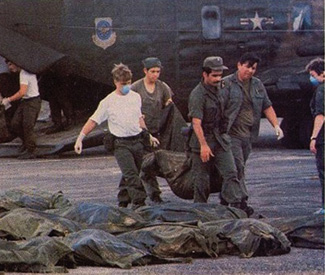
I remembered this refrain, possibly spoken by the same survivor, from Stanley Nelson’s 2006 Jonestown: The Life and Death of Peoples Temple. Recent works like Nelson’s film and Scheeres’ book suggest perceptions about Jonestown are shifting away from sensationalism. The broad strokes are well-known: a charismatic, maniacal preacher; a jungle settlement; over 900 people dead, including a Congressman; a vat of poisoned punch. But the story — explored in A Thousand Lives as a deeply disturbing human tragedy on a nearly unthinkable scale — neither starts nor ends there.

Scheeres, who keeps an office in the San Francisco Writers’ Grotto, pored through recently-released FBI files while researching A Thousand Lives. “The FBI released its files on three CDs, without a real index. So a letter that started on CD one, page 20, could end on CD three, page 350,” she remembers. “Organizing the material — 50,000 pages of documents — a lot of it was really boring shipping manifests. Crop reports. But then, oh, hey! Here’s a memo from the camp doctor discussing with [Jim] Jones how they’re gonna kill everyone.” Building from this material, the book focuses on five Peoples Temple members and views the experience of Jonestown through their eyes.

“[I chose my subjects] based on whether they were still alive, and I was able to interview them at length, or whether they had left a lot of primary source documents behind,” she says. “I also wanted to talk about the different demographics of the church, so you have old, young, black, white. A woman who has an MFA from San Francisco State, and a young black man with a GED from Oakland.”

Though A Thousand Lives does offer some background on Peoples Temple founder Jim Jones, “I wanted to know what it was like to be a rank-and-file member of the church,” Scheeres says. She uncovered powerful evidence that Jonestown was not a mass suicide, as the unfortunate phrase “drinking the Kool-Aid” suggests. Instead, she says, “it was a mass murder.”

As suggested by that sinister memo from the camp doctor, A Thousand Lives’ most startling revelation is that Jones had been fixated on killing his followers long before the events of November 18, 1978. According to Scheeres, he considered loading his congregation onto buses and plunging them off the Golden Gate Bridge, or onto a plane “and having someone shoot the pilot.” (Eerily, he even sent one of his followers to flight school in preparation.)

Soon, though, he was consumed by the idea of Jonestown: “a new society in the middle of the virgin jungle, a utopia that would be free of sexism, racism, elitism, and all other evil-isms,” Scheeres writes. The promises of Jonestown echoed Jones’ seemingly progressive message of equality, which is what attracted most Peoples Temple members to the church in the first place. It was also what had endeared Jones to San Francisco politicians, who were in awe of his ability to “mobilize thousands of people to vote,” according to Scheeres.

But in reality, “he had no desire to see his followers flourish in South America. He was already fantasizing about their deaths. Would his people die for him if he asked them to?” Turns out they had no choice. While she was writing A Thousand Lives, Scheeres took a trip to Guyana and visited what’s left of Jonestown.

“It’s remote, dense jungle,” she says. “Everything looks the same. It would be so easy to get lost. And as you’re walking through, you can hear things slithering in the leaves. Jim Jones told [his followers] that if they tried to escape, they’d be killed by ‘mercenaries’ — really, his sons that were [hiding and] shooting on the camp — or they would be killed by the jungle animals.”

Of course, when they left San Francisco, more or less willingly, Peoples Temple members — like Scheeres subject Hyacinth Thrash, an elderly African American woman who dreamed of a place where racism didn’t exist — expected to find a “utopia,” as they’d been promised.

“[Jones] was so suave and gentle in San Francisco, and would tell you what you wanted to hear, like the ultimate caring father figure. Then once he got down to Jonestown and had everyone trapped there, he just turned. You can hear him on those tapes just screaming, you know. ‘You old bitch, you’re gonna die!’,” Scheeres shudders. “The rank-and-file had no idea that he had this ideation of ‘revolutionary suicide’ until it was too late. They couldn’t escape. They were surrounded by guards holding crossbows, and behind them, a circle of guards with guns, and basically told, ‘If you don’t drink the poison, we’re going to shoot you.'”

Though she has no direct personal connection to Jonestown, Scheeres’ own background, detailed in her 2005 memoir Jesus Land, made her an unusually sympathetic outsider. “The interests aligned: race, religion, seclusion. When I was a teen, my brother and I were sent to this religious reform school in the Dominican Republic, where all of our communications with the outside world were censored, where all of these horrible things were happening that we couldn’t let anybody know about,” she says. “Obviously my situation wasn’t as bad [as Jonestown]. The head of the school wasn’t goading us toward revolutionary suicide. But the whole sense of powerlessness and feeling trapped and helpless — I could identify with that.”

Decades later, Jonestown continues to fascinate; dozens of books have been written by survivors, relatives of survivors, conspiracy theorists, cult experts, and scholars of macabre history. A Thousand Lives — meticulously researched, and written with clear-eyed, sensitive perspective — is a valuable resource for readers seeking truth, not misinformation, about the tragedy.

“Most people under 40 probably don’t remember Jonestown well, if at all. But most people have heard the phrase ‘drinking the Kool-Aid.’ I find that phrase very offensive, because they didn’t drink the Kool-Aid. First of all, it wasn’t Kool-Aid, it was Flavor Aid. Second of all, they were forced to drink the poison. ‘Drinking the Kool-Aid’ implies naïve, stupid, not thinking, kind of dumb, following the leader, and not questioning. And they were questioning. That’s what my book argues throughout,” the author says. “They argued with Jones: ‘We didn’t come down here to die. We came down here for a better life for ourselves and our kids.’ So I think ‘drinking the Kool-Aid’ needs to be excised from the cultural lexicon.”

What’s more, “I hope people will reconsider the conclusions of Jonestown after reading the book,” Scheeres says. “I think it’s a tremendously compelling tale; 918 people died that day, as a result of Jim Jones, and younger generations need to be cognizant of that. Again, he had his people trapped in Guyana, so by the time they were saying, ‘I want to go home’ — and that’s another heartbreaking thing, was finding all these notes from people to Jim Jones, saying ‘I want to go home. I want to go back to San Francisco. I hate it here. I’m miserable. My children are afraid and I don’t know how to tell them that death is a good thing’ — [it was too late]. Reading all of those notes, these voices have been silenced. Now, finally, I feel like I am the loudspeaker, or their medium for letting their voices be heard. It’s too late [to save them]. They’ve been dead for 33 years. But for the record — they did not want to die.”

www.juliascheeres.com


Get read!

0


ROCK AND ROLL ALWAYS FORGETS

By Chuck Eddy

Duke University Press

352 pp., paper, $24.95

Chuck Eddy glides through music criticism like a grumpy fanatic. Each article included in Rock and Roll Always Forgets — culled from Eddy’s vast back catalogue of music journalism articles, beginning with the early 1980s — is packed with cultural references, touchstones, facts, witty asides, a dash of snark, and acknowledgments of once-obscure acts. Yet, he approaches each band like he’s the first to have discovered it. He’s a musical anthropologist, but also, archeologist, digging up the remains of musicians past, lest we forget. Take a piece on a Marilyn Manson show, written in 1996. More than simply describing the stage and the crowd (which he does, expertly: “[they] wore too much black makeup, but they didn’t scare me — most seemed to be upper-middle-class Catholic school teens from the burbs…”). He wanders near profundity, dissecting Manson’s overall persona, his ticks, his own cultural references, and those who came before him, namely Alice Cooper, but a great many more. Most importantly, Eddy alludes to why that all matters in the least. (Emily Savage)


TROPIC OF CHAOS

By Christian Parenti

Nation Books

295 pp., hardcover, $25.99

Through historical research and on-the-ground reporting in Kenya, war-torn areas of Afghanistan, and other regions marked by intense conflict, Christian Parenti offers an unusual and compelling analysis of violence through the lens of the environment. Tropic of Chaos: Climate Change and the New Geography of Violence teases out the idea that increasingly unstable weather patterns stemming from climate change have fueled conflict throughout impoverished areas of the Global South. In the savannahs of northwest Kenya, for instance, deadly cattle raids have intensified as intertribal warfare heats up in the face of water scarcity. Recurring droughts and floods in Afghanistan have made it exceedingly difficult for farmers raise traditional crops, making them increasingly reliant drought-resistant poppy — the raw ingredient for heroin — for economic survival. Parenti also turns a sharp eye upon the repression, surveillance, and counterinsurgency that first-world nations have employed to combat growing violence in water-scarce, conflict-ridden regions, and calls for a more enlightened approach. (Rebecca Bowe)


CAFE LIFE SAN FRANCISCO

by Joe Wolff

Interlink Books

224 pp., paperback $20

Small quirks in this guide to the city’s cafes and coffeehouses — the sixth in a series that includes Sydney, New York, and Venice — will let you know its not strictly, strictly for locals. Java Beach is lumped in with more gearhead-oriented Mojo Bicycle Cafe and Ninth Avenue’s Arizmendi Bakery is filed under the catchall “Sunset District and vicinity.” The introduction’s discussion of “San Fran” versus “Frisco” versus “the City” is one that became boring long ago. But those things matter little. In-depth histories of some of your favorite cafes, from Java Beach to Philz’ to Caffé Baonecci are lucid looks at the facts and rewards of small entrepreneurship in the city. And Roger Paperno’s loving photography of velvet crema and foccacia sheets combines with words to create an ode to the city’s third spaces that any caffeine-laptop addict will appreciate in their stocking. (Caitlin Donohue)


LIONS OF THE WEST: HEROES AND VILLAINS OF THE WESTWARD EXPANSION

By Robert Morgan

Algonquin Books

497 pp., hardcover, $29.95

Biography can be the best history; stories of the people who changed the world (for better, and often for worse) are more compelling than turgid texts of dates and places. Lions of the West recounts the development of the American frontier from the end of the Revolutionary War to the Civil War era through the lives of 10 men. Yeah, all men. In fact, Morgan (by choice or by the longtime bias of American historians) makes it appear as if all of the great and evil deeds done as the nation moved Westward Ho were the province of the male of the species. At times, the profiles are a bit over the top (I don’t really care that much about Kit Carson’s personal life.) Overall, though, it’s a detailed, lively, and informative book that minces no words, especially when discussing the theft of much of the southwest from Mexico. San Franciscans will enjoy learning who Stockton, Sloat, Castro, Winfield, and a few other streets were named after. (Tim Redmond)


VHS: ABSURD, ODD, AND RIDICULOUS RELICS FROM THE VIDEOTAPE ERA

By Joe Pickett and Nick Prueher

Running Press

272 pp., paper, $14

Found Footage Festival founders and comedy writers Joe Pickett and Nick Prueher are apparently the Indiana Joneses of VHS, unearthing remarkable video package cover art that would otherwise be relegated to hoarder basements, bonfires, and anywhere else the worst (a.k.a., the best) videotapes go to die. I salute these dudes, even though the captions they tag each page with aren’t always funny or necessary. Truly, the covers (soft-focus and garish, tacky and baffling) speak for themselves, direct dispatches from ye olden days, long before YouTube brought WTF-ness to anyone with an Internet connection. You see, children, back in the 1980s or 90s, home viewers had to seek this shit out: instruction in squirrel-calling, chair-dancing, seduction, hairstyling (“What the Heck Am I Going to Do With My Hair?”), baby-proofing, spotting counterfeit Beanie Babies, etc. Straight-to-video masterpieces (F.A.R.T.: The Movie). Horrible exercise fads (“Bunnetics: The Buttocks Workout”). Well-meaning but also ghoulish-looking self-improvement vids (“Face Aerobics”). Every page is magical. Your mind will be blown. (Cheryl Eddy)


BI-RITE MARKET’S EAT GOOD FOOD

By Sam Mogannam and Dabney Gough

Ten Speed Press

297 pp., hardcover, $32.50

Bi-Rite Market is the ultimate neighborhood grocery. Shockingly small (with ambition to expand), it’s jam-packed with the best in organic produce, meats, cheeses, and artisan food products, much of it local. Now, Bi-Rite founder Mogannam has a new book loaded with recipes for such inviting delectables as white bean puree with prosciutto crespelle and strawberry rhubarb pie. But don’t relegate it to the cookbook category. Hewing to Bi-Rite’s mantra of creating community through food, the authors share extensive tips on shopping seasonally and locally for the healthiest and best-tasting products, no matter where you may live. You’ll learn what to look for at the grocery, storage and usage tips, and more. Well-illustrated sections feature produce (broken down by season), wine, beer, cheese, deli meats, butchery, baked goods, and even farmer profiles. Bonus: stay tuned for Sweet Cream and Sugar Cones, Bi-Rite’s ice cream and frozen treats recipe book from its renowned creamery, out this April. (No word yet on whether it’ll tell us how to beat the ever-present line outside.) (Virginia Miller)


DAMNED

By Chuck Palahniuk

Doubleday

247 pp., hardcover, $25

Welcome to Hell, as seen through the eyes of 13-year-old Madison Spencer, the daughter of a jet-setting yet eco-hyperconscious movie starlet and philanthropist. This is Dante’s Inferno meets The Breakfast Club, a film that overtly informs the plot and its main characters. As in Palahniuk’s breakout novel Fight Club, it’s hard distinguish between reality and perception as Maddy leads readers past the Vomit Pond, across Dandruff Desert, and right into Satan’s black Town Car. As she recalls her final weeks on earth, you’re pretty sure that she didn’t really die from a marijuana overdose. Clearly, things are not what they seem as the novel looses an American teenager’s perspective on modern life in both the underworld and earthly realm, with wry commentary on everything from pop culture and capitalist excess to the defeated religions whose fallen gods roam Hades. The gags alone — like the telemarketing and chatroom porn the damned deliver to Earth, and Hell’s endless loop of The English Patient — make this a tough book to put down, all the way to its slightly unsatisfying conclusion. (Steven T. Jones)


BEST AMERICAN COMICS 2011

edited by Alison Bechdel

Houghton Mifflin Harcourt,

352 pp., paperback $25

Chris Ware’s textbooky flowcharts; Angie Wang’s Technicolor, spiraling pistil-armed super-flower-heroine; Peter and Maria Hoy’s intricately plotted cause-and-effect grid art — the sixth year of this hardcover assemblage of the year in superlative strip art soars as a holiday gift for your fave comic nerd. Visual trickery and innovative page staging aside, many of the graphic narratives in this book hold up on plot alone. An excerpt from Kevin Mutch’s Fantastic Life effectively mines zombie philosophy, dating paranoia, and begging drinks off your service industry friends for comic gold. Many of the best pieces, perhaps indicative of the graphic novel mood these days, explore the darker side of the human psyche. But what graphic novel fan is unfamiliar with complicated? (Caitlin Donohue)


THE TIPSY VEGAN

By John Schlimm

Lifelong Books/Da Capo

164 pp., paper, $17

Every time I think we’re past the stereotype of the sullen, uptight vegan, I get another comment like, “Wait, don’t you only eat vegetables?” Why yes, I do eat plenty of veggies, but I also eat decadent dishes such as The Tipsy Vegan‘s Party Monster Pancakes, loaded with the sweet nectar of amaretto and drenched in syrup. This book is a carnivorous teetotaler’s nightmare, boasting 75 boozy recipes stuffed with everything from “beer to brandy” for the liquor-loving vegan cooks among us. It’s not, as I initially imagined, a book on vegan cocktails — that would be far too easy. Written by John Schlimm (Ultimate Beer Lover’s Cookbook), a member of “one of the oldest brewing families in the United States,” the book includes booze-infused treats for parties, brunch, and supper: fried avocados, slur-baaaaked peaches with Cointreau, “Bruschetta on a Bender” — all of which kind of sound like stoner food to me. An nice touch: glossy food porn shots on every page. (Emily Savage)


PROJECT DOG

By Kira Stackhouse

self-published

352 pp., hardcover, $34.99

Local photographer Kira Stackhouse experienced an inspiration so intense that she ditched her high-profile marketing job to pursue it: she would photograph specimens of the 50 most popular canine breeds officially registered with the American Kennel Club (“purebred dogs”) that had been purchased from professional breeders — and pair them with photos of the exact same kinds of dogs found in local dog rescues and shelters. The purpose was to start a dialogue about the effects of professional breeding and highlight the many kinds of dogs available for adoption (and also to change peoples’ perceptions about rescue dogs). But a major part of the story — and what makes this book so fantastic — is the wonderful doggy photography and sumptuous layout. Dogs are posed, or pose themselves, against iconic Bay Area backdrops, accompanied by often hilarious, always revealing, biographies and profiles. Project Dog became an online sensation: this book cements its reputation. Available at www.projectdog.net. (Marke B.)


LISTEN TO THIS

By Alex Ross

Picador

384 pp., paper, $18

In the expanded paperback edition of his absorbing and erudite collection of essays, Alex Ross of the New Yorker writes what could be called his mantra as critic: “I have always wanted to talk about classical music as if it were popular music, and popular music as if it were classical.” Ross listened exclusively to classical until he was 20, something he admits may sound “freakish.” But whether he’s describing Björk in her recording studio in Iceland, or composer John Luther Adams’ sound and light installation in Alaska, Ross draws from an immeasurable well of knowledge and plunges into his subject with gusto. He can find commonalities between Radiohead’s “Pyramid Song” and Stravinsky’s Firebird Suite, clear away the myths that have clouded both Franz Shubert and Bob Dylan, and thoroughly explain why OK Computer and John Cage’s 4’33” are equally astonishing. Informative, eye opening, Ross is every lover of music thrown harmoniously into one. (James H. Miller)


MY FAMILY TABLE

By John Besh

Andrews McMeel Publishing

272 pp., hardcover, $35

To know anything about New Orleans’ dining scene is to know John Besh. As one of Nola’s great chefs, he has a number of restaurants, including the acclaimed August, elevating local cuisine in forward-thinking ways. His original book My New Orleans is a striking post-Katrina tome to one of the greatest cities in the world and its vibrant culinary history. It’s a gorgeous coffee table volume packed with photos of the region’s people, places, and foods — more than 200 recipes from Mardi Gras specialties to gumbo, many with a contemporary twist. Besh just released, My Family Table, with welcoming, everyday recipes he cooks with his family that are healthy, fresh, simple, and heartwarming. Besh’s star power (Iron Chef champion and James Beard award-winner that he is) never dominates. Like New Orleans, it’s a visually beautiful book, but this time themed by “School Nights,” “Breakfast with my Boys,” and recipes like “Curried Anything” or “Creamy Any Vegetable Soup.” Closing with the key element of cooking, the communal, he writes: “If asked what my last meal would be, I’d reply, ‘Any Sunday supper at home, cooked with love, for people I love.'” (Virginia Miller)


FOUR SEASONS OF YOSEMITE: A PHOTOGRAPHER’S JOURNEY

By Mark Boster

Time Capsule Press

128 pages, hardcover, $34.95

John Muir would have loved this book, the spectacular result of a passionate love affair with Yosemite National Park involving all of the principals in this impressive project. Muir helped glorify and preserve Yosemite with his voice and pen. Robert Redford, who fell in love with Yosemite as an 11-year-old boy recovering from a mild case of polio, wrote an eloquent introduction to the book. Photojournalist, Mark Boster was smitten by the beauty and grandeur of the Yosemite when he first visited the park as a child with his family. He spent a year in the park detailing its seasonal changes in more than 100 magnificent pictures. “I felt the breezes, analyzed the light, listened to the sound of the rivers and falls, and tried to capture the images that moved me,” he writes in his introduction. Catherine Hamm’s delicate haiku add a poetic touch to many scenes. (The two principals who brought this project to life with loving care are Narda Zacchino, a former editor of LA Times and the Chronicle, and Dickson Louie, a former executive at both those papers. Zacchino serves as publisher and editor and Louie as president and CEO of Time Capsule Press, which specializes in creating books by using the archival content of newspapers and magazines.) Available at www.fourseasonsofyosemite.com (Bruce B. Brugmann)


THE PDT COCKTAIL BOOK

By Jim Meehan

Sterling Epicure

368 pp., hardcover, $24.95

Few bars have made as much impact on the New York cocktail (and thus the international) scene than PDT. Known as an early mover in the speakeasy trend, PDT revives classic recipes and invents new ones in the classic spirit. Bartender Jim Meehan put PDT on the map, and he’s since gone on to write about drink and educate bar managers and tenders everywhere. In the PDT Cocktail Book, he shares more than 300 cocktail recipes in a comprehensive collection inspired by classic tomes like The Savoy Cocktail Book. There are recipes from generations of hard-working bartenders, tips on glassware, bar tools, equipment, garnishes, techniques, a listing of seasonal ingredients, even a spirits primer. In keeping with PDT’s connection to neighboring Crif Dogs who serve creative dogs in the bar, there’s a section of hot dog recipes from big-name chefs who are regulars at the bar, including David Chang (Momofuku), Wylie Dufresne (WD-50), and Daniel Humm (Eleven Madison Park). From the comfort of home, cook up a Mason Dog fried in cornmeal and huitlacoche (corn smut/fungus, a Mexican specialty) to go with the Little Bit of Country cocktail, which mixes bourbon, maple, and jalapeño. (Virginia Miller)


EVERYTHING IS ITS OWN REWARD: AN ALL OVER COFFEE COLLECTION

By Paul Madonna

City Lights

240 pp., hardcover, $27.95

Like Ben Katchor’s classic “Julius Knipl, Real Estate Photographer,” local artist Paul Madonna’s “All Over Coffee” — published every Sunday in the Chronicle and on essential Web zine The Rumpus (www.therumpus.net) — draws me into a psychic space that is at once serene and troubled, surreal and hyperreal. The effect comes as much from the drawing style as the dreamlike non-narrative: both are direct descendants of Winsor McKay’s “Little Nemo.” Madonna gets an extra chills-up-the-spine boost from his illustrations of semi-familiar San Francisco architecture and intersections, lucid as etchings of bleached Kodachrome shots. For this second collection of the strip, he broadens his nib to include not only the City by the Bay, but Paris, Rome, Buenos Aires, and Tokyo. Overheard quotes, snatches of philosophical discourse, interior monologue snippets, existential doubts, random observations, and short stories are floated over the images to capture a peculiarly lovely eddies in the zeitgeist.


I DON’T WANT TO KILL YOU

By Dan Wells

Tor

320 pp., paperback, $11.95

Some of this is sick shit. You need a warped sense of humor and a love for random violence to enjoy the tale of a young man who lives with his mom in a mortuary and fights a demon made of black goo who takes over the minds and bodies of humans. But it’s a different type of thriller — complete with its own kinda sweet moments of teenage love and angst — and it’s packed with great detail. (Did you know that undertakers use Vaseline to fill up bullet holes? Cool.) John Wayne Cleaver, perfect name for a demon hunter, is a sociopath who is beastly to his mother and can’t get along with the other kids . Except for a super-hot chick who he thinks must be a demon, otherwise why would she like such a loser geek? The demon is nasty and gouges out eyes, cuts off tongues, sticks bodies on poles … you gotta check it out. (Tim Redmond)


RICE AND CURRY: SRI LANKAN HOME COOKING

S.H. Fernando, Jr.

Hippocrene Books

224 pp., paperback, $19.95

After a tongue-inflaming visit to the East Village’s fantastic Sigiri restaurant in NYC a couple weeks back, my interest in — and lust for — spicy Sri Lankan treats like kiri hodhi (coconut milk gravy), rossam (coriander-tamarind broth), kool (seafood soup), Jaffna goat curry, and ulundu vai (savory donuts) was, er, inflamed. Fortunately for me, author “Skiz” Fernando recently spent a year on the island rediscovering his roots and delving into the varied cuisine (later serving as a guide for that cheeky culinary colonist Anthony Bourdain). The punchy, informative Rice and Curry is the result, and includes nice introductions to Sri Lankan geography and history, as well as tips on what to stock in your cupboard to achieve the certain Sri Lankan “oomph” that sets the cuisine apart from Indian. A particular passage that profiles Leela, Fernando’s aunt’s ancient maid, offers some real insight into the island’s food tradition and customs — and yields a marvelous, corruscating crab curry from her hometown of Chilaw, just in time for Dungeness season. (Marke B.)


HEDY’S FOLLY: THE LIFE AND BREAKTHROUGH INVENTIONS OF HEDY LAMARR

By Richard Rhodes

Doubleday

261 pp., hardcover, $26.95

An author best-known for his 1986 Pulitzer-winning The Making of the Atomic Bomb, Richard Rhodes might seem like an unlikely biographer for movie stunner Hedy Lamarr, who lit up Golden Age films like Cecil B. DeMille’s 1949 epic Samson and Delilah. But her above-average qualities (she was called “the most beautiful woman in the world”) extended beyond the superficial. After escaping her gilded-cage marriage to an Austrian munitions magnate, Lamarr found success — and five more husbands — in Hollywood; between roles, she started inventing “to challenge and amuse herself.” During World War II, she got serious about her hobby. Showbiz circles led her to avant-garde musician George Antheil, renowned for his groundbreaking composition for 1924 short Ballet Mécanique. As Rhodes writes, “[Lamarr] began thinking about how to invent a remote-control torpedo to attack submarines just at the time she met Antheil, who knew quite a lot about how to synchronize player pianos.” Together, the “charming Austrian girl” and “the bad boy of music” worked on that torpedo, as well as “spread-spectrum radio,” an innovation that paved the way for contemporary wireless technology. Unlikely? Yes. Fascinating? Indeed. Never underestimate a beautiful woman — or a skilled writer’s ability to humanize complicated characters and bring drama to a tale loaded with tech-speak. (Cheryl Eddy)


COME, THIEF

By Jane Hirschfield

Knopf

98 pp., hardcover, $25

As it happens, one of Bay Area poet Jane Hirschfield’s passages currently adorns the famous Kahn and Keville auto repair shop’s marquee in the Tenderloin: “What some could not have escaped/ others will find by decision/ each we call fate.” Well, you could never blame her for not thinking big. As a well-known and approachable poet, she sports a blurb from O, The Oprah Magazine on this, her ninth collection, the first in six years since releasing her arresting After. And while her slightly witchy, be-scarved, grandiloquent persona screams marketable poetess, there’s some understated magic in her latest poems. These ones are full of plums and glass and vague Zen spells that give off, in their overall effect, an rueful, anticipatory sigh. Some childlike wonder seeps in: “Another year ends./ This one, I ate Kyoto pickles,” says “Washing Doorknobs,” my favorite from the collection. “But one thing you’ll never hear from a cat/ is Excuse me” goes “A Small-Sized Mystery.” Sometimes you can almost Hirschfield her straining for ambiguity, the poems’ heavy life lessons tearing through her delicate webs of observation. Still, each poem here showcases Hirschfield’s incisive power. (Marke B.)


PLENTY

By Yotam Ottolenghi

Chronicle Books

287 pp., hardcover, $35

Recently I returned to London, eating my way extensively through the city. One of my gustatory highlights was Yotam Ottolenghi’s beloved bakery and restaurant, Ottolenghi (with four locations). Not only were his baked goods otherworldly delights, his straightforward but elegant dishes using pristine ingredients were among the freshest and satisfying of my London travels. Plenty, his new cookbook, is a cleanly designed book with vivid photos of recipes like broccoli gorgonzola pie and mushroom herb polenta. Most impressive? Ottolenghi’s recipes are 100% vegetarian. The meat-free aspect is barely emphasized, and one feels no lack in the diverse range of flavors (with Middle Eastern influences) presented. Since 2006, Ottolenghi has penned the UK Guardian’s vegetarian column — and he’s not even a vegetarian! This speaks to how respected he’s become as a chef in his use of veggies and grains. Plenty shows this talent off, but most importantly delivers approachable, easy-to-replicate recipes to tickle our palates. (Virginia Miller)


HILLBILLY NATIONALISTS, URBAN RACE REBELS, AND BLACK POWER

By Amy Sonnie and James Tracy

Melville House

201 pp., paper, $16.95

Gazing back in time to the era when the Black Panthers were serving up free breakfast to low income youth and coming into the crosshairs of COINTELPRO, few may be aware that an interracial coalition of radical organizers included a contingent of poor white southerners bent on fighting capitalism in solidarity with communities of color. Written by a cofounder of the Center for Media Justice and a longtime San Francisco housing activist, this detailed bit of radical history spotlights the organizing efforts of poor whites, transplanted from rural Appalachia to the low-income Uptown neighborhood of Chicago, to build coalitions of poor people in solidarity with civil rights leaders. Groups like Jobs or Income Now (JOIN), the Young Patriots, and Rising Up Angry launched campaigns against neglectful landlords and cops who brutalized their youth. They represented the white arc of the multiracial Rainbow Coalition, initiated by the Black Panthers in Chicago as “a code word for class struggle.” Bizarre as it may seem, “It became common to see [Panther] Fred Hampton ‘give a typically awe-inspiring speech on revolutionary struggle, while white men wearing berets, sunglasses, and Confederate rebel flags sewn into their jackets helped provide security for him.'”

(Rebecca Bowe)


MR. KILL

By Martin Limon

Soho Press

376 pp., hardcover, $24

Korea in the 1970s. The United States has 50,000 troops in country, mostly near the Demilitarized Zone, and they don’t always behave. In general, the Korean authorities allow the military to police its own — but when a young Korean woman is brutally raped on a train to Seoul, and the assailant appears to be an American, all hell breaks loose. Martin Limon lived in Korea for ten years, and he does a (fairly) good job of presenting a portrait of the Cold War tensions between the two supposed allies. There’s a little bit of American bias — the author is former military himself — and his potrayal of Korean society isn’t as sensitive or oddly loving as John Burdett’s descriptions of Thailand in the Bankok 8 series. Limon’s great storytelling and his lively and compelling protagonists, Sergeants George Sureno and Ernie Bascom, pull readers past those issues. Perfect gift for someone who likes international crime thrillers. (Tim Redmond)


THE RECIPE PROJECT

By One Ring Zero

Black Balloon Publishing

116 pp., hardcover, $24.95

It’s part cookbook, part music journalism, part rock opus, and hell, part coffee table book. The Recipe Project (subhead “A Delectable Extravaganza of Food and Music”) is a concept spearheaded by New York-based gypsy-klezmer act One Ring Zero. The band’s co-founders, Michael Hearst and Joshua Camp, created songs using the recipes of well-known chefs (Mario Batali, Isa Chandra Moskowitz, Chris Cosentino) as the word-for-word lyrics. The meals themselves served as musical influence; each recipe inspired a different sound. While the songs are not likely ones you’d listen to say, on a long lonesome drive, they do have a glint of childlike glee. It’s conceptual. The true genius of this project is its overall cohesiveness. It’s an all-in-one package. Follow the recipe, listen to the song, get some interesting background factoids. The Recipe Project also includes full recipe playlists, articles by rock journalists, and some pretty interesting interviews with chefs. (Emily Savage)


CARY GRANT: DARK ANGEL

By Geoffrey Wansell

Arcade Publishing

192 pp., hardcover, $24.95

Back in print (it was originally released in 1996), this paen to the dapper star of North By Northwest (1959), An Affair to Remember (1957), Notorious (1946), His Girl Friday (1940), and approximately 10 zillion other classic films is somewhere between a biography and a coffee-table book. It’s worth picking up for the lavish black-and-white photos alone, illustrating the span of Cary Grant’s career with film stills, behind-the-scenes shots, and the occasional almost-candid image (did he ever take a bad picture)? The accompanying text is straightforward, but — as its title suggests — doesn’t shy away from Grant’s well-documented countercultural experiments. (“Grant became so enthusiastic about the value of LSD that he extolled its virtues during the shooting of his next picture.”) Nor does it gloss over Grant’s vices (he smoked 30 to 40 cigarettes a day) and sometimes troubled personal life (he was married five times). But the book’s chief focus is Grant’s brilliant career. As Stanley Donen, who directed him three times, remarks to author Geoffrey Wansell, “He’s thought of as a man who achieved a certain elegance and savoir faire. But in truth he was a fantastic actor.” (Cheryl Eddy)


NATURAL HISTORY OF SAN FRANCISCO BAY

By Ariel Rubissow Okamoto and Kathleen M. Wong

University of California Press

352 pp., paperback, $24.95

Drag queens, beat poets, burlesque dancers, hyphy rappers, dot com techies — the human species of the Bay Area have been well-documented, but information on the non-human dwellers of the bay itself has been left to scattered guidebooks, obscure blogs, and academic sources. Authors Rubissow Okamoto and Wong have collected a wealth of biological and environmental information in their book, published this November. The cross-country saga of the striped bass, the hidden beauty of eelgrass, the varied contentions of the California water wars are presented in highly readable, easily digestible sections. The emphasis here is on environmental impact and recent conservation developments — I did not know that it’s officially dangerous to eat more than one pound a month of fish from the bay! — and the history of decades of restoration triumphs and setbacks is related sleekly and straightforwardly. Absorbing all the information in this illuminating primer helped me appreciate the seething loveliness and churning forces that make up the place I call home. (Marke B.)




State of the occupations

0

news@sfbg.com, rebeccab@sfbg.com


STUDENTS TARGET THE 1 PERCENT

Another Occupy offshoot sprung up at San Francisco State University Dec. 1 when about 150 students attended a march and rally that culminated at Malcolm X Plaza, now the site of the San Francisco’s newest Occupy camp.

Students symbolically blocked off ATMs, wrapped Chase Bank machines in cellophane and plastered nearby Wells Fargo and Bank of America ATMs with “meet the one percent” flyers profiling wealthy University of California Trustee Monica Lozano and California State University Regent Bill Hauck.

The highlight of the action came when SF State President Robert Corrigan arrived on the scene. The group was using the people’s mic to read a letter addressed to Corrigan, penned by the Occupy SF State General Assembly, demanding that he write two letters. One should be directed to the school’s chancellor and CSU Board of Trustees, “urging them to repeal the 9 percent tuition fee increase” that the board passed Nov. 16, and another should go to “the presidents of every other CSU campus asking them to also contact the chancellor and Board of Trustees regarding a repeal of the 9 percent tuition fee increase.”

Corrigan listened, then participated in a frank question-and-answer session with protesters, urging them to contact Sacramento legislators. Yet he refused to write those letters or declare support for Occupy SF State.

Afterwards, the students returned to Malcolm X Plaza and erected about 15 tents, which organizers said would contain “books, food, and homework help” along with providing shelter for sleeping protesters.


OCCUPY LA MISIÓN

In the Mission, where city officials have been encouraging OccupySF to relocate from its current home in the Financial District, a separate new Occupy effort could be underway.

Organizer Enrique Del Valle says he and other organizers have been distributing flyers and talking to people and organizations throughout the neighborhood. “We’re getting it together to have a General Assembly,” he told us.

The effort is unrelated to the OccupySF General Assembly’s Nov. 29 decision to decline the city’s offer to utilize an abandoned lot at 1950 Mission Street, he added. Before the city made that offer, Del Valle, a community volunteer with connections with many Mission groups, says he was already working on forming a neighborhood occupation.

If Occupy SF had set up shop in the space offered by the city, “We would have worked with them,” he explained, “but set up somewhere else.”

Meanwhile, Mayor Ed Lee and OccupySF are still waiting for one another’s next moves. On the evening of Dec. 1, when San Francisco Police officers surrounded the camp in steel barricades, protesters felt another raid was underway. But they resisted and took down some barricades, causing police to suddenly back down and remove the rest.

“They’ve just been mindfucking us,” OccupySF protester Markus Destin told us. “As soon as they spend all that money breaking us down, we’ll just come back in a week and re-encamp.”

Mayoral Press Secretary Christine Falvey said Lee wasn’t aware OccupySF rejected his offer: “We haven’t heard back one way or another from the group. The offer is still out there and the group has all of the information they need from us. We are awaiting a decision. Mayor Lee has made it very clear to the group that he supports their first amendment rights and their right to assemble, but that overnight camping at Justin Herman Plaza is not an option for the long term because of the health and safety problems it creates.”


OCCUPY AGAINST FORECLOSURE

Community members rallied outside a foreclosed Visitacion Valley home Dec. 1 before moving their protest to the offices of the company that purchased the property.

At 11 a.m., dozens gathered in front of the residence where 75-year-old Josephine Tolbert had lived for nearly 40 years. A day earlier, Tolbert had arrived home with three young grandchildren in tow to find her locks changed. Organizers say the evicted resident needs to access the house to retrieve food and medicine.

The crowd — which included neighbors, friends, and members of Alliance of Californians for Community Empowerment (ACCE), Service Employees International Union (SEIU), OccupySF, and Occupy the Hood — demanded that Tolbert be let back in. According to Bayview resident and self-proclaimed “foreclosure fighter” Vivian Richardson, “They would not let her in to get food, diapers, or her diabetes medicine.”

Tolbert had run a daycare business from her home for 20 years. One of her regular clients, a mother with two young children, arrived during the rally. She was surprised to find that Tolbert was locked out of her home and unable to care for her children that day.

“I want to get in my home so I can resume my business,” Tolbert said. “That’s my occupation there, I don’t have any other way of caring for myself.”

The group then headed to the offices of True Compass Loan Services, LLC, the new owners of Tolbert’s home. About 20 supporters gathered at the Ocean Ave office, where ACCE organizer Grace Martinez singled out True Compass owner Ashok Gujral, who owns a $2.75 million home and multiple restaurants, according to a press release from a group calling itself the Foreclosure Fighters.

“The man is worth $10 million, and he has a bunch of limited liability companies,” said Martinez. “Everyone has been shocked at how this man could do this, he knows she is a senior.”

According to Martinez, Gujral personally refused to let Tolbert into her home Nov. 30. He and others from the company “don’t want her in there because they say she’ll refuse to leave,” Martinez added. Calls to Gujral’s office were referred to attorney Jak Marques, who did not return Guardian requests for comment.

A True Compass representative informed protesters “there’s no one here to talk to you,” then swiftly shut the door. But when a few protesters went around through a side entrance and let everyone else in, the group took their protest to the hallway inside.

They remained there for almost an hour, chanting, pounding rhythmically on the walls, and flooding the office on the other side of a locked door with phone calls, demanding Tolbert be allowed to return to her home to retrieve her medicine and belongings.

Five police officers arrived almost immediately as protesters entered company offices. One explained to the protesters that if they didn’t leave, they would face arrest for trespassing. A heated but measured back-and-forth ensued, in which protesters insisted that if Tolbert was his mother, the officer would feel differently. The officer, Lieutenant C. Johnson, responded, “If it was my mother — I don’t know. I have a house for my mother. But I feel for Josephine, and for the millions of other Americans in the same situation.”

Martinez quieted groans from protesters, replying, “You’re part of the 99 percent, and we’re not going to shoot the messenger.”

Organizers conferred and decided to leave the building voluntarily. Sergeant R. Young, who was also at the scene, told the Guardian, “It’s heartbreaking to do this. Their freedom of speech is a constitutional right that we take a sworn oath to protect.”


THE SEEDS OF A NEW AMERICA?

Does the Occupy movement signify a new beginning for America? Is history repeating itself? Is violence inevitable? These were some of the big questions pondered by a handful of prominent Bay Area writers, thinkers, artists, and activists Dec. 1 during a panel discussion organized by Salon.com.

Dan Siegel, who most recently made headlines for resigning as Oakland Mayor Jean Quan’s legal advisor because he disagreed with her decision to order a police raid of the Occupy Oakland encampment, was a panelist. “The perspective of Mayor Quan and other mayors, besides reflecting the 1 percent, reflects a misguided paradigm,” Siegel said. “The nation’s clearly in an economic crisis that this country has not seen since the 1930s. The mayors should be on the side of the 99 percent. They ought not be the lapdogs of Wall Street.”

Renowned author Rebecca Solnit also participated in the panel discussion. Asked if she thought Occupy symbolized a new beginning, she reflected on the past. “Huge mistakes were made on the left,” in past social movements, she said. “It was supposed to be the revolution, but the women were still expected to make the coffee.” She offered that Occupy represented an evolved manifestation that had benefitted from lessons learned over the years.

“It’s a culmination of decades of refining, searching, and building coalitions,” Solnit said. “It’s the beginning in the sense that summer’s the beginning. We’re reaping the fruit of … what’s been imagined.”

It’s also provided a spark for campus-based organizing. “The Occupy movement has given a tremendous amount of wind to the sails of the student movement and had a consciousness-raising aspect,” said Matt Haney, executive director of the University of California Student Association. “Now they are prepared in a new way to join all of those other folks who are also suffering.”

A key question put to panelists was whether Occupy ought to consider running candidates for office. In response, panelist Melanie Cervantes, an artist and activist, got to the heart of the issue. “What is political power? Is it just representation?” she asked.

Cervantes pointed out that autonomous social movements in Latin America have given rise to leftist political leaders, and she spoke of the past successes of mass-based organizations. “There were things that preceded us generationally, and they worked,” she pointed out. “There’s a lot of different ways people are experienced in trying to change things.”

Panelist Peter Coyote, an actor, activist, and founder of a radical underground group called The Diggers, offered an analogy in response to the idea of Occupy running candidates for office. “If you take a healthy goldfish and throw it into polluted water, it’s gonna get sick,” he said.

Solnit framed her answer as an analogy, too. “We live in a really crummy house with roaches and a leaky roof … Occupy is saying, let’s try to build a better house,” she said. “Our demand is for a better world, isn’t that obvious? We’re building a whole new political vocabulary, a whole new sense of possibility.”

As to the question of whether violence is inevitable as the movement continues to unfold, some panelists discussed nonviolence as a protest tactic, while others focused on the violent behavior of law enforcement officers against protesters. “You don’t hear students talk about using violence,” Haney said. “It’s more like how do we deal with violence that’s being used against us?”

Siegel stressed that the protests ought to be disruptive, yet nonviolent. “The question for our society is, who has the power?” he said. “At the end of the day, we live in a nation state, and people control things. And if they continue to control things, we’re screwed.”


WEST COAST PORT BLOCKADE

Occupy Oakland organizers have been engaged in planning yet another shutdown of the Port of Oakland on Dec. 12, which will coincide with attempts to shut down West Coast ports in San Diego, Los Angeles, Portland, Seattle, Longview, Tacoma, and Anchorage. “On December 12, the Occupy movements in different cities will … effectively shutdown the hubs of commerce, in the same fashion that Occupy Oakland shut down the Port of Oakland on November 2nd, the day of our general strike,” according to a Call to Action on WestCoastPortShutdown.org. “The message to you from Occupy Oakland in the face of police raids and continued disruptions of workers lives by the 1 percent is the following: The Occupy movement will strike back and rise again! We will blockade all of the West Coast Ports on December 12th in solidarity with longshoremen, port workers and truckers in their struggle against the 1 percent!” Steven T. Jones contributed to this report.

Michael Goldstein, 1953-2011

7

news@sfbg.com

San Francisco lost a valued champion of progressive causes on Dec. 2 when Michael Goldstein lost his battle with stage 4 lymphoma after surviving nearly 20 years living with HIV, a disease that helped awaken his political activism.

Michael was born in 1953 in New Mexico, where he was raised. His grandparents had come to New Mexico after surviving the Holocaust, and Michael came to the San Francisco in the early 1980s. Like many gay men of his generation, Michael came here to find community, to create family, and to be welcomed when much of the country was still hostile to the LGBT community.

He worked at Neiman Marcus, dressing “the San Francisco A list,” as he used to say. He studied at City College towards a paralegal certificate and was heavily involved in student politics. He landed a job at AIDS Legal Research Panel, where he worked when he was diagnosed HIV-positive in the mid-’80s.

The news hit hard, and the treatment he began took its toll. The HIV drugs were harsh then and there were many horrible side-effects with these early drugs. At that time, there was very little information or education about HIV/AIDS and there was even less support, from families and from the public.

Our San Francisco political community became Michael’s family. He was also blessed with an amazing friend in Lorae Lauritch. They worked together at NM, became roommates, and lived together with some incredible cats that were dear to him, including Paloma, Huey, Cadeau, and Missy.

Michael was a proud feminist who valued the women in his life and community, leading him to endorse a pair of successive female candidates for the Castro’s District 8 seat on the Board of Supervisors: Eileen Hansen in 2002 and Alix Rosenthal in 2006.

Over the years, Michael served as an elected member of the Democratic County Central Committee (serving as vice president), served as President of the Harvey Milk LGBT Democratic Club, and was appointed to a San Francisco City College citizen oversight board, where his questioning helped bring attention to mishandling of funds at that institution.

Michael was determined, opinionated, persistent, intolerant of bullshit, prickly, always questioning. He challenged us all to move a common agenda, come together beyond our own personal ambitions, but to also never back down out of convenience or feigned civility. “Civility doesn’t make change,” he often said.

I came to know Michael as many came to know him. Michael always showed up in support of every one of our causes. He not only showed up, he advised, opined, debated, argued, protested, got arrested, drafted policy, and so much more. Campaign after campaign, issue after issue — our friendships grew around our passion for politics, our deep concerns about everything, and a strong and unwavering belief that anyone can help make change.

Michael believed that and Michael lived that.

In the past few years, many of us noticed that Michael wasn’t feeling well. We pushed him to go to the doctor. This is a man who spent hours fighting to push through HIV/AIDS policy and funding, healthcare reform, Healthy SF — and he did not have healthcare, had not seen a doctor in nearly 10 years, and was not treating his HIV.

As many know, Michael and I were like brother and sister…often bickering back and forth on whatever was going on. We “debated” like the dear friends we had become. His lack of healthcare was one of the more important issues I would bring up often. As a long term survivor of this condition, Michael knew the score.

As the symptoms of this disease ravaged his body, he retreated from us and attempted to make sense of the unimaginable alone.

Finally at the end of September, Michael was admitted to General Hospital. With the amazing care of Ward 5A, Diane Jones, and all the amazing General Hospital workers, as well as Laguna Honda Staff and at his final resting place UCSF — his care, though coming too late, was the best in the world and gave Michael a fighting chance. He was clearly comforted and supported by his community in his final days, support that mattered so much to him.

If you knew Michael, you know there is a “what comes out of this” part. We all got to really see the results of the hard work we all participated in to rebuild General Hospital, to rebuild Laguna Honda, and to provide healthcare access to everyone, even the poorest among us. Michael, personally, was able to experience the fruits of our collective labor over these years.

He also experienced some areas where there really is a need for some work. We need to remember that AIDS/HIV is still killing people every day. We must improve people’s access to healthcare. We need to protect patients’ access to medical cannabis, even in General Hospital. We need services and we need housing, particularly affordable housing for those who need it, people struggling through this bad economy.

These are our issues and this is our agenda on the left that we have been fighting for.

I will never forget Michael. One of the last real discussions we had about politics was around election time, with Michael remembering the 2010 elections. Michael was probably more upset about what has come out of that election — the beginning of a political shift to the right in San Francisco — than many.

He has been such an integral part of the work that brought our progressive community together and he was devastated by the events tearing it apart. More than anything, he wanted to bring us together, but he ran out of time.

Michael had an agenda. His agenda was to move forward our agenda. It is time to come together and do that.

Debra Walker is an artist, activist, DCCC member, and city commissioner who ran for the District 6 seat on the Board of Supervisors last year.

Homes for the 99 percent

0

news@sfbg.com

Pressed by foreclosures, evictions, and an economic crisis with the gnawing tenacity of an early winter flu, San Franciscans protested in neighborhoods throughout the city on Saturday, Dec. 3. Marches from four of the city’s most impacted neighborhoods merged in the Financial District to pressure landlords, banks, and what the Occupy movement has dubbed the 1 percent to ease the spreading hardship surrounding housing in San Francisco.

“The 99 percent tenants and homeowners can no longer let the 1 percent banks and real estate speculators destroy our city and our lives so we’re marching in the neighborhoods and on the streets today,” asserted the statement read by the Occupy SF Housing coalition to the crowd gathered in the Financial District. The message echoed through the glass and granite corridors in front of Wells Fargo, passed along in a thousand voices by the now ubiquitous “mic check” style of Occupy crowd communication.

Housing advocates warned that a steady stream of foreclosures, climbing rents, and lagging job opportunities are driving even native San Franciscans out of the city for the relatively affordable housing in the East Bay or forcing them out of the region altogether, transforming the face of San Francisco into an older, whiter, wealthier demographic.

Throughout the economic crisis, San Francisco as a whole has posted lower foreclosure rates than surrounding counties. At first glance, San Francisco, with one in 880 homes facing foreclosure, looks like a safe harbor in the state’s troubled residential real estate market compared with the statewide foreclosure rate of one home in 243, according RealtyTrac. That represents 55,312 residential units across the state. Nationally, one in 563 homes was in some stage of foreclosure as of October 2011, the most recently released numbers.

However, a near absence of foreclosures in affluent, stable, San Francisco neighborhoods like Pacific Heights and Noe Valley hide troubling foreclose rates in the city’s blue collar ZIP codes that far exceed national and statewide levels. In the 94124 zip code that includes the Bayview and Hunters Point, one in 180 homes received foreclosure filings, higher then Oakland’s overall average rate of one in 245 homes — levels that reflect the experience of some of the nation’s most hard hit areas.

Of the 1,513 homes currently listed on the San Francisco housing market, 1,255 were in the pre-foreclosure, auction, or bank-owned stages of the foreclosure process, representing roughly 82 percent of the available housing stock.

At the downtown headquarters of Wells Fargo, Occupy protesters were placing some of the blame for the deepening hardship at the feet of the big banks. According to the Occupy SF Housing coalition, Wells Fargo is the mortgage lender for 226 homes in San Francisco that are in some stage of foreclosure. That represents about 18 percent of the total homes in San Francisco under foreclosure.

In neighborhoods like Hunters Point, these evictions have turned into an economic cascade of household wealth in decline, even for those who have managed to hold onto their homes.

With foreclosures flooding the market, the median sales price for homes in Hunters Point from Aug. 11 to Oct. 11 was $167,500. This represents a decline of 13.2 percent, or $25,500 per home on average, compared to the prior quarter. Sales prices have depreciated 62.6 percent over the last five years in Hunters Point, wiping out equity families have built over years, and leaving those who hang on stuck in underwater mortgages, where their debt far exceeds the value of their home.

“Predatory equity loans make a quick profit (for the lender) at the expense of home owners in the Bayview,” said Grace Martinez of the Alliance of Californians for Community Empowerment (ACCE). “There are 11 homeowners on a two-block stretch of Quesada in default or have already lost their homes.”

While the Obama administration has tried to ease the foreclosure crisis through the federally subsidized Home Affordable Modification Program (HAMP), only a small percentage of people who apply through their mortgage holder for relief under the program receive a loan adjustment. At Wells Fargo, only one in five borrowers applying for HAMP relief have received a loan modification.

Protesters sitting in the streets in front of Wells Fargo demanded that the company establish a moratorium on all foreclosures until it reforms its loan modification practices, halts the eviction of homeowners who have faced foreclosure, and instead offers them a rental option to keep them in their homes — a solution they say will ease the suffering of those caught in the middle of the banking crisis.

The banking and real estate driven economic crash has lead to the largest drop in home ownership nationally since the Great Depression. At the same time that home ownership has become increasingly out of reach for many San Franciscans, increases in rental rates and high competition for rental units are driving out many blue collar San Franciscans from the transit-friendly Mission District, in favor of a generally younger, wealthier, more educated, tech-savvy population.

As rallies took place across the city Saturday in the lead up to the afternoon’s Wells Fargo protest, a group of concerned residents and community groups gathered at 24th and Mission to highlight San Francisco’s other housing crisis — the rental market. The other marches started in the Castro, the Bayview, and the Tenderloin.

Much of the turnover of long-occupied rent controlled housing units in San Francisco comes as a result of the Ellis Act, a state law that allows evictions when an owner’s family wants to move in or when the unit is taken off the rental market. Brenda Nedina’s family is facing an Ellis Act eviction at 874 Shotwell Street.

“I’ve lived in that unit my whole life. My family has lived in the unit for 28 years,” said the tearful, 25-year-old San Franciscan native. “We would love to stay here, but with rents so high, it is not likely that we would find a place in San Francisco.”

Nedina, who works a service industry job at Pier 39, says the economic crisis has made it more difficult for her survive in San Francisco. She has had to cut down her college course load to get by in the tough economy. The troubles will get more complicated if her family is priced out of the city, as critical health services that they rely on are available through their San Francisco residency.

“A lot of people suffer through this as a private problem, but we are making it a public problem, and if the problem belongs to all of us then so does the solution,” said Maria Poblet of Just Cause, hugging a tearful Nedina as she addressed a crowd gathered at 24th and Mission streets.

Latino families like Brenda’s continue to be forced out of the Mission District by rising rent, and less economic opportunity for them in the recession. According to the 2010 U.S. Census, the past decade has seen a 22 percent decrease in the Mission’s Latino population.

“Landlords often abuse the Ellis Act as a way to remove tenants from rent controlled units,” Just Cause organizer Maria Zamudio told the Guardian. “I’m occupying Kaleidoscope free speech zone art space on 24th and Folsom. My slumlord landlord is not down with that mission,” said artist and gallery proprietor Sara Powell, also facing a Ellis Act eviction after pressuring her landlord to address substandard building maintenance issues. Powell’s landlord withdrew a standard eviction process that housing advocates said was unlikely to succeed before launching the Ellis Act eviction.

“With the help off the 99 percent and with right on our side we are going to fight this and we are going to win,” said Powell, whose gallery next door to Philz Coffee is a cornerstone of the neighborhood’s multi-ethnic arts scene. The San Francisco Rent Board has received more than 4,000 petitions to remove rental units from the real estate market since 1999 through the Ellis Act. While Ellis Act evictions have seen some decline during the economic crisis, more Ellis Act evictions are now concentrated in the Mission District, where 40 percent of all Ellis Act petitions are now filed. At the same time, evictions based on breach of lease throughout the city are on track to double pre-recession numbers this year as more and more San Franciscans are have trouble earning enough to keep up with the city’s exorbitant rental rates. According to Just Cause, the average rent for a two-bedroom apartment in the Mission District is now $2,497. “The only way to keep our Chinese, Latino, Arabic, English speaking neighborhood is to fight like hell for our homes,” said Poblet. “Even before Wall Street was occupied, we have been defending this neighborhood. This is the neighborhood of the 99 percent.”

CPMC provides little charity care despite huge profits

30

A new study has found that the California Pacific Medical Center (CPMC), an affiliate of nonprofit Sutter Health, provides far less charity care per paying patient than other hospitals in San Francisco even as it makes by far the most in profits, highlighting an issue that many city officials have raised as CPMC seeks permission to build a high-end new hospital on Cathedral Hill.

The study by UC Hastings College of Law is called “Profits & Patients: the Financial Strength and Charitable Contributions of San Francisco Hospitals,” and the Guardian reviewed an advance copy before its official release this Thursday. It compares CPMC’s hospitals with St. Francis Memorial Hospital, St. Mary’s Medical Center (both are Catholic Healthcare West facilities), and Chinese Hospital.

“Mainly due to Sutter Health’s plan to alter its current hospital structure within San Francisco, the provision of community health benefits by San Francisco hospitals is now a major issue before the Planning Commission and Board of Supervisors,” the report reads.

Even before that project, CPMC/Sutter is the dominant health provider in town, and by far the most profitable. Between 2006-2010, the report says the company made $743.9 million in profits from its San Francisco operations, compared to St. Mary’s $22.6 million in profits and the $14.8 million loss by St. Francis.

CPMC runs four of the largest hospitals in the city – St. Luke’s Hospital and CPMC’s Davies, California, and Pacific campuses – behind only San Francisco General Hospital, the city-run facility that does by far the most charity care. But while the other hospitals in the study are smaller, with much less staffed bed counts, they still manage to see the same or more charity care patients than CPMC.

For example, from the report, Saint Francis has 150 staffed beds and sees approximately 31 charity care patients per bed per year. CPMC has 514 staffed beds and sees only 14 patients per bed per year. “In 2010, CPMC’s three oldest campuses (Davies, California, and Pacific campuses) saw charity care patients at a patients per bed rate less than half that of Saint Francis, despite being more than 3 times the size of Saint Francis and having significantly greater financial stability,” read the report.

St. Mary’s and Chinese Hospital also see approximately 13 charity care patients per year per staffed bed, and their staffed beds are 160 for St. Mary’s and 31 for Chinese Hospital. If CPMC has so many more staffed beds, why aren’t their charity counts any higher than a hospital with only 31 beds to their 514 beds?

Hastings Professor Mark Aaronson, who put together the study, said that charity care is supposed to be at least 3 percent, the minimum expectation for the San Francisco Board of Supervisors. CPMC’s is closer to 1 percent.

Why is it so low? If you ask CPMC, it’s not. “It depends on how you calculate it,” said CPMC spokesperson Kevin McCormack. “As a dollar amount, we give more in charity care than any other hospital expect for General Hospital.”

Well, obviously. CPMC is a massive conglomerate that has four campuses to maintain and put money into to have the beds and staff available. Having so much more space than any other hospital, they would have to put in more as a dollar amount just to sustain those campuses.

Given that CPMC is a non-profit organization, where does that extra few tens of millions of dollars go? Well, some of it goes to hire the huge team of consultants and lobbyists who are now trying to win approval for the Cathedral Hill project. But McCormack said it also gets absorbed into CPMC operations.

“It goes back into the system itself,” said McCormack. “It goes back into the hospital, into salaries, building new facilities, repairing old ones.”

Even so, the report shows CPMC to be in a different category than other hospitals when it comes to supporting San Francisco’s full population. It also found that the profits extracted from San Francisco’s hospital subsidize the whole chain, a situation that will only become more pronounced as it builds a hospital at Cathedral Hill that seeks to draw patients from around the country.

“CPMC-St. Luke’s is not only the most profitable hospital in San Francisco, but it is also the most profitable hospital in the Sutter Health statewide network. Out of twenty-one hospital groups within the Sutter Health network, CPMC/St.Luke’s brought in nearly one quarter of Sutter Health’s average net income over the last five years,” the report reads.

The report was prepared for the Good Neighbor Coalition, Coalition for Health Planning — San Francisco, and Jobs with Justice. The official public release of “Profits & Patients” will be at 11 am on Thursday, Dec. 8, at the UC Hastings College of the Law, 100 McAllister St., Room 300, San Francisco.

Steven T. Jones contributed to this report.

Rep Clock

0

Schedules are for Wed/7-Tues/13 except where noted. Director and year are given when available. Double and triple features are marked with a •. All times p.m. unless otherwise specified.

ARTISTS’ TELEVISION ACCESS 992 Valencia, SF; www.atasite.org. $7. “Other Cinema:” Live A/V program with Michael Gendreau and Lisa Seitz and others, Sat, 8:30.

BALBOA 3630 Balboa, SF; www.brownpapertickets.com. $17.50-20. “Opera and Ballet at the Balboa Theatre:” Sleeping Beauty, performed by the Bolshoi Ballet, Wed, 7:30. Tosca, performed by the Royal Opera House, Sat-Sun, 10am.

CASTRO 429 Castro, SF; (415) 621-6120, www.castrotheatre.com. $7.50-10. The Wayshower (John-Roger and Garcia, 2012), Wed, 7:30. Free preview with director and cast in person; for entry, email thewayshowermovie@gmail.com with full name and number of tickets requested. “Long Now Foundation: Seminars About Long-Term Thinking: “Rick Prelinger presents Lost Landscapes of San Francisco 6,” Thurs, 7:30. This event, $10; advance tickets at lostlandscapes.eventbrite.com. “Midnites for Maniacs: Home for the Holidays:” •Home Alone (Columbus, 1990), Fri, 7:30; Weird Science (Hughes, 1985), Fri, 9:45; Career Opportunities (Gordon, 1991), Fri, 11:45. •Saturday Night Fever (Badham, 1977), Sat, 2:20, 7, and Logan’s Run (Anderson, 1976), Sat, 4:35, 9:15. •Throne of Blood (Kurosawa, 1957), Sun, 1:30, 6:15, and Macbeth (Polanski, 1971), Sun, 3:35, 8:20.

CHRISTOPHER B. SMITH RAFAEL FILM CENTER 1118 Fourth St, San Rafael; (415) 454-1222, www.cafilm.org. $6.75-10.25. Eames: The Architect and the Painter (Cohn and Jersey, 2011), call for dates and times. The Artist (Hazanavicius, 2011), Dec 9-15, call for times. Golf in the Kingdom (Streitfeld, 2010), Dec 9-15, call for times. Sutro’s: The Palace at Land’s End (Wyrsch, 2011), Sun, 4:15. Filmmaker Tom Wyrsch in person.

JEWISH COMMUNITY CENTER OF THE EAST BAY 1414 Walnut, Berk; (510) 848-0237, www.brownpapertickets.com. $6-8. San Francisco Jewish Film Festival presents: The Matchmaker (Nesher, 2010), Thurs, 7:30.

PACIFIC FILM ARCHIVE 2575 Bancroft, Berk; (510) 642-5249, bampfa.berkeley.edu. $5.50-9.50. “Jeanne Moreau: Enduring Allure:” The Trial (Welles, 1962), Wed, 7; The Fire Within (Malle, 1964), Thurs, 7; Mademoiselle (Richardson, 1966), Sat, 6:30; The Bride Wore Black (Truffaut, 1968), Sat, 8:35; Chimes at Midnight (Welles, 1966), Sun, 3. “Southern (Dis)comfort: The American South in Cinema:” God’s Little Acre (Mann, 1958), Fri, 7; The Intruder (Corman, 1962), Fri, 9:10; Wise Blood (Huston, 1979), Sun, 5:15. Theater closed Dec 12-Jan 11.

ROXIE 3117 and 3125 16th St, SF; (415) 863-1087, www.roxie.com. $6.50-10. House of Boys (Schlim, 2010), Wed-Thurs, 7, 9:15. “Holidays with the Human Centipede!”: The Human Centipede (First Sequence) (Six, 2009), Fri, 7:30; The Human Centipede 2 (Six, 2011), Fri, 9:20. “2 Drunk 2 Die Hard:” Die Hard (McTiernan, 1988), Thurs, 7:30. “Southern (Dis)Comfort: The American South in Cinema:” Reflections in a Golden Eye (Huston, 1967), Sat, 2:45, 7; The Strange One (Garfein, 1957), Sat, 5, 9:15; Two Thousand Maniacs! (Lewis, 1964), Sun, 5:15, 9:15; God’s Little Acre (Mann, 1958), Sun, 2:45, 7; Moonrise (Borzage, 1948), Mon, 6:45; Swamp Water (Renoir, 1941), Mon, 8:30; Poor White Trash (Daniels, 1957), Tues, 6:15; Hurry Sundown (Preminger, 1967), Tues, 8.

SFFS | NEW PEOPLE CINEMA 1746 Post, SF; www.sffs.org. $12-15. “An Evening with Don Hertzfeldt,” Thurs, 7, 9:15. “The Dardy Family Home Movies By Stephen Sondheim By Erin Markey,” Fri-Sat, 8; Sun, 6.

YERBA BUENA CENTER FOR THE ARTS 701 Mission, SF; (415) 978-2787, www.ybca.org. $6-10. Louder Than a Bomb (Jacobs and Siskel, 2010), Thurs and Sat, 7:30; Sun, 2. “From Muppets to Metal: Music Movies:” Saxon: Heavy Metal Thunder — The Movie (Coolhead Productions, 2010), Fri, 7, 9:30.

Stop downtown’s attack on RCV

52

OPINION The long-time foes of political reform at the Chamber of Commerce and San Francisco Chronicle have launched an effort to repeal ranked choice voting (RCV) and public financing of campaigns. Supervisors Sean Elsbernd and Mark Farrell have introduced a June 2012 charter amendment to repeal RCV, with public financing also in their crosshairs.

Many of us fought hard to pass these reforms, and I am reminded of when the downtown corporate interests repealed district elections in 1980. They blamed the assassinations of Harvey Milk and George Moscone on district elections and the election of Supervisor Dan White. San Francisco has a history of the anti-reformers waiting for their moment of opportunity. Now these same corporate interests think that moment has arrived again.

The Bay Guardian first reported about an anti-RCV campaign in 2009, when a meeting of downtown business leaders was hosted by Steve Falk, Chamber of Commerce CEO (and past publisher of the Chronicle) to discuss repealing RCV.

As part of that effort, polling also was done to see if they could repeal district elections and public financing. They also filed a bogus anti-RCV lawsuit which was unanimously rejected by two courts. Elsbernd’s repeal legislation is the culmination of their calculated efforts.

It’s clear what these special interests want: a return to the days when local races were decided in low-turnout December elections, and those who had the most money pounded their opponents into submission. An Ethics Commission report in 2003 found that independent expenditures increased by a factor of four during December runoffs, while another study found that voter turnout dropped by more than a third in 10 of the 14 December runoff races held from 2000-2003. Turnout in one city attorney runoff dropped to 16 percent.

Just as importantly, the December electorate did not represent the diversity of San Francisco’s population. Voters in the runoffs were overwhelmingly whiter, older and more conservative than the city as a whole, as voter turnout plummeted in December among racial minorities, the poor and young people. Simply put, a return to December runoffs will allow groups like the Chamber and its allies to dump huge amounts of money into negative campaigns aimed at the more conservative December electorate when most San Franciscans don’t vote.

In the era of unlimited independent expenditures by corporations (thanks the Supreme Court decision in Citizens United), political reforms like RCV are crucial for protecting our democracy. Both RCV and public financing have greatly improved local elections — since their inception San Francisco has doubled the number of racial minorities elected to the Board of Supervisors. Elections are now decided in higher turnout November contests, allowing more people to have a voice in choosing their local representatives. Winning candidates in RCV contests have won with an average of 30 percent more votes than winners in the old December runoffs.

San Francisco has saved $10 million in taxes by not holding second elections, money used for other public needs. Candidates also haven’t needed to raise money for a second election, which helps level the playing field. Progressive candidates have never done well in citywide elections, but this year in RCV contests Ross Mirkarimi was elected sheriff and John Avalos mobilized and finished a strong second. That bodes well for progressives’ future.

It’s no coincidence that Supervisor Elsbernd is trying to get his charter amendment on a low-turnout June ballot, when the electorate is more conservative. The downtown corporate interests are clear on what they must repeal in order to elect the candidates they want — RCV, public financing, and ultimately district elections. Progressives need to be just as clear on what reforms we must defend.

Assemblymember Tom Ammiano represents the 13th District.