San Francisco

City will turn Francisco Reservoir into a park, with no affordable housing

San Francisco is getting a new park – but the deal has left some wondering why a small portion of the new parkland couldn’t have been set aside to build housing for teachers and firefighters.

On July 8 members of the San Francisco Public Utilities Commission voted unanimously, amid a flurry of congratulatory exchanges, to transfer the Francisco Reservoir to the Recreation and Parks Department. Nearly everyone who weighed in during public comment praised the decision to convert the reservoir site into open space for the surrounding neighborhood. Located near Russian Hill on Hyde Street just above Bay Street, the Francisco Reservoir has gone unused for the better part of century.

One speaker did offer some balance. “We have the mayor and the Board of Supervisors constantly hitting us over the head saying we need housing,” she pointed out. “We have to start somewhere.” 

Under city law, publicly owned “surplus property” – as the Francisco Reservoir is categorized – must be considered for affordable housing before city departments may let it go for any other use.

Yet during years of discussion between neighbors and city officials to discuss this 4-acre parcel, the idea of building affordable housing apparently didn’t even receive minimal consideration.

Instead, the affluent neighbors wanted a park – and managed to raise nearly $10 million in private funding through several neighborhood associations to help make it happen. That money has been pledged for a park endowment, to cover development and maintenance purposes.

According to City Attorney spokesperson Matt Dorsey, the city’s “enterprise agencies” are exempted from the affordable housing requirement in the surplus property ordinance – this applies to surplus parcels under the ownership of the Port, the SFPUC, the SFMTA, and the Recreation & Parks Department.

A memorandum of understanding approved by the SFPUC, which must win the approval of the Board of Supervisors and the mayor before being finalized, grants some $10 million from the Recreation and Park Department’s open space fund to purchase the Francisco Reservoir from the SFPUC.

Open space is generally a wonderful amenity in an urban environment, particularly for land that hasn’t been used in decades. As Jan Blum noted at the hearing, the parkland will provide environmental benefits such as “habitat for migratory birds, as well as local wildlife.”

But the city’s decision to convert surplus property to open space comes just as Mayor Ed Lee is seeking to build 30,000 new housing units to stem the affordability crisis.

John Stewart, a prominent affordable housing developer appointed to serve on Lee’s affordable housing task force, told the Guardian that he got nowhere when proposing the idea of affordable housing construction for a small portion of the Francisco Reservoir parcel.

Stewart, who emphasized to the Bay Guardian that his company has no financial ties nor interest in developing a project there, penned an editorial for the San Francisco Business Times earlier this year on the Francisco Reservoir transfer, asking, “Why not expand the conversation to include the subject of housing?”

The idea was not well received. “I did not even propose tax-credit, tax-driven, very low income housing,” Stewart noted. “I proposed moderate-income, for teachers and nurses.”

The neighborhood plan showed the area at the end of the parcel, where Stewart thought housing could go, as a dog run.

Sup. Mark Farrell, who represents District 2, where Francisco Park would be located, was deeply involved in discussions about converting the reservior into a park. Farrell’s office didn’t return calls seeking comment, nor did the SFPUC.

“Sup. Farrell didn’t want me speaking to these groups,” Stewart said. “Nobody said, come by, come to our coffee klatch, make the case and we’ll at least talk it over. Nobody wanted to discuss it – that was clear. There was polite silence. But there was silence,” he said. “And their view is – and it’s understandable – they really want to have the whole thing.”

Angry building owners threaten lawsuit over anti-speculation tax

21

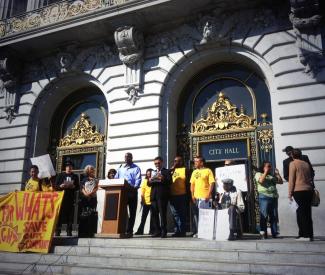
Opponents of the anti-speculator tax that will appear on the November ballot blasted the proposal in a City Hall hearing yesterday [Thu/10] — pledging to defeat the measure in court even if voters approve it — but they were overwhelmed by a strong turnout from supporters who said real estate speculation drives up the cost of housing without adding any value.

“We can sue you in court on the many of the unconstitutional aspects of this and we will do that,” Janan New, director of the San Francisco Apartment Association, said of the measure that would charge a 24 percent tax on properties flipped within a year of purchase down to a 14 percent tax if flipped within five years.

New and other allies — including San Francisco Association of Realtors, Small Property Owners of San Francisco, and Sup. Katy Tang — claimed that the measure is illegally retroactive because it affects those who recently bought property and that it doesn’t account for people who need to sell their properties because of job loss or other life changes.

“This is almost tantamount to a confiscation of property,” Peter Rich of SPOSF said at the hearing.

But Sup. David Campos — who placed the measure on the ballot along with Sups. Eric Mar, Jane Kim, and John Avalos — refuted allegations that the measure isn’t legally sound and carefully questioned City Attorney’s Office staff to clarify the laws that allow for the measure.

“I know there’s a lot of ulterior motives here because we do know this is going to be challenged in court, so I want to be very clear,” Campos said in response to a line of questioning from Tang, who continued to maintain, “So it’s retroactive in a sense” after being told by the deputy city attorney that it wasn’t retroactive because the tax only applies to future property sales.

The anti-speculation tax was first introduced by then-Sup. Harvey Milk shortly before his assassination in 1978 (Dianne Feinstein killed the measure after becoming acting mayor), and it was revived this year during a series of tenant conventions and sponsored by Mar.

“What we’re proposing is very reasonable to deal with the affordable housing crisis,” Mar said at the hearing, noting that it exempts single-family homes, projects larger than 29 units, and sales triggered by the death of the property owner. “It’s been crafted with enough exemptions to protect the small guy and really go after the profiteers.”

During the public comment period, where supporters on the measure vastly outnumbered opponents, several speakers referenced Harvey Milk and said housing in San Francisco wouldn’t be so expensive today if the measure had passed back then, a time when evictions and displacement were also on the rise.

“He was assassinated before it came to fruition. The parallels to that time and today are striking,” testified Tom Temprano, president of the Harvey Milk LGBT Democratic Club, who urged supervisors to “honor the legacy of Harvey Milk by passing this thoughtful and well-crafted legislation.”

Brian Basinger, head of the AIDS Housing Alliance, played old video footage of Milk talking about the measure back in 1978, shortly after he was evicted from his Castro Street camera store by a landlord seeking higher rents, noting that profiteering forces San Franciscans to spend too much on housing and have too little left over for other needs.

“So when you look at that, it’s going to affect the larger economy,” Milk said of real estate speculation.

Gen Fujioka, who works at Chinatown Community Development Center and spoke for San Franciscans Against Real Estate Speculation, cited recent evidence of properties snapped up by speculators and quickly flipped for profits of 50 percent of more.

“Basically, what we’re seeing today is an escalation in the sales prices of multi-unit buildings beyond what people can pay in rent,” Fujioka testified, noting how that essentially forces landlords to evict rent-controlled tenants to make the investments pencil out. “That kind of price escalation is causing instability in our communities.”

But opponents lashed out at the measure and the characterization that they were profiteering in ways that hurt people. “It’s a housing tax and it doesn’t make sense to have a housing tax in the most expensive city in the country,” said Jay Chang of the Association of Realtors.  

Aaron Jones said he and his wife invested their children’s college savings in a small apartment building, and that they’re good landlords who should be able to sell the property when they want to without penalty.

“We can’t sell until 2017 with this retroactive, punitive tax,” Jones said, saying there were many other small investors like him who were afraid to speak up because “in San Francisco, to be an investor — not a speculator — is to be the devil.”

But supporters of the measure say their intention isn’t to demonize property owners but to do something about the eviction and displacement crisis that is changing the face of the city, and to create a disincentive to bad behavior.

“It’s really the most vulnerable people who are being affected by evictions,” said Erin McElroy of the Anti-Eviction Mapping Project, citing her group’s research showing 72 percent of recent evictions have been of the elderly or disabled.

“Speculation is the commodification of housing and housing is essential,” said Chris Durazo of the Veterans Equity Center.

Campos said most landlords should support the measure as check against speculators that are pushing up the price of housing, triggering evictions, and creating a divisive politcal climate: “Speculators are giving landlords in San Francisco and property owners in San Francisco a bad name.”

SF to consider joining Richmond in fighting banks over underwater mortgages

7

Plans to ease San Francisco’s often overlooked home foreclosure crisis will have to wait a bit longer. The San Francisco Board of Supervisors this week delayed a resolution that would show the city’s “intent” to save underwater mortgages in favor of a resolution that might actually have begin to intervene in underwater mortgages.

“The idea of people losing their homes is very disheartening,” Sup. John Avalos told the Guardian. “I’m looking forward to an ordinance that would actually allow San Francisco to join a JPA [Joint Powers Authority] and enable us to have leverage over banks.”

The original proposal would have stated San Francisco’s “intention” to form a JPA with the City of Richmond in the obscure—and controversial—use of eminent domain to acquire and fix underwater mortgages for homeowners in working class neighborhoods. But Avalos said that the resolution was primarily aimed at supporting Richmond in defending its principal reduction program.

“The resolution in support of Richmond’s work is not as timely as it was and I want to make sure I can work with you colleagues about the relationship around how we can actually have an ordinance to join a JPA with the city of Richmond and have all of our questions answered as we’re going through that process,” he told the Board of Supervisors on Tuesday.

Eminent domain is a law that allows the government to purchase private property for public use, including nontangible assets such as mortgages. The use of eminent domain to acquire underwater mortgages (when mortgage payments that exceed the value of homes) could be a godsend for homeowners who have been bamboozled by predatory lenders.

Yet Richmond, receiving national attention for the gutsy strategy, faced intense criticism—even federal lawsuits—from banks and financial institutions of late. Certain banks and financial institutions warned lending would halt if the strategy were attempted. Although Richmond recently braved attempts to quash its principal reduction plan, a JPA with San Francisco would allow both cities to leverage some power over banks.

“One city doesn’t have the resources to do it alone,” Sup. David Campos, who co-sponsored the resolution, told the Guardian. “Collectively joining forces can do it, and can be strengthened by taking a regional approach.”

Yet Avalos explained that he has already experienced disagreement from banks, including Well Fargo. “We are swimming against the tide—against the institutions of our banks that have a stronghold on how local loans and mortgages are kept at high interest rates, on the ability homeowners have to renegotiate loans, and on how we can improve the actual principal of our loans,” he told the Board of Supervisors, which was met by public applause.

“People don’t feel a sense of urgency about the housing crisis, and we need to convince them,” Avalos told the Guardian. “Overall we’re two years from the Occupy movement that challenged banks, and people have forgotten the feeling of the time where people questioned how much power banks had over the loan modification.”

In San Francisco, focus has indeed shifted toward out-of-control rents, though fallout from the mortgage crisis still persists. Over 300 underwater mortgages are concentrated in San Francisco’s working class communities, 90 percent of which contain predatory features, according to the Mortgage Resolution Partners, a company helping Richmond administer and finance their principal reduction plan.

Although roughly 64 percent of San Francisco residents are renters, some working class community member still own their homes, and some, like Carletta Jackson-Lane—who has lived in District 10 for 27 years and who spoke at this week’s meeting during public comment—feels that the African American community has been hit especially hard by foreclosures.

“Don’t forget that foreclosures are directly related to the outward migration of African American families out of San Francisco,” she said. “The reality is that in the Mission, there’s a different impact because they were mostly renters.

“The other impact in the African American community—especially in District 10—is that they were single family property owners, so when the foreclosure crisis happened, it knocked them out,” she explained. “And that’s multiple generations.”

Avalos sent the resolution back to committee for modification, and he expects a resolution to be voted on in August. “I don’t want San Francisco to be a place where only the wealthy can survive,” Avalos said.  “But in order to make serious changes we have to break a few eggs.”

When asked what those eggs were, he responded, “What currently is.”  

Treasure Island development plans moving forward after lawsuit rejected

22

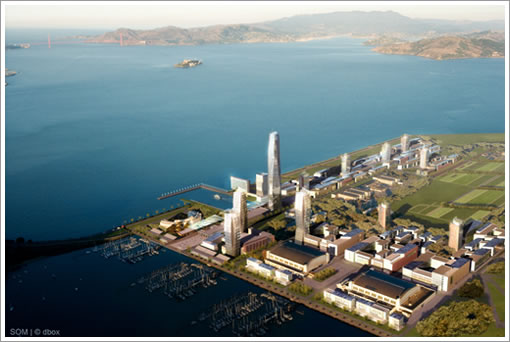
Construction on the first 1,000 of up to 8,000 new homes planned for Treasure Island could begin as soon as next year after the State Appeals Court this week rejected a challenge of the project’s environmental impact report by Citizens for a Sustainable Treasure Island, a grassroots group led by former supervisor Aaron Peskin.

The group challenged the project’s unanimous 2006 approval by the Board of Supervisors after its terms were modified the next year by the developers, Wilson Meany and Lennar Urban, to increase the number of homes and decrease their affordability. The project Peskin helped approve was 6,000 homes, 30 percent of them affordable, but now it’s up to 8,000 homes, 25 percent affordable.

More recently, stories by the Center for Investigative Reporting/Bay Citizen, San Francisco Chronicle, and others have also found evidence of lingering radiological contamination on the island from its days as a US Navy base, something that Peskin told us should raise concerns about the project.

“Obviously, we are disappointed in the court ruling and are very concerned it ignores the now widely reported news that Treasure Island is much more contaminated, by radiologically contamination, than we knew,” Peskin told us. As for whether his group intends to appeal the case to the California Supreme Court, he said, “We are assessing our options.”

Wilson Meany principle Chris Meany didn’t immediately return Guardian calls for comment (we’ll update this post if and when we hear back), but in a press release, he said, “After several years of unnecessary and costly litigation, we can finally begin building more homes for people who want to live in San Francisco.”

In addition to the homes, the project includes up to 500 hotel rooms, 450,000 square feet of retail space, 100,000 square feet of office space, and 300 acres of open space. To compensate for projections that rising seas caused by global warming would inundate the artificial island by the end of the century, its height will be raised substantially, with the EIR noting there will be about 100,000 trucks of landfill coming over the Bay Bridge during construction.

Traffic generated by the project has been a major concern of transportation officials from the beginning. San Francisco Transportation Authority Executive Director Tilly Chang said the challenge was, “How do you keep the Bay Bridge flowing and not muck up traffic?”

The plan calls for expanded bus and shuttle service to Treasure Island, new ferry service from the Ferry Building, and both expensive parking on the island for non-residents and a toll for driving onto the island, most likely set at $5, Chang said. The ferry service is set to launch around when the first phase of housing construction is complete, probably in 2018.

Meanwhile, work has already begun on a project to replace and improve the freeway ramps at adjacent Yerba Buena Island and the bridge that connects them to Treasure Island. SFTA Deputy Director for Capital Projects Lee Sage said the ramps will give much more time for cars to slow down or accelerate as they enter or exit the freeway there.

“It’s going to be very complicated, but we’re on target,” he said, estimating the eastside ramps will be done in 2016 and the westside ones a few years later.

Just last month, the Board of Supervisors approved terms accepting Treasure Island from the US Navy. Later this month  assuming that the issue of radiological contamination doesn’t derail the transfer — the city and project developers are scheduled to pay the Navy $55 million for Treasure Island and complete the deal.

But Peskin’s group and its attorney Keith Wagner, objected to the transfer in a June 25 letter to the Navy, calling for more studies on the substantially increased density of development on the island and more thorough testing and cleanup of contamination.

Wagner wrote, “In summary, the Navy’s 2003 EIS, on its own terms, did not evaluate the true nature of the City’s far more expansive contemporaneous development plans/proposals, let alone the even more expansive development plans that were ultimately devised and approved by the City in 2011; in the decade since the 2003 EIS was finalized, the Navy has developed significant and substantial new information indicating the nature, scope and severity of radiological and hazardous materials across NSTI that could impact the City’s 2011 development plans.”

Elder care facility under pressure not to move forward with evictions

A group of senior citizens, mostly in their 80s and 90s, faces eviction from the University Mound Ladies Home, a San Francisco elder care facility serving residents of modest means that has been in operation for 130 years.

The University Mound Board of Trustees has said the nonprofit organization that runs the home is too far in debt to keep the doors open.

Nevertheless, interim director Bill Brinkman and members of the Board of Trustees have rejected the city’s offer of temporary financial assistance. University Mound has entered into an agreement to sell the facility to Alta Vista School for $5.4 million as a way to pay off its debts, making it clear at a public hearing that it would not reconsider this plan despite the city’s attempts to intervene on behalf of the impacted residents.

At the Board of Supervisors’ Neighborhood Services and Safety Committee today [Thu/10], Sup. David Campos put board treasurer John Sedlander on the spot.

“The city has given you every opportunity to stay open,” Campos said, referencing offers made when his office met with University Mound leadership shortly after the closure was announced. “We are willing to put money on the table, to keep this open temporarily, until we find a long-term viable solution. Are you willing to accept that?”

But Sedlander insisted that this was not a viable option. “We’ve been financing our operations for the past six years … with debt,” he said. “We are unable to make the payroll unless we were to close this facility. … It’s one of those things that’s just a model that doesn’t work.” 

The closure has sparked widespread community concern, in part because it can be very dangerous to force people in frail health to move.

“They’re playing with people’s lives,” Eddie Shine, whose mother is 97 and lives at University Mound, told the Bay Guardian. “A move would be devastating, which is why I’m so passionate about this,” she added.

Speaking during public comment, Anna Stratton said she was concerned that her 87-year-old mother would “feel isolated and alone” after being transferred to a Hayward retirement home. “When we transferred her [to University Mound] she did not eat for seven days,” Stratton explained, noting that this would arise as a concern yet again with the pending move.

In May, residents were issued eviction notices indicating that they would have to move by July 10. That date has since been extended to July 31.

Campos said the city would explore every possible route to prevent University Mound from closing down and evicting the seniors, including the possibility of rezoning the property to be maintained as a retirement home since the benefactors behind the original endowment established that it should function as such. After public comment was over, Campos called Sedlander back to the podium.

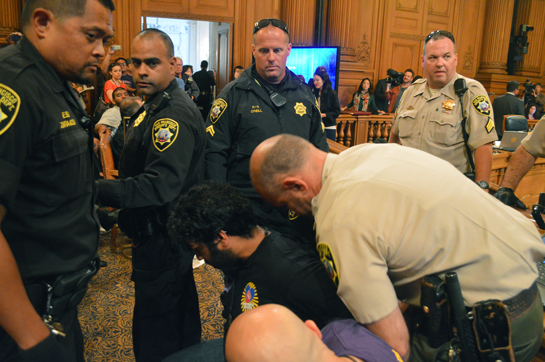
“You heard the testimony,” he told the University Mound board treasurer. “You know the city is going to do everything we can to block you” from moving forward with the July 31 eviction. “I am going to give you the option to do the right thing here,” he went on. “Are you prepared to call that deadline null and void?”

Sedlander responded that he was not prepared to rescind the evictions.

The item was continued and will likely come up for discussion again before July 31. “I will fight to do everything I possibly can till hell freezes over to make sure we stop the closure of this facility,” Campos said. “If the city has to fight to make it happen, then the city will fight to make it happen.”

Gimme 5: Must-see shows this week

4

Hello friends and festival-goers! Did you just get back from High Sierra? Does your hair still smell of patchouli? Are you sad that you actually have to be in the world this week, possibly at a desk, while wearing all of your clothes? (Sexual harassment suits these days, lemme tell you.) 

Fret not, fair Bay Areans. A solid few days of music, most of it bred right here, awaits you. Read on for our picks.

THU/10

WATERS and CATHEDRALS

Get your ALL CAPS game faces on for this buzzy night, which pairs SF’s own Van Pierszalowski and WATERS‘ hook-and-distortion-heavy guitar rock with the melodic, playful electro-pop of singer-songwriter Brodie Jenkins and synth-guitar-wizard-producer Johnny Hwin, aka CATHEDRALS. The latter (one of the Bay Guardian’s bands On the Rise this year) has garnered an impressive amount of attention around the Internets (and at SXSW) without even an EP to their name — this show marks their first public performance in the city. Come prepared to be seduced by Jenkin’s vocals, then do some cathartic headbanging to Pierszalowski’s. WATERS should be in good spirits; they’re heading home from a tour that included two sold-out nights at the Troubadour. [Note: The website says they’re sold out; you should still be able to snag tickets at the door.] (Silvers)

9pm, $12
The Chapel
777 Valencia, SF
www.thechapelsf.com


FRI/11

Cynic

The world was not ready for Cynic when they first emerged in the late ’80s. The band’s jazzy prog-metal and anti-macho stage presence (inspired in part by members Paul Masvidal and Sean Reinert’s sexuality — Reinert calls their music “some gay, gay metal”) made them equal parts influential and reviled. On their first national tour opening for Cannibal Corpse, the extreme audience hostility they experienced was enough to make them call it quits for 12 years — during which time their reputation and influence grew. Since the crew’s 2006 reunion, they’ve enjoyed success and reverence, releasing two more albums and playing major festivals in the U.S. and Europe. Their upcoming Fillmore gig is a chance to see one of metal’s coolest influences rock a venue as comfortably and thoroughly as they deserve to. (Bromfield)

https://www.youtube.com/watch?v=42ngxbGNLWk

9pm, $22.50
The Fillmore
1805 Geary, SF
www.thefillmore.com


Lia Rose

Formerly of Or, the Whale, San Francisco singer-songwriter Lia Rose has the kind of voice that seems like it could cut steel with its clarity — but instead, she’s going to pick up a guitar and carve you a lovesick, honey-and-whiskey-coated lullaby, with pedal steel or upright bass or banjo or all three helping to lull you under her spell. The timeless quality of her indie-folk pairs well here with opener We Became Owls, an East Bay Americana outfit that’s been gaining devotees like a steam train for the past year, despite not having an album out (this is their record release show). Gritty, Guthrie-esque sing-alongs are a distinct possibility here; maybe do some vocal warm-ups? (Silvers)

9pm, $15
The Chapel
777 Valencia, SF
(415) 551-5157
www.thechapelsf.com


SAT/12

Waterstrider

If you have anything left in you after spending the day and boozing and grooving and (sun-)baking to Wye Oak and Thao et al at Phono del Sol — first of all, we salute you. Second, you could do worse than to head over to Slim’s to see these East Bay mainstays co-headline with Guy Fox. Waterstrider‘s blend of Afro-pop, dance-ready synths, and indie rock is a must for anyone who wishes the latest tUnE-yArDs record were twice as long, or that Little Dragon (whom they’re known to cover) were just a little more, er, Californian. Fox will bring more of a driving, brassy garage-funk spirit to the evening. Another fine pairing indeed. (Silvers)

9pm, $14
Slim’s
333 11th St., SF
www.slimspresents.com


SUN/13

Darryl D.M.C. McDaniels

Neck of the Woods becomes a time machine on Sunday as Darryl McDaniels, better known as D.M.C., drops in for a nostalgic journey through the annals of 1980s rap. One third of the explosive rap innovators Run-D.M.C., McDaniels has kept busy since the dissolution of the group more than ten years ago, playing a full festival circuit, doing extensive charity work, and covering Frank Zappa’s “Willie the Pimp” with Talib Kweli, Mix Master Mike, and Ahmet Zappa for a pulsating track on a birthday compilation put out by the Zappa Family Trust. It’s hard to say whether D.M.C. will pull out anything quite as wild during this set, but expect zeitgeist-defining songs like “It’s Tricky” and “Walk This Way,” and hopefully some deeper cuts from the group’s later work (2001’s Crown Royal has some underrated tracks) and D.M.C.’s only solo album, Checks, Thugs, and Rock and Roll. Joining McDaniels on the mic are local groups the Oakland Mind and Jay Stone, each of whom have decidedly D.M.C.-inspired beats and flows and will offer up both politicized and party-themed bangers centered around the Bay. If you’re feeling like “Raising Hell,” then head over. (Kurlander)

9pm, $20
Neck of the Woods
406 Clement, SF
(415) 387-6343

www.neckofthewoodssf.com

San Jose cracks down on pot clubs after eschewing SF’s regulatory approach

16

San Jose’s current (and harsh) crackdown on medical marijuana dispensaries contrasts with San Francisco’s decade-old (and still working well) regulations.

Over the last five years, cannabis club after cannabis club sprouted throughout San Jose while the city’s local government debated, wavered, and faltered over the best way to regulate their pot clubs. But last month, San Jose City Council members, citing an abundance of pot clubs as the cause of a surge of marijuana use in schools, got tough. They voted to enact regulations that would make it too costly for more than 70 of their pot clubs in the city to operate. Only about 10 would survive.

Meanwhile, San Francisco pot clubs rest easy, undisturbed, and untouched — at least by the San Francisco officials who pioneered regulations in the city early on. In fact, the city’s Planning Department has recently recommended expanding the so-called Green Zone where dispensaries are allowed to operate by allowing dispensaries closer to schools.

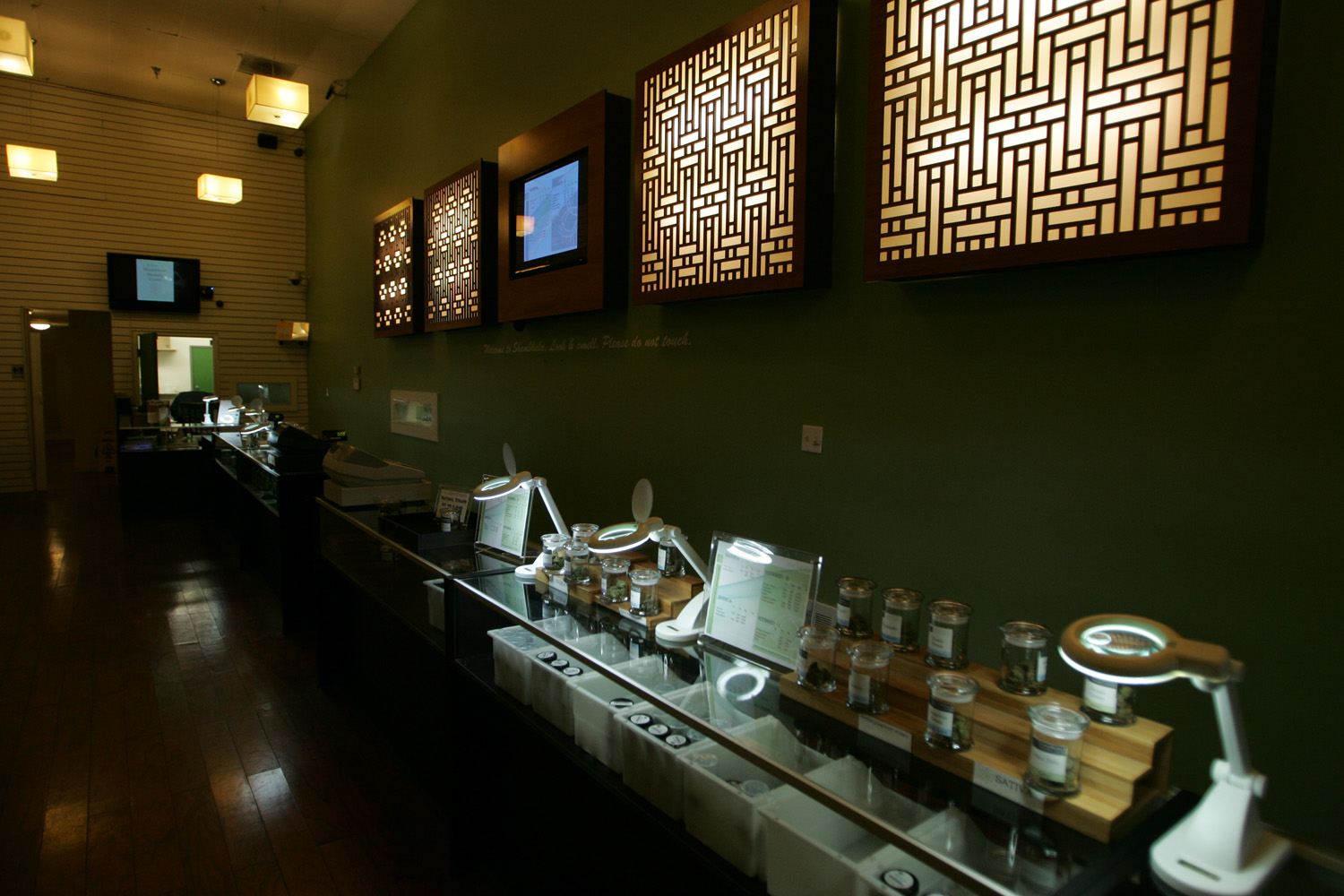
As it stands, getting a permit to open a dispensary in San Francisco is no easy task. San Francisco regulations mean dispensaries are limited to less than 10 percent of all of San Francisco.

“Because zoning is so limited, the biggest struggle is finding a location,” Shona Gochenaur, director of Axis of Love SF Community Center, told the Guardian. “I’ve known collectives that have searched for over two years for a space correctly zoned. If you get through all those mindfields and to your Planning Commission hearing, it’s smoother. Very few permits have been denied if they survive to that point.”

But San Jose’s proposed regulations take it a step farther: they would limit pot shops to industrial areas that make up roughly 1 percent of San Jose. Plus, under San Jose’s proposal, San Jose’s pot shop owners will have to grow their own cannabis and produce any topicals and edibles in house. For that, they’ll need kitchens, labs, health inspections, and a host of costly equipment. Also unlike San Francisco, no concentrates will be allowed, causing many marijuana patients to suffer from lack of access to the medicine they need.

After San Jose approved the relegations, Santa Clara County Board of Supervisors voted unanimously to enact a temporary moratorium on the establishment of medical marijuana dispensaries in unincorporated Santa Clara County. David Hodges,  a member of the Silicon Cannabis Coalition and owner of the All American Cannabis club, says he has until July 18 to put forth a referendum that would undo San Jose’s vote.

“I want regulations that work,” he said. “We want to remove the language that makes it impossible for dispensaries to operate and to keep everything else.”

The problem, he said, is that San Jose hadn’t enacted regulations soon enough. San Francisco was way ahead of them.

Gochenaur worked on some of San Francisco’s early regulations, recognizing that the feds would step in if cannabis activists didn’t act first.

“[The] San Francisco movement came with the AIDS crisis with city electeds that were both empathetic and personally affected by watching loved one’s suffering, our ZIP code being hit the hardest,” said Gochenaur .“We had the risk takers and the trail blazers willing to open their doors.”

Risk taking for San Francisco included regulating dispensaries in ways the state has since failed to do. Since San Francisco began regulating dispensaries in 2004, anyone wanting to open up a dispensary in San Francisco has had to jump through a series of tough bureaucratic hoops while also garnering neighborhood support.

San Jose, instead, opted for the laissez faire approach, allowing their dispensaries to grow, and then regretting it later.

When San Jose attempted to enact similar regulations back in 2011, Hodges used a referendum to stop the council’s plans. But, once he succeeded in defeating San Jose’s proposal, no new regulations were proposed.

“The cannabis movement in San Jose is back at square one,” Hodges wrote on his website after his referendum succeeded.

John Lee, director of the Silicon Valley Cannabis Coalition, said his organization’s biggest mistake was repealing, rather than revising, San Jose’s proposal 3 years ago. “We just knew that we couldn’t do with what they were proposing,” he said. “We just wanted to stop their relegations. But we had no idea how to regulate this back then. Now we want to.”

Having narrow relegations to begin with leaves San Francisco with room for revision later. For instance, Sup. John Avalos is working with the Planning Commission to help expand the Green Zone by bringing dispensaries 600 feet away from schools rather than 1,000 feet now. On the opposite end of the spectrum, Santa Clara Deputy County Executive Sylvia Gallegos has claimed before that San Jose’s dispensaries, totalling over 90 at the time,  caused a 106 percent increase in drug abuse-related suspensions of students in East San Jose schools in 2011-2012.

“I was smoking pot in high school before I even knew what a cannabis club was,” Hodges said. “Keeping dispensaries away from schools won’t stop that.”

If Hodges referendum fails, he says he’ll leave the cannabis industry for good.

“Right now, this could happen anywhere. There’s no safe place,” he said. “Save for Oakland – kind of. And San Francisco. But they have the territory well-covered in those areas. There’s no need for me there.”

San Francisco dispensaries may have local support, but without statewide regulations, they’re not immune to federal crackdowns, either, as the closures of Vapor Room and HopeNet made clear back in 2012. For years, Assemblymember Tom Ammiano has been trying to create statewide regulatory framework for California to help limit the crackdowns. In May, his most recent bill to address statewide regulation failed to pass the Assembly Floor. Since then, Ammiano has backed a bill from Senator Lou Correa (D-Santa Ana) that would force dispensaries to obtain local approval prior to obtaining state approval.

David Goldman, a former member of the San Francisco Medical Marijuana Task Force, told us, “It’s basically the only sensible approach towards state framework. The US Attorney is less likely to go after states with a strong structure. The tighter the regulations, the less the feds will go after dispensaries.”

For now, cannabis owners in San Jose must focus on their own, local battle to save themselves. As for the San Francisco cannabis owners who’ve passed their bureaucratic tests and received their golden permits, business resumes as usual.

Music Listings Aug 20 – Aug 26, 2014

0

WEDNESDAY 20
ROCK
DNA Lounge: 375 11th St., San Francisco. The Spiritual Bat, Crimson Scarlet, Headless Lizzy & Her Icebox Pussy, Roadside Memorial, 8:30pm, $8-$10.
Elbo Room: 647 Valencia, San Francisco. “Commune,” w/ The Fresh & Onlys, The Tambo Rays, Popgang DJs, 9pm, free with RSVP.
Hemlock Tavern: 1131 Polk, San Francisco. Koward, Green Beret, Condition, Trenches, 8:30pm, $8.
The Independent: 628 Divisadero, San Francisco. Boris, Marriages, 8pm, $20.
Slim’s: 333 11th St., San Francisco. Balance and Composure, Seahaven, The American Scene, 8pm, $16.
DANCE
Beaux: 2344 Market, San Francisco. “BroMance: A Night Out for the Fellas,” 9pm, free.
The Cafe: 2369 Market, San Francisco. “Sticky Wednesdays,” w/ DJ Mark Andrus, 8pm, free.
Cat Club: 1190 Folsom, San Francisco. “Bondage-A-Go-Go,” w/ DJ Damon, Tomas Diablo, guests, 9:30pm, $7-$10.
Club X: 715 Harrison, San Francisco. “Electro Pop Rocks,” 18+ dance party, 9pm, $10-$20.
DNA Lounge: 375 11th St., San Francisco. “Go Deep!,” 18+ dance party, 9pm, $10-$15.
F8: 1192 Folsom, San Francisco. “Housepitality,” 9pm, $5-$10.
Lookout: 3600 16th St., San Francisco. “What?,” 7pm, free.
Madrone Art Bar: 500 Divisadero, San Francisco. “Rock the Spot,” 9pm, free.
Make-Out Room: 3225 22nd St., San Francisco. “Burn Down the Disco,” w/ DJs 2shy-shy & Melt w/U, Third Wednesday of every month, 9pm, free.
MatrixFillmore: 3138 Fillmore, San Francisco. “Reload,” w/ DJ Big Bad Bruce, 10pm, free.
Q Bar: 456 Castro, San Francisco. “Booty Call,” w/ Juanita More, 9pm, $3.
HIP-HOP
Skylark Bar: 3089 16th St., San Francisco. “Mixtape Wednesday,” w/ resident DJs Strategy, Junot, Herb Digs, & guests, 9pm, $5.
ACOUSTIC
Cafe Divine: 1600 Stockton, San Francisco. Craig Ventresco & Meredith Axelrod, 7pm, free.
JAZZ
Amnesia: 853 Valencia, San Francisco. Gaucho, Eric Garland’s Jazz Session, The Amnesiacs, 7pm, free.
Balancoire: 2565 Mission, San Francisco. “Cat’s Corner,” 9pm, $10.
Burritt Room: 417 Stockton St., San Francisco. Terry Disley’s Rocking Jazz Trio, 6pm, free.
Jazz Bistro at Les Joulins: 44 Ellis, San Francisco. Charles Unger Experience, 7:30pm, free.
Le Colonial: 20 Cosmo, San Francisco. The Cosmo Alleycats featuring Ms. Emily Wade Adams, 7pm, free.
Level III: 500 Post, San Francisco. Sony Holland, Wednesdays-Fridays, 5-8pm, free.
Revolution Cafe: 3248 22nd St., San Francisco. Panique, Third Wednesday of every month, 8:30pm, free/donation.
Savanna Jazz Club: 2937 Mission, San Francisco. Savanna Jazz Jam with Eric Tillman, 7pm, $5.
Top of the Mark: One Nob Hill, 999 California, San Francisco. Ricardo Scales, Wednesdays, 6:30-11:30pm, $5.
INTERNATIONAL
Bissap Baobab: 3372 19th St., San Francisco. “Baobab!,” timba dance party with DJ WaltDigz, 10pm, $5.
Cafe Cocomo: 650 Indiana, San Francisco. “Bachatalicious,” w/ DJs Good Sho & Rodney, 7pm, $5-$10.
SOUL
Boom Boom Room: 1601 Fillmore, San Francisco. “Soul Train Revival,” w/ Ziek McCarter, Third Wednesday of every month, 9:30pm, $5.
Monarch: 101 Sixth St., San Francisco. “Color Me Badd,” coloring books and R&B jams with Matt Haze, DJ Alarm, Broke-Ass Stuart, guests, Wednesdays, 5:30-9:30pm, free.
THURSDAY 21
ROCK
The Chapel: 777 Valencia, San Francisco. French Cassettes, Flagship, Black Cobra Vipers, Feat. O, 9pm, $12.
DANCE
Abbey Tavern: 4100 Geary, San Francisco. DJ Schrobi-Girl, 10pm, free.
Aunt Charlie’s Lounge: 133 Turk, San Francisco. “Tubesteak Connection,” w/ DJ Bus Station John, 9pm, $5-$7.
Beaux: 2344 Market, San Francisco. “Twerk Thursdays,” 9pm, free.
The Cafe: 2369 Market, San Francisco. “¡Pan Dulce!,” 9pm, $5.
Cat Club: 1190 Folsom, San Francisco. “Class of 1984,” ‘80s night with DJs Damon, Steve Washington, Dangerous Dan, and guests, 9pm, $6 (free before 9:30pm).
The Cellar: 685 Sutter, San Francisco. “XO,” 10pm, $5.
Club X: 715 Harrison, San Francisco. “The Crib,” 18+ LGBT dance party, 9:30pm, $10.
Elbo Room: 647 Valencia, San Francisco. “Hi Life,” w/ resident DJs Pleasuremaker & Izzy*Wize, 9:30pm, $6.
F8: 1192 Folsom, San Francisco. “Beat Church,” w/ resident DJs Neptune & Kitty-D, Third Thursday of every month, 10pm, $10.
Infusion Lounge: 124 Ellis, San Francisco. “I Love Thursdays,” 10pm, $10.
Madrone Art Bar: 500 Divisadero, San Francisco. “Night Fever,” 9pm, $5 after 10pm
Raven: 1151 Folsom, San Francisco. “1999,” w/ VJ Mark Andrus, 8pm, free.
Trax: 1437 Haight, San Francisco. “Beats Reality: A Psychedelic Social,” w/ resident DJs Justime & Jim Hopkins, 9pm, free.
Underground SF: 424 Haight, San Francisco. “Bubble,” 10pm, free.
HIP-HOP
John Colins: 138 Minna, San Francisco. “Future Flavas,” w/ DJ Natural, 10pm, free.
Showdown: 10 Sixth St., San Francisco. “Tougher Than Ice,” w/ DJs Vin Sol, Ruby Red I, and Jeremy Castillo, Third Thursday of every month, 10pm
Skylark Bar: 3089 16th St., San Francisco. “Peaches,” w/ lady DJs DeeAndroid, Lady Fingaz, That Girl, Umami, Inkfat, and Andre, 10pm, free.
ACOUSTIC
Bazaar Cafe: 5927 California, San Francisco. Acoustic Open Mic, 7pm
Contemporary Jewish Museum: 736 Mission, San Francisco. “Unplugged in the Yud,” w/ Carletta Sue Kay, 7pm, free with museum admission.
Plough & Stars: 116 Clement, San Francisco. Tipsy House, Third Thursday of every month, 9pm, free.
The Pour House: 1327 Polk, San Francisco. Jimbo Scott & Grover Anderson, 7pm, free.
JAZZ
Jazz Bistro at Les Joulins: 44 Ellis, San Francisco. Eugene Pliner Quartet with Tod Dickow, First and Third Thursday of every month, 7:30pm, free.
Le Colonial: 20 Cosmo, San Francisco. Steve Lucky & The Rhumba Bums, 7:30pm
Level III: 500 Post, San Francisco. Sony Holland, Wednesdays-Fridays, 5-8pm, free.
The Royal Cuckoo: 3202 Mission, San Francisco. Charlie Siebert & Chris Siebert, 7:30pm, free.
Savanna Jazz Club: 2937 Mission, San Francisco. Savanna Jazz Jam with Eric Tillman, 7pm, $5.
Top of the Mark: One Nob Hill, 999 California, San Francisco. Pure Ecstasy, 7:30pm, $10.
INTERNATIONAL
Sheba Piano Lounge: 1419 Fillmore, San Francisco. Gary Flores & Descarga Caliente, 8pm
REGGAE
Pissed Off Pete’s: 4528 Mission St., San Francisco. Reggae Thursdays, w/ resident DJ Jah Yzer, 9pm, free.
BLUES
50 Mason Social House: 50 Mason, San Francisco. Bill Phillippe, 5:30pm, free.
The Saloon: 1232 Grant, San Francisco. Chris Ford, Third Thursday of every month, 4pm
COUNTRY
McTeague’s Saloon: 1237 Polk, San Francisco. “Twang Honky Tonk,” w/ Sheriff Paul, Deputy Saralynn, and Honky Tonk Henry, 7pm
The Parlor: 2801 Leavenworth, San Francisco. “Honky Tonk Thursdays,” w/ DJ Juan Burgandy, 9pm, free.
SOUL
Make-Out Room: 3225 22nd St., San Francisco. “In ‘n’ Out,” w/ The Selecter DJ Kirk, Third Thursday of every month, 10pm, free.
FRIDAY 22
DANCE
1015 Folsom: 1015 Folsom, San Francisco. Four Tet B2B Jamie xx, Eug, Shawn Reynaldo, 10pm, $27.50-$30 advance.
Beaux: 2344 Market, San Francisco. “Manimal,” 9pm
The Cafe: 2369 Market, San Francisco. “Boy Bar,” 9pm, $5.
Cat Club: 1190 Folsom, San Francisco. “Dark Shadows,” w/ resident DJs Daniel Skellington & Melting Girl, Fourth Friday of every month, 9:30pm, $7 ($3 before 10pm).
The Cellar: 685 Sutter, San Francisco. “F.T.S.: For the Story,” 10pm
The EndUp: 401 Sixth St., San Francisco. “Trade,” 10pm, free before midnight.
The Grand Nightclub: 520 Fourth St., San Francisco. “We Rock Fridays,” 9:30pm
Infusion Lounge: 124 Ellis, San Francisco. “Flight Fridays,” 10pm, $20.
Madrone Art Bar: 500 Divisadero, San Francisco. “I ♥ the ‘90s,” w/ DJs Samala, Teo, Mr. Grant, & Sonny Phono, Fourth Friday of every month, 9pm, $5.
MatrixFillmore: 3138 Fillmore, San Francisco. “F-Style Fridays,” w/ DJ Jared-F, 9pm
Mezzanine: 444 Jessie, San Francisco. Sneaky Sound System, Blaus, 9pm, $15-$20.
OMG: 43 Sixth St., San Francisco. “Deep Inside,” 9pm, free.
Public Works: 161 Erie, San Francisco. “As You Like It: 4-Year Anniversary,” w/ Todd Terje, Maurice Fulton, Qu, Jason Kendig, Conor, Jackie House (aka P-Play), Christina Chatfield, Rich Korach, Bells & Whistles, Mossmoss, 9pm, $25 advance.
Q Bar: 456 Castro, San Francisco. “Pump: Worq It Out Fridays,” w/ resident DJ Christopher B, 9pm, $3.
Slate Bar: 2925 16th St., San Francisco. “Darling Nikki,” w/ resident DJs Dr. Sleep, Justin Credible, and Durt, Fourth Friday of every month, 8pm, $5.
HIP-HOP
EZ5: 682 Commercial, San Francisco. “Decompression,” Fridays, 5-9pm
John Colins: 138 Minna, San Francisco. “#Flow,” w/ The Whooligan & Mikos Da Gawd, Fourth Friday of every month, 10pm, free befoe 11pm
ACOUSTIC
Bottom of the Hill: 1233 17th St., San Francisco. Before the Brave, Joseph, Marshall McLean, 9pm, $10-$12.
The Sports Basement: 610 Old Mason, San Francisco. “Breakfast with Enzo,” w/ Enzo Garcia, 10am, $5.
JAZZ
Atlas Cafe: 3049 20th St., San Francisco. Mean to Me, Fourth Friday of every month, 7:30pm, free.
Bird & Beckett: 653 Chenery, San Francisco. Chuck Peterson Quintet, Fourth Friday of every month, 5:30pm, $10 suggested donation per adult.
Jazz Bistro at Les Joulins: 44 Ellis, San Francisco. Charles Unger Experience, 7:30pm, free.
Level III: 500 Post, San Francisco. Sony Holland, Wednesdays-Fridays, 5-8pm, free.
Red Poppy Art House: 2698 Folsom, San Francisco. Rob Reich Quintet, 7:30pm, $10-$15.
Top of the Mark: One Nob Hill, 999 California, San Francisco. Black Market Jazz Orchestra, 9pm, $10.
Zingari: 501 Post, San Francisco. Joyce Grant, 8pm, free.
INTERNATIONAL
Amnesia: 853 Valencia, San Francisco. Baxtalo Drom, International shimmying for lovers of Balkan music, bellydancers, and burlesque., Fourth Friday of every month, 9pm, $10-$15.
Bissap Baobab: 3372 19th St., San Francisco. “Paris-Dakar African Mix Coupe Decale,” 10pm, $5.
Cafe Cocomo: 650 Indiana, San Francisco. Taste Fridays, featuring local cuisine tastings, salsa bands, dance lessons, and more, 7:30pm, $15 (free entry to patio).
Pachamama Restaurant: 1630 Powell, San Francisco. Cuban Night with Fito Reinoso, 7:30 & 9:15pm, $15-$18.
Roccapulco Supper Club: 3140 Mission, San Francisco. Fuego Latino, 9pm
Verdi Club: 2424 Mariposa, San Francisco. The Verdi Club Milonga, w/ Christy Coté, Seth Asarnow y Su Sexteto Tipico, DJ Emilio Flores, 8pm, $25-$35.
REGGAE
Gestalt Haus: 3159 16th St., San Francisco. “Music Like Dirt,” 7:30pm, free.
The Independent: 628 Divisadero, San Francisco. Lee “Scratch” Perry, 9pm, $25.
FUNK
Make-Out Room: 3225 22nd St., San Francisco. “Loose Joints,” w/ DJs Centipede, Damon Bell, and Tom Thump, 10pm, $5-$10.
Revolution Cafe: 3248 22nd St., San Francisco. Fourth Fridays Freestyle Fiesta with MSK.fm, Fourth Friday of every month.
SOUL
Edinburgh Castle: 950 Geary, San Francisco. “Soul Crush,” w/ DJ Serious Leisure, 10pm, free.
SATURDAY 23
ROCK
Bender’s: 806 S. Van Ness, San Francisco. Turbonegra, The Grannies, 10pm, $5.
The Independent: 628 Divisadero, San Francisco. Sylvan Esso, 9pm, sold out.
DANCE
DNA Lounge: 375 11th St., San Francisco. “Bootie S.F.,” 9pm, $10-$15.
The EndUp: 401 Sixth St., San Francisco. Shangri-La, Asian queer dance party., Fourth Saturday of every month, 10pm, $15-$20 (free before 11pm).
Infusion Lounge: 124 Ellis, San Francisco. “Set,” Fourth Saturday of every month, 10pm, $20.
The Knockout: 3223 Mission, San Francisco. “Galaxy Radio,” w/ resident DJs Smac, Emils, Holly B, and guests, Fourth Saturday of every month, 9pm, free.
Lookout: 3600 16th St., San Francisco. “Bounce!,” 9pm, $3.
Slate Bar: 2925 16th St., San Francisco. “Electric WKND,” w/ The Certain People Crew, Fourth Saturday of every month, 10pm, $5.
Temple: 540 Howard, San Francisco. “Life,” Fourth Saturday of every month, 10pm, $20.
HIP-HOP
John Colins: 138 Minna, San Francisco. “Nice,” w/ DJ Apollo, Fourth Saturday of every month, 10pm, $5.
ACOUSTIC
Atlas Cafe: 3049 20th St., San Francisco. Craig Ventresco and/or Meredith Axelrod, Saturdays, 4-6pm, free.
JAZZ
Jazz Bistro at Les Joulins: 44 Ellis, San Francisco. Bill “Doc” Webster & Jazz Nostalgia, 7:30pm, free.
Sheba Piano Lounge: 1419 Fillmore, San Francisco. The Robert Stewart Experience, 9pm
INTERNATIONAL
1015 Folsom: 1015 Folsom, San Francisco. “Pura,” 9pm, $20.
Bissap Baobab: 3372 19th St., San Francisco. “Paris-Dakar African Mix Coupe Decale,” 10pm, $5.
El Rio: 3158 Mission, San Francisco. “Mango,” Fourth Saturday of every month, 3pm, $8-$10.
Make-Out Room: 3225 22nd St., San Francisco. “El SuperRitmo,” w/ DJs Roger Mas & El Kool Kyle, 10pm, $5-$10.
OMG: 43 Sixth St., San Francisco. “Bollywood Blast,” Fourth Saturday of every month, 9pm, $10 before 11pm with RSVP.
Pachamama Restaurant: 1630 Powell, San Francisco. Eddy Navia & Pachamama Band, 8pm, free.
Space 550: 550 Barneveld, San Francisco. “Club Fuego,” 9:30pm
REGGAE
Mezzanine: 444 Jessie, San Francisco. Fiji, Mango Kingz, Jah Yzer, 9pm, $25.
BLUES
The Saloon: 1232 Grant, San Francisco. Dave Workman, Fourth Saturday of every month, 4pm
COUNTRY
Slim’s: 333 11th St., San Francisco. 13th Annual Honky-Tonk Showdown: A Celebration of Classic Country Music & Dance, w/ Wolf Hamlin & The Front Porch Drifters, Misisipi Mike Wolf & The Midnight Gamblers, Jon Emery & The Dry County Drinkers, Miss Kay Marie, 9pm, $15.
FUNK
Mighty: 119 Utah, San Francisco. “What the Funk?!: James Brown vs. Fela Kuti,” w/ DJs J Rocc & Rich Medina, 9pm, $10-$20 advance.
SOUL
Edinburgh Castle: 950 Geary, San Francisco. “Nightbeat,” w/ DJs Primo, Lucky, and Dr. Scott, Fourth Saturday of every month, 9pm, $3.
SUNDAY 24
ROCK
Hemlock Tavern: 1131 Polk, San Francisco. Ancient Altar, Infinite Waste, 7pm, $7.
DANCE
The Cellar: 685 Sutter, San Francisco. “Replay Sundays,” 9pm, free.
The Edge: 4149 18th St., San Francisco. “’80s at 8,” w/ DJ MC2, 8pm
Elbo Room: 647 Valencia, San Francisco. “Dub Mission,” Sunday night excursions into the echo-drenched outer realms of dub with resident DJ Sep and guests, 9pm, $6 (free before 9:30pm).
The EndUp: 401 Sixth St., San Francisco. “Sundaze,” 1pm, free before 3pm
F8: 1192 Folsom, San Francisco. “Stamina,” w/ DJs Lukeino, Jamal, and guests, 10pm, free.
The Knockout: 3223 Mission, San Francisco. “Sweater Funk,” 10pm, free.
Lookout: 3600 16th St., San Francisco. “Jock,” Sundays, 3-8pm, $2.
MatrixFillmore: 3138 Fillmore, San Francisco. “Bounce,” w/ DJ Just, 10pm
Monarch: 101 Sixth St., San Francisco. “Werd,” 9pm, $5-$10.
The Parlor: 2801 Leavenworth, San Francisco. “Sunday Sessions,” w/ DJ Marc deVasconcelos, 9pm, free.
Q Bar: 456 Castro, San Francisco. “Gigante,” 8pm, free.
The Stud: 399 Ninth St., San Francisco. “Cognitive Dissonance,” Fourth Sunday of every month, 6pm
Temple: 540 Howard, San Francisco. “Sunset Arcade,” 18+ dance party & game night, 9pm, $10.
HIP-HOP
Boom Boom Room: 1601 Fillmore, San Francisco. “Return of the Cypher,” 9:30pm, free.
ACOUSTIC
The Chieftain: 198 Fifth St., San Francisco. Traditional Irish Session, 6pm
The Lucky Horseshoe: 453 Cortland, San Francisco. Bernal Mountain Bluegrass Jam, 4pm, free.
Madrone Art Bar: 500 Divisadero, San Francisco. Spike’s Mic Night, Sundays, 4-8pm, free.
JAZZ
Chez Hanny: 1300 Silver, San Francisco. George Cotsirilos Trio, 4pm, $20 suggested donation.
Jazz Bistro at Les Joulins: 44 Ellis, San Francisco. Bill “Doc” Webster & Jazz Nostalgia, 7:30pm, free.
Madrone Art Bar: 500 Divisadero, San Francisco. “Sunday Sessions,” 10pm, free.
The Royal Cuckoo: 3202 Mission, San Francisco. Lavay Smith & Chris Siebert, 7:30pm, free.
Savanna Jazz Club: 2937 Mission, San Francisco. Savanna Jazz Jam with David Byrd, 7pm, $5.
INTERNATIONAL
Atmosphere: 447 Broadway, San Francisco. “Hot Bachata Nights,” w/ DJ El Guapo, 5:30pm, $10-$20.
Bissap Baobab: 3372 19th St., San Francisco. “Brazil & Beyond,” 6:30pm, free.
Caña Cuban Parlor & Cafe: 500 Florida, San Francisco. “La Havana,” 4pm
El Rio: 3158 Mission, San Francisco. Salsa Sundays, Second and Fourth Sunday of every month, 3pm, $8-$10.
Revolution Cafe: 3248 22nd St., San Francisco. Balkan Jam Night, 8:30pm
Thirsty Bear Brewing Company: 661 Howard, San Francisco. “The Flamenco Room,” 7:30 & 8:30pm
BLUES
The Saloon: 1232 Grant, San Francisco. Blues Power, 4pm; The Door Slammers, Fourth Sunday of every month, 9:30pm
Sheba Piano Lounge: 1419 Fillmore, San Francisco. Bohemian Knuckleboogie, 8pm, free.
Swig: 571 Geary, San Francisco. Sunday Blues Jam with Ed Ivey, 9pm
MONDAY 25
DANCE
DNA Lounge: 375 11th St., San Francisco. “Death Guild,” 18+ dance party with DJs Decay, Joe Radio, Melting Girl, & guests, 9:30pm, $3-$5.
Q Bar: 456 Castro, San Francisco. “Wanted,” w/ DJs Key&Kite and Richie Panic, 9pm, free.
ACOUSTIC
Amnesia: 853 Valencia, San Francisco. The Pick Bluegrass Jam, Fourth Monday of every month, 6pm, free; The Earl Brothers, Fourth Monday of every month, 9pm, free.
Fiddler’s Green: 1333 Columbus, San Francisco. Terry Savastano, 9:30pm, free/donation.
Hotel Utah: 500 Fourth St., San Francisco. Open Mic with Brendan Getzell, 8pm, free.
Osteria: 3277 Sacramento, San Francisco. “Acoustic Bistro,” 7pm, free.
The Saloon: 1232 Grant, San Francisco. Peter Lindman, 4pm
JAZZ
Jazz Bistro at Les Joulins: 44 Ellis, San Francisco. Eugene Pliner Quartet with Tod Dickow, 7:30pm, free.
Le Colonial: 20 Cosmo, San Francisco. Le Jazz Hot, 7pm, free.
Sheba Piano Lounge: 1419 Fillmore, San Francisco. City Jazz Instrumental Jam Session, 8pm
REGGAE
Skylark Bar: 3089 16th St., San Francisco. “Skylarking,” w/ I&I Vibration, 10pm, free.
BLUES
Elite Cafe: 2049 Fillmore, San Francisco. “Fried Chicken & Blues,” 6pm
The Saloon: 1232 Grant, San Francisco. The Bachelors, 9:30pm
SOUL
Madrone Art Bar: 500 Divisadero, San Francisco. “M.O.M. (Motown on Mondays),” w/ DJ Gordo Cabeza & Timoteo Gigante, 8pm, $3 after 9pm
TUESDAY 26
ROCK
Amnesia: 853 Valencia, San Francisco. Scary Little Friends, 9:15pm continues through.
Elbo Room: 647 Valencia, San Francisco. Apocryphon, Redacted, Connoisseur, Infinite Waste, Jesika Christ M.S. benefit show, 8:30pm, $10 minimum donation.
The Independent: 628 Divisadero, San Francisco. The Rosebuds, El May, 8pm, $12-$15.
DANCE
Aunt Charlie’s Lounge: 133 Turk, San Francisco. “High Fantasy,” w/ DJ Viv, Myles Cooper, & guests, 10pm, $2.
Boom Boom Room: 1601 Fillmore, San Francisco. “Time Warp Tuesdays,” w/ DJ Madison, 9pm, free.
Monarch: 101 Sixth St., San Francisco. “Soundpieces,” 10pm, free-$10.
Q Bar: 456 Castro, San Francisco. “Switch,” w/ DJs Jenna Riot & Andre, 9pm, $3.
Underground SF: 424 Haight, San Francisco. “Shelter,” 10pm, free.
HIP-HOP
Double Dutch: 3192 16th St., San Francisco. “Takin’ It Back Tuesdays,” w/ DJs Mr. Murdock & Roman Nunez, Fourth Tuesday of every month, 10pm, free.
ACOUSTIC
Plough & Stars: 116 Clement, San Francisco. Song session with Cormac Gannon, Last Tuesday of every month, 9pm
JAZZ
Burritt Room: 417 Stockton St., San Francisco. Terry Disley’s Rocking Jazz Trio, 6pm, free.
Cafe Divine: 1600 Stockton, San Francisco. Chris Amberger, 7pm
Jazz Bistro at Les Joulins: 44 Ellis, San Francisco. Clifford Lamb, Mel Butts, and Friends, 7:30pm, free.
Le Colonial: 20 Cosmo, San Francisco. Lavay Smith & Her Red Hot Skillet Lickers, 7pm
Revolution Cafe: 3248 22nd St., San Francisco. The Pleasure Palace, Fourth Tuesday of every month, 9pm
Verdi Club: 2424 Mariposa, San Francisco. “Tuesday Night Jump,” w/ Stompy Jones, 9pm, $10-$12.
Wine Kitchen: 507 Divisadero St., San Francisco. Hot Club Pacific, 7:30pm
Yoshi’s San Francisco: 1330 Fillmore, San Francisco. Tommy Igoe Big Band, 8pm, $22.
INTERNATIONAL
Cafe Cocomo: 650 Indiana, San Francisco. Salsa Tuesday, w/ DJs Good Sho & El de la Clave, 8:30pm, $10.
The Cosmo Bar & Lounge: 440 Broadway, San Francisco. Conga Tuesdays, 8pm, $7-$10.
F8: 1192 Folsom, San Francisco. “Underground Nomads,” w/ rotating resident DJs Amar, Sep, and Dulce Vita, plus guests, 9pm, $5 (free before 9:30pm).
REGGAE
Milk Bar: 1840 Haight, San Francisco. “Bless Up,” w/ Jah Warrior Shelter Hi-Fi, 10pm
SOUL
Make-Out Room: 3225 22nd St., San Francisco. “Lost & Found,” w/ DJs Primo, Lucky, and guests, 9:30pm, free. 2


This Week’s Picks: July 9 – 15, 2014

0


WEDNESDAY 9


‘A Hard Day’s Night’

In 1964, Beatlemania thoroughly swept America. Fifty years after the Fab Four’s stateside and film debuts, San Francisco’s celebrations seem like a blast from the past. Aside from Paul McCartney’s August concert at Candlestick Park — coming full circle to where the Beatles played their last official show — the band’s 1964 film A Hard Day’s Night returns to U.S. theaters this month. Old age may be sneaking up on Macca, but the Liverpudlian boys’ moptops, music, and mockery of Paul’s grandfather are timeless. Stay in your seat for the second feature — the 1978 film I Want to Hold Your Hand chronicles some fans’ Beatlecentric shenanigans. (Amy Char)

5:30pm, 7:30pm, $11

Castro Theatre

429 Castro, SF

(415) 621-6120

www.castrotheatre.com


THURSDAY 10


Nicole Kidman Is Fucking Gorgeous at ‘Gorgeous’

Arty art-pop-performance-party mavens Nicole Kidman Is Fucking Gorgeous (John Foster Cartwright, Maryam Rostami, and Mica Sigourney) show up at the Asian Art Museum this week to host one night’s worth of grand gorgeosity on the occasion of the museum’s current exhibit — Gorgeous (June 20–September 14) — which delves into its permanent collection as well as that of SF MOMA for a cache of 72 fabulous pieces ranging across more than two millennia. Who better to “activate the spaces” of the museum with dance and performance than special guests Fauxnique (Monique Jenkinson), Fatima Rude, La Chica Boom, and DJ Hoku Mama Swamp. Casual dress? I don’t think so. But TopCoat Nail Studio will handle the mani with designs inspired by the artwork. (Robert Avila)

6–9pm, free with museum admission, $5 after 5pm

Asian Art Museum

200 Larkin, SF

(415) 581-3500

www.asianart.org


FRIDAY 11


Cynic

The world was not ready for Cynic when they first emerged in the late ’80s. The band’s jazzy prog-metal and anti-macho stage presence (inspired in part by members Paul Masvidal and Sean Reinert’s sexuality — Reinert calls their music “some gay, gay metal”) made them equal parts influential and reviled. On their first national tour opening for Cannibal Corpse, the extreme audience hostility they experienced was enough to make them call it quits for 12 years — during which time their reputation and influence grew. Since the crew’s 2006 reunion, they’ve enjoyed success and reverence, releasing two more albums and playing major festivals in the U.S. and Europe. Their upcoming Fillmore gig is a chance to see one of metal’s coolest influences rock a venue as comfortably and thoroughly as they deserve to. (Daniel Bromfield)

9pm, $22.50

The Fillmore

1805 Geary, SF

(415) 346-6000

www.thefillmore.com


Lia Rose

Formerly of Or, the Whale, San Francisco singer-songwriter Lia Rose has the kind of voice that seems like it could cut steel with its clarity — but instead, she’s going to pick up a guitar and carve you a lovesick, honey-and-whiskey-coated lullaby, with pedal steel or upright bass or banjo or all three helping to lull you under her spell. The timeless quality of her indie-folk pairs well here with opener We Became Owls, an East Bay Americana outfit that’s been gaining devotees like a steam train for the past year, despite not having an album out (this is their record release show). Gritty, Guthrie-esque sing-alongs are a distinct possibility here; maybe do some vocal warm-ups? (Emma Silvers)

9pm, $15

The Chapel

777 Valencia, SF

(415) 551-5157

www.thechapelsf.com


Hot Chip (DJ set)

Hot Chip’s catchy brand of electro-funk has buoyed the group’s five critically acclaimed albums. Their most recent release, 2012’s In Our Heads, is perhaps their best yet — “Don’t Deny Your Heart,” a harmony-heavy party anthem with irresistible vocals from Alexis Singer that capture all the melody of the Britpop era, was one of the most unique and danceable singles of its year. The group comes to the glitzy Mezzanine for a DJ set that promises to be full of mixing, subtle live instrumentation, and mash-ups of prior releases. The band has a penchant for debuting new music at their gigs (or else subverting their old tunes to an extent that they’re effectively entirely new tracks) and a smaller-scale dance club provides the perfect location for them to run wild. Also performing is local legend and Lights Down Low host Sleazemore and DFA records mainstay The Juan Maclean, who just dropped a stinging new single called “Get Down (With My Love).” (David Kurlander)

8pm, $16-$25

Mezzanine

444 Jessie, SF

(415) 625-8880


SATURDAY 12


Sonny and the Sunsets

San Francisco’s Sonny Smith is a scattered man. He is a singer-songwriter, playwright, author, and curator who honed his musicianship in piano bars and travelling between the Rocky Mountains, the West Coast, and Central America. The music of Sonny and the Sunsets, his SF-based pop outfit with a revolving-door lineup, reflects the patchwork nature of Smith’s mind and talents, melding aspects of pop, doo-wop, indie rock, surf, and folk. Smith is a gifted storyteller and his compelling and wonderfully strange lyricism lends itself well to the demure Ocean Beach vibes of his music. The Sunsets’ most recent album, Antenna to the Afterworld, reflects on Smith’s experiences with the paranormal, and presents some of his strongest and most wonderfully weird material to date. Tonight’s show will feature a brand new lineup and material that’s never been heard before. (Haley Zaremba)

With The Reds, Pinks, and Purples, Bouquet

9pm, $15

The Chapel

777 Valencia, SF

(415) 551-5157

www.thechapelsf.com


The U.S. Air Guitar Championship Semifinals

The times, they are a-changin’. Now you can put “professional air guitarist” on your LinkedIn profile and actually justify the position. Unlike most artists who usually take the stage at the Independent, tonight’s stars left their instruments at home, but they’re ready to shred. Hear — or see, rather — contestants breathe new life into some of your favorite songs, including hits from years past. It’s time for a classic rock revival. AC/DC’s and Van Halen’s riffs inspire fans to rock out, sans guitars, as past contestants can attest to. No offense to Bob Dylan, but his brand of folk just isn’t that conducive to replicate on air guitar. (Amy Char)

9pm, $20

The Independent

628 Divisadero, SF

(415) 771-1421

www.theindependentsf.com


Xavier Rudd

Xavier Rudd is a music festival’s wet dream. He’s a handsome, frequently shirtless, habitually barefoot Australian surrounded by dozens of instruments over which he has complete mastery —and he plays them all at once. Since debuting in 2002 with the album To Let, the one-man band has had a platinum album in Australia (Solace, released in 2004) and gigs at festivals across the Anglophone world, in addition to slots opening for fellow stage hounds like Jack Johnson, Dave Matthews, and Ben Harper. Though he’s been sticking more to indoor venues on this leg of his American tour, his style should be well suited to the Fillmore — home to all manner of hippie-leaning, improv-happy artists since the heyday of the Dead. (Daniel Bromfield)

9pm, $25

The Fillmore

1805 Geary, SF

(415) 346-6000

www.thefillmore.com


SUNDAY 13


Darryl D.M.C. McDaniels

Neck of the Woods becomes a time machine on Sunday as Darryl McDaniels, better known as D.M.C., drops in for a nostalgic journey through the annals of 1980s rap. One third of the explosive rap innovators Run-D.M.C., McDaniels has kept busy since the dissolution of the group more than ten years ago, playing a full festival circuit, doing extensive charity work, and covering Frank Zappa’s “Willie the Pimp” with Talib Kweli, Mix Master Mike, and Ahmet Zappa for a pulsating track on a birthday compilation put out by the Zappa Family Trust. It’s hard to say whether D.M.C. will pull out anything quite as wild during this set, but expect zeitgeist-defining songs like “It’s Tricky” and “Walk This Way,” and hopefully some deeper cuts from the group’s later work (2001’s Crown Royal has some underrated tracks) and D.M.C.’s only solo album, Checks, Thugs, and Rock and Roll. Joining McDaniels on the mic are local groups the Oakland Mind and Jay Stone, each of whom have decidedly D.M.C.-inspired beats and flows and will offer up both politicized and party-themed bangers centered around the Bay. If you’re feeling like “Raising Hell,” then head over. (Kurlander)

9pm, $18

Neck of the Woods

406 Clement, SF

(415) 387-6343

www.neckofthewoodssf.com


MONDAY 14


BAASICS.5: Monsters

These aren’t the monsters that haunted your childhood nightmares. No, these monsters have matured alongside you, escaping their fantasy story homes and creeping into the minutiae of everyday life. A group of scientists and artists serve as their caretakers tonight, enthralling audiences with accounts of honey bees’ transformation into “ZomBees,” vampires’ affinity for the best coast (namely, California), Sasquatch sightings (guaranteed to be more terrifying than the music festival), and glow-in-the-dark plants (mundane, yes, but at least you won’t wet your pants in fear). Still, the multi-media presentation finds the delicate balance between artistic and hair-raising, while maintaining a somewhat spooky aura to keep you on your toes until Halloween. (Amy Char)

7pm, free

ODC Theater

3153 17th St., SF

(415) 863-9834

www.odcdance.org


TUESDAY 15


The Dwarves

 The Dwarves came into the world as we all do, screaming and covered in blood. Formed in Chicago in the mid-’80s as The Suburban Nightmare, the hardcore punk outfit has since relocated to our fine city to wreak havoc. In their three decades of existence, the Dwarves’ lineup and sound have shifted from hardcore to shock rock. The twin pillars of the Dwarves, singer Blag Dahlia and guitarist He Who Cannot Be Named, however, have stood the test of time, and continue to deliver some of the most insane live shows and stunningly tasteless lyrics punk rock has to offer. Infamous for their short, bloody, and often nude live shows, the Dwarves are a legendary part of punk history and the San Francisco rock scene. Also featuring the equally notorious Queers, this show is going to be a doozie. (Zaremba)

With the Queers, Masked Intruder, the Atom Age

9pm, $20

Bottom of the Hill 1233 17th St., SF

(415) 626-4455

www.bottomofthehill.com


Liz Grant

Local stand-up comedian Liz Grant has gotten divorced twice and gone on an astonishing number of dates in the interim. Additionally, she has served as a “ghost online dater” for a busy executive. In her show “Dating Is Comedy,” she breaks down the contemporary SF dating scene and gets brutally honest about her various misadventures and heartbreaks along the way. While the show isn’t expressly designed for singles, Grant hopes that her words of wisdom will resonate with those who “have dated, are dating, or want to date.” With a thematic scope that large, Grant is sure to strike a funny bone (or perhaps a more fragile Achilles’ Heel) for anyone who has survived the rough seas of the dating world. Fresh off a 23-week run of another dating rumination, “Deja Wince: Lessons From a Failed Relationship Expert,” Grant is no stranger to baring her soul about the most universally distressing of all societal practices. (Kurlander)

8pm, $15

Punch Line

444 Battery, SF

(415) 397-7573

www.punchlinecomedyclub.com


The Guardian listings deadline is two weeks prior to our Wednesday publication date. To submit an item for consideration, please include the title of the event, a brief description of the event, date and time, venue name, street address (listing cross streets only isn’t sufficient), city, telephone number readers can call for more information, telephone number for media, and admission costs. Send information to Listings, the Guardian, 835 Market Street, Suite 550, SF, CA 94103; or e-mail (paste press release into e-mail body — no attachments, please) to listings@sfbg.com. Digital photos may be submitted in jpeg format; the image must be at least 240 dpi and four inches by six inches in size. We regret we cannot accept listings over the phone.

Turning the tables

0

arts@sfbg.com

THEATER Between Mugwumpin’s 10th anniversary multi-show celebration and the University of Chichester’s second annual performance-making intensive, the summer has already been a pretty good one for ensemble-driven theater. “Fury Factory” sends it over the top, this week and next, with a festival devoted exclusively to collaborative efforts in live performance from around the Bay Area and across the country. Utilizing the full plate of performance venues in the Mission’s block-sized Project Artaud, the festival (a roughly biennial offering of local theater troupe foolsFURY) offers nine main stage shows and 16 works-in-progress by groups from New York, Chicago, Austin, Atlanta, and from California, San Francisco, Santa Rosa, Oakland, Blue Lake, and Los Angeles.

It all kicked off Sunday night at Z Below with Unfinished Business 2014 (Bay Area Edition), a free works-in-progress showing from the aforementioned performance-making intensive offered by the UK’s University of Chichester and co-presenter the California Institute of Integral Studies (CIIS) — which has come onboard as a local partner and host for the university’s forthcoming MFA program in performance-making (another sign, and a favorable one, that border-blurring devised work is on the rise locally).

As part of its effort to spotlight ensemble work locally as well as put it in a larger geographical context, “Fury Factory”‘s Saturday program includes a midday “convening” on the relationship of Bay Area theater to the wider national and international scenes — a salon whose centerpiece is a public “long table” conversation that this writer, among other folks, was invited to help lead off; followed by a screening of Austin Forbord’s 2011 documentary, Stage Left: A Story of Theater in San Francisco, with further input from the film’s lead researcher, Dr. Zack.

And speaking of tables, leading off the main stage productions this year is a work that takes place on and around one long-ass dining room setting called The Party — a weirdly intent performance soirée by the Imaginists, the admirable Santa Rosa company making its San Francisco debut at the Joe Goode Annex this week.

The piece (which I saw in an earlier version several months back) comes across as mischievously esoteric, eschewing a clear storyline for a jumble of narrative fits and starts that inevitably reflect on the power and contingency of story itself. At the same time, there are immediate, real world concerns undergirding the work, lending a sense of purpose and apprehension to its playful surfaces. For the past six years, founders and artistic directors Brent Lindsay and Amy Pinto have grown a flexible and adventurous company deeply rooted in its largely Spanish-speaking, working-class community. The group had been putting together a Christmas show featuring Chelsea Manning and Edward Snowden last October when Santa Rosa was rocked by the fatal shooting of 13-year-old Andy Lopez by a Sonoma County sheriff’s deputy. (The boy had been walking home with a toy gun at the time.) The grief and the ensuing political hailstorm emanating from that event brought the company’s production plans to a standstill. What finally emerged was The Party.

“We all came to it as a collaborative effort,” explains Lindsay, “and then we all just kept trying to clarify what the hell we were doing.” While the shooting and the politics it brutally underscored remain instigating and enduring inspirations, the play has traveled far down its own path of investigation. Its action serves less to advance an overarching storyline or moral than to conjure a substratum of desires and compulsions, a silence that speaks of what is not spoken.

“We really yearn for story, we want that,” says Lindsay. “The chaos of life won’t hand it to us. So we look to storytellers, or theater, to hand us the clean arc or the plot, we all have a desire for that. [The Party],” he laughs, “is really not giving you that at all.”

And speaking of substrata, a family-friendly main stage Bay Area premiere comes courtesy of Under the Table, a Brooklyn-based physical comedic theater ensemble. Its festival offering, The Hunchbacks of Notre Dame, follows a troupe of hunchbacked siblings trying to turn the tables on their hard luck, in something maybe just vaguely resembling the story by Victor Hugo. Yet more subsurface family-friendly comedy comes along in The Submarine Show (an SF Fringe favorite by Oakland-based Slater Penny and former Cirque du Soleil performer Jaron Hollander).

The emphasis on works-in-progress in the festival’s “Raw Materials” series, meanwhile, develops an interest cultivated in two previous iterations of foolsFURY’s separate “Factory Parts” festival, which opens up the creative process to audiences (who see several offerings for the price of a single ticket) and, in the words of co–artistic director Debórah Eliezer, “provides a rare opportunity for new work to gain critical feedback through performance and audience engagement.” “Fury Factory” offerings in this realm include two developing pieces by San Francisco’s Deborah Slater Dance Theater, another by international clown trio the Defenestrators (of Blue Lake, stomping grounds of famed Dell’Arte school of physical theater), LA’s Estela Garcia (with a piece on the Spanish-Mexican surrealist painter and anarchist Remedios Varo), Atlanta’s Danielle Deadwyler (with a “stream of consciousness mixtape listening party” exploring representations of the black female body), and two by foolsFURY (including playwright Steve Haskell’s Baden Powell Wars, about the conflicted Boer War hero and Boy Scouts founder). *

“FURY FACTORY”

Through July 20, $16 (three performances, $39; five performances, $55)

Z Space, 450 Florida, SF

Z Below, 470 Florida, SF

Joe Goode Annex, 401 Alabama, SF

NOHspace, 2840 Mariposa, SF

www.foolsfury.org

Events: July 9 – 15, 2014

0

Listings are compiled by Guardian staff. Submit items for the listings at listings@sfbg.com. For further information on how to submit items for the listings, see Selector.

WEDNESDAY 9

LaborFest 2014 Meet at SW corner of Geary and Laguna, SF; www.laborfest.net. 3-4:30pm, free. “Union Sponsored Affordable Housing in San Francisco: St. Francis Square Cooperative” walking tour.

Kim Stolz Book Passage, 1 Ferry Bldg, SF; www.bookpassage.com. 12:30pm, free. The author and media personality discusses Unfriending My Ex: And Other Things I’ll Never Do.

THURSDAY 10

Kjerstin Gruys Books Inc, 601 Van Ness, SF; www.booksinc.net. 7pm, free. The sociologist discusses her memoir Mirror, Mirror Off the Wall: How I Learned to Love My Body By Not Looking at It For a Year.

LaborFest 2014 518 Valencia, SF; www.laborfest.net. 7pm, donations accepted. “FilmWorks United: International Working Class Film and Video Festival:” Black and White and Dead All Over (Foster, 2013), followed by a discussion on the newspaper industry. Also: Berkeley City College Auditorium, 2050 Center, Berk; www.laborfest.net. 7pm, free. “FilmWorks United:” Coming for a Visit (Tourette, 2013).

Jervey Tervalon Book Passage, 1 Ferry Bldg, SF; www.bookpassage.com. 6pm, free. The author discusses his new thriller, Monster’s Chef.

FRIDAY 11

LaborFest 2014 First Unitarian Universalist Church, 1187 Franklin, SF; www.laborfest.net. 7pm, donations accepted. “FilmWorks United: International Working Class Film and Video Festival:” ASOTRECOL, The Struggle Against Transnationals in Colombia (2013).

“Off Shore: A Live Drawing Event and Fundraiser” Verdi Club, 2424 Mariposa, SF; www.soex.org. 6pm, $15-20. Southern Exposure’s annual “Monster Drawing Rally” fundraiser presents 120 artists drawing in shifts in front of a live audience.

“Punk: Convulsive Beauty” iHeartNorthBeach Art Gallery and Gifts, 641 Green, SF; www.pmpress.org. 5-11pm, free. PM press presents its new book, Dead Kennedys: Fresh Fruit for Rotting Vegetables, The Early Years, by Alex Ogg, featuring photographs by Ruby Ray and art by Winston Smith. Ray and Smith will also be exhibiting their artwork capturing the punk scene, circa 1977-1981.

SATURDAY 12

Tony Gilbert Green Apple Books, 506 Clement, SF; www.greenapplebooks.com. Noon, free. The author reads from Hannah and the Secret Mermaids of San Francisco Bay, alongside a display of original art from the story painted by Gail Weissman.

LaborFest 2014 Meet at 75 Folsom, SF; www.laborfest.net. 10am, free. “San Francisco Waterfront Labor History Walk,” with Lawrence Shoup and Peter O’Driscoll. Also: meet in front of Bill Graham Auditorium, 99 Grove, SF; www.laborfest.net. 10am, $20. “WPA Bus Tour.” Also: Fellowship of Unitarian Universalists, 1924 Cedar, Berk; www.laborfest.net. 7pm, free. Class War CD release party with Redd Welsh. Also: First Unitarian Universalist Church, 1187 Franklin, SF; www.laborfest.net. 7pm, donations accepted. “People’s Voices for a World of Harmony, Peace, and Justice.”

“Writers With Drinks: An Evening of Oversharing About Money” Make-Out Room, 3225 22nd St, SF; www.writerswithdrinks.com. 7:30pm, $5-20. With J. Bradford DeLong, Carol Queen, Farhad Manjoo, Frances Lefkowitz, and Charlie Jane Anders.

SUNDAY 13

“Bookish Beasts” Center for Sex and Culture, 1349 Mission, SF; www.sexandculture.org. Noon-6pm, free. Zine fest featuring authors whose work takes on sexuality, gender, and erotica.

MP Johnson Borderlands Books, 866 Valencia, SF; www.borderlands-books.com. 3pm, free. The author reads from Dungeons and Drag Queens. Attending in drag encouraged!

LaborFest 2014 ILWU 34 Hall, 801 Second St, SF; www.laborfest.net. 10am, free. “Staples, Our Public Post Office, Privativation, and Trust” panel discussion. Also: Manilatown Center, 868 Kearny, SF; www.laborfest.net. 4-7pm, donations accepted. “Revisiting the History of California Agricultural Workers and Filipino Labor” with a variety of speakers.

TUESDAY 15

Anoop Judge Booksmith, 1644 Haight, SF; www.booksmith.com. 7:30pm, free. The author discusses her Bay Area-set novel, The Rummy Club.

LaborFest 2014 Potrero Hill Neighborhood House, Southern Heights at De Haro, SF; www.laborfest.net. 10am, free. Potrero Hill history walk. Also: Modern Times Bookstore, 2919 24th St, SF; www.laborfest.net. 7pm, free. LaborFest Writers read their work. Also: San Jose Improv, 62 Second St, San Jose; www.sjimprov.com. 8pm, donations requested (make free reservations online). “LaborFest Comedy Night” with Will Durst and others. *


Fighting right

1

joe@sfbg.com

CULTURE The veteran Muay Thai master placed the braided circlet, the Mong Kong, on the head of his young pupil. The two stood together in the grass at the Contra Costa Fairgrounds in Antioch, in the qualifying round for the Battle of the Pacific, a day of martial arts battles featuring fighters both amateur and experienced.

May 17 was a bright, sunny day to enjoy a kick to the head; families, couples, and loved ones gathered on the grass around the red, white, and blue ring to cheer at flying legs and fists. Earlier in the night, two six-year-olds entered the ring for a round of Muay Thai in miniature headgear and leg shields. They smiled as they finished their adorable fight.

Others had more serious intentions. As Muay Thai struggles to find a foothold in the United States as a spectator martial art, every match matters. The Inner Sunset’s World Team USA already has one star in Ky Hollenbeck, who fought a nationally televised fight at Madison Square Garden last year.

But World Team’s newest up-and-comer is a San Francisco underdog at the beginning of his career, and that night he had much to prove.

The sun lowered at the fairgrounds, bringing a cool shade. Hands still outstretched, Kru Ajarn Sam Phimsoutham (Kru Sam for short) bowed his head with 22-year-old Robby Squyres, Jr., as both said a silent prayer before his championship fight.

The moment of prayer had a purpose. Squyres calls this his “switch.” Before a match, he closes his eyes and remembers his most feared memory, bringing himself to a point of aggression which he immediately must conquer to gain enough mental control to fight.

mongkong

Kru Sam, before placing the Mong Kong on Robby Squyres Jr.’s head. Photo by Joe Fitzgerald Rodriguez

Four years ago, Squyres was not a walking weapon. Four years ago, he had a brush with death.

Squyres first walked off the path while attending Raoul Wallenberg High School. The San Francisco native wasn’t necessarily a proud student.

“I was trying, but I was barely skimming by,” he said, alluding to unsavory extracurricular activities. “That life all caught up to me.”

One summer night, the then-teenager was walking up Powell Street with his friends when they came across a group of nine guys who “had beef” with two of Squyres’ friends. The newcomers were spoiling for a fight.

Squyres thinks he was the primary target because he was the biggest; if the attackers’ philosophy was “take out the biggest guy first,” it’s easy to see why it would be him. He was quickly knocked to the concrete with a sucker punch.

As soon as his head hit pavement, they pounced. Boots hammered his head and body as the savage teenagers ensured he couldn’t get up. When a friend tried to jump in to help, he was snared in the melee too. By the end, Squyres’ face was bloodied and he suffered multiple injuries, including a concussion.

A security guard found him laid out on the sidewalk and pulled him to a nearby store. Through hazy memories, Squyres remembers a friend holding his hand during the ambulance ride to the hospital. His hospital release papers came with advice for treating head injuries, but those were the least of his troubles.

“It went downhill from there,” Squyres remembered. He found he had trouble coping with the fear, which plagued his waking moments as well as his sleeping ones. He quit school and spent nights looking over his shoulder. Eventually he sought peace of mind.

“I asked this gentleman in the San Francisco Police Department, a good friend, for a gun. I was stupid,” he said. “My friend said ‘No. I’m going to help you defend yourself.’ He called his friend in the Philippines. He said ‘I don’t know your story that well, but I’m going to give you an opportunity.'”

That opportunity was World Team USA, where he works in exchange for lessons — scrubbing mats, leading workouts, and opening up the school in the morning. He likens finding Muay Thai to a spiritual awakening.

Though many Muay Thai schools advertise danger and action, World Team USA’s logo is surrounded by three words: courage, honor, and respect. Squyres even teaches anti-bullying classes at Wallenberg, hoping to reach teenagers like those who attacked him.

“My school helped me become a better man and walk my faith,” Squyres, a born-again Christian, said. “To show what my life was, and what it is.”

What it is now is laser-focused passion.

In the month leading up to his fight he lost nearly 40 pounds, dropping from the super heavyweight category to the heavyweight category. The week before the match Kru Sam allowed him to eat nothing but one avocado per day.

“Every day I dreamed of Jamba Juice mixed with pizza,” he said. “It was probably worse than a pregnant woman’s cravings.”

As the sun faded at the fairgrounds, Kru Sam told us the fight “is a testing ground for him, to see his potential for the future. But no matter the outcome, I’ll be proud of him.”

All of this flashed in Squyres’ mind before his match. His trigger struck: the brush with death bringing his rage, the peace he learned from Kru Sam bringing him calm.

The announcer called Squyres to the ring in a booming baritone. His opponent, Steven Grigsby of Stockton, couldn’t have been more physically different. Squyres’ body is broad and naturally thick, while Grigsby is hard and lean, with wiry muscle. Torches surrounded the ring, and the flames whipped in the wind. Squyre’s mom, Winki, sat in the crowd, biting on her knuckles.

“Ding!” The bell sounded, and the two circled.

Grigsby scored the first shot, a foot connecting with Squyres’ side. The heavy-set San Franciscan returned with a flurry of fists to Grigsby’s head, snapping him back. The two met legs in mid-section kicks.

The match ended without a decisive lead, but that soon would change.

Muay Thai is known as the “art of eight limbs.” The following rounds made that more than clear. Grigsby’s fists flurried at Squyres, with elbows and legs soon twisted around each. Squyres took it again and again, falling back.

“SWEEP, BOBBY, SWEEP!” Kru Sam shouted from the side. Something snapped in Squyres. As Grigsby swooped in for the attack, he flipped his body around in a twist, the momentum swinging his fist like a sledgehammer hard into the side of Grigsby’s head.

The crowd cheered.

When the match was over, Squyres was declared the winner by unanimous decision. Tears streaked his face as he walked from the ring to the fellow fighters from his dojo, to Kru Sam, and to his mother.

“I’m so thankful,” he said. Through the tears he unwrapped the bandages from his fists. 

Robby Squyres, Jr.’s next fight is tentatively July 19 at the Battle of the Pacific in San Jose; check out www.ikfkickboxing.com for details.

hit

Bobby Squyres, Jr., connects a first with Steven Grigsby of Stockton at the Battle of the Pacific, at the Contra Costa Fairgrounds. Photo by Joe Fitzgerald Rodriguez.

Motorists fight back in “transit-first” San Francisco

78

Believing that they’re somehow discriminated against on the streets of San Francisco, a new political coalition of motorists, conservatives, and neighborhood NIMBYs yesterday [Mon/7] turned in nearly twice the signatures they need to qualify the “Restore Transportation Balance in San Francisco” initiative for the November ballot.

It’s a direct attack on the city’s voter-approved “transit-first” policies and efforts to reduce automobile-related pollution and greenhouse gas emissions. It would prevent expanded parking meter enforcement unless requested by a neighborhood petition, freeze parking and permit rates for five years, require representation of motorists on the SFMTA board and create a Motorists Citizens Advisory Committee within the agency, set aside SFMTA funding for more parking lot construction, and call for stronger enforcement of traffic laws against cyclists.  

“With 79 percent of San Francisco households owning or leasing an automobile and nearly 50 percent of San Franciscans who work outside of their homes driving or carpooling to work, it is time for the Mayor, the Supervisors, and the San Francisco Municipal Transportation Agency (SFMTA) Board to restore a balanced transportation policy for all San Franciscans,” the group claims on its petition.

But given that drivers already dominate the space on public roadways, often enjoying free parking on the public streets for their private automobiles, transportation activists say it’s hard to see motorists as some kind of mistreated population.

“The idea that anyone who walks or cycles or takes public transit in San Francisco would agree that these are privileged modes of transportation is rather absurd,” Tom Radulovich, executive director of Livable City and an elected member of the BART board, told the Guardian.

He said this coalition is “co-opting the notion of balance to defend their privilege. They’re saying the city should continue to privilege drivers.”

But with a growing population using a system of roadways that is essentially finite, even such neoliberal groups as SPUR and the San Francisco Chamber of Commerce have long promoted the idea that continued overreliance on automobiles would create a dysfunctional transportation system.

“Prioritization of the single modes of transportation isn’t a matter of ideology, it’s a matter of geometry,” Radulovich said. “We’re all better off, including motorists, if we prioritize other modes of transportation and encourage people to get out of their cars.”

Still, the revanchist approach to transportation policy in San Francisco has been on the rise in recent years, starting with protests against parking management policies in the Mission and Potrero Hill, and continuing this year with Mayor Ed Lee successfully pushing the repeal of charging for parking meters on Sundays.

The coalition behind this ballot measure includes some of the combatants in those battles, including the new Eastern Neighborhoods United Front (ENUF) and old Coalition of San Francisco Neighborhoods. Other supporters include former westside supervisors Quentin Kopp, Tony Hall, and John Molinari, and the city’s Republican and Libertarian party organizations.

Spokespersons for the coalition didn’t return Guardian calls, but we’ll update this post if and when we hear back, and we’ll have a longer analysis of this issue in next week’s Guardian.

But Radulovich said that while conservatives are helping drive this coalition, anger over the city’s transportation policies is more of a throwback to a bygone era than it is based on conservative principles (for example, the SF Park program criticized by the coalition uses market-based pricing to better manage street parking and encourage turnover in high-demand areas).

As he said, “There are certain people who believe in the welfare state, but only for cars and not for humans.”  

Alerts: July 9 – 15, 2014

0

WEDNESDAY 9


Talk on gun control

Commonwealth Club SF Club Office, 595 Market, SF. 6pm, $20 non-members, $12 members, $7 students. Michael Waldmanpresident of the Brennan Center for Justice at NYU School of Law and author of The Second Amendment: A Biography will recount the raucous public debate surrounding the Second Amendment and gun control policy in the United States. In 2008, the U.S. Supreme Court ruled for the first time that the Constitution protects an individual right to gun ownership. Waldman argues that our view of the amendment is set, at each stage, not by a pristine constitutional text, but by the push and pull, the rough and tumble of political advocacy and public agitation. Moderated by Mark Follman, Senior Editor of Mother Jones.

SATURDAY 12


Survival Adaptations

Adobe Books Backroom Gallery, 3031 24th St., SF. www.rootdivision.org/071214. 7-10pm, free. This exhibition explores “the creative ways in which artists are responding to the challenge” presented by the changes in the Bay Area’s socio-economic landscape, and what the relocation of cultural administrators and institutions means for San Francisco’s future. The purpose of the project is to “reflect on our changing city” and “celebrate those who have chosen to stay and fight.”


Laborfest: SF waterfront labor history walk

Meet at Hills Brothers Coffee, 75 Folsom, SF. www.laborfest.net. 10am-noon, free. Join this walk and learn the stories of San Francisco’s labor struggles, affecting the maritime industry from 1835 until 1934. Labor historian Larry Shoup will discuss the 1901 transportation workers strike, led by the Teamsters, which the San Francisco police failed to quell.

Sunday 13


Greening the Economy, the Emerging Green Job Sector and Making Your Own Life Eco-Friendly

First Unitarian Universalist Society of San Francisco, MLK Room, 1187 Franklin, SF. http://tinyurl.com/qhw7jjq. 9:30am, free (light breakfast offered for a slight fee). Sierra Club managing editor Tom Valtin will give a talk on how our economy is becoming increasingly “green” and how to live a more eco-friendly life. Part of the society’s Sunday FORUM Speaker Series, this event will highlight new opportunities in the ever-growing green job sector.

San Francisco to provide right to counsel for tenants facing eviction

34

OPINION San Francisco is the second most unequal city in the nation. Working and middle-income people and families are being forced to flee the city they love. Between 2010 and 2013, Ellis Act evictions alone increased by 170 percent.

In 2013, a total of 3,662 San Franciscans were served with eviction notices. Over 1,000 of these tenants went to court without lawyers. According to court statistics, 90 percent of landlords hire attorneys, while only 10 percent of tenants have a lawyer. This inequity has made it more difficult for tenants to adequately assert their rights.

To level the playing field, the San Francisco Board of Supervisors Budget and Finance Committee just designated $1 million to fund 10 nonprofit housing attorneys to perform full scope legal services for any tenant facing eviction in San Francisco. We teamed up with tenant rights organizers and attorneys to fight for this budget allocation in order to address San Francisco’s affordability crisis. This funding will ensure that all San Franciscans facing eviction will receive legal assistance if they need it.

Crucial to ensuring economic diversity in this city is protecting our rent-controlled housing stock. Every time a tenant is evicted from his or her apartment, we lose another unit of price-controlled housing that is safe from the current astronomical market rental and sale prices. The board has passed local legislation that helps tenants remain in the city after an eviction, including Sup. Campos’ legislation increasing relocation assistance amounts after an Ellis Act eviction.

However, only the state Legislature has the power to change the law in a manner that would make a large impact on the frequency of evictions. Sadly, last week, Sen. Mark Leno’s bill that would have curbed Ellis Act evictions died in the Assembly Housing Committee. Leno said he will not further pursue the bill this year. Therefore, we must continue to act locally to deal with our housing crisis.

Legal representation for tenants is a crucial part of the fight against displacement. Several academic studies have shown that tenants are five to 10 times more likely to stay in their homes after receiving an eviction notice if they are represented by an attorney throughout the eviction process. Furthermore, having an attorney protects the tenants against abusive practices by landlords.

Tenant advocates report that illegal harassment by landlords is on the rise in an effort to force out tenants without having to resort to the formal eviction process. It is common practice for landlords to attempt to “buy out” tenants by offering a monetary sum to vacate a unit outside of the legal process. Vulnerable tenants, including immigrants and tenants who live in Section 8 housing, are often forced out of their units because they do not understand or assert their rights. Even if the action results in the tenants leaving, an attorney can help tenants avoid having an eviction on their record, which makes it much more difficult for the tenants to rent again.

We are fortunate to have 14 excellent nonprofit organizations in San Francisco that provide no- or low-cost legal services to tenants. However, these organizations have been woefully underfunded and do not have sufficient staff to address this housing crisis. The budget allocation of $1 million to fund 10 additional tenant attorneys will have a profound impact on San Francisco’s housing crisis. It will also make San Francisco one of the first cities in the country to provide a right to legal assistance to tenants facing eviction. Just as the Constitution allows an attorney for a person accused of a crime, a person threatened with the loss of his or her home should have legal assistance. San Francisco can and should lead the way when it comes to providing legal assistance to those tenants who need it.

Public Defender Jeff Adachi and Supervisor David Campos are elected officials in San Francisco.

Taxing speculators

18

steve@sfbg.com

Political tensions over evictions, displacement, real estate speculation, and rapidly rising housing costs in San Francisco are likely to heat up through the summer and autumn as a trio of November ballot measures are debated and combated by what’s expected to be a flood of campaign cash from developers and other real estate interests.

Topping the list is a tax measure to discourage the flipping of properties by real estate speculators. Known generally as the anti-speculation tax — something then-Sup. Harvey Milk was working on at the time of his assassination in 1978 — it was the leading goal to come out of a citywide series of tenant conventions at the beginning of this year (see “Staying power,” 2/11/14).

“To be in a position to pass the last thing Harvey Milk worked on is a profound opportunity,” AIDS Housing Alliance head Brian Basinger told us, arguing the measure is more important now then ever.

The measure has been placed on the ballot by Sups. John Avalos, David Campos, Jane Kim, and Eric Mar and is scheduled for a public hearing before the Board of Supervisors Rules Committee on July 10 at 2pm.

“It’s an absolutely key issue for San Francisco right now. Passing this measure will create a seismic shift in what we’re seeing with evictions and displacement in the city,” Sara Shortt, director of the Housing Rights Committee, told the Guardian.

The measure creates a supplemental surcharge on top of the city’s existing real estate transfer tax, a progressive rate ranging from a 24 percent tax on the sale of a property within one year of its purchase to 14 percent if sold between four and five years later.

In addition to levying the tax, the measure would also give the Board of Supervisors the power to waive that tax “subject to certain affordability-based restrictions on the occupancy of the real property,” giving the city leverage to expand and preserve deed-restricted affordable housing.

Meanwhile, there’s been a flurry of backroom negotiations surrounding the City Housing Balance Requirement measure sponsored by Sup. Jane Kim, which would require market rate housing projects to get a conditional use permit and be subjected to greater scrutiny when affordable housing falls below 30 percent of total housing construction (with a number exemptions, including projects with fewer than 24 units).

That measure is scheduled for a hearing by the Rules Committee on July 24 and, as an amendment to the City Charter, it needs six votes by the Board of Supervisors to make the ballot (the anti-speculation tax is an initiative that requires only the four supervisorial signatures that it now has).

Mayor Ed Lee and his allies in the development community responded to Kim’s measure by quickly cobbling together a rival initiative, Build Housing Now, which restates existing housing goals Lee announced during his State of the City speech in January and includes a poison pill that would invalidate Kim’s housing balance measure.

Together, the measures will draw key battle lines in what has become the defining political question in San Francisco these days: Who gets to live here?


COMBATING SPECULATORS

In February, Mayor Lee and his allies in the tech world, most notably venture capitalist Ron Conway, finally joined housing and other progressive activists in decrying the role that real estate speculators have played in the city’s current eviction and displacement crisis.

“We have some of the best tenant protections in the country, but unchecked real estate speculation threatens too many of our residents,” Lee said in a Feb. 24 press release announcing his support for Sen. Mark Leno’s Ellis Act reform measure SB 1439. “These speculators are turning a quick profit at the expense of long time tenants and do nothing to add needed housing in our City.”

The legislation, which would have prevented property owners from evicting tenants using the Ellis Act for at least five years, failed in the Legislature last month. So will Lee honor his own rhetoric and support the anti-speculation tax? His Communications Director Christine Falvey said Lee hasn’t yet taken a position on the measure, but “the mayor remains very concerned about real estate speculators.”

Peter Cohen of the Council of Community Housing Organization said Lee and his allies should support the measure: “It seems so clearly aligned with the same intent and some of the same mechanics as Ellis Act reform, which had the whole city family behind it.”

“I think it would be very consistent with their position on Ellis Act reform to support the anti-speculation tax,” Shortt told us. “If the mayor and tech companies went to bat for the anti-speculation tax, and not against it, that would show they have real concern about displacement and aren’t just giving it lip service.”

Conway’s pro-tech group sf.citi didn’t returned Guardian calls on the issue, nor did San Francisco Planning and Urban Research Association, but their allies in the real estate industry strongly oppose it.

“As Realtors, our goals are to increase housing availability and improve housing affordability,” San Francisco Association of Realtors CEO Walk Baczkowski told the Guardian. “We don’t believe the proposal from Sup. Mar, which is essentially a tax on housing, will accomplish either of those goals.”

But supporters of the measure say real estate speculation only serves to drive up housing costs.

“We have been successful at bringing people around on the issue of real estate speculation,” Basinger told us. “But of course, there will be financed opposition. People will invest their money to protect their interests.”

“We know it’s going to be a fight and we’ll have to put in a lot of resources,” Shortt said, adding that it’s a fight that tenant activist want to have. “Part of what fuels all of this [displacement] is the rampant real estate speculation. We can’t put profits above people.”


MAYOR’S MEASURE

Falvey denies that Lee’s proposal is designed simply to negate Kim’s measure: “Build Housing Now specifically asks the voters to adopt as official city policy the Mayor’s Housing Plan to create 30,000 new homes by 2020 — the majority within reach of low, moderate, and middle income residents. This is not a reaction, but a proactive measure that lets voters weigh in on one of the mayor’s most important policy priorities.”

Yet the most concrete thing it would do is sabotage the housing balance measure, an intention it states in its opening words: “Ordinance amending the Planning Code to prohibit additional land use requirements such as conditional use authorizations, variances or other requirements on housing projects…based on a cumulative housing balance ratio or other similar criteria related to achieving a certain ration of affordability.”

Beyond that, it would have voters validate Lee’s housing goal and “urge the Mayor to develop by December 31, 2014 a Housing Action Plan to realize this goal.” The measure is filled with that sort of vague and unenforceable language, most of it designed to coax voters into thinking it does more than it would actually do. For example, it expands Lee’s stated goal of 30 percent of that new housing being affordable by setting a goal of “over 50 percent within reach of low and middle income households.”

But unlike most city housing policies that use the affordable housing threshold of those earning 120 percent of area median income (AMI) and below, Lee’s measure eschews that definition, allowing him and his developer allies to later define “middle income households” however they choose. Falvey told us “he means the households in the 50-150 percent of AMI range.”

The measure would also study the central premise of Mayor Lee’s housing policy, the idea that building more market rate housing would bring down the overall price of housing for everyone, a trickle-down economic argument refuted by many affordable housing advocates who say the San Francisco housing market just doesn’t work that way because of insatiable and inelastic demand.

“Within 60 days of the effective date of this measure, the Planning Department is directed and authorized to undertake an economic nexus analysis to analyze the impact of luxury development on the demand for middle income housing in the City, and explore fees or other revenue sources that could help mitigate this impact,” the measure states.

Shortt thinks the mayor’s measure is deceptive: “It’s clever because for those not in the know, it looks like a different way to solve the problem.” But she said the housing balance measure works well with the anti-speculation tax because “one way to keep that balance is to make sure we don’t lose existing rental stock.”

And advocates say the anti-speculation tax is the best tool out there for preserving the rental housing relied on by nearly two-thirds of city residents.

“It’s the best measure we have going now,” Basinger said of the anti-displacement tax. “Mayor Ed Lee and his tech supporters were unable to rally enough support at the state level to reform the Ellis Act, so this is it, folks.”

Garbage game

8

San Francisco elected officials frequently celebrate the ambitious citywide goal of sending zero waste to the landfill by 2020, an environmental feat widely viewed as attainable since the current waste diversion rate stands at a stellar 80 percent.

Official city numbers — based on reporting by Recology, a company that has a monopoly on trash collection and curbside recycling in San Francisco — demonstrate that only 20 percent of all city dwellers’ trash ends up in a landfill, that unenlightened dead end for matter discarded from our lives, never to be reprocessed.

Yet a lawsuit against Recology exposed some inconsistencies in the company’s record keeping. It also shed light on how some material counted as “diverted” is routinely sent to a landfill anyway, a practice that muddies the concept of the city’s Zero Waste program but is nevertheless legal under state law.

On June 17, a San Francisco jury determined that Recology misrepresented the amount of waste diverted from the landfill in 2008, enabling it to collect an incentive payment of $1.36 million for meeting the goal. The verdict compels Recology to pay the money back to the city, since it was obtained after submitting a false claim.

The outcome of this lawsuit — brought by a former manager of the Tunnel Road recycling Buy Back facility, who also claims he was retaliated against for trying to expose fraud — highlights some larger questions. Was this inaccuracy unique to 2008, or are Recology’s numbers always a little fuzzy? Are there adequate safeguards in place to prevent the company from fudging the numbers, particularly when both company and city officials have an incentive to exaggerate the diversion rate? And if what’s on paper doesn’t quite square with reality, is San Francisco really keeping as much garbage out of the landfill as the city’s Department of the Environment says it is?

Attorney David Anton, who represented the former Recology employee, Brian McVeigh, said he found it odd that San Francisco officials didn’t show much interest in collaborating to recover the bonus money, even though millions of dollars was potentially at stake. Since damages are trebled under the False Claims Act, cited in the lawsuit, Recology could ultimately be made to fork over the incentive payment three times over.

“The city’s representative in the Department of the Environment actually testified that he hoped this lawsuit would be unsuccessful,” Anton recounted. He guessed that officials remained on the sidelines because in San Francisco’s political power centers, “relationships with Recology are so close and tight. It was a very strange thing,” he went on, “to be pursuing this lawsuit, trying to get money to the city, and the city’s representatives are saying, ‘we don’t want it.'”

Recology has filed post-trial motions in a bid to have the penalty reduced, “asking the court to decide whether there was any evidence at trial that there were public funds in the Diversion Incentive Account, and if so, how much,” explained Recology spokesperson Eric Potashner. “We expect a ruling this summer.”

Department of the Environment spokesperson Guillermo Rodriguez told the Guardian that Robert Haley, manager of the department’s Zero Waste team, was unavailable for comment before press time. With regard to the lawsuit, Rodriguez noted, “The city has been following the trial closely and is awaiting the judge’s ruling on post-trial motions before determining any reaction.”


FALSE CLAIMS

The False Claims Act is designed to recover damages to government when false statements are made to obtain money or avoid making payments. It has a provision allowing whistleblowers, such as McVeigh, to lead the charge on seeking civil enforcement action. The whistleblower may be eligible to receive a share of recovery.

Under the bonus incentive program, Recology sets aside extra cash — collected from garbage customers’ payments — in a segregated account. But it cannot withdraw funds from that account unless it hits the city’s established waste-reduction targets. Recology submitted paperwork to the city in 2008 showing that it met the diversion goals, so it was allowed to withdraw the money.

But the lawsuit demonstrated that Recology actually fell short of those goals — and apparently, nobody in city government ever followed up to check whether the reporting was accurate.

A key reason the jury ruled against Recology on this particular claim, according to Anton, was that it was found to have misclassified some construction and demolition waste as “diverted” material. Under state law, when ground-up construction debris is used to cover the top of a landfill — to prevent pests, fires, and odors, for example — it’s counted as “alternative daily cover.” Trash in this category winds up in a landfill, just like any other trash. But state law allows garbage companies to count it as “diverted,” just as if it were an aluminum can tossed into the blue bin.

The lawsuit claimed that Recology tried to count a great many tons of construction and demolition waste as “alternative daily cover” when in reality, it should have been counted as just plain trash.

Solano County records show that a landfill inspector had flagged an “area of concern” after discovering solid waste mixed in with construction debris Recology shipped to a landfill for use as that top layer. “It looks like they didn’t do a good enough job of cleaning out that material,” CalRecycle spokesperson Mark Oldfield noted as he pulled up the report from 2008 at the Guardian’s request.

Had the material gone to the landfill as just plain garbage, instead of “alternative daily cover,” Recology would have had to count it as waste sent to the landfill, instead of waste diverted from the landfill. That would have meant falling short of the waste diversion goal, hence losing out on the $1.36 million.

“Recology kept this completely secret from San Francisco,” according to Anton.

Potashner said it was actually a bit more complicated — the company challenged the inspector’s findings, he said. “The local enforcement agency in Solano County had questions about that material,” but Recology never received a cease-and-desist order, he added. “When we had talked to jurors after the fact, that was the issue that seemed to sway them. In 2008 we didn’t make that bonus by that much. They thought we shouldn’t have been able to count that as diversion because of this issue.”

Either way, the incident exposes a strange reality: When San Francisco city officials trumpet the citywide success of “diverting” 80 percent of all waste from the landfill, some portion of that 80 percent actually winds up in a landfill anyhow. Whether the construction debris counted as “alternative daily cover” has trash mixed into it or not, it’s still destined to wind up in a big, environmentally unfriendly trash heap.


CONCRETE NUMBERS

The lawsuit highlighted a few other red flags, too, raising more questions about the city’s true diversion numbers. For instance, the suit claimed that Recology was involved in a system of digging up concrete from its own parking lots, to be handed over to concrete recyclers as “diverted” waste.

“Recology facilities have large areas of concrete pads,” the complaint noted. “Management of Recology … directed Recology work crews in 2005, 2006, 2007, and 2008 to cut out sections of concrete pads and deliver the removed concrete to concrete recyclers, to falsely inflate the diversion incentive reported to SF.”

The waste management company then “solicited cement companies to deliver and dispose of excess and rejected concrete loads to Recology, to fill in the removed concrete pad sections,” according to the complaint. Those shipments were brought in on trucks that weren’t weighed at entry, and then placed in the concrete pads. Management then had work crews remove the same concrete that had been delivered, shipped it to the concrete recyclers, and reported it “as diverted from being disposed in a landfill,” the complaint noted.

This account was corroborated by a Guardian source unrelated the lawsuit, but nonetheless familiar with the inner workings of the company. “They would take the concrete across the road — right across the street,” this person confirmed.

Asked to provide an explanation for this, Recology’s Potashner said, “it is clear, and wasn’t even challenged by the plaintiff at trial, that recycled concrete is diverted, whether it had been from Recology’s lots or anywhere else.”

McVeigh’s case stemmed from his realization, while working as a manager at Recology’s Tunnel Road recycling buyback facility, that employees there were routinely marking up the weights of recyclable materials brought in, in order to pay out certain customers more than they were actually owed. The suit suggests that these routinely inflated California redemption value (CRV) tags contributed to Recology missing its waste-diversion targets, but the jury ultimately sided against the plaintiff on this question since it amounted to a financial loss for Recology, not the city.

The complaint included tag numbers and logs of scale weights that didn’t match up, showing a pattern of fraudulent dealings at the buyback center. In November 2007, for example, “ticket reports showed that 23.4 tons of aluminum CRV cans were purchased at the Bayshore Buyback Center, yet only 16.56 tons existed and were shipped.”

Asked about these claims, Potashner acknowledged that there may have been some “knuckleheads” involved in messing with the scales at the buyback center, but asserted that such activity had since been addressed. He added, “If there were any staffing issues around theft, that was actually affecting Recology’s books,” not the public.

Oldfield, the CalRecycle spokesperson, noted that a long list of paperwork violations had been recorded in 2010, but he said the company appeared to have been in compliance since then — based on logs from inspectors’ visits once a year.

Another problem uncovered in the trial, Anton said, had to do with Recology misrepresenting tons of garbage from out of county, so that it would be counted outside the parameters of the waste diversion program. Potashner said that had been corrected, adding, “the out-of-county waste is really a small volume.”

But he confirmed that yet another practice brought to light in this lawsuit is ongoing, revealing a surprising end for some of the stuff that gets tossed into the green compost bins.


MANY SHADES OF GREEN

According to every colorful flier sent out by Recology, the stuff that goes into the green bin gets composted. The green bin is for compost. The blue bin is for recycling. The black bin is for trash that goes to the landfill. This is the fundamental basis of Recology’s waste collection operation and, taking the company and the Department of the Environment at face value, one would assume that 80 percent of all waste was being processed through the blue and green waste streams.

Instead, some of what gets tossed into green bins makes its way to a landfill.

The green-bin waste is shipped to a Recology facility where it’s turned into compost, a process that involves sifting through giant screens. But some of what gets processed, known as “overs” because it isn’t fine enough to drop through the screens, is routinely transferred to a nearby landfill, where it’s spread atop the trash pile. Once again, this six-inch topper of neutralizing material is known as “alternative daily cover.”

Although Recology could convert 100 percent of its green-bin waste into soil-nourishing compost, the practice of using partially processed green-bin waste for “alternative daily cover” is cheap — and it’s perfectly legal under California law. Roughly 10 percent of what gets tossed into the compost bins is used in this way, Recology confirmed.

“There are some people who will say using green waste isn’t really diversion,” acknowledged Jeff Danzinger, a spokesperson with CalRecycle, which oversees recycling programs in California counties. “There’s some people who say we should stop that practice because that just incentivizes a landfill solution for green waste. But if somebody’s saying green waste shouldn’t go into a landfill and get counted as diversion, it’s an opinion.”

Nor is it something the city objects to. The Department of the Environment is aware of this practice, Recology’s Potashner told the Bay Guardian. Yet the city agency has never raised formal concerns about it, despite a mandate under its composting program agreement that the company use green-bin waste for the highest and best possible use.

But there’s no incentive for anyone in city government to complain: Recology may legally count this discarded material as “diverted” in official reporting, thus edging it closer to an annual bonus payment. San Francisco, meanwhile, may count it as part of the 80 percent that was successfully diverted — thus edging it closer to the ambitious Zero Waste program goal.

“It’s great PR to say you’re the highest recycling,” noted the person who was familiar with the company, but wasn’t part of the lawsuit. “It’s almost a movement more than reality. But who’s really watching for the public on these numbers? There’s no watchdog. It’s all about bragging rights.”


Recology is “a political business”

Recology’s political connections in San Francisco run deep. Years ago, when former San Francisco Mayor Willie Brown served as speaker of the California Assembly, he also worked as a lawyer for Recology, which was then known as Norcal Waste Systems.

Campaign finance archives show that when Brown ran for mayor in 1995, he received multiple campaign contributions from Norcal employees in what appeared to be a coordinated fashion.

Brown continues to be influential in the city’s political landscape due to his close relationship with Mayor Ed Lee, who himself came under scrutiny in his capacity as head of the Department of Public Works in 1999 when he was accused of granting Norcal a major rate increase as a reward for political donations to Brown.

In 2010, when Recology submitted a bid for a lucrative waste-disposal contract proposing to haul waste to its Yuba County landfill, Lee reviewed its proposal in his then-capacity as city administrator. As the Guardian reported (see “Trash talk,” 3/30/10), Lee recommended far higher scores for Recology than his counterparts on the contract review team, a key to the company winning the landfill contract over competitor Waste Management Inc. Before Lee declared his mayoral candidacy in 2011, news reports indicated that powerful Chinatown consultant Rose Pak had worked in tandem with Recology executives on a campaign effort, “Run Ed Run,” organized to urge Lee to launch a mayoral bid. Company employees had also been instructed to help gather signatures to petition Lee to run for mayor, news reports indicated, but Pak publicly denied her role coordinating this effort. David Anton, the attorney for Brian McVeigh, emphasized that Recology’s close ties to powerful city officials might have something to do with the city’s lack of interest in targeting the company for the improperly received incentive payments. Yet Recology spokesperson Eric Potashner called this assertion “completely untrue. Recology meets with the various city departments and regulators weekly. We are constantly improving our controls and practices for handling the city’s ever-changing waste stream; often at the behest of city regulators.” Recology and its predecessor companies have maintained the exclusive right to collect commercial and residential refuse in San Francisco since 1932, and rates are routinely raised for city garbage customers, based on the company’s own reporting that its costs are increasing. “I can tell you today, there will be another significant increase on July 21, 2016” — five years after the last rate increase — “because they have a monopoly,” said neighborhood activist and District 10 supervisorial candidate Tony Kelly, who previously worked on a ballot measure that sought to have the city’s refuse collection contract go out for a competitive bid. “When you have a closed system … then it’s entirely a black box. It’ll all be self-reported. It’s too powerful of an incentive.” An industry insider familiar with Recology echoed this point, adding that cozy relationships with local officials make it easier for the self-reporting to escape scrutiny. “It’s a political business,” this person said. “In San Francisco, they’re really a political organization.” Since the rate is guaranteed, this person added, the mentality is that there’s plenty of wiggle room for financial losses and expenditures such as generous political contributions. “If you’re losing any money, you just ask for it back when you do your next rate increase. The city doesn’t have any objection. The ratepayers just get stuck with it.” (Rebecca Bowe)

Stop Big Tech sprawl

0

EDITORIAL The footprint of Big Tech companies and their employees continues to spread through San Francisco, gobbling up the vast majority of commercial office space this year, driving up rents, and creating pressure to build ever more office towers. With Wall Street and Silicon Valley investors focusing so much wealth on this one economic sector, in this one once-dynamic city, this trend is threatening to squeeze out every other civic interest and sector in its path.

For example, city officials have long-struggled with how to preserve light industrial spaces in the city, known as Production Distribution and Repair (PDR) in the parlance of planners, who recognize the importance of such jobs and services to a city, even though they have a hard time competing with other economic sectors on rent. Indeed, despite efforts to protect it, San Francisco now has one of the lowest proportions of PDR uses of any big city in the US, a worrying sign for future economic prosperity.

Nonetheless, the new out-of-town investor-owners of the PDR-zoned San Francisco Design Center are trying to improperly use a loophole to evict most of its tenants to let Pinterest take over most of the building (which it bought at a bargain because of the zoning). Only the political will of politicians — who crave the campaign cash of capitalists — stands in the way of perversions like this. And without that will, which is severely lacking in the city right now, the economically strong will roll over everyone.

Let’s call it: Big Tech sprawl. Like urban sprawl — in which developers covered the cheapest land with housing and shopping malls, then let the public sector subsidize the roads and other infrastructure to serve it and passed the environmental costs on to future generations — the Big Tech firms favored by the Mayor’s Office will continue to expand ever outward if left unchecked.

Even conservative City Economist Ted Egan has warned against the city putting too many eggs in the basket of an industry known for its volatility and boom-bust cycles, repeatedly calling for the city to diversify its economy. As in nature, healthy ecosystems are marked by their diversity, while monocultures can be quickly destroyed by shocks to the system. Just like housing developers will build nothing but luxury condos if we let them — capital always seeks to maximize its returns, the most basic law of economics — Big Tech will continue to sprawl outward, greasing its path with political contributions, if San Franciscans don’t fight to maintain this great city’s diversity.

Recycle-pocalypse

16

Joe@sfbg.com

Red explosions and yellow starbursts lit the sky, accompanied by the requisite oohs and aahs.

San Franciscans sat by the beach at Aquatic Park celebrating our nation’s independence, eyes fixed upwards. But all around them, a team of independent scavengers, mostly ignored, methodically combed the wharf, plucking cans and bottles from the ground and overflowing trash bins.

Often derided as thieves or parasites, these workers are cogs in a grand machine instituted by California’s Bottle Bill in 1986, forming a recycling redemption economy meant to spur environmentalism with market principles.

The concept is simple. Taxpayers pay an extra five cents when they buy a can or bottle, and may redeem that nickel by trading the used can or bottle in at a recycling center. Thus, more recycling is spurred.

But now a wave of recycling center evictions is causing San Francisco’s grassroots recycling economy to crumble, and newly released numbers reveal just how much stands to be lost by the trend.

San Franciscan recyclers may miss out on millions of dollars in redemption, local mom-and-pop stores could wind up on the hook for millions of dollars in state fees, and neighborhoods stand to be besieged by recyclers flocking to the few remaining recycling centers.

Recycling activists and local businesses are pushing for change, but NIMBY interests are pushing for more of the same.


SOLUTION IS THE PROBLEM

San Francisco Community Recyclers is on the parking lot of Safeway’s Church and Market location, and after months of legal entanglement, the recycling center’s eviction draws near. Still, SFCR is making a show of resistance.

The San Francisco Sheriff’s Department is set to evict the recycling center within a week or so, as the rebel recyclers have so far refused to vacate voluntarily.

Sup. Scott Wiener says he’ll be glad to see them gone.

“This recycling center caused enormous problems in our neighborhood,” he told the Guardian. This particular Safeway lies within the boundaries of his district, and Wiener says his constituents complain the recycling centers draw too many unruly patrons, who are often homeless.

“There is problem behavior around the center in terms of camping and harassing behavior, defecation, urination in a much more concentrated way,” he said.

This animation shows the areas around San Francisco where recycling centers remain, which are often overburdened with customers as other centers close. The red zones indicate areas where supermarkets are mandated by state law to host recycling centers, but have chosen to pay fees instead.

But others say the not-in-my-backyard evictions only serve to create a ripple effect. The catalyst is a story we’ve reported on before: As well-heeled Golden Gate Park neighbors complained of homeless recycling patrons and waged a successful campaign to shutter the Haight Ashbury Recycling Center two years ago, the clientele adjusted by flocking to the Church and Market recycling center. New numbers illustrate this outcome.

Susan Collins is the president of the Container Recycling Institute, a nonprofit that conducts analysis on recycling data. On average nationwide, Collins said, one recycling center serves about 2,000 people.

But since 2012 the number of recycling centers in San Francisco has been reduced from 21 to 7, causing Church and Market’s service population to boom closer to 40,000, a difference that has more to do with the closures than the density of the area. Data from CalRecycle shows almost half of the city’s populace lacks a recycling center within close proximity, forcing patrons to overwhelm the few remaining centers.

“This makes it a chicken and egg process,” Collins told us. “For people to have the perception that the site is attracting so many people, they have to realize it’s because there are so few sites to begin with.”

Late last month, Assemblymember Tom Ammiano wrote to Safeway Chief Executive Officer Robert L. Edwards, urging the grocery chain to reverse its decision to evict San Francisco Community Recyclers from the Church and Market Safeway.

“Safeway has such a long history of supporting sustainability efforts,” Ammiano wrote, “and I truly believe that it can do so again.” Safeway, however, has other concerns.

“As curbside recycling has increased in San Francisco and around the state,” Safeway Director of Public Affairs Keith Turner wrote to Ammiano, “Safeway’s focus on recycling has evolved as well.”

Safeway is now also flouting local and state laws to throw recyclers off its back. CalRecycle, the state’s recycling agency, performed an inspection in April of the Diamond Heights Safeway. It found that the grocer failed to accept recyclables and offer state guaranteed redemption, despite signing an affidavit with CalRecycle pledging to do just that. CalRecycle cited that location and two other San Francisco Safeways for noncompliance with the bottle bill.

And that’s just the violations CalRecycle has documented so far. Ed Dunn, owner and operator of San Francisco Community Recyclers, has initiated his own investigation into Safeway statewide, filing complaints with CalRecycle alleging that as many as 75 Safeway stores aren’t following the mandates of their affidavits and offering redemption for recyclables.

On the other side of the fence, Safeway and other recycling-center critics (such as Chronicle columnist C.W. Nevius) are essentially saying, who cares? Don’t we all just use blue bins nowadays?

The short answer: Nope.


MAKING GREEN, GOING GREEN

“Why do we need recycling centers if we have curbside recycling?” Sup. Eric Mar asked the deputy director of recycling at CalRecycle, point blank.

Jose Ortiz responded in less than a beat. “While some communities think curbside operations ensure the state’s goals of collecting [recyclables], the reality is that 90 percent of recycling volume is collected through recycling centers, not curbside programs,” he said from the podium.

That number came as a shock to many at the Board of Supervisors Neighborhood Services and Safety Committee June 19, including Sups. Mar, David Campos, and Norman Yee. Only 8 percent of recycling statewide comes through blue bins, CalRecyle confirmed to the Guardian.

Nor is that limited to California: Data from the Container Recycling Institute shows that the 10 states with recycling redemption laws produce such a high rate of return that they account for 46 percent of the nation’s recycling. And since California Redemption Value recycling is pre-sorted, experts note, the bottles are often recycled whole (as opposed to broken) which can be used for higher-grade recycling purposes.

So for the city with a mandated goal of zero waste by 2020, the case for keeping recycling centers open is an environmental one. It’s also fiscal.

San Franciscans make $18 million a year selling back recyclables, Ortiz said, most of which went directly into the pockets of recyclers. Those scavengers at the Fourth of July festivities may have only collected five cents per can, but that’s enough to buoy the income of many poor San Franciscans.

At the recycling hearing, David Mangan approached the podium to speak. His red hat was clean and his grey sweatshirt was ironed, but his face was worn with worry-lines and creases.

“I can’t walk more than about eight blocks at a time, and I’m unemployable because of my disabilities,” he told the committee. Recycling centers are a lifeline, he added. “I need this job, I’m on a limited income. I need the help they offer. I need them to stay open, please.”

Critics say some poor and homeless depend on a black market of recycling truck drivers who trade drugs for cans and bottles, then turn to recycling centers to make a profit. But those at the hearing said the extinction of recycling centers actually helps the mobile, black market recycling fleets bloom, as motorists have an easier time shuttling recyclables across the city.

So recyclers are increasingly forced to rely on these so-called “mosquito fleets” for far-flung trips to cash in their bottles.


SMALL BUSINESS BUST

Meanwhile, recycling center evictions are becoming a source of anxiety within the small business community.

State law establishes a half-mile radius called a “convenience zone” around any supermarket that annually makes more than $2 million. The supermarket is mandated to provide recycling on-site, accept recyclables in-store, or opt to pay a $100 a day fee.

With the eviction of SFCR from Church and Market, Safeway may opt to pay the fee. But that gap would leave surrounding businesses inside that convenience zone with the same options: accept recyclables in-store or pay $36,000 a year.

Miriam Zouzounis of the Arab-American Grocer Association said those options are daunting for liquor stores and mom-and-pop grocers.

“We just don’t have the space for [recycling],” she said at the hearing. If SFCR were to close, the total of small businesses shouldering the burden of state recycling fees would jump from 100 to more than 360, said Regina Dick-Endrizzi, director of the city’s Office of Small Business.

All told, San Francisco small businesses would be made to send $12.96 million in annual fees to California coffers because a few supermarkets didn’t want to handle recyclables. Mar is now calling upon all involved to step up and solve this glaring problem.


SOLUTIONS ON THE WAY

This week the Board of Supervisors is tentatively set to vote on a moratorium of recycling center evictions, introduced by Mar on June 24. The pause would give Mar time to form a work group with those involved: Department of the Environment, Department of Public Works, CalRecycle, local supermarkets, grocers, the Coalition on Homelessness, and others to come together to form a compromise solution.

Department of the Environment proposed a mobile recycling center, which Wiener called an equitable solution that would help distribute recycling responsibility evenly across the city. While that agency did not provide a timeline on the creation of a mobile recycling center before our deadline, it’s been in the works since 2012, when then-District 5 Sup. Christina Olague said it was the answer to the Haight Ashbury Recycling Center’s closure.

It’s been a long wait for a solution. And in the meantime, many more stand to lose.