Queer

Undocumented youth hold ‘graduation’ at Civic Center

7

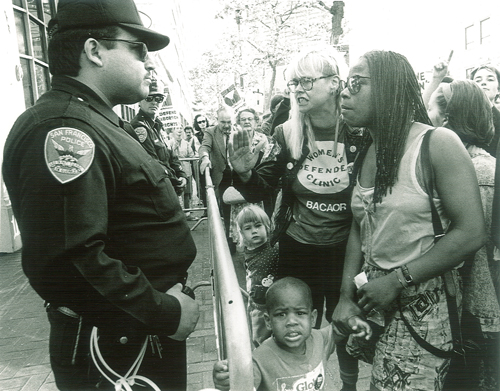
“I’m undocumented and unafraid, queer and unashamed!” Javier Hernandez declared as he took the stage in front of City Hall June 30.

He was one of hundreds of undocumented students from across the western United States who showed up in Civic Center Plaza to celebrate undocumented immigrant youth and students.

During the ceremony, students, dressed  in caps and gowns, told their stories. Many involved a struggle to get through school while unable to work, and uncertainty and fear about their own fate and that of their families. 

Angela Davis spoke in support of the students.

Later, Pomp and Circumstance played as the students marched down the aisles, each taking a turn on stage to say speak their names and their undocumented status, followed with a bold “and I’m unafraid!”

“Our core message today was to celebrate how far the undocumented movement has come,” said Blanca Vazquez, a senior at San Francisco State studying child and adolescent development. “It’s been 10 years since the DREAM Act was first proposed.”

Many protesters were made more hopeful by President Obama’s recent “deferred action” Department of Homeland Security policy directive, calling on officers to defer the depaortaton of many undocumented youth.

“This is a huge win for our communities,” Hernandez said to a cheering crowd, “and you made it happen!”

For Vazquez, the directive is an important step, but there is still much to be done. She participated in a sit-in at Obama campaign offices last week. On day two of the sit-ins, Vasquez said, Obama issued his policy directive.

Vazquez said the group wanted an Executive Order, not a policy directive. They stayed to continue the sit-in, but after the policy directive passed security guards at campaign office stopped allowing them to eat or go to the bathroom. After enduring those conditions for a day, the students stopped the occupation.

Vazquez promised they would be back, however, if “Obama doesn’t implement the policies he promised.”

A video made by immigrant youth in support of the “(und)occupation” of the campaign offices points out that although the policy directive allows DREAMers to apply for deferment and work permits, it does not guarantee either and denied applications can lead to the start of the deportation process. 

One speaker said the was grateful for the directive and hoped to get a work permit, especially after living in fear of deportation her last year of high school. But as an 18-year, she said she was still worried at the prospect of being left alone if her parents are deported to Indonesia. 

“Deportation is not just a Latino issue!” the young woman, a member of Asian Students Promoting Immigrant Rights through Education, reminded the crowd. 

Hernandez was among dozens who emphasized the intersections between undocumented and queer movements. 

“We want to find a way to bridge communities affected by homophobia and xenophobia,” Hernandez said. “It’s the same struggle.” 

A queerness in Harlem, finely revived

0

Visual alchemy, fabulous feminist story-telling, and something deemed “hyper-literate busking” abound at 2012’s Queer Rebels of the Harlem Renaissance fesitval, three nights of art and performance (Thu/28-Sat/30) by 21 LGBTQ African Americans.

Part of the 15th National Queer Arts Festival, Queer Rebels of the Harlem Renaissance continues the legacy of the droves of artists, performers, and activists who questioned stale societal standards in a myriad ways during the heyday of the New York City neighborhood’s 1920s and 30s creative blossoming: from sensual lyrics of Bessie Smith to the pointed poetics of Langston Hughes, the artists of the Harlem Renaissance continue to testify to the assertion that social causes are rarely separate and constantly progressing.

“The explosion of artistic, intellectual, and sexual freedom during the Harlem Renaissance created new possibilities,” explains Celeste Chan over the phone. She co-directs the performance series with Kali Boyce — together they’re known as the Queer Rebels. “We think that dialogue on race, gender, and sexuality grew naturally during the Harlem Renaissance because these were people’s real experiences, and what they wanted to create art about. We’re thankful for the elders and the artists who paved the way for us, whose shoulders we stand on.”

Queer Rebels of the Harlem Renaissance reinforces the idea that it is necessary to understand a past in order to create a future. Thus, paying proper homage to the Harlem Renaissance artists who opened the possibility for social change and activist dialogue, the performance schedule for Queer Rebels consists largely of dance, story-telling and readings, and music. Earl Thomas, Sista Monica, and “Drag King of the Blues” TuffNStuff operate within the jazz and blues traditions — however, the show also expands to mediums of artistic expression not so common in 1920’s America, such as political film,  contemporary music, and visual alchemy with appearances from the likes of short-filmmaker Crystal Mason, punk rock dancer Brontez Purnell, and visual artist Adee Roberson. 
(Check out the incredible-sounding lineup here.)

“Artists and queers are up against a lot, and have always been society’s outsiders, the ones who have and will lead the way,” says Chan, “Today, we are able to live unapologetically queer lives and create our own spaces because of the work that the Harlem Renaissance artists did.”

QUEER REBELS OF THE HARLEM RENAISSANCE

Thu/28.-Sat/30, 8pm, $15-$25

African American Art and Culture Complex

762 Fulton, SF.

www.queerrebels.com

Tickets:  www.brownpapertickets.com/event/246312


The economies of desire

0

THEATER Since 2010, This Is What I Want has hitched its program to the National Queer Arts Festival to explore the artistic and social ground between intimacy and performance. Privileging the immediate, even confused elaborations of desire over the canny or slickly theorized, TIWIW (produced by THEOFFCENTER in association with SOMArts, the Center for Sex and Culture, and the Queer Cultural Center) challenges adept, professional performance makers to risk forgoing the usual control or cohesion in the hope of finding new avenues for creation and participation.

TIWIW’s free-ranging curatorial approach, which includes artists operating outside queer or identity-based practices, gets a further boost this year with the inclusion of several Los Angeles–based artists and a symposium at the Center for Sex and Culture moderated by Carol Queen.

San Francisco–based performance artist and choreographer Tessa Wills took over as artistic director this year at the invitation of TIWIW’s founder, choreographer Jesse Hewit. Wills’s own piece caps the five-day program with a “participatory experience” at the Center for Sex and Culture, and in general she brings a particular stamp to this year’s festival, even as TIWIW stretches out within and beyond the Bay Area via a curatorial team that includes Hewit, Rachael Dichter, and Los Angeles–based artists Anna Martine Whitehead and Doran George.

Wills, a thirtysomething whose relaxed mien belies a probing stare, is an internationally produced performance maker who grew up studying music, ballet, and contemporary dance in England before relocating to the Bay Area. She’s one of those artists always worth going out of your way for. In fact, she was behind one of the more memorable contributions to last year’s TIWIW program (more on that below). Wearing a sleeveless T-shirt that nonchalantly compliments the shorn sides of her sandy brown bob, Wills sat down at a Mission café last week to discuss her directorial vision for TIWIW and the economies of desire.

San Francisco Bay Guardian Can you describe briefly the curatorial process this year?

Tessa Wills We asked people to apply, either people whose work we like or with a specific piece in mind, like Sara Kraft’s — Rachael [Dichter] knew exactly what the piece was. [Multimedia artist Sara Kraft’s The Truth employs a pair of dueling narratives in what the artist describes as a desperate search for objectivity, “fueled by the deeply subjective madness of desire, loss and the chaos of experience.” It premiered at Yerba Buena Center for the Arts in 2007.]

I had the curatorial statement underway, and the other curators added to it, enriched it or changed parts, and we invited people from there. About half of them are new commissions from people we are just excited by, like Dia [Dear] and Mica [Sigourney], and half of them are pieces that already exist. There are loads of people coming up from LA this time because two of the curators are down there.

SFBG One of those is British artist Doran George. How did he become involved?

TW I followed his work in England but never met him. Then he came to San Francisco, and we made very fast, intense connections around work and politics, and also a friendship. So we were looking for a way to work with each other.

When Jesse asked me to direct TIWIW and invite in curators, it seemed like that was really where Doran was at. A lot of his work is about somatics as it relates to gender. Because he was [in Los Angeles], it seemed sensible to think about other people that could support him and his choices down there. Anna Martine [Whitehead] is also down there working, and obviously she has this strong history with the festival, and her voice is clear, rich and powerful.

SFBG Can you explain the emphasis on desire and economy in your work and in your directorial approach overall?

TW Broadly, people in this festival [in the last two years] have looked at desire through the lens of sexuality — but they also have not. My artistic direction has put it very specifically; I really wanted to bring in that question of how money and desire weave together, and where the places of empowerment and disempowerment are around that. I’ve brought sex work to the fore in that. Doran also is interested in that. But we were very careful in the curating to broaden that out a lot. The pieces are not all about sex; but the pieces are all about desire. So there is breadth, but also that very specific thing that I’ve brought in.

In my piece, at Center for Sex and Culture on Saturday, there are nine people who are “charging,” they’re doing one-on-one performances with audiences. Basically, they’re facilitating you talking about your desire. But it’s not like straight sex work. It’s not like they’re going to meet your desire. They’re going to interrogate it with you and charge it up.

SFBG So “charge up” has a double entendre.

TW It’s got a double entendre, exactly. All of the chargers are sex workers. I identify as a sex-worker ally, and I identify in the space between performance and sex work. Those are my two communities. So this theme, the value of desire, somehow has those two together.

SFBG Where do you see subversive or radical points of departure in the intersections of desire and economy? 

TW People will take money and then use it for their subversive practices. So there’s that. Then there’s the fact that everybody is working for free to put this festival on. I think that adds a really interesting perspective to the conversation about how desire and money relate. Because the thing that’s really driven this festival is this passionate desire to put it on for its own sake. It defies any economic logic that any of us are working this hard. I mean, it’s ridiculous. I feel stupid how hard I’m working on this.

SFBG That’s the position of a lot of art-making in this society. But then, ridiculousness is a tried-and-true strategy of subversion too. I’m reminded of the argument in Judith Halberstam’s book, The Queer Art of Failure, where a willingness to “fail” — in the terms set by the dominant social and economic order — may offer a way out from under that order, and suggest alternatives beyond its reach or ken.

TW There are all these other economies that come to light when you look at that disconnect or failure [vis-à-vis the dominant economic model]—then it’s like, ok, that’s obviously not working, so what else can be motivating? There are just so many diverse economies at work. Like DavEnds piece, for example. She was really motivated by wanting to have close, intimate exchanges and make more friends. The people she’s brought into her piece, she’s very clear about it, are people that she wants to be friends with.

SFBG There’s a social impulse mixed in there. I also like the idea that desire could be tied to giving away or losing, as opposed to taking, receiving, gaining or possessing. Does that resonate with some of the pieces this year? 

TW Yes, I think that’s right. Mica Sigourney’s piece is one that I was very keen to curate. He’s the only one who’s been in all the iterations of the festival, and I think each time he’s done [TIWIW], it’s gotten a little closer to actually managing to stage desire, in motion, on the stage. His piece is kind of a secret, but there’s a way in which he is working directly with money. He’s trying to figure out his erotic value in the moment, with the audience. There’s a way in which his work always gets right to the heart of the theme for me.

SFBG Back to your piece: Does it build on previous work?

TW Yes. Last year, when I was at the festival, I did this piece with electric butt plugs. [Note: In this piece, Wills and co-performer Harold Burns were naked inside (what looked like) giant pink bath scrunchies (designed by Honey McMoney), wearing electric butt-plugs attached to a microphone set low before a pillow at the front of the stage. Individual audience members could come kneel and whisper their fantasies, their words registering solely in the physical responses and expressions of the performers.]

When they asked me to be in the festival, I identified that what I’m really excited about is the process of saying what you want, the somatic experience of saying what you want — especially if it feels transgressive inside of you. I don’t really care what the content of the thing is. And I don’t care whether society thinks it’s ok or not. I’m not really interested in any of that. I’m just interested in the physical, somatic experience of saying what you want. That seems like the most valuable thing for me.

So what I did in the butt-plug piece was to get the audience to come up and say things, to say what they wanted, and they couldn’t really be heard, and then we would just get the sensation — we would get the quality of how they were talking but we wouldn’t get the content. And we’d experience that in a very intimate, deep way. That’s what I wanted to try and develop a bit further this year. So after this week of people watching other people struggle and interrogate and stage their desire, [in this piece] they get to have all of that research land in their own body. They have their own process of saying what they desire, and they have their own somatic experience.

SFBG So it’s very individual and private, there’s no larger audience, there’s no documentation of the whole thing.

TW Exactly. It’s kind of rough for me as an artist, because I’ve put so much work into it, and it’s a very generous piece in terms of the amount — like we talked about the economic worth and the amount of one-on-one time with the audience. So it’s very sad for me to never get an audience response, actually.

SFBG No payoff?

TW Yeah, I’ll never get that.


THIS IS WHAT I WANT

Performances Wed/27-Fri/29, 8pm, $20

SOMArts Cultural Center

934 Brannan, SF

“Slow Sex Symposium” Sat/30, noon-4pm, free

“This Is What You Want — Experiential” Sat/30, 5-11pm, $15-$25

Center for Sex and Culture

1349 Mission, SF

thisiswhatiwant.eventbrite.com

Stage Listings

0

Stage listings are compiled by Guardian staff. Performance times may change; call venues to confirm. Reviewers are Robert Avila, Rita Felciano, and Nicole Gluckstern. Submit items for the listings at listings@sfbg.com. For further information on how to submit items for the listings, see Picks.

THEATER

OPENING

Absolutely San Francisco Alcove Theater, 414 Mason, Ste 502, SF; www.thealcovetheater.com. $32-50. Opens Thu/28, 8pm. Runs Thu-Sat, 8pm (no show Fri/29 or July 6). Through Aug 18. A multi-character solo show about the characters of San Francisco.

Hedwig and the Angry Inch Boxcar Playhouse, 505 Natoma, SF; www.boxcartheatre.org. $25. Opens Wed/27, 8pm. Runs Wed-Thu, 8pm; Fri-Sat, 7 and 9:30pm; July 8, 5pm. Through July 8. Boxcar Theatre performs John Cameron Mitchell’s musical about a transgendered glam rocker.

Jip: His Story Marsh San Francisco, MainStage, 1062 Valencia, SF; www.themarsh.org. $8-50. Previews Fri/29, 7:30pm. Opens Sat/30, 5pm. Runs Sun/1, 4:30; Thu-Fri, 7:30pm; Sat, 2pm; Sun, 3pm. Through July 15. Marsh Youth Theater remounts its 2005 musical production of Katherine Paterson’s historical novel.

Waiting… Larkspur Hotel Union Square, 525 Sutter, SF; www.brownpapertickets.com. $69-75. Opens Fri/29, 8pm. Runs Thu-Sat, 8pm; Sun, 2pm. Through Aug 5. Comedy set behind the scenes at a San Francisco restaurant.

ONGOING

Aftermath Stagewerx, 446 Valencia, SF; www.brownpapertickets.com. $25. Thu/28-Sat/30, 8pm. Theatre, Period presents Jessica Blank and Erik Jenson’s docu-drama, based on interviews with Iraqi civilians forced to flee after the US military’s arrival in 2003.

A Behanding in Spokane SF Playhouse, 533 Sutter, SF; www.sfplayhouse.org. $20-70. Wed/27-Thu/28, 7pm; Fri/29-Sat/30, 8pm (also Sat/30, 3pm). If Garth Ennis had been asked to write a comic book about a one-handed sociopath with a dark obsession, he might well have written something similar to Martin McDonagh’s A Behanding in Spokane. And admittedly, approached from that angle, a lot of the script’s dramatic flaws are more easily forgiven. There’s not a whole lot of subtle context or languid metaphor to be found in McDonagh’s criminal caper about the little-known “hand-dealing” trade, but as in Ennis’ best known work, Preacher, the pretty girl (Melissa Quine) is the smartest one in the room; the sociopath (Rod Gnapp) is interested in enacting as vicious a revenge on all humanity while spewing as many blatantly offensive invectives as possible; the boyfriend (Daveed Diggs) has some arrested development issues to work out; and the receptionist (Alex Hurt) takes the caricature of man-child to a whole new level. In fact, while all four actors deliver rock-solid performances of their mostly unsympathetic characters, it’s Hurt’s that impresses most. His spooky intensity and goofily tone-deaf determination plays like a combination of Adam Sandler and Arno Frisch, and if there’s a real sociopath in the room, the evidence suggests it’s probably him. Ultimately though the piece relies too heavily on hollow one-liners to remain interesting — a 20-minute farce stretched to 90 minutes — and quite unlike an Ennis comic, it does not leave one wanting more. (Gluckstern)

Bruja Magic Theatre, Fort Mason Center, Marina at Laguna, SF; www.magictheatre.org. $20-60. Extended run: Wed/27-Fri/29, 8pm; Sun/1, 2:30pm and 7pm. Although San Francisco’s Mission District is inexorably morphing into an empire of twee boutiques and haute cuisine, it’s still the first port of call for many Latin American migrants, and there are plenty of panaderias and botanicas tucked in between the sushi joints. In the Magic Theatre’s production of Bruja, playwright Luis Alfaro transplants the story of Medea to 24th Street by way of Michoacán, exploring the tension between retaining old-country values and staking out a future in a new world. Directed by artistic director Loretta Greco, the title role played by a stunning Sabina Zuniga Varela, this chamber version of the Greek tragedy hits hard, exposing each character’s darkest secrets to an unforgiving light. And every character, save the doomed brothers Acan and Acat (played the night I saw it by Daniel Castaneda and Gavilan Gordon-Chavez), has a secret to hide, even Medea, a curandera or healer by trade, whose powers run deeper and darker than her new world acquaintances, or even her old servant (Wilma Bonet) suspect. And when Jason (Sean San José) and his callous boss Creon (Carlos Aguirre), ruthlessly push Medea to her breaking point, her bloody vengeance proves, if little else, that she can play at ruthlessness better than anyone, whatever the consequences. (Gluckstern)

5 Lesbians Eating a Quiche Phoenix Theatre, 414 Mason, SF; www.tidestheatre.org. $20-38. Thu-Sat, 8pm (also Sat, 10pm). Through July 21. Tides Theatre performs Evan Linder and Andrew Hobgood’s comedy about five women forced into a bomb shelter during a mid-breakfast nuke attack.

The Full Monty Eureka Theatre, 215 Jackson, SF; www.roltheatre.com. $25-36. Thu/28-Sat/30, 8pm (also Sat/30, 2pm). In desperate times, how far would you go to turn a buck? The central premise of the 1997 movie and its namesake musical comedy The Full Monty, the answer to this question is right in the title, which limits the suspense, but amps up the expectations. Set not in Sheffield, England as in the movie, but the similarly economically challenged climate of Buffalo, New York circa the late nineties, the comical romp follows a group of unemployed steel workers who decide, rather optimistically, that spending one night as exotic dancers will solve their immediate financial woes. Banish all notions of a Hot Chocolate sing-along; the soundtrack of the stage musical has little in common with its cinematic predecessor, but there are a couple of toe-tappers, particularly the songs writ for the ladies: a belter’s anthem for their spry but elderly accompanist Jeanette (Cami Thompson), a snarky commentary on male beauty, “The Goods,” for the ensemble. On opening night, Ray of Light’s production ran about 15 minutes long after a late start, and the tempo seemed sluggish in parts, but once it hits its stride, The Full Monty should provide a welcome antidote to the ongoing, we’re-still-in-a-recession blues, red leather g-strings and all. (Gluckstern) Fwd: Life Gone Viral Marsh San Francisco, 1062 Valencia, SF; (415) 282-3055, www.themarsh.org. $20-50. Sat, 8:30pm; Sun, 7pm (July 15, show at 7:30pm). Extended through July 22. The internet becomes comic fodder for creator-performers Charlie Varon and Jeri Lynn Cohen, and creator-director David Ford.

Lips Together, Teeth Apart New Conservatory Theatre Center, 25 Van Ness, SF; www.nctcsf.org. $25-45. Wed/27-Sat/30, 8pm; Sun/1, 2pm. New Conservatory Theatre Center performs Terrence McNally’s play about two straight couples spending July 4 amid Fire Island’s gay community.

100 Saints You Should Know Thick House, 1695 18th St, SF; www.therhino.org. $10-30. Fri/29-Sat/30, 8pm; Sun/1, 3pm. Homespun scenic design notwithstanding, Theatre Rhinoceros and artistic director John Fisher offer a fine, engrossing production of this 2007 play by Kate Fodor (Hannah and Martin, RX), a sturdy comedy-drama about two fractured families colliding awkwardly in a sort of spiritual vacuum. Matthew (an intriguingly restrained Wiley Herman) is a desolate but forbearing Catholic priest sent on a leave of absence after a venial transgression involving some artful nude male photographs. Returning home, he endures a pained relationship with his devout, passively domineering Irish mother (Tamar Cohn, channeling a nicely measured mixture of stony discipline and childlike vulnerability). Soon Matthew gets an unexpected visit from single mom Theresa (a bright but shrewdly self-possessed Ann Lawler), a former Deadhead who now cleans the rectory and finds herself overcome with an urge to ask the gentle priest about prayer — just at the moment his faith seems to have left him. Meanwhile, Theresa’s too-cool-for-school teenager, Abby (a deft and hilarious Kim Stephenson), waits outside and does some preying of her own on a slower-witted but game young man from the neighborhood (a charmingly quirky Michael Rosen), both of them roiling with confused yearnings. The appealing characters and unexpected storyline come supported by some excellent dialogue, developing a searching theme that ultimately has less to do with formal religion than the ordinary but ineffable need it promises (problematically) to meet. “I think I could be religious or whatever if it made any sense,” notes Abby, “but it doesn’t make any sense.” It’s easy to agree with the teenager on this one. 100 Saints is a genuinely funny and compassionate play discerning enough to avoid naming the depths it sounds. (Avila)

Proof NOHspace, 2840 Mariposa, SF; www.proofsf.com. Wed-Sat, 8pm. Through July 14. $28. Expression Productions performs David Auburn’s Pulitzer-winning play about a mathematician and his daughter.

Reunion SF Playhouse, Stage Two, 533 Sutter, SF; (415) 677-9596, www.sfplayhouse.org. $20. Wed/27-Thu/28, 7pm; Fri/29-Sat/30, 8pm. SF Playhouse presents a world premiere drama by local playwright Kenn Rabin.

“Risk Is This…The Cutting Ball New Experimental Plays Festival” Exit on Taylor, 277 Taylor, SF; (415) 525-1205, www.cuttingball.com. Free ($20 donation for reserved seating; $50 donation for five-play reserved seating pass). Fri-Sat, 8pm. Through July 14. Cutting Ball’s annual fest of experimental plays features two new works and five new translations in staged readings.

The Scottsboro Boys American Conservatory Theater, 415 Geary, SF; www.act-sf.org. $20-95. Opens Wed/27, 8pm. Runs Tue-Sat, 8pm (Tue/3 performance at 7pm; also Wed and Sat, 2pm; no matinee July 4); Sun/1 and July 8, 7pm. Through July 15. American Conservatory Theater presents the Kander and Ebb musical about nine African American men falsely accused of a crime they didn’t commit in the pre-civil rights movement South.

Slipping New Conservatory Theatre Center, 25 Van Ness, SF; www.nctcsf.org. $25-45. Wed/27-Sat/30, 8pm; Sun/1, 2pm. Midwestern high-school senior Eli (Evan Johnson), a recent transfer from San Francisco, is a rebellious gay teen with issues — what American teen doesn’t have issues? But then Eli’s, which include the loss of a beloved father and a Hamlet-like resentment for his recently widowed, sexually liberated academic of a mom (a subtle Stacy Thunes), have already driven him over the ledge. Eli’s “slip” into a state of deep grief is further accelerated by the complicated, violently closeted love he left back in San Francisco. In flashbacks, Eli relives this punishing, irresistible relationship with Chris (a coiled, forceful Fernando Navales) as meanwhile new best friend Jake (Benjamin T. Ismail) gradually expresses more than platonic interest and life with mother builds toward a showdown, in New Conservatory’s Bay Area premiere of Bay Area–born playwright Daniel Talbott’s thoughtfully drawn if dramatically underdeveloped play. In contrast to Ron Gasparinetti’s purposefully vague “anywhere” of a monochrome set (consisting of several low or sloped stone slabs), director Andrew Nance’s cast are engagingly precise in their clear-eyed take on adolescent anguish. Johnson proves gracefully multifaceted as Eli, at turns unbearable in his loose, simmering rage and disarming in his helplessness and heartbreak. And a charmingly awkward and earnest Ismail makes wholly convincing Jake’s innocent moth-to-flame attraction. Indeed, the play’s weaknesses — including a dizzying amount of hopping around the time-space continuum and, more critically, a dramatic arc that’s too neat and shallow to be really satisfying — do not completely detract from a worthwhile subject that often feels drawn from life. (Avila)

Vital Signs Marsh San Francisco, 1062 Valencia, SF; (415) 282-3055, www.themarsh.org. $15-50. Sat, 8:30pm. Through July 21. The Marsh San Francisco presents Alison Whittaker’s behind-the-scenes look at nursing in America.

The Waiting Period MainStage, Marsh San Francisco, 1062 Valencia, SF; (415) 282-3055, www.themarsh.org. $15-50. Fri, 8pm; Sat, 5pm. Extended through July 7. Brian Copeland (comedian, TV and radio personality, and creator-performer of the long-running solo play Not a Genuine Black Man) returns to the Marsh with a new solo, this one based on more recent and messier events in Copeland’s life. The play concerns an episode of severe depression in which he considered suicide, going so far as to purchase a handgun — the title coming from the legally mandatory 10-day period between purchasing and picking up the weapon, which leaves time for reflections and circumstances that ultimately prevent Copeland from pulling the trigger. A grim subject, but Copeland (with co-developer and director David Ford) ensures there’s plenty of humor as well as frank sentiment along the way. The actor peoples the opening scene in the gun store with a comically if somewhat stereotypically rugged representative of the Second Amendment, for instance, as well as an equally familiar “doood” dude at the service counter. Afterward, we follow Copeland, a just barely coping dad, home to the house recently abandoned by his wife, and through the ordinary routines that become unbearable to the clinically depressed. Copeland also recreates interviews he’s made with other survivors of suicidal depression. Telling someone about such things is vital to preventing their worst outcomes, says Copeland, and telling his own story is meant to encourage others. It’s a worthy aim but only a fitfully engaging piece, since as drama it remains thin, standing at perhaps too respectful a distance from the convoluted torment and alienation at its center. (Avila)

BAY AREA

Emilie: La Marquise Du Chatelet Defends Her Life Tonight Berkeley City Club, 2315 Durant, Berk; www.brownpapertickets.com. $18-25. Thu/28-Sat/30, 8pm; Sun/1, 2pm. Symmetry Theatre Company presents Bay Area playwright Lauren Gunderson’s romantic drama centering on the life of 18th-century French physicist and mathematician, Émilie du Châtelet (Danielle Levin) and her (here tempestuous) long-term romance with Voltaire (Robert Parsons). In a familiar conceit left accordingly vague, fate rematerializes Emilie from some hazy afterlife so that she may relive key moments in her life and account for herself. A Cartesian mind/body split rules the replay, with Emilie finding herself painfully attenuated from the world of the senses — her flashback self (played by an impressive Blythe Foster) alone able to enjoy sensual contact with her surroundings. Meanwhile, love and loyalty face the test as Emilie goes head-to-head with a male-dominated scientific establishment over a certain theorem she calls “force vivre” — a formula into which Gunderson cleverly folds theoretical physics and the irrational heart. There’s even a visual aid: a running tally is kept throughout on a screen at the back of the stage, where hash marks appear and disappear under the headings “philosophy” and “love” as the scenes wind their desultory way back toward the moment of her demise. Chloe Bronzan directs a cast of strong actors but their work is uneven. Foster alone is consistently commanding in a part that, while minor, suggests what a more muscular approach overall might have accomplished. The normally formidable Parsons seems uncommitted in the part of Voltaire, admittedly a character too simpering and watery as written to merit much credence. Instead of palpable relationships — whether with lovers or ideas — Emilie deploys self-conscious verbiage, strained repartee and heavy thematic underscoring to churn what amounts to thin drama. (Avila)

Emotional Creature Berkeley Repertory Theatre, Roda Theatre, 2025 Addison, Berk; www.berkeleyrep.org. $14.50-73. Tue and Thu-Sat, 8pm (also Sat, 2pm; no show July 13); Wed, 7pm (no show July 4); Sun, 2 and 7pm. Through July 15. Berkeley Rep presents Eve Ensler’s world premiere, based on her best-seller I Am an Emotional Creature: The Secret Life of Girls Around the World.

The Kipling Hotel: True Misadventures of the Electric Pink ’80s New venue: Marsh Berkeley, 2120 Allston, Berk; (415) 282-3055, www.themarsh.org. $20-50. Sat, 8:30pm; Sun, 7pm. Extended through July 15. This new autobiographical solo show by Don Reed, writer-performer of the fine and long-running East 14th, is another slice of the artist’s journey from 1970s Oakland ghetto to comedy-circuit respectability — here via a partial debate-scholarship to UCLA. The titular Los Angeles residency hotel was where Reed lived and worked for a time in the 1980s while attending university. It’s also a rich mine of memory and material for this physically protean and charismatic comic actor, who sails through two acts of often hilarious, sometimes touching vignettes loosely structured around his time on the hotel’s young wait staff, which catered to the needs of elderly patrons who might need conversation as much as breakfast. On opening night, the episodic narrative seemed to pass through several endings before settling on one whose tidy moral was delivered with too heavy a hand, but if the piece runs a little long, it’s only the last 20 minutes that noticeably meanders. And even with some awkward bumps along the way, it’s never a dull thing watching Reed work. (Avila)

Not Getting Any Younger Marsh Berkeley, 2120 Allston, Berk; (415) 282-3055, www.themarsh.org. $15-50. Fri/29, 8pm; Sat/30, 5pm. Marga Gomez is back at the Marsh, a couple of too-brief decades after inaugurating the theater’s new stage with her first solo show — an apt setting, in other words, for the writer-performer’s latest monologue, a reflection on the inevitable process of aging for a Latina lesbian comedian and artist who still hangs at Starbucks and can’t be trusted with the details of her own Wikipedia entry. If the thought of someone as perennially irreverent, insouciant, and appealingly immature as Gomez makes you depressed, the show is, strangely enough, the best antidote. Note: review from the show’s 2011 run at the Marsh San Francisco. (Avila)

The Odyssey Angel Island; (415) 547-0189, www.weplayers.org. $40-76 (some tickets include ferry passage). Sat/30-Sun/1, 10:30am-4pm (does not include travel time to island). We Players present Ava Roy’s adaptation of Homer’s epic poem: an all-day adventure set throughout the nature and buildings of Angel Island State Park.

Salomania Aurora Theatre, 2081 Addison, Berk; www.auroratheatre.org. $30-55. Previews Wed/20, 8pm. Tue, 7pm; Wed-Sat, 8pm; Sun, 2 and 7pm. Throgh July 22. The libel trial of a politically opportunistic newspaper publisher (Mark Andrew Phillips) and the private life of a famous dancer of the London stage — San Franciscan Maud Allan (a striking Madeline H.D. Brown) — become the scandalous headline-grabber of the day, as World War I rages on in some forgotten external world. In Aurora’s impressive world premiere by playwright-director Mark Jackson, the real-life story of Allan, celebrated for her risqué interpretation of Oscar Wilde’s Salomé, soon gets conflated with the infamous trial (20 years earlier) of Wilde himself (a shrewdly understated Kevin Clarke). But is this case just a media-stoked distraction, or is there a deeper connection between the disciplining of “sexual deviance” and the ordered disorder of the nation state? Jackson’s sharp if sprawling ensemble-driven exploration brings up plenty of tantalizing suggestions, while reveling in the complexly intermingling themes of sex, nationalism, militarism, women’s rights, and the webs spun by media and politics. A group of trench-bound soldiers (the admirable ensemble of Clarke, Alex Moggridge, Anthony Nemirovsky, Phillips, Marilee Talkington, and Liam Vincent) provide one comedy-lined avenue into a system whose own excesses are manifest in the insane carnage of war — yet an insanity only possible in a world policed by illusions, distractions and the fear of unsettled and unsettling “deviants” of all kinds. In its cracked-mirror portraiture of an era, the play echoes a social and political turmoil that has never really subsided. (Avila)

Wheelhouse TheatreWorks at the Mountain View Center for the Performing Arts, 500 Castro, Mtn View; (650) 463-1960, www.theatreworks.org. $19-69. Wed/27, 7:30pm; Thu/28-Sat/30, 8pm (also Sat/30, 2); Sun/1, 2 and 7pm. TheatreWorks’ 60th world premiere is a musical created by and starring pop-rock trio GrooveLily.

The World’s Funniest Bubble Show Marsh Berkeley, TheaterStage, 2120 Allston, Berk; (415) 826-5750, www.themarsh.org. $8-50. Fri/29, 6pm; Sat/30, 11am. Louis “The Amazing Bubble Man” Pearl returns with this kid-friendly, bubble-tastic comedy.

PERFORMANCE/DANCE

Alicia Dattner Exit Theatre, 156 Eddy, SF; www.theexit.org. Thu/28-Sat/30, 8pm. $26. The comedian performs.

“DEEPER, Architectural Meditations at CounterPULSE” CounterPULSE, 1310 Mission, SF; www.counterpulse.org. Fri/29-Sun/1, 8pm. $25. Lizz Roman and Dancers perform a site-specific work.

“Elect to Laugh” Studio Theater, Marsh San Francisco, 1062 Valencia, SF; (415) 282-3055, www.themarsh.org. Tue, 8pm. Through Nov 6. $15-50. Will Durst and friends perform in this weekly political humor show that focuses on the upcoming presidential election.

“I Heart Hamas: And Other Things I’m Afraid to Tell You” Exit Theatre, 156 Eddy, SF; www.brownpapertickets.com. Fri/29-Sat/30, 8pm. $20. Jennifer Jajeh performs her solo show, soon to be presented at the Edinburgh Festival Fringe.

“Jillarious Tuesdays” Tommy T’s Showroom, 1000 Van Ness, SF; www.jillarious.com. Tue, 7:30. Ongoing. $20. Weekly comedy show with Jill Bourque, Kevin Camia, Justin Lucas, and special guests.

“Majestic Musical Review Featuring Her Rebel Highness” Harlot, 46 Minna, SF; www.herrebelhighness.com. Sun, 5pm. Through Aug 12. $25-65. Cocktails and hors d’oeuvres, performers in Baroque-chic gowns, music, and more.

“Mission in the Mix” Dance Mission Theatre, 3316 24th St, SF; www.brownpapertickets.com. Fri/29-Sat/30, 8pm; Sun/1, 7pm. $17. SF Hip-Hop DanceFest producer Micaya presents new work by her SoulForce Dance Company, plus guest performances.

“Nerdgasm” Garage, 715 Bryant, SF; wonderdave.wordpress.com. Thu/28, 8pm. $12. Poetry, storytelling, and more, for nerds and by nerds. Part of the National Queer Arts Festival.

“One Night Only Benefit Cabaret” Marines Memorial Theater, 609 Sutter, SF; www.richmondermet.org. Mon/2, 7:30pm. $25-65. Cast members from the American Idiot tour perform original music and comedy to raise money for the Richmond/Ermet AIDS Foundation and Broadway Cares/Equity Fights AIDS.

“Picklewater Clown Cabaret: Robot’s Revenge!” Stage Werx Theatre, 446 Valencia, SF; www.brownpapertickets.com. Mon/2, 8pm. $15. Picklewater and guests perform physical comedy and other circus acts.

“Same Amor” Shotwell Studios, 3252-A 19th St, SF; www.ftloose.org. Fri/29-Sat/30, 8pm; Sun/1, 3pm. $10-20. Flamenco and contemporary dance, comedy, and live music, featuring Acuña Danza Teatro.

San Francisco Ethnic Dance Festival Novellus Theater, Yerba Buena Center for the Arts, 700 Howard, SF; www.worldartswest.org. Sat/30-Sun/1, 3pm (also Sat/30, 8pm). $18-58. This final weekend of programming includes dance from Hawaii, India, Indonesia, Japan, Liberia, Mexico, the Philippines, Spain, Tajikistan, and Uzbekistan.

Sex and the City: Live!” Rebel, 1760 Market, SF; www.brownpapertickets.com. Tue, 7 and 9pm. Through June 26. $25. Heklina, D’Arcy Drollinger, Lady Bear, Trixxie Carr play the fab four in this drag-tastic homage to the HBO series.

“This Is What I Want Performance Festival” SOMArts Cultural Center, 934 Brannan, SF; thisiswhatiwant.eventbrite.com. Wed/27-Fri/29, 8pm. $20. Part of the National Queer Arts Festival, this event features different bills each night of new, multidisciplinary performances from San Francisco and Los Angeles-based artists.

“Walking Distance Dance Festival” ODC Theater, 3153 17th St, SF; www.odctheater.org. Fri/29-Sat/30, 6:30pm; Sun/1, 2pm. $20-75. LEVYdance, inkBoat, Kunst-Stoff, and more participate in this new festival, featuring dance artists performing throughout ODC’s two-building campus.

“When We Fall Apart” Z Space, 450 Florida, SF; www.zspace.org. Wed/27-Sat/30, 7pm (also Fri/29-Sat/30, 9pm). $25-35. Joe Goode Performance Group presents a world premiere, an exploration of “home” with a set designed by architect Cass Calder Smith.


No more fast food: Slow Sex Symposium proposes a love beyond capitalism

0

After a hectic Pride weekend, it’s about time to slow down. A Sat/30 performance-workshop (part of this week’s stellar This Is What I Want performance art fest — read Guardian theater critic Robert Avila’s enlightening interview with artistic director Tessa Wills here) should fit the bill nicely. Introducing “Slow Sex Symposia” and its curator, internationally-acclaimed writer and dancer Doran George. George is planning an afternoon exploration into alternative sexual practices, lifestyles, and unique relationships. Slow sex is a term the artist coined to serve as counterpoint to today’s fast-paced, commercialized notions of sex. Last week, George and I spoke about what it was like to work with a blockbuster lineup of artist, “the economics of queer desire,” and a childhood solo of  “Yankee Doodle.”

San Francisco Bay Guardian: Tell us about the slow sex movement. What makes it important?

Doran George: Slow sex is not a movement as far as I know. It’s a term that I coined for the symposium because I like the idea that communities of alternative sexual practice are engaged in the long-term process of cultivating a culture of sex that takes time, in contrast with the immediacy of practicing conventional ideas about sex. 

Setting up a good SM scene, negotiating non-monogamy, negotiating racist ideas about the sexuality of non-white bodies while still claiming the space for pleasure, these all take time. There is also a parallel [between slow sex and] the slow food movement, in the sense that I believe the radical pleasure community provides a model of sexual practice that is more nourishing, [similar to how] slow food is better than its fast equivalent. 

>>FOR MORE ON THE FESTIVAL, READ “ECONOMIES OF DESIRE”: ROBERT AVILA’S INTERVIEW WITH THIS IS WHAT I WANT‘S ARTISTIC DIRECTOR

SFBG: In your artist statement you reference accessibility to touch, conceptualizing new models of relationships, and the complexities of race in the sex industry. Can the slow sex movement move into mainstream and can queer forms of thought (around sex) be integrated into popular culture?

DG: There are many examples of alternative sexual practice entering mainstream culture. Unfortunately most of them are bitterly disappointing. Mainstream culture constantly needs new images and ideas to make it seem exciting, but at the same time it is usually committed to sustaining convention. Take Madonna’s use of SM imagery in the late 20th century as an example. Although some of the aesthetics were tantalizing, the bodies and constructions of gender were incredibly conservative. There were no sexy butch leather dykes on Madonna’s stage or in her videos. 

I think this is partly because the real power of alternative sexual culture is located in the fact that it is something you have learn and practice — it often entails carefully unpicking and rethinking relationships.. All of this takes careful work that is difficult for the fast consumer culture to contend with. In this sense I’m not sure that existing structures for the production and distribution of mainstream culture are very well designed for alternative sexual culture because radical sex depends upon local economy rather than global corporations. 

SFBG:  You are working with a blockbuster cast of queer artists, sex educators, and performers. What was it like working alongside all these influential queer people?

DG: I first heard about radical sex culture when I was in the fourth year of my dance training, nearly 20 years ago. Rachel Kaplan came to my dance academy and gave me a copy of More Out than In which was writing that came out of 848 space about the intersection between art, sex and community. 

A few years later I came to San Francisco from London with an artist’s grant to research diverse sexual cultures. It was 1999 and I was refusing to use gendered pronouns and regularly getting harassed on those big red buses for looking like a freak. When I first arrived in the Bay Area I felt like a queen. Susan Stryker showed me the hot-spots of transgender history and bought me my first\-ever burrito in the Mission. Pat (now Patrick) Califia and Matt Rice took me out for sushi. Annie Sprinkle gave me a pin badge that said “metamorphosexual” on it, and I met with Carol Queen and a host of other San Francisco folk. 

I was overwhelmed by the culture that had emerged in this city, the ideas and practices that people had pioneered, and the history that was being recorded. Returning to the UK I carried on making my own dance works that were influenced by the knowledge I had gleaned from people in the Bay. Being able to create a symposium that looks at how the unique sex culture of San Francisco has informed and been informed by the practice of art is therefore my own way of honoring the people and the gifts I was given as a young queer artists. 

SFBG: What does the term “the economics of queer desire” mean for you?

DG: I’m interested in how conventional economies of desire are queered, or how the queer dimensions of economies of desire become visible. Someone said to me recently that the extra-marital affair is the straight way to play. It made me laugh and struck me as a beautiful queering of heterosexuality, although Carol Queen’s Bend Over Boyfriend is still my all time favorite queering of straight sex.

SFBG: Where does art, desire, and sex intersect in your opinion?

DG: I don’t think that art, desire, and sex ever don’t intersect. Artistic practice has been involved in representing ideals of gender, desire and sex for centuries, and they inform the way that we practice sex. The symposium provides two different frames in which to think, one of them is

performance, and the other is sexual practice, but in reality these things are not separate. Having two frames is useful because it helps to start a conversation by giving us two different ideas to talk about: Performers make their work to represent or express something, and sex radicals do their practice to connect with people erotically (in all the different dimensions that the erotic can exist).

SFBG: How should attendees of the Slow Sex Symposia expect to walk away feeling? 

DG: I hope that attendees will walk away thinking about their feelings, and feeling about their thinking! I also hope their thinking and feeling moves in lots of different directions. My desire for the symposium is that it will provide a space for discourse about sexual and artistic practice to proliferate. A strong culture is one that can contend with diverse opinions being voiced.

SFBG: I enjoyed reading your bio on the This is What I Want website. You are quite an accomplished artist and scholar. Can you tell us something about yourself most people don’t know?

DG: My first major stage performance was a solo rendition of “Yankee Doodle” at the age of nine in the scout gangshow at the amateur dramatic theatre in a working class hosiery town in the British midlands. I don’t think the audience or I ever really recovered! 

Slow Sex Symposia 

Sat/30 noon-4pm, free with reservation

Center for Sex and Culture

1349 Mission, SF

www.theoffcenter.org

Free classes for all

0

Why should you need an expensive libereral arts education to ponder the question of realism, or pricey equipment to take a film making class? You don’t- the University of the Commons (UOTC) dove into its schedule of free, open to all classes a few weeks ago, and the effort is growing.

In a panel discussion at the summer session’s launch June 2, speakers placed the school in a radical context, mentioning other efforts such as D-Q University and Black Panther liberation schools like the Oakland Community School. 

The group’s mission statement says that the UOTC “aims to inspire participants to evolve more equitable and just societies and live more empowered and fulfilling lives.” The school isn’t accredited and students won’t get any formal acknowledgment of having taken classes there. 

It does, however, have some system-approved teachers. Dr. Barbara-Ann Lewis, who is teaching a class called Science Literacy to any and all who show up, is no newbie. She received her PhD in Soil Science from UC Berkeley in 1971, worked as a scientist at Argonne National Laboratory for seven years, and then taught environmental engineering at Northwestern for another 27. Since then she worked a stint as a violin-maker (“it’s good to have a trade,” she told me).

So what’s a pro like Lewis doing in a place like this? For her, its almost civic duty. “I want to teach the public,” she said. “The public votes, but has no idea about some of the real science behind the environmental issues.”

But in many of her university classes, “I had the standard students. They pay tuition, they come in, they don’t know too much about what’s going on in the world. They’ve lost their curiosity.”

She found students with that curiosity in her experience teaching with the Free University of San Francisco last year, Lewis says. “I had an 18-year-old and I had a 50-year-old in the class, lots of kinds of people, who all wanted to learn.”

Warren Lake of the San Francisco Free School, a similar effort that teaches free classes in the city, attended the launch in hopes of joining forces in some way with the UOTC. The Free School, Lake says, started with free yoga classes and has naturally offered movement, dance and other “right-brain pursuits,” compared to the UOTC’s heady academic offerings. Lake sees the Free School as “both a place to incubate teachers and for students to get together.” But when it comes to transferable skills and help along career paths, the picture is more complicated.

The Free School has been around for a few years now, and Lake says the accreditation issue is something he’s “thought about a lot.”

“There are different ways to show expertise,” said Lake. “Making a documentary or writing a book can often work as well as a college degree for showing you are interested of invested in something. There are different ways to market the experience.”

The University of the Commons is a great effort. But it brings up some questions. Who is it for? People who want an education but can’t afford one, now that the cost-free California community college system is a thing of the past? People who are already pretty well educated but always enjoy learning, not to mention generally fulfilling experiences? Students who want to supplement un-creative traditional schooling? People looking for friends and community who enjoy some learning on the side? Real change, liberation?

A Guardian article on a similar effort last year- the San Francisco Free University- pointed out that their effort was promising, admirable, and potentially very beneficial. It was also very white.

June 18, the pretty white- though, as members pointed out, also pretty female and queer- UOTC collective spent the majority of their meeting talking about “diversity and outreach.” They talked about teaching ethnic studies and women’s studies courses that are being cut out of public university curriculum. They talked about ideas for partnerships with organizations around the city that work with different groups, asking to see what kinds of free classes people there might want to participate in or teach. They talked about resources for classes in Mandarin and Spanish. They hope to plug in to existing efforts, and they hope to grow.

As of now, the classes range in the attendance. The students of Occupy U, a class discussing what worked and what didn’t in recent social justice efforts that focuses on Occupy, is about 11 mostly activist types, while From Mahler to the Music Video, a class tracing the history of music, has about 70 students that the instructor John Smalley says includes everyone from “professional musicians to homeless people.”

Next week will be the third week of classes, but you can still join in, although it might be a good idea to contact the instructor beforehand.

Science Literacy w/ Barbara-Ann Lewis

Tuesdays 5:30-7:30pm, Modern Times, 2919 24th St., SF

Responsive Cinema w/ Rand Crook

Tuesdays 7-9pm, the Emerald Tablet, 80 Fresno, SF

Intro to Western music: from Mahler to the music video w/ John Smalley

Saturdays 11am-1pm, Latino/Hispanic Community Meeting Room B, Main San Francisco Public Library, 100 Larkin, SF

History in digital culture w/ Molly Hankwitz

Sundays 6-8pm

Mutiny Radio Café, 2781 21st St

Occupy U w/ Stardust

Sundays 6-8pm, Modern Times, 2919 24th St., SF

www.uotc.org/wordpress

Never underestimate the importance of lube: Fetish fashionista Seven Mitchell on life in latex

0

Modeling by Karma Zabetch

“I have to tell my grandma I make clothes for rock stars.”

The Tenderloin neighborhood’s vivid street culture and its residents’ bold use of alternative sexuality makes it a perfect home for fetish designer and performer Seven Mitchell. Mitchell, a six-foot tall beauty, is a latex designer at Mr. S Leather, not to mention the host of Ice Queen Sundays, a weekly drag and performance night at Truck.

Mitchell greets me at the door and quickly goes into the infamous and gruesome story of a murder that took place at his TL apartment. He describes how the victim was kidnapped and goes into further details I’ll spare you from. “And it happened right behind this wall!” he exclaims as I follow him through the front door. 

Mitchell’s dark tale is juxtaposed by his warm demeanor and kind hospitality. He performs double duty as stylist and makeup artist for the photoshoot we’ve arranged to take place during our interview — a queer renaissance man. We talk about his performance persona Aurora Switchblade, the utility of lube for lovers of latex, and the casual fibs we tell our family about our profession. 

San Francisco Bay Guardian: Where are you originally from?

Seven Mitchell: I was born in Twentynine Palms, California, and I moved and lived in Ohio till I was 10. My family moved to Tampa, Florida next. I went to graduate school at the University of South Florida where I studied anthropology. 

SFBG: How did you go from anthropologist to latex designer?

SM: I had just separated from my long-term partner and wanted to follow my dreams of being a performer and artist. Needless to say, there wasn’t very much in the way of an artistic life in Tampa. So I left graduate school and moved to San Francisco. 

I had tried to make latex apparel on my own prior and wasn’t very successful. When I got to SF my curiosity led me to Mr. S Leather. It had a well-known reputation in the fetish community. I started volunteering for Mr. S during Folsom Street Fair in 2010. They really liked me and took me under their wing. 

I’ve worked for Mr. S Leather for two years now and love it. It fits my personality very well. My boss Skeeter is really amazing — the power dynamics feel quite balanced. She makes really great suggestions as opposed to telling us what to do. I also love working with latex. The longer you work with it the easier it is to design and manipulate.

SFBG: Does latex play a big role in your sex and sexuality?

SM: I have used latex as an element in my sex, but I don’t use it on the regular. It’s not a requirement for me. I am not a hardcore fetish person who has to have it, and I like it when it’s there.

SFBG: What type of fetish person are you?

SM: Well I used to run the Rubber Men of San Francisco. So, I guess I’m into rubber and latex, but after Aurora and Ice Queen Sundays started taking off, I gave it over to this guy Rick Holt, and he’s doing a fantastic job.

I participate now in leather and fetish events like Dore Alley and Folsom [Street Fair] as a participant. I’m looking forward to attending the rubber party this year at the Powerhouse.

SFBG: Where does latex and sexuality meet?

SM: Well for some they don’t meet at all. I think it can meet in that place where your sex becomes your entire body.


SFBG: Can you describe Aurora Switchblade?

SM: She’s a cunt. I mean drag is a hyperbole, and I like to exaggerate all aspects of my drag. Aurora does lots of reading. It’s important for people to know that I’m always kidding. Aurora is a punk, goth, activist. I feel like drag should have a message. So there is a lot of politics in my numbers.

SFBG: Tell us something people should know about latex.

SM: There is a lot of information a person should know about navigating latex. It’s actually like vampire skin. It can’t be exposed to light and it can’t touch metal. When you buy a piece you need to know that it isn’t going to last forever. It will last a long time, but it’s not like textiles.

Oh and you need lube for latex apparel! Latex is under the umbrella of rubber. So you need to use silicone-based lube to get it own. And you do sweat in latex. Your body reaches an equilibrium eventually. Most people who wear latex for the sake of wearing it let’s say at an event like Folsom usually get dehydrated from sweating, drinking alcohol, and partying in latex. 

And if you like your latex to shine use a polish like Black Beauty.

SFBG: Have you gotten any negative feedback for being a latex designer. Do people equate what you do to being a sex worker?

SM: I mean, not in San Francisco. I have to tell my grandma I make clothes for rock stars, but I’m sure she has gone to the Mr. S Leather’s website and knows all about what I actually do. It does change conversation in an instant. A lot of people in SF know about fetish and latex apparel. I find it harder to date in this city. I think people find it intimidating to be with someone who is super knowledgeable about fetish apparel.

Ice Queen Sundays

Every Sunday, 8pm, $5 includes icecream

Truck

1900 Folsom, SF

www.trucksf.com

Voices of “The Queer Youth of Today”

0

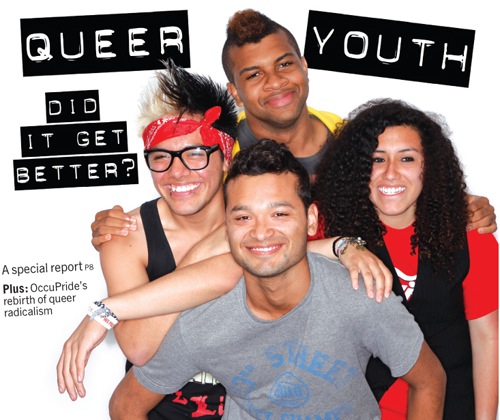
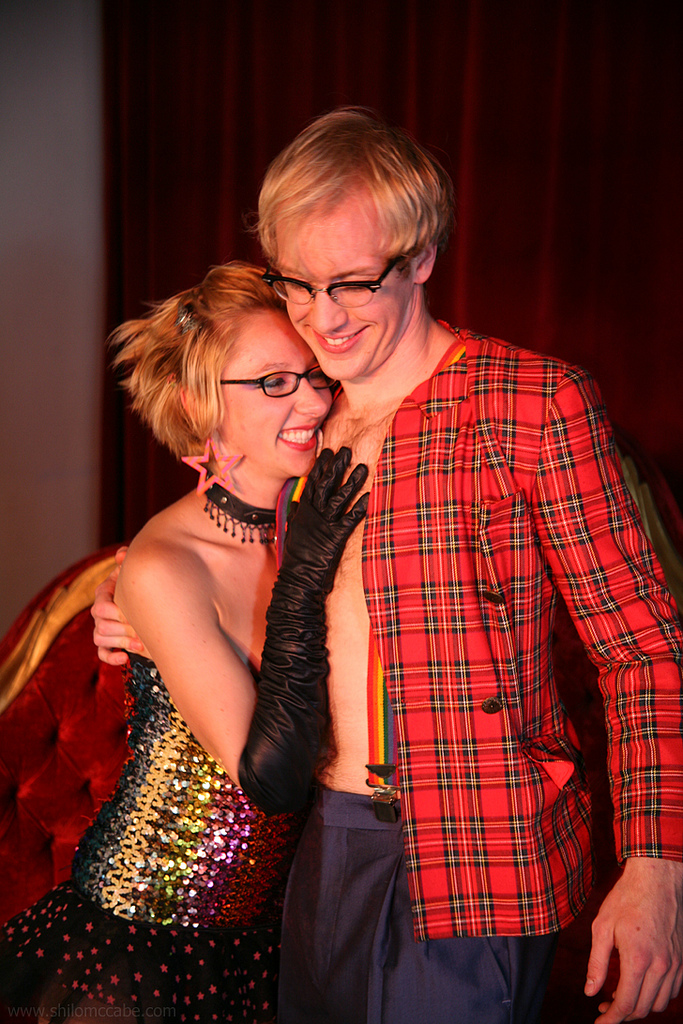
For the cover of our Queer Pride Issue, the Guardian rallied a group together to take some photos and ask them about their experiences as queer youths in the Bay Area. Go to the jump to hear more from Angel, Brian, Dennis, and Huitzi.

(Photos by Keeney and Law)


Angel, Intern, SF LGBT Community Center
“I’m really excited for Pride! I’ve never been… this is going to be my first time, so I’m really excited…”

Brian, Recent SF Transplant
“I grew up in Texas. By coming out here I’m coming into a new world where it’s ok being gay, it’s ok being you you are, it’s ok me loving Angel, and it’s ok flaunting it. No one is going to say anything about that. I think the Bay Area is where I was meant to be.”

Dennis, Poet/Musician/Queer Youth Educator
“What inspires me is adversity, because it’s something that enrages me and something that fuels me to overcome.”

Huitzi, Poet
“What inspires me? Seeing other people display their strength. Especially if they want to help people that are going through the same things they did. Seeing people take a stand for what they believe in… I love that.”

LGBT Pride: the good, the bad and the ugly

0

OPINION No doubt about it, LGBT Pride is a mixed bag.

Long gone are the days when Gay Freedom Day, later Gay Pride, was a one-day affair, a protest march and celebration to commemorate the Stonewall Riots in New York City in June, 1969.

These days, it’s a month-long, corporate-sponsored, $1.8 million-dollar, glitzy affair with events at fancy hotels and a “parade” (not a march) that remains totally out of touch with the radical, grassroots activism that first created it. Not only are contingents charged to participate, but curbside barricades make it impossible for onlookers to jump in, and participants are asked to “donate” to enter the festival after the parade. Even if the pride committee waives the fee for small groups, why does anyone have to pay to be part of pride?

Especially given that it has corporate sponsors with very deep pockets. Some of those sponsors are strange — and ugly — bedfellows indeed. They include Wells Fargo and B of A, two banking institutions that have been foreclosing queer and other people out of their homes. Their motto might well be, “We take Pride in evicting you.” What does it say about our community that we allow these institutions to use our events to buy good PR? Banks don’t deserve good PR, especially when the government is not holding them accountable in any real way for what they continue to do to us.

Fortunately, there are pride events that remain true to the fiery, uncompromising spirit that was demonstrated by those queens who refused to go quietly into the paddy wagons 43 years ago. Including the Faetopia “pop-up queer arts, ecology, theater and community center” at the old Tower Records space at Market and Noe, with lots of great events continuing through June 22 (www.faetopia.com); and the Vito Russo documentary, Vito, at the Frameline Film Festival last week. Vito’s life of gay and AIDS activism is a reminder of why Pride month exists. It’s just a shame that Wells Fargo is a sponsor of the festival.

You won’t find banks sponsoring the Trans and the Dyke marches (Friday, June 22 and Saturday, 23 respectively). Nothing in Pride month comes closer to being like the 1970s gay Pride marches (that I miss so much) than these two grassroots efforts.

Finally, a coalition calling itself OccuPride plans to protest the “increasingly commercialized” Pride parade that caters “only to those of us with money to spend.” According to a press statement, it will also “honor our radical roots for full liberation for women, people of color, immigrants, the disabled, all the oppressed and marginalized.” Sounds like a Gay Liberation Front manifesto I helped write 42 years ago. Join up with OccuPride on June 24 at 10 AM at Mission and Main, or at Taylor and Turk at 2:30 PM for a rally on the site of the former Compton’s Cafeteria where, three years before Stonewall, drag queens rioted.

Like Vito a reminder of where we came from.

A longtime queer and tenants rights activist, Tommi Avicolli Mecca was involved with organizing Philly’s first pride march in 1972. He is editor of Smash the Church, Smash the State: the Early Years of Gay Liberation (City Lights).

Prancing at the revolution

19

marke@sfbg.com

QUEER ISSUE “Right now it seems we have more in common with the Christian Right than the gay liberation movement. We’ve become so focused on marriage as the end-all and be-all of gay rights that it’s completely within the realm of possibility that the next leader of Focus on the Family could be a gay man. We all have to get married now for tax breaks, health care, or to stay in this country? Are you kidding me?” Mattilda Sycamore Bernstein spilled some truth into my hot pink Princess phone.

“I don’t know how we got to this position where we’re either agitating for more tax breaks for the rich via marriage, or we’re treating people like disposable objects on hookup sites because they don’t conform to certain standards. It’s really sickening. How does any of this further any agenda at all besides becoming what we’re supposed to be fighting against? I don’t get it.”

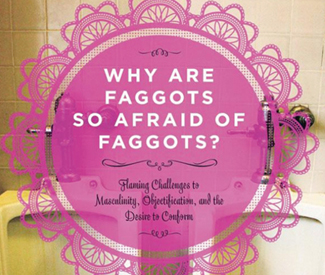
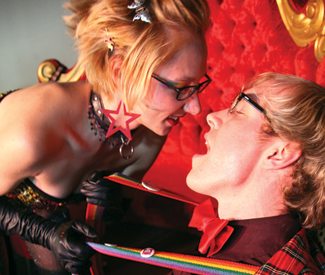
Sycamore Bernstein, who often writes for the Guardian, was speaking about the impetus behind her latest book, Why are Faggots So Afraid of Faggots? Flaming Challenges to Masculinity, Objectification, and the Desire to Conform (AK Press), an invigorating collection of essays from a vast variety of queer people that “challenges the assimilationist norms of a corporate-cozy lifestyle.” (Let’s just say that President Obama’s limp “evolution” on same-sex marriage was not going to be a topic of conversation.) From envisioning a more faggoty Internet and reclaiming perversity as a proud, queer norm to honestly exploring the complex cultural confusions that Western-originating political expressions of gayness can wreak on immigrant and native homos, Faggots goes there with inspiring directness.

“I wanted to put out something that captured the spectrum of radical queer thinking that’s been going on while it seems everyone else was in line to get married. There are so many topics that affect our lives that have just been completely bulldozed by the ‘gay rights’ corporate lobbying groups’ crazed marriagemania.

“For example, Chris Bartlett, in his contribution ‘Gravity and Levity’ talks about how the idea of ‘risk’ in the gay community has been so associated with AIDS that it may have pushed any aspiration towards risk — emotionally, politically, socially — right out of gay consciousness. Yet being gay used to be all about taking risks. It’s what got us so far in the first place!

“I think exploring how the medicalization of AIDS terminology may have numbed us from each other — or how race still defines us in the ‘community,’ or how every dollar sucked into the corporate marriage machine means less for those in need of actual life or death help, or how hate crimes legislation ridiculously puts more power and resources into the hands of the very system oppressing us — is something we desperately need right now. We’re raising an entire generation to think that marriage is the only fight. Meanwhile, we’re discriminating against ourselves in so many other ways.”

Faggots is no mere spitting into the wind, either. Although Sycamore Bernstein has been sounding the assimilationist alarm for years, the prolific author and activist, now living in Seattle, has been surprised by the tome’s positive reception. (“It’s quite shocking!” she says with a lilting laugh.) Edmund White, Samuel R. Delaney, and Mx Justin Vivian Bond offered blurbs, and younger readers and the press have been grabbing onto Faggots’ incendiary yet sophisticated tone. Could the recent wave of AIDS activist nostalgia and a Occupy-like disillusionment with big money Pride sponsorships (embodied locally, especially, by a Wells Fargo advertisement covering the entire front page of Bay Area Reporter’s Pride Issue and a Stoli-sponsored GLAAD Pride float) be buoying the book’s popularity?

“I think the re-emergence of interest in things like ACT UP is very interesting. When I came to San Francisco I was part of ACT UP, and — with everybody dying from drugs, suicide, and AIDS — there was a real drive to come together to confront this massive structural neglect and recognize how brutalities align themselves to bring about our annihilation. But nostalgia can be dangerous without recognizing the reality. There was a very real, very dangerous moment in the 1990s when activism suddenly became about discrimination in the military, of all things.

“It turned from trying to guarantee health care for all to being about whether or not we could go die faster in wars. Whose decision was that?”

Marke B. is the author of Queer: The Ultimate LGBT Gude for Youth (Zest)


OccuPride remembers

6

yael@sfbg.com

QUEER ISSUE “First of all, the parade wouldn’t have barricades, because that immediately creates an us versus them divide, and then you see the parade as just the groups and companies that can afford the fee, which is like $450. Anyone who wanted to march could march, regardless of what the sheriff or Fire Department says. There would be tents for connections to services that people desperately need. I’m not opposed to having companies there, but they shouldn’t be the be-all, end-all of Pride. And there should be more about the history, because people don’t know it. In the Holocaust, anywhere from 10,000 to 100,000 gays were worked to death in Dachau and other work camps. That’s where the pink triangle comes from. But people think Harvey Milk pulled it out of his ass or something.”

That’s what Scott Rossi, one of the organizers of San Francisco’s OccuPride march, told me when I asked him what his ideal SF Pride Parade would look like. The protest’s rallying cry is Community Not Commodity, and the group hopes to bring some rebellious spirit to the parade, which they say has become too watered down with corporate sponsors and assimiliation-lovin’ politics.

Some of the action’s organizers are from Occupy San Francisco and Occupy Oakland, but the majority are a coalition of radical queer groups like HAVOQ, Pride at Work, Act Up, and QUIT (Queers Undermining Israeli Terrorism).

Honestly, it would be weird if there wasn’t a group with an anti-capitalist critique of the parade disrupting Pride this year. It’s been a tradition since 1992 when Act Up members joined the parade and staged intermittent Die-Ins, collapsing every seven minutes, the frequency that people were dying from AIDS that year.

Act Up and related groups staged similar demonstrations practically every year. A decade later, two Gay Shame protesters were arrested when they attempted to enter the parade. That year’s parade was sponsored by Budweiser, and Gay Shame had created a seven-foot-tall cardboard Budweiser can that read “Vomit Out Budweiser Pride and the Selling of Queer Identities,” and other props to confront “the consumerism, blind patriotism and assimilationist agenda of the Pride Parade.”

And radical queers show no sign of stopping. Veteran gay rights warrior Tommi Mecca was at basically all of these disruptions, and he won’t be missing out on this year’s events. Mecca was 21 when he helped organize the first Pride March in Philadelphia in 1972.

“Pride used to be a protest,” Mecca recalls. “It was very free. There were no barricades on the street, there were very few rules. We didn’t have contingents, people just gathered, and at some point there were speeches, usually by activists…I don’t know when it started getting corporate sponsors.”

But the glitz! The glamour! The music enhanced by electricity! Today, Pride is a giant, televised affair — this year, sponsored by Wells Fargo.

“Don’t people in Pride realize how much we’re being used by Wells Fargo?” Mecca said. “It just reeks.”

So if you go to the parade, smell the sweet smell of protesters promoting “pride not profit, a movement not a market, and community not commodity.” After all, if it wasn’t for queer radicals in the ’70s, there wouldn’t be a Pride at all.

A poly push?

0

culture@sfbg.com

QUEER ISSUE Is San Francisco’s polyamorous community experiencing a renaissance? Pepper Mint, organizer of the recent sex education conference Open SF (www.open-sf.org), suspects the non-monogamous in the Bay Area have finally reached a critical mass. His proof? Over the weekend of June 8, OpenSF was attended by over 500 of the poly-curious and practicing.

It might be, however, that they’ve finally found something to relate to. Sonya Brewer, a somatic psychotherapist, OpenSF lecture facilitator, and queer woman of color, has been a practicing polyamorist for 15 years. Brewer pegged the high attendance numbers on Mint’s efforts to diversify the conference and include sexual minorities and other oppressed groups on its planning committee.

Those values were reflected in the conference’s keynote address, delivered by trans-identified sex educator Ignacio Rivera and transgender health educator and social justice activist Yoseñio V. Lewis. The two hosted a lecture entitled “Kink, Race, and Class,” which sought to inspire dialogue about how social forces play into the world of kink. It was one of the many unique talks over the weekend that both celebrated and critiqued the diversity and spread of the polyamorous community.

Looking over the list of lectures for the weekend — “Sex Work and Non-Monogamy,” “Fat Sluts, Hungry Virgins,” and “Trans Queering Your Sex,” to name a few — it was hard to decide which talks to attend.

I settled on two: Kathy Labriola’s “Unmasking the Green-Eyed Monster: Managing Jealousy in Open Relationships” and the Maggie Mayhem-led “Second Generation Poly.” Labriola’s hour-long talk examined jealousy from an anthropological perspective, highlighting it as a universal experience that manifests itself depending on one’s cultural upbringing. The bad news? Jealousy is unavoidable. The good news? It’s a learned behavior, and you can learn to manage it. Labriola provided us with a handy checklist to use in determining whether insecurities are based in fact or freak-out.

“Identify a situation that makes you jealous and ask the questions,” Labriola advised. “One, [do] I have a resource I value very much and I’m fearful of losing? Two, [does] another person wants that resource.? Three, [do] you believe you are in direct competition for something you want? Four, [do] you believe if push comes to shove you will lose out?” Unless you answered yes to all four, she counseled, your jealousy can be worked through.

Mayhem, dressed in a fluorescent orange space suit (a representation of her “out-of-this-world” situation, she said) sat on a panel with her partner in life and in porn Ned (www.meetthemayhems.com) and his polyamorous family: his father, and his father’s second partner — a non-hierarchical term, Maggie was quick to clarify. Maggie and her family discussed negotiating boundaries at sex parties, raising children with more than two parents, and the stigma parents of sex-positive offspring can encounter.

Given the general focus of Open SF, Maggie’s key advice had resonance: “Be the author to your own happily ever after,” she told us.

Make it better now

1

yael@sfbg.com

Noted queer writer and speaker Dan Savage sent a hopeful message to LGBT youth with his 2010 YouTube video, “It Gets Better.” But many queer youth in the Bay Area say they aren’t willing to wait.

“If my adult self could talk to my 14 year old self and tell him anything, I would tell him to really believe the lyrics from “Somewhere,” from West Side Story. There really is a place for us. There really is a place for you. And that one day you will have friends that love and support you, you will find love, you will find a community. And that life gets better,” Savage said.

Savage and his partner Terry Miller’s message went viral. It inspired hundreds of similar videos and eventually led to the creation of the It Gets Better Project, headquartered in Los Angeles. The videos were a response to a tragic cluster of suicides by children bullied for seeming gay, a trend that was only unusual in that the media picked up on it. And for many teens across the country, the “It Gets Better” videos provided crucial hope and support.

But last week, I was talking to Stephanie, Lolo, Ose, and Mia Tu Mutch, four Bay Area teens, about what its like to be a queer youth today. We were talking at the Lavender Youth Recreation and Information Center (LYRIC), a center for queer youth in the heart of the Castro.

When I asked about the “It Gets Better” videos, they all had the same reaction: “Ugh. I don’t like those videos. I don’t like those at all.”

“Those videos are depressing,” Lolo said.

“Yeah. ‘Just wait ’til you’re an adult?'” Stephanie asked.

“Just wait ’til you’re an adult, and your problems will go away,” Mia said, shaking her head.

“And it’s celebrities, too,” Ose noted. “‘I got thousands of dollars, and it gets better!'”

The four of them are facilitators at LYRIC, leading weekly community-building workshops that deal with issues queer kids face. Between 17 and 21 years old, these youth are not waiting for it to get better. They’re doing it for themselves.


LYRIC’S OUTREACH

LYRIC definitely promotes pride and empowerment. Founded in 1988, LYRIC organizers worked to secure funding for a physical space a few years later. Since then, this purple house on Collingwood has functioned as a crucial center for Bay Area queer youth. It offers counseling, food, clothing, community building workshops that kids teach, and a safe place to hang out.

But LYRIC, like many nonprofits, has felt the impact of the severe government cuts to health and human services. As a result, its budget has suffered steady declines from approximately $1.2 million in 2008 to $954,000 this, year primarily due to shrinking government funding.

But LYRIC refuses to give up offering paid internships, a rarity in the nonprofit world.

“The City has made it clear that they no longer intend to invest significant funding into subsidized employment model programs — they want to serve greater numbers of youth at a much lower unit cost — even if we all understand that some of the most marginalized youth will no longer be getting the intensive level of support they need to make it to a successful adulthood” LYRIC’s Executive Director Jodi Schwartz told me, explaining that the organization is now growing support by more grassroots funding networks.

“We used to hire 60-70 young people per year, now it’s more like 20,” Schwartz says.

The organization still serves about 400 young people per year.

“I would guess we have 6,000 queer youth living in the city,” Schwartz said. “So we’re not reaching everyone. Not to say that all those 6,000 queer youth need a LYRIC, but they need community. We all need community.”

Youth from across the country come to San Francisco seeking that community. Often they have escaped intolerant, abusive, or dangerous situations in their families or hometowns. But when they arrive in this storied city, these youth are often disappointed.

“I was that kid who left a small town in Texas and who got to San Francisco as fast as I could,” Mia told me. “And I was like, you know, I’ll figure it out, I’ll find a job, and I’ll do this and that. And it was really hard.”

” I think that the difference is that there are more LGBT specific languages and policies, and organizations that are affirming. All of that is the best in the US, probably,” Mia said. “And there are all these cultural groups and all of that. But queerphobia and transphobia exist here just like it exists everywhere else.”

“So my big thing is how we have all these systems in place that make us a little more queer friendly,” she said. “But how do we actually get the public to stop hating people, to stop doing hate crimes, to stop bullying?”

Ose, who now lives in the Bayview, grew up closer to the city. But coming from a religious family in Modesto, he says, “I had heard things about the Castro itself. I always thought the Castro was the devil…I was a church boy.”

He remembers fear that someone he knew would recognize him in the forbidden neighborhood, that “my mom would find out and be like, what are you doing in the Castro? So I was scared to death my parents would find out I was coming to the Castro.”

That was two years ago. Now, Ose works in the Castro, and he was dressed in cut-off shorts and a slicked back Mohawk, long painted nails clicking on the table. “I’m hella gayed out,” he happily reports.

When Mia made it to San Francisco, she initially settled into the Tenderloin, rather than the gentrifying Castro.

“As a trans person, a lot of trans history is in the Tenderloin and there’s a lot of trans women who live in the Tenderloin and who work in the Tenderloin,” she explained. “So I feel more at home there. Even though it isn’t technically the gay neighborhood, it’s always been the queer ghetto and that’s where the low income and queer people of color live a lot.”

The Tenderloin is also the site of many of the services that queer youth use. Mia made some of her first local connections at Trans: Thrive, a program of the Asian Pacific Islander Center. And many of the kids at LYRIC, as well as the city’s other queer teens, benefit from Larkin Street Youth Services.

The homeless shelter oversees the only beds reserved for queer youth in the city, all 22 of them, a number Schwartz believes in inadequate. A report from Larkin Street in 2010 found that 30 percent of the homeless youth they serve identify as LGBTQQ (lesbian, gay, bisexual, transgender, queer, or questioning).

LYRIC is part of the Community Partnership for LGBTQQ Youth and the Dimensions Clinic Collaborative, which includes service organizations like the queer-specific health clinic Dimensions, the nearby LGBT Center, the Bay Area Young Positives HIV health and support nonprofit, and the city’s Department of Public Health. But LYRIC is one of only a few organizations that focuses on fun, informative community-building workshops.


ACCEPTANCE NOW

Savage promised queer kids that, in the distant future, they would “have friends that love and support you, you will find love, you will find a community.” But LYRIC’s workshops, largely envisioned and run by the youth themselves, show kids that they don’t need to wait: they can create those supportive networks for themselves, in the here and now.

Another such community-building effort was on display at the LGBT Center on June 15: Youth Speaks’ queer poetry slam Queeriosity. The show, which was preceded by five weeks of free poetry workshops for and by queer youth, brought together young queer people from across the Bay Area, and one could feel the love and support in the air.

“Queeriosity is important because, in the poetry scene, we have so many people with so many different backgrounds,” Milani Pelley, one of the show’s hosts and a poet who works with youth in the workshops, told me. “A lot of times people who get identified in the LGBT category, they don’t have that space where they’re front and center and it’s a space for them. It’s very important that we celebrate everyone.”

Pelley, 24, has been working with Youth Speaks since she was 16. She said the message of the It Gets Better videos might be too simple.

“Thinking about being an adult versus a teenager, adults go through the same things,” she said. “The only difference is it’s not encouraged to speak out about it, you’re supposed to act like you have it together and it’s okay.”

Mia said youthful teasing and bullying are precursors to hate crimes: “Bullying and hate crimes are related because it’s all about people not accepting you, and then violently reacting to who are. So either throwing insults or beating you up.”

On April 29, Brandy Martell, an African American trans woman, was murdered in Oakland in a likely hate crime. CeCe McDonald’s recent case has also exhibited the dangers and injustice trans women of color face. The young Chicago woman defended herself against a bigoted attacker who she ended up killing, only to spend time in solitary confinement while awaiting trial, get convicted on manslaughter, and, last week, be placed in a men’s prison to serve her sentence.

I asked the four LYRIC teachers about the campaigns of national organizations like the Human Rights Committee — such as marriage equity or LGBT soldiers — and they all shook their heads.

“There’s a huge disconnect between the national platforms of the major gay organizations and the actual realities of queer youth,” Mia said. “Like they don’t even have queer youth in the majority of their meetings, but then they act like they’re the ones fighting for our rights, you know.”

For example, she said “marriage equality wouldn’t affect me at all. Yeah, it would be okay, it would be better if it was equal across the board. But when you have people dying because of hate crimes, and dying because of bullying, and dying because they don’t have a place to stay and they’re on the streets, it’s like, I just feel like those are a lot more pressing than getting a piece of paper from the government.”


SETTING THE AGENDA

Mia serves on the city’s Youth Commission, where she’s designing training programs for service providers to work with LGBT youth. Ose is working with Schwartz to create programming for LGBTQ youth who don’t want to take the common path of rejecting religion and spirituality as they come to terms with other parts of their identity.

“I go to church a lot,” Ose explained. “I grew up as a Christian. And I wanted to touch base on that because a lot of times, the youth that I come across, the majority of them are being silenced…I’m still going through some issues with my own church, especially with my pastor because just recently I’ve heard that he dislikes me over the fact of the way I dress, the way I act, my feminine gestures.”

Stephanie sighed and said, “I wish there were more LYRICS around the city. One in Bayview, one in every district. And Oakland too.”

“People who provide counseling, food, clothes, water if you need it,” Lola added. “A safe space to go to, a place where you can make friends, and make connections. There need to be more places like that specifically for queer youth.”

Even in San Francisco, harassment is a reality in youth programs and schools. In 2009, the SFUSD studied Youth Risk Behavior in San Francisco’s elementary through high school public schools, and found that more than 80 percent of students reported hearing anti-gay remarks at school, and more than 40 percent said they had never heard school staff stop others from making those remarks. The survey also found that students who identified as LGBT were significantly more likely than their peers to report skipping school out of concern for their safety.

Queer youth will never stop finding informal networks of support. But structured settings like LYRIC can be vital. At places like LYRIC, youth find the community, the love, and the friends that Savage promised would appear with time — before they turn 18.

“It’s easier to build relationships and to build community when its structured, when it has a little bit of structure like, hey, this is a queer specified setting, we’re going to talk to each other, we’re going to hang out, we’re gonna do this, and then you kind of build community off of that. And because it’s based on identity, you feel more comfortable to talk about that,” Mia explained. “You have to change your reality. And you have to be the one to change it for yourself. Because ain’t nobody gonna make it better for you.”

Too dope to be free

0

But it is! No ticket price required, but you might want to show up early for the wildly popular Queeriosity. 

It’s Youth Speaks’ annual queer poetry slam. The mostly high school age poets who will lay their stunningly well-worded wisdom upon you will be having fun tomorrow night, but they are not messing around. 

Neither is Youth Speaks. The national San Francisco-based organization works with 30,000 Bay Area youth per year, from school assembly performances to free after school poetry workshops to slams. Veteran Youth Speaks poet Milani Pelley will be co-hosting this year’s Queeriostiy show. Although a raging fire prevented me from meeting up with Pelley in Berkeley today, she told me over the phone about life, art, politics, and the aweomeness that Queeriosity attendees can expect. 

Pelley wrote her first poem at age 12.

“Actually a young lady who also was with Youth Speaks, she got me into writing,” Pelley told me. “In the 7th grade we were kind of tom boys, we were hanging out on the basketball courts and she said hey, want to hear a poem?  And she was little, like five feet,” Pelley laughed. 

“And everyone stopped what they were doing and listened. And after that, I went home and wrote a poem.  Because I said, this is how you get people to listen to you? I want to try it!”

She never stopped. Pelley went to Youth Speaks workshops at age 15, and later served on their Youth Board. She now makes it as an artist, working for Youth Speaks as a Poet Mentor and making jewelry on the side.

Pelley said that poetry sustained her through difficult times. “Once I was able to write down everything that I was going through and work out my pain and sadness I was able to see the bigger picture and really find a solution of how I was going to heal” she told me.

“It was basically me being my own therapist. Because you know how they take notes on you? I was taking notes on myself.”

I asked if Pelley sees her poetry as political.

“I talk about race, or I talk about sexuality, I talk about police brutality. These are regular things in my life,” said Pelley. “But people think it’s political or controversial. And some people think I should be considered pro-woman. People think it’s political because it’s a feminist perspective but I think Its just women being powerful as they should be.”

For one example of the personal-is-political-is-ridiculously-awesome Queeriosity experience, here’s a take on SF Pride from Yosimar Reyes at the 2010 Queeriosity slam. http://www.youtube.com/watch?v=XdZpRiOsdS8

If that doesn’t convince you, let Pelley: “I definitely think this is going to be an amazing show. It’s free, its way too dope to be free. Personally I think, they should be paying these youths because they’re very courageous, they’re very talented and what is going to be shown tomorrow shouldn’t be missed.”

15th Annual Queeriosity

Fri/15, 7pm

LGBT Center

1800 Market, SF

www.youthspeaks.org

Your love: Open SF conference teaches, showcases polyamorous community

14

“I have a partner that I live with, two girlfriends, and a number of lovers” 

In my San Francisco, it’s not uncommon to know someone who identifies as polyamorous, or who participates in multiple loving and intimate relationships. 

In fact when I talked to Pepper Mint, conference organizer for OpenSF, he told me that the non-monagamous community in the Bay Area has finally reached a critical mass. His reasoning? Over the weekend of June 8, Open SF was attended by over 500 of the poly-curious and practicing. 

As his community expands, Mint thinks it is necessary to recognize the multitude of voices that compose polyamorous San Francisco. “I feel it is important to highlight our similarities while acknowledging our differences,” he told me as we sat on the floor outside of one of the many conference rooms at the Holiday Inn where OpenSF was in full swing around us. 

The weekend started with the Pink play party at Mission Control. There was a keynote address from trans-identified sex educator Ignacio Rivera and trans-gendered health educator and social justice activist Yoseñio V. Lewis. The two also hosted a lecture entitled “Kink, Race, and Class.”

The lecture sought to inspire dialogue about how race, racism, and class appear in the world of kink. It was one of many unique talks over the weekend that both celebrated and critiqued the diversity and spread of the polyamorous community.  Other offerings available to OpenSF attendees included “Sex Work and Non-Monagamy,”  “Fat Sluts, Hungry Virgins,” and “Trans-Queering Your Sex.” 

In another hallway that weekend, Sonya Brewer — who facilitated the “Cultivating Healthy Boundaries” lecture on Sunday — suggested the conference was well attended due to Mint’s effort to include a diversity of individuals, including sexual minorities and other oppressed groups on the planning committee. Brewer, a somatic psychotherapist and queer woman of color, has been a practicing polyamorist for 15 years. 

“It’s about finding out where your yes’ and no’s are to really connect with other people,” said Brewer. “In our culture we get taught not to listen to our bodies. It’s about teaching people their forgotten skills of connecting to themselves.”

Mint described himself to be a straight-leaning bisexual with some gender variance. I watched him push back his shoulder-length purple hair to kiss one of his female lovers hello as he confidently navigated our interview and managed the conference. 

When I asked him to describe his poly structure Mint said, “I have a partner that I live with, two girlfriends, and a number of lovers.” He was raised in a polyamorous home, and talked openly about how his childhood environment help him grow into a healthy, sex-positive community leader. “When creating a sex-positive polyamorous space there is an importance to two things; skills — communication and transparency — and building community connections. People who participate in community usually succeed in polyamory.”

For my own itinerary, I settled on two lectures: Kathy Labriola’s “Unmasking the Green-Eyed Monster: Managing Jealousy in Open Relationships” and “Second Generation Poly,” a panel featuring porn couple Maggie and Ned Mayhem and members of their family. 

Labriola’s hour-long talk examined jealousy from an anthropological perspective, highlighting it as a universal experience that manifests itself depending on one’s cultural upbringing. Her bad news? Jealousy is unavoidable. Her good news? It’s a learned behavior, and you can learn to manage it. During the lecture, she provided us with a handy checklist to use in determining whether insecurities are based in fact or freak-out. 

“Identify a situation that makes you jealous and ask the questions,” Labriola said, breaking down the checklist. “Number one, [do] I have a resource I value very much and I’m fearful of losing? Number two, [does] another person want that resource? Number three, [do] you believe you are in direct competition for something you want? Number four, [do] you believe if push comes to shove you will lose out?”

This list was one of the practical tools Labriola gave the auienced to manage their jealousy. She also discussed guided imagery, treating jealousy as a phobia, and boundary setting. The audience had several questions for Labriola once the lecture was over. My personal favorite was when an audience member asked how to deal with a jealous partner. Labriola simply replied, “Just  shut up and listen.” 

Maggie Mayhem — dressed in a fluorescent orange space suit, a representation of her “out-of-this-world situation” — sat on a panel with partner Ned, his father, and his father’s “second partner” (a non-hierarchical term, Maggie clarified for me later.) They discussed negotiating boundaries at sex parties, raising children with more than two parents, and the stigma many parents of sex-positive children can encounter. Mayhem encouraged the audience to, “Be the author to your own happily ever after.”

I left OpenSF feeling newly inspired, and informed about the diverse landscape of the Bay Area’s poly community. The conference encouraged its participants to create doctrines of love while keeping a critical and open perspective. And it provided a place for the polyamorous to come together. “People who try to create their own non-monogamy usually fail,” said Mint. “People who participate in community usually succeed. Being a part of non-monogamous community greatly increases the chance of being successful with non-monogamy, because the skills required are simply not provided by mainstream culture.” 

Out for more

0

arts@sfbg.com

FRAMELINE It was Blue (1993) and Swoon (1992) and Frisk (1995), or My Own Private Idaho (1991) and The Hours and Times (1991). Paris Is Burning (1990). The Incredibly True Adventure of Two Girls in Love (1995).

It probably depended a little on who you were and what you’d seen lately that made you feel grateful to be coinciding with this point on the timeline of queer cinema. For me, it was Lilies (1996) and Go Fish (1997), and All Over Me (1997) and Beautiful Thing (1996), and every other gay teen romance, and any totally f***ed up thing Gregg Araki chose to put onscreen (including 1995’s Doom Generation, billed as “a heterosexual film by Gregg Araki,” which made straight look like a fairly provisional state of being). It was kind of like irony or porn — I couldn’t exactly define it, but I was pretty sure I knew it when I saw it while bingeing, mid–gay adolescence, on whatever the 1990s had to offer in the way of LGBT experience on film. “It” being this thing called New Queer Cinema, a term that film critic and scholar (and past Guardian contributor) B. Ruby Rich had coined in a 1992 essay in the British film journal Sight & Sound.

Rich, these days teaching in UC Santa Cruz’s Film and Digital Media Department, offered up the idea of New Queer Cinema as a way to frame a ragged-edged genre that she saw emerging. Populating it were films that told unfamiliar, upsetting, outrageous, and sometimes deeply lyrical stories of queer experience, forcing a more complicated picture onto the screen. As many of them gained a cultural foothold (seldom reaching deep into the mainstream, but drawing respectable numbers of art-house-goers), they made a space around themselves for more such films to follow their unsettling examples.

Over the next decade and beyond, the genre, and the larger, disparate queer culture, welcomed a world of untold stories; films like My Own Private Idaho and later Velvet Goldmine (1998) and Boys Don’t Cry (1999) entered the popular culture by way of some combination of star and story power; and one morning we woke up to the sight of significant swaths of the country heading to the multiplex to watch a swoony, gloomy tale of two cowboys in love.

Now, somehow, Brokeback Mountain (2005) is starting to seem like a long time ago, and you could say that New Queer Cinema has both evolved and devolved, a fact reflected in the rom-com-packed LGBT section of your friendly neighborhood video store as well as in each passing year’s Frameline festival catalog. This year, the San Francisco International LGBT Film Festival offers the opportunity to compare and contrast, casting its eyes back on the genre 20 years after Rich pronounced its existence and sketched its parameters.

In addition to presenting Rich with its annual Frameline Award, the fest has programmed a retrospective of four films that offer a sense of New Queer Cinema’s expansive scope and permeable borders: Alex Sichel’s dark-and-light, riot grrrl music–infused All Over Me (costarring a baby-faced Leisha Hailey from The L Word); Ana Kokkinos’s Head On (1998), about a reckless but closeted young man living in a tight-knit Greek Australian community; Gregg Araki’s violent, trashily romantic, HIV-inflected road movie The Living End (1992); and Cheryl Dunye’s experimental mix of documentary and dyke drama The Watermelon Woman (1996). (In 2012’s Mommy Is Coming, also screening, Dunye adds to the mix Berlin sex clubs, explicit taxicab-backseat role play, and a parent-child dynamic likely to leave you flinching in horror.)

Elsewhere in the fest, French writer-director Virginie Despentes’s Bye Bye Blondie has a mosh pit soundtrack and follows, clumsily, Araki’s frenetic and unrestrained example. Béatrice Dalle (1986’s Betty Blue) and Emmanuelle Béart (2002’s 8 Women) play former teenage punk rock sweethearts who met in a mental institution and reunite after a long estrangement to reenact the past and rip open old wounds. A high point, though not for their relationship, occurs when Dalle’s slightly unhinged character tells a woman at a highbrow cocktail party, populated by Paris’s public-intellectual set, that her dress is sectarian, before physically assaulting another guest. Cloying and soap operatic, offering the gauzy fantasy fulfillment of a Harlequin Romance, Nicole Conn’s A Perfect Ending nevertheless earns points for its premise of an uptight housewife who employs the services of a call girl — and for casting Morgan Fairchild as a madam who uses her Barbie collection as a staffing organizational tool.

Other queer stories are more successfully delineated. Aurora Guerrero’s coming-of-age tale Mosquita y Mari, which screened at the SF International Film Fest in April, soulfully and subtly captures the ambiguous friendship that develops between two Latina high schoolers struggling with unspoken feelings as well as pressures both familial and financial. In Joshua Sanchez’s Four, adapted from a play by Christopher Shinn, Fourth of July fireworks and a mood of lonely isolation serve as a backdrop to four disparate individuals’ uncomfortable attempts to find physical and emotional connection. Stephen Cone’s The Wise Kids is set in and around a Southern Baptist church in Charleston, South Carolina, and tracks a trio of teenagers as they sort out the facts of their religious and sexual identities.

There’s a startlingly small quantity of queer baby-making going on in this year’s fest compared with recent years, and the family proposed in writer-director Jonathan Lisecki’s romantic comedy Gayby (as well as Ash Christian’s Petunia) is not necessarily nuclear or easy to encapsulate in kindergarten on “Let’s draw our family tree!” day, marrying the concept of queer family to the Heather-has-two-mommies narrative. The film’s gay-boy Matt and straight-girl BFF Jenn decide that it’s time to settle down and start a family together, but reject the idea of turkey basting or consulting a fertility specialist in favor of comically awkward, highly unerotic, goal-oriented sexual intercourse.

Come to think of it, their method could resonate with the procreation-only, can’t-wait-to-be-raptured crowd, who might be less enthusiastic when the pair switch to good old-fashioned DIY insemination and Matt’s friend Nelson (a scene-stealing Lisecki) brings over a container of holy cat cremains to sanctify the proceedings. Either way, with queer spawning sometimes serving as the rope in a tug-of-war argument about heteronormativity, queer identity, transgression, and basic rights, an unruly rom-com about queer family planning is a fitting entry in a genre and a festival that have both grown into panoramic representations of the queer world.

FRAMELINE36

June 14-24, most shows $9-$11

Various venues

www.frameline.org

Stage Listings

0

Stage listings are compiled by Guardian staff. Performance times may change; call venues to confirm. Reviewers are Robert Avila, Rita Felciano, and Nicole Gluckstern. Submit items for the listings at listings@sfbg.com. For further information on how to submit items for the listings, see Picks.

THEATER

OPENING

5 Lesbians Eating a Quiche Phoenix Theatre, 414 Mason, SF; www.tidestheatre.org. $20-38. Opens Fri/15, 8pm. Runs Thu-Sat, 8pm (also Sat, 10pm). Through July 21. Tides Theatre performs Evan Linder and Andrew Hobgood’s comedy about five women forced into a bomb shelter during a mid-breakfast nuke attack.

BAY AREA

Emotional Creature Berkeley Repertory Theatre, Roda Theatre, 2015 Addison, Berk; www.berkeleyrep.org. $14.50-73. Previews Thu/14-Sat/16 and June 19-21, 8pm; Sun/17, 7pm. Opens June 22, 8pm. Runs Tue and Thu-Sat, 8pm (also Sat, 2pm; no show July 13); Wed, 7pm (no show July 4); Sun, 2 and 7pm. Through July 15. Berkeley Rep presents Eve Ensler’s world premiere, based on her best-seller I Am an Emotional Creature: The Secret Life of Girls Around the World.

Salomania Aurora Theatre, 2081 Addison, Berk; www.auroratheatre.org. $30-55. Previews Fri/15-Sat/16 and June 20, 8pm; Sun/17, 2pm; June 19, 7pm. Opens June 21, 8pm. Runs Tue, 7pm; Wed-Sat, 8pm; Sun, 2 and 7pm. Throgh July 22. Aurora Theatre Company closes its 20th season with writer-director Mark Jackson’s world premiere, commissioned especially for the company, about a San Francisco-born dancer notorious for her take on the "Dance of the Seven Veils."

ONGOING

Aftermath Stagewerx, 446 Valencia, SF; www.brownpapertickets.com. $25. Thu-Sat, 8pm. Through June 30. Theatre, Period presents Jessica Blank and Erik Jenson’s docu-drama, based on interviews with Iraqi civilians forced to flee after the US military’s arrival in 2003.

A Behanding in Spokane SF Playhouse, 533 Sutter, SF; www.sfplayhouse.org. $20-70. Tue-Thu, 7pm; Fri-Sat, 8pm (also Sat, 3pm). Through June 30. If Garth Ennis had been asked to write a comic book about a one-handed sociopath with a dark obsession, he might well have written something similar to Martin McDonagh’s A Behanding in Spokane. And admittedly, approached from that angle, a lot of the script’s dramatic flaws are more easily forgiven. There’s not a whole lot of subtle context or languid metaphor to be found in McDonagh’s criminal caper about the little-known "hand-dealing" trade, but as in Ennis’ best known work, Preacher, the pretty girl (Melissa Quine) is the smartest one in the room; the sociopath (Rod Gnapp) is interested in enacting as vicious a revenge on all humanity while spewing as many blatantly offensive invectives as possible; the boyfriend (Daveed Diggs) has some arrested development issues to work out; and the receptionist (Alex Hurt) takes the caricature of man-child to a whole new level. In fact, while all four actors deliver rock-solid performances of their mostly unsympathetic characters, it’s Hurt’s that impresses most. His spooky intensity and goofily tone-deaf determination plays like a combination of Adam Sandler and Arno Frisch, and if there’s a real sociopath in the room, the evidence suggests it’s probably him. Ultimately though the piece relies too heavily on hollow one-liners to remain interesting — a 20-minute farce stretched to 90 minutes — and quite unlike an Ennis comic, it does not leave one wanting more. (Gluckstern)

The Full Monty Eureka Theatre, 215 Jackson, SF; www.roltheatre.com. $25-36. Thu-Sat, 8pm (also Sat, 2pm); Sun, 2pm. Through June 30. In desperate times, how far would you go to turn a buck? The central premise of the 1997 movie and its namesake musical comedy The Full Monty, the answer to this question is right in the title, which limits the suspense, but amps up the expectations. Set not in Sheffield, England as in the movie, but the similarly economically challenged climate of Buffalo, New York circa the late nineties, the comical romp follows a group of unemployed steel workers who decide, rather optimistically, that spending one night as exotic dancers will solve their immediate financial woes. Banish all notions of a Hot Chocolate sing-along; the soundtrack of the stage musical has little in common with its cinematic predecessor, but there are a couple of toe-tappers, particularly the songs writ for the ladies: a belter’s anthem for their spry but elderly accompanist Jeanette (Cami Thompson), a snarky commentary on male beauty, "The Goods," for the ensemble. On opening night, Ray of Light’s production ran about 15 minutes long after a late start, and the tempo seemed sluggish in parts, but once it hits its stride, The Full Monty should provide a welcome antidote to the ongoing, we’re-still-in-a-recession blues, red leather g-strings and all. (Gluckstern)
Fwd: Life Gone Viral Marsh San Francisco, 1062 Valencia, SF; (415) 282-3055, www.themarsh.org. $20-50. Sat, 8:30pm; Sun, 7pm (June 24, show at 2pm; July 15, show at 7:30pm). Extended through July 22. The internet becomes comic fodder for creator-performers Charlie Varon and Jeri Lynn Cohen, and creator-director David Ford.

Lips Together, Teeth Apart New Conservatory Theatre Center, 25 Van Ness, SF; www.nctcsf.org. $25-45. Wed-Sat, 8pm; Sun, 2pm. Through July 1. New Conservatory Theatre Center performs Terrence McNally’s play about two straight couples spending July 4 amid Fire Island’s gay community.

100 Saints You Should Know Thick House, 1695 18th St, SF; www.therhino.org. $10-30. Wed-Thu, 7:30pm; Fri-Sat, 8pm; Sun, 3pm; starting June 22, runs Fri-Sat, 8pm; Sun, 3pm. Extended through July 1. Homespun scenic design notwithstanding, Theatre Rhinoceros and artistic director John Fisher offer a fine, engrossing production of this 2007 play by Kate Fodor (Hannah and Martin, RX), a sturdy comedy-drama about two fractured families colliding awkwardly in a sort of spiritual vacuum. Matthew (an intriguingly restrained Wiley Herman) is a desolate but forbearing Catholic priest sent on a leave of absence after a venial transgression involving some artful nude male photographs. Returning home, he endures a pained relationship with his devout, passively domineering Irish mother (Tamar Cohn, channeling a nicely measured mixture of stony discipline and childlike vulnerability). Soon Matthew gets an unexpected visit from single mom Theresa (a bright but shrewdly self-possessed Ann Lawler), a former Deadhead who now cleans the rectory and finds herself overcome with an urge to ask the gentle priest about prayer — just at the moment his faith seems to have left him. Meanwhile, Theresa’s too-cool-for-school teenager, Abby (a deft and hilarious Kim Stephenson), waits outside and does some preying of her own on a slower-witted but game young man from the neighborhood (a charmingly quirky Michael Rosen), both of them roiling with confused yearnings. The appealing characters and unexpected storyline come supported by some excellent dialogue, developing a searching theme that ultimately has less to do with formal religion than the ordinary but ineffable need it promises (problematically) to meet. "I think I could be religious or whatever if it made any sense," notes Abby, "but it doesn’t make any sense." It’s easy to agree with the teenager on this one. 100 Saints is a genuinely funny and compassionate play discerning enough to avoid naming the depths it sounds. (Avila)

Reunion SF Playhouse, Stage Two, 533 Sutter, SF; (415) 677-9596, www.sfplayhouse.org. $20. Wed-Thu, 7pm; Fri-Sat, 8pm. Through June 30. SF Playhouse presents a world premiere drama by local playwright Kenn Rabin.

"Risk Is This…The Cutting Ball New Experimental Plays Festival" Exit on Taylor, 277 Taylor, SF; (415) 525-1205, www.cuttingball.com. Free ($20 donation for reserved seating; $50 donation for five-play reserved seating pass). Fri-Sat, 8pm. Through July 14. Cutting Ball’s annual fest of experimental plays features two new works and five new translations in staged readings.

Slipping New Conservatory Theatre Center, 25 Van Ness, SF; www.nctcsf.org. $25-45. Wed-Sat, 8pm; Sun, 2pm. Through July 1. New Conservatory Theatre Center performs Daniel Talbott’s drama about a gay teen who finds new hope after a traumatic breakup.

Tenderloin Exit on Taylor, 277 Taylor, SF; (415) 525-1205, www.cuttingball.com. $10-50. Extended run: Thu, 7:30pm; Fri-Sat, 8pm (also Sat, 2pm); Sun, 5pm. Extended through June 24. Annie Elias and Cutting Ball Theater artists present a world premiere "documentary theater" piece looking at the people and places in the Cutting Ball Theater’s own ‘hood.

Vital Signs Marsh San Francisco, 1062 Valencia, SF; (415) 282-3055, www.themarsh.org. $15-50. Previews Fri/15, 8pm. Opens Sat/16, 8:30pm. Runs Sat, 8:30pm; June 22, 8pm. Through July 21. The Marsh San Francisco presents Alison Whittaker’s behind-the-scenes look at nursing in America.

The Waiting Period MainStage, Marsh San Francisco, 1062 Valencia, SF; (415) 282-3055, www.themarsh.org. $15-50. Fri, 8pm; Sat, 5pm. Extended through July 7. Brian Copeland (comedian, TV and radio personality, and creator-performer of the long-running solo play Not a Genuine Black Man) returns to the Marsh with a new solo, this one based on more recent and messier events in Copeland’s life. The play concerns an episode of severe depression in which he considered suicide, going so far as to purchase a handgun — the title coming from the legally mandatory 10-day period between purchasing and picking up the weapon, which leaves time for reflections and circumstances that ultimately prevent Copeland from pulling the trigger. A grim subject, but Copeland (with co-developer and director David Ford) ensures there’s plenty of humor as well as frank sentiment along the way. The actor peoples the opening scene in the gun store with a comically if somewhat stereotypically rugged representative of the Second Amendment, for instance, as well as an equally familiar "doood" dude at the service counter. Afterward, we follow Copeland, a just barely coping dad, home to the house recently abandoned by his wife, and through the ordinary routines that become unbearable to the clinically depressed. Copeland also recreates interviews he’s made with other survivors of suicidal depression. Telling someone about such things is vital to preventing their worst outcomes, says Copeland, and telling his own story is meant to encourage others. It’s a worthy aim but only a fitfully engaging piece, since as drama it remains thin, standing at perhaps too respectful a distance from the convoluted torment and alienation at its center. (Avila)

BAY AREA

Black n Blue Boys/Broken Men Berkeley Repertory Theatre, Thrust Stage, 2025 Addison, Berk; www.berkeleyrep.org. $14.50-73. Tue, Thu-Sat, 8pm (also Sat, 2pm); Wed and Sun, 7pm (also Sun, 7pm). Through June 24. Berkeley Rep presents a world premiere from writer-performer Dael Orlandersmith (a Pulitzer finalist for 2002’s Yellowman).

Emilie: La Marquise Du Chatelet Defends Her Life Tonight Berkeley City Club, 2315 Durant, Berk; www.brownpapertickets.com. $18-25. Thu-Sat, 8pm; Sun, 2pm. Through July 1. Symmetry Theatre Company presents Bay Area playwright Lauren Gunderson’s romantic drama centering on the life of 18th-century French physicist and mathematician, Émilie du Châtelet (Danielle Levin) and her (here tempestuous) long-term romance with Voltaire (Robert Parsons). In a familiar conceit left accordingly vague, fate rematerializes Emilie from some hazy afterlife so that she may relive key moments in her life and account for herself. A Cartesian mind/body split rules the replay, with Emilie finding herself painfully attenuated from the world of the senses — her flashback self (played by an impressive Blythe Foster) alone able to enjoy sensual contact with her surroundings. Meanwhile, love and loyalty face the test as Emilie goes head-to-head with a male-dominated scientific establishment over a certain theorem she calls "force vivre" — a formula into which Gunderson cleverly folds theoretical physics and the irrational heart. There’s even a visual aid: a running tally is kept throughout on a screen at the back of the stage, where hash marks appear and disappear under the headings "philosophy" and "love" as the scenes wind their desultory way back toward the moment of her demise. Chloe Bronzan directs a cast of strong actors but their work is uneven. Foster alone is consistently commanding in a part that, while minor, suggests what a more muscular approach overall might have accomplished. The normally formidable Parsons seems uncommitted in the part of Voltaire, admittedly a character too simpering and watery as written to merit much credence. Instead of palpable relationships — whether with lovers or ideas — Emilie deploys self-conscious verbiage, strained repartee and heavy thematic underscoring to churn what amounts to thin drama. (Avila)

God of Carnage Marin Theatre Company, 397 Miller, Mill Valley; www.marintheatre.org. $34-55. Wed/13, 7:30pm; Thu/14-Sat/16, 8pm (also Sat/16, 2pm); Sun/17, 2 and 7pm. Marin Theatre Company performs Yasmina Reza’s Tony-winning comedy about two sets of parents who meet after their children get into a schoolyard fight.

The Great Divide Ashby Stage, 1901 Ashby, Berk; www.shotgunplayers.org. $20-30. Wed-Thu, 7pm; Fri-Sat, 8pm; Sun, 5pm. Through June 24. Shotgun Players performs Adamn Chanzit’s drama about the hot topic of fracking, inspired by Ibsen’s An Enemy of the People.

The Kipling Hotel: True Misadventures of the Electric Pink ’80s New venue: Marsh Berkeley, 2120 Allston, Berk; (415) 282-3055, www.themarsh.org. $20-50. Sat, 8:30pm; Sun, 7pm. Extended through July 15. This new autobiographical solo show by Don Reed, writer-performer of the fine and long-running East 14th, is another slice of the artist’s journey from 1970s Oakland ghetto to comedy-circuit respectability — here via a partial debate-scholarship to UCLA. The titular Los Angeles residency hotel was where Reed lived and worked for a time in the 1980s while attending university. It’s also a rich mine of memory and material for this physically protean and charismatic comic actor, who sails through two acts of often hilarious, sometimes touching vignettes loosely structured around his time on the hotel’s young wait staff, which catered to the needs of elderly patrons who might need conversation as much as breakfast. On opening night, the episodic narrative seemed to pass through several endings before settling on one whose tidy moral was delivered with too heavy a hand, but if the piece runs a little long, it’s only the last 20 minutes that noticeably meanders. And even with some awkward bumps along the way, it’s never a dull thing watching Reed work. (Avila)

Not Getting Any Younger Marsh Berkeley, 2120 Allston, Berk; (415) 282-3055, www.themarsh.org. $15-50. Fri, 8pm; Sat, 5pm. Extended through June 30. Marga Gomez is back at the Marsh, a couple of too-brief decades after inaugurating the theater’s new stage with her first solo show — an apt setting, in other words, for the writer-performer’s latest monologue, a reflection on the inevitable process of aging for a Latina lesbian comedian and artist who still hangs at Starbucks and can’t be trusted with the details of her own Wikipedia entry. If the thought of someone as perennially irreverent, insouciant, and appealingly immature as Gomez makes you depressed, the show is, strangely enough, the best antidote. Note: review from the show’s 2011 run at the Marsh San Francisco. (Avila)

The Odyssey Angel Island; (415) 547-0189, www.weplayers.org. $40-76 (some tickets include ferry passage). Sat-Sun, 10:30am-4pm (does not include travel time to island). Through July 1. We Players present Ava Roy’s adaptation of Homer’s epic poem: an all-day adventure set throughout the nature and buildings of Angel Island State Park.

The Tempest Bruns Amphitheater, 100 California Shakespeare Theater Way, Orinda; (510) 809-3290, www.calshakes.org. $35-71. Tue-Thu, 7:30pm; Fri-Sat, 8pm (also June 23, 2pm); Sun, 4pm. Through June 25. California Shakespeare Theater opens its season with this dance-filled interpretation of the Bard’s classic tale.

Wheelhouse TheatreWorks at the Mountain View Center for the Performing Arts, 500 Castro, Mtn View; (650) 463-1960, www.theatreworks.org. $19-69. Tue-Wed, 7:30pm; Thu-Sat, 8pm (also Sat, 2); Sun, 2 and 7pm. Through July 1. TheatreWorks’ 60th world premiere is a musical created by and starring pop-rock trio GrooveLily.

The World’s Funniest Bubble Show Marsh Berkeley, TheaterStage, 2120 Allston, Berk; (415) 826-5750, www.themarsh.org. $8-50. Fri, 6pm; Sat/16, June 24, and 30, 11am. Through June 30. Louis "The Amazing Bubble Man" Pearl returns with this kid-friendly, bubble-tastic comedy.

PERFORMANCE/DANCE

"The Amen Corner" Lorraine Hansberry Theatre, 450 Post, SF; www.lhtsf.org. Mon/18, 7pm. $25. Project1Voice presents this benefit staged reading of James Baldwin’s play, part of a simultaneous staged-reading event with 25 other African American theaters across the country.

"Branded Funny" Purple Onion, 140 Columbus, SF; www.eventbrite.com. Thu/14, 8pm. $15. Stand-up with Melanie Bega, Seth Hardiman, and Justin Lucas.

"The BY Series" ODC Theater, 3153 17th St, SF; www.odcdance.org. Thu/14-Sat/16, 8pm; Sun/17, 2pm. $25. Robert Moses’ Kin Dance Company presents work by guest choreographers Molissa Fenley, Ramon Ramos Alayo, and Sidra Bell, plus the world premiere of Moses’ Scrubbing the Dog.

Alicia Dattner Exit Theatre, 156 Eddy, SF; www.theexit.org. Fri/15-Sat/16, 8pm. $26. The comedian performs.

"DEEPER, Architectural Meditations at CounterPULSE" CounterPULSE, 1310 Mission, SF; www.counterpulse.org. $25. Fri-Sun, 8pm. Through July 1. Lizz Roman and Dancers perform a site-specific work.

"Elect to Laugh" Studio Theater, Marsh San Francisco, 1062 Valencia, SF; (415) 282-3055, www.themarsh.org. Tue, 8pm. Ongoing through Nov 6. $15-50. Will Durst and friends perform in this weekly political humor show that focuses on the upcoming presidential election.

"Fresh Meat Festival" Brava Theater, 2781 24th St, SF; www.freshmeatproductions.org. $15-20. Fri/15-Sat/16, 8pm; Sun/17, 7pm. $15-25. The transgender and queer performance festival celebrates its 11th year with members of Vogue Evolution (America’s Best Dance Crew), Emily Vasquez (American Idol), drag star Miss Barbie-Q, same-sex ballroom champs William DeVries and Kumi Keali’I, and Sean Dorsey Dance.

"hOPPomage" Shotwell Studios, 3252-A 19th St, SF; www.brownpapertickets.com. Fri-Sat, 8pm; Sun/17, 3pm. Through June 23. $10-15. An evening of "mental dance" inspired by artist Dennis Oppenheim with Driveway Dancers.

"Jillarious Tuesdays" Tommy T’s Showroom, 1000 Van Ness, SF; www.jillarious.com. Tue, 7:30. Ongoing. $20. Weekly comedy show with Jill Bourque, Kevin Camia, Justin Lucas, and special guests.

"Kunst-Stoff Arts/Fest 2012" Kunst-Stoff Arts, One Grove, SF; kunststoffartsfest2012.eventbrite.com. Thu/14-Sat/16, 8:30pm. $15. Bruno Augusto and Meisha Bosma perform.

"Porch Light: I Do: The Wedding Show" Verdi Club, 2424 Mariposa, SF; www.brownpapertickets.com. Mon/18, 8pm. $15. Wedding-themed storytelling with Eugene Ashton-Gonzalez, Barbara Berman, Clint Catalyst, and more.

"Previously Secret Information" Stage Werx Theater, 446 Valencia, SF; www.eventbrite.com. Sun/17, 7pm. $15. Comic storytelling with C.W. Nevius, Jack Boulware, and more.

"Qcomedy Showcase" Stage Werx Theater, 446 Valencia, SF; www.qcomedy.com. Mon/18, 8pm. $8-20. Special Pride edition with stand-up comedians Julia Jackson, Scott Backman, Enzo Lombard, Justin Simpson, Karen Ripley, and drag performers House of Glitter.

"Queeriosity" San Francisco LGBT Community Center, 1800 Market, SF; www.youthspeaks.org. Fri/15, 7pm. Free. Youth Speaks hosts this literary arts and performance showcase for LGBTQ youth.

San Francisco Ethnic Dance Festival Novellus Theater, Yerba Buena Center for the Arts, 700 Howard, SF; www.worldartswest.org. Sat/16-Sun/17, 3pm (also Sat/16, 3pm). $18-58. This weekend’s program includes dance from China, Cuba, Hawaii, Hungary, India, and more.

Sex and the City: Live!" Rebel, 1760 Market, SF; www.brownpapertickets.com. Tue, 7 and 9pm. Through June 26. $25. Heklina, D’Arcy Drollinger, Lady Bear, Trixxie Carr play the fab four in this drag-tastic homage to the HBO series.

"Two by 24: Love on Loop" UN Plaza, Market between Hyde and Seventh St, SF; www.rawdance.org. Tue/19, 11am-7pm. Free. RAWdance performs an eight-hour contemporary dance installation.

"Voca People" Marines’ Memorial Theatre, 609 Sutter, Second Flr, SF; www.marinesmemorialtheatre.com. Wed/13-Fri/15, 8pm; Sat/16, 6:30 and 9:30pm; Sun/17, 3 and 6pm. $49-75. A capella from outer space.

"When We Fall Apart" Z Space, 450 Florida, SF; www.zspace.org. Thu/14-Sat/16, June 20-21, and 27-28, 7pm; June 22-23 and 29-30, 7 and 9pm. $20-35. Joe Goode Performance Group presents a world premiere, an exploration of "home" with a set designed by architect Cass Calder Smith.
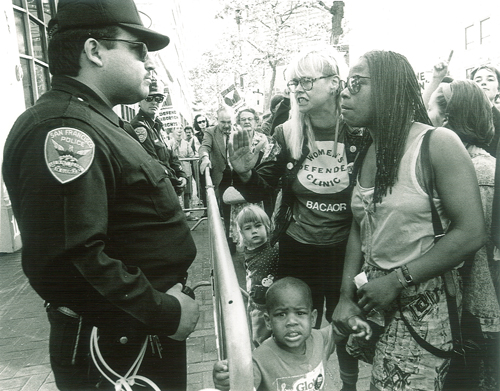
"Wonderland" Circus Center, 755 Frederick, SF; wonderlandatcircuscenter.eventbrite.com. Fri/15-Sat/16, 7pm; Sun/17, 2pm. Free (advance registration recommended). Family-friendly show of aerialists, acrobats, and other circus-style performers. *