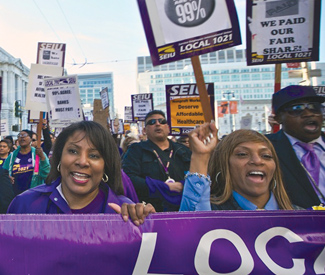
Protest

The People’s School

0

yael@sfbg.com

Oakland elementary schools that were packed with kids until a few weeks ago are now closed for the summer — and five are closed for good. In October the school board voted to close them in a move that would save about $2 million per year.

But many Oakland Unified School District (OUSD) residents are not pleased. At the Oct. 26 meeting where the vote was cast, 500 protested. Concerned parents and teachers have been petitioning and meeting with school board members and Superintendent Tony Smith for months, trying to reverse the decision.

“No one wants to close schools, but the OUSD made this difficult decision because it’s in the best long-term interest of students,” reads a June 22 press release.

Resistance to that decision now continues at one school that was supposed to close June 18. To the dismay of the district, it remains open. Lakeview Elementary is the site of a sit-in and free school, orchestrated by parents and teachers.

“Lakeview has strengths,” the June 22 press release goes on to say. “It has shown improved academic performance in recent years and, boasts a strong sense of community and close alignment with its afterschool programs.” But low rankings in attendance and test scores overshadowed those strengths in the decision to close the school.

Yet it seems that “strong sense of community” seems to be more powerful than the school board thought.

SENSE OF COMMUNITY

Joel Velasquez, a parent of three and PTA member who has had children at Lakeview for 10 years, didn’t think it would come to this.

“I’ve watched everything that went on as a parent here for 10 years,” Velasquez said. When the school was threatened, “I probably spent 20 hours a week meeting, talking, emailing, researching, sending, forwarding — I mean, this is something that has been ongoing.”

“I met with Tony Smith for an hour,” Velasquez said. “I sat with board members.”

But as the end of the school year approached, he was growing more desperate, so he ended up making an announcement: “On the last day of school, I’m not going to leave. And I hope that people join me.”

They did. Lakeview’s building is slated to be turned into administrative offices, and that process was scheduled to begin two weeks ago.

Now, the school that should be filling up with district employees’ office supplies still has children running around its grounds. Organizers opened the People’s School for Public Education, and classes, taught by an army of credentialed teachers and qualified volunteers, run from 9am to 3pm, Monday through Friday.

At a June 27 visit, I toured the school and sat in during a Social Justice class. In the People’s School’s organic garden, a smiling gardening teacher had to stop an overzealous six-year-old from drowning the kale. “They love watering!” he shrugged. Another child, still mesmerized 30 minutes after the official end of music class, improvised on the djembe along with the drumming teacher. From a balcony, a volunteer called to him: “There’s ice cream!” he looked up, considered, and then kept drumming.

The group of kids has grown since the school opened June 15, as parents hear about the summer school and come see it for themselves. The Lakeview sit-in is unlike other recent occupations in the careful vetting process each visitor gets. After all, protecting the kids and their education is the most important goal of the project. But during school hours, parents are permitted to come inside and stay with their children as long as they want, seeing what the school is like.

Still, getting parents to send their children to a summer camp that isn’t technically legal isn’t always easy. “I think our society, not just parents, are really reluctant to do something like this,” Velasquez said. “But I see it as a positive service to the community. We’re using the building for what it’s intended to be used for.”

Julia Fernandez, a high school math teacher, got involved with the effort to save the schools through the Occupy Oakland Education Committee, and her two children, ages 2 and 4, are enrolled in the summer school.

As a nine-year resident of Oakland, Fernandez says, the cuts affect her and her family. She’s taking part in the demonstration partly “for my own kids,” Fernandez said. She said the cuts “affect the school where my kids would go. It’s likely that it’s going to be closed or turned into a charter school.”

“But the thing that motivates me the most is all these attacks that are happening against people,” Fernandez said. She guessed that it was adversity of many kinds, not just school closures, that motivated many parents to join the protest and send their kids to the People’s School.

“People are really upset about all the attacks that are being done on regular working class people. People are losing their homes, they’re getting laid off, and now their schools are closing. It just seems like all these services, all these rights people should have, are being taken away”

MORE THAN MONEY

Organizers emphasize that the money saved seems paltry, just $2 million for five functioning schools.

“Think about it, this is not very much,” Velasquez said. “And they’re wasting almost $4 million to do these transitions to close the schools. They’re spending more than the savings.”

OUSD spokesperson Troy Flint confirmed that the savings will be “in the $2 million range,” and that the total cost of the transition is about $3.7 million.

These expenses include about $117,000 one-time moving related costs and about $200,000 in staffing, including paying a transition director.

They also include $95,000 in transportation costs, which may not be one-time expenditures; they may “as needed for an additional year or more,” Flint said in an email.

Meanwhile, about 1,000 students will be displaced by the move. Many will move to Grass Valley and Burckhalter, and these school’s capacities will be expanded with portable classrooms.

“The promise that we made to students was that we would guarantee students at the closing school a place at a school that was higher performing than the one we were leaving. We were able to live up to that promise,” Flint said.

However, there was a problem: “Most of the schools that perform in the top tier are already subscribed to capacity, so we had to expand the capacity using portables.”

Will these high performing schools remain high-performing as an influx of new students show up at their doors in the fall? After all, Oakland has many more elementary schools than comparable districts, a result of the small schools movement, a policy adopted in 2000 that led to the closure of some larger schools, which were replaced by smaller ones. According to a study conducted by Brown University’s Annenburg Institute for Education Reform, Oakland small schools are “safer, calmer, and more welcoming to families” than the schools they replaced.

But as private donations from those excited about small schools, notably the Bill and Melinda Gates Foundation, run out — along with federal and state money — Oakland may be reverting to larger institutions.

And as the OUSD sees it, that may not be a bad thing.

“To build toward the day when every OUSD school is a high-quality school, we need to concentrate our time, attention and resources in a manageable number of sites instead of spreading ourselves too thin,” he said in an email. “Quality over quantity is the goal when we can’t do both and the current financial environment prevents us from properly caring for 101 schools.

THE NEIGHBORHOOD PROBLEM

One of the reasons for the stated school closure is that it ranked in “the bottom quarter of elementary schools in terms of the number of children living within a half-mile of the school or within the attendance area” and the “lowest percentage of neighborhood students attending the school (30 percent).”

The school is also 99 percent children of color.

As Oakland Tribune education reporter Katy Murphy has written, about half of students in Oakland attend schools outside their district. As a statement from the group Decolonize Oakland points out, “We have to question why the families of black and brown students who live outside of Adams Point have chosen Lakeview.”

Maybe it’s that strong sense of community? All of the other schools slated for closure are also in the flatlands and serve mostly African American and Latino students.

Root, formerly Occupy the Hood Oakland, has played a big part in the organizing. So has Education for the 99 Percent, Occupy Oakland’s education working group, and other Occupy Oakland volunteers.

“A lot of people from Occupy have been extremely supportive and we wouldn’t be able to do this action without that support,” Velasquez said. “For example, the food, they have come every single day to feed, not just breakfast, lunch and dinner, but snacks and drinks.”

The sit-in has also received support from labor groups. A letter signed by more than 50 teachers’ union leaders and local school employees declares, “An injury to one is an injury to all. Let’s seize this opportunity to fight alongside parents, students, and community. We will mobilize our members to support this struggle.”

LEADERSHIP?

The demonstration has not, however, received support from the city of Oakland. Officers from the OUSD Police Service has visited the school several times (and Velasquez says they have done so without warning, despite agreeing to call first to avoid scaring children). Oakland police have been on site as well, and the protesters have received warnings to leave.

“I still remain hopeful that the protesters will see that the most forward-looking resolution to the standoff is to disperse peacefully and to concentrate their efforts on improving the school district for the year 2012/2013 and beyond,” Flint told me. “Right now we still believe that if there’s a relatively prompt resolution to the standoff, we’ll be able to meet our targets to get the facilities ready.”

“It’s not clear why they’re doing this sit-in in Oakland, an overwhelmingly Democratic district where Republicans can’t get elected,” Flint said. “The fundamental problem with this issue is all the Republicans have taken a no taxes pledge.”

Velasquez agrees. “It’s criminal what the state of California is doing right now,” he said. “But we’re focusing our attention on Tony Smith and the board because they’re accepting these conditions, and they shouldn’t…So if they feel that way, why are they not doing something about it, instead of accepting the conditions, and hurting the families and the students? Most importantly the kids.” Flint said the board would be willing to work with the group, but that the sit-in is pointless. “I don’t view this current action as something that is providing us any additional leverage,” he said, though he noted that his office had not attempted to use the sit-in to pressure the state. “We’ve coordinated people across the state, sending in postcards and petitions,” he explained. But when asked what worked best, he said nothing has. “I can’t name a time we’ve been successful,” he said, “because I don’t think we’ve been successful.” As budget cuts sweep the country many governments are feeling this kind of defeatism. The Peoples School for Public Education may not last forever. But they’ve taught 30 kids for free for more than two weeks now, and despite limited time and resources, show no sign of stopping.

Sit-in at Lakeview elementary raided, free classes continue, rally at 5pm

1

This post has been updated

A sit-in at Oakland’s Lakeview Elementary School ended early this morning as police from the Oakland School Police force entered the school building, making two arrests.

The dispersal was calm by all accounts, although protesters say that officers threatened to use chemical weapons to disperse the crowd, which included young children.


Officers from the Oakland School Police force, the Oakland Housing Authority Police force, Oakland Police Department, and California Highway Patrol were deployed to end the protest, according to a statement from OUSD Superintendent Tony Smith.

“There were children there, parents and teachers and a few occupiers,” said Lola, an organizer with Occupy Oakland who was supporting the sit-in on 4am security duty when police arrived.

There were 20-25 sit-in participants present when police arrived, according to Lola and another Occupy Oakland participant who was on the scene, Alyssa Eisenberg. “There were at least 15 police cars when I drove up,” Eisenberg said.

“The officers were saying, we’ve given you notices now we’re going to give you 15 minutes to leave. Then they gave an official dispersal order and they said, ‘If you do not disperse we’ll use chemical agents against you,’” Lola recounts.

Oakland parents, teachers, elementary school-aged children and supporters had been demonstrating at the school for 17 days. The school is one of five marked for closure by the Oakland School Board, a move that parents and teachers opposed.

The demonstration consisted of a free day camp for children called the People’s School for Public Education, a community garden, and a 24-hour sit-in involving half a dozen tents on the school property.

As protesters left the school, “it was very calm,” Lola said. “All the people that were there left willingly except two,” a parent organizer and an alum of the school who sat in a classroom rather than leave when police arrived. The two were cited for trespassing and released.

Police then erected a new fence outside the public school, and demonstrators went to a park across the street with the goal of continuing to teach free classes to children.

“Officers wouldn’t let [National Lawyers Guild] legal observers or journalists into the building,” said Lola, describing these observers standing on concrete structures outside the gates of the school in order to see what happened.

Organizers have planned a rally in protest of the raid and the ongoing school closures. They plan to meet today at 5pm outside of Lakeview Elementary.

“People who were occupying said this isn’t the end, they have more direct action civil disobedience plans,” Lola said.

Art breakthroughs and country music with Sonny Smith

0

Sonny Smith’s dedicated yet freewhelin’ attitude towards life and art have brought him to his ninth record release this week, Longtime Companion (Polyvinyl Records), with his band the Sonny & the Sunsets. Yes, amid traveling to Central America, undertaking the sprawling “100 Records” art project, writing and performing monologues, and providing scripts for theater and film, Smith found the time to record yet another album.

A longtime San Francisco music scene fixture, Smith is now giving the North Bay a try, specifically San Rafael, with his 8-year-old son. That said, Smith is nowhere near slowing down on his prolific cycle of creativity. His new record has a diverse, country edge. The title track from Longtime Companion features enough flute-work to feel reminiscent of Nick Drake, while the track “Year of the Cock” has a straight-up Johnny Cash vibe.

I spoke to Smith over the phone about his album release, songs as comics, and how having a family has changed his outlook as an artist. Sonny & the Sunsets play Amoeba Music San Francisco tonight:

SFBG How did your time in Central America affect your songwriting and creative influences?

Sonny Smith It was the first time I had my own breakthrough. I wrote a screenplay. I was sitting around playing guitar, trying out songs, and the screenplays became songs. I began writing songs that were linear stories with characters and plots and that stuck with me for years – it started there.

http://www.youtube.com/watch?v=WV70ZV0bX1w

SFBG I read in an interview that after your “100 Records” project ended, you were interested in undertaking another huge project called “Record Plant” – are you still planning to get back to that?

SS Yes I have been thinking about that but it’s morphed into a project called “Protest Factory.” People would come make protest signs, like posters, and musicians would make songs to go with the signs. I would like the poster-making to be open to the public, not just artist friends such as musicians.

SFBG Do you visualize your songs in images, like the record covers musicians made for your project? Or is storytelling your main focus?

SS They go together: sometimes I draw comic panels first for a song idea, like a storyboard. It is like making a little mini movie, I draw it out and fit it all together. Sometimes in the end I discover it’s actually not a song, it’s a visual thing. It is a strange, weird process.

SFBG Did the recording process of the new album feel like a breeze compared to the “100 Records” project?

SS It was very casual, with a couple of friends, when we had time. Actually the “100 Records” project was pretty spread out, so it was fairly casual as well. This time around it was definitely beer cans and afternoons, no uptight studios and all that shit.

SFBG Do you make a point of creating theme albums or does a vibe just strike you as you write?

SS It’s organic. I don’t set out to make a themed record, but songs do come in groupings. It’s natural that you write a few songs and they all share a kind of theme. After around five or six songs, you start to see what it is, and that can inform the rest of the record a little bit.

I didn’t set out to make a country record, but since three or four country songs came out, once I had enough, I said ‘Oh yeah, this is definitely a country record.’ Then I decided to work on more country songs because then I knew I had a record. It was not preconceived – it’s midway through that you start to notice a theme.

SFBG How do you decide what will become a script, and what will become a song?

SS You embark on something, and at some point it reveals itself as what it really is and should be – a lot of things change midstream. For example, recently I started out trying to make a novel, and then I realized it just wasn’t meant to be a book; at some point I couldn’t force it, I could see that is what it is.

I did a play-monologue type thing this year. At first it began as comic books, but at some point I realized it was more of a monologue. I try not to deny it too much, and instead let it be what wants to be. My work does change a lot – if a song does not work for whatever reason, for example, then often I realize it is meant to be a poem. On the other hand, if a poem does not translate into a song, then I let it be what it is.

SFBG How did you end up working with Miranda July?

SS I met her when she was making her first movie [Me, You and Everyone We Know] and she read this cool story over music for a project I was working on. We only worked together for an afternoon and sent a few emails back and forth. You can’t really say you know someone or that it was much of an experience from that amount of interaction – well except we did go to Africa together for a brief love affair. [laughs]

SFBG Any other artists you’d love to work with?

SS One person I was thinking of recently is basically an intangible goal: when I was watching Moonrise Kingdom I was thinking that if I met Wes Anderson, I would see if he wanted to make a sci-fi movie with me. It’s unlikely, but you never know!

SFBG What is one really memorable moment of inspiration or just something that really stands out over your career so far?

SS There are great moments where you feel like you have broken through something – a personal breakthrough, where you did something you had in mind. If I happen to be with other people when that happens, it is exciting. When I was in Central America it was a pivotal moment where I said ‘What is being made here? This is really cool!’

The “100 Records” project came about because the visual artists – that ended up making the record covers –  were making covers that were going to be sketches inside a book. Then the art eclipsed the book idea. It was scary, I thought ‘Oh man, I have to do this?!’ Exciting too. I think it’s good to get in over your head, so you have to hike out, as long as it’s not too hard.

http://www.youtube.com/watch?v=gTxChvAp47U

SFBG Do you have a particular place where you’ve enjoyed performing most out of all your travels thus far?

SS
The Make-Out Room feels like home. [Also,] we have played at a grocery store in Portland, right next to the broccoli. There was no sound system or stage, I just know the manager and we enjoyed playing there.

SFBG What made you choose San Francisco as your home base, and what’s your take on the current Bay Area music scene?

SS I was born here and left for a while – but when I came back, it was more like coming home. I don’t know if I would be staying for as long if it wasn’t for my 8-year-old girl. I try not to think about it too much. It’s an exciting music scene – but I think it has always been exciting and always will be, some years it just gets more attention than others.

SFBG
How has having a family changed your approach to making art?

SS In the earlier years before they go to school, you have to exploit the little bit of time you have to yourself. It can help in a way, because once you have obstacles it actually makes your brain synapses work – you create solutions. If I was rich and lived in some pad and could sleep in until noon every day and lounge around a pool, that would not be conducive to being creative. Maybe that’s why often when people make that much money, they’re not as creative anymore. You need a balance. Kids are creative and much more free, so if you let that rub off on you at all then you’ll be effective.

Sonny & the Sunsets
Fri/29, 6pm, free
Amoeba Music SF
1855 Haight St.
(415) 831-1200
www.amoeba.com

Lakeview sit-in supporters protest school board meeting

6

Supporters of a sit-in at Lakeview elementary school and others protesting cuts from the Oakland Board of Education protested at the board’s meeting June 27 and held a “People’s Board of Education Meeting” discussing their vision for Oakland schools.

Much of the protest focused on cuts to the district’s budget for special education students. The cuts came as the school board faces statewide cuts to public education, the end of a bout of federal stimulus money, and a last-minute budget shortfall.

After passionate public comment, the board reversed their their previous decision to approve $1.7 million in special ed staffing cuts.

The cuts would have eliminated some Program Specialist positions. $2 million in cuts in transportation for special ed students still stand.

This comes weeks after special ed teachers and parents were surprised to learn of proposed cuts to special ed to make up for a budget an accounting error that the board discovered just weeks before the budget deadline.

“The timing of these proposals, the lack of staff and community input and the ever-changing information about the relevant budget numbers make these proposals especially troubling,” Cintya Molina, chair of the Community Advisory Committee for special education and mother of a special-needs second grader, said as part of the meeting’s public comment period.

Special education funding advocates partnered with organizers at the Lakeview School sit-in to show up in force at the board meeting, demonstrating a coalition of Oakland parents and teachers opposed to the cuts to schools in the 2012/2013 budgets.

Lakeview is one of five elementary schools that the board voted to close last fall.

A sit-in protesting Lakeview’s closure began June 15. Parents and teachers have organized a free summer program, the Peoples School for Public Education, on the school grounds. Some parents and teachers also sleep in a handful of tents each night to assure that the sit-in continues.

The decision to engage in civil disobedience came after months of work on the part of a coalition of concerned parents and teachers under the banner Save Oakland Schools.

“I probably spent 20 hours a week meeting, talking, emailing, researching, sending it, forwarding, board meetings,” recalls Joel Velasquez, one of the main parent organizers of the sit-in. “This is something that has been ongoing.”

But at a town hall meeting towards the end of the school year when parents had grown desperate, Velasquez said, the plan for a sit-in began to materialize.

“There was a moment where we went around and introduced ourselves and talked about what we were going to do. And I got really emotional; it was a tough moment for me.  And I said you know what, I don’t know what everybody else is going to do. And I’m not telling you what to do. But this is what I’m going to do. On the last day of school, I’m not going to leave. And I hope that people join me,” said Velasquez.

The Peoples School for Public Education teaches an average of 20 kids per day.

Julia Fernandez, a high school math teacher who taught at Castlemont High last year, has enrolled her 2- and 4-year-olds in the camp, as well tabling outside the school and helping with organization.

She says her children are too young for elementary school, but she’s worried about providing an education for them when they reach school-age.

“The public schools are working worse and worse,” Fernandez said, “because we’re moving all these resources from them. I think that affects the school where my kids would go. It’s likely that it’s going to probably be closed or turned into a charter school.”

One of the school’s slated for closure, Lazear elementary, will instead be turned into a charter school.

“I really have a passion about teaching students to learn skills that they’re going to be able to use to be productive people for our community. And to see how that’s been taken away, its very upsetting to me. I want to put a lot of energy into fighting against it,” Fernandez said.

Protesters at Lakeview plan to continue the sit-in indefinitely.

Out of the paincave

0

arts@sfbg.com

MUSIC Apocalypse doesn’t exactly identify what Brooklyn-born producer and rapper El-P conjures in his music. Sure, furtive sirens blare out almost immediately in his new record Cancer 4 Cure (Fat Possum). Synthetic melodies disfigure themselves while break beats rumble with the intensity of the Bomb Squad, all drowned out through a wash of distorted noise. The lyrics are just as unsettling too: an overpowering technological violence brought to bear on soft human bodies, whose voices are fractured, rendered nearly schizophrenic.

El-P’s satire has here become more cutting, discordant — refining the unrest signature to his former group Company Flow, a host of solo and production credits, and his recently disbanded indie label Definitive Jux. But apocalyptic? Just another blockbuster word that conceals far more than it reveals.

“I’m not writing about an insane apocalyptic world,” says El-P, whose official documents give him the name Jaime Meline. “This is reality. I’m not writing sci-fi; I’m writing about Brooklyn. Yes, there’s an obvious sense of dread in my records. There’s a part of me that is fucking terrified of the world right now, and has been for a long time, and maybe always will be.”

From this fear, even an overwhelming paranoia, El-P gathers fuel for both incendiary attacks and self-abjection. So if there’s any rubble left by an apocalyptic catastrophe in his music, its value is that in showing us our world reduced to ash, it also gives us a chance to see what it is that we’re running from.

El-P’s protest finds a kindred spirit in William S. Burroughs, who introduces “Request Denied” amidst a haze of electric signals: “Prisoners of the earth, come out — Storm the studio,” he roars. Translating this incitement as a call to arms, El-P unleashes an onslaught of modulated rhythms and rapid-fire wordplay that jars you out of your sleeping flesh. “I want these records to be a blast of truth,” he says. “When you’re dealing with music and dealing with what’s real, screaming and crying and kicking and punching has something of the truth — in its reaction.”

Another way of putting it is that El-P’s music is not a diagnosis but a symptom. Rather than devising some sort of sonic therapy that would allegedly purify us of the systematic disease, he sets out to immerse himself as fully and desperately as possible into its cancerous cells in order to explode them from within. Words themselves come to suffer in this exaggerated space.

In “Drones Over Brooklyn,” El-P growls, “I’m a holy fuck what did he just utter marksman/Orphan, a whore born war torn, life for the harvest.” And in the concluding elegy, “$4 Vic” he navigates the threshold of a language stretched to its limits: “That Paincave Kid talk, at the end of the painbow/ The permanent stain bop/Maligning my name will holy ark up your squad’s face/ Viewers of the divine rage learn to worship the hard way/You get it? I don’t fade, just float where the poem slays.”

For El-P, the poem also struggles to survive, fighting against a syntax that embodies societal pressures of normalization, and an absolute pain on the horizon that ultimately spells death. He calls this jokingly the paincave: “the most horrible psychological place that you could possibly inhabit.” The word stems from the comedic yet admittedly still horrifying experience of when smoking excessively turns on you — when getting too high brings about a fall into madness.

But it’s within this naked fall that El-P finds an unexpected promise, even a chance for renewal. “I’m operating from a point of confusion and despair, but I don’t see it as pessimism. Maybe there’s an optimism to admit it: to stop running, to work through your own fear,” he says. “I want to make music that is the signifier of fighting to live, fighting for sanity, recognizing that it ain’t what it should be. So I’m going to scream. I’m going to run into the middle of the street, and take my clothes off, and scream.”

EL-P

With Killer Mike, Mr. Muthafuckin’ eXquire, Despot

Fri/29, 8pm, $25

Regency Ballroom

1290 Sutter, SF

(415) 673-5716

www.theregencyballroom.com

LGBT Pride: the good, the bad and the ugly

0

OPINION No doubt about it, LGBT Pride is a mixed bag.

Long gone are the days when Gay Freedom Day, later Gay Pride, was a one-day affair, a protest march and celebration to commemorate the Stonewall Riots in New York City in June, 1969.

These days, it’s a month-long, corporate-sponsored, $1.8 million-dollar, glitzy affair with events at fancy hotels and a “parade” (not a march) that remains totally out of touch with the radical, grassroots activism that first created it. Not only are contingents charged to participate, but curbside barricades make it impossible for onlookers to jump in, and participants are asked to “donate” to enter the festival after the parade. Even if the pride committee waives the fee for small groups, why does anyone have to pay to be part of pride?

Especially given that it has corporate sponsors with very deep pockets. Some of those sponsors are strange — and ugly — bedfellows indeed. They include Wells Fargo and B of A, two banking institutions that have been foreclosing queer and other people out of their homes. Their motto might well be, “We take Pride in evicting you.” What does it say about our community that we allow these institutions to use our events to buy good PR? Banks don’t deserve good PR, especially when the government is not holding them accountable in any real way for what they continue to do to us.

Fortunately, there are pride events that remain true to the fiery, uncompromising spirit that was demonstrated by those queens who refused to go quietly into the paddy wagons 43 years ago. Including the Faetopia “pop-up queer arts, ecology, theater and community center” at the old Tower Records space at Market and Noe, with lots of great events continuing through June 22 (www.faetopia.com); and the Vito Russo documentary, Vito, at the Frameline Film Festival last week. Vito’s life of gay and AIDS activism is a reminder of why Pride month exists. It’s just a shame that Wells Fargo is a sponsor of the festival.

You won’t find banks sponsoring the Trans and the Dyke marches (Friday, June 22 and Saturday, 23 respectively). Nothing in Pride month comes closer to being like the 1970s gay Pride marches (that I miss so much) than these two grassroots efforts.

Finally, a coalition calling itself OccuPride plans to protest the “increasingly commercialized” Pride parade that caters “only to those of us with money to spend.” According to a press statement, it will also “honor our radical roots for full liberation for women, people of color, immigrants, the disabled, all the oppressed and marginalized.” Sounds like a Gay Liberation Front manifesto I helped write 42 years ago. Join up with OccuPride on June 24 at 10 AM at Mission and Main, or at Taylor and Turk at 2:30 PM for a rally on the site of the former Compton’s Cafeteria where, three years before Stonewall, drag queens rioted.

Like Vito a reminder of where we came from.

A longtime queer and tenants rights activist, Tommi Avicolli Mecca was involved with organizing Philly’s first pride march in 1972. He is editor of Smash the Church, Smash the State: the Early Years of Gay Liberation (City Lights).

OccuPride remembers

6

yael@sfbg.com

QUEER ISSUE “First of all, the parade wouldn’t have barricades, because that immediately creates an us versus them divide, and then you see the parade as just the groups and companies that can afford the fee, which is like $450. Anyone who wanted to march could march, regardless of what the sheriff or Fire Department says. There would be tents for connections to services that people desperately need. I’m not opposed to having companies there, but they shouldn’t be the be-all, end-all of Pride. And there should be more about the history, because people don’t know it. In the Holocaust, anywhere from 10,000 to 100,000 gays were worked to death in Dachau and other work camps. That’s where the pink triangle comes from. But people think Harvey Milk pulled it out of his ass or something.”

That’s what Scott Rossi, one of the organizers of San Francisco’s OccuPride march, told me when I asked him what his ideal SF Pride Parade would look like. The protest’s rallying cry is Community Not Commodity, and the group hopes to bring some rebellious spirit to the parade, which they say has become too watered down with corporate sponsors and assimiliation-lovin’ politics.

Some of the action’s organizers are from Occupy San Francisco and Occupy Oakland, but the majority are a coalition of radical queer groups like HAVOQ, Pride at Work, Act Up, and QUIT (Queers Undermining Israeli Terrorism).

Honestly, it would be weird if there wasn’t a group with an anti-capitalist critique of the parade disrupting Pride this year. It’s been a tradition since 1992 when Act Up members joined the parade and staged intermittent Die-Ins, collapsing every seven minutes, the frequency that people were dying from AIDS that year.

Act Up and related groups staged similar demonstrations practically every year. A decade later, two Gay Shame protesters were arrested when they attempted to enter the parade. That year’s parade was sponsored by Budweiser, and Gay Shame had created a seven-foot-tall cardboard Budweiser can that read “Vomit Out Budweiser Pride and the Selling of Queer Identities,” and other props to confront “the consumerism, blind patriotism and assimilationist agenda of the Pride Parade.”

And radical queers show no sign of stopping. Veteran gay rights warrior Tommi Mecca was at basically all of these disruptions, and he won’t be missing out on this year’s events. Mecca was 21 when he helped organize the first Pride March in Philadelphia in 1972.

“Pride used to be a protest,” Mecca recalls. “It was very free. There were no barricades on the street, there were very few rules. We didn’t have contingents, people just gathered, and at some point there were speeches, usually by activists…I don’t know when it started getting corporate sponsors.”

But the glitz! The glamour! The music enhanced by electricity! Today, Pride is a giant, televised affair — this year, sponsored by Wells Fargo.

“Don’t people in Pride realize how much we’re being used by Wells Fargo?” Mecca said. “It just reeks.”

So if you go to the parade, smell the sweet smell of protesters promoting “pride not profit, a movement not a market, and community not commodity.” After all, if it wasn’t for queer radicals in the ’70s, there wouldn’t be a Pride at all.

Bringing the heat

9

On June 13, more than 400 people, mainly from law enforcement and non-profits, gathered for a conference in downtown Oakland’s Marriott Hotel. Outside, a group of angry protesters gave impassioned speeches before trying to enter the hotel. The complex set of issues involved? The conference was organized to discuss tactics for arresting and charging child sex traffickers, but the protesters said that the conference would do nothing but further the state’s harmful impact on the lives of sex workers.

I wasn’t able to attend the conference itself; the Alameda County District Attorney’s office decided at the last minute that press would not be permitted inside. But from the conference’s description and a talk with Casey Bates, head of DA’s Human Exploitation and Trafficking Unit (HEAT), it seemed that the conference was mostly focused on improving efforts to by law enforcement to find people underage people who are having sex for money and prosecute their “traffickers,” a designation not much different than “pimps.”

According to Bates, the HEAT unit has focused on people selling sex on the street and online, and most are from California or nearby states, although he hopes the efforts can expand to people who are trafficked in from other countries.

Under the law, anyone selling sex under 18 years of age is classified as a CSEC- commercially sexually exploited child.

As DA Nancy O’Malley emphasizes on the HEAT unit website, “We have been fighting to shatter the perception of children as prostitutes and criminals undeserving of protection.  These young people are victims of child abuse.”

The sex workers rights movement, organized by people in the sex industry who see their work as legitimate, has largely called for decriminalization of prostitution and other forms of sex work since the movement off in the 1960s, with new concerns in the 21st century. Many groups have argued that police increase the violence in the lives of prostitutes, harassing and arresting them while not taking violence against sex workers seriously. The much older anti-trafficking movement, (or, as it was called at the beginning of the 20th century, anti- “white slavery,”) has many proponents who disagree, saying all prostitution involves some form of coercion. The two movements have a long history of conflict, and on June 13, this dynamic was thrust into the public eye.

Policing the problem

This conference was described as “comprehensive event designed to enhance the capacity of law enforcement and practitioners to combat commercial sex trafficking of children (CSEC).” 

“Of course we support refuges, housing, and other services for these children,” said Rachel West, an organizer with US Prostitutes Collective. “Why aren’t the police focused on that instead of spending hours on the net looking for women, or going out on the street doing street sweeps?”

But US Prostitutes Collective, part of the International Prostitutes Collective, which has been campaigning for decriminalization of prostitution since 1975, didn’t organize last week’s protest. This time it was Occupy Patriarchy, an Occupy Oakland affiliated group.

Occupy Oakland has not been shy about calling out police behaviors, from infamous incidents like the tear gas-heavy offensive on the Occupy Oakland camp last fall to shootings of local teenagers. The HEAT Conference, which was organized by the DA’s office and played host to law enforcement from across the country, was no exception.

“Whose inside this conference?” said one demonstrator who spoke during a 20-minute speak-out in front of the hotel that afternoon. “61 official speakers are law enforcement agents, DA workers, or politicians with anti-sex worker reputations. 39 speakers are individuals or representatives of non-profits. The vast majority of these work directly with law enforcement or politicians to criminalize sex workers. Where is the voice of the sex workers?” 

“What we find disturbing as anti-capitalists and anti-authoritarians is these police who, to sex workers, are oppressing us,” Clarissa McFaye, one of the demonstrators, told me in an interview. “We know that police are a very violent, fearsome presence in the lives of all sex workers, and we feel the only way that we can abolish child trafficking and exploitative forms of labor, which is all labor in actuality, is to abolish the police state.”

“They think working to enforce criminalization isn’t going to help child victims of sexual slavery. We know they exist, but we don’t feel this is a solution. We don’t think enhancing the ability to arrest people is a solution,” said McFaye.

“We really appreciate a lot of the effort that some of the non profits are doing,” McFaye continued, “We want to talk to them and form a sense of camaraderie with them and tell them that we don’t need the cops. We don’t want them. They’re bad for us.” 

Sex workers rights groups have long spoken out about police treatment of prostitutes. Stories of police harassing sex workers, going through with sexual acts while undercover before making prostitution arrests, and demanding sex in exchange for letting an arrest slide are fairly common. As McFaye told me, “they’re condoning child trafficking because they make deals with pimps.”

“Not to mention that hella cops are tricks,” she added.

Pimps and traffickers, children and minors

The HEAT Unit’s website lists 237 charges and 160 convictions made by the unit between 2006 and 2011. The statistics include trafficking as defined by California Penal Code Section 236.1, California’s Human Trafficking Statute. But they also include charges and convictions for pimping and pandering, sexual assault, kidnapping, and burglary, and the website specifies that “these statistics do not differentiate between child and adult victims, though the majority of HEAT victims are minors.”

The anti-trafficking statute defines a human trafficker as “Any person who deprives or violates the personal liberty of another with the intent to effect or maintain a felony violation of ” one of several anti-pimping, pandering, and solicitation Penal Code violations.

This includes Penal Code section 266 which defines a pimp as someone who, knowing another person has commercial sex, “lives or derives support or maintenance in whole or in part from the earnings or proceeds of the person’s prostitution.” 

But for Bates, “The way a pimp-prostitute relationship works is the pimp takes 100 percent of the cash.”

I brought up the pimp question with Cyd Nova, harm reduction services coordinator at San Francisco’s for sex workers-by sex workers health clinic, the St. James Infirmary.

“I know a lot of street-based sex workers who are totally independent,” said Nova. “Some do split their money with pimps or managers.”

Nova also said pimping’s legal definition can often have questionable consequences. “Legally that would be most peoples partners, children, friends.”

“I have met sex workers who have had their partners charged under pimping codes, which was not their relationship with that person,” Nova told me.

Many “pimping” relationships fall somewhere in between “peoples partners, children, and friends” and “the pimp takes 100 percent of the cash.” Sex workers, a criminalized class, often experience violence from both pimps and clients- but fear for their own consequenes if they report the crimes. I asked Bates his opinion on granting immunity from prostitution charges or a person who comes forward to report all too common violations committed against sex workers like rape, assault and theft.

“We do this all the time in the context of other types of crime that we work with. If it’s a murder, we may be willing to negotiate with our witness to determine whether or not is appropriate to give immunity for the person to testify against this other person, in exchange they won’t be prosecuted for the crime that they committed.”

But Nova said that striking that deal can be a major problem.

“One thing that is an issue for people forced into the industry is they are unable to receive services until they agree to testify against their trafficker. This doesn’t work for the majority of people, and it’s a major issue when you’re talking about services for trafficking victims,” he said.

At the St. James Infirmary, “We have people who have been in situations where they feel that they wanted to leave, but are not willing to bring criminal charges against the person,” he continued.

Nova also described a distinction between the terms “child” and “minor.”

“People have choices in how they use their bodies, and that includes youth. We are living in a world where sometimes people have to choose options that are not ideal,” he said. 

McFaye painted a similar picture, saying that “sex work is a form of work that all genders do sex work can make a lot more money than other options.”

“It allows me to do my political work as well as work a few times a week, instead of working at McDonalds. When I was 17 years old I tried to get a job, couldn’t find anything but shitty house cleaning jobs. Then some sex workers I knew showed me the ropes, and my life’s been a lot better ever since,” she said.

I described a similar situation, in which a minor chooses prostitution to make desperately needed money or escape an abusive situation, to Bates. “There are going to be people that make that claim,” he responded. “There’s no doubt about it. Part of the phenomenon is that a lot of people that are being abused, when they’re being abused, don’t even realize that they’re being abused. That’s a big issue,” said Bates. “People have made the claim, they did what they had to do in a difficult circumstance, and they don’t really see themselves as being a victim of crime. And what I’m suggesting is, that’s not uncommon, it’s part of the victimology actually.” 

He added, “I’m speaking specifically to people that are being trafficked. What you described doesn’t sound as much like a trafficking situation.”

But the law doesn’t allow for that kind of nuance. 

“That is a clear distinction that we want to draw. This is focused on commercial sexual exploitation of children,” Bates said. “When you become 18, you’re given a set of rights and you’re treated differently under the law.”

Solutions

The HEAT Unit’s model is unique, and if the conference has its intended consequences, it may be replicated throughout the country.

For minors that the HEAT unit identifies as CSEC, “The goal is to try to stabilize them, to figure out what services they need, what situation they came from and figure out how we can get that child back on track,” Bates told me.

“Sometimes, that requires that we detain them for a period of time so we can figure out what services are necessary. That’s somewhat controversial, because some people say that’s not appropriate. We believe that it’s in the interest of these girls initially, to figure out what’s necessary. That to turn them back on the street means to turn your back on them, period.”

Many sex workers’ rights groups, however, argue for antoher solution entirely- decriminalization of prostitution. Part of the argument for decriminalization is that sex workers would feel more comfortable coming to police with reports that they are their colleagues had been victims of crimes like rape, assault or theft. 

As Nova said, “California is currently using anti-trafficking federal funds to target all sex workers. They say, if we arrest a bunch of sex workers, some of them are going to be trafficked. This has not proven to be very effective, whereas decriminalization would result in people, who are in coercive work situations, feeling more comfortable coming forward and asking for help.

“They need an evaluation of what kind of practices are going on and what results they’re turning out,” Nova said. “A study where they have conversations with people who have been arrested and detained and talk about what their life was like, what was detrimental and what was beneficial.”

For some of the more anarchist-leaning protesters, however, the police should play no role in the solution.

“What we think would help is if we as sex workers come together is if we come together and combat this exploitation,” McFaye told me.

I asked if there was anything the police could do.

“No,” said McFaye. “They can turn in their badges. That’s what they could do.” 

When the sex workers’ rights movement took off in the ’60s, they joined the debate that had been going on surrounding prostitution and policing for a century. The movement continues- and on Wednesday, a distinctly anti-capitalist side of it made noise. These groups may be piping up more, as the Californians Against Sexual Exploitation (CASE) Act, which would increase funding and resources for policing sex traffickers, goes to the ballot this November.

Alerts

0

yael@sfbg.com

THURSDAY 14

Solitary confinement at Pelican Bay, Audre Lourde Room, Women’s Building, 3548 18th St., SF; www.womensbuilding.org. 6:30pm, free. This panel discussion on the use of solitary confinement in the criminal justice system comes soon after a class action lawsuit challenging solitary confinement in California prisons. The Center for Constitutional Rights filed the lawsuit, Ruiz v. Brown, May 31 on behalf of prisoners at Pelican Bay State Prison. The plaintiffs have spent between 10 and 28 years in solitary confinement, generally spending at least 22 hours per day alone in windowless cells, and often denied letters, visits, any sunlight, or time spent outdoors. Many of the plaintiffs also participated in last year’s hunger strikes against inhumane conditions in prison, including solitary confinement. This lawsuit may be the crucial next step in their fight.

FRIDAY 15

India to Ireland, Sports Basement, 1590 Bryant, SF; www.indiatoireland.org. A brother and sister who rode bicylces12,000 km from India to Ireland are back with photos and stories. See what they saw and hear the tales at this fundraiser for Room to Read. The international nonprofit works “to promote literacy and gender equality in education by establishing libraries, constructing classrooms, publishing local-language children’s books, training educators and supporting girls’ education.”

SATURDAY 16

Art, culture and resistance, Redstone building, 2940 16th St., SF; www.norcalsocialism.org. 6pm, $5-10 suggested donation. What’s the music of today’s social justice movement? If it’s anyone, it’s The Coup, and frontman Boots Riley. Riley has written and performed powerful and revolutionary music for decades, from hip hop edutainment concerts that promoted efforts like the Women’s Economic Project Agenda and Copwatch to traveling guerilla hip hop concerts in protest of Prop 21 in 2000. Recently, he’s been organizing with Occupy Oakland. In July, he’ll be teaching a workshop at the Socialism 2012 conference in Chicago; the next month his book, Lyrics in Context, will be released. On Saturday he’ll discuss a tradition he helps to keep alive in Oakland: how art and resistance work together. Refreshments and mingling to follow.

Juneteenth festival, parade starts at African American Arts & Culture Complex, 762 Fulton St., SF; www.sfjuneteenth.org. Parade at 11am, festival runs through June 17. Start summer off right with the biggest Juneteenth festival on the West Coast. Juneteenth commemorates the announcement of the abolition of slavery and celebrates African American heritage, and this year will mark the 62nd annual Juneteenth in the Fillmore District. The two-day festival kicks off with a parade, followed by a family-friendly weekend complete with a classic car and motorcycle show, basketball games, fashion show, petting zoo, pony rides, live entertainment, community info booths and health fair, and more.

SUNDAY 17

African American veterans and the Civil Rights Movement, Niebyl-Proctor Marxist Library, 6501 Telegraph, Oakl; www.marxistlibr.org. 10:30am-12:30pm, free. Despite growing up in a United States that still had Jim Crow laws, African Americans fought in wars throughout the 20th century. When many of them returned and joined in civil rights and black liberation movements, however, they risked their lives once again. Perhaps best known is Medgar Evers, civil rights leader and World War II soldier who was assassinated by a Ku Klux Klan member in 1963. This event will explore the many veterans who joined civil rights struggles, their reasons for doing so, and how, in many cases, experiences in military service prompted involvement in the struggle back home. It will also feature a screening of the documentary Negroes With Guns, which follows the life of Army and Marine Corps veteran Robert F. Williams, who later took up arms against violent racist groups like the KKK as part of his work with the Black Armed Guard.

Sutter’s CPMC deal isn’t healthy

28

At 10am on Friday, June 15, at the main chambers of the Board of Supervisors, the first of a series of public hearings will be held on specific aspects of the  development agreement governing the $1.9 billion Sutter Health/California Pacific Medical Center proposal to expand and centralize the giant health-care outfit’s health center by building a new 555 bed hospital at Geary and Van Ness. The deal involves demolishing the existing 220-bed hospital at St. Luke’s at Mission and Cesar Chavez and rebuilding a new 80-bed facility, expanding the Ralph K. Davies hospital at Duboce and Noe and closing down the old Children’s Hospital in Laurel Heights.

The hearing will be the first before the Board of Supervisors. Thus far, the project has been before only the executive branch: the Planning Commission and the mayor. After a brief introduction on the overall project the hearing will focus on the issue of jobs.

This is the largest project to be negotiated by the Lee administration — and although the mayor introduced it to the board in May, not one supervisor has yet joined him to sponsor the legislation. That’s an an odd situation given the importance of the project – and the fact that Mayor Lee can usually count on an automatic four votes from the conservative faction of the board. But not this time.

The hearing was requested by a coalition of more than 60 community, neighborhood, labor, and environmental organizations — San Franciscans for Healthcare, Housing, Jobs and Justice (SFHHJJ) — which has been closely following the project for the last two years.  Members of the coalition have already appealed the project’s environmental impact report, passed last month by the Planning Commission, and SFHHJJ has developed a series of amendments to the agreement that it has been pressing on the Board of Supervisors.  Board President David Chiu agreed to set a series of hearings on the project before it voted on, along with the determination of the appeal of the EIR, in  late July.  SGHHJJ hopes to use the hearings to get across the serious shortcoming of the agreement.  In addition, depending upon the appeal of the EIR,  a law suit may well be filed by some members of the Coalition.

In short, what starts next Friday is a big deal.

Not only is it a big deal in the development war that is at the heart of San Francisco politics, but it also is a big deal given what may well be done by the Supreme Court in deciding the constitutionality of all or part of the Affordable Health Care Act. If Obama’s health reform is struck down by the court, in all or in part, which seems almost certain, Sutter/CPMC’s plan will most definitely take on even more importance for the future of health care and its costs in San Francisco.

Sutter currently controls about a third of the market for health care in San Francisco.  With the construction of this project, it will control about 40 percent — a portion most knowledgable observers feel will give it market dominance  and an ability to actually set health care costs in San Francisco. Sutter’s business model — as shown in Berkeley when it took over Alta Bates and elsewhere in the state – demonstrates that  with a dominate market position, it jacks up prices.

As the San Francisco Chronicle noted in 2010: “…Sutter Health Co. has market power that commands prices 40 to 70 percent higher than its rivals per typical procedure — and pacts with insurers that keep those prices secret”.

A US Supreme Court that weakens or strikes down health care reform will simply re-establish the status-quo ante, a situation in which Sutter will thrive.

And that’s why the board’s conservative members are not supporting Mayor Lee’s deal: it simply does not protect the city — itself a major health care consumer for both its workforce and Healthy San Francisco — from Sutter’s history of turning market power into high health care charges.

SFHHJJ want the development agreement amended to place a cap on the costs charged to the city, allowing Sutter no more than 115 percent of the average charged  by  San Francisco’s other private, nonprofit hospitals.  It also wants Sutter/CPMC low charity care payments pegged at an average of what other nonprofit hospitals contribute, and it is calling for rebuilding St. Luke’s in San Francisco medically underserved south east to 180 beds, not the sure-to-fail size of 80 beds.

But there’s even more to deplore about the proposed deal.

In housing, although the EIR showed that a demand would be created for some 1,500 new two-bedroom homes, Sutter/CPMC agreed to only provide funds to build about 90 such homes. Such a massive shortfall will boost housing prices all other San Franciscans will pay.

The project’s impact on public transit at the Geary / Van Ness intersection will be large and ongoing. More than 20,000 new car trips will be generated at that intersection by the new hospital. Plans for a Bus Rapid Transit raised roadway for the 38 Geary — the most used bus line in the city — will have to be altered at an unknown price since the project calls for all auto traffic to enter the site on the Geary Avenue side.

Again, San Francisco taxpayers will be on the hook to pay for these new costs.

But it is the jobs aspect of the deal that is the most distressing. Sutter/CPMC has a long history of labor disputes with its workforce. Last year it replaced nurses who took a day off to protest their working conditions, and a replacement nurse hired by Sutter accidentally killed a patient. Sutter/CPMC refuses to agree to hire all of its 6,000 current employees for the new facilities. It’s requiring them all to apply as new workers, losing all of their seniority, with a real prospect that many currently employed San Francisco residents will lose their jobs once the new facility opens. All that Sutter/CPMC has agreed to do is hire 50 residents a year for four years – 200 new local jobs, total.

The  June 15 hearing will focus on the jobs issue and public comment is sure to be hot on this laughable “commitment” agreed to by the “jobs” administration.

Calvin Welch is a longtime community organizer living in San Francisco. He currently teachs a course in the development history of San Francisco at San Francisco State University and the University of San Francisco.

A range of rage at Obama visit

0

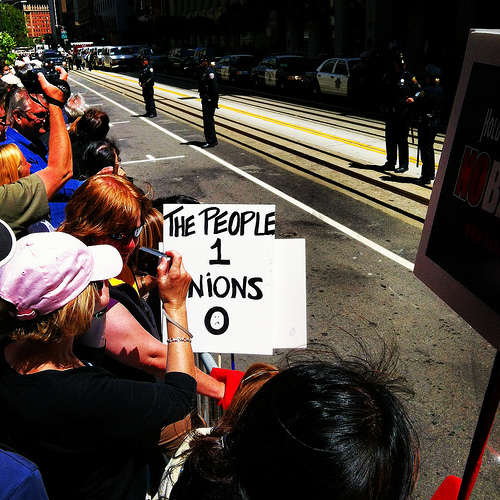
Hundreds gathered in the financial district today as President Obama came through San Francisco for a brief visit, consisting of a high-priced fundraising lunch and no public events. A mostly silent crowd waited patiently to watch the president’s motorcade drive by this afternoon, first at 1 Market St and then at 456 California, before he went off to SFO. On the crowd’s sidelines, handfuls of dissenters from various groups held signs and spoke up with a diverse range of reasons for protesting the president.

On Market, the motorcade went past the Occupy SF campsite at 101 Market St, where a dozen protesters had gathered. Their signs and chants focused on the National Defense Authorization Act. Sections 1021 and 1022 of the act, which the president signed Dec. 31 2011, have been interpreted as allowing for indefinite detention of terrorism suspects in the United States without charge or trial.

National groups Code Pink and World Can’t Wait brought attention to what they called Obama’s war crimes. 

“Code Pink is asking Obama to kill the kill list,” said Nancy Mancias, an organizer with the womens’ peace organization, referring to a list of terror suspects targeted for US attacks that Obama personally oversees. “We want more transparency in the CIA drone program, and victim compensation to the families of those who have been killed in drone strikes.”

World Can’t Wait demonstrators emphasized that Guantanamo Bay detention facility is still open and housing almost 200 prisoners, despite President Obama signing an executive order to close it days after taking office.

For demonstrators from the Center for Biological Diversity and Greenpeace, it’s imperative that the president stop oil drilling in the Arctic.

“There are a couple small permits they still need to get, but Shell is ready to drill in the Arctic in July,” said Miyoko Sakashita, an attorney at the Center for Biological Diversity. 

Sakashita said that drilling there could be dangerous for residents of the region, as well as polar bears, walruses and seals. 

“The conditions are terrible for drilling,” said Sakashita, citing low visibility and icy terrain. “If they can’t stop an oil spill in the gulf of Mexico, how will they stop it in the Arctic?” 

If these conditons do indeed lead to a disastrous oil spill, Greenpeace volunteers will be there first hand to witness it, as the group plans to send vessels of their own to monitor the operations.

Tea party protesters and Ron Paul supporters also came out to see the president. 

“It’s an issue of competence,” said Charles Cagnon, a protester who held a sign calling President Obama a “bad hire.”

“A president is our employee, not a king.”

But Cognan wasn’t too pleased with the competition either. 

“I was a Ron Paul kind of guy,” he said, “but I’ll take Romney. He’s level-headed and competent, and he likes arithmetic.”

“Obama doesn’t like arithmetic,” he continued, as evidenced, according to Cagnon, by the senate rejection of Obama’s budget May 16.

“Bush was terrible,” Cagnon added. “Romney is uninspiring.”

Cagnon and his group sported “Nobama” gear, Code Pink protesters came with signature pink clothing and signs, and a Greenpeace volunteer was dressed as “Frostpaw the polar bear.” Focused for the day on a common enemy of sorts, no conflicts arose between the divergent protest groups. For his part, Cagnon added that despite his right leanings, he loves KPFA radio, and that he believes the tea party has a distrust of government in common with Occupy.

“I’m just glad there’s people out there dissenting,” he said. “We need people like that.”

Summer of Peace events kick off in Oakland

6

By Natalie Orenstein

Oakland has garnered more attention in the last year for police violence than it has for peace, but a group of activists is hoping to highlight the city’s nonviolence initiatives and traditions later this month during the kickoff for the three-month global Summer of Peace celebration, starting June 22-23 at Oakland’s Scottish Rite Center.

The Summer of Peace was designed as an “effort to create a critical mass of consciousness,” said Jane Elin, the event manager for the Oakland festival.

A few “anchor events” will be sponsored by the Shift Network, a global peace organization based in Petaluma, but international activists and organizations will hold corresponding celebrations throughout the summer, said Production Manager Bill McCarthy. Soon, with hosts able to post events online.

The Voices for Peace festival, about a year in the making, will kick off with a benefit concert on June 22 from 7:30pm to 10:30pm, featuring Maria Muldaur and Friends, Country Joe McDonald, the Vukani Mawethu Choir, and a slew of other performers. At a conference starting at 9am the next day, speakers including peace advocates Marianne Williamson, Barbara Marx Hubbard, and James O’Dea will address peace-building efforts in a variety of spheres. 

More practical components of the conference, such as a seminar on nonviolent communication, “offer tools and awareness – something you can walk away and use,” Elin said. But the general goal of the summer-long effort is to find ways to connect activists, and to keep peace-building in the global consciousness, she said.

“One of the things we’re doing is having people make a pledge during the summer,” McCarthy said. Participants will decide how many “acts of peace” they will commit to on a weekly basis, then share them online.

If all this sounds a bit vague, that actually part of the intention. One goal of the project is to highlight the diverse range of “pathways” one might take to finding personal peace or advocating for peace locally or abroad, said Philip Hellmich, “director of peace” with the Shift Network..

“We’re using ‘peace’ in multiple contexts,” Hellmich said. “We want to acknowledge and celebrate, as well as accelerate, the ways it’s happening.”
Hellmich pointed to a recent study that found more lawyers now do yoga than play golf as an example of people searching for inner peace, an “essential component” of working toward peace on a larger scale, he said.

“There’s been an exponential growth in peace-building. In 1985, only a handful of colleges had peace and conflict resolution programs, and now there are hundreds,” Hellmich said. “This isn’t your parents’ protest movement. It’s about all the different ways emerging to create a culture of peace. We want to move away from the typical polarization that happens: us versus them, Democrats versus Republicans, hawks versus doves. It’s a more sophisticated and nuanced approach.”

Those who want to participate without leaving the house can tune in to a series of interviews on a webcast throughout the summer, and call in with thoughts and questions. Each week of this “telesummit” will focus on a different theme: forgiveness, education, the science of peace, arts and culture, business and economics, and even peace in the military. There are big names on the program for this as well, from Alice Walker to Olympic gold medalists.

All profits from the ticket sales at Voices for Peace will go to Urban Peace Movement, an Oakland organization that aims to combat conditions that lead to violence in the city. The suggestion to hold the opening celebration in Oakland came from one of the Shift Network’s 27 Peace Ambassadors, and the event coordinators quickly warmed to the idea.

“Obviously, the city of Oakland has had its share of having to deal with conflict and violence,” McCarthy said.
“This will highlight peace-building activities and organizations in the city, and let the city shine,” Elin said. “It’s a place that needs more support.”

The morning before the concert, Oakland Mayor Jean Quan, United Nations Association of the East Bay President Jerry Weber, and Shift Network representatives will gather in Willie Wilkins Park to install a Peace Pole. “May Peace Prevail on Earth” will be written in several languages on the handcrafted Peace Pole, a tradition that began in mid-century Japan.

The permanent monument – and the entire weekend’s festivities – will “designate the city as a place of peace,” McCarthy said.

Chevron meets amid angry shareholders, liability, and environmental disasters

3

About 40 gathered outside Chevron’s San Francisco offices yesterday to mark its annual shareholder meeting. The demonstration was organized by OccupySF’s environmental justice working group, and used art and street theater to criticize Chevron’s involvement in hydraulic fracturing, a natural gas extraction process that may threaten parts of California’s water supply.

The afternoon protest came after a larger group showed up to Chevron’s world headquarters in San Ramon for the shareholder meeting that morning. According to Ginger Cassady of Rainforest Action Network (RAN), who helped organize the protest, it was a “big, colorful demonstration” with “over 100” in attendance.

Groups like the True Cost of Chevron and RAN’s Change Chevron campaign have been pressuring the company for years on a variety of issues. This year, workers and residents in areas where Chevron operates from Ecuador, Brazil, Angola and Nigeria travelled to San Ramon to voice their concerns. These ranged from oil-contaminated land in the Ecuadorian Amazon to an explosion on an oil rig off the shore of Nigeria in January. In that explosion, two workers were killed and more than 100 local people left the city for fear of contamination and other health risks caused by a fire that burned for months before going out on its own, despite Chevron’s efforts to contain the flames.

About 30 activists from around the world entered the meeting with proxy votes, according to Cassady. None interrupted the meeting, instead waiting their turn to speak. There were no arrests.

Some people with proxy votes, however, were not allowed access to the meeting. João Antonio de Moraes, national coordinator of Brazil’s United Federation of Oil Workers (FUP), was not allowed access, along with two representatives from United Steel Workers. Another worker, at the meeting to present in support of a resolution for worker safety, was initially blocked from entering but allowed access after a dispute, but had his presentation notes confiscated.

At the meeting, Chevron CEO John Watson announced “tremendous performance momentum” for the company, with “earnings of $26.9 billion” in the past year, according to a press release.

“Watson reinforced Chevron’s long-standing culture of safety and environmental stewardship, and resulting industry-leading performance,” the press release states. “He also highlighted Chevron’s commitment to partnerships that address health, education and economic development issues in the communities where the company operates, and Chevron’s global social investments of approximately $1 billion over the past six years.”

But Chevron is also suffering financially due to liability following oil spills, explosions, and contamination, a concern protest organizers say Watson failed to address. Representatives from Chevron did not return calls for comment.

The company recently settled with plaintiffs in Ecuador after an appeals court there ordered that they pay $18 billion in fines for spilling and deliberately dumping a total of 345 million gallons of crude oil in the Amazon rainforest of northeastern Ecuador.

Stockholders in attendance voted on eleven proposals, including seven submitted by shareholders, at the meeting. All of the votes went with the recommendation of the Board of Directors- including a proposal to reform the Board of Directors itself. That proposal asked that the Board of Directors find an independent Chair to head it up, as the current Chair is Chevron’s CEO, John Watson. The Board of Directors has the authority to incentivize and, if necessary, fire CEOs.

“We believe this presents a conflict of interest that can result in excessive management influence on the board of weaken the board’s management oversight,” read the proposal.

The proposal, along with several others, mentioned the Ecuador lawsuit, saying “we believe that independent board leadership is key at Chevron, given the questions raised about the oversight by the board of the CEO’s management and disclosure to shareholders of the financial and operational risks to the company from the $18 billion dollar judgment in the Ecuadorian courts in 2011.”

“With all these major legal liabilities that Chevron is facing a lot of people are concerned,” said Cassady.  “Chevron is profitable at the expense of worker safety, the environment, human rights and our economy.”

Other stockholder proposals dealt with safety, transparency, and the environmental impacts of Chevron’s international operations. A proposal asking Chevron to disclose money spent on lobbying received approximately 23 percent of votes, a proposal asking for a report on what the company has done to reduce the risk of accidents like the Niger Delta explosion received only eight percent of the vote, and a proposal that Chevron nominate a new board member with environmental expertise failed as well with 23 percent of votes cast.

Shareholders also voted on a proposal that Chevron release a report on the financial, environmental, and community impacts of hydraulic fracturing, the focus of the afternoon protest in San Francisco. The proposal received about 27 percent of the vote.

Hydraulic fracturing, or fracking, is the process of extracting natural gas by injecting dense underground rock formations with a pressurized mixture of water, sand and chemicals. It has been hailed as an environmentally friendly alternative to oil drilling, as natural gas burns cleaner than oil.

But protest movements have coalesced around fracking practices in the Appalachian mountains region and above the Marcellus Shale, as residents report toxic chemicals in their water supplies, endangering drinking water as well as water used for raising livestock and growing food.

The 2010 documentary Gasland included now notorious footage of residents near a Pennsylvania fracking operations whose tap water bursts into flames.

Fracking operations in California are less well known. The protest outside of Chevron’s San Francisco offices yesterday drew attention to this issue- and the extensive list of chemicals present in fracking solution.

“It’s happening in California, but it’s not really talked about” said Ellen Osuna. Osuna now lives in San Francisco, but moved from New York, where she says she worried about her water supply since it comes from aquifers near the Marcellus Shale.

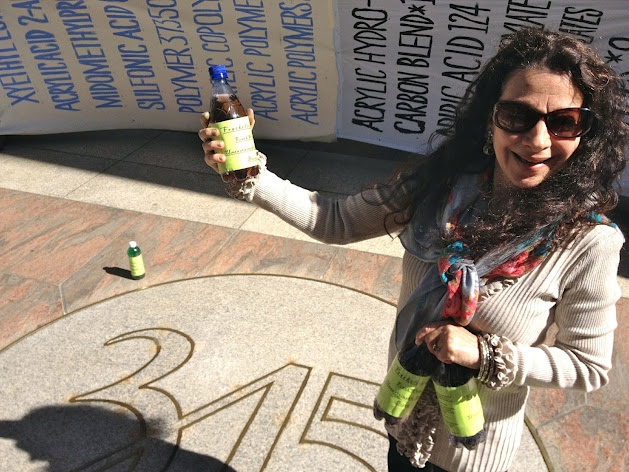
The protest featured an 180-foot banner, painted by artist Ruthie Sakheim. The banner listed more than 70 chemicals found in fracking fluid, in alphabetical order.

“It’s not even halfway through the A’s” said Sakheim.

She also handed out bottles of water oil-colored water labeled “Frackelicious Frackwater Unsustainable Energy Drink.” The label listed some of the more toxic chemicals involved in the process under “ingredients” along with “no preservatives, no artificial flavors, 100 percent poison.”
 
According to a report released by the Congressional Committee on Energy and Commerce, fracking fluid contains 750 chemicals, which “ranged from generally harmless and common substances, such as salt and citric acid, to extremely toxic substances, such as benzene and lead” as well as many carcinogens, according to the report.

These chemicals, along with gas itself, can enter water supplies when the casing on wells cracks or when wastewater containers spill.

The Safe Drinking Water Act of 2005 specifically exempts hydraulic fracturing, a lack of regulation known as the Halliburton Loophole.

Fracking currently takes place in nine California counties, including Sacramento, Los Angeles, Santa Barbara and Monterey.  But the extent of hydraulic fracturing in California isn’t well known, and yesterday, the California Senate rejected SB1054, which would have required energy companies to notify landowners before using hydraulic fracturing on or near their land.

In between chants of  “ban fracking now!” Sakheim told me that she spent several months painting the banner, and plans to continue the project of listing the chemicals involved in fracking in artistic form.

“I have three kids,” said Sakheim. “I really worry about what will happen to them with these corporations having so much control to influence government.”

Outer Mission opposition

1

steve@sfbg.com

HERBWISE Most medical marijuana dispensaries in San Francisco are clustered around the central part of the city, with the heaviest concentration in SoMa, leaving patients in many outlying parts of the city — such as the Outer Mission and Excelsior districts — with long journeys to visit a cannabis club.

That began to change in February when the Planning Commission approved permits for three new dispensaries to open in the Excelsior: venerable delivery service The Green Cross will open its first brick-and-mortar operation on the 4200 block of Mission, while Tree-Med and Mission Organics each won approval to locate on the 5200 block. All three clubs had been in development for years, delayed by a state case challenging new dispensaries that went all the way to the Supreme Court.

But Steve Currier, president of the Outer Mission Merchants and Residents Association, has appealed the building permit for the first of that trio of clubs to apply for one, Mission Organics, and he allegedly whipped up anti-pot hysteria in the neighborhood that included an April 21 protest march spanning the three dispensary sites.

David Goldman, a member of the city’s Medical Cannabis Task Force, said the Feb. 16 appeal hearing and April 21 demonstration — which he said also included supervisorial candidate Leon Chow — were marked by inaccurate statements that dispensaries attract crime and are harmful to children, even though all three dispensaries are more than 1,000 feet from schools.

“People who are ignorant assume we’re all a bunch of hoodlums or stoners looking to get high,” Goldman said. “We want them to realize that dispensaries don’t bring crime to neighborhood. If anything, it’s the opposite,” he said, citing the value of people, video cameras, and security guards on the street as a crime deterrent, particularly on blocks with vacant storefronts, as is the case with these blocks.

Neither Currier nor Chow returned Guardian calls or emails. Attorney Dorji Roberts, who represents Mission Organics owners Eugene Popok and Mike Mekk, said that he’s also had a hard time reaching project opponents to address their concerns before a Board of Permit Appeals hearing set for June 20.

“We’ve asked them for a meeting recently, but he won’t respond and he can’t articulate any real reasons why he has a problem with it,” Roberts said of Currier and his group.

Roberts said that Popok had attended meetings of the OMMRA to try to integrate into the group and address any concerns it might have, but they were surprised when the project got appealed after being approved 5-2 at the Planning Commission (Tree-Med’s vote was also 5-2, while The Green Cross won unanimous approval), where they saw their first hints of opposition.

“They’re saying it will be a density issue, even though no clubs are out there now,” Roberts said. “They say it will increase crime, which also isn’t true…It’s the same kind of fears and phobias that are offered by people who just don’t like [medical marijuana or its legality].”

Goldman, who had people monitoring the April 21 protest march, said the group would praise businesses along the way while condemning the dispensaries, as one point chanting, “Liquor stores, yes, pot stores, no,” a dichotomy he considers telling of the kind of moralism driving the appeal.

“Fundamentally,” he said, “it’s an attack on patients.”


State of debate

yael@sfbg.com

On May 24, a panel of three Jewish activists and authors from the Bay Area will discuss the historical figures and ancestors that inspire their work today. The event was originally scheduled to take place at the Jewish Community Library, operated by the Bureau of Jewish Education (BJE), which is largely supported by the Jewish Community Federation (JCF, or “the Federation”).

Leaders at the BJE canceled the event in January after discussions about its content with organizers of the panel, who then found another venue: Congregation Sha’ar Zahav. That seemed like a harmless turn of events that has nothing to do with the Israeli-Palestinian conflict, at least not directly.

But with the current state of discourse in the Bay Area’s Jewish community, just beneath the surface are complex dynamics that raise issues of censorship, bonds forged by religion, whether certain criticisms of Israel should be off-limits, and a battle for the hearts of minds of Jews in the diaspora.

Anti-war activist Rae Abileah has found herself at the middle of this battle. She is on the panel to discuss her great uncle Joseph Abileah, an Israeli pacifist who was charged and tried in 1949 after he refused to join the army as part of Israel’s mandatory military service.

Abileah is a member of Code Pink who is outspoken about her opposition to the Israeli occupation in Palestine. The panel is meant to discuss decades-old work, not the current state of affairs domestically or in Israel, but Abileah’s inclusion made it too political for some.

In March, the panelists — which also include Julie Gilgoff and Elaine Elinson — and event organizer Diana Scott wrote an open letter to the Jewish Community Library saying, “We find it particularly troubling that an act of censorship has occurred at the Library — an institution that it supposed to be a symbol of open thought in learning in the Jewish Community.”

David Waksberg, the director of the BJE who was instrumental in the decision-making process, said it was nothing of the sort. “We had very honest, productive, and respectful discussions about why the program wasn’t for us,” he told me.

The letter concludes: “We seek to make clear that Federation policies, designed to foster the appearance of Jewish solidarity by shutting down the vital exchange of ideas in the Jewish community, are divisive and intolerable. They are also ultimately ineffective in suppressing dissent, and, paradoxically, undermine the values and mission of some of our most cherished Jewish institutions.”

“The Jewish Community Federation didn’t tell us whether or not to do this program,” Waksberg insists. “They didn’t pressure us one way or another.”

The open letter also discusses funding guidelines, adopted in 2010 by the Federation. The guidelines restrict funding for events that “endorse the BDS (boycott-divestment-sanctions) movement or positions that undermine the legitimacy of the State of Israel.”


DELEGITIMIZING ISRAEL?

The guidelines have meaning beyond these specific circumstances. They represent a conflict in what counts as diversity of opinion, what counts as dissent, and the incredibly loaded concept of “delegitimizing Israel.”

The guidelines were a response to a controversial 2009 screening of Rachel, a documentary on the life of Rachel Corrie, a 24-year-old who was killed when she stood in front of a bulldozer on its way to level a Palestinian home. The film was screened at the San Francisco Jewish Film Festival followed by speaker Cindy Corrie, Rachel’s mother. The film-going crowd yelled and booed, and the Federation threatened to quit funding the festival.

The next year was declared by some Jewish leaders to be the Year of Civil Discourse. The Jewish Community Relations Council (JCRC), the self-described “central public affairs arm of the organized Bay Area Jewish Community,” organized a year of programming and discussion, with an aim to “elevate the level of discourse in the Jewish community when discussing Israel.” The J Weekly, the magazine of the Jewish Bay Area, reported that “[organizers] agree that the Year of Civil Discourse was a success,” though these organizers acknowledged their work was far from over.

Indeed, the controversies rage on. Two months before the Year of Civil Discourse officially ended Dec. 13, the Museum of Children’s Art in Oakland canceled an exhibit, “A Child’s View from Gaza”, that would have showcased drawings by Palestinian children, after pressure from Jewish organizations.

The director of the JCRC, Doug Kahn, became a spokesperson against the exhibit, butting up against groups like the Middle East Children’s Alliance and Bend the Arc (formerly Progressive Jewish Alliance). In March, an event that would have featured author and journalist Peter Beinart lost support after the JCC of the East Bay learned that one of the event’s moderators was on the board of Bend the Arc. Add this panel to the mix, and the six months since the Year of Civil Discourse ended have proven how taboo topics like BDS and Israeli violence in Palestine remain volatile.

BDS in particular has emerged as an untouchable issue. The campaign is a result of a 2005 Palestinian call for boycott and divestment from Israeli companies, and economic sanctions on Israel. BDSmovement.net, which provides news and background information regarding BDS efforts, lists three goals to the protest: “Ending [Israel’s] occupation and colonization of all Arab lands and dismantling the Wall; recognizing the fundamental rights of the Arab-Palestinian citizens of Israel to full equality; and respecting, protecting and promoting the rights of Palestinian refugees to return to their homes and properties as stipulated in UN resolution 194.”

The campaign has seen effects worldwide. Abileah has organized to promote BDS, in particular working to get Bay Area stores to stop carrying Ahava, skin-care products made in what she calls an illegal Israeli settlement in Palestine.

The BDS campaign is “a tried and true nonviolent tactic to get the Israeli government to uphold international law,” Abileah told me. “We decided to be in solidarity.”

But some Jewish leaders feel BDS goes too far.

“The term delegitimizing Israel refers to the intent to eliminate the Jewish and democratic State of Israel by portraying it as an illegitimate nation,” Kahn wrote in an email. “The boycott/divestment/sanctions movement’s leadership has made clear that this is their ultimate agenda and one of the movement’s explicit objectives would achieve that aim resulting in a dire threat to nearly half of the world’s Jewish population that lives in Israel.”

BDS is mentioned several times in the Federation funding guidelines, and stands out as the only specific example of what it means to “undermine the legitimacy of the state of Israel.”


ISOLATE THE EXTREMISTS

But organizations like the Federation and the JCRC aren’t the only ones interested in the path that Israel-Palestine discourse among Bay Area Jews takes. The Reut Institute, a think tank based in Tel Aviv, “has been committed to responding to the assault on Israel’s legitimacy since 2008,” according to the introduction to its 2011 report: “San Francisco as a Delegitimization Hub.”

The report ranks San Francisco and London among the “few global hubs of delegitimization.” It also warns of the dangers of San Francisco in particular as top-delegitimizing city, noting “the role of the San Francisco Bay Area as a generator and driver of broader trends, or as a hub of social experiments…What won’t pass in San Francisco won’t pass anywhere else, and what happens in San Francisco doesn’t stay in San Francisco.'”

San Francisco gets this attention from Reut because of dissent within its Jewish community, which the institute calls globally unparalleled. “While in London delegitimization is being promoted primarily by groups that are not part of the Jewish community…an increasing number of Jews in the San Francisco Bay Area have become ‘agnostic’ towards Israel, and are fueling the delegitimization campaign.”

The report’s authors, Reut’s “national security team,” do not spend much time explaining what “delegitimizing Israel” means. When it does, BDS again stands out as one of the only concrete examples. According to the report, in the Bay Area “the number of individuals who are willing to stand up for Israel is declining while others have been fueling the delegitimization campaign, many times unintentionally, by engaging in acts of delegitimization — namely, actions or campaigns framed by their initiators as a reaction to a specific Israeli policy, which in practice aim to undermine Israel’s political and moral foundations. Examples include support for the BDS movement and the 2010 Gaza Flotilla,” a protest in which ships full of supporters and cargo tried to make it to Palestinian land in violation of an Israeli embargo.

The report labels those looking to delegitimize Israel “extremists.” It warns, however, that those questioning Israel’s policies, when rebuked by its “tradition defenders,” may be swayed into trusting the extremists. It therefore advocates a “broad tent approach,” advising that Jews in the Bay Area initiate a “community-wide deliberation” with an “aim to…drive a wedge between the extremists and those who principally support the legitimacy of Israel’s existence regardless of policy agreements.”

It’s important, according to the report, to make sure that supporters of BDS are seen as “extremists.” The “broad tent” is supposed to contain all Jews, with a diversity of opinions — except those supporting BDS and other acts of “delegitimization.” In light of this goal, the report praises the Federation’s funding guidelines and the Year of Civil Discourse.

“Through the funding guidelines drafted by a JCRC-JCF Working Group…the San Francisco Bay Area has set the standard nationally as the first American Jewish community to develop guidelines delineating red lines that go hand-in-hand with the broad tent approach,” Reut reports. “Additionally, we regard the Year of Civil Discourse…led by the JCRC, as important best practices that could be emulated in other places.”


ORTHODOXY

The Bay Area’s left-leaning Jewish organizations may be influential, but under such a hot spotlight, they tread carefully. Congregation Sha’ar Zahav is one such organization. Last year, the synagogue surveyed its members to test opinions on Israel.

“In general, the survey shows that we have a liberal left-leaning congregation,” said Terry Fletcher, a member of Sha’ar Zahav who now heads a committee created to follow up on the survey results. “People tend to blame, shall we say, both sides of the conflict, both Israelis and Palestinians, somewhat equally.”

Fletcher’s committee has organized events and discussions in the wake of the survey since January. “One idea was that we would start with something non-controversial,” Fletcher told me. “But we couldn’t think of anything that everyone on the committee considers non-controversial.”

The programming has featured discussions on evolving relationships with Israel and questioned their nuances. But Fletcher says they haven’t been able to venture into BDS territory.

“I would love it if we could get to a place where we could actually address that,” Fletcher reflected. “And we would want to do it from a balanced perspective. But it’s such an emotional issue.”

There are practical concerns as well. According to Fletcher, the Federation gives a small amount of funding for scholarships for Sha’ar Zahav’s religious school. The money that funded Fletcher’s committee’s programming came from Sha’ar Zahav’s general fund, when there was enough of it. She says that the committee is now operating without a budget due to tight finances. Even so, if the committee’s programming were to breech the Federation’s funding guidelines, it might put the program in jeopardy.

“To me, that’s what’s so problematic about these guidelines,” Fletcher said. “The guidelines are saying, if you want money from us, we have restrictions on what your organization can do. Even though our programming is not funded by the Federation, because it funds something completely unrelated, it could get cut.”

Fletcher also questions that paradigm of “delegitimizing Israel.”

“I think this is a term that people who defend Israel use to label people who criticize Israel in a certain way,” she said. “Many of us would answer that it’s Israel’s own policies that are delegitimizing Israel in the eyes of the world. I don’t find it a useful term.”

Sha’ar Zahav will be hosting the Reclaiming Jewish Activism panel. Davey Shlasko, a member of the congregation who helped facilitate the new arrangement, thinks the concern about Abileah’s associations were misplaced.

“I think it is unfortunate that the predicted objection to Rae’s other work was enough of a concern to cancel an event that is actually about drawing inspiration from our ancestors,” Shlasko told me via email.

But it’s in looking back at history that the panel acquires so much meaning. “It is safe to say that living in the United States, Jews have never been more empowered, safe, and connected to the community they live in,” mused one source, who wished to remain anonymous. “It is inevitable that with such success, the need to band together changed. The group identity changes. Sometimes it’s that fight, that need to rally together, that keeps the group intact.”

For Abileah, “the event will be Jewish activists talking about our ancestors.” She’s upset about the event’s cancellation, but not surprised.

“For a lot of Jewish people it can be challenging to speak out against this issue because you don’t know where your friends stand on this, or your synagogue or even your family,” she said. “There are a lot of people who we say are PEP: progressive except Palestine. My family and community have been supportive, but I’ve gotten hate mail and threats of violence.”

“It sounds like these Jewish institutions that are censoring have so much power, like they’re the mainstream Jewish voice. But I think the majority of Jewish Americans want a resolution to the conflict and are opposed to the occupation,” she said.

And how does she think Joseph Abileah would react to this situation? “I’d like to think that he would be shocked and hurt by it,” she said. “It’s sad to see so much fracture in the Jewish community over this issue.”

‘Reclaiming Jewish Activism’: easier said than done

0

This article has been updated

A panel in which three local activists will talk about how their Jewish ancestors inform their present-day work seemed harmless enough. But in the Bay Area’s friction-prone Jewish community, its cancellation has led the organizers to write a letter in protest and accusations that one of the area’s biggest funders of Jewish events, the Jewish Community Federation (JCF), is participating in McCarthy-style censorship.

The panelists- Julie Gilgoff, Elaine Ellinson, and Rae Abileah- are all authors and activists. Bend the Arc (formerly the Progressive Jewish Alliance) and the Workmens Circle organized the event. They planned to hold the panel in the Jewish Library, run by the Bureau of Jewish Education (BJE), which funds most of its grants and programming through the JCF.

In late January, the Library cancelled the panel. It will now be held at Congregation Sha’ar Zahav.In an open letter to the Library, the event organizers write, “six decades after McCarthyism’s assault on progressives and their values, we reassert that censorship by association is dangerous and unconscionable.”

David Waksberg, CEO of the Bureau of Jewish Education, said that the BJE didn’t want to suppress the event all together. “In the end we decided not to do it with the understanding that they would be going forward at another location,” he said.

“I don’t know how it’s censorship when you agree, you guys go have your meeting, just don’t have it at my place. How is that censorship? No one’s telling them they can’t speak,” Waksberg said.

“The program involves two authors who have written about activism domestically,” Waksberg explained, “and another individual who has been involved with BDS related to Israel.”

BDS-  the boycott, divestment and sanctions campaign that activists throughout the world have used as a protest against the Israeli occupation in Palestine- is at the center of the conflict, right beside Rae Abileah.

Abileah will take part in the panel to discuss her great uncle, Joseph Abileah, an influential Israeli peace activist and war resister in the 1940s. 

“I grew up in the Bay Area Jewish community,” Abileah told us. “I was part of the Diller Teen Fellowship,” a program BJE puts on, “where we had Jewish gatherings, trainings and meetings.”

She’s also outspoken in her opposition to Israeli occupation in Palestine.

Abileah works for CODEPINK Women for Peace and Jewish Voice for Peace. She has travelled to Gaza CODEPINK in 2009 for a Gaza Freedom March with participants worldwide. She has also organized BDS campaigns.

“In 2005 the Palestinian civil society called for BDS as tried and true nonviolent tactic to get the Israeli government to uphold international law. We decided to be in solidarity,” said Abileah. She has since organized to spread a boycott of Ahava products, “Dead Sea beauty products made in an illegal settlement in the West Bank.”

According to Abileah, “several stores in the Bay Area have stopped carrying it.”

Abileah says she is proud to support nonviolent forms of protest like BDS and hunger striking, noting the lengthy hunger strike undertaken by Palestinian prisoners that ended just yesterday.

The hunger strike was successful. Israel agreed to prisoners’ demands to end solitary confinement (for 19 prisoners), allow more family visits, and to free some of those held in “administrative detention,” or imprisonment without trial, although the demand to end administrative detention was not met.

BDS has had successes worldwide as well. And it has become a controversial issue in the Bay Area.

Waksberg said, “we were concerned this would be an event that would have a lot of people yelling at each other.” This would not be unprecedented.

The ongoing rift is possibly best exemplified by the controversy surrounding the 2009 screening at the SF Jewish Film Festival of Rachel, a documentary about the life of 24-year-old Rachel Corrie. Corrie was killed in 2003 when, as part of a campaign to stop Israeli settlements, she stood in front of a bulldozer on its way to demolish a Palestinian family’s home.

The showing of the film, as well as the festival board’s decision to invite Corrie’s mother to speak after the film, sparked outrage. A portion of the audience booed and hissed at supportive references to the Israeli government.

Largely in response to that event, the JFC rewrote its funding guidelines in 2010. The guidelines outline a policy of not funding organizations that promote violence, attempt to “proselytize Jews away from Judaism” or work on “undermining the legitimacy of Israel.”

The idea of fighting for or against “Israel’s legitimacy” is invoked often but is vague- what exactly does it mean to oppose Israel’s “legitimacy” or “right to exist”? In In the guidelines, one thing seems to clearly do so: BDS campaigns.

In the guidelines’ section on “potentially controversial Israel-related programming,” the types of programs “not consistent with JCF’s policy” has three bullet points, all singling out support for BDS as unacceptable. The programs that are inconsistent are ones where the “overall experience” “endorse or prominently promote the BDS movement,”  “Individual programs that endorse the BDS movement or positions that undermine the legitimacy of the State of Israel,” and co-sponsoring public programs featuring supporters of BDS.

The open letter states that “The Federation’s 2010 revised funding guidelines, which prohibit grant recipients from associating with organizations and individuals who oppose its strong support for Israel, apparently triggered the cancellation.”

Wakberg says that these guidelines didn’t play a role in the BJE’s decision to drop the Reclaiming Jewish Activism panel.

“The JCF didn’t tell us whether or not to do this. This was our decision about what we thought was right for the library,” he said.

“There was going to be an event,” Waksberg said, “and there is going to be an event.”

Yes, the event will go on. But so, it seems, will tensions in the Bay Area’s Jewish community.

Alerts

0

WEDNESDAY 16

Occupy the Auction, City Hall steps, 1 Dr Carlton B Goodlett Pl, SF; www.occupytheauctions.org. 1:45pm, free. This event may not be a once-in-a-lifetime opportunity — organizers at Occupy the Auction have been showing up the City Hall every single weekday since April 27 — but its definitely worth checking out. Occupy the Auction works with people facing unjust evictions from their property, including homeowners that have been fraudulently foreclosed on and renters facing eviction because of their landlords mortgage issues. Talk about focused and effective: this campaign stops the majority of home auctions it targets.

THURSDAY 17

Beautiful Trouble & Organizing Cools, Planet Sub-mission, 2183 Mission, SF; www.tinyurl.com/pmpress. 7pm, free. This is a book launch for two books at once. Beautiful Trouble is part history and part manual for activism, art, and creative protest. Organizing Cools the Planet is a pamphlet on environmental organizing that has won praise with the likes of Vandana Shiva and Noam Chomsky. Celebrate the books and rock out to the Brass Liberation Orchestra at this event. There will also apparently be super special surprise happenings.

FRIDAY 18

Decolonized Yoga, 16th and Mission BART Station Plaza, SF. 5-7pm, free. The Occupy movement in San Francisco is tumultuous and ever-changing, but the yogis and radicals who host decolonized yoga have maintained a calm and consistent outdoor free yoga practice for months now. If you’ve ever wanted to do yoga for free with talented teachers and guides, and you don’t mind doing so on colorful rugs laid out next to the BART steps, decolonized yoga could be the best way for you to decompress Friday evening.

SATURDAY 19

Malcolm X Jazz Arts Festival, San Antonio Park, 1701 East 19th St, Oak; www.eastsideartsalliance.com. Free. Fun for the whole family at a truly grassroots festival by and for East Oakland. The annual festival honors Malcolm X on his birthday and features an impressive lineup of local musicians, dancers and performers and community activists, along with a childrens section and food stands.

SUNDAY 21

Straight Outta Hunters Point 2, Bayview Opera House, 4705 Third St, SF; www.tinyurl.com/kevinepps. 2-5pm, free. The film, a sequel to 2003’s Straight Outta Hunters Point, once again showcases filmmaker Kevin Epps’ ability to capture the mood and story of the neighborhood he grew up in. The film screened in theaters in February, but now Epps partners with the SF Arts Commission for a screening at the Opera House. As Epps said in a press release: “As a filmmaker and activist, this is the most important screening of all, premiering the film in the neighborhood where it all started.” The event will also showcase local organizations such as the San Francisco Black Film Festival and will be catered by Old Skool Café.

Eco-sexual hike, Redwood Park, 7867 Redwood Rd, Oak; www.tinyurl.com/sprinklemarks. 1pm, $25. Annie Sprinkle has helped shape San Francisco’s sex activist and cultural world for years. Now an advocate of eco-sexuality, Sprinkle will host Kim Marks, owner of a new all-green sex shop in Portland for an eco-sexual hike right here in SF. Explore the redwoods and your sexuality with this eco-sexy hike.

Long Haul oral history project: The Rodney King riots, Long Haul infoshop, 3124 Shattuck, Berk; www.thelonghaul.org. 7:30-9pm, free. The Long Haul provides a center for anarchist and radical media and organizing in the Bay Area, and produces the famous Slingshot newsletter. They also have an oral history series on the third Sunday of every month, discussing Bay Area events “with people who were there recalling what happened and how lessons we might have learned then could apply to the struggle now. This Sunday, the focus is on the Rodney King riots in the Bay Area, where 1400 were arrested and a 9pm citywide curfew declared all the way back in 1992.

Tax equity

3

steve@sfbg.com, yael@sfbg.com

A broad consensus in San Francisco supports reforming the city’s business-tax structure by replacing the payroll tax with a gross receipts tax through a November ballot measure. But the devil is in the details of how individual tax bills are affected, which has divided the business community and given a coalition of labor and progressives the opportunity to overcome the insistence by Mayor Ed Lee and other pro-business moderates that any change be revenue-neutral.

Service Employees International Union Local 1021, San Francisco’s biggest city employee union, last month launched a campaign demanding that the measure increase city revenue, setting a goal of at least $50 million, which represents the amount the city has lost annually since 2001 when 52 large downtown corporations sued to overturn the last gross receipts tax. The union is threatening to place a rival measure on the fall ballot.

“This call for it to be revenue-neutral didn’t make a lot of sense given all the reductions in city services in recent years,” said Chris Daly, the union’s interim political director. “It’s fair to at least get the money back that we lost in 2001.”

The union and the city recently agreed on a new contract that avoids more of the salary cuts that SEIU members have taken in recent years, but workers could still face layoffs under a new city budget that Lee is scheduled to introduce June 1. Lee, Board of Supervisors President David Chiu, and business leaders working on the tax-reform proposal have until June 12 to introduce their ballot measure.

But they don’t yet have an agreement on what the measure should look like — largely because the technology sector (led by billionaire venture capitalist Ron Conway, the biggest fundraiser for Lee’s mayoral campaign last year), the traditional businesses represented by the San Francisco Chamber of Commerce, and the small business community are pushing different interests and priorities.

“The technology industry has to realize they have a tax obligation like any member of the business community does,” Jim Lazarus, the Chamber’s vice president for public policy, told us.

Conway is reportedly using his influence on Lee to push for a model that keeps taxes low for tech companies — even if that comes at the expense of other economic sectors, such as commercial real estate and big construction firms, which will likely see their tax obligations increase. Yet some Chamber counter-proposals could end up costing small businesses more money, creating a puzzle that has yet to be worked out.

But one thing is clear: The business leaders don’t want to see overall city revenue increase. “If there’s anything that is unifying in the business community is that it’s revenue neutral,” small business advocate Scott Hauge told us. “We’re not going to increase revenues, that’s just a given, so if we have to do battle then so be it.”

SEIU and other members of progressive revenue coalition that has been strategizing in recent weeks are hoping to exploit the divisions in the business community and arrive at a compromise that increases revenue, and if not then they say they’re willing to go to the ballot with a rival measure.

“We’re working on trying to recover what we lost in the 2001 settlement and then some,” Sup. John Avalos, who has been working with the progressive coalition, told us. “We have to have something going to the ballot that is revenue generating.”


LABOR’S CAMPAIGN

For labor and progressives, this is an equity issue. Workers have been asked to give back money, year after year, despite the fact that big corporations have been doing well in recent years but haven’t contributed any of that wealth to the cash-strapped city. Labor leaders say that after they supported last year’s pension-reform measure, it’s time for the business community to support city services.

“When we talked about Prop C, we said if our members are doing this with our pensions now, we’ll see next year what businesses do with business tax,” said Larry Bradshaw, vice president of SEIU Local 1021. “Then we read about secret meetings where the labor movement was excluded from those talks.”

Anger over the “secret meetings” of business leaders that Lee assembled to craft the tax reform measure — meetings at which no labor leaders were included — helped inspire the fierce protest campaign that defined the SEIU’s recent contract negotiations.

In the first weeks of negotiations, workers were already up in arms. Protest marches at SF General Hospital and Laguna Honda Hospital brought hundreds of hospital workers to the streets. These hospitals serve some of the city’s poorest populations: Laguna Honda patients are mostly seniors on Medi-Cal and General is the main public hospital serving the city’s poor.

On April 5, city workers got creative with a street theater protest that involved six-story projections on the iconic Hobart Building. Protesters dressed as rich CEOs and handed out thank-you cards to commuters at the Montgomery transit station. SEIU’s “The City We Need, Not Downtown Greed” campaign included a website (www.neednotgreed.org), slick video, and direct mailers portraying CEOs as panhandlers on the street asking city residents, “Can you spare a tax break?”

The most dramatic civil disobedience came on April 18, when more than 1,000 workers rallied outside City Hall — along with several progressive supervisors — and then marched to Van Ness and Market. Protesters blocked the street, resulting in 23 arrests. At that point, increases in health care cuts and pay cuts to city workers were still on the table.

That was followed the next week by hundreds of workers staging noisy demonstrations in City Hall, and then again on May Day when SEIU workers were well represented in actions that took over parts of the Financial District.

In the end, the demands of union representatives were met in the contract agreement. Health care cost increases and pay cuts were eliminated, and a 3 percent pay raise will kick in during the two-year contract’s second year, a deal overwhelmingly approved by union members. Labor leaders hope to use that momentum to force a deal with the Mayor’s Office on the tax reform measure — which some sources say is possible. Otherwise, they say the campaign will continue.

“We may end up on the streets gathering signatures soon,” Daly said. “We need to figure it out in the next few weeks.”


THOSE DEVILISH DETAILS

The Controller’s Office released a report on May 10 that made the case for switching to a gross receipts tax and summed up the business community’s meetings, and the report was the subject of a joint statement put out by Lee and Chiu. “After months of thorough analysis, economic modeling and inclusive outreach to our City’s diverse business community, the City Controller and City Economist have produced a report that evaluates a gross receipts tax, a promising alternative to our current payroll tax, which punishes companies for growing and creating new jobs in our City'” the statement said. “Unlike our current payroll tax, a gross receipts tax would deliver stable and growing revenue to fund vital city services, while promoting job growth and continued economic recovery for San Francisco.”

Daly and Avalos say progressives agree that a gross receipts tax would probably be better than the payroll tax, and they say the controller’s report lays out a good analysis and framework for the discussions to come. But despite its detailed look at who the winners and losers in the tax reform might be, Daly said, “We haven’t seen an actual proposal yet.”

Lazarus made a similar statement: “Nobody likes the payroll tax, but the devil is in the details.”

But it’s clear some businesses those with high gross receipts but low payrolls — would pay more taxes. For example, the finance, insurance, and real estate sector now pays about 16 percent of the $410 million the city collects in payroll taxes. That would go up to about 21 percent under a gross receipts tax.

“Several industries that could face higher taxes under the proposal, such as commercial real estate, large retailers, and large construction firms, felt the increase was too sharp,” the report said under the heading of “Policy Issues Arising From Meetings with Businesses.”

The report highlighted how the change would broaden the tax base. Only about 7,500 businesses now pay the payroll tax (others are either too small or are exempt from local taxation, such as banks), whereas 33,500 companies would pay the gross receipts tax, which the report identified as another issue to be resolved.

“While some businesses appreciated the base-broadening aspect of the gross receipts proposal, others felt that too many small businesses were being brought into the Gross Receipts tax,” the report said. Hauge also told us that he fears a tax increase on commercial real estate firms could be passed on to small businesses in the form of higher rents. “I don’t want to see the business community split,” Hauge said, although it’s beginning to look like that might be unavoidable. The big question now is whether progressives and labor can find any allies in this messy situation, and whether they’ll be able to agree on a compromise measure that all sides say is preferable to competing measures.

Love on wheels

2

In honor of our annual bike issue, we wanted to highlight a few of the free-wheeling people that polished our spokes this year. Keep on pumpin’!

KAREN WEINER AND BRETT THURBER, NEW WHEEL

On a family-oriented strip of Cortland Avenue perched halfway up the precipitous heights of Bernal Hill, husband-wife team Karen Weiner and Brett Thurber have invested their all in an enterprise some would deem experimental: the first electric bike shop in San Francisco.

Photo by Mirissa Neff

“San Francisco is really the perfect place for these bikes,” said Thurber when we went on a test ride with him and Weiner around the city. Iron-thighed fixie fans notwithstanding, he’s right — there are some neighborhoods in this city where the average bear will only be able to bring a bike if he or she pushes it up the final blocks of incline. For older bikers, the e-bikes (as they are lovingly dubbed by their adherents) make it possible to zip around town, car and fancy-free. Plus, they are disturbingly fun — when else can you cruise up Twin Peaks and still be breathing easy when you reach that panoramic view?

Other stores around town do sell certain models of e-bikes, but Thurber and Weiner’s new New Wheel is the first place to specialize in them. It stocks European and Canadian-made models in addition to retrofitting kits so that normie bikes can be tricked out with motors capable of doubling one’s pedaling power.

Thurber says business has been steadily growing, and that he’s noticed that the electric bike is not a purchase taken lightly by consumers — often times a customer will come by the store six or seven times before taking that heady ride into pedal power (perhaps indicative of the bikes’ spendy pricetags.)

“People are really making this mindful shift instead of listening to us be like ‘just do it,'” says the man who hopes to be SF’s e-bike proselytizer. (Caitlin Donohue)

New Wheel, 420 Cortland, SF. (415) 524-7362, www.newwheel.net


PAUL JORDAN’S BIKE CAVALRY

Twenty years ago, Critical Mass began demonstrating the power and potential of mass bike rides to make a political statement by seizing space from cars and confounding the authorities. Almost 10 years ago, anti-war cyclists in San Francisco borrowed Critical Mass tactics to interfere with business as usual on daily Bikes Not Bombs rides that also proved effective and hard to police. Today, as the tides of protest again rise with the Occupy Wall Street and related movements, Paul Jordan and other founders of the new collective SF Bike Cavalry ( sfbikecavalry.org) are reviving and expanding the concept.

Photo by Tim Daw

“It’s all kinda new, definitely more of a buzzword at this point,” Jordan, a 38-year-old painting contractor, said when we caught up with him and his cycling comrades during last week’s May Day marches. “But the idea is to use bicycles for activism.”

As they demonstrated on May Day, even a dozen or so cyclists can send loud messages to passersby or nimbly create opportunities for marchers to safely seize the streets, all while riding more-or-less legally. And they can use whimsy — silly costumes, funny signs, big smiles, blowing bubbles — to defuse any tensions.

“It’s hard to be mad when you’re stuck in traffic if you see bubbles,” Jordan said as he reloaded the bubble machine on the back of his bike. “I see bubbles as a very good activist tool.”

The Cavalry is a fairly new venture, which Jordan first displayed for big Jan. 20 protests, but he sees it as something with enormous potential: “We want to figure out how to grow this bigger.” (Steven T. Jones)

SAM KROYER AND RENITA TAYLOR, ROLL SF

Sometimes it seems like the Mission has as many bike shops as taquerias, but the neighborhoods east of Potrero lacks the same double-wheelin’ bounty. Sam Kroyer and Renita Taylor met in their Bernal Heights neighborhood, where Kroyer used to run a repair shop out of his garage. Taylor is an avid biker, and the two decided to meld their respective strengths — Kroyer’s mechanical prowess and Taylor’s business know-how — and create a service-oriented shop near Potrero Hill for every type of rider.

Photo by Mirissa Neff

“We’re really trying to make it for everybody, from entry-level commuter bikers to bikers with really crazy exotic $20,000+ bikes,” Kroyer says. Kroyer has 25 year of experience as a bike mechanic, and Taylor is a sharp businesswoman who spent several years working in the entertainment industry.

Roll SF seems like an outpost in an area not known, for now, as a cycling nexus, but its atmosphere is friendly and accessible. A long wooden table runs through the center of the shop, welcoming guests to sit down and stay awhile — to use the shop’s free wi-fi while they wait, watch and ask questions, or eat dinner. Kroyer provides you with his utmost attention and quickly diagnoses your bike. If it’s a fast fix, he’ll handle it promptly with the grace cultivated by years spent engaging with a multifaceted machine. “We’re trying to make sure you come away with a great experience — that you feel like you’ve really gotten something taken care of properly,” Kroyer says. (Mia Sullivan)

275 Rhode Island, SF. (415) 701-ROLL, www.rollsanfrancisco.com


SONS OF SCIENCE

Are you on a motherfucking bike? Tell me you’re reading this on a motherfucking bike, doing the Tour de Fuck You. Sing with me, “No greenhouse gas! A tiny carbon footprint up your ass!” Then launch into the wickedest bike horn solo ever.

You know what I’m talking about. “Motherfucking Bike” by Sons of Science (sonsofscience.bandcamp.com), the profane viral hymn to SF peddlin’ that’s closing in on a million YouTube views and has been Tweeted liberally by the likes of Russell Crowe and Juliette Lewis. Sure it plays on every fixie hipster stereotype you can image — it’s the “Shit San Franciscans Say” for mutton-chopped, skinny-pantsed, non-fat latte-quaffing riders — but it’s pretty damn funny. (And catchy. It is maniacally catchy. So be warned.)

Sons of Science are a freewheeling trio: Ward Evans and John Benson, who direct for Sausage Films (www.sausagefilms.com), and Hector Perez, a.k.a. Horn Solo. “We’ve known each other for years and just recently decided to collaborate for fun, and it clicked. It was a great excuse to do a video. For this track we were also very lucky to feature Tim Brooks, formerly of the Young Offenders, who plays the ‘Angry Commuter’. He brought a pantsload of energy and genuine cyclist cred,” Evan told me. Also featured: the guys from that delicious new MASH shop (www.mashsf.com) near Duboce Park.

When asked about his own motherfucking bike heroes, Evans replied, “A guy named Joff Summerfield rode a penny farthing around the globe. He’d be right up there.” (Marke B.)