Planning

Alerts

0

THURSDAY 18

Culture as a weapon: poetry and storytelling SOUL School of Unity and Liberation, 1904 Franklin Suite 904, Oakl; www.schoolofunityandliberation.org, RSVP at info@schoolofunityandliberation.org. 6:30pm, $5-25. The second in a three-part series exploring how art and culture can be a form of political resistance. At this workshop, learn from poet, writer, artist and organizer Erika Vivianna Céspedes about writing that helps build movements. RSVP is required, and if you can’t get into this one, try their next event in the series, an activist printmaking workshop on Oct. 25.

Fall of the I-Hotel film screening New Nothing Cinema, 16 Sherman, SF; newnothing.wordpress.com. 8pm, free. A screening of a film depicting the historic struggle between residents and supporters of the International Hotel and the landlords that wanted it razed and turned into a parking lot. After massive neighborhood “revitalization,” the I-Hotel was one of the last remnants of the once-lively Manilatown neighborhood. See how residents fought for it at a screening presenting by Shaping San Francisco, New Nothing Cinema, and the CIIS Anthropology and Social Change Department.

FRIDAY 19

Say goodbye to condoms as evidence Jane Warner Plaza, 401 Castro, SF; www.tinyurl.com/condommarch. 6-8pm, free. As we reported this week, SFPD has decided to temporarily end the controversial practice of using possession of condoms as evidence in prostitution cases. For a three to six month trial period, condoms will not be seized or photographed if a cop thinks someone might be a sex worker. A group that was planning to march in opposition to the practice will now march in celebration of the decision, and to urge the city to make the trial period permanent.

Disobeying with great love Powell Street Bart station, Powell and Market, SF; www.tinyurl.com/disobeylove. 6pm, free. A flash mob meditation in the middle of the Disneyland-like shopping district. What better way to relax amongst the chaos?

SATURDAY 20

Op Trapwire Department of Homeland Security, 560 Golden Gate Ave, #36127, SF. WikiLeaks let loose information about Trapwire, the now-notorious company that uses surveillance and tracking to monitor people’s movements and aggregate them into patterns. It does this with a network of security cameras across the country, government and law enforcement uses its information, and the whole thing may be illegal. Some Occupy types have called for a national day of action against surveillance on Oct. 20, and San Francisco is joining in.

Picket Mi Pueblo market Mi Pueblo Mercado1630 High, Oakl; dignityandresistance@gmail.com. 1-4pm, free. Mi Pueblo Market is a successful and beloved grocery store chain. Workers were upset to learn that the company signed up to participate in E-Verify, a voluntary program that tracks the immigration status of all new hires. Managers say that the decision was made after serious pressure from ICE and the Department of Homeland Security. Workers and community supporters will picket the store in protest of the new policy.

SUNDAY 21

Amy Goodman speaks First congregational church of Oakland, 2501 Harrison, Oakl; www.kpfa.org/events. 7pm, $15 in advance. Amy Goodman co founded Democracy Now! The War and Peace Report in 1996. Since then, she has consistently brought progressive, hard hitting reporting to television screens and radios, authored a few books, and established herself as a distinctive voice in journalism. She’s also a kick ass speaker. Come hear her share her wisdom at a benefit for KPFA radio, where she’ll be speaking on “The Silenced Majority: Stories of Uprisings, Occupations, Resistance, and Hope”

MONDAY 22

Tasers forum Hamilton Recreation Center, 1900 Geary, SF; www.tinyurl.com/taserforums. 5pm, free. The SFPD has called a public forum to discuss the possible introduction of tasers into the police arsenal. Come to share your thoughts on the idea. And if you want to hear more, show up a half hour early for a community-led forum. “This summer, ACLU delivered a report of 532 documented Taser related deaths in the US since 2001, but that has not stopped SF Police Chief Greg Suhr from pushing the fourth attempt to spend several million dollars to equip SFPD with these deadly weapons,” say organizers.

Endorsements 2012: State and national races

25

National races

PRESIDENT

BARACK OBAMA

You couldn’t drive down Valencia Street on the evening of Nov. 4, 2008. You couldn’t get through the intersection of 18th and Castro, either. All over the east side of the city, people celebrating the election of Barack Obama and the end of the Bush era launched improptu parties, dancing and singing in the streets, while the cops stood by, smiling. It was the only presidential election in modern history that create such an upwelling of joy on the American left — and while we were a bit more jaded and cautious about celebrating, it was hard not to feel a sense of hope.

That all started to change about a month after the inauguration, when word got out that the big insurance companies were invited to be at the table, discussing health-care reform — and the progressive consumer advocates were not. From that point on, it was clear that the “change” he promised wasn’t going to be a fundamental shift in how power works in Washington.

Obama didn’t even consider a single-payer option. He hasn’t shut down Guantanamo Bay. He hasn’t cut the Pentagon budget. He hasn’t pulled the US out of the unwinnable mess in Afghanistan. He’s been a huge disappointment on progressive tax and economic issues. It wasn’t until late this summer, when he realized he was facing a major enthusiasm gap, that he even agreed to endorse same-sex marriage.

But it’s easy to trash an incumbent president, particularly one who foolishly thought he could get bipartisan support for reforms and instead wound up with a hostile Republican Congress. The truth is, Obama has accomplished a fair amount, given the obstacles he faced. He got a health-care reform bill, weak and imperfect as it was, passed into law, something Democrats have tried and failed at since the era of FDR. The stimulus, weak and limited as it was, clearly prevented the recession from becoming another great depression. His two Supreme Court appointments have been excellent.

And the guy he’s running against is a disaster on the scale of G.W. Bush.

Mitt Romney can’t even tell the truth about himself. He’s proven to be such a creature of the far-right wing of the Republican Party that it’s an embarrassment. A moderate Republican former governor of Massachusetts could have made a credible run for the White House — but Romney has essentially disavowed everything decent that he did in his last elective office, has said one dumb thing after another, and would be on track to be one of the worse presidents in history.

We get it: Obama let us down. But there’s a real choice here, and it’s an easy one. We’ll happily give a shout out to Jill Stein, the candidate of the Green Party, who is talking the way the Democrats ought to be talking, about a Green New Deal that recognizes that the richest nation in the history of the world can and should be doing radically better on employment, health care, the environment, and economic justice. And since Obama’s going to win California by a sizable majority anyway, a protest vote for Stein probably won’t do any harm.

But the next four years will be a critical time for the nation, and Obama is at least pushing in the direction of reality, sanity and hope. We endorsed him with enthusiasm four year ago; we’re endorsing him with clear-eyed reality in 2012.

UNITED STATES SENATE

DIANNE FEINSTEIN

Ugh. Not a pleasant choice here. Elizabeth Emken is pretty much your standard right-wing-nut Republican out of Danville, a fan of reducing government, cutting regulations, and repealing Obamacare. Feinstein, who’s already served four terms, is a conservative Democrat who loves developers, big business, and the death penalty, is hawkish on defense, and has used her clout locally to push for all the wrong candidates and all the wrong things. She can’t even keep her word: After Willie Brown complained that London Breed was saying mean things about him, Feinstein pulled her endorsement of Breed for District 5 supervisor.

It’s astonishing that, in a year when the state Democratic Party is aligned behind Proposition 34, which would replace the death penalty with life without parole, Feinstein can’t find it in herself to back away from her decades-long support of capital punishment. She’s not much better on medical marijuana. And she famously complained when then-mayor Gavin Newsom pushed same-sex marriage to the forefront, saying America wasn’t ready to give LGBT couples the same rights as straight people.

But as chair of the Senate Intelligence Committee, Feinstein was pretty good about investigating CIA torture and continues to call for the closure of Guantanamo Bay. She’s always been rock solid on abortion rights and at least decent, if not strong, on environmental issues.

It’s important for the Democrats to retain the Senate, and Feinstein might as well be unopposed. She turns 80 next year, so it’s likely this will be her last term.

HOUSE OF REPRESENTATIVES, DISTRICT 8

NANCY PELOSI

The real question on the minds of everyone in local politics is what will happen if the Democrats don’t retake the House and Pelosi has to face two more years in the minority. Will she serve out her term? Will her Democratic colleagues decide they want new leadership? The inside scuttle is that Pelosi has no intention of stepping down, but a long list of local politicians is looking at the once-in-a-lifetime chance to run for a Congressional seat, and it’s going to happen relatively soon; Pelosi is 72.

We’ve never been happy with Rep. Pelosi, who used the money and clout of the old Burton machine to come out of nowhere to beat progressive gay supervisor Harry Britt for the seat in 1986. Her signature local achievement is the bill that created the first privatized national park in the nation’s history (the Presidio), which now is home to a giant office complex built by filmmaker George Lucas with the benefit of a $60 million tax break. She long ago stopped representing San Francisco, making her move toward Congressional leadership by moving firmly to the center.

But as speaker of the House, she was a strong ally for President Obama and helped move the health-care bill forward. It’s critical to the success of the Obama administration that the Democrats retake the house and Pelosi resumes the role of speaker.

HOUSE OF REPRESENTATIVES, DISTRICT 9

BARBARA LEE

Barbara Lee represents Berkeley and Oakland in a way Nancy Pelosi doesn’t represent San Francisco. She’s been a strong, sometimes lonely voice against the wars in Iraq and Afghanistan and a leader in the House Progressive Caucus. While Democrats up to and including the president talk about tax cuts for businesses, Lee has been pushing a fair minimum wage, higher taxes on the wealthy, and an end to subsidies for the oil industry. While Oakland Mayor Jean Quan was struggling with Occupy, and San Francisco Mayor Ed Lee was moving to evict the protesters, Barbara Lee was strongly voicing her support for the movement, standing with the activists, and talking about wealth inequality. We’re proud to endorse her for another term.

HOUSE OF REPRESENTATIVES, DISTRICT 12

JACKIE SPEIER

Speier’s an improvement on her predecessor, Tom Lantos, who was a hawk and terrible on Middle East policy. Speier’s a moderate, as you’d expect in this Peninsula seat, but she’s taken the lead on consumer privacy issues (as she did in the state Legislature) and will get re-elected easily. She’s an effective member of a Bay Area delegation that helps keep the House sane, so we’ll endorse her for another term.

State candidates

ASSEMBLY DISTRICT 13

TOM AMMIANO

Tom Ammiano’s the perfect person to represent San Francisco values in Sacramento. He helped sparked and define this city’s progressive movement back in the 1970s as a gay teacher marching alongside with Harvey Milk. In 1999, his unprecedented write-in mayoral campaign woke progressives up from some bad years and ushered in a decade with a progressive majority on the Board of Supervisors that approved landmark legislation such as the universal healthcare program Ammiano created. In the Assembly, he worked to create a regulatory system for medical marijuana and chairs the powerful Public Safety Committee, where he has stopped the flow of mindless tough-on-crime measures that have overflowed our prisons and overburdened our budgets. This is Ammiano’s final term in the Legislature, but we hope it’s not the end of his role in local politics.

STATE ASSEMBLY, DISTRICT 19

PHIL TING

Phil Ting could be assessor of San Francisco, with a nice salary, for the rest of his life if that’s what he wanted to do. He’s done a good job in an office typically populated with make-no-waves political hacks — he went after the Catholic Church when that large institution tried to avoid paying taxes on property transfers. He’s been outspoken on foreclosures and commissioned, on his own initiative, a study showing that a large percentage of local foreclosures involved at least some degree of fraud or improper paperwork.

But Ting is prepared to take a big cut in pay and accept a term-limited future for the challenge of moving into a higher-profile political position. And he’s the right person to represent this westside district.

Ting’s not a radical leftist, but he is willing to talk about tax reform, particularly about the inequities of Prop. 13. He’s carrying the message to homeowners that they’re shouldering a larger part of the burden while commercial properties pay less. He wants to change some of the loopholes in how Prop. 13 is interpreted to help local government collect more money.

It would be nice to have a progressive-minded tax expert in the Legislature, and we’re glad Ting is the front-runner. He’s facing a serious, well-funded onslaught from Michael Breyer, the son of Supreme Court Justice Breyer, who has no political experience or credentials for office and is running a right-wing campaign emphasizing “old-style San Francisco values.”

Not pretty. Vote for Ting.

SENATE DISTRICT 11

MARK LENO

Mark Leno wasn’t always in the Guardian’s camp, and we don’t always agree with his election season endorsements, but he’s been a rock-solid representative in Sacramento and he has earned our respect and our endorsement.

It isn’t just how he votes, which we consistently agree with. Leno has been willing to take on the tough fights, the ones that need to be fought, and shown the tenacity to come out on top in the Legislature, even if he’s ahead of his time. Leno twice got the Legislature to legalize same-sex marriage, he has repeatedly gotten that body to legalize industrial hemp production, and he’s twice passed legislation that would give San Francisco voters the right to set a local vehicle license fees higher than the state’s and use that money for local programs (which the governor finally signed). He’s also been laying an important foundation for creating a single-payer healthcare system and he played an important role in the CleanPowerSF program that San Francisco will implement next year. Leno will easily be re-elected to another term in the Senate and we look forward to his next move (Leno for mayor, 2015?)


BART BOARD DISTRICT 9


TOM RADULOVICH

San Francisco has been well represented on the BART Board by Radulovich, a smart and forward-thinking urbanist who understands the important role transit plays in the Bay Area. Radulovich has played leadership roles in developing a plan that aims to double the percentage of cyclists using the system, improving the accessibility of many stations to those with limited mobility, pushing through an admittedly imperfect civilian oversight agency for the BART Police, hiring a new head administrator who is more responsive to community concerns, and maintaining the efficiency of an aging system with the highest ridership levels in its history. With a day job serving as executive director of the nonprofit Livable City, Radulovich helped create Sunday Streets and other initiatives that improve our public spaces and make San Francisco a more inviting place to be. And by continuing to provide a guiding vision for a BART system that continues to improve its connections to every corner of the Bay Area, his vision of urbanism is helping to permeate communities throughout the region

BART BOARD, DISTRICT 7

ZACHARY MALLETT

This sprawling district includes part of southeast San Francisco and extends all the way up the I-80 corridor to the Carquinez Bridge. The incumbent, San Franciscan Lynette Sweet, has been a major disappointment. She’s inaccessible, offers few new ideas, and was slow to recognize (much less deal with) the trigger-happy BART Police who until recently had no civilian oversight. Time for a change.

Three candidates are challenging Sweet, all of them from the East Bay (which makes a certain amount of sense — only 17 percent of the district’s population is in San Francisco). Our choice is Zachary Mallett, whose training in urban planning and understanding of the transit system makes up for his lack of political experience.

Mallett’s a graduate of Stanford and UC Berkelely (masters in urban planning with a transportation emphasis) who has taken the time to study what’s working and what isn’t working at BART. Some of his ideas sound a bit off at first — he wants, for example, to raise the cost of subsidized BART rides offered to Muni pass holders — but when you look a the numbers, and who is subsidizing who, it actually makes some sense. He talks intelligently about the roles that the various regional transit systems play and while he’s a bit more moderate than us, particularly on fiscal issues, he’s the best alternative to Sweet.

SFBC keeps its distance from Critical Mass anniversary ride

27

Today’s 20th anniversary Critical Mass ride has received overwhelming media coverage in the last few days, including a surprisingly laudatory editorial in yesterday’s Examiner, so people are expecting the ride to be huge. But the talk of last night’s CM20 birthday celebration at CELLspace was about Quintin Mecke’s widely circulated letter blasting the San Francisco Bicycle Coalition for refusing to even put the event on its calendar or in its newsletter.

By contrast, even the San Francisco Planning & Urban Research Association (SPUR) – founded and funded by downtown players with little love for Critical Mass – listed today’s “special anniversary ride” and related events throughout the week in its calendar and on its newsletter, recognizing this “monthly bicycling event that began in San Francisco and inspired similar events throughout the world.”

As I wrote in this week’s cover story, SFBC and Critical Mass grew up together on a similar, symbiotic trajectory, effectively working an outside/insider strategy (think MLK/Malcolm X) that has won cyclists a recognized spot on the roadways. But SFBC always warily kept its distance from Critical Mass, worried about offending politicians, the mainstream media, or the driving public.

That’s an understandable strategy, given the persistent resentment many feel toward Critical Mass. But when considered in combination with SFBC’s increasingly corporate culture and sponsorships and its controversial recent decision to allegedly overrule its member vote in its District 5 supervisorial endorsements, SFBC is in danger of losing the allegiance of much of the cycling community (which remains a minority of road users, and thereby political outsiders almost by definition).

David Snyder — SFBC’s executive director through its biggest growth period, SPUR’s former transportation policy director, and currently the executive director of the California Bicycle Coalition — is reluctant to wade into the current controversy, but he does acknowledge the important role Critical Mass played in winning political acceptance for cyclists in San Francisco. 

“In the mid-’90s, when the San Francisco Bicycle Coalition was a couple thousand members, the brouhaha around Critical Mass [particularly the crackdown in ’97] increased our membership by 50 percent at one point,” Snyder told us. “At that time, we benefitted hugely form the attention Critical Mass paid to safe streets for bicycles. And I don’t think we need Critical Mass to do that anymore…The Bicycle Coalition’s goal these days isn’t to develop an awareness of unsafe streets, it’s to develop a bold agenda to fix them.”

I spoke with Mecke, who finished second in the 2007 mayor’s race, at last night’s event, and he was frustrated by his follow-up conversations with SFBC leaders, who seem to have taken a very defensive posture instead of welcoming this interesting conversation. I called SFBC Executive Director Leah Shahum to discuss these issues, and I’m waiting to hear back from her and I’ll update this post when I do.

But in the meantime, to feed the discussion, here’s the full text of Mecke’s letter, followed by another letter to SFBC on the endorsement issue:

Dear Bike Coalition:

Sadly, I can’t say I was surprised when I read this week’s SFBC Newsletter and found absolutely zero mention of the 20th Anniversary of Critical Mass.  According to your own newsletter, apparently the only thing happening in the San Francisco bike world that is worthy of your 12,000 members knowing about on Friday, Sept. 28 is SFBC’s Valet Bike Parking at the DeYoung Museum.  Seriously?

This is the San Francisco Bike Coalition and you couldn’t even bring yourselves to stick a small mention of Critical Mass in your newsletter or on your website (or god forbid you actually celebrate/acknowledge CM and show some pride), a cycling event created here in San Francisco which has spread across the globe to multiple continents since its inception & inspired thousands of cyclists to take to the street?  It’s truly amazing that Critical Mass was on the cover of the Guardian this week and even SF Funcheap listed the event but SFBC wouldn’t even put a mention at the bottom in the “Upcoming Events” section, hidden away amongst all the SFBC sponsored events? Not even a listing of the critical mass website or the community events going on all week long?  Your website lists the celebration of the 15th anniversary of TransForm but not Critical Mass?

Wow.  I’m truly speechless.  How embarrassing but more to the point, how sad. Are you afraid of offending Chuck Nevius or Mayor Lee? I don’t know how, why or what SFBC has become as an organization at this point but it’s disappointing as a long time cyclist to see the city’s only (?) organized bike advocacy organization which continually touts how many members you have to not even show the smallest amount of solidarity to your fellow cyclists and to the city’s own cycling history.  That being the case, history will march on without you.

Contrary to our “biking” Supervisor David Chiu’s comments in today’s Chronicle (I always enjoy politicians running from anything deemed controversial), it’s actually SFBC that is simply one tiny part of a much larger movement made up of a variety of cyclists from all walks of life whose decision twenty years ago to ride freely in the street once a month for just a few short hours has laid the groundwork for cycling reforms, political action and transformative experiences across the country and the world.

What a shame that instead of celebrating all parts of the cycling community, SFBC has decided to distance itself from the historic roots of its own community in the name of moderation, families on bikes and political expediency.

Enjoy Bike Valet night at the DeYoung Museum, it sounds like an awesome event.

thanks,
Quintin


Dear Leah:

My name is Gus Feldman. I am an avid bicyclist, a Bike Coalition member, and the President of the District 8 Democrats.

I’m in receipt of a letter from you, dated September 12, 2012, requesting that I renew my SFBC membership. I am writing to inform you that I will only renew my membership if the SFBC Board of Directors publicly releases the results of the SFBC member vote for the District 5 supervisor race.

While it is clear that the membership vote is one of several factors used by the SFBC Board of Directors to determine endorsements, the refusal of the Board to grant SFBC members the ability to see the results of their votes demonstrates an unacceptable degree of secrecy. By withholding this information, the Board is publicly stripping SFBC members of all agency in the endorsement process.

If in fact the popular suspicion is true – that Julian Davis won the most votes from SFBC members, but the Board decided to grant Christina Olague the top endorsement in the interests of expediting the construction of separated bike lanes on Oak & Fell streets – we would greatly appreciate the Board publicly declaring and explaining the decision. Such a decision is certainly logical, as the Oak/Fell bikes lanes are a key priority for many SFBC members. The fact that the Board has elected to conceal the vote results, as opposed to explaining to SFBC members why and how Olague received the number one endorsement, is highly insulting as it insinuates that the Board does not have faith in SFBC members’ capacity to understand the rationale by which the Board arrived at their determinations. 

Please understand that if the Board elects to depart from the current practice of concealing the vote results, and transitions to one of transparency, I will promptly renew my membership.

Respectfully,
Gus Feldman

‘LOOPER’ IS HERE! Plus: a boatload of other new movies

0

Wait, what are you doing reading this? Why aren’t you watching Looper, the best time-travel movie to come out of Hollywood in ages? Check out Lynn Rapoport’s review below, go see the damn thing (it’s gonna be huge, like Inception huge), and start planning your “Gat Man” Halloween costume this instant.

In this week’s film column, I check out the Northern California Action/Sports Film Festival (a new venture from SF IndieFest, which, by the way: just another month or so until DocFest!), let’s-talk-about-our-feelings indie Liberal Arts, and docs Diana Vreeland: The Eye Has to Travel and Peter Ford: A Little Prince

Marke B. takes on another doc, Detropia, and dubs this look at his hometown “important and beautiful;” full review here.

Two more from H-wood open this week (3D animated monster comedy Hotel Transylvania and YA young-angst tale The Perks of Being a Wallflower), as yet unreviewed — but there’s a bunch more short reviews, including Dennis Harvey’s take on the Vortex Room’s “Aerobicide” triple feature, after the jump.

http://www.youtube.com/watch?v=Y6G_AXzOJKY

“Aerobicide Sunday: A Marathon of Murder in Tights” Two things that made the 1980s taste great, slasher movies and aerobic exercise, were each too crassly, promiscuously commercial not to hook up a few times — even if the sub-sub-genre they created together is even less well remembered than the Lambada musical. Sun/30, however, it shall reign as king at the Vortex, where a triple bill of exer-psycho obscurities will really make you feel the burn. First up is 1987’s Aerobicide a.k.a. Killer Workout, in which the fitness emporium owned by Rhonda (Marcia Karrof of 1984’s Savage Streets) — as sour a grape as you’ll find in pastel spandex and pouf-shouldered Valley Girl dresses — experiences a rash of hard bodies being reduced to bloody pulp by an unknown killer wielding a large killer safety pin. Totally gross! We get many close-ups of overexposed thighs and over assisted cleavage gyrating to heinous dance tracks with inexplicable lyrics like “Hey baby! I’ve got your number! Red and juicy, warm and sweet” — plus some feathered-hair beefcake too — before the culprit turns out to be exactly who you think it is.

This was but an early effort among 32 features to date by writer-director David A. Prior, and based on the evidence present there’s a reason why you’ve never heard of any of them. Slightly slicker was 1990’s Death Spa (a.k.a. Witch Bitch), in which a computer automated gym goes all HAL-slash-The Shining, to the mortal danger of its highly toned staff and clientele. We’re talking death by blender, sauna paneling, and reanimated frozen fish products. The facility’s bitchy programmer is played by Merrick Butrick, who’d portrayed Captain Kirk’s son and a Square Peg earlier in the decade, and died of AIDS before this movie was released. Directed by Austrian Michael Fischa, it’s comparatively glossy but definitely senseless nonsense with a Eurotrash-genre feel. Lastly, in the same vein, and even slicker, there’s 1984’s Murder Rock: Dancing Death a.k.a. Giallo a Disco a.k.a. Slashdance (one of, incredibly, no less than three movies with that third name), a lesser exercise by that occasionally great horror director Lucio Fulci. Rather than a health club, the setting here is a dance school where choreography seems less indebted to Balanchine and Martha Graham than Jane Fonda and Shabba Doo. For that crime the punishment is, of course … death by hatpin? Whatever. If you survive this evening, you will be sore, winded, and desperate to sweat the toxins out of your system. Vortex Room. (Dennis Harvey)

http://www.youtube.com/watch?v=nrf8xoQJ5Ms

Backwards Athletic disappointment is not a new feeling for Abi (Sarah Megan Thomas, who also wrote the script), who has just learned she’s been named the alternate for the Olympic crew team — a bench warming role she was also relegated to in the last Olympics. But after she quits the team in a huff and moves home, it’s not long before she realizes that her life off the water is pretty depressing, too. Enter former boyfriend Geoff (James Van Der Beek), now the athletic director at the high school where Abi honed her rowing talents, who gives her a job coaching the talented but undisciplined girls who make up the current team. Will this new venture help Abi finally grow up and regain her self-confidence? Will she re-ignite her spark with Geoff? Will there be a last-act conflict involving yet another chance at the Olympics? Will there be multiple training montages? As directed by Ben Hickernell, Backwards hits all of the expected themes about following one’s heart and Doing the Right Thing. Thomas, a former rower herself, has an ordinary-girl appeal, but even Backwards‘ attention to authenticity can’t elevate what’s essentially a very predictable sports drama. (1:29) Sundance Kabuki. (Cheryl Eddy)

http://www.youtube.com/watch?v=eI3ju17W070

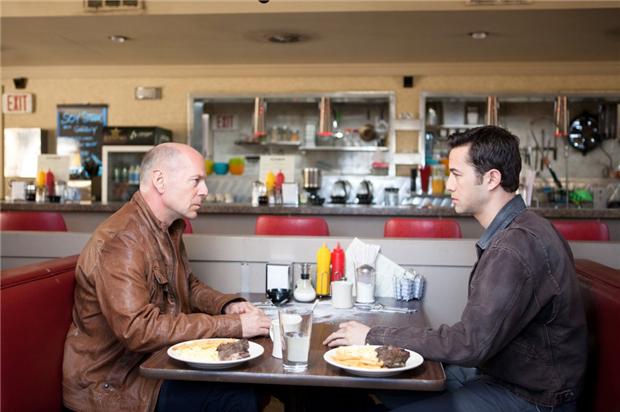
Looper It’s 2044 and, thanks to a lengthy bout of exposition by our protagonist, Joe (Joseph Gordon-Levitt), here’s what we know: time travel, an invention 30 years away, will be used by criminals to transport their soon-to-be homicide victims backward, where a class of gunmen called loopers, Joe among them, are employed to “do the necessaries.” More deftly revealed in Brick (2005) writer-director Rian Johnson’s new film is the joylessness of the world in which Joe amorally makes his way, where gangsters from the future control the present (under the supervision of Jeff Daniels), their hit men live large but badly (Joe is addicted to some eyeball-administered narcotic), and the remainder of the urban populace suffers below-subsistence-level poverty. The latest downside for guys like Joe is that a new crime boss has begun sending back a steady stream of aging loopers for termination, or “closing the loop”; soon enough, Joe is staring down a gun barrel at himself plus 30 years.

Being played by Bruce Willis, old Joe is not one to peaceably abide by a death warrant, and young Joe must set off in search of himself so that — with the help of a woman named Sara (Emily Blunt) and her creepy-cute son Cid (Pierce Gagnon) — he can blow his own (future) head off. Having seen the evocatively horrific fate of another escaped looper, we can’t totally blame him. Parsing the daft mechanics of time travel as envisioned here is rough going, but the film’s brisk pacing and talented cast distract, and as one Joe tersely explains to another, if they start talking about it, “we’re gonna be here all day making diagrams with straws” — in other words, some loops just weren’t meant to be closed. (1:58) (Lynn Rapoport)

http://www.youtube.com/watch?v=siEHekc-1oE

Pitch Perfect As an all-female college a cappella group known as the Barden Bellas launches into Ace of Base’s “The Sign” during the prologue of Pitch Perfect, you can hear the Glee-meets-Bring It On elevator pitch. Which is fine, since Bring It On-meets-anything is clearly worth a shot. In this attempt, Anna Kendrick stars as withdrawn and disaffected college freshman Beca, who dreams of producing music in L.A. but is begrudgingly getting a free ride at Barden University via her comp lit professor father. Clearly his goal is not making sure she receives a liberal arts education, as Barden’s academic jungle extends to the edges of the campus’s competitive a cappella scene, and the closest thing to an intellectual challenge occurs during a “riff-off” between a cappella gangs at the bottom of a mysteriously drained swimming pool. When Beca reluctantly joins the Bellas, she finds herself caring enough about the group’s fate to push for an Ace of Base moratorium and radical steps like performing mashups. Much as 2000’s Bring It On coined terms like “cheerocracy” and “having cheer-sex,” Pitch Perfect gives us the infinitely applicable prefix “a ca-” and descriptives like “getting Treble-boned,” a reference to forbidden sexual relations with the Bellas’ cocky rivals, the Treblemakers. The gags get funnier, dirtier, and weirder, arguably reaching their climax in projectile-vomit snow angels, with Elizabeth Banks and John Michael Higgins as grin-panning competition commentators offering a string of loopily inappropriate observations. (1:52) (Lynn Rapoport)

http://www.youtube.com/watch?v=XSDZNHYLDOY

Solomon Kane Conceived by Conan the Barbarian creator Robert E. Howard, this 16th-century hero is cut from the same sword-and-sorcery cloth, being a brawny brute of slippery but generally sorta-kinda upright morals. Solomon (James Purefoy) is slaughtering his way to a North African treasure trove when demons swallow up his likewise greedy, conscience-free cohorts and damn his soul for a lifetime of bad deeds. Suddenly committed to the greater good, he returns homeward to cold gray England, where Jason Flemyng’s evil sorcerer soon imperils both our protagonist and the Puritan family (complete with love interest) he’s befriended. This movie has been around a while — since 2009, to be exact, yet barely beating director Michael J. Bassett’s new Silent Hill: Revelation 3D to U.S. theaters — and is a good illustration of what can happen when you make a fairly expensive ($45 million) fantasy-action adventure without major stars nor any marketable novelty. Which is to say: not much. There is absolutely nothing wrong with the good-looking, watchable but generic-feeling Solomon Kane, save that nothing about it feels remotely original or inspired. It’s the perfectly okay, like-a-thousand-others mall flick you’ll forget you saw by Thanksgiving, despite being peopled with such normally interesting actors as Max Von Sydow, Alice Krige, and the late Pete Postlethwaite. (1:54) (Dennis Harvey)

http://www.youtube.com/watch?v=4mZIwD4K544

“Stars In Shorts” Outside of the festival circuit, it’s an uncommon feat for shorts to make it to the big screen, so it can’t hurt to make name recognition a prerequisite for selection. In writer-director Rupert Friend’s Steve, Keira Knightley plays an embattled Londoner under siege by her lonely, pathologically odd neighbor (Colin Firth). Written by Neil LaBute, Jacob Chase’s After School Special sets up a semi-flirtation between two strangers (Sarah Paulson and Wes Bentley) at a playground, only to deliver the kind of gut-level punch you might expect from the writer-director of 1998’s Your Friends and Neighbors. LaBute’s own Sexting is an entertaining exercise in stream-of-consciousness monologuing by Julia Stiles. As with most shorts programs, “Stars” is a mixed bag. Robert Festinger’s The Procession, in which Lily Tomlin and Modern Family’s Jesse Tyler Ferguson play reluctant participants in a funeral procession, sounds promising, but the conversation palls during the 10-plus minutes we’re stuck in the car with them. Benjamin Grayson’s sci-fi thriller Prodigal, starring Kenneth Branagh, reaches its predictable crisis points several minutes after the viewer has arrived. More successful are Jay Kamen’s musical comedy Not Your Time, starring Seinfeld’s Jason Alexander as an old Hollywood hand whose writing career has stalled out, and Chris Foggin’s Friend Request Pending, which treats viewers to the sight of Dame Judi Dench gamely wading into the social network in search of a date. (1:53) (Lynn Rapoport)

Won’t Back Down If talk of introducing charter schools into the public education mix tends to give you collective-bargaining-related hives, Daniel Barnz’s Won’t Back Down is unlikely to appeal, unless perhaps as the object of a boycott or a picket line. Two embattled mothers, Jamie Fitzpatrick (Maggie Gyllenhaal) and Nona Alberts (Viola Davis), both with children at a failing Pittsburgh elementary school and the latter a teacher there, join forces to change the institutional culture by leading a parent-teacher takeover, with the goal of creating a charter school. As the bureaucratic process for doing so is described by a school district employee, it should take them three to five years to discover that they’ve been hurling themselves at a brick wall; Jamie, an efficient combination of fireball and pit bull, is determined to pulverize the wall in about two months.

Watching her and Nona try to secure more than a third-rate, treading-water education for their kids, it’s hard not to root for the possibility of a transformation, and even an upper-level teachers’ union staffer played by Holly Hunter finds herself climbing the fence. The details of what lies on the other side (and inside Jamie and Nona’s 400-page proposal) stay fairly fuzzy, though. And while Barnz lets his warring factions — desperate mothers and educators, a union boss (Ned Eisenberg) watching the deterioration of the labor movement, a pro-union teacher (Oscar Isaac) ambivalently engaged in the chartering project — impassionedly debate their way through the film, a little more wonkiness might have clarified the arguments of those done waiting for Superman. (2:00) (Lynn Rapoport)

Critical Mass at 20

20

steve@sfbg.com

I was in Zeitgeist on a Friday summer evening, at a planning meeting for the 20th anniversary of Critical Mass, when I first heard about the idea of kicking off the celebration week with a renegade bicycle ride over the Bay Bridge.

The people who first shook up the city’s commute two decades ago were going to take the idea of seizing space from cars a step further — and fulfill a longtime cyclist fantasy. They were going to take the bridge.

Chris Carlsson, the author/activist who helped found Critical Mass and has evangelized the concept around the world, reminded me of this super-secret ride last Wednesday when I finally got around to starting my reporting for this story. I was surprised that I’d forgotten about it — but yes, I told him, I still wanted to be there.

>>JOIN IN ON THE FESTIVITIES WITH OUR GUIDE TO THIS WEEK’S CRITICAL MASS EVENTS

“This will galvanize our sense of the week,” Carlsson told me, explaining that Critical Mass has always been about “opening up a space for a conversation,” whether it’s about how urban space is used or who gets to make that decision.

“There is a real necessity to have a place for people to start thinking creatively. That’s Critical Mass’s enduring contribution, 20 years ago and today.”

What started in September 1992 with 48 cyclists pedaling together through San Francisco has become an enduring worldwide phenomenon. On the last Friday of every month, without leaders or direction, this group bike ride simply meanders through the streets, riders smiling and waving at motorists often perplexed at the temporary alteration of traffic laws by a crowd too big to stop or ignore. While views of Critical Mass may differ, the conversation about urban cycling that it started has had an undeniable impact on how people see cities and their power to shape them, placing it high on the list of San Francisco’s proudest cultural exports.

Last Friday evening — a week before thousands of people are expected to show up for the 20th anniversary ride Sept. 28 — I rode over to a meeting in the back of the art gallery at 518 Valencia, the welcome center for the week. The first international arrivals were there: four Europeans who flew to Mexico City, where most of them built tall bikes to cycle up to San Francisco for the anniversary ride, arriving last week after a four-month trek.

They were veterans of Critical Mass events all over Europe, which borrowed the concept from the Bay Area, and they were happy to be going back to its core.

Andrea Maccarone is a 31-year-old Italian who lives in Paris when he isn’t bike touring, which he does quite a bit, last year riding to consecutive Critical Mass events in Paris, Toulouse, Rome, and Madrid. “It began here and spread everywhere,” he said. “A lot of my lifestyle — I’ve been a bike messenger and worked in bike kitchens — is based on what started here.”

His French girlfriend, Marie Huijbregts, described a cultural happening that began when she was 8 years old. “It’s a political movement of cyclists to release the streets from the cars,” the 28-year-old told me. “It’s environmental, do-it-yourself, and a great way to meet people.”

She said she wanted to be here “because it’s supposed to be the biggest one and all the world was invited. It’s symbolic and I wanted to be a part of it.”

Carlsson has watched the event he helped popularize spread to hundreds of cities around the world, from the Biciletada in Sao Paulo to the Cyklojizda in Prague. He loves to see young people who have been energized by Critical Mass and the larger renegade cyclist movement that grew up around it — from DIY bicycle kitchens and art bikes to creative political actions that seize public spaces — “who dream of San Francisco with stars in their eyes.”

But he often feels like we’re the “hole in the donut” of this international urban cycling movement, unable to retain the same intention and energy that it had when Carlsson, Jim Swanson, and a group of their bike messenger and anarchist cyclist friends conceived of the idea (originally called Commute Clot) in the Market Street office of a zine called Processed World.

Carlsson still hears the stories from people whose lives were changed by Critical Mass. But it was only in the last year or so, as the 20th anniversary approached, that he started regularly riding Critical Mass again, with a new generation of participants often drawn by confrontational yahooism, riding well-trod routes and rejecting efforts to suggest destinations as counter to its leaderless ethos.

“It’s extremely predictable now and I’m sick of it,” Carlsson admitted to me, a less diplomatic version of what he wrote in the introduction to the newly released book of essays he edited, Shift Happens: Critical Mass at 20, writing that the “euphoria of cooperative, joyful reinhabitation of urban space is hard to sustain after a awhile.”

Yet that powerful central idea is still there, and it remains as relevant as ever in cities dominated by fast-moving cars. People working together to create “an organized coincidence” can still change the rules of the road, opening up all kinds of new possibilities.

“It is an unpredictable space and you never know what’s going to happen,” Carlsson told me. That’s true of the history of Critical Mass around the world — with its storied clashes with cops and motorists, and its glorious convergences and joyful infectiousness — and it was true of our quest to take the Bay Bridge the next day.


TO THE BRIDGE

We weren’t just being daredevils. The idea of fighting for a freeway lane against six lanes of fast-moving cars, drivers distracted by that epic view of San Francisco, was conceived by Carlsson as a political statement protesting current plans to rebuild the Bay Bridge with a bike lane going only from Oakland to Treasure Island, leaving out that final 2.5-mile stretch into The City.

And for years, the Bay Bridge had been out there as a symbol of where bikes couldn’t go — and in dozens of demonstrations, riders have sought to make it up those ramps, particularly during the Bikes Not Bombs rides protesting the US invasion of Iraq, only to be blocked by police.

Carlsson handed out flyers headlined “A Bay Bridge for Everyone,” harking back to the early pre-Internet “xerocracy” that used flyers to promote Critical Mass ideas or suggest routes. A local historian, Carlsson included photos and descriptions of the Bay Bridge with three lanes of cars in each direction on the top deck, back when the lower deck had trains.

Why couldn’t we have one lane back for bikes? Well, it’s actually under consideration — sort of.

The idea of creating a bicycle/pedestrian lane on the western span is the subject of an ongoing $1.6 million study by Caltrans and the Bay Area Toll Authority, which are looking at attaching paths to the sides of the bridge. That would likely require replacing the decks on the bridge with a lighter new surface to compensate for the added weight, all at a cost of up to $1 billion.

Carlsson thinks that’s ridiculous overkill, and probably intended to scuttle the idea (or else put the blame on bicyclists for the cost of resurfacing the bridge). “For five grand, in three hours it could be done,” he said, arguing that all cyclists need is a lane, a protective barrier, perhaps a lowering of the speed limit — oh, and the political will to recognize that we have as much right to this roadway as motorists.

“It is a sad commentary on the nature of our government that the only way the state transit agency will take bicycling seriously as everyday transportation is when pressured by demonstrations and organized public demands,” Carlsson wrote on the flyer. “Why don’t they take the lead in opening space for cycling instead of doing everything to obstruct, deny, and prevent cycling?”

Even getting to Treasure Island for a bike ride isn’t easy for the car-free. Muni only allows two bikes at a time on its 108 bus, so Carlsson borrowed a van to shuttle almost 20 of us out there in multiple trips. Among the crew were the group that rode up from Mexico City, a Peruvian, and many regular local Critical Mass riders, including Bike Cavalry founder Paul Jordan and LisaRuth Elliott, a 10-year Critical Mass rider who helped edit Shift Happens and coordinate volunteers for the anniversary week, along with a couple of its very early adherents: Hugh D’Andrade and Glenn Bachmann.

“Nobody knew what we were doing,” Bachmann said of that first ride. “We didn’t know what was going to happen. But displacing cars left us this intense euphoria.

Elliott said she was drawn to Critical Mass shortly after she got into urban cycling, attracted by the sense of community that had developed around her transportation choice. She was later inspired to visit Paris and Marseille and other cities that adopted Critical Mass rides.

“They have taken charge and are leading their movements to better bicyclable cities. It’s an adaptable idea,” she told me as we prepared to load our bikes on the van bound for Treasure Island.

Once we were out there, we gathered for a picnic on the beach in Cooper Cove, where we got some sobering news from David Wedding Dress, who talked us through the ride and was going to be trailing our crew in his Mercedes as a safety measure.

“Prepare to be in jail until Monday morning,” he told us. There were also the high winds and dangerous gaps to contend with, offering a bleak prognosis.

A veteran radical activist and bicyclist, Dress has ridden the bridge before and been arrested most times, and he didn’t share Carlsson’s view that we were most likely to get away with it. When Carlsson arrived, he tried to shore up our spirits, saying we’d probably be okay if we maintained the element of surprise.

“We have a right to do this and make that point,” Carlsson said.

Elliott, who was already a wobbler going in, decided not to ride, but 16 of us decided to do it anyway, feeling nervous but excited. When a CHP patrol pulled over a car near our spot and it turned into an hour-long arrest and towing ordeal, which we were forced to wait out, we had plenty of time to think about what we were doing.

As D’Andrade told me as we waited to ride up to the bridge entrance, “What feels to me like the early days of Critical Mass is how scary this is.”


THE EARLY DAYS

In the beginning, the Critical Mass activists say their battle for space was a safety issue infused with a political message, delivered with a smile derived from the joyous new discovery that riding with friends made it much easier. San Francisco streets were designed for automobiles, and to a lesser extent public transit, with cycling relegated to the bike messengers and a few renegades seen by most as simply refusing to grow up.

Even the nascent San Francisco Bicycle Coalition of that era — which grew in numbers and power on a similar trajectory as Critical Mass, despite its policy of maintaining a defensible distance from that outlaw event — was initially dominated by the philosophy that urban cyclists should ride quickly with car traffic and didn’t need separate lanes.

“That’s what I like to remind people is how scary bicycling was in San Francisco in the early ’90s,” D’Andrade said.

I first encountered Critical Mass in 2001 when I was the news editor for the Sacramento News & Review, and Berkeley resident Jason Meggs brought the movement into automobile-centric Sacramento. My reporters and I covered those early rides, which were met with a harsh crackdown by police, who often cited every minor traffic violation.

But Meggs was committed to the concept, as he wrote in his Shift Happens! essay entitled, “The Johnny Appleseed of Critical Mass,” a role he has played over the last 19 years. “Critical Mass made me a video activist and filmmaker; it sent me to jail and then to law school, and again to graduate school for healthy cities. It provided us the space to build a vibrant bicycle culture, and to feel free and alive in cities that otherwise felt hostile, caustic, and alien,” he wrote.

Meggs calculates that he’s been arrested more than 20 times and received more than 100 traffic tickets during Critical Mass events, beginning with the Berkeley Critical Mass that he started in March of 1993, in part to protest plans to widen I-80.

“Those early rides were legendary — moment to moment ecstatic joy and street theater,” he remembered. “The combination of bike activists and freeway fighters with anarcho-environmentalists on wheels was a combination that couldn’t be beat. Like a newscaster once said of Critical Mass, back then we were drunk with power.”

Yet in almost city where it’s sprouted, Critical Mass has had to battle through crackdowns by police, which are often met with greater determination by the cycling community. San Francisco fought through a showdown with Mayor Willie Brown in 1997, when his threats to shut Critical Mass down turned out thousands of cyclists for the next ride.

In 2007, the San Francisco Chronicle sensationalized a conflict between a motorist and Critical Mass, beginning a media campaign that led Mayor Gavin Newsom to order a heavy police presence on subsequent rides — a show of force, but one without any apparent plan or directive — again increasing number of cyclists.

Each time, San Francisco city officials were forced to accept the inevitability of Critical Mass, opting to avoid the route of the harsh, sustained, and costly crackdowns employed in New York City, whose police and city officials essentially went to war with Critical Mass in 2004 and have all-but destroyed it. Portland has also had a tumultuous relationship with its Critical Mass, with police there essentially shutting it down.

Yet Carlsson noted in his Shift Happens essay that the bicycle activism that formed along with those rides still prevailed: “Both cities — not coincidentally I think — have implemented extensive and intensive street-level redesigns to accommodate the enormous increase in daily cycling that followed the rapid growth and ultimate repression of their Critical Mass rides.”

San Francisco has seen an even greater explosion in the number of cyclists on the roadways, so many that spontaneous “mini-Masses” of cyclists form up during the daily commutes on Market Street and elsewhere. But despite the near-universal City Hall support for cycling here, and the SFBC’s status as one of the city’s largest grassroots political advocacy organizations, Carlsson said San Francisco’s cyclists still lack the infrastructure and policies needed to safely get around the city.

That’s one reason why the challenge of Critical Mass is still relevant, he said, and one reason why we were determined to ride our bikes into San Francisco on the Bay Bridge.


ANOTHER DAY

The cops left a little before 6pm, so we massed up and headed for the Bay Bridge, pedaling single-file up a long hill. Soon, the long western span of the bridge came into view, stretching to the downtown destination that we all hoped to reach without incident or arrest, as we passed a sign reading “Pedestrians and Bicycles Prohibited.”

As we crested the hill and dropped down toward the freeway entrance, our pathway seemed clear, with the only real variable being coordinating with Dress in the Mercedes trail car, but Carlsson was on the phone with him and we all assumed that we were about to ride our bikes onto the Bay Bridge.

We were in a fairly tight pack, Maccarone smiling atop the tall bike that had traveled so far to this point, as we rounded the swooping right turn to the point where even cars make a dangerously quick entrance onto the bridge from a complete stop, merging into loud and dense traffic moving at freeway speeds.

We stopped, looked back for Dress, and he wasn’t there. A minute crept by, then another, as cars drove cautiously past us to get onto the freeway, their drivers giving us the same quizzical, confused looks that we’d seen on Critical Mass so many times. Another minute passed, then another, as Carlsson lit one of the road flares that we planned to use as a secondary safety measure to the Mercedes.

Then, a CHP patrol car rounded the bend, the officer sternly telling us over his PA system, “Don’t even think you’re getting on this bridge with those bikes.”

So we turned around and began to head back when Dress finally arrived in his Mercedes, presenting a moment of truth. Did we proceed anyway, even though we had been warned and knew the officer had probably radioed in our presence, taking away the element of surprise and increasing our chances of arrest?

There was dissension in ranks and a clear division among those urging opposite courses of action, but Carlsson and others continued to ride away after talking the Dress, who proceeded onto the freeway. Later, Carlsson said he was still game to go at that moment, but tried to be responsive to the collective: “I was not comfortable imposing going on the bridge on everyone.”

D’Andrade advocated for going anyway, but most felt it was too risky at that point, siding with Carlsson’s argument that is wasn’t about getting arrested: “I like to do something and get away.”

And so it was decided that we would choose a strategic retreat, some pledging to take the bridge some other day, hopefully with greater numbers. Besides, we all had a big week ahead of us, starting the next day with the first official event of Critical Mass’s anniversary week: the Art Bike/Freak Bike Ride and BBQ.

We gathered the next afternoon on the waterfront under sunny blue skies, our aborted bike crew increased in size 10-fold, joined by underground DIY bike crews from San Francisco’s own Cyclecide to the Black Label crews from Minneapolis, Oakland, and Los Angeles, infusing the ride with a countercultural edge.

Urban bike culture is now vast and varied — from the eco-warriors and urban thinkers to wage slaves and renegade tinkerers — and they’ve all found a regular home in Critical Mass. “Twenty years on, people are kinda nostalgic about it, even if they don’t ride in it or think it’s a good idea,” an activist name rRez told me during that beautiful Sunday ride, the one we were able to take because we weren’t in jail.

Carlsson told me on the ride that he was at peace with our failed mission of the day before, a sign that being radical isn’t the same thing as being reckless. “That was a good strategic retreat moment. It’s very adult,” he said. “It was a good experience for all of us, and nothing bad happened and nobody is in jail.”

In a way, that’s the essence of Critical Mass. It isn’t pure anarchy, and it’s not about fighting with the cops or the motorists, something Carlsson sees as straying from its original intent. It’s a joyful gathering, an exercise in the power of people who are willing to challenge the status quo and take well-considered risks to create a society of their choosing.

“In a modern capitalist society, the roads are the lifeblood,” Carlsson said, “and if you block them, you’re a threat.”


CELEBRATE 20 YEARS OF CRITICAL MASS


Wednesday 26

East Bay Ride, meet at West Oakland BART station, 11:45am. Ride along the east shore of the bay to the Rosie the Riveter monument in Richmond.

NOIZ Ride, McKinley statue on the Panhandle at Baker Street, noon. Bring food, drink, and layers for a several hour, non-strenuous ride featuring three live bands.

Shift Happens book release party and discussion, Main SF Library, Latino-Hispanic Room, 100 Larkin St, 5:45 p.m. Discuss Critical Mass and this new book with its writers.

Book release concert, Great American Music Hall, 859 O’Farrell, SF, $15, 8pm. Featuring Seaweed Sway, Aaron Glass and Friends, and Kelly McFarling


Thursday 27

Mosquito Abatement Ride, Meeting place TBA near 16th & Valencia, SF, 11am. One-hour rides with a cycling city contractor.

NYC Critical Mass discussion and video, 518 Valencia, SF, 2pm. Hosted by Times Up New York City.

Bike Polo, Jose Coronado Playground, 21st and Shotwell, SF, 7-9pm. Play with locals and visitors, share a beer.

Bikes, Bands, and Brew: CM’s 20th Bday party, CELLspace, 2050 Bryant, 7pm, $10-20. Bike cultural offerings and music by Grass Widow, Apogee Sound Club, The Rabbles, and Future Twin.


Friday 28

20th Anniversary Critical Mass Ride, Justin “Pee Wee” Herman Plaza, Market and Embarcadero, SF, 6pm

Vintage Bicycle Film Festival, Oddball Films, 275 Capp, SF, $10. Saturday 29 International Critical Mass Symposium, California Institute of Integral Studies, 1453 Mission, Rooms 303/304, 5-8pm. Event will include an open mic and CM20 Anniversary Week photo contest at 7pm Sunday 30 Farewell Bike Ride and Party, 1pm departure from 518 Valencia, 2pm at Ocean Beach. Bring food and drink to share with your new friends and listen to bands on Rock the Bike’s pedal-powered stage. For more events and details, visit www.sfcriticalmass.org

Mission residents connect at community meeting

7

Police hosted a Mission community meeting yesterday in response to the Sept. 16 death of Jesus Solis, 20, who was shot at Treat Ave and 26th St. But before the meeting could take place on its scheduled date, another shooting took place; police officers shot Oscar Barceñas, 22, Sept. 20. Barceñas has survived his injuries.

The second shooting sparked two nights of late-night demonstrations during which protesters broke the windows of banks and a local business and painted “killers” on the Mission police station.

At last night’s meeting, Police Chief Greg Suhr, district Captain Robert Moser, and district Sup. David Campos spoke to a group of more than 100, then listened as the group asked questions, commented on their experiences and made suggestions. Ricardo Garcia-Acosta, regional director of the Community Response Network, took a seat next to the city officials about halfway through the meeting to address the community as well.
 
Suhr said that Barceñas may have been planning to act in revenge for the death of Solis.

Many at the meeting spoke of their mourning process for Solis, known as Chuy. He had been working, employed with help from the office of Sup. David Campos, before he was killed last week.

“This individual was trying go change his life. He was going to work, we was trying to turn his life around,” Campos said during the meeting.

Long-time Mission resident Roberto Hernandez said that he has been to 50 meetings after deaths of people in the community.

“I’ve buried too many kids in this barrio,” said Hernandez.

How to help?

Some residents at the meeting called for increased police presence, and one requested mounted police at Garfield Park. Others, such as Yaron Milgram, owner of two upscale restaurants in the 24th street area, expressed a desire to be more involved in the community.

“I know that there’s been a lot of change, and I know I’m considered part of that change,” said Milgram.

Many at the meeting had suggestions of how other residents could help.

Some advocated getting to know neighbors.

“For some of you hear who are quick to call the cops, when’s the last time you went outside and said how, how are you guys doing? What are your names?” said Garcia-Acosta.

“It really hurts when you hear people ask for these youth to be pushed out of the neighbrohood,” said Susana Rojas, director of the Mission Clubhouse. “Never forget they’re somebody’s son, they’re somebody’s brother, they might be somebody’s dad.”

She said that, if residents didn’t want to talk to the kids themselves, “talk to the people that are working with them” to learn more about them. She recommended donating to local community centers like the Mission Boys and Girls Club and the Good Samaritan Family Resource Center, where the meeting was held.

“A lot of the people I work with, they’re angry,” said Jae Maldonado, Community School Coordinator at Buena Vista/ Horace Mann. “The community is changing at a pace they don’t have any control over.”

Maldonado suggested that local business owners play an active role in getting resources and jobs to youth, offering Mission Pie as an example of a company that employs local youth and helps prepare employees for careers in catering or baking.

One resident, Anabelle Bolaños, decided to help set up a police and community meeting in Spanish, which she hopes can take place monthly. According to staff at the Mission Police Department, the first such meeting is tentatively scheduled to take place at some point in November. Tonight, police will host their regular community meeting at Mission Police Station meeting, which occur the last Tuesday of every month at 6pm.

Rojas also announced a “peace march,” to leave Thursday from 24th and Mission at 4pm.

Where is Occupy SF now?

28

On the anniversary of Occupy Wall Street, Occupy San Francisco also celebrated its birthday.

Demonstrations throughout the day Sept. 17, focusing on a variety of topics, converged at 5pm at 555 California, Bank of America’s west coast headquarters. A lively march of about 600 became a street festival down the block. There, protesters stopped for a circus of birthday activities. In one corner, people saddled by debt wrote their debt information on pieces of paper, explained their situations to the crowd, and dropped the papers into a trash can for a symbolic burning. One person also burned cash. “Hell no, we won’t pay,” the crowd chanted.

A few feet over, protesters painted the street with a bright yellow sun declaring “democracy not debt.” Volunteers then fed a free meal to the hundreds in attendance and wheeled in a video screen to watch some recaps of the year’s best moments. Around 8pm, the group left as peacefully as they had come.

In the darkness, a few hundred headed east on Market. When they arrived in Justin Herman Plaza– or Bradley Manning Plaza, as Occupy SF has christened it, in honor of the whistle blowing soldier- a few police stood guard around the perimeter. Undeterred, protesters walked in, and shouts of “happy birthday” gave way to “welcome home.”

The birthday party continued with a night of music. Five tents were pitched, sleeping bags were brought out. Police vehicles carrying truckloads of barricades drove by, but police told protesters they would have to leave the park by 6am, the hour the park opens.

30 or 40 spent the night. In the morning police came back. As ukelele and drums continued to play, tents were dutifully broken down. A few went back to sleep.

Video by Eric Louie

Last fall, Occupy SF could basically be found here. The camp was at Justin Herman Plaza. The ever-expanding list of working groups sometimes met somewhere else, but Occupy was at camp. But after a series of police raids, from Oct. 5 to the raid that finally brought the camp down in December, this camp was no more.

Now, Occupy SF is found all over the place.

As longtime Occupy SF activist Vi Huynh said while celebrating the anniversary: “I think it’s good to honor these milestones because, unlike the mainstream media would have us believe, we haven’t gone away. We’re not dying either. They’re writing our obituaries, but we’re very much alive. And we’re doing things every day.”

Here’s an uncomprehensive list of active groups from Occupy in San Francisco.

101 Market. This is the old camp of Occupy, “re-occupied” in February in response to a national call. At least 30 sleep there every night, and the camp is a veritable fortress of furniture and belongings. They’re mere existence is a refusal to humor the concept of private property. General Assembly meetings occur at 101 Market Tuesdays and Thursdays at 7pm.

Action Council. Action Council is a forum meant to connect Occupy with unions, non-profits, and community groups. They played a big role in planning demonstrations like the Jan. 20 shutdown of the financial district and the May Day solidarity demonstrations. Action Council meets weekly, Sundays at 2pm at Unite Here headquarters, 215 Golden Gate Ave.

All Streets Yoga. Since last winter, All Streets Yoga, formerly known as Decolonize Yoga, has been transforming part of the sidewalk at the 16th and Mission BART station into a yoga studio free for all. Volunteer yoga teachers lay out rugs and lead personalized yoga sessions for anyone who chooses to join. They transform space and creating calm in the busy city landscape. Join them Fridays 5-7pm.

Community Not Commodity. Also known as Bay Occupride, this group formed to protest commercialization of the Pride Parade. On the Sept. 17 anniversary they did a march on the Castro banks and a sit-in to protest sit-lie at Harvey Milk Plaza. CNC describes itself as “a collective assembly of queer/trans-focused community groups with established reputations in the Bay Area that have come together to strengthen and unify our diverse communities. We have come together to confront the 1% within our movement. We work for complete liberation of queer and trans people!” They meet Sundays at noon at Muddy Waters Café, 521 Valencia. See more at www.bayoccupride.com.

Direct Action working group. Direct action is a central tenant of Occupy. It means taking action to prevent something bad or create something good without permission or help of those with political power. In a 1912 essay titled Direct Action, Voltairine de Cleyre cited the Boston Tea Party as an example and wrote that “Every person who ever had a plan to do anything, and went and did it, or who laid his plan before others, and won their co-operation to do it with him, without going to external authorities to please do the thing for them, was a direct actionist. All co-operative experiments are essentially direct action.” The direct action working group meets Wednesdays, 6pm, at the Redstone Building at 2940 16th Street.

Environmental Justice working group. The environmental justice working group keeps the pressure on the corporations that exploit the planet. They’ve protested hydraulic fracturing and the nuclear industry. They meet Tuesdays at 4pm at 101 Market.

Food bank of America. Occupy SF set up the first Food Bank of America to feed thousands of hungry protesters and passers-by on Jan. 20. A Market Street Bank of America branch locked its doors when volunteers set up a food table and passed out hot meals. Now, Food Bank of America continues in front of the mega-bank’s 23rd and Mission branch, where volunteers pass out produce, mostly donated from farmers’ markets, along with literature on switching to credit unions. They’re usually there Thursdays 5-6pm.

Ideological Liberation working group. This working group has produced pamphlets explaining Occupy, trading cards of especially greedy bankers, and postcards summarizing issues like the foreclosure crisis and the National Defense Authorization Act. They also created the Occupy SF Declaration. Brainstorm and write with them on Tuesdays, 7:30-9pm, at the decidedly ideologically un-liberated meeting spot of the Starbucks at 27 Drumm.

Occupy Bay Area United. Occupy Bay Area United spent the night outside 555 California on the eve of the Occupy SF anniversary, an occupation complete with tents and signs. They are “committed to non-violent direct action.” They meet on Sundays, 5-7pm, and post meeting locations on their website, www.obau.org.

Occupy Bernal. This neighborhood-based group is largely considered one of the most effective and desperately needed parts of the Occupy movement in San Francisco. Occupy Bernal is in the business of stopping foreclosures and evictions. “Since January no one we worked with has had an auction. People we work with who already had auctions, we’re stopping their evictions. We’ve stopped six of them so far. So we’re almost done with all the evictions, and we can go back to just stopping the auctions. We have 60 people in line to get loan modifications from Wells,” said Occupy Bernal organizer Buck Bagot. On the anniversary, Occupy Bernal hosted a rally highlighting the disproportionate effects of the foreclosure crisis and veterans and elderly and disabled people. “There were about 100 of us at the protest and five people, all over 80, veterans who are all at risk of losing their homes because they don’t have very much income,” said Bagot. Occupy Bernal meets 7-9pm on the second and fourth Thursday of each month at the Bernal Heights Neighborhood Center at 515 Cortland Ave. See www.occupybernal.org for more information.

Occupy Forum. Occupy Forum started up in early June in the Women’s Building, and has since moved to Justin Herman Plaza. The well-attended forums, usually around 70 people, are a time to discuss issues that concern people in Occupy. From the beginning Occupy has been said to have “no focus”– maybe that’s because those involved saw that everything from greedy banks to income inequality to homelessness to discrimination in loans to healthcare to racism to wars were all connected. The forum is a chance to focus in on a different topic every week. Check them out Mondays at 6pm at Justin Herman Plaza, at Market and Embarcadero.

Occupy the Richmond. A philosophical Occupy. If you’ve ever gotten sick of decrying problems in society and yearned to discuss creative solutions, Occupy the Richmond may be your cup of tea. A philosophical Occupy. Saturdays at 4pm, Occupy the Richmond gets together at 11th Ave. in Mountain Lake Park “to talk about what kind of society we want to organize together,” according to Occupy the Richmond participant Alex Zane. “Occupy opens up the possibility for talking about that. Otherwise, people would be stuck behind their screens freaking out about what kind of society we should organize. We should get together and talk with real, living people about how we’re supposed to reorganize our society,” said Zane.

Outreach working group. A group that spreads the word about Occupy and speaks with people and community organizations about working together. They meet Wednesdays at 7pm at One Rincon Center, also known as 121 Spear.

This article has been corrected. Bradley Manning served as a soldier in the Army, not a marine

Ending the mayor’s commission monopoly

2

EDITORIAL Ten years ago, San Francisco voters took a huge step toward decentralizing control of city planning, approving a measure that splits the appointments to the powerful Planning Commission between the mayor and the Board of Supervisors. A year later, a similar change gave the supervisors a role in appointing Police Commission members.

By any rational account, it’s been a complete success. The commissions better reflect the diversity of opinion in the city, function well and are no longer complete rubber stamps for the mayor and his planning director and police chief.

The mayor still controls the majority on both panels; his ability to set the direction of city policy hasn’t been harmed. But there’s a least a chance for a dissenting voice or two.

Compare that to, say, the Recreation and Parks Commission.

Rec-Park is a disaster. The seven members are all appointed by the mayor. Some have little or no past experience in anything related to recreation or parks. One actually works as Mayor Ed Lee’s scheduler. Commission votes are nearly always unanimous and the panel supports the director more than 90 percent of the time.

The mayoral appointees have overseen the rampant privatization of public space and a change in direction that undermines the entire concept of urban parks. Rec-Park staff have been directed to find increased ways to turn the parks into cash machines, prioritizing revenue over public access.

The result: So many people are angry at the department that it’s possible San Francisco voters will reject a bond act in November aimed at providing badly needed money to fix up ailing parks and facilities.

The discontent with Rec-Park stems in significant part from the perception that the commission is inaccessible and uninterested in public input. Since all of the members typically line up in lockstep on every decision, there’s little discussion and less chance for opposing opinions to get heard.

There’s a pretty easy fix — the supervisors could put a charter amendment on the ballot giving the board three of the seven appointments. But that would leave a long list of other key commissions unchanged — and there’s no reason to address the problem piecemeal. It’s time for the supervisors to push a comprehensive reform package that redefines how every policy commission in the city is structured.

The reason district elections of supervisors has been such an unqualified success (and remains incredibly popular) is that it guarantees not only neighborhood input on issues but a diverse board. Fiscal conservatives have a voice; so do left-progressives. You won’t find that on most mayoral commissions; it’s very, very rare for a mayor to appoint someone who doesn’t share his or her policy perspectives.

The mayor of San Francisco — who needs to raise huge gobs of money to get elected, leaving him or her deeply in debt to powerful and wealthy individuals and interests — has too much power. That’s a basic problem in the City Charter. The supervisors should start holding hearings now on alternative approaches to a more equally shared governance. Splitting appointments to all commissions would be a great start.


Alerts

0

WEDNESDAY 19

Day of action for free Muni passes for youth Balboa BART Station, 401 Geneva Ave, SF; www.peopleorganized.org. 1:30pm, free. POWER has been working for years to get free Muni passes for youth, but the fight is not over. Come help keep the pressure on in a campaign that aims to "shift local, regional, and national mass transit priorities towards the needs of working class communities of color and to bring an analysis of race, class, and gender to bear on transportation planning decisions," starting with free Muni for youth in San Francisco.

Norman Yee happy hour Rio Grande, 1108 Market, SF; www.tinyurl.com/kim4yee. 6pm, free. Connect with some politicians at this happy hour, which District 6 Sup. Jane Kim is throwing for District 7 candidate Norman Yee. Yee is currently on the school board and hopes to represent District 7, which spans from Judah in the north to Lake Merced.

THURSDAY 20

Speak-out and march for Derrick Gaines Arco gas station, 2300 Westborough Blvd., South San Francisco; Derrick Gaines was just 15 years old when he was killed on June 5, 2012 by an officer of the South San Francisco Police Department. Police approached Gaines and a friend, who they say were "looking suspicious." Police say Gaines ran away from them and drew a gun. Family and friends don’t buy it. They will meet at the site of Gaines’ death, the Arco gas station, in a continuing campaign to demand justice.

Icarus 10-year anniversary concert El Rio, 3158 Mission, SF; www.theicarusproject.net. 6pm, $5-25. The Icarus Project is celebrating a decade of redefining mental illness by "navigating the space between brilliance and madness." Learn more about the Bay Area-born group in our story "Still Soaring" (9/12/12). Join them for live music, poetry, and an open mic.

SATURDAY 22

Out from the Wreckage Thrillhouse, 3422 Mission, SF; heatherwreckage.blogspot.com. "The collected, rejected, and recent works of punk artist Heather Wreckage." Her art has fueled revolutionary movements and counterculture at places like the Slingshot Collective, Occupy Oakland, and Hellarity House. Her zine, Dreams of Donuts, is on its 15th edition. Celebrate Wreckage with live music and zine bartering Saturday.

Third annual Castro nude-in Jane Warner Plaza, 17th and Castro, SF; nude-in.blogspot.com. Noon, free. It’s that time again. Come celebrate and defend the right of the Castro’s nude dudes and everyone who likes to be naked in public space. Of recent concern: cops unhappy with the public donning of cock rings. Decorated or not, nude-in organizers say, cocks should be able to fly free. So come support, nude or not- you can even dig up your Guardian butt guard from last year!

Self respect and community defense people’s forum Humanist Hall, 390 27th Street, Oakl; peopleshearing.wordpress.com. 12pm, free. Registration is at noon with events at 1, 3, and 6pm in this all-day forum on self-defense in the face of racial profiling and violence. In the wake of a report from The Malcolm X Grassroots Movement that shows that "every 36 hours a black man, woman, or child is murdered by the police, private security guards, prison guards or vigilantes in the US," this forum will discuss the history and current state of racial profiling and violence and how to launch a movement of people protecting themselves and their communities.

SUNDAY 23

Effective Animal Advocacy 101 371 10th St., SF; www.tinyurl.com/veg101. 1pm, free. Farm Sanctuary works to help animals by spreading the word about going vegetarian or vegan. They launch their Compassionate Communities national tour in San Francisco Sunday. Join them for a vegan lunch and workshop on "Effective Animal Advocacy 101," and be sure to pick up some leaflets explaining the merits of "going veg."

MONDAY 24

Nonprofit workers’ victory party El Rio, 3158 Mission, SF; www.tinyurl.com/seiunonprofit. 6pm, free. San Francisco nonprofit workers, represented by SEIU 1021, won a 2 percent increase in funding and prevented layoffs this year. Celebrate with the SEIU nonprofit division at El Rio, with DJ Carnita of Hard French.

CEQA: We Need It

0

OPINION Big business interests in California are waging a full-scale assault on the California Environmental Quality Act, known as CEQA, which has been loudly blamed for the slowdown in new construction in recent years.

But sluggish construction has been problematic nationwide and is far beyond CEQA’s reach. The exaggerated attacks on CEQA parallel extreme Tea Party politics, where facts don’t seem to matter and well-funded voices drown out reason. Attackers unfairly scapegoat a law that instead deserves great credit for far-reaching good.

The truth is that while environmental review takes time and costs money, the CEQA process usually moves quickly. In terms of litigation, a recent report recounted 11 CEQA lawsuits filed against San Francisco last year, while many hundreds of projects were approved in the city without CEQA challenges. A Natural Resources Defense Council study in Los Angeles similarly found 18 cases filed after 1182 approvals. A more in-depth analysis by the Public Policy Institute of California found that only one CEQA lawsuit is filed per 354 projects, a fraction of a percent.

So — what good does CEQA do? It assures citizens that they can participate in identifying and solving environmental problems alongside self–interested project applicants and City Hall insiders. The concept is simple and results in tangible benefits to California’s environment via better, smarter projects. The Planning and Conservation League, in a publication aptly entitled “Everyday Heroes,” assembled more than 70 examples of CEQA success. If space permitted I could describe scores of happy endings attributable to CEQA review that I have personally seen and celebrated.

CEQA assures environmental quality for present and future generations. Californians count on being informed about projects with environmental impacts — before their approval. In every California community, citizens organize and volunteer their time to offer comments and problem-solving suggestions. Applicants in turn know that their projects’ environmental impacts must be both disclosed and mitigated.

Attempts to weaken CEQA have also been around for decades. They always fail as Californians continue to champion their unique neighborhoods, cities, farmland, beaches, and wilderness areas. Most developers, even if preferring that their own projects not be subjected to CEQA review, do not want the law waived for all other projects.

Still, the national economic slowdown has given new life to the overblown claims of CEQA critics. A few weeks ago in Sacramento, a last-minute “gut and amend” bill would have taken away key protections. The public responded and the effort, again, failed. But the push to gut CEQA continues in cynical barrage.

What should happen? While well-orchestrated attacks on CEQA in the press and in Sacramento are largely opportunistic and misdirected, there is room for improvement. Over the past five years CEQA has been revised to prevent alleged abuses — including a $10,000 penalty for anyone filing a frivolous suit — and to streamline environmental review. Other positive changes are now being discussed among experts — without sacrificing citizen participation or substantial environmental protections.

Any CEQA amendments should occur only after a broad-based public process with full review by the Senate and Assembly Committees on Natural Resources.

Surely we do not want to regress to back-room planning and development without accountability. Benefiting all Californians in the long run, this profound law must itself be protected. As we continue to welcome millions to our beautiful state, we need CEQA’s protections more than ever.

Attorney Susan Brandt-Hawley represents public-interest environmental preservation groups statewide. In the last 15 years her work has been recognized with state and national awards and her cases have contributed to CEQA precedent in all six districts of the California Court of Appeal and in the Supreme Court.

PR problems

0

caitlin@sfbg.com

HERBWISE Though I’ll admit the waves of federally-mandated dispensary closures that have washed over the Bay in recent months make it hard to keep in mind, I can’t shake the feeling that the key to legalization is not burning effigies of US Attorney Melinda Haag and harassing Barack Obama when he comes to town. Though those things can be fun.

These nonsensical days of the government blocking our access to cannabis will only stop when regular old citizens realize that the War on Drugs is not making them any safer.

Which is why I’m talking to Kristina Barnes about her porch rowdies. The mother of two, who is a project manager for an energy conservation company, moved to the Mission a year and a half ago. Along some of her neighbors and an agent from the Mission Miracle Mile Business Improvement District, Barnes wrote a letter in protest of property owner Gus Murad’s plan to put a weed dispensary into part of the Mission Street building that until recently housed his restaurant Medjool.

The letters were sent to the city’s Planning Commission, but also to Haag, causing East Bay Express reporter David Downs to call Barnes and her crew “snitches,” and “clueless, craven, money-hungry carpetbaggers,” whose primary goal was to gentrify the Mission. One of the letters, he reported, even used what I like to call “the g-word,” as a positive term, calling into question the protesters’ basic grasp of SF’s social climate.

Fine, I chortled a little at the snitches part.

But I live really close to Morado Collective’s proposed site. It troubled me that my neighbors thought that “this shop will invite loads more undesirable people to our neighborhood,” as Barnes’ letter put it.

The perception of the pot clubs as a dangerous, disruptive place is sadly, common — Haag has used it as justification for her crusade, even though a UCLA study published in the July issue of the Journal of Studies on Alcohol and Drugs found zero evidence that dispensaries raise crime rates.

I needed to know where the negative image was coming from. So I called Barnes up to find out why she didn’t want high-quality nuggets near her family.

Turns out, Barnes does not support medical marijuana. “There’s a lot of misleading legality about it,” she said. “If I were to guess, 80 percent of the people [who frequent dispensaries] have no reason to be there.” In other neighborhoods, she told me, she’s seen people exit clubs and give joints to friends.

She thinks the Morado Collective will adversely affect her block. “My primary concern is that it’s really selfish,” she told me. “We moved into a neighborhood that has the promise of getting a little cleaner and better.” More saliently, she was concerned that her porch would look like an attractive place to smoke that newly-purchased bud. People use it as a smoke spot already, she said.

Of course, there was no reason to base this conversation on conjecture. Until it was shuttered by the feds earlier this summer, Shambhala Healing Center welcomed patients at 2441 Mission — across the street from the Morado Collective’s future home. (The dispensary is now delivery-only.) Had Barnes’ porch been inundated by Shambhala’s patrons? Had such disruptions diminished in the months since the club closed its doors?

Actually, she was unaware that she’d been living around the corner from a dispensary since she moved to the neighborhood. Granted, Shambhala looked like a yoga studio from the outside. “I can’t believe I didn’t know the other one was there,” Barnes said. It was unclear if this fact was enough to affect her views on disruptive dispensaries, but one hopes it was food for thought.


ALSO, LOGIC PROBLEMS

While researching this column, I also spoke with Philip Lesser of the MMMBID, who told me his neighborhood group was firmly in favor of medical marijuana, likening pot clubs to medical centers. But, he said, the Morado Collective’s spot between fancy restaurants Foreign Cinema and Lolinda “just doesn’t seem like the appropriate place to have a doctor’s office.”

What would be appropriate? “I’m thinking that anything that could better promote the arts and entertainment,” he ventured, adding that Alamo Draft House is set to open a five-screen movie theater in another Murad property across the street.

But — what makes you want to go to the movies more than weed?


On the Cheap Listings

0

Submit items for the listings at listings@sfbg.com. For further information on how to submit items for the listings, see Picks.

WEDNESDAY 5

Humpday happy hour Good Vibrations, 2504 San Pablo, Berk.; 1620 Polk, SF. www.goodvibes.com. 6:30-7:30pm, free. The strap-on: a necessity to many, mind-boggling to others, both to some. In Berkeley, tool over to your local Good Vibes for this guided shopping event where experts will talk to you about what you need to look for in a falsie friend. At the chain’s Polk Street location, GV employees will demystify the 50 Shades of Grey phenomenon. What will it take for you to recreate a scene with your own Christian Grey? Chances are, you’ll find the tools you need here.

THURSDAY 6

"Captured: Specimens in Contemporary Art" Bedford Gallery, Lesher Center for the Arts, 1601 Civic Dr., Walnut Creek. (925) 295-1417, www.bedfordgallery.org. Through Nov. 18. Opening reception 6-8pm, $5. Trend watch! Throughout our history, humans have appropriated the natural world as raw material for our bizarre artistic impulses. Nowhere is this more true than in Walnut Creek, where a new exhibit opens showcasing reassembled taxidermy, curiosity cabinets, and specimen boxes.

Geoff Manaugh talks applied topology Banatao Auditorium, Sutardja Dai Hall, UC Berkeley. (510) 495-3505, bcnm.berkeley.edu. 5-7pm, free. Things we know: Manaugh used to be a senior editor at Dwell Magazine, and a contributing editor at Wired UK. Currently, he runs a think tank for the Columbia University architecture department. Today’s UC Berkeley talked will be, according to the press release, about "burglary, tunneling, and urban perforation." In other news, UC Berkeley can sometimes create really confusing press releases.

Fillmore Fashion Night

MADison Avenue party Cartoon Art Museum, 655 Mission, SF. www.cartoonart.org. 7-9pm, $5-500. Celebrate the closing of "What, Me Worry?: 60 Years of Mad Magazine" at this little downtown shrine to the drawn and funny. Early 1960s attire is encouraged – in fact, you’ll get your date in for free if you’re both wearing Mad Men-style flair.

FRIDAY 7

Paralympics viewing party LightHouse for the Blind, 214 Van Ness, SF. (415) 694-7350, www.lighthouse-sf.org. 6-8pm, free. RSVP recommended. This center for the visually-impaired is celebrating its brand-new entertainment center with this party for the London 2012 Paralympic Games. Yes, there will be pizza.

"Party Like It’s 1906" One City One Book launch party The Green Arcade, 1687 Market, SF. www.sfpl.org. 7pm, free. It’s always a good idea to celebrate author-sociologist Rebecca Solnit, and no day better than today, when the SF Public Library launches a citywide reading of her community-forged-in-disaster book A Paradise Built in Hell. It’s the eighth time the library’s encouraged the city to read together, and today Solnit will be on hand, and snacks they were noshing around the time of the 1906 SF earthquake will be available like oysters, sourdough bread, and beer.

Night Market Public Works, 161 Erie, SF. www.publicsf.com. 5-9:30pm, $5. "Bacon Crack" chocolates, vegan soul food, and champagne funnel cakes go fabulously with a ukulele chanteuse — as any attendee of Forage SF’s upcoming Night Market will be able to attest. The organization dedicated to promoting ultra-local nourishment has been striking gold with this recurring nightlife-snack event, at which local small vendors rub elbows with the Bay’s musicos, DJs, and of course, party-hard foodies. Check out Uni and Her Ukulele, the 29th Street Swingtet, and Izzy*Wise.

KALX 50th anniversary art exhibit opening Rock Paper Scissors Collective, 2278 Telegraph, Berk. kalx.berkeley.edu. 6-9pm, free. For a half-century, UC Berkeley’s been home to 90.7 FM, a.k.a. KALX, where John Lennon talked People’s Park riots and Green Day crashed when they came to town. Come tonight to check out a collection of KALX paraphernalia, flyers, and historic photos.

SATURDAY 8

All You Can Dance Alonzo King Lines Dance Center, 26 Seventh St., SF. dancecenter.linesballet.org. 1-5pm, $5. Don’t know jack about dancing? Take a four-hour crash course today, with a sampling of mini-courses on ballet, flamenco, Chinese movement, hip-hop, modern, and more. Teachers will be on hand to possibly turn you on to a whole new beat of your heart.

Babylon Salon Cantina, 580 Sutter, SF. www.babylonsalon.com. 7pm, free. Explore the Bay at this evening of readings – you’ll hear tales from a special education classroom, from assassinated journalist Chauncey Bailey’s finals days and ensuing trial, plus words from the "refreshingly off-kilter" (according to the NY Times Book Review) Lysley Tenorio. Cash bar on-site.

SUNDAY 9

The Last Picture Show free screening Berkeley Underground Film Society, The Tannery, 708 Gillman, Berk. berkeleyundergroundfilms.blogspot.com. 7:30, donations suggested. Small town life examined, in this film about Anarene, Texas, and a bunch of kids just trying to get along. High school honey Jacey is the babe every one wants, but will the perfect sweetheart be enough to counteract the slow death of the town she calls home?

TUESDAY 11

Jefferson Graham’s "Video Nation: A DIY Guide to Planning, Shooting, and Sharing Great Video" The Booksmith, 1644 Haight, SF. (415) 863-8688, www.booksmith.com. 7:30pm, free. These days, it’s all about video. Author Graham knows it – that’s why he compiled this book on how to create the best footage for bloggers, web show hosts, and small business owners. The USA Today columnist and tech video host shares how to get your clip to go viral.

Women’s comedy night The Layover, 1517 Franklin, Oakl. www.feelmore510.com. 7pm, free. Sponsored by downtown Oakland’s sex-positive community shop Feelmore510 (a Best of the Bay 2012 winner!), this evening is for female-focused yucksters. Grab a drink, peruse the art that covers the Layover’s walls, and ready yourself for quips.

Dick Meister: Clint wasn’t always this politically inept

1

By Dick Meister

Dick Meister is a San Francisco columnist and serious ice cream aficionado who has covered politics for more than a half-century as a reporter, editor, author and commentator. Contact him through his website, www.dickmeister.com

You might reasonably think Clint Eastwood lacks political savvy, given his bizarre presentation at the Republican National Convention.  But he was once plenty savvy, as he showed clearly during his two-year stint as mayor of tourist favorite Carmel, California.

Prior to his election, folks in Carmel and elsewhere tended to think of Clint as just a rugged, handsome movie actor playing at politics. But, boy, were they wrong. Listen to what Carmel resident Jean Lajigian said after Eastwood took office in 1986:

“When I voted for Clint Eastwood, I knew that democracy worked, that we could change things. Since he’s been mayor, there’s been just an upbeat feeling in the community.”

Mrs. Lajigian and her husband Michael were merchants in heavily-touristed Carmel and, as such, had been at odds with local politicians. The politicians did not share the great fondness for tourists expressed by the Lajigians and other merchants. At best, the political leaders believed, tourists were to be endured. They were not to be encouraged, despite the many dollars they spent in the coastal village, aka Carmel-by-the-Sea.

Carmel has marvelous beaches, spectacular ocean views, a loveable colony of sea lions and much more of special interest that draws a large and seemingly endless stream of visitors. Although not fond of tourists, Carmel authorities did allow merchants to set traps for the tourists – but discreet traps.

The use of neon or any other garish means to identify businesses, advertise goods for sale or otherwise attract customers was outlawed. Small wooden signs with elegant lettering were preferred. Nothing was permitted that could cheapen the tasteful display of goods, including cashmere, Shetland and plaid from England, the home country of many residents’ forebears, and the other often imported and invariably expensive merchandise that filled Carmel’s shops – or “shoppes.”

You know those resort towns where stores display notices asking that shoppers carry “no food or drink, please”? In Carmel, the request covered the whole town. Under an ordinance adopted by the City Council a year before Eastwood took office, for example, the sale of take-out food of any kind was forbidden – not even fish and chips to go.

“Litter was a concern – the idea of having people walk around on the streets with pieces of pizza or plastic containers with sundaes and milkshakes . . . the trash tends to end up on the ground,” explained Ken White, chairman of Carmel’s Planning Commission.

Ice cream cones were a particular worry. You know, the way ice cream tends to melt in the sunlight and drip on sidewalks, the way people carelessly toss aside the remains of cones after eating up the ice cream, or drop entire cones on the street, ice cream and all.

The city council took care of that by simply banning the sale of ice cream cones within city limits.

Black market cones might be had occasionally if you knew the right ice cream vendor, but generally there were none to be had anywhere in downtown Carmel. That deeply troubled lots of Carmel citizens.

Ah, but then came Clint to end the suffering, just as he had promised he would during his pro-merchant, pro-tourist and assuredly pro-ice cream campaign for office.

One of the first acts of the newly-elected mayor and the pro-Eastwood majority on the newly-elected city council was to adopt an ordinance that allows the sale of cones. The first permit allowing the sales went to Jean and Michael Lajigian and their store, where they soon were selling Italian gelato cones, along with their chocolate truffles and other treats.  The day they got the permit, declared Michael, was “one of the happiest days of my life, a dream come true.”

You may certainly have considered Clint Eastwood’s convention bit politically lame, but at least, once-upon-a-time, he did show evidence of effective political skills. He brought ice cream back to Carmel!

Dick Meister is a San Francisco columnist and serious ice cream aficionado who has covered politics for more than a half-century as a reporter, editor, author and commentator. Contact him through his website, www.dickmeister.com

Nite Trax: The Eagle flies again

41

I hung out yesterday evening with the new occupants of the Eagle Tavern (now known as the SF Eagle, apparently) at a celebration of the lease-signing at the Lone Star Saloon. Alex Montiel and Mike Leon seem perfect to replace the former Eagle operators Joe and John: Tough-looking and leather-bearish, a tad gruff at first but friendly once they warm to you, and a wee bit shy of the press right now.

They’ll be releasing their full plans for the storied queer bar in a couple weeks, but I did manage to squeeze some juicy info out of Alex. They hope to open the bar in time for Halloween, the liquor license has indeed been secured (in fact, they have two!), and they’ll be doing their best to return some of the Eagle’s ambiance to the now-pretty-much-gutted space, with a few slight modifications to the bar layout for code and traffic flow reasons.   

It’s certainly been a long, winding, super-convoluted road to get to this point!

I’m not sure anyone can convey all the twists and turns and backroom mechanations of the whole thing — Jay Barmann at Grubstreet has done some excellent reporting on it all, but there were still many, many balls in the air, shall we say, and the shady politics got slightly out of control. The fight to keep a historically queer space queer — despite the previous occupants’ quasi-abandonment, despite the lucrative offers from upscale restaurants, despite the limited power and will of the city to legislate such things — was a bit of a hot gay potato for the past year. (The Eagle’s infamous, charitable Sunday Beer Busts lived on in monthly form at El Rio in the Mission, at least.)

Even the idea of a “historic queer space” was questioned: if the Sisters of Perpetual Indulgence had sanctified it, and the ashes of multiple queer people were scattered about a place that raised tens of throusands of dollars for amazing local causes and was regarded as the heart of the old school gay leather rock ‘n roll biker community, was it important enough to fight for?

Hats off to Milk Club president and outspoken queer activist Glendon Anna Conda Hyde for saying, “Hell yes!”

Glendon (identified slightly incorrectly in a recent Chron story as the Norm of the Eagle’s “Cheers” — that was actually the frizzy-haired dear in the thong and flip-flops who stood around clutching a goblet of piss) kept the Eagle issue at the forefront of the city’s debate about gentrification and the loss of queer nightlife spaces, angering some fussy queens with his usual passion and stridency, but in the end succeeding in rallying an assortment of powerful players to the Eagle’s defense.

I talked to Glendon today about how the whole thing went down. His basic summation was that Supervisors David Campos and Jane Kim did excellent jobs of making sure the Eagle stayed queer (Sup. Scott Weiner does not get very high marks from him in this regard), and that dubious dealings by the person supposedly representing the owner of the building — who lives north of the city, and who Glendon said had indeed wanted to welcome in new queer owners all along — were what kept screwing everything up. Finally the building owner (actually, the manager of a trust that includes several elderly owners) awarded the lease to Mike and Alex after he realized what was happening with his representation and the reaction of the community.

“I think it’s so great,” Glendon told me. “People keep saying that you can’t revitalize queer nightlife in SoMa — but that’s just a lazy excuse for gentrification. I’m glad we could band together to ensure a future for queer spaces in this city. We should be proud of what happened here. Our shared queer history is a powerful force. 

“We’re still fighting for an officially recognized queer historical district in SoMa that will honor those who came before us, and also help preserve lively alternative queer spaces. Supervisor Christina Olague and CMAC [California Music and Culture Association] is working hard on that. One of the major problems is that it’s illegal to say something has to be or remain ‘gay.’ I think we saw here that it can be done within the limits of current boundaries.”

As for the future of the Eagle? “Mike and Alex have indicated that while they’ll still be preserving the main traditions and atmosphere — as well as probably hiring some of the old staff back — they are hoping it will be a much more open space. Already the Lexington Club is planning to host a fundraiser to help them remodel, so that suggests the Eagle will be more women-friendly, and there may be new parties there from some of the city’s younger promoters as well.”

My favorite part of this whole thing — besides the colorful faux-funeral outside Foreign Cinema restaurant, or the “assless chaps” takeover of the Skylark bar (both at one point identified as villains in the Eagle saga)? Beyond the banding together of the community to save an actually cool place that is a huge and drunken part of my life (also, DJ Don Baird on Sundays was secretly the best DJ in the city)?

At one point it was announced that the Eagle was to become a fancy pizza place with a wood-fired oven on the back patio. Glendon turned to me and hissed: “I always knew the straights wanted to put us in the oven!” 

Feeding a movement

0

yael@sfbg.com

Keith McHenry was in Tampa, feeding fed-up (and hungry) Republican National Convention protesters, when we spoke by phone. Next he’ll head to Charlotte to do the same for those protesting the Democrats, and then to New York for Occupy Wall Street’s anniversary on Sept. 17.

Everywhere he goes, he’ll feed the masses home-cooked vegetarian meals. But unlike the other protesters, McHenry helped invent the system that gets them fed. He helped to found Food Not Bombs, the organization that salvages food that would otherwise be thrown out, cooks it up, and serves free, tasty meals in public squares throughout the world.

McHenry served the first meal in Boston Common in 1980, then moved to San Francisco a few years later, bringing the movement with him. Now, there are 500 chapters in the United States and hundreds more throughout the world.

“We provided food for 100 days at the Orange Revolution in the Ukraine,” McHenry recalls. “We fed a two-year occupation in Sarajevo. We provided food at Camp Casey,” Cindy Sheehan’s anti-war stakeout at then-President George W. Bush’s ranch.

The FNB approach to hunger is pretty simple: There’s enough food to go around, it’s just not distributed right. So activists find ways to distribute food that would otherwise be thrown out. San Francisco FNB gets donations of extra, unsold food from places like Rainbow Grocery and Other Avenues food co-op.

It was started by anti-nuclear activists, thus the “Not Bombs” part. But there’s more to their analysis than a cry for peace. As the group states, “For over 30 years the movement has worked to end hunger and has supported actions to stop the globalization of the economy, restrictions to the movements of people, end exploitation and the destruction of the earth and its beings.”

A typical Food Not Bombs operation features a table with a vegetarian or vegan meal, maybe some produce, and anti-war and other leftist literature and banners. In 1988, this is what was on the table when the San Francisco Police Department cracked down on Food Not Bombs, arresting dozens for serving food at the entrance to Golden Gate Park at Haight and Stanyan.

“We had our sign such that when you walked in at the corner of Haight you would see the words Food Not Bombs for a block and a half,” McHenry recalls. “What was good about that was you had tourists, and local business people, and local workers, and you had the people in the Golden Gate Park, all coming together to eat at that place. It was really perfect.”

FNB still serves there on Saturdays, but that perfection was disrupted by a high profile series of arrests in 1988, then again a few weeks ago, when Parkwide, the Recreation and Parks Department’s new bike rental program, set up in their old spot.

Food Not Bombs still runs into conflicts with police and courts. Last year, McHenry was one of 24 arrested in Orlando, Florida, spending 19 days in jail after protesting an ordinance making it a crime to feed the homeless in the city’s downtown.

Last week, FNB held its world gathering at Occupy Tampa’s tent city, serving daily breakfast and dinner while planning the future of the movement. Occupy Tampa has only grown in recent weeks as it hosts people in town to protest the RNC. Sharing food and shelter, making art, and protesting politicians doing the bidding of greedy corporations is McHenry’s vision made reality — and one he got to see bloom last fall with the birth of Occupy.

As McHenry tells it, he and others from Food Not Bombs have been part of a decade-long buildup to the “occupy” tactics that erupted into the world in 2011. “I was promoting the idea of occupation ever since a meeting that was held in 2003 after Cancun,” he said. Protests at the World Trade Organization meeting in Cancun were part of a growing trend of disrupting international conventions in which political and business leaders make agreements that further exploitation and neo-liberalism. But McHenry says that more was needed.

“There was a group of us that got together and said these one-off events, like summits, were just becoming more disempowering rather than successful,” he said.

After years of calling for occupations, the notion clicked last fall. “We had seen the Arab Spring, so that made it that much easier to imagine the occupation concept. And the Spanish occupations were just then happening.”

“That’s a common thing,” McHenry said. “People try all these different ways of organizing and then all at the same time, the same thing will start to click. And there’s no real way to say, ‘oh, it started here, it started there, this person started it.'”

When Occupy encampments sprang up, Food Not Bombs was behind many of the kitchens and food sharing efforts — it even had a guide to building a tent city kitchen at foodnotbombs.net/occupy_supplies.

“In the beginning of some of the first occupations like Chicago, DC, Wall Street, we made peanut butter and jelly sandwiches, because we didn’t know if we would get busted,” McHenry said. “We ended up behind the scenes helping provide free meals to the occupations.”

McHenry said he hopes the spirit of occupying grows again. “It’s so important,” he said. “It would be great if we could regroup and retake public space.”


Are free Golden Gate Park events fading away?

25

San Francisco’s countercultural community was built at least partly through free concerts and gatherings in Golden Gate Park, including the legendary Human Be-In and Grateful Dead and Jefferson Airplane concerts in the late-’60s. But these days, as corporations starve local government but seize public spaces, grassroots groups and populist performances are being forced out of the park.

Events without expensive tickets and corporate sponsorships (such as this month’s Outside Lands) or endowments from dead billionaires (Hardly Strictly Bluegrass Festival, coming up in early October) just can’t afford the rising fees charged by the Recreation and Parks Department, a reality that is quietly ending an important San Francisco tradition and legacy.

A few weeks ago, organizers of the Power to the Peaceful Festival – a free concert featuring Michael Franti and Spearhead and other big acts, which drew tens of thousands of people to the meadow formerly known as Speedway annually for more than a decade – announced that it was canceling next month’s event because of onerous fees.

“The only way to have produced the festival this year would have been to turn it into a ticketed event,” organizers wrote in their July 31 announcement. RPD officials were going to charge the event $77,000 in permit fees this year, dealing it a death blow after also forcing the cancellation of last year’s event by instituting a strict 40,000 attendee cap, which was nearly impossible to enforce for a free event.

If we accept the neoliberal perspective that has taken hold of San Francisco – which sees government’s role as facilitating whatever corporations want to do and hoping they share some of their profits, or at least create some good jobs – it makes sense. After all, the cash-strapped RPD made $1.7 million in profit-sharing off Outside Lands this year, up from $1.4 million last year.

The same logic has caused RPD, under the mercenary leadership of Director Phil Ginsburg, to rent out its recreation centers to the highest bidders and fire the recreation directors that used to treat them as public resources, and to let the private City Fields Foundation cover many parks in artificial turf. Again, through a strictly economic lens, it makes a certain amount of sense.

“As the steward of our parks, the Department works with event organizers to host diverse events in our parks, it is our shared responsibility to make sure the City and the event organizers have plans and resources in place to care for our park land and ensure public safety. The Department is always ready to work with all event organizers to modify their event planning for safe and successful events,” RPD spokesperson Connie Chan told us.

Power to the Peaceful – ironically, an event celebrating the plight of ordinary people against powerful political and economic interests around the world – just didn’t have the resources to meet the standard, so out they go. Same thing with the venerable Anarchist Book Faire, which was also forced from the park by rising fees this year after 17 years in the park’s County Fair Building.

Again, there’s a note of irony to this exodus, with city officials suddenly deciding the anarchists could no longer police themselves and needed to pay for four Park Police officers to watch over a festival that has been without violent incident throughout its history, unless you count a speaker getting pied last year (which the self-sufficient anarchists easily dealt with on their own).

“We had put this thing on for 17 years and there were no problems until this new guy came,” Joey Cain of Bound Together Bookstore, which puts on a free event whose fees have steadily risen to almost $14,000. “We’ve had to increase our rates every year, and we were starting to lose some vendors.”

On top of that, city officials had also cracked down on free offerings that surrounded the free event, banning Food Not Bombs from serving free meals to visitors and people from setting up information tables outside the main event.

So now the event, coming up in March, will be held at the Armory. Cain admitted that rent on the building they used in Golden Gate Park was still fairly cheap compared to similar sized venues around town, “as it should be, being owned by the city.”

But when city departments like RPD become dependent on corporate contributions, public spaces become commodified, and we begin to lose access to the last places in town where our creator endowed us with the right to assemble freely and pursue our happiness: our public parks.

Deltron 3030 is back

0

After releasing their self-titled debut LP to cultish acclaim in 2000, Bay Area hip-hop supergroup Deltron 3030 mysteriously dropped off the radar for over a decade, resulting in borderline Chinese Democracy levels of superfan speculation. Now, with their follow-up, Deltron Event II, finished and slated for release this fall, the trio is going all out on their first North American tour since the project’s revival.

This Sunday, rap icon Del the Funky Homosapien (or Del tha Funkee Homosapien), producer Dan the Automator, and turntablist Kid Koala, will descend upon Mountain View’s Shoreline Amphitheater on their second Rock the Bells tour stop as Deltron 3030, for a homecoming spectacular determined to exceed their devoted fan-base’s already lofty expectations.

As demonstrated by the triumphant live premiere of Deltron Event II in Toronto this past June, and in the YouTube videos that circulated in its aftermath, the trio’s comeback tour is anything but a low-key affair. “We’re literally bringing a string section, a horn section, and a choir,” Dan the Automator told the Guardian over the phone from his SF studio. “I mean, rap doesn’t do that. We’re in our own lane. There’s no actual comparative group to deal with, except ourselves.”

http://www.youtube.com/watch?v=bp5JK9YazVM

Dan’s assertion would recall Mike Tyson’s infamous post-prizefight gloating, if he weren’t totally right. Truth be told, Deltron 3030’s ambitious live approach presents a striking departure from hip-hop’s bare-bones, DIY origins.

“It’s an experience,” Del said from his home in Oakland. “It ain’t the same old walkin’ back and forth, two turntables, yelling in a microphone, not really doing nothing… This is an extravaganza.”

Having produced, recorded, and engineered a vast range of musical projects, from Kool Keith, to Gorillaz, to Primal Scream, Dan is no stranger to ambitious undertakings. However, the logistical planning of Deltron 3030’s current touring lineup stands tall as the mightiest accomplishment of his career thus far.

“I came up with the idea, and everybody else helped pull it off,” Dan explained. “Then, we had to do charts, score the music, get all the people, find how we can get that many people to a place. I don’t want to say it was a stupid idea, because it was a great idea. [Laughs] It was an incredibly naive undertaking, but it’s awesome that we got to do it.”

Del was similarly awestruck at the depth of Dan’s achievement. “It’s amazing, to me, how he had this vision, and really made it happen. Of course, it took some work, but he’s up there with the tuxedo on, with the baton in his hand, conducting. And I’m like, ‘Wow! OK, this is really happening.’ Plus, for some reason, I don’t know where his power comes from. I guess, because he’s the Automator.”

Whereas Dan functions as Deltron 3030’s chief organizer, and the primary force behind the project’s aesthetic foundation, Del is largely responsible for the underlying mythology. Set in an Orwellian dystopia, 1000 years in the future, and filtered through the observations of protagonist Deltron Zero, Deltron 3030 evoked the structure of rock operas such as Tommy, Ziggy Stardust, and The Wall, in its insistence upon narrative drive and the establishment of a distinctive universe all its own.

Partly in response to tumultuous changes in the real world since 2000 (9/11; the ensuing police state, and wars in the Middle East; Occupy Wall Street) Deltron Event II illustrates a society that has only grown bleaker and more demoralized.

“It’s a Mad Max type of world,” Del philosophized. “Everybody went too far, so to speak. Everything is just trashed; there’s no law; criminals just took over the streets, basically, so you just gotta get in where you can fit in, just make it happen however you gonna make it happen. It’s like anarchy, basically. It’s everybody for themselves.”

From his home in Montreal, Kid Koala discussed Deltron 3030’s futuristic approach, and its capacity to address the zeitgeist of 2012 more effectively than a narrative set in current times.

“Even though it’s set in the future,” he explained, “it’s not really about us being on some crazy laser quest… it’s actually talking about real issues. The economy, the class system… but, I guess, had we set it in the actual present day, it would just come off as more preachy, or something.”

Given the largely personal, apolitical nature of Del’s solo material, and his much celebrated work with Hieroglyphics, his resistance to heavy-handed politicking is understandable.

“Deltron is kind of separate from what I do with Del. With Del, I try to be more direct, to the ground, to the earth, try to talk directly to people. And it’s usually about real life situations. Just being able to deal and cope with personal types of problems or issues… and just striving. That’s what that’s about. With Deltron, I just tried to make a novel and put it in a musical format.”

Outlining his literary approach, Del cited Orwell’s 1984 as having a major effect on Deltron Event II’s conceptual framework, but the project’s key influence behind might come as a surprise.

“My main inspiration came from Megaman X,” Del explained. “It was the same game, basically, but the graphics were stepped up: more glossy, more futuristic, just looked real spiffy. It wasn’t as bubbly and cartoony as the first one. It looked modern. You had modern types of weapons and stuff. It really sent [me] a message, like, ‘Ok, that’s how you can do Del, too: put him in this future world, and he’ll be the same Del, but he’ll be able to do different little things that the regular Del can’t do.’”

High gloss, modern weapons, and a world gone down the tubes: that’s the state of affairs in the Deltron universe, circa 3040. But, despite the hopelessness of the world they’ve created, Dan, Del, and Koala are confident in Deltron Event II’s ability to justify a 12-year hiatus.

“I think it crushes the first one,” Kid Koala proclaimed. “The three of us, individually, are just better at our crafts now. We just tried to raise the bar on ourselves, really.”

A glance at the Rock the Bells lineup reveals a wealth of esteemed artists, and genuine game-changers in the world of hip-hop: Method Man and Redman, Ice Cube, Nas, Common. However, Deltron 3030’s almost absurdly ambitious live approach puts them in an entirely different league.

“As far as the artistic aspect, intrinsically, there’s nothing like this,” Dan insisted. “There never has been, and I doubt there ever will be.”

Deltron 3030
Sun/26, 6:45-7:45pm
Paid Dues Stage; Rock the Bells
$265 for two-day tickets
Shoreline Amphitheatre
1 Amphitheatre, Mountain View
www.rockthebells.net

Howdy, strangers

0

arts@sfbg.com

FALL ARTS Gemma Paintin and James Stenhouse were obsessed with Americana long before the two Bristol-based performance makers (known collectively as Action Hero) ever set their cowboy boots in the United States. In fact, they’d performed their site-specific first piece, a barroom exploration of the Western (called simply A Western) for years before lobbing it into the belly of the beast, where it appeared as part of Austin, Texas’ Fusebox Festival in 2010.

“We were shitting it,” remembers Paintin, in a British phrase meaning mighty fretful. But the crowd loved it; Paintin calls it their best audience ever. She and Stenhouse have worked together since 2005 on pieces that engage the audience as co-conspirators as well as subjects in their own right. A good example is their piece, Watch Me Fall, which had the audience cheering on a series of ridiculous, slightly risky stunts from either side of a long runway, a work that Paintin explains was inspired by the duo’s interest in motorcycle daredevil Evel Knievel.

>>VIEW OUR FULL FALL ART 2012 PREVIEW

A diminutive woman with bright blond bangs, Paintin spoke last week at a sidewalk table outside BrainWash Café, fresh from a rehearsal at CounterPULSE, where she and James were in the fifth day of leading a collaborative performance workshop with a selected group of Bay Area–based American artists (Laura Arrington, Andrea Hart, Xandra Ibarra, Richie Israel, Elizabeth McSurdy, Mica Sigourney, and Ernesto Sopprani).

Stenhouse was not able to join the conversation — rehearsal had run long and he was following its willy-nilly course to a local karaoke bar, where he and the rest of the group were planning to take turns singing Tammy Wynette’s “Stand by Your Man.” A couple of days earlier, the group had gone tailgating at a pre-season NFL game in Oakland. Such are the trails, happy or otherwise, down which the adventurer in Americana must travel. (You can follow some of the research results thus far — in a process McSurdy calls “aesthetically polyamorous” — in the group’s blog posts at www.counterpulse.org.)

The workshop sets out to investigate American cultural mythologies using the concept of the stranger or outsider as starting point. Hosted by CounterPULSE with leadership from program director Julie Phelps, the program is part of a major cultural exchange project by CounterPULSE’s collaborator on Stranger in a Strange land, the arts-based University of Chichester in the South of England.

“All the work of the Department of Performing Arts is about making radical new work, and we have a reputation for working with exciting and challenging artists, hence our connection to Action Hero,” explained Ben Francombe, head of the department, by email. “The University of Chichester has instigated this overall project as a way to explore different interdisciplinary working methods,” he continues, “which involve the idea of exchange.” Francombe adds that the University is keen to continue having a presence in the Bay Area.

“It’s been really fun actually,” enthuses Paintin, clearly pleased with how experienced and open-minded her American counterparts have proven with collaboration. “We’re trying to just be about the process.”

STRANGER IN A STRANGE LAND

Mon/27, 8 p.m., $10-$20

CounterPULSE

1310 Mission, SF

www.counterpulse.org


TAKE ANOTHER BOW, LAZARUS

The fall theater season includes several worthy returns (in addition to shiny new premieres) worth keeping in déjà view:

Chinglish The new comedy about East-West miscommunication from David Henry Hwang (M. Butterfly) has already been to Hong Kong but rebounds to the West Coast courtesy of Berkeley Rep. Aug. 24–Oct. 7; www.berkeleyrep.org

San Francisco Fringe Festival It’s a phoenix, really, rising each September like a sassy, gangling, 41–headed bird of play. Sept. 5–16; www.sffringe.org

Invasion! Crowded Fire delivers its own politically pointed comedy of miscommunication and cultural misconceptions in its West Coast premiere of Jonas Hassen Khemiri’s 2011 Obie-winner. Sept. 6–29; crowdedfire.dreamhosters.com

Geezer and The Real Americans The Hoyle boys — veteran clown and physical actor Geoff Hoyle and bounding son Dan, a theater sensation in his own right — return to the Marsh for re-runs of their respective, wildly popular solo shows. The Real Americans: Sept. 7–29; Geezer: Oct. 6–Nov. 18; www.themarsh.org

The Normal Heart Larry Kramer’s 1985 play returns (in the new Broadway revival directed by George C. Wolfe) at a time when the history of the AIDS crisis has become endangered by a vague “normalizing” narrative of American progress, or what Sara Schulman aptly calls “the gentrification of the mind.” Here’s an opportunity to remember lots of things, not least those who died and fought, a great play, a vital movement, a continuing health emergency, and the importance of mass resistance. Sept. 13–Oct. 7, www.act-sf.org

Roughin’ It 2: Theater. Oysters. Campfire. Booze. Again. Fresh from sold-out success with Duck Lake, PianoFight heads back up to Point Reyes for a second season of woozy waddling, shucking and jiving along the shore of Tamales Bay, featuring everything in the subtitle including brand new short plays harvested from a bed of delicious local playwrights. Sept. 15 and 22; www.pianofight.com

Assassins Shotgun Players mount the Sondheim musical about presidential recalls made and attempted from John Wilkes Booth onward, an election-year favorite directed by Susannah Martin. Sept. 26–Oct. 28; www.shotgunplayers.org

Rhinoceros Paris-based Theatre de la Ville’s production of the Ionesco play — a modernist classic on individual resistance to tyrannical conformity — is a remounting of the company’s acclaimed 2004 production, making its first US tour. Sept. 27–28, www.calperformances.org

Acid Test: The Many Incarnations of Ram Dass “Be Here Now” all over again in Lynne Kaufman’s new play — not so much a theatrical return as a serious flashback — starring the exceptional Warren David Keith as the titular giant of 1960s counterculture, a Harvard prof turned LSD advocate and spiritual teacher. Oct. 4–Nov. 24, www.themarsh.org  

Einstein on the Beach Composer Philip Glass and director Robert Wilson reinvented the opera in 1976 as an enthrallingly weird-ass piece of avant-garde spectacle and the world has not been the same since. This remounting —overseen by the original team of Glass, Wilson, and choreographer Lucinda Childs — marks the first performances of the five-hour formalist extravaganza in 20 years. The international tour takes its highly anticipated Bay Area bow courtesy of co-commissioner Cal Performances. Oct. 26–28, www.calperformances.org

Farmville, for real

11

yael@sfbg.com

In the next few months, San Francisco will lose some of its most beloved urban farms.

The City Hall victory garden is now reduced to dirt. The grants that kept afloat Quesada Gardens Initiative, which creates community gardens in Bayview, were temporary and are now drying up. Kezar Gardens, funded by the Haight Asbury Neighborhood Council recycling center, is facing eviction by the city.

Time is up for Hayes Valley Farm, on the old freeway ramp, where developers are now ready to build condos.

St. Paulus Lutheran Church has also announced that it wants to sell the land that the Free Farm uses at Eddy and Gough.

“There’s the old joke about developers,” said Antonio Roman-Alcalá, co-founder of Alemany Farm and the San Francisco Urban Agriculture Alliance. “God must be a developer, because they always seem to get their way.”

At the same time, new urban agriculture projects have sprung up across San Francisco. Legislation authored by Sup. David Chiu will create a city Urban Agriculture Program, with the goal of coordinating efforts throughout the city.

So is the movement to grow food in the city progressing? It’s a tricky question that gets down to one of the oldest conflicts in San Francisco: The best use of scarce, expensive land.

THE VALUE OF FARMING

The San Francisco Planning and Urban Research Association lauds the value of community gardens. An April 2012 SPUR report notes that urban agriculture connects people “to the broader food system, offers open space and recreation, provides hands-on education, presents new and untested business opportunities, and builds community.”

According to the report, the city had “nearly 100 gardens and farms on both public and private land (not including school gardens),” two dozen of which started in the past four years.

But that’s nowhere near enough for the demand. “The last time waiting lists were surveyed, there were over 550 people waiting,” Eli Zigas, Food Systems and Urban Agriculture Program Manager at SPUR, told us. “That likely underrepresents demand because some people who are interested haven’t put their name down.”

Changes in zoning last year, and the recent ordinance to create the Urban Agriculture Program, show a measure of city support for urban farming and gardening.

“We have one of the most permissive zoning codes for urban agriculture that I know of in the country,” said Zigas.

One zoning change from 2011 makes it explicit that community gardens and farms less than one acre in size are welcome anywhere in the city, and that projects on larger plots of land are allowed in certain non-residential districts.

More recent legislation is meant to streamline the process of starting to grow food in the city. Applying to use empty public land for a garden can be an arduous process, and every public agency has a different approach. The hoops to jump through for land owned by the Police Department, for example, are entirely different than what the Public Utilities Commission requires. A new Urban Agriculture Program would coordinate efforts.

“The idea is to create a new program that will serve as the main point of entry. Whether it will be managed by existing agency or nonprofit is to be determined,” said Zigas.

If the timeline laid out in the ordinance is followed, the plan will be implemented by Jan.1, 2014.

By then, if all goes according to plan, no San Franciscan looking to garden will wait more than a year for access to a community garden plot.

NO NEW LAND

Roman-Alcalá said that efforts to clear the way for urban agriculture are much less controversial than for affordable housing and other tenets of anti-gentrification. But for all the good the latest legislation does, it doesn’t secure a single square foot of land for urban agriculture.

“If you look at the language, there’s nowhere in it that mandates or prioritizes urban agriculture on any site,” said Roman-Alcalá. “The closest thing is a call for an audit of city owned rooftops. That’s the closest it comes to changing land use.”

And it won’t be easy. “No matter how much support there is for urban agriculture, in the end, developers and their ability to make money is going to be prioritized,'” he said. “The only way to really challenge that right now is cultural. Social change is not an event but a process.”

Janelle Fitzpatrick, a member of the Hayes Valley Farm Resource Council and a neighborhood resident who has been volunteering at the farm since it started, is committed to that process.

“Hayes Valley Farm proves that when the city, developers, and communities come together, urban agriculture projects can be successful,” Fitzpatrick said. She and dozens of other volunteers created the farm, which is now lush with food crops, flowers, and trees. The farm has a bee colony, a seed library, and a green house. It offers yoga and urban permaculture classes.

Hayes Valley Farm started on land that used to be ramps to the Central Freeway before that section was damaged in the Loma Prieta earthquake. The land under the freeway was toxic, but volunteers spent six months layering mulch and cardboard and planting fava beans to create soil. It took less than a year to create a productive farm on a lot that had been vacant and overgrown for nearly two decades.

“We’re producing food, we’re producing community, we’re producing education,” said Zoey Kroll, another volunteer and resource council member.

When they vacate their land in the winter, many Hayes Valley Farm team members will already be knee deep in new urban agriculture projects. These include Bloom Justice, a flower farm in the Lower Haight that Kroll says will teach job skills like forestry and landscaping. The farm has also built a relationship with Hunters Point Family, working together to offer organic gardening and produce at Double Rock Community Garden at the Alice Griffith Housing Development and Adam Rogers Community Garden.

As for the loss of the current site, Kroll says, “It’s an exercise in detachment.” Change in landscapes and ownership is part of urban life, she said — “We’re a city of renters.”

We’re also a city of very limited land. “Securing permanent public land for urban agriculture would be challenging,” said Kevin Bayuk, an instructor at the Urban Permaculture Institute. “And securing long-term tenure on anything significant, an acre or more of land in San Francisco, if it were on private land, would be cost prohibitive.”

Of the city’s three largest farms, only Alemany Farm seems secure in its future. The farm is on Recreation and Parks Department land, and has been working with the department since 2005 to create a somewhat autonomous governance structure.

Community gardens on Rec-Park land are subject to a 60-page rulebook, and according to Roman-Alcalá, Alemany Farm’s operations were restricted by the rules.

Last week, the group’s plan to be reclassified as a farm instead of a garden was approved, eliminating some of the rules and creating an advisory council of community stakeholders that will exert decision making power over the farm, although Rec-Park still has ultimate authority.

“Now it’s more secure,” said Roman-Alcalá. “We’ve finally reached this point where the city acknowledges it as a food production site.”

“I think the urban agriculture movement is still growing and burgeoning in the grassroots sense,” said Bayuk. “And I think some of the grassroots growth is reflected in the policy and code changes. “I’m optimistic for the idea of people putting land into productive use to meet human needs and be a benefit of all life.”

This article has been corrected to reflect information about the location and ownership of the Free Farm.

Lee appoints Santos, a staunch development advocate, to CCSF board

22

Rodrigo Santos, a structural engineer who heads the pro-development advocacy group San Francisco Coalition for Responsible Growth, had already raised an unheard of amount of money in his race for the City College of San Francisco Board of Trustees, $113,153 in just six months, mostly from real estate and development interests.

Today, he got another big boost when Mayor Ed Lee appointed Santos to fill the vacancy on that board created by the recent death of Milton Marks, giving the ambitious Santos a big advantage in the fall contest and perhaps signaling Lee’s support for making deep program cuts to satisfy the accrediting commission’s demand that CCSF cut expenditures and beef up its reserves.

“Tough decisions and reform are what City College needs at this time,” Lee said at a press conference this afternoon, calling Santos “someone who shares my vision of reform and will support the tough decisions ahead.”

Although Lee said Santos “is committed and passionate about education,” Santos hasn’t been active on education issues before running for this office. His passions seem to lie mostly with advocating for developers and opposing government regulations in front of the Planning Commission and other bodies, where he regularly testifies, and in helping fellow conservatives gain power on city boards and commissions.

The appointment continues Lee’s pattern of appointing and relying on controversial conservatives in key areas, from his chief fundraiser and economic adviser, venture capitalist Ron Conway, to his recent reappointment to the Planning Commission of Republican Michael Antonini, who gave Santos the maximum $500 contribution in his CCSF race.

“I join an institution that must be saved. I am absolutely committed to that goal,” Santos told a press conference in the Mayor’s Office. He said that he will work to “achieve consensus” around solutions to the troubled institution’s problems, while also declaring, “We must support the interim chancellor, Pamila Fisher.”

But rather than someone who seeks political compromise, Santos’ reputation is as more of polarizing and ideologically conservative firebrand who regularly criticizes government and progressives as part of the downtown alliance that includes Plan C, Committee on Jobs, Building Owners and Managers Association, the SF Chamber of Commerce, and the Board of Realtors PAC

“I actually find him to be pretty divisive in trying to work on issues at [the Department of Building Inspection],” Debra Walker, who served with Santos on the Building Inspection Commission. “He always seems to come into a situation attacking and I hope he doesn’t bring that to this board.”

Walker, a longtime progressive activist and former supervisorial candidate, said that she and her political allies have long endured nasty attacks from Santos and his CRG bretheren.

“They spend all of their time attacking progressives and he gets pretty intense about attacking rather than working with people,” she said. “CRG is about getting people elected who are conservative, that’s their whole reason for existence, perpetuating the real estate industry’s impact of city policies, which has had a negative impact on the middle class.”

Asked about that reputation by the Guardian, both Lee and Santos denied it and refused to answer follow-up questions. Santos said CRG has a “diverse membership” and told us, “I don’t know why you would cast that as polarizing.”

Yet its board is made up almost exclusively of real estate and development interests who have shown themselves to be politically ambitious, winning key mayoral appointments to the Building Inspection and Small Business commissions and working with mayoral staffers to hold onto key leadership positions, edging out supervisorial appointees in the process.

Sup. John Avalos, who was targeted by a CRG independent expenditure campaign in 2008, said that he researched Santos’ background on education issues and was a little surprised not to find anything. “More than anything, the appointment says more about Lee’s pro business leanings,” Avalos told us.

It was also telling that Lee included two of the most conservative CCSF trustees in his press conference, Natalie Berg and Anita Grier, but that more liberal trustees Chris Jackson and John Rizzo were neither consulted nor notified directly about the appointment. “I’m sorry the mayor didn’t involve us more or let us know,” Rizzo told us.

While Rizzo didn’t endorse Santos – instead backing Jackson, Steve Ngo, and Rafael Mandelman (who Rizzo said “really does have the best interests of the district at heart”) – he didn’t want to offer an opinion on Santos, saying that he wants to work constructively with him to solve the district’s problems: “I welcome him to the board and hope he will welcome the work we’ve been doing.”

Santos told reporters that he starts every work day with an “open house” at his office from 5:20-8am, discussing various issues with anyone who wants to stop by, before getting into his engineering and administrative work for his firm, Santos & Urrutia. “I will bring that same commitment to City College,” he pledged.

See ya, SAD: Post-Car Travel Agency pops-up with mid”summer” vacay inspiration

7

It wasn’t until I was lying on an office park lawn just south of Jack London Square yesterday, staring back at the Transamerica Pyramid-studded fog bank that currently consitutes our city, that I could acknowledge that Seasonal Affective Disorder is effectively ruining my life and most likely, everyone else’s in San Francisco these weeks.

Thankfully, that epiphany was quickly followed by a visit to the antidote, the Post-Car Travel Agency. It’s easy for city-dwellers to forget, but it is possible to access sunshine, san automobile, whenever one has the saddlebags to do so. The pop-up agency has popped up on Shotwell Street at the Storefront Lab, where it will be offering bike trip planning know-how, way-flash pannier bags in Bay-inspired colorways handmade by Seattle’s Swift Industries, more park guides than you can shake a stick at, and a photo show by Eric Jensen everyday through Fri/24. They also had PBR on my trip to the shop’s daily happy hour from 6-9pm yesterday, because any good bike tourist knows malty beverages make the road less rough. 

Pardon the pun, but the shop is geared towards beginners. “There’s some people who need help getting into this,” says Post-Car tour agent Kelly Gregory, who along with Kristin Saunders applied to Yosh Asato and David Baker when they learned of the couple’s plans to open an experiment in neighborhood storefronts on Shotwell. The Agency is the space’s second tenant (there will be eight total), after Deep Craft Atelier and its handmade longboards. The idea was based on the Post-Car Press guidebooks written by Gregory and Justin Eichenlaub, which we profiled in last year’s Summer Guide. 

So what did I find to remedy my fog hangover at the shop? Four ready-made bike trips, each encapsulated in a helpful brochure and neatly displayed next to a steed that would be perfect for the adventure. My personal favorite was the 106-mile “Big Sur to Boot Camp” trip, whose pamphlet included information on public transit to and from the Big Sur area, directions to nearby hot springs, local foraging tips, and notes on the Fost Hunter Ligget Hacienda, a guesthouse ($50 for the “cowboy room”) located inside an active military base that has both a bar and a bowling alley on premise. 

Other trips included “The Lush,” a mosey about East Bay wineries, a trek between Tahoe and Yosemite, and “The Down and Dirty,” which takes riders over Planet of the Apes Road (yesterday’s Highway 1, and a convenient option for those looking to dodge the nasty, shoulder-lite bits of that particular thoroughfare) to Half Moon Bay. Each $10 brochure includes a helpful packing list, map, and info on rad side trips for those looking for the scenic route. Combine a trip guide with a PCTA patch and Swift Industries tool roll for $37, the so-called “Tender Spoke Getaway.”

All you need to get started, really. For those looking not just for biking tips but biking buddies to boot, the women of Post-Car Travel Agency will be leading a group ride to Samuel P. Taylor Park (and it’s bike-in campsites tucked beneath massive redwood trees) on Sat/25. The four-hour, 30-mile ride will be just great for breaking out of this dismal cloud cover. 

Post-Car Travel Agency at StoreFrontLab

Open 6-9pm through Fri/24; ride to Samuel P. Taylor State Park departs Sat/25, 2pm

337 Shotwell, SF

www.storefrontlab.org

A week after police crack down, People’s Library still operating in East Oakland

13

The building where activists, some from Occupy Oakland, created a free library and garden August 13 was raided by police that night. But that was Monday, this is Friday– and the Biblioteca Popular Victor Martinez, or People’s Library, is still in full form.

The books and garden have moved from the building, which was built in 1918 in the Spanish Colonial Revival style, to the sidewalk. But it’s still a lively scene. Books are shelved the block in front of the old library’s entrace, and around the corner participants have built gadren beds. In the sidewalk library and garden, children browse books, play chess, dig holes for seeds, water plants, ride bikes and scooters, and casually work on the fence around the building with pliers. 

The building at 1449 Miller was donated to the city of Oakland as part of a grant from Andrew Carnegie, and functioned as a library until 1979. It was one of eight libraries closed by the City Librarian following the passage of Prop 13, according to Harry Hamilton, City of Oakland public information officer. It was subsequently used for the Emiliano Zapata Street Academy, an alternative high school that now operates on 29th street. It was owned by the Oakland Redevelopment Agency, whose members allocated money to it in their 2005 five-year plan, but no redevelopment of the building had begun when redevelopment agencies across California were dissolved last fall. It is now owned by the the Redevelopment Successor Agency housed within the City of Oakland’s Office of Neighborhood Investment, and, for all official purposes, remains vacant.

On Monday morning, activists entered the building, intent to revitalize it themselves. Empty wooden bookshelves covered the walls, and the floor was strewn with trash. A few mattresses indicated that the officially vacant building certainly hasn’t been.

Those building the People’s Library brought in brooms, sponges and trashbags. A few hours later, the place was cleaned up and hundreds of donated books lined the long-empty shelves. Neighbors came in through the open doors, helping to clean, checking out books, and reading to their kids. In the backyard, kids and adults built raised beds and started planting in them.

At 6:30, there was a potluck and a poetry reading. Most families had wandered off by 10pm. At 11:30, about a dozen people remained. That’s when 80 police arrived, blocked off the street for two blocks in all directions, and told them that they had 15 minutes to gather their books and exit the building, or risk arrest.

The creators of the Victor Martinez People’s Library did as they were told. But they didn’t go far. The next morning, they set up the library again, this time on the sidewalk outside the now-boarded up building. The kids and families came back. Police did, too, but they stayed in cars on corners around the building, watching.

Now, it’s been a week, and what organizer Jaime Yassin calls “the only 24-hour library in the US” is still here.

“That was on their agenda, at some point, to do this. What the people are doing now,” said Emji Spero, a poet who heard about the action from people invovled in Monday’s poetry reading. “But instead, they’re spending money on police to come shut it down. Someone said to me, I can see the dollar signs floating off the police cars as they run their engines.”

“This is the social reform that the city is supposed to be doing,” said Khalid Shakur, another Oakland resident who was involved in setting up the library.

On Wednesday Yassin, who had been researching the building’s history, sat down with me on a couch by the library. He explained that the clean sidewalk where the couch now sits was an unofficial garbage dump days earlier, covered in old clothes, drug paraphenalia, and other trash.

Yassin showed me a 2005 report from the Urban Ecology 23rd Avenue Working Group. the plan, a result of focus groups and surveys of people in the neighborhood of the People’s Library, includes a plan to “rehabilitate Miller Library” as a top priority for beneficial development in the neighborhood.

“Renovation, however, will be expensive and require the city’s help,” the report reads. “the city-owned library needs seismic reinforcement, repair to flood damage, asbestos removal and handicap accesibility improvements.”

As I spoke with Yassin, a 10-year-old who had been gardening and playing on the sidewalk scooted up. He handed some scissors, just retrieved from his home a block away, to one of the people making signs to organize the library.

“I never saw nobody use it using it since I got here,” he said when I asked him about the building.

“I liked it when you guys came,” he added to Yassin, smiling, before racing off on his scooter.

Juan Delgadillo, who owns Plaza Automotive, a business across the street from the library, said he plans to borrow some books from the People’s Library. “It’s a very good idea,” said Delgadillo. “I support it.”

The group has been holding nightly potlucks, and is planning to host a community barbecue tomorrow (August 18) at 2pm.

The Performant: Left Coasters

0

Right Brain Performancelab stakes a claim Out West. (Ed Note: While the Performant is off hugging trees in Oregon, please enjoy a series of interviews with the curators of three innovative performance spaces.)

Since 1998, Jennifer Gwirtz and John Baumann of Right Brain Performancelab (performing August 24 and 25) have been haunting black box theatres and dance studios with their quirkily cerebral brand of performance art. After staging a variety show in their Richmond District living room as part of Philip Huang’s International Home Theater Festival, they decided to keep running with the concept—and the Due West Salon was born.


SFBG: What is the main purpose of the Due West Salon?

RBP (Jen): The Due West Salon is our way to produce performances in a realistic and resilient way. Performing in a home, specifically our home, is especially wonderful to me because at its core, performance creates sacred space, especially community space. In the world of DIY theater, home theater is something that makes a lot of sense right now. It feels like part of that movement to come back to the local, to create more resilient communities…it’s all of a piece.

SFBG: Talk a little about the house performances you did in New Zealand. What turned you onto the format in the first place?

RBP (John):
In the late 90s, shortly after RBP was formed, we were introduced to New Zealand theater artist Warwick Broadhead.  Warwick was in the Bay Area with his traveling solo production of Lewis Carroll’s “The Hunting of the Snark”, which he performed entirely out of a suitcase complete with portable, remote controllable lights and music. (He’d) arranged to have a show in someone’s living room in the Oakland hills, for a flat fee, a place to stay, and a light supper.  We were in the audience and were both charmed and blown away by the poetry and economics of his production. We talked with Warwick after the show and began planning our trip to New Zealand, eventually deciding to perform our very first show “Not A Step” in his house in Auckland. The aesthetic of low-fi, DIY traveling theater is a terrific thing for art and for the company’s bottom line, focusing on performance rather than production value, encouraging the audience to engage their
 imaginations, and saving much money and effort.

SFBG: Right Brain Performancelab has a uniquely playful approach in a lot of its work. What inspires that, what does it inspire?

RBP (Jen): John and I have always had a playful relationship, which is where this all started. We love to make each other laugh. Then when we started to draw other performers into what we do, we realized that if it wasn’t going to be fun, or at least enjoyable and satisfying in process, then it wasn’t really worth doing. I’ve also had a deep attraction to these old archetypes of the tragic clown and the bumbling clown sorts of characters, as well as to the practice and imagery of Butoh, which can be a deep and skillful clowning practice on a certain level. At the same time, making work with lots of layers, some of them very dark where all the difficult ideas and impulses live is important to both of us.

(John): Jen and I have a deep connection with playfulness in our relationship, which grew out of our common love for The Muppets, Buster Keaton, Carol Burnett, Lily Tomlin and other performers who are playful. We have found it easier to explore weighty subject matter while deploying rubber chickens and funny hats, and it’s surprising how play can generate truly rewarding discoveries, even when working with and honoring a difficult theory or method.
 
SFBG: When is the next Due West Salon?

RBP:
The Due West Salon will take place on August 24 and 25 at 8pm. The link for tickets is here: duewestsalon-aug24-25-2012.eventbrite.com

SFBG: Anything you’d like to add?

RPL (Jen):
I’d love to see home-theater become a real force for great performance in the next ten years. Small is good. Bigger is not necessarily better.