Planning

As classes begin again, CCSF reconsiders its mission

0

Fall classes at City College of San Francisco began yesterday.  Students streamed through all nine campuses, navigating their schedules.

But they are coming back to a different school than they left. On July 3, Interim Chancellor Pamila Fisher received a letter from the Accrediting Commision of Community and Junior Colleges saying that the school could lose it’s accreditiaton, leading to its closure, unless it is able to succesfully “show cause” for staying open. The letter laid out 14 “major problems” that the accreditation board says CCSF must fix.

Now, the race is on, as students, faculty, staff, administrators, trustees, and community members rush to keep the school open without compromising its unique and succesful qualities.

Welcome Weeks

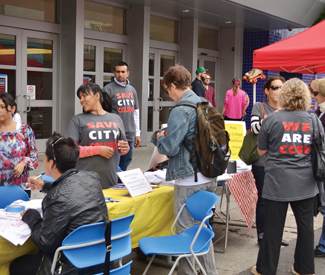
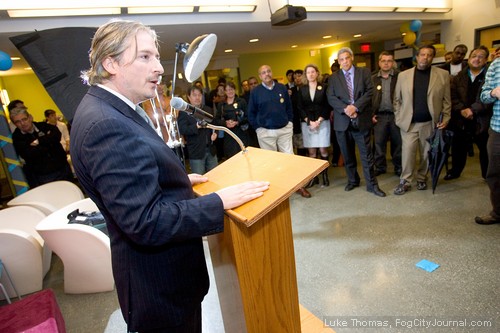
At the Ocean and Mission campuses, student organizers put on rallies that thousands of passers-by saw on their way to class. Volunteers holding “welcome weeks” events hosted music and speakers, and implored students walking past to talk into the mic about what CCSF means to them. Organized by the Save CCSF coalition that formed in July, the welcome weeks activities, which may include speakers, music, litterature, film screenings, and other events will continue until August 31.

“This is a community, not just a college. And right now, our community is under attack,” said Robert Chu, a former CCSF student who was volunteering with the welcome weeks events.

For Jason Bowden, another student who spoke at the rally, yesterday was the first day of college. Bowden said he is planning to earn his EMT certification and Associate Degree in fire science. “The dream is to be a firefighter,” Bowden said at the rally.

Bowden said he is confident the school will stay open. “Initially, I was freaked out,” he said. “But with 90,000 students, from a sociological perspective it would be disastrous. But I don’t want to say its not going to happen. Stupider things have happened.”

Chu said he was assisted by the Extended Opportunities Programs and Services Program (EOPS).“I’m actually an orphan,” said Chu. “EOPS supported me graciously and helped me out.”

The EOPS office is in a building near Ram Plaza, where the Ocean Campus rally took place yesterday. The adjacent Student Union building houses other programs that aid students, such as Students Supporting Students and the Multi Cultural Resource Center. Nearby, offices of the Veterans Educational Transition Services and Guardian Scholars program, which supports students coming to CCSF from the foster care system.  Some expressed concern that programs like these will be deprioritized for funding as the school tries to meet its accreditation requirements.

The rally’s backdrop was a banner reading “Keep community in community college. Accessibility and affordability are non-negotiable.”

Mission statement

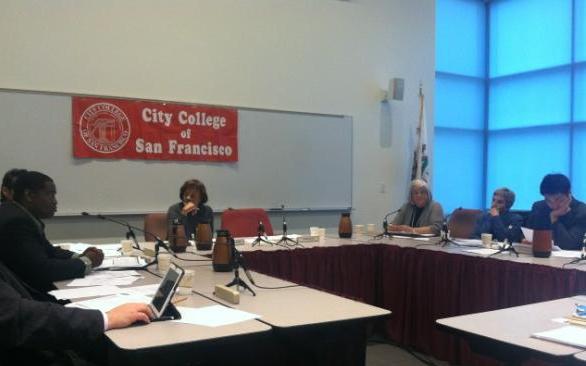
The evening before classes began, at an August 14 special board of trustees meeting, the trustees were discussing their priorities for CCSF moving forward.

The first recommendation in the accreditation board’s report regards CCSF’s mission statement.

“The team recommends that the college establish a prescribed process and timeline to regularly review the mission statement and revise it as necessary,” the text of the reccommendation reads. “The college should use the mission statement as the benchmark to determine institutional priorities and goals that support and improve academic programs, student support services and student learning effectively linked to a realistic assessment of resources”

In the wake of the accreditation crisis, the school set up 15 working groups to focus on different aspects of the process. The mission statement working group, tasked with evaluating the mission statement, and potentially, changing it, presented their work August 14– a new mission statement for the board to consider.

The board approved the first version of the new mission statement, which will be revisted at an August 23 meeting.

The new version includes a few changes. The new mission statement lists four goals: “transfer to baccalaureate institutions; acheivement of Associate Degrees in Art and Science; Acquisition of certificates and career skills needed for success in the workplace;” and “Basic Skills, including learning English as a Second Language.”

The goals that have been cut out of the mission statement: “Active engagement in the civic and social fabric of the community, citizenship preparation; completion of requirements for the Adlt High School Diploma and GED; Promotion of economic development and job growth” and “lifelong leaning, life skills, and cultural enrichment.”

The mission statement already read “CCSF provides educational programs and services to meet the following needs of our diverse community”; the new version adds the phrasing “that promote succesful leaning and student achievement.” Another phrase was added: “the college offers other programs and services supplementrary to our mission, only as resources allow and whenever possible in collaboration with partnering agencies and community business organizations.”

The mission statement working group was one of the first to complete their initial work. As Chancellor Fisher explained in the board of trustees meeting, “We need to finish recommendation one as early as possible because it will affect out planning.”

The working group that wrote the mission statement was comprised of faculty, administrators, trustees, and community members. No students were involved, until two– Associated Students president Shanell Williams and Student Senator Diamond Dave Whitaker– were added to the working group last week. Today, the mission statement working group, with its two new additional members, meets to discuss the ongoing process of documenting CCSF’s priorties. Their meeting is public and will take place 1:30-2:30pm at Batmale Hall.

Why?

44

steve@sfbg.com

Just a couple years ago, it seemed like the golden age of marijuana in San Francisco, the birthplace of the movement to legalize medical pot and a national leader in creating an effective regulatory framework to govern an industry that had become a legitimate, respected member of the business community.

More than two dozen patient cooperatives jumped through a variety of bureaucratic hoops to become licensed dispensaries, most of them opening storefront businesses that were often the most attractive, clean, and secure retail outlets on their blocks, sometimes in gritty stretches of SoMa, the Tenderloin, or the Mission.

“Pretty much everyone involved agrees that San Francisco’s system for distributing marijuana to those with a doctor’s recommendation for it is working well: the patients, growers, dispensary operators, doctors, politicians, police, and regulators with the planning and public health departments,” I wrote in “Marijuana goes mainstream” (1/28/10).

Since then, San Francisco’s medical marijuana industry has only become more established and professional, complying with new city regulations (such as changing how edibles are packaged to avoid tempting children), paying taxes and fees — and making very few waves. According to city officials, there have been almost no complaints from anyone about the dispensaries — and in San Francisco, people complain about everything.

But in the last six months, the full force of the federal government has brought the hammer down hard on this budding business sector, forcing the closure of eight brick-and-mortar dispensaries and instilling paranoia and insecurity in those that remain.

In just the past few weeks, two of the city’s oldest and most respected dispensaries –- HopeNet and the Vapor Room -– were forced to close their doors.

There’s been little rhyme or reason to which clubs get those dreaded letters warning operators and landlords to shut it down or be subject to asset forfeiture and prison time — and the officials involved have refused to explain their actions, except with moralistic anti-drug statements or unsupported accusations.

“These are people who played by the rules and paid their taxes, and now they’re being punished for it,” said Assembly member Tom Ammiano, a leader in creating a state regulatory framework to govern the distribution of medical marijuana, which California voters legalized in 1996. “This is pure thuggery. They are ignoring due process out of blind prejudice and ambition.”

Ammiano met with Melinda Haag, the US Attorney for the Northern District of California, who has coordinated the local crackdown from her 11th floor office in the Federal Building near City Hall, shortly after she announced her intentions to go after medical marijuana. He said she was like a throwback to a less enlightened era.

“In talking to Haag, not only is she a bit of a bully, but she’s totally uneducated about the issue,” Ammiano told us. When she told him that her office has received many complaints about the dispensaries, he asked to see them -– even making a formal Freedom of Information Act document request –- but she has yet to produce them. “Her duplicity is very moralistic, it’s like going back 100 years.”

Neither Haag nor anyone from the White House or Justice Department would grant an interview to the Guardian to discuss the reasons for and implications of the crackdown, or to answer the list of written questions her office asked us to submit. Instead, Haag gave the Guardian this statement and refused to respond to our follow-up questions:

“Although all marijuana stores are illegal under federal law, I decided to use our limited resources to address those that are in close proximity to schools, parks and playgrounds and operations so large that they constitute marijuana superstores. I hope that those who believe marijuana stores should be left to operate without restriction can step back for a moment and understand that not everyone shares their point of view, and that my office has received many phone calls, letters and emails from people who are deeply troubled by the tremendous growth of the marijuana industry in California and its influence on their communities.”

But in San Francisco, where more than 80 percent of residents consistently support medical marijuana in polls and at the ballot box, most people don’t share Haag’s point of view. And city officials contest many of her claims, from saying the dispensaries are “left to operate without restriction” to her implication that they promote crime or endanger children to the haphazard way she has targeted dispensaries to the characterization that many people are “deeply troubled by the tremendous growth of the marijuana industry.”

In fact, to talk to city officials, virtually nothing Haag says is true.

“We’re not getting nuisance complaints [about the dispensaries],” Dr. Rajiv Bhatia, the city’s medical director who oversees regulation of the dispensaries by the Department of Public Health, told the Guardian. “We’ve had very few complaints over the years and good cooperation with the storefront part of the regulations.”

Almost across the board, city officials and club operators praise one another and the cooperative relationship they’ve established over the last four years. Some of San Francisco’s biggest dispensaries have somehow avoided Haag’s wrath, but their once-open operators are now afraid to speak publicly, warily checking the mailbox each day. A thriving industry eager to pay its taxes and submit to regulation is being driven back underground, with all the uncertainty and hazards that creates.

“The question everyone is asking: Why here, why now, why these businesses? Nobody knows the answer,” Bhatia said. “We’re left to speculate and guess about motives.”

MULTI-AGENCY ATTACK

The federal crackdown has been stunning in both its speed and breadth, with various federal agencies coordinating their attacks. The IRS is auditing the biggest clubs and denying write-offs for routine business expenses, the DEA is threatening asset forfeiture efforts, and Haag and the DOJ are threatening prison time and court injunctions.

Underlying all of that is President Barack Obama, who pledged not to use federal resources to go after those in compliance with state law in the 17 states where medical marijuana is legal. Then, last year, Attorney General Eric Holder suddenly announced a new policy: “It will not be a priority to use federal resources to prosecute patients with serious illnesses or their caregivers who are complying with state laws on medical marijuana, but we will not tolerate drug traffickers who hide behind claims of compliance with state law to mask activities that are clearly illegal.”

When we sought an explanation and clarification from the White House Communications Office about why well-established medical marijuana collectives carefully operating under California law were suddenly deemed “drug traffickers” that wouldn’t be tolerated, they refused to answer and referred us to a statement Obama made to Rolling Stone magazine.

“What I specifically said was that we were not going to prioritize prosecutions of persons who are using medical marijuana. I never made a commitment that somehow we were going to give carte blanche to large-scale producers and operators of marijuana -— and the reason is, because it’s against federal law. I can’t nullify congressional law,” Obama told the magazine.

That simplistic explanation – which conveniently ignores how people are supposed to get this medicine – has infuriated local growers and patients. It’s particularly galling for those who supported Obama and took him at his word in the last election, and who don’t understand why he is suddenly escalating the federal war on drugs, ignoring local laws and values, and re-criminalizing their communities.

FUNERAL PROCESSION

Hundreds of medical marijuana supporters gathered on Aug. 1 for a New Orleans-style funeral procession at the Lower Haight intersection near where Vapor Room had operated -– without incident and with praise as a model business from three successive district supervisors –- from 2004 until the previous day.

The mood was festive and defiant on that sunny afternoon, where advocates from both sides of the bay gathered to express solidarity with the closed clubs and resolve to battle through the recent setbacks.

“I’m feeling the fight,” Steve DeAngelo, star of the reality television show Weed Wars and head of Oakland’s Harborside Health Center, which received Haag’s shut-down-or-else letter last month, told the Guardian. “I don’t think we can allow taking a few hits to break our spirit….We started this struggle to win it and we’re not going to stop until we do.”

Local politicians and business leaders also came to offer their support.

“As president of the Lower Haight Merchants Association, I’m upset that Vapor Room had to shut down,” Thea Selby, who is also running for the District 5 supervisorial seat, told us. “The Vapor Room did a lot of good for this neighborhood and was a great business.”

Marchers, most clad in black, carried “Cannabis is Medicine: Let States Regulate” and other signs -– as well as a makeshift coffin and massive puppet depicting a scowling Haag -– and danced down the middle of the street as Brass Mafia horns belted out lively jazz tunes. By the time the procession reached Haag’s office at the Federal Building, a chill fog had darkened the skies and the mood.

DeAngelo took the bullhorn first and called out Obama directly: “Either you were lying, sir, or your employees are out of step with your policies.” Steph Sherer, executive director of the DC-based Americans for Safe Access, told the crowd, “We need to tell Obama to lose Haag or lose California.”

Ammiano and the other mostly Democratic Party politicians who spoke tried to avoid putting Obama directly into the crosshairs of the angry activists, although he did say those executing this crackdown “are harming Obama’s chances of winning.” He also urged activists to put the pressure on politicians in Sacramento and Washington DC: “We need to be a voice in reshaping what’s happened in these last few months.”

Ammiano said the crackdown “empowers the cartels and the people who use violence,” contrasting that with San Francisco’s civilized approach to regulating marijuana.

“We in San Francisco have been a model for how to regulate this industry and we have been successful. We are not going to let the federal government interfere with our rights in this city,” Sup. David Campos told the crowd.

Cathy Smith, the founder of HopeNet, who was still reeling from watching her club gutted and shuttered the day before, also sounded an angry and defiant tone, urging supporters to make their voices heard by Haag and others.

“Everybody that’s here needs to go up to this evil woman’s office tomorrow and tell them what we think,” Smith said.

The general feeling was that if the feds can target model clubs like HopeNet and Vapor Room –- which had deep community roots and generous compassionate care programs for low-income patients -– then all clubs are in danger.

“I’m very upset that we’re losing two great medical marijuana dispensaries where patients could medicate on site,” said David Goldman, a local ASA activist and member of the city’s Medical Cannabis Task Force, noting how important that is for patients who live in apartments that ban smoking.

HopeNet and Vapor Room were some of the only dispensaries in town where smoking was allowed on site, because they were more than 1,000 feet from schools, playgrounds, or day care facilities, the city’s standard. Bhatia said that’s a very strict standard in a city as dense as San Francisco, which is why only four clubs ever met it.

Yet the feds saw things differently, ostensibly targeting HopeNet because a small private school opened two blocks away last year, and the Vapor Room because the feds didn’t use the city’s standard of being more than 1,000 feet from the playground at Duboce Park, instead deciding the dispensary was a community menace because it was a little under 1,000 feet from that dog-friendly park’s nearest patch of grass.

LAST DAYS

Vapor Room founder Martin Olive was a bundle of complicated emotions on the club’s last day in business (it will still operates as delivery-only, just like HopeNet, Medithrive, and a few other shuttered clubs have done). Initially, he didn’t want to talk to us: “I’m trying to keep a lower profile because it’s scary out there now.”

But he slowly opened up and tried to describe the feeling of watching his proudest accomplishment so rapidly undone by the one-two punch of a letter from the merchant services company cutting off credit card access (just like every dispensary in the city, returning pot sales to a cash-only status) followed days later by Haag’s shut-down letter.

“It’s complicated emotions that I’m feeling -– let down, confused. At the end of the day, I don’t understand why this is happening,” Olive said. “It’s a community tragedy, it really is.”

Vapor Room was a welcoming gathering place for its members and a supporter of a variety of community events and causes.

“I’ve always treated this as if it were just a nice coffee house. I’m not an outlaw,” Olive said. “I almost forgot I was breaking federal law. It was so normal, so legitimate.”

In fact, some club owners say their establishments helped clean up rough streets. “We took care of the entire block. Before us, it was all dealers, so there’s a safety issue,” HopeNet’s Smith told me as the once-welcoming club on 9th Street near Howard was reduced to bare walls.

Patients were also feeling the pain, including a 48-year-old ex-con who said he was paroled two years ago after serving 25 years in prison for attempted murder. “I have anger issues, big time. The only thing that keeps me calm and quiet and not blowing up is medical marijuana,” he told us, seething, before praising HopeNet’s “homelike environment” and supportive community. “It’s important to sit and relax in an environment that is comfortable and safe. All this is doing is pushing us into the streets.”

DRIVEN UNDERGROUND

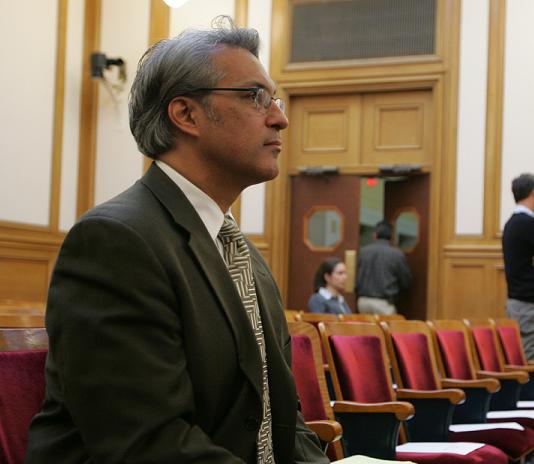
Before going through his latest official misconduct battles and fighting to return to his job as the elected sheriff, Ross Mirkarimi was the District 5 supervisor who sponsored the creation of the city’s medical marijuana regulatory system, the product of a long and arduous legislative process.

“We developed the system out of stark necessity because neither local government nor state government gave a roadmap to the dispensaries,” Mirkarimi said. “Prop. 215 legalized medical marijuana, but there were no rules around it.”

After an intensely collaborative process that lasted more than a year, the city in 2005 adopted a process for licensing dispensaries that balanced the needs of this nascent industry with concerns by police, patients, disability rights activists, neighborhood groups, and health officials. Mirkarimi said that maybe it’s time for city officials to consider an idea he floated a few years ago of having the city itself directly distribute medical marijuana through General Hospital.

“I still think that’s a good idea, particularly if the feds are going to force medical marijuana dispensaries back into the dark ages.” For all his praise of the city’s dispensaries, Dr. Bhatia will admit that the industry still needed better oversight -– dealing with issues such as standards for growing and transporting cannabis, fiscal transparency, and potency and dosage standards –- but the federal crackdown has scuttled his efforts to expand the city’s regulatory system.

“This DEA action stops us from making progress on the regulation of clubs that we need to make,” Bhatia said. “There are lots of issues, but we had just finished getting the clubs into their housing.” Now the industry is being driven back underground.

Ironically, Haag and other federal officials have accused dispensary operators of profiteering, which they’ll certainly be more free to do now that local officials have lost their leverage to begin regulating the finances of the supposedly nonprofit patient collectives that officially operate each dispensary.

“That was one of the areas that we never developed the tools or capacity to look at,” said Bhatia, who proposed more transparent record-keeping by dispensaries last year, only to have the operators express concern about how the feds might use that information, which turned out to be an understandable fear.

Davis snags a trio of top progressive endorsements

36

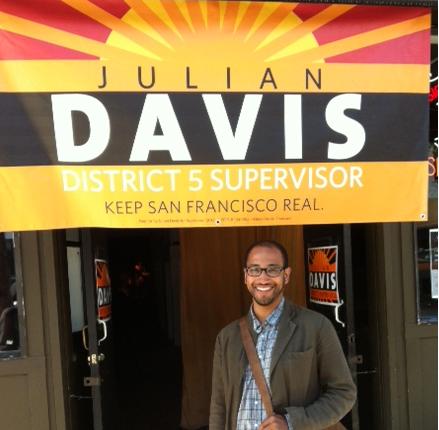
District 5 supervisorial candidate Julian Davis is emerging as the progressive standard-bearer in that competitive race after today receiving the endorsements of a trio of top progressive politicians: Sups. John Avalos and David Campos and attorney Matt Gonzalez, the former board president, mayoral candidate, and D5 supervisor.

Gonzalez had endorsed appointed incumbent Sup. Christina Olague – who he appointed to the Planning Commission in 2004 – but he withdrew that endorsement last month after being frustrated by a series of actions in which she sided with Mayor Ed Lee, moderates, and developers over her longtime progressive colleagues and constituents.

Avalos and Gonzalez are endorsing just Davis, at least for now, while Campos added to his early endorsement of Olague by today endorsing Davis and John Rizzo, who had earlier snagged the other prized progressive endorsement by winning the support of Assembly member Tom Ammiano.

Davis, who was already endorsed by former supervisor and local Democratic Party chair Aaron Peskin, said he’s thrilled with today’s triple endorsement. While some have questioned his anemic fundraising so far, raising less than $10,000 as of June 30, Davis notes that he had been in the race for less than a month before that deadline and that he expects to have more than $150,000 to get his message out.

“What these endorsements signal is a confidence from San Francisco’s progressive leaders, not only in the vision of this campaign, but in our capacity to win,” Davis told us.

Avalos said that he has confidence in Davis’ values, experience, and his ability to run a strong race that will help to reinvigorate the progressive movement.

“Julian is a solid candidate who has been around for years on a number of progressive causes. Running for mayor, I was impressed with his connection to neighborhood issues ranging from small business development to urban cycling and youth and worker rights. His campaign has a good buzz about it, one that I expect will resonate with District 5 residents,” Avalos told us.

In Richmond, is it safe to eat your garden fruits and veggies?

12

Questions remain about the safety of eating homegrown fruits and vegetables from gardens in Richmond and other areas affected by a fire at the Chevron refinery August 6.

The official line from Contra Costa County–where residents were told to shelter-in-place during Monday evening’s fire–is to wash the produce in your gardens extra well.

“It’s safe to eat your fruit and vegetables,” said Randy Sawyer, the county’s chief environmenta and hazardous materials officer. “We do recommend that you wash them in a weak soap solution like a dish soap.” If there was harmful residue on the plants, it would be visible, he said. “It wouldn’t be a dust product, it would be sooty.”

But local gardeners and environmentalists beg to differ, and many are anxious about the fire’s potential long-term effect on the area’s urban agriculture. At a tense community meeting on Tuesday night, gardeners from Urban Tilth rolled in wheelbarrows of wilted produce they said was destroyed by the refinery fire, which was contained after a few hours but burned into the night. 

“We have extreme concerns,” Urban Tilth executive director Doria Robinson told the Guardian. “We’re trying to work with soil and air quality scientists to figure out what we need to test and how we can test it to determine what is safe. In the meantime, we can’t stand by the food we have.”

Until we know what chemicals were burning in the fire and what remains in the air, it’s dangerous to assume our garden products are not contamminated, said Robinson, a Richmond resident herself. “If it’s particulate matter or dust, in theory you can wash it off. At the same time, you’re not exactly sure how certain chemicals react. More importantly, if you can wash the plant, what happens to the soil? Heavy metals like mercury are used in some processing. If that stuff was in the plume and it deposited in the soil” there could be lasting detrimental effects on our gardens, she said. 

When a Richmond resident at Tuesday’s community meeting asked what chemicals might be in the air, and Jeff McKay, Deputy Air Pollution Control Officer at Bay Area Air Quality Management District (BAAQMD), listed hydrogen sulfide, benzene, sulfur dioxide, and styrene. All four compounds are either considered poisonous, or suspected to be carcinogens. 

The BAAQMD’ lab analysis report tested for 23 compounds, including Benzene, but not the other three chemicals. Most of the chemicals “have been identified by the state of California as Toxic Air Contaminants,” according to the BAAQMD. And although the same report insists that the air pollution levels were “significantly below federal health standards,” the San Francisco Chronicle reported that 1,700 people ended up in the emergency room with respitory problems during or after the fire. 

Robinson said it is extremely difficult to trace health problems to individual pollutants. 

“The way that companies like Chevron have been able to pollute the air without liability is it’s extremely hard to trace back, and they can point to things like the highways,” she said. “This particular instance was so extreme that if we get a list of what was burning, we might be able to trace it back for the first time.”

Robinson and her team hope to have a plan to test Urban Filth’s produce by Monday, though she said financial barriers will make a comprehensive analysis difficult or impossible. Until the products are deemed safe, the organization is planning on suspending its school programs and refraining from eating from its 11 Richmond gardens, and Robinson urged residents to do the same with their personal plants.

“Before we take someone else’s word for it, we owe it to ourselves and our community” to ensure our food is clean, she said.

Outer limits

0

arts@sfbg.com

MUSIC Last year, we thought it couldn’t get better, and then it upped the ante. Outside Lands 2012 takes place this weekend, and the lineup is packed with legendary performers, reunited favorites, and flashy newcomers, pieced together (some overlapping) in a masterful Golden Gate frame, outlined by all that glorious flora and fog.

There’s little to debate; our inboxes have been unequivocally flooded with requests to cover the event from the moment the full list roared onto the web. Who’s to say what sparked the revved up offerings and subsequent queries?

The facts: 72 bands on stage, 15 DJs in the Dome, 25 comedy-variety acts in the Barbary, plus 10 night shows featuring 20 performers. Expected attendance is more than 65,000 people per day, according to the organizers.

It’s a lot to take in, even for the seasoned San Francisco festival-goer (keep hydrated, wear layers, duh). So we’ve whittled down the schedule to the must-sees — those with a certain unscientific combination of vitality and vigor, of historical significance and a very-modern presence.

Of course, if you’ve got a one or three-day pass, you’re likely planning on packing in as many acts as possible, with perfectly timed bathroom, wine, and gourmet food stand breaks. But if you’re of the looser sort, one to wander with feckless abandon among those throngs, keep the below in mind.

Here are your must-see Outside Lands performances:

THE BIG ONES

Headliners and icons

Watching an old friend dance with his bride to iconic folk ballad “Harvest Moon,” it dawned on us: despite his gruff persona, broadly influential singer-songwriter Neil Young & Crazy Horse (8:10-9:55pm Friday, Lands End) is for lovers. And his words — and strumming — are deeply personal for a handful of generations. They’ve left a yearning imprint on our collective pleasure center.

This is a grand return for ’90s indie rockers, Grandaddy (5:10-6:10pm Saturday, Sutro). The Modesto five-piece split in 2006, after a respected career that included touring with Elliott Smith (RIP) and a song, “AM 180,” used in a memorable zombie-less supermarket sweep scene in 28 Days Later.

Kill ‘Em AllAnd Justice For All…okay, and we guess St. Anger. The heavy metal — and then some other stuff — back catalogue of Metallica (7:55-9:55pm Saturday, Lands End) is forever drilled into our brains. In a press call leading up to the fest, drummer Lars Ulrich said, “we’re very proud of our…relation and our history with San Francisco,” (does that mean the band will do us a solid and play early tracks?), later adding, “it’s an amazing thing, 31 years into a career to be able to be as busy as we are and to [see] people give a shit and to be able to still tour.” We give a shit, Lars.

As one fan noted, Mr. Superstition, Steve Wonder (7:20-9:30pm Sunday, Lands End), is likely the most creative choice of a headliner in 2012. And it makes the night-map easy for some of us; in the scheduling contest between dub-monster Skrillex and Motown icon Stevie Wonder, there is no contest.

LOCALS ONLY

Best of the Bay represented

It’s been five years since Two Gallants (1:50-2:40pm Friday, Lands End) released an album, and this fest (along with the OL night show) are the first local shows for the folk-punk duo touring on the new record, The Bloom and the Blight. Seems they’ll have a lot of stowed away energy to release in the park.

Perhaps never has man and computer so beautifully collided than with San Francisco digi-rock act Geographer (2:10-2:55pm Saturday, Twin Peaks). Swelling vocal melodies blend so evenly with darting beeps and blurps and laser synths, sometimes deepened by floating violin. It’s hard-rocking orchestral pop, operatic robot love, and world travel in a machine. The band paid its dues playing Rock Make, Treasure Island, Live 105’s BFD, and now, Outside Lands.

These San Francisco pysch-surf-punks are notorious for their headspinningly prolific songwriting, unpredictable live shows, and spastic energy. Regardless of what happens during Thee Oh Sees (6:05-6:45pm Saturday, Panhandle) set, it’ll be an act people are talking about.

THE ANDY WARHOL FACTOR

Who everyone will be Tweeting about

Having just premiered barely pronounceable single “XP€N$IV $H1T” (“I rub my dick on XP€N$IV $H1T” being actual lyrics) it’s safe to assume that Southern African freak-rap trio Die Antwoord (5:25-6:15pm Friday, Twin Peaks) is going to continue down a path of what-the-fuck-did-I-just-witness trashy splendor. There will be rave wear and Ninja’s inexplicable junk-thrusting dance moves, DJ Hi-Tek records spinning, and Yo-Landi’s hyper-high chirp.

When Father John Misty (2:55-3:35pm Saturday, Panhandle), a.k.a. J. Tillman of Fleet Foxes, stopped by Bottom of the Hill earlier this year, folks didn’t know what hit them. FJM was a wild force on stage, engaging in an ongoing and increasingly odd conversation with the audience, with quips and asides a-plenty in between a hectic set of woozy pop and crunchy-hippie psychedelic jams.

Perhaps not since Janis Joplin, have we heard a lady blues vocalist with pipes this powerful. That wail is a show-stopper. And, four-piece Alabama Shakes (3:50-4:40pm Saturday, Sutro), led by Brittany Howard (she of the powerful pipes), is actually born and raised Alabama, as the band name would imply, meaning its a more authentic experience, it would seem.

After a prolonged break, Santigold (5:10-6pm Sunday, Twin Peaks) dropped long-awaited Master Of My Make-Believe this year, with reggae-flecked party jam single “Disparate Youth,” cut through with a machine-gun guitar riff. Clearly, Santigold is no less bold in her return. Both the sound and her avant-pop style will surely absorb those expansive outdoor stages.

WORLD TRAVEL

Globally relevant bands from far and wide

Sigur Ros is not the only Icelandic band at Outside Lands 2012. If ambient soundscapes aren’t your thing, check out the lesser-known folk sextet Of Monsters and Men (5:25-6:25pm Friday, Sutro), which balances catchy melodies with beautifully harmonized vocals. Amadou & Mariam (3:35-4:25pm Sunday, Twin Peaks) met at Mali’s Institute for the Young Blind. What the African duo lacks in 20/20 vision they make up for in mesmerizing sound — irresistible hip-hop-and blues-inspired world music. We dare you not to dance. Globally recognized Columbian culture-masher band Bomba Estéreo (6-6:40pm Sunday, Panhandle) mixes in the sounds of Latin America, the Caribbean, reggae, dub, and beyond, with bouncy hip-hop beats. Live, lead vocalist Li Saumet (who this year also released a side-project in which she imagines killing her boyfriend) pumps up the energy tenfold.

SONIC BREAK

Explore beyond the music

Imbibe in yeasty concoctions at this year’s first ever Beer Lands (oui, Wine Lands will be there too). And the beer lineup is made up of local craft breweries: 21st Amendment, Anchor Brewing, Magnolia, Pac Brewing Labs, Speakeasy (all San Francisco); Bear Republic (Russian River area), Drakes, (San Leandro) and Linden Street (West Oakland). Oh, and Sierra Nevada is debuting the Outside Lands Saison at the fest, said to be inspired by OL itself. Reggie Watts, Neil Patrick Harris, David Cross, Kristen Schaal, Nerdist Chris Hardwick, the list goes on for The Barbary. The comedy and variety tent keeps getting bigger, and weirder. There are the big names of course (see above) but also some awesome homegrown talent — Jesse Elias, for one. We caught him in the Cinecave last month, and were blown away by his timing. Our cheeks ached from laughing. And he never once looked up at the audience, only moving to push his glasses back up his nose.

OUTSIDE LANDS MUSIC AND ARTS FESTIVAL

Fri/10-Sun/12, noon, $95

Golden Gate Park, SF

www.sfoutsidelands.com

Olague faces her challengers during first D5 debate

58

Tonight’s inaugural District 5 supervisorial debate will be a key test for Sup. Christina Olague – who has fallen from favor with many progressives after a series of bad votes and prickly or evasive interactions with one-time allies – and a test for the rival candidates who are seeking to become the main progressive champion in one of the city’s most leftist districts.

The elected incumbents on the Board of Supervisors have ended up with surprisingly easy paths to reelection [8/9 UPDATE: with the exception of Eric Mar in D1], leaving D5 – as well as conservative District 7, where FX Crowley, Norman Yee, and Michael Garcia are part of a competitive field seeking to replace termed out Sup. Sean Elsbernd – as the race to watch this year.

Olague has been trying to execute a tough balancing act between the progressive community that she’s long identified with and the moderates she began courting last year with her early support for Mayor Ed Lee, who returned the favor and appointed her to serve the final year of Ross Mirkarimi’s D5 term. But by most accounts, she hasn’t executed the feat well, usually siding with Lee on key votes, but doing so in a waffling way that has frustrated both sides.

Progressive candidates such as Julian Davis and John Rizzo will have plenty of fodder with which to attack Olague as a turncoat, including her votes on the 8 Washington project and Michael Antonini, her strange antics on repealing ranked-choice voting, and her close ties to power brokers such as Rose Pak, who hosted a fundraiser that provided more than half of the $81,333 Olague has raised this year, much of it from developers and other interests outside of D5.

Matt Gonzalez – the former D5 supervisor, board president (from where he appointed Olague to the Planning Commission), and mayoral candidate – was so frustrated with Olague that he withdrew his endorsement of her last month, a decision that her other progressive endorsers are also said to be mulling.

With Mirkarimi tarnished by his ongoing official misconduct probe, the endorsement of Gonzalez could be the most significant in this race, and he told us that he plans to make a decision by Friday, the deadline for submission of ballot statements and a point at which we may hear about other changed or dual endorsements from prominent progressives. Other key nods in the race so far have been Aaron Peskin endorsing Davis and Tom Ammiano endorsing Rizzo, two candidates each vying to become the favorite of the left, with Thea Selby, Hope Johnson, and Andrew Resignato also courting support from the left.

Yet so far, the strongest challenge of Olague seems to be coming from her right, with moderate London Breed leading the fundraising battle with $85,461 as of late June 30, including the maximum $500 donation from venture capitalist Ron Conway – the main fundraiser behind Lee’s election last year – which may be a sign that Olague’s support among moderates is also soft.

Olague may be trying to get back in good with the progressives, last week introducing pro-tenant legislation sought by the San Francisco Tenants Union. But impressions have formed and the pressure is now on, and so far Olague – who didn’t answer our calls seeking comment, another troubling trend – hasn’t performed well in public appearances, mangling organizations’ names and generally not winning over her audiences.

Will Olague step up now that the campaign in entering its public phase? Will another candidate catch fire with progressives? Find out tonight from 6-7:30pm at the Park Branch Library, 1833 Page Street. It’s sponsored by the District 5 Democratic Club, the D5 Neighborhood Action Committee and the Wigg Party.

Or if you miss it, catch the next one on Tuesday, sponsored by the Harvey Milk Democratic Club, starting at 7pm in the Eric Quezada Center, 518 Valencia Street.

Poppin’ off

1

TRASH The late, beloved Werepad begat the Vortex Room, the former closing when co-founder Jacques Boyreau moved from SF to Portland, Ore. But ties between those concerned with both venues remain tight, and August is a big month for them all. Firstly, it sees the release of Boyreau’s latest coffee table tome, Sexytime: The Post-Porn Rise of the Pornoisseur (Fantagraphics, 96pp., $29.95). Really, you might ask, does there need to be a book devoted to full color reproductions of posters from the “golden age” (circa 1971-82) of XXX features?

Ohhhh yes. These hundred pages excavate a retro wonderland of film-shot sleaze with the usual tasteless ad lines (Finishing School: “She took a cram course in pleasure”) and graphics variably dime-novel crude, psychedelic, and disco-era slick. There are titles topically trendy (CB-themed Breaker Beauties; Erotic Aerobics; Patty Hearst-inspired Tanya) and parodic (Blazing Zippers; One Million Years AC/DC; Flash Pants). There’s even cautionary sexploitation, as the sheet for 1976’s Female Chauvinists warns “DO YOU KNOW: Women libbers are planning to take over the world? That they have recruiting camps in every corner of this planet?” So that’s where Rush learned about feminism.

Meanwhile back at the Vortex, the venue’s fifth anniversary is being celebrated through the month’s end with a Pop art-themed series of Thursday night double bills. It doesn’t get any more Pop, or Op, than incredible and inexplicable The Touchables, which despite its obscurity today was actually a mainstream 20th Century Fox release in 1968. Ah, the Sixties. This was just a simple tale of four Swinging London model types who, after stealing a Michael Caine dummy from Madame Tussauds, decide to be more ambitious and kidnap a live male pop star. They then take him to their giant-inflatable-plastic-dome country hideaway, torture him with sex play and go-go dancing, and unknowingly await the arrival of gangsters hired by a gay wrestler who also covets the abducted lad.

You know, that old story. Keen minds thought up this insanity: Robert Freeman, the Beatles’ “official” photographer making his directorial debut, cooked up the screenplay with Ian La Frenais (future Tracey Ullmann collaborator) and Donald Cammell (soon to be responsible for 1970’s Performance and 1977’s Demon Seed). The Touchables‘ co-feature is the almost equally daft Deadly Sweet (1967), another Swinging London artifact, albeit one directed by Italian Tinto Brass, who had yet to meet Caligula or his true calling as ass-man equivalent to Russ Meyer’s boobaholic in the softcore sexploitation hall of fame.

Next week things settle down a bit with Streets of Fire, Walter Hill’s fetishistically stylized 1984 music-video fable, and 1971’s Captain Apache, a weak Euro Western enlivened by a trip sequence and Carroll Baker’s apparent belief that she’s acting in a farce.

Then the weirdness level rises dangerously again August 23, with two lysergically bent missives from the “turbulent” decade. From 1969, Cult of the Damned (a.k.a. Angel, Angel, Down We Go) is the least-known of American International Picture’s psych flicks, and no wonder — compared to giddy The Trip (1967), Psych-Out (1968), and Wild in the Streets (1968), it’s a twisted downer. Future feminist singer-songwriter icon Holly Near plays the plump, unhappy only child of a jaded Hollywood couple whose household is seduced whole by rock singer Bogart (Jordan Christopher) and his entourage. Advertised with “If You’re Over 30 This Is A Horror Story,” Robert Thorn’s only directorial feature is rancid, baroque, and bizarre to no end, offering the opportunity to hear Roddy McDowell say “Baby man, I am just sexual. Like sometimes I can just stare at a carrot and baby man, that carrot can turn me on,” as well as Jennifer Jones (as mom) brag “I made 30 stag films and never faked an orgasm.” (It should be noted that shortly after completing her role, Jones had a nervous breakdown.) Cult‘s co-feature is 1962 sci-fi oddity Creation of the Humanoids, which was purportedly Andy Warhol’s favorite movie — that should be recommendation enough.

The series’ final bill moves upmarket to showcase two expensive early 1970s flops. You may search in vain for defenders of 1972’s Bluebeard, which features Richard Burton as the famed ladykiller and an array of Eurobabes as his victims — alas, not including American lounge-act extraordinaire Joey Heatherton, whose final wife is by far the most annoying but lives to tell. For a movie that features Raquel Welch as a nun, it’s pretty slow going, despite some imaginative production design and hints of a satirical zest that old-school Hollywood director Edward Dmytryk just couldn’t grok.

A more rewarding curio is 1974’s 99 and 44/100% Dead, a gangster spoof that supposedly represented a career nadir for director John Frankenheimer. (Actually, his nadir came the prior year with Story of a Love Story, one of those movies so interesting in concept and cast you can’t imagine it’s worthless — until you see it.) What can you say about a film that features Chuck Connors as a thug who screws different lethal weapons into his severed arm socket? Plus a rare appearance by the mysterious Zooey Hall of I Dismember Mama (1972) and Fortune and Men’s Eyes (1971)? That it can’t be all bad, and in fact it isn’t.

POP GOES THE VORTEX

Thursdays through Aug. 30, 9pm, $7

Vortex Room

1082 Howard, SF

Facebook: The Vortex Room


Impertinent question for Sup. Malia Cohen

14

As attentive readers know, I get most annoyed when a “neighborhood” supervisor, who ran as a “neighborhood” candidate, gets to City Hall and then votes the Chamber of Commerce/big development line without gulping.  And so I pop off Impertinent Questions now and then to pin the “neighborhood” supervisor on key votes  to illuminate the issue.  My latest Impertinent Question went by email last Friday  to Sup. Malia Cohen of District l0 (Potrero Hill, Bay View, Hunters Point) on her swing vote to keep the developers’ quarterback on the Planning Commission. City Editor Steve Jones  makes the point neatly  about Michael Antonini in his blog.  http://www.sfbg.com/politics/2012/08/01/antonini-quarterback-development-interests-wins-game

Cohen has earned an 80 per cent vote in the recent Chamber of Commerce’s mid-year “Paychecks & Pink Slips” voting scorecard for supervisors. And she is likely to do even better on the next score card with her votes for astroturf at Golden Gate Park and to shut down the Sunshine Task Force.                                                                                    

“Dear Sup. Cohen,

“Why did you as a neighborhood supervisor from District l0,  a neighborhood anxious about massive development from Potrero Hill to Hunters Point,  provide the swing vote for Antonini who operates as a quarterback for big development interests on the planning commission?  I would appreciate an answer for my Bruce blog at sfbg.com.”  I gave the supervisor a Monday deadline but I still had not heard from her by Tuesday evening.. I’ll keep trying to reach her for comment and keep you posted. B3


Saving City College

43

news@sfbg.com

CAREERS AND ED City College of San Francisco (CCSF) is fighting for its life, and that struggle has turned old enemies into new allies. Suddenly, past differences seem less important than the need to work together, bringing a new sense of unity and purpose to the troubled community college.

In June the school was sanctioned and ordered to “show cause” from the Accrediting Commission of Community and Junior Colleges, putting it on the brink of losing its accreditation — certification necessary for the college’s degrees to be worth anything and for the school to secure federal aid (see “City College fights back,” July 17).

Twelve workgroups comprised of faculty, staff, administrators, students, and college board members are working feverishly to prove by October that the school is making major progress. Otherwise, it could face dire consequences.

While few people with any education or political background believe the school will actually close, there are serious consequences if its accreditation is revoked. A special trustee assigned by the state chancellor’s office could assume the powers of the college’s board or the school could be merged with another community college district.

The only college in California to ever suffer both of those fates was Compton Community College in 2006. Though the two colleges serve wildly different communities, many speak of their fates in the same breath. Its shadow hangs over City College like a ghost of what is to come.

WORKING TOGETHER

The newfound sense of common purpose was displayed on Aug. 1 in CCSF conference rooms, where once-battling special interest groups and employees gathered to tackle problems that have plagued the school for years.

The feuds aren’t just of interest to political geeks and college insiders. Infighting and a dysfunctional governance structure had stalled the school from tackling urgent issues, according to the accrediting commission.

“During interviews, criticism regarding the efficiency of the institutional governance process was revealed. The criticism centered on the length of time to reach a recommendation. It was also noted that there may be misunderstanding regarding the role of a recommending body versus a decision-making body,” according to the commission’s report.

That snippet of the 66-page critical report represents years of strife at the school, not only among the school’s elected trustees but also between the board and other college groups on issues ranging from placement testing to school site closures.

The 12 newly formed workgroups — constituted by the Chancellor’s Office and comprised mostly of faculty, administrators, and trustees — met to discuss issues and make recommendations to the system’s decision-making authorities: the Chancellor’s Office and Board of Trustees. One of the workgroups is in charge of evaluating that very decision-making system, with 14 people from different college constituencies hashing out a new style of democracy for the school.

At their first meeting, the members brought in stacks of papers to hand out — research on best practices and policies in college governments around the state and the nation. This particular workgroup discussed how an ideal student government should run, and how to enact those changes at City College.

The workgroups are brainstorming sessions, and each one has a different task ahead of it, including how to measure student learning, leveraging technology to streamline the school, facilities planning, and fiscal planning. Each workgroup acts independently, although some themes and members overlap.

The Board of Trustees is scheduled to meet and report on the progress of the workgroups on August 14 — the day before fall semester classes begin.

A final, preliminary report based on the findings of the dozen workgroups is expected to be completed before the accrediting commission’s October 15 deadline. With everything on the table, from staff layoffs to campus closures, CCSF is an anxious institution facing an uncertain future.

THE GHOST OF COMPTON’S PAST

In Compton, faculty and staff lived in constant fear of losing their jobs between 2002 and 2006, while the school was at risk of losing accreditation. Its path offers some lessons for CCSF.

“From three or four years prior to the accreditation being revoked, every March everybody got a pink slip and then you found out, you know, whether or not you actually had a job to come back to the next year,” Ann Garten, the community relations director of El Camino Community College District, told the Guardian in a phone interview.

El Camino swooped in to save Compton from total closure when its accreditation was revoked in 2006. The fate of employees at City College is a mystery for now, but based on Compton’s experience, part-time faculty are most at risk.

During spring semester, City College had nearly 1,700 instructors, approximately half of which were part-timers, according to college payroll documents. The school’s faculty are represented by the American Federation of Teachers Local 2121.

Classified workers — those who perform services such as administrative support, technology services, and grounds maintenance — could also be at risk. Their numbers exceeded 800 during the last fiscal year, according to the school’s assistant director of research, Steve Spurling.

They are represented by the Service Employees International Union Local 1021, a large and active union that also represents most city workers. In recent years, both unions have already taken pay cuts and freezes on raises and accepted furlough days to help plug the college’s fiscal holes.

If a special trustee were to take over, these workers would become even more vulnerable. But even without a special trustee, will there be layoffs?

Though there is no definitive answer yet, “everything needs to be on the table,” Trustee Steve Ngo told us. Yet most indications are that part-timers are at the most risk.

“I’m not convinced [full time faculty] pay cuts are what is called for. Our part time is the highest paid in the country,” CCSF Chancellor Pamila Fisher told the Associated Student Presidents, made up of elected leaders from CCSF’s eight main campuses. “We pay them health care. That’s unheard of” and could be re-evaluated, she said.

Yet it’s also possible that more creative and aggressive fundraising could save the part-timers and other college functions. Alisa Messer, president of AFT local 2121, said statewide categorical funds exist expressly to help fund part time faculty health care costs, she said, although not all colleges follow through.

“AFT 2121 has been a leader in this state, and in fact in the nation, on increasing parity for part-time/contingent faculty,” Messer said. “We will not allow this crisis to be an excuse to roll back significant progress that has been made on the rights of our most vulnerable faculty.”

The commission’s June report dinged the school for spending higher than average levels on salaries and benefits, 92 percent of their funds to be exact, while other community colleges in the Bay Area have figures in the low to mid 80s.

Yet many of CCSF’s defenders say that comparison isn’t fair or accurate, noting San Francisco’s higher cost of living and the fact that the district provides health coverage to part-time faculty, which most other community colleges in the state do not provide.

SERVING STUDENTS

As the college unites, many conflicts that remain boil down to the question of open access. CCSF currently operates with what it sees as a true community college ethos, where the varied needs of a diverse student population are balanced.

Recent high school graduates preparing for transfer mingle with adult students continuing their education, while English as Second Language (ESL) learners work towards proficiency and others seek new technical skills or transition to a new career.

Many students also take so-called “personal enrichment” courses — one time classes in the arts or languages, for example — that state government has de-prioritized as the budget hole has gotten deeper.

“I think we have to spend money better,” Ngo said, concerning “non-credit” courses, which are primarily classes for adult learners. He pointed to the fact that ESL classes are a full semester long, despite a unique “hop in, hop out” structure to the lessons, which gives students flexibility in their attendance over the course of the semester.

Reducing the number of weeks in a semester that those classes meet could be one possible strategy for saving money, he said. He emphasized that the college needs to work with hard data, and that calculations from what could be saved by such moves aren’t finished.

The number of campuses within the district is also being re-evaluated. “Yes, one of things we’re looking at is whether we should have nine sites. Centers may be combined. We don’t know if that will pay out yet,” Chancellor Fisher told the student presidents, referring to complex funding formulas that could actually prevent CCSF from saving money by closing campuses.

Fisher said officials are researching the possibility of combining campuses in close proximity, which drew a mixed reaction from the presidents. Bouchra Simmons, the Downtown Campus student president, said that combining the Civic Center and Downtown campuses would be disastrous.

“[Downtown Campus] is already pushed to capacity in terms of class size,” Simmons said. And the reverse, moving Downtown Campus students into Civic Center, would make it difficult for her to drop her daughter off at child care and still be able to make it to school on time.

Emanuel Andreas, Southeast Campus president, disagreed when it came to his constituents. “We understand what is happening, and everything needs to be on the table,” he said.

The threat of campus closures and a reduction in non-credit classes are all part of the attack on open access, as some students have said. To combat that, they’ve formed a new student group aimed at educating the city about what they stand to lose.

Project Unity is comprised of Occupy CCSF students, former student trustee Jeffrey Fang, student body President Shanell Williams, and other students, led by the newly elected student Trustee William Walker. They’ve rallied for their school at City Hall, where Supervisors Eric Mar and John Avalos have sponsored a resolution to support City College.

Project Unity met at the Mission Campus shortly after supporting the resolution, and started to plan a grassroots campaign to educate the city and its residents about open access.

Bob Gorringe, a member of Occupy San Francisco, was on hand to help the fledgling group strategize. “[Trustee] Anita Grier came out to the Occupy action council, and she was very open,” Gorringe told the group on July 31, referring to the longtime board member who is not exactly known for her radical tendencies.

Students taking such a vested interest in their college should come as no surprise, considering what happened to Compton before it folded into El Camino.

Although Compton never actually closed, it hemorrhaged students as public fears of the college closing grew larger, and the student body dropped to around 2,000 when El Camino took over, Garten told the Guardian.

Some students went elsewhere, but many appear to have just abandoned the education system.

“We looked at two or three colleges around Compton and none of us had a significant increase in students from the Compton district” enrolling, Garten said.

In other words, it looked like many disillusioned students had simply dropped out, something that nobody wants to see in San Francisco.

MOVING FORWARD

Just over two months remain for CCSF and its supporters to hash out a preliminary plan. Aiding them is a team of experts that will create a detailed report on everything related to the college’s financial woes — possibly the most critical problem area.

The Fiscal Crisis and Management Assistance Team, or FCMAT, explained their process to the college on August 3.

Without revealing any specific details, Michelle Plumbtree, the chief management analyst of FCMAT, warned an audience of a couple dozen interested people that its report would seem negative, but only because that’s exactly what the report is supposed to be: a critical review of problem areas.

“You guys are doing incredible things…But that’s not what we talk about [in our reports],” Plumbtree said.

Mike Hill, another FCMAT team member, succinctly layed out the biggest obstacles to City College’s fiscal future. “This is not a one year problem…We’re looking at three years. What makes that complicated is the governor’s tax, and the parcel tax,” Hill said, referring to Prop. 30 and the San Francisco ballot measure City College sponsored. “There are four scenarios… It’s not predictable.” Prop. 30, the tax measure placed on the ballot by Governor Jerry Brown, wouldn’t raise new revenue for community colleges. If it passes, they simply break even, staving off more drastic cuts. But the parcel tax offers more hope for CCSF, if city voters approve it. It would free up $14 million in revenue for this fiscal year, restoring some of what was lost and prevent the deep cuts and scaled back mission that the school’s support most fear.

Supervisors prepare to receive Mirkarimi case from Ethics

37

The Board of Supervisors this week adopted a plan for considering ousting their former colleague, suspended Sheriff Ross Mirkarimi, on the official misconduct charges brought by Mayor Ed Lee in connection with Mirkarimi grabbing his wife’s arm on Dec. 31. The Ethics Commission is scheduled to make its final recommendation on Aug. 16, after which it will cull together the mountain of documents and evidence developed over the last four months.

Ethics Commission Executive Director John St. Croix tells the Guardian that it will take at least three weeks after the commission votes to compile an official record that already includes documents that now fill three five-inch-thick binders, which will grow with the “findings of fact” and recommendations that the commission will adopt on Aug. 16.

So the board won’t formally get the case until Sept. 6 at the earliest, at which point it will have a City Charter-mandated 30 days to make a decision, which requires at least nine votes from the 11-member board to remove Mirkarimi from office. Board sources say they want to give supervisors some time to review the voluminous record before the hearing, but still allow for a continuance if necessary, making the likely hearing date Sept. 18 if all goes according to schedule.

“Everything we have so far is available online, so if they wanted to get a head start, they’re welcome to,” St. Croix said of the supervisors.

Despite the fact that the commission spent lots of painstaking hours ruling on the admissibility of evidence – including cutting out most of the 22-page declaration of Lee’s star witness, Mirkarimi neighbor Ivory Madison, with commissioners ruling it was a prejudicial attempt to “poison the well” – St. Croix said the entire record will be passed on to supervisors, with strike-throughs or similar indicators for evidence ruled irrelevant or prejudicial.

“It’s got to be easy to understand because once the board gets it, the 30-day clock is ticking, so it needs to be clear,” said St. Croix, who says he is still weighing how much of the evidence can be transmitted electronically versus in paper form.

The Ethics Commission opted not to explore accusations that Mayor Lee committed perjury on two separate issues during his live testimony, but the issue of whether he consulted with any supervisors is likely to come up again as it goes to the board. Supervisors, who essentially act as jurors in these proceedings, have been legally barred from discussing the case, particularly with Lee.

Building Inspection Commissioner Debra Walker said her friend Sup. Christina Olague told he that Lee once asked her about filing charges against Mirkarimi. Olague denied it, but then told reporters that she may recuse herself from the case. One other supervisor is also rumored to have discussed the case with Lee (who denied it under oath).

When Mirkarimi attorney David Waggoner addressed the board on Tuesday, he asked them to affirmatively declare they have not discussed the case with anyone before deliberating. Any supervisors who recuse themselves would become de facto votes to keep Mirkarimi in office because doing do still takes nine votes, no matter now many supervisors actually vote.

Waggoner also objected to the short schedule – which includes a 10-minute presentation by a representative from Ethics, 20 minutes by the Mayor’s Office, 20 by Mirkarimi’s side, a five-minute mayoral rebuttal, and unlimited questions from supervisors and public comment – saying that it belies the serious and unprecedented decision to override voters and remove an elected official.

“This proceeding is extraordinary in its nature,” he said, objecting to the board adopting essentially the same procedures it uses for appealing routine Planning Commission project approvals.

But St. Croix said he welcomed the board’s shortening of his agency’s presentation, saying its recommendation and the record it compiled should speak for itself. “I don’t even know what the commission would present,” he said. “To try to sell it is not seemly.”

Antonini, quarterback for development interests, wins the game

20

If there was any doubt about the loyalty to developers of Planning Commissioner Michael Antonini, he put them to rest yesterday shortly after finally winning reappointment to a fourth, four-year on a 6-5 vote by the Board of Supervisors. Afterward, in comments to Examiner reporter Joshua Sabatini, Antonini likened his role on the commission to that of a successful football team’s quarterback.

“You want to knock out the quarterback for the other team,” Antonini said. “It’s a tribute in a way – backhanded.”

The five supervisors who opposed Antonini – Sups. David Chiu, John Avalos, David Campos, Eric Mar, and Jane Kim, the board’s most progressive members – seemed to understand that Antonini saw himself playing for the developers and big corporations that see San Francisco mostly as a place to make money, even at the expense of eastern neighborhoods and the city’s long-term interests.

The voting record of this Republican dentist – an elected member of the San Francisco Republican County Central Committee who advocates for right-wing causes (such as crackdowns on the homeless) and candidates – makes clear which team Antonini plays for, and it isn’t the same team as the vast majority of people in San Francisco, where Republicans constitute less than 10 percent of the electorate.

It says a great deal about the corporatist politics of Mayor Ed Lee for re-appointing him, as well as the politics and integrity of the swing votes, Sups. Malia Cohen and Christina Olague, the Lee appointee now running for election in District 5, one of the city’s most progressive districts.

Both supervisors mouthed meaningless platitudes and justifications for their votes, but in reinstating the developers’ quarterback just as the progressives were about to remove him from the game, one wonders what team they’re playing for – or whether they even understand the dimensions of the game they have unexpectedly found themselves playing.

But Antonini clearly understands. And despite the ridiculous statements that Cohen and Olague made about holding him “accountable,” Antonini now has four more years to continue leading a team that is rapidly gentrifying San Francisco, making it more inviting to the Google-busers and Twitterati and their landlords, but less so for the average teacher, clerk, and social worker.

Dick Meister: Good news–and bad–about jobs

2

By Dick Meister

Dick Meister, former labor editor of the SF Chronicle and KQED-TV Newsroom, has covered labor and politics for more than a half century. Contact him through his website, www.dickmeister.com

It’s of course good news that unemployment among workers in private industry has been steadily declining. But that comes along with the bad news that unemployment among public employees has been growing – and with it a decline in vital government services.

A recent  report in the New York Times has made that very clear.  Reporters Shaila Dewan and Motoko Rich noted that government payrolls grew in the early part of the recovery from the Great Recession in 2009, mainly because of federal stimulus measures. But they said that since then, “the public sector has shrunk by 706,000 jobs.  The losses appeared to be tapering off earlier this year, but have accelerated for the last three months, creating the single biggest drag on the recovery in many areas.”

Albeit slowly, the economy generally has been improving, with state tax revenues expected to go beyond pre-recession levels by next year.  Yet the Times’ reported that “governors and legislatures are keeping a tight rein on spending, whether to refill depleted rainy day funds or because of political inclination.”

Holding tight won’t be easy, with the costs of health care, social services, education and employee pensions steadily rising, and property taxes and other tax revenues steadily shrinking.  More than a dozen states have tried to do it by trimming their aid to local governments. And that will undoubtedly lead to more public worker layoffs, more unemployment and more reductions in important public services.

Local governments already have been making budget cuts that far outweigh the slight economic relief that’s come with a recent growth in state and federal jobs.  It’s certain to worsen, since more than 25 percent of municipalities are planning layoffs this year. 

President Obama has proposed easing the financial plight of states and their employees by providing $30 billion more for teachers, police officers and firefighters.  Such aid is essential if public services – and the compensation of those who provide them – are to be maintained at a significant yet reasonable level.

Predictably, the  conservatives who don’t really care for government are in a snit over Obama’s proposal.  The Times quoted Michael D. Tanner, a senior fellow at the Cato Institute, as complaining that the additional public sector jobs  “must be paid for with more debt and taxes borne by the private sector.”

Now, isn’t that a revelation! Imagine that, people taxing themselves and hiring people to provide services they and everyone else needs if they are to live a decent life, if they are to find meaningful work.

We need more, not less government, and we can provide it by employing for reasonable compensation many of the millions of Americans now suffering from unemployment. We need to open more government jobs for them so they may help provide essential services.

The lack of sufficient public workers, as the Times said, “can mean longer response times to fires, larger class sizes, and in some cases lawsuits when short-staffed agencies are unable to provide the required services.”

The Times quoted Mike Whited, president of the firefighters union local in Muncie, Ind., who said the area which could be reached within eight minutes after an alarm was sounded was cut in half.

The Times said, “Mr. Whited chafed at portrayals of public workers as overpaid or greedy, saying his union and others had made concessions, including paying more for their health insurance and forfeiting raises. I think a lot of people don’t understand what we do. They’re looking for somebody to blame, and I think they’re being led the wrong way.”

One of the hardest hit cities, Trenton, New Jersey, has laid off fully one-third of its police force, hundreds of school district workers and at least 150 other public employees, and now faces loss of 60 more firefighters.

More than half the job losses in local governments have come in education.  Thousands of teachers have been laid off throughout the country, and thousands more are being threatened with layoffs.

 Many teachers have agreed to help ease their school districts financial problems by taking unpaid “furlough days” or agreeing to less pay and benefits than they had sought or had been granted in contract negotiations.

The widespread teacher layoffs have nevertheless continued. In Cleveland, for instance, more than 500 teachers were laid off this spring because  of a claimed $66 million budget shortfall. That came after two years of cutbacks and $25 million in concessions, teachers union leader David Quolke told the Times’ reporters.

One consequence: Some classes will have more than 40 students, a serious hardship on students and teachers alike.

Relatively large teacher layoffs and cuts in public jobs and services generally have hit every state hard, including the largest, wealthiest and most influential states.  In California, for example, Gov. Jerry Brown is threatening to eliminate 15,000 state jobs.

The Times said Pennsylvania “has shed 5,400 government jobs this year, and many school districts and social service agencies are contemplating more layoffs.”

Yes, it will take higher taxes and more public debt in Pennsylvania, California and everywhere else to combat the severe economic problems that have left millions of Americans without the jobs  and public services they so badly need.

Dick Meister, former labor editor of the SF Chronicle and KQED-TV Newsroom, has covered labor and politics for more than a half century. Contact him through his website, www.dickmeister.com

Why should a Republican dentist decide what gets built in San Francisco?

34

The Board of Supervisors is almost evenly divided on confirming Mayor Ed Lee’s appointment of Republican dentist Michael Antonini to his fourth four-year term on the city’s powerful Planning Commission. After delaying its decision at each of its last two board meetings, the board is expected to finally decide this Tuesday.

Sup. Malia Cohen appears to be the swing vote between the progressive-to-neoliberal bloc of supervisors that would rather see new blood that is more reflective of San Francisco’s values and priorities, and the board’s moderate-to-conservative bloc that wants to keep Antonini there as a sure vote for whatever developers want (a bloc that strangely includes progressive-turned-mayoral-shill Sup. Christina Olague, a former planning commissioner who said during the July 17 discussion that she doesn’t agree with Antonini’s politics and that more diversity was needed on the commission, but that she’s voting for him anyway while offering this hollow threat: “This may be the last time I’ll support this kind of move that doesn’t support a diverse body.”)

Sup. Sean Elsbernd, who led the charge for Antonini, fairly effectively picked apart some of the vague and misleading “diversity” arguments made by some supervisors who oppose the nomination, a discussion that Examiner columnist Melissa Griffin dramatized in yesterday’s paper. And everyone praised Antonini as a hard worker.

But almost the entire discussion skipped over what should be the main point: Why the hell is San Francisco even considering appointing a Republican dentist with no particular land use expertise to a fourth term on the Planning Commission?!?! Shouldn’t someone else – preferably not a rubber stamp for developers – be given a chance to serve the city? And why isn’t Mayor Lee – whose main political benefactor and economic adviser, venture capitalist Ron Conway, is also a longtime Republican – paying a political price for this ridiculous appointment?

While supportive supervisors praised Antonini as thoughtful and fair, I can’t gauge that for myself because this supposed public servant hasn’t returned my phone calls. But I’m not sure it would have mattered because his voting record shows he is a consistent vote for developers and their interests, as even Griffin acknowledged in an otherwise supportive column.

Board President David Chiu came the closest to telling it like it is when he said, “Every person who has reached out to me from the northeast neighborhoods has asked me to oppose this nominee.” And for good reasons: Antonini is a right-winger who votes against neighborhood interests every single time. Not just neighborhood interests, but city interests as well, as shown by the commission’s approval earlier this year of a CPMC project that was found to have fatal flaws that were then exposed by supervisors.

Elsbernd argued that the board should give deference to the appointing authority, noting that he’s often voted for nominees whose politics he doesn’t agree with, including Olague. And there certainly is some value to have different perspectives on appointed bodies. But when we grant a Republican dentist tenure in shaping what this embattled city will look like for generations, and pretend that his ideology is less important than his work ethic, we make a mockery of the political system that is supposed to reflect the values and interests of city residents.

Environmental groups call for fracking moratorium in California

8

California’s biggest environmental organizations are gathering in Sacramento tomorrow (Wed/25) to call for a moratorium on the controversial practice of hydraulic fracturing – also known as fracking, in which a mixture of water and chemicals is injected at high pressure deep underground to increase production in oil and natural gas wells – until its impacts are better understood.

The occasion is the last in a series of workshops on the issue by the California Department of Conservation’s Division of Oil, Gas and Geothermal Resources, which is considering new rules on a practice that is mostly unregulated in California. Other recent legislative and administrative efforts to address fracking have been scuttled by the powerful fossil fuel industry.

Earlier this year, Sen. Fran Pavley (D-Santa Monica) discovered that state officials didn’t even know how much fracking is happening in California – while it requires state permits to drill an oil or natural gas well, fracking them doesn’t – although the industry has since estimated that more than 600 wells were fracked last year, most of them in Kern Country around Bakersfield.

But there is growing concern by environmentalists that the oil industry plans to expand its use of fracking in the Monterey shale formations that run from the Central Coast to the Central Valley, where an estimated 15 billion barrels of oil could be extracted if loosened up by fracking.

“We’re calling for the Division of Oil and Gas to slow down and not rush through these regulations,” said Andrew Grinberg, spokesperson for Clean Water Action. “We’re calling for a moratorium until we have good regulations that ensure the protection of our water, air, health, and communities.”

Other organizations joining the event – which begins at 5:30pm outside the California Environmental Protection Agency building at 1001 1st St. in Sacramento, where the DOGGR hearing will be held at 7pm – and the call for a moratorium includes the Sierra Club, Planning and Conservation League, Center for Biological Diversity, Environment California, and Food & Water Watch.

Public concerns about fracking have been on the increase in recent years, fueled by a high-profile debate in New York about ending a state moratorium against the practice and by alarming stories of groundwater contamination caused by fracking – including cases in which hydrocarbon content in drinking water is so high that people could set their faucets on fire – told in the 2010 documentary film Gasland and other media accounts.

But Tupper Hull, spokesperson for the influential trade group Western States Petroleum Association, told us fracking has been happening in California for 60 years – almost exclusively in oil wells rather than for the natural gas fields discussed in Gasland – and that it has not caused any detrimental environmental impacts, nor has its use been increasing, despite the increased public attention to the practice.

“We understand there is a lot of interest in this topic and questions about the technology,” Hull said. “We expect there will be new regulations and whatever they are, we hope they are based on facts and science and not emotional responses.”

But he said WSPA opposes the call for a moratorium because “this is a technology that aids in the production of energy.”

Yet the environmental groups say the need for energy shouldn’t cause government to abdicate its role of studying and regulating a potentially harmful practice that was given a broad federal exemption from the Clean Water Act by Congress in 2005, when it approved the Energy Policy Act that was spearheaded by then-Vice President Dick Cheney.

Environmental groups dubbed it the “Halliburton loophole” after Cheney’s former employer, which has greatly expanded the use of fracking in the US.

The NY Times and class struggle

7

The NY Times isn’t exactly a revolutionary left-wing publication — and while columnist Paul Krugman routinely talks about the income and wealth divide, it’s not typically a staple of how the Times cover the news. But David Leonhardt is starting a blog on the decline in the middle class and is going to turn it into an article during the later parts of the presidential campaign — and amazingly enough, he’s got it pretty much right:

In addition to the slow growth in overall size of the pie, the share that has been going to anyone but the richest Americans has been declining. The top-earning 1 percent of households now bring home about 20 percent of total income, up from less than 10 percent 40 years ago. The top-earning 1/10,000th of households — each earning at least $7.8 million a year, many of them working in finance — bring home almost 5 percent of income, up from 1 percent 40 years ago. In the simplest terms, the relatively meager gains the American economy has produced in recent years have largely flowed to a small segment of the most affluent households, leaving middle-class and poor households with slow-growing living standards.

It’s simple, and it’s pretty clear — as is the fact that it’s not random but the result of specific policies. From one of the (many intelligent) comments (my trolls, please take note):

The middle class is an artificial construct, something deliberately created through the enactment of policy. It emerged in the U.S. largely because of political, economic and social changes that were imposed: the New Deal, the Great Society, the creation of the suburbs and highway systems, strong unions that demanded fair wages and protections, etc. All of these developments happened only because people willed them and fought to ensure economic expansion benefited regular people. It could have just as easily gone the other way; indeed, it IS going the other way now (and has been for the last 30 years or so). The choices today are different: to let the markets decide, to deregulate and bolster corporations, to exacerbate the wealth divide, to enforce an unfair tax system, to shift essential costs (healthcare, environmental remediation, etc.) to the taxpayer, and so on. And so the middle class erodes. It should come as no surprise.

What’s talked about less in this NYT piece is the role of government in redistributing income. The idea that the US tax system should take more than half of the income people earn beyond a certain point is hardly radical; as early as the 1920s, the highest earners turned over as much as 70 percent to the government — and unlike today’s billionaires, they actually paid it. The JP Morgans of the world got really really rich AND paid high taxes AND gave a lot of money to public enterprises (public libraries, public museums etc.).

That as much as unionization and post-War industrialization created the middle class.

Another interesting comment:

Our “free-market” policies of the last 30 years have favored efficiency and productivity above all else. The result has been sending American jobs overseas on a massive scale. Now we have inexpensive tee-shirts and computers, but vast unemployment and underemployment. Instead, I believe our culture should favor creating as many high paying middle-class jobs as possible without regard to “productivity”. This requires protective trade barriers. Yes, prices will go up, but for a more affluent society, it’s a cheap price to pay.

Obama talks a good line about the middle class, but he’s not offering any specific ideas that would fundamentally change the direction of US economic policy. In fact, the biggest issue in the campaign isn’t even an issue.

Oh, and by the way: I have to note that Randy Shaw at BeyondChron is now talking about the important of “class diversity.” He’s right — there need to be more tenants (and working-class tenants) on the Planning Commission and Board of Appeals. There also needs to be a consciousness of class issues in general at City Hall — and a discussion of how policies that favor high-tech companies, like those of his beloved Mayor Lee, are pretty clearly NOT in the interests of protecting class diversity in the city.


Guardian Voices: There’s something happening here

25

There are distinct signs of the rebirth of a grassroots  balanced-growth  movement in San Francisco, and some small indication that it’s even beginning to shift, ever so slightly,  the politics of the Board of Supervisors.  This is very good news for the vast majority of San Franciscans.

First, a little history.

Land use and the approval of major development projects lie at the very heart of San Francisco politics. Developers and their allies (the building trades, contractors, bankers, architects, land-use lawyers, consultants, and  permit expeditors) are the primary source of political money for candidates for local office. Since the freeway and urban renewal fights of the 1960s, the very definition of  progressive  politics in San Francisco has been the attempt to build a political base of  residents to resist that money.  So-called moderates are simply the political extension of the pro-development lobby using its money to consolidate developer control of the public approval process.

In most cities, land-use issues — zoning, permits, urban design — is left to elites. Not so in San Francisco. Here, land use is talked about at neighborhood meetings and on street corners. The heart the reason is our compact size: 46.7 square miles, and the prohibition of filling in any more of the Bay to create new land. There is no vacant land in San Francisco. Any new major development almost always displaces something already there.  Development is a zero sum game, with winner and losers.  And the losers  leave town.

Land-use politics is about staying here — and that creates real interest among San Francisco residents.

The funding for major development in San Francisco has dramatically changed in the 45 years since the freeway and anti-urban-renewal fights of the mid-1960s. Back then, it was public sector money that fueled development. Yet, with that money, due to the actions of  progressive politicians like Phil and John Burton and George Moscone, came its own remedy: votes to not accept the public money for freeways (Moscone) and votes creating either laws that either prohibited displacement or funded legal assistance to the poor, empowering  them to stop government agencies through litigation (the Burtons at both the state and federal level).

Since the money for freeways and urban renewal was from the government, the focus of the early balanced growth  forces was on government itself, through massive lobbying campaigns to affect officials’ votes (the freeway fight), or the use of government-funded lawyers  to protect poor people’s  interests ( the WACO and TOOR lawsuits against redevelopment).

All of that changed starting in the 1970s, when Richard Nixon and later Ronald Reagan deregulated oversight of urban development by creating a system of  block grants and ended funding for legal assistance for the poor.  Large-scale development was effectively privatized, moving it from being designed, funded, and approved at public meetings by government officials following regulations to being designed and funded in private — and having a Kabuki-play-like public approval process with little real oversight. With the passage of Prop 13 in 1978, which limited the main source of local government revenue — property taxes — local governments became even more reliant on private developer money to create new revenue.

The popular response to this change in the development process in San Francisco was the emergence of a politics that relied on the old progressive-era reforms of the initiative, referendum, and recall. Through a series of initiatives, the community sought to impose regulations on the development process, culminating in the 1986 Proposition M, which actually limited the amount of high-rise office space developers could build, completely imposing the popular will over a supine set of local officials and politicians. Indeed, ten years earlier, again through the initiative processes, the very nature of the Board of Supervisors was changed from a developer-friendly at-large system to a district-election system. Hotly opposed by real estate and development interests, district elections in its brief three years of existence (repealed in the wake of the Moscone-Milk assassinations, even though they were both strong supporters of the system and their assassin opposed it…ironies abound in San Francisco politics) saw limits placed on condo conversions and the passage of rent control.

In each of these multi-year efforts, a citywide coalition was formed, including an ever-expanding set of communities and neighborhoods.  Common interests were defined that cut across race, class, and geography and issues of community (neighborhood) control and funding for essential services like Muni, affordable housing, childcare, and employment training were placed on the table – and developers had to address them if they wanted projects approved.

The point is that balanced growth came from community-based political forces, not elected officials.  Broad movements were built — in the end, encompassing elements of labor. These were victories won not by elected officials but by a popular movement.

In 2000, in the wake of  the dot-com bust, another balanced-growth measure, Prop. L, aimed at cutting then-Mayor Willie Brown’s power over development, was paired with the new district election system — and a broad coalition of forces including labor, community and neighborhood organizations won a major progressive victory.

Every candidate for supervisor who supported the balanced-growth measure won. Every candidate who opposed it and supported Brown lost. While Prop L narrowly lost, its policies and objectives were passed as ordinances by the new Board of Supervisors (banning live-work lofts, closing loopholes in the planning code, requiring neighborhood-based plans for the Mission, SOMA, and Potrero Hill).

But as is so often the case, the victory of 2000 led to the slow dissolution of the coalition that created it. Folks had won. Our supervisors could handle all these issues; we no longer had to. By the end of the term of the supervisors elected as the class of 2000, very little of that citywide coalition existed any more.

With the Great Recession of 2008, advances were rolled back.  Fees on local developers for affordable housing, childcare and transit were deferred in order to stimulate development.  A new era of “moderation” was announced by elected officials, led by Mayor Gavin Newsom. Desires to “attract and retain”  business saw new tax concessions in the name of “jobs” and a new willingness to use open space and public facilities for “private/public partnerships” was announced.

By 2012 any concept of balanced growth had been replaced with a new era of “cooperation” between city officials and developers.

Until recently, that is.

It should be clear to all that for the last four years, City Hall has been eager to approve any scheme presented by private developers — from the America’s Cup nonsense to highrise luxury condos on the waterfront. The siren song of the developers — more revenue if you approve our project — has been proven false again and again, as the revenue never really matches the real costs of these projects. The city’s essential services continue to shrink. Transit fees are too low to pay for the actual new costs of Muni. The affordable housing  fees are too little to actually meet the affordable housing needs of the new, poorly-paid workers employed in the retail and service industry that is always a part of these projects.

More and more of our parks and public open spaces are made available to private users, while few if any new public parks or open spaces are being created.  Indeed, the Department of Parks and Recreation often opposes new public parks — because it can’t maintain what it has.

So it is with fondness that these old eyes see the stirring of what appears to be the awakening political  giant of a new controlled-growth movement.

Here’s how it’s happening: The formation of a multi-neighborhood coalition to oppose fee increases at the Arboretum leads to a bigger coalition to oppose artificial turf  fields in western Golden Gate Park, which leads to an even-bigger coalition placing a policy statement against the privatization of Coit Tower on the ballot and winning.

These are important indications of a broad dissatisfaction with the endless private-public-partnership ( in which all the costs are public and all the profits are private) babble from Rec and Park.

The submission by a broad based coalition of more than 30,000 signatures to place the 8 Washington on the ballot — the first land-use referendum in decades — is an incredibly important achievement, and shows the popular sentiment against much of the City Hall happy talk about development on the waterfront.

But it was the unanimous ( yes, unanimous) vote by the Board of Supervisors last Tuesday to hold California Pacific Medical Center accountable for its constant shape shifting  on its massive project at Geary and Van Ness that shows, perhaps, the outline of the potential future of the balanced-growth movement in San Francisco.

Six supervisors stated their willingness to turn down the environmental impact report on the project unless Sutter/CPMC committed to a project that addressed not only the promise to keep St. Luke’s open for at least 20 years but also hired more San Franciscans, corrected the traffic nightmare predicted for Geary and Van Ness, provided more affordable housing for its own low-income new workforce, and committed  to cap the city’s health care costs as a result of CPMC’s market control the new project would create.

There is always the possibility that the two-week delay will go nowhere, but this kind of talk from this Board of Supervisors to a huge private developer simply has not occurred in the recent past.  No one from Room 200 showed up to twist supervisors’ arms in favor of Sutter.  Sutter was on its own and got rolled.

The coalition that fought Sutter to a standstill at the board, that defined the inadequacies of  the project listed by the supervisors, was a multi-neighborhood, multi-issues organization composed of community, neighborhoods, and labor. Middle class “Baja” Pacific Heights residents and low income seniors from Bernal Heights, non-profit affordable housing advocates and trade unionists, tenant organizers from the Tenderloin and Sierra Club members from the Haight-Ashbury; single moms from the Bayview and Filipino youth from the South of Market.

It was a San Francisco coalition, one that has been working together for nearly three years, blending issues, making concessions to one another and staying together.  A group like this with a set of demands such as these has not prevailed at City Hall for nearly a decade.  It still may not, indeed the chances are slim that its full demands will be achieved.

But this group moved the Board of Supervisors in a way not seen in years.  If the folks mobilized about our parks and the folks mobilized about our waterfront and the folks mobilized about CPMC get together, we have something very big happening. And it might be just in time to make a real difference.
It reminds me of an old saying: “ The people alone are the makers of world history.”

Gonzalez withdraws his endorsement of Olague

57

Matt Gonzalez – the attorney and former president of the Board of Supervisors whose 2003 run for mayor galvanized the city’s progressive movement – has withdrawn his endorsement of Sup. Christina Olague for his old District 5 supervisorial seat, citing her positions on the 8 Washington project and replacing ranked-choice (RCV) voting with a September mayoral primary election.

It is perhaps the biggest political blow that Olague has suffered since being appointed to her first elective office by Mayor Ed Lee in January, and a sign that she may be siding more solidly with Lee and his pro-development allies than with the progressive political community she has long identified with – and that could complicate her race in one of the city’s most progressive districts.

Gonzalez, who helped launch Olague’s political career by appointing her to the Planning Commission in 2004, confirmed his decision and the reasons for it, but he told the Guardian that he didn’t want to make a formal public statement yet. That could come later in the week, possibly coupled with a new endorsement in the race.

But he did say that he’s been frustrated with Olague’s actions on both 8 Washington – a housing project for the super-rich on the Embarcadero – and with her recent antics on RCV. In both cases, it wasn’t just the votes, but the way they were made that have raised doubts about Olague with Gonzalez and other progressives.

Olague and Sup. Jane Kim (another former Gonzalez protege who has disappointed many of her one-time progressive supporters on several high-profile issues) not only voted for the 8 Washington project, but also for a series of amendments that made the already lucrative project even more profitable for the developers and costly to the city.

On RCV, as I reported on Friday, Olague surprised progressives by giving new life to efforts by the most conservative supervisors to repeal the system, then has made a shifting series of statements and pledges on the issue, in the end supporting a system that will repeal RCV only for the mayor and create a September election.

The fear is that election would be extremely low turnout, and Lee could win it outright with at least 65 percent of the vote and avoid the normal November election, and Olague has been unwilling to fully explain her position or address concerns that she is simply doing Lee’s bidding. Olague hasn’t returned our calls on that issue or for her reaction to Gonzalez’s decision to withdraw his endorsement.

Saving City College

18

By Chris Jackson

Although a recent accreditation report levels a long list of criticisms of City College, some of them legitimate issues that need to be addressed, the real problem is the state’s defunding of public education and its disinvestment in our community-college system.

There’s no question that everyone is going to work to keep City College open and serving our communities.

City College of San Francisco serves more than 90,000 students each year, trains (and retrains) our workforce, teaches English to our immigrant populations, fosters lifelong learning, and provides affordable, accessible pathways into all of higher education’s opportunities. But five years of drastic cuts in state funding has resulted in shrinking programs and overflowing classes; skyrocketing costs to students and families; employee furloughs, pay cuts, and givebacks; shutting the doors on far too many students who are unable to get the classes they need; and an increasing sense that community college education and its mission are wholly threatened for our city’s diverse students.

Overall, if you read the Accrediting Commission for Community and Junior College’s report, the commission is asking City College to shrink its mission of providing a high quality, affordable education to all who come to its doors. The ACCJC wants City College to step away from its San Francisco value of “chopping from the top” — cutting administration instead of teachers.

Let’s be clear, the buck stops with the elected Board of Trustees. We as a board are going to work together with the entire City College family to save the college and its accreditation and look at and resolve all of the issues brought up in the accreditation report.

With that said, it’s important to understand that California’s institutions of higher education have taken huge cuts during our historic recession and subsequent unemployment — a time when more and more people have come to use our educational resources to help in their quest to find jobs.

Over the past four years, the state has cut more than $1 billion from the community college system. That includes a $17 million cut to City College last year — and this year, we’ve worked to close an additional $14 million budget deficit. Last year, more than 10,000 students were unable to attend City College due to lack classes.

While students are scrambling for classroom seats, the commission is arguing that City College has too few administrators. But we’re proud of the fact that every available dollar continues to go to saving City College classes and student access.

City College has spent the last year planning to place a parcel tax on this November’s ballot — to raise funds specifically to address many of the problems cited in the report. If the City College parcel tax and Governor Brown’s tax both pass, City College will have the money to restore many of the classes, services and liabilities that we’ve been unable to address.

As the largest community college in California, our mission and values are to serve all that come to the doors of City College, and let this be clear to our communities: We will never shrink away from that mission.

Chris Jackson is a member of the San Francisco Community College Board of Trustees


The malling of San Francisco

110

steve@sfbg.com

Shopping malls filled with national chain stores and restaurants are in many respects the antithesis of San Francisco. They’re the bane of any metropolis that strives to be unique and authentic. And those just happen to be qualities that make tourism this city’s number one industry.

The logic of modern capitalism, and its relentless growth into new markets, has already placed a Target or a Walmart, and a Nordstrom, Macy’s, Ross, or a JCPenney — along with a bevy of Starbucks, Applebee’s, Jamba Juice, and McDonald’s and myriad other formulaic corporate eateries — in just about every town in the country.

Do people really need them here, too? And in a city renowned worldwide for its scenic beauty and temperate (albeit sometimes foggy) climate, do people want to shop in the enclosed, climate-controlled malls popularized in the small or suburban towns that many residents came here to escape?

For me, the answer is no. Frankly, malls have an aura of artificiality that gives me the creeps — but I freely acknowledge that not everyone feels that way. Some San Franciscans may like malls and chain stores while others don’t.

But it doesn’t really matter what any of us think. Left unchecked, it’s the market that matters — and the logic of the market gives chain stores a huge competitive advantage over the mom-and-pops. Their labor and supply costs are lower, their financial resources are more extensive and appealing to commercial landlords, and their business models are based on constantly opening new stores.

All cities have to do is just say yes. And San Francisco has been increasingly saying yes to malls and chain stores.

The economic desperation that set in since the financial crash of 2008 has overcome the trend of resistance to so-called “formula retail establishments” that had been building in San Francisco during the years before the recession.

So now, rather than dying from neglect, the Metreon mall has been brought back to life by a huge Target store set to open this fall, the second Target (the other one at Masonic and Geary) going into a city that had once eschewed such national mega-retailers.

Just down the street, in the heart of the city’s transit-rich commercial center, the CityPlace mall that had been abandoned by its previous owners after winning city approval two years ago is now being built by new owners and set to open next spring with “value-based” national chain stores like JCPenney.

Projects funded with public money aren’t immune either. The new Transbay Terminal transit center now under construction will have its own mini-mall, with 225,000 square feet of retail, much of it expected to house national chains. Even more retail will be built on the ground floor of the dozen other nearby residential and office buildings connected to the project.

And it isn’t just these new malls going in a stone’s throw from the Westerfield Mall, Crocker Galleria, San Francisco Center, and other central city malls. All over town, national chains like the Whole Foods and Fresh & Easy grocery stores are replacing Cala Foods and other homegrown markets, or going into other commercial shells like the S&C Ford building on Market near the Castro.

Just a few years ago, the approval of Home Depot on Bayshore Boulevard (since then sold and opened as Lowe’s, another national chain) was a hugely controversial project approved by the Board of Supervisors on a closely watched 6-5 vote. Now, Lennar is building an entire suburban-style complex of big box stores on Candlestick Point, hundreds of thousands of square feet — without much controversy at all.

Even Walmart — the dreaded poster child for huge corporations that use their market power to drive down wages or force local stores out of business — is reported to be actively looking to open “a couple” of stores in San Francisco (see “Walmart sets sights on San Francisco,” June 24, San Francisco Chronicle).

To Livable City Executive Director Tom Radulovich and others who have long encouraged San Francisco to embrace the kind of urbanism advocated by famed author and activist Jane Jacobs — which emphasizes unique, neighborhood-based development that enhances public spaces and street life — accepting the malls feels like giving up on more dynamic urban models.

“It’s sort of an admission of failure,” Radulovich said. “It’s the failure of urbanism in San Francisco.”


MID-MARKET SYMBOLISM

Mid-Market Street is a bellwether for the type of city San Francisco may become. Every mayor since at least Dianne Feinstein in the late 1970s has called for the redevelopment of Mid-Market into a more active and inviting commercial and social corridor, and few have done so more fervently than Mayor Ed Lee.

Several city studies have explored a wide variety of ways to accomplish that goal, from eliminating automobiles and transforming Market Street into a lively pedestrian promenade to using redevelopment money, tax breaks, and/or flashy lighted signs to encourage distinctive development projects unique to San Francisco.

“But the city failed, so the market filled the void,” Radulovich said.

It isn’t that all shopping malls or enclosed commercial areas are necessarily bad, Radulovich said, citing the influential work by writer Walter Benjamin on the roles the enclosed “arcades” of Paris played in public life. “They work when they are an extension of public spaces,” Radulovich said.

Yet that isn’t what he sees being built in San Francisco, where what gets approved and who occupies those spaces is largely being dictated by private developers who are more interested in their bottom lines than with the creation of a vibrant urban environment where people are valued as more than mere consumers or workers.

San Francisco isn’t alone in allowing national chains to increasingly dominate commercial spaces. In fact, Stacy Mitchell, a researcher with the Institute for Local Self-Reliance, said that until recently San Francisco was one of the best big US cities in controlling the proliferation of chain stores.

But the city has lost ground since its anti-chain high water mark in 2007, when voters approved Proposition G, which expanded the controls on formula retail outlets — generally requiring them to get a conditional use permit and go through public hearings — that the Board of Supervisors had approved in 2004.

Those controls are only as good as the political will to reject a permit application, and that doesn’t happen very often. A memo prepared last July for the Planning Commission — entitled “Informational Presentation on the Status of Formula Retail Controls” — found that of the 31 formula retails applications the city received since 2007, just three were rejected by the commission, six were withdrawn, and 22 were approved.

It’s gotten even worse since then, as the two Targets and other chains have been courted and embraced by Mayor’s Lee’s administration, whose key representatives didn’t respond to Guardian interview requests by press time.

Mitchell said it’s not nearly as bad in San Francisco as it is in Chicago, New York City, New Orleans, and other iconic US cities whose commercial spaces have been flooded with chains since the recession began.

“It’s nothing compared to the no-holds-barred stuff going on in New York City right now,” Mitchell said. “Walking down Broadway now is like a repeating loop of the stores you just saw further up the street.”

It isn’t that these cities are actively courting the national chains in most cases. It’s just that in the absence of strong local controls, developers and large commercial landlords just prefer to deal with chains, for a variety of reasons.

“If you’re just going with the flow of what developers are doing,” she said, “you always end up with national chains.”

And that’s what San Francisco has started to do.


MALLS LIKE CHAINS

Stephen Cornell, the owner of Brownie’s Hardware and a board member of the nonprofit advocacy group Small Business California, said chains have a huge competitive advantage over local businesses even before either one opens their doors.

“In general, landlords tend to like chains more,” said Cornell, whose business has struggled against Lowe’s and other corporate competitors. “The landlord always worries: is this guy going to make it and do they have the funds to back it up?”

Big corporate chains have lawyers and accountants on staff, and professional systems established for everything from buying goods to opening new stores, whereas most local entrepreneurs are essentially figuring things out as they go along.

“They’re very good at selling themselves,” Cornell said. “They’re going to manipulate the system perfectly, whether it’s the city and its codes or dealing with neighborhood merchants.”

And for large malls, Cornell said the problem is even worse. Brokers that fill malls have standing relationships with the national chains — most of which are publicly traded corporations seeking to constantly expand and gain market share — and no incentive to seek out or take a chance on local entrepreneurs.

“Chains have a lot of advantages,” Cornell said.

Mitchell said there are two main ways in which malls favor national chains over local businesses. In addition to the relationship between mall brokers and national chains, malls are often built with financing from financial institutions that require certain repayment guarantees.

“What they want to see are credit-worthy clients signed onto those places, and that means national chains with a credit rating from Standard & Poors,” Mitchell said, noting how that “automatically locks out” most local businesses.

Cornell also noted that national chains have already figured out how to maximize their efficiency, which keeps their costs down even though that often comes in the form of fewer employees with lower pay — and less reliance on local suppliers, accountants, attorneys, and other professionals — which ends up hurting the local economy. In fact, big chains suck money out of the city and back to corporate headquarters.

“All those people are making money and spending money here, so you have to look at the full circle,” Cornell said.

Mitchell said there are often simple solutions to the problem. For example, she said that city officials in Austin, Texas recently required the developer of a large shopping mall to set aside a certain percentage of the units for locally owned businesses.

So rather than hiring a national broker to find tenants, the developer hired a local broker to contact successful independent businesses in the area who might be interested in expanding, and the project ended up greatly exceeding the city’s minimum requirements.

Mechanisms like that, or like the formula retail controls pioneered in San Francisco, give her some hope. But she said, “Whether the counter-trends will be enough to counter the dominant trend, I don’t know.”


PUBLIC SUBSIDIES

The increased malling of San Francisco isn’t simply the result of official neglect. Often, the city’s policies and resources are actively encouraging the influx of chain stores. A prime example is the massive redevelopment project on Hunters Point and Candlestick Point that city voters approved in 2008 after mega-developer Lennar and most San Francisco political officials pushed the project with a well-funded political campaign.

“If you’re selling the land to Lennar for a dollar, and then building all the automobile infrastructure for people to get there, then that’s a massive public subsidy,” Radulovich said of the big-box mall being built on what was city-owned land on Candlestick Point.

That public subsidy creates a cycle that makes San Francisco less intimate and livable. Creating commercial spaces on the city’s edge encourages more people to drive on congested regional roadways. These spaces are filled with national chain stores that have a direct negative impact on small, locally owned stores in neighborhood commercial districts all over the city, causing some of these businesses to fail, meaning local residents will need to travel further for the goods they once bought down the street.

“Those neighborhoods are going to be less walkable as a result,” Radulovich said, noting how the trend contradicts the lip service that just about every local politician gives to supporting local businesses in neighborhood corridors. “There’s a certain schizophrenia to San Francisco’s economic development strategy.”

Sup. Eric Mar has been working with Jobs with Justice San Francisco and other groups to tweak city policies that have allowed the chains to proliferate. Last year, Mar held high-profile hearings in City Hall on how national chains impact local businesses, which pointed to the need for additional protections (see “Battling big box,” Jan. 3).

This year, he’s working on rolling out a series of legislative initiatives designed to level the playing field between local interests and those of Wall Street and the national chains it champions.

Last month, the Board of Supervisors approved Mar’s legislation to add banks to the city’s formula retail controls, a reaction to Chase Bank and other national banks snapping up vacant stores in neighborhood commercial corridors such as Divisadero Street.

Now he’s working on legislation that would mandate minimum labor and community benefit standards for chain stores — including grocery outlets such as Fresh & Easy — and study how chains affect San Francisco’s overall economy.

“There should be good neighbor policies when they come into a neighborhood,” Mar said. “Some neighborhoods are so distressed they may want a big box grocery story coming in, but we need to try to mitigate its negative impacts.”

One of his partners in that effort is his brother, Gordon Mar of Jobs with Justice, who argues the city needs to have a clearer picture of how national chains impact local communities.

“We’ve definitely seen an increase in corporate chain stores coming into San Francisco in the last year, and nobody has really been tracking it,” he said.

While the Planning Department’s quarterly pipeline report shows that applications for retail outlets has held steady at about 3 million square feet on the way in recent years, it doesn’t break out how much of that is national chains — let alone how that impacts the city’s economy and small business sector.

The city’s Legislative Analyst is now studying the matter and scheduled to release a report later this summer, which Gordon Mar said will be helpful in countering the narrow “jobs” rhetoric that now dominates City Hall.

“They are exploiting the economic recession by saying they’re bringing much needed jobs into the city and serving low-income residents,” he said. “But when you bring out the facts about the impact of these low-road retail stores on neighborhoods and small businesses, there is a net loss of jobs and a lowering of labor standards.”


VALUING MALLS

Yet the fate of those controls is uncertain at best, particularly in a tough economic environment in which the city needs revenue, people are desperate for jobs, and many residents have seen their buying power stagnate, making the cheap goods offered by Target and Walmart more attractive.

“It’s complicated stuff,” Michael O’Connor, a local entrepreneur and former member of the Small Business Commission who favors formula retail controls, told us. “Stores like Target do appeal to lower income families…The progressive agenda needs to understand that working-class families need somewhere to shop.”

O’Connor acknowledges how small businesses like those he owns, including a clothing store, often can’t compete with national chains who buy cheap goods in bulk. So he said he favors protections in some neighborhoods while allowing chains in others, telling us, “I don’t have a problem with the Target going into the Metreon.”

That argument also held sway with city officials when they considered approving the CityPlace project two years ago, which was presented as a mall filled with “value-based” stores that would be affordable to median income San Franciscans.

“At the time, the decision was around whether a value-based retail operation made sense in that location, and the answer was an emphatic ‘yes,'” Barbary Coast Consulting founder Alex Clemens, who represented the project, told us.

On a national or global level, there are good arguments against reliance on national chains selling cheap imported goods, which has created a huge trade deficit between the US and countries such as China that costs American jobs — ironically, the very things that some use as arguments for approving chain stores.

“The recession has created a climate of desperation where cities are more easily swayed by the jobs argument,” Mitchell said, noting the falsity of those arguments by pointing to studies showing that the arrival of chain stores in cities usually creates a net loss in employment. Finally, supporters of chain stores say the cash-strapped city needs the property and sales tax revenue “Because they say they’ll produce a lot sales tax revenue, they’re going to get away with all kinds of shit,” Cornell said, arguing that shouldn’t justify city policies that favor big corporations, such as tax breaks and publicly financed infrastructure. “I certainly don’t think [city officials] should be giving them any advantages.” There are few simple solutions to the complex and interconnected problems that result from the malling of San Francisco and other cities. It’s really a question of balance — and the answer of whether San Francisco can regain its balance has yet to be answered. “Given the mayor’s approach to economic development, it’s inevitable that we’ll have more coming into the city,” Sup. Mar said. “But the ’50s car culture, and the model of malls that came in the ’60s, don’t build communities or strong neighborhoods.”


Hearing could work out flaws in Lee’s housing trust fund proposal

2

Mayor Ed Lee’s proposed Housing Trust Fund charter amendment — which he proposed during his inaugural address in January — will be up for review before the Board of Supervisors Rules Committee tomorrow (Wed/11) in the hopes of making its way onto the November ballot. The meeting is at 1:30pm in City Hall Room 263.

The measure, which would guarantee money for affordable housing for the next 30 years, was drafted primarily by the Council of Community Housing Organization (CCHO) and the Mayor’s Office, but included input from housing developers, the San Francisco Planning and Urban Research Association (SPUR), and some supervisors.

Supporters intend the housing trust fund to provide a consistent stream of funding that guarantees $1.2 billion over a 30-year period for affordable housing. Each year the fund would take in between $20 million and $50 million. In addition to building new housing, it would create a $15 million homebuyers assistance program, doubling the current funds, and a $15 million home stabilization fund to help homeowners facing foreclosure. But Lee hasn’t convinced his business community allies to adequately fund the measure and there are doubts about its revenue projections.

Sup. John Avalos is cosponsoring the measure and helped draft some content, but he isn’t ready to vote for it yet. He is concerned with some of the big concessions the measure grants to market-rate developers, which could end up actually hurting existing affordable housing programs.

“I am watching closely,” Avalos said, “to make sure we don’t give too much away.”

Here are the three concessions: 1) High-rise residential developers would be allowed to pay inclusionary housing fees for affordable housing after construction instead up upfront. 2) Low to mid-rise developers would have the percentage of onsite affordable housing unit requirements lowered from 15 percent to 12 percent. 3) Developers of small five-to-nine-unit buildings would no longer have the inclusionary housing fee or the onsite affordable housing requirement.

The housing trust gets its funding by trying recapture the disbanded Redevelopment Agency’s bond repayments and hotel tax funds, but Fernando Marti of CCHO doesn’t believe that would capture nearly as much as Lee hopes. Marti estimates that the money would eventually lead to $13 million a year, which is a far cry from the previous $50 million needed.

Marti said the rest of the funding he hopes will come from the two competing business tax reform measures developed by Lee and Avalos, although Avalos has make clear that the $40 million his measure would raise is intended for the General Fund to maintain city services that have been cut in recent years. Lee’s measure would generate $13 million that he would earmark for the housing trust fund.

Marti said if the housing trust is approved by voters but the business tax reform fails, Lee has inserted language into the measure that would allow him to unilaterally abolish the housing trust fund. Marti said the CCHO doesn’t want the money for the housing trust to come out of the cash-strapped general fund.

Avalos is skeptical of Lee’s approach, telling us, “That doesn’t sound like anything I’d vote for.”

Alerts

0

WEDNESDAY 11

Students organizing for CCSF Student Union upper level lounge, CCSF Ocean Campus, 50 Phelan, SF; www.ccsfwill.blogspot.com. 5-8pm, free. At an emergency community meeting concerning the threatened closure of City College of San Francisco July 9, many meetings were called, including the organizing to form a student union, to campaign for the parcel tax initiative to get money to CCSF, and to organize in solidarity with labor. This meeting is discussing support for the parcel tax, which could send $15 million City Colleges way if it passes in November. Come organize with labor on this issue. This meeting is a working group on student response to the accreditation report.

THURSDAY 12

It calls you back 826 Valencia, SF; www.826valencia.org. A book reading and film screening with Luis Rodriguez, a poet, journalist, and fiction writer and author of the best-selling memoir Always Running, La Vida Loca, Gang Days in L.A. He will read from his new sequel and screen Rushing Waters, Rising Dreams: How the Arts are Transforming a Community, documenting how Tia Chucha’s Centro Cultural and Bookstore is bringing art and community to the once devastated post-industrial San Fernando Valley.

Happiness Happiness Institute, 1720 Market, SF; www.meetup.com/SF-Free-School. An afternoon of yoga and a workshop on community building. This event is presented by a collaboration between the Bay Area Community Exchange Time Bank, the San Francisco Free School, and the Happiness Institute- three of the organizations that work on spending time and energy in the gift economy.

FRIDAY 13

4 days for Kenneth Harding Jr. around Bayview-Hunters Point, July 13-16; www.tinyurl.com/4days4kenny. On July 16, 2011, 19-year-old Kenneth Harding Jr. was killed. He was stopped by police and asked for his transfer when off-boarding the Muni T train—he ran, and police began shooting. As far as the SFPD is concerned, the case is settled; they say Harding drew a gun and shot back at them, and the fatal bullet was his own. His family, friends, and the movement resisting police murder of black youth disagree. On this anniversary of his death, commemorate Kenny with four days of events. On July 13, a community speak out at NOI Mosque at 26a 3rd & Revere at 7pm. On July 14th, a free community hip hop show. On July 15th a free community meal at 3rd and Palou St from 10am-2pm. And on July 16th, join Kenneth Harding’s mother and a broad coalition of community and labor to shut down Muni in honor of Kenneth Harding.

SATURDAY 14

Occupy Bohemian Grove Monte Rio Amphitheater, 9925 Main, Monte Rio; www.occupybohemiangrove.com. Noon, free. What, you’ve never heard of Bohemian Grove? It’s just the private club of CEOs, politicians, and their favorite performers that meet every year for debauchery and rituals such as the “Cremation of Care” at the Owl Shrine. The rich and powerful go camping among the redwoods every year, and although business talk is frowned upon, they often make deals, including, notoriously, a 1942 Manhattan Project planning meeting that led to the atomic bomb. Many anti-war activists and others who are pissed off that the 1 percent meets in this strange private camping party to plot acts of war and environmental destruction will be setting up their own protest encampment outside Bohemian Grove this year. The kick-off on Saturday will include musical performances and speakers, including the Fukushima Mothers and Cindy Sheehan.

Tardeada/ women’s social for women’s rights, 2969 Mission, SF; www.defendwomensrights.org. 2pm, $3-10. Women Organized to Defend and Resist are planning a nationwide protest August 26 to defend women’s rights. This Saturday, come share food, entertainment and political conversation to meet and bond with others who won’t stand for attacks on women’s rights.

Bernal Heights pumps up the volume

2

Climb Bernal Hill as a sweaty pedestrian and you just might descend by flying down on a futuristic — newly charged! — electric bicycle. Or at least, with a fully-juiced iPhone. Starting this month through the end of the summer, a collaboration between Sol Design Lab and The New Wheel has brought the city’s newest solar energy recharging station to Bernal Heights. Plug in your speedy e-bike, or hell, electric toothbrush.

The New Wheel’s extensive selection of pedal-activated electric bikes and urban transportation goods and bike shop services — we recently profiled its owners for being the e-bike pioneers they are — are enhanced by Sol Design’s latest Solar Pump design, which is able to utilize solar energy to charge anything with a standard electric plug. With a single solar panel, Sol Design Lab and The New Wheel pedal-assisted electric bicycle users can get 65 miles for as little as three cents.

“The Solar Pump is mainly a way to start the discussion around sustainable energy practices,” says co-owner Brett Thurber. Although an electric bicycle doesn’t face the same difficulties in acquiring energy as does the electric car, the Solar Pump has helped to foster a sense of community that Thurber claims is important in The New Wheel’s sustainable endeavor, particularly through its ability to charge computers and phones. 

“People are hanging out outside and doing work. I think it’s all a part of goodwill,” he explains. “It’s public power and it’s free. That got a lot of people’s attention.”

The Solar Pump is an ironic re-invention of the1950s gas pump, retrofitting that product of the mid-20th century economic boom with solar panels to encourage and reinforce a vision of carbon-free cities. Originally on tour at music festivals like Coachella and set to make an appearance at this summer’s Outside Lands, Solar Pump™ technology provides free solar energy outlets to the public and to charge the store’s vast array of bikes.

With the help of the Solar Pump™ , The New Wheel creates a communal space of free-of-charge solar outlets and extensive electric bicycle products and maintenance.  Paired with San Francisco’s chaotic city layout of grid street-planning planted atop a naturally hilly landscape, the convenience of the electric bike might be a good answer for wayward progressives who like the idea of clean energy more than the reality of harrumphing their aching muscles and rickety street bikes up Jones Street, and who desperately need a solar outlet to charge their various electronic devices of communication. 

The New Wheel

420 Cortland, SF

(415) 524-7362

www.thenewwheel.net


Brown, Pak, and Olague

38

Christina Olague was a great planning commissioner. I’ve always liked her, and when she was appointed we pointed out how strongly she was rooted in the progressive community.

Olague has strong progressive activist credentials, from working with the Mission Anti-Displacement Coalition to protect low-income renters during the last dot-com boom to her more recent community organizing for the Senior Action Network. She co-chaired the 2003 campaign that established the city’s minimum wage and has been actively involved in such progressive organizations as the Milk Club, Transit Riders Union, and the short-lived San Francisco People’s Organization.

She also served two terms on the Planning Commission — appointed by Board of Supervisors then-President Matt Gonzalez in 2004 and reappointed by then-President Aaron Peskin in 2008 — where she was known for doing her homework on complicated land use issues and usually landing on the progressive side of divided votes.

We’ve had some disagreements since she took office — particularly around 8 Washington. (I also disagreed with the Labor Council on that one, and only three of the supervisors agreed with me.) And it’s not the first time an elected official I supported turned around and infuriated me on a development vote.

I want Olague to succeed; I want her to come to us in the fall with a record that makes us want to endorse her for a full four-year term. She’s been talking seriously about violence in the district and about young people, predominantly African Americans, getting killed. I feel like she wants to do the right thing.

But her reelection effort is starting to feature some bad actors.

At a recent fundraiser in Chinatown, former Mayor Willie Brown, who ranks as one of the most corrupt public officials in modern San Francisco history and whose administration was a disaster for poor and working-class people (he once even said that poor people ought to just get out of town because this city is too expensive for them), stood up and made a speech, warmly endorsed Olague and said he would be with her “all the way.” Olague then thanked Rose Pak, the Chinatown power broker, for “all of her support over the last few months.”

This makes me nervous. And it hasn’t helped my nerves that I’ve been trying to talk to Olague about these issues for the last week, and she keeps avoiding the conversation by not returning calls or cutting conversations short when I do reach her.

Willie Brown, with his Chron column, has taken on this funny, warm, man-about-town persona, but when he was running City Hall, everything was about money. He cut deals right and left that destroyed communities and neighborhoods. He oversaw, aided and encouraged what we called the “Economic Cleansing of San Francisco.” Tens of thousands of working-class people, artist, writers, young people … were driven out of the city by a steamroller of gentrification — all with the mayor’s blessing.

Now he’s working as a private attorney, and last time we checked was getting $200,000 a year to represent PG&E. We have no idea what other big corporate clients he has or what he does for them — but it’s clearly not writing legal briefs and handling litigation. He gets paid for being a political fixer. For the bad guys.

And he’s going to be with Olague “all the way.”

Damn.