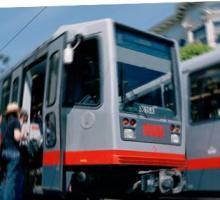
MUNI

CCSF teachers recruit students from BART/Muni stations

58

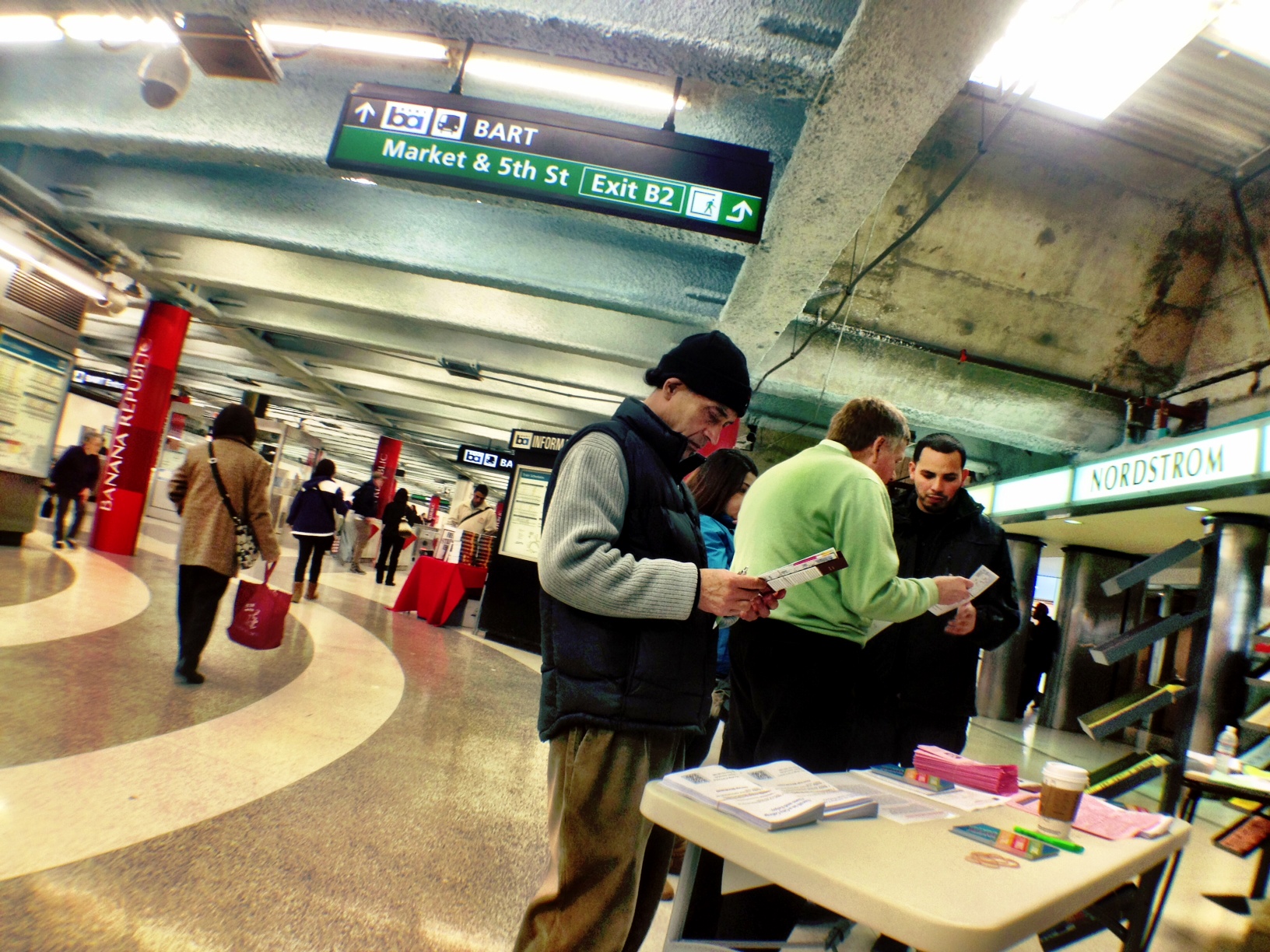
Walking through the Powell BART and Muni station, commuters are used to hearing the cries of a melange of musicians, crazies, and those with something to sell. Today and tomorrow though, commuters will hear something entirely different, as teachers cry “Enroll at City College! Enroll now!” through transit stations across San Francisco.

Teachers and faculty from the equally bedeviled and beloved school, City College of San Francisco, are out in force with flyers and laptops trying to shore up an enrollment deficit of 3,000 students. Today they’re at the Powell, Montgomery, and Embarcadero stations, handing out flyers and enrolling potential students on their laptops. Tomorrow, they’ll be at Civic Center, Mission, and Balboa street Muni and Bart stations doing the same.

The lack of student enrollment would deprive the school of $6.5 million dollars in state funding, which the school has responded to by cutting faculty and administrative salaries by 8.8 percent, and electing not to rehire, essentially letting go, 30-40 part time teachers, 18 part time counselors, and 30 clerical staff.

It’s no wonder these teachers are out on foot, enrolling as many folks as they can — and they say they’ve met with some success.

“I’ve been surprised how receptive people have been,” said Lizzie Brock, a basic skills English teacher at the college. Brock was on her feet handing out flyers for four hours, despite being about six months pregnant with her second child. “It’s a labor of love,” she said.

Though Brock only recently became a tenured teacher at the college, having taught there full-time for six years, she can’t afford to live in San Francisco on her salary from CCSF. She lives in Pacifica, commuting to the city to teach her classes.

Thomas Blair, a foreign language department head at CCSF who also teaches French, organized the two days of outreach. An older gentleman with snowy, neatly combed hair, and a kindly manner, he’s the last person you’d expect to sound the trumpets and gather 90 or so teachers to hit the pavement.

His passion for the college lies in these simple facts: he’s taught there for more than 30 years, and as a department head, he has a responsibility to all of the foreign language teachers at the college, and the thousands of students who open themselves to learning how to communicate with the world.

“I brought the table on the K with me all the way from Ocean Avenue,” Blair said. He thinks he has a pretty good chance of signing up new students from commuters, because those in the 30-55-year-old crowd are often the ones taking new languages at City College, he said. “The office workers are a very good segment for us now,” he said.

Guillermo Romero, a blueprint reading instructor at CCSF, was also there handing out flyers. Streams of people flew past Romero, but he was undeterred. Romero is confident that his classes will meet enrollment, simply because of his philosophy in teaching his class, he said.

Disfrutando euseñando, disfrutando aprendieindo,” Romero said. If you enjoy teaching, they’ll enjoy learning — and hopefully be back for more.

War of the waterfront

40

tredmond@sfbg.com

There’s a blocky, unattractive building near the corner of Howard and Steuart streets, right off the Embarcadero, that’s used for the unappealing activity of parking cars. Nobody’s paid much attention to it for years, although weekend shoppers at the Ferry Building Farmers Market appreciate the fact that they can park their cars for just $6 on Saturday and Sunday mornings.

But now a developer has big plans for the 75 Howard Street site — and it’s about to become a critical front in a huge battle over the future of San Francisco’s waterfront.

Paramount Partners, a New York-based real-estate firm that also owns One Market Plaza, wants to tear down the eight-story garage and replace it with a 350-foot highrise tower that will hold 186 high-end condominiums. The new building would have ground-floor retail and restaurant space and a public plaza.

It would also exceed the current height limit in the area by 150 feet and could be the second luxury housing project along the Embarcadero that defies the city’s longtime policy of strictly limiting the height of buildings on the waterfront.

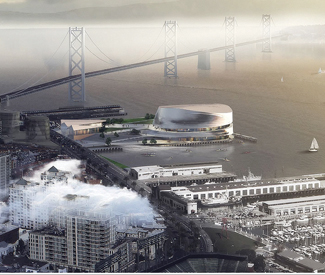
It comes at a time when the Golden State Warriors are seeking permission to build a sports arena on Piers 30 and 32, just a few hundred feet from 75 Howard.

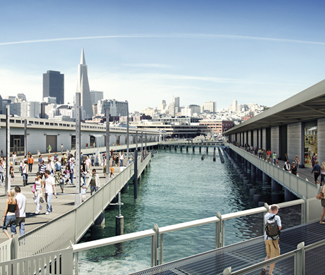
Between the proposed 8 Washington condo project, the arena, and 75 Howard, the skyline and use of the central waterfront could change dramatically in the next few years. Add to that a $100 million makeover for Pier 70, the new Exploratorium building on Pier 15, and a new cruise ship terminal at Pier 27 — and that’s more development along the Bay than San Francisco has seen in decades.

And much of it is happening without a coherent overall plan.

There’s no city planning document that calls for radically upzoning the waterfront for luxury housing. There’s nothing that talks about large-scale sports facilities. These projects are driven by developers, not city planners — and when you put them all together, the cumulative impacts could be profound, and in some cases, alarming.

“There hasn’t been a comprehensive vision for the future of the waterfront,” Sup. David Chiu told me. “”I think we need to take a step back and look at what we really want to do.”

Or as Tom Radulovich, director of the advocacy group Livable City, put it, “We need to stop planning the waterfront one project at a time.”


Some of the first big development wars in San Francisco history involved tall buildings on the waterfront. After the Fontana Towers were built in 1965, walling off the end of the Van Ness corridor in a nasty replica of a Miami Beach hotel complex, residents of the northern part of the city began to rebel. A plan to put a 550-foot US Steel headquarters building on the waterfront galvanized the first anti-highrise campaigns, with dressmaker Alvin Duskin buying newspaper ads that warned, “Don’t let them bury your skyline under a wall of tombstones.”

Ultimately, the highrise revolt forced the city to downzone the waterfront area, where most buildings can’t exceed 60 or 80 feet. But repeatedly, developers have eyed this valuable turf and tried to get around the rules.

“It’s a generational battle,” former Sup. Aaron Peskin noted. “Every time the developers think another generation of San Franciscans has forgotten the past, they try to raise the height limit along the Embarcadero.”

The 8 Washington project was the latest attempt. Developer Simon Snellgrove wants to build 134 of the most expensive condominiums in San Francisco history on a slice of land owned in part by the Port of San Francisco, not far from the Ferry Building. The tallest of the structures would rise 136 feet, far above the 84-foot zoning limit for the site. Opponents argued that the city has no pressing need for ultra-luxury housing and that the proposal would create a “wall on the waterfront.”

Although the supervisors approved it on a 8-3 vote, foes gathered enough signatures to force a referendum, so the development can’t go forward until the voters have a chance to weigh in this coming November.

Meanwhile, the Paramount Group has filed plans for a much taller project at 75 Howard. It’s on the edge of downtown, but also along the Embarcadero south of Market, where many of the buildings are only a few stories high.

The project already faces opposition. “The serious concerns I had with 8 Washington are very similar with 75 Howard,” Chiu said. But the issues are much larger now that the Warriors have proposed an arena just across the street and a few blocks south.

“Because of the increase in traffic and other issues around the arena, I think 75 Howard has a higher bar to jump,” Sup. Jane Kim, who represents South of Market, told me.

Kim said she’s not opposed to the Warriors’ proposal and is still open to considering the highrise condos. But she, too, is concerned that all of this development is taking place without a coherent plan.

“It’s a good question to be asking,” she said. “We want some development along the waterfront, but the question is how much.”

Alex Clemens, who runs Barbary Coast Consulting, is representing the developer at 75 Howard. He argues that the current parking garage is neither environmentally appropriate nor the best use of space downtown.

“Paramount Group purchased the garage as part of a larger portfolio in 2007,” he told me by email. “Like any other downtown garage, it is very profitable — but Paramount believes an eight-story cube of parking facing the Embarcadero is not the best use of this incredible location.”

He added: “We believe removing eight above-ground layers of parked cars from the site, reducing traffic congestion, enlivening street life, and improving the pedestrian corridor are all benefits to the community that fit well with the city’s overall goals. (Of course, these are in addition to the myriad fees and tax revenues associated with the project.)”

But that, of course, assumes that the city wants, and needs, more luxury condominiums (see sidebar).


Among the biggest problems of this rush of waterfront development is the lack of public transit. The 75 Howard project is fairly close to the Embarcadero BART station, but when you take into account the Exploratorium, the arena, and Pier 70 — where a popular renovation project is slated to create new office, retail, and restaurant space — the potential for transit overload is serious.

The waterfront at this point is served primary by Muni’s F line — which, Radulovich points out, “is crowded, expensive, low-capacity, and not [Americans with Disabilities Act]-compliant.”

The T line brings in passengers from the southeast but, Radulovich said, “if you think we can serve all this new development with the existing transit, it’s not going to happen.”

Then there are the cars. The Embarcadero is practically a highway, and all the auto traffic makes it unsafe for bicycles. The Warriors arena will have to involve some parking (if nothing else, it will need a few hundred spaces for players, staff, and executives — and it’s highly unlikely people who buy million-dollar luxury boxes are going to take transit to the arena, so there will have to be parking for them, too. That’s hundreds of spaces and new cars — assuming not a single fan drives.

The 75 Howard project will eliminate parking spaces, but not vehicle traffic — there will still be close to 200 parking spaces.

And all of this is happening at the foot of the Bay Bridge, the constantly clogged artery to the East Bay. “Oh, and there’s a new community of 20,000 people planned right in the center of the bridge, on Treasure Island,” Peskin pointed out.

Is it possible to handle all of the people coming and going to the waterfront (particularly on days where there’s also a Giants game a few hundred yards south) entirely with mass transit? Maybe — “that’s the kind of problem we’d like to have to solve,” Radulovich said. Of course, the developers would have to kick in major resources to fund transit — “and,” he said, “we don’t even know what the bill would be, and we don’t have the political will to stick it to the developers.”

But a transit-only option for the waterfront is not going to happen — at the very least, thousands of Warriors fans are going to drive.

The overall problem here is that nobody has asked the hard questions: What do we want to do with San Francisco’s waterfront? The Port, which owns much of the land, is in a terrible bind — the City Charter defines the Port as an enterprise department, which has to pay for itself with revenue from its operations, which made sense when it was a working seaport.

But now the only assets are real estate — and developing that land, for good or for ill, seems the only way to address hundreds of millions of dollars in deferred maintenance and operating costs on the waterfront’s crumbling piers. And the City Planning Department, which oversees the land on the other side of the Embarcadero, is utterly driven by the desires of developers, who routinely get exemptions from the existing zoning. “There is no rule of law in the planning environment we live in,” Radulovich said. So the result is a series of projects, each considered on its own, that together threaten to turn this priceless civic asset into a wall of concrete.

Sunday metering begins in SF but few notice

15

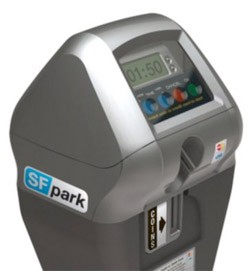
Yesterday, after years of heated conflicts over the issue, San Francisco officially began charging motorists to use metered parking spaces between noon and 6pm on Sundays – and nobody seemed to notice.

For the first few weeks, parking control officers with the San Francisco Municipal Transportation Agency are going to be issuing warnings rather than expensive parking tickets. But as Streetsblog SF reported today, even that didn’t seem to be happen. Its street survey in the Haight and Mission districts found that most parkers didn’t pay, and they received no warnings that they were supposed to.

SFMTA spokespersons that didn’t respond to Streetsblog inquiries also haven’t responded to questions from the Guardian about what happened and how many warnings were issued (UPDATED BELOW).

Sunday metering is intended to create more parking turnover in busy commercial corridors and bolster the SFMTA’s budget, capturing more money for Muni. But for now, it seems that everyone involved is still trying to shake off their holiday hangovers and get up to speed.

UPDATE 5:45: SFMTA spokesperson Paul Rose just returned our call to say parking control officers were indeed busy issuing warnings yesterday. “We issued about 4,000 warnings yesterday. That’s part of getting the word out,” he said. As far as Streetsblog’s observations, he said it could have been a fluke of timing or the fact that meters don’t indicate when someone pre-pays or pays by cell phone. “In the Haight, specifically, we issued about 600 warnings, and about 1,000 in the Mission,” he said. In addition to the direct warnings, the SFMTA has been publicizing the Sunday metering on billboards and Muni posters, through merchant groups, in the media, and on the meters themselves. 

Enforcement with actual tickets begins on Jan. 27.

A tale of police priorities

116

By Anh Lê

On Friday afternoon, November 9th, as I was walking on Howard St. near 3rd, I was physically assaulted twice by a Caucasian man walking with an accomplice, an African American woman. I was punched in the jaw the first time while I was still on the sidewalk; the assailant followed me into the street traffic to punch me in the jaw again. Many people passed by, yet none stopped to help. 

I called 911 from the a nearby restaurant. The first oSan Francisco police officer to arrive ordered me to sit down, and then quickly left. Then two other officers arrived, one of whom told me that he was already on assignment at the Moscone Convention Center. Even though I had an eyewitness, and we both provided the officers with a description of the assailant and his accomplice, and I told the officers that the two were still in the vicinity on Howard St., the police did nothing. One of the cops told me, “I think the guy looks like someone from the Tenderloin.”

Compare that to another incident and you get a sense of the city’s police priorities.

On Thursday afternoon, December 13, at the Muni island bus stop on Market St. at 5th, I saw two young African American men in handcuffs. They were detained by an SFPD officer, and two Muni fare inspectors. Both African American men were calm, poised, and respectful in their behavior.

One of the handcuffed men had a cell phone in his mouth while the police officer was questioning him. I thought that it was an odd situation, since the officer could have assisted him by removing the cell phone from his mouth.  I also thought that the dynamics of the situation seemed degrading and demeaning to this young man.

Within five minutes, several additional SFPD officers arrived on the scene, and then several more arrived in an unmarked large black SUV. Nearly all of the police officers were Caucasian. None was African American. 

One of the officers unzipped the second detainee’s backpack.  He calmly said to the officer, “I don’t have any weapon in there.” I could see that the situation involved a simple Muni fare situation. Yet I saw more than ten SFPD officers responding.

I spoke with two of the passengers waiting at the bus stop to ask them what they had seen. Semetra Hampton and Laversa Frasier told me that they saw the two young males handcuffed, and that these young men never acted in any aggressive manner.

I spoke with the two young men, Wayne Price and Jamal Jones. Each received citations, one for paying a youth fare as an adult, the other for misuse of a Clipper card. Hardly serious crimes.

I contacted Officer Michael Andraychak in the Media Relations Unit at SFPD and Paul Rose, spokesperson for San Francisco Municipal Transit Authority to ask why so many officers were involved in such a minor incident.

Rose emailed to tell me that transit fare inspectors saw that the men were using youth passes and asked for identification. When they refused, the fare inspectors contacted police. Andraychack said a Muni fare inspector tried to detain the suspects, but they refused to comply and ran onto the Muni bus island. The inspectors flagged down a nearby police officer, who radioed his location and told dispatch that he was being summoned by Muni personnel for an undetermined problem. Additional officers heard this radio transmission and responded to the scene.

He noted that “Fifth Street / Market is on the border of Tenderloin and Southern Districts. Officers from both districts patrol this area and the MTA K9 officers routinely patrol the Market Street Muni Metro Stations and surface transit stops.”

I appreciate the efforts by Rose and Andraychack to provide me with the information requested.  However, their statements only tell part of the story. Some of their information does not match what I observed, nor what the eyewitnesses told me at the Muni bus stop.

I was there; I counted more than ten SFPD officers who descended on these two young men. Neither of them had done anything violent to anyone, yet their fare evasion elicited massive response.

On the other hand, there was no diligent effort by SFPD to locate, apprehend, and arrest the assailant who assaulted me, on November 9th when he and his accomplice were still in the vicinity of the attack.

Mayor Ed Lee recently proposed a policy permitting police officers to detain and search certain individuals on the street if police deemed it necessary. After vigorous protests from San Franciscans and the Board of Supervisors on the grounds that such a policy would encourage racial profiling, the mayor withdrew the plan.

Still, I have to wonder: Is sending that many officers to handle a simple Muni fare situation involving two young African American males necessary — or is it racial profiling at its extreme? Is this how we as San Franciscans want to see our tax dollars spent — and wasted?

Will narrow business interests continue to dominate SF’s political agenda?

44

Will the narrow, deceptive, and disempowering “jobs” rhetoric of the last two years continue to dominate San Francisco politics in 2013? Or can San Franciscans find the will and organizing ability to create a broader political agenda that includes livability, sustainability, and affordability?

If it’s up to the San Francisco Chamber of Commerce – whose perspective has been aired in both the Examiner and Chronicle over the last two days – private sector profits will continue to be our only metric of civic success.

Just take a look at the “Pinkslips and Paychecks Scorecard” that the Chamber released yesterday, rating members of the Board of Supervisors based on a series of 16 votes for tax cuts and public subsidies for businesses, approvals of projects serving the rich, rollbacks of government regulations, business surcharges on consumers, maintaining PG&E’s dirty energy monopoly, and blocking an expansion of developer fees to improve Muni.

That aggressive neoliberal agenda, which is shared by Mayor Ed Lee and his big corporate backers, was reinforced by Chamber VP Jim Lazarus in an op-ed in today’s Examiner. Ignoring the rising housing and other living costs that plague the average San Francisco, Lazarus uses hopeful language about how we’re all “poised for success in 2013,” burying the Chamber’s aggressive and exclusive agenda in the subtext.

At the top of his agenda are: “Approval of the California Pacific Medical Center rebuild, reforming San Francisco’s California Environmental Quality Act appeals process, and rule-making for the upcoming gross-receipts tax.” In other words, let CPMC have what it wants, make it more difficult to challenge developers on environmental grounds, and ensure business taxes remain as low as possible.

And to ensure supervisors get the message, he closes by noting that business leaders are “energized and ready” to push their agenda with tools such as the Alliance for Jobs and Sustainable Growth, which waged some of the nastiest and most deceptive political attack ads on progressive candidates in the last election cycle.

The progressive movement of San Francisco has its problems and issues, including a recently widening schism between environmental and transportation activists on one side and the nonprofit housing and social justice faction on the other. And in the current economic and political climate, both sides too often find themselves partnering with corporate and neoliberal interests to get things done.

But now, more than ever, San Francisco needs to broaden into political dialogue, and that means a reconstitution and expansion of its progressive movement. That’s something that the Guardian has long focused on facilitating and publicizing – something that will be my personal focus as well – and we have some idea percolating that we’ll discuss in the coming weeks and months.

Then maybe all San Franciscans can be poised for success in 2013 and beyond.

Putting transit first

268

By Stuart Cohen, Leah Shahum, Rob Boden, and Elizabeth Stampe

OPINION Every day, San Franciscans pay the price of an underfunded transportation system. We have all experienced painfully overcrowded bus rides … or, worse yet, the bus that never shows up. Now, Muni is reducing service during Christmas week, as it is faced with a $7 million deficit this fiscal year.

Today, we are finally facing up to the reality that our declining transportation system hurts us all. It hurts our economy and it hurts people all along the economic spectrum. San Francisco is a world-class city in many ways, but we have a long way to go to have a world-class transportation system.

San Franciscans want better transit options: reliable, fast, comfortable buses, and safe and pleasant streets for walking and biking. San Franciscans support the city’s official transit-first policy, but lacking political will, the city hasn’t delivered on it.

By failing to make the tough decisions to fund our transit system, our leaders have put the burden on those who depend on affordable transportation options most. Transportation is one of the top expenses for people living in the Bay Area, after housing, and an exponentially greater burden for those with lower incomes.

Who will be hurt most by Muni’s skeletal service this holiday week? Working families.

That is why our organizations are proud to have joined together recently to support a proposal to update the Transit-Impact Development Fee (TIDF), which would have ensured that major developments pay their fair share into the city’s transit system. This would have included large nonprofits like Kaiser and the Exploratorium, when they build major new developments that generate thousands of new trips. The fee, probably about 1 percent of costs, would have paralleled the existing development fees for water, sewer, parks, and even art, that nonprofits already pay. It would not have included small nonprofits, and of course most nonprofits never build developments at all.

It would have helped visitors to large institutions have more dependable transit to get there, and helped the whole transportation system work better for everyone.

But it didn’t pass, and last week’s opinion piece (“The Muni vs. housing clash,” 12/18/12) mischaracterized the issue, suggesting a trade-off between basic services and transportation. But good, reliable, safe transportation is a basic service. Just like housing and health care, it’s something everyone should have access to, and something our city has declared a priority with its transit-first policy.

Unsafe streets are inequitable streets; low-income people and people of color are more likely to be hit by cars while walking. Underfunded transit is inequitable; low-income people have fewer options aside from walking or taking the bus, and the stakes are higher when the bus is late or doesn’t arrive.

Funding transit is a core progressive value. Great public transit — and being able to get around the city under your own power, by walking and bicycling — are great equalizers in a city like ours.

We should be investing more and expecting more from our transit system. Our organizations are proud to be doing just that. It’s time to help San Francisco finally live up to its transit-first policy — because that means putting people first.

Stuart Cohen works with TransForm, Leah Shahum with the San Francisco Bicycle Coalition, Rob Boden with the San Francisco Transit Riders Union, and Elizabeth Stampe with Walk San Francisco.

On the cheap

0

Event listings compiled by George McIntire. Submit items for the listings at listings@sfbg.com. For further information on how to submit items for the listings, see Picks.

WEDNESDAY 26

Kwanzaa Celebration Bay Area Discovery Museum, 557 McReynolds, Sausalito. www.baykidsmuseum.org. 9am-5pm, free. A traditional Kwanzaa altar will greet you upon arriving at the kids museum’s celebration of African American community, featuring two performance (at 11am and 1pm) by African Roots of Jazz.

7th Annual San Francisco Celebration City Hall Rotunda, 1 Dr. Carlton Goodlett, SF. www.kwanzaasanfrancisco.com. Noon, free. Head on over to City Hall to celebrate the umoja (unity) day of Kwanzaa, the 150th anniversary of the Emancipation Proclamation. Keynote speeches from the likes of Dr. Amos C. Brown, pastor of Third Baptist Church and district vice president of YMCA San Francisco Gina Fromm.

Soul Sessions Era Art Bar and Lounge, 19 Grand, Oakl. www.oaklandera.com. 9pm-1am, $5-10. Live performance from the Antique Naked Soul collective, painting by Bushmama & Smokie, and DJs spinning deep house, trap, hip-hop, and R&B.

Stay Gold Public Works, 161 Erie, SF. www.publicsf.com, (415) 932-0955. 10pm-1am, $3-5. It’s going to be a raucous holi-gay par-tay at Public Works tonight where DJ Pink Lightning will be throwing down the sick, bass-throbbing beats. Bring pastel lipstick and chandelier earrings.

THURSDAY 27

DIY Zine Making Workshop Rock Paper Scissors Collective, 2278 Telegraph, Oakl. www.rpscollective.org. 6-8pm, $1. This is your chance to become the next big media mogul. The good folks at the Rock Paper Scissors Collective are being gracious enough of to provide you with a workshop and your own materials to create your own zine, take them up on it.

FRIDAY 28

Dam-Funk 1015 Folsom, SF. www.1015.com. 10pm-3am, free with RSVP on website. No one in the world is as committed to the funk than super-funkateer Dam Funk. Get your boogie on as he shreds his keytar with his electro-synth jams. Be on the look out for the new album dropping in the spring of 2013.

Free Muni Day SF Muni stops. www.sfmta.com. All day, free. Take the L-line to the zoo or ride a cable car for the first time ever — today all Muni services are on the house to celebrate the agency’s 100th anniversary.

SATURDAY 29

Treasure Island Flea Market Great Lawn, Ave of the Palms, Treasure Island, SF. www.treasureislandflea.com. 10am-4pm, $3. Looking to pick up some Christmas or Chanukah presents? Then head over to the Island of Treasure for its monthly open-air flea market. Enjoy awesome views of the Bay Area while perusing goodies from local designers, collectors, and other makers.

SUNDAY 30

Instant Camera Photo Walk Photobooth SF, 1193 Valencia, SF. www.photoboothsf.com. 1-3pm, free. This event is for analog photographers only, so Instagrammers need not apply. Join the staff of the Mission’s Photobooth gallery for a photowalk down Valencia corridor. Be sure to bring a Polaroid/Land or Frankenstein instant camera along. No worries if you don’t have one, Photobooth will be happy to lend you one for the occasion.

SF Zoo Lights 1 Zoo, SF. www.sfzoo.com, (415) 753-8141. 4-8pm, $5. Stuck with the family all week? May we recommend taking them to the last night of the San Francisco Zoo Lights extravaganza? The zoo will be a bastion of animal-themed, family-friendly holiday fun complete with a splendid light show, 30-foot Christmas tree with animal decorations, and free rides on the carousel.

MONDAY 31

Holiday 3D Light Show Westfield SF Centre, 865 Market, SF. www.westfield.com/sanfrancisco. 5pm, free. Tonight’s your last chance to catch the holiday magic of the Illuminique Under the Dome show, which transforms the Westfield mall’s glass dome, built in 1908, into a surround-sound wonderland of scenes sure to get your little (and not-so-little) ones in an eggnog froth.


The Muni vs. housing clash

73

OPINION Two votes at the Board of Supervisors and the Municipal Transportation Agency Dec. 4 laid out a stark contrast between two different approaches to transportation advocacy — one based on a sense of justice and the idea that public transit is an issue of equity, and another based on the self interest and transactional politics of a cash-strapped transportation agency and its dedicated allies.

After years of work, organizing transit riders and talking to policy makers from the local to the regional levels, a scrappy group of transit justice advocates, many of them young, most of them people of color, got the Municipal Transportation Agency board to approve a $1.6 million plan to fund free Muni passes for low-income youth. It sent a strong message that a new kind of transportation advocacy has arrived, one that puts race, class, and environment at the center.

Meanwhile, a separate vote was taking place at the Board of Supervisors that seemed to pit community organizations, nonprofit service providers, and affordable housing developers on opposite sides of the fence from what has become a mainstream transportation and bicycle advocacy community.

We should have been on the same side. But a last-minute maneuver by Sup. Scott Wiener to add to the MTA’s strained budget (a worthy goal) by expanding the 30-year Transportation Impact Development Fee (TIDF) to include nonprofits that provide critical services in our neighborhoods backfired and sent his amendments out the door in a 9-2 vote.

Many transportation and bicycle advocates seemed incredulous that the rest of the world did not accept their arguments.

I consider many of these transportation advocates friends and acquaintances whom I have known and worked with for years. But rather than seeing themselves as part of a greater social justice movement rooted in the communities who are most affected, some of these advocates have become increasingly narrow in their scope, single-minded in their pursuit of funding for bike lanes and bulbouts, as well as rapid transit projects serving downtown commuters.

Real-world politics requires that activists, organizers, and policy advocates be flexible and willing to figure out how to work with others very unlike themselves. Recently an organization I work for was able to work in a broad coalition, convened by the mayor, to develop and campaign for a Housing Trust Fund to create a permanent source of funding for affordable housing, as a direct response to the State of California taking away the city’s housing budget when it dissolved the redevelopment agencies. We walked into the room knowing that we would have to make tough decisions, and have to take those back to our allies in the progressive movement.

But we also walked in with non-negotiables. We were not going to entertain any attempt at weakening rent control by tying the Housing Trust Fund to lifting the condo conversion lottery. We would not support a set-aside without increasing city revenue to support not just our housing trust fund but also critical health and social services. We do not screw over our broader movement for pure self-interest.

We stand at a crossroads, and we could very well end up with two different transportation advocacy communities, both talking about the same thing, but with very little to say to each other. As the old mineworker’s song used to say, it’s time to decide: “Which side are you on?”

Fernando Martí works at the San Francisco Information Clearinghouse

No brand

0

caitlin@sfbg.com

STREET SEEN To the casual observer, it may have appeared as if I had taken a painful, rainy early morning Muni ride into SoMa for the sole purpose of eating plastic-wrapped Japanese pancakes filled with red bean paste in a chain store. But to adherents of the Muji phenomenon, I was actually witnessing the birth of cross-Pacific retail revolution.

“The minimalism of Muji fits San Francisco perfectly with what the city is trying to do with conservation,” said store manager Eric Kobuchi, who was standing with the cash registers behind of him, and the sleepy-eyed attendees of the November 30th press preview and reception in front of him. His company was to open its first West Coast location (540 Ninth St., SF. www.muji.us) in an hour-and-a-half.

Among minimalism aficionados, this brand is paramount. Muji was born in 1980, originally as a line of 40 house and food items that were sold in Seiyu supermarkets. The name itself means “no label, quality goods.” The items were cheap, but relatively high quality. These savings were possible, said the company, by simplifying packaging and production, and utilizing offbeat materials, like the parts of the fish near the head and tail for its canned fish.

Muji fans kindled to the line’s recycled, plain packaging (the company has courted the “sustainable” label for decades). Being a Muji consumer is an identity unto itself, at least according to the brands’s brilliant ad campaigns. From a 256-page coffee table book of such endeavors presented to me at the preview: “Muji tries to attract not the customer who says ‘This is what I want,’ but rather the one who says, rationally, ‘this will do.'”

Zen. Today, Muji’s selection is an Ikea-Gap mélange. The San Francisco location, says Azami, has a similar, but smaller product selection (minus the food — tight regulations here make importing comestibles complicated), and the same layout and presentation as its Japanese stores. I don’t doubt that little changes have been made to the Muji formula for its West Coast audience — during the press preview, display prices for some of the stock were still only visible in yen.

Muji is but one simple, made-from-recycled-material package in a shopping bag full of newish Japanese brands to hit the Bay Area. Daiso, in my eyes the epitome of dollar (or rather 100 yen, roughly $1.50) store excellence, has been plying lunch boxes, fake eyelashes, party wigs, and stationary on the West Coast since 2005. It has several stores from SF to Milpitas (SF locations at 570 Market and 22 Japantown Peace Plaza).

We have homegrown Japanese retailers as well. Lounging in a bright office lined with shelves of Japanese comics, Seiji Horibuchi explained to me how he came to open retail complex New People (1746 Post, SF. www.newpeopleworld.com) in the heart of San Francisco’s Japantown.

Dressed in head-to-toe Sou Sou, a neo-traditional line of Japanese worker comfortwear whose signature item is its brightly patterned split-toe shoes, Horibuchi says he moved to the city in 1975, and started his anime-manga publishing house Viz Media in his adopted city in 1986. Viz Pictures, a distribution company for Japanese films followed, and then New People was born, originally as a movie theater at which to play Viz titles.

But the project grew, and by its opening in 2009, the J-pop mall included a gift shop, art gallery, and entire floor of Japanese fashion brands like Sou Sou and the babydoll goth Lolita brand Baby, the Stars Shine Bright.

New People is a bit different than the new megachains in town, however. Even the casual visitor can tell Horibuchi’s inventory couldn’t have come from any other country — unlike a lot of Muji’s stock, comprised of simply-universal products, most of New People’s vinyl dolls, high design flatware, and frilly babydoll bonnets could really have only come from Japan.

But Horibuchi understands why brands like Muji choose San Francisco for their debut on this side of the country. “We’re more open to foreign culture,” he says. “San Francisco is very flexible, livable.”

Plus, Asian Americans make up nearly 36 percent of the city’s population — and that ratio has grown in recent years. Companies know that many residents are already familiar with their brand, Horibuchi says. “I’m sure they’ve done enough marketing research.”

A company that has certainly done its marketing research is Uniqlo, which opened a popup shop (117 Post, SF) this summer, then a full-size West Coast flagship store (111 Powell, SF) in Union Square in October. In its opening weeks, the latter attracted 100-plus-person lines of shoppers with cheaply-priced rainbows of colored denim and ultralight down jackets.

In a calm moment on a busy holiday shopping day, I got a chance to talk with Uniqlo’s John “Jack” Zech, a “superstar store manager” according to a publicist that sat with us while we talked.

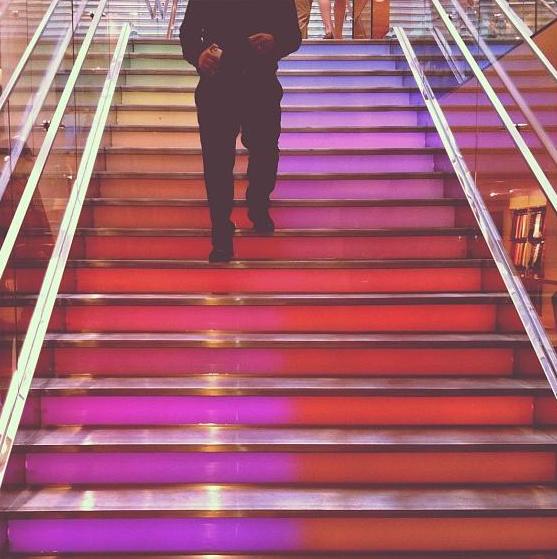
The three of us had a view of Uniqlo’s specially-designed-for-SF “magic mirror” (put on a down jacket, press a button, and the hue of your garment in the reflection shifts through the line’s different colors), its staircase of melting rainbow tones, and slowly rotating armies of mannequins clad in ski-ready fashions, ensconced in glass cases.

Zech worked in Uniqlo’s Japanese locations for months before the SF stores opened, and he says the company’s goal is to bring the Japanese concept of supreme customer service, irrashai mase, to the rest of the world.

When you walk into Uniqlo, a person in a happi day kimono greets you warmly. But other than that, I couldn’t see much of a difference between the cheery sales staff there versus that of any of the other chain stores in the neighborhood.

You won’t find happi on sale at Uniqlo. Instead, its affordably-priced cashmere, “Heat Tech” clothing — that I promise you, actually tingles and heats your skin up — and $9.90 packable raincoats (the only clothing item made specifically for the SF store) dominate the sales floor.

In 2010, the company’s official language switched to English. All managerial staff worldwide is required to speak it. “We found that people basically need the same things in Japan, France, London, here,” chirps Kech. “[CEO] Tadashi Yanai thinks we can improve the world by being a global company.”

Which snapped me out of the reverie I’d been lulled into by banks of $29.90 beige boot-cuts. Are Uniqlo and Muji really all that different than the globalized brands from the United States? Walmart, after all, has store greeters.

“If the product is good, it will sell,” regardless of geography, Horibuchi told me. These big brands have real cute stuff (admittedly, I would like to draw Santa’s attention to Muji’s $38 cardboard MP3 speakers.) But you’re not being worldly by shopping at them, though you are being globalized.


Free Muni for youth a rare progressive victory

18

The left isn’t winning all that much these days, but Sup. David Campos had a huge victory with the passage of a plan to offer free Muni to some 40,000 low-income kids. The challenges aren’t over — it’s still not clear, for example, how the actual clipper cards will be distributed — but this is a big step forward.

And it didn’t come easily. Campos worked with a coalition of low-income advocates that refused to give up despite two years of setbacks.

“We were relentless, even when we lost,” Campos told me.

It’s no secret that I’ve supported this plan all along (I actually like free Muni for all youth). And I think we’ll get there. In the meantime, for low-income middle-school and high-school kids, most of whom don’t get school bus rides any more, this is a big deal. The price of taking Muni to school ($1 a day for youth fares) is a significant amount of money, particularly for families with several kids who are struggling to make rent and eat. Yeah, there are cheaper youth passes — but you have to go to a Muni office in the middle of the day and bring proof of your kid’s age and it’s a pain in the ass for working parents.

So now it’s up to the MTA to figure out how to make it easy for families, some of them with limited English proficiency and virtually no time to wait in lines at Muni offices, to take advantage of the program. “We’re going to spend a lot of time doing outreach,” Campos said. “We’re working with Muni and with community-based organizations. We’re going to make this as easy as possible.”

The obvious solution, in my mind, is to distribute the passes at public schools. The school district already has income information on the kids, through the free and reduced-price lunch program; in theory, all anyone would have to do is take that list, adjust it a bit (because the eligibility for lunches and Muni passes is a little different) and hand out the passes at middle-school and high-school campuses. (You’d miss low-income kids who go to parochial schools, and a few others, but SFUSD wouldn’t be the only provider, just the first.)

And it’s education-related, since most of these kids take Muni to and from school — or should.

Problem is, there are legal rules about the use of the lunch data (although there must be a way to get around it) and SFUSD doesn’t seem terribly interested. (More work, more hassles for an already overworked and underfunded district.) But you could station one Muni worker at each school to hand out the passes, right? Or Muni could use some of the outreach money to pay for the SFUSD staff time.

At any rate, those are details. The main point is that Campos and his allies managed to beat back the opposition and make this actually happen. Good job.

(Oh, and the same day, Sup. Jane Kim managed to get $1.7 million for the schools to help with graduation rates — without raiding the Rainy Day Fund. Two progressive wins and it’s only the 5th of December.)

The Performant: Talk Lobster

0

Killing My Lobster sends up San Francisco

“Funny can mean different things to different people.” Perhaps no tagline better describes the fluctuations of sketch comedy than that of veteran gagsters Killing My Lobster. And they should know, since they’ve been dishing up their irreverent brand of short-attention span comedy since 1997. Even if, as a performance format, sketch comedy isn’t really your thing, the variables built into its basic equation — rotating writers and cast members, wacky themes, and the unique juxtaposition of the ludicrous with the everyday — ensure that, like the weather, if you don’t like something, just wait 10 minutes, and you will probably be rewarded with something you do.

The blink-and-you-missed-it one-night run on Saturday of “Killing My Lobster Takes it to the Streets,” at Stagewerx naturally included the weather in their microhood-specific roundup of familiar, Bay Area moments.

Fog, of course, and even the sun (in the East Bay, natch) got referenced in sketches which ranged topically from botched muggings and marauding food trucks to a series of wildly ineffectual 911 dispatch calls and a night in the life of a drug-loving cabdriver. Using San Francisco as their canvas, the Lobsters created a humorous collage of snapshots of city living, in a city that takes making fun of itself more seriously than most.

Opening with a brief spate of beat-boxing from Tommy Shephed aka Soulati of Felonious, (whose creative partner Dan Wolf directed the show), the first sketch featured the aforementioned mugging. A menacing Brian Allen tried to divest a pair of yupsters of their cash only to have them snort derisively that they don’t carry “money” and obnoxiously compare his mugging skills to that of robbers past, until he was forced to flee out of shame for his poor performance. The obligatory roommates from hell trope got a ribald twist in the form of an orgy, and a flashback to the birth of MUNI gave insight as to why the Richmond District has been deprived of metro lines for all these years. 

Other highlights included a tearful wake being held for an amiable youth, Cody (Anthony Tupasi), who, it turns out, wasn’t dead at all, but might as well be, since he moved to the East Bay, a video of clip-board zombies soliciting donations on 18th Street, a retro-hipster faceoff which included the best line of the evening “I want to have your babies so we can watch them die of cholera,” and a visit to Blue Toad Farm which included the second-best line of the evening: “This is a locally-grown, artisanal, heirloom carrot root.” Maybe you had to be there.

Which brings us right back to that tagline. Humor is so highly subjective that conveying it adequately, sight-unseen, can be a tricky business, and it’s precisely why seeing it live is so important. Fortunately, this is a lesson that KML fans seem to have fully absorbed as the house was packed despite the torrential downpour. And happily this is a lesson that KML seems willing to teach often, the only real question being, what sacred cows will these Lobsters skewer next?  


Left-right punch knocks out increased development fees for Muni

148

A new and unusual coalition of nonprofit, religious, and corporate interests today killed a legislative effort to get more money for Muni through the Transit Impact Development Fee, which was going through its process of being reauthorized every five years and came to the Board of Supervisors today.

The San Francisco Municipal Transportation Agency was hoping to get millions of dollars more per year from the fee to help cover the increasing costs of Muni service, so the city last year commissioned a study establishing a nexus between new development projects and their impact on the public transit system as a way to set the fees developers would pay.

Using that study, Sup. Scott Wiener sponsored legislation that increased the cost per square foot of development for some business types – mostly notably hospitals, big retail and entertainment complexes, and Cultural/Institution/Education facilities – and ended the categorical exemption for nonprofit organizations.

Those who could be impacted by the increased fees banded together into an organization calling itself NOTT (Non-profits Opposed to the Transit Tax), a group that included the city’s major health care providers, religious institutions, and influential nonprofits such as Council of Community Housing Organizations and Chinatown Community Development Center.

“We are gravely concerned that elements of the forthcoming Transportation Sustainability Program (TSP), especially elimination of the non-profit fee exemption, have been selectively imbedded in the TIDF update legislation. Elimination of the non-profit exemption has not been considered through a thorough and transparent process and is not good public policy,” SF Chamber of Commerce President Steve Falk wrote in Nov. 27 letter to supervisors on behalf of the organization.

In the face of opposition from both downtown and progressive groups, and hoping to get SFMTA more money for its next budget cycle, Wiener appealed for support to sustainable transportation activists, who had mixed feelings on the legislation for reasons ranging from its exemption of parking garages and development in Mission Bay to its inclusion of organizations serving low-income communities.

So Sup. Sean Elsbernd – who spoke on behalf of Catholic schools and churches – was able to amend the legislation back to the status quo on a 9-2 vote, with only Wiener and Sup. Carmen Chu opposed (Sup. Christina Olague, who co-sponsored the measure with Wiener, even failed to support it in the end).

While that ends this effort for now, it is really only the first round of efforts that are just getting underway to find more funding for Muni, which is underfunded and at capacity on many lines, and implement the TSP when it is unveiled next year.

W. Kamau Bell returns triumphant to the Bay, needs burrito

0

Attention burrito vendors of the Mission, there is a sale to be made at the arrivals gate of SFO this weekend when newly-minted TV star W. Kamau Bell makes his triumphant return to the city in which he spent 15 years honing his comedic chops. He is aching for a Mission burrito like this city is aching for a more efficient MUNI system.

Culinary yearnings aside, this Sunday Bell headlines a standup show at the Fillmore as part of his “Kamau Mau Uprising” tour. The tour’s moniker should come as no surprise to those who are familiar with Bell’s politically progressive, acerbic wit.

These days, that category includes more people than ever. Earlier this year Bell ditched left our lovely 49-square-mile patch for Gotham when he was offered his own TV show on FX (Thursdays at 11:30pm). And it looks like he’ll be spending more time back east — said show Totally Biased with W. Kamau Bell just got picked up for a second season that will start January 17.

In the inaugural season of Totally Biased, Bell and his crew of writers have covered a lot of ground, exploring the differences between Sikhs and Sheiks, sweet potato and pumpkin pies. They’ve made a fake PSA telling men to stay home and watch porn on Election Day instead of vote, and watched presidential election returns with the Brooklyn Young Republicans (some of whom are not, it turns out, are not so young.)

Now that both he and President Obama will be back in 2013, Bell looks forward to holding our Commander in Chief to task. Right before the Thanksgiving Break, and just hours after finding out his show got renewed, the self-proclaimed “billionth most famous person in the history of New York” took some time to chat with the Guardian about his homecoming, and on what makes a San Francisco comedian different from those from NY, LA, or Boston. Plus, on whether he’ll ever drop a “hella” on Totally Biased.

SFBG: In the past you’ve referred to Totally Biased executive producer Chris Rock as the “foul-mouthed Yoda.” How far along have you come in your Jedi training?

Assuming that this is the original prequel, I would say I’m probably halfway through the first movie. Although Yoda wasn’t in the first movie, so I’m screwing up my nerd status, but I’m at the very beginning of the Jedi training, if it’s Empire Strikes Back, I’m at the point where I lifted the thing out and then I got scared.

SFBG: What’s Mr. Rock’s involvement in the show? Is he more hands-on or hands-off?

WKB: I just talked to him and he literally said, “I’m around if you need me, call me.” He’s as available as we need him and he jokes that’s he’s on sabbatical from show business because he has no projects right now. He comes to all the tapings, but then again he also wants this to be my show so he allows me to use him as much or as little as I want to. Overall, I’ve used him a lot less than people thought I would.

SFBG: Would you say that your show is in competition with The Colbert Report and Daily Show?

WKB: Not really, but I would say that they’re a standard that we’re measuring ourselves against. You know, I’m just the new guy who likes “Hey guys can I hang out!” We’re certainly aiming for a lot of the same people, but I think that by the nature of Totally Biased we’re also reaching a group of way different people.

SFBG: Do you ever plan on saying hella during the show?

WKB: Here’s the thing, by the time I moved to San Francisco, I knew if I started saying hella, people from Chicago would think I had lost my mind. On the back of the set, we have these designs and there are a couple of Bay Area shout-outs and that’s the closest I’ll get to saying hella on air.

SFBG: How did your stand-up show Ending Racism in a Hour prep you for Totally Biased?

WKB: When I wrote that show, the idea behind it was: what kind of show would I write if I was famous? I would have a screen, I would have a computer, I would talk about the world, I would talk about racism all the time, and I would be very topical.

So I did Ending Racism the way I would do it if I had a TV show and through lots of luck and hard work I ended up with Totally Biased. I know for sure that I would not have gotten Totally Biased if I had just done stand up. And by the time Chris saw me at the UCB (Upright Citizens Brigade) Theatre in New York, I had already been doing for about three or four years.

SFBG: Do you have writers from the Bay?

WKB: Janine Brito, Kevin Avery, Kevin Kataoka, and Nato Green.

SFBG: What’s the history of your relationships with them?

WKB: I used to do “Siskel & Negro” with Kevin Avery, who’s from San Jose, on Live 105 back in the day and I met him right when I moved out to San Francisco. We did a lot of shows together, we were writing partners and almost got hired to do a D.L. Hughley show for CNN.

Kevin Kataoka is originally from Oakland and I met him when I first moved to San Francisco, in the SF comedy scene. He actually introduced me to Chuck Scolar who’s an executive producer of the show, and he’s the guy who introduced me to Chris Rock.

I’ve said many times that Janine is my comedy daughter, who’s this little hipster, half Cuban, all lesbian. I met Nato on the scene about six or seven years ago, so I had already been on the scene by the time I had met Nato and Janine.

Myself, Nato, Janine, and at one point Hari Kondabolu (fellow TB writer) had a three-headed standup comedy monster called “Laughter Against the Machine” that we started in the Bay Area and the New Parish in Oakland was the home base for that show. We’re currently working on a documentary about going on the road last year to various political hotspots in America.

SFBG: What’s your take on the SF comedy scene?

WKB: The thing about San Francisco is that it always has had a good reputation as a good comedy city. Ever since Mort Sahl stepped on stage at The Hungry i in the ‘50s San Francisco has had a great reputation as a comedy town. Even though we’re not the biggest city, all the greats come through San Francisco.

I remember seeing [Dave] Chappelle when I moved to town, and he was already packing the club despite not being nationally famous. This is was big because this was before the Internet took hold. He was already a legend and I remember one night when he was stage and he said yeah I just finished filming this movie and it’s all about weed! I saw him go to the next level when he got his own show, and so San Francisco is a great city for developing comedic talent.

If you come up in the San Francisco comedy scene, clubs like The Punchline and Cobb’s are loyal to local talent if you show loyalty to them. You will work with the best in the business. I’ve heard that New York comics say that San Francisco comics know more headliners and have more personal relationships with headliners than New York comics do because San Francisco comics hang out a lot before and after shows, whereas in New York everyone is always running to the next thing. The city is known for having good comedians but there’s not a style called “San Francisco comedian.” You can pick out a Boston, New York, or LA comedian but you can’t really pick out a San Francisco comedian.

SFBG: How does it feel to headline a show at The Fillmore?

WKB: In some sense that’s bigger than getting a TV show [laughs] when they said that I was going to play The Fillmore, I thought “wait a minute! It’s too soon!” And time will tell if it is too soon. It’s just weird to me that it’s happening now. I think a lot of it is because I’ve built up a name in the Bay Area.

SFBG: Will you have time to stop by your old spots?

WKB: I’ll have a chance to visit my old spots and look at the “did that really happen?!” look on people’s faces.

SFBG: What are places and things you miss the most about the Bay Area?

WKB: The one thing overall that both my wife — who’s from Monterrey — and I miss most is that the style of living in Northern California is so easy. When I think about my time in San Francisco, even walking outside my house, it feels like a baby bird being born. When I think about New York, every time I walk out of my house, I feel like a paratrooper jumping out of a plane. And there are definitely five or six Mission burritos in my future because New York does not understand how burritos work.

I also want to go back to The Punchline on a Sunday night where all of it really started for me. That place is my mecca. I just need to go there and walk around the stage seven times and really reflect on all that is happening. And oh! I’ll be probably ride the N-Judah and visit my old block of Ninth and Irving.

SFBG: I know you just found out about the second season but now that the election is over and your boy is back for a second term what direction do you think the show will be taking?

WKB: My career and act has followed Obama’s presidency and a lot of comics say it would have been better if Mitt Romney had won and I’m like noooooo this black president thing has worked out for me nicely. And the great thing about Romney being gone is that now we can actually talk about Obama from a more critical angle. Now we can talk about how Obama is not a great president, we can talk about Guantanamo and immigration. I don’t just want to be a cheerleader.

The Kamau Mau Uprising

Sun/9, 8pm, $29.50

The Fillmore 

1805 Geary, SF

www.thefillmore.com

All reflected

3

caitlin@sfbg.com

VISUAL ARTS Glossy and matte stripes alternate across the walls and floor of the 941 Geary gallery in the Tenderloin, occasionally illuminated by striking reflections from the exhibition’s 10 hanging canvases. These are perfectly symmetrical morphs of traditional letter-form graffiti, each done in Easter-ready pastels, save for a black-and-white tag that takes up one enormous gallery wall.

“I just want to continue painting different visions I have,” says the creator of this immersive art experience, visual artist Ricardo “Apex” Richey. He got his start tagging the streets of San Francisco in the early 1980s, perfecting his now-revered, precise hand forms inside Muni buses and walls around the city.

“Reflected,” this new solo show, plays on the entrance into the gallery world of an art form once done covertly on exterior walls. He’s taking graffiti and, like artists before him, skewing and reimagining it. “Abstracting the notion of Apex,” he tells me.

>>CHECK OUT OUR SLIDESHOW OF APEX’S ROOFTOP GALLERY AND SOME OF HIS TECHNICOLOR WORKS FROM AROUND THE SIXTH STREET NEIGHBORHOOD

With the current mania for street art-inspired pieces, Apex has been able to make a career of his work. He capitalizes on the legions of graff-nerd followers on his social networks, and his drive to refract and skew the recognizable shape of graffiti in endless ways. The 941 Geary show was inspired by an iPhone app that allowed him to mirror pre-existing works. After speaking with Justin Giarla, founder of 941 and the rest of the White Walls family of urban art galleries, the two decided the idea merited more exploration.

But during the same week “Reflection” opened, Apex’s personal life was morphing as well. After three years in an epic factory-cum-studio on Market and Sixth Street, his building was sold and he was out. Goodbye to its 13-foot ceilings and the rotating, 10-foot high windows that look out on Market.

http://vimeo.com/21421094

And goodbye to the museum he’d been curating upstairs on the roof, where SF street artists Chez and Neon had contributed massive works, among others. Painted vegetation by muralist Mona Caron curled to the sun in a piece one could nearly see from Trailhead, the pop-up cafe down the street in the Renoir Hotel whose back wall, by chance, is graced by a collaboration mural done by Caron and Apex.

If you wander around the Mid-Market neighborhood, it’s not hard to see that Apex spends his nights working in a neighborhood studio. He’s certainly left his mark. The first piece in the area was Yerba Buena Liquors’ sign, years ago. Since then he’s painted all over the place. The corner of Turk, Mason, and Market Streets is graced by a super-burner of his, a phrase coined to describe his pieces that use hundreds of hues of aerosol.

“I would love to stay there,” he tells me at his new FiDi day job (more on that in a sec.) “In that regard, this is kind of sad.” But Apex knew he was in the studio and roof space on borrowed time — rumors had swirled since he first moved in that the building was for sale. He sees the “gradient” of real estate prices, that Sixth Street was an anomaly in a ridiculously expensive city to live in.

“On one hand it sucks, on the other, I understand it. Overall, it’s better for the city.” He’s looking for a new space anywhere in the “industrial band” that loops between his old studio and Potrero Hill, hoping to get lucky with one of the city’s few remaining industrial spaces.

And, as his solo show is testament, he’s not letting the forced move stop him. That day job? He bought a coffee kiosk. The business is about him “trying to be mature,” he says, laughing as he talks about Otis Cafe, the Four Barrel-equipped stand he’s set up in the Otis Lounge nightclub entryway (25 Maiden, SF) where you can now find him weekdays from 7am to 3:30pm.

“This idea popped into my head,” he says. ‘Coffee cart, that’s a low end startup.” The Maiden Lane micro-‘hood lacks designer coffee, and on the day I visit, new regulars are already lining up.

For Apex, the kiosk is just product of a creative mind. “I feel very blessed, fortunate,” he muses. “Like, I’m an idea person. Painting, art allows me to get the most of those ideas to come to light.” The Otis Cafe sandwich board and cart bear Apex’s signature loops of color — a new home in the downtown area for the artist himself.

“REFLECTED”

Through Jan. 5

941 Geary, SF

(415) 931-2500

www.941geary.com


Aggressive Warriors

0

steve@sfbg.com

No standard defensive strategy is likely to stop the Golden State Warriors, Mayor Ed Lee, and their huge team of partners and employees from dominating the game of approving construction of a new basketball and concert arena on San Francisco’s central waterfront. That became clear on Nov. 14, as the political operation overcame fire, darkness, and neighborhood-based opposition for the first big score.

The Board of Supervisors Budget and Finance Committee was set to consider declaring the project, which the Warriors want to build on Piers 30-32 by the 2017 basketball season, to be “fiscally feasible,” recommending it move forward with more detailed environmental studies and a term sheet nailing down myriad administrative details.

Before the 11am hearing, the project team held a packed press conference to announce that the Warriors had volunteered to abide by the city’s local-hire standards for public works projects, hiring San Francisco residents or military veterans for at least 25 percent of total construction jobs and 50 percent of apprenticeships. A beaming Lee praised the deal as an “unprecedented” indicator of the Warriors’ willingness to partner with the city.

The event overflowed with union members in hard hats and orange “Build It Now!” T-shirts, as well as a full range of local political pros, from former mayoral and current project spokespersons PJ Johnston and Nathan Ballard to former aides to progressive supervisors, David Owen and David Loyola. Among the agreement’s four signatories were Joshua Arce, the Brightline Defense Project head who last year crusaded for Sup. John Avalos’s local hire ordinance, and building trades chief Michael Theriault.

Strikingly missing at the press conference was Sup. Jane Kim, in whose District 6 the project would be built — over the objections of many residents who are raising concerns about the loss of waterfront views, huge crowds attending what is projected to be more than 200 events per year, high interest rates paid by city taxpayers, the project’s accelerated approval schedule, and other concerns.

Kim is one of the three members of the Budget Committee, which held its meeting despite an electrical fire in the basement of City Hall that knocked out power to the building. Portable photography lighting was brought in to supplement the emergency backup lights, making it bright enough so the televised show could go on but giving a strangely surreal feel to the proceedings and reinforcing the urgency project supporters feel to move this forward without delay.

Kim raised the concerns of her constituents, winning support for amending the resolution to ensure the Citizens Advisory Committee — whose chair was given two minutes to convey how its members feel steamrolled by the accelerated process, asking it be delayed by a month or two — will be given chances to weigh in and pushing the EIR scoping meetings back a few weeks to January.

In the end, Kim and the committee voted to move the project forward. A few days later, on Nov. 19, the process repeated itself with another flashy press conference in the Mayor’s Office — with another important union endorsing the project — followed by the Land Use Committee responding favorably to the project.

The full Board of Supervisors was scheduled to approve the project’s fiscal feasibility the next day, after Guardian press time, but there was little chance that the full board would take any other action than giving the Warriors, Lee, and their huge roster of teammates what they want.

This despite unusual financing and some very real concerns about waterfront development.


JOBS, MONEY, AND SUPPORT

Mayor Lee — who has placed a high priority on this project since announcing his deal with the team in May — emphasized its job creation and contribution to the local economy during the Nov. 19 press conference.

“I remind people, this is a private investment of hundreds of millions of dollars,” Lee said of a project pegged to cost around $1 billion. “It means a lot of jobs, and that is so important to all of us.”

The project is expected to directly create 4,300 jobs: 2,600 construction jobs and 1,700 permanent jobs, including those at the 17,000-seat sports and entertainment arena and the 250-room hotel and 100,000 square feet of retail and restaurants that would be built as part of the project.

“We’ve been spending a lot of these last many months describing what it is we want to build,” Warriors President Rick Welts said at the press conference before casting the project in grander terms. “That’s not really what we’re building. What we’re really building are memories.”

But city residents and workers are looking for more tangible benefits than just the highs of watching big games or concerts. The building trades were already expected to strongly support the project, which only got stronger with last week’s local-hire deal. Labor’s support for the project was broadened on Nov. 19 with the announcement that the Warriors agreed to card-check neutrality for the hotel, making it easier for its employees to join UNITE-HERE Local 2.

“Thank you for being a partner and we’re looking forward to working with you in the future,” Local 2 head Mike Casey, who notably also serves as president of the San Francisco Labor Council, said to Welts at the event before the two signed a formal agreement.

In addition to allowing the hotel workers to easily organize, the Warriors agreed to card-check neutrality for vendors at the arena with at least 15 employees and those outside the arena with more than 45 employees, as well as giving those who now work Warriors’ games at Oracle Arena first dibs on jobs at the new arena.

“I think that speaks a lot about what the project is. It’s not just a San Francisco project, but a Bay Area project,” Casey said. He also said, “I want to thank the mayor for bringing people together and laying all this out.”

While Lee and the Warriors do seem to have this deal pretty well wired, this is still a San Francisco project, a complex one on the politically and environmentally sensitive waterfront that city taxpayers are helping to pay for and one for which the residents there will bear the brunt of its impacts.


PAYING FOR IT

Lee, Office of Economic and Workforce Development head Jennifer Matz, and other key project supporters have repeatedly claimed this project is funded completely with private money, noting how rare that is for urban sports stadiums these days.

But in reality, city taxpayers are spending up to $120 million for the Warriors to rebuild the unstable piers on which the arena will be built, plus an interest rate of 13 percent, an arrangement that has drawn criticism from a key source.

Rudy Nothenberg, who served as city administrator and other level fiscal advisory roles to six SF mayors and currently serves as president of the city’s Bond Oversight Committee, wrote a Nov. 12 letter to the Board of Supervisors urging it to reject the deal.

“Quite simply, I would have been ashamed of such a recommendation,” Nothenberg wrote of the high interest rate. “In today’s markets it is incomprehensible to have such a stunning recommendation brought to your honorable Board in such haste.”

Johnston and Matz each disputed Nothenberg’s characterization, citing a report by the project consultants, the Berkeley-based Economic and Planning Systems Inc. (EPS), that 13 percent is a “reasonable and appropriate market based return.”

Matz told us the rate was based on the risky nature of rebuilding the piers, for which the Warriors are responsible for any cost overruns. And she compared the project to the massive redevelopment projects now underway on Treasure Island and Hunters Point, from which the city is guaranteeing powerful developer Lennar returns on investment of 18.5 percent and 20 percent respectively.

Johnston, who was press secretary to former Mayor Willie Brown and worked with Nothenberg on building AT&T Park and other projects, told us “I have great respect for Rudy.” But then he went on to criticize him for taking a self-interested stand to defend the views from the condo he owns nearby: “They don’t want anything built in their neighborhood. They would rather leave it a dilapidated parking lot.”

But Nothenberg told us his stand is consistent with the work he did throughout his public service career in trying to keep the waterfront open and accessible to the public, rather than blocking those views with a 14-story stadium and hotel complex.

“I have a self-interest as a San Franciscan, and after 20 years of doing the right thing, I don’t want to see this rushed through in an arrogant way that would have been unthinkable even a year ago,” Nothenberg told us. “I spent 20 years of my life trying to deal with waterfront issues.”

He is being joined in his opposition by other neighborhood residents, land use experts such as attorney Sue Hestor, some opponents of the 8 Washington project concerned with the creeping rollback of waterfront development standards, and members of the Citizens Advisory Committee who have felt steamrolled by the rapid process so far and unable to thoroughly discuss the project or the neighborhood’s concerns.

“We would like to slow this process down,” committee Chair Katy Liddell told supervisors on Nov. 14. “Things are going so quickly.”


DETAILS OF THE DEAL

The $120 million plus interest that the city will owe the Warriors would be offset by the $30 million the team would pay for Seawall Lot 330 (the property across from the piers where the hotel would be built), a one-time payment of $53.8 million (mostly in development impact fees), annual rent of nearly $2 million on its 66-year lease of Piers 30-32, and annual tax and mitigation payments to the city of between $9.8 million and $19 million.

Kim raised concerns at the Budget Committee hearing about the more than 200 events a year that the arena will host, but she was told by Matz that’s necessary to make the project pencil out for the Warriors.

Many of the project’s financial and administrative details are still being worked out as part of a term sheet going to the Board of Supervisors for approval, probably in April. Other details will be studied in the project Environmental Impact Report, which is expected to come back to the board in the fall.

The Department of Public Works, Police Department, and — perhaps most critically given its impact on Muni and roadways — Municipal Transportation Agency have yet to estimate their costs.

“We do have a lot of concerns in the neighborhood about this project,” Kim told the Land Use Committee, singling out impacts to the transportation system as perhaps the most important, followed by quality-of-life issues associated with huge crowds of sports fans.

Kim noted that the area already has a problematic transportation infrastructure, with some of the highest rates of motorist-pedestrian collisions in the city and a public transit system that reaches capacity at peak times, and said that many residents worry this project will make things worse. The EIR will deal with the transportation details. But Kim praised how about half the space on the piers, about seven acres, will be maintained as public open space: “I think the open space aspect is incredible and it could actually increase access to the waterfront.” In the end, Kim urged project proponents to heed the input of the CAC and other concerned parties because, “This could be a very valuable project, or it could also be a disaster.”

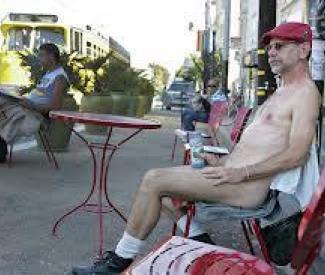
Supervisors approve nudity ban on close vote

139

Over the objections of progressive supervisors and under threats of a lawsuit from nudists and civil liberties advocates, the San Francisco Board of Supervisors today voted 6-5 to outlaw public nudity in the city. Supervisors voting against the ban were David Campos, Christina Olague, John Avalos, Eric Mar, and Jane Kim.

Sup. Scott Wiener, who sponsored the measure, cast it as a last resort to deal with what has become daily displays of nudity in the Castro district he represents (and most recently around City Hall as his legislation was being considering in committees), noting that, “Public nudity is part of San Francisco and is appropriate in some circumstances.” His legislation makes exceptions for permitted events such as the Folsom Street Fair and Bay-to-Breakers.

But Wiener said that “public nudity can go too far,” as he says it has over the last two years in the Castro’s Jane Warner Plaza, and that “freedom of expression and acceptance does not mean you can do whatever you want.”

Campos echoed some of the legal concerns that critics of the legislation have raised, noting that, “As a lawyer, I do worry about when you ban specific conduct and then you have exceptions to that.” He also questioned whether Wiener has done enough to try to mediate the increasingly divisive conflict he’s been having with the nudist community and whether this was an appropriate use of scarce police resources.

“I don’t believe we’re at the point of saying this becomes a priority over violent crime,” Campos said, noting that he’s been unable to get more police foot patrols to deal with a recent spate of violent crimes in the Mission, which shares a police station with the Castro.

Avalos said it was absurd to focus city resources on this victimless issue when the city is wrestling with far more serious problems, such as poverty and violence, and he played a clip from the film Catch 22 where a soldier goes naked to a ceremony to highlight that absurdity. “I will refuse to put on this fig leaf, I just can’t do it,” Avalos said.

Mar said he sympathized with Wiener’s concerns, but agreed with Campos that Wiener could have done more to mediate this situation before both sides dug in: “I really don’t think we need citywide legislation, particularly overbroad legislation, to deal with a problem isolated to one neighborhood.”

Wiener seemed stung by the comments and said he could cite example of each supervisor pushing resolutions or ordinances that dealt with similarly trivial issues, comparing it to refusing to deal with a constituent’s pothole complaint until that supervisor fixed Muni and solved the city’s housing problem. But Campos pushed back, calling the comparison ridiculous and saying there was no reason for a citywide ban to deal with such an isolated issue.

Nudists at the hearing reacted angrily to the approval and started to disrobe before President David Chiu ordered deputies to intervene and abruptly recessed the hearing. Now, it will likely be up to the courts to decide whether Wiener’s concerns about weiners can withstand legal scrutiny.

outLOUD Radio snags stories from an evolving queer world

0

It’s Saturday afternoon and, two weeks before the gala that will mark its 10th year of existence (coming up Wed/14) outLOUD Radio is talking style. Elders from the queer community are sitting in a circle in a LGBT Community Center third floor conference room, translating their thoughts on the concept of “gay uniform” into the waiting mics of outLOUD Radio youth volunteers.

“Describe what you’re wearing today.”

“Jeans, which could be categorized as old hippie jeans with tight ankles — not flares. That’s what I feel comfortable in, pants.”

“I’m wearing designer jeans. I bought them from Goodwill for $4.” “Nice.” “Very nice, actually.”

“I’m a dyke, and I wear pants. I’m cold a lot of the time because of my peripheral circulation.”

“There’s something about this T-shirt that makes me feel more alive, more vibrant.”

This is outLOUD’s intergenerational storytelling project. 

Phuong Tsing is 20. Tsing is holding the mic for the seniors to talk about their clothes because “I wanted to feel more connected with the LGBT community, to make myself feel more comfortable about myself. [The elders] make me feel like I live in the present, but I’m connected with the past.”

“What does your outfit say about you?”

“I decided at some point in my old age I was not going to dress like a geezer. And I live in San Francisco, so I don’t have to.”

“Not too flashy, except for the rhinestones on the shoes.”

“I’m alive, grateful, a vital human being.”

“I have on what I have on to keep warm.”

The first generation of out LGBT elders are coming of age these days, and they’re providing the community with a heretofore unique resource — the chance for baby gays to sit around and listen to what it was like being queer back in the day. Pre-Stonewall (some of the seniors at this Saturday session were actually present at the infamous raid and insuing protest), pre Glee, pre civil unions. Not only that — one of outLOUD’s major goals is the empowerment of youth through this archiving. Young people assemble pieces on the salient issues of their day, forming their own voice in the process. 

“Is there a gay uniform?”

“No. It just seems to me that there’s so many reasons why people put on one thing any morning. Right now in modern times you can wear anything, be anything.”

“What I really love about his group is that it feels really empowering,” say Tsing. Like outLOUD’s other projects, eventually this footage will be edited, and assembled into a radio show that can be streamed online and heard on radio stations across the country. Past podcast topics have included transbodied athletes, the definition of masculinity, sexual harassment on the Muni, even history like the piece below, that interviews members of the Sisters of Perpetual Indulgence about creating the first safe sex pamphlet. 

The work, led by executive director Noah Miller, has been going on for a decade, and needs more funds to stay on track. This week’s gala, featuring gay NPR White House correspondent and sometimes-Pink Martini vocalist Ari Shapiro, and KQED host and reporter Scott Shafer.

“Did you dress differently before and after coming out?”

“Not really. But I got my ear pierced when only gay men wore earrings.”

Assembling stories is important work — and not just for those that would compile and listen to the recorded product. That afternoon in the LGBT Community Center, the seniors being interviewed were aglow after interacting with the young people, and probably had plenty to think about after being interviewed about what they were wearing, from the guy in rhinestone shoes to the woman who proudly asserted she was wearing the activist dyke uniform. Telling your stories makes you realize that you have stories, to be really simplistic about it. 

Anyway, listen to this podcast — we need 10 more years of this right?

“10 Years of Making Waves”: outLOUD Radio benefit

Wed/14 7pm, $25-5,000

Brava Theater

2781 24th St., SF

gala.outradio.org

Giants’ revelers who crossed the line face charges

17

Yesterday’s parade celebrating the Giants’ World Series sweep almost went down without a hitch, no thanks to a handful of inebriated miscreants. Among the estimated one million revelers that attended, the SFPD reports that 22 were arrested, including 13 for public drunkenness. Others were charged for robbery, battery and unlawful possession of a loaded firearm.

Yesterday’s violations, however, paled in comparison to the chaos that ensued after the final game on Sunday night, when even more arrests were made and major damage was done to the city. District Attorney George Gascón is prosecuting nine individuals detained in connection to the shenanigans that occurred around the city last weekend. 

“What occurred last Sunday was inexcusable,” Gascón at a press conference Tuesday afternoon. “We want to send a clear message that we will prosecute all the cases presented to us, to the fullest extent of the law.”

The nine charged so far include eight men and one woman, all of them locals. “So far I believe everyone we have are San Francisco residents,” says Gascón.

Seven are charged with assaulting or threatening a peace officer. SFPD Officer Carlos Manfredi says two officers – whose names he could not release – suffered injuries after confrontations with rioters. “One suffered a hand injury and one suffered lacerations to the leg from a glass bottle that was thrown.”

Tomas Lunsford was arrested on charges of robbery after he allegedly stole a phone from a woman who was filming the celebration. He then allegedly punched her female friend while attempting to evade capture. Additional charges include resisting arrest with force, battery and arson of property.

The latest arrest associated with the carnage occurred Tuesday after police identified a man who was photographed shattering a Muni bus window. Gregory Tyler Grannis, 22, of San Francisco was detained on felony charges of vandalism and destroying a passenger transit vehicle. Police were led to him after tips from social media sites.  Grannis is scheduled to be arraigned Friday.

The DA’s office has been presented with several other individuals who have yet to be reviewed.  Gascón anticipates more violators will be charged in the coming days: “We expect additional cases, including cases involving damage to city vehicles.”

SFPD is currently investigating the torched Muni bus incident.  On Wednesday, Police Chief Greg Suhr released cell phone video and photographs of two suspects wanted in connection with the arson of the bus. “We are now asking for public assistance in identifying these two arsonists and bringing them to justice,” Suhr said.  Photos and video can be viewed at sf-police.org

It is unknown what the ultimate cost of the damage from Sunday night’s chaos will be. City Attorney Dennis Herrera said that in addition to being charged criminally, public offenders will receive civil fines commensurate with their offenses.  “I’m here to tell folks that you will be hit in your pocket book,” he says. “If you damage the city we will seek retribution and damages.”

Celebrations turned chaotic in North Beach and Downtown, but it was the Mission District that saw the most damage. Along Mission Street, 24th Street and Valencia Street vandals tagged several businesses, damaged public property and set fires.  In a statement Monday, Mission District Supervisor David Campos said, “I have been in communication with the Department of Public Works and we are working closely to clean up the streets and help affected businesses.”

Why free Muni for kids makes sense

13

For a moment this morning, Mission Street looked the way it might in a world where the city actually got beyond cars. About a million people were a block away, on Market, and everyone with an ounce of sense knew not to try to drive downtown. So I rode my bike along a busy city street that was given over entirely to pedestrians, bicycles and Muni buses. The buses moved at a rapid clip with no traffic to slow them down. And despite the parade a few hundred feet to the north, it felt … quiet. Peaceful. Yes, Mission Street.

How totally cool.

Imagine how easy it would be for transit to serve the downtown corridor if nobody drove cars. Imagine how comfortable people would be biking and walking to work. It just takes a Giants World Series (and a huge regional parade) to show us that a different urban world is possible.

Which brings me to free Muni for kids.

There’s enough money now, from a federal grant, to do a pilot program in San Francisco. Except that Sup. Scott Wiener thinks the money should go to general system improvements. I get it — Muni has lots of problems and Wiener thinks we should fix the system for everyone before we make it free for some.

I admit I’m biased — I have two kids who go to public school, and ride Muni. The school bus system is nearly gone; most kids can’t get an old-fashioned yellow bus in the morning or at night. So their only option is the have parents or friends drive them, or to ride Muni. Yeah, it would save me a little money if my kids didn’t have to pay, but it’s not making me choose between food and rent.

For a lot of low-income familes, the cost of Muni fare is a real issue — and it’s difficult getting a reduced-fare youth pass. (Among other things, you need a birth certificate or passport to prove your age; you think immigrant families including some members without documents are going to go to a government agency and present that sort of information?) It seems to me it’s the city’s responsibility to help young people get to school, and since we can’t afford school buses, this is one of the best options.

There’s another side of the story, though. Getting kids to ride Muni as a matter of normal course — showing them that it’s the best way to get around town — is a huge investment in the future. We can’t keep going on the way we are with personal automobiles, particularly in urban areas. We want to get to the point where just about everyone uses Muni or rides a bike or walks — and I say, start young.


Man for the moment?

25

steve@sfbg.com

This year’s supervisorial race in District 5 — representing the Haight, Panhandle, and Western Addition, some of the most reliably progressive precincts in the city — has been frustrating for local leftists. But as the long and turbulent campaign enters its final week, some are speculating that John Rizzo, whose politics are solid and campaign lackluster, could be well-positioned to capitalize on this strange political moment.

Appointed incumbent Sup. Christina Olague has been a disappointment to some of her longtime progressive allies, although she’s now enjoying a resurgence of support on the left in the wake of her vote to reinstate Sheriff Ross Mirkarimi. Now two allies of the mayor — tech titan Ron Conway and landlord Thomas Coates — are funding a $120,000 last-minute attack on Olague.

The campaign of one-time left favorite Julian Davis lost most of its progressive supporters following his recent mishandling of accusations of bad behavior toward women (see “Julian Davis should drop out,” 10/16).

The biggest fear among progressive leaders is that London Breed, a well-funded moderate candidate being strongly supported by real estate and other powerful interests, will win the race and tip the Board of Supervisors to the right. The final leg of the campaign could be nasty battle between Breed and Olague and their supporters, who tend to see it as a two-person race at this point.

But in a divisive political climate fed by the Mirkarimi and Davis scandals and the unprecedented flood of hundreds of thousands of dollars in real estate and tech money, it’s hard to say what D5 voters will do, particularly given the unpredictably of how they will use ranked-choice voting to sort through this mess.

Running just behind these three tarnished and targeted candidates in terms of money and endorsements are Rizzo and small business person Thea Selby, who described their candidacies as “the grown-ups in the room, so there’s an opportunity there and I’m hopeful.”

Selby hasn’t held elective office and doesn’t have same name-recognition and progressive history as Rizzo, although she has one of the Guardian’s endorsements. It probably didn’t help win progressive confidence when the downtown-backed Alliance for Jobs and Sustainable Growth recently did an independent expenditure on behalf of both Selby and Breed.

And then there’s Rizzo, who has been like the tortoise in this race, quietly spending his days on the streets meeting voters. Between fundraising and public financing, Rizzo collected about $65,000 as of Oct. 20 (compared to Breed’s nearly $250,000), but he’s been smart and frugal with it and has almost $20,000 in the bank for the final stretch, more than either Olague or Davis.

But perhaps more important than money or retail politics, if indeed D5 voters continue their strongly progressive voting trends, are two key facts: Rizzo is the most clear and consistent longtime progressive activist in the race — and he’s a nice, dependable guy who lacks the oversized ego of many of this city’s leaders.

“I see consistency there and a lack of drama,” Assembly member Tom Ammiano, an early Rizzo endorser, told us. “He’s looking not like a flip-flopper, not like he owes anyone, and he doesn’t have a storied past.”


PROGRESSIVE HISTORY

Rizzo, who was born in New York City 54 years ago, is downright boring by San Francisco standards, particularly given his long history in a local progressive movement known for producing fiery warriors like Chris Daly, shrewd strategists like Aaron Peskin, colorful commenters like Ammiano, bohemian thinkers like Matt Gonzalez, and flawed idealists like Ross Mirkarimi.

Rizzo is a soft-spoken family man who has lived in the same building on Waller Street in the Haight-Ashbury for the last 27 years. Originally, he and Christine, his wife of 25 years, rented their apartment in a tenancy-in-common building before they bought it in the early 1990s, although he’s quick to add, “In all the years we’ve owned it, we never applied for condoship.”

He supports the city’s limits on condo conversions as important to protecting working-class housing, although he said, “The focus should be on building new affordable housing.” That’s an issue Rizzo has worked on since joining the Sierra Club’s San Francisco Bay Chapter more than 20 years ago, an early advocate for broadening the chapter’s view of environmentalism.

He’s a Muni rider who hasn’t owned a car since 1987.

Michelle Myers, director of the Sierra Club’s San Francisco Bay Chapter, said Rizzo brings a wealth of experience, established relationships, and shrewd judgment to his role as the group’s political chair. “We really rely on John’s ability to weigh what is politically feasible, not just what’s ideal in our minds,” she told us.

Yet that political realism shouldn’t be confused for a lack of willingness to fight for big, important goals. Rizzo has been an advocate for public power in San Francisco for many years, strategizing with then-Sup. Ammiano in 2001 to implement a community choice aggregation program, efforts that led to this year’s historic passage of the CleanPowerSF program (with a key vote of support by Olague) over the objections of Mayor Lee and some business leaders.

“CleanPowerSF was carried by John Rizzo, who has been working on that issue for 10 years,” Myers said.

Rizzo is a technology writer, working for prospering computer magazines in the 1990s “until they all went away with the dot.com bubble,” as well as books (his 14th book, Mountain Lion Server for Dummies, comes out soon).

He sees the “positives and the negatives” of the last tech boom and this one, focusing on solving problems like the Google and Genetech buses blocking traffic or Muni bus stops. “On the one hand, these people aren’t driving, but on the other hand, they’re unregulated and using our bus stops,” he said. “We need to find some solution to accommodate them. Charge them for it, but accommodate them.”

That’s typical of how Rizzo approaches issues, wanting to work with people to find solutions. As president of the City College of San Francisco Board of Trustees, Rizzo suffered the bad timing of the district having its accreditation threatened just as his supervisorial race was getting underway, but he’s steadily worked through the administrative problems that predated his tenure, starting with the criminal antics of former Chancellor Phil Day and continuing with “a management structure still in place, and it had calcified.”

Despite being on the campaign trail, Rizzo called the trustees together six times in August to deal with the accreditation problems. “We now have a plan that shows all the things the district needs to do to keep it afloat. City College is back on track.”


WEAKNESS BECOMES STRENGTH

Eileen Hansen — a longtime progressive activist, former D8 supervisorial candidate, and former Ethics Commissioner — gave her early endorsement to Rizzo, who never really seemed to catch fire. “There hasn’t been a lot of flash and I would love for there to be more energy,” she admitted.

So, like many progressive leaders, she later offered her endorsement to Davis, believing he had the energy needed to win the race. But after Davis’ problems, Hansen withdrew that endorsement and sees Rizzo as the antidote to its problems.

“We are in such a mess in D5, and I’m hoping they will say, ‘enough already, let’s find someone who’s just good on the issues, and that’s John,” Hansen said. “As a progressive, if you look at his stands over many years, I’d be hard-pressed to find an issue I don’t agree with him on. He’s a consistent, strong progressive voice, someone you can count on who’s not aligned with some power base.”

Other prominent progressive leaders agree.

“What some people may have viewed as his weak point may end up being his strength,” said former Board President Aaron Peskin, who endorsed Rizzo after the problems surfaced with Davis. “A calm, steady, cool, collected, dispassionate progressive may actually be the right thing for this moment.”

Sup. Malia Cohen, a likable candidate who rose from fourth place on election night to win a heated District 10 supervisorial race two years ago, is a testament to how ranked-choice voting opens up lots of new possibilities.

“Ranked choice voting defies conventional wisdom,” Peskin said. “There may be Julian Davis supporters and Christina Olague supporters and London Breed supporters who all place John Rizzo as their second.”

In fact, during our endorsement interviews and in a number of debates and campaign events, nearly every candidate in the race mentioned Rizzo as a good second choice.

Yet Rizzo doesn’t mince words when he talks about the need for reconstitute the progressive movement after the deceptions and big-money interests that brought Mayor Lee and “his fake age of civility” to power. Lee promised not to seek a full term “and he broke the deal,” Rizzo said. “And it was a public deal he broke, not some backroom deal.” 

That betrayal and the money-driven politics that Lee ushered in, combined with the divisive political climate that Lee’s long effort to remove Mirkarimi from office created, has deeply damaged the city’s political system. “I think the climate is very bad It’s bad for progressives, and just bad for politics because it’s turning voters off,” Rizzo said.

He wants to find ways to empower average San Franciscans and get them engaged with helping shape the city’s future.

“We need a new strategy. We need to regroup and think about things long and hard. I think it’s not working here. We’re doing the same things and it’s not working out. The money is winning.” He doesn’t think the answers lie in continued conflict, or with any individual politicians “because people are flawed, everyone is,” Rizzo said.

Yet Rizzo’s main flaw in the rough-and-tumble world of political campaigns may be that he’s too nice, too reluctant to toot his horn or beat his chest. “That kind of style is not me. That aggressive person is not who I am,” Rizzo said. “But I think voters like that. Voters do want someone who is going to focus on policy and not themselves.”

This week in sex events: Free Internet anti-porn and sex nerd heaven

7

What to do when Halloween rolls around, but you’re already slutty 365 days a year? Up the ante with one of this week’s sex events, because you’re more than just an awkwardly-gender-coded bag of crap from Spirit.

Quickies Indie Erotic Short Film Festival

Once a year, locally-born sex toy behemoth Good Vibrations gives us an opportunity to don a Halloween costume, kick back in a historic theater, and watch ourselves have sex. This would be Good Vibes’ annual erotic short film competition, which welcomes sensual submissions featuring sexualities of all stripes, vanilla and kink alike, and all manner of core, rock-hard to whisper-soft. This year, sexologist-about-town Carol Queen and drag cinenova Peaches Christ host the affair, whose audience-selected winner will take home a cool $1,500.  

Pre-party 7pm, $10; screening 8pm, $10

Castro Theatre

429 Castro, SF

(415) 621-6120

www.castrotheatre.com

Australian animated genitals await you at Quickies

Good Vibrations Sex Summit

And the fun need not end in the Castro. “Sex nerd” is becoming one of those that’s-so-San-Francisco identities, right up there with “proud wearer of cock rings.” Bawdy Storytelling based an entire show ‘n’ tell session around the concept this year, and now you can spend an entire Saturday (bonus if it’s bright and sunny out) getting into the nitty-gritty of desire, lecture style! Good Vibes hosts this day of panels and keynote talks by all kinds of sexperts. Topics up for discussion include “Regulating Pleasure: Sex, Politics and Censorship,” “Outspoken/Unsaid: Sex and Media,” “Pills, Profits and Pleasures: Sexual Health and Pharmaceuticals,” and “Sexual Stargazing: Sex and Pop Culture.” Attendees get in free to Friday night’s erotic film festival at the Castro. Make a weekend of it, nerd!

Sat/27 8:30am-9pm, $69-99

Marriot Marquis Hotel

www.goodvibessexsummit.com

XXX Apocalypse Funhouse 

This Halloween season, hightail to the one haunted house where you don’t have to be embarassed about getting the pants scared off you (and yes, this is the perfect opportunity to look at those photos again.) Kinky Salon hosts a spooky, two-night edition of its vampire kink orgy (all orientations, all the time.) This weekend look for zombie strippers, Satanic rituals gone sexy, and tunes by DJ Fact 50.

Fri/26 Sat/27, 10pm, $25-35

Mission Control

2519 Mission, SF

www.missioncontrolsf.org

Poetry class for sex workers

Poet Zhayra Palma is teaching four sessions (they started Oct. 23) of writing workshops for people in the sex industry, because really who has better stories than them? (Sorry, Muni drivers.) Come if you’d like your poetry demystified, your voice unleashed, your writing workshops taking place in the most amazing library of sex lit in San Francisco. 

Tuesdays through Nov. 13, 4-6pm, free 

Center for Sex and Culture

1349 Mission, SF

www.sexandculture.org

As this trailer of Somebody’s Daughter clearly shows, when women become sex workers they become mice.

White Ribbon Against Pornography Week

Through some odd vagary in conservative PR-think, I am on the press list for Morality in Media, a batshit crazy anti-porn organization who sends me important tidings like the fact that adult filmmakers are voting for Obama. Thusly, I have been alerted to the fact that next week will be chockful of free livestreams of sure-to-be-hilarious-if-you’re-not-terrified anti-porn flicks (like this documentary of a real-life pastor’s son who “felt a call from God” to marry a sex worker. Lucky her), seminars on how to spy on your child/limit their ability to access information, and psuedo scientific talks on porn addiction. I suggest masturbating to all of it. 

Various online events, Sun/28-Nov.4, free

www.pornharms.com

Protest the Weiner bill

Though public nudity is currenty legal in our fair city, your right to strut like a peacock may be in danger — Supervisor Scott Weiner has submitted an anti-nudity piece of legislation that woud make everyone put their clothes on. Should that rub you the wrong way, join this protest in the middle of the city to show your true colors. Clothing very much optional. After the chanting, head to the Center for Sex and Culture to estatic dance the night away with Seattle DJ Jules O’Keefe. 

Protest: Tue/30, noon, free

City Hall

1 Dr. Carlton B. Goodlett 

After-party: Tue/30, 7pm, free (all-ages)

Center for Sex and Culture

1349 Mission, SF

www.mynakedtruth.tv