MUNI

City-owned electricity generation works

7

I remember years ago a loser of a supervisor named Bill Maher tried to make a lame joke in opposition to a public-power measure. “If the city tries to run an electric system,” he said, “every time I throw a light switch my toilet would flush.”

Ha. Ha. Ha.

But it’s a common refrain: We can’t even run the Muni on time — how can we run an electricity system?

Which is why it’s worth noting that the San Francisco Public Utilities Commission and the Department of Public Works have managed, all on their own, to build successful solar generating facilities –– without contract scandals or any other apparent problems. The School District is happy; when they throw the light switch, the lights turn on — and the price of electricity is really, really low (far less than half what Pacific Gas and Electric Co. charges), so there’s more money for classroom instruction.

This is the future of green energy in San Francisco: Small-scale renewable projects, either owned by the city or financed by the city and placed on residential and commercial rooftops. It’s why CleanPowerSF is so important. PG&E is never going to support distributed generation; that kind of project makes PG&E irrelvant and undermines its business model. Once the city has enough generating facilities, it can start buying its own distribution system.

So yeah: Public power works. On a small scale, to be sure, but if the city can build one solar project, it can build more.

Wells Fargo foreclosure fighters: They’re baaaack!

See an update at the end of this article.

 A group of activists focused on organizing against Bay Area foreclosures will return to Wells Fargo’s San Francisco headquarters today for a protest timed to coincide with the banking giant’s shareholders’ meeting – even though the meeting was moved to Salt Lake City, Utah this year. (Perhaps the change of scenery had something to do with what happened last year, or the year before?)

Unfazed, the Alliance of Californians for Community Empowerment has sent some homeowners who are facing bank foreclosure on a road trip to Utah to bring their message to CEO John Stumpf in person, according to ACCE organizer Erin Franey.

Meanwhile, in San Francisco, activists focused on fighting foreclosure will congregate outside the bank’s Mongtomery Street headquarters. “Wells is foreclosing on more homeowners in California than any other bank,” says Franey, adding that there are currently 11,000 California homes in the foreclosure pipeline.

In attendance at this afternoon’s San Francisco rally will be Bernetta Adolf, a cancer survivor in her late 60s who has also struggled with blindness, a particularly challenging disability that forced her to retire from her city job as a Muni driver.

Adolf is locked in a battle with Wells Fargo over the foreclosure of her home in San Francisco’s Oceanview-Merced-Ingleside neighborhood. The trouble started when she borrowed against the home she’s lived in 20 years, to fund her son’s college education.

“It turns out the loan to provide for my son’s future was designed to ruin my own,” Adolf wrote in an online statement. “It was predatory, calculated to strip my equity and set me up for failure. When I tried to work with Wells to fix the loan, they offered a modification so small it didn’t make any difference. Then they started trying to take my house. The stress hastened my blindness and continues to aggravate my health problems.”

UPDATE: Wells Fargo spokesperson Ruben Pulido contacted us in response to this article and requested that we post a statement in response:

“Our foreclosure rate in 2012 fourth quarter was just 1.04 percent in California—less than half our national rate (2.1 percent) during that period.

Over the past four years, Wells Fargo has helped more than 850,000 customers nationwide with loan modifications, and has helped customers through $6.6 billion in principal forgiveness; the majority of that principal forgiveness has gone to borrowers in California.

When customers with financial challenges choose to work with us, we help 7 of 10 avoid foreclosure. Over the last 6 months, customers who completed a foreclosure were, on average, 19 months past due on their payments.”

“Street Fight” examines the politics of mobility in San Francisco

16

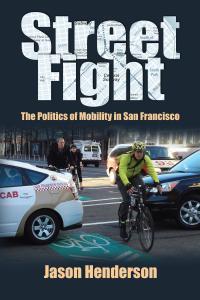
Ideology plays a bigger role in shaping San Francisco than most people realize, as we’ve discussed in this space before. Nowhere is that more true than in the politics of land use and transportation, as my friend Jason Henderson, a San Francisco State University geography professor, discusses in his insightful new book, Street Fight: The Politics of Mobility in San Francisco.

He’ll be discussing his work this Friday, April 19, from 7-9pm during a book launch party hosted by Green Arcade Bookstore across the street at the upstairs loft space of McRoskey Mattress, 1687 Market. Or if you miss that but want to join the discussion, you can catch Henderson’s forum on May 15 at SFSU or what will surely be other local events on this pivotal topic.

Henderson chronicles the seminal events in San Francisco’s history with “automobility” and related transportation issues, from the freeway revolts of the late ’50s through 2000 to today’s continuing political struggles over parking, bicycles, livability, gentrification, and the form, function, and financing of Muni.

Yet the lens that Henderson brings to understanding all of these issues and struggles is ideology, which he breaks down into three major categories: progressive, neoliberal, and conservative. Whether we realize it or not, we can all be fairly easily placed in one of those three categories when it comes to how we think about automobility, or the primacy of cars in modern life.

“A progressive framework conceptualizes mobility as a systemic problem that requires deep social commitment and responsibility. How we get there matters. It posits that there can be too much mobility, as exemplified by high levels of [Vehicle Miles Traveled] in the United States, and that excessive mobility results in both environmental degradation and major social inequality at a local, state, and global scale. The main problem, obviously, is that automobility is part of a wider, systemic moral and social problem of over-consumption and disproportionate materialism,” Henderson writes, sounding themes that I echoed in this week’s cover story.

On the other end of the ideological spectrum are those with conservative views on mobility, who see driving as a basic right, which is the dominant mindset on the west side of supposedly liberal San Francisco. “Unlike progressives, conservatives do not think about responsibility as relating to broader systems such as the economic structure of society. Instead, they think in terms of direct causation and of each individual being responsible for the consequences of his or her actions. For example, poverty is a result of individual shortcomings caused by personal and moral characteristics, not of structural themes like socioeconomic forces beyond an individual’s control. Getting to work on time and providing one’s daily needs are not collective concerns but the responsibility of the individual,” he writes.

Of course, these conservatives still rely on government to build and maintain their transportation infrastructure, which they believe should be centered around cars. “Government should guarantee and accommodate automobility, not seek to discourage it or make it more expensive. Government-sponsored road building and other explicit policies that encourage motoring reflect an optimal use of government to stabilize conservative social relations centered on automobility,” Henderson write of the conservative mindset.

Between those two poles are the neoliberals, who have come to dominate City Hall, particularly in the last few years with the ascendancy of Mayor Ed Lee, Board President David Chiu, and Sup. Scott Wiener, who has taken the lead role on transportation issues. Neoliberals rely on market-based solutions to almost any problem, and they end up partnering with either conservatives or progressives in the politics of mobility depending on the issue.

“Neoliberals, consistent with the broader agenda of the privatization of space and market-based pricing of public access to space, envision a mobility system shaped by pricing and markets rather than by regulation and collective action. Unlike progressives, neoliberals feel the built environment must be allowed to develop with the efficacy of the market. Movement, paid for by the individual user, should be unrestrained. Yet such efficacy can include a commodification of nonmovement or slower movement or the package of quality-of-life goods surrounding the ‘walkability’ and ‘livability’ of the city, a package reserved for those who can afford to enter. To that end, neoliberal mobility includes the aggressive use of government to both enhance mobility and rein it in, but only inasmuch as government policy helps realize the goals of profit and facilitating economic growth and development,” Henderson writes.

It’s fascinating to explore how these three distinct mindsets have shaped San Francisco in recent decades, and how they interact today to create the city that we’ll be moving through in the future.

Smell that: Wildflower trains take you away all this month

0

If one-too-many overcrowded Muni rides have left you aching for a more pleasurable mass transit experience, the Western Railway Museum has an option that smells less of body odor and more of spring flowers for you this weekend: the 12th year of its April spring wildflower train rides, which take passengers back to the early 1900s on an hour-long, 10-mile trip around the Montezuma Hills, a mere hour’s drive out of town. 

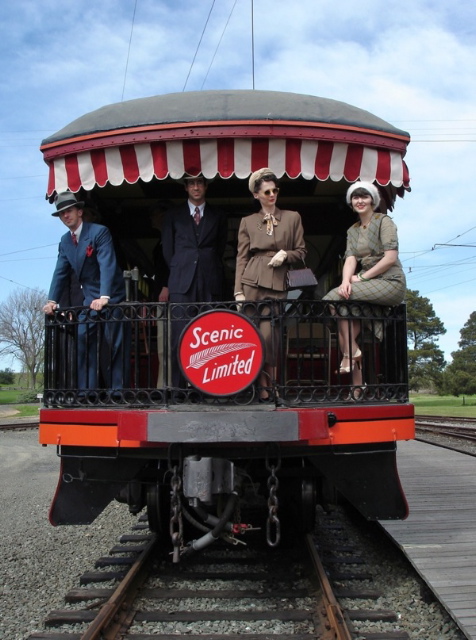
The trains’ route runs along the original historic main line of the Sacramento Northern Railway fields. Passengers can hop on either the Scenic Limited or the Vintage Comet trains, both of which consist of a 1914 parlor car and Sacramento Northern interurban car. 

THIS. Seriously, leave the city this weekend.

For a mid-day, kid-friendly adventure: Hop aboard the Scenic Limited. First class passengers ride up front in the parlor car and are served cookies and lemonade by attendants dressed in white button downs, vests, and slacks. Coach passengers ride behind in the Sacramento Northern interurban. Docents will be in both cars pointing out botanical views, which are constantly evolving as the season progresses. Expect to spot patches of poppies, goldfields, brass buttons, butter and eggs, clovers, and sheep’s sorrel.

If that options sounds too sober: A late afternoon ride on the Vintage Comet train, its quaint charms augmented by sips via the Suisun Valley Wine Co-Op might be more your speed. Proceeds from your ticket will go towards Solano Midnight Sun Foundation, which provides temporary financial assistance to women with breast cancer.

Whether you’re in it for the wine, the history, or simply as an escape from the particular eau de rush hour of Muni, be sure to bring a camera. Because if you were ever going to make out of state friends jealous of your California digs a shot of wildflower filled fields on a sunny April day aught to do it. 

April Wildflower Train Rides

The Scenic Limited: Saturdays and Sundays through April 28, 11:00am, 12:30pm, and 2:00pm, $10-16

The Vintage Comet: Saturdays through April 28, 5:00pm, $30

Western Railway Museum

5848 State Highway 12, Suisun

www.wrm.org

What cabs really do

0

tredmond@sfbg.com

EDITORS NOTES There are two ways to look at the taxicab industry in San Francisco: Either it’s purely a business, out to serve customers with the products that are most profitable — or it’s part of the city’s public transportation infrastructure, and thus subject to regulations that ensure all parts of the city are properly served.

If you take the first approach, then you’re like the entrepreneurs who founded Lyft, Uber, Sidecar, and Tickengo. They offer a product that the market clearly wants — rides that can be summoned with a smart phone and tracked by geolocation (no more “when the hell is that cab going to get here?”), with both drivers and passengers rated on a Yelp-like system.

The newcomers have no interest in the city’s old-fashioned regulations, which really do, in some ways, date back to the days when cabs were buggies pulled by horses. They’ve got a business model, and they’re going to follow it.

The problem here is that cabs are not just a business. (Housing isn’t just a business, either; that’s why we have, for example, rent control, eviction protections, and code enforcement.) Taxis are an essential part of the transit system in San Francisco. They backfill where buses and trains can’t or don’t go. They provide a lifeline for disabled people and seniors who need a ride, for example, to and from health-care appointments or supermarkets.

They are absolutely essential to the tourist economy, which is the city’s biggest and most lucrative industry (tech is still far behind).

There are problems with this part of the transportation system, as there are problems with Muni and BART and airport shuttles. There need to be more cabs on the streets, particularly at busier times. The existing drivers and operators need better technology and a better dispatch system.

But taxi drivers — the old, traditional type — are required to pick up anyone and drive anywhere; they can’t cherry pick the most attractive rides. They have to go through screening and training that ensures the public is safe.

They are, like many other utilities, almost a part of the public sector. There’s a good reason for that. And it’s what the city and the state regulators should be looking at.

Class divisions in SF (sorta)

38

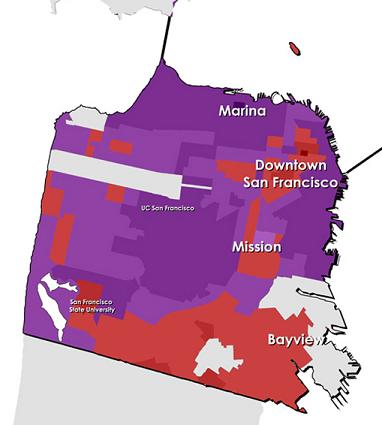
Richard Florida, who got famous creating the “creative class,” has a new series of maps out charting class structure in American cities — not on the basis of income or wealth but on the type of work people do. Sfist has a nice copy of the San Francisco version here. It shows, on the surface, that this city has virtually no “working class,” some “service class” and lots of “creative class.”

Overall, it’s a picture of a city in the late stages of terminal gentrification — but it’s also a bit misleading.

San Francisco long ago lost much of it’s traditional blue-collar work — manufacturing, production, distribution, and repair — although there’s still some left. What we don’t have is a lot of unionized blue-collar jobs (like the Port of Oakland offers). That’s pretty clear.

But unionized jobs that don’t require advanced degrees still exist in San Francisco — they’re just in the public sector. I suppose Muni drivers get defined as “service class” by Florida, but that’s really not accurate.

Nor is the notion that “creative class” people all make a lot of money. I suppose there are artists and musicians who are getting rich in San Francisco, but I don’t know any of them.

If anything, Florida’s approach just underscores the changes in the American economy in the past few decades. It doesn’t do much to help understand how the actual demographics of the city have changed, how wealth has become more concentrated and poverty more dire. So I don’t really get the point.

Lyft to take on Muni routes

37

In an announcement that could transform transportation policy in San Francisco, the startup company Lyft is prepared to take over some of the most crowded and dysfunctional Muni routes in San Francisco.

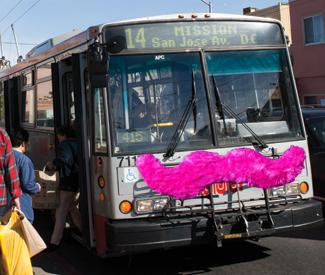
Mayor Ed Lee and the Municipal Transportation Agency have approved a plan that would turn the 38 Geary, 30 Stockton, and 14 Mission over to the tech startup, City Hall sources told us. The plan is still tentative and the Mayor’s Office is trying to keep it tightly under wraps until the financial details are complete.

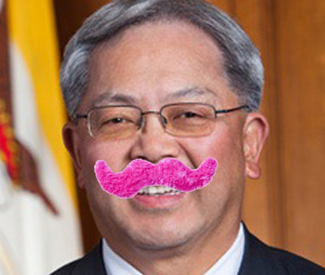
However, documents provided to the Guardian show that Lyft would buy at least 68 buses, including 12 articulated vehicles, at a price still to be negotiated. In exchange, the city would give the company – known for its pink mustaches on illegal taxi cabs – exclusive rights to operate on the heavily-used lines.

Lyft is developing an  app that would allow customers not only to view approaching buses but to book specific seats for an additional  price. Sensors in the bus seats will emit an electronic buzz to alert passengers that their seats had been purchased by someone else, warning them to vacate by the next stop. If the passengers remain, they will feel a sharp electric shock.

Lee’s office said the plan is similar to the market-based parking-meter program that raises the price of a space in times of heavy demand.

“The free market solves so many problems,” Christine Falvey, spokesperson for Lee, told us. “And it’s pretty clear that too many people who don’t really need to sit down or who are perfectly capable of waiting for a later conveyance are taking up space on the most crowded buses.”

Ron Conway, the venture capitalist who is Lee’s closest ally in the business community, will invest as much as $40 million in the new venture, Silicon Valley sources say.  If the trial public-private partnership works, he’s prepared to raise money to buy out Muni and turn the city’s bus system into a private operation.

“You’ve got a captive market, and demand-based pricing is what’s happening these days,” Falvey said.  “It’s just the next step.”

Artists respond to hate-speech ads with “fabulous” alterations

When it comes to countering hate speech, there’s nothing like creative expression mixed with direct action. Activists affiliated with art collectives Bay Area Art Queers Unleashing Power (BAAQUP) and Street Cred declared yesterday to be “Hate Free Monday,” and celebrated by modifying hate speech ads recently plastered on Muni buses.

Purchased by the pro-Israeli American Freedom Defense Initiative (AFDI), the ads contain bigoted, inflammatory quotations directed at LGBT people, attributed to prominent Muslims. Although city officials have condemned the advertisements, they were nevertheless allowed to be displayed because Muni determined them to be within First Amendment guidelines.

Headed by conservative blogger Pamela Geller, AFDI has been deemed a hate group by the Southern Poverty Law Center and the Anti-Defamation League. Geller herself is the target of the activists’ handiwork.

“We believe that all public spaces, including public transit, should be welcoming and safe for all members of our community,” the artists, who did not give their names, wrote to the Guardian in a statement sent from baqupower@gmail.com. “The hate-filled messages purchased by Pamela Geller’s AFDI defame and vilify Muslims and are harmful and offensive to residents and visitors in San Francisco, both Muslim and non-Muslim. 
Since the city will not take action against these ads on city buses, we have.”

To read BAAQUP’s full description of the motivations behind their action, go here.

Their statement concludes: “As long as these advertising outrages continue to appear on our streets, we will continue to reconstitute them to reflect something more truthful, just, and ideally fabulous.”


Emotions in motion

0

arts@sfbg.com

FILM Imagine being trapped, No Exit–style, on a city bus — let’s say Muni’s dreaded “Double Deuce” Fillmore for the sake of creative visualization — in the midst of a dozen or so out-of-control teenagers hell-bent on humiliating and terrorizing their peers and, if you have an obvious human frailty, you as well. Sound like fun? Well, Michel Gondry’s The We and the I puts you there (dramatically speaking, at least) and is often surprisingly just that. To paraphrase Sartre, “Hell is other people … on the bus,” but thankfully we get to take the trip from the safety of cushy theater seats and comfy couches.

Arguably minor Gondry (unlike 2011’s abominable The Green Hornet, whose failure can only be described as major), it’s a nice little palate cleanser in anticipation of his upcoming, much-publicized “return to form,” the Audrey Tautou–starring Mood Indigo, a film that looks to be as visually lush and romantic as The We and the I is stripped down.

Almost all of the film takes place on the aforementioned city bus as it crawls around the mean streets of New York City’s Bronx borough, ostensibly to take home kids (all played by nonprofessional actors, all minorities) after their last day of school. One or two of them do disembark early, but most seem stuck on a fossil-fueled existential journey of the damned. At about the 70-minute mark it’s hard not to wonder if the disgruntled bus driver isn’t just tooling around in circles past the same storefronts à la Joel Barish’s mind trips in Gondry’s Eternal Sunshine of the Spotless Mind (2004) — just exactly how big is the Bronx anyway? “Drop out, get your GED, join the army. I don’t give a fuck,” the driver tells a confused girl. It’s clear that the kids suffer from this kind of general adult apathy, but most bear it with a hard-edged bravado that belies their vulnerability.

That particularly applies to the trio of bullies at the back of the bus, who treat both the kids and the adults with equal-opportunity disdain. They smash an arty boy’s acoustic guitar, hurl insults while sneaking smokes, and even shame a middle-aged guy with a cleft palette. But most of their ire is saved for Teresa (Teresa Lynn), a slightly chubby, obviously troubled girl who shows up wearing a laughably bad blonde wig after being MIA from school for weeks. Teresa becomes the emotional heart of the story after it’s revealed her relationships with several kids on the bus are more complicated than initially thought.

Those kids include a drama-queen sexpot with apparent self-harming issues, a refreshingly upfront couple of gay teens, and a gaggle of giggling girls who toss around a water bra like a football. (The girls, tellingly, are just as aggressive as the boys.) Geek and bully alike connect regularly through the preferred teen method of communication: social media, specifically in the form of a YouTube video of a local doofus named Elijah repeatedly falling on his ass. Some joys are universal.

Visually, The We and the I marks a departure for Gondry. While his films always have a low-fi, arts-and-crafts vibe full of DIY quirk, this one generally eschews his love of handmade ephemera. (A major exception is the boom box rejiggered to resemble a tiny bus, which tools around to Young MC’s “Bust A Move” during the opening credits.) There is a touch of fast-motion and papier-mâché goofiness, but mostly the whole thing is done in a straightforward, verité style.

The tone, however, is pure Gondry: dopey-funny and sophisticatedly unsophisticated. You get the sense that, unlike his tony New York–loving counterparts Wes Anderson and Noah Baumbach, Gondry is a true populist. The We and the I is certainly nothing if not populist. But it’s also about the individual — specifically who we are inside and outside of an often-grueling social system. Despite some hiccups, like an unnecessarily dark third-act revelation, it’s more or less successful in illuminating the joys, cruelties, and uncertainties of life, which remain viscerally real after the sun sets and we finally get off the bus, vulnerable as ever in our solitude. 

THE WE AND THE I opens Fri/22 in Bay Area theaters.

Who gets hit by Muni switchbacks?

20

rebecca@sfbg.com

Muni switchbacks — that annoying practice where trains force all the passengers off well before the end of the line — have been in the news lately, with new Supervisor Katy Tang making switchbacks her first political priority.

But when you zero in on who bears the brunt of these service disruptions, it becomes clear that not all transit passengers are created equal. In fact, Muni data shows that the vast majority of switchbacks were concentrated in just three locations this past January.

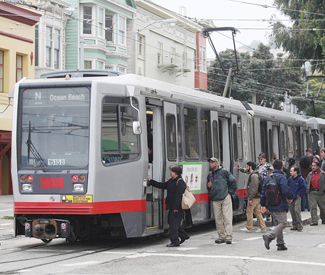
San Francisco Municipal Transportation Agency reports shows that the top three stations hit by switchbacks in January were the T Third stop at Third Street and Carroll Avenue; the N Judah stop at Judah Street and Sunset Boulevard; and the J Church stop at Glen Park Station, in that order. While the January data provides only a snapshot, annual figures show that the T and J lines each averaged around 36 switchbacks per month since February of 2012, while the N averaged 49.

View MUNI Switchbacks in a larger map

This map displays the top five locations where switchbacks occurred in January 2013.

Muni defends the switchbacks, saying that trains sometimes have to be rerouted to fill service gaps elsewhere. But for passengers, it’s a huge inconvenience — they’re left with little choice but to sit tight until the next train arrives, which in some cases can be as long as 30 minutes.

Switchbacks can happen in foul weather, and at night. They can impact elderly transit riders with few other transportation options. For weary Muni customers headed to the outskirts of the city after a long workday — or trying to get to a job or child-care responsibilities on time — a switchback can be the proverbial last straw.

The SFMTA data was included in a February memo to Sup. Carmen Chu, predecessor to newly minted District 4 Sup. Tang, who did not return Guardian calls seeking comment.

Some view switchbacks as a social justice issue. In the case of riders traveling to the end of the T line in the Bayview, the disruptions disproportionately affect riders who have longer trips to begin with — it takes 40 minutes to get from Van Ness Station to the end of the T line during normal weekday hours, compared with 28 minutes to the end of the N line and 26 minutes to the end of the J line. And those traveling to the city’s lower income, southeastern sector are less likely to have alternative means of transportation.

The 39 switchbacks that left southbound passengers waiting at the T Third Carroll stop, near Armstrong Ave, accounted for almost a third of all switchbacks recorded in January. Since they happen more frequently during off-peak hours, passengers are more likely to be left standing out on the platforms at night, when there are longer gaps between train arrivals.

That’s a public-safety issue: Police Department data accessed on San Francisco’s Open Data Portal shows multiple car break-ins, a robbery with force, and a meth possession charge all occurring nearby that train stop over the past three months.

According to the SFMTA memo, “Vehicle maintenance issues and automatic train control system issues accounted for most delays in which switchbacks were used to rebalance and restore scheduled service.” There were more disruptions on the K/T and N lines, Transit Director John Haley wrote, because they are “longer than the other lines and, as a result, have more opportunity to fall behind schedule.” The memo added that upgrades are underway to improve reliability and reduce breakdowns.

“SFMTA needs to prioritize providing reliable transit service to all San Franciscans,” Sup. Malia Cohen, who represents the Bayview, told us. “While I understand that systems need to be flexible to adjust to accidents or other issues, the data tells us that there is a pattern of these switchbacks in our outer neighborhoods in District 10 and District 4, disproportionately impacting low income transit riders, seniors and families.”

San Francisco’s Transit First policy, which appears in the City Charter, states: “The primary objective of the transportation system must be the safe and efficient movement of people and goods.” But Muni regularly boots three specific groups of train passengers off the trains, even though they have the farthest to travel. They’re left out on the platforms during off-peak hours, sometimes after dark, when there are longer wait times between trains. Does anyone actually believe that’s safe and efficient?

MUNI switchbacks disproportionately affect low-income and outlying areas

MUNI switchbacks may be on the decline overall, but when you zero in on who bears the brunt of these annoying service disruptions, it becomes clear that not all transit passengers are created equal. In fact, the vast majority of these annoying service disruptions were concentrated in just three locations this past January, according to San Francisco Municipal Transportation Agency (SFMTA) data.

A “switchback” is SFMTA jargon for ejecting passengers from a train before their destination, leaving them with little choice but to sit tight until the next one arrives. The trains are then rerouted to provide service elsewhere. Switchbacks can happen in foul weather, and at night. They can impact elderly transit riders with few other transportation options. For weary MUNI customers headed to the outskirts of the city after a long workday, a switchback can be the proverbial last straw.

The top three affected stations in January were the T Third stop at Third Street and Carroll Avenue; the N Judah stop at Judah Street and Sunset Boulevard; and the J Church stop at Glen Park Station, in that order. While the January data provides only a snapshot, annual figures show an average of 36 switchbacks on the T and J lines per month since February of 2012, and an average of 49 per month on the N.

For more information, click on the stations plotted below, created by the Guardian using Google Maps.


View MUNI Switchbacks in a larger map

The SFMTA data was included in a February memo to Sup. Carmen Chu, predecessor to newly minted District 4 Sup. Katy Tang, who has taken up switchbacks as a cause. Tang did not return Guardian calls seeking comment.

Whether passengers are bound for the Outer Sunset, Glen Park, or the Bayview, the passengers disproportionately impacted by these disruptions are those traveling furthest from the city’s urban hubs.

Some regard switchbacks as a social justice issue. In the case of riders traveling to the end of the T line in the Bayview, the disruptions disproportionately affect riders who face longer trips to begin with – it takes 40 minutes to get from Van Ness Station to the end of the T line during normal weekday hours, compared with 28 minutes to the end of the N line and 26 minutes to the end of the J line. And those traveling to the city’s lower income, southeastern neighborhoods are less likely to have alternative means of transportation.

The 39 switchbacks that left southbound passengers waiting at the T Third Carroll stop, near Armstrong Ave, accounted for almost a third of all switchbacks recorded in January. Since they’re concentrated during “off-peak” hours, passengers are more likely to be left standing out on the platforms at night, when there are longer gaps between train arrivals. Police Department data accessed on San Francisco’s Open Data Portal shows multiple car break-ins, a robbery with force, and a meth possession charge all occurring nearby that train station in the past three months, suggesting that there could be safety concerns as well. 

According to the SFMTA memo, “Vehicle maintenance issues and automatic train control system issues accounted for most delays in which switchbacks were used to rebalance and restore scheduled service.” There were more service disruptions on the K/T and N lines, Transit Director John Haley wrote, because they are “longer than the other lines and, as a result, have more opportunity to fall behind schedule.” The memo added that upgrades are underway to improve reliability and reduce breakdowns.

“SFMTA needs to prioritize providing reliable transit service to all San Franciscans,” Sup. Malia Cohen, who represents the Bayview, told the Guardian. “While I understand that systems need to be flexible to adjust to accidents or other issues, the data tells us that there is a pattern of these switchbacks in our outer neighborhoods in District 10 and District 4, disproportionately impacting low income transit riders, seniors and families. I will be working with Supervisor Tang and SFMTA to develop strategies to limit these switchbacks so we can provide reliable transit service to all corners of our city.”

San Francisco’s Transit First policy, which appears in the City Charter, states: “The primary objective of the transportation system must be the safe and efficient movement of people and goods.” SFMTA data shows switchbacks disrupt travel for three specific groups of passengers, even though they have the farthest to go. They’re left out on the platforms, sometimes after dark, when there are longer wait times. Does anyone actually believe this practice is safe and efficient?

Those infuriating private buses

154

People in the Mission continue to get more and more angry with the private tech-company buses clogging streets and filling up Muni stops; here’s a great photo of two of the behemoths forcing Muni passengers to walk out into the street to catch the bus that is supposed to be at the stop.

There’s a way to put an end to this, of course. Any other outfit that blocked Muni stops that regularly, with that much of an impact, would not only get repeated $250 tickets (as if Google cares about $250) but would eventually get a cease-and-desist order from the city. I know it’s not an earth-shattering problem, but it drives a lot of us nuts — and at some point, the city attorney needs to make it clear that violating city bus zones on a daily basis is not acceptable.


Big waterfront projects prompt study of new transportation ideas

18

The massive development projects being proposed along San Francisco’s central waterfront – from the proposed Warriors Arena at Pier 30 through the Giants’ housing/retail project at Pier 48 down to Forest City’s sprawling proposal around Pier 70 – will create huge challenges for the city’s already overtaxed transportation system.

Nobody is more aware of that issue than Warriors President Rick Welts as he seeks approval to build a 17,500-seat arena with just a smattering of parking spaces. “We’re investing a billion dollars in this property, and if people aren’t comfortable getting to it and leaving it, we have a problem,” Welts told a gathering of the California Music and Culture Association on Tuesday night, responding to a local resident who raised the concern. “We have to get that right, it’s at the top of our list.”

With Muni and BART already at capacity during peak hours, and thousands of new housing units being built in the coming years both along the waterfront and from nearby SoMa down through the Eastern Neighborhoods Plan area, city transportation planners are trying to get ahead of potential problems created by the development boom.

“We’re now taking a step back and looking at the long-term needs from the Exploratorium down to Pier 70,” says San Francisco Municipal Transportation Agency planner Peter Albert, who is leading a comprehensive waterfront transportation study that will inform the environmental studies done for each of these projects. “What we get is an environmental review that is much smarter because we have all this advanced planning….EIRs are important, but they aren’t really planning.”

Albert is looking at everything from working with various transportation agencies to beef up bus, train, and ferry services to the area; using these projects to complete the ambitious but underfunded and long-stalled Blue-Greenway bicycle path along the waterfront; accelerating capital projects that are already in the SFMTA’s queue; and exploring a dozen or so new ideas.

“What’s also coming out of this are new ideas we’re coming up with, things we weren’t even thinking of that may make sense,” Albert told us, noting that he’ll be doing his first presentation of some of these ideas to the SFMTA Board of Directors on March 5.

They include extending new streetcar service along the Embarcadero to the Caltrain station at 4th and King or possibly all the way out to the Anchor Steam Brewing-anchored project at Pier 48 (which would probably involve construction of new streetcar turn-arounds); better integrating the Central Subway project into Mission Bay and the Embarcadero with new bus and rail connections around 20th and 3rd streets; and expansion of the Embarcadero BART station to increase its peak capacity.

Welts said BART will be an important connector to the new Warriors Arena, noting that the walking distance from Pier 30 to the Embarcadero station is actually about the same distance as the Coliseum BART station is from the entrance to the Warriors’ current arena. He said that he’s excited about Albert’s work and wants to cooperate with helping the city meet its transportation needs: “We have a lot of process to go through and we’re embracing that process.”

Funding the needed improvements will be a challenge, particularly because new development projects generally don’t pay for their full impacts to the transportation system, as SFMTA head Ed Reiskin and Sup. Scott Wiener have told the Guardian. On Monday, Wiener amended the Western SoMa Community Plan to increase how much developers would pay in transportation impact fees.

Albert said funding for the needed improvements to the area’s transportation system would come from a combination of mitigation fees from the developers, reprioritizing the SFMTA’s existing capital budget, and securing state and federal transportation grants by developing impactful projects that are shovel-ready, thanks to this advanced planning effort.

These three waterfront development projects alone could have huge impacts. The Warriors Arena would host more than 200 concerts and sporting events per year, drawing anywhere from a few thousand to more than 17,500 people. The Giants’ Pier 48 proposal involves 27 acres of new development, including retail, office, Anchor Brewing, and about 1,500 homes. And Forest City’s proposal for Pier 70 involves about 1,000 homes, 2.2 million square feet of office space, and 275,000 square feet of retail and light manufacturing.

Addressing the waterfront’s transportation challenges, Board of Supervisors President David Chiu told the Guardian, “It is possibly the most difficult and important question surrounding the Warriors project, and I’ve encouraged all parties to make sure they get it right.”

Public broadband works; why not here?

42

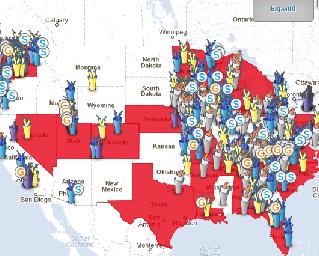
There’s a fascinating new map that the Institute for Local Self Reliance has put together that shows how 342 communities around the United States are now offering publicly owned, cheap, reliable broadband and cable service to local residents and businesses. Check it out here. Then check out why the fastest networks in the nation are built by local governments:

“It may surprise people that these cities in Virginia, Tennessee, and Louisiana have faster and lower cost access to the Internet than anyone in San Francisco, Seattle, or any other major city,” says Christopher Mitchell, Director of ILSR’s Telecommunications as Commons Initiative. “These publicly owned networks have each created hundreds of jobs and saved millions of dollars.”

Then sit back and ask yourself why you’re paying so much money every month for the rotten service you get from Comcast and AT&T. Ask your friends, ask around work; is anyone really happy with their broadband service? Do you think you’re getting a good deal for the price?

When I saw the map I called Mitchell, and he told me that every one of the cities and towns on his map has been successful with public ownership. “Within five years, everyone is either making money for the general fund or breaking even and offering really low rates,” he said. “The real benefit is lower prices, which leaves residents with more money in their pockets, which tends to get spent in their communities where it helps local business.”

Most of the cities that have muni broadband (and cable TV!) also have municipal electric power systems, which makes the whole thing easier. But Santa Monica did it bit by bit, installing fiber every time one of the streets was torn up for plumbing, sewers, etc. and gradually building out a network that so far only connects businesses but can be expanded as the money comes in. San Francisco streets are torn up all the time, and will be torn up regularly as water and sewer lines are replaced. The biggest expense of laying cable is cutting open and repaving streets; the cable itself is fairly cheap.

In some states, the big private telecoms have pushed through state legislation banning muni broadband — but not in California. San Francisco has every legal right to get into this business.

So why aren’t we doing it already? “What’s missing,” Mitchell said, “is the political will to really piss off Comcast and AT&T.”

I was just looking at the map when I got an email alerting me to this lovely discussion between Mayor Ed Lee and the head of PG&E, talking about the private utility’s plans to invest $1.2 billion in local infrastructure (more on that in a future blog post). That’s going to involve a lot of digging up streets. So what does Mayor Lee say? Maybe we could allow PRIVATE companies to lay fiber at the same time.

I want to throw up.


Western SoMa Plan changed to lessen development impacts to nightlife and Muni

14

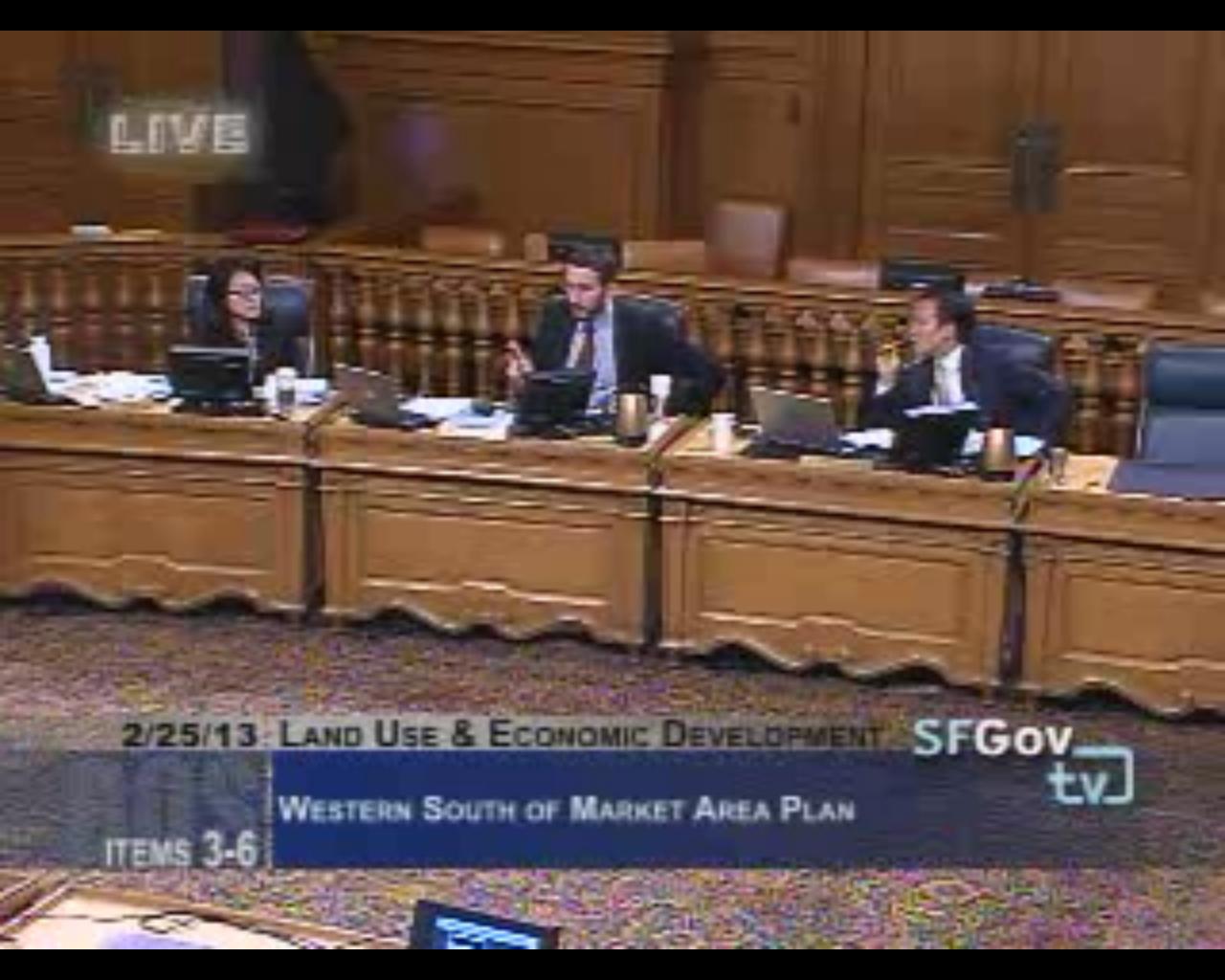
The Western SoMa Community Plan had its first hearing before the Board of Supervisors Land Use and Economic Development Committee today, with dozens of speakers praising the eight-year citizen-based planning effort that developed it but with much of the testimony criticizing the plan’s emphasis on facilitating housing development to the exclusion of other goals.

As we’ve reported, the nightlife community has in recent months been pushing for changes to the plan that would better protect nightclubs from complaints and pressure from nearby residents, particularly along 11th Street. Area Sup. Jane Kim has supported that effort and those concerns were echoed by Sup. Scott Wiener, the committee chair and a strong nightlife advocate.

“I have had significant concerns about this plan…and I’m hoping we can address them over the course of this hearing,” Wiener said.

Wiener also opened another front of attack on the plan by noting that it doesn’t adequately pay for the impact that thousands of new housing units would have on Muni and other aspects of the transportation system. In particular, he criticized a policy in the plan that would let 13 large properties get increased density in exchange for higher affordable housing fees that would be offset by lower transit and other impact fees paid to the city.

“What are we doing to make sure our transportation system keeps pace?” Wiener asked of Planning Department staff, later asking again, “Where would we get the money to improve transit for these increased residents?” Wiener didn’t get back any answers that seemed to satisfy him, so he asked for a more detailed report when the plan returns next week for a second hearing. That concern was echoed by the third committee member, Board President David Chiu, who said, “Building housing without money for transit will lead to long-term problems.”

The concern seemed to revive a losing fight that Wiener led in December over expanding who pays the city’s Transit Impact Development Fee, which pitted transportation advocates against affordable housing activists. Fernando Marti of the Council of Community Housing Organizing rued the revival of that conflict. “We’ve been here before, pitting [transportation against affordable housing needs] as if it were a zero sum game,” Marti told the committee, noting the importance of policies to balance out market rate housing and calling it a “plan for stability in a neighborhood facing large-scale gentrification.”

Marti’s COCHO colleague Peter Cohen, who was closely involved with the plan’s creation, also urged the committee not to tweak the housing policies or the revenues it creates for affordable housing. “This is a major upzoning,” Cohen said. “In 20 years, perhaps all the market rate stock [of housing in the plan area] will be gentrified.”

But the issue raised most often during more than two hours of public testimony involved nightlife and the need to strike a better balance between housing development and entertainment, much of the input stirred up by the California Music and Culture Association, a industry-backed trade group that formed largely in response to crackdowns on clubs in SoMa.

“It’s often said San Francisco can plan more for fun, and this is a great opportunity to do that,” said Guy Carson, a CMAC founder who owns Cafe du Nord. Longtime nightlife advocate Terrence Alan took part in the Western SoMa Task Force for four years before resigning in frustration, and he told the committee, “We are bringing up issues we felt marginalized in bringing up earlier.”

But several people involved with the task force, as well as speakers representing development interests, urged supervisors to pass the place without significant modifications. “There are dozens or hundreds of compromises in this plan,” Cohen said, urging supervisors not to upset that careful balance.

Task Force Chair Jim Meko – whose leadership was widely praised in the testimony – detailed the extensive outreach and detailed work that went into the plan, and offered a simple plea to the committee: “Please pass this plan so we can get on with our lives.”

The committee unanimously voted to support the change made to the plan by the Planning Commission to ban new residential development on the raucous 300-block of 11th Street, but to reverse the commission’s decision to grandfather in one final 24-home residential project on that block, in the so-called “purple building” at 340 11th Street. A number of other small changes to the plan were also unanimously approved.

But Kim objected to Wiener’s motion to eliminate the plan provision that would reduce the transit and open space fees and raise the affordable housing fees that developers of those 13 large parcels would pay. “I don’t think it’s good policy to reduce transit impact fees when we’re increasing population,” Wiener said.

“This has gone through an extensive community process,” Kim countered, adding that, “I hate that we’re always having this discussion about transit versus affordable housing.”

But Chiu sided with Wiener and the amendment was approved on a 2-1 vote with Kim in dissent. Yet Chiu held open the possibility of changing his mind next week when the plan returns to committee for a final vote – the delay prompted by the other revisions in the plan – when Planning staff will provide more information on the fee structure and its impacts.

If the committee gives final approval to the plan next Monday, it could be before the full board for approval the next day.

The battle of Brotherhood Way

24

Brotherhood Way is a creature of another era. Tucked between the San Francisco Golf Club and ParkMerced, it was long known as Stanley Way. But in 1958, under Mayor George Christopher, the city, which owned all of the land on the south side of the street, turned that property over to a long list of religious institutions and renamed the street to reflect its role as a place for houses of worship. It’s now home to six churches or synagogues and nine religious schools. It has its own (religious) neighborhood association.

And this quiet little corner of the city has been the scene of a pitched battle over a plan to build 182 housing units on an empty patch of land on the north side of the street.

Opponents of the project say the area was set aside for educational and religious uses, not housing — and they argue that the expansion of ParkMerced will add too much congestion to the area. Supporters say the west side of town needs to acept more housing and more density.

It’s gotten ugly: At one point, the Archbishop himself ordered the pastor of St. Thomas More Catholic Church to quit agitating against the development. Sean Elsbernd, who represented the district for eight years, infuriated neighbors when he supported the project, and later apologized for his insensitivity to their concerns.

And seven years after the Planning Commission and the supervisors gave the project a green light, it still hasn’t broken ground.
Now the developers are ready to go — and the churches, aided by retired Judge Quentin Kopp, are trying once again to shut it down.

Kopp’s been arguing for some time now that the project needs to go back for a new permit because too much time has passed and nothing has happened. But he’s got another argument, too, and he brought it to the Board of Appeals Jan. 9. See, the original deal had a problem with transit access, since there isn’t enough Muni capacity along Brotherhood to handle 300 or so new residents. So the developer agreed to build two pedestrian walkways from the project up to Font Blvd. in Park Merced. But according to Kopp’s appeal, ParkMerced management never agreed to the easements that would be necessary to build a path through its property.

Instead, in 2008, Zoning Administrator Larry Badiner unilaterally changed the requirement, allowing for one footpath to the edge of Park Merced — with some vague agreement that later there might be an extension to the Muni stop. That, Kopp argues, should have triggered a new Conditional Use application and a new hearing. Oh, and in the meantime, ParkMerced has just moved to greatly expand the size of its complex, so maybe that should be considered, too.

The Board of Appeals rejected Kopp’s arguments, but he’s petitioning for a rehearing, in part because the board chair wasn’t present for meeting. Kopp argues that this is a quasi-judicial board — “and you don’t go before the Supreme Court with only eight of the nine members present.” Under city rules, though, four out of five is a quorum and able to hear the matter.

Kopp has another argument, too — one that’s unusual, perhaps unique: He claims none of the board members actually read his original appeal brief.

Kopp, see, asked during the hearing if all of the members had read the papers he submitted, and none of them responded affirmatively. “It is appearent and inferable that no members of the short-handed Board of Appeals had read Appelants’ brief before the hearing, or at all,” the motion for rehearing states. “The manifest failure of the four members present to real Appellants’ carefully-prepared brief constitute extraordinary circumstances and injustice.”

I’ve been able to reach two of the board members, Frank Fung and Darryl Honda, and both insist they read the brief. “I read every case in its entirely,” Fung said, “and so does everyone on this panel.” Honda, who is new to the board, also said he read the documents. “I bust out the highlighter pen and go through all of the briefs in every case,” he said.

So why didn’t they answer Kopp’s question? Well, Fung says, it took them all by surprise: “I don’t think any one has every asked that before.”

I’ll let you know if the petition for rehearing is accepted.

The inauguration and the economic divide

112

Second inaugration speeches are hard; you have to be political without sounding partisan, inspiring without being divisive — and promise change and progress even if you haven’t accomplished what you wanted in the first term. The Obama address surprised me: He went left, making clear that he wants economic and social equality to be his final legacy. It’s getting rave reviews in the lib-blogosphere, where it’s been described as the speech liberals have been begging him to give for years. You can’t argue with the content — he mentions gay rights, global climate change, equal pay, protecting social security, economic inequality, the need for collective effort … he even talks about reforming the tax code.

So now comes the hard part: The struggle for economic justice has to go beyond a compromise plan that limits higher tax rates to people earning more than $400,000 a year.

In fact, the best thing I read this weekend was a NY Times piece by Nobel-Prize-winning economist Joseph Stiglitz, who argues forcefully that continued economic inequality is prolonging the recession. It’s also destroying the nation’s future:

Our skyrocketing inequality — so contrary to our meritocratic ideal of America as a place where anyone with hard work and talent can “make it” — means that those who are born to parents of limited means are likely never to live up to their potential. Children in other rich countries like Canada, France, Germany and Sweden have a better chance of doing better than their parents did than American kids have. More than a fifth of our children live in poverty — the second worst of all the advanced economies, putting us behind countries like Bulgaria, Latvia and Greece. Our society is squandering its most valuable resource: our young.

Stiglitz says what few in Washington want to admit: We can’t get the economy going again without rebuilding the middle class, and we can’t do that without higher taxes on the rich and a lot more public investment in education. Oh, and all this talk of how it’s out of our control is bullshit:

There are all kinds of excuses for inequality. Some say it’s beyond our control, pointing to market forces like globalization, trade liberalization, the technological revolution, the “rise of the rest.” Others assert that doing anything about it would make us all worse off, by stifling our already sputtering economic engine. These are self-serving, ignorant falsehoods. Market forces don’t exist in a vacuum — we shape them. Other countries, like fast-growing Brazil, have shaped them in ways that have lowered inequality while creating more opportunity and higher growth. Countries far poorer than ours have decided that all young people should have access to food, education and health care so they can fulfill their aspirations.

Makes me think about some of what I hear out of San Francisco City Hall. Oh, we can’t do anything about economic inequality; that’s a national issue. Or maybe it’s a state issue. I bet there’s not an elected official in town today who woudn’t proclaim complete agreement with everything Obama just said — and there are very few of them who are trying to bring that message back home.

In San Francisco, we give tax breaks for businesses that create high-end jobs that drive poor people out of town. We happily seek development without considering the impact it will have on existing vulnerable populations. We even struggle over free Muni for low-income youth. We do nothing — nothing — to reclaim wealth from the 1 percent and put it into local housing, public education, and job-training that could make a dent in our local economic inequality.

Mr. Mayor: Are you even paying attention?


The (bad) Warriors deal, by the numbers

36

Rudy Nothenberg, who ran Muni and the city’s water system, was chief administrative officer, negotiated the deal for the Giants ballpark, and served under six San Francisco mayors, stopped by the office last week to talk to us about the Warriors Arena. We’ve had our fights with Nothenberg (as we would with anyone who was that close to Willie Brown and Dianne Feinstein) but the guy knows more about City Hall, public works, private development, and infrastructure finance than almost anyone alive. So we were happy to hear what he had to say.

Let’s be clear, here: Nothenberg lives near where the arena is slated to be built, and, as he was quick to tell us, he doesn’t want it in his backyard. But he also presented a compelling case that San Francisco is getting ripped off. And he had a few pointed things to say about the lack of negotiating skills among the members of Mayor Ed Lee’s administration.

Back when Nothenberg was talking to the Giants about a stadium at Third and King — at that point a district of dilapidated and underused warehouses — always kept a card in his back pocket. “I always knew that if things didn’t work out and we didn’t build the stadium, that would be okay too,” he said. In other words: You can’t get a good deal if you’re not prepared to walk away. And when it comes to the Warriors proposal, the mayor has made it so clear that this is his legacy that the team knows the city will never walk away. So one side of the talks can demand pretty much anything, and the other side has no leverage.

Oh, and it doesn’t hurt that just about every development lawyer, political consultant, and lobbyist in town is already working on the project. “They have co-opted everyone,” Nothenberg — no stranger to the dark side of politics — told us.

The exact terms of the deal are still not public, which is a bit odd since the city has already started its environmental review. (Can you really do an environmental impact report on a project when you don’t know what the project actually is? Two difference state courts have come to opposite conclusions, so for now the answer is: maybe.)

But there’s enough information out there for Nothenberg to give us a basic rundown on the financing — and it doesn’t look good. “The Port is really not getting anything out of the deal,” he said. The city will get some increased sales and business taxes, and the Warriors will have to pay housing and transit fees. But there won’t be a lot of new property tax revenue, since that will all go to pay for the arena.

Here’s how Nothenberg laid out his analysis:

The Warriors have to spend $120 million to replace Piers 30-32. (Costs a lot to build such a huge structure over the water.) To make the team whole, the city will sell the Warriors a seawall lot on the other side of the Embarcadero for $30 million, then give the $30 million right back to the team. Then the city will set up an Infrastructure Finance District — the 2013 equivalent of a redevelopment agency — use the future tax increments to fund a $50 million bond. The Warriors get the bond money; the city pays it back. Oh, and then the city gives the team $30 million worth of rent credits, meaning the Warriors will probably never pay any rent at all for the use of that public property. And to make it sweeter, San Francisco will pay the Warriors 13 percent interest on the rent-credit money.

Meanwhile, the local taxpayers will have to come up with a huge amount of money to increase Muni capacity, since the existing transit can’t possibly handle the load of the new arena. Yes, the Warriors, like any developer, will have to pay a modest transit impact fee — “but it’s laughable to thing that this will ever cover the capital and operating costs,” Nothenberg said.

To summarize: The wealthy owners of a professional sports team will get free waterfront land to build an immensely valuable new arena. The city will pay to bring the fans there and get them home, deal with the traffic impacts — and get almost nothing in return.

Good one, Mr. Mayor.

SFBOS grab bag: Diva Breed, Yee’s jig, delayed Chiu, and more

10

Now that the dust has settled from this week’s San Francisco Board of Supervisors inauguration and presidential vote, I thought I’d return to a few random gems that were still stuck in my notebook, waiting to see the light of day.

Under the heading of There’s a New Diva under the Dome, new D5 Sup. London Breed didn’t wait for the official noon inauguration prescribed by the City Charter to take her oath of office, instead holding a packed event at 10am in the North Light Court, where her oath was administered by a key supporter, Attorney General Kamala Harris.

“I held a swearing in earlier to be able to have a large crowd of supporters,” was how Breed explained it to her colleagues later, and it’s certainly true that attendance at the official event was limited by the size of the room. But it’s equally true that gathering a who’s who list of local power brokers to applaud Breed’s ascendance as a key swing vote sends the signal that she expects to be at the table when the big deals get cut.

President David Chiu, who is also no stranger to political power plays, sounded a tone of humble leadership after maneuvering himself with closed-door negotiations into an unprecedented third consecutive term as president, noting that there is still much more work to do.

In fact, Chiu said he was almost late for Breed’s event because, “my bike light got stolen, the Muni bus was late, and then I had a hard time catching a cab.”

Sup. Eric Mar revisited his reelection race last year with a huge understatement – “In my campaign, I had to do a little more work than my colleagues did.” – noting that he and his supporters overcame an unprecedented $1 million in spending against them: “We sent a strong message that the Richmond District is not for sale and never will be.”

Sup. John Avalos gave credit for his surprisingly easy reelection campaign to a unlikely but deserving source: journalist Chris Roberts, who uncovered evidence that Avalos challenger Leon Chow didn’t really live in the district, which he reported in SF Appeal, forcing Chow to withdraw from the race. Avalos called Roberts “an honorary member of our campaign.”

Meetings like this are often just dripping in sanctimony, and this one was no exception, so it was nice to see a moment of genuine child-like exuberance from new D7 Sup. Norman Yee, who at 63 is about twice as old as most of his colleagues. As he thanked supporters and laid out his goals, Yee suddenly seemed overcome by this opportunity, smiling broadly, doing a little jig, and declaring, “Darn, I’m excited!”

I was less impressed by the rambling mini-lecture that Cohen gave on the topic of leadership before she withdrew her nomination as president. “That’s what leadership is about, stepping forward, outside your comfort zone, and doing things,” said the supervisor with a scant legislative record as she quit the race for president before her colleagues were even given the chance to vote on what she said was the importance of having a women of color in charge. “Every person here has that leadership quality within them.”

From both supervisors and the general public, there were also a number of statements made about the history of the board presidency that were not quite right, particularly as it pertained to Cohen and Jane Kim nominating one another for president and the issue women of color being nominated for that slot.

So, for the record, the last time a woman of color (former D10 Sup. Sophie Maxwell) was nominated for board president was 10 years ago. The last time a woman served as president was Barbara Kaufman (1997-99). And the last time there was a woman of color serving as president was Doris Ward, who served from 1991 to mid-1992 when she left to become Assessor. Also, the last three-term president was John Molinari, who served from 1979-83 and ’85-’87.

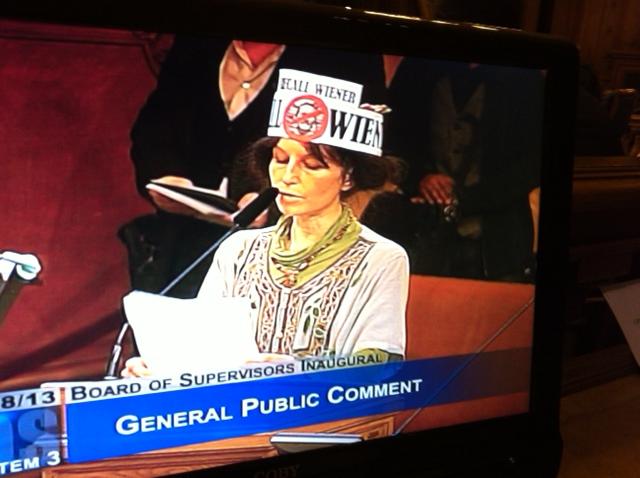
The most colorful moment in public comment was when nudism activist Gypsy Taub came clad in homemade hat that urged people to oppose and recall Sup. Scott Wiener. But because Wiener had already said he wouldn’t accept a nomination as president, she turned her criticism on Chiu, who was also slammed by another leftist speaker who told supervisors, “If you can’t prevent David Chiu from being president, we deserve to be slaves.”

Finally, the meeting included an unremarkable speech by Mayor Ed Lee, who pledged to work with each supervisor and offered this unsupported claim, “We continue to make sure this city is successful for everyone.”