MUNI

Waiting for BRT

18

By Joe Fitzgerald Rodriguez

joe@sfbg.com

You’re on Muni’s underground line, the train stalled just shy of your stop, just stuck there, the light at the end of the tunnel right in front of you. It’s a frustrating feeling, right?

With more than six years worth of delays in three major transit overhauls — the Van Ness, Geary and Geneva Bus Rapid Transit Projects — it’s beginning to feel just like that.

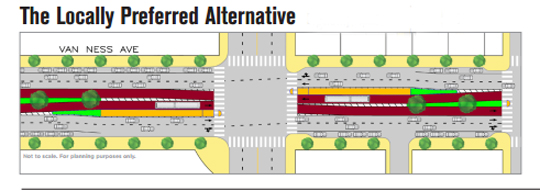
The projects are designed to speed up the most trafficked transit routes in the city by making the buses run like trains. For the Van Ness Bus Rapid Transit, the 47 and 49 would drive in dedicated bus-only lanes shuttling riders north and south, reducing travel time by a third, according to project estimates.

Van Ness BRT was initially announced in 2004 with a planned unveiling of 2012. Eight years later, the new debut is set for 2018. The Geary Project is even worse, with a completion date slated for 2020.

The Van Ness BRT is finally getting its wheels turning this month, with the Environmental Impact Report set to be approved by a number of governmental bodies: the Van Ness BRT Citizen’s Advisory Committee, the Transit Authority board, and the San Francisco Municipal Transportation Authority.

Why the hell has this bus project taken nearly a decade to start its engine? As is customary in politics, fingers are pointed at all sides.

At a citizen’s meeting for the Van Ness BRT on Sept. 4, two angry factions gathered in the Old First Church Fellowship Hall on Van Ness. The SFMTA’s spokesperson for the project, Lulu Feliciano, wrapped up her presentation to the crowd of about 100, and that’s when they pounced.

“Van Ness’ three lanes will be limited to two, but it’s a highway, isn’t it?” asked Carole Holt, owner of Russian Hill Upholstery. “Why do cars have no consideration?” She told the Guardian she worried her customers from Marin would have trouble getting to her store.

Another Polk Street activist, Kelly Gerber, walked right up to Feliciano’s face and gestured with his hand like an angry schoolteacher. “Why has no one ever heard of this?” he bellowed, telling us he opposes the loss of parking spaces.

Ironically, transit planners say car traffic would move faster, partially because of the elimination of all left turns along Van Ness except Broadway.

“They’re just angry and zooming in on every little detail,” Mario Tanez, spokesperson for the SF Transit Riders Union, said of BRT’s opponents.

The mostly younger crowd of transit activists showed up in equal force to counter the Polk Street merchants, hoping to stem the tide of NIMBYism.

“We’re the generation that will actually see these improvements,” Teo Wickland told us. He’s an urban planning student who hopes to see Muni running on time.

Feliciano said the project was complicated by having to coordinate multiple city agencies, all with their own goals.

Instead of digging up the same stretch of concrete a dozen times in a decade, San Francisco tries to include as many agencies as possible when cement is broken in any part of the city, she said. Since the Van Ness project is a two-mile stretch between Lombard and Mission streets, many are involved.

infographic showing different city agencies involved in the reconstruction of Van Ness

Graphic by Brooke Robertson

Peter Gabancho, the project manager for Van Ness BRT, said that the San Francisco Public Utilities Commission will put in new water lines, institute a rainwater catch system, and do sewer work. The Department of Public Works plans to repave, and the SFMTA will replace overhead bus lines and light poles.

When asked how much the city would save by combining work, he couldn’t give an exact dollar amount but said it was in the tens of millions, at least.

He also said that the process requires community meetings at many steps in the process. City officials visited Mexico City to see how they planned and built its BRT in just three years, and Gabancho said it’s because that city didn’t really consult the community.

“We can’t do business like that in San Francisco and I don’t think we want to do that in San Francisco,” he said.

All of that governmental insanity had a member of the Geary BRT’s Citizen Advisory Council calling it quits in a fury — he even wrote about it in his blog.

“What I’ve seen in the past six years has been a severe disappointment during which I have lost trust in America’s regulatory framework to enact effective transit improvements,” Kieran Farr, the CEO and co-founder of VidCaster, wrote. He described the process as fraught with starts and restarts, slips and delays, mostly due to a lack of leadership. And that’s the rub: There is no point person on this project with strong political will, according the SFTRU. “The mayor is not saying this is high priority,” Tanez told us. “He’s at all the Central Subway events, but getting political clout behind this by writing to our supervisors is the only way to do this.” The Van Ness project runs through the districts of Sups. Mark Farrell and David Chiu, who were both unavailable at press time. The SFMTA is slated to approve the Van Ness BRT EIR on Tue/17 at 1pm in City Hall, Room 400.

Put the Warriors Arena atop CalTrain

21

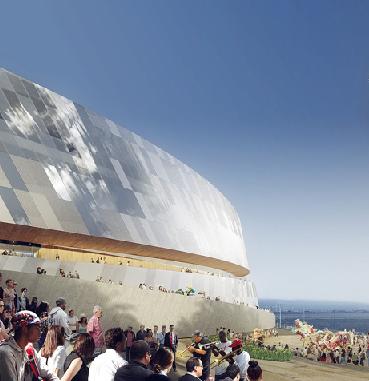
OPINION Numerous problems with the proposed location of a new Warriors stadium and surrounding complex are obvious. What we need is a better solution, not just laments about the folly of it all. Is there a better solution for everyone?

We can take a page from Warriors co-owner Peter Guber’s book, “Tell To Win.” He explains how a business proposal lives or dies in terms of the story it embodies. The story trumps piles of statistics or litanies of problems. This is what tries men’s souls and glazes eyes. But there is an alternative story to tell in this case, one that is win-win for everyone.

Let’s create a great sports complex at the heart of our public transportation system. We don’t need to clog the waterfront when we can build a great sports mecca elsewhere. Let’s take a cue from New York City and how Madison Square Garden perches directly above Penn Station.

Right now CalTrain has an ideally located terminus in the core of the city, but it’s unsightly. Why not put the new stadium directly above the CalTrain station? The same solution is being applied right now to the new Time Warner headquarters at Hudson Yards on the west side in New York: several skyscrapers will rise on platforms above an existing rail yard.

Consider the advantages: CalTrain passengers can walk upstairs to see a game! Muni and BART riders can take a short walk to the stadium. Soon they’ll be able to ride the Central Subway to it as well. It’s the perfect place for a major indoor arena that could host diverse events.

AT&T Park is just a block away and already lends enormous appeal to this entire area. The train yard extends from 4th to 7th St and the space above this great expanse could house a sizeable parking garage, less than a block from the 280 access ramp, as well as a hotel, restaurants, condos, offices and perhaps a shopping complex.

It’s everything Peter Guber and his partners dream of, that the city needs, and that we can embrace, now that it’s in the right place.

Let’s welcome the Warriors by all means. But do we want a Titanic on the waterfront when we can have a jewel above the CalTrain station that will simultaneously overcome the gulf that now exists between the western part of SOMA and Mission Bay?

This location could establish a sports complex the rival of any in the country. An essential, but dreary space turns into a great sports oasis, like Cinderella at midnight but in reverse. Perhaps the city will even want to include a large, well-equipped community recreation center for all of us who like to play as well as watch.

Bill Nichols is a consultant for documentary filmmakers and has published a dozen books related to the cinema. He lives in San Francisco.

Waiting to connect

10

news@sfbg.com

Eight years ago, San Francisco almost gave away an enormously lucrative public utility to Google and Earthlink: a citywide Wi-Fi connection. The hastily drawn up plan was championed by then-Mayor Gavin Newsom after a Google executive pitched him on the idea of citywide wireless Internet access at a dinner party.

Google’s Wi-Fi scheme would have blanketed the city with coverage, but it would also have required users to obtain Google accounts to sign in, thereby facilitating the company’s vacuum-like data harvesting practices that suck up everything from search queries and emails to the geographic locations of smartphones and tablets. Google’s Wi-Fi plan would have allowed the tech giant to insert “prioritized placement” of ads and brands into a Wi-Fi user’s feed, limiting choice of content through profit-driven algorithms.

The Electronic Frontier Foundation, ACLU of Northern California, Electronic Privacy Information Center, and we at the Bay Guardian all criticized the plan (see “Tech Disconnect,” 11/9/05). Earthlink, Google’s partner in the privatization deal, nearly went bankrupt in 2007 and the company bailed on the Wi-Fi proposal. That was the end of the city’s first Wi-Fi scheme. Thousands of free networks in cafes and hotels popped up in the meantime, leading many to question the purpose of building municipal Wi-Fi.

But municipal Wi-Fi is back. Sup. Mark Farrell and Mayor Ed Lee announced recently that free Wi-Fi is coming to 31 San Francisco parks. Google is involved yet again, but officials in the city’s Department of Technology say that the network will be not be controlled by Google, nor directly susceptible to privacy invasions by the “don’t be evil” company or its affiliates. In short, it will be a public utility.


PUBLIC UTILITY

“I think a lot of the prior debate around free Wi-Fi in San Francisco that never moved forward was because of different questions around business models,” Farrell told us. “To emphasize, this is a free gift [from Google] of financial benefit to the city of San Francisco with no strings attached.”

For the parks, Google has agreed to give a $600,000 contribution to fund Wi-Fi installation and two years of operation. Farrell said this is the company’s only role. There will be no Google hardware or software allowing the company to devour user data or steer traffic.

San Francisco’s reinvigorated push to build out public Wi-Fi comes just as major telecom companies and Internet giants like Google are again targeting large Wi-Fi networks for privatization. In the late 2000s, many tech companies abandoned Wi-Fi services as unprofitable. Telecom companies were busy expanding their cellphone infrastructure.

But thanks to the proliferation and technical advances of smartphones, cellular networks are now choking on megabits of traffic. Telecom companies see Wi-Fi as a means of offloading mobile traffic onto broadband infrastructure. Google and other companies see Wi-Fi networks as vast troves of consumer data, and airwaves on which to advertise.

Google’s grant for Wi-Fi in San Francisco’s parks comes after months of bad press for the company and the tech sector, including revelations that all of Silicon Valley’s top companies readily cooperated with the NSA’s electronic surveillance programs.

Google also recently paid out $7 million to settle state investigations into its “Wi-Spy” data collection activities: wireless receivers hidden in Google’s Street View vehicles sopped up communications data, including passwords and even email content, from millions of networks in the United States and Europe. Beside Google’s numerous spying scandals, the company has also come under criticism for aggressively avoiding federal taxes, and locally for its impact on San Francisco’s transportation and housing problems.

If the $600,000 gift is designed to bolster Google’s image as a good corporate citizen, it probably also makes good business sense. “Thousands of Googlers live and work in SF,” said Jenna Wandres, a spokesperson for the company replied to our inquiries by email.

Marc Touitou, director of the city’s Department of Technology, told us the park Wi-Fi system will be entirely the city’s, and that no third party corporation will determine who can use the service or under what terms.

“It’s not a Google network, it’s not a Wi-Fi name from Google. It’s a donation, a gesture,” said Touitou. He added that talks with AT&T to let the company roll out a Wi-Fi network for all of Market Street were recently cut off because his office has decided to build the system as a fully municipal network instead.


CORPORATE GIFTS

Touitou’s office has plans to light up free municipal Wi-Fi along the Embarcadero, in the Castro, Noe Valley, and perhaps even on Muni buses in the near future. With the parks, Touitou said the idea is to gain back the confidence of the public, to show that the city can do this on its own. Touitou also said that he hopes the city will budget funds for these Wi-Fi systems so that they’re not reliant on corporate gifts.

“We reserve right to leverage this model where companies can put money in because it’s in their interest,” Touitou said. “They don’t care what name is on the network so long as they can dump their traffic on it.”

A public utility model will allow San Francisco to own and operate Wi-Fi across the city and to allow telecom companies to funnel mobile traffic through the city’s infrastructure, likely for a fee. Touitou said it doesn’t make sense for the city to give away its Wi-Fi infrastructure as it is a limited and increasingly valuable asset.

“The day we sell it would be a sad day,” Touitou added.

He described the city’s two radio towers, 200 buildings, thousands of utility poles, and the fiber optic grid that can connect these as the backbone of a robust municipal wireless network. Telecom and Internet companies will pay to use the infrastructure under this model. Most privacy experts who examined San Francisco’s prior Wi-Fi plans have yet to weigh in on the parks network. Revelations about the NSA’s vast spying programs have consumed the attention of groups like EFF and the ACLU.

Touitou said, however, that the city’s Wi-Fi privacy policies will be strong. “This isn’t a third party network trying to market to you,” explained Touitou. “It’s a city network that wants to facilitate traffic, and we want to have the privacy respected.”

Even as San Francisco plans its next steps with city Wi-Fi, Google is rapidly expanding its own wireless network operations. Already the company controls the citywide Wi-Fi network for Mountain View where the “Googleplex” is located. Google also has Wi-Fi networks scooping up communications in Boston’s South Station and New York’s Chelsea neighborhood. The terms of Google’s Mountain View deal do not limit Google from collecting data, and users are required to sign in with a Google account. Google also recently announced that it will take control over Starbucks’ thousands of Wi-Fi networks, creating a potentially vast trove of consumer data and a marketing platform for both companies. Starbucks has 50 locations in San Francisco.

AT&T, which lost the Starbucks contract to Google, and also lost its bid to take over Market Street’s airwaves, has its own data mining projects that tap the company’s Wi-Fi networks in 30 countries for personal information, and to route telecom traffic.

So even with municipal Wi-Fi, tech and telecom companies will still have ample ability to siphon off communications data straight from wireless networks and hand it to the feds or to advertisers.

Spotlight shone on gentrification in West Oakland and SF

0

Two stories on the theme of gentrification and displacement — a topic we at the Bay Guardian have expended plenty of ink on — ran in major news outlets recently, showing how intense the Bay Area housing market pressure has become as it continues to be fueled by a rapid growth in high-salaried jobs in big tech.

Zeroing in on San Francisco, the Los Angeles Times turned an eye toward Mission District gentrification (“San Francisco split by Silicon Valley’s wealth,” Aug. 14) illustrating the growing divide with a succinct comment overheard on a Muni bus: “I don’t know why old people ride Muni. If I were old, I’d just take Uber.”

And a Wall Street Journal article (“Companies spruce up neighborhoods, putting gentrification in overdrive,” Aug. 13) provides an eye-opening account of how REO Homes LLC is seeking to accelerate the gentrification process by “beautifying” West Oakland, an historically African American neighborhood that is home to predominantly low-income and working-class residents.

Minutes from downtown San Francisco via BART, West Oakland is dotted with Victorians and was hit with a wave of foreclosure during the economic crash, destabilizing the lives of many families who lost their homes.

REO is an investment firm helped along by San Francisco billionaire Tom Steyer, a well-connected venture capitalist (he even hosted a Democratic Party fundraiser with President Barack Obama at his Pacific Heights mansion earlier this year).

As the Journal’s Robbie Whelan reports, REO has been shelling out top dollar to spruce up not just its holdings, but residences nearby its West Oakland properties. In a rarely seen form of hyper-gentrification, the company has been planting trees, sprucing up homes (for free) of neighbors who aren’t in the market to sell or rent, mending fences, and making other improvements — all in an effort to lure higher-income residents to the neighborhood.

Since 2008, the height of the real-estate market crash, REO has acquired more than 200 homes in Oakland, Whelan reports, mostly in West Oakland. “Most houses cost around $200,000,” he writes, “and [founder Neill Sullivan] said he invests as much $100,000 to fix each one up.”

Real-estate agents have been marketing the sometimes-rough neighborhood to house-hunters as an affordable, nearby alternative to astronomically expensive San Francisco. Now that many people who weren’t able to keep up with mortgage payments have been forced out by foreclosure, things are changing swiftly, as if by magic. Armed with cash, bankers are chasing away the blight and rolling out the welcome mat for up-and-comers who can’t swing that $3,000 one-bedroom in The City. All of which will likely result in further displacement of Oakland residents who are barely holding on as it is. As Oakland City Council member Desley Brooks told the Journal: “I’m not interested in finding housing for San Franciscans who can no longer afford San Francisco. I’m interested in helping people here in Oakland.”

West Oakland hyper gentrification in the WSJ

Two stories on the theme of gentrification and displacement – a topic we at the Guardian have expended plenty of ink on – ran in major news outlets recently, showing how intense the Bay Area housing market pressure has become as it continues to be fueled by a rapid growth in high-salaried jobs in big tech.

Zeroing in on San Francisco, the LA Times turned an eye toward Mission District gentrification, illustrating the growing divide with a succinct comment overheard on a Muni bus: “I don’t know why old people ride Muni. If I were old, I’d just take Uber.”

And a Wall Street Journal article provides an eye-opening account of how REO Homes LLC is literally seeking to accelerate the gentrification process by “beautifying” West Oakland, an historic Black neighborhood that is home to predominantly low-income and working-class residents. (Note: The article may be behind a paywall.)

Minutes from downtown San Francisco via BART, West Oakland is dotted with Victorians and was hit with a wave of foreclosure during the economic crash, destabilizing the lives of many families who lost their homes.

REO is an investment firm helped along by San Francisco billionaire Tom Steyer, a well-connected venture capitalist (he even hosted a Democratic Party fundraiser with President Barack Obama at his Pacific Heights mansion earlier this year).

As the Journal’s Robbie Whelan reports, REO has been shelling out top dollar to spruce up not just its holdings, but residences nearby its West Oakland properties. In a rarely seen form of hyper-gentrification, the company has been planting trees, sprucing up homes (for free) of neighbors who aren’t in the market to sell or rent, mending fences, and making other improvements – all in an effort to lure higher-income residents to the neighborhood.

Since 2008, the height of the real-estate market crash, REO has acquired more than 200 homes in Oakland, Whelan reports, mostly in West Oakland. “Most houses cost around $200,000,” he writes, “and [founder Neill Sullivan] said he invests as much $100,000 to fix each one up.”

Real-estate agents have been marketing the neighborhood – which is no stranger to violent crime – to house-hunters as an affordable, nearby alternative to astronomically expensive San Francisco. Now that many people who weren’t able to keep up with mortgage payments have been forced out by foreclosure (see: robocalls, bungled loan modifications, foreclosure abuses), things are changing swiftly, as if by magic. Armed with cash, bankers are chasing away the blight and rolling out the welcome mat for up-and-comers who can’t swing it for that $3,000 one-bedroom in the city.

All of which will likely result in further displacement of Oakland residents who are barely holding on as it is. As Oakland councilwoman Desley Brooks told the Journal: “I’m not interested in finding housing for San Franciscans who can no longer afford San Francisco. I’m interested in helping people here in Oakland.”

Compromises deliver results

5

OPINION When Guardian Editor Steven T. Jones asked me to respond to his recent columns (“Chiu becomes City Hall’s go-to guy for solving tough problems“, 7/23/13; “Chiu: Centrist Compromiser, Effective Legislator, or Both,” 7/30/13), I reflected on how our Board of Supervisors’ 2013 accomplishments exemplifies the lessons and rewards of working together.

After several decades of intense fights between TIC owners and tenants, I asked both sides to sit down, share perspectives, and brainstorm beyond the impasse. To our surprise, when TIC owners shared their struggles and offered to pay a fee to condo convert, tenant advocates agreed to finally support conversions as long as their core principle of preventing evictions — which I strongly shared — was addressed.

After a decade of failed CEQA reform attempts, the pundits predicted an epic battle between developers and neighbors this year. The breakthrough for unanimous support occurred when both sides acknowledged to me that real neighborhood input and predictability in the planning process are not mutually exclusive, and progressive leaders wanted to ensure that pedestrian, bike, affordable housing, and public projects are not delayed.

After years of controversy, CPMC/Sutter and the coalition of dozens of community-based organizations deadlocked over how to rebuild the Cathedral Hill and St. Luke’s hospital campuses. After exposing financial documents challenging the original proposal, I worked with colleagues for six months at a mediation table that refashioned a CPMC plan to rebuild those 21st century hospitals the right way.

While each story is unique, what all of these accomplishments — along with recently balanced budgets, business tax reform, and pension reform — have in common is hard work and extreme patience by dedicated San Franciscans seeking creative solutions.

As Board President, my job is to build consensus among our diverse supervisors and deliver results. When I first came to City Hall, I asked my colleagues to move beyond past politics that had magnified differences. I am proud that today’s Board has the highest approval ratings in a decade, as we do more together working through our differences.

At the negotiation table, it’s essential to stand firm on core values. My vision for San Francisco has been of a city that protects tenants and families; creates good jobs across the economic spectrum; offers high quality public services with Muni, our schools, and our parks; and embraces our diversity, our immigrants, our seniors, and those who have been historically disenfranchised.

When we can’t always find creative win-wins, it’s still important to fight for what’s right. I’ve taken my political lumps championing the right of noncitizen parents to vote in school board elections, standing up for workers requesting family-friendly workplaces, and taking on a Yellow Pages industry dumping millions of phone books on our streets.

When I hear criticisms of “compromise,” I reflect that the most important federal legislation in recent years — from the Civil Rights Act to the Affordable Care Act, Wall Street reform to comprehensive immigration reform — were also criticized as “compromises.” Critics often forget the big picture: by incorporating different views, reforms actually get done, and if we wait forever for the perfect policy, people will suffer.

San Franciscans are at our best when we unite around shared values — from marriage equality to universal health care to environmental protections. We still have plenty of challenges: housing affordability, struggling workforces, family flight, public transit.

Let’s continue to work together to show the rest of the country how our city can govern.

David Chiu, who represents District 3 (North Beach, Chinatown, Nob Hill), is serving his second term as president of the Board of Supervisors.

The time is now to fix Muni

11

EDITORIAL San Franciscans love to bash Muni, but this city would be a gridlocked nightmare without it. Despite its many flaws, Muni does a pretty good job at getting people around the city, particularly for a system that has been plagued by chronic underfunding and which is at capacity during peak hours.

Yet in a growing city that has ambitions to grow even faster — pushed by regional motivators such as Plan Bay Area and pulled by the grand designs of powerful capitalists and their neoliberal political enablers — Muni is well on the way to earning all the scorn that critics can heap on it and becoming the self-fulfilling prophecy of dystopian dysfunction.

Into this critical moment comes the city’s Transit Effectiveness Project and its promise to reduce travel times by 20 percent on busy corridors and to improve reliability and service to underserved areas such as the Excelsior. The TEP’s 793-page environmental impact report dropped on the city with a barely noticed thud last month, and it will be the subject of an informational hearing at the Planning Commission this week (Thu/15) and a series of community hearings in the weeks that follow, with public comments due into the Planning Department by Sept. 17.

So now is the time to get serious about addressing long-simmering conflicts between the Muni’s needs and the desires of private automobile drivers, which are often in conflict on roadways where they’re forced to share space. And on a deeper level, this city must resolve the conflict between the need to substantially increase investment in vital public infrastructure and the destructive fantasies of anti-government ideologues who want a functional city but don’t want to pay for it or be inconvenienced.

Only then can we really delve into the devilish details of the TEP, with tough-to-resolve conflicts between reducing stops to speed service and the needs of the elderly and disabled, whether to limit cycling in certain stretches, how to slow traffic and limit parking without triggering motorist backlash, and how to quickly expand capacity again after you’ve improved the system and encouraged more people to use it.

But these are solvable problems if San Franciscans of all stripes acknowledge the realities of a growing city with a finite capacity to accommodate cars and an infinite need to improve Muni and the safety of pedestrians, laudable goals of the TEP and its new EIR, which is designed to smooth the way for many transit improvement projects to come.

We won’t get there by pandering to people who are pissed off about efforts to regulate street parking in their neighborhoods (and we certainly won’t get there if certain supervisors now making rumblings about taking parking regulation back from the SFMTA get their way). It’s time to truly become the transit-first city we claim to be, and that process starts now.


Boxes in space

38

rebecca@sfbg.com

On a recent weeknight, a group of volunteers met up at a warehouse space in SoMa to hash out plans for The Learning Shelter, a project that has attracted hefty donations and enthusiastic volunteers but lacks a permanent home base. The brainchild of Marc Roth, a maker-movement enthusiast, the idea is to give homeless people a boost toward a brighter future by teaching them how to make things with 3D printers, and other useful skills.

Eight large shipping containers, on loan from supportive organizations, are currently sitting in a gated lot adjacent to the 14,000-square-foot warehouse, which housed a community-based project called [freespace] in June and July.

Roth and his core group of volunteers have plans to retrofit each container to be a “shop in a box” — a mobile classroom, outfitted with whiteboards and enough juice to power the Cubes (a brand name for 3-D printers), CNC routers, laser cutters, and other maker toys. The vision is to use those retrofitted shipping containers to lead three-month intensives in technical skill instruction for up to 30 adult students without homes at a time.

Roth is currently working at a laser company startup, but it wasn’t long ago that he was among his project’s target population. He moved to San Francisco from Las Vegas in September of 2011 and slept in his car (which was “part of the plan,” he explained) while struggling to piece together a new life in the Bay Area.

After one job opportunity fell through, he landed a gig cooking pizzas on Treasure Island. But the long shifts kept him on his feet all day, and aggravated a health condition that causes nerve damage. With few options and a disability sending his health into a downward spiral, it was only a matter of months before he hit rock bottom and checked into a homeless shelter run by the St. Vincent de Paul Society.

It was near 5th and Bryant streets in SoMa. Just a few blocks away, Roth discovered TechShop, a do-it-yourself community workshop that describes itself as being “on a mission to democratize access to the tools of innovation.” An atypical member of the homeless population, Roth had worked as a programmer in the past, and had an itch to learn laser cutting. So he shelled out some of his last dollars for a TechShop membership.

At first, he was grateful just to have found a place where he could tinker for about 10 hours a day while sitting down, since his health problems were still sapping his energy. “I’d never heard of any of these machines,” Roth said. But soon, he was voraciously teaching himself to use them. “When they showed me what a water jet was and what it could do, the hair on the back of my neck stood up,” he said of the device that uses high-pressure water for cutting. “This was Disneyland, multiplied.”

Today, Roth is housed (for now, but he’s still seeking a permanent place to rent) and teaches multiple workshops at TechShop. Yet he’s acutely aware that there are others who were under the roof of St. Vincent with him who still wake up every day to a harsh and destitute life on the streets.

During his time there, he said he befriended several people and got a sense of their innate curiosity and creativity. “I was dragging people with me to the TechShop,” Roth recalled. “In my little group of five to six people, we had a couple ideas for inventions.” With the skills that could be mastered at the community workshop, “they could actually go out and get a part-time job.”


DIY BOOTSTRAPS

Of course, there are obvious barriers preventing the vast majority of San Francisco’s homeless population from following Roth’s example of just going out there and doing-it-yourself.

People who lack income generally cannot afford training programs to learn new skills. Nor is shelter ever a sure bet: Homeless advocates have reported that it can take eight hours of waiting around in line just to reserve a shelter bed through the lottery system, making it difficult even for would-be job hunters to devote time to much else — let alone the challenges presented by addiction, behavioral health problems, or a lack of access to nutritious food or bathing facilities.

Roth’s vision is to combine temporary housing with a 90-day training program, so that up to 30 individuals can participate in intensive trainings in how to use maker tools. His plan is to partner with homeless service providers who already offer basic computer-training courses, and enlist their help in screening for candidates who’ve demonstrated an interest in technical skills and stand to benefit the most.

To date, Roth has collected several Cubes donated by 3D Systems, eight shipping containers loaned by ReAllocate and Ekology, and struck a partnership with a similar project that seeks to convert retired Muni buses to bathing facilities for the homeless.

But things are still coming together, and the looming question (“the elephant in the room,” as one meeting participant put it) is location. The use of shipping containers as the basis for classroom design is intentional and a key element of the plan, Roth said, because the only surefire guarantee for viability in astronomically pricey San Francisco is to build something that can be taken apart and transported somewhere else if necessary. When economic barriers prevent cash-poor idealists from carving out a physical space, they find ways to adapt.

High on Roth’s wish list is finding a church to partner with, since he believes religious establishments can more easily gain residential permitting. And it almost goes without saying that there is a crowd-funding video pitch in his future.

“When I moved into the homeless shelter,” Roth said, “I thought it would be my secret until I died.”

Now, in a city where the idea of harnessing a powerful narrative to fuel crowd-funding campaigns is practically a way of life in some circles, he’s relating that experience to anyone willing to listen. Venture Beat, a magazine that chronicles tech culture, profiled Roth in an article that ran earlier this year (“Homeless to Hacker,” May 16, 2013).

Ilana Lipsett, an organizer who helped launch [freespace], read about Roth’s project and sent the article around to her co-conspirators, saying it seemed to complement their endeavor perfectly. Soon Roth was dubbed a “[freespace] fellow,” his shipping containers had found a home in the lot next door, and one of [freespace]’s final acts before its lease ran out at the end of July was to host a hackathon for The Learning Shelter.


BIG TECH, LITTLE TECH

The buzzy word hackathon is sometimes used to refer to different things; in this case, it was an extended brainstorming session organized over the Internet. Some 40 volunteers attended that event one July weekend, and wound up forming committees dedicated to tasks like promotion, workshop instruction, or soliciting donations.

The foundational reason for [freespace]’s existence was to host a series of hackathons under the umbrella theme “civic hacking,” to inspire a kind of extended collaboration-fest that would produce projects to benefit civic life in some way.

Its doors were open to all, “and you had people who had lived on the street interacting with people who worked in tech companies,” Lipsett recalled of some events hosted at the 14,000-square-foot warehouse space.

Can something with staying power emerge from this short-lived experiment? The concept behind [freespace] was to show what could be accomplished if a dedicated space was provided, and permission granted, for the civic hackers to run wild with their ideas. Emerging from the 60-day experiment was a community garden, a bike-sharing project, a plethora of visual art and a core of volunteers committed to making The Learning Shelter a reality.

[Freespace] came about when the landlords who own the spacious warehouse, a former sewing factory, agreed to rent it to the core group of volunteers for $1 during the month of June. (For the month of July, the tenants crowd-funded $24,000 and used $10,000 of it to pay the rent.) But now, [freespace] is technically homeless, because the space isn’t really free. In fact, the 14,000-square-foot SoMa warehouse is downright unaffordable to the group of makers and idealists who fervently believe they can better the lives of homeless people by teaching them skills that are in demand in the Bay Area’s changing economy. Lipsett says [freespace] will continue in some form, and Roth is still looking for collaborators to help elevate The Learning Shelter, but it’s struggle in a city where the economic forces unleashed by big tech is making things harder for little tech.

Surrounded by kids, David Campos files to run for State Assembly

On the morning of Aug. 1, San Francisco District 9 Sup. David Campos joined a group of parents and kids at the 24th Street BART station, climbed aboard the 49-Mission/Van Ness, and rode to City Hall, where he filed paperwork to run for the California Assembly.

“Running for office is not an easy thing. It’s a very personal decision,” he said. “And thinking about it, I am where I am because I was given a lot of opportunity as a kid coming in, as an undocumented kid. It was the opportunity of getting a quality education, the opportunity to really get a degree,” and to stay motivated by the idea that “if you really work hard and play by the rules, that you can really fulfill your potential.”

Campos was elected to represent San Francisco’s District 9, which spans the Mission, Bernal Heights, and surrounding areas, in November of 2008. The gay Latino elected official is regarded as one of the most progressive members of the Board of Supervisors, and he is credited with spearheading Free Muni for Youth, a city program offering free public transit access to some 40,000 low-income kids.

Campos stressed that many of the policies he’s tackled on the Board of Supervisors have been aimed toward aiding low-income families and youth, “whether it’s helping families who are struggling with free Muni for low-income kids, to improving the quality of schools in the Mission, to focusing on public safety in a progressive way that tries to build a relationship between the police and the community.”

Naturally, Muni took longer than expected.

Some of the kids amused themselves with a clapping game while they waited.

Many of the parents were monolingual Spanish speakers, and their kids were Free Muni for Youth participants. Raul Foneza (pictured in the first shot, with his thumbs up), spoke to the Guardian through a translator and said he had come out for the supervisor that day because he respected Campos’ support for the city’s young people and was there with his friend and her two kids.

When the bus arrived at City Hall, another group of kids was there awaiting Campos’ arrival, with signs. So was Assembly Member Tom Ammiano, who has already granted Campos his endorsement.

Ammiano spent a few moments on the steps of City Hall speaking to the kids. “I hope you tell people to vote for David Campos, I hope you all do your homework, be good to your teachers, and go to college. How does that sound?” After they cheered, “yeeeah!” in unison, Ammiano half-jokingly added something about how then they could all get good-paying jobs, so they could afford an apartment.

Once inside, the crowd of kids and parents squeezed into the basement-level Department of Elections office, where Campos filled out the paperwork to make his candidacy for State Assembly official. He turned to face his supporters, most of whom will have to wait eight years till they’re old enough to vote, and explained that he had decided to run “because we want to make sure our state makes you the top priority.”

Street Fight: Plan Bay Area falls short of a worthy goal

20

Last week’s adoption of Plan Bay Area by the Metropolitan Transportation Commission was a watershed moment in regional planning. The plan links regional planning to state policies mandating reductions in greenhouse gas emissions, and aims to limit future sprawl by accommodating 2.1 million people, 1 million jobs, and 660,000 housing units largely within the existing built-up areas of the nine-county region.

Newly designated priority development areas (PDAs) will enable modest-density, walkable development in city and suburb alike, while preserving both existing single-family neighborhoods and open space. In a time of urgent need to address global warming, the Bay Area has once again proved a leader by enabling compact housing around transit, and its supporting studies expect the per capita greenhouse gas emissions from driving to decline by 15 percent in 2040.

This will not save the world and it’s not without some challenging byproducts — such as preventing displacement of low-income residents from San Francisco and other urban centers — but it is a start. And in a nation hell-bent on denying the urgency of global warming, it is refreshing and inspiring that someone, somewhere, is trying to do something.   

Yet the transportation component – the lynchpin and impetus of Plan Bay Area, according to many local leaders –is mediocre, uninspiring, and inadequate.  Despite land use policies enabling compact development, 80 percent of all travel in the Bay Area will still be in cars in 2040, not much different from today, and far short of the real change that is needed in this time of urgency. With 2 million more people, this is a recipe for gridlock, inequity, and ecological disaster – not sound public policy. 

 It should be no surprise that a big part of the problem is funding. The MTC, charged with assessing future regional transit potential, identifies just $289 billion between now and 2040 for roads, bridges, and transit — far short of what’s needed.  At $10.3 billion a year that may seem like a lot, but upwards of 87 percent of this is already committed to maintenance of existing roads and transit– not transit capacity expansion.  New homes and jobs might be focused around BART and Caltrain stations, but because there’s no real capacity expansion, the current iteration of Plan Bay Area can’t even reach its own modest goal of 74 percent of trips by car in 2040. 

With 2 million more people, cumulative emissions from driving will actually increase by 18 percent because so few new residents will be able to squeeze onto our already crowded transit systems.  Today BART is breaking ridership records but it is crowded. Extensions to far flung suburbs might be worthwhile but they don’t expand capacity in the system’s core. What we need is a second BART line and/or Amtrak service between San Francisco and Oakland, but this is absent from the plan. Meanwhile, most mainline Muni buses and railcars are currently jam-packed, yet San Francisco is somehow expected to absorb 92,000 housing units in Plan Bay Area.

Supervisors David Campos and Scott Weiner, representing San Francisco in the Plan Bay Area process, are to be commended for drawing attention to the transit problem and for asking MTC staff to show how to meet future funding gaps. By broaching the subject, they show that San Francisco might be poised to lead on this critical issue. But Campos and Weiner, working within the “fiscally constrained envelope” as framed by MTC planners, were only seeking to cover deficits for existing service – not visionary expanded service.  In the end, there was no real vision for adequate transit capacity expansion.

This foretells a troubling transit future – and one that will likely be more and more private. While many San Franciscans decry the proliferation of Google buses and other private corporate shuttles hogging Muni stops, these buses do lay bare the transit conundrum in the Bay Area. Without well-funded, visionary capacity expansion of public transit, those with the means (and high wage jobs) will shift to private buses while everyone else is left to duke it out on crowded highways, buses, and trains.

This conundrum demands that progressives in the Bay Area ramp up their transit politics to lead locally and nationally. The debate about transit finance needs to be redirected – away from regressive local sales tax measures (which often include more roads) back towards more progressive measures, such as transit assessment districts – which could require developers who profit from Plan Bay Area’s growth incentives to adequately finance transit expansion.

The debate needs to move away from demonizing public transit employees to a discussion of the role and responsibility of corporate health care, banks, and the real estate industry in causing economic instability (which has harmed public transit finance more in the last decade than a bus driver expecting a living wage and healthcare). The debate needs to move away from creating new roadway capacity, such as exclusive toll lanes, and focus on how to convert existing highway lanes into transit-only lanes with fast, frequent, reliable regional bus service open to all.

Plan Bay Area is a living document, a work in progress. Within the next four-five years it will need to be revised and can be improved.  The current version of the plan, weak on transit funding, has been dominated by a loud, irrational mob of Tea Party cranks bent on sabotaging anything that hints of progressive ideas. They were successful in diluting Plan Bay Area. While a smattering of progressive transit activists showed up and attempted to shape the plan, next time the plan needs a broader progressive movement — including housing, social justice, and environmental activists — to demand a truly visionary transportation plan.


Jason Henderson is a geography professor at San Francisco State University and the author of Street Fight: The Politics of Mobility in San Francisco. We’ll be sharing his perspective regularly in the Bay Guardian.

Scorning smokers

news@sfbg.com

San Francisco officials are attempting to ban the public use of e-cigarettes under the same laws that restrict smoking cigarettes, which are banned in most public places purportedly because secondhand smoke endangers others. However, the alleged lack of toxic emissions from e-cigarette vapor raises questions about the basis for the crackdown.

Has the crusade against smoking in public really been about protecting the innocent, or is the moralistic motivation to try to save people from their own bad choices also driving the trend? And if so, does that undermine the legal basis for restricting an otherwise lawful product?

Since 2011, the San Francisco Department of Public Health has backed legislation to hold e-cigarettes under the same public smoking laws as traditional tobacco products. Currently, San Francisco’s continually expanding smoke-free ordinance bans cigarette consumption in nearly any public place. This consists of Muni stops, festivals, parks, farmers’ markets, non-smoking apartments and, unfortunately for all you nicotine-addicted bingo lovers, the obscure addition of “charity bingo games.”

San Francisco has yet to pass any regulatory laws regarding e-cigarette consumption, or “vaping.” But Nick Pagoulatos, a legislative aide to Sup. Eric Mar, a staunch sponsor of San Francisco’s many anti-smoking policies, says a plan is in the works.

“Currently there is nothing on the books,” Pagoulatos told the Bay Guardian. “But there has been discussion with the health department [which is] working something up and the Mayor’s Office has been talking with them as well. The timing is unclear, but at some point it will happen.”

California Senate Bill 648, approved in May and currently on its way to the California Assembly, would elevate similar e-cigarette regulations to a state level. So why are California and San Francisco pushing so hard to regulate these products?

“The suspicion is that allowing people to vape these things reinforces the culture of smoking,” Pagoulatos said. “It continues in the tradition of making smoking look cool, even if it’s not actual smoke.”

Traditionally, San Francisco’s smoking ordinances have derived from the hazards of secondhand smoke on innocent bystanders, but the regulation of e-cigarettes evokes an entirely new basis for public smoking laws.

California has an active history of anti-smoking legislation beginning in the 1990s when San Luis Obispo became the first city in the world to ban smoking in all public buildings. In 1998, the public smoking ban elevated to the state level, specifically because of the health risks posed to bar and restaurant employees by secondhand smoke. This year, the San Francisco Board of Supervisors voted to extend the already strict non-smoking laws to cover festivals and street fairs and require landlords to designate their building units as smoking or non-smoking. Now, vapers in California face a similar threat.


VAPING ISN’T SMOKING

E-cigarettes contain a battery operated heating device that vaporizes a combination of nicotine and a binding liquid such as propylene glycol, a substance “generally recognized as safe” by the FDA. Since nicotine is not what kills smokers, e-cigarettes have the potential to exist as a safe alternative for smokers who can feed both the physical and mental habit of smoking without the detrimental effects of tar and the plethora of other chemicals found in traditional cigarettes.

However, conflicting studies exist regarding the safety of e-cigarettes for both users and the public. While the FDA has yet to regulate e-cigarettes, a 2009 evaluation reported the finding of numerous chemicals in e-cigarette liquid, such as those found in antifreeze.

Gregory Conley, legislative director for The Consumer Advocates for Smoke-Free Alternatives Association, told us these reports are misleading.

“Essentially, there is absolutely no evidence that e-cigarette vapor poses any significant threat to public health,” said Conley. “The antifreeze chemical was found in one of the 18 cartridges and tested in an amount that was less than 1 percent. Additionally, the amount of the chemical diethylene glycol found by the FDA would take thousands of cartridges to reach a toxic level.”

Conley cites the publication Tobacco Control, a premier tobacco science journal in the US with no tobacco industry ties, as the leading evidence in the case for e-cigarettes. The study, funded by the National Institute of Health, tested 17 different brands of e-cigarettes for chemicals known to cause harm in secondhand smoke.

“These amounts were nearly identical to the amounts in the control product, or the FDA approved nicotine inhaler,” said Conley. “They are trace levels, and anyone who has been in a room with an e-cigarette knows that there is a vast difference in comparison to a normal cigarette.”

A study by the Fraunhofer Wilhelm-Klauditz-Institut in Braunschweig, Germany found similar results, reporting that the release of toxins from e-cigarettes were marginal to non-existent. In fact, researchers attributed many of the low level chemicals detected in the tests, such as formaldehyde and acetone, to the test subjects, since our lungs naturally exhale these chemicals in small amounts.

Conley says e-cigarettes not only provide a safe alternative, but also offer a public promotion of smoking cessation by illustrating the addicting effects of nicotine.

“It’s a walking advertisement to show how addictive cigarettes are,” Conley said. “The fact that you have to buy one of these things to quit smoking, with a battery and everything, it’s ridiculous.


TARGETTING TOBACCO

Equating e-cigarettes and traditional cigarettes does tend to disregard the potential benefits safer nicotine alternatives can have on addicts. The language of the FDA and the DPH appears to dismiss the advantages of e-cigarettes over smoking. While issues certainly arise with the lack of regulation and quality control of e-cigarettes, much of the discussion from these groups pertains to reversing social views on smoking.

“The major concern for us is about social norms,” Derek Smith, a health program coordinator at the Tobacco Free Project, told us. “People get confused about the use of these products in public where they might think tobacco use is allowed. That’s one of the major concerns because there are limits to where people can safely smoke indoors. It’s the idea of a copycat item.”

According to Smith, AT&T Park, San Francisco General Hospital, and the San Francisco Airport Commission have all already banned the use of e-cigarettes on their premises. Some Bay Area cities, such as Petaluma, have already classified vaping under their smoking ordinances. In Canada, the sale of e-cigarettes is entirely prohibited due to a lack of regulation and quality control, while cigarettes remain legal.

FDA regulation could certainly alleviate much of the pressure e-cigarette companies face from the public. However, if a safe e-cigarette is proven to exist via an official FDA evaluation, organizations like the DPH may still not allow public vaping for the sake of remaining strictly against the use of tobacco related products in public places.

Many of the arguments against the use of e-cigarettes are seemingly arbitrary to the discussion of public use since San Francisco’s public policy holds so much blunt hostility toward anything tobacco related (but, of course, anything marijuana related is okay with the city). Oddly, e-cigarettes continue to get flack from the FDA, while other nicotine delivery systems such as patches and gum are FDA approved.

Under what legal grounds could San Francisco’s government have the right to ban e-cigarette usage in public places if they are proved harmless? If the legislation passes, residents of non-smoking apartments would be unable to legally vape a scentless, allegedly toxin free e-cigarette in the privacy of their own home.


FEDS AND E-CIGS

In March the FDA appointed Mitch Zeller as the new director of the Center for Tobacco Products. According to his FDA profile, Zeller, a lifelong proponent of FDA tobacco regulation, has deep-rooted ties to the anti-smoking movement and is currently an executive of a pharmaceutical consulting firm working closely with sellers of FDA approved, nicotine-replacement pharmaceuticals.

But Zeller has openly advocated the idea of harm reduction through nicotine-replacement systems, much more than his predecessor, Dr. Lawrence Deyton. So hope may yet exist for the plight of vapers who don’t want to be lumped in with smokers. So much of the anti-smoking conversation is drenched in black-and-white thinking, promoting a system of total abolition over harm reduction. Unfortunately for smokers, this could impede their transition to a safe nicotine delivery system that they can use virtually anywhere, and one that may consequently help save lives. As of now, public discourse and education may act as the most important catalyst toward a widespread understanding of e-cigarettes.

For anyone who has seen an e-cigarette, the soft glow of the LED light at the end has little resemblance to a traditional cigarette, which is on fire and emitting a cloud of noxious smoke. If an FDA approved, emission-free e-cigarette eventually hits the market, users in San Francisco could still face a loss of freedom solely backed by the ideological social standards of the anti-smoking movement, which would bar them from vaping in public. But for now, San Francisco’s vapers should enjoy their freedom while it lasts.

CORRECTION: This article was corrected to change the chemical name in Conley’s quote from propylene glycol and to clarify that the FDA studied the liquid in e-cigarettes, not their emissions. 

No weekend plans? Let us fill in your dayplanner

0

Good clean, squeaky, fresh, wholesome fun. That’s what you’ll be having this weekend, courtesy this rundown of (all totally family-friendly) (unless your children don’t like zombies) daytime events.

FRI/7

Corazon Under the Dome

Head from work to the mall where, after sifting through the pink and plastic fineries at Claire’s Accesories, you can sit back, relax, and take in a show projected on the Westfield’s glorious dome. Today’s offering is an animated 3D art show, showcasing an iconic medley of photography and images of San Francisco that celebrate the city’s incomparable saga. The show is set against the backdrop of classic San Francisco songs, bound to get those TGIF toes tapping.

5pm, free. Westfield Center, 865 Market, SF. www.westfield.com/sanfrancisco/corazon

SAT/8

Citywide Yard Sale

Part citywide block party, part scavenger hunt, part flea market, enjoy this beautiful day of shopping for bargains and searching for treasure. This South Bay yard sale promotes buying, selling, and donating used items to keep them out of the landfill, conserving natural resources.

8am-2pm, free. University and Cowper, Palo Alto. www.paloaltoonline.com/yardsale

Humans v. Zombies Nerf War: Triage

How well would you fare during a zombie apocalypse? Plan your Muni routes accordingly – an entire city neighborhood has been taken over by zombies. The human team must complete missions and defend themselves against the team of zombies, who are trying to infect the humans before they’re rescued. This is the perfect storm for Nerf gun, multiplayer game, and horror movie lovers alike.

2-5pm, free. Columbus and Union, SF. www.humansvszombies.org

Ukulele Love-In

Make merry with the happiest sounding instrument ever made. Ukulele fans will gather for a concert, sing-a-long, and lessons today. You don’t have to be a ukulele player or enthusiast to come, but you may be one when you leave. 

7-10pm, $5-$10. Actual Café, 6334 San Pablo, Oakl. www.actualcafe.com

SUN/9

Civil War Reenactment

Men with sabers alert! Civil War reenacters take over the island today. Dodge their blades until you’re hungry, then check out the bread-making, butter-churning activities. Meet camp cooks and soldiers, and get a taste of life on an old-school military camp.

11am-4pm, free. Angel Island State Park, Angel Island, SF. www.parks.ca.gov/angelisland

Haight Ashbury Street Fair

This one-day annual street fair features live music, a variety of foods, dancing, and a festive assemblage of tie-dye. From street vendors to the Children’s Alley, everyone will have something to do here.

11am-5:30pm, free. Haight between Stanyan and Masonic, SF. www.haightashburystreetfair.org

Sailboat Ride Day

Come out and enjoy free sailboat rides with the Cal Sailing Club, a non-profit volunteer-run club on the Berkeley Marina. Get an introductory sail, a fun first-hand experience on the San Francisco Bay, and discover the joy of sailing.

1pm, free. 124 University, Berkeley. www.cal-sailing.org

Planning for displacement

70

tredmond@sfbg.com

The intersection of Cesar Chavez and Evans Avenue is a good enough place to start. Face south.

Behind you is Potrero Hill, once a working-class neighborhood (and still home to a public housing project) where homes now sell for way more than a million dollars and rents are out of control. In front, down the hill, is one of the last remaining industrial areas in San Francisco.

Go straight along Evans and you find printing plants, an auto-wrecking yard, and light manufacturing, including a shop that makes flagpoles. Take a right instead on Toland, past the Bonanza restaurant, and you wander through auto-glass repair, lumber yards, plumbing suppliers, warehouses, the city’s produce market — places that the city Planning Department refers to at Production, Distribution, and Repair facilities. Places that still offer blue-collar employment. There aren’t many left anywhere in San Francisco, and it’s amazing that this district has survived.

Cruise around for a while and you’ll see a neighborhood with high home-ownership rates — and high levels of foreclosures. Bayview Hunters Point is home to much of the city’s dwindling African American population, a growing number of Asians, and much higher unemployment rates than the rest of the city.

Now pull up the website of the Association of Bay Area Governments, a well-funded regional planning agency that is working on a state-mandated blueprint for future growth. There’s a map on the site that identifies “priority development area” — in planning lingo, PDAs — places that ABAG, and many believers in so-called smart growth, see as the center of a much-more dense San Francisco, filled with nearly 100,000 more homes and 190,000 new jobs.

Guess what? You’re right in the middle of it.

The southeastern part of the city — along with many of the eastern neighborhoods — is ground zero for massive, radical changes. And it’s not just Bayview Hunters Point; in fact, there’s a great swath of the city, from Chinatown/North Beach to Candlestick Park, where regional planners say there’s space for new apartments and condos, new offices, new communities.

It’s a bold vision, laid out in an airy document called the Plan Bay Area — and it’s about to clash with the facts on the ground. Namely, that there are already people living and working in the path of the new development.

And there’s a high risk that many of them will be displaced; collateral damage in the latest transformation of San Francisco.

CLIMATE CHANGE AND “SMART GROWTH”

The threat of global climate change hasn’t convinced the governor or the state Legislature to raise gas taxes, impose an oil-severance tax, or redirect money from highways to transit. But it’s driven Sacramento to mandate that regional planners find ways to reduce greenhouse gas emissions in California cities.

The bill that lays this out, SB375, mandates that ABAG, and its equivalents in the Los Angeles Basin, the Central Coast, the Central Valley and other areas, set up “Sustainable Communities Strategies” — land-use plans for now through 2040 intended to reduce greenhouse gas emissions by 15 percent.

The main path to that goal: Make sure that most of the 1.1 million people projected to live in the Bay Area by 2040 be housed in already developed areas, near transit and jobs, to avoid the suburban sprawl that leads to long commutes and vast amounts of car exhaust.

The notion of smart growth — also referred to as urban infill — has been around for years, embraced by a certain type of environmentalist, particularly those concerned with protecting open space. But now, it has the force of law.

And while ABAG is not a secret government with black helicopters that can force cities to do its will — land-use planning is still under local jurisdiction in this state — the agency is partnering with the Metropolitan Transportation Commission, which controls hundreds of millions of dollars in state and federal transportation money. And together, they can offer strong incentives for cities to get in line.

Over in Contra Costa and Marin counties, at hearings on the plan, Tea Party types (yes, they appear to exist in Marin) railed against the notion of elite bureaucrats forcing the wealthy enclaves of single-family homes to accept more density (and, gasp, possibly some affordable housing). In San Francisco, it’s the progressives, the transit activists, and the affordable housing people who are starting to get worried. Because there’s been almost zero media attention to the plan, and what it prescribes for San Francisco is alarming — and strangely nonsensical.

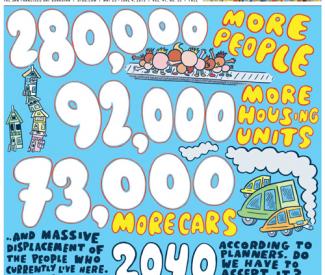
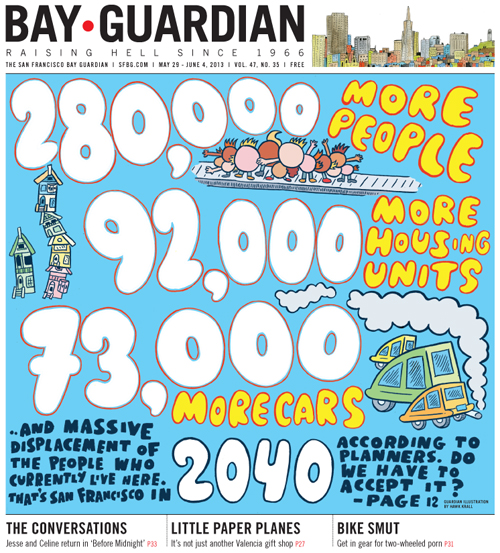
Under the ABAG plan, San Francisco would approve 92,400 more housing units for 280,000 more people. The city would host 190,000 more jobs, many of them in what’s called the “knowledge economy,” which mostly means high tech. Second and third on the list: Health and education, and tourism.

The city currently allows around eight cars for every 10 housing units; as few as five in a few neighborhoods, at least 10 in many others. And there’s nothing in any city or regional plan right now that seeks to change that level of car dependency. In fact, the regional planners think that single-occupancy car travel will be the mode of choice for 48 percent of all trips by 2040 — almost the same as it is today.

And since most of the new housing will be aimed at wealthier people, who are more likely to own cars and avoid catching buses, San Francisco could be looking for ways to fit 73,000 more cars onto streets that are already, in many cases, maxed out. There will be, quite literally, no place to park. And congestion in the region, the planners agree, will get a whole lot worse.

That seems to undermine the main intent of the plan: Transit-oriented development only works if you discourage cars. In a sense, the car-use projections are an admission of failure, undermining the intent of the entire project.

The vast majority of the housing that will be built will be too expensive for much of the existing (and even future) workforce and will do little to relieve the pressure on lower income people. But there is nothing whatsoever in the plan to ensure that there’s money available to build housing that meets the needs of most San Franciscans.

Instead, the planners acknowledge that 36 percent of existing low-income people will be at risk for displacement. That would be a profound change in the demographics of San Francisco.

Of course, adding all those people and jobs will put immense pressure on city services, from Muni to police, fire, and schools — not to mention the sewer system, which already floods and dumps untreated waste into the Bay when there’s heavy rain. Everyone involved acknowledged those costs, which could run into the billions of dollars. There is nothing anywhere in any of the planning documents addressing the question of who will pay for it.

THE NUMBERS GAME

Projecting the future of a region isn’t easy. Job and population growth isn’t a straight line, at best — and when you’re looking at a 25-year window in a boom-and-bust area with everything from earthquakes to sea-level rise factoring in, it’s easy to say that anyone who claims to know what’s going to happen in 2040 is guessing.

But as economist Stephen Levy, who did the regional projections for ABAG, pointed out to us, “You have to be able to plan.” And you can’t plan if you don’t at least think about what you’re planning for.

Levy runs the Center for the Continuing Study of the California Economy, and he’s been watching trends in this state for years. He agrees that some of his science is, by nature, dismal: “Nobody projects deep recessions,” much less natural disasters. But overall, he told me, it’s possible to get a grip on what planners need to prepare for as they write the next chapter of the Bay Area’s future.

And what they have to plan for is a lot more people.

Levy said he started with the federal government’s projections for population growth in the United States, which include births and deaths, immigration, and out-migration, using historic trends to allocate some of that growth to the Bay Area. There’s what appears at first to be circular logic involved: The feds (and most economists) project that job growth nationally will be driven by population — that is, the more people live in the US, the more jobs there will be.

Population growth in a specific region, on the other hand, is driven by jobs — that is, the more jobs you have in the Bay Area, the more people will move here.

“Jobs in the US depend on how many people are in the labor force,” he said. “Jobs in the Bay Area depend on our share of US jobs and population depends on relative job growth.”

Make sense? No matter — over the years it’s generally worked. And once you project the number of people and jobs expected in the Bay Area, you can start looking at how much housing it’s going to take to keep them all under a roof.

Levy projects that the Bay Area’s share of jobs will be higher than most of the rest of the country. “This is the home of the knowledge industry,” he told me. So he’s concluded that population in the Bay Area will grow from 7.1 million to 9.2 million — an additional 2.14 million people. They’ll be chasing some 1.1 million new jobs, and will need 660,000 new housing units.

Levy stopped there, and left it to the planners at ABAG to allocate that growth to individual cities — and that’s where smart growth comes in.

For decades in the Bay Area, particularly in San Francisco, activists have waged wars against developers, trying to slow down the growth of office buildings, and later, luxury housing units. At the same time, environmentalists argued that spreading the growth around creates serious problems, including sprawl and the destruction of farmland and open space.

Smart growth is supposed to be an alternative: the idea is to direct new growth to already-established urban areas, not by bulldozing over communities (as redevelopment agencies once did) but by the use of “infill” — directing development to areas where there’s usable space, or by building up and not out.

ABAG “focused housing and jobs growth around transit areas, particularly within locally identified Priority Development Areas,” the draft environmental impact report on the plan notes.

The draft EIR is more than 1,300 pages long, and it looks at the ABAG plan and several alternatives. One alternative, proposed by business groups, would lead to more development and higher population gains. Another, proposed by community activist groups including Public Advocates, Urban Habitat, and TransForm, is aimed at reducing displacement and creating affordable housing; that one, it turns out, is the “environmentally preferred alternative.” (See sidebar).

But no matter which alternative you look at, two things leap out: There is nothing effective that ABAG has put forward to prevent large-scale displacement of vulnerable communities. And despite directing growth to transit corridors, the DEIR still envisions a disaster of traffic congestion, parking problems, and car-driven environmental wreckage.

THE DISPLACEMENT PROBLEM

ABAG has gone to some lengths to identify what it calls “communities of concern.” Those are areas, like Bayview Hunters Point, Chinatown, and the Mission, where existing low-income residents and small businesses face potential displacement. In San Francisco, those communities are, to a great extent, the same geographic areas that have been identified as PDAs.

And, the DEIR, notes, some degree of displacement is a significant impact that cannot be mitigated. In other words, the gentrification of San Francisco is just part of the plan.

In fact, the study notes, 36 percent of the communities of concern in high-growth areas will face displacement pressure because of the cost of housing. And that’s region wide; the number in San Francisco will almost certainly be much, much higher.

Miriam Chion, ABAG’s planning and research director, told me that displacement “is the core issue in this whole process.” The agency, she said, is working with other stakeholders to try to address the concern that new development will drive out longtime residents. But she also agreed that there are limited tools available to local government.

The DEIR notes that ABAG and the MTC will seek to “bolster the plan’s investment in the Transit Oriented Affordable Housing Fund and will seek to do a study of displacement. It also states: “In addition, this displacement risk could be mitigated in cities such as San Francisco with rent control and other tenant protections in place.”

There isn’t a tenant activist in this town who can read that sentence with a straight face.

The problem, as affordable housing advocate Peter Cohen puts it, is that “the state has mandated all this growth, but has taken away the tools we could use to mitigate it.”

That’s exactly what’s happened in the past few decades. The state Legislature has outlawed the only effective anti-displacement laws local governments can enact — rent controls on vacant apartments, commercial rent control, and eviction protections that prevent landlords from taking rental units off the market to sell as condos. Oh, and the governor has also shut down redevelopment agencies, which were the only reliable source of affordable housing money in many cities.

Chion told me that the ABAG planners were discussing a list of anti-displacement options, and that changes in state legislation could be on that list. Given the power of the real-estate lobby in the state Capitol, ABAG will have to do more than suggest; there’s no way this plan can work without changing state law.

Otherwise, eastern San Francisco is going to be devastated — particularly since the vast majority of all housing that gets built in the city, and that’s likely to get built in the city, is too expensive for almost anyone in the communities of concern.

“This plan doesn’t require affordable housing,” Cindy Wu, vice-chair of the San Francisco Planning Commission, told me. “It’s left to the private market, which doesn’t build affordable housing or middle-class housing.”

In fact, while there’s plenty of discussion in the plan about where money can come from for transit projects, there’s virtually no discussion of the billions and billions that will be needed to produce the level of affordable housing that everyone agrees will be needed.

Does anyone seriously think that developers can cram 90,000 new units — at least 85 percent of them, under current rules, high-cost apartments and condos that are well beyond the range of most current San Franciscans — into eastern neighborhoods without a real-estate boom that will displace thousands of existing residents?

Let’s remember: Building more housing, even a lot more housing, won’t necessarily bring down prices. The report makes clear that the job growth, and population boom that accompanies it, will fuel plenty of demand for all those new units.

Steve Woo, senior planner with the Chinatown Community Development Center, sees the problem. In a letter to ABAG, he notes: “Plan Bay Area and its DEIR has analyzed the displacement of low-income people and explicitly acknowledges that it will occur. This is unacceptable for San Francisco and for Chinatown, where the pressures of displacement have been a constant over the past 20 years.”

Adds the Council of Community Housing Organizations: “It would be irresponsible for the regional agencies to advance a plan that purports to ‘improve’ the region’s communities as population grows while the plan simultaneously presents great risk and uncertainty for many vulnerable communities.”

Jobs are at stake, too — not tech jobs or office jobs, which ABAG projects will expand, but the kind of industrial jobs that currently exist in the priority development areas.

Calvin Welch, who has been watching urban planning and displacement issues in San Francisco for more than 40 years, puts it bluntly: “It is axiomatic that market-rate housing drives out blue-collar jobs,” he said.

Of course, there’s another potential problem: Nobody really knows where jobs will come from in the next 25 years, whether tech will continue to be the driver or whether the city’s headed for a second dot-com bust. San Francisco doesn’t have a good record of building for projected jobs: In the mid-1980s, for example, the entire South of Market area (then home to printing, light manufacturing, and other blue-collar jobs) was rezoned for open-floor office space because city officials projected a huge need for “back-office” functions like customer service.

“Where are all those jobs today?” Welch asked. “They’re in India.”

TOO MANY CARS

For a plan that’s designed to reduce greenhouse gas emissions by moving residential development closer to work areas, Plan Bay Area is awfully pessimistic about transportation.

According to the projections, there will be more cars on the roads in 2040, with more — and much worse — traffic. The DEIR predicts that a full 48 percent of all trips in 2040 will be made by single-occupant vehicles — just slightly down from current rates. The percentage of trips on transit will only be a little bit higher — and there’s no significant increase in projected bicycle trips.

That alone is pretty crazy, since the number of people commuting to work by bike in San Francisco has risen dramatically in the past 10 years, and the city’s official goal is that 20 percent of all vehicle trips will be by bike in the next decade.

Part of the problem is structural. Not everyone in San Francisco 2040 is going to be a high-paid tech worker. In fact, the most stable areas of employment are health services and government — and hospital workers and Muni drivers can’t possibly afford the housing that’s being built. So those people will — the DEIR acknowledges — be displaced from San Francisco and forced to live elsewhere in the region (if that’s even possible). Which means, of course, they’ll be commuting further to work. Meanwhile, if current trends continue, many of the people moving into the city will work in Silicon Valley.

Chion and Levy both told me that the transit mode projections were based on historical trends for car use, and that it’s really hard to get people to give up their cars. Even higher gas prices and abominable traffic delays won’t drive people off the roads, they said.

If that’s the case — if auto culture, which is a top source of global climate change, doesn’t shift at all — it would seem that all this planning is pointless: the seas will rise dramatically, and San Franciscans ought to be buying boats.

“The projections don’t take into account social change,” Jason Henderson, a geography professor at San Francisco State University and a local transportation expert, told me. “And social change does happen.”

Brad Paul, a longtime housing activist who now works for ABAG, said these projections are just a start, and that the plan will be updated every four years. “I think we’re finding that the number of people who want to drive cars will go down,” he said.

Henderson argues that the land-use policy is flawed. He suggests that it would make more sense to increase density in the Bay Area suburbs along the BART lines. “Elegant development in those areas would work better,” he said. You don’t need expensive high-rises: “Four and five stories is the sweet spot,” he explained.

Most of the transportation projects in the plan are already in the pipeline; there’s no suggestion of any major new public transit programs. There is, however, a suggestion that San Francisco adopt a congestion management fee for downtown driving — something that city officials say is the only way to avoid utter gridlock in the future.

SIDELINING CEQA

ABAG and the MTC have a fair amount of leverage to implement their plans. MTC controls hundreds of millions of dollars in transit money; ABAG will be handing out millions in grants to communities that adopt its plan. And under state law, cities that allow development in PDAs near transit corridors can gain an exemption from the California Environmental Quality Act.

CEQA is a powerful tool to slow or halt development, and developers (and some public officials) drool at the prospect of getting a fast-track pass to avoid some of the more cumbersome parts of the environmental review process.

Under SB 375 and Plan Bay Area, CEQA exemptions are available to projects that meet the Sustainable Community Strategy standards and are close to transit corridors. And when you look at the map of those areas, it’s pretty striking: All of San Francisco, pretty much every square inch, qualifies.

That means that almost any project almost anywhere in town can make a case that it doesn’t need to accept full CEQA review.

The most profound missing element in this entire discussion is the cost of all this growth.

You can’t cram 210,000 more residents into San Francisco without new schools, parks, and child-care centers. You can’t protect those residents without more police officers and firefighters. You can’t take care of their water and sewer needs without substantial infrastructure upgrades. And even if there’s state and federal money available for new buses and trains, you can’t operate those systems without paying drivers, mechanics, and support workers.

There’s no question that the new development will bring in more tax money. But the type of infrastructure improvements that will be needed to add 25 percent more residents to the city are really expensive — and every study that’s ever been done in San Francisco shows that the tax benefits of new development don’t cover the costs of public services it requires.

When World War II and the post-war boom in the Bay Area brought huge growth to the region, property taxes and federal and state money were adequate to build things like BART, the freeways, and hundreds of new schools, and to staff the public services that the emerging communities needed. But that all changed in 1978, with the passage of Prop. 13, and two years later, with the election of Ronald Reagan as president.

Now, federal money for cities is down to a trickle. Local government has an almost impossible time raising taxes. And instead of hiking fees for new residential and commercial projects, many communities (including San Francisco) are offering tax breaks to encourage job growth.

Put all that in the mix and you have a recipe for overcrowded buses, inadequate schools, overstressed open space (imagine 10,000 new Mission residents heading for Dolores Park on a nice day), and a very unattractive urban experience.

That flies directly in the face of what Plan Bay Area is supposed to be about. If the goal is to cut down on commutes by bringing new residents into developed urban areas, those cities have to be decent places to live. What would it cost to accommodate this level of new development? Five billion dollars? Ten billion? Nobody knows — because nobody has run those numbers. But they’re going to be big.

Because just as tax dollars have been vanishing, the costs of infrastructure keep going up. It costs a billion dollars a mile to build BART track. It’s costing more than a billion to build a short subway to Chinatown. Just upgrading the sewer system to handle current demands is a $4 billion project.

And if the developers and property owners who stand to make vast sums of money off all of this growth aren’t going to pay, who’s left?

The ABAG planners point out, correctly, that there’s a price for doing nothing. If there’s no regional plan, no proposal for smart growth, the population will still increase, and displacement will still happen — but the greenhouse gas emissions will be even worse, the development more haphazard.

But if the region is going to spend all this money and all this time on a plan to make the Bay Area more sustainable, more livable, and more affordable in 25 years, we might as well push all the limits and get it right.

Instead of looking at displacement as inevitable, and traffic as a price of growth, the planners could tell the state Legislature and the governor that it’s not possible to comply with SB375 — not until somebody identifies the big sums of money, multiples of billions of dollars, needed to build affordable housing; not until there are transit options, taxes, and restrictions on driving.

Because continued car use and massive displacement — the package that’s now facing us — just isn’t an acceptable option.


New BART director wants to raise fares in San Francisco and end “A” Fast Pass

34

Are BART passengers in San Francisco being subsidized by Muni riders and by BART customers from the suburbs? Or is it the other way around? And does it really matter, or should we just be thankful that people are choosing BART over clogging the roadways in this transit-first city?

These are some of the questions arising from an aggressive effort by the newest, youngest member of the BART Board of Directors, Zakhary Mallett, who has proposed severing BART’s partnership with the San Francisco Municipal Transportation Authority to end their joint “A” Fast Pass program that allows unlimited rides on both systems for $74 per month.

And after he’s done with that, Mallett says he’ll take aim at the BART fare structure that charges $1.75 for rides of six miles or less, saying that San Francisco residents shouldn’t be able to access BART’s relatively luxurious trains for less than the $2 it costs to catch a Muni bus.

These are arguments that the 25-year-old Mallet started making last year when he successfully ran against longtime Director Lynette Sweet of San Francisco, with the El Sobrante resident snatching the District 7 seat that represents slivers of San Francisco, Alameda, and Contra Costa counties.  

Mallett, who has a master’s degree in city planning from UC Berkeley, claims his stand is about “fairer fares” and ending “cross subsidies” among various transit riders. But BART  President Tom Radulovich — the Livable City executive director who has represented San Francisco on the board for more than 16 years — said his new colleague is simply wrong in his assessment, and that’s he’s pushing it in inappropriate ways.

“I think the Fast Pass works,” Radulovich told us. “I’d love to see us go in the opposite direction [that Mallett is proposing], with more passes for more parts of the system.”

Mallett’s basic argument concerns the difference between the “M” Fast Pass, which allows unlimited rides on Muni for $64 per month, and the “A” Fast Pass, which lets riders also use BART for an extra $10 per month. SFMTA pays BART $1.02 for each of those rides, so Mallett believes that riders who take more than 10 trips per month on BART are being subsidized by other Muni riders. Nevermind the fact that the reason people buy Fast Passes is precisely because they are a bargain for heavy users of the transit system.

“My ultimate goal is equity in fares,” Mallett told us. “My concern is certainly subsidies. I’m guessing that there are subsidies.”

Yet Radulovich said that some simple, back-of-the-envelope math shows that Mallett is wrong, as he believes the more detailed fare study now underway will also show. Radulovich said that given Muni fare-box recovery rates of less than 25 percent, it would cost the agency more than $4 to pay for the trips it is paying BART just over $1 to provide.

“If [Fast Pass A] didn’t exist, Muni would need to pull buses off of other lines and put them on the BART lines,” Radulovich said. “What I told Muni is that if BART carried all your passengers, you’d make money. So that argument [being made by Mallet] is really absurd to me.”

Plus, there’s the simple fact that all transit is subsidized by taxpayers because of the public good it does, both as a direct service and as a diversion for people who might otherwise add congestion to the roadways. So we asked Mallett: What’s the harm? Isn’t it good that people are using public transit?

Mallett responded that, “The harm is who is paying for the subsidies, and it is other transit riders.” In fact, he even makes the racial argument that African-American Muni riders from Bayview shouldn’t be subsidizing white BART riders from Glen Park.  

Yet for all his concern about fare equity, Mallet seems to have tried to avoid doing the federal Title VI analysis that would look at whether low-income individuals and certain ethnic or geographic groups of citizens are being hurt by changes in the fare structure.

In late February, Mallett began contacting officials with the Federal Transportation Administration with a series of phone calls and emails to get information and debate the issue, and that written correspondance was obtained by the Bay Guardian.

“BART needs a way out of this agreement and the agreement stipulates that its way out is to provide a ninety (90) day notice, period.  But depending on how Title VI requirements are interpreted, it can greatly hinder our ability to impose a termination of this agreement,” Mallett wrote to Jonathan Ocana of the FTA’s Office of Civil Rights in a March 5 email, apparently following up on their phone conversation.

Mallett tells the Guardian that he wasn’t trying to avoid a Title VI analysis, only to clarify which agency was required to perform it and to let BART move forward with termination if the SFMTA drags its feet on the study. But he also did seem to make arguments that such a study shouldn’t be required.

“I want to point out that, should this agreement be terminated, the ‘value’ of the FastPass is only impacted in that it would no longer work on BART.  That is, the price of the FastPass would remain the same and could still be used on SFMTA/MUNI services at that same price.  The only change is that the convenience of using it on a third party’s service (i.e., BART’s service) would be discontinued,” Mallett wrote.

Marci Malaster, deputy director of the FTA’s Office of Civil Rights, didn’t agree with Mallett’s analysis, as she told him in a March 14 email: “Once a transit rider enters the BART system, he/she is a BART fare-paying customer, regardless of the fare media used.  From the passenger’s perspective, a fare media currently available for use on BART (the Muni Adult “A” FastPass) would no longer be available for use on BART.  Since this effectively results in a fare increase, BART would need to conduct a fare equity analysis to determine whether elimination of this fare media would result in a disparate impact.  In addition to Title VI concerns, Federal transit law requires a public participation process when a fare is increased.”

That seems clear enough, but Mallett didn’t let it go, responding to Malaster by writing, “the mixed messages I have received in my discussions with FTA staff prior to receiving the below response from you makes this determination somewhat suspect in my mind. Among other things I suspect is that my arguments/viewpoints that I articulated to Mr. Ocana telephonically were not properly relayed for your consideration.  I requested that he allow me to speak to whomever the decision maker is and that request was never granted.”

BART General Manager Grace Crunican was apparently not pleased with Mallett for the tenor and content of his communications with FTA staff, particularly after BART got in trouble with the agency last year for avoiding Title VI analysis on its Oakland Airport connection.

She became aware of the correspondance when Mallett CCed her on one of his emails — which he apparently forget about, writing to her on March 19 that “I am not sure where or from whom you received information about my communications” — and when she was contacted by the FTA with concerns about what BART was up to.

“A plain reading of your inquiry could easily lead the FTA to conclude that BART was looking for a way to avoid doing a Title VI analysis in its haste to terminate the FastPass Agreement with SFMTA.  Furthermore, you called into question the integrity of FTA staff in your correspondence.  My letter to the FTA was intended to clearly express to them BART’s intent to comply with whatever determination is made by the FTA and to nip in the bud any impression that we were less than committed to Title VI compliance,” Crunican wrote to Mallett in March 20 email. “I acted because the issue seemed to be escalating quickly, involving both the S.F. and D.C. offices of the FTA.  As you must be aware, the FTA is critical to our success and we are in repair mode following past Title VI issues.  We work very hard to maintain a good relationship with the FTA and anything that appears to be inconsistent coming from the District could be damaging to maintaining that relationship.”

But Mallett told the Guardian that his comments have been misinterpreted. “It is incorrect that I don’t want to do that analysis,” Mallett said, maintaining that it was simply a question of who does the analysis. “I was confused who does what. I understand now that BART and SFMTA have to work together.”

Yet he’s showing no signs of backing off of pushing for San Francisco BART riders to pay higher fares. Mallett made a detailed argument on his campaign website that San Francisco BART riders are being subsidized by other BART and Muni riders. He is hoping the current fare study supports raising fares on short BART trips in San Francisco.  

“I’m of the opinion it is an inefficiently low price. You get more for less, that’s why it’s an inefficient fare,” Mallett told us of BART being cheaper than Muni in San Francisco. “My goal is to efficiently price transportation.”

But Radulovich said that since BART’s inception, the heavy ridership in the system’s core has helped hold down fares for longer trips, which use more energy and staff time and create more wear-and-tear on the system, necessarily making them significantly more expensive than the average San Francisco trip.

“He’s making the opposite argument and it’s not substantiated in my mind,” Radulovich said. “The heavy usage in San Francisco subsidizes the rest of the system.”

Beyond just this issue, Radulovich said he’s bothered by the larger neoliberal ideology that Mallett is representing, which treats transit as a commodity that should use pricing to achieve maximum efficiency, rather than a vital public service that should be available to all income brackets in roughly equal measure, which is the progressive position.

“There is a danger of this neoliberal argument that ignores equity,” Radulovich said of Mallett’s focus on fare efficiency, particularly as it tries to privilege BART use over Muni. “People who are relatively rich will stay on BART and there’s something unsettling about that. Let’s push the poor people onto the bus.”

BART spokesperson Alicia Trost said the agency is currently working on renewing its FastPass agreement with SFMTA and that they are pleased with the arrangement: “We are working with SFMTA to get a new agreement pass and that’s separate from what Director Mallett has said publicly,” she said. “It helps comply with the city’s transit-first policies and we’re supportive of that intent.”

SFMTA spokesperson Paul Rose told us the new Fast Pass agreement woud increase what SFMTA pays for each BART ride from $1.02 now up to $1.19 in the new agreement, but other than that, “We don’t have any specific plans to make any changes.”

Radulovich said BART has come a long way from its early days, that were characterized by the mantra “the rich ride, the poor pay,” because San Francisco and Oakland paid a disproportionate amount of money to become accessible by white people in the suburbans of Contra Costa and San Mateo counties.  

“For the first time in our history, we’re really looking at these equity issues,” Radulovich said, a study that Mallett said he also supports and looks forward to reviewing. But when that involves pitting transit riders against one another, Radulovich said, “We send the wrong message to people who want to use transit.”

Brown raids cap-and-trade funds, delaying action on climate change

5

Greenhouse gas concentrations in the atmosphere continue to rise to dangerous levels, but still our political leaders delay taking meaningful actions to address the looming crisis. The latest example: Gov. Jerry Brown is borrowing $500 million from the state’s new cap-and-trade program — money designated specifically for efforts to address climate change — to help balance the revised state budget proposal that he released today.

And the worst part was that Brown is raiding these funds even though there was no good reason to do so. “The Governor’s Budget reflected California’s most stable fiscal footing in well over a decade,” was the first sentence in the budget document, which admirably begins to restore education funding, partly because voters approved the Prop. 30 tax package last year.

While Brown said that the $500 million raid is just a loan that will be paid back with interest, the action highlights the short-term thinking that animates our political and business leaders, who seem content with hollow gestures and symbolic actions that fall far short of what’s actually needed to minimize climate change and sea level rise (even the cap-and-trade system itself is a business-friendly half-measure; simply capping then decreasing emmissions would have been far more effective).

There are a multitude of immediate needs for that “borrowed” money that would have big impacts to the carbon emmissions that our state continues to spew into the atmosphere, such as helping Muni and other urban transit systems overcome budget deficits that hamper their ability to provide good alternatives to private automobile use, which is one of the top sources of greenhouse gas emmissions.  

Environmentalists and advocates for social and economic justice — who have fought to direct some of these funds to reducing emmissions in low-income communities, where it is an acute public health issue on top of the long-term climate change threat — immediately criticized the governor’s move.

“The governor is playing a dangerous game that could wreck California’s push toward clean energy,” Greenlining Institute Legal Counsel Ryan Young said in a press release. “Voters of color turned out in force to protect AB 32, the clean energy law, when it was under attack by Prop. 23 [last year’s effort to repeal it], and they did it based on the promise that it would bring clean energy investments to polluted and struggling communities. These are the same voters who provided Jerry Brown’s victory margin when he ran for governor. Seizing these funds for other uses will hurt our state’s neediest communities, and it’s simply not necessary.”

Longtime Sierra Club legislative director Bill Magavern, who works with the Coalition for Clean Air, told Capital Weekly that the money is urgently needed for a variety of programs to reduce pollution in communities of color: “These important goals are now shunted aside as broken promises. The Governor has spoken of the urgency of addressing our climate crisis, but he has not put his money where his mouth is. It’s important to remember that none of the dollars in the Greenhouse Gas Reduction Fund come from taxes, and they were never intended to go to the General Fund.”

Another gauge is also telling: how do the polluters feel about the governor’s new budget? Well, here’s another press release we got on the governor’s new budget, from a conservative business organization that has long opposed meaningful efforts to address climate change: “California Manufacturers & Technology Association president Jack Stewart made the following media statement after Gov. Jerry Brown’s proposed ‘May Revise’ budget: ‘We congratulate Gov. Jerry Brown on a proposed balanced budget that will help California provide important government services. We appreciate that the Governor proposes the addition of a statewide sales tax exemption on the purchase of manufacturing equipment.  This will make California a more competitive place to scale up production.”

Same as it ever was.

Those overpaid, underworked public employees

49

Before you start griping about ovepaid Muni drivers and public employee unions, you might want to take a look at this neat-o map that shows who the highest-paid public employees are in every one of the 50 states. Hint: It’s not a bus driver. Or even a cop or firefighter:

You may have heard that the highest-paid employee in each state is usually the football coach at the largest state school. This is actually a gross mischaracterization: Sometimes it is the basketball coach.

In fact in 40 of the 50 states, the highest-paid person runs a collegiate sports operation. The other ten are doctors running medical centers or, in a couple of places, college presidents.

Oh, but aren’t those people earning their money by bringing in the big bucks? Maybe; maybe not:

In 2011-2012, Mack Brown was paid $5 million to lead a mediocre 8-5 Texas team to the Holiday Bowl. The team still generated $103.8 million in revenue, the most in college football. You don’t have to pay someone $5 million to make college football profitable in Texas.

Just sayin.

(Oh, and what’s up with New Hampshire, where the guy making the most money coaches hockey?)

On the Cheap listings

0

For information on how to submit events for listing consideration, see the guidelines in Selector.

THURSDAY 9

Bike to work day Various SF locations. www.sfbike.org. 5:30am-7pm, free. Trade in a cramped morning Muni commute for an open-air bike ride today in honor of bike to work day. The SF Bicycle Coalition knows biking the hills of SF is not always an easy task, which is why it has set up 26 "energizer stations" all around the city to serve free snacks, beverages, and reusable, goodie-filled tote bags to use on your to-and-froms. Check the Coalition’s site to find a station along your regular route.

Thirsty Thursday Toga Party Atmosphere, 447 Broadway, SF. www.a3atmosphere.com. 9:30pm, free. RSVP required. Revive your Animal House-esque days with a toga party. Travelers, locals, au pairs, and international students will be decked out in the finest bed sheets around. Show up before 10pm and score a free bingo card with a $3 shot offered every time you check off a square.

Britweek Design Series San Francisco Design Center, 2 Henry Adams, SF. www.babcsf.org. 4:30-10pm, $20-25 advance. The British-American Business Council hosts this design-driven evening. The event will kick off with a panel of British and American architects and interior designers, followed by a second international panel of innovators working in product design and technology, finishing up with an after party at Project One Gallery, just down the street from the design center.

FRIDAY 10

Spirit: A Century of Queer Asian Activism Mission Cultural Center, 2868 Mission, SF. www.queerrebels.com. 8pm, $12-20. Queer Rebels’ organization for queer artists of color brings movers and shakers of the community together to celebrate 100 years of queer Asian activism. The two-day event begins tonight with performances by Eli-Coppola award winning poet Ryka Aoki, performance artist Genevieve Erin O’Brien, and more. The festivities will continue tomorrow night with a panel discussion and film screenings.

SATURDAY 11

Pet Week kick-off Little Marina Green, Marina and Baker, SF. www.marinatimes.com. 11am-3pm, free. Soak up some sun and get your puppy fix today at Pet Week’s kick-off event. Bring your favorite four-legged friend for free microchipping, watch police K-9s show off their detective skills, pick up some free goodies for Fido, and maybe even adopt a new friend. Pet adoption will be available from eight organizations including Pets Unlimited, Muttville, and Rocket Dog Rescue.

Bluegrass Pickin’ Picnic Dahlia Picnic Area, Golden Gate Park, SF. www.countryroundupsf.com. Noon-6pm, free. If you’re a fan of Golden Gate Park and bluegrass but the giant mobs of the Hardly Strictly festival bruise your gentle nerves, here is your second chance. Sponsored by the California Bluegrass Association, this afternoon is an open jam session for all who play or just like listening to bluegrass. Set up your picnic blanket early and score some free hamburgers and hot dogs while supplies last.

SUNDAY 12

Wanderlust Festival Marina Green. sf.wanderlustfestival.com. 12-5pm, free. Register online. If the daily grind of city life is taking its toll, head over to the Marina for a stress-relieving day of yoga and music. The day will begin with yoga sessions led by Pradeep Teotia and Susan Hauser, Lululemon 2012 ambassador. The evening will conclude with musical performances by DJ Drez and the fittingly named MC Yogi.

TUESDAY 14

Cakespy book signing Book Passage, 1 Ferry Building, SF. www.bookpassage.com. 6pm, free. Ever been stuffing your face with a red velvet cupcake or Girl Scout cookie and wondered where the recipe originated? Self proclaimed "dessert detective" Jessie Oleson Moore has these answers and more in her new book The Secret Lives of Baked Goods: Sweet Stories & Recipes from America’s Favorite Desserts. Head over to the Ferry Building to meet Moore and get a signed copy of this sweet literary treat.

"Ask a Scientist: Origins of the Universe" SoMa StrEat Food Park, 428 11th St., SF. www.askascientistsf.com. In this lecture hosted by UC Berkeley Professor Eliot Quataert science fanatics will learn how the universe evolved from its smooth beginnings to its current state. Quataert will focus on how gravity reigns supreme and builds up the planets, stars, and galaxies required for biological evolution. If digesting all this scientific chatter works up an appetite, fuel up at one of the ten gourmet food trucks at SoMa StrEat Food Park.

Secret San Francisco: Adventures in History Balboa Theatre, 3630 Balboa, SF. www.cinemasf.com/balboa. 6:30pm, $10. The history of the downtown neighborhoods of San Francisco are well photographed and documented, but head further west and things tend to get a bit foggy. That’s where the Western Neighborhood Projects comes in. The nonprofit has been documenting all things west of Stanyan Street since 1999. Head to the Balboa Theatre tonight for a dose of SF history — west and east — short films, archival TV footage, and other historic surprises.

Parking breaks

9

steve@sfbg.com

This was the moment these indignant motorists had been waiting for. The elected supervisors were finally going to get the unelected bureaucrats at the San Francisco Municipal Transportation Agency to back off of plans to manage street parking and install new parking meters in their Western SoMa, northeast Mission, Potrero Hill, and Dogpatch neighborhoods.

Anger and frustration over the parking program has been building for more than a year (see "Pay to park," 1/24/12), and when Sup. Mark Farrell called a May 2 hearing before the Neighborhood Services and Safety Committee, SFMTA’s critics put out the call and dozens showed up to voice their displeasure.

Farrell opened the hearing with a clear statement about where he stands on the issue: "I am very much against expanding parking meters into our residential neighborhoods." He also expressed opposition to the SFMTA’s extension of meter hours to evenings and Sundays and said that would be the subject of another upcoming hearing.

"I think we’re frankly on the wrong track," said Sup. Malia Cohen, who isn’t on the committee but showed up just to voice the frustrations of her District 10 constituents and to help grill SFMTA head Ed Reiskin. She repeated the populist criticisms of the SFMTA, calling its goals "unattainable" and its critics "reasonable," and accusing the agency of not having a comprehensive parking management plan.

"I look forward to you saying, ‘I quit, you win, no more parking meters,’" Cohen said to Reiskin, throwing red meat to the seething crowd, which erupted into loud, raucous, sustained applause and shouts of appreciation at the comment.

Those comments frame a defining problem in San Francisco: The city can’t get to its sustainability and climate-change goals without reducing car use (see "Zero-sum future, p. 12) — but even mild attempts to reduce parking create populist furor.

When Reiskin took the podium to deliver his presentation, he struck an even, diplomatic tone, saying that he understands people’s concerns about the issue. "Parking is a challenging, sensitive, and difficult issue. Parking matters to people," he said.

But then he went on to explain that voters and previous supervisors charged the SFMTA with managing the city’s entire transportation system — Muni, cars, bikes, cabs, pedestrians, and parking — in accordance with the city’s Transit-First policy, which calls for active promotion of alternatives to private automobile use in this dense and growing city.

Then he responded directly to Cohen’s challenge: "I would have to respectfully decline the suggestion that we don’t manage parking. We have an obligation under the Charter to do so."

BALANCING ACT


Reiskin rejects the frequent accusation that SFMTA is anti-car — and the suggestion that the agency should focus on improving Muni before it can realistically expect people to rely less on private automobiles. The reality, he said, is that the city can’t make Muni or bicycling more attractive without regulating automobiles in general and parking in particular.

He said drivers who circle the blocks looking for parking spots constitute 20-30 percent of traffic in this highly congested city, and they are the worst sorts of drivers to have on the roads. They clog traffic by stopping frequently or double-parking, they drive in bike lanes, they do dangerous U-turns, and they are often inattentive and distracted, presenting a danger to pedestrians and cyclists.

The agency’s SF Park program tries to alleviate some of that problem by using market-based pricing at meters and garages to promote turnover in high-demand areas and to ensure the availability of parking spots. But in Potrero Hill and the few other parts of the city that still have unregulated street parking, other issues arise, such as out-of-town commuters parking for free all day and limiting availability in a region slated for lots of new development in the coming years.

"Parking management matters," Reiskin said, adding that without it, "we won’t be able to achieve our goals of having an efficient transit system."

He cited policies in the Eastern Neighborhoods Plan that the supervisors approved that call for parking management and noted growth projections that could draw another 100,000 people into San Francisco in the next 20 years.

"The competition we feel today in the public right-of-way will only grow more intense," Reiskin said.

Farrell argued that families and many individuals need cars to get around: "The use of a car is simply necessary." Reiskin acknowledged that cars are still the top transportation choice in San Francisco and they will remain so for the foreseeable future. But he said that each person who opts to use a bike, Muni, or to walk is an important gain in the efficiency of the overall transportation system, given how much space cars take up, so eliminating free parking is an important incentive.

"There is a clear relationship between transportation choices and costs," Reiskin said. "If there is free parking, a lot more people will choose to drive."

Farrell then repeated the other big criticism that gets aimed at the SFMTA over its parking management program, that it’s simply a "revenue grab" that uses meter and parking citation revenue to make Muni and cycling improvements. But Reiskin said the $200 million in revenues from parking have been fairly consistent, with increases in meter revenue being offset by declining revenue from citations (which he attributed to longer meter hours and new payment options) and lowering the rates in city parking garages to make them more competitive with street parking.

"We’re lowering your rates as much as we’re raising them," Reiskin said after noting that, "We’d much rather get the revenue through the meter than through citations."

Finally, Farrell got down to the crux of the criticism from car owners: why can’t everything else wait until the SFMTA makes Muni more efficient and attractive? This is a car-dominant culture, and people won’t take the bus until it’s easy and reliable. Bike advocates make a similar argument, saying completion of a safe system of bike lanes is the only way to substantially increase cycling in the city. But Reiskin said the SFMTA has to do everything at once lest traffic congestion slow the entire system.

"I know it’s a challenge for you, but it’s a challenge for us with how to respond to it as well," Reiskin replied to Farrell. "I don’t think we have the luxury of putting one part on hold while we make up for decades of underinvestment in public transit."

Sup. David Campos said he understands the frustrations of his northeast Mission constituents and he thought the SFMTA was right to delay the implementation of parking management programs there (the revised plan comes out this summer). But he noted that many of his constituents can’t afford to own a car and they need SFMTA to actively promote other transportation options: "We do need to find a way to do everything and balance this out."

FRUSTRATION WITH SFMTA


No neighborhood epitomizes the tricky balancing act on parking polices more than the northeast Mission, with its tight mix of residential and production, distribution, and repair businesses in a neighborhood where growing parking demand will be exacerbated by plans to convert the parking lot at 17th and Folsom streets into a park.

That was where the anger at the SFMTA’s approach to parking reached a fever pitch last year, spawning opposition groups such as the Northeast Mission Coalition. Angela Sinicropi, who heads that group, is calling for new preferential parking permits for local residents and the PDR businesses in the area.

"It’s not a preference or a choice. Vehicles are a necessary part of these businesses," said Sinicropi, who owns a photography business called Syntax Studio. "We need long-term, all-day parking."

She said her members appreciate SFMTA staff working with residents, but they’re still frustrated by the agency’s reliance on parking meters as the main parking management tool. Others simply slammed the SFMTA — which was set up as an independent agency that would be somewhat immune from political pressures — as out-of-control.

"The problem with the MTA is their lack of transparency and accountability," Rob Francis said.

"MTA has lost its way. They shouldn’t be focused on parking. They should focus on transit," said Potrero Hill resident Jim Wilkins. "As taxpayers, we pay for the streets. We pay to maintain those streets. So we should be given priority on those streets."

"Keep things as they are and be respectful of taxpayers," said Walter Bass, a Potrero Hill property owner, blaming the "bike people" for skewing the agency’s priorities. "SFMTA has lost the privilege to manage parking in San Francisco."

Reiskin sat in the front row listening to angry tirades against him and his agency for more than an hour, yet he stuck by his position that managing parking is far from a privilege — it is a difficult duty and one he doesn’t intend to shirk, even as he tries to heed the public’s concerns.

In the end, the supervisors didn’t really chasten the SFMTA, as its critics had hoped for.

Farrell seemed content to declare, "There are no other plans to expand parking meters throughout San Francisco," after Reiskin said he’s not planning to go beyond the five parking management areas now being created.

"I hope MTA was listening to the public comments and concerns," Cohen offered, hoping the hearing will somehow alleviate the shitstorm from some of her car-driving constituents.

And Campos closed with perhaps the only real conclusion that could be drawn from this hearing: "This won’t be the last time we’ll be talking about this issue."

T-Third passengers unhappy about train service disruptions

Around 20 residents from San Francisco’s Bayview neighborhood lined up at the San Francisco Municipal Transportation Agency board meeting May 7 to voice complaints that all too often, the T-Third light rail transit vehicles leave passengers stranded on train platforms, taking rail cars out of service before the end of the line and leaving riders to wait for the next arrival.

Organized by People Organized to Win Employment Rights, an organization better known as POWER that has campaigned around Muni issues before, the riders asked the SFMTA board to address the T train turnarounds, and called on the transit agency to run all trains through to the end of the line in the city’s Southeast neighborhoods.

Muni service disruptions along the T-Third occur most frequently at 23rd and Third, Armstrong and Third, and Williams and Third, based on SFMTA data. The passengers expressed frustration that even though the T-Third technically runs all the way to Sunnydale, a Visitation Valley housing complex, it often stops short of the final destination and causes delays on an already lengthy commute. The topic of Muni “switchbacks” picked up momentum earlier this year after District 4 Sup. Katy Tang vowed to take up the issue of train turnarounds, which also impact transit passengers in the Sunset. 

Jackie Wysinger, who walks with a cane and resides at a senior center nearby Armstrong and Third streets, told SFMTA board members that she’s no longer able to drive and depends upon the T train to get around.

“We need better transportation,” Wysinger said. “The T train turns around right there, and they do it regularly,” leaving passengers with no choice but to walk or wait in discomfort. “It’s just bad on the senior citizens.”

Claudia Bustamante, a member of POWER who spoke in Spanish through a translator, related a story of traveling back to the Bayview on the T-third on Monday night. “We were on the T-train and there was a person in a wheelchair, and another woman crying,” she said. “But the driver said, ‘sorry, this is the last stop. Everybody has to get off.’ … They kicked us off. This happens not just to me, but to the members of the African American community in Bayview. And this needs to stop.”

Jim Hill, who told SFMTA board members that he’s lived in the Bayview for 51 years, said he’s experienced train service disruption at 23rd Street on a regular basis. “I don’t understand why a man would turn a train around that’s full of people,” he said. “I have experienced 45 minutes to an hour before another train comes.”

Hill added, “I don’t think a person should have to work all day, and have to stand up from the time they get off work, until they get home.”

Gloria Dean, a Bayview resident who penned an editorial in the San Francisco BayView newspaper in March, characterized the frequent disruptions to service in Bayview Hunters Point as “shameful racism” in her opinion piece. She recounted one evening when her commute from Oakland to Third and LaSalle took from 6:45pm until 9:08pm. Since her husband is battling health problems, “it’s important for me to get home” following her evening classes at Mills College in Oakland, Dean wrote.

Juana Teresa Tello, an organizer with POWER, stressed that while switchbacks are known to occur on other lines, Bayview residents tend to have fewer transportation options. “It’s the highest concentration of people in public housing,” Tello pointed out. “It’s people who need the transit system the most.”

There was no SFMTA agenda item on the topic of turnarounds on the T-Third line, so residents aired their grievances about the issue during public comment. Once they had all finished speaking, SFMTA board chair Tom Nolan indicated that the item should be added to the board meeting agenda “sometime in the near future.”

In response to a query submitted several weeks ago, SFMTA spokesperson Paul Rose sent the Bay Guardian a detailed response to questions about train turnarounds at the 23rd and Third stop.

“Trains going to 23rd Street on the T-Third are typically going to our maintenance yard located near 25th Street and Illinois at the end of their shift,” Rose explained in an email. “These trains are J, K, L, M, and N trains that travel in service as T-Third trains to the yard and accept passengers all the way to the last stop before the yard – 23rd Street. The alternative is to have the trains travel ‘not in service’ to the yard from the subway and accept no passengers.

“The vehicles returning to the yard and traveling from the subway only to 23rd Street add additional frequency between the subway and 23rd Street but are not scheduled full trips to Sunnydale,” Rose acknowledged.

The 23rd Street stop marks the end of a stretch of recently installed condominium complexes in San Francisco’s Dogpatch neighborhood, an increasingly popular residential area for Silicon Valley commuters who have easy access to the highway to travel south to tech campuses.

Finally, Rose stressed that “We minimize unscheduled train turnarounds as much as possible … Supervision is also told to only perform these turnarounds when there is another train within five minutes or less,” he added, “to minimize passenger inconvenience.”

The warriors arena: How are you going to get there?

51

The Warriors and the all-star lineup of nearly every political consultant in town launched a new public relations offensive this week with the release of a new, spiffy set of drawings and a rewritten plan for a waterfront arena. And opponents of the project pretty much shrugged and said: So, what?

Sure, it looks nicer than it did before. Sure, there’s a pedestrian walkway around the arena. Yeah, there’s glass on the inside that will give spectators a nice view of the Bay. Oh, and there’s room for a cruise ship terminal, to give the whole thing a veneer of maritime use.

But the problems with this project have never been the architecture of the 12-story structure or the inevitably dubious links to the water. “The design was never the point,” Randy Shandobil, a spokesman for the Waterfront Alliance, told us. “Is this the best place to put a big arena?”

The new plan calls for a slightly smaller arena — 125 feet high instead of 135 — with slightly less retail space and seating inside. The glass sides will not only allow fans to look out, but allow people walking around the outside to view in and see something going on inside. The scoreboard will probably be visible; the actually play on the floor less so.

The visuals presented by the architects, Snøhetta and AECOM, indicate that the arena will perch on a large pad raised significantly above the level of the current Piers 30-32. From the ground level, the arena looks like a giant flying saucer, taller than AT&T Park, that’s plopped down below the Bay Bridge.

Craig Dykers, a representative of the architects, told a Board of Supervisors committee May 6 that the arena will fill a need for some sort of project along the open stretch of waterfront from the Ferry Building to AT&T Park. His presentation made it sound as if that undeveloped area was by nature a blight; thousands of joggers, walkers, bicyclists and people enjoying the unimpeded views of the Bay might disagree.

In fact, the project will change more than the two piers; it will create a busy residential and commercial shopping district that will increase foot and vehicle traffic even when there are no games or concerts scheduled.

This is, by any standard, a very different project from what the Warriors first proposed back in November, 2012. That’s why the Waterfront Alliance is asking that the scoping sessions for the environmental impact report on the project ought to go back to square one.

No matter what you think about the design, or the views, or the impact on the city’s priceless waterfront, there’s a problem that’s glaringly obvious, and Sup. Scott Wiener made the point very clearly:

This absolutely has to be a transit-first arena. There’s no way that part of the city can handle even half of the 5,000 cars that have been counted at the Warrior’s current home, Oracle Arena in Oakland. And much of that impact is going to fall on the subway, or light-rail vehicle system.

“It absolutely has to have good LRV service,” Wiener said.

The problem: “Our current system is not even meeting our current needs. I have a lot of constituents who say, when there’s a Giants game you just don’t take the subway because there’s not going to be any capacity. We’re close to a breaking point now, even past it. and our ten-year capital plan puts to the side most of Muni’s unmet capital needs.”

Jennifer Matz, the Mayor’s Office point person on waterfront development, said she agreed with Wiener. “I recognize this challenge,” she said. “There needs to be more of a holistic approach.”

But Wiener wasn’t backing down. Adding the capacity that will be needed to serve the new arena, and the new Giants development, and the new residents moving into the waterfront neighborhood, is not going to be cheap. “Where,” he asked, “is the money going to come from?”

Peter Albert, who works for the Municipal Transportation Agency, is looking into the number of passengers that will be riding Muni — and BART, and Caltrain — and the capacity those systems plan to add. But he had no answer to Wiener’s question.

That’s because there is only one answer: The taxpayers will have to come up with something in the range of a billion dollars to solve Muni’s capacity problems in the next few years — or else the developers will. And right now, there’s not a lot of political will at City Hall to ask for either.

SFMTA chief hopes to calm the parking meter furor at supervisorial hearing

64

San Francisco Municipal Transportation Agency director Ed Reiskin faces a tough challenge tomorrow (Thu/2) at the Board of Supervisors Neighborhood Services and Safety hearing that Sup. Mark Farrell has called on expanding parking meters into new neighborhoods, where Reiskin is expected to face a hornet’s nest of SFMTA critics stirred up by the loss of free street parking and perceptions that the agency is mismanaging public spaces and transit. [UPDATE: Read what happened here.]

Reiskin needs to quell some of the anger that is erupting in the northeast Mission District, Potrero Hill, and other areas slated for new meters enough to prevent increased supervisorial intervention into his independent agency and ensure a transit improvement bond measure planned for next year has a chance of passing – which the agency desperately needs to make improvements to Muni.

“We appreciate the opportunity to share information on how we’re trying to create more parking availability and ease congestion,” SFMTA spokesperson Paul Rose told us.

Jay Primus, who manages the SF Park variable price meter program for the SFMTA, told us he’s seen the presentation that Reiskin will be giving and finds it compelling, even though he knows better than anyone that, as Primus said, “Parking is always a difficult subject, particularly in an area as dense as San Francisco.”

It’s hard to imagine what might satisfy the SFMTA’s staunchest critics, who have created websites blasting and lampooning the agency’s every action and formed opposition groups that use militant rhetoric.

Mary Eliza is the spokesperson for Eastern Neighborhoods United Front, which has whipped up critics of the parking plans with calls to “FILL THE HALL. Raise your flag and wear your colors.” Speaking to the Guardian, she cited a litany of complaints and deep, conspiratorial suspicion of the SFMTA and its agenda, which is why she said critics have appealed to the supervisors.

“We’re not dealing much with the MTA anymore, we’re dealing with the supervisors because we think it’s our best chance to get anything accomplished,” Eliza told us.

They seem to have found a sympathetic audience with Farrell, a conservative from the westside, where pro-car ideologies are strongest. “Even as a transit first city, San Franciscans deserve to have reasonable parking situations in their neighborhoods. With plans under discussion to expand SFMTA’s number of parking meters citywide, every potentially affected neighborhood deserves to have extensive input into and thorough understanding of SFMTA’s upcoming plan,” Farrell wrote in calling for the hearing.

Primus said the SFMTA does try to be responsive to community concerns, noting that when its plans for new meters in the northeast Mission, Potrero Hill, and Mission Bay ran into strong community opposition in 2011, officials delayed the plans to gather more data and do more community outreach, separate the proposals, and remove them from the SF Park pilot program.

They are now finishing work on the Mission plan, which should come out this summer, after they do more work on solving issues raised by car repair and other light industrial businesses. But Primus said parking scarcity and good transit access in the area make it “an area where good parking management is all the more important.”

Then comes Potrero Hill, where the anti-meter furor appears to be strongest. But with increased development planned for the area, Primus noted that the community and Board of Supervisors have already called for more active parking management by the SFMTA: “All these parking policies were called for in the Eastern Neighborhoods plan, so it was already approved by the supervisors.”

The Google-bus elitism

144

I’ve been waiting for the Chron’s culture columnist Caille Millner to finally write about something interesting, and I got it April 27 when she stumbled onto the Google Buses. Or rather, the problem with the Google buses.

Thanks to the Chron’s silly paywall, you can’t read her column online, and since hardly anyone in San Franciso buys the Chronicle anymore, Millner’s story won’t get the attention it should. So allow me to repeat some of it here:

It was close to 9 p.m., and I was waiting at a bus stop on an island in the middle of Market Street. Next to me stood a tired-looking middle-aged woman who had clearly just left work. While we waited, up cruised the big white pod. It paused right in front of us. The door at the front slid open to discharge a few Googlers, and the luggage door on the lower right side of the bus also slid open to allow them access to their belongings.

One gentleman bounced down the bus steps and pushed his way in front of us to get his bicycle from beneath the bus. As he hurled it out onto the bus island, it hit the woman standing next to me. She glanced at me, mute and horrified, and in that moment I sensed that she didn’t feel able to confront him. So I did.

“Excuse you,” I said loudly.

>No response. He was busy fumbling with his messenger bag

“You hit her,” I yelled.

He glanced up in no particular direction, as though suddenly troubled by the buzz of an insect. Circling his head around, he finally noticed where he was – the bus stop, the night, the fact that there were other people around him.

“Sorry?” he asked the air, in a tone of confusion. Then he climbed on his bicycle and pedaled away. He never looked at the woman he had hit.

There’s a sense of entitlement about the rich, and the young rich are often the worst. And that’s one reason why the logic of the Google bus — it’s better to have a single luxury vehicle haul all those people to work than have them all drive cars — doesn’t register with a lot of us. They’re too good for Caltrain. They’re too good for Muni. And they’re too damn good to bother to notice that they’ve hit an old lady.