MUNI

Climate fight is a street fight

41

STREET FIGHT

Prolonged warm-weather droughts seem a normal part of California life, but the intensity of drought impacts — shrinking snowpack, intense wildfires, crop failures, and the devastation of wildlife habitat and fisheries — is likely accentuated by global warming.

So it’s not enough to simply save water. In this drought, our sense of urgency about global warming should be ramped up. The science from the Intergovernmental Panel on Climate Change, respected scientists like James Hansen, and even the World Bank (historically no friend to radical ecologists) all stress that droughts will get worse unless greenhouse gas emissions peak in the next decade.

The science is clear. If we are to avoid a disastrous future of ecological upheaval, violence, and forced mass migrations of hundreds of millions of people (many of whom produce the least amount of carbon emissions) then we must dramatically reduce emissions now, and we must do it in a globally fair and equitable way. And to be fair and equitable, we must reduce driving. Here’s why.

Globally, transportation is the fastest growing sector of greenhouse emissions, owing in large measure to the expansion of global automobility. Presently 500 million passenger cars are in use (approximately one-third of them in the United States), but by 2030, this figure is expected to reach 1 billion worldwide.

This increase in automobility will contribute substantially to the “trillionth ton” of cumulative carbon emissions, which is an emissions threshold signaling global climate catastrophe. Today we are more than halfway there (556 billion tons). At current rates of consumption, including America’s ownership of 800 cars and trucks per 1,000 persons, we hit the trillionth ton in 28 years.

To avoid this, we must keep as much fossil fuel as possible in the ground. Because the United States is disproportionately responsible for at least 27 percent of the cumulative carbon emissions since industrialization, and has a disproportionate number of cars compared to the rest of the world, we in the United States have a particular responsibility to keep carbon in the ground.

If China, which has produced 10 percent of global emissions so far, had the same per capita car ownership rate as the United States, there would be over 500 million more cars, doubling the current worldwide rate. This would be madness. It would be worse than building the Keystone pipeline, which is what Hansen called “game over” for the global climate because it’s a spigot into the sticky, tarlike oils in Alberta which, if fully tapped, would be a carbon time bomb.

Ask yourself this: If China (and possibly India) successfully copy American-style driving, how much tar sands would that require? What kind of world would that look like? And if Americans (and especially environmentalists) expect the global middle class in China and India to stand aside while we keep on driving, that is stark, crass, and inequitable.

Many well-meaning environmentalists and progressives think that driving a Prius or buying an electric car will be adequate in mitigating this conundrum. They must reconsider. There is no “green” car when a global middle class replicates American driving patterns.

If the world’s fleet of gasoline-powered automobiles magically shifts to electric, hydrogen fuel cells, or biofuels, the change will draw resources away from industrial, residential, and food systems, or it will have to involve an entirely new layer of energy production (more tar sands). Massive quantities of coal and petroleum will be needed to scale-up to wind turbines, solar panels, nuclear, and other arrays of energy, as well as for all the new “clean cars.”

Are environmentalists still planning to drive around the Bay Area while waiting for this magic? I sure hope not.

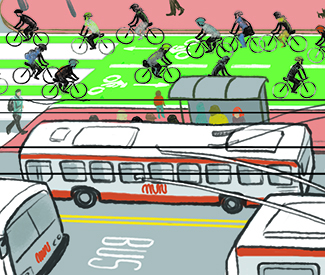
In these global warming days, with drought on everyone’s mind, we must avoid wasting precious water washing cars, and we must reallocate street space with fewer cars in mind. A critical piece of the puzzle is to prioritize public transit and bicycles over automobiles by building exclusive transit and bicycle lanes, remove the lanes and curbside parking available to cars, install signal prioritization for transit and bicycles at intersections, queue-jumping so that transit can bypasses traffic stalled at intersections, restrictions on turns for automobiles, and transit stop improvements including bus stop bulb-outs and amenities.

Reconfigured streets must furthermore exclude car-oriented land uses like more off-street parking in the 92,000 new housing units projected for San Francisco by Plan Bay Area. These units, whatever size or income, should be completely car-free. And this must include removal of existing parking beneath homes, replacing garages with housing and returning the privatized curb cut to the public.


VISIONS FOR HAIGHT

In many respects, the Haight Street corridor is a model for the kind of global warming mitigation strategy the rest of America should follow. The corridor has high density, transit dependent, and car-free households (over 30 percent in the Upper Haight and almost 50 percent in the Lower Haight/Hayes Valley) It has several walkable neighborhood commercial districts, as well as several hundred units of new housing (some of which are below market rate) under construction in Hayes Valley. Almost 25,000 passengers take the Haight buses (6-Parnassus and 71-Haight Noriega) daily, making it one of the busiest combined transit corridors in the city.

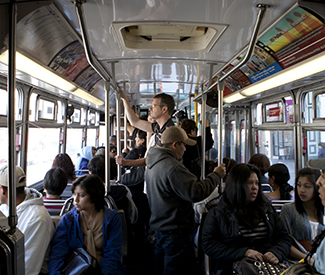
But the buses are crowded and often stuck in traffic, so the SFMTA has plans to improve service by increasing frequency, converting more of the existing route into faster “limited” service whereby some buses stop only at key points and removing the “jog” at Laguna and Page which adds delay to the inbound buses.

As I’ve written before, the Muni staff has a good plan known as the Transit Effectiveness Project, with a modest reallocation of street space for higher transit reliability, attracting more ridership, and potentially enabling San Franciscans to conveniently reduce driving to half of all trips by 2018 (it was at 62 percent in 2012). But on both ends of Haight Street, the city has fumbled. While not a disaster, hopefully Muni can learn some lessons and tweak the plans.

On the eastern end, Muni will shift buses off Page Street, converting a short segment of Haight back to two-way. The new two-way Haight includes a transit-only lane between Laguna and Gough/Market streets, which will dramatically improve travel times and reliability. Part of it will enable buses to bypass queues of cars making the right turn from Haight onto Octavia.

Where this scheme falls short is in the plans to simply give former bus stops on Page to private cars for parking. A more progressive plan would instead use the space to help make room for needed bicycle improvements on Page between Laguna and Market. Nearby are multiple housing construction sites where curbside parking has been temporarily removed — such as at the 55 Laguna site. The city has a great opportunity to innovate with transit-first policies at all of these construction sites.

Instead of turning space over to private cars when construction concludes, the city could instead build more bus lanes, pedestrian space, curbside car sharing, and bicycle space. The city could also return some of the space to parking, but only in exchange for parking removal upstream, such as at Haight and Fillmore, where bus stop improvements are sorely needed.

Throughout the city, there are block-by-block opportunities like these, where the city can help the climate instead of giving away parking. As the city discontinues bus stops and sees more housing construction, the policy should be to use curbside space for bicycles, pedestrians, or curbside car share — not simply giving it away to private car parking.

Meanwhile, at the other end of Haight, the city has also fumbled in proposing to reroute the 6-Parnassus, an important electric trolley bus line, off the Frederick-Cole-Parnassus segment. Bus riders in the Upper Haight are incensed. At a recent public meeting, a crowd of 90 people balked at the cut. Muni planners defended the proposal, arguing that ridership is low in the hilly segment above, and that a less productive segment would be shifted to the more crowded Haight Street.

This might seem logical but it may also be shortsighted, especially since the existing segment has overhead trolley wires. Drought notwithstanding, the electric trolley buses are the greenest motorized mobility in San Francisco, propelled by hydroelectricity from Hetch Hetchy.

Taking a longer and more progressive view, it might be useful to think of the debate over the 6-Parnassus this way: If the city is hoping to wean motorists from their cars by achieving the laudable goal of having 30 percent of all trips in the city by transit (up from 17 percent today), cutting service, even in relatively low ridership routes, is counterproductive. It raises the question: Is the ridership level low because the service was poor to begin with, including such irritating factors as less frequency, less reliability, or fewer hours of service? What would ridership levels look like if these less-crowded routes had high frequency, all-day and late-night service with high reliability?

Moreover, what would demand for these routes look like if parking were substantially reduced throughout the city while car-travel lanes were removed, creating space for bicycle lanes and transit lanes? Or what if there were a regional gasoline tax, a congestion charge, or other measures that priced automobility closer to its real social cost, thus producing higher demand for transit?

Surely, reducing the footprint of transit service, however inefficient that service might seem now, is not creating a template necessary for carrying 1.4 million daily passengers in the future, which is what it would take to reach significant emissions reduction goals and 30 percent mode share. Removing segments like the 6-Parnassus on Frederick will only make it harder to rebuild and accomplish that goal. And for political expediency it will also make it harder for Mayor Ed Lee to sell his transportation funding ballot proposals to progressive voters in November.

Muni planners ought to ditch the proposal to reroute the 6-Parnassus, and instead focus on maximizing improved reliability and transit efficiency on the other end of Haight Street by removing parking and prioritizing transit and bicycling on Haight and Page respectively.

Thinking globally about climate change means acting locally, on the streets of San Francisco.

Street Fight is a monthly column by Jason Henderson, a professor at San Francisco State University’s Department of Geography and Environment.


Muni fare shakedown

43

Update: Just a day after the release of this article, advocacy group POWER announced that Google pledged to pay for Free Muni For Youth for two years. “This validates both the success and necessity of the Free Muni for Youth program,”said Bob Allen, leader in the FreeMuni for Youth coalition, in a press release. “We need tech companies in San Francisco and throughout the region to work with the community to support more community-driven solutions to the displacement crisis.” 

The funding though is promised only for two years, and when that timeframe is up the question will still remain — will Muni’s operating budget pay for something Mayor Ed Lee could find funding for elsewhere? Additionally, Google hasn’t announced funding for free Muni for seniors or the disabled, another program up for consideration in the San Francisco Municipal Transportation Agency’s new budget. That may change if and when it is approved by the SFMTA for the next budget year. 

“I think it’s a positive step in the right direction,” Superivsor David Campos, the sponsor of Free Muni For Youth, told us. “But there are still questions about what it means in terms of the long term future of the program. It’s only a two year gift.” 

“We have asked for a meeting with Google and the mayor’s office and the coalition to talk about long term plans, to find out more information about what this means.” 

There’s a tie that binds all Muni riders. From the well-heeled Marina dwellers who ride the 45 Union to Bayview denizens who board the T-Third Sunnydale line, we’ve all heard the same words broadcast during sleepy morning commutes.

“Please pay your fare share.”

The play on words (also seen on Muni enforcement signage) would be cute if it didn’t perfectly represent how Muni riders may now be stiffed. A slew of new budget ideas hit the San Francisco Municipal Transportation Agency Board of Directors last week (Feb. 18), and who will pay for it all is an open question.

The first blow to riders is a proposed single-ride fare hike from the current $2 to $2.25.

Other proposals include expanding the Free Muni for Youth program, rolling out a new program offering free Muni for seniors and the disabled, and a fare hike to $6 for the historic F streetcar.

The odorous price jumps (and costly but promising giveaways) are moving forward against a backdrop of a Muni surplus of $22 million, which the board has until April to decide how to use, and a controversial decision by Mayor Ed Lee to make a U-turn on charging for parking on Sundays.

The meter decision would deprive Muni of millions of dollars.

“We’re not proposing anything here, just presenting what we can do,” SFMTA Director Ed Reiskin told the SFMTA board at City Hall last week.

There’s still time to change the SFMTA board’s mind on the proposals between now and final approval of the budget in April. But who will end up paying for a better Muni?


FARE HIKES NOT FOUGHT

In 2010, the SFMTA instituted a policy to raise Muni fares along with inflation and a number of other economic factors, essentially putting them on autopilot. The SFMTA board still has to approve the fee hikes, which may rise across the board.

fares One-time fares may jump to $2.25. Muni’s monthly passes would see an increase by $2 next year and more the following year. The “M” monthly pass will be $70 and the “A” pass (which allows Muni riders to ride BART inside San Francisco) will be $81.

Muni needs the money, Reiskin said.

“To not have (fares) escalate as fuel and health care costs increase, you can’t just leave one chunk of your revenues flat,” he told the Guardian. Muni’s operating budget will expand from $864 million this year to $958 million in 2016. “Salary and benefit growth is the biggest driver of that,” Reiskin said.

Mario Tanev, spokesperson for the San Francisco Transit Riders Union, said the hike was expected.

“We’re not necessarily against the inflation increase,” he said. “But though the parking fines SFMTA levies are inflation adjusted, other rates (against drivers) are not. There are many things in our society that disincentivize transit and incentivize driving.”

Drivers enjoy heavy subsidies to their lifestyle on the federal, state, and local levels, from parking lot construction, the cost of gasoline, and now it seems, renewed free Sunday parking meters. The new fare increases are hitting transit riders just as the mayor is poised to yank funding from Muni to put in the pockets of drivers.


PLAYING POLITICS

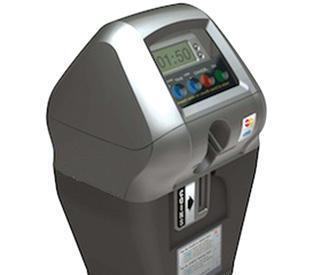
When the paid Sunday meter pilot began in early 2013, it was a rare flip in a city that often treats Muni like a piggy bank: money was floated from drivers and dropped onto the laps of transit.

A report from SFMTA issued December 2013 hailed it as a success for drivers as well: Finding parking spaces in commercial areas on Sundays became 15 percent easier, the study found, and the time an average driver spent circling for a space decreased by minutes.

Even some in the business community call it a success, since a higher parking turnover translates to more customers shopping.

Jim Lazarus, senior vice president of public policy at the Chamber of Commerce, is a supporter of the paid Sunday meters. “You can drive into merchant areas now where you couldn’t before,” he told us.

Eliminating Sunday meter fees would punch a $9.6 million hole in Muni’s budget next year, by SFMTA’s account.

The timing couldn’t be worse. On the flip side the Free Muni for Youth program, which targets low-income youth in San Francisco, may expand next year at an estimated cost of about $3.6 million, and a program to offer free Muni for the elderly and disabled would cost between $4 and $6 million — close to the same the same amount that would be lost by the meter giveback.


BOOSTING SAN FRANCISCO FAMILIES

“As an 18-year-old in high school it was a struggle to get to school, it was a struggle to find 75 cents or two dollars to get home,” Tina Sataraka, 19, told the SFMTA board last week. As a Balboa High School student, Sataraka had a 30-minute commute from the Bayview. She’s not alone.

A study by the San Francisco Budget & Legislative Analyst’s office found that 31,000 youth who faced similar financial hurdles had signed up for the Free Muni for Youth pilot program, a resounding success in a city where the youth population is dwindling. Authored by Sup. David Campos, the program may redefine “youth” to include 18-year-olds, who are often still in high school.

But initial grant funding for the program has dried up, so now Muni will foot the bill.

Not one to say “I told you so,” Sup. Scott Wiener said there were reasons for objecting to the program a year ago.

“My biggest, fundamental objection to the program was less that they were giving free fares to kids, and more that they were taking it out of Muni’s operating budget,” Wiener told us. “They need to find a way to pay for it, perhaps from the General Fund, and not just taking the easy and lazy way out.”

The Budget & Legislative Analyst recommended several options for alternative funding: special taxes on private shuttle buses (Google buses), or an increased vehicle license fee specially earmarked for the youth bus program. So far, Mayor Ed Lee hasn’t shown an interest.

“There haven’t been discussions of having the Board of Supervisors fund free Muni for youth,” Reiskin told us. The same goes for the mayor. And though Reiskin was cautious and political about the possibility of Sunday meters becoming free again, he didn’t sound happy about it.

“As for what’s behind [the mayor’s] call for free Sunday parking, that didn’t come from us,” Reiskin told us. “That came from him.”


NOVEMBER RISKS

Mayor Lee’s office didn’t answer our emails, but politicos, including Wiener and Chronicle bromance Matier and Ross, indicated the mayor may be reversing on Sunday parking meters to appease the driving voter electorate.

There are two measures up on the November ballot, and one is aimed right at drivers’ wallets.

The two measures, a $1 billion vehicle license fee hike, and a $500 million transportation bond, are both aimed at shoring up the SFMTA’s capital budget. An October poll paid for by the mayor showed 44 percent of San Franciscans in favor of a vehicle fee hike, and 50 percent against, according to the San Francisco Chronicle.

Reiskin said the loss of those two ballot measures would be crippling to Muni’s future.

“The improvements we’re trying to make to make Muni more reliable, more attractive, those won’t happen. This is our funding source for that,” he said.

The mayor is busy smoothing the potholes towards the bonds’ success in the November election, but it seems he’s willing to pile costs onto Muni and its riders to do it.

Correction 2/26: An editing error led to the erroneous calculation of Free Muni For Youth at near $9 million. Free Muni For Youth is only estimated to cost the SFMTA $3.6 million. It is the combination of Free Muni For Youth and free Muni for the disabled and elderly that equal about $9 million. 


Activists, union challenge Google bus pilot program

73

San Francisco activists and labor filed an appeal of the controversial commuter shuttle (aka, the Google buses) pilot program to the Board of Supervisors today, alleging it was pushed through without a proper environmental review. 

The appeal was filed by a coalition of the Harvey Milk LGBT Democratic Club, SEIU 1021, The League of Pissed Off Voters, and Sara Shortt of the Housing Rights Committee. 

The shuttles, mostly to Silicon Valley tech firms, pick up passengers in Muni bus stops. The use of public bus stops would incur a $271 fine for private autos, and often do, but the shuttles have largely received a free pass from the city. Last month, the San Francisco Municipal Transportation Agency approved of a pilot plan hatched behind closed doors that allows use of 200 bus stops by the private shuttles, charging only $1 per stop, per day.

The appeal alleges that the program needed review under the California Environmental Quality Act, which asks for projects to be analyzed for, among other things, land use, housing, and public health impacts. 

“CEQA actually identifies displacement as an environmental impact,” attorney Richard Drury, who filed the appeal on behalf of the coalition, told us. “Almost no one knows that. Honestly I didn’t know that, until I started researching all of this.”

If the Board of Supervisors doesn’t back the appeal, there may be a court battle on the environmental impact of the shuttle stops, which increase rents and home prices nearby. 

Paul Rose, spokeserpson for the SFMTA, responded to the complaint in an email to the Guardian.

“We developed this pilot proposal to help ensure the most efficient transportation network possible by reducing Muni delays and further reducing congestion on our roadways,” Rose wrote. “We are confident that the CEQA clearance is appropriate and will be upheld.”

In the meantime, Drury told us, the coalition is performing environmental research of its own. It has experts from the US Environmental Protection Agency and other organizations analyzing diesel outputs from the shuttles, as well as the impact of shuttles on displacement. 

“CEQA review needs to have a review before they start the pilot, not after,” Drury said. “They’re basically doing it backwards: let’s have 200 stops and 35,000 people in the service, and figure out what happens.”

Some studies conducted already show that affluence rises wherever the shuttle stops are placed. One by Chris Walker, a 29 year old in Mumbai, India, shows rising property values in and around the Google bus stops from 2011 to 2013.

heatmap

This heatmap shows a rise in property values appreciated near shuttle stops.

“We see the Google Bus as a part of a larger effort to privatize public spaces and services, displacing both current residents and the public transportation system we rely on,” said Alysabeth Alexander, Vice President of SEIU Local 1021, in a statement. “San Francisco has a long history and tradition as a union town. With the tech takeover, San Francisco is becoming inhospitable to working class families. Our wages are stagnant, as the cost of everything is skyrocketing. This is a shame.”

The price of growth

20

joe@sfbg.com

San Francisco is booming, but will its infrastructure be able to keep up with its population growth?

The problem is acutely illustrated in the southeast part of San Francisco, where long-stalled development plans were finally greenlit by the adoption of the Eastern Neighborhoods Community Plan a few years ago.

The Mission, Potrero Hill, Dogpatch, and Mission Bay districts have attracted more attention from developers than any other sector of San Francisco, according to the Planning Department. Bayview and Hunters Point are also now attracting lots of investment and building by developers.

But when development projects don’t pay the full cost of the infrastructure needed to serve those new residents — which is often the case in San Francisco and throughout California, with its Prop. 13 cap on property tax increases — then that burden gets passed on the rest of us.

Mayor Ed Lee’s recent call to build 30,000 new housing units by 2020 and the dollar sign lures of waterfront development have pressed the gas pedal on construction, while giving short shrift to corresponding questions about how the serve that growth.

growthimage

Infrastructure needs — such as roads, public transit, parks, and the water and sewer systems — aren’t as sexy as other issues. But infrastructure is vital to creating a functional city.

That kind of planning (or lack thereof) impacts traffic congestion, public safety, and the overall livability of the city. And right now, the eastern neighborhoods alone face a funding gap as high as $274 million, according to city estimates highlighted by area Sup. Malia Cohen.

That’s why Cohen went looking for help, though that’s not exactly what she found.


MEETING DEMAND

Cohen has asked Mayor Lee about the lack of adequate investment in critical infrastructure again and again. She asked his staffers, she asked his aides. At the Feb. 11 Board of Supervisors meeting, during the mayor’s question time, she was determined to ask one more time.

Cohen asked the mayor about how to fund infrastructure needs in the eastern neighborhoods and whether the city should use a new, rarely used fundraising option called an Infrastructure Financing District, or IFD.

“When the city adopted the Eastern Neighborhoods Plan, we were aware of a significant funding gap that existed for infrastructure improvement,” she said to the mayor. She asked if he would slow down development while the city caught up with infrastructure improvements, or commit more funding.

Cohen asked pointedly, “Would you support an IFD for the eastern neighborhoods?”

The mayor’s answer was in the foreign language known as bureaucratese, offering a firm “only if we have to.”

“Strategically planning for growth means making long-term investments in infrastructure,” he said. “And the most important thing that we can do right now is to work together to place and pass two new revenue generating bonds measures on the November 2014 ballot.”

But his proposed $500 million general obligation bond and $1 billion local vehicle license fee increase would just go to citywide transportation projects, where the city faces $6 billion in capital needs over the next 15 years, according to a task force formed by the mayor.

That’s small comfort for the people of the eastern neighborhoods, who are already ill-served by Muni and will have other needs as well. It’s a situation likely to get worse as the population there increases, unless the city finds a way to make serious new investments.


CITY VS. NEIGHBORHOOD

Development impact fees go to the city’s General Fund, paying for the planning work, building inspections, and a share of citywide infrastructure improvements. The problem with that strategy, opponents say, is that there are then no promises that the money will make its way back to the neighborhood that generated the funding in the first place.

Neighborhood advocates see a need to address the problems created by new development by capturing fees before they get to the General Fund. IFDs do just that. Though the nuts and bolts of how an IFD works are complex, the gist is this: Once implemented, an IFD sets up a special area in a neighborhood where a portion of developer impact fees are captured to exclusively fund infrastructure where the development is.

“So the idea that growth should pay for growth was the notion,” Tom Radulovich, executive director of the nonprofit group Livable City, told us. But with money flowing into the General Fund rather than being earmarked for specific neighborhoods, Radulovich said,the infrastructure is going to come much later than the development. (The city) delivers projects slowly, if at all.”

IFDs are largely untested in California, and have only one recent use in San Francisco, on Rincon Hill, where a deal with developers cut by then-Sup. Chris Daly has morphed into an IFD created by his successor, Sup. Jane Kim. The neighborhood will now see new funding, and a new park, as a result of development there.

“This is a HUGE step towards getting the public infrastructure improvements needed to correct livability deficiencies in Rincon Hill,” read a newsletter from the Rincon Hill Neighborhood Association in 2011. “What does this mean for those of us living (here)? It means the Caltrans property at 333 Harrison Street has a short future as a commuter parking lot, because the front portion will become our first neighborhood park.”

The benefits are tangible, but putting an IFD into action is onerous. California Senate documents describe the hurdles involved: The county (or city) needs an infrastructure plan, it must hold public hearings, every local agency that will contribute property tax revenue must approve the plan, and the IFD needs to go to ballot and obtain two-thirds voter approval, a high mountain to climb.

Gov. Jerry Brown has called for lowering the voter threshold for IFDs to 55 percent in his newest budget. The mayor used the governor’s rationale as reason to avoid an IFD for the eastern neighborhoods when speaking on the topic last week. But that may not be his only reason.

“Even if we get the changes that we seek, it’s important to point out that IFDs don’t create more money for our city, they fund specific capital improvements by earmarking money in the General Fund for a particular purpose,” Lee said.

In other words, IFDs take money from a city that is already wrestling with underfunded citywide infrastructure needs. “Earmarking general funds isn’t something that we do lightly,” Lee told Cohen.

But Peter Cohen, co-director of the Council of Community Housing Organizations, put it this way to us: “Should the eastern neighborhoods be the cash cow for the General Fund?”


BOOMTOWN

With more than 10,000 housing entitlements, the eastern neighborhoods are where San Francisco will experience its biggest growing pangs.

“The eastern neighborhoods are ground zero for development in San Francisco,” Keith Goldstein, a long time member of the Eastern Neighborhoods Citizens Advisory Committee, told a Nov. 14 Board of Supervisors Government Oversight Committee hearing on the issue.

Sups. Cohen and David Campos spent the majority of the meeting trying to find solutions, but none were forthcoming. Instead they were met with presentations on the neighborhood’s myriad needs, but few on how they would be funded.

Muni is also starved for resources in the area, where the T-line is notorious for its “switchbacks” that leave riders stranded before completing its run.

“This is a topic I’ve advocated a lot,” Sup. Scott Wiener told us. “When you have a growing population, these folks absolutely have to have service.”

At the meeting, Planning Director John Rahaim put the problem simply: “There’s a lack of development fee funding.” The officials that day from the SFMTA, Planning Department, and the Department of Public Works presented plans that relied heavily on state and federal funding to meet the new construction and infrastructure needs, a funding gap of $274 million.

“We’re really struggling to maintain the infrastructure the city has,” Brian Strong, director of capital planning, said at the meeting. “For the General Fund itself, we’re deferring $3.9 billion in capital projects the city deemed high priority. We just don’t have the funds.”

The Mayor’s Office didn’t respond to our questions about how to solve the problem, but Sup. Cohen said she’s hopeful he’ll support an IFD in her district.

“When we introduced the plan five years ago, we knew there was a gap in terms of what we expected to collect. In terms of development impact fees, we’re still in that place,” she told us. “I just want to get shit done.”

One report seems to agree with Cohen on the importance of IFDs. In 2009, a major report on development in the eastern neighborhoods was filed to then-Mayor Gavin Newsom. It recommended the city “commission a consultant study to inform the formation of an IFD,” saying it was the best tool available to fund infrastructure in the eastern districts.

The top signature on the report belonged to then-City Administrator Ed Lee. Now that he’s mayor, a mayor calling for rapid growth, can he find a way to pay for the infrastructure to serve those new residents?

The trouble with compromise

44

“It takes no compromise to give people their rights… It takes no money to respect the individual. It takes no political deal to give people freedom. It takes no survey to remove repression.” — Harvey Milk

OPINION As I sat in the audience at the Jan. 23 San Francisco Young Democrats meeting and watched the first debate between David Campos and David Chiu in their race to represent San Francisco’s 17th Assembly District, I was disturbed to hear the words “compromise” and “consensus” come out of David Chiu’s mouth more often than the words “eviction” and “displacement.”

During the debate, a line in the sand was drawn by the two candidates: Campos was on the side of the underdog, a voice to the voiceless; and Chiu, by his own admission, was all about compromise and “getting things done.”

Don’t get me wrong. True compromise can be a good thing. Unfortunately, what has been coming out of City Hall, from both President Chiu’s Board of Supervisors chamber and the Mayor’s Office, hasn’t been real compromise. It’s been a wholesale selling of our city to the highest bidder. The only thing that our leadership’s compromises have yielded is a compromised San Francisco.

Compromise gave corporations millions of dollars in tax breaks and it has forced nonprofits and small businesses out of our neighborhoods. Compromise has not resulted in any substantive action to curb Ellis Act evictions, instead serving to green light the building of luxury condo towers throughout the city. Compromise has allowed queer youth shelters and our parks to be closed to the people who need them as a last resort, as our bus stops have been opened up to billionaires for little more than pennies.

Chiu’s compromises have cost this city dearly. His compromise with developers on Parkmerced will lead to the demolition of 1,500 units of rent-controlled housing. His compromise on Healthy San Francisco allowed restaurant owners to continue to defraud consumers and to pocket money that should have gone to health care for their employees. His compromise on Muni killed a much-needed ballot initiative that would have resulted in an additional $40 million for the agency — a ballot initiative that he originally co-authored.

Please forgive me if I am fed up with compromise and am demanding actual leadership from my representatives.

Now is the time to stand with people of color, with members of the LGBTQ community, with our youth and elders, with artists and with small businesses, all of whom are being forced out of our city.

Thankfully, we have another choice. Sup. David Campos has shown that real change comes not from compromising your values but standing up for your principles. His legislative accomplishments include providing free Muni for low-income youth, protecting women’s right to choose at the Planned Parenthood Clinic, and preventing teacher layoffs at our public schools.

Campos has demonstrated that he, not Chiu, is the right choice to follow Tom Ammiano’s footsteps to Sacramento. Ammiano, who had 13 of his 13 bills signed into law this past year, is the perfect example of the success that can come from leading with your principles and not compromising your integrity.

San Francisco needs a leader representing us in the capital. Successful victories in reforming the Ellis Act and closing the Prop. 13 tax loophole will take a leader who can stand up to landlords and corporations, not a compromiser who will sit down at the table in a backroom with them.

That is why I will give my all to make sure that David Campos is our next representative in Sacramento. Pardon me if I refuse to compromise.

Tom Temprano is president of the Harvey Milk LGBT Democratic Club.

SFMTA approves tech shuttle plan

8

The San Francisco Municipal Transportation Agency Board of Directors approved a pilot program Jan. 21 that allows operators of private commuter shuttles to use public bus stops, something they’ve been doing illegally for years on a very predictable basis.

The program will establish an “approved network” of 200 designated San Francisco stops where private shuttles may pick up and drop off passengers. It will issue permits and identifying placards to the private buses and require them to adhere to certain set of rules, like yielding to Muni buses if they approach the stop at the same time. (There’s already a Curb Priority Law stating that any vehicles not operated by Muni will be fined $271 for blocking a bus zone. But the city has chosen to ignore that law when it comes to private commuter shuttles.)

Finally, the program will charge shuttle operators $1 per stop per day, which seeks to cover the costs of the program implementation and no more. The meeting drew a very high turnout that included the protesters who have been blockading the buses, Google employees, private commuter shuttle drivers, and residents of various San Francisco neighborhoods.

Sup. Scott Wiener said at the meeting he was fully supportive of the pilot program, which was developed over the course of many months in collaboration with tech companies who operate the shuttles.

“These shuttles are providing a valuable service,” Wiener said. He said he was sensitive to widespread “frustration and anxiety” around the high cost of housing and rising evictions, but thought it was unfair to blame tech workers: “We need to stop demonizing these shuttles and these tech workers.”

Then Sup. David Campos addressed the board. “I think it’s really important for us to have a dialogue to find common ground,” Campos said, adding that pushing shuttle riders into private automobiles was not a good outcome. But he also urged the SFMTA board to send the proposal back to the drawing board: “It’s a proposal that simply does not go far enough.”

Campos was also critical of the SFMTA’s process of studying the growing private shuttle problem for years and drafting a proposal in collaboration with members of the tech community, with Campos pointing out, “Public input is being sought after the fact.”

Bus plan ignores real cost

Many community members have criticized the new $1 per stop tech shuttle fee as being too low, but city officials say their hands are tied by a state law prohibiting them from charging any more than that.

Yet under Proposition 218 — the state law that limits local governments’ ability to impose new fees — the city has more discretion about how to calculate “cost recovery” than officials have let on.

“Prop. 218 is part of a legal scheme that doesn’t so much limit how we calculate cost recovery,” San Francisco City Attorney’s Office spokesperson Gabriel Zitrin told us, “but limits the city to cost recovery.”

At the Jan. 21 SFMTA meeting, Project Manager Carli Paine explained how her team had arrived at the $1 per stop, per day fee amount.

“We identified everything it would take to implement this program,” Paine said. After identifying all the program components, the agency “took the number of stop events and came up with a ‘per stop event’ cost…The kinds of costs we included are upfront costs, ongoing program costs.”

Under Prop. 218, however, the SFMTA could determine whether there are other costs associated with allowing private commuter shuttles to use public transportation infrastructure, beyond just the cost of issuing and enforcing permits and placards.

Zitrin said the city can identify any costs not already being recovered elsewhere. If shuttles’ use of public bus stops cause transit delays, for instance, what are the costs associated with those delays? More overtime pay for bus drivers?

Low-income kids getting to school late and missing breakfast? What’s the cost of that?

If rents rise in neighborhoods located along the shuttle routes (and studies show they do), what are the associated costs of that phenomenon? What’s the cost of displacement resulting from those higher rents?

SFMTA Board approves tech shuttle plan

The San Francisco Municipal Transportation Agency Board of directors approved a pilot program today that allows operators of private commuter shuttles to use public bus stops, something they’ve been doing illegally for years on a very predictable basis.

The program will establish an “approved network” of 200 designated San Francisco stops where private shuttles may pick up and drop off passengers. It will issue permits and identifying placards to the private buses and require them to adhere to certain set of rules, like yielding to Muni buses if they approach the stop at the same time. (There’s already a Curb Priority Law stating that any vehicles not operated by Muni will be fined $271 for blocking a bus zone. But the city has chosen to ignore that law when it comes to private commuter shuttles.)

Finally, the program will charge shuttle operators $1 per stop per day, which covers the costs of the program implementation and no more.

The meeting drew a very high turnout that included the protesters who have been blockading the buses, Google employees, private commuter shuttle drivers, and residents of various San Francisco neighborhoods.

Sup. Scott Wiener spoke at the beginning of the meeting, saying he was fully supportive of the pilot program, which was developed over the course of many months in collaboration with tech companies who operate the shuttles.

“These shuttles are providing a valuable service,” Wiener said. He said he was sensitive to widespread “frustration and anxiety” around the high cost of housing and rising evictions, but thought it was unfair to blame tech workers. “We need to stop demonizing these shuttles and these tech workers,” Wiener said.

Then Sup. David Campos addressed the board. “I think it’s really important for us to have a dialogue to find common ground,” Campos said, adding that pushing shuttle riders into private automobiles was not a good outcome. But he also urged the SFMTA board to send the proposal back to the drawing board. “It’s a proposal that simply does not go far enough,” he said.

Campos was also critical of the SFMTA’s process of studying the growing private shuttle problem for years, drafting a proposal in collaboration with members of the tech community, and waiting until the eleventh hour once the plan had already been formulated to seek comment from community members who are impacted.

“Public input is being sought after the fact,” he said.

That feeling of being frozen out of the process was echoed in comments voiced throughout the public comment session, which went on for hours.

“I’m opposed to the $1 charge,” one woman said. “I believe it’s way, way, way too low.” She told a story of receiving a ticket for being parked in a bus zone very briefly. “It wasn’t a $1 ticket,” she said.

Another woman, who said she was born and raised in SF, said she’d been riding Muni since she was in diapers. “It makes me really sad that we have regional shuttles and corporations that are saying, you can’t just fix that system, we’re going to go around it,” she said. She urged members of the transit agency board to find a better system that would work for everyone, “because you are in charge.”

A Google employee told board directors that she is very pleased that the shuttles have made it possible for her to live in San Francisco. “Not everyone at Google is a billionaire,” she said. “Ten years after the fact I am still paying my student loans. This is a choice, I know, to live in San Francisco and commute to Mountainview. But I wouldn’t have it any other way.”

Her perspective, however, came in sharp contrast to that of Roberto Hernandez, who spoke on behalf of Our Mission No Eviction and said he was worried that displacement caused by rising rents have forced many members of his community to move to the East Bay.

Hernandez also brought up a little-known consequence of transit delays caused by private shuttle buses.

In the elementary schools near 24th Street in the Mission, he said, “They have the breakfast program for people who are low-income. So if you show up late, you don’t get breakfast.”

Here’s Hernandez addressing the SFMTA board members.

In the end, the transit directors approved the pilot with very little discussion. “At the end of the day, this is before us as a transit issue,” said board member Malcolm Heinicke. “And we’re better with something than nothing.”

Positive starts

1

marke@sfbg.com

GOOD TECH Like Tabasco sauce, Lady Gaga, and the color teal, technology in itself is neither good nor bad — it’s all in how you use it. (Indeed, you could argue that those first three examples are technological feats in their own right: Just don’t use too much, please!) And while battles rightly rage about how the Bay Area’s tech industry is reweaving our social fabric, creating and applying technology is an art in itself, albeit one that can have huge economic and political impact.

It can be difficult to see past the whizbang gizmos, marketing dazzle, and glowing dollar signs of how technology is normally presented to us. But in this issue we wanted to take a deeper look at some of the ways technology is impacting or enhancing Bay Area life, and highlight some of its possibilities in addressing some of the city’s real problems (no, not parking or hailing a cab). For all the talk about sharing economies and communal interaction, there’s still a huge gulf between what’s considered “innovation” and what actually offers a path toward civic solutions.

Important questions still hang in the air (beyond the environmental and labor impacts of manufacturing such technologies): How can innovation be better applied to help city infrastructure and social services? How can we integrate startup energy into city policy-making and government transparency? Can the effects of “disruption” be assessed using other indicators beyond market value? In what ways can we ameliorate the knee-jerk resistance to innovation from all sides when it comes to addressing the explosion of homelessness, hunger, and child poverty in the Bay Area? Can we develop new “inputs” or ways of including all Bay Area voices in the conversation about how technology is transforming the way we live?

And why can’t we Kickstart Muni, anyway?

Lately, there’s been some movement toward addressing some of these concerns, especially when it comes to art and culture. The huge, forthcoming 5M project on Mission plans to not only house Yahoo, but also Intersection for the Arts and SF Made, explicitly integrating local arts and businesses into the start-up incubator template. A recent forum hosted by music app WillCall on how tech can better support the local music and nightlife industry packed the Public Works nightclub. Proposals to help teach more coding in schools and make government more transparent are gaining steam.

Of course, it’s always wise to maintain a healthy skepticism about the latest shiny thing, and to realize the limits of technology — often it can’t even clean up its own mess — and especially the people behind it. But it’s also important to keep pushing the conversation about technology’s role in civic engagement forward in positive, thought-provoking, even spicy new directions.


Nickels and dimes… or transit for our times?

14

STREET FIGHT Much has been written about the so-called “Google buses” and San Francisco’s latest round of gentrification. It’s a horrible mess and the city’s trifling $1 charge per bus stop will do little to address the broader structural problem that these buses lay bare.

Ordinary people cannot ride them, nor do the people who clean and cook for the tech world. Like tour buses, they are clunky and inappropriate for many neighborhood streets. While they do substitute for some car trips, an ad hoc private transit system does not reflect the kind of thoughtful regional planning needed to truly reduce car use in the Bay Area.

But the controversy over the private commuter buses does show that there is great potential for a public regional express bus system. Consider that in 1980, 9 percent of commuters in San Francisco left the city every day to go to work. In 2010, outbound commuters approached 25 percent. Owing to regional political fragmentation, Muni cannot provide intercounty service and thus is not the travel mode of choice for many of these commuters. And although Caltrain and BART offer some regional service, the sprawling locations of suburban firms often make regional rail impractical or at the very least time-consuming owing to unavoidable multiple transfers to local buses.

So in noteworthy ways, the rise of private transit is an immediate reaction to poor regional transit connections. Yet rather than sidestepping failed regional planning by encouraging an inequitable, two-tiered, private system, we need to expand and regionalize the existing public bus systems. San Francisco’s mayor and Board of Supervisors have seats at the table of regional planning and ought to use the controversy over private buses as an opportunity to kickstart the implementation of a regional public bus system accessible to all.

For example, something like AC Transit’s Transbay routes should be extended through San Mateo and Santa Clara counties, perhaps operated by BART or Caltrain as part of the next iteration of Plan Bay Area. This network would use reallocated express lanes on 101 and I-280 and use transit priority lanes on arterials like 19th Avenue in San Francisco and El Camino Real in San Mateo. Regional property assessments on the corporations and developers, in part already possible within the existing BART district (one should be created for Caltrain), could be used to fund such a system. Congestion charging on 101 and I-280 should also be deployed and those funds used for electrifying Caltrain and developing the parallel and complementary regional bus system.

Of course there will be opposition to a regional public bus system as there already is to progressive regional planning. Transit-connected, walkable communities in the South Bay, for example, have been made all but illegal by decades of conservative middle and upper class, anti-density, anti-tax homeowners in suburban localities. As recently as last year, this Tea Party-style conservative politics dampened Plan Bay Area, resulting in a weak regional housing plan with an underfunded and lackluster transit vision. This conservative approach stifles our collective sense of what is possible and the fear-mongering has rendered regional planners virtually impotent. Yet it can and must be overcome.

Some progressives may find it convenient (and in some cases justifiable) to target tech workers right now, but they could also direct energy into shaping the next round of Plan Bay Area. Remember that Plan Bay Area is a living document, a work in progress. The current version of the plan, weak on transit funding, has been subdued by a loud, irrational mob of Tea Party cranks bent on sabotaging anything that hints of progressive ideas. Plan Bay Area is also stifled by a regional business class that wants to keep the status quo and that is comfortable with the neoliberal model of private transit.

So while a smattering of dedicated and hard-working progressive transit activists showed up and attempted to shape Plan Bay Area last year, in the coming years the plan needs a broader progressive movement — including transit, housing, social justice, and environmental activists — to demand a more visionary regional transportation plan that connects all of the Bay Area. I am hopeful that this would not only steer regional planning in a progressive direction, but many of the tech workers who are now on the private buses would gladly join in the cause.


THE POLITICS OF SUNDAY PARKING

Speaking of hopeful, last month the SFMTA reported that Sunday metering, implemented last January, is a resounding success. Switching-on the meters doubled parking availability on Sundays, which is invariably what small businesses, most of which are open on Sunday, want to see.

Sunday meters increased the number of cars using city-owned garages and decreased the time cars circled in search of parking from an average of four minutes to two — de-cluttering streets in commercial districts. While this might seem like a boon to drivers, it also means less pollution, safer conditions for pedestrians and cyclists, less delay for Muni, and a much needed enhancement of revenue for operating public transit.

So it is mystifying that such success would be ignored by Mayor Ed Lee, who instead has proposed to discontinue Sunday metering. This is doubly confusing because, based on existing travel behavior to many commercial districts, 25 percent of people arrived by driving, while 31 percent took transit and 25 percent walked. So what the mayor is effectively saying to the pedestrian and transit-using majority is you matter little. What does matter is the few whining motorists who called him to complain about being “nickel and dimed.”

The mayor talks a good game when saying he is truly concerned about pedestrian and cyclist safety, and insisting that he wants to fix Muni. But gutting a reliable source of operating funds and pandering to car drivers who will dangerously circle for parking is inconsistent.

Lee says money isn’t an issue because his proposed General Obligation bond (which must be approved by voters) will patch the lost revenue from Sunday metering. But the GO bond will incur further debt and only fund existing capital needs, while parking meters provide a debt-free steady revenue stream for Muni. It’s also slightly misleading because the bond would not cover Muni operations, while revenue from Sunday metering does pay for operations.

The mayor’s pandering also put the SFMTA Board of Directors, which has been working out parking management and Muni finance, on the spot. Ultimately, it has to vote to preserve or scrap Sunday metering in the coming months. Now the directors have to decide if they support transit-first or the mayor’s pandering.

Unfortunately, when it comes to parking policy, the way that the Board of Supervisors has behaved lately suggests it will either jump on the mayor’s bandwagon and pander to motorists or cower in silence as good public policy is trashed. Not a good situation at City Hall, where transit riders seem to be routinely thrown under the bus by the political establishment.

Street Fight is a monthly column by Jason Henderson, an urban geography professor at San Francisco State University.

State of the City: spin over substance

5

It was maddening to watch Mayor Ed Lee deliver his annual State of the City address on Jan. 17. This was pure politics, from the staged backdrop of housing construction at Hunters Point Shipyard to the use of “regular people” props to the slate of vague and contradictory promises he made.

“This place, the shipyard, links our proud past to an even more promising future,” was how Lee began his hour-plus, invite-only address.

Later, he touted the housing construction being done there by Lennar Urban as emblematic of both his promise to bring 30,000 new housing units online by 2020 — the cornerstone to what he called his “affordability agenda” — and the opposition to unfettered development that he is pledging to overcome.

“A great example is the place we’re standing right now. This took us too long,” Lee said after decrying the “easy slogans and scapegoating” by progressive activists who place demands on developers.

But that implication was bullshit. As we’ve reported, progressive and community activists have long encouraged Lennar Urban (which has a close relationship to Lee) to speed up development on this public land that it was given almost a decade ago, particularly the long-promised affordable housing, rather than waiting for the real estate market to heat up.

That was just one of many examples of misleading and unsupported claims in a speech that might have sounded good to the uninformed listener, but which greatly misrepresented the current realities and challenges in San Francisco.

For example, Lee called for greater investments in the public transit system while acknowledging that his proposal to ask voters this November to increase the vehicle license fee isn’t polling well. And yet even before that vote takes place, Lee wants to extend free Muni for youth and repeal the policy of charging for parking meters on Sundays without explaining how he’ll pay for that $10 million per year proposal.

Lee also glossed over the fact that he hasn’t provided funding for the SFMTA’s severely underfunded bicycle or pedestrian safety programs, yet he still said, “I support the goals of Vision Zero to eliminate traffic deaths in our city.”

Again, nice sentiment, but one disconnected from how he’s choosing to spend taxpayer money and use city resources. And if Lee can somehow achieve his huge new housing development push, Muni and other critical infrastructure will only be pushed to the breaking point faster.

Even with his call to increase the city’s minimum wage — something that “will lift thousands of people out of poverty” — he shied away from his previous suggestion that $15 per hour would be appropriate and said that he needed to consult with the business community first: “We’ll seek consensus around a significant minimum wage increase.”

But Mayor Lee wants you to focus on his words more than his actions, including his identification with renters who “worry that speculators looking to make a buck in a hot market will force them out.”

Yet there’s little in his agenda to protect those vulnerable renters, except for his vague promise to try to do so, and to go lobby in Sacramento for reforms to the Ellis Act.

Lee also noted the “bone dry winter” we’re having and how, “It reminds us that the threat of climate change is real.” Yet none of the programs he mentions for addressing that challenge would be as effective at reducing greenhouse gas emissions as the CleanPowerSF program that Lee and his appointees are blocking, while offering no other plan for building renewable energy capacity.

Far from trying to beef up local public sector resources that vulnerable populations increasingly need, Lee said, “Affordability is also about having a city government taxpayers can afford.”

State of the City speech filled with unsupported promises

178

It was maddening to watch Mayor Ed Lee deliver his annual State of the City address this morning. This was pure politics, from the staged backdrop of housing construction at Hunters Point Shipyard to the use of “regular people” props to the slate of vague and contradictory promises he made.

“This place, the shipyard, links our proud past to an even more promising future,” was how Lee began his hour-plus, invite-only address.

Later, he touted the housing construction being done there by Lennar Urban as emblematic of both his promise to bring 30,000 new housing units online by 2020 — the cornerstone to what he called his “affordability agenda” — and the opposition to unfettered development that he is pledging to overcome.

“A great example is the place we’re standing right now. This took us too long,” Lee said after decrying the “easy slogans and scapegoating” by progressive activists who place demands on developers.

But that implication was complete bullshit. As we and others have reported, progressive and community activists have long encouraged Lennar Urban (which has a close relationship to Lee) to speed up development on this public land that it was given almost a decade ago, particularly the long-promised affordable housing, rather than waiting for the real estate market to heat up.

That was just one of many examples of misleading and unsupported claims in a speech that might have sounded good to the uninformed listener, but which greatly misrepresented the current realities and challenges in San Francisco.

For example, Lee called for greater investments in the public transit system while acknowledging that his proposal to ask voters this November to increase the vehicle license fee isn’t polling well. And yet even before that vote takes place, Lee wants to extend free Muni for youth and repeal the policy of charging for parking meters on Sundays without explaining how he’ll pay for that $10 million per year proposal.

“Nobody likes it, not parents, not our neighborhood businesses, not me,” Lee said of Sunday meters, ignoring a study last month by the San Francisco Muncipal Transportation Agency showing the program was working well and accomplishing its goals of increasing parking turnover near businesses and bringing in needed revenue.

Lee also glossed over the fact that he hasn’t provided funding for the SFMTA’s severely underfunded bicycle or pedestrian safety programs, yet he still said, “I support the goals of Vision Zero to eliminate traffic deaths in our city.”

Again, nice sentiment, but one that is totally disconnected from how he’s choosing to spend taxpayer money and use city resources. And if Lee can somehow achieve his huge new housing development push, Muni and other critical infrastructure will only be pushed to the breaking point faster.  

Lee acknowledges that many people are being left out of this city’s economic recovery and are being displaced. “Jobs and confidence are back, but our economic recovery has still left thousands behind,” he said, pledging that, “We must confront these challenges directly in the San Francisco way.”

And that “way” appears to be by making wishful statements without substantial support and then letting developers and venture capitalists — such as Ron Conway, the tech and mayoral funder seated in the second row — continue calling the shots.

Even with his call to increase the city’s minimum wage — something that “will lift thousands of people out of poverty” — he shied away from his previous suggestion that $15 per hour would be appropriate and said that he needed to consult with the business community first.

“We’ll seek consensus around a significant minimum wage increase,” he said, comparing it to the 2012 ballot measures that reformed the business tax and created an Affordable Housing Fund (the tradeoff for which was to actually reduce the on-site affordable housing requirements for developers).

But Mayor Lee wants you to focus on his words more than his actions, including his identication with renters who “worry that speculators looking to make a buck in a hot market will force them out.”

Yet there’s little in his agenda to protect those vulnerable renters, except for his vague promise to try to do so, and to go lobby in Sacramento for reforms to the Ellis Act. While in Sacramento, he says he’ll also somehow get help for City College of San Francisco, whose takeover by the state and usurpation of local control he supported.   

“City College is on the mend and already on the path to full recovery,” Lee said, an astoundingly out-of-touch statement that belies the school’s plummeting enrollment and the efforts by City Attorney Dennis Herrera and others to push back on the revocation of its accreditation.

Lee also had the audacity to note the “bone dry winter” we’re having and how, “It reminds us that the threat of climate change is real.” Yet none of the programs he mentions for addressing that challenge — green building standards, more electric vehicle infrastructure, the GoSolar program — would be as effective at reducing greenhouse gas emmisions as the CleanPowerSF program that Lee and his appointees are blocking, while offering no other plan for building renewable energy capacity.

Far from trying to beef up local public sector resources that vulnerable city residents increasingly need, or with doing environmental protection, Lee instead seemed to pledge more of the tax cutting that he’s used to subsidize the overheating local economy.

“Affordability is also about having a city government taxpayers can afford,” Lee said. “We must be sure we’re only investing in staffing and services we can afford over the long term.”

How that squares with his pledges to put more resources into public transit, affordable housing development, addressing climate change, and other urgent needs that Lee gives lip service to addressing is anybody’s guess.  

Lee panders to motorists and undermines SFMTA with Sunday metering repeal

36

First Mayor Ed Lee ignores the rising cost of living in San Francisco (fueled partly by his own corporate welfare for the tech industry and commercial landlords), and now he’s using his sudden concern about gentrification as an excuse to make parking meters free again on Sundays, a blatant bit of political pandering that blows a $6 million annual hole in Muni’s budget.

Maybe it’s understandable that a politician worried about his reelection prospects with restive voters would take a page from the playbook of former Gov. Arnold Schwarzenegger, who slashed the state’s vehicle license fee to win that office. But what makes this move stink even more is it’s being supported by the San Francisco Municipal Transportation Agency, a supposedly independent (yet mayoral appointed) body whose top officials methodically and courageously have made a strong case for Sunday metering.

“We’re just willing to partner with the mayor to address affordability,” SFMTA spokesperson Paul Rose told us, admitting the agency hasn’t yet identified a funding source to fill that gap if Sunday metering is repealed on July 1 as proposed. Sunday meters were budgeted for $1 million in revenue, but they actually brought in $6 million in the last year because of more tickets than expected, feeding the outrage of motorists who feel entitled to use public roads for free. 

We’re waiting for calls back from SFMTA Executive Director Ed Reiskin and Chairman Tom Nolan to find out whether they no longer stand by the arguments they’ve been making for Sunday metering, claiming it helps the local economy by making parking spaces available in neighborhood commercial districts and that it’s consistent with the city’s official transit-first policy.

“What does this say about the city’s commitment to the policy of promoting transit first?” San Francisco Bicycle Coalition Executive Director Leah Shahum said, saying she was shocked by the announcement given how underfunded the SFMTA’s transit, bicycle, and pedestrian improvement programs all are. “Why in the world are we even talking about this?”

Lee claims this is about affordability, telling the Chronicle “it was just nickel-and-diming people to death,” yet his own plans call for asking voters to approve more than $6.3 billion in taxes to fund Muni’s needs over the next 15 years, including a proposal to increase the sales tax in 2016, a regressive tax that will hit those already struggling harder than Sunday metering does to the 70 percent of San Francisco households that have an automobile.

Lee has also proposed ballot measures for this November that would increase the vehicle license fee and issue a $500 million general obligation bond, paid for on the property taxes of all city households. His own polls show the measures could be difficult sells to voters, and it’s not clear why he won’t wait for those results before ending Sunday metering.

When we asked mayoral Press Secretary Christine Falvey about all this, she selectively answered our questions with the following response: “The mayor believes a comprehensive funding strategy to not just maintain, but improve Muni performance, pedestrian and bike safety and the condition of our roads is what will finally turn the corner on improving San Francisco’s Transportation System. That’s why he has spent the better part of a year with the Transportation 2030 Taskforce, that recommended several ways to support these goals, including a $500 million general obligation bond, which the mayor supports. Because of a strong economy, the mayor believes it’s time to eliminate parking fees for six hours on Sundays and permanently fund Free Muni for low income youth to help working families in San Francisco and ease the affordability issues he hears about from families across the City.”

But at this point, that’s just political rhetoric, and Lee’s “comprehensive funding strategy” remains a vague and distant dream — one that will soon be $6 million a year tougher to make a reality. 

This Week’s Picks: January 15 – 21, 2014

0

Word spears to pierce the stoniest of hearts

THURSDAY 1/16


“Ravishing, Radical, and Restored: The Films of Jack Smith”

Legendary underground filmmaker Jack Smith gets the Technicolor-red carpet treatment in this series co-presented with the San Francisco Cinematheque, which screens sparkling 16mm restorations of his films, plus two Smith-centric documentaries. First up is his best-known work, Flaming Creatures (1962-63), a film so “obscene” and “orgiastic” it was, of course, banned upon release. Upcoming programs include Jack Smith and the Destruction of Atlantis (2006), Mary Jordan’s excellent doc, and unfinished extravaganza Normal Love (1963-65), which just may convert you to the church of Maria Montez — Smith icon and star of 1944’s lavishly camp Cobra Woman. (Cheryl Eddy)

Through Jan. 30

Flaming Creatures tonight, 7:30pm, $8-$10

Yerba Buena Center for the Arts

701 Mission, SF

www.ybca.org


Reflecting China in a California Vision

Tired of hearing the same old techno-dystopian nay-saying about San Francisco’s growth? Get thee to our dear city’s urban planning think tank, SPUR, for some solutions-oriented and original thoughts about how we might skim some brilliant urbanization ideas for another booming place — China. For anyone who’s keeping score on high-speed rails: China, more than 6,000 miles of active tracks; California, zero, but maybe 520 miles in 2029 if we’re lucky? With our state’s population projected to grow about 30 percent by 2050, it’s time we start taking notes. (Rebecca Huval)

6pm, $10 for non-members/free for members

SPUR Urban Center

654 Mission, SF

www.spur.org


Fresh and Freaky Fiction

George Saunders sits on a make-believe throne as the king of the short story of our time. His writing often takes us into a futuristic, dystopian Midwestern America, where completely average and unusual events converge in dry, hilarious, and sometimes disturbing ways. Karen Russell dances ahead of the Pied Piper to the lyrical composition of her own prose, which flows and sings and rushes like water. Her writing lures readers into her wild imagination, be it the marshes of the deep South or the thorny forest behind Madame Bovary’s backyard. Together, these authors create dynamite, discussing their out-of-bounds genres, surreal realities, and literary inspirations. (Kaylen Baker)

7pm, $25-45

JCCSF Kanbar Hall

3200 California, SF

www.jccsf.org


FRIDAY 1/17


YBCA presents Wayne McGregor

I can’t think of a choreographer, besides Mark Morris, who so easily moves between Ballet — SFB will reprise his Borderlands on Feb. 18 which is influenced by Josef Albers’ color studies—and Modern Dance—he has his own Random Dance Company—as Wayne McGregor. His work is conceptually so far out that your brain begins to vibrate; his dancers are out of this world and yet so very human. It’s a fascinating approach to what the human body—the complete dancer—can do. For its second SF appearance, Random will present the West Coast premiere of Far, based on McGregor’s reading of a historical analysis of the Enlightenment. No need to get out your history books, just stay tuned. (Rita Felciano)

Jan.17/18, 7:30pm, $30-60

Jan. 19, 2pm

Lam Research Theater, YBCA

700 Howard, SF

www.sfperformances.org


Bad News

Replicant Presents’ electronic and experimental noise reaches into Oakland again with a dose of “weird core,” industrial and straight-up sounds out of a horror-film soundtrack. BR-OOKS will have the home-court advantage and push the boundaries of any genre, then the more palpable Names will bring a dancier, more rhythmic approach, while maintaining roots in the realm of noise. But the true industrial strength will be heard when Bad News takes over. This commanding SF/LA guitar and synth duo, composed of Sarah Bernat and Alex Lukas, should whip you into shape with sounds of precision and perfection. But before they totally slay you, you’ll reflect on any angst past or present and why it feels so right. Look for their new material in 2014! (Andre Torrez)

With Names and BR-OOKS

9pm, $7

The Night Light

311 Broadway, Oakland

www.thenightlightoakland.com


Big Trouble in Little China

Once upon a time, a big-mouthed big-rig driver named Jack Burton (Kurt Russell) barreled into San Francisco’s Chinatown on the Pork Chop Express — and blundered into a strange world controlled by Lo Pan (James Hong): crusty old businessman by day, evil magician by night. And thus begins Big Trouble in Little China, John Carpenter’s wacky, Western-comedy-martial arts extravaganza, which was way too high-concept (or just too insane) for audiences in 1986 but achieved immortality thanks to the wonders of home video and late-night cable. Fittingly, it has a three-night stand in the Clay’s midnight series, so you’ll have plenty of time to prep your favorite quotes. “The check is in the mail!” (Eddy)

Through Sun/19, midnight, $10

Clay Theatre

2261 Fillmore, SF

www.landmarktheatres.com


SATURDAY 1/18


Edwardian Ball

Legendary illustrator Edward Gorey created a delightfully ominous world full of creepy curiosities out of pen and ink, inspiring and entertaining generations of fans. Celebrating and honoring his work, the 14th Annual Edwardian Ball & World’s Faire offers revelers the chance to travel back in time. Partygoers dress in fantastic Edwardian period fashion, gothic attire, and steam punk costumes that look like they could have stepped from the pages of Gorey’s books. Expect a wide variety of live entertainment, including music, dancing, games, circus performances, and even a stage show re-creation of one of his stories at this truly one-of-a-kind event. (Sean McCourt)

8pm, $40-$95

The Regency Ballroom

1300 Van Ness, SF

www.theregencyballroom.com

www.edwardianball.com


An Evening with Big Tree, Idea the Artist, and The Parmesans

They may hail from Brooklyn, but Big Tree members have taken root in the Bay Area if the latest single off of their EP My, How You’ve Grown is anything to go by. With the song recorded at Tiny Telephone and the music video shot and edited by local media group Three Thirds Visual, “Like a Fool” is the product of an inspiring setting, as well as the inspiring emotion of frustration. The band is releasing the track for the low price of free, and what better way to say thank you than to join them for a night of some of the best indie music the Bay Area has to offer? With Idea the Artist’s tremulous, heartfelt melodies, and The Parmesans’ harmonious, bluesy folk on strings, listeners are in for an evening of moving tunes. (Kirstie Haruta)

8pm, $7-10

Brick & Mortar Music Hall

1710 Mission, SF

www.brickandmortarmusic.com


SUNDAY 1/19


“In the Name of Love”

Music played a key role in Dr. Martin Luther King Jr.’s teachings, and today, amid his legacy of nonviolent protest and charismatic speechmaking, songs like “We Shall Overcome” remain an important part of his civil rights message. Appropriately, much joyful noise will ensue at Living Jazz’s 12th annual tribute to the humanitarian. Talents on tonight’s bill: “rebel soul” singer-songwriter Martin Luther McCoy; the acclaimed Marcus Shelby Jazz Orchestra with guest vocalist Faye Carol; the 55-member Oakland Interfaith Gospel Choir; the 300-member Oakland Children’s Community Choir; and the Oaktown Jazz Workshops. (Eddy)

7pm, $8-$23

Oakland Scottish Rite Center

1547 Lakeside, Oakl.

www.mlktribute.com


Queer/Trans* Night

Celebrate being queer in the New Year with Gilman’s first Queer/Trans* Night of 2014, when MC Per Sia hosts a night of hard-hitting punk from some of the coolest queers in Bay Area music. The show features masked trio Moira Scar, San Cha, DADDIE$ PLA$TIC, Oakland punks Didisdead, post-punk duo Bestfriend Grrlfriend, and Alice Cunt all the way from LA. Show goers can also look forward to DJ Johnny Rose and a video booth by Lovewarz. This is a safe and sober show, so leave the booze and drugs at home, as well as any racism, misogyny, transphobia, or homophobia. (Kirstie Haruta)

5pm, $5 + $2 membership

924 Gilman St.

924 Gilman, Berkeley

www.924gilman.org


MONDAY 1/20


Winter Fancy Food Show

Three Twins sea salt caramel ice cream. Fava Life hummus. Bacon Hot Sauce. Camembert from Caseificio Dell’Alta Langa. Moon Dance biscotti. Amella caramels. Drooling yet? We’ve only just begun — these food items represent just a handful of the 13,000 producers coming from all over the globe to display their edible wares at the 39th annual Winter Fancy Food Show. This year, 360 food artisans represent California, showing off everything from luscious micro-greens to rainbow-colored, homemade kombucha. Whether you’re a home cook or a Michelin-starred-restaurant buyer, this market is great for stocking up on strange, rare, and quality food items, discovering in-state artisans, and creating new ideas for your next cooking adventure. (Kaylen Baker)

10am-5pm Sun-Mon, 10am-4pm Tues, free entrance

Moscone Center 747 Howard, SF www.specialtyfood.com Bringing the Noise for Dr. Martin Luther King Jr. If you want to feel the power of King’s legacy on MLK Day, look no further than the fierce spoken word from literary organization Youth Speaks. These teens spin rhymes that will make you bristle at the sorry state of the world and might even inspire you to start a protest. They’ll also have you wanting to smack your younger self around for playing video games instead of forging word spears sharp enough to pierce the stoniest of hearts. See the future of activism for yourself at this annual celebration. (Rebecca Huval) 7-9pm, $5 youth/$10 adults Nourse Theater 275 Hayes, SF www.youthspeaks.org TUESDAY 1/21 Armistead Maupin “Mary Ann Singleton was twenty-five years old when she saw San Francisco for the first time.” So begins the famed Tales of the City series by Armistead Maupin, originally a serialized fiction project for The San Francisco Chronicle, depicting the impressions and day-to-day discoveries of a fresh young newcomer to San Francisco in the ’70s. Amassing fans through its humor, quick chapters (the perfect Muni bus-stop read), and on-point depictions of diverse, vibrant characters in three decades and eight novels, Maupin has finally drawn the story to a close, in the recently published The Days of Anna Madrigal. Find out how 92-year-old transgender landlady Anna Madrigal has been keeping busy by coming down to Book Passage, and get a copy signed by Maupin himself. (Kaylen Baker) 12:30pm, free Book Passage 1 Ferry Building, SF www.bookpassage.com

What “Google bus” really means

79

EDITORIAL In recent years, “Google bus” has become a term that encompasses more than just the shuttles that one corporation uses to transport its workers from San Francisco down to the Silicon Valley. It has taken on a symbolic meaning representing the technology sector’s desire to shield itself from the infrastructure, values, and responsibilities that most citizens choose to share.

These are the very things that motivate many of us to live here, finding that community spirit in such a beautiful, world-class city. More than just the great restaurants and bars, its vistas and artistic offerings, San Francisco represents an experiment in modern urbanism and cultural development.

It is this collision and collusion of disparate yet public-spirited cultures that gave birth to the region’s great economic and social movements, from gay rights and environmentalism to groundbreaking academic research and the creation of the Internet economy.

The antithesis of this idea of creative collaboration is to consider San Francisco just 49 square miles of valuable real estate, to be used and developed as the highest bidder sees fit, as some tech titans seem to believe. It’s ironic that an industry based on creating online communities would place so little value on engaging with its physical community.

The proposed $1 per bus stop use, and $50 per docking that new exclusive Google ferry is paying, is a privatization of public space that barely covers the city’s costs. The tech industry should be doing much more just to counteract its negative impacts on the city’s economy, let alone actually being good corporate citizens of this region.

A new report called for by the Mayor’s Office says Muni needs a $10 billion investment over the next 15 years just to maintain current service levels. A big chunk of that should come from the wealthy corporations in our community through a downtown transit assessment district and higher fees on Silicon Valley companies that are using us as a bedroom community.

San Francisco writer Rebecca Solnit has been developing a critique of the Google bus since her initial shot last February in the London Review of Books, answering a subsequent techie/enviro criticism published in Grist with a Jan. 7 article in Guernica called “Resisting Monoculture.”

“And thus come the well-paid engineers to San Francisco, and thus go the longtime activists, idealists, artists, teachers, plumbers, all the less-well-paid people,” she writes, citing surveys that the buses allow Silicon Valley workers to live in San Francisco when they otherwise wouldn’t.

That’s the issue. The only thing green about Google buses are the piles of money their riders and their bosses are keeping from the city we all share. Segregated buses have never been a good idea, but if these companies insist on them, that should come with a higher price tag.


Beathoven

0

marke@sfbg.com

SUPER EGO A couple of years ago, Muni put out a public safety campaign that showed this gorgeous woman in giant silver headphones texting ferociously right before she stepped into the path of an oncoming train. Tagline: “Do you want Beethoven to be the last thing you hear?

Which was a bit unintentionally hilarious because, yes, I do want Beethoven to be the last thing I hear, specifically the insanely great, otherworldly “late string quartets,” which would be a fine soundtrack with which to finally divest myself from this gorgeous, all-natural, all-me, not-silicone-at-all, nope-definitely-not, personal body.

But I’ll take any Beethoven at all, really — and local contemporary “laptop classical” composer Mason Bates is teaming up with the SF Symphony for a special treat: two nights of great Beethoven works paired with Bates’ electronica-obsessed orchestral pieces (Symphony No. 7 and The B-Sides Jan. 8-11, and Mass in C Major and Liquid Interface Jan. 15-18, www.sfsymphony.org).

If you’re unfamiliar with Bates, he uses digital and electronic instruments to bring lush, eerie dancefloor atmospherics and a leftfield backbeat to a full symphony and chorus setting. Adding Beethoven’s existential and ecstatic works to the mix might start some kind of weird fire.


AMBIVALENT

The Berlin-via-NYC favorite, a.k.a. Kevin McHugh, takes a heady, design-oriented approach to techno, reaching back into minimal to tease skeins of pulsing sonic ideas into a more visceral present. And you can dance to it. With Mossmoss, Brian Knarfield, Bob Five, and more.

Fri/10, 9pm-4am, $15. Monarch, 101 Sixth St., SF. www.monarchsf.com


HOT SINCE ’82

And he is hot! Out of the current crop of tech house pretty boys, Daley Padley of Leeds is also one of the sharpest, with a thoughtful sound that isn’t afraid to recall your champagne hangovers and long-lost puppy love dreams.

Fri/10, 9:30pm, $15-20. Audio Discotech, 316 11th St., SF. www.audiosf.com


MR. TIES

Have you heard this Berlin bearded queer techno wonder’s killer, slow-burn three-hour Boiler Room DJ set? Kind of all you need to hear. He’s coming in from his beloved Homopatik club to play Honey Soundsystem’s “Midi Slave” party, and it will get steamy.

Fri/10, 9pm-4am, $10–$15. F8, 1192 Folsom, SF. mrtieshoneysoundsystem.eventbrite.com


CIRCUIT SLAVE

Experimental psychedelic electronic music brings all the kids to the yard for a mini-festival of sorts. Headliners Circuit Slave slice punk angst through the wiring; duo Cry gets emotive with some 4AD-influenced eeriness, Bezier’s loops and arpeggios drive us back to analog days. With Redredred, PSSNGRS, and PowWow.

Sat/11, 9pm, $5, The Holdout, 2313 San Pablo Ave., Oakl. www.tinyurl.com/circuitslaveOAK


DJ DEEON

“Let me bang!” The legend of booty bass comes to the jackin’ Two Men Will Move You party for a night of low-low-low.

https://www.youtube.com/watch?v=hMtBpGqA1mU

Sat/11, 9pm, $8. Amnesia, 853 Valencia, SF.


KIM ANN FOXMAN

The NYC superfox of house grooves somes to the monthly Isis party, bringing with her a dose of classics with a devilishly danceable helping of transcendent 1980s and early ’90s sound-a-likes. Nice and funky, with a slow-motion vogue-ready twist. With Avalon Emerson, Hi Today, and Brittany B.

Sat/11, 9:30pm-3:30am, $10 advance. Public Works, 161 Erie, SF. www.publicsf.com


LESLIE AND THE LYS

Rickshaw Stop celebrates 10 years of rolling us out — wow, remember the insanely fun hipster-glitzy hardcore electro scene there? — with this appearance by the Iowan queen of hyper-ironic dance rap (she made it into art). Grab your gem sweater and let’s reach for the gold!

Sun/12, 8pm, $16, all ages. Rickshaw Stop, 155 Fell, SF. www.rickshawstop.com


Why Muni won’t earn a dime off the tech buses

174

Every day mammoth private buses squeeze into San Francisco public bus stops, and every day they contribute to the delay of countless Muni buses. Riders walk around the Google, Apple and Genentech luxury rides and into the street to board their grimy, underfunded public transit system. 

Now finally, the mayor has announced the near-approaching implementation of a pilot program to permit and regulate the tech industry’s private coaches. If approved by a vote from the SFMTA Board of Directors on Jan. 21, the pilot will begin. The only catch is, though they’ll charge those companies for the cost of implementing the program, the San Francisco Municipal Transportation Agency won’t make any money off of the tech shuttles.

The chronically underfunded Muni won’t get a lift from Google. Yesterday (Mon/6) we finally got an explanation as to why.

On the 8th floor of the SFMTA offices, the transit agency’s director Ed Reiskin told reporters that his hands were tied by California Proposition 218, which limits what new revenue municipalities can raise without voter approval.

“Only the voters of San Francisco can enact a tax that generates excess revenue,” he said. 

“This isn’t new,” Reiskin said, but he’s only half right. Though Prop. 218 was passed in 1996, this is the first time anyone at the MTA has touted it as a reason not to profit off of the tech shuttles.

We even asked Mayor Ed Lee this question just a month ago, and got a two-minute response that did not once include Prop. 218

Part of this might have to do with the nebulous quality of Prop. 218. An implementation guide from the California Budget Analyst office puts it this way: “Proposition 218’s requirements span a large spectrum, including local initiatives, water standby charges, legal standards of proof, election procedures, and the calculation and use of sewer assessment revenues. Although the measure is quite detailed in many respects, some important provisions are not completely clear.”

The waters of Proposition 218 are murky: is the government charging for the use of Muni stops a fee or a tax? In that grey area lies the answer on whether the city truly can’t charge tech buses to help fix Muni, or if this is just political cover for a government who doesn’t want to piss off tech.

Tellingly, that’s pretty much what Reiskin said.

“There’s a lot of benefit these services (buses) are bringing to San Francisco,” Reiskin told us after the press conference. “We wanted to resolve the conflicts without killing the benefit.”

“I imagine if we sat down with them and said ‘we wanna start taxing you guys’ they’d say ‘screw it, we don’t want to do the shuttles.’”

The 18-month pilot will recoup an estimated $1.5 million, the estimated cost of the project, according to the SFMTA. The project would give approval for use of 200 Muni stops by private shutle providers, out of 2,500 Muni stops in the system. We’ve reached out to California’s budget analyst office to dig into Proposition 218. 


Hairy dilemma

3

news@sfbg.com

It used to be rare to see dogs in restaurants — which many people see as gross and the health codes don’t allow — but not anymore. It’s an increasingly common sight to see dogs in Bay Area restaurants, grocery stores, bars, and others businesses that traditionally haven’t allowed them.

Call it part of our love affair with canines, a loophole in medical privacy laws that stymies inquiries into whether Fido is a service dog needed for some ailment, or a manifestation of some people’s entitlement issues, but more and more pet owners see no problem with bringing their dogs to the dinner or lunch table.

Some have even angrily defended their supposed right to do so when confronted.

The city estimates there are about 120,000 dogs living in San Francisco, which equates to almost one dog per seven people. Sometimes it seems like even more than that given how omnipresent dogs seem to be, popping in places that used to be off-limits to them, such as restaurants.

Some people now see restaurants as dog-friendly zones, but they’re not, and for good reason. Due to public health concerns, dogs are banned by federal law from any establishment that serves or handles food.

The lone caveat to that rule is provided by the Americans with Disabilities Act (ADA), and it allows those who need service dogs to have them at all times, overriding the aforementioned policy established by the US Food and Drug Administration. The existence of the caveat isn’t really a problem — service dogs are necessary, helpful, and are highly trained animals — but the loophole it provides is.

That loophole allows regular, untrained folks to take regular, untrained dogs into restaurants under the guise of service.

“Under those provisions, restaurants are somewhat limited in that they can’t be too forceful in their line of questioning,” said Angelica Pappas, communications manager at the California Restaurants Association (CRA). “So I think that some people who want to bring their dogs know that and might think that they can get around the law that way.”

And in San Francisco, the trend is particularly pronounced, creating a problem for those who work in restaurants.

“The most obvious issue you see [when a dog is in a restaurant] is cross contamination,” said Terrence Hong, senior environmental inspector with the San Francisco Department of Public Health. “A food handler might pet a cute dog, for instance, where service dog handlers go through training themselves and are more prepared for that situation.”

Food can be contaminated with fecal bacteria — something many dogs just love to roll around in — in addition to just the unsightly hairs ending up in people’s meals. The US Centers for Disease Control estimates that one in six people (about 48 million) are sickened by food-borne illness each year. Of those, 128,000 are hospitalized and 3,000 die, according to the CDC’s last comprehensive study of the issue in 2011.

“Safety, too, is an issue,” Pappas said. “There’s no guarantee that all these dogs are well-trained and even having them on a patio is really no different than having them inside when it comes to that.”

Florida became the first state to allow non-service dogs in outdoors seating areas in restaurants in 2006, and California had followed the lead of the Sunshine State by 2012.

“But the application of those laws is far more difficult than the black and white on a piece of paper,” Hong says.

The ADA — the same law that allows service dogs to enter restaurants— is proving to be one of the biggest obstacles when it comes to identifying the fakes. The language in the ADA states that anyone entering a business with a dog claiming to be a service animal can be asked only two questions: Is the dog a service dog? What task is it trained to do for you?

Business owners can’t ask a person in question for identification, because no federally or municipally approved uniform identifier exists, according to Hong. They can’t ask what a customer’s ailment is, because that question violates a privacy clause in the ADA.


DOGS EVERYWHERE

While the restaurants are being unlawfully infiltrated, other areas around the city are experiencing atypical levels of canine traffic as well.

Buses? Sure, why not. As long as your dog has a muzzle, it can legally take part in the herkiest, jerkiest, most claustrophobic ride available in the Muni playground, at least according to the unbothered gentleman with his dog on the 47-Van Ness bus on a recent Saturday.

Cabs? Hop on in, Rover. The mall? Every dog could use an afternoon at Michael Kors. Grocery stores? Screw the food handling laws, dogs gotta eat too.

And if someone gets in the way of you and your pet canine’s umbilical relationship? Just claim it’s a service dog. Sure, it’s considered a federal offense to misrepresent your pet as a service animal, but you can order a super-official looking vest off the Internet easier than you can order a book off of Amazon. The malfeasance is also nearly impossible to report.

Thus, the misrepresentation of service dogs is a rapidly growing problem, and one that seems to be trivialized by a large number of people.

Unfortunately for those who need legitimate service dogs, Hong said the general public has offered little opposition to the fakes. He said that there is no exact figure for dog-related complaints, because they don’t consolidate them, but he also noted that many people are reluctant to speak out against the malfeasant service dog owners.

Whether it’s because they think the business owners will handle the complaint (they won’t, according to the CRA) or if they are just privately, rather than publicly, opposed to the trend (which Hong had said he thinks people are), it still leaves the owners of real service dogs in a tough place.

“We’ve been affected many times by fake service dogs,” said Wallis Brozman, service dog owner from Corporate Advancement Assistant for Canine Companions for Independence, a service dog training academy located in Santa Rosa. “It’s happened to us everywhere, we’ve been attacked right outside of restaurants. We’ve been denied service at restaurants, denied service at hotels.”

Brozman says that she has been denied service at those institutions expressly because of the bad name that poorly trained service dogs have given to the whole industry.

But Brozman needs her dog. She uses a manual wheelchair full-time due to a condition called dystonia, a neurological movement disorder that causes extremely painful and involuntary muscle contractions. Even with her condition, she says that she has been made to pay pet deposits in hotels, even though her dog isn’t even classified as a “pet” by the ADA.

And Caspin, Brozman’s dog, is definitely not a pet. He understands both Sign Language and English, making him a bilingual dog (and more linguistically savvy than this writer). He’s been trained to stay calm in loud, obnoxious public settings. He can pick up anything Brozman might drop. He’s a talented dog, but he’s no pet.


NOT JUST PETS

According to the California Penal Code Section 365.5, a “service dog means any dog individually trained to do work or perform tasks for the benefit of an individual with a disability, including, but not limited to, minimal protection work, rescue work, pulling a wheelchair, or fetching dropped items.”

Service dogs not only provide assistance when necessary, but they provide their handlers with a sense of autonomy that they can’t achieve through other means. That’s why service dogs were included in ADA of 1990.

It was a huge victory for the people that really need service dogs, like Brozman, for instance, or war veterans suffering from post-traumatic stress syndrome. One of the prescribed treatments for PTSD victims happens to be the presence of a service dog.

“It can cost us $5,000 to train these dogs for veterans,” said Robert Misseri, president of a service dog training organization called Guardians of Rescue. “Poorly behaved dogs make things more difficult for the vets who need our dogs.”

But the benefits of owning a service dog can be voided in a hurry if the dog encounters another dog without the same composure, training, and restraint.

“Our graduates have been bitten by dogs in public, provoked, and mistreated by other dogs,” said Angie Schact, an instructor at Canine Companions for Independence, a program that requires a minimum six-month program for their graduates. “They have gone through so much more training than the average dog. We’ve raised the issue with the Department of Justice. We’re serious.”

But when the ADA was originally drafted, according to Paul Bowskill, general manager of ServiceDogsAmerica.com, it “provided for very few mental disabilities. Most of the qualifying disabilities at the time were physical and [visible].”

After the ADA was passed, guidelines were expanded to include mental illness and seizure risk, in addition to physical ailment, so visual cues became far less notable.

“You can’t tell if someone needs a service dog now,” said Bowskill. “The law was written so you can train your own service dog, and by law, you don’t need an ID.” And as we, as a culture, become even more accustomed to steady streams of “Sure you can!” responses and discomfort demolishing inventions, our reluctance to leave pets behind is only trending upwards.

But for service dog owners just trying to lead an autonomous existence and those patrons simply tired of seeing dogs in places previously forbidden, it’s a scary thought. “Sometimes, [people] just assume that my service dog is a fake,” said Brozman. “I explain to people again and again, and I show them that my dog is perfectly trained and there to help me, yet people still stigmatize us.”