Military

The Ro Khanna party

17

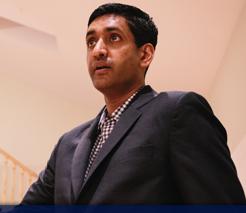
When Ro Khanna, a young, energetic intellectual property lawyer, ran for Congress against Tom Lantos, he was the candidate of the progressives. I liked Khanna, and appreciated his willingness to take on the almost unheard-of task of challenging a longtime incumbent in a Democratic primary. At that point, in 2004, the big issues were the war and the PATRIOT Act, and Khanna was against both. Lantos, who was always hawkish on defense issues (and a die-hard supporter of Israel, no matter what the Israeli government was doing), was clearly out of touch with his district. But Khanna never got much traction, and he lost pretty badly.

Now he’s back, in a new era of top-two primaries (which has its own problems), and in a different district. He’s taking on Mike Honda, who, like Lantos, has been around a while, and hasn’t faced serious opposition in years.

And this time around, it’s not Matt Gonzalez and the left supporting Khanna — it’s Lite Guv Gavin Newsom, who beat Gonzalez for mayor of SF, along with Ron Conway and the tech industry. And  instead of talking about failed US military policies, he’s talking about bringing the interests of Silicon Valley to Washington:

“The premise of this campaign is quite simple,” Khanna told the crowd. “We’ve had quite brilliant people…use technology to change the world. And it’s time that we actually change politics, that Silicon Valley has the potential to do this.” “It’s not just about having a tech agenda. This is about something much deeper — our values, and our ability to use those values to change Washington and the world,” he told them.

Now: It’s not as if Mike Honda has been horrible to Silicon Valley. He’s been involved in all sorts of tech-related issues. But he’s of a different generation, and however stereotypical it may be to say it, there’s a certain level of ageism in the tech world right now. Honda is old; the wealth in the tech world is overwhelmingly young. Politico notes:

Khanna’s decision to take on Honda also reflects a long-standing frustration among many young California pols who have been patiently waiting for older members to exit the state’s congressional delegation. Last year’s induction of an independent redistricting committee and a jungle primary system in which the top two finishers in an open primary advance to the runoff regardless of party affiliation, helped push many senior members into retirement.

Oh, and Honda is very much a pro-labor guy. And tech firms are almost never unionized, and their owners and workers don’t tend to have the same sympathies for labor unions as young activists did 20 years ago.

Politico doesn’t give Khanna much of a shot; it’s going to be a tough battle. Honda’s been around the district forever, and has no apparent scandals or gaffes (and unlike poor Pete Stark, he doesn’t seem to be losing his marbles).

But money talks, and Khanna’s got a lot of it — and in some ways, this will be a new-money-v.-old-Democratic Party, tech v. labor kind of battle that will say a lot about where Bay Area politics are going as the region’s population, and wealth, are dramatically and rapidly changing.

The bagpipe squawks for thee: first thoughts on ‘Black Watch’

0

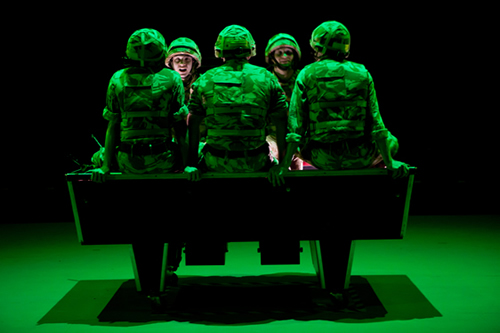
If you thought the theatricalized story of a jaunty and imperiled Scottish regiment in Iraq in 2004 would come off as a sort of “Trainspotting meets Black Hawk Down,” you wouldn’t be too far off the mark — in a very positive way. I’ll leave the nuts and bolts reviewing of full-force National Theatre of Scotland via American Conservatory Theater’s spectacular “Black Watch,” (through June 16) presented at the huge Mission Armory, to my colleague Robert Avila in next Wednesday’s Guardian. But my first thoughts upon emerging from Sunday night’s opening performance, after I cleaned the constant stream of expletives from my ears (and a bit of something from my eye) is that yae fookin’ coonts moost sae this pish, i.e. the production and performances are well worth the gasp-inducing $100 ticket price.

As is, I guess, a reminder of the — hey, ongoing! — sorry state of our “misadventures” in that part of the world. Ten years later, we have to drop a Benjamin for a complex, moving, and engrossing take on what just happened, or any take whatsoever, pretty much. That it also includes a lot of nifty multimedia effects (a surprisingly malleable pool table basically co-stars), affecting and thrillingly performed choreography, a bit of fascinating history, and some old Scottish ballads — oh yes, there will be bagpipes — is icing on the erroneous Occupation. 

Less plot-driven than situation-oriented (within the framing device of a “researcher” interviewing former squadron-mates at a pub, the story of the 300-year-old Black Watch Scottish fighting force’s dissolution in Iraq is told through clever reenactments), Gregory Burke’s play, first performed in 2007, keeps its ideological cards tucked slightly up its sleeve. But it pulls no punches when it comes to the hella screwy “facts” on the ground. It also toys with the Mametian trope that language is a real sharp double-edged sword, especially the language of power in crisis, when all the misogyny, homophobia, sexphobia, and racism comes howling through the seams of ballsy mens’ speech. One wondered how the more delicate members of A.C.T.’s regular subscription audience was taking all the “fucks,” “cunts,” and every other realistically used expletive, all fenced in by a true yet penetrable thicket of brogue.

One also wondered how many of them knew they were sitting in a giant BDSM porn studio — a famous fact left out of the program’s introduction to the “Armory Community Center,” a.k.a. Kink.com HQ, the timeline of which conveniently ends in the late 1970s, and has the gall to state that “plans to convert the building into a full-time film studio did not come to fruition.” Ahem. Aaanyways. For those of us in the know, it made the porn jokes a lot more funny.

The location also resonates with military history, of course. It was built in the early 1900s to help quell any union strikes or labor demonstrations downtown  … with hundreds of troops armed to the teeth. The wee irony of a play about an occupation staged here isn’t lost. But the genius of the location comes through in other ways. On first hearing ACT was hosting the play here, I immediately thought it would involve dozens of extras and a full orchestra. The play, however takes place in a modest (if very large compared to other locations) draped off part of the armory, and the often-eerie backing music is recorded. It is up to the cast, numbering a mere 10, to bring a full war and its aftershocks to a life big enough to fill the physical and mental space, which they do with aplomb.

They’re aided by a panoply of well-executed mulitmedia efects, culminating in a series of tragic explosions that ripple outward into the Armory’s enormous space. Those explosions can’t help but remind of the recent Boston marathon explosions, permanently televised into our senses. So much blood, so many severed limbs, the media and government weren’t afraid to show us in that bombing earlier this year. And yet 10 years ago, I remember seeing hardly any blood at all, let alone any troops’ bodies, in the long, long, then too-short coverage of the “Iraq War.” How far we’ve come, and haven’t come at all since then, “Black Watch” reminds us.      

From Lick to Main: Noah Veltman on his amazing interactive SF street name history map

0

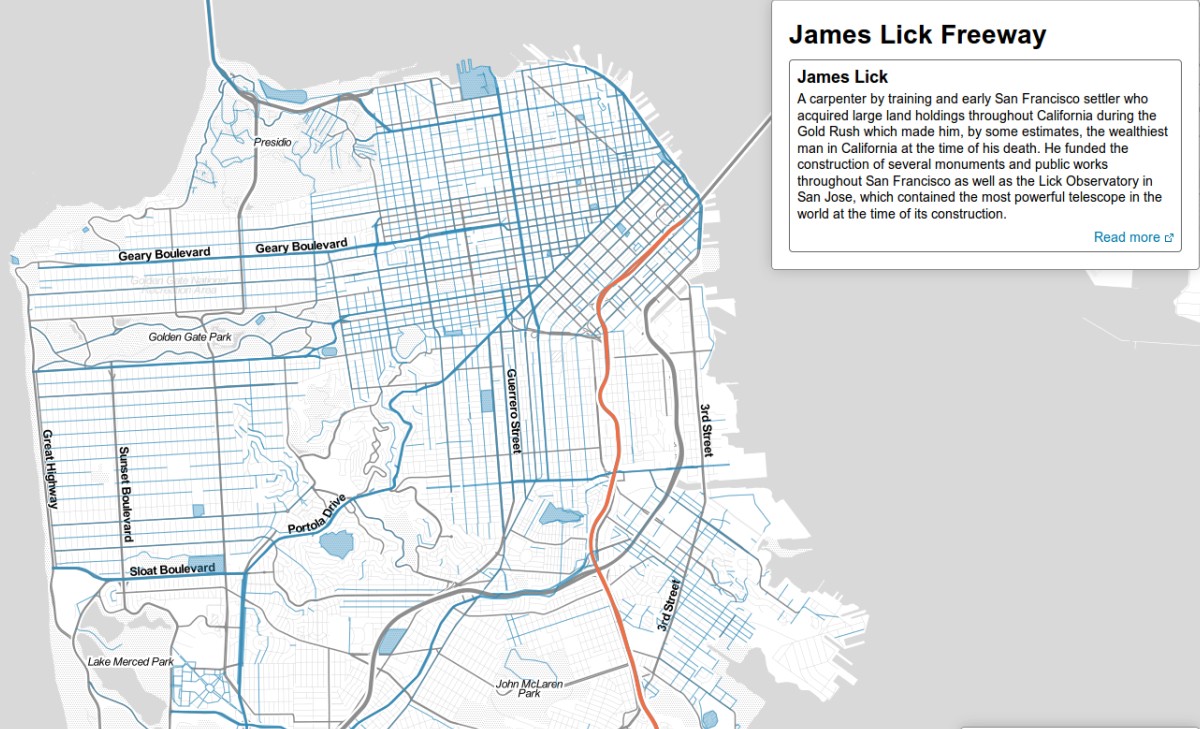
When I saw Noah Veltman’s interactive SF street (and landmark) name history map pop up on feed last week, I was instantly engrossed. (It was especially refreshing after staring at this depressing interactive map of Ellis evictions.) Of course I looked up my own street immediately, duh.

Many of us have encountered various bits of street name history along our travels, but here was a comprehensive aggregator that was fun to play with, and covered James Lick Freeway to Main Street, all in one handy spot. Did you know that Baker street was named after Edward Dickinson Baker, the lawyer who defended accused US Marshal killer Charles Cora, before Cora was lynched by the Vigilance Commitee in 1856? Or that Moraga was named for José Joaquín Moraga, founder of San Jose? Or how about Germania — it’s actually named after German people!

(One thing you do realize after a couple of minutes is that most of the streets are named after dudes, both military and wealthy. Maybe going forward, SF will institute gender parity naming regulations, like Berlin just did.)

I wanted to talk to Noah more about what inspired him to make the map, where he got his info from, and if the SF map — and the mapping project as a whole — would continue to grow. So I sent him an email. Here are the smart, and smartly civic, things he had to say

“I’m a Web developer by trade, I’ve always made interactive graphics like this for fun, although this is probably my most ambitious (you can see some of my other side projects here). I grew up on the peninsula, and lived in San Francisco for the last 4 years, but I moved to London in January for a one-year fellowship doing interactive graphics and data journalism at the BBC.

“I made the map because I thought it would be a neat way to take San Francisco’s colorful history and connect to everyday experience, give you a new sense of your neighborhood and your city. I used to walk down these streets all the time and never had any idea that they all pointed to so many larger-than-life characters and pivotal events. The names tell stories that you couldn’t make up if you tried: duels,
saloon shootouts, mob justice, espionage, overnight millionaires, explorers, tycoons, battles, rebellions. They also give you a lot of insight into people who in some cases literally built the city, people who created its skyscrapers or its railroads or its parks. That kind of local history has an immediacy you don’t get when you’re learning about something like the Founding Fathers. You walk past it on your way to work every day.

“There were a number of surprising histories to me, like the fact that Main Street isn’t a generic name, it’s named after Charles Main. I also never knew Crissy Field used to be a military airfield – I’m sure there’s a plaque explaining that somewhere but I had never come across it. Some other favorites:

Green Street
Broderick Street
Woodward Street
Guerrero Street


“I got the information from lots of places — a few different books, but also old news clippings, military records, historical society sites, that sort of thing. Usually I would start with a claim that a street was named for somebody, and then find as much corroborating evidence as I could, and if it seemed solid, research for other colorful details about the person’s life. Needless to say it was a time-intensive process.

“I’ll definitely be adding more to the map over time, there are lots of histories missing, and I’ve gotten lots of helpful tips from others since posting the map. Some streets are left out by design though. Many are self-explanatory or don’t have a historical component (for example, lots of names are just Spanish words or trees or foreign cities), I wanted to focus on ones that would be interesting and not clutter up the map with the rest. I also had to leave out a lot of ones with potentially interesting histories that were hard to verify. I wanted to be careful about not presenting rumor as fact, and there’s plenty of rumor to go around when it comes to how the streets got their names. It’s a tough balancing act, a lot of judgment calls, and I’m sure I still got a few wrong.

“This wasn’t originally meant to be a larger project, but once I got deeper into it I realized that I’d really like to expand it to other cities, so I’m going to be working on that in the coming weeks. I’d like to work on additional cities myself (maybe LA and London next) but I’d also like to generalize the template and create blank versions for lots of cities in the world and open them up for others to work on. I’ve gotten tons of feedback from folks who would be excited to make something similar for their home cities, and I’d love to help make that happen.

“As far as other upcoming projects, in addition my work at the BBC and taking the street name map beyond San Francisco, I’m hoping to start on a project to visualize diasporas from different countries around the world.”

The Pulitzer Prize Board surrender – and how the New York Times blew the Ed Kennedy story (Part l)

10

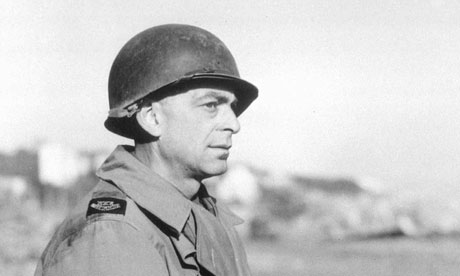
In the May 19, 1945 edition of the New Yorker magazine, the legendary press critic A. J. Liebling wrote a prescient article on what happened when Edward Kennedy, an Associated Press combat correspondent, defied military censorship to break one of the century’s biggest and most important stories.

His lead said that “the great row over Edward Kennedy’s Associated Press story of the signing of the German surrender at Reims served to point up the truth that if you are smart enough you can kick yourself in the seat of the pants, grab yourself by the back of the collar and throw yourself out on the sidewalk. This is an axiom that I hope will be taught to future students of journalism as Liebling’s Law.” Liebling titled his piece, “The AP surrender,” because AP, caving in to government pressure, led the attack on its own reporter by publicly censuring and then firing him. He cited the New York Times as leading the charge with a nasty editorial blasting Kennedy only two days after it had splashed Kennedy’s story on the front page with huge heads. Kennedy, the editorial intoned solemnly, had done a “grave disservice to the newspaper profession.”

Liebling, a mid-1920s  student at the Graduate School of Journalism at Columbia University in New York City, was presumably aiming his axiom at his alma mater, which was in a building endowed by Joseph Pulitzer, a crusading liberal publisher in New York at the turn of the century.  Pulitzer also endowed the prestigious Pulitzer Prizes, which are housed in the school and administered by a senior member of the faculty.

I especially enjoyed Liebling’s Law as a Columbia journalism graduate (’58) and as a charter member of the committee working to get Kennedy a posthumous Pulitzer prize this year for his story. The axiom was timely because my wife Jean and I were at the journalism school in April to attend my 55th class reunion and the school’s centennial celebration. The event was full of Pulitzer references and remembrances, highlighted by an address by James McGrath Morris, a respected Pulitzer biographer, speaking in the World room, named after Pulitzer’s newspaper.

The day after the centennial weekend, the Pulitzer Prize Board announced its Pulitzers and rejected the two Kennedy nominations without comment. One nomination was for his story, the other for a previously unpublished book by Kennedy on his career as a WWII foreign correspondent. The rejections demonstrated a serious flaw in the Pulitzer Prize process.

The point of quoting Liebling today, in May of 2013, is that almost seven decades after his article, the Pulitzer Prize Board and the New York Times have once again left Kennedy out on the sidewalk for doing his job as a reporter who, in a favorite Pulitzer phrase, knew “the  right and had the courage to do it.” Since this is a historic story of military censorship for political reasons, it is as timely and relevant now as it was then, since the Pulitzer Board and the Times still do not get the point.

So let me put the issue in context. Let me start by quoting Liebling’s main arguments and link his full six page piece, written in the heat of the censorship battle.

Liebling, who was himself a distinguished World War II correspondent, wrote,  ”The important aspect of the story of the row, I am sure, is not that Kennedy got his dispatch out of Europe before the SHAEF Public Relations bosses wanted him to but that only three representatives of the American press were admitted to one of the memorable scenes in the history of man, and only on condition that they promise not to tell about it until the brigadier general in charge of public relations gave them permission.

“No correspondent of a newspaper published in the United States was invited to the signing; besides Kennedy, Boyd Lewis of United Press, and James Kilgallen, of Hearst’s International News Service, the official list included four radio men, an enlisted correspondent for the Stars and Stripes, and a collection of French, Russian, Australian, and Canadian correspondents.

“Whether a promise extorted as this one was, in an airplane several thousand feet up, has any moral force is a question for theologians…I suppose Kennedy should have refused to promise anything and thus made sure of missing an event that no newspaperman in the world would want to miss, but I can’t imagine any correspondent doing it.

“I do not think Kennedy imperiled the lives of any Allied soldiers by sending the story, as some of his critics   have charged. He probably saved a few, because by withholding the announcement of an armistice you prolong the shooting, and, conversely, by announcing it promptly you make the shooting stop. Moreover, the Germans had broadcast the news of the armistice several hours before Kennedy’s story appeared on the streets of New York, and Alsie, the OWI’s American Broadcasting Station in Europe, broadcast it in 24 languages, including English, within an hour after.”

Liebling noted that the Russians “had their own surrender show in Berlin, and probably had a better publicity break on it than they would have had if the two surrenders has been announced simultaneously… One unconditional surrender of the Reich a day is as much as the public can absorb.” 

Liebling brought out the crucial political censorship point. “Moreover, the row can do a lot of good if it brings into the clear the whole disturbing question of military censorship imposed for political, personal, or merely capricious reasons and reveals the history of the prodigious amount of pure poodle-faking that has gone under the name of Army Public Relations.” Liebling was right on because it later turned out that a secret agreement between Stalin, Roosevelt, and Churchill had imposed a 24 hour embargo on the surrender story so the Russians could announce it the next day in Berlin. Kennedy’s story was in effect the start of the Cold War.

Last year, almost 70 years later,  Tom Curley, as president and CEO of AP,  backed up Liebling’s Law and apologized publicly on behalf of  AP. for the way it treated Kennedy. “tt was a terrible day for AP,” he was quoted as saying on the AP wire.  “It was handled in the worst possible way,.” He wrote a strong  defense of Kennedy in an introduction to a book published last year by the Lousiana State University Press,  titled “Ed Kennedy’s War: V-E Day, Censorship & the Associated Press.” The book was a personal account by Kennedy of his career as a foreign correspondent and a detailed account of his side of the controversy. His daughter, Julia Kennedy Cochran, found Kennedy’s manuscript in his papers after he died in a pedestrian accident in Monterey in 1963 at age 58 where he was editing the Monterey Peninsula  Herald. 

Curley wrote that “Kennedy and his editors performed superbly. They delivered one of the most significant scoops in journalism history. They did four things right. A great correspondent was assigned to the story. He kept reporting even after the censors tried to shut him down. The London desk moved the news without hesitation. The correspondent and editors adhered to the wartime rules as they knew them.  Finally, Kennedy wins the argument on a technicality. With the signing of a surrender treaty, there was no longer a war in Europe and not any excuse to submit to censors.”

Curley said “the book matches the best memoirs by World War II combat reporters for the quality of writing and telling detail, some of it gripping.  And in one way it surpasses the others. Not only does Kennedy give his final, thoughtful explanation for what happened on May 7, 1945. In describing his struggles with censorship and bureaucratic red tape and stupidity over many months, not just on May 7, he provides the fullest first-person account we have of the difficulties World War II correspondents encountered every day trying to do their jobs.

“Perhaps in some small way we bring posthumous recognition to an American hero and embrace – too belatedly – what McClean and Cooper (B3: AP executives) and the AP board could not admit. Edward Kennedy was the embodiment of the highest aspirations of the Associated Press and American journalism.” Curley said his account drew upon newly available records held in the Associated Press Corporate Archives.

Curley’s co-author was John Maxwell Hamilton, founding dean of the Manship School of Mass Communications at LSU.  He is the editor of “From Our Correspondent,” a series of books that features forgotten works and unpublished memoirs by pioneering foreign correspondents and illuminates “the development of foreign news gathering at a time when it has never been more important.” Hamilton, once a foreign correspondent himself, is currently the executive vice chancellor and provost of LSU. The book was submitted by LSU Press for a Pulitzer in the book category but the board rejected the nomination and, in keeping with tradition, rejected it without comment.

Following V-E Day, Kennedy was out at AP and the big  mainstream dailies. He became a managing editor for two years at the Santa Barbara News-Press and then edited the Monterey County Herald, later the Monterey Peninsula Herald.   The Herald won lots of journalism awards under Kennedy and he wrote many international commentaries under the initials E.K. He loved his community and he loved his job. .A memorial to Kennedy stands in the form of a sundial in Laguna Grande Park in nearby Seaside. It reads: “He saved the world an extra day of happiness.”

Meanwhile, Ray March, editor of the Modoc (Calif.) Independent News  and a former reporter under Kennedy on the Herald, decided it was time to nominate Kennedy for a posthumous Pulitzer prize and help right a historic journalistic and public policy wrong. With the help of Eric Brazil, a former Examiner editor and reporter, he put together a committee and petition.  I signed up immediately when Brazil called me.  And I helped put together the first ever panel anywhere on the Kennedy story for last year’s annual meeting of the California Press Association. It featured as moderator Ward Bushee, the Chronicle editor whose father had been recruited by Kennedy to work on the Herald. (He turned down the offer.)  Ward’s father had earlier won a Pulitzer as editor of the Watsonville Register-Pajaronian for exposing corruption involving the local district attorney.

The historic panel included March, Kennedy’s daughter, and Dave Perlman, a Chronicle reporter at 93, who was in Paris as a reporter at the time of the surrender. Jim Ewert, general counsel of the California Newspaper Publishers Association, drafted  a stirring resolution supporting the nomination and the members approved it unanimously.  It was submitted as part of the nomination package, put together by the Chronicle’s promotion department. March, Brazil, and  Frank McCulloch, former bureau chief for Time magazine in Vietnam who later held top editorial positions at the LA Times, the Sacramento Bee, and the old San Francisco Chronicle, wrote the nomination letter. It stressed that Kennedy had been the victim of military censorship for political reasons.  Meanwhile, the nomination got much media coverage, including the Chronicle, Washington Post, Sacramento Bee, Atlantic Magazine, Portland Oregonian, Editor and Publisher, and many other print and online venues.

When the New York Times announced this year’s Pulitzers, the paper gushed that  it got four Pulitzers, giving it a total of 112 Pulitzers, ”far more than any other newspaper,” as trumpeted in full page promotion ads. Margaret Sullivan, the public editor, was even more glowing in her Sunday column (4/21/2013). Her lead:  “The Times, it is safe to say, had a very good week. On Monday, it won four Pulitzer prizes – “the third most in its history and twice a many as any other news organization this year.”  (She also quite properly gave credit to the Times for its coverage of the Boston bombings and in particular for staying on the safe side of the “Rubicon of inaccuracy” by not reporting that an arrest had been made and a suspect was in custody.) She concluded her appraisal by saying that “The Times is far from perfect.  But last week, in its intelligent and restrained handling both of images and facts, it looked like a newspaper worthy of this year’s Pulitzer glory.”

However,  I and many others weren’t as smitten by Pulitzer glory. We were disappointed to see that the Pulitzer Board  not only rejected a Pulitzer for Kennedy, but that it did so without reference or mention of the Kennedy nominations, made no special citation (such as the special citation to the late Chronicle columnist Herb Caen) and gave no reasons nor acknowledgment of any kind for the rejections or to the historic importance of righting a major  journalistic and public policy wrong on one of the most crucial issues of our time:  military censorship for political reasons of news the public needs to know. I couldn’t find any evidence that the Times ever changed its editorial opposition to Kennedy and that it ever properly covered Kennedy’s side of the story. And the Times, unlike AP and so many other papers, didn’t cover the current story of the nominations to award Kennedy a posthumous Pulitzer prize or the censorship issues, before or after the Pulitzer awards were announced. Will it do so now? I am sending this report to the public editor and other Times editors and public  for comment.

I emailed Sig Gissler, the former Milwaukee Journal editor who now administers the Pulitzers.as a journalism professor. I put the above points to him and asked why the committee “instead of coming down on the side of the free press that Pulitzer and his school and prizes represented, the committee in effect came down on the side of government censorship for political reasons and supported a politically charged embargo agreement that would allow Stalin to catch up on the surrender announcement and hold his own press conference in Berlin.” 

Specifically, I asked Gissler  “was there any discussion on the Kennedy nominations, was there a vote and what was it, who voted for and against, what were the reasons for the rejection, was there any real internal debate on the importance and timeliness of this issue, and anything else that you or the Columbia officials (Outgoing Dean Nicholas Lemann or incoming Dean Steve  Coll, President Lee Bollinger) or the committee chairs or member would like to add. Is there a spokeperson I can talk to?”  I also asked for the names and contact information of the full Pulitzer committee and subcommittees and the appropriate Columbia spokespeople.

Gissler is a good man in a tough job burdened with honoring a dated policy. He emailed me back promptly and thanked me for my “interesting note.”  He said that, “regarding Kennedy, your desire for an explanation is testimony to your earnestness. However, each year the Pulitzer process produces many similar situations. Entrants desire to know why they did not become finalists. Finalists desire to know why they didn’t become winners. Petitioners for special citations desire to know why no special citations were bestowed. The Board declines to provide explanatory details, consistent with its tradition of basically not discussing, debating or defending its decisions.

“I understand your disappointment. However, at the risk of eternal irritation, I can only reiterate that the request for a special citation for Ed Kennedy was duly considered and that we do not issue statements when a request does not result in a citation.” He didn’t send me the names or contact information of the board or Columbia spokespeople. 

To give Gissler every opportunity to explain, I emailed him again and asked more questions: “So, after all these years, are you saying that the Pulitzer Board has no way for anyone (entrants or journalists or the public) to comment on the awards or the contest or the process? If not, why not?” I also asked again how the Kennedy nominating committee and others could make comments this year, right now. I ended by saying there was now much interest in “making the Pulitzer process more transparent, representative, and accountable.” I hope you agree, I told Gissler, and that you “at least present the issue to the board and the proper Columbia officials.”  I got no further comment from Gissler.

The Pulitzer School of Journalism and the Pulitzer prizes are endowed by Joseph Pulitzer. The school has the venerable Columbia Journalism Review magazine with a mission to “encourage excellence in journalism in the service of a free society.” And it has the excellent  CJR.org website that “weighs in daily, hosting a conversation that is open to all who share a commitment to high journalistic standards in the U.S. and around the world” and that could, let me suggest,  display the Pulitzer winners properly and host a lively forum for congratulations and comment  on the Pulitzers and the Pulitzer process,  It has a large and distinguished faculty and hosts a wide array of newsworthy panels and programs. It attracts each year an excellent class of students. It has a huge statue of Thomas Jefferson, paid for by Pulitzer, standing as a beacon of press freedom in front of the entrance to the journalism building. It is situated in the media capital of the world and promotes itself as the best journalism school in the country and a source of many of the country’s best journalists. It can do better, much better, with the prizes that the New York Times proclaimed, in its full page ad promoting its four Pulitzers, as “widely considered journalism’s highest honor.” .

And so I recommend that Columbia, the Graduate School of Journalism, and its Pulitzer Prize Board use the rejected nominations of Edward Kennedy, the reporter who was tarred and feathered for the crime of committing journalism, as the catalyst for major Pulitzer reforms. I recommend making the Pulitzer process more transparent, more responsive, and more prepared in our militarized age to fight government censorship and more prepared to promote and defend the First Amendment values of free speech and free press.

I will keep you posted. B3

POSTSCRIPT:  THE RUSSIAN PLAN TO PREEMPT THE SURRENDER STORY:   Ed Kennedy writes in his book that in the turmoil over his dispatch the correspondents overlooked another story almost as big as the surrender story. It came from  “no less august an official spokesman”  than Brig. Gen. Frank A. Allen Jr., the SHAEF commanding officer,  who told the corresponents in a May 8 meeting that “the official announcement might be delayed even further beyond the time set for it–3 p.m., Paris time.  He revealed that the Russians, having induced Washington and London to hold up the announcement, until the hour set for their own ceremony in Berlin, now were asking that news of the real surrender at Reims be suppressed until some hours after the phony surrender of Berlin. HIs disclosure was ‘off the record’ at the moment but could have been legitimately been reported the following day. It never was. 

“The sole purpose of the Soviet request, it was later established–and even then was obvious–was to convince a large part of the world that the Russians had obtained the surrender of Germany, with but contributory help from the Western Allies, whom they had generously invited to share in the final honor.  The Berlin ceremony was staged purely for Soviet propaganda purposes. Although a Russian correspondent was one of those whom General Allen had invited to Reims to the exclusion of any reporter of an American newspaper, no word of the Reims surrender appeared in the Russian press. So far as I know, none has to this day.

“The Russian action was the inauguration of the propaganda build-up for the course of expansion on which the Soviet Union was shortly to embark in Europe. Its importance as news was that it was the first clue to Moscow’s postwar policy.  But it went unreported at that time.”

Bruce B, Brugmann, writing as editor at large of the San Francisco Bay Guardian, as editor and co-founder and co-publisher of the Guardian with his wife Jean Dibble (1966-2012, now  retired), as a graduate of the Columbia Graduate School of Journalism (’58), as a recipient of  the Columbia Journalism School’s  Distinguished Alumnus award (2011), as a former bureau chief of the Korea Bureau of the Pacific edition of Stars and Stripes who encountered milItary censorship  (1959-60), and as a charter member of the Kennedy nominating committee. 



Let it all out

0

VISUAL ART Dottie Guy had a difficult time in 2006. In addition to the death of her grandfather, she was recovering from surgery for an injury to her ankle and foot that she had sustained on duty in Iraq. She started taking pictures as motivation to walk around and to reclaim a sense of purpose.

This year, Guy is one of the artists participating in a one-night art exhibition presented by Shout!, an initiative to support female veterans in the Bay Area. Primary organizer Star Lara asked Guy to submit a photo to an event that, in its fifth year, will include several different media — photography, painting, sculpture, drawing, writing, and music — made by 22 vets. As a result of Lara’s outreach efforts, this year’s event has grown so much that she had to turn artists away.

Lara is the Women Veterans Coordinator at Swords to Plowshares, a nonprofit that helps veterans transition back to civilian life. Leaving the military in 2007 after serving on active duty for 12 years, she knows the hardships of adapting, particularly those that affect women. As more women enlist, she explains, the gender-specific problems become increasingly defined. Female veterans now represent the fastest growing homeless population, yet they seek help through Veteran Affairs at far lower rates than men do.

Issues also stem from public perception. People understand what it means when they see a man with a military pin, but Lara often hears the question, “Is your dad in the military?” Society resists the idea of a female veteran.

And when civilians do know about a woman’s military service, another problem arises: the tendency to reduce all aspects of her persona to her veteran identity. For Guy, the exhibition provides an opportunity to showcase another side of herself. Though her life revolves around veterans — she works at the VA — she is also a photographer, and her photography does not directly address military service.

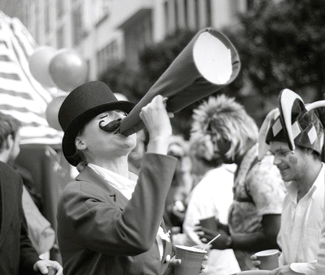
Guy snapped her Shout! photo at Bay to Breakers a couple of years ago when she stumbled across a woman in a top hat and fake moustache shouting into a bullhorn next to a man wearing a polar bear mask. It is a quirky image one could find in few places besides San Francisco. “I embrace the ridiculous stuff,” says Guy. “Being in the military, there’s not much room to celebrate that. You’d never see somebody walking around in a mask like that, unless it meant trouble.”

Another Shout! artist, JoAnn Martinez, has only recently begun to experiment with military subjects. For her second year in the show, she has submitted comics derived from dialogues she has heard within the female veteran community. By undertaking this new comedic mode of art, she hopes she can not only share a creation she’s proud of besides her family and work (she started the nonprofit Women Veterans Connect), but also communicate a digestible message to the non-veteran community. “Instead of complaining, let’s laugh about it,” she says.

Not only do Martinez’s comics convey a therapeutic levity, but they also contain an expressive subtext; they are printed on homemade paper created in response to the Combat Paper Project, in which workshops instruct veterans how to create paper pulp from their shredded military uniforms.

Extending the practice beyond Shout!, Martinez is seeking female veterans to submit stories about their uniforms for a Shotwell Paper Mill limited-edition book created using the same fabric-turned-paper method. So far, the stories range in tone, some reflecting a similar lightness to Martinez’s comics; one woman tells how after she painted her toenails, the Iraqi heat melted the polish and she had trouble removing her socks.

Lara has also participated in the project, an experience she found restorative in part because it involved breaking down and reclaiming an object laden with intense experiences, but primarily because of the work’s collectivity. After talking with fellow female veterans while their hands were busy cutting, she says, “It was no longer about the trauma that brought you to the table — it was about what you took from the table.” (The Combat Paper Project also inspired Lara’s contribution to this year’s Shout!, a piece that involved her “painting the shit out of” her last uniform.)

Though Lara does not consider herself a fine artist, Shout! presents an opportunity to share the voice of her small group within a greater context. In the Women’s Building, a hub of action in the Mission, the event will enact her idea that women veterans comprise a subset of larger existing communities and should be reached as such.

Lara says that without focusing on trauma, without involving policy, services, or outreach, Shout! offers a chance for artists like Guy and Martinez to declare, “I am a woman and a veteran, and here’s how I express myself.”

SHOUT!: ART BY WOMEN VETERANS

Wed/8, 6-9pm, free

San Francisco Women’s Building

3543 18th St, SF

swords-to-plowshares.org/shout


Pride Board locks out press, protesters at public comment meeting

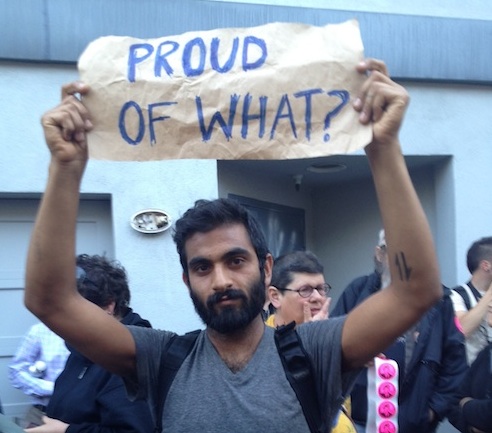
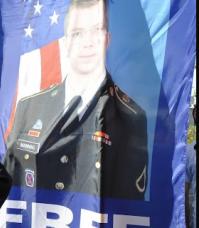
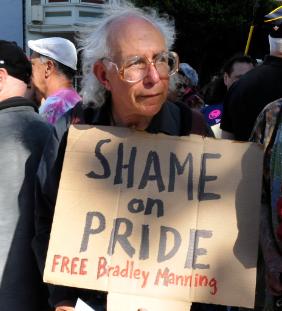
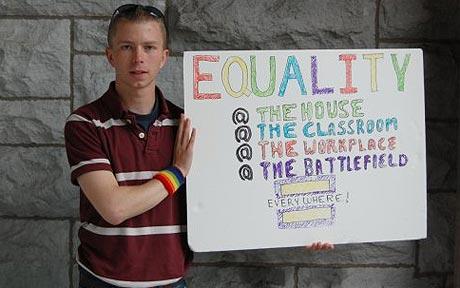
“Let the press in! Let the press in!” the crowd of about 50-60 Bradley Manning for Grand Marshal supporters chanted yesterday evening at 7pm, packed into the lobby of the Golden Gate Business Association on Pearl Street, after being denied entrance to the elevator leading to the Pride Board meeting on the fourth floor. A hired security guard held the crowd, which included reporters from KTVU and KQED, back and the elevator doors closed for the last time as “No cameras, no justice!” filled the air. 

The word came via the significant police presence outside the building (officers were also posted outside the building’s stairwell) that only 15 people at a time were being allowed into the board meeting, which was held to accept “public comment” on the Bradley manning controversy. The meeting was also supposedly held to address any questions about its official statement, released yesterday afternoon, rescinding Manning’s election as Grand Marshal because he was “not local.”

No one there, it was clear, was getting in. 

Safety hazards were cited. Surely, some protesters put forth, the Pride Board knew it would need a bigger space to address the community’s concern — like, say, the LGBT Community Center across the street? 

Scene inside the lobby after being denied entrance to the Pride Board public comment meeting

(Blogger Michael Petrellis did manage to get into the sparsely occupied meeting by arriving early and begging to use the bathroom. You can read his report here.)

Among the protesters outside were Daniel Ellsberg of Pentagon Papers fame, who spoke eloquently at a previous demonstration defending Manning. (He eventually made it into the meeting, along with a few other high-profile community representatives like Gary Virginia, Carol Queen, Starchild, Lisa Geduldig, and Rainey Reitman of the Bradley Manning Support Network.) Also present outside were members of Code Pink, ACT UP/SF, and the Gray Panthers.

Waiting on the street was attorney David Waggoner, who that day had filed an official discrimination complaint with the city’s Human Rights Commission. The complaint alleges that “the Pride Board syomped on the moral convictions of the grand marshals who voted for Manning. SF Pride — a recipient of City funding — is not allowed to discriminate against people just because they don’t like their moral support of Manning.”

The Pride Board ended its meeting early, and a representative said that it would plan another in a more appropriate — hopefully meaning bigger — venue. 

As usual, queer activist Tommi Avicolli Mecca put everything into perspective.

“I know it’s 40 years ago and I’m old, but I was at the first Gay Freedom march in Philadelphia in 1972 — and we were oficially protesting the war in Vietnam. How did we come to this — standing outside the corporate offices of Pride and shouting for them to let a military protestor, from the military itself, into their parade — into our parade?”

As the Manning supporters took to the streets and shouted “You say court martial, we say grand marshal!” from the nearby F-Market stop, Patricia Jackson, convener of the Gray Panthers, added:

“If Pride is about inclusion, how can they shut us out — of the meeting, of the conversation? The only way to heal any divide in a community is to accept that people have different views, and make things bigger than that.”  

Pride Board statement: Manning “not local,” controversy “not our mission”

20

Here’s the official statement just issued by the Pride SF Board about the Bradley Manning grand marshal fiasco, “clarifying” its bizarre rules (“Under longstanding policy, the community grand marshal upon whom the Electoral College votes is defined as ‘a local hero (individual) not being a celebrity'”), and directing the electoral college to vote for one of “two, duly qualified nominees for the 2013 Community Grand Marshal: Bebe Sweetbriar and Associate Justice Jim Humes.”

(Poor singing drag queen BeBe Sweetbriardespite her incredible productivity, even Pride doesn’t think she’s a celebrity! We still love you, Beebs.)

The statement also engages in a gross bit of condescencion.

“Those that nominated Mr. Manning surely knew that he is not a local, Bay Area community member, and that he should not have been voted on by the Electoral College. His nomination is more appropriately debated and voted on by the public than by a small group, and it could be next year when nominations open…. Taking sides in the controversy concerning Mr. Manning’s conduct is not appropriate for the organization and falls outside its core mission. We apologize to Mr. Manning, knowing that he did not ask to be at the center of a community firestorm, and for any harsh words that may have been said about him.”

Because the core mission of Pride, of course, is not to take a side in any controversy ever. Except gays in the military. And whether the Altoids float should come before or after PFLAG. Tell us, SF Pride: does Bud Light taste great, or is it less filling? We’ll have to wait until the end of time for an answer.

I’ll be asking the Pride Board about this statement tonight at its public meeting (7pm at 30 Pearl St., Fourth Floor). Stay tuned.


“For the past four decades, SF Pride has stood firmly to advance its mission to educate the world about LGBT issues, commemorate LGBT heritage, celebrate LGBT culture, and liberate LGBT people.  It remains a considerable honor and utmost commitment to engage the community to recognize those persons who have positively advanced the LGBT liberation movement, representing the full spectrum of contributions to advance full equality for all.

Presenting various categories and criteria for annual parade grand marshal nominees offers SF Pride and the community a broad range of opportunities to recognize and honor a diverse range of individuals and organizations for their achievements on behalf of LGBT people. Grand Marshal Categories include Celebrity, Lifetime Achievement, Organizational, Community, Special Guests, and Pink Brick.

The SF Pride Board recognizes and regrets the recent error in the announcement of Mr. Bradley Manning as the Electoral College’s Community Grand Marshal.  The Electoral College was not the appropriate forum for his nomination. The longstanding Grand Marshal Policy provides that one community grand marshal shall be elected by an electoral college composed of Community Grand and Honorary Marshals elected or appointed since 1999. Grand Marshal/Pink Brick Policy, Sections 3.3 and 5.2.3.  Under that longstanding policy, the community grand marshal upon whom the Electoral College votes is defined as “a local hero (individual) not being a celebrity.” Grand Marshal/Pink Brick Policy, Section 5.2.3.

Because Mr. Manning is not local, by definition under the Grand Marshal policy, he may not be nominated or elected by the Electoral College as its community grand marshal. The SF Pride Board determined that because the nomination and election had been conducted in the incorrect forum, the election could not be upheld as valid. Mr. Manning might rightfully qualify as a nominee for Celebrity Grand Marshal or another community grand marshal spot, but not as the Electoral College’s nominee, as a matter of longstanding, written policy.

The integrity of the elections process and procedures are important to SF Pride and the community. Those that nominated Mr. Manning surely knew that he is not a local, Bay Area community member, and that he should not have been voted on by the Electoral College.  His nomination is more appropriately debated and voted on by the public than by a small group, and it could be next year when nominations open.

Taking sides in the controversy concerning Mr. Manning’s conduct is not appropriate for the organization and falls outside its core mission. We apologize to Mr. Manning, knowing that he did not ask to be at the center of a community firestorm, and for any harsh words that may have been said about him. In the end, SF Pride recognizes that becoming embroiled in the controversy concerning the merit of Mr. Manning’s conduct was an honest mistake. However, because the Grand Marshal/Pink Brick policy precludes Mr. Manning from being nominated for, or elected as a community grand marshal by the Electoral College, SF Pride stands by his disqualification on those unequivocal policy grounds.

Moving forward, in the spirit of fairness and to respectfully honor the contributions of qualified nominees, the SF Pride Board is re-opening the Electoral College’s voting process so that it may select a Community Grand Marshal from the remaining two, duly qualified nominees for the 2013 Community Grand Marshal: Bebe Sweetbriar and Associate Justice Jim Humes. Members of the Electoral College will have until May 16 to re-cast their vote. 

Starting on Wednesday, May 8, ballots will be sent to the Electoral College both by email and snail mail. Votes can be cast by either email or postal mail to the SF Pride offices at 1841 Market Street, 4th Floor, San Francisco, CA 94103; Att: Electoral Voting.  Votes must be cast by 5pm PST on Thursday, May 16.  The elected Grand Marshal will be announced by noon the following day, Friday, May 17.  The SF Pride Board of Directors appreciates the support of concerned members of the community. These matters have been sorted out towards a fair resolution.  We encourage all former Community and Honorary Grand Marshals in the Electoral College to participate in this extended opportunity to select a qualified Community Grand Marshal for the 2013 Parade and Celebration.

Shortly before this statement was released, SF Pride received a complaint filed against it at the San Francisco Human Rights Commission concerning Mr. Manning.  This statement is not a response to that complaint, and SF Pride will be responding to that complaint in the proper forum, not in the press and/or at board meetings.”

The 8 Washington-Monterey connection

11

The guy who wants to build the most expensive condos in San Francisco history on the waterfront is facing a ballot measure that could derail his dreams — so he’s hiring a team of signature-gatherers to put a competing measure on the ballot. Which makes little sense to us, since when the voters are confused, then tend to vote against things, and there will be two measures (confusing) and all the opponents of the 8 Washington have to go is get people to vote No, which is easier than Yes.

But whatever.

What intrigued us is that the signature-gathering company that is about to launch Simon Snellgove’s pro-condo drive is also doing a petition drive a couple hours to the south — where environmentalists are facing off against a developer who wants to build a luxury horse-racing facility along with housing, two hotels, and an office complex on the old Fort Ord military base in Monterey.

The opponents, who want to preserve open space, are doing an initiative campaign to block it — and the developer is now doing his own counter-intiative.

According to a message on the petition company’s voice mail, signature gatherers are getting $1.60 a signature in Monterey. Don’t know yet what they’re getting in San Francisco.

And of course, the developers in Monterey are talking about jobs and recreation and parks — just as they are in San Francisco. Someone must have done a few focus groups on that.

If Monterey Downs gets built (and for the record, I am not an opponent of race tracks, horse racing, or gambling, and I love Golden Gate Fields and its $1 beers) it won’t be the kind of blue-collar cheapie place across the Bay. It will be a high-end equestrian center. “Maybe,” Jon Golinger, an 8 Washington foe, says, “that’s where the multimillionaires in the new condos will keep their horses.”

It’s an interesting political tactic — block an opposition intiative with one of your own — and it’s going to play out twice this fall in Northern California. If it works, the developers will have yet another tool. If it fails, that may be the end of it.


Don’t vent, organize and “primary” a Democrat near you

5

By Norman Solomon

Norman Solomon is co-founder of RootsAction.org and founding director of the Institute for Public Accuracy. His books include “War Made Easy: How Presidents and Pundits Keep Spinning Us to Death.” He writes the Political Culture 2013 column.

Progressives often wonder why so many Republican lawmakers stick to their avowed principles while so many Democratic lawmakers abandon theirs. We can grasp some answers by assessing the current nationwide drive called “Primary My Congressman” — a case study of how right-wing forces gain ground in electoral terrain where progressives fear to tread.

Sponsored by Club for Growth Action, the “Primary My Congressman” effort aims to replace “moderate Republicans” with “economic conservatives” — in other words, GOP hardliners even more devoted to boosting corporate power and dismantling the public sector. “In districts that are heavily Republican,” the group says, “there are literally dozens of missed opportunities to elect real fiscal conservatives to Congress — not more ‘moderates’ who will compromise with Democrats. . .”

Such threats of serious primary challenges often cause the targeted incumbents to quickly veer rightward, or they may never get through the next Republican primary.

Progressive activists and organizations could launch similar primary challenges, but — to the delight of the Democratic Party establishment — they rarely do. Why not?

Here are some key reasons:

*  Undue deference to elected Democrats.

Members of Congress and other elected officials deserve only the respect they earn. All too often, for example, plenty of Congressional Progressive Caucus members represent the interests of the establishment to progressives rather than the other way around. 

*  Treating election campaigns more like impulse items than work that requires long-term planning and grassroots follow-through.

The same progressives who’ve spent years planning, launching and sustaining a wide range of community projects are apt to jump into election campaigns with scant lead time. Progressives need to build electoral capacity for the long haul, implementing well-planned strategic campaigns with candidates who come out of social movements and have a plausible chance to win on behalf of those movements.

*  Assuming that millions of dollars are necessary to win.

Yes, successful campaigns require effective fundraising — but money is often a less significant obstacle than a shortage of commitment and willingness to do painstaking grassroots organizing.

*  Self-marginalization by ignoring elections.

Some on the left prefer to stay out of electoral contests while focusing on the next protest demonstration — thus leaving the electoral field to battles between corporate Democrats and Republicans. One sure result: a progressive won’t win.

*  Self-marginalization with third-party efforts in partisan races.

In congressional races, Green Party and other progressive third-party candidates have a zero record of success in our lifetimes. In other races with party affiliations also on the ballot (such as governor and state legislature), victories have been almost nonexistent. In such races, the corporate-military complex is not in the slightest threatened by third-party candidates, who rarely get higher than a low single-digit percentage of the vote. In nonpartisan races, by contrast, there are examples of successful and uplifting campaigns by third-party candidates, as with Green Party member Gayle McLaughlin, the mayor of Richmond, California. 

By changing just a few words in the Club for Growth’s “Primary My Congressman” manifesto, progressives have a road map for electoral progress: In districts that are heavily Democratic, there are literally dozens of missed opportunities to elect real progressives to Congress — not more of those who go along with the Obama White House as it keeps compromising with Republicans.

Anyone serious about getting genuine progressives elected to Congress next year should be engaged in developing campaigns now. To avoid the impulse-item syndrome, that means identifying key races where progressives have a real chance to win, while remaining mindful that election campaigns should be subsets of social movements and not the other way around.

If there’s a defining issue that now separates the Obama party leadership from social decency, it is the president’s push to cut Social Security benefits. Less ballyhooed but also crucial is his push to cut Medicare benefits and the ever-present danger of cuts to already woefully-underfunded Medicaid. Meanwhile, Democratic leaders are unwilling to seriously cut the enormous military budget.

Any incumbent Democrat who is not serving progressive interests should be weighed as a possible primary target. And the most fruitful primary challenges are beckoning in heavily Democratic districts where there are many progressive voters and incumbents aren’t measuring up.

By that standard, the Congress members who may be vulnerable to a primary challenge include the 44 who tout their membership in the Progressive Caucus but have refused to sign the letter (initiated by Congressmen Alan Grayson and Mark Takano) promising not to vote to cut Social Security, Medicare or Medicaid benefits.

A good starting point to consider launching a primary challenge in your area would be to look at those 44 members of Congress who continue to refuse to make such a promise, leaving themselves wiggle room to vote for cuts in three crucial programs of the social compact. To see the list of those self-described “progressives,” click here. (Meanwhile, wherever you live, you can let your Congress member and senators know what you think of proposals for such cuts by clicking here.)

It’s fair to say those 44 members of Congress are among the many Democratic incumbents showing themselves to be more afraid of the Obama White House and the Democratic Party hierarchy than they are of voters in their own districts. Progressives in and around those districts need to do less venting and more organizing.

Norman Solomon is co-founder of RootsAction.org and founding director of the Institute for Public Accuracy. His books include “War Made Easy: How Presidents and Pundits Keep Spinning Us to Death.” He writes the Political Culture 2013 column.


Guest opinion: LGBT supporters of Bradley Manning

33

Editor’s note: At least 24 LGBT community leaders and activists have signed on to the following statement in support of Bradley Manning as a Pride grand marshal.

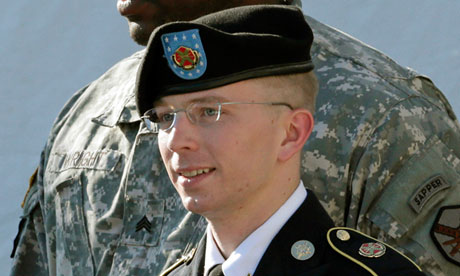
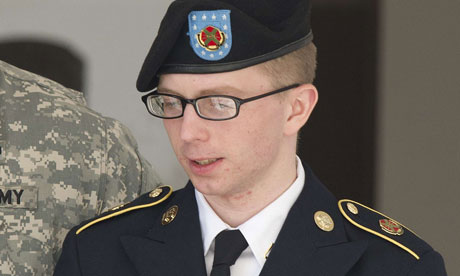
Recently, it was announced that PFC Bradley Manning would be a grand marshal of the 2013 San Francisco Pride Celebration. We felt this decision was a bold and uplifting choice, bestowing a great honor on a young whistleblower being persecuted for following his conscience.

Much to our disappointment, two days later SF Pride board president Lisa Williams issued a separate announcement that the SF Pride board would not be honoring PFC Manning as a grand marshal after all.  It appears the SF pride board’s reversal was affected by criticism from a recently formed gay military rights group. 

We want the world to know that the SF Pride board’s decision is not reflective of the LGBTQ community as a whole, and that many of us proudly celebrate PFC Manning as a member of our community.  Unfortunately, the statements by Williams, and the group which originally advocated against PFC Manning as grand marshal, continue to perpetuate certain factual inaccuracies with regards to the military prosecution against him. 

The first inaccuracy would be that PFC Manning did not advocate for gay rights.  In fact, while serving in the military, PFC Manning experienced harassment and physical assault because of his perceived sexuality.  He responded by marching against Don’t Ask Don’t Tell in the DC pride parade, where he spoke to reporters about his position, in addition to attending a fundraiser with Gavin Newsom and the Stonewall Democrats so he could discuss the issue of homophobia in the military.  He told a friend in February of 2009 that his experience living under DADT and experiencing the oppression that entailed helped increase his interest in politics more generally.

LGBTQ activists fought hard for years to win the right to live free from the fear that we could be targeted with violence deemed acceptable to society at large, simply for being who we are.  We members of the LGBTQ community would like to stand in solidarity with others around the world who still must live in fear of violence and oppression, simply for being born into a particular group.

Contrary to SF Pride Board president Lisa Williams’s claim, no evidence has been presented that PFC Manning’s actions endangered fellow soldiers or civilians. In fact, the military prosecution has successfully argued in court that it isn’t required to provide such evidence, and former State Department spokesperson P.J. Crowley continues to insist that the “Aiding the enemy” charge is unwarranted. 

In a February 28, 2013, court statement, PFC Manning detailed the due diligence he performed prior to releasing materials to ensure this lack of harm, in addition to explaining,

“I believed the detailed analysis of the [Iraq and Afghanistan war log] data over a long period of time by different sectors of society might cause society to reevaluate the need or even the desire to even to engage in counterterrorism and counterinsurgency operations that ignore the complex dynamics of the people living in the affected environment every day.”

The truth is that President Bush and VP Cheney’s aggressive wars in the Middle East endangered far more LGBTQ service members and civilians than any Army whistle-blower.  Unlike PFC Manning, however, they have never served prison time, and likely never will.

Millions of people around the world support Bradley for the personal risk he took in sharing realities of complicated U.S. foreign conflicts with the American people.  He is the only gay U.S. serviceperson to be nominated three times for the Nobel Peace Prize.  In joining the Army, soldiers take an oath to protect the U.S. Constitution, and we believe that by his actions PFC Manning strengthened our democracy, and fulfilled that oath to a greater degree than most enlisted.

We are proud to embrace PFC Bradley Manning as one of our icons, and intend to march for him in pride contingents across the country this year, as we have in years past.  We think Bradley Manning sets a high standard for what a U.S. serviceperson, gay or straight, can be.

Lt. Dan Choi, 2009 SF Pride Celebrity Grand Marshal, anti-DADT activist
Joey Cain, 2008 SF Pride Community Grand Marshal, former Board Member and President of SF Pride
Gary Virginia, 2012 SF Pride Community Grand Marshal
John Caldera, Commander, Bob Basker Post 315ED, American Legion, SF Veterans For Peace
Peter Tatchell, Peter Tatchell Foundation
Glenn Greenwald, award-winning journalist
Leslie Feinberg, transgender author and activist
Minnie Bruce Pratt, award-winning poet, activist and educator
Dossie Easton, Therapist and Author
Susie Bright, public speaker, educator, writer
Andy Thayer, co-founder, Gay Liberation Network
Becca von Behren, Staff Attorney, Swords to Plowshares Veterans Service Organization
Stephen Eagle Funk, Artistic Director, Veteran Artists
Liz Henry, poet and activist
Lori Selke, author and activist
Rainey Reitman, Steering Committee, Bradley Manning Support Network
Sergei Kostin, Codepink Art Director
Kit Yan, Queer & Trans Asian American Poet
Lori Hurlebaus, Civilian-Soldier Alliance, SF Chapter; Co-founder, Courage to Resist
Evan Greer, radical queer riotfolk musician
Pat Humphries, Emma’s Revolution
Sandy Opatow, Emma’s Revolution
Pamela Means, award-winning OUT musician
Malachy Kilbride, Coordinating Committee, National Campaign for Nonviolent Resistance
Oliver Shykles, Queer Friends of Bradley Manning
Gabriel Conaway, equality activist, Steering Committee of SAME
Adele Carpenter, Civilian-Soldier Alliance, SF Chapter

The most bitter Bradley Manning-Pride piece yet

16

Lots of people angry about the Pride Committee’s decision to fire Bradley Manning as a grand marshal. But the most savage, all-out assault comes from Steven W. Thrasher, a former Village Voice writer who has nothing good to say at all about Pride or the people who run it — or for the more mainstream parts of the LGBT movement:

Listen up, fellow homos—you have been bought, paid-for and sold to the highest bidder. The military industrial complex is so far up the ass of the LGBT movement that it can feel what is being digested in its upper intestines. Talking points and “messaging,” not discussion and debate, are the preferred methods of “communication” in a movement now run and owned by PR-firm trained Professional Homosexuals. Dissent will not be tolerated, and the assimilation of homosexuals into the rest of the militarized American public is complete.

On Manning and Pride:

A regular homosexual can give Dan Savage handjob after handjob for his anti-bully “It Gets Better” campaign if he wants, and he can even scream from the rafters that Savage should be given the Nobel Peace Prize for saying that something must be done to protect the powerless who are bullied by the powerful. But that same homosexual becomes as beholden to the military-industrial complex as the Professional Homosexual when he fails to call out SF Pride as a bully. The powerful group found perhaps the most marginalized, powerless homosexual in the nation, pulled him into the spotlight for a few hours, took a giant shit on him, roughed him up a little, called him names, and then kicked him back into the gutter.

I had to smile when I came to the end of the post, which notes:

Steven W. Thrasher was named Journalist of the Year 2012 by the National Lesbian and Gay Journalists Association for his staff writing for the Village Voice and his freelance contributions to the New York Times and Out magazine. Two weeks after receiving this award, he was laid off by the Voice.

Is he being too harsh? Is he channeling his inner Marc Salomon? Or does the guy have a point here?


Take the plunge

0

arts@sfbg.com

DANCE FACT/SF’s new Falling is a conceptually demanding, convincingly realized 70-minute sextet that annoys, puzzles, and ultimately persuades. Choreographer Charles Slender set his work on six beautifully-trained, well-rehearsed women. He also engaged excellent collaborators.

Falling asks questions that resonate beyond the physicality of what Slender has said he wanted to look at: the human need to stay upright and the reality of falling. That’s what the dancers do. They walk, stand, wobble, turn, and they fall — like rocks, sponges, and leaves. And then they get up. Again, and again, and again.

Repetition and unisons are the work’s most effective strategy. At first they are also annoying. A dancer bourrées across the stage like some Swan Queen, another joins her, then another. One starts an in-place stepping pattern, companions pick it up. A daisy-chain run calls up responses.

After a very short time this domino effect defocuses attention the way a déjà vu does. It also threatens to paralyze Falling’s thrust. But Slender keeps it going, and the set-up becomes uncomfortable because the process seems unstoppable. Then he shifts gears, with Shannon Leypoldt at the head of a diagonal shooting up her arm into the air as if delivering a manifesto.

That single gesture, besides elongating the body, becomes perhaps a leader’s command, an invitation, or a greeting among equals. It will be repeated over and over again, and everyone responds to it. To watch this process recalls cults and causes, rigid beliefs, and military indoctrination. In Falling, it’s insidious because not force but seduction sends those arms into the air. The initiation is made gently with a close body-to-body encounter as if in a tango. Tender hands help you take off that monkish, hooded robe to reveal the pretty dress, just like everyone else’s, underneath. Subjugation becomes possible because you really want to belong, no matter how hesitantly your arm responds.

There is a cool sense of inevitability about the way Leypoldt accrues these acolytes, until only Catherine Newman is left as the outsider. Desperately trying to hang on to her gown, and yet trying to step into the existing unisons, she attacks one of the dancers but crumples. That’s when hands reach out and welcome Newman to the brave new world accompanied by Dan Cantrell’s “angelic” voices. However, in that section, with its quasi-militaristic, though bare-foot stepping pattern, Falling stepped rather too close to literalism.

When Newman becomes the last acolyte and Leypoldt goes into a tailspin, Falling’s emotional temperature rises to something like a fever pitch. For the most part Slender keeps overt expressiveness in the cooler. The choreography stresses clarity and unity of purpose; there is little room for individual phrasing. Some of the floor patterns look as if they were designed on graph paper. Even when the dancers squirm flat on their backs and look like beasts about to expire, Darl Andrew Packard throws a harsh light on body parts as if they were on a dissecting table. Even in pretty phrases, elegantly rendered, the women look impersonal, primarily engaged in tasks — not in communicating. The dancing exists within strict parameters, yet not oppressively beyond the implications of the thematic material. The finale could have become melodramatic, but it didn’t; the dancers just walked away, leaving us with more questions than answers.

Falling benefits greatly from excellent production values. Packard suspended dozens of reflectors across the stage that blink on and off, suggesting a vast but dark space. Together with Slender he designed a simple set of dark woods in the beginning that became something like a world aflame at the end. Cantrell’s score, often fractured, is first-rate. Often you sense that the music, or its absence, serves as a comment to what’s happening in front of our eyes. Miyuki Bierlein designed two outstanding costumes, one a dark body-hiding robe, the other a subtly colorful summer frock that enhanced turns and suggested common ease. In addition to Leypoldt and Newman, the praiseworthy performers included Liane Burns, Michaela Burns, LizAnne Roman, and Amanda Whitehead.

Short takes: SFIFF week two

0

Prince Avalanche (David Gordon Green, US, 2012) It has been somewhat hard to connect the dots between David Gordon Green the abstract-narrative indie poet (2000’s George Washington, 2003’s All the Real Girls) and DGG the mainstream Hollywood comedy director (2008’s Pineapple Express, yay; 2011’s Your Highness and The Sitter, nay nay nay). But here he brings those seemingly irreconcilable personas together, and they make very sweet music indeed. Paul Rudd and Emile Hirsch play two men — one a fussy, married grown-up, another a short-attention-spanned man child — spending the summer in near-total isolation, painting yellow divider lines on recently fire-damaged Texas roads. Their very different personalities clash, and at first the tone seems more conventionally broad than that of the 2011 Icelandic minimalist-comedy (Either Way) this revamp is derived from. But Green has a great deal up his sleeve — gorgeous wide screen imagery, some inspired wordless montages, and a well-earned eventual warmth — that makes the very rare US remake that improves upon its European predecessor. Wed/1, 4pm, and Fri/3, 6:30pm, Kabuki. (Dennis Harvey)

Fill the Void (Rama Burshtein, Israel, 2012) Respectfully rendered and beautifully shot in warm hues, Fill the Void admirably fills the absence on many screens of stories from what might be considered a closed world: the Orthodox Hasidic community in Israel, where a complex web of family ties, duty, and obligation entangles pretty, accordion-playing Shira (Hada Yaron). An obedient daughter, she’s about to agree to an arranged marriage to a young suitor when her much-loved sister (Renana Raz) dies in childbirth. When Shira’s mother (Irit Sheleg) learns the widower Yochay (Yiftach Klein) might marry a woman abroad and take her only grandchild far away, she starts to make noises about fixing Shira up with her son-in-law. The journey the two must take, in possibly going from in-laws to newlyweds, is one that’s simultaneously infuriating, understandable, and touching, made all the more intimate given director Rama Burshtein’s preference for searching close-ups. Her affinity for the Orthodox world is obvious with each loving shot, ultimately infusing her debut feature with a beating heart of humanity. Wed/1, 6:30pm, and Thu/2, 4pm, Kabuki. (Kimberly Chun)

The Strange Little Cat (Ramon Zürcher, Germany, 2013) There’s a strange music to this light-on-its-toes, rhythmic, and ultimately mesmerizing chamber piece by first-time feature director Ramon Zürcher — one seemingly informed by dance, Gerhard Richter, contemporary opera, and Jean-Luc Godard in a latter-day gimlet-eyed state. The arc of a banal yet odd day is traced, within mostly the close confines of a Berlin apartment, as family members enter, interact, and then retreat in a kind of call and response: the mother runs a kitchen machine, a girl cries out as if to mimic its roar, a cousin who looks as if he’s straight out of a Dutch master painting soberly surveys the scene, while the eponymous feline weaves in and out of the action. In fact, that pet is the most domesticated of the lot populating this riveting domestic scene, all of which makes you want to see what Zürcher cooks up next. Wed/1, 9pm; Sun/5, 7pm; and May 8, 4pm, Kabuki. (Chun)

Salma (Kim Longinotto, England/India, 2012) Kept like a prisoner in her in-laws’ house for more than two decades, Salma is more than the most famed woman poet writing in the Tamil language. She’s also an archetypal South Indian woman of her time and place: married as a teen despite her desire to read and write poetry, her body controlled by her husband and family, and her freedom constricted to the point where she was once forced to write on scraps of paper in the toilet and to smuggle her verse out to have it published. What follows is the stuff of fairy tales, as Salma evolves into a politician and heroine who speaks for those otherwise muffled by their burkas and smothered by circumstance. Documentarian Kim Longinotto keeps a close eye on the oppressive culture that once harbored the writer — and inspired her to express herself — yet also takes the time to notice Tamil Nadu’s many small instances of beauty, in mutable pink and purple skies, a gold-flecked green sari, and showy weddings that mark both the beginning, and end, for so many young girls. Documentarian Longinotto whets one’s appetite for more of Salma’s words, while upholding her story’s relevance amid rising consciousness concerning the rights of all women in India. Thu/2, 6:15pm, Kabuki; Sat/4, 2pm, PFA; Sun/5, 3:45pm, New People. (Chun)

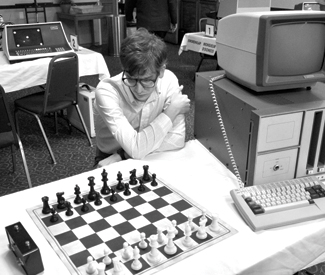
Computer Chess (Andrew Bujalski, US, 2013) Mumblecore maestro Andrew Bujalski (2002’s Funny Ha Ha; 2005’s Mutual Appreciation) makes his first period picture, kinda, with this stubbornly, gloriously retro saga set at an early-1980s computer-chess tournament (with a few ventures into the freaky couples-therapy seminar being held at the same hotel). The technology is dated, both on and off-screen, as hulking machines with names like “Tsar 3.0” and “Logic Fortress” battle for nerdly supremacy as a cameraman, wielding the vintage cameras that were actually used to film the feature, observes. Tiny dramas highlighting the deeply human elements lurking amid all that computer code emerge along the way, and though the Poindexters (and the grainy cinematography) are authentically old-school, the humor is wry and awkwardly dry — very 21st century. Keep an eye out for indie icon Wiley Wiggins, last seen hiding from Ben Affleck’s hazing techniques in 1993’s Dazed and Confused, as a stressed-out programmer. Thu/2, 9pm, and Sat/4, 4pm, Kabuki. (Cheryl Eddy)

The Cleaner (Adrián Saba, Peru, 2011) An austere take on substitute-parental bonding dressed in apocalyptic sci-fi clothing, Adrián Saba’s Peruvian feature finds the world ending not with a bang but with a sickly whimper. (If you’ve ever breathed the toxic air or looked at the shit-brown sea around Lima, you’ll find this pretty credible.) A middle-aged loner (Victor Prada) tasked with cleaning up the death sites of citizens felled by a fatal epidemic finds a surviving young boy (Adrian Du Bois) in one such apartment. Their forced, awkward pairing — because the death toll is so high city services can no longer taken in another orphan — is poignant and terse in what’s a minimalist companion to the underrated 2008 adaptation of José Saramago’s plague saga Blindness. Sat/4, 6:15pm, Kabuki; Tue/7, 8:40pm, PFA; May 9, 8:30pm, Kabuki. (Harvey)

Invasion of the Body Snatchers (Philip Kaufman, US, 1978) Yes, Vertigo (1958) is very nice. But here is my alternate choice for Best San Francisco Movie Ever: 2013 SFIFF tributee Philip Kaufman’s 1978 remake of the 1950s sci-fi classic. Donald Sutherland, Brooke Adams, Jeff Goldblum, Veronica Cartwright, and Leonard Nimoy are among the locals who get very paranoid — with no pot brownies involved — when everyone around them starts turning coldly conformist. Given the film’s fond evocation of the city’s loopy, friendly, countercultural vibe at the time, this shift in the psychological weather really is alarming — arguably much more dramatically so than it was the vanilla small-town setting of Don Siegel’s original or Abel Ferrara’s military-base 1994 version. Wonderfully creepy, eccentric, stylish and humorous, it was Kaufman’s first commercial success. He will appear at the Castro screening to discuss it, his career in general, and to accept his Founder’s Directing Award. Sun/5, 7:30pm, Castro. (Harvey)

Waxworks (Paul Leni, Germany, 1924) Paul Leni’s 1924 omnibus horror feature is considered one of the great classics of German Expressionist cinema. A young man (William Dieterle, who went on to a long Hollywood directing career) answers an ad seeking “an imaginative writer for publicity” work at a wax museum. There he’s asked to write “startling tales” about specific wax figures, envisioning himself and the owner’s comely assistant (Olga Belajeff) as hero and heroine in each narrative. The first and longest tale has the two of them as a couple who get unwanted attention from the tyrannical, lusty Caliph of Bagdad (Emil Jannings). It’s an attenuated comic episode sparked by spectacular abstracted “Middle Eastern” sets. Next, Conrad Veidt (of 1920 Expressionist flagship film The Cabinet of Dr. Caligari) plays Ivan the Terrible in a more macabre story of bloodthirst and madness. Finally, Werner Krauss is “Spring-Heeled Jack” (i.e. Jack the Ripper), terrorizing our protagonists in a brief riot of nightmarish superimposed images. SFIFF’s annual silent film extravaganza at the Castro will be accompanied by a stellar quartet of musicians playing an original score: Mike Patton, Scott Amendola, Matthias Bossi, and William Winant. Expect an eclectic and propulsive evening of sounds equally schooled by punk, prog rock, and jazz. Tue/7, 8:30pm, Castro. (Harvey)

Before Midnight (Richard Linklater, US, 2012) Proving (again) that not all sequels are autonomic responses to a marketplace that rewards the overfamiliar, director Richard Linklater and his co-writers Julie Delpy and Ethan Hawke reconnect with the characters Céline and Jesse, whom we first encountered nearly 20 years ago on a train and trailed around Vienna for a night in Before Sunrise, then met again nine years later in Before Sunset. It’s been nine more years since we left them alone in a Paris apartment, Céline adorably dancing to Nina Simone and telling Jesse he’s going to miss his plane. And it looks like he did. The third film finds the two together, yes, and vacationing in Greece’s southern Peloponnese, where the expansive, meandering pace of their interactions — the only mode we’ve ever seen them in — is presented as an unaccustomed luxury amid a span of busy years filled with complications professional and personal. Over the course of a day and an evening, alone together and among friends, the two reveal both the quotidian intimacies of a shared life and the cracks and elisions in their love story. May 9, 7pm, Castro. (Lynn Rapoport) *

The San Francisco International Film Festival runs through May 9 at the Castro Theatre, 429 Castro, SF; New People Cinema, 1746 Post, SF; Pacific Film Archive, 2575 Bancroft, Berk; and Sundance Kabuki Cinemas, 1881 Post, SF. For tickets (most shows $10-15) and info, visit festival.sffs.org.


Pride faces backlash from defenders of gay whistleblower

In the wake of the debacle unleashed by San Francisco Pride’s announcement that gay whistleblower Bradley Manning would not be grand marshal for this year’s Pride Parade after all, a large crowd of protesters assembled outside Pride’s Market Street headquarters April 29 for a hastily organized rally condemning the move. They held signs depicting Manning’s image, and chanted, “Grand marshal, not court martial!”

Famed whistleblower Daniel Ellsberg, who helped foment opposition to the Vietnam War by leaking classified government documents known as the Pentagon Papers to the New York Times in 1971, expressed support and admiration for the young US Army soldier. Manning was arrested in May of 2010 on suspicion of having leaked classified government cables and military footage later published by WikiLeaks, and faces a possible life sentence.

“A big mistake was made by the Board of Directors of SF Pride,” Ellsberg said. Referencing director Lisa Williams’ statement that not even a “hint” of support for Manning would be tolerated, Ellsberg said, “I don’t hint at support for Bradley Manning. I couldn’t be louder. I will be marching in that parade, for the first time for me, with a banner honoring Bradley Manning.”

Gay Navy veteran John Caldera, commander of the Bob Basker Post 315 of the American Legion, an LGBT-focused veteran’s organization, announced that his members had voted unanimously to call for Williams’ resignation, saying she had “negated and belittled all of the voices of the community” who had expressed support for Manning. He also condemned Pride for withholding its support for Manning while accepting funding from the likes of Wells Fargo, a banking giant responsible for foreclosures that have affected veterans. “The SF Pride committee has to put people first and corporations second,” he said.

Joey Cain, a former grand marshal who said he nominated Manning, noted that he was not calling for Williams to resign, but hoped she would realize the mistake and reinstate him as grand marshal. “What he did was heroic … Bradley made the world a better place,” Cain said. He shamed Pride for straying so far from the roots of the gay movement. “We believed in radical inclusivity,” practicing tolerance for all “colors, genders and opinions,” he said, with the understanding that “We don’t all agree. We never will. But we’re sure never going to throw any part of the community under the bus.”

The rally was organized by longtime housing activist Tommi Mecca (pictured, center), comedian Lisa Geduldig and blogger Michael Petrelis.

Some counter-protesters from the Log Cabin Republicans, a gay GOP organization, even made an appearance. “We were praising the Pride Committee for not having selected Manning,” SF Log Cabin Republicans Fred Schein told the Bay Guardian.

Paul Bloom, a longtime activist, handed the Guardian a written statement on his take of the whole dustup, which he viewed as “an opportunity for people to unite in our understanding that there is no antiwar movement without gay people, and no movement for human rights that doesn’t envision an end to war.”

“Why does the SF Gay Pride Parade need corporate sponsorship, anyway?” Bloom wrote. “The parade must be brought back into the struggle as a part of it instead of remaining the grossly commercial spectacle it has become. We need to occupy the parade.”


Former Pride grand marshal: Manning is LGBT hero, Board action ‘height of stupidity’

61

“I was one of the 15 former grand marshals on the electoral commission that voted for Bradley Manning,” Barry Saiff, former BiNet president, told me over the phone this morning from Washington, DC, about the Bradley Manning Pride grand marshalship controversy. (As one half of a bi-national queer couple, he lives most of the year in the Phillipines with his boyfriend, who is unable to come to the United States due to discriminatory immigration laws.)

To recap: An ‘electoral college’ of former grand marshals elected the jailed gay (possibly now transgender) whistleblower who provided Wikileaks with a huge dump of raw classified US government info. Someone announced the choice on Friday and the media went nuts. Then the Pride executive director issued this bizarre statement repudiating the decision and rescinding the honor, to the dismay of the electoral college and a huge swath of LGBT locals. A protest at Pride HQ is planned for today, 5pm at 1841 Market, SF.) 

“The list of nominees from the other board members was presented to me in March, and the instant I saw Bradley’s name on there I knew it was the right choice. Pride stands for justice, freedom, and an end to discrimination, and I feel Bradley represents all of these things — as well as complete honesty and bravery. What the Pride board did to repudiate that choice, especially in its official statement — to not be able to make the distinction between Manning’s necessary actions and way the government is denigrating our troops with these illegal and unjust wars — is the height of stupidity.

“They [the Pride board] are colluding in the giant ‘Support Our Troops’ hoax that says you must never question the leadership of the military. There is actually no contradiction between supporting our troops as individuals, including our LGBT folks in the armed services, and supporting Bradley Manning and what he did.

“Specifically, if we care about our troops, we should care that they are used by our military for just ends, for missions and goals that actually increase our security, rather than decrease it, and that they are dealt with honestly. And, regardless of how you feel about the rightness or wrongness of Manning’s actions, there is no question that it is both immoral and illegal under international law (the US is a signatory to the Convention Against Torture), that he was tortured by the USA. Bradley Manning is an American hero, and an LGBT hero. We can rightfully be proud of him. He will rightly be remembered long after his duplicitous superiors are forgotten.

“What the Pride Board should have done to respond to the critics of the nomination was to point out that they were failing to make a crucial distinction. That it is simply a point of logic that we can support our troops while being diametrically opposed to the ends to which they are used by our government. This is a crucial point for the LGBT movement to understand and promote. We should not allow ourselves to be divided by people who are committed to denying reality. We can agree to disagree on the military and the wars in Afghanistan and Iraq, but there is no disagreement on this, it is a point of fact.”

What about the charge that Manning’s leaks endangered US troops?

“I say, ‘Bullshit.’ Of course that’s what the government says. Look, Manning did not act alone. He worked with some extremely savvy media people with this — Wikileaks, the New York Times — he didn’t just publish everything himself. Those organizations worked to edit what was put out there and protect peoples’ lives. To dump this all on him and call him a traitor is a mistake.”

How much of all this had to do with Manning’s queerness?

“Well, all things being equal, that’s what qualified him in the first place. But as I said, this fight has resonance with LGBT people in terms of freedom and justice. The fact that he’s gay may play into his situation in terms of military and former persecution.”

Were you ever given guidelines by the Pride board about who was qualified to be elected a grand marshall?  

“Not that I know of. I don’t know the bylaws off-hand, but every year, as the ‘electoral college,’ we’ve been able to elect one grand marshall and it’s never been a problem. We voted in March, although there may have been a period before the final decision was tallied. [Radical faerie elder and historian Joey Cain put forth the Manning nomination.] And that was the last I heard of it until Friday. I wasn’t contacted personally by [executive director] Lisa Williams or anybody else saying we had to change anything. It wasn’t until Friday that I found out about any controversy — in the news media, like everybody else. And I was outraged.”  


Reports of grenade-type devices used in West Oakland raid

A high profile police raid occurred last night in multiple East Bay locations, with most activity centered at the Acorn public housing complex in West Oakland. According to recent news reports, some 150 FBI agents and support staff carried out the raid, along with 120 Oakland police officers and other law enforcement officers from San Leandro, Hayward and Antioch.

OPD Chief Howard Jordan told reporters at a press conference that the raid targeted the Acorn gang of West Oakland, and that officers made five arrests, served 16 narcotics and weapons warrants, and seized firearms, heroin, cocaine and marijuana.  

An official statement attributed to OPD spokesperson Johnna Watson in a Chronicle report suggested that police did not use force during the operation. This suggests OPD does not consider deploying grenade-type devices (considered to be “less lethal weapons”) to be “use of force,” because residents living nearby the Acorn housing complex at Eighth and Adeline streets told the Guardian that they heard loud bangs, probably from flash grenades, go off when the operation was underway around 7:30 Wednesday night.

A neighbor who lives nearby the apartment complex, who asked not to be identified, had a partial view of the police activity from their West Oakland residence. The person described the operation as “like a military presence” due to the sheer number of officers, many outfitted in SWAT gear, and “very precise,” targeting a specific address and lasting roughly an hour and 15 minutes. The streets surrounding the apartment complex were closed off for the duration of the raid.

The neighbor estimated that the flash grenades (or similar devices) were used five times, but since the explosions produce echoes, there could have been fewer deployments. The observer wasn’t able to see how they were used because there wasn’t a clear view of the unit, but heard the bangs in sequence. An OPD officer could be heard addressing occupants inside one of the units on a loudspeaker, reading out the address, telling them they were surrounded, and then saying something like, “you in the suit, get down, get down on the ground.”

The neighbor said they observed three people being removed from the unit and taken into custody – a man who was wearing a suit, a person in a motorized wheelchair, and a tall, younger-looking man. The arrestees were cooperative. 

The West Oakland resident also reported seeing an armored vehicle parked at the scene. A host of official OPD vehicles were parked along the street, along with unmarked cars including SUVs and white vans. 

More details about the massive police operation, the targeted gang, and the criminal activity the cops zeroed in on are sure to come out. A lot of outstanding questions remain, of course, including why officers decided to use the grenade-type devices. So far, OPD hasn’t responded to our email or voice message, but we’ll post the department’s response if we receive one.

Solomon: It’s time to renounce the “war on terror”

1

Norman Solomon is co-founder of RootsAction.org and founding director of the Institute for Public Accuracy. His books include “War Made Easy: How Presidents and Pundits Keep Spinning Us to Death.” He writes the Political Culture 2013 column.

As a perpetual emotion machine — producing and guzzling its own political fuel — the “war on terror” continues to normalize itself as a thoroughly American way of life and death. Ongoing warfare has become a matter of default routine, pushed along by mainline media and the leadership of both parties in Washington. Without a clear and effective upsurge of opposition from the grassroots, Americans can expect to remain citizens of a war-driven country for the rest of their lives.

Across the United States, many thousands of peeling bumper stickers on the road say: “End this Endless War.” They got mass distribution from MoveOn.org back in 2007, when a Republican was in the White House. Now, a thorough search of the MoveOn website might leave the impression that endless war ended with the end of the George W. Bush presidency.

MoveOn is very big as online groups go, but it is symptomatic of a widespread problem among an array of left-leaning organizations that have made their peace with the warfare state. Such silence assists the Obama administration as it makes the “war on terror” even more resolutely bipartisan and further embedded in the nation’s political structures — while doing immense damage to our economy, siphoning off resources that should go to meet human needs, further militarizing society and undermining civil liberties.

Now, on Capitol Hill, the most overt attempt to call a halt to the “war on terror” is coming from Rep. Barbara Lee, whose bill H.R. 198 would revoke the Authorization for Use of Military Force that Congress approved three days after 9/11. Several months since it was introduced, H.R. 198 only has a dozen co-sponsors. (To send your representative and senators a message of support for Lee’s bill, click here.)

Evidently, in Congress, there is sparse support for repealing the September 2001 blanket authorization for war. Instead, there are growing calls for a larger blanket. Bipartisan Washington is warming to the idea that a new congressional resolution may be needed to give War on Terror 2.0 an expansive framework. Even for the law benders and breakers who manage the executive branch’s war machinery, the language of the September 2001 resolution doesn’t seem stretchable enough to cover the U.S. warfare of impunity that’s underway across the globe . . . with more on the drawing boards.

On Tuesday afternoon, when a Senate Judiciary subcommittee held a hearing on “targeted killing,” the proceedings underscored the great extent of bipartisan overlap for common killing ground. Republican super-hawk Sen. Lindsey Graham lauded President Obama for “targeting people in a very commander-in-chief-like way.” And what passed for senatorial criticism took as a given the need for continuing drone strikes. In the words of the subcommittee’s chairman, Sen. Dick Durbin, “More transparency is needed to maintain the support of the American people and the international community” for those attacks.

This is classic tinkering with war machinery. During the first several years of the Vietnam War, very few senators went beyond mild kibitzing about how the war could be better waged. In recent years, during President Obama’s escalation of the war in Afghanistan that tripled the U.S. troop levels in that country, senators like John Kerry (now secretary of state) kept offering their helpful hints for how to fine tune the war effort

The “war on terror” is now engaged in various forms of military intervention in an estimated two-dozen countries, killing and maiming uncounted civilians while creating new enemies. It infuses foreign policy with unhinged messages hidden in plain sight, like a purloined letter proclaiming “What goes around won’t come around” and telling the world “Do as we say, not as we do.”

Political ripple effects from the Boston Marathon bombings have only begun. While public opinion hasn’t gotten carried away with fear, much of the news media — television in particular — is stoking the fires of fear but scarcely raising a single question that might challenge the basic assumptions of a forever “war on terror.”

After a city has been traumatized and a country has empathized, a constructive takeaway would be that it’s terribly wrong to set off bombs that kill and maim. But that outlook is a nonstarter the moment it might be applied to victims of U.S. drones and cruise missiles in Afghanistan, Pakistan, Yemen and elsewhere. The message seems to be that Americans should never be bombed but must keep bombing.

The death of Richie Havens days ago is a loss and reminder. Each of us has only so many days ahead. We may as well live them with deeper meaning, for peace and social justice. To hear Havens performing the song “Lives in the Balance” written by another great musician, Jackson Browne, is to be awakened anew:

I want to know who the men in the shadows are
I want to hear somebody asking them why
They can be counted on to tell us who our enemies are
But they’re never the ones to fight or to die

And there are lives in the balance
There are people under fire
There are children at the cannons
And there is blood on the wire

Norman Solomon is co-founder of RootsAction.org and founding director of the Institute for Public Accuracy. His books include “War Made Easy: How Presidents and Pundits Keep Spinning Us to Death.” He writes the Political Culture 2013 column.


Pageant play

0

caitlin@sfbg.com

SEX Who could have anticipate that this year’s International Ms. Leather pageant (www.imsl.org) would do so much to temper the legacy of Sarah Palin? Thanks to the crowning of Sarha Shaubach, the world now has an alternative posterwoman for that tiny hamlet on the outskirts of Anchorage’s metropolitan area.

Shaubach, who accepted her title wearing a furry hat and a stole with paws on April 20, told us a little about herself via email the day after the pageant’s climax at the Holiday Inn Golden Gateway. The event drew leatherwomen from all over the world to the Van Ness Avenue hotel for play parties, history panels, kinky writing intensives, and extensive opportunities for forging a global network of BDSM broads.

2013’s International Ms. Bootblack bella (left) and International Ms. Leather Sarha Shaubach

SFBG: What does your new title mean to you?

Sarha Shaubach: The International Ms Leather title represents a long history of diverse women from all over the country sharing a passion to support and grow bonds between leatherwomen from many different kinds of background and experiences. To me, this title is a chance to learn, educate, grow, and thrive in my journey as a leatherwoman while building bonds between communities.

SFBG: Tell me about your winning outfit.

SS: I wore a combination of fur and leather for my last and final outfit on stage. I felt that [those materials] most authentically represented who I am and where I come from. The furs were harvested by me and my family in Meadow Lakes, Alaska, and the leathers were bought secondhand at various thrift stores.

Shaubach, to the north of her leather community, per usual

SFBG: Highlight of the pageant week?

SS: The excitement of all the hot leather folk at the IMSL “Seductions Show” on Thursday night was a highlight for sure, but calling home to talk to my husband John after the contest would have to take the cake. He seems to be just as excited for my new title as I am.

SFBG: As a leatherwoman, what do you consider your greatest achievement?

SS: My greatest achievement to this point would be producing the first Northern Exposure (www.northernexposurealaska.com) in 2010, Alaska’s only BDSM/leather education weekend. Since then, and with the help of my amazing tribe of friends and volunteers, we have brought more than 50 educators from all over North America to Alaska to teach and present on all kinds of kink and leather-related topics.

SEXY EVENTS

“Maximizing a Women’s Pleasure” Wed/24, 8-10pm, $35. Pink Bunny, 1772 Union, SF. www.pinkbunny.biz. Learn how to work a clit in the Marina? It’s true! Drop in on the adorable, independently owned sex shop Pink Bunny for this two-hour seminar by Japanese bondage expert and sex educator Midori on giving and receiving female feelings. Couples and solo enthusiasts of all genders welcome.

Home Movies 101 Sat/27, 2-5pm, $60 solo admission, $80 couples. Center for Sex and Culture, 1349 Mission, SF. www.sexandculture.org. Porn star Kara Price uses hawt, if clothed, demonstrations of various positions and orgasms to teach you how to make a pro sex tape. Get half off tuition if your partner is in the military or overseas.

Short takes: SFIFF week one

0

SAN FRANCISCO INTERNATIONAL FILM FESTIVAL

April 25-May 9, most shows $10-15

Various venues

festival.sffs.org

The Artist and the Model (Fernando Trueba, Spain, 2012) The horror of the blank page, the raw sensuality of marble, and the fresh-meat attraction of a new model — just a few of the starting points for this thoughtful narrative about an elderly sculptor finding and shaping his possibly finest and final muse. Bedraggled and homeless beauty Mercè (Aida Folch) washes up in a small French town in the waning days of World War II and is taken in by a kindly woman (Claudia Cardinale), who seems intent on pleasantly pimping her out as a nude model to her artist husband (Jean Rochefort). As his former model, she knows Mercè has the type of body he likes — and that she’s capable of restoring his powers, in more ways than one, if you know what I mean. Yet this film by Fernando Trueba (1992’s Belle Époque) isn’t that kind of movie, with those kinds of models, especially when Mercè turns out to have more on her mind than mere pleasure. Done up in a lustrous, sunlit black and white that recalls 1957’s Wild Strawberries, The Artist and the Model instead offers a steady, respectful, and loving peek into a process, and unique relationship, with just a touch of poetry. Fri/26, 1pm, and Sun/28, 6:30pm, Kabuki. (Kimberly Chun)

The Daughter (Alexander Kasatkin and Natalia Nazarova, Russia, 2012) Imagine a serial-killer tale as directed by Tarkovsky and you’ll get an idea of this fascinating, ambiguous Russian drama by co-directors Aleksandr Kasatkin and Natalia Nazarova. Someone is murdering teenage girls in what otherwise seems a tranquil village backwater. That’s one reason the almost painfully naïve Inna (Maria Smolnikova) is kept on a fairly tight leash by her gruff, conservative widower father (Oleg Tkachev), who expects her to perform all housekeeper duties and mind a little brother. When brash, borderline-trashy new schoolmate Marta (Yana Osipova) surprisingly decides to make Inna her best friend, she’s both a liberating and dangerous influence. Less interested in narrative clarity than issues of morality, spirituality, and guilt (at one point the killer confesses to a priest whose daughter he murdered — tormenting the cleric who is bound to confidentiality), this often-gorgeous feature is a worthy addition to the long line of somber, meditative Russian art films. Fri/26, 6:15pm, and Sun/28, 1pm, Kabuki; May 6, 9pm, PFA. (Dennis Harvey)

The Kill Team (Dan Krauss, US, 2012) Dan Krauss’ documentary chronicles the shocking case of a US Army unit in Afghanistan whose squad leader, one Sgt. Calvin Gibbs, encouraged his men to kill unarmed, unaccused civilians for fun, then cover it up as alleged self-defense. (He also collected severed fingers for an eventual bone necklace.) When subordinate Adam Winfield was disturbed enough by this to tell his parents (his father a Marine vet), and ponder informing officials, he was threatened with his own lethal “accident.” Once the scandal finally broke, he found himself on military trial for murder along with Gibbs and others. While sometimes a little too slickly made in a narrative-feature kind of way, this is a potent look at the vagaries of military justice, not to mention a military culture that can foster dangerously frustrated adrenaline junkies. As one of Winfield’s fellow accused puts it, Afghanistan was “boring as fuck” because they expected to be “kickin’ ass” when “instead we’re forced to help ’em build a well, or a school, or whatever.” Another shrugs “It was nothing like everyone hyped it up to be … and that is probably partly why, uh, things happened.” Fri/26, 9pm, PFA; May 6, 3:15pm, and May 7, 6pm, Kabuki; May 9, 6pm, New People. (Harvey)

Rosie (Marcel Gisler, Switzerland, 2013) Moms: can’t live with ’em … and can’t live with ’em. Roughly, that’s the predicament of successful gay writer Lorenz (Fabian Kruger) when his hard-drinking independent mater Rosie (Sibylle Brunner) keels over with a heart attack. His heart is with his tough old bird of a mother — unlike his more conventional sister (Judith Hofmann) — though a young, adorable fanboy of a neighbor (Sebastian Ledesma) is intent on competing for his attentions. Director and co-writer Marcel Gisler spares no warmth or care when it comes to filling out the story fully, as when Lorenz discovers that he has more in common with his seemingly inaccessible late father than he ever imagined. While Rosie paints a rosier, slightly more sentimental picture, imagine a warmer and fuzzier yet still renegade Rainer Werner Fassbender nursing a wisecracking, headstrong Emmi post-1974’s Ali: Fear Eats the Soul. Fri/26, 9:30pm, Kabuki; Sun/28, 9pm, PFA; Tue/30, 6pm, Kabuki. (Chun)

You’re Next (Adam Wingard, US, 2011) The hit of the 2011 Toronto Film Festival’s midnight section — and one that’s taking its sweet time getting to theaters — indie horror specialist (2010’s A Horrible Way to Die, 2007’s Pop Skull, 2012’s V/H/S) Adam Wingard’s feature isn’t really much more than a gussied-up slasher. But it’s got vigor, and violence, to spare. An already uncomfortable anniversary reunion for the wealthy Davison clan plus their children’s spouses gets a lot more so when dinner is interrupted by an arrow that sails through a window, right into someone’s flesh. Immediately a full on siege commences, with family members reacting with various degrees of panic, selfishness, and ingenuity, while an unknown number of animal-masked assailants prowl outside (and sometimes inside). Clearly fun for its all-star cast and crew of mumblecore/indie horror staples, yet preferring gallows’ humor to wink-wink camp, it’s a (very) bloody good ride. Sat/27, 11:30am, Kabuki; May 1, 9:45pm, Kabuki. (Harvey)

Thérèse (Claude Miller, France, 2012) Both Emma Bovary and Simone de Beauvoir would undoubtedly relate to this increasingly bored and twisted French woman of privilege stuck in the sticks in the ’20s, as rendered by novelist Francois Mauriac and compellingly translated to the screen by the late director Claude Miller. Forbiddingly cerebral and bookish yet also strangely passive, Thérèse (Audrey Tautou) looks like she has it all from a distance — she’s married to her best friend’s coarse, hunting-obsessed brother (Gilles Lellouche) though envious of her chum’s affair with a handsome and free-thinking Jewish student. Turns out she’s as trapped and close to death as the birds her spouse snares in their forest, and the suffocatingly provincial ways of family she’s married into lead her to undertake a dire course of action. Lellouche adds nuance to his rich lunk, but you can’t tear your eyes from Tautou. Turning her pinched frown right side up and hardening those unblinking button eyes, she plays well against type as a well-heeled, sleepwalking, possibly sociopathic sour grape, effectively conveying the mute unhappiness of a too-well-bred woman born too early and too blinkered to understand that she’s desperate for a new century’s freedoms. Sat/27, 3pm, Kabuki; Mon/29, 6:30pm, New People. (Chun)

Ernest & Celestine (Stéphane Aubier, Vincent Patar, and Benjamin Renner, France/Luxembourg/Belgium, 2012) Belgian animators Vincent Patar and Stéphane Aubier are best known for the stop-motion shorts series (and priceless 2009 subsequent feature) A Town Called Panic, an anarchic, absurdist, and hilarious creation suitable for all ages. Their latest (co-directed with Benjamin Renner) is … not like that at all. Instead, it’s a sweet, generally guileless children’s cartoon that takes its gentle, watercolor-type visual style from late writer-illustrator Gabrielle Vincent’s same-named books. Celestine (voiced by Pauline Brunner) is an orphaned girl mouse that befriends gruff bear Ernest (the excellent Lambert Wilson), though their improbable kinship invites social disapproval and scrapes with the law. There are some clever satirical touches, but mostly this is a softhearted charmer that will primarily appeal to younger kids. Adults will find it pleasant enough — but don’t expect any Panic-style craziness. Sun/28, 12:30pm, and May 1, 7pm, Kabuki. (Harvey)

Marketa Lazarová (Frantisek Vlácil, Czech Republic, 1966) An extraordinary evocation of medieval life, this 1966 black and white epic — considered by some the greatest Czech film ever made — is being reprised at SFIFF in honor of the festival’s late board chairman and generous benefactor George Gund, for whom it was a personal favorite. The violent struggle between pagan feudalist clans and rising Christian political forces in 13th century Eastern Europe is dramatized in brutal yet poetical form here. You will be very glad you didn’t live back then, or suffer the privations director Frantisek Vlácil and his crew did during an apparently very tough rural, mostly wintertime shoot. But you won’t forget this cinematically dazzling if sometimes opaquely told chronicle based on a classic Czech novel. Sun/28, 12:30pm, PFA; May 3, 8:45pm, New People. (Harvey)

Museum Hours (Jem Cohen, US, 2012) Feature documentaries Benjamin Smoke (2000) and Instrument (2003) are probably Jem Cohen’s best-known works, but this prolific filmmaker — an inspired choice for SFIFF’s Golden Gate Persistence of Vision Award, honoring “a filmmaker whose main body of work is outside the realm of narrative feature filmmaking” — has a remarkably diverse resume of shorts, music videos, and at least one previous narrative film (albeit one with experimental elements), 2004’s Chain. Cohen appears in person to discuss his work and present his latest film, Museum Hours, about a guard at Vienna’s Kunsthistorisches Museum (“the big old one,” the man calls it) who befriends a Montreal woman visiting her comatose cousin. It’s a deceptively simple story that expands into a deeply felt, gorgeously shot rumination on friendship, loneliness, travel, art history and appreciation, and finding the beauty in the details of everyday life. Sun/28, 5:30pm, Kabuki. (Eddy)

The Patience Stone (Atiq Rahimi, France/Germany/England/Afghanistan, 2012) “You’re the one that’s wounded, yet I’m the one that’s suffering,” complains the good Afghan wife of Patience Stone in this theatrical yet charged adaptation of Atiq Rahimi’s best-selling novel, directed by the Kabul native himself. As The Patience Stone opens, a beautiful, nameless young woman (Golshifteh Farahani) is fighting to not only keep alive her comatose husband, a onetime Jihadist with a bullet lodged in his neck, but also simply survive on her own with little money and two small daughters and a war going off all around her. In a surprising turn, her once-heedless husband becomes her solace — her silent confidante and her so-called patience stone — as she talks about her fears, secrets, memories, and desires, the latter sparked by a meeting with a young soldier. Despite the mostly stagy treatment of the action, mainly isolated to a single room or house (although the guerilla-shot scenes on Kabul streets are rife with a feeling of real jeopardy), The Patience Stone achieves lift-off, thanks to the power of a once-silenced woman’s story and a heart-rending performance by Farahani, once a star and now banned in her native Iran. Mon/29, 6:30pm, and Tues/30, 8:45pm, Kabuki. (Chun)

Peaches Does Herself (Peaches, Germany, 2012) Canadian-born yet the quintessential modern Berlin act — transgressively sexed-up electroclash slash-performance artist — Peaches delivers an expectedly high-concept live show in this nimbly cinematic concert movie. The first 15 minutes or so are absolutely great: raunchy, hilarious, imaginatively staged (completely with an orgiastically inclined dance troupe). But after a while it really begins to bog down in prolonged appearances by elderly burlesque-type standup Dannii Daniels, stilted ones by Amazonian transsexual Sandy Kane, and an attempt at a quasi-romantic-triangle narrative that is meant to be funny and outrageous but just kinda lies there. Diehard fans will be thrilled, but most viewers will hit an exhaustion point long before the film reaches its (admittedly funny) fadeout. Mon/29, 9:45pm, and May 2, 9:15pm, Kabuki. (Harvey) *

The San Francisco International Film Festival runs April 25-May 9 at the Castro Theatre, 429 Castro, SF; New People Cinema, 1746 Post, SF; Pacific Film Archive, 2575 Bancroft, Berk; and Sundance Kabuki Cinemas, 1881 Post, SF. For tickets (most shows $10-15) and info, visit festival.sffs.org.

Ringside

2

By L.E. Leone

IN THE GAME Gio Camacho, captain of the West Point women’s boxing team, sang the national anthem into the ring announcer’s microphone, wearing boxing gloves. Then she climbed into the ring and beat the beans out of University of Maryland’s Catherine Breslin, who looked a little bewildered.

This was the first fight on a 21-bout card the second night of the inaugural United States Intercollegiate Boxing Association tournament held at USF last weekend. Incredibly, it was the first collegiate tournament to crown women champions, as well as men.

West Point seemed especially excited about this. The academy sent twelve female boxers to San Francisco for the event (and no male ones). Eight out of nine of the women’s bouts featured at least one West Pointer. A couple were West Point vs. West Point.

West Point had coaches. West Point had uniforms. West Point had chants. West Point had Gio Camacho. After a while, it became pretty easy to root against West Point. Everyone from any other college who stepped into the ring with them seemed lonely and intimidated.

It’s reassuring, I suppose, from a national security standpoint, that our country’s future military officers fought with more discipline, confidence, and swagger than (for example) Pat Cannaday of UNC — who I fell in love with when I saw her laughing in her corner between rounds. Something her coach had said to her.

She was clearly being beaten. But didn’t seem fazed by it. At all. The ref interrupted the fight in the middle of the third because her ponytail had come undone. She had to go to her corner and have it taped.

Cannaday lost. Rachel Luba of UCLA lost. Jules Squire, a jangly and wildly strong, free-swinging slugger from UMD, lost, goddamn it. Mei-Le Keck of UCLA lost.

West Point took every weight class from 112 to 152. I started to lose interest. Then I saw three people sitting in another section of bleachers off to the side at the Koret Center gymnasium. They didn’t look “above it all” so much as, yeah, “off to the side” of it.

The woman was wearing a WVU hoody, her hands in the pockets. She wasn’t shadow boxing, chattering nervously, or eating power bars. In fact, it was hard to tell she was a boxer.

Her coach didn’t look like the other coaches, and her boyfriend didn’t look like anyone else in the place: beard, bandanna, shorts and flip-flops . . .

My people! I thought.

When I saw her legs, I knew who was going to take West Point down.

Sadly, though, Jennifer Moreale of WVU never had the chance. She fought Eileen Macias-Mendoza, USF. She fought the home team! And she won, by TKO. First round. Probably the USF boxing coach saw what I’d seen. In fact, he had the best view in the house of where Moreale’s power was coming from, and he threw in the towel. I saw this. It was literal. Towel. Over. First knockout of the night.

The second came in the other 165-pound fight, in which West Point was taken down, finally, by Elizabeth Brunton of Georgetown. Brunton, another likeable fighter, had a strong upper body and an old-fashioned brawler’s demeanor, but bird legs compared to Moreale’s.

Now, the next night, they were going to square off for the 165-pound collegiate title. That’s the heavyweights, for women. Brunton vs. Moreale. It had a ring, for me — like Ali-Frazier or Foreman Grill. I was hooked. Brunton-Moreale. The rest of that evening, and all the next day, it was the only thing I could talk about. West Virginia vs. Georgetown.

In collegiate boxing, they count the punches landed, that’s all, and — barring a knockout — it is how you win or lose. Three rounds. Two minutes apiece. It goes fast, from the outside.

“When you’re the person in the ring, you’re in it alone,” Moreale told me after. “The only voice I hear is the corner. And I feel the punches. And I feel what I am going to do next. But that’s it.”

Brunton went the distance with her, and fought well, but Moreale won. She looked like a different fighter the second night: more bob and weave. “I discovered some things that I always thought I could do,” she said. “I surprised myself, too.”

Counting her half-round TKO the night before, this was her fourth fight ever.

An Italian native, Moreale is two years into her PhD studies. Economics. But she has wanted to box since she was little, when she would practice on a stuffed duffel bag, wearing ski gloves.

“When you believe in something,” she said, two hands on her giant, gaudy, championship belt, “it’s possible.”

I said that I agreed.


Laid bare

0

marke@sfbg.com

LIT “I met Johanna at a party in New York in 1998 — actually I was talking to her boyfriend first, barrettes in his dyed black hair and painted nails, I was trying to figure out if he was a fag or from Olympia.”

If you were “alternative” in the ’90s, that priceless sentence should ring strikingly true, as will this one: “Obviously we believed in attitude: if someone said something about not wanting to judge people, that was New Age garbage. New Age garbage was almost as bad as a trust fund, it was the same thing as stealing from your friends because you were stealing their rage.”

Mattilda Bernstein Sycamore — outspoken queer anti-assimilation activist, genderblending thriftstore style icon, archetypal Mission District character, huge-hearted den mother, insufferable gadfly — is the posterchild for all that was culturally alternative in San Francisco in that pierced-lip poser decade, while at the same time possessing one of the loudest voices cutting through the bullshit clamor back then and questioning it all.

She’s also a brilliant writer, with two novels and several anti-assimilationist essay anthologies, including last year’s Why Are Faggots So Afraid of Faggots?, under her sparkly little purple belt. Her new memoir The End of San Francisco from City Lights Books is written in such a hypnotically elliptical style (summoning City Lights’ Beat poet legacy) and contains so many spot-on observations and era-damning epigrams that anyone who lived through the period described will cling to its pages while wishing to hurl the book at a wall in embarrassed self-recognition.

Searing, funny, maudlin, elegiac, infuriating, and confessional, The End of San Francisco is a deliberately disordered collection of vignettes dealing mostly with Sycamore’s span living in the city and launching the highly influential Queeruption, Fed Up Queers, and Gay Shame activist movements.

“At some point I realized that the book centered around the myths and realities of San Francisco as a refuge for radical queer visions in community building,” Sycamore told me via email.

“I first moved to San Francisco in 1992, when I was 19, and it’s where I figured out how to challenge the violence of the world around me, how to embrace outsider visions of queer splendor, how to create love and lust and intimacy and accountability on my own terms. I left San Francisco in 2010, and in some ways this book is an attempt to figure out why or how this city has such a hold on me, in spite of the failure of so many of my dreams, over and over and over again.”

Along the way we get drug overdoses, AIDS, lesbian potlucks, heroin chic, crystal meth, ACT UP, the birth of the Internet, the dot-com boom, the dot-com bust, mental breakdowns, outdoor cruising, phony spirituality, Craigslist hookups, hipster gentrification, Polk Street hustling, fag-bashing, shoplifting, house music, the Matrix Program, crappy SoMa live/work lofts, “Care Not Cash,” gallons of bleach and hair dye, and processing, processing, and more processing.

It’s definitely not a nostalgia-fest: Juicy passages about SF club history, ’90s queer life in the Mission, and Gay Shame’s internal dynamics and gloriously kooky pranks (guerrilla Gay Shame Awards ceremonies blocking Castro traffic; a Pride adjacent, corporate-sponsor-tweaking “Budweiser Vomitorium” where you could “barf up your pride”) are accompanied by an Oprah-load of issues including chronic pain, incest, personal betrayals, anorexia, depression. The moving opening chapter describes Sycamore confronting her father in the upscale Washington, DC home she grew up in about her recovered memories of his sexual abuse, as he lay dying.

And Sycamore has surprising words for those who think queer punk, riot grrrl, the bathhouse disco and clone-look revival, or the scene at the SF Eagle were essential to the queer activist movement (Kathleen Hanna of Bikini Kill makes a memorable appearance — Sycamore befriended her without knowing who she was, and later attended the first Le Tigre show.) Her habit of questioning everything can often paint her into corners of abrasive self-absorption, but she continues to raise interesting points about the fetishization of machismo in the FTM, leather, and punk communities, the emptiness of hipster activism, and the capitalist-colluding hypocrisy of “alternative culture.”

As usual though, she saves her heaviest judgments for the mainstream gay morass, its Borg-like drive toward cultural hegemony via marriage, military, and consumerism — even as she acknowledges the necessary symbiosis that binds queer outcasts together. At 1993’s March on Washington, “where suddenly there were a million white gay people in white t-shirts applying for Community Spirit cards”: “Gays in the military was the big issue and what could be more horrifying but here’s the thing: freaks actually found one another — we were so alienated that we went right up and said hi, I like your hair…”

This, then, is the tenderness that drives Bernstein to keep speaking out, despite the personal costs. As we weather another dot-com boom of homogenizing gentrification, The End of San Francisco is a timely reminder of the community that can spring from resistance.

MATTILDA BERNSTEIN SYCAMORE reads Tue/30, 7pm, free at City Lights Bookstore, 261 Columbus, SF. www.citylights.com, and Thursday, May 9, 7:30pm, free at the GLBT History Museum, 4127 18th St., SF. www.glbthistory.org


Solomon: The Orwellian warfare state of carnage and doublethink

3

By Norman Solomon

Norman Solomon is co-founder of RootsAction.org and founding director of the Institute for Public Accuracy. His books include “War Made Easy: How Presidents and Pundits Keep Spinning Us to Death.” He writes the Political Culture 2013 column.

After the bombings that killed and maimed so horribly at the Boston Marathon, our country’s politics and mass media are awash in heartfelt compassion — and reflexive “doublethink,” which George Orwell described as willingness “to forget any fact that has become inconvenient.”

In sync with media outlets across the country, the New York Times put a chilling headline on Wednesday’s front page: “Boston Bombs Were Loaded to Maim, Officials Say.” The story reported that nails and ball bearings were stuffed into pressure cookers, “rigged to shoot sharp bits of shrapnel into anyone within reach of their blast.”

Much less crude and weighing in at 1,000 pounds, CBU-87/B warheads were in the category of “combined effects munitions” when put to use 14 years ago by a bomber named Uncle Sam. The U.S. media coverage was brief and fleeting.

One Friday, at noontime, U.S.-led NATO forces dropped cluster bombs on the city of Nis, in the vicinity of a vegetable market. “The bombs struck next to the hospital complex and near the market, bringing death and destruction, peppering the streets of Serbia’s third-largest city with shrapnel,” a dispatch in the San Francisco Chronicle reported on May 8, 1999.

And: “In a street leading from the market, dismembered bodies were strewn among carrots and other vegetables in pools of blood. A dead woman, her body covered with a sheet, was still clutching a shopping bag filled with carrots.”

Pointing out that cluster bombs “explode in the air and hurl shards of shrapnel over a wide radius,” BBC correspondent John Simpson wrote in the Sunday Telegraph: “Used against human beings, cluster bombs are some of the most savage weapons of modern warfare.”

Savage did not preclude usage. As a matter of fact, to Commander in Chief Bill Clinton and the prevailing military minds in Washington, savage was bound up in the positive attributes of cluster bombs. Each one could send up to 60,000 pieces of jagged steel shrapnel into what the weapon’s maker described as “soft targets.”

An unusually diligent reporter, Paul Watson of the Los Angeles Timesreported from Pristina, Yugoslavia: “During five weeks of airstrikes, witnesses here say, NATO warplanes have dropped cluster bombs that scatter smaller munitions over wide areas. In military jargon, the smaller munitions are bomblets. Dr. Rade Grbic, a surgeon and director of Pristina’s main hospital, sees proof every day that the almost benign term bomblet masks a tragic impact. Grbic, who saved the lives of two ethnic Albanian boys wounded while other boys played with a cluster bomb found Saturday, said he had never done so many amputations.”

The LA Times article quoted Dr. Grbic: “I have been an orthopedist for 15 years now, working in a crisis region where we often have injuries, but neither I nor my colleagues have ever seen such horrific wounds as those caused by cluster bombs.” He added: “They are wounds that lead to disabilities to a great extent. The limbs are so crushed that the only remaining option is amputation. It’s awful, awful.”

The newspaper account went on: “Pristina’s hospital alone has treated 300 to 400 people wounded by cluster bombs since NATO’s air war began March 24, Grbic said. Roughly half of those victims were civilians, he said. Because that number doesn’t include those killed by cluster bombs and doesn’t account for those wounded in other regions of Yugoslavia, the casualty toll probably is much higher, he said. ‘Most people are victims of the time-activated cluster bombs that explode some time after they fall,’ he said.”

Later, during invasions and initial periods of occupation, the U.S. military dropped cluster bombs in Afghanistan and fired cluster munitions in Iraq.

Today, the U.S. State Department remains opposed to outlawing those weapons, declaring on its official website: “Cluster munitions have demonstrated military utility. Their elimination from U.S. stockpiles would put the lives of its soldiers and those of its coalition partners at risk.”

The State Department position statement adds: “Moreover, cluster munitions can often result in much less collateral damage than unitary weapons, such as a larger bomb or larger artillery shell would cause, if used for the same mission.” Perhaps the bomber(s) who stuffed nails and ball bearings into pressure cookers for use in Boston had a similarly twisted rationale.

But don’t expect explorations of such matters from the USA’s daily papers or commercial networks — or from the likes of NPR’s “Morning Edition” and “All Things Considered,” or the PBS “NewsHour.” When the subject is killing and maiming, such news outlets take as a given the presumptive moral high ground of the U.S. government.

In his novel 1984, Orwell wrote about the conditioned reflex of “stopping short, as though by instinct, at the threshold of any dangerous thought . . . and of being bored or repelled by any train of thought which is capable of leading in a heretical direction.”

The doublethink — continually reinforced by mass media — remains within an irony-free zone that would amount to mere self-satire if not so damaging to intellectual and moral coherence

Every news report about the children killed and injured at the finish line in Boston, every account of the horrific loss of limbs, makes me think of a little girl named Guljumma. She was seven years old when I met her at an Afghan refugee camp one day in the summer of 2009

At the time, I wrote: “Guljumma talked about what happened one morning last year when she was sleeping at home in southern Afghanistan’s Helmand Valley. At about 5 a.m., bombs exploded. Some people in her family died. She lost an arm.

In the refugee camp on the outskirts of Kabul, where several hundred families were living in squalid conditions, the U.S. government was providing no help. The last time Guljumma and her father had meaningful contact with the U.S. government was when it bombed them.

War thrives on abstractions, but Guljumma was no abstraction. She was no more or less of an abstraction than the children whose lives have been forever wrecked by the bombing at the Boston finish line.

But the same U.S. news media that are conveying the preciousness of children so terribly harmed in Boston are scarcely interested in children like Guljumma.

I thought of her again when seeing news reports and a chilling photo on April 7, soon after 11 children in eastern Afghanistan were even more unlucky than she was. Those children died from a U.S./NATO air strike. For mainline American journalists, it wasn’t much of a story; for American officials, it was no big deal.

“Circus dogs jump when the trainer cracks his whip,” Orwell observed, “but the really well-trained dog is the one that turns his somersault when there is no whip.”

Norman Solomon is co-founder of RootsAction.org and founding director of the Institute for Public Accuracy. His books include “War Made Easy: How Presidents and Pundits Keep Spinning Us to Death.” He writes the Political Culture 2013 column.

Treasure Island: Is this the end?

30

So Mayor Lee goes to China with plans to celebrate the signing of a deal that would bring $1.7 billion in Chinese investment into the lagging Treasure Island redevelopment project, and instead the whole thing falls apart. Not good for the cross-Bay rivalry: Gov. Brown, a former mayor of Oakland, landed $1.8 billion in Chinese money for his city’s big project, while Lee lost out.

But there’s a bigger problem. It’s hard to see how anyone would want to invest in Treasure Island right now, when:

The island is sinking,

The Bay is rising,

There’s only one way on or off the island, and it’s already so crowded that a modest event like the Treasure Island Flea Market ties up traffic in both directions for hours, and

The place is radioactive.

Matt Smith and Katherine Mieszkowski of the Bay Citizen did what the Navy and the city of San Francisco refused to do. They went out with a couple of red buckets, dug up some soil and had it tested for Cesium-137. Bingo: The place suffers from far worse contamination that anyone was letting on. And there might be even more:

Until the early 1990s, the Navy operated atomic warfare training academies on Treasure Island, using instruction materials and devices that included radioactive plutonium, cesium, tritium, cadmium, strontium, krypton and cobalt. These supplies were stored at various locations around the former base, including supply depots, classrooms and vaults, and in and around a mocked-up atomic warfare training ship – the USS Pandemonium. CIR’s samples were taken from under a palm tree 50 feet from a classroom building where cesium-137 was kept, according to military archives. A 1974 radiation safety audit identified cesium samples used and stored there with radioactivity several times the amount necessary to injure or kill someone who mishandled them. In 1993, shipping manifests from the same building showed even greater amounts of cesium-137 taken away from the same site that year.

Now some experts say that development plans need to be put on hold while the entire place is checked out more carefully:

“The fact that there is a level above standards is a clear mandate for further study and assessment of the extent of contamination and its origin,” Beyea wrote in an email, adding that more systematic testing is particularly important given that public play areas are planned nearby. “Building a playfield is not an appropriate plan at this time,” he wrote, “given the tendency for little children to put things in their mouths.”

Would you loan a couple billion dollars for a development project on that site?

In theory, of course, the Navy is responsible for the cleanup. In practice? Good luck with that. The Pentagon is blaming the sequester for forced budget cuts in everything including the Blue Angels; you think anyone’s going to write a very big check any time soon for a very complex environmental clean-up job on an artificial island that will soon be underwater?

I used to think the best thing to do with Treasure Island was to leave as much open space as possible for soccer and baseball fields, then slowly let it sink back into the Bay. Now apparently it’s a bad idea even to have kids playing there.

And what about the people who already have moved into housing at TI? Anyone going to test their soil?

Anyone want to take bets on whether anything much is ever going to be built there?