Mayor

On 8 Washington, it’s No, No

56

The November ballot may contain not one but two measures addressing super-luxury condos on the waterfront. And that could pose a serious problem for the developer of the 8 Washington condominium project.

The Board of Supervisors approved that proposed 134-unit complex, which would be the most expensive condos ever built in San Francisco, in June, 2012, but immediately opponents gathered enough signatures to force a vote of the people. The referendum would overturn the increased height limits that developer Simon Snellgrove wants for the site.

That, it turns out, is a popular notion: “If Snellgrove is looking at the same polls we’re looking at, the public is not interested in raising building heights on the waterfront,” Jon Golinger, who is running the referendum campaign, told us.

So Snellgrove is now funding his own initiative — a ballot measure that would essentially approve the entire project, allowing 136-foot buildings along the Embarcadero and giving the green light to start construction on housing for multimillionaires.

The paperwork for the initiative was set to be filed April 23, allowing Snellgrove’s team to begin collecting signatures. They’ll need more than 9,000 valid ones to make the November ballot — and that’s not much of a threshold. If the developer funds the signature-gathering effort — which he’s vowed to do — he’ll almost certainly get enough people who are fooled by the fancy name of his campaign: “San Franciscans for Parks, Jobs, and Housing.”
That, presumably, suggests that there are San Franciscans who are against Parks, Jobs, and Housing, although we don’t know any of them. We just know people who think this particular project provides housing the city doesn’t need without paying nearly enough for affordable units.

At any rate, the campaign manager for this effort, according to the paperwork filed at the Department of Elections, is Derek Jensen, a 20-something communications consultant who was Treasurer of the Lee for Mayor Campaign. The address for the waterfront initiative is listed as 425 Market St, 16th floor –which, by the way, was the same address used by the Lee Campaign. And since it’s right near our office, we took a stroll over to see what the Snellgrove forces had to say.

Well, it turns out that 425 Market is a secure building, and the 26th floor is the law office of Hanson Bridgette, and you can’t get up there unless your name is already in the computer system, which ours was not. The security guard kindly called up to ask about the 8 Washington initiative, and was told there was nobody who could talk about it today, but to check back later.

The person who answered the phone at Hanson, Bridgette had never heard of Derek Jensen. Transferred to voicemail, we left a message for someone named “Lance.” Perhaps that would be Associate Counsel Arthur “Lance” Alarcon, Jr. He hadn’t called back at press time.

The campaign against 8 Washington, on the other hand, has an office at 15 Columbus. First floor. Walk right in the door. The campaign manager is Jon Golinger, who answers his own phone.

At any rate, we can’t figure out what Snellgrove is up to, since his plan makes zero political sense. The referendum needs a “no” vote to block the project. If voters don’t like increased height limits on the waterfront, they won’t like his initiative, either. And if all that this does is confuse the voters, they’ll tend to vote “no” on both measures. If anything, he’s only hurting himself.

Chiu and Herrera roll up their sleeves for spring cleaning in City Hall

For some time now, oft-labeled “power brokers” with undue influence in San Francisco city government have taken heat for failing to register as lobbyists. At the same time, politically connected insiders are often criticized for manipulating the permitting process for major real estate developments far outside the public gaze.

It’s said that sunshine is the best disinfectant. Yesterday, City Attorney Dennis Herrera and Board of Supervisors President David Chiu introduced a package of reforms designed to shed more light on lobbyists’ practices.

The new set of rules would tighten up lobbying regulations, create new disclosure rules for developers and their lobbyists, create more oversight around city contracting and grant-making, and require the publication of a guide for campaign donors spelling out Ethics laws regarding campaign contributions.

“We’re not demanding of anybody else anything different than we would demand of ourselves,” Herrera said, adding that he and Chiu had been working on drafting the proposal for months.

Chiu and Herrera both vied for the city’s highest office in competition with Mayor Ed Lee in 2011. Since beginning his term as mayor, Lee has drawn sharp criticism for his cozy relationships with former San Francisco Mayor Willie Brown, Chinatown consultant Rose Pak and a handful of others who are not registered as lobbyists.

Without mentioning anyone by name, Chiu noted, “I do think there are individuals who have not registered as lobbyists who probably should.”

The proposed rules would broaden the definition of “lobbyist” under the city’s Ethics regulations. The new definition would include “any individual who makes contact with” an elected official on behalf of an employer or anyone else paying them “for lobbyist services.” If someone makes $1,000 or more per month for lobbying, that person would be considered a lobbyist under the law.

The new legislation would also create new disclosure requirements for “permit expediters,” who work on behalf of developers to hasten the permitting process for major real estate construction. They would have to register with the city’s Ethics Commission and file regular reports about their contacts with city officials. Developers with major planning projects in the pipeline would also have to disclose donations of $5,000 or more to city-based nonprofits.

Chiu noted that he and Herrera had consulted with Friends of Ethics, a group of government accountability advocates that’s been pushing for Ethics reform, for help drafting the proposal.

Chiu and Herrera also acknowledged that better enforcement of existing laws was needed in addition to the proposed legislative reforms. “Our city could be more proactive in enforcing our Ethics laws to the fullest,” Chiu said. “Not just the letter of the law, but the spirit of the law.”

Check, please

44

steve@sfbg.com

San Francisco restaurants that have been cheating their customers and employees — charging diners for city-required healthcare coverage that they aren’t fully providing to workers — will finally be exposed in the coming weeks, with some notable names in foodie circles among the likely culprits.

City Attorney Dennis Herrera is working on settlements with dozens of restaurants that responded to his investigation and partial amnesty offer, which had an April 10 deadline. His effort augments the complaint-driven enforcement actions by the city’s Office of Labor Standards Enforcement, which has collected millions of dollars for thousands of employees of negligent local businesses in recent years.

At issue is the Healthcare Security Ordinance, the landmark 2008 law authored by then-Sup. Tom Ammiano that requires San Francisco businesses to provide a minimal level of healthcare benefits to their workers. Businesses are also required to report spending and surcharge figures to the OLSE annually, with the next report due April 30.

Last year’s data show celebrity chef Michael Mina’s Mina Group LLC — which includes the restaurants Michael Mina, RN74, Bourbon Steak, and Clock Bar — to be the top violator, collecting $539,806 in surcharges from customers and spending just $211,809 on employee healthcare.

Herrera used that list to ask more than 70 businesses to show they are in compliance with the law or reach discounted settlements now to avoid punitive fines or criminal charges later, and Herrera told us he received 60 responses and had his inquiry snubbed by fewer than a dozen.

“It’s too early to talk about how large a recovery we’ll be getting for workers, but I’m pleased with the response rate,” Herrera told us. He refused to estimate how many of the respondents were found to be in violation, but in an April 11 message to reporters covering the issue, his spokesperson Matt Dorsey wrote, “Based on our investigation so far, we anticipate that the majority of these establishments will be required to pay money to compensate their workers.”

WHAT THE FIGURES SHOW

The Guardian contacted many of the restaurants that topped the OLSE list. Some wouldn’t respond, some said they’ve changed their policies since the controversy erupted, and some wouldn’t talk until after a settlement is announced — including the Mina Group. That seems to indicate they’re about to pay for past violations.

Nicole Kraft, who handles public relations for the Mina Group, responded to Guardian inquires by writing, “I wanted to let you know that Mina Group will soon be releasing a joint statement with the City Attorney’s office, which should answer many of your questions. We’ll be sure to send it your way ASAP.” [UPDATE 4/29: Mina Group settled its case for $83,617.]

Sources in the City Attorney’s Office say settlements with as many as 10 restaurants that admit clear violations of the HCSO could be announced in the next week or two, while another 10 or so have provided data showing they are not in violation. The rest are more complicated and could take weeks or months of investigations, which are being led by Deputy City Attorney Sarah Eisenberg.

“There are going to be some that are given a clean bill of health,” Herrera told us. Herrera also told us that his investigation is just getting started and that it will look at businesses that haven’t made required annual reports to the OLSE. “When we get to a place where we’re announcing settlements, we’ll have more to say,” he said when asked for details and dimensions of his investigation.

GGRA Executive Director Rob Black has maintained that the OLSE figures don’t accurately reflect whether businesses are in compliance because the reporting requirements are confusing. GGRA held a compliance workshop on April 17, and Black told us about 40 restaurateurs attended.

“It was very informative and we got really good feedback from the restaurants,” Black told us. “We had people saying, ‘knowing what I know now, we should redo my 2011 form because I did it wrong.”

Black was initially critical of Herrera’s focus on the restaurant industry, but told us last week, “He made a commitment that the process would be efficient and fair, and he’s lived up to that so far….I still believe that the majority [of violators] didn’t have a mal-intent…Many people on the list that was reported have done nothing wrong.”

Cheesecake Factory — which was seventh on last year’s OLSE list, allegedly taking in $159,242 more in surcharges than it spent on employee health care — insists that it is in compliance and expects the City Attorney’s Office to confirm that.

“We believe the City Attorney’s initial review was erroneous,” Richard J. Frings, the company’s vice president of compensation and benefits, told us. “We are in full compliance with HCSO. Our healthcare costs in San Francisco have far exceeded the surcharge that we have collected. Once the City Attorney’s office has an opportunity to review our filings, we believe this matter will be closed without any further action.” He refused to provide figures to support the assertions.

THE HSA PROBLEM

Most of the restaurants that have been accused of stiffing employees use health savings accounts, which health officials say is a far worse option than private health insurance or the city’s Healthy San Francisco plan, which was created in conjunction with HCSO. Federal law bars cities from prescribing how health benefits are delivered.

San Francisco’s restaurant industry has always been hostile to the HCSO’s employer mandate, with the Golden Gate Restaurant Association unsuccessfully challenging the law all the way to the US Supreme Court. Controversy then erupted in 2011 with revelations (first in the Wall Street Journal, followed up by local media outlets) that some of the city’s most high-profile restaurants were shirking their responsibilities even as they charged diners 3 percent to 5 percent surcharges, sometimes essentially pocketing that money at the end of each year.

That verges on consumer fraud, but District Attorney George Gascon has refused to investigate, telling the Guardian and other papers that he was deferring to the OLSE and the City Attorney’s Office.

In 2011, a progressive-led majority on the Board of Supervisors passed legislation authored by Sup. David Campos to require that businesses keep the money they are required to spend on employee healthcare — which is currently $2.33 per employee-hour for large companies or $1.55 per employee-hours for businesses with less than 100 employees — for employees to use as needed.

But under aggressive lobbying by the GGRA and San Francisco Chamber of Commerce — which asserted the right of business owners to raid these funds, calling the set-aside a multi-million-dollar annual loss to the local economy — Mayor Ed Lee vetoed the measure. He later signed watered-down legislation requiring the money be set aside for two years, setting standards for letting employees know how to access the funds, and explicitly calling for all customer surcharges to remain in escrow accounts.

The OLSE, which also monitors compliance with the city’s paid sick leave and minimum wage laws, can only investigate businesses when an employee files a complaint. But then complaints trigger investigations that cover all of a given business’s employees, who are often compensated for past violations. To file a complaint, just write hcso@sfgov.org or call (415) 554-7892.

OLSE figures show the agency has investigated more than 100 complaints since 2008, resulting in $8.1 million in health care benefits provided to more than 6,400 employees and $244,000 in penalties paid to the city. Herrera’s office also reached a $320,000 settlement with the owners of Patxi’s Chicago Pizza in January, just before announcing his broader investigation.

“The vast majority of San Francisco employers have complied with their obligation to make health care expenditures pursuant to the HCSO,” OLSE Manager Donna Levitt told the Guardian. “With respect to the minority of businesses who fail to meet their obligations, the OLSE works tirelessly to ensure that workers receive the benefits to which they are entitled and that all businesses compete on a level playing field.”

Among the restaurants near the top of the OLSE list that did not respond to the Guardian inquires are Squat & Gobble, Wayfare Tavern, and Trinity Building Services.

“We are actually in complete compliance,” Larry Bouchard, manager of One Market restaurant, told us, explaining its inclusion on the OLSE list by saying, “It’s my understanding that we reported the wrong information.” He said the restaurant uses health savings accounts, but that they are widely used by employees, who get their expenditures repaid within three weeks.

Scott Carr, general manager of Boulevard — who sources say was one of the first restaurants to use the healthcare surcharges on customer bills, and whose parent company, Reroute LLC, was fifth on the OLSE list, underspending by $169,777 — told us the figures didn’t fully reflect the company’s spending on employee health care.

He wouldn’t say whether the company will be settling with Herrera for any past violations, but he did say that the restaurants decided to abandon health savings accounts in favor of health insurance policies for employees starting on Jan. 1. As he told us, “We feel we’ve made a positive step.”

Newsom calls for marijuana legalization

8

For all his flaws, Gavin Newsom has never shied away from taking a stand or showing leadership on emerging issues, particularly when the politicians are lagging behind public opinion. As mayor, he did it on same-sex marriage, temporary public art, and taking street some space from cars. And today, as the state’s lieutenant governor, he is calling for an end to marijuana prohibition.

“It is time for California to decriminalize, tax and regulate marijuana and decide who sells it, who can buy it legally, and for how much. When California became the first state to approve medical marijuana, we led the nation on progressive drug policies, and now it is time to lead again,” Newsom wrote in a Huffington Post column that was posted last night.

Newsom recites a case for legalization that the public has long supported, particularly here in California, citing how damaging and expensive it is to wage “war” on a substance that most Californians know is less harmful than alcohol or tobacco, peppering his column with compelling stats like this: “The U.S. leads the world in the incarceration of its citizens, with less than 5 percent of the world’s population but almost 25 percent of the world’s incarcerated population.”

The Drug Policy Alliance amplified Newsom’s column with a press release today, calling for other politicians to follow his lead and finally remove marijuana from its federal listing as a Schedule One narcotic, “where is current sits alongside heroin,” as Newsom noted. He closes by writing: “There is no reason why California cannot set the example for the nation in responding to drugs in a rational and sensible way. It is time to be bold enough to consider the science and the examples set forth by other states and nations. The time has come to decriminalize, tax and regulate marijuana — anything less is not enough.”

Drug Policy Alliance Executive Director Ethan Nadelmann praised the stand, writing, “What I find remarkable is that not one sitting governor or U.S. senator has spoken out in favor of legalizing marijuana notwithstanding the fact that a majority of Americans now support that approach. But I am confident that it’s only a matter of time until elected officials follow in Gavin Newsom’s bold footsteps as they did with marriage equality.”

Indeed, when Newsom unilaterally began issuing marriage licenses to same-sex couples in 2004, it was opposed by then-House Speaker Nancy Pelosi, US Senator Dianne Feinstein (in fact, all but two US Senators), and the official platforms of both major parties. Today, after a rapid upwelling of political support, it is supported by President Obama and half of the US Senate and it may be on the verge of being legalized by the US Supreme Court (we find out next month). Newsom showed foresight on that issue, and he’s doing so again with marijuana.

Washington and Colorado voters legalized recreational uses of marijuana last year, and they are well on their way to reviving their economies promoting what is already California’s top cash crop, despite its strained legal status. In fact, we also got a press release today from Gaynell Rogers, who handles public relations for Harborside Health Center, the Oakland medical marijuana dispensary that is currently waging an expensive fight for its life after a federal raid.

“Investors Gather to Fund the Most Promising Marijuana Companies in Seattle,” was the headline of a press release about an April 29 event where 40 wealthy investors will “hear pitches from the top entrepreneurs in the hot, new legal cannabis industry,” an event hosted by ArcView Investor Network, which includes many tech entrepreneurs and investors.

“Cannabis is the next great American industry,” said ArcView co-founder and CEO Troy Dayton. “Now that a majority support legalization, a geyser is about to go off. The question is: which companies will be seated on top of it? That is what’s being decided at this investor event.”

Similarly, as California wrestles with tight budgets and a overcrowded prison system, can we really afford to continue wasting money and lives criminalizing such an industry that already is already an important part of the state’s economy? Newsom says no, and so do we.

“Street Fight” examines the politics of mobility in San Francisco

16

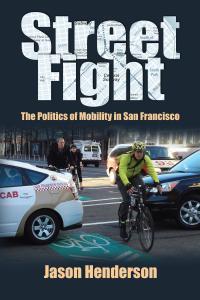
Ideology plays a bigger role in shaping San Francisco than most people realize, as we’ve discussed in this space before. Nowhere is that more true than in the politics of land use and transportation, as my friend Jason Henderson, a San Francisco State University geography professor, discusses in his insightful new book, Street Fight: The Politics of Mobility in San Francisco.

He’ll be discussing his work this Friday, April 19, from 7-9pm during a book launch party hosted by Green Arcade Bookstore across the street at the upstairs loft space of McRoskey Mattress, 1687 Market. Or if you miss that but want to join the discussion, you can catch Henderson’s forum on May 15 at SFSU or what will surely be other local events on this pivotal topic.

Henderson chronicles the seminal events in San Francisco’s history with “automobility” and related transportation issues, from the freeway revolts of the late ’50s through 2000 to today’s continuing political struggles over parking, bicycles, livability, gentrification, and the form, function, and financing of Muni.

Yet the lens that Henderson brings to understanding all of these issues and struggles is ideology, which he breaks down into three major categories: progressive, neoliberal, and conservative. Whether we realize it or not, we can all be fairly easily placed in one of those three categories when it comes to how we think about automobility, or the primacy of cars in modern life.

“A progressive framework conceptualizes mobility as a systemic problem that requires deep social commitment and responsibility. How we get there matters. It posits that there can be too much mobility, as exemplified by high levels of [Vehicle Miles Traveled] in the United States, and that excessive mobility results in both environmental degradation and major social inequality at a local, state, and global scale. The main problem, obviously, is that automobility is part of a wider, systemic moral and social problem of over-consumption and disproportionate materialism,” Henderson writes, sounding themes that I echoed in this week’s cover story.

On the other end of the ideological spectrum are those with conservative views on mobility, who see driving as a basic right, which is the dominant mindset on the west side of supposedly liberal San Francisco. “Unlike progressives, conservatives do not think about responsibility as relating to broader systems such as the economic structure of society. Instead, they think in terms of direct causation and of each individual being responsible for the consequences of his or her actions. For example, poverty is a result of individual shortcomings caused by personal and moral characteristics, not of structural themes like socioeconomic forces beyond an individual’s control. Getting to work on time and providing one’s daily needs are not collective concerns but the responsibility of the individual,” he writes.

Of course, these conservatives still rely on government to build and maintain their transportation infrastructure, which they believe should be centered around cars. “Government should guarantee and accommodate automobility, not seek to discourage it or make it more expensive. Government-sponsored road building and other explicit policies that encourage motoring reflect an optimal use of government to stabilize conservative social relations centered on automobility,” Henderson write of the conservative mindset.

Between those two poles are the neoliberals, who have come to dominate City Hall, particularly in the last few years with the ascendancy of Mayor Ed Lee, Board President David Chiu, and Sup. Scott Wiener, who has taken the lead role on transportation issues. Neoliberals rely on market-based solutions to almost any problem, and they end up partnering with either conservatives or progressives in the politics of mobility depending on the issue.

“Neoliberals, consistent with the broader agenda of the privatization of space and market-based pricing of public access to space, envision a mobility system shaped by pricing and markets rather than by regulation and collective action. Unlike progressives, neoliberals feel the built environment must be allowed to develop with the efficacy of the market. Movement, paid for by the individual user, should be unrestrained. Yet such efficacy can include a commodification of nonmovement or slower movement or the package of quality-of-life goods surrounding the ‘walkability’ and ‘livability’ of the city, a package reserved for those who can afford to enter. To that end, neoliberal mobility includes the aggressive use of government to both enhance mobility and rein it in, but only inasmuch as government policy helps realize the goals of profit and facilitating economic growth and development,” Henderson writes.

It’s fascinating to explore how these three distinct mindsets have shaped San Francisco in recent decades, and how they interact today to create the city that we’ll be moving through in the future.

Indicator city

74

steve@sfbg.com

When biologists talk about the health of a fragile ecosystem, they often speak of an “indicator species.” That’s a critter — a fish, say, or a frog — whose health, or lack thereof, is a signal of the overall health of the system. These days, when environmentalists who think about politics as well as science look at San Francisco, they see an indicator city.

This progressive-minded place of great wealth, knowledge, and technological innovation — surrounded on three sides by steadily rising tides — could signal whether cities in the post-industrial world will meet the challenge of climate change and related problems, from loss of biodiversity to the need for sustainable energy sources.

A decade ago, San Francisco pioneered innovative waste reduction programs and set aggressive goals for reducing its planet-cooking carbon emissions. At that point, the city seemed prepared to make sacrifices and provide leadership in pursuit of sustainability.

Things changed dramatically when the recession hit and Mayor Ed Lee took office with the promise to focus almost exclusively on economic development and job creation. Today, even with the technology and office development sectors booming and employment rates among the lowest in California, the city hasn’t returned its focus to the environment.

In fact, with ambitious new efforts to intensify development along the waterfront and only lackluster support for the city’s plan to build renewable energy projects through the CleanPowerSF program, the Lee administration seems to be exacerbating the environmental challenge rather than addressing it.

According to conservative projections by the Bay Conservation and Development Commission, the Bay is expected to rise at least 16 inches by 2050 and 55 inches by the end of the century. BCDC maps show San Francisco International Airport and Mission Bay inundated, Treasure Island mostly underwater, and serious flooding the Financial District, the Marina, and Hunters Point.

Lee’s administration has commissioned a report showing a path to carbon reduction that involves promoting city-owned renewable energy facilities and radically reducing car trips — while the mayor seems content do the opposite.

It’s not an encouraging sign for Earth Day 2013.


HOW WE’RE DOING

Last year, the Department of the Environment hired McKinsey and Company to prepare a report titled “San Francisco’s Path to a Low-Carbon Economy.” It’s mostly finished — but you haven’t heard much about it. The department has been sitting on it for months.

Why? Some say it’s because most of the recommendations clash with the Lee administration’s priorities, although city officials say they’re just waiting while they get other reports out first. But the report notes the city is falling far short of its carbon reduction goals and “will therefore need to complement existing carbon abatement measures with a range of new and innovative approaches.”

Data presented in the report, a copy of which we’ve obtained from a confidential source, shows that building renewable energy projects through CleanPowerSF, making buildings more energy-efficient, and discouraging private automobile use through congestion pricing, variable-price parking, and building more bike lanes are the most effective tools for reducing carbon output.

But those are things that the mayor either opposes and has a poor record of supporting or putting into action. The easy, corporate-friendly things that Lee endorses, such as supporting more electric, biofuel, and hybrid vehicles, are among the least effective ways to reach the city’s goals, the report says.

“Private passenger vehicles account for two-fifths of San Francisco’s emissions. In the short term, demand-based pricing initiatives appear to be the biggest opportunity,” the report notes, adding a few lines later, “Providing alternate methods of transport, such as protected cycle lanes, can encourage them to consider alternatives to cars.”

Melanie Nutter, who heads the city’s Department of the Environment, admits that the transportation sector and expanding the city’s renewable energy portfolio through CleanPowerSF or some other program — both of which are crucial to reducing the city’s carbon footprint — are two important areas where the city needs to do a better job if it’s going to meet its environmental goals, including the target of cutting carbon emissions 40 percent from 1990 levels by the year 2025.

But Nutter said that solid waste reduction programs, green building standards, and the rise of the “shareable economy” — with Internet-based companies facilitating the sharing of cars, housing, and other products and services — help San Francisco show how environmentalism can co-exist with economic development.

“San Francisco is really focused on economic development and growth, but we’ve gone beyond the old edict that you can either be sustainable or have a thriving economy,” Nutter said.

Yet there’s sparse evidence to support that statement. There’s a two-year time lag in reporting the city’s carbon emissions, meaning we don’t have good indicators since Mayor Lee pumped up economic development with tax breaks and other city policies. For example, Nutter touted how there’s more green buildings, but she didn’t have data about whether that comes close to offsetting the sheer number of new energy-consuming buildings — not to mention the increase in automobile trips and other byproducts of a booming economy.

Tom Radulovich, executive director of Livable City and president of the BART board, told us that San Francisco seems to have been derailed by the last economic crisis, with economic insecurity and fear trumping environmental concerns.

“All our other values got tossed aside and it was all jobs, jobs, jobs. And then the crisis passed and the mantra of this [mayoral] administration is still jobs, jobs, jobs,” he said. “They put sustainability on hold until the economic crisis passed, and they still haven’t returned to sustainability.”

Radulovich reviewed the McKinsey report, which he considers well-done and worth heeding. He’s been asking the Department of the Environment for weeks why it hasn’t been released. Nutter told us her office just decided to hold the report until after its annual climate action strategy report is released during Earth Day event on April 24. And mayoral Press Secretary Christine Falvey told us, “There’s no hold up from the Mayor’s Office.”

Radulovich said the study highlights how much more the city should be doing. “It’s a good study, it asks all the right questions,” Radulovich said. “We’re paying lip service to these ideas, but we’re not getting any closer to sustainability.”

In fact, he said the promise that the city showed 10 years ago is gone. “Gavin [Newsom] wanted to be thought of as an environmentalist and a leader in sustainability, but I don’t think that’s important to Ed Lee,” Radulovich said.

Joshua Arce, who chairs the city’s Environmental Commission, agreed that there is a notable difference between Newsom, who regularly rolled out new environmental initiatives and goals, and Lee, who is still developing ways to promote environmentalism within his economic development push.

“Ed Lee doesn’t have traditional environmental background,” Arce said. “What is Mayor Lee’s definition of environmentalism? It’s something that creates jobs and is more embracing of economic development.”

Falvey cites the mayor’s recent move of $2 million into the GoSolar program, new electric vehicle charging stations in city garages, and his support for industries working on environmental solutions: “Mayor Lee’s CleantechSF initiative supports the growth of the already vibrant cleantech industry and cleantech jobs in San Francisco, and he has been proactive in reaching out to the City’s 211 companies that make up one of the largest and most concentrated cleantech clusters in the world.”

Yet many environmentalists say that simply waiting for corporations to save the planet won’t work, particularly given their history, profit motives, and the short term thinking of global capitalism.

“To put it bluntly, the Lee administration is bought and paid for by PG&E,” said Eric Brooks with Our City, which has worked for years to launch CleanPowerSF and ensure that it builds local renewable power capacity.

The opening of the McKinsey report makes it clear why the environmental policies of San Francisco and other big cities matter: “Around the globe, urban areas are becoming more crowded and consuming more resources per capita,” it states. “Cities are already responsible for roughly seventy percent of global carbon dioxide emissions, and as economic growth becomes more concentrated in urban centers, their total greenhouse gas emissions may double by 2050. As a result, tackling the problem of climate change will in large part depend on how we reduce the greenhouse gas emissions of cities.”

And San Francisco, it argues, is the perfect place to start: “The city now has the opportunity to crystallize and execute a bold, thoughtful strategy to attain new targets, continue to lead by example, and further national and global debates on climate change.”

The unwritten message: If we can’t do it here, maybe we can’t do it anywhere.


ON THE EDGE

San Francisco’s waterfront is where economic pressures meet environmental challenges. As the city seeks to continue with aggressive growth and developments efforts on one side of the line — embodied recently by the proposed Warriors Arena at Piers 30-32, 8 Washington and other waterfront condo complexes, and other projects that intensify building along the water — that puts more pressure on the city to compensate with stronger sustainability initiatives.

“The natural thing to do with most of our waterfront would be to open it up to the public,” said Jon Golinger, who is leading this year’s referendum campaign to overturn the approval of 8 Washington. “But if the lens you’re looking through is just the balance sheet and quarterly profits, the most valuable land maybe in the world is San Francisco’s waterfront.”

He and others — including SF Waterfront Alliance, a new group formed to oppose the Warriors Arena — say the city is long overdue in updating its development plan for the waterfront, as Prop. H in 1990 called for every five years. They criticize the city and Port for letting developers push projects without a larger vision.

“We are extremely concerned with what’s happening on our shorelines,” said Michelle Myers, director of the Sierra Club’s Bay Chapter, arguing that the city should be embracing waterfront open space that can handle storm surge instead of hardening the waterfront with new developments. “Why aren’t we thinking about those kinds of projects on our shoreline?”

David Lewis, director of Save the Bay, told us cities need to think less about the value of waterfront real estate and do what it can to facilitate the rising bay. “There are waterfront projects that are not appropriate,” Lewis said. Projects he puts in that category range from a scuttled proposal to build around 10,000 homes on the Cargill Salt Flats in Redwood City to the Warriors Arena on Piers 30-32.

“We told the mayor before it was even announced that it is not a legal use of the pier,” Lewis said, arguing it violated state law preserving the waterfront for maritime and public uses. “There’s no reason that an arena has to be out on the water on a crumbling pier.”

But Brad Benson and Diana Oshima, who work on waterfront planning issue for the Port of San Francisco, say that most of San Francisco’s shoreline was hardened almost a century ago, and that most of the planning for how to use it has already been done.

“You have a few seawall lots and a few piers that could be development sites, but not many. Do we need a whole plan for that?” Benson said, while Oshima praises the proactive transportation planning work now underway: “There has never been this level of land use and transportation planning at such an early stage.”

The Bay Conservation and Development Commission was founded almost 50 years ago to regulate development in and around the Bay, when the concern was mostly about the bay shrinking as San Francisco and other cities dumped fill along the shoreline to build San Francisco International Airport, much of the Financial District, and other expansive real estate plans.

Now, the mission of the agency has flipped.

“Instead of the bay getting smaller, the bay is getting larger with this thing called sea level rise,” BCDC Executive Director Larry Goldspan said as we took in the commanding view of the water from his office at 50 California Street.

A few years ago, as the climate change predictions kept worsening, the mission of BCDC began to focus on that new reality. “How do we create a resilient shoreline and protect assets?” was how Goldspan put it, noting that few simply accept the inundation that BCDC’s sea level rise maps predict. “Nobody is talking about retreating from SFO, or Oakland Airport, or BART.”

That means Bay Area cities will have to accept softening parts of the shoreline — allowing for more tidal marshes and open space that can accept flooding in order to harden, or protect, other critical areas. The rising water has to go somewhere.

“Is there a way to use natural infrastructure to soften the effect of sea level rises?” Goldspan asked. “I don’t know that there are, but you have to use every tool in the smartest way to deal with this challenge.”

And San Francisco seems to be holding firm on increased development — in an area that isn’t adequately protected. “The seawall is part of the historic district that the Port established, but now we’re learning the seawall is too short,” Goldspan said.

BCDC requires San Francisco to remove a pier or other old landfill every time it reinforces or rebuilds a pier, on a one-to-one basis. So Oshima said the district is now studying what it can remove to make up for the work that was done to shore up Piers 23-27, which will become a new cruise ship terminal once the America’s Cup finishes using it a staging ground this summer.

Yet essentially giving up valuable waterfront real estate isn’t easy for any city, and cities have both autonomy and a motivation to thrive under existing economic realities. “California has a history of local control. Cities are strong,” Goldspan said, noting that sustainability may require sacrifice. “It will be a policy discussion at the city level. It’s a new discussion, and we’re just in the early stages.”


NEW WORLD

Global capitalism either grows or dies. Some modern economists argue otherwise — that a sustainable future with a mature, stable economy is possible. But that takes a huge leap of faith — and it may be the only way to avoid catastrophic climate change.

“In the world we grew up in, our most ingrained economic and political habit was growth; it’s the reflex we’re going to have to temper, and it’s going to be tough.” Bill McKibben writes in Eaarth: Making a Life on a Tough New Planet. “Across partisan lines, for the two hundred years since Adam Smith, we’ve assumed that more is better, and that the answer to any problem is another burst of expansion.”

In a telephone interview with the Guardian, McKibben discussed the role that San Francisco could and should be playing as part of that awakening.

“No one knows exactly what economy the world is moving toward, but we can sense some of its dimensions: more localized, less material-based, more innovative; these are things that San Francisco is good at,” he told us, noting the shift in priorities that entails. “We need to do conservation, but it’s true that we also need to build more renewable power capacity.”

Right now, CleanPowerSF is the only mechanism the city has for doing renewable energy projects, and it’s under attack on several fronts before it even launches. Most of the arguments against it are economic — after all, renewable power costs more than coal — and McKibben concedes that cities are often constrained by economic realities.

Some city officials argue that it’s more sustainable for San Francisco to grow and develop than suburban areas — thus negating some criticism that too much economic development is bad for the environment — and Radulovich concedes there’s a certain truth to that argument.

“But is it as green as it ought to be? Is it green enough to be sustainable and avert the disaster? And the answer is no,” Radulovich said.

For example, he questioned, “Why are we building 600,000 square feet of automobile-oriented big box development on Hunters Point?” Similarly, if San Francisco were really taking rising seas seriously, should the city be pouring billions of dollars into housing on disappearing Treasure Island?

“I think it’s a really interesting macro-question,” Jennifer Matz, who runs the Mayors Office of Economic Development, said when we asked whether the aggressive promotion of economic development and growth can ever be sustainable, or whether slowing that rate needs to be part of the solution. “I don’t know that’s feasible. Dynamic cities will want to continue to grow.”

Yet that means accepting the altered climate of new world, including greatly reduced fresh water supplies for Northern California, which is part of the current discussions.

“A lot of the focus on climate change has moved to adaptation, but even that is something we aren’t really addressing,” Radulovich said.

Nutter agreed that adapting to the changing world is conversation that is important: “All of the development and planning we’re doing today needs to incorporate these adaptation strategies, which we’re just initiating.”

But environmentalists and a growing number of political officials say that San Francisco and other big cities are going to need to conceive of growth in new ways if they want to move toward sustainability. “The previous ethos was progress at any cost — develop, develop, develop,” Myers said, with the role of environmentalists being to mitigate damage to the surrounding ecosystem. But now, the economic system itself is causing irreversible damage on a global level. “At this point, it’s about more than conservation and protecting habitat. It’s about self-preservation.”

Warriors Arena proposal rouses supporters and opponents

72

UPDATED Rival teams have formed in the last week to support and oppose the proposed Warriors Arena at Piers 30-32 as the California Legislature considers a new bill to approve the project, a new design is about to be released, and a trio of San Francisco agencies prepares to hold informational hearings.

Fresh off the collapse of two of the city’s biggest development deals, Mayor Ed Lee and his allies are pushing hard to lock in what he hopes will be his “legacy project.” A new group of local business leaders calling itself Warriors on the Waterfront held a rally on the steps of City Hall today, emphasizing the project’s job creation, community partnerships, and revitalization of a dilapidated stretch of waterfront.

That launch event followed last week’s creation of the San Francisco Waterfront Alliance, made up mostly of area residents and environmental organizations that oppose the project, including the Sierra Club and Save the Bay. The group today released a press release and artist’s rendering of how the 13-story arena and two condo towers may block views of the bay.

Last week, SFWA put out a press release criticizing Assembly Bill 1273 by Assembly member Phil Ting, claiming it would allow the project to avoid scrutiny by the Bay Conservation and Development Commission, which oversees and issues permits for waterfront projects. “One of the primary reasons we have regulatory agencies like the BCDC is so that local jurisdictions don’t run roughshod over the Bay and the waterfront,” group President Gayle Cahill said in the release. “The San Francisco Waterfront Alliance strongly believes that BCDC should retain its jurisdiction in this project to ensure independent oversight for the Bay and for all of us.”

Yet Ting and supporters of the project say the legislation doesn’t change BCDC’s oversight of the project, pointing to language that explicitly acknowledges the agency’s authority. While the legislation would remove the need for the three-member State Lands Commission to approve the project, proponents said approval by the full Legislature is a higher bar that ensures more public scrutiny and accountability.

“It does not waive BCDC. It goes through the same BCDC process,” Ting told us. “By going through the Legislature, you do have more hearings and public process. The idea was to make this more thoroughly vetted.”

The Port’s Brad Benson told us that State Lands staff is also still actively scrutinizing the project. “We’ve been working closely with State Land and BCDC staff to incorporate their concerns,” Benson said. For example, the arena configuration has already been moved closer to shore than originally proposed because of BCDC concerns about maritime access to a deep-water berth at the site.

In addition to approval by the Legislature and BCDC, the project must also be approved by the Port Commission and Board of Supervisors. The latest design for the project is scheduled to be released on May 6 and will be discussed by the Board of Supervisors Land Use and Economic Development Committee that day, said Gloria Chan of the Mayor’s Office of Economic and Workforce Development. The Planning Commission will then hold an informational hearing on the new design May 9, following by a May 14 hearing before the Port Commission. 

The project is proposed to include a 17,500-seat arena that would host more than 200 Warriors games, concerts, and other events per year, starting in 2017, on 13 acres of rebuilt piers. The adjacent, 2.3-acre Seawall Lot 330 would include up to 130 new condos, a hotel of up to 250 rooms, and 34,000 square feet of restaurants and retail space.

The whole project would include just 830-930 parking spaces, making its still-unfolding transportation plan key to the project’s approval. Opponents of the project also criticize the project’s height and its financing package and say this intensive development isn’t consistent with city plans or state laws that protect waterfront lands for maritime and public uses.

“We told the mayor before it was even announced that it is not a legal use of the pier,” Save the Bay Executive Director David Lewis told the Guardian. “There’s no reason that an arena has to be out on the water on a crumbling pier.”

Yet proponents tout the project’s economic benefits to the city and the need for an arena that size to host concerts and conventions, beyond the prestige of luring the Warriors away from Oakland and back to its original home city. “It will be privately financed and turn a crumbling pier and unsafe parking lot into a state-of-the-art venue that generates new revenue for the region and provides a spectacular new facility for the Bay Area’s NBA team.”Jim Wunderman, CEO of the Bay Area Council and an honorary co-chair of Warriors on the Waterfront, said in the press release.

UPDATE: Rudy Nothenberg, who served five SF mayors financing big civic projects and helped found SF Waterfront Alliance, disputes several assertions made by project proponents. “The first version of [AB 1273] unquestionably moved BCDC out of the way,” he said, claiming that bill language was altered after input from BCDC and the consultant to the Assembly Natural Resources Committee. BCDC has not yet returned a call from the Guardian on the issue. Nothenberg also says AB 1273 turns the deliberate fact-finding process required for the State Lands Commission to make its public trust determination into a political process that is a less thorough vetting of the project.

He also took issue with the statements by Wunderman and others that this is a privately funded project, noting that taxpayers will be paying $120 million to rebuild these piers and will give up future property taxes on the site, which will be diverted by a special tax district to help repay the bonds. Nothenberg told us, “Their continued assertion that there is no public money involved in blatantly untrue.”


Treasure Island: Is this the end?

30

So Mayor Lee goes to China with plans to celebrate the signing of a deal that would bring $1.7 billion in Chinese investment into the lagging Treasure Island redevelopment project, and instead the whole thing falls apart. Not good for the cross-Bay rivalry: Gov. Brown, a former mayor of Oakland, landed $1.8 billion in Chinese money for his city’s big project, while Lee lost out.

But there’s a bigger problem. It’s hard to see how anyone would want to invest in Treasure Island right now, when:

The island is sinking,

The Bay is rising,

There’s only one way on or off the island, and it’s already so crowded that a modest event like the Treasure Island Flea Market ties up traffic in both directions for hours, and

The place is radioactive.

Matt Smith and Katherine Mieszkowski of the Bay Citizen did what the Navy and the city of San Francisco refused to do. They went out with a couple of red buckets, dug up some soil and had it tested for Cesium-137. Bingo: The place suffers from far worse contamination that anyone was letting on. And there might be even more:

Until the early 1990s, the Navy operated atomic warfare training academies on Treasure Island, using instruction materials and devices that included radioactive plutonium, cesium, tritium, cadmium, strontium, krypton and cobalt. These supplies were stored at various locations around the former base, including supply depots, classrooms and vaults, and in and around a mocked-up atomic warfare training ship – the USS Pandemonium. CIR’s samples were taken from under a palm tree 50 feet from a classroom building where cesium-137 was kept, according to military archives. A 1974 radiation safety audit identified cesium samples used and stored there with radioactivity several times the amount necessary to injure or kill someone who mishandled them. In 1993, shipping manifests from the same building showed even greater amounts of cesium-137 taken away from the same site that year.

Now some experts say that development plans need to be put on hold while the entire place is checked out more carefully:

“The fact that there is a level above standards is a clear mandate for further study and assessment of the extent of contamination and its origin,” Beyea wrote in an email, adding that more systematic testing is particularly important given that public play areas are planned nearby. “Building a playfield is not an appropriate plan at this time,” he wrote, “given the tendency for little children to put things in their mouths.”

Would you loan a couple billion dollars for a development project on that site?

In theory, of course, the Navy is responsible for the cleanup. In practice? Good luck with that. The Pentagon is blaming the sequester for forced budget cuts in everything including the Blue Angels; you think anyone’s going to write a very big check any time soon for a very complex environmental clean-up job on an artificial island that will soon be underwater?

I used to think the best thing to do with Treasure Island was to leave as much open space as possible for soccer and baseball fields, then slowly let it sink back into the Bay. Now apparently it’s a bad idea even to have kids playing there.

And what about the people who already have moved into housing at TI? Anyone going to test their soil?

Anyone want to take bets on whether anything much is ever going to be built there?

Ron Lanza, queer impressario, dies at 78

24

Ron Lanza, a pioneer in San Francisco’s gay rights movement and an impressario who promoted queer arts through the worst of the AIDS crisis, has died after a long battle with colon cancer. He was 78.

Lanza, a Brooklyn native, was one of the leaders of Bay Area Gay Liberation in the 1970s, and, along with Assemblymember Tom Ammiano and the late activists Hank Wilson and Howard Wallace, was instrumental in building the LGBT movement in San Francisco.

He was the owner and operator of the Valencia Rose Café and later Josie’s Cabaret and Juice Joint, two groundbreaking queer performance venues that helpled launch the careers of  Whoopie Goldberg, Marga Gomez, and Margaret Cho.

“His vision came from looking at people and saying, ‘you have talent, you ought to try this,’ ” Ammiano, who performed as a comedian at Valencia Rose, told me.

“He was a giant in this city,” Tommi Avicolli Mecca, a performer and housing activist and the author of a book on the history of gay liberation, noted. “He created the foundation for what we now know as queer arts in San Francisco. He was really one of a kind.”

Lanza with Dennis Peron and Tom Ammiano

Marke B., our managing editor and a longtime follower of queer culture, put it this way:

“He dedicated his life to promoting theater and arts in San Francisco — even if it sometimes meant playing hardball, but always with that super-charming, goofball smile. Every single drag queen, performance artist, comedian, and actor in the city owes Ron a memorial smoothie — the Valencia Rose and Josie’s Cabaret kept performing arts alive in this town through the worst years of AIDS and political artphobia.”

Lanza, a Navy veteran, arrived in San Francisco in the 1970s, and worked for a while as a teacher in Walnut Creek. “When he came out, he risked being fired, so he quite before they could fire him,” Ammiano said.

With Wilson, Lanza took over the Ambassador Hotel, a Tenderloin SRO with a large number of gay and transgender tenants. In the 1980s, the two helped create what would become the Tenderloin AIDS Resource Center.

Lanza never liked the headlines; while his compatriots entered politics, ran for office, and organized on the streets, he stayed in the background, providing the cultural, moral, and financial support.

When Ammiano challenged then-Mayor Willie Brown in a legendary 1999 write-in campaign, Josie’s Cabaret and Juice Joint became the campaign headquarters. “He was so supportive,” Ammiano said. “He was a real San Francisco lefty. He only cared about money if he had to pay the bills.”

Gabriel Haaland, who helped run the Ammiano write-in, told me that “San Francisco is dimished. It’s such a heavy loss. There are people who are just magical, bright lights in the world, and he was one of them.”

Lanza was diagnosed with colon cancer in his 40s, but survived — in part, probably, thanks to adopting a healthy lifestyle. “He didn’t smoke, he was a vegetarian, and back then we teased him about it,” Ammiano said.

But the cancer came back in his later years, and he quietly underwent a series of operations. “He called me a few weeks ago and said he was dying,” Ammiano said. “He wanted to have a good-bye dinner.”

A huge dog-lover, Lanza could often be seen running down Dolores Street with two or three rescue animals. One of his last wishes was for a trip East to leave the dogs with a relative. He’d been driving a limo for income, and one of his wealthy clients paid for the ticket.

“He was always handsome, always loyal,” Ammiano recalled. “There were times you wanted to kill him, but the love was always there.”

A memorial is pending.

Checks from mayor’s mysterious breakfast companions mysteriously absent

In less than three months, custom made super yachts will zip around the San Francisco Bay in the ultimate competition for the prized America’s Cup. But San Francisco could wind up spending millions more than originally expected to host this prestigious sailing regatta.

At a March 13 committee hearing at the Board of Supervisors, America’s Cup Organizing Committee CEO Kyri McClellan reported that Mayor Ed Lee was investing an “incredible amount of energy” into helping ACOC with fundraising efforts to avert a city funding shortfall. He was even said to be hosting “breakfasts with CEOs” to solicit funding, McClellan said.

Who are the CEOs? Nobody will say.

How much has each of them pledged to give? Nobody will say.

When the Guardian submitted these questions to Lee, McClellan, and Stefanie Roumeliotes – whose SGR Consulting firm was wheeled in at the last minute to organize fundraising events – none answered directly.

McClellan responded on April 9 with a copy of a letter she sent to Mayor Lee and Board President David Chiu on the day of the hearing, which she indicated was “the most recent update on fundraising.” Roumeliotes, for her part, told the Guardian flat out to stop calling, because her firm was not going to answer any questions.

So far, it appears that none of the mayor’s fundraising meetings, which took place from January 25 to March 4, resulted in his unnamed breakfast companions writing out actual donation checks.

Had they contributed funding, the donation amounts would have been reflected in “behested payment” forms filed with the San Francisco Ethics Commission, required under state law to be submitted 30 days after a contribution is made.

Elected officials are “supposed to file behested payment [forms] for … legislative, governmental or charitable purposes,” Ethics Commission chief John St. Croix told the Guardian, so donations relating to the America’s Cup would fall squarely into this category. Those forms are supposed to filed internally by department, then sent onto Ethics. So far, none have been recorded.

“If there are such forms that the mayor filled out,” St. Croix told the Guardian, “they’re not getting forwarded.”

Meanwhile, McClellan’s March 13 letter suggests that recent fundraising efforts have yielded only $1.4 million – which won’t actually be in hand till next year. That’s a far cry from the estimated $15.6 million funding gap race organizers say is needed to cover San Francisco’s estimated $22.5 million billionaires’ boat race tab. As the fundraising arm of the race organizing committee, ACOC promised in an initial agreement that it would “endeavor to raise” the amount needed to defray city costs. Thus far, it’s paid $6.8 million.

In her letter to Lee and Chiu, McClellan suggested that roughly $13 million of that $15.6 million shortfall would be accounted for in “forecast General Fund revenues.” That translates to additional money harvested from visitors’ pockets via sales and hotel taxes, with some payroll taxes and parking fees sprinkled in, all associated with the America’s Cup events. Little-guy money.

And thanks to the little guys, ACOC’s new fundraising goal is much more attainable. “The SFACOC continues to endeavor to raise the funds,” McClellan wrote. “At a minimum that is $2,670,851 of which we already have $1,400,000 in existing pledges that are to be received by January 2014.”


ABC shows more concern about expanding police video surveillance than Mayor Lee

15

The SFPD has quietly expanded its reach and authority to obtain video surveillance from in and around bars, clubs, and markets through a condition it has begun recommending on new liquor licenses, as I reported in today’s issue, effectively bypassing controls on city-operated surveillance cameras established through extensive public hearings in 2005.

But the Mayor’s Office doesn’t seem concerned about the new trend, echoing SFPD’s point that it is the California Department of Alcoholic Beverage Control that decides whether to heed the SFPD’s request to include the video surveillance condition. “There is no new policy. SFPD makes recommendations as far as I know, not requirements,” Mayoral Press Secretary Christine Falvey wrote to me in an email responses to our questions.

Certainly, everyone from bar owners to the ACLU to Sups. Scott Wiener and David Campos – who have called a hearing on the policy for later this month – consider it a new policy, or at least one that the public has just learned of after it was adopted internally right after the idea was shot down in public hearings in 2011.

ABC spokesperson John Carr had told me the department “routinely denied requests for conditions by SFPD per section 23800(e) of the Californian Business and Professions Code, occasionally these denials include the surveillance condition,” but he wasn’t able to provide me any examples of that happening by press time.

But today, he was able to find one. On Oct. 3, 2012, ABC rejected the SFPD’s request for video surveillance at Bush Market at 820 Bush on a quiet residential block of Nob Hill, noting that state law requires such requests be supported by “substantial evidence” that problems exist at the site that would be mitigated by the condition.

“I regret to inform you that the Department is unable to impose conditions pursuant to your request because no evidence was provided to establish that a problem exists at the premises or in it immediate vicinity,” ABC District Administrator Justin Gebb wrote in what was essentially a form letter.

Carr shared an identical letter that the ABC sent to the SFPD denying some of its requested conditions for another liquor license transfer on Feb. 12, this one for the Space 550 event venue at 550 Barneveld Ave. But in that case, the ABC decided to support the SFPD’s request for video surveillance “that is able to view the inside and outside of the premises” and which must be given to the cops “upon demand.”

As I wrote in this week’s paper, the ACLU considers that kind of extrajudicial expansion of the SFPD’s ability to require and obtain video surveillance to be unconstitutional, and we furnished a copy of the article and the issues it raised to try to get a more substantial comment from the Mayor’s Office, which seems to be less concerned with the civil rights of San Franciscans than the bureaucrats in Sacramento are.

“Balancing public safety with vibrant cultural and nightlife activities is a concern of mayor. He expects the Police Department to work in partnership with the neighborhood and its businesses to lawfully collect evidence that can help keep the public safe and neighborhoods active,” Falvey wrote.

So I had a few follow-up questions, for which I’m still awaiting answers, and I’ll update this post if and when I get them: “The ACLU’s position is that this is not a lawful way to collect evidence, and that it violates the state constitution’s privacy protections and the rules San Francisco established in 2005 regulating when and how the SFPD may request and use video surveillance. Does the mayor reject those concerns and has he sought any legal advice to support his position? In the absence of any judicial review, shouldn’t the city have some guidelines and policies governing this expansion of SFPD’s video surveillance authority? Does the mayor believe the 2005 guidelines should no longer apply? And does the mayor agree with Sups. Wiener and Campos that it would be appropriate to have a public hearing on this issue, particularly given the strong public opposition to requiring expanded video surveillance by bars two years ago?”

SF declares Pay Equity Day as it lowers salaries for women’s jobs

87

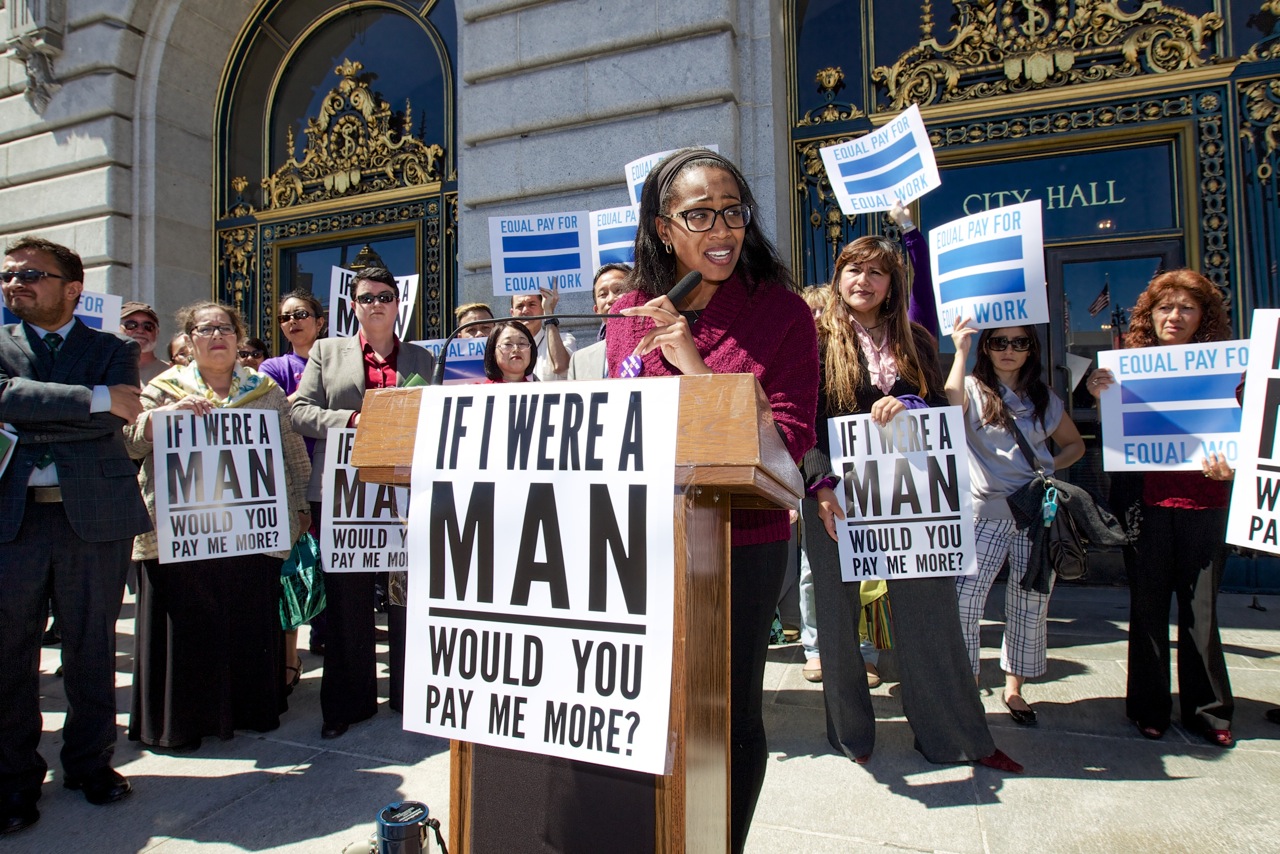
The Board of Supervisors today declared April 9 Pay Equity Day in San Francisco, in recognition of the persistent national gap between male and female financial compensation. But with the city locked in a dispute with SEIU Local 1021 over pay cuts to jobs dominated by women and workers of color, the day took on special local significance. Ahead of the declaration, union members, activists, and supervisors rallied in front of City Hall, chanting against San Francisco’s wage inequality and the general climate of fiscal austerity.

Women in San Francisco earn just 84 cents for every dollar paid to their male counterparts. Although this figure is slightly higher than the national average of 77 cents per dollar, the discrepancy represents a yearly wage gap of $9,968 per year, according to the National Partnership for Women and Families. At today’s press conference in front of City Hall, Sup. Malia Cohen called the gap “unconscionable in a country as wealthy as ours.”

Cohen was joined by Sups. David Chiu and David Campos, who both spoke out against gender-based wage gaps. “It is important for men to speak out,” Chui said. “It wasn’t women who made the decision for pay to be unequal.” Campos went a step further, promising to vote against any budget that further entrenches unequal pay. “I will not support any budget that reflect this discrepancy,” he said.

SEIU Local 1021, which represents over half of city employees, is currently locked in a budget dispute with the city over pay cuts that would adversely affect women and workers of color. The city Department of Human Resources has recommended that the city cut the salaries of 16 categories of city workers, including personnel clerks and nursing technicians, which are disproportionately females and workers of color. The dispute was recently sent to an arbitrator.

At today’s event, local SEIU leaders and the San Francisco Women’s Political Committee (SFWPC) continued to pressure the city to reconsider the salary cuts. SFWPC President Laura Hahn called persistent pay inequality “embarrassing.”

“If we can’t achieve it here in San Francisco where are we going to do it?” she asked.

Former Supervisor Chris Daly, who now works as political director for SEIU 1021, echoed Hahn’s concerns and charged that the proposal to cut pay for female-dominated categories calls into question the city’s long term commitment to pay equity.

“If you ask Mayor Lee if he supports wage equality, of course he will say yes,” Daly told us. “But in reality, his Department of Human Resources is rolling back progress.” Daly’s repeated requests for Mayor Lee to intervene in the wage-cut arbitration have not yet been answered.
But for the DHR, the recommended cuts have more to do with fiscal reality than gender equality. At a March 7th budget hearing, DHR director Micki Callahan said, “It would be improper to base any decision on demographics.”

She voiced concern over the “root causes” of pay discrepancy, but indicated that these issues fall outside the purview of her department. Spokespeople for the the DHR department have repeatedly assured us that the proposed budget cuts have nothing to do with gender, but rather reflect an effort to bring city salaries in line with market forces.

Paying for the mayor’s China trip

20

You’d think the mayor would know better by now. After all the allegations of cronyism and undue influence, you’d think that he’d make sure everyone involved in his trip to China was playing by the rules. You’d think the last thing he would want is this.

Now: So far this is just a complaint, and noting has been proven. But still: It sure looks bad. And it’s entirely unnecessary.

If the mayor really belives that he needs to go to China to do the city’s business, why doesn’t he go on the city’s tab? Seriously: I would much rather that my tax dollars went for this trip than have the mayor inundated and unduly influenced by corrupt actors who want his ear. If he was going for fun and sightseeing, he could pay his own way; if he’s there, as his office says, on official business, then why is he taking private money?

When Dennis Herrera went to Washington DC for the Supreme Court hearing on same-sex marriage, the city paid his way. That’s appropriate: He’s directly involved in the case, as are some of his staffers. They were meeting with co-counsel, doing practice runs … working. He stayed at a midrange hotel at the government rate ($200 a night) and was allowed to spend a set per-diem on meals. That’s the same rules any city employee follows on official travel.

If you think he shouldn’t have gone (as Michael Petrelis clearly thinks), then that’s a political discussion. It’s appropriate to ask about it, to point out how much money was spent on the trip, to analyze his expenses, and to challenge him about it when he’s next running for office. But it’s not a corruption probe — and frankly, I’m happy that some corporate bond-counsel firm that wants the city’s legal business didn’t pay for the trip and send a lobbyist to hang out with Herrera the whole time.

The city sends people on trips. It’s fair to ask if they are an appropriate use of taxpayer money. But if the trip is worth taking, then the mayor should justify the expense — and not take corporate and lobbyist money instead.

The Willits tree-sit fallout

76

I just spoke with state Sen. Noreen Evans, who represents the Willits area, about the forcible eviction of five tree-sitters — and by forcible, I mean firing projectiles (first reported as rubber bullets, later as bean bags) at a protester holding onto tree limbs 70 feet in the air. She’s not happy.

The Willits Weekly has been reporting in depth on this whole mess, and quotes an Evan statement:

I am shocked and dismayed at what seems to be an excessive use of force on unarmed protestors. Thus far, I feel Caltrans and CHP have been slow to respond to my questions and quick to act regarding the Bypass Project.

By the time we talked, she’d calmed down a bit and wasn’t ready to second-guess the CHP tactics. “I’m not in law-enforcement,” she said. “It could have been much worse.”

But she did say she was still furious about the timing of the raid. “The mayor of Willits has been trying to get information out of Caltrans, and has been having trouble, so I asked for a meeting. I wanted to know, is there some way they could handle this protest peacefully?

“I learned about the events half an hour before the Caltrans director was supposed to be in my office. I was not happy.”

Evans told me that Caltrans blamed the CHP — but the CHP wasn’t having it. “I called the commissioner of the CHP, who told me the order was given by Caltrans,” she said.

So the bulldozing continues — but this isn’t going away.


Oakland’s first outdoor sculpture park opens tonight!

2

Last Tuesday, in the parcel of land off of Telegraph Avenue between 19th and 20th Streets in Oakland, Randy Colosky discussed the orientation of his wooden sculpture, The Pressure to Hold Together That Which Held Things Back Part 2. Three assistants and two arts commissioners weighed in. The word of the hour, it seemed, was “dialogue.” 

“It’s about starting a dialogue,” Steven Huss, the city’s Cultural Arts Manager, said on the phone earlier that day. He reiterated the same on site as he moved a portable chain-link fence aside to enter the Uptown ArtPark, a large-scale temporary sculpture garden that will open to the public tonight during Art Murmur. His favorite part of the park’s construction, he told me, was talking to people who stopped to ask questions.

Huss is experienced in the art of dialogue. Over the past three years, he has witnessed and participated in the many that have transpired between the community, the city, and developers during the planning of the space’s use.

As a part of a redevelopment effort to enliven Oakland’s uptown area, the city bought the parcel in 2005 and began to lay out plans for an apartment complex and Henry J. Kaiser Memorial Park, which now hosts the monument, Remember Them: Champions for Humanity, which honors a wide array of humanitarians such as Frederick Douglass, Elie Wiesel, and Harvey Milk. The piece of land adjacent to Telegraph, known as Parcel 4, was slated to become a parking lot, but members of the community objected.

After an blogging effort, an exhaustive campaign at city council, and a plan that aligned with an initiative to promote public art in Oakland, a proposal began to crystallize in the summer of 2009. In October 2010, after searching for funding, Huss earned a Creative Placemaking grant from the National Endowment for the Arts, which the city agreed to match. Other sponsors stepped in, including Burning Man offshoot Black Rock Arts Foundation, which was eager to exhibit work in an urban setting.

On the phone and in the park, though, Huss’s tone flattened as he discussed the years of bureaucratic coordination and lightened as he talked about the art and the space that had almost reached completion. For the time-being, the logistics had been settled and he was relieved and excited that he could look forward to filling the space. In the empty back-alley of the three-sided lot perimeter that comprises the ArtPark, Huss enthusiastically described the potential dance and theater events that could enliven the space. In what he called “immersive theater,” the audience would participate in the production.

Programming will focus on “dialogue, not didacticism,” added Kristen Zaremba, Senior Public Art Manager for Oakland, as Huss went to talk through the fence to a passerby who had shouted a question about how long the project had been underway.

As they talked, Zaremba spoke to a woman who was drilling into the concrete pad at the base of Karen Cusolito’s Dandelion, then pointed out the steel wool tufts that the artist recently added to compose the anther of the giant flower.

The 20-foot tall sculpture, the final in the row along 19th Street, complements the other nine works in the park in the play between the organic and the industrial that adheres to the exhibition’s theme, “repurposed.” In ascending height order from Telegraph back along 19th, the pieces form an oversized garden of welded steel, recycled bicycle parts, and in the case of Colosky’s second piece, Barbican, engineered ceramic honeycomb, a material found in the catalytic combustor of a car. The effect is both whimsical and striking.

When we returned to the plot along Telegraph, Colosky’s piece had assumed its arch-like form that he envisioned. Though a completed version of Pressure had already been exhibited before it came to the Art Park (all except one by Eric Powell were finished work), the artist enjoyed the process of revising the reclaimed redwood retaining wall pieces to fit the circular base. “In remaking things, you get to explore all the possibilities,” he said. He and his assistants agreed that the new configuration worked well, and they bolted it down then cheered. “That ain’t going nowhere,” Colosky proclaimed with a grin.

As the group sat down to lunch, a man on the sidewalk shouted, “Making our city look good! Welcome.”

On Friday, the chain-link fence will depart and the Uptown ArtPark will receive its official welcome in a ceremony that will include speeches by Mayor Jean Quan and city council members, an organized bike ride, and because above all, Huss wants to celebrate the artists of Oakland and the vibrant scene they have created, it will also include conversations with the artists, most of whom will be on site.

At a certain point, though, serious dialogue will end. “Friday will be fun,” Huss said. After years of planning, Parcel 4 will open as a community gathering place. “It’s a party.”

Fri/5, 6:30-8:30pm, free
Telegraph and 19th St., Oakl.
www2.oaklandnet.com

Mayor Lee’s trip to China raises questions of ethics and influence

86

[UPDATED(x3)] Mayor Ed Lee barely had time to unpack from his recent political junket to Paris before he was off on his current trip to China – both of which were paid for and accompanied by some of his top political supporters and among the city’s most influential power brokers. No wonder Lee doesn’t have time to weigh in on Airbnb’s tax dodge, the condo conversion stalemate, or other important city issues.

Local good government advocate Charles Marsteller learned of the current China trip from Willie Brown’s column in Sunday’s San Francisco Chronicle, whose editors (including Editor Ward Bushee, who we’re still waiting to hear back from about this trip) consider it a “man about town” column immune from conflict-of-interest policies that normally require journalists to disclose who is paying them on the side.

“I’m here with Mayor Ed Lee for my seventh official visit,” Brown cheerfully wrote, although readers were left to wonder just what official business Brown might be conducting with our mayor and his entourage. So, being an expert on political disclosure laws, Marsteller went down to the Ethics Commission to pull the Form SFEC-3.216(d) that state law requires elected officials to file before leaving on trips paid for by outside interests.

But it wasn’t there, so Marsteller filed an official complaint with the commission, telling us, “I did so to impress upon our Elected and other City Officials the need to properly report gifts in a timely way and in the manner as called for by State law and on the forms provided by the SF Ethics Commission.” 

When we contacted mayoral Press Secretary Christine Falvey, she forwarded us a copy of the form that should have been filed before the trip and told us, “I’m not going to answer the question about why we failed to file the appropriate forms with the Ethics Commission, as we worked closely with the City Attorney’s office to exceed reporting requirements by all appropriate deadlines.” [UPDATE: The time stamp on the form indicated it was filed on May 25, before the trip, even though it wasn’t publicly available at the Ethics Commission office when Marsteller went down to look for it].

The form indicates that Lee’s portion of the trip was paid for by the San Francisco Chinese Chamber of Commerce, whose influential leader Rose Pak conspired with Brown to get Lee appointed mayor more than two years ago. This is also the same Rose Pak who was admonished by the state’s Fair Political Practices Commission for illegally funding another political junket to China in 2009 with Sups. David Chiu and Eric Mar and then-Sup. Carmen Chu, who Lee appointed as Assessor earlier this year.

Those officials were forced to repay the expenses after the FPPC found that Pak, that time acting under the auspices of the Chinese New Year Festival Committee, was not allowed to make gifts exceeding $420 per official that year. “Please be advised that since the Chinese New Year Festival Committee is not an organization that falls under Section 501(c)(3) of the Internal Revenue Code, no public official may accept gifts of any type from this organization valued in excess of the applicable limit,” FPPC counsel Zachary Norton wrote in an Aug. 22, 2011 enforcement letter to Pak.

In other words, because this committee and “other 501(c)(6) chamber of commerce organization[s]” are in the business of actively lobbying top elected officials for favorable policies, rulings, and projects, they are barred by ethics law from giving them the gifts of big overseas political junkets. As Marsteller noted in his complaint letter, violations are punishable by fines of $5,000 per violation, or if they are “willful violations of the law” – which doing the same thing you were sanctioned for just two years ago certainly might be considered – the criminal penalties are $10,000 per violation or up to a year in jail.

Mayor Lee’s portion of the trip cost the Chamber $11,970, according to the form. But this time, to get around the FPPC restrictions, Pak seems to have passed the hat among various business elites to fund the trip. The mayor’s form shows that 41 people paid up to the current gift limit of $440 “to defray the cost of the mayor’s trip.”

They include Pak, Brown, four people from Kwan Wo Construction, three from American Pacific International Capital, two each from Boyett Construction, Young Electric, and Bel Builders, Harbor View Holdings Director Gorretti Lo Lui, and SF Immigration Rights Commissioner Sonya Molodetskaya – most of whom were also part of the trip’s 43-member delegation.

Among others who tagged along for the trip are Public Works Director Mohammed Nuru (who has a history of political corruption under Mayors Brown and Newsom and no clear business being on a Chinese trade delegation, but who doesn’t love a free trip?!), Kofi Bonner from Lennar Home Builders, Harlan Kelly with the SFPUC, Jay Xu with the Asian Art Museum, the wives of Lee and Bonner, Kandace Bender with San Francisco International Airport, and Mark Chandler with the Mayor’s Office of International Trade and Commerce.

It’s not clear who paid for those other public officials or even what they were doing there. [UPDATE: Department of Public Works spokesperson Rachel Gordon told us that Nuru paid for the trip himself, but that he’ll be studying China’s instrastructure, from its separated bikesways to greening of public rights-of-way, as well as meeting with Chinese businesses involved in the redevelopment of Hunter’s Point. “He’s been looking at a lot of the infrastructure in China,” Gordon said. “I expect a dozen if not more ideas when he returns.”] Then again, it also wasn’t clear why venture capitalist Ron Conway – Lee’s top campaign fundraiser and possible reason for publicly subsidizing big tech companies, including many that Conway funds – joined and helped sponsor Lee’s recent trip to Paris. This is just how business gets done in San Francisco.

“Willie Brown is the former Mayor of San Francisco,” Falvey told us when we asked why Brown was on the trip and what its purpose was. “The purpose of the trip is to promote San Francisco, its local manufacturing, cultural exchanges, he is signing an MOU and meeting with high level, new Chinese government officials.”

[UPDATE 4/5: Marsteller has withdrawn his complaint from the Ethics Commission alleging the mayor’s form wasn’t filed on time, but he and another citizen have filed separate complaints with the FPPC alleging the trip and its funding mechanism may violate the agency’s 2011 ruling against Pak.]

Film listings

0

Film listings are edited by Cheryl Eddy. Reviewers are Kimberly Chun, Dennis Harvey, Lynn Rapoport, and Sara Maria Vizcarrondo. For rep house showtimes, see Rep Clock.

OPENING

Evil Dead Yep, they remade it. But before you grab your chainsaw in anger, know this: early buzz is actually pretty positive. (1:31)

Gimme the Loot Biggie Smalls’ track is just a smart starting point for this streetwise, hilarious debut feature by Adam Leon. Young graf artists Malcolm (Ty Hickson) and Sofia (Tashiana Washington) are hustling hard to get paid and fund a valiant effort to tag the Mets’ Home Run Apple to show up rival gang-bangers. The problem lies in raising the exorbitant fee their source demands, either by hook (selling pot to seductive, rich white girls) or crook (offloading cell phone contraband). The absurdity of the pair’s situation isn’t lost on anyone, especially Leon. But their passion to rise above (sorta) and yearning for expression gives the tale an emotional heft, and Gimme the Loot stays with you long after the taggers have moved onto fresh walls. (1:21) (Chun)

Jurassic Park 3D Because Velociraptors and Jeff Goldblum are even more awesome in 3D. (2:07)

The Place Beyond the Pines Powerful indie drama Blue Valentine (2010) marked director Derek Cianfrance as one worthy of attention, so it’s with no small amount of fanfare that this follow-up arrives. The Place Beyond the Pines‘ high profile is further enhanced by the presence of Bradley Cooper (currently enjoying a career ascension from Sexiest Man Alive to Oscar-nominated Serious Actor), cast opposite Valentine star Ryan Gosling, though they share just one scene. An overlong, occasionally contrived tale of three generations of fathers, father figures, and sons, Pines‘ initial focus is Gosling’s stunt-motorcycle rider, a character that would feel more exciting if it wasn’t so reminiscent of Gosling’s turn in Drive (2011), albeit with a blonde dye job and tattoos that look like they were applied by the same guy who inked James Franco in Spring Breakers. Robbing banks seems a reasonable way to raise cash for his infant son, as well as a way for Pines to draw in another whole set of characters, in the form of a cop (Cooper) who’s also a new father, and who — as the story shifts ahead 15 years — builds a political career off the case. Of course, fate and the convenience of movie scripts dictate that the mens’ sons will meet, the past will haunt the present and fuck up the future, etc. etc. Ultimately, Pines is an ambitious film that suffers from both its sprawl and some predictable choices (did Ray Liotta really need to play yet another dirty cop?) Halfway through the movie I couldn’t help thinking what might’ve happened if Cianfrance had dared to swap the casting of the main roles; Gosling could’ve been a great ambitious cop-turned-powerful prick, and Cooper could’ve done interesting things with the Evel Knievel-goes-Point Break part. Just sayin’. (2:20) (Eddy)

Reality Director Matteo Garrone’s Cannes Grand Prix winner couldn’t be more different from his 2008 Gomorrah, save one similarity: that film was about organized crime, and dark comedy Reality stars Aniello Arena, a former gangster who was allowed out of prison to shoot his scenes. All things considered, he’s rather winning as Neapolitan everyman Luciano, whose daily life slinging fish can’t compete with his big dreams of appearing on the Italian version of Big Brother. He makes it through the second round of auditions — and soon starts believing he’s being watched by casting agents considering whether to put him on the show. His level-headed wife (Loredane Simioli) suspects he’s being paranoid (as does the audience, before long), though he’s told "never give up!" by cheesy-sleazy Big Brother vet Enzo (Raffaele Ferrante), a character clearly designed to comment on reality TV’s own peculiar brand of insta-fame. Nobody who’s ever watched reality TV will be surprised at the film’s ultimate messages about the hollow rewards of that fame, but Arena’s powerful performance makes the journey worthwhile. (1:55) (Eddy)

Renoir The gorgeous, sun-dappled French Riviera setting is the high point of this otherwise low-key drama about the temperamental women (Christa Theret) who was the final muse to elderly painter Auguste Renoir (Michel Bouquet), and who encouraged the filmmaking urges in his son, future cinema great Jean (Vincent Rottiers). Cinematographer Mark Ping Bin Lee (who’s worked with Hou Hsiao-hsein and Wong Kar Wai) lenses Renoir’s leafy, ramshackle estate to maximize its resemblance to the paintings it helped inspire; though her character, Dédée, could kindly be described as "conniving," Theret could not have been better physically cast, with tumbling red curls and pale skin she’s none too shy about showing off. Though the specter of World War I looms in the background, the biggest conflicts in Gilles Bourdos’ film are contained within the household, as Jean frets about his future, Dédée faces the reality of her precarious position in the household (which is staffed by aging models-turned-maids), and Auguste battles ill health by continuing to paint, though he’s in a wheelchair and must have his brushes taped to his hands. Though not much really happens, Renoir is a pleasant, easy-on-the-eyes experience. (1:51) Clay. (Eddy)

The Revolutionary Optimists If the children, as someone once sang, are our future, the inspiring work done by youth activists living in the slums of Kolkata, India hints that there might be brighter days ahead for some of the poorest communities in the world. Under the guidance of Amlan Ganguly and his non-profit, Prayasam, kids whose daily struggles include lacking easy access to drinking water, having to work backbreaking long hours at the local brick field, and worrying that their parents will marry them off as soon as they turn 13, find hope via education and artistic expression. Sensitively directed over the span of several years by Nicole Newnham (who made the excellent 2006 doc The Rape of Europa) and Maren Grainger-Monsen, The Revolutionary Optimists shows stories of both success (12-year-old sparkplug Salim speaks before Parliament about bringing water to his neighborhood) and failure (16-year-old Priyanka is forced into an abusive marriage, ending her dreams of becoming a dance teacher). With harsh reality keeping its stories firmly grounded, the film — which is, of course, ultimately optimistic — offers a look at how the youngest members of a community can help effect real change. (1:23) (Eddy)

ONGOING

Admission Tina Fey exposes the irritating underbelly of the Ivy League application process as Princeton admissions officer Portia Nathan. When her school falls to number two in U.S. News and World Report‘s annual ranking, Portia and her colleagues are tasked by their boss (Wallace Shawn) with boosting application numbers to bring the university back into the lead. Alterna-school headmaster John Pressman (Paul Rudd) has one more applicant to add to the pile: a charmingly gawky autodidact named Jeremiah (Nat Wolff), who John is convinced is the child Portia gave up for adoption back when they were both students at Dartmouth. Stuck in a dreary 10-year relationship with an English professor (Michael Sheen) whose bedtime endearments consist of absentmindedly patting her on the head while reading aloud from The Canterbury Tales, and seeming less than thrilled with the prospect of another season of sifting through the files of legacies and overachievers, Portia is clearly ripe for some sort of purgative crisis. When it arrives, the results are fairly innocuous, if ethically questionable. Directed by Paul Weitz, the man responsible for bringing Little Fockers (2010) into the world, but About a Boy (2002) as well, Admission is sweet and sometimes funny but unmemorable, even with Lily Tomlin playing Portia’s surly, iconoclast mother. (1:50) 1000 Van Ness, SF Center, Sundance Kabuki. (Rapoport)

Amour Arriving in local theaters atop a tidal wave of critical hosannas, Amour now seeks to tempt popular acclaim — though actually liking this perfectly crafted, intensely depressing film (from Austrian director Michael Haneke) may be nigh impossible for most audience members. Eightysomething former music teachers Georges and Anne (the flawless Jean-Louis Trintignant and Emmanuelle Riva) are living out their days in their spacious Paris apartment, going to classical concerts and enjoying the comfort of their relationship. Early in the film, someone tries to break into their flat — and the rest of Amour unfolds with a series of invasions, with Anne’s declining health the most distressing, though there are also unwanted visits from the couple’s only daughter (an appropriately self-involved Isabelle Huppert), an inept nurse who disrespects Anne and curses out Georges, and even a rogue pigeon that wanders in more than once. As Anne fades into a hollow, twisted, babbling version of her former self, Georges also becomes hollow and twisted, taking care of her while grimly awaiting the inevitable. Of course, the movie’s called Amour, so there’s some tenderness involved. But if you seek heartwarming hope and last-act uplift, look anywhere but here. (2:07) New Parkway. (Eddy)

The Call (1:34) 1000 Van Ness, Shattuck, SF Center.

The Croods (1:38) Balboa, Metreon, 1000 Van Ness.

Emperor This ponderously old-fashioned historical drama focuses on the negotiations around Japan’s surrender after the bombings of Hiroshima and Nagasaki. While many on the Allied side want the nation’s "Supreme Commander" Emperor Hirohito to pay for war crimes with his life, experts like bilingual Gen. Bonners Fellers (Matthew Fox) argue that the transition to peace can be achieved not by punishing but using this "living god" to wean the population off its ideological fanaticism. Fellers must ultimately sway gruff General MacArthur (Tommy Lee Jones) to the wisdom of this approach, while personally preoccupied with finding the onetime exchange-student love (Kaori Momoi) denied him by cultural divisions and escalating war rhetoric. Covering (albeit from the U.S. side) more or less the same events as Aleksandr Sokurov’s 2005 The Sun, Peter Webber’s movie is very different from that flawed effort, but also a lot worse. The corny Romeo and Juliet romance, the simplistic approach to explaining Japan’s "ancient warrior tradition" and anything else (via dialogue routinely as flat as "Things in Japan are not black and white!"), plus Alex Heffes’ bombastic old-school orchestral score, are all as banal as can be. Even the reliable Jones offers little more than conventional crustiness — as opposed to the inspired kind he does in Lincoln. (1:46) Vogue. (Harvey)

From Up on Poppy Hill Hayao (dad, who co-wrote) and Goro (son, who directed) Miyazaki collaborate on this tale of two high-school kids — Umi, who does all the cooking at her grandmother’s boarding house, and Shun, a rabble-rouser who runs the school newspaper — in idyllic seaside Yokohama. Plans for the 1964 Olympics earmark a beloved historic clubhouse for demolition, and the budding couple unites behind the cause. The building offers a symbolic nod to Japanese history, while rehabbing it speaks to hopes for a brighter post-war future. But the past keeps interfering: conflict arises when Shun’s memories are triggered by a photo of Umi’s father, presumed lost at sea in the Korean War. There are no whimsical talking animals in this Studio Ghibli release, which investigates some darker-than-usual themes, though the animation is vivid and sparkling per usual. Hollywood types lending their voices to the English-language version include Jamie Lee Curtis, Christina Hendricks, Ron Howard, and Gilllian Anderson. (1:31) Sundance Kabuki. (Eddy)

GI Joe: Retaliation The plot exists to justify the action, but any fan of badass-ness will forgive the skimpy storyline for the outlandish badassery in GI Joe: Retaliation. Inspired by action figures and tying loosely to the first flick, Retaliation starts with a game of "secure the defector," followed by "raise the flag," but as soon as the stakes aren’t real, the Joes outright suck. They don’t have "neutral," which is maybe why a mission to rescue and revive the Joes as a force is the most ferocious fight that ever pit metal against plastic. The set pieces are stunning: a mostly silent sequence with Snake Eyes (Ray Park) and Jinx (Elodie Yung) on a mountainside will leave the audience gaping in its high speed wake, and a prison break featuring covert explosives is nonstop amazing. You’ll notice an emphasis on chain link fences and puddles (terra nostra for action figures) and set pieces conceived as if by kids who don’t have a concept of basic irrefutable truths like gravity. It’s just that kind of imagination and ardor and limitlessness that makes this Joe incredible, memorable, and a reason to crack out your toys again. (1:50) Metreon, 1000 Van Ness. (Vizcarrondo)

Ginger and Rosa It’s the 1960s, nuclear war is a real possibility, and nuclear-family war is an absolute certainty, at least in the London house occupied by Ginger (Elle Fanning), her emotionally wounded mother (Mad Men‘s Christina Hendricks), and her narcissistic-intellectual father (Alessandro Nivola). In this downbeat coming-of-age tale from Sally Potter (1992’s Orlando), Ginger’s teenage rebellion quickly morphs into angst when her BFF Rosa (Beautiful Creatures‘ Alice Englert) wedges her sexed-up neediness between Ginger’s parents. Hendricks (playing the accordion — just like Joan!) and Annette Bening (as an American activist who encourages Ginger’s political-protest leanings) are strong, but Fanning’s powerhouse performance is the main focus — though even she’s occasionally overshadowed by her artificially scarlet hair. For an interview with writer-director Potter, visit www.sfbg.com/pixel_vision. (1:30) Smith Rafael. (Eddy)

The Host (2:01) Metreon, 1000 Van Ness.

Identity Thief America is made up of asshole winners and nice guy losers — or at least that’s the thesis of Identity Thief, a comedy about a crying-clown credit card bandit (Melissa McCarthy) and the sweet sucker (Jason Bateman) she lures into her web of chaos. Bateman plays Sandy, a typical middle-class dude with a wife, two kids, and a third on the way. He’s always struggling to break even and just when it seems like his ship’s come in, Diana (McCarthy) jacks his identity — a crime that requires just five minutes in a dark room with Sandy’s social security number. Suddenly, his good name is contaminated with her prior arrests, drug-dealer entanglements, and mounting debt; it’s like the capitalist version of VD. But as the "kind of person who has no friends," Diana is as tragic as she is comic, providing McCarthy an acting opportunity no one saw coming when she was dispensing romantic advice on The Gilmore Girls. Director Seth Gordon (2011’s Horrible Bosses) treats this comedy like an action movie — as breakneck as slapstick gets — and he relies so heavily on discomfort humor that the film doesn’t just prompt laughs, it pokes you in the ribs until you laugh, man, LAUGH! While Identity Thief has a few complex moments about how defeating "sticking it to the man" can be (mostly because only middle men get hurt), it’s mostly as subtle as a pratfall and just as (un-)rewarding. (1:25) Metreon. (Vizcarrondo)

The Incredible Burt Wonderstone Steve Carell dips into the men-at-work comic genre so associated with Will Ferrell: he’s Burt Wonderstone, who starts out as a picked-on kid discovering his powers via a kit by Las Vegas magician Rance Holloway (Alan Arkin). The ensuing years have not been kind to Burt, a relatively decent guy struggling to shed the douchey buildup of ego, corn, and dated moves à la David Copperfield (ta-da, who magically appears), while working for benevolently threatening casino boss Doug Munny (James Gandolfini) with his childhood best friend Anton (Steve Buscemi, reviving the naifitude of The Big Lebowski‘s Donny) and side fox Jane (Olivia Wilde). The shot of adrenalin to the moribund heart of Burt and Anton’s act: Jim Carrey’s "Brain Rapist," who aims to ream his colleagues by cutting playing cards from his flesh and going to bed on fiery coals. How can the old-schoolers remain relevant? Hard work is key for Carell, who rolls out the straight-man sweetness that seem to make him a fit for romantic comedies — though his earnestness and need to be liked, as usual, err on the side of convention, while taking for granted the not-quite-there chemistry with, in this instance, Wilde. Fortunately whatever edge is lacking materializes whenever Carrey’s ridiculously ombré-tressed daredevil is on screen. Using his now-battered, still-malleable features to full effect, he’s a whole different ball of cheese, lampooning those who will go to any lengths — gouging, searing, and maiming — to entertain. (1:40) Metreon, Vogue. (Chun)

Jack the Giant Slayer (1:55) Metreon.

Mental Toni Collette is a batshit Mary Poppins in this side-splitting comedy about one family and Australia’s identity as the world’s Island of Misfit Toys. According to Shaz (Collette), she and her pit bull Ripper (pronounced "Reippah") came to the town of Dolphin Head to fulfill their destiny. It’s there philandering Mayor Moochmore (a brilliant Anthony LaPaglia) employs her informally as a "babysitter" (the film’s biggest plot hole). Moochmore’s a pathetic excuse for a dad but he needs someone to take care of his five daughters, since he’s finally pushed his wife into nervous-breakdown mode. Everything in Dolphin Head exists on a fulcrum: when Shaz takes the girls to climb a mountain one asks, "What’s the point of climbing to the top?", and Shaz answers, "Not being at the bottom." Mental is not a far cry from the director’s last big import, Muriel’s Wedding, the 1994 film that made Collette a star. Everyone’s nuts here, the message goes, but if we’re confident enough in ourselves, we can sway the rest into seeing how our insanity is better than theirs — or at least strong enough to withstand sharks, knife fights, and pit bulls. Good times, mate, good times. (1:56) Sundance Kabuki. (Vizcarrondo)

Olympus Has Fallen Overstuffed with slo-mo shots of the flag rippling (in breezes likely caused by all the hot air puffing up from the script), this gleefully ham-fisted tribute to America Fuck Yeah estimates the intelligence of its target audience thusly: an establishing shot clearly depicting both the Washington Monument and the US Capitol is tagged "Washington, DC." Wait, how can you tell? This wannabe Die Hard: The White House follows the one-man-army crusade of secret service agent Mike Banning (Gerard Butler), the last friendly left standing when the President (Aaron Eckhart) and assorted cabinet members are taken hostage by North Korean terrorists. The plot is to ridiculous to recap beyond that, though I will note that Morgan Freeman (as the Speaker of the House) gets to deliver the line "They’ve just opened the gates of hell!" — the high point in a performance that otherwise requires him to sit at a table and look concerned for two hours. With a few more over-the-top scenes or slightly more adventurous casting, Olympus Has Fallen could’ve ascended to action-camp heights. Alas, it’s mostly just mildly amusing, though all that caked-on patriotism is good for a smattering of heartier guffaws. (2:00) 1000 Van Ness, SF Center, Sundance Kabuki. (Eddy)

On the Road Walter Salles (2004’s The Motorcycle Diaries) engages Diaries screenwriter Jose Rivera to adapt Jack Kerouac’s Beat classic; it’s translated to the screen in a streamlined version, albeit one rife with parties, drugs, jazz, danger, reckless driving, sex, philosophical conversations, soul-searching, and "kicks" galore. Brit Sam Riley (2007’s Control) plays Kerouac stand-in Sal Paradise, observing (and scribbling down) his gritty adventures as they unfold. Most of those adventures come courtesy of charismatic, freewheeling Dean Moriarty (Garrett Hedlund of 2010’s Tron: Legacy), who blows in and out of Sal’s life (and a lot of other people’s lives, too, including wives played by Kristen Stewart and Kirsten Dunst). Beautifully shot, with careful attention to period detail and reverential treatment of the Beat ethos, the film is an admirable effort but a little too shapeless, maybe simply due to the peripatetic nature of its iconic source material, to be completely satisfying. Among the performances, erstwhile teen dream Stewart is an uninhibited standout. (2:03) Smith Rafael, Sundance Kabuki. (Eddy)

Oz: The Great and Powerful Providing a backstory for the man behind the curtain, director Sam Raimi gives us a prequel of sorts to 1939’s The Wizard of Oz. Herein we follow the adventures of a Depression-era Kansas circus magician named Oscar (James Franco) — Oz to his friends — as he cons, philanders, bickers with his behind-the-scenes assistant Frank (Zach Braff), and eventually sails away in a twister, bound for a Technicolor land of massively proportioned flora, talking fauna, and witches ranging from dazzlingly good to treacherously wicked. From one of them, Theodora (Mila Kunis), he learns that his arrival — in Oz, just to clarify — has set in motion the fulfillment of a prophecy: that a great wizard, also named Oz, will bring about the downfall of a malevolent witch (Rachel Weisz), saving the kingdom and its cheery, goodhearted inhabitants. Unfortunately for this deserving populace, Oz spent his last pre-twister moments with the Baum Bros. Circus (the name a tribute to L. Frank Baum, writer of the Oz children’s books) demonstrating a banged-up moral compass and an undependable streak and proclaiming that he would rather be a great man than a good man. Unfortunately for the rest of us, this theme is revisited ad nauseam as Oz and the oppressively beneficent witch Glinda (Michelle Williams) — whose magic appears to consist mainly of nice soft things like bubbles and fog — stand around debating whether he’s the right man for the task. When the fog clears, though, the view is undeniably pretty. While en route to and from the Emerald City, Oz and his companions — among them a non-evil flying monkey (voiced by Braff) and a rather adorable china doll (Joey King) — wander through a deliriously arresting, Fantasia-esque landscape whose intricate, inventive construction helps distract from the plodding, saccharine rhetoric and unappealing story line. (2:07) Balboa, 1000 Van Ness, SF Center, Sundance Kabuki. (Rapoport)

Quartet Every year there’s at least one: the adorable-old-cootfest, usually British, that proves harmless and reassuring and lightly tear/laughter producing enough to convince a certain demographic that it’s safe to go to the movies again. The last months have seen two, both starring Maggie Smith (who’s also queen of that audience’s home viewing via Downton Abbey). Last year’s The Best Exotic Marigold Hotel, in which Smith played a bitchy old spinster appalled to find herself in India, has already filled the slot. It was formulaic, cute, and sentimental, yes, but it also practiced more restraint than one expected. Now here’s Quartet, which is basically the same flower arrangement with quite a bit more dust on it. Smith plays a bitchy old spinster appalled to find herself forced into spending her twilight years at a home for the elderly. It’s not just any such home, however, but Beecham House, whose residents are retired professional musicians. Gingerly peeking out from her room after a few days’ retreat from public gaze, Smith’s Jean Horton — a famed English soprano — spies a roomful of codgers rolling their hips to Afropop in a dance class. "This is not a retirement home — this is a madhouse!" she pronounces. Oh, the shitty lines that lazy writers have long depended on Smith to make sparkle. Quartet is full of such bunk, adapted with loving fidelity, no doubt, from his own 1999 play by Ronald Harwood, who as a scenarist has done some good adaptations of other people’s work (2002’s The Pianist). But as a generator of original material for about a half-century, he’s mostly proven that it is possible to prosper that long while being in entirely the wrong half-century. Making his directorial debut: 75-year-old Dustin Hoffman, which ought to have yielded a more interesting final product. But with its workmanlike gloss and head-on take on the script’s very predictable beats, Quartet could as well have been directed by any BBC veteran of no particular distinction. (1:38) Smith Rafael. (Harvey)

The Sapphires The civil rights injustices suffered by these dream girls may be unique to Aboriginal Australians, but they’ll strike a chord with viewers throughout the world — at right about the same spot stoked by the sweet soul music of Motown. Co-written by Tony Briggs, the son of a singer in a real-life Aboriginal girl group, this unrepentant feel-gooder aims to make the lessons of history go down with the good humor and up-from-the-underdog triumph of films like The Full Monty (1997) — the crucial difference in this fun if flawed comedy-romance is that it tells the story of women of color, finding their voices and discovering, yes, their groove. It’s all in the family for these would-be soul sisters, or rather country cousins, bred on Merle Haggard and folk tunes: there’s the charmless and tough Gail (Deborah Mailman), the soulful single mom Julie (Jessica Mauboy, an Australian Idol runner-up), the flirty Cynthia (Miranda Tapsell), and the pale-skinned Kay (Shari Sebbens), the latter passing as white after being forcibly "assimilated" by the government. Their dream is to get off the farm, even if that means entertaining the troops in Vietnam, and the person to help them realize that checkered goal is dissolute piano player Dave (Chris O’Dowd). And O’Dowd is the breakout star to watch here — he adds an loose, erratic energy to an otherwise heavily worked story arc. So when romance sparks for all Sapphires — and the racial tension simmering beneath the sequins rumbles to the surface — the easy pleasures generated by O’Dowd and the music (despite head-scratching inclusions like 1970’s "Run Through the Jungle" in this 1968-set yarn), along with the gently handled lessons in identity politics learned, obliterate any lingering questions left sucking Saigon dust as the narrative plunges forward. They keep you hanging on. (1:38) SF Center. (Chun)

Side Effects Though on the surface Channing Tatum appears to be his current muse, Steven Soderbergh seems to have gotten his smart, topical groove back, the one that spurred him to kick off his feature filmmaking career with the on-point Sex, Lies, and Videotape (1989) and went missing with the fun, featherweight Ocean’s franchise. (Alas, he’s been making claims that Side Effects will be his last feature film.) Here, trendy designer antidepressants are the draw — mixed with the heady intoxicants of a murder mystery with a nice hard twist that would have intrigued either Hitchcock or Chabrol. As Side Effects opens, the waifish Emily Taylor (Rooney Mara), whose inside-trading hubby (Tatum) has just been released from prison, looks like a big-eyed little basket of nerves ready to combust — internally, it seems, when she drives her car into a wall. Therapist Jonathan Banks (Jude Law), who begins to treat her after her hospital stay, seems to care about her, but nevertheless reflexively prescribes the latest anti-anxiety med of the day, on the advice of her former doctor (Catherine Zeta-Jones). Where does his responsibility for Emily’s subsequent actions begin and end? Soderbergh and his very able cast fill out the issues admirably, with the urgency that was missing from the more clinical Contagion (2011) and the, ahem, meaty intelligence that was lacking in all but the more ingenious strip scenes of last year’s Magic Mike. (1:30) New Parkway, 1000 Van Ness, Shattuck. (Chun)

The Silence Maybe "fun" is a tasteless way to describe The Silence, which hinges on pederasty and child murder — though in the end this is more an intelligent pulp thriller than serious address of those issues, uneasily as it straddles both at times. In 1986 two men abduct an 11-year-old girl — one the initially excited, then horrified observer to the second’s murderous sexual assault. Twenty-three years later, another young girl disappears in the same place under disturbingly identical circumstances. This event gradually pulls together a large cast of characters, many initial strangers — including the original victim’s mother (Katrin Sass) and the just-retired detective (Burghart Klaubner) who failed to solve that crime; parents (Karoline Eichhorn, Roeland Wiesnekker) of the newly disappeared teen, who experience full-on mental meltdown; a solidly bourgeoise husband and father of two girls (Wotan Wilke Möhring), inordinately distressed by this repeat of history; and the erstwhile friend he hasn’t contacted in decades, an apartment-complex handyman with a secret life (Ulrich Thomsen). Part procedural, part psychological thriller, part small-town-community portrait, director-scenarist (from Jan Costin Wagner’s novel) Baran bo Odar’s The Silence is just juicy and artful enough to get away with occasional stylistic hyperbole. It’s a conflicted movie, albeit handled with such engrossing confidence that you might not notice the credibility gaps. At least until thinking it over later. Which, don’t. (1:59) (Harvey)

Silver Linings Playbook After guiding two actors to Best Supporting Oscars in 2010’s The Fighter, director David O. Russell returns (adapting his script from Matthew Quick’s novel) with another darkly comedic film about a complicated family that will probably earn some gold of its own. Though he’s obviously not ready to face the outside world, Pat (Bradley Cooper) checks out of the state institution he’s been court-ordered to spend eight months in after displaying some serious anger-management issues. He moves home with his football-obsessed father (Robert De Niro) and worrywart mother (Jacki Weaver of 2010’s Animal Kingdom), where he plunges into a plan to win back his estranged wife. Cooper plays Pat as a man vibrating with troubled energy — always in danger of flying into a rage, even as he pursues his forced-upbeat "silver linings" philosophy. But the movie belongs to Jennifer Lawrence, who proves the chops she showcased (pre-Hunger Games megafame) in 2010’s Winter’s Bone were no fluke. As the damaged-but-determined Tiffany, she’s the left-field element that jolts Pat out of his crazytown funk; she’s also the only reason Playbook‘s dance-competition subplot doesn’t feel eye-rollingly clichéd. The film’s not perfect, but Lawrence’s layered performance — emotional, demanding, bitchy, tough-yet-secretly-tender — damn near is. (2:01) Metreon, Sundance Kabuki. (Eddy)

Somebody Up There Likes Me A textbook illustration of what’s so frequently right and wrong with Amerindie comedies today, Bob Byington’s feature starts out near-brilliantly in a familiar, heightened Napoleon Dynamite-type milieu of ostensibly normal people as self-absorbed, socially hapless satellites revolving around an existential hole at the center in the universe. The three main ones meet working at a suburban steakhouse: Emotionally nerve-deadened youth Max (Keith Poulson), the even more crassly insensitive Sal (Nick Offerman), and contrastly nice but still weird Lyla (Teeth‘s estimable Jess Weixler). All is well until the film starts skipping ahead five years at a time, growing more smugly misanthropic and pointless as time and some drastic shifts in fortune do nothing to change (or deepen) the characters. Still, the performers are intermittently hilarious throughout. (1:24) Roxie. (Harvey)

Spring Breakers The idea of enfant terrible emeritus Harmony Korine — 1997’s Gummo, 2007’s Mister Lonely, 2009’s Trash Humpers — directing something so utterly common as a spring break movie is head-scratching enough, even moreso compounded by the casting of teen dreams Vanessa Hudgens, Selena Gomez, and Ashley Benson as bikini-clad girls gone wild. James Franco co-stars as drug dealer Alien, all platinum teeth and cornrows and shitty tattoos, who befriends the lasses after they’re busted by the fun police. "Are you being serious?" Gomez’s character asks Alien, soon after meeting him. "What do you think?" he grins back. Unschooled filmgoers who stumble into the theater to see their favorite starlets might be shocked by Breakers‘ hard-R hijinks. But Korine fans will understand that this neon-lit, Skrillex-scored tale of debauchery and dirty menace is not to be taken at face value. The subject matter, the cast, the Britney Spears songs, the deliberately lurid camerawork — all carefully-constructed elements in a film that takes not-taking-itself-seriously, very seriously indeed. Korine has said he prefers his films to make "perfect nonsense" instead of perfect sense. The sublime Spring Breakers makes perfect nonsense, and it also makes nonsense perfect. (1:34) 1000 Van Ness, SF Center, Sundance Kabuki. (Eddy)

Starbuck Starbuck has a great (if not entirely original) comedic concept it chooses to play seriocomedically — i.e., less for the laughs it seldom earns than for the heart-tugging it eventually pretty much does. An ingratiatingly rumpled Patrick Huard (a major Quebec star best known for the mega-hit Les Boys series and 2006’s Good Cop, Bad Cop) plays David, erstwhile stellar contributor to a Montreal sperm bank in his salad days. Now older but no wiser, he finds himself confronted by the reality of 533 biologically fathered, now-grown offspring who’ve filed a class action lawsuit to discover his identity even as he deals with mob debt and an exasperated, pregnant semi-ex-girlfriend (Julie LeBreton). This is one of those "loser manboy must semi-grow up fast amid crisis, finding family values en route" scenarios tailor-fit for Adam Sandler. That said, the overlong, stubbornly endearing Starbuck is so much less insufferable than anything Sandler has made since … um, ever? Halfway through, this agreeable movie gets clever — as David stumbles into a meeting of his prodigious anonymous progeny — and remains reasonably so to the satisfyingly hard-won happy ending. It’s still got moments of contrivance, editorial fat (too many montages, for one thing), and more climactic hugs than any self-respecting dramedy needs to get the redemptive point across. Yet it’s also got something few comedies of any national origin have today: a lovely, distinctive, bright yet non-cartoonish widescreen look. (1:48) Embarcadero. (Harvey)

Tyler Perry’s Temptation: Confessions of a Marriage Counselor (2:06) Metreon, 1000 Van Ness, Shattuck.

Warm Bodies A decade and a half of torrid, tormented vampire-human entanglements has left us accustomed to rooting for romances involving the undead and the still-alive. Some might argue, however, that no amount of pop-cultural prepping could be sufficient to get us behind a human-zombie love story for the ages. Is guzzling human blood really measurably less gross than making a meal of someone’s brains and other body parts? Somehow, yes. Recognizing this perceptual hurdle, writer-director Jonathan Levine (2011’s 50/50, 2008’s The Wackness) secures our sympathies at the outset of Warm Bodies by situating us inside the surprisingly active brain of the film’s zombie protagonist. Zombies, it turns out, have internal monologues. R (Nicholas Hoult) can only remember the first letter of his former name, but as he shambles and shuffles and slumps his way through the terminals of a postapocalyptic airport overrun by his fellow corpses (as they’re called by the film’s human population), he fills us in as best he can on the global catastrophe that’s occurred and his own ensuing existential crisis. By the time he meets not-so-cute with Julie (Teresa Palmer), a young woman whose father (John Malkovich) is commander-in-chief of the human survivors living in a walled-off city center, we’ve learned that he collects vinyl, that he has a zombie best friend, and that he doesn’t want to be like this. We may still be flinching at the thought of his and Julie’s first kiss, but we’re also kind of rooting for him. The plot gapes in places, where a tenuous logic gets trampled and gives way, but Levine’s script, adapted from a novel by Isaac Marion, is full of funny riffs on the zombie condition, which Hoult invests with a comic sweetness as his character staggers toward the land of the living. (1:37) Metreon. (Rapoport)

Wrong Poor Dolph Springer. His life’s already oozing downhill — he’s been unemployed for months and yet continues to show up at his old job, to the white-hot annoyance of his former co-workers — when his beloved dog, Paul, goes missing. His favorite backyard palm tree is suddenly a pine tree. His alarm clock flips from 7:59 to 7:60 every morning. Pretty much everyone he meets, from a pretty pizza-restaurant cashier to a traffic cop to the "top-level detective" who gets drawn into the search for Paul, behaves precisely the opposite of whatever normal would seem to be. What’s a lonely man living in a permanent state of mindfuck to do? Wrong is the latest surreal-absurdist-subversive comedy from writer-director-cinematographer-editor Quentin Dupieux, who rightly earned a cult following for 2010’s wickedly funny Rubber (about a tire that goes rogue after summoning Carrie-like powers of destruction). The French filmmaker — also known by his musical pseudonym, Mr. Oizo — attempts a slightly more conventional tale with Wrong; Rubber‘s Jack Plotnick stars as the hapless Dolph. Unfortunately, for all its deadpan weirdness, Wrong contains nothing so genius as that diabolical tire. (1:34) Roxie. (Eddy)


Tech Bubble 2.0

58

OPINION We all remember the first dot-com bubble, right? Web technology start-ups flocked to San Francisco in the late 1990s. Thousands of would-be entrepreneurs and techies filled up the city. Gentrification of Central City neighborhoods accelerated sharply. Apartment rents jumped, followed by the condo boom. Demand for commercial office space, especially South of Market, quickly grew red-hot. Rents zoomed, and office developers rushed dozens of proposed new projects forward.

The leaders of Mayor Willie Brown’s gutless Planning Department rubber-stamped all they could, and decried the annual limit imposed on their approvals by the 1986 community-activist-sponsored Proposition M ballot measure.

The activists and the mayor put two competing measures on the November 2000 ballot in response. Both lost, but the progressive slate for the Board of Supervisors swept that election, defeating most of the mayor’s candidates.

And then Tech Bubble 1.0 popped. The peak year was 2000. The big dot-com bust, 9/11, and finally the Great Recession all followed.

The city’s office market crashed. Some new office buildings were foreclosed by their lenders. Many approved office developments went unbuilt. Overall office market vacancies approached 20 percent by 2010.

Ah, but here we go again — Tech Bubble 2.0! A new wave of recent technology industry start-ups — like Twitter and Yelp — are joining the growing survivors of Bubble Number 1 — like Salesforce. And San Francisco has become a premiere national media venue for the tech industry.

Thousands of would-be entrepreneurs and techies are again filling up the city. Apartment rents are going through the roof. Gentrification of Central City neighborhoods is accelerating even faster. Demand for commercial office space, still in SoMa, is red-hot again.

But by 2011 so much vacant space was on the market, and so many approved buildings were waiting for anchor tenants to start construction, that there has been room for them all so far. Several new buildings got underway. Mayor Ed Lee strategically took advantage of this market boom to target economic expansion to the Central Market District, the last disinvested zone of San Francisco’s Downtown.

Even today though, city office vacancies still exceed 5 percent. And according to the most recent Planning Department report, more than a dozen already-approved new buildings, totaling more than 4.5 million square feet, are waiting to start construction in the Transbay Transit District, South of Market, and Mission Bay. Another 5 million feet of office space is proposed for more than a dozen more pipeline projects for those areas. Plus another 2.5 million feet is planned for projects on Port property — including the San Francisco Giant’s huge project — that are not even on the Planning Department’s list yet!

How does this total of 12 million square feet of pending new San Francisco office buildings compare to historic demand? Going back to 1986, the amount of new office space actually built — true long-term market demand through the boom/bust business cycles — averages out to about only 750,000 square feet a year. The city’s old-school corporate headquarters dramatically downsized or even moved out of San Francisco — like Chevron and Bank of America — and that’s still ongoing. The new tech industry is mostly replacing them. So these 30+ identifiable current projects would provide a 16-year supply of office space at historic rates.

But even in the face of this evident market glut of future office buildings, the usual civic development hypsters are once again muttering about gutting Proposition M, and radically upzoning Soma for even greater office expansion. Is that who City Hall will listen to this time too?

Bubble? What Bubble? [Pop!]

John Elberling is executive director of the Tenants and Owners Development Corporation.

Time to enforce the law

83

EDITORIAL The new tech companies that are making waves in San Francisco — Airbnb in the short-term rental business and Lyft and Uber in the taxi industry — may describe themselves as innovative and disruptive, and they may be appealing to investors.

But there’s a more accurate word that describes their relationship to the city:

Cheaters.

The way these companies are luring customers isn’t really about high-tech applications or brilliant business models. They’ve just found a way to get around the rules that everyone else has to obey.

Some city officials are talking about hearings and new legislation, all of which is fine. But in the rest of the business community, when someone flagrantly, openly violates the regulations, the City Attorney’s Office cracks down. That’s what needs to happen here, and soon.

Airbnb has a slick and appealing promise: You can rent out your house or apartment on the Internet to someone who wants to stay in the city for a few days, but is looking for an alternative to a traditional hotel. The homeowner or tenant gets some extra bucks; the visitor gets to stay in a cool neighborhood at a bargain price. What’s not to like?

Well, for one thing, most leases in San Francisco bar unauthorized sublets, so renters who offer their places on Airbnb face problems with their landlords, including possibly eviction. City laws also bar the use of residential property for commercial purposes. And, as we’ve pointed out repeatedly, Airbnb isn’t collecting the transient occupancy tax that every other hotel operator in the city has to pay. The total tab: At least $1.8 million a year.

Lyft and Uber say they’re using creative apps to offer an alternative to the screwed-up taxi system. Drivers offer rides to people who can “volunteer” to pay at the end — but if nobody pays, the whole business model fails and the venture capitalists who put up the money lose. So everyone knows that these are pay-for-hire taxis.

Except that San Francisco requires every taxi driver to have a permit, called a medallion — and drivers have to go through training, background checks, and carry extensive insurance. If a driver overcharges or refuses a fare, a customer can complain to the city, and get recourse. The startups don’t follow the same rules.

There are reasons the city regulates cabs and charges hotel taxes. Cab drivers are ferrying people, some of them vulnerable; it’s only a matter of time before a rogue driver who sneaks into the new unregulated startups winds up in a horrible crash or criminally preying on riders.

Driving a cab without a medallion is illegal. Failing to pay city taxes is, too. City Hall can debate and dither and try to avoid offending the mayor (who, unfortunately, is trying to help Airbnb slide). But this is a clear-cut case of businesses flouting city law. Herrera needs to put an end to it.


Dirty war over clean power

10

tredmond@sfbg.com

It was supposed to be part of Ed Harrington’s legacy, and the chief of the city’s Public Utilities Commission delayed his retirement to make sure it happened.

But six months after the Board of Supervisors voted 8-3 to move forward with CleanPowerSF, the plan is under attack from all sides. Pacific Gas & Electric Company’s house union is spending big chunks of money to shoot it down. The press is loaded with accounts of how expensive it’s going to be for customers. Advocates on the left are blasting it as too limited.

Critics say Harrington’s replacement, Harlan Kelly, is far less interested in making a program work that clearly lacks the support of a PG&E-friendly mayor.

That’s left Sup. David Campos, City Hall’s chief proponent for CleanPowerSF, trying to move forward with a program that, for all its flaws, is the city’s best chance to put a crack in PG&E’s monopoly.

CleanPowerSF will offer San Franciscans a greener alternative to PG&E power, most of which comes from nonrenewable sources. The city will buy renewable power in bulk, through Shell Energy, and distribute it to customers along PG&E’s lines.

A similar system is working well in Marin County, and communities all over the state are looking to see if a city the size of San Francisco — where PG&E has kept out any hint of competition for a century — can pull it off.

Clean power is more expensive right now, and that’s one sticking point: City officials recognize that not all San Franciscans will be willing to pay a premium (of perhaps $10 to $20 a month) for the option. An SFPUC survey released March 25 showed that about 45 percent of the city’s customers would pay extra for clean power and stick with the new program. Earlier studies suggested that 90,000 customers will remain with CleanPowerSF — enough to make the system financially viable.

(Interestingly, the areas most likely to pay extra to avoid fossil fuels are not the wealthiest parts of town. Most of the customers would be on the Eastside, in communities like the Mission, Potrero Hill, the Haight, and Noe Valley.)

The bigger problem with the current debate is that advocates and city officials can’t agree how much money the city ought to spend, on what schedule, to build its own renewable generation system, which would eventually replace much of the power purchased by Shell.

“In the past we would have figures and claims from all sides, and Ed Harrington would look at the numbers and figure it all out, and everybody trusted him,” Campos said. “But we don’t have Ed any more, and Kelly doesn’t seem to be as strongly behind this.”

Building a green-power infrastructure was always a critical part of the CleanPowerSF plan. And once the city has a system up and running, it can use the revenue stream to float bonds to pay for building solar, wind, and cogeneration facilities.

Over time, the locally generated power would be far cheaper than what anyone can offer today, meaning rates would come down.

“We agreed to move the sales agreement forward to get the system started, then keep working on the build-out,” Campos explained.

But a campaign by International Brotherhood of Electrical Workers Local 1245, which represents PG&E employees and is historically allied with the company’s political goals, is trying to scare customers away with claims of high rates. And in fact, the first rate proposals were above what Campos and others were hoping for.

So the Local Agency Formation Commission, which oversees CleanPowerSF for the supervisors, and the SFPUC, have send staff back to try to find ways to cut rates.

Meanwhile, Kelly wants to de-couple the public build-out from the Shell agreement, in essence launching the program with the most expensive elements in place — and potentially undermining the future of a publicly owned energy infrastructure.

That has some clean-energy advocates furious — and they’ve threatened to withdraw their support for the program.

“Ever since Harlan Kelly took over, the PUC staff has been less supportive of a robust build-out,” Eric Brooks, who works with Our City has been a longtime supporter of CleanPowerSF, told us. “We’re not saying the city should stop moving forward with the Shell deal, but the city has to continue the planning work for the build-out. It can’t be a piecemeal thing.”

The SFPUC hired a Marin-based outfit called Local Power, led by longtime clean-energy advocate Paul Fenn, to do some preliminary work on how a build-out could proceed. Fenn’s conclusion: The city could create 1,500 to 3,000 jobs and build enough renewable energy to power much of the city, over a seven-year period — at a cost of about $1 billion.

That’s a huge tab — and almost certainly more ambitious than this SFPUC and Board of Supervisors could accept.

Fenn told us that his economic analysis, presented to the SFPUC’s Rate Fairness Board Feb. 18, indicates that the city’s cash flow from CleanPowerSF with a renewable build-out would more than cover the payments on the bonds. But he also agreed that he’s suggesting the best possible alternative — and he expects the city would go for a much smaller piece.

“The Board of Supervisors hasn’t made the decision to spend that kind of money,” he said.

Fenn’s contract expired April 1, and the SFPUC hasn’t renewed it. Instead, another consultant will review Local Power’s work, Campos said.

Part of the political challenge is that Local Power has proposed that much of the build-out include what’s known as “distributed generation” — small-scale solar, wind, and cogen projects on private houses and buildings.

Those installations would be “behind the meter” — that is, they would allow households and businesses to generate their own power without buying it through PG&E’s distribution system.

The build-out proposals that the SFPUC staff have discussed are primarily larger solar arrays, some on land the city owns in the East Bay.

“That’s the most expensive way to do this, and it allows PG&E to still control the transmission and distribution,” Brooks said.

[TK-SFPUC comment Monday.]

Meanwhile, PG&E is preparing to roll out its own competing “green energy” plan — while IBEW ramps up it assault on CleanPowerSF.

The IBEW campaign includes robo-calls, mailers, and advertising, all aimed at convincing customers to opt out of the city program.

And now, with advocates from the Sierra Club to Our City criticizing the program on the left, and IBEW trying to undermine it before it gets going, there’s a real chance that a plan more than 10 years in the making could be in trouble.

That concerns Campos. “All I’m hearing from the advocates is negative,” he said. “I want more build-out, too, but unless we move forward with the program, we won’t be able to do that.”

In fact, he said, “you could wind up killing it and have nothing to show for it at all.”

That, of course, would be PG&E’s preferred alternative.

Lyft to take on Muni routes

37

In an announcement that could transform transportation policy in San Francisco, the startup company Lyft is prepared to take over some of the most crowded and dysfunctional Muni routes in San Francisco.

Mayor Ed Lee and the Municipal Transportation Agency have approved a plan that would turn the 38 Geary, 30 Stockton, and 14 Mission over to the tech startup, City Hall sources told us. The plan is still tentative and the Mayor’s Office is trying to keep it tightly under wraps until the financial details are complete.

However, documents provided to the Guardian show that Lyft would buy at least 68 buses, including 12 articulated vehicles, at a price still to be negotiated. In exchange, the city would give the company – known for its pink mustaches on illegal taxi cabs – exclusive rights to operate on the heavily-used lines.

Lyft is developing an  app that would allow customers not only to view approaching buses but to book specific seats for an additional  price. Sensors in the bus seats will emit an electronic buzz to alert passengers that their seats had been purchased by someone else, warning them to vacate by the next stop. If the passengers remain, they will feel a sharp electric shock.

Lee’s office said the plan is similar to the market-based parking-meter program that raises the price of a space in times of heavy demand.

“The free market solves so many problems,” Christine Falvey, spokesperson for Lee, told us. “And it’s pretty clear that too many people who don’t really need to sit down or who are perfectly capable of waiting for a later conveyance are taking up space on the most crowded buses.”

Ron Conway, the venture capitalist who is Lee’s closest ally in the business community, will invest as much as $40 million in the new venture, Silicon Valley sources say.  If the trial public-private partnership works, he’s prepared to raise money to buy out Muni and turn the city’s bus system into a private operation.

“You’ve got a captive market, and demand-based pricing is what’s happening these days,” Falvey said.  “It’s just the next step.”