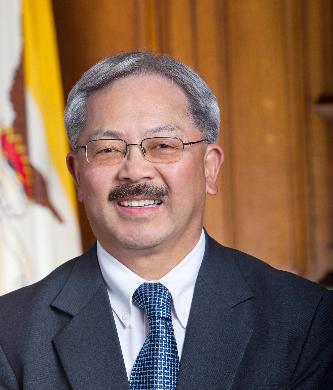
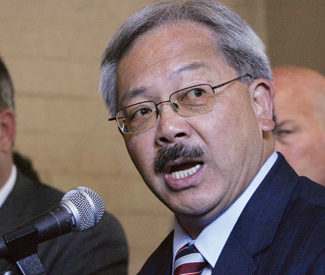
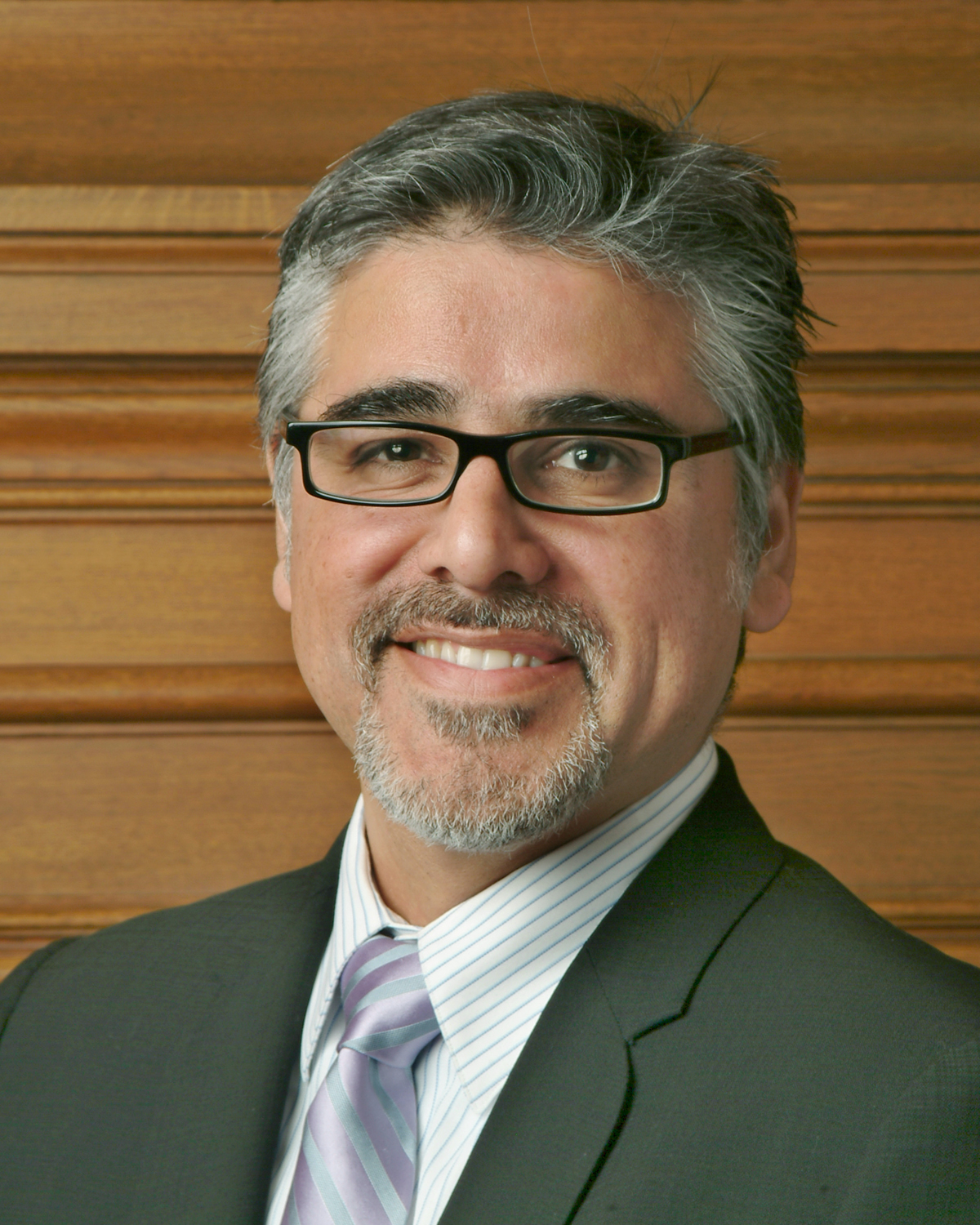
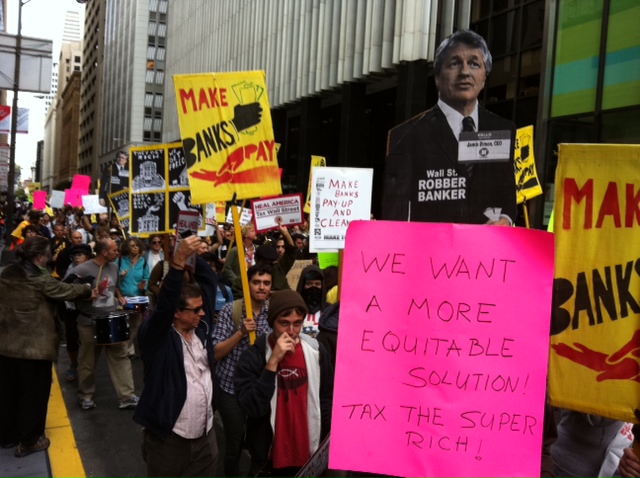
Mayor Ed Lee

If Mayor Lee lied

219

What’s going to happen to Mayor Ed Lee?

That’s the big question after a series of news reports have suggested that the mayor was less-than truthful under oath in his statements to the Ethics Commission. If he actually lied on the stand, that would be considered perjury, which is a felony.

But the reality is that the mayor’s not going to jail. First of all the District Attorney’s Office would have to investigate and file charges — and does anyone really think this DA, George Gascon, is going to subpoena Walter Wong and demand that he talk under oath about his interactions with Lee (who is a close friend)? I think Gascon ought to do it; there’s clear evidence that a crime may have been committed, and the public has a right to know about it, but I suspect that will never happen.
And even if the DA pushed, and Wong told the truth, and the truth contradicted the mayor, would a jury believe Wong over Lee?

It’s really hard to prove perjury. Maybe one of Lee’s staffers talked to Wong and the mayor wasn’t directly involved. Maybe the recollections of the two men have faded in the past few months. Maybe the mayor’s defense would be able to throw up enough chaff that nobody in the courtroom could figure it out.

So it’s not going to be about a criminal case against the mayor. But the revelations of what’s gone down here go far beyond any possible perjury indictment.

For starters, Ross Mirkarimi’s lawyers have every right and responsibility to demand that the Ethics Commission members hear from Debra Walker, Walter Wong, and — I would argue — every member of the Board of Supervisors. Here’s why:

The crux of Mirkarimi’s legal case at Ethics is that the mayor had no grounds to remove him from office — and that Lee never gave Mirkarimi due process or a chance to explain himself. The way the suspended sheriff tells it, the mayor never asked for an explanation of what happened that New Year’s Eve, never tried to talk to Eliana Lopez — never, in short, did any investigation into the incident before deciding the file misconduct charges (except for talking to Ivory Madison).

The way the mayor tells it, Mirkarimi refused to provide an explanation.

That distinction is critical, and the only basis for deciding what happened is for the judges — the commissioners — to use their best information and judgment about who’s telling the truth.

In other words, the mayor’s credibility is central to the entire case.

So if there’s any evidence that Lee lied about his discussions with Walter Wong or about whether he talked to any supervisors, then the commissioners would have the responsibility to consider that when evaluating the rest of his testimony. If you can’t believe everything he said, can you believe anything he said?

Some commissioners may argue that it’s not their business to determine if the mayor perjured himself, and on one level, that’s true — Ed Lee isn’t on trial here. But his credibility either makes or breaks the case. So the panel needs to hear from witnesses who can address that question.

Then there’s the much larger, more disturbing possibility that the mayor sought to influence (or might have been in a position to influence) members of the Board of Supervisors, who will be sitting as the final judges of Mirkarimi’s fate.

There’s a reason that the City Attorney’s Office has advised board members not to talk about the case. They’re sitting in a judicial role, and they can’t legally fulfill that obligation if there’s any indication they’ve already made up their minds. And if the mayor has talked to any of them — and there’s any indication at all that anything he said could be seen as seeking to influence their votes — well, in a courtroom you’d call that jury tampering. It’s a little different in a political forum, but still: Any supervisor who had a conversation with the mayor will be under pressure to recuse himself or herself — and every recusal helps Mirkarimi.

It doesn’t matter how many supervisors are in the room, in the country, recused or otherwise unable to vote — the mayor still needs nine to remove the sheriff. Three recusals and the whole thing collapses.

That’s why all of this is so fascinating and potentially explosive.

Oh,and by the way: When Lee set this process in motion, he should have known that he’d be testifying under oath and that anything he said or did might come out. You’d think he’d have been a little better prepared. 

So what’s going to happen to Ed Lee? Legally, nothing. But he may have done serious damage to his own case.

Perjury allegations against Lee gain more support

126

San Francisco Democratic Party Chair Aaron Peskin has confirmed his role in extending a city job offer from Mayor Ed Lee to Sheriff Ross Mirkarimi if Mirkarimi had been willing to resign in March, bolstering allegations that Lee may have committed perjury when testifying under oath before the Ethics Commission on Friday.

But even as more media outlets report the possible perjury (a story we broke first here), which is further complicating the already complicated official misconduct proceedings that Lee brought against Mirkarimi, the Mayor’s Office and key Lee allies have refused to comment on the perjury allegations or the strange circumstances surrounding the alleged bomb threat that temporarily got Lee off the hot seat.

As we reported in this week’s Guardian, Building Inspection Commissioner Debra Walker said Lee was lying when he said that he hadn’t spoken with any members of the Board of Supervisors before charging Mirkarimi with official misconduct. Walker said Sup. Christina Olague told her she had spoken with Lee about the matter, which Olague now denies.

Lee also responded “absolutely not” when asked by Mirkarimi attorney Shephard Kopp whether he authorized Peskin or development consultant Walter Wong, a close Lee ally, “to convey to Sheriff Mirkarimi if he would stop down, you’d get him another job.”

At press time for this week’s article, Peskin was backpacking in the Sierras and couldn’t be reached, but he has now confirmed to the Guardian that he met with Wong at 11:30am on March 19 – just hours before Lee met with Mirkarimi to say he would be removed from office unless he resigned – at Cafe Trieste.

In that meeting, Peskin said Wong asked him to convey to Mirkarimi an offer from the mayor of a job with the San Francisco Public Utilities Commission or the Airport Commission if Mirkarimi would voluntarily resign. Asked whether Wong indicated that he had discussed the offer with the mayor, Peskin told us, “He certainly left me with that impression.”

Mirkarimi refused to accept the offer, insisting on fighting to keep his job, which was one factor in Peskin’s subsequent public statement calling for Mirkarimi to resign. “There were a lot of things that factored into that,” Peskin said of his call for Mirkarimi to step down, although he wouldn’t discuss other factors on the record.

Efforts by both the Guardian and the Examiner to reach Wong have been unsuccessful, and messages to the Mayor’s Press Office on this and related issues also haven’t been answered. But just as Walker has offered to do, Peskin said he’s willing to testify under oath if asked.

“I am prepared, if subpoenaed, to tell the truth, the whole truth, and nothing but the truth,” Peskin told us.

Lee hasn’t had any public events or made any public comments on the matter since the scandal broke on Friday. The other unanswered mystery is why Lee was whisked from the hearing room just 15 minutes into his testimony, shortly after making the statements that Walker alleges amounted to perjury.

As we reported, neither the SFPD nor the Sheriff’s Department ordered the room evacuated, meaning that decision must have been made by someone within the Mayor’s Office. Press Secretary Christine Falvey’s last statement to the Guardian, on July 2, said, “Again, the mayor’s office did not recess the meeting. I still have to refer you to the Police Department which maintains Mayor Lee’s security or the Ethics Commission about the decision to recess the meeting for (I believe) about 90 minutes.”

Yet neither body seems to know who made the call, and follow-up questions asking the Mayor’s Office to disclose any information they have about that decision have gone unanswered. District Attorney George Gascon — whose office would need to pursue the perjury allegations considering the city’s official misconduct rules don’t apply to the mayor — also didn’t return our call asking generally how allegations of this fashion should be handled.

The official misconduct proceeding continue in front of the Ethics Commission on July 18 and 19 when Mirkarimi’s wife, Eliana Lopez, is scheduled to testify. But that has also been complicated by the Mayor’s Office’s refusal to authorize payment for a plane ticket for Lopez to return from her native Venezuela to testify. Mirkarimi and his legal team say they can’t afford to pay for that plane ticket after Lee suspended Mirkarimi without pay.

Davis launches D5 campaign with fortuitous timing

14

When progressive activist Julian Davis formally launched his District 5 supervisorial campaign late last week with a well-attended kickoff party at the Peacock Lounge in Lower Haight, timing and circumstances seemed to be on his side.

Days earlier, Quintin Mecke – a rival for the progressive vote in this staunchly leftist district – announced to supporters that he needed to care for his ailing mother and wouldn’t be running after all. At the same time, appointed incumbent Christina Olague seemed to be rapidly falling from favor with many progressives.

First came the viral video of Olague gushing over all the support she’s received from Chinatown power broker Rose Pak during a fundraiser where she raised nearly $50,000, then her squirrely role in helping the moderates repeal ranked-choice voting, and finally the bizarre episode of clashing with a close progressive ally and friend to defend Mayor Ed Lee from perjury allegations.

Davis has sought to capitalize on the rapidly unfolding developments, today sending out a press release blasting Olague for having “joined the conservatives on the Board of Supervisors to repeal ranked choice voting for mayoral elections,” and telling the Guardian that Mecke’s exit will help clarify the choice D5 voters face.

“The fact that he’s out allows us to consolidate the progressive base,” Davis said, not mentioning that candidates John Rizzo and Thea Shelby will also be vying for the progressive vote.

At his kickoff party, Davis also demonstrated that he has substantial support from another significant D5 voting block – African Americans – for which he’ll be competing with political moderate London Breed, director of the African American Arts & Cultural Complex.

Davis said that with Olague’s support by Mayor Ed Lee and the city’s economic and political establishment, he’ll need to run a strong grassroots campaign based on “people power and shoe leather,” an approach that he’s also displaying with regular street corner campaigning.

“We’re at an economic, social, and political crossroads in San Francisco,” he said at his launch party. “Rogue developers are corrupting City Hall with a vision of luxury condos, corporate tax breaks, chain stores, and parking garages. It’s a vision of San Francisco that doesn’t include us. Everyday, progressive reforms are being dismantled and progressive values are being abandoned.”

Davis is hoping that Olague’s ties to Lee will drag her down in a district that voted almost 2-1 in favor of progressive John Avalos (whose campaign Davis actively worked on) over Lee in last year’s mayor’s race.

“Look what’s happening on the waterfront where Olague voted to approve the 8 Washington development. These are condos for the Kardashians, vacation homes for the ultra rich and the 1 percent. That’s not keeping it real for San Francisco,” he said at the kickoff. “So we’ve got to ask ourselves: how do they get away with it? The only way they can. By choosing your leaders for you. Over the past two years in San Francisco, we’ve had an appointed mayor, an appointed district attorney, an appointed sheriff, and an appointed District 5 supervisor. Does that sound like participatory democracy to you? Does that sound like your vote counts?”

And as Avalos also tried to do in his mayoral campaign, Davis says he wants to use his campaign to help restart the city’s progressive movement, which has been in tatters since being divided and nearly conquered by the politicians and political operatives who helped elevate Lee into Room 200 18 months ago.

As he told supporters, “We can re-launch the progressive movement in San Francisco from this district. We can take back City Hall. We will win this election with people power, street by street, block by block, neighbor to neighbor, shop by shop.”

Stop ‘stop and frisk’

4

EDITORIAL If the San Francisco Police Department put up checkpoints and metal detectors all along lower Market Street and stopped and searched every person who walked by, they’d find some contraband. No question — a certain percentage of people on the city’s main downtown artery are carrying drugs or weapons. Some have warrants out. There would be multiple arrests and criminals taken off the streets.

And it’s hard to imagine that anyone would consider that a good idea.

So how about moving those checkpoints to the Mission and Bayview-Hunters Point? You might get even more weapons and drugs. And it would still be a profound violation of the civil liberties of every San Franciscan.

But what Mayor Ed Lee is now talking about — instituting some version of the notorious New York City “stop and frisk” law — isn’t much different. Under New York Mayor Michael Bloomberg, the police have been given the authority to search, without cause or a warrant, anyone who looks suspicious. The goal is to get guns off the street.

The result: The vast majority of people stopped are African American or Latino — and 88 percent are totally innocent.

It is, in other words, a huge waste of police resources as well as a systematic program or racial profiling and harassment.

Lee told the San Francisco’ Chronicle’s editorial board that he realized the problems with the New York system and wants a better model. And he said, correctly, that there are serious problems with gun violence, particularly in Bayview-Hunters Point. “I think we have to get to the guns,” Lee said. “I know we have to find a different way to get to these weapons, and I’m very willing to consider what other cities are doing.”

But San Francisco has spent huge amounts of time and resources trying (not always successfully) to build a community policing program that would increase trust between the police and communities of color — and any version of “stop and frisk” would instantly undermine that effort. It’s a terrible idea, and Lee should make it clear that he is dropping any discussion or consideration of it.

The mayor and his supporters insist that they’ll only pursue this approach if it can be done without profiling. But that’s almost impossible and it’s a fantasy to think the San Francisco cops, once empowered to stop anyone for any reason, would target white people the same way they do blacks and Latinos. There’s never been an example anywhere in the country where this kind of law was anything but a case study in racial profiling. Even Police Chief Greg Suhr sounds dubious.

The fact that Lee would even suggest this is a sign of how far he’s moved from his progressive roots. Moving even a step further toward this sort of wholesale civil-liberties violation would be a disaster for San Francisco.

Mayor and Mirkarimi testify in Ethics probe before dramatic disruption

261

After Sheriff Ross Mirkarimi endured about four hours of questioning in his official misconduct proceedings, mostly from Deputy City Attorney Peter Keith, Mayor Ed Lee took the stand a little after 1pm. But just as Mirkarimi attorney Shepherd Kopp was beginning to pin Lee down on the selective manner in which he decided to launch these unprecedented proceedings, the commission suddenly announced the hearing was being suspended and the room would need to be cleared immediately.

There is speculation that there was a bomb threat or other security emergency, but officials have so far offered no explanation for the dramatic development or whether the hearing would reconvene today. Yet the room is still half-filled with journalists and audience members, some speculating that that the clearing of the room was simply an effort to get the unusually grim-faced Lee off the hot seat.

Kopp’s questioning included pointed questions about whether he consulted any members of the Board of Supervisors before deciding to bring official misconduct charges against Mirkarimi in March. The city’s objection was overruled after Kopp noted that the supervisors will ultimately decide Mirkarimi’s fate. Forced to answer under oath, Lee said no, he didn’t speak to any supervisors before filing charges.

But progressive activist Debra Walker says Sup. Christina Olague — women who are close political allies and speak regularly — has repeatedly told her that Mayor Lee asked her opinion before filing the charges. If true, that would mean Mayor Lee committed perjury, which is a felony. Yet as reporters confronted Olague outside her office, she denied ever speaking with Lee about the case and then barricaded herself in her office.

When the reporters lingered and persisted, she finally emerged, reiterated her denial, refused to speculate about why her friend Walker would make that claim, and said, “We’re not allowed to discuss this matter with anyone before it comes to the board…I may have to recuse myself from voting on this.”

It was unclear why she thought recusal might be necessary, but if she does that would hurt Lee’s effort to get the nine votes on the board needed to remove Mirkarimi.

We’ll have complete analysis of the testimony and other developments in next week’s Guardian.


Ed Lee gets frisky

33

I knew Mayor Ed Lee was going to be more friendly to developers that I would have liked, and I knew he’d be a tough sell on new taxes, but I didn’t expect to see him talking about a program that has racial profiling and civil liberties issues written all over it.

Yeah, we could find some weapons if we simply gave up all rights to privacy. Yeah, if we put a metal detector on Market Street and strip-searched everyone who passed by we’d find some contraband. But seriously — I don’t think even my crazy trolls think this is a good idea.


CPMC’s new numbers threaten St. Luke’s and the mayor’s deal

9

Can San Franciscans trust California Pacific Medical Center (CPMC) not to shutter St. Luke’s Hospital once the company gets what it wants from the city? And has the Mayor’s Office, in its desire to please the business community and building trades, accepted and promoted a bad deal that doesn’t adequately protect the city’s interests?

Those are some of the questions that arose Monday during a hearing on CPMC’s $2.5 billion, multi-hospital development proposal before the Board of Supervisors Land Use Committee when officials from the Mayor’s Office revealed that the development agreement they negotiated with CPMC might not be good enough to keep St. Luke’s open.

As we’ve reported, CPMC (a subsidiary of Sutter Health, a not-for-profit corporation that nonetheless has a well-earned reputation for profiteering and other bad corporate behavior) is seeking to build a 550-bed regional luxury hospital atop Cathedral Hill. In exchange, the development deal requires CPMC to rebuild St. Luke’s, a seismically unsafe hospital in the Mission District that is relied on by many low-income San Franciscans (as well as the city, which would otherwise have to shoulder more of that burden at General Hospital).

After years of stalled negotiations between CPMC and two consecutive mayors, Mayor Ed Lee announced a deal in March that would have CPMC build a smaller version of St. Luke’s (with just 80 beds) and agree to keep it open for at least 20 years as long as CPMC’s operating margins didn’t dip below 1 percent in two consecutive years.

Activists had criticized the deal as too small, too short, and without enough guarantees, but Mayor’s Office officials have consistently said they were confident it was enough to keep St. Luke’s from being shuttered. But now, based on new revenue projections offered by CPMC, even those officials have lost confidence in the deal and say it needs to be renegotiated.

“These new 2012 projections, while still showing CPMC will not breach the 1 percent margin, do not offer the same comfort level we previously had,” Ken Rich of the Mayor’s Office of Economic and Workforce Development told the committee.

The news hit like a bombshell, shaking the confidence of even supervisors who strongly supported the deal, such as Sup. Scott Wiener, who called it a “surprising, critical piece of information” and said, “It’s very, very important that this issue is quickly resolved.”

For supervisors who were already skeptical of the deal and CPMC – such as Sup. David Campos, whose District 9 includes St. Luke’s – it was further evidence that this was a bad deal that needed more work before being brought to the board. The Planning Commission has already approved the project and the full board was scheduled to consider it in just a few weeks.

“What does that say about the way the negotiation was done?” Campos told us. “How half-baked can something be? What have we done to verify the numbers that CPMC gave us? And what does this say about CPMC?…If the numbers on St. Luke’s aren’t accurate, how can we trust the rest of what they’re telling us?”

Yet during the hearing, when Campos tried to get reassurances from CPMC officials and requested that the board be allowed to review the company’s financial records, he was rebuffed and belittled by CPMC attorney Pam Duffy – who later tersely apologized for her comments after Committee Chair Eric Mar criticized them as “insulting to the board.”

Campos had questioned Rich about why the city was relying on CPMC rather than independently assessing the numbers. “Maybe if you had done an audit, you wouldn’t be in this position of being surprised by the numbers that were given to you,” Campos told Rich.

But Rich said “projections are guesses, we can’t ever guarantee that they are right,” noting that CPMC had revised its revenue estimates downward for the years after St. Luke’s would open (when it would be absorbing the high costs of construction), making its profit margin slimmer. “CPMC took a more conservative approach to forecasting the rate of increase in hospital charges as well as patient volumes in light of the greater uncertainty in health care finance,” Rich said.

So Campos asked whether the supervisors could review CPMC’s data. Rich, who has reviewed it, replied, “The conditions under which we were shown CPMC’s projections is that those are confidential.”

Campos noted that it is the board’s job to review and approval this deal to determine whether it’s in the city’s best interests, which shouldn’t simply involve trusting CPMC. “Why should the executive branch of the government see those numbers but not the legislative branch?” he asked.
“It’s really not our call,” said Rich, noting that he had no objections to the request.

But when Campos asked CPMC’s Duffy, she offered a legalistic refusal, and when Campos tried to explain his reasoning, she said, “I heard your speech a moment ago” and added, “this isn’t really a game of gotcha.”

When Campos said the board was simply exercising its due diligence over an important project. she said “nothing unusual or untoward has occurred here, and the suggestion that might be the case, I think it unfair.”

But Campos wasn’t alone in wanting more reassurance from CPMC, who supervisors, labor leaders, and community activists have criticized for its secrecy and bad faith negotiating tactics with both the city and its employee unions.

“This announcement is shocking, on a number of levels,” Board President David Chiu said at the hearing, noting that he had met with CPMC officials just days earlier and they hadn’t mentioned the new developments, instead assuring him that their operating margins were high and the deal protected St. Luke’s. “It’s not a great way to build the trust we’ll need to move this forward.”

Rich said he had learned of the new numbers 12 days earlier, drawing a rebuke from Campos and others who said the supervisors should have been notified earlier. But Rich said that he was hoping that the problem would be solved through negotiations with CPMC before the hearing, but that talks over the issue have so far been fruitless.

“We would have vastly preferred to have an agreement in hand,” Rich told the committee, reassuring the supervisors that the Mayor’s Office will not support the project until the St. Luke’s issue is resolved to its satisfaction.

But Sup. Malia Cohen criticized CPMC as an untrustworthy negotiating partner. “CPMC has an interesting corporate culture,” she said, noting that the company has repeatedly misled supervisors and community leaders, accusing it of being “disingenuous in its negotiations.”

Chiu emphasized that this is a make-or-break issue: “This is an escape clause that could allow St. Luke’s – and what St. Luke’s means to the city – to not be operational. So this is an incredibly important question.”

Campos said this latest episode only added to his suspicion that CPMC will play games with its finances to shutter St. Luke’s – whose construction must be completed before CPMC can build Cathedral Hill Hospital – once it gets the lucrative regional medical center that it really wants.

“How do we know they aren’t transferring money out of CPMC into Sutter in order to shut down St. Luke’s?” Campos said, adding that he wants to see a clear guarantee that St. Luke’s will remain open as a full-service hospital. “This deal, as far as I’m concerned, is not ready for prime time.”

Mayor vs. Mirkarimi

58

steve@sfbg.com

For all the lawyers, investigators, witnesses, politicians, and political appointees involved in Mayor Ed Lee’s official misconduct case against suspended Sheriff Ross Mirkarimi, this case is ultimately a battle between these two politicians, who come from rival ideological camps — and have a lot riding on the outcome of their clash.

And this week, both Mirkarimi and Lee are expected to take the witness stand and face tough questioning from each other’s attorneys.

These first two rounds of live testimony before the Ethics Commission — which has been painstakingly setting up procedures for its inquiry, defining its scope, and making myriad rulings on what evidence and witnesses to allow — could be the emotional high point of hearings likely to drag on throughout the summer.

On June 28, after the commission finishes ruling on the admissibility of evidence — dealing mostly with the controversial testimony of Lee’s star witness, Ivory Madison, the neighbor who triggered the police investigation that found Mirkarimi had grabbed his wife’s arm during a Dec. 31 argument — Mirkarimi is expected to take the stand.

Given the tacks taken by each side so far, the deputy city attorneys representing Lee will likely try to ask Mirkarimi a broad array of questions about his actions and their wider implications, while his attorneys will seek to limit the line of inquiry to what they see as the narrow question of whether he committed specific acts of official misconduct.

“They’re going to want to blast him with every single issue they can conjure up,” said Mirkarimi attorney Shepherd Kopp. But he thinks the Ethics Commission “will limit it consistent with how they’ve been ruling on our objections,” which has already greatly limited the case that Lee sought to present.

The next day, Lee is scheduled to take the stand, with Mirkarimi’s attorneys planning to question the mayor about why he didn’t conduct an investigation or seek more input from witnesses or former mayors before demanding Mirkarimi’s resignation and suspending him without pay in March.

“The suspension was not done carefully with the best interests of the city at heart. It was a rash political decision that had little to do with the facts,” Mirkarimi’s other attorney, David Waggoner, told us.

Indeed, the city didn’t begin gathering evidence until after the charges had been filed, and since then Lee and his team haven’t been able to unearth much evidence in support of his most damning allegations that Mirkarimi tried to dissuade witnesses and thwart the police investigation, something that Mirkarimi and his attorneys have adamantly denied. In the absence of that evidence, Waggoner said Lee has stepped up his efforts to defame Mirkarimi publicly.

Lee told reporters on June 19 that he suspended Mirkarimi because he was “beating his wife,” seeming to escalate the characterization of a single arm-grabbing incident. The city has also released the video that Madison made of Mirkarimi’s wife tearfully recounting the incident and the couple’s text messages, which made Mirkarimi look bad but don’t offer much new information or evidence.

“He’s panicking. The ship is going down and he’s beginning to flail,” Waggoner said of Lee’s recent statements and actions. “The more the mayor uses that kind of rhetoric, the less credibility he has.”

We sought responses and comments from the press secretaries for Lee and the City Attorney’s Office, but both refused to comment for the record.

Ethics Commission Chair Benedict Hur has taken an increasingly strong role in running the hearings and limiting the ability of either side’s attorney to control them. At the June 19 hearing, he cut off Deputy City Attorney Sherri Kaiser at least twice when she tried to offer unsolicited comments, at one point causing her to get visibly agitated and declare, “I’m objecting to the procedures for objecting to evidence.”

But Hur didn’t relent or modify his approach, telling her, “We are trying to conduct these proceedings in a fair and expeditious way.” Waggoner praised the way Hur has run the hearings so far: “I think he’s been fair in his rulings and how he’s conducted the process.”

After this week’s pair of hearings, the Ethics Commission is scheduled to reconvene its inquiry on July 18 and 19, when it will likely hear from Madison, whose testimony could make or break the case. But first, attorneys for each side are meeting this week to decide where they can agree to limit Madison’s testimony, with the commission making rulings on realms where the two sides differ. Deputy City Attorney Peter Keith has previously said he expects Madison to face tough questioning in which her credibility will be attacked, but the commission itself has already criticized her written declaration and greatly limited her hearsay accounts of life in the Mirkarimi household (see “Ethics Commission undercuts the main witness against Mirkarimi,” June 20, SFBG.com Politics blog). And Kopp told us, “If I get most of my objections sustained, I may not need to cross examine her, as fun as that might be.”

Avalos emerges as the board’s main progressive champion

23

Sup. John Avalos seems to be the only consistent champion of progressive values at the Board of Supervisors these days, as he demonstrated once again yesterday as he tried to present some alternatives to the neoliberal corporatism that has seized City Hall over the last couple years.

Last week, Avalos was the only vote against a pandering proposal by Sup. Mark Farrell to exempt more small businesses from the city’s payroll tax, which is projected to cost the city $1.5 million next fiscal year and $2.5 million the following one, blowing a $4 million hole in the two-year budget that supervisors are now finalizing for approval in two weeks.

Yesterday, as the measure was about to receive final approval on its second reading, Avalos made a motion to delay it until after the fall election when voters may consider a pair of measures to transition from a payroll to gross receipts tax as the means of assessing local businesses. Mayor Ed Lee and Board President David Chiu introduced one measure that is revenue neutral, while an alternative by Avalos would bring in about $40 million per year.

Avalos didn’t have the votes for the long delay, so he got behind a compromise motion by Sup. Jane Kim to delay the measure until July 10 so the Budget Committee can at least factor it into its deliberations. Farrell opposed the move, insisting that “this is about creating jobs now,” despite the fact that businesses couldn’t apply for the exemption until next February.

A spirited debate followed, in which Avalos criticized City Hall’s current penchant for business tax cuts and questioned whether it really creates the jobs its boosters claim. He also noted that it is the multitude fee increases that local politicians have approved in recent years to balance the budget without raising taxes that have become most onerous for small businesses.

“When we were raising fees over the last five years, we were raising taxes on small businesses,” Avalos said, suggesting that rolling back those fees and taxing larger corporations that can afford it is a better strategy for helping small businesses and encouraging them to create jobs.

Eventually, Avalos won the short delay on a 7-4 vote, with Sups. Farrell, Carmen Chu, Sean Elsbernd, and Scott Wiener opposed.

Meanwhile, Avalos managed to place on the fall ballot an increase in the real estate transfer taxes paid on properties worth $2.5 million or more, convincing Sups. Kim, David Campos, and Eric Mar to support the proposal as the 5 pm deadline for at least four supervisors to place measures on the ballot neared. It would raise $16 million and compete with a similar measure by Lee that would raise $13 million through a smaller increase on properties worth more than $1 million.

Avalos also joined Campos and Chiu in opposing final approval for the 8 Washington housing project for the uber-wealthy. On the same 8-3 vote, the board also rejected Chiu’s efforts to allow opponents of the project to circulate referendum petitions without having to lug around a thick stack of all the studies referenced in the project approval.

Chiu appealed to his colleagues to support “citizens of San Francisco exercising the constitutional right to referendum,” but he won few sympathies on a board that these days seems most concerned with the interests of this city’s wealthiest individuals and corporations.

Ethics Commission undercuts the main witness against Mirkarimi

213

The testimony of the star witness in Mayor Ed Lee’s official misconduct case against suspended Sheriff Ross Mirkarimi came in for harsh criticism by the Ethics Commission last night, with that body striking most of it as prejudicial and unsupported hearsay evidence that should have never been introduced, something that even the city’s attorneys admitted and apologized for.

It was a serious blow to the city’s case that also undercuts the written testimony of the city’s domestic violence expert, attorney Nancy Lemon, who based much of her analysis and judgments on this discredited and disallowed testimony of Ivory Madison, the neighbor and confidante of Mirkarimi’s wife who reported the Dec. 31 domestic violence incident to police.

Meanwhile, Lee was confronted by a large pack of reporters following his monthly appearance before the Board of Supervisors earlier the day, which peppered him with pointed questions about his decision to bring what is evolving into an expensive, complicated, and nasty prosecution of Mirkarimi rather than simply allowing him to be recalled by voters. The exchange made news when Lee characterized Mirkarimi’s arm-grabbing incident as “the beating of his wife.”

Mirkarimi and his attorneys labeled that comment and much of the city’s case as simply a smear campaign that goes well beyond the narrow question of whether Mirkarimi committed official misconduct and should be removed from office, which the commission is still in the process of setting up procedures to answer.

Yesterday’s hearing dealt mostly with deciding whether to exclude or allow the written testimony of nearly two dozen witnesses. The only testimony that was stricken entirely was that of Paul Henderson, Lee’s criminal justice adviser, who testified that Mirkarimi’s guilty plea to misdemeanor false imprisonment for the grabbing incident would hurt his ability to function as the sheriff. The commission found the testimony to be irrelevant and prejudicial, clearly upsetting Deputy City Attorney Sherri Kaiser.

But the big news from last week’s hearing was the dim view that the commission took of Madison’s 22-page declaration, which painted Mirkarimi as domineering and oppressive, a bleak picture that she attributed to his wife, Eliana Lopez, as conveyed during repeated conversations between October and December as the couple was having marital problems. Madison is the main source supporting the city’s most serious allegations: that Mirkarimi abused his wife and then tried to thwart a police investigation

Commissioner Paul Renne – a career litigator appointed to the commission by the District Attorney’s Office – took the lead role in criticizing Madison’s testimony and the city for allowing it, ruing the fact that it was used by the Examiner and other media outlets to paint a defamatory “portrait of verbal abuse and child neglect inside Mirkarimi’s fear-ridden household,” as the Examiner put it on the cover of yesterday’s paper.

“I saw that and I thought maybe this idea of [taking initial testimony through written] declarations is not protective of the interests of everyone,” Renne said.

“I was disappointed by the content of Ivory Madison’s declaration. A first-year lawyer should know that much of it is inadmissible and it should not have been given to us,” Renne told Deputy City Attorney Peter Keith, calling it “clearly hearsay, clearly having the intention of poisoning the well of this hearing.”

Keith didn’t even try to defend most of the declaration, responding to Renne by saying, “We have an independent witness that is represented by [her own legal] counsel and we didn’t have control over everything that was submitted…I think the criticism is well-taken and we didn’t mean to put matters before the commission that are not relevant.”

“But you were the one who submitted the declaration,” Renne responded, telling Keith that the city must avoiding engaging in character assassination that goes beyond the scope of the commission’s inquiry, which will result in a formal recommendation going to the Board of Supervisors near the end of summer.

“My recommendation is we reject the declaration and you bring her in for live testimony,” Renne recommended. The rest of the commission seemed to agree with Renne’s criticism, but it opted to go through the declaration line-by-line, removing most of it from the proceedings. Madison is also expected to testify live and be subjected to a tough cross-examination by Mirkarimi’s attorneys, who say she has blown the incident out-of-proportion and broke the confidence of Lopez, who denies that Mirkarimi was ever abusive.

In arguing unsuccessfully for much of Madison’s written testimony to remain in the record, Keith told the commission that it was the basis for Lemon’s assessment of patterns of behavior by batterers, thus undercutting that testimony as well.

“If they’re untrue, they’re meaningless, right?” Renne asked Keith, referring to the sensational tales Madison told about Mirkarimi’s controlling behavior.

But Keith said that even if the stories Lopez told Madison were untrue or highly embellished – as Lopez’s attorney, Paula Canny, has implied as she characterized her client as building a child custody case in the event the couple divorced – they are still relevant to understanding why Madison reported Mirkarimi to the police.

“Whether or not these actions happened, it’s relevant to her concerns,” Keith said.

But Mirkarimi attorney Shepherd Kopp said that, like much of the city’s case, hearsay testimony based on flawed and prejudicial information should be irrelevant to these proceedings and shouldn’t be allowed as evidence against Mirkarimi.

“Their expert, Ms. Lemon, can believe what she wants, but that doesn’t mean it should come in as evidence,” Kopp said.

The hearing was continued to next week when Mirkarimi, Lee, and other key witnesses are expected to begin giving live testimony before the commission on June 28 and 29. Click here to read the various documents associated with the case.

Why do Lee, Chiu, and others want to stifle economic growth?

16

Why do Mayor Ed Lee, Board of Supervisors President David Chiu, and San Francisco’s two major daily newspapers want to punish success? Because that’s exactly what their proposal to create a new gross receipts tax for businesses – in which corporations would be taxed more as they grow, thus encouraging economic stagnation – would do.

Right now, the city taxes businesses through a payroll tax, levying taxes based on the number of employees the company has. But under a gross receipts tax that would replace the payroll tax, employees have a disincentive to be productive and efficient and increase their companies’ profits because that would expose those companies to more of the city’s onerous tax burden.

Why would investors and employees want to grow a business in San Francisco when that would only submit them to higher taxes. Clearly, this is anti-business measure that is likely to plunge our local economy back into the depths of the recession. Don’t our leaders understand the need to help this fragile economic recovery?

Okay, okay, in case you haven’t guessed it yet, the previous three paragraphs are satire of the ridiculously overblown and misleading political rhetoric used by Lee and other critics of the city’s payroll tax, which they deride as as “job killer” that makes companies not want to hire new employees.

“Mayor Lee and Board President David Chiu proposed a gross receipts tax as an alternative to the City’s current payroll tax, which punishes companies for growing and creating new jobs in San Francisco,” Lee’s office wrote in a press release it distributed last week.

Yet my argument that a gross receipts taxes “punishes companies for growing” is just as logically sound as Lee’s argument that the payroll tax discourages companies from “creating new jobs” – and both arguments are also complete hyperbolic bullshit. But it’s seductively simple and widely parroted bullshit.

“To attract more companies to San Francisco and encourage existing employers to hire more employees, it is past time to do away with this tax,” our new neighbors down the hall, the editors of the Examiner, wrote in their editorial today, a oft-repeatedly refrain from the Chronicle and SF Chamber of Commerce as well. It later added that switching tax methods “wouldn’t penalize companies for employing people or paying them well. And city policy wouldn’t give employers any incentive to shed employees during a downturn.”

But the reality is that the 1.5 percent payroll tax is too small to really be a factor in the decision by corporations to add new employees, something they are already loath to do unless forced to by rising demand. It is simply one imperfect gauge of the size of a company and its ability to pay local taxes, just as the gross receipts tax is.

Health insurance costs, which Lee’s CPMC deal doesn’t adequate contain, is a far bigger factor in a company’s hiring decisions. So is commercial rent, which Lee’s corporate welfare policies are causing to go up downtown and throughout the city.

For decades, conservatives have tried to sell the general public on bogus trickle down economic theories that we all benefit from corporate tax cuts and that people will simply stop working if you tax them, ideas that should have been discarded as they were discredited. But they’re back with a vengeance, in supposedly liberal San Francisco of all places, actively peddled by key Lee supporters like billionaire venture capitalist Ron Conway, who only recently dropped his Republican party affiliation in favor of declined to state.

But it’s time to call out this voodoo economics for what it is: self-serving bullshit that ought to be rejected by citizens of a city that prides itself as being more educated and enlightened than the rubes in the flyover states that have been so thoroughly manipulated by the Republican Party and Blue Dog Democrats, to the detriment of our entire country.

Now, the Examiner’s argument that the business tax reform proposal would broaden and stabilize the tax base is a sound and meaningful argument, which is why the concept enjoys widespread support from across the ideological spectrum and is worth doing (although progressives rightful argue that if the tax base is being broadened then the city should reap some benefits from that, logic that Lee inexplicably resists).

Yet as the City Hall debates that will shape the details of business tax reform begin in a couple of weeks, it’s time to drop this misleading “job killer” label that has been promulgated by Republicans and other fiscal conservatives over the last decade and have an honest debate over what’s best for San Francisco’s private and public sectors.

No deal yet on business tax reform as competing measure are introduced

21

Mayor Ed Lee and his business community allies failed to reach an agreement with labor and progressives by today’s deadline for submitting fall ballot measures to the Board of Supervisors, leading progressive Sup. John Avalos to introduce a business tax reform measure that would compete with Lee’s proposal.

The Avalos measure would raise $40 million in new General Fund revenue to restore recent cuts to city services while Lee’s would essentially be revenue-neutral, although Lee did tweak the formulas to raise about $13 million in new revenue that would be dedicated to a new Affordable Housing Trust Fund, which would be created by another ballot measure that Lee was having a hard time funding in the face of business community opposition.

“I don’t believe trickle down economics works, except for the 1 percent,” Avalos told the Guardian, arguing the importance of recovering revenue that the city lost when the biggest downtown corporations sued the city in 2001 to invalidate a gross receipts tax. Both the Lee and Avalos measures would gradually convert the current payroll tax into a new version of the gross receipts tax, which is preferred by most of the business community.

So, will voters in the fall be faced with competing ballot measures? Probably not, according to the same sources from the business and progressive sides of the negotiations who told us last week that it appeared a deal was in the offing, something they still believe.

“This is the beginning of the negotiations,” said the business community source, noting that both measures won’t be approved until next month, with discussions about merging them ongoing. “I’m sure this is part of the process and they will agree on a number.”

Our labor source agreed, predicting the two sides will come to an agreement because neither side wants competing ballot measure, but noting that Lee appears to be trying to create divisions between the progressive revenue coalition and the affordable housing advocates. “That’s just positioning on their part, but it doesn’t feel like good faith bargaining,” the source said.

Mayoral Press Secretary Christine Falvey seemed to leave the door open for compromise, telling the Guardian, “The Mayor believes that to be successful, we should continue building consensus around business tax reform and that it’s important that the business community continue to be key partners in that effort.”

Lee is trying to placate an emboldened business community, which has taken a hard line position on opposing new taxes even while seeking ever more tax breaks and public subsidies. In fact, Sup. Mark Farrell had another business tax cut on today’s board agenda, cutting the payroll tax for small businesses at a cost of more than $2 million to city finances.

“I believe we need to do all we can to incentivize job growth in our small business community,” Farrell said.

Avalos said he agrees with helping small businesses – which is why both his and Lee’s business tax reform measure shifts more of the tax burden to the large corporations that have been so profitable in recent years – but that “we should not be putting a hole in the city’s budget to do so.”

In a sign of just how strong the business community has become at City Hall compared to the progressive movement that had a board majority just two years ago, the tax cuts were approved on a 10-1 vote, with only Avalos opposed.

The great car slowdown

49

EDITORIAL It’s going to be hard to reach San Francisco’s official bike transportation goal, which calls for 20 percent of all vehicle trips to be taken by bicycle by 2020. Everyone in town knows that; everyone at City Hall and in the biking community agrees that some profound and radical steps would need to be taken to increase bike trips by more than 500 percent in just eight years.

It starts with safety — you’re not getting anywhere near that number of people on light, two-wheeled vehicles unless, as international bicycling advocate Gil Peñalosa recently told San Franciscans, people between the ages of eight and 80 feel safe riding on the city streets.

At the San Francisco Bicycle Coalition’s 20th Annual Golden Wheel Awards, Peñalosa — executive director of 8-80 Cities, a nonprofit that promotes creation of cycling infrastructure that is safe and inviting — laid out a prescription for designing cities around pedestrians and bicyclists (he sees riding a bike as ” just a more efficient way of walking.”) Peñalosa laid out an agenda for achieving that goal — one that includes a step San Francisco can start taking immediately: Cut vehicle speeds on all city streets to no more than 20 miles an hour.

Even if that were only done in residential areas, it would have a huge impact, and not just on bicyclists. Peñalosa cited statistics showing that only about 5 percent of pedestrians hit by cars driving 20 mph will die — but the fatality rate shoots up to 80 percent when the vehicles are traveling 40 mph.

If there are some streets where it’s impractical to have such a low speed limit, it’s imperative to have bike lanes that are separated from cars by physical barriers.

San Francisco’s Municipal Transportation Agency director, Ed Reiskin, told us after Penalosa’s speech that the notion of reducing speed limits made sense: “The logic is unquestioned that slowing speeds reduces the risk of fatality.”

But the city, it turns out, doesn’t have the power to unilaterally lower speed limits: State law requires speed limits to be set based on formulas determined by median vehicle speeds. That seems awfully old-fashioned and out of touch with modern urban transportation policy, which increasingly emphasizes bikes, pedestrians, and transit, and city officials ought to be asking the state Legislature to review those rules and give more latitude to cities that want to control traffic speed.

In the meantime, Reskin argues that a lot can be done by redesigning streets, using bulb-outs and barriers to discourage speeding. That’s fine, and part of the city’s future bike-lane policy should start with traffic-calming measures (Berkeley, to the chagrin of many nonlocal drivers, has done a great job making residential streets into bike-friendly places where cars can’t travel very fast).

Peñalosa had some other great ideas; he noted that cities such as Guadalajara, Mexico require developers to give free bikes away with each home, a program that has put 102,000 more bikes on the streets. That’s a cheap and easy concept — except that so much of the new housing in the city is so expensive, and comes with so much parking, that it’s hard to believe the millionaires who are moving into these units will be motivated by a free bicycle.

But the notion of working with Sacramento to slow down car traffic makes tremendous sense — and that ought to be one of the transportation priorities of Mayor Ed Lee’s administration.

Hospital standoff

2

steve@sfbg.com

The controversial and long-awaited proposal by California Pacific Medical Center (CPMC) to build a 550-bed luxury hospital atop Cathedral Hill and to rebuild St. Luke’s Hospital has finally arrived at the Board of Supervisors — where it appears to have little support.

So far, not one supervisor has stepped up to sponsor the deal, and board members say it will have to undergo major changes to meet the city’s needs. “There are still a lot of questions that remain,” Sup. David Campos told us, citing labor, housing, community benefits, and a long list of other issues that he doesn’t believe CPMC has adequately addressed. “It tells me there’s still more work to be done.”

CPMC, which is Sacramento-based nonprofit corporation Sutter Health’s most lucrative affiliate, has been pushing the project for almost a decade. Its advocates have subtly used a state seismic safety deadline for rebuilding St. Luke’s — a hospital relied on by low-income residents of the Mission District and beyond — as leverage to build the massive Cathedral Hill Hospital it envisions as the Mayo Clinic of the West Coast.

But the project’s draft environmental impact report shows the Cathedral Hill Hospital would have huge negative impacts on the city’s transportation system and exacerbate its affordable housing crisis. And CPMC has been in a pitched battle with its labor unions over its refusal to guarantee the new jobs will go to current employees or local residents and be unionized. There are also concerns with the market power CPMC will gain from the project, how that will affect health care costs paid by the city and its residents, and with the company’s appallingly low charity care rates compared to other health care providers (see “Lack of charity,” 12/13/11).

CPMC had refused to budge in negotiations with the Mayor’s Office under two mayors, for which Mayor Ed Lee publicly criticized the company’s intransigence last year. But under pressure from the business community and local trade unions who support the project, Lee cut a deal with CPMC in March.

That development agreement for the $2.5 billion project calls for CPMC to pay $33 million for public transit and roadway improvements, $20 million to endow community clinics and other social services, and $62 million for affordable housing programs, nearly half of which would go toward helping its employees buy existing homes.

While those numbers seem large, community and labor leaders from San Franciscans for Healthcare, Housing, Jobs and Justice (SFHHJJ), which formed in opposition to the project, say they don’t cover anywhere near the project’s full impacts. And given that CPMC made about $180 million in profit last year in San Francisco alone — money that subsidizes the rest of Sutter’s operations — they say the company can and should do better.

“This is about standing up to corporate blackmail,” SFHHJJ member Steve Woo, a community organizer with the Tenderloin Neighborhood Development Corporation, told us.


PIVOTAL PROJECT

CPMC is perhaps the most high-profile project the board will consider this year, one that will impact the city for years, so the political and economic stakes are high.

The Planning Commission voted 5-1 on April 26 to approve the deal and its environmental impact report, citing the project’s economic benefits and the looming deadline for rebuilding St. Luke’s. The Board of Supervisors was scheduled to consider the appeal of that decision on June 12 (after Guardian press time), but activists say supervisors planned to continue the item until July 17.

In the meantime, the board’s Land Use Committee has scheduled a series of hearings on different aspects of the project, starting June 15 with a project overview and presentation on the jobs issue, continuing June 25 with a hearing on its impacts to the health care system. Traffic and neighborhood impacts would be heard the next week, and then housing after that.

Calvin Welch, a progressive activist and nonprofit affordable housing developer, said the project’s EIR makes clear just how paltry CPMC’s proposed mitigation measures are. It indicates that the project’s 3,000 new workers will create a demand for at least 1,400 new two-bedroom housing units. Even accepting that estimate — which Welch says is low given that many employees have families and won’t simply be bunking with one another — the $26 million being provided for new housing construction would only create about 90 affordable studio apartments.

“We’re going to end up, if we want to house that workforce, subsidizing CPMC,” Welch told us.

Compounding that shortcoming is the fact that the Cathedral Hill Hospital is being built in a special use district that city officials established for the Van Ness corridor — where there is a severe need for more housing, particularly affordable units. The SUD calls for developers to build three square feet of residential for every square foot of non-residential development.

“That would require building 3 million square feet of residential housing with this project,” Welch said. “We don’t think $26 million meets the housing requirement for this project, let alone what was envisioned by this [Van Ness corridor] plan.”

SFHHJJ is calling for CPMC to provide at least $73 million for affordable housing, with no more than 20 percent of that going to the company’s first-time homebuyer assistance program. That assistance program does nothing to add to the city’s housing stock and critics call it a valuable employee perk that will only increase the demand for existing housing — and thus drive up prices.

But the business community is strongly backing the deal, and the trade unions are expected to turn out hordes of construction workers at the hearing to make this an issue of jobs — rather than a corporation paying for its impacts to the community.

“After a decade of discussion, debate and compromise, the city’s departments, commissions, labor, business and community groups all agree on CPMC,” San Francisco Chamber of Commerce President Steve Falk wrote in a June 8 e-mail blast entitled “Message to the Board of Supervisors: Don’t Stand in the Way of Progress.”

“The fate of our city’s healthcare infrastructure now lies solely with the Board of Supervisors,” the Chamber says. “When it comes time to vote, let’s insist they make the right choice.”

Yet it’s simply inaccurate to say that labor and community groups support the deal, and both are expected to be well-represented at the hearings.


CARE FOR WHOM?

Economic justice issues related to health care access and costs are another potential pitfall for this project. SFJJHH activists note that no supervisors have signed on to sponsor the project yet — which is unusual for something this big — and that even the board’s most conservative supervisors have raised concerns that the city’s health care costs aren’t adequately contained by the deal.

“There’s a significant amount of dissatisfaction with the deal, even among conservatives,” SFJJHH member Paul Kumar, a spokesperson for the National Union of Healthcare Workers, told the Guardian.

On the progressive side, a big concern is that CPMC is proposing to rebuild the 220-bed St. Luke’s with only 80 beds, which activists say is not enough. And even then, CPMC is only agreeing to operate that hospital for 20 years, or even less time if Sutter’s fortunes turn around and the hospital giant begins losing money.

CPMC Director of Communications Kathryn Graham, responding by email to questions and issues raised by the Guardian, wrote generally and positively about CPMC and the project without addressing the specific concerns about whether housing, transportation, and other mitigation payments are too low.

On the jobs issue, she wrote, “Our project will create 1,500 union construction jobs immediately—and preserves and protects the 6,200 health care professional jobs that exist today at the hospitals. Currently, nearly 50 percent of our current employees live in San Francisco. During the construction phase of this project, we are committed to hire at least 30 percent of workers from San Francisco. We will create 500 permanent new jobs in just the next five years—200 are guaranteed to be local hires from underserved San Francisco neighborhoods. We don’t know where you got the ridiculous idea that our employees must reapply for jobs at our new hospitals. That is incorrect.”

Yet CPMC has resisted requests by the California Nurses Association and other unions to be recognized at the new facility or to agree to card-check neutrality that would make it easier to unionize. And union representatives say CPMC has offered few assurances about staffing, pay, seniority, and other labor issues.

As one CNA official told us, “If they aren’t going to guarantee jobs to the existing employees, those are jobs lost to the city.”

“We’re giving Sutter a franchise over San Francisco’s health care system for 30 to 40 years, so we should ensure there are basic worker and community protections,” Kumar said.

Welch and other activists say they believe CPMC is prepared to offer much more than it has agreed to so far, and they’re calling on the supervisors to be tougher negotiators than the Mayor’s Office was, including being willing to vote down the project and start over if it comes down to that.

“They make too much money in this city to just leave town,” Welch said of CPMC’s implied threat to pull out of San Francisco and shutter St. Luke’s. “It’s bullshit.”


Mayor Lee’s business tax reform will include new revenue

30

Mayor Ed Lee has acquiesced to labor’s demand that the business tax reform measure being negotiated for the November ballot raise tens of millions of dollars in new revenue, rather than being revenue-neutral as Lee and business leaders had previously insisted, according to Guardian sources in both the business and progressive communities who are involved in the ongoing negotiations.

As we previously reported, SEIU Local 1021 had demanded that the measure – which must be submitted to the Board of Supervisors by Tuesday – raise $30-50 million in additional revenue to prevent cuts to city services and to recapture money the city lost when the largest downtown corporations sued the city in 2001 to invalidate its gross receipts tax. If not, the union threatened to qualify a competing ballot measure that would raise the money, something neither side wants.

Sources say the Mayor’s Office has agreed to structure the tax to raise at least $25 million in new revenue, and some believe they will settle on $30 million, which is being supported by the big technology companies and is probably enough for labor to sign onto the deal.

But a complicating factor is the fact that Lee’s representatives are simultaneously negotiating another ballot measure to create an Affordable Housing Trust Fund that will also need to generate revenue, most likely through an increase in the real estate transfer tax, something the commercial landlords are opposing.

The business community has opposed any tax increases, but it is split between the big technology companies who helped elect Lee and more traditional businesses, including the FIRE (Finance, Insurance, and Real Estate) companies that all observers say are likely to get hit with a higher tax burden whatever the outcome of the current negotiations.

There is an urgency to get this deal done now because of the fast-approaching deadline to introduce ballot measures to the board, and the fact that under state law revenue measure can be passed with only a simple majority of voters only in presidential election years.


Mecke joins crowded District 5 supervisorial race

26

Progressive activist Quintin Mecke jumped into the District 5 supervisorial race today, echoing gentrification concerns raised this week by the Guardian and The New York Times and promising to be an independent representative of one of the city’s most progressive districts, a subtle dig at Sup. Christina Olague’s appointment by Mayor Ed Lee.

“The City is at an economic crossroads. As a 15 year resident of District 5, I cannot sit idly by while our City’s policies force out our residents and small businesses, recklessly pursuing profits for big business at whatever cost,” he began a letter to supporters announcing his candidacy, going on to cite the NYT article on the new tech boom that I wrote about earlier this week.

“What we do next will define the future of San Francisco; the city is always changing but what is important is how we choose to manage the change. One path leads to exponential rent increases, national corporate chain store proliferation, and conversion of rent-controlled housing. The other path leads to controlled and equitable growth, where the fruits of economic development are shared to promote and preserve what is great about this City and our district,” Mecke wrote.

Mecke came in second to Gavin Newsom in the 2007 mayor’s race and then served as the press secretary to Assembly member Tom Ammiano before leaving that post last week to run for office. Mecke joins Julian Davis and John Rizzo in challenging Olague from her left, while London Breed and Thea Selby are the leading moderates in a race that has 10 candidates so far, the largest field in the fall races.

Although he never mentioned Olague by name, Mecke closed his message by repeatedly noting his integrity and independence, a theme that is likely to be a strong one in this race as Olague balances her progressive history and her alliance with the fiscally conservative mayor who appointed her.

“Politics is nothing without principles; and it’s time now to put my own principles into action in this race,” Mecke wrote. “District 5 needs a strong, independent Supervisor. I am entering this race to fight for the values that I believe in and to fight to preserve what is great about District 5 and the city. I have brought principled independence to every issue I’ve worked on and that’s what I’ll continue to bring to City Hall.”

In an interview with the Guardian, Mecke said he sees the campaign as a “five-month organizing project” to reach both regular voters and residents of the district who haven’t been politically engaged, including those in the tech sector. He’d like to see the perspective of workers represented in discussions about technology, not simply the narrow view of venture capitalist Ron Conway that Mayor Lee has been relying on.

“Local politics needs new blood,” Mecke said, “it needs to hear from these people.”

Mayor Lee’s priorities are wrong

0

By Margaret Brodkin

OPINION There was much back slapping at City Hall last week as officials congratulated themselves on what was described as a welcome “philosophical shift” in San Francisco politics.

The beneficiary of the acclaim and virtual political consensus was Mayor Ed Lee’s proposed budget, the largest in history — including an unexpected windfall of new revenue. The budget’s signature element, described in glowing terms by the San Francisco Chronicle’s C.W. Nevius and warranting its own special mayoral press conference, is the expansion of the police and fire budgets — an $82 million increase over two years.

Amid last week’s ovations was an unsettling silence from voices normally willing to cut through obscure numbers and rhetoric. Not one official commented that the best way to ensure public safety is to build strong children, families, and communities.

The cumulative impact of the devastating state budget and years of inadequate funding on families and children should not permit celebration. In light of millions in unanticipated revenue, politicians should not be satisfied with addressing urgent needs simply by sparing a few city departments from cuts, as appeared to be the case. Here’s what they should be thinking about:

• Our schools face the worst budget cuts ever, with SFUSD preparing to lay off 400 employees, reduce the already-too-short school year, increase class size, eliminate most school bus lines and all high school after-school programs, and under-fund everything from food to special education.

• Our childcare system is being gutted by the state, with $20 million in losses this year on top of $9 million from last year. This will impact thousands of families and result in the closure of centers and family childcare homes. Many fewer parents will be eligible for childcare subsidies (no one with two kids earning more than $37,500 a year will qualify) — pushing parents out of work and onto “welfare,” and children out of quality care and into unsafe settings.

• Support systems for children with disabilities are being eliminated and reduced through simultaneous cuts in multiple agencies.

• Young people entering community colleges or state universities face years of uncertainty — including whether their campuses will even exist. Already, the majority of SF students who enter City College are unable to graduate — stymied by costs, lack of educational support, or the inability to get classes they need.

It appears that little of the new millions will address these problems. The mayor’s budget does not even fully fund the voter-approved Public Education Enrichment Fund, passed in 2004 to provide essential services to public schools and preschools. Funding falls short by more than $10 million. Providing schools the funds to which they are legally entitled is the least we can do when the city lands millions in new resources.

Let’s be clear: crime is at historic lows — and has gotten that way with 200 fewer officers than the mayor is now advancing. There is little rationale to suddenly swell the ranks, at a cost of $140,000 per officer. The Fire Department’s inefficiencies have been well documented by city budget experts, and many cost-saving recommendations have yet to be implemented.

Before signing off on a budget they have not yet discussed in public (as it appeared to last week), the Board of Supervisors must evaluate fiscal options in full view. Private meetings with the mayor are no substitute for a robust debate now that the revenue facts are known. This is the city’s first two-year budget, and its policy direction will impact us all for years to come.

What looks to Nevius like a positive “drama-free, signature moment” for San Francisco, looks to many advocates for children and families like an abdication of responsibility.

Margaret Brodkin is a former executive director of Coleman Advocates for Children, director of the Department of Children, Youth and their Families and New Day for Learning, and a veteran of numerous budget processes

Oakland gets jilted

0

By Frank Artrage

news@sfbg.com

After a secret whirlwind courtship that lasted a mere five months, Mayor Ed Lee and the Golden State Warriors tied the knot May 22 at Piers 30-32, announcing their unexpected union at the site they intend to occupy with a new basketball arena by 2017.

The Warriors’ entrepreneurial new owners — Joe Lacob and Peter Guber — say they love this “iconic site” and promised to build a “spectacular sports and entertainment complex” that is “architecturally significant.”

But what about Oakland, the team’s unceremoniously jilted current homemaker? The perception from the East Bay is that Lacob and Guber were duplicitous and underhanded in their dealings with city officials that were desperately trying to retain the city’s three main sports franchises — the Oakland Athletics baseball club, the Oakland Raiders football team, and the Golden State Warriors basketballers — all of whom have recently signaled interest in moving.

Several sources told us that the Warriors’ new owners have been lying to Oakland officials about their intentions for months. For example, Oakland City Councilmember Larry Reid told me “that when our staff had conversations with the new owners, they always indicated they hadn’t yet come to a final decision.”

Reid told me what happened next. “I get a call Sunday night at 9:30 telling me about their move like a thief in the night.” Reid said. “It’s upsetting.”

On the fan site GoldenStWarriors, Lacob seemed to belittle Oakland. In an 18-minute video, Lacob predicts that Oakland will be left with only one sports team someday. “I think they’re challenged,” he said when asked what’s wrong with Oakland, adding the city is in “a difficult situation.”

Sports talk radio hosts, fan sites, and bloggers, however, seem to be evenly divided on the move. Even hardcore Oakland and Warriors blogger Ethan Sherwood Strauss prefers the San Francisco site. At his Warriorsworld site, Strauss wrote: “I’d never leave Oakland…. I have everything at arm’s length. There’s food from around the world, teeming farmers markets, lush green hills, Redwood trees, Mosswood Park, Grand Lake Theatre — this is all within two miles.”

But: “Guess which is the better place for the Golden State Warriors? It’s that west bay city national broadcasters keep showing during Warriors games while pretending Oakland doesn’t exist.”

Thus far, neither Oakland Mayor Jean Quan nor Mayor Lee have made any comments regarding the other side’s situation or whether their mutually reported “good relationship” has been strained. But it must be devastating to Quan, given all of her work and hoopla over her recent announcements surrounding her ambitious plans for the “Coliseum City” project.

Not unlike the Warriors’ “world class arena” planned for their new San Francisco home, Coliseum City, according to Quan, will be a “world-class sports and entertainment district.” Ryan Phillips, writing on the Oakland North blog in March, said that the project includes “building hotels, retail, office and residential space in the Coliseum complex…as well as building an Oakland Airport Business Park just across the freeway on the way to the airport. The business park will be developed to attract tech companies.”

Mayor Quan issued a press release following the Warriors’ bombshell to announce that she remains “bullish” on her Coliseum City project. Her new spin is that, “Coliseum City is a long-term development project that was never dependent on any one tenant. It was always a larger project than just one sports team.”

But if there’s even one team missing from the original trinity, then they have no choice but to lower their expectations and scale back their plans. Therefore, the Warriors’ move could trigger a complete unraveling of not only her recent plans to keep the Oakland A’s baseball team in Oakland, but also efforts to keep any team there.

For example, a case study published by the Airport Area Business Association (AABA) in conjunction with Coliseum City principal and manager Oakland-based JRDV Urban International, and students at UC Berkeley’s Haas School of Business found, The Coliseum complex presents a unique opportunity to prepare a pioneering business model that generates revenue for both public and private interests.”

Presciently, in the wake of this announced move by the Warriors and how that hurts Oakland, the study asked: “Are the withdrawal of redevelopment monies, the negative perception of Oakland (and especially Deep East Oakland) by investors and the soft commercial real estate market insurmountable? Can the City of Oakland and Alameda County garner the public support required to approve the necessary public financing and inspire investor confidence?”

Manning up, Councilmember Reid told me that Oakland bears some responsibility for this fiasco. “I’ve been agitating for 10 years to get this Coliseum project going. But let me tell you about two critical mistakes Oakland has made over the last decade,” he said. “One, Oakland has always taken the position that these teams had no place to go. Well, you see where that thinking got us today…Two, 10 years ago the decision was made to invest in the old [Oakland] Army Base. Yet, to this day, not one spade of dirt has been unearthed to symbolize any kind of progress is underway there. In fact, the whole project is at a standstill.”

Maybe, but Oakland and Warriors’ fans should not despair. It is not a done deal because a million things could go wrong. For example, this will be the fifth attempt to develop Piers 30-32 into something spectacular over the last several years.

Also, environmental groups and local activists are already squawking about the site. It has to pass a notoriously tough approval process of at least four major agencies. Financing might fall through, at least until Warriors ownership present to the press, government, and citizens some details: Tuesday’s press conference was basically a pep rally — the only thing missing were the pom-poms. Finally, Pier 30-32 and the site have yet to pass muster over the environmental and safety concerns and myriad other requirements of the California Environmental Quality Act (CEQA).

If any obstacle dooms the Warriors’ plans, Oakland’s Assistant City Administrator Fred Blackwell said they’d keep the door open for these prodigal owners: “And in the end, we will leave a space for the Warriors after they are exhausted from the CEQA litigation and cost increases required to be on the San Francisco Waterfront.”

“In a nutshell,” according to a City Hall press aide, Blackwell “means that waterfront development is expensive and requires an extensive and complex environmental review and permitting process involving review and approval by a number of local, state, and sometimes federal agencies.”

But what if it is a success? Oakland loses even more than just the Warriors. At least one politician pointed out, and I also heard this on 95.7 FM The Game, that what’s to stop circuses, ice shows, and major rock stars from ditching Oakland and following the Warriors to this splashy and scenic new entertainment venue?


Julian Davis announces for supervisor in the key battleground district for progressives (5)

29

Julian Davis, a widely known progressive activist and organizer in San Francisco since 2002, declared Tuesday  his intention to run for supervisor in District 5, the city’s most liberal district and a battleground district for progressives seeking to regain control of the Board of Supervisors.

He joins eight other challengers to Sup. Christina Olague, appointed by Mayor Ed Lee to replace former Sup. Ross Mirkarimi. He was considered by many to be  the board’s most reliable progressive. He succeeded Matt Gonzales, a strong progressive.  The battle will center on which candidate will be the most reliable progressive vote–Olague,  whose votes are being carefully watched by progressives, or by one of her challengers.

Davis, a Bay Area native,  is a graduate of Brown University and UC Hastings College of the Law, where he graduated magna cum laude. He has worked in government and non-profit and legal sectors on community development, civil rights, social justice, public power, and environmental causes. He has worked on several candidate and ballot measure campaigns including John Avalos for mayor (20ll), Jane Kim for supervisor (2010), Prop H (2008), Clean Energy Act.) He also led a succeesful campaign in 2007 to free journalist Josh Wolf from federal prison for refusing to reveal sources in a demonstration he was covering.

“I was drawn to San Francisco by the creative energy and culture of the city–by what makes this place so special,” Davis said. “Over the past l0 years, I’ve devoted myself to developing healthy communities. I’m running for supervisor to keep the city a vibrant home for the every day people that make San Francisco real.”  b3


To Yelp at City Hall

1

By Anne Stuhldreher

OPINION If you attended any of the oodles of mayoral debates during last fall’s election, you surely heard every candidate say two things: One, that they’d make city government more accountable to San Franciscans — and two, that they’d harness technology to make city services better.

Now that Mayor Ed Lee is settled into office, there’s an easy and affordable way he can make good on this promise. It would give a megaphone to San Franciscans fed up (or delighted) with city services, letting them tell City Hall — and each other — what is and isn’t working with their tax dollars. It would amplify consumer power, increasing the responsiveness the public sector the way it has the private one.

San Francisco should be the first city to list all municipal services on one of the existing user-review websites that thousands of San Franciscans already rely on to critique restaurants, drycleaners, and auto repair shops. City Hall leaders would encourage all San Franciscans to get online and post reviews, to tell them what happens when they apply for a business license or send their kids to a city camp. Yelp and Citysearch are two user review sites that San Franciscans use right now.

This wouldn’t have a big price tag. Lee would simply mandate that every city service include a prominent icon on its web site asking users to “rate them” on the site. At every window and desk where public servants serve San Franciscans, there’d be a sign encouraging the public to share their experience on the site. Reviews on user review sites aren’t a feedback form sent to nowhere. People’s comments are seen by everyone.

Such open feedback has spurred thousands of businesses—from restaurants and retailers to doctors and dentists — to be more customer-focused and make better decisions with scarce resources.

Public servants and elected politicians are extremely keyed into public sentiment. They just often lack ways to gauge it. Feedback from public reviews would give them a clear picture of what successes they can tout and what problems they need to fix so they can benefit the most people and voters.

Imagine if you could look at online reviews before you went to apply for this permit or pay that fee. People would have written about good and bad times of day to go. They would have written about how much time it takes. They also would have written about which staff were friendly and which were rude.

I know I’d use it. I’d want to see what parks people think are good for toddlers and which ones are better for bigger kids. And what other parents think of different schools, camps, and pools. I’d also use it let the City know when I’ve called 311 three times to get an obscenity painted over in Dolores Park (that my kids walk by every day) but nothing has happened.

For inspiration, city leaders could look to the Family Independence Initiative, a coalition of working-class families in the Bay Area who grew frustrated after bad experiences with local programs. Nothing changed when the parents approached program leaders. So they set up an online rating system so parents could compare notes on services like childcare, job training, or after school-programs.

As decisions are made to dice up the shrinking budget pie to best serve San Franciscans, City Hall needs to hear from San Franciscans. Most city residents don’t have a lobbyist at city hall, but they have a lot to say.

Anne Stuhldreher is a Senior Policy Fellow at the New America Foundation