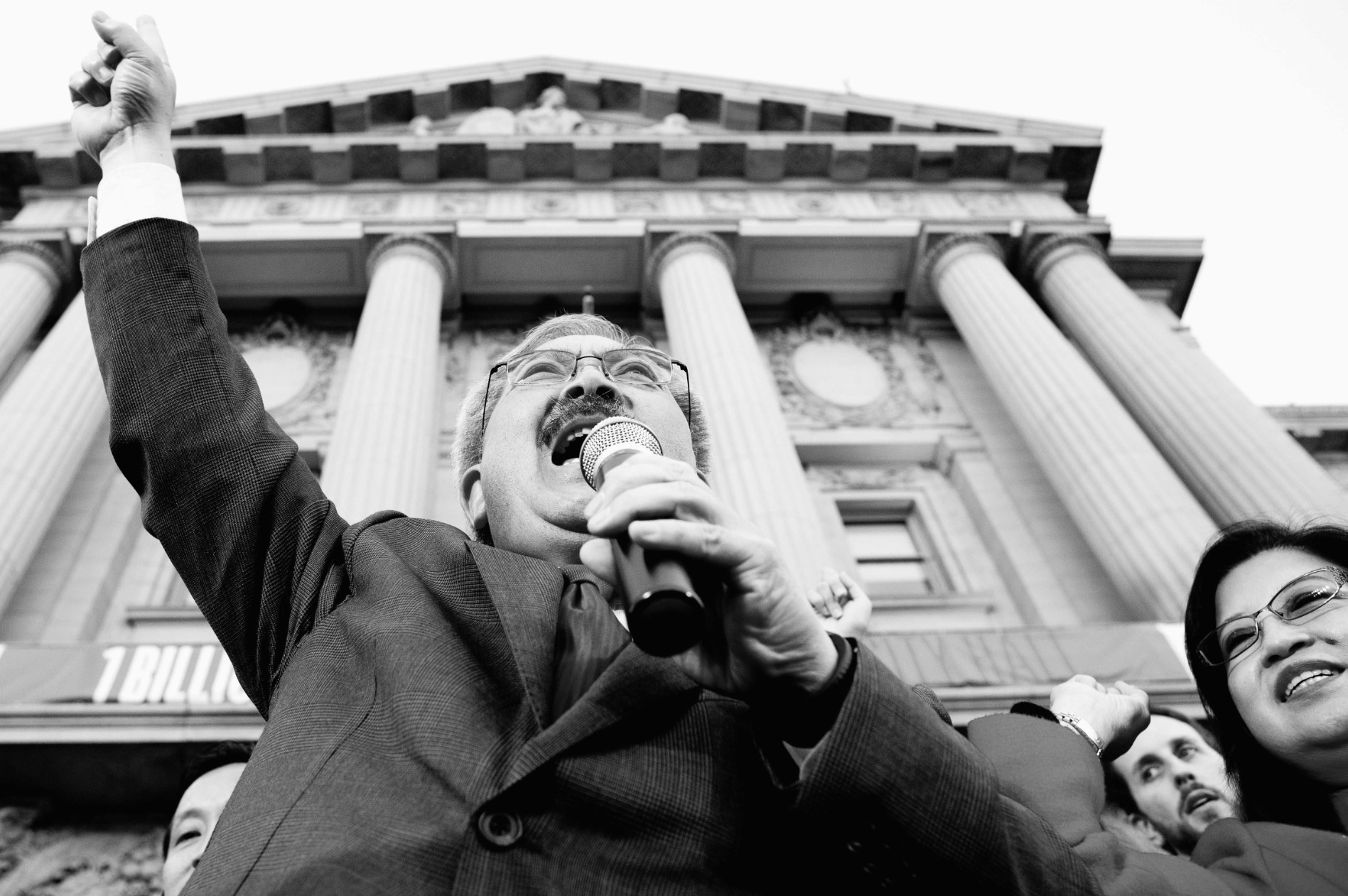
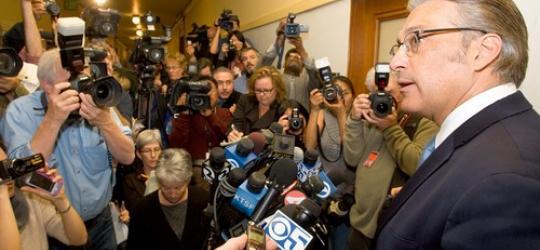
Mayor Ed Lee

Randy Shaw just loves Capitalism

215

Well: We all know that Randy Shaw, director of the Tenderloin Housing Clinic and editor of BeyondChron, is a loyal, devoted fan of Mayor Ed Lee. We know that he pretty much sees no wrong in the Lee Administration. But his attack on the Chron’s John King for daring to say that there’s a lack of planning on the waterfront is remarkable not only because there IS a lack of planning on the waterfront but because Shaw’s position is essentially that King is (gasp) anti-Captialist.

Seriously:

Ultimately, King’s critique is more directed at the U.S. capitalist system than to Mayor Lee, his predecessors, or other urban mayors. Private developers have long called the shots in urban America because the government does not go into the lucrative business of building and operating office buildings, luxury housing or tourist hotels. In the absence of government development, private interests determine what gets built. And when planners decide, under King’s favored approach, to dictate land use policies for a certain area, success is dependent on attracting private investment.

 Randy: The whole concept of city planning is “dictating land use policies for a certain area.” That’s not just King’s favored approach; it’s the essence of how progressive cities operate. Yes, you (sadly) have to attract private investment, but you don’t have to let the private developers lead the way. You can say: This is the kind of city we want; if you want to build here, build to our terms.

If you don’t do that, you become the wild west.

I’m surprised how far Randy Shaw has moved to the right on development issues in the past year; this piece could have been written by the folks at SPUR. Everything is about serving the needs of the private sector.

So BeyondChron is now the voice of the developers, and the Chronicle is the one raising the critical issues. What an odd world this has become.


The Chron discovers the lack of waterfront planning

12

So the Chronicle’s John King (who’s generally not a bad architecture critic and really seems to understand city planning) finally discovered something that some of us have been talking about for months: There’s no comprehensive planning on the waterfront. Instead, it’s all developer-driven projects that make little sense as part of a well-thought-out future for the area.

Once again, we are hampered by the Chron’s paywall, so unless you subscribe you can’t read the whole story. But here’s the gist of it:

Instead of mapping out how the next frontiers of growth should be filled in, Mayor Ed Lee’s administration is letting developers frame the debate. They select a site, cook up a proposal and then see what will fly.

He notes that there are good touches in the new Warriors proposal, although:

[N]obody envisioned an 18,000-seat arena on a pier until the Warriors called City Hall. The team loved the glamour of the camera-friendly location. The Lee administration saw a chance to fill a void left open when the America’s Cup organizers shifted gears. …. the whole effort is aimed at soothing objections to what the team owners want. It isn’t connected to a pre-existing vision of what this part of the city could be.

There have been successful community-based planning efforts in other parts of town. But the waterfront — which is unique and immensely valuable — is nothing but a collection of projects that developers want. And Lee is going along:

Today, instead, we have a mayor’s office that wants to make things happen. Progress is measured in terms of construction jobs, housing units and new buildings that might lure the likes of Google up north. Planners on the city and state payrolls are put in the reaction mode, massaging the details the best they can.If this continues, some of what gets built could be terrific.Some of it could also be an alien presence in the city around it. And that’s not a legacy that any mayor should want.

It’s all too reminiscent of Dot-Com Boom I, when Willie Brown was in charge and city planning was driven entirely by campaign money. Highrise office buidlings in the residential Mission? No problem — just wave the dollars in front of the mayor. Not saying Lee is that corrupt — but he’s so excited about building stuff that he can’t bother to take a step back and ask: Is this the city we really want?


Nice to know our tech friends aren’t paying taxes

9

Since Mayor Ed Lee has decided that tech companies are the future of San Francisco, it’s nice to note that these outfits are often no better than the cheating robber barons of old — or the modern Leona Helmsleys. The Campaign for America’s Future notes that Apple dodged a $9.2 billion tax bill that would have been enough to cover most of the sequester cuts this spring. Notes Isaiah Poole:

Apple makes great products, but the obscenity of its use of the tax code to avoid paying its fair share for the functions of government that make its success possible is only exceeded by the tax code itself and the nexus of ideology and corporate greed that created it.

Only the little people pay taxes.

Bike hot spots

16

steve@sfbg.com

When a four-year-long court injunction against new bicycling improvement projects in San Francisco was finally lifted in 2010, there was great hope in the cycling community that the city would rapidly move forward on completing its long-planned network of bike lanes.

Feeding that optimism, Mayor Ed Lee, Board President David Chiu, and other top officials set ambitious goals to increase cycling, even though they did little to provide funding that was up to the task or overcome political opposition that inevitably arises to projects that take space from cars (see “20 percent by 2020,” 5/8/12).

San Francisco is still a long way from emerging into even double-digits in terms of the percentage of vehicle trips taken by bike, and a big part of that is many people don’t feel safe or comfortable fighting with cars for space on the roads. They want bike lanes throughout the city, ideally more of the physically separated cycletracks that debuted a few years ago on Market Street.

So, on Bike to Work Week 2013, we’re taking a look some of the cycling hot spots in the city, places where the San Francisco Bicycle Coalition and other advocates have been pushing for pivotal bike safety improvements, the opposition they’ve encountered, and the status on those improvements.

Polk Street: This has become the hottest of hot spots in recent weeks, with an SFMTA plan for cycletracks shot down by local residents and businesses who complained about the loss of parking spaces on this narrow and increasingly congested corridor. SFBC is organizing to restore the bike lanes, starting with a May 14 event at its office.

Masonic Boulevard: Cars turning left from Fell onto Masonic, which bisects the bike-friendly Panhandle, used to be one of the most dangerous spots in the city, a problem that was largely solved with a special bike-signal light. Next, the SFMTA is proposing to take a lane from cars on that fast-moving thoroughfare and install bikes lanes all the way to Geary, with important funding decisions on that project coming up this summer.

Fell and Oak Streets: There’s finally been some recent progress to this short but important east-west connection after years of delays and broken promises. Cycletracks on each busy street to connect the Wiggle to the Panhandle were approved in October, with an appeal denied the next month as Fell got new striping. But it was only in the last week that Oak finally got two blocks of temporary bike lanes, with parking spaces still standing in the way of the final block.

Second Street: After years of political haggling and community meetings, the SFMTA is finally on the verge of approving bicycle and pedestrian improvements on this dangerous car-clogged artery. The latest plans call for one-way cycletracks running next to the sidewalks on both sides of the street separated by a raised median with street trees separating riders from rows of parked and moving cars. Look for community meetings on the project in June.

Caesar Chavez Boulevard: This busy street got some much needed improvements earlier this year, with good bike lanes on the eastern portion, clearer signage for automobiles approaching the confusing maze as Chavez crosses I-280, and pedestrian safety improvements. Now the city just needs to continue what it started and complete the bike-lane link all the way to Valencia.

Market Street: Cyclist demand is causing mini Critical Masses everyday during the morning and evening commutes on mid-Market Street. Yet despite the fact that the last two mayors long ago called for private cars to be removed from this showplace thoroughfare, Market is a traffic mess and will probably remain so for awhile without fresh political will. The Better Market Street project has delayed improvements to 2017, and its planners this year offered the daffy idea of banning bikes from Market and forcing them over to Mission.

Mansell Street: Improving people’s ability to safely ride bikes to and through McLaren Park, the SFMTA has designed and approved a road diet along Mansell that includes a two-way cycletrack and pedestrian path from Brazil to University, after a series of multilingual community meetings.

Embarcadero: To help improve access to and views of the waterfront during this year’s America’s Cup, the SFBC is aggressively pushing for a pilot project with a two-way cycletrack along the bay side of the roadway. Meanwhile, the SFMTA is now doing a long-term transportation study that will inform approval of the Warriors Arena and the Giants/Anchor Stream development at Pier 48, which will hopefully fund the Blue-Greenway bike path along the waterfront.

Condo bypass legislation now before the full board

196

Controversial condominium lottery bypass legislation — sponsored by Sups. Mark Farrell and Scott Wiener but substantially modified by tenant group that strongly opposed the original legislation, with the help of Sup. David Chiu, Jane Kim, and Norman Yee — is finally coming to the full Board of Supervisors today (Tues/7, starting at 2pm).

Those involved in the negotiations say the legislation will likely to be returned to the Land Use Committee because of amendments being introduced today that the City Attorney’s Office has deemed substantial enough to require another public hearing. [UPDATE: The board voted unanimously to send this back to committee, which will consider it on Monday the 13th].They include a provision pushed by tenant groups that would scuttle the lottery bypass if the 10-year lottery moratorium is challenged in court. 

That moratorium was pushed by tenants and their supporters as a tradeoff for letting a backlog of around 2,000 tenancy-in-common owners buy their way out of the city’s lottery for the annual allowed conversion of 200 TICs into condominiums, which are more valuable and easier to sell and finance than TICs.

Farrell told the Guardian late last week that he was still negotiating with both sides and hopeful that he might be able to support the legislation, despite the hostile amendments that Chiu made which were opposed by Farrell and Wiener in committee.

San Francisco Tenants Union head Ted Gullicksen told us that the tenants’ side was willing to accept a couple of the technical amendments that Farrell proposed during negotiations with them, including exempting from the bypass fee the 19 building that have awaited conversion the longest and allowing some owner-occupier changes as the bypass is phased in over six years.

He said Farrell also proposed that if less than 2,000 condos opt for the bypass, then the difference in numbers would be added to the allowable number of condos in the first year that the lottery is restored, which the tenants’ groups haven’t yet agreed to.

Farrell and Wiener are also expected to offer other amendments, but the tenant groups have said they’ve gone as far as they’re willing to in allowing any increase in condo conversions, and they seem to have six solid votes lined up on the board.

Yet it’s still an open question how new amendments might affect those political dynamics, how the real estate industry (which simply wants as many condo conversions as possible) will respond, whether Mayor Ed Lee (who has avoided taking a position on the legislation) will sign or veto whatever emerges, and whether whoever is left unsatisfied by this deal will try to go to the ballot.

In other words, there may be some tricky political maneuvering ahead, so stay tuned. 

Chiu and Herrera roll up their sleeves for spring cleaning in City Hall

For some time now, oft-labeled “power brokers” with undue influence in San Francisco city government have taken heat for failing to register as lobbyists. At the same time, politically connected insiders are often criticized for manipulating the permitting process for major real estate developments far outside the public gaze.

It’s said that sunshine is the best disinfectant. Yesterday, City Attorney Dennis Herrera and Board of Supervisors President David Chiu introduced a package of reforms designed to shed more light on lobbyists’ practices.

The new set of rules would tighten up lobbying regulations, create new disclosure rules for developers and their lobbyists, create more oversight around city contracting and grant-making, and require the publication of a guide for campaign donors spelling out Ethics laws regarding campaign contributions.

“We’re not demanding of anybody else anything different than we would demand of ourselves,” Herrera said, adding that he and Chiu had been working on drafting the proposal for months.

Chiu and Herrera both vied for the city’s highest office in competition with Mayor Ed Lee in 2011. Since beginning his term as mayor, Lee has drawn sharp criticism for his cozy relationships with former San Francisco Mayor Willie Brown, Chinatown consultant Rose Pak and a handful of others who are not registered as lobbyists.

Without mentioning anyone by name, Chiu noted, “I do think there are individuals who have not registered as lobbyists who probably should.”

The proposed rules would broaden the definition of “lobbyist” under the city’s Ethics regulations. The new definition would include “any individual who makes contact with” an elected official on behalf of an employer or anyone else paying them “for lobbyist services.” If someone makes $1,000 or more per month for lobbying, that person would be considered a lobbyist under the law.

The new legislation would also create new disclosure requirements for “permit expediters,” who work on behalf of developers to hasten the permitting process for major real estate construction. They would have to register with the city’s Ethics Commission and file regular reports about their contacts with city officials. Developers with major planning projects in the pipeline would also have to disclose donations of $5,000 or more to city-based nonprofits.

Chiu noted that he and Herrera had consulted with Friends of Ethics, a group of government accountability advocates that’s been pushing for Ethics reform, for help drafting the proposal.

Chiu and Herrera also acknowledged that better enforcement of existing laws was needed in addition to the proposed legislative reforms. “Our city could be more proactive in enforcing our Ethics laws to the fullest,” Chiu said. “Not just the letter of the law, but the spirit of the law.”

Check, please

44

steve@sfbg.com

San Francisco restaurants that have been cheating their customers and employees — charging diners for city-required healthcare coverage that they aren’t fully providing to workers — will finally be exposed in the coming weeks, with some notable names in foodie circles among the likely culprits.

City Attorney Dennis Herrera is working on settlements with dozens of restaurants that responded to his investigation and partial amnesty offer, which had an April 10 deadline. His effort augments the complaint-driven enforcement actions by the city’s Office of Labor Standards Enforcement, which has collected millions of dollars for thousands of employees of negligent local businesses in recent years.

At issue is the Healthcare Security Ordinance, the landmark 2008 law authored by then-Sup. Tom Ammiano that requires San Francisco businesses to provide a minimal level of healthcare benefits to their workers. Businesses are also required to report spending and surcharge figures to the OLSE annually, with the next report due April 30.

Last year’s data show celebrity chef Michael Mina’s Mina Group LLC — which includes the restaurants Michael Mina, RN74, Bourbon Steak, and Clock Bar — to be the top violator, collecting $539,806 in surcharges from customers and spending just $211,809 on employee healthcare.

Herrera used that list to ask more than 70 businesses to show they are in compliance with the law or reach discounted settlements now to avoid punitive fines or criminal charges later, and Herrera told us he received 60 responses and had his inquiry snubbed by fewer than a dozen.

“It’s too early to talk about how large a recovery we’ll be getting for workers, but I’m pleased with the response rate,” Herrera told us. He refused to estimate how many of the respondents were found to be in violation, but in an April 11 message to reporters covering the issue, his spokesperson Matt Dorsey wrote, “Based on our investigation so far, we anticipate that the majority of these establishments will be required to pay money to compensate their workers.”

WHAT THE FIGURES SHOW

The Guardian contacted many of the restaurants that topped the OLSE list. Some wouldn’t respond, some said they’ve changed their policies since the controversy erupted, and some wouldn’t talk until after a settlement is announced — including the Mina Group. That seems to indicate they’re about to pay for past violations.

Nicole Kraft, who handles public relations for the Mina Group, responded to Guardian inquires by writing, “I wanted to let you know that Mina Group will soon be releasing a joint statement with the City Attorney’s office, which should answer many of your questions. We’ll be sure to send it your way ASAP.” [UPDATE 4/29: Mina Group settled its case for $83,617.]

Sources in the City Attorney’s Office say settlements with as many as 10 restaurants that admit clear violations of the HCSO could be announced in the next week or two, while another 10 or so have provided data showing they are not in violation. The rest are more complicated and could take weeks or months of investigations, which are being led by Deputy City Attorney Sarah Eisenberg.

“There are going to be some that are given a clean bill of health,” Herrera told us. Herrera also told us that his investigation is just getting started and that it will look at businesses that haven’t made required annual reports to the OLSE. “When we get to a place where we’re announcing settlements, we’ll have more to say,” he said when asked for details and dimensions of his investigation.

GGRA Executive Director Rob Black has maintained that the OLSE figures don’t accurately reflect whether businesses are in compliance because the reporting requirements are confusing. GGRA held a compliance workshop on April 17, and Black told us about 40 restaurateurs attended.

“It was very informative and we got really good feedback from the restaurants,” Black told us. “We had people saying, ‘knowing what I know now, we should redo my 2011 form because I did it wrong.”

Black was initially critical of Herrera’s focus on the restaurant industry, but told us last week, “He made a commitment that the process would be efficient and fair, and he’s lived up to that so far….I still believe that the majority [of violators] didn’t have a mal-intent…Many people on the list that was reported have done nothing wrong.”

Cheesecake Factory — which was seventh on last year’s OLSE list, allegedly taking in $159,242 more in surcharges than it spent on employee health care — insists that it is in compliance and expects the City Attorney’s Office to confirm that.

“We believe the City Attorney’s initial review was erroneous,” Richard J. Frings, the company’s vice president of compensation and benefits, told us. “We are in full compliance with HCSO. Our healthcare costs in San Francisco have far exceeded the surcharge that we have collected. Once the City Attorney’s office has an opportunity to review our filings, we believe this matter will be closed without any further action.” He refused to provide figures to support the assertions.

THE HSA PROBLEM

Most of the restaurants that have been accused of stiffing employees use health savings accounts, which health officials say is a far worse option than private health insurance or the city’s Healthy San Francisco plan, which was created in conjunction with HCSO. Federal law bars cities from prescribing how health benefits are delivered.

San Francisco’s restaurant industry has always been hostile to the HCSO’s employer mandate, with the Golden Gate Restaurant Association unsuccessfully challenging the law all the way to the US Supreme Court. Controversy then erupted in 2011 with revelations (first in the Wall Street Journal, followed up by local media outlets) that some of the city’s most high-profile restaurants were shirking their responsibilities even as they charged diners 3 percent to 5 percent surcharges, sometimes essentially pocketing that money at the end of each year.

That verges on consumer fraud, but District Attorney George Gascon has refused to investigate, telling the Guardian and other papers that he was deferring to the OLSE and the City Attorney’s Office.

In 2011, a progressive-led majority on the Board of Supervisors passed legislation authored by Sup. David Campos to require that businesses keep the money they are required to spend on employee healthcare — which is currently $2.33 per employee-hour for large companies or $1.55 per employee-hours for businesses with less than 100 employees — for employees to use as needed.

But under aggressive lobbying by the GGRA and San Francisco Chamber of Commerce — which asserted the right of business owners to raid these funds, calling the set-aside a multi-million-dollar annual loss to the local economy — Mayor Ed Lee vetoed the measure. He later signed watered-down legislation requiring the money be set aside for two years, setting standards for letting employees know how to access the funds, and explicitly calling for all customer surcharges to remain in escrow accounts.

The OLSE, which also monitors compliance with the city’s paid sick leave and minimum wage laws, can only investigate businesses when an employee files a complaint. But then complaints trigger investigations that cover all of a given business’s employees, who are often compensated for past violations. To file a complaint, just write hcso@sfgov.org or call (415) 554-7892.

OLSE figures show the agency has investigated more than 100 complaints since 2008, resulting in $8.1 million in health care benefits provided to more than 6,400 employees and $244,000 in penalties paid to the city. Herrera’s office also reached a $320,000 settlement with the owners of Patxi’s Chicago Pizza in January, just before announcing his broader investigation.

“The vast majority of San Francisco employers have complied with their obligation to make health care expenditures pursuant to the HCSO,” OLSE Manager Donna Levitt told the Guardian. “With respect to the minority of businesses who fail to meet their obligations, the OLSE works tirelessly to ensure that workers receive the benefits to which they are entitled and that all businesses compete on a level playing field.”

Among the restaurants near the top of the OLSE list that did not respond to the Guardian inquires are Squat & Gobble, Wayfare Tavern, and Trinity Building Services.

“We are actually in complete compliance,” Larry Bouchard, manager of One Market restaurant, told us, explaining its inclusion on the OLSE list by saying, “It’s my understanding that we reported the wrong information.” He said the restaurant uses health savings accounts, but that they are widely used by employees, who get their expenditures repaid within three weeks.

Scott Carr, general manager of Boulevard — who sources say was one of the first restaurants to use the healthcare surcharges on customer bills, and whose parent company, Reroute LLC, was fifth on the OLSE list, underspending by $169,777 — told us the figures didn’t fully reflect the company’s spending on employee health care.

He wouldn’t say whether the company will be settling with Herrera for any past violations, but he did say that the restaurants decided to abandon health savings accounts in favor of health insurance policies for employees starting on Jan. 1. As he told us, “We feel we’ve made a positive step.”

“Street Fight” examines the politics of mobility in San Francisco

16

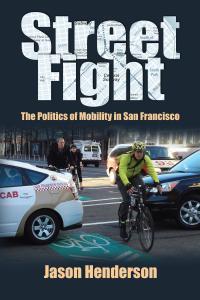
Ideology plays a bigger role in shaping San Francisco than most people realize, as we’ve discussed in this space before. Nowhere is that more true than in the politics of land use and transportation, as my friend Jason Henderson, a San Francisco State University geography professor, discusses in his insightful new book, Street Fight: The Politics of Mobility in San Francisco.

He’ll be discussing his work this Friday, April 19, from 7-9pm during a book launch party hosted by Green Arcade Bookstore across the street at the upstairs loft space of McRoskey Mattress, 1687 Market. Or if you miss that but want to join the discussion, you can catch Henderson’s forum on May 15 at SFSU or what will surely be other local events on this pivotal topic.

Henderson chronicles the seminal events in San Francisco’s history with “automobility” and related transportation issues, from the freeway revolts of the late ’50s through 2000 to today’s continuing political struggles over parking, bicycles, livability, gentrification, and the form, function, and financing of Muni.

Yet the lens that Henderson brings to understanding all of these issues and struggles is ideology, which he breaks down into three major categories: progressive, neoliberal, and conservative. Whether we realize it or not, we can all be fairly easily placed in one of those three categories when it comes to how we think about automobility, or the primacy of cars in modern life.

“A progressive framework conceptualizes mobility as a systemic problem that requires deep social commitment and responsibility. How we get there matters. It posits that there can be too much mobility, as exemplified by high levels of [Vehicle Miles Traveled] in the United States, and that excessive mobility results in both environmental degradation and major social inequality at a local, state, and global scale. The main problem, obviously, is that automobility is part of a wider, systemic moral and social problem of over-consumption and disproportionate materialism,” Henderson writes, sounding themes that I echoed in this week’s cover story.

On the other end of the ideological spectrum are those with conservative views on mobility, who see driving as a basic right, which is the dominant mindset on the west side of supposedly liberal San Francisco. “Unlike progressives, conservatives do not think about responsibility as relating to broader systems such as the economic structure of society. Instead, they think in terms of direct causation and of each individual being responsible for the consequences of his or her actions. For example, poverty is a result of individual shortcomings caused by personal and moral characteristics, not of structural themes like socioeconomic forces beyond an individual’s control. Getting to work on time and providing one’s daily needs are not collective concerns but the responsibility of the individual,” he writes.

Of course, these conservatives still rely on government to build and maintain their transportation infrastructure, which they believe should be centered around cars. “Government should guarantee and accommodate automobility, not seek to discourage it or make it more expensive. Government-sponsored road building and other explicit policies that encourage motoring reflect an optimal use of government to stabilize conservative social relations centered on automobility,” Henderson write of the conservative mindset.

Between those two poles are the neoliberals, who have come to dominate City Hall, particularly in the last few years with the ascendancy of Mayor Ed Lee, Board President David Chiu, and Sup. Scott Wiener, who has taken the lead role on transportation issues. Neoliberals rely on market-based solutions to almost any problem, and they end up partnering with either conservatives or progressives in the politics of mobility depending on the issue.

“Neoliberals, consistent with the broader agenda of the privatization of space and market-based pricing of public access to space, envision a mobility system shaped by pricing and markets rather than by regulation and collective action. Unlike progressives, neoliberals feel the built environment must be allowed to develop with the efficacy of the market. Movement, paid for by the individual user, should be unrestrained. Yet such efficacy can include a commodification of nonmovement or slower movement or the package of quality-of-life goods surrounding the ‘walkability’ and ‘livability’ of the city, a package reserved for those who can afford to enter. To that end, neoliberal mobility includes the aggressive use of government to both enhance mobility and rein it in, but only inasmuch as government policy helps realize the goals of profit and facilitating economic growth and development,” Henderson writes.

It’s fascinating to explore how these three distinct mindsets have shaped San Francisco in recent decades, and how they interact today to create the city that we’ll be moving through in the future.

Indicator city

74

steve@sfbg.com

When biologists talk about the health of a fragile ecosystem, they often speak of an “indicator species.” That’s a critter — a fish, say, or a frog — whose health, or lack thereof, is a signal of the overall health of the system. These days, when environmentalists who think about politics as well as science look at San Francisco, they see an indicator city.

This progressive-minded place of great wealth, knowledge, and technological innovation — surrounded on three sides by steadily rising tides — could signal whether cities in the post-industrial world will meet the challenge of climate change and related problems, from loss of biodiversity to the need for sustainable energy sources.

A decade ago, San Francisco pioneered innovative waste reduction programs and set aggressive goals for reducing its planet-cooking carbon emissions. At that point, the city seemed prepared to make sacrifices and provide leadership in pursuit of sustainability.

Things changed dramatically when the recession hit and Mayor Ed Lee took office with the promise to focus almost exclusively on economic development and job creation. Today, even with the technology and office development sectors booming and employment rates among the lowest in California, the city hasn’t returned its focus to the environment.

In fact, with ambitious new efforts to intensify development along the waterfront and only lackluster support for the city’s plan to build renewable energy projects through the CleanPowerSF program, the Lee administration seems to be exacerbating the environmental challenge rather than addressing it.

According to conservative projections by the Bay Conservation and Development Commission, the Bay is expected to rise at least 16 inches by 2050 and 55 inches by the end of the century. BCDC maps show San Francisco International Airport and Mission Bay inundated, Treasure Island mostly underwater, and serious flooding the Financial District, the Marina, and Hunters Point.

Lee’s administration has commissioned a report showing a path to carbon reduction that involves promoting city-owned renewable energy facilities and radically reducing car trips — while the mayor seems content do the opposite.

It’s not an encouraging sign for Earth Day 2013.


HOW WE’RE DOING

Last year, the Department of the Environment hired McKinsey and Company to prepare a report titled “San Francisco’s Path to a Low-Carbon Economy.” It’s mostly finished — but you haven’t heard much about it. The department has been sitting on it for months.

Why? Some say it’s because most of the recommendations clash with the Lee administration’s priorities, although city officials say they’re just waiting while they get other reports out first. But the report notes the city is falling far short of its carbon reduction goals and “will therefore need to complement existing carbon abatement measures with a range of new and innovative approaches.”

Data presented in the report, a copy of which we’ve obtained from a confidential source, shows that building renewable energy projects through CleanPowerSF, making buildings more energy-efficient, and discouraging private automobile use through congestion pricing, variable-price parking, and building more bike lanes are the most effective tools for reducing carbon output.

But those are things that the mayor either opposes and has a poor record of supporting or putting into action. The easy, corporate-friendly things that Lee endorses, such as supporting more electric, biofuel, and hybrid vehicles, are among the least effective ways to reach the city’s goals, the report says.

“Private passenger vehicles account for two-fifths of San Francisco’s emissions. In the short term, demand-based pricing initiatives appear to be the biggest opportunity,” the report notes, adding a few lines later, “Providing alternate methods of transport, such as protected cycle lanes, can encourage them to consider alternatives to cars.”

Melanie Nutter, who heads the city’s Department of the Environment, admits that the transportation sector and expanding the city’s renewable energy portfolio through CleanPowerSF or some other program — both of which are crucial to reducing the city’s carbon footprint — are two important areas where the city needs to do a better job if it’s going to meet its environmental goals, including the target of cutting carbon emissions 40 percent from 1990 levels by the year 2025.

But Nutter said that solid waste reduction programs, green building standards, and the rise of the “shareable economy” — with Internet-based companies facilitating the sharing of cars, housing, and other products and services — help San Francisco show how environmentalism can co-exist with economic development.

“San Francisco is really focused on economic development and growth, but we’ve gone beyond the old edict that you can either be sustainable or have a thriving economy,” Nutter said.

Yet there’s sparse evidence to support that statement. There’s a two-year time lag in reporting the city’s carbon emissions, meaning we don’t have good indicators since Mayor Lee pumped up economic development with tax breaks and other city policies. For example, Nutter touted how there’s more green buildings, but she didn’t have data about whether that comes close to offsetting the sheer number of new energy-consuming buildings — not to mention the increase in automobile trips and other byproducts of a booming economy.

Tom Radulovich, executive director of Livable City and president of the BART board, told us that San Francisco seems to have been derailed by the last economic crisis, with economic insecurity and fear trumping environmental concerns.

“All our other values got tossed aside and it was all jobs, jobs, jobs. And then the crisis passed and the mantra of this [mayoral] administration is still jobs, jobs, jobs,” he said. “They put sustainability on hold until the economic crisis passed, and they still haven’t returned to sustainability.”

Radulovich reviewed the McKinsey report, which he considers well-done and worth heeding. He’s been asking the Department of the Environment for weeks why it hasn’t been released. Nutter told us her office just decided to hold the report until after its annual climate action strategy report is released during Earth Day event on April 24. And mayoral Press Secretary Christine Falvey told us, “There’s no hold up from the Mayor’s Office.”

Radulovich said the study highlights how much more the city should be doing. “It’s a good study, it asks all the right questions,” Radulovich said. “We’re paying lip service to these ideas, but we’re not getting any closer to sustainability.”

In fact, he said the promise that the city showed 10 years ago is gone. “Gavin [Newsom] wanted to be thought of as an environmentalist and a leader in sustainability, but I don’t think that’s important to Ed Lee,” Radulovich said.

Joshua Arce, who chairs the city’s Environmental Commission, agreed that there is a notable difference between Newsom, who regularly rolled out new environmental initiatives and goals, and Lee, who is still developing ways to promote environmentalism within his economic development push.

“Ed Lee doesn’t have traditional environmental background,” Arce said. “What is Mayor Lee’s definition of environmentalism? It’s something that creates jobs and is more embracing of economic development.”

Falvey cites the mayor’s recent move of $2 million into the GoSolar program, new electric vehicle charging stations in city garages, and his support for industries working on environmental solutions: “Mayor Lee’s CleantechSF initiative supports the growth of the already vibrant cleantech industry and cleantech jobs in San Francisco, and he has been proactive in reaching out to the City’s 211 companies that make up one of the largest and most concentrated cleantech clusters in the world.”

Yet many environmentalists say that simply waiting for corporations to save the planet won’t work, particularly given their history, profit motives, and the short term thinking of global capitalism.

“To put it bluntly, the Lee administration is bought and paid for by PG&E,” said Eric Brooks with Our City, which has worked for years to launch CleanPowerSF and ensure that it builds local renewable power capacity.

The opening of the McKinsey report makes it clear why the environmental policies of San Francisco and other big cities matter: “Around the globe, urban areas are becoming more crowded and consuming more resources per capita,” it states. “Cities are already responsible for roughly seventy percent of global carbon dioxide emissions, and as economic growth becomes more concentrated in urban centers, their total greenhouse gas emissions may double by 2050. As a result, tackling the problem of climate change will in large part depend on how we reduce the greenhouse gas emissions of cities.”

And San Francisco, it argues, is the perfect place to start: “The city now has the opportunity to crystallize and execute a bold, thoughtful strategy to attain new targets, continue to lead by example, and further national and global debates on climate change.”

The unwritten message: If we can’t do it here, maybe we can’t do it anywhere.


ON THE EDGE

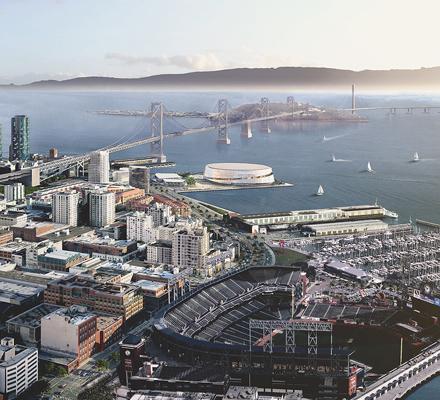
San Francisco’s waterfront is where economic pressures meet environmental challenges. As the city seeks to continue with aggressive growth and developments efforts on one side of the line — embodied recently by the proposed Warriors Arena at Piers 30-32, 8 Washington and other waterfront condo complexes, and other projects that intensify building along the water — that puts more pressure on the city to compensate with stronger sustainability initiatives.

“The natural thing to do with most of our waterfront would be to open it up to the public,” said Jon Golinger, who is leading this year’s referendum campaign to overturn the approval of 8 Washington. “But if the lens you’re looking through is just the balance sheet and quarterly profits, the most valuable land maybe in the world is San Francisco’s waterfront.”

He and others — including SF Waterfront Alliance, a new group formed to oppose the Warriors Arena — say the city is long overdue in updating its development plan for the waterfront, as Prop. H in 1990 called for every five years. They criticize the city and Port for letting developers push projects without a larger vision.

“We are extremely concerned with what’s happening on our shorelines,” said Michelle Myers, director of the Sierra Club’s Bay Chapter, arguing that the city should be embracing waterfront open space that can handle storm surge instead of hardening the waterfront with new developments. “Why aren’t we thinking about those kinds of projects on our shoreline?”

David Lewis, director of Save the Bay, told us cities need to think less about the value of waterfront real estate and do what it can to facilitate the rising bay. “There are waterfront projects that are not appropriate,” Lewis said. Projects he puts in that category range from a scuttled proposal to build around 10,000 homes on the Cargill Salt Flats in Redwood City to the Warriors Arena on Piers 30-32.

“We told the mayor before it was even announced that it is not a legal use of the pier,” Lewis said, arguing it violated state law preserving the waterfront for maritime and public uses. “There’s no reason that an arena has to be out on the water on a crumbling pier.”

But Brad Benson and Diana Oshima, who work on waterfront planning issue for the Port of San Francisco, say that most of San Francisco’s shoreline was hardened almost a century ago, and that most of the planning for how to use it has already been done.

“You have a few seawall lots and a few piers that could be development sites, but not many. Do we need a whole plan for that?” Benson said, while Oshima praises the proactive transportation planning work now underway: “There has never been this level of land use and transportation planning at such an early stage.”

The Bay Conservation and Development Commission was founded almost 50 years ago to regulate development in and around the Bay, when the concern was mostly about the bay shrinking as San Francisco and other cities dumped fill along the shoreline to build San Francisco International Airport, much of the Financial District, and other expansive real estate plans.

Now, the mission of the agency has flipped.

“Instead of the bay getting smaller, the bay is getting larger with this thing called sea level rise,” BCDC Executive Director Larry Goldspan said as we took in the commanding view of the water from his office at 50 California Street.

A few years ago, as the climate change predictions kept worsening, the mission of BCDC began to focus on that new reality. “How do we create a resilient shoreline and protect assets?” was how Goldspan put it, noting that few simply accept the inundation that BCDC’s sea level rise maps predict. “Nobody is talking about retreating from SFO, or Oakland Airport, or BART.”

That means Bay Area cities will have to accept softening parts of the shoreline — allowing for more tidal marshes and open space that can accept flooding in order to harden, or protect, other critical areas. The rising water has to go somewhere.

“Is there a way to use natural infrastructure to soften the effect of sea level rises?” Goldspan asked. “I don’t know that there are, but you have to use every tool in the smartest way to deal with this challenge.”

And San Francisco seems to be holding firm on increased development — in an area that isn’t adequately protected. “The seawall is part of the historic district that the Port established, but now we’re learning the seawall is too short,” Goldspan said.

BCDC requires San Francisco to remove a pier or other old landfill every time it reinforces or rebuilds a pier, on a one-to-one basis. So Oshima said the district is now studying what it can remove to make up for the work that was done to shore up Piers 23-27, which will become a new cruise ship terminal once the America’s Cup finishes using it a staging ground this summer.

Yet essentially giving up valuable waterfront real estate isn’t easy for any city, and cities have both autonomy and a motivation to thrive under existing economic realities. “California has a history of local control. Cities are strong,” Goldspan said, noting that sustainability may require sacrifice. “It will be a policy discussion at the city level. It’s a new discussion, and we’re just in the early stages.”


NEW WORLD

Global capitalism either grows or dies. Some modern economists argue otherwise — that a sustainable future with a mature, stable economy is possible. But that takes a huge leap of faith — and it may be the only way to avoid catastrophic climate change.

“In the world we grew up in, our most ingrained economic and political habit was growth; it’s the reflex we’re going to have to temper, and it’s going to be tough.” Bill McKibben writes in Eaarth: Making a Life on a Tough New Planet. “Across partisan lines, for the two hundred years since Adam Smith, we’ve assumed that more is better, and that the answer to any problem is another burst of expansion.”

In a telephone interview with the Guardian, McKibben discussed the role that San Francisco could and should be playing as part of that awakening.

“No one knows exactly what economy the world is moving toward, but we can sense some of its dimensions: more localized, less material-based, more innovative; these are things that San Francisco is good at,” he told us, noting the shift in priorities that entails. “We need to do conservation, but it’s true that we also need to build more renewable power capacity.”

Right now, CleanPowerSF is the only mechanism the city has for doing renewable energy projects, and it’s under attack on several fronts before it even launches. Most of the arguments against it are economic — after all, renewable power costs more than coal — and McKibben concedes that cities are often constrained by economic realities.

Some city officials argue that it’s more sustainable for San Francisco to grow and develop than suburban areas — thus negating some criticism that too much economic development is bad for the environment — and Radulovich concedes there’s a certain truth to that argument.

“But is it as green as it ought to be? Is it green enough to be sustainable and avert the disaster? And the answer is no,” Radulovich said.

For example, he questioned, “Why are we building 600,000 square feet of automobile-oriented big box development on Hunters Point?” Similarly, if San Francisco were really taking rising seas seriously, should the city be pouring billions of dollars into housing on disappearing Treasure Island?

“I think it’s a really interesting macro-question,” Jennifer Matz, who runs the Mayors Office of Economic Development, said when we asked whether the aggressive promotion of economic development and growth can ever be sustainable, or whether slowing that rate needs to be part of the solution. “I don’t know that’s feasible. Dynamic cities will want to continue to grow.”

Yet that means accepting the altered climate of new world, including greatly reduced fresh water supplies for Northern California, which is part of the current discussions.

“A lot of the focus on climate change has moved to adaptation, but even that is something we aren’t really addressing,” Radulovich said.

Nutter agreed that adapting to the changing world is conversation that is important: “All of the development and planning we’re doing today needs to incorporate these adaptation strategies, which we’re just initiating.”

But environmentalists and a growing number of political officials say that San Francisco and other big cities are going to need to conceive of growth in new ways if they want to move toward sustainability. “The previous ethos was progress at any cost — develop, develop, develop,” Myers said, with the role of environmentalists being to mitigate damage to the surrounding ecosystem. But now, the economic system itself is causing irreversible damage on a global level. “At this point, it’s about more than conservation and protecting habitat. It’s about self-preservation.”


Warriors Arena proposal rouses supporters and opponents

72

UPDATED Rival teams have formed in the last week to support and oppose the proposed Warriors Arena at Piers 30-32 as the California Legislature considers a new bill to approve the project, a new design is about to be released, and a trio of San Francisco agencies prepares to hold informational hearings.

Fresh off the collapse of two of the city’s biggest development deals, Mayor Ed Lee and his allies are pushing hard to lock in what he hopes will be his “legacy project.” A new group of local business leaders calling itself Warriors on the Waterfront held a rally on the steps of City Hall today, emphasizing the project’s job creation, community partnerships, and revitalization of a dilapidated stretch of waterfront.

That launch event followed last week’s creation of the San Francisco Waterfront Alliance, made up mostly of area residents and environmental organizations that oppose the project, including the Sierra Club and Save the Bay. The group today released a press release and artist’s rendering of how the 13-story arena and two condo towers may block views of the bay.

Last week, SFWA put out a press release criticizing Assembly Bill 1273 by Assembly member Phil Ting, claiming it would allow the project to avoid scrutiny by the Bay Conservation and Development Commission, which oversees and issues permits for waterfront projects. “One of the primary reasons we have regulatory agencies like the BCDC is so that local jurisdictions don’t run roughshod over the Bay and the waterfront,” group President Gayle Cahill said in the release. “The San Francisco Waterfront Alliance strongly believes that BCDC should retain its jurisdiction in this project to ensure independent oversight for the Bay and for all of us.”

Yet Ting and supporters of the project say the legislation doesn’t change BCDC’s oversight of the project, pointing to language that explicitly acknowledges the agency’s authority. While the legislation would remove the need for the three-member State Lands Commission to approve the project, proponents said approval by the full Legislature is a higher bar that ensures more public scrutiny and accountability.

“It does not waive BCDC. It goes through the same BCDC process,” Ting told us. “By going through the Legislature, you do have more hearings and public process. The idea was to make this more thoroughly vetted.”

The Port’s Brad Benson told us that State Lands staff is also still actively scrutinizing the project. “We’ve been working closely with State Land and BCDC staff to incorporate their concerns,” Benson said. For example, the arena configuration has already been moved closer to shore than originally proposed because of BCDC concerns about maritime access to a deep-water berth at the site.

In addition to approval by the Legislature and BCDC, the project must also be approved by the Port Commission and Board of Supervisors. The latest design for the project is scheduled to be released on May 6 and will be discussed by the Board of Supervisors Land Use and Economic Development Committee that day, said Gloria Chan of the Mayor’s Office of Economic and Workforce Development. The Planning Commission will then hold an informational hearing on the new design May 9, following by a May 14 hearing before the Port Commission. 

The project is proposed to include a 17,500-seat arena that would host more than 200 Warriors games, concerts, and other events per year, starting in 2017, on 13 acres of rebuilt piers. The adjacent, 2.3-acre Seawall Lot 330 would include up to 130 new condos, a hotel of up to 250 rooms, and 34,000 square feet of restaurants and retail space.

The whole project would include just 830-930 parking spaces, making its still-unfolding transportation plan key to the project’s approval. Opponents of the project also criticize the project’s height and its financing package and say this intensive development isn’t consistent with city plans or state laws that protect waterfront lands for maritime and public uses.

“We told the mayor before it was even announced that it is not a legal use of the pier,” Save the Bay Executive Director David Lewis told the Guardian. “There’s no reason that an arena has to be out on the water on a crumbling pier.”

Yet proponents tout the project’s economic benefits to the city and the need for an arena that size to host concerts and conventions, beyond the prestige of luring the Warriors away from Oakland and back to its original home city. “It will be privately financed and turn a crumbling pier and unsafe parking lot into a state-of-the-art venue that generates new revenue for the region and provides a spectacular new facility for the Bay Area’s NBA team.”Jim Wunderman, CEO of the Bay Area Council and an honorary co-chair of Warriors on the Waterfront, said in the press release.

UPDATE: Rudy Nothenberg, who served five SF mayors financing big civic projects and helped found SF Waterfront Alliance, disputes several assertions made by project proponents. “The first version of [AB 1273] unquestionably moved BCDC out of the way,” he said, claiming that bill language was altered after input from BCDC and the consultant to the Assembly Natural Resources Committee. BCDC has not yet returned a call from the Guardian on the issue. Nothenberg also says AB 1273 turns the deliberate fact-finding process required for the State Lands Commission to make its public trust determination into a political process that is a less thorough vetting of the project.

He also took issue with the statements by Wunderman and others that this is a privately funded project, noting that taxpayers will be paying $120 million to rebuild these piers and will give up future property taxes on the site, which will be diverted by a special tax district to help repay the bonds. Nothenberg told us, “Their continued assertion that there is no public money involved in blatantly untrue.”


Checks from mayor’s mysterious breakfast companions mysteriously absent

In less than three months, custom made super yachts will zip around the San Francisco Bay in the ultimate competition for the prized America’s Cup. But San Francisco could wind up spending millions more than originally expected to host this prestigious sailing regatta.

At a March 13 committee hearing at the Board of Supervisors, America’s Cup Organizing Committee CEO Kyri McClellan reported that Mayor Ed Lee was investing an “incredible amount of energy” into helping ACOC with fundraising efforts to avert a city funding shortfall. He was even said to be hosting “breakfasts with CEOs” to solicit funding, McClellan said.

Who are the CEOs? Nobody will say.

How much has each of them pledged to give? Nobody will say.

When the Guardian submitted these questions to Lee, McClellan, and Stefanie Roumeliotes – whose SGR Consulting firm was wheeled in at the last minute to organize fundraising events – none answered directly.

McClellan responded on April 9 with a copy of a letter she sent to Mayor Lee and Board President David Chiu on the day of the hearing, which she indicated was “the most recent update on fundraising.” Roumeliotes, for her part, told the Guardian flat out to stop calling, because her firm was not going to answer any questions.

So far, it appears that none of the mayor’s fundraising meetings, which took place from January 25 to March 4, resulted in his unnamed breakfast companions writing out actual donation checks.

Had they contributed funding, the donation amounts would have been reflected in “behested payment” forms filed with the San Francisco Ethics Commission, required under state law to be submitted 30 days after a contribution is made.

Elected officials are “supposed to file behested payment [forms] for … legislative, governmental or charitable purposes,” Ethics Commission chief John St. Croix told the Guardian, so donations relating to the America’s Cup would fall squarely into this category. Those forms are supposed to filed internally by department, then sent onto Ethics. So far, none have been recorded.

“If there are such forms that the mayor filled out,” St. Croix told the Guardian, “they’re not getting forwarded.”

Meanwhile, McClellan’s March 13 letter suggests that recent fundraising efforts have yielded only $1.4 million – which won’t actually be in hand till next year. That’s a far cry from the estimated $15.6 million funding gap race organizers say is needed to cover San Francisco’s estimated $22.5 million billionaires’ boat race tab. As the fundraising arm of the race organizing committee, ACOC promised in an initial agreement that it would “endeavor to raise” the amount needed to defray city costs. Thus far, it’s paid $6.8 million.

In her letter to Lee and Chiu, McClellan suggested that roughly $13 million of that $15.6 million shortfall would be accounted for in “forecast General Fund revenues.” That translates to additional money harvested from visitors’ pockets via sales and hotel taxes, with some payroll taxes and parking fees sprinkled in, all associated with the America’s Cup events. Little-guy money.

And thanks to the little guys, ACOC’s new fundraising goal is much more attainable. “The SFACOC continues to endeavor to raise the funds,” McClellan wrote. “At a minimum that is $2,670,851 of which we already have $1,400,000 in existing pledges that are to be received by January 2014.”


Mayor Lee’s trip to China raises questions of ethics and influence

86

[UPDATED(x3)] Mayor Ed Lee barely had time to unpack from his recent political junket to Paris before he was off on his current trip to China – both of which were paid for and accompanied by some of his top political supporters and among the city’s most influential power brokers. No wonder Lee doesn’t have time to weigh in on Airbnb’s tax dodge, the condo conversion stalemate, or other important city issues.

Local good government advocate Charles Marsteller learned of the current China trip from Willie Brown’s column in Sunday’s San Francisco Chronicle, whose editors (including Editor Ward Bushee, who we’re still waiting to hear back from about this trip) consider it a “man about town” column immune from conflict-of-interest policies that normally require journalists to disclose who is paying them on the side.

“I’m here with Mayor Ed Lee for my seventh official visit,” Brown cheerfully wrote, although readers were left to wonder just what official business Brown might be conducting with our mayor and his entourage. So, being an expert on political disclosure laws, Marsteller went down to the Ethics Commission to pull the Form SFEC-3.216(d) that state law requires elected officials to file before leaving on trips paid for by outside interests.

But it wasn’t there, so Marsteller filed an official complaint with the commission, telling us, “I did so to impress upon our Elected and other City Officials the need to properly report gifts in a timely way and in the manner as called for by State law and on the forms provided by the SF Ethics Commission.” 

When we contacted mayoral Press Secretary Christine Falvey, she forwarded us a copy of the form that should have been filed before the trip and told us, “I’m not going to answer the question about why we failed to file the appropriate forms with the Ethics Commission, as we worked closely with the City Attorney’s office to exceed reporting requirements by all appropriate deadlines.” [UPDATE: The time stamp on the form indicated it was filed on May 25, before the trip, even though it wasn’t publicly available at the Ethics Commission office when Marsteller went down to look for it].

The form indicates that Lee’s portion of the trip was paid for by the San Francisco Chinese Chamber of Commerce, whose influential leader Rose Pak conspired with Brown to get Lee appointed mayor more than two years ago. This is also the same Rose Pak who was admonished by the state’s Fair Political Practices Commission for illegally funding another political junket to China in 2009 with Sups. David Chiu and Eric Mar and then-Sup. Carmen Chu, who Lee appointed as Assessor earlier this year.

Those officials were forced to repay the expenses after the FPPC found that Pak, that time acting under the auspices of the Chinese New Year Festival Committee, was not allowed to make gifts exceeding $420 per official that year. “Please be advised that since the Chinese New Year Festival Committee is not an organization that falls under Section 501(c)(3) of the Internal Revenue Code, no public official may accept gifts of any type from this organization valued in excess of the applicable limit,” FPPC counsel Zachary Norton wrote in an Aug. 22, 2011 enforcement letter to Pak.

In other words, because this committee and “other 501(c)(6) chamber of commerce organization[s]” are in the business of actively lobbying top elected officials for favorable policies, rulings, and projects, they are barred by ethics law from giving them the gifts of big overseas political junkets. As Marsteller noted in his complaint letter, violations are punishable by fines of $5,000 per violation, or if they are “willful violations of the law” – which doing the same thing you were sanctioned for just two years ago certainly might be considered – the criminal penalties are $10,000 per violation or up to a year in jail.

Mayor Lee’s portion of the trip cost the Chamber $11,970, according to the form. But this time, to get around the FPPC restrictions, Pak seems to have passed the hat among various business elites to fund the trip. The mayor’s form shows that 41 people paid up to the current gift limit of $440 “to defray the cost of the mayor’s trip.”

They include Pak, Brown, four people from Kwan Wo Construction, three from American Pacific International Capital, two each from Boyett Construction, Young Electric, and Bel Builders, Harbor View Holdings Director Gorretti Lo Lui, and SF Immigration Rights Commissioner Sonya Molodetskaya – most of whom were also part of the trip’s 43-member delegation.

Among others who tagged along for the trip are Public Works Director Mohammed Nuru (who has a history of political corruption under Mayors Brown and Newsom and no clear business being on a Chinese trade delegation, but who doesn’t love a free trip?!), Kofi Bonner from Lennar Home Builders, Harlan Kelly with the SFPUC, Jay Xu with the Asian Art Museum, the wives of Lee and Bonner, Kandace Bender with San Francisco International Airport, and Mark Chandler with the Mayor’s Office of International Trade and Commerce.

It’s not clear who paid for those other public officials or even what they were doing there. [UPDATE: Department of Public Works spokesperson Rachel Gordon told us that Nuru paid for the trip himself, but that he’ll be studying China’s instrastructure, from its separated bikesways to greening of public rights-of-way, as well as meeting with Chinese businesses involved in the redevelopment of Hunter’s Point. “He’s been looking at a lot of the infrastructure in China,” Gordon said. “I expect a dozen if not more ideas when he returns.”] Then again, it also wasn’t clear why venture capitalist Ron Conway – Lee’s top campaign fundraiser and possible reason for publicly subsidizing big tech companies, including many that Conway funds – joined and helped sponsor Lee’s recent trip to Paris. This is just how business gets done in San Francisco.

“Willie Brown is the former Mayor of San Francisco,” Falvey told us when we asked why Brown was on the trip and what its purpose was. “The purpose of the trip is to promote San Francisco, its local manufacturing, cultural exchanges, he is signing an MOU and meeting with high level, new Chinese government officials.”

[UPDATE 4/5: Marsteller has withdrawn his complaint from the Ethics Commission alleging the mayor’s form wasn’t filed on time, but he and another citizen have filed separate complaints with the FPPC alleging the trip and its funding mechanism may violate the agency’s 2011 ruling against Pak.]

Tech Bubble 2.0

58

OPINION We all remember the first dot-com bubble, right? Web technology start-ups flocked to San Francisco in the late 1990s. Thousands of would-be entrepreneurs and techies filled up the city. Gentrification of Central City neighborhoods accelerated sharply. Apartment rents jumped, followed by the condo boom. Demand for commercial office space, especially South of Market, quickly grew red-hot. Rents zoomed, and office developers rushed dozens of proposed new projects forward.

The leaders of Mayor Willie Brown’s gutless Planning Department rubber-stamped all they could, and decried the annual limit imposed on their approvals by the 1986 community-activist-sponsored Proposition M ballot measure.

The activists and the mayor put two competing measures on the November 2000 ballot in response. Both lost, but the progressive slate for the Board of Supervisors swept that election, defeating most of the mayor’s candidates.

And then Tech Bubble 1.0 popped. The peak year was 2000. The big dot-com bust, 9/11, and finally the Great Recession all followed.

The city’s office market crashed. Some new office buildings were foreclosed by their lenders. Many approved office developments went unbuilt. Overall office market vacancies approached 20 percent by 2010.

Ah, but here we go again — Tech Bubble 2.0! A new wave of recent technology industry start-ups — like Twitter and Yelp — are joining the growing survivors of Bubble Number 1 — like Salesforce. And San Francisco has become a premiere national media venue for the tech industry.

Thousands of would-be entrepreneurs and techies are again filling up the city. Apartment rents are going through the roof. Gentrification of Central City neighborhoods is accelerating even faster. Demand for commercial office space, still in SoMa, is red-hot again.

But by 2011 so much vacant space was on the market, and so many approved buildings were waiting for anchor tenants to start construction, that there has been room for them all so far. Several new buildings got underway. Mayor Ed Lee strategically took advantage of this market boom to target economic expansion to the Central Market District, the last disinvested zone of San Francisco’s Downtown.

Even today though, city office vacancies still exceed 5 percent. And according to the most recent Planning Department report, more than a dozen already-approved new buildings, totaling more than 4.5 million square feet, are waiting to start construction in the Transbay Transit District, South of Market, and Mission Bay. Another 5 million feet of office space is proposed for more than a dozen more pipeline projects for those areas. Plus another 2.5 million feet is planned for projects on Port property — including the San Francisco Giant’s huge project — that are not even on the Planning Department’s list yet!

How does this total of 12 million square feet of pending new San Francisco office buildings compare to historic demand? Going back to 1986, the amount of new office space actually built — true long-term market demand through the boom/bust business cycles — averages out to about only 750,000 square feet a year. The city’s old-school corporate headquarters dramatically downsized or even moved out of San Francisco — like Chevron and Bank of America — and that’s still ongoing. The new tech industry is mostly replacing them. So these 30+ identifiable current projects would provide a 16-year supply of office space at historic rates.

But even in the face of this evident market glut of future office buildings, the usual civic development hypsters are once again muttering about gutting Proposition M, and radically upzoning Soma for even greater office expansion. Is that who City Hall will listen to this time too?

Bubble? What Bubble? [Pop!]

John Elberling is executive director of the Tenants and Owners Development Corporation.

Lyft to take on Muni routes

37

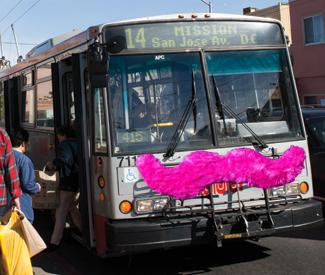
In an announcement that could transform transportation policy in San Francisco, the startup company Lyft is prepared to take over some of the most crowded and dysfunctional Muni routes in San Francisco.

Mayor Ed Lee and the Municipal Transportation Agency have approved a plan that would turn the 38 Geary, 30 Stockton, and 14 Mission over to the tech startup, City Hall sources told us. The plan is still tentative and the Mayor’s Office is trying to keep it tightly under wraps until the financial details are complete.

However, documents provided to the Guardian show that Lyft would buy at least 68 buses, including 12 articulated vehicles, at a price still to be negotiated. In exchange, the city would give the company – known for its pink mustaches on illegal taxi cabs – exclusive rights to operate on the heavily-used lines.

Lyft is developing an  app that would allow customers not only to view approaching buses but to book specific seats for an additional  price. Sensors in the bus seats will emit an electronic buzz to alert passengers that their seats had been purchased by someone else, warning them to vacate by the next stop. If the passengers remain, they will feel a sharp electric shock.

Lee’s office said the plan is similar to the market-based parking-meter program that raises the price of a space in times of heavy demand.

“The free market solves so many problems,” Christine Falvey, spokesperson for Lee, told us. “And it’s pretty clear that too many people who don’t really need to sit down or who are perfectly capable of waiting for a later conveyance are taking up space on the most crowded buses.”

Ron Conway, the venture capitalist who is Lee’s closest ally in the business community, will invest as much as $40 million in the new venture, Silicon Valley sources say.  If the trial public-private partnership works, he’s prepared to raise money to buy out Muni and turn the city’s bus system into a private operation.

“You’ve got a captive market, and demand-based pricing is what’s happening these days,” Falvey said.  “It’s just the next step.”

Mayor Lee’s mysterious breakfast companions [UPDATED]

See an update to this story below. San Francisco Mayor Ed Lee has been having breakfast with CEOs to seek millions in funding for the America’s Cup, but the identities of those CEOs remain a mystery.

At a City Hall hearing two weeks ago, America’s Cup Organizing Committee chief Kyri McClellan told supervisors that Lee has been “putting an incredible amount of energy” into fundraising to cover city costs for the America’s Cup. As the yacht race draws closer, pressure is building around an anticipated funding shortfall that could deal a blow to city coffers.

McClellan told supervisors that Lee was “holding breakfasts with CEOs” to raise money. Encouragingly, she added, “people are responding.”

So, who are the CEOs? And how much have they agreed to contribute? So far, nobody has disclosed that information.

Shortly after the hearing, the Guardian submitted a public records request to Lee’s office seeking documentation on the fundraising breakfasts and records showing the names and affiliations of the CEOs.

In response, we received several pages from the mayor’s calendar. Entries show that Lee held half a dozen meetings concerning “economic development,” with no mention of the America’s Cup. The mayor had a meeting at Waterbar, a restaurant on the Embarcadero overlooking the Bay Bridge, on the morning of Jan. 25; he had another meeting there Feb. 1; he met at the Hotel Vitale on Feb. 22; met at City Hall on Feb. 28; had breakfast at the St. Regis Hotel on March 1, and had lunch with someone at Original Joe’s on March 4. But there was no information disclosing whom he met with.

After receiving the documents, the Guardian left multiple voicemails with the mayor’s press office asking for the identities of the CEOs. So far, nobody has responded.

The request also yielded a fundraising form that asks prospective donors to “join the 2013 America’s Cup San Francisco Host Committee.”

Donors could opt to become a “Legacy Benefactor” for committing to give or raise $5 million; a “Legacy Partner” for $2.5 million; a “Strategic Partner” for $1 million, a “Civic Champion” for $500,000, or a mere “Member” for $250,000. Donors with questions or who wished “to connect with Mayor Lee” could call Stephanie Roumeliotes, the form noted. 

Roumeliotes is a prominent fundraiser and political strategist who provided financial consulting for the re-election campaigns of Senators Dianne Feinstein and Barbara Boxer. She was appointed to serve on the Golden Gate Concourse Authority, a part of the Recreation and Parks Department, by former Mayor Gavin Newsom.

A call to the number listed went to SGR Consulting, Roumeliotes’ firm. The receptionist declined to comment or to connect the Guardian with Roumeliotes, saying, “All press inquiries should be directed to the Mayor’s Office.”

UPDATE: We just received a voicemail from Christine Falvey, Mayor Lee’s press secretary, who told us “I don’t have a list of the attendees for those breakfasts. They were hosted by the America’s Cup Organizing Committee.” Which raises more questions, but in any case we placed a call to race organizers and will update again when we know more.

Does Mayor Lee support Airbnb dodging its $1.8 million tax debt to SF?

185

My story in this week’s Guardian about how Airbnb appears to be refusing to pay the hotel taxes it owes to the city has gotten a lot of attention. But I’m still getting stonewalled by representatives from the company and Mayor Ed Lee, who apparently refuses to take a public stand against corporate tax evasion, even when it means thousands of San Franciscans could get stuck with an unexpected tax bill.

How much money are we talking about? According to a study that Airbnb commissioned and publicized late last year, its hosts in San Francisco collect $12.7 million from their guests every year. That means that if the company was charging the 14 percent Transient Occupancy Tax – as the Tax Collector’s Office last year ruled that it must – it would be paying the city nearly $1.8 million annually.

But that doesn’t seem to be happening, although only Airbnb can say for sure, which is why its spokespeople have been dodging my questions for more than a week. As I reported, taxpayer privacy laws prevent city officials from disclosing how much individual businesses pay in local taxes, but we do know Airbnb doesn’t add the TOT to the online transactions it facilitates or specifically encourage its San Francisco hosts to collect the taxes (even though the tax codes make the hosts and Airbnb jointly responsible for this growing debt to city coffers). And with the company charging 6-12 percent per transaction, it’s a safe bet that it isn’t simply paying the taxes itself.

What makes this particular case of corporate tax dodging even more interesting is the fact that Mayor Lee has a close connection to this particular San Francisco-based corporation. Venture capitalist Ron Conway is a top investor in both Airbnb and Mayor Lee’s political campaigns, creating a potential conflict-of-interest in Room 200. Last year, Mayor Lee personally lobbied against the interpretation by the Tax Collector’s Office, and now he appears to be silently backing Airbnb’s resistance to paying its taxes.

Last week, when I was trying to get a comment for Lee spokesperson Francis Tsang on Airbnb’s apparent tax dodge, he replied, “It’s an incorrect assumption that Airbnb and hosts haven’t been paying any transient occupancy tax..” Of course, because of the taxpayer privacy laws, Tsang can’t actually support that statement and I responded by laying out the evidence that the city is getting stiffed by Airbnb.

Then, he and Airbnb simply stopped responding to my questions, even though I’ve made repeated inquiries and asked only whether Mayor Lee was willing to make a public statement calling for a major San Francisco corporation to meet its local tax obligations. And in the interests of fully transparency, I’ll close with the email that I sent to spokespersons for Airbnb and the Mayor’s Office on Wednesday as my story came out, along with their emails in case you want to push for answers yourself.

kim@airbnb.com, francis.tsang@sfgov.org, christine.falvey@sfgov.org.

Dear Airbnb and mayoral spokespeople,

Since I couldn’t get responsive answers from any of you about why Airbnb isn’t collecting the Transient Occupancy Tax from its guests, I wanted to forward the link to my story on the topic in our latest issue (http://www.sfbg.com/2013/03/19/airbnb-isnt-sharing) and to let you know that I will continue covering this issue in the Guardian and our sister newspapers until you address it publicly.

Because of privacy laws that limit the Tax Collector’s Office from addressing this directly, only Airbnb can say whether they’re paying any of the hotel taxes that the city last year conclusively ruled that they owe. As I reported in my story, that tax obligation is shared jointly by Airbnb and its hosts, who don’t appear to have been warned of this by the company, making this an issue of consumer protection as well as corporate greed.

Will the Mayor’s Office make a public statement opposing tax evasion? Will it stand up for San Franciscans who may be unwittingly stuck with the tax bill by Airbnb? Or will Mayor Lee stick up for a tax-dodging corporation funded by the same billionaire that funds his political campaigns? And how will people feel about San Franciscans and the city treasury paying for his political ambitions?

These are all questions that I plan to air and explore in the Guardian, and I think that our readers and the general public deserve answers to those questions. If there are reasons why Airbnb guests aren’t being charged the TOT, some other arrangement that has been made, or some other complex reasons why Airbnb feels it can’t comply with last year’s ruling by the Tax Collector’s Office, I’ll be happy to hear it and let you make your case to our readers. But I don’t think that continuing to stonewall me is going to be a viable strategy for any of you. I hope to hear from you soon.

Fine Arts Museums management blasted in colorful anonymous letter

Ever since the Guardian reported on recent firings and allegations of improper behavior by senior staff at the Fine Arts Museums of San Francisco (FAMSF), we’ve received a great deal of correspondence relating to the museums. The barbs continue to fly as current and former museum staff members describe an intimidating internal atmosphere within the city’s charitable trust departments, which Curator Emeritus Robert Flynn Johnson has termed “Orwellian dysfunction.” Just this afternoon, another letter arrived — with no return address.

Dated March 20, it was addressed to Richard Benefield, Deputy Director of the de Young. Here’s the text in full, with our own links inserted to clarify the issues the writer is referencing:

“What a ridiculous and absurd Dept. Head Meeting yesterday!

“Aside from the competent I.T. report … how could you expect even a singular response regarding the recent media attention when everyone in the room has been completely intimidated and muted into silence?

“You, sir, are operating with the same delusion as our board president.

“‘Orwellian Dysfunction’ doesn’t even begin to describe the underlying rage, resentment, and disloyalty among most of us still employed by this institution.”

The letter goes on to name three top-ranking museum staff members, calling them “the greatest threat to this museum’s future function and credibility. If Colin Bailey cannot swiftly address these problem individuals, provide the city and public with a transparent accounting of its operating budget, reinstate board president term limits, and modify the draconian time clock surveillance system for our once dedicated hourly workers, then its [sic] certain that the probing press will only continue.”

Additional recipients were listed as San Francisco Mayor Ed Lee; Colin Bailey (rumored to have been selected as the new director of the de Young); FAMSF Board of Trustees President Diane “Dede” Wilsey; San Francisco Chronicle reporter Jesse Hamlin (who managed to get Wilsey on the phone; she ignored Guardian requests for an interview); New York Times reporter Patricia Cohen and arts journalist Lee Rosenbaum.

The Guardian left a message for Ken Garcia, spokesperson for the museums, to share the contents of the letter and request comment. So far, he has not responded.

The real CPMC story

10

OPINION The recently announced terms for the development of California Pacific Medical Center’s hospitals at Cathedral Hill and St. Luke’s generated front-page and lead stories in the local news media. But nearly without exception, only part of the story was reported. Missing from most accounts of the terms of the new deal, which dramatically changed last year’s failed draft development agreement negotiated by Mayor Ed Lee, was the decisive role played by a community/labor coalition, San Franciscans for Healthcare, Housing, Jobs and Justice.

Key details of the agreement have yet to be finalized, and provisions of the terms announced on March 5th need to be improved. But the new agreement, in virtually all respects, is an improvement over the old one. And on the same day the terms of the new deal was announced one of the union members of the coalition, the National Union of Healthcare Workers signed a contact with CPMC that protected union organizing rights, job security at Cathedral Hill and full employer paid health care — issues that had been unresolved over the last few years. Still missing is an ageement between Sutter and its nurses, a critical component of labor peace.

The basic structure of the current terms mirror almost exactly the positions outlined by the SFHHJJ over the last year, including a requirement for labor peace with all unions at CPMC. This was no accident; it was the result of the efforts of the community/labor coalition. When the old deal was stalled at the Board of Supervisors in early 2013 and it was clear that the Mayors Office had no idea how to proceed, the members of the coalition came up with a framework to get discussions going again. The key ingredient was the involvement of a skilled an knowledgeable mediator, mutually respected by all parties and the participation of Sutter Corp. in Sacramento — the real party able to make actual binding corporate commitments, not the subsidiary the mayor had dealt with.

The second step was to agree to a framework of issues that would form the substance of negotiations — and the coalition’s own comprehensive set of positions served as that framework.

The next step was to get a critical mass of supervisors to agree to participate in the negotiations. Two Supervisors, David Chiu and David Campos, agreed to the coalition’s framework and the use of a third-party mediator. They added a third supervisor, Mark Farrell, to their group in order to assure buy-in from the full board.

Finally, the mediator had to be found and in that the coalition (and the rest of the city) simply were lucky that Lou Girardo was willing and able to provide his own special skills and credibility.

The SFHHJJ is not the first community/labor coalition in San Francisco history. Such coalitions were present in both the District 1 and District 5 supervisors races last year with mixed success, and in 2008 a community/labor coalition fought for revenue measures, again with mixed success but real unity. A new labor/community coalition has emerged to oppose Scott Wiener’s ill-advised weakening of our local California Environmental Policy Act procedures.

As the Democratic Party transforms itself into ever greater political irrelevancy by becoming the home of moderate Republicanism at all levels of government, community and labor co-operation seems to be growing over an increasing number of issues, showing a level of political vibrancy impossible to ignore.

Calvin Welch is a longtime community organizer in San Francisco and is a member of the SFHHJJ CPMC Negotiating Committee

Last gasp ends the sordid Mirkarimi saga

167

A San Francisco judge has dismissed a defamation lawsuit against Sheriff Ross Mirkarimi and his wife, Eliana Lopez, which is likely to be the last step in an ugly and protracted political, legal, and administrative battle stemming from Mirkarimi grabbing Lopez’s arm during an argument on Dec. 31, 2011.

The couple’s neighbors, attorney Abraham Mertens and his wife, Ivory Madison, reported the grabbing incident to police over the objections of Lopez, who had sought advice from Madison and allowed her to film a short but emotional video displaying a bruise on her arm, which became the main evidence against Mirkarimi.

That exploded into a high-profile drama in which Mirkarimi was vilified by the media, charged with domestic violence and witness dissuasion, pleaded guilty to misdemeanor false imprisonment, suspended without pay for six months by Mayor Ed Lee, and finally reinstated to office by the Board of Supervisors in October.

Along the way, the two couples – who are still neighbors, despite Mirkarimi’s efforts to sell his house and move – became increasingly bitter public rivals. Lopez consistently denied being abused and implied to reporters that Mertens and Madison had political motives for breaking her confidence and reporting the incident to police. Mertens and Madison maintained that Mirkarimi tried to dissuade their cooperation with police – an allegation that the long investigation failed to substantiate – and blasted Mirkarimi and Lopez in a San Francisco Chronicle op-ed.

Other than that, Madison and Mertens refused to talk to the press as the saga unfolded – a stance they maintained today, with a man who answered the phone at the Red Room website business they run immediately telling us, “They’re not interested in talking.”

But Madison, who went to law school before becoming a fantasy writer, did let loose in June when she submitted a wild, incredible 22-page declaration to the Ethics Commission as part of the city’s effort to permanently remove Mirkarimi on official misconduct charges, purporting to describe the tyrannical way the Mirkarimi ran the household, as Madison claimed she was told by Lopez (which she disputes).

The commission criticized and gutted the declaration, finding that it was prejudicial and contained little usable evidence. Commissioner Paul Renne even dressed down the deputy city attorneys for submitting it, calling it “clearly hearsay, clearly having the intention of poisoning the well of this hearing,” causing Deputy City Attorney Peter Keith to apologize and explain they had little to do with the declaration because Madison had hired a private attorney who helped her prepare it.

The couple and their attorney have threatened to sue Mirkarimi and Lopez for more than a year, and they finally filed the defamation case in January, and it has now been quickly dismissed. Domestic violence advocates and allies of Mayor Lee also threatened a recall election against Mirkarimi, but that also seemed to wither late last year – meaning this is probably the last we’ll hear about this case, at least until Mirkarimi runs for reelection in two years, if he decides to do so.

Asked to comment on the lawsuit’s dismissal, Mirkarimi told the Guardian, “My family and I are very happy and have moved forward, and I hope they are too.” His attorney, David Waggoner, told us, “Hopefully, the dismissal represents the end of what has been a long and painful experience for everyone involved.”