

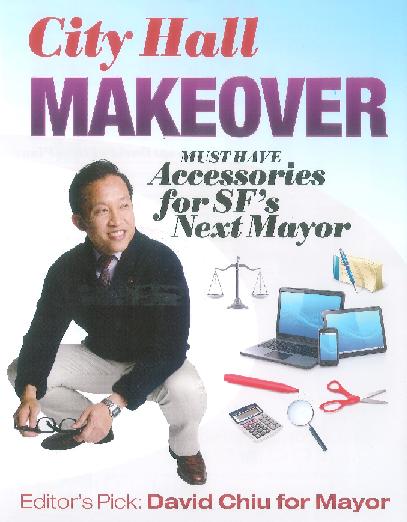
There’s a new fashion in the mayor’s race, and it’s … accessories! This new mailer says to vote for Sup. David Chiu because he knows how to accessorize — check out the cool glasses, and the sensible yet snazzy shoes and the high-tech wristwatch. Oh, and there’s a laptop/cell phone/ipad, a checkbook, a scissors, a red pen, a calculator and a set of scales, which I assume are to measure out justice and not medical marijuana. Although that’s fashionable, too. On the back of the mailer a nicely-dressed line of people stands out in front of City Hall in some sort of synchronized dance step; they all have their left hands pointed up. Cute.
Marijuana
Kamala Harris likes Bob Marley and Chris Cunnie
My Sublime station on Pandora just got interupted by California Attorney General Kamala Harris, telling me that she likes Jay Z, Bob Marley, and Chris Cunnie.
It was sponsored by the latter’s Sheriff campaign. I’m not surprised by the Cunnie part, but Bob Marley? With that kind of musical taste, you’d think Kamala would take a stronger stand in defense of California’s medical marijuana laws.
Bob would certainly be disappointed that she’s not standing up for our rights — and he’d probably back Ross Mirkarimi, who created San Francisco’s successful framework for dealing with the pot clubs.
Occupy camps don’t create social ills, they showcase them
By Anna Lacey
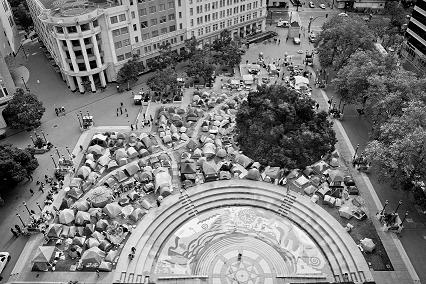
OPINION When I entered the public square off Broadway and 14th on Oct. 17 — the site of the Occupy Oakland camp that police violently broke up this week — I immediately felt dazed by the atmosphere. But rather than seeing the squalor that has been highlighted by city officials and the media, I saw it as a place of real possibilities, particularly from my perspective as a social worker
Surrounded by tall buildings, the square is in the heart of downtown Oakland. It felt like I was in a commune of sorts. Walking through the rows of tents, I found myself amidst a sea of commotion; there were children of different ethnicities playing, a crowd was listening to some guy on a microphone talking about political freedom, a marching band was performing, and lines of people were dishing out and receiving free food. The energy in the air was almost tangible.
The police raided the square Monday night, October 24th, arguing that the occupiers were dangerous or directionless substance abusers. They had also been complaining about a rat infestation and other problems and about the camp being a magnet for homeless people. But when I visited the camp several times before it was raided, there were two important points that struck me about what has really been happening in Oakland’s occupation.
First: The occupation did not create new social problems. Instead, the movement has been making existing problems visible. Oakland is a city with an overwhelming crime problem and serious financial woes, a city known by many as “Oaksterdam” because of its many marijuana dispensaries as well as the presence of weed smokers on the streets. It’s a city with rats, gangs, unemployment, and school closures. Existing social problems have become more visible because people have congregated together, largely because they were sick of suffering from social ills in silence and isolation.
It should also be pointed out that the homeless population was in the square before the occupation. Yet only now are they able to receive free healthcare, learn about available social services, and enjoy respite from police harassment. The police were not allowed in the square for two weeks, and participants in the movement voiced extreme pride of the “liberated space.” As one organizer put it, “Here in Oakland we have a history that makes us unable to dialogue with the police. Occupy Oakland is unique due to the legacy of the Oscar Grant movement; we know the police are not on our side.”
It does seem quite clear that, instead of trying to resolve the problems being brought to light in the square, the police would prefer the protesters remain isolated from each other, so as not to bring attention to existing social problems. I suppose a gang of police in riot gear followed by the terrorizing and arrests of almost 100 peaceful organizers is easier, thanks to our flawed governmental system, than responding to the social issues put forth by the public.
Second: The occupation was never a party zone. Quite the opposite, for two weeks the participants functioned as an organized political and social union. By day, various presenters lectured the crowds on such things as the rights and responsibilities of political beings. One evening, several youth spoke of their hopes and dreams, saying things like, “I want to be the future of America, but I can’t if there’s no money to fund my school.”
Dusk would mark the start of the nightly General Assembly, a sort of lengthy debate giving all the opportunity to make propositions to influence the movement. The assembly would last until after midnight, and a 90 percent majority of votes was needed to pass any given proposition. One evening, the General Assembly closed with everyone chanting, “This isn’t Burning Man,” implying the seriousness of the movement and the need to leave the party in the desert.
At the same time, the square was far from utopian. There were a couple of fights, which were deescalated quickly. Another key issue remains how to manage the movement’s ethos of equality while still moving in a unified direction. However, as one organizer put it, “Our power is in the lack of a leader, and our diversity is a blessing. The media doesn’t know how to control the masses.” There are discussions of new occupations to bring attention not only to the recent jailing of many protestors but also to school closures, police brutality, prison hunger strikes, foreclosures, and other social and political injustices.
Obviously, the Occupy Oakland that I experienced was very different than what the media and police accounts would have you believe. I wish I could tell you to come and judge for your self, but unfortunately there is no longer any one identified place to congregate. Instead, following Monday night’s raid and Tuesday’s squirmishes, many involved in the movement have been scattered out on the streets, forced to defend themselves from the police without the sanctuary of a peaceful and supportive liberated space.
Snow Park, along Lake Merritt, originally an extension of the original camp, is currently one meeting place for those involved in the movement. While I think the police’s senseless and heartless behavior has, at least for the time being, destroyed much of the beauty taking place in Occupy Oakland, I still urge you to lend your support. As one occupier told me, “Be a part of the process. It’s not perfect. Then again, if it was so easy, it wouldn’t be worth it.”
Anna Lacey is MSW trainee and therapist with La Clínica de la Raza who lives in Oakland and is working on her master’s in social work at UC Berkeley
Blowback
caitlin@sfbg.com
HERBWISE A throng of reporter types had gathered in the lobby of the State Building to listen to State Senator Mark Leno and State Assemblymember Tom Ammiano badmouth the feds.
“It is not the purview of the federal government to upset the will of the people,” said Ammiano, to the grunted affirmations of the patients, advocates, and cannabis business owners who had also assembled for the event.
Leno called the recent steps taken against the medicinal cannabis industry — which provides California each year with somewhere between $50 million and $100 million in taxes according to a 2010 estimate by the state’s Board of Equalization — “the exact wrong policy for a deep recession.” And then there’s the patients themselves. The two gay politicians commented that the issue of patient access is especially salient for the LGBT community, given that group’s increased incidence of HIV and AIDS.
Ammiano and Leno announced plans to push for federal regulatory guidelines that would clear up inconsistencies in the way medicinal cannabis works at the state level. As of press time for this article, Ammiano had scheduled another panel to discuss the matter on Tuesday, October 25 where he’ll be joined by marijuana advocates, labor leaders, Steve DeAngelo — founder of Harborside Health Center, which the IRS recently announced owes millions in back taxes because the business cannot legally write off standard expenses — and Matthew Cohen, who was handcuffed for hours along with his wife when the DEA raided his legal Mendocino County grow-op Northside Organics earlier this month. The event is being timed to coincide with President Obama’s visit to San Francisco this week.
When the politicos were done with their spiels, they trotted out Charlie Pappas, the owner of Divinity Tree Patients’ Wellness Cooperative. The landlord of Pappas’ 3,000-member dispensary was served with a cease and desist notice from the DEA that threatened property forfeiture and jail time if he continued to let Divinity Tree operate in his building.
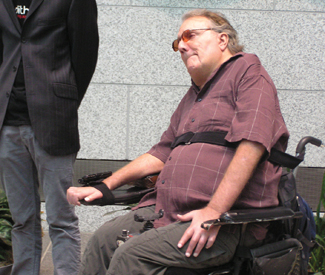
Pappas approached the podium in a wheelchair, a patient himself. As he was introduced, it was noted that here we had one of the little guys, not a tycoon turning millions of dollars of profit as dispensary owners have been portrayed by unsympathetic media and government officials. It’s illegal to turn a profit off of medical marijuana — and who would want to get rich off of sick people anyway?
The controversy over the issue is understandable, but also mind-blowingly hypocritical. You know who turns a profit off of making and distributing medicine? The pharmaceutical industry, to the tune of billions of dollars, in fact. Makes the $1.7 billion national market that constitutes the medical marijuana industry look like shake.
The sound of money talking rendered unsurprising the words of a one Bruce Buckner, who has been a patient “since the laws passed” and who came down from his home in Sonoma County to attend Ammiano and Leno’s press conference. Buckner shared his suspicions about why the federal government turned its eyes to dispensary operations this autumn. Slightly grizzled and wearing a straw hat, Buckner had sat patiently though the event, hooked up to a respirator.
“It’s real obvious why Obama is doing it,” he said. “The pharmaceutical industry is afraid of how potent this medicine is.”
Gee, thanks Kamala

After ducking the issue for more than a week, Attorney General Kamala Harris has finally weighed in on the feds crackdown on medical marijuana. Just after Assemblymember Tom Ammiano and state Sen. Mark Leno denounced the bizarre move by the U.S. attorneys, Harris issued a weak, lame and overall pointless statement that shows she is unwilling to be a leader on this issue. The statement doesn’t even appear on the front page of her website.
Here’s what she has to say:
Harris said she was worried that “an overly broad federal enforcement campaign will make it more difficult for legitimate patients to access physician-recommended medicine in California.”
She urged federal authorities to make sure their enforcement efforts are focused on significant traffickers of illegal drugs.
Come on, Kamala. This is a blatant effort by the Obama Administration to overrule state law. It’s an attack on an industry that creates jobs, pays taxes and helps sick people. It’s another front in the failed War on (some) Drugs. And you’re the chief law enforcement officer in the state of California, charged by the Constitution to defend state statutes, including Prop. 215. You can do a lot better than this.
Harris should have joined Ammiano and Leno at their press conference. She should have pointed out that the state is trying to regulate dispensaries, but the federal government has made that almost impossible by pulling this kind of shit.
And the most frustrating this is that Harris could actually make a difference here. What, exactly, is she hiding from? Does she think fighting the U.S. attorneys will make her look soft on drugs or crime and hurt her changes to be elected governor? Doesn’t she realize that medical marijuana is really popular with the voters and that the anti-pot crowd is almost gone?
Dumb. Frustrating and dumb.
Editorial: Mayor Lee is tough as hell on Occupy SF protestors, but keeps City Hall safe for PG@E and the downtown gang
And so Mayor Ed Lee once again shows his true colors: he is tough as hell on Occupy SF protestors and, unlike every other mayor in every other U.S. city, sends in the cops to roust them out in two midnight raids and trumpets the word by bullhorn from the mayor’s office that he will harass them until the end of time. Meanwhile, he is is quietly sending sending out the message that under his stewardship that City Hall will be safe for PG@E, the downtown gang, the big developers, the bailed banks, and the feds who are going after the dispensers of medical marijuana and the newspapers who run their ads. (Full disclosure: that’s us at the Guardian.) B3
EDITORIAL This is what civility and compromise looks like:
At a little after 10 P.m. Oct 16, a squadron of San Francisco police equipped with riot gear raided and attempted to shut down the OccupySF protest. It was the second time San Francisco has embarrassed itself, becoming the only major U.S. city to attempt to evict members of the growing Occupation movement — and this time, the cops used a lot more force.
The first crackdown, on Oct. 5, was supposedly driven by concerns that the activists were using an open flame for their communal kitchen without the proper permits. This time around, the alleged lawbreaking was confined to a Park Code section that bans sleeping in city parkland after 10 p.m. And since Justin Herman Plaza, where OccupySF is camped, is technically under the jurisdiction of the Recreation and Park Department, that ordinance could be enforced.
But let’s be serious: The encampment endangered nobody, and if any Rec-Park officials had actually complained, the police couldn’t provide their names. This was all about rousting a protest against corporate greed and economic injustice. It came with police batons, several beatings and five arrests.
And the mayor of what many call the most liberal city in America hasn’t said a word. Mayor Ed Lee was clearly consulted on the raid, clearly approved it — and now becomes unique among the chief executives of big cities across the country, most of whom have worked to find ways to avoid police confrontations.
David Chiu, the president of the Board of Supervisors, issued a ridiculous statement saying that “Both the Occupy SF protesters and the San Francisco Police Department need to redouble their efforts to avoid confrontations like the ones we saw last night.” No: The protesters didn’t start it, didn’t provoke it, didn’t want it — and frankly, did their best to avoid it. The crackdown is all about the folks at City Hall trying to get rid of one of the most important political actions in at least a decade — and doing it with riot police.
This is what the civility and compromise so touted by Mayor Lee and Board President Chiu looks like. And it’s a disgrace.
In Oakland, where the encampment at Frank Ogawa Plaza, renamed Oscar Grant Plaza for the event, has far more people than Occupy SF, city officials approached the activists and offered to issue whatever permits were needed. Mayor Jean Quan visited the general assembly, waited her turn to speak, and then politely asked the group not to damage the somewhat fragile old oak tree on the site. In deference to her wishes, the group surrounded the tree with a fence.
In New York, the private owner of the park where Occupy Wall Street is camped agreed not to evict the demonstrators — or even move some of them to all for a regular park cleaning.
Why is San Francisco acting so hostile? Is this not a city with a reputation for political activism and tolerance? Is it really that big a problem to allow activists to peacefully occupy public space to denounce the greatest corporate thievery in a generation?
San Francisco ought to be supporting the OccupySF movement, not harassing it. Lee should immediately call off the police raids. The Board of Supervisors should have a hearing on this, bring Police Chief Greg Suhr, Mayor Lee and representatives of Rec-Park and the Department of Public Health and work out a solution that doesn’t involve repeatedly rousting the protesters in the middle of the night. And if this continues, perhaps OccupySF should move to the plaza in front of City Hall.
Sup. John Avalos is the only person at City Hall who is making an outspoken effort to protect the protest; he needs some support.
Weed Wars
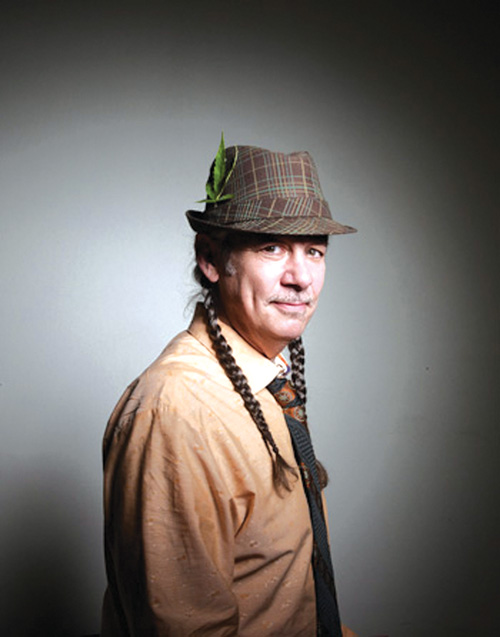
HERBWISE “I always knew that doing this show would be a risk,” says Harborside Health Center founder Steve DeAngelo in a phone interview with the Guardian. A medical marijuana dispensary could probably always be considered controversial fodder for a nighttime reality TV program, but DeAngelo’s enterprise rose above standard controversy when it became the target of the IRS, the federal agency ruling that it could no longer write off common business expenses. It now owes $2 million — an amount that left the rest of the industry quaking with concerns over its future.
The perfect time for an on-air debut, right? DeAngelo thinks so.
“If the American people see how we use this medicine, how we distribute it, they’re going to support it,” he says. “They’ve only gotten a chance to see the government’s side, the propaganda side.”
Especially nowadays. In the past few weeks, the feds have launched a multi-lateral attack on medical cannabis dispensaries (see the Oct. 12 Herbwise column, entitled “Feds crack down”). The Treasury Department convinced banks to close dispensaries’ accounts. The Department of Justice has sent out numerous cease-and-desist letters to dispensaries. The notifications insist that the trafficking illegal substances is occurring, and that it must be stopped — a turnaround from the Obama administration’s earlier pledge that it would not stand in the way of a patient’s access to medicine.
DeAngelo claims that Harborside is among the top 10 highest tax payers to the city of Oakland. The dispensary has gone through disputes over taxes paid before, but this latest persecution has meant a diminished sense of security for the dispensary’s 120-person staff at its San Jose and Oakland locations — not to mention among patients.
“They’re terrorized,” says DeAngelo. “I have 60, 70, 80-year old patients who are terrified.”
It’s high drama stuff. Ironically, filming for Weed Wars — save a few remaining pickup shots — had already concluded by the time of the ruling. Surely Discovery Channel executives are smacking their foreheads, having shot the relatively boring chunk of 2011 at Harborside.
“It does seem like the cameras got turned off at just the wrong time,” says DeAngelo.
The dispensary founder says that his people thoroughly vetted Braverman Productions prior to signing any deals — it wasn’t the only offer they got to be the subject of such a show. He’s confident the company will shy from the “unreal setups” so prevalent on other reality TV series. And he hopes that despite the current drama (which might make its way into the final episode of the program’s season), producers will portray the dispensary in a way that’s respectful and shows an accurate image of what day-to-day operations look like.
But whether or not that will be the case remains to be seen. An article written by a staff member in the September 2011 edition of the Harborside newsletter questioned the use of “weed” in the show’s title (a faux pas in the medical marijuana industry). In such a volatile political environment, the temptation to sensationalize cannabis dispensaries might run pretty hot. Or on the contrary, maybe Weed Wars will make the sale of state-legal marijuana seem as normal as being a Coloradan bounty hunter or a Kardashian.
Regardless of what happens, DeAngelo’s not ruing the day he decided to go into medical marijuana.
“We decided when we opened our doors that it was worth the risk. I still think it was worth that risk.” *
Weed Wars premieres November 27 at 10 p.m. PST on the Discovery Channel
Medical marijuana protesters gather at City Hall in wake of federal raids
Protesters met in front of the San Francisco Federal Building this afternoon to challenge the recent federal crackdown on California’s medical marijuana industry. The rally formed on the heels of yesterday (October 13)’s raid by federal agents on Northstone Organics, a Ukiah medical marijuana cooperative.
“Our state, our medicine,” protesters chanted. Among those present — about 30 individuals, per Guardian estimates — were medical marijuana patients, patient advocates, dispensary employees, and a representative of the Medical Cannabis Association.
“When you’re a part of the medical cannabis movement, you feel personally affected by these raids,” said Shantanae Todd, an advocate and patient herself. Todd suffers from seizures and says she has found relief through her medical cannabis presciption for two years.
“What’s the difference between Democrats and Republicans? I’m not seeing much of a difference here,” cried Shona Gochenaur, executive director of low income medicinal cannabis center Axis of Love and member of the city’s Medical Cannabis Task Force. Gochenaur urged Kamala Harris, California’s Attorney General — who has resisted taking a stand on the federal government’s persecution of medicinal cannabis producers — to lend more vocal support.
“We need to give everyone a clear message today that patients are not willing to go underground,” said Gochenaur. The protesters plan to meet and rally at noon the day after each and any future large-scale federal raids on California marijuana producers.
Why are Harris, Newsom, and other pols silent on the federal pot crackdown?

UPDATED BELOW As I worked on this week’s story about the federal crackdown on California’s marijuana industry, I tried to get a statement from California Attorney General Kamala Harris. After all, it’s her job to defend California’s medical marijuana laws, which she was fairly supportive of as our district attorney. And she was an early Barack Obama backer who could probably get him or U.S. Attorney General Eric Holder on the phone to say, “What the hell are you guys doing? Please, for your own sake and California’s, just back off.”
After all, as I reported, this multi-agency federal crackdown could destroy a thriving industry that is pumping billions of dollars into California’s economy and employing tens of thousands of people – at a cost of many millions of dollars in enforcement costs to simply destroy the state’s top cash crop, ruin the lives of people working in the industry, and strain our already overtaxed court and prison systems.
“It’s a policy with no upsides and all downsides,” Steve DeAngelo of Harborside Health Center correctly told me.
But when I finally got Harris’ Press Secretary Lynda Gledhill on the phone, she said Harris had nothing to say on the issue. “Nothing?” I asked, “Really?” What about off-the-record, I asked, how does she feel about it and might she make some statement in the future. Again, nothing to say, no comment.
So I tried Lieutenant Governor Gavin Newsom, another San Franciscan who as mayor helped oversee the creation of the city’s widely lauded system for regulating the dispensaries, which by all accounts has made it a legitimate and thriving member of the business community. Given Newsom’s current obession with job creation and how hungry he’s been for attention, surely he’d have something to say in defense of the good jobs that this sustainable industry has created in California. Again, nothing. I haven’t even gotten a call back yet from his press secretary, Francisco Castillo.
Also, no public statements have been issued by Mayor Ed Lee, David Chiu, or most other mayoral candidates who have put “jobs” at the center of their agendas – or from the SF Chamber of Commerce or other business groups that regularly deride bad government actions as “job killers – despite this move by the Obama Administration to destroy an important industry in California.
The only major politician from San Francisco (SEE UPDATE BELOW) to come out strongly against the federal crackdown was Assemblymember Tom Ammiano, author of measures to legalize and tax marijuana, who put out the following statement: “I am bitterly disappointed in the Obama Administration for this unwarranted and destructive attack on medical marijuana and patients’ rights to medicine. Today’s announcement by the Department of Justice means that Obama’s medical marijuana policies are worse than Bush and Clinton. It’s a tragic return to failed policies that will cost the state millions in tax revenue and harm countless lives. 16 states along with the District of Columbia have passed medical marijuana laws – whatever happened to the promises he made on the campaign trail to not prosecute medical marijuana or the 2009 DOJ memo saying that states with medical marijuana laws would not be prosecuted? Change we can believe in? Instead we get more of the same.”
But from most of the politicians who claim to support both jobs and the right of patients to access medical marijuana, we also get more of the same. They pander to people’s economic insecurities in order to give corporations and wealthy what they want – tax cuts, deregulation, union-busting, corporate welfare — but aren’t willing to risk any political capital defending the rest of us.
UPDATE (11/13): San Francisco’s other two representatives in the Legislature have also criticized the crackdown.
Sen. Leland Yee put out a statement saying: “Medical marijuana dispensaries are helping our economy, creating jobs, and most importantly, providing a necessary service for suffering patients. There are real issues and real problems that the US Attorney’s Office should be focused on rather than using their limited resources to prosecute legitimate businesses or newspapers. Like S-Comm, our law enforcement agencies – both state and local – should not assist in this unnecessary action. Shutting down state-authorized dispensaries will cost California billions of dollars and unfairly harm thousands of lives.”
Sen. Mark Leno, another medical marijuana support, also criticized the move. He told the Los Angeles Times, “”The concern here is that the intimidation factor will directly impact safe and affordable access for patients.” And he told Associated Press, “”I don’t understand the politics of it, and certainly if we haven’t learned anything over the past century, it’s that Prohibition does not work.”
One last cannabis fest? Despite IRS ruling, medical community soldiers on
Last week, the IRS’ two year audit of Harborside Health Center ended poorly for the medical marijuana industry. The federal government agency decided that the dispensary (Oakland’s largest, as the Bay Citizen reported in its coverage of the craziness — check out our story in today’s paper about the additional threats that have been made) couldn’t deduct standard business expenses, a move that left Harborside in the hole for $2 million and the rest of its industry in need of a joint.
Such was the setting for the West Coast Cannabis and Music Festival this weekend (Fri/7-Sun/9). Things got a little weird. Which is not to say that things weren’t also good. The 215 legal smoking area was ample proof that medical cannabis is alive and thriving, especially in the here and now. How else to explain the booths hawking aphrodisiac cannabis drinks and medicated vanilla chai truffles? Outside, the fresh-faced and strongly-quadricepped carried forth at the Rock the Bike music stage, its live and DJ offerings projected into the Cow Palace parking lot by a woefully shallow pool of volunteers. The muscle mass we pay for music…
Even the charming gentlemen at the Harborside booth were all kinds of upbeat, eager to talk about their new Discovery Channel reality TV show. They were handing out copies of their dispensary’s newsletter, the Harborside Illuminator. In it, general manager Andrew DeAngelo’s column, which contained a transcript of a conversation he had with the show’s producer, Chuck Braverman:
DeAngelo: Chuck, I really liked the name Cannabis Confidential — why did they go with Weed Wars?
Braverman: Bigger tent
DeAngelo: What do you mean bigger tent?
Braverman: The title Weed Wars will get more people into the tent to watch the show.
DeAngelo: But we don’t call it ‘weed’ and there is no war.
Of course, some would say there is a war on now. It certainly felt like I was being drafted by Sunday afternoon, when California state senator John Vasconsellos’ time to occupy the speaker’s stage was approaching. A barker alternatively sang and cajoled into the microphone, eventually resorting to bribes. “Anyone who sits down over here will receive a free joint. People, you need to hear this!” Ever obliging, we sat and listened to the woman who introduced the senator. She informed us she was filming the talk, although the final destination of the video was unclear to those of us who had just made her acquaintance.
“Senator,” she trilled. “Look at all these people here who love you!” You and free marijuana, doll.
Which is a really snarky thing to say, because we had little to say against the senator’s speech, which was 45 minutes of a call to arms to save patients’ right to access their medicine. And truly, we had to agree with the woman who had repurposed an electric green sleep sack as a dress, but not before cutting out the tits, donning a black mesh garment underneath, affixing a fake weed plant to the crotch area, and boldly Sharpie-ing across the front of it all “Obama can you replace our tax revenue?”
She giggled and posed in front of a strangely perfect WCCMF logo-ed wall when asked by (more than one) photographer if they could digi-capture her. Probably because she knew we all agreed with her, which come to think of it is a big part of these festivals: meeting other stoners that share your concerns.
Like, does that aphrodisiac stuff really work or what?
Feds crack down
steve@sfbg.com
HERBWISE Reversing its previous pledge to abide people’s rights to legally obtain medical marijuana in California and the 14 other states that have legalized it, the Obama Administration has launched a crackdown on the industry using several different federal agencies.
During an Oct. 7 press conference in Sacramento, California’s four U.S. attorneys announced their intention to go after the industry with raids on large-scale growing operations and big dispensaries and civil lawsuits targeting the assets of people involved in the cannabis business.
“We want to put to rest the notion that large marijuana businesses can shelter themselves under state law,” Melinda Haag, the U.S. attorney for Northern California, based here in San Francisco, said at the press conference.
That pronouncement is just the latest in a series of federal actions against those involved with the production and distribution of California’s top cash crop, an industry that the California Board of Equalization estimates to be worth about $1.3 billion in tax revenue annually. Sources in the medical marijuana business say the crackdown began quietly this summer.
Hundreds of dispensaries and other medical marijuana operations had their bank accounts shut down after the Treasury Department contacted their banks and warned them of sanctions for doing business with an industry that remains illegal under federal law. The Internal Revenue Service last month also notified many large dispensaries — including Harborside Health Center in Oakland, the largest in Northern California — that they cannot write off normal business expenses and must pay a 35 percent levy on those claims going back for three years.
Harborside’s Steve DeAngelo told us that would put Harborside — or any company with high overhead costs — out of business. “This is not an effort to tax us, it’s an effort to tax us out of existence,” he said, noting that Harborside paid the city of Oakland $1.1 million in taxes this year. In addition, the Department of Justice recently began sending 45-day cease-and-desist letters to hundreds of dispensaries around the state, including at least two in San Francisco, warning the clubs and their landlords that the operations violate federal law and could be subject to federal laws on the seizure of assets from the drug trade.
“It’s a multi-agency federal attack on patients’ access to this medication,” DeAngelo said. “It’s going to drive sick and dying patients back out onto the street to get their medicine.”
Haag claimed the state’s medical marijuana laws, which California voters approved back in 1996, have been “hijacked by profiteers.” Yet both local officials and people in the industry say that characterization is ridiculous, and that the federal government’s new stance will destroy an important industry — one that is very professional and well-regulated in San Francisco — and send legitimate patients back into the black market.
“I think it’s a step in the wrong direction and counter-intuitive to the Obama Administration’s contention that he would respect state’s rights,” said Sup. Ross Mirkarimi, who authored groundbreaking legislation regulating San Francisco’s two dozen dispensaries, a system that he said “is working well…But now the federal government is pulling the rug out from under us.”
Shortly after taking office in 2009, the Obama Administration released the “Ogden memo,” written by Deputy Attorney General David Ogden, stating the federal government would respect the rights of states to legalize and regulate medical marijuana. It was seen by cannabis activists as a sign that Obama was de-escalating the war on drugs, at least as it applied to marijuana.
But in June of this year, the DOJ release the “Cole memo,” by Deputy Attorney General James Cole, which it said “clarifies” the Ogden memo. In fact, it reversed the position, stating unequivocally that federal marijuana prohibition prevails and “state laws or local ordinances are not a defense to civil or criminal enforcement of federal law with respect to such conduct.”
“They’re bringing the hammer down,” said David Goldman, who works for Americans for Safe Access and sits on San Francisco’s medical marijuana task force. “This is not U.S. attorneys doing this on their own, this is coming from the top levels of the DOJ.”
Actually, Goldman and others suspect it goes even higher than that, right to Obama and his political team, who appear to be making a calculation that cracking down on medical marijuana is a good move before an uncertain reelection campaign.
“It’s political. It’s all about Obama appealing to the middle to win reelection,” Goldman said.
“I don’t think there’s any rational basis for what’s going on. It was clearly a political calculation,” DeAngelo said. “Why do they think it’s better for patients to buy their medicine from the black market?”
He said the crackdown will bolster the Mexican drug cartels, destroy a thriving industry that provides jobs and pays taxes, hinder efforts at better quality control and growing conditions (see “Green buds,” Aug. 16), and waste law enforcement resources to seize and destroy a valuable commodity.
“It’s a policy with all downsides and no upsides,” DeAngelo said.
Mirkarimi said that this crackdown could finally force cannabis activists to take on the federal prohibition of marijuana directly: “Bottom line, marijuana is the United States needs to be reformed so it’s not a Schedule 1 drug,” referring the federal government’s conclusion that marijuana is a dangerous drug with no medical applications.
But for now, DeAngelo said the industry will fight back: “We will fight it in the legal system, we will fight it in the court of public opinion, and we will appeal to Congress.”
The Hangover: Oct. 7-9
Jounce with us, if you will, through the Guardian staff’s frenzied weekend. Here’s our live reviews, hot raging, random sightings.
***Blow Up is reputed to be the best party in the city. I’ll say it’s almost certainly the best regular event for the 18+ crowd. But rule number one of going to a 18+ club event: don’t wear your nice shoes, even if the code does say “dress to impress.” It was only thanks to sheer luck and repeat viewings of The Matrix that I managed to avoid a geyser of projectile vomit in The Factory’s overcrowded men’s room Saturday night at Blow Up Forever II. “You go here.” I said, guiding the poor kid to the urinal I was about to use. “I’ll wait for the stall.” Click here for full story. (Ryan Prendiville)
***Stationary bikes snuggled into the corners of Public Works’ sweaty cavern of a first floor, but the realness of the Bikes and Beats party on Friday was onstage. The event was billed as J Boogie’s album release party and the DJ spent the night doing what he does best: orchestrating sick collaborations. At one point he had Jazz Mafia (including emcee Aima the Dreamer) and Duece Eclipse sharing the stage with him simultaneously. That’s a lot of local live luminaries to look at. (Caitlin Donohue)
***Overt-sweetness ran emboldened through Twin Sister’s set opening for Pains of Being Pure at Heart on Friday at Slim’s, leaving a trail of cotton candy kisses in its wake. Lead singer Andrea Estella, hugging herself tightly, laid out tender and girlish vocals over the band’s funked out disco’d-Cardigans tone. The Long Island band, spread across stage in a perfect line at the front, pulled through decorated versions of “Bad Street” and other tunes off its highly enjoyable, recently released album, In Heaven. The only misstep, in my mind, is the oddly nasally pop tune “Saturday Sunday.” It’s too cutesy, the call and response of weekend days is at times cloying. By contrast, Pains of Being Pure at Heart kept it moody, with songs like “Heart in Your Heartbreak” recalling the darkened club scenes from Nic Cage classic, Valley Girl, when the Plimsouls’ thrust into “A Million Miles Away.” Quick tip: Slim’s has a pretty decent hummus plate. (Emily Savage)
***Completely inappropriate for a blog feature called the Hangover, but nonetheless we must give props to the Life Is Living Festival on Saturday in West Oakland’s De Femery Park for being the Bay’s feel-good event of the year. Was it the way the breakdancing children spun blithely on their heads? Maybe the youth parkour obstacle course, spoken word stage, or arts and crafts tables? Probs an amalgamation of it all. Plus, Los Rakas and ?uestlove made for a slammin’ live block party soundtrack. Click here for full story. (Donohue)
***(See accompanying photo) Someone had to make a statement at this weekend’s West Coast Cannabis and Music Festival — the medical marijuana industry is in absolute turmoil after last week’s forboding ruling by the IRS about Harborside Health Center’s tax status. Speaker Senator John Vasconsellos spoke to a multitudinous crowd at one stage (perhaps the free joints that promoters promised to anyone willing to take a seat upped number a little), and outside in the sunshine Rock the Bike bravely endeavored to keep the music stage pedal-powered, despite a location off the festival’s beaten track and corresponding dearth of volunteers.
***Emotions ran high for the second consecutive sold-out Girls show at the Great American Music Hall last night. Chris Owens, JR White, and their talented ensemble were perfectly in sync as they treated us to a lengthy set highlighted by a trio of charismatic female vocalists. A powerful solo from one of the ladies made for an especially moving rendition of “Vomit.” Girls played nearly every song from Father Son Holy Ghost as well as old favorites like “Heartbreaker,” “Hellhole Ratrace,” and “Lust For Life.” The high point for me was the tender encore of “Jamie Marie,” which began with just Owens and his guitar on the flower ornamented stage before the rest of the band stepped out to resounding applause. The rapport between band members was palpable and I couldn’t help feeling a little bummed to be witnessing the closing chapter of their national tour. (Frances Capell)
***”This is the only mayoral candidate that’s doing drag events!” The woman at the door was, of course, wrong — just last week Lil Miss Hot Mess coupled with Queers for John Avalos to through the high school-themed Homo Homecoming at the Verdi Club. But last night’s Bevan Dufty’s “Politics is a Drag” campaign fundraiser was staged by the mayoral race’s only gay candidate, which was good enough reason to attract a Florence and the Machine-themed number from La Monistat and a return to the Sarah Palin costume that Anna Conda donned for a Work More! event — a reprise of a number she choreographed with the help of Guardian Managing Editor Marke B. (Caitlin Donohue)
***The Stevie Nicks show at The Fillmore on Sunday night was like a time warp to an early 1980s high school. Although most of the women in the audience were in their 40s and 50s, they were competing for “Best Dressed” like girls more than half their age. They paid tribute to their Queen Stevie in dark velvet, shimmering shawls, and long skirts. If I didn’t know better, I would say they’d kept those clothes in their closets for 20 years just for this occasion. But shopping with my mom has taught me that they sell it all at Chico’s. Click here for full story. (Ann Edwards)
Do North

FILM You could drive (or if you have the time, public transport) to the 34th annual Mill Valley Film Festival solely for movies like period drama Albert Nobbs, which is already generating Oscar buzz for Glenn Close. Hot tip, though: anything with the words “Oscar buzz” attached to it, or “critically acclaimed” (including believe-the-hype entries Martha Marcy May Marlene and Like Crazy), will likely arrive in San Francisco over the next few months.
However, Mill Valley also offers a huge schedule of films you haven’t heard of yet, like Bill Couturié’s Thumbs, a zippy doc about swift-fingered teens battling to win the 2010 US National Texting Championships. Before you shake your head in disbelief, Grandpa, note that the top finishers rake in major skrilla (first place: $50,000). Thumbs, which owes much to earlier competition docs like 2002’s Spellbound, has already taken aim at its target demographic by airing on MTV, but it holds up beyond the small screen. Kids will dig the wholesome protagonists: the punky small-town girl who argues with her mother via text; the soft-spoken swim-team standout. But anyone who doesn’t hang with the class of 2014 will find Thumbs an eye-opening (and surprisingly positive) peek at high-school society in the digital age.
Using technology in a completely different way is Granito: How to Nail a Dictator, acclaimed documentarian Pamela Yates’ follow-up to her 1983 doc about the Guatemalan civil war, When the Mountains Tremble. “How does each of us weave our responsibilities into the fabric of history?” Yates wonders in her introspective voice-over. When a human-rights lawyer working to charge Guatemalan military leaders with genocide asks Yates for her Mountains outtakes, the filmmaker scours her archives, digging for evidence and eventually becoming deeply involved in the case. Granito is a legal thriller, but it’s also a personal journey, for Yates and, most potently, survivors still traumatized by Guatemala’s years of repression and violence.
On the lighter side is Smokin’ Fish, a low-key profile of wry businessman Cory Mann (who also co-directs). Born in Juneau, raised in San Diego, the half-white, half-Native American (“For a long time, I thought I was Mexican!”) puts his mail-order company on hold for a few months every year to catch and smoke salmon using traditional methods in rural Alaska. More than a character study, Smokin’ Fish is also a portrait of what it means to be an “authentic Indian” in the 21st century, in a world where you can spend one day tangling with the IRS and the next trading fish for fresh moose meat.
A far less gratifying tradition is the subject of The Forgiveness of Blood, the sophomore effort from Maria Full of Grace (2004) director Joshua Marston. The Los Angeles-born, internationally-minded Marston travels to Albania for this fictional drama about the decades-old conflict between two rival families — and the devastating impact the eye-for-an-eye feud has on the younger generation. Already tapped as Albania’s entry for Best Foreign Language Film at next year’s Oscars, Forgiveness is definitely gonna be one of those MVFF films you’ll be able to see theatrically. Make sure you don’t miss it.
Got no transition here, just another recommendation. Guru: Bhagwan, His Secretary and His Bodyguard, a Swiss documentary about the late Bhagwan Shree Rajneesh — and two of his most devoted followers, bodyguard Hugh Milne and secretary-spokesperson Sheela Birnstiel. “When did it begin to go wrong?” asks Milne early in the film, which utilizes a bounty of archival footage to chart a movement that started in the 1970s, when a charismatic guru first enthralled thousands of spiritual, sexually adventurous hippies. Milne (mournful) and Birnstiel (incredibly, still a believer) reconstruct the confusing, emotionally exhausting years that followed; the subsequent web of culty weirdness culminated with the hostile takeover of a rural Oregon community, and, most famously, an unholy collection of Rolls-Royces.
Mill Valley’s shorts programs are always strong, from the “5@5” selections to the films paired with longer features throughout the fest. Of local interest, the UC Berkeley Graduate School of Journalism presentation Pot Country (part of the “5@5: Circle of Life” program) travels 200 miles north of San Francisco to hang with marijuana farmers. The film interviews both the world’s smarmiest pot lobbyist and a veteran grower prone to poetic, philosophical musings (“We didn’t move here to grow marijuana. It came to us as a gift”). Directors Kate McLean and Mario Furloni are particularly interested in divisive Prop 19 (which would have legalized weed for personal use, but had the potential to squeeze out small farmers), and the fact that, like, everyone grows pot these days. “We came [to Northern California] to be away from the mainstream culture,” remarks the grower. “Now, we’re in it.”
Screening alongside two other shorts in a program dubbed “The Barber, The Brush, and the Baton” is Paige Bierma’s A Brush With the Tenderloin, which follows muralist Mona Caron as she creates her landmark piece at Jones and Golden Gate Streets in San Francisco. Despite the neighborhood’s bad rep, its residents — no matter how intimidating they may look — rally around Caron’s efforts with positivity and pride.
The art theme continues with Library of Dust, screening before William Kurelek’s The Maze. Directed by Ondi Timoner and Robert James, Library draws inspiration from David Maisel’s photography collection of the same name. His subject? Abandoned canisters of human ashes discovered at the Oregon State Hospital. Library recounts how the canisters were found and how Maisel’s haunting artwork came about; it also delves into the troubled history of mental health care. Despite the tragedy of the forgotten ashes — very few have been claimed to date, though the “reunions” captured on camera are poignant — the resulting media storm was enough to convince voters that Oregon was long overdue for new mental health facility. Powerful stuff, all vividly explored in the span of 16 minutes.
MILL VALLEY FILM FESTIVAL
Oct. 6-16, most shows $13.50
Various North Bay venues
Spreading smoke
caitlin@sfbg.com
HERBWISE When asked to describe herself, Green Cross Dispensary patient Nicole Williams laughs. “I work full time, I go to school, I care for my mom. My brother’s taking the LSATs on Saturday — what else should I say? Native San Franciscan, long time resident.”
She’s being interviewed by the Guardian to gauge the demand in the Excelsior neighborhood for a new business that’s relocating to the neighborhood where it will be the first of its kind: the Green Cross’ new marijuana dispensary walk-in facility. Currently, the company is the city’s sole licensed delivery-only dispensary.
The Green Cross is hoping to have a little more luck with 4218 Mission than it did with its first location, which opened in Noe Valley in 2004 as a more professional alternative to the stereotypical cannabis club with “long haired hippies behind the counter,” in the words of dispensary employee Caren Woodson.
But the idea attracted so many customers (some garnering complaints that marijuana was being sold on the street) that the city’s planning department rescinded owner Kevin Reed’s permit for the space. After a disappointing attempt to open a location in Fisherman’s Wharf, an aide to the Mayor encourage Reed to try for a delivery-only permit instead. Now, the dispensary hopes the third try’s the charm. A public hearing to discuss its application to re-open in the Excelsior is scheduled for Nov. 17.
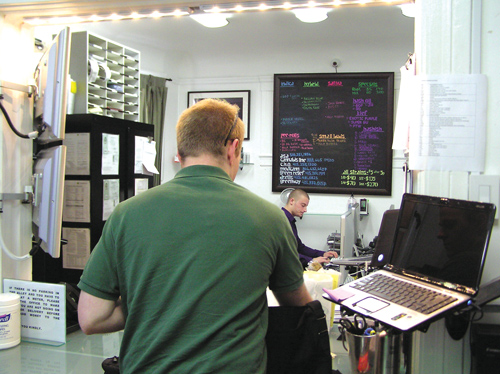
“We’re going to make sure we’re addressing the neighbors’ concerns,” Reed says, sitting on a stool in the Green Cross delivery and call center, which operates out of the front rooms of his comfortably-appointed SoMa apartment. In front of him are the flashing screens of 32 security cameras — a glaring reminder that Green Cross’ first commitment is to safety.
Green Cross employees dress in business casual — even, as this reporter witnessed, when they’re up to their elbows in bowls of weed nugs they’re breaking apart. Though currently located in a mostly residential building, Woodson claims that the business has never received a single neighborhood complaint.
The delivery service has now served over 3,000 clients. Having sunk a half million dollars into failed permitting procedures, Reed hopes he’s created a comprehensive plan that will pass the expectations of the various city agencies through which one must venture to open a weed dispensary.
The new location will necessitate a focus on discretion and security. Monroe Elementary School and the Mission YMCA are both a few blocks away. Plans include a wall that would block all view of the goings-on inside the dispensary. Plans do not include a space for on-site smoking, and members will have to sign a code of conduct that says they’ll be respectful of the surrounding neighborhood.
350 patients in the Green Cross’ database live in the proposed site’s 94112 zip code. Williams is one of them, and has been a patient since Green Cross’ Noe Valley days. She’s nowhere near the image of a troublemaking pothead, but it’s small wonder she was “pretty excited” to hear that she might be getting a new neighbor.
“You’re just looking for a safe place where you can get your medicine and go home.”
GREEN CROSS MANDATORY REVIEW HEARING
Nov. 17, time TBA
Room 400, City Hall
One Dr. Carlton B. Goodlett, SF
(415) 558-6377
Counting calories
caitlin@sfbg.com
HERBWISE An old factory sits in the outskirts of Oakland. In decades past, this building produced name brand snacks, but the smell of baking still permeates the factory air.
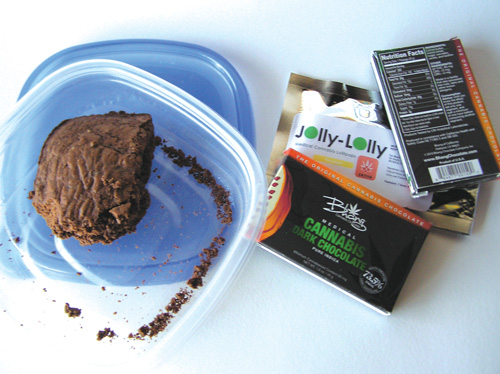
And weed. It smells like weed too. Bhang Chocolate churns out medicinal marijuana sweets here, bars that are smartly packaged in Bhang’s sleek black, orange, and green boxes that are a far cry from the plain wax envelopes and saran wrap that most marijuana edibles used to be sold in. The company is part of the current expansion in edible products — these days, patients can buy medicated cheesecakes, and even savory trail mix.
Adjacent to Bhang’s factory floor, about ten marijuana edibles producers are listening to a man talk about quality control for weed food. Robert Martin, Ph.D., worked for years in corporate food product development and quality assurance. He tells the class his specialty was frozen foods.
Martin is the co-founder of C.W. Analytical, a business that consults marijuana producers and has cannabis testing facilities. A patient himself, he says that marijuana-medicated foods are technically subject to all the same guidelines for commercially-produced non-pot products, although actual enforcement is sparse. C.W. offers these classes for free to interested entrepreneurs. They teach professional skills and serve as an introduction to the for-sale services the business provides.
The students are being treated to quality assurance fail stories from Martin’s career in the corporate world. A sherbet producer he once knew bought a wildly expensive machine to make fudge bars, but when he failed to make the proper tests on his treats, they caused a nasty spate of diarrhea in consumers and he ended up losing his shirt.
“That’s the kind of crap that can happen to you guys,” cautions Martin, and starts reading from a tongue-in-cheek guide to how you can tell food has gone bad. “Flour is spoiled when it wiggles,” he reads. This is quality assurance humor. “I love this stuff!”
One of the day’s students Lacey (not her real name) says she learned a lot from the class that she’ll be able to implement in her own business, Laced Cakes Bakery. She’s been making prettily iced cannabis cookies and brownies since 2007 and has seen the industry requirements shift dramatically.
“Years ago, you could just bring down a tray [to a dispensary] and drop it off,” she says. Nowadays, to sell in San Francisco she has to package the sweets in opaque material and make sure that the design can’t be interpreted as too appealing to kids. “The laws keep changing.”
She had heard about C.W. Analytical at some of the cannabis expos she’s been a vendor at — the firm will have a booth at next weekend’s West Coast Cannabis Expo as well — and was happy that the class was offered for free. She hadn’t finalized her opinion, however, on Martin’s suggestion that producers get their foods analyzed by the company so that they can put nutrition labels on their packaging. “It seems like they might just be trying to make money off of us,” she mused.
WEST COAST CANNABIS EXPO
Oct. 7-9. Fri/7, 3-9 p.m.; Sat/8, 11 a.m.-9 p.m.; Sun/9 11 a.m.-7 p.m., $18 one day/$45 weekend pass
Cow Palace
Geneva and Santos, Daly City
(650) 591-0420
Brrap! Brrap!

HERBWISE There is a land where talk of marijuana legalization barely penetrates the pungent cloud of ganja smoke. In this world, blunts are the size of carrots, and you get so high that you forget to finish your rum and coke. You rarely have to pay to get in, the crowd is equal parts dancing and chilling, and — sigh — you can wear your Bob Marley shirt.
You already know what I’m talking about: it’s your local reggae night.
Here in the Bay, we’re blessed (up) with some good ones. I recently kicked it backstage with Lymie Murray before his performance at Sebastopol’s Monday Night Edutainment at the Hopmonk Tavern. That show’s been attracting reggae heads to the tiny Sonoma County town for over a decade now, which gives you a good idea of how dedicated the genre’s fans are. And new shows pop up all the time — for proof, check out the fresh-this-year Boomshot Saturdays at Tope Lounge in North Beach.
We’ve assembled a list of spots where you can jam seven days a week, so feel free to clip out and hang by your jars of sativa. And hey, couch lock — you can even chill in-house. Radio Valencia (www.radiovalencia.fm), 87.9 FM broadcasts Adam Tadesse of Revival Sound System and Bryan Martin from the SF Vintage Reggae Society’s show “Wake The Town” every Saturday from 6-8 p.m. The two spin irie from back in the day, plus 1960s ska and rocksteady.
So you’re set for tunes. Don’t stop smoking and keep the vibes lovely.
MONDAY
Monday Night Edutainment Hopmonk Tavern, 230 Petaluma, Sebastopol. www.hopmonk.com. 10 p.m.-2 a.m., $5-10.
Skylarkin’ Skylark, 3089 16th St., SF. (415) 621-9294, www.skylarkbar.com.
TUESDAY
Bless Up Milk, 1840 Haight, SF. (415) 387-6455, www.milksf.com. 9 p.m.-2 a.m., free–$5.
WEDNESDAY
Rocksteady The Oasis Restaurant and Bar, 135 12th St., Oakl. 9 p.m.-2 a.m., free.
Coo-Yah Som Bar, 2925 16th St., SF. www.som-bar.com. 10 p.m.-2 a.m., free–$3 after 10:30 p.m.
THURSDAY
Back to Basics Little Baobab, 3388 19th St., SF. (415) 643-3558,www.bissapbaobab.com. 9:30 p.m.-1:45 a.m., free.
Feel Good Rockit Room, 406 Clement, SF. (415) 387-6343, www.rock-it-room.com. 10 p.m.-2 a.m., $5.
FRIDAY
Music Like Dirt Gestalt Haus, 3159 16th, SF. , p.m., free.
Pier 23 (415) 362-5125, www.pier23cafe.com. Weekly reggae shows, various times and prices.
Mighty Irie Luka’s Tap Room, 2221 Broadway, Oakl. (510) 451-4677,www.lukasoakland.com. 10 p.m.-2 a.m. (Fourth and second Fridays)
SATURDAY
Boomshot Tope Lounge, 1326 Grant, SF. Facebook: Boomshot Saturdays. 10 p.m.-2 a.m., free.
Reggae Gold Club Six, 60 Sixth St., SF. p.m.-4 a.m., $10-15. (Last Saturdays); The New Parrish, 579 18th St., Oakl. (510) 444-7474, www.reggaegoldsf.com. (Second Saturdays)
SUNDAY
King of Kings Shattuck Down Low, 2284 Shattuck, SF.www.kingofkingsreggae.com. 9 p.m.-2 a.m., free.
Ragga Ragga Il Pirata, 2007 16th St., SF. Facebook: Ragga Ragga. 9 p.m.-2 a.m., free. (Last Sundays)
For a complete list of Northern California reggae events, www.reggaegyals.com has got that fi-yah — it was a great resource in compiling the list above.
Harsh times

caitlin@sfbg.com
HERBWISE It’s what you would call a recession novel.
The lead character of Tony D’Souza’s Mule: A Novel of Moving Weight (292 pp, Mariner Books, $14.95)has nearly navigated the entirety of the upward-downward spiral to drug kingpin-dom we know so well from Scarface. This is how his story ends, in part:
“And there was the recession and there was not the recession and there was fear from the recession and there was not the fear from the recession. And there was America and there was not America and there was me and there was not me.”
The moment comes after hundreds of pages of violence and paranoia. D’Souza’s James is a successful freelance journalist rendered financially obsolete in the Crash Which Dare Not Speak It’s Name. Reduced from an A-list Austin lifestyle, he decides to drive a pound of marijuana across the country, literally to make ends meet for himself and his young family. His surprising ambition leads to mansions in Florida and reliance on the money-sick and power-mad for business.
Mule reads like an episode of The Wire, drawing from Weeds for some background material. And like those two series, what it has to say about the times we’re living in is worth hearing.
James is a deal-shoot-angst protagonist, a thoroughly middle class character. He wears Lacoste. He can’t get a byline to save his life, hence the drug running. His white skin is an advantage as a mule because it keeps him from being profiled by highway cops.
But if the Obama job plan passes, if unemployment was no longer at 9.1 percent, would James still be hustling? This is where Mule succeeds, its sheer ambiguity making it so much a product of this rightnow. In 2011, it’s not clear if we should be taking deep breathes and job hunting through the madness or straight up losing our shit in the face of economic meltdown, environmental heart attack, and vitriolic culture war.
And yes, Mule is also about marijuana itself. This too is important. How many Cali children have saved their skins by trimming in Mendo?
This is the same substance that supports the professional photographers and glamour shots we profiled in last week’s column. Only in Mule, double murders are performed over the stuff, people lose their minds to transport it. These are the same things that are happening across the hemisphere, despite our privileged Bay Arean cradle where we smoke in the streets and get prescriptions to stoke our appetites. Medicine, felony: marijuana is ambivalence itself these days.
If you’re looking for a novel-length iteration of why cannabis should be legalized, you could do worse than Mule. But you could also do better. That’s because of the book’s omnipresent ghoul, the generation-derailing R-word.
Sure, if selling pot wasn’t grounds for a felony or worse in most of the country, James would never have to smack around that snotty college dealer with the kid’s own textbooks, or been rendered paralyzed by fear in a grotty hotel room in San Angelo, Tex. — but would his world morph to emerald green good vibes? If weed were legal, wouldn’t it be assimilated into that other source of our brave protagonist’s dread? Would it be just one more job field described by our dismal unemployment levels?
Mule is a drug novel. But it’s also a recession novel and it’s not a recession novel and the novel’s about fear from the recession and the novel is not about fear from the recession.
In other words, read it.
Sticky palms: check out our nug porn gallery
I touched base with some of the guys with the toughest job in the world this week in Herbwise, our month-old marijuana column. Yessir folks, meet your professional weed photographers — potographers, if you will. Danny Danko, senior cultivation editor at High Times — who included some indoor growhouse shots that he told me were the trickiest to get due to light wave vagaries — and Ryno Barela, who is in charge of photography and social media over at SF’s Vapor Room were kind enough to send over some of the shots they think best represent their profession. Point, click, pass.
Pot shots
HERBWISE High Times senior cultivation editor Danny Danko remembers how a photo from the early 1990s changed his life. It was “Field of Dreams” by Andre Grossmann, an aerial view of a corn field south of the Mason-Dixon line that had 300 marijuana plants growing in its midst.
“This was before the days of these massive open air gardens,” Danko told the Guardian in a recent phone interview. “It definitely is one of those images that is worth a thousand words. It shows you the possibilities are endless when it comes to growing.”
Danko handles High Times’ marijuana growing section, and writes the magazine’s annual top 10 strains list, covering events like Amsterdam’s Cannabis Cup. His work gives him the opportunity to sample the kindest bud photos from around the world. He brings his own images when the shoot is, as he calls it, “sensitive. Sometimes people don’t want anyone besides me to come to their space.”
“The fact is, you can grow it on your windowsill.” Danko says part of High Times’ mission is encouraging the home gardener to produce weed for their community, “to make [cannabis] something people grow in their garden and share with their friends.”
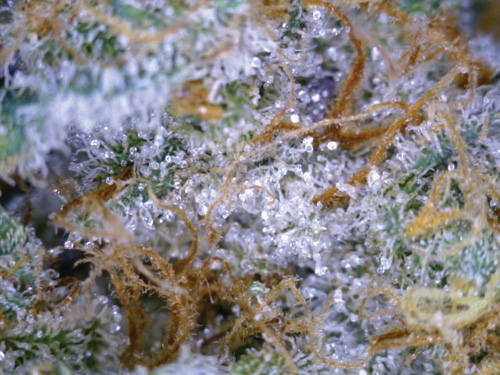
Potography is big business these days. Search the Internet and you’ll see shots of strains so high def that the trichomes (THC crystal formations) resemble glowing deep sea bottom feeders. 3D imaging yields 360 degree views of your prospective nug.
Danko says that the importance of weed photography can’t be overestimated. “We publish photography of things you don’t get to see,” he says. “Plants growing in their natural habitat; mythical, clandestine spaces. We’re the National Geographic of pot,” he pauses. “Or maybe the Playboy.”
In the Bay, local businesses are discovering ways to harness the power of nug porn. Vapor Room dispensary staff member Ryno Barela shoots daily specials and recent arrivals in a small studio in the back of the dispensary. He posts his images on the Vapor Room’s social networking sites, making daily updates to the dispensary’s iPhone-Droid application, which is a guide to current inventory for patients.
“Once we started doing it, we realized how powerful the photography of cannabis is,” he said in a recent phone interview with the Guardian. “You put a picture of something that looks amazing and within an hour, five people come through that ‘saw it on Facebook.’”
But it’s not just about activating salivary glands. “It’s beautiful and you can fantasize about smoking it,” says Barela. “But a trained eye can tell a lot.” The trichome structure and coloration, he says, give away lots of information about bud types.
But he’s not going for centerfold gloss. “We really focus on what it looks like in actuality so that it looks the same when you come into the shop.” Like “Field of Dreams,” he’s showing smokers the scope of the burgeoning world of cannabis – only his shots are live action reports of what’s on offer around the corner.
Refusing to be hotboxed
HERBWISE Karen Cue, CEO of this weekend’s International Cannabis and Hemp Expo is taking me to school. “It’s insulting to switch up those terms,” she tells me.
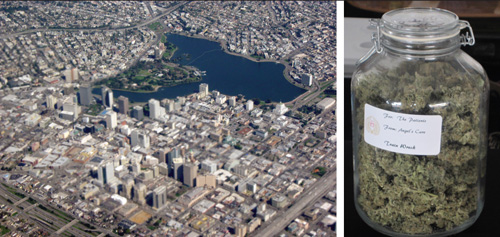
The terms I switched up? I just asked her why it was important to have legal-for-cannabis-consumption “215 areas” at her upcoming event, which will draw a projected 30,000 marijuana patients and cannabis-curious folk, turning a full mile’s worth of streets into an exhibition area in middle of downtown Oakland.
I’m standing by the validity of the question — but apparently I shouldn’t have phrased it “why is it important for people to be able to smoke weed?”
“That’s the terminology for recreational use,” Cue says. The expo is not, she says, about getting blazed and blunted. Medical marijuana users pay $20 million a year to the California state government in what are called taxable donations. That should buy them some civil rights — and many advocates see having places to legally consume cannabis as a big deal. “95 percent” of the people that her expo is marketed to, Cue says, are medical marijuana patients.
The event has been growing larger every year. This is the first year it will be held in downtown Oakland, having outgrown 2010 and 2009’s site, Candlestick Park. Cue calls the expo’s old digs “kind of old, kind of rustic — it’s got its good qualities about it, but we’re looking at advancement.” An Oakland local herself, she saw the possibility of holding the expo in a more accessible location — an outdoors area with a shady park, no less — a way to improve everyone’s enjoyment of the weekend.
And after years of dealing with Candlestick (a state-owned facility), holding the event in the heart of Oaksterdam was a breeze. City government had rejected two cannabis expo event applications in the past, but Cue says the reputation of her group coupled with positive media reviews it has earned made the city’s process relatively easy to work through.
“They did not ask anything of us out of the norm. But it definitely did raise the attention of the Oakland police” — a security concern that she hopes will be unfounded.
But this is no simple smoke-out (which I say in the most medicine-respecting way possible). Cue says the exhibition is also meant as an important learning opportunity about the parts of the marijuana plant you consume — and the parts you wear.
Hemp, as any good stoner should know, was once used by the US military to make uniforms, ropes, and parachutes. The government even released a short movie entitled Hemp For Victory during World War II promoting the material’s importance to the American war machine. Drafts of the Declaration of Independence was written on the stuff, for chrissakes. It’s more durable than cotton, hemp oil is a prime source of essential fatty acids — the list of reasons for its full legalization goes on.
For a crash course in hemp’s utilitarian glory, Cue recommends checking out David (“Doctor”) Bronner’s talk at the expo. Bronner is a member of Canada’s International Hemp Association, a hemp advocacy group that has no equivalent here in the United States. Learnin’ will also be on tap at the expo’s three stages of speakers, at vendor booths, and at Grow Op’s portable marijuana-growing trailer.
Have fun, learn stuff — and don’t call it weed.
INTERNATIONAL CANNABIS AND HEMP EXPO
Sat/3-Sun/4 noon- 8 p.m., $18-300
Frank Ogawa Plaza, Oakl.
WEST COAST CANNABIS AND MUSIC FESTIVAL
For even more cannabis celebration, check out next month’s tune-and-toke fest — three days of live music powered by Rock The Bike’s generator bicycles.
Oct. 7-9. Fri., 3-9 p.m.; Sat., 11 a.m.-9 p.m.; Sun., 11 a.m.-7 p.m., $18 one day pass/$45 three day pass
Cow Palace
Daly City
Hot sexy events: August 24-30
You’re dying for a new pair of marijuana leaf-shaped pasties, but also can’t go another moment without some hot trans docu-porn? Well thank goodness for Oakland’s Feelmore510. The downtown adult store continues its killing-it line-up of sexy, useful, and educational events this week with a screening of Trans Entities. Morty Smith’s filmed profile of Papí and Wil, a real-life trans couple, switches between probing, honest interviews and raw, hot sex. All in all, the anti-plastic fantastic of mainstream skin flicks.
And now it’s carrying Pastease, a line of fantastical tit covers that veer from sexy to silly and back again. The cannabis leaf-shaped pair caught our eyes originally, but that is not to say we’re not into the skull-and-crossbone set or the four leaf clover numbers. Anyway, take note – one stop sexiness has made it to the East Bay.
Lyon Martin-Femina Potens art exhibit
Katie Gilmartin, Kira Scarlet, Suzanne Rachel Forbes, and KD “Megaphone” Diamond all know the power of their sex-positive art. And now through November, the four are harnessing it for the forces of good. Femina Potens helped to organize this art installation at one of SF’s favorite sexual health clinics — the artists’ works were all inspired by the mission to create a welcoming, positive space for the clients of Lyon Martin.
Through November 5
Lyon Martin Health Services
1748 Market, SF
Hubba Hubba Summer Camp
Hey campers! Celebrate the summer we never have in the city with this sleep-away themed edition of the Hubba Hubba Revue burlesque blowouts. We’re talking “campfire comedy” and “astonishing acts of nature,” according to the event poster — pack your Calamine lotion and head out, scouts.
Fri/26 9 p.m., $10-15
DNA Lounge
375 11th St., SF
Steam
It’ll be the first time you come to Powerhouse to get clean — maybe. This party meets you at the door with towel rental and clothing check, but something tells us that the “Powershower” its featuring is unlikely to give you a chance to shampoo and condition. Sweaty go-go dancers provide inspiration to drop the soap…
Fri/26 10 p.m.-2 a.m.
Powerhouse
1347 Folsom, SF
“Anatomy of Pleasure with Robert and Carol”
Going beyond the typical lexicon of opening energies and “feeling” your partner, this one-off workshop taught by sex luminaries Carol Queen and Robert Lawrence makes use of anatomical in’s to sexual pleasure: proprioception, dermatones, sensory specificity. What do those terms mean? Hey, we’re not the ones teaching the course, go check it out for yourself.
Sun/28 1-5 p.m., $20-60
Center for Sex and Culture
1349 Mission, SF
Trans Entities: Naughty Love of Papí and Wil
The talking scenes are sweet and thought-provoking, the bedroom scenes are sexy and brutal — Trans Entities picks up where other adult films leave off and tonight you can check it out in downtown Oakland’s new woman-run sex store hot spot.
Mon/29 7:30-9:30 p.m., donation suggested
Feelmore510
1703 Telegraph, Oakl.
(510) 891-0199
Good girls inhale
caitlin@sfbg.com
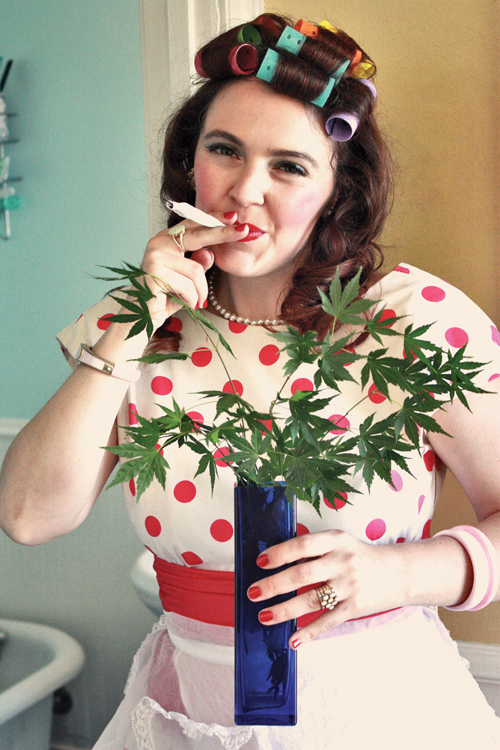
HERBWISE This is the image that could very well legalize weed in the United States, if not on the books then in our national subconscious: a be-curlered, white-bathrobed housewife ducking behind the backyard clothesline for a quick toke before her adolescent son comes to ask her to wash his gear for the Little League championship tomorrow.
Dee Dee Kirkwood thinks so. The playwright behind Toke places the image at the center of an opening scene in her semi-autobiographical play about a woman and her weed.
“It’s all positives, there are no negatives about marijuana,” chirped Kirkwood over the phone the day after the friends and family preview performance of Toke. “I wanted to focus my writing on making a change, helping cannabis smokers, and helping people come out of the closet.”
Out of the closet? Kirkwood does put much truck in marijuana as a libido-enhancer, and noted Bay sexologist Carol Queen is slated to step into the pointy high heels of Toke‘s pot fairy character for the second two weeks of the play. Sexuality is in the air of Ashby Theatre as much as smoke, in fact — but Kirkwood’s talking about an entirely different kind of self-realization here.
The climactic scene of Toke takes place after protagonist Wee Dee (get it!) has surfed the seas of kitchen table abortions, Post Traumatic Stress Disorder-having Vietnam vet first loves, radical European commune life, and a confining marriage to the father of her two children — happenings that Kirkwood’s script manage to make touching and madcap in turns. The character is plucky, likable, fun, so it makes sense when her second hubby encourages her to take that indomitable Wee Dee spirit and channel it towards marijuana activism.
So she organizes an event. It’s not important what the event is, because it’s at the end of an already-wacky play and if you’re not stoned by that point, it’s not clear why you at a production called Toke to begin with.
What is important is that after Wee Dee has listened to the This is Your Life-style cassette tape of various blasts from the past wishing her well, she emerges onstage with a glittering, Beach Blanket Babylon-esque cannabis headdress. She announces “I’m coming out of the closet! I’m green!”
And boy does the audience cheer. Wee Dee is a hero.
Toke is Kirkwood’s raison d’être. She doesn’t consider herself a career activist, just wants to lead people to more morality-based look at marijuana’s outlaw status, even though the unjust incarceration issue doesn’t get much play in Toke. As a wife and mother, she wants others to share in the happiness that the dro has brought to her life.
And — if it ever makes it out of Berkeley’s green hills — one could see Toke performing similar feats for weed that Eat, Pray, Love enacted on Middle America’s acceptance of yoga and women traveling solo.
“If it ever makes it out of Berkeley” being the key phrase there, of course.
TOKE
Fri/26 – Sept. 11, Thu.-Sat, 8 p.m.; Sun., 5 p.m., $25
Ashby Theatre
1901 Ashby, Berk.
Green buds

steve@sfbg.com
CANNABIS Most marijuana sold in Bay Area dispensaries is grown indoors, where the ability to precisely control conditions creates the kind of buds — strong, dense, crystal-covered, fragrant, beautiful — that consumers have come to expect. But that perfection comes at a high price, both financially and environmentally.
So some local leaders in the medical marijuana movement have begun to nudge the industry to return to its roots, to the days before prohibition and the helicopter raids of the Campaign Against Marijuana Planting chased the pot growers indoors. They say it’s time for California to start growing more of its cannabis outdoors again, in the soil and sunlight, just like the rest of the state’s crops.
Growers have long known how inefficient it is to grow indoors. All they need to do is look at their huge monthly energy bills. Between the powerful grow lights, constantly running air conditioners, elaborate ventilation systems, pumps and water purifiers, and heaters used for drying and curing, this is an energy-intensive endeavor.
But a widely circulated study released in April — “Energy Up in Smoke: The Carbon Footprint of Indoor Cannabis Production” by Evan Mills, a researcher with Lawrence Berkeley National Laboratory — revealed just what a huge cumulative toll the practice was taking on California and the planet.
It found that indoor pot production accounts for about 8 percent of California household energy use, costing about $3 billion annually and producing about 4 millions tons of greenhouse gases each year, the equivalent of 1 million automobiles. Producing one joint was the equivalent of driving 15 miles in a 44 mpg car.
“The emergent industry of indoor Cannabis production results in prodigious energy use, costs, and greenhouse-gas pollution. Large-scale industrialized and highly energy-intensive indoor cultivation of cannabis is driven by criminalization, pursuit of security, and the desire for greater process control and yields,” Mills wrote in the report’s summary.
Yet while opponents of marijuana seized on the report to condemn the industry, proponents say there’s a very simple solution to the problem: grow it outdoors. And with the artisanship and quality in the fields and greenhouses now rivaling that of indoor buds, the biggest barriers to moving most marijuana production outdoors are federal laws and the biases of pot consumers.
“There’s a misconception out there that indoor is better marijuana than outdoor, but we don’t think that’s true,” Erich Pearson, who runs the San Francisco Patient and Resource Center (SPARC) dispensary and sits on the city’s Medical Cannabis Task Force. “Marijuana is a plant that came from the earth and that’s where we should grow it, just like our food.”
INDOOR VS. OUTDOOR
There are definitely some benefits to growing indoors, beyond just the ability to hide it from the prying eyes of law enforcement. The grow cycles are shorter, allowing for multiple harvests around the year. The generally small operations and precise control over growing conditions also tend to produce the best-looking buds, which command the highest prices and win the top prizes in competitions.
Kevin Reed, who runs Green Cross — a venerable medical marijuana delivery service that works closely with an established group of growers — told us there are several reasons why indoor buds have dominated the marketplace.
“The most important factor is local laws and regulations and the enforcement of those various laws. A second factor is space and climate — obviously outdoor cultivation will flourish is some places better than other. And, a final factor is sustainability of the market; indoor cultivators can produce crops on a year-round basis, providing some stability in the market over the long-term, especially in the event of crop failure or other unforeseen and unexpected disasters,” Reed told us.
Yet he also said, “If cultivated correctly and with care, there should be no difference between the same strain grown in- or outdoors.” And he said that from an environmental standpoint, outdoor is clearly superior: “So far as environmental factors are concerned, there is little doubt in my mind that outdoor cultivation is kinder to Mother Earth.”
Wilson Linker, with Steep Hill Laboratories, Northern California’s largest tester of medical marijuana, said that outdoor plants generally have more vegetative growth because of the longer light cycles, meaning that “indoor tests generally higher in cannabanoids, with THC [marijuana’s main psychoactive compound] in particular.”
But he and other marijuana experts also say that the quality of the buds ultimately depends on a wide variety of factors, from the strain used to the expertise of the cultivators to the time and care taken by the trimmers.
“I’ve seen outdoor that can compete with the best indoor strains,” said David Goldman, who runs San Francisco’s Americans for Safe Access (ASA) chapter, sits on the city’s Medical Marijuana Task Force, and is active in rating the various dispensaries and pot strains in terms of quality, using magnifying glasses to investigate the trichomes and other characteristics. “I would match the best outdoor I know up with anybody’s indoor, any day.”
Even when indoor buds look better, Pearson said, that doesn’t means they are better. Looks can be deceiving, he said, noting how local consumers now accept that those perfect-looking, genetically modified apples and tomatoes in the store aren’t as tasty or good for you as their ugly, organic counterparts.
“It’s not all about appearance,” he said, noting that marijuana grown in the sunshine is more robust and complex than its indoor cousins.
“We’re starting to find [outdoor] strains that were scoring just as high as indoor,” says Rick Pfrommer, the purchasing manager for Oakland’s Harborside Health Center.
And that’s especially true when the cannabis is grown in greenhouses, where it gets natural sunlight but growing conditions can be controlled better than in the fields.
“Greenhouses can attain a level of cosmetic attractiveness that is right up there with indoor,” Pfrommer said.
“There are a lot of products coming out of greenhouses that even trained eyes can’t tell the difference with [compared to indoors],” Linker said. “Greenhouses are the future.”
Or at least they might be the future if there is a change in the federal laws, which still view any marijuana cultivation as a crime — which is why indoor grows flourished in the first place.
LINGERING PROHIBITION
Rising demand for medical marijuana has created some regulatory pushback, even in pot-friendly San Francisco, where the Department of Public Health announced earlier this year that it wanted to create a registry of growers that work with the dispensaries in order to weed out the illegal growing operations.
“In the last few years, there’s been a proliferation of both illegal and legal cultivators,” Dr. Rajiv Bhatia, San Francisco’s environmental health director, told us earlier this summer. “We’re asking for this information to try to steer them back toward legal cultivation.”
Reed, Goldman, and other industry representatives strongly condemned the move, mostly on the grounds that creating lists of growers could subject them to federal prosecution, so the idea was shelved for now. But Bhatia said the problem remains, and in San Francisco, it’s a problem created largely by the demand for cannabis grown indoors.
But allowing for a more widespread conversion to sustainably grown marijuana will require a relaxation of the federal enforcement to allow for more land cultivation and the development of high-tech greenhouses.
“A lot of that rests in the hands of law enforcement,” Pearson said.
But it isn’t just the cops. Consumers are also supporting indoor grows.
SUPPLY AND DEMAND
Pfrommer said there are many factors that influence whether customers choose indoor or outdoor, or what he calls the “bag appeal” that causes customers to zero in on one strain among the 40 or so that can be offered at one time.
Generally, indoor grows are smaller operations, allowing greater care in the tending and processing of the buds, whereas outdoor grows usually produce large crops harvested all at once, “so frequently people won’t manicure it as well,” Pfrommer said.
Smell is another big factor, Pfrommer said, and that’s one area where he thinks outdoor actually has an advantage. “Outdoor generally has a more pungent smell,” he said. “Cannabis is very sensitive to the environment, so it can pick up elements from the soil, the wind, and the surroundings. It picks up different qualities.”
For that reason, he also said, “I personally find outdoor to taste better when it’s grown well,” comparing it to the subtle qualities that various appellations can give to fine wines.
The final factor is price, and that’s one area where outdoor has a distinct advantage. SPARC is currently selling quarter-ounces of greenhouse-grown Big Buddha Cheese with a THC content of more than 17 percent for just $70. And when the buds from open outdoor fields arrive this fall, they’ll be as low as $50.
“This,” Pearson said, holding up a beautiful bud of greenhouse-grown Green Dragon, “was grown at a fraction of the cost of indoor and it’s outstanding.”
“That’s why indoor sells for so much more,” Goldman said, ” because it costs so much more to grow.”
So if outdoor cannabis is cheaper, better for the environment, less risky for the industry, and just as good, why are the indoor stains still so much more popular?
“You’re looking a 20-plus years of indoor being the standard,” Pfrommer said, noting that the hardest part of creating a more substantial changeover in people’s buying habits is their expectations.
He said Harborside started offering more outdoor strains three years ago, “but the market wasn’t responding as strongly.” In other words, people still preferred indoor.
Yet things are changing, prompted partly by the Mills study. “That was what kicked off this latest round,” Pfrommer said. “There is a small but growing awareness among the regular marijuana consumers about the costs of growing indoors…The consciousness is starting to shift, but it’ll be slow, probably over the next two seasons.”
Harvests usually take place during the full moons in September and October, after which they are cured and processed for about four weeks, finally coming to market around Thanksgiving.
“It’s mostly an education process,” Pfrommer said. “We’re going to have a vigorous push around harvest time this year.”
“We’re trying to transition completely to outdoor because the environmental toll is less, the cost is less, the yield is higher, and our testing is showing that the quality is just as good,” said Nick Smilgys, who has done both marketing and purchasing at SPARC. “It just makes more sense to grow it outdoors.”
Munchies
HERBWISE There will be things at this weekend’s Street Food Festival that you will want to eat. Oh yes, very much so. And damn if there won’t be things that you will want to look at — and then eat.
One of these things will be Rosa Rodriguez’ Sweets Collection gelatin desserts: small, sweet cups in which three dimensional flowers bloom, taunting you to stick a spoon in them. I will take them over designer cupcakes any day.
Rodriguez, who now lives in the Mission with her two daughters, is from the Mexican state of Durango. There, large gelatin molds traditionally bloom at birthdays, baby showers, and wedding parties; red roses and yellow zinnias made of condensed milk curling prettily around the faces of happy couples and beaming little girls. When I asked her via email about her San Francisco customers’ most common reaction to her wares, she said it is uncertainty. “They ask if they can eat the flower, or if it’s plastic.”
A La Cocina street food incubator program graduate, Rodriguez will be in the heart of the Mission this Saturday, along with the rest of the sweet and savory offerings of the Street Food Festival’s 60-some vendors. She’ll be selling “fanciful jellos shots” at the festival’s bars on 23rd and Folsom streets, and her more family-friendly concoctions at a stand of her own on the same intersection.
Saturday will entail a lot of eating, and a lot of gawking at fanciful jello shots, and for these reasons alone the day will go very well if you are really, really stoned.
But ingesting marijuana before the Street Food Festival is a delicate matter. After all, the third year of the event will be the biggest yet, its girth spanning eight blocks of Folsom Street, plus parts of 23rd, 25th, the Cesar Chavez Elementary School parking lot, and the Parque de los Niños Unidos.
In past years, massive crowds have marred the day for many an avid snacker — the lines, my friend, the lines. This year La Cocina is hopeful that the vast expansion of the event will stem the tide — but nonetheless it would not do to have agoraphobia derail you just as you are reaching the front of the line at the Kasa booth.
Luckily, there are plenty of San Francisco souls that geek out tailor-making THC regimens for situations like these. I placed a call to one such place humans like this congregate: the San Francisco Patient and Resource Center, winningly acronym-ed SPARC. It just received our Best of the Bay reader’s poll award for Best Cannabis Club and it’s well known for having an extensive selection of in-house strains. It seemed like a fine place to start out.
Nick Smilgys, who has served as the club’s marketing director for over a year now, had two words for me: blackberry kush. Then he had some more. The kush — which he says is traditionally cultivated in Pakistan and India, but happens to be one of SPARC’s signature strains — is a deep-green indica that’ll make you hungry as hell, ready to take on all those Indian burritos and handmade huaraches.
Smilgys says the blackberry buds create “good well being” in their ingester, and result in a nice body high. Of course, he cautions, medicines will have differing effects on different patients.
But if you’re not careful with the blackberry, it could keep you from your improbably edible jello flowers. (Smilgys employed the term “couch lock” to describe a potential blackberry kush effect.) If you’re prone to getting paranoid, he counsels medical marijuana patients to look for a sativa-indica hybrid that tilts to the indica side of things for a more tranquil, crowd-ready high.
Be brave friends, eat the flower. *
STREET FOOD FESTIVAL
Sat/20 11 a.m.-7 p.m., free
Folsom between 22nd and 26th sts. and surrounding area, SF