Marijuana

Mayor’s race a tight pack, but Gascón lags in DA’s contest

25

Despite the hype and spin from various mayoral campaigns and newspapers, the big story in yesterday’s release of semi-annual campaign finance reports is that there isn’t much of a story: It’s pretty much what everyone has been expecting, a tight field of qualified mayoral candidates with comparable financial resources.

It was also no surprise that Progress for All, the deceptive committee behind the effort to draft Mayor Ed Lee into breaking his word and running to keep his job, was funded mostly by a narrow group of business interests connected to longtime power brokers Rose Pak and Willie Brown, mostly with $5,000 contributions, or 10 times the contribution limit for legitimate mayoral campaigns.

The real story in yesterday’s numbers was in the district attorney’s race where the conventional wisdom that incumbent George Gascón is the clear frontrunner (“wisdom” that we’ve always questioned given his lack of local roots) was cast into doubt by his lackluster fundraising, big spending for small results, and the fact that each of his two major challengers have twice as much money in the bank.

Alameda County prosecutor Sharmin Bock led the fundraising race this year with $240,337, about $6,000 more than Gascón. And after spending $156,916 in just six months, Gascón has just $77,570 in the bank. David Onek, who has been getting progressive support and retail campaigning up a storm, raised $126,386 this year, but his early start and frugal spending leaves him with $153,474 in the bank.

In the mayor’s race, while both the Chronicle and Examiner led with David Chiu’s impressive fundraising this year, leading the pack with almost $400,000, all that really did was put him into financial contention with the top-tier candidates who have been raising money since last year: Leland Yee, Dennis Herrera, Bevan Dufty, Joanna Rees, and Michela Alioto-Pier.

As of last month, their campaigns’ cash-on-hand was Herrera at $586,294, Dufty at $493,372, Yee at $444,820, Ress at $441,168, Alioto-Pier at $406,574, and Chiu at $396,754. On the next tier down, Phil Ting appears dead in the water, raising just $67,526 and having more debt than money in the bank, although his campaign consultant Eric Jaye said public funds are just starting to come in and the campaign is on track to meet its $300,000 fundraising goal.

Two other major candidates were also well behind the pack, but both are running with an outsiders’ appeal that should keep them in the running throughout the race. Tony Hall, a conservative with a strong independent appeal, raised $102,612, has $173,368, and will likely continue nipping at the heels of the mainstream pack.

And then there’s progressive favorite John Avalos, who has been running a visible, enthusiastic campaign with lots of volunteer support, although he raised just $86,882 this period and has about $100,000 in the bank (contrary the erroneous report in today’s Chronicle that he only had $500, apparently because the reporter looked at his supervisorial campaign report instead of his mayoral – whoops).

But Avalos supporter Chris Daly said the campaign has recently raised another $32,000 and is due to soon receive about $120,000 in matching funds, bringing them up to around $250,000. “That’s what [then-mayoral candidate Tom] Ammiano had in his entirety in ’99,” Daly said, noting that progressive mayoral favorites always get outspent and usually by margins greater than what Avalos now faces. “Our people don’t have as much money or city contracts.”

By contrast, Chiu has been raking in the dough this year, with lots of $500 contributions mostly from lawyers, bankers, developers, people with Chinese surnames, and employees of Google and other tech firms, with almost half of the contributions from out of town.

“We raised almost a hundred grand more than the closest competitor,” said Chiu campaign manager Nicole Derse. “We’re in a super strong position.”

In addition to the big money sources that usually gravitate to strong moderate candidates, Chiu also had some notable financial support from some progressive constituencies, including bicyclist activists (such as Gary Fisher, Dan Nguyen-Tan, Jason Henderson, architect David Baker, and MTA member Cheryl Brinkman), progressive activists Susan King and Amy Laitenen (Matt Gonzalez’s former board aide), and medical marijuana advocate Kevin Reed from Green Cross.

Jim Stearns, who is running the Yee and Bock campaigns, said the funding picture is about what he and others predicted would be the case given public financing (and its $1.475 million spending cap) and the large field of qualified candidates. “That’s the interesting thing about this race, it’s like the World Series of Poker with everyone getting the same stake,” he said. “This is unlike every other mayor’s race where there have been huge disparities in funding.”

Many political analysts privately fear that this dynamic, with nobody really pulling away from the pack of candidates, could encourage Lee to get into the race. But Stearns notes that Lee, despite the power of incumbency, will have a hard time catching up in fundraising and a huge target on his back because of breaking his word, the sleazy “Run Ed Run” campaign tactics, and just the fact that he would become the instant frontrunner.

“In the ranked choice voting scenario, if there’s someone who looks like he’s going to come in first, you don’t lose anything by attacking him because his second place votes aren’t going anywhere,” said Stearns, who said the current mayor’s race appears to be a game of inches. “It’s an infantry game rather than an air game, where the gains are slow and people are proceeding carefully.”


Best of the Bay 2011: BEST COUCH-BOUND — BUT COMMUNITY-MINDED — STONER’S DREAM COME TRUE

0

While a marijuana home delivery business may sound like nothing more than a couch-bound stoner’s dream come true, the Green Cross actually offers a valuable service to many of the city’s neediest residents who are less mobile as a result of illness, disability, or age. And this is no slapdash selection, either. Brick-and-mortar dispensaries can’t beat its impressive array of hard-to-find THC-infused specialty items like olive oil and agave nectar. Plus it boasts vegan, gluten-free, and nut-free goodies, all made in-house. So toke it all in — a portion of the proceeds are reinvested in the community, supporting social service agencies like the SF AIDS Foundation and the YMCA.

(415) 648-4420, www.thegreencross.org

Best of the Bay 2011: BEST SUBLINGUAL HIGH

0

The Bay Area’s well-developed medical marijuana industry has done much to elevate the age-old practice of smoking marijuana to new heights, with sticky, stinky new strains and a wide variety of edibles. Along with improvements of the herbal variety have come winning technological advances: the formulation of some mighty fine of cannabis tinctures and other concentrates. Our favorite? Alta California tinctures by CBD Science, formerly known as 420 Alchemy. Take a drop or two sublingually (that’s under the tongue, stoners) and you’ll attain a beautiful high that’s different from smoking, vaporizing, or eating — a clear but consuming ride that seems to emanate from your very tissues, almost ecstasy-like. Three varieties — Healing, Tranquility, and Euphoria — give fans a range of satisfaction.

(877) 737-4420, www.4altacalifornia.com

Best of the Bay 2011 Editors Picks: Shopping

0

Best of the Bay 2011 Editors Picks

Shopping


BEST VINYL FLIPPERS

Tweekin Records in the Lower Haight was one of the centers of Bay Area dance music culture for the better part of two decades. But besides the basic insanity of operating a specialty record store in these e-times, the Tweekin brand had gotten a bit ragged over the years. So it was a charge for vinyl lovers when Manny Alferez and crew stepped up for a reinvigoration, unveiling Black Pancake Records. Pretty much the same concept reigns: great funk, soul, house, techno, jazz, and even (gasp!) rock records, plus a friendly staff with some primo recommendations. Perhaps best of all, there are a couple of those rarest of beasts — listening stations. Yep, you can put the actual circular whatsit on the doohickey that spins around and hear it make the music, little Johnny. All without clickety-clicking on the wee mouse-thingy.

593 Haight, SF. (415) 626-6995, www.blackpancakerecords.com


BEST EVERYDAY KAN DO

Peruse the labels of say, a kitty-shaped exfoliating washcloth or exquisitely lacquered bento box at Ichiban Kan, and you’re likely to see a Good Housekeeping seal of approval-style label trumpeting that the item won a design award in Japan. At times it seems like everything wins a design award in Japan, then the realization sets in that no other country seems to have dedicated itself so fervently to assuring that the everyday things of life — from paper clips to cooking utensils — be attractive, eminently functional, durable, and well-designed. When we want to load up on the best of the quotidian (we’re particular fans of the rolls of plastic wrap for $1), we come here.

Various locations, www.ichibankanusa.com


BEST GEEKDOM: THE GATHERING

It’s a constant nerd alert — not that that’s a bad thing — at Cards and Comics Central, a Richmond District shop where employees know the difference between vine whips and seed bombs and can explain why destroy effects don’t harm a cattank. Kids into Yu-Gi-Oh, Pokémon, or Magic will be overwhelmed by the shop’s vast selection. Parents will be overwhelmed at the price tag — you can spend more than $100 on a single card, though assorted decks (available for under $10) might keep the average young collector sated. Check out the back room for the real action — pale adults playing Magic with an intensity you won’t find at most Vegas poker tables.

5424 Geary, SF. (415) 668-3544, www.candccentral.com


BEST REFILL, NOT LANDFILL

What does it take to win a gazillion green business awards? It certainly starts with a great concept, a seriously vetted supply chain, and a commitment to spreading the eco-word. It also helps to have a pleasing storefront in Noe Valley, cute and eager staff, luscious products, and bulk-store prices without the forklifts and doublewide shopping carts. Green 11, launched by married couple Marco Pietschmann and Bettina Limaco and inspired by a Rachel Carson observation (“For the first time in history, every human being is being subjected to contact with dangerous chemicals, from the moment of conception to death.”), offers soaps, cleaning supplies, pet food, shampoo, conditioners, and lotions, all ready for your refillable, affordable use. Bring your own containers or put for up a starter container at the store.

3980 24th St., SF. (415) 425-5195. www.shopgreen11.com


BEST FAIR FEATHERS

You think your head hurts from the plumage parade that alit on Dolo Park this year? Think of the feather-farm roosters and other avian amigos that have lost their lives to appease the current mania for quill jewelry and hair extensions. Happily, two gentle crafters have taken the torture out of the trend: Erykah Prentice and Martha Hudson started their accessories label Divine Dandelions for peace, not plucking. The two create their cascading earrings and fanciful headdresses from foraged feathers, selling them from a sweet little gazebo at festivals up and down the West Coast. If you find yourself Bay-bound during next month’s Gaia Festival (up in the hills of Laytonville), you can always check out their Kahlil Gibran-quoting website for custom-made creations.

www.divinedandelions.com


BEST MEMORY TRANSFERENCE

Are your childhood camcorder memories gathering worrisome mildew by the minute? Entrust your VHS-ed precious moments to the Mission’s Video Transfer Center run by Jennifer Miko, a 2008 graduate of the L. Jeffrey Selznick School of Film Preservation and a collaborator with the Image Permanence Institute. Miko, along with husband Buck Bito, boasts some of the best equipment in the biz — including a fancy-pants transfer system for 8mm and Super-8 that the center says is California’s first and only. For a small fee, the team will inspect, repair, and transfer your film memories to a digital format that will last forever … or at least until we figure out brain-to-brain info-beaming.

395 South Van Ness, SF. (415) 558-8815, www.videotransfercenter.com


BEST BUGS BUNNY B-BOY FLASHBACKS

Mission vintage stores tend to cater to your typical high-waisted jean-clad, chain-smoking-in-front-of-Four-Barrel kind of girl. (We love her!) But New Jack City is a breath of fresh hype air. This “throwback goods” outpost at 15th and Guerrero streets specializes in sports gear and B-boy stylings straight from your favorite scene in Houseparty 2. Vintage Giants jackets, old school stripes, Bugs Bunny tees of various ages, priceless Afro-centric relics, and breezy caps repping teams or just plain reppin’ … . Actual 1980s and ’90s B-boys (and newer admirers) will feel they never left their Cold Crush Brothers and KRS-One cassettes in their cousin’s janky hoopty’s deck once they step inside.

299 Guerrero, SF. (415) 624-3751, newjackcitysf.blogspot.com


BEST REASON TO NOT GET OUT OF BED

You know those girls who flounce down 24th Street, vintage pastel print sundresses fluttering over their kicky cork wedge sandals, carrying a perfect sexy grandma purse? We know their style secret. Oakland’s Field Day Wearables’ bedding dresses are handmade by a crunchy-awesome label that wants to take the disposable out of fashion. They’ve got pockets and detachable straps that double as a matchy-match headband, and you can find them in patterns from striped to pansied to Batman (yes, they’re made from actual sheets). Score ’em at myriad brick-and-mortar distributing boutiques — or even better, by trying them on over your jeans at one of the craft fairs and street walks where FDW sets up a pretty post.

Available at various Bay Area locations. www.fielddaywearables.com


BEST SMALL WORLDS AFTER ALL

Apparently all the people who came of age in the late 1960s and early ’70s are either dead or too busy filling out Social Security forms to notice that at least one of their cherished craft projects is making a comeback. (No, not candle-splattered Mateus wine bottles or macramé hanging plant slings.) We’re talking about terrariums, the terrestrial equivalent of a ship in a bottle. So what if many G4-era terrarium enthusiasts call them “terraniums”? Their variation on vivarium nomenclature does nothing to diminish the charm of these glassed-in mini-worlds. And particularly high on the charm assessment scale are the creations of the good women of Studio Choo, part of Prairie Collective, whose arrangements of tiny ferns, succulents, and other floral inspire full minutes of unbroken, smart phone-free contemplation.

Available at Prairie Collective 262 Divisadero. (415) 701-8701, www.studiochoo.com, www.prairiecollective.com


BEST BET FOR BAROQUE BEAUTY

You’ve redecorated your living room, but still something is missing. Could it be? Yes it is — a fuchsia-toned chaise lounge. Do not despair, for we have your marching orders: SF Antiques and Design Mall. The 13-year-old Bayview behemoth is something akin to an indoor flea market, and is home to 200 experts in the art of antique, all of whom have booths filled to the brim with fanciful paperweights, glittering heaps of costume jewelry, and ever-so-whimsical seating options. Seriously, if your interior design is hankering for a touch of the over-embellished, a whiff of kitsch, or perhaps a splash of hanging basket chair, you will find it here.

701 Bayshore, SF. (415) 656-3530, www.sfantique.com


BEST FASHION SHRINE

Natural wooden tables, colorful blankets spread here and there, a goat’s head staring placidly down on wonder-covered shelves — Hayes Valley’s Reliquary could be a gaucho explorer’s treasure room. And — minus the gaucho part — that’s pretty much what boutique owner Leah Bershad has created it to be. Bershad stocks the year-old space with crafts and vintage finds from all around the country, plus Europe and — in the case of some elaborate bead-and-quilt satchels stacked near the counter — Afghanistan. The store’s racks of secondhand embroidered dresses and its smattering of designer wear like high-waisted Court denim mean that, as far as fashion church goes, Reliquary lives up to its name: a container for sacred relics.

537 Octavia, SF. (415) 431-4000, reliquarysf.tumblr.com


BEST PLACE TO BUY 300 PAIRS OF PANTS, 250 TELEPHONES, OR 7,651 RUBBER GASKETS

If you’ve ever spent an afternoon wistfully clicking your way through the Craigslist “free” section — pondering all you could do with an extra this or that — you’ve sampled a certain seductive sweet taste. Beware: the California Materials Exchange is crack to Craigslist’s cocaine. It’s eBay on steroids, Urban Ore for colossi. A state-sponsored recycling program, CalMAX facilitates the transfer of bulk, odd, and industrially useful products for wholesale and discount rates, and sometimes for free. So, looking for extra cubicles? How ’bout a free 1000-gallon asphalt-emulsion tank? Or 7,500 pounds of apparel, including 300 women’s black twill pants missing only the waist button? That’ll cost you a paltry 10 grand, but for someone with a plan — and a lot of storage — it could be just the thing.

www.calrecycle.ca.gov/CalMAX


BEST SHOP FOR THE SOCIALLY CONSCIOUS STITCH

A sobering fact: your clothes were probably made in a sweatshop (sorry). Most of our industrially produced togs — you are probably aware — are made by people making far from decent wages, working with toxic, health-shattering dyes. Small wonder then that local fiber movements are beginning to stitch. Visit Oakland yarn shop A Verb For Keeping Warm to be indoctrinated. Owner Kristine Vejar sells an in-house line of local fibers and natural dyes, and stocks other brands as well. Plus she gives classes on the skills you need to clothe yourself sustainably and hosts free sewing nights to develop community among people who purl — responsibly.

6328 San Pablo, Oakl. (510) 595-8372, www.averbforkeepingwarm.com


BEST WAY TO SIGN UP

Beautify the street and bolster your curb appeal in classic style with some legit hand-lettering from New Bohemia Signs. Using traditional enamels and gold leaf, New Bohemia practices its old-school art with pride — snazzing up placards with over-the-top fonts, providing elegant window signage for boutiques and restaurants, crafting appetizing menu boards, even revamping your Victorian with a gilded transom. Founder Damon Styer and crew have also branched out into the gallery scene: a recent art show at Guerrero Gallery featured work by present and past New Bohemia staff. The vintage feel, handmade aesthetic, and design-addict cache — New Bohemia’s products have even been salivated over in The New York Times — seem a perfect sign of our local, small-batch, skill-appreciative times.

281 Ninth St., SF. (415) 864-7057, www.newbohemiasigns.com


BEST PROTOTYPES (PRIMATE OR OTHERWISE)

The website of the Foam Monkeys concept modeling studio has an “awards” section that admits, “While we can’t honestly recall Foam Monkeys ever actually being mentioned for an award, the company has certainly been a part of many award-winning product development teams.” But we’re giving the company itself a real, bona fide Best of the Bay to boast about. Why? Because! Here you can not only construct a polyurethane primate, but also all sorts of useful stuff — like prototypes for everything from MacBooks to microchips. Sure, the company is geared toward creating serious conceptual models for industrial design and product development, but that doesn’t make the idea of an accessible foam-based 3-D modeling studio any less awesome.

32 Shotwell, SF. (415) 552-5577, www.foammonkeys.com


BEST SONIC SAFARI

Deep in the thick of the taquerias, bodegas, butcher shops , and joyerias of 24th Street dwells this exotic little shopping outpost for fearless cultural adventurers. Explorist International captain Chris Dixon (known on assorted music bills as Phengren Oswald) lets his collector come out to play here, sharing new and used recordings of global party riddims, heady jazz, weird old folk and country blues, and various unclassifiables — as well as art books, micro-run zines, and McSweeney’s volumes. The record bins are where the real action is, though: Moondog vinyl canoodles with Sperm Walls rarities, and Charlie Nothing crashes with the Indonesian prog and funk of Those Shocking, Shaking Days. Would we like to snag that vinyl copy of Luk Thung: Classic and Obscure 78s from the Thai Countryside? Yes, Dr. Livingstone, we would indeed.

3174 24th St., SF. (415) 400-5850, www.exploristinternational.com


BEST CHEAP PLACE TO SCORE A CUP AND A CONRAD

Literature and coffee: such sweet, sweet dependencies. Enable both on the cheap at Reader’s Café . Inconspicuous to those on a casual Fort Mason stroll, this used book treasure trove on the bay is infinite and grand once found. With $20, it’s possible to take home a few written works (some only $1!) and still have change for indulging in a custom-brewed cup of Blue Bottle. Reader’s is a production of the San Francisco Friends of the Library, so not only does each purchase soothe the DTs, it’s for a good cause.

Building C, Room 165, Fort Mason Center, SF. (415) 771-1076, www.readerscafe.org


BEST PARTNER IN PREUSED PURCHASE

In a perfect world, each visit to the Apartment would be a leisurely half-day treasure hunt. The Mission District store is packed with vintage furnishings, boxes of old family photos and 1960s magazines, even a $1 tray for affordable finds. No plywood or cheap IKEA stuff here — everything on offer is well maintained and crafted. Of course, that quality comes with some heft, but if you’ve fallen in love with a cedar armoire when you were supposed to be on the hunt for a throw rug, the Apartment will pay for its delivery: $65 plus $10 for every flight of stairs it must ascend to your door. So accommodating!

3469 18th St., SF. (415) 255-1100


BEST ANTI-GOLIATH GAME FACE

After a five-year effort by chain-wary neighborhood activists to keep it off the grand hippie boulevard, megachain Whole Foods opened at Haight and Stanyan streets early this year. It furthered the neighborhood’s fitful transmogrification into Fancy Town (or Ashbury Valley, the ‘hood’s new NoPa-like real estate agency-created moniker), but Haight Street Market is rising to this market-share challenge. With shifts starting before the crack of dawn, the 30-year-old family-owned shop has stepped it up, adding a high-quality butcher counter, a deli, the least pricey and most diverse beer selection in the Upper Haight, and a buffed-up coffee selection. If only all small businesses could up their game in the face of corporate claims.

1530 Haight, SF. (415) 255-0644, www.haightstreetmarket.com


BEST LEATHER-SCENTED TIME WARP

Stepping into cobbler Suzanne George’s shop is like entering a hide-covered time warp. George crafts her clodhoppers in much the same way that shoes were made several hundred years ago. She works the leather by hand, stitching the pieces with thread and hammering it all together with actual nails. Not only are the shoes custom-made to fit every tootsie they encase, they are also unique pieces of art, nearly too lovely to take tramping on the dirty pavement. George shares her high-quality, low-technology workshop with Peter, a shoemaker originally from Italy who used to make sandals for Mother Teresa. Together they make some damn fine throwback sling-backs.

1787 Church, SF. (415) 775-1775, www.suzannegeorgeshoes.com


BEST COUCH-BOUND — BUT COMMUNITY-MINDED — STONER’S DREAM COME TRUE

While a marijuana home delivery business may sound like nothing more than a couch-bound stoner’s dream come true, the Green Cross actually offers a valuable service to many of the city’s neediest residents who are less mobile as a result of illness, disability, or age. And this is no slapdash selection, either. Brick-and-mortar dispensaries can’t beat its impressive array of hard-to-find THC-infused specialty items like olive oil and agave nectar. Plus it boasts vegan, gluten-free, and nut-free goodies, all made in-house. So toke it all in — a portion of the proceeds are reinvested in the community, supporting social service agencies like the SF AIDS Foundation and the YMCA.

(415) 648-4420, www.thegreencross.org


BEST GOAL-GETTERS

Toby and Libby Rappolt hardly leave the balls behind when they exit their 20-year business, Sunset Soccer Supply, for the day. The Rappolts are players, coaches, and fans too. If they’re not holding up the counter at their shop, chatting with regulars about the most recent match or the best way to teach a kid to dribble or selling a team-sized box of scrimmage vests, there’s a good chance they’re out supporting the SF soccer community. The business is especially into rooting for women’s teams: it was present at the Civic Center showing of the World Cup final, it sponsors tournaments, and it has even invited players to in-store signings.

3401 Irving, SF. (415) 753-2666, www.sunsetsoccer.com


BEST PLACE TO PUT A CORD ON IT

Where to trundle if you want to wear that pretty pierced stone you found on your first anniversary hike up Mount Diablo? The Bead Store has a vast assortment of necklace-ready cords, and the Castro shop’s friendly staff can point you toward a nice clasp, or even tie a slip-knot for you if you’re not fancy. It’s the city’s smallest and oldest bead store — it has been in the same spot since 1964 — and stocks centuries-old beads and rare stones you won’t find anywhere else, as well as the standard tools you need to take your diamonds from the rough.

417 Castro, SF. (415) 861-7332, www.thebeadstoresf.com


BEST RING OF SUCCESS

Jewelry — it can be scary! We don’t mean the fun ornamental kind of jewelry, like Celtic nipple rings or jade idol earrings or purple pentagram pendants (although those can be scary too). No, we’re referring to real jewelry — like the fancy traditional kind you’d better get right or Bridezilla/o is gonna ‘splode and slap you silly with a rolled-up copy of Country Weddings magazine. How will you know how to score the perfect engagement ring, or wedding band, or anniversary bracelet, or birthday watch? Don’t fret. The enormously helpful and nice folks of Just Bands will help you with everything, from sizing and color to design and polish. Their showroom in the labyrinthine San Francisco Gift Center sparkles not just with diamonds and silver, but with the smiles of satisfied lovers whose romance wasn’t tarnished by stressful transactions.

888 Brannan, Suite 151, SF. (415) 626-2318


BEST THROUGH THE RABBIT HOLE

The N-Judah thunders by it dozens of times a day, but because it’s tucked well back in a garden courtyard, you’d never know this spirited, magickal little “multitraditional world mysticism” shop existed. Unless you capital-K Know. Look into your third eye: do you Know? Randy, the genial owner of the Sword and the Rose — a man who is part Keith Richards, part Baba Yaga — definitely Knows. And he’ll graciously tell you, spinning tales of about gods and goddesses from esoteric cultures past and present, or reading your tarot cards in a cozy nook warmed by an amber fire, or selling you his house-produced incense, or offering lessons in spellcraft, all while bestowing friendly (if a bit confusing to the uninitiated) guidance to more transcendent realms. First stop: Cole and Carl streets. Next stop: the Divine.

85 Carl, SF. (415) 681-5434


BEST BARREL FULL OF MONKEY SUITS

Let’s face it, if you’re a happenin’ gentleman or a trouser-trusting lady in this fancy-pants city, you’re going to need to bust out the occasional tuxedo. But who wants to spend a few hundred bucks on a new tux? Screw that noise, get over to Held Over, and check out the selection of $20 used tux shirts and wide variety of full monkey suits — from the 1970s-style mariachi look to something a bit more classic. Hell, why don’t you mix-and-match it up? They’ve already got you in a suit, so you might as well have some fun with it.

1542 Haight, SF. (415) 864-0818


BEST GRAND POOBAH OF THE PAST

A visit to the cavernous Potrero Hill digs of Big Daddy’s Antiques ushers you into a wondrous, uncannily postmodern version of the past. There’s definitely a little vintage-meets-steampunk aesthetic going on — Big Daddy grand poobah Shane Brown and his magic elves have collected enough old-school film lights, globes, wooden angel wings, horse-drawn buggies, large animal heads, giant pillars, and studio cameras with bellows to kit out the dreams of antique queens and cyber-fanboys alike. (Tech guys, please get your decor here.) And the large collection of Depression-era Americana like shoe shop signs and flag bunting adds to the pleasantly discombobulating Twilight Zone feel. Don’t worry though; the amiable Big Daddy’s staff will guide you though it all.

1550 17th St., SF. (415) 621-6800, www.bdantiques.com


BEST SHOT OF PANACHE

We just have one question for you, Revolver: can we move in? We would fit so well in your charming, roomy, homey, comfy store-and-gallery. On warm summer days, we could don one of your light summer frocks and Illesteva sunglasses, like contemporary post-ironic preppies but not that heavy; seal in our dewy look with one of your delicious moisturizers; and have coffee while pondering the art on display in your back room. Evenings, we could venture out in a pair of Tretorn rubber boots or suede Volta high tops and Creep khaki chinos, then settle in for the night on one of your durable cotton Japanese Workers pillow covers. In short, Revolver, we like everything about your small, beautifully curated store. Just one more thing: Is that a pistol in your pocket, or are you glad to see us?

136 Fillmore, SF. (415) 578-3363, www.revolversf.com


BEST HOLGA ROLLS

You know what’s tired? Using your iPhone to take a picture of yourself in the mirror for your Google+ profile. You know what’s not tired? Using a low-fi medium format 120 film Chinese toy camera from the 1980s to snap that same pic. Sure, you could just download Hipstamatic, but the hardcore among us prefer to use the delightful original mechanism — an actual Holga camera — which, thanks to a mini-craze in the past few years, has become readily available in the U.S. But you’ll need the right roll of film, and the awesome Photoworks is here to provide. Photoworks stocks hard-to-find film from all over the world, offers excellent print production services, and will even stretch your Holga hotness on a canvas to hang in your hallway.

2077-A Market, SF. (415) 626-6800, www.photoworkssf.com


BEST NATURE NOOKIE NAPSACKS

Backpacks, tents, and BPA-free utensils designed with an eye for classic retro outdoors-y accouterments (think 1980s L.L. Bean and 1970s RV campers), Mission District-based camping company Alite Designs‘ gear is innovative, body conscious, and oh-so-considerate of our decadent ways. Take for example its Sexy Hotness sleeping bag — at first glance, just a pretty sack for camp-crashing, but unzip the center fastener and it becomes a thermo-Snuggie with built-in feet, its center zipper freeing your nether regions for trips to the john or even a little nature nookie. Plus, the bags connect endlessly, so if you roll deep ‘n’ dirty, your camp orgies will be well served.

2505 Mariposa, SF. (415) 626-1526, www.alitedesigns.com

California dreaming

2

arts@sfbg.com

HAIRY EYEBALL In his review of the latest Venice Biennale, Boston Globe art critic Sebastian Smee threw down something of a gauntlet when he wrote, “The received wisdom is that contemporary art is mostly about ideas. In truth, however, it’s mostly about gestures.”

Smee’s generalization offers plenty to chew on and plenty to disagree with. For starters, it implicitly presents one of art’s oldest chicken-egg scenarios — one that was muddied decades ago by Marcel Duchamp and later Conceptual Art — as a false choice between thought and spectacle, sustained engagement and capricious showmanship.

But it can also be read as a pretty spot-on diagnosis of the current moment in art — at least, as refracted through the fun house mirror of the Biennale — in which having a gimmick, however thought through or critically engaged, or bringing out the big guns guarantees attention in an increasingly crowded market already clogged with gimmicks and big guns.

Bay Area Now, Yerba Buena Center for the Arts’ triennial snapshot of local creative culture, is the closest thing the Bay Area has to the Biennale and also, thankfully, the furthest thing from it. Still, Smee’s comment provides a useful rubric for navigating its sixth installment, which is full of gestures (some well-executed, others not so much) that at times overshadow the ideas (some half-baked, others worth mulling over) they’re meant to put across.

Visual art curators Betti-Sue Hertz and Thien Lam have pared the number of participating artists, now augmented by art collectives, to a tidy 18. This smaller range gives each participant’s work — most of it created especially for BAN6 — a little more breathing room, although the exhibition’s layout isn’t exactly conducive to following the connecting threads (environmentalism, geopolitics, Americana, and local subcultures, among other topics) unspooled in their curators’ statement.

Tammy Rae Carland’s wonderful series of work about the self-effacing price female comedians have had to pay (and continue to pay) to get a laugh is the first thing you see when you enter. But her photographs of local comediennes in ambiguous forms of self-presentation, text pieces that isolate the painful punch lines of Phyllis Diller, Joan Rivers, et al., and banana peels cast in brass are spread between two floors: a confusing arrangement if you don’t directly proceed up the stairway next to which Carland has created an elegiac installation that, save for the large helium balloons suspending a porcelain microphone, is also easy to miss.

YBCA’s main gallery is another case in point: it’s a good site for large installations that pack a lot of visual impact (think Song Dong’s Waste Not or Nick Cave’s soundsuits), but can pose a challenge for arranging groups of smaller-scale pieces coherently. It’s too bad, then, that the three box-like structures housing works by Brion Nuda Rosch, Rio Babe International, and Chris Sollars cut diagonally across the space like a semipermeable wall of shipping crates. Incidentally, these installations are also some of BAN6’s least compelling pieces.

Harder to ignore is Ben Venom’s See You on the Other Side, a giant quilt whose centerpiece motif of snakes sprouting from a human skull, all made from old metal band T-shirt scraps, only becomes visible as your eyes adjust to the surrounding negative space. It is, in a word, awesome. But it’s also a canny fusion of craft traditions already present in metal subcultures — the quilt is flanked by two cut-off embroidered and studded denim vests, familiar handmade vestments of the tribe — with an older American precedent.

Quilting is also taken up in Suzanne Husky’s nearby Sleep Cell Hotel installation, a collection of three potentially inhabitable nest-like wooden structures that resemble porcupines, replete with quilts covered in radical slogans. A goofy infomercial touts the dwellings as the next development in politically conscious eco-tourism, while a hand-drawn sign warns of their structural unsoundness. Husky’s isolation tanks take the piss out of radical chic and backpackers alike while questioning the impact even the most well-intentioned and off-the-grid 21st century nomads leave in the wake of their habitats beyond carbon footprints.

That question is reframed in more ambiguous terms by Ranu Mukherjee’s wonderful series of drawings and watercolors of “nomadic artifacts” located in YBCA’s smaller second gallery. Each work is based on an image or stories sent to Mukherjee by friends and associates that reflect their conception of the nomadic, a process of translation neatly embodied by the blank fields against which a camper van or an ancient Egyptian temple is depicted. Isolated from their original contexts, these purloined postcards from the edge form an ongoing archive of mobile existence (the call for submissions is still open).

This second room — darkened to accommodate a video projection by Mukherjee as well as Sean McFarland’s crepuscular, large-format photographs of forest interiors — is actually BAN6’s most coherent grouping, with Weston Teruya’s architectural model-like paper sculptures and Richard T. Walker’s winsome three channel video installation rounding out a chorale of differing takes on land use, abuse, occupation, and representation.

In many cases at BAN6, ambition tends to exceed execution, but the results — as with Tony Labat’s large neon marijuana leaf that, seen from the outside, makes YBCA’s Mission Street lobby look like the city’s chicest pot dispensary — still pack a punch. Whether that is enough, or enough for a “moment in time” group survey such as this, is another question.

BAY AREA NOW 6

Through Sept. 25

Thurs.–Sat., noon–8 p.m.; Sun, noon–6 p.m., $5–$7

Yerba Buena Center for the Arts

701 Mission, SF

www.ybca.org


The Chron is clueless

8

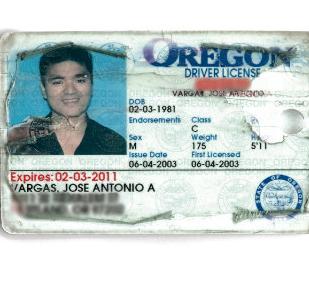
The ol’ Chron commissioned its former reader representative, Dick Rogers, to do a piece on the Jose Antonio Vargas story, and he concludes that Vargas was a liar whose failure to turn himself in to immigration authorities (and thus accept deportation to a country he hardly knew) undermined his journalistic work. Rogers quotes editor Ward Bushee:


“While he deserves sympathy for his efforts to become a citizen, Vargas’ lack of forthrightness in some of his reporting cannot be defended,” Bushee said. “He practiced a pattern of deception that was not only dishonest, but disrespectful of his readers and fellow journalists at The Chronicle.”


Pardon me while I puke.


I’ve already written about Vargas and about former Chron editor Phil Bronstein’s (far more nuanced) handwringing over the situation. But the conclusions the Chron reached in the Rogers article are just bizarre and reflect a creaky, ancient attitude towards journalism that makes no sense in the modern world.


I called Rogers, who is a nice guy with a long history in journalism, and we had a long talk about the situation. I asked him what the young man should have done when he found out at 16 that his parents had sent him to the Unites States illegally. Rogers, to his credit, said he didn’t know, that it was a tricky moral and legal dilmemma. “But that’s not what I was asked to write about,” he said.


The issue for him: Vargas lied when he filled out his employment application and failed to disclose to his editors that he was in the country illegally. That damaged the Chronicle. “You can’t put yourself above your newspaper,” he told me.
Okay, once again: What should Vagas have done? What should a person who is forced by stupid and inconsistent federal laws to lie about his immigration status do if he wants to be a journalist? Well, Rogers said, that’s the dilemma: “I don’t think he should have been working in mainstream journalism.”


Of course, he’s have to lie to get a job as a lawyer, or doctor, or CPA. And all of those professions also have ethical codes that discourage lying. So perhaps he should have been a bricklayer.


To be fair, Rogers doesn’t go that far — he suggested that there were other types of journalism Vargas could have done. He could, for example, have worked for the Bay Guardian. (I wish.) After we talked for a while, Rogers said that if Vargas was going to work for the Chron, he should have recused himself from any stories involving immigration.


But let’s be real here: The Chron allowed a reporter who took money from a nativist group to keep writing about immigration. Bushee, who is so outraged about Vargas, has no problem allowing an (illegally) unregistered lobbyist who gets paid to advocate for wealthy interests in the city to write a political column without ever disclosing his clients or conflicts. (Rogers told me that was a legitimate point. “Conflicts are conflicts,” he said.)


And at the same time, the Chron fired a reporter who participated in an antiwar march and wouldn’t let a lesbian reporter cover same-sex marriage.


It’s inconsistent to the point of being silly.


Look: All of us have conflicts. As the great Larry Bensky once told me, “People who have no conflicts have no interests.” Can a person who drives a car write about transportation policy? Can a person who smokes pot write about medical marijuana (or should she tell her editor, sorry boss — I’m illegally ingesting a controlled substance at night, better fire me or report me to the cops because I can’t cover this story)? Can a person with children write about whether San Francisco is a good city to raise children? Can a person with kids in the public schools write about the school board? Can a divorced person cover a wedding? Can a person who had an affair write about a politician who’s caught fooling around? Can a person who drinks beer write about the city’s alcohol tax?


I mean, let’s not be ridiculous here.


Let me tell a perhaps hypothetical story. Suppose that, when I was working for a (socially conservative) daily newspaper in a (socially conservative) New England city in the mid-1970s, I had a colleague who was gay. And suppose she decided — correctly — that her career would be damaged (at that time, at that institution) if she was out of the closet. (For all I know, she was a criminal, too — I’m not sure when this particular state repealed its sodomy laws.) So suppose she lied — to her boss, to her coworkers, to everyone around. Did that mean she was a bad reporter? Not at all. My hypothethical friend did what she thought she had to do, at a time when the professional and political world she lived in was unwilling to accept who she was. (In fact, there were no laws back then about firing people because of their sexual orientation.) She hated it, we all hated it, and we worked to change things. But I’m not going to condemn her — or call into question the credibility of her work — because of it.


(By the way: I lied, too. I told my boss at this particular institution that I didn’t smoke marijuana. It was a job requirement. I wanted the job. I was a lawbreaker, and I still covered the cops. In fact, I wrote about pot busts. Thank god they didn’t test my pee.)


Let’s face it: Everyone at the Chron, and at every daily newspaper, has personal issues that prevents him or her from being completely objective. Jose Antonia Vargas was no different. The fact that the United States government forced him to lie is no grounds for saying he couldn’t be, and isn’t, a good, honest reporter.
 

Hot sexy events: June 22-28

0

Apparently we got everyone a little too hot and bothered with our bike messenger sex post a few weeks back — the bicycle coitus backlash has already begun!

This news from LA, where the super fly Midnight Ridazz ride ran into some complications in the form of a drunk, cell phone-using driver smashing into a group stopped on the side of a road, injuring 11 cyclists. The police were quick to point fingers — at the cyclists. After all, “alcohol, condoms, and marijuana” were found near the scene of the crime, as ABC Channel 7 reported. Clearly, the Ridazz were gearing up (ha!) for a late night bike orgy. You know how that saddle friction gets everyone all randy.

LAPD did offer this PSA-type release, which I suppose is intended to act as a mea culpa for being all sassy about adult beverages, smoking weed, and safe sex? At any rate, “bike orgy” should surely be the SF Bike Party’s next theme ride. And now onto sex events for Pride Week! 


Oh!

Dirty young gentlemen, be aware: you’re not to miss this grimy-beated, well-meated party time at SF’s cruisey queer watering hole. Details? Write the story yourself — all we can tell you is that DJs Taco Tuesday and Guy Ruben will be getting the soundtrack hot like a skin flick. 

Wed/22 10 p.m.-2 a.m., $5

Powerhouse

1347 Folsom, SF

www.powerhouse-sf.com


“Heart/Hand/Art: Erotic Moments from San Francisco’s Lesbian Underground”

In a recent SF Station interview, Phyllis Christopher insists she “never, never wanted to shock people. I was having these amazing experiences and I wanted to talk about it.” Surely shocking is not the right word for Christopher’s florid shots of women in the throes of passion — titty grabbing, peeking out between fishnetted leg passion — we only flash on “sexy.” But Christopher’s intent was to document the lives of San Francisco lesbians. The erotica she captured is gorgeous — a flattering portrayal of women loving women in the City by the Bay. 

Thurs/23 6-8 p.m., free

Good Vibrations

1620 Polk, SF

(415) 345-0500

www.goodvibes.com


Lexington Club Pride weekend

Let’s be honest, it’s a rat race trying to name your Pride parties with the sluttiest monikers in the city — there’s just too much competition out there. But the Lex surely has a leg way up, if there is such a contest. Honestly, it wins based on sheer quantity: Thursday dances out with “DTF,” Friday flirts hard with “No Strings Attached,” on Saturday you can “Tap That,” and Sunday’s climax (after a super-slutty brunch party — oh, and the official Pride blowout, of course) is “Hit It and Quit It.” Straddle you a lady lez and get down — just don’t spill that Pabst on her cut-offs unless you’re trying to lick it off. 

Thurs/23-Sun/26, free

Lexington Club

3464 19th St., SF

(415) 863-2052

www.lexingtonclub.com


Mr. Kok Kontest

Kok Bar’s keeping it hard and slutty for you all weekend, but the new kid on the Folsom block has some extra special for you planned for Saturday night: a contest to see who has the biggest dick — though wait, isn’t that the point of Pride Week itself? Anyways, it’s been formalized here, so pack your binoculars, not much else, and head down.

Sat/25, free before 10 p.m., $4 afterwards

Kok Bar

1225 Folsom, SF

www.kokbarsf.com


Pansexual Pride Party

Cap off your Pride celebrations (or gear up for Sunday night) at the Citadel’s all-inclusive dungeon play party. Featured will be a demonstration by Mr. SF Citadel 2011 on how to successfully dominate a bottom twice your size. The website promises that it will produce experiences akin to “a chihuahua picking on a rottweiler.” 

Sun/26 5-8 p.m., $10 

SF Citadel 

1277 Mission, SF

www.sfcitadel.org


“Sex, Death, Laughter, and Disease: Writing and the Body”

Empower your body (and your prose) with this course, which will teach the skill of writing the corporeal form as protagonist. Sound a little English Lit-y for you? Instructor Lorelei Lee is an NYU creative writing professor, but check her clips before you dismiss this event from this column: lady’s been featured in $pread Magazine, the anthologies Hos, Hookers, Call Girls and Rent Boys: Professionals Writing on Life and Love and Off the Set: Porn Stars and Their Partners — plus, she’s currently penning a script with Stephen Elliott. 

Tues/28 (through Aug. 2) 7:30-9 p.m., $325

Center for Sex and Culture

1349 Mission, SF

(415) 902-2071

www.sexandculture.org


On the hook

4

rebeccab@sfbg.com

Unique Roberts squared back her shoulders and recalled what it was like when she first moved to San Francisco from East Oakland more than a decade ago. A tall, 33-year-old African American transgender woman with piercing eyes and a charming smile despite gaps of missing teeth, Roberts said she performed as a showgirl at clubs like Harvey’s and the Pendulum in the Castro. In those exciting days, “I fell in love with this boy, and he was an addict,” she explained. “I thought that if I did it, it would keep our relationship together.”

She recalled how awful her boyfriend felt when he found out she was using, telling her, “You don’t know what you’re doing to yourself.” He departed for Texas several years later, but addiction stuck with her as a way of life.

She says she’s tried to kick the habit, but it’s wrapped up in a battle against depression stemming from the loss of loved ones. Roberts was wearing one of the bright orange sweatshirts issued to inmates at San Francisco County Jail. She landed there after being arrested in April for allegedly selling a tiny rock of crack, weighing just 9/100s of a gram, to an undercover narcotics officer. According to the police report, the cop offered her $20 for it — but based on National Drug Intelligence Center street-value estimates, that amount is only worth about $2.50.

Roberts may go by the first name Unique, but her lawyer Tal Klement, who works for the San Francisco Public Defender’s Office, is fond of saying her case is hardly unique at all. She was one of several people arrested in the Tenderloin that day after interacting with the same plainclothes officer.

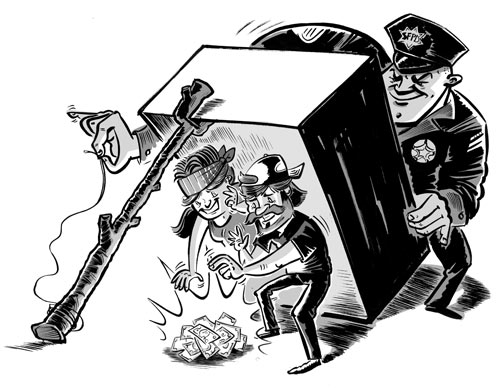
It was part of a coordinated sweep known as a buy-bust, a common practice under which an officer may pose as a homeless person, a clueless outsider, or a dope-sick fiend to lure people into selling crack, pills, meth, heroin, or marijuana. Once a transaction is made, a team of officers awaiting the signal immediately closes in and arrests the seller.

As of June 20, there were at least 109 open buy-bust cases in San Francisco. Based on defendants’ rap sheets, 92 percent had prior drug-use histories, according to a tally conducted by the Public Defender’s Office.

The officers posing as buyers — who often earn overtime — use street lingo, know which drugs can be obtained at which intersections, and sometimes offer higher prices than the accepted street value. Attorney Anne Irwin, also a public defender, is critical of the practice, saying it’s an expensive tactic that’s makes for easy arrests — because the money is irresistible to addicts who think they’re getting an opportunity to convert a personal stash into more drugs.

In a lean budget year, “they’re cutting social services left and right, and these are the very services that could help the addicts get off the street,” Irwin noted. She’s skeptical that the strategy stems the flow of substantial quantities of drugs.

Police Chief Greg Suhr, who said he participated in buy-busts for years as a narcotics officer, credits the tactic for helping to eradicate a rampant open-air drug market on Third Street in the Bayview, and says it can help prevent drug-related violence.

Klement, however, condemns it as a “war on crumbs,” saying it ensnares far more addicts than serious dealers and often ends up unnecessarily pinning felony convictions onto low-level offenders.


NUMBERS GAME

Buy-busts usually involve around eight officers, according to an average calculated by the Public Defender’s Office based on open cases, but have involved as many as 14 and as few as three. There’s the decoy buyer, who sometimes dresses in grimy sweatpants, goes without shaving, or dirties his face to look like a street addict in desperate need of a fix. There’s a “close cover” officer who follows the decoy, plus an arrest team that is also sometimes in plainclothes. Beforehand, officers will photocopy cash — usually $20 bills — to document the serial numbers so that the same marked city funds can be used as evidence once recovered from arrestees. Busts can happen within minutes of one another, and a single shift may net five or six arrests.

Irwin says the people snared aren’t typical drug dealers — certainly not big-time players. But they’re charged as dealers — and in many cases wind up branded as felons, with severe legal penalties such as multiyear prison sentences.

While the police department is able to show on paper that it’s brought hundreds of drug dealers into custody — and the district attorney can point to a boost in the conviction rate thanks to the program’s efficiency — Irwin says the amounts being peddled are tiny.

“In traditional narcotics operations, they cultivated snitches, used surveillance, and obtained search warrants” to go after major dealers, Irwin said. With buy-busts, “It’s like shooting fish in a barrel. Everyone agrees that we need cops on the streets to help keep us safe … But do we want to be paying hundreds of thousands of dollars for this?”

Sharon Woo, chief assistant of operations for the San Francisco District Attorney, told the Guardian that “we charge based on the conduct of the individual.” Woo went on to say that the DA tried to “exercise appropriate discretion” on a case-by-case basis when individuals are selling to support an addiction or due to being in dire financial straits.

Sometimes individuals are ushered into alternative programs such as drug court or a Back on Track program for first-time offenders, Woo said. And while the DA typically includes charges that make defendants ineligible for probation under state law if they have prior convictions for selling crack-cocaine — a discretionary practice that has drawn criticism from public defenders — Woo observed that “it doesn’t mean that’s how cases resolve.”

Police forces in nearly every major metropolitan area practice buy-busts, said Frank Zimring, a law professor at UC Berkeley’s Boalt Hall School of Law specializing in criminal justice issues. Yet he described the practice as costly and noted that paying overtime for it “makes what would ordinarily be a very expensive operation into a more expensive operation.”

Cost estimates for the entire program are tough to pin down. It costs $130 per day to house each prisoner in the county jail, amounting to more than $14,000 per day if all of the defendants with pending cases are in custody. If an average of eight officers per bust were paid $60 an hour each to spend six hours conducting a buy-bust, the current caseload represents more than $300,000 in officer pay — a conservative estimate — and that’s before lawyers in the offices of the public defender and district attorney are paid to prosecute and defend the suspects in court.

But no matter how you add it up, it’s a lot of money.

Suhr told the Guardian that apprehending street-level offenders occasionally leads officers to bigger fish. “Sometimes you get a low-level person, or a buyer if you will … if that same person would say, ‘But I know this guy and he has guns and he’s a big dealer and whatever.’ That is a good way to get to those bigger people.”

“We’ve never seen that happen in practice,” Klement countered.

One of Irwin’s clients, a homeless man, was charged with selling narcotics after he scraped out the contents of his pipe to sell 1/1,000th of a gram of crack to an undercover officer for $20. In a rare twist, the case was ultimately settled on a misdemeanor possession of narcotics.

Inspector Robert Doss, who served as the decoy in that case, has earned substantial amounts of overtime while going undercover to buy drugs, according to a court transcript. In 2009 Doss earned $35,488 in combined overtime and “other pay,” which includes time spent testifying in court, according to a San Francisco Chronicle database of municipal salaries.


ON THE STREET, OFF THE STREET

The Tenderloin is frequently targeted for buy-busts, with 65 percent of open cases as of June 13 having taken place in that neighborhood. The Haight ranked second, with nearly 12 percent of cases, and the Mission followed with 10 percent. Shortly after District Attorney George Gascón was sworn into his prior post as police chief in 2009, he announced a concerted effort to clean up the Tenderloin, and Klement maintains he’s seen a surge in cases stemming from buy-busts there ever since.

Drug dealing in the Tenderloin often makes the news as a source of frustration to merchants and residents. “You try and explain to the people of San Francisco that it’s okay for people to have open-air drug markets right in front of their stores,” Suhr said.

Yet Klement maintains that what is essentially a quality-of-life crime should not be treated as a felony. “There’s a lot of pressure from people who are invested in businesses [in the Tenderloin] who would love to see that neighborhood become the next Hayes Valley,” he said. “But what they don’t realize is that people are paying with prison for that agenda.”

Once someone has been labeled a drug dealer in the eyes of the law, he said, it becomes more difficult for them to access drug treatment — not to mention get a job, qualify for a student loan, or find housing.

Roberts’ case nearly went to trial. If convicted, she could have been sent to prison for a minimum of three and a maximum of 17 years due to extra penalties from prior convictions. On the eve of the trial, however, the case was settled on a possession charge for a year in jail, a rare outcome. Klement was hoping to have her placed in a treatment program.

Asked if she knew of others swept up in undercover operations, Roberts gave a wry chuckle and gestured to the jail corridor behind her, indicating that nearly everyone there had been taken down in similar fashion. Klement noted that the targets of the buy-busts are almost exclusively people of color, saying, “You walk into the holding cell and you think you’re in Alabama or Mississippi, not San Francisco.”

In an editorial on the subject that he wrote a couple years ago, Klement noted that by contrast, predominantly white middle class people with a fondness for illegal drugs are rarely targeted because they aren’t the ones selling drugs on the street. “The hard truth is that the police ignore most of the middle class drug use and dealing occurring out of private homes in every neighborhood or other public venues in the city — bars, nightclubs, concert halls. More drugs are being transported to Burning Man as we speak than will probably be seized during Gascón’s entire crackdown.”

For Klement, it’s just another symptom of a broken system. “A lot of these people are repeat players because we don’t have the right interventions at the right time,” he said. “We don’t understand addiction.”


Will another DREAMer be deported, despite ICE’s S-Comm reforms?

51

Last week, ICE announced reforms to its controversial Secure Communities program. Civil rights advocates denounced these changes as window dressing, and the Guardian broke the news about S-Comm’s importance to the FBI’s Next Generation Identification (NGI) initiative, which appears to be using S-Comm on undocumented folks to secure support for a fingerprint dragnet to cover a much broader segment of the population than undocumented immigrants. But now, even before folks have had a chance to fully process the potential civil liberties impacts of the FBI’s NGI’s initiative, comes word that Mandeep, a DREAM Act honors pre-med student at UC Davis, who was once voted “most likely to save the world” by her peers at Los Altos High in Mountain View, could be deported to India on Wednesday.


Mandeep is pursuing a degree in Neurology, Physiology, and Behavior at UC Davis. But she is undocumented, and thanks to Congress’ failure to pass the DREAM Act last year, she now faces deportation to a country she barely knows. Immigrant rights advocates note that it was only a  month ago that President Obama spoke about the importance of providing a path to citizenship for students like Mandeep.


“We should stop punishing innocent young people for the actions of their parents,” Obama said. “We should stop denying them the chance to earn an education or serve in the military.”


They note that Obama has authority to grant administrative relief, which would make qualified DREAM Act youth safe from deportation, but that he has said he can’t use his executive authority in that way. So they’ve been sounding the alarm about Mandeep’s plight by faxing government officials about her situation.


But weren’t ICE’s newly announced S-Comm reforms supposed to provide relief for students like Mandeep?


Immigrant rights advocates say they are concerned that the reforms may not have much real impact on Mandeep because they rely on advocates and attorneys to get attention on individual cases. They note that Mandeep and her mother turned themselves into ICE this morning because they are scheduled to be deported tonight at 1am. And that ICE released them. But it is not clear what will happen next….


Meanwhile, ICE today announced the results of a seven-day targeted “Cross Check” enforcement operation that led to the arrest of more than “2,400 convicted criminal aliens and immigration fugitives” in May, as part of its promise to focus S-Comm resources on undocumented residents who have also broken criminal laws.


“The results of this operation underscore ICE’s ongoing focus on arresting those convicted criminal aliens who prey upon our communities, and tracking down fugitives who game our nation’s immigration system,” ICE Director John Morton said. “This targeted enforcement operation is a direct result of excellent teamwork among law enforcement agencies who share a commitment to protect public safety.”


ICE notes that everyone taken into custody as part of this latest sweep had prior convictions for crimes such as armed robbery, drug trafficking, child abuse, sexual crimes against minors, aggravated assault, theft, forgery and DUI. ICE also noted that 22 percent of the individuals were immigration fugitives-convicted criminal aliens with outstanding orders of deportation who failed to leave the country.


ICE says it conducted its first successful Cross Check operation in December 2009,  and has since conducted similar operations in 37 states, but that this seven-day operation, was the largest of its kind, and involved the collaboration of more than 500 ICE agents and officers, and coordination with the U.S. Marshals Service, the U.S. Diplomatic Security Service, U.S. Customs and Border Protection, the U.S. Postal Inspection Service, and ICE’s state and local law enforcement partners throughout the United States.


Arrestees included a 32-year-old man residing in Amesbury, Mass., from the Dominican Republic, who is a registered sex offender convicted of assault, battery on a household member, indecent assault, battery on a child, and leaving the scene/person injured; a 51-year-old man residing in Denver, Colo. from Libya convicted of first degree sexual assault against a child and assault domestic violence; a 38-year-old man residing in Orlando, Fla. from the Philippines convicted of battery on a law enforcement officer, resisting officer with violence, reckless driving and refusal to submit to blood/urine test; andaA 37-year-old residing in North Hills, Calif. from Mexico convicted of aggravated felony sex crime and rape of an unconscious victim. He was also identified as re-entering the United States after deportation. He will be removed following prosecution for illegal re-entry after deportation; and a 47-year-old man residing in Magnolia, Texas from Mexico convicted of injury to a child with intent to cause bodily injury, burglary, marijuana possession, driving while license suspended and indecency with a child by sexual contact.


“ICE is focused on smart, effective immigration enforcement that prioritizes efforts first on removing those serious criminal aliens who present the greatest risk to the security of our communities, such as those charged with or convicted of homicide, rape, robbery, kidnapping, major drug offenses and threats to national security. ICE also prioritizes the arrest and removal of those who game the immigration system including immigration fugitives or those criminal aliens who have been previously deported and illegally re-entered the country, “ ICE stated.


Hmm. It sure sounds like Mandeep doesn’t fit ICE’s criminal alien profile or priorities any more…

BYO Flair: A guide to this weekend’s festival explosion

0

If there is one thing I know about festivals it is this: the gear you pack can leave you hydrated, hip and happy — or break you down to a sunburned, schlubby hunk of bad vibes. (It’s true – shoddy preparation for Reggae on the River 2006 left me stranded in the psych tent with disoriented girlfriend during the Ziggy and Damian Marley concert. Clearly, a hipper fedora would have solved everything.) 

This weekend plays host to a freakishly large share of summer festivals, so consider this your guide to happy cavorting in the sun. Cups, caps, frocks, and foods: here, friends, are our picks for best festie flair.  

Sierra Nevada World Music Festival

The perfect weekend campout for those that can’t handle the crushing crowds of the more commercial festivals this summer. Even the little things (children) will appreciate the open-minded approach to beautiful noise here.

Bring: Consider SNWMF a three-day immersion program in getting loose. Translation: you need costumes. If you’re heading up from San Francisco, we’ve got the perfect sartorial layover for you. Sebastopol’s Funk & Flash vintage store is far enough removed from the big city that its stock hasn’t been picked to all hell by the club kid set, so festie-bound you can benefit from its racks of flowery skirts, and tons of sparkle. Go, do you! 

Fri/17-Sun/19, $60-150

Boonville Fairgrounds

CA-128, Boonville

www.snwmf.com


Juneteenth Festival and Parade

The website proclaims this celebration of African American heritage to be the largest gathering of blacks in Northern California, but it remains to be seen whether you’ll fixate on the cultural signifcance while attending the event itself: with an impressive classic car show and three-on-three basketball tournament, all the historical reflection might have to wait until after the festival. 

Bring: No brainer accessory: a hat from Hats of the Fillmore, an independent business that’s been holding it down on Fillmore’s main drag for years. High quality at surprisingly low prices, you can don one of these lids to fit in perfectly with the jazzy milieu of SF’s traditionally black neighborhood. 

Sat/18 11 a.m.-7 p.m., free

Fillmore and Geary, SF

www.sfjuneteenth.org


Alameda Sailing Festival

Hey Muffy, take a break from hating on the impending America’s Cup to catch a day of boating buoyancy. The Encinal Sailing Foundation will be providing turns on the high seas for a “nominal” fee, and there will be seminars on “pilates for sailors,” boating to Mexico, and how to get your captain’s license. Afterwards, we know some great places to get drunk in Alameda!

Bring: This really goes for every fest on the list, but possibly the most important piece of flair is a fun, functional backpack to hold your water (flask), sunscreen, cell phone, and snacks. We love the Brooklyn Circus’ BKc satchels – but for the moment you’ve gotta special order them from New York. That’s fine, this ain’t the last weekend of the summer! The store’s preppy style (without the snooty WASP-y supply chain behind it) would be divine if you’re looking to drop some dough on a nice sailing fest outfit. 

Sat/18 10 a.m.-8 p.m., free

Encinal Yacht Club

1251 Pacific Marina, Alameda

www.summersailstice.com


Bicycle Music Festival

You read our profile on Fossil Fool, so you know all about the current trend towards bike-fueled culture fun. According to all the volunteers that have been standing near Mona Caron’s bike mural behind the Church Street Safeway for the past few days, this fest will be the perfect spot to enjoy the zeitgeist. Saddle up for awesome tunes, and community-building bike rides between concert sites. 

Bring: Hedgehog mug from Gravel and Gold so you can (chicly, adorably) reap the benefits of the fest’s pedal-powered smoothie maker. It also comes in rabbit, fyi. The calories you consume in said smoothies work doubletime — once you’re done drinking, take your turn powering the generator for the drinks or one of the music stages yourself.

Sat/18 noon-11:25 p.m., free

Various locations, SF

www.bicyclemusicfestival.com


Berry Festival

You know this sun isn’t going to last past 4th of July, so now is the perfect time to up your antioxidant intake and arm the old immune system against “summer” colds. CUESA and the Ferry Building farmers market is holding this day of loving for berry season – sample the treats available in the market stalls and let chef Daniel Clayton of Nibblers Eatery and Wine Bar show you how to whip up some healthy, hearty grub with the juicy little devils. 

Bring: a nice navy sweatshirt from Mollusk for the Bay breezes and inevitable tayberry stains. 

Sat/18 11 a.m.-1 p.m., free

Ferry Building, SF

www.cuesa.org


California Big Time Indian Gathering

The Ohlones are hosting their first gathering of Native peoples in their ancestral lands in two centuries. Come to learn more about real SF locals through dance, rituals, and craft exhibitions.

Bring: Mocs that slip off easy – you’re not gonna want a layer of separations between the well-manicured lawns of Yerba Buena and your soles. 

Sat/18 noon-11 p.m., free

Yerba Buena Gardens

Howard between Second and Third St., SF

www.worldartswest.org


North Beach Festival

Sure, the neighborhood street fests all start to look the same after awhile. But there are good parts of that same: family-friendly musical acts, artery-busting festie food, and an excuse to run amok in the streets. The North Beach incarnation has been going for 56 years, and manages to sneak a couple unique facets into the standard cruise-shop-eat formula SF has perfected. 

Bring: your kitty cat companion for the yearly St. Francis of Assisi animal blessings. Also, a flirty, locally made frock from NooWorks is totally Maria from West Side Story – perfectly for the neo-Catholic-in-the-summertime vibe you’ll be channeling. 

Sat/18-Sun/19 10 a.m.-6 p.m., free

Washington Square Park

Union and Columbus, SF

www.northbeachchamber.com


Northern California Pirate Festival

Never underestimate the amount of people willing to drop serious time and dime on dressing up in period costumes. You’ve seen the Renaissance fairs and the Dickens Christmas Fair – now it’s time to peep the pirates. Two very full days of pirate entertainers and replica boats (not to mention squadrons of pirate clothing vendor booths) await you if you be brave enough to cross the seas to Vallejo. 

Bring: Your 826 Valencia designer spyglass, for scurvy-watching of course. 

Sat/18-Sun/19 10 a.m.-6 p.m., free

Vallejo Waterfront

Mare Island Way (near the ferry terminal), Vallejo

www.norcalpiratefestival.com


Picklewater Free Circus Festival

As we mentioned in last year’s profile of our favorite free circus troupe, Circus Bella, nothing quite highlights the magic (and eccentricity) of this city quite like catching a high-flying aerial act smack dab in the heart of downtown. Picklewater is taking over Union Square for the third year in a row this weekend, and we suggest you head down — if only to catch the amazed gaze of the throngs of tourists that’ll be on hand to remind you that yes, your city is freakin’ amazing. 

Bring: Your medical marijuana card, and attending accoutrements. 

Sun/19 2-4 p.m., free

Union Square

Post and Powell, SF

www.jewelssf.org


Sharon Jones and the Dap Kings at the Stern Grove Festival

The 74th season of this green glade’s free concert series kicks off with a killer show from the queen of throwback soul. 

Bring: The Stern Grove scene struts more with its picnic spread than by any accessory or fly outfit. A retro basket (check Goodwill, people are always ditching picnic baskets) will be a useful score, and in terms of snack to make (they must be homemade!), peep our favorite new vegan cooking blog, The Vegan Stoner. It’s perfect, even if you had to self-medicate your hangover before you started prepping for the journey out to the Sunset.  

Feat. Ben L’Oncle Soul

Sun/19 2 p.m., free

Stern Grove

19th Ave. and Sloat, SF

www.sterngrove.org


Mission Street mural unveiling

But why spend all your time at the big events? Artist Aaron Lawrence is holding an al fresco event of his own – pulling the dropcloth off the work he and muralist Rocky Villanueva did on a new apartment building on Mission. He’s making a party of it, so get there early if you want to get down on the free burritos provided. 

Bring: Tapatio, tall can Tecate. Bring two cans, share them. 

Sun/19 2-5:30 p.m., free

Mission between 18th and 19th St., SF

Facebook: Sunday Mural Reveal Party


Candidates land punches in first D.A. debate

5

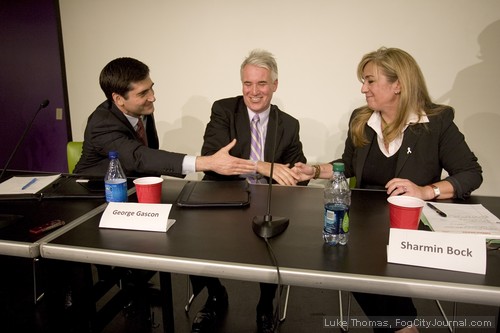
District Attorney and former SFPD Chief George Gascón, Alameda County Deputy District Attorney Sharmin Bock, and former San Francisco Police Commissioner David Onek all landed solid punches during a three-way District Attorney debate that was co-hosted by the San Francisco Young Democrats and the Alice B. Toklas LGBT Democratic Club, and moderated by Recorder editor Scott Graham. The primary sponsor of the debate was the City Democratic Club, according to CDC President Jim Reilly. So, thanks CDC for helping to pull off a great event.

The debate was framed as a choice between Bock, a veteran prosecutor with leadership experience, Gascón, a career cop with managerial experience, and Onek, a former San Francisco Police Commissioner and criminal justice reform expert. And above all it proved that if you lock three attorneys in the same room and pit them in a three-way fight, you’ll be rewarded with a blood sport spectacle.

Bock kicked off by noting that there are many similarities between the three candidates—except when it comes to independence and experience “Experience matters,” Bock said, throwing a one-two punch at Gascón and Onek. “The job of the District Attorney is not a management job, a police job or a job for someone with just a law degree. It needs a veteran prosecutor,” she said—remarks that resonated well with the crowd, judging from the applause.

But after a few niceties, Gascón shot right back at Bock and Onek. “I am the only one who has led large organizations and pushed public policy forward in an effective manner,” he said.

And Gascón struck a home run when he revealed that when he took the job of Chief of Police in Mesa, Arizona, he was “facing one of the most toxic environments” in terms of hatred towards people of color and the LGBT community–and that he did something about it, by standing up to anti-immigrant Sheriff Joe Arpaio of Maricopa County, and protecting the local LGBT community’s right to protest.

When it was his turn to speak, Onek fired off his own rounds at Bock and Gascón, noting that the state’s criminal justice system is broken—and claiming that it will take an outsider to fix it.
“This is a once-in-a-lifetime opportunity to reform the criminal justice system,” Onek said, laying out his reform-minded track record.

And then he stuck it to both Bock and Gascón by stating that the death penalty does not work. “I will never seek it in San Francisco under any circumstances,” Onek said, earning excited applause, as he noted that he’ll look at all policy question through the prism of three questions: ‘Does it make us safer, is it cost effective and is it fair and equitable?”

Onek also noted that neither the Supreme Court’s ruling that California must reduce its prison population by 30,000, nor Gov. Jerry Brown’s call for prisoner realignment, come with any money.
‘That’s a disaster,” observed Onek, as he stressed the need to demand resources to help deal with the upcoming load of prisoners that about to return to San Francisco.

Gascón fielded questions about whether they are enough people of color and LGBT background in management in the D.A.’s Office. “Well, I think there’s definitely always room for improvement in any organization,” he said, noting that he has a history in the Los Angeles Police Department, the Mesa, Arizona Police Department and the SFPD, “of pushing very aggressively to have diversity within the office.”
But he started a bit of a buzz when he said it was “really a surprise to me that I promoted the first male, black, police captain to the San Francisco Police Department.”
“You would think that there have been, you know, male African-Americans in that department for many years. It was hard for me to believe that actually in 2009 we had not had one,”  Gascón continued, a remark that got some debate observers asking afterwards, if this meant that Gascón really did not know that former SFPD Chief Earl Sanders was a black male.

Meanwhile, Bock was happily trampling all over the sit-lie legislation that then SFPD Chief Gascón and Mayor Newsom backed last fall, as she noted that more foot patrols and community policy are what’s actually needed. “Political hot-button measures don’t work,” Bock said. “Both sides agree it hasn’t worked. It’s the wrong response to the real problem.

Asked if he had a conflict of interest, when it comes to investigating allegations of police misconduct, Gascón claimed the problem is limited to a small number of officers, adding, “if the allegations are true.”

“In reality the majority of the SFPD are hard-working people doing the right thing,” he said. “And there has been only one challenge—and our office has prevailed,” Gascón said. “However, there have been a finite number of cases where I personally adjudicated the bad conduct—and those will be handled by the Attorney General’s office.”

Bock stressed that she was not in favor of sending drug offenders to prison and would focus on restorative justice, instead. Asked if she would have a panel on her staff review potential death penalty cases, Bock confirmed that she is committed to having a Special Circumstances Committee, as D.A. Kamala Harris did, to get input around the facts and from lawyers involved in such cases.“The ultimate decision is mine, and I oppose the death penalty,” Bock said, noting that she does not believe that 12 jurors will return a unanimous death penalty verdict. “But I do think as prosecutor you need to go case by case.”

Asked if he would have sought the death penalty in a case like the L.A. Night Stalker, who murdered 13 people, many of them elderly, Gascón said, “Probably not. All of us agree that the death penalty is not a good tool. But it is part of our system, and I continue to have the system Kamala Harris had in place. At the end of the day, it’s my decision, and I’m the only one in the room, who can say I’ve already turned down the death penalty.”

Agreeing with Bock that a jury is unlikely to go for the death penalty, Gascón maintained that the death penalty is “an illusory issue,” and that the real question is, “How do we rewrite the State Constitution [so the death penalty is not on the books]?”

Asked how he felt about marijuana, Gascón said he doesn’t believe folks should be incarcerated for use—and that folks are already being diverted to community courts in those instances.

But when Onek tried to wrap up by positioning himself as a the reformist-minded outsider, Gascón pounced, reminding folks that Onek was a Police Commissioner, when the Police Commission recommended Gascón to Mayor Newsom as the next SFPD Chief. “While David is someone I respect—and one of those who hired me, David has painted himself as an outsider, when the Police Commission is the policy-making body for the SFPD. There are no outsiders here. The question is, what have you done? There’s a difference between calling yourself a reformer and having other people call you a reformer.”

Bock for her part used her closing remarks to remind folks that there has been a crime lab scandal, alleged police misconduct, a DNA backlog, and about 100 cases dismissed as a result of these scandals, and a bunch of prisoners are about to be sent back to the community because of realignment. “We’re in challenging times, at a critical crossroads, with stormy weather ahead,” she said. “I’m not going to be trying things out at your expense. As a veteran progressive prosecutor, I’m fully prepared.”

Return to Barbary Lane

1

arts@sfbg.com

THEATER The mainstream apotheosis of once-outré subculture is always a complex matter. Even the good-natured, good-time stories in Armistead Maupin’s original “Tales of the City” San Francisco Chronicle serial had a subversively political edge to them in 1976 (which made their publication in the paper beginning that year both remarkable and fraught with behind-the-scenes battles between writer and editorial). So it is a little weird, if also apt, to see a full-fledged musical adaptation of Maupin’s classic Tales of the City — the first and eponymous title in what became an eight-book series — getting its Broadway-bound debut at American Conservatory Theater.

Although inevitably speaking less to today’s San Francisco than to an idealized conception of a glorious recent past, this Tales is still recognizably homegrown (despite all the out-of-town talent), affirming, lightly risqué, and overall slickly accomplished. Minor weak points aside, there’s plenty of vitality throughout a generally shrewd production, whose creative team includes playwright Jeff Whitty (Avenue Q) and music group Scissor Sisters’ Jake Shears and John Garden (providing the eclectic music and occasionally awkward but mostly inspired lyrics for Whitty’s admirably clear, compact book).

The results are nostalgic but never blinkered. Even the shopworn feel of Haight Ashbury and disco kitsch proves less than annoying thanks to Maupin’s set of palpable and sympathetic characters (animated by a strong cast), his nicely entangling storyline, and the show’s engaging, even rousing period-savvy score. Whether it will play in Peoria — or New York City for that matter — who knows. But for the audience at last week’s opening in San Francisco, it solidly earned the love fest it probably would have gotten either way.

Cleveland-reared but Bay-curious Mary Ann Singleton (a formidable Betsy Wolfe) arrives in 1976 San Francisco, a city celebrating its own version of the “bi-sexi-centennial” year with a burgeoning alternative culture mixing remnants of Summer of Love hippiedom with mirror-ball dance floors and gay bathhouses. Fleeing her oppressive hometown and shedding gradually her straight-laced upbringing, Mary Ann makes her new home at 28 Barbary Lane, a Russian Hill apartment complex (a skyward Victorian framework flanked by great locks of greenery in Douglas W. Schmidt’s choice scenic design) overseen by the benignly extravagant matron and marijuana maven Anna Madrigal (played with serene assurance by Broadway’s golden-throated Judy Kaye). She soon joins the other tenants in a loose alternative “family” (with all attendant subplots) centered on the mysterious Anna, who we learn started out even more remotely from her present self than did Mary Ann.

The numerous other characters come equally well realized. As Mary Ann’s out gay neighbor Michael “Mouse” Tolliver, for instance, Wesley Taylor is as believably down-to-earth as he is charming (Michael’s loving coming-out letter to his Anita Bryant–loving parents is just one of the show’s dramatic highlights). Broadway veteran Richard Poe, meanwhile, delivers Edgar Halcyon — the stuffy businessman grasping for a last chance at life under Anna’s amorous tutelage — with commanding aplomb and a nicely understated vulnerability. Many other fine turns abound in the large cast, amid some fine musical numbers — although an otherwise effective power ballad from secret Anna daughter Mona (the excellent Mary Birdsong) is somewhat marred by the unintentionally comic title “Seeds and Stems.” And the final “No Apologies” number, while good, is stretched thin with the duty of wrapping up various subplots.

If nostalgia reigns here, the story till has real roots that make themselves gently felt throughout. In 1976, Maupin was a young transplant from North Carolina, via the Navy, and newly, enthusiastically out as a gay man and budding author. Capturing the gig with the Chronicle, he serialized what would become his first novel in a rush of five installments per week under the column title “Tales of the City.” He wrote close to the ground (and the Chronicle society desk), delivering what was at times almost as much reportage as fiction, peppering his hastily composed plotlines and characters with anecdotes from the city he was coming to know intimately. Of course, the ground he worked was then heaving in a cultural and political earthquake that set San Francisco ever further apart from the rest of the country. Tales of the City, in its various incarnations, is still a no-apologies love letter home. 

TALES OF THE CITY

Through July 10

Check website for dates and times, $35–$98

American Conservatory Theater

405 Geary, SF

(415) 749-2228

www.act-sf.org

Guardian takes seven awards

0

news@sfbg.com

The Bay Guardian won seven awards, including the top prize for overall excellence, at the Peninsula Press Club awards dinner May 21.

The overall excellence award cites the Guardian as the best non-daily paper in the region. The San Francisco Business Times was second and Central City Extra placed third.

Steven T. Jones won a first place award in the Specialty Story category for his report “Marijuana goes mainstream.” Jones and Rebecca Bowe shared top honors in the News Story category for “Buying power,” a report on corporate corruption. Tim Redmond won first place in the Political Column category and third place for editorial writing.

Bowe and Alex Emslie took third place honors in Breaking News for their report on the BART Police killing verdict. Redmond and Rula Al-Nasrawi shared second place in that category for “Mysteries of the death-drug scramble.”


Where’s Gascon on Ammiano’s pot bill?

4

Some very good news from Sacramento (and since good news from that part of the world is rare these days, let’s celebrate it). Assembly Member Tom Ammiano has a bill that would eliminate the mandatory felony charges for marijuana cultivation and allow district attorneys to charge some pot farmers with misdemeanors. And it’s cleared committee and is headed to the Assembly floor. The Bay Citizen has a decent wrapup on the politics (including the fact that the prison guards union isn’t going to like it — less customers).


It’s likely the Senate will go along with the bill, too — particularly since most of the district attorneys in Pot Country are supporting it. Mendocino DA David Eyster is the main sponsor. His colleagues in Humboldt, Del Norte and Lake Counties are all on board.


Oddly enough, the California District Attorneys Association still opposes the bill. The board of this august group seems to be dominated by the more conservative counties, but still: The DAs who have to deal with this issue regularly all want the bill passed. What’s up with that? Well, the spokesman for the group, Cory Salzillo, told me that the bill “send the wrong message with controlled substances generally” and that it would also give not only a prosecutor but a judge the ability to turn a potential felony into a misdemeanor. “We’re concerned about that judicial discretion,” he said.


Which seems, frankly, a little nuts — again, the four DAs who are most involved in charging people for cultivation of marijuana — the folks on the front lines, so to speak — want the bill to pass. So who decided the association position?


Salzillo says there’s a legislative committee, but since this one was controversial, it went to the full board. And guess what? There’s a San Francisco rep. on the board — Assistant D.A. Jerry Coleman. I called him to ask how the vote went down. Here’s our conversation:


Me: Hi, Mr. Coleman, I understand you’re on the board of the California DAs association and I wanted to talk to you about why that group is opposing the Ammiano marijuana bill, which the DAs of the north counties that deal with the issue all support.


Coleman: “I’m not the spokesman for that association.”


Me: Yes, but you’re on the board and I’m wondering if you voted in favor of opposing AB 1017.


Coleman: “I can’t give you an answer to that. I won’t discuss any vote. I don’t remember this one, but if I did I wouldn’t talk to you about it anyway.”


That was helpful.


Meanwhile, where’s Coleman’s boss, the San Francisco DA, George Gascon? This is a city that supports medical marijuana, has perhaps a few growers living in its city limits — and if I had to guess, about, maybe, 93 percent of the voters would agree that marijuana cultivation shouldn’t be an automatic felony. Why isn’t Gascon’s name on the list of supporters?


I dunno. His office hasn’t called me back. I’ll let you know when they do.

SF’s top cops differ on local control

7

The announcement by Sheriff Michael Hennessey that he won’t honor federal deportation holds for undocumented prisoners accused of low-level crimes is a great illustration of local control – which is the reason why we elect our sheriff and district attorney – but it is a concept that District Attorney George Gascon doesn’t seem to understand.

As the Guardian recently reported in a cover story by Sarah Phelan, Gascon ignored local control, civilian police oversight, and even standing police general orders as police chief by taking a highly deferential stance with the FBI and its domestic spying operations. Then, in a Chronicle op-ed on the death penalty last weekend, Gascon went even further in declaring himself to be merely a minion of higher government authorities.

While stating his opposition to capital punishment, Gascon said he wouldn’t rule out seeking the death penalty because he doesn’t think his own view or that of the vast majority of San Franciscans should determine his office’s actions. “I don’t believe district attorneys should be allowed to supplant the views of the state with those of their own,” he wrote.

That is a rather astounding statement that only an inexperienced prosecutor and an individual who has spent almost his entire career in the rigid hierarchies of police departments – rather than actually working as an attorney – would make.

“That’s where rookies make mistakes because they don’t have the experience to use their prosecutorial discretion,” said Sharmin Bock, a career prosecutor who works in the the Alameda County District Attorney’s Office, and who is running against Gascon (who did not return our calls for comment). “The DA has discretion over charging decisions and when you pick a DA it is for their discretion.”

For example, Bock cited the Three Strikes You’re Out law, which allows prosecutors to seek a sentence of 25 years to life even for the most minor crimes when they are committed by two-time felons. If all prosecutors used that full authority in every case, California’s severely overcrowded prison system would be even worse, which is one reason why prosecutors in places like San Francisco, Alameda County, and Los Angeles use their discretion and only seek Three Strikes sentencing standards for violent felons.

Similarly, in San Francisco, former DA Kamala Harris upheld her campaign pledge to never seek the death penalty, just as her predecessor Terence Hallinan used his prosecutorial discretion in dealing with local medical marijuana dispensaries or refusing to throw the book at those who committed low-level drug crimes.

Otherwise, the DA is nothing more than an administrative position, and San Francisco is forced to endure the same prosecutorial standards and values that are promulgated by intolerant conservatives from rural counties who have loaded up the Penal Code with costly and unjust new crimes and sentencing enhancements.

Hennessey understands that San Franciscans don’t want the same harsh treatment of our immigrant neighbors that the intolerant residents of Fresno, Orange, or Placer counties might demand. That why San Francisco’s elected officials made this a sanctuary city, and it’s why Hennessey told the Examiner, “I’m just doing our best to enforce local law. That’s my job.” But if Gascon thinks it’s his job to simply be an agent of the state and federal governments, perhaps San Francisco voters should cast their ballots accordingly.

Canine conflict

34

news@sfbg.com

San Francisco enjoys proximity to natural beauty and recreation on a scale unlike any other major urban area in the country. The 75,000-acre Golden Gate National Recreation Area offers city dwellers almost 60 miles of rugged coastline, forested hiking trails, and scenic beaches to enjoy. In most cases, people can bring their dogs.

While the city is notoriously difficult to raise human children in, four-legged friends flourish in an environment that celebrates their existence. With a multitude of dog-friendly parks, pet hotels, and ubiquitous doggie boutiques to accommodate the estimated 120,000 dogs that call San Francisco home, the canines and their companions form their own political constituency.

So it’s only natural that GGNRA’s Draft Dog Management Plan, which restricts dog walking in the park, has the pet set howling. The plan would limit off-leash dogs to 21 different areas of the park, including some of the most popular places such as Crissy Field, Fort Funston, and Ocean Beach, and ban dogs from some areas, like Muir Beach, where they have long been welcome.

The 2,400-page plan has been in the works since 2002, created out of the need to uphold the agency’s duty to protect the sensitive wildlife and plant species in the park while accommodating a growing population of visitors. Since its unveiling in January, thousands have rallied against it, filing so many comments to the National Park Service that it has extended the public comment period until May 30.

Currently, dogs are allowed off-leash in small fraction of the GGNRA lands and on-leash throughout most of the park. The proposed plan offers six alternatives for each of the 21 areas examined, all strengthening existing — but often ignored — leashing policies and reducing areas where dogs are allowed to roam tether-free.

“This is overly restrictive and unrealistic,” said Martha Walters, chair of the Crissy Field Dog Group. “There are certainly more management measures that can be taken with signage and educational outreach to protect these environments without having to impose this plan.”

Opposition has been widespread among pet owners and groups like the SPCA and Animal Care and Control. The Board of Supervisors voted 10-1 on April 26 to adopt a resolution formally opposing the plan, although the city has no jurisdiction over the area.

“It’s one thing to make sure we protect endangered species, but this plan doesn’t just do that,” said District 8 Sup. Scott Wiener, who authored the resolution. “This is a much more extreme proposal that is a significant restriction to dogs.”

Opponents fear the plan will force more dogs into city parks where overcrowding and aggressive behavior could become problems. Dog owners and advocates stress that responsible dog guardianship can be compatible with environmental stewardship, and that the NPS should better enforce the pet policy already in place.

“This is not right for our community,” said Jennifer Scarlett, codirector of the SPCA. “I would never want to wish harm on any wildlife, but it’s a piece of land stuck in one of the most densely populated cities in the country.”

But the GGNRA is still part of NPS, although many existing national environmental policies have largely been ignored here.

“We don’t get to choose whether or not to fulfill federal mandates,” said Alexandra Picavet, public affairs specialist for the GGNRA.

The GGNRA allows leashed dogs in more places than any other national park, and is the only park in the entire NPS system that allows off-leash dogs. It achieved National Park status in 1972, but its unique position as the backyard of a major city caused it to bend the rules when it came to letting the dogs out.

“The policy was adopted by the superintendent at the time of the GGNRA, and even that wasn’t really enforced,” GGNRA spokesperson Howard Levitt told us. “This was relatively early in the parks history, and in the early days, we didn’t really understand the importance of natural resources and history in the park.”

According to NPS, GGNRA is home to more threatened and endangered species than Yellowstone, Yosemite, Sequoia, Death Valley, and Kings Canyon national parks combined. It has a higher concentration of sensitive species than all but four of the 394 parks in the system.

The new pet plan would not be implemented until late 2012, after public comment is taken and the plan is revised. For six to 12 months, monitoring areas to measure compliance with leash laws will be conducted. If 75 percent of users do not comply, further restrictions will be made.

Current regulations are broken everyday at Ocean Bean and Fort Funston. Like the lax marijuana laws that are synonymous with San Francisco, leash laws have historically been considered more of a suggestion than a rule. At Crissy Field, one of the most popular recreation spaces for off-leash dogs, NPS observed dog owners disobeying the guidelines more than 60 percent of the time.

Many people do not realize that the four-mile stretch of Ocean Beach slated for restriction currently only allows dogs from May to June, or that the Great Meadow of Upper Fort Mason has never allowed the many off leash dogs seen there every day. Dog advocates say better signage about existing rules would help.

“To me, they went this way instead of having any intermediate steps in current policy and off leash areas,” said Rebecca Katz, director of the Animal Care and Control. “I am not supportive of the alternative. This isn’t like any other national park, and we don’t want it to be.”

On a recent visit to Fort Funston, it was evident that the park was, as some environmentalists call it, a de facto off-leash area. Dozens of dogs, most off leash, romped in the windy dunes, far outnumbering dog owners and professional dog walkers. Most dogs happily jumped from car to sand without ever being put on a leash.

Longtime San Francisco resident Candy Deboer and her giant schnauzer, Leila, have been coming to the park for years after finding city parks unsatisfactory.

“Golden Gate Park? I’ve tried that and I ended up stepping over hypodermic needles,” Deboer said. “Plus, I have a dog that loves junkie poop. I grew up camping, hiking, and fishing. I know how to preserve wildlife and take care of a park.”

Many said closing Fort Funston and Ocean Beach in March during tsunami warnings resulted in horribly crowded dog parks, and felt that GGNRA’s plan would deliver more of the same.

“We are using the parks the way they are supposed to be used,” said San Francisco resident Willa Hagerty, who also spoke at some of the hearings on the plan. “If we are doing something wrong, let us know with signs or fences.”

For some, walking dogs isn’t just a means of enjoying the outdoors, it’s a source of income. “The plan would really affect a lot of jobs like mine,” said SF resident and dog walker Josh Boutelle, who impressively handled eight different dogs while on a run for SF Pup Prep. “There will be more incidents in parks when there is crowding.”

Although everyone surveyed at Fort Funston stridently opposed the plan, most supported regulations in some form, from limiting the number of dogs professional walkers can handle to requiring leashes in some parts of the park. Sup. Wiener is also in the process of devising regulations for dog walking in city parks.

But the GGNRA plan has pitted environmentalists against dog advocates. The Sierra Club and Golden Gate Audubon Society support the plan and even argue that more restrictions are needed than proposed. Those groups, along with six other organizations including the California Native Plant Society and Nature in the City, wrote a letter to the Board of Supervisors April 8 opposing Wiener’s resolution.

“The GGNRA was created in part to bring a national park-caliber experience to all Bay Area residents and visitors, not to expand recreation opportunities for dog owners,” the letter states. “Contrary to what some are saying, the proposed plan is not about keeping dogs out of the GGNRA. Rather, it is about inviting dogs into the park in a manner that is sustainable and fair to all park users.”

The Sierra Club has even used the dog debate as a big factor for its mayoral endorsement. Sen. Leland Yee has spoken in support of the plan, while mayoral candidates Sup. John Avalos and Board President David Chiu voted to oppose it.

“I’m concerned that the Sierra Club is going to use a microscope on a tiny, insignificant measure to make a decision on mayoral endorsement,” Avalos told us. “The dog policy is insignificant compared to so many other environmental issues.”

Others disagree. Michael Lynes, director of the Golden Gate Audubon society, thought Wiener’s resolution was hasty and did a disservice to the years of work NPS has put into the plan.

“They keep talking about the impacts to the city, while here they are trying to do something that impacts the National Park,” Lynes said. “The resolution is really strange. It opposes the Park Service’s effort to regulate land in a way that is sustainable and equitable.”

Opponents say evidence of dog-induced damage to wildlife and humans is unclear, but the plan gives hundreds of pages of studies and incident reports. In 2008, nearly 900 dog-related incidents were reported, including attacks on vulnerable populations such as young children, seniors, and, disabled people. In 2005, Guide Dogs for the Blind found that 89 percent of their graduates had guide dogs interfered with by off leash dogs.

Plus, as difficult as it may be for dog lovers to fathom, not everyone wants to be around dogs when enjoying the outdoors. Currently, dogs are allowed on all but one major trail in the GGRNA, and China Beach in the Presidio is the only beach where people can have a dog-free experience.

“At the end of the day,” Lynes said, “people don’t want to change their behavior.”


Editorial: Let counties raise taxes

3

The president of the state Senate, Darrell Steinberg (D-Sacramento), has a bill that could profoundly change that way California pays for government. At lot of insiders think it’s just a ploy, a way to force Republicans to come to the table and accept some tax measures, but Steinberg appears serious. He’s presenting the bill to the Governance and Finance Committee May 4, and a simple party-line majority vote could get it to the governor’s desk.

The bill, SB653, would allow counties and school districts to approve taxes — a wide range of taxes, the type that are now entirely under the control of the state. Local governments could impose an income tax, a transactions and use tax, an oil severance tax, a vehicle license fee, or a tax on alcohol, cigarettes, or marijuana. It’s part of what Gov. Jerry Brown calls “realignment” — returning more authority to local government, which is complicated and has advantages and disadvantages. But on its own, the tax measure makes perfect sense: if the residents of San Francisco want to pay a higher car tax, or income tax, or tax on booze, and use the money for better schools and public services, why shouldn’t they be allowed to do it?

San Franciscans pay far more in state taxes than the city gets in state money. That’s one of the great ironies of California finance: the more liberal counties, where the voters support adequate public services, wind up subsidizing the more conservative areas that demand tax cuts. A certain amount of that is inevitable, and even laudable: richer areas should be helping pay for schools, police, and roads in poorer areas. It’s certainly true in the arena of public education, where the courts have, properly, ruled that that state has to make sure every school district gets adequate funding so that kids in Marin County don’t get better educational opportunities than the kids in Tulare County.

And there’s always the risk that realignment will push the state back to the days when geographic inequality was even more dramatic, that California will wind up being, as Sen. Mark Leno (D-SF) once put it: “Hollywood next to Mississippi.”

But Steinberg’s bill doesn’t cut state funding at all; in fact, he’s among the Democrats working to avoid more budget cuts. SB653, properly administered, wouldn’t mean less money for any local agency. It would just remove the ceiling.

California is becoming too big to govern effectively with the current rules — and under the state Constitution, written in a very different era with a smaller, more homogeneous population, even a tiny number of Republicans can hold the budget process hostage. That means, for better or worse, that cities like San Francisco, where residents want decent services and a credible social safety net, are on their own. And if Brown’s proposals to put more of the service burden on the counties (for example, by shifting thousands of state prisoners into county jails) move forward, local governments are going to need the ability to raise their own resources.

Unfortunately, many of the taxes that state law currently allows local government to impose (sales taxes, for example) are regressive. Taxes on income and motor vehicles are far more fair and progressive, and ought to at least be available to cities and counties.

The Democrats in Sacramento need to take this seriously and work for its passage. It’s not the entire solution to the budget crisis and to economic inequality — but it’s an excellent start.

Let counties raise taxes

2

EDITORIAL The president of the state Senate, Darrell Steinberg (D-Sacramento), has a bill that could profoundly change that way California pays for government. At lot of insiders think it’s just a ploy, a way to force Republicans to come to the table and accept some tax measures, but Steinberg appears serious. He’s presenting the bill to the Governance and Finance Committee May 4, and a simple party-line majority vote could get it to the governor’s desk.

The bill, SB653, would allow counties and school districts to approve taxes — a wide range of taxes, the type that are now entirely under the control of the state. Local governments could impose an income tax, a transactions and use tax, an oil severance tax, a vehicle license fee, or a tax on alcohol, cigarettes, or marijuana. It’s part of what Gov. Jerry Brown calls “realignment” — returning more authority to local government, which is complicated and has advantages and disadvantages. But on its own, the tax measure makes perfect sense: if the residents of San Francisco want to pay a higher car tax, or income tax, or tax on booze, and use the money for better schools and public services, why shouldn’t they be allowed to do it?

San Franciscans pay far more in state taxes than the city gets in state money. That’s one of the great ironies of California finance: the more liberal counties, where the voters support adequate public services, wind up subsidizing the more conservative areas that demand tax cuts. A certain amount of that is inevitable, and even laudable: richer areas should be helping pay for schools, police, and roads in poorer areas. It’s certainly true in the arena of public education, where the courts have, properly, ruled that that state has to make sure every school district gets adequate funding so that kids in Marin County don’t get better educational opportunities than the kids in Tulare County.

And there’s always the risk that realignment will push the state back to the days when geographic inequality was even more dramatic, that California will wind up being, as Sen. Mark Leno (D-SF) once put it: “Hollywood next to Mississippi.”

But Steinberg’s bill doesn’t cut state funding at all; in fact, he’s among the Democrats working to avoid more budget cuts. SB653, properly administered, wouldn’t mean less money for any local agency. It would just remove the ceiling.

California is becoming too big to govern effectively with the current rules — and under the state Constitution, written in a very different era with a smaller, more homogeneous population, even a tiny number of Republicans can hold the budget process hostage. That means, for better or worse, that cities like San Francisco, where residents want decent services and a credible social safety net, are on their own. And if Brown’s proposals to put more of the service burden on the counties (for example, by shifting thousands of state prisoners into county jails) move forward, local governments are going to need the ability to raise their own resources.

Unfortunately, many of the taxes that state law currently allows local government to impose (sales taxes, for example) are regressive. Taxes on income and motor vehicles are far more fair and progressive, and ought to at least be available to cities and counties.

The Democrats in Sacramento need to take this seriously and work for its passage. It’s not the entire solution to the budget crisis and to economic inequality — but it’s an excellent start.


Get baked with Obama

2

Whoa, dude. Back up. What?

Well, sort of. We all have heard about the $35,800 dinner that President Obama will be feasting upon tonight in Nob Hill, so needless to say, the man is in town. And the Green Door, one of San Francisco’s premier marijuana dispensaries, has tipped their patients off to some very top secret information – The president’s motorcade, according to the Green Door’s website, is expected to serendipitously drive past the shop, located at 843 Howard, at approximately 4:20 p.m., on this, the unofficial stoner holiday we affectionately call 4/20.

Just about every marijuana dispensary in the city is having some sort of patient appreciation party and tokefest, and the Green Door is no exception. All day they will be offering product deals and giveaways with raffle prizes, Djs, and munchies, so if you’re lucky enough have made it inside the shop before the police temporarily close off Howard – sometime between 3 and 4 p.m., the Green door says, though we were unable to verify any specifics with the SFPD – you will be able to “inhale to the chief.”

Happy 4/20!

Beyond 420

0

steve@sfbg.com

GREEN CITY When the clock or the calendar hits 420 — and particularly at that magical moment of 4:20 p.m. on April 20 — the air of Northern California fills with the fragrant smell of green buds being set ablaze. But this year, some longtime cannabis advocates are trying to focus the public’s attention on images other than stoners getting high.

“I hope the house of hemp will replace the six-foot-long burning joint as the symbol of 420,” says Steve DeAngelo, executive director of Harborside Health Center, an Oakland cannabis collective, and one of the organizers of an April 23 festival in Richmond dubbed Deep Green that offers an expanded view of cannabis culture.

In addition to big musical acts, guest speakers, and vendors covering just about every aspect of the cannabis industry, the event will feature a house made almost entirely of industrial hemp. That exhibit and many others will highlight the myriad environmental and economic benefits of legalizing hemp, as California Sen. Mark Leno has been trying to do for years, with his latest effort, SB676, The California Industrial Hemp Farming Act, clearing the Senate Agriculture Committee on a 5–1 vote April 5.

Public opinion polls show overwhelming support for ending the war on drugs, particularly as it pertains to socially benign substances like industrial hemp, a strain of cannabis that doesn’t share the psychoactive qualities of its intoxicating sister plants. Yet DeAngelo said that after 40 years of advocating for legalization, he’s learned to be patient because “unfortunately, our politicians are lagging behind public opinion.”

In San Francisco and many other cities, marijuana dispensaries have become a legitimate and important part of the business community (see “Marijuana goes mainstream,” 1/27/10), spawning offshoots like the edibles industry that provide more safe and effective ways of ingesting marijuana (see “Haute pot,” 1/25/11).

But the proof that the medical marijuana is about more than just getting people high also continues to grow, from the endless touching tales of cancer, AIDS, and other patients who have been saved from suffering by this wonder weed to the lengths that the industry is going to cultivate cannabidiol (CBD), a compound found in marijuana that doesn’t get people high but offers many other benefits, including acting as an antidepressant and antiinflammatory medicine.

CBD and tetrahydrocannabinol (THC), the main psychoactive compound in marijuana, generally have an inverse relationship in cannabis plants, so the efforts by generations’ worth of pot cultivators to breed strains with higher THC content have almost completely bred the CBD out of the plants. “In the underground markets, it didn’t have any value,” DeAngelo said.

When Harborside Health Center first started laboratory-testing marijuana many years ago, DeAngelo said that of 2,000 strains tested, only nine had “appreciable quantities of CBD.” In addition to efforts by Harborside and the San Francisco Patient and Resource Center (SPARC) to work with growers on bringing back CBD-heavy strains, modern scientific techniques are allowing CBD to be extracted from the strains that do exist.

“It’s not psychoactive, but let me tell you, it is mood-altering,” says Albert Coles, founder of CBD Sciences in Stinson Beach. “A lot of people, when they smoke pot go inward, but that often isn’t good for social interactions.”

His company makes laboratory-tested cannabis tinctures called Alta California that have been increasingly popular in San Francisco, offering three different varieties: high THC/low CBD, low THC/high CBD, and a 50-50 mix. “It’s good for creative thinking because it just clears out all the noise,” Coles said of CBD.

But even when talking about THC, many in the industry dispute the criticism that most marijuana use is merely recreational drug use. Vapor Room founder Martin Olive has said most pot use isn’t strictly medical or recreational, but a third category he calls “therapeutic,” people who smoke pot to help cope with the stress of modern life.

DeAngelo agrees, although he puts it slightly differently: “The vast majority of cannabis users use it for the purpose of wellness.” 

DEEP GREEN FESTIVAL Saturday, April 23. Performances by The Coup, Heavyweight Dub Champion, and more; speakers include pot cultivation columnist Ed Rosenthal, Steve DeAngelo, and business owner David Bronner. $20 advance/$30 door ($20 for bicyclists and carpoolers, $100 VIP).

Craneway Pavilion, 1414 Harbour Way South, Richmond. www.deepgreenfest.com


Gascon’s futility

0

news@sfbg.com

If the April 12, 2011 breakfast meet-and-greet featuring appointed District Attorney George Gascón at a West Portal Avenue eatery constitutes a barometer of the campaign for that important public office, San Franciscans are in for a tepid exercise in municipal futility.

Sponsored by a prolific campaign contributor and restaurant owner, a Board of Permit Appeals appointee of former Mayor Gavin Newsom, and the owner of a new public relations/lobbying firm just awarded the $100,000 dollar public relations contract for Muni, the event attracted some 20 people, including Gascón’s campaign manager and fundraiser, and consisted of a stereotypical candidate presentation and a meager number of audience questions.

Revealing he’s “intrigued” by a chief of police becoming the District Attorney, Gascón described a Saturday afternoon meeting in early January with Newsom supposedly about the transition in local law enforcement arising from relinquishment of the DA’s office by the prior officeholder. According to Gascón, he was “really surprised” when Newsom declared he wanted to appoint him to the office — but Gascón had to accept the offer by 5 p.m. (Not a word did he provide his breakfast audience about Willie Brown-Rose Pak’s participation in promulgating the Newsom offer).

After claiming he “got some very good results” in his first year as police chief, Gascón recited the need for “separation” between his role as former chief and execution of prosecutorial duties. But he failed to specify, even by example, cases in which he has or will recuse himself from prosecuting in favor of the state’s attorney general — at added taxpayer cost, to be sure! (The Attorney General’s Office institutionally lacks trained criminal trial lawyers; the office responsibility pertains to defending the people in appeals from criminal trial court convictions.)

Asserting that the D.A.’s office is “understaffed and underfunded,” the political appointee then tried to describe the three sections of responsibility within the office, concentrating on so-called community courts for “low-level offenses” and “diversion courts.”

He referred to a section for “justice integrity” without defining its nature or scope. He proclaimed as novelty ” a pre-preliminary hearing” proceeding to resolve charges by “offers” for defendants pleading no contest or guilty to lesser crimes, an existing standard practice in Superior Court.

Audience questions involved the mentally ill, capital offenses, the Mental Health Court, domestic violence, and prosecution problems caused by a flawed drug laboratory, search and seizure police errors, and the like. Gascón conveyed his personal “misgivings about the death penalty,” asserted that 60 percent of Death Row prisoners are “minorities,” reminded listeners the death penalty is California law and must be followed and concluded: “I can’t say categorically I’d never seek the death penalty.” (There are currently seven cases in the District Attorney’s Office that qualify for capital punishment.)

Gascón finally stated he “is not a fan of” so-called consent searches and that he has established a 24-hour search warrant office capability for police — and he spoke of an unexplained relationship with Public Defender Jeff Adachi, who has criticized several warrantless Police Department searches.

Strikingly absent from the Gascón dissertation was any reference to attacking public corruption of the genre disclosed by the Guardian and many other sources. One also wonders whether punishment represents an object of this prosecutor’s office or whether social outcomes represent the dominant goal.

Never mentioned was the Special Prosecution Unit of the office (which once handled corruption cases), whether it still exists or, if so, what its current mission is. Never mentioned was the method of selecting judges for his proposed Community Courts.

And, as John Shanley, one-time spokesman for ex-District Attorney Terence Hallinan and a former deputy city attorney observes: “Anybody who thinks public corruption ended in San Francisco with the disgraced Ed Jew needs to reduce their dosage of medicinal marijuana.”

Lacking any questions or information on the candidate’s trial experience, prosecutorial successes, or experience as a lawyer, we still don’t know much about political appointee D.A. Gascón after one West Portal meet and greet.

Retired Superior Court Judge Quentin Kopp — a former San Francisco supervisor and state senator — has been engaged as a special correspondent for the Guardian covering selected political events and issues.


4/20 fantasy: Ziggy’s new comic book

0

Attention, WonderCon, Ziggy is missing. Repeat, we are missing Ziggy Marley. But only for a second – turns out the “Love is My Religion” star had only wandered away from the Image Comics booth into the dizzying panorama of the comics convention for a moment to snag his son some of the new Green Lantern toys. “He’s into it,” he tells me, smiling as his fixers and Image staff scramble to set up the seats for our interview.

But to be clear about what exactly we’re doing here: Ziggy Marley is releasing a comic book on 4/20. It’s called Marijuana Man, obviously. 

It’s about a hero (a white guy!) named Sedona, a being from the planet Yelram – like, read it backwards — on Exodus, where the for-real (a.k.a., the weed smoking, freedom-fighting, down) Earthlings are trying their best to defeat the evil, environment-ruining, pill-pushing Pharma-Con. Sample Pharma-Con line: “I want to get this over with so we can get back to the business of selling people chemicals they don’t need.” Hiss.

The book really is gorgeous, illustrated by Jim Mahfood of 40 Oz. Comics, who pretty much has the sexy street art graphic novel on lock. I mean, the guy illustrated Colt 45’s label, for chrissakes.

“There’s quality in the textures,” Marley tells me (still smiling, he’s always smiling because love is his religion). “It’s a collector’s edition.” Some characters’ speak with a smoker’s patois, a lushly-proportioned-yet-badass guerilla named MJ – like, think about it – bonds with Sedona in a ecstatic, abstract sex session also patronized by the Lion of Judah and the crashing wave from Katsushika Hokusai’s 36 Views of Mt. Fuji series. And there’s whizzing, crashing battles between Sedona and a Pharma-Con mercenary on a motorcycle that leaps and murders. 

The Marijuana Man gang

But. Ziggy Marley, you have never once made a comic book before. I had doubts, doubts as to whether this book, with its “Ziggy Marley’s” inscribed over its title, was indeed the work of the genial reggae star in front of me. I put it to him: Ziggy, was Marijuana Man really your idea?

He says: yes. Ziggy uses the royal “we,” which is fine because Bob Marley is his dad.

“We had the idea to create a superhero who gets his powers from a plant.” It seems that royal Ziggy, or team Ziggy (this last probably includes Snoopy, his genial bodyguard who takes photos of Ziggy bonding with childrens in Brazil and later bemoaned to me the fact that Shakira got a helicopter to airlift her to a concert in Argentina that the two headlined, while team Love = My Religion had to proceed on a congested road, which I agree isn’t right) were ready for a superhero that got righteous not through the ingestion of toxic chemicals, or prosthetics, or capitalism, but rather natural medicine. 

So Marley had the original idea for the comic, but then chose a crack team of comic professionals to make it come to fruition. “Jim and Joe [Casey, another big deal-guy who wrote the book] would do their thing, and every once in awhile I’d say ‘what about this.’” 

Basically, there’s a cause involved here, and not least because Marley plans to make Marijuana Man‘s 4/20 release an annual occurrence. “Sedona’s a metaphor for the plant itself. We believe the plant is special, if used properly,” he says, admitting that Marijuana Man carries an additional message. To wit: “to get rid of the stigma and the demonization of the plant.”

“I have a vivid imagination,” he smiiiiles. There is nothing more that I want to do with my day past hang out with this happy, sun-shiney man and his comic book dreams, so I start asking him what comic books he likes.

He likes Jonah Hex, “the weirdest Western hero” who was born to a prostitute mother and a father who sells him to the Apaches, whose respect he earns and then loses at the hands of a jealous chief’s son, who messes up his face with a hot tomahawk. Hex becomes a bounty hunter anti-hero. At some point, Hex is catapulted into 2050. When he dies (card game) his body is stolen, stuffed, and unfairly displayed by a touring circus. I think he is later resurrected, and takes to fighting for and against crime again with the Black Lantern Corps. 

“Jonah Hex, he’s a bad good guy, he’s a good bad guy,” Ziggy says. I wish I could walk around WonderCon all weekend with Ziggy Marley and talk about this, but his next interview is already waiting for him and then he has a big stack of Marijuana Man posters to sign for fans. 

“The thing about comic books, it’s a deep thing. They’re not frivolous, they have meaning,” he tells me. “Music fans who love our philosophies and ideas, I think they can relate to that. They’re art. They’re not just about drawing people, hands, and feet.” 

That man, I swear, love him. To celebrate your holiday with Marijuana Man, here’s a website that’ll point you to the nearest comic book store. 

Ammiano takes on prison costs

9

Assemblymember Tom Ammiano (D-SF) is taking on a crucial, but challenging task: trying to cut down on the costs of the prison system by eliminating some expensive waste in two sensitive areas: Drugs and sex offenders.


His drug bill is pretty much a no-brainer, and has the support of a bunch of district attorneys, including Mendocino County D.A. David Eyster, support it. The bill, AB 1017, would allow local prosecutors to charge (non-medical) marijuana growers with either a felony or a misdemenaor, depending on the circumstances. Right now, any amount of illegal cultivation is automatically a felony. Eyster:


It makes no sense that unlawful possession of less than one ounce of marijuana is an infraction, that possession of more than an ounce of marijuana is a misdemeanor, that possession of methamphetamines may be charged as a misdemeanor, but that growing any amount of marijuana must be charged as a straight felony punishable by prison.


The difference could be millions of dollars saved by county prosecutors and the prison system.


The sex-offender bill is pretty simple, too — although the GOP will no doubt get all hissy about it. AB 625 would allow for a tiered approach to the registration of sex offenders. It’s based on a state report that point out how little sense it makes to keep nonviolent offenders who are highly unlikely to commit another sex crime under the same level of expensive, tight monitoring — for life — as high-risk offenders.


The truth, according to Rebecca Blanton, a senior policy analyst at the California Research Bureau, is that only 5% of all sex offenders released from prison are arrested for another sex crime. That means 95% never again get charged with any of the six categories of crimes that require lifetime registration and monitoring.


Now, that doesn’t mean that none of those people commit sex crimes and don’t get caught. Nor does it mean they are all model citizens — The state tracked 2,028 sex criminals released in 2005 and found that 113 comitteed another sex crime, and 110 committed another crime. The most common reason for them to be back in jail was parole violations (that’s true of almost every class of California offender, since almost anything can be a parole violation, including missing an appointment with your parole officer).


But only 6.3% of the sex offenders tracked in that three-year study were charged with a crime against another person.


Ammiano’s not trying to make life easy for sex criminals (that’s what the GOPers will no doubt say). But there’s ample quantitiative evidence to show that some offenders are far more likely to be a threat to society — and many others aren’t — yet the state spend the same amount of resources on every category. A tiered system (which exists in all but three other states) would allow California authorities to track more closely the dangerous folks and pay less attention to the ones who are highly unlikely to offend again. 


Ammiano:


With the skyrocketing costs of corrections in California, we need to base our management and enforcement of sex offenders on the research and data available rather than emotion.  This means focusing our efforts and resources on the most dangerous offenders to ensure that the registry achieves its primary goal – to keep our children and communities safe. 


Tom Tobin, co-chair of the Sex Offender Management Board:


California needs to modify its current policy and start devoting our limited resources to those individuals who pose the greatest risk of re-offending.  Common sense and solid research both agree that not all sex offenders pose the same degree of risk of re-offending.  Many pose very little risk.  Unless one accepts the myth that “all sex offenders are alike,” there can be no defensible justification for treating them all the same and requiring lifetime registration for each and every convicted sex offender.  This puts an increasing burden on law enforcement and does not make our communities any safer.


So lets see if the nutty law-and-order crowd in Sacto is willing to listen to facts and reason this time around.