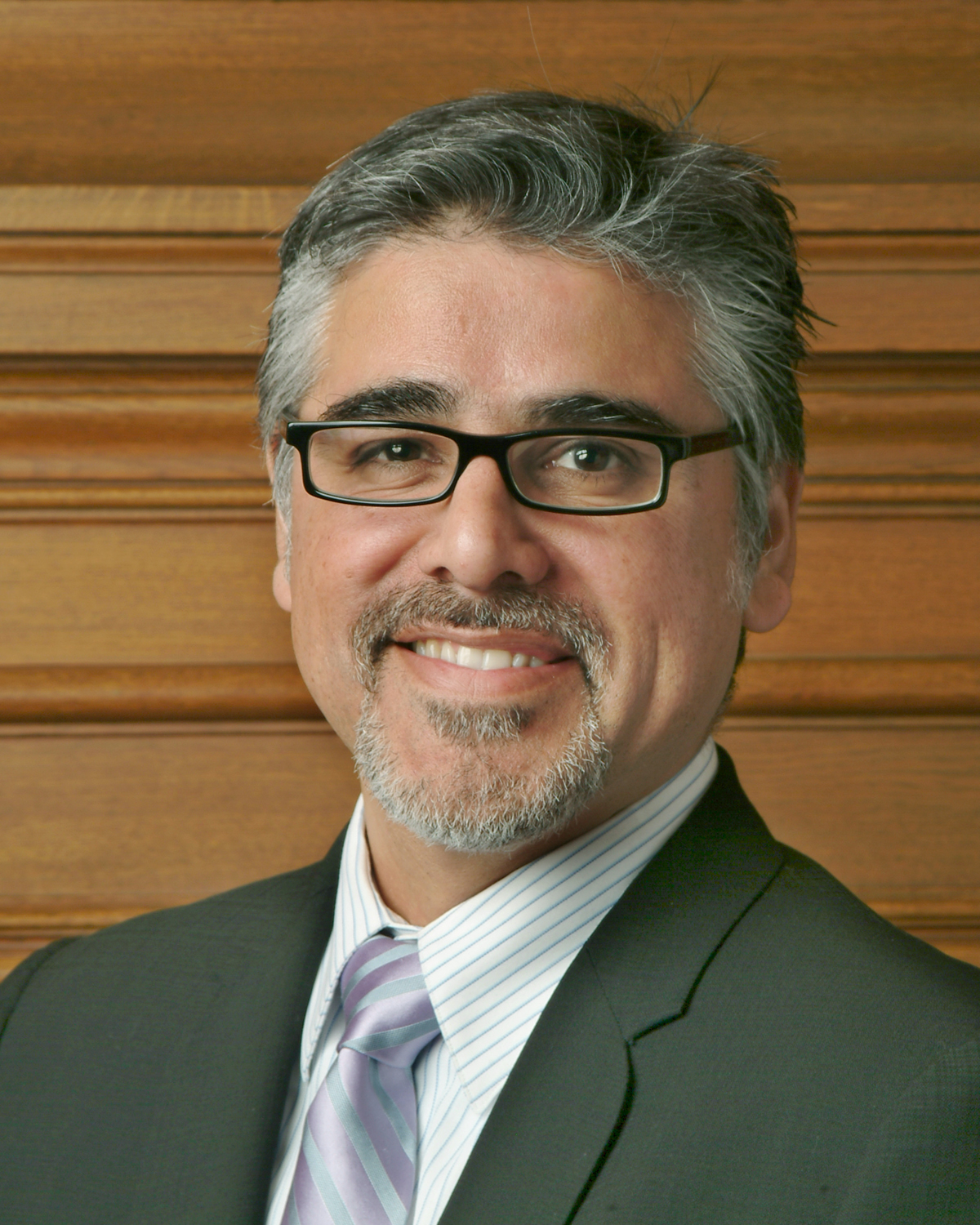
Jane Kim

Stop the presses: CleanPowerSF 8, PG&E 3

19

Sometimes, the good guys (and gals) win.

And so, after the Guardian started the public power movement in 1969  with the pioneering Joe Neilands expose of the PG&E/Raker Act scandal, after three  initiative campaigns to kick PG&E put of City Hall and enforce the public power mandates of the federal Raker Act and bring our own Hetch Hetchy public power to our own people, after hundreds of people worked for years inside and outside City Hall for public power and clean energy,  the San Francisco Board of Supervisors voted 8-3 Tuesday  to formally launch a CleanPowerSF project that would for the first time challenge the decades-old power monopoly of the Pacific Gas & Electric Company.

It was a historic moment. And it was a historic veto proof vote that Ed Lee, the PG&E- friendly mayor, and his ally and mentor, former mayor Willie Brown, the unregistered $200,000 a year PG&E lobbyist, will have difficulty snuffing out this time around.

The CleanPowerSF 8 were Sups. David Campos, who sponsored the legislation, Scott Weiner, who cast the deciding swing vote, David Chiu, Eric Mar, Christina Olague, Jane Kim, Malia Cohen, and John Avalos, all of whom made helpful remarks during the debate. They also voted down an attempt by the PG&E bloc to continue the vote for a week and voted against crippling amendments.

The PG&E 3 were Sups.Mark Farrell and Carmen Chiu, who tried to dilute the legislation with the crippling amendments, and Sean Elsbernd, who was strangely silent during the debate. 

I use the phrase CleanPowerSF  8 and PG&E 3 to dramatize the crucial political point and toss in a bit of Guardian history on the story.  For years, as clean energy/public power proposals were routinely voted down as a result of PG&E political muscle and power lobbying, the Guardian would use variations of the phrase. PG&E l0, San Francisco l or whatever was the PG&E margin of victory. The phrase was accurate, pin-pointed the good and bad guys and gals, lifted our spirits, and sent the message that the battle was far from over.

The hero of the afternoon was Ed Harrington, the general manager of the San Francisco Public Utilities Commission who delayed his retirement to complete the project. He got a standing ovation after his testimony backing up his legislation and deft handling of  all questions.  As Campos said, Harrington’s legislation  was as “good as you are going to get.”  No one seriously questioned his plan, figures,  marketing strategy, or key argument that his plan was fiscally and environmentally sound.

PG&E was never mentioned during the discussion and it was difficult to determine its lobbying strategy. After the vote, I asked Eric Brooks, the crafty clean power leader at the meeting,  what happened to PG&E and  its strategy. He said that PG&E, after the San Bruno disaster and other notable mishaps, was not the monopoly power it once was and that perhaps the company had decided it would rather face the slower pace of  CleanPowerSF rather than another clean energy initiative it would have a good chance of losing 

Thanks and congratulations to the CleanPowerSF 8, David Campos, Scott Weiner, John Avalos, David Chiu, Eric Mar, Chritina Olague, Jane Kim, and Malia Cohen, who voted themselves into San Francisco history.  Five of them will face the electorate and PG&E in the November election (Campos, Avalos,  Chiu, Mar, and Olague.) and they acted and spoke as if voting for CleanPowerSF would be a significant advantage to their campaigns in their districts. And thanks and congratulatons to former Sup. Ross Mirkarimi, who carried the public power flag as the unpaid campaign manager during the first two unsuccessful public power campaigns and then carried the CCA plan inside City Hall during his seven years as supervisor.  When he was voted in as sheriff last November, he handed the CCA baton to Campos who pushed the proposal through with style and solid argument that the issue was choice and providing necessary competition to PG&E’s monopoly.

The vote to start public power in San Francisco comes none too soon. The tear-down-tne-Hetch Hetchy dam forces have put the nice-sounding Proposition F to study draining the Hetch Hetch reservoir.on the fall ballot. This is the first step toward tearing down the dam.  The problem for the city is that it could ultimately lose the dam, if it isn’t moving to public power, because the Raker Act mandates that San Francisco have a municipal  system to distribute public power to its residents and businesses because the act allowed San Francisco to dam Hetch Hetchy Valley in Yosemite National Park. The Guardian’s position is that the dam is in place and  should only be torn down after the city has real public power and is able to find and afford an adequate new source for the city’s water and power supply. And that, let me emphasize,  will be a massive undertaking involving billions of dollars and incredible political challenges.   .

Much more to come in this saga that never ends,  b3

Here is Guardian City Editor  Steve Jones’ account of the vote: : http://www.sfbg.com/politics/2012/09/18/historic-veto-proof-vote-launches-cleanpowersf

And some Guardian background on the PG&E/Raker Act Scandal in my advance story: http://www.sfbg.com/bruce/2012/09/17/historic-pgeclean-energy-vote-today
Historic, veto-proof vote launches CleanPowerSF

24

The San Francisco Board of Supervisors today cast an historic vote that was more than a decade in the making, approving the CleanPowerSF program – which challenges PG&E’s monopoly by offering 100 percent renewable energy directly to city residents – on an 8-3 vote that would be enough to override an implied veto threat by Mayor Ed Lee.

The outcome was far from certain throughout the two-hour hearing as conservative Sups. Mark Farrell and Carmen Chu led efforts to undermine the program, which was the final work product of retiring San Francisco Public Utilities Commission Executive Director Ed Harrington, who previously served as the city’s controller for 17 years.

The pair of supervisors offered a series of amendments challenging the state requirement that city residents must proactively opt-out of such community choice aggregation (CCA) programs if they want to remain with PG&E, offering convoluted language that would have required people to opt-in to the program before its launch, and requiring that the $13 million in reserve funds from the SFPUC be covered entirely by CleanPowerSF customers, which could increase its rates.

“It looks like the amendments would be harmful to the success of the program,” Sup. Eric Mar observed, prompting Farrell and Chu to flash broad conspiratorial smiles at one another.

Sup. Scott Wiener, who was undecided and considered a key swing vote in reaching a veto-proof majority, said he also had concerns about the opt-out requirement and wanted to better understand how the amendments would work and whether they were legal. “For me, I’m not interested in putting any poison pills in here,” he said.

Wiener posed questions about the amendments to Farrell and to Harrington, who said it was possible for the SFPUC to have CleanPowerSF customers repay the initial allocation of reserve funds over time but that he wasn’t sure how the opt-in change would work without sabotaging the program.

“It harms the ability to have an intelligent conversation with people,” Harrington said, noting that rates are based on the number of customers in the program, so it would be nearly impossible to survey everyone’s potential interest without being able to tell them how their bills would be affected.

As it is, the SFPUC has already done extensive surveys of which neighborhoods and demographics are likely to be interested in taking part in CleanPowerSF, initially paying about $10 more per month for 100 percent renewable energy (PG&E’s portfolio includes less than 30 percent renewable). “We’ve done extensive surveys already,” Harrington said. Based on that research, the city is initially rolling out the program to less than a third of city residents, who will be repeatedly notified about how to opt-out, anticipating about 90,000 customers remain in the initial program. 

The program has been repeatedly tweaked over the last eight years that it’s been in development, during which time Marin County launched a successful version of the CCA concept that was developed in San Francisco by legislators Tom Ammiano, Carole Migden, and Mark Leno.

“I feel pretty comfortable trusting Ed Harrington on whether the numbers add up,” said the measure’s chief sponsor, Sup. David Campos, arguing against the Farrell/Chu amendments, later adding, “With Ed Harrington leading this charge, this is as good as it gets. If you don’t like CCA under Ed Harrington, you’re not going to like CCA.”

Farrell claimed to support CCA in concept, but he strenuously objected to the opt-out requirements that Migden included in the enabling state legislation, which she had argued was the only way to make CCAs viable against PG&E’s proven willingness to spend tens of millions of dollars to sabotage would-be competitors.

“It’s the wrong way to legislate, the opt-out. It smells of coercion,” Farrell said. Campos countered that, “The best thing we can give the consumers in San Francisco is a choice, a meaningful choice.”

Wiener ultimately made a motion to delay the item by a week, something Mayor Lee yesterday told the Chronicle he wanted, in order to further study the opt-out issue, telling Farrell that his amendment “feels a little seat of the pants to me.”

Campos and other progressive supervisors who were supporting CleanPowerSF argued against the continuance, noting that it has been years in development and sitting in board committees since January, while the Farrell/Chu amendments weren’t offered until this meeting had already begun.    

“This is not going to change because we wait a week to make a decision,” Campos said. “The terms of this deal are not going to change.”

The motion for a continuance failed on a 4-7 vote, with Wiener joined by Farrell, Chu, and Sup. Sean Elsbernd (who offered no comments throughout the hearing).

Then, as the vote on the Farrell/Chu opt-in amendment came up for vote, Wiener said, “I don’t feel comfortable voting for amendments that I don’t know what they’ll do,” and it failed on a 3-8 vote.

Sup. Malia Cohen had earlier indicated a willingness to support the other Farrell/Chu amendment: saddling CleanPowerSF customers with paying the SFPUC back for reserve fund costs – which Harrington indicated could be dragged out over many years to minimize the impact on rates, and which might not be necessary at all if the initial program exceeds expectations.

That amendment was then approved on an 8-3 vote, with Sups. Jane Kim, Christina Olague, and John Avalos opposed. Another set of amendments that would keep low-income city residents out of the initial rollout and take other steps to reduce their rates if they opted in – which was developed by Kim, Cohen, and Sup. Eric Mar – was unanimously approved by the board.

Then it was time for the big vote on creating the CleanPowerSF program, approving the contract with Shell Energy Northern California to administer it, and authorizing the initial $19.5 million expenditure. Would there be eight votes to override a veto by Mayor Lee, who has been under pressure by PG&E and their downtown allies to kill the program?

“To be perfectly candid, I struggled mightily with this contract,” Wiener said, reiterating his concern about its opt-in requirement, noting that the measure wasn’t perfect, even though it was significantly improved from earlier versions. It sounded as if he were about to vote against it.

“What we have the opportunity to do is move forward with clean power,” Wiener said, noting that even Marin County supervisors who initially opposed its CCA have come around to supporting it. “This is something I believe we should try.”

And with that, the board voted 8-3 to launch the program in mid-2013, with Chu, Farrell, and Elsbernd opposed.

Campos said he was “pleasantly surprised” by the vote, while key supporters say they are cautiously hopeful it will stand up during next week’s final supervisorial approval on second reading and in a veto override vote, if that becomes necessary. Campos said he was thankful for the work of Harrington, who got a standing ovation after the vote as the board recognized him for his long service to the city.

Earlier in the meeting, Harrington told supervisors that while the program isn’t perfect, and it contains some risks that he considers reasonable, there is no other way the city has identified to meet ambitious greenhouse gas reduction goals it has set for itself over the last decade. It is city policy to reduce emissions by 25 percent below 1990 levels by 2017 and 80 percent below those levels by 2050.

“This program before you has the only chance of reaching those goals. There’s nothing else,” Harrington said. He also said “it’s an incredibly efficient way to spend money,” noting that the city has spent $90 million on solar and other renewable energy projects that power fewer than 7,000 homes, whereas this $19.5 million will power 90,000 households, possibly without ever tapping into that $13 million reserve fund set aside to cover any losses by Shell, which will buy renewable energy, a role the city hopes to eliminate as it develops its own projects.

Harrington said the ultimate goal of CleanPowerSF is to develop a large enough customer base that the city could use revenue bonds to finance a wide variety of renewable energy projects – many using solar arrays along city-owned property connected to its water system stretching all the way to Hetch Hetchy Valley – that would pay for themselves.

“The real issue is can you build a facility that will have this rate structure support it?” Harrington said.

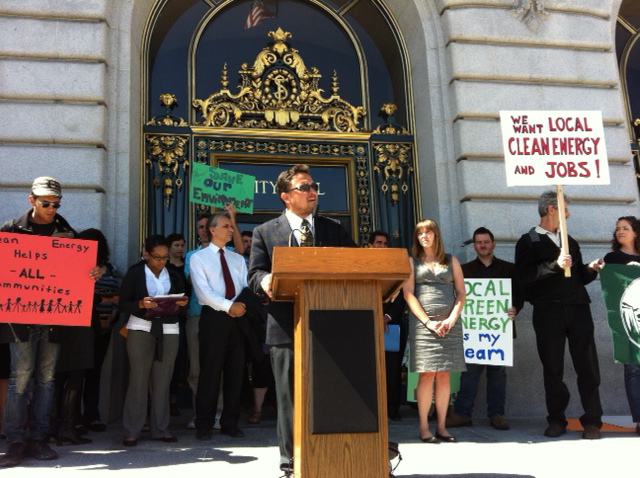
That’s the real power and potential of CleanPowerSF – finally taking action to address global warming, which will have a huge impact on San Francisco and future generations – as supporters noted in a rally outside City Hall before the meeting. Sen. Mark Leno said that he doesn’t usually weigh in on proposals before the board, but that, “This is an exceptional time and this is an exceptional vote. This is the time that we need to address our inconvenient truth.”

Alerts

0

WEDNESDAY 19

Day of action for free Muni passes for youth Balboa BART Station, 401 Geneva Ave, SF; www.peopleorganized.org. 1:30pm, free. POWER has been working for years to get free Muni passes for youth, but the fight is not over. Come help keep the pressure on in a campaign that aims to "shift local, regional, and national mass transit priorities towards the needs of working class communities of color and to bring an analysis of race, class, and gender to bear on transportation planning decisions," starting with free Muni for youth in San Francisco.

Norman Yee happy hour Rio Grande, 1108 Market, SF; www.tinyurl.com/kim4yee. 6pm, free. Connect with some politicians at this happy hour, which District 6 Sup. Jane Kim is throwing for District 7 candidate Norman Yee. Yee is currently on the school board and hopes to represent District 7, which spans from Judah in the north to Lake Merced.

THURSDAY 20

Speak-out and march for Derrick Gaines Arco gas station, 2300 Westborough Blvd., South San Francisco; Derrick Gaines was just 15 years old when he was killed on June 5, 2012 by an officer of the South San Francisco Police Department. Police approached Gaines and a friend, who they say were "looking suspicious." Police say Gaines ran away from them and drew a gun. Family and friends don’t buy it. They will meet at the site of Gaines’ death, the Arco gas station, in a continuing campaign to demand justice.

Icarus 10-year anniversary concert El Rio, 3158 Mission, SF; www.theicarusproject.net. 6pm, $5-25. The Icarus Project is celebrating a decade of redefining mental illness by "navigating the space between brilliance and madness." Learn more about the Bay Area-born group in our story "Still Soaring" (9/12/12). Join them for live music, poetry, and an open mic.

SATURDAY 22

Out from the Wreckage Thrillhouse, 3422 Mission, SF; heatherwreckage.blogspot.com. "The collected, rejected, and recent works of punk artist Heather Wreckage." Her art has fueled revolutionary movements and counterculture at places like the Slingshot Collective, Occupy Oakland, and Hellarity House. Her zine, Dreams of Donuts, is on its 15th edition. Celebrate Wreckage with live music and zine bartering Saturday.

Third annual Castro nude-in Jane Warner Plaza, 17th and Castro, SF; nude-in.blogspot.com. Noon, free. It’s that time again. Come celebrate and defend the right of the Castro’s nude dudes and everyone who likes to be naked in public space. Of recent concern: cops unhappy with the public donning of cock rings. Decorated or not, nude-in organizers say, cocks should be able to fly free. So come support, nude or not- you can even dig up your Guardian butt guard from last year!

Self respect and community defense people’s forum Humanist Hall, 390 27th Street, Oakl; peopleshearing.wordpress.com. 12pm, free. Registration is at noon with events at 1, 3, and 6pm in this all-day forum on self-defense in the face of racial profiling and violence. In the wake of a report from The Malcolm X Grassroots Movement that shows that "every 36 hours a black man, woman, or child is murdered by the police, private security guards, prison guards or vigilantes in the US," this forum will discuss the history and current state of racial profiling and violence and how to launch a movement of people protecting themselves and their communities.

SUNDAY 23

Effective Animal Advocacy 101 371 10th St., SF; www.tinyurl.com/veg101. 1pm, free. Farm Sanctuary works to help animals by spreading the word about going vegetarian or vegan. They launch their Compassionate Communities national tour in San Francisco Sunday. Join them for a vegan lunch and workshop on "Effective Animal Advocacy 101," and be sure to pick up some leaflets explaining the merits of "going veg."

MONDAY 24

Nonprofit workers’ victory party El Rio, 3158 Mission, SF; www.tinyurl.com/seiunonprofit. 6pm, free. San Francisco nonprofit workers, represented by SEIU 1021, won a 2 percent increase in funding and prevented layoffs this year. Celebrate with the SEIU nonprofit division at El Rio, with DJ Carnita of Hard French.

Committee approves CleanPowerSF over downtown opposition

51

The question of whether San Francisco creates a renewable energy program that offers an alternative to Pacific Gas & Electric got its first major hearing at City Hall today, with the business community claiming it’s too expensive and supporters arguing that the time has come for the city to address climate change and the long-term energy needs of city residents and businesses.

The Board of Supervisors Budget & Finance Committee voted 2-1 in favor creating CleanPowerSF, entering into a contract with Shell Energy Northern California to administer the program, and devoting $19.5 million from the San Francisco Public Utility Commission’s water fund to help launch it and buy clean power for city residents.

Sups. John Avalos and Jane Kim supported the project, while Sup. Carmen Chu was opposed. It now goes to the full Board of Supervisors next week, where it is expected to have progressive support and be opposed by the fiscal conservatives.

“I do think we will have the necessary majority to get this through,” the measure’s sponsor, Sup. David Campos, told us. But one open question is whether Mayor Ed Lee will veto a measure that his SFPUC appointees developed but his downtown allies are trying to kill, and if so, whether there are eight supervisors willing to override a veto.

But Campos noted that SFPUC officials testified today that CleanPowerSF is the only way they’ve identified to meet the city’s ambitious official goals for reducing greenhouse gas emissions, which call for a reduction of 20 percent below 1990 levels by the end of this year and an 80 percent reduction by 2050.

Supporters who testified today included environmentalists, progressive groups, and young people who cast addressing climate change as the defining struggle of their generation. “This, not to go overboard, is the most important vote you’ll ever do,” said the Sierra Club’s Arthur Feinstein.

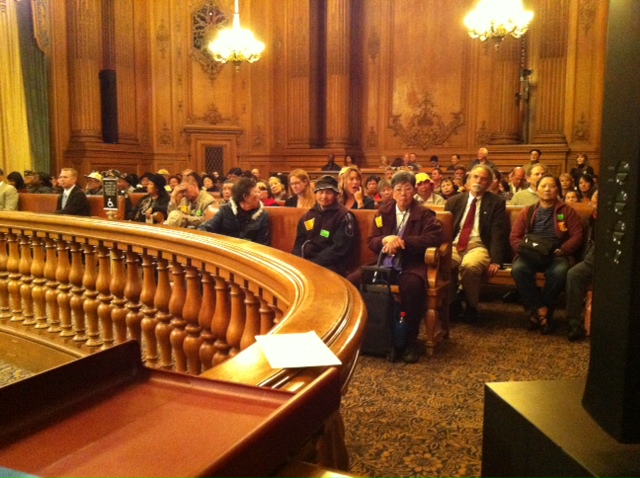
Those who spoke against the program included the usual array of downtown groups that have traditionally defended PG&E’s interests – including the Committee on Jobs, Golden Gate Restaurant Association, and Plan C – and they were joined by an unusually large number of elderly Asian individuals wearing stickers opposing the project.

“It’s a bad program that doesn’t meet even the basic elements of its original promise,” said Chris Wright, executive director of the Committee on Jobs, which PG&E has helped fund since its inception. Like most CleanPowerSF opponents, they have long opposed even the concept of community choice aggregation (CCA), the state law that allowed the city to create CleanPowerSF.

PG&E’s longtime support by local politicians has eroded in recent years because of its overkill campaigns against public power initiatives and supporters and its negligence in the deadly San Bruno pipeline explosion.

Even GGRA Executive Director Rob Black told the committee, “PG&E, a local company, candidly has its problems.” But he and other project opponents – and even a few supporters of the project – centered much of their opposition on the involvement of Shell, which has a bad reputation and environmental record, like almost every other multinational energy company.

“I have the same qualms about Shell that everyone else does,” said Katherine Roberts, who said that she nonetheless supports the project, calling it the only way for most San Franciscans to directly support the development of renewable energy sources. Shell was the sole bidder on a project that requires enormous financial wherewithal.

Campos calls the focus on Shell a diversionary tactic: “PG&E already buys energy from Shell. To the extent people don’t want Shell in the picture, Shell is already in the picture.”

Both the supervisors and the mayor will be under intense pressure to derail CleanPowerSF, with that campaign led by downtown groups and IBEW Local 1245, the union that represents PG&E workers. Sup. Scott Wiener, who says he’s still undecided, told us that his office was flooded with phone calls today, mostly in opposition to the project.

Why Question Time is boring

9

So Sup. Jane Kim isn’t sure Question Time is useful. And the press and some other board members think that, to quote Sup. John Avalos, it’s “deadening.”

Well, there’s a reason for that — the mayor doesn’t like the idea of appearing in an unscripted forum with board members, where he could face tough questions he doesn’t expect and engage in some real debate. And led by Board President David Chiu, the supervisors intentionally created a system that guarantees nothing valuable will happen.

The board sets the rules for Question Time. It’s in the law. And the mayor has to follow those rules.

The whole idea, when Sup. Chris Daly first brought this up, was to mandate that the chief executive interact with the board — and to provide an opportunity for the supervisors to engage in public discussion and debate with the occupant of an office that under Mayors Willie Brown and Gavin Newsom had become increasinly imperious.

Lee’s nowhere near as bad — but still, what Daly envisioned, and what the voters approved, was an open forum. Instead, we got a farce, a pre-scripted scene where the supervisors submit questions in advance, the mayor reads from a prepared answer, and there’s no follow-up or back-and-forth.

Yeah, it’s boring. No, it’s not useless. It’s just broken, because the supervisors didn’t have the guts to put into practice what the voters wanted. It’s simple: Change the rules. Get rid of the requirement that questions be sumitted in advance. Let the supervisors ask, challenge, debate, follow up. That would be a public service.

And the idea that the mayor can’t handle a few unscripted questions is insulting. Lee handles press conferences just fine. And I suspect the supes would be no worse than those wild, unpredictable hordes in the City Hall press corps.

The darn thing’s got wings

0

marke@sfbg.com

SUPER EGO And thus the epic saga of the Eagle Tavern, legendary drunken gay leather biker den of iniquity (which secretly boasted one of the best DJs in the city, Don Baird, on Sundays), closed for a year and a half, ravenously beset upon by upscale restaurant developers, canonized by the Sisters of Perpetual Indulgence, radicalized by queer activists desperate to preserve the scared space around which were scattered the ashes of some of our ancestors, transformed into a symbol of contemporary gentrification, gutted by real estate agents, tossed around by the Board of Supervisors like a hot potato, has finally entered another stage.

Please welcome new gay proprietors Mike Leon and Alex Montiel, who told me they hope to open the SF Eagle (www.sf-eagle.com) by Halloween, they’ll still hold charitable events, they’re looking forward to hosting live music nights again, and they’ll be doing their best to preserve that precious Eagle ambiance. You can read the whole story here, but little patent leather caps off to Glendon Anna Conda Hyde, David Campos, Jane Kim, El Rio (which hosted the Eagle’s wonderfully pervy Sunday beer busts in exile), and everyone else who pushed for the preservation of queer nightlife space in SoMa.

Says Glendon, who really led the push, “People thought we couldn’t preserve queer nightlife in this city — but that’s just a lazy excuse for gentrification. we should all be proud of what happens when we come together. Our nightlife history is a powerful force.”

That’s great. Now if we could only get the EndUp back on track, I could do my old Sunday bar (literally) crawl: Eagle, Lone Star, EndUp. Except for those times when I simply curled up beneath a parked car on Harrison. She was hella classy in the ’00s.


SF ELECTRONIC MUSIC FESTIVAL

There’s a lot going on at this annual feast of nifty experimentation — Negativwobblyland, William Basinski, Dieter Moebius, Cheryl E. Leonard, Guillermo Galindo, soddering trio Loud Objects, Machine Shop’s amplified gongs — kind of freaking out about it, ready for scary beautiful.

Wed/5-Sun/9, various times, prices, and locations. www.sfemf.org


NEW WAVE CITY 20TH ANNIVERSARY

Holy Echo and the Bunnymen! San Francisco’s longest-running party is celebrating two decades? Somebody call Square Pegs. I adore DJs Skip and Shindog — they started being retro about the ’80s almost before the ’80s were over. And their selections (Bauhaus, New Order, the Cure, Depeche Mode) somehow transcend the casket of ubiquity, possibly because of the lively and actually old-school cool crowd still riding the brave new waves of aural devotion. Here’s to 20 more years of Tears for Fears, at which point it will be like listening to Elvis in the ’90s. Or something. Prefab Sprout had a song about it. Just go.

Fri/7, 9pm-3am, $12. DNA Lounge, 375 11th St., SF. www.newwavecity.com


PUSH THE FEELING: LES SINS

Underground indie impresario Kevin Meenan’s monthly Push the Feeling parties are a hot ticket already — but add in Les Sins and we’re entering another dimension? Who are Les Sins? Oh, just chillwave-plus genius Toro Y Moi dropping a DJ set. For an intimate crowd in Lower Haight. For $5. And you’re one of the only people who know about it.

Fri/7, 9pm, $5. Underground SF, 424 Haight, SF. www.epicsauce.com


DARK ENTRIES THIRD ANNIVERSARY

Speaking of New Wave Cities — Josh Cheon’s Dark Entries label has kept the Bay Area at the forefront of the minimal and dark wave movement, which mines overlooked bands of the synth music past and reverential present acts that are direct descendents of those slightly sinister new waves. (Recent signee Linea Aspera is to die for.) This dark celebration features a live performance by Max + Mara plus a glowering set by Cheon himself, with Nihar, Jason P, and Dreamweapon.

Sat/8, 10pm, $5. SubMission, 2183 Mission, SF. www.darkentriesrecords.com


SOUL CLAP AND DANCE OFF

Considering the garage powerhouse that is Oakland, it’s weird to me that we don’t have a huge dirty-funk, pervy girl group, kooky Hairspray 1960s dance-party scene here. (Hard French and any concert by Shannon and the Clams come close.) NYC DJ Jonathan Toubin was set to bring his great Night Train party here last year, but he was almost killed by a freak accident in Portland that made national headlines (a car drove into his hotel room and ran over him in bed). Well, he’s recovered enough now to get the party going again, and this groovy dance-off will also be an all-ages celebration of life. Celebrity judges and the cream of our underground garage crop will be in attendance.

Sun/9, 7pm, $13, all ages. Great American Music Hall, 859 O’Farrell, SF. www.gamh.com


OPERA IN THE PARK

Dearest drama queens, have you had a hard night out on the town? Do you need your over-the-top batteries recharged? How about just a lovely day on the lawn to check out other cute arts enthusiasts — like me! — swooning along to our hometown opera company’s overwhelming melodiousness? Bring a little (secret) wine, and let’s sing along.

Sun/9, 1:30pm, free. Sharon Meadow, Golden Gate Park, SF. www.sfopera.org


Nite Trax: The Eagle flies again

41

I hung out yesterday evening with the new occupants of the Eagle Tavern (now known as the SF Eagle, apparently) at a celebration of the lease-signing at the Lone Star Saloon. Alex Montiel and Mike Leon seem perfect to replace the former Eagle operators Joe and John: Tough-looking and leather-bearish, a tad gruff at first but friendly once they warm to you, and a wee bit shy of the press right now.

They’ll be releasing their full plans for the storied queer bar in a couple weeks, but I did manage to squeeze some juicy info out of Alex. They hope to open the bar in time for Halloween, the liquor license has indeed been secured (in fact, they have two!), and they’ll be doing their best to return some of the Eagle’s ambiance to the now-pretty-much-gutted space, with a few slight modifications to the bar layout for code and traffic flow reasons.   

It’s certainly been a long, winding, super-convoluted road to get to this point!

I’m not sure anyone can convey all the twists and turns and backroom mechanations of the whole thing — Jay Barmann at Grubstreet has done some excellent reporting on it all, but there were still many, many balls in the air, shall we say, and the shady politics got slightly out of control. The fight to keep a historically queer space queer — despite the previous occupants’ quasi-abandonment, despite the lucrative offers from upscale restaurants, despite the limited power and will of the city to legislate such things — was a bit of a hot gay potato for the past year. (The Eagle’s infamous, charitable Sunday Beer Busts lived on in monthly form at El Rio in the Mission, at least.)

Even the idea of a “historic queer space” was questioned: if the Sisters of Perpetual Indulgence had sanctified it, and the ashes of multiple queer people were scattered about a place that raised tens of throusands of dollars for amazing local causes and was regarded as the heart of the old school gay leather rock ‘n roll biker community, was it important enough to fight for?

Hats off to Milk Club president and outspoken queer activist Glendon Anna Conda Hyde for saying, “Hell yes!”

Glendon (identified slightly incorrectly in a recent Chron story as the Norm of the Eagle’s “Cheers” — that was actually the frizzy-haired dear in the thong and flip-flops who stood around clutching a goblet of piss) kept the Eagle issue at the forefront of the city’s debate about gentrification and the loss of queer nightlife spaces, angering some fussy queens with his usual passion and stridency, but in the end succeeding in rallying an assortment of powerful players to the Eagle’s defense.

I talked to Glendon today about how the whole thing went down. His basic summation was that Supervisors David Campos and Jane Kim did excellent jobs of making sure the Eagle stayed queer (Sup. Scott Weiner does not get very high marks from him in this regard), and that dubious dealings by the person supposedly representing the owner of the building — who lives north of the city, and who Glendon said had indeed wanted to welcome in new queer owners all along — were what kept screwing everything up. Finally the building owner (actually, the manager of a trust that includes several elderly owners) awarded the lease to Mike and Alex after he realized what was happening with his representation and the reaction of the community.

“I think it’s so great,” Glendon told me. “People keep saying that you can’t revitalize queer nightlife in SoMa — but that’s just a lazy excuse for gentrification. I’m glad we could band together to ensure a future for queer spaces in this city. We should be proud of what happened here. Our shared queer history is a powerful force. 

“We’re still fighting for an officially recognized queer historical district in SoMa that will honor those who came before us, and also help preserve lively alternative queer spaces. Supervisor Christina Olague and CMAC [California Music and Culture Association] is working hard on that. One of the major problems is that it’s illegal to say something has to be or remain ‘gay.’ I think we saw here that it can be done within the limits of current boundaries.”

As for the future of the Eagle? “Mike and Alex have indicated that while they’ll still be preserving the main traditions and atmosphere — as well as probably hiring some of the old staff back — they are hoping it will be a much more open space. Already the Lexington Club is planning to host a fundraiser to help them remodel, so that suggests the Eagle will be more women-friendly, and there may be new parties there from some of the city’s younger promoters as well.”

My favorite part of this whole thing — besides the colorful faux-funeral outside Foreign Cinema restaurant, or the “assless chaps” takeover of the Skylark bar (both at one point identified as villains in the Eagle saga)? Beyond the banding together of the community to save an actually cool place that is a huge and drunken part of my life (also, DJ Don Baird on Sundays was secretly the best DJ in the city)?

At one point it was announced that the Eagle was to become a fancy pizza place with a wood-fired oven on the back patio. Glendon turned to me and hissed: “I always knew the straights wanted to put us in the oven!” 

When the people lead

0

By Jon Golinger

OPINION Thursday, July 19, 2012 was an especially gorgeous day in San Francisco. On that warm and sunny summer afternoon, a colorful collection of more than 100 citizens from every corner of the city gathered together on the steps of City Hall to announce they had done something political insiders and powerbrokers had just weeks earlier dismissed as “impossible.”

This grassroots coalition of neighborhood leaders, tenant activists, homeowners, seniors, environmentalists, and recreation enthusiasts had just collected more than 31,000 petition signatures in less than 30 days from San Francisco voters. For the first time in more than 20 year, they had just qualified a referendum for the ballot challenging a Board of Supervisors-approved ordinance. They had just stopped in its tracks the seemingly done-deal to dramatically increase height limits on the waterfront for the proposed 8 Washington luxury condo high-rise project.

This citizen activism was made even more difficult by developer Simon Snellgrove, who went to extraordinary lengths to interfere with the petition drive and prevent it from succeeding, including:

• Using crafty legal maneuvers to require the petition to include not just the five-page city ordinance it challenges, but 515 additional pages of charts and addendums. This created a 520-page “book” that was expensive to print and heavy to carry.

• Spending $30,000 to pay hired “blockers” to encircle petition gatherers wherever they could find them and shout, intimidate, and otherwise interfere with their talking to voters.

• Paying an attorney to hover over the shoulders of workers at the Department of Elections as they counted petition signatures, repeatedly challenging their decisions.

While all of these hurdles and questionable tactics certainly had an impact, the citizen activists and volunteers nevertheless persevered. Soon after the 65 boxes overflowing with signed petitions had paraded through the corridors of City Hall, they were certified as sufficiently valid by the San Francisco Department of Elections. The “impossible” was done.

A recent poll by David Binder Research found that voters citywide would overwhelmingly reject the 8 Washington waterfront height limit increase by a vote of 56 percent to 25 percent if the Waterfront Referendum were put to a vote today. However, before it is officially placed on the ballot, the referendum process offers the Board of Supervisors a “second-chance” to make the right decision at its September 4th meeting.

Supervisors Christina Olague, Jane Kim, Eric Mar, and Malia Cohen — who all voted in favor of the waterfront height limit increase in June — now have the opportunity to take some time to talk with their constituents, reexamine their initial decision, and hopefully make a different choice.

But if they fail to do so, the referendum on the proposed 8 Washington project’s “Wall On the Waterfront” will appear on the November 2013 ballot and the people will decide. The people will decide whether a special exemption should be made to give away prime public land to a developer to build multi-million-dollar condos that 99 percent of San Franciscans can’t afford. The people will decide whether to allow the construction of a high-rise luxury condo building on the waterfront that would be 50 feet higher than the old Embarcadero Freeway. The people will decide whether we should protect or neglect our unique and beautiful waterfront. If the leaders fail to lead, the people will lead.

Jon Golinger is the Campaign Director for No Wall on the Northeast Waterfront www.NoWallOnTheWaterfront.com

Antonini, quarterback for development interests, wins the game

20

If there was any doubt about the loyalty to developers of Planning Commissioner Michael Antonini, he put them to rest yesterday shortly after finally winning reappointment to a fourth, four-year on a 6-5 vote by the Board of Supervisors. Afterward, in comments to Examiner reporter Joshua Sabatini, Antonini likened his role on the commission to that of a successful football team’s quarterback.

“You want to knock out the quarterback for the other team,” Antonini said. “It’s a tribute in a way – backhanded.”

The five supervisors who opposed Antonini – Sups. David Chiu, John Avalos, David Campos, Eric Mar, and Jane Kim, the board’s most progressive members – seemed to understand that Antonini saw himself playing for the developers and big corporations that see San Francisco mostly as a place to make money, even at the expense of eastern neighborhoods and the city’s long-term interests.

The voting record of this Republican dentist – an elected member of the San Francisco Republican County Central Committee who advocates for right-wing causes (such as crackdowns on the homeless) and candidates – makes clear which team Antonini plays for, and it isn’t the same team as the vast majority of people in San Francisco, where Republicans constitute less than 10 percent of the electorate.

It says a great deal about the corporatist politics of Mayor Ed Lee for re-appointing him, as well as the politics and integrity of the swing votes, Sups. Malia Cohen and Christina Olague, the Lee appointee now running for election in District 5, one of the city’s most progressive districts.

Both supervisors mouthed meaningless platitudes and justifications for their votes, but in reinstating the developers’ quarterback just as the progressives were about to remove him from the game, one wonders what team they’re playing for – or whether they even understand the dimensions of the game they have unexpectedly found themselves playing.

But Antonini clearly understands. And despite the ridiculous statements that Cohen and Olague made about holding him “accountable,” Antonini now has four more years to continue leading a team that is rapidly gentrifying San Francisco, making it more inviting to the Google-busers and Twitterati and their landlords, but less so for the average teacher, clerk, and social worker.

High noon for CPMC

7

CPMC, the health-care giant owned by Sutter Health, has two weeks to convince some very reluctant city officials that its plan to build a flashy new hospital on Van Ness Avenue is at least marginally acceptable.

It might not be possible.

CPMC and Mayor Ed Lee had a deal back in June — a bad deal for the city, but one that the mayor was ready to push. Then internal documents showed that the hospital folks weren’t telling the truth and were looking for ways to shut down St. Luke’s, which provides care to the underserved population in the southeast part of the city.

The actual deal is in some kind of suspension now, since CPMC and the mayor aren’t anywhere near close to agreement — but the environmental impact report on the development came up on appeal to the supervisors, and it was clear that there weren’t enough votes to approve the document. Rejecting it would have set the project back at least 18 months, probably two years — and that would spell doom. CPMC is under a state mandate to upgrade the seismic safety of its facilities by 2015, and this Van Ness super-hospital is supposed to replace that aging California St. campus, which doesn’t meet state codes.

At the end of a seven-hour hearing, the supes agreed to continue the matter for two weeks after Michael Duncheon, Sutter’s general counsel, promised to maybe, sorta, kinda try to reopen talks with the city:

“In the intervening two weeks, CPMC commits to work with the mayor’s office and with you. … CPMC is ready to talk about a structure for future discussions as we all put our heads together.”

I other words, we’re ready to consider the shape of the bargaining table.

That doesn’t go very far, particularly since CEO Warren Browner has been a complete asshole throughout this process. He acts as if he’s entitled to do anything he wants with this project and he dismisses community benefits as nonsense. Oh, and guess what? He’s not even around right now. He’s on vacation.

Sup. Jane Kim made a good point in her remarks:

“The fundamental issue in certifying this EIR, in my humble opinion, is the elephant in the room, which is that there is no proposed project.  The only sponsor of this project, has himself stated that there is currently no project without greater assurance and agreement to stronger language from project sponsor on a commitment to the operation of St. Luke’s.”

And she said that if the matter hadn’t been continued, she would have voted not to certify the EIR. Sup. David Campos told me that he agreed: “We sent a very clear message that we can kill this thing if we want to,” he said.

So now we wait two weeks to see if Browner and his crew will come to their senses. “There’s hope,” Campos said, “but who knows?” And if CPMC doesn’t come back very quickly with a much-better plan, it will be time to start thinking about other options for saving St. Luke’s.

Gonzalez withdraws his endorsement of Olague

57

Matt Gonzalez – the attorney and former president of the Board of Supervisors whose 2003 run for mayor galvanized the city’s progressive movement – has withdrawn his endorsement of Sup. Christina Olague for his old District 5 supervisorial seat, citing her positions on the 8 Washington project and replacing ranked-choice (RCV) voting with a September mayoral primary election.

It is perhaps the biggest political blow that Olague has suffered since being appointed to her first elective office by Mayor Ed Lee in January, and a sign that she may be siding more solidly with Lee and his pro-development allies than with the progressive political community she has long identified with – and that could complicate her race in one of the city’s most progressive districts.

Gonzalez, who helped launch Olague’s political career by appointing her to the Planning Commission in 2004, confirmed his decision and the reasons for it, but he told the Guardian that he didn’t want to make a formal public statement yet. That could come later in the week, possibly coupled with a new endorsement in the race.

But he did say that he’s been frustrated with Olague’s actions on both 8 Washington – a housing project for the super-rich on the Embarcadero – and with her recent antics on RCV. In both cases, it wasn’t just the votes, but the way they were made that have raised doubts about Olague with Gonzalez and other progressives.

Olague and Sup. Jane Kim (another former Gonzalez protege who has disappointed many of her one-time progressive supporters on several high-profile issues) not only voted for the 8 Washington project, but also for a series of amendments that made the already lucrative project even more profitable for the developers and costly to the city.

On RCV, as I reported on Friday, Olague surprised progressives by giving new life to efforts by the most conservative supervisors to repeal the system, then has made a shifting series of statements and pledges on the issue, in the end supporting a system that will repeal RCV only for the mayor and create a September election.

The fear is that election would be extremely low turnout, and Lee could win it outright with at least 65 percent of the vote and avoid the normal November election, and Olague has been unwilling to fully explain her position or address concerns that she is simply doing Lee’s bidding. Olague hasn’t returned our calls on that issue or for her reaction to Gonzalez’s decision to withdraw his endorsement.

Guardian Voices: The case against RCV

88

“The Cure for the Ills of Democracy is More Democracy”
                                 — old Progressive Party slogan

My friends here at the Guardian have elevated support for ranked choice voting to a defining requirement for being considered a progressive. This is not only historically incorrect,  it is actually politically silly. There are many progressive reasons to oppose RCV — not the least of which is the undeniable fact that it overwhelmingly favors incumbents, has failed to deliver on the 2002 ballot promises, and now poses real threats to progressive political advancement in key supervisor districts. 

First, a little history. 

The two greatest national political victorys  of the Progressive Era were the 1913 adoption of the 17th Amendment of the US Constitution, which required direct elections of US Senators, and, at the tail end of the era,  the 1920 passage of the 19th Amendment, which gave women the right to vote. Both expanded people power in elections, curing the ills of democracy by more democracy.

Historically, to be a Progressive is to favor MORE elections, MORE political opportunities for more people at the local level.  How can it be that it is now progressive to favor FEWER elections at the local level?

In the March, 2002 Voters Handbook, ballot arguments against RCV were authored by several progressive activists (Sue Bierman, Jane Morrison, David Looman, Larry Griffin, David Spiro and me, to name a few). We argued then that replacing local elections with a mathematical formula that few understand and even fewer could explain was political foolishness. While were outvoted, I think we were right a decade ago.

Left-liberals do very well in run-off elections in San Francisco — from 1975, when Moscone beat Bargbagalata in a December run-off, to the run-off victory of the more liberal candidate for City Attorney, Dennis Herrera, over Chamber of Commerce functionary Jim Lazarus in 2001. The reason is that in low-turnout elections, left-liberals vote more heavily that do conservatives, and that’s a verifiable San Francisco political fact.

But it was the 2000  supervisors races that showed just how well left-liberal forces did in run-off elections at the district level: Jake McGoldrick, Aaron Peskin, Matt Gonzales, Chris Daly, Sophie Maxwell, and Gerardo Sandoval, the very heart of the progressive majority, were elected in December run-off elections.

In 2002, three arguments were made for RCV: first, that it would reduce negative campaigning; second, that it would increase turnout in local elections and third, it would reduce costs by eliminating the run off election. Of the three  arguments only the last has been met, a dubious achievement in that even more such savings could be made by eliminating ALL elections.

Can anyone actually claim that last year’s mayoral election, the first contested one conducted under RCV, was anything but a negative free-for-all? Or, how about the 2010 D6 race between Debra Walker and Jane Kim, or the D8 race between Mandelman and Weiner? Or the 2002 D4 Ron Dudum – Ed Jew race? RCV did not end negative campaigns.

How about turnout?  Last year’s mayoral race had the lowest turnout in a contested race for mayor in the modern history of San Francisco. Every supervisorial race in 2008 had a lower turnout than  the citywide average. Turnout in 2010 was below citywide levels in the RCV supervisor races in D4, D6 and D10.

No, the record is clear RCV has not resulted in higher turnout, either.

RCV creates a political system in which candidates make deals with other candidates, behind closed doors, before the voters vote.  Runoff elections result in a system in which voters make deals with candidates AFTER they vote in the polling booth. What’s wrong with giving voters two choices in two elections instead of three choices in one election? Oh, that’s right, we save money by giving voters fewer elections.

Left-liberals tend to field fewer candidates for races than do moderates and conservatives because, especially in San Francisco, left-liberals simply don’t know how to raise political money, while moderates and conservatives do. RCV elections reward multiple candidates of the same political persuasion as these candidate can agree to appeal to their similar voters to vote for them as a block.  Thus, RCV will always favor, in an open contest in which there is no incumbent, moderate to conservative candidates because there are  usually more of them running.

That’s what happened to Avalos in last years mayoral election: he picked up nothing as the moderate candidates’ second and third votes went to the moderate Lee. The same happened in D10 two years ago: moderates voted for multiple moderate candidates and the only real left-liberal in the race did not pick up any of these votes and lost — although he outpolled the eventual, moderate winner.

RCV favors incumbents, and that’s why at least two of the Class of 2000 progressive supervisors told me they voted for it. Lets see how well it works to defeat Sup. Scott Wiener, who is far to the right of the average voter in D8, or Supervisor Malia Cohen in D10 who was supported by less than 30 percent of the election day vote.

What seems to be going on here is an incredibly silly political association game.  Because repealing RCV is supported by conservative supervisors and the Chamber of Commerce we should be opposed since they are for it. Haven’t we seen this year conservative Republicans make one self defeating political move after another?  When your enemy is threatening to shoot himself in the heard why are we trying to pull the gun away? It time to pull the trigger on RCV.

Avalos emerges as the board’s main progressive champion

23

Sup. John Avalos seems to be the only consistent champion of progressive values at the Board of Supervisors these days, as he demonstrated once again yesterday as he tried to present some alternatives to the neoliberal corporatism that has seized City Hall over the last couple years.

Last week, Avalos was the only vote against a pandering proposal by Sup. Mark Farrell to exempt more small businesses from the city’s payroll tax, which is projected to cost the city $1.5 million next fiscal year and $2.5 million the following one, blowing a $4 million hole in the two-year budget that supervisors are now finalizing for approval in two weeks.

Yesterday, as the measure was about to receive final approval on its second reading, Avalos made a motion to delay it until after the fall election when voters may consider a pair of measures to transition from a payroll to gross receipts tax as the means of assessing local businesses. Mayor Ed Lee and Board President David Chiu introduced one measure that is revenue neutral, while an alternative by Avalos would bring in about $40 million per year.

Avalos didn’t have the votes for the long delay, so he got behind a compromise motion by Sup. Jane Kim to delay the measure until July 10 so the Budget Committee can at least factor it into its deliberations. Farrell opposed the move, insisting that “this is about creating jobs now,” despite the fact that businesses couldn’t apply for the exemption until next February.

A spirited debate followed, in which Avalos criticized City Hall’s current penchant for business tax cuts and questioned whether it really creates the jobs its boosters claim. He also noted that it is the multitude fee increases that local politicians have approved in recent years to balance the budget without raising taxes that have become most onerous for small businesses.

“When we were raising fees over the last five years, we were raising taxes on small businesses,” Avalos said, suggesting that rolling back those fees and taxing larger corporations that can afford it is a better strategy for helping small businesses and encouraging them to create jobs.

Eventually, Avalos won the short delay on a 7-4 vote, with Sups. Farrell, Carmen Chu, Sean Elsbernd, and Scott Wiener opposed.

Meanwhile, Avalos managed to place on the fall ballot an increase in the real estate transfer taxes paid on properties worth $2.5 million or more, convincing Sups. Kim, David Campos, and Eric Mar to support the proposal as the 5 pm deadline for at least four supervisors to place measures on the ballot neared. It would raise $16 million and compete with a similar measure by Lee that would raise $13 million through a smaller increase on properties worth more than $1 million.

Avalos also joined Campos and Chiu in opposing final approval for the 8 Washington housing project for the uber-wealthy. On the same 8-3 vote, the board also rejected Chiu’s efforts to allow opponents of the project to circulate referendum petitions without having to lug around a thick stack of all the studies referenced in the project approval.

Chiu appealed to his colleagues to support “citizens of San Francisco exercising the constitutional right to referendum,” but he won few sympathies on a board that these days seems most concerned with the interests of this city’s wealthiest individuals and corporations.

The 8 Washington embarrassment

16

I wasn’t shocked by the vote on 8 Washington. I knew it was happening; I knew we’d lost when the EIR went through. I knew we couldn’t count on a solid progressive bloc any more. I knew that the lobbying was intense.

But I have to say, at the end of the day I was embarrassed. Because the supervisors sold the city cheap.

In the earlier board discussions, Sup. Christina Olague and Sup. Eric Mar mentioned their concerns about the heigh and bulk of the project and said they would work with the developer, Simon Snellgrove, on changes. But the final project was exactly the same size.

Olague and Sup. Jane Kim were concerned about the amount of parking; the developer agreed to cut 50 spaces. But the actual size of the garage won’t be reduced at all; the only promise: There won’t be valet parking, so maybe not so many cars will fit.

Yes, Snellgrove agreed to set aside some scholarships for low-income kids to swim in the pool, which is a great thing and I fully support it. For a project that, according to available figures, will net the developer $200 million in profit — according to Sup. David Chiu’s analysis, a 72 percent rate of return — the scholarship money is peanuts.

There’s an additional 50 cent parking levy to pay for surface improvements in the area.

But as Chiu asked at the June 12 meeting, “Is the city getting an appropriate level of benefits based on Snellgrove’s profits?” Project foe Brad Paul — a veteran of more than 30 years of the city’s development wars — doesn’t think so. “They got nothing,” he told me.

Here’s how it went down:

Chiu started off by introducing the board’s budget analyis, Harvey Rose. Rose said he’d reviewed the finances of the project, and concluded that the city would get $50 million less out of the project than the developer or the Port of San Francisco, which owns some of the land and is a primary proponent, had originally claimed. Chiu also noted that not all the documents were in the file, but nobody else seemed to care.

In fact, through most of the discussion — limited discussion — and final votes, it was pretty clear that nobody was swayed by any of the facts that Chiu put forward. This deal was done long before the board members took their seats.

Chiu offered a series of amendments, none of them terribly radical. He pointed out that the deal requires the city to pay the developer $5 million for open-space improvements. “That’s an anomaly,” Chiu said, and moved that it be removed.

Kim, who throughout the meeting was the strongest supporter of the project, argued that the city often reimburses developers for open space. More, she said, compared to what the city has asked other major residential developers to give, this project is just dandy. “I would not say this is not a fair deal for the city,” she told her colleagues.

The vote on the $5 million giveaway? Developer 6, SF 5. Siding with Snellgrove: Christina Olague, Scott Wiener, Carmen Chu, Sean Elsbernd, Mark Farrell, and Jane Kim. Siding with Chiu and project opponents: John Avalos, David Campos, Malia Cohen, and Eric Mar. It’s an odd lineup — Cohen doesn’t always vote with the progressives, and I have to say it’s strange to see Kim and Olague siding with the four most conservative supervisors.

Chius’s second proposal: Since the city’s benefits were $50 million less than advertised, why not add $14 million to the affordable housing fee?
Developer: 7. Affordable housing: 4. Voting for the developer: Olague, Wiener, Chu, Elsbernd, Farrell, Kim and Mar.

Okay, one last try. Chiu suggested maybe just $2 million more for affordable housing. Wiener, as is he way, went off on his usual complaint that too much of the affordable housing money is for poor people and not enough for the middle class. The final vote:

Developer: 6. Affordable housing: 5. Voting for the developer: Olague, Wiener, Chu, Elsbernd, Farrell, Kim.

Kim, again, took the lead in promoting the deal on the final vote, saying that a parking lot and a private club were not a good use for the space and that “we are achieving here is a higher and better use for the land.” That’s what every developer talks about, by the way — higher and better use.

She also talked about One Rincon, that hideous tower next to the Bay Bridge that was approved after then-Sup. Chris Daly cut a deal with the developer that the San Francisco Chronicle denounced as a “shakedown.

Kim said that, considering the much-smaller size of the Snellgrove project, the benefits were richer than the Rincon deal.

I never liked the Rincon deal — that tower’s a disaster, an ugly scar on the skyline, and there was nowhere near enough affordable housing money. That’s because I think that the city should be building six affordable units for every four market-rate units, that there’s no need for more housing for the very rich and that our current housing policy is a disaster. (The Guardian wrote an editorial at the time that said it was good that Daly had gotten that much money, but was dubious about the whole project. In retrospect, we were too kind.)

I think all my readers at this point know that. So does Daly.

But I asked the former supervisor anyway to comment on the difference between 8 Washington and One Rincon. His thoughts:

1. The Rincon Hill agreement was negotiated by the district Supervisor working together with the communities most impacted by the development. 8 Washington was opposed by the district Supervisor and many nearby residents.
2. Most people in the South of Market were not diametrically opposed to highrise development in that location. The Planning Department had been working on a Rincon Hill neighborhood plan and was recommending upzoning for the area.
3. Rincon Hill had no waterfront trust issues.
4. The Rincon HIll development impact fee was $25 per square foot (over and above the required inclusionary affordable housing fee even though the Mayor’s Office contended that over $20 per square foot would kill the deal.) According to Kim’s release, her 8 Washington deal netted an additional $2 million for affordable housing and a $.50 parking surcharge. This even though development in Rincon Hill is not as valuable as the northern waterfront.

Folks: I think the city got taken to the cleaners here. I’ll stipulate that I’m against this project for much broader reasons. And maybe I’m just an old commie who thinks that the richer you are, the more you should give back, that the affordable housing fees on the most expensive condos in San Francisco should be higher than normal, that if Snellgrove nets $200 million, then the city by definition left too much on the table.

But I don’t think I’m alone in believing that if you’re going to approve something that will make a developer this rich, and let him use public land to do it, on the waterfront, you ought to get your fair share. And that didn’t happen.

Embarrassing.

Why I hope Sup. Farrell is wrong about condos

213

So Sup. Mark Farrell thinks the Board of Supervisors is ready to turn its back on the tenants movement and vote for legislation that would increase evictions, eliminate rental housing and undermine one of the most important pieces of tenant legislation to come out of City Hall in decades?

Gawd, I hope he’s wrong.

From the Examiner:

Similar proposals have gone nowhere at City Hall. Farrell acknowledged it has been a “third rail,” but he suggested the political climate has shifted. “This is a different Board of Supervisors and this is a different time,” Farrell said.

Yeah, it’s a different Board of Supervisors. Five years ago, the 8 Washington project would never have been approved in its current form. Five years ago, Ed Lee wouldn’t have been elected mayor.

But I don’t think this board is ready to abandon the tenant vote.

Making condo conversions easier is a huge deal. When San Francisco put a limit on condo conversions more than 20 years ago, it was a landmark law that put the preservation of affordable, rent-controlled housing over the needs of speculators. Over the past decade, the single greatest threat to tenants in this city is Ellis-Act evictions done to create tenancies in common. And the only check on more of that happening is the disincentive posed by the limits on condo conversions.

If Farrell gets his way, and TIC owners can bypass the conversion lottery, tenant organizations will be furious. There are, at best, five reliable pro-landlord votes on the board, so It’s not going to happen without either David Chiu, Christina Olague or Jane Kim siding with Farrell. A lot of things suprise me in local politics, but that would be a shocker.


8 Washington isn’t getting much better

30

When the Board of Supervisors approved the environmental impact report for the most expensive condos in San Francisco history, several members of the board said they weren’t entirely happy with the project. Supervisors Christina Olague and Eric Mar both complained about the height and bulk and Olague said she wanted a parking fee.

So now the project is back, and just won approval at the Budget and Finance Commitee — with only a few minor changes. There’s no adjustment to the height and bulk, although the parking has been cut from 255 spaces to 200 and a 50-cent parking surcharge has been added. Sup. Jane Kim wants to be sure that the pool built in the new facility will be open to low-income youth.

But the city’s not getting a dime more than the $11 million in affordable housing money that developer Simon Snellgrove has already offered — despite the fact that the available financial evidence suggests Snellgrove and his partners will make more than $250 million on the deal. Sup John Avalos made clear that the city’s not getting enough out of this project.

So now it goes to the full board June 12 — and if things go according to the normal San Francisco pattern, the developer will get what he wants and the city will get screwed.

See, when you give developers the opening, they take advantage of it. When you let them over the first hurdle with and 8-3 vote, they get pretty confident that they’re going to win. So why would they compromise on more than few details? Why cut the height and bulk when you know you have the votes?

I respect what Eric Mar, Jane Kim and Christina Olague said about their votes on the EIR — but imagine if it had been a 6-5 vote? Snellgrove might have gotten the message that this wouldn’t be easy. He might be calling Olague and Mar and saying: How much less height? How much less bulk? How much more affordable housing? We might have wound up with a much better deal.

Every time — every single time — a developer presents what is supposed to be the last, best deal it’s a scam. Every time the city has said No, the developer has come back and sweetened the pot. That would have happened here, too.

But no. I predict no height and bulk adjustments, no additional affordable housing money — nothing more than what Budget and Finance already got. Which isn’t enough.

Oh, and by the way: Everyone here already knows that I oppose this project because it’s too much housing for rich people, which we don’t need in this city, and puts the city’s housing balance further out of whack. But if we’re going to sell off the waterfront for all the wrong reasons, we should at least get the best deal we can.

Sunshine eclipsed

1

As an advocate for the passage of the San Francisco Sunshine Ordinance in the early 1990s, I felt obligated to take my first and only City Hall position and serve as a founding member of the Sunshine Ordinance Task Force. I served for l0 years and helped with many other good members to build the task force into a strong and respected agency for helping citizens get access to records and meetings and hold city officials accountable for suppressing access and information.

The task force is the first and best local sunshine task force of its kind in the country, if not the world. It is the only place where citizens can file an access complaint without an attorney or a fee and force a city official, including the mayor, to come before the task force for questioning and a ruling on whether they had violated sunshine laws. The task force lacked enforcement powers, but it still annoyed city officials, including Mayor Willie Brown.

In fact, Brown spent a good deal of time trying to kick me off the task force. He used one jolly maneuver after another, even getting an agent to make a phony complaint against me for violating the ordinance with an email (The complaint went nowhere). I refused to budge and decided to stay on until Brown left office—on the principle that neither the mayor nor anybody else from City Hall could arbitrarily kick members off the task force.

That principle held until about 3pm last Thursday (May 17) at the meeting of the Board of Supervisors Rules Committee to appoint candidates to the task force. At that meeting, without proper notice, advance warning, explanation, apology, or even a nice word or two, the supervisors suddenly turned a normal drowsy committee meeting into an unprecedented bloodbath for the task force and its independence. Sup. Mark Farrell played the heavy, Jane Kim was the facilitating chair, and David Campos was the reluctant third party, working together to bring Willie Brownism back at the task force with a vengeance.

The committee rejected four qualified candidates from three organizations who are mandated by the Sunshine Ordinance to choose representatives for the task force because of the organizations’ special open government credentials. (Doug Comstock, editor of the West of Twin Peaks Observer; Attorney Ben Rosenfeld from the Northern California chapter of Society of Professional Journalists, sponsor of the ordinance; Allyson Washburn from the League of Women Voters and Suzanne Manneh from America New Media.)

The committee without blushing asked the organizations to come up with a “list of names,” a whiff of grapeshot aimed at members and organizations who had served the public well for years. Who wants to go before the supervisors on a list of names for a bout of public character assassination? Meanwhile, while knocking off the qualified, knowledgeable candidates, the committee approved four neophytes without experience and then unanimously appointed David Pilpel, a former task force member known for delaying meetings with bursts of nitpicking. He almost always comes down on the side of City Hall and against citizens with their complaints.

Farrell also tried to bounce Bruce Wolfe, an excellent member, but Kim and Campos supported him and his name was sent on to the full board for approval.

Then, when Wolfe’s name got to the board on May 22, it was a repeat of Willie Brownism and this time to the max. Sup. Scott Wiener moved to amend the motion and substituted Todd David. Farrell seconded. The vote was 6-5, meaning that Willie Brownism wiped the sunshine slate clean of anybody who would raise a pesky question of city officials and the City Attorney’s Office.

The infamous votes against Wolfe: Wiener (ah, yes, the heir of the Harvey Milk and Harry Britt seat in the Castro), Farrell (where is Janet Reilly when we need her?), Malia Cohen (who comes from the Potrero Hill/Bay View/Hunters Point district that needs all the sunshine it can get in facing an Oklahoma-style land rush of development), David Chiu (who was reportedly angry over the unanimous task force opinion finding he violated the Sunshine Ordinance with late submission of documents before the controversial vote to redevelop Parkmerced), Carmen Chu and Sean Elsbernd (neighborhood supes way out in West Portal and the Sunset who almost always vote the downtown line at City Hall). The good votes for Wolfe: John Avalos, Eric Mar, Cristina Olague, Jane Kim, and David Campos.

Campos told me that the organization candidates were “eminently qualified,” that they should have been appointed, and that he would fight for them. He advised the organizations to “stand by their candidates.” He is urging that the issue of organization candidates come back to the next Rules Committee.

Rick Knee, SPJ’s mandated journalist on the task force surveying the carnage, said the supervisors’ actions stem “partly from a desire by some supervisors to sabotage the task force and ordinance itself, and partly from a vendetta by certain supervisors after the task force found several months ago that the board violated local and state open meeting laws when it railroaded some last minute changes to a contract on the Parkmerced development project without allowing sufficient time for public review and comment.”

Knee is right, and it isn’t just Parkmerced, but all the high-stakes development deals flowing through City Hall these days, with their advocates preferring to cut backroom deals rather than being subjected to the full scrutiny of the public and the task force.

James Chaffee, a former chair of the task force, watched the board proceedings with outrage and fired off a letter to all supervisors later that day. He charged that the board in sacking Wolfe violated the Sunshine Ordinance on several counts. Among them: the board changed the committee recommendation on Wolfe without allowing public comment and it passed over Wolfe even though the ordinance requires at least one member of the task force to be “physically handicapped.” That was Wolfe.

Thus, Chaffee wrote, the orchestrated coup was “the perfect example of a failure to follow the sunshine ordinance that led to the sort of problem that it was intended to forestall, namely the supervisors taking an action without being informed of what they are doing.  If Scott Weiner and David Chiu and the rest of the crew did not consider the citizens the enemy and exercize judgment about whether they were complying with the spirit of open government rather than just shaving off the letter of the law as closely as possible, this could have been avoided.”

Chaffee said he couldn’t tell if David was physically handicapped but he said nothing in his application for the task force nor was any disability apparent from the video of the rules committee meeting.

Chaffee said David’s  application showed he  was “self-employed as an investor, obtained a BA from Stanford in 1993, has never attended a task force meeting, and left the statement of his qualifications blank.”

Chaffee said, “It’s easy to see why Scott Wiener likes him. He said it would be a long road before he would go against the city attorney’s office and when it came to constitutional law, he would place the city attorney’s opinion above his own because the city attorney is an ‘expert.'”

I sent Chaffee’s letter and my Bruce Blog post ( “The return of Willie Brown to the Sunshine Task Force,” 5/21) to City Attorney Dennis Herrera for comment: How can his office sit by while the letter and spirit of the sunshine laws are being violated in the move to sabotage the sunshine ordinance and task force? I also sent Chaffee’s letter, with the Bruce blog, to the supervisors with similar questions: Why  are you violating the sunshine laws to kick out the best candidates? For their answers (coming)  and the latest on this evolving controversy, follow along at  www.sfbg.com/bruce.

There you have it:  the state of sunshine and open government in city hall in San Francisco in May of 2012. Todd David over Bruce Wolfe. David  Pilpel uber alles.  Five inexperienced candidates over five experienced candidates. David Pilpel uber alles. A city attorney who rolls over and over and over again. And a whiff of grapeshot for the three organizations mandated by the charter to have represenatives on the task force  because of their open government and public access credentials (the Northern California chapter of the Society of Professional Journalists, the League of Women Voters, and America New Media.)  On guard,  b3


Julian Davis announces for supervisor in the key battleground district for progressives (5)

29

Julian Davis, a widely known progressive activist and organizer in San Francisco since 2002, declared Tuesday  his intention to run for supervisor in District 5, the city’s most liberal district and a battleground district for progressives seeking to regain control of the Board of Supervisors.

He joins eight other challengers to Sup. Christina Olague, appointed by Mayor Ed Lee to replace former Sup. Ross Mirkarimi. He was considered by many to be  the board’s most reliable progressive. He succeeded Matt Gonzales, a strong progressive.  The battle will center on which candidate will be the most reliable progressive vote–Olague,  whose votes are being carefully watched by progressives, or by one of her challengers.

Davis, a Bay Area native,  is a graduate of Brown University and UC Hastings College of the Law, where he graduated magna cum laude. He has worked in government and non-profit and legal sectors on community development, civil rights, social justice, public power, and environmental causes. He has worked on several candidate and ballot measure campaigns including John Avalos for mayor (20ll), Jane Kim for supervisor (2010), Prop H (2008), Clean Energy Act.) He also led a succeesful campaign in 2007 to free journalist Josh Wolf from federal prison for refusing to reveal sources in a demonstration he was covering.

“I was drawn to San Francisco by the creative energy and culture of the city–by what makes this place so special,” Davis said. “Over the past l0 years, I’ve devoted myself to developing healthy communities. I’m running for supervisor to keep the city a vibrant home for the every day people that make San Francisco real.”  b3


The battle of 8 Washington

tredmond@sfbg.com

More than 100 people showed up May 15 to testify on a condominium development that involves only 134 units, but has become a symbol of the failure of San Francisco’s housing policy.

I didn’t count every single speaker, but it’s fair to say sentiment was about 2-1 against the 8 Washington project. Seniors, tenant advocates, and neighbors spoke of the excessive size and bulk of the complex, the precedent of upzoning the waterfront for the first time in half a century, the loss of the Golden Gateway Swim and Tennis Club — and, more important, the principle of using public land to build the most expensive condos in San Francisco history.

Ted Gullicksen, director of the San Francisco Tenants Union, calls it housing for the 1 percent, but it’s worse than that — it’s actually housing for the top half of the top half of the 1 percent, for the ultra-rich.

It is, even supervisors who voted in favor agreed, housing the city doesn’t need, catering to a population that doesn’t lack housing opportunities — and a project that puts the city even further out of compliance with its own affordable-housing goals.

And in the end, after more than seven hours of testimony, the board voted 8-3 in favor of the developer.

It was a defeat for progressive housing advocates and for Board President David Chiu — and it showed a schism on the board’s left flank that would have been unthinkable a few years ago. And it could also have significant implications for the fall supervisorial elections.

Sup. Jane Kim, usually an ally of Chiu, voted in favor of the project. Sup. Eric Mar, who almost always votes with the board’s left flank, supported it, too, as did Sup. Christina Olague, who is running for re-election in one of the city’s most progressive districts.

At the end of the night, only Sups. David Campos and John Avalos joined Chiu in attempting to derail 8 Washington.

The battle of 8 Washington isn’t over — the vote last week was to approve the environmental impact report and the conditional use permit, but the actual development agreement and rezoning of the site still requires board approval next month.

Both Mar and Olague said they were going to work with the developer to try to get the height and bulk of the 134-unit building reduced.

But a vote against the EIR or the CU would have killed the project, and the thumbs-up is a signal that opponents will have an upward struggle to change the minds of Olague, Kim, and Mar.


DEFINING VOTES

The 8 Washington project is one of a handful of defining votes that will happen over the next few months. The mayor’s proposal for a business tax reform that raises no new revenue, the budget, and the massive California Pacific Medical Center hospital project will force board members to take sides on controversial issues with heavy lobbying on both sides.

In fact, by some accounts, 8 Washington was a beneficiary of the much larger, more complicated — and frankly, more significant — CPMC development.

The building trades unions pushed furiously for 8 Washington, which isn’t surprising — the building trades tend to support almost anything that means jobs for their members and have often been in conflict with progressives over development. But the Hotel and Restaurant Employees Union joined the building trades and lined up the San Francisco Labor Council behind the deal.

And for progressive supervisors who are up for re-election and need union support — Olague and Mar, for example — defying the Labor Council on this one was tough. “Labor came out strong for this, and I respect that,” Olague told me. “That was a huge factor for me.”

She also said she’s not thrilled with the deal — “nobody’s jumping up and down. This was a hard one” — but she thinks she can get the developer to pay more fees, particularly for parking.

Kim isn’t facing re-election for another two years, and she told me her vote was all about the $11 million in affordable housing money that the developer will provide to the city. “I looked at the alternatives and I didn’t see anything that would provide any housing money at all,” she said. The money is enough to build perhaps 25 units of low- and moderate-income housing, and that’s a larger percentage than any other developer has offered, she said.

Which is true — although the available figures suggest that Simon Snellgrove, the lead project sponsor, could pay a lot more and still make a whopping profit. And the Council of Community Housing Organizations, which represents the city’s nonprofit affordable housing developers, didn’t support the deal and expressed serious reservations about it.

Several sources close to the lobbying effort told me that the message for the swing-vote supervisors was that labor wanted them to approve at least one of the two construction-job-creating developments. Opposing both CPMC and 8 Washington would have infuriated the unions, but by signing off on this one, the vulnerable supervisors might get a pass on turning down CMPC.

That’s an odd deal for labor, since CPMC is 10 times the size of 8 Washington and will involve far more jobs. But the nurses and operating engineers have been fighting with the health-care giant and there’s little chance that labor will close ranks behind the current hospital deal.

Labor excepted, the hearing was a classic of grassroots against astroturf. Some of the people who showed up and sat in the front row with pro-8 Washington stickers on later told us they had been paid $100 each to attend. Members of the San Francisco Planning and Urban Research Association, to which Snellgrove has donated substantial amounts of money in the past, showed up to promote the project.


BEHIND THE SCENES

But the real action was behind the scenes.

Among those pushing hard for the project were Chinese Chamber of Commerce consultant Rose Pak and community organizer David Ho.

Pak’s support comes after Snellgrove spent years courting the increasingly powerful Chinatown activist, who played a leading role in the effort that got Ed Lee into the Mayor’s Office. Snellgrove has traveled to China with her — and will no doubt be coughing up some money for Pak’s efforts to rebuild Chinese Hospital.

Ho was all over City Hall and was taking the point on the lobbying efforts. Right around midnight, when the final vote was approaching, he entered the board chamber and followed one of Kim’s aides, Matthias Mormino, to the rail where Mormino delivered some documents to the supervisor. Several people who observed the incident told us Ho appeared to be talking Kim in an animated fashion.

Kim told me she didn’t actually speak to Ho at that point, although she’d talked to him at other times about the project, and that “nothing he could have said would have changed anything I did at that point anyway.” Matier and Ross in the San Francisco Chronicle reported that Ho was heard outside afterward saying “don’t worry, she’s fine.”

Matier and Ross have twice mentioned that the project will benefit “Chinatown nonprofits,” but there’s nothing in any public development document to support that assertion.

Chiu told me that no Chinese community leaders called him to urge support for 8 Washington. The money that goes into the affordable housing fund could go to the Chinatown Community Development Corp., where Ho works, but it’s hardly automatic — that money will go into a city fund and can’t be earmarked for any neighborhood or organization.

CCDC director Norman Fong confirmed to me that CCDC wasn’t supporting the project. In fact, Cindy Wu, a CCDC staffer who serves on the city Planning Commission, voted against 8 Washington.

I couldn’t reach Ho to ask why he was working so hard on this deal. But one longtime political insider had a suggestion: “Sometimes it’s not about money, it’s about power. And if you want to have power, you need to win and prove you can win.”

Snellgrove will be sitting pretty if 8 Washington breaks ground. Since it’s a private deal (albeit in part on Port of San Francisco land) there’s no public record of how much money the developer stands to make. But Chiu pointed out during the meeting, and confirmed to me later by phone, that “there are only two data points we know.” One is that Snellgrow informed the Port that he expects to gross $470 million in revenue from selling the condos. The other is that construction costs are expected to come in at about $177 million. Even assuming $25 million in legal and other soft costs, that’s a huge profit margin.

And it suggests the he can well afford either to lower the heights — or, more important, to give the city a much sweeter benefits package. The affordable housing component could be tripled or quadrupled and Snellgrove’s development group would still realize far more return that even the most aggressive lenders demand.

Chiu said he’s disappointed but will continue working to improve the project. “While I was disappointed in the votes,” he said, “many of my colleagues expressed concerns about height, parking, and affordable housing fees that they can address in the upcoming project approvals.”

So what does this mean for the fall elections? It may not be a huge deal — the symbolism of 8 Washington is powerful, but if it’s built, it won’t, by itself, directly change the lives of people in Olague’s District 5 or Mar’s District 1. Certainly the vote on CPMC will have a larger, more lasting impact on the city. Labor’s support for Mar could be a huge factor, and his willingness to break with other progressives to give the building trades a favor could help him with money and organizing efforts. On the other hand, some of Olague’s opponents will use this to differentiate themselves from the incumbent. John Rizzo, who has been running in D5 for almost a year now, told me he strongly opposed 8 Washington. “It’s a clear-cut issue for me, the wrong project and a bad deal for the city.” London Breed, a challenger who is more conservative, told us: “I would not have supported this project,” she said, arguing that the zoning changes set a bad precedent for the waterfront. “There are so many reasons why it shouldn’t have happened,” she said. And while Mar is in a more centrist district, support from the left was critical in his last grassroots campaign. This won’t cost him votes against a more conservative opponent — but if it costs him enthusiasm, that could be just as bad.

The war on sunshine

0

EDITORIAL The Rules Committee of the San Francisco Board of Supervisors joined the war on sunshine May 17 when it rejected four qualified candidates from three organizations who are mandated by the ordinance to choose representatives for the task force because of the organizations’ special open government credentials.

The representatives served as experienced, knowledgeable members who were independent counters to the nominees of supervisors who were often promoting an anti-sunshine agenda. The committee asked the organizations to come up with more names.

That was a nasty slap at members and organizations that have served the task force well for years. And this arbitrary demand will make it virtually impossible for these organizations to come up with a “list of candidates” to run the supervisorial gauntlet. Who wants to go before the supervisors on a list for a bout of public character assassination?

Specifically, the committee:

• Unanimously moved to sack the two incumbents (Allyson Washburn from the League of Women Voters) and Suzanne Manneh (New California Media). The League was mandated to name a representative because of its tradition and experience with good government and public access issues. New California Media was mandated to name a member to insure there would always be a journalist of color on the task force.

• Unanimously refused to seat two representatives from the Northern California chapter of the Society of Professional Journalists, the sponsor of the ordinance with a long tradition in open government and First Amendment issues. One SPJ mandated representative was for a journalist (Doug Comstock, editor of the West of Twin Peaks Observer, one of the best neighborhood papers in town and a former chair of the task force.) The second mandated seat was for an attorney (Ben Rosenfeld).

• Tried to knock out incumbent Bruce Wolfe on motion of member Mark Farrell, but Wolfe survived on a 2-l vote.

• Voted unanimously for four new persons to the task force while sacking and refusing to appoint able members with experience and expertise without a word of thanks.

Committee Member David Campos later told me that he went along because he could see he didn’t have the votes. He said the organization’s candidates “were eminently qualified,” that they should have been appointed, and that he would fight for them. He said he would ask the office of Jane Kim, who chairs the committee, to set the issue for hearing at the next rules meeting or call for a special meeting.

We asked Campos what the organizations should do. “They should stand by their candidates,” he said. We concur.

The Society of Professional Journalists, the League of Women Voters, and California New Media and their open government allies should stand by their candidates, lobby for them with the rules committee and the full board, and get out the word about this attempted coup in the most important court of all, the court of public opinion.

The Sunshine Task Force has annoyed some elected officials with its dogged efforts to promote open government. City Hall is already trying to find ways to undermine it. That needs to end, now.

Editorial: The war on sunshine

7

EDITORIAL The Rules Committee of the San Francisco Board of Supervisors joined the war on sunshine May 17 when it rejected four qualified candidates from three organizations who are mandated by the ordinance to choose representatives for the task force because of the organizations’ special open government credentials.

The representatives served as experienced, knowledgeable members who were independent counters to the nominees of supervisors who were often promoting an anti-sunshine agenda. The committee asked the organizations to come up with more names.

That was a nasty slap at members and organizations that have served the task force well for years. And this arbitrary demand will make it virtually impossible for these organizations to come up with a “list of candidates” to run the supervisorial gauntlet. Who wants to go before the supervisors on a list for a bout of public character assassination?

Specifically, the committee:

•Unanimously moved to sack the two incumbents (Allyson Washburn from the League of Women Voters) and Suzanne Manneh (New California Media now known as America New Media.)  The League was mandated to name a representative because of its tradition and experience with good government and public access issues. America New Media was mandated to name a member to insure there would always be a journalist of color on the task force.

•Unanimously refused to seat two representatives from the Northern
California chapter of the Society of Professional Journalists, the sponsor of the ordinance with a long tradition in open government and First Amendment issues. One SPJ mandated representative was for a journalist (Doug Comstock, editor of the West of Twin Peaks Observer, one of the best neighborhood papers in town and a former chair of the task force.) The second mandated seat was for an attorney (Ben Rosenfeld).

•Tried to knock out incumbent Bruce Wolfe, an excellent member,  on motion of member Mark Farrell, but Wolfe survived on a 2-l vote.

•Voted unanimously for four new persons to the task force while sacking and refusing to appoint able members with experience and expertise without a word of thanks, explanation, or apology.

Committee Member David Campos later told me that he went along because he could see he didn’t have the votes. He said the organizations’ candidates “were eminently qualified,” that they should have been appointed, and that he would fight for them. He said he would ask the office of Jane Kim, who chairs the committee, to set the issue for hearing at the next rules meeting or call for a special meeting.

We asked Campos what the organizations should do. “They should stand by their candidates,” he said. We concur.

The Society of Professional Journalists, the League of Women Voters, and America New Media and their open government allies should stand by their candidates, lobby for them with the rules committee and the full board, and get out the word about this attempted coup in the most important court of all, the court of public opinion.

The Sunshine Task Force has annoyed some elected officials with its dogged efforts to promote open government. City Hall is again  trying to find ways to undermine it. That needs to end, now.