Interview

Independence/Movement: extended interview with Oakland’s SALTA dance collective

1

Note: this is an extended version of an article in this week’s Guardian.

The crowd outside the Niebyl-Proctor Marxist Library in Oakland was hopping. Fidgeting, really. Almost imperceptibly at first, while above it a bulging moon hung in the temperate June sky, just itching to go super as it would the following night. But soon enough bodies were bouncing and flailing, until finally the scrum of dancers packed shoulder-to-front-to-back on the sidewalk morphed their collective way through the front door.

We followed the dancers (choreographed by Abby Crain) inside, swept along by their momentum, and were deposited around the perimeter of the main reading room like dust mice by a strong breeze. On that same floor, a few hours later, choreographer Ronja Ver would be sending her supine audience into dreamland with a couple of Finnish lullabies. Before that, a bowl of liquid nitrogen would send a delicate fog creeping over its wooden surface as the spectators (temporarily wrapped in reflective emergency blankets) braced themselves for a performance by Daniel Stadulis that was part science experiment, part detailed meditation on the fragility of the body.

Much else went on during the event’s roughly four hours, which ended with a dance party. No one stayed put the whole time. Some wandered off to the back rooms to the free bar, or to partake in the desultory clothing swap at the free boutique (both the bar and boutique are voluntarily stocked by the guests). Upstairs, meanwhile, the ebb and flow offered other attractions — a mother and daughter did a duet; a young writer read her first novel aloud for the first time, offering each completed page to anyone who paused to listen…

June 22 marked one year’s worth of PPP, the monthly performance series instigated by Oakland-based dance collective SALTA. As much a scene as a performance platform, PPP has been building a platform for serious, unbridled experimentation in a low-key setting where failure is as valid as success, and no one ever encounters a price tag, a door charge, or a gate keeper.

As an attribute of its headlong dive into experimentation and openness, PPP never sits still but moves restlessly and freely from one donated space to another. Among these have been the Foundry, The Vulcan, The Public School, Subterranean Arthouse, Sri Louise’s Underground Yoga Parlour, private homes, Ellen Webb’s studio, and Zach Houston’s poemstore gallery (site of the inaugural PPP in June 2012). With each space come new networks as well as a growing number of PPP diehards.

Providing room for experimentation and cross-fertilization among artists — from the well known to the unknown, and as disparate as Tere O’Connor (interviewed by Monique Jenkinson), Jmy James Kidd, Peter Max Lawrence, Miriam Wolodorski, Keith Hennessy, Ethan Cowan, Laura Arrington, and Philip Huang, among many others — PPP has also been building a unique audience for contemporary dance/performance, while inspiring dialogue about the nature of art-making in the Bay Area.

The anniversary installment of PPP marked the beginning of a summer hiatus for the series, so that the collective can focus on advancing other projects — all geared to creating space, in the widest sense, for dance in Oakland.

SALTA is very much the restive and searching reflection of its monthly series. What began as necessity — a space for dance — has been embraced as ethic. Not that the two were entirely strangers to begin with. As suggested by the conversation below with the seven women who currently make up SALTA, the realities of dance today imply, more than ever, a confrontation with the values of the dominant culture.

Note: the dancers preferred to speak as members of the collective rather than use their individual names.

SF Bay Guardian Did PPP come first, or SALTA, and what’s the relationship?

SALTA It’s funny, we were just talking about this earlier — it’s so confusing!

SALTA I guess we, as a collective, came first.

SALTA And we named that SALTA.

SALTA But the name SALTA didn’t come until after we had the name PPP.

SALTA We all came together in the idea of making space for dance. We were talking a lot about having an actual space and, in the meantime, [we said] let’s do a performance series. So that came second, and then it eclipsed a lot of what we’d been doing. We’re actually going to take a break over the summer and focus on some other stuff.

SALTA We want to have classes. We would really like a dance publication. We want to work on networking. We’ve had some out of town people, but just because the West Coast can be very isolating. So that’s one of our goals, we’d really like to figure out some way to connect.

SFBG What’s the most urgent or exciting project you’re discussing now?

SALTA I think building a floor.

SALTA And also exploring what it might look like to do a pop-up for one or two months. That would then allow us to do classes and hold performance.

SALTA Yeah, I think classes and workshops and stuff. Not only us — we have a lot of things we’re interested in exploring in teaching — but also, again, people we might invite in from out of town who could come do a workshop and perform. So that kind of thing.

SALTA In that vein of dialogue, it’s important to mention that a lot of our work is multi-generational in curation. We try to reach out to people who have paved pathways for us. And we’ve been a little brazen about cold-emailing, cold-calling people who are in town, like Jeremy Wade.

SFBG I saw his performance at CounterPULSE at that time; really great. What did he do at PPP?

SALTA He tried something new!

SALTA Yeah, he took advantage.

SALTA He did a kind of magic act. He had a crazy magician’s outfit on. Yeah, it was pretty awesome.

SALTA But even he, who is touring at that time with specific ideas, still adhered to this idea of coming and experimenting with us.

SALTA That’s something we’re trying to work more. Inviting people, colleagues, or people whose work we’re interested in that we don’t actually know, from other places but also from the Bay Area. I think last month was a pretty harmonious example of that because we had Ellen Webb. She runs a space for so long and had a company in the ’80s. We didn’t really know her work. We use her space all the time — we’ve actually used it for PPP as well. So we had her come and just share. She showed some video of an amazing piece she did with a hundred dancers on Mandela Parkway, right after the [1989] earthquake. She was there, and then Keith [Hennessy] was there — who’s kind of the next [generation] — and then Jmy [Leary, a.k.a. James Kidd] from LA, who is just a little bit older than us.

SFBG How did you start working together?

SALTA We’re all based in Oakland, and we wanted to have a space for dance to happen here — there are not a lot of venues that are really open for experimental work. That was the big thing: we’re sick of going to San Francisco all the time, and we want to figure out what the community is in Oakland and see what we can build. Something that’s been really cool from the beginning is that a lot of non-dancers come to PPP, a lot of Oakland people who hear about it from different arenas.

SALTA We were also not interested in institutionalizing art, in the way that it’s done. Also, financially, making it a free event — no one is paid, free boutique, free bar  —that was really important to us as artists and the way we want to make art. Not having to play this whole [who do you know] game. It was modeled, or got a lot of guidance from Jmy in LA, who started [dance organizers/activists] AUNTS in New York. That’s been a model that we’ve been in dialogue with.

SALTA She’s a mentor of ours, and a benefactor actually, through the Yellow House fund. So we’ve been working with her. We originally wanted to create a space here in Oakland similar to Pieter Pasd in LA, but the realities of being who we are as artists and where we are in our lives, as transient people, we thought we’d keep the space moving. We figured out that that worked over the past year. We actually made a list before you got here of all the [12] spaces we’ve been in, here in Oakland.

SFBG I like this ethic of moving around, of asking for a free space each time. It seems a good thing to encourage, and it really pushes back against the spirit of the times.

SALTA It’s interesting who has said no, at the proposal, and who has been really willing to donate space and time and their art.

SALTA I feel as we continue to exist and assert ourselves into spaces, it opens up more. We have to find a space, and ask for a free space, because as dancers we don’t have the resources to be renting all the time. So where there’s this huge scene of First Friday or whatever — “art’s happening all the time in Oakland” — we’re not a part of that. It would be interesting at some point. Well, we WILL be a part of that. [Laughter.] But what does that mean? And how much more legit, in a certain sense, do we have to become?

SFBG How did your thinking about a physical space evolve into this broader idea of creating space for dance?

SALTA I live between here and LA. And when I’m in LA I spent a lot of time at Pieter, and I kept asking Jmy questions about how she runs it and how the funding worked. About a year and half ago she asked me to have coffee with her and said, ‘It seems like you really just want to run a space.’ So that planted the seed. I’d danced with some of the people here, so I just brought up the conversation, “Should we start something?” And Ethan [a founding member not currently with SALTA] used to live in New York and we would go to AUNTS events. I think Ethan had an idea to start an event series. So we thought, let’s start an events series and hopefully that will snowball into something bigger.

SALTA Into an actual space.

SALTA Before we even talked about having a performance series, it was very much, “We want a space in Oakland that is about dance/experimental performance.” But, soon we found out: that’s hard!

SALTA I think, too, we like going to different spaces, and we like how that pulls in different people. [We realized] we want to actually make space, however that can happen. One of our ideas — there have been these pop-up spaces; different people have gotten subsidies from the city and empty buildings. We want to see if we can do that kind of thing. Build a moveable floor. So, yeah, it’s just kind of expanded.

SALTA I think too there’s something about the impermanence about it that’s special and that we like. So instead of focusing on the brick-and-mortar — “We’re going to have a space. That’s our jam” — opening it up and being a bit more flexible has allowed us to think a bit more creatively about, “What does it mean to really promote dance and make space for dance in Oakland?”

SALTA All of us are dancers. But something that feels important to us in creating this event is that it’s really not about us, or our agenda as dancers. All of us at some point have performed at a PPP. There’ve been 12, so we’ve all at some point done something. We’ve talked about doing a group dance — there’s this event called Oakland Nights Live that happens once a month. They invited SALTA to perform at it, even though we’ve never made a dance together before. We thought, OK, we’ll go do something there. So there is that fluidity and it definitely feeds into the work that we do, and we’re doing other projects too. But PPP is really about creating space for dance and really trying to open it up to the community.

SFBG It sounds like you’re really creating an audience too. Do you have a lot of return people?

SALTA Yeah! We have diehards.

SALTA We have a following! It’s crazy.

SALTA Our first PPP: Zach Houston had a space in downtown Oakland. It was a poetry space, specifically; he’s a poet…

SALTA That was our first one. And I think because of that we’ve had this nice relationship with the poetry community. And so we’ve had a lot of people from that community that come and watch. So people who are around the arts, or friends of friends — I mean one of the great thing about inviting all these performers is that they bring their people. And their people maybe bring someone else. And they go to the next one. Someone last night was like, “I feel like the more I come to these I get it more, I know how to watch it better.” I thought, wow, that’s a really cool thing.

SALTA It’s very unassuming. We don’t demand a lot. People can come and leave.

SALTA There’s literally an open door policy. Like at Niebyl-Proctor last night, the front door is open and people from the street walk in. That’s happened at a lot of the events we do. And that’s really nice, to have people that are called to it.

SALTA People come to it from so many different places too, which is exciting.

SALTA I think it’s important to us all as dancers, that it is a richer audience with various interests. Because we as dancers are like that, as people, we have varied interests outside of dance that informs our dancing.

SFBG Is performing in this kind of event is more satisfying in some ways? What are the advantages to you and others, as performers, with this kind of format?

SALTA We’ve had performers who are performing on the same night together who maybe have never met each other. There have been connections that have been made there between their work and their interests that might not have happened otherwise.

SALTA It’s a space for experimentation. I think that’s one thing we’re trying to be really intentional about it, how to create a space where people will take experimentation seriously. Not just come do whatever and don’t give a shit. That’s why we were really excited about what Keith [Hennessy] did [at the May PPP at Berkeley’s Subterranean Arthouse]. He was actually late to the pre-performer meeting, saying, “I’m sorry I was late. I was rehearsing!” People come with that mindset often. Not necessarily that they’re creating their masterwork — how can they? We’re not funding them. We don’t have any money. But it’s just a chance to try things out and be able to fail or do something absolutely spectacular, and everything in between. Really, most months, there is something that’s like oh god and also something that’s so inspiring …

SALTA I like that: take experimentation seriously.

SALTA And also it’s not like a critique. We didn’t want that. It’s just a time to try something out, and then you can have conversations about it afterward if you want.

SALTA That said, whenever I’ve performed at PPP there’s always someone who comes up to me who has a really interesting, deep perspective because it’s not your typical dance, performance audience member.

SALTA And I think too that there’s something freeing in that there’s not a whole lot at stake. Oh, you finally got a show at CounterPULSE and you have to make it good if you want to show anywhere else. I think there’s a lot of freedom in knowing that everyone’s there to do the same kind of experiment.

SFBG What’s the financial model that makes possible bringing artists in from out of town, and the other projects you’re looking at?

SALTA I think, at this point, we’re trying to go for the free and grant-supported. That might not be something we continue with.

SFBG So you’ve been getting grants.

SALTA Well, we got one. [Laughter.]

SALTA That’s how it started. It was from Jmy…

SALTA But that’s what we’ve talked about — more than trying to make it a viable business.

SALTA I think it’s really important for it to stay free and non-commodified. [SALTA] has lots of thoughts about the realm of recreation, and dance as recreation rather than something you make money off of.

SALTA One more thing about the name. We had a deadline to submit a fiscal sponsorship application. So there was one meeting where we had to come up with a name. I had the idea of wanting it to be a name, like Pieter, so it could be like a sister or brother [to Pieter Pasd]. But then no one else really liked that idea. So PPP was this compromise where it would be like initials but it wouldn’t refer to a name. But then I was reading a book by Marx and I came across the term, Hic Rhodus, hic salta, which is from an Aesop fable. But Marx translates it as, “Here is the rose, dance here.” Salta is a Latin term that means both to leap and to dance. The way Marx uses it, [the phrase means], “You want to do something? OK, do it. Show the dance. Do the leap.”

So for me it was this nice metaphor for what we were doing. And it’s also something about the dance world, and the disintegration of what it means to be a professional dancer; the eclipse of a company model, where you train and then suddenly there’s this company that will employ you to dance. So it’s also part of this question: What does it mean to dance in this post-Fordist moment when it’s not financially viable to dance? (And also everyone else seemed to like the name SALTA.)

SALTA She even put that on our website: “Hic Oakland, hic salta!”

SFBG In this one year since starting, has the collective or vision changed in ways you didn’t foresee?

SALTA I feel the main change is we’ve let go of trying to have an actual, permanent space. Because a year ago we were looking at Craigslist, and biking around to different buildings, and trying to figure out square footage — and that’s — just the logistics of everyone’s lives …

SALTA And the reality of the rental market right now, it’s insane.

SALTA We were like, “How can we do that with our grant?” The grant is generous but it’s not enough to last over a year of rent.

SALTA And a lot of us do travel a lot, or live in various cities, and we all have different creative projects…

SALTA Originally we had a little flyer saying SALTA is looking for a space. We said that a lot: “PPP is this, a project of SALTA. We are looking for a space. Please contact us.” And we’ve decided we’re just always looking for a space. That’s going to be our new flyer.
Heads Up: 7 must-see concerts this week

2

This week I learned that if I should ever be presented with the chance to interview Selena Gomez, I should decline. The Toronto Star published this biting commentary on the current state of press interviews with pop stars, and had more information leading up to the interview than the actual chat. Recommended reading: “Meeting Selena Gomez rule No. 1: Do not mention Justin Bieber.”

Often, the story behind the stage is even more compelling. And there are some storied acts playing live in SF this week: local emcee DaVinci busts out with a freebie, the long-running Flamin’ Groovies are back, as are LA’s Happy Hollows, after a lineup shift and with a new album; we also welcome Weedeater, Japonize Elephants, and Acid Pauli. Plus the return of reliably great outdoor fest Phono Del Sol (Thee Oh Sees and YACHT headline this time).

Here are your must-see Bay Area concerts this week/end:

DaVinci
Fillmore District-raised emcee DaVinci plays this free show alongside fellow burgeoning local rap duo Main Attrakionz, Young Gully, Shady Blaze, Ammbush, and Sayknowledge. DaVinci has been releasing tracks for a few years, in late 2012 dropping full-length The MOEna Lisa with an ode to SF in track “In My City” with the telling lyric, “Trying to push us out of the city/but we ain’t leaving,” in a hoarse whisper, but also referencing favorite spots like the waffle house at Fillmore and Eddy (Gussies).
Wed/10, 9pm, free
Brick and Mortar Music Hall
1710 Mission, SF
www.brickandmortarmusic.com
http://www.youtube.com/watch?v=8PMgStbVNYk

The Flamin’ Groovies
Influential 1960s rockers the Flamin’ Groovies — who delivered wailing cult classics like “Slow Death,” “You Tore Me Down,” and “Shake Some Action” (you know this last one from its resurrection in the film Clueless) — have gone through some serious band changes over the past four decades, with more than 15 members rotating through the legendary group and some legendary rifts in the mix as well. Roy Loney has moved on to Roy Loney and the Phantom Movers. This current lineup is a circle back to Cyril Jordan, Chris Wilson, and George Alexander, who all overlapped in the group from 1971 through ’80. That powerpop lineup played a hastily arranged show in SF earlier this year, its first time together since ’81, but now it’s given you more advance notice. The current crew is rounded out by drummer Victor Penalosa. Don’t miss it again.
With Deniz Tek (Radio Birdman), Chuckleberries, DJ Sid Presley
Wed/10, 9pm, $25
Chapel
777 Valencia, SF
www.thechapelsf.com
http://www.youtube.com/watch?v=EI7-ol-TG2o

Happy Hollows
Happy Hollows, the LA group now made up of Sarah Negahdari, Charlie Mahoney, and Matthew Fry, will release its sophomore album Amethyst on July 30. Produced by Fools Gold guitarist Lewis Pesacov, the record has that shimmering indie thing down, especially on single, “Endless.” With “Endless,” you can squeeze your eyes shut and practically see the stars bouncing through the sky along with the beat, or perhaps the neon pink signs flickering down Sunset Boulevard. And then there’s bubbly electro “Galaxies,” (sensing a theme here?), used in the album trailer. They both present a compelling, synth-looped step away from 2010’s Spells.
With Nightmare Air, Broadheds
Wed/10, 9pm, $12
Café Du Nord
2170 Market, SF
www.cafedunord.com
http://www.youtube.com/watch?v=cJ5ZYMe2bIY

Japonize Elephants
The elegant yet spooky old-world-carnival act Japonize Elephants — noted for drawing sounds from eclectic styles like gypsy jazz, bluegrass, and klezmer — will celebrate the vinyl release party for newest album Mélodie fantastique, this week at Amnesia. Go, and witness all the instrumentation you can handle (fiddle, banjo, glockenspiel, vibraphone, accordion, percussion, surf guitar), along with four-part vocal harmonies. A group of waltzing ghosts, like the ones you find on the Haunted Mansion ride, wouldn’t seem out of place here.
Thu/11, 9:30pm, $7–$10
Amnesia
853 Valencia, SF
www.amnesiathebar.com
http://www.youtube.com/watch?v=axWdjXBZqIo

Weedeater
After last year’s triumphantly heavy opening slot before LA doom metal group Saint Vitus at the Indy, North Carolina sludge metal act Weedeater returns to the Bay to play a far more appropriate venue, the dank, dark cave of the Oakland Metro. And this time, local metal duo Black Cobra and fellow NC stoner act ASG will pummel the crowd first, setting up the perfect spotlight for the grimy Weedeater. Here’s hoping there’s another Southern Lord release on the horizon for Weedeater (the band’s most recent LPs, 2007’s God Luck and Good Speed and 2011’s Jason…The Dragon, were both put out by the well-curated metal label).
With ASG, Black Cobra
Fri/12, 9pm, $13
Oakland Metro
630 Third St., Oakl.
www.oaklandmetro.org
http://www.youtube.com/watch?v=3ZSN-d0e_bg

Acid Pauli
“Punk bands, Bjork productions, hip-hop projects, an ambient album on Nicolas Jaar’s label, mixes for Crosstown Rebels: Martin Gretschmann has many musical roles and aliases. In DJ mode as Acid Pauli, the guy sends me Googling every time, re-energizing my excitement for new sounds. Half the time it’s something I’ve never heard like the wonky jazz romp of Der Dritte Raum’s “Swing Bop,” or tectonically teutonic deep house of Gunther Lause’s “Mountain.” (Where the school children astral pop on Jan Turkenburg’s “In My Spaceship” came from I. Just. Don’t. Know.) Even when it’s as familiar as Nancy Sinatra or Johnny Cash, Gretschmann reworkings are something else entirely. At this debut three+ hour set, I expect to see at least few cell phones on the dance floor, Shazam-ing to keep up.” — Ryan Prendiville
With Eduardo Castillo (Crosstown Rebels/Voodoo),
Fri/12, 9pm-3:30am, $12 presale
Public Works
161 Erie St., SF
(415) 932-0955
www.publicsf.com
http://www.youtube.com/watch?v=PvwCggxOaKc

Phono Del Sol

In these past three years, Phono Del Sol has built itself up into a tastemaker midsummer’s indie music fest — and it’s one to watch. It makes sense: the one-day fest is curated by on-the-pulse local blog, the Bay Bridged. And beyond the interesting (and mostly local) band choices — the first year featured Aesop Rock and Mirah, last year the Fresh and Onlys and Mwahaha, and this year Thee Oh Sees, YACHT, Bleached, and K. Flay will headline — there’s something about the approach and atmosphere that calms the nerves. One of the newest bands on this year’s bill fits this feeling as well, the young garage pop four-piece Cool Ghouls will be bringing a horn section to Phono Del Sol this year.
Sat/13, 11:30am-7pm, $20
Potrero Del Sol Park
25th Street at Utah, SF
www.phonodelsol.com
http://www.youtube.com/watch?v=TuCx9kgtr38
http://www.youtube.com/watch?v=aeD3-sdGf1c

Hi-yo, stinker

2

FILM Pop-culture historians who study 2005’s top movies will remember Mr. & Mrs. Smith, the so-so action flick that birthed Brangelina; Batman Begins, which ushered in a moodier flavor of superhero; and Tim Burton’s shrill Charlie and the Chocolate Factory.

That last title is of particular interest lately. Not only did Charlie provide grim confirmation that a post-Planet of the Apes (2001) Tim Burton had squandered whatever goodwill he’d built up a decade prior with films like Ed Wood (1994) and Edward Scissorhands (1990), it also telegraphed to the world that Johnny Depp — previously a highly intriguing actor, someone whose cool cred was never in question — was capable of sucking. Hard.

In the years since 2005, Depp hasn’t done much to stamp out those initial flickers of doubt. If anything, he’s fanned ’em into a bonfire. His involvement in the Pirates of the Caribbean franchise (which is plodding toward a fifth installment) has taken up most of his schedule, though he’s always willing to don a wacky wig whenever Burton needs him (2007’s Sweeney Todd; 2010’s Alice in Wonderland; 2012’s Dark Shadows). The rest of his post-2005 credits are a mixed bag, mostly best forgotten (ahem, 2010’s The Tourist), though one does stand out for positive reasons: 2011’s animated Rango, a cleverly-scripted tale that reunited Depp with Gore Verbinski, who helmed the first three Pirates movies.

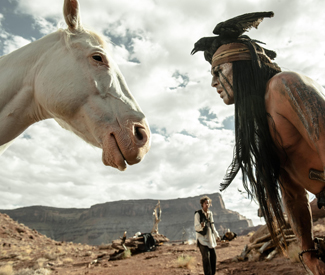
The pair returns to Rango‘s Wild West milieu for The Lone Ranger; certainly there’ll be no Oscars handed out this time, though Razzies seem inevitable. The biggest strike against The Lone Ranger is one you’ll read about in every review: it’s just a teeny bit racist. The casting of the once and future Cap’n Sparrow — who apparently has a blank check at Disney to do any zany thing he wants — as a Native American given to “hey-ya” chants and dead-bird hats is very suspect. Some (white) people might be willing to give this a pass, because it’s always been part of Depp’s celebrity mythology that he’s part Indian. I mean, he totally has a Cherokee warrior inked on his bicep, just below “Wino Forever”!

Mmm-hmm. Let’s go to the source, shall we? Speaking of his heritage in a 2011 interview with Entertainment Weekly, Depp mustered the following: “I guess I have some Native American somewhere down the line. My great grandmother was quite a bit of Native American, she grew up Cherokee or maybe Creek Indian. Makes sense in terms of coming from Kentucky, which is rife with Cherokee and Creek.”

Sounds kinda sketchy, JD. The actor who played Tonto on TV may have been born Harold J. Smith (“Jay Silverheels” was his nom de screen), but he was also raised on Canada’s Six Nations reserve and was the son of a Mohawk tribal chief. So The Lone Ranger TV series, which ran from 1949 to 1957 — and had its share of racial-insensitivity and stereotype-perpetuating issues — was able to cast an actual indigenous person to play Tonto, but 2013’s The Lone Ranger, which elevates Tonto from sidekick to narrator and de facto main character, was not.

In fact, it’s not too far-fetched to assume that the casting of Depp (also credited as an executive producer) is the only reason this Lone Ranger exists. Clearly, he really wanted to play Tonto, and Depp has a way of making his performance the most important thing about whatever film he’s in. Were audiences really screaming out for The Lone Ranger, a rather literal big-screen take on a 1950s TV show with some heavily CG’d train chases added in? Could not $250 million, the film’s reported budget, have been better spent doing something … anything … else?

Obviously “redface” is nothing new in Hollywood. It was frequently deployed in the pre-PC era, as when a white actor played a heroic Native American figure — think Chuck Connors in 1962’s Geronimo. But shouldn’t we have transcended that by now? You’d never see blackface in a film unless it was being used to make a character look ridiculous (2008’s Tropic Thunder), or to make a satirical point, as with 2000’s Bamboozled. Somewhere, Kevin Costner is clutching his Oscars for 1990 post-Western Dances With Wolves — more or less cinema’s biggest mea culpa for all those “the only good Indian is a dead Indian” yarns of the John Wayne era — and weeping.

Tonto isn’t the only Native American character in The Lone Ranger. But the others (none of whom are given names, unless someone was called “set dressing” or “background actor” and I missed it) have a slightly sharper aura of authenticity than Depp, who spends the whole movie caked in either old-age make-up or campy face paint. They are mere plot devices, there to give contemporary audiences a reason to feel outraged when an evil railroad baron lays his tracks through their land and raids their silver mine. “Our time has passed,” an elderly Indian character tells the Lone Ranger (Armie Hammer, whose role literally consists of riding a horse and reacting to Depp’s scenery-chewing buffoonery). “We are already ghosts.”

But back up, kemo sabe. Racism may be The Lone Ranger‘s worst problem, but it’s not the film’s only problem. There’s also its bloated length (nearly three hours); its score, which dares to introduce an Ennio Morricone homage into a film Sergio Leone wouldn’t line his gatto‘s litter box with; its waste of some great character actors (Barry Pepper, William Fichtner); its assumption that having random characters ask the Lone Ranger “What’s with the mask?” over and over is the funniest joke ever; and its failure to follow through on its few inventive elements — that herd of Monty Python-inspired rabbits, for example.

And another thing: if the moral of The Lone Ranger — spelled out with all the delicate subtlety of a fiery train crash — is “greed is bad,” why did El Deppo sign onto this piece of crap in the first place? *


THE LONE RANGER opens Wed/3 in Bay Area theaters.

Hungry for reform

16

news@sfbg.com

Sitawa Jamaa is among the thousands of California inmates who, two years ago this summer, took part in the largest prison hunger strike in US history to protest harsh conditions and their invisibility to those outside prison walls.

Now, Jamaa and other prisoners are about to launch another hunger strike to highlight the system’s unfulfilled promises and the persistence of inhumane conditions.

The California Department of Corrections and Rehabilitation (CDCR) counted 6,000 prisoners throughout the state who refused food over several weeks in July 2011. During a follow-up strike that September, the number of prisoners missing meals swelled to 12,000, according to the federal receiver who was appointed by the courts to oversee reforms in the system. At least one inmate starved to death.

As one of four inmates who call themselves the Short Corridor Collective, Jamaa was a key organizer of the hunger strike. The group of inmates drafted a list of core demands calling for the strike when they weren’t met.

That was no easy task for Jamaa, who has spent most of the last 28 years alone in a windowless, 8-by-10 foot concrete cell in Pelican Bay State Prison, a supermax facility not far from the Oregon border, where some 1,200 men are held in similar conditions.

Inmates held in solitary confinement (in government lingo: “Segregated Housing Units”, or “SHU” for short) aren’t supposed to communicate with each other, verbally or through the mail. But they were able to organize with the help of their lawyers, who they are allowed to communicate with, and prison reform advocates outside.

Jamaa and other inmates are planning to launch a second hunger strike on July 8. The Short Corridor Collective has drafted a list of 45 demands, reflecting concerns ranging from inadequate health care to extreme solitary confinement—conditions that prison advocates characterize as cruel and unusual punishment.

The list is an extension of the five initial demands that Pelican Bay inmates presented in 2011 before initiating a hunger strike. Most of those demands were never met, or they were met only with lip service, leading prisoners back to where they started.


CONFINEMENT AS TORTURE

High on the list are concerns about conditions in the SHU, the amount of time prisoners can be made to spend in isolation, and the public’s inability to monitor the situation.

“I feel dead. It’s been 13 years since I have shaken someone’s hand and I fear I’ll forget the feel of human contact,” Pelican Bay prisoner Luis Esquivel told attorneys with the Center for Constitutional Rights in an interview.

Along with Jamaa and others, Esquivel is a plaintiff in a lawsuit against the state of California that would effectively cap the time someone can spend in solitary confinement to 10 years.

“The hunger strike is an extreme act,” says Terry Kupers, a Piedmont-based psychology professor and clinical psychiatrist who has testified before the California State Assembly on long-term solitary confinement. “It’s very dangerous, and you can die. So when a group of prisoners go on hunger strike, it means they’ve exhausted all ways of expressing themselves and having their demands considered. And that’s very much the case here—some of these guys have been in SHU for 30 or 40 years.”

Kupers believes solitary confinement in California prisons violates the 8th Amendment’s prohibition on cruel and unusual punishment, a view echoed by activists who’ve launched a statewide effort called the Stop the Torture Campaign.

United Nations Special Rapporteur Juan Méndez, an expert on torture, has called for a ban on solitary confinement where inmates are kept in isolation for 22 hours a day or more, saying the practice should only be used in very exceptional circumstances and for short time periods.

The CDCR has made some concessions and reforms since the 2011 hunger strikes, but critical issues have gone unaddressed. In Pelican Bay’s SHU, the men are now allowed beanie caps for when it gets cold. They can now have wall calendars to track time and bring a human touch to their surroundings.

Some prisoners have received exercise equipment, such as a handball or pull-up bar. Each year, they now have permission to have one photograph of themselves taken to send to family members, and prison administrators have signaled that they are looking into extending Pelican Bay’s visitation hours.

But more pressing issues have yet to be resolved, so the prisoners who drafted the 45 demands are resorting to starvation once again, despite official statements that it will do little to improve their conditions.

“Negotiation is something the department does not do,” says Terry Thornton, a spokesperson for CDCR. But the department has met periodically with a mediation team, consisting of lawyers and prison activists, who have communicated the inmates’ concerns and gone over their demands with prison authorities.


RESISTING REFORM

In 2002, the state of California was sued, and lost, in an 8th Amendment class-action lawsuit: Plata v. Davis. The federal judge overseeing the case called the medical treatment in California prisons “horrifying,” sinking “below gross negligence to outright cruelty,” ordering improved treatment and reductions in severe prison overcrowding.

A court-appointed doctor found that out of 193 deaths over the course of one year, 34 were “probably preventable,” but medical staff gave “well below even minimal standards of care.” Eleven years later, the state is still under federal receivership, until it can show that conditions have actually improved.

Court-appointed consultant Dr. Raymond Patterson wrote his 14th annual assessment report last April, blaming high suicide rates behind bars on a lack of “adequate assessment, treatment or intervention.” After it was released, he quit the post in frustration, writing: “It has become apparent that continued repetition of these recommendations would be a further waste of time and effort.”

So inmates are taking in upon themselves to accomplish what the courts and consultants have failed to do: reform conditions in the prisons.

As happened in 2011, in spite of what is planned to be a peaceful protest, prisons housing strikers will be, according to Thornton, on “modified program” (or “lockdown,” as prisoners call it). Generally, that means inmates aren’t allowed to leave their cells, even to shower.

New regulations created after the 2011 strikes call for no visits for striking prisoners, and for their canteen food to be confiscated. In addition, “inmate(s) identified as strike leaders, instrumental in organizing, planning, and perpetuating a hunger strike, shall be isolated from non-participating inmates.”

Since March of this year, the Guantanamo Bay prisoner hunger strike has made news around the world for highlighting alleged violations of international law. There, when a striker goes below 85 percent Ideal Body Weight, regulations dictate that he or she be shackled to a chair, fitted with a mask, and have tubes inserted through their nostrils into their stomachs for up to two hours at a time.

That didn’t happen in California back during the 2011 strikes, but the Division of Correctional Health Care Services devotes five pages of its policy handbook to outlining specific instructions for dealing with hunger strikers, including transfers to prison medical facilities where they could potentially be force-fed, another practice the UN regards as torture.

Prisoners and activists believe the policy was instituted as preemptive attack on the upcoming hunger strike. “We are concerned that, under the pretext of ‘welfare’ checks, prisoners are being harassed, targeted, and deprived of sleep as the date of planned hunger strikes and work stoppages approaches,” said Isaac Ontiveros of the Prisoner Hunger Strike Solidarity group. “Whatever the case, new CDCR Secretary Jeffery Beard has an opportunity to avoid the strike and begin to undo the indescribable harm that the California prison system has caused.”


DANGEROUS ASSOCIATIONS

Problems associated with solitary confinement are closely connected to CDCR’s most commonly used tool for sending prisoners like Jamaa into the SHU: the controversial “gang validation” process.

Once an inmate is listed in prison records as a gang member, he or she loses multiple rights on the assumption that they’re a threat to the order of the prison. With no disciplinary write-ups since 1995, Jamaa would have been eligible for parole in 2004, except for the gang validation that led to his indefinite SHU sentence.

Getting pegged as a member of a gang can happen easily. Guards can write prisoners up for anything from the possession of artwork deemed to be gang-related, to information obtained from confidential informants whose claims prisoners often aren’t allowed to refute and whose identities remain unknown to the targeted prisoners.

Last year, in the wake of hunger strikes, CDCR announced a “complex retooling” of the gang validation practices. The so-called Step Down process, created in conjunction with the Department of Homeland Security, is meant to transition inmates out of gangs over the course of four years, with privileges gained over that time.

It might be the most significant of the reforms that followed the last hunger strike, but prisoners and their advocates criticize it as too lengthy of a process, subject to the arbitrary whims of the correctional officers overseeing a given prisoner. In fact, they say it may widen the definition of who counts as a gang member.

Manuel Sanchez, who is participating in the Step Down program at Corcoran State Prison, wrote in a letter that he is “seriously considering returning to SHU, where I’d be less harassed and I’d get more yard access more consistently.”

Compounding the problems in the prisons is a lack of transparency and public accountability.

“It’s like mentioning July 8 is anathema,” says San Francisco Bay View Editor Mary Ratcliff, whose African American-focused newspaper has been a CDCR censorship target.

From January to April of this year, Ratcliff said papers were being returned from Pelican Bay undelivered because they included articles about the hunger strikes, representing “material inciting participation in a mass disturbance,” and “a serious threat to the safety and security” of the prison, according to CDCR Administrator R.K. Swift.

“I think it’s remarkable that hunger strikes are considered a ‘disturbance,'” says Ratcliff. “A disturbance is supposed to mean a fight—something that threatens people. A hunger strike is a threat to no one except the people who are participating in it.”

Just as inmates can’t get news from the outside, they are also walled off from journalists who might cover them and the conditions they live in.

Since 1996, the CDCR has limited reporters to only interviewing prisoners they’ve selected. Last September, Governor Jerry Brown vetoed legislation that would have opened up media access to the prisons. “Giving criminals celebrity status through repeated appearances on television will glorify their crimes and hurt victims and their families,” he wrote, citing the media spectacle around Charles Manson.

But activists say the nearly $2 million Brown received from the California Correctional Peace Officers Association (CCPOA) during his successful bid for governor in 2010 had more to do with it than infamous serial killers.

Assembly member Tom Ammiano, who authored the most recent bill, stressed that “Press access isn’t just to sell newspapers. It’s a way for the public to know that the prisons it pays for are well-run. I invite the governor to visit the SHU to see for himself why media access is so important.”


DRASTIC MEASURES

Last time around, Jamaa lost 19 pounds. Deprived of sunlight, the Oakland-born man has developed melanin and vitamin D deficiencies that have lightened his normally dark brown skin. He suffers stomach problems and swollen thyroid glands that he didn’t have before prison. Starvation is a possibly lethal proposition. “Make no mistake, none of us wants to die. But we are prepared to, if that’s what it takes to force a real reform,” he and other strike leaders wrote in a statement last December. Jamaa’s sister, Marie Levin, who has organized monthly vigils for the strikers at Oakland’s monthly First Fridays/Art Murmur event, is worried about how her brother’s body will cope this time around. “It’s something that we as family members don’t want them to have to experience again,” she notes with anxiety. Yet both the prisoners and their advocates on the outside say they can’t simply let dehumanizing conditions in California’s prison system continue indefinitely. “I think things have changed, but not substantially in terms of actual conditions,” Kupers argues. “What is changed is the CDCR had to recognize the strikers, and conceded some of the things. And subsequently, the various prisoner groups have come together and made a commitment not to have violence between groups inside the prisons. This is huge advancement.” But unless all 45 demands are met, they say the strike will commence July 8. For now, Jamaa and others are readying their bodies for hunger, for a cause they believe goes far beyond prison walls. “Know this,” he wrote from SHU, words that needed to be smuggled out through unconventional means to get around an official wall of silence. “I am a … Prisoner of War, and I serve the interest of all people.”

Possibly the coolest queer mental health concert tour ever

1

Accidental Bear Queer Music Summer Tour Benefit for LGBTQ Mental Health Services and Suicide Prevention. Now, that’s a mouthful.

“It’s the longest, most ridiculous title ever,” Accidental Bear blog owner and founder Mike Enders said in a Guardian interview.

It’s basically a really queer, really cool music concert series travelling to five cities with performances by Logan Lynn, Big Dipper, Conquistador, Darling Gunsel, and Rica Shay, who all put a different spin on the concept of “queer music.”

But it’s also a two-fer. It’s giving exposure to the bands playing while raising money to donate to LGBT foundations in support of mental health including the San Francisco-based Stonewall Project, the LAGay and Lesbian Center, Ali Forney Center, Pride Foundation, and Q Center.

“All of these people [performing] are up-and-coming and some people have been around longer than others,” Enders said. “I wanted to have people who are going to draw a crowd and each one of these bands has their own group or pull.”

There are some big characters and personalities performing, and it’s going to be a high energy show. It’s also something you don’t want to bring your grandma to.

“Parts of the show are going to be X-rated,” Enders said. “Not like, nude, but Big Dipper, he has a lot of songs about his private parts. His version of the twerking that’s going on, is a song he has out called ‘Dick Bounce.’”

The Accidental Bear Tour is going to be a fun, queer time that also aims to eliminate the stigma that surrounds mental health and bring awareness to the alarming rates of suicide in the LGBTQ community.
Enders has a personal connection to the cause as well.

“In 2007, I started having these out-of-the-blue horrible panic attacks. And, being someone who didn’t have a lot of money, that was uninsured, I couldn’t find a resource, couldn’t find anybody to help,” Enders said.

He went to LGBT-specific services that couldn’t help due to him being uninsured, or being put on the end of a waiting list.

“I ended up in the emergency room,” Enders said. “If you’re unaware of what’s actually happening with a panic attack, a lot of times people think they’re having a heart attack. It was just kind of an eye opener. Luckily, I had good support around me, but I just realized there’s a real lack in services.

“The fact is, everyone in their life has dealt with a mental health issue. It’s kind of embarrassing admitting it now. It’s weird with the stigma to it.”

Tickets start at $15, and are on sale now. The tour kicks off here in San Francisco on July 5 at Beatbox, and will travel to LA, Portland, Seattle, and finish in New York City on the 19th.

“This is something that the queer world is missing right now,” Enders said. “Everything right now’s like DJs and dance music.”

The Accidental Bear Tour features dance, rap, hip hop, and electro music – a little something for everyone.

It’s going to be a great, big, gay time, with awesome performances while simultaneously fighting for a good cause.

AB SUMMER TOUR

8pm, $15
Beatbox
314 11th St., SF.
www.accidentalbear.com

Heads Up: 6 must-see concerts this week

0

Not to give this family any more attention, but here I go. Are you aware of the fact that the Balloon Boy is now a long-hair tween, in a darker Hanson trio with his brothers, singing operatic heavy metal bits? It’s all here, in a Gawker long-read post. The article notes that the group (Heene Boyz) considers itself the “World’s Youngest Metal Band.” — don’t we have that already here in the Bay with our own Haunted by Heroes? Take that, Balloon Boy. (Whatever, technically they’re billed as “The World’s Youngest Rock Band.”)

But my real point is this: America, home of the free, free to whore oneself and one’s family out on reality TV, to sneak kids into homemade balloon UFOs, to shoot for fame from birth. Happy Fourth of July week, everyone. Celebrate it with the bedlam of Bob Log III, the annual Big Time Freedom Fest at El Rio or Fillmore Jazz Festival, dreamy R&B producer Giraffage, or, the snacktastic Burger Boogaloo fest with headliners Redd Kross, the Oblivians, the Trashwomen, and more! Paint your face red, white, and blue, stick a sparkler behind your ear, and rage out into the night, it’s what the founding fathers would have wanted.

Here are your must-see Bay Area concerts this week/end:

Bob Log III
What’s more US of A than a lone multi-instrumentalist on stage in a glittery bodysuit and microphone-affixed motorcycle helmet, looking like a futuristic Bowie-esque alien, and sounding like a punky blues madman, or a scrappier Bo Diddley meets the Coachwhips, on slide guitar. As the Kansas City Star puts it, “If he hired a drummer, ditched his helmet, and requested a standard swizzle stick to stir his scotch, Bob Log III would still draw an audience. His music is that entertaining.”
With The Okmoniks, Los Vincent Black Shadows (Mexico City).
Wed/3, 8:30pm, $15
Hemlock Tavern
1131 Polk, SF
www.hemlocktavern.com
http://www.youtube.com/watch?v=UQmX4LzaDDU

Big Time Freedom Fest
It’s back, El Rio’s annual Fourth of July patio party Big Time Freedom Fest is here again, and this time brings out the worthy local Black Sabbath tribute act that is Bobb Saggeth, fronted by wailing female powerhouse Meryl Press. The band isn’t nearly as active as I’d prefer, but always plays parties on Halloween and Fourth of July, usually at places like Thee Parkside, Hemlock Tavern, and yes, El Rio. Plus, newish local heavy-psych band Golden Void headlines the show, and Wild Eyes, Couches, and Upside Drown open. And it’s all on the back patio, so you can officially say you spent the holiday outdoors, (with your favorite local rock‘n’rollers).
Thu/4, 3:30pm, $8
El Rio
3158 Mission, SF
www.elriosf.com
http://www.youtube.com/watch?v=Ebe9BtnD6wQ
http://www.youtube.com/watch?v=BmXB7-plWrY

Giraffage
“San Francisco-based futuristic dream R&B producer Charlie Yin has made some big leaps in 2013, with a performance at SXSW along with upcoming gigs at Southern California’s Lightning in a Bottle festival and SF’s Treasure Island Music Festival. His new album Needs on Los Angeles label Alpha Pup Records is a thesis in music manipulation, a comprehensive counterargument to straightforward 4/4. Vocal samples are up-shifted in tempo to lend a playful mood. Tracks are sometimes dipped in sonic mud halfway through, decelerating to a crawl before jumping back to normal time. But Needs never feels jerky, which owes to Yin’s tight transitions and harmonious melodies throughout. The sensual, infectious, shifty third track “Money” sounds like it will be played in lounges in 2050.” — Kevin Lee
With Mister Lies, Bobby Browser
Thu/4, 9:30pm, $13–$15
Rickshaw Stop
155 Fell
(415) 861-2011
www.rickshawstop.com
http://www.youtube.com/watch?v=6PVWP1Zrh4Q

Fillmore Jazz Festival
“Live jazz music, crafts, and gourmet food, all in one place (and most of it is free to check out). The Fillmore Jazz Festival is the largest of its kind on the West Coast, reportedly luring in a mind-blowing 100,000 visitors over the two-day event. Sultry local vocalist Kim Nalley will again bring her jazzy blues blend to the stage, as will instrumentalist-composer Peter Apfelbaum, Mara Hruby, John Santos Sextet, Beth Custer Ensemble, Crystal Money Hall, Bayonics, and Afrolicious, among many others.” — Hillary Smith
Sat/6-Sun/7, 10am-6pm, free
Fillmore Street between Jackson and Eddy, SF (800) 310-6563
www.fillmorejazzfestival.com
http://www.youtube.com/watch?v=5XRE8FSkxQg
http://www.youtube.com/watch?v=hall_F7pTbg

Woolfy
“I miss Kevin Meenan’s show listings at epicsauce.com. At one time it was a go-to for highlights of small shows going on in the city, filler free, and super reliable for finding a new act to see live. Meenan has since dropped the showlist (perhaps made redundant with the availability of social apps), but is still active with his regular event Push The Feeling. This edition features a DJ set by English born, LA musician, Simon ‘Woolfy’ James, whose eclectic and spacey post-punk dance sensibility first got my attention with the caressingly Balearic “Looking Glass” and the recent James Murphy-esque snappy cut on Permanent Release, ‘Junior’s Throwin’ Craze.’” — Ryan Prendiville
With Bruse (Live), YR SKULL, and epicsauce DJs
Sat/6, 9pm-2am, $6, free before 10 w/ RSVP
Underground SF
424 Haight, SF
www.undergroundsf.com
http://www.youtube.com/watch?v=R9WMPPiBimc

Burger Boogaloo
We blurbed this early: everyone is talking about the disparate headliners early LA punk band Redd Kross and Modern Lover/singer-songwriter Jonathan Richman — and rightfully so, they are incredible — but can we also take a minute to thank satan for the Trashwomen addition to the lineup? For those somehow unaware, the Trashwomen are Bay Area noisy surf-punk royalty, born of the ‘90s, and featuring Tina Lucchesi (of every band, ever), Danielle Pimm, and Elka Zolot (Kreayshawn’s hot mama). Check the paper this week for an interview with the Trashwomen. And check Mosswood Park for a sloppy soul dance party.
With the Zeroes, Oblivians, Fuzz, Mikal Cronin, Audacity, Guantanamo Baywatch, Mean Jeans, Pangea
Sat/6-Sun/7, noon-9pm, $25
Mosswood Park
3612 Webster, Oakl.
www.burgerboogaloo.com
http://www.youtube.com/watch?v=QP4hxwyWxHY
http://www.youtube.com/watch?v=eJx5c_cFq5o
http://www.youtube.com/watch?v=jI3XM-X72eQ

Still beating

27

cheryl@sfbg.com

FILM/LIT A few weeks before our scheduled interview, Laura Albert mails me copies of 2000’s Sarah and 2001’s The Heart is Deceitful Above All Things. Inscribed on Heart‘s title page is a note: “Thanks for being available to revelation.” The volumes are signed “Yours, LA and JT” — the latter, of course, referring to JT LeRoy, the identity under which Albert penned both books.

That secret’s been out since late 2005, and has been dissected over and over. It even inspired a Law and Order episode. LeRoy, and his fantastically tragic back story (just out of his teens, he’d survived drugs, homelessness, and prostitution en route to becoming the lit world’s hottest wunderkind), were Albert’s creations. She was the true author behind the best-sellers listed above, plus 2004’s Harold’s End, dozens of magazine articles, an early script for Gus Van Sant’s Elephant (2003), and numerous other works. (Meanwhile, the androgynous “JT” that had been appearing in public was actually the half-sister of Albert’s then-partner; she wrote her own tell-all in 2008.) On Albert’s website, there are tabs marked “Who is Laura Albert?” and “Who is JT LeRoy?” Both link to Albert’s biography.

Years have passed since l’affaire LeRoy, and Albert has moved through the experience in her own way. (Her business card lists her as “literary outlaw.”) Later this summer, Sarah will be reissued as an ebook, with a fairy tale-inspired cover by artist Matt Pipes. Albert also is working on her memoirs (though she doesn’t like to use the word “memoirs”), and tells me there’s a documentary forthcoming from Jeff Feuerzeig, who made 2005’s critically-acclaimed The Devil and Daniel Johnston. This weekend, Asia Argento’s 2004 adaptation of The Heart is Deceitful Above All Things screens as part of the Clay Theatre’s midnight-movie series, with Albert and producer Chris Hanley in person, plus Argento via Skype.

Sitting in her San Francisco kitchen, Albert eyes my tape recorder and admits she’d rather focus on the film, not JT — though it’s a topic that inevitably arises. Argento, Albert says, encountered Heart the way many LeRoy readers did, via word-of-mouth recommendation.

“She read the book and she didn’t know anything about JT. At the same time, a small publisher was putting out the book [in Italy], and they wanted to bring JT over,” Albert recalls. “It was a weird coincidence. They were putting on an event, and they wanted to get someone to read. They had contacted Asia, and she already knew about the book, and she wanted not only to do this event, but to make the movie. It’s funny because I thought Sarah would be the first [to become a film], because it was already optioned by Gus [Van Sant]. But Asia moved really fast. We went over to meet her, and I had turned down a lot of people. My feeling was, it’s my baby and I’m giving it up for adoption, and I saw that this was someone I could give my baby to.”

Argento, the daughter of famed Italian horror director Dario Argento, is best-known stateside as an actor; previous to Heart, her directing experience was limited to short films and 2000’s flamboyant Scarlet Diva. Once she decided to helm the movie, her decision to star as the free-spirited, needy, sometimes-cruel single mother of the story’s young protagonist was an obvious choice.

“I had concerns about that, how much she would take on the role, how much it would become her. It’s ironic, because I had given myself over completely to Jeremy, to JT, to Jeremiah,” Albert says. She pauses. “Did you see that French film, about the guy who assumes different characters?”

Holy Motors?”

“Yeah! It really was transformative to me. There’s a scene where someone asks [the main character], ‘Why are you still doing this?’, and he makes reference to the act of giving yourself over completely. And that was it. I gave myself over completely. I did not break character. You know how, in that movie, he’ll do anything? He’ll kill someone! He’s in it. Most people don’t know what that’s like. And that was it. I will never apologize,” she says, firmly. “We’re talking about art. Nobody was harmed in this, really. I didn’t really scribble that far outside the lines. Everything was labeled ‘fiction.'”

At her mention of an apology, I have to ask: does she feel like people demanded one?

“People like to give themselves a lot of credit for how vanguard they are. I can’t tell you how many people I’ve had tell me, ‘Warhol would have loved it!’ — including people who were close with Warhol,” she says. “I think it revealed more about other people and what they could accommodate, and what they put on the work, than it does about me. If you have a personal relationship with JT, then that’s a conversation between you and me. I put my email [in the books], and I really did have a connection with the fans because I grew up in the punk scene, and I wasn’t into hero worship. The problem was — psychologically — I wasn’t able to do that. It wasn’t like [adopts goofy voice], ‘Gee, how do I burst forth onto the literary scene? I know! I’ll create a little boy!’ No. It wasn’t like that.”

As we talk, Albert makes references to her own troubled youth: surviving abuse, living in a group home, being institutionalized. Amid the tumult of her teenage life, she would “call hotlines — I don’t know what I would talk about, but it was the only time I could feel. I would give myself over to another being, and it was always a boy. So when I hear people say, ‘I’m gonna do what you did,’ it’s like, good luck. For me it was created the way an oyster creates a pearl: out of irritation and suffering. It was an attempt to try to heal something. And it actually worked, and it did so for a lot of other people. The amazing thing is, now I can be available to people.”

We’re delving more into her work (“I didn’t do anything new — writers have always been using combinations of pseudonyms and identities,” she points out) when the doorbell rings; it’s a Comcast technician here to see about Albert’s Internet connection. We move to her office, which features a wall collaged with photos and several filing cabinets full of archives — material she’s letting Feuerzeig use in his documentary.

But it’s not a room completely given over to the past. It’s also where Albert works on her new projects (besides her memoirs, she’s writing screenplays — building off her experiences working on Deadwood with David Milch), and stashes new mementos, including a program from a recent Brazilian rock opera entitled JT, A Punk Rock Fairy Tale.

Before I leave, she gives me a copy of a New York Times article from 2010 entitled “Life, In the Way of Art;” its subjects include Joaquin Phoenix, still smarting from the backlash after his faux breakdown in I’m Still Here. The director of that film, Casey Affleck, cites a line from a Picasso quote that Albert emails to me in full the day after we speak: “We all know that art is not truth. Art is a lie that makes us realize truth, at least the truth that is given us to understand. The artist must know the manner whereby to convince others of the truthfulness of his lies.”

She’s just as frank over email as she is in person. “It’s OK with me if someone doesn’t like my writing. But they shouldn’t try to tell me how I’m obliged to present my work,” she writes. “When I talk about my personal background, I’m not attempting to somehow bestow legitimacy to what I’ve written — anyone should be able to do what I did. My life history doesn’t matter and isn’t being offered as any kind of excuse.”

I think back to something she said in her kitchen — a simple, powerful summation of a story that will never not be complicated. “JT was my lifeboat. You loved him? Well, I loved him more.” 

THE HEART IS DECEITFUL ABOVE ALL THINGS

Fri/28, midnight, $10

Clay

2261 Fillmore, SF

www.landmarktheatres.com


Our Weekly Picks

0

WEDNESDAY 26

Dita Von Teese

With a seductive and sexy nod to the past, modern pin-up and burlesque queen Dita Von Teese has been at the forefront of reviving a nearly lost art form for two decades now. Bringing back the sense of classic style and glamour of the golden days of Hollywood and meshing it with the tantalizing teasing of the old-time burlesque circuit, Von Teese returns to the city this week with her “Burlesque: Strip, Strip, Hooray!” show, a live revue featuring not only her own titillating talents, but a host of other performers as well, including Dirty Martini, Catherine D’Lish, and Lada Nikolska from the legendary “Crazy Horse Paris.”

(Sean McCourt)

Through Fri/28, 7:30pm, $40

Fillmore

1805 Geary, SF

(415) 346-6000

www.thefillmore.com


“Harvey Milk 2013”

The San Francisco Gay Men’s Chorus, the world’s first chorus comprised of openly gay men, had its first unofficial public performance at a candlelight vigil for Harvey Milk. The group has since become known for its dazzling holiday concerts, but its historical origins mean it’s fitting that — as part of its 35th anniversary celebration — SFGMC is presenting the world premiere of I Am Harvey Milk. Starring its composer Andrew Lippa as Milk, with guest soprano Laura Benanti, this blend of theater and choral works traces the courageous life of the slain politician, with accompaniment by the Bay Area Rainbow Symphony. (Cheryl Eddy)

Wed/26-Fri/28, 8pm, $25-60

Nourse Theatre

201-299 Hayes, SF

www.sfgmc.org


THURSDAY 27

Clay Shirky

“I’m trying to figure out what difference communications technologies makes to society,” Clay Shirky remarked in a 2011 interview. “What is it about the Internet, what is it about mobile phones, applications built on top of them, that changes how we behave.” The New York University professor has become one of the world’s foremost authorities on gauging how technology has shifted social action. His 2010 book Cognitive Surplus: Creativity and Generosity in a Connected Age outlined how web tools have provided new opportunities for creation in place of consumption, pointing out dynamics such as self-publication and charitable crowdfunding. Shirky has championed government transparency in recent editorials exploring the high-profile leaks of US surveillance programs. (Kevin Lee)

6:30 p.m., $20 (member, $12; students $7)

Commonwealth Club

595 Market, SF

(415) 597-6700

www.commonwealthclub.org


Tommy Davidson

Comedian Tommy Davidson might be offensive, but his keen observations about the absurdity of our daily lives and his animated delivery guarantee laughs. His ability to comment on situations that arise in all walks of life ensures everyone has something to chuckle about through his bits. Known for his roles in the ’90s hit sketch show In Living Color, films like Strictly Business (and OK, Juwanna Mann) and most recently in the spotlight for his character Cream Corn on Adult Swim’s cartoon Black Dynamite, Davidson tours pretty infrequently, so catch him while you can — likely offering fresh takes on old habits. (Hillary Smith)

8pm and 10pm, $24-26

Yoshi’s

1330 Fillmore, SF

(415) 655-5600

yoshis.com/sanfrancisco


FRIDAY 28

Y La Bamba

Indie-folk rocker group Y La Bamba has been steadily building a fan base over the past couple of years, earning high praise from NPR and loaning songs to television programs such as Bones. The Portland-based band’s hauntingly rich and ethereal sound is propelled by singer-songwriter Luzelena Mendoza, whose vocals float and weave tales above Latin-inspired rhythms and unique backing vocals. Its latest full-length album, last year’s Court The Stormwas produced by Los Lobos member Steve Berlin, and an excellent EP, Oh February was released this January. (McCourt)

9pm, $12–$15

Chapel

777 Valencia, SF

(415) 551-5157

www.thechapelsf.com


Japanther

Japanther lets everything go in its performances. Punk is its staple, and the group is known for fuzzy overtones and generally sloppy delivery. All this culminates into weird, disorienting live shows. But whether the band drops five Ramones covers on you or blasts into its own songs (likely off newest album, Eat Like Lisa Act Like Bart) with a raw, unpredictable energy, it will be fun. Keep an eye out for the duo’s signature telephone microphones and the more-often-than-not shirtless bat-shit drummer. (Smith)

With Defiance, Ohio, Psilovision

9pm, $12

Bottom of the Hill

1233 17th St., SF

(415) 626-4455

www.bottomofthehill.com


SATURDAY 29

San Francisco FrontRunners Pride Run

For folks who love to sweat, there’s no better way to celebrate Pride than with veteran LGBT running club the San Francisco FrontRunners, who’ve hosted this event for over three decades. Choose the 5K or the 10K by asking yourself “How many times do I want to haul ass up that hilly stretch of Golden Gate Park’s JFK Drive?” — but remember, the emphasis here is mos def on fun. Sure, some speed demons do turn out (last year’s 5K winner clocked in at just over 18 minutes), but casual joggers are also in effect, as are Pink Saturday-themed athletic ensembles. Upbeat DJs and tasty food at the finish line add to the festive atmosphere. (Eddy)

9am, $40

Golden Gate Park (near Metson and Middle Dr. West), SF

www.sffr.org


In A Daughter’s Eyes

Two women, two very different circumstances: the first, the daughter of a Black Panther sentenced to death for killing an Oakland cop; the second, the daughter of the slain man. Locked in a room together, how will the women negotiate their differences — and is there any chance of forgiveness and healing? Brava! For Women in the Arts and Black Artists Contemporary Cultural Experience present award-winning playwright A. Zell Williams’s In A Daughter’s Eyes in its West Coast debut; though it features just one location and only two characters, expect a powerful, intense story, guided by the sure hand of veteran director Edris Cooper-Anifowoshe. (Eddy)

Through July 14

Previews Thu/27-Fri/28, 8pm; opens Sat/29, 8pm; runs Thu-Sat, 8pm; Sun, 3pm, $15

Brava Theater Center

2781 24th St, SF

www.brava.org


The Juan MacLean (DJ Set)

After years of producing quality electro-disco-club music for DFA Records (home to legendary sometimes-retired LCD Soundsystem), DJ and producer the Juan MacLean (stage name for John Maclean) has leapt head first into a stripped-down, nu-house sound. With vocalist and longtime collaborator Nancy Whang, MacLean released the cool, classy “You Are My Destiny” this March, completing a shift that may have taken root as far back as 2011 with his Peach Melba side project. Transitions are standard practice for the former hardcore guitarist turned electronic music artist, who has collaborated with LCD Soundsystem, !!!, and Holy Ghost! and remixed Yoko Ono and Stevie Nicks. In the midst of a relentless international tour schedule, MacLean signaled his return to dance music prominence earlier this month with a set on BBC Radio 1’s prestigious Essential Mix program. (Lee)

With Kim Ann Foxman, Blacksheep

9pm, $10–$20

Monarch

101 Sixth St., SF

(415) 284-9774

monarchsf.com


SUNDAY 30

Deltron 3030

If you’ve lived in SF for at least a year, then you probably know about Stern Grove’s awesomely free and diverse ongoing music festival. But if not, this summer-long (June 16-Aug.18) series offers the community a chance to get outside and enjoy nature while picnicking with live musical accompaniment. The beautiful, towering eucalyptus trees, redwoods, and grassy meadows provide the best possible settings for a summer music festival. This Sunday’s lineup features dance hip-hip super group Deltron 3030. Rapping about evil corporate Goliaths and space battles, often alongside an orchestral band, Deltron 3030’s performance is anything but typical. The festival itself is always worth checking out, but the group makes this Sunday’s show one of the highlights of summer. (Smith)

2pm, free

Stern Grove

19th Avenue and Sloat, SF

www.sterngrove.org


“Science On Screen: The Science of Baseball”

Hey, batter! There are very few Bay Area residents who don’t have an opinion on which baseball team to root for (default consensus: “L.A. sucks”), but there’s more to the game than trash talk and World Series trophies. Indeed, there’s some pretty serious science behind all those curve balls and home runs, and who better to break it down than the Exploratorium’s David Barker and Linda Shore? (Check out the museum’s clever and educational “Science of Baseball” site at exploratorium.edu/baseball.) Using clips from documentaries and Hollywood films, the duo gets into the nitty-gritty of baseball’s complex biomechanics — so the next time you watch Hunter Pence step up to the plate, you’ll be able to spot the physics behind his hitting prowess. (Eddy)

7pm, $12

Christopher B. Smith Rafael Film Center

1118 Fourth St, San Rafael

www.cafilm.org


TUESDAY 2

Pure Bathing Culture

Listen to Portland, Oreg.-via-Brooklyn duo Pure Bathing Culture’s ethereal, synth-laced cover of Fleetwood Mac’s “Dreams,” and you’ll likely tumble into a web search hole, digging out other soundscape-y Fleetwood Mac covers to quench your newfound obsession (likely finding that PBC’s is still tops). Crawl out of the hole and face your new favorite, Pure Bathing Culture, head on by grabbing a hold of 2012’s self-titled EP, an ode to dreamy 1980s pop produced by Richard Swift. Then note influences like Talk Talk and Cocteau Twins expanding on recently released tracks off upcoming debut full-length, Moon Tides. Band members guitarist Daniel Hindman and keyboardist Sarah Versprille have contributed in the past to records by Foxygen and Damien Jurado, but together as Pure Bathing Culture, they form a loosely wound union of shimmering guitars, twinkling synths, and delicate vocals, twisting along a well-worn path. (Emily Savage)

With Cocktails, Cannons and Clouds, CoolGreg

9pm, free

Brick and Mortar Music Hall

1710 Mission, SF

(415) 800-8782

www.brickandmortarmusic.com


The Guardian listings deadline is two weeks prior to our Wednesday publication date. To submit an item for consideration, please include the title of the event, a brief description of the event, date and time, venue name, street address (listing cross streets only isn’t sufficient), city, telephone number readers can call for more information, telephone number for media, and admission costs. Send information to Listings, the Guardian, 225 Bush, 17th Flr., SF, CA 94105; or e-mail (paste press release into e-mail body — no attachments, please) to listings@sfbg.com. Digital photos may be submitted in jpeg format; the image must be at least 240 dpi and four inches by six inches in size. We regret we cannot accept listings over the phone.

Heads Up: 7 must-see concerts this week

0

Pride Week is upon us y’all, and with those excited, proud, rainbow-waving masses, come awesome live acts, DJs, bands, you know the drill by now; there are official shows, tangential nights, and underground events (check out Mykki Blanco at Mezzanine, or Magic Mouth with THEESatisfaction at Hard French Hearts Los Homos). Many more Pride listings will be in the paper this week.

And of course, there’s also some unrelated live rock‘n’roll you should be checking out right now as well, including two doubled-headlined shows of high-quality locals; there’s the Warm Soda/Midnite Snaxxx night at Brick and Mortar, along with the White Barons/Wild Eyes SF shakedown at Bender’s. Plus, Deltron 3030 plays the free summer series at Stern Grove this weekend.

There’s plenty to do and see in San Francisco at the moment, so buckle up. An aside: I’d also recommend Austra at the Independent Wed/26, debuting its new album Olympia; the show is sold out but I know you creative types have ways around this.

Here are your must-see Bay Area concerts this week/end:

Warm Soda and Midnite Snaxxx
This should make for a fizzy summer combo: both local to Oakland and full of vigor, Warm Soda’s glistening ‘80s pop will be matched in this Brick and Mortar lineup to Midnite Snaxxx’s leather-jacket-babe rock‘n’roll bubblegum smash. The results should be explosive, like a shaking up a two-liter bottle of cola and showering those around you with its sticky sweetness. Plus, it’s your last chance to see Warm Soda this summer — the group’s about to head out on its first European tour.
With Primitive Hearts, the Wild Ones
Thu/26, 9pm, $8
Brick and Mortar
1710 Mission, SF
www.brickandmortarmusic.com
http://www.youtube.com/watch?v=OUQQDb4fkmo

Mykki Blanco
The self-described “Acid Punk Rapper” behind debut mixtape Cosmic Angel: The Illuminati Prince/ss brings his global nightlife pulse to San Francisco this week, (once again — when he performed here last year, Marke B. called Blanco a “Dark and fierce queer rapper from the future”). The hyperreal, multifaceted rapper is a supporter of underground arts and a rather busy one; he’s written books, recorded albums, posed as a fashion muse, and served as a nightclub dignitary, once telling Interview mag: “I didn’t plan for it, but everyday in the morning, for extra energy, I drink a raw garlic smoothie with fruit. I have nothing to lose and everything to gain by working hard. To have this be the beginning of my career and receive this much positive support — I cannot waste a fucking minute, and I’d be a fool to waste a minute.”
Thu/27, 9pm, $15
Mezzanine
444 Jessie, SF
www.mezzaninesf.com
http://www.youtube.com/watch?v=w39Fxx10CEI
http://www.youtube.com/watch?v=LSgVZEGpo6U

Y La Bamba
“Indie-folk rocker group Y La Bamba has been steadily building a fan base over the past couple of years, earning high praise from NPR and loaning songs to television programs such as Bones. The Portland-based band’s hauntingly rich and ethereal sound is propelled by singer-songwriter Luzelena Mendoza, whose vocals float and weave tales above Latin-inspired rhythms and unique backing vocals. Its latest full-length album, last year’s Court The Stormwas produced by Los Lobos member Steve Berlin, and an excellent EP, Oh February was released this January.” — Sean McCourt
Fri/28, 9pm, $12–$15
Chapel
777 Valencia, SF
(415) 551-5157
www.thechapelsf.com
http://www.youtube.com/watch?v=sP9U4tm8xJc

The Juan MacLean (DJ Set)
“After years of producing quality electro-disco-club music for DFA Records (home to legendary sometimes-retired LCD Soundsystem), DJ and producer the Juan MacLean (stage name for John Maclean) has leapt head first into a stripped-down, nu-house sound. With vocalist and longtime collaborator Nancy Whang, MacLean released the cool, classy “You Are My Destiny” this March, completing a shift that may have taken root as far back as 2011 with his Peach Melba side project. Transitions are standard practice for the former hardcore guitarist turned electronic music artist, who has collaborated with LCD Soundsystem, !!!, and Holy Ghost! and remixed Yoko Ono and Stevie Nicks. In the midst of a relentless international tour schedule, MacLean signaled his return to dance music prominence earlier this month with a set on BBC Radio 1’s prestigious Essential Mix program.” — Kevin Lee
With Kim Ann Foxman, Blacksheep
Sat/29, 9pm, $10–<\d>$20
Monarch
101 Sixth St., SF
(415) 284-9774
www.monarchsf.com
http://www.youtube.com/watch?v=Nwf31pKvGc4

The White Barons and Wild Eyes SF
Some background: local Southern fried rock group (“by way of Atlanta, Jakarta, and two Midwest podunk towns”) the White Barons includes members of Thee Merry Widows, Winter Teeth, and Whiskey Dick Darryls, and SF’s Wild Eyes recently opened for King Khan and BBQ Show at Slim’s. This Bender’s show is a party for a few things: it’s the birthday of Bender’s doorperson and Subliminal SF booker Mikey Madfes, it’s a split seven-inch release celebration for the White Barons and Wild Eyes, and lastly, there’s a band vs. band chili cook-off (if you buy a record, you’ll get a chili sample). So you know it’s going to be a messy mix of raucous rock’n’roll and tender cooked meats.
Sat/29, 10pm, $5
Bender’s Bar and Grill
806 S. Van Ness, SF
www.bendersbar.com
http://www.youtube.com/watch?v=9UXOSZPocks

Deltron 3030
“If you’ve lived in SF for at least a year, then you probably know about Stern Grove’s awesomely free and diverse ongoing music festival. But if not, this summer-long (June 16-Aug.18) series offers the community a chance to get outside and enjoy nature while picnicking with live musical accompaniment. This Sunday’s lineup features dance hip-hip super group Deltron 3030. Rapping about evil corporate Goliaths and space battles, often alongside an orchestral band, Deltron 3030’s performance is anything but typical.” — Hillary Smith
Sun/30, 2pm, free
Stern Grove
19th Avenue and Sloat, SF
www.sterngrove.org
http://www.youtube.com/watch?v=ijPE7fe4XTg

Magic Mouth
To get a taste of the soulful energy Magic Mouth exudes, check the YouTube video “MAGIC MOUTH LIVE: MISSISSIPPI STUDIOS,” (below); it’s like watching James Brown front a garage-punk band. The lively Portland, Ore. queer soul-punk quartet will play Hard French Hearts Los Homos (an event described by DJ Carnita as “an intergalactic Pride Party for all the gayliens who love to dance in outer space”), opening up for THEESatisfaction.
Sun/30, 4-11pm, $20
Roccapulco
3140 Mission, SF
hardfrenchpride2013.eventbrite.com
http://www.youtube.com/watch?v=otA5i0Y6wlE

Netroots Nation: How to make a comeback

At Netroots Nation the central focus on the how, and not so much the why. Everyone here knows why austerity is devastating, why women need ready access to birth control, and why blank-industrial complex is morally reprehensible. But not everyone necessarily knows how marriage equality made a comeback in 2012, or how one goes about convincing your Nebraska Republican farmer father to believe in climate change. At Netroots, your network is your net worth. 

A noteworthy panel of the day was “Moving the Needle: How We Won the Gay Marriage Fight,” spotlighting an issue where the left has made considerable progress. Remember the days when Feinstein was trying to stop Newsom from issuing gay marriage licenses? That was less than a decade ago; today, even Republican senators from Alaska endorse gay marriage.

In 2009, the pro-gay marriage team lost at the ballot by 33,000 votes, three years later the good guys won by 38,000. Ian Grady, communications director for Equality Maine, explained “that their main message of ‘equal rights for all’” lacked the emotional resonance to persuade swing voters and “left the LGBT community vulnerable to the civil unions argument.” In 2012 when Equality Maine pivoted to showcasing a marine talking about his two moms and a grandfather’s emotional speech about wanting to see his granddaughter get married, their research overwhelmingly showed that the impact of emotional persuasion. PR pro tip for liberals and progressives: evaluate and reevaluate ideas that look like no-brainers to you and know that style (communication) is just about as important as substance (ideas).

Closing out the first day was the pep rally! Liberal stalwarts Howard Dean and Barney Frank, activist Sandra Fluke, Speaker of the California House John Perez, Senator Jeff Merkeley, and a video appearance from Obama all reiterated the message, and provided a much-needed respite from the dysfunctional state of our government by reminding us of the progress our issues have made and inspired us to keep on keeping on.

Netroots Nation Stats:

# of Google Glass Sightings: 2

# of White people flubbing “Si Se Puede!”: 3

# of Ignored interview requests sent from me to Congresswoman Pelosi’s office: 4

# of Times I heard “The president is not perfect” or some variation there of: 6

# of Times some crazy guy called the American people slaves to Congressman Mike Honda’s staff: I lost count after 6.

# of points Chris Bosh and Mike Miller scored in game 7 of the NBA Finals: 0

# of New media/tech-oriented panels on day one: 12

A hackivist’s call for a culture of engagement

By Shava Nerad

[Editor’s note: Last week, the Guardian reached out to a number of experts and technologists to gauge reactions on revelations of the massive National Security Agency spying program that recently came to light. Shava Nerad, who started her career as a software engineer and was previously involved with the Tor Project, which offers online anonymity in web browsing, has also been engaged in various forms of political activism. Nerad submitted comments via email in response to the Bay Guardian’s request for an interview. We’ve published an edited version of her thoughts here.]

My dad worked with MLK and the SCLC [Southern Christian Leadership Conference] every summer of the early/mid 60s — and the FBI knew who he had lunch with every day of those summers — this stuff isn’t really that new, it’s just automated. I got to go from “We Shall Overcome” to making sure that the Tor Project could get US nonprofit status, a good foundation of funding, a great reputation internationally, and become infrastructural for free press, free speech, and free expression on the net.

I come from a family of old style liberals from a time before the 60s, when intellectual liberals were in the military, in finance, in civil service and all parts of civic life. We moderated all parts of American society. After the 60s, to a large extent, it became uncool for liberals and intellectuals (even non-hippie types) to go into these Establishment pastimes, especially the volunteer or low paying scutwork that keeps this country running. So after half a century, what are we seeing? Largely unmoderated by liberal intellectual thought, with two generations of kids who don’t even know how to go to a public meeting or why or how politics actually works at most levels in this country, we are a goddamn mess.

I have a son in the military, and I have friends in the [Department of Homeland Security], law enforcement, a friend who’s a retired CIA analyst. But many of my friends consider me an outspoken lefty liberal (I don’t) because I am a Democratic Party activist, a strong civil libertarian, a union member … and a sort of hippie chick.

I love this wonderful flawed country. I want to tell every one of my folks here, get out of your ergonomic chairs … and get involved. Congress’ approval rating is up two percent since March to fifteen percent — and they won’t fix the USA PATRIOT Act because they aren’t a bit afraid of your disapproval!  In fact, if you say you disapprove, they will make googly eyes at you, and say “Oooooo TERRORISTS!!!” and expect you to back down and shut up — and unfortunately they are probably right.

If we are the engineers and the scientists, the innovators and the entrepreneurs — can’t we find the best way to fix our culture of engagement?  Make our culture a culture where the makers learn applied civics and share their successes on social networking?

Many of us who are “hactivists” are post-conventional thinkers, if you are familiar with that concept. Most of us do not believe that the system is irrevocably broken — we are not revolutionaries or traitors or terrorists. This is why we are making moves that are aimed toward waking up the public, not blowing them up.  If that isn’t clear enough, I can’t see what would be — we certainly have ample examples of violence in the world. We are sending signals that say, “Please, see that everything is not exactly as you have been told. You are citizens of a Republic. Take the reins and bring it back to rights. Your rights.”

Civil disobedients, whistleblowers, leakers, facilitators like Bradley Manning, Edward Snowden, William Binney, Nicholas Merrill, Jake Appelbaum and more — these people should be honored rather than vilified as people who were willing to risk everything they had in order to send up a distress signal to the nation to say, “All is not right.”

But if every person of good character left all the military, law enforcement, DHS, government — then we would be a mess. Not everyone can leave. Someone has to break ranks, betray unit cohesion, take these risks, and risk being branded as a traitor even (and all of those men have been by some people).  

The American public has to wake up and understand that all is not right BECAUSE IT IS NOT.  DHS cannot fix the USA PATRIOT Act. Congress won’t fix it so long as the people moan about it on blogs and don’t insist that action be taken.

I have spoken to people in DHS since 9/11 who have been waiting to exhale for over a decade. Do you understand the situation that many in the career diplomatic services believed that they were in during [George W. Bush’s]’s administration? That they were hanging on by their fingernails, as professional diplomats and civil servants? 

Well, oddly, when Obama came in, State gave a great many of these people an opportunity to exhale. But … oddly, the new boss, and the Congress just piled on more of the same. No reprieve.

So we have the State Department declaring Internet Freedom and distributing Tor overseas, and Prism turned inward at our own people?  What sense does this make?  Praising the Arab Spring, and chasing American citizens with drones?  

The nation is sleeping or ostriching, and I’m sorry, but the press is sleeping or at the least, distracted by survivability issues. We need to turn this into a great and heroic national adventure story, or it’s going to turn into a national tragedy.

Holding out for a hero…or an antihero…or the Antichrist: this week’s new movies!

0

Already in theaters, Seth Rogen and his bro posse take on doomsday in This Is the End. I got the chance to talk with Mr. Rogen, his co-director and co-writer Evan Goldberg, and co-star Craig Robinson when they visited San Francisco a few days back. (Fun fact: Rogen really does laugh like that in real life.) Check the interview here!

In rep news, this weekend at the Castro Theatre heralds the San Francisco Silent Film Festival‘s “Hitchcock 9” event, spotlighting nine silent films by the guy who would later claim the title “Master of Suspense,” direct some of the greatest thrillers of all time, etc. You can’t go wrong with any of the films, but just for kicks, here’s my take on the series here. And at the Yerba Buena Center for the Arts, Austrian director Ulrich Seidl’s dark Paradise Trilogy continues its bummer-summer run this weekend; Dennis Harvey breaks ’em down here.

Plus! That Superman movie you’ve been hearing a thing or two about, and the rest of the week’s new offerings, after the jump.

http://www.youtube.com/watch?v=Sq6ffF8QLsQ

Becoming Traviata Philippe Béziat’s backstage doc offers an absorbing look at a particularly innovative production of Verdi’s La Traviata, directed by Jean-François Sivadier and starring the luminous Natalie Dessay (currently appearing in SF Opera‘s production of Tales of Hoffman). Béziat eschews narration or interviews; instead, his camera simply tracks artists at work, moving from rehearsal room to stage as Sivadier and Dessay (along with her co-stars) block scenes, make suggestions, practice gestures, and engage in the hit-and-miss experimentation that defines the creative process. The film is edited so that La Traviata progresses chronologically, with the earliest scenes unfolding on a spartan set (Dessay’s practice attire: yoga clothes), and the tragic climax taking place onstage, with an orchestra in the pit and sparkly make-up in full effect. Dessay will appear in person at San Francisco screenings Sat/15 at 7pm and Sun/16 at 2pm. (1:53) (Cheryl Eddy)

http://www.youtube.com/watch?v=CWnrk35qYMs

Dirty Wars Subtitled “the world is a battlefield,” this doc follows author and Nation magazine writer Jeremy Scahill as he probes the disturbing underbelly of America’s ongoing counterterrorism campaign. After he gets wind of a deadly nighttime raid on a home in rural Afghanistan, Scahill does his best to investigate what really happened, though what he hears from eyewitnesses doesn’t line up with the military explanation — and nobody from the official side of things cares to discuss it any further, thank you very much. With its talk of cover-ups and covert military units, and interviewees who appear in silhouette with their voices disguised, Dirty Wars plays like a thriller until Osama bin Laden’s death shifts certain (but not all) elements of the story Scahill’s chasing into the mainstream-news spotlight. The journalist makes valid points about how an utter lack of accountability or regard for consequences (that will reverberate for generations to come) means the “war on terror” will never end, but Dirty Wars suffers a bit from too much voice-over. Even the film’s gorgeous cinematography — director Rick Rowley won a prize for it at Sundance earlier this year — can’t alleviate the sensation that Dirty Wars is mostly an illustrated-lecture version of Scahill’s source-material book. Still, it’s a compelling lecture. (1:26) (Cheryl Eddy)

The Guillotines Why yes, that is Jimmy Wang Yu, director and star of 1976 cult classic Master of the Flying Guillotine, in a small but pivotal role commanding a team of assassins who specialize in dispatching heads with airborne versions of you-know-which weapon. Unfortunately, this latest from Andrew Lau (best-known stateside for 2002’s Infernal Affairs, remade into Martin Scorsese’s 2006 Oscar-winner The Departed) doesn’t have nearly as much fun as it should; dudes be chopping heads off in a flurry of CG’d-up steampunky whirlygigs, but The Guillotines‘ tone is possibly even more deadly, as in deadly serious. When a rebellious prophet-folk hero known as Wolf (Xiaoming Huang) runs afoul of the Emperor’s top-secret Guillotine brotherhood, led in the field by Leng (Ethan Juan), the squad travels in disguise to a rural, smallpox-afflicted village to track him down. Along for the journey is the Emperor’s top operative, ruthless Agent Du (Shawn Yue), a boyhood friend of Leng’s. Leng and Du share a dark secret: the Guillotines have been deemed expendable — yep, in the Stallone sense — and the Emperor has decided to kill them off and replace them with armies toting guns and cannons in the name of progress. Lau is no stranger to tales of men grappling with betrayals, misplaced loyalties, and hidden personal agendas — and as historical martial-arts fantasies go, The Guillotines has higher production values than most, with sweeping, luscious photography. Too bad all the action scenes are punctuated by episodes of moody brooding — replete with slo-mo gazing off into the distance, dramatically falling tears, solemn heart-to-hearts, swelling strings, and the occasional howl of anguish. (1:53) (Cheryl Eddy)

http://www.youtube.com/watch?v=T6DJcgm3wNY

Man of Steel As beloved as he is, Superman is a tough superhero to crack — or otherwise bend into anything resembling a modern character. Director Zack Snyder and writer David S. Goyer, working with producer Christopher Nolan on the initial story, do their best to nuance this reboot, which focuses primarily on Supe’s alien origins and takes its zoom-happy space battles from Battlestar Galactica. The story begins with Kal-El’s birth on a Krypton that’s rapidly going into the shitter: the exploited planet is about to explode and wayward General Zod (Michael Shannon) is staging a coup, killing Kal-El’s father, Jor-El (Russell Crowe), the Kryptonians’ lead scientist, and being conveniently put on ice in order to battle yet another day. That day comes as Kal-El, now a 20-something earthling named Clark Kent (Henry Cavill) — resigned to his status as an outsider, a role dreamed up by his protective adoptive dad (Kevin Costner) — has turned into a bit of a (dharma) bum, looking like a buff Jack Kerouac, working Deadliest Catch-style rigs, and rescuing people along the way to finding himself. Spunky Lois Lane (Amy Adams) is the key to his, erm, coming-out party, necessitated by a certain special someone looking to reboot the Kryptonian race on earth. The greatest danger here lies in the fact that all the leached-of-color quasi-sepia tone action can turn into a bit of a Kryptonian-US Army demolition derby, making for a mess of rubble and tricky-to-parse fight sequences that, of course, will satisfy the fanboys and -girls, but will likely glaze the eyes of many others. Nevertheless, the effort Snyder and crew pack into this lengthy artifact — with its chronology-scrambling flashbacks and multiple platforms for Shannon, Diane Lane, Christopher Meloni, Laurence Fishburne, and the like — pays off on the level of sheer scale, adding up to what feels like the best Superman on film or TV to date — though that bar seems pretty easy to leap over in a single bound. (2:23) (Kimberly Chun)

http://www.youtube.com/watch?v=4V1E2IgXeuI

Pandora’s Promise Filmmaker Robert Stone has traveled far from his first film, 1988’s Oscar-nominated anti-nuke Radio Bikini, to today, with the release of Pandora’s Promise, a detailed and guaranteed-to-be-controversial examination of nuclear power and the environmentalists who have transitioned from fervently anti- to pro-nuclear. Interviewing activists and authors like Stewart Brand, Gwyneth Cravens, Mark Lynas, and Michael Shellenberger, among others, Stone eloquently visualizes all angles of their discussion with media, industrial, and newly shot footage, starting with a visit to the largest nuclear disaster of recent years, Fukushima, which he visits with the hazmat-suited environmental activist and journalist Lynas and continuing to Chernobyl and its current denizens. Couching the debate in cultural and political context going back to World War II, Stone builds a case for nuclear energy as a viable method to provide clean, safe power for planet in the throes of climate change that will nonetheless need double or triple the current amount of energy by 2050, as billions in the developing world emerge from poverty. In a practical sense, as The Death of Environmentalism author Shellenberger asserts, “The idea that we’re going to replace oil and coal with solar and wind and nothing else is a hallucinatory delusion.” Stone and his subjects put together an enticing argument to turn to nuclear as a way forward from coal, made compelling by the idea that designs for safer alternative reactors that produce less waste are out there. (1:27) (Kimberly Chun)

Icelandic MP Birgitta Jónsdóttir talks asylum options for NSA whistleblower

Birgitta Jónsdóttir is waiting for Edward Snowden to drop her a line.

The Icelandic Member of Parliament and Wikileaks supporter happens to be in San Francisco at the moment, working to raise awareness about the trial of Wikileaks whistleblower Bradley Manning, and preparing for a speaking engagement this evening where she’ll appear alongside Daniel Ellsberg, who leaked the Pentagon Papers in 1971.

Snowden, meanwhile, is presumed to be somewhere in Hong Kong – but as of the most recent media reports, his exact whereabouts were unknown (at least to reporters). Snowden is the 29-year-old former employee of intelligence contractor Booz Allen Hamilton, who came forward Sunday as the source responsible for leaking top-secret U.S. government documents to The Guardian (UK) and The Washington Post revealing a widespread digital surveillance program.

Jónsdóttir’s International Modern Media Institute issued a statement on June 9 vowing to “discuss the details of his asylum request” and to investigate the legal and security implications of the Iceland option.

“I have not gotten into contact with him,” Jónsdóttir said in a phone interview with the Bay Guardian this morning. “But … we have sent out the message that he can be in contact with us if he chooses, to let us know exactly what he wants.”

She added, “I’m quite concerned, because there are no direct flights to Iceland. … I’m just worried about the extradition process in other countries – if he needs to do a layover, or if we’re not quick enough to grant him asylum. And, frankly speaking, one of the parties in the government in Iceland is never going to agree to support it. So, it’s tricky.”

There may be better places for Snowden to seek asylum, Jónsdóttir added, but she and others are still investigating the possibilities. “I don’t know if Ecuador can take any more refugees from the political prisoners of the information age,” she said, referencing the country that granted Wikileaks founder Julian Assange political asylum, and has granted him residency in the Ecuadorian embassy in London for a year.

“But I really think emphasis in this case should be on all this heavy sentencing on … whistleblowers and people that are doing research and trying to bring information into the public domain,” Jónsdóttir said. “I feel this is more like a witch hunt than the ordinary justice system,” she added, “if you look at the crimes they’re accused to have done, which in many people’s opinion, are not crimes at all.”

For now, it’s still too early to say where Snowden will ultimately wind up. “The ball is in his hands,” Jónsdóttir said. “In the meantime, we will check out all the legalities and possibilities. We would obviously have to do it through secure ways. We have reached out to [journalist] Glenn [Greenwald] and James Ball, who has also been writing about this for The Guardian. And we’ll see if we get a message from him or if we can communicate directly. As soon as we have any information, we will make a statement.”

Drama queens (and kings), start your engines: SF Opera’s summer season is here

0

The annual SF Opera summer season is always a treat — the programmers get a little wild, and the risks, like last year’s extraordinary Nixon in China, always pay off in adventurous spirit. (Ticket prices, starting at $22, aren’t bad, either).

Honestly, I have no idea how they manage to squeeze all the creativity of three whole productions onstage in the space of one month, but that’s opera for you. Kinda magic, kinda crazy, all pretty fascinating.

Oh, and music. Incredible music.

This year’s season opened June 5 and runs through July 7, It includes Mozart’s cheeky Cosi fan tutte, a high-spirited tale of a “school for lovers,” full of that lilting, chattery Mozartian goodness, where the characters excitedly (and excitingly) talk over one another, and if a particular song gets a good audience response, heck, they might just sing it twice.

Cosi fan tutte also contains a nugget of annotation that’s pure genius: “Mozart disliked prima donna Adriana Ferrarese del Bene, [librettist] da Ponte’s arrogant mistress for whom the role of Fiordiligi had been created. Knowing her idiosyncratic tendency to drop her chin on low notes and throw back her head on high ones, Mozart filled her showpiece aria Come scoglio with constant leaps from low to high and high to low in order to make Ferrarese’s head ‘bob like a chicken’ onstage.”

http://www.youtube.com/watch?v=tKd3NshZGKE

Also on the menu, Offenbach’s grand Tales of Hoffman (Les Contes d’Hoffman) based on three psychologically resonant fairytale-like stories from E.T.A. Hoffman that twist from quasi-absurd to darkly tragic, but retain a strange, affirming liveliness in the music.  (So French!)

The buzzy highlight of the season, though, is new work The Gospel of Mary Magdalene by Mark Adamo. Mary is based on an apocryphal gospel found in 1896, “the Gospel of Mary,” and sprang from six years of Adamo’s own research. It gives a different spin on the Jesus tale, and it’s bound to raise a few eyebrows.

Mary opens Weds/19 and stars Sasha Cooke and Nathan Gunn: the opera hasn’t released any audio or video preview yet, but you can find out more here. And here’s an interesting interview about the costumes:

SF OPERA SUMMER SEASON

Through July 7, various prices and times

War Memorial Opera House

301 Van Ness, SF.

www.sfopera.com

First lady of fajas

0

caitlin@sfbg.com

STREET SEEN Never in my time writing this style column has a clothing seller interrupted our interview to deal with an inquiry about legal advice or natural medicine.

But then, very few of the stores and designers I’ve featured have served as crucial a function in its community as the small enterprise run by Martina Lopez de Perez, who sells traditional huipils and fajas to her community of indigenous Guatemalan Maya Mam refugees out of her family’s home in Fruitvale.

Lopez de Perez’s husband, Felix Perez Mendoza, is the president of the thousands-strong East Bay community of indigenous Guatemalans, who were forced to flee the highlands of their historically conflict-wracked country during the dirty war that peaked in violence during the 1980s and officially came to a close in 1996.

Their small living room in a Fruitvale duplex is set up for business: a desk with neatly-stacked reams of paperwork, well-worn couch seating, a map of the United States, and smiling family photographs hung on the walls. A long glass case holds the traditional garb Maya Mam wear to religious events — or in everyday life as Lopez de Perez does, she tells me, when it’s not as ridiculously hot as it is on the afternoon I visit.

The first couple of Oakland’s Maya Mam

“I feel great wearing these clothes — it’s my traje,” Lopez de Perez tells me in fluent Spanish (though many Maya Mam speak only their indigenous language, she received formal schooling in Todos Santos, the town from which she and her husband hail).

She shows me the components of a traje típica(traditional outfit) — the round-brimmed sombrero with woven hat band, the square-cut huipil blouse, and corte, a solid floor-length wrap skirt, both made of a thick cotton and secured by an intricately embroidered faja, or belt around the waist. For men, she stocks striped button-downs, cut from a thick cloth and accented with patterned collars. The embroidery is magic, the colors vivid, but the pieces are a far cry from trend items.

Lopez de Perez imports the materials and finished hats from indigenous seamstresses in Todos Santos. “It’s a source of work, both here and there,” says Perez Mendoza, who encourages non-Maya Mam to contact them for a private shopping appointment if they’re interested in buying a summer blouse to support their indigenous community members. (Attention coffee nerds: Perez Mendoza is also looking for Bay Area roasters interested in purchasing the organic coffee beans grown by Maya Mam in their homeland.)

It’s with these traditional outfits that Lopez de Perez and her fellow Maya Mam represent a culture from which they have been separated from by tragic circumstance. Though Efrain Rios Montt, the dictator who murdered thousands of indigenous people throughout the country’s civil war, was sentenced to 80 years in prison last month, his head of military intelligence Otto Pérez Molina is the country’s current leader. My hosts’ daughters and son still live in Guatemala City, where they study at one of the capital’s universities.

In the past, Lopez de Perez says, Oakland’s Maya Mam were too afraid of being targeted by immigration police to wear the outfits proclaiming their heritage. Nowadays, thanks to the battles they and other immigrant groups have waged, they can wear their huipils wherever they like.

Which is not to say that she doesn’t need a little bit of convincing to be my Street Seen model on the unseasonably hot day we visit. But — with the added pleas of the friends who have stopped by the house that day — she eventually ties on her faja. She has to strut, I tell her. After all, she is Oakland’s Maya Mam Michelle Obama.

To set up an appointment to shop Maya Mam style, call (510) 472-6660

Burning questions

7

steve@sfbg.com

A documentary called Spark: A Burning Man Story is arriving on the big screen, with dreams of wide distribution, at a pivotal moment for the San Francisco-based corporation that has transformed the annual desert festival into a valuable global brand supported by a growing web of interconnected burner collectives around the world.

Is that a coincidence, or is this interesting and visually spectacular (if slightly hagiographic) film at least partially intended to shore up popular support for the leadership of Burning Man as the founders cash out of Black Rock City LLC and supposedly begin to transfer more control to a new nonprofit entity?

Filmed during last year’s ticket fiasco — in which high demand and a flawed lottery system created temporary scarcity that left many essential veteran burners without tickets during the busy preparation season — both the filmmakers and leaders of Burning Man say they needed to trust one another.

After all, technology-entrepreneur-turned-director Steve Brown was given extensive, exclusive access to the sometimes difficult and painful internal discussions about how to deal with that crisis. And if he was looking to make a film about the flawed and dysfunctional leadership of the event — ala Olivier Bonin’s Dust & Illusions — he certainly had plenty of footage to make that storyline work.

But that wasn’t going to happen, not this time — for a few reasons. One, Brown is a Burning Man true believer and relative newbie who took its leaders at face value and didn’t want to delve into the details or criticisms of how the event is managed or who will chart its future. As he told us, that just wasn’t the story he wanted to tell.

“We got trusted by the founders of Burning Man to do this story,” he told us. “They were in the process of going into a nonprofit and they wanted to get their message out into the world.”

Two, Black Rock City LLC needed to sign off on the film for it to be distributed, given that the corporation controls the use of images from the event. “Could Burning Man have prevented us from distributing this film? Yeah, they probably could have,” Brown told us. And during my own experience writing and promoting a book about Burning Man, I learned that its leaders resent criticism and can make or break efforts to promote books or movies to the larger burner community.

Finally, as is increasingly the case with many documentary films, the filmmakers and their subjects are essentially in a partnership. Brown and the LLC’s leaders reluctantly admitted to us that there is a financial arrangement between the two entities and that the LLC will receive revenues from the film, although they wouldn’t discuss details with us.

Chris Weitz, an executive producer on the film, is also on the board of directors of the new nonprofit, The Burning Man Project, along with his wife, Mercedes Martinez. Both were personally appointed by the six members of the LLC’s board to help guide Burning Man into a new era.

Brown insists that these relationships had no influence on the film and that the LLC neither requested nor received any editorial changes. “I made it clear to them that I’m only going to do a film that is completely independent,” Brown said.

And his co-director, Jessie Deeter, is a respected journalist and veteran documentary filmmaker whose strong reputation lured estranged Burning Man co-founder John Law to participate in the film, offering the only real questioning of the event’s leadership (although it focused on the decisions in the late 1990s to continue growing the event, not on its more recent stewardship and questions of relinquishing some control to the larger community).

“I’m fair and I’m really proud of my reputation as a journalist,” Deeter told us, noting how important she thought it was to have Law’s contrarian voice in the film.

Still, both Deeter and Brown are also clear that they believe in the leadership of the event. “I found their intentions to be honorable and positive as they deal with difficult-to-solve problems,” Brown said, while Deeter later told us, “I believe in their intentions.”

More cynical burner veterans may have a few eye-rolling moments with this film and the portrayals of its selfless leadership. While the discussions of the ticket fiasco raised challenging issues within the LLC, its critics came off as angry and unreasonable, as if the new ticket lottery had nothing to do with the temporary, artificial ticket scarcity (which was alleviated by summer’s end and didn’t occur this year under a new and improved distribution system).

And when the film ends by claiming “the organization is transitioning into a nonprofit to ‘gift’ the event back to the community,” it seems to drift from overly sympathetic into downright deceptive, leaving viewers with the impression that the six board members are selflessly relinquishing the tight control they exercise over the event and the culture it has spawned.

Yet our interview with the LLC leadership shows that just isn’t true. If anything, the public portrayals that founder Larry Harvey made two years ago about how this transition would go have been quietly modified to leave these six people in control of Burning Man for the foreseeable future.

CHANGING FOCUS

As altruistic as Spark makes Burning Man’s transition to nonprofit status sound, Harvey made it clear during the April 1, 2011 speech when he announced it that it was driven by internal divisions that almost tore the LLC board apart, largely over how much money departing board members were entitled to.

The corporation’s bylaws capped each board member’s equity at $20,000, a figure Harvey scoffed at as ridiculously low, saying the six board members would decide on larger payouts as part of the transition and they have refused to disclose how much (Sources in the LLC tell me the payouts have already begun. Incidentally, author Katherine Chen claimed in her book Enabling Creative Chaos that the $20,000 cap was set to quell community concerns about the board accumulating equity from everyone else’s efforts, but Harvey now denies that account).

In that speech, Harvey also said the plan was to turn over operation of the Burning Man event to the nonprofit after three years, and then three years later to transfer control over the Burning Man brand and trademarks and to dissolve the LLC (see “The future of Burning Man,” 8/2/11).

Board member Marian Goodell assured us at the time that the LLC would be doing extensive outreach to gather input on what the future leadership of the event and culture should look like: “We’re going to have a conversation with the community.”

But with just a year to go until the event was scheduled to be turned over to the nonprofit board, there has been no substantive transfer, the details of what the leadership structure will look like are murky — and the six board members of Black Rock LLC still deem themselves indispensable leaders of the event and culture.

The filmmakers say that the transition to the nonprofit was one of the things that drew them to the project, but the ticket fiasco came to steal their focus, mostly because the nonprofit narrative was simply too complex and confusing to easily convey on film.

Deeter said they decided to close the film with Law and his questions of whether the event should have been allowed to grow so large. “We insisted on having John Law at the end to counterbalance that idea” of who would be leading the event.

As she said of the transition to a nonprofit: “You know that transition is a really, really complicated thing.”

TRANSITION TIME

Yes, and it’s something that seems to be made even more complicated by Harvey and Goodell, who offered dizzying answers to our questions about how the event and culture will be led going forward. All we can tell at this point is that it’s still a work in progress.

“We’re pretty much on schedule,” Harvey told me, noting that he still hopes to transfer ownership of the event over to the nonprofit next year. “The nonprofit is going well, and then we have to work out the terms of the relationship between the event and the nonprofit. We want the event to be protected from undue meddling and we want it to be a good fit.”

From our conversations, it appears that a new governance structure seems synonymous with the “meddling” they want to avoid.

“We want to make sure the event production has autonomy, so it can water the roads without board members deciding which roads and the number of tickets and how many volunteers,” Goodell said. “We did look at basically plopping the entire thing into the nonprofit, but if you look at what we’re trying to do out in the world, we don’t have any interest in becoming a big, large government agency.”

It was an analogy they returned to a few times: equating a new governance structure with bureaucratic tyranny. They rejected the notion that the new nonprofit would have “control” over the event, even though they want it to have “ownership” of the event.

“You just said the control of the event would be turned over to the nonprofit,” Goodell said.

“No, the ownership,” Harvey added.

“Yeah, there’s a difference,” Goodell said.

That difference seems to involve whether the six current board members would be giving up their control — which she said they are not.

“All six of us plan to stay around. We’re not going off to China to buy a little house along the Mekong River,” Goodell said.

“We want to make sure the event production company has sufficient autonomy, they can function with creating freedom and do what it does best, which is producing the Burning Man event, without being unduly interfered with by the nonprofit organization,” Harvey said.

“That’s why you heard it one way initially, and you’re hearing it slightly differently now, and it could go back again,” Goodell said. “We don’t think it’s sensible, either philosophically or fiscally, to essentially strip away all these entities and take all these employees and plop them in the middle of The Burning Man Project.”

In other words, Black Rock LLC and its six members will apparently still produce the event — and it’s not clear what, exactly, the nonprofit will do.

“We are giving up LLC-based ownership control, we are not giving up the steerage of the culture,” Goodell said. “That we’re not giving up. We’re more necessary now than ever.”

PLAYA AS BACKDROP

There are burners who see things in much simpler terms. Chicken John Rinaldi, the longtime burner and thorn in the LLC’s side, was interviewed for Spark but not included in the film. [CLARIFICATION: Deeter and Rinaldi had one phone conversation “on background,” she says, and both deny that he was “interviewed,” as Deeter had told us]. Rinaldi, Law, and others have repeatedly questioned why the LLC doesn’t create a more inclusive and community-based leadership structure, something that would seem appropriate for an event whose value is derived almost entirely by the volunteer efforts of burners, who acquire no equity in the event even after years of work.

But these aren’t the issues that Spark explores. In following both the leaders of the LLC and storylines involving two different art projects and a theme camp, the filmmakers say the film isn’t really about Burning Man at all, but what it brings out in people.

“This film is about ordinary people following extraordinary dreams,” Brown said at a press screening at the Roxie last month. “Burning Man is the context, but it’s not necessarily what it’s about.”

When I asked Brown about whether he paid the LLC for access and the right to use footage they filmed on the playa — something I know it has demanded of other film and photo projects — Brown paused for almost a full minute before admitting he did.

“We saw it as location fees. We’re making an investment, they’re making an investment,” he said, refusing to provide details of the agreement. “The arrangement we had with Burning Man is similar to the arrangements anyone else has had out there.”

Goodell said the LLC’s standard agreement calls for all filmmakers to either pay a set site fee or a percentage of the profits. “It’s standard in all of the agreements to pay a site fee,” Goodell said, noting that the LLC recently charged Vogue Magazine $150,000 to do a photo shoot during the event.

But the issue of paying subjects is a controversial one in the documentary film world, according to a couple of veteran Bay Area documentary filmmakers we interviewed (one spoke only on background). For documentaries that present themselves as journalism, documentary filmmaker Chris Metzler told us, “The rule is, you don’t pay a subject because it will corrupt the process and authenticity you’re trying to capture.”

That rule has become more of a guideline in recent years, particularly as technological advances have made it easier to become a documentary filmmaker. And even the guideline is a little squishy when it comes to interviewing consultants or powerful people who expect to be compensated for their time, or with wanting to ensure people of limited means can take part in a film’s promotion.

Metzler also said that a financial arrangement can influence a film less than an ideological or cultural affinity. That can be particularly strong in the Burning Man world, as Weitz told us, conceding that most art done on Burning Man ends up being at least a little hagiographic: “I think it’s inevitable whenever anyone writes about or makes a film about Burning Man, because we love it.”

Metzler said he simply doesn’t pay sources, but he also said the determining factor should be, “Does it change what you have access to and how people behave?”

TWO VIEWS

There are at least a couple ways for burner true believers to look at the event, its culture, and its leadership. One is to see Burning Man as a unique and precious gift that has been bestowed on its attendees by Harvey, its wise and selfless founder, and the leadership team he assembled, which he formalized as an LLC in 1997.

That seems to be the dominant viewpoint, based on reactions that I’ve received to past critical coverage (and which I expect to hear again in reaction to this article), and it is the viewpoint of the makers of this film. “They’ve dedicated their lives to creating this platform that allows people to go out and create art,” Brown said.

Another point-of-view is to see Burning Man as the collective, collaborative effort that it claims to be, a DIY experiment conducted by the voluntary efforts of the tens of thousands of people who create the art and culture of Black Rock City from scratch, year after year.

Yes, we should appreciate Harvey and the leaders of the event, and they should get reasonable retirement packages for their years of effort. But they’ve also had some of the coolest jobs in town for a long time, and they now freely travel the world as sort of countercultural gurus, not really working any harder than most San Franciscans.

Should the gratitude we feel toward them really be so much greater than the gratitude they feel toward us, the people who hold fundraisers and make sacrifices and toil for months on end for no compensation to give Burning Man its artistic, cultural, and financial value?

In that sense, it’s the community that has gifted Burning Man to the people who run it. So, as Spark claims, is the LLC really planning to gift it back? We’ll see. As Weitz told me when we discussed that idea and whether it’s really true, “I think everyone wants to live up to that phrase.”

Brown also told us that final phrase might have been a little wishful thinking, or perhaps a prompt for burners: “I wrote that card for the end of the film expressing the intention we heard from the Burning Man founders, but I also wrote it to show that it is a process that is just beginning, and we do not yet know the outcome. My bet is that the community will hold them to it.”

Guardian City Editor Steven T. Jones is the author of The Tribes of Burning Man: How an Experimental City in the Desert is Shaping the New American Counterculture (2011, CCC Publishing).