Homeless

The return of the ugly laws

0

OPINION In the late 19th and early 20th centuries, municipalities across the country passed what have become known as “ugly laws,” often modeling their ordinances word for word on San Francisco’s. According to The Ugly Laws: Disability in Public, Susan Schweik’s comprehensive study of these laws, they were intended to target those who “exposed disease, maiming, deformity, or mutilation for the purpose of begging.” In city after city a pattern emerged of “enactment, reenactment, crackdown, malaise.” As Schweik writes, “what most aligned” the cities “were not the law’s successes, but its failures, the impossibility of removing the unsightly in the form of persons.”

Fast-forward 150 years and “sit lie,” replaces “ugly,” as the name for a category of laws whose intention is to remove the unsightly from our public spaces. Different in form, but nearly identical in intent and justification, these laws are now sweeping through the country, disfiguring the municipal codes of one city after another. San Francisco is not patient zero of this epidemic. But it now threatens to pass that contagion on directly to Berkeley.

Berkeley’s Measure S would prohibit sitting on any commercial sidewalk or on any object placed on the sidewalk without express permission of the city between 7 am and 10 pm. (Since 1998 Berkeley has had an ordinance prohibiting lying on the sidewalk.)

As with the “ugly laws,” the fact that sit lie-laws have been ineffective, has proven no impediment to their spread. Months before the Berkeley City Council voted to place Measure S on the ballot, an independent analysis of San Francisco’s sit-lie ordinance conducted one year after its implementation concluded that it had “on the whole, been unsuccessful at meeting its multi-faceted intentions to improve merchant corridors, serve as a useful tool for SFPD, connect services to those who violate the law, and positively contribute to public safety for the residents and tourists of San Francisco.” Undeterred by the failures of sit-lie in San Francisco, proponents of Measure S, most prominently business improvement districts representing commercial landlords, promise it will rid the city of what they describe as unsightly “encampments” of nomadic street youth.

The fact that Measure S is targeted at homeless youth is an open secret. Ugly laws are a thing of the past. It is not constitutionally permissible to pass laws that target people for who they are as opposed to what they do. The Supreme Court has declared laws against loitering and vagrancy unconstitutionally void for vagueness. The workaround these constitutional obstacles is to pass laws against specific behaviors associated with people whom we don’t want in our public space. Like laws prohibiting sitting on the sidewalk.

Over a hundred years ago, Anatole France famously praised “the majestic equality of the law that forbids the rich and the poor alike to sleep under bridges, to beg in the streets, and to steal bread.” He would no doubt smile at a law that forbids everybody from sitting on the sidewalk. Measure S is supported by people who hide behind its “majestic equality,” but count on a “majestic inequality,” in its enforcement. They believe, without reservation, that it will always be enforced against others.

I don’t like using disease metaphors in politics. Susan Schweik describes the spread of ugly laws as a “contagion,” and it’s hard to resist a similar metaphor for the spread of sit-lie laws. But what is really at stake here is an ugly tendency in national politics, spread not by an anonymous bug, but by people in positions of power and influence, to shift the blame for our sour economy from those who run the system to those who are run over by it: labor unions, public employees, teachers, immigrants, and now, in Berkeley and too many other cities, people who are homeless. If Berkeley passes Measure S, sit-lie laws could be greenlighted across the nation, for who could object that such laws are unfair and mean spirited if oh-so-radical Berkeley passed one. On the other hand, if we defeat measure S Berkeley has a chance to model how a community can come together to find real solutions to real problems in hard economic times.

Osha Neumann is an attorney with the East Bay Community Law Center, and Chair of Berkeley Standing Up for the Right to Sit Down/No on Measure S. For more on the measure, visit www.noonsberkeley.com.

Homes Not Jails protesters released

29

This article has been updated

Nineteen Homes Not Jails protesters who were arrested last night and held on felony charges of vandalism, conspiracy and burglary, many on bail as high as $325,000, have been released.

Their charges have not been dropped. Instead, those arrested have been “discharged pending further investigation,” according to District Attorney spokesperson Stephanie Ong Stillman.

Friends and supporters say that they spent the day calling the office of District Attorney George Gascón, asking him to release the demonstrators.

The arrests were made during a protest marking World Homeless Day. It involved opening and entering a vacant building at 535 Castro St. The building, a commercial ground floor space and second floor apartments, has been vacant seven years. It’s owned by Les Natali, who also owns the vacant Patio Cafe next door as well as several other neighborhood properties.

Homes Not Jails has been protesting landlords who let properties lie vacant since it was founded in 1992. Many in the group were surprised with the charges leveled against those arrested last night,

“My understanding is that after 2008, these actions usually resulted in misdemeanor charges,” said longtime housing rights advocate and Castro resident Tommi Avicolli Mecca.

Mecca said he was surprised at the police response to the protest. At least 80 police officers gathered outside Dolores Park and observed a rally that took place yesterday. They then escorted the march and closed the street, lining up in riot gear, as protesters entered the building. 

“Homes Not Jails has absolutely no history of violence,” said Mecca.

Stillman said that the DA’s office could not go into details about the reasoning for the charges and bail amount, as they cases are under ongoing investigation.

World homeless day protest targets Castro landlord

54

In a protest marking World Homeless Day, the squatter group Homes Not Jails briefly occupied a vacant building on Castro St. tonight. Twenty were arrested.

This is the third year that the group has staged a building occupation to draw attention to buildings that lie vacant while people live on the streets.This year’s demonstration began in Dolores Park, where a group of about 50 held a rally and concert. 

The group then marched up 18th street, chanting “house keys not handcuffs” and “housing is a human right.” 

When the protest arrived at the building, on the 500 block of Castro St., activists opened the building and entered it. From the roof, protesters dropped a banner reading “Gentrification equals assimilation.”

One man who entered the building had seen the march on 18th st. and joined along the way. “I don’t believe there should be this many abandoned houses,” said the man, who identified only as Scott. “I don’t mind being homeless, though,” he added. “I like sleeping under the stars.”

Police lined up across the street and closed Castro between 18th and 19th to traffic. After about 40 minutes, they charged the building. Those on the sidewalk were pushed aside, and those inside the building were arrested. According to SFPD spokesperson Michael Andraychak, there were 20 arrests.

After more than two hours, the police reopened the street.

During that time, Andraychak said, “Several people had run into an annex in the rear. Several had gone downstairs and broke into an adjoining restaurant.” Arrestees were also being searched and processed in the building.

The city’s most recent “Homeless Point-in-Time Count and Survey” finds that there were 6,455 homeless individuals and families living in San Francisco; Homes Not Jails estimates 11,000 homeless individuals. 

In either case, as members of the group often point out, the amount of vacant housing in the city is more than enough to shelter the whole homeless population. The 2011 census finds that San Francisco has 378,261 total housing units, and 9.4 percent, or about 35,000, are vacant.  

Homes Not Jails formed in 1992 to connect these homeless people to these vacant buildings. According to one organizer, the group is “made up of squatters who live in vacant places.”

He said that today’s largely symbolic housing occupation has a purpose. “It’s the experience people have when they come into a vacant, liberated space. There’s no other feeling like that. It’s transformative.”

Last year, the group targeted the Cathedral Hill Hotel , the site of a new hospital project still riled in controversy. They also less conspicuously occupied several other nearby buildings, include the Charlie Hotel. Some of these buildings are still active squats. 

Across the street, a large crowd gathered, watching the action. 

Some neighbors supported the protest. “I think it’s fantastic,” said Jesse Oliver Sanford, who lives two doors down from the building.

Sanford said the building’s long vacancy frustrated him, and the space should instead be used for something beneficial. “You could put a nonprofit soup kitchen there,” said Sanford. “I don’t understand why we’re not providing more services for queer youth. This building is twice the size of LYRIC and just a block away.”

“If the queer history here means anything, we need to have a place with a political base. That means low income and mixed income,” Sanford continued. Instead, he said, low income people are being squeezed out of the neighorhood.  “If you lose your lease, you lose all you have” he said, mentioning that a neighbor of his had recently had his rent increased by $1,000 per month.

The building that protesters occupied, comprised of a ground floor storefront and second floor apartments, has been vacant for more than five years.

The building’s owner, Les Natali, owns several other properties in the Castro. The neighboring Patio Café, the restaurant that protesters allegedly entered, has been vacant for more than ten years. Natali also owns Toad Hall as well as Badlands, where he has come under fire for racist business practices. Natali used to own the Pendulum, “the Castro’s only African American gay bar,” before he closed it, sparking community outrage.

The buiding protesters occupied “used to be the Bakery Café,” remembered a neighbor who didn’t wish to be identified. “It was a great place to hang out and a major employer of young people. It would be great if it was a functioning business or some community benefit, and rent controlled housing on top.”

“This is at least getting a lot close to those real issues,” he said of the protest.

UPDATE: All 20 arrested are being held on charges of burglary, conspiracy and vandalism. Most have bails set at $325,000.

Local censored 2012

0


BEHIND THE MIRKARIMI CASE

In early January, details from the police investigation of then-Sheriff-elect Ross Mirkarimi bruising his wife’s arm during an argument were leaked to the San Francisco Chronicle and other news outlets. The key piece of evidence was a 45-second video that Mirkarimi’s wife, Eliana Lopez, made with her neighbor, Ivory Madison, displaying the bruise and saying she wanted to document the incident in case of a child custody battle. That video convinced many of Mirkarimi’s guilt, and a majority of Ethics Commissioners say they found it to be the main evidence on which Mirkarimi should be removed from office on official misconduct charges (the Board of Supervisors was scheduled to vote on Mirkarimi’s removal on Oct. 9, after Guardian press time).

But that video was only a small part of the overwhelming and expensive case that Mayor Ed Lee brought against Mirkarimi, including the more serious charges of abuse of power, witness dissuasion, and impeding a police investigation, all of which go more directly to a sheriff’s official duties. All of those charges got lots of media coverage and they helped cement the view of many San Franciscans that Mirkarimi engaged in a pattern of inappropriate behavior, rather than making a big momentary mistake. Yet most of the media coverage during the six months of Ethics Commission proceedings ignored the fact that none of the evidence that was being gathered supported those charges. Indeed, all those charges were unanimously rejected by the commission on Aug. 16, a startling rebuke of Lee’s case but one that was not highlighted in many media reports, which focused on the one charge the commission did uphold: the initial arm grab.


THE NEXT DOT-BOMB

In the late 1990s, San Francisco was in a very similar place to where it is now. The first dot-com boom was full bloom, driving the local economy and creating countless young millionaires — but also rapidly gentrifying the city and driving commercial and residential rents through the roof (great for the landlords, bad for everyone else). And then, the bubble popped, instantly erasing billions of dollars in speculative paper wealth and leaving this a changed city. The city’s working and creative classes suffered, but the political backlash gave rise to a decade with a progressive majority on the Board of Supervisors.

The era ended in 2010 when Ed Lee was appointed mayor, and he began ambitious agenda of pumping up a new dot-com bubble using tax breaks, public subsidies, and relentless official boosterism to lure more tech companies to San Francisco. Lee has been successful in his approach, in the process driving up commercial rents and housing prices. By some estimates, about 30 percent of the city’s economy is now driven by technology companies.

Yet there have been few voices in the local media raising questions about this risky, costly, and self-serving economic development strategy. The Bay Citizen did a story about Conway’s self interested advice, the New York Times did a front page story raising these issues, and San Francisco Magazine just last month did a long cover story questioning how much tech is enough. But most local media voices have been silent on the issue, and much of the damage has already been done.


OLD POWERBROKERS RETURN TO CITY HALL

More than a decade ago, then-Mayor Willie Brown and Chinatown power broker Rose Pak worked together to empower big business, corrupt local politics, and clear the path for rampant development — an approach that progressives on the Board of Supervisors repudiated and slowed from 2000-2010. But Brown, Pak, and a new generation of their allies have returned in power in City Hall, and it’s as bad as it ever was.

Many San Franciscans know of their high-profile role appointing Lee to office in early 2011. But their influence and tentacles have extended far beyond what we read in the papers and watch on television, starting in 2010 when their main political operatives David Ho and Enrique Pearce ran Jane Kim’s supervisorial campaign, beating Debra Walker, a veteran of the fights against Brown’s remaking of the city.

Now, this crew has the run of City Hall, meeting regularly with Mayor Lee and twisting the arms of supervisors on key votes. Pearce and Ho persuaded longtime progressive Christina Olague to co-chair the scandal-plagued Run Ed Run campaign last year, she was rewarded this year with Lee appointing her to the Board of Supervisors. Pearce has been her close adviser, and most of her campaign cash has been raised by Brown and Pak. Even progressive Sup. Eric Mar admits that Pak in raising money for him, a troubling sign of things to come.


THE REAL OCCUPY STORY

The Occupy San Francisco camp that was cleared by police last week may have been mostly homeless people. And major news media outlets from the start reported that Occupy was dangerous, filthy, and a civic eyesore.

But last fall, the camps were comprised of a huge variety of people that chose to live part or full time on the streets. Students, people with 9-5 jobs, people with service jobs, and the unemployed were all represented. Wealthy people who lived in the financial districts where camps popped up mixed with working-class people who came from suburbs and small towns. Families came out, welcomed in the “child spaces” set up in many Occupy camps throughout the country. Most camps also boasted libraries, free classes, kitchens, food distribution, and medical tents.

As news media focused on gross-out stories of pee on the streets and graphic descriptions of drunk occupiers, they managed to ignore the complex systems that were built in the camps. Nor did anyone mention that homeless people have the right to protest, too.

East Bay Endorsements 2012

22

The East Bay ballot is crowded, with races for mayor, city council and school board in Berkeley and Oakland, plus a long list of ballot measures. We’re weighing in on what we see as the most important races.


OAKLAND CITY ATTORNEY


BARBARA PARKER

This one’s simple: Progressives on the council like Parker, who’s a pretty unbiased attorney. Her challenger, Jane Brunner, is a supporter of Ignacio De La Fuente. Vote for Parker.


OAKLAND CITY COUNCIL


AT-LARGE


REBECCA KAPLAN

In some ways, this is a replay of the 2010 mayor’s race, where Rebecca Kaplan and Jean Quan, running as allies in a ranked-choice voting system, took on and beat Don Perata, the longtime powerbroker who left town soon after his defeat. This time around, it’s Kaplan, the popular incumbent, facing Ignacio De La Fuente, a Perata ally, for the one at-large council seat.

De La Fuente, who currently represents District 3, would have easily won re-election if he stuck to home. But for reasons he’s never clearly articulated, he decided to go after Kaplan. The general consensus among observers: De La Fuente wants to be mayor (he’s tried twice and failed), thinks Quan is vulnerable, and figures winning the at-large seat would give him a citywide base.

It’s a clear choice: Kaplan is one of the best elected officials in the Bay Area, a bright, progressive, practical, and hardworking council member who is full of creative ideas. De La Fuente is an old Perata Machine hack who wanted to kick out Occupy Oakland the first day, wants curfews for youth, and can’t even get his story straight on cutting the size of the Oakland Police Department.

De La Fuente is all about law and order, and he blasts Kaplan for — literally — “coddling criminals.” But actually, as the East Bay Express has reported in detail, De La Fuente, in a fit of anger at the police union, led the movement to lay off 80 cops. And the crime rate in Oakland spiked shortly afterward. Kaplan opposed that motion, and tried later to rehire many of those cops — but De La Fuente objected.

Public safety is one of the top local issues, and Kaplan not only supports community policing (and more cops) but is working on root causes, including the lack of services for people released into Oakland from state prison and county jail. She’s also a strong transit advocate who’s working on new bike lanes and a free shuttle on Broadway. She helped write the county transportation measure, B1. She richly deserves another term — and De La Fuente deserves retirement.


BERKELEY MAYOR


KRISS WORTHINGTON

It would be nice to have a Berkeley person as mayor of Berkeley again.

The city’s still among the most progressive outposts in the country — and Mayor Tom Bates, for all his history as one of the leading progressive voices in the state Legislature and a key part of the city’s left-liberal political operation, has taken the city in a decidedly centrist direction. Bates these days is all about development. He’s a big supporter of the sit-lie law (hard to imagine the old Tom Bates ever supporting an anti-homeless measure). He didn’t even seek the mayoral endorsement of Berkeley Citizens Action, which he helped build, and instead hypes the Berkeley Democratic Club, which he used to fight. After ten years, we’re ready for a new Berkeley mayor.

Worthington is the voice of the left on the City Council. He’s an aggressive legislator who is never short of ideas. He’s talking about the basics (holding separate council meetings on major issues so people who want to speak don’t have to wait until midnight), to the visionary (a 21-point plan for revitalizing Telegraph Avenue). He’s against sit-lie and wants developers to offer credible community benefits agreements before they build. We’re with Worthington.

Alameda County ballot measures


MEASURE A1


ZOO TAX


YES

The Oakland Zoo does wonders with rescue animals; instead of bringing in creatures from the wild or from other zoos, the folks in Oakland often find ways to take in animals that have been abused or mistreated elsewhere. Measure A1 would impose a tiny ($12 a year) parcel tax to support the public zoo. Critics say the money could go for zoo expansion, but the expansion’s happening anyway. Vote yes.


MEASURE B1


TRANSPORTATION PROGRAMS


YES

Quite possibly the most important thing on the East Bay ballot, Measure B1 creates the funding for a long-term transportation plan. Almost half of the money goes for public transit and only 30 percent goes for streets and road. There’s more bicycle money than in any previous transportation plan. Every city in Alameda County supports it. Vote yes.

Berkeley ballot measures


PROPOSITION M


STREET IMPROVEMENTS BOND


YES

Not our first choice for a street improvement bond, it’s a bit of a hodgepodge that squeaked through a divided council. But the city’s deferred street maintenance is a major problem and this $30 million bond would be a modest step forward.


MEASURE N


POOLS BOND


YES

Berkeley has lost half its public pools in the past two years; the facilities are unusable, and it’s going to take about $20 million to refurbish and rebuild them. This bond measure would allow the city to re-open the Willard Pool and build a new Warm Water Pool — critical for seniors and people rehabbing from injuries. Vote Yes.


MEASURE O


POOL TAX


YES

Berkeley often does things right, and this is a perfect example: Instead of building new facilities that it can’t afford to operate (hell, SF Recreation and Parks Department), Berkeley is asking for two things from the voters: Bond money to rebuild the municipal pools, and a special tax to provide $600,000 a year for operations. We support both.


MEASURE P


REAUTHORIZING SPECIAL TAXES


YES

Measure P doesn’t raise anyone’s taxes. It’s just a housekeeping measure, mandated by state law, allowing the city to keep spending taxes that were approved years ago for parks, libraries, medical services, services for the disabled, and fire services. Vote yes.


MEASURE Q


UTILITY TAX


YES

Berkeley’s been collecting utility taxes on cell phones for some time now, but the law that allows it is based on federal language that has changed. So the city needs to make this modest change to continue collecting its existing tax.


MEASURE R


DISTRICT LINES


YES

The council districts in Berkeley were set when the city adopted district elections in 1986, with a charter amendment saying all future redistricting should conform as closely as possible to the 1986 lines. Nice idea, but the population has changed and it makes sense for the council to have more flexibility with redistricting.


MEASURE S


SIT-LIE LAW


NO, NO, NO

It’s hard to believe that progressive Berkeley, which has spent hundreds of thousands of dollars defending similar laws in court, wants to criminalize sitting on the sidewalk. It hasn’t worked in San Francisco, it won’t work in Berkeley. Vote no.


MEASURE T


AMENDMENTS TO THE WEST BERKELEY PLAN


NO

Council Members Kriss Worthington, Jesse Arreguin, and Max Anderson all oppose this plan, which would open up West Berkeley to more office development — with no guarantee of community benefits. Everyone agrees the area needs updated zoning, but this is too loose.


MEASURE U


SUNSHINE COMMISSION


YES

Berkeley has needed a strong sunshine law for years; this one isn’t the greatest, but it’s not the worst, either; it would mandate better agendas (and allow citizens to petition for items to be put on the agenda) for city boards and commissions, would create a new sunshine commission with the ability to sue the city to enforce the law, and would require elected and appointed officials to make public their appointments calendars.


MEASURE V


CERTIFIED FINANCIAL REPORTS


NO

This sounds like a great idea — mandate that the city present certified financial audits of its obligations before issuing any more debt. In practice, it’s a way to make it harder for Berkeley to raise taxes or issue bonds. Vote no.

Oakland ballot measures


MEASURE J


SCHOOL BONDS


YES

Measure J would authorize $475 million in bonds for upgrading school facilities. This one’s a no-brainer; vote yes.


Open doors await on Affordable Housing Day

2

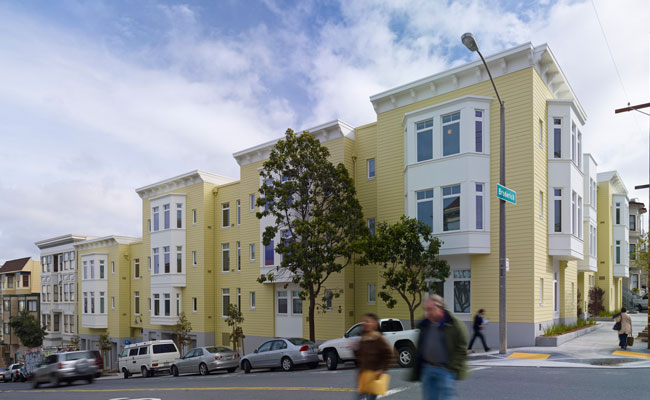
Tomorrow, 10/6 from 1pm-4pm, you can tour several of the city’s affordable housing sites — there’s even a handy citywide bike tour! — and  get an indepth look inside many of the innovative buildings that have recently gone up (or been rehabbed) in San Francisco, helping to house the homeless and make the city an affordable place to live for seniors, families, and people with special needs.

There will be refreshments! And also access to detailed information about the design, finances, and management of the buildings. And if you’re interested in finding out how to apply to live at one of the sites, there’ll be info about that, too. 

For Nosey Parkers like me who just like to go inside buildings and have a good gander, this will be pretty neat. (Also, my husband works in non-profit housing, and I get the backstory on a lot of the great stuff going on at these buildings, but never get to see it all!) And many of the buildings are doing really cool things environmentally and designwise. Complete list of locations and official press release after the jump.

SITE LIST:

Armstrong Place, 3rd Street & Armstrong
Bayview Commons, 4445 3rd Street
Bishop Swing, 275 10th Street
Broadway Family Apartments, 810 Battery Street
CASA, 5199 Mission Street
I Hotel, 868 Kearny Street
Mendelsohn House, 737 Folsom
Mosaica, 2949 19th Street
Notre Dame Plaza, 347 Dolores Street
St. Peters Place, 29th Avenue & Geary Street
The Hayes, 55 Page Street
Westbrook Plaza, 255 7th Street
Zygmunt Arendt House, 850 Broderick

Affordable Housing Day San Francisco to be held on Saturday, October 6
The Council of Community Housing Organizations, the American Institute of Architects San Francisco, and SPUR invite the community to an open house highlighting the benefits of affordable housing in San Francisco.

SAN FRANCISCO ─ As part of a citywide Affordable Housing Day, neighborhood affordable housing organizations throughout San Francisco will open up selected buildings for tours, info sessions and refreshments. Included in the tours will be examples of housing designed for seniors, families and people with special needs. The goal of the citywide day is to provide an opportunity for up close and personal experience with the people and places that make up San Francisco’s affordable housing. Each location will have detailed information about design, finance and management of these housing developments as a sample of the many affordable housing sites across the city. And for individuals interested in obtaining affordable housing, each participating organization will have information about qualifications, the application process, and vacancies.

Fernando Martí, co-director of the Council of Community Housing Organizations which is sponsoring the event, said “These are great examples of housing for everyday San Franciscans, slowing SF’s family flight, so that our children and grandchildren can continue to live in the City they helped build. Affordable housing also preserves the diversity of our neighborhoods, stabilizing communities from gentrification, while improving living conditions.”

There will be building tours throughout the city including the South of Market, Richmond, Mission, Excelsior, Bayview and Western Addition neighborhoods. Participants are welcome to visit all the open house locations, or just stop by the building in their neighborhood. Participating organizations include: Bernal Heights Neighborhood Center, Bridge Housing, Chinatown Community Development Center, Community Housing Partnership, Episcopal Community Services, Mercy Housing, San Francisco Housing Development Corporation, Tenants and Owners Development Corporation, Tenderloin Neighborhood Development Corporation , and The Hayes (55 Page).

“Creating affordable housing helps build our economy, creates jobs in San Francisco and supports families so they can stay, live and succeed in our City,” said San Francisco Mayor Ed Lee. “We must create a permanent source of revenue to fund the production of housing in San Francisco to ensure that seniors, people with disabilities and San Francisco families can continue to call San Francisco home.” Supervisor Christina Olague representing the city’s Western Addition and Hayes Valley neighborhoods where two sites will be open on Affordable Housing Day, said “We are fortunate to have such wonderful examples of affordable housing in my district, it’s a critical part of making diverse and stable neighborhoods.”

Please join us for San Francisco Affordable Housing Day, a free event to be held Saturday, October 6 from 1:00pm – 4:00pm. This is an open house format, so visitors can start at any of the 13 sites.


Much ado about nudity

69

There was no public outcry when Pedro Villamore, a 44-year-old homeless gay man, was found dead in a doorway in the 500 block of Castro Street last December, a couple of weeks before Christmas and across the street from the holiday tree that the Merchants of Upper Market and Castro puts up every year to welcome big spenders into the neighborhood.

MUMC, which in years past opposed three homeless queer youth shelters and a free meals program at a local gay church, did not decry the fact that a member of our community died on the street — and where were the city’s homeless outreach teams? Nor did any of the residents of the neighborhood express any concern that others who have a problem with methamphetamine, the area’s drug of choice, might meet a similar fate — and shouldn’t the community be doing something about it?

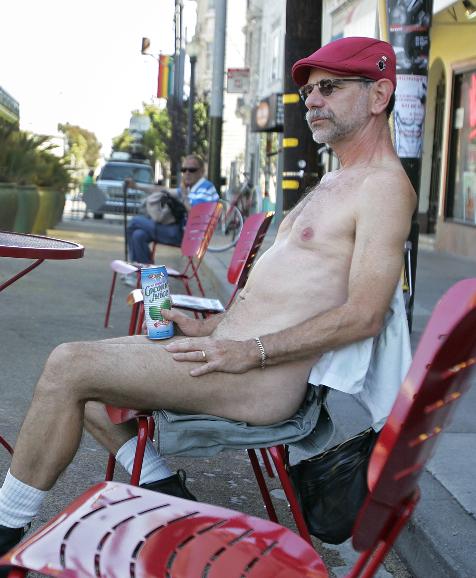
Of course, if he had been one of the nudists who hang out naked in the Castro these days Villamore would’ve found himself on the front-page of Bay Area Reporter, the city’s gay weekly, while he was still alive. Not to mention the target of diatribes from the SF Chronicle’s chronically right-wing columnist C.W. Nevius.  

Sadly enough, a neighborhood that once stood for sexual and personal freedom has succumbed to anti-nudism hysteria, even to the point of echoing Anita Bryant’s old rallying cry, “Save the children!”

Hysteria it is, of epic proportions. Some Castro residents and MUMC merchants actually persuaded their elected official, Supervisor Scott Wiener, to introduce anti-nudism legislation because a few naked men prance around the hood au natural, even sometimes sporting (horrors!) cock rings on their dicks. In a neighborhood where there’s no dearth of cock rings or any other sex toy, not to mention every variety of gay porn imaginable, and where guys walk around bars in underwear, residents don’t want public nudity. Huh? The neighborhood’s historic live-and-let-live attitude has obviously gone the way of Halloween and being able to walk into Pink Saturday without being scanned by a metal detector.

Has gay marriage and the freedom to “be all that you can be” in the military afflicted residents of the Castro with assimilation fever? What’s next — fundraising parties for Mitt Romney or a Castro chapter of the Moral Majority?

In a community that, according to a recent Williams Institute study, is rampant with poverty and suffers a serious lack of full-time employment for transgender people (75%, according to a report from this paper and the Transgender Law Center), not to mention a major drug and alcohol problem that makes gay men easy targets for muggings as they leave the bars at night, you’d think that public nudity would the last thing on anyone’s mind.  

People with AIDS continue to be pushed out of apartments in the Castro so that landlords and realtors can make tons of dough and LGBT seniors are forced to live with little economic or social support, regular cuts to services and benefits, and discrimination and isolation in nursing care facilities.

Yet from the volume of letters in the BAR and the number of calls Wiener says he’s received, you’d think that public nudity is the biggest problem in the world.

Pedro Villamore might disagree with that.

Tommi Avicolli Mecca has been a queer activist for the past 42 years, and a Castro resident for 20. He is editor of Smash the Church, Smash the State: the early years of gay liberation (City Lights).

Downtown development

1

LIT/VISUAL ARTS The term “Mission School” was coined in these pages by Glen Helfand in 2002 to describe a loose-knit group of artists based around the Mission District who were then just beginning to break through into international art world success. These artists — including Barry McGee, Margaret Kilgallen, Chris Johanson, Alicia McCarthy, Rigo 23 and others — made use of found materials and shared an informal aesthetic that was influenced as much by the low rent streets of the city around them as a relaxed, collective Bay Area vibe.

A decade later, it seems safe to say that the Mission School was probably the last major art movement of its kind in this country, and itself the end of an era. For over three decades, significant art and music breakthroughs in this country were linked to specific urban neighborhoods (hip-hop to the South Bronx; Warhol’s Factory to downtown Manhattan, riot grrrl to Olympia, Wash.; grunge to Seattle; Fort Thunder in Providence, RI, etc.) Today, with the rise of the importance of MFA programs as a means to enter the art world, and the lack of locality fostered by the internet, the era of geographic specificity as arts incubator has perhaps passed us for good.

Two new books take us back to those freer, more experimental days at the inception of the SoHo and East Village arts scenes of New York in the 1970s and 80s. 112 Greene Street: The Early Years (1970-1974) (Radius Books, 192 pp., $50) is a brief, but invigorating oral history from the early years of what we now know as SoHo. This just-released catalog to last year’s exhibition at Zwirner Gallery in Chelsea brings to life the sense of discovery and improvisation of the nascent neighborhood scene that centered around the legendary pioneering alternative arts space and its north star, the late Gordon Matta-Clark.

In October 1970, when Jeffrey Lew and Matta-Clark opened 112 Greene Street in the storefront of a “rundown former rag picking factory,” the area south of Houston Street was a wasteland of abandoned former textile factories known as Hell’s Hundred Acres. The space, with its lack of heat, and its raw walls, uneven floors, and poor artificial lighting resembled the city then falling apart all around it. The ruins of the city not only influenced the work; sometimes they literally became work.

Alan Saret remembers walking near Canal Street with Matta-Clark one night when a cornice simply fell off a building right in front of them. Saret found some other cornices on the ground nearby and paid the crew of a passing city garbage truck to haul them back to 112 Greene where they became part of a sculpture piece he called Cornices.

Far from the uptown galleries where Manhattan art world power then was consolidated, 112 Greene’s isolation and state of decay fostered a certain kind of “anything goes” artistic freedom and collaborative spirit. For the first opening at 112 Greene, Matta-Clark jackhammered a hole in the basement floor and filled the area with dirt, where he planted a cherry tree that he kept alive all winter with grow lamps. For a later exhibition, George Trakas wanted to do a two-story sculpture, so he simply cut a hole in the floor so his piece could rise up out of the basement into the main floor. The only rule seemed to be that work had to be created on site and could not be made for sale.

Perhaps predictably, with this last rule, the space could barely keep its doors open. Yet, there is a timeless lesson here for those running arts spaces today: the downfall of 112 Greene came ironically only after it finally achieved financial stability. When Lew landed a big NEA grant in 1973, pure art experimentation and spontaneity gradually gave way to formal scheduling and programming guidelines from the funders in DC, who demanded more and more say in the operation of the space. “The excitement that anything could happen waned as paperwork and schedules were enforced,” remembers Lew. The core group of artists slowly drifted away from 112 Greene, just as the original SoHo, too, was beginning to change all around them into the high-end shopping district it is today.

The SoHo model has become a cynical real estate gentrification strategy, as developers create prefab arts — and shopping — neighborhoods in empty warehouse districts across the country from Miami to Portland, Ore. to Brooklyn. But if, say, Bushwick’s art scene feels less like a real place than the shores of a desert island where hundreds of young artists have been randomly washed up by the storms of the global economy, 112 Greene Street reminds us that the first art neighborhoods were formed organically around genuine community. In 1971, Matta-Clark and artist Carol Goodden started an artist-run collective restaurant in SoHo called Food. By all accounts, Food was not some relational aesthetic stunt; it was a well loved and sincere attempt to provide cheap meals, a gathering place, and jobs to artists in the scene.

112 Greene Street ends before Matta-Clark’s untimely death from pancreatic cancer at age 35 in 1978, and before the artist would famously take the work he developed in the ruins of 112 Greene out into the ruins of the city with a practice he dubbed “Anarchitecture.” He took the city as his canvas, transforming raw space by sawing dramatic cuts in the floors and facades of abandoned buildings in the South Bronx and industrial parts of New Jersey. But the charm and dreamy freedom of the era 112 Greene Street depicts comes through in Matta-Clark’s film, Day’s End. In it, Matta-Clark works calmly with a blowtorch, cutting holes in the steel ceiling of an abandoned city pier on the Hudson River (with no apparent fear of getting caught) as the space slowly fills with radiant light.

A decade later, another artist who would die too young, David Wojnarowicz, would also find a wide-open playground in the rotting piers along the river. Wojnarowicz would spend hours at the piers, writing about what he saw there, having sex with strangers, and drawing murals or writing poetry on the crumbling walls. Wojnarowicz delighted in the ruins and saw the piers as a sign that America’s empire was fading away before his eyes. That today we know it was actually only Wojnarowicz’s world that was about to disappear is just one of the many poignant aspects of Cynthia Carr’s beautiful new book, Fire in the Belly: The Life and Times of David Wojnarowicz (Bloomsbury USA, 624 pp., $35), the first comprehensive biography to date of the artist, writer, and activist who died of AIDS at the age of 39 in 1992.

On the run from an abusive father, Wojnarowicz started sleeping with older men for money while living on the streets in his teens. Drawn to other criminals and outlaws, his first published writings were based on interviews he did with street hustlers, travelers, and homeless people he met in skid row waterfront diners and on hitchhiking trips. In the works of Jean Genet, he found a literary moral universe that helped him make sense of his own worldview. One of his earliest surviving works, a collage entitled St. Genet, depicts the French writer wearing a halo in the foreground while in the background, Jesus is tying off to shoot up. While Wojnarowicz would continue to use such blunt religious imagery in his work, the collage resonates in other ways. Carr reports that it was Kathy Acker who first called Wojnarowicz “a saint” when she appeared with him at his final public reading in 1991. The identification of Wojnarowicz’s life and work with the tragic loss of so many daring, outlaw artists to AIDS is so complete that Wojnarowicz has become a patron saint to young queer and activist artists today, his life story surrounded by an aura of myth.

Carr, a former arts reporter for the Village Voice, carefully picks apart myth from fact: Wojnarowicz didn’t actually start selling his body for money at age nine as he often claimed and he also wasn’t a founding member of ACT UP as many people suppose (though he did participate in some ACT UP protests). Yet, the complex and more human Wojnarowicz that Carr leaves us with is no less inspiring a figure — a self-taught artist whose lifelong struggle to make meaningful art out of his own experience, sexuality, and ultimate diagnosis with an incurable disease would almost by chance place him front and center in the story of the AIDS crisis and the great culture wars of the late 1980s and early ’90s.

Carr, a resident of the East Village now for four decades, became friends with Wojnarowicz late in his life, and she refreshingly breaks journalistic “objectivity” to insert her own eyewitness perspective into the narrative at many key junctures. One senses Fire in the Belly is so good precisely because it is a story only Carr could personally tell. Built on years of observation, Fire in the Belly has the ambitious scope and rich detail of a novel, and, more than a biography, is the story of a fabled East Village scene now irrevocably lost.

Wojnarowicz arrived in a gritty East Village where whole blocks had been abandoned to heroin dealers and bricked up tenements. A nihilistic neighborhood arts scene embraced the decay of the streets as an aesthetic, and galleries like Civilian Warfare Studios presented a giddy cocktail of downtown punk and queer culture mixed with the freshly born graffiti and hip-hop scenes of the South Bronx. Carr relates now-famous events like Gracie Mansion’s “Loo Division” show (mounted in the bathroom of her E. Ninth Street walkup), Keith Haring painting on the snow on the street in front of his show at Fun Gallery, and the exploits of the Wrecking Crew — a team including Wojnarowicz and other artists who would binge on acid and stay awake for days, filling galleries with creepy and crazed collaborative installations.

The artists’ isolation would not protect them from the art world for long. Soon, limos were disgorging passengers at openings on the heroin and rat-filled terra incognita east of First Avenue. East Village stalwarts like Jean-Michel Basquiat and Haring became rich and internationally famous, and even Wojnarowicz became a fairly established up-and-coming art star. The rags-to-riches story of the East Village scene might be the same kind of innocent tale of lost Bohemia as that of 112 Greene, were it not for the AIDS crisis shadowing it the whole time. Carr skillfully juxtaposes the narrative of openings and parties with chronological news reports of the then-unknown new disease. Carr describes a party on Fire Island in July 1981: writer Cookie Mueller read a story from the New York Times out loud to the room about a strange, new “gay cancer”. Photographer Nan Goldin, who was present, remembers today, “We all just kind of laughed.”

Carr’s tale picks up suspense after Wojnarowicz himself is diagnosed with AIDS. Over a breathtaking two-year period, Wojanrowicz embarks on an urgent mission to complete every single art project he’d ever hoped to accomplish in the time left to him in life. In the process he almost reluctantly becomes the fiery AIDS activist we remember today. While working on his career retrospective, he also battles the harassment of his landlord who is determined to evict Wojnarowicz and convert his loft in the gentrifying East Village into a cinema multiplex. He struggles to complete his memoir, even as his work becomes the focus of battles over government funding of art. Soon, Republicans denounce the dying man’s work as obscene and anti-Christian on the floors of Congress, and Wojnarowicz becomes a target of conservative Mississippi preacher Reverand Donald Wildmon’s public attacks. Wojnarowicz absorbed these attacks and the era’s stunning homophobia and turned them into what became the most powerful work of his career, the myth of his own life.

Carr’s book stands along with recent work like Sarah Schulman’s Gentrification of The Mind as a corrective to the uncritical nostalgia for the lost New York City of the 1970s and 80s that seems to have flowed like a river from Patti Smith’s 2009 memoir, Just Kids. These works unromantically detail what has been lost and then lovingly describe exactly how painfully it was all lost. Yet, perhaps all is not lost. While arts neighborhoods like the ones described in 112 Greene Street and Fire in the Belly seem like a thing of the past, the towering myths left behind by figures like Matta-Clark and Wojanrowicz still bring young artists against all odds to the rehabbed neighborhoods of San Francisco and New York today. Everytime Sara Thustra serves a meal at an opening at Adobe Books on 16th Street or Homonomixxx shuts down a Wells Fargo bank, we walk, if just for a short time, the streets of our old familiar city.

David Wojnarowicz: Cynthia Carr and Amy Scholder in Conversation
Wed/3, 7:30pm, free
Lecture Hall
San Francisco Art Institute
800 Chestnut, SF
www.sfai.edu/event/CynthiaCarr

The rich, the poor and the state of SF

68

The latest Forbes 400 is out, the list of the richest Americans, and a record number (according to my annual record-keeping) now live in San Francisco. This is a city with 18 people on the top-billionaires list — and since the list cuts off at $1.1 billion, there are a lot of really, really rich San Franciscans who didn’t quite make it this year. School Board candidate Sam Rodriguez told us his research shows that there are 80,000 millionaires in the city, meaning one in ten San Franciscans is worth a cool mil, and while some of that is just homeowners who bought 20 years ago and now have property worth $1 million — and I haven’t verified his data anyway — it’s hard to argue that this is anything but a very wealthy city.

(It also has, according to Forbes, the second-hippest neighborhood in the nation, and that would be the Mission, which is reaching that fully-gentrified stage where nobody young can afford to live there anymore so it won’t be hip much longer.)

The list comes out at the same time that figures show nearly 7 million Californians are living in poverty, and household income for most people has been stagnant — at best — for more than a decade.

It was a great year for the top 400, though — their median income was up rather dramatically. It seems that, whatever Mitt Romney may say in public or in private, the Obama administration hasn’t been bad at all for the 1 percent.

I keep asking, and I know it’s tiresome, but: Why, in a city with 18 billionaires, do we still have to clear out homeless encampments?

Why are the public schools holding (literally) bake sales to buy paper and pencils? Why have we cut the number of acute psychiatric care beds at SF General from 40 to 10? If San Francisco can’t even talk about taxing the billionaires, is there any hope for the rest of the country?

FYI, here’s The SF 18 (complied by Anna Sterling):

    1
    Riley Bechtel
    $2.9 B
    Chairman and CEO, Bechtel Corp.
    2
    Stephen Bechtel, Jr.
    $2.9 B
    Former Chairman, Bechtel Corp.
    3
    Doris Fisher
    $2.9 B
    Cofounder, Gap
    4
    Dustin Moskovitz
    $2.7 B
    CEO, Asana
    5
    Ray Dolby
    $2.4 B
    Founder and director emeritus, Dolby Laboratories
    6
    John Fisher
    $2.3 B
    President, Pisces, Inc.
    7
    William Randolph Hearst, III
    $2.3 B
    Source of Wealth: Hearst Corp
    8
    Marc Benioff
    $2.2 B
    Chairman and CEO, Salesforce.com
    9
    James Coulter
    $2.1 B
    Source of Wealth: Leveraged buyouts, Self-made
    10
    Gordon Getty
    $2 B
    President and Chairman, Ann & Gordon Getty Foundation
    11
    Phoebe Hearst Cooke
    $1.9 B
    Source of Wealth: Hearst Corp
    12
    Michael Moritz
    $1.9 B
    Partner, Sequoia Capital
    13
    John Pritzker
    $1.8 B
    Source of Wealth: Hotels, investments
    14
    Robert Fisher
    $1.7 B
    Director, Gap
    15
    William Fisher
    $1.7 B
    Director, Gap
    16
    Peter Thiel
    $1.4 B
    Partner, Founders Fund
    17
    Thomas Steyer
    $1.3 B
    Founder & Co-Senior Managing Partner, Farallon Capital Management
    18
    Jack Dorsey
    $1.1 B
    CEO, Square, Inc.


Where is Occupy SF now?

28

On the anniversary of Occupy Wall Street, Occupy San Francisco also celebrated its birthday.

Demonstrations throughout the day Sept. 17, focusing on a variety of topics, converged at 5pm at 555 California, Bank of America’s west coast headquarters. A lively march of about 600 became a street festival down the block. There, protesters stopped for a circus of birthday activities. In one corner, people saddled by debt wrote their debt information on pieces of paper, explained their situations to the crowd, and dropped the papers into a trash can for a symbolic burning. One person also burned cash. “Hell no, we won’t pay,” the crowd chanted.

A few feet over, protesters painted the street with a bright yellow sun declaring “democracy not debt.” Volunteers then fed a free meal to the hundreds in attendance and wheeled in a video screen to watch some recaps of the year’s best moments. Around 8pm, the group left as peacefully as they had come.

In the darkness, a few hundred headed east on Market. When they arrived in Justin Herman Plaza– or Bradley Manning Plaza, as Occupy SF has christened it, in honor of the whistle blowing soldier- a few police stood guard around the perimeter. Undeterred, protesters walked in, and shouts of “happy birthday” gave way to “welcome home.”

The birthday party continued with a night of music. Five tents were pitched, sleeping bags were brought out. Police vehicles carrying truckloads of barricades drove by, but police told protesters they would have to leave the park by 6am, the hour the park opens.

30 or 40 spent the night. In the morning police came back. As ukelele and drums continued to play, tents were dutifully broken down. A few went back to sleep.

Video by Eric Louie

Last fall, Occupy SF could basically be found here. The camp was at Justin Herman Plaza. The ever-expanding list of working groups sometimes met somewhere else, but Occupy was at camp. But after a series of police raids, from Oct. 5 to the raid that finally brought the camp down in December, this camp was no more.

Now, Occupy SF is found all over the place.

As longtime Occupy SF activist Vi Huynh said while celebrating the anniversary: “I think it’s good to honor these milestones because, unlike the mainstream media would have us believe, we haven’t gone away. We’re not dying either. They’re writing our obituaries, but we’re very much alive. And we’re doing things every day.”

Here’s an uncomprehensive list of active groups from Occupy in San Francisco.

101 Market. This is the old camp of Occupy, “re-occupied” in February in response to a national call. At least 30 sleep there every night, and the camp is a veritable fortress of furniture and belongings. They’re mere existence is a refusal to humor the concept of private property. General Assembly meetings occur at 101 Market Tuesdays and Thursdays at 7pm.

Action Council. Action Council is a forum meant to connect Occupy with unions, non-profits, and community groups. They played a big role in planning demonstrations like the Jan. 20 shutdown of the financial district and the May Day solidarity demonstrations. Action Council meets weekly, Sundays at 2pm at Unite Here headquarters, 215 Golden Gate Ave.

All Streets Yoga. Since last winter, All Streets Yoga, formerly known as Decolonize Yoga, has been transforming part of the sidewalk at the 16th and Mission BART station into a yoga studio free for all. Volunteer yoga teachers lay out rugs and lead personalized yoga sessions for anyone who chooses to join. They transform space and creating calm in the busy city landscape. Join them Fridays 5-7pm.

Community Not Commodity. Also known as Bay Occupride, this group formed to protest commercialization of the Pride Parade. On the Sept. 17 anniversary they did a march on the Castro banks and a sit-in to protest sit-lie at Harvey Milk Plaza. CNC describes itself as “a collective assembly of queer/trans-focused community groups with established reputations in the Bay Area that have come together to strengthen and unify our diverse communities. We have come together to confront the 1% within our movement. We work for complete liberation of queer and trans people!” They meet Sundays at noon at Muddy Waters Café, 521 Valencia. See more at www.bayoccupride.com.

Direct Action working group. Direct action is a central tenant of Occupy. It means taking action to prevent something bad or create something good without permission or help of those with political power. In a 1912 essay titled Direct Action, Voltairine de Cleyre cited the Boston Tea Party as an example and wrote that “Every person who ever had a plan to do anything, and went and did it, or who laid his plan before others, and won their co-operation to do it with him, without going to external authorities to please do the thing for them, was a direct actionist. All co-operative experiments are essentially direct action.” The direct action working group meets Wednesdays, 6pm, at the Redstone Building at 2940 16th Street.

Environmental Justice working group. The environmental justice working group keeps the pressure on the corporations that exploit the planet. They’ve protested hydraulic fracturing and the nuclear industry. They meet Tuesdays at 4pm at 101 Market.

Food bank of America. Occupy SF set up the first Food Bank of America to feed thousands of hungry protesters and passers-by on Jan. 20. A Market Street Bank of America branch locked its doors when volunteers set up a food table and passed out hot meals. Now, Food Bank of America continues in front of the mega-bank’s 23rd and Mission branch, where volunteers pass out produce, mostly donated from farmers’ markets, along with literature on switching to credit unions. They’re usually there Thursdays 5-6pm.

Ideological Liberation working group. This working group has produced pamphlets explaining Occupy, trading cards of especially greedy bankers, and postcards summarizing issues like the foreclosure crisis and the National Defense Authorization Act. They also created the Occupy SF Declaration. Brainstorm and write with them on Tuesdays, 7:30-9pm, at the decidedly ideologically un-liberated meeting spot of the Starbucks at 27 Drumm.

Occupy Bay Area United. Occupy Bay Area United spent the night outside 555 California on the eve of the Occupy SF anniversary, an occupation complete with tents and signs. They are “committed to non-violent direct action.” They meet on Sundays, 5-7pm, and post meeting locations on their website, www.obau.org.

Occupy Bernal. This neighborhood-based group is largely considered one of the most effective and desperately needed parts of the Occupy movement in San Francisco. Occupy Bernal is in the business of stopping foreclosures and evictions. “Since January no one we worked with has had an auction. People we work with who already had auctions, we’re stopping their evictions. We’ve stopped six of them so far. So we’re almost done with all the evictions, and we can go back to just stopping the auctions. We have 60 people in line to get loan modifications from Wells,” said Occupy Bernal organizer Buck Bagot. On the anniversary, Occupy Bernal hosted a rally highlighting the disproportionate effects of the foreclosure crisis and veterans and elderly and disabled people. “There were about 100 of us at the protest and five people, all over 80, veterans who are all at risk of losing their homes because they don’t have very much income,” said Bagot. Occupy Bernal meets 7-9pm on the second and fourth Thursday of each month at the Bernal Heights Neighborhood Center at 515 Cortland Ave. See www.occupybernal.org for more information.

Occupy Forum. Occupy Forum started up in early June in the Women’s Building, and has since moved to Justin Herman Plaza. The well-attended forums, usually around 70 people, are a time to discuss issues that concern people in Occupy. From the beginning Occupy has been said to have “no focus”– maybe that’s because those involved saw that everything from greedy banks to income inequality to homelessness to discrimination in loans to healthcare to racism to wars were all connected. The forum is a chance to focus in on a different topic every week. Check them out Mondays at 6pm at Justin Herman Plaza, at Market and Embarcadero.

Occupy the Richmond. A philosophical Occupy. If you’ve ever gotten sick of decrying problems in society and yearned to discuss creative solutions, Occupy the Richmond may be your cup of tea. A philosophical Occupy. Saturdays at 4pm, Occupy the Richmond gets together at 11th Ave. in Mountain Lake Park “to talk about what kind of society we want to organize together,” according to Occupy the Richmond participant Alex Zane. “Occupy opens up the possibility for talking about that. Otherwise, people would be stuck behind their screens freaking out about what kind of society we should organize. We should get together and talk with real, living people about how we’re supposed to reorganize our society,” said Zane.

Outreach working group. A group that spreads the word about Occupy and speaks with people and community organizations about working together. They meet Wednesdays at 7pm at One Rincon Center, also known as 121 Spear.

This article has been corrected. Bradley Manning served as a soldier in the Army, not a marine

Happy Birthday Occupy

20

Occupy celebrates its one-year anniversary Monday, and many of the groups who have gotten involved over the past year will be going all out. These groups’ goals–  including ending unjust foreclosures,  fighting displacement of queer people and homeless people, and taking back power from banks and the one percent– are a lot to achieve in one year. But they’ve made great stride. They’ll celebrate, and commit to another year of action, on Monday. 

Occupy Bernal, Occupy Noe and Alliance of Californians for Community Empowerment will put the pressure on banks that continue to foreclose on San Franciscans despite widespread evidence of fraud and a city resolution calling for a moratorium on foreclosures. At noon, they will hold a rally highlighting the ways that the foreclosure crisis disproportionately affects seniors, veterans and disabled people- find them at 401 Van Ness. At 3pm they will rally One Market Plaza, the officers of Fortress Investment Group board co-chair Peter Briger, infamous amongst the “foreclosure fighters” for his role in selling off distressed home mortgage debt.  

In the Castro, Community Not Commodity, the coalition that formed around an Occupride march protesting the corporate takeover of the Gay Pride Parade and continues to fight “increased rent, foreclosures and evictions, and the displacement of queer and homeless youth.”  They will meet up at 2pm at 18th and Castro for a speak-out, followed by a march on the banks at 3 and a sit-in protesting sit-lie at Harvey Milk Plaza. 

Also at 2pm, Occupy Oakland is throwing a street party. They’ll converge at Embarcadero and Market at Justin Herman Plaza (renamed Bradley Manning Plaza by the people from Occupy San Francisco, whose encampment stood there for three months last fall.) Organizers advise: stay tuned for Oct. 10, the one-year anniversary of Occupy Oakland. 

But Occupy San Francisco didn’t start at Justin Herman Plaza. It started Sept. 17, 2011 at 555 California, outside the building that houses the Bank of America west coast headquarters along with Goldman Sachs offices. It’s there that everyone will converge at 5pm for a raucous casserole-style march with the Brass Liberation Orchestra, followed by guerilla movie screenings, food to share, and a debt burning: “bring dept papers (BYOD) to burn symbolically,” say organizers.

Can’t wait for tomorrow? Occupy SF hosts a day of poetry and speakers at Justin Herman Plaza today. The Human Be In, the unpermitted music and skillshare festival that brought hundreds to play music, teach workshops, and “transform space” in a dusty spot near Ocean Beach yesterday continues through tonight.  Occupy Bay Area United is also throwing a rally and teach–in focused on corporate greed starting outside 555 California at 7pm. 

Occupy is dead! Long live Occupy!

Alerts

0

Thursday 13

Coalition on Homelessness 25 years SomArts Cultural Center, 934 Brannan, SF; www.cohsf.org. 5:30pm, $25-75. The Coalition on Homelessness has been working for the rights on the homeless for 25 years, always with a focus on people defining for themselves what their needs are and how to meet them. San Francisco has the Coalition on Homelessness to thank for more than a thousand supportive housing units, an expanded substance abuse treatment system, rental subsidy programs for poor families to access housing, and so much more. Show them some love back at their anniversary celebration., an art auction and benefit for the organization.

Friday 14

Human be-in Kezar Gardens, 780 Frederick, SF; www.humanbein.org. 3pm, free. Beginning Friday and spanning three days leading up the anniversary of Occupy on Sept. 17, this festival in Golden Gate Park celebrates coming together in pubic spaces and the commons. Musical performances are booked all weekend, a film festival will be screened in the evening, and workshops and skill-shares ranging from rainwater harvesting basics to bread baking to living without conventional currency fill the weekend, as well as yoga and meditation. But don’t just come to check out what the organizers and participants offer. As they put it, “you are invited to teach a workshop, facilitate a discussion, share a skill, play music, make art, cook a meal, or simply be.” They did it in 1967 — come create the modern Human Be-in this weekend.

Saturday 15

Odd couples Modern Times. Author Anna Muraco’s has done loads of interviews with “odd couples” — friends who don’t fit the norms of what genders go with which platonic and romantic relationships. “Odd Couples” examines friendships between gay men and straight women, and also between lesbians and straight men, and shows how these “intersectional” friendships serve as a barometer for shifting social norms, particularly regarding gender and sexual orientation,” say event organizers. So come here Muraco speak and examine the relationships and norms in your life.

Monday 17

Fight foreclosure Spear Tower, 1 Market Plaza, SF; www.occupybernal.org. 3pm, free. Occupy Bernal, Occupy Noe, and foreclosure fighters will rally at the offices of Peter Briger, board co-chair at Fortress Investment Group. These anti-foreclosure occupiers have zeroed in on Briger for involvement buying up distressed mortgage bond debt and selling it to turn a profit, a process Briger calls “Financial Services Garbage Collection.” As people resisting foreclosure with these Occupy groups put it, “we’re not garbage!”

Occuanniversary 555 California, SF; www.occupyactionsf.org. 5pm, free. One year ago, “Occupy the Financial District San Francisco” met at this spot, the massive Bank of America San Francisco headquarters and Goldman Sachs offices. The meeting was called in solidarity with Occupy Wall Street, and the first San Francisco occupiers began camping out at 555 that night. Celebrate a year of resisting the 1 Percent and taking back power with a debt burning. Organizers ask that participants bring copies of debt papers to burn symbolically, and pots and pans for a loud casserole march. There will also be music and guerrilla movie screenings.

Community Not Commodity 18th and Castro, SF; www.bayoccupride.com. 2pm, free. Community Not Commodity came together to protest commercialization and corporate greed at Gay Pride this year. Join the group today to celebrate the one-year anniversary of Occupy Wall Street. Protesters will march on the banks, hold a sit-in at Harvey Milk Plaza to protest the sit-lie ordinance that forbids San Franciscans from sitting or lying on sidewalks during the daylight hours, then meet up with other occupy anniversary events at 555 California at 5pm.

Tuesday 18

Connie Rice book reading Prevention Institute, 221 Oak, Oakl; preventioninstitute.org. 4:30-6:30 p.m., free. Civil rights attorney Connie Rice worked to reform the Los Angeles Police Department, filing case after case in an attempt to end police brutality against LA’s communities of color. She’s also Condoleezza Rice’s cousin. She will speak and read from her book, Power Concedes Nothing: One Woman’s Quest for Social Justice in America, from the Courtroom to the Kill Zones.

Feeding a movement

0

yael@sfbg.com

Keith McHenry was in Tampa, feeding fed-up (and hungry) Republican National Convention protesters, when we spoke by phone. Next he’ll head to Charlotte to do the same for those protesting the Democrats, and then to New York for Occupy Wall Street’s anniversary on Sept. 17.

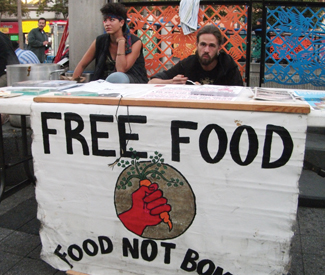
Everywhere he goes, he’ll feed the masses home-cooked vegetarian meals. But unlike the other protesters, McHenry helped invent the system that gets them fed. He helped to found Food Not Bombs, the organization that salvages food that would otherwise be thrown out, cooks it up, and serves free, tasty meals in public squares throughout the world.

McHenry served the first meal in Boston Common in 1980, then moved to San Francisco a few years later, bringing the movement with him. Now, there are 500 chapters in the United States and hundreds more throughout the world.

“We provided food for 100 days at the Orange Revolution in the Ukraine,” McHenry recalls. “We fed a two-year occupation in Sarajevo. We provided food at Camp Casey,” Cindy Sheehan’s anti-war stakeout at then-President George W. Bush’s ranch.

The FNB approach to hunger is pretty simple: There’s enough food to go around, it’s just not distributed right. So activists find ways to distribute food that would otherwise be thrown out. San Francisco FNB gets donations of extra, unsold food from places like Rainbow Grocery and Other Avenues food co-op.

It was started by anti-nuclear activists, thus the “Not Bombs” part. But there’s more to their analysis than a cry for peace. As the group states, “For over 30 years the movement has worked to end hunger and has supported actions to stop the globalization of the economy, restrictions to the movements of people, end exploitation and the destruction of the earth and its beings.”

A typical Food Not Bombs operation features a table with a vegetarian or vegan meal, maybe some produce, and anti-war and other leftist literature and banners. In 1988, this is what was on the table when the San Francisco Police Department cracked down on Food Not Bombs, arresting dozens for serving food at the entrance to Golden Gate Park at Haight and Stanyan.

“We had our sign such that when you walked in at the corner of Haight you would see the words Food Not Bombs for a block and a half,” McHenry recalls. “What was good about that was you had tourists, and local business people, and local workers, and you had the people in the Golden Gate Park, all coming together to eat at that place. It was really perfect.”

FNB still serves there on Saturdays, but that perfection was disrupted by a high profile series of arrests in 1988, then again a few weeks ago, when Parkwide, the Recreation and Parks Department’s new bike rental program, set up in their old spot.

Food Not Bombs still runs into conflicts with police and courts. Last year, McHenry was one of 24 arrested in Orlando, Florida, spending 19 days in jail after protesting an ordinance making it a crime to feed the homeless in the city’s downtown.

Last week, FNB held its world gathering at Occupy Tampa’s tent city, serving daily breakfast and dinner while planning the future of the movement. Occupy Tampa has only grown in recent weeks as it hosts people in town to protest the RNC. Sharing food and shelter, making art, and protesting politicians doing the bidding of greedy corporations is McHenry’s vision made reality — and one he got to see bloom last fall with the birth of Occupy.

As McHenry tells it, he and others from Food Not Bombs have been part of a decade-long buildup to the “occupy” tactics that erupted into the world in 2011. “I was promoting the idea of occupation ever since a meeting that was held in 2003 after Cancun,” he said. Protests at the World Trade Organization meeting in Cancun were part of a growing trend of disrupting international conventions in which political and business leaders make agreements that further exploitation and neo-liberalism. But McHenry says that more was needed.

“There was a group of us that got together and said these one-off events, like summits, were just becoming more disempowering rather than successful,” he said.

After years of calling for occupations, the notion clicked last fall. “We had seen the Arab Spring, so that made it that much easier to imagine the occupation concept. And the Spanish occupations were just then happening.”

“That’s a common thing,” McHenry said. “People try all these different ways of organizing and then all at the same time, the same thing will start to click. And there’s no real way to say, ‘oh, it started here, it started there, this person started it.'”

When Occupy encampments sprang up, Food Not Bombs was behind many of the kitchens and food sharing efforts — it even had a guide to building a tent city kitchen at foodnotbombs.net/occupy_supplies.

“In the beginning of some of the first occupations like Chicago, DC, Wall Street, we made peanut butter and jelly sandwiches, because we didn’t know if we would get busted,” McHenry said. “We ended up behind the scenes helping provide free meals to the occupations.”

McHenry said he hopes the spirit of occupying grows again. “It’s so important,” he said. “It would be great if we could regroup and retake public space.”


Jesus-free food

0

“For I was hungry and you gave me food, I was thirsty and you gave me drink, I was a stranger and you welcomed me,” Jesus supposedly said way back when. In San Francisco, there are a multitude of churches that offer free food to the hungry (find a handy list at www.freeprintshop.org).

But what follows is a list of secular organizations that share food — for the planet, for self-determination and providing for community outside of the system, for healthy food untainted by hormones, pesticides and GMOs, for food not grown by exploited workers, and for many other reasons, these groups bring food straight to the people.

FREE FARM STAND

Where: Parque Niños Unidos, 23rd St. and Treat. When: Sundays, 1-3pm. Numbers given out at around noon. The Free Farm Stand gives out food and flowers grown at the Free Farm on Eddy and Gough, where local volunteers grow and harvest produce. They also share local organic surplus produce left over from several farmer’s markets and produce brought in from neighbors and from locally gleaned fruit trees.

The philosophy of the Free Farm is food sovereignty. Why should anyone go hungry, or go broke, feeding themselves and their kids? Instead, they figure, they should get for free what the earth gives. They facilitate this by offering the farm’s harvest — as well free sprouts and plants, that people can use to grow food themselves.

“The solution to the problem of hunger is to share the abundance that’s out there and to encourage people to grow food and share some with those in need.” said a Free Farm Stand organizer. “We can set up neighborhood networks of people growing food and sharing their surplus.” The Free Farm Stand is a step towards that vision.

BETTER DAYS TO COME

Where: Tuesday, 16th and Mission, Thursday, Turk and Taylor. When: 6pm. Some of the folks at Better Days to Come have God in mind, but the organization’s founder, Leonard Fulgham, came from not the churches but the prisons. As its mission statement says, “Mr. Fulgham began mentoring many of the younger inmates, while having the unique opportunity to hear their stories. Many of their stories outlined how they landed in the prison community and why they continued to return. Being homeless upon release back into society is a commonly known contributing factor to these ex-offenders being hungry while being starved by the lack of job training and vocational skills.” Fulgham passed away March 24, 2012, and in his memory, the organization began serving two hot meals a week.

CURRY WITHOUT WORRY

Where: Civic Center Plaza at Hyde and Market. When: Tuesdays 5:45-7pm. Curry Without Worry serves vegetarian food, mostly Nepali and mostly with five courses, in San Francisco every week. It does the same at its other branch in Kathmandu. Shrawan Nepali once owned a restaurant, Taste of the Himalayas, but used the proceeds to start Curry Without Worry and eventually sold it when “I realized I was not a businessmen.” Instead, he’s a man who feeds people a vegan five-course meal, which includes a sauce made from timur, herbs that grow in his Himalayan hometown but are rare in the US. “Our mantra is healthy food for hungry souls,” says Nepali.

FOOD NOT BOMBS

Where and when: Monday, UN Plaza at 6:30pm and 16th and Mission at 7pm. Wednesday, UN Plaza at 6pm. Thursday: 16th and Mission at 7pm. Saturday: Haight and Stanyan at 5pm. After 30 years, Food Not Bombs still serves almost daily in San Francisco at a few locations throughout the city. Volunteers cook meals then bring them out to the people, bringing home the message that there’s enough to go around and you shouldn’t need money to feed yourself. The Saturday team still shares food at Haight and Stanyan, where Food Not Bombs first parked three decades ago.

FOOD BANK OF AMERICA

Where: In front of the Bank of America at 2701 Mission. When: Thursday, 5pm until food runs out. Occupy-related people, carrying on from the giant Food Bank of America action on Jan. 20, when the Bank of America at the Embarcadero locked its doors after activists set up a food table and hung two interactive banners where passers-by could write what fit under the category “person” and what fit under the category “corporation.” They hung a third banner saying Food Bank of America, hundreds ate a hot meal, and the concept caught on. Now, people who have been gathering food donations for Occupy and otherwise give away fresh produce and hand out information about credit unions weekly in front of the bank.

COMMUNITY FEED

Where: Mendell Plaza, at Third and Oakdale. When: Every third Sunday, 10-2. A few organizations, including the Black Star Riders Coalition and the Kenneth Harding Jr. Foundation, work together to put on this food giveaway every other week. It takes place in Mendell Plaza, the square that some have renamed Kenny’s Plaza after Harding, who was killed in the plaza at 19 years old after a dispute with SFPD officers over bus fare. “First, we definitely want to honor Kenny, that’s why we got there,” said Tracey Bell-Borden, one of the organizers of the Community Feed. “But there’s been a lot of activity in that area for a long time. So it’s really about healing the community,” she said. “We have to take care of our community.”

Homeless camp raided

41

California Highway Patrol police, San Francisco police, Cal Trans workers, Department of Public Works, and workers from the mayor’s Homeless Outreach Team descended today on an encampment on Fourth and King.

Yesterday, 40-50 people lived on the sidewalk and under the freeway overpass next to the Caltrain tracks. The encampment had tents, mobile units, and other makeshift housing. One group of residents had a large tent with a well-maintained garden in the front yard.

Another, a woman who several residents said suffered from mental illness, had built a home out of metal that looked like parts of carts, wood, sheets and mattresses. After about four hours this morning, most other residents were moved out of the camp, but she remained, moving and packing suitcases. After Homeless Outreach Team members, police, workers, and humanitarian volunteers approached her, she took a single suitcase and walked to the sidewalk, then sat and watched as her other suitcases, mattresses, and the structures that constituted her house were thrown into a garbage truck.

The eviction began around 8am. Some residents said they were told they could take with them only what they could carry or, if they had something wheeled like a shopping or bike cart, what they could push. Others said they hadn’t been told one way or another what they could take, just that they had to get out.
 
The items in the dump trucks, said CHP Officer Sarah Wrathall, is “the stuff they said they don’t want.” Wrathall said people were given the chance to keep whatever they wanted to, and that items they wanted to keep but could not carry would be stored and tagged for retrieval later.

Jamie Crisco, a resident of the camp who was moving out, said that this was an unusual eviction. “There isn’t usually this dog and pony show,” said Crisco. A large amount of media was present at the eviction.

“Usually they will tell people to get out, and people will start packing. And in the process the workers will come and start taking stuff and throwing it away,” said Crisco, a veteran who had been living in a small trailer for a year.

“I don’t understand that,” added Crisco. “You’re creating a criminal element when you do that. You’re putting people in a position where they have to steal to acquire what just got taken from them.”

According to John Gallagher, an organizer with the Coalition on Homelessness who did outreach at the encampment before it was evicted, trash was pushed safely to the side and the camp was clean and peaceful before this morning’s “clean up.”

“We’re respectful, we’re quiet. Honestly, we keep this area cleaner than they ever could dream to,” agreed one person who was staying in the camp.

Wrathall described a very different situation, saying that the area under the overpass had amassed trash, waste and rats.

She said that the eviction was based on complaints from neighbors and other residents.

“People have a right to complain if they can’t walk down the sidewalk to get to Caltrain,” said Wrathall. She said that some people feared the dogs that lived in the camp.

She said illegal lodging and trespassing was reason enough to evict the camp’s residents. “It doesn’t have to be any other kind of crime.”

No citations were issued this morning.

Camp resident Margaret Stallings said that the camp was very peaceful and neighbors walked on the sidewalk and parked their cars in the adjacent parking lots without issues.

“This is a dead end street,” she said. The area under the freeway is out of the way of most city life and, according to Stallings, “Some people have been underneath there for eight years.”

In an outreach report written based on Gallagher’s observations, he stated that “This camp is so peaceful that I saw more that four people on their way to work walk unafraid right down the middle of camp.”

Patrice Perkins, who had been living in the camp for two and a half months, said that the encampment’s location was relatively tucked away. He expressed frustration that many of the residents will be pushed out towards other parts of SoMa and downtown.

“We found a place where you’re not in public. We’re not bothering anybody here,” he said. He pointed out the no parking signs along the street.

“See, no parking. It’s not being used.”

His neighbor in the camp, James Belcher, said that the eviction was causing him to miss two classes at Laney College. “I missed Civil War History this morning, and I’ll miss math at 10:30,” he said. Belcher said he has been studying for a few solid semesters and earning good  grades while looking for work, but struggling, based in part on issues associated with being a disabled veteran.

“It’s difficult for me to study in this little tent and stay in school,” he said.

One resident, who said she provided first aid at the camp, shared disinfectant wipes with a DPW worker when he expressed a need for them.

One of the city’s stated concerns with the camp was the presence of children, and in Gallagher’s outreach statement he said at least two children lived in the camp. None were present this morning, and Wrathall said that in her previous visits to the camp, she hadn’t seen any.

“I’ve never seen kids here, but if I did, I would take them to CPS [Child Protective Services]. Of if they’re older, 16 or 17, I would connect them to services like Huckleberry House. I would never walk away from someone who is 18 or under in the encampment. Its not safe,” she said.
 
“Homelessness is not a crime. People are afraid for the public to see their children because they will be taken away from them. And for what, the crime of being poor?” said Gallagher.

The Homeless Outreach Team secured rooms for several of the people who were evicted, including Stallings and Crisco.

“They’re housing me. I’ve been waiting on the VA list for housing for four and a half years,” said Crisco. “I’m a combat vet. I used to be a business owner. But life does things to you. Ends up putting you in places you didn’t plan on being.”

Crisco said he was happy to accept the room, but frustrated in general with the way the homeless are pushed around.

“I’m only human. I can only take so much pushing and prodding,” he said. “Sometimes, someone’s going to snap. And they’ll say, it’s the drugs. They never say, maybe it’s us. Maybe its what we’re doing to them.”

Removal of large homeless encampment scheduled for tomorrow morning

11

The Coalition on Homelessness received word that a homeless encampment at Fourth and King is scheduled for eviction tomorrow. According to an outreach report from John Gallagher, a human rights organizer at the coalition, about 40 people live in the encampment including at least two children. It has approxamitely 15 tent and 3-4 mobile structures.

Some excerpts from the report:

There are essentially two campsites, one under the overpass on Cal Train property and subject to the jurisdiction on the CHP and a sidewalk next to a bike path subject to SFPD.
4 persons using wheel chairs – and most of the people had at least some disability (their own words).
The camp community is clean and free of any smells and what rubbish there is has been set out of the way. They seem in general to be a law abiding community even keeping their tents away from the fire hydrant. There are bathrooms across the street in a park that is kept neat and clean.
Residents of this small community were proud to tell me that people who park cars next to the camp felt more security than those who parked away from camp. This camp is so peaceful that I saw more that four people on their way to work walk unafraid right down the middle of camp.
I was informed that several of the residents are “working poor.” they get up for 9 to 5 daily. There were two American flags displayed and potted plans are scattered around works of “Art” decoratively in from of most tents. There is a community garden bordered and well keep by the residents at the part of the overpass that receives the most sun. Clean laundry hangs drying on a chain link fence. This is a community of families, Artists, writers (two brothers), displaced persons and pet owners. ( Three healthy well fed dogs)

The eviction will likeley occur at 8 or 9am tomorrow. As Gallagher says in his report, part of the camp is on SFPD turf, and part is CalTrain property policed by the California Highway Patrol. Neither agency could be reached for comment.

Diamond Dave’s report from Romneyville

27

Activists from San Francisco and around the country are descending on Tampa this week to protest the Republican National Convention. I got a call this morning from Diamond Dave Whitaker, the poet who hung with the beats and the hippies in his 75 years, CCSF student senator and San Francisco legend. He’s has been serving food to protesters at election-season conventions for almost three decades. His first was 1984, the Democratic Convention here in San Francisco before he got hooked and headed to Dallas to protest the Republicans. Along with a few hundred others, Diamond Dave braved the rain, but missed the full effects of Hurricane Isaac on the tent city last night. The RNC starts officially starts today (though many of the day’s events have been called off due tot the hurricane warning.)

“I’m talking in the midst of Romneyville,” he said. “Folks came from far and wide to camp out together, cause a ruckus and be here.”

What’s Romneyville? “It’s a homeless camp, a poor peoples camp,” said Dave. He’s been there a week setting up the Food Not Bombs kitchen, and Romneyville grew up around him. It now has few hundred tents, he said. But most people arrived today, so as the convention gets started, it will probably grow. “Two buses from Zuccotti Square came today,” he said.

Romneyville is put together in part by the Poor Peoples Economic Human Rights Campaign. Dave said Green Party vice presidential nominee Cheri Honkala, a formerly homeless mother herself who works with the Poor Peoples campaign, is a fixture around the camp.

“Our demands are housing for all, food for all, healthcare for all, and living wages for all. We call for an end to foreclosures and homelessness, an end to the war on the poor, both here and abroad. An end to criminalization of poverty. Money for jobs and housing, not for war!” says a statement from the group.

More protesters are staying over at the Occupy Tampa encampment.

A permitted march left this morning, and Diamond Dave says there’s another, unpermitted, planned for 3pm est. Many citizen journalists and livestreamers are documenting the events, one can be found at mobilebroadcastnews.com.

But so far, his work has been handing out free meals with Food Not Bombs.

“We fed the masses this morning for sure,” he said.

Creating activist scholars: extended interview with Andrej Grubacic

16

For this week’s paper, we talked with with Andrej Grubacic, the new head of the anthropology department at the California Institute for Integral Studies. Here’s the extended interview with Grubacic, where he talks more about the new Anthropology and Social Change program, as well as the history of anarchist schools, how his grandmother influenced his politics growing up in Yugoslavia, and the state of the occupy movement.

San Francisco Bay Guardian: What’s the structure of the new program going to look like?

Andrej Grubacic: It’s going to be called Anthropology and Social Change, and we have two levels. One is MA, the other is PhD. Philosophically speaking and politically speaking, in the age of occupy and all of these movements, the great question for me was how to organize a department that’s actually going to be useful for all of these social struggles and that activism that’s happening outside of education. I’ve been in academia as a scholar-activist for a long time. And what I’ve discovered is the most painful thing in my experience is the separation. The fact of actual separation between the grassroots knowledges, produced outside of the academia, and academic knowledge produced within the universities. So the best things, the way that I was thinking about this was that what we should do on both levels, MA and PhD, is to construct a space of translation of different knowledge. So to put these two knowledges, one produced outside of academia and the other produced in the university, in dialogue.

So we have Boots Riley for example, he’s going to be teaching community organizing, or organizing for social justice. Then we’re going to have Sasha Lilley teaching an eminently practical course on how to create and produce radical radio. So you’re going to get activist media skills. Then we’re going to have a few other people teaching also different skills, and knowledge that’s inspired by art, bringing artists in, and knowledge that’s inspired by people who are thinking about social theory and social emancipation. We’re going to create something really exciting. 

SFBG: Do you think the students who attend are going to be the same kind of mix of academics, artists, activists, and people who want to organize within their own communities here in San Francisco?

AG: I think so. That’s the idea. The idea is to make this department work for the students, but also for the people in San Francisco Bay Area. And we can do that by bringing students who are interested in local work, and I think that’s going to be a pretty amazing. If we are of course able to do things right, but I think that we will be. So Chris Carlsson for example, he’s going to be teaching labor and ecological history of San Francisco, so a very local topic. We’re going to be teaching courses on activist ethnography, and activist ethnography is the center for the whole program, which is how can we relate to community– and this is where we’re also using the term integral– in an integral way? Meaning how do we integrate community into every step of the research process? And the traditional anthropology, as you probably know, is all about participant observation. We would like to have instead observant participants. People who are involved with the communities. People who are trying to dissolve the distinction between the researcher, between who’s on the outside, and who’s on the inside. And they’re creating something together. 

SFBG: I saw when you spoke at the University of the Commons launch. You were talking about how there’s a wave of radical activity going on at schools throughout the world.

AG: Oh yeah.

SFBG: This is obviously very different, because this is an institution putting out something radical, but do you think it fits into that trend right now?

AG: I think it does. Because if you know my biography, I’ve been travelling through all of these experiences in schools for many many years now. I had to leave Yugoslavia where I’m from because of my oppositional political activity and, you know, I finally arrived here to work at New College of California which was also a private institution, and I was very inspired by the department of Activism and Social Change, and I completely fell in love with the history of radical schools in San Francisco. Now I don’t know how much you know about them, but they’re, like, great stuff. There was a liberation school, there were Black Panther schools, of course. There is a great history of alternative schools and experiments. So New College was a private institution, but still, many of my activist friends, who became friends later, have actually been through New College and they got their MA s in activism and social change or media studies. So CIIS actually took many of these people, many of the professors from these programs, and invited them here. So in a certain sense, I think what was done in terms of Activism and Social Change, and orientation to social justice and emancipation, was that at New College we are still keeping that spirit alive. But, in communication- and I think this is the crucial thing for our department- we are doing this in communication with radical educational experiments, movement-based experiments from all over the world. Manolo Callahan, who is going to be teaching here next semester, he is one of the people involved in University of the Earth- Universidad de la Tierra in Oaxaca and in Chiapas, so we are creating relationships with them. Which you know are completely radical experiences outside of institutions, they call themselves deprofessionalized intellectuals. We have already relationships with the Activism and Social Change department in Leeds, in England, they have a great school there. With people in Brazil, the landless workers movements. We’re in touch with people from Ecuador and people form Bolivia. So it’s a whole network of educational, tendency of educational experiences that this department is now creating.

SFBG: Do you have economics courses here?

AG: Yeah.

SFBG: So are there classes that are non-capitalist economics?

AG: Yes, it’s called radical political economy. We are trying to understand political economy from a feminist perspective, from an anarchist perspective, from a post-colonialist- so in that sense we are engaging multiple emancipatory frameworks of understanding social reality. So I myself, I come from the anarchist experience in social science, in politics. We have people who are feminists- Roxanne Dunbar-Ortiz for example. She’s sort of a legend in San Francisco Bay Area and she’s teaching three courses. Roxane Dunbar-Ortiz is going to be teaching about Native American struggles. As it pains me to say, that kind of a focus is mostly missing not only in private but also in public universities now. 

SFBG: So could you tell me a little more about the anarchist background you come from?

AG: I became an anarchist fairly early on, I was 13 or something. Because I was living in Yugoslavia. At that time, Yugoslavia was a socialist state. And because it was a socialist state for me it was a very interesting place to grow up, because you see socialism, real existing socialism, and you see many things that are beautiful about socialism. But you also see many things that are not so beautiful. And I was thinking about the alternatives to it. And for me it was really, sounds cheesy, but a conversation with my grandmother that decided it. She was a communist; she was a Yugoslav revolutionary communist. And Yugoslavia was falling apart, Yugoslavia was in a series of really brutal ethnic wars back in the 90s, and my grandmother, this lifelong communist, told me– my question was, are you still a communist? Do you still believe in communism in the context of this country falling apart? And she said yes, I do, I think that we have chosen a path to communism that was wrong. But I think the responsibility of your generation is to find a different path. The ideal is OK, the ideal is good. It’s a different path that you’re generation needs to find, and you have a great responsibility to do so. And the alternative that I discovered that seemed to me, back when I was 13 years old, and it still does, rational– as an alternative to the Marxist-Leninst way of getting from here to there, right– is anarchism. So for me anarchism, or libertarian socialism is another name that people are using, is a way of organizing for social justice and creating an egalitarian system that takes democracy very seriously. It’s like democracy without a state. 

SFBG: What happened that made you leave Yugoslavia?

AG: I was raised a Yugoslav. So I was raised to be a citizen of a country that doesn’t exist anymore. And on one hand, you had people who were Serbian nationalists, and I couldn’t really get along with those. On the other hand you had people who were neoliberal capitalists, who thought that everything coming from Europe and the United States was great and I couldn’t really agree with those either. And being a young academic, I was a historian at the time and working within the university, there was a great deal of pressure to get me out of the university. So it became very unpleasant. So I already had a relationship with Noam Chomsky, and Chomsky was following everything that was happening to me in Yugoslavia. And he told me at some point OK, it’s time for you to go. So he got me out of Yugoslavia, moved me to the United States or helped me move to the United States, introduced me to a man whose name is Immanuel Wallerstein, a great, amazing sociologist, who helped me get to his program at the Center for the Study of Economics, Historical Systems, and Civilization at SUNY-Binghamton to finish my graduate studies. So that was a– it was a long journey. 

Let’s just say that it was an active disagreement with the political class active at that time in Yugoslav-Serbia. It was actually funnily enough still called Yugoslavia. We only had two countries of the former Yugoslavia, Serbia and Montenegro. But the political cultures and political groups in power were either Serbian nationalists or these hyper-capitalists, right. And going after them, because I was publishing and I was doing a lot of things, was– let’s say, not smart career choice. But it made it possible for me to meet people like Chomsky and some other people. And they liked what I was doing and they were concerned that, for health reasons, United States might be a better environment.

SFBG: Even within these more welcoming academic environments, do you feel your activism or anarchism is stifled in some way?

AG: I had a bad experience here at one university, a local university here in San Francisco, and it wasn’t a good experience. That felt unpleasant and it felt very stifling. CIIS is very different. Actually this is the first place where I think that I was hired because I was an anarchist, or I am an anarchist. It’s kind of funny. But in other places, in Yugoslavia and there was another institution here, I had problems because of my politics. Here, that was exactly the reason I was hired. So it gives you an idea that the school is very different than most other universities. 

SFBG: Could there be such a thing as an anarchist school?

AG: I hope University of the Commons can become something like an anarchist school. Anarchist schools actually used to exist. And they still exist. But the really big one was Francisco Ferrer in Spain. It was called Modern School. It was created in 1904. It became so huge– especially after Francisco Ferrer was killed by the Spanish state in 1909- that there were 60 schools only in Spain and there were I don’t know how many schools in the United States but the last one closed only in 1958 in New Jersey. Modern Schools were amazing places. One could also argue that Yasnaya Polyana of Leo Tolstoy was also an anarchist school. It was in many ways. 

But anarchist schools were schools where you had a few elements. Integral education was number one. Education of the whole person. You don’t only educate somebody as an intellectual but you aim at education of the whole person. The other thing was something that anarchists called reality of the encounter. Which means that all the questions in pedagogical practice needs to come from real questions posed by life itself. So you need to do something that’s practical. Another thing was the complementary role of the teacher, which means the teacher needs to be a facilitator who listens and who offers something in return. But the first thing, the first kind of show of interest, comes from the student. So the role of the teacher is complementary. Another huge thing was something Proudhon called démoédie, or self-government of the school. So school becomes a place where you teach students arts of self-government and self-management. Schools are organized in the spirit of direct democracy. Another thing which was Paul Goodman, famous anarchist educator, his idea was to organize decentralized “teeny schools,” as he called them. So to have a small teaching environment. To have students go to the bank to be taught about mathematics, to go to a museum and then to teach them about geography, to do these things. And then the most important thing for anarchist schools on all levels is the idea of natural motivation and natural learning which was first formulated by Tolstoy. The idea is the students have this natural motivation to learn. And what you do is basically you create an environment where that kind of learning becomes possible. And another thing for anarchist schools was the idea of spontaneous order. So there is no imposed order by the teacher, but there is a spontaneous order that the students themselves discover. In other words, discipline is– I think this is Tolstoy’s, the word that he used– discipline is being discovered, not imposed. What would that mean for a university is a different question. I think the one obvious thing would be that everybody, students and professors, there needs to be a horizontal relationship between them. There needs to be an atmosphere of collective production of knowledge in the classroom. There cannot be a curriculum that’s linear. It needs to be dialogical, it needs to be participatory, you need to talk about this and co-create a syllabus. You need to be as horizontal and participatory as possible. You need to be as imaginative as possible in diminishing your own role as a teacher, which is a very tricky thing, without becoming a populist in the classroom, you know. Empowering students, and finding appropriate structure together with students. Again we are coming back to the idea of listening. We need to listen to the students and together with them, create an atmosphere in the classroom that’s going to be genuinely transformative. 

SFBG: I’d love to ask you more about how this will relate to anarchism and occupy.

AG: In terms of anarchism, we are gonna have- this is going to be one of the few places where anarchism is going to be studied. So anarchist social theory, anarchist education, anarchist ideas in general. We are going to study them, seriously, because they need to be recognized seriously. They’re part of- it’s a beautiful history, it’s a beautiful tradition. How important it is, I think, is revealed, by the recent rediscovery or reinvention of anarchism at occupy. So I think that it’s more relevant than ever to create a space where anarchism will be studied. 

In terms of occupy, occupy is going through the process of fragmentation right now, and they are looking for a new political space of conversation I think. So the way that we can relate to occupy, I think, is to have our students participate in whatever different movements occupy helped. Because you know that occupy now how occupy patriarchy, there is decolonize, there are many different groups. So I expect our students to be involved in occupy, and I expect us to be able to offer a space where many of the debates related to occupy can happen. So, and you know there is an actual affinity. When Silvio Federici comes, or John Holloway, or Michael Hardt, or any of these people, these are the people that occupy people read, and these are some of the bibles of the occupy movement. So what are we going to do is, we are going to make them available and accessible to these people who come here, and we are going to bring here,  and we are going to take them to the occupy movements and we are going to invite people from the occupy movements to come here. But we are also going to do more I think. What we can do, and this is now only a plan an idea, is to invite the movement itself, not only occupy but different movements, and say, OK, please come here and tell us what would you like us to do. And one person from our department had this idea and I think it is brilliant. So to have the movement, different movements– is it food, is it the environment, is it one of the occupy-related movements- come here. We provide the space. And they tell us- social theorist, social scientists, people in the academia, they tell us what do they need us to do. It comes back to this idea of listening. So give a movement or movements a real possibility and opportunity to speak. Because usually academics, we are people who speak. Well we would like to see academics become people who actually listen. 

SFBG: I agree that occupy is basically an anarchist movement and a lot of the tenants of anarchism are being used in it. And I think this is a time when, in the mainstream, people are talking about anarchism more. But for a lot of people it has the image of people who wear black and smash stuff. So I’m curious, how does black bloc, or property damage, relate to the anarchism that’s going to be studied in the department?

AG: It doesn’t relate at all. The anarchism that we are going to study is– in Katrina, the Common Ground collective. That for me is a great example. Common Ground collective is a relief group of activists who went there from all over the place, they went to New Orleans, they were all anarchists and they said OK, we don’t believe in charity, we believe in solidarity. And they built a common ground center and they did relief work with the community for a couple of years. And there is a new book about it by a person who actually came here and spoke, one of the New Orleans activists, Scott Crow. And this is the kind of anarchism I am myself inspired by, the constructive side, not the destructive side. So how to build alternatives in the present for people, what sometimes referred to as prefigurative politics. How to think about positive stuff, constructive stuff. Building alternatives that are going to be persuasive enough– not about breaking windows. I don’t see any particular point in breaking windows. And I think it’s an unfortunate thing that people would reduce anarchism to that. If you think about it, the most important public intellectuals in the United States, one of them recently died, Howard Zinn, and Noam Chomsky thankfully is still alive, they’re both anarchists. So this is the kind of anarchism that I subscribe to, and both of them were my mentors. And I studied with Howard. I studied with Noam, he was the chair of my PhD committee. So these are the people whose anarchism I take very seriously, and this is the kind of anarchism that I like. 

SFBG: But it’s hard to ignore organizing tactics.

AG: But even orgnanizing tactics– black bloc as a tactic comes from the autonomen movement in Germany, which was not an anarchist movement. It comes from the 80s. People dressed in black in Germany, you know, doing property destruction thinking that property destruction is going to contribute to the tactical efficiency of a particular action. Then it went through the environmental movement in particular places, in the environmental movement here in the United States. And it’s being used not only by anarchists, it’s being used by people who would call themselves communists, left, anti-state communists, by different varieties, autonomous Marxists. So it’s not only a tactic that anarchists use. And, you know, it’s a tactic. Anarchism is far broader. 

SFBG: Than just tactics.

AG: Yes. If you would ask me what is the most distinguishing, for me, character of anarchism I would say prefigurative politics– creating the new within the shell of the old—the idea of direct democracy, and the idea of direct action. Direct action being producing alternatives within the present, and direct democracy, behaving in the way that general assemblies are being set up. So that is I think the greatest lesson that anarchism can teach, direct democracy and direct action. 

SFBG: Occupy Oakland, they only had their camp for less than two months, but so much happned.

AG: They did great things. I really feel bad when I read mainstream media completely dismissing that experience. I was there, and the amount of work that went into keeping the medical facilities there, to helping homeless, feeding homeless, helping people with medicine, with immediate healthcare, taking care of children, creating children-friendly spaces, I mean it was amazing. Sure there were problems, of course there are going to be problems. But the stuff that people did there was just incredible. And the general strike, and shutting the port, and all of that, these were great things.

SFBG: And part of the reason the city started cracking down on it was when police tried to enter the space, people wouldn’t let them in.

AG: And they shouldn’t let them in, because the way police behave in Oakland was just outrageous.

This interview has been edited for length.

Antonini, quarterback for development interests, wins the game

20

If there was any doubt about the loyalty to developers of Planning Commissioner Michael Antonini, he put them to rest yesterday shortly after finally winning reappointment to a fourth, four-year on a 6-5 vote by the Board of Supervisors. Afterward, in comments to Examiner reporter Joshua Sabatini, Antonini likened his role on the commission to that of a successful football team’s quarterback.

“You want to knock out the quarterback for the other team,” Antonini said. “It’s a tribute in a way – backhanded.”

The five supervisors who opposed Antonini – Sups. David Chiu, John Avalos, David Campos, Eric Mar, and Jane Kim, the board’s most progressive members – seemed to understand that Antonini saw himself playing for the developers and big corporations that see San Francisco mostly as a place to make money, even at the expense of eastern neighborhoods and the city’s long-term interests.

The voting record of this Republican dentist – an elected member of the San Francisco Republican County Central Committee who advocates for right-wing causes (such as crackdowns on the homeless) and candidates – makes clear which team Antonini plays for, and it isn’t the same team as the vast majority of people in San Francisco, where Republicans constitute less than 10 percent of the electorate.

It says a great deal about the corporatist politics of Mayor Ed Lee for re-appointing him, as well as the politics and integrity of the swing votes, Sups. Malia Cohen and Christina Olague, the Lee appointee now running for election in District 5, one of the city’s most progressive districts.

Both supervisors mouthed meaningless platitudes and justifications for their votes, but in reinstating the developers’ quarterback just as the progressives were about to remove him from the game, one wonders what team they’re playing for – or whether they even understand the dimensions of the game they have unexpectedly found themselves playing.

But Antonini clearly understands. And despite the ridiculous statements that Cohen and Olague made about holding him “accountable,” Antonini now has four more years to continue leading a team that is rapidly gentrifying San Francisco, making it more inviting to the Google-busers and Twitterati and their landlords, but less so for the average teacher, clerk, and social worker.

The Friedkin connection

0

arts@sfbg.com

FILM Like many directors who emerged in the 1960s, William Friedkin started out in television before trying his luck on the big screen. Between 1967 and 1970 he directed four films from which it was difficult to perceive anything beyond a rather wild flexibility.

Two were offbeat quasi-musicals — Good Times (1967), a mod skit-based showcase for Sonny and Cher, and retro burlesque homage The Night They Raided Minsky’s (1968) — while two were vivid if inescapably stagy adaptations of plays by Harold Pinter (1968’s The Birthday Party) and Mart Crowley (groundbreaking 1970 gay drama The Boys in the Band).

Then Friedkin made two enormously popular movies that defined his career, and helped define the early 1970s as an era of unusually adventurous mainstream Hollywood product. The French Connection (1971) was an electric police thriller with a thuggish cop hero (Gene Hackman); it was both familiar as a genre piece and fresh as something harsher, more deeply cynical than before. Then there was 1973’s The Exorcist, a bona fide pop culture phenomenon that scared the pants off millions and somehow drained supernatural hocus-pocus of its usual comforting, campy silliness.

Suddenly Friedkin was a king of the New Hollywood. But four years later Sorcerer, his striking remake of 1953 French suspense classic Wages of Fear, was a disastrous, costly flop. The crown was revoked.

Hardly alone among directors of his generation, he went back to projects that seemed seldom of his choosing — some on TV, some beleaguered by studio or other inference, all hit-and-miss in both critical and popular appeal, none equaling the triumphs of his peak moment. Most have their defenders (I’ll take 1987’s Rampage; you can keep 1980’s Cruising), though not all — 1990’s The Guardian was about a sexy murderous ancient tree spirit, a subject fit perhaps for Apichatpong Weerasethakul but not for a mainstream American horror film.

After a couple biggish action movies, it seemed a step down for him to be doing Bug (2006), a claustrophobic stage adaptation with falling star Ashley Judd, never-was Harry Connick Jr., and as-yet-little-heard-of Michael Shannon. But while Bug had its limits as a psychological quasi-horror that perhaps belabored its narrow concept a bit too far, you could feel the cracking recognition of like minds between cast, director, and playwright Tracy Letts.

The latter two are back in Killer Joe, which was a significant off-Broadway success for Letts in 1998 (and more recently for Marin Theatre Company, in a production that transferred to the Magic Theatre), paving early road to the 2008 Pulitzer for August: Osage County. That last is quippily updated, three-act dysfunctional family “well-made play” par excellence, with Meryl Streep duly on board for the movie somebody else (not Friedkin) is making.

Killer Joe is its bastard cousin — short, violent, bracing, with no assurances that anything, let alone everything, will turn out all right in the end. Once again Friedkin gets the ghoulish jet-black-comedic tone just right, and his actors let themselves get pushed way out on a limb to their great benefit. (We’re informed that Gina Gershon suggested Popeye’s fried chicken be served after a recent promotional screening, an inside joke you won’t appreciate until you’ve seen the film, but one suggesting she is a very, very good sport.) It’s very NC-17, a nasty piece of narrative work just soberly presented enough to trouble you with the similarities to old yokelspoitation like Tobacco Road (1941), Poor White Trash (1957), and Shanty Tramp (1967) — rather than let you dismiss outright it as just a more graphically cruel update of the same.

The Smith clan of Texas may pass many things from generation to generation, but brains are not among them. The current dimmest-bulb end product is Chris (Emile Hirsch), a yelping young fool whose solution to his temporary homelessness and a bungled drug deal is murdering the mother who just threw him out to collect her life insurance money. This scheme doesn’t particularly bother his pa, equally slow Ansel (Thomas Haden Church), or the latter’s somewhat sharper albeit slutty second wife Sharla (Gina Gershon). But none are capable or courageous enough to pull off such a stunt themselves, so an outside party is enlisted in the form of Joe (Matthew McConaughey), a corrupt police detective slash hit man for hire.

“Killer” Joe enters the Smith family mobile home like he owns it, cutting through their fumbling promises and excuses with bored, bullying impatience. When it becomes clear these yokels can’t possibly come up with his required $25,000 deposit, he announces he’ll accept as retainer the temporary possession of Dottie (Juno Temple) — Chris’ younger sister, an untouched innocent so wide-eyed she almost seems mentally deficient — with aforementioned to be forfeited entirely should they fail to come through.

Needless to say, almost nothing goes as planned, escalating mayhem to new heights of trailer-trash Grand Guignol. Things get fugly to the point where Killer Joe becomes one of those movies whose various abuses (physical and otherwise) are shocking enough to court charges of gratuitous violence and misogyny. Unlike the 2010 Killer Inside Me, for instance, it can’t really be justified as a commentary upon those very entertainment staples; Letts is highly skilled, but those looking for a message here will have to think one up for themselves.

Still, Friedkin and his cast do such good work that Killer Joe‘s grimly humorous satisfaction in its worst possible scenarios seems quite enough. He’s never been a moralizing director; The French Connection, The Exorcist, and Sorcerer remain great in part because they stare into spectacular voids with clinical, nonjudgmental fascination.

This latest is a more artificially contrived piece, but it still hits Friedkin’s sweet spot, with his actors more than rising to the occasion. In particular, McConaughey brings a snake’s cold-blooded sinuousness to the role of the most lethal weapon here. Coming on the heels of Bernie and Magic Mike, two movies in which he made deft fun of his own narcissism, this turn makes it a very good year for him — although Killer Joe is sure to be a little too much for awards notice, just as it is for MPAA tolerance. 


KILLER JOE opens Fri/3 in Bay Area theaters.

Guardian Voices: Hassle-free housing

64

I’m talking to the amazing organizers at Causa Justa:: Just Cause (CJJC) about their work to protect homeowners from foreclosure by the big banks, about their long history of tenants’ rights work, and what they are up to right now. Blanca Solis says they’ve launched a new campaign for what they’re calling the “Hassle-Free Housing” ordinance. She’s a grassroots leader from CJJC, and she’s asking for our support. To protect tenants from unscrupulous landlords. To stop unfair evictions. To stop wringing our hands about gentrification and families leaving the city. She says we can do something very straightforward to keep working families in their homes.
 
On Tuesday July 31st, Solis will join other tenant leaders, advocates and supporters at city hall to call for an end to tenant harassment by landlords. The San Francisco Tenants Union will be there. Organizers at CJJC have learned from years of experience with Latino tenants struggling to make ends meet in the midst of this rapidly gentrifying city that “one of the quickest and cheapest ways to evict a tenant is by harassing them until the situation becomes unbearable and the tenant moves on their own. Whey they leave, the landlord has an empty unit that they can rent to new tenants at market-rate rent.”
 
Faced with a pattern of such blatantly unfair practices, tenant activists took the issue to the voters in 2008; when “Prop M” passed, it was an important victory for this still-majority-renter-city. But then, the landlord’s lawyers got hold of it, and sued to stop implementation.
 
No one seems to be denying that landlords do this, and that it’s wrong. But what can a family do to stop the harassment, hold on to their housing and get some relief? Here’s where the “Hassle-Free Housing” ordinance comes in. It builds on Prop M and addresses the landlords’ legal issue. It would “allow tenants to claim damages from their landlords for each incident of harassment in small claims court to collect statutory damages of up to $2,000 for each incident.”
 
Sounds good, let’s do it. City Hall – get on it.
 
All over San Francisco, probably every night, people are sitting around shaking their heads about how expensive the city has become. How families have been pushed and priced out. Folks shrug and say “But, what can you do?”
 
There is a long, proud, and painful history in San Francisco of everyday people organizing to put a stop to unfair evictions, developer-driven displacement, and the over-production of luxury housing. From the African American community’s fight to save the Fillmore from redevelopment’s “negro removal” in the 1960s, to the Filipino-led struggle to stop the eviction of elderly men at the I-Hotel in the 1970s, and to Mission activists’ campaigns to control land use during the intense gentrification of the 1990’s dot-com boom. (Just this week there’s a big celebration marking the 35th Anniversary of the I-Hotel struggle.) 
 
These “housing justice” fights are ultimately about who has the power to shape the future of our city and who has the power to determine who can and cannot afford to live here. That’s where we all come in – all of us who are renters whose lives will be better with a “Hassle-Free Housing” ordinance; all of us whose housing is insecure – because we fear foreclosure or are a paycheck away from homelessness. This is an issue of people power, and you can do something now – attend the press conference at 10am tomorrow on the steps of City Hall, or go to CJJC’s website to sign up as a campaign supporter. Being right is good, but ultimately it’s people power that matters.
 
When Solis was asked why she joined the hassle-free housing campaign and why she’s coming to City Hall tomorrow, she said:
 
“Que los supervisores aseguren que los inquilinos estemos protegidos de los desalojos injustos por parte de los caseros y asi mismo vivamos en lugares dignos, seguros y libres de hostigamiento”
 
“So that the supervisors can ensure that we, tenants, are protected from illegal and unjust evictions by landlords and be able to live in homes that are dignified, safe and free of harassment”
 
Solis and the other incredible grassroots leaders at CJJC are full of courage and determination, and have not given up hope that there is a bright future for San Francisco. Let’s join them!