History

Free classes for all

0

Why should you need an expensive libereral arts education to ponder the question of realism, or pricey equipment to take a film making class? You don’t- the University of the Commons (UOTC) dove into its schedule of free, open to all classes a few weeks ago, and the effort is growing.

In a panel discussion at the summer session’s launch June 2, speakers placed the school in a radical context, mentioning other efforts such as D-Q University and Black Panther liberation schools like the Oakland Community School. 

The group’s mission statement says that the UOTC “aims to inspire participants to evolve more equitable and just societies and live more empowered and fulfilling lives.” The school isn’t accredited and students won’t get any formal acknowledgment of having taken classes there. 

It does, however, have some system-approved teachers. Dr. Barbara-Ann Lewis, who is teaching a class called Science Literacy to any and all who show up, is no newbie. She received her PhD in Soil Science from UC Berkeley in 1971, worked as a scientist at Argonne National Laboratory for seven years, and then taught environmental engineering at Northwestern for another 27. Since then she worked a stint as a violin-maker (“it’s good to have a trade,” she told me).

So what’s a pro like Lewis doing in a place like this? For her, its almost civic duty. “I want to teach the public,” she said. “The public votes, but has no idea about some of the real science behind the environmental issues.”

But in many of her university classes, “I had the standard students. They pay tuition, they come in, they don’t know too much about what’s going on in the world. They’ve lost their curiosity.”

She found students with that curiosity in her experience teaching with the Free University of San Francisco last year, Lewis says. “I had an 18-year-old and I had a 50-year-old in the class, lots of kinds of people, who all wanted to learn.”

Warren Lake of the San Francisco Free School, a similar effort that teaches free classes in the city, attended the launch in hopes of joining forces in some way with the UOTC. The Free School, Lake says, started with free yoga classes and has naturally offered movement, dance and other “right-brain pursuits,” compared to the UOTC’s heady academic offerings. Lake sees the Free School as “both a place to incubate teachers and for students to get together.” But when it comes to transferable skills and help along career paths, the picture is more complicated.

The Free School has been around for a few years now, and Lake says the accreditation issue is something he’s “thought about a lot.”

“There are different ways to show expertise,” said Lake. “Making a documentary or writing a book can often work as well as a college degree for showing you are interested of invested in something. There are different ways to market the experience.”

The University of the Commons is a great effort. But it brings up some questions. Who is it for? People who want an education but can’t afford one, now that the cost-free California community college system is a thing of the past? People who are already pretty well educated but always enjoy learning, not to mention generally fulfilling experiences? Students who want to supplement un-creative traditional schooling? People looking for friends and community who enjoy some learning on the side? Real change, liberation?

A Guardian article on a similar effort last year- the San Francisco Free University- pointed out that their effort was promising, admirable, and potentially very beneficial. It was also very white.

June 18, the pretty white- though, as members pointed out, also pretty female and queer- UOTC collective spent the majority of their meeting talking about “diversity and outreach.” They talked about teaching ethnic studies and women’s studies courses that are being cut out of public university curriculum. They talked about ideas for partnerships with organizations around the city that work with different groups, asking to see what kinds of free classes people there might want to participate in or teach. They talked about resources for classes in Mandarin and Spanish. They hope to plug in to existing efforts, and they hope to grow.

As of now, the classes range in the attendance. The students of Occupy U, a class discussing what worked and what didn’t in recent social justice efforts that focuses on Occupy, is about 11 mostly activist types, while From Mahler to the Music Video, a class tracing the history of music, has about 70 students that the instructor John Smalley says includes everyone from “professional musicians to homeless people.”

Next week will be the third week of classes, but you can still join in, although it might be a good idea to contact the instructor beforehand.

Science Literacy w/ Barbara-Ann Lewis

Tuesdays 5:30-7:30pm, Modern Times, 2919 24th St., SF

Responsive Cinema w/ Rand Crook

Tuesdays 7-9pm, the Emerald Tablet, 80 Fresno, SF

Intro to Western music: from Mahler to the music video w/ John Smalley

Saturdays 11am-1pm, Latino/Hispanic Community Meeting Room B, Main San Francisco Public Library, 100 Larkin, SF

History in digital culture w/ Molly Hankwitz

Sundays 6-8pm

Mutiny Radio Café, 2781 21st St

Occupy U w/ Stardust

Sundays 6-8pm, Modern Times, 2919 24th St., SF

www.uotc.org/wordpress

Mic Check: Everyone is listening at Sacred Grounds

2

“It’s about writing. We should start the interview with that.” Todd Tholke leans forward across the greasy café table. “The whole reason I came all the way over here today to meet with you is to tell you about this thing that we do that has to do with free speech.”

Tholke emcees open mics, which is something he’s been doing in San Francisco for over 15 years to showcase the works of local artists in a free venue. At present, Tholke is hosting acoustic nights every Thursday at Sacred Grounds Café, which lies north of the Panhandle.

One of the city’s oldest coffee shops, Sacred Grounds has been hosting musicians almost every week since 1967. This pioneering open mic has a legacy that boasts artists such as Joan Baez and Tracey Chapman.

Tholke has been emceeing this event, which he refers to as the Songwriters’ Guild, for eight years, but he has no interest in discussing the event’s venerable past. He lays his ring-laden hands on the table. “I’m a person that’s into the present and the future,” he says with a smile.

In addition to his extensive history in the SF open mic scene, Todd works as a street musician on Haight and has a day job down at the docks. “I work on the docks and I’ve been living aboard my sailboat for fifteen years” says Tholke. “That’s how I supplement my lifestyle as a songwriter and musician in San Francisco. I live on a boat.”

As a known musician and vibrant personality in Upper Haight, Tholke was asked to emcee his first open mic at the now-defunct Coffee Zone. “The way that you become the host is by being asked to do it. I’ve been asked to do it at many different venues in Haight-Ashbury that I’ve been haunting for 25 years.” Tholke’s devotion to the district is emblazoned on his necklace, a metal disc that bears the image of the Haight and Ashbury street signs.

Though he doesn’t get paid to host the Songwriters’ Guild at Sacred Grounds, Tholke has been here once a week for nearly a decade because he believes that what happens there on Thursday night is important. “There’s an element of magic,” he says, “an element of the unknown and of possibility.”

He runs a tight ship in which no acts are favored, no one is barred, and politeness is key. “Sometimes people will come up and they’ll be vulgar or rude,” Tholke explains.

“We have something called clapping someone offstage. We’ll politely clap you right off the stage, and if you don’t get it we’ll give you a standing ovation.”

Unlike most open mics in the city, Sacred Grounds has no PA system. The unplugged aspect of the event forces people be to be quiet and listen, otherwise their chatter would drown out the musician in the small café.

“Everyone here is listening. At the end of the night there’s a camaraderie of people that don’t know each other. They shared two things: they shared their music and they shared the respect,” Tholke says. “At other open mics, everyone is like, ‘blah blah blah I don’t care who else plays and by the time I leave I’m going to be drunk.’” Tholke makes sure that the experience at Sacred Grounds is different.
 
“People come from all walks of life and it doesn’t matter how old you are, what your gender is, none of those things matter. All that matters is that you have your name on the list.”
 
It’s showtime

When I slip in to Sacred Grounds on a Thursday night mid-June, a man named Rainbow is just finishing his set. I count only 12 other people in the room, but it doesn’t feel like a small crowd with the dark paneling and low ceiling in the café.
Like the first time I met him, Todd is dressed in all black. This time his long hair is tied up under a beret. In between performers, he whispers to me, “You came on a really good night.”

After Rainbow, the next performer opens his set by asking the audience, “Anybody think they’re on Obama’s kill list?” Despite the eccentricities and left slant of most of the performers, the music is simple, never offensive, and some is just downright beautiful.

Featured musicians Maria Quiles and Rory Cloud play Nickel Creek-inspired folk lullabies that leave the Songwriters’ Guild literally begging for more. The audience is incredibly involved and tight-knit, addressing one another by name, borrowing instruments, and asking each other how they can buy their music and when their next gigs are.

As Quiles and Cloud leave the stage — more like a designated corner — Quiles calls out, “we met at an open mic! It could happen to you!” She smiles, “Maybe it already has.”
 
Reservations and revelations

After eight years at Sacred Grounds, Tholke isn’t sure he can keep it up. “Every single week I think it’s gonna be the last one and every single week I’m glad that I didn’t quit that week,” he says.  Tholke was paid to host open mics in San Francisco for many years, but the gig at Sacred Grounds is an act of charity. “My win is them winning, but I feel like a loser because I am poor,” says Tholke.  “I’m the most poor person I know. I don’t know anyone that has less than me because I’m not on any programs.”

Despite his reservations, Tholke keeps coming back every Thursday. The open mic got shut down in 2007 because of the musicians’ use of copyrighted materials, but Tholke brought it back.

He struggles with the time commitment, but ultimately he loves the Songwriters’ Guild. Tholke values very little above free speech, and the fact that the open mic is available to everyone for free is something that he thinks is immensely important for San Francisco’s culture.

 “Free speech and freedom and liberty. You can actually have it,” says Tholke, sipping his coffee. “That’s the thing that keeps me coming back.”

Pixar! Vampires! And more new movies to tide you over ’till the return of a certain web-slinger…

1

This week: Frameline continues. Where have you been?

Hollywood’s great hopes this week involve, as Game of Thrones would say, “the pointy end”: the arrow-slingin’ grrl rebel (a character type that’s all the rage lately) in Pixar’s Brave and and the monster-staking activities of the 16th prez in Abraham Lincoln: Vampire Hunter. (Let’s be honest, Abe: mash-ups are kinda 2001, and vampires are so 2008.) Our reviews below.

Also from the factory of mass-marketed dreams is Steve Carell’s uninspiring road trip into the apocalypse, Seeking a Friend for the End of the World. Read Dennis Harvey’s review here.

Abraham Lincoln: Vampire Hunter Are mash-ups really so 2001? Not according to the literary world, where writer Seth Graham-Smith has been doing brisk trade in gore-washing perfectly interesting historical figures and decent works of literature — a fan fiction-rooted strategy that now reeks of a kind of camp cynicism when it comes to a terminally distracted, screen-aholic generation. Still, I was strangely excited by the cinematic kitsch possibilities of Graham-Smith’s Lincoln alternative history-cum-fantasy, here in the hands of Timur Bekmambetov (2004’s Night Watch). Historians, prepare to fume — it helps if you let go of everything you know about reality: as Vampire Hunter opens, young Lincoln learns some harsh lessons about racial injustice, witnessing the effects of slavery and the mistreatment of his black friend Will. As a certain poetic turn would have it, slave owners here are invariably vampires or in cahoots with the undead, as is the wicked figure, Jack Barts (Marton Csokas), who beats both boys and sucks Lincoln’s father dry financially. In between studying to be a lawyer and courting Mary Todd (Mary Elizabeth Winstead), the adult Lincoln (Benjamin Walker) vows to take revenge on the man who caused the death of his mother and enters the tutelage of vampire hunter Henry (Dominic Cooper), who puts Abe’s mad skills with an ax to good use. Toss in a twist or two; more than few freehand, somewhat humorous rewrites of history (yes, we all wish we could have tweaked the facts to have a black man working by Lincoln’s side to abolish slavery); and Bekmambetov’s tendency to direct action with the freewheeling, spectacle-first audacity of a Hong Kong martial arts filmmaker (complete with at least one gaping continuity flaw) — and you have a somewhat amusing, one-joke, B-movie exercise that probably would have made a better short or Grindhouse-esque trailer than a full-length feature — something the makers of the upcoming Pride and Prejudice and Zombies should bear in mind. (1:45) (Kimberly Chun)

http://www.youtube.com/watch?v=TEHWDA_6e3M

Brave Pixar’s latest is a surprisingly familiar fairy tale. Scottish princess Merida (voiced by Kelly Macdonald) would rather ride her horse and shoot arrows than become engaged, but it’s Aladdin-style law that she must marry the eldest son of one of three local clans. (Each boy is so exaggeratedly unappealing that her reluctance seems less tomboy rebellion than common sense.) Her mother (Emma Thompson) is displeased; when they quarrel, Merida decides to change her fate (Little Mermaid-style) by visiting the local spell-caster (a gentle, absent-minded soul that Ursula the Sea Witch would eat for brunch). Naturally, the spell goes awry, but only the youngest of movie viewers will fear that Merida and her mother won’t be able to make things right by the end. Girl power is great, but so are suspense and originality. How, exactly, is Brave different than a zillion other Disney movies about spunky princesses? Well, Merida’s fiery explosion of red curls, so detailed it must have had its own full-time team of animators working on it, is pretty fantastic. (1:33) (Cheryl Eddy)

And, as always, there’s more! A doc shot on the frontlines of the Middle East conflict; a doc shot on the frontlines of the sexual-assault epidemic in the American military; a heroin movie; and a “claustrophobic conspiracy thriller” opening at the Roxie that looks to be this week’s hidden-gem pick.

http://www.youtube.com/watch?v=XID_UuxiGxM

5 Broken Cameras Palestinian Emad Burnat bought his first camcorder in 2005 with the intention of bottling family memories, but when Israeli forces began the construction of settlements in Bil’in (his home village in the West Bank) Burnat stumbled into activist-filmmaker territory. In documenting his community’s nonviolent resistance to the Israeli occupation, Burnat’s friends and family (much like his cameras) are shot at, injured, and even killed. His son Gabreel’s first words are “wall” and “cartridge,” epitomizing the psychological toll of the struggle. Israeli forces are depicted as an eerily faceless entity, with colonialist aspirations run amok. Burnat isn’t interested in highlighting the political delicacy of the situation, and frankly, he’s given us something far more powerful than your average piece of fair-and-balanced journalism on the Israel-Palestine conflict. Splitting the difference between home-video montage and war-zone nightmare, 5 Broken Cameras skillfully merges the political and the personal, profoundly humanizing the Palestinian movement for independence. (1:30) (Taylor Kaplan)

http://www.youtube.com/watch?v=3fBaFQk6aE0

The Invisible War Kirby Dick’s searing documentary takes a look at the prevalence of rape within U.S. military ranks, a problem whose unbelievably high levels of occurrence would long ago have caused huge public outcry and imposed reform in any other institutional context. Yet because it’s the military — where certain codes of loyalty, machismo, and insularity dominate from the grunt level to the highest ranks — the issue has not only been effectively kept secret, but perpetrators almost never suffer any disciplinary measures, let alone jail time or dishonorable discharges. Meanwhile the women — some studies estimate 20% of all female personnel (and 1% of the men) suffer sexual assault from colleagues — are further traumatized by an atmosphere that creates ideal conditions for stalking, rape, and “blame the victim” aftermaths from superiors. (Indeed, for many the superior to whom they would have reported an attack was the one who attacked them.) Most end up quitting promising service careers (often pursued because of generations of family enlistment), dealing with the serious mental health consequences on their own. The subjects who’ve come forward on the issue here are inspiring in their bravery, and dedication to a patriotic cause and vocation that ultimately, bitterly betrayed them. Their stories are so engrossing that The Invisible War is as compulsively watchable as its topic and statistics are inherently appalling. (1:39) (Dennis Harvey)

Oslo, August 31st Heroin movies are rarely much fun, and Oslo is no exception, though here the stress lies not in grisly realism but visceral emotional honesty. Following an abortive, Virginia Woolf-esque suicide attempt during evening leave from his rehab center, recovering addict Anders visits Oslo for a job interview. He reconnects bittersweetly with an old friend, tries and fails to meet up with his sister, and eventually submerges himself in the nightlife that once fueled his self-destruction. Expressionistic editing conveys Anders’ sense of detachment and urge for release, with scenes and sounds intercut achronologically and striking sound design which homes in on stray conversations. A late intellectual milieu is signified throughout, quite humorously, by serious discussions of popular television dramas, presumably an update of similar concerns addressed in Pierre Drieu La Rochelle’s 1931 novel Le Feu follet, on which the film is based. (1:35) (Sam Stander)

http://www.youtube.com/watch?v=vVKLCRnb51U

Ultrasonic Is it madness to imagine a stylish new twist on the claustrophobic conspiracy thriller? Multi-hyphenate director, co-writer, and cinematographer (and musician and software engineer) Rohit Colin Rao manages just that with this head-turning indie feature film debut, while managing to translate a stark indie aesthetic encapsulated by Dischord and Touch and Go bands, lovers of Rust Belt warehouses and waffle houses, culture vultures who revere both Don DeLillo and Wisconsin Death Trip, and critics who lean too hard on the descriptor “angular.” Musician Simon York (Silas Gordon Brigham) is one denizen firmly placed in that cultural landscape, but the pressures of funding his combo’s album, coping with the diminishing returns of his music teacher livelihood, and anticipating the arrival of a baby with his wife, Ruth (Cate Buscher), seem to be piling on his murky brow. Simon begins to hear a hard-to-pin-down sound that no one else can detect, though Ruth’s eccentric and possibly certified conspiracy-theorist brother Jonas (Sam Repshas) is quick to affirm — and build on — his fears. Painting his handsome, stylized mise-en-scène in noiry blacks and wintry whites, Rohit positively revels in this post-punk jewel of a world he’s assembled, and it’s a compelling one even if it’s far from perfect and ultimately shies away from the deepest shadows. (1:30) Roxie. (Chun)

Alerts

0

Wednesday 20

Pack the court for Kali
, Hayward Hall of Justice, 24405 Amador #108, Hayward; www.occupyoakland.org. 8-11am, free. Of all the outrageous and unjust arrests that have gone down at Occupy Oakland, Kali’s may be the worst. Kali was turning his life around at the Occupy Oakland camp when he was arrested in December for his “unpermitted” blanket. He was denied medication for a mental health issue for days in jail before getting in a conflict with a guard- which got him charged with assaulting a police officer. It was his third strike, and he may face life in prison. From organizers: “Wear red in support of Kali’s favorite color! Since he was an active member of the Kitchen Committee, there will be Coffee not Cops as well as a potluck afterwards.”

“Notes from a revolution
,” Booksmith, 1644 Haight, SF; www.booksmith.com. 6:30pm, free. In the Haight’s heyday, the Diggers were a cultural and political force to be reckoned with. The “community anarchist” collective served food in the Panhandle, ran free medical clinics, and generally cared for the large amount of people who flocked to the neighborhood in the 60s. They set up free stores and crash pads, and were known for absurd theater that makes you think. Now their broadsides have become a new book, Notes from a Revolution. Some of those involved in this recent San Francisco history will speak at the Booksmith for the books release, and there might even be some Diggers-style people-feeding afoot.

Thursday 21


Emiliano Donis
benefit concert, Brava Theater, 2781 24th St., SF; www.brava.org. 7:30pm, $15-20. Emiliano Donis had only been 18 for a few weeks when he was arrested for dating his underage partner. According to his mother, Denhi Donis, they had been together at ages 15 and 17 before his birthday last fall. He was arrested in November, and has been locked up since. His moher organized this benefit concert, featuring a pretty great lineup of local bands, to help raise money for his legal fees.

Friday 22


The Black Power Mixtape
room 304, Redstone building, 2940 16th St., SF; www.norcalsocialism.org. 7pm, $5-10 suggested donation. The Black Power Mixtape, 1967-1975, contains rare and powerful footage. There are scenes of Angela Davis being interviewed in prison, Stokely Carmicheal with his mother, and too many unnamed leaders spreading the revolution. The footage, shot by Swedish filmmakers who lacked a certain tendency to demonize those in the black liberation movement, is unique in its honesty. This screening is a fundraiser for local folks to get to the Socialism 2012 conference in Chicago next week.

Sunday 24

Queer prisoner letter-writing Station 40, 3030B 16th St., SF; www.tinyurl.com/station40. 4-6pm, free. It’s the monthly prisoner letter-writing campaign- the “post-pride (or hide from pride)” edition. From hate crime victims who fight back to sex workers to people who just don’t “look right,” LGBTQ people make up a disproportionate number of people in the criminal justice system. Come write letters to show them they’re not forgotten.

Monday 25

“The sky did not fall” Commonwealth Club, 595 Market, SF; www.commonwealthclub.org. 5:30pm, $7-20.  Don’t Ask, Don’t Tell was finally repealed last July. That hasn’t stopped people to argue for its reinstatement for reasons like“they’re in close quarters, they live with people, they obviously shower with people” (Rick Santorum in October.) Get the real story at this Commonwealth Club event, where soldiers will speak on the historic repeal’s effect on their lives. At least for these soldiers, the changes weren’t shower-related, but instead related to not fearing dishonorable discharge and hiding who they love while risking their lives in the military.

Food trends unite: New Peruvian pop-up on Market Street

1

Could it be that tacutacu is the new taco, and cebiche the new calimari? Places like Mochica, Piqueos, and Destino have us surfing a wave of Peruvian food fandom — and now two SF food trends have merged in happy unity. Chef Christopher Kese have started a weekly gourmet Peruvian pop-up restaurant, perfect for your Wednesday dinner. 

The party takes place at SF Food Lab every Wednesday, where guests will be offered a variety of staple dishes that include mushroom and beef heart skewers, the spicy Afro-Peruvian rice dish tacutacu, and a traditional Peruvian ice cream dessert. Tonight (Wed/20), Gomez and Kese will be whipping up offer sashimi drizzled with a spicy-citrus leche de tigre sauce and a cilantro lamb stew. Afro-Peruvian salsa music that’ll serve as the perfect soundtrack to your .

Kese was studying in Peru’s mountainous regions when he felt the pull from its gastronomic traditions — he actually ditched the history thesis he was working on through the University of Washington in order to study the food more deeply.

Cebiche for what ails you

“Talking with the people there, a lot of people were angry with their government and didn’t feel like a part of Peru,” says Kese in a phone interview with the Guardian. “But when it came to the food, they felt so proud of being Peruvian. I fell in love with the social aspect of the gastronomic movement there. They celebrate the diversity of it.” 

With 11 of the world’s 13 ecosystems at its chefs’ fingertips, Peru’s cuisine exhibits a diversity that may explain its current vogue. Fresh fruits and vegetables are available at the country’s higher elevations, and the coast brings in fish that stands up to the best of Japan’s sushi stock. 

“That’s a part of the basis of Peruvian cuisine,” Kese says. “Any food has a place in it. There’s a really eclectic immigration.” He cites the country’s waves of immigrants from China, Japan, Italy, and Spain — not to mention its rich indigenous heritage — as important contributors to the country’s “melting pot of flavors.”

It’s only natural, then, that the culinarily-eclectic United States would eventually start salivating over Peruvian fare. All signs point to the trend’s longevity — there are currently 80,000 culinary students in the city of Lima alone. 

“[Peruvians] have this huge, domestic, culinary tradition,” says Kese. “They’ve also had a self-defeatist attitude in the past — as many developing countries have. But if you go there today and ask which country has the best food in the world, they’ll say ‘Peru’ very proudly.” 

Kese plans to use the pop-up to build a close relationship with clientele before acquiring his own kitchen space and restaurant front. To our way of thinking, he can take his time: a cilantro-infused, perfectly-skewered pop-up party set to the sound of salsa sounds like fun enough for now.

Lima Peruvian Food pop-up dinner

Every Wednesday 5:30-10:30pm, free entrance 

SF Food Lab

1106 Market, SF

(206) 795-4193

www.limaperuvianfood.com


Guardian voices: Outside the Bay Area Bubble

7

This week I’m back in the midwest, where my roots are strong and my mother is approaching her retirement years. I’m thinking about the vast geographic and cultural distance –both real and imagined — between the San Francisco, California where I now live, and the great state of Iowa, which made me so much of who I am.

Here I am, sweating through a ridiculously muggy midwest summer heatwave, thinking about how it is that I am black, a lifelong social justice activist and organizer, and a married, dyke mama who hails from a small, working-class Iowa town where sweet corn and tomatoes once grew in my own backyard.

When I tell people that I’m from Cedar Rapids, Iowa, there is a kind of shocked silence I’ve become accustomed to. I’m used to people’s confusion about how I – given my politics and identities — could possibly be from such a place. And, while I find it extremely problematic, I’ve also gotten used to a dismissive arrogance about Iowa, a comfortable ignorance about the heartland, and a total failure to comprehend why I long for my Nana’s lilac-lined house at 1339 10th Street and why I have so much hope for middle America.

I work, organize and am raising a family in the “Bay Area bubble” but being from Iowa has developed in me core values that are decidedly anti-bubble, and deeply pro-working America. My ancestors built the wealth of this nation, and I consider the whole place mine – to love and rage over, to listen to and understand, to organize and to challenge. I have not committed my life to social change just for a privileged few on the East and West Coasts. This is, fundamentally about all of us, the 99 percent in San Francisco, through the heartland, down South and all the way to upper tip of Maine.

My four-year-old son was born in San Francisco, and he is a proud Frisco kid through and through. We have a multi-racial community that dances and organizes for justice together, he considers Salvadoran pupusas a special treat, and he loves remembering the day the Giants won the World Series and it seemed like everyone in the city was a member of the same big family.

But today, I’m writing from a cramped apartment in a seven-story public housing building in Michigan where my mother now lives with her scores of books, photography equipment and cute dresses from QVC. She and I are from a clan of Gibsons, black folks from working-class Iowa where my great grandparents worked on the railroads, and where my grandfather slaughtered pigs and went on strike with his white coworkers to defend the gains of their union.

We’re from the Iowa, where my mother attended black churches as a child and found Islam as an adult, and where she, as a struggling single mother, read black feminist poetry and first fought battles with Ronald Reagan’s backwards welfare policies.

We’re from the Iowa that is a center of agribusiness and everything that’s bad about corporate food production in this country. We’re from the Iowa that rallied for Jesse Jackson’s run for president, voted for same-sex marriage, and where Obama won the caucuses back in 2008.

But Iowa has also gone from unionized, inter-racial meatpacking plants to non-union poultry factories that exploit undocumented Latino workers from as far away as El Salvador and Guatemela. We’re from the Iowa that is indeed mostly white, where my first best friend grew up – a sweet white working class red head – and our mothers shared survival stories of single, working-poor motherhood. And I’m from the Cedar Rapids, Iowa that, unlike San Francisco, is actually growing its black population and is home to a thriving center of African American community history.

For most of my adult life, as I’ve been marching against war and racism, I’ve also been defending this Iowa, fighting against the tendency toward self-righteous superiority I’ve found among too many activists in the Bay and on the East Coast. It’s the same arrogance that the Right exploits in its scandalous but effective pseudo-populist campaigns against so-called liberal elitism.

It’s my experience that people on the left think they know what it means to be Iowan. Iowans are used as stand-in for a stereotypical idea of backwards, irrationally racist white America that ‘doesn’t vote its class interests’; Iowa is a convenient marker for everything less cool, hip, cosmopolitan and liberal than, well, San Francisco.

This kind of dismissive arrogance leads to a refusal to develop, in any meaningful, long-term way, an organizing agenda for the majority of the country, and has been one of the errors of progressive politics for a long time.

We can change this. When we are thinking about the politics of immigration policy, Occupy Wall Street, gay marriage, the movement against corporate food policy, or the politics of race, poverty and labor unions, we have to think about Iowa. Think about the white working class Republicans. Think about my mom’s friend in Iowa, raised on an old fashioned farm and now leading an organic farming collective there. Think about the proud struggle for small farms, union work, and participatory democracy there.

And think about what it will really take to make the Bay, Iowa and the whole nation a place where we can all develop our full human potential, have true mutual respect for one another, and are able to struggle through our deep divisions without exclusionary moral superiority, top-down “we know what’s best for you” politics and where all of us who want to live out our old age on a quiet lilac-lined porch in Iowa, can do so in peace and dignity.
As we make our plan to build a new progressive majority, let’s stay open-minded and take our organizing to a whole new level.

Film Listings

0

Frameline36, the San Francisco International LGBT Film Festival, runs through Sun/24 at Castro Theatre, 429 Castro, SF; Roxie Theater, 3117 16th St., SF; Victoria Theatre, 2961 16th St., SF; and Rialto Cinemas Elmwood, 2966 College, Berk. For tickets (most shows $9-$11) and schedule, visit www.frameline.org.

OPENING

Abraham Lincoln: Vampire Hunter America’s 16th president jumps aboard the bloodsucker bandwagon. (1:45) Presidio.

Brave Kelly Macdonald, Emma Thompson, and Billy Connolly star in Pixar’s fantasy about a strong-willed girl who brings turmoil upon her Scottish kingdom when she defies a long-held tradition. (1:33) Balboa, Presidio, Shattuck.

5 Broken Cameras Palestinian Emad Burnat bought his first camcorder in 2005 with the intention of bottling family memories, but when Israeli forces began the construction of settlements in Bil’in (his home village in the West Bank) Burnat stumbled into activist-filmmaker territory. In documenting his community’s nonviolent resistance to the Israeli occupation, Burnat’s friends and family (much like his cameras) are shot at, injured, and even killed. His son Gabreel’s first words are “wall” and “cartridge,” epitomizing the psychological toll of the struggle. Israeli forces are depicted as an eerily faceless entity, with colonialist aspirations run amok. Burnat isn’t interested in highlighting the political delicacy of the situation, and frankly, he’s given us something far more powerful than your average piece of fair-and-balanced journalism on the Israel-Palestine conflict. Splitting the difference between home-video montage and war-zone nightmare, 5 Broken Cameras skillfully merges the political and the personal, profoundly humanizing the Palestinian movement for independence. (1:30) Embarcadero, Shattuck. (Taylor Kaplan)

Found Memories The literal Portuguese-to-English translation of this film’s title — “stories that exist only when remembered” — is clunky, but more poignantly accurate than Found Memories. At first, it’s not entirely clear if Brazilian Júlia Murat is making a narrative or a documentary. In an tiny, isolated community populated by elderly people, Madalena (Sonia Guedes) follows a schedule she’s kept for years, probably decades: making bread, attending church, doing chores, tending the cemetery gates, writing love letters to a long-absent partner (“Isn’t it strange that after all these years, I still find your things around the house?”), and grousing at the “annoying old man” who grinds the town’s coffee beans. One day, young photographer Rita (Lisa Fávero) drifts into the village, an exotic import from the outside, modern world. Slowly, despite their differences, the women become friends. That’s about it for plot, but as this deliberately-paced film reflects on aging, dying, and memories (particularly in the form of photographs), it offers atmospheric food for thought, and a few moments of droll humor. Note, however, that viewer patience is a requirement to reap its rewards. (1:38) SF Film Society Cinema. (Eddy)

The Invisible War Kirby Dick’s searing documentary takes a look at the prevalence of rape within U.S. military ranks, a problem whose unbelievably high levels of occurrence would long ago have caused huge public outcry and imposed reform in any other institutional context. Yet because it’s the military — where certain codes of loyalty, machismo, and insularity dominate from the grunt level to the highest ranks — the issue has not only been effectively kept secret, but perpetrators almost never suffer any disciplinary measures, let alone jail time or dishonorable discharges. Meanwhile the women — some studies estimate 20% of all female personnel (and 1% of the men) suffer sexual assault from colleagues — are further traumatized by an atmosphere that creates ideal conditions for stalking, rape, and “blame the victim” aftermaths from superiors. (Indeed, for many the superior to whom they would have reported an attack was the one who attacked them.) Most end up quitting promising service careers (often pursued because of generations of family enlistment), dealing with the serious mental health consequences on their own. The subjects who’ve come forward on the issue here are inspiring in their bravery, and dedication to a patriotic cause and vocation that ultimately, bitterly betrayed them. Their stories are so engrossing that The Invisible War is as compulsively watchable as its topic and statistics are inherently appalling. (1:39) Metreon. (Harvey) 

Oslo, August 31st Heroin movies are rarely much fun, and Oslo is no exception, though here the stress lies not in grisly realism but visceral emotional honesty. Following an abortive, Virginia Woolf-esque suicide attempt during evening leave from his rehab center, recovering addict Anders visits Oslo for a job interview. He reconnects bittersweetly with an old friend, tries and fails to meet up with his sister, and eventually submerges himself in the nightlife that once fueled his self-destruction. Expressionistic editing conveys Anders’ sense of detachment and urge for release, with scenes and sounds intercut achronologically and striking sound design which homes in on stray conversations. A late intellectual milieu is signified throughout, quite humorously, by serious discussions of popular television dramas, presumably an update of similar concerns addressed in Pierre Drieu La Rochelle’s 1931 novel Le Feu follet, on which the film is based. (1:35) Elmwood, Embarcadero, Smith Rafael. (Sam Stander)

Seeking a Friend for the End of the World See “Apocalypse Meh.” (1:41) Marina, Piedmont, Shattuck.

Ultrasonic Is it madness to imagine a stylish new twist on the claustrophobic conspiracy thriller? Multi-hyphenate director, co-writer, and cinematographer (and musician and software engineer) Rohit Colin Rao manages just that with this head-turning indie feature film debut, while managing to translate a stark indie aesthetic encapsulated by Dischord and Touch and Go bands, lovers of Rust Belt warehouses and waffle houses, culture vultures who revere both Don DeLillo and Wisconsin Death Trip, and critics who lean too hard on the descriptor “angular.” Musician Simon York (Silas Gordon Brigham) is one denizen firmly placed in that cultural landscape, but the pressures of funding his combo’s album, coping with the diminishing returns of his music teacher livelihood, and anticipating the arrival of a baby with his wife, Ruth (Cate Buscher), seem to be piling on his murky brow. Simon begins to hear a hard-to-pin-down sound that no one else can detect, though Ruth’s eccentric and possibly certified conspiracy-theorist brother Jonas (Sam Repshas) is quick to affirm — and build on — his fears. Painting his handsome, stylized mise-en-scène in noiry blacks and wintry whites, Rohit positively revels in this post-punk jewel of a world he’s assembled, and it’s a compelling one even if it’s far from perfect and ultimately shies away from the deepest shadows. (1:30) Roxie. (Chun)

Ongoing 

Bel Ami Judging from recent attempts to shake off the gloomy atmosphere and undead company of the Twilight franchise, Robert Pattinson enjoys a good period piece, but hasn’t quite worked out how to help make one. Last year’s Depression-era Water for Elephants was a tepid romance, and Declan Donnellan and Nick Ormerod’s belle epoque–set Bel Ami is an ungainly, oddly paced adaptation of the Guy de Maupassant novel of the same name. A down-and-out former soldier of peasant stock, Georges Duroy (Pattinson) — or “Bel Ami,” as his female admirers call him — gains a brief entrée into the upper echelons of France’s fourth estate and parlays it into a more permanent set of social footholds, campaigning for the affections of a triumvirate of Parisian power wives (Christina Ricci, Uma Thurman, and Kristin Scott Thomas) as he makes his ascent. His route is confusing, though; the film pitches forward at an alarming pace, its scenes clumsily stacked together with little character development or context to smooth the way, and Pattinson’s performance doesn’t clarify much. Duroy shifts perplexingly between rapacious and soulful modes, eyeing the ladies with a vaguely carnivorous expression as he enters drawing rooms, dining rooms, and bedrooms, but leaving us with little sense of his true appetites or other motivations. (1:42) Lumiere, Smith Rafael. (Rapoport) 

Bernie Jack Black plays the titular new assistant funeral director liked by everybody in small-town Carthage, Tex. He works especially hard to ingratiate himself with shrewish local widow Marjorie (Shirley MacLaine), but there are benefits — estranged from her own family, she not only accepts him as a friend (then companion, then servant, then as virtual “property”), but makes him her sole heir. Richard Linklater’s latest is based on a true-crime story, although in execution it’s as much a cheerful social satire as I Love You Philip Morris and The Informant! (both 2009), two other recent fact-based movies about likable felons. Black gets to sing (his character being a musical theater queen, among other things), while Linklater gets to affectionately mock a very different stratum of Lone Star State culture from the one he started out with in 1991’s Slacker. There’s a rich gallery of supporting characters, most played by little-known local actors or actual townspeople, with Matthew McConaughey’s vainglorious county prosecutor one delectable exception. Bernie is its director’s best in some time, not to mention a whole lot of fun. (1:39) Embarcadero, Four Star, Presidio, Shattuck, Smith Rafael. (Harvey)

The Best Exotic Marigold Hotel (1:42) Albany, Four Star, Piedmont, SF Center, Sundance Kabuki.

A Cat in Paris This year’s Best Animated Film nominees: big-budget entries Kung Fu Panda 2, Puss in Boots, and eventual winner Rango, plus Chico and Rita, which opened just before Oscar night, and French mega-dark-horse A Cat in Paris. Sure, Jean-Loup Felicioli and Alain Gagnol’s film failed to cash in on 2011’s Paris craze, but it’s still a charming if featherweight noir caper, being released stateside in an English version that features the voices of Marcia Gay Harden and Anjelica Huston. A streetwise kitty named Dino spends his days hanging with Zoey, a little girl who’s gone mute since the death of her father — a cop killed in the line of duty. Zoey’s mother (Harden), also a cop, is hellbent on catching the murderer, a notorious crook named Costa who runs his criminal empire with Reservoir Dogs-style imprecision. At night, Dino sneaks out and accompanies an affable burglar on his prowlings. When Zoey falls into Costa’s clutches, her mom, the thief, and (natch) the feisty feline join forces to rescue her, in a series of rooftop chase scenes that climax atop Notre Dame. At just over an hour, A Cat in Paris is sweetly old-fashioned and suitable for audiences of all ages, though staunch dog lovers may raise an objection or two. (1:07) Opera Plaza. (Eddy) 

Dark Shadows Conceptually, there’s nothing wrong with attempting to turn a now semi-obscure supernaturally themed soap opera with a five-year run in the late 1960s and early ’70s into a feature film. Particularly if the film brings together the sweetly creepy triumvirate of Tim Burton, Johnny Depp, and Helena Bonham Carter and emerges during an ongoing moment for vampires, werewolves, and other things that go hump in the night. Depp plays long-enduring vampire Barnabas Collins, the undead scion of a once-powerful 18th-century New England family that by the 1970s — the groovy decade in which the bulk of the story is set — has suffered a shabby deterioration. Barnabas forms a pact with present-day Collins matriarch Elizabeth (Michelle Pfeiffer) to raise the household — currently comprising her disaffected daughter, Carolyn (Chloë Grace Moretz), her derelict brother, Roger (Jonny Lee Miller), his mournful young son, David (Gulliver McGrath), David’s live-in lush of a psychiatrist, Dr. Hoffman (Carter), and the family’s overtaxed manservant, Willie (Jackie Earle Haley) — to its former stature, while taking down a lunatic, love-struck, and rather vindictive witch named Angelique (Eva Green). The latter, a victim of unrequited love, is the cause of all Barnabas’s woes and, by extension, the entire clan’s, but Angelique can only be blamed for so much. Beyond her hocus-pocus jurisdiction is the film’s manic pileup of plot twists, tonal shifts, and campy scenery-chewing by Depp, a startling onslaught that no lava lamp joke, no pallid reaction shot, no room-demolishing act of paranormal carnality set to Barry White, and no cameo by Alice Cooper can temper. (2:00) SF Center. (Rapoport)

The Dictator As expected, The Dictator is, yet again, Sacha Baron Cohen doing his bumbling-foreigner shtick. Said character (here, a ruthless, spoiled North African dictator) travels to America and learns a heaping teaspoon of valuable lessons, which are then flung upon the audience — an audience which, by film’s end, has spent 80 minutes squealing at a no-holds-barred mix of disgusting gags, tasteless jokes, and schadenfreude. If you can’t forgive Cohen for carbon-copying his Borat (2006) formula, at least you can muster admiration for his ability to be an equal-opportunity offender (dinged: Arabs, Jews, African Americans, white Americans, women of all ethnicities, and green activists) — and for that last-act zinger of a speech. If The Dictator doesn’t quite reach Borat‘s hilarious heights, it’s still proudly repulsive, smart in spite of itself, and guaranteed to get a rise out of anyone who watches it. (1:23) 1000 Van Ness, SF Center, Shattuck. (Eddy)

Double Trouble When crooks nab a priceless painting from a Taipei museum, two security guards — wannabe hero Jay (Jaycee “Son of Jackie” Chan) and Chinese-tourist-on-vacation Ocean (Xia Yu) — reluctantly team up to recover the piece. A road trip of sorts ensues, laden with petty bickering, wacky melees, bonding moments, mistaken identity, gangsters both comical and sinister, and other buddy-comedy trappings. As expected, there are a few high-flying fight scenes; in the film’s production notes, director David Hsun-Wei Chang reveals he was inspired by the Rush Hour movies. Alas, Chan is neither as charismatic nor as breathtakingly nimble as his father (and, obvi, Xia is no Chris Tucker). It should be noted, however, that one of the slithery art thieves is played by underwear model Jessica C., famed in Hong Kong for her “police siren boobs.” So there’s that. (1:29) Metreon. (Eddy)

Elena The opening, almost still image of breaking dawn amid bare trees — the twigs in the foreground almost imperceptibly developing definition and the sky gradually growing ever lighter and pinker in the corners of the frame — beautifully exemplifies the crux of this well-wrought, refined noir, which spins slowly on the streams of dog-eat-dog survival that rush beneath even the most moneyed echelons of Moscow. Sixtyish former nurse Elena (Nadezhda Markina) is still little more than a live-in caretaker for Vladimir (Andrey Smirnov), her affluent husband of almost 10 years. She sleeps in a separate bed in their modernist-chic condo and dutifully funnels money to her beloved layabout son and his family. Vladimir has less of a relationship with his rebellious bad-seed daughter (Yelena Lyadova), who may be too smart and hedonistic for her own good. When a certain unlikely reunion threatens Elena’s survival — and what she perceives as the survival of her own spawn — a kind of deadly dawn breaks over the seemingly obedient hausfrau, and she’s driven to desperate ends. Bathing his scenes in chilled blue light and velvety dark shadows, filmmaker Andrey Zvyagintsev (2003’s The Return) keeps a detached but close eye on the proceedings while displaying an uncanny talent for plucking the telling detail out of the wash of daily routine and coaxing magnetic performances from his cast. (1:49) Lumiere. (Chun)

Headhunters Despite being the most sought-after corporate headhunter in Oslo, Roger (Aksel Hennie) still doesn’t make enough money to placate his gorgeous wife; his raging Napoleon complex certainly doesn’t help matters. Crime is, as always, the only solution, so Roger’s been supplementing his income by stealthily relieving his rich, status-conscious clients of their most expensive artworks (with help from his slightly unhinged partner, who works for a home-security company). When Roger meets the dashing Clas Greve (Nikolaj Coster-Waldau of Game of Thrones) — a Danish exec with a sinister, mysterious military past, now looking to take over a top job in Norway — he’s more interested in a near-priceless painting rumored to be stashed in Greve’s apartment. The heist is on, but faster than you can say “MacGuffin,” all hell breaks loose (in startlingly gory fashion), and the very charming Roger is using his considerable wits to stay alive. Based on a best-selling “Scandi-noir” novel, Headhunters is just as clever as it is suspenseful. See this version before Hollywood swoops in for the inevitable (rumored) remake. (1:40) Lumiere. (Eddy)

The Hunger Games Katniss Everdeen (Jennifer Lawrence) is a teenager living in a totalitarian state whose 12 impoverished districts, as retribution for an earlier uprising, must pay tribute to the so-called Capitol every year, sacrificing one boy and one girl each to the Hunger Games. A battle royal set in a perilous arena and broadcast live to the Capitol as gripping diversion and to the districts as sadistic propaganda, the Hunger Games are, depending on your viewpoint, a “pageant of honor, courage, and sacrifice” or a brutal, pointless bloodbath involving children as young as 12. When her little sister’s name comes up in the ann­ual lottery, Katniss volunteers to take her place and is joined by a boy named Peeta Mellark (Josh Hutcherson), with whom she shares an old, unspoken bond. Tasked with translating to the screen the first installment of Suzanne Collins’s rabidly admired trilogy, writer-director Gary Ross (2003’s Seabiscuit, 1998’s Pleasantville) telescopes the book’s drawn-out, dread-filled tale into a manageable two-plus-hour entertainment, making great (and horrifying) use of the original work’s action, but losing a good deal of the narrative detail and emotional force. Elizabeth Banks is comic and unrecognizable as Effie Trinket, the two tributes’ chaperone; Lenny Kravitz gives a blank, flattened reading as their stylist, Cinna; and Donald Sutherland is sufficiently creepy and bloodless as the country’s leader, President Snow. More exceptionally cast are Woody Harrelson as Katniss and Peeta’s surly, alcoholic mentor, Haymitch Abernathy, and Stanley Tucci as games emcee Caesar Flickerman, flashing a bank of gleaming teeth at each contestant as he probes their dire circumstances with the oily superficiality of a talk show host. (2:22) 1000 Van Ness. (Rapoport)

Hysteria Tanya Wexler’s period romantic comedy gleefully depicts the genesis of the world’s most popular sex toy out of the inchoate murk of Victorian quackishness. In this dulcet version of events, real-life vibrator inventor Mortimer Granville (Hugh Dancy) is a handsome young London doctor with such progressive convictions as a belief in the existence of germs. He is, however, a man of his times and thus swallows unblinking the umbrella diagnosis of women with symptoms like anxiety, frustration, and restlessness as victims of a plague-like uterine disorder known as hysteria. Landing a job in the high-end practice of Dr. Robert Dalrymple (Jonathan Pryce), whose clientele consists entirely of dissatisfied housewives seeking treatments of “medicinal massage” and subsequent “parosysm,” Granville becomes acquainted with Dalrymple’s two daughters, the decorous Emily (Felicity Jones) and the first-wave feminist Charlotte (Maggie Gyllenhaal). A subsequent bout of RSI offers empirical evidence for the adage about necessity being the mother of invention, with the ever-underused Rupert Everett playing Edmund St. John-Smythe, Granville’s aristocratic friend and partner in electrical engineering. (1:35) Opera Plaza. (Rapoport)

The Intouchables Cries of “racism” seem a bit out of hand when it comes to this likable albeit far-from-challenging French comedy loosely based on a real-life relationship between a wealthy white quadriplegic and his caretaker of color. The term “cliché” is more accurate. And where were these critics when 1989’s Driving Miss Daisy and 2011’s The Help — movies that seem designed to make nostalgic honkies feel good about those fraught relationships skewed to their advantage—were coming down the pike? (It also might be more interesting to look at how these films about race always hinge on economies in which whites must pay blacks to interact with/educate/enlighten them.) In any case, Omar Sy, portraying Senegalese immigrant Driss, threatens to upset all those pundits’ apple carts with his sheer life force, even when he’s shaking solo on the dance floor to sounds as effortlessly unprovocative, and old-school, as Earth, Wind, and Fire. In fact, everything about The Intouchables is as old school as 1982’s 48 Hrs., spinning off the still laugh-grabbing humor that comes with juxtaposing a hipper, more streetwise black guy with a hapless, moneyed chalky. The wheelchair-bound Philippe (Francois Cluzet) is more vulnerable than most, and he has a hard time getting along with any of his nurses, until he meets Driss, who only wants his signature for his social services papers. It’s not long before the cultured, classical music-loving Philippe’s defenses are broken down by Driss’ flip, somewhat honest take on the follies and pretensions of high culture — a bigger deal in France than in the new world, no doubt. Director-writer Olivier Nakache and Eric Toledano aren’t trying to innovate —they seem more set on crafting an effervescent blockbuster that out-blockbusters Hollywood — and the biggest compliment might be that the stateside remake is already rumored to be in the works. (1:52) Embarcadero. (Chun)

Jiro Dreams of Sushi Celebrity-chef culture has surely reached some kind of zeitgeist, what with the omnipresence of Top Chef and other cooking-themed shows, and the headlines-making power of people like Paula Deen (diabetes) and Mario Batali (sued for ripping off his wait staff). Unconcerned with the trappings of fame — you’ll never see him driving a Guy Fieri-style garish sports car — is Jiro Ono, 85-year-old proprietor of Sukiyabashi Jiro, a tiny, world-renowned sushi restaurant tucked into Tokyo’s Ginza station. Jiro, a highly-disciplined perfectionist who believes in simple, yet flavorful food, has devoted his entire life to the pursuit of “deliciousness” — to the point of sushi invading his dreams, as the title of David Gelb’s reverential documentary suggests. But Jiro Dreams of Sushi goes deeper than food-prep porn (though, indeed, there’s plenty of that); it also examines the existential conflicts faced by Jiro’s two middle-aged sons. Both were strongly encouraged to enter the family business — and in the intervening years, have had to accept the soul-crushing fact that no matter how good their sushi is, it’ll never be seen as exceeding the creations of their legendary father. (1:21) Bridge. (Eddy)

Lola Versus Greta Gerwig’s embattled late-twentysomething, the titular Lola, apologetically invokes the Saturn return to explain the chaos that enters her life when her emotionally underdeveloped boyfriend proposes, panics, and dumps her. Workaday elements of the industry-standard romantic comedy surface, lightly revised: a crass, loopy BFF (co-writer Zoe Lister Jones) who can’t find true love and says things like “I have to go wash my vagina”; a vaguely soulful male friend (Hamish Linklater, 2011’s The Future) who’s secretly harboring nonplatonic feelings (or maybe just an opportunistic streak); wacky yet vaguely successful Age of Aquarius parents (a somewhat toneless Debra Winger and a nicely gone-to-seed Bill Pullman). One can see why it would be tempting to blame a planet’s galactic travels for the solipsistic meandering that Lola engages in, bemusedly lurching, often under chemical influences, from one bout of poor decision-making to the next. She claims to be searching for a path out of the chaos into some calmer place (fittingly, she’s a comp lit Ph.D. candidate who’s writing her dissertation on silence), but as the movie transports us mercilessly from one scene of turmoil to the next, we have little reason to believe her. The script has funny moments, and Gerwig sometimes succeeds in making Lola feel like a charming disaster, but her personal discoveries, while certainly valuable, feel false and forced. (1:26) Metreon. (Rapoport)

Madagascar 3: Europe’s Most Wanted (1:33) Balboa, Metreon, 1000 Van Ness, Presidio.

Marvel’s The Avengers The conflict — a mystical blue cube containing earth-shattering (literally) powers is stolen, with evil intent — isn’t the reason to see this long-hyped culmination of numerous prequels spotlighting its heroic characters. Nay, the joy here is the whole “getting’ the band back together!” vibe; director and co-writer Joss Whedon knows you’re just dying to see Captain America (Chris Evans) bicker with Iron Man (a scene-stealing Robert Downey Jr.); Thor (Chris Hemsworth) clash with bad-boy brother Loki (Tom Hiddleston); and the Hulk (Mark Ruffalo) get angry as often as possible. (Also part of the crew, but kinda mostly just there to look good in their tight outfits: Jeremy Renner’s Hawkeye and Scarlett Johansson’s Black Widow.) Then, of course, there’s Nick Fury (Samuel L. Jackson) running the whole Marvel-ous show, with one good eye and almost as many wry quips as Downey’s Tony Stark. Basically, The Avengers gives you everything you want (characters delivering trademark lines and traits), everything you expect (shit blowing up, humanity being saved, etc.), and even makes room for a few surprises. It doesn’t transcend the comic-book genre (like 2008’s The Dark Knight did), but honestly, it ain’t trying to. The Avengers wants only to entertain, and entertain it does. (2:23) Metreon, 1000 Van Ness, Sundance Kabuki. (Eddy)

Men in Black III Why not? It’s been ten years since Men in Black II (the one where Lara Flynn Boyle and Johnny Knoxville — remember them? — played the villains), Will Smith has barely aged, and he hasn’t made a full-on comedy since, what, 2005’s Hitch? Here, he does a variation on his always-agreeable exasperated-guy routine, clashing with his grim, gimlet-eyed partner Agent K (Tommy Lee Jones, and in a younger incarnation, a spot-on Josh Brolin) in a plot that involves a vicious alien named Boris (Flight of the Conchords’ Jermaine Clement), time travel, Andy Warhol, the moon (as both space-exploration destination and modern-day space-jail location), and lines that only Smith’s delivery can make funny (“This looks like it comes from planet damn.“) It’s cheerful (save a bit of melodrama at the end), crisply paced, and is neither a must-see masterpiece nor something you should mindfully sleep through if it pops up among your in-flight selections. Oh, and it’s in 3D. Well, why not? (1:42) 1000 Van Ness, SF Center, Shattuck. (Eddy)

Moonrise Kingdom Does Wes Anderson’s new film mark a live-action return to form after 2007’s disappointingly wan Darjeeling Limited? More or less. Does it tick all the Andersonian style and content boxes? Indubitably. In the most obvious deviation Anderson has taken with Moonrise, he gives us his first period piece, a romance set in 1965 on a fictional island off the New England coast. After a chance encounter at a church play, pre-teen Khaki Scout Sam (newcomer Jared Gilman) instantly falls for the raven-suited, sable-haired Suzy Bishop (Kara Hayward, ditto). The two become pen pals, and quickly bond over the shared misery of being misunderstood by both authority figures and fellow kids. The bespectacled Sam is an orphan, ostracized by his foster parents and scout troop (much to the dismay of its straight-arrow leader Edward Norton). Suzy despises her clueless attorney parents, played with gusto by Bill Murray and Frances McDormand in some of the film’s funniest and best scenes. When the two kids run off together, the whole thing begins to resemble a kind of tween version of Godard’s 1965 lovers-on the-lam fantasia Pierrot le Fou. But like most of Anderson’s stuff, it has a gauzy sentimentality more akin to Truffaut than Godard. Imagine if the sequence in 2001’s The Royal Tenenbaums where Margot and Richie run away to the Museum of Natural History had been given the feature treatment: it’s a simple yet inspired idea, and it becomes a charming little tale of the perils of growing up and selling out the fantasy. But it doesn’t feel remotely risky. It’s simply too damn tame. (1:37) California, Metreon, Piedmont, Sundance Kabuki. (Michelle Devereaux)

Music From the Big House See review at sfbg.com/pixel_vision. (1:27) Sundance Kabuki.

Peace, Love and Misunderstanding How is that even as a bona fide senior, Jane Fonda continues to embody this country’s ambivalence toward women? I suspect it’s a testament to her actorly prowess and sheer charisma that she’s played such a part in defining several eras’ archetypes — from sex kitten to counterculture-heavy Hanoi Jane to dressed-for-success feminist icon to aerobics queen to trophy wife. Here, among the talents in Bruce Beresford’s intergenerational chick-flick-gone-indie as a loud, proud, and larger-than-life hippie earth mama, she threatens to eclipse her paler, less colorful offspring, women like Catherine Keener and Elizabeth Olsen, who ordinarily shine brighter than those that surround them. It’s ostensibly the tale of high-powered lawyer Diane (Keener): her husband (Kyle MacLachlan) has asked for a divorce, so in a not-quite-explicable tailspin, she packs her kids, Zoe (Olsen) and Jake (Nat Wolff), into the car and heads to Woodstock to see her artist mom Grace (Fonda) for the first time in two decades. Grace is beyond overjoyed — dying to introduce the grandchildren to her protests, outdoor concerts, and own personal growhouse — while urbanite Diane and her kids find attractive, natch, diversions in the country, in the form of Jude (Jeffrey Dean Morgan), Cole (Chace Crawford), and Tara (Marissa O’Donnell). Yet there’s a lot of troubled water for the mother and daughter to cross, in order to truly come together. Despite some strong characterization and dialogue, Peace doesn’t quite fly — or make much sense at its close — due to the some patchy storytelling: the schematic rom-com arch fails to provide adequate scaffolding to support the required leaps of faith. But that’s not to deny the charm of the highly identifiable, generous-spirited Grace, a familiar Bay Area archetype if there ever was one, who Fonda charges with the joy and sadness of fallible parent who was making up the rules as she went along. (1:36) Opera Plaza, Shattuck, Smith Rafael. (Chun)

Prometheus Ridley Scott’s return to outer space — after an extended stay in Russell Crowe-landia — is most welcome. Some may complain Prometheus too closely resembles Scott’s Alien (1979), for which it serves as a prequel of sorts. Prometheus also resembles, among others, The Thing (1982), 2001: A Space Odyssey (1968), and Event Horizon (1997). But I love those movies (yes, even Event Horizon), and I am totally fine with the guy who made Alien borrowing from all of them and making the classiest, most gorgeous sci-fi B-movie in years. Sure, some of the science is wonky, and the themes of faith and creation can get a bit woo-woo, but Prometheus is deep-space discombobulation at its finest, with only a miscast Logan Marshall-Green (apparently, cocky dude-bros are still in effect at the turn of the next millennium) marring an otherwise killer cast: Noomi Rapace as a dreamy (yet awesomely tough) scientist; Idris Elba as Prometheus‘ wisecracking captain; Charlize Theron as the Weyland Corportation’s icy overseer; and Michael Fassbender, giving his finest performance to date as the ship’s Lawrence of Arabia-obsessed android. (2:03) Metreon, 1000 Van Ness, Sundance Kabuki. (Eddy)

Rock of Ages (2:03) California, Four Star, Marina, 1000 Van Ness, SF Center, Sundance Kabuki.

Safety Not Guaranteed San Francisco-born director Colin Trevorrow’s narrative debut feature Safety Not Guaranteed, written by Derek Connolly, has an improbable setup: not that rural loner Kenneth (Mark Duplass) would place a personal ad for a time travel partner (“Must bring own weapons”), but that a Seattle alt-weekly magazine would pay expenses for a vainglorious staff reporter (Jake Johnson, hilarious) and two interns (Aubrey Plaza, Karan Soni) to stalk him for a fluff feature over the course of several days. The publishing budget allowing that today is true science-fiction. But never mind. Inserting herself “undercover” when a direct approach fails, Plaza’s slightly goth college grad finds she actually likes obsessive, paranoid weirdo Kenneth, and is intrigued by his seemingly insane but dead serious mission. For most of its length Safety falls safely into the category of off-center indie comedics, delivering various loopy and crass behavior with a practiced deadpan, providing just enough character depth to achieve eventual poignancy. Then it takes a major leap — one it would be criminal to spoil, but which turns an admirable little movie into something conceptually surprising, reckless, and rather exhilarating. (1:34) Metreon, Shattuck. (Harvey)

Snow White and the Huntsman It’s unclear why the zeitgeist has blessed us this year with two warring iterations of the Snow White fairy tale, one broadly comedic (April’s Mirror Mirror), one starkly emo. But it was only natural that Kristen Stewart would land in the latter rendering, breaking open the hearts of swamp beasts and swordsmen alike with the chaste glory of her mien. As Snow White flees the henchmen and hired killers dispatched by her seriously evil stepmother, Queen Ravenna (Charlize Theron), and traverses a blasted, virulent forest populated with hallucinogenic vapors and other life-threatening obstacles, Stewart need not act so much as radiate a dazzling benignity, weeping the tears of a martyr rather than a frightened young girl. (Unfortunately, when required to deliver a rallying declaration of war, she sounds as if she’s speaking in tongues after a heavy hit on the crack pipe.) It’s slightly uncomfortable to be asked, alongside a grieving, drunken huntsman (The Avengers’ Chris Hemsworth), a handful of dwarfs (including Ian McShane and Toby Jones), and the kingdom’s other suffering citizenry, to fall worshipfully in line behind such a creature. But first-time director Rupert Sanders’s film keeps pace with its lovely heroine visually, constructing a gorgeous world in which armies of black glass shatter on battlefields, white stags dissolve into hosts of butterflies, and a fairy sanctuary within the blighted kingdom is an eye-popping fantasia verging on the hysterical. Theron’s Ravenna, equipped in modernist fashion with a backstory for her sociopathic tendencies, is credible and captivating as an unhinged slayer of men, thief of youth, destroyer of kingdoms, and consumer of the hearts of tiny birds. (2:07) Metreon, 1000 Van Ness, Shattuck. (Rapoport)

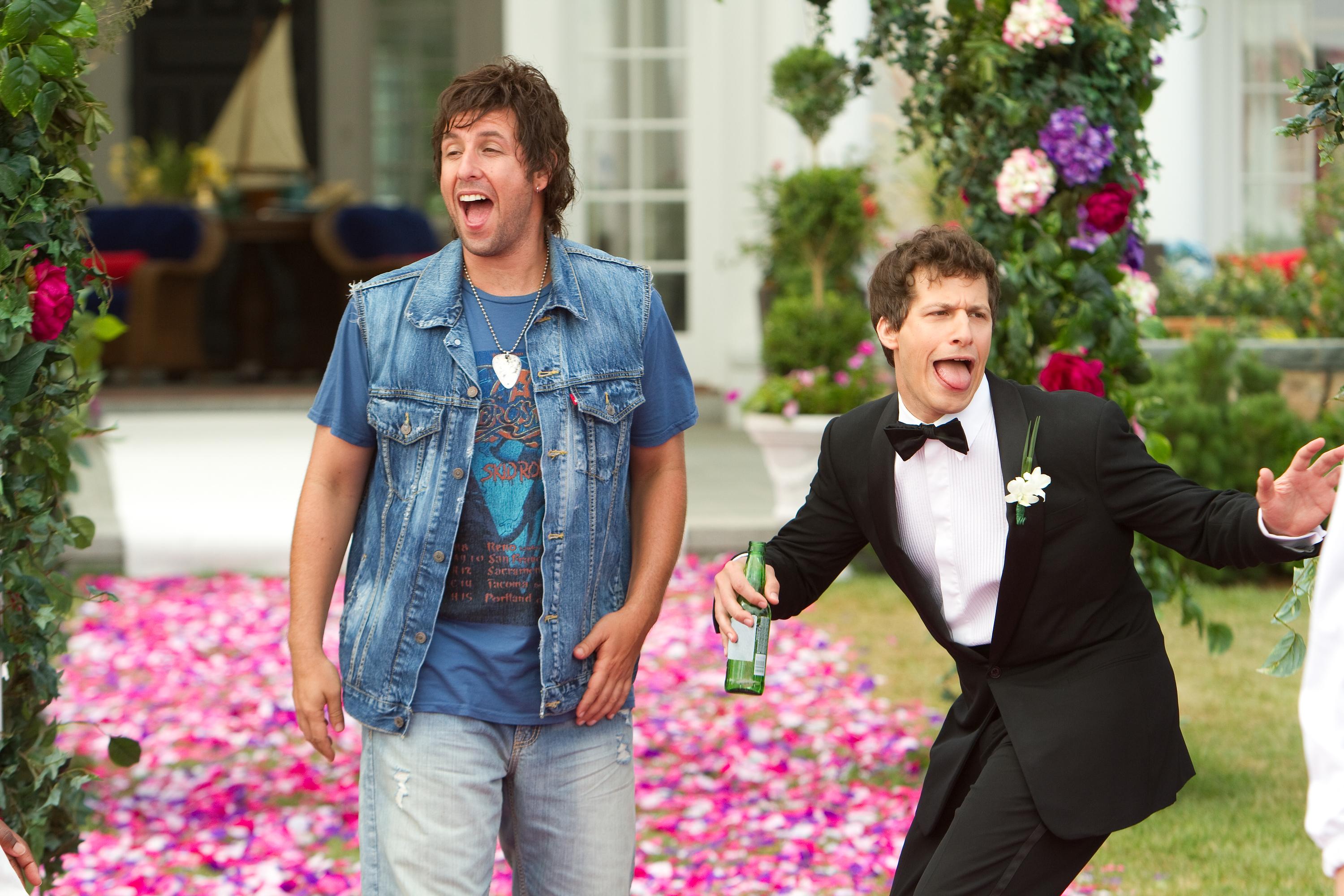
That’s My Boy (1:55) Metreon, SF Center.

Turn Me On, Dammit! The 15-year-old heroine of writer-director Jannicke Systad Jacobsen’s Turn Me On, Dammit! is first heard in voice-over, flatly cataloging the over familiar elements of the small town in rural Norway where she lives — and first seen lying on the kitchen floor of her house sharing an intimate moment with a phone sex operator named Stig (Per Kjerstad). Largely ruled by her hormones and longing to get it on with someone other than herself and the disembodied Stig, Alma (Helene Bergsholm) spends large segments of her life unspooling sexual fantasies starring Artur (Matias Myren), the boy she has a crush on, and Sebjorn (Jon Bleiklie Devik), who runs the grocery store where she works and is the father of her two closest friends: burgeoning political activist Sara (Malin Bjorhovde) and full-fledged mean girl Ingrid (Beate Stofring). Back in real life, a strange and awkward physical interaction with Artur leads Alma, excited and confused, to describe the experience to her friends, a mistake that precipitously leads to total social ostracism among her peers. With the possible exception of some unnecessary dog reaction shots during the aforementioned opening scene, documentary maker Jacobsen’s first narrative feature film is an engaging and impressive debut, presenting a sympathetic and uncoy depiction of a young girl’s sexuality and exploiting the rich contrast between Alma’s gauzier fantasies and the realities of her waking world to poignantly comic effect. (1:16) Opera Plaza. (Rapoport)

The Woman in the Fifth A rumpled American writer with a hinted-at dark past (Ethan Hawke) shows up in Paris, to the horror of his French ex-wife and confused delight of his six-year-old daughter. An ill-advised nap on public transportation results in all of his bags being stolen; broke and out of sorts, he takes a grimy room above a café and a gig monitoring the surveillance-cam feed at what’s obviously some kind of illegal enterprise. During the day he stalks his daughter and romances both sophisticated Margit (Kristen Scott Thomas) and nubile Ania (Joanna Kulig); he also dodges his hostile neighbor (Mamadou Minte) and shady boss (Samir Guesmi). Based on Douglas Kennedy’s novel, the latest from Pawel Pawlikowski (2004’s My Summer of Love), offers some third-act twists (gory, distressing ones) that suggest Hawke’s character (and, by extension, the viewer) may not be perceiving reality with 100 percent accuracy. Moody, melancholy, not-entirely-satisfying stuff. (1:23) SF Film Society Cinema. (Eddy)

Your Sister’s Sister The new movie from Lynn Shelton — who directed star and (fellow mumblecore director) Mark Duplass in her shaggily amusing Humpday (2009) — opens somberly, at a Seattle wake where his Jack makes his deceased brother’s friends uncomfortable by pointing out that the do-gooder guy they’d loved just the last couple years was a bully and jerk for many years before his reformation. This outburst prompts an offer from friend-slash-mutual-crush Iris (Emily Blunt) that he get his head together for a few days at her family’s empty vacation house on a nearby island. Arriving via ferry and bike, he is disconcerted to find someone already in residence — Iris’ sister Hannah (Rosemarie DeWitt), who’s grieving a loss of her own (she’s split with her girlfriend). Several tequila shots later, two Kinsey-scale opposites meet, which creates complications when Iris turns up the next day. A bit slight in immediate retrospect and contrived in its wrap-up, Shelton’s film is nonetheless insinuating, likable, and a little touching while you’re watching it. That’s largely thanks to the actors’ appeal — especially Duplass, who fills in a blunderingly lucky (and unlucky) character’s many blanks with lived-in understatement. (1:30) Albany, Embarcadero, Sundance Kabuki. (Harvey)


After the raid

1

caitlin@sfbg.com

HERBWISE It is exceedingly difficult to get Oaksterdam University founder Richard Lee to talk about himself. I have him — the person who drove the Proposition 19 legalization campaign, whose house and cannabis trade school were raided by federal agents in April, who through his businesses’ success has helped revitalize and make safe a previously gloomy stretch of downtown Oakland — on the phone to talk about the lifetime achievement award he will be receiving from High Times at this week’s Cannabis Cup (Sat/23-Sun/24).

I want him to share his emotional journey since government agents poured into his home, what’s it’s like to be the public face of the flashpoint between California and national government over marijuana. High Times editorial director Malcolm MacKinnon calls Lee a “fearless trailblazer,” perhaps he’d like to make grand predictions about the future of pot? At least describe exactly what’s happening with Oaksterdam, post-raid. But Lee prefers to stress the latest poll numbers on legalization.

“All the national polls and the Colorado polls are going our way,” he says. “If you could get the word out about that, that’d be great.” FYI, on June 6 Rasmussen Reports found that 61 percent of Coloradoans support regulating cannabis like alcohol and cigarettes.

Lee has retired from university administration — he’s referred to as a professor emeritus, although he is still teaching classes in cannabis policy, history, and advocacy. In his “big Converse All-Stars” (as she calls them) now stands Dale Sky Jones. She once developed Oaksterdam’s curriculum and now joins a short list of female leaders in the marijuana industry as the university’s president.

“When the federal government came in, they took the curriculum, the computers — everything else that was the blood and breathe, heart and soul of the school short of the tables and chairs and teachers,” Jones says in a phone interview. Under her watch, the finances of “top-heavy” Oaksterdam’s gift shop, dispensary, and university have split and are now under separate ownership. Staff is attempting to rebuild curriculum from email records. 45 employees have lost their job because of the disruption in business affairs. “This was a violation on so many levels for the staff of Oaksterdam,” Jones says, sadly.

But life goes on. Lee says his “students are great, they have lots of energy and enthusiasm.” And the cultural contributions that the school and its founder have hardly been negated by federal intervention. “[Lee] brought the debate about marijuana policy reform to the kitchen table,” says Jones. “Before Prop. 19, the only time parents and kids had conversations around marijuana it was ‘where the hell did you find it? who are your jackass friends?’ It was always a negative discussion. This was the first time that families were able to discuss marijuana as a policy issue.”

This weekend’s Cannabis Cup will bring the pot world’s focus back here, as some of NorCal’s [author’s note: and hence, the world’s] best strains compete for the title of best indica, sativa, edibles, etc. Lee’s lifetime achievement award (presented at 7pm on Sun/24) will just confirm what we all already knew: even when it comes to activists, we grow things better out here.

HIGH TIMES CANNABIS CUP

Sat/23 noon-10pm, Sun/24 noon-9:30pm; one-day pass $40, two-day pass $65 advance, $80 at door

Craneway Pavilion

1414 Harbour Way, Richmond

www.medcancup.com

That’s amore

1

virginia@sfbg.com

APPETITE After moving from Southern California to New Jersey at age 14, I learned what a true city was when I discovered New York City. Whenever in that New York state of mind, I miss its boundless energy, frank people, eclectic neighborhoods, and, yes, East Coast-style Italian. I reminisce about family dinners filling up on mountains of cheese, doughy pasta, and impeccable red sauce — which, to achieve perfection, should exhibit both sweet and savory notes. In both NYC and NJ, it was often perfect. (I miss you, Cafe L’Amore).

It can be challenging getting my red sauce Italian fix here. I crave old school, heartwarming places, whether drinking a Manhattan in the brilliant time capsule of Joe’s of Westlake, dining on Gaspare’s “real deal” lasagna, Mozzeria’s oozing, baked mozzarella, or a plate of my beloved guanciale (pig jowl bacon) and garlic-heavy spaghetti alla matriciana at Ristorante Marcello. Enter Original Joe’s, a reborn San Francisco classic appealing to a blessedly broad demographic, satisfying East Coast cravings.

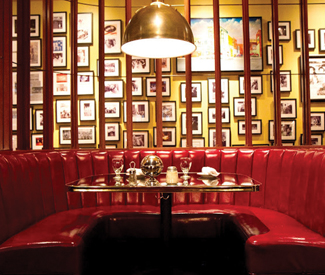
You couldn’t be blamed for initially assuming the sizable Original Joe’s off North Beach’s idyllic Washington Square Park is a tourist destination or primarily for older clientele. There is a more mature set dining here, a factor I welcome and at times seek out intentionally. But families, couples, residents, and tourists alike mingle in this new home for a restaurant founded here in 1937, yet closed since a 2007 fire at its Tenderloin location. Though impossible to replicate the original locale’s dive-y 1970s charm, the new space feels more old school NYC than modern-day tourist trap. Roomy red leather booths and a tuxedoed waitstaff immediately comfort.

The food surprises with an amped-up dose of quality compared to the old days on Taylor. A market price crab cocktail is expensive at $25 but the crab is clean and plentiful. A daily special of fresh burrata and Spring pea salad could have come from any current SF restaurant. Joe’s Italian chopped salad ($15.95) ends up being one of the quickest transports East. Ordering it to share, it arrives split, a half portion plenty for one. Chopped romaine is doused in Italian dressing, with garbanzo beans, olives, cherry tomatoes, silvers of salami, provolone, fennel, and the necessary pepperoncini. It’s brighter — and almost as satisfying — than heavier, loaded versions I used to fill up on back in Jersey.

As in the old Joe’s, there’s plenty of tender, juicy beef, from flat iron steak ($24) to a porterhouse (25 oz. at $44) and prime rib on Saturdays. But when in such an setting, I crave red sauce. It doesn’t get much comfier than spaghetti with meat sauce ($13.95) or meatballs ($16.95). Even if Joe’s is not the superlative version, it hits the spot, as does classic ravioli ($16.95), although I tend to prefer Jackson Fillmore’s housemade ravioli over the years. Another way to my East Coast Italian heart is parmigiana, whether chicken, veal, or eggplant. Here I’m drawn to the eggplant ($16.95), not too smoky, layered in cheese, breading, and, of course, red sauce.

I was tickled to find that $6 cocktails, including simple but revered favorites like a whiskey sour or negroni, are actually well-made — completely unexpected and at this price, one of the best drink values in town for solid classics.

Another unexpected pleasure is impeccable spumoni for dessert ($5 for a few generous scoops). Often in spumoni, unnatural cherry, chocolate and pistachio ice cream flavors are cluttered with nuts and candied fruits in what feels like a dated flavor that should be relegated to the past. Joe’s version delivers authentic, rich flavor with smattering of crumbled pistachios on top, demanding me to rethink, and once again enjoy, this classic ice cream rumored to have Neapolitan roots.

Joe’s isn’t revolutionary gourmet or cutting edge cuisine, but what it does, it does well. Its clientele reminds me of the history and sense of place San Francisco possesses that makes it one of the truly great cities in the world, now ideally situated in a neighborhood that fiercely maintains reverence for and ties to that history. Amid SF’s influx of tech-attracted newbies, Joe’s attracts that breed we often forget is here: the San Francisco native. Feeling like a family/group restaurant first and foremost, it’s a place I’d bring visiting family and Sicilian relatives with hefty portions and friendly service. But I’ve also had a cozy date night with my husband here, transported to decades past… but with fresher ingredients.

ORIGINAL JOE’S

601 Union, SF.

415-775-4877

www.originaljoessf.com

Subscribe to Virgina’s twice-monthly newsletter, The Perfect Spot, www.theperfectspotsf.com


Female trouble

0

arts@sfbg.com

THEATER We’ve come a long way, baby, but why does it feel like women’s equality is a legal concept that still troubles the status quo? This past year has proven that the erosion of women’s rights remains a powerful political agenda across the country, with state bans on certain forms of abortion, the redefinition of rape, and the blocking of the Paycheck Fairness Act.

Two very different shows opening this week in Berkeley (previews began last week for both) are poised to provide timely additions to the ever-evolving discourse on female power and its reverberations on society at large. Mark Jackson’s Salomania, at the Aurora Theatre, and Eve Ensler’s Emotional Creature, at the Berkeley Rep, take on themes of gender parity and its embattled vanguard with a historical drama set in the early 1900s based on the life of one notorious woman, and an ensemble work exploring the challenges of girlhood in the present day.

Salomania, commissioned by Aurora, has been percolating on Jackson’s burner since 2006, when he directed Oscar Wilde’s Salome, also at the Aurora. While researching the production history of the play, he discovered a mostly forgotten scandal involving Maud Allan, a San Francisco dancer who achieved stardom with a provocative interpretation of “The Dance of the Seven Veils.” But it wasn’t her dancing that cemented her notoriety, but rather a high-profile media controversy in which she sued British M.P. Noel Pemberton Billing for libel after he accused her of being a lesbian (she was), a sadist (she wasn’t), and a German sympathizer (she wasn’t that either) after starring in a private performance of Wilde’s then-banned play.

Like all the best media scandals, her 1918 trial had all the necessary elements for a juicy celebrity circus — the personal vs. the political, beauty vs. bigotry, a titillating flush of sexual impropriety — and temporarily displaced the more austere wartime headlines of the era.

There are several themes at work in Jackson’s biographical drama, gleaned in part from courtroom transcripts and letters from Allan to her family, but the one that seems to best tie Allan together with her biblical muse is the emergence of the “independent” woman in popular culture, and the fearfulness they’ve inspired in their detractors throughout history. And just as New Testament figure Salome has been almost unanimously vilified by both church and secular society for her coerced display of her physical sensuality (almost more so than for her adolescent act of brutal vengeance), so was Allan maligned for her empathic recreation of same.

Both Jackson and Allan’s attitudes towards Salome accentuate the positive lurking within her oft-maligned reputation. Jackson posits that she’s “the only honest person in the room,” the one with the greatest potential for breaking free of the venal, decadent atmosphere of Herod’s palace. Allan found in her a kindred beauty-seeker, whose attraction to John the Baptist was formed partially from a sense of wonder at his purity and capacity for selflessness.

“She was not an uncouth child,” she protested at her libel trial. “She was a woman who valued beauty.” Their mutual reverence for beauty aside, another tie that binds Salome and Allan is a shared reputation for willfulness.

“She was kind of a force of nature in her personality,” Jackson says of Allan. “[And] without apology said, ‘This is what I do, and this is who I am’.” This unyielding attitude contributed to Allan’s reputation as “difficult,” even “arrogant,” a complexity of character that attracted Jackson’s interest as a playwright as much as it repelled her critics.

“Any woman with a forward personality who has pushed her boundaries is going to be characterized that way by her culture,” he muses, a sentiment that could be applied equally to Salome as well as to Allan, as well as to almost any controversial female celebrity today: our Madonnas and our Hillary Clintons.


GIRLS, GIRLS, GIRLS


“Part of why I wanted to write this is to say there’s this amazing resilience here, and power, and resistance, and energy and vitality in girls that we haven’t even begun to unleash,” says Eve Ensler, who has also been compared to a force of nature (by Berkeley Rep artistic director Tony Taccone). Best-known for The Vagina Monologues, Ensler’s latest play, Emotional Creature, is having its world premiere at Berkeley Rep.

Global girlhood is its focus. Based on her book I Am an Emotional Creature: The Secret Life of Girls Around the World, the subject matter includes stories from Congolese rape victims, Eastern European sex workers, young factory workers, and Western anorexics, all struggling to move forward from their circumstances. Despite the often violent circumstances Ensler’s protagonists find themselves in, it’s their vitality that she hopes will come across, onstage and off.

Quick to emphasize that Creature is fictional, Ensler’s encounters with young women around the world — Democratic Republic of Congo, South Africa, Sarajevo, Haiti, Afghanistan — have nonetheless heavily informed the characters of her piece. And of course, she has her own experiences in girlhood to draw from. “When I was younger, I was constantly told I was being too alive or too intense or too dramatic, and I chose to learn how to mute myself,” she says. An outspoken and prolific anti-violence advocate, Ensler does seem to have overcome that mute button in adulthood, but she’s quick to point out that its existence can make girlhood a bewildering, disempowering time in life.

The creation of the piece began in Johannesburg, with a staged workshop at the Market Theatre in July 2011, and another in Paris in September. Director Jo Bonney likens the shape of the play to that of an event being put on by the girls themselves: a variety show of monologues, ensemble pieces, even song and dance numbers, with music written by South African composer Charl-Johan Lingenfelder. Navigating the stormy seas of modern-day adolescence and young adulthood, Ensler’s “girls” may still be facing a whole spectrum of obstacles while tapping into their personal power. But thanks to precedents set by strong women such as Maud Allan, and even Salome, the fact that they should want to at all no longer seems unusual or unfortunate — no matter how often American right-wingers might have us otherwise believe. *


EMOTIONAL CREATURE

Through July 15, $14.50-$73

Berkeley Repertory Theatre

Roda Theatre, 2025 Addison, Berk.

www.berkeleyrep.org

SALOMANIA

Through July 22, $30-$55

Aurora Theatre

2081 Addison, Berk. www.auroratheatre.org

OccuPride remembers

6

yael@sfbg.com

QUEER ISSUE “First of all, the parade wouldn’t have barricades, because that immediately creates an us versus them divide, and then you see the parade as just the groups and companies that can afford the fee, which is like $450. Anyone who wanted to march could march, regardless of what the sheriff or Fire Department says. There would be tents for connections to services that people desperately need. I’m not opposed to having companies there, but they shouldn’t be the be-all, end-all of Pride. And there should be more about the history, because people don’t know it. In the Holocaust, anywhere from 10,000 to 100,000 gays were worked to death in Dachau and other work camps. That’s where the pink triangle comes from. But people think Harvey Milk pulled it out of his ass or something.”

That’s what Scott Rossi, one of the organizers of San Francisco’s OccuPride march, told me when I asked him what his ideal SF Pride Parade would look like. The protest’s rallying cry is Community Not Commodity, and the group hopes to bring some rebellious spirit to the parade, which they say has become too watered down with corporate sponsors and assimiliation-lovin’ politics.

Some of the action’s organizers are from Occupy San Francisco and Occupy Oakland, but the majority are a coalition of radical queer groups like HAVOQ, Pride at Work, Act Up, and QUIT (Queers Undermining Israeli Terrorism).

Honestly, it would be weird if there wasn’t a group with an anti-capitalist critique of the parade disrupting Pride this year. It’s been a tradition since 1992 when Act Up members joined the parade and staged intermittent Die-Ins, collapsing every seven minutes, the frequency that people were dying from AIDS that year.

Act Up and related groups staged similar demonstrations practically every year. A decade later, two Gay Shame protesters were arrested when they attempted to enter the parade. That year’s parade was sponsored by Budweiser, and Gay Shame had created a seven-foot-tall cardboard Budweiser can that read “Vomit Out Budweiser Pride and the Selling of Queer Identities,” and other props to confront “the consumerism, blind patriotism and assimilationist agenda of the Pride Parade.”

And radical queers show no sign of stopping. Veteran gay rights warrior Tommi Mecca was at basically all of these disruptions, and he won’t be missing out on this year’s events. Mecca was 21 when he helped organize the first Pride March in Philadelphia in 1972.

“Pride used to be a protest,” Mecca recalls. “It was very free. There were no barricades on the street, there were very few rules. We didn’t have contingents, people just gathered, and at some point there were speeches, usually by activists…I don’t know when it started getting corporate sponsors.”

But the glitz! The glamour! The music enhanced by electricity! Today, Pride is a giant, televised affair — this year, sponsored by Wells Fargo.

“Don’t people in Pride realize how much we’re being used by Wells Fargo?” Mecca said. “It just reeks.”

So if you go to the parade, smell the sweet smell of protesters promoting “pride not profit, a movement not a market, and community not commodity.” After all, if it wasn’t for queer radicals in the ’70s, there wouldn’t be a Pride at all.

Make it better now

1

yael@sfbg.com

Noted queer writer and speaker Dan Savage sent a hopeful message to LGBT youth with his 2010 YouTube video, “It Gets Better.” But many queer youth in the Bay Area say they aren’t willing to wait.

“If my adult self could talk to my 14 year old self and tell him anything, I would tell him to really believe the lyrics from “Somewhere,” from West Side Story. There really is a place for us. There really is a place for you. And that one day you will have friends that love and support you, you will find love, you will find a community. And that life gets better,” Savage said.

Savage and his partner Terry Miller’s message went viral. It inspired hundreds of similar videos and eventually led to the creation of the It Gets Better Project, headquartered in Los Angeles. The videos were a response to a tragic cluster of suicides by children bullied for seeming gay, a trend that was only unusual in that the media picked up on it. And for many teens across the country, the “It Gets Better” videos provided crucial hope and support.

But last week, I was talking to Stephanie, Lolo, Ose, and Mia Tu Mutch, four Bay Area teens, about what its like to be a queer youth today. We were talking at the Lavender Youth Recreation and Information Center (LYRIC), a center for queer youth in the heart of the Castro.

When I asked about the “It Gets Better” videos, they all had the same reaction: “Ugh. I don’t like those videos. I don’t like those at all.”

“Those videos are depressing,” Lolo said.

“Yeah. ‘Just wait ’til you’re an adult?'” Stephanie asked.

“Just wait ’til you’re an adult, and your problems will go away,” Mia said, shaking her head.

“And it’s celebrities, too,” Ose noted. “‘I got thousands of dollars, and it gets better!'”

The four of them are facilitators at LYRIC, leading weekly community-building workshops that deal with issues queer kids face. Between 17 and 21 years old, these youth are not waiting for it to get better. They’re doing it for themselves.


LYRIC’S OUTREACH

LYRIC definitely promotes pride and empowerment. Founded in 1988, LYRIC organizers worked to secure funding for a physical space a few years later. Since then, this purple house on Collingwood has functioned as a crucial center for Bay Area queer youth. It offers counseling, food, clothing, community building workshops that kids teach, and a safe place to hang out.

But LYRIC, like many nonprofits, has felt the impact of the severe government cuts to health and human services. As a result, its budget has suffered steady declines from approximately $1.2 million in 2008 to $954,000 this, year primarily due to shrinking government funding.

But LYRIC refuses to give up offering paid internships, a rarity in the nonprofit world.

“The City has made it clear that they no longer intend to invest significant funding into subsidized employment model programs — they want to serve greater numbers of youth at a much lower unit cost — even if we all understand that some of the most marginalized youth will no longer be getting the intensive level of support they need to make it to a successful adulthood” LYRIC’s Executive Director Jodi Schwartz told me, explaining that the organization is now growing support by more grassroots funding networks.

“We used to hire 60-70 young people per year, now it’s more like 20,” Schwartz says.

The organization still serves about 400 young people per year.

“I would guess we have 6,000 queer youth living in the city,” Schwartz said. “So we’re not reaching everyone. Not to say that all those 6,000 queer youth need a LYRIC, but they need community. We all need community.”

Youth from across the country come to San Francisco seeking that community. Often they have escaped intolerant, abusive, or dangerous situations in their families or hometowns. But when they arrive in this storied city, these youth are often disappointed.

“I was that kid who left a small town in Texas and who got to San Francisco as fast as I could,” Mia told me. “And I was like, you know, I’ll figure it out, I’ll find a job, and I’ll do this and that. And it was really hard.”

” I think that the difference is that there are more LGBT specific languages and policies, and organizations that are affirming. All of that is the best in the US, probably,” Mia said. “And there are all these cultural groups and all of that. But queerphobia and transphobia exist here just like it exists everywhere else.”

“So my big thing is how we have all these systems in place that make us a little more queer friendly,” she said. “But how do we actually get the public to stop hating people, to stop doing hate crimes, to stop bullying?”

Ose, who now lives in the Bayview, grew up closer to the city. But coming from a religious family in Modesto, he says, “I had heard things about the Castro itself. I always thought the Castro was the devil…I was a church boy.”

He remembers fear that someone he knew would recognize him in the forbidden neighborhood, that “my mom would find out and be like, what are you doing in the Castro? So I was scared to death my parents would find out I was coming to the Castro.”

That was two years ago. Now, Ose works in the Castro, and he was dressed in cut-off shorts and a slicked back Mohawk, long painted nails clicking on the table. “I’m hella gayed out,” he happily reports.

When Mia made it to San Francisco, she initially settled into the Tenderloin, rather than the gentrifying Castro.

“As a trans person, a lot of trans history is in the Tenderloin and there’s a lot of trans women who live in the Tenderloin and who work in the Tenderloin,” she explained. “So I feel more at home there. Even though it isn’t technically the gay neighborhood, it’s always been the queer ghetto and that’s where the low income and queer people of color live a lot.”

The Tenderloin is also the site of many of the services that queer youth use. Mia made some of her first local connections at Trans: Thrive, a program of the Asian Pacific Islander Center. And many of the kids at LYRIC, as well as the city’s other queer teens, benefit from Larkin Street Youth Services.

The homeless shelter oversees the only beds reserved for queer youth in the city, all 22 of them, a number Schwartz believes in inadequate. A report from Larkin Street in 2010 found that 30 percent of the homeless youth they serve identify as LGBTQQ (lesbian, gay, bisexual, transgender, queer, or questioning).

LYRIC is part of the Community Partnership for LGBTQQ Youth and the Dimensions Clinic Collaborative, which includes service organizations like the queer-specific health clinic Dimensions, the nearby LGBT Center, the Bay Area Young Positives HIV health and support nonprofit, and the city’s Department of Public Health. But LYRIC is one of only a few organizations that focuses on fun, informative community-building workshops.


ACCEPTANCE NOW

Savage promised queer kids that, in the distant future, they would “have friends that love and support you, you will find love, you will find a community.” But LYRIC’s workshops, largely envisioned and run by the youth themselves, show kids that they don’t need to wait: they can create those supportive networks for themselves, in the here and now.

Another such community-building effort was on display at the LGBT Center on June 15: Youth Speaks’ queer poetry slam Queeriosity. The show, which was preceded by five weeks of free poetry workshops for and by queer youth, brought together young queer people from across the Bay Area, and one could feel the love and support in the air.

“Queeriosity is important because, in the poetry scene, we have so many people with so many different backgrounds,” Milani Pelley, one of the show’s hosts and a poet who works with youth in the workshops, told me. “A lot of times people who get identified in the LGBT category, they don’t have that space where they’re front and center and it’s a space for them. It’s very important that we celebrate everyone.”

Pelley, 24, has been working with Youth Speaks since she was 16. She said the message of the It Gets Better videos might be too simple.

“Thinking about being an adult versus a teenager, adults go through the same things,” she said. “The only difference is it’s not encouraged to speak out about it, you’re supposed to act like you have it together and it’s okay.”

Mia said youthful teasing and bullying are precursors to hate crimes: “Bullying and hate crimes are related because it’s all about people not accepting you, and then violently reacting to who are. So either throwing insults or beating you up.”

On April 29, Brandy Martell, an African American trans woman, was murdered in Oakland in a likely hate crime. CeCe McDonald’s recent case has also exhibited the dangers and injustice trans women of color face. The young Chicago woman defended herself against a bigoted attacker who she ended up killing, only to spend time in solitary confinement while awaiting trial, get convicted on manslaughter, and, last week, be placed in a men’s prison to serve her sentence.

I asked the four LYRIC teachers about the campaigns of national organizations like the Human Rights Committee — such as marriage equity or LGBT soldiers — and they all shook their heads.

“There’s a huge disconnect between the national platforms of the major gay organizations and the actual realities of queer youth,” Mia said. “Like they don’t even have queer youth in the majority of their meetings, but then they act like they’re the ones fighting for our rights, you know.”

For example, she said “marriage equality wouldn’t affect me at all. Yeah, it would be okay, it would be better if it was equal across the board. But when you have people dying because of hate crimes, and dying because of bullying, and dying because they don’t have a place to stay and they’re on the streets, it’s like, I just feel like those are a lot more pressing than getting a piece of paper from the government.”


SETTING THE AGENDA

Mia serves on the city’s Youth Commission, where she’s designing training programs for service providers to work with LGBT youth. Ose is working with Schwartz to create programming for LGBTQ youth who don’t want to take the common path of rejecting religion and spirituality as they come to terms with other parts of their identity.

“I go to church a lot,” Ose explained. “I grew up as a Christian. And I wanted to touch base on that because a lot of times, the youth that I come across, the majority of them are being silenced…I’m still going through some issues with my own church, especially with my pastor because just recently I’ve heard that he dislikes me over the fact of the way I dress, the way I act, my feminine gestures.”

Stephanie sighed and said, “I wish there were more LYRICS around the city. One in Bayview, one in every district. And Oakland too.”

“People who provide counseling, food, clothes, water if you need it,” Lola added. “A safe space to go to, a place where you can make friends, and make connections. There need to be more places like that specifically for queer youth.”

Even in San Francisco, harassment is a reality in youth programs and schools. In 2009, the SFUSD studied Youth Risk Behavior in San Francisco’s elementary through high school public schools, and found that more than 80 percent of students reported hearing anti-gay remarks at school, and more than 40 percent said they had never heard school staff stop others from making those remarks. The survey also found that students who identified as LGBT were significantly more likely than their peers to report skipping school out of concern for their safety.

Queer youth will never stop finding informal networks of support. But structured settings like LYRIC can be vital. At places like LYRIC, youth find the community, the love, and the friends that Savage promised would appear with time — before they turn 18.

“It’s easier to build relationships and to build community when its structured, when it has a little bit of structure like, hey, this is a queer specified setting, we’re going to talk to each other, we’re going to hang out, we’re gonna do this, and then you kind of build community off of that. And because it’s based on identity, you feel more comfortable to talk about that,” Mia explained. “You have to change your reality. And you have to be the one to change it for yourself. Because ain’t nobody gonna make it better for you.”

Bringing the heat

9

On June 13, more than 400 people, mainly from law enforcement and non-profits, gathered for a conference in downtown Oakland’s Marriott Hotel. Outside, a group of angry protesters gave impassioned speeches before trying to enter the hotel. The complex set of issues involved? The conference was organized to discuss tactics for arresting and charging child sex traffickers, but the protesters said that the conference would do nothing but further the state’s harmful impact on the lives of sex workers.

I wasn’t able to attend the conference itself; the Alameda County District Attorney’s office decided at the last minute that press would not be permitted inside. But from the conference’s description and a talk with Casey Bates, head of DA’s Human Exploitation and Trafficking Unit (HEAT), it seemed that the conference was mostly focused on improving efforts to by law enforcement to find people underage people who are having sex for money and prosecute their “traffickers,” a designation not much different than “pimps.”

According to Bates, the HEAT unit has focused on people selling sex on the street and online, and most are from California or nearby states, although he hopes the efforts can expand to people who are trafficked in from other countries.

Under the law, anyone selling sex under 18 years of age is classified as a CSEC- commercially sexually exploited child.

As DA Nancy O’Malley emphasizes on the HEAT unit website, “We have been fighting to shatter the perception of children as prostitutes and criminals undeserving of protection.  These young people are victims of child abuse.”

The sex workers rights movement, organized by people in the sex industry who see their work as legitimate, has largely called for decriminalization of prostitution and other forms of sex work since the movement off in the 1960s, with new concerns in the 21st century. Many groups have argued that police increase the violence in the lives of prostitutes, harassing and arresting them while not taking violence against sex workers seriously. The much older anti-trafficking movement, (or, as it was called at the beginning of the 20th century, anti- “white slavery,”) has many proponents who disagree, saying all prostitution involves some form of coercion. The two movements have a long history of conflict, and on June 13, this dynamic was thrust into the public eye.

Policing the problem

This conference was described as “comprehensive event designed to enhance the capacity of law enforcement and practitioners to combat commercial sex trafficking of children (CSEC).” 

“Of course we support refuges, housing, and other services for these children,” said Rachel West, an organizer with US Prostitutes Collective. “Why aren’t the police focused on that instead of spending hours on the net looking for women, or going out on the street doing street sweeps?”

But US Prostitutes Collective, part of the International Prostitutes Collective, which has been campaigning for decriminalization of prostitution since 1975, didn’t organize last week’s protest. This time it was Occupy Patriarchy, an Occupy Oakland affiliated group.

Occupy Oakland has not been shy about calling out police behaviors, from infamous incidents like the tear gas-heavy offensive on the Occupy Oakland camp last fall to shootings of local teenagers. The HEAT Conference, which was organized by the DA’s office and played host to law enforcement from across the country, was no exception.

“Whose inside this conference?” said one demonstrator who spoke during a 20-minute speak-out in front of the hotel that afternoon. “61 official speakers are law enforcement agents, DA workers, or politicians with anti-sex worker reputations. 39 speakers are individuals or representatives of non-profits. The vast majority of these work directly with law enforcement or politicians to criminalize sex workers. Where is the voice of the sex workers?” 

“What we find disturbing as anti-capitalists and anti-authoritarians is these police who, to sex workers, are oppressing us,” Clarissa McFaye, one of the demonstrators, told me in an interview. “We know that police are a very violent, fearsome presence in the lives of all sex workers, and we feel the only way that we can abolish child trafficking and exploitative forms of labor, which is all labor in actuality, is to abolish the police state.”

“They think working to enforce criminalization isn’t going to help child victims of sexual slavery. We know they exist, but we don’t feel this is a solution. We don’t think enhancing the ability to arrest people is a solution,” said McFaye.

“We really appreciate a lot of the effort that some of the non profits are doing,” McFaye continued, “We want to talk to them and form a sense of camaraderie with them and tell them that we don’t need the cops. We don’t want them. They’re bad for us.” 

Sex workers rights groups have long spoken out about police treatment of prostitutes. Stories of police harassing sex workers, going through with sexual acts while undercover before making prostitution arrests, and demanding sex in exchange for letting an arrest slide are fairly common. As McFaye told me, “they’re condoning child trafficking because they make deals with pimps.”

“Not to mention that hella cops are tricks,” she added.

Pimps and traffickers, children and minors

The HEAT Unit’s website lists 237 charges and 160 convictions made by the unit between 2006 and 2011. The statistics include trafficking as defined by California Penal Code Section 236.1, California’s Human Trafficking Statute. But they also include charges and convictions for pimping and pandering, sexual assault, kidnapping, and burglary, and the website specifies that “these statistics do not differentiate between child and adult victims, though the majority of HEAT victims are minors.”

The anti-trafficking statute defines a human trafficker as “Any person who deprives or violates the personal liberty of another with the intent to effect or maintain a felony violation of ” one of several anti-pimping, pandering, and solicitation Penal Code violations.

This includes Penal Code section 266 which defines a pimp as someone who, knowing another person has commercial sex, “lives or derives support or maintenance in whole or in part from the earnings or proceeds of the person’s prostitution.” 

But for Bates, “The way a pimp-prostitute relationship works is the pimp takes 100 percent of the cash.”

I brought up the pimp question with Cyd Nova, harm reduction services coordinator at San Francisco’s for sex workers-by sex workers health clinic, the St. James Infirmary.

“I know a lot of street-based sex workers who are totally independent,” said Nova. “Some do split their money with pimps or managers.”

Nova also said pimping’s legal definition can often have questionable consequences. “Legally that would be most peoples partners, children, friends.”

“I have met sex workers who have had their partners charged under pimping codes, which was not their relationship with that person,” Nova told me.

Many “pimping” relationships fall somewhere in between “peoples partners, children, and friends” and “the pimp takes 100 percent of the cash.” Sex workers, a criminalized class, often experience violence from both pimps and clients- but fear for their own consequenes if they report the crimes. I asked Bates his opinion on granting immunity from prostitution charges or a person who comes forward to report all too common violations committed against sex workers like rape, assault and theft.

“We do this all the time in the context of other types of crime that we work with. If it’s a murder, we may be willing to negotiate with our witness to determine whether or not is appropriate to give immunity for the person to testify against this other person, in exchange they won’t be prosecuted for the crime that they committed.”

But Nova said that striking that deal can be a major problem.

“One thing that is an issue for people forced into the industry is they are unable to receive services until they agree to testify against their trafficker. This doesn’t work for the majority of people, and it’s a major issue when you’re talking about services for trafficking victims,” he said.

At the St. James Infirmary, “We have people who have been in situations where they feel that they wanted to leave, but are not willing to bring criminal charges against the person,” he continued.

Nova also described a distinction between the terms “child” and “minor.”

“People have choices in how they use their bodies, and that includes youth. We are living in a world where sometimes people have to choose options that are not ideal,” he said. 

McFaye painted a similar picture, saying that “sex work is a form of work that all genders do sex work can make a lot more money than other options.”

“It allows me to do my political work as well as work a few times a week, instead of working at McDonalds. When I was 17 years old I tried to get a job, couldn’t find anything but shitty house cleaning jobs. Then some sex workers I knew showed me the ropes, and my life’s been a lot better ever since,” she said.

I described a similar situation, in which a minor chooses prostitution to make desperately needed money or escape an abusive situation, to Bates. “There are going to be people that make that claim,” he responded. “There’s no doubt about it. Part of the phenomenon is that a lot of people that are being abused, when they’re being abused, don’t even realize that they’re being abused. That’s a big issue,” said Bates. “People have made the claim, they did what they had to do in a difficult circumstance, and they don’t really see themselves as being a victim of crime. And what I’m suggesting is, that’s not uncommon, it’s part of the victimology actually.” 

He added, “I’m speaking specifically to people that are being trafficked. What you described doesn’t sound as much like a trafficking situation.”

But the law doesn’t allow for that kind of nuance. 

“That is a clear distinction that we want to draw. This is focused on commercial sexual exploitation of children,” Bates said. “When you become 18, you’re given a set of rights and you’re treated differently under the law.”

Solutions

The HEAT Unit’s model is unique, and if the conference has its intended consequences, it may be replicated throughout the country.

For minors that the HEAT unit identifies as CSEC, “The goal is to try to stabilize them, to figure out what services they need, what situation they came from and figure out how we can get that child back on track,” Bates told me.

“Sometimes, that requires that we detain them for a period of time so we can figure out what services are necessary. That’s somewhat controversial, because some people say that’s not appropriate. We believe that it’s in the interest of these girls initially, to figure out what’s necessary. That to turn them back on the street means to turn your back on them, period.”

Many sex workers’ rights groups, however, argue for antoher solution entirely- decriminalization of prostitution. Part of the argument for decriminalization is that sex workers would feel more comfortable coming to police with reports that they are their colleagues had been victims of crimes like rape, assault or theft. 

As Nova said, “California is currently using anti-trafficking federal funds to target all sex workers. They say, if we arrest a bunch of sex workers, some of them are going to be trafficked. This has not proven to be very effective, whereas decriminalization would result in people, who are in coercive work situations, feeling more comfortable coming forward and asking for help.

“They need an evaluation of what kind of practices are going on and what results they’re turning out,” Nova said. “A study where they have conversations with people who have been arrested and detained and talk about what their life was like, what was detrimental and what was beneficial.”

For some of the more anarchist-leaning protesters, however, the police should play no role in the solution.

“What we think would help is if we as sex workers come together is if we come together and combat this exploitation,” McFaye told me.

I asked if there was anything the police could do.

“No,” said McFaye. “They can turn in their badges. That’s what they could do.” 

When the sex workers’ rights movement took off in the ’60s, they joined the debate that had been going on surrounding prostitution and policing for a century. The movement continues- and on Wednesday, a distinctly anti-capitalist side of it made noise. These groups may be piping up more, as the Californians Against Sexual Exploitation (CASE) Act, which would increase funding and resources for policing sex traffickers, goes to the ballot this November.

Acquerello

0

virginia@sfbg.com

APPETITE There are but few whispers about Acquerello in dining circles these days. This is an oversight. Not readily visible from the street, the Nob Hill restaurant’s lobby opens onto a glowing dining room that at first glance appears to be an elegant oasis for an older clientele — a classic that has been loyal to the city since 1989. After a recent return to Acquerello, I’ll venture that it is this, but much more as well. For me, this is San Francisco’s great underrated fine dining destination, despite the fac that it has won a coveted Michelin star for six years and counting.

Even with the promise of Acquerello’s forward-thinking food and heartwarming classics in the air, it’s the service that initially stands out. Upon arrival, one is ushered to a table thoughtfully spaced apart from its neighbors, intimate yet still engaged with the Italian decor. In soft peach and beige, the dining room is subtly dated in a way that speaks of the old country, inviting and quiet enough under striking wood rafters but not so hushed as to be museum-like.

A team of waiters, three sommeliers and co-owner Giancarlo Paterlini, alternately attend to each table, the head waiter having been at the restaurant since the 1980s, along with Paterlini’s son, Gianpaolo, who is also the wine director, and chef and co-owner Suzette Gresham-Tognetti. The latter came out to greet those of us that lingered into the evening, clearly still passionate about what she does. Gresham-Tognetti works closely with young chef de cuisine Mark Pensa on all menus. (The classic tasting menu runs for $95 plus $75 for wine pairing; the seasonal tasting menu is $135 plus $95 for wine pairing; you can also choose three courses a la carte for $70, four for $82, five for $95.)

I recommend trying both the classic and seasonal menus, even if the a la carte menu gives you a chance to pick and choose among favorites. Ideally, a dining couple could order both for a glimpse of Acquerello’s entire timeline, past and present.

Maybe the dishes on the classic menu have been around for awhile, but they are far from stale. In fact, the “greatest hits” lineup still offers some of the restaurant’s best dishes. It will be a gourmand’s loss when one of Acquerello’s most popular plates, the ridged pasta in foie gras and Marsala wine sauce scented with black truffles, goes away in a few weeks. The most ecstasy-inducing dish on any menu is this dreamy take on foie gras, served as a sauce over al dente pasta. Another classic is juicy chicken breast decadently stuffed with black truffles over a leek custard and an artful mini-potato gratin, topped with shaved cremini mushrooms.

In contrast, the “chef’s surprises” menu is filled with delicate hints of things to come, like a warm arancini of asparagus and parmesan cream and some profiteroles filled with lush herbed cream. The regular menu holds treasures like pear and foie gras “ravioli” — the chefs slice dry-farmed, organic comice pears into a thin, pasta-like skin, filling it with truffled foie torchon. Saikou, a New Zealand farm-raised salmon, is bright and clean from high, cold elevations. It is poached for a few seconds in a layer of horseradish, and crusted it with chevril, pine nuts, and parsley; an herb pesto of sorts. Each dish explodes with flavor yet corners refinement, maintaining a Cal-Italian ethos that won’t play safe.

On the seasonal menu, the chefs work together closely on inventive takes that rival the better fine dining meals I’ve had. An amuse of raw yellowtail is alive with seabeans and arugula blossoms, while red abalone pairs with cabbage “seaweed” in porcini broth. Snake River Kobe beef is tender and pink, cooked sous vide under shaved hazelnuts. The cheese course is a warm, oozing round of gorgonzola D.O.P. (denominazione di origine protella, or protected designation of origin) beautifully co-mingled with potato, onion, mustard seeds, and nasturtium. Probably the most delightful, unique dish is “baked potato” gnocchi, a playful take on a baked potato made with a base of doughy gnocchi topped with chive crème fraiche, pancetta, and paper thin, fried slivers of potato skin.

Palate cleansers include a shot of carrot-apple-ginger juice with vanilla foam and a refreshing starter of orange juice, vermouth, and bitters. On the seasonal menu, a vivid dessert from pastry chef Theron Marrs marries cucumber sorbet with tart lime curd, sweet strawberry consommé, and herbaceous mint granita. As at Gary Danko, the cheese cart is one of Acquerello’s shining glories. The cart traverses the restaurant covered to contain the smell of its stinkiest offerings. Diners have their work cut out of them to select from among its unusual, largely Italian cheeses. An impression was made with earthy Blu di Valchiusella from Piemonte wrapped in walnut leaves and an impeccable Beppino Occelli in Barolo wine leaves.

Boasting input from no less than three sommeliers, Acquerello’s extensive wine list is novel-thick, dense with Italian wines. There’s an impressive range of varietals and vintages stored in its wine cellars. Suggested pairings meld seamlessly with each dish, whether it be a classic, lovely Nebbiolo d’Alba (2008 La Val Dei Preti), an unusual Langhe Rosso Burgundian-style Italian Pinot, or D’antiche Terre Taurasi Riserva, which transforms when sipped with fabulously rich veal and truffled mortadella tortellini Bolognesi.

For a special occasion, I’d place Acquerello among the best fine dining experiences in San Francisco — even up against hot newcomers and pricey minimalist restaurants. This is a place with a sense of history and a vision for the future.

ACQUERELLO

1722 Sacramento, SF

(415) 567-5432

www.acquerello.com

Subscribe to Virgina’s twice-monthly newsletter, The Perfect Spot, www.theperfectspotsf.com


In case you have time between Frameline screenings: new movies!

1

This week: Frameline, Frameline, Frameline! Our coverage here. Ticket and schedule info here.

Hollywood’s two big releases are the Adam Sandler-Andy Samberg arrested-development yukfest That’s My Boy, and the Tom Cruise hair metal musical Rock of Ages. If you’re excited about either, you probably aren’t the type of person who gives two shits what movie critics say. Just a guess. So, enjoy. As you were.

Also of note for movie fans: the San Francisco Museum and Historical Society opens “The Stuff That Dreams Are Made Of: San Francisco and the Movies” this weekend. It features work by Madeleine Ellster herself, Kim Novak, plus:

“The exhibition paints a picture of the amazing breadth of the Bay Area’s film history and filmmaking community, using educational text panels, photographs, posters, vintage cameras, movie props and other objects. Slide shows, lectures, book signings, oral history recordings, screenings, and multimedia will also be part of the exhibition.”

(I can’t confirm there will be a Harry Callahan street shootin’ simulator, but that would be pretty awesome, no?)

But back to the movie theater:

This weekend, it’s a Duplass-a-thon, as Dennis Harvey reviews mumblecore’s first sex symbol in Safety Not Guaranteed and Your Sister’s Sister. Below, you’ll find our takes on another mumblecore overachiever, Greta Gerwig, who less success with the wee-bit-twee Lola Versus; handcuffed-together-at-a-music-festival (don’t ya hate when that happens?) rom-rom Tonight You’re Mine, featuring Natalie Tena (Osha for all my fellow Game of Thrones devotees also going through withdrawals); delightful coming-of-age Norwegian import Turn Me On, Dammit!; and The Woman in the Fifth, the latest movie to remind us that yes, Kristin Scott Thomas can totally speak French! And maybe the first to let us know that Ethan Hawke can, too.

http://www.youtube.com/watch?v=b5hYBMZft9w

Lola Versus Greta Gerwig’s embattled late-twentysomething, the titular Lola, apologetically invokes the Saturn return to explain the chaos that enters her life when her emotionally underdeveloped boyfriend proposes, panics, and dumps her. Workaday elements of the industry-standard romantic comedy surface, lightly revised: a crass, loopy BFF (co-writer Zoe Lister Jones) who can’t find true love and says things like “I have to go wash my vagina”; a vaguely soulful male friend (Hamish Linklater, 2011’s The Future) who’s secretly harboring nonplatonic feelings (or maybe just an opportunistic streak); wacky yet vaguely successful Age of Aquarius parents (a somewhat toneless Debra Winger and a nicely gone-to-seed Bill Pullman). One can see why it would be tempting to blame a planet’s galactic travels for the solipsistic meandering that Lola engages in, bemusedly lurching, often under chemical influences, from one bout of poor decision-making to the next. She claims to be searching for a path out of the chaos into some calmer place (fittingly, she’s a comp lit Ph.D. candidate who’s writing her dissertation on silence), but as the movie transports us mercilessly from one scene of turmoil to the next, we have little reason to believe her. The script has funny moments, and Gerwig sometimes succeeds in making Lola feel like a charming disaster, but her personal discoveries, while certainly valuable, feel false and forced. (1:26) (Lynn Rapoport)

Tonight You’re Mine Ah, the old chained-together gimmick, so effective in creating conflict in movies like 1973 women-in-prison classic Black Mama, White Mama. Alas, Tonight You’re Mine contains zero escaped cons, and is instead a pretty contrived love story about two rockers who’re inexplicably handcuffed together, mid-argument, by a mysterious man prowling the grounds at Scotland’s massive T in the Park music festival. Whether or not Adam (Luke Treadaway, last seen getting very stoned mid-alien invasion in 2011’s Attack the Block) and Morello (Game of Thrones‘ Natalie Tena) will ditch their clearly-wrong-for-them partners and fall for each other is hardly up for debate. What saves Tonight You’re Mine is its authentic rock-festival atmosphere; director David Mackenzie filmed amid the actual chaos of the 2010 T in the Park fest, so there’s plenty of mud, inebriated extras, and background music swirling around the budding romance. Also, though her character is underdeveloped here, Tena has a punky appeal that suggests a star on the rise. (1:20) (Cheryl Eddy)

http://www.youtube.com/watch?v=eySFZRVcHYM

Turn Me On, Dammit! The 15-year-old heroine of writer-director Jannicke Systad Jacobsen’s Turn Me On, Dammit! is first heard in voice-over, flatly cataloging the over familiar elements of the small town in rural Norway where she lives — and first seen lying on the kitchen floor of her house sharing an intimate moment with a phone sex operator named Stig (Per Kjerstad). Largely ruled by her hormones and longing to get it on with someone other than herself and the disembodied Stig, Alma (Helene Bergsholm) spends large segments of her life unspooling sexual fantasies starring Artur (Matias Myren), the boy she has a crush on, and Sebjorn (Jon Bleiklie Devik), who runs the grocery store where she works and is the father of her two closest friends: burgeoning political activist Sara (Malin Bjorhovde) and full-fledged mean girl Ingrid (Beate Stofring). Back in real life, a strange and awkward physical interaction with Artur leads Alma, excited and confused, to describe the experience to her friends, a mistake that precipitously leads to total social ostracism among her peers. With the possible exception of some unnecessary dog reaction shots during the aforementioned opening scene, documentary maker Jacobsen’s first narrative feature film is an engaging and impressive debut, presenting a sympathetic and uncoy depiction of a young girl’s sexuality and exploiting the rich contrast between Alma’s gauzier fantasies and the realities of her waking world to poignantly comic effect. (1:16) (Rapoport)

The Woman in the Fifth A rumpled American writer with a hinted-at dark past (Ethan Hawke) shows up in Paris, to the horror of his French ex-wife and confused delight of his six-year-old daughter. An ill-advised nap on public transportation results in all of his bags being stolen; broke and out of sorts, he takes a grimy room above a café and a gig monitoring the surveillance-cam feed at what’s obviously some kind of illegal enterprise. During the day he stalks his daughter and romances both sophisticated Margit (Kristen Scott Thomas) and nubile Ania (Joanna Kulig); he also dodges his hostile neighbor (Mamadou Minte) and shady boss (Samir Guesmi). Based on Douglas Kennedy’s novel, the latest from Pawel Pawlikowski (2004’s My Summer of Love), offers some third-act twists (gory, distressing ones) that suggest Hawke’s character (and, by extension, the viewer) may not be perceiving reality with 100 percent accuracy. Moody, melancholy, not-entirely-satisfying stuff. (1:23) SF Film Society Cinema. (Eddy)

Guardian voices: The zombie condo converters

28

What is the shelf life of  a really bad public policy concerning housing in  San Francisco?

When it comes to condo conversions of existing rent controlled apartments, the answer is that there is no limit on how many times this bad idea is taken off the shelf. Like a bad summer zombie movie, this undead keeps  walking, no matter what San Franciscans say.

A little history.  In 1982 Supervisor Willie Kennedy, not a bomb-throwing tenant advocate by any stretch, sponsored legislation that limited the  conversion of existing apartments to condos to no more than 200 a year. The measure did not touch new constriction, allowing unlimited condominium construction. Indeed, from 1983 to 2000, some 12,200 new condos were built, an average of some 680 units a year. Since 2000, nearly 100 percent of all new residential constriction is built as condos; there is no limit on renting a condo, but an annual limit in converting an existing apartment. Clearly, condos are a tenure type of housing that is dramatically expanding.

The reason Kennedy and the at-large elected Board of Supervisors voted for the annual limit was to protect rent-controlled apartments, a type of housingthat can’t be expanded. San Francisco’s 1978  rent control ordinance exempted all new construction from being under rent control. So rent-controlled apartments were a fixed number — all apartments built before 1978 — banned by law from ever being expanded. 

Yet those apartments are the largest number of affordable housing units available to moderate and middle income households. Thus, there’s a rational desire to preserve them by a public policy that limits their conversion to condos because they are declining in numbers.

And San Francisco voters understand and support this very rational policy.

In 1989, realtors and speculators tried to overturn the annual limit, proposing a measure that said if 51 percent of a building’s existing tenants voted for a conversion, then the building could be converted with no annual limit. This proposal laid out a future of a Hobbesian society here in San Francisco with one set of well-to-do tenants fighting another set of less-well-off tenants, building by building. San Francisco voters defeated the measure 63-37.

But in the land of the living dead condo converters, no is never the answer.
 
In 2002, Gavin Newsom, Tony Hall and Leland Yee, Plan C, and the Chamber of Commerce placed another measure on the ballot to repeal the annual limit. It too, was  rejected: 60 percent voted no, and 40 percent yes. The measure was defeated in all of the supervisorial districts except  Newsom’s D2, Tony Hall’s D7, and Leland Yee’s D4.

Tenant and affordable housing advocates were not unmoved by the desire of tenants, especially in privately owner rental housing facing Ellis Act and TIC evictions, to seek the protection of home ownership. In 2008 they supported an amendment to the Subdivision Code carving out from the annual limit conversions of apartments by nonprofit, limited equity housing
co-ops.

Now were are confronted again by a desire to allow more conversions of rent controlled units by private buyers who bought into the TIC dodge around the annual condo conversion limit.

Since TIC’s do not require a sub-division map, creating legally recognized separate units, they became “grey market” condos. With hot mortgage money flowing during the bubble, TIC owners could get financing. Now, banks are actually following some laws and will not lend to buy a legally grey TIC.  Thus the move to get them converted to legal condos.
 
This is, in its most basic form, yet another bailout caused by speculative capitalism. We seem to no longer believe in the market as an economic system, in which bad economic decisions result in economic loss for the folks involved. We now seem to believe in the “market society” — in which those with money get to keep it no matter what bad decisions they make.

What this is all about is not really homeownership but about home sales. After all, if you have a TIC you already have a home. You want to convert it to a condo not to live in, but to sell. To make it easier to sell TICs would make it harder to sell the thousands of already approved but stalled new condos.

Mayor Lee administration want to stimulate these stalled condo developments, claiming they will create constriction jobs. The Farrell and Wiener condo conversion plan undercuts these efforts and, of course, will create no jobs for anyone but realtors and moving companies.

This is called a “contradiction of capitalism,” when one set of capitalists seek, to the disadvantage of another group of capitalists, to get the government to intervene on their behalf.  But it does prove once again that Lenin was right when he said that one could count on one set of capitalists to compete with each other to sell rope to hang another set.

It’s really bad economic policy, and even worse housing policy.

Local jazz, blues behind bars, and backing-band memories: new music docs

0

Jazz singer Jacqui Naylor — Buddhist, Hayes Valley resident, mash-up innovator — premieres her new doc, Lucky Girl: A Portrait of Jacqui Naylor, with a live concert at the Palace of Fine Arts Sat/16 (the DVD will be available in stores Tue/19).

The film, produced by the Bay Area’s ARTiDOCs, is about as far from Behind the Music-style tell-all as you could get; Naylor seems blissfully happy with her life, being completely creatively and personally fulfilled (see also: the film’s title, named for her 2011 CD). No scandals or dark secrets revealed here; this is a straightforward look at a working artist, briefly touching on her career beginnings (at the suggestion of teachers at American Conservatory Theater, she chose music over acting) and including mini-profiles on the artists she collaborates with, including husband Art Khu.

http://www.youtube.com/watch?v=DiBY1U4b8oI&feature=player_embedded

Fans (whom she prizes highly — and takes their suggestions seriously) will enjoy the film’s many musical interludes, which showcase snippets and entire songs of Naylor performing and rehearsing in the Bay Area, Seattle, and Istanbul. Her repertoire includes original songs, pop and jazz standards, and standards freshened up with her signature “acoustic smashing” — singing the lyrics to “My Funny Valentine” over the instrumentation for AC/DC’s “Back in Black,” for example. Will this versatile performer dust off more heavy-metal flair for Saturday’s show? It could totally happen. She’s taking requests: jacqui@jacquinaylor.com.

Lucky Girl: A Portrait of Jacqui Naylor (with reception and concert)
Sat/16, 7pm, $35
Florence Gould Theater
Legion of Honor
100 34th Ave., SF
www.jacquinaylor.com

**

Coming to the Kabuki and Smith Rafael this weekend is Music from the Big House, a soulful doc from filmmaker Bruce McDonald (2008’s Pontypool) about fellow Canadian Rita Chiarelli‘s experiences working with musician-inmates at Louisiana’s Angola Prison.

Angola Prison — earlier the subject of an acclaimed short documentary about its famous rodeo — has a well-known, rich musical history; in the 30s, John and Alan Lomax recorded Leadbelly while he was serving time there. Chiarelli, a blues superstar in her native country, says she initially traveled to the American South a decade ago to “visit the birthplace of the blues” — a journey that included a stop at America’s largest maximum security prison (5,000 inmates), where she discovered a thriving musical culture. Inspired (“the trueness totally moved me”), a planned concert for the prisoners became a concert with the men, including groups playing good ol’ boy country, gospel, Stevie Wonder jams, and Chiarelli’s own brand of raw, rootsy blues.

Gorgeously filmed in black and white, and crisply edited, McDonald’s film emphasizes the joy and feelings of freedom the men have achieved through their musical pursuits. But it also acknowledges its inescapable setting, filming the dorm-style cell blocks, a visiting day filled with seldom-seen wives and children, the barbed wire encircling the years. “When you’re playing music it’s easy to forget where you are,” the husky-voiced Chiarelli reflects. “But they’re still in prison and that’s rough.”

Though most of the featured men don’t directly address their crimes (their various offenses, including rape and murder, are addressed in the film’s sobering end credits), themes of deep regret and redemption run throughout the film. Kind of like the blues.

Music From the Big House
June 15-21, 2:15, 4:10, 7, and 9:20pm (with live performance by Rita Chiarelli Sat/16, 7pm)
Sundance Kabuki Cinema
1881 Post, SF
www.sundancecinemas.com

Also Sun/17, 7pm, $12 (with live performance by Chiarelli)
Christopher B. Smith Rafael Film Center
1118 Fourth St., San Rafael
(415) 454-1222
www.cafilm.org

**

And next weekend, get a sneak peek at an as-yet-unreleased (and not on DVD) documentary about acclaimed session musicians the Wrecking Crew, presented by the San Francisco Chapter of the Audio Engineering Society.

http://www.youtube.com/watch?v=-xs2kJn6PBE&feature=plcp

The film sounds kind of similar to the excellent 2002 doc Standing in the Shadows of Motown, about Motown’s legendary Funk Brothers: the Wrecking Crew was hugely active in 1960s Los Angeles, adding their musicianship to hits by the Beach Boys, Frank and Nancy Sinatra, the Monkees, the Mamas and the Papas, and more. (The film contains so many songs that its release has been held up over music-rights issues).

Producer-director Danny Tedesco — son of Wrecking Crew guitarist Tommy Tedesco — will be on hand to discuss the film, which he’s been working on for over 15 years, after each screening.

The Wrecking Crew
June 23, 2:30 and 7pm, $20
Auctions By the Bay Theater
2700 Saratoga, Alameda
www.brownpapertickets.com

Guardian Voices: On losing

80

I’m turning 43 today and feeling glad to be alive. I would love to be writing about the joy of raising children and the mysteries of the universe. But instead, today I’m thinking about last week’s elections, about losing and the nature of long-term struggle. I’m thinking about being born black in 1969, and how, in fact, our side has been losing my whole life. And while this sobering reality about the balance of forces in the nation could make a sane person completely despondent, today I’m considering it a challenge to radically rethink the way we progressives try to change the world. 

The truth is that despite historic victories and truly incredible grassroots organizing over the last several decades, we’ve been getting our asses kicked for a long, long time. Since the right and the state got together to crush people’s movements of the 1960s. Since the Republicans built this rightwing coalition, began pushing wedge politics, winning the hearts and minds of white working people, and winning elections all over the country. And since capitalism shifted gears in the 1970s – we call it neoliberalism now — and the war on poverty was pushed aside to make way for the war on poor people specifically and working people generally. Since then, our cities have lost good jobs, union members, safety net services, and in San Francisco, more than half of the entire black population.

Thanks to Fox News, billionaire Republicans, and fragmentation on the left, conservative ideas about government, about individual vs. institutional responsibility, and about the supposed virtues of free markets have taken a powerful hold over the thinking of most Americans. One result: Last week in Wisconsin, despite the truly historic mobilization against the right’s Scott Walker, labor and social justice forces lost a big one. And here in San Francisco, in the heart of the “left coast,” progressives lost control of the Democratic Party to that special brand of “moderate” big-business Democrats who are socially liberal but have been making me embarrassed to be a registered Democrat since – well, since Bill Clinton was in the White House.

Clinton’s “ending welfare as we know it” third-way politics made it ok to talk about ending poverty while at the same time helping people get rich at the expense of poor people all over the world. Gavin Newsom was our local version – more socially liberal, and therefore successfully confusing to a lot of people, but he was nonetheless made of the same cloth.

Are you ready for the good news? Well, not quite yet. I didn’t mention the economic crisis.

If this were a boxing match, I don’t think the referees would have trouble judging this one. The current economic crisis was indeed once a crisis for capitalists — some financial institutions were forced to close shop, other lost billions and Wall Street seemed for a while to be in complete disarray. At one point, one third of Americans supported the Occupy movement and thought socialism was something to consider.

But even taking the ongoing Eurozone crisis into account, the US corporate elites in 2012 are more like a dazed prize fighter momentarily wobbly on his feet than a boxer who’s down for the count. Now, four years after the financial crash, the crisis is primarily a crisis for the rest of us, and our suffering is real. Even the middle class has taken serious punches, and our communities are badly bruised.

Good political spin will not change these real conditions. And the problem is not that organizers and activists, here in the Bay and around the country, aren’t brave and brilliant and working just remarkably hard. And even creating new forms of activism and alliances for the 21st century. But we have to think differently about how we do politics.

Most fundamentally, after so many years of losing in one way or another, too many social justice activists have lost hope of ever winning a truly more just society. Too many of us have settled for short-term gains, defensive fights, and building organizational power.

Don’t get me wrong – I’m deeply committed to local organizing that builds leadership and political power and win’s concrete improvements in people’s lives. But we will certainly never see the society we hold in our dreams without a bold, audacious belief that we can in fact win and govern our city, our state, and the entire country. Like the right – which was, objectively speaking, once weak and playing defense — progressive forces have to share a common belief that we too can build a majority, that we can govern the entire country based on values of racial justice, equity, sustainability and the collective good.  There’s a big difference between losing and feeling, en masse, like losers.

There is so much already in motion to build upon, so much potential to seize the opportunities that this historic moment provides. Inspired by Arab Spring, we too can be bold and audacious in our visions of what’s possible. After we rally against what’s wrong, let’s make plans for how we are really going to solve the crises of the 21st century and make the world a better place. Local political battles are essential opportunities to build new leadership (especially in communities of color), to change everyday people’s consciousness, and defend the ground we’ve already won. Across the nation, more organizations should take lessons from efforts like the National Domestic Workers Alliance, San Francisco Rising, CA Calls, and the national Unity Alliance that are breaking the fragmentation of progressive forces, moving beyond organizational ego, and consolidating people power. But above all, we have to let go of the idea that it’s someone else’s role to run the world or that having power is just for self-serving politicians. Unafraid of power and determined to slug it out, let’s make my next forty years about how we turned it around, had the Right on the run, built a movement and a society that we are proud to leave our children.

We are not down for the count. We are still in the ring swinging. Our opponent is powerful, and we’re already weak from a long fight, but we have the capacity to regroup, take advantage of our opponent’s weaknesses and make the most of our strengths, plot a new offensive strategy, and win — and win decisively. Losing is part of political struggle, it’s part of history, but there are more rounds to go. And what’s even better, unlike boxing, in the real world of building a movement for social justice, we engage in the struggle together. What happens next is up for grabs, and history is ours to make.

N’Tanya Lee was formerly the director of Coleman Advocates and one of the founding members of San Francisco Rising. She’s a veteran organizer with racial justice and LGBT and youth movement struggles in New York City, Michigan and the Bay. She now works on national movement building projects, advises local social justice leaders and is raising a son with her wife in Southeastern San Francisco.

Possessions and concessions

0

arts@sfbg.com

THEATER A general store in a factory town is the deceptively concrete setting for playwright Christina Anderson’s purposefully nebulous drama, which conflates a range of 20th century African American experiences in a supernatural tale of characters and a town variously “possessed.”

Crowded Fire (which produced the world premiere of Anderson’s DRIP in 2009) takes the premise and runs with it, artistic director Marissa Wolf helming the production with a sure grasp of Anderson’s fluid structure, where time (“between 1961 and 1994”), place (“the side pocket of America”), and position (social, sexual or otherwise) are all on the move and yet passingly specific, as in some Heisenberg Uncertainty Principle of history and identity.

As the story opens, Good Goods proprietor Stacey Good (Yahya Abdul-Mateen II) has recently retuned to town to take over from his father — the original Good — who we learn fled under vague circumstances seemingly connected to a recent “invasion” that has left this exclusively African American community in some sense (again purposely vague) occupied.

Meanwhile, the store itself is contested terrain. Longtime employee Truth (David E. Moore) holds a grudge against Stacey, who was supposed to be born a girl — promised to Truth by Good-the-father along with the keys to the store. But as a male heir, Stacey is instead Truth’s boss (although, as we learn in some of the clunky exposition at the top of the play, he’s obligated to keep Truth on the payroll no matter how ill tempered he may get).

The allegorical air of this premise grows apace with the arrival of Patrick, nicknamed Wire (Armando McClain), and Patricia (an assured and persuasive Mollena Williams), his twin sister with a stalled career as a nightclub comedian. Patricia has just returned this day — Wire’s birthday but not yet hers, since she was born after midnight — with a runaway bride named Sunny (a fittingly bright and captivating Lauren Spencer), who she met on the bus ride to town. Sunny’s innocent, childlike radiance captures Truth’s ardor but it’s soon clear she’s already smitten with Patricia.

As it further becomes obvious there’s some lingering romantic history between Patricia and Stacey, as well as between Stacey and childhood best friend Wire, a horrible accident at the local factory intrudes. The outcome of this tragedy is the supernatural arrival of another member of the community, whose family has earned some resentment for having gone AWOL during the recent invasion. As a local medicine man named Waymon (Anthony Rollins-Mullens), channeling the spirit of the Hunter Priestess, arrives to sort the matter out, history and solidarity, ownership and desire, masculinity and femininity, tyrannical convention, and casual nonconformity are all mixed ever more thoroughly together.

Without giving away too many details of the plot’s central twist, it’s fair to say that who gets to possess whom and under what circumstances (that is, with or without the consent of the other party) is a question that rises and sinks amid the play’s convoluted action like a stone skipping across a roiling pond. If Anderson sacrifices some dramatic coherence along the way, there are productive questions thrown up merely by flouting a more realistic time/place continuum, since not making an issue of the characters’ fluid sexuality, for example, is already to draw attention to the usual regime while toppling its violent logic.

Crowded Fire’s production at Boxcar Playhouse is somewhat erratically paced and has sightline challenges, but it offers scope for some nicely tailored performances (with the most consistent work coming from Williams and Spencer, who anchor the proceedings with fine, vital turns). Emily Greene’s half-open half-realistic scenic design, buttressed by Rebecca Longworth’s mix of still and video backdrops, meanwhile strives with limited success to capture the play’s particular mix of naturalism and supernaturalism.

That mixture is ultimately both a weakness and strength. The action can feel too mysterious, contradictory and diffuse to be as hard-hitting as it wants to be. But the boldness of Anderson’s formal strategy and its deliberately spongy sense of history also invite an invigorating play between necessity and possibility. 

GOOD GOODS

Through June 23

Wed.-Sat., 8pm, $15-$35

Boxcar Playhouse

505 Natoma, SF

www.crowdedfire.org


On the Cheap Listings

0

Submit items for the listings at listings@sfbg.com. For further information on how to submit items for the listings, see Picks.

THURSDAY 14

Screening of Ken Russel’s Gothic Pacific Film Archive, 2575 Bancroft, Berk. bampfa.berkeley.edu. 7:30pm, $9.50. Director Ken Russell passed away this year, but his 1986 feature film continues to transport audiences. Gothic takes audiences into the country estate where Lord Byron (Gabriel Byrne), Mary Shelley (Natasha Richardson), and her partner Percy Bysshe Shelly (Julian Sands), give birth to the idea for Frankenstein’s monster. Prior to the screening, listen to a brief set by the world’s only Ken Russell tribute band Brale.

Oakland Landmarks book signing Cathedral Gift Shop, 2121 Harrison, Oakl. www.cltcathedral.org. Noon-1:30pm, free. Oakland historian and columnist AnnaLee Allen and artist Heidi Wyckoff raised enough donations through Kickstarter to publish their new book Oakland Landmarks, a melding of Wyckoff’s watercolor images and Allen’s detailed descriptions of historical sites. The project is a tribute to the city in honor of its 160th birthday this year. Today, come meet the author and illustrator, eager to sign your copy this afternoon.

Celebrate Flag Day with America the Philosophical Mechanic’s Institute, 57 Post, SF. (415) 393-0114, www.milibrary.org. 6pm, $12, members free. Just in time for Flag Day, award-winning book critic Carlin Romano challenges the idea that our nation is anti-intellectual. Using the examples of talk shows, social media, blogs, and an online trend he calls “cyber philosophy,” he argues that the USA is still a nation of innovation and public debate. Listen as Romano speaks up for the intelligence of you and yours at tonight’s reading.

FRIDAY 15

Rex Ray pop-up show and Information release Gallery 16, 501 Third St., SF. www.gallery16.com. Also Sat/16, 6pm-9pm, free. To celebrate Rex Ray’s new book, Information, this pop-up gallery displays images of his artwork, photographs, and private moments of inspiration. The new book highlights a collection of happenings that the artist says inspired his life’s work. Ask him more about it in person.

Faetopia reclaims vacant Castro space for public joy Vacant Tower Records building, 2286 Market, SF. www.faetopia.com. Through Fri/22, event times vary, $10 suggested donation. Faetopia imagines a world where queer people are honored and respected for their gifts and perspectives. Artists and collaborators have created a space for the LGBTQQ community and their allies in the long, vacant storefront. During the day, Faetopia will host a visual arts gallery, workshops, meditations, teach-ins, and more. Theater, poetry, cinema, and sexy book readings in a land where the arts reign supreme.

SATURDAY 16

“The Stuff That Dreams are Made of: San Francisco and the Movies” Old Mint, Fifth St. and Mission, SF. www.sanfranciscomuseum.org. Through Sat/24, 11am-4pm, $10. Thanks largely to cinema, people everywhere know about our city by the bay, even if they’ve never visited it. To highlight the movies and filmmakers that make San Francisco one of the world’s film capitals, the San Francisco Museum and Historical Society present this exhibition.

Father’s Day weekend at Playland-Not-at-the-Beach 10979 San Pablo, El Cerrito. www.playland-not-at-the-beach.org. 10am-5pm, $15. Don’t let Dad spend his special day sitting on the couch watching other people play. Accompany him to Playland, where the two of you can raise a ruckus with pinball and carnival games galore — there’s even an ugly tie contest. Pops also gets $3 off admission this weekend — perfect for Playland’s theme of the week: celebrating everyday American heroes.

San Francisco Crystal Fair Fort Mason Center, SF. www.crystalfair.com. 10am-6pm; also Sun/17 10am-4pm, $6. The Pacific Crystal Guild hosts a magical mix of crystals, minerals, beads, jewelry, and the healing arts today and tomorrow. Crystal enthusiasts can gawk at some of the most hard-to-find gems around, and those new to the world of geology can learn about the history and potential healing powers of these natural treasures.

North Beach Festival North Beach neighborhood, SF. www.sresproductions.com. Also Sun/17, 10am-6pm, free. One of the country’s original outdoor festivals, this 58th annual event brings you to the city’s Little Italy for 125 arts and crafts booths, 20 gourmet food booths, three stages of live entertainment, Italian street painting, beverage gardens, and the blessing of the animals. Join in this longstanding San Francisco tradition.

Marin Art Festival, Marin Civic Center, 3501 Civic Center Dr., San Rafael. (415) 388-0151, www.marinartfestival.com. 10am-6pm, $10. Enjoy the famed Marin oyster feast while you view the works of more than 250 fine artists. This annual event takes place in the spectacular Marin Civic Center designed by Frank Lloyd Wright, so be sure to look up and down and all around at the architecture while you’re there.

SUNDAY 17

Open Cockpit for Father’s Day Oakland Aviation Museum, 8252 Earhart, Building No. 621, Oakl. www.oaklandaviationmuseum.org. Noon-4pm, $9. Sit in a Korean War MiG-15 next to Dad, and feel what it would have been like to fly for the “other side” in America’s first war of the jet age. Learn about the training involved for naval flight officers in the 1970s via a Navy A-6 simulator trailer, horse around on a carrier deck in the Navy A-3 Sky Warrior, tour the Solent Flying Boat from Indiana Jones: Raiders of the Lost Ark.

MONDAY 18

Baasics.2: The Future Oberlin Dance Collective Theater, 3153 17th St., SF. www.baasics.com. 7:30pm-9:30pm, free. Do flying cars and android housekeepers to mind when you ponder the future? Will humanity populate other planets and interact with extraterrestrial beings? Or, do you fret about the imminent environmental catastrophe, the rise of a totalitarian mega-state, and the end of our species? This event brings together Bay Area artists, inventors, researchers, and musicians whose projects and musings provide a sense of what they think lies ahead.

TUESDAY 19

Activists read from The Harvey Milk interviews: In His Own Words HRC Store, 575 Castro, SF. (415) 387-2272. 6pm, free. This newly released collection of never-before published transcripts of unrehearsed interviews with Harvey Milk will be read live tonight by Bay Area activists and novelists. Learn about the local icon on a deeper level.