Government

December 25 – 31, 2013

0

WEDNESDAY 25

The Future of Farming Humanist Hall, 390 27th St, Oakl. www.humanisthall.org. 6:30-9:30pm, $5 donation. Following a potluck and social hour, this event will feature a screening of wildlife filmmaker Rebecca Hosking’s documentary, A Farm for the Future. With awareness of the looming implications of peak oil, Hosking returns to her family’s small farm in England with the aim of transforming it into a low-energy operation that is not dependent upon fossil fuels. The hour-long documentary is a valuable addition for broader experimentation with post-fossil fuel agricultural systems, showcasing pioneer farmers who are exploring alternatives like forest gardening and permaculture, while exposing the viewer to how unsustainable the current system is.


THURSDAY 26

Support CCSF in court State Superior Court Room 304, 400 McAllister, SF. 8:30am, free. Show your support for City College at the State Superior Court hearing on the school’s request for injunctive relief from the actions of the ACCJC, the private agency that voted to terminate CCSF’s accreditation this past summer. The lawsuit, filed by City Attorney Dennis Herrera, claims that the ACCJC’s decision was motivated by political biases, conflicts of interest and a flawed evaluation process. If CCSF is successful in court, that decision could be revoked and City College will be saved. The presence of San Francisco residents at the hearing is important because to demonstrate widespread support for this critical institution.


FRIDAY 27

Solidarity action for striking Korea railway workers Korean Consulate, 3500 Clay, SF. www.transportworkers.org/node/961. Noon—2pm, free. Join the Transport Workers Solidarity Committee in collaboration with United Public Workers For Action as they protest firing of 8,565 Korean railway workers. The workers, who have been on strike since Dec. 9, were terminated for striking against the privatization and union busting tactics used by the Korean government.


TUESDAY 31

New Year’s Eve Noise Demo Oscar Grant Plaza, 14th and Broadway, Oakland. http://tinyurl.com/NYENoiseDemo. 9:30 p.m. Free. Help bring noise to the inmates of the North County Jail this New Years Eve by marching from Oscar Grant Plaza to the jail. Those opposed to prison society are hosting a nationwide march as a sign of solidarity with prisoners across the globe, and the local manifestation of this demonstration is in Oakland.


Lee: Prioritize Affordable Housing

13

joe@sfbg.com 

Mayor Ed Lee announced an executive directive on Dec. 18 for all San Francisco government departments with a hand in housing development, to prioritize construction of affordable units.

The Department of Building Inspection, Mayor’s Office of Housing, Planning Department and others have all been directed to tailor their activities to the directive — a stark indicator of just how potent this issue has become after months of high-profile evictions and progressive organizing and demonstrations.

“It isn’t always on the private sector, we’ve got to have a stake in the action as well,” Lee told reporters. “(San Francisco) is expensive. But we don’t have to accept it. We can do something.”

With the tech-fueled housing crisis pricing out San Franciscans left and right, and Ellis Act evictions surging 170 percent in the last three years, the city is in dire need of housing help. But as progressives have noted before, you can’t simply build your way out of this crisis, as Lee acknowledged.

“The other part of this directive is to also get the other departments to work with me and the private sector to build more housing in all the different spectrums, and middle class housing,” Lee said.

Peter Cohen, co-director of the Council of Community Housing Organizations, said Lee’s plan sounded like a step in the right direction. “The proof’s in the pudding, of course,” he said. “It’s the kind of directive that I wish, honestly, would come out a year ago. The answer has been, let’s keep building and hope it fixes itself.”

Lee made his announcement at the nearly finished Natoma Family Apartments, a new affordable housing development. The building will have 60 units, and will open in January. The number of San Franciscans who applied to live there? 2,806.

Mayor Lee orders affordable housing push

26

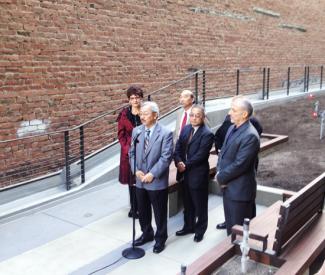
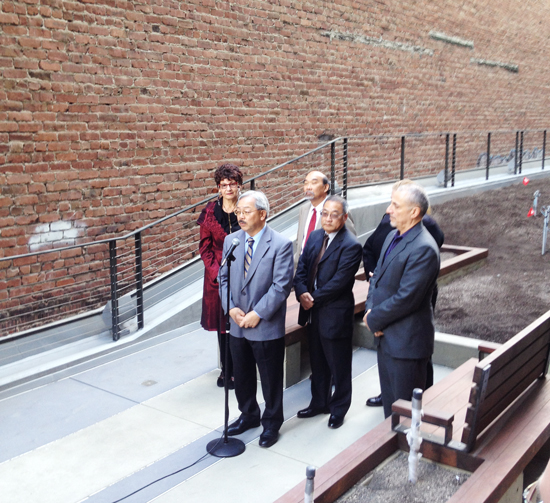
Mayor Ed Lee stood on the rooftop terrace between high brick walls of the soon-to-be-built Natoma Family Apartments, and in the distance, the buzz and clanks of nearby construction echoed his message of the day: Build, baby, build. 

Today (Wed/18) the mayor announced an executive directive for all San Francisco government departments with a hand in housing development to prioritize construction of affordable units, from completely below market rate (BMR) projects to those that have a mix of BMR and market rate units. 

The Department of Building Inspection, Mayor’s Office of Housing, Planning Department and others involved with approving development will all reorient their priorities towards getting new affordable housing built — a stark indicator of just how potent this issue has become after months of high-profile evictions and progressive organizing and demonstrations.

“It isn’t always on the private sector, we’ve got to have a stake in the action as well,” Lee told reporters gathered at the Natoma apartment building. 

“(San Francisco) is expensive,” he said, “but we don’t have to accept it. We can do something.”

With the tech-fueled housing crisis pricing out San Franciscans left and right, and Ellis Act evictions surging 170 percent in the last three years, the city is in dire need of housing help. Even the national media has picked up on San Francisco’s rising inequality, even if some local media outlets have been slower to react.  

But as progressives have noted before, you can’t simply build your way out of this crisis, as Lee acknowledged. His directive carries a promise to incentivize an emphasis on middle class housing, which has been particularly lacking in the housing now being built. 

“The other part of this directive is to also get the other departments to work with me and the private sector to build more housing in all the different spectrums, and middle class housing,” Lee said.  

New Housing Project at Natoma street

Mayor’s Office of Housing Director Olson Lee speaks to a reporter on the deck of a community garden at the new Natoma Family Apartments, which will open in January. 

City rules will also change to protect current housing stock. Now, when a loss of housing is proposed, it will need to go through the Planning Commission for a discretionary review hearing. The mayor also formed a working group of city department heads to make recommendations to the mayor on how to preserve and create new affordable rental stock in San Francisco.

“It isn’t always on the private sector, we’ve got to have a stake in the action as well,” Lee said.

The promise of more housing in the city almost sounds too good to be true. Will the mayor’s plans reverse San Francisco’s affordable housing crisis? 

Peter Cohen, co-director of the Council of Community Housing Organizations, said it sounded like a step in the right direction. “The proof’s in the pudding, of course,” Cohen told the Guardian. “It’s the kind of directive that I wish, honestly, would come out a year ago. The answer has been, let’s keep building and hope it fixes itself.”

By prioritizing affordable housing and mixed use housing, the mayor is using the leverage of government to get developers to do the right thing. “If developers are pushed to put more units they’ll do it,” Cohen said.

Let’s hope the new push from the mayor has come in time to stunt the crisis. Even at the Natoma property where he made the announcement, the need of San Franciscans for affordable housing was palpable.

The new Natoma affordable housing building has 60 units, and will open in January. How many San Franciscans applied to live there? 2,806. 

The Unconstitutional Truth about the Presidio

4


By John Farrell


OPINION When Congress established the Presidio Trust in 1996, it wanted to ensure its financial stability. Congress believed taxing private tenants impeded the Trust’s financial stability, so it enacted provisions within the Presidio Trust Act to ensure that tenants were tax-exempt. The only problem is that Congress doesn’t have the power to exempt tenants under the US Constitution.

In 1897, the State of California ceded to the United States exclusive jurisdiction on all lands held for military purposes, including the Presidio. Military installations are federal enclaves exempt from state authority. Per legal counsel of the State Board of Equalization, a “federal enclave” is a property over which the federal government holds exclusive jurisdiction.

In 1989, the federal government closed the Presidio as a military base. Since the Presidio is no longer for military use, the federal government transferred jurisdiction to the Golden Gate National Recreation Area (GGNRA) in 1994 for natural, historic, cultural, and recreational purposes.

Did this transfer to GGNRA end its tax-exempt status? Did this transfer negate the concept of “federal enclave” and “exclusive jurisdiction,” since the Presidio is no longer used for military purposes? Could the city now tax private beneficiaries? This issue has never been addressed.

The Presidio Trust was created by Congress in 1996 for a dual purpose: to rehabilitate and repurpose historic buildings and environmental resources, and operate as a vibrant public park independent of annual taxpayer funds.

In establishing the Trust, Congress’s concern was with the city’s potential assessment of property tax. In California, any private party that rents or uses space on government-owned property is subject to property tax.

In order to curtail the possible assessment of property tax, Congress enacted legislation signed into law by President Clinton on November 29, 1999. Public Law 106-113 (HR 3194) includes specific language providing that, “The Trust and all properties administered by the Trust and all interest created under leases, concessions, permits and other agreements associated with the properties shall be exempt from all taxes and special assessments of every kind in the State of California, and its political subdivisions, including the City and County San Francisco.”

Our City Attorney and Congressional representative have the opinion that all third party interests for private benefit under the Presidio Trust’s jurisdiction are exempted from taxes by the Presidio Trust Act.

This language confirms Congress’s intent to exempt private tenants from all forms of state and local property taxes. The only problem is that if Congress enacted the Presidio Trust Act to exempt third party beneficiaries, it did not have the authority per Article 1 Section 8 of the Constitution, which provides the Powers of US Congress. In other words, this part of the legislation was unconstitutional.

Because of this unconstitutional loophole, the city is losing at least $10 million annually in property tax and over $100 million since inception. This amount doesn’t include revenue loss from other taxes such as real estate transfer tax. Further, if the George Lucas plan for a Presidio museum is approved, the city will lose at least $8.1 million annually in property tax.

The city is losing an additional $12.5 million from the recent sale of Lucasfilm’s to Disney in 2012 (based on a 2.5 percent transfer tax on a conservative $500 million assessment). An ownership transfer includes a lease of 35 years or more. Lucasfilm had a 66-year lease at the Presidio transferred to Disney. Per the state Revenue and Taxation Code, this is a legal transfer and there is no rational why there is no transfer tax imposed.

The city has decided to adhere to the legislation by Congress to tax exempt tenants even though it is unconstitutional. But everyone should pay their fair share.  

John Farrell is a Realtor, former city budget analyst, and fifth generation San Franciscan.

Homework troubles

28

joe@sfbg.com

The San Francisco Board of Education approved a land swap with city government on Dec. 10, gifting San Francisco an empty lot that it will use to build new affordable housing. That’s 115 units of living space for low-income San Francisco renters, wrapped in a bow for the holidays.

The proposal was the brainchild of board members Hydra Mendoza-McDonnell and Sandra Lee Fewer, who worked on the measure with the Mayor’s Office of Housing for over two years. The district will trade a lot on 1950 Mission street and another on Connecticut Street in exchange for a property it currently rents from the city of San Francisco. The city will also pay SFUSD $4.5 million, according to district data.

The deal was the culmination of that work, which Fewer said was the right thing to do.

“Could we get more money from [selling] this property with a private developer? I’m sure. But would we get the value? No,” Fewer said at the meeting.

The original intent of the land swap was to provide affordable housing for the school district’s employees. Project proponents say school district workers are being priced out of San Francisco in droves. But the affordable housing project will be general use, with no specific provisions for teachers or other SFUSD workers.

teachersinSF Though the teachers’ union supports the land swap, United Educators of San Francisco President Dennis Kelly warned that teachers are in dire need.

“It’s more than an oversight, it’s an insult, felt very deeply, and very bitterly,” Kelly said at the podium. “Affordable housing will not house a single teacher, not a single one, because of where the dollar breaks are.”

The board has made various promises over the past decade to aid with teacher housing, all empty words, Kelly told the Guardian. There’s yet to be a solution from the school district or the board on finding sustainable housing for teachers.

The problem is a microcosm of one of San Francisco’s toughest challenges during this tech-fueled affordable housing crisis. Affordable housing helps the poor, and the rich certainly don’t need help staying in the city, but help for middle-income earners is hard to come by.


NEW RECRUIT

Research from education nonprofit ASCD shows most first-year teachers face three challenges: difficulty learning to manage classroom behavior, an overload of curriculum creation, and lack of school support. San Francisco’s new teachers face a fourth: finding a place to sleep at night.

Second-year SFUSD science teacher Kate Magary, 29, knows this all too well. Her first year on the job went from challenging to hellish as she looked for an affordable place to live.

Despite having a modestly salaried full-time job, she couldn’t afford a studio on her own. She eventually found a room for rent on Craigslist, but her noisy roommates made grading papers and writing curriculum a constant challenge. She started a new apartment hunt, but even that was like a full-time job.

“As a first-year teacher, it was awful,” Magary said. “I tried not to let it affect me too much at school, but the stress from home eventually made it with me to the classroom.”

She over-disciplined some kids, she said, and her patience was at the breaking point for most of the year. When teachers suffer, students suffer.

Magary is a science teacher at the Academy of Arts and Sciences, which is on the Ruth Asawa School of the Arts campus at Twin Peaks. Three-story homes and apartment buildings dot the hills along the road from Market Street on her drive to school, but Magary can’t afford them.

Instead, she eventually found a place on Treasure Island. A sixth-generation San Franciscan, Magary is happy to stay in what is still technically part of the city. But her lease is tenuous, and she anticipates having to move within the next few years. She’s not alone.

Out of SFUSD’s 3,284 teachers, 927 live outside of San Francisco, according to data from their union. That’s 28 percent of teachers living outside of the city, 3 percent higher than just last year. That number masks the depth of the problem.

New teachers who aren’t established in San Francisco bear the brunt of displacement. Half of all new teachers leave SFUSD in their first five years, according to data from the district. And 35 percent of teachers hired since July 1 live outside the city.

“A teacher might start in the district, live in the city, and move out,” said UESF spokesperson Matt Hardy. “The turnover is very high, particularly in newer schools.”

Teachers we talked to said there are problems for those who manage to stay in San Francisco as well. They sometimes sleep in unstable or unsafe housing, couchsurf, or sleep in their cars. In the morning they teach the city’s children.

It’s bad for teachers, but worse still, it’s bad for students. Recognizing this, federal, state and city government have all pitched in to try and find housing solutions for teachers.

Unfortunately for them, and for us, they’ve mostly failed.


OWNERSHIP FOR NONE

Art Agnos is most well known for being San Francisco’s former mayor. But after stepping down in the ’90s, he served in the Clinton Administration as the Department of Housing and Urban Development regional director throughout California, Arizona, Nevada, and Hawaii.

He was in charge of finding folks places to live.

The crisis for teacher housing was stark. At the time, Agnos was in charge of implementing Clinton’s housing program for teachers in San Francisco. The experiment? Build affordable housing units at Dianne Feinstein Elementary School on 25th Avenue exclusively for teachers.

The idea died in a sea of NIMBYism.

“The resistance came from the neighborhood who thought affordable housing for the teachers would diminish the value for their property and make traffic issues,” Agnos told the Guardian. “The Board of Education yielded to that NIMBYism and refused to pursue the deal, which was on the table.”

The federal push for teacher housing died, having created a home for just one teacher in San Francisco by the year 2000, and only 100 in California, according to news reports at the time.

California would follow suit with a less ambitious teacher housing program. The Teacher Next Door program offers assistance for teachers buying homes in San Francisco through the Mayor’s Office of Housing. We called the office to get statistics on its use, but as of press time it had not called back.

Among teachers, the program is mostly a joke.

“That’s the case with most teachers,” science teacher Tom Dallman of Ruth Asawa School of the Arts told the Guardian. “They roll their eyes when it comes to talk about buying a place in San Francisco.”

Median home prices in San Francisco skyrocketed past $1 million in June, a signal that for many teachers, homeownership in the city is a near impossibility.

Subsidized Below Market Rate housing is out of their reach too. San Francisco teachers make anywhere between $40,000 and $80,000 a year, placing them just above the salary as a single person to qualify for affordable housing.

“The struggle is about middle income people who do not qualify for mortgages or newly develop projects, because the market is astronomically high,” Agnos said. And that’s leading to a teacher migration, numbers from the UESF show.

“If they have to live in Oakland, they’ll work in Oakland,” Agnos said. “Their talent will follow them.”

The dream of homeownership for San Francisco’s education workforce is a thing of the past, Susan Solomon, vice president of the UESF told us.

“Maybe long, long ago this was a possibility,” she said, “way back when.”


FEW SOLUTIONS

Fewer was ecstatic to see the land swap deal go through, and excited to see affordable housing for San Francisco families.

But when asked what she’ll do to tackle the struggle to find affordable housing for teachers, she said that the upcoming contract negotiations may be the time to revisit a new plan.

“We’ve asked the unions to give us a poll for a long time,” she said. She wants to know what the teachers want. Do they want to live in housing together? Have rental subsidies? Housing assistance? What are their needs?

Sup. Jane Kim, a former school board member, said there’s a split of preference in the union. Should affordable housing solutions be given to teachers in their first five years in SFUSD, to encourage them to stay in San Francisco, or to veteran teachers?

“There’s a limited amount of funding,” Kim told us. And when the district lucks itself into extra funding, it’s hard not to spend it in the classroom. “How do you invest the limited dollars that you have?” she asked.

Santa Clara’s school district built its own affordable housing, and spent $6 million in 2005 to construct 40 units for its workforce. Three years later, they built 30 more units. Teachers there initially paid $1,075 a month in rent for a two-bedroom apartment, according to The New York Times.

“You cannot be an education advocate without being a housing advocate,” Fewer said. But housing help has been largely elusive for SFUSD employees.

“Stubbornness is keeping me in the city,” Magary said. But without some help, that may not be enough.

Fieldwork

4

marke@sfbg.com

After two more hours of hiking, we stop in a dry creek. One of the younger men enlists help pulling large cactus spines from one of his legs. We sit in a circle sharing food. The tastes link us to loved ones and Oaxaca…

After we have hiked again through blisters for many miles and I have shared all my ibuprofren with the others, we stop to rest. We fall asleep, using torn-open plastic trash bags as blankets. Our coyote leaves to talk to his contact on a nearby Native American reservation about giving us a ride past the second boarder checkpoint to Phoenix….

Suddenly, our guide runs back, speaking quickly in Triqui. Two Border Patrol agents — one black and one white — appear running through the trees, jump down in our creek bed, and point guns at us.

— Seth M. Holmes, Fresh Fruit, Broken Bodies

According to the US Public Health Service, there are, on average, an estimated 3.5 million migrant farmworkers in the United States, the majority of whom are undocumented immigrants. At harvest season, most of them perform the backbreaking work of picking our fruits and vegetables for an average $12,500 annually; at other times, they share slum-like apartments or live out of cars looking for odd jobs — 68 percent of them wondering if they should return home to Mexico and risk another border crossing to the US when picking time rolls around again. Only 5 percent of migrant workers have health insurance, and what happens to the rest if they get injured or fall ill doing the work the rest of us won’t is an eye-opening American tragedy.

To many Americans, this cheap, legally and socially vulnerable population is a faceless brown mass in the fields somewhere, maybe receiving a noble thought at Cesar Chavez Day or inducing the occasional twinge of guilt in the produce aisle, if thought of at all. But a provocative, important new book by UC Berkeley Assistant Professor of Public Health and Medical Anthropology Seth M. Holmes, Fresh Fruit, Broken Bodies: Migrant Farmworkers in the United States (University of California Press), which is picking up awards and has been featured on mainstream news outlets, is helping to re-personalize migrant farmworkers and move their health care situation into the media spotlight.

As the US finally addresses the facts that it spends the most money on health care for the worst outcomes, that a huge chunk of its population has no health care at all (and is severely underpaid for its work), and that we’re dependent on undocumented immigrants to harvest our produce and keep food costs down, we’re only just starting to realize the irony in giving the people who devastate their bodies to provide our healthiest foods perhaps the lousiest health care deal of all.


COMPLEX VOICES

Part heart-pounding adventure tale, part deep ethnograhic study, part urgent plea for reform, Fresh Fruit starts off with Holmes embedded in an ill-fated group of border-crossers from the mountains of Oaxaca: he gets arrested, they get deported after a harrowing stay in a detention center. Holmes then writes about his 18 months spent picking fruit alongside hundreds of others at a large family-owned farm in Skagit Valley, Wash., living in a closet with a dozen farmworkers in a rundown apartment while they look for work on the off-season, returning to Mexico to spend time with workers and their families, and shadowing the medical professionals in the publicly and privately funded clinics that serve migrant populations. Throughout, Holmes saw people “give premature birth, develop injured knees and backs, suffer from extreme stress, experience symptoms of pesticide poisoning, and even have farm trucks run over and crush their legs,” as he told Farmworker Justice magazine.

Holmes, a medical doctor as well as a doctor of anthropology — the book resulted from his thesis work — brings an enlightening complexity to the issue of migrant workers. (Including the label “migrant worker” itself, which, he notes piercingly at the end of the book, has been ossified with classist and racial overtones. If this group of people were flying over every summer from Europe or Hong Kong to secure investments on Wall Street, they would be called “international businesspeople.”)

He’s especially concerned not just with the grueling minutae of trying to receive treatment for the aches and pains that come with stooping to pick strawberries 12 hours a day, struggling to meet ambitious quotas in order to get paid very little, but also the larger, physically devastating effects of the structural violence visited upon a whole population by neoliberal economic policies that continue to widen the global income gap and entrench the wealthy in power. His “participant observation” method of studying migrant farmworkers means he writes about his own experiences in the field, and he brings his sophisticated anthropological knowledge to bear on the way contemporary society ensures that migrant farmworkers stay on the bottom rung of the economic ladder, building on the work of Pierre Bordieu, Philippe Bourgois, and others who’ve studied power relationships and structural violence in terms of workers’ health.

But, although there are scholarly footnotes and personal interjections, Holmes avoids an icky “anthropological tourism” vibe by providing the workers themselves with room to tell their histories, talk about their bodies, and react to the way they’re treated. People like Abelino, who falls victim to a series of misunderstandings over his severely injured knee, or Crescencio, who suffers acute headaches whenever he’s called racist names or ordered around degradingly, but is labeled a potential domestic abuser by one caregiver and resorts to drinking up to 24 beers per night to soothe his pain. We also hear from Marcelina, who talks to a Skagit Valley community gathering about low wages and high quotas.

And Holmes lets the owners and operators on all levels of Skagit’s Tanaka Brothers Farm — a pseudonym to protect his sources — speak as well, about the need for cheap labor in an increasingly competitive global agribusiness environment, among other concerns. (One especially interesting tidbit: organic distributors pressured Tanaka Brothers Farms to sign a machine-pick contract, which relegates farmworkers to the pesticide-ridden fields, despite the growing market for organic produce.) The Japanese-descended Tanaka family is deeply embedded in the Skagit Valley community, with roots stretching back before the Japanese internment period. The farm has seen different waves of migrant workers from poor white to Asian to Mexican. The Valley community itself has a fascinating relationship with the migrant community, emerging from it while reacting to it, developing its own social hierarchy as each generation “graduates” from farmworker to resident.


ANOTHER GENERATION

A lot has changed from Chavez’s day. For one thing, the previous generation of field workers, mostly from Guadalajara and northern Mexico or from Central America, has gained a toehold on American society — like the Asian workers that preceded them, many Hispanic workers’ children, placed in American schools, have grown up, providing their parents with a path to citizenship or work visas that allow them access to better jobs.

Today, a lot of workers are not mestizo Mexican, but of indigenous Mixtec descent, from increasingly violent mountain villages of Oaxaca in southern Mexico like San Miguel and San Pedro. Bloody land disputes, ethnic tension, the collapse of the local agriculture market that was exacerbated by the North American Free Trade Agreement in the 1990s and continued through the recent global recession, and the rowdy and malevolent presence of US-funded anti-drug military forces (strange since no major drug cartels operate there) have isolated this area, forcing its men, women, and children to look for work in America.

Triqui, not Spanish, is their native language — just one of the major hurdles when it comes to delivering healthcare to this population. Another hurdle comes with the specific cultural record of Triqui and general Mexican healthcare. Many Triqui workers rely on native healers, even in American farmworker camps, whose methods of consulting cards and drawing evil spirits from bodies using oils surely provide some psychosomatic respite. But reliance on native healers — out of a combination of tradition, availability, and fear of discovery or of health institutions in general — often prevents workers with deeper problems from receiving a wider range of appropriate treatments. Self-medication through alcohol is common (Holmes observed no drug use), and in one case a man named Bernardo took to the habit mashing his abdomen with soda bottles to ease a chronic stomache ache.

The migratory nature of these workers — and their shifting relationship to the law — all but insures disruptions in preventative and prescriptive care, lack of access to medications, frustratingly spotty medical records, and the inability to form a valuable personal bond with a trusted physician. But the major hurdle is that the system put in place by the government to serve migrant populations hasn’t been revisited since 1962, when a wave of media concern spotlighted the plight of migrant workers — most of whom, at that time, were white Oakies descended from the great Dustbowl diaspora of the ’30s and ’40s. The system has been only slightly adapted and enlarged since then, with dozens of clinics and organizations competing for limited grants, and nonprofits charging as little as they can (often still a steep fee on a farmworkers’ wage).

The picture Holmes paints of the clinics he visits and the doctors, nurses, and caseworkers he encounters is a mostly warm one — most health workers are hard-working and well-intentioned, stymied by cultural and linguistic differences, lack of funds and proper medical records, and racist attitudes from the surrounding communities. Some are prone to misinterpretation, and there are a couple outbursts of frustration that borders on stereotyping.

Still, most migrant worker health care providers are dedicated to their patients’ welfare. As one doctor, a mountaineer who serves the Tanaka Brothers Farm workers, put it: “It’s a very difficult problem. We have a bad situation where citizens cannot really afford health care. And the migrant workers, I truly believe they should have at least the same access as the others. I mean, this work that they are doing is something that nobody else is willing to do. That’s the truth. That’s probably the only reason why we are able to go to the supermarket and buy fruit for a fair price. So this is a group of people that really deserves our attention.”

That group will most likely be left out of the Affordable Care Act’s initial implementation, with possible implications for other, growing fields of migrant work, like software coding or childcare. Holmes’ book will hopefully inspire other investigations into this critical area of the nation’s health care gap — and concerted action to bridge it.

School gaze

0

cheryl@sfbg.com

FILM At Berkeley, the latest documentary from the great Frederick Wiseman, runs 244 minutes — a time commitment intimidating enough to deter any casual viewer. But viewers intrigued by Wiseman’s long tradition of filming institutions (a small sampling: 1968’s High School; 1973’s Juvenile Court; 1985’s Racetrack; 2011’s Crazy Horse — the latter about a Parisian nude-dancing establishment) with fly-on-the-wall curiosity will want to carve out an afternoon for At Berkeley, as will those interested in 21st century educational issues, California’s financial crisis, and the care and maintenance of UC Berkeley’s free-spirited image, among other topics.

UC Berkeley students and grads also seem like a built-in audience, which means the film’s local screenings are likely to be more populated than they would be elsewhere. Folks who attended while Wiseman was filming (he shot 250 hours of footage over 12 weeks in what appears to be mid- to late-2011) might even catch a glimpse of themselves in crowd scenes and shots of casual moments on campus, which comprise the smallest portion of At Berkeley‘s divided interests. But the local-color moments do much to flesh out what’s not seen in the classroom and administrative-meeting sequences: the fading-hippie glow of Telegraph Avenue; two men with impressive yo-yo skills; a student tussling with his bicycle; a couple napping on a grassy expanse.

http://www.youtube.com/watch?v=3L2_yLBrQsM

We’re also shown what goes into the maintenance of that postcard-perfect campus. Berkeley’s landscaping starts looking especially impressive when — during a retreat of school bigwigs that Wiseman had apparent free rein to shoot — one administrator points out that budget cuts mean the school employs just one person to mow all of its lawns. “Well, he’s doing a good job!” interjects Robert J. Birgeneau, chancellor of the school 2004-2013. At the time of filming, UC Berkeley was weathering a series of painful fee increases, staff furloughs and layoffs, and widespread budget cutbacks, with Birgeneau serving as its pragmatic, stern-yet-sympathetic eye of the storm.

Birgeneau, like everyone else in the film (including probably the most recognizable figure: former Clinton cabinet member Robert Reich, now a Berkeley prof), is never identified by name. At first, this feels disorienting; most docs strive to hook the viewer with first-act exposition, but At Berkeley simply plunges in with a woman (a teacher? a student?) regaling (a class? an extracurricular club?) with a myth about Berkeley’s origins (spoiler alert: it wasn’t founded by gamblers) that leads into a broader rumination on what the school represents. “A sense of imagination, of diversity,” she says. “An ideal.”

Before long, it’s obvious that we don’t need to know the back stories of everyone who appears in the film. This portrait of UC Berkeley — as a complex place, not without unrest, but also not without spontaneous a capella performances — emerges with all of its subjects sharing equal footing, their experiences and points of view presented with equal interest. Some of the most compelling scenes take place in classrooms, with remarkably articulate students (though, yes, Wiseman’s camera does catch a few looking sleepy and bored) discussing subjects as wildly diverse as poverty in America, advancements in robotics, Thoreau, and racism. There are also fascinating snippets of lectures, including an amusing, anecdote-heavy treatise from Reich on the importance of self-evaluation.

“The film has to work on both a literal level and a metaphoric, or abstract, level,” Wiseman writes in his At Berkeley director’s note. Filmgoers grasping for a through line will pick up on the financial stress that permeates every corner of the school. A student who describes herself as middle-class weeps at the financial burden she’s imposing on her parents. A professor advises a pair of eager students that their engineering dreams will require raising funds from government entities. Another professor expresses her concerns that increasing student fees will encourage new grads to seek out big paychecks to pay off their debts, rather than lower-paying jobs that might be more socially conscious.

The unrest percolating throughout the film culminates in coverage of a late-2011 Occupy Cal demonstration, in which the main campus library is overtaken by passionate protestors. The focus shifts away from the chanting students to UC Berkeley’s behind-the-scenes response, or rather, the phone calls and meetings that decide what the response should be (a “generic acknowledgement” is met by jeers from the protestors; a heavy police presence is suggested, but not visually documented).

In the library, a young man grasps the bullhorn and advises his fellow students that they need to organize their guiding principles more efficiently — an observation echoed later by Birgeneau. Unlike the headline-grabbing demonstrations that fill UC Berkeley’s storied past — its rabble-rousing legacy gets surprisingly few mentions here — there’s no underlying philosophy, he points out. A few moments later, we’re in a classroom, listening to students grumble about how the protests disrupted their midterms.

As its fourth hour draws to a close, At Berkeley‘s final sequence leaps from a discussion of one of John Donne’s sexier poems into a science class discussing interplanetary space travel. Sure, it’s possible, the affably geeky instructor says — but the practical concerns (like building a vessel with incredibly robust power sources that could sustain life for generations upon generations) tend to get in the way of one’s brilliant ideas and imagination. Here Wiseman’s affection for metaphor is made abundantly clear. *


AT BERKELEY opens Fri/6 in Bay Area theaters.

Last stand at the Bulb

8

news@sfbg.com

As the squatter residents of Albany Bulb make one final push against being evicted from their home in a former landfill, the city of Albany is pushing forward with its plan to change the untamed space into a waterfront state park (see “Battle of the bulb,” Sept. 24).

The first signs of the transition came on Nov. 22, when a temporary shelter was set up for residents whose camps would be cleared. The shelter came after a disappointing week in court left the 50 to 60 residents of the Bulb without the stay-away order their advocates had sought, which they intended to use to keep the city and police at bay during the winter.

On Nov. 18, the residents and their attorneys received word that the stay-away order was denied by U.S. District Judge Charles Breyer. After the decision and an Albany City Council meeting later that evening, campers and area activists set up a permanent settlement against the eviction after marching through the streets of Albany.

Barricades made of rocks were set up at the Bulb to resist police getting into the camps. However, the rain that followed for a few nights inhibited their efforts, according to activists involved in the action. And the police, using a backhoe, destroyed the rock barricades. The city of Albany, according to a press release, is calling the transition “ACT” which includes, “Assistance to homeless, including housing-centered outreach, transitional services, support, and shelter; Cleanup and maintenance of the Bulb; and Transfer of the Bulb to McLaughlin Eastshore State Park.” “As part of the City Council’s Strategic Planning Process conducted in 2012, the City Council identified key goals for the City,” Albany City Clerk Nicole Almaguer wrote in an email to the Guardian. “One of which is to ‘Maximize Park and Open Space’ including developing a plan to transition the Bulb into Eastshore State Park, and to improve accessibility for general public use of all of the Albany Bulb as a waterfront park.” Almaguer stated that part of the plan included a temporary shelter and support services, which started this summer and is headed by Berkeley Food and Housing Project. The BFHP also provides case management for the Albany campers interested in securing housing outside of the Bulb.

While the city has provided a housing subsidy program to help Bulb residents with rent, a portion of it will also need to be covered by the tenant. Many of the Bulb residents are only supported through government programs such as SSI, and cannot afford housing costs.

In addition, most residents, and their attorney Osha Neumann, who is also a longtime contributor to art at the Bulb, say that the city does not have any affordable housing in which the residents can transition into. Managed by Operation Dignity, a nonprofit designed to help homeless veterans, the transitional shelter is set up by Golden Gate Fields racetrack near the entryway into the Bulb.

“I was out… talking to people and was overwhelmed by the fragility and vulnerability of many of them, as well as their strengths,” Neumann said of the residents in an email to the Guardian. “The portables are awful. You look at the Bulb and all the life and beauty that’s out there, and then you look at those anonymous utilitarian boxes, and really you expect it all to be stuffed into those containers? 22 men in one, eight women in the other? It’s all really appalling.” According to the shelter’s posted rules, the doors for the shelter open at 5:30pm and close at 8:30am. Showers may be taken 8:30-9:30pm, and breakfast is served 7-8am. The sexes are separated, and pets must stay in kennels outside of the shelter. There are also no “in and out privileges” and if a person doesn’t return by 8pm they are not admitted into the shelter. No one stayed in the shelter the first three nights it was available, according to city reports. Amber Lynn Whitson, a Bulb resident, said that access to the shelter is difficult for people, and doesn’t address the need for people with disabilities to access a bed during the day. “At least two individuals were turned away at the door to the shelter, due to their names not being on ‘the list’, she said in an email. “Both were told that they could stay in the shelter, despite their names not currently being on ‘the list,’ but only after getting ‘a voucher’ from BFHP.” The transitional shelter came to the residents’ lives after Breyer rejected the campers’ request for an injunction to block the eviction with a temporary restraining order. A lawsuit also filed by the residents against the eviction remains open, according to Neumann.

Based on information obtained in court documents, $570,000 was allocated to remove the Bulb residents, based on a Albany City Council decision made on Oct. 21, with $171,000 spent on the cleanup of the campsites and the remainder spent on the two portable trailers with bunk beds to serve as transitional housing for six months. As of now, the shelter’s efficacy to get the campers off the Bulb, as well as the residents’ efforts to resist the transition, remains unclear.


BULB ART TO BE CLEARED

The Albany Bulb, a wild shoreline space near Golden Gate Fields and a former landfill for BART construction and other industries, is well known for its art. Now that a transitional shelter looms over the entrance as part of the city’s plan to remove the residents from the Bulb, campers, activists, and artists came together this past weekend for a festival of resistance against the eviction.

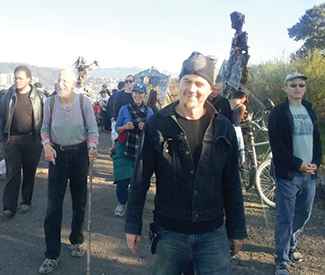
The rubble and sculpture filled space will soon be transformed into part of the Eastshore State Park system. The event drew around 60 people, according to resident Amber Whitson. She led an art walk on Nov. 29, giving the history of the art at the Bulb and explaining why it’s important to preserve it as a cultural resource.

“Some things should remain sacred, and Sniff paintings are out on the Albany Bulb,” she said, referencing works by a group of Oakland-based artists.

Other prominent Bulb artists, such as Osha Neumann and Jason DeAntonis, who built massive sculptures made of found wood and parts along the shoreline, were on hand to speak about their contributions and the personal significance the Bulb holds for them.

While residents have come and gone throughout the years, the art has remained a constant draw. Graffiti artists practice their craft, and sculptors work undisturbed, using debris that is scattered around. Even some of the campers’ shelters, makeshift shanties of concrete, wood and tarp, could be considered artistic.

Once the transition of the Bulb from untamed outcrop to a state park of well-kept trails is further along, the city plans to remove most of the art currently installed there.

The campers and activists organized the art walk as part of a three-day festival of trainings, workshops, and music, to enjoy the space, but also to educate residents and others about how the space could be kept in its current state. “I know that organizing is continuing, and again, the shape it takes will depend on how the city goes about the planned evictions,” said Neumann in an email to the Guardian.

For now though, the art stands, in between garbage, rubble, trees and shrubs, a constant reminder that artists and Bulb dwellers are still around.

Single-payer is the cure

168

EDITORIAL We’re sorry to see all the problems surrounding President Obama’s Affordable Care Act, which has made some important improvements to the country’s healthcare system, such as helping those with preexisting conditions get coverage and preventing those who do have coverage from being arbitrarily dropped. Given a break from being exploited by the insurance industry, there’s no way this country’s citizens will want to go back to how things were.

But the convoluted Obamacare system was a foreseeable mess, one that is now causing unnecessary anxiety across the country and bringing right-wing extremists back from the political dead as the mid-term elections approach. Republicans may not be correct when they trumpet the old system as the best on the world, but their criticisms of Obamacare are already finding increasing resonance, and we haven’t even gotten to the point yet where it will be illegal not to have health insurance.

It doesn’t make sense to leave something as important as our healthcare system in the hands of for-profit corporations with the incentive to drive up costs. The New York Times has done some excellent work this year showing how US residents pay astronomically more for every procedure and drug than citizens of other countries. We should have all been suspicious when the insurance industry cooperated with enacting Obamacare and helped preclude a public option, leaving us with the insurance exchanges that have been so problematic.

There’s really only one remedy to this country’s ailing healthcare system, which we said at the time that Obamacare was being passed and we’ll repeat again now that there’s even more evidence supporting our position: We need socialized medicine in this country.

Conservatives who read that assertion are probably shaking their heads in disbelief right now, believing that Obamacare’s shortcomings prove that government can’t run a healthcare system. And the inexcusable technical problems with the federal healthcare.gov website and its related state exchanges unfortunately reinforce that view. But they’re wrong, and the single-payer advocates have been right all along, noting among other things that the government runs Medicare well and with far lower overhead than insurance companies.

The problems with Obamacare are similar to the problems it sought to address, and they stem from the fact that an insurance-based model is a terrible way to run a healthcare system. It’s too expensive and does too little to hold down medical costs, it’s confusing and stressful to people who are already wrestling with disease or injury, and it unjustly creates different standards of care for the rich and poor.

Socialized medicine — or a single-payer system, administered by either government or a private contractor, but paid for automatically through our taxes — works well in just about every other industrialized country, most of which are far less expensive and yet have better healthcare outcomes. A single-payer system could utilize the existing healthcare infrastructure, it would simply change how we pay for it and bring much-needed price controls and regulatory oversight.

Think about it: Healthcare coverage is something that every citizen needs in equal measure. We all need the right to see a doctor when we’re sick or injured. None of us should have to gamble with our health by weighing the cost of various monthly insurance premiums against our likelihood of ending up in the hospital. And it really shouldn’t be up to struggling small businesses to pay expensive health insurance premiums for their employees, even though that’s really the only way to make the fatally flawed insurance model work.

There’s infighting among congressional Democrats now about whether to roll back parts of Obamacare, such as hospital subsidies and whether to let people remain on minimal catastrophic coverage plans, and all that will do it upset the careful balance the plan tried to achieve to hold down long-term costs.

For now, we need to apply whatever bandages needed to stop the bleeding and limp the flawed Obamacare along for a little while. But we also need to immediately start the difficult work of transitioning to a socialized medicine system.


SF General will lose much of its federal subsidy under Obamacare

137

As President Obama’s Affordable Care Act is phased in over the next couple years, San Francisco General Hospital will lose at least 25 percent of the $123 million it receives from the federal government to offset costs of caring for the uninsured, but hopefully that will be offset by its expansion of those who will have health insurance.

General Hospital receives those funds for being a so-called “safety-net hospital,” a place where those without insurance can still get quality healthcare. Even though the need for such safety nets is supposed to diminish under Obamacare, SF General will remain a critically important safety-net hospital.

Many San Franciscans – including non-U.S. citizens who won’t qualify for coverage under the Affordable Care Act, as well as homeless individuals – will continue to rely on the hospital when in need of medical care.

Yet here and nationwide, concern is brewing about whether funding for safety-net hospitals could be impacted if enrollment in the new state health exchanges doesn’t reach anticipated levels.

“The financial question every state is asking is: What are the newly eligible patients going to do? What plan will they enroll in? Will they enroll?” Greg Wagner, CFO of the San Francisco Department of Public Health, told the Guardian, referring to the health insurance marketplaces created under the Affordable Care Act.

Most safety-net hospitals in the country are bolstered with federal subsidies, and are especially reliant on funds known as disproportionate share hospital payments, or DSH. However, those subsidies are about to be slashed with machete-like strokes.

All told, as much as $18 billion nationwide could be siphoned away from safety-net hospitals by 2020. Compounding that is another $22 billion that could be cut from Medicare subsidies, depending on the number of insured.

There’s an expectation that the looming safety-net budget cut will be offset by the burgeoning population of insured residents who would flock to state health exchanges. It makes sense: Instead of absorbing the entire cost of an uninsured patient, hospitals would be getting money from newly active insurance policies, and no money would be lost.

The New York Times recently ran a story detailing how low-income patients in Georgia may be put in a precarious position under federal healthcare reform because safety-net hospitals in Georgia might not be able to make up for lost funding once DSH payments evaporate.

California isn’t likely to experience this problem to the same degree, Wagner said, because the state chose to expand Medi-Cal, the state version of Medicaid, to include all low-income residents and not just those who previously qualified under a narrow set of criteria. Georgia had the same option to expand, but chose to keep its Medicaid qualifications in place, like many states led by Republicans looking to tweak President Obama.

As things stand, enrollment in Covered California – the state’s health insurance marketplace under the Affordable Care Act – remains low. Until enrollment closes at the end of March, it’s an open question whether it will reach the necessary levels to make up for pending cutbacks.

So far, 59,000 Californians had completed applications and enrolled in health insurance plans within the new marketplace as of Nov. 13. That’s a drop in the bucket, considering that 2.3 million are eventually expected to enroll. According to state data, 203,904 applications had been started online (reflecting an estimated 370,000 individuals). In addition to those applying for Covered California plans, another 72,000 people were determined eligible for Medi-Cal. 

“SF General operates on a huge amount of federal money,” Wagner explained. “Some comes directly from the federal government, and some comes from DSH.” He said the hospital received $123 million in DSH funds last year, “and not all of that will go away” once cuts go into effect.

“Healthy SF will still be around after March 31,” said Wagner. “We’re still retaining the program for anybody not eligible for Medi-Cal, and through Healthy SF those people can still access primary healthcare.”
He even said that under extreme circumstances, like the delivery of a child, for instance, some undocumented immigrants will have the opportunity to enroll in Medi-Cal. 
And it’s not all gloom-and-doom on the subsidy front, either. There is a safety-valve for the safety-net hospitals: If everyone who is expected to enroll in Covered California actually does so, the funding will be available without the need to rely on federal aid. 
But in order to achieve that idyllic plateau, a serious push is needed on the enrollment level. Granted, those enrollment figures should rise. But what if they don’t? 
“If people don’t enroll in the new programs, it will be a big problem,” said Wagner. “If we have a significantly lower enrollment number than we initially predicted, we will have some major financial issues. There’s still some uncertainty.”

He added, “We’ll still provide care for the uninsured at SF General. The money will decrease, but it won’t disappear. By no means will all of the money go away. The hope is that the newly enrolled will offset the decreasing number of uninsured, then the federal government could take the DSH payment and redirect it to the providers.” 

That being said, “we still have lots of optimism moving forward,” Wagner said. “We think people will enroll.”

[Correction: We corrected the amount of the reduction from 50 percent down to 25 percent].


Small number enroll in health insurance exchange

Covered California, the state-run health insurance exchange established under the Affordable Care Act, released its first set of enrollment data today (Wed/13), providing an initial glimpse of how the program commonly known as Obamacare is working in practice in California.

From Oct. 1 until yesterday (Tue/12), a total of 59,000 enrollees completed applications and enrolled in health insurance plans under Covered California.

As a report in the Sacramento Bee pointed out, that number pales in comparison with the estimated 2.3 million Californians who are expected to enroll for coverage by 2017.

Still, a larger number have begun the process, which entails submitting an application and clearing eligibility criteria before selecting a plan and enrolling. Californians initiated a total of 203,904 applications online, according to state data, reflecting an estimated 370,000 individuals.

Of those, 85,960 individuals were determined to be eligible for Covered California, the state-run marketplace that offers coverage at more affordable rates than conventional insurance plans. Another 72,000 were determined to be eligible for Medi-Cal, a program for low-income residents that was expanded under the Affordable Care Act.  

Despite the low initial enrollment, representatives from the Greenlining Institute and the California Pan-Ethnic Health Network welcomed the initial figures as a positive development.

“It’s a great start – and that’s what it is, it’s a start,” said Ellen Wu, executive director of the California Pan-Ethnic Health Network. “There was this pent-up demand,” she added. “The majority of people who enrolled are people who don’t qualify for government subsidies but are seeking health insurance because they’ve been turned away or charged an arm and a leg” when seeking coverage elsewhere. “What you’re going to see, come November and December, is people for whom it might not be top-of-mind priority.”

Covered California began accepting applicants on Oct. 1, but the program will not take effect until Jan. 1, 2014. Californians who are eligible for coverage will have until the end of March to enroll.

Carla Saporta, Health Policy Director for the Greenlining Institute, emphasized the challenge of reaching out to diverse communities in multiple languages to inform people of their options under the new program. 

“I’m disappointed that they have yet to release enrollment data by demographic,” she noted. “I am particularly interested in knowing the breakdown by region, race and primary language because knowing this information will help with targeting outreach efforts.”

According to a report released by the Department of Health and Human Services, California has spent $94 million on outreach to help community groups, local health clinics, and labor unions to make residents aware of their options and sign them up for coverage. 

Calvin Trillin: JP Morgan cops a $13 billion plea

1

They touted securities they knew were trash.

The government’s case plainly shows

They’re willing to profit from bucket-shop scams,

Although they wear much nicer clothes.

Calvin Trillin: Deadline Poet: The Nation

Driving us crazy

209

STREET FIGHT Parking reform is one of the most radically important elements of making San Francisco a more livable and equitable city.

In this geographically constrained city, parking consumes millions of square feet of space that could be used for housing, especially affordable housing in secondary units. Curbside parking in the public right of way impedes plans to make Muni more reliable for hundreds of thousands of transit riders. Parking in new housing and commercial developments generates more car trips on our already congested and polluted streets, slowing Muni further while bullying bicyclists and menacing pedestrians.

Fundamentally, parking is a privatization of the commons, whereby driveway curb cuts and on-street parking hog the public right-of-way in the name of private car storage. The greater public good — such as reducing greenhouse gas emissions and enhancing public safety through bike lanes, wider sidewalks, public green spaces, and transit-first policies — is subsumed to narrow private interests. These are among the many reasons why, for over a decade, parking reform has been a key part of progressive transportation policy.

Yet lately, it has been disappointing to watch progressives, especially on the Board of Supervisors, retreat from that stance. In Potrero Hill and North Mission, a vitriolic reaction has slowed rollout of nationally acclaimed SF Park, which raises revenue for Muni and is a proven sustainable transportation tool. Yet there are murmurings that some progressive supervisors might seek an intervention and placate motorists who believe the public right-of-way is theirs.

On Polk Street, some loud merchants and residents went ballistic when the city and bicycle advocates proposed removing curbside parking to accommodate bicycles. The city, weary of Tea Party-like mobs, ran the other way, tail-between-legs. Progressive supervisors seem to have gone along with the cave-in.

Along Geary, planning for a desperately needed bus rapid transit project drags on. And on. And on. And on. The lollygagging includes bending over backward to placate some drivers who might be slightly inconvenienced by improvements for 50,000 daily bus riders.

One thing that is remarkably disturbing about this backpedaling is that, in an ostensibly progressive city by many measures (civil rights, tolerance, environmentalism), the counterattack is steeped in conservative ideology. That is, conservatives believe that government should require ample and cheap parking, whether in new housing or on the street. This conservative ideology, shared by many car drivers and merchants — and even by some self-professed progressives — is steeped in the idea people still need cars. This despite the evidence that cars are extremely destructive to our environment, socially inequitable, and only seem essential because of poor planning decisions, not human nature.

Progressive backpedaling has become more confusing with the recent debate over 8 Washington, defeated at the polls Nov. 5, and on the same day of a convoluted Board of Supervisors hearing on a proposed car-free housing development at 1050 Valencia. Both of these projects highlight the muddled inconsistency emerging among progressive supervisors.

Enough has been written about how 8 Washington was a symbolic battle for the soul of San Francisco. But during the campaigns, the lack of attention to parking was curious. Notably, progressive-leaning transportation organizations like the San Francisco Bicycle Coalition, Walk SF, and Transform sat out the election despite the project’s excessive 327 underground parking spaces, which violated hard-fought progressive planning efforts to make the waterfront livable. The Council of Community Housing Organizations also sat it out, despite benefitting from the progressive parking policies that 8 Washington violated. It appears that despite their transit-first rhetoric, progressives made a tactical calculation to keep parking out of the campaign.

The progressive victory came with a Faustian bargain which involved ignoring parking. To ensure 8 Washington was defeated, conservative voters were folded into the opposition. Groups like Eastern Neighborhoods United Front (ENUF), the Coalition for San Francisco Neighborhoods, and the Republican Party came out against 8 Washington and yet, ironically, all are opponents of progressive parking reform.

Moving forward, whatever happens at the 8 Washington site must include progressive parking policies. Don’t expect this from the unimaginative leadership at the Port, which speciously demanded the excessive parking. Don’t expect it from the developer, who steadfastly insists that the rich must have parking. And don’t expect conservatives to latch on to a waterfront scheme that is both publicly accessible and genuinely transit-oriented. It is progressives who will need to muster political will for a zero-parking project at the waterfront and set the tone for consensus among the other factions in the waterfront debate.

Meanwhile on the same day 8 Washington went down, 1050 Valencia barely made it out of a tortuous Board of Supervisors hearing in which progressives seemed to be the antagonists. As the first car-free market-rate housing proposal on Valencia under progressive parking reforms, this 12-unit mixed use building seemed an obvious win for progressives. It would be a walkable, bicycle-friendly urban infill mixed-use project with on-site affordable housing, all of which the city needs more of.

Yet since 2010, when the project first went to the Planning Commission, conservative rhetoric has been deployed to stop the project. Significantly, the Liberty Hill Neighborhood Association objected to the transit-oriented characterization of the project. It claimed that the 14 Mission and 49 Mission/Van Ness are filthy, crime-ridden, and unreliable and so 1050 Valencia must have parking.

Unlike progressives, who also decry shortfalls with Muni but propose solutions, the Liberty Hill opponents offered only secession from public transit, insisting on driving in secure armored cocoons instead of addressing Muni reliability, and they also expect free or cheap parking in the public right of way.

You would think that progressives at the Board of Supervisors would see through this thinly veiled bigotry against the 14 and 49 buses. But instead, four self-professed progressive supervisors — John Avalos, David Campos, Jane Kim, and Eric Mar — voted against 1050 Valencia.

They may argue that they were more concerned about the neighboring Marsh Theater, which has concerns about construction noise (and also parking). The noise issue can be worked out, and why the progressive supervisors did not work this out in advance is a mystery. But if you watch the hearing closely, the Marsh basically opposed the development — period — and thus a modest car-free development that included affordable housing at an appropriate location. And so did four progressive supervisors. It’s baffling.

At the end of the day, 1050 Valencia moved forward, barely. But it can still be stopped at the upcoming Board of Appeals hearing. Meanwhile, it’s time for progressives to make a frontal response to the Muni-bashing coming out of Liberty Hill.

The SFMTA is offering a bold and ambitious proposal for these buses on Mission between 13th and Cesar Chavez. This includes a transit-only lane, restricting automobile traffic, rearranging loading zones, and removing curbside parking so that 46,000 daily 14 and 49 passengers have better reliability and less crowding.

This plan will make life easier for San Franciscans who rely on these buses, but will require progressive supervisors to openly and sincerely advocate for removal of on-street parking, to support SF Park, and push for car-free housing development in the Mission, rather than knee-jerk posturing for a few political points in future elections. Progressives, stop screwing around.

Street Fight is a monthly column by Jason Henderson, an urban geography professor at San Francisco State University.

Solomon: We met Edward Snowden in Moscow: Please defend his right to travel

5

(B3 note: Norman Solomon sent out the following message from Roots.org. The message was signed by four Americans who recently  visited Snowden in Moscow: Thomas Drake, Ray McGovern, Jesselyn Raddack, and Coleen Rowley.)

Most Americans probably take the right to travel for granted until this right is lost or curtailed. Passports are, of course, required for most international travel. When our group (Jesselyn Radack, Thomas Drake, Ray McGovern and Coleen Rowley) recently traveled to Moscow to meet with Edward Snowden and present him with the Sam Adams Award for Integrity in Intelligence, we depended upon our fundamental right to travel.

The intelligence whistleblower whose integrity we honored, however, has been deprived of that right. Vindictive U.S. officials revoked the passport of Snowden, whose disclosures have informed and educated the people of the United States and the world about secret surveillance and massive data-gathering that the NSA and other government agencies are engaged in within the U.S. and around the world.

If you’ve already signed the RootsAction petition urging that Snowden’s passport be restored, please forward this email to people you know and urge them to do the same. If you haven’t yet signed the petition, you can add your name by clicking here.

Proposals for serious reforms that will enhance security as well as preserve constitutional rights are now being studied and debated in Congress as a result of the disclosures. Snowden made it clear in our conversation with him that achieving debate and reform of the unethical, illegal and counter-productive massive data collection was his sole motivation and remains his focus. He hopes to play a continuing role in that debate, even if it’s at long-distance from Russia where he was granted temporary asylum.

The least we can do in recognition of Snowden’s personal sacrifices on behalf of all of our civil liberties and human rights is to sign and share this petition urging Secretary of State John Kerry to restore the NSA whistleblower’s passport.

To send an email now to Secretary of State Kerry, click here.

Please forward this link to like-minded friends:
http://SupportEdwardSnowden.org

Thank you!

Best wishes,
Thomas Drake
Ray McGovern
Jesselyn Radack
Coleen Rowley

Background:
Ray McGovern: Snowden Accepts Whistleblower Award

www.RootsAction.org

Why I oppose closing our parks

47

OPINION I have great respect for Recreation & Park General Manager Phil Ginsburg, my colleague Sup. Scott Wiener, and my constituents and friends who support the parks closure legislation. I certainly share their concerns about damage to our parks. But I do not think this law is the appropriate means to address it.

I have six fundamental problems with the legislation.

My first concern is the impact this could have on our neighborhoods. There are an estimated 7,350 homeless youth and adults in San Francisco. Many find a shelter bed; some wind up in jail or a hospital. Over 4,300 people, though, have nowhere to sleep.

As the supervisor for District 5, it would be irresponsible for me not to think about this, not to consider what will happen if homeless people are evicted from the parks and wind up sleeping on the doorsteps of my constituents in the Haight, Inner Sunset, or Buena Vista. This would be unjust for the homeless and worse for the neighborhoods.

Second, we have an enforcement problem, not a regulation problem. The Park Code already prohibits: camping, sleeping between 8pm-8am, dumping, drinking (in most parks), being under the influence, damaging the parks, or making loud, “unreasonable” noises.

Unfortunately, at night there are only two or three park patrol officers on the beat for all 220 parks across 3,500 acres.

We can’t enforce the codes we have. Rather than adding a broad, redundant code, I would like targeted improvements to the codes and their enforcement.

Third, it could cost more to enforce this law than we would actually save. Vandalism is distributed all over the park system and does not all occur between midnight and 5am. A dramatic increase in officers could decrease vandalism, but that would cost more than any savings realized.

Fourth, I am sympathetic to the almost-Libertarian argument made by some constituents that: “My tax dollars pay for those parks and if I want to use them at 4am, that is my prerogative.”

Firefighters and others who work late shifts should be allowed to walk their dogs in the park when they get off work. Whenever I raise this point, I am told by the law’s supporters, “Oh it won’t be enforced against them.”

This is exactly the problem, and my fifth concern — that this law will be selectively enforced. If it’s not intended to target the homeless, the firefighter, or the well-groomed neighbor, who is the law designed to target? Suspicious looking people? Teenagers? Young men in hooded sweatshirts?

Lastly, I think there are perfectly legitimate reasons to use the parks at night, and I don’t think our government should be admonishing us otherwise.

Acts can be criminal. Vandalism, dumping, drug use — those are acts. I am not comfortable preemptively criminalizing a person’s presence, or everyone’s presence, in order to deter the few who commit those acts. I am not comfortable limiting everyone’s freedom in order to deter those who abuse that freedom.

But frankly, I am also not comfortable with how politically charged the issue of homelessness has become in San Francisco. Whether this particular law passes or fails, 7,350 people will wake up tomorrow morning not knowing where they will sleep tomorrow night.

We must be creative, unconventional. For example, we could repurpose fallow city buildings as temporary shelters. Would this idea be received as an opportunity or an insult? I hope the former, but I suspect the latter.

We have a political climate in this city which, for a variety of reasons, seems to default to the status quo on homelessness. Well, we need change. We need to acknowledge that not every call for service is a “handout,” nor every call for enforcement a “criminalization.”

Relegating 4,300 people to a cold spot of concrete or grass every night is not compassion; working creatively to change it is not malice. It is leadership. And it is exactly what we need.

London Breed is the District 5 supervisor. The board was scheduled to make its first of two votes on Wiener’s legislation Nov. 5 after our press time. Visit www.sfbg.com/politics for the latest.

The next election

15

EDITORIAL This week’s dismal election in San Francisco is a symptom of deeper problems in our political system, both here and across the country. It isn’t voter apathy that caused what is expected to be record low turnout at the polls. It was an understandable loss of faith in an electoral system dominated by money and insider political games. And that’s what we need to address before the next election.

Three of the four officeholders on the Nov. 5 had no opposition, while Dist. 4 Sup. Katy Tang had only token opposition from someone new to town with no relevant experience. Why would these important, coveted, well-paying jobs have no applicants? Because the cost of admission is just too high, and it looks to many observers like the fix is in.

Tang and Assessor-Recorder Carmen Chu were each appointed to their posts by Mayor Ed Lee, and it is because of that connection that they were able to raise nearly $200,000 each, the most in this field of experienced office-holders. They also unfairly benefited from the power of incumbency, which can be formidable (as Lee knows, given that he was appointed mayor on the condition that he wouldn’t run for office, breaking that pledge and spending millions of dollars to win the 2011 mayor’s race).

We need a better system, one that the power brokers who put Lee into office can’t game as easily as they do. Maybe we should hold special elections for each vacancy, with shorter campaigns requiring less fundraising and thus opening up the field. Alternatively, we could make all appointees temporary caretakers and prohibit them from immediately running for a full term.

We should also limit how much developers can spend on political campaigns pushing their projects. The $2 million that Pacific Waterfront Partners just spent selling the 8 Washington luxury condo project to voters — particularly the deceptions and limits on reviews by the Planning Department in Prop. B — was obscene and unfair. But it was a smart investment on seeking profits of more than 50 times that figure.

In the post-Citizens United world, where money equals speech, there are legal barriers to doing what needs to be done. But we need to be creative and aggressive at pushing for political reform, from public financing, spending caps, and greater disclosure on campaigns to reforming the City Charter to end our strong mayor form of government, from his appointments to commissions and elective offices to the unchecked power that he has to control the spending of public money.

If we want to woo voters back to the polls, we need to give them something to vote for, and a package of political reforms would be a good place to start.

UPDATE: This editorial was corrected to fix a misspelling of Katy Tang’s last name.