Government

Broken bodies, broken lives

42

Motorists driving for rideshare companies have struck and also killed pedestrians in San Francisco, even since state regulations were adopted to make these new transportation businesses safer and more accountable to the public.

Four months after the new rules were created, lawsuits from these incidents reveal that the new regulations contain gaping holes that continue to place passengers, pedestrians, and even drivers at risk.

One recent local story actually started in 2004 in Florida’s Monroe County. A vehicle sped down the Overseas highway at over 100mph. Ever seen the movie The Fast and the Furious? It was like that.

In the Florida heat, the car blazed by palm trees and an ocean view, hell bent for Miami. It accelerated as it took a curve, swerving around two vehicles going half its speed. Brazenly passing a traffic control device, the car cut off one more vehicle, then another, and another. Still barreling over 100mph, the driver swerved across the double yellow lines, forcing an oncoming vehicle to veer off the highway.

A traffic snarl put an end to the thrill ride. According to the Monroe County Sheriff’s Office incident report, which the Guardian obtained through a records request, driver Syed Muzzafar was accompanied by his wife and three children during his death-defying drive. He told the police officer, “This was just a dumb thing to do. I know I’m wrong.”

Muzzafar was booked for reckless driving. Nine years later, he would be booked again in San Francisco for hitting a family as they crossed the street in the Tenderloin.

On New Year’s Eve 2013, picking up fares for the tech company Uber, Muzzafar’s car struck young Sofia Liu, her mother, Huan Kuang, and brother, Anthony Liu. Six-year-old Sofia did not survive. Her family filed a wrongful death suit against Uber on Jan. 27, and will be represented by attorney Christopher Dolan.

Uber is part of an emerging cast of companies commonly known as rideshares, now legally called Transportation Network Companies (TNCs). The gist of how they operate is this: the company’s mobile app connects a driver with a customer, much like a taxi dispatch. Only a few years old, the TNCs initially operated in a wild west, devoid of regulation. But the California Public Utilities Commission passed rules for TNCs in September with the aim of protecting pedestrians, passengers, and drivers in collisions.

Uber, formed in 2009, has drivers in over 50 cities worldwide and an estimated worth of just over $3 billion, according to leaked evaluations. But Uber may still be in need of a version 2.0.

The death of the young Sofia Liu, killed by a driver already arrested for reckless driving, shows the state still has a long way to go on the road to regulating rideshares.


NOT MY PROBLEM

The night Muzzafar struck the Liu family, he was ferrying customers using the Uber app — but the company disavowed responsibility for the incident.

“We thank law enforcement for the quick release of information,” Uber wrote in a blog post the day after Sofia Liu died. “We can confirm that the driver in question was a partner of Uber and that we have deactivated his Uber account. The driver was not providing services on the Uber system during the time of the accident.”

But that’s a half-truth: Muzzafar was picking up passengers for Uber all night, but because he’d just dropped off a customer, he allegedly ceased being an Uber driver. With no passengers in the vehicle, Uber did not consider him “on the Uber system.”

If that sounds like a giant loophole, you’d be right — but it’s a legal one, for now.

The new CPUC regulations specify that TNCs must only provide liability insurance when drivers are “in service.” The Taxicab Paratransit Association of California is suing to modify those rules, saying the meaning of “in service” was never defined — and they allege this wording allows companies to disavow responsibility for a driver not carrying passengers at the moment of an accident.

This gaping loophole can also lead to insurance and liability consequences.

“I would guess that’s on the order of a $20 million liability case,” Christiane Hayashi, director of Taxi services at the San Francisco Municipal Transit Agency, said of Liu’s death. “The question is, who is going to pay for it?”

Muzzafar, and not Uber, may be on the fiscal hook, even though it’s unlikely he could cover the family’s medical and legal fees on his own.

Though much reporting has focused on TNC drivers’ lack of insurance, the collision that killed Sofia Liu on New Year’s Eve raises other questions as well. Just how did a driver with a reckless driving record manage to become a partner with Uber in the first place?

Checking out drivers

The recently drafted CPUC regulations require the TNCs to carry out background checks, a key element for safety. As it turns out, not all background checks are made equal.

Uber hired a private company called Hirease to conduct its checks, the Guardian learned in emails obtained from drivers. While Hirease requires Uber drivers to fill out a form with their personal information, taxi drivers who must register with the city’s transportation agency are screened with fingerprinting, Hayashi from the SFMTA told us.

The fingerprint checks make use of the FBI’s national criminal database, something a company like Hirease lacks access to (since it isn’t a government agency). We called the FBI’s background check department, based in West Virginia, to better understand the two methods.

We spoke to a rank and file employee, not a spokesperson, so he declined to give his name. The FBI employee spoke with a twang, and clearly laid out the problems.

The first snag with private background checks are false positives from common names (like John Smith) or stolen identities, he said.

Self-identification is also a problem. “If you’re a criminal, you’re not going to use your information,” the FBI employee said. “What if you were a lady and you were married six times, which name will you use for a background check? Bottom line, fingerprints are exclusive. Names are not.”

Another flaw is that while background checks performed for entities like the SFMTA make use of a federal database that dates back 100 years, California law doesn’t allow private background checks to go beyond seven years — and Muzzafar’s reckless driving arrest was nine years ago.

“Uber works with Hirease to conduct stringent background checks,” Uber spokesperson Andrew Noyes wrote to us via email. “This driver (Muzzafar) had a clean background check when he became an Uber partner.”

Hirease and Uber did what they legally could, but the summation of laws and regulations blinded Uber to Muzzafar’s background — and nothing in the new CPUC regulations would have prevented this. That may go a long way toward explaining how a man caught recklessly driving with his own family in the car in Florida was driving for Uber the night he allegedly struck and killed a child.

Importantly, California law does allow for a taxi driver to have one reckless driving incident, or one count of driving under the influence, on his or her record. But as Hayashi told us, stricter background checks make it easier for taxi companies to spot a red flag before making hiring decisions.

The relative insecurity of private background checks raises an unsettling question: How many others with reckless driving records or DUIs drive for TNC companies like Uber, Sidecar, and Lyft without the companies’ knowledge?

The results of a collision can be severe, as San Francisco’s tragic New Year’s eve incident demonstrates. But even those who survive are left with bills that Uber, allegedly, isn’t paying.


PAYING NO ONE

Last September, Jason Herrera and Nikolas Kolintzas summoned an Uber driver via smartphone, intending to hop from Valencia Street to the Marina district. Driver Bassim Elbatniji responded, and drove the pair down Octavia, where his Prius collided with a Camry.

Herrera suffered a concussion and was knocked unconscious. Kolintzas also suffered a concussion, and they both sustained injuries to their necks and backs, according to court documents.

But when the two sought financial assistance from Uber to cover their medical costs, Uber said it was the driver’s responsibility.

“As far as Uber’s concerned, their insurance isn’t providing any of this,” attorney Colleen Li told the Guardian. Li is representing Kolintzas and Herrera in their suit against Uber, which seeks damages to cover their medical bills, which reached “tens of thousands” of dollars, Li told us.

According to a policy published on Uber’s website, the company maintains a $1 million “per incident insurance policy applicable to ridesharing trips,” which is in keeping with requirements under the new CPUC regulations.

Nevertheless, Uber has not stepped up to cover damages in response to a lawsuit arising from a similar incident. Months ago, the Guardian reported on the case of an Uber driver who hit a fire hydrant, which flew through the air and struck Claire Fahrbach, a barista living in San Francisco (“Lawsuit over injury from airborne fire hydrant tests Uber’s insurance practices,” 8/8/13). She sustained lacerations to her body, a fracture in her lower leg, and multiple herniated discs, according to her lawsuit against Uber.

Her medical bills and injuries destroyed her dreams of living in San Francisco, and she moved home with her parents in North Carolina to recover. Her lawyer, Doug Atkinson, told us Uber still hasn’t paid for his client’s medical services.

“They’re still denying they have any liability for the driver,” he said. “They said they wouldn’t fight the CPUC ruling, but in our case they obviously are.”

But the hydrant also sprouted a geyser that flooded a nearby business, Rare Device, and the apartment building above it. “It was horrible. Our store flooded, we lost a bunch of inventory,” Rare Device’s owner, Giselle Gyalzen, told us.

Her insurance covered the damage, but she’s still trying to recover the deductible from Uber.

Uber directed the lawyers to its terms of service, which tell people up front that they won’t cover anything: “Uber under no circumstance accepts liability in connection with and/or arising from the transportation services provided by the Transportation Provider or any acts, action, behavior, conduct, and/or negligence on the part of the Transportation Provider.”

Meanwhile, the drivers also find themselves in a bind when it comes to obtaining insurance. Given the lack of clarity, state agencies have opted to alert TNC drivers that they’re going without a safety net.

On its website, the California Department of Insurance posted a notice warning, “TNCs are not required to have medical payments coverage, comprehensive, collision, uninsured/underinsured motorist coverage or other optional coverages.” It goes on to explain that TNCs’ liability policies aren’t required to cover bodily injury to the drivers, damages to the drivers’ cars, or damage and injuries caused by an uninsured or underinsured motorist.

And as the Guardian previously reported (“Driven to Take Risks,” 8/6/13), rideshare drivers don’t qualify for commercial insurance since their vehicles are registered as private automobiles, yet insurance companies won’t grant complete insurance coverage to TNC drivers since it’s considered an insufficient safeguard against risk.

Notably, limo drivers who also work for Uber (and get commercial insurance through those companies) don’t have this problem — just those using Uber or other rideshare apps as independent contractors. Taxi drivers are also eligible for commercial coverage.

Is there any way for an independent TNC driver to legally insure him/herself on the road? “Not that I’m aware of,” said Patrick Storm, a spokesperson for the Department of Insurance.


FIXING SAFETY

Paul Marron is an attorney for the Taxicab Paratransit Association of California, the group suing the CPUC to tighten up its regulations. In his view, a key test of the new CPUC regulations is whether they’re enforced — and with a bare bones staff, enforcement is likely to be anemic.

“The CPUC does not have the adequate resources to regulate (transportation) safety statewide,” he told us.

As a lawyer for taxi interests competing against rideshares, Marron obviously has skin in the game, so we looked at the numbers.

We compared the staff counts of the SFMTA, the CPUC, and for some perspective, the New York City Taxi Commission.

The SFMTA has 15 employees who oversee San Francisco’s 1,850 taxi cabs. That’s one staff person for every 123 cabs in the city. The NYC Taxi Commission’s staff of 569 oversees 94,500 taxis, town cars and similar liveries, according to their posted annual report. Though the numbers are greater than San Francisco, the ratio is similar: One staff person for every 166 vehicles.

Now for the CPUC. Though it is now tasked with overseeing “rideshare” TNC vehicles, the agency is also responsible for regulating limos and town cars statewide. Public documents obtained by the Guardian show it oversees 1,900 liveries in the Bay Area, and though there are no official numbers, there are an estimated 3,000 rideshare drivers in the city, according to data compiled by the San Francisco Cab Driver’s Association.

The CPUC has a staff of six based in San Francisco, responsible for overseeing an estimated 4,900 vehicles. That leaves the CPUC with one staffer for every 700 vehicles, a ratio wildly out of sync with other vehicle safety regulators.

Hayashi pleaded with the CPUC to allow cities to regulate rideshares on the local level, saying, “You don’t even have the resources to monitor this stuff.”

Sup. Eric Mar met repeatedly with the SFMTA over these concerns, and will hold a February hearing to get to the heart of the safety culture around San Francisco’s TNC rideshares.

CPUC spokesperson Christopher Chow defended its safety regulations and enforcement. “We can clarify or modify our TNC requirements, if needed, particularly the insurance requirements, as we see how the TNCs attempt to comply with the decision’s directives,” Chow wrote in an email. “If we believe there are any issues that should be addressed, we will take action.”

But as things stand, Claire Fahrbach, Giselle Gyalzen, Jason Herrera, Nikolas Kolintas and the family of Sofia Liu are all waiting for that action.

Reed Nelson contributed to this report.

 

Positive starts

1

marke@sfbg.com

GOOD TECH Like Tabasco sauce, Lady Gaga, and the color teal, technology in itself is neither good nor bad — it’s all in how you use it. (Indeed, you could argue that those first three examples are technological feats in their own right: Just don’t use too much, please!) And while battles rightly rage about how the Bay Area’s tech industry is reweaving our social fabric, creating and applying technology is an art in itself, albeit one that can have huge economic and political impact.

It can be difficult to see past the whizbang gizmos, marketing dazzle, and glowing dollar signs of how technology is normally presented to us. But in this issue we wanted to take a deeper look at some of the ways technology is impacting or enhancing Bay Area life, and highlight some of its possibilities in addressing some of the city’s real problems (no, not parking or hailing a cab). For all the talk about sharing economies and communal interaction, there’s still a huge gulf between what’s considered “innovation” and what actually offers a path toward civic solutions.

Important questions still hang in the air (beyond the environmental and labor impacts of manufacturing such technologies): How can innovation be better applied to help city infrastructure and social services? How can we integrate startup energy into city policy-making and government transparency? Can the effects of “disruption” be assessed using other indicators beyond market value? In what ways can we ameliorate the knee-jerk resistance to innovation from all sides when it comes to addressing the explosion of homelessness, hunger, and child poverty in the Bay Area? Can we develop new “inputs” or ways of including all Bay Area voices in the conversation about how technology is transforming the way we live?

And why can’t we Kickstart Muni, anyway?

Lately, there’s been some movement toward addressing some of these concerns, especially when it comes to art and culture. The huge, forthcoming 5M project on Mission plans to not only house Yahoo, but also Intersection for the Arts and SF Made, explicitly integrating local arts and businesses into the start-up incubator template. A recent forum hosted by music app WillCall on how tech can better support the local music and nightlife industry packed the Public Works nightclub. Proposals to help teach more coding in schools and make government more transparent are gaining steam.

Of course, it’s always wise to maintain a healthy skepticism about the latest shiny thing, and to realize the limits of technology — often it can’t even clean up its own mess — and especially the people behind it. But it’s also important to keep pushing the conversation about technology’s role in civic engagement forward in positive, thought-provoking, even spicy new directions.


By the people

3

rebecca@sfbg.com

A growing number of people seem to be convinced that “civic innovation” is sexy.

Tech-oriented events at San Francisco City Hall, like hackathons for improving government services, have become increasingly common. App developers are gaga over the idea of revolutionizing government through software, and the concept is gaining momentum.

To borrow an analogy referenced in an essay by tech publisher Tim O’Reilly, some software purveyors are moving away from the idea of government as a vending machine: “When we don’t get what we expect, our ‘participation’ is limited to protest—essentially, shaking the vending machine.”

Instead, they’re latching onto the idea of government as an open platform that citizens can tinker with.

That’s exciting. Can it lead to a government that is more responsive to the people, as enthusiasts predict? Can we really hack away the ineffective and irresponsive parts of the public sector?

Or is some of this just hype and libertarian idealism from a cash-drenched tech sector seeking business opportunities and greater political influence?


HACK THE LAW

Sup. Mark Farrell recently proposed doing away with an outmoded and widely disregarded law disallowing bicycle storage in garages. The legislative tweak matters because it was spurred by feedback submitted through a new website, SanFranciscoCode.org.

Operated by a private nonprofit organization called the OpenGov Foundation, the website presents an interactive, online version of the city’s municipal code with an open platform where anyone can easily comb through the thicket of city laws and leave comments on specific sections, using the software as a magnifying glass.

Farrell touted the website — launched in partnership with Mayor Ed Lee’s Office of Civic Innovation last September — as a tool that could spur “a more transparent and accountable city government.”

“I see this leading to better engagement,” said Jess Montejano, Farrell’s legislative aide. Seamus Kraft, executive director of the OpenGov Foundation, has been compiling all the comments submitted via SanFranciscoCode.org, and recently sent a memo with all user feedback to each member of the Board of Supervisors.

“Our mission is to put as much public information into the public’s hands as possible,” Kraft said, “so that people can access their laws the way they deserve in 2013.”

The idea that a law would be changed instantly based on public comments is a new take on an old concept, with shades of being enamored by that shiny new thing. After all, many supervisors have a habit of turning their backs, or very obviously zoning out, during public comment sessions at weekly board meetings.

Yet anyone with an Internet connection can run with this new portal for citizen engagement. How about a reinvigorated response to San Francisco’s Sit/Lie Ordinance? A torrent of online commentary about the public nudity ban? Not everyone has the same idea about what it means to fix a broken law.

In some respects, City Hall appears to be lending itself out as a laboratory in which to test the wide-ranging theories of civic innovators. Mayor Lee has greeted the technology sector with arms wide open, and empowered the Office of Civic Innovation to foster tech-fueled government fine-tuning.

With the rise of amply funded organizations such as Code for America, droves of programmers stand at the ready, eager to chip in and do their part to help transport the public sector out of the analog ages.

A recent brigade of Code for America fellows partnered with the city’s Department Health and Human Services to create an app that automatically notifies food stamp recipients via text when they are about to be automatically dis-enrolled. The idea is to give recipients advance notice so they can take steps to renew their enrollment.

Other initiatives, such as the Department of Public Health’s release of an open data set to reveal housing inspection records, can arm citizens with useful knowledge — like empowering apartment hunters to spot a slumlord from a mile away.

The use of tech for transparency holds potential: What if each and every public record — down to every last email, calendar appointment, or police report — were instantly uploaded to a publicly accessible database, easy to locate, and fully searchable? Would that be a check against corruption?

Ron Bouganim, a San Francisco-based venture capitalist and mentor to the very Code for America teams industriously improving city government through technology, recently filed paperwork with the Securities and Exchange Commission to create GovTech. It’s a new kind of venture capital fund, specifically devoted to fostering companies looking to find their way in the “civic innovation” sector.

Bouganim laid out the dynamics driving the civic innovation trend: First, “2008-2009 was like a nuclear bomb,” he explained. “The financial crisis was a cataclysmic event. The money is not coming back, ever.”


THE NEW NORMAL?

This new normal, characterized by dramatically depleted public-sector finances, has helped make government more open to working with startups instead of trusted brands like IBM, Bouganim said, since startups can help government “do more with less.”

Bouganim also said adoption of cloud computing has changed the game. Whereas governments were initially hesitant to move their data to the cloud, the recent migration has made it possible for companies seeking government contracts to price below the “procurement threshold,” a price point that triggers a long public approval process before a purchase can go through. Now that technology has helped software developers slice through red tape, startups are flooding in, eager to land public sector contracts.

The city’s Entrepreneurship in Residence webpage (entrepreneur.sfgov.org), which markets a program rolled out by the Office of Civic Innovation, says it all. Sporting a gleaming picture of San Francisco City Hall, it bears the caption: “Develop products & services for the $142 billion public sector market.”

Bouganim wasn’t willing to say much in the way of GovTech’s plans, but he mentioned that his accelerator provides mentorship for startups that are paired with government agencies, and hinted that his initial investments would lead to “a dramatic impact on government savings.”

An underlying goal of the whole civic innovation movement, Bouganim added, “is to fundamentally change this concept that government is over there, and I am over here. We the people are the government, we’ve just lost touch with it.”

Bouganim responded to the Guardian’s call within 15 minutes, mentioning he was in London. “I wanted to get back to you so you didn’t think I was ignoring you,” he said, “because that would be awful.”

But the well-compensated public servants at the Mayor’s Office of Civic Innovation evidently had no such compunction. The Bay Guardian placed multiple calls to that office for this story, only to be met with radio silence.

And that’s a quandary. One cannot trumpet lofty goals of citizen engagement while habitually walling off government critics, and still expect to be taken seriously. And therein lies the rub with civic innovation: Even if technology is neutral, politics will never be so.

Hey whistleblowers

6

rebecca@sfbg.com

The San Francisco Bay Guardian newsroom is tapping some high-tech tools to continue its journalistic mission.

Working in partnership with a group of technologists who dislike government corruption just as much as we do, we’re launching a new web-based system to enable sources to anonymously submit documents directly to our news staff.

The system offers better safeguards for protecting sources’ identities than conventional email can offer.

Powered by a software system called SecureDrop, the system is designed to protect the identities of whistleblowers if they wish to share information without fear of retaliation.

If the documents we receive contain newsworthy information that can be independently verified, we’ll use it as the basis for our reporting.

Since this is an experiment, we have no idea what will land in our SecureDrop folder — but it creates the potential for us to partner with sources in breaking significant news items.

The SecureDrop program originated with the late Aaron Swartz, who developed it in collaboration with Wired Editor Kevin Poulson. Swartz was an Internet activist and programmer known for hashing out inventive ways to fight corruption and promote transparency. He’s remembered, among other things, for cofounding Reddit, the online news site; and for founding Demand Progress, an online activism group known for its 2012 campaign against the Stop Online Piracy Act.

Now, SecureDrop is managed by the Freedom of the Press Foundation, a nonprofit organization founded in 2012 that is “dedicated to helping support and defend public-interest journalism focused on exposing mismanagement, corruption, and law-breaking in government.”

Files submitted to the Guardian through the SecureDrop system will remain encrypted until they are securely downloaded. This means there’s no way for a third party to view their contents and trace them back to the sender.

Sources’ actual identities will never be revealed, and they’ll be identified to our news staff only through randomly generated code names.

Of course, whistleblowers desiring to keep their identities unknown always have the option of putting some documents into an unmarked envelope and dropping it in the mail.

But by submitting documents through SecureDrop, sources will have the ability to send high volumes of information that would be logistically difficult to print out or send. The program also enables sources to communicate with journalists in real time without revealing their actual identities.

Stay tuned. In coming weeks, the Guardian will publish a clip-out guide with instructions on how to submit documents to our news staff using SecureDrop. Sending encrypted files to journalists begins with downloading the Tor Browser Bundle, a system that makes online activity invisible to third parties.

State of the City: spin over substance

5

It was maddening to watch Mayor Ed Lee deliver his annual State of the City address on Jan. 17. This was pure politics, from the staged backdrop of housing construction at Hunters Point Shipyard to the use of “regular people” props to the slate of vague and contradictory promises he made.

“This place, the shipyard, links our proud past to an even more promising future,” was how Lee began his hour-plus, invite-only address.

Later, he touted the housing construction being done there by Lennar Urban as emblematic of both his promise to bring 30,000 new housing units online by 2020 — the cornerstone to what he called his “affordability agenda” — and the opposition to unfettered development that he is pledging to overcome.

“A great example is the place we’re standing right now. This took us too long,” Lee said after decrying the “easy slogans and scapegoating” by progressive activists who place demands on developers.

But that implication was bullshit. As we’ve reported, progressive and community activists have long encouraged Lennar Urban (which has a close relationship to Lee) to speed up development on this public land that it was given almost a decade ago, particularly the long-promised affordable housing, rather than waiting for the real estate market to heat up.

That was just one of many examples of misleading and unsupported claims in a speech that might have sounded good to the uninformed listener, but which greatly misrepresented the current realities and challenges in San Francisco.

For example, Lee called for greater investments in the public transit system while acknowledging that his proposal to ask voters this November to increase the vehicle license fee isn’t polling well. And yet even before that vote takes place, Lee wants to extend free Muni for youth and repeal the policy of charging for parking meters on Sundays without explaining how he’ll pay for that $10 million per year proposal.

Lee also glossed over the fact that he hasn’t provided funding for the SFMTA’s severely underfunded bicycle or pedestrian safety programs, yet he still said, “I support the goals of Vision Zero to eliminate traffic deaths in our city.”

Again, nice sentiment, but one disconnected from how he’s choosing to spend taxpayer money and use city resources. And if Lee can somehow achieve his huge new housing development push, Muni and other critical infrastructure will only be pushed to the breaking point faster.

Even with his call to increase the city’s minimum wage — something that “will lift thousands of people out of poverty” — he shied away from his previous suggestion that $15 per hour would be appropriate and said that he needed to consult with the business community first: “We’ll seek consensus around a significant minimum wage increase.”

But Mayor Lee wants you to focus on his words more than his actions, including his identification with renters who “worry that speculators looking to make a buck in a hot market will force them out.”

Yet there’s little in his agenda to protect those vulnerable renters, except for his vague promise to try to do so, and to go lobby in Sacramento for reforms to the Ellis Act.

Lee also noted the “bone dry winter” we’re having and how, “It reminds us that the threat of climate change is real.” Yet none of the programs he mentions for addressing that challenge would be as effective at reducing greenhouse gas emissions as the CleanPowerSF program that Lee and his appointees are blocking, while offering no other plan for building renewable energy capacity.

Far from trying to beef up local public sector resources that vulnerable populations increasingly need, Lee said, “Affordability is also about having a city government taxpayers can afford.”

Debunking SF Mag’s Ellis Act apologist article, point by point

107

Well, everyone’s got an opinion. And when it comes to San Francisco’s housing crisis, that’s doubly true.

San Francisco Magazine’s opinion though, amounts to a cry for help for (they say) the oft-demonized landlords from what they call the ever-overblown Ellis Act eviction crisis.

In his Tweet earlier today, San Francisco Magazine Editor-in-Chief Jon Steinberg said “We’re calling BS on San Francisco’s eviction crisis.” The article, by San Fran Mag Web Editor Scott Lucas, lays out a San Francisco that’s hard to recognize, one where evictions and rental increases aren’t displacing people in droves. At least, not enough to qualify as a “crisis.”

Sorry Jon, we’re calling BS on your article.

The Guardian reached out to Ted Gullicksen, executive director of the San Francisco Tenant’s Union and Erin McElroy, the head of the Anti-Eviction Mapping Project, to debunk some of the claims made in SF Magazine’s attempt to de-fang the threat of Ellis Act evictions. 

You can read the full article here, but we’ve reproduced lines from the piece and included responses from Gullicksen and McElroy addressing their points one by one. 

San Francisco Magazine The narrative was a straightforward one: Because the Bay Area has seen an influx of people—largely young, white, and working in tech—who need housing (and can pay for it), greedy landlords, many of them out-of-town speculators, are throwing longtime San Franciscans into the streets and turning the city over to gentrification. It looked cut-and-dried.

It’s not. In fact, Ellis Act evictions represent only a small proportion of the city’s total evictions—and they’re not even historically high to begin with. 

Ted Gullicksen That is incorrect on a couple levels. First off, it’s important to understand that the main way people are evicted these ways are via the Ellis Act followed by a buyout. The reason for that is that San Francisco passed strict condominium conversion prohibitions several years ago. If you do an Ellis, you generally are not going to be able to convert to condos ever. 

(You need to) include the Ellis threats… for every single Ellis Act eviction filed with the rent board, they’re where the speculators tried to get the tenants to bite… for every Ellis Act eviction, there are about five buyouts where Ellis Act was used as a club.

I come to that number by the number of people coming to the Tenants Union concerned about buyouts, and comparing those with the rent board’s numbers. Pretty consistently we see 33 percent of what the rent board sees. 

Erin McElroy California is the only state where the Ellis Act is utilized, it’s hard to say whether it’s historically high or not. We also see it’s being utilized by landlords repeatedly. It’s being used as a business model, not a way of going out of business which was its intended use in 1986. 

SFM In the 12-month period ending on February 28, 2013, the total number of Ellis Act evictions was 116—an almost twofold increase over the previous year, but a nearly 70 percent decrease since 2000, when such evictions hit an all-time high of 384. All told, the Ellis Act was behind less than 7 percent of the 1,716 total evictions in the city between February 2012 and February 2013. “Isn’t it far more likely,” asks Karen Chapple, a professor of city planning at UC Berkeley, “that more units are being lost [from the market] through Airbnb?”

TG That number, the 1,716 number, includes “for fault” evictions. If you just include no-fault evictions, Ellis Act evictions are the highest amounts. No-fault evictions are the ones we’re all talking about here. There are a number of rental units lost from the market and that’s a big problem, but the TIC and condominium conversions far surpass tourist conversions (like AirBNB).

EM First of all, for every Ellis Act being recorded, there is not a recording of the units evicted. While you can say there is a number of evictions, it doesn’t represent the units or people being displaced: it doesn’t record the number of people losing their homes.

What we’ve done through the Anti-Eviction Mapping Project is to match those petitions with the number of units. If you go to our website you can see the number of units lost since 1997 in each petition. While the city (of San Francisco) only recorded about 1,300 Ellis Act evictions since then, there have been at least 4,000 units lost. We don’t know how many people are in each unit. There could be between 1 and 6 people in each on average. 

SFM Laying the blame on nefarious Rich Uncle Pennybags types isn’t exactly right either. A recent report commissioned by Supervisor David Campos is clear on that point: The increase in Ellis Act evictions, it found, “occurred simultaneously with significant increases in San Francisco housing prices.” In other words, the problem isn’t speculators. It’s the market. 

TG The problem is indeed the speculators. Most of these buyouts are done by speculators, of the current Ellis Act evictions right now, most of the buyouts are done by one of twelve speculators. 

The Anti-Eviction Mapping Project showed that these real estate speculators form Limited Liability Corporations for each building. The Anti Eviction Mapping Project went through all these LLC’s and identified actual owners and compared them to Ellis Act evictions at the rent board. One person involved is doing six Ellis evictions right now. 

EM Speculators are taking advantage of the market. If there weren’t people to buy luxury condos, Ellis Act evictors wouldn’t buy up the units and turn them into condos. 

It’s one thing for a landlord to issue an Ellis Act one time because they’re done being a landlord, it’s another to see serial evictors use it over and over again through Limited Liability Corporations. Urban Green has 40 or so LLC’s, they’re using them all to push the Ellis Act. See our serial evictor chart and you’ll see 12 different people that use that serial evictor model. It’s a way for them to make money. 

SFM The city simply doesn’t have enough housing to keep up with job growth. And as real estate values rise, the incentive for a property owner to sell grows considerably. No villainy. Just economics.

TG The city is building a ton of housing, as anyone can tell you. The city, though, is building nothing but luxury condos. There’s plenty of housing, but nothing affordable.

EM If displacing long term residents and folks with disabilities and seniors is just economics, it’d be an argument against our economic system. The city offers services for trans folk, queer folk, people with HIV, all reasons people moved to San Francisco and it has a popular place in people’s imagination. Native San Franciscans are also not being valued. If that’s economics, San Francisco has lost its heart and its soul.

SFM Even if incremental changes happen, San Francisco’s affordability problem will likely continue almost unabated. Ellis Act evictions are, in Chapple’s words, not a cause of the housing crisis, but rather “a symptom. Fixing it is like using a Band-Aid for brain cancer.”

TG The Ellis Act is in fact a cause, because it’s taking thousands of units off the rent control market. When we’re losing more and more rent control units, supply dwindles and the rents go up. 

EM I would agree the Ellis Act isn’t the cause of the problem. The problem is it’s being utilized with other forms of evictions for landlords to take advantage of a political economy with the relationship between the city and tech. The problem is the relationship with the new tech class and the impunity it maintains through city government.

Double standard for the role of voters in SF waterfront development?

4

As our article on San Francisco waterfront development was hitting the presses last week, California State Lands Commission Chief Counsel Mark Meier made public a letter questioning the legality of a local initiative in circulation that would submit waterfront projects that break height limits to a vote of the people.

Meier argued that such “public trust lands” are managed locally for statewide benefit, and therefore voters can’t meddle with the decisions made in City Hall or the Port of San Francisco offices: “The land use and management decisions that the City makes regarding these public trust land cannot be overriden by the local initiative process…”

State Lands Commission must sign off on most waterfront developments, along with the San Francisco Bay Conservation and Development Commission, so this Jan. 13 letter to the City Attorney’s Office is significant. It’s unlikely to keep the measure off the June ballot if the campaign gets enough qualifying signatures by Feb. 3, but it could be used in later challenges. 

Campaign Manager Jon Golinger said he wasn’t surprised or worried by the threat, calling Meier’s argument flawed. “Our attorneys have already analyzed this and we feel pretty confident,” he told us, summarizing his side’s legal argument as, “Anything that the people’s representatives can do, the people are also allowed to do.”

Golinger also noted a perverse aspect to Meier’s arguments, noting that the initiative seeks to strengthen existing protections of the waterfront, which is exactly what the Burton Act encouraged when transfering authority to the city. And most of the caselaw that Meier relies on for his arguments involved judges ruling against initiatives that sought to weaken local authority and protections.

Golinger also noted the glaring contradiction between the position between taken now by the State Lands Commission, of which Lieutenant Governor Gavin Newsom is one of three elected members, and the Prop. C initiative campaign funded last year by the 8 Washington project developers that was overtly supported by Newsom.

“If this is of question legally, why didn’t Commissioner Newsom raise this last year?” Golinger asked.  

In fact, that initiative would have been a far more glaring violation of the sanctity of local government control considering it would have not only green-lighted the 8 Washington project and all of its variances from local codes, but it would have prohibited “discretionary review” of the project by professional city planners.

We called both Meier and Newsom’s office with questions about the letter, its arguments and contradictions, and the role that Newsom had in ordering, preparing, or reviewing the letter. We never heard back from either of them, but we’ll update this post if and when we do.   


State of the City speech filled with unsupported promises

178

It was maddening to watch Mayor Ed Lee deliver his annual State of the City address this morning. This was pure politics, from the staged backdrop of housing construction at Hunters Point Shipyard to the use of “regular people” props to the slate of vague and contradictory promises he made.

“This place, the shipyard, links our proud past to an even more promising future,” was how Lee began his hour-plus, invite-only address.

Later, he touted the housing construction being done there by Lennar Urban as emblematic of both his promise to bring 30,000 new housing units online by 2020 — the cornerstone to what he called his “affordability agenda” — and the opposition to unfettered development that he is pledging to overcome.

“A great example is the place we’re standing right now. This took us too long,” Lee said after decrying the “easy slogans and scapegoating” by progressive activists who place demands on developers.

But that implication was complete bullshit. As we and others have reported, progressive and community activists have long encouraged Lennar Urban (which has a close relationship to Lee) to speed up development on this public land that it was given almost a decade ago, particularly the long-promised affordable housing, rather than waiting for the real estate market to heat up.

That was just one of many examples of misleading and unsupported claims in a speech that might have sounded good to the uninformed listener, but which greatly misrepresented the current realities and challenges in San Francisco.

For example, Lee called for greater investments in the public transit system while acknowledging that his proposal to ask voters this November to increase the vehicle license fee isn’t polling well. And yet even before that vote takes place, Lee wants to extend free Muni for youth and repeal the policy of charging for parking meters on Sundays without explaining how he’ll pay for that $10 million per year proposal.

“Nobody likes it, not parents, not our neighborhood businesses, not me,” Lee said of Sunday meters, ignoring a study last month by the San Francisco Muncipal Transportation Agency showing the program was working well and accomplishing its goals of increasing parking turnover near businesses and bringing in needed revenue.

Lee also glossed over the fact that he hasn’t provided funding for the SFMTA’s severely underfunded bicycle or pedestrian safety programs, yet he still said, “I support the goals of Vision Zero to eliminate traffic deaths in our city.”

Again, nice sentiment, but one that is totally disconnected from how he’s choosing to spend taxpayer money and use city resources. And if Lee can somehow achieve his huge new housing development push, Muni and other critical infrastructure will only be pushed to the breaking point faster.  

Lee acknowledges that many people are being left out of this city’s economic recovery and are being displaced. “Jobs and confidence are back, but our economic recovery has still left thousands behind,” he said, pledging that, “We must confront these challenges directly in the San Francisco way.”

And that “way” appears to be by making wishful statements without substantial support and then letting developers and venture capitalists — such as Ron Conway, the tech and mayoral funder seated in the second row — continue calling the shots.

Even with his call to increase the city’s minimum wage — something that “will lift thousands of people out of poverty” — he shied away from his previous suggestion that $15 per hour would be appropriate and said that he needed to consult with the business community first.

“We’ll seek consensus around a significant minimum wage increase,” he said, comparing it to the 2012 ballot measures that reformed the business tax and created an Affordable Housing Fund (the tradeoff for which was to actually reduce the on-site affordable housing requirements for developers).

But Mayor Lee wants you to focus on his words more than his actions, including his identication with renters who “worry that speculators looking to make a buck in a hot market will force them out.”

Yet there’s little in his agenda to protect those vulnerable renters, except for his vague promise to try to do so, and to go lobby in Sacramento for reforms to the Ellis Act. While in Sacramento, he says he’ll also somehow get help for City College of San Francisco, whose takeover by the state and usurpation of local control he supported.   

“City College is on the mend and already on the path to full recovery,” Lee said, an astoundingly out-of-touch statement that belies the school’s plummeting enrollment and the efforts by City Attorney Dennis Herrera and others to push back on the revocation of its accreditation.

Lee also had the audacity to note the “bone dry winter” we’re having and how, “It reminds us that the threat of climate change is real.” Yet none of the programs he mentions for addressing that challenge — green building standards, more electric vehicle infrastructure, the GoSolar program — would be as effective at reducing greenhouse gas emmisions as the CleanPowerSF program that Lee and his appointees are blocking, while offering no other plan for building renewable energy capacity.

Far from trying to beef up local public sector resources that vulnerable city residents increasingly need, or with doing environmental protection, Lee instead seemed to pledge more of the tax cutting that he’s used to subsidize the overheating local economy.

“Affordability is also about having a city government taxpayers can afford,” Lee said. “We must be sure we’re only investing in staffing and services we can afford over the long term.”

How that squares with his pledges to put more resources into public transit, affordable housing development, addressing climate change, and other urgent needs that Lee gives lip service to addressing is anybody’s guess.  

Slice of local soul

3

LEFT OF THE DIAL Looking back with the sense of perspective that four and a half decades can provide, the year 1969 seems almost implausibly momentous. The US government instated the draft for Vietnam. Neil Armstrong walked on the moon. John and Yoko got in bed and stayed there; Jimi shred the Star-Spangled Banner. And the Mets were really, really good.

In San Francisco, Sly and the Family Stone went into the studio — Pacific High Recording, on a tiny street near the 101 between Market and Mission, to be specific—and emerged with a record that would change the course of funk and soul music forever. Stand! was the fourth album from the Vallejo-bred seven-piece, catapulting into the mainstream a band the likes of which popular music had never seen: Two white folks and five black folks, both men and women, who sang about racism, poverty, peace and violence, sex, and other provocative topics in an honest yet irresistably danceable way. At the wheel was Sly Stone (born Sylvester Stewart), a charismatic sometime-soul DJ for SF radio stations and a musical prodigy of sorts who played the keyboard, guitar, bass and drums by age 11.

The record sold more than 3 million copies, propelled by singles like the title track, “Everyday People,” and “I Want to Take You Higher.” It was the apex of the band’s success. Three months later, they would give one of the best performances of their career at Woodstock, at 3:30am on a Sunday. By the end of 1969, after a move to LA, Sly and other Family Stone members were addicted to cocaine; by 1970, tensions were brewing in the studio and on the road. Despite producing a handful of other critically acclaimed records, drug problems and personal rifts grew steadily, and the band dissolved in 1975.

Still: “There are two types of black music,” wrote Joel Selvin in Sly and the Family Stone: An Oral History. “Black music before Sly Stone, and black music after Sly Stone.”

Of the 100-plus Bay Area musicians participating in “UnderCover Presents: Sly and the Family Stone’s Stand!” Jan. 17-19, it’s safe to say most came of age in the latter era — regardless of ethnicity — with popular music that bore Stone’s influence. For three consecutive nights at the Independent, nine artists from diverse genres will recreate the iconic album from start to finish, with each band performing its own unique arrangement of the track they were assigned. A record of all the performances was produced at San Francisco’s Faultline Studios in the weeks leading up to the show.

UnderCover has been producing large-scale shows like this every few months for the a little over three years, each time honoring an influential album with a different bill of Bay Area bands and a different guest musical director: Past shows have included reinterpretations of Joni Mitchell’s Blue, Nick Drake’s Pink Moon, and Radiohead’s Kid A. But Stand! represents new ground for a couple reasons: From a technical standpoint, the sheer quantity of musicians participating is daunting, thanks to guest director David Möschler’s 50-person Awesöme Orchestra, a Berkeley-based collective that holds monthly orchestral rehearsals that are free and open to anyone who wants to play.

Perhaps more importantly, this will be the first show honoring a local musician — one whose legacy still commands so much local respect. Recruiting bands who were excited about the chance to honor Sly and the Family Stone, says Möschler, was the easy part.

“If you’re talking innovation, if you’re talking community, if you’re talking Bay Area, that’s Sly,” says Möschler, a Berkeley-based musical director and conductor who comes from the world of orchestra and musical theater. “It was a natural choice.” He pitched Lyz Luke, UnderCover’s director, after being “blown away” by the Joni Mitchell show last January. Möschler said it was time for an Undercover show highlighting an artist of color — and that, while tribute nights to Michael Jackson, Prince and even Stevie Wonder are in no short supply, Sly’s oeuvre seemed to be under-trodden territory.

Why Stand!? “Every song is so powerful and yet so economical. There are these huge political statements — ‘Don’t Call Me Nigger, Whitey,’ ‘Everyday People,’ ‘You Can Make It If You Try’ — but it’s also just extremely good songwriting. And then there’s this 13-minute jam with ‘Sex Machine,'” says Möschler with a laugh. “You can hear that they were at the height of their creative powers as a band.”

Möschler reached out to Bay Area artists that felt like family bands, as Sly’s was. Seemingly impossibly, every artist, from the acclaimed jazz composer/bassist Marcus Shelby to the hip-hop/funk/Latin 10-piece Bayonics, listed a different first choice of song to cover.

“I think we said yes within two minutes,” says Daniel Blum, drummer for the Tumbleweed Wanderers, a folky soul-rock outfit who’ll be performing “Everyday People.” “We were huge fans of the band, but we didn’t want to fall into just covering the song. We played with harmonies, added some signatures of our sound.” Aside from the thrill of reinterpreting Stone’s music, UnderCover presented a rare opportunity to work with a slew of other artists the band respected, said Blum.

“Every show we do, we have artists tell us that they made connections they might never have otherwise, saying ‘You have to keep doing this,'” says Luke. She had the idea for UnderCover late one night three years ago, over drinks at the Latin American Club with Jazz Mafia founder Adam Theis and Classical Revolution’s Charith Premawardhana, then stayed up until morning crafting a dream-team lineup. “Our very first show [a Velvet Underground and Nico night in which Liz Phair and Third Eye Blind’s Stephan Jenkins took part], there were musicians running out from backstage just to see the next band, exchanging numbers afterward — they were in awe of each other.”

Theis has since watched the shows evolve as both an organizer and a musician. Though it hasn’t been the case with this show, “More than one previous UnderCover artist has told me that they actually didn’t really dig the song they ended up with at first, but that it brought them to a place where they had to dig and search for what the song meant to them,” says Theis, whose ensemble will be performing “You Can Make It If You Try.” “For me, that’s brought me to new musical places that I never would have gotten to just by staying in my comfort zone.”

Speaking of comfort zones: Nothing’s official, but this may be the first UnderCover show featuring members of the band being honored. Sly Stone famously fell on hard times in the early ’80s, suffering from addiction, financial problems and alleged mental illness; the musician, who is believed to live in Vallejo again, has made public appearances only sporadically since. But at least a few other original members have happily said they’ll be there. And Sly definitely knows about the show, thanks to Jeff Kaliss, a former Chronicle entertainment reporter who in 2008 penned the only authorized biography of the band, including the first in-depth interview with the elusive musician in over two decades. The verdict: Sly supposedly thinks it sounds “very cool.”

“The number of people from Sly’s community who have reached out has been truly amazing,” says Luke. “We’re talking major, famous funk guys going ‘We’re on board, we’ll help you. I think the community was waiting for this. I don’t think I realized what he means to the Bay Area.”

UnderCover Presents Sly & the Family Stone’s “Stand!”

Fri/17 – Sun/19

The Independent

628 Divisadero, SF

www.theindependentsf.com/


Soft eyes

2

cheryl@sfbg.com

FILM Chip Lord first came to public attention as a founding member of art collective Ant Farm (1968-78), which allowed him to explore his interest in alternative architecture via projects like the Cadillac Ranch installation in Amarillo, Texas. He later segued into teaching (at UC Santa Cruz) and video art, with works that include a long-running series examining city spaces. A San Francisco resident, he’ll be at the Exploratorium this week screening a trio of urban-themed works.

SF Bay Guardian Before we get into your Exploratorium screening, I wanted to ask about 2010’s Abscam (Framed), a re-creation of the 1981 FBI surveillance operation that exposed a government bribery scandal. Have you seen American Hustle, which dramatizes the same events?

Chip Lord I did! I enjoyed it. Obviously, it takes liberties with the truth of the Abscam events — but it was done in a very clever way.

SFBG Do you think it got the hotel-room surveillance scene right?

CL No, because when I did my re-enactment I went to the actual room where one of the FBI operations took place, at the Travelodge at [New York’s] Kennedy Airport. What was rather ironic was that the art on the wall was the US Capitol building — I think it had to have been added after the fact by an ironic hotel decorator.

SFBG As a nod to the Congressman who was busted there?

CL Yeah. [Laughs.] But I will say, in terms of the way [American Hustle depicted] the appearance of the video surveillance — that scene was very accurate.

SFBG You have three films screening at the Exploratorium, one of which, Venice Underwater, is making its local debut. You’ve been making city-centric films for over 20 years. What drew you to Venice, Italy, as your latest subject?

CL I had a residency in Venice at the Emily Harvey Foundation in 2008. I’d never been there before, and I was attracted to it as a city where there are no cars — and, of course, knowing that it’s a prime tourist destination. At the time, I didn’t have a high definition camera. I shot a lot of footage in standard definition video, and then I realized that I had to go back and reshoot some of it in HD.

It’s largely an observed film. It has some voice-over, but it’s very minimal. I wanted it to be in the style of Frederick Wiseman, which gives the viewer more responsibility in arriving at its meaning. Not being specifically guided as much.

SFBG When the voice-over happens, it’s like the viewer becomes a tourist for a few minutes. But most of the time, the viewer is observing the tourists. And there are so many of them!

CL The title refers metaphorically to the flood of tourists, which has gone up every year over the past 10 or 15 years. Meanwhile, the residential population is diminishing. Most of the people who work in the tourist industry don’t live in the city; they’re commuting in every day. And the city has been cooperative in allowing more and more buildings to be converted into hotels. It reaches a point at which you wonder: Is it becoming a Disneyland version of itself?

SFBG Did the sheer number of tourists allow you to blend in and film discreetly?

CL That was an advantage, especially on the Rialto Bridge, where everybody has a camera. You can be filming a subject, and they’re not aware of it because it’s just another camera. There’s one sequence with a Japanese couple, and I was kind of stalking them for awhile — intentionally trying to construct a sequence where you would see them wandering and taking pictures and interacting. I think that was a more substantive portrait of the tourist experience in a way.

They did become aware, but they didn’t say anything; a couple of shots, I couldn’t use because the young woman was looking at the camera and sort of giving me a dirty look. At that point, I stopped [filming them].

This type of shooting is a form of people-watching. If you introduce a camera into that equation, it’s very challenging. You want to get close to people, but without changing their normative behavior, and you don’t want to be invading somebody’s privacy. It’s a kind of complicated ethical situation.

SFBG Another film in the program is Une Ville de l’Avenir (2011), which uses clips from Jean-Luc Godard’s Alphaville (1965). This recontextualizing technique is one you’ve used previously. What do you think it helps achieve?

CL What’s wonderful about Godard’s film is that it’s set in the future and has a very archetypical sci-fi plot, with a Big Brother character. But he shot it in present-day Paris, which was a brilliant idea. He found very good locations. I love that film, but I thought, “Now we’re in the future that was imagined in that film, in a way. It would be interesting to go back and re-imagine some of the locations.” That’s the basic idea. I also book ended it as an airplane movie. So what you’re seeing of Alphaville, you’re seeing on an airplane.

I’m more interested in defining these kinds of public spaces than sticking to the narrative plot of his original film, although I did use music from Alphaville as well — such an evocative score.

SFBG Air travel is a recurring theme in your films, including the final Exploratorium film, In Transit (2011). Have you encountered any post-9/11 artistic challenges?

CL I’ve been told to stop filming many times. [Laughs.] I happened to make the unfortunate choice of spending some time at Kennedy Airport right after the “shoe bomber” had been apprehended. At that point, anybody who took out a camera in an airport was kind of suspect.

But from a larger perspective, air travel is an activity that has become so boring and routine — but it’s still kind of miraculous. I always try to get a window seat, because it can be just amazing to look out the window for an extended period of time. For In Transit, I wanted to capture both of those elements. *

“OFF THE SCREEN: CHIP LORD CITY FILMS”

Thu/16, 7pm, free with museum admission ($19-$25)

Exploratorium

Pier 15, SF

www.exploratorium.edu


Left turn?

27

rebecca@sfbg.com

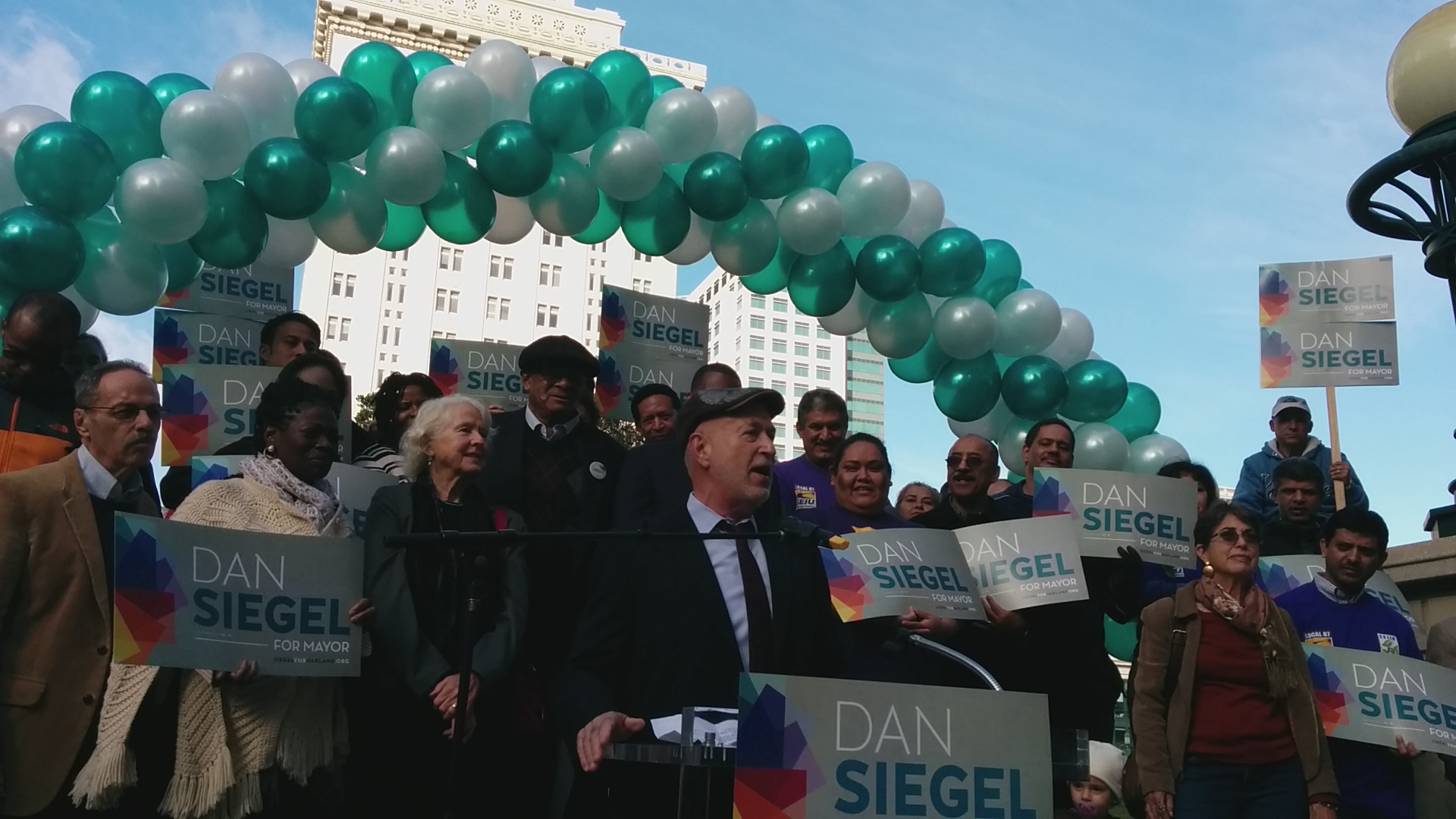
Dan Siegel, an Oakland civil rights attorney and activist with a long history of working with radical leftist political movements, joined a group of more than 150 supporters in front of Oakland City Hall on Jan. 9 to announce his candidacy for mayor.

With this development, the mayor’s race in Oakland is sure to be closely watched by Bay Area progressives. Siegel’s bid represents a fresh challenge from the left against Mayor Jean Quan at a time when concerns about policing, intensifying gentrification, and economic inequality are on the rise.

Siegel is the latest in a growing list of challengers that includes Joe Tuman, a political science professor who finished fourth in the 2010 mayor’s race; Oakland City Councilmember Libby Schaaf; and Port Commissioner Bryan Parker.

In a campaign kickoff speech emphasizing the ideals of social and economic justice, Siegel laid out a platform designed “to make Oakland a safe city.” But he brought an unusual spin to this oft-touted goal, saying, “We need people to be safe from the despair and hopelessness that comes from poverty and long-term unemployment. We need safety for our tenants from unjust evictions and … gentrification.”

Siegel voiced support for raising the city’s minimum wage to $15 an hour. He also called for shuttering Oakland’s recently approved Domain Awareness Center, a controversial surveillance hub that integrates closed circuit cameras, license plate recognition software, and other technological law enforcement tools funded by a $10.9 million grant from the federal Department of Homeland Security.

He spoke about pushing for improvements in public education “to level the playing field between children from affluent backgrounds and children from poor backgrounds,” and described his vision for reorganizing the Oakland Police Department to foster deeper community engagement.

Among Siegel’s supporters are East Bay organizers with a deep history of involvement in social justice campaigns. His campaign co-chair is Walter Reilly, a prominent Oakland National Lawyers Guild attorney who said he’s been involved with civil rights movements for years. “This is a continuation of that struggle,” Reilly told the Bay Guardian, adding that leadership affiliated with “a progressive and class-conscious movement” is sorely needed in Oakland.

Left Coast Communications was tapped as Siegel’s campaign consultant. Siegel’s communications director is Cat Brooks, an instrumental figure in Occupy Oakland and the grassroots movement that arose in response to the fatal BART police shooting of Oscar Grant, whose Onyx Organizing Committee is focused on racial justice issues.

Olga Miranda, an organizer with San Francisco janitors union, SEIU Local 87, also spoke on Siegel’s behalf during the kickoff event. “San Francisco has become for the rich, and we understand that,” she said. “But at the same time, Oakland isn’t even taking care of its own.”

Referencing a recent surge in Oakland housing prices due in part to an influx of renters priced out of San Francisco, she added, “Dan understands that if you live in Oakland, you should be able to stay in Oakland.”

Siegel’s decision to challenge Quan for the Mayor’s Office has attracted particular interest since he previously served as her legal advisor, but their relationship soured after a public disagreement.

In the fall of 2011, when the Occupy Oakland encampment materialized overnight in front of Oakland City Hall, Siegel resigned from his post as Quan’s adviser over a difference in opinion about her handling of the protest movement. Police crackdowns on Occupy, which resulted in violence and the serious injury of veteran Scott Olsen and others, made national headlines that year.

“I thought that the Occupy movement was a great opportunity for this country to really start to understand the issues of inequality in terms of wealth and power,” Siegel told the Bay Guardian when queried about that. “And I thought the mayor should embrace that movement, and become part of it and even become a leader of it. And obviously, that’s not what happened.”

Since then, his relationship with Quan has been “Cool. As in temperature, not like in hip,” he said during an interview. “I don’t want to make this personal. But we have a difference about policy and leadership.”

With Oakland’s second mayoral election under ranked-choice voting, the race could prove fascinating for Bay Area politicos. Also called instant runoff voting, the system allows voters to select their first, second, and third choice candidates. If nobody wins more than 50 percent of the vote, the last-place candidates are eliminated in subsequent rounds and their vote redistributed until one candidate crosses the majority threshold.

Quan, who ran on a progressive platform in 2010, was elected despite winning fewer first-place votes than her centrist opponent, former State Senate President Don Perata. She managed to eke out an electoral victory with a slim margin (51 percent versus Perata’s 49), after voting tallies buoyed her to the top with the momentum of second- and third-place votes, many gleaned from ballots naming Councilmember Rebecca Kaplan as first choice.

Early polling conducted by David Binder Research showed Quan to be in the lead with the ability to garner 32 percent of the vote, as compared with 22 percent for Tuman, who placed second. That’s despite Quan’s incredibly low approval ratings — 54 percent of respondents said they disapproved of her performance in office.

When Schaaf announced her candidacy in November, Robert Gammon of the East Bay Express opined, “Schaaf’s candidacy … likely will make it much more difficult for Quan to win, particularly if no true progressive candidate emerges in the months ahead.” But Siegel’s entry into the race means there is now a clear progressive challenger.

The Guardian endorsed Kaplan as first choice in 2010, and gave Quan a second-place endorsement. While there has been some speculation as to whether Kaplan would run this time around — the David Binder Research poll suggested she would be a formidable opponent to Quan — Kaplan, who is Oakland’s councilmember-at-large, hasn’t filed.

Siegel, meanwhile, cast his decision to run as part of a broader trend. “I feel that not only in Oakland, but across the country, things are really ripe for change,” he told the Guardian.

Indeed, one of the biggest recent national political stories has been the election of Kshama Sawana, a socialist who rose to prominence during the Occupy Wall Street movement, to the Seattle City Council.

“When you have a city like Oakland where so many people are in poverty or on the edge of poverty, or don’t have jobs or face evictions,” Siegel told us, “it’s no wonder that the social contract falls apart. It seems to me that what government should do is elevate the circumstances of all people, and particularly people who are poor and disadvantaged.”

Lies, damned lies, and statistics

0

When is a public opinion poll a valid representation of how people feel? That turns out to be a tricky and ever-evolving question, particularly in San Francisco — thanks to its prevalence of tenants and technology — and even more particularly when it concerns the approval rating of Mayor Ed Lee.

Traditionally, the central requirements for public opinion polls to be considered valid is that respondents need to be representative of the larger population and they need to be selected at random. Polls are often skewed when people need to opt-in, as is the case in most online polls.

So the Guardian took issue with claims that 73 percent of voters approve of the job that Mayor Lee is doing, a figure derived from an opt-in online poll focused on “Affordability and Tech” that was conducted by University of San Francisco Professors Corey Cook and David Latterman and released to the San Francisco Chronicle on Dec. 9. That figure quickly wallpapered the comment section of the Guardian’s website as the answer to any criticism of Mayor Lee, his policies, or the city’s eviction and gentrification crises.

“Any survey that relies on the ability and/or availability of respondents to access the Web and choose whether to participate is not representative and therefore not reliable,” is how The New York Times Style Guide explains that newspaper’s refusal to run such polls, a quote we used in our Jan. 10 Politics blog post on the subject, and we quoted an academic making a similar point.

We also interviewed and quoted Latterman discussing the challenges of doing accurate and economical polling in a city with so many renters (64 percent of city residents) and so few telephone landlines. “San Francisco is a more difficult model,” Latterman told us. “So Internet polling has to get better, because phone polling has gotten really expensive.”

So we ran our story dubbing the poll “bogus” — and the next day got angry messages from Cook and Latterman defending the poll and educating us on efforts within academia to craft opt-in online polls that are as credible as traditional telephone polls.

“The author is so quick to dismiss the findings of the study, which is based upon accepted methodology, and which had nothing to do with mayoral approval scores, that he actually misses the entire thrust of the study — that voters in San Francisco are deeply ambivalent about the current environment, concerned about the affordability crisis, and not trusting of local government to come up with a solution,” Cook wrote in a rebuttal we published Jan. 13 on the Politics blog.

Cook told us the survey’s methods are endorsed by the National Science Foundation and peer-reviewed academic papers, including a Harvard University study called “Does Survey Mode Still Matter?” that concludes “a carefully executed opt-in Internet panel produces estimates that are as accurate as a telephone survey.”

That study went to great lengths to create a sample group that was representative of the larger population, while Cook and Latterman both admit that their survey’s respondents had a disproportionate number of homeowners. But they say the results were then weighted to compensate for that and they stand by the accuracy of their work.

Yet Cook also notes that the mayoral approval rating number wasn’t even part of the package they developed from this survey, it was just a finding that they decided to give the Chronicle. “I don’t think the 73 percent means anything,” Cook told us, noting that snapshot in time doesn’t reflect Lee’s actual popularity going forward, despite how Lee supporters focused on it. “The number they use politically is not a meaningful number.”

What Cook found more significant is the “tepid support” for Lee indicated by the poll, including the 86 percent that expressed concern about affordability in the city, a concern that cuts across all demographic groups. Most respondents had little faith in City Hall to address the problem and many felt the tech industry should be doing more to help, particularly companies that have received tax breaks.

Confronting the speculators

34

rebecca@sfbg.com

A group of tenant advocates has upped the ante in the ongoing protest movement against San Francisco evictions, publicizing the names, photographs, property ownership, and corporate affiliations of a dozen landlords and speculators they’ve deemed “serial evictors.”

The Anti Eviction Mapping Project, a volunteer-led effort that snagged headlines last fall when it released data visualizations charting long-term displacement in San Francisco, released its Dirty Dozen list Jan. 10.

The project spotlights property owners who’ve moved to evict tenants under the Ellis Act, a controversial state law that allows landlords to oust tenants even if they aren’t in violation of lease terms. In practice, the Ellis Act tends to be waged against longtime residents with low monthly rental payments, frequently impacting elderly or low-income tenants who benefit from rent control.

The Anti Eviction Mapping Project’s list gets up close and personal, publishing details such as landlord’s cell phone numbers, home addresses, and histories of legal entanglement.

It’s an edgy use of public records that seems to raise a slew of questions about free speech, privacy, and the use of information sharing and public shaming as a protest tactic in the digital age.

Erin McElroy, a volunteer and lead organizer of the project, said the goal was to spotlight landlords “who are disproportionately impacting senior and disabled tenants,” and to raise public awareness about “people who are making millions at the expense of tenants.”

She added that there is a budding effort to push for Ellis Act reform in Sacramento, and noted that a goal of this project was to fuel that statewide effort by providing easily accessible information.

Among those individuals named on the Dirty Dozen list was David McCloskey of Urban Green Investments, a company that owns more than 15 San Francisco properties. Urban Green has been a frequent target of San Francisco housing activists, in part due to the company’s ongoing attempt to evict Mary Elizabeth Phillips, a Dolores Street tenant who will turn 98 in April.

Another landlord who made the list, Elba Borgen, has also attracted past attention from tenant activists due to her history of pursuing Ellis Act evictions at six different San Francisco properties. A tenant currently residing in a 10th Avenue property, where Borgen’s LLC has filed for eviction, is 90 years old and suffering from Alzheimer’s, according to an interview with her daughter Vivian Montesdeoca posted to the mapping project website.

The Bay Guardian‘s efforts to reach landlords who were spotlighted on the Dirty Dozen list were largely unsuccessful. We did manage to contact Tom Iveli, president of Norcal Ventures, who spoke briefly before excusing himself, saying he had to take another call. Iveli clearly wasn’t aware that he and his business partner Bob Sigmund had been singled out.

McElroy said the Dirty Dozen list was the product of an in-depth research project which entailed filtering through property records, San Francisco Rent Board data, and information gleaned from the website Corporation Wiki.

The Anti Eviction Mapping Project initiative has attracted around 15 volunteers and will be partnering with Stanford University students to produce an oral history project showcasing the narratives of San Francisco tenants facing eviction, McElroy said.

Some of the same activists involved in recent high-profile blockades of tech buses were also part of the Anti Eviction Mapping Project effort.

“We’re not, you know, anti-tech by any means,” said McElroy. “We’re anti- speculative real estate,” and wary of policies like the Ellis Act and city government’s tendency to give deep-pocketed corporations a free pass, regardless of the consequences.

“It’s that linkage that is kind of the crux of the issue,” she added.

Article overlooks key findings and new academic research

43

By Corey Cook

I am writing in regard to Reed Nelson’s story “’Poll’ showing 73 percent approval for Mayor Lee was flawed.” As one of the two authors of the survey, I am deeply disappointed in the many insinuations in the article and the author’s cavalier abandonment of evidence or reason in order to make his politically expedient, but otherwise inane, point.

In fact, the author is so quick to dismiss the findings of the study, which is based upon accepted methodology, and which had nothing to do with mayoral approval scores, that he actually misses the entire thrust of the study – that voters in San Francisco are deeply ambivalent about the current environment, concerned about the affordability crisis, and not trusting of local government to come up with a solution.

You’d think the Bay Guardian might find that an interesting subject. Under a previous editor I have little doubt it would have. Instead, the author mind numbingly asserts that the mayor’s approval rate – a largely irrelevant number – is clearly overinflated and the survey must then be “bogus” (meaning fake or phony). While other scholars might find the popular characterization of their work as “fake” somewhat amusing. I do not.

The author relies on two main sources to claim that an on-line panel survey is “bogus”, the New York Times “style guide” and the “website publication” of Southeast Missouri State University Political Scientist Russell D. Renka, who is neither a survey researcher nor a political methodologist, and who does not seem to have published anything in this field (or even in political science based on his on-line vita), but who does seem to have a fairly robust home page that includes cute photos of his grandkids.

It’s not the kind of “source” that I would utilize to deride another academic’s work as “bogus”, and I could suggest some other (actual) publications to consider, including Harvard political scientist Stephen Ansolabehere’s peer reviewed article in Political Analysis titled “Does Survey Mode Still Matter?” from 2011 that compares national surveys fielded at the same time over the Internet (using an opt-in Internet panel), by telephone with live interviews (using a national RDD sample of landlines and cell phones), and by mail (using a national sample of residential addresses).

The authors of that study conclude that “comparing the findings from the modes to each other and the validated benchmarks, we demonstrate that a carefully executed opt-in Internet panel produces estimates that are as accurate as a telephone survey and that the two modes differ little in their estimates of other political indicators and their correlates.” But unfortunately that peer reviewed publication by a Harvard political scientist seems to contradict the simple assertion that a survey result the author doesn’t like must be phony.

Let me say that I don’t considered this issue “settled” in the scholarly community, but it is far from the case that serious on-line panel surveys ought to be derided as “bogus.” My preference would be to do a 1,200 person phone survey. If the Bay Guardian would like to commission such a survey, I would enjoy working with you on that project. But given the various cost limitations that preclude such a robust research design, this is not an altogether bad alternative.

That said, feel free to poke at the methodology and suggest that the numbers for Lee might not reflect that of the overall population because of the timing of the survey or because it was only conducted in English (though I’d disagree with you there – that likely holds down his numbers), or frankly just that surveys do often get it wrong. Even the best random sample is outside the margin of error one time out of 20 according to basic probability theory.

But the other thing I’d like to draw your attention to is that you’ve missed the entire point of the survey. Why do you focus on mayoral approval when it’s a survey about attitudes towards affordability and tech? In fact the article notes that “(i)nterestingly, the USF “poll” also found that 86 percent of respondants (sic) said that lack of affordability was a major issue in the city, while 49.6 percent of that same group considered housing developers to be most at fault for the astronomical real estate prices.” So apparently that part of the survey wasn’t bogus.

Here were our four findings:

* San Franciscans are of two minds: a clear majority of respondents say the city is going in the right direction, yet affordability is seen as a significant, and newly exacerbated problem.

* Most respondents see the tech boom as most strongly helping tech executives and workers. Though there is little sense that respondents and their families benefit from the tech boom, a clear majority say that tech is also good for other white collar workers and the city overall.

* The public strongly supports the idea that the city government ought to enact policies to preserve affordability but were skeptical of public officials’ ability to deal with these issues.

* Despite these concerns, there was little interest in making it harder for tech companies to come to San Francisco. For now, keeping the economy strong appears to be the priority, and we expect that feelings about the economy will likely stave off a substantial political “backlash” at least at the present time.

While Ed Lee has high approval scores, they are tepid – much more “good” than “excellent”. And those numbers erode on affordability, what the voters regard as the city’s most important issue. And we found that people don’t articulate a high degree of trust in mayor in dealing with affordability. Yes, they trust him more than they do others (like developers, or the Board of Supervisors), but not much. This survey help me understand what happened on the 8 Washington vote. Voters like the mayor, as they do Newsom incidentally, but don’t buy their argument that the development would address housing affordability. His popularity didn’t have coattails on this issue.

It strikes me as a real missed opportunity for your journalists to trash the poll, based on really flimsy grounds, rather than address it’s important, and yes, ambivalent findings.

Sincerely,


Corey Cook, Ph.D.

Dan Siegel announces candidacy for Oakland mayor

Oakland attorney Dan Siegel, known for a long history of involvement in Bay Area social justice movements, joined a group of more than 150 supporters in front of Oakland City Hall this morning to announce his candidacy for mayor.

In a speech emphasizing his campaign ideals of social and economic justice, Siegel called for shutting down Oakland’s recently approved Domain Awareness Center, raising the city’s minimum wage to $15 an hour, making improvements in public education “to level the playing field between children from affluent backgrounds and children from poor backgrounds,” and shifting the city’s approach to policing by reorganizing the police department to foster deeper community engagement. We caught a few moments from his speech here:

Guardian video by Rebecca Bowe

Siegel’s campaign co-chair is Walter Reilly, a prominent attorney affiliated with the National Lawyers Guild who said he has a long history of involvement with civil rights and social justice movements. “This is a continuation of that struggle,” he said, adding that Siegel’s affiliation with “a progressive and class-conscious movement” is sorely needed in Oakland.

Left Coast Communications was tapped as Siegel’s campaign consultant. Siegel’s communications director is Cat Brooks, who was previously an organizer and sometimes spokesperson for Occupy Oakland.

In 2011, when the Occupy Oakland encampment sprung up in front of Oakland City Hall, Siegel resigned as a legal advisor to Mayor Jean Quan over a difference in opinion about her handling of the protest movement. Police crackdowns on Occupy, which resulted in violence and the serious injury of veteran Scott Olsen, made national headlines that year. 

Olga Miranda, an organizer with San Francisco janitors union, SEIU Local 87, also spoke on Siegel’s behalf. “San Francisco has become for the rich, and we understand that,” she said. “But at the same time, Oakland isn’t even taking care of its own.” Referencing gentrification, a term that seemed to be everyone’s lips, she added, “Dan understands that if you live in Oakland, you should be able to stay in Oakland.”

Asked why he’d decided to run, Siegel told the Bay Guardian, “I feel that not only in Oakland but across the country, things are really ripe for change. When you have a city like Oakland where so many people are in poverty or on the edge of poverty, or don’t have jobs or face evictions … it’s no wonder that the social contract falls apart. It seems to me that what government should do is elevate the circumstances of all people, and particularly people who are poor and disadvantaged.”

Got pests? Open data project reveals housing code violation data

Thanks to a handy new online platform created by the city’s Department of Public Health, in collaboration with the Mayor’s Office of Civic Innovation and Code for America, you can now determine whether the rental you’re eyeing is moldy, pest-ridden, or otherwise hazardous to your health – before signing a lease.

Investigating a potential landlord’s track record is just one application for the House Facts data set, an open data tool rolled out six months ago that instantly provides building owners’ names, code violation data, property assessment information and other relevant information associated with San Francisco addresses, all in one place.

Let’s say, for example, you were contemplating paying $1,650 a month to inhabit a 300-square-foot studio, right in the center of the Tenderloin. Now there’s a bargain in a red hot housing market! 

But before you get all excited and drain your bank account to plunk down a security deposit, surf on over to HouseFacts and punch in the building address. With this simple search, you might discover that this building has undergone inspection by city agencies a grand total of 73 times, most recently 11 months ago, with a total of 23 violations recorded.

Skim the list of violations and you’ll notice the words “rodents,” “insects,” “unsanitary conditions,” and even (big red flag here!) “biohazards (human feces).”

As they say, knowledge is power.

To be fair, some of those violations were recorded practically an eternity ago, and things could well have been cleaned up since – but having instant access to these track records could prove to be a check against negligent landlords.


A map of housing inspection data prepared by DPH.

The initiative to develop a uniform format and open platform for San Francisco housing inspection data was spearheaded under the environmental health division of the Department of Public Health in collaboration with city government’s growing tech innovation wing, and it’s now being emulated by several other cities nationwide.

DPH’s former Environmental Health Director, Dr. Rajiv Bhatia – who recently resigned after being targeted with a mysterious investigation that resulted in no findings of misconduct – was instrumental in advancing the open-data project under the Program on Health, Equity and Sustainability.

“We decided releasing this data would have the potential to improve government regulation,” notes Cyndy Comerford, manager of planning and fiscal policy in the environmental health division, who’s continued to move it forward since Bhatia’s departure. “Within San Francisco, there are many people who live in dilapidated and poor housing.” 

Residences plagued with rodents, cockroach infestations, lead, or mold present higher risks for health afflictions, such as allergies, respiratory conditions or cancer.

The enhanced transparency can strengthen code compliance and lead to an overall reduction in medical costs for preventable conditions, Comerford said.

Slumlords, beware: The tool has also been implemented at a time when the city is signaling that more aggressive code enforcement is on the horizon.

At the Jan. 7 Board of Supervisors meeting, Sups. Scott Wiener and Malia Cohen called for a hearing to get a better handle on building code enforcement.

“There’s not really any clear procedure for when these cases are closed, or how they’re closed,” said Jeff Cretan, a legislative aide for Sup. Scott Wiener.

“Our complicated code inspection system lacks sufficient coordination and communication among the different departments,” Wiener noted in a statement. “In addition, departments sometimes appear to be reluctant to pursue enforcement due to budget concerns.”

While the health department’s actions seem geared toward preventing ailments arising from poor housing conditions, the supervisors’ effort seems to stem from a quality-of-life concern. Cretan said his office regularly receives complaints from “really wired-in, aggressive Noe Valley neighbors.” He added, “People will call because they’re worried about hoarders.”

Insane Clown Posse and the ACLU vs. the FBI

0

I never thought I’d write this sentence, and I doubt I’ll have cause to write it again, but: Good on ya, Insane Clown Posse.

The inimitable horrorcore-rap duo — best known for their demonic clown makeup, misogynistic lyrics, supposedly tongue-in-cheek love of extreme violence, and their always-charming fan base — filed a lawsuit this morning in Detroit against the FBI and the Justice Department, alleging that the federal government acted unlawfully when it classified Juggalos as gang members, leading to “harassment” of fans by law enforcement officials.

Attorneys from the ACLU of Michigan and attorneys for ICP collaborated on the suit, which concerns a 2011 report by the National Gang Intelligence Center on “emerging trends” that defined fans of the band as a “loosely-organized hybrid gang” that was “rapidly expanding into many US communities.” Four Juggalos listed as plaintiffs (alongside ICP members Joseph Bruce and Joseph Utsler — er, sorry, Violent J and Shaggy 2 Dope) claim the gang designation led to unwarranted harassment by the police.

“We’re not a gang, we’re a family,” said Utsler at a press conference announcing the suit. “We’re a diverse group of men and women, united by our love of music and nothing more. We’re not a threat, a public menace or a danger to society.”

Insane Clown Posse and their assorted devotees remain, of course, for many of us, a public menace to our senses and a danger to good taste everywhere. A gang? Not quite. And organized groups of assholes aren’t exactly an emerging trend.

Besides, don’t our federal security agencies have anything better to do?

Bits and bots

0

marke@sfbg.com

CAREERS AND ED “When it comes to robots, there’s usually a kneejerk reaction about job loss. But the robotics field is also creating jobs. We haven’t had stagecoach drivers for a hundred years, but still the world has moved forward.” That’s Tim Smith, a robotics public relations expert — talk about robots creating new jobs — speaking to me over the phone from his Element PR home office in Bernal Heights, where he’s busy representing some of the most innovative robotics projects coming out of the Bay Area.

Smith has a gentle way (he’s no robot?) of putting the recent quantum-like advances in the robotics field into perspective — while also noting the limitations of the field. “One of the biggest challenges I face is overcoming the ‘creep factor’ that most people have when it comes to robots. There are different kinds of robots, different niches: industrial, military, personal. Most people, however, jump to a kind of malevolent science fiction combination of all three. And that’s understandable, considering how robots have been presented in the past.

“But really, personal robots are all around us. Thermostats are robots. Smoke alarms are robots,” Smith continues. “And despite people’s misgivings, they really do want the future, they do want science fiction. They want Rosie the Robot to do their laundry, clean the house. But right now, most personal robots do one thing extremely well. It’s when they’re asked to do two things that chaos breaks out. They need controlled environments. For instance, we have robots to clean your floors, but not one to clean your floors and wash your windows. Even Google’s driverless car needs to be in a certain kind of environment to function.

“So that’s what’s really held the industry from advancing. Meanwhile, though, on this side of that wall, there are some spectacular things being done to fine-tune and develop not just robots but the robotics field, including efforts to integrate robotics into daily life. You can see how far intelligent technology has come just by looking in your pocket.”

Smith took me on a tour of some of the Bay Area-based organizations and companies pushing those advances, including direct descendents of Willow Garage, the legendary Menlo Park robotics incubator started by Google developer Scott Hassan in 2006.


ROBOTSLAB BOX

Sure, math in high school was kind of a snoozefest. But what if your geometry class was taught by a box of robots? Yep, that might have you reaching for the protractor a bit more often.

RobotsLAB (www.robotslab.com) has created that box of robots, which is now in use in several schools. “The idea to create RobotsLAB BOX was born after spending hundreds of hours with educators, teachers, and administrators,” founder Elad Inbar told me by email. “The need for a population with basic STEM skills (science, technology, engineering, and mathematics) is imperative, yet we’ve heard over and over again that students don’t understand why they need to learn math, or where math’s core concepts such as linear and quadratic equations are applicable to their lives.

“As a result, they underperform in evaluations and can give up on meaningful careers. But the RobotsLAB BOX robots are serving in the classroom as a bridge between the concrete world we live in and and abstract math concepts.

“There are four robots in the RobotsLAB BOX: a quadcopter, a robotic arm, a rover with a mustache, and a robotic ball. The students love them all. They help teach everything from the law of cosines to the sum of vectors.”

RobotsLAB BOX even offers a STEM kit that guides you through the basics of robotics. Wait, does that mean a robot will actually teach you to build itself?


OPEN SOURCE ROBOTICS FOUNDATION

The Bay Area-based ROS (Robotics Operating System, www.ros.org) organization is a collection of programmers dedicated to advancing robotics development and application through collaborative coding and invention.

The Open Source Robotics Foundation (www.osrf.org) is the nonprofit in charge of overseeing the development of ROS. Basically this means that it helps make robotics coding something shareable and open to all who are interested (and who can gain the technical chops). OSRF also does things like participate in last year’s headline making DARPA Challenge, the awesome-looking, government-sponsored festival and competition aiming to push robotics to the next level, where it completed a challenge to build an open-source robot simulation environment.

“If you want to enter the world of robotics software coding,” advises Brian Gerkey, OSRF CEO, “some familiarity with Linux is helpful. But the best advice is to just dive in. There are tons of resources at ROS for all levels of expertise and a vibrant community ready to help.

“One of the challenges facing robotics is the multi-disciplinary nature of the field — hardware, software, vision, navigation, manipulation — and lots of math. But there are lots of ways for a young person to get started — things like the FIRST Robotics competition and the growing Maker community come to mind.”

To advance the cause of personal robotics containing open-source software, Gerkey is participating in a panel at the Commonwealth Club on Feb. 26 called “Robots in Unconventional Workplaces” (www.commonwealthclub.org).

“Everyone has their own idea of what a robot looks like and what it does, but in many cases those expectations derive from movies, books, and television shows. One of my goals is to help people picture robots in scenarios they never dreamed possible.”


UNBOUNDED ROBOTICS

“The simplest way to describe our UBR-1 robot is that it’s akin to an iPhone without any third party apps,” says Unbounded Robotics (www.unboundedrobotics.org) CEO Melonee Wise of the one-year-old company’s latest protoype.

“The robot, like the phone, is incredibly capable and sophisticated, but the real value comes from what developers are able to add to the platform. For that reason, the practical applications are limited only by the imagination of the ROS developer community.”

Another way to describe the UBR-1 is: squeee.

The little shiny orange robot is so cute I want to have one just to look at when I get tired of Lil Bub pics. The introductory video, in which an “emergency stop” switch is activated to “prevent robot apocalypse” (“not guaranteed to prevent robot apocalypse”) is enough for me to welcome the coming robot apocalypse.

Now I just have to learn to program the darn thing.


Start the mayor’s race now

4

EDITORIAL

We hope you enjoyed last week’s cover package, “The Rise of Candidate X,” a parable about politics and the media in San Francisco. While it was clearly a fantastical tale, it also had a serious underlying message that we would like to discuss more directly here. Bold actions are needed to save San Francisco. It will take a broad-based coalition to keep the city open to all, and that movement can and should morph into a progressive campaign for the Mayor’s Office, starting now.

While 22 months seems like an eternity in electoral politics, and it is, any serious campaign to unseat Mayor Ed Lee — with all the institutional and financial support lined up behind him — will need to begin soon. Maybe that doesn’t even need to involve the candidate yet, but the constellation of progressive constituencies needs to coordinate their efforts to create a comprehensive vision for the city, one radical enough to really challenge the status quo, and a roadmap for getting there.

It’s exciting to see the resurgence of progressive politics in the city over the last six months, with effective organizing and actions by tenant, immigrant rights, affordable housing, anti-corporate, labor, economic justice, LGBT, environmental, transit, and other progressive groups.

Already, they’ve started to coordinate their actions and messaging, as we saw with the coalition that made housing rights a centerpiece of the annual Milk-Moscone Memorial March. Next, we’d like to see progressive transportation and affordable housing activists bridge their differences, stop fighting each other for funding within the current zero-sum game of city budgets, and fully support a broad progressive agenda that seeks new resources for those urgent needs and others.

Yet City Hall is out of touch with the growing populist outrage over trends and policies that favor wealthy corporations and individuals, at the expense of this city’s diversity, health, and real economic vitality (which comes from promoting and protecting small businesses, not using local corporate welfare to subsidize Wall Street). The San Francisco Chamber of Commerce recently gave this Board of Supervisors its highest-ever ranking on its annual “Paychecks and Pink Slips” ratings, which is surely a sign that City Hall is becoming more sympathetic to the interests of business elites than that of the average city resident.

This has to change, and it won’t be enough to focus on citizens’ initiatives or this year’s supervisorial races, which provide few opportunities to really change the political dynamics under the dome. We need to support and strengthen the resurgent progressive movement in this city and set its sights on Room 200, with enough time to develop and promote an inclusive agenda.

San Francisco has a strong-mayor form of government, a power that has been effectively and repeatedly wielded on behalf of already-powerful constituents by Mayor Ed Lee and his pro-downtown predecessors. Lee has used it to veto Board of Supervisors’ actions protecting tenants, workers, and immigrants; and the commissions he controls have rubber-stamped development projects without adequate public benefits and blocked the CleanPowerSF program, despite its approval by a veto-proof board majority.

Maybe Mayor Lee will rediscover his roots as a tenant lawyer, or he will heed the prevailing political winds now blowing through the city. Or maybe he’ll never cross the powerful economic interests who put him in office. But we do know that the only way to get the Mayor’s Office to pursue real progressive reforms is for a strong progressive movement to seek that office.

New York City, which faces socioeconomic challenges similar to San Francisco’s, has exciting potential right now because of the election of Mayor Bill de Blasio, who waged a long and difficult campaign based on progressive ideals and issues. By contrast, San Francisco seems stuck in the anachronistic view that catering to capitalists will somehow serve the masses.

The Mayor’s Office has been a potent force for blocking progressive reforms over the last 20 years. Now is the time to place that office in service of the people.


Stealing secret records about government spying used to be way more complicated

In 1971, a group of radicals broke into an FBI office in Media, Pennsylvania and stole a bunch of documents about J. Edgar Hoover’s surveillance program targeting dissidents and antiwar activists.

Thanks to their criminal act, which they followed up by anonymously sending copies of the files to major media outlets, awareness of FBI spying under Cointelpro penetrated mainstream consciousness.

More than 40 years later, the people behind that theft have unmasked themselves in a new book, The Burglary: The Discovery of J. Edgar Hoover’s Secret FBI, authored by Betty Medsger. The former Washington Post reporter convinced some of the burglars to come forward and tell their tale. Medsger previously served as chair of the journalism department at San Francisco State University.

A New York Times piece spotlighting the book describes the historic event and draws a comparison with modern day whistleblower Edward Snowden, who used access granted to him as a National Security Agency contractor to shed light on secret documents detailing NSA surveillance programs.

“Unlike Mr. Snowden, who downloaded hundreds of thousands of digital N.S.A. files onto computer hard drives, the Media burglars did their work the 20th-century way: they cased the F.B.I. office for months, wore gloves as they packed the papers into suitcases, and loaded the suitcases into getaway cars. When the operation was over, they dispersed.”

The burglary also entailed lock picking, opening a window with a crowbar, and memorization of FBI staff’s comings and goings; also, they never again met as a group after making off with the files.

Even as technology has given intelligence agencies the ability to build a once unfathomable surveillance system that regularly sweeps in the communications of millions of law-abiding Americans, it’s also made it easier for information about such activities to be brought into the light of day – with just a few simple keystrokes.

Why Muni won’t earn a dime off the tech buses

174

Every day mammoth private buses squeeze into San Francisco public bus stops, and every day they contribute to the delay of countless Muni buses. Riders walk around the Google, Apple and Genentech luxury rides and into the street to board their grimy, underfunded public transit system. 

Now finally, the mayor has announced the near-approaching implementation of a pilot program to permit and regulate the tech industry’s private coaches. If approved by a vote from the SFMTA Board of Directors on Jan. 21, the pilot will begin. The only catch is, though they’ll charge those companies for the cost of implementing the program, the San Francisco Municipal Transportation Agency won’t make any money off of the tech shuttles.

The chronically underfunded Muni won’t get a lift from Google. Yesterday (Mon/6) we finally got an explanation as to why.

On the 8th floor of the SFMTA offices, the transit agency’s director Ed Reiskin told reporters that his hands were tied by California Proposition 218, which limits what new revenue municipalities can raise without voter approval.

“Only the voters of San Francisco can enact a tax that generates excess revenue,” he said. 

“This isn’t new,” Reiskin said, but he’s only half right. Though Prop. 218 was passed in 1996, this is the first time anyone at the MTA has touted it as a reason not to profit off of the tech shuttles.

We even asked Mayor Ed Lee this question just a month ago, and got a two-minute response that did not once include Prop. 218

Part of this might have to do with the nebulous quality of Prop. 218. An implementation guide from the California Budget Analyst office puts it this way: “Proposition 218’s requirements span a large spectrum, including local initiatives, water standby charges, legal standards of proof, election procedures, and the calculation and use of sewer assessment revenues. Although the measure is quite detailed in many respects, some important provisions are not completely clear.”

The waters of Proposition 218 are murky: is the government charging for the use of Muni stops a fee or a tax? In that grey area lies the answer on whether the city truly can’t charge tech buses to help fix Muni, or if this is just political cover for a government who doesn’t want to piss off tech.

Tellingly, that’s pretty much what Reiskin said.

“There’s a lot of benefit these services (buses) are bringing to San Francisco,” Reiskin told us after the press conference. “We wanted to resolve the conflicts without killing the benefit.”

“I imagine if we sat down with them and said ‘we wanna start taxing you guys’ they’d say ‘screw it, we don’t want to do the shuttles.’”

The 18-month pilot will recoup an estimated $1.5 million, the estimated cost of the project, according to the SFMTA. The project would give approval for use of 200 Muni stops by private shutle providers, out of 2,500 Muni stops in the system. We’ve reached out to California’s budget analyst office to dig into Proposition 218. 


City College saved, for now (update)

0

Update: This post has been updated with new information, after a 5:30 press conference held by City Attorney Dennis Herrera.

City College of San Francisco is safe from closure, for now.

A ruling from San Francisco Superior Court Judge Curtis Karnow issued this afternoon would bar City College’s accreditors from terminating the college’s accreditation until after legal proceedings against it are done. 

The loss of accreditation would make City College’s future degrees basically worthless, resulting in its closure or merger with another district.

“I’m grateful to the court for acknowledging what so far accreditors have refused to, that educational access for tens of thousands of city college students matters,” City Attorney Dennis Herrera said at a press conference announcing the judge’s decision.

Now Herrera and his team have time to save the school, and City College will keep its doors open for the duration of the suit — win or lose.

The ruling was the result of an injunction filed by City Attorney Dennis Herrera on Nov. 25. as part of their suit against the Accrediting Commission for Community and Junior Colleges in August for allegedly using the process to carry out an ideological agenda against CCSF. The ACCJC openly lobbied in public hearings and via public letters for education reform across the state, reforms which City College’s administration believed would harm San Francisco’s most vulnerable students: the poor, certificate seekers, and lifelong learners.

ccsfhearing

Counsel for the Accrediting Commission for Community and Junior Colleges, Andrew Sclar and Philip Ward, confer during a break at a preliminary injunction hearing regarding City College of San Francisco on Dec. 26, 2013. Photo by Sara Bloomberg

Only part of the injunction was granted by Karnow, however. The ACCJC is barred from shutting down City College, but it can still revoke the accreditation from any of the 112 community colleges it oversees across the state.

The ruling also doesn’t stop it them from making preparations to close the college, Herrera said.

“It does not stop them from continuing their review and analysis and evaluation, it stops them from issuing a final ruling with respect to taking accreditation of City College,” he said. 

Not everyone agrees with Herrera’s efforts though.

“Court intervention is not necessary to keep City College open,” State Community College Chancellor Brice Harris wrote to Herrera in a letter today. 

Harris argues that the lawsuit detracts from the efforts to save the school made by the special trustee Robert Agrella, who was assigned by Harris to replace City College’s board of trustees just after the accreditation crisis broke out.

“Characterizations that the cases before the court are a ‘last-ditch’ effort to ‘save’ City College are inaccurate and will do additional damage to the college’s enrollment,” Harris wrote.

And City College’s enrollment has taken a huge hit, down nearly 30 percent from last year, leading to the college’s new media campaign to get students back in City College seats. 

Though Harris criticized Herrera’s lawsuit as the chancellor of the state community college system, Harris has tangled ties with the accreditors — he was a commissioner on the ACCJC board some years ago

At the hearing to grant the injunction, Sara Eisenberg, the deputy city attorney, argued that real harm hit City College since the news of its closure hit. Students have left the school in droves.

We’re asking, your honor, right now for something that won’t happen until further down the road… but there’s real harm happening right now. Latest numbers show enrollment is down 27 percent,” she told Karnow. 

The ACCJC’s counsel, Andrew Sclar, argued that an injunction to stop City College’s closure would actually harm the ACCJC itself.

 “There certainly would be harm to us,” he told Karnow. “If we do not enforce sanctions or bring a non compliant institution into compliance within a two year period, we would be at risk of losing our recognition with the United States Department of Education.”

Karnow then asked if there was “evidence on the record” of that ever happening. Sclar said no.

The college is slated to lose its accreditation in July 2014. The college is trying to reverse its fortunes and is applying for an appeal with the ACCJC. 

Now, it has a chance to stay open while Herrera fights for its future. Two other lawsuits were filed against the ACCJC as well, one by the California Federation of Teachers and another by the Save CCSF Coalition. 

Lawsuits aren’t the only fire the ACCJC has come under lately. US Rep. Jackie Speier called for a forum on the ACCJC’s alleged misconduct in November, and the beleagured commission was recently reviewed by the federal government, and given one year to come into compliance with federal guidelines.

For our coverage of the court hearing that led to the injunction, click here.

Deputy City Attorney Sara Eisenberg discusses the hearing for the injuncton.

The full text of Herrera’s press release is below.

City College wins reprieve, as court enjoins ACCJC from terminating accreditation

Herrera grateful to court ‘for acknowledging what accreditors callously won’t: that the educational aspirations of tens of thousands of City College students matter’

SAN FRANCISCO (Jan. 2, 2014) — A San Francisco Superior Court judge has granted a key aspect of a motion by City Attorney Dennis Herrera to preliminarily enjoin the Accrediting Commission for Community and Junior Colleges from terminating City College of San Francisco’s accreditation next July.  Under terms of the ruling Judge Curtis E.A. Karnow issued late this afternoon, the ACCJC is barred from finalizing its planned termination of City College’s accreditation during the course of the litigation, which alleges that the private accrediting body has allowed political bias, improper procedures, and conflicts of interest to unlawfully influence its evaluation of the state’s largest community college.  Judge Karnow denied Herrera’s request for additional injunctive relief to prevent the ACCJC from taking adverse accreditation actions against other educational institutions statewide until its evaluation policies comply with federal regulations.  A separate motion for a preliminary injunction by plaintiffs representing City College educators and students was denied.  

In issuing the injunction, the court recognized that Herrera’s office is likely to prevail on the merits of his case when it proceeds to trial, and that the balance of harms favored the people Herrera represents as City Attorney.  On the question of relative harms, Judge Karnow’s ruling was emphatic in acknowledging the catastrophic effect disaccreditation would hold for City College students and the community at large, writing: “There is no question, however, of the harm that will be suffered if the Commission follows through and terminates accreditation as of July 2014.  Those consequences would be catastrophic.  Without accreditation the College would almost certainly close and about 80,000 students would either lose their educational opportunities or hope to transfer elsewhere; and for many of them, the transfer option is not realistic.  The impact on the teachers, faculty, and the City would be incalculable, in both senses of the term: The impact cannot be calculated, and it would be extreme.”

“I’m grateful to the court for acknowledging what accreditors have so far refused to: that the educational aspirations of tens of thousands of City College students matter,” said Herrera.  “Judge Karnow reached a wise and thorough decision that vindicates our contention that accreditors engaged in unfair and unlawful conduct.  Given the ACCJC’s dubious evaluation process, it makes no sense for us to race the clock to accommodate ACCJC’s equally dubious deadline to terminate City College’s accreditation.”

Judge Karnow adjudicated four separate pre-trial motions in today’s ruling following two days of hearings on Dec. 26 and 30.  Herrera filed his motion for preliminary injunction on Nov. 25 — three months after filing his initial lawsuit — blaming the ACCJC for procedural foot-dragging and delay tactics, which included a failed bid to remove the case to federal court and its months-long refusal to honor discovery requests.  Judge Karnow granted in part and denied in part Herrera’s motion, issuing an injunction that applies only to the ACCJC’s termination deadline for City College’s accreditation, and not statewide.

Apart from Herrera’s motion, AFT Local 2121 and the California Federation of Teachers also moved for a preliminary injunction on Nov. 25, citing additional legal theories.  That motion was denied.  A third motion by the ACCJC asked the court to abstain from hearing the City Attorney’s lawsuit for interfering with complex accrediting processes largely governed by federal law; or, failing that, to stay Herrera’s action pending the outcomes of City College’s accreditation proceeding and ACCJC’s own efforts to renew its recognition with the U.S. Department of Education.  A fourth motion, also by the ACCJC, requested that the court strike the AFT/CFT’s case under California’s Anti-SLAPP statute, which enables defendants to dismiss causes of actions that intend to chill the valid exercise of their First Amendment rights of free speech and petition.  (SLAPP is an acronym for “Strategic Lawsuits Against Public Participation.”)  Both of the ACCJC’s pre-trial motions were denied.

The ACCJC has come under increasing fire from state education advocates, a bipartisan coalition of state legislators and U.S. Rep. Jackie Speier for its controversial advocacy to dramatically restrict the mission of California’s community colleges by focusing on degree completion to the detriment of vocational, remedial and non-credit education.  The accrediting body’s political agenda — shared by conservative advocacy organizations, for-profit colleges and student lender interests — represents a significant departure from the abiding “open access” mission repeatedly affirmed by the California legislature and pursued by San Francisco’s Community College District since it was first established.  

Herrera’s action, filed on Aug. 22, alleges that the commission acted to withdraw accreditation “in retaliation for City College having embraced and advocated a different vision for California’s community colleges than the ACCJC itself.”  The civil suit offers extensive evidence of ACCJC’s double standard in evaluating City College as compared to its treatment of six other similarly situated California colleges during the preceding five years.  Not one of those colleges saw its accreditation terminated.  

The City Attorney’s case is: People of the State of California ex rel. Dennis Herrera v. Accrediting Commission for Community and Junior Colleges et al., San Francisco Superior Court No. 13-533693, filed Aug. 22, 2013.  The AFT/CFT case is: AFT Local 2121 et al. v. Accrediting Commission for Community and Junior Colleges et al., San Francisco Superior Court No. 534447, filed Sept. 24, 2013.  Documentation from the City Attorney’s case is available online at: http://www.sfcityattorney.org.