


From Mikey B, owner of Vinyl Dreams in the Lower Haight, comes this epic pic of a sleek shuttle being towed through the rough-and-tumble streets.
“Tale of Two Davids” casts Campos as the progressive hero

David Campos presented “a tale of two Davids” tonight [Thu/23] in his first debate with David Chiu in their race to replace Assemblymember Tom Ammiano in AD17, contrasting his solid progressive record against Chiu’s more pragmatic approach. Chiu reinforced the narrative by repeatedly touting his “effectiveness” and record at City Hall.
So the question that may decide the race is whether the corporate-friendly “jobs agenda” that Chiu has pursued with Mayor Ed Lee – an approach that is now triggering a political backlash as evictions and gentrification rage – is popular with voters. It wasn’t with the San Francisco Young Democrats, which sponsored the debate in the Main Library tonight and then voted to endorse Campos.
Campos brought the fire from the beginning, chiding Chiu for his chummy relationship with the San Francisco Chamber of Commerce and offering English and Spanish translations of the saying, “Tell me who you walk with and I’ll tell you who you are.”
Chiu tried to focus on his record and political skills – “We need an Assembly person who is effective at getting things done,” Chiu said – but he seemed weary and thrown off balance by Campos’ well-delivered ideological jabs.
“I’m surprised as a tenant you would support the demolition of 1500 rent-controlled units at Parkmerced,” Campos said after Chiu identified with struggling renters. And when Chiu touted the condo conversion moratorium deal he cut, Campos said, “There doesn’t have to be a lobbying effort by tenant groups to get me to do the right thing.”
As Chiu listed his legislative accomplishments, Campos said it was important to “draw a line in the sand” against the powerful corporate interests that hold sway in City Hall these days. “ I have a different definition of effectiveness,” Campos said, criticizing Chiu for supporting Twitter’s $22 million tax break.
Chiu finally got testy and defensive, accusing Campos of also taking money from developers and corporations and with practicing divisive politics. “I do think the people in San Francisco are stick of these attacks,” Chiu said, and then indignantly offering, “I’m in nobody’s pocket.”
But Campos maintained both his narrative and his composure, calling Chiu out for crafting a watered-down alternative to Campos’ legislation requiring restaurants to comply with the Health Care Security Ordinance in paying for their employees’ health coverage and ensuring all surcharges tacked onto customers’ bill go to employees.
“You co-sponsored [the Campos legislation] then changed your mind when the Chamber told you,” Campos said.
When moderator Marisa Lagos from the Chronicle asked the two candidates whether they supported the deal that Mayor Lee cut with tech companies to charge $1 per bus stop for the “Google buses,” which the SFMTA board rubber-stamped this week, Chiu said, “I don’t think $1 per stop is enough.”
Campos pounced, citing Chiu’s support for the deal and quotes in a press release that the Mayor’s Office put out and his absence from the SFMTA meeting where Campos publicly called for a better deal for the city. “It’s one thing to say it here and it’s another thing to say it at City Hall,” Campos said, continuing the offensive by returning to Chiu’s sponsorship of the Twitter tax break, which disappeared from Chiu’s campaign page as the issue has turned toxic recently. “I think you know that was a mistake,” Campos said.
Chiu didn’t respond, choosing instead to actually emphasize the contrast between his insider role at City Hall and Campos’ identification with the activists. “I’m trying to work behind the scenes and get things done, he’s grandstanding before the cameras,” Chiu said.
Campos extended his “tale of two Davids” narrative, charging that there are two David Chius: the candidate first elected with progressive support in 2008, and the calculating politician who works with the moderates and the business community to advance his interests.
“Which David Chiu is going to go to Sacramento?” Campos asked.
Chiu tried to bridge the gulf between his progressive and pragmatic selves: “In 2008 I said I believed it’s progressive for us to be creating jobs and building housing.” In his closing, Chiu reminded the capacity crowd that there was a recession when he and Campos were elected the Board of Supervisors in 2008. “What we didn’t need at that time is discussion about ideology,” Chiu said.
Campos used his closing to return to the personal story he told in his introduction about immigrating from Guatemala with his family when he was 14, and seeing such hope and opportunity in the United States. “There is something happening to our city and country that we are losing what made us great,” Campos said. “This campaign is about taking our city back, it’s about protecting the heart of San Francisco.”
The SFMTA could legally charge commuter shuttles a higher fee
Under a newly approved pilot program that sanctions private commuter shuttles’ use of San Francisco public bus stops, shuttle operators will be made to pay a fee of $1 per stop, per day.
Many community members have criticized this fee as being too low. In response, city officials have indicated that their hands are tied due to a state law prohibiting them from charging any more than that.
But we’ve just learned that under Proposition 218 – the state law that limits local governments’ ability to impose new fees – the city has more discretion about how to calculate “cost recovery” than officials have let on.
“Prop. 218 is part of a legal scheme that doesn’t so much limit how we calculate cost recovery,” said spokesperson Gabriel Zitrin, of the San Francisco City Attorney’s office, “but limits the city to cost recovery.”
At the San Francisco Municipal Transportation Agency Board meeting yesterday afternoon (Tue/21), Project Manager Carli Paine explained very clearly how her team had arrived at the $1 per stop, per day fee amount.
“We identified everything it would take to implement this program,” Paine said. After identifying all the program components, the agency “took the number of stop events and came up with a ‘per stop event’ cost.” Further clarifying, Paine said, “The kinds of costs we included are upfront costs, ongoing program costs.”
Even while remaining within the limitations of Prop. 218, however, the SFMTA could determine whether there are other costs associated with allowing private commuter shuttles to use public transportation infrastructure, beyond just the cost of issuing permits and placards.
It would be well within the legal rights of the city to recover identified costs, as long as they were not already being recovered elsewhere, according to Zitrin’s explanation.
If shuttles’ use of public bus stops cause transit delays, for instance, what are the costs associated with those delays? More overtime pay for bus drivers?
Low-income kids getting to school late and missing breakfast? What’s the cost of that?
If rents rise in neighborhoods located along the shuttle routes (studies show they do), what are the associated costs of that phenomenon? What’s the cost of displacement resulting from those higher rents, which can create a new class of commuters originating from the East Bay?
There are no simple answers, of course. But thanks to data and technology (two things Google seems to know an awful lot about) many costs associated with the private use of public infrastructure can likely be identified.
Zitrin said it was tough to say more without having the details.
“As far as our office is concerned,” he said, “we would need full detail on what costs are being recovered.”
SFMTA Board approves tech shuttle plan
The San Francisco Municipal Transportation Agency Board of directors approved a pilot program today that allows operators of private commuter shuttles to use public bus stops, something they’ve been doing illegally for years on a very predictable basis.
The program will establish an “approved network” of 200 designated San Francisco stops where private shuttles may pick up and drop off passengers. It will issue permits and identifying placards to the private buses and require them to adhere to certain set of rules, like yielding to Muni buses if they approach the stop at the same time. (There’s already a Curb Priority Law stating that any vehicles not operated by Muni will be fined $271 for blocking a bus zone. But the city has chosen to ignore that law when it comes to private commuter shuttles.)
Finally, the program will charge shuttle operators $1 per stop per day, which covers the costs of the program implementation and no more.
The meeting drew a very high turnout that included the protesters who have been blockading the buses, Google employees, private commuter shuttle drivers, and residents of various San Francisco neighborhoods.
Sup. Scott Wiener spoke at the beginning of the meeting, saying he was fully supportive of the pilot program, which was developed over the course of many months in collaboration with tech companies who operate the shuttles.
“These shuttles are providing a valuable service,” Wiener said. He said he was sensitive to widespread “frustration and anxiety” around the high cost of housing and rising evictions, but thought it was unfair to blame tech workers. “We need to stop demonizing these shuttles and these tech workers,” Wiener said.
Then Sup. David Campos addressed the board. “I think it’s really important for us to have a dialogue to find common ground,” Campos said, adding that pushing shuttle riders into private automobiles was not a good outcome. But he also urged the SFMTA board to send the proposal back to the drawing board. “It’s a proposal that simply does not go far enough,” he said.
Campos was also critical of the SFMTA’s process of studying the growing private shuttle problem for years, drafting a proposal in collaboration with members of the tech community, and waiting until the eleventh hour once the plan had already been formulated to seek comment from community members who are impacted.
“Public input is being sought after the fact,” he said.
That feeling of being frozen out of the process was echoed in comments voiced throughout the public comment session, which went on for hours.
“I’m opposed to the $1 charge,” one woman said. “I believe it’s way, way, way too low.” She told a story of receiving a ticket for being parked in a bus zone very briefly. “It wasn’t a $1 ticket,” she said.
Another woman, who said she was born and raised in SF, said she’d been riding Muni since she was in diapers. “It makes me really sad that we have regional shuttles and corporations that are saying, you can’t just fix that system, we’re going to go around it,” she said. She urged members of the transit agency board to find a better system that would work for everyone, “because you are in charge.”
A Google employee told board directors that she is very pleased that the shuttles have made it possible for her to live in San Francisco. “Not everyone at Google is a billionaire,” she said. “Ten years after the fact I am still paying my student loans. This is a choice, I know, to live in San Francisco and commute to Mountainview. But I wouldn’t have it any other way.”
Her perspective, however, came in sharp contrast to that of Roberto Hernandez, who spoke on behalf of Our Mission No Eviction and said he was worried that displacement caused by rising rents have forced many members of his community to move to the East Bay.
Hernandez also brought up a little-known consequence of transit delays caused by private shuttle buses.
In the elementary schools near 24th Street in the Mission, he said, “They have the breakfast program for people who are low-income. So if you show up late, you don’t get breakfast.”
Here’s Hernandez addressing the SFMTA board members.
In the end, the transit directors approved the pilot with very little discussion. “At the end of the day, this is before us as a transit issue,” said board member Malcolm Heinicke. “And we’re better with something than nothing.”
The good witches of music tech

esilvers@sfbg.com
LEFT OF THE DIAL When MTV debuted “Video Killed the Radio Star” at 12:01am on Aug. 1, 1981 — the first music video to air on the brand-new, much-buzzed-about network — producers knew exactly what they were doing. Amid all the excitement about the possibilities video technology presented to the music industry, there was an ambivalence, tinged with apprehension from musicians, about what the sea change would mean for artists. The song perfectly captured the current climate, a combination of brave-new-world optimism and flat-out fear of the future.
Two decades later, a scrappy little Redwood City-based file-sharing startup called Napster would be ordered shut down in federal court. ”It’s time for Napster to stand down and build their business the old-fashioned way — they must get permission first,” said Hilary Rosen, president of the Recording Industry Association of America, told the New York Times, speaking on behalf of five major record labels that sued the company. And, as everyone knows, that sealed it: Music was never obtained for free on the Internet ever again, all artists were paid fairly for their work, and everyone lived happily ever after.
Funny thing about technological advancement — it only goes one way. The collapse of the record industry over the past decade has given way to a sort of Wild West atmosphere when it comes to the ways musicians, fans, producers, etc. can interact, make art, and do commerce. It has been something of an economic equalizer: Anyone with a Wi-fi connection can throw his latest dubstep/witchhouse cover of “Under the Sea” up on Soundcloud one night, and wake up to a bevy of fans. But most musicians I know would agree that the availability of free or very cheap streaming and downloading services has made it difficult, if not impossible, to make a living from their work the way they might have 30 years ago.
And yet: There are those who would argue that the tech world has more to offer musicians than it might initially seem. In the spirit of our “good tech” issue, I reached out to some local techies who aren’t using their powers for evil.
On the vast playing field of websites and apps that promise to help musicians get their work out into the world — without, ideally, anyone going bankrupt — Bandcamp may have built the most trust among artists, using a straightforward revenue-share model: The company takes 15 percent of sales on digital purchases; 10 percent on merch. Of course, it didn’t hurt when Amanda Palmer decided to forego the traditional album-release route in 2010, releasing her ukulele Radiohead covers album solely on Bandcamp, bringing in $15,000 inside three minutes.
When founder Ethan Diamond launched the site in 2007 — after trying to buy a favorite band’s digital album directly from its website and having “every single technical problem that could go wrong, go wrong” — people were saying “music sales are dead,” recalls the SF resident, a programmer who previously co-founded the webmail service that would become Yahoo! mail. “Within a year or two of the business, you could see that wasn’t true: Even in the digital era, fans actually want to support the artists they love. Right now fans are giving artists $2.8 million every month [through Bandcamp]. We have 50,000 unique artists communicating and marketing directly to their fans…our entire goal is to help artists be successful. That’s really it.”
And no, he doesn’t want to name the band whose technical difficulties inspired the company a few years back — the band members don’t know who they are. And they’re not on Bandcamp yet.
At Zoo Labs, a less-than-year-old nonprofit based out of a recording studio in West Oakland, a handful of heavy hitters from the tech and design worlds asked the question: What happens when you apply a business incubator model — like the well-founded training grounds that typically nurture Silicon Valley startups — to a band? The Zoo Labs Residency, a two-week, all-expenses-paid program for musicians, offers practical skill-building workshops, marketing training, mentorship, and studio time to bands who have a vision but haven’t yet achieved a widespread reach.
“We started talking to musicians about their experiences and how they were managing their careers and accomplishing their projects, and it was really interesting to find that a lot of musicians and producers working in music are having very similar experiences to entrepreneurs in the startup world,” says Anna Acquistapace, a designer who founded the program with Vinitha Watson, an ex-Googler (she opened Google’s first satellite office in India) after the two met in California College of the Arts’ Design Strategy MBA program. Music producer Dan Lawrence (whom — full disclosure — I’ve known since elementary school, at which time he wanted to be a music producer) brought his working knowledge of the local music industry to the team.
“With all of these changes in the [music] industry over the last 10 years, musicians have been forced to take way more control over their marketing channels,” says Acquistapace. “They need to get their own fans, they need to bootstrap their own products in a similar to way to what startups do, whether that means funding albums or demos to pitch to a record label, reaching out to the media…they have to become entrepreneurs, out of necessity. From that, the idea of this artists’ residency-meets-business-incubator or accelerator was born.”
Thus far only one band, an Americana/roots four-piece called the Boston Boys, has completed the residency, participating in a series of workshops and recording sessions tailored specifically to their needs: They took a “sonic branding” class from Oakland producer Jumbo (whose credits include work with Blackalicious, Lyrics Born, and others), learned about music law, met with design professionals and leadership coaches. Meanwhile, recording engineer/producer Damien Lewis recorded the band live in the studio most days in sessions that ran from 2 in the afternoon until 2 in the morning; the two-week period culminates in a live show at the studio.
In total, the program costs about $20,000 per session to run, with much of it underwritten by private investors from Silicon Valley who are simply interested in developing new models for the music industry. “If there’s one thing that people are passionate across the board, it’s music,” says Acquistapace.'”I haven’t really seen any other art form that crosses groups the same way.”
(The application period for its March residency just closed, but look for new programming to launch in February; the Beat Lab, which will open next month, aims to be a combination recording studio/coworking space for musicians of all kinds: www.zoolabs.org)
And in, er, music/tech news of a much lower-tech variety: Tom Temprano, co-owner of Virgil’s Sea Room in the Mission, announced this week that the bar, which occupies the space Nap’s III left behind (both physically and in our hearts), will be bringing back the grand Nap’s tradition of sloppy, gleeful karaoke around the glow of a two-tone screen. Starting Jan. 23, every Thursday night at 9pm will find Nap himself back at home base, MCing the action, with songbooks and harmonicas in tow. Because technology will march forward — video may have killed the radio star — but drunken renditions of Salt ‘n’ Pepa’s “Shoop”? Karaoke, my friends, is forever.
VIDEO: Tech buses blocked hours before vote on bus stop fees
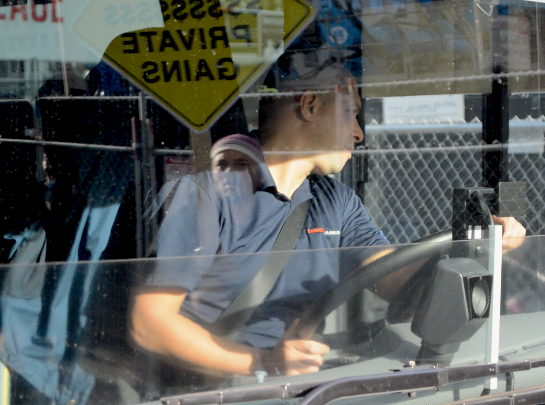
Two tech buses were surrounded and blockaded by over 100 protesters earlier today, just hours before the San Francisco Municipal Transportation Agency Board of Directors is set to vote on fees for private shuttle use of public bus stops.
The protest was organized by Heart of the City, an alliance of many long time housing advocacy groups. The marchers met at UN Plaza at at 8:30am, then proceeded to Market and 8th, where they stopped the two buses that many identified as Facebook and Google buses, based on their destination signs.
“The corporation that is employing this bus is responsible for the displacement of San Francisco tenants,” said Erin McElroy, the head of the Anti-Eviction Mapping Project, to the crowd. “And we’re not going to stand for that for that one more minute.”
In case you’re living under a rock… BREAKING protesters stop 2 tech buses just before SFMTA vote on bus fees pic.twitter.com/cHFeTI6ljP
— Joe Fitz Rodriguez (@FitzTheReporter) January 21, 2014
Techies on their buses worked on their laptops as the protesters swarmed around them. One tech worker even took a quick break to taunt activist and protester Tony Robles (as Robles waves a sign) from the window of his bus. It’s in the video below.
The SFMTA’s today will vote on a pilot program that would charge private shuttles $1 per stop, per day for use of public bus stops, which are used by Muni. Mayor Ed Lee, SFMTA head Ed Reiskin and others have claimed that this falls in line with Proposition 218, which limits fees and taxes that municipalities can levy without going to the voters.
But that’s is murky rationale for a number of reasons, as the SFMTA said that enforcement would be carried out by off-duty (overtime drawing) enforcement officers, and the idea of those officers overtime fees being fully paid by the $100,000 a year contributions of tech companies is questionable.
Equally questionable, the protesters said, is the idea that Google, Facebook, Genentech, Yahoo, and others would only pay about $100,000 a year for their private shuttles to use bus stops created for and maintained by a taxpayer-funded public transit system.
Though the mayor and Google have reiterated the talking point that the shuttles take cars off the road, they also delay the already slowdown-plagued Muni system and push pedestrians onto dangerous streets as Muni jockeys for space with the private shuttles.
By 9:30, the SFPD arrived on the scene of the protest and blocked off the entrance to 8th street from Market. Shortly after, the protesters dispersed and continued marching to a Realtor’s office, and finally City Hall. There were nearly 30 reporters at the bus blockade, but by the time the protesters reached City Hall, there were only a handful left.
@SFPD have now blocked 8th street entrance to Google bus protest #tech #googlebus #panorama pic.twitter.com/0N7TevcjX1
— Joe Fitz Rodriguez (@FitzTheReporter) January 21, 2014
WHY protesting #tech Google buses works 101: nearly 30 reporters swarmed the buses, only 5 left at city hall– pic.twitter.com/HRstF2h3Sb
— Joe Fitz Rodriguez (@FitzTheReporter) January 21, 2014
Talking points for Google busers
TechCrunch is reporting that a Google employee leaked an internal memo the Silicon Valley tech firm circulated to its employees, urging them to provide public comment on the controversial proposal to sanction its private shuttles’ use of city bus stops.
Here are the talking points Googlers were supposedly told to highlight in comments to the San Francisco Municipal Transportation Agency at tomorrow’s (Tue/21) meeting, when the transit board will vote on the proposal.
- I am so proud to live in San Francisco and be a part of this community
- I support local and small businesses in my neighborhood on a regular basis
- My shuttle empowers my colleagues and I to reduce our carbon emissions by removing cars from the road
- If the shuttle program didn’t exist, I would continue to live in San Francisco and drive to work on the peninsula*
- I am a shuttle rider, SF resident, and I volunteer at…..
- Because of the above, I urge the Board to adopt this pilot as a reasonable step in the right direction
The leaked memo, according to TechCrunch, also noted that “While you are not required to state where you work, you may confirm that Google is your employer if you are so inclined. If you do choose to speak in favor of the proposal we thought you might appreciate some guidance on what to say. Feel free to add your own style and opinion.”
According to the article, the memo was leaked to the activists who have been organizing tech bus blockades by an employee who found it “a bit high handed.” In turn, the activists sent it to TechCrunch.
*Not according to the study that was mentioned by the SFMTA at the SF Environment Commission last week.
Google’s androids

rebecca@sfbg.com
CAREERS AND ED Robotics, a field that largely exists in the realm of research and development, is poised to grow leaps and bounds right here in the Bay Area now that Google has decided to dump mountains of cash into it.
So far, the search giant with the “don’t be evil” slogan has acquired eight robotics firms, and is pursuing a robotics initiative that nobody seems willing to describe in detail when speaking on record to the press.
Its December acquisition of Boston Dynamics, a leading robotics firm famous for developing robots like Cheetah — which can move at 29 miles per hour on a treadmill — has generated rampant speculation about the Silicon Valley giant’s ultimate intentions.
Since Boston Robotics receives funding from military sources, including the Defense Advanced Research Projects Agency (DARPA), the high-profile purchase has raised a few eyebrows to be sure — like, they keep all of our email data forever and they just went out and bought some military-funded robots?
“None of these companies have products — they have prototypes,” points out Berkeley robotics professor Dr. Homayoon Kazerooni, who founded Ekso Bionics, a company that aids paraplegics in overcoming mobility limitations with robotic aids.
“Not all scientists or engineers are fully considering commercial applications yet. I don’t know why Google’s buying that stuff, except to push those applications.” From there, the question becomes “what can you do with that, to create jobs that are helpful to people?”
Kazerooni says the research being generated by robot scientists and engineers could yield many possibilities, whether in the form of new robots or something else. While he specializes in robotic machines for paraplegics, he says robots can sometimes be helpful replacements for humans in dangerous situations, like when a repair is needed at a nuclear power plant.
Several of the other firms purchased by Google are based in San Francisco. A recent, um, Google search revealed that while the companies’ website URLs remained intact, their pages had mostly been scrubbed of any information, save a single line of text announcing the acquisitions and that they were joining “the robotics revolution.”
So much for transparency from a company that knows all your secrets.
But thanks to a handy tool created by the San Francisco-based Internet Archive, called the Wayback Machine, we at the Bay Guardian were able to unearth a few nuggets to shed some light on what the hell Google just bought.
Meka Robotics, founded in 2007 by roboticists from the Massachusetts Institute of Technology, is one of the Google robotics acquisitions that lists a San Francisco address. A Wayback search revealed that it has developed something called “the Meka S2 Humanoid Head,” which is a “robotic active vision head” featuring high resolution cameras in each eye. “Designed for a wide range of expressive postures, it is the ideal platform for researchers interested in human-robot interaction and social robotics,” according to a description that no longer exists on Meka’s current website.
Another local firm Google gobbled up is Industrial Perception, a Palo Alto company that the Wayback search revealed is “a leader in 3D vision-guided robot technology” that “enables industrial robots to assume challenging logistical tasks,” mainly related to shipping.
Julia Gottlieb is the executive producer at Bot & Dolly, a San Francisco outfit that operates dinosaur-sized robotic arms equipped with high-end cameras that capture footage while the machines glide through space. “You may have heard the news that we were recently acquired by Google,” she wrote in response to a Bay Guardian inquiry. “Unfortunately, this means I am not able to speak to or make any decisions about press or PR related matters.”
Bits and bots

marke@sfbg.com
CAREERS AND ED “When it comes to robots, there’s usually a kneejerk reaction about job loss. But the robotics field is also creating jobs. We haven’t had stagecoach drivers for a hundred years, but still the world has moved forward.” That’s Tim Smith, a robotics public relations expert — talk about robots creating new jobs — speaking to me over the phone from his Element PR home office in Bernal Heights, where he’s busy representing some of the most innovative robotics projects coming out of the Bay Area.
Smith has a gentle way (he’s no robot?) of putting the recent quantum-like advances in the robotics field into perspective — while also noting the limitations of the field. “One of the biggest challenges I face is overcoming the ‘creep factor’ that most people have when it comes to robots. There are different kinds of robots, different niches: industrial, military, personal. Most people, however, jump to a kind of malevolent science fiction combination of all three. And that’s understandable, considering how robots have been presented in the past.
“But really, personal robots are all around us. Thermostats are robots. Smoke alarms are robots,” Smith continues. “And despite people’s misgivings, they really do want the future, they do want science fiction. They want Rosie the Robot to do their laundry, clean the house. But right now, most personal robots do one thing extremely well. It’s when they’re asked to do two things that chaos breaks out. They need controlled environments. For instance, we have robots to clean your floors, but not one to clean your floors and wash your windows. Even Google’s driverless car needs to be in a certain kind of environment to function.
“So that’s what’s really held the industry from advancing. Meanwhile, though, on this side of that wall, there are some spectacular things being done to fine-tune and develop not just robots but the robotics field, including efforts to integrate robotics into daily life. You can see how far intelligent technology has come just by looking in your pocket.”
Smith took me on a tour of some of the Bay Area-based organizations and companies pushing those advances, including direct descendents of Willow Garage, the legendary Menlo Park robotics incubator started by Google developer Scott Hassan in 2006.
ROBOTSLAB BOX
Sure, math in high school was kind of a snoozefest. But what if your geometry class was taught by a box of robots? Yep, that might have you reaching for the protractor a bit more often.
RobotsLAB (www.robotslab.com) has created that box of robots, which is now in use in several schools. “The idea to create RobotsLAB BOX was born after spending hundreds of hours with educators, teachers, and administrators,” founder Elad Inbar told me by email. “The need for a population with basic STEM skills (science, technology, engineering, and mathematics) is imperative, yet we’ve heard over and over again that students don’t understand why they need to learn math, or where math’s core concepts such as linear and quadratic equations are applicable to their lives.
“As a result, they underperform in evaluations and can give up on meaningful careers. But the RobotsLAB BOX robots are serving in the classroom as a bridge between the concrete world we live in and and abstract math concepts.
“There are four robots in the RobotsLAB BOX: a quadcopter, a robotic arm, a rover with a mustache, and a robotic ball. The students love them all. They help teach everything from the law of cosines to the sum of vectors.”
RobotsLAB BOX even offers a STEM kit that guides you through the basics of robotics. Wait, does that mean a robot will actually teach you to build itself?
OPEN SOURCE ROBOTICS FOUNDATION
The Bay Area-based ROS (Robotics Operating System, www.ros.org) organization is a collection of programmers dedicated to advancing robotics development and application through collaborative coding and invention.
The Open Source Robotics Foundation (www.osrf.org) is the nonprofit in charge of overseeing the development of ROS. Basically this means that it helps make robotics coding something shareable and open to all who are interested (and who can gain the technical chops). OSRF also does things like participate in last year’s headline making DARPA Challenge, the awesome-looking, government-sponsored festival and competition aiming to push robotics to the next level, where it completed a challenge to build an open-source robot simulation environment.
“If you want to enter the world of robotics software coding,” advises Brian Gerkey, OSRF CEO, “some familiarity with Linux is helpful. But the best advice is to just dive in. There are tons of resources at ROS for all levels of expertise and a vibrant community ready to help.
“One of the challenges facing robotics is the multi-disciplinary nature of the field — hardware, software, vision, navigation, manipulation — and lots of math. But there are lots of ways for a young person to get started — things like the FIRST Robotics competition and the growing Maker community come to mind.”
To advance the cause of personal robotics containing open-source software, Gerkey is participating in a panel at the Commonwealth Club on Feb. 26 called “Robots in Unconventional Workplaces” (www.commonwealthclub.org).
“Everyone has their own idea of what a robot looks like and what it does, but in many cases those expectations derive from movies, books, and television shows. One of my goals is to help people picture robots in scenarios they never dreamed possible.”
UNBOUNDED ROBOTICS
“The simplest way to describe our UBR-1 robot is that it’s akin to an iPhone without any third party apps,” says Unbounded Robotics (www.unboundedrobotics.org) CEO Melonee Wise of the one-year-old company’s latest protoype.
“The robot, like the phone, is incredibly capable and sophisticated, but the real value comes from what developers are able to add to the platform. For that reason, the practical applications are limited only by the imagination of the ROS developer community.”
Another way to describe the UBR-1 is: squeee.
The little shiny orange robot is so cute I want to have one just to look at when I get tired of Lil Bub pics. The introductory video, in which an “emergency stop” switch is activated to “prevent robot apocalypse” (“not guaranteed to prevent robot apocalypse”) is enough for me to welcome the coming robot apocalypse.
Now I just have to learn to program the darn thing.
Why Muni won’t earn a dime off the tech buses
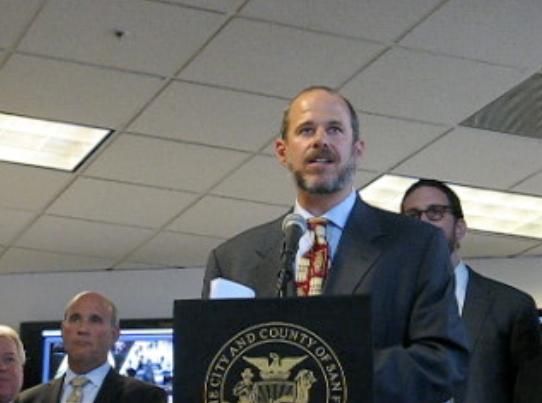
Every day mammoth private buses squeeze into San Francisco public bus stops, and every day they contribute to the delay of countless Muni buses. Riders walk around the Google, Apple and Genentech luxury rides and into the street to board their grimy, underfunded public transit system.
Now finally, the mayor has announced the near-approaching implementation of a pilot program to permit and regulate the tech industry’s private coaches. If approved by a vote from the SFMTA Board of Directors on Jan. 21, the pilot will begin. The only catch is, though they’ll charge those companies for the cost of implementing the program, the San Francisco Municipal Transportation Agency won’t make any money off of the tech shuttles.
The chronically underfunded Muni won’t get a lift from Google. Yesterday (Mon/6) we finally got an explanation as to why.
On the 8th floor of the SFMTA offices, the transit agency’s director Ed Reiskin told reporters that his hands were tied by California Proposition 218, which limits what new revenue municipalities can raise without voter approval.
“Only the voters of San Francisco can enact a tax that generates excess revenue,” he said.
“This isn’t new,” Reiskin said, but he’s only half right. Though Prop. 218 was passed in 1996, this is the first time anyone at the MTA has touted it as a reason not to profit off of the tech shuttles.
We even asked Mayor Ed Lee this question just a month ago, and got a two-minute response that did not once include Prop. 218
Part of this might have to do with the nebulous quality of Prop. 218. An implementation guide from the California Budget Analyst office puts it this way: “Proposition 218’s requirements span a large spectrum, including local initiatives, water standby charges, legal standards of proof, election procedures, and the calculation and use of sewer assessment revenues. Although the measure is quite detailed in many respects, some important provisions are not completely clear.”
The waters of Proposition 218 are murky: is the government charging for the use of Muni stops a fee or a tax? In that grey area lies the answer on whether the city truly can’t charge tech buses to help fix Muni, or if this is just political cover for a government who doesn’t want to piss off tech.
Tellingly, that’s pretty much what Reiskin said.
“There’s a lot of benefit these services (buses) are bringing to San Francisco,” Reiskin told us after the press conference. “We wanted to resolve the conflicts without killing the benefit.”
“I imagine if we sat down with them and said ‘we wanna start taxing you guys’ they’d say ‘screw it, we don’t want to do the shuttles.’”
The 18-month pilot will recoup an estimated $1.5 million, the estimated cost of the project, according to the SFMTA. The project would give approval for use of 200 Muni stops by private shutle providers, out of 2,500 Muni stops in the system. We’ve reached out to California’s budget analyst office to dig into Proposition 218.
The Rise of Candidate X

EDITOR’S NOTE:
As we move through tumultuous times in San Francisco and start a year with infinite political potential, we decided to stretch our imaginations a bit. While this is clearly a work of satire that appropriates some local media voices and perspectives, we hope that even its most fantastical moments will give this parable some resonance with our readers. Happy new year!

EDITORIAL The most exciting and promising political development we’ve seen in a long time in San Francisco is the sudden emergence of so-called Candidate X, who has quickly parlayed groundbreaking populist efforts to reform Muni and housing development into a full-blown campaign for mayor.
While the election is still 22 months away — an eternity in electoral politics — we’re going to go out on a limb here and offer the Candidate X campaign our early endorsement. Political movements like this one are once in a generation opportunities, and it will only be successful with strong, early support.
There’s just too much at stake for politics as usual, or to trust Mayor Ed Lee’s sudden recognition that his economic development policies and deference to market-rate housing developers were hurting San Francisco’s vitality and diversity and igniting a popular uprising, which Candidate X suddenly emerged to help lead.
In case you’ve been living in a cave for the last month, 2014 began with an explosion of progressive activism that finally began to bridge the gap between longtime San Francisco communities and a group of fairly apolitical but Internet-savvy new arrivals, many of whom work in the technology industry, which had been increasingly vilified as elitist and out-of-touch with the city’s values and history.
 A mysterious, masked figure calling himself or herself (nobody is quite sure) Candidate X used social media on New Year’s Day to announce bold plans to “disrupt the streets of San Francisco,” calling for vaguely defined meet-ups at a dozen key spots around the city on the morning of Jan. 3.
The multi-pronged response was overwhelming and surprisingly coordinated, perhaps an indicator of offline organizing that exceeded the viral online phenomenon. Google and other corporate buses were commandeered into free public service (with the collusion of many drivers and regular riders) while Kickstarter, Indiegogo, and other online funding drives raised at least $10 million for Muni to expand its service, a potent mix of fiscal and people power. And that epic day ended with an unpermitted rally of at least 10,000 people in Civic Center Plaza.
A week later, Candidate X followed up with a similar effort to jumpstart affordable housing construction in the city, using a combination of carrot and stick (humanist appeals to project backers and direct action at construction sites) to persuade a half-dozen market rate developments to substantially increase their affordable housing mix. And the candidate helped organize a mass mobilization that brought thousands of tenants to City Hall — and generated 10 times as many emails and calls — to force the supervisors to support a measure raising the relocation fees on Ellis Act evictions so high that the speculators were almost instantly driven out of the city.
Candidate X is now talking about raising even more money for Muni by quadrupling the mitigation fees developers pay to construct new offices.
Those campaigns were coupled with hundreds of activists using hoes, picks, and shovels on public land that was part of the 8 Washington luxury condo proposal, removing the parking lots and grading the land by hand for a communal housing project they intend to build on the site.
The next week, with the Candidate X movement gaining momentum at astonishing speed, Candidate X announced his/her intention to run for mayor in the November 2015 election, starting now. The campaign has already announced a series of radical but smart positions, from banning cars on Market and other key streets to reclaiming Treasure Island and Hunters Point Shipyard from Lennar’s control, and promising many more to come.
In some ways, it seems like a marriage between the surging housing rights movement — which has been challenging evictions and gentrification and fighting for the soul of San Francisco — and the social media-driven Batkid outpouring back in November. But rather than an apolitical one-off, this feels like a broad movement focused on shaping San Francisco in the public interest over the long term.
The whirlwind of exciting political energy has left many speechless, and we can only say: Candidate X for mayor!
 While the Candidate X phenomenon has certainly captivated San Franciscans and attracted national media attention, giving the city’s far-left progressives a glimmer of hope in capturing the Mayor’s Office next year, those close to Mayor Ed Lee say they aren’t worried.
“Everybody’s having fun with this now, but at the end of the day, voters are going to prefer a proven leader like Mayor Lee and his successful jobs agenda to some kind of strange masked comic book character,” a source in the Mayor’s Office told us. “Whatever this thing is, it’ll be a footnote in the mayor’s race.”
 The source cited internal polling indicating the Mayor Lee’s approval rating holding steady at more than 70 percent and unaffected by the last three months’ worth of headline-grabbing antics by Candidate X and his or her campaign. The polls also found the public is turned off by the candidate’s mask and secret identity.
Candidate X has certainly proven adept at using social media and other technological tools to generate support, but Angel investor Ron Conway and his sf.citi collaboration of technology industry leaders have pledged to help make tech-driven outreach and voter identification a centerpiece of Lee’s reelection campaign.
“Entrepreneurs have made this city what it is, and we’re not going to let this Candidate X creature undermine our agenda for San Francisco,” Conway said. “Let them have their fun for now, we’re not worried.”
 Sometimes, revealing the fakers in politics can be easy.
And so it goes with the so-called “Candidate X.” The self-stylized Progressive Hero is a multi-racial, gender ambiguous second coming of Christ for the city’s super-lefties. The narrative began with a PR move that undoubtedly had Willie Brown weeping into his Wilkes Bashford handkerchief.
Brown promised to fix Muni in 100 days, and Candidate X fixed it with one glorifyingly stupid stunt.
Masked and spandex clad, Candidate X straddled two Muni buses while doing the splits, Van Damme style, between them. X rode the buses spread eagle, laughing like a demented Santa Claus, as streams of San Franciscans ran behind them down Geary Boulevard. Using the ploy to call for Kickstarter of America’s Worst Transit System, millions of streaming video gawkers nationwide flocked to and knocked out the crowd funder’s website.
The silliness ended before you could say “back door!”
It was seemingly successful. Defying the history of failed fixes from every ex-San Francisco mayor since forever, X single-handedly raised enough money to “expand Muni for the next three decades,” progressives claimed.
Some played it as a progressive spurning of Mayor Ed Lee’s proven political tactic — ignore Muni’s issues and glorify the Google buses. Some portrayed it as a socialist takeover of an already red or dead leaning City by the Bay. Your humble narrator knew better.
 X is a ludicrous candidate no sane citizen would back, and that stunt was clearly that — a stunt. But still the quixotic charade marched on.
Last week, X sat Mark Zuckerberg and a team of star studded tech oligarchy down with progressive activists. The previously evicted Lee family was there, arm-in-arm with former Mayor Art Agnos and a cadre of lefty power in San Francisco, or what’s left of them anyway. With Candidate X in the center of the two contentious camps, the tableau was vaguely reminiscent of the Last Supper, save for the presence of Mission District burritos.
San Francisco’s problems were tastily tackled one by one.
Housing problems? Hacked and solved. The homeless? Software solutions streamlined shelters in a day. Even hunger among the city’s poor was licked, as the techies and lefties together crafted solutions mind-melding the best ideals of both. All throughout, a time bomb ticked away like a demented clock ready to strike “I told you so!” at midnight.
It’s difficult to watch impending doom stare well-meaning people in the face. Literally staring, as the problem came the person posing for all the cameras: Candidate X.
Last week the candidate’s violent history was revealed, and although the SF Weekly doesn’t have a stock of X-ray glasses, your humble narrator still saw this coming a long way back. X is a fraud. A charlatan. A wannabe in progressive clothing. And now we all know why.
In police records obtained by the City Attorney’s Office, Candidate X was revealed to be one of the Occupy San Francisco and Oakland protesters, maybe even from the pernicious Black Bloc. Way back when, the Bay Area was captivated by martyred rallier Scott Olsen and others who were wronged by the not-so-mighty Oakland Police Department. OPD tear gassed and grenaded the Occupy pests. At the same time, a more intimate, frightening drama played out across the bay in San Francisco’s Embarcadero.
The SFPD was mostly kind to their own Occupy camp, but one boy in blue was not: Officer Alex Murphy. He paid dearly for it. One night, sleeping in his tent at the Occupy camp, Candidate X was roused by Murphy and ushered to leave. Does that translate into the officer deserving a beating within an inch of his life? It seems Candidate X thought so, although he also seems to have got as good as he gave, and ended up in the hospital.
The Black Bloc folks aggressive ways led the public to link Occupy with violence, from hippies to rage rousers. Black Bloc and Candidate X were kindred souls. Even his heart was black.
X yanked Murphy behind the fountain at Justin Herman Plaza, and punched him repeatedly, savagely, in the face, Murphy said in police reports, eventually pinning the officer to the ground before he got his.
Candidate X put up the usual defenses. “Murphy was near murderous with protesters all night, he’d gone vigilante,” Candidate X told scads of TV crews in Aaron Sorkin-esque walk and talks, last week. Protesters said he saved their lives, hailing his heroism. San Francisco shouldn’t buy the story. It’s malarkey, plain and simple.
But good reasons or no, is a violent wacko the kind of candidate you want leading the new progressive movement? Not surprisingly, it seems the new progressive era is like the old one. Big dreams, empty promises, and a lot of rhetoric that will soar nowhere.
And no one, especially not your humble narrator, was surprised.
 The electoral landscape today is much different than it was only last week, when the revelation of Candidate X’s brawl with police had pulled the mayoral hopeful’s poll numbers into the ground.
Now a new viral video released by members of the San Francisco Occupy camp from 2011 confirms X’s side of the story: Officer Alex Murphy broke ranks with the generally peaceful SFPD. Police Chief Greg Suhr had a mostly “hands off” policy, allowing the Occupiers their right to free speech.
Murphy did not follow those directives, however, and the video shows the officer swinging his baton wildly, throwing punches, and injuring several protesters in the night, only to be fought off by Candidate X.
The story of X’s fight with an SFPD officer during the Occupy encampments had many saying the candidate’s campaign was over.
“That’s not someone I’d trust to be the leader of San Francisco,” said Mayor Ed Lee Press Secretary Christine Falvey.
The release of the video casted doubt on Murphy’s side of the story, and changed the electoral climate in the city going into next month’s election, when five seats on the Board of Supervisors are on the ballot.

 Progressives in San Francisco scored big victories in last night’s election, winning seats on the Board of the Supervisors that a year ago seemed secure for the incumbents, thanks largely to a populist surge triggered by the mysterious Candidate X mayoral campaign.
Although neither Mayor Ed Lee nor Candidate X will appear on the ballot until next year, this year’s legislative races clearly got caught up in the enthusiasm of that race, with David Campos defeating David Chiu in their Assembly race and three members of the Board of Supervisors replaced by progressives.
Attorney David Waggoner took Sup. Scott Wiener’s District 8 seat and previous political unknowns Jennifer Wong and Betty Jones scored improbable victories in the Districts 2 and 10, defeating Mark Farrell and Malia Cohen.
District 6 incumbent Jane Kim appears to have narrowly won reelection after being strongly challenged by three candidates to her left, who criticized her ties to Mayor Lee and her sponsorship of the big tax break for Twitter and other mid-Market businesses almost four years ago. But Kim appeared to blunt that criticism by leading this year’s repeal on that and other business tax breaks and firmly aligning herself with Candidate X.
Kim’s vote in favor of raising fees on Ellis Act evictions and more than tripling the fees charged to office developers for Muni and affordable housing almost certainly saved her seat — and the refusal of Farrell and Cohn to support the tenant and economic fairness agenda were major factors in the campaigns that unseated them.
 Candidate X defies easy categorization, and confusion surrounding this political dynamo’s gender identity is just the tip of the iceberg.
Since announcing her candidacy, she’s been the subject of rampant speculation among the city’s political insiders. Is she a native Spanish speaker, or did she grow up speaking Cantonese? Was she born and raised in San Francisco, or is she a transplant from the Midwest, or a foreign-born resident? Which supervisorial district does she live in? What is her annual income? Does Candidate X have any tattoos?
For all the questions this rollercoaster-like campaign has raised, Candidate X has left little doubt about his stance on certain issues. He frequently spouts a philosophy of “radical inclusion,” which he says could be put into practice in San Francisco city government by creating an online platform where all residents could log in and vote directly on discretionary funding allocation. He’s proposed eliminating the system of mayoral commission appointments altogether, instead allowing residents to digitally cast votes for commissioners. And he’s floated the idea of making every single public document tagged, searchable, and readily available, to anyone, the moment it’s created.
Candidate X’s unique method of campaign fundraising has spurred several economic studies. She’s created partnerships with a wide network of independently owned, San Francisco small businesses to allow customers to chip in a bit extra when they make a purchase, then used her considerable social media reach to encourage supporters to shop at those businesses. The approach has helped her tap a broad pool of donors, while sending new clientele through the doors of struggling proprietors in every corner of the city, many of whom have been losing ground in the face of rising rents and competition from national chain stores.
Candidate X has also organized campaign fundraising events with sliding scale admission fees. They are rumored to draw large, diverse crowds and occasionally last until sunrise, with attendees lingering for impassioned political discussion long after the performers have left. The events tend to start early in the evening with talks by local artists and authors, followed by aerial circus arts performances and live sets by Bay Area bands spanning a wide range of musical genres.
Candidate X has met with experts on climate change and used their input to produce a comprehensive plan for developing city-owned renewable energy infrastructure, which she says could be staffed with graduates of a job-training program created for at-risk youth. She’s also undertaken a project of identifying every abandoned property in the city that could be converted to residential use, as part of a plan to open up new transitional housing for homeless residents, to be staffed with a veritable army of substance abuse counselors and mental health professionals.
Earlier this month, when baristas organized a citywide protest against gentrification — by withholding coffee and shutting down Wi-Fi networks — Candidate X rode his bike from café to café to stand with the aproned employees while bleary-eyed patrons lined up outside the doors in confusion, clutching their laptops.
“Today, you are going to have to make your own coffee and work from home,” Candidate X told the bewildered patrons, after baristas shared personal stories of facing eviction or anxiety over losing rental housing.
“These baristas have taken a courageous stand for economic justice, to defend San Francisco against real estate speculators and developers who hold no regard for this city’s long tradition of inclusion and equality. They will not make your Ethiopian pour-over coffee with complex flavors of lilac and lavender while you connect to their free Wi-Fi — until you join in the fight against real-estate speculators whose actions have threatened this city as a haven for people of all incomes and identities.”
Since then, rumors have surfaced that someone in the tech community who heard the baristas’ stories that day has since started collaborating with the San Francisco Tenants Union, to create an app to help apartment-hunting tech workers boycott landlords who are known to carry out evictions and harassment — and to track evictions and alert house-hunters to join in refusing to bid on properties emptied by eviction.
 So it seems that Candidate X has done the unthinkable, and gotten the younger voters of San Francisco to actually give a damn.
In his (her? their?) latest headline-grabbing move, Candidate X registered nearly 100 percent of voters age 18-30 in San Francisco just in time for the next election.
How’d X do it? The SF Examiner explains:
“In what could become a regular afternoon ritual, Candidate X stopped by college campuses, hip coffee shops, and Dolores Park this week with representatives of the tech industry and every San Francisco constituent group in tow.
The elderly, the homeless, new immigrants and others volunteered their time to convince every young voter, one by one, why it was worth their time to register to vote.
“I’ve never felt like I had a reason to give a damn, really,” said Martin Collins, 22. “Maybe it was X’s energy, which felt like (President) Obama’s campaign… or maybe it was because Macklemore was there. Either way, I’m voting next election.”
There you have it folks. X is so revolutionary. All you have to do is bring famous people to your voting drive, or you know, tout “hope and change.”
That always works. Last time Ed Lee ran for mayor, only around 30 percent of San Franciscans turned out to vote. Now Lee really has something to worry about.
 Candidate X has been an enigma from the beginning, a vessel of progressive hopes for finally winning the Mayor’s Office. And at tonight’s triumphant election night party, we learned that we’re all Candidate X.
As exciting as the political victory was the hope that the masked Candidate X would reveal her or his identity after winning the race, which the current 15-point margin all but assures. That made for a big moment when Candidate X came onstage in Bill Graham Civic Auditorium to address the large crowd.
“This election was a fight for the soul of San Francisco and beyond. It was a referendum on the belief that we should leave this great city and others like it to the mercies of market forces, and the people have now said they want to be in control. Politicians often claim their victories are really victories for the people, but tonight, that’s finally true,” Candidate X said.
At that moment, dozens of nearly identical Candidate Xs — with the ubiquitous mask, cape, and costume, that image that has so captivated the country over these last 22 months — streamed out from backstage and filled the stage.
“1, 2, 3,” they all said in unison, all of them pulling off their masks at the same moment, revealing themselves to be a broad cross-section of city residents: young and old, men and women, attractive and plain, black and white and every shade in between.

“You see,” said the Candidate X who had originally come to the microphone, who appeared to be an Asian woman around 40 years old. “From the very beginning of this campaign, there’s never been a single Candidate X. We’ve all worn the mask at different times, we’ve all stood on the stump to proclaim the progressive values that this election was about, and we’ve all run this race.”
“Some of us have been doing this for a long time,” said a costume-clad Tom Ammiano, the longtime local legislator who last ran for mayor in 1999, “and we knew this moment needed to be about more than just one leader. So we created a vehicle that we could all ride into Room 200.”
Ammiano told the Guardian that he had been part of the large team that conceived of Candidate X during a series of secret meetings in late 2013. He said the campaign hopes and believes that its entire X Factor Leadership Team will be allowed to legally govern the city, but that just in case the Lee team challenges the unconventional arrangement in court, Ammiano last year legally changed his name to Candidate X and that he will serve as the figurehead for that governing structure if necessary.
“To turn this city around and restore it as an example for the world is a job for all of us, not any one person or faction,” said another Candidate X, who appeared to be African American woman in her early 20s. “We face challenges ranging from unaffordable rents here to global warming and loss of biodiversity everywhere. And it’s going to take all of us, working and standing together, to solve these problems and create a just and inclusive society, today and for future generations.”
“Todos somos Candidate X,” declared an elderly Latino Candidate X. “We are all Candidate X.”
*All new items written by Steven T. Jones, Rebecca Bowe, and Joe Fitzgerald Rodriguez
Read this: 11 national news outlets cover SF’s tech culture war
Those of us in the Bay Area have long followed the rising rents, floods of evictions, and growing resentment between long-time Bay Area residents and the new tech elite. Now it seems the national media is catching on. National reporting of the Bay Area class war is on the rise.
We’ve rounded up some of the more colorful coverage, which runs the gamut of different perspectives (even among the so-called “objective” news outlets). Some say the resentment is understandable, some say the blame against techies is misplaced. Some, like The Huffington Post, reached out to protesters for interviews, while others simply reblogged local reporters’ Tweets and video – including the Guardian’s.
Regardless of which of the articles you most agree with, the one thing we can all agree on is that things are changing fast. Just this week, Mayor Ed Lee announced his plan to prioritize and streamline construction of affordable housing in San Francisco. And the mayor’s pal, Ron Conway, announced via a press release today that local tech/government partnership group SF.citi will form three committees to address rising inequality in San Francisco: one on housing (led by SPUR’s Gabriel Metcalf), another on philanthropy (shaking down rich peeps for cash), and another on education (hoping to form a tech pipeline from SFUSD to SFSU to jobs).
But why blockade the tech employee’s buses? Why not protest the mayor instead?
“People say ‘you should protest city hall!’” organizer Leslie Dreyer told us. She had a large hand in organizing the first Google bus protest that blew up in the national press last week. There’s a problem with that, she said.
It didn’t work.
“We did that every day,” she said. “No one noticed us until we protested a Google bus. There’s a tension when you take it to the street.”
Maybe the national press gave Mayor Lee the nudge he needed. Decide for yourself. Below are a few examples of the national news outlets highlighting the Bay Area’s growing inequality, covering the first tech bus protests last week, and today’s.
NPR: Income inequality in the San Francisco Bay Area
National Public Radio didn’t just do one article on the Google bus protests, they used the first incident as a catalyst for a weeklong series on inequality in the Bay Area. Kudos to them for going a step beyond the protest, and digging into the issues that prompted it in the first place.
One of their best pieces covers Manny Cardenas, a security guard at Google.
“Cardenas says it is strange being on Google’s campus, watching the regular employees drive around on company-supplied bikes and scooters and taking food home.
‘You feel like you’re different,’ he says. ‘Even though you’re working in the same place, you’re still like an outsider. And it’s weird because you’re actually protecting these people.’”
New York Times: Google bus vandalized during protest
The Times covered the growing inequality before the protests, but followed up with a few quick pieces on the tech bus rallies in San Francisco as well. Their take featured tweets from the tech community itself, who continued to hammer home on the point that the tech buses help take cars off the road. Uh techies, hate to tell you, but the point of the protests is not about taking you out of your buses, but about paying your fair share, like the robotic voices on the Muni buses tell us to do every day.
The Times previous bus protest coverage and their previous coverage on San Francisco gentrification.
My Gbus got hit by protesters in Oakland and they broke a window. pic.twitter.com/VGCyhBLgyd
— Craig Frost (@craigsfrost) December 20, 2013
Fox News: San Francisco Residents Protest Google’s Buses
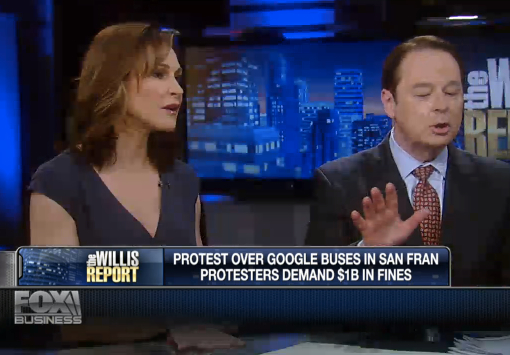
Talk about missing the point, Fox News program “The Willis Report” coverage of the tech bus protests is blissfully comical. Watch Tamara Holder, the one female commenter, have to explain she knows what the word “pithy” means. Oh boy.
From the program:
“Google is a national treasure, a force for good. San Francisco should be really glad its people work at Google, yet now they’re beating up on the company… I’m trying to find it hard to understand the resentment. It just seems like it’s resenting Google because its employees are rich.”
We only wish Jon Stewart would’ve covered this silliness.
Salon: SF Protesters block Google bus
Salon approaches the issue from a “Google is smarmy and weird,” perspective, touching on the idea that maybe the class war is a culture war as well.
“If you’ve had the misfortune of watching “The Internship” — the most profound artifact of brand placement in cinema history — you’ll have been told that Google, and its ruling ideology of “Googliness,” is nothing if not purportedly a warm and cozy vector of innovation, with its own internal, coddled ecosystem.”
HuffPost Tech: Protesters Block Google Bus, Demand $1 Billion
This Huffpost piece is notable for the video at the top of the page, featuring an interview with local activist Erin McElroy, the leader of the Anti-Eviction Mapping Project. The piece also actually tries to explore the tech bus non-payment of city fines for using bus stops, something some of the other pieces completely avoid altogether.
“The protest centered around Google’s use of the city’s Muni bus stops for the last two years — a practice that protesters allege is illegal and would total $1 billion in owed fines. Activists from the San Francisco Displacement and Neighborhood Impact Agency stalled an employee-filled Google Bus at the corner of 24th and Mission Streets for approximately half an hour on Monday morning with mock traffic signs citing the shuttles for illegal use of public infrastructure.”
CNET: Fake Google employee’s fight with protesters we wish was true
CNET took a look at the antics of Max Bell Alper, whose “theatrics” in posing as a Google employee arguably helped catapult the conversation on Bay Area’s tech driven inequality into the national spotlight. Nick Statt makes this observation about Alper:
“…what Alper did was something special. He lied to us, and in doing so, got us all to start throwing rocks and then look only at each other when the mirror shattered. Mission accomplished.”
This situation is getting more and more complicated – @google bus hijacked again in housing crisis protest pic.twitter.com/eloeUvrafV
— Ken Ken Ramen (@KenKenRamen) December 20, 2013
Wall Street Journal: Fake Protest Spawns Real Outrage
One of the few outlets to play it straight, the Wall Street Journal’s new reporter Nathan Olivarez-Giles (a Missionite himself) pointed out that Alper is no San Franciscan, and highlighted the differing opinions among the protesters of his “theatrics.”
“Deepa Varma, a lawyer with the group Eviction Free San Francisco and an organizer of the bus protest, said the protesters have mixed feelings about Alper’s staged outburst.
‘We didn’t know that was going to happen and it’s too bad because the point was really to connect the housing crisis to the tech industry,’ Varma said.
Google did not respond to a request for comment.”
Max Bell Alper, not as clever as he thinks he is. http://t.co/bTptVLSWbj
— Derek Powazek (@fraying) December 9, 2013
Honorable mentions: Missing the point
These three outlets make the argument that the protesters anger is misplaced, and should rally against government, not techies, instead. But as we’ve pointed out, that doesn’t tend to get attention, whereas protesting techies does (or else these three outlets likely wouldn’t have written stories in the first place).
The Wire: A fake fight at a real protest blames the wrong people for a serious problem
Slate: Protesters surround Google bus in San Francisco. Obnoxiousness ensues.
Wired: In This Silicon Valley Tech Culture and Class War, We’re Fighting About the Wrong Things
The Peter Shih Effect
— Susie Cagle (@susie_c) December 10, 2013
The Atlantic Cities: Why I’m Not Embarrassed to Have Been Fooled by the Google Bus Protest Hoax
In this piece for The Atlantic Cities, Sarah Goodyear points out that with real tech haters like Peter Shih (though now we have Greg Gopman too) referring to San Francisco women as “49ers” (4’s who think they’re 9’s) and saying our foggy weather is “PMSing,” buying Max Bell Alper’s Google employee impersonation wasn’t all that much of a stretch.
But she takes it the next step further, and tries to build bridges between all involved.
“Will the next generation of tech entrepreneurs abandon the suburban campus model that makes Google buses necessary? We’ll have to wait to find out, although the rise of the tech sector in New York – where public transportation and pedestrian culture are more robust than anywhere else in the United States, and the bubble of privilege is less impermeable – may be one indication that things are changing.
In the meantime, the obnoxious tech guy who wasn’t a hoax, Peter Shih, did try to make amends. After his offending entry on Medium came down, Shih posted a note of apology on the site:
‘I don’t deserve any forgiveness for the stupidity of my actions and words, but I sincerely hope to demonstrate by my future behavior to humbly build up and not tear down the communities and people around me.’
I’m inclined to give Shih the benefit of the doubt, and Alper, too. Not to mention myself. We’re all just trying to figure this out, after all. And sometimes it’s the mistakes you make that teach you the most.”
Undoubtedly a new slew of articles will follow today’s protests, as the smashed windows of an Oakland Google bus are the ultimate media bait. Post any new articles you’d like in the comments below.
Mayor Lee addresses Google bus controversy
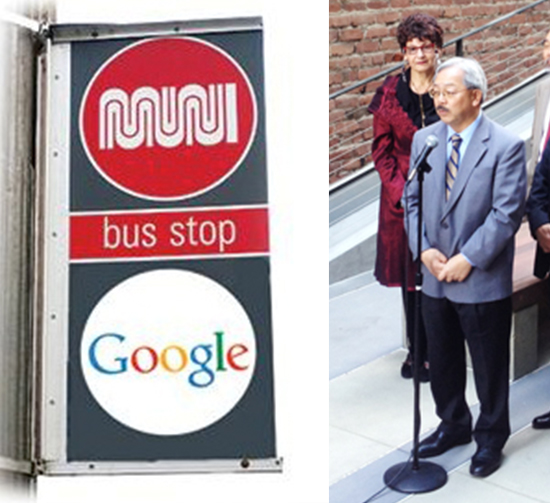
At a press conference on affordable housing today, the Guardian asked Mayor Ed Lee about San Francisco’s favorite pinata: tech buses. The monstrous private shuttles, which daily whisk tech workers away to Silicon Valley, currently use Muni bus stops without paying fines, like most private autos do.
In Guardian News Editor Rebecca Bowe’s article in the print edition of the Bay Guardian this week, the San Francisco Municipal Transportation Agency spokesperson Paul Rose tells her that although there is a proposal in the works to regulate them, the SFMTA won’t profit a single dime from the plan.
“We are developing these policies to better utilize the boarding zones for these shuttle providers,” Rose said. “What we’re trying to do is provide a more efficient transportation network.”
But everyone in San Francisco who has ever ridden Muni knows that it struggles to run on time, and chronic underfunding is a perennial Muni problem. It even hurts the city’s bottom line, depressing our economy by over $50 million a year, according a report from the city earlier this May.
The report also highlights the cost to overhaul Muni between now and the year 2020: over $167 million would be needed to overhaul the system.
So why not make a few bucks from tech companies using Muni stops, who, according to the city, cause Muni delays?
We asked Mayor Ed Lee that very question at a press conference today. You can listen to his answer in the audio embedded below, or read the transcript for yourself.
San Francisco Bay Guardian: “Housing is one aspect of this, but transportation is another. The MTA’s plan to deal with tech buses is cost neutral. Is that a missed opportunity to get additional funding for Muni?”
Mayor Ed Lee: “Not a missed opportunity. That’s the essence of that 2030 task force, transportation task force, that we put together where they send a report to me, I’m in a process of reviewing all aspects of that.
Muni officials themselves were directly involved in producing that very comprehensive review along with our Planning Department and many in fact all of the departments here had implemented them.
Transportation is not just about Muni, it’s about all the modes of how people get around the city. You can’t forget that, because that’s a really big part of the task force’s work.
How to get people walking. How to get them bicycling safer and more. How to get cars less, and the cars that do, get them through where they have to go without stalling and congesting.
How do you invest in Muni? In its assets, in its transportation, in all of its aspects. How do you work with taxis and all the other car-sharing and automobile sharing companies. It’s not just about taxis, by the way. I hear from my taxi friends as I walk around City Hall, they don’t want to be left behind so we want to bring them in to see the new exciting use of Uber carshare and Lyft… all of those modes have to be paid attention to at the highest level, including investing in the assets of Muni.
I want Muni to be the choice.”
Earlier in the press conference Lee voiced his opposition to all of the hatred pointed at tech companies.
“People, stop blaming tech, tech companies,” he said. “They want to work on a solution. I think it’s unfortunate that some voices want to pit one economic sector they view as successful against the rest of our challenge. The reality is they’re only eight percent of our economy.”
We tried to ask a follow up question, but at the end of his answer on Muni, the mayor’s spokesperson Christine Falvey told the Guardian “We’re going to go on a tour now, this is off topic.”
Tech sets out to help the homeless
Google “tech,” “San Francisco,” and “homeless” right now, and you will undoubtedly find the tale of Greg Gopman, former CEO of AngelHack, whose notorious Facebook comments comparing homeless people to “hyenas,” among other things, earned him a viral dose of public shaming delivered via Twitter and the blogosphere.
Needless to say, the less-than-angelic entrepreneur didn’t score any points with vocal critics of the tech sector as a driving force of gentrification in San Francisco.
“I looked at this tech boy’s face and wondered if he ever really worked in his life,” scoffed longtime activist Tony Robles, in an editorial for POOR Magazine. “He has pampered written all over his face. He says he been all over the world, to third world countries even (clap clap clap). I hope he wasn’t as big an assh**e overseas as he is here in the Bay Area.”
In this climate of flaring tempers, increasingly defined by escalating tension between the haves and the have-nots, tech entrepreneur Rose Broome is wading in with something she believes can help solve homelessness in San Francisco and elsewhere: A startup.
Hey @Sidecar, Chris is homeless and could really use a winter jacket. Can you help? https://t.co/FAPIFsnhNv #MakeMyHoliday
— Rose Broome (@rosical) December 16, 2013
HandUp is unlike any homeless services provider. It doesn’t operate as a nonprofit, nor does it provide shelter, accept donated blankets or foodstuffs for those in need, or connect people directly with mental health services or substance abuse counseling.
Instead, in accordance with a Silicon Valley-based formula that encourages a technology user to share in order to earn points and broaden one’s circle, it is based on digital profiles.
HandUp “members,” who include individuals living on the street as well as those at risk of becoming homeless, are aided in the creation of their own webpages, where they write out their bios, pose for professional photographs, and make a list of items they need. They are also given something like business cards, to hand to people on the streets as a way to direct them to their website.
Donors may then visit the website, surf through the member profiles, and decide how much to give and to whom. The whole transaction can occur without the donor ever having an interaction with an actual person on the street, but Broome says the donors express interest in how the members are doing, while members express curiosity about who has chosen to help them and why. If the donors feel uncomfortable selecting an individual, they can contribute to a general fund.
Once a member has received a donation, they can go to Project Homeless Connect, HandUp’s partner organization, to redeem it for things such as clean socks or canned food. “It really depends on what the person needs,” Broome said. “People need their phone bill paid, bike locks, temporary housing, help with ordering things online. We want this to be open because people have all kinds of needs.” So far, with a pilot program, Broome says members have averaged $200 in donations per month.
HandUp plans to begin fundraising for its corporate development soon, and it’s won public praise from Bevan Dufty, appointed by Mayor Ed Lee to address homeless issues, and Sup. Jane Kim.
Broome told the Bay Guardian that she got her idea after witnessing a homeless woman sleeping on the street last winter. “I was like, why, in a city with so many resources … have we not figured out some new ways to tackle homelessness?” she wondered.
That is a good question. It’s a question that many a homeless advocate, affordable-housing activist, clergy member, Occupy protester, health-care provider, government employee, candidate for office, international visitor, or generally compassionate individual has likely asked as well. But the problem persists.
HandUp isn’t the first tech-based initiative to try and tackle homelessness: There’s also this, and this, and this.
As Salon.com writer Andrew Leonard put it in an article where he reflected on HandUp and his interactions with Jason Calacanis, HandUp’s lead investor, “I also detected what I thought was the unstated assumption that if the almighty tech community just got around to devoting its attention to the issue, then it could be fixed, lickety-split.”
.@Gopmania, you said something really dumb, but you are a good person. Go to http://t.co/83ClgRnOFC and give 5 folks $100 each–I will match
— jason (@Jason) December 11, 2013
Broome, who partnered with software engineer Zac Witte to formulate the HandUp platform, attracted some criticism for taking the for-profit route. HandUp is registered as a benefit corporation, a kind of corporate entity that has a positive social mission “baked in,” as she puts it, to its raison d’être.
“We don’t want to be constantly struggling, and constantly fundraising,” she explained when we asked about why HandUp is a for-profit entity. “Our social mission is very core to what we do.” A mechanism for generating revenue will come further down the line, she said – not by taking a cut of the donations, but through partnerships with retailers who will be part of the system for redeeming donations.
Broome acknowledged that her idea might be dismissed as too simplistic. “It’s sort of a cliché, that tech people want to pull out a phone and solve a problem,” she said.
And while the basic desire to help is laudable, it’s hard to see how great of an impact this could have when considering the broader economic picture. The Bay Area is ground zero for a sweeping national trend of income inequality, and the housing affordability crisis is undeniably a key reason why there are so many people without homes. This very crisis is fueled by an influx of tech employees. HandUp doesn’t begin to approach this root cause.
It’s also a bit questionable that members are expected to publish their names, images, and life stories in order to get their needs met. Some members, out of desperation, are even sharing details about past incarceration, drug use, or medical problems, which could actually hinder their efforts to land a job or find housing in the long run.
But Broome says personal stories contribute to HandUp’s greatest strength, which is to “humanize” the problem of homelessness for prospective donors who may not understand their plight or otherwise think twice about them. “We help put a really human face on homelessness. It’s hard to have an understanding of what homelessness is like,” but by giving people a forum to share their story, “It helps you have empathy.”
Do San Franciscans really need that much help feeling a sense of empathy? If they are anything like Gopman, then maybe so. This week’s Guardian editorial dives into this a bit.
Kara Zordel, executive director of Project Homeless Connect, acknowledged that HandUp is not a cure-all, yet said she was pleased to see new energy and “to have anybody from the community coming up with some idea.” After all, a startup that aims to tackle homelessness could lead to a flood of donations from tech workers, a demonstrably better outcome than tech workers sounding off on Facebook about how disgusted they are by the homeless.
“I don’t think this is a good fit for someone who is ill on the street, but there’s not one program that’s going to fit every single need,” Zordel went on. For people who are mentally or physically ill and living on the street, there is still vast unmet need, she added.
“If I could have one wish, it would be for medically based housing in San Francisco,” Zordel went on. “Even if we have 1,000 different housing units, we have a lot of medically fragile people,” who would require a high level of care in order to improve, she explained.
At the same time, she emphasized that any person who approaches Project Homeless Connect with a need will be treated equally, whether they participate in HandUp or not.
“There’s no way I would feel comfortable sleeping at night thinking that somebody on HandUp is more deserving than somebody who’s not,” she said. And on the whole, she agreed, the problem of a lack of housing for those out on the street should be prioritized. “Until we meet the needs of the homeless,” she asked, “Are we really going to feel whole as a city?”
Candy crush

marke@sfbg.com
YEAR IN NIGHTLIFE The drink of the year was the Chinese Mai Tai at Lipo Lounge. It’s $9, but it’s huge and you only need one. Or maybe a half, if you want to remember your pants. Oh, just drink the whole thing.
It was another supersweet, neon-bright yet sonically sophisticated year of clubbing and dance music, full of ups, downs, and twirl-arounds. Celebrated rave cave 222 Hyde and Hayes Valley drag outpost Marlena’s closed (boooo). But Mighty and 1015 got mindblowing new sound systems, Monarch and DNA Lounge expanded, Project One inherited 222’s speakers, Public Works and F8 doubled-down on adventurous bookings, and ambitious venues Audio Discotech and Beaux opened (and are still finding their footing). And we got a new dance music record store, RS94109, and rising dark techno star, Vereker.
As far as music goes: we’ve managed to fend off the worst of pop-EDM, while welcoming the drum ‘n bass and big-room ’90s sound comeback with open underground arms. (Also, there is an actual underground!) San Francisco’s still a major destination for techno up-and-comers — and even though you may stumble across some clueless tech-bros sporting 2k7-wear or novelty rasta wigs on our finer dance floors, give them a hug and hope they improve! It’s all good.
>>Read Emily Savage’s take on the YEAR IN MUSIC 2013
Before I get into some of my favorite 2013 things, let’s tip a hat to two legends we lost this year: Scott Hardkiss and Cheb i Sabbah. Between them, they brought a whole world’s worth of music to our dance floors and spanned generations. Dancing forever in their honor.
HIP-HOP, Q’ED UP
Hip-hop got so good in 2013, the Year that Twerking Ate the Internet. Trap sounds and molly pops seemed to invigorate the East Bay scene: E-40 dropped a zillion slaps, while Iamsu! and Sage the Gemini (who can totally get it, hellieu) swerved onto the national scene. Buffed-up SF legends Latyrx dropped a nifty disc after two decades. In the bigtime, Kanye bought up every edgy electronic producer he could to impress Pitchfork, while Danny Brown and Kendrick Lamar recontextualized essential ’90s rap tropes — gangsta and concept albums, respectively, but in a party way.
Unfortunately, another ’90s rap trope, tired homophobia, was also revived, with Eminem and Tyler, the Creator fumbling bigtime. This time, however, there was such a huge and thriving queer hip-hop party scene that we could look right past all that lazy ish. Queer rap broke big in 2012 when eye-catching artists blended witch-dark sounds, quantum vogue moves, and afro-surreal poetry with R&B licks, broken bass boost, and neon-bright performance art.
That scene deepened and brightened this year — here, at super parties like Swagger Like Us, 120 Minutes, Fix Yr Hair, and House of Babes and unstoppable homegrown talent like Micahtron, Double Duchess, and even cameo appearances by classic homohop babes Deep Dickollective — proving that spitting flames can still burn down the disco. And queer-rap resistance even grabbed the national spotlight when Daddie$ Pla$tic‘s electro-anarchic “Google Google Apps Apps” went viral.
SWEET AND LOW
The Honey Soundsystem crew ended its Sunday night parties at the top of its game with a huge blowout — surprise marriage proposal, performance by fabled ’80s singer Jorge Socarras, and slew of unannounced guest DJs included. Honey was an ostensibly gay club, but that might have just been a feint to pack the floor with hairdressers. While it never ceased brazenly shoving its raw homosexuality in the oft-frigid techno scene’s face, its influence went way beyond the queer sphere. For five years, it was our best weekly in terms of musical guests (Wednesdays’ fantastic Housepitality almost ties it on that score), bringing in a mind-blowing roster of international underground players.
But Honey Sundays were more. Will there ever be a party ballsy enough to take as a month-long theme the skyrocketing real estate market, condo-mapping its venue and printing “luxury house” brochures? Or base the décor of one of its biggest parties around a collection of putrid haters’ comments? What promoters, nowadays, even bother to actually design and print challenging works of art as posters and flyers, or truly transform their venues? (DJ Bus Station John, still our gold standard, is the only one I can think of.)
Fortunately, Honey parties will continue, just not weekly. But SF is full of such amazingly talented crews, both well-established (As You Like It, No Way Back, Sunset, Lights Down Low, Icee Hot, Opel, Pink Mammoth) and burgeoning (Isis, Face, Modular, Mighty Real, Trap City, Odyssey). My wish for 2014 is that many of these really invest themselves in building a whole vibe for their parties, top to bottom, instead of just relying on groovy headliners, online promotions, and audience goodwill. As the changing city chases out its artists and loses its edge, we need entire worlds of freakiness to escape into and call our own.
TOP SOUNDS OF 2013
>> Nebakaneza, “Expansion Project, Vols. 1-11“
What does our most forward-thinking dubstep DJ do when dubstep’s no longer an option? He deepens his crates, cycling through 12 months-worth of excellent mixes, themed by genres like yacht rock and classic soul, to rediscover his bass roots while transforming his sound into something even more thrilling.
>> Swedish House Mafia, Bill Graham Center, Feb. 16
I finally get it! All you need is a $1 million light rig, 40,000 glowsticks, an indoor fireworks show, and an arena full of half-naked teens. This EDM stuff is actually kind of fun.
Disclosure’s Grammy-nominated debut Settle (Cherrytree) will nest atop most critic’s dance picks this year, and rightly so: the young Lawrence Brothers brought lovely, 2-step-fueled house back into headphones and charts worldwide. But if it also brings more attention to breezy sonic relatives like Bondax, AlunaGeorge, Joe Hertz, the Majestic Casual roster, and the hundreds of bedroom producers who suddenly switched from making EDM and dubstep to deeper house sounds, then so much the better.
>> Deafheaven, Sunbather (Deathwish, Inc.)
Shoegaze plus death metal equals an arctic beauty and burning mystery that transcends even My Bloody Valentine’s wonderful, self-released mbv and, when listened to alongside this year’s icy electronic-ish masterworks like Tim Hecker’s Virgins (Paper Bag Records) and the Haxan Cloak’s Excavations (Tri Angle) — or more emotive ones like Chance of Rain (Hyperdub) by Laurel Halo, Psychic (Matador) by Darkside, or Engravings (Tri Angle) by Forest Swords — makes strange sense of a near future.
Steve Reich, “Music for 18 Musicians,” SF Contemporary Music Players, Jan. 28
The fact that there was a near-riot to get into a performance this hypnotic, hyper-complex 50-minute 1974 piece by minimalist icon Reich attests to SF’s ravenous appetite for “contemporary classical.” That the audience sat in stunned silence a full two minutes after the piece concluded before exploding with applause attests to the excellence of our local players. (And while we’re on “classical,” kudos, too, to the SF Opera’s summer production of Mozart’s “Cosi fan tutte” — three fantastic hours of the most ravishing singing I’ve ever heard.
>> Patrick Cowley, School Daze 2 x LP (Dark Entries)
The instant Internet popularity of Montag’s trippy “Porn Archives Lo-Fi Mix” earlier this year should have tipped off the coming re-evaluation of porn soundtracks as electronic artworks. But when members of Honey Soundsystem released this two-disc compilation of fascinating, atmospheric early tracks by local electronic wizard Patrick Cowley (1950-1982) used in ’80s gay porn flicks, it became a critical sensation.
>> Regis, As You Like It and Public Works, July 26
Here’s a question: Do you need to actually be at a party to enjoy it? I was out of town when this joint went down. But after witnessing my feeds blow up and listening obsessively to the Soundcloud set, later posted to Youtube, it feels like I was there when the young Brit freaked everyone out with a hard, deep techno set. No FOMO, baby.
I may be fascinatingly elderly, but all the young kids flocked to the ’90s big-room house sound revival this year. This party, a SF reunion brimming with new faces, classic tracks, and legends at the decks, is like Universe plus cool straight people, or maybe the End Up in the East Bay.
>> Jay Tripwire
I fell deep(er) in love with so many DJs this year: Guy Gerber, Kyle Hall, Osunlade, J.Phlip, Greg Wilson, Catz ‘n Dogz, South London Ordnance, Finnebassen, 0Phase, MK, Vakula, Robert Hood, Huerco S., Kastle, Psychemagik, Jeff Mills, Keep Schtum, Stretford Dogs Club — but this revered Canadian DJ’s DJ always sets my (vinyl!) standard, especially with this year’s banging techno DJ Mag and expansive Electronic Groove (best deep house buildup of the year on that one, imho) mixes.
>> Divoli S’vere, Ckuntinomksz Vols. 1-3
Vogue beats continued to come into, er, vogue harder than ever this year, their flashy attitude and underground authenticity influencing musicmakers, like our own up-and-coming Soo Wavey label. Young NYCer Divoli, however, gives you real quantum fishiness to gag on all day — and goes waaay above your wig, hunty. These three volumes of lightning-made bedroom beats might be overload, but take us into some incredible sonic landscapes, beyond the balls.
>> Mexico
Forget Miami, Playa del Carmen is the new Ibiza of North America — with all the tech house festivals, bare white flesh, and urbanizing displacement (and opportunity) that entails. And Mexico’s tech scene, like its economy recently, is coming on strong with players like Rebolledo and White Visitation. But the best nightlife sound in the world still comes from Plaza Garibaldi at 3am in Mexico City, when dozens of spangled mariachi bands play all at once for your attention. Pure musical bliss.
Bus stop
rebecca@sfbg.com
Each weekday, gleaming white buses operated by Google and other Silicon Valley tech giants roll through congested San Francisco streets and pause for several minutes in public bus stops, picking up passengers bound for sprawling tech campuses.
Using bus zones for private passenger pickup is not legal — but so far, that hasn’t resulted in any kind of systematic enforcement. It did boil over as an issue when it became the focal point of the Dec. 9 Google bus blockade, a Monday morning rush hour episode staged by anti-gentrification activists that went viral thanks to Bay Guardian video coverage, spurring commentary by Wall Street Journal, Fox News, and dozens of other media outlets.
SYMBOLIC ISSUE
The significance of the private buses as a symbol for an economically divided San Francisco, private service that spares a high-salaried class of workers from the delays, crowds, and service breakdowns that can plague Muni, has never been more resonant. The shuttles are frequently mentioned in conjunction with eviction and displacement, since apartment units in proximity to shuttle routes have become more desirable and expensive.
And as more shuttles are sent out to transport passengers, the San Francisco Municipal Transportation Agency has come under increasing pressure to solve the logistical and other problems they create.
“Our policies are catching up to this new transportation mode,” SFMTA spokesperson Paul Rose said in a recent phone call. “The shuttle service has been growing very rapidly.”
Accordingly, SFMTA is working on a pilot program to allow Google and other providers of private shuttle buses to share space in Muni bus zones in an organized fashion. The policy would establish a set of guidelines around boarding and alighting, implement measures to prevent Muni delays, create a formal permitting process, and require the shuttles to display identifying placards.
Although Muni needs funding to improve its aging infrastructure (see “Street Fight”), this plan to accommodate private shuttles would not result in any new revenue collection for the agency. Google and other private shuttle providers would be charged a fee under the program, but it would go only toward cost recovery, allowing the agency to break even.
Leslie Dreyer, one of the masterminds behind the Google bus blockade, calculated that the SFMTA could theoretically collect $1 billion if it aggressively targeted private shuttles for violating the Curb Priority Law, which prohibits vehicles other than Muni from using designated bus zones.
“It’s a ballpark estimate,” Dreyer said, describing her project as more of a thought experiment to illustrate a broader point. “We were trying to get people to think about … the bigger issue of what these things symbolize: evictions, gentrification.”
Dreyer based her findings on a color-coded chart released by SFMTA in July, showing the frequency of shuttle stops at 200 known locations. Paul Rose insisted the $1 billion estimate was too high because the total number of daily private shuttle trips is actually lower. He added that it’s more than just Google that is using the stops: At least 27 institutions and employers provide private shuttles in SF, according to data compiled by SFMTA.
But even based on the information that Rose provided, that same calculation shows that Muni could collect $500-600 million in fines from all the shuttle providers. That’s theoretically enough to augment a sizeable portion of Muni’s annual operating budget, which is around $800 million.
The pilot program for sharing bus zone space with private shuttles is expected to be reviewed by the SFMTA board early next year, and it could be implemented by July of 2014. It does not require approval by the Board of Supervisors.
SCOFFLAW BUSES
In the meantime, given that Google and other private shuttle providers are in rather obvious violation of a law prohibiting them from doing what they do every weekday like clockwork, why doesn’t the SFMTA bother to enforce the law?
Rose offered several answers to this question, but most just pointed to more questions.
The fine for violating the law that prohibits vehicles other than Muni from using bus zones is $271, Rose confirmed. According to a Strategic Analysis Report prepared for the SFMTA in June of 2011, which notes that the Curb Priority Law is part of the City Transportation Code, “enforcement … has been limited.”
“We have only so many resources, and most enforcement is based on complaints,” Rose explained.
But the same strategic analysis report, dating back to 2011, shows that a great number of complaints have flowed in from disgruntled transit riders.
“The frequency of public comment and complaints regarding bus zone conflicts … may indicate a more problematic situation than these limited data imply,” a portion of the 2011 study noted after presenting the results of a field study, in which some analyst was presumably sent out to physically observe the private shuttle buses (illegally) stopping in the bus zones.
Rose’s contention that a lack of complaints was behind the lack of enforcement didn’t really seem to hold up, but he offered another reason, too. “We’d have to ID the bus,” he explained. “There isn’t an identity placard or permit to ID them specifically.”
Establishing an identification system is one of the goals of the pilot program now under consideration, he added. Then again, Google buses have license plates. And if SFMTA has the capability to do anything well, it’s to harness license plate data as a mechanism for collecting fines from offending motorists.
In fact, officers under the parking enforcement division of the SFMTA use an automated system called AutoVu Patroller, made by a tech company called Genetech (not to be confused with Genentech, a pharmaceutical giant that has its own fleet of buses transporting San Francisco employees to its South Bay campus).
EASY TO TRACK
The AutoVu patroller starts automatically when a parking enforcement officer fires up the on-board computer. It works by scanning license plates as the parking vehicles cruise down the street, using plate recognition technology to feed the data into a system that checks the identifying numbers against an existing hotlist.
When a hit occurs, it’s automatically flagged on screen. With the flick of an index finger, an enforcement officer can instantly bring up a vehicle’s model, year, and VIN. If a vehicle lacks a permit, it automatically generates a hit, signaling that enforcement may be needed. Then there’s the obvious point that Google buses and other shuttles are highly visible, and stopping all the time — whether or not an enforcement officer has a license plate scanner or not.
But at the end of the day, the private shuttles are treated differently from other kinds of vehicles that are found to be in violation of the transportation code. No matter what the laws on the books say, it’s difficult to imagine the SFMTA or the SFPD, which also has enforcement power, causing tech employees to be late to work as they roll through the city in climate-controlled coaches with tinted windows.
Far from targeting the shuttles for enforcement, an in-depth conversation has actually been taking place between the shuttle providers and SFMTA for quite some time, with representatives from the Planning Department and other agencies brought to the table as well.
The SFMTA actually regards the shuttles as being somewhat helpful, Rose said, since they get drivers out of their cars and into pooled transportation modes, thereby helping to alleviate congestion.
“We are developing these policies to better utilize the boarding zones for these shuttle providers,” Rose explained. “What we’re trying to do is provide a more efficient transportation network.”
To that end, the city has organized a series of stakeholder meetings in recent years with Google, Apple, Adobe, Genentech, the University of California San Francisco, and other shuttle providers to design a way for Muni buses and private buses to coexist in harmony, in city bus zones. Those conversations were referenced in the 2011 report; three years later, the pilot program is expected to solidify those discussions into a formalized system.
Here and there, some bus zones have already been altered to accommodate the private shuttle buses. “[An] extension of the Muni zone on 8th Street (in the South of Market) appears to be working well; although SFMTA Staff report that shuttle operators using the new zone have balked at the suggestion that they should help pay for the $1,500 improvement,” the 2011 strategic analysis noted.
The plan that’s coming down the pipe will essentially serve to legitimize what the shuttles are already doing. But so far, this deal won’t result in any financial gain for the transportation agency. If it goes forward as planned, the opportunity to make transit improvements by collecting revenue from private companies that use public infrastructure will be passed up.
Bus riding tech workers respond to national spotlight on evictions

Evictions are rippling through San Francisco. Tensions are high. Tech workers with gobs of cash are driving up the rental market in what may be the newest tech bubble — or the city’s new reality. Protesters took to the street earlier this week, blocking a Google bus to draw attention to gentrification, and our video of a union organizer posing as a Google employee shouting down those protesters lit up the Internet.
In the wake of that national spotlight on San Francisco’s outrage, the Bay Guardian decided to talk to the bus-riding techies themselves and ask how they felt about the new tech revolution. Are they at fault for displacing long time San Franciscans? What did they make of Monday’s outrage?
We returned to the scene of the protest, 24th and Valencia streets, where workers from Yahoo, Genentech, Google, and others line up at Muni stops to be whisked away in mammoth private buses. Most had hands in their pockets, turning away when asked questions. Others decided to talk, but none would go on the record with their names.
“We’re very aware of the sentiment in the city against us,” one tech worker with grey hair and glasses told us. “But hopefully this (protest) leads to a positive conversation.”
He said that the envy was understandable. Public transit in the city “isn’t the best,” he said, but pointing to any one company to be at fault isn’t productive.
“Our economy lacks upward mobility, and the haves and have-nots are divided all over the country,” he said, not just in San Francisco.
But some of the techies themselves are “have nots,” as one tech worker, a middle-aged Java programmer sitting in Muddy Waters cafe, could attest to. As we watched the tech buses ride by, he told the Guardian he’s been out of work for a few months now. He used to work for a computer sketch software company called Balsamiq.
He’s lived in the city for 22 years. When he first moved into town, he lucked into renting a room for $175 a month. Now his rent is much, much higher, though he wouldn’t say by how much.
This is not the viral video of the staged argument, but from the same day. A protester enters the Google bus, and a bus rider shouts her out.
“I’m sympathetic,” he said, of the discord on rising rents. “But getting rid of tech isn’t the solution.” He pointed to a need for more affordable housing.
A blonde haired Apple employee told us that although he makes more money than the average San Franciscan, he can’t afford to buy a home here. He’s lived in the city three years, and worked at Apple for four. He took a balanced view of the protest, saying the stunt started a national look at inequality.
“It’s keeping (the conversation) at the front and center. You could argue it’s not fair to target one company, but I see both sides,” he said.
Tech should do its part to pay its fair share, the 19-year cafe owner of Muddy Waters said. Hisham Massarweh said he likes the tech folk, who are great for business. But the transit issue needs to be worked out, he said. He once got a $250 ticket for parking in the same bus stop outside his store that the tech buses park in every day — ticket and permit free.
Across the street, Jordan Reznick, a PhD student and teacher at California College of the Arts, said she’s seen many of her friends displaced. “I feel a lot of animosity towards Google and Google workers,” she said, as we sat just behind a line of Google employees waiting for their bus.
“I live in a small place with a family of four,” she told us, as it’s the best she could find in this market.
As she ran off to catch her ride to work, the Guardian approached a man who sat waiting for the same Google bus that was protested earlier in the week.
“San Francisco doesn’t have its shit together,” he said. The protest was about housing, but San Francisco needs to address that fast. And as for the Google buses, there’s no framework for Google to pay the city, yet. “If they could (pay) they would, going forward I’m sure they will.”
We asked him point blank if he felt guilty watching longtime San Franciscans lose their homes.
He took a drag of his cigarette, looked me in the eye, and said, “Every day. I love San Francisco with all my heart, and I feel tremendously guilty. Every day.”
As the bus pulled up he hopped on and headed to Mountain View.
All together now

news@sfbg.com
The latest attempt to legalize marijuana in California took one step forward last week when a group of advocates filed a ballot initiative with the office of the Secretary of State.
Titled California’s Marijuana Control, Legalization and Revenue Act of 2014 (MCLR), the new marijuana legalization proposal is being floated by Americans for Policy Reform (AFPR). For the past year, the organization has made the draft initiative open to the public as an editable Google Doc for anyone to read, comment on, and even modify.
The next step is for the Secretary of State to evaluate the initiative and compose a title and summary. Only after that process, which could take up to two months, will the AFPR be free to begin collecting the 500,000 signatures it must amass in order to get the marijuana legalization act on the 2014 ballot.
Such a task may sound daunting, but AFPR members have already done some of the heavy lifting, having spent the past year soliciting thousands of individual Californians’ input and support. The policy reform group even postponed an earlier submission target date to allow time for a statewide tour to gauge public opinion one last time before formally filing the proposed legislation. The initiative began as a grassroots, “open source” document to legalize cannabis for medical, industrial and adult social use.
“About a year ago, we held a cannabis conference in San Jose where we presented a document that was two paragraphs long and basically said, ‘Marijuana should be legal and nobody should be sent to jail,'” recounts AFPR member Dave Hodges. “Then we put that document into a Google Doc and just started promoting it, telling everybody, ‘If there’s anything in it that you don’t like, get in there — and change it yourself.'”
Hodges opened San Jose’s first medical cannabis club in 2009, but wasn’t drawn to the forefront in the fight for legalization until the death of a good friend a year and a half ago. His friend suffered from a condition caused by daily consumption of alcohol.
“About two weeks before he passed away, we were smoking a joint and the fucker had the balls to tell me: ‘If this shit were legal, I would have never drank alcohol.’ This is something I’ve believed in a lot, in general — but that was probably the thing that made me really get into it and not let go.”
The AFPR has gone to great lengths to garner broad support and lay the groundwork for a strong coalition once the signature gathering process begins. In the past year, the policy reform group has reached out to attorneys, activists, and other members of the community, trying to include as many Californians as possible in shaping the MCLR initiative. They’ve also issued press releases and blasted the word out on social media.
The editable Google Doc upon which the proposal is based has been circulated to thousands of people, via e-mail lists. When someone posted a link to the document on the popular website Boing Boing, more than 1,000 people logged into it within 48 hours.
Hodges has personally sat down to meet face-to-face with more than 100 different people. Over time, the two-paragraph long Google Doc grew to a length of 24 pages.
“The process of creating it was a little bit of a nightmare,” Hodges chuckles. “I’ve probably read that 24 pages a thousand times,” a feat he admits could not have been accomplished without copious amounts of marijuana.
Nonetheless, he agrees with fellow proponent Bob Bowerman, who said, “This is the best cannabis initiative ever put together for California. It follows federal guidelines and regulates cannabis in a way that makes sense.” Bowerman added, “It corrects the other legal mistakes.”
The open-source style in which MCLR was created might have been headache inducing, but its proponents believe it will prove to be the key to the initiative’s success on the 2014 ballot — in contrast with previous failed efforts at legalization.
As Hodges states, “In the case of Prop 19 in 2010, the message that was circulating — and the reason that it failed — was that everybody was saying, ‘It’s a bad law, but vote for it anyways,’ because everybody just wanted to see legalization happen. In 2012, we had nine different initiatives all competing to be on the ballot, because everybody had their own view of how this had to happen and nobody was really trying to get everybody to work together. And then none of them ended up on the ballot.”
These defeats in 2010 and 2012 led Hodges and his associates to the conclusion that the essential problem with legalization efforts was internal division across the movement, caused by respective groups disagreeing on language and prioritizing different aspects of the issue.
“When you do this process and combine so many perspectives, you see a lot of things that you wouldn’t otherwise,” Hodges explains. “And if there are any critics who come out and say this is a bad law, well, we’ve taken over a year to reach out to everybody. Anybody who hasn’t responded doesn’t really have an excuse at this point.”
While the original document put forth by the AFPR a year ago stated simply that Californians should be free to smoke marijuana, its final form is a detailed set of regulations on how the drug ought to be sold, provided, and regulated. It also outlines new protections against issues, such as federal regulation, still complicating the movement toward legalization. The need for such a precise, comprehensive initiative was underscored by a recent California Supreme Court ruling, determining that individual cities are allowed to ban medical marijuana dispensaries, despite provisions established by Prop 215 in 1996 and reinforced by SB-420 in 2003 clearing the way for their operation.
“There were a lot of lessons to be learned from that Supreme Court ruling,” Hodges says. “We learned that if we want this structured properly, we need to spell it out in very fine detail, to make sure that legally the courts can’t come back and do something like this again.”
He went on to explain the essence of the MCLR initiative. “The core of what we’ve done is create a bipartisan, independent cannabis commission that’s going to regulate this, set up further detailed regulations, and adjust for anything in the future,” he said. “Everything else is more basic structures around protections and limitations for businesses that could exist, and protections for the people who are currently using it.”
Some of those “basic structures” proved especially important to the co-collaborators. They include enforcing laws against driving under the influence by testing a driver’s impairment rather than testing the amount of THC in their bloodstream; prohibiting employers from firing employees simply for testing positive for marijuana; disregarding, in custody battles, whether one of the parents smokes; and establishing independent financial and insurance cooperatives for the cannabis and hemp industries, so that banking and insurance transactions may be done apart from the federal framework.
“Those are the little things that we would not have thought of, unless we’d been reaching out to individuals,” Hodges states. “So it really is a much stronger document because we’ve been so open about it.”
Once the document had been collaboratively shaped and vetted, AFPR took it to an attorney, who drafted it as legislation in preparation for submission to the Secretary of State.
As the final, amended version of the MCLR initiative undergoes evaluation by the office of the Secretary of State, the greatest obstacle now facing AFPR is the task of raising the $2 million needed to gather signatures for the petition. Without that funding, the measure won’t appear on the 2014 ballot, regardless of all the effort and collaboration already invested. The organization has been cultivating relationships with prospective sponsors, but collecting that large of a sum will not be easy.
Still, the initiative’s proponents remain confident. According to the most recent survey data released by AFPR, 64 percent of California voters want to legalize marijuana in 2014. This support follows a broader trend: Results of a recent Gallup poll show that for the first time since Americans were first polled on their attitudes toward marijuana in 1969, a clear majority of Americans — 58 percent — say it should be legalized.
“The time is now,” declared John Lee, another proponent. “The voters are ready, and we can get it done.”
What getting it done will ultimately mean, in practice, is anyone’s guess.
“We’re talking about a lot of saved money as far as people going to jail, better use of resources, and a new stream of revenue for the state,” Hodges predicts. “There’s obviously gonna be some sort of liquor-store type models. But I’ve heard of everything from marijuana-friendly bed and breakfasts, to high-end bars that will have girls going around like cigarette girls used to, but with different types of pre-rolled joints.”
Taking it all in, he concluded, “The possibilities are pretty endless. But if this initiative passes, we will set a standard for the rest of the country.”
Tech leaders must engage their critics
EDITORIAL It’s time for San Franciscans to have a public conversation about who we are, what we value, and where we’re headed. In the increasingly charged and polarized political climate surrounding economic displacement, the rising populist furor needs to be honestly and seriously addressed by this city’s major stakeholders.
Whether or not the technology industry that is overheating the city’s economy is to blame for the current eviction crisis and hyper-gentrification, it’s undeniable that industry and it’s leaders need to help solve this problem. They are rolling in money in right now, including tens of millions of dollars in city tax breaks, and they need to offer more than token gestures to help offset their impacts.
As we were finalizing stories for this issue on Dec. 9, the Guardian newsroom was roiled by our rollercoaster coverage of a protest blockade against a Google bus, which has become a symbol for the insulated and out-of-touch nouveau-riche techies in the emerging narrative of two San Franciscos.
Our video of an apparent Google-buser shouting at protesters “if you can’t afford it, it’s time for you to leave” went viral and burned up the Internet (and our servers) even as we discovered and reported that he was actually a protester doing some impromptu street theater.
But there was a reason why his comments resonated, and it’s the same reason why The New York Times and other major media outlets have been doing a series of stories on San Francisco and the problems we’re having balancing economic development with economic security, diversity, infrastructure needs, and other urban imperatives.
Rents have increased more than 20 percent this year, the glut of new housing coming online now is mostly unaffordable to current residents, even that new construction has done little to slow real estate speculators from cannibalizing rent-controlled apartments, and the only end in sight to this trend is a bursting of the dot-com bubble, which would cause its own hardships.
We need this city’s political leaders to convene a summit meeting on this problem, and Mayor Ed Lee and his neoliberal allies need to bring tech leaders to the table and impress upon them that they must engage with their critics in a meaningful way and be prepared to share some of their wealth with San Franciscans. Not only is the future of the city at stake, so is its present, because the housing justice movement won’t be ignored any longer. The good news is that San Francisco has a golden opportunity to test whether democracy can help solve the worst aspects of modern capitalism, offering an example to others if we succeed. But if our political leaders don’t create good faith avenues for meaningful reforms, San Francisco may offer a far messier and more contentious lesson.
“Why’d you do it?” we ask Fake Google employee Max Bell Alper

Within a half hour of our original post on today’s tech gentrification and transit protest, the Guardian learned that Max Bell Alper, a union organizer with Unite Here Local 2850 was the man shouting down Google bus protesters earlier this morning. We asked Alper what motivated him to impersonate a Google employee.
You can read the original post, with updates, here.
Alper maintained that he meant no deception, and that it was all “political theater.”
“This is political theater to demonstrate what is happening to the city. It’s about more than just the bus,” he said. “These are enormous corporations that are investing in this community. These companies, like Google, should be proud of where they’re from and invest in their communities.”
And the effects of the tech boom are strong, are real, which the thousands of long-time San Franciscans priced out of the city can attest to. The Bay Guardian has covered this extensively, which is what led us to cover the protest. Unfortunately for the organizers of this morning’s Google bus protest, all of their work may now be for naught.
Some of the protesters feel duped.
“No I did not know him, he didn’t tell me that he was going to be doing that,” said Erin McElroy, who since January has led the Anti-Evitction Mapping Project. A part-time nanny and caretaker for the elderly, she’s poured hours of her downtime into the project. The protest was supposed to highlight an issue that for the past year has been her life’s work.
McElroy is the one being screamed at in this video:
“I’m really upset that this happened. We’ve calculated about 11,000 no fault evictions since 1997,” she said. And the evictions only count units — there’s no telling how many people were in each unit. Many other tenants are bought out of their rentals as well, displacing tenants in what critics call “invisible evictions.” The plight of long-time San Franciscans may be lost in the shuffle over Alper’s deceptions.
When asked if he intentionally intended to deceive media, he replied “People are talking all over the country about what’s happening in San Francisco (referring to evictions and displacement). That’s the debate we need to have here. The more we talk about it, the more we think about it, the more we’re going to see the tech companies need to contribute.”
Alper said that he did not intend to engage in theater before going to the protest, but when there made the decision, “spontaneously,” to stage the argument. When he maintained his story that this was political theater, we again asked why he did not verify his name at the protest itself — and only after the story blew up in national and local media.
“This was improv political theater,” he repeated.
I don’t know whether to laugh or cry at local media not recognizing well-known local organizers.
— Susie Cagle (@susie_c) December 9, 2013
Alper came to the protest in a backpack and dressed in a button down shirt, which some readers via Twitter and comments rightly pointed out may have been his “tech costume,” suggesting he planned the theater beforehand. Indeed, his performance was impeccable, mirroring snarky and shallow comments made by tech luminaries like Peter Shih just a few months ago.
The Guardian noted this, asking him how he came to show up in near perfect costume for his tech theater. “This is what I wear everyday,” he said.
McElroy didn’t want the larger story to get lost in the shuffle. “I understand it was a highly dramatic moment people were drawn to,” she said. “But I wish people would pay attention to the larger systemic issue of tech capital creating a particular class in San Francisco that’s displacing long-time residents.”
Leslie Dreyer, one of the protest organizers, said that though Alper’s shoutout turned out to be a deception, riders on the Google bus itself were making plenty of snarky comments of their own, which she captured on a camera she was wearing as she entered the bus.
“People were shaming others for even talking to me,” she said. “A person tried to read (my pamphlet) and people said ‘no don’t take anything from them!'”
In the Guardian’s original post we clarified that though it appeared Alper got off the bus and was late to work, as he repeatedly claimed, we had not verified that he was an employee. We did identify him as an employee in the headline, which we quickly amended.
In fact, we actively asked for news tips as to his identity, listing the news@sfbg.com email address to solicit help. Tips flowed in within 20 minutes of the original post. Anthony, a recent San Francisco ex-pat, emailed us identifying the shouting man as Max Bell Alper, a union organizer. The Guardian took time to confirm this, comparing photos and calling other sources. Ex-Guardian reporter Yael Chanoff interviewed Alper during her extensive coverage of the Occupy protests some time ago, as some have pointed out, but as she no longer works here she was not around to identify him quickly. The reporter who covered the event today only covered one night of the Occupy protests, the night Scott Olsen was injured, and had no experience with Alper.
When we confirmed Alper’s identity, we immediately amended our post. Many, including San Francisco Chronicle reporter Ellen Huet, asked if our tweet contributed to the mis-identification problem as well. We tweeted back “Mistakes should stand, and lets correct, not erase them.”
That’s exactly what we did.
@ellenhuet @susie_c @juliacarriew True. But I don’t believe in deleting tweets. Mistakes should stand, and lets correct, not erase them
— Joe Fitz Rodriguez (@FitzTheReporter) December 9, 2013
The story quickly went viral, featured on the blogs SFist and Valleywag. SF Weekly covered the aftermath. The time between our original posting and our correction was 56 minutes.
“Many people put hours into this [protest],” McElroy said. And many more San Franciscans are losing their homes. Let’s hope once people are done talking about Alper, they talk about that.
On displacement, journalism, and the Guardian’s fake Google-buser video

It’s been a whirlwind morning here in the Guardian newsroom. First our coverage of the surprise Google bus blockade and protest, along with a video that appeared to show a Google bus rider shouting at protesters, went viral (congratulations to getting onto our site now, it’s been hard to keep it up). Then we discovered the guy was actually protester Max Alper, who staged this intriguing bit of street theater on the spot, unbeknowst to protest organizers who had tipped us off to their event in advance.
As the editor of the Guardian, it’s tempting to second guess how we handled this incident, but I believe that we did everything right, with full transparency at every stage in the process. For better or worse, we live in an age of Internet immediacy, and sometimes stories unfold in unexpected ways right before readers’ eyes.
We were clear in our original post that we couldn’t confirm his identity as a Google employee, noting only that he had been on the bus and got off to confront the protesters. And as we pushed to confirm who he was and authenticate the video, we were the first to learn and report that he was actually a protester. We also got and ran the first interview with him. So we maintained a proper journalistic skepticism and diligence throughout the process.
Besides, this is still a good and telling story about the current San Francisco moment. First of all, in the long and proud history of political theater in San Francisco, this is a great video. Sure, in retrospect, perhaps his comments were a little over the top, but they resonated because they seemed to represent a persistent attitude among some who want to let market forces determine who gets to live here.
“This is a city for the right people who can afford it, and if you can’t afford it, it’s time for you to leave,” Alper said, a comment that echoes posts regularly made on the Guardian website in reaction to our coverage of gentrification, eviction, and displacement issues.
As a protest tactic, I think this stunt is open to interpretation about whether it helps or hurts a housing rights movement that has caught populist fire in recent months, quickly altering this city’s political dynamics and making politicians scurry to address these issues.
But I think it does point to the need for San Franciscans to have a serious public conversation about who we are, what we value, and where we’re headed, as we’re calling for our house editorial this week. And because print deadlines are immutable compared to the online world, I’d better turn my attention back to the paper now, thanks for reading.