Film

Do not disturb

0

arts@sfbg.com

FILM Todd Solondz elicits a variety of responses, nearly all of them extreme, and nearly all reasonable enough. You can look at his work and find it brilliant, savage, challenging; or show-offy, contrived, fraudulent. The circles of interpersonal (especially familial) hell he describes are simultaneously brutal, banal, and baroque.

But what probably distresses people most is that they’re also funny — raising the issue of whether he trivializes trauma (rape, murder, child abuse, etc.) for the sake of cheap shock-value yuks, or if black comedy is just another valid way of facing the unbearable.

His dialogue is enjoyably snappy, in the sense that the cat doubtlessly enjoys the crunchy snapping of bones in the bird or mouse it’s caught (and which the fox then enjoys in the cat). He’s very good with actors — it’s not easy to draw fully dimensionalized performances from such grotesque material. But these strengths only further muddy the line he walks between a theater of cruel hyper-realism and facile, modishly mean-spirited satire.

After 17 years and six features (excluding 1989’s Fear, Anxiety & Depression, a tampered-with debut he’s disowned), it seems safe to say the truth is somewhere between. While variable, his films have stayed interesting despite their narrow thematic and stylistic range. Life During Wartime (2009), the “sequel” to Happiness (1998), had startlingly good sequences even as it dutifully handed more ammo to the naysayers. No matter how suspect his intentions, it’s difficult to shrug off the alarming punch in reptilian Charlotte Rampling’s pickup of Ciarán Hinds, his tense reunion with the son he’d molested, or Allison Janney’s whole portrait of a hapless “good” mother self-justifying one bad decision after another. It proved, at the very least, that Solondz hadn’t lost his edge.

That’s why Dark Horse is disturbing — because it isn’t, in his usual way, and because it’s such a slight, inconsequential, even soft movie by his standards. This time the sharp edges seem glibly cynical, and the sum ordinary enough to no longer seem unmistakably his.

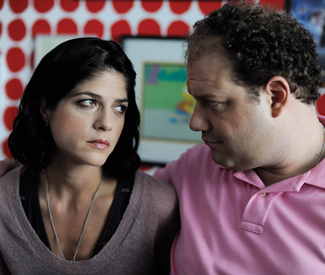
It opens at a wedding reception, always a ghastly ordeal for single people who figure themselves losers. In that regard, Abe (Jordan Gelber) would be right — he is a big fat loser, an obnoxious jerk of about 35 who still lives with his parents (Mia Farrow, Christopher Walken) and works at dad’s office, likely because no one else would employ him.

But Abe doesn’t exactly see himself as a loser. He resents and blames others for being winners, which is different — he sees the inequality as their fault. Spying Miranda (Selma Blair) at the reception, clearly miserable, he perceives someone whose self-esteem is so low she might lack the will or good sense to resist his awful personality when it’s forced upon her.

He’s right. Miranda’s self-loathing is such that after some bewildered and mortified initial resistance, she figures she … deserves him. In the interest of full disclosure, however, she airs some skeletons from the past, and these rattle Abe’s barricade of angry obliviousness. So does getting fired by his fed-up dad, being asked to move out, discovering something weird about the office secretary (Donna Murphy), and so forth. Plus there’s the eternal aggravation of being much less smart, handsome, and successful than his brother Richard (Justin Bartha), whom he thus blames for “ruining my life” — and who doesn’t even lose points with mom and dad for being gay! So unfair.

Dark Horse flirts with something interesting by letting these factors tear at Abe’s deniability until he starts suffering delusional episodes — ones in which people tell him exactly the truth about himself. (Farrow’s simpering voice has seldom been put to better use than a sequence in which her infallibly supportive mother uses just the same sugary tone to inform Abe he’s always been a waste of space.)

But Dark Horse is less of an ensemble piece than most of Solondz’s films, and in hinging on Abe, it diminishes his usual ambivalence toward flawed humanity. Abe is a buffoon, like a particularly unfunny Zach Galifianakis supporting character in a broad commercial comedy inexplicably given center stage in a low-key seriocomedy. The awful people in prior Solondz movies were also repellant, yet partly because we could perceive enough of their pathos to make them even more squirm-inducing. Abe has no pathos, or other redemptive qualities. He’s just an annoyance, one whose mental health issues aren’t clarified enough to induce sympathy. The director’s deliberately crap pop soundtrack choices and tritely ironic ending only further reduce these 86 minutes to a thin, overextended joke.

That’s disappointing for Solondz, though admittedly if Dark Horse were by somebody else its modest virtues might be more easily appreciated. In particular, the erratic Blair is excellent here — she digs into Miranda’s depression so deeply we marvel that the woman can still summon energy to walk and talk.


DARK HORSE screens Thu/19 at San Francisco Film Society Cinema; it opens Fri/20 in Bay Area theaters.

Personal detectives

0

cheryl@sfbg.com

SFJFF This year’s San Francisco Jewish Film Festival includes a trio of documentaries inspired by ephemera: hand-scrawled memoirs and journals, decades-old letters, fading photographs, and yellowing newspapers, long-forgotten and crumpled into attics and storage closets.

Dust be damned, for all three filmmakers — Arnon Goldfinger (The Flat), David Fisher (Six Million and One), and Daniel Edelstyn (How to Re-Establish a Vodka Empire) — become obsessed with these scraps from the past, and with piecing together their family histories, all of which were studded with tragedy and rarely discussed with younger generations. The task requires the kind of determination that can only be mined from a deeply personal place — and it results in some deeply personal films.

The docs are similar, especially when viewed in the short span of a festival, but Goldfinger’s The Flat is the standout. It begins as the filmmaker’s family descends upon the Tel Aviv apartment of his recently-deceased grandmother, “a bit of a hoarder” who lived to 95 and seemingly never got rid of anything. This includes, as Goldfinger discovers, copies of the Joseph Goebbels-founded newspaper Der Angriff, containing articles about “the Nazi who visited Palestine.” The Nazi was Leopold von Mildenstein, an SS officer with an interest in Zionism. Turns out he made the journey in 1933 with his wife and a Jewish couple named Kurt and Gerda Tuchler — Goldfinger’s grandparents.

Understandably intrigued and more than a little baffled, Goldfinger investigates, finding letters and diary entries that reveal the unlikely traveling companions were close friends, even after World War II. His mother, the Tuchler’s daughter, prefers to “keep the past out,” but curiosity (and the pursuit of a good documentary) presses Goldfinger forward; he visits von Mildenstein’s elderly daughter in Germany, digs through German archives, and unearths even more surprises about his family tree. Broader themes about guilt and denial emerge — post-traumatic coping mechanisms that echo through generations.

Family is a favorite subject for fellow Israeli David Fisher (2000’s Love Inventory). For Six Million and One, he rounds up his brothers and sister for a visit to the Austrian concentration camp where their late father was held as a teen. The elder Fisher recorded his thoughts in a memoir that only David can bear to read. As the siblings engage in the odd pursuit of being tourists in a place of brutality — the film illustrates the town’s changing landscape through eerie, before-and-after photos — their playful arguments escalate into legit psychodrama as the camera rolls and four raw nerves react to their intense emotions.

Interspersed with this journey is David Fisher’s visit with some American veterans who saw unimaginable horrors when they arrived to liberate the camps. It becomes clear that post-traumatic stress doesn’t just affect Jewish families grappling with the after effects of the Holocaust. When Fisher wistfully remarks that his father never spoke about his experiences, an elderly solder tells him, “Maybe you’re better off not having heard the stories.”

Lighter in tone, but with an equally serious back story, is Daniel Edelstyn’s How to Re-Establish a Vodka Empire, which follows the British filmmaker’s quest to import the vodka made at the Ukrainian factory once owned by his great-grandfather. The disheveled Edelstyn, who admits he has no business experience, pinballs between charming and exasperating as he fumbles through meetings with distributors and dodges hostile locals in his grandmother’s hometown. Despite the film’s title, Edelstyn’s adventures in booze are less compelling than the tale of that grandmother, whose remarkable life is re-enacted with sepia-toned silent film-style clips (starring Edelstyn’s wife, Hilary Powell, who’s also the film’s cinematographer), and miniature animations.


THE MORE YOU KNOW

There’s more for fans of non-narrative cinema, as SFJFF unspools several biopics that also delve into troubled pasts — with significant triumphs along the way. No one embodies this more than Roman Polanski, subject of Roman Polanski: A Film Memoir, directed by Laurent Bouzereau and structured as a sit-down conversation with longtime Polanski pal and producer Andrew Braunsberg. If you’re hoping for hardball questions or new information on Polanski’s colorful life, prepare for disappointment; the familiar pillars of the Polanski legend (traumatic childhood growing up as a Polish Jew during World War II; filmmaking success with films like 1968’s Rosemary’s Baby and 1974’s Chinatown; wife Sharon Tate’s gruesome death at the hands of Charles Manson’s followers; and that oh-so-inconvenient sexual assault charge, which came back to haunt him 30 years after the fact) are all covered.

If you’ve read Roman By Polanski, the director’s autobiography, or seen the 2008 doc about his struggle with scandal, Roman Polanski: Wanted and Desired, this is familiar turf. But to hear the celebrated director share his memories in his own voice, encouraged by an interviewer he trusts, is a unique experience.

You won’t hear the spoken voice of passionate, patriotic Yoni Netanyahu, the Israeli commando who died leading the 1976 hostage-rescue mission at Uganda’s Entebbe Airport, in Ari Daniel Pinchot and Jonathan Gruber’s Follow Me: The Yoni Netanyahu Story. But Netanyahu — adored older brother of Benjamin Netanyahu, Israel’s current Prime Minister — was prolific letter-writer, and his words (read by actor Marton Csokas) are an invaluable component of this affectionate portrait. But it’s not all heroic platitudes: Netanyahu, who also fought in the Six Day War and the Yom Kippur War, put the military above everything else, including his marriage.

“I don’t ever remember walking as a young person,” jokes sportscasting great Marty Glickman at the start of James Freedman’s upbeat Glickman. “I always ran. It was just my nature to run.” Though he’s referring to his extraordinary sprinting ability, which got him all the way to the 1936 Olympics (where he was denied the chance for certain glory for Hitler-related reasons), it’s also kind of how he lived his life, attacking bigotry and adversity with sunny side-up resilience. Glickman died in 2001, but his life was well-documented — when he wasn’t making sports history, he was doing the play-by-play for it. As an influential broadcaster (basketball fans: he was the first one to say “Swish!”), there’s no shortage of famous fans willing to weigh in: Bob Costas, Bill Bradley, Jerry Stiller, Jim Brown, and Larry King, who has supremely high praise for Glickman’s skills: “It was like his voice was attached to the ball.”

SAN FRANCISCO JEWISH FILM FESTIVAL

July 19-August 6, most shows $12

Various Bay Area venues

www.sfjff.org


Melody machers

0

>>Read Cheryl Eddy’s take on this year’s SFJFF documentaries here.

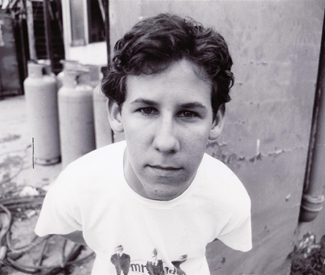
SFJFF “All greatness comes from pain.” The simple statement comes from Raoul Felder, brother of legendary R&B songwriter Doc Pomus, in the beautiful, crushing mediation on his brother’s life, A.K.A. Doc Pomus, the closing-night film of the San Francisco Jewish Film Festival.

Doc wrote some of the greatest music of a generation: R&B and early rock’n’roll standards such as “This Magic Moment,” “A Teenager in Love,” “Save the Last Dance For Me,” and “Viva Las Vegas” — songs made famous by the likes of Dion, the Drifters, and Elvis Presley. Jewish, debilitated by polio, and vastly overweight, Doc defied expectations while struggling with a lifetime of outsider status and physical pain.

It’s a subject that runs — albeit in far paler shades — throughout many of the fest’s music-filled documentaries. Defying limitations, strength through struggle, alienation, outsiders looking in; these all come up again and again. Tsuris to nachas, struggle to get to joy. All that plays out in the films, along with wildly varying (R&B, hip-hop, classical old world violin, 1990s-era Australian grunge pop) and vibrant music created by the subjects.

In Y-Love, about the gay, formerly Hasidic (still Orthodox) black Jewish rapper, these themes of isolation persist, almost painfully so. Having just come out during the year of filming, Y-Love seems to be smack dab in the midst of his struggle, and not yet capable of showing it all to the cameras following him through performances in Israel, his childhood neighborhood in Baltimore, and a New York recording studio. Most of these scenes are a bit long, focusing intently on Y-Love’s furrowed brow as he talks in great detail about the past without revealing much about how it’s affecting him now.

That’s not to say he hasn’t achieved something notable — we see that part. Y-Love does have followers, his records are starting to gain some traction, his YouTube videos have plenty of hits. He’s an anomaly in the communities he’s chosen (Judaism, the hip-hop scene), and owes his burgeoning artist status to this. He defied an agonizing childhood with an alcoholic, drug-addicted mother by turning to Judaism — a religion he first heard of in a TV commercial, a story he mentions in most interviews — and using word flow to study Torah.

On the other side of the world, and from an entirely different generation, there’s Jascha Heifetz, the gifted subject of God’s Fiddler. Growing up in rural Russia in the early part of the last century (he passed away in 1987), he was attached to the violin nearly since birth — a voice-over tells the story of Heifetz as a baby being soothed by the instrument’s sound — and a prodigy by age 5. Heifetz struggled with a demanding father and rising anti-Semitism, and had to fight to live in Saint Petersburg: the city had a quota for the amount of Jews allowed within its limits, not to mention the amount of Jews allowed to study at its prestigious music conservatory. But his eventual international attention and success led to a period of rebellion; negative reviews led the wunderkind to contemplate suicide. Emerging from the darkness, he re-focused on his instrument — but never again smiled while playing.

Though Ben Lee was born in Sydney, Australia some 77 years later, his musical journey — traced in fun, frenzied, colorful doc Ben Lee: Catch My Disease — mirrors Heifetz’s in certain ways. His first bout with fame also came at an early age, as a precocious tween in ’93 with his band Noise Addict. He went on to achieve higher levels of attention as a solo artist, steadily releasing poppier albums throughout the late ’90s and early ’00s, but never again reached as wide an audience outside of Oz (where he is a bona fide superstar).

Catch My Disease features interviews with ’90s mainstays and enduring entertainers like Thurston Moore (who discovered Lee as a child), Beastie Boy Mike D (who signed him to Grand Royal), actor Winona Ryder, and former girlfriend Claire Danes; Lee emerges as a well-rounded, exuberantly talented musician, always chasing a seemingly unattainable level of success.

SAN FRANCISCO JEWISH FILM FESTIVAL

July 19-August 6, most shows $12

Various Bay Area venues

www.sfjff.org

Retro future

0

arts@sfbg.com

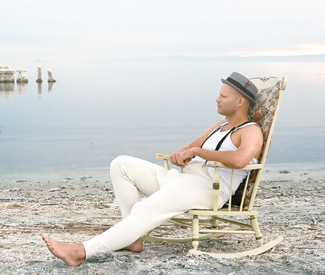
MUSIC The sad truth of dance music is that the party necessarily ends. Tailor a song too much for the floor tonight and it’s lifeless on the street or in the car tomorrow. Factor in the conflation between EDM and electronic music, and the latter can be all too often stuck in the shadow of the club. With his latest solo album, Salton Sea, Danish music producer Tomas Barfod steps out into new territory.

Barfod — a.k.a. Tomboy, also the drummer for electro-rock act WhoMadeWho — has worked on more projects than I could count: producing, running a label, booking Copenhagen’s Distortion festival, and lots of DJing. But tired of nonstop club performances, he recently decided to refocus and moved to LA “It was about getting away from doing gigs and focusing on studio work, that was the main goal of going away,” Barfod said. “But also to start from zero in a totally different — and awesome — environment.”

This environment allowed Barfod to work with Leeor Brown’s burgeoning label Friends of Friends, home of talented producers including Shlohmo, Salva, and Groundislava. “I’ve always had a vision about where I wanted my career to go, and almost always ended there, but never on the path that I expected,” Barfod says. Working with FoF has been an unexpected path. “It started when MySpace was almost dead. I hardly ever checked my messages, but I got one from Leeor. It took us a couple of years to really figure out how to work together, but when I moved to LA there was no question that we should do an album.”

The result is Salton Sea, named after the California lake area that’s now largely an abandoned wasteland. (Imagine the post-apocalyptic setting for a Fallout video game or Mad Max movie.) In the early 1900s, an engineering accident flooded the area and created a lake that was for a few decades rebranded as a utopian resort town.

One track on the album recalls this, consisting of a single repeated lyric: “everybody came to party.” An ecstatic house track? A hedonistic rager anthem? Barfod affects another mood entirely. The voice is robotic, with zero emotion, over a brooding four to the floor bass beat. The lyric is a statement that begs a question: and then what happened?

Saline levels rose. Water became polluted. Fish became infected with botulism and washed up on the beach. In the case of the Salton Sea, the past returned, the party was over, the people left.

Barfod describes himself as a “retro-romantic” for “places where nothing has been touched for ages. It doesn’t need to be pretty, as long as it tells a story about the past.” He was working on music and collecting pictures of abandoned places and things — ships being cut up in India at Alang Beach; empty offices in Detroit — so when Leeor told him about the Salton Sea it was a natural fit. “It’s a really special place,” Barfod says, “the lake is kind of timeless.”

Similarly timeless is Blade Runner, Ridley Scott’s sci-fi classic set against an environmental dystopia. Not wanting to be too influenced by new music, Barfod cites the film, particularly Vangelis’s soundtrack, as something he listened to a lot while making Salton Sea. Its stamp is there, beginning with the racing arpeggio and slow synth chord progressions that open the album on “D.S.O.Y.”

But the influence is beyond references. A video posted by Barfod shows visual designer Syd Mead discussing minute details like parking meters as he creates the futuristic world of Blade Runner. Key to the aesthetic is building on existing layers so that buildings use ceiling fans in an era of flying cars, and a geneticist can create artificial humans but wears coke bottle glasses. It’s a regressive sort of futurism, but ages surprisingly well.

Listening to Barfod there’s a sense of wanting to make something that sounds good now, but will last. “I think it’s very hard to make something timeless. However my way of trying is that I tend to use analog sounds in my drums and synths, and acoustic instruments so it sounds somewhat retro, but on the other hand I use a lot of computer generated effects that are new and almost futuristic. I don’t know if it makes my music timeless but I like it like that.”

The lesson of the Salton Sea is that the future can’t escape the past. The lesson of Blade Runner is that the future can’t escape the past. Tomas Barfod is in a new home, with new collaborators, and a new label, but at the same time it’s not a complete break. (Among the new voices on Salton Sea is his WhoMadeWho bandmate, Jeppe Kjellberg. When we exchanged emails Barfod was back in Europe for gigs.) While he’s moving into the future, Barfod has his eyes and ears on the past.

FORWARD WITH NITIN, TOMAS BARFOD, ADNAN SHARIF, AND MORE

Sat/21, 9pm, $15–$20

Public Works

161 Erie, SF (415) 932-0955

www.publicsf.com

Asylum seekers

1

arts@sfbg.com

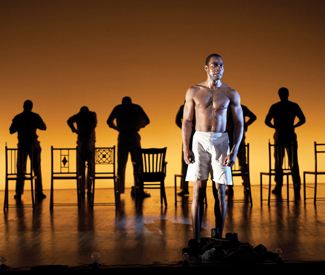
THEATER From Broadway blockbuster Les Misérables (at the Orpheum) to offbeat courtly lounge act Her Rebel Highness (at Harlot), 18th-century radical postures are enjoying an unexpected vogue at the moment — as anachronistic and bracing as a pinch of snuff. But let the truly adventurous eat Marat/Sade. In what may be the year’s most felicitous blend of company, producer, and material, Thrillpeddlers and Marc Huestis offer an exuberant, exquisitely trashy, and note-perfect revival of Peter Weiss’s radical 1963 play, permeating the enormous Brava Theatre with an infectious delirium perfectly in sync with restive times.

Helmed with operatic flourishes and insouciant humor by artistic director Russell Blackwood, Marat/Sade unfolds meticulously and vibrantly across an imposing pasteboard set (by James Blackwood) that aptly looks something like a sprawling lavatory with enormous glory holes, covered over in political graffiti (from “El pueblo unido jamás será vencido” to “Ayn Rand fucks you”). Whatever debt it owes to the original legendary production (staged by Peter Brook for the Royal Shakespeare Company, and made into a film in 1967), this Marat/Sade is fully inhabited by the raucous libertine spirit and Grand Guignol aesthetic of Blackwood’s adventurous company and its artistic confreres — including former Cockettes Scrumbly Koldewyn (the show’s astute musical director and pianist) and Rumi Missabu (who excels as the straightjacketed and wild-eyed Jacques Roux, radical upstart priest of the French Revolution).

The play’s full title — The Persecution and Assassination of Jean-Paul Marat as Performed by the Inmates of the Asylum of Charenton Under the Direction of the Marquis de Sade — pretty much says it all, plot-wise. The date is July 13, 1808, 15 years to the day after Girondist partisan Charlotte Corday stabbed Jacobin leader Marat to death as he soaked in his bath. The French Revolution, having since lost many more lives in a tidal wave of bloodshed, has succumbed to Napoleon and the return of the old guard, wrapping themselves in the mantle of 1789. A skeptical, revolution-weary but ever defiant Sade (rivetingly personified by a darkly charming Jeff Garrett) has been granted permission to perform his play in the institution’s bathhouse. There the asylum’s director, quintessential bourgeois twit Coulmier (a comically wound yet nicely restrained Brian Trybom), watches the performance with wife (Lisa Appleyard) and daughter (Carina Lastimosa Salazar), intervening now and then to protest feebly Sade’s reinsertion of some previously censored lines.

Sade (once a real-life inmate at Charenton) meanwhile leads his variously deranged cast in a reenactment of the death of the Jacobin leader. The “actors” (or “patients” to Director Coulmier and his regime of mental hygiene) are made up of political dissenters, social deviants, the desperately poor, the disempowered, the mentally ill — the lines blur pointedly here.

This play-within-the-play unfolds like a comically unhinged historical pageant, with bursts of anarchic energy, high political debate, and low provocation — all amid excellent renderings of composer Richard Peaslee’s wonderfully serrated songs (backed by Koldewyn, Victoria Fraser, Eden Neuendorf, and Birdie-Bob Watt on a mix of keyboard, percussion, brass and wind instruments). Marat (played with a biting intensity by a fine Aaron Malberg) argues with Sade while soaking continually in a bath to assuage the fever and itching from a debilitating skin disease, his wounds attended to by spouse Simonne Evrard (a sure Kära Emry).

Before he dies, Marat suffers three separate visits by Corday (played by a delicately incandescent Bonni Suval, as a narcoleptic and melancholic beauty with volcanic depths). But the real purpose of this thin plotline is the airing of competing viewpoints on the nature of revolution, freedom, power, individuality, social solidarity, authority, and (more implicitly) art’s role as a site of radical alternatives.

To this end, the large and able cast has its say in song and other outbursts, variously hysterical, macabre, louche, and chilling. But the preeminent voices are Sade, Marat, Corday, and Roux — all of whom attack, from competing angles, the problem of resistance in the modern age, where bureaucratic class-rule comes in the name of democracy, liberty, equality, fraternity, and other terms appropriated by the modern state.

Effortlessly recalling recent popular uprisings across a shuddering planet, these archetypal voices of dissent sound as alive as ever in Weiss’s eloquent dialogue — an iridescent mix of the philosophical, poetical, and scatological. As the cast belts out for a final time the show’s blunt refrain, “We want our revolution now!”, the actors spill over the stage and the inmates take over the asylum, enveloping the audience in a coup d’état that is simultaneously a coup de theatre, and a thoroughly carnivalesque upending of norms. It’s enough to make you lose your head.

MARAT/SADE

Through July 29

Wed-Sat, 8pm; Sun, 7pm (also Sun/22, 1:30pm), $20-$38

Brava Theatre

2781 24th St, SF

(415) 863-0611

www.ticketfly.com

Batman approacheth…but what to see THIS weekend?

0

You already have your tickets for The Dark Knight Rises (opens July 20) — if not, you might want to get on that — but there’s an entire week between then and now. Parental types are already locked into Ice Age: Continental Drift, which, in addition to Ray Romano and company, features teenage mammoths voiced by Nicki Minaj and Drake and a baboon pirate captain voiced by Peter Dinklage. So there’s that. Cineastes won’t want to miss the San Francisco Silent Film Festival (check out Dennis Harvey’s tribute to featured filmmaker William Beaudine here).

The best of the rest includes an eye-opening doc about teen athletes being groomed for MLB in the Dominican Republic; a doc about a rebellious Tibetan Buddhist; a lush Marie Antoinette drama; a family drama set against the backdrop of a kite festival in India; and an Australian import about a dog whose scruffy brio united a hardscrabble community. Which one made me sob like a tween Belieber? Hint: its star has four legs and very pointy ears.

Ballplayer: Pelotero With upbeat music, slick editing, and narration by John Leguizamo, Ballplayer: Pelotero is an entertaining, enlightening investigation into exactly why the Dominican Republic produces so many baseball stars. Comparisons to acclaimed sports doc Hoop Dreams (1994) are apt, as filmmakers Ross Finkel, Trevor Martin, and Jonathan Paley travel to the DR to follow a pair of teenage baseball players dreaming of big-league stardom (and big-league paychecks). But the Hoop Dreams kids weren’t being confronted by the shady, sinister, bottom-line-obsessed recruiters working for Major League Baseball, which maintains a pee-wee farm system of sorts in the country to train young prospects — the best of whom are snapped up at the magic age of 16 for bargain-basement (relatively speaking) prices. And in this environment, questions about numbers reign supreme: how much with each kid be signed for? And, more intriguingly, is either kid lying about his true age? (1:12) SF Film Society Cinema. (Cheryl Eddy)

Crazy Wisdom Not exactly your average Buddhist leader, Chogyam Trungpa was one part monk to two parts rock star. Recognized as a reincarnated master while still an infant, he left Tibet behind to flee Chinese government forces in 1960, eventually landing in the UK, where he founded its first Buddhist center. A decade later he’d move to the US, founding its first Buddhist university. Amidst all that achievement and enlightenment-spreading, however, he also found time to marry a 16-year-old upper-class Brit, have myriad affairs with students, partially paralyze himself driving a car into a shop front, frequently get drunk in public, and so forth — even though, incongruously, he frowned upon marijuana (and rock music). All this made sense in a tradition of Tibetan Buddhist “crazy wisdom” — or so his supporters would (and still) claim in his defense. Having left this life at age 48, his body exhausted by decades of hedonistic excess, he still has a powerful hold over diverse, multi-faith followers and acquaintances who recall his extraordinary spiritual-personal magnetism. Johanna Demetrakas’ entertaining documentary gathers up testimony from a gamut of them, including Ram Dass, Allen Ginsberg, Robert Thurman, and Anne Waldman. (1:26) Roxie. (Dennis Harvey)

http://www.youtube.com/watch?v=Hu95AAbj7bE

Farewell, My Queen (Benoît Jacquot, France, 2012) Opening early on the morning of July 14, 1789, Farewell, My Queen depicts four days at the Palace of Versailles on the eve of the French Revolution, as witnessed by a young woman named Sidonie Laborde (Léa Seydoux) who serves as reader to Marie Antoinette (Diane Kruger). Sidonie displays a singular and romantic devotion to the queen, while the latter’s loyalties are split between a heedless amour propre and her grand passion for the Duchess de Polignac (Virginie Ledoyen). These domestic matters and other regal whims loom large in the tiny galaxy of the queen’s retinue, so that while elsewhere in the palace, in shadowy, candle-lit corridors, courtiers and their servants mingle to exchange news, rumor, panicky theories, and evacuation plans, in the queen’s quarters the task of embroidering a dahlia for a projected gown at times overshadows the storming of the Bastille and the much larger catastrophe on the horizon. (1:39) (Lynn Rapoport)

http://www.youtube.com/watch?v=E8dH2BEj5Os

Patang (The Kite) Loving memories tethered to a place (Ahmedabad, India), moment (the city’s kite festival, the largest of its kind in the country), and season (according to the Hindu calendar, the event coincides with the day that wind direction shifts) beautifully suffuse this first feature film by director and co-writer Prashant Bhargava. Certainly Patang (The Kite) is the story of a family: Delhi businessman Jayesh (Mukund Shukla) has returned with his freewheeling, movie-camera-toting daughter Priya (Sugandha Garg) to his majestically ramshackle family home, where he supports his mother, sister-in-law (Seema Biswas of 1994’s Bandit Queen), and nephew Chakku (Nawazuddin Siddiqui). He’s come to indulge his childhood love of kite flying and to introduce Priya to Ahmedabad’s old-world sights and ways. Entangled among the strands of story are past resentments —harbored by Chakku against his paternalistic uncle — and new hopes, particularly in the form of a budding romance between Priya and Bobby (Aakash Maherya), the son of the kite shop owner. Above all — and as much a presence as any other — is the city, with its fleeting pleasures and memorable faces, captured with vérité verve and sensuous lyricism on small HD cameras by Bhargava and director of photography Shanker Raman. Their imagery imprints on a viewer like an early memory, darting to mind like those many bright kites dancing buoyantly in the city sky. (1:32) (Kimberly Chun)

Red Dog Already a monster hit in Australia, provenance of the Babe movies, this animal-centric charmer comes to the Bay Area as part of the Windrider Bay Area Film Forum in Atherton. It’s based on Louis de Bernières’ collection of tales (and tall tales) about a legendary canine that roamed the country’s Northwestern wilderness in the 1970s. Director Kriv Stenders centers his film in the mining burg that erected a statue to the animal after its death — an event that serves as the movie’s starting point, as the townspeople gather to toast Red Dog’s many contributions to the community (in addition to providing a much-needed source of amusement in a bleak, barren place, he also became a mascot for the local union, match-made multiple couples, prevented a suicide-by-shark attempt, and engaged in epic brawls with his arch-nemesis, Red Cat). It’s a shaggy, sentimental story elevated by some appealing human performances — Josh Lucas is the token American star, though Aussie film fans will recognize Noah Taylor and Keisha Castle-Hughes — and, of course, one very charismatic pooch. If you can’t make the trek down the peninsula for the screening, Red Dog will be available On Demand starting August 14; the DVD will be out September 4. (1:32) Menlo-Atherton Performing Arts Center. (Eddy)

The man who made 500 movies

0

arts@sfbg.com

FILM In 1969, a lot of silent films unloaded on the Library of Congress by Paramount Pictures was found to include The Canadian, a little-remembered 1926 drama that proved a major rediscovery when shown to new audiences under the American Film Institute’s banner. Its director, William Beaudine, had never seen it — hustling between assignments at different studios, he’d had no time — and would die at age 78 in March of 1970. But the prior month he managed (just out of the hospital, in a wheelchair) to catch a revival screening. Surprised by both the film and his standing ovation afterward, he admitted “Maybe I wasn’t such a bad director after all.”

That wasn’t just false modesty speaking — over the course of six decades in the business, Beaudine no doubt had been called a bottom-rung director, or worse. This wasn’t due so much to the actual quality of his movies (had anyone bothered to evaluate them as a whole) as the assumption that no one so ludicrously, indiscriminately prolific could possibly be good. Upon retiring a couple years earlier, he’d completed some 500 theatrical films (including shorts) and approximately 350 TV programs. No one even knows the precise numbers, as he occasionally worked under pseudonyms. What could you say about a man credited with such titles as Blonde Dynamite (1950), Tuna Clipper (1949), Billy the Kid vs. Dracula (1966), Voodoo Man (1944), Trick Golf (1934), The Girl from Woolworth’s (1929), and Bela Lugosi Meets A Brooklyn Gorilla (1952)? How could a one-man factory be expected to be an artist, too?

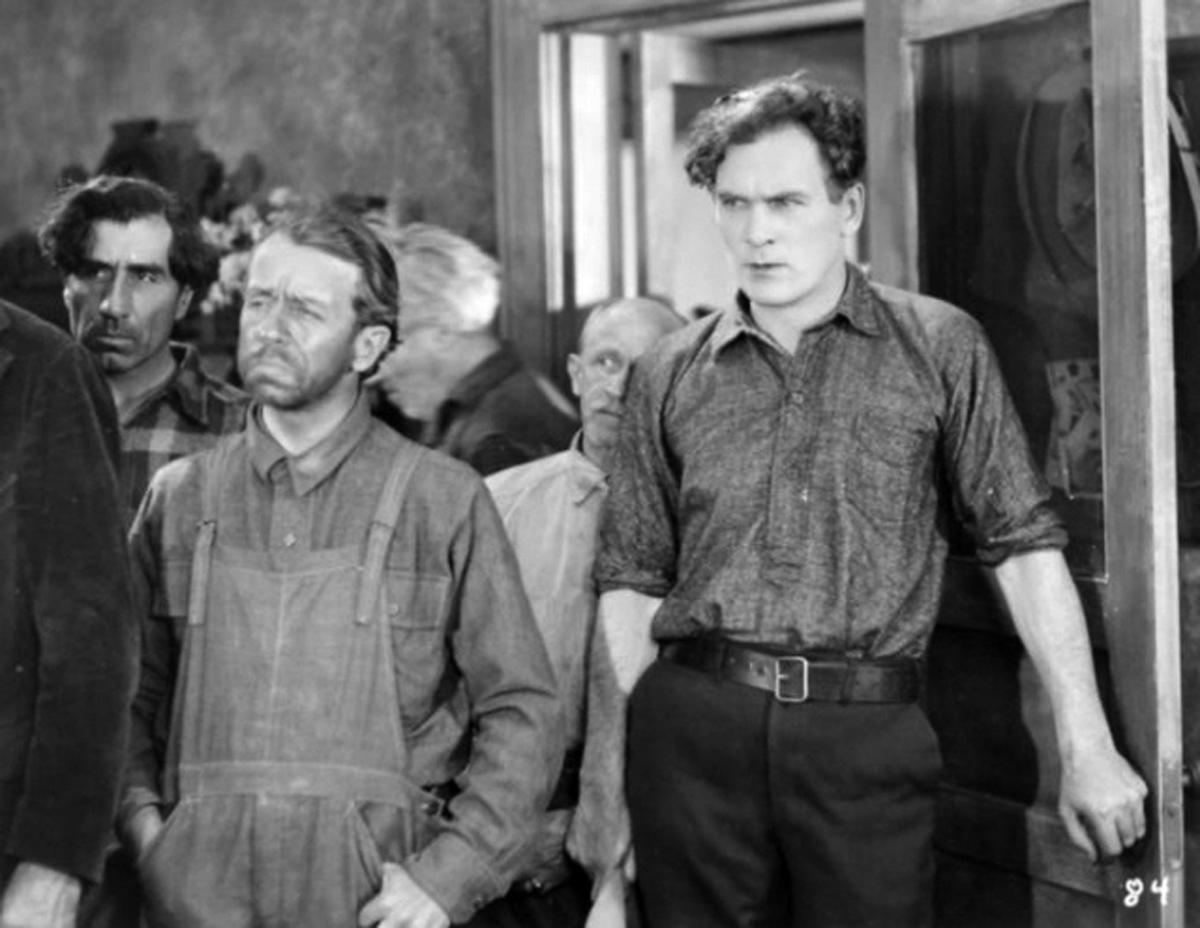
The truth was that Beaudine seldom got the chance to be one, and by being so pliant and efficient at directing low-end commercial product he probably helped ensure those chances would be rare. Still relatively unknown, The Canadian was certainly one such exception. It plays Saturday afternoon as part of the 17th San Francisco Silent Film Festival, on a program that will also see an honorary award go to Telluride Film Festival directors Tom Luddy, Gary Meyer, and Julie Huntsinger for their event’s long-standing efforts at preserving and exhibiting silent cinema.

A working-class Manhattan native infatuated with the movies from childhood — Beaudine and his brother actually acted in a 1900 short for Thomas Edison’s company — he began working in the then-NYC-centered early industry while still a teen, performing nearly every job behind (and a few before) the camera. He apprenticed under pioneers D.W. Griffith and Mack Sennett, graduating to the director’s seat shortly after a second, permanent move to Los Angeles in 1914.

Beaudine quickly acquired a reputation for being fast and funny — comedy was considered his forte, alongside working with child actors. It was the latter talent that won the attention of “America’s Sweetheart,” film industry tycoon Mary Pickford. Grudgingly accepting that the public still only wanted to see her in juvenile roles despite the fact that she was pushing 40, she chose him to direct two “comeback” vehicles after a year’s hiatus. Sentimental 1925 entry Little Annie Rooney was a great hit; the next year’s more Gothic Sparrows is still considered by some her best vehicle.

These prestige assignments and several other box-office successes should have lifted Beaudine to the top tier of Hollywood directors — he was already paid accordingly — yet curiously his self-effacing flexibility and ability to deliver the goods under-budget seemed to work against his acquiring the kind of artistic cred that might have let him choose his projects, or be assigned bigger, A-level ones. Frequently loaned out by whatever studio he was currently contracted to, he invariably did a sound job, even if the material was sub-par.

The Canadian itself was an example of his ability to roll with the punches. Sent east by Paramount to make a football picture, he arrived in New York only to find he was now directing a rural drama instead. Improbably based on a W. Somerset Maugham play, it starred Thomas Meighan as an Alberta farmer who marries his neighbor’s sister — a sort of grudge match, as she (Mona Palma) is a European society snob just recently forced here by dwindling family fortunes, and who proposes marriage herself largely to spite the brother and sister-in-law she’s managed to offend.

Sometimes compared today to Victor Sjöström’s 1928 The Wind with Lillian Gish, The Canadian is much less extreme in its style, melodrama, and emotions. (Its heroine doesn’t nearly go mad, for one thing.) The taming-of the-snoot gist is routine, but played out with charming naturalism and restraint. A somewhat difficult, weather-challenged location shoot near Calgary paid off in admiring reviews and good business, although by then Beaudine was already well into other projects, the most immediate being SF-set Frisco Sally Levy (1927).

Beaudine nimbly transitioned into “talkies,” freelancing rather than tying himself down. Yet perversely his adaptability, and knack for getting the most out of a budget, got him typed as a B-pic director rather than promoted to the front ranks. Wiped out in the 1929 stock market crash, he accepted what turned out to be a very successful stint abroad directing some of the top English comedians (notably Will Hays in 1936’s deliciously titled Windbag the Sailor). But those films weren’t seen in the U.S. When he returned home, Beaudine was — for reasons still murky — shut out at every Hollywood major, despite a long track record and being widely liked by coworkers.

His remaining three decades were a testimony to dogged workaholicism, versatility, and solid craftsmanship under sometimes trying circumstances. He worked for all the low-budget “Poverty Row” studios, as well as companies targeting “Negro-only” cinemas, and Protestant church circuits. He chalked up umpteen bottom-half-of-the-bill features in popular series, including dozens starring those aging adolescent cutups the Bowery Boys. He also directed infamous “sex hygiene” film Mom and Dad (1945), which for years played grindhouses and tent shows while fending off as many legal challenges as Deep Throat (1972) years later. Moving into television, he cranked out episodes of everything from The Mickey Mouse Club and Lassie to The Green Hornet — becoming surely the sole person ever to direct both Mary Pickford and Bruce Lee.

This year’s Silent Film Fest contains many more treasures, from two with the “It Girl” Clara Bow (1926’s Mantrap, 1927’s Wings) to films by Ernst Lubitsch, Josef von Sternberg, Georg Wilhelm Pabst, and Buster Keaton; from China, Russia, and Sweden; and with irrepressible cartoon id Felix the Cat. If you loved The Artist, check out The Mark of Zorro (1920) — its leaping, grinning star Douglas Fairbanks was the unmistakable model for Jean Dujardin’s Oscar-winning turn. *

SAN FRANCISCO SILENT FILM FESTIVAL

Thu/12-Sun/15, free-$42

Castro Theatre

429 Castro, SF

www.silentfilm.org

Rep Clock

0

Schedules are for Wed/11-Tue/17 except where noted. Director and year are given when available. Double and triple features marked with a •. All times pm unless otherwise specified.

ARTISTS’ TELEVISION ACCESS 992 Valencia, SF; www.atasite.org. $10. “Orbit (film): A Program of Short Films About Our Solar System,” Sat, 8. “Collaborations: An Evening of Music and Image,” Tue, 8.

CASTRO 429 Castro, SF; (415) 621-6120, www.castrotheatre.com. $8.50-11. •Thief (Mann, 1981), Wed, 7, and Straight Time (Grosbard, 1978), Wed, 9:15. San Francisco Silent Film Festival: Wings (Wellman, 1927), Thu, 7; “Amazing Tales from the Archives: Into the Digital Frontier,” Fri, 10:30am; Little Toys (Sun, 1933), Fri, 1; The Loves of Pharaoh (Lubitsch, 1922), Fri, 4; Mantrap (Fleming, 1926), Fri, 7; The Wonderful Lie of Nina Petrovna (Schwarz, 1929), Fri, 9:15; “The Irrepressible Felix the Cat!”, Sat, 10am; The Spanish Dancer (Brenon, 1923), Sat, noon; The Canadian (Beaudine, 1926), Sat, 2:30; South (Hurley, 1919), Sat, 5; Pandora’s Box (Pabst, 1926), Sat, 7; The Overcoat (Kozintsev and Trauberg, 1926), Sat, 10; The Mark of Zorro (Niblo, 1920), Sun, 10am; The Docks of New York (von Sternberg, 1928), Sun, noon; Erotikon (Stiller, 1920), Sun, 2; Stella Dallas (King, 1925), Sun, 4:30; The Cameraman (Sedgwick and Keaton, 1928), Sun, 7:30. More info and advance tickets (free-$42) at www.silentfilm.org. Inforum Presents: “Chuck Palahniuk: The Monsters Within,” Mon, 7 (this event, $20-40); “Meghan McCain and Michael Ian Black: Two Slices of American Pie,” Tue, 7 (this event, $25-45).

CHRISTOPHER B. SMITH RAFAEL FILM CENTER 1118 Fourth St, San Rafael; (415) 454-1222, www.cafilm.org. $6.75-$10.25. Bel Ami (Donnellan and Ormerod, 2012), call for dates and times. Bernie (Linklater, 2012), call for dates and times. Peace, Love and Misunderstanding (Beresford, 2011), call for dates and times. Pink Ribbons, Inc. (Pool, 2011), call for dates and times. Take This Waltz (Polley, 2011), call for dates and times. Beasts of the Southern Wild (Zeitlin, 2012), July 13-19, call for times.

“FILM NIGHT IN THE PARK” This week: Creek Park, 451 Sir Francis Drake Blvd, San Anselmo; www.filmnight.org. Donations accepted. Across the Universe (Taymor, 2007), Fri, 8. Union Square, Geary at Powell, SF. The Artist (Hazanavicius, 2011), Sat, 8.

JACK LONDON SQUARE First Street at Broadway, Oakl; www.jacklondonsquare.com. Free. We Bought a Zoo (Crowe, 2011), Thu, sundown.

MECHANICS’ INSTITUTE 57 Post, SF; (415) 393-0100, rsvp@milibrary.org. $10. “CinemaLit Film Series: Music and Nostalgia:” Amélie (Jeunet, 2001), Fri, 6.

MENLO-ATHERTON PERFORMING ARTS CENTER 555 Middlefield, Atherton; www.windriderbayarea.org. $5-15. Windrider Bay Area Third Annual Independent Film Forum, with films from Africa, Australia, and North America, and stars and filmmakers in person, Thu-Sat.

PACIFIC FILM ARCHIVE 2575 Bancroft, Berk; (510) 642-5249, bampfa.berkeley.edu. $5.50-9.50. “Bellissima: Leading Ladies of the Italian Screen:” Nights of Cabiria (Fellini, 1956), Wed, 7; The Leopard (Visconti, 1963), Fri, 7; Juliet of the Spirits (Fellini, 1965), Sat, 6. “Cool World:” The Hustler (Rossen, 1961), Thu, 7; Ed Wood (Burton, 1994), Sat, 8:50. “A Theater Near You:” El velador (Almada, 2011), Sun, 5:30. “Always for Pleasure: The Films of Les Blank:” In Heaven There Is No Beer? (Blank and Gosling, 1984). Sun, 7.

ROXIE 3117 and 3125 16th St, SF; (415) 863-1087, www.roxie.com. $6.50-10. “Au Revoir Béla Tarr:” The Man From London (Tarr and Hranitzky, 2007), Wed, 6:30; The Turin Horse (Tarr and Hranitzky, 2011), Wed, 9:15. “Songs Along a Stony Road: Music Movies by Local Luminaries:” Songs Along a Stony Road (Csicsery and Teerink, 2011) with “Sprout Wings and Fly” (Blank, 1983), Thu, 7 and 9. Filmmakers George Csicsery and Les Blank in person. San Francisco Frozen Film Festival, animation, shorts, and documentaries, Fri-Sat. All-day festival pass, $20; more info at www.frozenfilmfestival.com. Crazy Wisdom (Demetrakas, 2011), July 13-19, 7, 8:45 (also Sat-Sun, 3:15, 5).

SF FILM SOCIETY CINEMA 1746 Post, SF. $10-11. The Story of Film: An Odyssey, Part Seven: New Boundaries: World Cinema in Africa, Asia, and Latin America and New American Independents and the Digital Revolution (Cousins, 2011), Sat, noon. British TV series; new episodes weekly through July 21. Ballplayer: Pelotero (Finkel, Martin, and Paley, 2011), Fri-Sat and Tue, 3, 7; Sun-Mon, and July 18, 5, 9; July 19, 1. Bonsái (Jiménez, 2011), Fri-Sat and Tue, 5, 9; Sun-Mon and July 18, 3, 7; July 19, 3. “Family Screening: The Storytellers Show,” Sat, 10am. Marina Abramovic: The Artist is Present (Akers, 2011), Wed-Thu, 2:45, 5, 7:15, 9:30.

VICTORIA 2961 16th St, SF; www.911expertsspeakout.org. $10. 9/11 Explosive Evidence: Experts Speak Out (Gage, 2012), Wed, 7. Filmmaker Richard Gage in person.

YERBA BUENA CENTER FOR THE ARTS 701 Mission, SF; (415) 978-2787, www.ybca.org. $6-8. “Documentaries By Ai Weiwei:” Disturbing the Peace (2009), Sun, 2. *


Film Listings

0

Film listings are edited by Cheryl Eddy. Reviewers are Kimberly Chun, Max Goldberg, Dennis Harvey, and Lynn Rapoport. For rep house showtimes, see Rep Clock. For complete film listings, see www.sfbg.com.

OPENING

Ballplayer: Pelotero With upbeat music, slick editing, and narration by John Leguizamo, Ballplayer: Pelotero is an entertaining, enlightening investigation into exactly why the Dominican Republic produces so many baseball stars. Comparisons to acclaimed sports doc Hoop Dreams (1994) are apt, as filmmakers Ross Finkel, Trevor Martin, and Jonathan Paley travel to the DR to follow a pair of teenage baseball players dreaming of big-league stardom (and big-league paychecks). But the Hoop Dreams kids weren’t being confronted by the shady, sinister, bottom-line-obsessed recruiters working for Major League Baseball, which maintains a pee-wee farm system of sorts in the country to train young prospects — the best of whom are snapped up at the magic age of 16 for bargain-basement (relatively speaking) prices. And in this environment, questions about numbers reign supreme: how much with each kid be signed for? And, more intriguingly, is either kid lying about his true age? (1:12) SF Film Society Cinema. (Eddy)

Bonsái Awkward young love blooms in this Chilean import, a hit at the 2012 San Francisco International Film Festival. (1:35) SF Film Society Cinema.

Crazy Eyes Los Angeles thirtysomething Zach (Lukas Haas, playing a character apparently based on writer-director Adam Sherman — which, if true, yikes) doesn’t do anything but party from the minute he wakes up ’till the moment he passes out. Since he’s conveniently, inexplicably rich, he also has plenty of time to chase tail; occasionally, very occasionally, he’ll make time for his concerned parents and young son, the product of a failed marriage to a woman openly portrayed as a gold digger. Adding to this noxious brew is Rebecca (Madeline Zima), Zach’s vapid drinking buddy; she refuses to have sex with him, so he becomes obsessed with her — see, she’s the one thing the man who has everything can’t have. Deep, man. This is the cinematic equivalent of all that slurring, flailing, late-night drama that goes down outside your local dive bar, amplified to magnificently self-indulgent levels. (1:36) Lumiere, Shattuck. (Eddy)

Crazy Wisdom Not exactly your average Buddhist leader, Chogyam Trungpa was one part monk to two parts rock star. Recognized as a reincarnated master while still an infant, he left Tibet behind to flee Chinese government forces in 1960, eventually landing in the UK, where he founded its first Buddhist center. A decade later he’d move to the US, founding its first Buddhist university. Amidst all that achievement and enlightenment-spreading, however, he also found time to marry a 16-year-old upper-class Brit, have myriad affairs with students, partially paralyze himself driving a car into a shop front, frequently get drunk in public, and so forth — even though, incongruously, he frowned upon marijuana (and rock music). All this made sense in a tradition of Tibetan Buddhist “crazy wisdom” — or so his supporters would (and still) claim in his defense. Having left this life at age 48, his body exhausted by decades of hedonistic excess, he still has a powerful hold over diverse, multi-faith followers and acquaintances who recall his extraordinary spiritual-personal magnetism. Johanna Demetrakas’ entertaining documentary gathers up testimony from a gamut of them, including Ram Dass, Allen Ginsberg, Robert Thurman, and Anne Waldman. (1:26) Roxie. (Harvey)

The Do-Deca-Pentathlon An annual family gathering sets the stage for revival of the poisonously competitive rivalry between two thirty-something siblings. Mark (Steve Zissis) has a devoted wife (Jennifer Lafleur), a teenage son (Red Williams), a home, and steady job, but he can still be easily goaded into a frustrated rage by brother Jeremy (Mark Kelly), who has none of the above but still gloats over his alleged victory in an adolescent fraternal mini-Olympics two decades earlier. Their uncomfortable reunion provides an opportunity to settle that score once and for all — even if they must (not very successfully) try to hide this epic athletic rematch between nearly middle-aged schlubs from their disapproving relatives. Penned by the Duplass Brothers (2011’s Jeff, Who Lives at Home), and shot several years ago, this feels like a Will Ferrell-John C. Reilly (or whoever) comedy writ small, with the variously normal and silly competitive heats only mildly amusing, and the character drama only slightly more depthed than it would be in a more commercial, slapsticky vehicle. Plus, it’s hard to care much about whether the bros achieve reconciliation, since Jeremy is a little too effectively drawn as an annoying, bullying prick in the early going. There’s a clever idea at Pentathlon‘s center, but this just passably diverting feature doesn’t make all that much of it. (1:30) Sundance Kabuki. (Harvey)

“Family Screening: The Storytellers Show” A one-time-only engagement, this cosmopolitan, family-friendly compilation of short films is a mixed bag, both content and quality-wise. Certain selections — the beautifully, imaginatively animated, Storyteller (Kahanikar) of England; the live-action, Aussie Play Lunch — are inhibited by the heavy-handed drive to tell a linear story or push a message, while others (the Tim Burton-ish, Alan Rickman-narrated Boy in the Bubble) put forth compelling narratives, hindered by wishy-washy CGI. Strongest are the visually-driven films (the silent, mixed-media Paper Piano from Venezuela, in which a young girl crosses the “dangerous urban jungle” to get to her music lesson), and those whose stories flow naturally (the live-action, left-field documentary The Vacuum Kid, about a tweenage boy who enthusiastically collects vacuum cleaners). As a whole, “The Storytellers Show” is perfectly viable entertainment — but with competition like A Cat in Paris, it’s not compulsory viewing, either. (1:06) SF Film Society Cinema. (Taylor Kaplan)

Farewell, My Queen (Benoît Jacquot, France, 2012) Opening early on the morning of July 14, 1789, Farewell, My Queen depicts four days at the Palace of Versailles on the eve of the French Revolution, as witnessed by a young woman named Sidonie Laborde (Léa Seydoux) who serves as reader to Marie Antoinette (Diane Kruger). Sidonie displays a singular and romantic devotion to the queen, while the latter’s loyalties are split between a heedless amour propre and her grand passion for the Duchess de Polignac (Virginie Ledoyen). These domestic matters and other regal whims loom large in the tiny galaxy of the queen’s retinue, so that while elsewhere in the palace, in shadowy, candle-lit corridors, courtiers and their servants mingle to exchange news, rumor, panicky theories, and evacuation plans, in the queen’s quarters the task of embroidering a dahlia for a projected gown at times overshadows the storming of the Bastille and the much larger catastrophe on the horizon. (1:39) Embarcadero. (Rapoport)

Ice Age: Continental Drift This time with pirates. (1:27) Presidio.

Magic of Belle Isle Morgan Freeman and Virginia Madsen star in this Rob Reiner-directed drama about an alcoholic writer who gets a new lease on life after befriending the neighbors at his lakeside cabin. (1:49) Opera Plaza.

Patang (The Kite) Loving memories tethered to a place (Ahmedabad, India), moment (the city’s kite festival, the largest of its kind in the country), and season (according to the Hindu calendar, the event coincides with the day that wind direction shifts) beautifully suffuse this first feature film by director and co-writer Prashant Bhargava. Certainly Patang (The Kite) is the story of a family: Delhi businessman Jayesh (Mukund Shukla) has returned with his freewheeling, movie-camera-toting daughter Priya (Sugandha Garg) to his majestically ramshackle family home, where he supports his mother, sister-in-law (Seema Biswas of 1994’s Bandit Queen), and nephew Chakku (Nawazuddin Siddiqui). He’s come to indulge his childhood love of kite flying and to introduce Priya to Ahmedabad’s old-world sights and ways. Entangled among the strands of story are past resentments —harbored by Chakku against his paternalistic uncle — and new hopes, particularly in the form of a budding romance between Priya and Bobby (Aakash Maherya), the son of the kite shop owner. Above all — and as much a presence as any other — is the city, with its fleeting pleasures and memorable faces, captured with vérité verve and sensuous lyricism on small HD cameras by Bhargava and director of photography Shanker Raman. Their imagery imprints on a viewer like an early memory, darting to mind like those many bright kites dancing buoyantly in the city sky. (1:32) Metreon. (Chun)

Red Dog Already a monster hit in Australia, provenance of the Babe movies, this animal-centric charmer comes to the Bay Area as part of the Windrider Bay Area Film Forum in Atherton. It’s based on Louis de Bernières’ collection of tales (and tall tales) about a legendary canine that roamed the country’s Northwestern wilderness in the 1970s. Director Kriv Stenders centers his film in the mining burg that erected a statue to the animal after its death — an event that serves as the movie’s starting point, as the townspeople gather to toast Red Dog’s many contributions to the community (in addition to providing a much-needed source of amusement in a bleak, barren place, he also became a mascot for the local union, match-made multiple couples, prevented a suicide-by-shark attempt, and engaged in epic brawls with his arch-nemesis, Red Cat). It’s a shaggy, sentimental story elevated by some appealing human performances — Josh Lucas is the token American star, though Aussie film fans will recognize Noah Taylor and Keisha Castle-Hughes — and, of course, one very charismatic pooch. If you can’t make the trek down the peninsula for the screening, Red Dog will be available On Demand starting August 14; the DVD will be out September 4. (1:32) Menlo-Atherton Performing Arts Center. (Eddy)

ONGOING

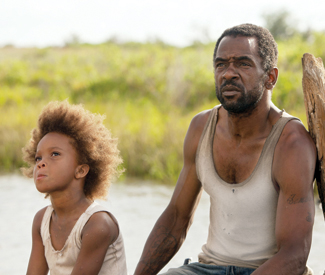
Beasts of the Southern Wild Six months after winning the Grand Jury Prize at Sundance (and a Cannes Camera d’Or), Beasts of the Southern Wild proves capable of enduring a second or third viewing with its originality and strangeness fully intact. Magical realism is a primarily literary device that isn’t attempted very often in U.S. cinema, and succeeds very rarely. But this intersection between Faulkner and fairy tale, a fable about — improbably — Hurricane Katrina, is mysterious and unruly and enchanting. Benh Zeitlin’s film is wildly cinematic from the outset, as voiceover narration from six-year-old Hushpuppy (Quvenzhané Wallis) offers simple commentary on her rather fantastical life. She abides in the Bathtub, an imaginary chunk of bayou country south of New Orleans whose residents live closer to nature, amid the detritus of civilization. Seemingly everything is some alchemical combination of scrap heap, flesh, and soil. But not all is well: when “the storm” floods the land, the holdouts are forced at federal gunpoint to evacuate. With its elements of magic, mythological exodus, and evolutionary biology, Beasts goes way out on a conceptual limb; you could argue it achieves many (if not more) of the same goals Terrence Malick’s 2011 The Tree of Life did at a fraction of that film’s cost and length. (1:31) Bridge, California, Embarcadero, Smith Rafael. (Harvey)

Neil Young Journeys Interested in going back further with Neil Young, back beyond 1969’s Everybody Knows This Is Nowhere? With Neil Young: Heart of Gold (2006) and Neil Young Trunk Show (2009) under his belt, Jonathan Demme has clearly earned the trust of the singer-songwriter, who occasionally likes to flex his multi-hyphenate creative muscles as a director himself, working under the name Bernard Shakey. The music-loving filmmaker tails Young as he drives through his hometown of Omemee, Ontario, shares glimpses of his school, named after his newspaper-man father, his small-town streets, and his home, and then takes it back to the stage and performs at Toronto’s Massey Hall. The stories and sights will interest mostly Young fans — you definitely get a feel for Young’s roots, but the place and its tales won’t jump out dramatically; they merely visualize factoids one can cull from sources like James McDonough’s bio Shakey — but performance dominates this concert film. Playing solo on guitar, harmonica, and in at least one memorable instance, pipe organ (for a hammered-home “After the Gold Rush”), the songs range from the still-moving, sprawling “Ohio” to “Love and War” off 2010’s Le Noise. It’s all love here for the Young diehard, though for an insightful, passionate tour doc, one might look to Shakey’s own CSNY/ Deja Vu (2008) or, for the performer’s finest cinematic performances, to Rust Never Sleeps (1979) and The Last Waltz (1978). (1:27) SF Center, Shattuck. (Chun) *


Alerts

0

WEDNESDAY 11

Students organizing for CCSF Student Union upper level lounge, CCSF Ocean Campus, 50 Phelan, SF; www.ccsfwill.blogspot.com. 5-8pm, free. At an emergency community meeting concerning the threatened closure of City College of San Francisco July 9, many meetings were called, including the organizing to form a student union, to campaign for the parcel tax initiative to get money to CCSF, and to organize in solidarity with labor. This meeting is discussing support for the parcel tax, which could send $15 million City Colleges way if it passes in November. Come organize with labor on this issue. This meeting is a working group on student response to the accreditation report.

THURSDAY 12

It calls you back 826 Valencia, SF; www.826valencia.org. A book reading and film screening with Luis Rodriguez, a poet, journalist, and fiction writer and author of the best-selling memoir Always Running, La Vida Loca, Gang Days in L.A. He will read from his new sequel and screen Rushing Waters, Rising Dreams: How the Arts are Transforming a Community, documenting how Tia Chucha’s Centro Cultural and Bookstore is bringing art and community to the once devastated post-industrial San Fernando Valley.

Happiness Happiness Institute, 1720 Market, SF; www.meetup.com/SF-Free-School. An afternoon of yoga and a workshop on community building. This event is presented by a collaboration between the Bay Area Community Exchange Time Bank, the San Francisco Free School, and the Happiness Institute- three of the organizations that work on spending time and energy in the gift economy.

FRIDAY 13

4 days for Kenneth Harding Jr. around Bayview-Hunters Point, July 13-16; www.tinyurl.com/4days4kenny. On July 16, 2011, 19-year-old Kenneth Harding Jr. was killed. He was stopped by police and asked for his transfer when off-boarding the Muni T train—he ran, and police began shooting. As far as the SFPD is concerned, the case is settled; they say Harding drew a gun and shot back at them, and the fatal bullet was his own. His family, friends, and the movement resisting police murder of black youth disagree. On this anniversary of his death, commemorate Kenny with four days of events. On July 13, a community speak out at NOI Mosque at 26a 3rd & Revere at 7pm. On July 14th, a free community hip hop show. On July 15th a free community meal at 3rd and Palou St from 10am-2pm. And on July 16th, join Kenneth Harding’s mother and a broad coalition of community and labor to shut down Muni in honor of Kenneth Harding.

SATURDAY 14

Occupy Bohemian Grove Monte Rio Amphitheater, 9925 Main, Monte Rio; www.occupybohemiangrove.com. Noon, free. What, you’ve never heard of Bohemian Grove? It’s just the private club of CEOs, politicians, and their favorite performers that meet every year for debauchery and rituals such as the “Cremation of Care” at the Owl Shrine. The rich and powerful go camping among the redwoods every year, and although business talk is frowned upon, they often make deals, including, notoriously, a 1942 Manhattan Project planning meeting that led to the atomic bomb. Many anti-war activists and others who are pissed off that the 1 percent meets in this strange private camping party to plot acts of war and environmental destruction will be setting up their own protest encampment outside Bohemian Grove this year. The kick-off on Saturday will include musical performances and speakers, including the Fukushima Mothers and Cindy Sheehan.

Tardeada/ women’s social for women’s rights, 2969 Mission, SF; www.defendwomensrights.org. 2pm, $3-10. Women Organized to Defend and Resist are planning a nationwide protest August 26 to defend women’s rights. This Saturday, come share food, entertainment and political conversation to meet and bond with others who won’t stand for attacks on women’s rights.

9 ways to say oui to Bastille Day

1

Unless the tech kings and queens need to start watching their backs, there’s no accounting for the voracity San Francisco consumes all things Bastille Day (Sat/14). Why do we celebrate the anniversary of the storming of a French clink so comprehensively, when Canada Day goes all but unnoticed? Perhaps the answers will be clearer after this weekend — movies, concerts, food cart explosions, and more will be taking place now through Sat/14 in honor of the Bay’s most illogically favorite holiday.

Farewell, My Queen 

Landmark Theatres picked an appropriate time to unveil French director Benoit Jacquot’s film Farewell, My Queen. The flick follows the last three days of Marie Antoinette (Diane Kruger) and her reader (Léa Seydoux, the pale beauty from Midnight in Paris) in the chaos just before the French Revolution.

Showing at Embarcadero Center Cinema, 1 Embarcadero Center, SF; Shattuck Cinemas, 2230 Shattuck Ave, Berk.

www.landmarktheatres.com

Pre-Bastille Musicale with Baguette Quartet and GAUCHO

Peacefully ring in this not-so-peaceful holiday with a musical performance in the UC Berkeley Botanical Garden. Local group Baguette Quartette performs tangos, foxtrots, and more tunes endemic to 1920s and ’30s Paris. It’ll be joined by Gaucho, a Euro-New Orleans-inspired jazz group that prides itself on its ability to inspire foot-tapping. 

Thu/12 5:30-7:30pm, $12

University of California Berkeley Botanical Gardens

200 Centennial, Berk. 

(510) 643-2755 

botanicalgarden.berkeley.edu

“From Geek to Chic: French Fashion and Technology”

SF Fashion + Tech has acquired a collection of Bay Area industry notables to speak at their Bastille Day commemoration “French Technique: From Geek to Chic.” Enrich your intellect and your closet with drinks, music, and fashion tech talk. 

Thu/12 5pm-9pm, $15-$25

Temple

540 Howard, SF. 

f1wfrenchtechnique.eventbrite.com

Mugsy’s Pop-Up Wine Bar

El Rio busts out its new socially-conscious wine bar in honor of Bastille Day, where Francophile — or just plain wine-chugging — Missionaries can celebrate French independence with a cuppa and some patio-side sunshine. Just as the French revolutionaries stormed the Bastille on this monumental day, Mugsy proposes to storm your olfactory senses with a velvety wine with hints of licorice, chocolate, and lavender (and, somehow, plum, olive, and pepper), a 2009 Le Clos du Caillou Côtes du Rhône Vieilles Vignes Cuvee Unique. Quite a way to class up your Friday night happy hour. 

Fri/13 5:30-8:30pm

El Rio

3158 Mission, SF.

mugsywinebar.tumblr.com

Off The Grid Au Francais 

Foodies can rejoice in a Off The Grid’s solution to affordable French cuisine. In honor of the holiday, many of the street truck fair’s vendors will be offering special French-inspired items. Regardless of one’s culinary orientation (cupcake, crepe, and bahn mi, or baguette?), French gypsy jazz will accompany this cart food frenzy throughout the evening. 

Fri/13 5pm-9pm, free entry

Fort Mason Center, SF

www.offthegridsf.com

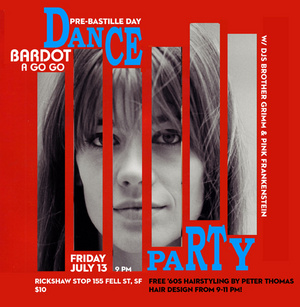
Bardot-A-Go-Go 

Go-go to the Rickshaw’s no-pretension dance floor for this always-fun Bastille Day pre-party. DJs Brothers Grimm and Pink Frankenstein will be providing the tunes to guide the night, and you can count on some Gainsbourg screenins to provide an appropriately-hazy French ambiance. Go-go girls, drinks, videos — even 1960’s hair-styling for only $10. 

Fri/13 9pm-11pm, $10

Rickshaw Stop

155 Fell, SF 

www.rickshawstop.com

Belden Place Block Party 

Celebrating another nation’s independence day has never felt so authentic. Tucked away in a FiDi alleyway, Belden is a focal point for Francophiles in San Francisco due to its tasty restaurants. Bastille Day turns the nook into a communal fete, with music and other festivities to boot. The festival recently ran into some trouble due to “past insanity” — always a good sign — but it’s pledged to  

Sat/14, check restaurant websites for hours

Belden between Pine and Bush, SF.

www.belden-place.com

KZYX Bastille Day benefit

Holler your support of community radio through a mouthful of crawfish etouffee — today Mendocino indie radio station KZYZ is raising funds for its community tunes with a full spread of French Cajun fare. Live tunes from Americana rockabillies Contino and that band’s fave openers Shaky Jake Blues Band featuring Rag Time Rick will be the perfect side dish to heaping bowls of gumbo, jambalaya, and red beans and rice with sweet corn boiled in Tabasco mash for the vegetarians music fans. 

Sat/14 3pm, $10-$15

Mendocino County fairgrounds

Highway 128, Boonville

www.kzyx.org

Le P’tit Laurent 

What is normally a highfalutin French restaurant is also a fabulous fete for those who want to get their dinner, drinks, and dancing all in one. The restaurant will serve its normal menu a la carte, keep its bar open until 2am, and rumor has it DJs and dancing will enter the scene at around 10:30pm.

Sat/14 5:00pm-10:30pm dinner, 10:30pm-2am drinks and dancing, $23

699 Chenery, SF. 

 www.leptitlaurent.net

Ejaculation conversation: An interview with Billy Castro

2

“I watch some straight fisting and some gay male fisting. I guess all types of fisting”

Female ejaculation can be about as mysterious as the Loch Ness Monster. Looking to do a little underwater exploration? Sexy SF transman porn star Billy Castro’s Naughty Squirters is a revealing 60 minutes of hot femmes coming here, there, and everywhere, brought to you by the folks at Good Vibrations.

Castro — sans his infamous silicon dick — and I meet up early one morning to talk about his newest film, which happens to be his directorial debut. He caresses my arms and periodically squeezes my biceps throughout our interview. I’m not complaining — Castro’s chiseled jaw, altar boy face, and jock muscles make him desirable to just about everyone.

But he’s got more going on than just his good looks, this boy’s gone Ivy League. Castro wants to tell me about the seminar on making queer porn that he co-hosted with Jiz Lee — at Stanford University.

San Francisco Bay Guardian: How did Billy Castro get into the porn business?

Billy Castro: Courtney Trouble asked me if I wanted to do a scene with Laurel Ly Lee and I really wanted to fuck her. So I did it. At first I was really shy when being filmed. Then Courtney asked me to do [full-length feature] Billy Castro Does the Mission and then I started to get really comfortable shooting porn.

SFBG: Is it easy to make someone squirt?

BC: It’s not always easy to make someone squirt, especially if they’ve never done it before. There’s this moment where you feel like you have to take a piss, but if you push past that moment then all of a sudden you’re gushing all over the place. I think that nearly everyone has the capacity to ejaculate. I became obsessed with it after Jiz Lee gave me a facial, so I went out and learned as many techniques as I could.

SFBG: What is your favorite scene in Billy Castro’s Naughty Squirters?

BC: I really loved all of them, but I really liked the lighting and the squirting showed up the most in the scene with Chloe Camilla. She hadn’t ejaculated very much before, so we had a lot of fun making it happen together.

SFBG: You’ve acted in several porn films, even have your own feature film. But you’ve never directed before. How did you like it?

BC: I found directing to be simultaneously challenging and exciting. I had very minimal experience directing. So I just sort of fumbled my way through it, and I learned a lot. I’ve always been set in my ways in [terms of] how I want a scene to look, and who I get to perform with. So it was an amazing experience to be able to decide what an entire movie looked like. I would love to do it again and again.

SFBG: What kind of porn does Billy Castro watch on his personal time?

BC: I watch almost all fisting videos. I surf for it on Extremetube. I watch some straight fisting and some gay male fisting. I guess all types of fisting. I love it so much. There is something incredible about having an entire hand inside you. You are stretching a person to their limits. I like the feeling of filling someone up.

I’ve gotten the majority of my girlfriends to get really into fisting. I’m really into ass fucking too. I think it’s my new favorite flavor. I think ass fucking like fisting can be really invasive. And that’s what I find so hot. I mean it also feels really good. And I love putting my hands and dick into someone’s ass.

SFBG: Tell us about your dick.

BC: I love my big dick and my small dick. I love fucking with my big dick. I’ve had the same harness since I was 21. I also love fucking with my hands or sometimes a combo, my big dick in someone’s ass and then my hands inside their other hole.

SFBG: Tell us something most people don’t know about Billy Castro.

BC: Most people don’t realize I’m a switch. I’m an active switch. The reality level is I’m not so comfortable showing my junk on film, and no one’s offered me enough money. There is something about showing my genitals that feels really intimate. I don’t have any dysphoria. I just like to save my genitals for the people I’m dating.

SFBG: Queer porn is still a niche market. How do you think it can become more mainstream?

BC: I think queer porn needs to become more marketable to straight people. We can do that by making higher quality porn and bringing in mainstream porn stars. I brought in Ashley Blue for Billy Castro’s Naughty Squirters. It’s queer rough sex with that mainstream quality. I want to show mainstream people that they too can have queer sex. And hopefully grow the queer sex porn industry, thus making queer porn stars more money.

SFBG: Any final words for our interview?

BC: Yeah, being a queer porn star has made my sex life so much better. Queer porn stars are artist and they are really good at having sex. They have this intellectual component to the way they have sex. Queer porn stars have sex with so many different types of bodies and are very aware of the aesthetics of the porn they do, which makes it quite artistic.


Hollie Stevens lived a big life that was tragically cut short

3

When a slowly unfolding tragedy strikes the young and energetic, fate seems especially cruel, a notion I haven’t been able to shake since learning that my friend Hollie Stevens, a 30-year-old porn star, died this week after a year-long bout with cancer that had spread from her breasts to her brain.

Hollie moved here from the Midwest in her early 20s for a career in porn that included more than 170 films, and she had an infectious zest for life and a strong and expansive sense of her community. She was proudly living her dream, parlaying her film career into an entertaining column on porn life in Girls and Corpses magazine, art projects, and speaking gigs.

I met Hollie in 2008 when working on “Cue the clowns,” a Guardian cover story on the burgeoning local indie circus scene, a memorable meeting that I even included in the article. Dressed as a clown at a Bohemian Carnival event, I asked this statuesque blond if she liked clowns, and she responded that she was a clown and had starred in a film called Clown Porn, a cult classic in this admittedly narrow porn genre.

Hollie combined a fun-loving free spirit with a down-to-earth confidence that made her easy to befriend, as other friends of mine at the time also found. While doing often-extreme BDSM porn shoots at the Armory for Kink.com and live shows at Lusty Lady, she also became a regular in the tight crew that gathers on the north side of Baker Beach and a volunteer with How Weird Street Faire and other community events.

We’d lost touch when I heard last year that she was diagnosed with stage three metastatic breast cancer, which first claimed those beautiful breasts and then her luscious life. But our mutual friends said she was a fighter who maintained her spirit and sense of humor throughout, an inspiration to friends and admirers who held a series of fundraisers around San Francisco to help pay her medical expenses. Just last month, she married her love, artist and comedian Eric Cash, while in the hospital.

Hollie was one of those classic San Francisco transplants, who made a real home and family of her adopted city and lived an unconventional life to its fullest potential. She will be greatly missed by many admirers and kindred spirits.


Beasts of the NorCal movie theaters: new flicks!

0

It’s finally here! And nope, I don’t mean The Amazing Spider-Meh Man, though you can check my unenthused review below the jump. (Seriously, it’s not a bad movie if you can get past the obligatory product placement, but it ain’t amazing, either. New countdown: two weeks ’til The Dark Knight Rises!) Nay, the hotly-anticipated title I’m referring to is Sundance hit with mainstream (and Oscars?) potential, Beasts of the Southern Wild; read Dennis Harvey’s admiring review here.

Another one for indie fans: Sarah Polley’s Take this Waltz, Michelle Williams’ latest why-did-I-get-married-again? weeper. This one has Seth Rogen instead of Ryan Gosling, so proceed accordingly.

Tonight, it’s your civic duty to pack all seats at the Roxie’s kung fu double feature. Seriously, you will have a killer time (what with all the high kicks, insane weaponry, spraying gore, krayzee wigs, and horrific dubbing), and the Roxie will be all, “Hey, kung fu is what the kids want!” and dedicate one of their screens to nightly screenings in Shawscope. DO IT. (But if kung fu isn’t your thing, Midnites for Maniacs is screening a triple-feature of 1995’s Clueless, 2004’s Mean Girls, and my personal favorite, 1994’s Heavenly Creatures, at the Castro. Not a bad alternate.)

http://www.youtube.com/watch?v=50P2mxW0-Tc

And the rest of the n00bs: Spidey (out since Tuesday), two docs about artists, a French neo-noir sleeper with Twin Peaks-esque quirks, and Oliver Stone’s new weed caper.

The Amazing Spider-Man A mere five years after Sam Raimi and Tobey Maguire’s Spider-Man 3 — forgettable on its own, sure, but 2002’s Spider-Man and especially 2004’s Spider-Man 2 still hold up — Marvel’s angsty web-slinger returns to the big screen, hoping to make its box-office mark before The Dark Knight Rises opens in a few weeks. Director Marc Webb (2009’s 500 Days of Summer) and likable stars Andrew Garfield (as the skateboard-toting hero) and Emma Stone (as his high-school squeeze) offer a competent reboot, but there’s no shaking the feeling that we’ve seen this movie before, with its familiar origin story and with-great-power themes. A little creativity, and I don’t mean in the special effects department, might’ve gone a long way to make moviegoers forget this Spidey do-over is, essentially, little more than a soulless cash grab. Not helping matters: the villain (Rhys Ifans as the Lizard) is a snooze. (2:18) (Cheryl Eddy)

Marina Abramović: The Artist is Present Matthew Akers’ sleek and telling doc explores the career and motivations of the legendary Serbian-born, New York-based performance artist on the occasion of 2010’s major retrospective and new work at the New York Museum of Modern Art. Abramović, self-styled the “grandmother of performance art” at an eye-catching 63, steels herself with rare energy — and a determination to gain equal status for performance in the world of fine art — for an incredibly demanding new piece, The Artist Is Present, a quasi-mystical encounter between herself and individual museum patrons that takes the form of a three-month marathon of silent one-on-one gazing. Meanwhile, 30 young artists re-perform pieces from her influential career. Akers gains intimate access throughout, including Abramović’s touching reunion with longtime love and artistic collaborator Ulay, while providing a steady pulse of suspense as the half-grueling, half-ecstatic performance gets underway. A natural charmer, Abramović’s charismatic presence at MoMA is no act but rather a focused state in which audiences are drawn into — and in turn shape — powerful rhythms of consciousness and desire. (1:45) SF Film Society Cinema. (Robert Avila)

Neil Young Journeys Interested in going back further with Neil Young, back beyond 1969’s Everybody Knows This Is Nowhere? With Neil Young: Heart of Gold (2006) and Neil Young Trunk Show (2009) under his belt, Jonathan Demme has clearly earned the trust of the singer-songwriter, who occasionally likes to flex his multi-hyphenate creative muscles as a director himself, working under the name Bernard Shakey. The music-loving filmmaker tails Young as he drives through his hometown of Omemee, Ontario, shares glimpses of his school, named after his newspaper-man father, his small-town streets, and his home, and then takes it back to the stage and performs at Toronto’s Massey Hall. The stories and sights will interest mostly Young fans — you definitely get a feel for Young’s roots, but the place and its tales won’t jump out dramatically; they merely visualize factoids one can cull from sources like James McDonough’s bio Shakey — but performance dominates this concert film. Playing solo on guitar, harmonica, and in at least one memorable instance, pipe organ (for a hammered-home “After the Gold Rush”), the songs range from the still-moving, sprawling “Ohio” to “Love and War” off 2010’s Le Noise. It’s all love here for the Young diehard, though for an insightful, passionate tour doc, one might look to Shakey’s own CSNY/Déjà Vu (2008) or, for the performer’s finest cinematic performances, to Rust Never Sleeps (1979) and The Last Waltz (1978). (1:27) (Kimberly Chun)

http://www.youtube.com/watch?v=h74N3cXZH3s

Nobody Else But You The Marilyn Monroe pop-culture resurgence continues with director and co-writer Gérald Hustache-Mathieu’s appealingly low-key mystery, which pays homage to the iconic blonde while borrowing liberally from a pair of noir Lauras: Vera Caspary’s back-from-the-dead heroine, and Twin Peaks‘ unfortunate Ms. Palmer. Fortunately, Nobody Else But You is original enough to remain both suspenseful and highly entertaining. David (Jean-Paul Rouve), a detective novelist with writer’s block, travels from Paris to a small village where a Monroe-esque local beauty named Candice (Sophie Quinton) has just been found dead in a snowdrift. The official word is suicide, but David suspects something more sinister. With the help of a local cop (Guillaume Gouix), the newly inspired author investigates, urged onward by Candice’s evocative diary entries. Though it tries a little hard at times (drinking game: keep track of how many times the number five appears onscreen), Nobody Else But You is well worth seeking out; it layers European flair (translation: lots of casual nudity) over a plot that wouldn’t be out of place in an American indie — but relocated, memorably, to “the coldest town in France.” (1:42) (Cheryl Eddy)

Savages If it’s true, as some say, that Oliver Stone had lost his way after 9/11 — when seemingly many of his worst fears (and conspiracy theories) came to pass — then perhaps this toothy noir marks his return: it definitely reads as his most emotionally present exercise in years. Not quite as nihilistic as 1994’s Natural Born Killers, yet much juicier than 2010’s Wall Street: Money Never Sleeps, this pulpy effort turns on a cultural clash between pleasure-seeking, honky Cali hedonists, who appear to believe in whatever feels good, and double-dealing Mexican mafia muscle, whose apparently ironclad moral code is also shifting like drifting SoCal sands. All are draped in the Stone’s favored vernacular of manly war games with a light veneer of Buddhistic higher-mindedness and, natch, at least one notable wig. Happy pot-growing nouveau-hippies Ben (Aaron Johnson), Chon (Taylor Kitsch), and O (Blake Lively) are living the good life beachside, cultivating plants coaxed from seeds hand-imported by seething Afghanistan war vet Chon and refined by botanist and business major Ben. Pretty, privileged sex toy O sleeps with both — she’s the key prize targeted by Baja drug mogul Elena (Salma Hayek) and her minions, the scary Lado (Benicio Del Toro) and the more well-heeled Alex (Demian Bichir), who want to get a piece of Ben and Chon’s high-THC product. Folks lose their heads — in classic Mexican drug cartel style — and even zen-goon do-gooder Ben becomes complicit when Chon brings the war home to a decidedly lawless Southland. The twists and turnarounds obviously tickle Stone, though don’t look much deeper than Savages‘ saturated, sun-swathed façade — the script based on Don Winslow’s novel shares the take-no-prisoners hardboiled bent of Jim Thompson while sidestepping the brainy, postmodernish light-hearted detachment of Quentin Tarantino’s “extreme” ‘90s shenanigans. Our only glimpse at weird, wild depths lie in the fathomless eyes of Hayek’s soulful, castrating matriarch and the quotable interludes (“Gimme my money, gimme my money!”) bounding from Del Toro’s psycho-mulleted, striving maniac. (1:57) (Kimberly Chun)

Delta delight

1

arts@sfbg.com

FILM In the annual hothouse atmosphere of Sundance, even mediocre or bad new American narrative features are cocooned in an atmosphere of self-congratulation — at least until the reviews come out a few hours later. Movies that are actually pretty good invariably become “great” for the duration of the festival; with everyone searching for something to hyperventilate about, one need only light a birthday candle to set off a roman candle of hyperbole. Most of these movies come out a few months, waving their festival awards, only to look significantly diminished in the sober light of day (and decreased altitude). Suddenly they’re, well, just pretty good.

With the occasional exception, of course. Six months after winning the Grand Jury Prize at Sundance (and a Cannes Camera d’Or), Beasts of the Southern Wild proves capable of enduring a second or third viewing with its originality and strangeness fully intact. Magical realism is a primarily literary device that isn’t attempted very often in U.S. cinema, and succeeds very rarely. But this intersection between Faulkner and fairy tale, a fable about — improbably — Hurricane Katrina, is mysterious and unruly and enchanting, an imaginative leap of unusual ambition and accomplishment for a first feature.

Ostensibly based on a stage play — co-scenarist Lucy Alibar’s Juicy and Delicious, said to be a bluegrass musical — Benh Zeitlin’s film is wildly cinematic from the outset, as voiceover narration from six-year-old Hushpuppy (Quvenzhané Wallis) offers simple commentary on her rather fantastical life. She abides in the Bathtub, an imaginary chunk of bayou country south of New Orleans whose residents live closer to nature, amid the detritus of civilization. Seemingly everything is some alchemical combination of scrap heap, flesh, and soil. What might look like an unhygienic, frightening, child-abusive nightmare to any Social Services authority is to Hushpuppy a constant playground, and to her elders a sort of pagan-libertarian utopia.

http://www.youtube.com/watch?v=Wqt5m0OBkjE

Before the story has gotten properly started there’s a community celebration with fireworks, music, guns fired into the air, babies crawling everywhere — a celebration of nothing in particular, at least that we can tell. But as our heroine says, “The Bathtub has more holidays than the rest of the world.” It is clear that, for that and many other reasons, its citizens have no use for the rest of the world.

She lives with her father Wink (Dwight Henry) — albeit in separate ramshackle trailers on stilts — a fierce, erratic man with unknown demons who’s seldom outright unkind but acts less like a father than an Outward Bound coach, teaching his charge the tools to survive on her own. (In addition to slopping the livestock and pets, she can already make dinner for herself, lighting the stove with a blowtorch.) But one day he disappears, leaving Hushpuppy without human company beyond the memory of a long-absent mother she nonetheless frequently talks to. When Wink returns, it’s in a hospital gown and bracelet; whatever happened, he doesn’t want to discuss it.

Soon they have bigger things to worry about, anyway, as “the storm” is coming — prompting all but a few stubborn holdouts (well-fortified by alcohol) to evacuate the Bathtub. Wink and child aren’t going anywhere, waiting it out instead in a shack then floating to safety in their boat (a decapitated truck bed).

The area is fully flooded, however, and an illegal breach of a remaining levee drains it but can’t repair the devastation wrought on plants, animals, and homes. The holdouts are forced at federal gunpoint to evacuate at last, sequestered in a relief shelter-hospital whose sterility and order is as alien to them as the surface of Mars. Worse, this exile hastens the serious illness Wink was able to keep (mostly) at bay in the Bathtub — as the wary say, hospitals are where sick people go to die.

With its elements of magic (or at least the illustration of a child’s belief in such), mythological exodus, and evolutionary biology — Gina Montana’s Amazonian schoolmarm Miss Bathsheeba defines her eat-or-be-eaten perspective with “Everything is part of the buffet of the universe” — Beasts goes way out on a conceptual limb. Particularly for a low-budget movie with non-professional actors; you could argue it achieves many (if not more) of the same goals Terrence Malick’s 2011 The Tree of Life did at a fraction of that film’s cost and length. Its messiness is an organic virtue, with grainy imagery whose hand-held spastic camerawork (by Ben Richardson) is for once much more than a trendy stylistic choice; the instability feels in synch with Hushpuppy’s world, in vibrates with the slightest clue provided by glance, weather, or instinct.

The frenetic yet amorphous atmosphere might on a first viewing make you question whether there’s really much story beneath the busy aesthetic surface, but in fact for all its freely digressive air Beasts is pretty tightly constructed. (Nonetheless, you can imagine the editors scratching their heads initially over how this footage might possibly cut together, unless they were in on the project from the start.) Adding to that spectral, hyperreal effect is a score by Dan Zomer and Zeitlin that combines keening or plucked strings with the ethereal chime of a glockenspiel, at times sounding like a Sufjan Stevens instrumental.

There are moments of real enchantment, like an all-girls’ side trip to a floating bordello whose bosomy ladies surrender to their maternal instincts, or the recurrent glimpses that see Hushpuppy’s hog gradually morph into a thundering pack of tusked, primeval wild boars. (Toward the end especially, this latter effect underlines the notion that the film’s closest recent antecedent is Spike Jonze’s 2009 Where the Wind Things Are, another child’s feral fantasy.)

Through it all the pint-sized Wallis (who was just five when she was chosen from some 4000 auditioning kids) strides with astonishing alertness and confidence, a vulnerable minor one minute, as regally self-possessed as Pam Grier in Coffy (1973) the next.

It would almost be a shame if she did anything else — this performance would be best preserved as a mysterious lone bolt from the blue, just as the movie itself seems to capture unrepeatable lightning in a bottle.


BEASTS OF THE SOUTHERN WILD opens Fri/6 in San Francisco.

Rep Clock

0

Schedules are for Wed/4-Tue/10 except where noted. Director and year are given when available. Double and triple features marked with a •. All times pm unless otherwise specified.

CASTRO 429 Castro, SF; (415) 621-6120, www.castrotheatre.com. $8.50-11. Grease (Kleiser, 1978), Thu, 5, 7. Presented sing-along style; this event, $10-15. “Midnites for Maniacs: BFFs Triple Bill:” •Clueless (Heckerling, 1995), Fri, 7:30; Mean Girls (Waters, 2004), Fri, 9:45; Heavenly Creatures (Jackson, 1994), Fri, 11:45. This event, one or all three films for $13. “Scary Cow Short Film Festival,” Sat, 3. More info at www.scarycow.com. •The Muppet Movie (Frawley, 1979), Sun, noon, 3:15, 7, and Phantom of the Paradise (De Palma, 1974), Sun, 5:05, 8:50.

CHRISTOPHER B. SMITH RAFAEL FILM CENTER 1118 Fourth St, San Rafael; (415) 454-1222, www.cafilm.org. $6.75-$10.25. Bel Ami (Donnellan and Ormerod, 2012), call for dates and times. Bernie (Linklater, 2012), call for dates and times. Oslo, August 31st (Trier, 2011), call for dates and times. Peace, Love and Misunderstanding (Beresford, 2011), call for dates and times. Pink Ribbons, Inc. (Pool, 2011), call for dates and times. Take This Waltz (Polley, 2011), July 6-12, call for times.

PACIFIC FILM ARCHIVE 2575 Bancroft, Berk; (510) 642-5249, bampfa.berkeley.edu. $5.50-9.50. “Bellissima: Leading Ladies of the Italian Screen:” Le Amiche (Antonioni, 1955), Fri, 7; La strada (Fellini, 1954), Sat, 8:30. “A Theater Near You:” Weekend (Godard, 1967), Fri, 9:05; Gerhard Richter Painting (Belz, 2011), Sat, 6:30; This Is Not a Film (Mirtahmasb and Panahi, 2011), Sun, 5:15. “Always for Pleasure: The Films of Les Blank:” Always for Pleasure (Blank, 1978) with “Dry Wood” (Blank and Gosling, 1973) and “Running Around Like a Chicken With Its Head Cut Off” (Blank, Blank, and Van Deusen, 1960), Sun, 7.

ROXIE 3117 and 3125 16th St, SF; (415) 863-1087, www.roxie.com. $6.50-10. Beyond the Black Rainbow (Cosmatos, 2011), Wed-Thu, 7:15. 9:30. The Connection (Clarke, 1962), Wed-Thu, 7, 9:15. “Kung Fu Double Feature:” •Five Element Ninjas (a.k.a. Chinese Super Ninjas) (Chang, 1982), Fri, 7:30, and The Mystery of Chess Boxing (Kuo, 1979), Fri, 9:30. “Au Revoir Béla Tarr:” The Man From London (Tarr and Hranitzky, 2007), July 7-11, 6:30 (also Sat-Sun, 1); The Turin Horse (Tarr and Hranitzky, 2011), July 7-11, 9:15 (also Sat-Sun, 3:45).

SF FILM SOCIETY CINEMA 1746 Post, SF. $10-11. The Story of Film: An Odyssey, Part Six: The Arrival of Multiplexes and Asian Mainstream (1970s); Fight the Power: Protest in Films (1980s), (Cousins, 2011), Sat, noon. British TV series; new episodes weekly through July 21. Corpo Celeste (Rohrwacher, 2011), Wed-Thu, 2:30, 4:30, 6:30. Marina Abramovic: The Artist is Present (Akers, 2011), July 6-12, 2:45, 5, 7:15, 9:30.

SF STATE UNIVERSITY Coppola Theatre, 1600 Holloway, SF; www.legacyfilmfestivalonaging.org. $12. “Legacy Film Festival on Aging,” co-presented by the Osher Lifelong Learning Institute, Fri-Sun.

YERBA BUENA CENTER FOR THE ARTS 701 Mission, SF; (415) 978-2787, www.ybca.org. $6-8. “Documentaries By Ai Weiwei:” Fairytale (2008), Sun, 2.

Win a pair of tickets to the classic Paramount movie, Apollo 13

0

This riveting space exploration film has yet to be equaled by any other for its depiction of courage in the face of danger – and for sheer nail biting suspense. As astronauts Jim Lovell (Tom Hanks), Fred Haise (Bill Paxton), and Jim Swigert (Kevin Bacon) prepare to embark on the third manned moon shot in 1970, the public already was beginning to regard lift-offs at Cape Canaveral as routine. But everything changed when three-quarters of the way to the moon, an explosion sent the Apollo 13 craft into an uncontrolled spin and left the astronauts with a rapidly dwindling supply of oxygen and power. Director Ron Howard’s dramatic account of the astronauts’ bravery and their ship’s rescue is fraught with action, anxiety and emotion, as the plight of the astronauts is linked to the fears and hopes of their earthbound colleagues and families. Paramount Movie Classics include live Wurlitzer organ serenade, Dec-O-Win raffle, newsreel, cartoon and previews.

Enter to win a pair of tickets by emailing sfbgpromos@sfbg.com with “Apollo 13” as the subject and provide your name in the message. Six lucky winners will win a pair of tickets to the viewing on Friday, July 13. Winners will be announced Wednesday, July 11.

Friday, July 13 at 8p.m., @ Paramount Theatre, 2028 Broadway, Oakland | $5

Film Listings

0

Film listings are edited by Cheryl Eddy. Reviewers are Kimberly Chun, Max Goldberg, Dennis Harvey, and Lynn Rapoport. For rep house showtimes, see Rep Clock. For complete film listings, see www.sfbg.com.

OPENING

Beasts of the Southern Wild See "Delta Delight." (1:31) Embarcadero.

Katy Perry: Part of Me The candy-colored pop star makes the logical leap to big-screen 3D. (1:57) Metreon.

Marina Abramovic: The Artist is Present Matthew Akers’ sleek and telling doc explores the career and motivations of the legendary Serbian-born, New York-based performance artist on the occasion of 2010’s major retrospective and new work at the New York Museum of Modern Art. Abramovic, self-styled the "grandmother of performance art" at an eye-catching 63, steels herself with rare energy — and a determination to gain equal status for performance in the world of fine art — for an incredibly demanding new piece, The Artist Is Present, a quasi-mystical encounter between herself and individual museum patrons that takes the form of a three-month marathon of silent one-on-one gazing. Meanwhile, 30 young artists re-perform pieces from her influential career. Akers gains intimate access throughout, including Abramovic’s touching reunion with longtime love and artistic collaborator Ulay, while providing a steady pulse of suspense as the half-grueling, half-ecstatic performance gets underway. A natural charmer, Abramovic’s charismatic presence at MoMA is no act but rather a focused state in which audiences are drawn into — and in turn shape — powerful rhythms of consciousness and desire. (1:45) SF Film Society Cinema. (Robert Avila)

Nobody Else But You The Marilyn Monroe pop-culture resurgence continues with director and co-writer Gérald Hustache-Mathieu’s appealingly low-key mystery, which pays homage to the iconic blonde while borrowing liberally from a pair of noir Lauras: Vera Caspary’s back-from-the-dead heroine, and Twin Peaks‘ unfortunate Ms. Palmer. Fortunately, Nobody Else But You is original enough to remain both suspenseful and highly entertaining. David (Jean-Paul Rouve), a detective novelist with writer’s block, travels from Paris to a small village where a Monroe-esque local beauty named Candice (Sophie Quinton) has just been found dead in a snowdrift. The official word is suicide, but David suspects something more sinister. With the help of a local cop (Guillaume Gouix), the newly inspired author investigates, urged onward by Candice’s evocative diary entries. Though it tries a little hard at times (drinking game: keep track of how many times the number five appears onscreen), Nobody Else But You is well worth seeking out; it layers European flair (translation: lots of casual nudity) over a plot that wouldn’t be out of place in an American indie — but relocated, memorably, to "the coldest town in France." (1:42) Lumiere, Shattuck. (Eddy)

Savages Weed dudes (Aaron Johnson and Taylor Kitsch) break bad, bro, by taking on a Mexican cartel in Oliver Stone’s latest. (1:57) Four Star, Marina.

Take this Waltz See "Sad Romance." (1:56) Embarcadero, Shattuck, Smith Rafael.

ONGOING

The Amazing Spider-Man A mere five years after Sam Raimi and Tobey Maguire’s Spider-Man 3 — forgettable on its own, sure, but 2002’s Spider-Man and especially 2004’s Spider-Man 2 still hold up — Marvel’s angsty web-slinger returns to the big screen, hoping to make its box-office mark before The Dark Knight Rises opens in a few weeks. Director Marc Webb (2009’s 500 Days of Summer) and likable stars Andrew Garfield (as the skateboard-toting hero) and Emma Stone (as his high-school squeeze) offer a competent reboot, but there’s no shaking the feeling that we’ve seen this movie before, with its familiar origin story and with-great-power themes. A little creativity, and I don’t mean in the special effects department, might’ve gone a long way to make moviegoers forget this Spidey do-over is, essentially, little more than a soulless cash grab. Not helping matters: the villain (Rhys Ifans as the Lizard) is a snooze. (2:18) Metreon, 1000 Van Ness, Presidio. (Eddy)

The Connection The first re-release in a project to restore all of quintessential 1960s American independent director Shirley Clarke’s features, this 1961 vérité-style drama was adapted from a controversial off-Broadway play by Jack Gelber. Set exclusively in a dingy Greenwich Village crash pad, it captures a little time in the lives of several junkies there — many off-duty jazz musicians — listlessly waiting for the return of their dealer, Cowboy. To mimic the stage version’s breaking of the fourth wall between actors and spectators, Clarke added the device of two fictive filmmakers who are trying to record this "shocking" junkie scene, yet grow frustrated at their subjects’ levels of cooperation and resistance. With actors often speaking directly to the camera, and all polished stage language and acting preserved, The Connection offers a curious, artificial realm that is nonetheless finally quite effective and striking. A prize-winner at Cannes, it nonetheless had a very hard time getting around the censors and into theaters back home. Hard-won achievement followed by frustration would be a frequent occurrence for the late Clarke, who would only complete one more feature (a documentary about Ornette Coleman) after 1964’s Cool World and 1967’s Portrait of Jason, before her 1997 demise. She was a pioneering female indie director — and her difficulty finding projects unfortunately
also set a mold for many talented women to come. (1:50) Roxie. (Harvey)

Magic Mike Director Steven Soderbergh pays homage to the 1970s with the opening shot of his male stripper opus: the boxy old Warner Bros. logo, which evokes the gritty, sexualized days of Burt Reynolds and Joe Namath posing in pantyhose. Was that really the last time women, en masse, were welcome to ogle to their heart’s content? That might be the case considering the outburst of applause when a nude Channing Tatum rises after a hard night in a threesome in Magic Mike‘s first five minutes. Ever the savvy film historian, Soderbergh toys with the conventions of the era, from the grimy quasi-redneck realism of vintage Reynolds movies to the hidebound framework of the period’s gay porn, almost for his own amusement, though the viewer might be initially confused about exactly what year they’re in. Veteran star stripper Mike (Tatum) is working construction, stripping to the approval of many raucous ladies and their stuffable dollar bills. He decides to take college-dropout blank-slate hottie Adam (Alex Pettyfer) under his wing and ropes him into the strip club, owned by Dallas (Matthew McConaughey, whose formidable abs look waxily preserved) and show him the ropes of stripping and having a good time, much to the disapproval of Adam’s more straight-laced sister Brooke (Cody Horn). Really, though, all Mike wants to do is become a furniture designer. Boasting Foreigner’s "Feels like the First Time" as its theme of sorts and spot-on, hot choreography by Alison Faulk (who’s worked with Madonna and Britney Spears), Magic Mike takes off and can’t help but please the crowd when it turns to the stage. Unfortunately the chemistry-free budding romance between Mike and Brooke sucks the air out of the proceedings every time it comes into view, which is way too often. (1:50) 1000 Van Ness, Presidio, SF Center. (Chun)

Ted Ah, boys and their toys — and the imaginary friends that mirror back a forever-after land of perpetual Peter Pans. That’s the crux of the surprisingly smart, hilarious Ted, aimed at an audience comprising a wide range of classes, races, and cultures with its mix of South Park go-there yuks and rom-commie coming-of-age sentiment. Look at Ted as a pop-culture-obsessed nerd tweak on dream critter-spirit animal buddy efforts from Harvey (1950) to Donnie Darko (2001) to TV’s Wilfred. Of course, we all know that the really untamable creature here wobbles around on two legs, laden with big-time baggage about growing up and moving on from childhood loves. Young John doesn’t have many friends but he is fortunate enough to have his Christmas wish come true: his beloved new teddy bear, Ted (voice by director-writer Seth MacFarlane), begins to talk back and comes to life. With that miracle, too, comes Ted’s marginal existence as a D-list celebrity curiosity — still, he’s the loyal "Thunder Buddy" that’s always there for the now-grown John (Mark Wahlberg), ready with a bong and a broheim-y breed of empathy that involves too much TV, an obsession with bad B-movies, and mock fisticuffs, just the thing when storms move in and mundane reality rolls through. With his tendency to spew whatever profanity-laced thought comes into his head and his talents are a ladies’ bear, Ted is the id of a best friend that enables all of John’s most memorable, un-PC, Hangover-style shenanigans. Alas, John’s cool girlfriend Lori (Mila Kunis) threatens that tidy fantasy setup with her perfectly reasonable relationship demands. Juggling scary emotions and material that seems so specific that it can’t help but charm — you’ve got to love a shot-by-shot re-creation of a key Flash Gordon scene — MacFarlane sails over any resistance you, Lori, or your superego might harbor about this scenario with the ease of a man fully in touch with his inner Ted. (1:46) California, Four Star, Marina, Metreon, 1000 Van Ness, Sundance Kabuki. (Chun)

To Rome with Love Woody Allen’s film legacy is not like anybody else’s. At present, however, he suffers from a sense that he’s been too prolific for too long. It’s been nearly two decades since a new Woody Allen was any kind of "event," and the 19 features since Bullets Over Broadway (1994) have been hit and-miss. Still, there’s the hope that Allen is still capable of really surprising us — or that his audience might, as they did by somewhat inexplicably going nuts for 2011’s Midnight in Paris. It was Allen’s most popular film in eons, if not ever, probably helped by the fact that he wasn’t in it. Unfortunately, he’s up there again in the new To Rome With Love, familiar mannerisms not hiding the fact that Woody Allen the Nebbish has become just another Grumpy Old Man. There’s a doddering quality that isn’t intended, and is no longer within his control. But then To Rome With Love is a doddering picture — a postcard-pretty set of pictures with little more than "Have a nice day" scribbled on the back in script terms. Viewers expecting more of the travelogue pleasantness of Midnight in Paris may be forgiving, especially since it looks like a vacation, with Darius Khondji’s photography laying on the golden Italian light and making all the other colors confectionary as well. But if Paris at least had the kernel of a good idea, Rome has only several inexplicably bad ones; it’s a quartet of interwoven stories that have no substance, point, credibility, or even endearing wackiness. The shiny package can only distract so much from the fact that there’s absolutely nothing inside. (1:52) Albany, Balboa, Embarcadero, Sundance Kabuki. (Harvey)

Show trial

0

arts@sfbg.com

THEATER The set (by Beowulf Boritt) is almost unassuming in its simplicity: just a trio of receding frames arching over the stage, each progressively more askew, and beneath them a jumble of aluminum chairs piled to one side. Still, such simplicity also hints at, and soon delivers, rich complexity.

The chairs become many things over the course of the evening but first of all a bus stop, where an African American woman (C. Kelly Wright) in 1950s dress waits and remembers. This mute opening scene then gives way to a reverie and nightmare — a memory and history that take the form of a highly fraught “entertainment” — as a man in a white suit and a black string bow tie (Hal Linden), invariably recalling the Old South if only via the emblem of a certain fast-food chicken franchise, comes onto the stage and pronounces the start of the show.

That would be a minstrel show, a notorious artifact of 19th and 20th century American popular culture, which returns with subversive vengeance in The Scottsboro Boys — the iridescent 2010 Broadway musical by the famed song-making team of John Kander and the late Fred Ebb, in collaboration with equally-no-slouch associates David Thompson (book) and Susan Stroman (director and choreographer). Making an impressive Bay Area debut at American Conservatory Theater, The Scottsboro Boys revisits the trials and the international cause célèbre sparked by the false accusation of rape leveled by two white women at nine freight-train–hopping African American youths (all teenagers ranging in age from 13 to 19) in Depression-era Alabama.

If this seems a heavy subject for a musical, that hardly prevents The Scottsboro Boys from being exquisitely well wrought and enthralling, thanks to an excellent score (channeled wonderfully by Eric Ebbenga’s pit orchestra), Stroman’s devilishly potent staging and choreography, and a strikingly multifaceted, charismatic cast that includes a memorable Clifton Duncan as Haywood Patterson, upon whose memoir, Scottsboro Boy, the narrative partly draws (David Bazemore, Cornelius Bethea, Nile Bullock, Christopher James Culberson, Eric Jackson, Jared Joseph, James T. Lane, JC Montgomery, Clifton Oliver, and Clinton Roane make up the rest of the outstanding ensemble).

At the same time, it’s precisely the mesh-clash of form and content —recalling similar canny deployments of popular theatrical forms Kander and Ebb’s Cabaret and Chicago — that makes Scottsboro a vigorous, if sometimes simplified excavation of the case, as well as this country’s ongoing convolutions over race, sex, ethnicity, and class. A productive tension arises between the show’s exquisite spectacle and the often uncomfortable, even macabre content of the storyline. In just one example, a winning tap number erupts in the young men’s shared jail cell, inspired by the terrifying proximity of the electric chair. So charged a number generates as much thought as emotion, as the audience shifts uneasily in a place where popular entertainment mingles pleasure and complicity, truth and artifice.

The subversive appropriation of minstrelsy is not unique to Scottsboro —there’s the San Francisco Mime Troupe’s 1965 production of Minstrel Show, Or Civil Rights in a Cracker Barrel, Suzan-Lori Parks’ use of minstrel tropes in Topdog/Underdog and The America Play, and Spike Lee’s 2000 film Bamboozled, for instance — but the musical deploys it with its own intent, humanizing the young men whose lives were permanently altered by their arrest and the subsequent trials, which became international news when the Communist-led International Labor Defense got involved, sending in celebrated New York attorney Samuel Liebowitz as the new defense counsel. That the trials were themselves the lesser evil in a white Southern regime of lynching and mob justice (waiting, essentially, just outside the walls of the jailhouse) is never lost on the audience either.

Thompson’s admirable book, meanwhile, in the figure of the woman at the bus stop (an unnamed Rosa Parks) bearing witness to the events of the past, draws a line from the Scottsboro case to the later Civil Rights Movement. But, ironically, the use of Rosa Parks obscures as much as it reveals if we think of her as a lone actor who sparks a revolt against an unjust system. She too was a member of a movement culture, one that had built on the activism of the 1930s that first brought the Scottsboro case to light. *

THE SCOTTSBORO BOYS

Extended through July 22, $20-$95

American Conservatory Theater

415 Geary, SF

www.act-sf.org

How they do it in New York: ‘Brooklyn Boheme’ premieres, SFNY goes out with a bang

0

Do people within a “scene” ever recognize it at the time? Does that self-awareness kill the vibe, or is it essential in forming a group identity? Perhaps the answers can be gleaned at the Thu/12 Bay Area premiere of hip-hop writer Nelson George’s latest flick Brooklyn Boheme — a documentary filled with glimpses of baby Rosie Perez, Erykah Badu, and Talib Kweli in the thick of their Fort Greene, Brooklyn heyday. The show’s being thrown down by SFNY,  the three-year event series concluding this week that has connected SF and NYC with promises of slick DJs in fancy hotels and bicoastal culture swap. 

Hip-hop historian Jeff Chang interviewed George about the period he explores in Boheme. In that exchange, George’s top five moments from Fort Greene circa mid-’80s to ’90s make it sound like a dream: 

“1. I had a book party for The Death of Rhythm & Blues at my place at 19 Willoughby Avenue in 1988 that attracted a very eclectic group of folks, from Russell Simmons to Melba Moore to supermodels. It was a very fun, memorable party.

2. Chris Rock coming over to that same apartment to pitch me the film that eventually became CB4.

3. Sneaking around one night to the apartments of two women who lived around the corner from each other for booty calls. A very risky, but exciting night.”

Judging from the trailer, Brooklyn Boheme is an insider’s look at the kids everyone wanted to be like in the ’90s. Yeah, that’s Michael Jordan hanging with Spike Lee, what? Mos Def — sorry, Yasiin Bey — pre-Hitchhiker’s Guide to the Galaxy, visual artist Lorna Simpson reminiscing on the productivity that came from hanging out around densely-packed, extravagantly brilliant people (Lorna, I’m down for tips on how to do this if you’re offering.) The snapshot of the temporary community is made even more poignant with the knowledge of what came about in the neighborhood later on. The trailer acknowledges that Fort Greene has become synonymous with gentrification. Blame it on the artists… 

After the flick, head to the Clift Hotel for sets by KM/FM (King Most, FA, and Marky), Wonway Posibul (Latin Soul Brothers-Thinkbeat Radio), Haylow (Roy Ayers Project-70/30), and Jerry Nice (Groove Merchant Records). 

Brooklyn Boheme premiere

Thu/12 8pm; $5 movie only, $15-$45 movie and afterparty

Clay Theater 

2261 Fillmore, SF


SFNY wrap party-Brooklyn Boheme afterparty

Thu/12 10pm-2am

Clift Hotel 

495 Geary, SF

sfny6.eventbrite.com

Abs! Abs! Abs! And a few other new movies…

0

As a nation reacts with faux-surprise to the news of TomKat’s demise, one question remains: what movie to see this weekend to ease the faux-pain? You could ogle Magic Mike‘s ludicrously luscious abs (review below); guffaw in spite of yourself at Family Guy creator Seth MacFarlane’s big-screen leap, Ted; or suffer through Woody Allen’s latest, To Rome With Love (a big reason I won’t be seeing it: Dennis Harvey’s review).

You could get in line for The Amazing Spider-Man, which I have seen but am not allowed to whisper a word about until its opening Tuesday, July 3. Ahem.

Or, you could hit up the Roxie, which is opening both a strange nugget of sci-fi-ish weirdness and a Beat-gen classic (and while you’re there, pick up tickets for the theater’s July 6 kung-fu double feature). Also of note: Canadian Léa Pool’s eye-opening documentary about “breast cancer culture.” Reviews below.

OR, you could get a jump start on the holiday by watching the most patriotic movie of all time, probably screening on a basic cable channel as you read this. Welcome to Earth!

Magic Mike With conservatives continuing to hammer away at the reproductive rights that we all took for granted, just so they can reset the time machine for the Eisenhower age, it speaks volumes that red-blooded American women are so excited about this movie. Their desire-slash-gaze continues to be marginalized, while throwback pinups and chesty manscapers continue to shoot come-hither looks to the dudes, both straight and gay. That might be why director Steven Soderbergh harks directly to the then-new freedoms of the ‘70s with the opening shot of his male stripper opus: the boxy old Warner Bros. logo, which evokes the gritty, sexualized days of Burt Reynolds, Raquel Welch, and Joe Namath posing in pantyhose. Was that really the last time women, en masse, were welcome to ogle to their heart’s content, pre-AIDS, pre-teen abstinence? That might be the case considering the outburst of applause when a nude Channing Tatum rises after a hard night in a threesome, in Magic Mike’s first five minutes.

Ever the savvy film historian, Soderbergh toys with the conventions of the era, from the grimy quasi-redneck realism of Reynolds’ ‘70s movies to the hidebound framework of the period’s gay porn, almost for his own amusement, though the viewer might be initially confused about exactly what year they’re in. Veteran star stripper Mike (Tatum) is working construction, stripping to the approval of many raucous ladies and their stuffable dollar bills, and jumping in the sack with psych student Joanna (Olivia Munn). He decides to take college-dropout blank-slate hottie Adam (Alex Pettyfer) under his wing and ropes him into the strip club, owned by Dallas (Matthew McConaughey, whose formidable abs look waxily preserved) and show him the ropes of stripping and having a good time, much to the disapproval of Adam’s more straight-laced sister Brooke (Cody Horn, daughter of Warner Bros. president Alan Horn). Really, though, all Mike wants to do is become a furniture designer.

Boasting Foreigner’s “Feels like the First Time” as its theme of sorts and spot-on, hot choreography by Alison Faulk (who’s worked with Madonna and Britney Spears), Magic Mike takes off and can’t help but please the crowd when it turns to the stage, with Tatum and McConaughey filling out the none-too-challenging narrative and their sparsely sketched characters where they can. Unfortunately the dour, chemistry-free budding romance between Mike and Brooke sucks the air out of the proceedings every time it comes into view, which is way too often. The ladies in the audience will also be frustrated that this wasn’t, say, a male version of Frederick Wiseman’s, ahem, penetrating 2011 Crazy Horse and certainly less of the thrill ride they might have been promised. (1:50) (Kimberly Chun)

Beyond the Black Rainbow Sci-fi in feel and striking look even though it’s set in the past (1983, with a flashback to 1966), Canadian writer-director Cosmatos’ first feature defies any precise categorization — let alone attempts to make sense of its plot (such as there is). Arboria is a corporate “commune”-slash laboratory where customers are promised what everyone wants — happiness — even as “the world is in chaos.” Just how that is achieved, via chemicals or whatnot, goes unexplained. In any case, the process certainly doesn’t seem to be working on Elena (Eva Allan), a near-catatonic young woman who seems to be the prisoner as much as the patient of sinister Dr. Nyle (Michael Rogers). The barely-there narrative is so enigmatic at Arboria that when the film finally breaks out into the external world and briefly becomes a slasher flick, you can only shrug — if it had suddenly become a musical, that would have been just as (il-)logical. Black Rainbow is sure to frustrate some viewers, but it is visually arresting, and some with a taste for ambiguous, metaphysical inner-space sci-fi à la Solaris (1972) have found it mesmerizing and profound. As they are wont to remind us, half of its original audience found 1968’s 2001: A Space Odyssey boring, pointless and walk out-worthy, too. (1:50) Roxie. (Dennis Harvey)

http://www.youtube.com/watch?v=l5TDkXnycrk

The Connection The first re-release in a project to restore all of quintessential 1960s American independent director Shirley Clarke‘s features, this 1961 vérité-style drama was adapted from a controversial off-Broadway play by Jack Gelber. Set exclusively in a dingy Greenwich Village crash pad, it captures a little time in the lives of several junkies there — many off-duty jazz musicians — listlessly waiting for the return of their dealer, Cowboy. To mimic the stage version’s breaking of the fourth wall between actors and spectators, Clarke added the device of two fictive filmmakers who are trying to record this “shocking” junkie scene, yet grow frustrated at their subjects’ levels of cooperation and resistance. With actors often speaking directly to the camera, and all polished stage language and acting preserved, The Connection offers a curious, artificial realm that is nonetheless finally quite effective and striking. A prize-winner at Cannes, it nonetheless had a very hard time getting around the censors and into theaters back home. Hard-won achievement followed by frustration would be a frequent occurrence for the late Clarke, who would only complete one more feature (a documentary about Ornette Coleman) after 1964’s Cool World and 1967’s Portrait of Jason, before her 1997 demise. She was a pioneering female indie director — and her difficulty finding projects unfortunately also set a mold for many talented women to come. (1:50) Roxie. (Dennis Harvey)

Pink Ribbons, Inc. This enraging yet very entertaining documentary by Canadian Léa Pool, who’s better known for her fiction features (1986’s Anne Trister, etc.), takes an excoriating look at “breast cancer culture” — in particular the huge industry of charitable events whose funds raised often do very little to fight the cease, and whose corporate sponsors in more than a few cases actually manufacture carcinogenic products. It’s called “cause marketing,” the tactic of using alleged do gooderism to sell products to consumers who then feel good about themselves purchasing them. Even if said product and manufacturer is frequently doing less than jack-all to “fight for the cure.” The entertainment value here is in seeing the ludicrous range to which this hucksterism has been applied, selling everything from lingerie and makeup to wine and guns; meanwhile the march, walk, and “fun run” for breast cancer has extended to activities as extreme (and pricey) as sky-diving. Pool lets her experts and survivors critique misleading the official language of cancer, the vast sums raised that wind up funding very little prevention or cure research (as opposed to, say, lucrative new pharmaceuticals with only slight benefits), and the products shilled that themselves may well cause cancer. It’s a shocking picture of the dirt hidden behind “pink-washing,” whose siren call nonetheless continues to draw thousands and thousands of exuberant women to events each year. They’re always so happy to be doing something for the sisterhood’s good — although you might be doing something better (if a little painful) by dragging friends inclined toward such deeds to see this film, and in the future question more closely just whether the charity they sweat for is actually all that charitable, or is instead selling “comforting lies.” (1:38) (Dennis Harvey)