Development

Our Weekly Picks: October 17-23

0

WEDNESDAY 17

Bob Dylan

What does one need to know in order to decide whether or not to go to one of the upcoming Bay Area Bob Dylan concerts? What more can you say about a legendary singer-songwriter who has left an indelible mark on the fabric of American culture for 50 years — the man who earlier this year was given the Presidential Medal of Freedom for his contributions to this country via his more than 600 songs, including “The Times They Are A-Changin'” and “Blowin’ in the Wind?” All you need to know is that Dylan is in town, there are still tickets available, and you will never forgive yourself if you miss the opportunity to see this one of a kind icon. (Sean McCourt)

With Mark Knopfler

Wed/17-Thu/18, 7:30pm, $59.50–$125

Bill Graham Civic Auditorium

99 Grove, SF

www.apeconcerts.com


THURSDAY 18

Makers Nightlife

Do you need to have a reason to engineer cool robots and get generally crafty? If your answer is, “No, just do it!” you might like Maker Faire, a showcase of DIY creativity and cool technology. And there doesn’t seem to be a better place to see it than inside the living domes of the California Academy of Sciences. Many projects will be on display for you to ogle and nerd-out on, including pieces by Applied Kinetic Arts and a jukebox-style dancing robot. If the creativity gets you itching to work with your hands, the event will be ready with a craft table for making freak flags. Or you can just sit back and enjoy a live performance by the very cerebral, digital painter, J-Watt. Either way, it should be a fun night of quirkiness, creativity, and intellectual stimulation. (Molly Champlin)

6pm, $12

California Academy of Sciences

55 Music Concourse

(415) 379-8000

www.calacademy.org


FRIDAY 19

Jason Lytle of Grandaddy

It’s been a great year to be a Grandaddy fan. Not only did 2012 yield a handful of unexpected reunion shows for the Modesto space pop band (including an excellent Outside Lands night show at the Independent), but now frontperson Jason Lytle has just released Dept. of Disappearance, his second album of solo material. Just as on 2009’s Yours Truly, the Commuter, Lytle’s new batch of tracks maintains his knack for penning achingly beautiful songs full of swoon-worthy keyboard lines, touching lyrics, and warmly lush DIY production. (Landon Moblad)

With Sea Of Bees

8pm $20

Swedish American Hall

2174 Market, SF

(415) 861-5016

www.cafedunord.com


Stolen Babies and the Fuxedos

While there’s a good chance that you’ll be terrified, bemused, appalled, or amazed by the aggressively madcap triple-header of Darling Freakhead, the Fuxedos, and Stolen Babies, you most certainly will not be bored. What with the polymetric layers of Darling Freakhead’s nihilistic introspection, the twisted, sideshow extroversion of the Fuxedos’ leader, Danny Shorago, and the steampunkish dark carnival menace of Stolen Babies, plus plenty of puppet carnage, costume changes, and apocalyptic accordion interludes, this is one evening guaranteed to haunt your consciousness, as well as your eardrums, for a long time afterwards. (Nicole Gluckstern)

9pm, $12

Bottom of the Hill

1233 17th St., SF

(415) 621-4455

www.bottomofthehill.com


Tiger Army

Berkeley-spawned rocker band Tiger Army released its self-titled debut record 13 years ago this month — so it’s a fitting time to return to the Bay Area for two special shows, part of “Octoberflame,” a fifth annual run of gigs that take place around each Halloween. Here’s hoping the band kicks off with its classic intro of “Nightfall” and “Nocturnal,” a psychobilly-tinged combo from the early days that would set the standard for the group’s darkly melodic sound — it would be a most appropriate soundtrack for the season. (McCourt)

With the Goddamn Gallows, Death March (Fri.); Suedehead, God Module (Sat.).

Fri/19-Sat/20, 8:30pm, $23

Slim’s

333 11th St., SF

(415) 255-0333

www.slimspresents.com


SATURDAY 20

Trolley Dances

The idea started in San Diego, where streetcars actually are called trolleys. This hasn’t stopped the yearly version of San Francisco Trolley Dances to become a major hit among (some) tourists and (lots of) locals. Now in its ninth year, this mini-festival of public art has yet to run out of steam. More and more artists — and not only dancers — seem to be excited about the format. The offerings this time around include stilt walkers and circus artists, dance theater companies, carnival performers, and dancers from street to modern to African. You can do the whole tour on foot or on a bike if you are so inclined. For a map, consult the website. (Rita Felciano)

Sat/20-Sun/21, 11am- 2:45pm (every 45 min), free with Muni ticket

Starts at Mission and Fifth Street, SF

(415) 226-1139

www.epiphanydance.org


The Hula Show 2012

You might think about hula and imagine rapidly shaking grass skirts finishing off a day spent lounging on refreshingly warm, blue beaches. If you feel that Hawaiian vacation nostalgia hitting you, let Na Lei Hulu I Ka Wekiu transport you back. Evoking the slow pace of Hawaiian life, their dances allow you to luxuriate in each movement like a cool breeze rustling through palm trees. But it’s not all poi and roasted pig — the San Francisco-based troupe brings things up to the city pace by mixing traditional Hula with more contemporary music and styles to create a dynamic stage performance. Be prepared to open your eyes to Polynesian dance as an art form in a way you’ll never see at a tourist-attraction luau. (Champlin)

Through Oct. 28

Sat/20, 8pm; Sun/21, 3pm, $35-$45

Palace of Fine Arts Theater

3301 Lyon

(415) 392-4400

www.palaceoffinearts.org


Wax Idols

Wax Idols’ badass frontperson Heather Fedewa (who goes by the moniker “Hether Fortune”) has dubbed her refreshingly unique garage pop-punk-death rock genre “morbid classics” and cites Christian Death as a prominent artistic influence. This raucous Oakland-based quartet brings it on heavy, but its fun, sardonic tunes are quite accessible to the less-than-devout death rockers among us. Fortune’s songs focus on morbidity, love, and defiance, and the band’s sound oscillates between the sunny, upbeat punk of “Gold Sneakers” and the dark and raw introspection of “The Last Drop.” Wax Idols recently finished recording their second LP, so stay tuned! (Mia Sullivan)

With Wymond Miles, Evil Eyes

8pm, $10

Brick and Mortar

1710 Mission, SF

(415) 800-8782

www.brickandmortarmusic.com


Masquerotica

Those suffering post-Folsom exhibitionist blues need no longer wear overmuch clothing, for one night at least. Masquerotica takes over one of the largest venues in town — which, hooray, isn’t the hard to get to Cow Palace. The Concourse Exhibition Center is way closer to the center of town, way less mileage to truck your thigh highs and stripper-envy through. The bash promises a stadium-sized assortment of erotic artists, DJs, acrobats, and fetish designers vending their leather and lace wares. Rest assured that T&A won’t be the only stars present: Kink.com talent, contortionist Sylvia Currin, the ladies of Trannyshack, and lascivious visual artists will all be featured at the second year in a row of this no-streetwear-allowed blowout. (Caitlin Donohue)

8:30pm-3am, $55–$125

Concourse Exhibition Center

635 Eighth St., SF

www.masquerotica.com


SUNDAY 21

Kaki King

A talented guitarist who has done the indie-rock thing and just married her partner in New York last week (seriously California, get on it), don’t let Kaki King fool you; she’s not another Tegan and Sara. More about the music than the iconery, Kaki King is exploring life through her love of guitar and the result is genuinely heartfelt and evocative work. She began learning the instrument at the age of four but soon became more serious about drums. Luckily for us, she returned to guitar for her classical training in college. Percussive techniques remain a signature of her style though and are just one way she explores all that the instrument can do, including unique tunings and steel lap guitar. Her new album, Glow, is entirely instrumental and a little more experimental than previous work. She describes this step in a new direction as one of those things that you can’t believe you’ve made, like something bigger than you must have been helping out. (Champlin)

With Lady Lamb the Beekeeper

7pm, $20; 9pm, $15

Yoshi’s SF

1330 Fillmore, SF

(415) 655-5600

www.yoshis.com


MONDAY 22

Ultraísta

Few artists split the difference between alt and mainstream as convincingly as Radiohead/Beck/R.E.M. mega-producer Nigel Godrich. Yet, while he’s built a giant reputation as a behind-the-scenes figure, the guy’s true musical sensibility has always remained somewhat of a mystery. Until now, with the development of Ultraísta: a hypnotic, Afrobeaty, Krautified synth-pop band he can proudly call his own. Think of them as a 21st century equivalent to Garbage: another supergroup of sorts, featuring assertive female vocals, synth contributions from an elusive knob-twiddler for the stars (in their case, Nirvana producer Butch Vig), and deep, layered production that’s constantly busy but never muddy or overstuffed. On Ultraísta’s self-titled debut, Godrich’s angular, heavily syncopated King of Limbs aesthetic remains in full force; we’re just glad to hear him writing the hooks this time around. (Taylor Kaplan)

With Astronauts, etc.

8pm, $18

Independent

628 Divisadero, SF

(415) 771-1421

www.theindependentsf.com


TUESDAY 23

Dan Deacon

If there were anything that could top the hyperkinetic charm of a Dan Deacon album, it would likely be a Dan Deacon show. The Baltimore-based experimental electronic musician treats live performances as joyous, life-affirming events full of enthusiastic crowd participation, all spearheaded by Deacon himself. America, his newest LP, continues to evolve the more nuanced and fleshed out sound he first dabbled with on Bromst in 2009. As a result, this tour’s live shows will include a full backing ensemble to help recreate America‘s frenetic blend of electronic composition and live orchestration. (Moblad)

With Height with Friends, Chester Endersby Gwazda, Alan Resnick

8pm, $16

Great American Music Hall

859 O’Farrell, SF

(415) 885-0750

www.slimspresents.com

SF Stories: Annalee Newitz

0

46TH ANNIVERSARY SPECIAL Right now, at UC Berkeley, somebody is inventing a new organism. Across the Bay, at the San Francisco hacker space Noisebridge, somebody is programming a giant array of LEDs they bought from a cheerfully piratical Chinese website that sells the lights on long ribbons rolled tightly into bundles. On Mount Tam, long after the park closes on Saturday night, a group of amateur astronomers has set up telescopes and is surveying Messier objects. In Golden Gate Park, historians are leading walking tours; in the Presidio, the Park Service has just painstakingly recreated a dune ecosystem that had been destroyed by development decades ago. And over at Tech Shop, in SoMa, somebody is inventing a high-tech prosthetic that will turn disabilities into superpowers.

The San Francisco Bay Area is globally famous for its subversive subcultures, from the hippies and punks to the hipsters and steampunks. But what we usually forget is that scientists and engineers are part of the city’s phylogeny of subversives too. The Bay Area was home to the nation’s first conservationist movement in the early twentieth century, as well as the first urban “sidewalk astronomy” club in the 1960s. The Homebrew Computer Club, whose members included a bunch of weirdos who invented the first home PCs, started in Silicon Valley in the 1970s. The people who participated in these groups, like John Muir and Steve Wozniak, were activists. Their goal was to teach everyone about science, so that we could use science to transform our cities and the world.

We did it, too. In the 1960s, conservationists prevented developers from choking the Bay with landfill so they could build more condos. In the 1980s, computer scientists at Stanford and Berkeley organized to educate the public about the incredible dangers of Reagan’s “Star Wars” project, a computerized missile defense system. And today, Bay Area scientists are still trying to save the world. Earthquake engineers at an enormous lab in Richmond are figuring out ways to construct buildings that won’t collapse when the Big One hits. Biologists at Walnut Creek’s Joint Genome Institute are using a fleet of genome sequencers save the environment by figuring out which plants make the best biofuels — and which microorganisms are the best carbon sinks.

It’s no accident that San Francisco is home to two of the country’s most radical experiments in politicized science: the Electronic Frontier Foundation (EFF), which fights legal battles to protect people’s privacy and free speech in the realms of technology; and the Public Library of Science (PLoS), which makes scientific journal articles freely available online under open copyright licenses. Both organizations challenge the conventional wisdom that technology and science should be controlled by an elite few.

Here in the Bay Area, we use education to disturb the peace. We do science in the streets. When it comes to rational inquiry, we do not fuck around. And that is why San Francisco will always be a city with one glowing tentacle wrapped tightly around the future. Of course, our version of tomorrow isn’t ruled by brain-eating zombie authoritarians and mind-controlled mutants. Instead, it’s full of green energy, freely-shared information, robotic exoskeletons for people who are paralyzed, carefully maintained ecosystems, and Utopian experiments with Internet democracy. I know you’ve seen that future, too. It lurks in labs and libraries. Of course there are always reasons to be pessimistic. But sometimes, when you climb a hill and look out at the open Bay, you cannot suppress the feeling that we are inventing a better tomorrow.

Annalee Newitz is a surly media nerd who is editor and time distortion field operator for i09.com.


SF Stories: Kevin Killian

0

46TH ANNIVERSARY SPECIAL Today it’s mostly about the rents. People come to my tiny apartment, a shoebox I share with three cats and a genius, and they wonder two things at the same time—what the mad Romantic poet Holderlin called the condition of “pallaksch,” an occurrence that presses your yes and no buttons simultaneously. I can see my visitors wondering, you’re only an avant-garde writer at the bottom of the heap, how can you afford to live in San Francisco? And another part of them is answering their own questions by guessing, it must be rent control.

We moved into our place in 1990. Minna Street was then the foulest street I’d ever lived on, but because of the recent earthquake of 1989 the rents were dirt cheap and you just couldn’t say no. From what I understand, the building shook so much during the quake that if you didn’t live on the ground floor, you got the hell out. And the bottom feeders, like ourselves, moved in. I said, “Lightning’s not gonna strike twice,” and so far the building hasn’t crumbled. We came to love our little alley, the neighbors, the quiet, even the drug dealers. It was the bohemian quandary: if a neighborhood improves, does gentrification automatically follow?

I write this in the mourning attendant to the September 29th death, in New York, of radical geographer Neil Smith, the Scots-born teacher and theorist whose work on uneven development has helped us identify these patterns more clearly. Walking down the streets of a big city, or even passing through my shoebox (for he taught us that the same patterns that shape a city are shaping our interiors too), it’s impossible not to think of the man. “Capital,” he wrote, “is continually invested in the built environment in order to produce surplus value and expand the basis of capital itself. But equally, capital is continually withdrawn from the built environment so that it can move elsewhere and take advantage of higher profit rates.” That’s the uneven part of the theory of uneven development. We always wondered why there was so much crack and prostitution on Minna Street, a stones throw from City Hall, from the Opera House, from the other landmarks of capital. But Smith knew. How does rent control even survive in a totalizing city like San Francisco? It has to for capital to flourish, to breed, to flex its muscles.

The legends of the uneven are rampant. When I interviewed the poets and artists who flocked to San Francisco after WWII for my book on the life of Jack Spicer, men and women 85 today if still they live, they would invariably mention moving into a room in North Beach that was 19 dollars a month, a four-bedroom flat in the Fillmore for sixty a month. When the evidence of inflation is pressed up to one’s face like a rag dowsed in chloroform, we younger people inhale sharply. And we’re the same way, we who moved here later on, in the 60s, 70s, even the 80s, when rents were 200, 300, 500 dollars. It wasn’t like we could afford our apartments even then. But at least there would be another worse one we could repair to when “times got tough.” And now, instead, there are fields further away, from which capital has been temporarily withdrawn. Oakland we hear. Last month we counted and realized that only three poets under the age of forty remain in San Francisco. And in each case it’s an exception—a quirk in the system—perhaps the wrinkle that determines the system’s face? The face that says yes to us and no to us with the same grinning wet mouth.

Kevin Killian’s new novel is called Spreadeagle (from Publication Studio). His next book is Tagged, a collection of his intimate color photos of poets, artists, filmmakers, musicians naked, or the next thing to it, edited by Darin Klein. (A show of this work opens at White Columns in New York on October 27th). On November 8, SFMOMA and San Francisco Poets Theater present a revival of Killian’s 1995 play WET PAINT, in conjunction with the Jay DeFeo retrospective (Nov 3 — February 3, 2013) organized jointly by SFMOMA and New York’s Whitney Museum.


Overkill

0

Resident Evil 6

(Capcom)

Xbox 360, PS3, PC

GAMER Capcom really wants you to like Resident Evil 6. The Japanese developer has been turning out entries since 1996 in the survival horror franchise that has spawned countless films, games, books, and theme park attractions, and with each success came an increase in fans. Resident Evil 6 suggests Capcom has listened to each and every one of its fans, and instead of using fan feedback to make an informed decision about what type of game players want, they simply shrugged and stuffed four games into one.

Resident Evil 6 offers four separate story campaigns, each designed to appeal to a different kind of player. For fans of the original games, fan favorite Leon Kennedy gets top billing in a campaign with a tense atmosphere and sense of exploration. Resident Evil 5‘s Chris Redfield heads a combat-heavy campaign focusing on action and gunplay. New character Jake Muller takes on a story that plays like a mixture of the first two, and the unlockable final campaign stars a bizarrely deracialized Ada Wong as she solves puzzles.

Booting up the Leon campaign reveals mechanics and pacing that are baffling. Levels are designed to be played with a partner, but there are moments when one player performs a task while the other stands around with nothing to do. Quicktime events exist solely to make players jam on the sticks and buttons at inopportune times and lead mostly to cheap deaths. Melee combat is so overpowered it makes more sense to kick zombies to death rather than waste ammunition lining up a shot from a pistol. And the game is relentless with explosions and breakneck action sequences.

The schizophrenic design decisions start to fall into place when you begin Chris’ war-shooter themed campaign. The focus on guns, overpowered melee moves, and arena levels are specifically designed to enhance an action experience but have been applied across the board to campaigns that don’t support the play style. Understandably, it’s impossible to change the fundamental design of each campaign without ballooning the developers’ budget, but my response to that would be not to make four different campaigns. Longtime fans of the series were never going to accept Resident Evil 6. It makes the controversially action-packed fifth entry look like Citizen Kane and it’s a far cry from the slow, solitary experiences that made the franchise a hit. But even separating the game from its baggage, the game stumbles in simple mechanics, pacing, and level design. When a single failed release can sink a development company it may seem justifiable to want to focus-group your game, but in dividing their resources Capcom really just made four different bad games. 

Keep digging

0

arts@sfbg.com

DANCE Once you have learned to ride a bike or tie your shoes, your body will recall the movements and their sequential logic for the rest of your life. It’s called muscle memory and dancers are fantastic at it.

Before videotape and dance notation, it was not uncommon to ask, say, former Martha Graham dancers about an old piece — only to hear them respond that they couldn’t recall it. But if you put them into a studio together, one of them would demonstrate a half-remembered gesture, another would place or correct it, and a third would bring up a sequence or antecedent. Four hours later, these women would have drawn out of their bodies a pretty good approximation of what had been thought to be a forgotten piece of choreography.

Morgan Thorson’s oddly titled and deeply flawed Spaceholder Festival (Oct. 5-7, ODC Theater) took a stab at examining the residue that life imprints on our bodies. Comparing the process of uncovering what is hidden to archeologists’ trying to make sense of what they unearth, Thorson partook in an actual dig and used that experience in her choreography. When it came to evaluating the results, she apparently felt that assigning artifacts to the highest bidder was an accurate reflection of reality. So the work’s middle section also included two dancers as auctioneers.

Spaceholder opened on a quasi-abstract note, evolved into a messy theatricality only to circle back on itself. Screeching machine sounds accompanied uniform dancers being spit out onto the stage as if by an assembly line. They dutifully followed each other, stepping into two against three or horizontal movement patterns. Strangest were their blank faces. They looked as if they were being pulled by something, perhaps an urge to catch what was just out of their reach.

Spreading across the stage, they moved in and out of sync with each other. Many small phrases — a scratch on a leg, a knee opening and closing, a skipping step — held promises that never were fulfilled. Some were clearly dance-derived; a fourth position and jetés, hip rolls, and toe walks were recognizable. But what to make of a wafting hand that approached like a butterfly trying to land? A woman resting on the floor on her side looked like an Odalisque, her smile an invitation to the rest of the group to join her. A finger pointing section, the result of a counting maneuver, evolved into a wheel with the arms being the spokes. Gestures might connect to each other with no apparent logic. With its neutral tone and the dance’s accompanying sense of accumulation for its own sake, it became about as involving as watching falling snow after a while. Yet simultaneously fascinating and frustrating was the clarity that these dancers brought to their tasks.

At one point, the dancers coalesced into a tight group with arms stretched up as they reached for each other’s fingers. That section later returned, except with the dancers passing pieces of foam around. One of them tried to press them into a single shape. The idea of retroactively deciphering meaning may avoid an obvious linear development, but it makes entering a piece very difficult — perhaps impossible, unless seeing it several times.

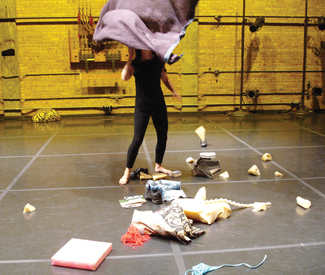
Part two opened with a promising twist. A dancer was ceremoniously carried in on a blanket and started to throw rubbish — old shoes, cans, rags, paper — around the stage as if the items were a goddess’ precious gifts. The stuff got kicked around, swept away, and finally ended up on a table, being sorted into what probably was meant to suggest legible patterns. The gathering and examination of this detritus and using some of it as props may have had its comic elements, but if so most of the humor escaped me. The remembered physicality of the table’s effect on the dancers, however, was a lovely touch.

Perhaps the evening’s most intriguing element came with Max Wirsing, the company’s lone male dancer, who donned silver sandals and paraded around while covered by a tablecloth. Later he repeated the gesture of closing the clasp around his ankle. It was clearly a movement that had entered his body. As for me, I was grateful when the last of this unearthed material — a single dancer — was blanketed by the dark falling onto the stage.

Local censored 2012

0


BEHIND THE MIRKARIMI CASE

In early January, details from the police investigation of then-Sheriff-elect Ross Mirkarimi bruising his wife’s arm during an argument were leaked to the San Francisco Chronicle and other news outlets. The key piece of evidence was a 45-second video that Mirkarimi’s wife, Eliana Lopez, made with her neighbor, Ivory Madison, displaying the bruise and saying she wanted to document the incident in case of a child custody battle. That video convinced many of Mirkarimi’s guilt, and a majority of Ethics Commissioners say they found it to be the main evidence on which Mirkarimi should be removed from office on official misconduct charges (the Board of Supervisors was scheduled to vote on Mirkarimi’s removal on Oct. 9, after Guardian press time).

But that video was only a small part of the overwhelming and expensive case that Mayor Ed Lee brought against Mirkarimi, including the more serious charges of abuse of power, witness dissuasion, and impeding a police investigation, all of which go more directly to a sheriff’s official duties. All of those charges got lots of media coverage and they helped cement the view of many San Franciscans that Mirkarimi engaged in a pattern of inappropriate behavior, rather than making a big momentary mistake. Yet most of the media coverage during the six months of Ethics Commission proceedings ignored the fact that none of the evidence that was being gathered supported those charges. Indeed, all those charges were unanimously rejected by the commission on Aug. 16, a startling rebuke of Lee’s case but one that was not highlighted in many media reports, which focused on the one charge the commission did uphold: the initial arm grab.


THE NEXT DOT-BOMB

In the late 1990s, San Francisco was in a very similar place to where it is now. The first dot-com boom was full bloom, driving the local economy and creating countless young millionaires — but also rapidly gentrifying the city and driving commercial and residential rents through the roof (great for the landlords, bad for everyone else). And then, the bubble popped, instantly erasing billions of dollars in speculative paper wealth and leaving this a changed city. The city’s working and creative classes suffered, but the political backlash gave rise to a decade with a progressive majority on the Board of Supervisors.

The era ended in 2010 when Ed Lee was appointed mayor, and he began ambitious agenda of pumping up a new dot-com bubble using tax breaks, public subsidies, and relentless official boosterism to lure more tech companies to San Francisco. Lee has been successful in his approach, in the process driving up commercial rents and housing prices. By some estimates, about 30 percent of the city’s economy is now driven by technology companies.

Yet there have been few voices in the local media raising questions about this risky, costly, and self-serving economic development strategy. The Bay Citizen did a story about Conway’s self interested advice, the New York Times did a front page story raising these issues, and San Francisco Magazine just last month did a long cover story questioning how much tech is enough. But most local media voices have been silent on the issue, and much of the damage has already been done.


OLD POWERBROKERS RETURN TO CITY HALL

More than a decade ago, then-Mayor Willie Brown and Chinatown power broker Rose Pak worked together to empower big business, corrupt local politics, and clear the path for rampant development — an approach that progressives on the Board of Supervisors repudiated and slowed from 2000-2010. But Brown, Pak, and a new generation of their allies have returned in power in City Hall, and it’s as bad as it ever was.

Many San Franciscans know of their high-profile role appointing Lee to office in early 2011. But their influence and tentacles have extended far beyond what we read in the papers and watch on television, starting in 2010 when their main political operatives David Ho and Enrique Pearce ran Jane Kim’s supervisorial campaign, beating Debra Walker, a veteran of the fights against Brown’s remaking of the city.

Now, this crew has the run of City Hall, meeting regularly with Mayor Lee and twisting the arms of supervisors on key votes. Pearce and Ho persuaded longtime progressive Christina Olague to co-chair the scandal-plagued Run Ed Run campaign last year, she was rewarded this year with Lee appointing her to the Board of Supervisors. Pearce has been her close adviser, and most of her campaign cash has been raised by Brown and Pak. Even progressive Sup. Eric Mar admits that Pak in raising money for him, a troubling sign of things to come.


THE REAL OCCUPY STORY

The Occupy San Francisco camp that was cleared by police last week may have been mostly homeless people. And major news media outlets from the start reported that Occupy was dangerous, filthy, and a civic eyesore.

But last fall, the camps were comprised of a huge variety of people that chose to live part or full time on the streets. Students, people with 9-5 jobs, people with service jobs, and the unemployed were all represented. Wealthy people who lived in the financial districts where camps popped up mixed with working-class people who came from suburbs and small towns. Families came out, welcomed in the “child spaces” set up in many Occupy camps throughout the country. Most camps also boasted libraries, free classes, kitchens, food distribution, and medical tents.

As news media focused on gross-out stories of pee on the streets and graphic descriptions of drunk occupiers, they managed to ignore the complex systems that were built in the camps. Nor did anyone mention that homeless people have the right to protest, too.

East Bay Endorsements 2012

22

The East Bay ballot is crowded, with races for mayor, city council and school board in Berkeley and Oakland, plus a long list of ballot measures. We’re weighing in on what we see as the most important races.


OAKLAND CITY ATTORNEY


BARBARA PARKER

This one’s simple: Progressives on the council like Parker, who’s a pretty unbiased attorney. Her challenger, Jane Brunner, is a supporter of Ignacio De La Fuente. Vote for Parker.


OAKLAND CITY COUNCIL


AT-LARGE


REBECCA KAPLAN

In some ways, this is a replay of the 2010 mayor’s race, where Rebecca Kaplan and Jean Quan, running as allies in a ranked-choice voting system, took on and beat Don Perata, the longtime powerbroker who left town soon after his defeat. This time around, it’s Kaplan, the popular incumbent, facing Ignacio De La Fuente, a Perata ally, for the one at-large council seat.

De La Fuente, who currently represents District 3, would have easily won re-election if he stuck to home. But for reasons he’s never clearly articulated, he decided to go after Kaplan. The general consensus among observers: De La Fuente wants to be mayor (he’s tried twice and failed), thinks Quan is vulnerable, and figures winning the at-large seat would give him a citywide base.

It’s a clear choice: Kaplan is one of the best elected officials in the Bay Area, a bright, progressive, practical, and hardworking council member who is full of creative ideas. De La Fuente is an old Perata Machine hack who wanted to kick out Occupy Oakland the first day, wants curfews for youth, and can’t even get his story straight on cutting the size of the Oakland Police Department.

De La Fuente is all about law and order, and he blasts Kaplan for — literally — “coddling criminals.” But actually, as the East Bay Express has reported in detail, De La Fuente, in a fit of anger at the police union, led the movement to lay off 80 cops. And the crime rate in Oakland spiked shortly afterward. Kaplan opposed that motion, and tried later to rehire many of those cops — but De La Fuente objected.

Public safety is one of the top local issues, and Kaplan not only supports community policing (and more cops) but is working on root causes, including the lack of services for people released into Oakland from state prison and county jail. She’s also a strong transit advocate who’s working on new bike lanes and a free shuttle on Broadway. She helped write the county transportation measure, B1. She richly deserves another term — and De La Fuente deserves retirement.


BERKELEY MAYOR


KRISS WORTHINGTON

It would be nice to have a Berkeley person as mayor of Berkeley again.

The city’s still among the most progressive outposts in the country — and Mayor Tom Bates, for all his history as one of the leading progressive voices in the state Legislature and a key part of the city’s left-liberal political operation, has taken the city in a decidedly centrist direction. Bates these days is all about development. He’s a big supporter of the sit-lie law (hard to imagine the old Tom Bates ever supporting an anti-homeless measure). He didn’t even seek the mayoral endorsement of Berkeley Citizens Action, which he helped build, and instead hypes the Berkeley Democratic Club, which he used to fight. After ten years, we’re ready for a new Berkeley mayor.

Worthington is the voice of the left on the City Council. He’s an aggressive legislator who is never short of ideas. He’s talking about the basics (holding separate council meetings on major issues so people who want to speak don’t have to wait until midnight), to the visionary (a 21-point plan for revitalizing Telegraph Avenue). He’s against sit-lie and wants developers to offer credible community benefits agreements before they build. We’re with Worthington.

Alameda County ballot measures


MEASURE A1


ZOO TAX


YES

The Oakland Zoo does wonders with rescue animals; instead of bringing in creatures from the wild or from other zoos, the folks in Oakland often find ways to take in animals that have been abused or mistreated elsewhere. Measure A1 would impose a tiny ($12 a year) parcel tax to support the public zoo. Critics say the money could go for zoo expansion, but the expansion’s happening anyway. Vote yes.


MEASURE B1


TRANSPORTATION PROGRAMS


YES

Quite possibly the most important thing on the East Bay ballot, Measure B1 creates the funding for a long-term transportation plan. Almost half of the money goes for public transit and only 30 percent goes for streets and road. There’s more bicycle money than in any previous transportation plan. Every city in Alameda County supports it. Vote yes.

Berkeley ballot measures


PROPOSITION M


STREET IMPROVEMENTS BOND


YES

Not our first choice for a street improvement bond, it’s a bit of a hodgepodge that squeaked through a divided council. But the city’s deferred street maintenance is a major problem and this $30 million bond would be a modest step forward.


MEASURE N


POOLS BOND


YES

Berkeley has lost half its public pools in the past two years; the facilities are unusable, and it’s going to take about $20 million to refurbish and rebuild them. This bond measure would allow the city to re-open the Willard Pool and build a new Warm Water Pool — critical for seniors and people rehabbing from injuries. Vote Yes.


MEASURE O


POOL TAX


YES

Berkeley often does things right, and this is a perfect example: Instead of building new facilities that it can’t afford to operate (hell, SF Recreation and Parks Department), Berkeley is asking for two things from the voters: Bond money to rebuild the municipal pools, and a special tax to provide $600,000 a year for operations. We support both.


MEASURE P


REAUTHORIZING SPECIAL TAXES


YES

Measure P doesn’t raise anyone’s taxes. It’s just a housekeeping measure, mandated by state law, allowing the city to keep spending taxes that were approved years ago for parks, libraries, medical services, services for the disabled, and fire services. Vote yes.


MEASURE Q


UTILITY TAX


YES

Berkeley’s been collecting utility taxes on cell phones for some time now, but the law that allows it is based on federal language that has changed. So the city needs to make this modest change to continue collecting its existing tax.


MEASURE R


DISTRICT LINES


YES

The council districts in Berkeley were set when the city adopted district elections in 1986, with a charter amendment saying all future redistricting should conform as closely as possible to the 1986 lines. Nice idea, but the population has changed and it makes sense for the council to have more flexibility with redistricting.


MEASURE S


SIT-LIE LAW


NO, NO, NO

It’s hard to believe that progressive Berkeley, which has spent hundreds of thousands of dollars defending similar laws in court, wants to criminalize sitting on the sidewalk. It hasn’t worked in San Francisco, it won’t work in Berkeley. Vote no.


MEASURE T


AMENDMENTS TO THE WEST BERKELEY PLAN


NO

Council Members Kriss Worthington, Jesse Arreguin, and Max Anderson all oppose this plan, which would open up West Berkeley to more office development — with no guarantee of community benefits. Everyone agrees the area needs updated zoning, but this is too loose.


MEASURE U


SUNSHINE COMMISSION


YES

Berkeley has needed a strong sunshine law for years; this one isn’t the greatest, but it’s not the worst, either; it would mandate better agendas (and allow citizens to petition for items to be put on the agenda) for city boards and commissions, would create a new sunshine commission with the ability to sue the city to enforce the law, and would require elected and appointed officials to make public their appointments calendars.


MEASURE V


CERTIFIED FINANCIAL REPORTS


NO

This sounds like a great idea — mandate that the city present certified financial audits of its obligations before issuing any more debt. In practice, it’s a way to make it harder for Berkeley to raise taxes or issue bonds. Vote no.

Oakland ballot measures


MEASURE J


SCHOOL BONDS


YES

Measure J would authorize $475 million in bonds for upgrading school facilities. This one’s a no-brainer; vote yes.


Today’s gathering of the music apps

2

The music industry — as we all know — has reached the nadir of its financial situation after a dozen or so years of file sharing. The Internet, many would say, hasn’t been too kind to the business. But if the Web taketh it also giveth, as evidenced by the plethora of music apps and Internet-based services (Spotify, Turntable.FM, Shazam, etc.) that are competing to transform the industry.

One of the driving forces behind this development is Brian Zisk, the executive producer of today’s SF Musictech Summit. The Summit is a biannual conference that aims to advance the profile of the digital music business by providing a space where entrepreneurs, developers, and music industry reps can come together, build networks, learn from one another. In addition, Michael Franti, of Spearhead fame, and composer Zoë Keating will be giving talks. The two will be in attendance through the conference, holding it down for the actual musicmakers.

Musicians testify about Musictech.

Zisk is the perfect person to facilitate such a gathering, due to this extensive career in digital media. He founded the production company Buzzmakers, Inc., which produces this event and the Future of Money and Technology Summit. He is also the co-founder and technologies director of the Future of Music Coalition, a non-profit that advocates on the behalf of musicians in the digital and legal spheres.

In a recent email interview with the Guardian, Zisk remarked on what sets his conference apart from others.

“Many conferences are all about showcasing the heads of sales and marketing. If given the choice, they tend to leave their tech guys at home. Our event specifically brings together the developers and CTOs to share knowledge and promote new ideas innovation. With these technically savvy folks leading the way, everyone else comes along.”

Some of the more recognizable names in the field will be in attendance today — DJ favorite Soundcloud, the so-called Youtube of mp3s, and top-selling radio app Tunein Radio. One of the more intriguing companies at the summit will be BAMM.tv, which uses its web platform to produce and distribute music videos for emerging musicians. And just like any gathering of tech-minded people, you won’t be able to walk two feet without hearing someone’s elevator pitch about his or her hot new app. In years past, the conference has also included seminars dedicated to helping attending developers perfect the elevator pitch.

Founded in 2008, the summit has made significant inroads in elevating this once-niche industry’s profile. In the finance realm, funding for digital music companies this year has increased 26.5 percent from last year. Zisk is also quick to point out that the summit has “helped people better realize that the goal is to better connect artists and fans, and helped show how the Internet has enabled musicians to do so.”

The summit now regularly features speeches from people such as Pandora CEO and founder Tim Westergren, and has even grabbed the attention of the big labels (representatives from companies like Universal Music Group will be in attendance.) It is possible to envision the startups that will be featured next week full on rescuing the music industry, but it remains to be seen whether or not they can return the music business back to its peak revenue earning days of the roaring 1990s.

SF MusicTech Summit
Tue/9 9am-6pm, $400
Hotel Kabuki
1625 Post, SF
www.sfmusictech.com

Open doors await on Affordable Housing Day

2

Tomorrow, 10/6 from 1pm-4pm, you can tour several of the city’s affordable housing sites — there’s even a handy citywide bike tour! — and  get an indepth look inside many of the innovative buildings that have recently gone up (or been rehabbed) in San Francisco, helping to house the homeless and make the city an affordable place to live for seniors, families, and people with special needs.

There will be refreshments! And also access to detailed information about the design, finances, and management of the buildings. And if you’re interested in finding out how to apply to live at one of the sites, there’ll be info about that, too. 

For Nosey Parkers like me who just like to go inside buildings and have a good gander, this will be pretty neat. (Also, my husband works in non-profit housing, and I get the backstory on a lot of the great stuff going on at these buildings, but never get to see it all!) And many of the buildings are doing really cool things environmentally and designwise. Complete list of locations and official press release after the jump.

SITE LIST:

Armstrong Place, 3rd Street & Armstrong
Bayview Commons, 4445 3rd Street
Bishop Swing, 275 10th Street
Broadway Family Apartments, 810 Battery Street
CASA, 5199 Mission Street
I Hotel, 868 Kearny Street
Mendelsohn House, 737 Folsom
Mosaica, 2949 19th Street
Notre Dame Plaza, 347 Dolores Street
St. Peters Place, 29th Avenue & Geary Street
The Hayes, 55 Page Street
Westbrook Plaza, 255 7th Street
Zygmunt Arendt House, 850 Broderick

Affordable Housing Day San Francisco to be held on Saturday, October 6
The Council of Community Housing Organizations, the American Institute of Architects San Francisco, and SPUR invite the community to an open house highlighting the benefits of affordable housing in San Francisco.

SAN FRANCISCO ─ As part of a citywide Affordable Housing Day, neighborhood affordable housing organizations throughout San Francisco will open up selected buildings for tours, info sessions and refreshments. Included in the tours will be examples of housing designed for seniors, families and people with special needs. The goal of the citywide day is to provide an opportunity for up close and personal experience with the people and places that make up San Francisco’s affordable housing. Each location will have detailed information about design, finance and management of these housing developments as a sample of the many affordable housing sites across the city. And for individuals interested in obtaining affordable housing, each participating organization will have information about qualifications, the application process, and vacancies.

Fernando Martí, co-director of the Council of Community Housing Organizations which is sponsoring the event, said “These are great examples of housing for everyday San Franciscans, slowing SF’s family flight, so that our children and grandchildren can continue to live in the City they helped build. Affordable housing also preserves the diversity of our neighborhoods, stabilizing communities from gentrification, while improving living conditions.”

There will be building tours throughout the city including the South of Market, Richmond, Mission, Excelsior, Bayview and Western Addition neighborhoods. Participants are welcome to visit all the open house locations, or just stop by the building in their neighborhood. Participating organizations include: Bernal Heights Neighborhood Center, Bridge Housing, Chinatown Community Development Center, Community Housing Partnership, Episcopal Community Services, Mercy Housing, San Francisco Housing Development Corporation, Tenants and Owners Development Corporation, Tenderloin Neighborhood Development Corporation , and The Hayes (55 Page).

“Creating affordable housing helps build our economy, creates jobs in San Francisco and supports families so they can stay, live and succeed in our City,” said San Francisco Mayor Ed Lee. “We must create a permanent source of revenue to fund the production of housing in San Francisco to ensure that seniors, people with disabilities and San Francisco families can continue to call San Francisco home.” Supervisor Christina Olague representing the city’s Western Addition and Hayes Valley neighborhoods where two sites will be open on Affordable Housing Day, said “We are fortunate to have such wonderful examples of affordable housing in my district, it’s a critical part of making diverse and stable neighborhoods.”

Please join us for San Francisco Affordable Housing Day, a free event to be held Saturday, October 6 from 1:00pm – 4:00pm. This is an open house format, so visitors can start at any of the 13 sites.


David Lee and his landlord backers raise the stakes in District 1

29

Realtors and commercial landlords have transformed the supervisorial race in District 1 into an important battle over rent control and tenants’ rights, despite their onslaught of deceptive mailers that have sought to make it about everything from potholes and the Richmond’s supposed decline to school assignments and economic development.

It’s bad enough that groups like the Coalition for Sensible Government – a front group for the San Francisco Association of Realtors, which itself is in the middle of internal struggles over its increasing dominance by landlords rather than Realtors – have been funding mailers attacking incumbent Eric Mar on behalf of downtown’s candidate: David Lee. Combined spending by Lee and on his behalf is now approaching an unheard of $400,000 (we’ll get more precise numbers tomorrow when the latest pre-election campaign finance statements are due).

What’s even more icky and unsettling is the fact that Lee – a political pundit who has been regularly featured in local media outlets in recent years, usually subtly attacking progressives while trying to seem objective – has refused to answer legitimate questions about his shady background and connections or the agenda he has for the city. He refused to come in for a Guardian endorsement interview or even to respond to our questions. His campaign manager, Thomas Li, told me Lee is too busy campaigning to answer questions from reporters, but he assured me that Lee will be more accessible and accountable once he’s elected.

Somehow, I don’t find that very reassuring. But I can understand why Lee is ducking questions and just hoping that the avalanche of mailers will be enough to win this one. In a city where two-thirds of residents rent, but where landlords control most of the city’s wealth, it’s politically risky to be honest about a pro-landlord agenda.

“It’s pretty clear that is a real estate-tenant battleground,” Ted Gullicksen, executive director of the San Francisco Tenants Union, told us. “District 1 is all about rent control, really. If David Lee wins, we’ll see the Board of Supervisors hacking away at rent control protections. The only question is whether it will be a severe hack or outright repeal.”

Real estate and development interests have already been able to win over Sups. Jane Kim and Christina Olague on key votes – and even Mar, who has disappointed many progressives on some recent votes, which many observers believe is the result of the strong challenge by Lee and his allies – but an outright flip of District 1 could really be dangerous.

“I want people to know how high the stakes are in this election. I want people to know that outside special interests are trying to buy this election,” Mar told us.

Mar is far from perfect, but at least he’s honest and accessible. With all the troublesome political meddling that we’ve seen in recent years from Willie Brown and Rose Pak on behalf of their corporate clients, particularly commercial landlords – which has been a big issue in District 5 this election and the mayor’s race last year – progressives were disturbed by rumors that Pak is helping Mar.

When we asked him about it, he didn’t deny it or evade the issue. “Yes, I have the support of just about all the Chinatown leaders, including Rose Pak,” Mar told us. “I’m proud to have a strong Chinese base of support.”

When asked about that support and how it will shape his votes, Mar noted that he also has strong support from labor and progressives, and that he will be far stronger on development and tenants issues than Lee. “I view myself as an independent, thoughtful supervisor who works very hard for the neighborhood,” Mar said. “There’s an accusation [in mailers paid for the Realtors] that the Richmond has become unlivable, and that’s just not true.”

We have a stack of official documents showing how Lee has used his Chinese-American Voter Education Project and his appointment to the Recreation and Parks Commission to personally enrich himself and his wife, using donations from rich corporations and individuals whose bidding he then does, and we mentioned some of that in our endorsements this week. We’ll continue seeking answers from Lee and his allies about their agenda for the city.

In fact, just as I was writing this post, Lee sent a message to supporters responding to our editorial and other efforts to raise these issues. “I know it is shocking, but while working as a full-time employee for CAVEC for the last twenty years, I was paid a salary. But let me tell you this was no six figure job with benefits,” he wrote. Actually, CAVEC’s federal 990 form shows he was paid $90,000 per year, while his wife, Jing Lee, was paid up to $65,000 per year as “program director” up until 2006. 

“We did not receive any money from the government. All of our activities were funded by private donations and grants and our finances were audited on a regular basis,” Lee wrote, not noting that he has refused to make public a full list of his donors, although we know from a 2001 report in Asian Week that they included Chevron, Wells Fargo, Anheuser-Busch, Bank of America, Marriott, Levi Strauss, Norcal Waste Management (now known as Recology), State Farm, and the late philanthropist Warren Hellman, who at the time was funding downtown attacks on progressives through groups including the Committee on Jobs.

District 1 has always been an important San Francisco battleground. During the decade that progressives had a majority on the Board of Supervisors, District 1 was represented first by Jake McGoldrick and then by Mar. Neither McGoldrick nor Mar always voted with the progressives, yet McGoldrick had to endure two failed recall drives funded by business and conservative interests.

Now, they have increased their bet, raising the question that President Barack Obama posed in last night’s presidential debate: “Are we going to double down on the top down policies that got us into this mess?”

Let’s hope not.

Film Listings

0

Film listings are edited by Cheryl Eddy. Reviewers are Kimberly Chun, Dennis Harvey, and Lynn Rapoport. For rep house showtimes, see Rep Clock.

MILL VALLEY FILM FESTIVAL

The 35th Mill Valley Film Festival runs Oct. 4-14 at the Christopher B. Smith Rafael Film Center, 1118 Fourth St, San Rafael; Cinéarts@Sequoia, 25 Throckmorton, Mill Valley; and 142 Throckmorton Theatre, Mill Valley. For additional venues, full schedule, and tickets (most shows $13.50), visit www.mvff.com. For commentary, see Film.

OPENING

Bitter Seeds Just what we all needed: more incontrovertible evidence of the bald-faced evil of Monsanto. This documentary on destitute Indian cotton farmers follows an 18-year-old girl named Manjusha, a budding journalist who investigates the vast numbers of farmer suicides since the introduction (and market stranglehold) of "BT" cotton — which uses the corporation’s proprietary GMO technology — in the region of Vidarbha. Before BT took over in 2004, these cotton farmers relied on cheap heritage seed fertilized only by cow dung, but the largely illiterate population fell prey to Monsanto’s marketing blitz and false claims, purchasing biotech seed that resulted in pesticide reliance, failing crops, and spiraling debt. It’s a truly heartbreaking and infuriating story, but much of the action feels stagy and false. Should Indian formality be blamed? Considering the same fate befell Micha X. Peled’s 2005 documentary China Blue, probably not. Still, eff Monsanto. (1:28) Roxie. (Michelle Devereaux)

Butter Jennifer Garner, Olivia Wilde, and Hugh Jackman star in this Iowa-set satirical comedy about competitive butter carving. (1:32)

Frankenweenie Wee Victor Frankenstein brings his dog back from the dead in Tim Burton’s black-and-white, 3D animated tale. (1:27) Presidio.

The Mystical Laws As The Master gathers Oscar buzz for its Scientology-inspired tale, another movie based on the teachings of a similarly-named religion, Japanese fringe sect Happy Science, opens this weekend. But that analogy is incorrect, for The Mystical Laws way more resembles 2000’s Battlefield Earth, demonstrating and preaching its source material’s tenants rather than questioning them. Visit Happy Science’s website and you’ll find a New Age mix of Christianity and Buddhism, with woo-woo about truth and love. Its founder, Ryuho Okawa, claims to the reincarnation of "El Cantare," sort of an über-god who controls all spiritual activity on Earth. Anyway, now there’s an anime flick based on one of Okawa’s hundreds of books; it’s about an evil overlord with planet-ruling aspirations who gets smacked down by the powerful combo of aliens, a guy who realizes he’s humanity’s "light of hope" (basically a Jesus-Buddha combo, with psychic powers to boot), and an eight-headed flying dragon. There is Nazi iconography; there are Star Wars-inspired plot points. At one point, the hero preaches directly to the camera. It’s all very heavy-handed. A far more amusing use of your time would be to go to Happy Science’s website and click the tab marked "Astonishing Facts" to learn the spiritual fates of historical figures: "Currently Beethoven lives in the lower area of the Bodhisattva Realm of the 7th dimension in the Spirit world, and aims to transcend the sadness evident in parts of his music and become an expert in the music of joy," while proponent o’ evolution Darwin "is now serving a penance in Abysmal Hell." Hey, wait a minute! Isn’t science supposed to be "happy?" (2:00) New People, 1746 Post, SF; www.newpeopleworld.com. (Eddy)

The Oranges In director Julian Farino’s tale of two families, the Wallings and the Ostroffs are neighbors and close friends living in the affluent New Jersey township of West Orange. We meet David Walling (Hugh Laurie), his wife Paige (Catherine Keener), his best friend Terry Ostroff (Oliver Platt), and Terry’s wife, Carol (Allison Janney), during a period of domestic malaise for both couples — four unhappy people who enjoy spending time together — that is destined to be exponentially magnified over the Thanksgiving and Christmas festivities. We learn much of this in voice-over courtesy of stalled-out 24-year-old design school grad Vanessa (Alia Shawkat), a second-generation Walling whose narrative subjectivity the film makes plain. No one will fault Vanessa for editorializing, however, when her Ostroff counterpart, onetime BFF and present-day nemesis Nina (Leighton Meester), returns home after a five-year absence and, amid maternal pressure to date Vanessa’s visiting brother, Toby (Adam Brody), instead embarks on an affair with their father. The ick factor is large, particularly because it takes a while to keep straight all the spouses, offspring, and houses they belong in. But Farino works to convince us that the romantic spark between David and Nina should be judged on its merits rather than with a gut-level revulsion, a reaction we can leave to the film’s principals. To the extent that this is possible, it’s possible to enjoy The Oranges‘ intelligent writing and fine cast, whose sympathetic characters (perhaps excluding Nina, whose heedlessness regarding the feelings of others verges on sociopathic) we wish the best of luck in surviving the holidays. (1:30) Albany, Clay. (Rapoport)

The Paperboy Lee Daniels scored big with Precious (2009), but this follow-up is so off-kilter in tone and story it will likely polarize critics and confuse audiences, despite its A-list cast. I happened to enjoy the hell out of this tacky, sweat-drenched, gator-gutting, and generally overwrought adaptation of Peter Dexter’s novel (Dexter and Daniels co-wrote the screenplay); it’s kind of a Wild Things-The Help-A Time to Kill mash-up, with the ubiquitous Matthew McConaughey starring as Ward Jansen, a Florida newspaper reporter investigating what he thinks is the wrongful murder conviction of Hillary Van Wetter (a repulsively greasy John Cusack). But the movie’s not really about that. Set in 1969 and narrated by Macy Gray, who plays the veteran housekeeper for the Jansens — a clan that also includes college dropout Jack (Zac Efron) — The Paperboy is neither mystery nor thriller. It’s more of a swamp cocktail, with some odd directorial choices (random split-screen here, random zoom there) that maybe seem like exploitation movie homages. As a Southern floozy turned on by "prison cock" (but not, to his chagrin, by the oft-shirtless Jack), Nicole Kidman turns in her trashiest performance since 1995’s To Die For. (1:46) Embarcadero. (Eddy)

V/H/S See "Gruesome Discovery." (1:55) Bridge, Shattuck.

Taken 2 It’s kidnapping season again, and Liam Neeson is pissed. (1:31) Marina.

ONGOING

Arbitrage As Arbitrage opens, its slick protagonist, Robert Miller (Richard Gere), is trying to close the sale of his life, on his 60th birthday: the purchase of his company by a banking goliath. The trick is completing the deal before his fraud, involving hundreds of millions of dollars, is uncovered, though the whip-smart daughter who works for him (Brit Marling) might soon be onto him. Meanwhile, Miller’s gaming his personal affairs as well, juggling time between a model wife (Susan Sarandon) and a Gallic gallerist mistress (Laetitia Casta), when sudden-death circumstances threaten to destroy everything, and the power broker’s livelihood — and very existence — ends up in the hands of a young man (Nate Parker) with ambitions of his own. It’s a realm that filmmaker Nicholas Jarecki is all too familiar with. Though like brothers Andrew (2003’s Capturing the Friedmans) and Eugene (2005’s Why We Fight), Jarecki’s first love is documentaries (his first film, 2006’s The Outsider, covered auteur James Toback), his family is steeped in the business world. Both his parents were commodities traders, and Jarecki once owned his own web development firm and internet access provider, among other ventures. When he started writing Arbitrage‘s script in 2008, he drew some inspiration from Bernard Madoff — but ultimately, the film is about a good man who became corrupted along the way, to the point of believing in his own invincibility. (1:40) Metreon, Presidio, Smith Rafael, Shattuck. (Chun)

Backwards Athletic disappointment is not a new feeling for Abi (Sarah Megan Thomas, who also wrote the script), who has just learned she’s been named the alternate for the Olympic crew team — a bench warming role she was also relegated to in the last Olympics. But after she quits the team in a huff and moves home, it’s not long before she realizes that her life off the water is pretty depressing, too. Enter former boyfriend Geoff (James Van Der Beek), now the athletic director at the high school where Abi honed her rowing talents, who gives her a job coaching the talented but undisciplined girls who make up the current team. Will this new venture help Abi finally grow up and regain her self-confidence? Will she re-ignite her spark with Geoff? Will there be a last-act conflict involving yet another chance at the Olympics? Will there be multiple training montages? As directed by Ben Hickernell, Backwards hits all of the expected themes about following one’s heart and Doing the Right Thing. Thomas, a former rower herself, has an ordinary-girl appeal, but even Backwards’ attention to authenticity can’t elevate what’s essentially a very predictable sports drama. (1:29) Sundance Kabuki. (Eddy)

Beasts of the Southern Wild Six months after winning the Grand Jury Prize at Sundance (and a Cannes Camera d’Or), Beasts of the Southern Wild proves capable of enduring a second or third viewing with its originality and strangeness fully intact. Magical realism is a primarily literary device that isn’t attempted very often in U.S. cinema, and succeeds very rarely. But this intersection between Faulkner and fairy tale, a fable about — improbably — Hurricane Katrina, is mysterious and unruly and enchanting. Benh Zeitlin’s film is wildly cinematic from the outset, as voiceover narration from six-year-old Hushpuppy (Quvenzhané Wallis) offers simple commentary on her rather fantastical life. She abides in the Bathtub, an imaginary chunk of bayou country south of New Orleans whose residents live closer to nature, amid the detritus of civilization. Seemingly everything is some alchemical combination of scrap heap, flesh, and soil. But not all is well: when "the storm" floods the land, the holdouts are forced at federal gunpoint to evacuate. With its elements of magic, mythological exodus, and evolutionary biology, Beasts goes way out on a conceptual limb; you could argue it achieves many (if not more) of the same goals Terrence Malick’s 2011 The Tree of Life did at a fraction of that film’s cost and length. (1:31) Four Star, Shattuck, Smith Rafael. (Harvey)

Beauty is Embarrassing You may not recognize the name Wayne White offhand, but you will know his work: he designed and operated many of the puppets on Pee-Wee’s Playhouse, including Randy (the blockheaded bully) and Dirty Dog (the canine jazzbo). Neil Berkeley’s Beauty Is Embarrassing — named for a mural White painted on the side of a Miami building for Art Basel 2009 — charts the life of an artist whose motto is both "I want to try everything I can!" and "Fuck you!" The Southern-born oddball, who came of age in the early-1980s East Village scene, is currently styling himself as a visual artist (his métier: painting non-sequitur phrases into landscapes bought from thrift stores), but Beauty offers a complex portrait of creativity balanced between the need to be subversive and the desire to entertain. (1:27) Roxie. (Eddy)

The Bourne Legacy Settle down, Matt Damon fans — the original Bourne appears in The Bourne Legacy only in dialogue ("Jason Bourne is in New York!") and photograph form. Stepping in as lead badass is Jeremy Renner, whose twin powers of strength and intelligence come courtesy of an experimental-drug program overseen by sinister government types (including Edward Norton in an utterly generic role) and administered by lab workers doing it "for the science!," according to Dr. Rachel Weisz. Legacy‘s timeline roughly matches up with the last Damon film, The Bourne Ultimatum, which came out five years ago and is referenced here like we’re supposed to be on a first-name basis with its long-forgotten plot twists. Anyway, thanks to ol’ Jason and a few other factors involving Albert Finney and YouTube, the drug program is shut down, and all guinea-pig agents and high-security-clearance doctors are offed. Except guess which two, who manage to flee across the globe to get more WMDs for Renner’s DNA. Essentially one long chase scene, The Bourne Legacy spends way too much of its time either in Norton’s "crisis suite," watching characters bark orders and stare at computer screens, or trying to explain the genetic tinkering that’s made Renner a super-duper-superspy. Remember when Damon killed that guy with a rolled-up magazine in 2004’s The Bourne Supremacy? Absolutely nothing so rad in this imagination-free enterprise. (2:15) 1000 Van Ness, SF Center. (Eddy)

The Campaign (1:25) 1000 Van Ness.

Celeste and Jesse Forever Married your best friend, realized you love but can’t be in love with each other, and don’t want to let all those great in-jokes wither away? Such is the premise of Celeste and Jesse Forever, the latest in what a recent wave of meaty, girl-centric comedies penned by actresses — here Rashida Jones working with real-life ex Will McCormack; there, Zoe Kazan (Ruby Sparks), Zoe Lister Jones (Lola Versus), and Lena Dunham (Girls) — who have gone the DIY route and whipped up their own juicy roles. There’s no mistaking theirs for your average big-screen rom-com: they dare to wallow harder, skew smarter, and in the case of Celeste, tackle the thorny, tough-to-resolve relationship dilemma that stubbornly refuses to conform to your copy-and-paste story arc. Nor do their female protagonists come off as uniformly likable: in this case, Celeste (Jones) is a bit of an aspiring LA powerbitch. Her Achilles heel is artist Jesse (Andy Samberg), the slacker high school sweetheart she wed and separated from because he doesn’t share her goals (e.g., he doesn’t have a car or a job). Yet the two continue to spend all their waking hours together and share an undeniable rapport, extending from Jesse’s encampment in her backyard apartment to their jokey simulated coitus featuring phallic-shaped lip balm. Throwing a wrench in the works: the fact that they’re still kind of in love with each other, which all their pals, like Jesse’s pot-dealer bud Skillz (McCormack), can clearly see. It’s an shaggy, everyday breakup yarn, writ glamorous by its appealing leads, that we too rarely witness, and barring the at-times nausea-inducing shaky-cam under the direction of Lee Toland Krieger, it’s rendered compelling and at times very funny — there’s no neat and tidy way to say good-bye, and Jones and McCormack do their best to capture but not encapsulate the severance and inevitable healing process. It also helps that the chemistry practically vibrates between the boyish if somewhat one-note Samberg and the soulful Jones, who fully, intelligently rises to the occasion, bringing on the heartbreak. (1:31) Shattuck. (Chun)

The Dark Knight Rises Early reviews that called out The Dark Knight Rises‘ flaws were greeted with the kind of vicious rage that only anonymous internet commentators can dish out. And maybe this is yet another critic-proof movie, albeit not one based on a best-selling YA book series. Of course, it is based on a comic book, though Christopher Nolan’s sophisticated filmmaking and Christian Bale’s tortured lead performance tend to make that easy to forget. In this third and "final" installment in Nolan’s trilogy, Bruce Wayne has gone into seclusion, skulking around his mansion and bemoaning his broken body and shattered reputation. He’s lured back into the Batcave after a series of unfortunate events, during which The Dark Knight Rises takes some jabs at contemporary class warfare (with problematic mixed results), introduces a villain with pecs of steel and an at-times distractingly muffled voice (Tom Hardy), and unveils a potentially dangerous device that produces sustainable energy (paging Tony Stark). Make no mistake: this is an exciting, appropriately moody conclusion to a superior superhero series, with some nice turns by supporting players Gary Oldman and Joseph Gordon-Levitt. But in trying to cram in so many characters and plot threads and themes (so many prisons in this thing, literal and figural), The Dark Knight Rises is ultimately done in by its sprawl. Without a focal point — like Heath Ledger’s menacing, iconic Joker in 2008’s The Dark Knight — the stakes aren’t as high, and the end result feels more like a superior summer blockbuster than one for the ages. (2:44) Metreon. (Eddy)

Detropia Those of us from Detroit, once-glamorous capital of American manufacturing and symbol of the triumph of capitalism, often feel like we were born with the history of the city in our bones. Another common feeling is that of dread upon hearing that yet another arty documentary (or brow-furrowing article, or glossy photo book) is coming down the pipe. The narrative arc of such things is usually this: remember Motown? Cars were amazing. Then there were scary riots, probably out of thin air. Then the jobs left. Isn’t Detroit sad now? Look how spooky this abandoned train station from the 1930s is! America is over. Wait! Some hipsters are starting a farm downtown! There may be hope after all. But who knows? Detropia, directed by Heidi Ewing, who grew up near Detroit, and Rachel Grady, doesn’t exactly deconstruct that crusty storyline (non-spoiler alert: the hipster-farmers become performance artists). But this important and beautiful film shows how much more of the Detroit tale takes on meaning and shape when told through the voices of people who actually live there, with a cinematic eye that doesn’t shy away from reality, even as it bends it to narrative ends. (1:30) Elmwood, Roxie, Smith Rafael. (Marke B.)

Diana Vreeland: The Eye Has to Travel The life of legendary fashion editor Diana Vreeland is colorfully recounted in Diana Vreeland: The Eye Has to Travel, a doc directed by her granddaughter-in-law, Lisa Immordino Vreeland. The family connection meant seemingly unlimited access to material featuring the unconventionally glamorous (and highly quotable) Vreeland herself, plus the striking images that remain from her work at Harper’s Bazaar, Vogue, and the Costume Institute of the Metropolitan Museum of Art. "Narrated" from interview transcripts by an actor approximating the late Vreeland’s husky, posh tones, the film allows for some criticism (her employees often trembled at the sight of her; her sons felt neglected; her grasp of historical accuracy while working at the museum was sometimes lacking) among the praise, which is lavish and delivered by A-listers like Anjelica Huston, who remembers "She had a taste for the extraordinary and the extreme," and Manolo Blahnik, who squeals, "She had the vision!" (1:26) Embarcadero, Shattuck. (Eddy)

Dredd 3D Cartoonishly, gleefully gruesome violence abounds in Dredd 3D, a pretty enjoyable comic-book adaptation thanks to star Karl Urban’s deadpan zingers. This is not a remake of the 1995 Sly Stallone flop Judge Dredd, by the way, though it might as well be a remake of 2011 Indonesian import The Raid: Redemption. The stories are identical. Like, lawsuit material-identical: supercop infiltrates (and then becomes trapped in, and must battle his way out of) a high-rise apartment tower run by a ruthless crime boss. Key difference is that Dredd has futuristic weapons, and The Raid had badass martial arts. Also Dredd‘s villain is played by Lena "Cersei Lannister" Headey, so there’s that. (1:38) Metreon, 1000 Van Ness. (Eddy)

End of Watch Buddy cop movies tend to go one of two ways: the action-comedy route (see: the Rush Hour series) or the action-drama route. End of Watch is firmly in the latter camp, despite some witty shit-talking between partners Taylor (a chrome-domed Jake Gyllenhaal) and Zavala (Michael Peña from 2004’s Crash) as they patrol the mean streets of Los Angeles. Writer-director David Ayer, who wrote 2001’s Training Day, aims for authenticity by piecing together much of (but, incongruously, not all of) the story through dashboard cameras, surveillance footage, and Officer Taylor’s own ever-present camera, which he claims to be carrying for a school project, though we never once see him attending classes or mentioning school otherwise. Gyllenhaal and Peña have an appealing rapport, but End of Watch‘s adrenaline-seeking plot stretches credulity at times, with the duo stumbling across the same group of gangsters multiple times in a city of three million people. Natalie Martinez and Anna Kendrick do what they can in underwritten cop-wife roles, but End of Watch is ultimately too familiar (but not lawsuit-material familiar) to leave any lasting impression. Case in point: in the year 2012, do we really need yet another love scene set to Mazzy Star’s "Fade Into You"? (1:49) Marina, 1000 Van Ness, SF Center. (Eddy)

Finding Nemo 3D (1:40) 1000 Van Ness, SF Center.

For a Good Time, Call&ldots; Suffering the modern-day dilemmas of elapsed rent control and boyfriend douchebaggery, sworn enemies Katie (Ari Graynor) and Lauren (Lauren Miller) find themselves shacking up in Katie’s highly covetable Manhattan apartment, brought together on a stale cloud of resentment by mutual bestie Jesse (Justin Long, gamely delivering a believable version of your standard-issue young hipster NYC gay boy). The domestic glacier begins to melt somewhere around the time that Lauren discovers Katie is working a phone-sex hotline from her bedroom; equipped with a good head for business, she offers to help her go freelance for a cut of the proceeds. Major profitability ensues, as does a friendship evoking the pair bonding at the center of your garden-variety romantic comedy, as Katie trains Lauren to be a phone-sex operator and the two share everything from pinkie swears and matching pink touch-tone phones to intimate secrets and the occasional hotline threesome. Directed by Jamie Travis and adapted from a screenplay by Miller and Katie Anne Naylon, the film is a welcome response to the bromance genre, and with any luck it may also introduce linguistic felicities like "phone-banging" and "let’s get this fuckshow started" into the larger culture. The raunchy telephonic interludes include cameos by Kevin Smith and Seth Rogen (Miller’s husband) as customers calling from such unfurtive locations as a public bathroom stall and the front seat of a taxicab. But the two roomies supply plenty of dirty as Katie, an abashed wearer of velour and denim pantsuits, helps the more restrained Lauren discover the joys of setting free her inner potty mouth. (1:25) SF Center. (Rapoport)

Hotel Transylvania (1:32) Metreon, 1000 Van Ness, Shattuck.

House At the End of the Street Tight T-shirts, a creepy cul-de-sac, couples in cars on lonely lanes, and the cute but weird loner kid — all the stuff of classic drive-in horror fare, revisited in this ambitious tribute of sorts. Don’t mistake House at the End of the Street for genre-reviving efforts by super fans like Eli Roth and Rob Zombie; Mark Tonderai’s mash up of Psycho (1960) and Last House on the Left (1972) lacks the rock ‘n’ roll brio and jet-black humor of, say, Cabin Fever (2002) or The Devil’s Rejects (2005). Instead House reads like an earnest effort to add a thin veneer of psychological realism and even girl power sincerity to a blood-spattered back catalog. Teenage musician Elissa (Jennifer Lawrence) and her overwhelmed mom Sarah (Elisabeth Shue) have found themselves quite a deal of a new rental home — a bit too good, since their next door neighbors were both brutally killed by their brain-damaged offspring who was obviously afflicted with the same greasy hair issues as the ghoulish gal in The Ring. Ryan (Bay Area native Max Thieriot), the boy who continues to live in the house where his parents were murdered, is ostracized, attractive, and much like his home, a fixer — making him mighty attractive to Elissa. A hearty, artistic soul who likes to venture where others fear to tread, she’s drawn to him despite the fact that she feels like she’s being watched from the woods that separate their homes. Switching back and forth between various perspectives — like that of a sputtering, spasmodically edited psychopath-cam and the steady, thoughtful gaze of a rebellious yet empathetic girl — House manages to effectively throw a few curveballs your way, while toying with genre conventions and upsetting your expectations. Shoring up its efforts is a talented cast, headed up by Lawrence’s feisty heroine and Shue’s sad-eyed struggling mom. (1:43) Metreon, 1000 Van Ness. (Chun)

Lawless Lawless has got to be the most pretentiously humorless movie ever made about moonshiners — a criminal subset whose adventures onscreen have almost always been rambunctious and breezy, even when violent. Not here, bub. Adapting Matt Bondurant’s fact-inspired novel The Wettest County in the World about his family’s very colorful times a couple generations back, director John Hillcoat and scenarist (as well as, natch, composer) Nick Cave have made one of those films in which the characters are presented to you as if already immortalized on Mount Rushmore — monumental, legendary, a bit stony. They’ve got a crackling story about war between hillbilly booze suppliers and corrupt lawmen during Prohibition, and while the results aren’t dull (they’re too bloody for that, anyway), they’d be a whole lot better if the entire enterprise didn’t take itself so gosh darned seriously. The Bondurant brothers of Franklin County, Va. are considered "legends" when we meet them in 1931, having defied all and sundry as well as survived a few bullets: mack-truck-built Forrest (Tom Hardy); eldest Howard (Jason Clarke), who tipples and smiles a lot; and "runt of the litter" Jack (Shia LeBeouf), who has a chip on his shoulder. The local law looks the other way so long as their palms are greased, but the Feds send sneering Special Deputy Charlie Rakes (Guy Pearce), it’s an eye for an eye for an eye, etc. The revenge-laden action in Lawless is engaging, but the filmmakers are trying so hard to make it all resonant and folkloric and meta-cinematic, any fun you have is in spite of their efforts. (1:55) 1000 Van Ness, SF Center. (Harvey)

Liberal Arts Against his better judgment, 35-year-old Jesse (How I Met Your Mother‘s Josh Radnor, who also wrote and directed) falls for 19-year-old Zibby (Elizabeth Olsen), a student at the leafy Ohio university he graduated from years before (never named, but filmed at Kenyon College, Radnor’s own alma matter). The two meet when Jesse, now a jaded Brooklynite, visits to celebrate the retirement of Professor Hoberg (Richard Jenkins). Letter-writing, classical-music appreciation, a supremely awkward follow-up visit, and much white-boy angst follows. Liberal Arts is at its best when delineating a specific type of collegiate experience — as safe, privileged bubble where, as Jesse explains, you can announce "I’m a poet!" without anyone punching you in the face. It can also be an oppressive space, as illustrated by a cranky prof who feels trapped by academia (a razor-sharp Lucinda Janney), and a morose classmate of Zibby’s who identifies a little too closely with David Foster Wallace. And it’s stuff like the Wallace references (again, never named — just identified via heavily dropped hints, for all the cool viewers to pick up on) that’re ultimately Liberal Arts‘ undoing. Radnor explores some interesting themes, but the film is full of indie-comedy tropes — the friendly stoner (Zac Efron) who randomly appears to dispense life lessons; an anti-Twilight rant that’s a bit too pleased with itself; the unusually attractive character who appears in the first act and is obviously destined for inclusion in the inevitable happy ending. (1:37) Shattuck. (Eddy)

Looper It’s 2044 and, thanks to a lengthy bout of exposition by our protagonist, Joe (Joseph Gordon-Levitt), here’s what we know: Time travel, an invention 30 years away, will be used by criminals to transport their soon-to-be homicide victims backward, where a class of gunmen called loopers, Joe among them, are employed to "do the necessaries." More deftly revealed in Brick writer-director Rian Johnson’s new film is the joylessness of the world in which Joe amorally makes his way, where gangsters from the future control the present (under the supervision of Jeff Daniels), their hit men live large but badly (Joe is addicted to some eyeball-administered narcotic), and the remainder of the urban populace suffers below-subsistence-level poverty. The latest downside for guys like Joe is that a new crime boss has begun sending back a steady stream of aging loopers for termination, or "closing the loop"; soon enough, Joe is staring down a gun barrel at himself plus 30 years. Being played by Bruce Willis, old Joe is not one to peaceably abide by a death warrant, and young Joe must set off in search of himself so that—with the help of a woman named Sara (Emily Blunt) and her creepy-cute son Cid (Pierce Gagnon)—he can blow his own (future) head off. Having seen the evocatively horrific fate of another escaped looper, we can’t totally blame him. Parsing the daft mechanics of time travel as envisioned here is rough going, but the film’s brisk pacing and talented cast distract, and as one Joe tersely explains to another, if they start talking about it, "we’re gonna be here all day making diagrams with straws" —in other words, some loops just weren’t meant to be closed. (1:58) Four Star, 1000 Van Ness, Piedmont, Presidio, SF Center, Sundance Kabuki. (Rapoport)

The Master Paul Thomas Anderson’s much-hyped likely Best Picture contender lives up: it’s easily the best film of 2012 so far. Philip Seymour Hoffman stars as Lancaster Dodd, the L. Ron Hubbard-ish head of a Scientology-esque movement. "The Cause" attracts Freddie Quell (Joaquin Phoenix, in a welcome return from the faux-deep end), less for its pseudo-religious psychobabble and bizarre personal-growth exercises, and more because it supplies the aimless, alcoholic veteran — a drifter in every sense of the word — with a sense of community he yearns for, yet resists submitting to. As with There Will Be Blood (2007), Anderson focuses on the tension between the two main characters: an older, established figure and his upstart challenger. But there’s less cut-and-dried antagonism here; while their relationship is complex, and it does lead to dark, troubled places, there are also moments of levity and weird hilarity — which might have something to do with Freddie’s paint-thinner moonshine. (2:17) Albany, Embarcadero, 1000 Van Ness, Presidio, Sundance Kabuki. (Eddy)

Moonrise Kingdom Does Wes Anderson’s new film mark a live-action return to form after 2007’s disappointingly wan Darjeeling Limited? More or less. Does it tick all the Andersonian style and content boxes? Indubitably. In the most obvious deviation Anderson has taken with Moonrise, he gives us his first period piece, a romance set in 1965 on a fictional island off the New England coast. After a chance encounter at a church play, pre-teen Khaki Scout Sam (newcomer Jared Gilman) instantly falls for the raven-suited, sable-haired Suzy Bishop (Kara Hayward, ditto). The two become pen pals, and quickly bond over the shared misery of being misunderstood by both authority figures and fellow kids. The bespectacled Sam is an orphan, ostracized by his foster parents and scout troop (much to the dismay of its straight-arrow leader Edward Norton). Suzy despises her clueless attorney parents, played with gusto by Bill Murray and Frances McDormand in some of the film’s funniest and best scenes. When the two kids run off together, the whole thing begins to resemble a kind of tween version of Godard’s 1965 lovers-on the-lam fantasia Pierrot le Fou. But like most of Anderson’s stuff, it has a gauzy sentimentality more akin to Truffaut than Godard. Imagine if the sequence in 2001’s The Royal Tenenbaums where Margot and Richie run away to the Museum of Natural History had been given the feature treatment: it’s a simple yet inspired idea, and it becomes a charming little tale of the perils of growing up and selling out the fantasy. But it doesn’t feel remotely risky. It’s simply too damn tame. (1:37) Shattuck. (Michelle Devereaux)

ParaNorman (1:32) Metreon.

The Perks of Being a Wallflower Move over, Diary of a Wimpy Kid series — there’s a new shrinking-violet social outcast in town. These days, life might not suck quite so hard for 90-pound weaklings in every age category, what with so many films and TV shows exposing, and sometimes even celebrating, the many miseries of childhood and adolescence for all to see. In this case, Perks author Stephen Chbosky takes on the directorial duties — both a good and bad thing, much like the teen years. Smart, shy Charlie is starting high school with a host of issues: he’s painfully awkward and very alone in the brutal throng, his only friend just committed suicide, and his only simpatico family member was killed in a car accident. Charlie’s English teacher Mr. Andersen (Paul Rudd) appears to be his only connection, until the freshman strikes up a conversation with feline, charismatic, shop-class jester Patrick (Ezra Miller) and his magnetic, music- and fun-loving stepsister Sam (Emma Watson). Who needs the popular kids? The witty duo head up their gang of coolly uncool outcasts their own, the Wallflowers (not to be confused with the deeply uncool Jakob Dylan combo), and with them, Charlie appears to have found his tribe. Only a few small secrets put a damper on matters: Patrick happens to be gay and involved with football player Brad (Johnny Simmons), who’s saddled with a violently conservative father, and Charlie is in love with the already-hooked-up Sam and is frightened that his fragile equilibrium will be destroyed when his new besties graduate and slip out of his life. Displaying empathy and a devotion to emotional truth, Chbosky takes good care of his characters, preserving the complexity and ungainly quirks of their not-so-cartoonish suburbia, though his limitations as a director come to the fore in the murkiness and choppily handled climax that reveals how damaged Charlie truly is. (1:43) Albany, California, Embarcadero, Sundance Kabuki. (Chun)

Pitch Perfect As an all-female college a cappella group known as the Barden Bellas launches into Ace of Base’s "The Sign" during the prologue of Pitch Perfect, you can hear the Glee-meets-Bring It On elevator pitch. Which is fine, since Bring It On-meets-anything is clearly worth a shot. In this attempt, Anna Kendrick stars as withdrawn and disaffected college freshman Beca, who dreams of producing music in L.A. but is begrudgingly getting a free ride at Barden University via her comp lit professor father. Clearly his goal is not making sure she receives a liberal arts education, as Barden’s academic jungle extends to the edges of the campus’s competitive a cappella scene, and the closest thing to an intellectual challenge occurs during a "riff-off" between a cappella gangs at the bottom of a mysteriously drained swimming pool. When Beca reluctantly joins the Bellas, she finds herself caring enough about the group’s fate to push for an Ace of Base moratorium and radical steps like performing mashups. Much as 2000’s Bring It On coined terms like "cheerocracy" and "having cheer-sex," Pitch Perfect gives us the infinitely applicable prefix "a ca-" and descriptives like "getting Treble-boned," a reference to forbidden sexual relations with the Bellas’ cocky rivals, the Treblemakers. The gags get funnier, dirtier, and weirder, arguably reaching their climax in projectile-vomit snow angels, with Elizabeth Banks and John Michael Higgins as grin-panning competition commentators offering a string of loopily inappropriate observations. (1:52) Metreon. (Rapoport)

The Possession (1:31) Metreon.

Resident Evil: Retribution (1:35) Metreon, 1000 Van Ness.

Samsara Samsara is the latest sumptuous, wordless offering from director Ron Fricke, who helped develop this style of dialogue- and context-free travelogue with Koyaanisqatsi (1982) and Baraka (1992). Spanning five years and shooting on 70mm film to capture glimmers of life in 25 countries on five continents, Samsara, which spins off the Sanskrit word for the "ever-turning wheel of life," is nothing if not good-looking, aspiring to be a kind of visual symphony boosted by music by the Dead Can Dance’s Lisa Gerrard and composers Michael Stearns and Marcello De Francisci. Images of natural beauty, baptisms, and an African woman and her babe give way to the madness of modern civilization — from jam-packed subways to the horrors of mechanized factory farming to a bizarre montage of go-go dancers, sex dolls, trash, toxic discarded technology, guns, and at least one gun-shaped coffin. After such dread, the opening and closing scenes of Buddhist spirituality seem almost like afterthoughts. The unmistakable overriding message is: humanity, you dazzle in all your glorious and inglorious dimensions — even at your most inhumane. Sullying this hand wringing, selective meditation is Fricke’s reliance on easy stereotypes: the predictable connections the filmmaker makes between Africa and an innocent, earthy naturalism, and Asia and a vaguely threatening, mechanistic efficiency, come off as facile and naive, while his sonic overlay of robot sounds over, for instance, an Asian woman blinking her eyes comes off as simply offensive. At such points, Fricke’s global leap-frogging begins to eclipse the beauty of his images and foregrounds his own biases. (1:39) Opera Plaza, Shattuck. (Chun)

Searching for Sugar Man The tale of the lost, and increasingly found, artist known as Rodriguez seems to have it all: the mystery and drama of myth, beginning with the singer-songwriter’s stunning 1970 debut, Cold Fact, a neglected folk rock-psychedelic masterwork. (The record never sold in the states, but somehow became a beloved, canonical LP in South Africa.) The story goes on to parse the cold, hard facts of vanished hopes and unpaid royalties, all too familiar in pop tragedies. In Searching for Sugar Man, Swedish documentarian Malik Bendjelloul lays out the ballad of Rodriguez as a rock’n’roll detective story, with two South African music lovers in hot pursuit of the elusive musician — long-rumored to have died onstage by either self-immolation or gunshot, and whose music spoke to a generation of white activists struggling to overturn apartheid. By the time Rodriguez himself enters the narrative, the film has taken on a fairy-tale trajectory; the end result speaks volumes about the power and longevity of great songwriting. (1:25) Opera Plaza. (Chun)

Sleepwalk with Me Every year lots of movies get made by actors and comedians who want to showcase themselves, usually writing and often directing in addition to starring. Most of these are pretty bad, and after a couple of festival appearances disappear, unremembered by anyone save the credit card companies that vastly benefited from its creation. Mike Birbiglia’s first feature is an exception — maybe not an entirely surprising one (since it’s based on his highly praised Off-Broadway solo show and best-seller), but still odds-bucking. Particularly as it’s an autobiographical feeling story about an aspiring stand-up comic (Mike as Matt) who unfortunately doesn’t seem to have much natural talent in that direction, but nonetheless obsessively perseveres. This pursuit of seemingly fore destined failure might be causing his sleep disorder, or it might be a means of avoiding taking the martial next step with long-term girlfriend (Lauren Ambrose, making something special out of a conventional reactive role) everyone else agrees is the best thing in his life. Yep, it’s another commitment-phobic man-boy/funny guy who regularly talks to the camera, trying to find himself while quirky friends and family stand around like trampoline spotters watching a determined clod. If all of these sounds derivative and indulgent, well, it ought to. But Sleepwalk turns a host of familiar, hardly foolproof ideas into astute, deftly performed, consistently amusing comedy with just enough seriousness for ballast. Additional points for "I zinged him" being the unlikely most gut-busting line here. (1:30) Opera Plaza, Piedmont, Shattuck. (Harvey)

Solomon Kane Conceived by Conan the Barbarian creator Robert E. Howard, this 16th-century hero is cut from the same sword-and-sorcery cloth, being a brawny brute of slippery but generally sorta-kinda upright morals. Solomon (James Purefoy) is slaughtering his way to a North African treasure trove when demons swallow up his likewise greedy, conscience-free cohorts and damn his soul for a lifetime of bad deeds. Suddenly committed to the greater good, he returns homeward to cold gray England, where Jason Flemyng’s evil sorcerer soon imperils both our protagonist and the Puritan family (complete with love interest) he’s befriended. This movie has been around a while — since 2009, to be exact, yet barely beating director Michael J. Bassett’s new Silent Hill: Revelation 3D to U.S. theaters — and is a good illustration of what can happen when you make a fairly expensive ($45 million) fantasy-action adventure without major stars nor any marketable novelty. Which is to say: not much. There is absolutely nothing wrong with the good-looking, watchable but generic-feeling Solomon Kane, save that nothing about it feels remotely original or inspired. It’s the perfectly okay, like-a-thousand-others mall flick you’ll forget you saw by Thanksgiving, despite being peopled with such normally interesting actors as Max Von Sydow, Alice Krige, and the late Pete Postlethwaite. (1:54) Metreon. (Harvey)

Somewhere Between Five years ago, when filmmaker Linda Goldstein Knowlton adopted a baby girl from China, she was inspired to make Somewhere Between, a doc about the experiences of other Chinese adoptees. The film profiles four teenage girls, including Berkeley resident Fang "Jenni" Lee, whose American lives couldn’t be more different (one girl has two moms and attends a fancy prep school; another, raised by devout Christians, dreams of playing her violin at the Grand Ole Opry) but who share similar feelings about their respective adoptions. The film follows the girls on trips to London (as part of an organized meeting of fellow adoptees), Spain (to chat with people interested in adopting Chinese babies, and where the question "What does it feel like to be abandoned?" is handled with astonishing composure), and China (including one teen’s determined quest to track down her birth family). Highly emotional at times, Somewhere Between benefits from its remarkably mature and articulate subjects, all of whom have much to say about identity and personal history. (1:28) Shattuck. (Eddy)

"Stars In Shorts" Outside of the festival circuit, it’s an uncommon feat for shorts to make it to the big screen, so it can’t hurt to make name recognition a prerequisite for selection. In writer-director Rupert Friend’s Steve, Keira Knightley plays an embattled Londoner under siege by her lonely, pathologically odd neighbor (Colin Firth). Written by Neil LaBute, Jacob Chase’s After School Special sets up a semi-flirtation between two strangers (Sarah Paulson and Wes Bentley) at a playground, only to deliver the kind of gut-level punch you might expect from the writer-director of 1998’s Your Friends and Neighbors. LaBute’s own Sexting is an entertaining exercise in stream-of-consciousness monologuing by Julia Stiles. As with most shorts programs, "Stars" is a mixed bag. Robert Festinger’s The Procession, in which Lily Tomlin and Modern Family‘s Jesse Tyler Ferguson play reluctant participants in a funeral procession, sounds promising, but the conversation palls during the 10-plus minutes we’re stuck in the car with them. Benjamin Grayson’s sci-fi thriller Prodigal, starring Kenneth Branagh, reaches its predictable crisis points several minutes after the viewer has arrived. More successful are Jay Kamen’s musical comedy Not Your Time, starring Seinfeld‘s Jason Alexander as an old Hollywood hand whose writing career has stalled out, and Chris Foggin’s Friend Request Pending, which treats viewers to the sight of Dame Judi Dench gamely wading into the social network in search of a date. (1:53) Opera Plaza. (Rapoport)

Trouble with the Curve Baseball scout Gus (Clint Eastwood) relies on his senses to sign players to the Atlanta Braves, and his roster of greats is highly regarded by everyone — save a sniveling climber named Sanderson (Matthew Lillard), who insists his score-keeping software can replace any scout. Gus’ skill in his field are preternatural, but with his senses dwindling, his longtime-friend Pete (a brilliant John Goodman) begs Gus’ daughter Mickey (Amy Adams) to go with him — to see how bad the situation is and maybe drive him around. Ultimately, the film’s about the rift between career woman Mickey, and distant dad Gus, with some small intrusions from Justin Timberlake as Mickey’s romantic interest. Trouble with the Curve is a phrase used to describe batters who can’t hit a breaking ball and it’s a nuance — if an incontrovertible one — unobservable to the untrained eye. While Mickey and Gus stumble messily toward a better relationship (with a reasonable amount of compromise), Curve begins to look a bit like The Blind Side (2009), trading the church and charity for therapy and baggage. But what it offers is sweet and worthwhile, if you’re tolerant of the sanitized psychology and personality-free aesthetics. But it’s a movie about love and compromise — and if you love baseball you won’t have trouble forgiving some triteness, especially when Timberlake, the erstwhile Boo-Boo, gets to make a Yogi Berra joke. (1:51) Metreon, 1000 Van Ness, Sundance Kabuki. (Sara Vizcarrondo)

Vulgaria (1:32) Metreon.

Won’t Back Down If talk of introducing charter schools into the public education mix tends to give you collective-bargaining-related hives, Daniel Barnz’s Won’t Back Down is unlikely to appeal, unless perhaps as the object of a boycott or a picket line. Two embattled mothers, Jamie Fitzpatrick (Maggie Gyllenhaal) and Nona Alberts (Viola Davis), both with children at a failing Pittsburgh elementary school and the latter a teacher there, join forces to change the institutional culture by leading a parent-teacher takeover, with the goal of creating a charter school. As the bureaucratic process for doing so is described by a school district employee, it should take them three to five years to discover that they’ve been hurling themselves at a brick wall; Jamie, an efficient combination of fireball and pit bull, is determined to pulverize the wall in about two months. Watching her and Nona try to secure more than a third-rate, treading-water education for their kids, it’s hard not to root for the possibility of a transformation, and even an upper-level teachers’ union staffer played by Holly Hunter finds herself climbing the fence. The details of what lies on the other side (and inside Jamie and Nona’s 400-page proposal) stay fairly fuzzy, though. And while Barnz lets his warring factions—desperate mothers and educators, a union boss (Ned Eisenberg) watching the deterioration of the labor movement, a pro-union teacher (Oscar Isaac) ambivalently engaged in the chartering project—impassionedly debate their way through the film, a little more wonkiness might have clarified the arguments of those done waiting for Superman. (2:00) Metreon, 1000 Van Ness, Sundance Kabuki. (Rapoport)

The Words We meet novelist Rory Jansen (Bradley Cooper) as he’s making his way from a posh building to a cab in the rain; it’s important the shot obscures his generally shiny exterior, because we’re meant to believe this guy’s a sincere and struggling novelist. Jeremy Irons, aged with flappy eye makeup, watches him vengefully. Seems Rory fell upon the unpublished novel Irons’ character wrote in sadness and loss — and feeling himself incapable of penning such prose, transcribed the whole thing. When his lady friend (Zoe Saldana) encourages him to sell it, he becomes the next great American writer. He’s living the dream on another man’s sweat. But that’s not the tragedy, exactly, because The Words isn’t so concerned with the work of being a writer — it’s concerned with the look and insecurity of it. Bradley and Irons aren’t "real," they’re characters in a story read by Clay Hammond (Dennis Quaid) while the opportunistic, suggestive Daniella (Olivia Wilde) comes onto him. She can tell you everything about Clay, yet she hasn’t read the book that’s made him the toast of the town — The Words, which is all about a young plagiarist and the elderly writer he steals from. "I don’t know how things happen!", the slimy, cowering writers each exclaim. So, how do you sell a book? Publish a book? Make a living from a book? How much wine does it take to bed Olivia Wilde? Sure, they don’t know how things happen; they only know what it looks like to finish reading Hemingway at a café or watch the sun rise over a typewriter. Rarely has a movie done such a trite job of depicting the process of what it’s like to be a writer — though if you found nothing suspect about, say, Owen Wilson casually re-editing his 400-page book in one afternoon in last year’s Midnight in Paris, perhaps you won’t be so offended by The Words, either. (1:36) SF Center. (Vizcarrondo)

Northern promises

0

On the Road (Walter Salles, US/France/UK/Brazil, 2012) Walter Salles (2004’s The Motorcycle Diaries) engages Diaries screenwriter Jose Rivera to adapt Jack Kerouac’s Beat classic; it’s translated to the screen in a streamlined version, albeit one rife with parties, drugs, jazz, danger, reckless driving, sex, philosophical conversations, soul-searching, and “kicks” galore. Brit Sam Riley (2007’s Control) plays Kerouac stand-in Sal Paradise, observing (and scribbling down) his gritty adventures as they unfold. Most of those adventures come courtesy of charismatic, freewheeling Dean Moriarty (Garrett Hedlund of 2010’s Tron: Legacy), who blows in and out of Sal’s life (and a lot of other people’s lives, too, including wives played by Kristen Stewart and Kirsten Dunst). Beautifully shot, with careful attention to period detail and reverential treatment of the Beat ethos, the film is an admirable effort but a little too shapeless, maybe simply due to the peripatetic nature of its iconic source material, to be completely satisfying. Among the performances, erstwhile teen dream Stewart is an uninhibited standout. Thu/4, 6:30 and 6:45pm, Smith Rafael. (Cheryl Eddy)

Road North (Mika Kaurismäki, Finland) Mika Kaurismäki’s films are generally much more broadly accessible than the dryly minimalist ones of his brother Aki, yet the latter has by far the larger international audience. That might change a bit with this likable seriocomic road trip. Emotionally recessive concert pianist Timo (Samuli Edelmann) is less than delighted one day to find an uninvited guest slumped outside his apartment: the father who abandoned him 30-odd years earlier. Far from having improved himself in the interim, Leo (Vesa-Matti Loiri) is a corpulent slob, convenience store robber, and car thief. But he is insistent in dragging his son on a journey whose full purpose he won’t reveal until its end. Actually, you can guess where it’s headed — but getting there is full of surprises, some touching and some very funny. Fri/5, 9pm, Smith Rafael; Sun/7, 6pm, Sequoia. (Dennis Harvey)

Fat Kid Rules the World (Matthew Lillard, US) It really does suck to be Troy (Jacob Wysocki from 2011’s Terri). An XXL-sized high schooler, he’s invisible to his peers, derided by his little brother (Dylan Arnold), and has lived in general domestic misery since the death of his beloved mother under the heavy-handed rule of his well-meaning but humorless ex-military dad (Billy Campbell). His only friends are online gamers, his only girlfriends the imaginary kind. But all that begins to change when chance throws him across the path of notorious local hell raiser Marcus (Matt O’Leary), who’s been expelled from school, has left the band he fronts, and is equal parts rebel hero to druggy, lyin’ mess. But he randomly decrees Troy is cool, and his new drummer. Even if he’s just being used, Troy’s world is headed for some big changes. Actor Matthew Lillard’s feature directorial debut, based on K.L. Going’s graphic novel, is familiar stuff in outline but a delight in execution, as it trades the usual teen-comedy crudities (a few gratuitous joke fantasy sequences aside) for something more heartfelt and restrained, while still funny. O’Leary from last year’s overlooked Natural Selection is flamboyantly terrific, while on the opposite end of the acting scale Campbell makes repressed emotion count for a lot — he has one wordless moment at a hospital that just might bring you to the tears his character refuses to spill. Sat/6, 3pm, Sequoia; Oct. 11, 7pm, Smith Rafael. (Harvey)

The Central Park Five (Ken Burns, US) Acclaimed documentarian Ken Burns takes on the 1989 rape case that shocked and divided a New York City already overwhelmed by racially-charged violence. The initial crime was horrible enough — a female jogger was brutally assaulted in Central Park — but what happened after was also awful: cops and prosecutors, none of whom agreed to appear in the film, swooped in on a group of African American and Latino teenagers who had been making mischief in the vicinity (NYC’s hysterical media dubbed the acts “wilding,” a term that became forever associated with the event). Just 14 to 16 years old, the boys were questioned for hours and intimidated into giving false, damning confessions. Already guilty in the court of public opinion, the accused were convicted in trials — only to see their convictions vacated years after they’d served their time, when the real assailant was finally identified. Using archival news footage (in one clip, Gov. Mario Cuomo calls the crime “the ultimate shriek of alarm that says none of us are safe”) and contemporary, emotional interviews with the Five, Burns crafts a fascinating study of a crime that ran away with itself, in an environment that encouraged it, leaving lives beyond just the jogger’s devastated in the process. Sat/6, 3:30pm, Smith Rafael; Mon/8, 3:15pm, Smith Rafael. (Eddy)

Rebels with a Cause (Nancy Kelly, US) The huge string of parklands that have made Marin County a jewel of preserved California coastline might easily have become wall-to-wall development — just like the Peninsula — if not for the stubborn conservationists whose efforts are profiled in Nancy Kelly’s documentary. From Congressman Clem Miller — who died in a plane crash just after his Point Reyes National Seashore bill became a reality — to housewife Amy Meyer, who began championing the Golden Gate National Recreation Area because she “needed a project” to keep busy once her kids entered school, they’re testaments to the ability of citizen activism to arrest the seemingly unstoppable forces of money, power and political influence. Theirs is a hidden history of the Bay Area, and of what didn’t come to pass — numerous marinas, subdivisions, and other developments that would have made San Francisco and its surrounds into another Los Angeles. Sat/6, 6:15pm, Sequoia; Tue/9, 4pm, Smith Rafael. (Harvey)

The Sessions (Ben Lewin, US) Polio has long since paralyzed the body of Berkeley poet Mark O’Brien (John Hawkes) from the neck down. Of course his mind is free to roam — but it often roams south of the personal equator, where he hasn’t had the same opportunities as able-bodied people. Thus he enlists the services of Cheryl (Helen Hunt), a professional sex surrogate, to lose his virginity at last. Based on the real-life figures’ experiences, this drama by Australian polio survivor Ben Lewin was a big hit at Sundance this year (then titled The Surrogate), and it’s not hard to see why: this is one of those rare inspirational feel-good stories that doesn’t pander and earns its tears with honest emotional toil. Hawkes is always arresting, but Hunt hasn’t been this good in a long time, and William H. Macy is pure pleasure as a sympathetic priest put in numerous awkward positions with the Lord by Mark’s very down-to-Earth questions and confessions. Sat/6, 7pm, Smith Rafael; Sun/7, noon, Sequoia. (Harvey)

Flicker (Patrik Eklund, Sweden) The provincial HQ of behind-the-times, inept telecommunications company Unicom is locus to a whole bunch of weirdness during the eventful work week chronicled by Swedish writer-director Patrik Eklund’s first feature. To wit: sterility by electrocution, tarantula therapy, grade-school performances of Frankenstein, Ted Danson fixations, workplace application of dunce caps, blind dates, domestic terrorism cults, and scented candle making. If you only see one Scandinavian comedy this year, make it Klown. If you only see two, however, this is definitely the other one. It’s a goofy, lightly surreal delight. Sat/6, 9pm, Smith Rafael; Mon/8, 3:15pm, Smith Rafael. (Harvey)

Jayne Mansfield’s Car (Billy Bob Thornton, US) Billy Bob Thornton’s first directing gig in over a decade is an ensemble piece set in small-town 1969 Alabama — like every U.S. town at the time, a hotbed of generational conflict over the Vietnam War and the generally changin’ times. Particularly defining that gap is the squabbling relationship between hawkish patriarch Jim Caldwell (Robert Duvall) and youngest son Carroll (Kevin Bacon), who — though a World War II veteran, like brother Skip (Thornton) — has appointed himself a sort of elder to the local hippie population. That alone is enough to set Jim’s teeth on edge; he’s put in an even crustier mood upon hearing that his ex-wife has died, and her corpse is being brought back from England by the new family (John Hurt, Ray Stevenson, Frances O’Connor) she’d acquired after leaving him. The awkward meeting between two very different clans quickly thaws in various ways, however, some sexual, some comradely. Dismissed as a garrulous mess in its other festival showings to date, this Car is indeed one rusty, leaky, wayward vehicle at times, with some forced situations and way too much speechifying in the director’s script (co-written with Tom Epperson). But the thematically over ambitious, structurally clumsy movie is watchable nonetheless, with some real strengths: most notably strong performances (especially Thornton’s own) and a real feel for a particular high-Southern Brahmin milieu that hasn’t changed much more in the last 40 years than it did in the prior 40. Thornton will receive the MVFF Award and be interviewed onstage at the film’s screening. Sun/7, 6:30pm, Smith Rafael; Oct. 14, 5pm, Smith Rafael. (Harvey)

Ricky on Leacock (Jane Weiner, France/US) Shot over the last 40 years, since she was her subject’s student, Jane Weiner’s film about globe trotting director-cinematographer Richard Leacock is a fond tribute that pays due respect to the latter’s innovations in the documentary form. Dismayed by the lack of spontaneity that cumbersome equipment forced on the genre, he began devising a series of lightweight, synch-sound cameras that could unobtrusively travel with and capture events as they occurred. While his own mostly TV-targeted fruits of that labor are relatively little-known today, their impact on nonfiction cinema was enormous — and Leacock, who died last year at 89, was clearly charming company. Sun/7, 7pm, Smith Rafael; Mon/8, 9:15pm, 142 Throckmorton. (Harvey)

In Another Country (Hong Sang-soo, Korea) This latest bit of gamesmanship from South Korea’s Hong Sang-soo (2000’s Virgin Stripped Bare by Her Bachelors) has Isabelle Huppert playing three Frenchwomen named Anne visiting the same Korean beachside community under different circumstances in three separate but wryly overlapping stories. In the first, she’s a film director whose presence induces inapt overtures from both her married colleague-host and a strapping young lifeguard. In the more farcical second, she’s a horny spouse herself, married to an absent Korean man; in the third, a woman whose husband has run away with a Korean woman. The same actors as well as variations on the same characters and situations appear in each section, their rejiggered intersections poking fun at Koreans’ attitudes toward foreigners, among other topics. Airy and amusing, In Another Country is a playful divertissement that’s shiny as a bubble, and leaves about as much of a permanent impression. Tue/9, 4:15pm, Sequoia; Oct. 12, 9:45pm, Smith Rafael. (Harvey)

To Kill A Beaver (Jan Jakub Kolski, Poland) Furtive, paranoid, solitary Eryk (Eryk Lubos) returns from places unknown to prepare his dilapidated farmhouse for a mission that, for a long time, remains equally unclear. Veteran Polish director Jan Jakub Kolski’s enigmatic drama takes its time unfolding the mysteries of Eryk’s traumatic past, unstable present, and future purpose. He’s all suspicion when he finds local teen Bezi (Agnieszka Pawelkiewicz) trespassing on his property, but her brazen come-on and hidden vulnerabilities chip away at his ample defenses. This intricate character study in the guise of a thriller puzzle is offbeat and absorbing, thanks in large part to Lubos’ prickly performance as a man as damaged as he is dangerous. Oct. 10, 6:30pm, Smith Rafael; Oct. 11, 9:30pm, Sequoia. (Harvey)

Holy Motors (Leos Carax, France) Holy moly. Offbeat auteur Leos Carax (1999’s Pola X) and frequent star Denis Lavant (1991’s Lovers on the Bridge) collaborate on one of the most bizarrely wonderful films of the year, or any year. Oscar (Lavant) spends every day riding around Paris in a white limo driven by Céline (Edith Scob, whose eerie role in 1960’s Eyes Without a Face is freely referenced here). After making use of the car’s full complement of wigs, theatrical make-up, and costumes, he emerges for “appointments” with unseen “clients,” who apparently observe each vignette as it happens. And don’t even try to predict what’s coming next, or decipher what it all means: this wickedly humorous trip through motion-capture suits, graveyard photo shoots, teen angst, back-alley gangsters, old age, and more (yep, that’s the theme from 1954’s Godzilla you hear; oh, and yep, that’s pop star Kylie Minogue) is equal parts disturbing and delightful. Movies don’t get more original or memorable than this. Oct. 11, 6pm, Sequoia; Oct. 12, 3:15pm, Smith Rafael. (Eddy)

The 35th Mill Valley Film Festival runs Oct. 4-14 at the Christopher B. Smith Rafael Film Center, 1118 Fourth St, San Rafael; Cinéarts@Sequoia, 25 Throckmorton, Mill Valley; and 142 Throckmorton Theatre, Mill Valley. For additional venues, full schedule, and tickets (most shows $13.50), visit www.mvff.com. Additional short reviews at www.sfbg.com.


Downtown development

1

LIT/VISUAL ARTS The term “Mission School” was coined in these pages by Glen Helfand in 2002 to describe a loose-knit group of artists based around the Mission District who were then just beginning to break through into international art world success. These artists — including Barry McGee, Margaret Kilgallen, Chris Johanson, Alicia McCarthy, Rigo 23 and others — made use of found materials and shared an informal aesthetic that was influenced as much by the low rent streets of the city around them as a relaxed, collective Bay Area vibe.

A decade later, it seems safe to say that the Mission School was probably the last major art movement of its kind in this country, and itself the end of an era. For over three decades, significant art and music breakthroughs in this country were linked to specific urban neighborhoods (hip-hop to the South Bronx; Warhol’s Factory to downtown Manhattan, riot grrrl to Olympia, Wash.; grunge to Seattle; Fort Thunder in Providence, RI, etc.) Today, with the rise of the importance of MFA programs as a means to enter the art world, and the lack of locality fostered by the internet, the era of geographic specificity as arts incubator has perhaps passed us for good.

Two new books take us back to those freer, more experimental days at the inception of the SoHo and East Village arts scenes of New York in the 1970s and 80s. 112 Greene Street: The Early Years (1970-1974) (Radius Books, 192 pp., $50) is a brief, but invigorating oral history from the early years of what we now know as SoHo. This just-released catalog to last year’s exhibition at Zwirner Gallery in Chelsea brings to life the sense of discovery and improvisation of the nascent neighborhood scene that centered around the legendary pioneering alternative arts space and its north star, the late Gordon Matta-Clark.

In October 1970, when Jeffrey Lew and Matta-Clark opened 112 Greene Street in the storefront of a “rundown former rag picking factory,” the area south of Houston Street was a wasteland of abandoned former textile factories known as Hell’s Hundred Acres. The space, with its lack of heat, and its raw walls, uneven floors, and poor artificial lighting resembled the city then falling apart all around it. The ruins of the city not only influenced the work; sometimes they literally became work.

Alan Saret remembers walking near Canal Street with Matta-Clark one night when a cornice simply fell off a building right in front of them. Saret found some other cornices on the ground nearby and paid the crew of a passing city garbage truck to haul them back to 112 Greene where they became part of a sculpture piece he called Cornices.

Far from the uptown galleries where Manhattan art world power then was consolidated, 112 Greene’s isolation and state of decay fostered a certain kind of “anything goes” artistic freedom and collaborative spirit. For the first opening at 112 Greene, Matta-Clark jackhammered a hole in the basement floor and filled the area with dirt, where he planted a cherry tree that he kept alive all winter with grow lamps. For a later exhibition, George Trakas wanted to do a two-story sculpture, so he simply cut a hole in the floor so his piece could rise up out of the basement into the main floor. The only rule seemed to be that work had to be created on site and could not be made for sale.

Perhaps predictably, with this last rule, the space could barely keep its doors open. Yet, there is a timeless lesson here for those running arts spaces today: the downfall of 112 Greene came ironically only after it finally achieved financial stability. When Lew landed a big NEA grant in 1973, pure art experimentation and spontaneity gradually gave way to formal scheduling and programming guidelines from the funders in DC, who demanded more and more say in the operation of the space. “The excitement that anything could happen waned as paperwork and schedules were enforced,” remembers Lew. The core group of artists slowly drifted away from 112 Greene, just as the original SoHo, too, was beginning to change all around them into the high-end shopping district it is today.

The SoHo model has become a cynical real estate gentrification strategy, as developers create prefab arts — and shopping — neighborhoods in empty warehouse districts across the country from Miami to Portland, Ore. to Brooklyn. But if, say, Bushwick’s art scene feels less like a real place than the shores of a desert island where hundreds of young artists have been randomly washed up by the storms of the global economy, 112 Greene Street reminds us that the first art neighborhoods were formed organically around genuine community. In 1971, Matta-Clark and artist Carol Goodden started an artist-run collective restaurant in SoHo called Food. By all accounts, Food was not some relational aesthetic stunt; it was a well loved and sincere attempt to provide cheap meals, a gathering place, and jobs to artists in the scene.

112 Greene Street ends before Matta-Clark’s untimely death from pancreatic cancer at age 35 in 1978, and before the artist would famously take the work he developed in the ruins of 112 Greene out into the ruins of the city with a practice he dubbed “Anarchitecture.” He took the city as his canvas, transforming raw space by sawing dramatic cuts in the floors and facades of abandoned buildings in the South Bronx and industrial parts of New Jersey. But the charm and dreamy freedom of the era 112 Greene Street depicts comes through in Matta-Clark’s film, Day’s End. In it, Matta-Clark works calmly with a blowtorch, cutting holes in the steel ceiling of an abandoned city pier on the Hudson River (with no apparent fear of getting caught) as the space slowly fills with radiant light.

A decade later, another artist who would die too young, David Wojnarowicz, would also find a wide-open playground in the rotting piers along the river. Wojnarowicz would spend hours at the piers, writing about what he saw there, having sex with strangers, and drawing murals or writing poetry on the crumbling walls. Wojnarowicz delighted in the ruins and saw the piers as a sign that America’s empire was fading away before his eyes. That today we know it was actually only Wojnarowicz’s world that was about to disappear is just one of the many poignant aspects of Cynthia Carr’s beautiful new book, Fire in the Belly: The Life and Times of David Wojnarowicz (Bloomsbury USA, 624 pp., $35), the first comprehensive biography to date of the artist, writer, and activist who died of AIDS at the age of 39 in 1992.

On the run from an abusive father, Wojnarowicz started sleeping with older men for money while living on the streets in his teens. Drawn to other criminals and outlaws, his first published writings were based on interviews he did with street hustlers, travelers, and homeless people he met in skid row waterfront diners and on hitchhiking trips. In the works of Jean Genet, he found a literary moral universe that helped him make sense of his own worldview. One of his earliest surviving works, a collage entitled St. Genet, depicts the French writer wearing a halo in the foreground while in the background, Jesus is tying off to shoot up. While Wojnarowicz would continue to use such blunt religious imagery in his work, the collage resonates in other ways. Carr reports that it was Kathy Acker who first called Wojnarowicz “a saint” when she appeared with him at his final public reading in 1991. The identification of Wojnarowicz’s life and work with the tragic loss of so many daring, outlaw artists to AIDS is so complete that Wojnarowicz has become a patron saint to young queer and activist artists today, his life story surrounded by an aura of myth.

Carr, a former arts reporter for the Village Voice, carefully picks apart myth from fact: Wojnarowicz didn’t actually start selling his body for money at age nine as he often claimed and he also wasn’t a founding member of ACT UP as many people suppose (though he did participate in some ACT UP protests). Yet, the complex and more human Wojnarowicz that Carr leaves us with is no less inspiring a figure — a self-taught artist whose lifelong struggle to make meaningful art out of his own experience, sexuality, and ultimate diagnosis with an incurable disease would almost by chance place him front and center in the story of the AIDS crisis and the great culture wars of the late 1980s and early ’90s.

Carr, a resident of the East Village now for four decades, became friends with Wojnarowicz late in his life, and she refreshingly breaks journalistic “objectivity” to insert her own eyewitness perspective into the narrative at many key junctures. One senses Fire in the Belly is so good precisely because it is a story only Carr could personally tell. Built on years of observation, Fire in the Belly has the ambitious scope and rich detail of a novel, and, more than a biography, is the story of a fabled East Village scene now irrevocably lost.

Wojnarowicz arrived in a gritty East Village where whole blocks had been abandoned to heroin dealers and bricked up tenements. A nihilistic neighborhood arts scene embraced the decay of the streets as an aesthetic, and galleries like Civilian Warfare Studios presented a giddy cocktail of downtown punk and queer culture mixed with the freshly born graffiti and hip-hop scenes of the South Bronx. Carr relates now-famous events like Gracie Mansion’s “Loo Division” show (mounted in the bathroom of her E. Ninth Street walkup), Keith Haring painting on the snow on the street in front of his show at Fun Gallery, and the exploits of the Wrecking Crew — a team including Wojnarowicz and other artists who would binge on acid and stay awake for days, filling galleries with creepy and crazed collaborative installations.

The artists’ isolation would not protect them from the art world for long. Soon, limos were disgorging passengers at openings on the heroin and rat-filled terra incognita east of First Avenue. East Village stalwarts like Jean-Michel Basquiat and Haring became rich and internationally famous, and even Wojnarowicz became a fairly established up-and-coming art star. The rags-to-riches story of the East Village scene might be the same kind of innocent tale of lost Bohemia as that of 112 Greene, were it not for the AIDS crisis shadowing it the whole time. Carr skillfully juxtaposes the narrative of openings and parties with chronological news reports of the then-unknown new disease. Carr describes a party on Fire Island in July 1981: writer Cookie Mueller read a story from the New York Times out loud to the room about a strange, new “gay cancer”. Photographer Nan Goldin, who was present, remembers today, “We all just kind of laughed.”

Carr’s tale picks up suspense after Wojnarowicz himself is diagnosed with AIDS. Over a breathtaking two-year period, Wojanrowicz embarks on an urgent mission to complete every single art project he’d ever hoped to accomplish in the time left to him in life. In the process he almost reluctantly becomes the fiery AIDS activist we remember today. While working on his career retrospective, he also battles the harassment of his landlord who is determined to evict Wojnarowicz and convert his loft in the gentrifying East Village into a cinema multiplex. He struggles to complete his memoir, even as his work becomes the focus of battles over government funding of art. Soon, Republicans denounce the dying man’s work as obscene and anti-Christian on the floors of Congress, and Wojnarowicz becomes a target of conservative Mississippi preacher Reverand Donald Wildmon’s public attacks. Wojnarowicz absorbed these attacks and the era’s stunning homophobia and turned them into what became the most powerful work of his career, the myth of his own life.

Carr’s book stands along with recent work like Sarah Schulman’s Gentrification of The Mind as a corrective to the uncritical nostalgia for the lost New York City of the 1970s and 80s that seems to have flowed like a river from Patti Smith’s 2009 memoir, Just Kids. These works unromantically detail what has been lost and then lovingly describe exactly how painfully it was all lost. Yet, perhaps all is not lost. While arts neighborhoods like the ones described in 112 Greene Street and Fire in the Belly seem like a thing of the past, the towering myths left behind by figures like Matta-Clark and Wojanrowicz still bring young artists against all odds to the rehabbed neighborhoods of San Francisco and New York today. Everytime Sara Thustra serves a meal at an opening at Adobe Books on 16th Street or Homonomixxx shuts down a Wells Fargo bank, we walk, if just for a short time, the streets of our old familiar city.

David Wojnarowicz: Cynthia Carr and Amy Scholder in Conversation
Wed/3, 7:30pm, free
Lecture Hall
San Francisco Art Institute
800 Chestnut, SF
www.sfai.edu/event/CynthiaCarr

TIFF happens, part two!

2

Read Jesse Hawthorne Ficks’ first report from the 2012 Toronto International Film Festival here.

In Another Country (Hong Sang-soo, South Korea) This highly enjoyable Éric Rohmer-esque vehicle for Isabelle Huppert continues Hong’s tradition as being the Korean Woody Allen by making a highly personal comedies. Huppert is masterful bouncing in and out of each random-yet-interconnected sequence, but Yu Jun-sang steals the show as the local lifeguard who hilariously channels Roberto Benigni (circa Jim Jarmusch’s 1986 Down By Law). It’s one of the funniest comic performances of 2012.

http://www.youtube.com/watch?v=kveNw8uD2kY

Passion (Brian De Palma, Germany/France) Brian De Palma is back, and primed for those of us who love the way he remixes his favorite Alfred Hitchcock movies (see: 1976’s Obsession, 1980’s Dressed To Kill, 1984’s Body Double, and 2002’s Femme Fatale). This time, though, De Palma remakes a French thriller: Alain Corneau’s 2010 Love Crime. It begins with a whiter-than-Wonder Bread color scheme and structurally devolves into something much more sinister combined with a crisp HD cinematography by Jose Luis Alcain (of Pedro Almodovar fame.)

De Palma said in the press that he really wanted someone who “understood how to make a woman look beautiful” — and by gawd, leads Rachel McAdams and Noomi Rapace not only look flawless but deliver deliciously diabolical performances. Passion also boasts what has to be one of De Palma’s most exciting conclusions. As soon as it was over, I wanted to watch it again! Who says De Palma peaked with Scarface (1983)?!

http://www.youtube.com/watch?v=j-AkWDkXcMY

Gangs of Wasseypur (Anurag Kashyap, India) Only 10 critics (yes, I counted) at the festival completed both parts of Anurag Kashyap’s Gangs of Wasseypur, which runs five hours and 15 minutes long. But I feel those of us who did are bonded together forever.

This historical Hindi gang epic, which begins in 1941 ends in the present day, is massive film that transcends generations and should make Ram Gopal Varma (of Sarkar films fame, clearly an inspiration here) proud. Director Anurag Kashyap pays attention to the details: wonderfully changing fashion and hair styles, ever-evolving movie posters on the alley walls. Not only is Gangs a tribute to the history of Hindi cinema, it establishs quite brilliantly where and what time period the characters are in — and during a five and half hour movie, you need all the help you can get.

http://www.youtube.com/watch?v=3SiHa6gVuyI&feature=related

Spring Breakers (Harmony Korine, US) This extremely hyped Harmony Korine dream project does exactly what you could ever fantasize about by delivering a T&A-filled exploitation film, led by James Franco as a grimy, gold-grilled-grinning, dreadlocked drug dealer who lives to prey on bikini-clad young girls (which is perfectly punctuated by the brilliant casting of Disney darling Selena Gomez.)

Spring Breakers is poised to become Korine’s most popular film to date, but its commercial appeal will likely overshadow perhaps his greatest film: Lotus Community Workshop, which played the San Francisco International Film Festival earlier this year and features a legendary performance by the almighty Val Kilmer! Don’t miss either of these soon-to-be contemporary cult classics.

http://www.youtube.com/watch?v=jgzkzVI5O3c

Aftershock (Eli Roth and Nicolas Lopez, US) Eli Roth and Nicolas Lopez’s earthquake horror flick Aftershock is a gleefully mean-spirited grindhouse thriller that sends a group of annoying American tourists (led by Roth himself, as the dorkiest douchebag of the year) into earthquake-ridden Santiago, Chile. Throw in every tried and true obstacle from 70s genre flicks such as Mark Robson’s Earthquake (1974) and Wes Craven’s Last House on the Left (1972) and you’ve got either one helluva hilarious tongue-in-cheek horror roughie, or, as some critics leaving the press screening were saying: “One of the worst films of the year. It definitely should go straight-to-streaming.”

http://www.youtube.com/watch?v=1YjIWEky81M

Laurence Anyways (Xavier Dolan, Canada) Winner of the Best Canadian Feature at this year’s fest, Xavier Dolan’s Laurence Anyways is yet another OCD, gorgeously-designed love story; it fits perfectly alongside his extremely personal I Killed My Mother (2009) and his devastatingly spot-on hipster classic Heartbeats (2010).

Once again, Dolan’s characters are allowed to feel obsessive about one another while encased in jaw-dropping mises en scène. Some critics seem to take issue with this 24-year-old’s influences (Wong Kar-wai, Pedro Almodovar), which led many reviews suggesting that Dolan needs to hire an editor (Laurence Anyways clocks in at two hours and 41 minutes).

But I would argue that this epic, gender-bending love story needs to take its time to do what no other film has ever done right. By humanizing not only Laurence, the transgendered lead character (epically performed by Raúl Ruiz’s ingenue, Melvil Poupaud), but also his life-long lover Fred, performed with an Elizabeth Taylor-esque guttural passion by Suzanne Clément, who won the Best Actress prize in this year’s Cannes Film Festival’s sidebar competition, Un Certain Regard.

For those willing to give in to a decade’s worth (1989-1999) of hypnotic set and costume designs, cryptic character development, a crew of campy castaways, and a killer soundtrack ranging from Visage to Celine Dion, Laurence Anyways should elevate Dolan from Canada’s best kept-secret to being an integral leader of a post-gender film movement that is just about to explode.

Jesse Hawthorne Ficks is the Film History Coordinator at the Academy of Art University and hosts Midnites for Maniacs, a film series devoted to underrated, overlooked, and dismissed cinema.

Fly, on the wall

1

arts@sfbg.com

DANCE Suspended by a single rope, Jennifer Chien’s bare feet gently push against the white wall of Zaccho Dance Theatre’s studio. The move propels her into space; perhaps she is swimming, perhaps flying, or just floating on Carla Kihlstedt and Matthias Bossi’s finely detailed score.

Chien is rehearsing the finale for Niagara Falling, Flyaway Productions artistic director Jo Kreiter’s latest site-specific outdoor work. It will be performed against the west wall of the Renoir Hotel on Market Street. The dance in the air feels quiet and ever so poetic, particularly for a work that originated in Kreiter’s sense of having been “stung and caught by that whole American economics story.”

Niagara is another of Kreiter’s socially conscious choreographies, in which she examines vital issues through art making. She has called herself a “citizen artist,” a person she describes as someone whose work is “essentially concerned about how we live in the world.” (Poet Adrienne Rich and musician-activist Pete Seeger have been guiding lights.)

“Actually,” Kreiter adds, “any artist does that — except that some of us are more able or willing to talk about the issues.” She has called Niagara Falling “an artistic response to the economic degradation of our current recession.”

As a citizen artist, Kreiter’s choreographies are most frequently performed in public places, free of charge. They are accessible to casual passersby, neighborhood folks, and dancegoers. This is art at the heart of the democratic ideal.

Her works also subtly alter the urban landscape and the way we perceive it. After Singing Praises: Centennial Dances for the Women’s Building, the owners of the Women’s Building confessed that before the piece, they had not even known their Mission District neighbors. Mission Wall Dances honored the old Garland Hotel, an SRO that housed disadvantaged people until it burned and was rebuilt as lodging for tourists. (Painter Josef Norris was inspired to add some of Kreiter’s dancers to the building’s existing mural.) With one of her earliest works, Sparrow’s End, Kreiter created an “urban fantasy” for one of the most drug-infested alleys in the Mission. I still remember its beauty and also the odor that pervaded that sad location.

Niagara happened because Kreiter had admired David and Hi-Jin Hodge’s video setting for Brenda Way’s 2009 In the Memory of the Forest. Talking with the artists, Kreiter realized that the three of them had much in common — particularly when she learned that the Hodges had documented the poverty and decay of David’s hometown, Niagara Falls, NY, by talking with its citizens. Some of what he said sounded all too familiar with what is happening to many people in San Francisco.

Both cities are also surrounded by beautiful but sometimes terrifying bodies of water. The imagery is as ancient as Noah’s bobbing ark and as recent as the videos of Japan’s 2011 tsunami. So it seems appropriate that the first two pieces of equipment Kreiter ordered were a lifeboat and life jackets. The boat is a commissioned steel structure; the vests came off the rack.

Hanging from the wall at the Zaccho studio for the last rehearsal there — the equipment would be moved downtown later that day — three dancers are buffeted by the video’s raging waters and a howling storm on the soundtrack. The women look ever so vulnerable as they try to catch and don the slippery life jackets. Yet gradually in all that chaos they find a common rhythm and can link arms in relative safety.

While Niagara is a piece that gives voice to the reality of the urban poor, it’s also a beacon of hope. The work happened because, Kreiter acknowledges, people — like the Renoir Hotel’s owners and Urban Solutions, the SOMA-based economic development nonprofit — have been supportive of the project. Pointing out that she started working on the piece before the advent of Occupy Wall Street, she observes that “everything is collapsing, and yet in some places there are people who try to pull things forward.” *

“NIAGARA FALLING”

Wed/26-Sat/29, 8:30 and 9:30pm, free

West wall of the Renoir Hotel

Seventh St at Market, SF

www.flyawayproductions.com

Film Listings

0

OPENING

“Aerobicide Sunday: A Marathon of Murder in Tights” Two things that made the 1980s taste great, slasher movies and aerobic exercise, were each too crassly, promiscuously commercial not to hook up a few times — even if the sub-sub-genre they created together is even less well remembered than the Lambada musical. Sun/30, however, it shall reign as king at the Vortex, where a triple bill of exer-psycho obscurities will really make you feel the burn. First up is 1987’s Aerobicide a.k.a. Killer Workout, in which the fitness emporium owned by Rhonda (Marcia Karrof of 1984’s Savage Streets) — as sour a grape as you’ll find in pastel spandex and pouf-shouldered Valley Girl dresses — experiences a rash of hard bodies being reduced to bloody pulp by an unknown killer wielding a large killer safety pin. Totally gross! We get many close-ups of overexposed thighs and over assisted cleavage gyrating to heinous dance tracks with inexplicable lyrics like “Hey baby! I’ve got your number! Red and juicy, warm and sweet” — plus some feathered-hair beefcake too — before the culprit turns out to be exactly who you think it is. This was but an early effort among 32 features to date by writer-director David A. Prior, and based on the evidence present there’s a reason why you’ve never heard of any of them. Slightly slicker was 1990’s Death Spa (a.k.a. Witch Bitch), in which a computer automated gym goes all HAL-slash-The Shining, to the mortal danger of its highly toned staff and clientele. We’re talking death by blender, sauna paneling, and reanimated frozen fish products. The facility’s bitchy programmer is played by Merrick Butrick, who’d portrayed Captain Kirk’s son and a Square Peg earlier in the decade, and died of AIDS before this movie was released. Directed by Austrian Michael Fischa, it’s comparatively glossy but definitely senseless nonsense with a Eurotrash-genre feel. Lastly, in the same vein, and even slicker, there’s 1984’s Murder Rock: Dancing Death a.k.a. Giallo a Disco a.k.a. Slashdance (one of, incredibly, no less than three movies with that third name), a lesser exercise by that occasionally great horror director Lucio Fulci. Rather than a health club, the setting here is a dance school where choreography seems less indebted to Balanchine and Martha Graham than Jane Fonda and Shabba Doo. For that crime the punishment is, of course … death by hatpin? Whatever. If you survive this evening, you will be sore, winded, and desperate to sweat the toxins out of your system. Vortex Room. (Harvey)

Backwards Athletic disappointment is not a new feeling for Abi (Sarah Megan Thomas, who also wrote the script), who has just learned she’s been named the alternate for the Olympic crew team — a bench warming role she was also relegated to in the last Olympics. But after she quits the team in a huff and moves home, it’s not long before she realizes that her life off the water is pretty depressing, too. Enter former boyfriend Geoff (James Van Der Beek), now the athletic director at the high school where Abi honed her rowing talents, who gives her a job coaching the talented but undisciplined girls who make up the current team. Will this new venture help Abi finally grow up and regain her self-confidence? Will she re-ignite her spark with Geoff? Will there be a last-act conflict involving yet another chance at the Olympics? Will there be multiple training montages? As directed by Ben Hickernell, Backwards hits all of the expected themes about following one’s heart and Doing the Right Thing. Thomas, a former rower herself, has an ordinary-girl appeal, but even Backwards’ attention to authenticity can’t elevate what’s essentially a very predictable sports drama. (1:29) Sundance Kabuki. (Eddy)

Detropia See “We Were Here.” (1:30) Elmwood, Roxie, Smith Rafael.

Diana Vreeland: The Eye Has to Travel See “Chronic Youth.” (1:26) Embarcadero.

Hotel Transylvania Genndy Tartakovsky (TV’s Star Wars: The Clone Wars) directs this 3D animated comedy about a resort run by Dracula (voiced by Adam Sandler) for Frankenstein (Kevin James) and other monsters. (1:32) Shattuck.


Liberal Arts See “Chronic Youth.” (1:37) Bridge, Shattuck.

Looper Writer-director Rian Johnson reunites with Brick (2005) star Joseph Gordon-Levitt for this sci-fi thriller about time-traveling assassins. (1:58) Four Star, Piedmont, Presidio.

The Perks of Being a Wallflower Stephen Chbosky wrote and directed this adaptation of his best-selling YA novel, about a high-school misfit (Logan Lerman) comes out of his shell when he befriends a brother-sister duo (Ezra Miller, Emma Watson). (1:43) California, Embarcadero.

Peter Ford: A Little Prince See “Chronic Youth.” (:40) Delancey Street.

Pitch Perfect Anna Kendrick stars in this musical comedy set within the cutthroat world of competitive college a capella groups. (1:52)

Solomon Kane Conceived by Conan the Barbarian creator Robert E. Howard, this 16th-century hero is cut from the same sword-and-sorcery cloth, being a brawny brute of slippery but generally sorta-kinda upright morals. Solomon (James Purefoy) is slaughtering his way to a North African treasure trove when demons swallow up his likewise greedy, conscience-free cohorts and damn his soul for a lifetime of bad deeds. Suddenly committed to the greater good, he returns homeward to cold gray England, where Jason Flemyng’s evil sorcerer soon imperils both our protagonist and the Puritan family (complete with love interest) he’s befriended. This movie has been around a while — since 2009, to be exact, yet barely beating director Michael J. Bassett’s new Silent Hill: Revelation 3D to U.S. theaters — and is a good illustration of what can happen when you make a fairly expensive ($45 million) fantasy-action adventure without major stars nor any marketable novelty. Which is to say: not much. There is absolutely nothing wrong with the good-looking, watchable but generic-feeling Solomon Kane, save that nothing about it feels remotely original or inspired. It’s the perfectly okay, like-a-thousand-others mall flick you’ll forget you saw by Thanksgiving, despite being peopled with such normally interesting actors as Max Von Sydow, Alice Krige, and the late Pete Postlethwaite. (1:54) (Harvey)

“Stars In Shorts” Outside of the festival circuit, it’s an uncommon feat for shorts to make it to the big screen, so it can’t hurt to make name recognition a prerequisite for selection. In writer-director Rupert Friend’s Steve, Keira Knightley plays an embattled Londoner under siege by her lonely, pathologically odd neighbor (Colin Firth). Written by Neil LaBute, Jacob Chase’s After School Special sets up a semi-flirtation between two strangers (Sarah Paulson and Wes Bentley) at a playground, only to deliver the kind of gut-level punch you might expect from the writer-director of 1998’s Your Friends and Neighbors. LaBute’s own Sexting is an entertaining exercise in stream-of-consciousness monologuing by Julia Stiles. As with most shorts programs, “Stars” is a mixed bag. Robert Festinger’s The Procession, in which Lily Tomlin and Modern Family‘s Jesse Tyler Ferguson play reluctant participants in a funeral procession, sounds promising, but the conversation palls during the 10-plus minutes we’re stuck in the car with them. Benjamin Grayson’s sci-fi thriller Prodigal, starring Kenneth Branagh, reaches its predictable crisis points several minutes after the viewer has arrived. More successful are Jay Kamen’s musical comedy Not Your Time, starring Seinfeld‘s Jason Alexander as an old Hollywood hand whose writing career has stalled out, and Chris Foggin’s Friend Request Pending, which treats viewers to the sight of Dame Judi Dench gamely wading into the social network in search of a date. (1:53) Opera Plaza, Shattuck. (Rapoport)

Vulgaria Raunchy HK import about a film producer who convinces a gangster to finance his porn epic. (1:32) Metreon.

Won’t Back Down Determined mothers (Maggie Gyllenhaal, Viola Davis) become education activists in this based-on-true-events drama. (2:00)

ONGOING

Arbitrage As Arbitrage opens, its slick protagonist, Robert Miller (Richard Gere), is trying to close the sale of his life, on his 60th birthday: the purchase of his company by a banking goliath. The trick is completing the deal before his fraud, involving hundreds of millions of dollars, is uncovered, though the whip-smart daughter who works for him (Brit Marling) might soon be onto him. Meanwhile, Miller’s gaming his personal affairs as well, juggling time between a model wife (Susan Sarandon) and a Gallic gallerist mistress (Laetitia Casta), when sudden-death circumstances threaten to destroy everything, and the power broker’s livelihood — and very existence — ends up in the hands of a young man (Nate Parker) with ambitions of his own. It’s a realm that filmmaker Nicholas Jarecki is all too familiar with. Though like brothers Andrew (2003’s Capturing the Friedmans) and Eugene (2005’s Why We Fight), Jarecki’s first love is documentaries (his first film, 2006’s The Outsider, covered auteur James Toback), his family is steeped in the business world. Both his parents were commodities traders, and Jarecki once owned his own web development firm and internet access provider, among other ventures. When he started writing Arbitrage‘s script in 2008, he drew some inspiration from Bernard Madoff — but ultimately, the film is about a good man who became corrupted along the way, to the point of believing in his own invincibility. (1:40) Metreon, Presidio, Smith Rafael, Shattuck, Sundance Kabuki. (Chun)

Beasts of the Southern Wild Six months after winning the Grand Jury Prize at Sundance (and a Cannes Camera d’Or), Beasts of the Southern Wild proves capable of enduring a second or third viewing with its originality and strangeness fully intact. Magical realism is a primarily literary device that isn’t attempted very often in U.S. cinema, and succeeds very rarely. But this intersection between Faulkner and fairy tale, a fable about — improbably — Hurricane Katrina, is mysterious and unruly and enchanting. Benh Zeitlin’s film is wildly cinematic from the outset, as voiceover narration from six-year-old Hushpuppy (Quvenzhané Wallis) offers simple commentary on her rather fantastical life. She abides in the Bathtub, an imaginary chunk of bayou country south of New Orleans whose residents live closer to nature, amid the detritus of civilization. Seemingly everything is some alchemical combination of scrap heap, flesh, and soil. But not all is well: when “the storm” floods the land, the holdouts are forced at federal gunpoint to evacuate. With its elements of magic, mythological exodus, and evolutionary biology, Beasts goes way out on a conceptual limb; you could argue it achieves many (if not more) of the same goals Terrence Malick’s 2011 The Tree of Life did at a fraction of that film’s cost and length. (1:31) Shattuck, Smith Rafael. (Harvey)

Beauty is Embarrassing You may not recognize the name Wayne White offhand, but you will know his work: he designed and operated many of the puppets on Pee-Wee’s Playhouse, including Randy (the blockheaded bully) and Dirty Dog (the canine jazzbo). Neil Berkeley’s Beauty Is Embarrassing — named for a mural White painted on the side of a Miami building for Art Basel 2009 — charts the life of an artist whose motto is both “I want to try everything I can!” and “Fuck you!” The Southern-born oddball, who came of age in the early-1980s East Village scene, is currently styling himself as a visual artist (his métier: painting non-sequitur phrases into landscapes bought from thrift stores), but Beauty offers a complex portrait of creativity balanced between the need to be subversive and the desire to entertain. (1:27) Roxie. (Eddy)

The Bourne Legacy Settle down, Matt Damon fans — the original Bourne appears in The Bourne Legacy only in dialogue (“Jason Bourne is in New York!”) and photograph form. Stepping in as lead badass is Jeremy Renner, whose twin powers of strength and intelligence come courtesy of an experimental-drug program overseen by sinister government types (including Edward Norton in an utterly generic role) and administered by lab workers doing it “for the science!,” according to Dr. Rachel Weisz. Legacy‘s timeline roughly matches up with the last Damon film, The Bourne Ultimatum, which came out five years ago and is referenced here like we’re supposed to be on a first-name basis with its long-forgotten plot twists. Anyway, thanks to ol’ Jason and a few other factors involving Albert Finney and YouTube, the drug program is shut down, and all guinea-pig agents and high-security-clearance doctors are offed. Except guess which two, who manage to flee across the globe to get more WMDs for Renner’s DNA. Essentially one long chase scene, The Bourne Legacy spends way too much of its time either in Norton’s “crisis suite,” watching characters bark orders and stare at computer screens, or trying to explain the genetic tinkering that’s made Renner a super-duper-superspy. Remember when Damon killed that guy with a rolled-up magazine in 2004’s The Bourne Supremacy? Absolutely nothing so rad in this imagination-free enterprise. (2:15) 1000 Van Ness, SF Center. (Eddy)

The Campaign (1:25) 1000 Van Ness, SF Center.

Celeste and Jesse Forever Married your best friend, realized you love but can’t be in love with each other, and don’t want to let all those great in-jokes wither away? Such is the premise of Celeste and Jesse Forever, the latest in what a recent wave of meaty, girl-centric comedies penned by actresses — here Rashida Jones working with real-life ex Will McCormack; there, Zoe Kazan (Ruby Sparks), Zoe Lister Jones (Lola Versus), and Lena Dunham (Girls) — who have gone the DIY route and whipped up their own juicy roles. There’s no mistaking theirs for your average big-screen rom-com: they dare to wallow harder, skew smarter, and in the case of Celeste, tackle the thorny, tough-to-resolve relationship dilemma that stubbornly refuses to conform to your copy-and-paste story arc. Nor do their female protagonists come off as uniformly likable: in this case, Celeste (Jones) is a bit of an aspiring LA powerbitch. Her Achilles heel is artist Jesse (Andy Samberg), the slacker high school sweetheart she wed and separated from because he doesn’t share her goals (e.g., he doesn’t have a car or a job). Yet the two continue to spend all their waking hours together and share an undeniable rapport, extending from Jesse’s encampment in her backyard apartment to their jokey simulated coitus featuring phallic-shaped lip balm. Throwing a wrench in the works: the fact that they’re still kind of in love with each other, which all their pals, like Jesse’s pot-dealer bud Skillz (McCormack), can clearly see. It’s an shaggy, everyday breakup yarn, writ glamorous by its appealing leads, that we too rarely witness, and barring the at-times nausea-inducing shaky-cam under the direction of Lee Toland Krieger, it’s rendered compelling and at times very funny — there’s no neat and tidy way to say good-bye, and Jones and McCormack do their best to capture but not encapsulate the severance and inevitable healing process. It also helps that the chemistry practically vibrates between the boyish if somewhat one-note Samberg and the soulful Jones, who fully, intelligently rises to the occasion, bringing on the heartbreak. (1:31) Shattuck, Sundance Kabuki. (Chun)

The Dark Knight Rises Early reviews that called out The Dark Knight Rises‘ flaws were greeted with the kind of vicious rage that only anonymous internet commentators can dish out. And maybe this is yet another critic-proof movie, albeit not one based on a best-selling YA book series. Of course, it is based on a comic book, though Christopher Nolan’s sophisticated filmmaking and Christian Bale’s tortured lead performance tend to make that easy to forget. In this third and “final” installment in Nolan’s trilogy, Bruce Wayne has gone into seclusion, skulking around his mansion and bemoaning his broken body and shattered reputation. He’s lured back into the Batcave after a series of unfortunate events, during which The Dark Knight Rises takes some jabs at contemporary class warfare (with problematic mixed results), introduces a villain with pecs of steel and an at-times distractingly muffled voice (Tom Hardy), and unveils a potentially dangerous device that produces sustainable energy (paging Tony Stark). Make no mistake: this is an exciting, appropriately moody conclusion to a superior superhero series, with some nice turns by supporting players Gary Oldman and Joseph Gordon-Levitt. But in trying to cram in so many characters and plot threads and themes (so many prisons in this thing, literal and figural), The Dark Knight Rises is ultimately done in by its sprawl. Without a focal point — like Heath Ledger’s menacing, iconic Joker in 2008’s The Dark Knight — the stakes aren’t as high, and the end result feels more like a superior summer blockbuster than one for the ages. (2:44) Metreon. (Eddy)

Dredd 3D Cartoonishly, gleefully gruesome violence abounds in Dredd 3D, a pretty enjoyable comic-book adaptation thanks to star Karl Urban’s deadpan zingers. This is not a remake of the 1995 Sly Stallone flop Judge Dredd, by the way, though it might as well be a remake of 2011 Indonesian import The Raid: Redemption. The stories are identical. Like, lawsuit material-identical: supercop infiltrates (and then becomes trapped in, and must battle his way out of) a high-rise apartment tower run by a ruthless crime boss. Key difference is that Dredd has futuristic weapons, and The Raid had badass martial arts. Also Dredd‘s villain is played by Lena “Cersei Lannister” Headey, so there’s that. (1:38) Metreon, 1000 Van Ness. (Eddy)

End of Watch Buddy cop movies tend to go one of two ways: the action-comedy route (see: the Rush Hour series) or the action-drama route. End of Watch is firmly in the latter camp, despite some witty shit-talking between partners Taylor (a chrome-domed Jake Gyllenhaal) and Zavala (Michael Peña from 2004’s Crash) as they patrol the mean streets of Los Angeles. Writer-director David Ayer, who wrote 2001’s Training Day, aims for authenticity by piecing together much of (but, incongruously, not all of) the story through dashboard cameras, surveillance footage, and Officer Taylor’s own ever-present camera, which he claims to be carrying for a school project, though we never once see him attending classes or mentioning school otherwise. Gyllenhaal and Peña have an appealing rapport, but End of Watch‘s adrenaline-seeking plot stretches credulity at times, with the duo stumbling across the same group of gangsters multiple times in a city of three million people. Natalie Martinez and Anna Kendrick do what they can in underwritten cop-wife roles, but End of Watch is ultimately too familiar (but not lawsuit-material familiar) to leave any lasting impression. Case in point: in the year 2012, do we really need yet another love scene set to Mazzy Star’s “Fade Into You”? (1:49) Marina, 1000 Van Ness, SF Center. (Eddy)

The Expendables 2 (1:43) Metreon.

Finding Nemo 3D (1:40) 1000 Van Ness, SF Center, Shattuck, Sundance Kabuki.

For a Good Time, Call&ldots; Suffering the modern-day dilemmas of elapsed rent control and boyfriend douchebaggery, sworn enemies Katie (Ari Graynor) and Lauren (Lauren Miller) find themselves shacking up in Katie’s highly covetable Manhattan apartment, brought together on a stale cloud of resentment by mutual bestie Jesse (Justin Long, gamely delivering a believable version of your standard-issue young hipster NYC gay boy). The domestic glacier begins to melt somewhere around the time that Lauren discovers Katie is working a phone-sex hotline from her bedroom; equipped with a good head for business, she offers to help her go freelance for a cut of the proceeds. Major profitability ensues, as does a friendship evoking the pair bonding at the center of your garden-variety romantic comedy, as Katie trains Lauren to be a phone-sex operator and the two share everything from pinkie swears and matching pink touch-tone phones to intimate secrets and the occasional hotline threesome. Directed by Jamie Travis and adapted from a screenplay by Miller and Katie Anne Naylon, the film is a welcome response to the bromance genre, and with any luck it may also introduce linguistic felicities like “phone-banging” and “let’s get this fuckshow started” into the larger culture. The raunchy telephonic interludes include cameos by Kevin Smith and Seth Rogen (Miller’s husband) as customers calling from such unfurtive locations as a public bathroom stall and the front seat of a taxicab. But the two roomies supply plenty of dirty as Katie, an abashed wearer of velour and denim pantsuits, helps the more restrained Lauren discover the joys of setting free her inner potty mouth. (1:25) SF Center. (Rapoport)

Hello I Must Be Going Blindsided by her recent divorce, 35-year-old Amy (Melanie Lynskey) flees New York City for quaint Westport, Conn., where she nurses her wounds, mostly by sleeping and watching Marx Brothers movies. Amy’s protracted moping rankles her perfectionist mother (Blythe Danner, bringing nuance to what could have been a clichéd character) and concerns her workaholic father (John Rubenstein). Dad’s trying to land a big client so he can “make back some of the money we lost in the market” — a subtle aside in Sarah Koskoff’s script that suggests Amy’s parents aren’t as well-heeled as they used to be, despite the ongoing renovations to their swanky home, catered dinners, and expensive art purchases. Money woes are just one of Amy’s many concerns, though, and when a distraction presents itself in the form of 19-year-old Jeremy (Girls’ Christopher Abbott), she finds herself sneaking out at night, making out in her mom’s car, smoking weed, and basically behaving like a teenager herself. As directed by indie actor turned director Todd Louiso (2002’s Love Liza), Hello I Must Be Going is a nicely contained, relatable (self-loathing: we’ve all been there) character study — and props for casting the endearing Lynskey, so often seen in supporting roles, as the film’s messy, complex lead. (1:35) SF Center. (Eddy)

House At the End of the Street Tight T-shirts, a creepy cul-de-sac, couples in cars on lonely lanes, and the cute but weird loner kid — all the stuff of classic drive-in horror fare, revisited in this ambitious tribute of sorts. Don’t mistake House at the End of the Street for genre-reviving efforts by super fans like Eli Roth and Rob Zombie; Mark Tonderai’s mash up of Psycho (1960) and Last House on the Left (1972) lacks the rock ‘n’ roll brio and jet-black humor of, say, Cabin Fever (2002) or The Devil’s Rejects (2005). Instead House reads like an earnest effort to add a thin veneer of psychological realism and even girl power sincerity to a blood-spattered back catalog. Teenage musician Elissa (Jennifer Lawrence) and her overwhelmed mom Sarah (Elisabeth Shue) have found themselves quite a deal of a new rental home — a bit too good, since their next door neighbors were both brutally killed by their brain-damaged offspring who was obviously afflicted with the same greasy hair issues as the ghoulish gal in The Ring. Ryan (Bay Area native Max Thieriot), the boy who continues to live in the house where his parents were murdered, is ostracized, attractive, and much like his home, a fixer — making him mighty attractive to Elissa. A hearty, artistic soul who likes to venture where others fear to tread, she’s drawn to him despite the fact that she feels like she’s being watched from the woods that separate their homes. Switching back and forth between various perspectives — like that of a sputtering, spasmodically edited psychopath-cam and the steady, thoughtful gaze of a rebellious yet empathetic girl — House manages to effectively throw a few curveballs your way, while toying with genre conventions and upsetting your expectations. Shoring up its efforts is a talented cast, headed up by Lawrence’s feisty heroine and Shue’s sad-eyed struggling mom. (1:43) Metreon, 1000 Van Ness. (Chun)

How to Survive a Plague David France’s documentary chronicles the unprecedented impact political activism had on the course of AIDS in the U.S. — drastically curtailing its death toll within a few years despite considerable institutional indifference and downright hostility. As the epidemic here first surfaced in, and decimated, the gay male community, much of Reagan America (particularly in religious quarters) figured the death sentence was deserved. The President himself infamously refrained from even saying the word “AIDS” publicly until his final year of office, after thousands had died. Both terrified and outraged, the gay community took it upon themselves to demand treatment, education, and research. Most of this urgent 1980s overview is concerned with the rise of ACT-UP, whose angry young men successfully lobbied and shamed corporate, academic, medical, and pharmaceutical bodies into action, with the result that by the mid-90s new drugs existed that made this dreaded diagnosis no longer a necessarily terminal one. France is a journalist who’s been covering AIDS practically since day one, and his first feature (made with the help of numerous first-rate collaborators) is authoritative and engrossing. Just don’t expect much (or really any) attention paid to the contributions made by S.F. or other activist hotspots — like many a gay documentary, this one hardly notices there’s a world (or gay community) outside Manhattan. (1:49) Opera Plaza. (Harvey)

Lawless Lawless has got to be the most pretentiously humorless movie ever made about moonshiners — a criminal subset whose adventures onscreen have almost always been rambunctious and breezy, even when violent. Not here, bub. Adapting Matt Bondurant’s fact-inspired novel The Wettest County in the World about his family’s very colorful times a couple generations back, director John Hillcoat and scenarist (as well as, natch, composer) Nick Cave have made one of those films in which the characters are presented to you as if already immortalized on Mount Rushmore — monumental, legendary, a bit stony. They’ve got a crackling story about war between hillbilly booze suppliers and corrupt lawmen during Prohibition, and while the results aren’t dull (they’re too bloody for that, anyway), they’d be a whole lot better if the entire enterprise didn’t take itself so gosh darned seriously. The Bondurant brothers of Franklin County, Va. are considered “legends” when we meet them in 1931, having defied all and sundry as well as survived a few bullets: mack-truck-built Forrest (Tom Hardy); eldest Howard (Jason Clarke), who tipples and smiles a lot; and “runt of the litter” Jack (Shia LeBeouf), who has a chip on his shoulder. The local law looks the other way so long as their palms are greased, but the Feds send sneering Special Deputy Charlie Rakes (Guy Pearce), it’s an eye for an eye for an eye, etc. The revenge-laden action in Lawless is engaging, but the filmmakers are trying so hard to make it all resonant and folkloric and meta-cinematic, any fun you have is in spite of their efforts. (1:55) 1000 Van Ness, SF Center. (Harvey)

The Master Paul Thomas Anderson’s much-hyped likely Best Picture contender lives up: it’s easily the best film of 2012 so far. Philip Seymour Hoffman stars as Lancaster Dodd, the L. Ron Hubbard-ish head of a Scientology-esque movement. “The Cause” attracts Freddie Quell (Joaquin Phoenix, in a welcome return from the faux-deep end), less for its pseudo-religious psychobabble and bizarre personal-growth exercises, and more because it supplies the aimless, alcoholic veteran — a drifter in every sense of the word — with a sense of community he yearns for, yet resists submitting to. As with There Will Be Blood (2007), Anderson focuses on the tension between the two main characters: an older, established figure and his upstart challenger. But there’s less cut-and-dried antagonism here; while their relationship is complex, and it does lead to dark, troubled places, there are also moments of levity and weird hilarity — which might have something to do with Freddie’s paint-thinner moonshine. (2:17) Albany, Balboa, Embarcadero, 1000 Van Ness, Presidio, Sundance Kabuki. (Eddy)

Moonrise Kingdom Does Wes Anderson’s new film mark a live-action return to form after 2007’s disappointingly wan Darjeeling Limited? More or less. Does it tick all the Andersonian style and content boxes? Indubitably. In the most obvious deviation Anderson has taken with Moonrise, he gives us his first period piece, a romance set in 1965 on a fictional island off the New England coast. After a chance encounter at a church play, pre-teen Khaki Scout Sam (newcomer Jared Gilman) instantly falls for the raven-suited, sable-haired Suzy Bishop (Kara Hayward, ditto). The two become pen pals, and quickly bond over the shared misery of being misunderstood by both authority figures and fellow kids. The bespectacled Sam is an orphan, ostracized by his foster parents and scout troop (much to the dismay of its straight-arrow leader Edward Norton). Suzy despises her clueless attorney parents, played with gusto by Bill Murray and Frances McDormand in some of the film’s funniest and best scenes. When the two kids run off together, the whole thing begins to resemble a kind of tween version of Godard’s 1965 lovers-on the-lam fantasia Pierrot le Fou. But like most of Anderson’s stuff, it has a gauzy sentimentality more akin to Truffaut than Godard. Imagine if the sequence in 2001’s The Royal Tenenbaums where Margot and Richie run away to the Museum of Natural History had been given the feature treatment: it’s a simple yet inspired idea, and it becomes a charming little tale of the perils of growing up and selling out the fantasy. But it doesn’t feel remotely risky. It’s simply too damn tame. (1:37) Shattuck, Sundance Kabuki. (Michelle Devereaux)

ParaNorman (1:32) Metreon, 1000 Van Ness.

The Possession (1:31) Metreon.

Premium Rush “Fixed gear. Steel frame. No brakes. Can’t stop … don’t want to.” Thus goes the gear breakdown and personal philosophy of New York City bike messenger Wilee (Joseph Gordon-Levitt), an aggro rider who uses his law school-refined brain to make split-second decisions regarding which way to dart through Midtown traffic. Though bike messengers had a pop culture moment in the 1990s, Premium Rush is set in the present day, with one of Wilee’s numerous voice-overs explaining the job’s continued importance even in the digital era. One such example: a certain envelope he’s tasked with ferrying across the city, given to him by the troubled roommate (Jamie Chung) of the pretty fellow messenger (Dania Ramirez) he’s romantically pursuing. The contents of the envelope, and the teeth-gnashingly evil-cop-with-a-gambling-problem (Michael Shannon, adding some weird flair to what’s essentially a stock villain) who would dearly love to get his mitts on it, are less crucial to Premium Rush than the film’s many, many chase scenes featuring Wilee outwitting all comers with his two-wheeled Frogger moves. Silly fun from director David Koepp (2008’s Ghost Town), but not essential unless you’re a fixie fanatic or a JGL completist. (1:31) Metreon, 1000 Van Ness. (Eddy)

Resident Evil: Retribution (1:35) Metreon, 1000 Van Ness.

Robot and Frank Imagine the all-too-placid deadpan of Hal from 2001: A Space Odyssey (1968) coming out of a home-healthcare worker, and you get just part of the appeal of this very likable comedy debut with a nonrobotic pulse directed by Jake Schreier. Sometime in the indeterminate near future, former jewel thief and second-story man Frank (Frank Langella) can be found quietly deteriorating in his isolated home, increasingly forgettable and unable to care for himself and assemble a decent bowl of Cap’n Crunch (though he can still steal fancy soaps from the village boutique). In an effort to cover his own busy rear, Frank’s distracted son (James Marsden) buys him a highly efficient robotic stand-in (voiced by Peter Sarsgaard), much to his father’s grim resistance (“That thing is going to murder me in my sleep”) and the dismay of crunchy sibling Madison (Liv Tyler). The robot, however, is smarter than it looks, as it bargains with Frank to eat better, get healthier, and generally reanimate: it’s willing to learn to pick locks, participate in a robbery, and even plan a jewel heist, provided, say, Frank agrees to a low-sodium diet. Frank flourishes, like the garden the robot nurtures in a vain attempt to interest his human charge, and even goes on a date with his librarian crush (Susan Sarandon), though can the self-indulgent idyll last forever? A tale about aging as much as it is about rediscovery, Robot tells an old story, but one that’s wise beyond its years and willing to dress itself up in some of the smooth, sleek surfaces of an iGeneration. (1:30) Piedmont, Shattuck, Sundance Kabuki. (Chun)

Samsara Samsara is the latest sumptuous, wordless offering from director Ron Fricke, who helped develop this style of dialogue- and context-free travelogue with Koyaanisqatsi (1982) and Baraka (1992). Spanning five years and shooting on 70mm film to capture glimmers of life in 25 countries on five continents, Samsara, which spins off the Sanskrit word for the “ever-turning wheel of life,” is nothing if not good-looking, aspiring to be a kind of visual symphony boosted by music by the Dead Can Dance’s Lisa Gerrard and composers Michael Stearns and Marcello De Francisci. Images of natural beauty, baptisms, and an African woman and her babe give way to the madness of modern civilization — from jam-packed subways to the horrors of mechanized factory farming to a bizarre montage of go-go dancers, sex dolls, trash, toxic discarded technology, guns, and at least one gun-shaped coffin. After such dread, the opening and closing scenes of Buddhist spirituality seem almost like afterthoughts. The unmistakable overriding message is: humanity, you dazzle in all your glorious and inglorious dimensions — even at your most inhumane. Sullying this hand wringing, selective meditation is Fricke’s reliance on easy stereotypes: the predictable connections the filmmaker makes between Africa and an innocent, earthy naturalism, and Asia and a vaguely threatening, mechanistic efficiency, come off as facile and naive, while his sonic overlay of robot sounds over, for instance, an Asian woman blinking her eyes comes off as simply offensive. At such points, Fricke’s global leap-frogging begins to eclipse the beauty of his images and foregrounds his own biases. (1:39) Opera Plaza, Shattuck. (Chun)

Searching for Sugar Man The tale of the lost, and increasingly found, artist known as Rodriguez seems to have it all: the mystery and drama of myth, beginning with the singer-songwriter’s stunning 1970 debut, Cold Fact, a neglected folk rock-psychedelic masterwork. (The record never sold in the states, but somehow became a beloved, canonical LP in South Africa.) The story goes on to parse the cold, hard facts of vanished hopes and unpaid royalties, all too familiar in pop tragedies. In Searching for Sugar Man, Swedish documentarian Malik Bendjelloul lays out the ballad of Rodriguez as a rock’n’roll detective story, with two South African music lovers in hot pursuit of the elusive musician — long-rumored to have died onstage by either self-immolation or gunshot, and whose music spoke to a generation of white activists struggling to overturn apartheid. By the time Rodriguez himself enters the narrative, the film has taken on a fairy-tale trajectory; the end result speaks volumes about the power and longevity of great songwriting. (1:25) Clay. (Chun)

Sleepwalk with Me Every year lots of movies get made by actors and comedians who want to showcase themselves, usually writing and often directing in addition to starring. Most of these are pretty bad, and after a couple of festival appearances disappear, unremembered by anyone save the credit card companies that vastly benefited from its creation. Mike Birbiglia’s first feature is an exception — maybe not an entirely surprising one (since it’s based on his highly praised Off-Broadway solo show and best-seller), but still odds-bucking. Particularly as it’s an autobiographical feeling story about an aspiring stand-up comic (Mike as Matt) who unfortunately doesn’t seem to have much natural talent in that direction, but nonetheless obsessively perseveres. This pursuit of seemingly fore destined failure might be causing his sleep disorder, or it might be a means of avoiding taking the martial next step with long-term girlfriend (Lauren Ambrose, making something special out of a conventional reactive role) everyone else agrees is the best thing in his life. Yep, it’s another commitment-phobic man-boy/funny guy who regularly talks to the camera, trying to find himself while quirky friends and family stand around like trampoline spotters watching a determined clod. If all of these sounds derivative and indulgent, well, it ought to. But Sleepwalk turns a host of familiar, hardly foolproof ideas into astute, deftly performed, consistently amusing comedy with just enough seriousness for ballast. Additional points for “I zinged him” being the unlikely most gut-busting line here. (1:30) Balboa, Opera Plaza, Piedmont, Shattuck. (Harvey)

Somewhere Between Five years ago, when filmmaker Linda Goldstein Knowlton adopted a baby girl from China, she was inspired to make Somewhere Between, a doc about the experiences of other Chinese adoptees. The film profiles four teenage girls, including Berkeley resident Fang “Jenni” Lee, whose American lives couldn’t be more different (one girl has two moms and attends a fancy prep school; another, raised by devout Christians, dreams of playing her violin at the Grand Ole Opry) but who share similar feelings about their respective adoptions. The film follows the girls on trips to London (as part of an organized meeting of fellow adoptees), Spain (to chat with people interested in adopting Chinese babies, and where the question “What does it feel like to be abandoned?” is handled with astonishing composure), and China (including one teen’s determined quest to track down her birth family). Highly emotional at times, Somewhere Between benefits from its remarkably mature and articulate subjects, all of whom have much to say about identity and personal history. Lee and filmmaker Goldstein Knowlton will appear in person at select opening shows; visit www.landmarktheatres.com for more information. (1:28) Shattuck. (Eddy)

Ted Ah, boys and their toys — and the imaginary friends that mirror back a forever-after land of perpetual Peter Pans. That’s the crux of the surprisingly smart, hilarious Ted, aimed at an audience comprising a wide range of classes, races, and cultures with its mix of South Park go-there yuks and rom-commie coming-of-age sentiment. Look at Ted as a pop-culture-obsessed nerd tweak on dream critter-spirit animal buddy efforts from Harvey (1950) to Donnie Darko (2001) to TV’s Wilfred. Of course, we all know that the really untamable creature here wobbles around on two legs, laden with big-time baggage about growing up and moving on from childhood loves. Young John doesn’t have many friends but he is fortunate enough to have his Christmas wish come true: his beloved new teddy bear, Ted (voice by director-writer Seth MacFarlane), begins to talk back and comes to life. With that miracle, too, comes Ted’s marginal existence as a D-list celebrity curiosity — still, he’s the loyal “Thunder Buddy” that’s always there for the now-grown John (Mark Wahlberg), ready with a bong and a broheim-y breed of empathy that involves too much TV, an obsession with bad B-movies, and mock fisticuffs, just the thing when storms move in and mundane reality rolls through. With his tendency to spew whatever profanity-laced thought comes into his head and his talents are a ladies’ bear, Ted is the id of a best friend that enables all of John’s most memorable, un-PC, Hangover-style shenanigans. Alas, John’s cool girlfriend Lori (Mila Kunis) threatens that tidy fantasy setup with her perfectly reasonable relationship demands. Juggling scary emotions and material that seems so specific that it can’t help but charm — you’ve got to love a shot-by-shot re-creation of a key Flash Gordon scene — MacFarlane sails over any resistance you, Lori, or your superego might harbor about this scenario with the ease of a man fully in touch with his inner Ted. (1:46) Metreon. (Chun)

10 Years (1:50) Metreon.

Total Recall Already the source material for Paul Verhoeven’s campy, quotable 1990 film (starring the campy, quotable Arnold Schwarzenegger), Philip K. Dick’s short story gets a Hollywood do-over, with meh results. The story, anyway, is a fine nugget of sci-fi paranoia: to escape his unsatisfying life, Quaid (Colin Farrell) visits a company capable of implanting exciting memories into his brain. When he chooses the “secret agent” option, it’s soon revealed he actually does have secret agent-type memories, suppressed via brain-fuckery by sinister government forces (led by Bryan Cranston) keeping him in the dark about his true identity. Shit immediately gets crazy, with high-flying chases and secret codes and fight scenes all over the place. The woman Quaid thinks is his wife (Kate Beckinsale) is actually a slithery killer; the woman he’s been seeing in his dreams (Jessica Biel) turns out to be his comrade in a secret rebel movement. Len Wiseman (writer and sometimes director of the Underworld films) lenses futuristic urban grime with a certain sleek panache, and Farrell is appealing enough to make highly generic hero Quaid someone worth rooting for — until the movie ends, and the entire enterprise (save perhaps the tri-boobed hooker, a holdover from the original) becomes instantly forgettable, no amnesia trickery required. (1:58) Metreon. (Eddy)

Trouble with the Curve Baseball scout Gus (Clint Eastwood) relies on his senses to sign players to the Atlanta Braves, and his roster of greats is highly regarded by everyone — save a sniveling climber named Sanderson (Matthew Lillard), who insists his score-keeping software can replace any scout. Gus’ skill in his field are preternatural, but with his senses dwindling, his longtime-friend Pete (a brilliant John Goodman) begs Gus’ daughter Mickey (Amy Adams) to go with him — to see how bad the situation is and maybe drive him around. Ultimately, the film’s about the rift between career woman Mickey, and distant dad Gus, with some small intrusions from Justin Timberlake as Mickey’s romantic interest. Trouble with the Curve is a phrase used to describe batters who can’t hit a breaking ball and it’s a nuance — if an incontrovertible one — unobservable to the untrained eye. While Mickey and Gus stumble messily toward a better relationship (with a reasonable amount of compromise), Curve begins to look a bit like The Blind Side (2009), trading the church and charity for therapy and baggage. But what it offers is sweet and worthwhile, if you’re tolerant of the sanitized psychology and personality-free aesthetics. But it’s a movie about love and compromise — and if you love baseball you won’t have trouble forgiving some triteness, especially when Timberlake, the erstwhile Boo-Boo, gets to make a Yogi Berra joke. (1:51) Four Star, Marina, Metreon, 1000 Van Ness, Sundance Kabuki, Vogue. (Sara Vizcarrondo)

2 Days in New York Messy, attention-hungry, random, sweet, pathetic, and even adorable — such is the latest dispatch from Julie Delpy, here with her follow-up to 2007’s 2 Days in Paris. It’s also further proof that the rom-com as a genre can yet be saved by women who start with the autobiographical and spin off from there. Now separated from 2 Days in Paris‘s Jake and raising their son, artist Marion is happily cohabiting with boyfriend Mingus (Chris Rock), a radio host and sometime colleague at the Village Voice, and his daughter, while juggling her big, bouncing bundle of neuroses. Exacerbating her issues: a visit by her father Jeannot (Delpy’s real father Albert Delpy), who eschews baths and tries to smuggle an unseemly selection of sausages and cheeses into the country; her provocative sister Rose (Alexia Landeau), who’s given to nipple slips in yoga class and Marion and Mingus’ apartment; and Rose’s boyfriend Manu (Alexandre Nahon), who’s trouble all around. The gang’s in NYC for Marion’s one-woman show, in which she hopes to auction off her soul to the highest, and hopefully most benevolent, bidder. Rock, of course, brings the wisecracks to this charming, shambolic urban chamber comedy, as well as, surprisingly, a dose of gravitas, as Marion’s aggrieved squeeze — he’s uncertain whether these home invaders are intentionally racist, cultural clueless, or simply bonkers but he’s far too polite to blurt out those familiar Rock truths. The key, however, is Delpy — part Woody Allen, if the Woodman were a maturing, ever-metamorphosing French beauty — and part unique creature of her own making, given to questioning her identity, ideas of life and death, and the existence of the soul. 2 Days in New York is just a sliver of life, but buoyed by Delpy’s thoughtful, lightly madcap spirit. You’re drawn in, wanting to see what happens next after the days are done. (1:31) Smith Rafael. (Chun)

The Words We meet novelist Rory Jansen (Bradley Cooper) as he’s making his way from a posh building to a cab in the rain; it’s important the shot obscures his generally shiny exterior, because we’re meant to believe this guy’s a sincere and struggling novelist. Jeremy Irons, aged with flappy eye makeup, watches him vengefully. Seems Rory fell upon the unpublished novel Irons’ character wrote in sadness and loss — and feeling himself incapable of penning such prose, transcribed the whole thing. When his lady friend (Zoe Saldana) encourages him to sell it, he becomes the next great American writer. He’s living the dream on another man’s sweat. But that’s not the tragedy, exactly, because The Words isn’t so concerned with the work of being a writer — it’s concerned with the look and insecurity of it. Bradley and Irons aren’t “real,” they’re characters in a story read by Clay Hammond (Dennis Quaid) while the opportunistic, suggestive Daniella (Olivia Wilde) comes onto him. She can tell you everything about Clay, yet she hasn’t read the book that’s made him the toast of the town — The Words, which is all about a young plagiarist and the elderly writer he steals from. “I don’t know how things happen!”, the slimy, cowering writers each exclaim. So, how do you sell a book? Publish a book? Make a living from a book? How much wine does it take to bed Olivia Wilde? Sure, they don’t know how things happen; they only know what it looks like to finish reading Hemingway at a café or watch the sun rise over a typewriter. Rarely has a movie done such a trite job of depicting the process of what it’s like to be a writer — though if you found nothing suspect about, say, Owen Wilson casually re-editing his 400-page book in one afternoon in last year’s Midnight in Paris, perhaps you won’t be so offended by The Words, either. (1:36) SF Center. (Vizcarrondo)

Vacancy voyeur: Matt Fisher’s shots of a Treasure Island that waits

0

Originally built as an airport for flying boats, Treasure Island’s man-made four square kilometers went on to house the Navy, and now is home to wineries, environmental hazards, electronic music from time to time, 2,500 people — most of them low-income, many of them college students — and tons of unused, abandoned buildings that capture the imagination of artists (check out this video from Tiny Town Productions we posted last year.)

The latest creative type to get inspired is Matt Fisher, a photographer who captured the isle’s luminous creepiness in his shots. Now that there’s plans to build more housing on the isle, Fisher is working on turning the images into a book to capture a moment in time and structures that may not be around much longer. We caught up with him about his tangles with pollution, ghosts, and about why he didn’t shoot any of Treasure Island’s living inhabitants. 

San Francisco Bay Guardian: What inspired you to take on Treasure Island?

Matt Fisher: About six years ago, a friend of mine started working for the Treasure Island Development Authority, which oversees all the properties on the island. Through visits out there and seeing some of the buildings left over from the Navy’s occupation, I became intrigued with the story behind the island. I ended up doing a short-form documentary for Current TV on the island and the location has been lingering with me ever since. I watched it become more populated with residents and businesses, and about two years ago, I finally started taking my camera out there. Current plans for redevelopment to turn Treasure Island into an eco-friendly city had me wondering what would happen to these tarnished old remnants of the island’s past. Would they be forgotten like so many other things? That was when I decided to document the island and the remaining structures as thoroughly as I could.

SFBG: There are thousands of people living out there and I don’t see any of them in your shots — why didn’t you shoot the inhabited portions of the island?

MF: I have always been fascinated by the phenomenon when a human is added to the landscape of a picture, whether it is a painting, video, or photo. Immediately, it seems like your attention is directed at the figure. Humans love to look at other humans. Take the human out of the picture and you start realizing elements of the landscape again, the buildings and the objects. I really tried to keep people out of many of these photos for that reason. The landscape on Treasure Island is so bizarre, I really tried to portray that desolate and eerie feeling to the viewers.

SFBG: I know the island is crazy polluted — did you run into any dicey situations involving waste out there?

MF: I personally didn’t run into any problems out there but most of the pollution problems come from invisible culprits, so maybe I did and just don’t know it yet. Asbestos is running rampant out there and taking out a lot of buildings. Low levels of radiation are also a factor and now the recent news of a botched radiological assessment from the past has the Island’s future looking sketchy again. I really felt like this was a critical time to do this project with all the uncertainties swirling around its growth over the last five years. My hope is that this book can serve as a historical reference to immortalize this mysterious landmass before it’s too late.

SFBG: Ghosts?

MF: I am sad to report I experienced no ghosts. The attached Yerba Buena Island may have a few lurking around though. Indian burial artifacts and other human remains have been found out there while building the Bay Bridge back in the late 1930s. They found a mammoth’s tusk as well!


Historic, veto-proof vote launches CleanPowerSF

24

The San Francisco Board of Supervisors today cast an historic vote that was more than a decade in the making, approving the CleanPowerSF program – which challenges PG&E’s monopoly by offering 100 percent renewable energy directly to city residents – on an 8-3 vote that would be enough to override an implied veto threat by Mayor Ed Lee.

The outcome was far from certain throughout the two-hour hearing as conservative Sups. Mark Farrell and Carmen Chu led efforts to undermine the program, which was the final work product of retiring San Francisco Public Utilities Commission Executive Director Ed Harrington, who previously served as the city’s controller for 17 years.

The pair of supervisors offered a series of amendments challenging the state requirement that city residents must proactively opt-out of such community choice aggregation (CCA) programs if they want to remain with PG&E, offering convoluted language that would have required people to opt-in to the program before its launch, and requiring that the $13 million in reserve funds from the SFPUC be covered entirely by CleanPowerSF customers, which could increase its rates.

“It looks like the amendments would be harmful to the success of the program,” Sup. Eric Mar observed, prompting Farrell and Chu to flash broad conspiratorial smiles at one another.

Sup. Scott Wiener, who was undecided and considered a key swing vote in reaching a veto-proof majority, said he also had concerns about the opt-out requirement and wanted to better understand how the amendments would work and whether they were legal. “For me, I’m not interested in putting any poison pills in here,” he said.

Wiener posed questions about the amendments to Farrell and to Harrington, who said it was possible for the SFPUC to have CleanPowerSF customers repay the initial allocation of reserve funds over time but that he wasn’t sure how the opt-in change would work without sabotaging the program.

“It harms the ability to have an intelligent conversation with people,” Harrington said, noting that rates are based on the number of customers in the program, so it would be nearly impossible to survey everyone’s potential interest without being able to tell them how their bills would be affected.

As it is, the SFPUC has already done extensive surveys of which neighborhoods and demographics are likely to be interested in taking part in CleanPowerSF, initially paying about $10 more per month for 100 percent renewable energy (PG&E’s portfolio includes less than 30 percent renewable). “We’ve done extensive surveys already,” Harrington said. Based on that research, the city is initially rolling out the program to less than a third of city residents, who will be repeatedly notified about how to opt-out, anticipating about 90,000 customers remain in the initial program. 

The program has been repeatedly tweaked over the last eight years that it’s been in development, during which time Marin County launched a successful version of the CCA concept that was developed in San Francisco by legislators Tom Ammiano, Carole Migden, and Mark Leno.

“I feel pretty comfortable trusting Ed Harrington on whether the numbers add up,” said the measure’s chief sponsor, Sup. David Campos, arguing against the Farrell/Chu amendments, later adding, “With Ed Harrington leading this charge, this is as good as it gets. If you don’t like CCA under Ed Harrington, you’re not going to like CCA.”

Farrell claimed to support CCA in concept, but he strenuously objected to the opt-out requirements that Migden included in the enabling state legislation, which she had argued was the only way to make CCAs viable against PG&E’s proven willingness to spend tens of millions of dollars to sabotage would-be competitors.

“It’s the wrong way to legislate, the opt-out. It smells of coercion,” Farrell said. Campos countered that, “The best thing we can give the consumers in San Francisco is a choice, a meaningful choice.”

Wiener ultimately made a motion to delay the item by a week, something Mayor Lee yesterday told the Chronicle he wanted, in order to further study the opt-out issue, telling Farrell that his amendment “feels a little seat of the pants to me.”

Campos and other progressive supervisors who were supporting CleanPowerSF argued against the continuance, noting that it has been years in development and sitting in board committees since January, while the Farrell/Chu amendments weren’t offered until this meeting had already begun.    

“This is not going to change because we wait a week to make a decision,” Campos said. “The terms of this deal are not going to change.”

The motion for a continuance failed on a 4-7 vote, with Wiener joined by Farrell, Chu, and Sup. Sean Elsbernd (who offered no comments throughout the hearing).

Then, as the vote on the Farrell/Chu opt-in amendment came up for vote, Wiener said, “I don’t feel comfortable voting for amendments that I don’t know what they’ll do,” and it failed on a 3-8 vote.

Sup. Malia Cohen had earlier indicated a willingness to support the other Farrell/Chu amendment: saddling CleanPowerSF customers with paying the SFPUC back for reserve fund costs – which Harrington indicated could be dragged out over many years to minimize the impact on rates, and which might not be necessary at all if the initial program exceeds expectations.

That amendment was then approved on an 8-3 vote, with Sups. Jane Kim, Christina Olague, and John Avalos opposed. Another set of amendments that would keep low-income city residents out of the initial rollout and take other steps to reduce their rates if they opted in – which was developed by Kim, Cohen, and Sup. Eric Mar – was unanimously approved by the board.

Then it was time for the big vote on creating the CleanPowerSF program, approving the contract with Shell Energy Northern California to administer it, and authorizing the initial $19.5 million expenditure. Would there be eight votes to override a veto by Mayor Lee, who has been under pressure by PG&E and their downtown allies to kill the program?

“To be perfectly candid, I struggled mightily with this contract,” Wiener said, reiterating his concern about its opt-in requirement, noting that the measure wasn’t perfect, even though it was significantly improved from earlier versions. It sounded as if he were about to vote against it.

“What we have the opportunity to do is move forward with clean power,” Wiener said, noting that even Marin County supervisors who initially opposed its CCA have come around to supporting it. “This is something I believe we should try.”

And with that, the board voted 8-3 to launch the program in mid-2013, with Chu, Farrell, and Elsbernd opposed.

Campos said he was “pleasantly surprised” by the vote, while key supporters say they are cautiously hopeful it will stand up during next week’s final supervisorial approval on second reading and in a veto override vote, if that becomes necessary. Campos said he was thankful for the work of Harrington, who got a standing ovation after the vote as the board recognized him for his long service to the city.

Earlier in the meeting, Harrington told supervisors that while the program isn’t perfect, and it contains some risks that he considers reasonable, there is no other way the city has identified to meet ambitious greenhouse gas reduction goals it has set for itself over the last decade. It is city policy to reduce emissions by 25 percent below 1990 levels by 2017 and 80 percent below those levels by 2050.

“This program before you has the only chance of reaching those goals. There’s nothing else,” Harrington said. He also said “it’s an incredibly efficient way to spend money,” noting that the city has spent $90 million on solar and other renewable energy projects that power fewer than 7,000 homes, whereas this $19.5 million will power 90,000 households, possibly without ever tapping into that $13 million reserve fund set aside to cover any losses by Shell, which will buy renewable energy, a role the city hopes to eliminate as it develops its own projects.

Harrington said the ultimate goal of CleanPowerSF is to develop a large enough customer base that the city could use revenue bonds to finance a wide variety of renewable energy projects – many using solar arrays along city-owned property connected to its water system stretching all the way to Hetch Hetchy Valley – that would pay for themselves.

“The real issue is can you build a facility that will have this rate structure support it?” Harrington said.

That’s the real power and potential of CleanPowerSF – finally taking action to address global warming, which will have a huge impact on San Francisco and future generations – as supporters noted in a rally outside City Hall before the meeting. Sen. Mark Leno said that he doesn’t usually weigh in on proposals before the board, but that, “This is an exceptional time and this is an exceptional vote. This is the time that we need to address our inconvenient truth.”

Film Listings

0

Film listings are edited by Cheryl Eddy. Reviewers are Kimberly Chun, Dennis Harvey, and Lynn Rapoport. For rep house showtimes, see Rep Clock.

3RD I

The San Francisco International South Asian Film Festival runs Sept. 19-30 at various Bay Area venues. Tickets and schedule at thirdi.org/festival. For commentary, see "Cinetology."

OPENING

About Cherry See "Sex Things We Love." (1:42) Castro.

Dredd 3D See "Cinetology." (1:38)

End of Watch See "Cinetology." (1:49) Marina.

Hello I Must Be Going Blindsided by her recent divorce, 35-year-old Amy (Melanie Lynskey) flees New York City for quaint Westport, Conn., where she nurses her wounds, mostly by sleeping and watching Marx Brothers movies. Amy’s protracted moping rankles her perfectionist mother (Blythe Danner, bringing nuance to what could have been a clichéd character) and concerns her workaholic father (John Rubenstein). Dad’s trying to land a big client so he can "make back some of the money we lost in the market" — a subtle aside in Sarah Koskoff’s script that suggests Amy’s parents aren’t as well-heeled as they used to be, despite the ongoing renovations to their swanky home, catered dinners, and expensive art purchases. Money woes are just one of Amy’s many concerns, though, and when a distraction presents itself in the form of 19-year-old Jeremy (Girls’ Christopher Abbott), she finds herself sneaking out at night, making out in her mom’s car, smoking weed, and basically behaving like a teenager herself. As directed by indie actor turned director Todd Louiso (2002’s Love Liza), Hello I Must Be Going is a nicely contained, relatable (self-loathing: we’ve all been there) character study — and props for casting the endearing Lynskey, so often seen in supporting roles, as the film’s messy, complex lead. (1:35) SF Center. (Eddy)

House At the End of the Street Oh, Jennifer Lawrence, don’t you know better than to poke around in that creepy house where all those murders happened? (1:43)

How to Survive a Plague David France’s documentary chronicles the unprecedented impact political activism had on the course of AIDS in the U.S. — drastically curtailing its death toll within a few years despite considerable institutional indifference and downright hostility. As the epidemic here first surfaced in, and decimated, the gay male community, much of Reagan America (particularly in religious quarters) figured the death sentence was deserved. The President himself infamously refrained from even saying the word "AIDS" publicly until his final year of office, after thousands had died. Both terrified and outraged, the gay community took it upon themselves to demand treatment, education, and research. Most of this urgent 1980s overview is concerned with the rise of ACT-UP, whose angry young men successfully lobbied and shamed corporate, academic, medical, and pharmaceutical bodies into action, with the result that by the mid-90s new drugs existed that made this dreaded diagnosis no longer a necessarily terminal one. France is a journalist who’s been covering AIDS practically since day one, and his first feature (made with the help of numerous first-rate collaborators) is authoritative and engrossing. Just don’t expect much (or really any) attention paid to the contributions made by S.F. or other activist hotspots — like many a gay documentary, this one hardly notices there’s a world (or gay community) outside Manhattan. (1:49) Embarcadero. (Harvey)

The Master See "Cinetology." (2:17) Embarcadero, Presidio.

Somewhere Between Five years ago, when filmmaker Linda Goldstein Knowlton adopted a baby girl from China, she was inspired to make Somewhere Between, a doc about the experiences of other Chinese adoptees. The film profiles four teenage girls, including Berkeley resident Fang "Jenni" Lee, whose American lives couldn’t be more different (one girl has two moms and attends a fancy prep school; another, raised by devout Christians, dreams of playing her violin at the Grand Ole Opry) but who share similar feelings about their respective adoptions. The film follows the girls on trips to London (as part of an organized meeting of fellow adoptees), Spain (to chat with people interested in adopting Chinese babies, and where the question "What does it feel like to be abandoned?" is handled with astonishing composure), and China (including one teen’s determined quest to track down her birth family). Highly emotional at times, Somewhere Between benefits from its remarkably mature and articulate subjects, all of whom have much to say about identity and personal history. Lee and filmmaker Goldstein Knowlton will appear in person at select opening shows; visit www.landmarktheatres.com for more information. (1:28) Opera Plaza. (Eddy)

10 Years Channing Tatum and Rosario Dawson star in this high-school reunion comedy. Which one of them invented Post-its, again? (1:50)

Trouble with the Curve Baseball scout Gus (Clint Eastwood) relies on his senses to sign players to the Atlanta Braves, and his roster of greats is highly regarded by everyone — save a sniveling climber named Sanderson (Matthew Lillard), who insists his score-keeping software can replace any scout. Gus’ skill in his field are preternatural, but with his senses dwindling, his longtime-friend Pete (a brilliant John Goodman) begs Gus’ daughter Mickey (Amy Adams) to go with him — to see how bad the situation is and maybe drive him around. Ultimately, the film’s about the rift between career woman Mickey, and distant dad Gus, with some small intrusions from Justin Timberlake as Mickey’s romantic interest. Trouble with the Curve is a phrase used to describe batters who can’t hit a breaking ball and it’s a nuance — if an incontrovertible one — unobservable to the untrained eye. While Mickey and Gus stumble messily toward a better relationship (with a reasonable amount of compromise), Curve begins to look a bit like The Blind Side (2009), trading the church and charity for therapy and baggage. But what it offers is sweet and worthwhile, if you’re tolerant of the sanitized psychology and personality-free aesthetics. But it’s a movie about love and compromise — and if you love baseball you won’t have trouble forgiving some triteness, especially when Timberlake, the erstwhile Boo-Boo, gets to make a Yogi Berra joke. (1:51) Four Star, Marina. (Sara Vizcarrondo)

ONGOING

Arbitrage As Arbitrage opens, its slick protagonist, Robert Miller (Richard Gere), is trying to close the sale of his life, on his 60th birthday: the purchase of his company by a banking goliath. The trick is completing the deal before his fraud, involving hundreds of millions of dollars, is uncovered, though the whip-smart daughter who works for him (Brit Marling) might soon be onto him. Meanwhile, Miller’s gaming his personal affairs as well, juggling time between a model wife (Susan Sarandon) and a Gallic gallerist mistress (Laetitia Casta), when sudden-death circumstances threaten to destroy everything, and the power broker’s livelihood — and very existence — ends up in the hands of a young man (Nate Parker) with ambitions of his own. It’s a realm that filmmaker Nicholas Jarecki is all too familiar with. Though like brothers Andrew (2003’s Capturing the Friedmans) and Eugene (2005’s Why We Fight), Jarecki’s first love is documentaries (his first film, 2006’s The Outsider, covered auteur James Toback), his family is steeped in the business world. Both his parents were commodities traders, and Jarecki once owned his own web development firm and internet access provider, among other ventures. When he started writing Arbitrage‘s script in 2008, he drew some inspiration from Bernard Madoff — but ultimately, the film is about a good man who became corrupted along the way, to the point of believing in his own invincibility. (1:40) Metreon, Smith Rafael, Sundance Kabuki. (Chun)

Bachelorette A movie called Bachelorette is inevitably going to be accused of riding Bridesmaids‘ coattails, even if — as it happens — Bachelorette‘s source-material play was written years before the 2011 comedy hit theaters. (That said, there are inevitable similarities, what with the shared wedding themes and all.) Playwright turned scriptwriter-director Leslye Headland does a good job of portraying women who are repulsive in realistic ways: a decade ago, Regan (Kirsten Dunst), Gena (Lizzy Caplan), Katie (Isla Fisher) were the popular "B-Faces" at their high school and haven’t matured much since. Competitive Regan is a Type A blonde; Gena’s the queen of one-night stands; and Katie’s a self-destructive party girl. All of them are pushing 30, and though Regan’s the most functional among them, she’s the hardest-hit when she learns that Becky (Bridesmaids‘ Rebel Wilson), always treated as a second-tier B-Face by virtue of being plus-sized, is engaged. "I was supposed to be first," Regan wails via three-way cell call to Gena and Katie, who’re sympathetic to this sense of entitlement. The wedding is a fancy New York City affair, so the B-Faces reunite for what they think will be a bachelorette party for the ages. Most of the film takes place during that single night, a madcap, coke-fueled, mean-spirited spiral into chaos. It’s raunchy and funny, but every character is utterly unlikable, which becomes more of a problem and less of an amusement as the movie trundles onward toward the expected happy ending. Bachelorette would’ve been better served by sticking with its rallying cry — "Fuck everyone!" — to the bitter end. (1:34) 1000 Van Ness. (Eddy)

Beasts of the Southern Wild Six months after winning the Grand Jury Prize at Sundance (and a Cannes Camera d’Or), Beasts of the Southern Wild proves capable of enduring a second or third viewing with its originality and strangeness fully intact. Magical realism is a primarily literary device that isn’t attempted very often in U.S. cinema, and succeeds very rarely. But this intersection between Faulkner and fairy tale, a fable about — improbably — Hurricane Katrina, is mysterious and unruly and enchanting. Benh Zeitlin’s film is wildly cinematic from the outset, as voiceover narration from six-year-old Hushpuppy (Quvenzhané Wallis) offers simple commentary on her rather fantastical life. She abides in the Bathtub, an imaginary chunk of bayou country south of New Orleans whose residents live closer to nature, amid the detritus of civilization. Seemingly everything is some alchemical combination of scrap heap, flesh, and soil. But not all is well: when "the storm" floods the land, the holdouts are forced at federal gunpoint to evacuate. With its elements of magic, mythological exodus, and evolutionary biology, Beasts goes way out on a conceptual limb; you could argue it achieves many (if not more) of the same goals Terrence Malick’s 2011 The Tree of Life did at a fraction of that film’s cost and length. (1:31) Four Star, Lumiere, Smith Rafael. (Harvey)

Beauty is Embarrassing You may not recognize the name Wayne White offhand, but you will know his work: he designed and operated many of the puppets on Pee-Wee’s Playhouse, including Randy (the blockheaded bully) and Dirty Dog (the canine jazzbo). Neil Berkeley’s Beauty Is Embarrassing — named for a mural White painted on the side of a Miami building for Art Basel 2009 — charts the life of an artist whose motto is both "I want to try everything I can!" and "Fuck you!" The Southern-born oddball, who came of age in the early-1980s East Village scene, is currently styling himself as a visual artist (his métier: painting non-sequitur phrases into landscapes bought from thrift stores), but Beauty offers a complex portrait of creativity balanced between the need to be subversive and the desire to entertain. (1:27) Roxie. (Eddy)

The Bourne Legacy Settle down, Matt Damon fans — the original Bourne appears in The Bourne Legacy only in dialogue ("Jason Bourne is in New York!") and photograph form. Stepping in as lead badass is Jeremy Renner, whose twin powers of strength and intelligence come courtesy of an experimental-drug program overseen by sinister government types (including Edward Norton in an utterly generic role) and administered by lab workers doing it "for the science!," according to Dr. Rachel Weisz. Legacy‘s timeline roughly matches up with the last Damon film, The Bourne Ultimatum, which came out five years ago and is referenced here like we’re supposed to be on a first-name basis with its long-forgotten plot twists. Anyway, thanks to ol’ Jason and a few other factors involving Albert Finney and YouTube, the drug program is shut down, and all guinea-pig agents and high-security-clearance doctors are offed. Except guess which two, who manage to flee across the globe to get more WMDs for Renner’s DNA. Essentially one long chase scene, The Bourne Legacy spends way too much of its time either in Norton’s "crisis suite," watching characters bark orders and stare at computer screens, or trying to explain the genetic tinkering that’s made Renner a super-duper-superspy. Remember when Damon killed that guy with a rolled-up magazine in 2004’s The Bourne Supremacy? Absolutely nothing so rad in this imagination-free enterprise. (2:15) 1000 Van Ness, SF Center, Sundance Kabuki. (Eddy)

Branded (1:46) SF Center.

The Bullet Vanishes Veteran Hong Kong actor Lau Ching-wan stars as a Sherlock Holmes type in 1930s Shanghai, bumped up from prison-guard detail to homicide detective by top brass impressed with his talent, if not his unusual methods. Good timing, since there’s been a series of killings at the local munitions factory, an operation run by a Scooby Doo-ish villain — in cahoots with corrupt cops — who’s prone to snappy hats and checkered overcoats. Adding to the mystery: a tragic back story involving Russian roulette and blood-written graffiti promising "The phantom bullets will kill you all!" Helping solve the crimes is Nicholas Tse as "the fastest gun in Tiancheng," no slouch of an investigator himself; together, the sleuths compile evidence and recreate scenes of murders, including one that seemingly transpired in a locked room with only one exit. The Bullet Vanishes contains more plot twists, slightly fewer steampunk flourishes, and way less slo-mo fist action than Guy Ritchie’s recent attempts at Holmes; though it’s no masterpiece, it’s a fun enough whodunit, with a reliably great and quirky performance from Lau. (2:00) Metreon. (Eddy)

The Campaign (1:25) 1000 Van Ness, SF Center.

Cane Toads: The Conquest They’re baaack — and in 3D. Director Mark Lewis returns to the subject that made him famous, or notorious, in Cane Toads: The Conquest. Lewis’ 1988 short doc Cane Toads: An Unnatural History — about the warty critters’ population explosion after being imported to Australia as part of an unsuccessful pest-control experiment, after which they became pests themselves — is by now a cult hit, thanks to its droll tone, quirky interview subjects, and toad’s-eye-view P.O.V. shots. These days, Australia’s toad situation has, predictably, gotten worse — and weirder, thanks in part to the popularity of the first film, as Lewis chats up a mix of scientists, government officials, and everyday folk on the subject. High points: a man whose "traveling toad show" includes dioramas of costumed, taxidermied toads (there’s a wrestling match, a nightclub scene, a highway accident, and an Aussie rules football game); advanced production values, which render our bulging-eyed buddies in lush detail; and fun 3D flourishes, as when a squeezed poison gland splatters the lens. (1:25) Smith Rafael. (Eddy)

Celeste and Jesse Forever Married your best friend, realized you love but can’t be in love with each other, and don’t want to let all those great in-jokes wither away? Such is the premise of Celeste and Jesse Forever, the latest in what a recent wave of meaty, girl-centric comedies penned by actresses — here Rashida Jones working with real-life ex Will McCormack; there, Zoe Kazan (Ruby Sparks), Zoe Lister Jones (Lola Versus), and Lena Dunham (Girls) — who have gone the DIY route and whipped up their own juicy roles. There’s no mistaking theirs for your average big-screen rom-com: they dare to wallow harder, skew smarter, and in the case of Celeste, tackle the thorny, tough-to-resolve relationship dilemma that stubbornly refuses to conform to your copy-and-paste story arc. Nor do their female protagonists come off as uniformly likable: in this case, Celeste (Jones) is a bit of an aspiring LA powerbitch. Her Achilles heel is artist Jesse (Andy Samberg), the slacker high school sweetheart she wed and separated from because he doesn’t share her goals (e.g., he doesn’t have a car or a job). Yet the two continue to spend all their waking hours together and share an undeniable rapport, extending from Jesse’s encampment in her backyard apartment to their jokey simulated coitus featuring phallic-shaped lip balm. Throwing a wrench in the works: the fact that they’re still kind of in love with each other, which all their pals, like Jesse’s pot-dealer bud Skillz (McCormack), can clearly see. It’s an shaggy, everyday breakup yarn, writ glamorous by its appealing leads, that we too rarely witness, and barring the at-times nausea-inducing shaky-cam under the direction of Lee Toland Krieger, it’s rendered compelling and at times very funny — there’s no neat and tidy way to say good-bye, and Jones and McCormack do their best to capture but not encapsulate the severance and inevitable healing process. It also helps that the chemistry practically vibrates between the boyish if somewhat one-note Samberg and the soulful Jones, who fully, intelligently rises to the occasion, bringing on the heartbreak. (1:31) Presidio, Sundance Kabuki. (Chun)

Chicken With Plums Steeped in whimsy — and a longing for love, beauty, and home — this latest effort from brilliant Persian-French cartoonist-filmmaker Marjane Satrapi and director Vincent Paronnaud flaunts the odd contours of its eccentric narrative, enchants with its imaginative tangents, sprawls like an unincapsulated life, and then takes off on aching, campy romantic reverie—a magical realistic vision of one Iranian artist’s doomed trajectory. Master violinist Nasser Ali Khan (Mathieu Amalric) is seeking the ineffable — a replacement for his destroyed instrument — and otherwise he’s determined to die. We trace the mystery of his passing, backward, with wanders through the life of his family and loved one along the way in this playful, bittersweet feast. Despite Amalric’s glazed-eyed mugging, which almost spoils the dish, Satrapi’s wonderfully arch yet lyrical visual sensibility and resonant characters — embodied by Maria de Medeiros, Jamel Debbouze, Golshifteh Farahani, and Isabella Rossellini, among others — satisfy, serving up so much more than chicken with plums. (1:31) (Chun)

The Cold Light of Day (1:33) 1000 Van Ness, SF Center.

Compliance No film at this year’s Sundance Film Festival encountered as much controversy as Craig Zobel’s Compliance. At the first public screening, an all-out shouting match erupted, with an audience member yelling "Sundance can do better!" You can’t buy that kind of publicity. Every screening that followed was jam-packed with people hoping to experience the most shocking film at Sundance, and the film did not disappoint. (Beware: every review I have happened upon has unnecessarily spoiled major plots in the film, which is based on true events.) What is so impressive about Zobel’s film is how it builds up a sense of ever-impending terror. In fact, I would go as far as to say that the film steps into Psycho (1960) terrain, as it boldly aims to confront a society filled with people who are trained to follow rules without questioning them. Magnolia Pictures, which previously collaborated with Zobel on his debut film Great World of Sound (which premiered at Sundance in 2007), picked up the film for theatrical release; if you dare to check it out, prepare to be traumatized as well as intellectualized. You’ll be screaming about one of the most audacious movies of 2012 — and that’s exactly why the film is so brilliant. For an interview with Zobel, visit www.sfbg.com/pixel_vision. (1:30) (Jesse Hawthorne Ficks)

Cosmopolis With end times nigh and the 99 percent battering the gates of the establishment, it’s little wonder David Cronenberg’s rendition of the Don DeLillo novel might rotate, with the stately rhythm of a royal funeral and deliciously tongue-in-cheek humor, around one of the most famed vampire heartthrobs at the cineplex. Sadly, a recent paparazzi scandal threatens to eclipse this latest, enjoyably blighted installment in the NYC urban nightmare genre. Robert Pattinson’s billionaire asset manager Eric Packer takes meetings with his new wife Elise (Sarah Gadon) and staffers like his monetary theorist Vija (Samantha Morton) in his moving office: a white, leather-bound stretch limo that materializes like a sleek, imposing extension of his pale frame. Seriously disassociated from reality on multiple levels, Eric is a 28-year-old boy in a bubble, speaking of himself in third person and willing to spend all day making his way across town to get a haircut at his father’s old barbershop, even though his head of security (Kevin Durand) warns him that at least one "credible threat" has designs on his life. The passing of his favorite Sufi rapper (K’Naan), a possible Rothko for sale, a mad pie-thrower, and an asymmetrical prostate all threaten to capsize those, as it turns out, not-so-humble plans. Warning: the brainier members of Team Edward might plan on finding their minds blown by this thoughtful and mordantly humorous meditation on this country’s cult of money, while Cronenberg watchers will be gratified to pluck out his recurring themes, here dealt with a lighter hand than usual. At this date, rather than telegraphing how one might feel about a scene by way of, say, music, the director is increasingly comfortable with the ambiguity — and the uneasy, pleasing mix of sneaking repulsion and gimlet-eyed humor, of these scenes and their language. Thus the autoerotic-car fetishism of Crash (1996) and hallucinatory culture grazing of Naked Lunch (1991) — and that fascination with how a body intersects sexually or otherwise with a machine or "other" — seems completely natural here. Or perhaps it’s a measure of how much Cronenberg’s preoccupations and cinematic language have made themselves at home in the vernacular. (1:49) (Chun)

The Dark Knight Rises Early reviews that called out The Dark Knight Rises‘ flaws were greeted with the kind of vicious rage that only anonymous internet commentators can dish out. And maybe this is yet another critic-proof movie, albeit not one based on a best-selling YA book series. Of course, it is based on a comic book, though Christopher Nolan’s sophisticated filmmaking and Christian Bale’s tortured lead performance tend to make that easy to forget. In this third and "final" installment in Nolan’s trilogy, Bruce Wayne has gone into seclusion, skulking around his mansion and bemoaning his broken body and shattered reputation. He’s lured back into the Batcave after a series of unfortunate events, during which The Dark Knight Rises takes some jabs at contemporary class warfare (with problematic mixed results), introduces a villain with pecs of steel and an at-times distractingly muffled voice (Tom Hardy), and unveils a potentially dangerous device that produces sustainable energy (paging Tony Stark). Make no mistake: this is an exciting, appropriately moody conclusion to a superior superhero series, with some nice turns by supporting players Gary Oldman and Joseph Gordon-Levitt. But in trying to cram in so many characters and plot threads and themes (so many prisons in this thing, literal and figural), The Dark Knight Rises is ultimately done in by its sprawl. Without a focal point — like Heath Ledger’s menacing, iconic Joker in 2008’s The Dark Knight — the stakes aren’t as high, and the end result feels more like a superior summer blockbuster than one for the ages. (2:44) Metreon, 1000 Van Ness, Sundance Kabuki. (Eddy)

The Expendables 2 (1:43) Metreon, 1000 Van Ness.

Farewell, My Queen (Benoît Jacquot, France, 2012) Opening early on the morning of July 14, 1789, Farewell, My Queen depicts four days at the Palace of Versailles on the eve of the French Revolution, as witnessed by a young woman named Sidonie Laborde (Léa Seydoux) who serves as reader to Marie Antoinette (Diane Kruger). Sidonie displays a singular and romantic devotion to the queen, while the latter’s loyalties are split between a heedless amour propre and her grand passion for the Duchess de Polignac (Virginie Ledoyen). These domestic matters and other regal whims loom large in the tiny galaxy of the queen’s retinue, so that while elsewhere in the palace, in shadowy, candle-lit corridors, courtiers and their servants mingle to exchange news, rumor, panicky theories, and evacuation plans, in the queen’s quarters the task of embroidering a dahlia for a projected gown at times overshadows the storming of the Bastille and the much larger catastrophe on the horizon. (1:39) Opera Plaza. (Rapoport)

Finding Nemo 3D (1:40) 1000 Van Ness, Presidio, SF Center, Sundance Kabuki.

For a Good Time, Call&ldots; Suffering the modern-day dilemmas of elapsed rent control and boyfriend douchebaggery, sworn enemies Katie (Ari Graynor) and Lauren (Lauren Miller) find themselves shacking up in Katie’s highly covetable Manhattan apartment, brought together on a stale cloud of resentment by mutual bestie Jesse (Justin Long, gamely delivering a believable version of your standard-issue young hipster NYC gay boy). The domestic glacier begins to melt somewhere around the time that Lauren discovers Katie is working a phone-sex hotline from her bedroom; equipped with a good head for business, she offers to help her go freelance for a cut of the proceeds. Major profitability ensues, as does a friendship evoking the pair bonding at the center of your garden-variety romantic comedy, as Katie trains Lauren to be a phone-sex operator and the two share everything from pinkie swears and matching pink touch-tone phones to intimate secrets and the occasional hotline threesome. Directed by Jamie Travis and adapted from a screenplay by Miller and Katie Anne Naylon, the film is a welcome response to the bromance genre, and with any luck it may also introduce linguistic felicities like "phone-banging" and "let’s get this fuckshow started" into the larger culture. The raunchy telephonic interludes include cameos by Kevin Smith and Seth Rogen (Miller’s husband) as customers calling from such unfurtive locations as a public bathroom stall and the front seat of a taxicab. But the two roomies supply plenty of dirty as Katie, an abashed wearer of velour and denim pantsuits, helps the more restrained Lauren discover the joys of setting free her inner potty mouth. (1:25) SF Center. (Rapoport)

Girl Model Everyone wants to be special — though of course that only works if other people aren’t. The disturbingly instructive new documentary Girl Model makes a good case for not encouraging such desires in your child, because the likelihood is that someone will come along to exploit that desire, convincingly promise them fame, then leave them worse off than before. "The first secret to a successful modeling career is to start modeling at five or ten years old," says an emcee at a cattle-call showcase early on in David Redmond and Ashley Sabin’s film. It’s Russia, where the relatively new capitalism trickles down even less than here, so the families are even more eager to turn little Svetlana into a moneymaker. But that way lies madness, or at least deceit and disappointment. Plucked from a couple hundred pretty, rail-thin girls, 13-year-old wide-eyed blonde Nadya Vall is yanked from her rural Siberian village and mother and sent to Japan, where she fits a general type sought there. The younger the better, as talent scout Ashley Arbaugh tells us, qualifying that it’s not her taste, but she’s learned to see through the clients’ eyes. An ex-model herself, Ashley gives off disillusioned, compromised vibes. (It takes a while for us to realize that she’s a user and a hypocrite — not a buffer between the girls and harsh reality but a key part of the problem herself.) Needless to say, Nadya ends up owing rather than making money. Meanwhile Ashley lounges around the immaculate, expansive, coldly all-white house her job as middleman has earned; at the end of the film, she’s telling a new group of parents "Every model has success in Japan, unlike other markets where they might go into debt. They never do in Japan." For a longer version of this review, visit sfbg.com/pixel_vision. (1:17) (Harvey)

The Imposter A family tragedy, an international thriller, a Southern-fried mystery, and a true story: The Imposter is all of these things. This unique documentary reveals the tale of Frédéric Bourdin, dubbed "the Chameleon" for his epic false-identity habit. His ballsiest accomplishment was also his most heinous con: in 1997, he claimed to be Nicholas Barclay, a San Antonio teen missing since 1994. Amazingly, the impersonation worked for a time, though Bourdin (early 20s, brown-eyed, speaks English with a French accent) hardly resembled Nicholas (who would have been 16, and had blue eyes). Using interviews — with Nicholas’ shell-shocked family, government types who unwittingly aided the charade, and Bourdin himself — and ingenious re-enactments that borrow more from crime dramas than America’s Most Wanted, director Bart Layton weaves a multi-layered chronicle of one man’s unbelievable deception. (1:39) (Eddy)

The Inbetweeners The bro-bacchanal never stops being funny in some circles, and those acolytes might want to attempt to penetrate the thick, juicy UK accents in this writ-large version of the English sitcom of the same name. The deliciously awkward teenage boy gang’s all here — with an added dose of ultragross-out humor that one-ups the American Pie gang. Brainy Will (Simon Bird), aggressively gelled Simon (Joe Thomas), super-horndog Jay (James Buckley), and lanky oddity Neil (Blake Harrison) are off on summer break before "uni" on a booze- and sex-swathed Greek isle. The goal: to get soundly laid and eradicate Simon’s heartbreak over recently departed girlfriend Carli (Emily Head). As luck would have it, the bunch even stumble over some nubile, nice cuties — including doll-faced blonde Allison (Laura Haddock) and far-too-accommodating brunette Lucy (Tamla Kari) — in their quest for "fit" slatterns. In between them and a very certain happy ending, in more ways than one, are plenty of excess, barf, poo, blackouts on ant hills — what’s not to love, provided you can overlook the very un-PC rumblings from this dude-a-rama? A self-fellatio interlude even takes on the Jackass posse on their own physically challenging turf. (1:37) Metreon. (Chun)

The Intouchables Cries of "racism" seem a bit out of hand when it comes to this likable albeit far-from-challenging French comedy loosely based on a real-life relationship between a wealthy white quadriplegic and his caretaker of color. The term "cliché" is more accurate. And where were these critics when 1989’s Driving Miss Daisy and 2011’s The Help — movies that seem designed to make nostalgic honkies feel good about those fraught relationships skewed to their advantage—were coming down the pike? (It also might be more interesting to look at how these films about race always hinge on economies in which whites must pay blacks to interact with/educate/enlighten them.) In any case, Omar Sy, portraying Senegalese immigrant Driss, threatens to upset all those pundits’ apple carts with his sheer life force, even when he’s shaking solo on the dance floor to sounds as effortlessly unprovocative, and old-school, as Earth, Wind, and Fire. In fact, everything about The Intouchables is as old school as 1982’s 48 Hrs., spinning off the still laugh-grabbing humor that comes with juxtaposing a hipper, more streetwise black guy with a hapless, moneyed chalky. The wheelchair-bound Philippe (Francois Cluzet) is more vulnerable than most, and he has a hard time getting along with any of his nurses, until he meets Driss, who only wants his signature for his social services papers. It’s not long before the cultured, classical music-loving Philippe’s defenses are broken down by Driss’ flip, somewhat honest take on the follies and pretensions of high culture — a bigger deal in France than in the new world, no doubt. Director-writer Olivier Nakache and Eric Toledano aren’t trying to innovate —they seem more set on crafting an effervescent blockbuster that out-blockbusters Hollywood — and the biggest compliment might be that the stateside remake is already rumored to be in the works. (1:52) Lumiere. (Chun)

Keep The Lights On In Ira Sachs’ intensely discomfiting Keep the Lights On, Erik (Thure Lindhardt) is a Danish documentarian in late-1990s New York City, prodding his career along, spending time with friends, having casual sex with strangers. One of the latter is Paul (Zachary Booth), a publishing-house lawyer who first tells him "I have a girlfriend, so don’t get your hopes up." Yet some time later they’ve become a tentative couple, then a live-in one. Erik is patient and easygoing, but Paul has secrets and problems all the more difficult to deal with because he denies, hides, or lies about them. He disappears for days at a time, then turns up wrecked. Crack is just the addiction we see; there are evidently others. Erik tries everything — group interventions, rehab, endless attempts at frank conversation that invariably turn into Paul accusing him of being unreasonable — but nothing sticks. It takes Erik a decade to come to terms with, and extricate himself from, a relationship in which all his best efforts only bring torment, grief, and exasperation. Keep the Lights On is the kind of excellent movie a lot of people don’t like: it’s not just depressing in the sense of having downbeat, difficult subject matter, it actually sets out to be unpleasant and succeeds. There is a point to that. Leaping forward a couple years at a time, leaving us to figure out how things have shifted in the interim, Sachs’ script (co-written with Mauricio Zacharias) induces in the viewer the disoriented helplessness of dealing with a loved one who can’t or won’t tell the full truth — it’s his best defense. (1:42) Lumiere. (Harvey)

Kumaré Just as there was a certain bullying pride of snark that made Bill Maher and Larry Charles’ Religulous (2008) more mean-spirited than necessary, Kumaré leaves a sour, smug aftertaste. Raised in New Jersey by a first-generation immigrant family of Hindus, Vikram Gandhi proclaims himself a skeptic who started out wanting to make a documentary about the opportunistic charlatans one can find passing as spiritually enlightened gurus in both India and around the booming US yoga industry. "I wanted to prove to others looking for answers that no one is more spiritual than anyone, that spiritual leaders are just illusions," he tells us. A noble impulse. Yet somehow this took the form of growing his hair and beard out, wearing saffron robes, and posing as Sri Kumaré, a fresh-off-the-boat guru who arrives in Phoenix, Ariz. to open up shop as a one-stop spiritual guide for the gullible. He asks "Could people find the same peace in a made-up religion that they would in a real one?" But too often the real question here seems to be "How silly can I make these chumps look while starring in my very own nonfiction version of The Love Guru?" The comedy Kumaré has been primarily compared to is 2006’s Borat, another Larry Charles joint. As unhappy as their portraiture in Borat made its duped participants, it was hard to feel sorry for them — given enough rope they gladly hung themselves expressing racism, homophobia, sexism, and sheer Ugly Americanism. But those who fall under Kumaré‘s farcical spell don’t deserve to be exposed and ridiculed; they’re just people with real-world issues — financial struggles, low self-esteem, empty-nest loneliness, etc. — looking for somebody to tell them what to do. (1:24) Roxie. (Harvey)

Lawless Lawless has got to be the most pretentiously humorless movie ever made about moonshiners — a criminal subset whose adventures onscreen have almost always been rambunctious and breezy, even when violent. Not here, bub. Adapting Matt Bondurant’s fact-inspired novel The Wettest County in the World about his family’s very colorful times a couple generations back, director John Hillcoat and scenarist (as well as, natch, composer) Nick Cave have made one of those films in which the characters are presented to you as if already immortalized on Mount Rushmore — monumental, legendary, a bit stony. They’ve got a crackling story about war between hillbilly booze suppliers and corrupt lawmen during Prohibition, and while the results aren’t dull (they’re too bloody for that, anyway), they’d be a whole lot better if the entire enterprise didn’t take itself so gosh darned seriously. The Bondurant brothers of Franklin County, Va. are considered "legends" when we meet them in 1931, having defied all and sundry as well as survived a few bullets: mack-truck-built Forrest (Tom Hardy); eldest Howard (Jason Clarke), who tipples and smiles a lot; and "runt of the litter" Jack (Shia LeBeouf), who has a chip on his shoulder. The local law looks the other way so long as their palms are greased, but the Feds send sneering Special Deputy Charlie Rakes (Guy Pearce), it’s an eye for an eye for an eye, etc. The revenge-laden action in Lawless is engaging, but the filmmakers are trying so hard to make it all resonant and folkloric and meta-cinematic, any fun you have is in spite of their efforts. (1:55) 1000 Van Ness, SF Center, Sundance Kabuki. (Harvey)

Little White Lies In the wake of a serious accident that puts magnetic Ludo (Jean Dujardin, just briefly seen) in the hospital, his circle of closest friends go without him on their annual vacation at a beachfront summer home, courtesy of well-off restaurateur Max (Francois Cluzet) and wife Vero (Valerie Bonneton). But this year they’ve all got a lot of drama going on. Marie (Marion Cotillard) is suffering the uncomfortable consequences of all the lovers (male and female) she’s run out on when "commitment" reared its head. Similarly, the roving eye of actor Eric (Gilles Lellouche) threatens the stable relationship he’s finally sorta settled on. Hapless boy-man Antoine (Laurent Lafitte) obsesses over the longtime girlfriend who’s dumping him. And Vincent (Benoit Magimel) endangers his marriage to Isabelle (Pascale Arbillot) by privately proclaiming more-than-platonic love for best friend Max — whose discomfort manifests itself in hostile behaviors that threaten to ruin everyone’s stay. Actor Guillaume Canet’s third film as writer-director (following the 2006 hit thriller Tell No One) has been compared, even by himself, to 1983’s The Big Chill. But while that slick, somewhat glib seriocomedy’s characters had 1960s activist pasts and faded ideals to square with encroaching midlife, this slicker, glibber ensemble piece is about people who’ve never shared much more than good times and mutual self-absorption. Though Canet has worked with most of these actors before, and developed Lies in collaboration with them, the thinly amusing, often contrived results hardly tax anyone’s resources. (Nor are they equal-opportunity: star attraction Cotillard aside, he barely seems interested in the women here.) It takes two and a half hours for this overblown fluff to arrive at a group-hug freeze frame (ugh), aiming for emotional heft it still hasn’t earned. (2:34) (Harvey)

Moonrise Kingdom Does Wes Anderson’s new film mark a live-action return to form after 2007’s disappointingly wan Darjeeling Limited? More or less. Does it tick all the Andersonian style and content boxes? Indubitably. In the most obvious deviation Anderson has taken with Moonrise, he gives us his first period piece, a romance set in 1965 on a fictional island off the New England coast. After a chance encounter at a church play, pre-teen Khaki Scout Sam (newcomer Jared Gilman) instantly falls for the raven-suited, sable-haired Suzy Bishop (Kara Hayward, ditto). The two become pen pals, and quickly bond over the shared misery of being misunderstood by both authority figures and fellow kids. The bespectacled Sam is an orphan, ostracized by his foster parents and scout troop (much to the dismay of its straight-arrow leader Edward Norton). Suzy despises her clueless attorney parents, played with gusto by Bill Murray and Frances McDormand in some of the film’s funniest and best scenes. When the two kids run off together, the whole thing begins to resemble a kind of tween version of Godard’s 1965 lovers-on the-lam fantasia Pierrot le Fou. But like most of Anderson’s stuff, it has a gauzy sentimentality more akin to Truffaut than Godard. Imagine if the sequence in 2001’s The Royal Tenenbaums where Margot and Richie run away to the Museum of Natural History had been given the feature treatment: it’s a simple yet inspired idea, and it becomes a charming little tale of the perils of growing up and selling out the fantasy. But it doesn’t feel remotely risky. It’s simply too damn tame. (1:37) Four Star, Sundance Kabuki. (Michelle Devereaux)

The Odd Life of Timothy Green (2:05) SF Center.

ParaNorman (1:32) Metreon, 1000 Van Ness.

The Possession (1:31) Metreon, 1000 Van Ness.

Premium Rush "Fixed gear. Steel frame. No brakes. Can’t stop … don’t want to." Thus goes the gear breakdown and personal philosophy of New York City bike messenger Wilee (Joseph Gordon-Levitt), an aggro rider who uses his law school-refined brain to make split-second decisions regarding which way to dart through Midtown traffic. Though bike messengers had a pop culture moment in the 1990s, Premium Rush is set in the present day, with one of Wilee’s numerous voice-overs explaining the job’s continued importance even in the digital era. One such example: a certain envelope he’s tasked with ferrying across the city, given to him by the troubled roommate (Jamie Chung) of the pretty fellow messenger (Dania Ramirez) he’s romantically pursuing. The contents of the envelope, and the teeth-gnashingly evil-cop-with-a-gambling-problem (Michael Shannon, adding some weird flair to what’s essentially a stock villain) who would dearly love to get his mitts on it, are less crucial to Premium Rush than the film’s many, many chase scenes featuring Wilee outwitting all comers with his two-wheeled Frogger moves. Silly fun from director David Koepp (2008’s Ghost Town), but not essential unless you’re a fixie fanatic or a JGL completist. (1:31) Metreon, 1000 Van Ness. (Eddy)

The Queen of Versailles Lauren Greenfield’s obscenely entertaining The Queen of Versailles takes a long, turbulent look at the lifestyles lived by David and Jackie Siegel. He is the 70-something undisputed king of timeshares; she is his 40-something (third) wife, a former beauty queen with the requisite blonde locks and major rack, both probably not entirely Mother Nature-made. He’s so compulsive that he’s never saved, instead plowing every buck back into the business. When the recession hits, that means this billionaire is — in ready-cash as opposed to paper terms — suddenly sorta kinda broke, just as an enormous Las Vegas project is opening and the family’s stupefyingly large new "home" (yep, modeled after Versailles) is mid-construction. Plugs must be pulled, corners cut. Never having had to, the Siegels discover (once most of the servants have been let go) they have no idea how to run a household. Worse, they discover that in adversity they have a very hard time pulling together — in particular, David is revealed as a remote, cold, obsessively all-business person who has no use for getting or giving "emotional support;" not even for being a husband or father, much. What ultimately makes Queen poignantly more than a reality-TV style peek at the garishly wealthy is that Jackie, despite her incredibly vulgar veneer (she’s like a Jennifer Coolidge character, forever squeezed into loud animal prints), is at heart just a nice girl from hicksville who really, really wants to make this family work. (1:40) Opera Plaza. (Harvey)

Red Hook Summer It seems like lifetimes ago that Michelle and Barack found each other beneath the flicker of filmmaker Spike Lee’s Do the Right Thing (1989), so the director-cowriter’s cameo in his now-graying, still-pizza-delivering Mookie guise, in this hot, bothered return to Brooklyn, reverberates with meaning. Less polemical and now complicated by an acute, confused love and loathing for certain places and faces, Red Hook Summer takes a different tact — the Red Hook projects rather than the streets of Bedford-Stuyvesant — and narrows its focus on Flik Royale (Jules Brown), the reluctant young visitor to the humble home of his grandfather, Da Good Bishop Enoch Rouse (Clarke Peters from Treme and The Wire). A true child of his time and place, the introverted, rebellious Atlanta kid would rather hide behind his favorite screen, a.k.a. the iPad that he’s using to document his world, than engage with reality, even when it’s raging in his face by way of his grandfather’s fiery sermons or threats from the glowering rapper Box (Nate Parker). Only a charismatic girl his age, Chazz Morningstar (Toni Lysaith), seems to get through, despite the Bishop’s passionate efforts to bond with the boy. Alas, Lee himself doesn’t seem to quite get his youthful protagonist — one who’s predisposed to turn inward rather than turn a politicized lens outward — and instead casts about restlessly to the detriment of this supposed coming-of-age narrative. No shock that somehow Red Hook Summer gets caught in the undertow of the magnetic Peters, who will turn heads with his take on a tormented believer, eager to forgive and equally hopeful for forgiveness. (2:01) Roxie. (Chun)

Resident Evil: Retribution (1:35) Metreon, 1000 Van Ness.

Robot and Frank Imagine the all-too-placid deadpan of Hal from 2001: A Space Odyssey (1968) coming out of a home-healthcare worker, and you get just part of the appeal of this very likable comedy debut with a nonrobotic pulse directed by Jake Schreier. Sometime in the indeterminate near future, former jewel thief and second-story man Frank (Frank Langella) can be found quietly deteriorating in his isolated home, increasingly forgettable and unable to care for himself and assemble a decent bowl of Cap’n Crunch (though he can still steal fancy soaps from the village boutique). In an effort to cover his own busy rear, Frank’s distracted son (James Marsden) buys him a highly efficient robotic stand-in (voiced by Peter Sarsgaard), much to his father’s grim resistance ("That thing is going to murder me in my sleep") and the dismay of crunchy sibling Madison (Liv Tyler). The robot, however, is smarter than it looks, as it bargains with Frank to eat better, get healthier, and generally reanimate: it’s willing to learn to pick locks, participate in a robbery, and even plan a jewel heist, provided, say, Frank agrees to a low-sodium diet. Frank flourishes, like the garden the robot nurtures in a vain attempt to interest his human charge, and even goes on a date with his librarian crush (Susan Sarandon), though can the self-indulgent idyll last forever? A tale about aging as much as it is about rediscovery, Robot tells an old story, but one that’s wise beyond its years and willing to dress itself up in some of the smooth, sleek surfaces of an iGeneration. (1:30) Opera Plaza, Sundance Kabuki. (Chun)

Samsara Samsara is the latest sumptuous, wordless offering from director Ron Fricke, who helped develop this style of dialogue- and context-free travelogue with Koyaanisqatsi (1982) and Baraka (1992). Spanning five years and shooting on 70mm film to capture glimmers of life in 25 countries on five continents, Samsara, which spins off the Sanskrit word for the "ever-turning wheel of life," is nothing if not good-looking, aspiring to be a kind of visual symphony boosted by music by the Dead Can Dance’s Lisa Gerrard and composers Michael Stearns and Marcello De Francisci. Images of natural beauty, baptisms, and an African woman and her babe give way to the madness of modern civilization — from jam-packed subways to the horrors of mechanized factory farming to a bizarre montage of go-go dancers, sex dolls, trash, toxic discarded technology, guns, and at least one gun-shaped coffin. After such dread, the opening and closing scenes of Buddhist spirituality seem almost like afterthoughts. The unmistakable overriding message is: humanity, you dazzle in all your glorious and inglorious dimensions — even at your most inhumane. Sullying this hand wringing, selective meditation is Fricke’s reliance on easy stereotypes: the predictable connections the filmmaker makes between Africa and an innocent, earthy naturalism, and Asia and a vaguely threatening, mechanistic efficiency, come off as facile and naive, while his sonic overlay of robot sounds over, for instance, an Asian woman blinking her eyes comes off as simply offensive. At such points, Fricke’s global leap-frogging begins to eclipse the beauty of his images and foregrounds his own biases. (1:39) Embarcadero. (Chun)

Searching for Sugar Man The tale of the lost, and increasingly found, artist known as Rodriguez seems to have it all: the mystery and drama of myth, beginning with the singer-songwriter’s stunning 1970 debut, Cold Fact, a neglected folk rock-psychedelic masterwork. (The record never sold in the states, but somehow became a beloved, canonical LP in South Africa.) The story goes on to parse the cold, hard facts of vanished hopes and unpaid royalties, all too familiar in pop tragedies. In Searching for Sugar Man, Swedish documentarian Malik Bendjelloul lays out the ballad of Rodriguez as a rock’n’roll detective story, with two South African music lovers in hot pursuit of the elusive musician — long-rumored to have died onstage by either self-immolation or gunshot, and whose music spoke to a generation of white activists struggling to overturn apartheid. By the time Rodriguez himself enters the narrative, the film has taken on a fairy-tale trajectory; the end result speaks volumes about the power and longevity of great songwriting. (1:25) Clay. (Chun)

Sleepwalk with Me Every year lots of movies get made by actors and comedians who want to showcase themselves, usually writing and often directing in addition to starring. Most of these are pretty bad, and after a couple of festival appearances disappear, unremembered by anyone save the credit card companies that vastly benefited from its creation. Mike Birbiglia’s first feature is an exception — maybe not an entirely surprising one (since it’s based on his highly praised Off-Broadway solo show and best-seller), but still odds-bucking. Particularly as it’s an autobiographical feeling story about an aspiring stand-up comic (Mike as Matt) who unfortunately doesn’t seem to have much natural talent in that direction, but nonetheless obsessively perseveres. This pursuit of seemingly fore destined failure might be causing his sleep disorder, or it might be a means of avoiding taking the martial next step with long-term girlfriend (Lauren Ambrose, making something special out of a conventional reactive role) everyone else agrees is the best thing in his life. Yep, it’s another commitment-phobic man-boy/funny guy who regularly talks to the camera, trying to find himself while quirky friends and family stand around like trampoline spotters watching a determined clod. If all of these sounds derivative and indulgent, well, it ought to. But Sleepwalk turns a host of familiar, hardly foolproof ideas into astute, deftly performed, consistently amusing comedy with just enough seriousness for ballast. Additional points for "I zinged him" being the unlikely most gut-busting line here. (1:30) Embarcadero. (Harvey)

Ted Ah, boys and their toys — and the imaginary friends that mirror back a forever-after land of perpetual Peter Pans. That’s the crux of the surprisingly smart, hilarious Ted, aimed at an audience comprising a wide range of classes, races, and cultures with its mix of South Park go-there yuks and rom-commie coming-of-age sentiment. Look at Ted as a pop-culture-obsessed nerd tweak on dream critter-spirit animal buddy efforts from Harvey (1950) to Donnie Darko (2001) to TV’s Wilfred. Of course, we all know that the really untamable creature here wobbles around on two legs, laden with big-time baggage about growing up and moving on from childhood loves. Young John doesn’t have many friends but he is fortunate enough to have his Christmas wish come true: his beloved new teddy bear, Ted (voice by director-writer Seth MacFarlane), begins to talk back and comes to life. With that miracle, too, comes Ted’s marginal existence as a D-list celebrity curiosity — still, he’s the loyal "Thunder Buddy" that’s always there for the now-grown John (Mark Wahlberg), ready with a bong and a broheim-y breed of empathy that involves too much TV, an obsession with bad B-movies, and mock fisticuffs, just the thing when storms move in and mundane reality rolls through. With his tendency to spew whatever profanity-laced thought comes into his head and his talents are a ladies’ bear, Ted is the id of a best friend that enables all of John’s most memorable, un-PC, Hangover-style shenanigans. Alas, John’s cool girlfriend Lori (Mila Kunis) threatens that tidy fantasy setup with her perfectly reasonable relationship demands. Juggling scary emotions and material that seems so specific that it can’t help but charm — you’ve got to love a shot-by-shot re-creation of a key Flash Gordon scene — MacFarlane sails over any resistance you, Lori, or your superego might harbor about this scenario with the ease of a man fully in touch with his inner Ted. (1:46) Metreon. (Chun)

To Rome with Love Woody Allen’s film legacy is not like anybody else’s. At present, however, he suffers from a sense that he’s been too prolific for too long. It’s been nearly two decades since a new Woody Allen was any kind of "event," and the 19 features since Bullets Over Broadway (1994) have been hit and-miss. Still, there’s the hope that Allen is still capable of really surprising us — or that his audience might, as they did by somewhat inexplicably going nuts for 2011’s Midnight in Paris. It was Allen’s most popular film in eons, if not ever, probably helped by the fact that he wasn’t in it. Unfortunately, he’s up there again in the new To Rome With Love, familiar mannerisms not hiding the fact that Woody Allen the Nebbish has become just another Grumpy Old Man. There’s a doddering quality that isn’t intended, and is no longer within his control. But then To Rome With Love is a doddering picture — a postcard-pretty set of pictures with little more than "Have a nice day" scribbled on the back in script terms. Viewers expecting more of the travelogue pleasantness of Midnight in Paris may be forgiving, especially since it looks like a vacation, with Darius Khondji’s photography laying on the golden Italian light and making all the other colors confectionary as well. But if Paris at least had the kernel of a good idea, Rome has only several inexplicably bad ones; it’s a quartet of interwoven stories that have no substance, point, credibility, or even endearing wackiness. The shiny package can only distract so much from the fact that there’s absolutely nothing inside. (1:52) (Harvey)

Total Recall Already the source material for Paul Verhoeven’s campy, quotable 1990 film (starring the campy, quotable Arnold Schwarzenegger), Philip K. Dick’s short story gets a Hollywood do-over, with meh results. The story, anyway, is a fine nugget of sci-fi paranoia: to escape his unsatisfying life, Quaid (Colin Farrell) visits a company capable of implanting exciting memories into his brain. When he chooses the "secret agent" option, it’s soon revealed he actually does have secret agent-type memories, suppressed via brain-fuckery by sinister government forces (led by Bryan Cranston) keeping him in the dark about his true identity. Shit immediately gets crazy, with high-flying chases and secret codes and fight scenes all over the place. The woman Quaid thinks is his wife (Kate Beckinsale) is actually a slithery killer; the woman he’s been seeing in his dreams (Jessica Biel) turns out to be his comrade in a secret rebel movement. Len Wiseman (writer and sometimes director of the Underworld films) lenses futuristic urban grime with a certain sleek panache, and Farrell is appealing enough to make highly generic hero Quaid someone worth rooting for — until the movie ends, and the entire enterprise (save perhaps the tri-boobed hooker, a holdover from the original) becomes instantly forgettable, no amnesia trickery required. (1:58) Metreon, 1000 Van Ness. (Eddy)

2 Days in New York Messy, attention-hungry, random, sweet, pathetic, and even adorable — such is the latest dispatch from Julie Delpy, here with her follow-up to 2007’s 2 Days in Paris. It’s also further proof that the rom-com as a genre can yet be saved by women who start with the autobiographical and spin off from there. Now separated from 2 Days in Paris‘s Jake and raising their son, artist Marion is happily cohabiting with boyfriend Mingus (Chris Rock), a radio host and sometime colleague at the Village Voice, and his daughter, while juggling her big, bouncing bundle of neuroses. Exacerbating her issues: a visit by her father Jeannot (Delpy’s real father Albert Delpy), who eschews baths and tries to smuggle an unseemly selection of sausages and cheeses into the country; her provocative sister Rose (Alexia Landeau), who’s given to nipple slips in yoga class and Marion and Mingus’ apartment; and Rose’s boyfriend Manu (Alexandre Nahon), who’s trouble all around. The gang’s in NYC for Marion’s one-woman show, in which she hopes to auction off her soul to the highest, and hopefully most benevolent, bidder. Rock, of course, brings the wisecracks to this charming, shambolic urban chamber comedy, as well as, surprisingly, a dose of gravitas, as Marion’s aggrieved squeeze — he’s uncertain whether these home invaders are intentionally racist, cultural clueless, or simply bonkers but he’s far too polite to blurt out those familiar Rock truths. The key, however, is Delpy — part Woody Allen, if the Woodman were a maturing, ever-metamorphosing French beauty — and part unique creature of her own making, given to questioning her identity, ideas of life and death, and the existence of the soul. 2 Days in New York is just a sliver of life, but buoyed by Delpy’s thoughtful, lightly madcap spirit. You’re drawn in, wanting to see what happens next after the days are done. (1:31) Bridge, Smith Rafael. (Chun)

The Words We meet novelist Rory Jansen (Bradley Cooper) as he’s making his way from a posh building to a cab in the rain; it’s important the shot obscures his generally shiny exterior, because we’re meant to believe this guy’s a sincere and struggling novelist. Jeremy Irons, aged with flappy eye makeup, watches him vengefully. Seems Rory fell upon the unpublished novel Irons’ character wrote in sadness and loss — and feeling himself incapable of penning such prose, transcribed the whole thing. When his lady friend (Zoe Saldana) encourages him to sell it, he becomes the next great American writer. He’s living the dream on another man’s sweat. But that’s not the tragedy, exactly, because The Words isn’t so concerned with the work of being a writer — it’s concerned with the look and insecurity of it. Bradley and Irons aren’t "real," they’re characters in a story read by Clay Hammond (Dennis Quaid) while the opportunistic, suggestive Daniella (Olivia Wilde) comes onto him. She can tell you everything about Clay, yet she hasn’t read the book that’s made him the toast of the town — The Words, which is all about a young plagiarist and the elderly writer he steals from. "I don’t know how things happen!", the slimy, cowering writers each exclaim. So, how do you sell a book? Publish a book? Make a living from a book? How much wine does it take to bed Olivia Wilde? Sure, they don’t know how things happen; they only know what it looks like to finish reading Hemingway at a café or watch the sun rise over a typewriter. Rarely has a movie done such a trite job of depicting the process of what it’s like to be a writer — though if you found nothing suspect about, say, Owen Wilson casually re-editing his 400-page book in one afternoon in last year’s Midnight in Paris, perhaps you won’t be so offended by The Words, either. (1:36) 1000 Van Ness, SF Center, Sundance Kabuki. (Vizcarrondo)


Endorsement interviews: Shamman Walton for School Board

3

Shamann Walton, who runs a youth development program, told us what most candidates tell us — that the schools don’t have enough money. But he’s also suggesting solutions, ones that don’t require the kind of dramatic change in Sacramento that is years away. He talks about leverage federal vocational training funds, about pushing to get more General Fund money for the San Francisco schools, about demanding that developers set aside some money for public education. Walter has plenty of experience in education — he taught at a public school in Solano County, worked with at-risk kids and has helped the SFUSD with support and transition programs.

Walton said he would have voted against skipping seniority for the so-called Superintendent’s Zone schools; when it comes to layoffs, he said, “you have to let the teachers and the union decide that.” You can listen to the full interview after the jump.