Franz Ferdinand, the band, has shaken up some summer music festivals in recent times, but 100 years ago in the summer of 1914, Archduke Franz Ferdinand’s assassination shook up the world. In Chris Kraus’s 2010 drama film The Poll Diaries, young Oda (Paula Beer) rejoins her aristocratic German family in Estonia. Throw in an Estonian anarchist and a society on the brink of World War I and you’ll find there isn’t too much hope for love. The Poll Diaries is the first film in the Goethe-Institut’s weekly WWI film series and is an apt film to spearhead the selection of poignant, beautifully melancholy wartime movies. (Amy Char)
Do people still write with No. 2 pencils? Maybe not, but some people sure as hell make music with them. A pencil’s just as handy to whip out as a tiny violin but a little more ingenious, and Danny Dechi definitely has it down. He claims he can perform any tune, ranging from classical to rock ‘n’ roll, by using his cheek as the drum. He’s a San Francisco-based comedian and regularly performs a pencil musical act to go hand-in-hand with his clean stand-up comedy routines. While he’s performed in renowned SF comedy clubs such as Punch Line, tonight’s show is at a more intimate location — and free. (Amy Char)
Combining elements of garage rock and punk with dark organ lines and caterwauling vocals, Seattle rockers The Murder City Devils were a musical powder keg from 1996 to 2001, just waiting to be lit by a live audience. After a five-year break up, the band has sporadically reunited for concerts here and there, but hadn’t put out a new record until this month, dropping The White Ghost Has Blood On Its Hands, its first album release in 13 years. Fans can look forward to hearing the new material, along with old favorites, when Spencer Moody and cohorts hit the stage in what always promises to be a gloriously unpredictable and incendiary performance. (Sean McCourt)
A visual art non-profit that presents gallery shows, Root Division recently relocated from its Mission Street home because of rising rent costs. Without missing a beat, the collective has found a pop-up location in Civic Center for its shows. Root Division’s first offering in its new space is “Magical Thinking,” an exhibition that focuses on the inexplicable leaps in human logic that lead to bizarre trends — the gallery comments, for example, on the fact that less than 5 percent of New York high-rises have a 13th floor. Ten artists showcase their work in the exhibit, which young artists Erin Colleen Johnson and Karl Marboe both participate in and curate. The curators, who met while working towards their MFAs at UC Berkeley in 2011, challenged eight fellow local artists to explore other instances of magical thinking. Root Division and the artists have planned a Third Thursday reception to honor the work — the walk-through and discourse will present visitors both with a provocative visual examination of human nature and a chance to see Root Division’s new space. (David Kurlander)
By the sheer power of its title, Ruggero Deodato’s 1979 Cannibal Holocaust triumphs in its aim to offend and horrify — and that’s without even considering all the gross-out elements (including very iffy depictions of “natives” and actual animal torture) that pack the oft-banned film itself, which remains the ultimate example of the short-lived yet indelible exploitation subset of cannibal films. The Clay turns into a gory, graphic grindhouse this weekend, with star Carl Gabriel Yorke — one of the film’s “missing” documentarians in Holocaust’s found-footage plotline — in person, hopefully bursting with insane behind-the-scenes tales. (Cheryl Eddy)
The God of Dub may be pushing 80, but his live shows and constantly evolving studio production are not slowing down. Lee “Scratch” Perry, who helped to transform reggae into an aurally and technologically complex genre while virtually inventing “the remix,” released a new album, Back at the Controls, earlier this year. The work was a true group effort, both because it was a collaboration with Rolling Lion Studios’ producer Daniel Boyle as well as the fact that it benefited from a thriving Kickstarter campaign. To complement his new record, Perry embarked on an ongoing world tour, which hopped over to Europe for a three-month stint starting in March. Now back in the States, Perry looks to continue dazzling audiences with his idiosyncratic fashion, pulsating beats, and exhilarating reworkings of timeless classics from every kind of music. (Kurlander)
How many YouTubers have baked brownies with Mary-Louise Parker (of Weeds fame) while drunk? Hannah Hart, the mastermind behind the “My Drunk Kitchen” YouTube channel, has come a long way since her first video, in which she set out to make grilled cheese — getting by with a little help from her friend, wine — and realized mid-video that she didn’t have any cheese in the house. She appears this evening to promote her new cookbook, which is chock-full of tasty recipes (ones she made up while writing and hasn’t tasted) and spontaneous fun. And hey, she has drunk Jamie Oliver’s stamp of approval, so what more could you ask for? (Amy Char)
The power of pup positivity reigns at Bark for Life of San Francisco, an American Cancer Society fundraiser that unleashes (ha!) some creative fundraising techniques, including the hotly contested “My Dog is Cuter” photo contest (donate to vote!). Events also include a lap around Hellman Hollow to honor cancer survivors, SFPD K-9 and SF SPCA guide dog demonstrations, talent and costume contest, a doggie photo booth, a silent auction, and more. (Eddy)
Small Packages at the SF Conservatory of Music The works of Stockhausen and Grisey can sometimes be tough sells. The composers, who dominated the world of experimental music during the second half of the 20th century, cared more about consistent sonographic representations and aleatory development (look them up) than melody. The results, highly mathematic and often jarring pieces, are entirely unique and difficult to play and extremely diverse — although the two composers occupied similarly heady realms, their works do not usually sound similar (and often are islands even within their own outputs). Thus, sfSound’s choice to present Stockhausen’s seminal and towering “Kontra-Punkte” alongside Grisey’s more atmospheric “Périodes” is challenging. How does a collective effectively tie together works that share little in common besides their chronology and avant-garde tendencies? sfSound, a group of disturbingly knowledgeable local musicians who have been delivering experimental performances since 1999, answer this question through their own works, a series of “small packages” inspired by Stockhausen and Grisey that will be performed alongside the more monumental works. (Kurlander) 8pm, $15 San Francisco Conservatory of Music 50 Oak, SF (415) 864-7326 www.sfcm.edu Avey Tare’s Slasher Flicks Animal Collective’s Avey Tare might look unassuming with his soft features and adorable, curly hair. But give him a microphone and some instruments and his mad genius will make itself known. With a love of organic, slimy textures and a voice like Dionysus at the height of spring, Tare is one of the most uninhibited and unhinged psychedelic auteurs working today. His new band Slasher Flicks confounded even the most seasoned Animal Collective fans when they dropped Enter The Slasher House last April — a bizarre mishmash of psych-rock, pulp horror, and carnival-ride theatrics. Though Tare’s accompanied in the band by Dirty Projector Angel Deradoorian and Ponytail drummer Jeremy Hyman, not even they can keep him in check — Tare truly answers only to himself. (Daniel Bromfield) 8pm, $16 Great American Music Hall 859 O’Farrell, San Francisco (415) 885-0750 www.slimspresents.com MONDAY/25 Slint When Slint recorded Spiderland over one weekend in 1990, the band hardly expected it to become the holy scripture of the burgeoning post-rock movement. But as their associates (Will Oldham, Steve Albini) became famous, the rock world began to pick up on this unassuming Louisville, Kentucky band. Within 10 years they were legends, and their influence continues to this day. The band didn’t initially last long, with drummer Britt Walford joining The Breeders and guitarist David Pajo playing with…well, just about everyone. But Slint has reunited time to time, and coinciding with this year’s reissue of Spiderland as a box set, they’re touring once again. The upcoming show at the Fillmore should provide a rare opportunity to see a truly legendary underground rock act in the flesh. (Bromfield) 8pm, $29.50 Fillmore 1805 Geary, SF (415) 346-6000 www.thefillmore.com TUESDAY/26 Men Without Hats If you don’t know the band, you know “The Safety Dance,” and if you think you don’t know “The Safety Dance,” you’d know it if you heard it. Practically synonymous with ’80s music, the Canadian New Wave band’s 1983 hit is as ubiquitous as a party-starter as it is as a meme and an artifact from their weird, coldly distant decade. But while Ivan Doroschuk and his crew could have just sat back and enjoyed their shiny new houses throughout the ’80s, the band has soldiered on with a stream of albums that have been largely absent from record collections in the States but still fly off the shelves in their home country. If you count yourselves among these loyal American fans, leave your friends behind and come see them at the DNA Lounge. (Bromfield) 8:30pm, $15 DNA Lounge 375 Eleventh St., SF (415) 626-1409 www.dnalounge.com The Guardian listings deadline is two weeks prior to our Wednesday publication date. To submit an item for consideration, please include the title of the event, a brief description of the event, date and time, venue name, street address (listing cross streets only isn’t sufficient), city, telephone number readers can call for more information, telephone number for media, and admission costs. Send information to Listings, the Guardian, 835 Market Street, Suite 550, SF, CA 94103; or e-mail (paste press release into e-mail body — no attachments, please) to listings@sfbg.com. Digital photos may be submitted in jpeg format; the image must be at least 240 dpi and four inches by six inches in size. We regret we cannot accept listings over the phone.
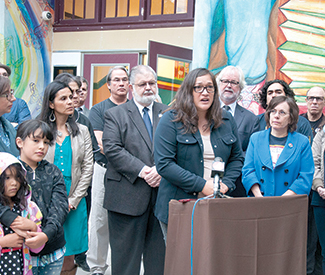
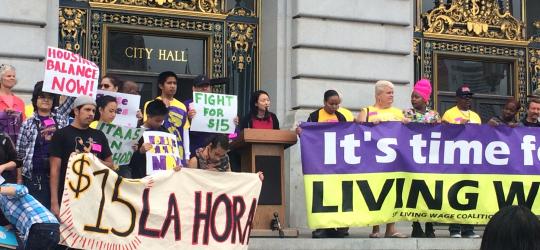
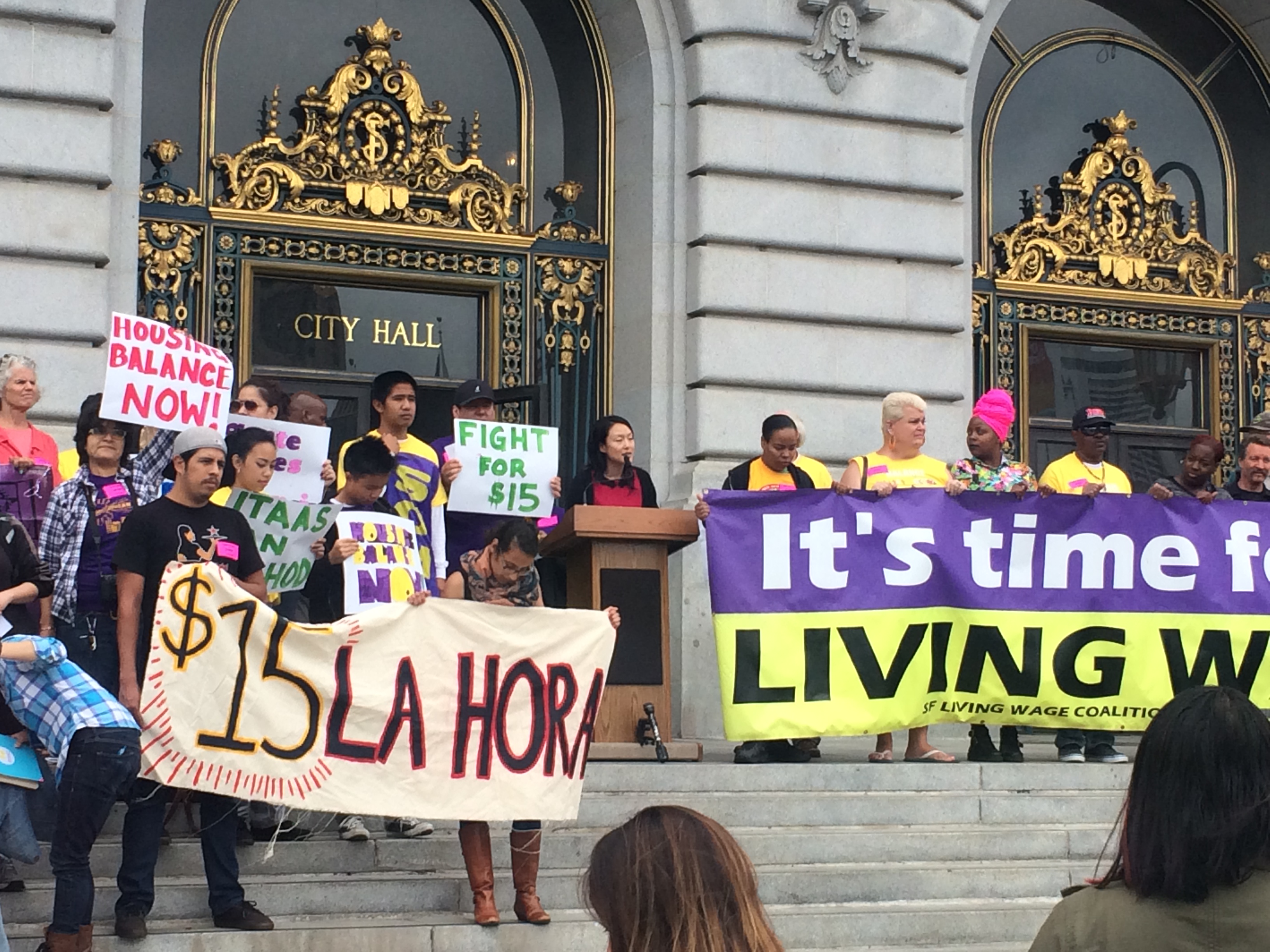
The first day of school was Aug. 18 in the San Francisco Unified School District, but a group of teachers started the day with a press conference announcing the possibility that they could soon go on strike.
The teachers union, United Educators of San Francisco, announced the results of a strike authorization vote held the previous Thursday. The vote, which was the first of two required to authorize a strike, resulted with an overwhelming “yes” with 99.3 percent of teachers saying they would take that step if necessary.
UESF President Dennis Kelly noted that 2,251 teachers had voted, and all but 16 were in favor of authorizing the union to go on strike if contract negotiations with the school district do not result in an acceptable settlement. “It’s pretty unequivocal,” noted UESF spokesperson Matthew Hardy, “and it demonstrates the need for teachers to have a wage that allows them to live in San Francisco.
On Aug. 14, teachers streamed onto the grounds at George Washington High School to cast ballots for the first strike authorization vote. Among them was Kelly Lehman, a first grade teacher at Mira Loma Elementary, who said she’d recently been forced to leave her longtime Mission District residence under threat of eviction.
“I am one of those people who has been ‘Googled’ out of the city,” she said. “I used to be able to afford the city.”
Since she relocated in Marin County, Lehman said her commute has gone from 10 to 40 minutes each way. “It means either less time with my family, or less time with my class,” she noted, adding that she ended up purchasing a car and now drives to work.
Public school teachers’ contract ended June 30, but contract negotiations began months earlier, in February. In June, the negotiations went into impasse, which means the union and district were unable to meet without the presence of a mediator. If mediated negotiations now underway don’t result in a settlement, the process would move to fact finding, where parties on either side of the bargaining table would make presentations to a neutral party, who would in turn prepare a report and make recommendations. If that still doesn’t result in an agreement, the district could impose its last and best contract offer and the union could opt to go on strike, provided it wins approval in a second strike vote.
Hardy said it would likely take weeks before a final outcome is determined, but he stressed that “the goal is to get a settlement.”
While there are several issues of contention, the major point of disagreement comes down to teachers’ salaries. Teachers have demanded a 21 percent pay raise over three years, saying that amount is necessary for educators to be able to provide for themselves in San Francisco. But the district, which has made an offer that would raise pay by 8.5 percent instead, maintained in a statement that it “has not received increases in revenue sufficient to raise salaries enough to keep up with the high cost of living in San Francisco.”
Ken Tray, a UESF organizer and longtime social studies teacher at SFUSD, said he was alarmed by the trend of schoolteachers being forced out of the community. “Today there are many, many teachers facing eviction,” he said. “One of my oldest teacher friends, who was voted best teacher at Galileo High School and then at Lowell High School, is leaving San Francisco because he is losing his apartment. So that is a loss not only to him and his wife, but it’s a loss to his community. What kind of community drives its…best teachers out of town? What about the soul of San Francisco?”
The next mediation session is scheduled for Sept. 2. “We are currently in mediation with UESF and remain hopeful that we can resolve our differences and reach a fair and equitable compensation agreement,” SFUSD Superintendent Richard A. Carranza told the Guardian via email. “We are a public agency and our revenues and expenditures are carefully monitored and audited on a regular basis. Anyone can view our detailed budget and auditors reports online. We are committed to giving our employees much deserved raises but we are also committed to being fiscally responsible which means submitting a balanced three-year budget to the state with a minimum reserve.”
The SFUSD statement indicated that the district expects the total cost of salary and benefits for teachers to increase by at least 18.5 percent over the next three years. But Hardy was skeptical of those figures. “That’s crazy,” he said after reviewing the district statement. “I don’t know how they ran those numbers.”
Claudia Delarios Moran, a former paraprofessional at SFUSD and Restorative Justice coordinator, started her comments at the Aug. 18 press conference by saying she was excited to be taking her kids to their classrooms for the first day of school. “They’re so eager to find out who their teachers are, which of their friends are assigned to their class, and to settle back into the warmth and familiarity of their school site, which is filled with staff who are consistently affectionate toward them and interested in their academic and social development,” she said. “These days, that kind of environment for students and families is more crucial than ever, given what they’re up against. Many of our students and families are living on the margins, due to their immigration status, their language capability, and their limited income. They’re stressed out — due to fear that they’ll be displaced from their homes and never find another place in their neighborhoods that they can afford. … And though the work is hard, educators know that it is a great privilege to serve our children — to help the working families of San Francisco survive here.”
STREET FIGHT San Francisco’s politics of mobility devolved into a cesspit this summer. Beginning with Mayor Ed Lee’s retreat on Sunday parking meters, purportedly to garner support for his transportation bond and vehicle license fee proposals, Lee’s bait and switch ultimately backfired.
Rather than nudge the city’s transit finance debate in a sensible, progressive direction, confusion and duplicity by the mayor and some supervisors over parking policy has instead empowered a Tea Party-like faction that’s placed a backwards initiative on the November ballot.
This Restore Transportation Balance Initiative (Proposition L) is a wolf in sheep’s clothing. It’s got nothing to do with balance, but would instead seek to substitute a “cars-first” policy for the city’s longstanding “transit-first” paradigm. Although only an advisory measure, its main effect would be to provide the mayor and supervisors more cover to do nothing except shrug and kick the can of sustainable transportation policy down the road.
This is exactly what the car-firsters want, just as Republicans in Congress have thwarted President Obama’s agenda for mitigating climate change. These local drivers hope to stall efforts to make San Francisco more pedestrian-friendly, block Muni improvements, and make sure bicycles don’t slow them down or get in the way of unfettered, gluttonous free parking for private cars on public streets.
In that vein, the Restore Balance crowd has lifted a script from the infamous Koch brothers, securing finances from a Facebook billionaire (Sean Parker funded the measure’s signature-gathering effort) and speaking about transportation policy in a manner reminiscent of climate change deniers. Any bike lane, parking management effort, or Muni improvement is, in their eyes, out of balance with a city that should be betrothed solely to cars.
Meanwhile, as Muni fares went up this summer without any objection from mayor “nickel-and-dime,” a ballot measure put forth by Sup. Scott Wiener joins the crowded field as Proposition B. His proposal would devote more General Fund monies to Muni operations, but it’s unclear what impact this might have on other important city programs like housing or social services.
It’s a good thing City Hall went on summer recess, because we’ll all need some time to sift through all this muck.
TOWARDS CAR-FREE VACATIONS
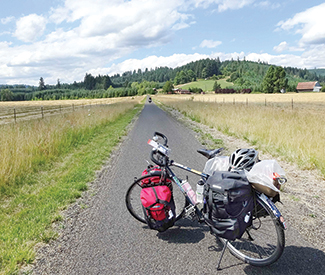
Speaking of vacations, let’s talk about the good, bad, and ugly of car-free vacationing using Amtrak and a bicycle. I recently took Amtrak’s Coast Starlight north from Oakland to Portland, with my touring bicycle in tow. In Portland, I surveyed some of the bicycle and transit infrastructure before a 950-mile bike tour back to San Francisco along the Oregon and California coasts.
The Coast Starlight is a relaxing way to travel up to Portland. It has comfortable and roomy seating with outlets for plugging in phones or other devices, and the views of Mt. Hood and Oregon’s verdant forests and valleys are breathtaking. Most importantly, taking the train from Oakland to Portland produces far fewer carbon emissions than flying or driving the same distance.
A flight to Portland produces 14 times the carbon emissions compared to the train. Driving up I-5 in a new car with decent fuel economy produces 26 times the emissions of the train. This is an incredible difference that must be factored into national transportation policies, and it does not include the full life cycle assessment of each mode, such as petroleum extraction, manufacturing vehicles, waste disposal, infrastructure (concrete is a huge CO2 emitter), and so on. While carpooling might reduce per capita driving emissions, traveling with friends or family on Amtrak reduces them even further.
But Amtrak has some bad aspects. The coffee needs immediate mitigation! It’s an easy problem to solve, and I’ve had delicious coffee on German and Swiss trains, even in ceramic mugs.
Getting a bicycle on many Amtrak trains is annoying. Unlike the Capitol Corridor or San Joaquin trains, on which you can simply roll the bicycle on board, Amtrak’s long-distance trains require boxing the bicycle as checked baggage. This means additional charges, and you must arrive and disembark at a station that handles baggage, so many stops are not bicycle-accessible. And the cardboard bike box is not reused by Amtrak but put in recycling, which is rather silly and wasteful.
Fortunately, Amtrak is starting to get it, and soon will be introducing bicycle roll-on service on many trains on the East Coast. Let’s hope Amtrak does the same for the Coast Starlight. There’s plenty of room on the multilevel rail cars to squeeze in a few bikes, and that would probably attract more people to use the system while making it more flexible.
Now for the ugly. The trip to Portland takes more than 17 hours on a good day. I’m not necessarily arguing for high-speed rail, but this length of time is a big problem for Amtrak. It’s not a technology problem — it’s politics.
Amtrak is caged by the timetable of freight railways that own the tracks. This often results in delays since the freight railroads have eliminated double tracks and rationalized their routes to maximize profit while having little concern about passenger rail.
Over 100 years ago, Edward Harriman, who merged Southern Pacific with Union Pacific into a continent-wide system, had it right on running a railroad. Instead of focusing on shareholder wealth, Harriman argued that profits from railroads should be shoveled back into reducing grades, strengthening bridges, improving curves, double-tracking trunk routes, and building new bridges, cutoffs, sidings, tunnels, stations, yards, cars, and terminals. Harriman even proposed a rail tunnel under San Francisco Bay, which as I’ve written about before and which should be a priority in the region today.
Rail is critical infrastructure and key to our national energy and climate policy. It should not be left to the whims of freight haulers and private profit. It’s time for the political will to coordinate the right-of-way to improve travel times as well as increase frequency of passenger trains.
Six years ago, improving Amtrak was a signature platform of the Obama Administration. But Republicans — many filled with racist vitriol — have fought anything he stands for. And they hate Amtrak almost as much as they hate Obama.
During the 2012 presidential campaign, Republicans vowed to gut Amtrak and mocked Obama’s pro-Amtrak policies. In Florida, Ohio, and Wisconsin, the hate ran so deep that funding for rail was simply sent back to Washington, even as cities in all of those states pined for rail as an economic development strategy. This kind of zombie-like Republican hate towards Obama and Amtrak is remarkably similar to the posturing of the anti-transit, car-firsters pushing Prop L.
THE PORTLAND COMPARISON
But I’m on vacation, and problems of Amtrak’s ugly politics aside, once in Portland it all got beautiful. Cycling around Portland is fantastic. With excellent, well-connected bicycle facilities coupled with attentive and polite drivers, bicycle-oriented innovation and businesses flourish in Portland. I’ve never seen so many cargo bikes and families with children out shopping, cycling to school, and making other utilitarian trips by bicycle.
Sure, it’s flatter, but more important is the traffic density and allocation of street space. Compared to San Francisco, Portland has lower residential density, a low density of automobiles, and more capacity to reallocate road space for bicycling.
To get to Portland-style cycling, we need to recognize that San Francisco’s 9,000-plus cars per square mile is extreme and out of control, and San Francisco politicians need to embrace much tighter parking management and street management policies.
I should also add that Portland does have its own ugly right-wing backlash against bikes and transit. For example, in suburban Clackamas County, dubbed “Clakistan” by some, Tea Party-types voted to stall light rail expansion. But in the city, the bicycle and rail transit are embraced with enthusiasm.
Oregon is also refreshingly welcoming to bicycle tourists. For those leaving Portland by bicycle, state and local transportation departments have produced wonderful maps with route suggestions, and the official state highway map includes a bicycle map showing highway shoulder widths and identifies state parks with bike-friendly camping, hot showers, and other services. One state park bike campground even had a solar-powered charging station so cyclists can check their phones.
Unlike California parks, which also have affordable and accessible bicycle camping sections, Oregon places sites away from the noisy RV and automobile campsites, providing peace and tranquility and level ground for tents.
Since cycle tourists don’t always know their timing or exact route, Oregon and California do not require reservations, which enables flexibility for bike touring. And the sites are cheaper — usually $5 in both states, but some California campgrounds charge $7 — because bicyclists have a much lighter impact on parks compared to cars and RVs.
SHARE THE ROAD
All of this made bicycle touring from Portland to San Francisco inspiring, energizing, invigorating, revitalizing, and really just a whole lot of fun. Waking up early to pedal through the Cape Lookout area of Oregon or the Avenue of the Giants in California was truly amazing.
But the big downside was high-speed traffic whizzing by at certain points along the coast (but not all). So the same methods used to make city streets safe for cycling could apply everywhere, including for bicycle touring. Rural traffic is faster than city traffic, so we really need to separate cyclists from speeding traffic if substantial numbers of people (including families) are to take on bike touring.
Rail trails and fully separated cycle ways in parts of Oregon (Banks Vernonia) and California (near Arcata and also Samuel P. Taylor Park) should be expanded and made part of a coastal bikeway using the rights-of-way along Highway 101 and 1.
Where full separation is not possible, wider shoulders cleared of the nasty detritus of car glass or metal should be provided. Shoulders should be regularly cleaned and crumbling edges patched. At tight spots, such as on Highway 1 between Fort Ross and Jenner, narrow portions of roadway could be made into signal-controlled one-way segments such as what is done in construction zones.
Reducing the speed limits and using traffic calming should also be promoted on the coast highways. This is a tourist route, not Interstate 5, so even the Subaru-driving weekend warriors and RVs can slow it down. Rural areas in California and Oregon can benefit greatly with more bicycle tourism (as well as auto tourists slowing down).
We cyclists don’t drag a ton of Costco provisions up to the campgrounds. We shop and eat locally, at each increment, and spend hard cash in small towns. Slowing the cars and RVs down would draw them into the local stores and restaurants as well. And every few days, we cycle tourists get a motel or bed-and-breakfast room.
I saw and spoke with several families with children touring the Oregon coast, with no motorized vehicle support. In Oregon and parts of California, buses also accommodate bicycles, so getting to the coast is easier than you’d think, even if greater frequency would be helpful.
As I pedaled the Avenue of the Giants, I saw an old Northwestern Pacific railway bridge over the Eel River. It would be so civilized if the Sonoma-Marin (SMART) rail line were extended north to Eureka and Arcata, with a spur to Fort Bragg, enabling one to access (and bicycle tour) the Redwoods and California coast from the Bay Area without a car.
Pedaling through Marin and towards the Golden Gate Bridge last Sunday was also truly inspiring. There were hundreds of cyclists out on the regular Marin circuit, many with friendly waves and greetings. The Golden Gate Bridge was packed with smiling cyclists out for a rigorous Mt. Tam ride or rental bikes heading to Sausalito.
If you share in the dream of car-free vacations and bicycle touring, I urge you look at the California Bicycle Coalition’s upcoming organized bike tour from Santa Barbara to San Diego. This could be your launching point for rethinking how we vacation in America.
Street Fight is a monthly column by Jason Henderson, a geography professor at San Francisco State University and the author of Street Fight: The Politics of Mobility in San Francisco.
Editor’s Note: Aug. 19 marks the Bay Area Global Health Film Festival, hosted by the Institute for Global Orthopaedics and Traumatology. The theme of this year’s festival is “Road Traffic Safety Locally … and Globally,” and is geared toward raising awareness about the need for road traffic safety improvements. In this opinion piece, representatives from the University of California at San Francisco Orthopaedic Trauma Institute, at San Francisco General Hospital, describe how all-too-common accidents can permanently injure pedestrians and bicyclists. And they voice support for Proposition A, the San Francisco Transportation and Road Improvement Bond.
By Amber Caldwell and Nick Arlas
San Francisco is a transit-first city. Everyone shares the need to get safely from point A to point B, preferably quickly. And the various options for doing so span the full spectrum from driving, biking, and walking, to public transit like MUNI and Bart, rideshare programs, taxis, and companies like Uber and Lyft.
As we go about our daily lives, transportation is one of the most important public infrastructure systems that San Francisco relies upon. It encompasses many controversial issues and is linked to other social equity campaigns including housing advocacy and urban gentrification.
Yet the issue of pedestrian and bike safety in San Francisco has made disheartening headlines as of late. 2013 was an especially deadly year, with 21 pedestrian and four bicyclist fatalities. San Francisco General Hospital alone cared for over 1,000 road traffic injuries, with an estimated $60 million annual cost. Organizations like the SF Bicycle Coalition and WalkSF have made biking and walking leading issues in debates over transportation policy and traffic safety. Mayor Ed Lee and our city government have responded by introducing a $500 million transportation bond measure for the Nov. 4th ballot. If it passes, a portion of the funding will be allocated for improving pedestrian and cyclist safety.
Less often discussed, however, is what happens to the pedestrians and bicyclists who are hit while going about their daily routines and permanently affected by all-too-common accidents. At the UCSF SFGH Orthopaedic Trauma Institute (OTI), these patients fill our wards, the operating room schedule and our hearts as we help to heal them from these injuries. We struggle with the balance between doing what we can and what should be done to curb the growing volume of patients we see annually due to preventable accidents.
What is alarming is the socio-economic impact these accidents have, not only on the person affected, but on the hospital and our city as a whole. Even in cases where the driver is at fault, it is rare for them to even be cited for a traffic violation in most cases. More importantly, personal injury insurance and health coverage barely cover the emergency services needed for these accidents, and most services offered at the hospital are subsidized by taxpayer dollars, which means we are paying for this on all sides. This is unacceptable.
There is currently a wave of momentum to address these complex issues and attempt to tease through how we as a city can rebuild, redefine and reinforce the safety in our city. This movement is supported by a global platform addressing road traffic safety as a public health campaign, through the World Health Organization’s Decade of Road Traffic Safety. This campaign tackles the myriad polices and resource investments needed to address the enormous impact road traffic accidents have on the world.
Injuries, mainly those resulting from road traffic accidents, account for greater disability and death than HIV, TB and Malaria combined. An average 5.8 million die annually, and for every death caused by these accidents, eight to 10 more are permanently injured.
To bring collective awareness around this issue and to change the landscape, the community needs to stand together not only in San Francisco but also around the world, to demand safer streets. The city is doing its part to outline a roadmap to curbing these alarming statistics, and a greater global campaign is underway to promote awareness and inspire activism.
We must stand up for the injured and for ourselves as local citizens to demand safer streets and protection from when accidents occur. We may not be able to prevent every accident, but we can improve the choreography of their outcome if we work together.
Amber Caldwell and Nick Arlas are Director of Development and Community Outreach Coordiator, respectively, at the Institute for Global Orthopaedics and Traumatology, UCSF Orthopaedic Trauma Institute, San Francisco General Hospital.
The Bay Area Global Health Film Festival begins Tue/19 at 6 p.m. at Public Works, 161 Erie, in San Francisco.
Native San Franciscan Benito Santiago, 64, joined a protest Aug. 12 in an attempt to remind his evictors that he’s a human being – not a roadblock to profit.
Santiago is facing an Ellis Act eviction from his 47-year Duboce Triangle home, where his monthly rent is just below $600.
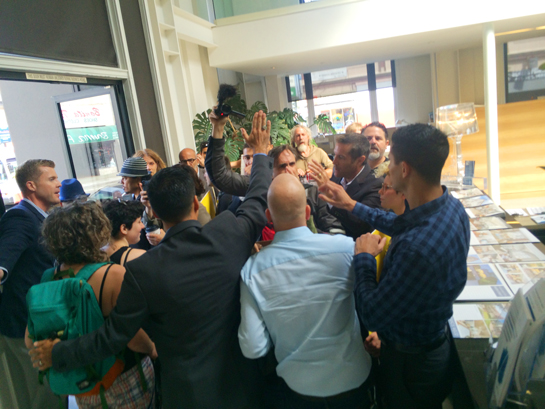
Clad in a stylish blue fedora, Santiago and a dozen or so protesters filed into Vanguard Properties to deliver a letter asking Vanguard co-founder Michael Harrison to rescind his eviction. Harrison initiated an eviction proceeding against Santiago last December through his corporation, Pineapple Boy LLC. But by the end of the protest, Santiago and other tenant activists were physically pushed out of the building by Vanguard representatives in a show of aggression.
Before it got to that point, protesters called out Harrison for exploiting the Ellis Act for profit.
From the letter:
“We do not believe that you, Michael Harrison, are ‘going out of business’ which is the purpose of using the Ellis Act. We know that instead you are exploiting a loophole in state law for your greed.”
Suffice to say, Vanguard representatives didn’t accept the letter. But the message still got across: The protesters brought a bullhorn.
“My name is Benito Santiago,” Santiago blared, standing at the front desk, but was soon interrupted. A young-looking man in a grey suit approached protesters and asked them to leave.
“I’m calling the San Francisco police,” he said. Santiago may have approached the business with a bullhorn, but he has much to lose.
While Vanguard may perceive Santiago merely as someone who doesn’t offer monetary value, he’s of much value to the developmentally disabled children he teaches at San Francisco Unified School District.
The protesters intended to make these points to the folks at Vanguard. But before words could be exchanged, a crowd of Vanguard workers (real estate agents or employees, perhaps?) swooped in and physically carried out the protesters.
Fred Sherbun-Zimmer held her protest sign and chanted as one Vanguard agent placed hands on her back and swiftly pushed her out. Peter Menchini, a videographer, held his camera high and away from the snatching hands of real-estate experts turned vigilantes. Poet and activist Tony Robles had a paper slapped out of his hand by a Vanguard employee, before protesters were pushed out in a wave behind him.
As you can see from the video, things turned downright nasty as the real-estate representatives shoved and pushed the anti-eviction protesters as well as journalists there to document the event. (They even tried to yank my phone out of my hand.)
By the time the SFPD arrived, things had settled down. No arrests were made, and after a few sidewalk declarations by bullhorn, the protesters cleared the scene.
Afterwards, Santiago told us his housing prospects aren’t looking good. The Bill Sorro Housing Program helped him file many affordable housing applications, but he hasn’t gotten any word back yet. The rent he pays now eats up a hefty chunk of his paycheck, leaving little for basic expenses by the end of the month.
“I’m getting lots of positivity from family,” he said. And he does have an extension, until December, to find a new apartment. But, he noted, with median rents almost reaching $4,000 in San Francisco (they’re actually at $3,200, but that’s still bad), his chances of staying in the city are slim.
“I might be bad at math,” he told us, “but that seems like shooting for the moon.”
Michael Harrison is the co-founder of Vanguard Properties, where he specializes in “residential investment properties.” He is a property flipper: his shell company Pineapple Boy LLC bought the building in November 2013 and tried to evict Benito and the two other tenants immediately. Vanguard Properties is currently involved in a number of luxury property developments in the Mission District and Duboce Triangle area including the development at 19th and Valencia that in February 2014 set record sale prices for the neighborhood.
Santiago did have some flickering hope when an in-law unit behind a garage next door went on the market for rent. His hope was deflated, though, when his friend told him the rent for the single room.
“Eduardo said, ‘guess how much it is?'” Santiago told us. “It’s going for $4,000 a month.”
THEATER Sarah Cameron Sunde will be standing in the water at Aquatic Park this Friday. She’ll stand from low tide, at 9:26 that morning, through high tide at 4:09 in the afternoon, and back to low tide again at 10:31 that night. Thirteen hours and five minutes of being still, while everything around her changes.
When it comes to the near and distant impacts in store from sea level rise brought on by the planet’s changing climate, Bay Area residents might be expected to know more than most. The bay’s distinctive shape is already being modified by creeping water levels. New efforts at shoreline protection are underway, but with an expected rise of six feet by the end of the century, the bay and San Francisco are destined to be different places no matter what.
How conscious we are of that fact remains a question. It’s one thing to know the figures and another to “feel the rise,” as Sunde puts it in her invitation to locals. For the New York–based theater director and interdisciplinary artist, the awesome movement of the daily tide shift acts as a visceral metaphor for larger cycles, and momentous changes afoot. Even those who choose to watch from the shore might grasp something of this larger theme, tucked into an ephemeral moment, merely by registering the bay’s embrace of a human tidal gauge.
That, anyway, is Sunde’s hope as she embarks on the third iteration of her 36.5 Water Project. The venture began last August in Maine, while Sunde was at an artist residency near Bass Harbor. But its roots go back a little further, to 2012 and Hurricane Sandy.
“When Hurricane Sandy hit New York,” she says, “it was the first time I truly, deeply understood that everything is temporary.” This despite being married to a water engineer from the Netherlands, whose first impression of New York City was tantamount to a liver specialist encountering Dean Martin. “And I didn’t believe him,” she admits. “Then [the hurricane] hit, and I understood. It changed the way I think about these things.” Sunde realized there was a real and dangerous deficit in long-term vision. “We know how to rally after a disaster but there’s no forward, future thinking.”
Sunde — whose theatrical work has largely revolved around her position as deputy artistic director of New York’s New Georges theater company, as well as her role as the foremost American translator and director of the famed contemporary Norwegian playwright Jon Fosse — was at that time also moving away from new play development toward her roots in more experimental, devised performance-making with a group of interdisciplinary collaborators collectively known as Lydian Junction. Its experiments, informed in part by the writing of Norwegian writer Knut Hamsun and by issues of sustainability in the arts, explore art’s relation to suffering and sacrifice.
“In Maine, I was thinking about all these things. I was thinking about New York sinking. I was thinking about art and sacrifice and suffering, sustainability. And I was on this bay, this tidal bay, where there is a ten-and-a-half foot tidal shift. That meant that it was a mudflat during low tide, and then during high tide it was a bay, a full-on bay of water. I had never seen the environment change so drastically with the tide before. I was watching this huge rock out in the bay get swallowed. There was something really beautiful about this.”
Suddenly, an image came to her director’s eye.
“I thought, I see a human being standing there up to the neck, and then the water going back down again. I thought, I have to do this. How can I create this spectacle? I thought about my collaborators and I thought, shit, they’re not going to do it; I guess I’m going to have to do it myself. I decided to do it three days later because it was my half birthday — I always try to do something that is related to my own tracking of time. I’m a little obsessed with time, the expansion, the contraction of it, the perception, all of it, the routine, the anti-routine. That’s why it’s called 36.5, because I turned 36 and a half that day.”
Since then, Sunde has developed some more thinking around the shape of her piece and its intentionally simple design. She plans to travel to six continents, drawn to places with some personal connection. (Having grown up in Palo Alto, Sunde has roots in the Bay Area that run especially deep.) Each iteration will involve specific local partnerships. Aptly enough, the after party for Friday’s performance takes place at the Long Now Foundation at nearby Fort Mason. And the number in the title ends up being significant in several ways: The average person needs 36.5 cubic meters of water a year; at the current rate of climate change, oceans could rise 36.5 inches by the century’s end; and ditching the decimal point leaves the number of days in a year. The connotations underscore the way the personal and universal remain deeply entwined here.
The invitation to the public to test the waters with her, meanwhile, adds a new wrinkle in this globetrotting project, granting space for direct participation in the experience. At the same time, it means the performance becomes a collective action, however peripheral or absurd it may appear on the surface. Small steps just might sound greater depths. *
Stage listings are compiled by Guardian staff. Performance times may change; call venues to confirm. Reviewers are Robert Avila, Rita Felciano, and Nicole Gluckstern. Submit items for the listings at listings@sfbg.com.
THEATER
OPENING
Killing My Lobster Goes Radio Active Z Below, 470 Florida, SF; www.killingmylobster.com. $10-20. Opens Wed/13, 8pm. Runs Wed-Sat, 8pm. Through Aug 23. Killing My Lobster performs a live radio comedy.
Motown the Musical Orpheum Theatre, 1192 Market, SF; www.shnsf.com. $45-210. Opens Fri/15, 8pm. Runs Tue-Sat, 8pm (also Wed and Sat, 2pm); Sun, 2pm (also Sun/17, 7:30pm). Through Sept 28. Over 40 hits (“My Girl,” “Ain’t No Mountain High Enough”) pack this tale of Motown founder Barry Gordy’s career in the music biz.
BAY AREA
Fetch Clay, Make Man Marin Theatre Company, 397 Miller, Mill Valley; www.marintheatre.org. $35-58. Previews Thu/14-Sat/16, 8pm; Sun/17, 7pm. Opens Tue/19, 8pm. Runs Tue-Sat, 8pm; Wed, 7:30pm; Sun, 2 and 7pm. Through Sept 7. Marin Theatre Company performs the West Coast premiere of Will Power’s historical drama.
An Ideal Husband Forest Meadows Amphitheater, 890 Belle, Dominican University of California, San Rafael; www.marinshakespeare.org. $12-35. Previews Fri/15 and Sun/17, 8pm. Runs in repertory Fri-Sun through Sept 27; visit website for specific performance dates and times. Marin Shakespeare Company performs Oscar Wilde’s witty tale.
Moonlight and Magnolias Dragon Theatre, 2120 Broadway, Redwood City; www.dragonproductions.net. $10-30. Previews Thu/14, 8pm. Opens Fri/15, 8pm. Runs Thu-Sat, 8pm; Sun, 2pm. Through Sept 7. Dragon Productions presents Ron Hutchinson’s behind-the-scenes drama about the filming of Gone With the Wind.
ONGOING
Each and Every Thing Marsh San Francisco Main Stage, 1062 Valencia, SF; www.themarsh.org. $20-50. Thu-Fri, 8pm; Sat, 8:30pm (starting Sept 6, Sat shows at 5); Sun, 2pm. Extended through Oct 4. The latest solo show from celebrated writer-performer Dan Hoyle (Tings Dey Happen, The Real Americans) winds a more random course than usual across the country and abroad but then that’s the idea — or at least Hoyle warns us, right after an opening encounter with a touchy young white supremacist, that the trip he’s taking us on is a subtle one. Displaying again his exceptional gifts as a writer and protean performer, Hoyle deftly embodies a set of real-life encounters as a means of exploring the primacy and predicament of face-to-face communication in the age of Facebook. With the help of director Charlie Varon (who co-developed the piece with Hoyle and Maureen Towey), this comes across in an entertaining and swift-flowing 75-minute act that includes a witty rap about “phone zombies” and a Dylan-esque screed at a digital detox center. But the purported subject of connection, or lack there of, in our gadget-bound and atomized society is neither very original nor very deeply explored — nor is it necessarily very provocative in a theater, before an audience already primed for the live encounter. Far more interesting and central here is Hoyle’s relationship with his old college buddy Pratim, an Indian American in post-9/11 America whose words are filled with laid-back wisdom and wry humor. Also intriguing is the passing glimpse of early family life in the Hoyle household with Dan’s celebrated artist father, and working-class socialist, Geoff Hoyle. These relationships, rather than the sketches of strangers (albeit very graceful ones), seem the worthier subjects to mine for truth and meaning. Indeed, there’s a line spoken by Pratim that could sum up the essence of Hoyle’s particular art: “It’s so much better,” he says, “when you find yourself in other people than when you just find yourself.” Hoyle’s real frontier could end up being much more personal terrain, much closer to home. (Avila)
Foodies! The Musical Shelton Theater, 533 Sutter, SF; www.foodiesthemusical.com. $32-34. Fri-Sat, 8pm. Open-ended. AWAT Productions presents Morris Bobrow’s musical comedy revue all about food.
From Red to Black ACT Costume Shop, 1119 Market, SF; www.sfplayhouse.org. $7.50-20. Wed-Thu, 7pm; Fri-Sat, 8pm. Through Aug 30. San Francisco Playhouse performs Rhett Rossi’s detective drama as part of its Sandbox Series.
The Habit of Art Eureka Theatre, 215 Jackson, SF; www.therhino.org. $15-25. Wed-Sat, 8pm (also Sat, 3pm). Through Aug 23. Theatre Rhinoceros presents the return engagement of Alan Bennett’s “very British comedy” about a meeting between Benjamin Britten, W.H. Auden, and other figures from throughout time, including their future biographer.
Into the Woods San Francisco Playhouse, 450 Post, SF; www.sfplayhouse.org. $20-120. Tue-Thu, 7pm; Fri-Sat, 8pm (also Sat, 3pm); Sun, 2pm. Through Sept 6. SF Playhouse performs Stephen Sondheim’s fractured fairy-tale musical.
Millicent Scowlworthy Thick House Theatre, 1695 18th St, SF; www.99stockproductions.org. $20. Thu-Sat, 8pm. Through Aug 30. 99 Stock Productions presents Rob Handel’s spooky tale that cautions against burying tragic events in the past.
Noises Off! Shelton Theater, 533 Sutter, SF; www.sheltontheater.org. $38. Thu-Sat, 8pm. Through Oct 25. Shelton Theater performs Michael Frayn’s outrageous backstage comedy.
O Best Beloved This week: Precita Park, 3200 Folsom, SF; www.obestbeloved.org. Sat/16, 2pm. Free (donations accepted). Also Sun/17, 5pm, Centennial Park, 5353 Sunol, Pleasanton. Through Sept 13 at various NorCal venues. Idiot String’s Joan Howard and Rebecca Longworth bring their SF Fringe Festival hit, an adaptation of Rudyard Kipling’s Just-So Stories, to local public spaces aboard a mobile stage.
Patterns Dennis Gallagher Arts Pavilion (in the French American International High School), 66 Page, SF; www.thenewstage.com. $30. Wed/13-Sat/16, 8pm. The New Stage’s premiere of company founder Amy Munz’s solo work is one of the more intelligent and sophisticated debuts (by both a new company and a young artist) in recent memory. It’s an ambitious and notably subtle, serious, unsentimental exploration of love, in which a dynamic Munz — on a wide bare stage bounded on three sides by her own wonderfully evocative three-channel video-scape — plays several characters, and three in particular: Amot, Abigail, and Ava, whose stories are slyly interwoven. Amot, the principal focus across two discrete acts, is a young woman raised by her widowed father in his butcher shop, who later falls in love with a young man. But her story, like that of the other young women, comes to us in a form more like the stream of consciousness, fractured and expansive in the disjuncture and interplay between Munz’s ardently committed performance and the shrewd audio and visual environment surrounding the audience — a manufactured landscape of memory, desire, and role-playing in which to some extent the audience is free to find its own way and discover its own truths. Part two further integrates the voices of the other young women, Abigail and Ava, forming a mesh of narratives and associations stimulating in their intellectual, visual, and aural juxtapositions. This is a work that demands a kind of letting go, but also invites full participation of the viewer’s imagination, as the rich mise-en-scène and Munz’s intense, unflinching performance unfold with unexpected abundance. (Avila)
Pleiades Phoenix Theatre, 414 Mason, Sixth Flr, SF; http://pleiadessf.wordpress.com. $20-25. Thu-Sat, 8pm. Through Aug 30. Marissa Skudlarek’s world premiere reimagines the Greek myth of the seven Pleiades sisters as a story about Baby Boomers in their youth.
The Ripple Effect This week: Glen Park, Bosworth and O’Shaughnessy, SF; www.sfmt.org. Free (donations accepted). Sat/16, 2pm. Also Sun/17, 2pm, Washington Square Park, Columbus at Union, SF. Through Sept 1 at various NorCal venues. The veteran San Francisco Mime Troupe stays current by skewering San Francisco’s ever-dividing economy; think rising rents, tech-bus protests, and (natch) Glassholes.
The Scion Marsh San Francisco, 1062 Valencia, SF; www.themarsh.org.$30-100. Sat, 5pm. Through Aug 23. Brian Copeland’s hit solo show, “a tale of privilege, murder, and sausage,” returns to the Marsh.
Shit & Champagne Rebel, 1772 Market, SF; shitandchampagne.eventbrite.com. $25. Fri-Sat, 8pm. Open-ended. D’Arcy Drollinger is Champagne White, bodacious blond innocent with a wicked left hook in this cross-dressing ’70s-style white-sploitation flick, played out live on Rebel’s intimate but action-packed barroom stage. Written by Drollinger and co-directed with Laurie Bushman (with high-flying choreography by John Paolillo, Drollinger, and Matthew Martin), this high-octane camp send-up of a favored formula comes dependably stocked with stock characters and delightfully protracted by a convoluted plot (involving, among other things, a certain street drug that’s triggered an epidemic of poopy pants) — all of it played to the hilt by an excellent cast that includes Martin as Dixie Stampede, an evil corporate dominatrix at the head of some sinister front for world domination called Mal*Wart; Alex Brown as Detective Jack Hammer, rough-hewn cop on the case and ambivalent love interest; Rotimi Agbabiaka as Sergio, gay Puerto Rican impresario and confidante; Steven Lemay as Brandy, high-end calf model and Champagne’s (much) beloved roommate; and Nancy French as Rod, Champagne’s doomed fiancé. Sprawling often literally across two buxom acts, the show maintains admirable consistency: The energy never flags and the brow stays decidedly low. (Avila)
Show Down! Exit Theatre, 156 Eddy, SF; www.thunderbirdtheatre.com. $15-25. Thu/14-Sat/16, 8pm. Thunderbird Theatre performs an original comedy, set amid a war against technology at the last all-live TV station left in the United States.
Too Much Light Makes the Baby Go Blind Boxcar Theatre, 505 Natoma, SF; www.sfneofuturists.com. $11-16. Fri-Sat, 9pm. Ongoing. The Neo-Futurists perform Greg Allen’s spontaneous, ever-changing show that crams 30 plays into 60 minutes.
BAY AREA
Catch Me If You Can Woodminster Amphitheater, Joaquin Miller Park, 3300 Joaquin Miller, Oakl; www.woodminster.com. $18-59. Thu/14-Sun/17, 8pm. Woodminster Summer Musicals presents the musical based on the film about notorious con artist Frank Abagnale, Jr.
Cops and Robbers Marsh Berkeley, 2120 Allison, Berk; www.themarsh.org. $20-100. Previews Fri/15, 8pm. Opens Sat/16, 8pm. Runs Fri, 8pm; Sat, 8:30pm. Through Sept 13. Hip-hop artist and law enforcement officer Jinho “The Piper” Ferreira performs his 17-character solo show.
Dracula Inquest Berkeley City Club, 2315 Durant, Berk; www.centralworks.org. $15-28. Thu/14-Sat/16, 8pm; Sun/17, 5pm. Central Works performs Gary Graves’ mystery inspired by the Bram Stoker vampire classic.
Old Money Barn Theatre, 30 Sir Francis Drake, Ross; www.rossvalleyplayers.com. $10-26. Thu/14, 7:30pm; Fri/15-Sat/16, 8pm; Sun/17, 2pm. Ross Valley Players performs Wendy Wasserstein’s New York City-set comedy.
Romeo and Juliet Forest Meadows Amphitheater, 890 Belle, Dominican University of California, San Rafael; www.marinshakespeare.org. $12-35. Runs in repertory Fri-Sun through Sept 28; visit website for specific performance dates and times. Marin Shakespeare continues its 25th season with the Bard’s timeless tragedy.
Semi-Famous: Hollywood Hell Tales from the Middle Marsh Berkeley Main Stage, 2120 Allison, Berk; www.themarsh.org. $20-100. Sat, 5pm; Sun, 7pm. Through Sept 7. Don Reed’s new solo show shares tales from his career in entertainment.
The Taming of the Shrew Sequoia High School grounds, 1201 Brewster, Redwood City; www.sfshakes.org. Free. Sat, 7:30pm; Sun, 4pm. This location and schedule through Aug 24. Continues through Sept 21 at various Bay Area venues. Free Shakespeare in the Park presents this take on the Bard’s barb-filled romance.
“TheatreWorks New Works Festival” Lucie Stern Theatre, 1305 Middlefield, Palo Alto; www.theatreworks.org. $19. Wed/13-Sun/17, 8pm (also Sat/16-Sun/17, noon and 4pm) . TheatreWorks presents this festival of staged readings of in-development plays and musicals.
12th Night Ashby Stage, 1901 Ashby, Berk; www.shotgunplayers.org. $20-35. Wed/13-Thu/14, 7pm; Fri/15-Sat/16, 8pm; Sun/17, 5pm. Shotgun Players take a fresh approach to the Shakespeare classic, using folk music and other twists.
PERFORMANCE/DANCE
Yayne Abeba Punch Line Comedy Club, 444 Battery, SF; www.punchlinecomedyclub.com. Tue/19, 8pm. $15. The comedian performs with guests Ronn Vigh, Kaseem Bentley, and Yuri Kagan.
“BATS Summer Improv Festival” Bayfront Theater, B350 Fort Mason, SF; www.improv.org. Through Sept 20. $20. This week: “Spontaneous Broadway,” Fri/15, 8pm; “SF vs LA Theatresports,” Sat/16, 8pm.
Caroline Lugo and Carolé Acuña’s Ballet Flamenco Peña Pachamama, 1630 Powell, SF; www.carolinalugo.com. Aug 24, 30, Sept 6, 13, 21, 28, Oct 4, 11, 18, 26, 6:30pm. $15-19. Flamenco performance by the mother-daughter dance company, featuring live musicians.
“Dash: Improv in a Flash” Un-Scripted Theater Company, 533 Sutter, Second Flr, SF; www.un-scripted.com. Sat, 10pm. Through Aug 30. $15. A late-night, free-form improv show with Un-Scripted Theater Company.
“Decades Apart: Reflections of Three Gay Men” Exit Theatre, 156 Eddy, SF; www.theexit.org. Thu/14-Sat/16, 8pm. $25. Gay men living in 1970s SF, 1980s NYC, and 1990s LA are the characters in Rick Pulos’ multimedia solo performance piece.
“Desi Comedy Fest” Cobb’s Comedy Club, 915 Columbus, SF; www.desicomedyfest.com. Wed/13, 8pm. $15. Also Thu/14, 8pm, Washington Inn, 495 10th St, Oakl; Fri/15, 8pm, Sunnyvale Community Center Theater, 550 E. Remington, Sunnyvale; and Sat/16, 8pm, Vito’s Express, 4060 Grafton, Dublin. Showcase of South Asian comedians, including Abhay Nadkarni, Samson Koletkar, Dhaya Lakshminarayanan, Imran G, and more.
“Dream Queens Revue” Aunt Charlie’s Lounge, 133 Turk, SF; www.dreamqueensrevue.com. Wed/13, 9:30pm. Free. Drag with Collette LeGrande, Ruby Slippers, Sophilya Leggz, Bobby Ashton, and more.
Feinstein’s at the Nikko 222 Mason, SF; www.feinsteinssf.com. This week: “Broadway Bingo,” Wed/13, 7pm. “I Heart the ’80s,” nostalgic tunes from Michael Jackson, Cyndi Lauper, and others, starring Tony Vincent and Jessica Phillips, Thu/14-Fri/15, 8pm; Sat/16-Sun/17, 7pm, $35-50.
“Love and Laughter” Society Cabaret, Hotel Rex, 562 Sutter, SF; http://darlenepopovic.com. Fri/15-Sat/16, 8pm. $25-45. Cabaret chanteuse Darlene Popovic performs her latest show.
“Magic at the Rex” Hotel Rex, 562 Sutter, SF; www.magicattherex.com. Sat, 8pm. Ongoing. $25. Magic and mystery with Adam Sachs and mentalist Sebastian Boswell III.
“Merola Grand Finale” War Memorial Opera House, 301 Van Ness, SF; www.merola.org. Sat/16, 7:30pm. $25-45. The Merola Opera Program’s Summer Festival concludes with this concert of works by Mozart, Handel, Strauss, and others.
“Music Moves Festival” ODC Theater, 3153 17th St, SF; www.odctheater.org. Through Aug 24, most performances at 8pm. $25-45. Diverse performances celebrating the relationship between music and dance, with Bandelion, Kate Weare Company, San Jose Taiko, and more.
“Out of Line Improv” Stage Werx, 446 Valencia, SF; outoflineimprov.brownpapertickets.com. Sat, 10:30pm. Ongoing. $12. A new, completely improvised show every week.
“Outrageous Adult Sing-Along Show” Martuni’s, 4 Valencia, SF; (415) 241-0205. Sat/16, 7pm; Sun/17, 4pm. $20. Sing show tunes, TV themes, mash-ups, and more with host Matt Yee.
“People in Plazas” Various locations, SF; www.peopleinplazas.org. Through Oct 3. Free. Lunchtime concerts in various downtown locations showcasing jazz, world, funk, and other styles of music.
“The Pirates of Penzance” Yerba Buena Center for the Arts, 700 Howard, SF; www.lamplighters.org. Thu/14-Sat/16, 8pm (also Sat/16, 2pm); Sun/17, 2pm. $20-59. Also Aug 23-24, 2pm (also Aug 23, 8pm), Bankhead Theatre, 2400 First St, Livermore. Lamplighters Music Theatre performs the Gilbert & Sullivan classic.
“San Francisco Comedy College” Purple Onion at Kells, 530 Jackson, SF; www.purpleonionatkells.com. Ongoing. $5-15. “New Talent Show,” Wed-Thu, 7; “Purple Onion All-Stars,” Wed-Thu, 8:15; “The Later Show,” Wed-Thu, 10. Check website for Fri-Sat shows and schedule updates.
“San Francisco Drag King Contest” SOMArts Cultural Center, 934 Brannan, SF; www.sfdragkingcontest.com. Sat/16, 9pm. $25. Drag kings compete at this 19th annual “studliest competition in the world,” co-hosted by Sister Roma and Fudgie Frottage. Proceeds benefit PAWS — Pets Are Wonderful Support.
San Francisco Son Jarocho Festival Brava Theater Center, 2781 24th St, SF; www.brava.org. Sat/16, 7:30pm. $20-25. Folkloric music from Southern Mexico with Joel Cruz Castellanos y Sonos de Tuxtlas and others. Visit website for additional concerts and workshops.
“Terminator Too: Judgment Play” and “Point Break LIVE!” DNA Lounge, 375 11th St, SF; www.dnalounge.com. Sept 5, Oct 3, Nov 7, and Dec 5, Terminator at 7:30pm; Break at 11pm. $20-50. The raucous, interactive staged recreations of two of 1991’s greatest action films return to the DNA Lounge.
“Till Death Do Us Party” DNA Lounge, 375 11th St, SF; www.dnalounge.com. Tue/19, 9pm. $22.50-40. RuPaul’s Drag Race star Adore Delano performs with her live band.
“Trapeze 13: Double-Bubble Bottom-Rockin’ Anniversary” Rickshaw Stop, 155 Fell, SF; www.rickshawstop.com. Fri/15, 9pm. $15-20. Celebrate this “equal parts Weimar cabaret and wild speakeasy rave” with live music, burlesque performances, and more.
“Yerba Buena Gardens Festival” Yerba Buena Gardens, 760 Howard, SF; www.ybgfestival.org. Through Oct 26. Free. This week: Encuentro de Jaraneros, Thu/14, 12:30pm; “The Unique Derique,” hip clowning, Thu/15, 11am and 12:15pm; Jerry González and the Fort Apache Band, Sat/16, 1pm; “Brazil in the Gardens” with Paula Santoro, Sun/17, 1pm; “Poetic Tuesday,” Tue/19, 12:30pm.
BAY AREA
“Knights of Revery” Flight Deck, 1540 Broadway, Oakl; www.eventbrite.com/e/knights-of-revery-laughter-dreams-august-8-9-10-15-16-tickets-12259096287. Fri//15-Sat/16, 8pm. $20. Variety show starring Sir Psycho and Sir Pomp, who “travel with you between the realms of the conscious and unconscious, between fact and fiction, between here and now, between our creamy peanut butter and your smooth jelly.”
“MarshJam Improv Comedy Show” Marsh Berkeley, 2120 Allston, Berk; www.themarsh.org. Fri, 8pm. Ongoing. $10. Improv comedy with local legends and drop-in guests. *
Listings are compiled by Guardian staff. Submit items for the listings at listings@sfbg.com. For further information on how to submit items for the listings, see Selector.
WEDNESDAY 13
“History Speaks: Ken Yager and the History of Climbing” California Historical Society, 678 Mission, SF; www.californiahistoricalsociety.org. 6-8pm, $5. The president of the Yosemite Climbing Association discusses the history of rock climbing in the park, from its origins in the 1930s to the present.
THURSDAY 14
“Formosus” Red Poppy Art House, 2698 Folsom, SF; www.redpoppyarthouse.org. 7:30pm, $7-10. Latino poetry reading event with Roger Santivañez, José Antonio Galloso, Arturo Dávila, and Adrián Arias.
“International LGBT Rights and LGBT Asylum Seekers” Commonwealth Club, 595 Market, Second flr, SF; www.commonwealthclub.org. 6pm, $7-20. Human rights and immigration attorney Rochelle A. Fortier leads a panel discussion on LGBT immigration rights and the challenges facing asylum seekers, with international activists from the Middle East and Africa.
Judy Melinek and T.J. Mitchell Granny Smith Room, Green Apple Books, 506 Clement, SF; www.greenapplebooks.com. 7pm, free. The authors read from Working Stiff: Two Years, 262 Bodies, and the Making of a Medical Examiner.
“Shoerageous” Creativity Explored, 3245 16th St, SF; www.creativityexplored.org. Opening reception 7-9pm, free. Exhibit runs through Oct 1. Creativity Explored’s artists take on footwear in their latest curated group exhibition.
Debra Tate Books Inc., 2275 Market, SF; www.booksinc.net. 7:30pm, free. The author and victims’ rights activist discusses Sharon Tate: Recollection, about her sister’s life and career. The book features an introduction by Sharon Tate’s husband, Roman Polanski.
FRIDAY 15
Sandman Ball Cat Club, 1190 Folsom, SF; www.facebook.com/dancingghosts. 9:30pm, $5-8. Darkwave party Dancing Ghosts pays tribute to Neil Gaiman and his fantasy tales with music, visuals, tarot readings, vendors, and more. Costumes encouraged (with prizes for the best Sandman-inspired outfits).
Rev. Josephinie Robertson Mission Cultural Center for Latino Arts, 2868 Mission, SF; www.missionculturalcenter.org. 6pm, $5. The author shares her book The Miskitu Motherland at this fundraiser for Miskitu Nation, a Central American social movement working to stop illegal development in indigenous communities.
SATURDAY 16
Chinatown Music Festival Portsmouth Square, Kearny between Washington and Clay, SF: www.c-c-c.org. 11am-5pm, free. This year’s theme is “Without Walls,” and performers include composer-pianist Jon Jang, the Latin Jazz Youth Ensemble, and rockers Queen Crescent, plus traditional Chinese music, a performance by installation artist Summer Lee, a screening of Shaolin Soccer (2001), and more.
Cotati Accordion Festival La Plaza Park, Cotati; www.cotatifest.org. 9:30am-8pm, $17 (both days, $25). Through Sun/17. The Sonoma County town hosts its 24th annual celebration of the squeezebox, with performances by the International Cavalcade of Stars with Italy’s Vincent Abbraciante, China’s Jinan Tian, Russia’s Trio Voronhezh, the US’s Dick Contino, and others. Plus: a polka tent, a zydeco dance party, an “accordion apocalypse stage,” food vendors, beer and wine, and more.
“Indelible Marks II: Broader Strokes” opening reception Faultline Artspace, 850 42nd Ave, Oakl; www.faultlineartspace.com. 7-11pm, free. Exhibit of contemporary calligraphy works and installations by artists Hunter de la Ghetto, Dusty Mauldin, Jasper Marino, Silencer, and Evan “ESK” Wilson.
SUNDAY 17
Amin Ghaziani Green Arcade, 1680 Market, SF; www.thegreenarcade.com. 6pm, free. The author and sociologist discusses There Goes the Gayborhood?, about why the rumors of the demise of “gay neighborhoods” (like the Castro) are premature.
MONDAY 18
Dan Coshnear Sausalito Public Library, Sausalito City Hall Building, 420 Litho, Sausalito; www.ci.sausalito.ca.us. 7pm, free. As part of the Sausalito Library Speaker Series, the North Bay author reads from his latest short-fiction collection, Occupy and Other Love Stories.
TUESDAY 19
“Honoring Our Hero: Remembering José Julio Sarria” SF LGBT Community Center, 1800 Market, SF; https://rememberingjose.eventbrite.com. 6pm, $25. Openhouse and the SF LGBT Community Center celebrate the late, legendary empress of San Francisco, also a noted LGBT activist who was the first openly gay candidate for public office in the United States. *
Schools of suit-clad professionals stream up city sidewalks in San Francisco’s Financial District during the typical morning migration to the office. Near the intersection of Sutter and Montgomery streets, one line of immigrant workers stands still as they wait to submit paperwork in hopes of permanently joining the commuting throngs.
Cox & Kings Global Services, where documents of the Bay Area’s new wave of workers are processed and filed, has a queue stretching down the block to a nearby coffee shop most mornings. Workers from India go here to submit their visas, and their numbers have exploded lately.
As the greater Bay Area’s technology sector has boomed, so has its Indian population. This influx is linked to tech’s practice of employing foreign-born workers, mostly from India and China, using H-1B work visas that are usually valid for six years with the possibility of extensions and eventually citizenship.
“You’re seeing this across the US as tech aggressively pursues immigrants to work here,” Todd Schulte, executive director of FWD.us, told the Bay Guardian. “You even see this in the Bay Area.”
FWD.us advocates for immigration reform on behalf of the tech industry to make it easier for employers to bring foreign workers into the US. It was created by Facebook founder Mark Zuckerberg as his first foray into political lobbying. The move has led skeptics to ask an age-old question with a new spin: Are low-cost foreign workers depressing American workers’ wages? Are they occupying jobs an American labor force could have instead?
Although immigration reform is high on the list of priorities for tech companies, they’re spearheading ways to widen the temporary worker visa program without addressing the complicated issues raised by importing more tech-trained workers from lower-wage countries.
A foreign worker in the tech industry certainly does not suffer the same instability as a low-wage immigrant employee who lacks higher education and technical training. But studies show that the pathway to citizenship created by the specialized H-1B workers’ visa program isn’t guaranteed, presenting challenges for all involved.
Click map for a larger version.
H-1B visas are technically known as “nonimmigrant visas,” indicating the workers aren’t expected to remain here permanently. So while American citizens are made to compete for jobs with those foreign workers who usually earn less, nonimmigrant workers encounter high barriers to obtaining the security of citizenship.
For now, the tech companies gaining low-cost workers seem to be the main beneficiaries of this skewed system.
GOLDEN HANDCUFFS
First came the boom. Tech jobs were less than 1 percent of San Francisco private sector employment in 1990, but now make up nearly 8 percent of the city’s private sector jobs, according to research by urban development nonprofit SPUR. The tech boom coincided with a population boom of Indian and Chinese workers, temporary visa holders who may or may not seek permanent US citizenship.
San Francisco saw more than 8,000 nonimmigrant visa applications in the 2012-13 filing year, according to MyVisaJobs.com, which assembles reports on nonimmigrant visas. Employers in the Bay Area as a whole, including San Francisco and Silicon Valley, filed over 29,000 applications for H-1B visa holders. The majority of those workers are from India, and to a lesser extent, China, according to data from the US Department of Consular Affairs.
The H-1B is the golden ticket for foreign workers to work in the US, and the center of much of the controversy. An employer sponsors the worker under an H-1B, tying that workers’ ability to live in the US to the employer. More importantly, the workers’ permanent residence process — and becoming a US citizen — is also tied to that employer.
So not only is nonimmigrant workers’ presence in the US in the hands of the people signing their paychecks, but so is their potential citizenship, creating an imbalance of power.
“[Workers] have the legal right to leave the employer, but don’t dare do so because they would have to start the very lengthy green card process all over again,” Norm Matloff, a UC Davis professor and researcher with the Economic Policy Institute, told the Guardian. “Note that we’re talking about the mainstream American companies and startups.”
Standing in line back at Cox & Kings on Sutter, the Guardian spent a few days speaking to various Indian technology workers as they finished filing their paperwork. None were willing to speak on the record due to their tenuous citizenship status, fearing employer reprisal. But these workers did confirm to the Guardian that their employers effectively hold a huge hammer over their heads: deportation.
What do employers have to gain with this sizable leverage? A paper by Ron Hira, “Bridge to Immigration or Cheap Temporary Labor?” catalogued systemic underpayment of foreign workers, sometimes by as much as 25 percent less than their US counterparts. Of course, the pay is handsome in Silicon Valley, even when taking a hit compared to US citizen peers. The average salary of an H-1B visa worker is $99,000, according to MyVisaJobs.com.
“H-1B rules place most of the power in the hands of the employer at the expense of the guest worker,” Hira wrote, “creating sizeable opportunities for exploitation … many have described this employment relationship as indentured servitude.”
This is done legally, the study found, because of substantial loopholes in federal labor and guest worker laws.
We asked Matloff if it was possible to measure the impact of depressed nonimmigrant Silicon Valley workers’ wages on the overall wages of the Bay Area, and we were told this would be “very hard to quantify.” But his research leads him to believe tech worker wages in the Bay Area are depressed as a result of nonimmigrant visas.
The nonimmigrant visa workers wear what Matloff calls golden handcuffs: under the thumb of their employers, but perhaps comfortably so. And all of this would be worth it for them, if the visa-holders could stay in the United States.
Uncritically, the tech industry is going to great lengths to defend its ability to hire nonimmigrant workers, who are cheaper than their citizen counterparts.
QUESTIONABLE ADVOCACY
Rishi Misra came to the US for college, and pushed his way through startups and biotechnology companies. Now he works at Archimedes Clinical Analytics, located in the South of Market area. He still is not, as of yet, a US citizen.
“My wait to become a US permanent resident continues, more than 16 years after I first came to this country as an undergraduate student,” Misra wrote in a FWD.us testimonial, “more than 10 years after I started working, paying taxes, and more recently, helping build start-ups that are making a positive impact on the US economy and society.”
Misra’s struggle for citizenship mirrors Hira’s study on H-1B visa holders. “A nonimmigrant visa can be an important first step toward permanent residence for many skilled foreign workers,” Hira wrote. “But most never make it.”
The federal government doesn’t keep explicit conversion numbers of temporary work visas to permanent residency, we learned after contacting the Department of Labor and the USCIS. But Hira’s study estimates that only 1-5 percent of H-1B visa holding temporary workers gain citizenship status.
To be sure, there are some exceptions in the tech community. Google and Microsoft historically have sought to assist most of their immigrant employees in gaining full residency, while Cisco and others have only converted about a quarter.
But many tech companies outsource work to offshore firms, often based in India, and federal data shows they employ the most H-1B visa holders, and offer citizenship the least often. Still, as they also fight for permanent residency, advocacy groups focus on bringing in H-1B workers in greater numbers.
According to the government transparency group Open Secrets, FWD.us put as much as $900,000 to the cause of trying to open the door for high-talent tech workers like Misra, here in San Francisco, but not necessarily towards reforming workplace rights.
The tech companies claim there’s a technology employee shortage, but Matloff and the Economic Policy Institute strongly disagree, saying no study that wasn’t sponsored by the tech industry has ever demonstrated a US tech worker shortage. But what can’t be argued is the swelling number of nonimmigrant workers vying for a spot in the US. The cap for new nonimmigrant visas is currently set at 65,000 by the federal government. In only the past two years, applications for those slots filled up in less than five days from the filing date.
It is on behalf of tech companies that want to hire those nonimmigrant workers that FWD.us brought thousands of dollars to bear against key progressive causes.
FWD.us, led by Zuckerberg and a cadre of tech cohorts, has come under fire for much of its advocacy. Notably, the group supported national Republicans’ efforts to build the Keystone XL pipeline, supplying them with ample support for TV ads.
The backlash from environmental groups, many of whom hail from the Bay Area, had the tech community and other supporters of FWD.us running for the hills.
“As a startup founder, former Senatorial intern, and director of an amateur documentary about racial inequality in public schools, I cannot tell you how excited I was to hear about Mark Zuckerberg’s FWD.us,” wrote Branch co-founder and CEO Josh Miller, in an editorial on Buzzfeed. “In service of noble causes, FWD.us is employing questionable lobbying techniques, misleading supporters, and not being transparent about the underlying values and long-term intentions of the organization.”
If ever there was a cause to unite tech workers and other progressive San Franciscans, it would be decrying Zuckerberg and FWD.us’ backing of massive oil pipelines on US soil. Many liberal political groups pulled their ads from Facebook after the Keystone XL ads aired.
Moving forward, Todd Schulte said FWD.us would need to change its strategies, after being handed decisive losses in Congress by Republicans blocking immigration reform. “We’re going to keep pushing,” Schulte told us. “One thing that we’ll do better is to make a broader coalition.”
But rules pertaining to depressing nonimmigrant worker wages aren’t on their agenda, and Schulte said this was not a problem in the tech industry. He claimed the cost would be too great to bring workers in from overseas and train them, simply to save a few dollars.
The workers we talked to told a different story.
IN LIMBO
The Guardian went back to the line at Cox & Kings, intent to check out Schulte’s stories of the glamour of nonimmigrant visa holders working in the tech industry. We asked a few folks in line what working for US tech companies under a nonimmigrant visa was like.
One man, clad in a lime green shirt with a messenger bag slung over his shoulder, had much to say. Not wanting to be named, again due to tenuous citizenship status, he wagged his finger in our face strongly with each point. Firstly, coming to the Bay Area for some Indians is a no-brainer, he said.
“The typical guy loves his vegetarian food and loves his [Hindu] temple,” the man told us. “They realize the Bay Area is not so different than home.”
But the man, who described himself as more affluent than the average nonimmigrant worker here (“My family owns temples in Bombay, plural!”), said he was often treated like a second class citizen in the US. He worked for tech companies in the past, and his brother works for a prominent and long-standing Bay Area tech company. His nephew works for a prominent Seattle-based tech company.
“There and [in India] it’s like a fucking sweatshop,” he said. “Some come here and they’re cheated!”
He was referring to the wage-fixing some US companies engage in. Matloff told us those most vulnerable to this practice were those seeking US citizenship. “The handcuffing is clearest in the case of those H-1Bs who are simultaneously being sponsored by their employers for green cards,” he said.
Those who did speak on the record about wage fixing were those who already achieved the dream: former H-1B workers who are now US citizens.
For ten years Manish Champsee was on the Board of Directors at WalkSF, a pedestrian advocacy group in the city. In his day job, he owns a web development company, after a long stint as an H-1B visa nonimmigrant tech worker.
A Canadian citizen, Champsee first flirted with computers in the fourth grade. The young Champsee taught himself programming in BASIC, a coding language. In college he strayed a bit, learning to be an actuary, but soon realized technology was his passion.
Ten years ago, he came to San Francisco on an H-1B as a systems programmer analyst, and experienced the golden handcuffs firsthand. At first, he didn’t realize the precarious position he was in, until he unwittingly angered one of his bosses.
“I started off thinking about it once in awhile. At a certain point I started thinking about it a lot more,” Champsee said. “I pissed off the wrong person in the company. It was a game of chicken.”
All of a sudden, the threat of restarting the citizenship process, or even deportation, entered his workday thoughts. His employers’ power over his future was suddenly very real.
“They can hold it over your head,” he said.
But he stuck it out. The day Champsee realized he wanted to be a US citizen, he was sitting in the natural beauty of Yosemite.
“I was camping a few days and did some hikes with a friend,” he said, and started thinking about all San Francisco had to offer. The walkability, the natural beauty, the charming local mom and pop stores, the food, and the people. “It all came together there.”
Champsee made it, and gained his citizenship in 2012. But despite all the tradeoffs the US has made in hiring swelling numbers of temporary workers, fewer are able to follow his path into citizenship.
Aug. 5 marks National Night Out, an annual event promoted by local governments and law enforcement agencies geared toward ending neighborhood violence and promoting public safety.
In San Francisco, Mayor Ed Lee is scheduled to join Police Chief Greg Suhr and District Attorney George Gascon at a Visitacion Valley playground for a National Night Out gathering. A host of other neighborhood block parties are scheduled throughout San Francisco and Oakland as well.
National Night Out gatherings, which are sponsored by the National Association of Neighborhood Watch, are scheduled to take place nationwide. Block party attendees are encouraged to come out and meet their neighbors as a way of banding together against crime. Yet some have questioned the heavy emphasis this event places on suspicion and surveillance as tools for promoting neighborhood safety.
To offer a different perspective, the Ella Baker Center for Human Rights has organized a community gathering Aug. 5 at the Lake Merritt amphitheater, billed as the Second Annual Night Out for Safety and Democracy.
“We still want to have a celebration of the community – but we really want to reframe the message that it’s not all about setting up a neighborhood watch program,” said Maria Dominguez, a community organizer with the Ella Baker Center. She added that a mass effort to encourage suspicion and neighborhood surveillance can lead to unintended consequences, such as actions that are unnecessarily based in fear, or racial profiling.
Instead, the Ella Baker Center hopes to emphasize restorative justice practices, youth job training programs, and reentry services as tools for promoting community safety. The group is also highlighting the need for more resources to be dedicated toward these programs as state funding becomes available.
“Safety really goes hand in hand with the lack of economic opportunity in our communities,” Dominguez said. This coming fall, she noted, the Alameda County Board of Supervisors will begin discussing allocation of some $30 million in state realignment funding. Historically, only about a fourth of this has gone toward community-based organizations focused on efforts such as reentry services, with the rest being devoted mainly to law enforcement agencies.
“We want to make sure there’s more funding allocated for community based organizations providing restorative justice initiatives, and other organizations that focus on employment and workforce development opportunities,” Dominguez said.
“With the recent rise in local surveillance initiatives and private patrols, it’s more important than ever to encourage neighbors to build connections with one another so that they can see each other,” said Ella Baker Center executive director Zachary Norris, “rather than watch each other.”
The evening’s event will feature talks by practitioners in restorative justice practitioners and representatives from organizations working around reentry programs. There will also be food, art, voter information, and a performance by Turf Feinz. They’re turf dance performers whose moves – consisting of “elaborate footwork, gliding, gigging, contortion and acrobat,” according to the event description – have been known to liven up BART commutes.
“Rain,” Turf Feinz’ video from 2009 created in memory of a friend, got more than six million YouTube hits.
Stage listings are compiled by Guardian staff. Performance times may change; call venues to confirm. Reviewers are Robert Avila, Rita Felciano, and Nicole Gluckstern. Submit items for the listings at listings@sfbg.com.
THEATER
OPENING
From Red to Black ACT Costume Shop, 1119 Market, SF; www.sfplayhouse.org. $7.50-20. Previews Thu/7-Fri/8, 8pm. Opens Sat/9, 8pm. Runs Wed-Thu, 7pm; Fri-Sat, 8pm. Through Aug 30. San Francisco Playhouse performs Rhett Rossi’s detective drama as part of its Sandbox Series.
Millicent Scowlworthy Thick House Theatre, 1695 18th St, SF; www.99stockproductions.org. $20. Previews Fri/8, 8pm. Opens Sat/9, 8pm. Runs Thu-Sat, 8pm. Through Aug 30. 99 Stock Productions presents Rob Handel’s spooky tale that cautions against burying tragic events in the past.
Pleiades Phoenix Theatre, 414 Mason, Sixth Flr, SF; http://pleiadessf.wordpress.com. $20-25. Previews Thu/7-Fri/8, 8pm. Opens Sat/9, 8pm. Runs Thu-Sat, 8pm. Through Aug 30. Marissa Skudlarek’s world premiere re-imagines the Greek myth of the seven Pleiades sisters as a story about Baby Boomers in their youth.
BAY AREA
Catch Me If You Can Woodminster Amphitheater, Joaquin Miller Park, 3300 Joaquin Miller, Oakl; www.woodminster.com. $18-59. Previews Thu/7, 8pm. Opens Fri/8, 8pm. Runs Sun/10 and Aug 14-17, 8pm. Through Aug 17. Woodminster Summer Musicals presents the musical based on the film about notorious con artist Frank Abagnale, Jr.
Cops and Robbers Marsh Berkeley, 2120 Allison, Berk; www.themarsh.org. $20-100. Previews Fri/8-Sat/9 and Aug 15, 8pm. Opens Sat/16, 8pm. Runs Fri, 8pm; Sat, 8:30pm. Through Sept 13. Hip-hop artist and law enforcement officer Jinho “The Piper” Ferreira performs his 17-character solo show.
“TheatreWorks New Works Festival” Lucie Stern Theatre, 1305 Middlefield, Palo Alto; www.theatreworks.org. $19. Opens Sat/9, 8pm. Runs Sun/10, Aug 12-17, 8pm (also Sun/10, 2pm; Aug 15, 10:30pm; Aug 16-17, noon and 4pm) . Through Aug 17. TheatreWorks presents this festival of staged readings of in-development plays and musicals.
ONGOING
Each and Every Thing Marsh San Francisco Main Stage, 1062 Valencia, SF; www.themarsh.org. $20-50. Thu-Fri, 8pm; Sat, 8:30pm. Extended through Aug 24. The latest solo show from celebrated writer-performer Dan Hoyle (Tings Dey Happen, The Real Americans) winds a more random course than usual across the country and abroad but then that’s the idea — or at least Hoyle warns us, right after an opening encounter with a touchy young white supremacist, that the trip he’s taking us on is a subtle one. Displaying again his exceptional gifts as a writer and protean performer, Hoyle deftly embodies a set of real-life encounters as a means of exploring the primacy and predicament of face-to-face communication in the age of Facebook. With the help of director Charlie Varon (who co-developed the piece with Hoyle and Maureen Towey), this comes across in an entertaining and swift-flowing 75-minute act that includes a witty rap about “phone zombies” and a Dylan-esque screed at a digital detox center. But the purported subject of connection, or lack there of, in our gadget-bound and atomized society is neither very original nor very deeply explored — nor is it necessarily very provocative in a theater, before an audience already primed for the live encounter. Far more interesting and central here is Hoyle’s relationship with his old college buddy Pratim, an Indian American in post-9/11 America whose words are filled with laid-back wisdom and wry humor. Also intriguing is the passing glimpse of early family life in the Hoyle household with Dan’s celebrated artist father, and working-class socialist, Geoff Hoyle. These relationships, rather than the sketches of strangers (albeit very graceful ones), seem the worthier subjects to mine for truth and meaning. Indeed, there’s a line spoken by Pratim that could sum up the essence of Hoyle’s particular art: “It’s so much better,” he says, “when you find yourself in other people than when you just find yourself.” Hoyle’s real frontier could end up being much more personal terrain, much closer to home. (Avila)
Foodies! The Musical Shelton Theater, 533 Sutter, SF; www.foodiesthemusical.com. $32-34. Fri-Sat, 8pm. Open-ended. AWAT Productions presents Morris Bobrow’s musical comedy revue all about food.
God Fights the Plague Marsh San Francisco Studio Theater, 1062 Valencia, SF; www.themarsh.org. $15-100. Sat/9, 8:30pm; Sun/10, 7pm. The Marsh presents a solo show written by and starring 18-year-old theater phenom Dezi Gallegos.
The Habit of Art Eureka Theatre, 215 Jackson, SF; www.therhino.org. $15-25. Wed-Sat, 8pm (also Sat, 3pm). Through Aug 23. Theatre Rhinoceros presents the return engagement of Alan Bennett’s “very British comedy” about a meeting between Benjamin Britten, W.H. Auden, and other figures from throughout time, including their future biographer.
Into the Woods San Francisco Playhouse, 450 Post, SF; www.sfplayhouse.org. $20-120. Tue-Thu, 7pm; Fri-Sat, 8pm (also Sat, 3pm); Sun, 2pm. Through Sept 6. SF Playhouse performs Stephen Sondheim’s fractured fairy-tale musical.
Noises Off! Shelton Theater, 533 Sutter, SF; www.sheltontheater.org. $38. Thu-Sat, 8pm. Through Oct 25. Shelton Theater performs Michael Frayn’s outrageous backstage comedy.
Patterns Dennis Gallagher Arts Pavilion (in the French American International High School), 66 Page, SF; www.thenewstage.com. $30. Wed-Sat, 8pm. Through Aug 16. The New Stage’s premiere of company founder Amy Munz’s solo work is one of the more intelligent and sophisticated debuts (by both a new company and a young artist) in recent memory. It’s an ambitious and notably subtle, serious, unsentimental exploration of love, in which a dynamic Munz — on a wide bare stage bounded on three sides by her own wonderfully evocative three-channel video-scape — plays several characters, and three in particular: Amot, Abigail, and Ava, whose stories are slyly interwoven. Amot, the principal focus across two discrete acts, is a young woman raised by her widowed father in his butcher shop, who later falls in love with a young man. But her story, like that of the other young women, comes to us in a form more like the stream of consciousness, fractured and expansive in the disjuncture and interplay between Munz’s ardently committed performance and the shrewd audio and visual environment surrounding the audience — a manufactured landscape of memory, desire, and role-playing in which to some extent the audience is free to find its own way and discover its own truths. Part two further integrates the voices of the other young women, Abigail and Ava, forming a mesh of narratives and associations stimulating in their intellectual, visual, and aural juxtapositions. This is a work that demands a kind of letting go, but also invites full participation of the viewer’s imagination, as the rich mise-en-scène and Munz’s intense, unflinching performance unfold with unexpected abundance. (Avila)
The Scion Marsh San Francisco, 1062 Valencia, SF; www.themarsh.org.$30-100. Sat, 5pm. Through Aug 23. Brian Copeland’s hit solo show, “a tale of privilege, murder, and sausage,” returns to the Marsh.
Sex and the City: Live!! Victoria Theatre, 2961 16th St, SF; sexandthecitylive.eventbrite.com. $30. Thu/7-Sat/9, 8pm; Sun/10, 7pm. Velvet Rage Productions presents two new live episodes of the hit HBO show, with an all-star drag cast (Lady Bear, Heklina, D’Arcy Drollinger, and RuPaul’s Drag Race runner-up Alaska).
Shit & Champagne Rebel, 1772 Market, SF; shitandchampagne.eventbrite.com. $25. Fri-Sat, 8pm. Open-ended. D’Arcy Drollinger is Champagne White, bodacious blond innocent with a wicked left hook in this cross-dressing ’70s-style white-sploitation flick, played out live on Rebel’s intimate but action-packed barroom stage. Written by Drollinger and co-directed with Laurie Bushman (with high-flying choreography by John Paolillo, Drollinger, and Matthew Martin), this high-octane camp send-up of a favored formula comes dependably stocked with stock characters and delightfully protracted by a convoluted plot (involving, among other things, a certain street drug that’s triggered an epidemic of poopy pants) — all of it played to the hilt by an excellent cast that includes Martin as Dixie Stampede, an evil corporate dominatrix at the head of some sinister front for world domination called Mal*Wart; Alex Brown as Detective Jack Hammer, rough-hewn cop on the case and ambivalent love interest; Rotimi Agbabiaka as Sergio, gay Puerto Rican impresario and confidante; Steven Lemay as Brandy, high-end calf model and Champagne’s (much) beloved roommate; and Nancy French as Rod, Champagne’s doomed fiancé. Sprawling often literally across two buxom acts, the show maintains admirable consistency: The energy never flags and the brow stays decidedly low. (Avila)
Show Down! Exit Theatre, 156 Eddy, SF; www.thunderbirdtheatre.com. $15-25. Thu-Sat, 8pm; Sun, 3pm. Through Aug 16. Thunderbird Theatre performs an original comedy, set amid a war against technology at the last all-live TV station left in the United States.
Too Much Light Makes the Baby Go Blind Boxcar Theatre, 505 Natoma, SF; www.sfneofuturists.com. $11-16. Fri-Sat, 9pm. Ongoing. The Neo-Futurists perform Greg Allen’s spontaneous, ever-changing show that crams 30 plays into 60 minutes.
BAY AREA
As You Like It Forest Meadows Amphitheater, 890 Belle, Dominican University of California, San Rafael; www.marinshakespeare.org. Donations accepted. Fri/8-Sun/10, 8pm. Marin Shakespeare kicks off its 25th season with a classic production of the Bard’s gender-bending comedy.
Dracula Inquest Berkeley City Club, 2315 Durant, Berk; www.centralworks.org. $15-28. Thu-Sat, 8pm; Sun, 5pm. Through Aug 17. Central Works performs Gary Graves’ mystery inspired by the Bram Stoker vampire classic.
Monsieur Chopin Berkeley Repertory Theatre, 2025 Addison, Shattuck; www.berkeleyrep.org. $29-87. Wed/6 and Sun/10, 7pm (also Wed/6, 2pm); Thu/7-Sat/9, 8pm (also Sat/9, 2pm). Hershey Felder stars in his musical biography of legendary composer Chopin.
Old Money Barn Theatre, 30 Sir Francis Drake, Ross; www.rossvalleyplayers.com. $10-26. Thu, 7:30pm; Fri-Sat, 8pm; Sun, 2pm. Through Aug 17. Ross Valley Players performs Wendy Wasserstein’s New York City-set comedy.
The Ripple Effect This week: Lakeside Park, Edoff Memorial Band Stand, 468 Perkins, Oakl; www.sfmt.org. Wed/6-Thu/7, 7pm. Free (donations accepted). Also Sat/9-Sun/10, 3pm, San Lorenzo Park, Santa Cruz. Through Sept 1 at various NorCal venues. The veteran San Francisco Mime Troupe stays current by skewering San Francisco’s ever-dividing economy; think rising rents, tech-bus protests, and (natch) Glassholes.
Romeo and Juliet Forest Meadows Amphitheater, 890 Belle, Dominican University of California, San Rafael; www.marinshakespeare.org. $12-35. Runs in repertory Fri-Sun through Sept 28; visit website for specific performance dates and times. Marin Shakespeare continues its 25th season with the Bard’s timeless tragedy.
Semi-Famous: Hollywood Hell Tales from the Middle Marsh Berkeley Main Stage, 2120 Allison, Berk; www.themarsh.org. $20-100. Sat, 5pm; Sun, 7pm. Through Sept 7. Don Reed’s new solo show shares tales from his career in entertainment.
“Splathouse Double Feature” La Val’s Subterranean, 1834 Euclid, Berk; http://impacttheatre.com. $10-25. Thu/7-Sat/9, 8pm. Impact Theatre performs The Sadist and Eegah!, film and live performance blends inspired by the classic exploitation movies.
The Taming of the Shrew Sequoia High School grounds, 1201 Brewster, Redwood City; www.sfshakes.org. Free. Sat, 7:30pm; Sun, 4pm. This location and schedule through Aug 24. Continues through Sept 21 at various Bay Area venues. Free Shakespeare in the Park presents this take on the Bard’s barb-filled romance.
12th Night Ashby Stage, 1901 Ashby, Berk; www.shotgunplayers.org. $20-35. Wed-Thu, 7pm; Fri-Sat, 8pm; Sun, 5pm. Through Aug 17. Shotgun Players take a fresh approach to the Shakespeare classic, using folk music and other twists.
PERFORMANCE/DANCE
“BATS Summer Improv Festival” Bayfront Theater, B350 Fort Mason, SF; www.improv.org. Through Sept 20. $20. This week: “Improvised Shakespeare: 25th Anniversary Edition!,” Fri/8-Sat/9, 8pm.
“Bay Area Now 7 Performance Festival” Yerba Buena Center for the Arts, 701 Mission, SF; www.ybca.org. Thu/7-Sat/9, 8-10pm. $25-30. A multidisciplinary fest of boundary-pushing artists, including Antique Naked Soul, Katie Faulkner/little seismic dance company, Lenora Lee Dance, Eddie Madril/Sewam American Indian Dance, sfSound, and many more.
Caroline Lugo and Carolé Acuña’s Ballet Flamenco Peña Pachamama, 1630 Powell, SF; www.carolinalugo.com. Sat/9, Aug 24, 30, Sept 6, 13, 21, 28, Oct 4, 11, 18, 26, 6:30pm. $15-19. Flamenco performance by the mother-daughter dance company, featuring live musicians.
“Dash: Improv in a Flash” Un-Scripted Theater Company, 533 Sutter, Second Flr, SF; www.un-scripted.com. Sat, 10pm. Through Aug 30. $15. A late-night, free-form improv show with Un-Scripted Theater Company.
“Deaf Louder: The Second Bay Area Deaf Dance Festival” Dance Mission Theater, 3316 24th St, SF; www.dancemission.com. Fri/8-Sat/9, 8pm; Sun/10, 4pm. $15-25. Celebrating the talents of hearing-impaired performing artists, as well as collaborations between hearing and deaf artists. Participants include Antoine Hunter (the fest’s artistic director), Def Motion, Michelle Banks, Fred Beam, Half N Half, and more.
Emote Dance and Marlena E. Zahm Garage SF, 715 Bryant, SF; www.ticketfly.com. Fri/8-Sat/9, 8pm. $10-20. New dance works exploring individuality and vulnerability.
Feinstein’s at the Nikko 222 Mason, SF; www.feinsteinssf.com. This week: “Operation Opera,” Thu/7-Fri/8, 8pm; Sat/9-Sun/10, 7pm, $35-50.
“Flying Five High” Yerba Buena Center for the Arts Theater, 700 Howard, SF; www.postballet.org. Thu/7-Sat/9, 8pm. $30-65. Post: Ballet, under the director of choreographer Robert Dekkers, launches its fifth season with an evening-length program containing world premiere ourevolution.
“The Glass Menagerie” Beverly Hills Playhouse of SF, 414 Mason, Fifth Flr, SF; www.overcasttheatre.com. Fri/8-Sat/9, 8pm; Sun/10, 5pm. $14-16. Overcast Theatre performs the Tennessee Williams drama.
“Magic at the Rex” Hotel Rex, 562 Sutter, SF; www.magicattherex.com. Sat, 8pm. Ongoing. $25. Magic and mystery with Adam Sachs and mentalist Sebastian Boswell III.
“Music Moves Festival” ODC Theater, 3153 17th St, SF; www.odctheater.org. Through Aug 24, most performances at 8pm. $25-45. Diverse performances celebrating the relationship between music and dance, with Bandelion, Kate Weare Company, San Jose Taiko, and more.
Jim Norton Cobb’s Comedy Club, 915 Columbus, SF; www.cobbscomedyclub.com. Thu/7-Fri/8, 8pm (also Fri/8, 10:15pm); Sat/9, 7:30 and 9:45pm. $27. The comedian and talk show host performs.
“Out of Line Improv” Stage Werx, 446 Valencia, SF; outoflineimprov.brownpapertickets.com. Sat, 10:30pm. Ongoing. $12. A new, completely improvised show every week.
“People in Plazas” Various locations, SF; www.peopleinplazas.org. Through Oct 3. Free. Lunchtime concerts in various downtown locations showcasing jazz, world, funk, and other styles of music.
“San Francisco Comedy College” Purple Onion at Kells, 530 Jackson, SF; www.purpleonionatkells.com. Ongoing. $5-15. “New Talent Show,” Wed-Thu, 7; “Purple Onion All-Stars,” Wed-Thu, 8:15; “The Later Show,” Wed-Thu, 10. Check website for Fri-Sat shows and schedule updates.
“Summer Camp!” DNA Lounge, 375 11th St, SF; www.dnalounge.com. Fri/8, 9:30pm. $15-30. Hubba Hubba Revue performs burlesque with a campers-and-counselors theme.
“Terminator Too: Judgment Play” and “Point Break LIVE!” DNA Lounge, 375 11th St, SF; www.dnalounge.com. Sept 5, Oct 3, Nov 7, and Dec 5, Terminator at 7:30pm; Break at 11pm. $20-50. The raucous, interactive staged recreations of two of 1991’s greatest action films return to the DNA Lounge.
“Tough” Z Below, 470 Florida, SF; www.zspace.org. Thu/7-Sat/9, 8pm. $20-25. Bay Area choreographer-dancer Chris Black comes out swinging, rolling, singing and more in this beautifully tailored solo take on the concepts of strength, couched in the biographical particulars of legendary bare-knuckle (and gloved) boxing champ John L. Sullivan (1858–1918). Black (natty in a three-piece period-style men’s suit) presents herself in friendly but decidedly composed fashion to her arriving audience, distributing some simple instructions to a few willing participants who together relate the rules of the game — namely, old-school 19th-century boxing. But Black is also, in a sense, relating the terms of the piece, which unfolds as something of a conversation between the audience and herself/Sullivan on the nature of the transitory. Black’s precision and control throughout echo the storied power of her purported subject, and the double identity she assumes as herself and Sullivan casts a particular light on the life of a dancer even as she is enveloped in the aura and atmosphere of the Boston-born Irish American and his times. The smooth evocation of those life and times — brought about with the help of some pungent, chiseled dialogue (carved from historical sources as well as an original text by Courtney Moreno) as well as delicately crafted sound and lighting designs from Hannah Birch Carl and Heather Basarab, respectively — can seem at times too cool and well-ordered a world for the kind of fragility and uncertainty also being explored here. But it casts its own spell, and there’s no denying either its poise or the power to which that can speak. (Avila)
“Yerba Buena Gardens Festival” Yerba Buena Gardens, 760 Howard, SF; www.ybgfestival.org. Through Oct 26. Free. This week: Tiffany Austin Quintet, Thu/7, 12:30pm; Pi Clowns, Fri/8, 11am and 12:15pm; Pistahan Festival celebrating Filipino and Filipino American arts and culture (more info at www.pistahan.net), Sat/9-Sun/10, 11am-5pm.
BAY AREA
“Free Comedy Night” Bayfair Center, Center Court, 15555 E. 14th St, San Leandro; www.shopbayfair.com. Sat/9, 7pm. Free. Stand-up comedy with local performers and host Mark Pitta (of FOX’s Totally Hidden Video).
Nick Griffin Rooster T. Feathers, 157 W. El Camino Real, Sunnyvale; www.roostertfeathers.com. Thu/7-Sun/10, 8pm (also Sat/9, 10:30pm). $13-19. The veteran comedian performs.
“Knights of Revery” Flight Deck, 1540 Broadway, Oakl; www.eventbrite.com/e/knights-of-revery-laughter-dreams-august-8-9-10-15-16-tickets-12259096287. Fri/8-Sun/10 and Aug 15-16, 8pm. $20. Variety show starring Sir Psycho and Sir Pomp, who “travel with you between the realms of the conscious and unconscious, between fact and fiction, between here and now, between our creamy peanut butter and your smooth jelly.”
“MarshJam Improv Comedy Show” Marsh Berkeley, 2120 Allston, Berk; www.themarsh.org. Fri, 8pm. Ongoing. $10. Improv comedy with local legends and drop-in guests.
“National Poetry Slam” Various venues, Oakl; www.nationalpoetryslam.com. Through Sat/9. $15-125. The National Poetry Slam celebrates its 25th anniversary with a full schedule of events, with 500 poets representing 72 slam teams from across the US and Canada (and including seven from the Bay Area).
“The Pirates of Penzance” Mountain View Center for the Performing Arts, 500 Castro, Mtn View; www.lamplighters.org. Sat/9-Sun/10, 2pm (also Sat/9, 8pm). $20-59. Also Aug 14-16, 8pm (also Aug 16, 2pm); Aug 17, 2pm. Yerba Buena Center for the Arts, 700 Howard, SF. Also Aug 23-24, 2pm (also Aug 23, 8pm), Bankhead Theatre, 2400 First St, Livermore. Lamplighters Music Theatre performs the Gilbert & Sullivan classic. *
The Guardian last week published an editorial on the outcome of the process around the Housing Balance measure. We offer here an alternative perspective from the field.
Since 1990, San Francisco has developed an incredible track record of building close to 30 percent affordable housing — but that ratio is quickly slipping away as new market-rate approvals far outstrip funding for affordable housing.
In many parts of our city, this imbalance in housing affordability is opening the door to displacement and gentrification at an unprecedented level, as long-term residents find they can no longer afford to live in their own neighborhoods.
The Housing Balance measure, developed as legislation for central city neighborhoods and introduced in April, and promoted by CCHO members TODCO and SOMCAN coming out of the West SoMa planning process, was intended to link market-rate development to affordable housing production by setting a goal of at least 30 percent affordable housing and establishing stricter conditions on approvals of market-rate housing whenever the city fell below this minimum balance. The Housing Balance measure was meant to compel all sides to work together to achieve a minimum of 30 percent affordability over time.
In June, Supervisor Jane Kim revised the Housing Balance to introduce it as a measure for the November 2014 ballot, extending the reach of the measure to not only establish a 30 percent affordable housing requirement for District 6, but across the neighborhoods of the city. Perceived as a threat by developers, this new proposal compelled the Mayor’s Office to put its own measure on the ballot — a so-called “poison pill” that would override the conditions placed on market-rate development by the Housing Balance. Since that time, the Mayor’s Office and Sup. Kim’s office engaged in extensive negotiations, which CCHO supported as a pathway to more substantive outcomes than simply a ballot “war.”
On July 29, negotiations produced a compromise measure — a policy statement that was introduced for the November ballot and agreed-upon terms for a work plan to take the policy statement into action. Though “compromise” is often considered a dirty word in politics, this measure represents a real potential win for affordable housing.
By putting the possibility of a housing linkage on the table, the negotiated outcome allowed Sup. Kim and housing advocates to up the ante to 33 percent affordable housing instead of the original 30 percent, and to get more immediate solutions for the housing crisis started immediately. The original Housing Balance was a tool to create leverage, but didn’t create ways to produce more affordable housing. This new measure establishes a package of policies and funding to set the conditions to reach the 33 percent minimum housing balance goal.
If approved by the voters, it will formalize the city’s commitment to maintain a one third affordable housing goal and set expectations on how to get there. While lacking the conditional use requirement “teeth” of the original Balance legislation, the policy and work plan sets up the conditions for a future Balance, compelling the city to do the following:
1) Establish a housing balance report and require public hearings to hold the city accountable to its goal of minimum 33 percent affordable housing;
2) Develop funding and site-acquisition strategies;
3) Develop a strategy to maintain one-third affordability citywide;
4) Make high-rise luxury developments pay their fair share of inclusionary obligations;
5) Establish a funded Neighborhood Stabilization Trust to acquire small-to-large buildings and take them out of the speculative market, preserving them in perpetuity as affordable housing;
6) Create immediate interim controls to protect PDR (production, distribution, repair/service) businesses and artists in SOMA from displacement.
The pieces of this agreement constitute a step towards addressing San Francisco’s ongoing affordability crisis and stabilizing neighborhoods facing rapid gentrification. It may seem less dramatic than the prospect of a ballot battle with developers. But it is a package to work with that was leveraged from the process. That said, we must keep an eye on the larger goal of real citywide affordability. Though 33 percent affordable housing production is higher than what we’ve achieved in the past, we must not forget this is only a floor — realistic given the funding goals of this measure, but an incremental step toward achieving the affordable housing we need to house all San Franciscans fairly.
Peter Cohen and Fernando Martí are co-directors of the Council of Community Housing Organizations.
BART Director James Fang is San Francisco’s only elected official who is a registered Republican, yet over the last 24 years, he has somehow managed to easily win election after election in a city dominated by the Democratic Party, often with the endorsements of top Democrats.
But this year, Fang is facing a strong and well-funded challenge from investor and former solar company entrepreneur Nicholas Josefowitz, a Harvard graduate in his early 30s. Thanks in part to support from the tech community — Lyft cofounder Logan Green is one of several prominent figures in tech to host fundraisers for him, according to Re/Code — Josefowitz has managed to amass a campaign war chest of about $150,000.
Josefowitz has also secured some key political endorsements, including from Sups. John Avalos, Eric Mar, and Scott Wiener, BART Director Tom Radulovich, former SF Mayor Art Agnos, and the Sierra Club.
After Josefowitz sold his solar company, RenGen, almost two years ago, “I got more and more involved in sustainable community advocacy,” he told us. “Then the BART strike happened and I was like, wow, this shouldn’t be happening.”
Josefowitz cited BART’s history of worker safety violations, last year’s unnecessarily divisive labor contract negotiations, the district’s massive deferred maintenance budget, property devoted to parking lots that could be put to better uses (he sees potential there for real-estate development), corrupt cronyism in its contracting, and lack of cooperation with other transit agencies as problems that urgently need correcting.
Fang is being challenged by well-funded Democratic newcomer Nicholas Josefowitz.
“BART does a terrible job at coordinating with other transit agencies,” Josefowitz told us, arguing the transit connections should be timed and seamless. “James has been there for 24 years, and if he was going to be the right guy to fix it, then he would have done it by now.”
But perhaps Josefowitz’s strongest argument is that as a Republican in liberal San Francisco, Fang’s values are out-of-step with those of voters. “Why is someone still a Republican today? … He’s a Republican and he’s a Republican in 2014, with everything that means,” Josefowitz told us. “He hasn’t been looking out for San Francisco and he’s out of touch with San Francisco values.”
We asked Fang why he’s a Republican. After saying it shouldn’t matter as far as the nonpartisan BART board race is concerned, he told us that when he was in college, he and his friends registered Republican so they could vote for John Anderson in the primary election.
“Some people feel the expedient thing for me to is switch parties,” Fang said, but “I think it’s a loyalty thing. If you keep changing … what kind of message does that send to people?”
Fang said he thought the focus ought to be on his track record, not his political affiliation. It shouldn’t matter “if it’s a black cat or a white cat, as long as it catches mice,” he said. He pointed to programs such as seismic upgrades, completing the BART to the airport project, and instituting a small-business preference for BART contractors as evidence of his strong track record. “I’m a native San Franciscan — I’ve gone through all the public schools,” Fang added. “It’s very important to get people from a San Francisco perspective and San Francisco values.”
Josefowitz supporters say he has perhaps the best shot ever at defeating Fang, largely because of his prodigious fundraising and aggressive outreach efforts on the campaign trail. “He is doing all the things that someone should do to win the race,” Radulovich, San Francisco’s other longtime elected representative on the BART board, told us. “There’s a lot of unhappiness with BART these days.”
But in an interesting political twist, Fang has the endorsement of Service Employees International Union Local 1021, a champion of many progressive causes in San Francisco, after he walked the picket line with striking BART employees last year and opposed the district’s decision to hire a high-priced, union-busting labor consultant.
“It’s a priority for us to elect Fang,” SEIU 1021 organizer Gabriel Haaland told us. “When we needed him on the strike, he walked our picket line.”
SEIU Political Chair Alysabeth Alexander sounded a similar note. “In the middle of one of the most important and highest-profile labor fights in the nation, when two workers had to die to prove that safety issues were the heart of the struggle, Fang was the only board member who took a position for safety,” she said. “Every other member shut out the workers and refused to acknowledge that serious safety issues put workers lives at risk every day. If more BART Board members has the courage of Fang, two workers would be alive today.”
BART got a series of public black eyes last year when its contract standoff with its employees resulted in two labor strikes that snarled traffic and angered the public. Then two BART employees were killed by a train operated by an unqualified manager being trained to deliver limited service to break the strike, a tragedy that highlighted longstanding safety deficiencies that the district had long fought with state regulators to avoid correcting. Finally, after that fatal accident helped force an end to the labor standoff, BART officials admitted making an administrative error in the contract that reopened the whole ugly incident.
“One of the things that really opened my eyes in this labor negotiation is that often we get told things by management, and we just assume them to be true,” Fang said, noting that he’d questioned the agency’s plan to run train service during last year’s strike.
Yet Josefowitz said the BART board should be held accountable for the agency’s shortcomings in dealing with its workers. “It starts with having a genuine concern over worker safety issues, and not just at bargaining time,” he said. “If the board had acted early enough, that strike was totally avoidable.”
Indeed, BART’s decisions that led to the tragedy have been heavily criticized by the National Transportation Safety Board, California Division of Occupational Safety and Health, and the California Assembly Committee on Labor and Employment.
Fang also has the support of many top Democrats, including Attorney General Kamala Harris, US Rep. Nancy Pelosi, and former state legislator and current Board of Equalization candidate Fiona Ma, who told us: “I have endorsed one Republican in my political history, and that is James Fang for BART Board.” Noting that Josefowitz “just moved here,” Ma said, “The BART system is one of our jewels, and I don’t think we should elect first-time newcomers in San Francisco to manage it.”
Radulovich said he was mystified by prominent San Francisco politicians’ support for Fang, saying, “In this solidly Democratic town, this elected Republican has the support of these big Democrats — it’s a mystery to me.”
One reason could be Fang’s willingness to use newspapers under his control to support politicians he favors, sometimes in less than ethical ways. Fang is the president of Asian Week and former owner of the San Francisco Examiner, where sources say he shielded from media scrutiny politicians who helped him gain control of the paper, including Willie Brown and Pelosi (see “The untouchables,” 4/30/03).
But political consultant Nicole Derse, who is working on the Josefowitz campaign, told us that she thinks support for Fang among top Democrats is softening this year, noting that US Sen. Dianne Feinstein and state Sen. Mark Leno haven’t endorsed Fang after doing so in previous races.
“[Fang] has longstanding relationships with folks, but Nick is challenging people in this race to stop supporting the Republican,” Derse told us. “It’s now up to the Democratic Party and it’ll be interesting to see what they do.”
She was referring to the San Francisco Democratic County Central Committee, which plans to vote on its endorsements on Aug. 13. While DCCC bylaws prevent the body from endorsing a Republican, Ma and other Fang allies have been lobbying for no endorsement in the race, which would deny Josefowitz a key avenue for getting his name and message out there.
“This is going to be one of the most expensive races in BART’s history. He will kill me on money,” Fang said of Josefowitz. He suggested that his opponent’s candidacy underscores tech’s growing influence in local politics, and urged voters to take a closer look. “People are saying oh, it’s all about Fang. What about this gentleman?” Fang asked. “Nobody’s questioning him at all.”
Derse, for her part, noted the importance of having a well-funded challenge in this nonpartisan race. “It allows him the resources to get his message out there,” she said of Josefowitz. “Most San Franciscans wouldn’t knowingly vote for a Republican.”
“Will the SF minimum wage hike kill our restaurants?” Zagat SF tweeted last week.
No, Chicken Little, it won’t. Not even if you tweet it.
Two days earlier, the Board of Supervisors had unanimously approved a measure for the November ballot to raise the city’s minimum wage to $15 an hour by 2018, up from where it stands at $10.74.
Zagat may be fine for restaurant reviews, but this attack on raising the minimum wage — which parroted fearmongering about high-priced burgers and relied heavily on a narrative served up by a powerful business lobby, the Golden Gate Restaurant Association — was enough to cause heartburn.
And it’s only one example of the backlash directed at low-wage workers since the bid to boost the minimum wage has picked up steam. A now-infamous billboard that popped up in SOMA, funded by conservative lobbying group Employment Policies Institute, taunted minimum-wage workers by claiming they would be replaced with iPads if they didn’t give up the fight for higher pay.
The proposed minimum wage increase, actually a compromise that turned out weaker than an initial proposal spearheaded by a progressive coalition that would have delivered $15 an hour a year earlier, is backed by business-friendly Mayor Ed Lee. Even the San Francisco Chamber of Commerce has expressed support for it. Still, some conservative interests seem bent on ensuring that minimum-wage workers never achieve living-wage status — demonstrating how out of touch these naysayers are.
Once better known for its rich labor history and track record of holding employers accountable for wage theft and discriminatory practices, San Francisco is better known these days as one of the nation’s highest-ranking cities for income inequality.
Scraping by at a minimum wage job translates to a stressful existence. Even if minimum-wage earners were currently earning $31,000 a year, the amount a full-time $15-an-hour job would bring in before taxes, it wouldn’t begin to stretch far enough to rent a market-rate apartment. Earlier this year, the National Low Income Housing Coalition pointed out that a renter’s got to earn at least $29.83 an hour — or $62,046 annually — to afford a San Francisco one-bedroom at market rate.
Meanwhile, those spouting doomsday scenarios over a higher minimum wage seem blind to the fact that the city is regularly populated with hordes of tourists and well-compensated San Francisco professionals with a penchant for fine food, even if it’s pricey.
Just for a sense of how much cash is pumping through the local economy, the San Francisco Center for Economic Development reports that San Francisco claimed 40 percent of all venture capital investment in the Bay Area last year, with nearly $5 billion in VC funding invested in 2013. Meanwhile, 16.5 million visitors flocked to the Bay Area last year — can anyone really claim with a straight face that a higher minimum wage for restaurant workers will prevent this army of tourists from chowing down at local restaurants?
Instead of having a debate about whether we ought to raise the minimum wage, a better conversation would focus on the consequences of allowing the city’s sharp inequality to continue unchecked.
When he launched an unexpected mayoral bid in 2011, Mayor Ed Lee campaigned on a platform of changing the tone of San Francisco politics. The appointed mustachioed mayor claimed he put the civility back in City Hall, marking a sharp departure from the divisive tone of city politics as progressives battled former Mayor Willie Brown, followed by Mayor Gavin Newsom.
“We’ll continue the high level of civility in the tone we’ve set since January, and solve the problems with civil engagement,” he told Board of Supervisors President David Chiu, then his mayoral opponent, at a 2011 debate.
Yet over the past two weeks, Mayor Lee has started swinging hard against supervisors who have introduced measures that go against his own priorities. So much for civility at City Hall.
COMPROMISE EVERYTHING
When asked about the outcome of her newly revised affordable housing measure, Sup. Jane Kim did not sound enthusiastic.
“It was definitely a compromise,” Kim said. But compromise is a word you use when you find a middle ground. By most accounts, Mayor Lee weakened the measure by hammering the right pressure points.
Kim crafted a novel solution to the city’s housing affordability crisis for the November ballot. Her initial Housing Balance Requirement would have established controls on market-rate housing construction, requiring a reevaluation whenever affordable housing production falls below 30 percent of total construction. The goal was to ensure that a certain amount of affordable housing would be built — but it was unpopular with housing developers.
Lee immediately drummed up a ballot measure in opposition to Kim’s, the Build Housing Now Initiative. The nonbinding policy statement asked the city to affirm his previously stated affordable housing goals. So what was the point?
It contained a poison pill which would have killed Kim’s Housing Balance Requirement. If Lee’s measure was approved, Kim’s would fail. The two politicians were in heated negotiations, trying to diffuse this ballot box arms race up to the very moment Kim’s measure went before the Board of Supervisors for approval at its July 29 meeting.
By the end of that process, Kim’s measure had been gutted.
Mirroring the mayor’s Build Housing Now Initiative, the new Housing Balance Requirement is a nonbinding policy statement asking the city to “affirm the City’s commitment” to support the production or rehabilitation of 30,000 housing units by 2020, with at least 33 percent of those permanently affordable to low or moderate income households.
Kim said she’d won funding pledges and promises for a number of affordable housing projects from the mayor. But Lee did not sign any agreement.
Essentially, the revised measure is a promise to promise, a plan to plan. Kim told us flatly, “We didn’t get the accountability we wanted.”
Political insiders told us the Mayor’s Office put pressure on affordable housing developers, who backed the original measure but later asked Kim to revise it to reflect the mayor’s wishes. The Mayor’s Office allegedly threatened to cut their funding next year, or divert projects to other affordable housing organizations.
Everyone acknowledged the mayor was pissed.
Tenants and Owners Development Corporation, an affordable housing developer in SoMa, sat in on the negotiations. The city paid $170,961 in contracts to TODCO last year, according to the City Controller, and over $250,000 the year before. John Elberling, president of TODCO, and Peter Cohen, co-director of the Council of Community Housing Organizations, denied the mayor influenced them to ask Kim to revise her measure.
“I didn’t hear my phone ringing saying we’ll pull funding for affordable housers if you don’t do X, Y and Z,” Cohen told us. Yet he acknowledged the mayor “brought certain leverages to bear” in the closed-door negotiations to “compromise” on Kim’s ballot measure. Then everything changed.
“Yes,” Cohen said, “we then convinced the lead supervisor to change her position.”
Despite being labeled as a “compromise,” many observers read this as a sign that Lee had prevailed. Now the same hammer is coming down on Sup. Scott Wiener.
BALLOT BATTLE
“I agree with the mayor on many things,” Wiener told us. But the mayor is targeting Wiener’s new Muni funding ballot measure, hoping to knock it off the ballot.
“It’s not personal,” Wiener said. “It’s a policy disagreement.”
The mayor has a transportation bond on the ballot, asking voters to pony up $500 million to fund Muni. But Lee already blew a $33 million hole into Muni’s proposed budget when he decided to pull a Vehicle License Fee measure off the ballot. When that measure began to poll badly, he got cold feet, and withdrew it.
The San Francisco Municipal Transportation Agency’s budget outlined a doomsday scenario if the funding ballot measures failed to pass. It would be impossible to improve transit travel time, reliability, or to fund pedestrian and bike safety projects, the SFMTA staff noted in recent budget presentations.
Seeing the potential fallout due to the mayor pulling the VLF measure, Wiener placed his own measure on the ballot, tying expansion for Muni funding to the city’s growing population. If passed, Muni could see a $22 million bump just next year.
Openly, the mayor told reporters he would hold the supervisors who supported Wiener’s ballot measure “accountable.” Lee then initiated a conversation about slashing funding to city programs, signaling that supervisors’ favored projects could be jeopardized.
“Last week, the Board of Supervisors sent a measure to the ballot that the budget does not contemplate,” Kate Howard, the mayor’s budget director, wrote in a memo. She directed departments to cut their budgets by 1.5 percent, and asked for “contingency plans” including a “revisit” of hiring plans and scaling back existing programs and services.
Wiener issued a statement describing the move as “an empty scare tactic.”
“For whatever reason,” he wrote, “the Mayor’s Office felt the need to issue these emergency instructions now — a full year before the fiscal year at issue, in the middle of an election campaign, without even knowing whether the measure will pass.”
John Elberling, president of TODCO, recalled when then-Mayor Willie Brown used the same schoolyard-bully tactics to ensure his favored measures passed.
“The punchline is there were competing ballot measures, one from our side and one from Willie’s side,” Elberling told the Guardian. “There was an effort to reach a compromise, but that failed. I was in the meeting where he shot it down.”
“He said ‘I will make the decisions,’ quote unquote. ‘There is no compromise unless I say there’s a compromise.’ That was quite memorable,” Elberling recalled.
When things didn’t go his way, “Willie Brown took a housing project away from us,” Elberling said.
But Mayor Lee’s bluster and anger is new, and Elberling said it should be taken with a grain of salt. “Is it a bluff? That’s always a question. Real retaliation like Willie did, that’s a real thing. But huff and puff, that goes on all the time.”
Housing is out of whack in San Francisco, and Sup. Jane Kim’s affordable housing ballot measure would’ve gone a long way towards fixing it. But that was then. Now, things are more uncertain.
At yesterday’s [Tues/29] Board of Supervisors meeting, the board unanimously approved Kim’s Housing Balance proposal. But this was not her original ballot measure: it was gutted. Or as Kim told the board, “We were not able to come to an agreement on everything I wanted to see.”
Her originally proposed ballot measure required new housing developments to provide 30 percent affordable housing, with an opt-out mechanism possible through a hearing. Currently, developers can provide on-site affordable housing or pay money into a pot of affordable housing funding. That’s the system we’ve got now, and you can check San Francisco’s soaring rents and home prices to see how well that’s working out.
The 30 percent requirement was a strong, clear ask which may have spurred much-needed housing for middle and lower-income San Franciscans. Too strong, apparently.
Kim’s negotiations with the affordable housing community and Mayor Ed Lee hit more than a few snags, sources told us. The mayor, frankly, didn’t like it.
We reached out to the Mayor’s Office but didn’t hear back from them before press time. But it doesn’t take a soothsayer to see the mayor wanted the measure dead: He sent a strong signal by creating a rival ballot measure, which, if approved by voters, contained a “poison pill” which would’ve killed Kim’s measure.
“We were still negotiating down to the last minute what we’re announcing today,” Kim told the board.
Kim’s new ballot measure no longer includes the 30 percent affordable housing requirement. In exchange for dropping the strong mandate, Kim said she wrested a number of concessions from the mayor, including:
Pledges of a 33% affordability housing goal for all new development in Central SoMa and future area plans
Interim planning controls in the Central SoMa to prevent displacement in advance of the approval of the Central SoMa Plan
The creation of a Neighborhood Stabilization Trust to fund Affordable Housing Acquisition & Rehabilitation program
Commitment to identify new revenue to accelerate affordable housing projects languishing in the City’s pipeline and land acquisition strategies, including tiered in-lieu fees
Pledges to find sufficient funding to jumpstart public housing rehab and HOPE SF –without tapping the Affordable Housing Trust Fund
A legislative path forward to continue goals of Housing Balance Act, including unit count
Peter Cohen, co-director of the San Francisco Council of Community Housing Organizations, put the compromise this way: “What the supervisor ended up doing [through negotiation] is forcing the city to commit itself to substantive policies for real action, in exchange for that conditional use trigger [contained in the original legislation, which would have subjected market-rate projects to addition scrutiny when affordable housing dropped below 30 percent].”
“Obviously,” Cohen said, “some people think thats a bad tradeoff.”
So Kim lost the 30 percent trigger, but gained a number of compromises. So were they a big win for affordable housing advocates?
Sources told us the Neighborhood Stabilization Trust is a long sought-after goal of the affordable housing community, but so far no plans have been revealed about how the trust (or any of the other proposals) would be funded. The ballot measure may offer Kim some leverage to make sure those promises are funded by Lee, especially considering San Francisco’s impending 2015 mayoral race.
“We’re presenting [voters] a ballot measure that constitutes our core values and memorializes the agreement,” Kim told the board. “Housing balance had a large journey, and it does not stop today. Thirty percent: this is a goal we should commit to as a city. Our voters want this.”
Earlier Tuesday, Kim stood with Lee at the unveiling of 60 new affordable housing units on Natoma street. Now, without a mandate, the only guarantee the city will build more affordable housing is the mayor’s word.
EDITORIAL Under the misleading guise of encouraging the development of more affordable housing in San Francisco, Mayor Ed Lee and Sup. Jane Kim have sponsored a pair of fall ballot measures that actually weaken existing housing policy in San Francisco. It’s a ruse that shouldn’t fool politically savvy San Franciscans.
Lee has the authority to place his Build Housing Now measure on the ballot, although he may withdraw it under his backroom deal with Kim. But the Board of Supervisors should reject Kim’s City Housing Balance measure, a once-promising proposal that she last week made toothless and counterproductive. What she called a “compromise” was actually a capitulation to developers and the Mayor’s Office [Editor’s Note: The board was scheduled to consider Kim’s measure on July 29 after Guardian press time, which is why we posted this editorial early at sfbg.com, where print readers can check for an update].[UPDATE: The board unanimously approved the amended measure.]
Kim’s original measure called for market-rate housing developers to get conditional use permits and perform additional economic studies on their projects when affordable housing production falls below 30 percent of total production. She then weakened it with several exemptions, yet it was still a check against runaway development of luxury housing.
But her new measure, much like Lee’s, is little more than a wishful policy statement calling for the city to seek the goal of 33 percent of housing affordable by moderate income San Franciscans and below (usually defined as those making 120 percent of area median income or less) and 50 percent by the more vaguely defined “working middle class.”
While neither measure includes any enforcement or funding mechanism to help reach that goal, it’s noteworthy that the goals themselves weaken those the city set for itself in the Housing Element of the General Plan, which call for 60 percent of new housing construction to be affordable to those with moderate incomes and below. The board adopted an amended version of this Housing Element just last month.
This is politics at its very worst: Politicians claiming to be doing one thing in order to score points with voters and appear responsive to their concerns, while they actually do just the opposite and try to disguise that fact with disingenuous rhetoric.
Kim’s allies in the labor and progressive political communities tell us they’re disappointed in her capitulation at such a crucial moment in determining whether San Francisco becomes a city of the rich or whether it can retain its socioeconomic diversity.
We were also disappointed, although we weren’t surprised. There’s an ugly, money-driven brand of politics being practiced at City Hall these days, and Kim has repeatedly shown herself to be more concerned with her future political prospects than living up to the progressive values she has long espoused.
OPINION Achieving a more sustainable San Francisco means a city running on clean power. It also means maintaining our infrastructure to keep San Francisco functioning.
Right now, our city can do better on both fronts, and legislation we are sponsoring will help move us in the right direction by increasing our use of clean, hydroelectric power while generating more revenue for infrastructure investment in our streetlight and power systems.
San Francisco’s Hetch Hetchy power system produces a massive amount of clean, hydroelectric power, yet our city uses very little of this energy despite our stated goal of moving toward 100 percent clean power by 2030. Moreover, the operator of this power system, the San Francisco Public Utilities Commission (PUC), has massive unmet infrastructure needs. Our streetlights, most of which are owned by the PUC, are badly in need of upgrade, and PUC’s power delivery system has almost a billion dollars in deferred maintenance.
To address these challenges, we are authoring legislation to bring more revenue-generating, clean power to San Francisco.
For over 100 years, the PUC has provided 100 percent clean, hydroelectric power to municipal agencies, including Muni, the San Francisco International Airport, San Francisco General Hospital, police and fire stations, libraries, and our public schools. Using this clean public power saves taxpayers millions versus what we would pay if we were to purchase PG&E power. Hetch Hetchy generates 1.43 million megawatt hours of clean power a year and is 100 percent greenhouse-gas free. This is a tremendous asset, but it has been underutilized.
Any excess public power that the PUC generates and doesn’t use for governmental customers is now sold on the wholesale market at a significantly reduced rate. Retail rates are around four times higher than wholesale rates. This means that with every megawatt sold at wholesale rates, the PUC is losing out on significant revenue to address its aging infrastructure needs.
If the PUC obtains more customers paying retail rates, we can generate more revenue to upgrade and improve our failing streetlight system and address the power system’s massive deferred capital needs. The PUC estimates that for every 10 megawatts sold to new retail customers — rather than selling that power on the wholesale market — we will see a net revenue increase of $4 million per year.
That is why we are sponsoring legislation to bring the PUC more retail customers and hence more infrastructure investment. The legislation provides the PUC with the right of first refusal to be the power provider for new development projects in San Francisco, including large private projects. This will allow the PUC to determine if it feasibly can serve as the power provider for these new developments, and in doing so expand the agency’s retail customer base.
Allowing the PUC the flexibility to add retail customers will move us toward a more financially sustainable public power system, while providing 100 percent greenhouse-gas free power to our city and generating significant resources for infrastructure investment, including for our streetlight system.
Some have raised questions about what this legislation means for the future of CleanPowerSF, our previously approved clean energy program that has been stalled by the PUC Commission’s refusal to set rates. These two public power measures are not in any way mutually exclusive, and both can move forward. We are both supporters of CleanPowerSF, and we want it to succeed.
We know the PUC can provide reliable, greenhouse-gas-free power that works for its customers. Anyone who disagrees can just look at San Francisco International Airport. If the PUC can reliably provide power to serve one of the most significant airports in the world, powering new housing and commercial developments won’t be a problem.
A sustainable, clean energy future requires a broad range of solutions. This proposal is one that will deliver our city more clean power and make our power enterprise stronger by redirecting energy revenues back into the system. Let’s put our clean power to work for San Francisco.
Scott Wiener and London Breed are members of the San Francisco Board of Supervisors.
When Susan King attends the Aug. 24 Sunday Streets in the Mission District — the 50th incarnation of this car-free community gathering, coming the week before her 50th birthday — it will be her last as director of an event she started in 2008.
That successful run was made possible by King’s history as a progressive community organizer who also knew how to do fundraising, a rare combination that has made Sunday Streets more than just a bicycle event, a street faire, or a closure of streets to cars that the city imposes on its neighborhoods on a rotating basis.
Instead, King took the ciclovia concept that started in Bogota, Colombia in the late ’70s — the idea was creating temporary open space on streets usually dominated by cars (See “Towards Carfree Cities: Everybody into the streets,” SFBG Politics blog, 6/23/08) — and used it as a tool for building community and letting neighborhoods decide what they wanted from the event.
“I regard the organizing as community organizing work rather than event organizing, and that’s significant,” King told the Guardian. “We’re creating the canvas that community organizations can use.”
San Francisco was the third US city to borrow the ciclovia concept to create open streets events — Portland, Ore, was the first in June 2008, followed quickly by New York City — but the first to do one that didn’t include food trucks and commercial vending, which Sunday Streets doesn’t allow.
“It’s not a street fair, it’s about meeting your neighbors and trying new things,” King said, referring to free activities that include dance, yoga, and youth cycling classes and performances. “It’s a really different way of seeing your city. A street without cars looks and feels different.”
Now, after seeing how Sunday Streets can activate neighborhoods and build community, and watching the concept she helped pioneer be adopted in dozens of other cities, King says she’s ready for the next level.
“I want to apply what I know on a larger scale, ideally statewide,” King said of her future plans. “This really opened my eyes up to the possibilities.”
WORKING WITH COMMUNITIES
After a lifetime of progressive activism — from grassroots political campaigns to city advisory committees to working with the Green Party — King knew the value of listening to various community stakeholders and earning their trust.
“We try to be culturally competent and work with each neighborhood,” King said. “We want to work with the neighborhood instead of dropping something on the neighborhood.”
That distinction has been an important one, particularly in neighborhoods such as Bayview and the Western Addition, where there is a long history of City Hall officials and political do-gooders trying to impose plans on neighborhoods without their input and consent.
“We worked really closely together and she gave me a lot of leeway to do Sunday Streets in a way that it worked for the community,” said Rebecca Gallegos, who managed public relations for the Bayview Opera House 2010-2013. “I can’t say enough great words about Susan. She was a truly a mentor to me. They’re losing someone really great.”
The first Sunday Streets on Aug. 31, 2008, extended from the Embarcadero into Bayview, opening up that neighborhood to many new visitors. King cited a survey conducted at the event showing 54 percent of respondents had never been to Bayview before.
“Susan wore a lot of hats. Not only did she create community in all the neighborhoods in San Francisco, but she knew how to go after the money,” Gallegos told us. “She walks the walk and doesn’t just talk the talk.”
Meaghan Mitchell, who worked with the Fillmore Community Benefits District, also said King’s skills and perspective helped overcome the neighborhood’s skepticism about City Hall initiatives.
“Susan came in and was very warm and open to our concerns. She was a joy to work with,” said Mitchell, who went on to work with King on creating Play Streets 2013, an offshoot of Sunday Streets focused on children.
The neighborhood was still reeling from a massive redevelopment effort by the city that forced out much of its traditional African American population and left a trail of broken promises and mistrust. Mitchell said King had to spend a lot of time in community meetings and working with stakeholders to convince them Sunday Streets could be good for the neighborhood — efforts that paid off as the community embraced and helped shape the event.
“It was nice to know the Fillmore corridor could be included in something like this because we were used to not being included,” Mitchell told us. “Community organizing is not an easy job at all because you’re dealing with lots different personalities, but Susan is a pro.”
ROUGH START
It wasn’t community organizing that got King the job as much as her history with fundraising and business development for campaigns and organizations, ranging from the San Francisco Symphony to the San Francisco Women’s Building.
At the time, when city officials and nonprofit activists with the Mode Shift Working Group were talking about doing a ciclovia, King was worried that it would get caught up in the “bike-lash” against cyclists at a time when a lawsuit halted work on all bike projects in the city.
“I thought that would never fly,” King said. “We started Sunday Streets at the height of the anti-bike hysteria.”
But her contract with WalkSF to work on Masonic Avenue pedestrian improvements was coming to an end, she needed a job, and Sunday Streets needed a leader who could raise money to launch the event without city funds.
“I know how to raise money because I had a background in development,” said King, who raised the seed money for the first event with donations from the big health care organizations: Kaiser, Sutter Health/CPMC, and Catholic Healthcare West. And as a fiscal sponsor, she chose a nonprofit organization she loved, Livable City, for which Sunday Streets is now a $400,000 annual program.
King had a vision for Sunday Streets as an exercise in community-building that opens new avenues for people to work and play together.
Immediately, even before the first event, King and Sunday Streets ran into political opposition from the Fisherman’s Wharf Merchants Association, which was concerned that closing streets to cars would hurt business, and progressive members of the Board of Supervisors who were looking to tweak then-Mayor Gavin Newsom, whose office helped start the event.
City agencies ranging from the Police Department to Municipal Transportation Agency required Sunday Streets to pay the full costs for city services, something that even aggressive fundraising couldn’t overcome.
“We were in debt to every city department at the end of the second year. It was the elephant in the room going into that third year,” King said.
But the Mayor’s Office and SFMTA then-Director Nat Ford decided to make Sunday Streets an official city event, covering the city costs. “It was the key to success,” King said. “There’s no way to cover all the costs. The city really has to meet you halfway.”
King said that between the intensive community organizing work and dealing with the multitude of personalities and interests at City Hall, this was the toughest job she’s had.
“If I would have known what it would be like,” King said, “I would never have taken the job.”
SUNDAY STREETS SOARS
But King had just the right combination of skills and tenacity to make it work, elevating Sunday Streets into a successful and sustainable event that has served as a model for similar events around the country (including at least eight others also named Sunday Streets).
“The Mission one just blew up. It was instantly popular,” said King, who eventually dropped 24th Street from the route because it got just too congested. “But it’s the least supportive of our physical activity goals because it’s so crowded. It was really threatening to be more of a block party.”
That was antithetical to the ethos established by King, who has cracked down on drinking alcohol and unpermitted musical acts at Sunday Streets in order to keep the focus on being a family-friendly event based on fitness and community interaction.
Even the live performances that Sunday Streets hosts are required to have an interactive component. That encouragement of participation by attendees in a noncommercial setting drew from her history attending Burning Man, as well as fighting political battles against the commercialization of Golden Gate Park and other public spaces.
“It was my idea of what a community space should look like, although I didn’t invent it…We really want to support sustainability,” King said. “We’re not commodifying the public space. Everything at Sunday Streets is free, including bike rentals and repairs.”
As a bike event, the cycling community has lent strong support to Sunday Streets, with the San Francisco Bicycle Coalition strongly promoting it along the way.
“The success of Sunday Streets has been a game changer in showcasing how street space can be used so gloriously for purposes other than just moving and storing automobiles. At every Sunday Streets happening we are reminded that streets are for people too,” SFBC Director Leah Shahum told us. “Susan’s leadership has been such an important part of this success.”
The Mapping Project’s graphic shows the properties owned by Urban Green and its affiliates, assets that number 385 units in more than 15 buildings. According to the Mapping Project, they have displaced “numerous tenants in the San Francisco Bay Area,” led by the efforts of CEO David McCloskey.
“The Anti-Eviction Mapping Project created this map to expose how large and interconnected the Urban Green and McCloskey network is,” said Erin McElroy of the Anti-Eviction Mapping Project. “We have been shocked at how many tenants they have pushed out and in how many cities they are flipping properties.”
Urban Green’s website advertises the company as a “fully integrated real estate company with brokerage, property management and development capacities.” The company’s strategy is to acquire property, then add value by “increasing efficiencies, enhancing entitlements, and employing carefully calibrated green renovations.”
In recent years, Urban Green has been busy displacing tenants, including in October 2012, when it purchased a multi-family portfolio with 130 units in San Francisco. According to the Mapping Project, the company is involved in around 40 LLCs, “many of which they use to evict tenants and then flip buildings.”
“Companies like Urban Green wouldn’t be evicting tenants like Mary Phillips if we stopped the profiting of buying up then evicting whole buildings just to sell them quickly,” San Francisco Tenants Union Director Ted Gullicksen said in a statement. “We need to pass a surtax on transfers of apartment buildings within five years of last sale this November if we are to stop these displacement practices of speculators like Urban Green.”
Gullicksen referred to the anti-speculation tax that tenant activists and progressive members of the Board of Supervisors has place on the November ballot. Representatives of Urban Green have not returned Guardian calls for comment, but we’ll update this post if and when we hear back.
Even residents outside the Bay Area have not escaped the reach of the McCloskey family, which has a long history of evictions. Urban Green is currently a subsidiary of the business run by David McCloskey’s Thomas McCloskey: Cornerstone Holdings. The family owns property in Colorado (where Cornerstone is based), New York, Hawaii, and California, according to the Mapping Project. Perhaps most controversially, the family owns 300 acres of land in Hawaii, called Kealia Kai, which greatly angered the Kaua`i people in the 1990s. After buying the land for $17 million, McCloskey unsuccessfully attempted to build a private beach community with his land.
More than 2,000 miles of sea separate Hawaii from Phillips’ apartment, but the residents of both areas are suffering similar fates at the hands of the McCloskeys. And though Urban Green stated last week that it would not continue its attempt to evict Phillips, attorney Steve Collier of the Tenderloin Housing Clinic issued a statement making it clear that the company’s efforts are not over. According to Collier, Urban Green’s new strategy is to force out Brant, which would remove Phillips by default because she relies on Brant’s care.
“This has been my home for over 40 years and I don’t want to leave. . . I am just too old,” said Phillips, according to the Mapping Project’s website. “I didn’t sit down and cry, I just refused to believe it. They’re going to have to take me out of here feet first. Just because of your age, don’t let people push you around.”
The November ballot is shaping into a housing supply theory showdown, and yesterday’s [Thu/17] Board of Supervisors Rules Committee hearing was the first round.
The committee hosted two hearings on rival housing proposals for the November ballot: Sup. Jane Kim’s City Housing Balance Requirement and Mayor Ed Lee’s Build Housing Now initiative. The two purport to set similar goals for building affordable housing, but Lee’s proposal contains a poison pill that would invalidate Kim’s measure.
The mayor’s philosophy on housing, a strict supply and demand argument, was on full display.
“[Housing] is a competition based on who has the most dollars in their pocket, and the ones with the most dollars win,” Olson Lee, director of the Mayor’s Office of Housing said at the hearing. “If we limit the supply, the people with the most dollars will win.”
The arguments are a little complicated, but let’s try to break them down: Kim’s initiative lays out a requirement for new construction to build 30 percent affordable housing and 70 percent market-rate housing. Currently, new construction projects can build on-site affordable or pay a fee into a pot, known as the Affordable Housing Trust Fund. If new construction needs to be exempt from the balance requirement, under Kim’s measure, that can be decided by the Planning Commission.
But the mayor and his deep-pocketed development allies are shrinking away from this like the Wicked Witch of the West from water. Affordable housing doesn’t make a dime for developers, and the mayor fears Kim’s policy will slam the breaks on market-rate housing construction.
Activist and San Francisco historian Calvin Welch argues supply and demand housing theories won’t solve the San Francisco housing crisis, via 48hills.
Yet Kim’s measure is based on what many progressives in San Francisco believe: San Francisco’s housing market is hot, profits are high, demand is insatiable, and building lots of market rate housing that will never be affordable to most San Francisco won’t solve the city’s affordable housing crisis. The construction pipeline won’t slow down with a few dings to profit margins, she argued.
“I just have to say if building 30 percent affordable housing will halt development, we’re in a whole lot of trouble,” Kim said to her critics. “We have to build. Even people that make money leave San Francisco every day.”
No one is saying Kim doesn’t believe more housing needs to be built. But Lee’s staffers emphasized a belief that more housing construction alone is the solution to the city’s ills, a strategy that hasn’t exactly netted stellar results recently. They also defended the Affordable Housing Trust Fund, as the Mayor’s Office of Housing is funded about “40 percent” from developer’s fees, Olson Lee said. Sarah Dennis Phillips, from the Mayor’s Office of Economic and Workforce Development, argued sharply that any hit to developer’s fees, even marginal ones, would result in a loss of dollars for the city’s General Fund, the funding pot feeds most city services.
Meanwhile, people are losing their homes and fleeing the city. Some who are holding on by a thread came out to speak at the dueling hearings.
“I have health challenges including cerebral palsy,” Justin Bennet said during public comment. He spoke with a difficulty in his jaw, haltingly and with much effort. He said the housing market made it difficult to move from the dangerous areas of the city he calls home. “I’ve been robbed outside several residences I’ve lived in, so I’m hoping for a change in my housing situation in the future. Thanks for letting me speak.”
A family came up to the podium to speak, with two young housing activists, a brother and sister, 9 and 6, saying they didn’t want to see so many lose their homes.
Advocates from the SEIU 1021, South of Market Community Action Network, Alliance of Californians for Community Empowerment, and the Chinese Progressive Association, to name a few, were on hand at the hearing. They were also on hand for a press conference on the steps of City Hall shortly before the hearing. Ed Donaldson from ACCE called out the mayor’s housing measure, saying its only intent was to torpedo Kim’s.
“I say we should play chicken with the mayor,” Donaldson said at the podium. Metal bands have sung with less volume than the baritone he used while booming, “Let’s see if he has the gall.”
Inside the hearing, Patrick Valentino (who championed luxury development on the waterfront) and Tim Colen of the Housing Action Coalition spoke, defending the mayor’s measure.
“As San Francisco, as a city in affordability, we’re failing. Our rate of failure is accelerating,” he said flatly. He criticized Kim’s plan and asked, “Where’s the money? No one disagrees we need it. The shortcoming I see in the housing balance measure is its premise that if we increase restrictions on market rate housing, it helps subsidize housing.”
He argued instead to gather more stakeholders together (i.e. deep pocketed developers) to negotiate more private funding, a strategy he said that worked in the past.
As others came to the podium to argue against developer greed, Colen watched on, shaking his head, seemingly in disagreement. When someone in public comment argued that developers so far have shirked their responsibilities to build affordable housing, he shook his head again and left the hearing room.
There’s a stark divide in housing philosophy, and supply and demand’s ability to save San Francisco will soon see a trial by voter if Kim’s charter amendment can win six vote at the full Board of Supervisors.
The mayor’s policies seem to be more of the same, Kim said, and now the city seems to be fighting over the crumbs of developers’ fees. Despite opposition from the mayor, Kim told the Guardian she’s open to new ideas from the mayor.
But she also said she won’t back down.
“We’re on a two-fold path right now. If there’s a compromise to get [the city] to 30 percent affordable housing, like new revenue, we’re open to that compromise,” she said. “But we always intended this to go to the ballot.”
This morning (Wed/16), outside the San Francisco Community Recycler’s Center in the parking lot of the Safeway at Church and Market streets, a group of protesters stood in a cluster, chanting: “Cans not condos!”
As the Guardian previously reported, Safeway is in the process of evicting the recycling center, which continued to operate up until yesterday. The San Francisco Sheriff’s Department, which carries out evictions on Wednesdays, had signaled to the center’s operators that they could be forced out anytime after July 16.
That led supporters and volunteers with the San Francisco Coalition on Homelessness to show up at 5:30am in a bid to beat the sheriff there. They stood on the sidewalk outside the recycling center’s locked gate, waving signs.
“We’ll be holding space as long as we can,” Lisa-Marie Altorre, of the Coalition on Homelessness, told the Guardian a little after 7am. Calls to the Sheriff’s Department were not returned, but Altorre said around 12:15 that supporters had received “official word” that the eviction would be going forward, “likely later in the day.”
[UPDATE: Sheriff’s Department deputies showed up at 7am the next morning to enforce the eviction, and the center is now closed.]
Sup. Scott Wiener told the Guardian in an earlier interview that his District 8 constituents had complained about the recycling center’s presence, saying the facility draws too many unruly patrons, who are often homeless. A new condominium development looms over the recycling center from one direction, while a mixed-use condo development with a Whole Foods on the ground floor lies just across the street.
But recycling center operators argue that the eviction will be harmful to patrons, who need the extra money to get by, and that it will erode the city’s environmental goals. There’s also an issue of impacts on surrounding small businesses, which could be required under state law to accept recycling in-store, a burdensome task for smaller retailers, or to pay fees.
“Eliminating community-based recycling has grave impacts on San Francisco, from public safety to huge environmental fails, including moving us away from goals of being Zero Waste in 2020,” said Ed Dunn of the San Francisco Community Recyclers Center. Dunn was previously affiliated with the Haight Ashbury Neighborhood Council Recycling Center, which was evicted from a parking lot in Golden Gate Park. “It is sad to think any elected leader would support a move like this,” Dunn said, “and a corporation like Safeway would get away with turning their back on their corporate civic responsibility to something as vital as recycling.”
“Die techie scum.” Those words are sprayed ominously on sidewalks throughout San Francisco. They’re plastered on stickers stamped on lampposts. They’re even scrawled in the bathrooms of punk bars, the very establishments now populated by Google-Glass-wearing tech aficionados.
Journalists from San Francisco to New York have opined on the source of the hate: Is it the housing crisis? Tech-fueled gentrification? Rising inequality? Those same journalists later parachute into the tech industry to periodically peer at its soul: Is tech diverse enough? Is it sexist? Is it a true meritocracy?
Those issues are often looked at in a vacuum, but perhaps they shouldn’t be. Perhaps those problems are all interconnected, and solving tech’s diversity problem is also part of solving income inequality in San Francisco, giving longtime San Franciscans a chance to join the industry many now view as composed of outsiders and interlopers.
The average Silicon Valley tech worker makes about $100,000, according to Dice Holdings Inc., which conducts annual tech salary surveys. Opportunity in the tech sector may bolster San Francisco’s middle-income earners, vanishing like wayward sea lions from the city’s landscape. Statistics from the US Census Bureau show that 66 percent of the city is either very poor or very rich, showing a hollowing out of the middle class.
Some tech CEOs are addressing their employment needs with a foreign workforce. Mark Zuckerberg and a cadre of tech CEOs have lobbied Senate and House Republicans to reform immigration in their favor, hoping to lure out-of-country workers to fill tech’s employment vacancies. Politico reported Sean Parker gave upwards of $500,000 to Republicans in 2014, all for the cause of immigration reform.
Conversely, a movement is already underway to bring San Franciscans into tech’s fold, based on the idea of a win-win scenario: San Francisco’s public school students are overwhelmingly diverse and lower income, while the tech industry is not.
Google, Facebook, LinkedIn, and Yahoo recently released their diversity numbers, showing the companies are mostly white and male. This accusation has long haunted Silicon Valley.
Two years ago, Businessweek heralded the “Rise of the Brogrammer.” The stereotype is as follows: He preens as he programs in his popped collar, his startup funds fuel the city as he hunts “the ladies,” and he is insensitive toward women in the workplace in the most fratboy-like way imaginable.
Biz dev VP of @path just cracked lame jokes re: “nudie calendars,” frat guys + “hottest girls,” “gangbang” at #swsx talk. Cue early exit.
But while outlier brogrammer douche-bros certainly exist, whose classist opinions ignite widespread ire (think Greg Gopman’s statement comparing homeless people to “hyenas”), the real brogrammer threat is more insidious, more systemic.
“The brogrammer is always someone else,” wrote Kate Losse, a freelance journalist, in an April blog post. “He is THOSE Facebook guys who yell too loudly at parties and wave bottles in the air, he is not the nice, shy guy who gets paid 30 percent more because of his race, gender and appeal to the boy-genius fetishes of [venture capitalists].”
The overarching point of Losse’s article was this: There is a subtle sexism, and also racism, in the tech sector, which shuts out women and people of color. The looming stereotype of a douchey brogrammer can obscure the smaller, more indirect ways in which minorities and women are shut out of the industry.
Tech’s disturbing (but unsurprising) lack of diversity is being highlighted amid an economic backdrop that has resulted in widespread displacement of San Francisco’s working class and minorities.
Some are seeking to create opportunities for Bay Area communities of color within tech, as a way to even the scales. A swell of new applicants with programming skills — including people of color and women — may soon come knocking. But in the time it will take school-age coders to cycle through the first generation of new computer science classes, Silicon Valley is going to have to take a hard look in the mirror.
Some of the Bay Area’s hate toward tech may be rooted in a perceived lack of access. Longtime residents see a sea of newcomers, often white, often male, who aren’t pulling up a seat for minorities to join the new gold rush.
The age of the brogrammer is now, and it’s as socially progressive as the paleolithic era, meaning: not at all.
FAKE IT TIL YOU MAKE IT
Talk to anyone in the realm of new technology companies and startups, and they’ll surely tell you this: Tech is an inspiring, creative field, where pure skill is the key to unlocking any job you’d like. The dress style is casual (hoodies, of course) and the perks flow like wine (or energy drinks).
When the Guardian visited the CloudCamp social good hackathon, we saw video game arcade machines in the ground floor and beer flowing throughout. Another company, Hack Reactor, had desks attached to treadmills and a life coach on hand to mind employee health. These are accoutrements de rigeuer, stunningly standard. But tales of true Silicon Valley excess abound: One CEO offers employees free helicopter rides, many offer in-house chefs and extravagant travel.
Interns in Silicon Valley are enjoying huge perks like free meals, massages, swimming pools, nap pods: http://t.co/BdaaOdC95P
Skill and ability alone are the keys to unlocking this lifestyle, the tech industry says. Workers’ fervor can take on an almost cult-like zeal.
“I think the sharing economy is addictive,” said Rafael Martinez-Corina, a panelist at the Share2014 sharing economy conference in May, touting tech’s biggest stars like AirBNB, Lyft, and Uber. “Once you get it, you want more and more. You get into car sharing, you want to get into food sharing, time sharing.”
He asked the audience, “Who else is addicted to sharing?”
Almost every hand went in the room shot right up. Cheers immediately followed. Hallelujah!
Mars Jullian, an engineer at AdRoll, told the Guardian that employees of tech companies with name-brand apps tend to exhibit more ego. AdRoll is a big player, but more behind the scenes, she said, giving her perspective on the attitudes of her fellow tech workers.
“Sometimes it seems tech people feel like they own the city,” she said. “I don’t know if that’s the right attitude to have. Sometimes it’s more important to be humble.”
One might forgive the tech workers for their enthusiasm. The industry, after all, has ushered in widespread transformation in business and communications, resulting in dramatic economic shifts. But with such a high concentration of wealth and influence in the Bay Area, the question of who gets to participate is key.
Google’s diversity numbers rocked the world outside Silicon Valley, but surprised few in the Bay Area. The behemoth is 70 percent male and 60 percent white, with Asians making up 30 percent of the company’s ethnic representation.
Soon after Google’s numbers were revealed, Facebook, Yahoo, and LinkedIn followed suit with their own diversity reports. Their numbers differ a bit from Google, showing more Asian employees, and slightly more women. The numbers look worse, however, when only technology jobs are factored in. The tech worker population among these companies is about 15 percent female.
Hadi Partovi, an early Facebook investor, now adviser, and ex-chief of Microsoft’s MSN, told the Guardian that despite the industry’s challenges, tech’s doors are open to people with skills, regardless of background.
“The computer doesn’t know if it’s being programmed by someone rich or poor, black or brown,” he told us in a phone interview. “A lawyer, for instance, is looked at more explicitly. Tech has the opportunity to be more meritocratic.”
But the tech sector’s pious belief that it functions as a world-changing meritocracy ignores a host of factors that serve to hinder inclusion.
Many have touted the education pipeline as the root cause of tech’s lack of diversity. The number of women pursuing science, technology, engineering, and math (STEM) fields is stunningly low, 24 percent, according to the US Department of Commerce. African Americans and Latinos also lag far behind their white and Asian counterparts in completing their computer science degrees, according to studies by the East Bay nonprofit Level Playing Field Institute.
Considering Asian groups is important: the Level Playing Field Institute draws a distinction between represented and underrepresented minority groups, acknowledging that ethnicity, income and class intermingle in complex ways. It’s those underrepresented groups like women, Latinos and African Americans LPFI identifies as groups lacking in tech.
But the pipeline is only one part of the problem. Subtle (and not-so-subtle) misogyny and racism, often labeled micro-aggressions, pervade hiring.
Level Playing Field is focused on creating opportunity for people of color and women in STEM fields. In an extensive tech-industry study conducted in 2011, called “Hidden Bias in Information Technology Workplaces,” researchers concluded: “Despite widespread underrepresentation of women and people of color within the sector, diversity is not regarded as a priority.”
Surveying more than 645 engineers, the study’s authors found that white men were the most likely to believe that diversity was not a problem that needed addressing in the tech sector. The study also found that underrepresented people of color (Latinos and African Americans), and women were more likely to encounter exclusionary cliques, unwanted sexual teasing, bullying, and homophobic jokes.
Sometimes, these instances blow up for the world to see.
THE MIRROR-TOCRACY
The workday text messages between Tinder’s co-founder Justin Marteen and former VP Whitney Wolfe went public after Wolfe sued Tinder, revealing the ugly waters women must sometimes navigate in tech. Marteen was allegedly harassing Wolfe over her new love interest, and Wolfe asked him to stop.
“Stop justin [sic]. Were at work,” Wolfe asked of Marteen, to which he replied, “Ur heartless… go talk to ur 26 year old fucking accomplished nobody. I’ll shit on him in life.”
He should have ended there. But he continued his rage at his ex-girlfriend.
“Hagsgagahaha so pathetic I even imagined a life w u. I actually thought u would be a good mother and wife. I have horrible judgement. He can enjoy my left overs,” he allegedly wrote. “You’re effecting my work environment,” she replied, “and this is very out of control. Please don’t do this during work hours.”
Besides an awful command of rudimentary spelling, the squabble showed the very real harassment women in tech are exposed to every day. When Wolfe went to Tinder CEO Sean Rad for help, she found herself out of a job.
Tinder is not an outlier, according to studies by Level Playing Field. Nor is it the only company to see its harassment go public. Earlier this year, GitHub’s CEO Tom Preston-Werner resigned after a former employee, Julie Ann Horvath, alleged she was harassed by him, his wife, and engineers.
While Github denied the allegations, Horvath was defiant: “A company can never own you. They can’t tell you who to fuck and who not to fuck. And they can’t take away your voice.”
But for every example of outright sexism or racism, there are multitudes of more subtle biases in the workplace. Level Playing Field’s studies found these biases are pervasive. They start as early as the hiring process.
Carlos Bueno is a former Facebook engineer, now tinkering behind the scenes at memSQL. He is of mixed ethnicity, Irish and Mexican, among others. “My father called us ‘Leprechan-os’,” he told us.
Bueno trained interviewers at Facebook, and like many there, he also conducted interviews. He said Facebook’s interview process was probably one of the best in the industry for screening out biases of the interviewer, but other companies were not as aware of bias as a problem.
“Every startup wants to be a big dog,” he said, describing the process. “But the point of a startup is to grow very large, very quickly. They don’t have time to learn. Some people take rules of thumb or investor advice and run with it.”
Paypal co-founder Max Levchin is looked to as a thought leader in the startup world. He touts the idea that diversity of perspective in a startup’s early phases can actually hurt its chances of success, hindering its speed in “endless debates.”
Paypal co-founder Peter Thiel once famously put it this way: “Don’t fuck up the culture.”
Bueno pointed to a real estate startup, 42Floors, as an example of a company adopting Levchin’s philosophy. It looks for potential hires who are a “cultural fit,” i.e., making sure the candidate and employer think alike.
One 42Floors interviewer explained this on the company blog: “I asked her how she was doing in the interview process and she said, ‘I’m actually still trying to get an interview. Well, I grabbed coffee with the founder, and I had dinner with the team last night, and then we went to a bar together.’ I chuckled. She was clearly confused with the whole matter. I told her, ‘Look, you just made it to the third round.'”
So the interview process for tech may involve coffee dates or “beer with the guys,” and the onus is on the interviewee to figure all of this out. Similar blog posts from 42Floors go on to call out interviewees who wear suits, or act too stodgy for their liking.
We spoke to Bueno extensively over burgers, but he put it best in his blog.
“You are expected to conform to the rules of The Culture before you are allowed to demonstrate your actual worth,” he wrote. “What wearing a suit really indicates is — I am not making this up — non-conformity, one of the gravest of sins. For extra excitement, the rules are unwritten and ever-changing, and you will never be told how you screwed up.”
Founders back up their faulty hiring practices with faulty logic. “It’s so hard to get in, if you get in you must be good,” Bueno said. “But those two statements don’t support each other.”
Some students of color training to code have already caught a glimpse of how the mirror-tocracy functions.
OPENING THE DOOR
Eight years ago, Kimberly Bryant moved to San Francisco to work in biotech. She moved to the city because she believed it to be more racially and economically diverse. She worked adjacent to Bayview Hunters Point, and has since revised her view of the city as a welcoming multicultural environment.
Instead, she found a city with an African American population dwindling below six percent in a city of over 800,000, and a gutted middle class. Latinos are moving out in greater numbers too. Over the last decade, 1,400 Latinos left the Mission District, according to a recent report on displacement by Causa Justa / Just Cause. In the same time, 2,900 white residents flooded in.
The displacement data reveals a significant parallel: The diverse ethnic groups Silicon Valley lacks in its employed ranks are the very same ethnic groups being priced out of San Francisco.
Seeking to mitigate the ethnic and gender disparity in tech, Bryant formed Black Girls Code, a student mentor and workshop program. It first opened up shop in the Bayview, but has sinced moved on.
“I really saw and experienced the true diversity of the community in Oakland,” Bryant told the Guardian, of the nonprofit’s new home. “It’s just an amazingly incredibly diverse community in terms of race and economy. What San Francisco used to be,” she added, “but is no longer.”
Black Girls Code teaches K-12 students rudimentary coding skills, providing instruction in Ruby and Python. Although companies like Google and others have opened their doors with welcoming arms, she said, convincing her students that the tech world is ready for them has been challenging.
When she brought her young students to an industry event, TechCrunch Disrupt, she dodged a minefield of fratboy-like behavior that made her students feel unwelcome, she said. This is the same event that heralded a prank app called “titstare,” which invited users (presumably male) to upload photos of themselves staring at women’s breasts.
The app was displayed on a stage before some of the most influential players in the tech industry, but Bryant’s students were in the audience too.
“They were shocked, like everyone there. It was disconcerting for the parents and the girls,” she said. Though she’s careful not to overplay the damage done (the girls “laughed awkwardly,” she said), the takeaway of the conference was that women and girls were not the intended participants. “It’s like a frathouse. I thought, ‘oh my god, this is like college all over again. This sucks.'”
At Mission and 19th streets sits MEDA, a nonprofit that has long worked to help Mission residents gain a foothold in San Francisco workplaces. This begins even in the lobby, where a small kitchenette in the corner plays host to a chef who mixes up a mean ceviche, with spices admittedly leaving this reporter in tears. He aspires to open his own restaurant, and MEDA is helping him get there.
The upstairs houses a group of students called the Mission Techies. They seek support in their aspirations to enter the tech industry, but for them the dream may be further off than the chef’s.
Gabriel Medina, policy manager at MEDA, doesn’t mince words. These are the “challenge” kids, he said, but they’ve done him and program manager Leo Sosa proud.
The Mission Techies pull apart computers to learn about their innards.
Sosa described a visit from Google and Facebook engineers who taught his students rudimentary coding skills. One student, Jamar, was so engrossed in programming that one engineer asked: “Is he okay?!”
“Jamar is on the coding program, [and he’s] on fire,” Sosa told the Guardian, while sitting in a MEDA office.
But students like Jamar, an African American San Franciscan, face an uphill battle before they ever get to the step of applying for a job like one at Google.
After visiting some tech offices, the students felt less sure of themselves.
“They were like ‘I don’t see no black guys, I don’t see no Latinos. Leo, do you really think I can get a job here?'” Sosa told us. For them, the mirror-tocracy did not reflect an image they recognized.
By many measures, MEDA’s Mission Techies program is a success, taking kids of modest means and equipping them with digital skills that can aid their employment prospects. Mission Techies, Black Girls Code, and other programs such as Hack Reactor and Mission Bit all nip at the heels of the education pipeline leading to tech industry employment. They also share a common focus: They’re educating largely minority populations, often low-income, and located in the Bay Area.
The solution to tech’s diversity problem and to San Francisco’s displacement may spring from the same well: educate the people who live here to work in the local industry. But in order to do that effectively, afterschool and summer programs alone won’t do the trick.
The schools themselves need disruption.
WORKING TOGETHER
In the midst of the tech hub, the San Francisco Unified School District finds itself surrounded by tech allies. Still, change comes slowly.
Only five of SFUSD’s 17 high schools have computer science courses. Ben Chun, an MIT graduate and former computer science teacher at Galileo High School, told us the outlook is bleak without digital training in schools. Though kids sometimes teach themselves programming at home, most low-income students don’t have that opportunity.
“It’s a privilege thing,” he told us. If you have access to computers at home, you’re more likely to tinker and teach yourself. Those kids are more likely to be the Bill Gates of the future, he said, the self-starters and early computer prodigies.
“If you don’t have those things in place,” he said, “there’s a zero chance it will be you.”
When he first got to Galileo, his computer teacher predecessor taught word processing. But a lot has changed since 2006.
Partovi took his successes at Facebook and Microsoft and parlayed his money into a nonprofit called Code.org. The organization created its own coding classes for kids as young as 6, and compelled 30 school districts nationwide to create computer science courses based on its work.
Code.org’s tutorials have been played by millions of students.
Now it has its sights set on SFUSD’s 52,000 students, potentially solving tech and the school’s problems at once.
“It would for sure level that diversity gap,” Partovi told the Guardian. “All of the data released from Google, Yahoo, and others show a male-dominated industry. The pipeline of educated kids is actually much more diverse.”
But integrating tech in the district is slow, and likely years away. The district needs state standards to require computer science, something SFUSD Superintendent Richard Carranza has already lobbied Gov. Jerry Brown to change.
“The demand [for computer science classes] is coming from everywhere,” Carranza told us, including parents, students, the tech industry, and city leaders.
“What makes it a game changer is the partnership with our tech partners,” he said. “It gives our students the opportunity to interact elbow to elbow with people doing computer science out in the real world.”
But the tech workers those students are interacting with, though well meaning, remain the domain of the brogrammers. Will they hire SFUSD graduates with computer science skills when and if they’re ready? Will they be the right “culture fit?”
“There’s definitely a libertarian thread, a free market, red-toothed nature of things [in tech],” Bueno told us. “Talking to people in unguarded moments, that definitely leaks out. You’re not going to convince anyone by singing kumbaya and holding hands.”
But logical tech workers need look no further than the current numbers facing Silicon Valley to see the need to reach beyond their in-groups: 1.2 million new tech jobs will be created by 2020, studies from the US Department of Labor show. At the same time, 40 percent of the United States will be Latino and black by 2040.
When the minority is the majority, the brogrammers may become a dying species.
Although the mid-Market Street headquarters of Twitter was targeted with protests by the city’s largest employee union this spring, Zendesk was technically the first company to take advantage of what came to be known as the Twitter tax break.
Crafted by Mayor Ed Lee along with Sups. David Chiu and Jane Kim in 2011, that controversial policy lured the elite tech sector to the central core with the promise of payroll-tax exclusion — leading progressives to deride it as corporate welfare, served up to an industry already soaked in venture capital.
In the years since, the property values around mid-Market have swelled — ushering in the revitalization fervently desired by Lee and his political allies, but also putting the squeeze on long-term tenants who couldn’t keep pace with rising rents.
Some area nonprofits have been sent packing for the East Bay, while a group of relatively low-income tenants residing at nearby 1049 Market Street continue to float in a state of limbo, having been threatened with evictions that haven’t been carried out yet but also haven’t been rescinded.
When members of the media were invited to survey Zendesk’s sprawling new corporate headquarters July 9, spanning eight floors of newly renovated office space, I took the opportunity to witness firsthand the mid-Market facelift ushered in by the Twitter tax break.
What we found was a meticulously crafted corporate space populated by hip, well-intentioned employees, who seemed as if they inhabit an altogether different city — maybe a different world — than that of low-income residents living in the surrounding neighborhood.
MAYORAL LOVE
“My, how things change so rapidly,” Mayor Lee said when he took the stage at Zendesk. “Two years ago, [Zendesk CEO Mikkel Svane] and I, and Sup. Kim, were celebrating the expansion from one floor to two floors. And just in literally two years, we’re celebrating a fantastic IPO.”
Zendesk’s May 15 IPO was hailed by investors as a sign that cloud computing stocks could perform well, raising just under $100 million on its first day of public trading.
Lee thanked Zendesk for its contributions to the community. The company had just announced its intention to open up its basement space for community programs and dinners for neighborhood groups, in partnership with area nonprofits and childcare providers. Under its community benefit agreement with the city, a required tradeoff for the tax break, the company commits volunteer service to activities like serving hot lunch to destitute clients at the St. Anthony’s Foundation.
“Already, being a major resident in mid-Market, I congratulate you on working so closely with our Office of Economic Development staff, our … nonprofits, our arts community,” the mayor said. “This building compliments so much of what I’ve envisioned for Market Street — to bring it back as a grandiose place. “
“The sense of being part of San Francisco reverberates with all your employees,” he added with an approving smile.
Zendesk, which sells customer-service software that’s widely used even if not well known outside the tech industry, has more than tripled in size in just a few years, expanding from 80 employees to more than 360 since 2011.
The grand opening bash was held on the basement level, equipped with a stage, amphitheater, and bar, with natural light filtering through the first floor. The mood was celebratory, with catering staff circulating through with trays of hors d’oeuvres and fresh-baked treats. Lee and Sup. Kim mixed with the crowd and delivered short speeches. Zendesk staff even presented Kim with a birthday cake, candles ablaze.
The unveiling of Zendesk’s crisp new headquarters was paired with the launch of a new initiative, the Mid-Market Business Association. With membership including Zendesk, Spotify, Zoosk, Benchmark Capital, WeWork, Silicon Valley Bank, and Koch Ventures, the newly formed group aims to spur even more business activity along Market Street between 5th and 10th streets.
It “came about organically,” explained Zendesk’s Tiffany Apczynski, who heads up the company’s corporate responsibility programs. “We’re all neighbors.” The Mid-Market Business Association “is mainly going to be focused on getting ground-floor retail space filled,” she added.
I asked Svane about working in the neighborhood. “The week we moved in, there was a murder,” right across the street from its first Mid-Market space, he said. “We did this thing, like if you’re working after dark, just take a cab — we’ll pay for it.” Three years later, “we’ve had no incidents,” Svane said, adding that he was glad to have Zendesk staff engage in community volunteer work. “It’s great to get people out there,” he said. “Like it’s really changed people — it makes them smarter, more well-rounded.”
RAGS TO RICHES
Mid-Market used to be the type of neighborhood that middle-class white people might refer to as “gritty.” Years ago, then-Mayor Gavin Newsom bemoaned the stubborn blight of the area, vowing to do better, and Lee echoed that sentiment in the early days of his administration.
A few short years later, some long-term nonprofits and businesses have found it tough to adjust to the new market forces. And with venture-capital firms and tech companies flooding in, the contrast between rich and poor is jarring. In the area surrounding Zendesk’s gleaming new headquarters, it’s typical to see homeless people rummaging through shopping carts, or curled up in sleeping bags in storefront doorways.
Not far from Zendesk’s new headquarters, on Golden Gate Avenue, the Tenderloin Outpatient Clinic has found it must relocate due to a steep rent increase. Cindy Gyori, executive director of the clinic’s parent organization, Hyde Street Community Services, said she’s hoping to move the clinic to medical offices on Nob Hill but it has run into neighborhood resistance. The clinic, which has been in operation since 1975, serves about 1,200 clients per year. If the pending move doesn’t go as planned, then the clinic could be forced to shut its doors, Gyori said.
A city analysis from several years ago showed that a full 31 percent of the households in the densely populated Mid-Market neighborhood, mostly single-room occupancy hotels, earned less than $15,000 a year, making it three times as poor as the citywide average.
A Central Market Economic Strategy for revitalizing the area, published by the city’s Office of Economic and Workforce Development in November 2011, listed guiding principles voiced by community stakeholders at the time. Among them was: “Prevent displacement of existing residents and businesses.”
But in the face of market forces, revved up by the high interest in mid-Market created by the payroll tax exclusion zone, those guiding principles haven’t exactly panned out.
Last fall, a mass eviction facing long-term tenants at 1049 Market made headlines. Attorney Steve Collier, of the Tenderloin Housing Clinic, continues to represent some of those tenants. While the eviction notices they received have long since expired, they haven’t been kicked out, but they also haven’t been given assurance that they can stay.
“For some reason the landlord hasn’t been accepting rent,” Collier said. “The tenants know to save the rent money. But it’s always hard for people who are low income to save.”
Just before he left after touring Zendesk, we caught up with Mayor Lee to ask him a few questions, including whether he thought enough was being done to assist nonprofits being displaced from the area.
“We have a lot of focus on how to help nonprofits,” Lee responded, adding that he thought a solution was to “create even more public-private partnerships between nonprofits and tech,” and that “we need to bridge that more quickly.”
DANISH MODERN-SLASH-NIRVANA
Zendesk’s new headquarters is a veritable fortress, housed in a 1909 building at 1019 Market that was once a department store. Renovations were completed in June, exposing historic wood beams and brick walls to complement the spacious workspaces, all featuring white and green hues for consistent corporate branding.
The building renovations cost $9.5 million, the same amount as the 2012 purchase price. When a reporter asked Jay Atkinson, a managing partner at building owner Cannae Partners about the sale price, Atkinson gave the number and then quipped, “Less than it’s worth today.”
Compared against the recently surging property values, that $19 million investment might now be considered small potatoes.
Just across the street, the recent flip of Zendesk’s other Mid-Market office space, at 989 Market, underscores the dramatic commercial property value increase in what the buyer termed the “rapidly-evolving Mid-Market district.”
ASB Real Estate nabbed the six-story building — which Zendesk shares with Zoosk, a social dating service — for $61.3 million. As the San Francisco Business Times reported, that’s more than double what the building sold for in 2011.
“Led by Twitter, Spotify, Yammer, and Intuit, new and expanding technology companies have made the Mid-Market District a location of choice,” ASB President Robert Bellinger said in a prepared statement, “leading to a market renaissance, from which our investors can take advantage.”
Back at 1019 Market, side office nooks and conference rooms were interspersed throughout the new space, with signs taped into the windows bearing enigmatic labels such as S’MORES, or FEATHER.
Ainsley Hill, a Zendesk staffer, led reporters on tours of the newly renovated space, describing how it had been configured “to our core brand values: airy, humble, valued, uncomplicated.” The aesthetic, Hill explained, might be described as “Danish Modern,” true to the company’s Scandinavian roots.
Danish Modern with a splash of California-style zen, you might say. The corporate logo is a cartoon Buddha wearing a telemarketers’ headpiece. Ergonomic workspaces are highly prioritized at Zendesk: That means adjustable desks, which can be lowered to the point where “you can actually sit on an exercise ball, and still be ergonomic,” Hill noted. Some choose to raise their desks and stand upon memory-foam pads (priced at $100 a pop) to support spinal health while working.
Svane, Zendesk’s genuinely approachable and gregarious CEO, could not express enough appreciation for the mayor. “Ed Lee has just been such a fantastic supporter,” he said. “I got his number, he got my number. He’s very hands-on with these things. Ultimately, we all have the same goal — to see mid-Market become a fantastic space.”
I asked Svane what he thought about the trend of displacement that had been affecting some long-term tenants in the area, particularly nonprofits. “As this neighborhood becomes more popular, it’s really hard to keep rents down,” he said. “There will be change. It’s hard to avoid.”