2012

Dark side of the Dude

3

More than a year ago, in his rundown on “top substances that have influenced music,” promoter-DJ Marco De La Vega said this: “I…raid my own medicine cabinet, take a couple Vicodin, and listen to a stack of records including [Girls],Tamaryn, King Dude, Chelsea Wolfe, and Zola Jesus.”

Already a fan of the others mentioned in that paragraph, I sought out King Dude (a.k.a T.J. Cowgill) and found that I’d already known his previous work, intimately. I’d seen his black metal band Teen Cthulhu in high school, and for many years had the band’s sticker plastered on my black Nissan Maxima, later discovering his band that rose from the ashes of Teen Cthulhu: Book of Black Earth.

It was his turns as founder-creative director of his own clothing label, Actual Pain (Kanye has worn it, OK?), and solo “darkly spiritual acoustic-folk” singer-songwriter that have been the most surprising. Like previous King Dude releases, 2012’s Burning Daylight (Dais) is a desolate affair, with subtle plucking and Cowgill’s darkly raspy vocals meditating on death, murder, spirituality, and love – or as I wrote in this week’s Tofu and Whiskey print music column (Jan. 9 issue), it sounds like “a gravelly demon inside, clawing to get out.”

Yet, behind that gloomy facade, Cowgill was friendly as hell during our phone call, even in the face of adversity. While his beloved dog was going through tests at the vet, he chatted about the occult, personal influences (John Lomax, prison songs, Death in June), his musical relationship with tour-mate Chelsea Wolfe (they arrive at the Great American Music Hall this Fri/11), the differences between his many bands, and deep-seated psychological fears:

San Francisco Bay Guardian Where are you right now?

T.J. Cowgill  I’m at the vet with my dog, everything’s OK. She’s been dog aggressive a little lately, so we’re just making sure. Dogs don’t have a way to tell you when they’re sick. My dog is really nice. She’s a big black lab, and she’s usually nice but she tried to bite a dog yesterday. She’s seven, and hasn’t been to the vet in a long time, but I’m about to leave on tour, so I want to make sure she’s OK before I go.

SFBG What’s her name?

Cowgill Her name’s Pagan.

SFBG OK, so that leads into my first real question: where did you find this interest in the occult?

Cowgill It’s just how I was raised. My dad and his wife were Born Again Christians – they got saved at this church in a small town in Oregon, and that was probably when I was six or seven. Before that they were basically atheists. My mom though has always been a neo-Pagan Witch, her own breed or religion. She would teach me how to meditate, she had healing crystals. So my mother taught me that stuff sometimes out of the year, and then my dad would be telling me that it’s all devil worship. It was back and forth.

I just had to figure out why all these adults in my life were crazy. And I just had a profound interest in the history of religion in general, because of it. Where do these beliefs come from? How are people so fractured when it comes to spirituality? 

https://www.youtube.com/watch?v=BiSnI8vyxx0

SFBG Can you tell me about the process for ‘Burning Daylight?’ What was influencing you at the time you were making it?

Cowgill That record in particular, I was listening to a bunch of early field recordings, by like, John Lomax, a lot of prison songs, and a lot of early American country-blues. But it’s across the board; some of it is influenced by country stars like Roy Orbison and Johnny Cash. John Lee Hooker, a lot of his guitar playing influenced how I played guitar on that record. In all, I was just going for an early American, turn of the century vibe. An alternate score to maybe There Will Be Blood.

SFBG It does have a little bit of a darker feel to it…

Cowgill Totally, it’s really dark. I thought when I recorded like, ‘this isn’t that dark.’ But then I play it and some songs are the darkest, most depressing shit. When I was writing it, it didn’t feel like that at all. Then of course you send it off to press, to the labels, and you don’t think about it anymore, because you’re sick [of hearing it]..I record, mix, and master everything that I release, or I have so far. And so it’s like, I don’t want to hear those fucking songs for a good amount of time. It was almost three months before I listened to it again, and I was like, ‘Jesus Christ, this is the darkest fucking record.’ Who wants to sit around and listen to this?

SFBG People are drawn to the darker stuff.

Cowgill Definitely. It represents a side of every single human being. The themes were like, love causing people to murder, the need to accomplish something, preventing your own death by any means necessary. And while working on the record, I was going to this incredibly dark place. My wife noticed, everybody noticed. I would get into arguments with people, or fistfights, I got arrested, you know? I’m like, how bad am I trying to get myself into trouble to understand this, or to get this narrative correct. I’m not normally like that.

SFBG Each song does feel like its own narrative, a vignette with a scene of specific characters, like in ‘Barbara Ann,’ there’s a story of murdering for love, but is it really a love song?

Cowgill I think it’s probably the best love song I’ve ever written. Just simply because it is this character, this young kid. It’s from the perspective of this 12-year-old kid singing to another 12-year-old, this girl Barbara Anne. In my mind it takes place in a small town in the ’40s and it’s this kid who’s wildly in love but doesn’t really even know what love is.

He’s more in love than anybody has been in love before, and is willing to do anything for Barbara Anne, who’s not even a bad person but she has had some bad things happen to her in the town. So the kid is like: I’ll kill everybody in the town for you, if that’s alright with you. That’s the most loving thing I think anybody can say for somebody else.

To get into a character, if you’re trying to tell a story – and all my songs have a fairly strong narrative – it helps to give some life to the characters that you might not even talk about in the song.

SFBG How different is that from the way you’d write for your other bands like Teen Cthulhu and Book of Black Earth?

Cowgill Completely different. I have to take into consideration the feelings and religious or political stances of the people I’m in a band with. I don’t feel, in the past, that I’ve ever been able to just write whatever I wanted; there was a bit of a filter – and it’s not like they were asking me, don’t write songs about this or censoring, but I was sort of self-censoring, to not associate them with something they didn’t want to affiliate with.

SFBG Is this the first time then that you’ve really been able to write exactly how you wanted?

Cowgill Exactly. I realized early on the power of that for me, and how much I liked it. I love it. My creativity or output is much higher than it is in other bands. It’s a far more difficult process with a band. I’m in another band called CROSS with Travis [Namamura] from Teen Cthulhu and my friend Larry [Perrigo], who was in Wormwood, and that’s a collaborative band. It’ll take us months to write a single song and with King Dude, I could do a song a day.

Granted, the songs are completely fucking different. My songs are blues and folk-influenced, so the framework’s already there. In CROSS, it’s inspired a lot by Finnish black metal, so it’s a weirder process. Everybody in that band CROSS looks at it as a different band. I look at it as complete Bathory worship as a guitar player, the bass player [Perrigo] listens to Finnish Black Metal, and then [drummer Namamura] listens to hardcore and heavy metal. 

SFBG So how did you choose folk and blues as the direction for your personal project?

Cowgill It just kind of came out that way, I think. I have a strange guitar tuning I use, it’s just a little different than a normal tuning and it forces everything into a minor key, and it makes the song sound sadder, somber, with a sense of longing. When you strum an acoustic guitar with a C chord, it just sounds kind of folky.

Plus I was listening to like, a lot of British folk at the time when I started it. I listened to bands like Trees and Fairport Convention and even Krautrock too. Death in June obviously, and all the neofolk stuff was greatly influential on me.

Although, I didn’t ever really consider myself part of that scene, I just knew a little bit about. I just started discovering it around that time. Actually, I started King Dude before I heard Death in June. My friend Mary – who is a lifelong goth [laughs] –  heard the recording I did and said, ‘This sounds like Current 93 and Death in June.’ And I was like, ‘what are those bands?’ And just dived in and fell in love with both of those bands and it really influenced what I was writing.

SFBG How did you end up working with Chelsea Wolfe? This is your first tour together, but you’ve also recorded together in the past?

Cowgill We recorded a split seven-inch, we wrote two songs together and performed on each other’s material. My wife, Emily, played drums on both of the songs. And Ben Chisholm, her boyfriend who plays bass in the band, played on both songs. So it was very collaborative. That was a year and a half or two years ago. We’ve only done a couple of shows together in our lives. That’s so weird, I’ve known them for so long.

SFBG How did you first meet?

Cowgill There’s this guy Todd Pendu, Pendu Sound Recordings. He put out her early stuff. He also was a big King Dude fan. He thought I should met Chelsea and that we should do a split together. It was weird, meeting Chelsea with a pretense. It was that awkward moment when your friend is trying to set you up with someone.

I was like, I don’t know if she’s an asshole, I don’t know if she’s on heroin. I don’t know anything about her. There’s all kinds of things that would make me not want to work with someone. But as luck would have it, we got on like a house on fire. We’re similar in a lot of aesthetics and things, and Tom was right.

SFBG For the record, she’s not an asshole or a heroin addict...

Cowgill It’s really good that’s she’s not. It’s beyond just, ‘oh she’s cool.’ We’re friends. Ben wrote the intro for my last record, Love. We share music with each other before it comes out. It’s a great friendship. We’re really stoked [for the tour].

https://www.youtube.com/watch?v=bP-MBHdka90

SFBG What else do you have planned for 2013?

Cowgill I have a record called Fear. It’s a lot different than Burning Daylight. The songs are a lot more ’60s pop rock, British Invasion type of stuff. But lyrically it’s much much darker.

Burning Daylight is about death, an angry emotion, but Fear is about your deepest, darkest fears – the things that keep you awake at night; I’m exploring deep-seated psychological stuff. It’s been enlightening. The lyrics are more personal, maybe not such fictional characters. So that’s a huge step for me, I’ve never done that before. Lyrically and musically, I think it’s the best stuff I’ve written.

I’m about to tour for two months, so it’ll probably be a fall release. About a record a year is what I aim for.

SFBG And you’re still doing the Actual Pain [clothing line]?

Cowgill That’s a full-time operation as well. Luckily, [Emily] helps so much. We’re partners in the business as well as in life. And we have a couple of employees now. So it’s a little easier for me to leave and tour. For the past couple of years, it’s been too hard for me to leave for more than a week. Actual Pain is doing really well and growing a lot, and in that growth I experience a little more freedom.

King Dude
With Chelsea Wolfe
Fri/11, 9pm, $15
Great American Music Hall
859 O’Farrell, SF
www.slimspresents.com

Heads Up: 6 must-see concerts this week

0

It’s likely your first full week back to work after the holidays – and just how does that feel? Painful? Like a dull, numbing pain creeping up your neck? Fix it with fun, like the kind you’ll have seeing former Das Racist, Kool A.D. at Elbo Room, doom folk friends Chelsea Wolfe and King Dude at the Great American Music Hall, or producer Jerome LOL at Rickshaw Stop, punk act Kicker at Bender’s, or club night Push the Feeling’s one-year anniversary show at Underground SF.

Cheer up, Bay Area. There’s plenty to hear in 2013.

Here are your must-see Bay Area concerts this week/end:

Kool A.D.
Fresh off that announcement that his group, Das Racist, broke up (though it technically fizzled months earlier), Kool A.D., a.k.a Victor Vazquez, seems to be reinvesting himself in Bay life. The rapper-producer grew up here, and in 2012, he reconnected with his roots: releasing a mixtape (51) recorded in Oakland, littered with Bay notables and local references. Here’s to new projects on 2013.
With Safe, Trill Team 6, Trackademicks
Wed/9,  9pm, $10
Elbo Room
647 Valencia, SF
www.elbo.com
https://www.youtube.com/watch?v=ycPbYqLDq4w

Jerome LOL
Remember when Rihanna played SNL and transformed the stage into an IRL URL with a green screen of floating GIFs and animated graphics while singing “Diamonds?” And around the same time Azealia Banks (recently involved in more controversy) released a ’90s-copping video for “Atlantis” as a seapunk mermaid priestess riding a Lisa Frank-like digital dolphin? Those aesthetics were largely reminiscent of LA’s Jerome LOL and his kind of early web archeologist-producers. Jerome has since come out as saying those takes on his flashy style were complimentary, though perhaps not the right formats, as they are void of substance and context. If you want to see the cursor starting point, you’ll make it to his show tonight. Plus, he does a chirpy club remix of “Diamonds.”
With RL Grime, popscene DJs
Thu/10, 9:30pm, $13-$15
Rickshaw Stop
155 Fell, SF
www.rickshawstop.com
https://www.youtube.com/watch?v=oCxkuoRPQJA

Chelsea Wolfe
Ah, the tormented love song. Chelsea Wolfe does it well. Vocally, she transfixes, sometimes sounding like she’s calmly wringing every ounce of blood from a relationship totem, at other points whispering cries of help from a enveloping darkness, the vibrations of the plucked-hard guitar strings reverberating in the distance. This rush of gloom and pain, in a genre she’s past described as “doom folk,” came forth in a fierce package in 2011’s electric Apokalypsis, and steadily zigzags beautifully through 2012’s meandering Unknown Rooms: A Collection of Acoustic Songs.
With King Dude
Fri/11, 9pm, $15
Great American Music Hall
859 O’Farrell, SF
www.slimspresents.com
https://www.youtube.com/watch?v=mgWb1d001FI

Push the Feeling with Yacht (DJ set)
Push the Feeling, Kevin “epicsauce” Meenan’s affordable dance night at Underground SF – which I profiled in last year’s “Post-Everything” cover story – is turning one-year-old this weekend. Over the past 12 months the Lower Haight party has seen live performances and DJ sets from the likes of Les Sins (Toro Y Moi), High Places, Shock, Blackbird Blackbird, Heathered Pearls, Silver Hands, Yalls, and Chautauqua. This time, there’s a Yacht DJ set, and a live Jeffrey Jerusalem along with resident DJs YR SKULL and epicsauce.
Fri/11, 9pm, $5-$8
Underground SF
424 Haight, SF
facebook.com/pushthefeeling
https://www.youtube.com/watch?v=vHNtMWKqMeg

Mister Lies
“Nick Zanca played in several punk bands in high school until he was introduced to electronic music and production in college. This happened about a year ago. Since then he’s caused quite the stir, catching a record deal and tour as Mister Lies. The deep, almost spiritual electronica, or “experimental avant-garde pop” as he prefers, draws inspiration from diverse artists — spanning Steve Reich to Missy Elliot.“ — Molly Champlin
With Some Ember
Fri/11, 9:30pm, $12
Bottom of the Hill
1233 17th St., SF
(415) 621-4455
www.bottomofthehill.com
http://www.youtube.com/watch?v=xc1u9X4HFAE

Kicker
Newish Bay Area band Kicker features members of Neurosis, Filth, and Dystopia, and sounds like late ’70s anarcho-punk à la Subhumans. Which makes perfect sense, really, as lead vocalist Pete the Roadie grew up in England, went to the same school as Subhumans and Organized Chaos, and has been a part of the worldwide punk scene since that formative year of ’77. Really need another reason to go to this $5 Bender’s show? OK: Bad Cop/Bad Cop — the LA rock’n’roll band with members of Cocksparrer tribute act Cunt Sparrer — opens the whole thing up.
With Pang!
Sat/12, 10pm, $5
Bender’s
800 S. Van Ness, SF
(415) 824-1800
www.bendersbar.com
http://www.youtube.com/watch?v=2MPFQE5h-lE

The Performant: One for the road

0

Baxtalo Drom’s happy trails — and the Performant’s faves of 2012

With 2012 finally behind us, apocalypse thwarted, we have to get back to the business of preparing for a future we were told not to expect. Stretched out before us, a ribbon of Alfred Noyes moonlight looping the landscape of possibility, the road of the future beckons us onward, final destination unknown. What lies ahead, nobody knows for sure. But at least we know that for the moment there *is* an ahead.

During both the best and worst of times, the heady mystique of the open road is always in fashion, imbued with an undeniable glamour that monthly “gypsy punk cabaret” Baxtalo Drom is all too happy to exploit. Baxtalo Drom translates to “Lucky Road” — happy trails, if you like — and it plays out very much like a quick-and-dirty variety show performed by a high-spirited caravan-load of traveling players. A showcase for pretty girls, hobo bands, and eclectic DJ’s, Baxtalo Drom’s shabby chic and Balkan streak make it a perfect fit for Amnesia’s convivial ramshackle allure, its dark corners and hardwood floors.

The weather was cold, but the action onstage was hot for Baxtalo Drom’s last show of the year. Saucily MCed by Mz. K., and featuring a sizzling playlist courtesy of guest DJ, Wolfgang von Cope, the show starred two very different dancers and one eclectic band, with a cameo by “The Human Cortex” — SF’s most cerebral sword swallower.

First up was Amberetta, billed as a second-generation belly dancer, who first performed to a blues version of “You Shook me All Night Long” and later in the evening to The Prodigy while balancing two curved swords on top of her regally poised head. Burlesque firecracker Bunny Pistol showed off her tasseled pasties and tattooed midriff, and Thee Hobo Gobbelins, armed with squeezebox, banjo, and guitarrón, rollicked their way through a setlist of junkyard anthems and phantasmagoric drinking songs. Swords being somewhat a theme, an appearance by “The Human Cortex” (Hernan Cortez) who gave an impromptu lesson on sword swallowing to an excitable oddience member, was a fitting complement to the evening’s entertainments, infusing the stage with a bit of dramatic vaudevillian bombast.

And as both the evening and the year drew to a close, a momentarily prophetic vision of the Lucky Road lurching forward into the future rose to mind, making said future seem less daunting, more familiar, even worth looking forward to — roadblocks, ruts, unexpected twists and all.

*******

Five for the road: five awesome events the Performant checked out in 2012 that you can still catch in 2013:

1) The San Francisco Tape Music Festival, January: www.sfsound.org/tape

2) Bay One Acts, TBD: www.bayoneacts.org

3) Robogames, April: www.robogames.net

4) KC Turner House Concerts, monthly or more: www.kcturnermusic.com

5) Popcorn Anti-Theater, monthly: www.antitheater.com

Still the fairest

1

arts@sfbg.com

FILM One of the few upbeat by-products of the increasing infantilization of popular movies is that the same impulse to dumb down live action for permanently adolescent tastes also raises the bar for animation, which no longer has to target grade schoolers as its primary audience. Even not-so-special 2012 had more sophisticated and interesting animated features than you’d find in any given year a couple decades or more ago. Wreck-It Ralph won’t win the Best Picture Oscar. But it will almost certainly be better than whatever movie does.

The notion that adults actually want to see full-length cartoons, however, seemed preposterous to myriad soon-to-be-crow-eating people 75 years ago. That was when Walt Disney unleashed Snow White and the Seven Dwarfs on the public — to an enormous success no one had predicted. In fact, all bets were placed on “Disney’s folly” sinking the studio that had foolishly invested all its resources (and a lot of borrowed money) in a venture whose cost overruns and dim prospects had been the talk of Hollywood. (No doubt a few studio heads were happily anticipating hiring Walt’s newly at-liberty talent at cut rates for their own animation divisions.)

http://www.youtube.com/watch?v=5kWr9e4JN5I

Of course, the naysayers were proven wrong — opening up the floodgates to more cartoon features, then Disney live-action films, nature documentaries, TV series, theme parks … a whole empire of “brand” that for better and worse has shaped American culture (and its perception abroad) ever since. The double-disc 2009 DVD release of Snow White features, among its extras, one latter-day observer calling the film “one of the great American success stories of all time.” (The official Disney history offered up in such self promotional products is relentlessly hyperbolic. The same package also offers an “all-new music video” rendition of “Someday My Prince Will Come” by one Tiffany Thornton that is so horrifyingly kitsch you can be sure it will be erased from the official Disney history forthwith.) Snow White would set a record for being the highest-grossing film of all time — but not for long, since a little thing called Gone with the Wind came out in 1939 and stole that title for another quarter-century.

I doubt Mr. Disney could have imagined the world in which his Snow White — which plays the Castro in a newly restored digital print this week, by the way — would be celebrating that septuagenarian anniversary. One in which prevailing tastes decreed two big-budget live-action spins on that same Bavarian fairy tale would be among 2012’s major releases for grown-ups; a mass murder of his target demographic would dominate year-end news; and the unions he famously opposed would be popularly vilified.

That ripple effect is more than this movie should have to bear — let alone that it was apparently Hitler’s favorite. Because Snow White is still a charmer, gorgeous in the depth and detail of its backgrounds, seamless in traversing the bridge between score and song, and timelessly adorable (to use the heroine’s favorite adjective).

It seems less dated than just about any other movie from 1937, even if Snow White herself remains an insipid blank with the voice of Betty Boop doing operetta. (Subsequent Disney cartoon heroines would be feistier, though heroes would remain problematic — Walt’s animators found Snow’s Prince Charming so difficult to depict they wound up simply cutting his screen time to the bone.) The most one can say for her is that she seems to have majored in Home Ec, though the evil queen hooked on being “fairest of them all” kick-started a fine legacy of excellent Disney villains. (Notably absent were such grisly original fairy-tale details as the step mum’s death from dancing in red-hot iron shoes at Snow’s wedding.)

You can blame Snow White for cementing Disney’s transition from the rambunctious to the harmless. But 75 years later that formula still works — in this instance, at least. The art itself remains near-timeless, even if the subsequent Pinocchio (1940) and Bambi (1942) are arguably much better films. Few movies had anywhere near the same impact, on the medium’s development or life in general.

It had a more direct impact on the Radio City Music Hall, whose seats had to be replaced after a record-breaking run because children kept wetting themselves during the scarier sequences. Adorable! 

SNOW WHITE AND THE SEVEN DWARFS

Wed/2-Sun/6, 1:30, 3:45, 6, and 8:15pm

Castro Theatre

429 Castro, SF

www.castrotheatre.com


Rep Clock

0

Schedules are for Wed/2-Tue/8 except where noted. Director and year are given when available. Double features marked with a •. All times pm unless otherwise specified.

BAY MODEL 2100 Bridgeway, Sausalito; www.tiburonfilmfestival.com. Free. The Pipe (Ó Domhnaill, 2011), Tue, 6.

CASTRO 429 Castro, SF; (415) 621-6120, www.castrotheatre.com. $8.50-11. Snow White and the Seven Dwarfs (Cottrell and Hand, 1937), Wed-Sun, 1:30, 3:45, 6, 8:15. 75th anniversary restoration. A Late Quartet (Zilberman, 2012), Tue, 2:30, 7, and Marina Abramovic: The Artist is Present (Akers and Dupre, 2012), Tue, 4:50, 9.

CHRISTOPHER B. SMITH RAFAEL FILM CENTER 1118 Fourth St, San Rafael; (415) 454-1222, www.cafilm.org. $6.75-$10.25. My Worst Nightmare (Fontaine, 2012), call for dates and times.

MECHANICS’ INSTITUTE 57 Post, SF; www.milibrary.org. $10. “Cinemalit: New Years Revolution Redux 3:” Pan’s Labyrinth (del Toro, 2006), Fri, 6.

PACIFIC FILM ARCHIVE 2575 Bancroft, Berk; (510) 642-5249, bampfa.berkeley.edu. $5.50-9.50. PFA closed through Jan 9.

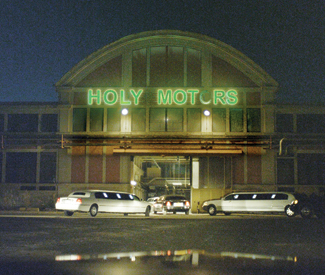
ROXIE 3117 and 3125 16th St, SF; (415) 863-1087, www.roxie.com. $6.50-11. The Central Park Five (Burns, Burns, and McMahon, 2012), Wed-Thu, 7. Holy Motors (Carax, 2012), Wed-Thu, 7. Killing Them Softly (Dominik, 2012), Wed-Thu, 9:15. We Are Legion: The Story of the Hacktivists (Knappenberger, 2012), Wed-Thu, 9:15. Tchoupitoulas (Ross and Ross, 2012), Jan 4-10, 7, 8:45 (also Sat-Sun, 3).

Bigger than Bigelow

2

cheryl@sfbg.com

FILM There was hella hoopla over Kathryn Bigelow being the first woman to win an Oscar for Best Director, for 2010’s The Hurt Locker. It’s a good possibility she’ll soon be the first woman to win two directing Oscars, if Zero Dark Thirty‘s remarkable haul of critical kudos continues into statuette season.

But even if Zero (more on that below) doesn’t claim cinema’s top prize, Bigelow will probably win another Best Directing Oscar before another woman anyway. She’s just about the only female director making films that work Oscar’s magic formula: critically praised, culturally significant, headline-grabbing, and popularly loved (with box-office hauls to match). Women may be making inroads on the screenwriting end of things (and you’ll find lauded female names among documentary, foreign-language, and film-producing credits), but the most successful post-millennial female directors — Sofia Coppola (a Best Original Screenplay winner for 2003’s Lost in Translation), Catherine Hardwicke, Andrea Arnold, Debra Granick, Lisa Cholodenko, Lynn Shelton, Kelly Reichardt, and Sarah Polley, to name a few — haven’t been able to tick enough of those golden boxes.

Whether or not a film wins an Oscar is hardly a measure of its true worth. But hoisting a Best Directing Oscar does count for something important, particularly in an industry that largely runs on male power. Bigelow’s success is particularly notable because she does not make so-called “women’s pictures,” whatever that may mean (she did make a vampire flick long before Hardwicke, though, as fans of 1987’s Near Dark will recall). With the exception of 2000’s little-seen The Weight of Water and 1989’s Blue Steel (would anyone remember that movie, if not for Derek Zoolander?) — with honorable mention for Angela Bassett’s formidable supporting turn in 1995’s Strange Days — Bigelow’s films tend to be, uh, “men’s pictures.”

http://www.youtube.com/watch?v=cAtWcvCxPhc

The surfing, skydiving, bank-robbin’ three-punch of Point Break (1991) allowed Keanu Reeves to set a course for action-hero superstardom (without it, he’d never have been cast in 1994’s Speed); though the film features a traditional romantic subplot, it’s mostly about the bromance between Reeves’ undercover FBI agent and Patrick Swayze’s New Age macho man. K-19: The Widowmaker (2002) was Bigelow’s first foray into a military milieu; its tale of trouble aboard a Soviet nuclear submarine, circa 1961, was couched in a $100 million production that neither earned back its budget nor convinced anyone of Harrison Ford’s ability to do a Russian accent. (Interestingly, the film’s Rotten Tomatoes summary foreshadows the reception to date of Zero Dark Thirty: “A gripping drama even though the filmmakers have taken liberties with the facts.”)

Bigelow rebounded with The Hurt Locker (2008) — scooping up her accolades in front of ex-husband and former film-production partner James Cameron, whose 2008 Avatar grossed billions but didn’t win over Academy voters. Set during the Iraq War, The Hurt Locker follows the high-stakes, high-tension routine of a three-man bomb disposal team. It launched actor Jeremy Renner to stardom, and earned a screenwriting Oscar for Mark Boal, a journalist who’d been embedded with a US Army bomb squad. Along with the 2008 HBO mini-series Generation Kill (based on a book written by a journalist embedded with the Marines at almost the same time as Boal), The Hurt Locker — a tense, gritty thriller shot using hand-held cameras — was one of the first large-scale docu-dramas based on the months immediately following the 2003 invasion.

After the Oscars, rumor had it that Bigelow and Boal’s next film would be a South American “drug parable,” with big names like Tom Hanks and Johnny Depp floated as possible stars. Clearly, a more exciting project took precedence — one that’s already raked in critic’s association prizes, and raised the ire of government types, including Sen. Dianne Feinstein, who insist that it has “taken liberties with the facts.”

Front-loaded with equal parts acclaim and controversy, Zero Dark Thirty moves into wider release this week, and larger audiences will be able to make up their own minds about it. It’s certainly edgier than another 2012 film about CIA heroics. (There’s no waterboarding in Argo.) “What I want you to know is that Zero Dark Thirty is a dramatization, not a realistic portrayal of the facts,” CIA Acting Director Michael Morell explained in a recent statement, taking issue not just with the depiction of “enhanced interrogation techniques” (that’s “torture” to you and me), but also the way the film singles out one character as masterminding the operation to take down Osama bin Laden.

“The point was to immerse the audience in this landscape, not to pretend to debate policy,” Bigelow responded in an interview with entertainment site the Wrap. “Was it difficult to shoot? Yes. Do I wish [torture] was not part of that history? Yes, but it was.”

The extent to which torture was actually used in the hunt for bin Laden may never be known, though popular opinion will surely be shaped by this film, as it’s produced with the same kind of “realness” that made The Hurt Locker so potent. Zero Dark Thirty incorporates torture early in its chronology — which begins in 2003, after a brief opening that captures the terror of September 11, 2001 using only 911 phone calls — but the practice is discarded after 2008, a sea-change year marked by the sight of Obama on TV insisting that “America does not torture.” (The “any more” goes unspoken.)

Most of Zero Dark Thirty is set in Pakistan and/or “CIA black sites” in undisclosed locations; it’s a suspenseful procedural that manages to make well-documented events (the July 2005 London bombings; the September 2008 Islamabad Marriott Hotel bombing; the December 2009 bombing of Camp Chapman in Afghanistan) seem shocking and unexpected. Even the raid on bin Laden’s HQ is nail-bitingly intense. The film immerses the viewer in the clandestine world, tossing out abbreviations (“KSM” for al-Qaeda bigwig Khalid Sheikh Mohammed) and jargon (“tradecraft”) without pausing for a breath. It is thrilling, emotional, engrossing — the smartest, most tightly-constructed action film of the year.

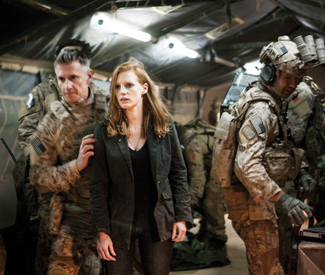
At the center of it all: a character allegedly based on a real person whose actual identity is kept top-secret by necessity. She’s interpreted here in the form of a steely CIA operative named Maya, played to likely Oscar-winning perfection by Jessica Chastain. No matter the film’s divisive subject matter, there’s no denying that this is a powerful performance. Maya is the perfect Bigelow lead; she succeeds in a male-dominated world by focusing solely on her job and her ultimate goal, sexism and gender politics be damned. “Washington says she’s a killer,” a character remarks after meeting this seemingly delicate creature, and he’s proven right long before bin Laden goes down.

Some critics have argued that the character is underdeveloped, but anyone who says that isn’t watching closely enough. Maya may not be given a traditional back story (all we know is she was recruited into the agency after high school), or any outside life to speak of (even Renner’s unhinged Hurt Locker vet is shown going home to a wife and kid), or the desire to distract herself with romance (“I’m not the girl who fucks … it’s unbecoming” she explains at one point, dismissing a colleague’s inquiry into her social life). But there’s plenty of interior life there, and it comes through in quick, vulnerable flashes — leading up to the payoff of the film’s devastating final shot.


ZERO DARK THIRTY opens Fri/4 in Bay Area theaters.

Film Listings

0

Film listings are edited by Cheryl Eddy. Reviewers are Kimberly Chun, Dennis Harvey, Lynn Rapoport, and Sara Maria Vizcarrondo. For rep house showtimes, see Rep Clock. Due to the New Year holiday, theater information was incomplete at presstime.

OPENING

Texas Chainsaw Massacre 3D The seventh film in the series, bolstered (maybe) by cameos by Marilyn Burns (from the 1974 original) and Bill Mosely (from its immortal 1986 sequel). (1:32)

Tchopitoulas Three adolescent brothers enjoy a dusk-to-dawn night in the Big Easy — New Orleans, baby — in this impressionistic documentary that blurs the line between staged and sampled lyricism. Bill and Turner Ross’ film sets the trio loose in the French Quarter and beyond, where they sample the company of various drunks, buskers, oyster shuckers, painted ladies, and so forth. No laws are conspicuously broken, though a few get bent — it’s safe to say these kids probably won’t be visiting several environs again until they’re of legal drinking age. The long night is an inebriate dream of color and sound, strange but seldom menacing. Like the "city symphony" movies of the 1920s and 30s, this is less nonfiction cinema in a strict vérité vein than a poetically contrived ode to life — a life that’s sturdier than it looks, since Tchoupitoulas finds NO back to the business of partying like Katrina never happened. If you’re looking for a harder-edged portrait of the burg’s status quo, there are plenty of other documentaries to choose from; the Ross’ provide a woozy mash note rather than a sober pulse-taking. You’ll definitely want to go bar-hopping afterward. (1:20) (Harvey)

Tristana Luis Buñuel’s 1970 drama starring Catherine Deneuve and Franco Nero (the original Django!) gets a restored re-release. (1:38)

Zero Dark Thirty See "Bigger Than Bigelow." (2:39)

ONGOING

Anna Karenina Joe Wright broke out of British TV with the 9,000th filmed Pride and Prejudice (2005), unnecessary but quite good. Too bad it immediately went to his head. His increasing showiness as director enlivened the silly teenage-superspy avenger fantasy Hanna (2011), but it started to get in the way of Atonement (2007), a fine book didn’t need camera gymnastics to make a great movie. Now it’s completely sunk a certified literary masterpiece still waiting for a worthy film adaptation. Keira Knightley plays the titular 19th century St. Petersburg aristocrat whose staid, happy-enough existence as a doting mother and dutiful wife (to deglammed Jude Law’s honorable but neglectful Karenin) is upended when she enters a mutually passionate affair with dashing military officer Count Vronsky (Aaron Taylor-Johnson, miscast). Scandal and tragedy ensue. There’s nothing wrong with the screenplay, by Tom Stoppard no less. What’s wrong is Wright’s bright idea of staging the whole shebang as if it were indeed staged — a theatrical production in which nearly everything (even a crucial horse race) takes place on a proscenium stage, in the auditorium, or "backstage" among riggings. Whenever we move into a "real" location, the director makes sure that transition draws attention to its own cleverness as possible. What, you might ask, is the point? That the public social mores and society Anna lives in are a sort of "acting"? Like wow. Add to that another brittle, mannered performance by Wright’s muse Knightley, and there’s no hope of involvement here, let alone empathy — in love with its empty (but very prettily designed) layers of artifice, this movie ends up suffocating all emotion in gilded horseshit. The reversed-fortune romance between Levin (Domhall Gleeson) and Kitty (Alicia Vikander) does work quite well — though since Tolstoy called his novel Anna Karenina, it’s a pretty bad sign when the subsidiary storyline ends up vastly more engaging than hers. (2:10) (Harvey)

Any Day Now In 1970s West Hollywood, flamboyant drag queen Rudy (Alan Cumming) and closeted, newly divorced lawyer Paul (Garret Dillahunt) meet and become an unlikely but loving couple. Their opposites-attract bond strengthens when they become de facto parents to Marco (Isaac Leyva), a teen with Down syndrome left adrift when his party-girl mother (Jamie Anne Allman) is arrested. Domestic bliss — school for Marco with a caring special-education teacher (Kelli Williams); a fledgling singing career for Rudy (so: lots of crooning, for Cumming superfans) — is threatened by rampant homophobia, so Rudy and Paul must conceal their true relationship from Paul’s overbearing boss and the other parents at Marco’s school. When the secret gets out, the fact that Marco is being well cared-for matters not to the law; he’s immediately shunted into a foster home while Paul and Rudy battle the court for custody. Actor-turned-director and co-writer Travis Fine (2010’s The Space Between) guides a veteran cast through this based-on-true-events tale, with sensitive performances and realistic characterizations balancing out the story’s broader strokes. (1:43) (Eddy)

Argo If you didn’t know the particulars of the 1979 Iranian Revolution, you won’t be an expert after Argo, but the film does a good job of capturing America’s fearful reaction to the events that followed it — particularly the hostage crisis at the US embassy in Tehran. Argo zeroes in on the fate of six embassy staffers who managed to escape the building and flee to the home of the sympathetic Canadian ambassador (Victor Garber). Back in Washington, short-tempered CIA agents (including a top-notch Bryan Cranston) cast about for ways to rescue them. Enter Tony Mendez (Ben Affleck, who also directs), exfil specialist and father to a youngster wrapped up in the era’s sci-fi craze. While watching 1973’s Battle for the Planet of the Apes, Tony comes up with what Cranston’s character calls "the best bad idea we have:" the CIA will fund a phony Canadian movie production (corny, intergalactic, and titled Argo) and pretend the six are part of the crew, visiting Iran for a few days on a location shoot. Tony will sneak in, deliver the necessary fake-ID documents, and escort them out. Neither his superiors, nor the six in hiding, have much faith in the idea. ("Is this the part where we say, ‘It’s so crazy it just might work?’" someone asks, beating the cliché to the punch.) Argo never lets you forget that lives are at stake; every painstakingly forged form, every bluff past a checkpoint official increases the anxiety (to the point of being laid on a bit thick by the end). But though Affleck builds the needed suspense with gusto, Argo comes alive in its Hollywood scenes. As the show-biz veterans who mull over Tony’s plan with a mix of Tinseltown cynicism and patiotic duty, John Goodman and Alan Arkin practically burst with in-joke brio. I could have watched an entire movie just about those two. (2:00) (Eddy)

The Central Park Five Acclaimed documentarian Ken Burns takes on the 1989 rape case that shocked and divided a New York City already overwhelmed by racially-charged violence. The initial crime was horrible enough — a female jogger was brutally assaulted in Central Park — but what happened after was also awful: cops and prosecutors, none of whom agreed to appear in the film, swooped in on a group of African American and Latino teenagers who had been making mischief in the vicinity (NYC’s hysterical media dubbed the acts "wilding," a term that became forever associated with the event). Just 14 to 16 years old, the boys were questioned for hours and intimidated into giving false, damning confessions. Already guilty in the court of public opinion, the accused were convicted in trials — only to see their convictions vacated years after they’d served their time, when the real assailant was finally identified. Using archival news footage (in one clip, Gov. Mario Cuomo calls the crime "the ultimate shriek of alarm that says none of us are safe") and contemporary, emotional interviews with the Five, Burns crafts a fascinating study of a crime that ran away with itself, in an environment that encouraged it, leaving lives beyond just the jogger’s devastated in the process. (1:59) (Eddy)

Chasing Ice Even wild-eyed neocons might reconsider their declarations that global warming is a hoax after seeing the work of photographer James Balog, whose images of shrinking glaciers offer startling proof that our planet is indeed being ravaged by climate change (and it’s getting exponentially worse). Jeff Orlowski’s doc follows Balog and his Extreme Ice Survey team as they brave cruel elements in Iceland, Greenland, and Alaska, using time-lapse cameras to record glacier activity, some of it quite dramatic, over months and years. Balog is an affable subject, doggedly pursuing his work even after multiple knee surgeries make him a less-than-agile hiker, but it’s the photographs — as hauntingly beautiful as they are alarming — that make Chasing Ice so powerful. Could’ve done without Scarlett Johansson crooning over the end credits, though. (1:15) (Eddy)

Cirque du Soleil: Worlds Away (1:31)

Citadel Irish import Citadel begins with terror: a young pregnant woman, on the verge of moving out of her soon-to-be-condemned high-rise, is attacked — while her husband, Tommy (Aneurin Barnard), looks on helplessly — by a pack of hoodie-wearing youths who inject her with a mysterious substance. Though the baby lives, the woman dies, and Tommy becomes a haunted, paranoid husk of a man. Not that you can really blame him; the housing project he lives in is nearly deserted, and those hoodie-wearing gangs seem to be increasing (and are increasingly interested in his infant daughter). After an ominous build-up, the darkly disturbing Citadel can’t quite keep the momentum going, though James Cosmo (Game of Thrones fans will recognize him even out of his Night’s Watch blacks) offers an amusingly over-the-top performance as a foul-mouthed priest. (1:24) (Eddy)

Cloud Atlas Cramming the six busy storylines of David Mitchell’s wildly ambitious novel into just three hours — the average reader might have thought at least 12 would be required — this impressive adaptation directed (in separate parts) by Tom Twyker (1998’s Run Lola Run) and Matrix siblings Lana and Andy Wachowski has a whole lot of narrative to get through, stretching around the globe and over centuries. In the mid 19th century, Jim Sturgess’ sickly American notory endures a long sea voyage as reluctant protector of a runaway-slave stowaway from the Chatham Islands (David Gyasi). In 1931 Belgium, a talented but criminally minded British musician (Ben Whishaw) wheedles his way into the household of a famous but long-inactive composer (Jim Broadbent). A chance encounter sets 1970s San Francisco journalist Luisa (Halle Berry) on the path of a massive cover-up conspiracy, swiftly putting her life in danger. Circa now, a reprobate London publisher’s (Broadbent) huge windfall turns into bad luck that gets even worse when he seeks help from his brother (Hugh Grant). In the not-so-distant future, a disposable "fabricant" server to the "consumer" classes (Doona Bae) finds herself plucked from her cog-like life for a rebellious higher purpose. Finally, in an indeterminately distant future after "the Fall," an island tribesman (Tom Hanks) forms a highly ambivalent relationship toward a visitor (Berry) from a more advanced but dying civilization. Mitchell’s book was divided into huge novella-sized blocks, with each thread split in two; the film wastes very little time establishing its individual stories before beginning to rapidly intercut between them. That may result in a sense of information (and eventually action) overload, particularly for non-readers, even as it clarifies the connective tissues running throughout. Compression robs some episodes of the cumulative impact they had on the page; the starry multicasting (which in addition to the above mentioned finds many uses for Hugo Weaving, Keith David, James D’Arcy, and Susan Sarandon) can be a distraction; and there’s too much uplift forced on the six tales’ summation. Simply put, not everything here works; like the very different Watchmen, this is a rather brilliant "impossible adaptation" screenplay (by the directors) than nonetheless can’t help but be a bit too much. But so much does work — in alternating currents of satire, melodrama, pulp thriller, dystopian sci-fi, adventure, and so on — that Cloud Atlas must be forgiven for being imperfect. If it were perfect, it couldn’t possibly sprawl as imaginatively and challengingly as it does, and as mainstream movies very seldom do. (2:52) (Harvey)

The Collection As soon as you behold the neon sign "Hotel Argento" shining over the grim warehouse-cum-evil dead trap, you know exactly what you’re in for — a wink, and even a little bit of a horror superfan’s giggle. In other words, to tweak that killer Roach Motel tagline: kids check in, but they don’t check out. No need to see 2009’s The Collector — the previous movie by director-cowriter Marcus Dunstan and writer Patrick Melton (winners of the third season of Project Greenlight, now with the screenplays for multiple Saw films beneath their collective belt) — the giallo fanboy and gorehound hallmarks are there for all to enjoy: tarantulas (straight from 1981’s The Beyond), a factory kitted out as an elaborate murder machine, and end credits that capture characters’ last moments. Plus, plenty of fast-paced shocks and seemingly endless splatter, with a heavy sprinkle of wince-inducing compound fractures. The Collection ups the first film’s ante, as gamine Elena (Emma Fitzpatrick) is lured to go dancing with her pals. Their underground party turns out to be way beyond the fringe, as the killer mows down the dance floor, literally, and gives the phrase "teen crush" a bloody new spin. Stumbling on The Collector‘s antihero thief Arkin (Josh Stewart) locked in a box, Elena releases him but can’t prevent her own capture, so killer-bodyguard Lucello (Oz‘s Lee Tergesen) snatches Arkin from the hospital and forces him to lead his team of toughs through a not-so-funhouse teeming with booby traps as well as victims-turned-insidious-weapons. All of which almost convinces you of nutty-nutball genius of the masked, dilated-pupiled Collector (here stuntman Randall Archer), who takes trendy taxidermy to icky extremes — even when his mechanism is threatened by a way smart last girl and a lock picker who’s adept at cracking building codes. Despite Dunstan’s obvious devotion to horror-movie landmarks, The Collection doesn’t turn out to be particularly original: rather, it attempts to stand on the shoulders — and arms and dismembered body parts — of others, in hopes of finding its place on a nonexistent drive-in bill. (1:23) (Chun)

Deadfall Thriller Deadfall, set amid a howling blizzard, has an all-star cast: Eric Bana and Olivia Wilde play a creepy-close brother-sister team who crash their getaway car after a successful casino heist; Sons of Anarchy‘s Charlie Hunnam plays a vengeful boxer just out of the slammer (with nervous parents played by Kris Kristofferson and Sissy Spacek); and Treat Williams and Kate Mara are an antagonistic father-daughter team of cops chasing after most of the above. Bana’s glowering performance is the high point of this noir-Western, though if the snowy landscape were a character, it’d be the most important part of the ensemble. (1:35) (Eddy)

Django Unchained Quentin Tarantino’s spaghetti western homage features a cameo by the original Django (Franco Nero, star of the 1966 film), and solid performances by a meticulously assembled cast, including Jamie Foxx as the titular former slave who becomes a badass bounty hunter under the tutelage of Dr. Schultz (Christoph Waltz). Waltz, who won an Oscar for playing the evil yet befuddlingly delightful Nazi Hans Landa in Tarantino’s 2009 Inglourious Basterds, is just as memorable (and here, you can feel good about liking him) as a quick-witted, quick-drawing wayward German dentist. There are no Nazis in Django, of course, but Tarantino’s taboo du jour (slavery) more than supplies motivation for the filmmaker’s favorite theme (revenge). Once Django joins forces with Schultz, the natural-born partners hatch a scheme to rescue Django’s still-enslaved wife, Broomhilda (Kerry Washington), whose German-language skills are as unlikely as they are convenient. Along the way (and it’s a long way; the movie runs 165 minutes), they encounter a cruel plantation owner (Leonardo DiCaprio), whose main passion is the offensive, shocking "sport" of "Mandingo fighting," and his right-hand man, played by Tarantino muse Samuel L. Jackson in a transcendently scandalous performance. And amid all the violence and racist language and Foxx vengeance-making, there are many moments of screaming hilarity, as when a character with the Old South 101 name of Big Daddy (Don Johnson) argues with the posse he’s rounded up over the proper construction of vigilante hoods. It’s a classic Tarantino moment: pausing the action so characters can blather on about something trivial before an epic scene of violence. Mr. Pink would approve. (2:45) (Eddy)

Flight To twist the words of one troubled balladeer, he believes he can fly, he believes he can touch the sky. Unfortunately for Denzel Washington’s Whip Whitaker, another less savory connotation applies: his semi-sketchy airline captain is sailing on the overconfidence that comes with billowing clouds of blow. Beware the quickie TV spot — and Washington’s heroic stance in the poster — that plays this as a quasi-action flick: Flight is really about a man’s efforts to escape responsibility and his flight from facing his own addiction. It also sees Washington once again doing what he does so well: wrestling with the demons of a charismatic yet deeply flawed protagonist. We come upon Whip as he’s rousing himself from yet another bender, balancing himself out with a couple lines with a gorgeous, enabling flight attendant by his side. It’s a checks-and-balances routine we’re led to believe is business as usual, as he slides confidently into the cockpit, gives the passengers a good scare by charging through turbulence, and proceeds to doze off. The plane, however, goes into fail mode and forces the pilot to improvise brilliantly and kick into hero mode, though he can’t fly from his cover, which is slowly blown despite the ministrations of kindred addict Nicole (Kelly Reilly) and dealer Harling (John Goodman at his most ebullient) and the defensive moves of his pilots union cohort (Bruce Greenwood) and the airline’s lawyer (Don Cheadle). How can Whip fly out of the particular jam called his life? Working with what he’s given, Washington summons reserves of humanity, though he’s ultimately failed by John Gatins’ sanctimonious, recovery-by-the-numbers script and the tendency of seasoned director Robert Zemeckis to blithely skip over the personal history and background details that would have more completely filled out our picture of Whip. We’re left grasping for the highs, waiting for the instances that Harling sails into view and Whip tumbles off the wagon. (2:18) (Chun)

The Guilt Trip (1:35)

Hitchcock On the heels of last year’s My Week With Marilyn comes another biopic about an instantly recognizable celebrity viewed through the lens of a specific film shoot. Here, we have Anthony Hopkins (padded and prosthetic’d) playing the Master of Suspense, mulling over which project to pursue after the success of 1959’s North by Northwest. Even if you’re not a Hitch buff, it’s clear from the first scene that Psycho, based on Robert Bloch’s true crime-inspired pulpy thriller, is looming. We open on "Ed Gein’s Farmhouse, 1944;" Gein (Michael Wincott) is seen in his yard, his various heinous crimes — murder, grave-robbing, body-part hoarding, human-skin-mask crafting, etc. — as yet undiscovered. Hitchcock, portrayed by the guy who also played the Gein-inspired Hannibal Lecter, steps into the frame with that familiar droll greeting: "Guhhd eevvveeeening." And we’re off, following the veteran director as he muses "What if somebody really good made a horror picture?" Though his wife and collaborator, Alma (Helen Mirren), cautions him against doing something simply because everyone tells him not to, he plows ahead; the filmmaking scenes are peppered with behind-the-scenes moments detailed in Stephen Rebello’s Alfred Hitchcock and the Making of Psycho, the source material for John J. McLaughlin’s script. But as the film’s tagline — "Behind every Psycho is a great woman" — suggests, the relationship between Alma and Hitch is, stubbornly, Hitchcock‘s main focus. While Mirren is effective (and I’m all for seeing a lady who works hard behind the scenes get recognition), the Hitch-at-home subplot exists only to shoehorn more conflict into a tale that’s got plenty already. Elsewhere, however, Hitchcock director Sacha Gervasi — making his narrative debut after hit 2008 doc Anvil: The Story of Anvil — shows stylistic flair, working Hitchcock references into the mise-en-scène. (1:32) (Eddy)

The Hobbit: An Unexpected Journey Make no mistake: the Lord of the Rings trilogy represented an incredible filmmaking achievement, with well-deserved Oscars handed down after the third installment in 2003. If director Peter Jackson wanted to go one more round with J.R.R. Tolkien’s beloved characters for a Hobbit movie, who was gonna stop him? Not so fast. This return to Middle-earth (in 3D this time) represents not one but three films — which would be self-indulgent enough even if part one didn’t unspool at just under three hours, and even if Jackson hadn’t decided to shoot at 48 frames per second. (I can’t even begin to explain what that means from a technical standpoint, but suffice to say there’s a certain amount of cinematic lushness lost when everything is rendered in insanely crystal-clear hi-def.) Journey begins as Bilbo Baggins (a game, funny Martin Freeman) reluctantly joins Gandalf (a weary-seeming Ian McKellan) and a gang of dwarves on their quest to reclaim their stolen homeland and treasure, batting Orcs, goblins, Gollum (Andy Serkis), and other beasties along the way. Fan-pandering happens (with characters like Cate Blanchett’s icy Galadriel popping in to remind you how much you loved LOTR), and the story moves at a brisk enough pace, but Journey never transcends what came before — or in the chronology of the story, what comes after. I’m not quite ready to declare this Jackson’s Phantom Menace (1999), but it’s not an unfair comparison to make, either. (2:50) (Eddy)

Hyde Park on Hudson Weeks after the release of Lincoln, Hyde Park on Hudson arrives with a lighthearted (-ish) take on Franklin D. Roosevelt’s 1939 meeting with King George VI (of stuttering fame) and Queen Elizabeth at FDR’s rural New York estate. Casting Bill Murray as FDR is Hyde Park‘s main attraction, though Olivia Williams makes for a surprisingly effective Eleanor. But the thrust of the film concerns FDR’s relationship with his cousin, Daisy — played by Laura Linney, who’s relegated to a series of dowdy outfits, pouting reaction shots, and far too many voice-overs. The affair has zero heat, and the film is disappointingly shallow — how many times can one be urged to giggle at someone saying "Hot dogs!" in an English accent? — not to mention a waste of a perfectly fine Bill Murray performance. As that sideburned Democrat bellows in Lincoln, "Howwww dare you!" (1:35) (Eddy)

The Impossible Spanish director Juan Antonio Bayona (2007’s The Orphanage) directs The Impossible, a relatively modestly-budgeted take on the 2004 Indian Ocean tsunami, based on the real story of a Spanish family who experienced the disaster. Here, the family (Naomi Watts, Ewan McGregor, three young sons) is British, on a Christmas vacation from dad’s high-stress job in Japan. Beachy bliss is soon ruined by that terrible series of waves; they hit early in the film, and Bayona offers a devastatingly realistic depiction of what being caught in a tsunami must feel like: roaring, debris-filled water threatening death by drowning, impalement, or skull-crushing. And then, the anguish of surfacing, alive but injured, stranded, and miles from the nearest doctor, not knowing if your family members have perished. Without giving anything away (no more than the film’s suggestive title, anyway), once the survivors are established (and the film’s strongest performer, Watts, is relegated to hospital-bed scenes) The Impossible finds its way inevitably to melodrama, and triumph-of-the-human-spirit theatrics. As the family’s oldest son, 16-year-old Tom Holland is effective as a kid who reacts exactly right to crisis, morphing from sulky teen to thoughtful hero — but the film is too narrowly focused on its tourist characters, with native Thais mostly relegated to background action. It’s a disconnect that’s not quite offensive, but is still off-putting. (1:54) (Eddy)

Jack Reacher See "No Headbutting?" (2:10)

Killing Them Softly Lowest-level criminal fuckwits Frankie (Scoot McNairy) and Russell (Ben Mendelsohn) are hired to rob a mob gambling den, a task which miraculously they fail to blow. Nevertheless, the repercussions are swift and harsh, as a middleman suit (Richard Jenkins) to the unseen bosses brings in one hitman (Brad Pitt), who brings in another (James Gandolfini) to figure out who the thieves are and administer extreme justice. Based on a 1970s novel by George V. Higgins, this latest collaboration by Pitt and director-scenarist Andrew Dominik would appear superficially to be a surer commercial bet after the box-office failure of their last, 2007’s The Assassination of Jesse James By the Coward Robert Ford — one of the great films of the last decade. But if you’re looking for action thrills or even Guy Ritchie-style swaggering mantalk (though there is some of that), you’ll be disappointed to find Killing more in the abstracted crime drama arena of Drive (2011) or The American (2010), landing somewhere between the riveting former and the arid latter. This meticulously crafted tale is never less than compelling in imaginative direction and expert performance, but it still carries a certain unshakable air of so-what. Some may be turned off by just how vividly unpleasant Mendelsohn’s junkie and Gandolfini’s alchie are. Others will shrug at the wisdom of re-setting this story in the fall of 2008, with financial-infrastructure collapse and the hollow promise of President-elect Obama’s "Change" providing ironical background noise. It’s all a little too little, too soon. (1:37) (Harvey)

A Late Quartet Philip Seymour Hoffman is fed up playing second fiddle — literally. He stars in this grown-up soap opera about the internal dramas of a world-class string quartet. While the group is preparing for its 25th season, the eldest member (Christopher Walken) is diagnosed with early stage Parkinson’s. As he’s the base note in the quartet, his retirement challenges the group’s future, not just his own. Hoffman’s second violinist sees the transition as an opportunity to challenge the first violin (Mark Ivanir) for an occasional Alpha role. When his wife, the quartet’s viola player (Catherine Keener), disagrees, it’s a slight ("You think I’m not good enough?") and a betrayal because prior to their marriage, viola and first violin would "duet" if you get my meaning. This becomes a grody aside when Hoffman and Keener’s violin prodigy daughter (Imogen Poots) falls for her mother’s old beau and Hoffman challenges their marriage with a flamenco dancer. These quiet people finds ways to use some loud instruments (a flamenco dancer, really?) and the music as well as the views of Manhattan create a deeply settled feeling of comfort in the cold —insulation can be a dangerous thing. When we see (real world) cellist Nina Lee play, and her full body interacts with a drama as big as vaudeville, we see what tension was left out of the playing and forced into the incestuous "family" conflicts. In A Late Quartet, pleasures are great and atmosphere, heavy. You couldn’t find a better advertisement for this symphonic season; I wanted to buy tickets immediately. And also vowed to stay away from musicians. (1:45) (Vizcarrondo)

Life of Pi Several filmmakers including Alfonso Cuarón, Jean-Pierre Jeunet, and M. Night Shyamalan had a crack at Yann Martel’s "unfilmable" novel over the last decade, without success. That turns out to have been a very good thing, since Ang Lee and scenarist David Magee have made probably the best movie possible from the material — arguably even an improvement on it. Framed as the adult protagonist’s (Irrfan Khan) lengthy reminiscence to an interested writer (Rafe Spall) it chronicles his youthful experience accompanying his family and animals from their just shuttered zoo on a cargo ship voyage from India to Canada. But a storm capsizes the vessel, stranding teenaged Pi (Suraj Sharma) on a lifeboat with a mini menagerie — albeit one swiftly reduced by the food chain in action to one Richard Parker, a whimsically named Bengal tiger. This uneasy forced cohabitation between Hindu vegetarian and instinctual carnivore is an object lesson in survival as well as a fable about the existence of God, among other things. Shot in 3D, the movie has plenty of enchanted, original imagery, though its outstanding technical accomplishment may lie more in the application of CGI (rather than stereoscopic photography) to something reasonably intelligent for a change. First-time actor Sharma is a natural, while his costar gives the most remarkable performance by a wild animal this side of Joaquin Phoenix in The Master. It’s not a perfect film, but it’s a charmed, lovely experience. (2:00) (Harvey)

Lincoln Distinguished subject matter and an A+ production team (Steven Spielberg directing, Daniel Day-Lewis starring, Tony Kushner adapting Doris Kearns Goodwin, John Williams scoring every emotion juuust so) mean Lincoln delivers about what you’d expect: a compelling (if verbose), emotionally resonant (and somehow suspenseful) dramatization of President Lincoln’s push to get the 13th amendment passed before the start of his second term. America’s neck-deep in the Civil War, and Congress, though now without Southern representation, is profoundly divided on the issue of abolition. Spielberg recreates 1865 Washington as a vibrant, exciting place, albeit one filled with so many recognizable stars it’s almost distracting wondering who’ll pop up in the next scene: Jared Harris as Ulysses S. Grant! Joseph Gordon-Levitt as Robert Lincoln! Lena Dunham’s shirtless boyfriend on Girls (Adam Driver) as a soldier! Most notable among the huge cast are John Hawkes, Tim Blake Nelson, and a daffy James Spader as a trio of lobbyists; Sally Field as the troubled First Lady; and likely Oscar contenders Tommy Lee Jones (as winningly cranky Rep. Thaddeus Stevens) and Day-Lewis, who does a reliably great job of disappearing into his iconic role. (2:30) (Eddy)

The Master Paul Thomas Anderson’s much-hyped likely Best Picture contender lives up: it’s easily the best film of 2012 so far. Philip Seymour Hoffman stars as Lancaster Dodd, the L. Ron Hubbard-ish head of a Scientology-esque movement. "The Cause" attracts Freddie Quell (Joaquin Phoenix, in a welcome return from the faux-deep end), less for its pseudo-religious psychobabble and bizarre personal-growth exercises, and more because it supplies the aimless, alcoholic veteran — a drifter in every sense of the word — with a sense of community he yearns for, yet resists submitting to. As with There Will Be Blood (2007), Anderson focuses on the tension between the two main characters: an older, established figure and his upstart challenger. But there’s less cut-and-dried antagonism here; while their relationship is complex, and it does lead to dark, troubled places, there are also moments of levity and weird hilarity — which might have something to do with Freddie’s paint-thinner moonshine. (2:17) (Eddy)

The Matchmaker In 2006, amid ongoing conflict with Lebanon, an Israeli novelist learns he’s received an unexpected inheritance from a man he knew in 1968, the summer before he turned 16. Most of Avi Nesher’s The Matchmaker takes place during those golden months in Haifa, when young Arik (Tuval Shafir) — lover of Dashiell Hammett, son of Holocaust survivors — takes a job working for a charismatic but vaguely shady matchmaker (comedian Adir Miller, who won the Israeli equivalent of a Best Actor Oscar), following potential clients to assure their quest for love is on the level. His exciting new gig whisks the budding writer out of middle-class monotony and introduces him to a wealth of colorful "Low Rent district" types; he also nurses a raging crush on his best friend’s free-spirited American cousin. Mostly a gently nostalgic tale, The Matchmaker also offers an unusual take on the Holocaust, viewing it from two decades later and using its looming memory to shape the characters who experienced it firsthand — as well as members of the younger generation, like Arik, who pages through The House of Dolls to learn more, even as he refers to the concentration camp where his father was held as simply "there." (1:52) (Eddy)

Les Misérables There is a not-insignificant portion of the population who already knows all the words to all the songs of this musical-theater warhorse, around since the 1980s and honored here with a lavish production by Tom Hooper (2010’s The King’s Speech). As other reviews have pointed out, this version only tangentially concerns Victor Hugo’s French Revolution tale; its true raison d’être is swooning over the sight of its big-name cast crooning those famous tunes. Vocals were recorded live on-set, with microphones digitally removed in post-production — but despite this technical achievement, there’s a certain inorganic quality to the proceedings. Like The King’s Speech, the whole affair feels spliced together in the Oscar-creation lab. The hardworking Hugh Jackman deserves the nomination he’ll inevitably get; jury’s still out on Anne Hathaway’s blubbery, "I cut my hair for real, I am so brave!" performance. (2:37) (Eddy)

Monsters, Inc. 3D (1:35)

My Worst Nightmare First seen locally in the San Francisco Film Society’s 2012 "French Cinema Now" series, My Worst Nightmare follows icy art curator Agathe (Isabelle Huppert) as her airless, tightly-controlled world begins to crumble — thanks in no small part to an exuberantly uncouth, down-on-his-luck Belgian contractor named Patrick (Benoît Poelvoorde). (His obnoxious, freewheeling presence in Agathe’s precision-mapped orbit gives rise to the film’s title.) Director and co-writer Anne Fontaine (2009’s Coco Before Chanel) injects plenty of offbeat, occasionally raunchy humor into what could’ve been a predictable personal-liberation tale — the sight of classy dame Huppert driving through a bikini car wash, for instance. (1:43) Smith Rafael. (Eddy)

Not Fade Away How to explain why the Beatles have been tossed so many cinematic bon mots and not the Stones? The group’s relatively short lifespan — and even the tragic, unexpectedly dramatic passing of John Lennon — seem to have all played into the band’s nostalgia-marinated legend, while the Stones’ profitable tour rotation and shocking physical resilience have lessened their romantic charge. So it reads as a counterintuitive, and a bit random, that Sopranos creator David Chase would open his first feature film with a black and white re-creation of the Mick Jagger and Keith Richards meet-up, before switching to the ’60s coming-of-age of New Jersey teen geek Douglas (John Magaro), trapped in an oppressively whiny nuclear family headed up by his Pep Boy grouch of a dad (James Gandolfini) — at least until rock ‘n’ roll saves his soul and he starts beating the skins. Graduating to better-than-average singer after his band’s frontman Eugene (Boardwalk Empire‘s Jack Huston) inhales a joint, Douglas not only finds his voice, but also wins over dream girl Grace (Bella Heathcote). Sure, Not Fade Away is about sex, drugs, and rock ‘n’ roll — and much attention is dutifully squandered on basement shows, band practice, and politics, and posturing with wacky new haircuts and funny cigarettes, thanks to Chase’s own background in garage bands and executive producer, music supervisor, and true believer Steve Van Zandt’s considerable passion. Yet despite the amount screen time devoted to rock’s rites, those familiar gestures never rise above the clichéd, and Not Fade Away only finds its authentic emotional footing when Gandolfini’s imposing yet trapped patriarch and the rest of Douglas’s beaten-down yet still kicking family enters the picture — they’re the force that refuses to fade away, even after they disappear in the rear view. (1:52) (Chun)

Parental Guidance (1:36)

The Perks of Being a Wallflower Move over, Diary of a Wimpy Kid series — there’s a new shrinking-violet social outcast in town. These days, life might not suck quite so hard for 90-pound weaklings in every age category, what with so many films and TV shows exposing, and sometimes even celebrating, the many miseries of childhood and adolescence for all to see. In this case, Perks author Stephen Chbosky takes on the directorial duties — both a good and bad thing, much like the teen years. Smart, shy Charlie is starting high school with a host of issues: he’s painfully awkward and very alone in the brutal throng, his only friend just committed suicide, and his only simpatico family member was killed in a car accident. Charlie’s English teacher Mr. Andersen (Paul Rudd) appears to be his only connection, until the freshman strikes up a conversation with feline, charismatic, shop-class jester Patrick (Ezra Miller) and his magnetic, music- and fun-loving stepsister Sam (Emma Watson). Who needs the popular kids? The witty duo head up their gang of coolly uncool outcasts their own, the Wallflowers (not to be confused with the deeply uncool Jakob Dylan combo), and with them, Charlie appears to have found his tribe. Only a few small secrets put a damper on matters: Patrick happens to be gay and involved with football player Brad (Johnny Simmons), who’s saddled with a violently conservative father, and Charlie is in love with the already-hooked-up Sam and is frightened that his fragile equilibrium will be destroyed when his new besties graduate and slip out of his life. Displaying empathy and a devotion to emotional truth, Chbosky takes good care of his characters, preserving the complexity and ungainly quirks of their not-so-cartoonish suburbia, though his limitations as a director come to the fore in the murkiness and choppily handled climax that reveals how damaged Charlie truly is. (1:43) (Chun)

Playing For Keeps Not a keeper: the marketing imagery that makes Gerard Butler look like an insufferable creep with bad hair. Dennis Quaid, seen in a small pic toward the base of the Playing For Keeps poster, gets that thankless role instead in this family-oriented rom-com, which is better than some while still being capable of eliciting very audible yawns from an audience supposedly primed for cutesy hijinks. Butler is George Dryer, a onetime pro soccer star now on the decline yet desperately seeking his next opening — a career as a sportscaster. To get there he has to run a networking gauntlet called coaching children’s soccer, which he gets roped into by ex Stacie (Jessica Biel) and spawn Lewis (Noah Lomax). The ankle biters are the least of his problems: more challenging are hot ‘n’ horny soccer moms like TV sports vet Denise (Catherine Zeta-Jones), cry-face Barn (Judy Greer), and desperate trophy housewife Patti (Uma Thurman), who’s saddled with all-American a-hole Carl (Dennis Quaid). The charisma-oozing George has to practically fight them off, while somehow shooting for that family-first goal. With its sex farce tendencies, rom-com DNA, and vaguely sour attitude toward hard-up moms, hot or not, I’m not sure who Playing For Keeps is really making a play for — perhaps married ladies looking for date-night possibilities and some shirtless Butler action? Projecting believability even under the most plausibility-taxing circumstances, Butler manages, as always, to be the best thing in the movie, though it seems like less of an achievement when his projects tend toward mediocrity. (1:46) (Chun)

Promised Land Gus Van Sant’s fracking fable — co-written by stars Matt Damon and John Krasinski, from a story by Dave Eggers — offers a didactic lesson in environmental politics, capped off by the earth-shattering revelation that billion-dollar corporations are sleazy and evil. You don’t say! Formulated like a Capra movie, Promised Land follows company man Steve Butler (Matt Damon) as he and sales partner Sue (Frances McDormand) travel to a small Pennsylvania town to convince its (they hope) gullible residents to allow drilling on their land. But things don’t go as smoothly as hoped, when the pair faces opposition from a science teacher with a brainiac past (Hal Holbrook), and an irritatingly upbeat green activist (Krasinski) breezes into town to further monkey-wrench their scheme. That Damon is such a likeable actor actually works against him here; his character arc from soulless salesman to emotional-creature-with-a-conscience couldn’t be more predictable or obvious. McDormand’s wonderfully biting supporting performance is the best (and only) reason to see this ponderous, faux-folksy tale, which targets an audience that likely already shares its point of view. (1:46) (Eddy)

Rise of the Guardians There’s nothing so camp as "Heat Miser" from The Year Without a Santa Claus (1974) in Rise of the Guardians,, but there’s plenty here to charm all ages. The mystery at its center: we open on Jack Frost (voiced by Chris Pine) being born, pulled from the depths of a frozen pond by the Man on the Moon and destined to spread ice and cold everywhere he goes, invisible to all living creatures. It’s an individualistic yet lonely lot for Jack, who’s styled as an impish snowboarder in a hoodie and armed with an icy scepter, until the Guardians — spirits like North/Santa Claus (Alec Baldwin), the Tooth Fairy (Isla Fisher), and the Easter Bunny (Hugh Jackman) — call on him to join them. Pitch the Boogeyman (Jude Law) is threatening to snuff out all children’s hopes and dreams with fears and nightmares, and it’s up to the Guardians must keep belief in magic alive. But what’s in it for Jack, except the most important thing: namely who is he and what is his origin story? Director Peter Ramsey keeps those fragile dreams aloft with scenes awash with motion and animation that evokes the chubby figures and cozy warm tones of ’70s European storybooks. And though Pine verges on blandness with his vocal performance, Baldwin, Jackman, and Fisher winningly deliver the jokes. (1:38) (Chun)

A Royal Affair At age 15 in 1766, British princess Caroline (Alicia Vikander) travels abroad to a new life — as queen to the new ruler of Denmark, her cousin. Attractive and accomplished, she is judged a great success by everyone but her husband. King Christian (Mikkel Boe Følsgaard) is just a teenager himself, albeit one whose mental illness makes him behave alternately like a debauched libertine, a rude two year-old, a sulky-rebellious adolescent, and a plain old abusive spouse. Once her principal official duty is fulfilled — bearing a male heir — the two do their best to avoid each other. But on a tour of Europe Christian meets German doctor Johann Friedrich Struenesse (Mads Mikkelsen), a true man of the Enlightenment who not only has advanced notions about calming the monarch’s "eccentricities," but proves a tolerant and agreeable royal companion. Lured back to Denmark as the King’s personal physician, he soon infects the cultured Queen with the fervor of his progressive ideas, while the two find themselves mutually attracted on less intellectual levels as well. When they start manipulating their unstable but malleable ruler to push much-needed public reforms through in the still basically feudal nation, they begin acquiring powerful enemies. This very handsome-looking history lesson highlights a chapter relatively little-known here, and finds in it an interesting juncture in the eternal battle between masters and servants, the piously self-interested and the secular humanists. At the same time, Nikolaj Arcel’s impressively mounted and acted film is also somewhat pedestrian and overlong. It’s a quality costume drama, but not a great one. (2:17) (Harvey)

Rust and Bone Unlike her Dark Knight Rises co-star Anne Hathaway, Rust and Bone star Marion Cotillard never seems like she’s trying too hard to be sexy, or edgy, or whatever (plus, she already has an Oscar, so the pressure’s off). Here, she’s a whale trainer at a SeaWorld-type park who loses her legs in an accident, which complicates (but ultimately strengthens) her relationship with Ali (Belgian actor Matthias Schoenaerts, so tremendous in 2011’s Bullhead), a single dad trying to make a name for himself as a boxer. Jacques Audiard’s follow-up to 2009’s A Prophet gets a bit overwrought by its last act, but there’s an emotional authenticity in the performances that makes even a ridiculous twist (like, the kind that’ll make you exclaim "Are you fucking kidding me?") feel almost well-earned. (2:00) (Eddy)

The Sessions Polio has long since paralyzed the body of Berkeley poet Mark O’Brien (John Hawkes) from the neck down. Of course his mind is free to roam — but it often roams south of the personal equator, where he hasn’t had the same opportunities as able-bodied people. Thus he enlists the services of Cheryl (Helen Hunt), a professional sex surrogate, to lose his virginity at last. Based on the real-life figures’ experiences, this drama by Australian polio survivor Ben Lewin was a big hit at Sundance this year (then titled The Surrogate), and it’s not hard to see why: this is one of those rare inspirational feel-good stories that doesn’t pander and earns its tears with honest emotional toil. Hawkes is always arresting, but Hunt hasn’t been this good in a long time, and William H. Macy is pure pleasure as a sympathetic priest put in numerous awkward positions with the Lord by Mark’s very down-to-earth questions and confessions. (1:35) (Harvey)

Silver Linings Playbook After guiding two actors to Best Supporting Oscars in 2010’s The Fighter, director David O. Russell returns (adapting his script from Matthew Quick’s novel) with another darkly comedic film about a complicated family that will probably earn some gold of its own. Though he’s obviously not ready to face the outside world, Pat (Bradley Cooper) checks out of the state institution he’s been court-ordered to spend eight months in after displaying some serious anger-management issues. He moves home with his football-obsessed father (Robert De Niro) and worrywart mother (Jacki Weaver of 2010’s Animal Kingdom), where he plunges into a plan to win back his estranged wife. Cooper plays Pat as a man vibrating with troubled energy — always in danger of flying into a rage, even as he pursues his forced-upbeat "silver linings" philosophy. But the movie belongs to Jennifer Lawrence, who proves the chops she showcased (pre-Hunger Games megafame) in 2010’s Winter’s Bone were no fluke. As the damaged-but-determined Tiffany, she’s the left-field element that jolts Pat out of his crazytown funk; she’s also the only reason Playbook‘s dance-competition subplot doesn’t feel eye-rollingly clichéd. The film’s not perfect, but Lawrence’s layered performance — emotional, demanding, bitchy, tough-yet-secretly-tender — damn near is. (2:01) (Eddy)

Skyfall Top marks to Adele, who delivers a magnificent title song to cap off Skyfall‘s thrilling pre-credits chase scene. Unfortunate, then, that the film that follows squanders its initial promise. After a bomb attack on MI6, the clock is running out for Bond (Daniel Craig) and M (Judi Dench), accused of Cold War irrelevancy in a 21st century full of malevolent, stateless computer hackers. The audience, too, will yearn for a return to simpler times; dialogue about "firewalls" and "obfuscated code" never fails to sound faintly ridiculous, despite the efforts Ben Whishaw as the youthful new head of Q branch. Javier Bardem is creative and creepy as keyboard-tapping villain Raoul Silva, but would have done better with a megalomaniac scheme to take over the world. Instead, a small-potatoes revenge plot limps to a dull conclusion in the middle of nowhere. Skyfall never decides whether it prefers action, bon mots, and in-jokes to ponderous mythologizing and ripped-from-the-headlines speechifying — the result is a unsatisfying, uneven mixture. (2:23) (Ben Richardson)

This is 40 A spin-off of sorts from 2007’s Knocked Up, Judd Apatow’s This is 40 continues the story of two characters nobody cared about from that earlier film: Debbie (Leslie Mann, Apatow’s wife) and Pete (Paul Rudd), plus their two kids (played by Mann and Apatow’s kids). Pete and Debbie have accumulated all the trappings of comfortable Los Angeles livin’: luxury cars, a huge house, a private personal trainer, the means to throw catered parties and take weekend trips to fancy hotels (and to whimsically decide to go gluten-free), and more Apple products than have ever before been shoehorned into a single film. But! This was crap they got used to having before Pete’s record label went into the shitter, and Debbie’s dress-shop employee (Charlene Yi, another Knocked Up returnee who is one of two people of color in the film; the other is an Indian doctor who exists so Pete can mock his accent) started stealing thousands from the register. How will this couple and their whiny offspring deal with their financial reality? By arguing! About bullshit! In every scene! For nearly two and a half hours! By the time Melissa McCarthy, as a fellow parent, shows up to command the film’s only satisfying scene — ripping Pete and Debbie a new one, which they sorely deserve — you’re torn between cheering for her and wishing she’d never appeared. Seeing McCarthy go at it is a reminder that most comedies don’t make you feel like stabbing yourself in the face. I’m honestly perplexed as to who this movie’s audience is supposed to be. Self-loathing yuppies? Masochists? Apatow’s immediate family, most of whom are already in the film? (2:14) (Eddy)

The Twilight Saga: Breaking Dawn – Part 2 The final installment of the Twilight franchise picks up shortly after the medical-emergency vampirization of last year’s Breaking Dawn – Part 1, giving newly undead Bella Swan (Kristen Stewart) just enough time to freshen up after nearly being torn asunder during labor by her hybrid spawn, Renesmee. In a just world, Bella and soul mate Edward Cullen (Robert Pattinson) would get more of a honeymoon period, given how badly Part 1‘s actual honeymoon turned out. Alas, there’s just enough time for some soft-focus vampire-on-vampire action (a letdown after all the talk of rowdy undead sex), some catamount hunting, some werewolf posturing, a reunion with Jacob (Taylor Lautner), and a few seconds of Cullen family bonding, and then those creepy Volturi are back, convinced that the Cullens have committed a vampire capital crime and ready to exact penance. Director Bill Condon (1998’s Gods and Monsters, 2004’s Kinsey) knows what the Twi-hards want and methodically doles it out, but the overall effect is less sweeping action and shivery romance and more "I have bugs crawling on me — and yet I’m bored." Some of that isn’t his fault — he bears no responsibility for naming Renesmee, for instance, to say nothing of a January-May subplot that we’re asked to wrap our brains around. But the film maintains such a loose emotional grip, shifting clumsily and robotically from comic interludes to unintentionally comic interludes to soaring-music love scenes to attempted pathos to a snowy battlefield where the only moment of any dramatic value occurs. Weighed down by the responsibility of bringing The Twilight Saga to a close, it limps weakly to its anticlimax, leaving one almost — but not quite — wishing for one more installment, a chance for a more stirring farewell. (1:55) (Rapoport)

We Are Legion: The Story of the Hacktivists (1:33) Roxie.

Wreck-It Ralph Wreck-It Ralph cribs directly from the Toy Story series: when the lights go off in the arcade, video game characters gather to eat, drink, and endure existential crises. John C. Reilly is likable and idiosyncratic as Ralph, the hulking, ham-fisted villain of a game called Fix-It-Felix. Fed up with being the bad guy, Ralph sneaks into gritty combat sim Hero’s Duty under the nose of Sergeant Calhoun (Jane Lynch), a blond space marine who mixes Mass Effect‘s Commander Shepard with a PG-rated R. Lee Ermey. Things go quickly awry, and soon Ralph is marooned in cart-racing candyland Sugar Rush, helping Vanellope Von Schweetz (a manic Sarah Silverman), with Calhoun and opposite number Felix (Jack McBrayer) hot on his heels. Though often aggressively childish, the humor will amuse kids, parents, and occasionally gamers, and the Disney-approved message about acceptance is moving without being maudlin. The animation, limber enough to portray 30 years of changing video game graphics, deserves special praise. (1:34) (Ben Richardson)


On the Cheap Listings

0

On the Cheap listings by Caitlin Donohue. Submit items for the listings at listings@sfbg.com. For further information on how to submit items for the listings, see Picks.

WEDNESDAY 2

Westin St. Francis sugar castle Westin St. Francis, 335 Powell, SF. www.westinstfrancis.com. Through Thu/3. 24 hours/day, free. There’s still time (until tomorrow, to be precise) to visit this sugar-spun site in the lobby of these venerable Union Square lodgings, a yearly tradition that for the first time this year features the movers and shakers of our times – Gavin Newsom and Lady Gaga are included, if not exactly within hand-shaking distance of each other.

Brooklyn Visits Heath Heath Ceramics, 2900 18th St., SF. www.heathceramics.com. Through Jan. 13. Today: 5-8pm, free. Brooklyn-based craftspeople have trundled their wares out to the West Coast for a six-week showing at Heath Ceramics’ SF location. An excellent chance to check out East Coast design, and to visit the venerable Sausalito ceramics company’s relatively new showroom in the Mission.

THURSDAY 3

Litquake’s Epicenter Tosca Cafe, 242 Columbus, SF. www.litquake.org. 7-8:30pm, $5-10 suggested donation. Looking for a cultured Thursday? This manifestation of the city’s favorite year-round lit fest should do the trick. Author Stuart Neville will be on hand to discuss Ratlines, his rip-roaring whodunnit featuring JFK, Jr., the Irish government, and a handful of dead Nazis.

FRIDAY 4

“Speak Your Peace” SOMArts Cultural Center, 934 Brannan, SF. www.somarts.org. Through Jan. 24. 6-9pm, free. Nathera Mawla’s take on sex and identity should not be missed at this group exhibition of Bay Area-based artists of all medias. The Iranian-born artist provides a much-needed perspective of a Persian women in an era when we hear more about Middle-Eastern femininity than from it.

SUNDAY 6

Free first Sunday at the Oakland Museum of California 1000 Oak, Oakl. www.museumca.org. Museum hours: 11am-5pm. The perfect day to enjoy art, natural science, and history under one soaring roof – today’s free admission to OMCA will gain you entrance to the California studio glass exhibit, the “we/customize” open studio workshop from 1-4pm, and of course, time to sit and reflect on the many wonders in the lovely little Blue Oak Cafe.

MONDAY 7

The Imperfectionists book club Commonwealth Club office, 595 Market, Second floor, SF. www.commonwealthclub.org. 5:30pm, free to members, $5 general public. The comic debut novel by Brit author Tom Rachman takes place in the offices an English language newspaper in Rome. Come prepared with discussion questions – the Commonwealth Club crowd at this book club meeting should be rife with the involved, informed sort of city-dweller.

TUESDAY 8

“Breaking News” SOMArts Cultural Center, 934 Brannan, SF. www.somarts.org. 7:30-9pm, $5. Have you heard The News? Kolmel WithLove’s year-old monthly exploration of queer artists is one of the most consistently unpredictable performance series in the city, which means that this extravaganza version curated by experimental performer Laura Arrington will be some kind of explosive. The list of artists reads as a who’s-who of queer SF art today, and includes some of our faves: drag monster Vain Hain, “No Fags on the Moon” provocateur Philip Huang, and 2012 Goldies winner Mica Sigourney.

The Debt-Free Spending Plan: An Amazingly Simple Way to Take Control of Your Finances Once and For All The Booksmith, 1644 Haight, SF. www.booksmith.com. 7:30pm, free. We love you, author Joannah Nagler. You have not only overcome the crushing ubiquity of debt in this American life, but written a to-the-point guide so that others can do the same. Today, you will share secrets in the charming back area of The Booksmith, and we can only hope you don’t throw too much math at us.


We go together

0

APPETITE A celebratory or comforting drink is just what we crave at this time of year. When it comes with an excellent bite, even better. Here are a few of the most noteworthy drinks, winter cocktail menus, and dishes in SF as 2012 passes into 2013.


AME

It’s not a cocktail, and its blowfish base has long been known as dangerous… but in skilled hands, is entirely safe. Ame Restaurant in The St. Regis serves this fugu (blowfish) fin sake, the most adventurous drink on order this winter. Yes, it’s infused with an actual toasted fugu fin resting in the bottom of a ceramic mug ($15 for 6 oz.), filled with warm Honjozo-style “Karatamba” sake from Japan’s Hyogo prefecture. In Japan, this torafugu is considered to be of the highest quality, the fins traditionally roasted and steeped in warm sake. I couldn’t miss a chance to taste the rarity when it came on the menu a few weeks ago — and it will be available through February 2013. On a brisk, clear winter’s night, it warmed me from within with rich, layered, funky, even umami notes.

Eat with: Sit at Ame’s small bar with a mug of blowfish fin sake accompanied by Ame’s now classic Lissa’s Staff Meal ($16.50), an artful bowl of cuttlefish noodles, appropriate soft and muscled, tossed with brightly fresh sea urchin and quail egg in soy and wasabi.

In the St. Regis Hotel, 689 Mission, SF. (415) 284-4040, www.amerestaurant.com


BLACKBIRD

Launched on December 17, Blackbird’s winter menu offers the most sophisticated, satisfying cocktails in the Castro. Owner Shawn Vergara has been filling this needed niche on Market Street since opening Blackbird in 2009. This brand-new menu features some of Blackbird’s best drinks yet. I adore Italy’s sexy, sparkling red wine, Lambrusco. Here it’s a vibrant aperitif with pear-infused gin in the Poached Pear ($8), balanced by honey and lemon. Crimson King ($9) is another rosy, cool sipper of hibiscus-infused brandy, house pistachio orgeat, cranberry, and lemon. My tops on the new menu just might be Harvest Moon ($10). It’s a Bols Genever and Nocino (green walnut liqueur) base, sweetened with maple and pumpkin butter, balanced by lemon and Angostura bitters, softened with egg whites.

Eat with: Blackbird’s six different bar jars smeared on crispy crackers make for playful snacks, whether you opt for the smoked trout or deviled ham jars. I lean towards the pimento cheese jar laden with piquillo peppers and cheddar.

2124 Market, SF. (415) 503-0630, www.blackbirdbar.com


15 ROMOLO

Running through the first week of January, 15 Romolo’s Sherry Christmas! explores the wonders of sherry in cocktails that don’t taste merely of sherry. The impressive range is no surprise from what has consistently remained one of the best cocktail menus in San Francisco — with damn great food, too. The menu features all sherry styles from fino to oloroso, which act as shining stars or subtle unifiers. Manzanilla sherry subtly backs gin in Gardner’s Delight ($10) next to celery bitters, Dolin blanc vermouth, lemon, and a house thyme shrub — a lively “delight”. White Elephant ($9) illumines white port, sherry vinegar. and spiced liqueur with manzanilla sherry, a dash of absinthe tying this refresher together. Typically when I see rye whiskey, Cynar, and amontillado sherry together, I expect a musky, fall-spiced drink. In the case of a Solstice Sour ($10), these elements are mixed with a light hand, touched with lemon and cinnamon syrup, a cocktail that manages to capture winter in an almost spring-like way. Here’s hoping these sherry beauties stay on past January.

Eat with: Chef Justin Deering added on a few Spanish inspired dishes to accompany sherry cocktails or half bottles of sherry, like gambas a la plancha (shrimp in garlic and lemon), juicy albondigas (beef-pork meatballs), and sherried mushrooms ($5-8).

5 Romolo Place, SF. (415) 398-1359, www.15romolo.com


JASPER’S CORNER TAP

Bar manager Kevin Diedrich and crew produced another all-star cocktail menu this season at Jasper’s Corner Tap. One of the most unusual, savory drinks you’ll run into anywhere is Diedrich’s Genki ($13), inspired by a dish he recently had at Makoto in DC. With a base of Del Maguey Vida mezcal balanced by Partida Blanco tequila and Combier orange liqueur, Diedrich adds Togarashi syrup, lime, egg white and Matcha salt. Genki is simultaneously spicy, perky, refreshing.

Though there’s many a joy (don’t miss the creamy-but-light, floral Rum Shaker, seamlessly mixing Bacardi 8 Rum, Shipyard Pumpkin Ale, lime, pumpkin syrup, cream, egg white, orange flower water), one of the most playful drinks is a bottled Here Comes the Fuzz! ($11). Charred peach is infused in Jasper’s house bourbon, bottled with Manzanilla sherry (sherry dominates this season!), honey, lemon, pomegranate molasses, peach bitters and Angostura Bitters. Fizzy and vivacious, charred peaches and sherry imbue a gorgeous, nutty hue.

Eat with: With the invigorating drinks above, a trio of deviled eggs ($8 or $4 each) is appropriately light but satisfying. Though deviled eggs seem to be everywhere the last couple years, this trio stays fun with heirloom tomato caprese, “Caesar salad”, chipotle-romesco.

401 Taylor, SF. (415) 775-7979, www.jasperscornertap.com

Subscribe to Virgina’s twice-monthly newsletter, The Perfect Spot, www.theperfectspotsf.com


Manhattanization forgotten, Transbay Tower moves without the trains

101

Times in San Francisco have changed since the battles in the ‘80s against increased high-rise development and the “Manhattanization of San Francisco,” which peaked in 1986 with the passage of Prop. M placing limits on the rapid development pushed by then-Mayor Dianne Feinstein and her downtown allies.

Now, in 2012, the tallest building on the West Coast — Transbay Tower, the first in a series of new high-rises envisioned for downtown — gathered its final approvals with only scattered opposition (such as Quentin Kopp, the former judge and legislator, who derides the project as nothing but a “real estate scheme” involving lucrative publicly owned land being turned over private developers).

Whether we were all too distracted by a year of political scandals real and contrived, or whether it was the project proponents’ savvy marriage of the real estate deal to the high-speed rail project and Caltrain extension that environmentalists want to see become a reality, this behemoth building is now all but a done-deal.

Yet despite the slick and compelling interactive videos and project descriptions on the Transit Joint Powers Authority website, San Franciscans aren’t really on the verge of realizing this utopian urban vision of 21st century high-speed rail burrowing its way into SoMa over the next few years.

“The projection of that is less clear now. The delays with the high-speed rail have created some challenges for us,” said Adam Alberti of the high-powered communications firm Singer Associates, which represents the TJPA. Contributing to the delay and uncertainty is the indefinitely delayed plan for the electricification of Caltrain tracks that would be a precursor to bringing the trains downtown.

Now, even though the current Transbay Terminal rebuild (scheduled for completion in 2017) includes a “train box,” funding hasn’t yet been identified for the tunneling to get the trains there. That depends on federal allocations and the New Starts program administered by the Metropolitan Transportation Commission.

“Those things take awhile. It’s a long process,” Alberti said.

But the 930-foot Transbay Tower has its approvals, with the property scheduled to be formally transferred to the Hines/Boston Properties building team in the next couple months, followed in the coming years by other parcels in the area for more high-rises.

“The other parcels will be metered out and put out when we get maximum return for taxpayers,” Alberti said. “The transit center itself is on schedule and on budget, so it’s moving forward.”

That’s great, even if it’s just going to be a glorified bus station for the foreseeable future as the high-rises that are being built as part of this trade-off for trains help inch San Francisco a bit closer to Manhattanization

City College’s new divide

156

Despite recent voter approval of Proposition A, the parcel tax expected to bring $14 million annually to City College of San Francisco, faculty there are enduring pay cuts and layoffs, a reality that has rankled union leaders and others who have rallied to save the school. 

In the face of the school’s accreditation crisis, which if not addressed by March could lead to its closure, the college was a united front to keep the school open and pass Prop. A, which was approved by over 70 percent of San Francisco voters on the same night as President Obama’s reelection.

But a combination of timing (the money won’t roll in until later in 2013), the depth of the district’s fiscal hole, and declining student enrollment have left CCSF with essentially status quo funding. District officials appear to be leaning toward using most of the surplus it does get to beef up its scant reserve funds, which was one of the things that triggered the accreditation crisis.  

After the good news of Prop. A’s passage, CCSF discovered it wasn’t on track to meet its required enrollment numbers — and the number of students enrolled dictates state funding.

“[The administration] was focused on these accreditation reports. It’s a big job. It was very disruptive to change chancellors kind of midstream,” said John Rizzo, the college’s board president. “We had to switch administrations, and that’s been very difficult.”

City College has been through three different chancellors in the past year: longtime Chancellor Don Q. Griffin left in April due to illness, Pamila Fisher was interim chancellor until October, and now Thelma Scott-Skillman is the current chancellor.

Whatever the reason, City College has 3,000 fewer students enrolled than it expected to have for the Spring, potentially putting it $6.5 million in the hole this coming year. It has until the end of summer to boost those numbers. Now, despite all the cards coming up aces for them in the polls, the college still needs to save millions of dollars somewhere else in the budget.

It has started by slashing faculty and administration wages 8.8 percent, and not renewing contracts for more than 30 part time teachers, 18 part time counselors, and 30 clerical staff. Notably, Scott-Skillman — whose office negotiated the plan, which the board discussed on Dec. 13 — will also take a paycut.

Alisa Messer, president of the faculty union at City College, thinks cutting teachers, and therefore classes, flies in the face of what the voters bargained for with Prop. A. “There’s no discussion here about accountability to San Francisco voters,” Messer told us. And with the loss of competitive wages, the faculty has already started to come apart at the seams.

“We have unfortunately heard from quite a few faculty that they will be looking for jobs out of state,” Messer said. “Many said they’ll have to change their living situation or move out of San Francisco.”

She said that would hurt CCSF: “These things have to do with the long term viability of the college.”

Steve Ngo, a trustee on the college’s board, thinks that the Prop. A money should be used to shore up the school’s reserve fund, as dictated by the accreditation team that threatens the school with closure. Unfortunately, this means losing teachers now rather than later.

“If you want to frame it in terms of labor, there’s nothing worse to do than spending money now [to retain teachers] and laying off teachers in the future,” Ngo said. “Those are younger teachers. The people there now will be retired.”

Due to increased focus on diversity in hiring, CCSF’s more diverse and younger teachers tend to be the newer ones, and part time faculty, Ngo said. Those are the teachers most at risk — and the ones that students will end up losing.

Amidst the arguments about proper use of funding, teachers at the school are seeing their wages cut. Some, like Danny Halford, are losing their jobs.

Halford taught English as a Second Language at City College for seven years. A friendly and outgoing middle-aged guy, Halford is a veritable man about town, and can be seen at City College fundraisers, and was among the college’s most ardent Prop. A supporters, waving picket signs and attending rallies.

He was also one of the part time faculty members to lose his job in the Spring.

“Greg Keech, our super-wonderful ESL Dept. chair, wrote me a very nice letter to inform me that due to budget cuts there will be no job for me next semester,” Halford said. He had also recently lost his job as an organist at the College Avenue Presbyterian Church, which he’d had for 10 years, when a new pastor had “a new music concept that I don’t fit,” he said.

One of his favorite memories from City College was of a student named Elmer, from Guatemala. “He came into my Literacy class in May 2006, near the end of my first semester, with almost no English.  He made progress quickly.”

“When he got his G.E.D. diploma, I was so proud of him, I could have bust,” Halford said. “I’ve watched him grow, off and on, for six years now. He has no family here, and I think of him as my nephew.”

He may even be re-hired next fall, but until then he waits in limbo. He’ll try to substitute teach at the college for now, he said, but ruled out looking at other schools for work. As he said, “There are no jobs at other colleges because all colleges are in the same boat.”

Ngo said that the choice is basically between drastic change, or the closure of the school.

“It’s mathematically impossible to keep that payrate now,” Ngo said. “My hope is to provide the best wages and benefits in the long run, but we can’t offer it if it’s a facade. We can’t maintain payrates as they are now because we have too many faculty…There’s no agreement if there’s no college.”

City College’s faculty’s union, American Federation of Teachers 2121, filed an unfair labor practice charge Dec. 21 with the Public Employee Relations Board, a state entity that has the power to enforce labor law in California. The charge alleges that the college’s paycuts are unlawful.

A recent email to their union members outlines the AFT 2121’s grievances with the college: “At Monday’s bargaining session, the District finally outlined its claim that it will cut wages to recover last year’s ongoing state cuts of $13 million—even though the parties bargained in good faith, reaching agreement on June 20, 2012 to address these losses, including the 2.85% wage reduction this year and millions of dollars in savings through attrition and program cuts. The District is essentially overriding the previous agreement by now moving to cut wages to recover $13 million on top of the already agreed to concessions.”

College spokesperson Larry Kamer said he hadn’t seen the charges yet, as the college is on vacation, but that “we respectfully disagree with AFT 2121’s characterization of the situation.”

“City College is facing an immediate budget shortfall due to a second straight year of missed enrollment targets,” he said. “In the past, City College might have papered over such a budget gap with money it didn’t have, but those days are over. The college remains in a perilous situation with regard to accreditation and has no choice but to respond to the crisis with swift action and a request for shared sacrifice.”

And there’s the rub. In the midst of reforming the school to meet the requirements of the accreditation team by March or face closure, the college failed to keep its eye on their enrollment.

“The unions were trying to help, calling prospective students and trying a pitch,” Rizzo said. “‘Hey enroll!’ That kind of thing. They’re helping. A lot of people are trying to chip in to help this.”

“Ultimately it’s the people in the administration who are responsible for the enrollment,” he said.

With City College’s newest Chancellor Scott-Skillman on track to stay for at least a year, some stability may return to college’s administration. But City College’s dilemma, to potentially strain its budget to the breaking point or to lose valued and experienced teachers, has no easy answers  — and either way the losers may end up being the students.

To register for classes at City College, visit ccsf.edu. Enrollment for Spring is open.


CCSF by the numbers:

Prop A - $14 million a year for 8 years starting in 2013
 
3,000 - the number of students city college needs to enroll in order to meet its budget expectations, or lose money
 
$6.5 million - the amount CCSF loses if it doesn't enroll 3,000 students
 
8.8 percent, the amount faculty wages are being cut
 
160 - faculty lost in the past year due to attrition - retirement, quitting
 
30 - part time faculty not rehired next semester, including ESL teacher Danny Halford
 
30 - clerical staff not rehired for next semester
 
18 - part time counselors not rehired next semester
 
3 - number of chancellors running City College over the past year


Respect your elders

1

By Sara Maria Vizcarrondo

arts@sfbg.com

YEAR IN FILM Before Bruce Willis saved Bonnie Bedelia at Nakatomi Plaza, he was David Addison, detective-agency foil to Cybill Shepherd on Moonlighting. Then, after some multi-genre foreplay (1987’s high pedigree rom-com Blind Date, an iffy pop album), Willis charmed the pants off America in 1988’s Die Hard, sliding — gritty and glistening — down an air duct to escape the film’s fiery climax.

It’s been a hero’s journey ever since, so appropriately enough, the 57-year-old co-stars in next year’s G.I. Joe: Retaliation. According to the trailer, he’ll mow down villains triumphantly, then annoy some hottie with TMI about the pains of aging. Maybe Willis’ action-hero persona has come full circle, but the movies haven’t exactly evolved with him. With the exception of the mercifully MIA Steven Seagal, the 1980s’ biggest action stars spent 2012 doing the shtick they perfected long before latter-day idols like The Amazing Spider-Man star Andrew Garfield and The Avengers star Chris Hemsworth (both born in 1983, which makes them one year older than The Terminator and one year younger than First Blood) entered the third grade.

>>Read more from our Year in Film 2012 issue here.

But unlike more spandex-y saviors, the leathery hunks who’ve been making films for a generation aren’t asking us to grow with them; instead, they’re growing old in front of us. (In The Dark Knight Rises, Christian Bale’s Batman is just pushing 40, but he spents half the movie in post-injury, old-man wobble mode.) If we wanna watch these guys be badasses, we’d better mind our touchy-feely instincts, because aging is rougher than a hailstorm of bullets and nowhere near as pretty. At least the flashy shit happens quickly.

Usually, an actor demonstrating frailty provokes viewers to confront their own weaknesses — the goal there is identification, poignancy. So what are we to make of the unstoppable Expendables series? The movies are as one-note as the best glossy shoot-’em-ups, which is relevant because Sylvester Stallone couldn’t have cast Willis, Dolph Lundgren, or Arnold Schwarzenegger as the cockroaches of the mercenary world without their stone-cold legacies. This epic Viagra ad of a franchise is built on the same single-mission structure of the classics that made its stars famous in the first place. The Expendables 2 pads its cast with Chuck Norris and Jean-Claude Van Damme (as a villain named “Vilain”) — but adds a “kid” (Liam Hemsworth) and a woman (Yu Nan) to the mix. Of course, the film atones for these updates making a plutonium mine the center of the film. (Also, it’s set in an old Russian military base — ah, sweet memories!)

But Stallone, Willis, and co. aren’t the only geezers attached to the aging-heroes trend. Think of Liam Neeson, sizzling anew at age 60 thanks to the Taken films. His career has only gotten hotter as he’s aged and started embracing lower-brow roles — does anyone look more fierce fighting wolves than Neeson? Tom Cruise, who turned 50 this year, doesn’t need a career reboot, even after Rock of Ages; his action-man streak continues apace with the upcoming Jack Reacher, plus 2013’s Oblivion and an inevitable fifth Mission: Impossible film.

James Bond may have shagged half of Europe, but he’s a lone wolf (no cubs) by design, and when the character turned 50 (current Bond Daniel Craig is 44), the plight of post-middle age was all his 23rd movie could talk about. Skyfall, a.k.a. The Best Explosive Marigold Hotel, features a Bond that fights for Britain and his own relevance at the same time — while the series does the same, making the bad guy a hacker and aiming for poignancy with a back story the 1960s Bond would have been too busy sexing around the globe to indulge.

According to the rules of the cowboy — speaking of, is Clint Eastwood still out there somewhere, talking to that empty chair? — the silver star goes to the next in line. But these cowboys ain’t going nowhere, no matter how many Channing Tatum clones start lurking around the box office. The Expendables 3 has already been announced (two words, casting directors: Nic Cage). No word if Willis is in that cast, but he does have G.I. Joe: Retaliation, Red 2 (another series about “retired, extremely dangerous” operatives), and A Good Day to Die Hard on the docket. Terrorists, Cobra Commanders, JCVD, wolves: 2012’s mature action heroes fear not these things. Their only true adversary is time. And possibly gravity.

They see me rollin’

0

arts@sfbg.com

YEAR IN FILM Two of 2012’s finest, most philosophical, and most frustrating movies share a setting of sorts. Although one film takes place in New York, the other in Paris, both films’ protagonists spend a lot of time in their white stretch limousines. The limo: an ostentatious symbol of status and wealth, a home away from home.

In David Cronenberg’s unsettling Don DeLillo adaptation Cosmopolis, it’s superwealthy magnate Eric Packer (a defanged Robert Pattinson) who eats, fucks, and talks business in a limo, trapped in ever-worsening NYC traffic. For Monsieur Oscar (Denis Lavant) in Leos Carax’s Holy Motors, the limousine is also place of business. When I first saw Holy Motors, I noted the “limo-as-liminal-space” — Oscar’s limousine is his dressing room, a place of transformation for the chameleonic arch-performer.

>>Read more from our Year in Film 2012 issue here.

This common factor, though coincidental, is not accidental. The limousine as symbol and space is crucial to the structure of both films, which I’ve taken half-facetiously to calling “limo operas.” In both, white stretch limos are distinctive cells in the secret circulatory system of late capitalist society. Their passengers have a privileged viewpoint — they can see out, but others can’t see in. When the camera joins the passengers inside the limo, the city becomes an almost unreal backdrop for the private activities within.

In Cosmopolis, there’s an ongoing, ambivalent dialogue about the dispersal of all things into data; everything is getting smaller, faster, swept away by the flow of “cyber-capital.” But Eric Packer, whose vast wealth is about to collapse due to minute changes in the value of the yuan, is obsessed with large, worldly purchases. He has two private elevators with specialized soundtracks, and a Soviet bomber plane that he keeps in a hangar. He’s insistent that he wants to buy the Rothko Chapel, despite its nature as a public artwork. And he describes his limo as a car sawed in half and expanded. He’s had his limo “Prousted” — lined with soundproof cork like Marcel Proust’s bedroom — which he describes as “a gesture … a thing a man does.” The soundproofing doesn’t work, though. His limousine is a performance of his ego, and of its futility.

It’s also an object in the movie’s central dialogue about systems that operate beyond perception. Much like units of encrypted economic information, limos push through the city announcing the self-importance of their passengers. They might be carrying a president or a celebrity, but one of Packer’s employees reminds him that limos also connote “kids on prom night, or some dumb wedding.” And then they go away. Packer asks, “Where do all these limos go at night?” and he finally gets an answer from his limo driver — there are underground garages — they slumber beneath the city. Even his driver’s description of the garages reinforces the weird information-value of the vehicle — “a marketplace of limos.”

Oscar’s limo in Holy Motors is perhaps less of a grand statement to the public, but it’s still a sort of grandiose contradiction on wheels. Oscar is an actor who fulfills “appointments” — enigmatic, prearranged convergences with other lives, where he transmutes into elaborately conceived new beings, for an audience of no one and everyone. When another strange figure, the critic to Oscar’s artist, appears in the limo, Oscar explains his less convincing performances as a result of technological progress: “I miss the cameras. They used to be heavier than us. Then they became smaller than our heads. Now you can’t see them at all.” And so he prepares for his appointments in an eminently visible, garishly substantial machine. In the world of Holy Motors, white stretch limos are apparently markers of Oscar’s trade — when his limo collides with another, it is coincidentally also carrying a performer, his old flame, en route to her own appointment.

In contrast to Cosmopolis, Carax’s film gives a glimpse inside the occluded space of the garage where limos sleep — literally. In its amusing and crucial final scene, Holy Motors returns to the titular motor pool, and eavesdrops on the after-hours gossiping of an entire fleet of sentient limousines. One laments that they’ll soon all be junked, and another agrees: “Men don’t want visible machines anymore.” But visible machines are precisely what Oscar wants, so he makes his office in a limo.

Both Packer and Oscar are aging, battling obsolescence while stubbornly clinging to old operating procedures. In these two films, deeply entrenched in commenting on the withering progress of postmodern life, the stretch limo is a loud, defiant holdout. You might even call it a relic — it is, after all, a holy motor. *


Read more from Sam Stander at hellascreen.blogspot.com


SAM STANDER’S TOP 15 OF 2012


1. Margaret (Kenneth Lonergan, US, 2011)

2. The Turin Horse (Béla Tarr and Ágnes Hranitzky, Hungary/France/Germany/Switzerland/US, 2011)

3. Cosmopolis (David Cronenberg, Canada/France/Portugal/Italy)

4. Moonrise Kingdom (Wes Anderson, US)

5-6. [tie] Cabin in the Woods (Drew Goddard, US, 2011)/The Avengers (Joss Whedon, US)

7-8. [tie] Haywire (Steven Soderbergh, US/Ireland, 2011)/Magic Mike (Steven Soderbergh, US)

9. Whores’ Glory (Michael Glawogger, Germany/Austria, 2011)

10. Holy Motors (Leos Carax, France/Germany)

11. Pina (Wim Wenders, Germany/France/UK, 2011)

12. The Master (Paul Thomas Anderson, US)

13. The Color Wheel (Alex Ross Perry, US, 2011) 14. This Is Not A Film (Jafar Panahi, Iran, 2011) 15. Kill List (Ben Wheatley, UK, 2011)

Chick it out

0

arts@sfbg.com

YEAR IN FILM Cluck as you may, it was only a matter of time before the chicks started rewriting those chick flicks. Tina Fey, Kristen Wiig, and their peers represent the girls — how politically incorrect — in all their messy, sexy, oozy, frizzy-haired, fallible, flabby, and unflappable glory. And this year saw a major meeting in the ladies room, films out real soon, that poked fun at women’s work, relationships, identities, and insecurities.

The pedestal that history’s most notorious auteur-patriarch was so quick to place his icy blondes upon, rhapsodized in the nostalgia-laced Hitchcock, was toppled in feminist Pygmalion revamp Ruby Sparks, penned by lead actress Zoe Kazan. Meanwhile, Rashida Jones took a revisionist tact and rethought the second-wave myth of the woman who can have it all by writing and playing the lovable power bitch who nevertheless kicks her slacker soul mate to the curb in Celeste and Jesse Forever.

>>Read more from our Year in Film issue here.

In a more clearly chick-flicky vein, writer-star Lauren Miller amped up the sexual side of the rom-com with For a Good Time, Call…, whereas Julie Delpy reveled in an old-world/new-urban interracial culture clash while writing, directing, and starring in 2 Days in New York. Zoe Lister Jones got the second-banana gal-pal’s revenge by writing herself all the best lines in the unsettlingly girlie Lola Versus, a movie that seemed designed to test the patience of men, critics (especially male ones) by wallowing in one girl’s mournful sexual shenanigans.

Why take on the notoriously powerless role of screenwriter? “A pretty dreary lot of hacks,” Raymond Chandler once put it. “On billboards, in newspaper advertisements, [the writer’s] name will be smaller than that of the most insignificant bit-player who achieves what is known as billing.” It’s a critical step in deconstructing the tropes, disassembling the lines, and unpacking the baggage so many so-called women’s films have been supplying for years. No wonder female actor-writers so often seem to be in a race for the bottom with the guys, writing themselves roles that make themselves look more morally ambiguous, sexually conflicted, taste-testingly lurid, and simply screwed-up. Born in Flames (1983), these movies aren’t.

Instead, dub them the natural byproduct of a DIY video-making movement or simply a pendulum swing away from 2011, when it seemed like all the blockbuster roles for women lay in servant’s quarters of The Help and females were protagonists of only 11 percent of all films, in contrast to 2002’s 16 percent (according to a report by the Center for the Study of Women in Television and Film at San Diego State University).

Chalk it up to the afterglow of Wiig’s Bridesmaids (2011), spinning off the comedy that won over audiences with its flurry of frenemy backstabbing, scatological humor, and extremely close attention to women’s bizarro rites of passage. Or attribute it to the seismic activity set off by Lena Dunham, who satirized the YouTube generation in 2010’s Tiny Furniture, a comedy she herself shot on a Canon 5D digital camera. Dunham’s HBO hit, Girls, only added fuel to a blogosphere backlash that seemed less about Dunham (her looks, her privileged background) and more about hipster-culture smugness, an entire generation’s perceived sense of entitlement, and good ol’ jealousy.

That kind of outcry is a risk that women are increasingly willing to take, as they wrote themselves onto the big screen and told their own stories. They spun tales about their perhaps petty, perhaps big-deal concerns, and went there — to the not so deep, but sort of dirty little secrets in the Hidden World of Girls, to crib the title of that Fey-hosted NPR series.

And however you felt about her genre-defining rom-coms, there was a certain sad poetry to the fact that writer-director Nora Ephron quietly passed away amid this year’s girlquake. She spent less time in front of the camera than many of these actress-writers do, but you know the woman who directed and co-wrote 1992’s This Is My Life — the film that inspired Dunham to make movies — would have been eager to pass the baton.


KIMBERLY CHUN’S TOP 10 SHOTS IN THE DARK OF 2012


Attenberg (Athina Rachel Tsangari, Greece, 2010)

Crazy Horse (Frederick Wiseman, USA/France, 2011)

The Deep Blue Sea (Terence Davies, UK, 2011)

Django Unchained (Quentin Tarantino, US)

Elena (Andrey Zvyagintsev, Russia)

Gerhard Richter Painting (Corinna Belz, Germany, 2011)

Gimme the Loot (Adam Leon, US)

I Wish (Hirokazu Kore-eda, Japan, 2011) Marina Abramovich: The Artist Is Present (Matthew Akers, Jeff Dupre, US) Searching for Sugar Man (Malik Bendjelloul, Sweden/UK)

This ain’t a wrap

0

YEAR IN FILM Perhaps the backlash was inevitable. Any film that so flawlessly wows its initial audience in turn begins to receive a lot more scrutiny down the line, and there are definitely things about This Ain’t California to scrutinize. Billed as a documentary, yet centered around a character who may not actually exist, This Ain’t California details the unlikely rise of a rebellious East German skateboarding scene hidden from view behind the Iron Curtain.

An exuberant mischung of archival and new video footage, a brash and punkish soundtrack, animated sequences, and compelling, little-explored subject matter, the film made irreverence its watchword, from storyline to storyboard. And although the sheer scale of this irreverent approach, including the filmmakers’ unorthodox methods of framing their story, raised serious questions about This Ain’t California‘s self-definition as documentary, what was undeniable was the movie’s greatest success — its flawless capture of a zeitgeist, not just of a specific place and time, but of the irrepressible vitality of youth cultures everywhere.

>>Read more from our Year in Film 2012 issue here.

Screened first at the 2012 Berlinale in February (and in San Francisco at the Berlin and Beyond Film Festival in October), This Ain’t California won the coveted “Dialogue en Perspective” prize for young filmmakers, an award given with this statement that foreshadowed the controversy to come: “We’ve rarely been so splendidly manipulated.” While the jury in Berlin was referring to the dynamic editing job spearheaded by 23-year-old Maxine Gödecke, as the film won more awards around the festival circuit — including “Best Documentary” at the Cannes Independent Film Festival — details about its unconventional creation began to emerge in the press. That much of the so-called “archival” video footage was recreated by a slew of modern-day skaters disguised in touchingly hilarious GDR-era hairdos and aggressively mismatched stripes. That all of the footage of the central character Denis “Panik” Paraceck was actually that of Berlin-based skater-model, Kai Hillebrandt. That Denis Paraceck (who, according to the film, died in Afghanistan in 2011) might actually never have existed, let alone been the impetus behind the film’s modern-day reunion of the now-adult skaters (and at least a couple of hired actors, including David Nathan and Tina Bartel).

German news weekly Der Spiegel condemned it as a glorified advertisement for skate culture, bloggers such as Berlin-based Joseph Pearson of The Needle decried the dangerous folly of Germans rewriting their own history, and the filmmakers themselves have been cagey about admitting to the extent of their subterfuge.

“[It’s] so much more fun to keep that secret,” director Martin Persiel explains to me via email when asked to comment.

But lest the naysayers condemn the film as pure hoax, it should be noted that there most definitely was an underground skate scene in East Germany, in addition to other outlaw scenes, including break dancers, punk rockers, and heavy metal bands. Plenty of the film’s old-school skate rats are verifiable as such, and some of the most frankly unbelievable details of the film, such as a compatriot with a Finnish passport being tapped to smuggle boards in from the West, appear to be corroborated independently by academic Kai Reinhart, who has been researching sports history and GDR funsportart since 2005.

“As a filmmaker there is a huge responsibility to truthful depiction of your subject,” Persiel insists. “[And] as far as feedback from the skaters from the East goes, we did do justice to their story.”

On the controversy over allowing a partially fictitious film win awards in the documentary category (against presumably less colorful and more rigorously fact-based films), Persiel remains silent, though he does theorize that the definition of “documentary” is expanding and evolving all the time.

“I call This Ain’t California a ‘documentary tale’,” he explicates, adding his own micro-category. It’s an explanation that probably won’t placate his detractors, but whatever side of the definition of “documentary” the film winds up being relegated to, the definition of “best” will still apply. No matter what, it’s a movie well worth seeing, and controversies aside, a movie well worth having been made — for truly we have been splendidly manipulated. *


2012’S TOP SELF-CURATED DOUBLE FEATURES (A.K.A. TWO-DOLLAR WEDNESDAY AT LOST WEEKEND IS MY JAM)


More in common than you’d expect Delicatessen (Marc Caro and Jean-Pierre Jeunet, France, 1991) and Deliverance (John Boorman, US, 1972)

William H. Macy is underrated Edmond (Stuart Gordon, US, 2005) and The Cooler (Wayne Kramer, US, 2003)

All about men A Single Man (Tom Ford, US, 2009) and A Serious Man (Ethan Coen and Joel Coen, US/UK/France, 2009)

Post-Prometheus Ridley Scott-a-thon Blade Runner (Ridley Scott, US/Hong Kong/UK, 1982) and Alien (Ridley Scott, US/UK, 1979)

Noomi vs. Rooney The Girl with the Dragon Tattoo (David Fincher, US/Sweden/Norway, 2011) and The Girl with the

Dragon Tattoo (Niels Arden Oplev, Sweden/Denmark/Germany/Norway, 2009)

Please kill me Dancer in the Dark (Lars von Trier, various, 2000) and Black Swan (Darren Aronofsky, US, 2010)

Gay follies Paris is Burning (Jennie Livingston, US, 1990) and The Birdcage (Mike Nichols, US, 1996)

Dark days Capturing the Friedmans (Andrew Jarecki, US, 2003) and Deliver Us from Evil (Amy Berg, US, 2006)

The masochism tango The Piano Teacher (Michael Haneke, Austria/France/Germany, 2001) and Secretary (Steven Shainberg, US, 2002) Let’s get physical Boogie Nights (Paul Thomas Anderson, US, 1997) and Magic Mike (Steven Soderbergh, US, 2012)

Harvey’s list

0

DENNIS HARVEY’S TOP 25 NARRATIVE FILMS OF 2012


Beasts of the Southern Wild (Benh Zeitlin, US)

Bernie (Richard Linklater, US, 2011)

The Eye of the Storm (Fred Schepisi, Australia)

Fat Kid Rules the World (Matthew Lillard, US)

Footnote (Joseph Cedar, Israel, 2011)

Girl Walk//All Day (Jacob Krupnick, US)

Hermano (Marcel Rasquin, Venezuela, 2010)

Holy Motors (Leos Carax, France/Germany)

The Hunter (David Nettheim, Australia, 2011)

In Darkness (Agnieszka Holland, Poland/Germany/Canada, 2011)

Keep the Lights On (Ira Sachs, US)

Klown (Mikkel Norgaard, Denmark, 2010)

Life of Pi (Ang Lee, US/China)

Lincoln (Steven Spielberg, US/India)

The Master (Paul Thomas Anderson, US)

Michael (Markus Schleinzer, Austria, 2011)

Moonrise Kingdom (Wes Anderson, US)

Natural Selection (Robbie Pickering, US, 2011)

Oslo, August 31st (Joachim Trier, Norway, 2011)

Safety Not Guaranteed (Colin Trevorrow, US)

Silver Linings Playbook (David O. Russell, US)

Sister (Ursula Meier, France/Switzerland)

Skyfall (Sam Mendes, UK/US)

21 Jump Street (Phil Lord and Chris Miller, US)

Wreck-It Ralph (Rich Moore, US)


DENNIS HARVEY’S TOP 10 DOCUMENTARIES OF 2012


Gypsy Davy (Rachel Leah Jones, Israel/US/Spain, 2011)

The House I Live In (Eugene Jarecki, various)

How to Survive a Plague (David France, US)

Informant (Jamie Meltzer, US)
The Invisible War (Kirby Dick, US)
The Queen of Versailles (Lauren Greenfield, US/Netherlands/UK/Denmark)
Pink Ribbons, Inc. (Léa Pool, Canada, 2011)
Room 237 (Rodney Ascher, US)
Searching for Sugar Man (Malik Bendjelloul, Sweden/U.K.)
Surviving Progress (Mathieu Roy and Harold Crooks, Canada, 2011)
The Waiting Room (Peter Nicks, US)

Ficks’ picks

0

1. Cosmopolis (David Cronenberg, Canada/France/Portugal/Italy) During the five times I watched this brilliantly slow-burning, transcendental flick, I saw dozens of audience members fall asleep, walk out early, and complain all the way down the corridor of the Embarcadero Center Cinema hallways. I had to watch it that many times (plus read the book and have countless late-night discussions) just to try and wrap my brain around this era-defining exploration of what it means to be a (hu)man in the Y2Ks. Robert Pattinson proved he’s a truly spectacular actor, Paul Giamatti has never been better, and David Cronenberg is only getting better as he gets older.

2. In the Family  (Patrick Wang, US, 2011) Self-distributed due to its length (169 minutes), this is a stunningly haunting and devastating work. Viewers with the patience to stick with it are rewarded with a genuinely achieved emotional volcano that I can only relate to John Cassavetes’ greatest films. A truly landmark film, in both style and content.

3. The Master  (Paul Thomas Anderson, US) Of all the films that Anderson has boldly attempted, audaciously experimented with, and (perhaps most importantly) been critically embraced for, The Master is a balanced period piece that combines both poetic and historical elements with a couple of truly profound performances by Joaquin Phoenix and Philip Seymour Hoffman. This is not a film only about Scientology, or about just one master. This is a film that asks many questions, but supplies few answers.

4. The Comedy (Rick Alverson, US) Perhaps containing the most mean-spirited characters of the decade, this harrowingly insightful satire of the hipster generation’s compulsion to heap irony upon irony inspired many an audience member to exit mid-film. But the many who dared to remain (including fans of the film’s lead actor, Tim Heidecker, from Tim and Eric Awesome Show, Great Job!) may have found themselves forced to question their own heartless (and even sociopath) tendencies.

Director Rick Alverson’s perceptive use of a contemporary antihero is quite comparable to the counterculture characters of the 1970s: Robert De Niro in Taxi Driver (1976), Peter Falk in Husbands (1970), and Jack Nicholson in Five Easy Pieces (1970). And since The Comedy was not necessarily made to be enjoyed, it will probably, sadly, take 20 years for people to recognize that there is no finer film to define this generation.

5. Florentina Hubaldo CTE (Lav Diaz, Philippines) With this six-hour film, Lav Diaz has created yet another minimalist masterpiece that few will even attempt to watch — 20 people started out in the Yerba Buena Center for the Arts’ screening, and only 10 finished it. Diaz has a monumental goal in mind for his character, and his film’s length is a major part of achieving it. I am not sure if there will ever be a time when six-hour character studies will be all the rage, but until then, Diaz is paving an uncharted road for others to follow.

6. Shanghai (Dibakar Banerjee, India) This Hindi remake of Costa-Gavras’ monumental political thriller Z (1969) may not have French New Wave cinematographer Raoul Coutard behind the camera, but Shanghai‘s director of photography Nikos Andritsakis adds his own brand of raw intensity. For his part, writer-director Banerjee creates an even more complicated look at the state of politics in the age of the modern terrorist. Seemingly inspired by fellow director Ram Gopal Varma’s career of gritty political dramas, Banerjee is an international director to watch.

7. Holy Motors (Leos Carax, France) The perfect companion to David Cronenberg’s Cosmopolis, this film contains a tour de force performance by the almighty Denis Lavant (of Claire Denis’ 1999 Beau Travail), with Michel Piccoli, Eva Mendes, Édith Scob, and Kylie Minogue in supporting roles. Unique, surreal, and completely inspired, this day-in-the-life journey will make you want to watch it again as soon as it ends.

8. The Grey  (Joe Carnahan, US) The best existential “animal attacking human” flick since David Mamet’s 1997 cult classic The Edge. It’s a film that showcases Liam Neeson as he tapes glass to his fists to battle a pack of giant wolves — and manages to be emotionally stirring at the same time. Make sure to keep watching all the way through the credits.

9a. Your Sister’s Sister (Lynn Shelton, US, 2011) Lynn Shelton’s follow-up to her genre-defining bromance Humpday (2009) is a pitch-perfect indie that attempts to dig deep within its dark and confused characters. Depressed and confused thirtysomething Jack (played by Mark Duplass, master of casual awkwardness) heads off to a remote island to figure out his life. The only trouble: his best friend (a mesmerizing Emily Blunt) also has a lesbian sister (Rosemarie DeWitt) who is already there doing her own soul searching. With this contemplative, honest, and hilarious film, Shelton is turning out to be quite a splendid voice for our current generation of progressive pitfallers.

9b. Jeff, Who Lives At Home (Jay Duplass and Mark Dupass, US) They’ve done it again! With Jeff, the mumblecore masters (2005’s The Puffy Chair; 2010’s Cyrus) construct a stoner comedy-existential trip for the man-child generation. While inspiring outstanding performances from Jason Segal and Ed Helms (both the best they’ve ever been), playing brothers, a poignantly performance by Susan Sarandon as their mother raises this wonderfully earned sentimental indie flick to the ranks of family dramas like Jodie Foster’s Home for the Holidays (1995) and her most recent overlooked gem, The Beaver (2011).

10. Lotus Community Workshop (Harmony Korine, US) His next film, Spring Breakers (due out next year), is poised to become Harmony Korine’s most accessible film to date; it’s a T&A-filled exploitation film, led by James Franco as a grimy, gold-grilled-grinning, dreadlocked drug dealer who lives to prey on bikini-clad young girls. But 30-minute meta-masterpiece Lotus Community Workshop, which played the San Francisco International Film Festival earlier this year (as part of omnibus film The Fourth Dimension), is maybe Korine’s greatest film to date. The almighty Val Kilmer plays a dirt bike-riding, fanny-pack wearing, roller-rink guru named Val Kilmer — and yep, it’s as mind-blowing as it sounds.

11. ParaNorman  (Chris Butler and Sam Fell, US) This stop-motion animated film surprised parents who felt its PG rating should have been PG-13 — and it inspired gasps and even yells (from adults!) in every screening I attended. Daringly shot on a Canon 5D Mark II DSLR Camera and released in a fully utilized 3D, this ode to midnight movies is a kids’ film that will stand the test of time and should rank right alongside Shaun of the Dead (2004) and Army of Darkness (1992): horror parodies that transcended their own self-awareness and become classics themselves.

12-14 [tie]. A Simple Life (Ann Hui, Hong Kong, 2011), Amour (Michael Haneke, Austria/France/Germany), The Turin Horse (Béla Tarr and Ágnes Hranitzky, Hungary/France/Germany/Switzerland/US, 2011) Ann Hui’s simple, straightforward tale of a woman’s choice to check herself into a retirement home after suffering a stroke will probably get overshadowed by Michael Haneke’s wonderfully minimalist approach to an elderly couple’s decline after one of them experiences the same ailment. Meanwhile, Béla Tarr’s final film is for acquired tastes only; it’s a cyclical journey with a rural couple, who eat potatoes, are isolated in a stormy darkness, and care for their horse. All three films lay out a terrifyingly realistic blueprint of old age.

15. Compliance  (Craig Zobel, US) No film at the 2012 Sundance Film Festival encountered as much controversy as Compliance. At the first public screening, an all-out shouting match erupted, with one audience member yelling “Sundance can do better!” You can’t buy that kind of publicity. Every screening that followed was jam-packed with people hoping to experience the most shocking film at the fest. And it doesn’t disappoint: Zobel unleashes an uncomfortable psychological mindfuck on the viewer all the way through to the stunning final 15 minutes, which are even more shocking than all the twists and turns that came before.

16. The Kid With a Bike (Jean-Pierre Dardenne and Luc Dardenne, Belgium/France/Italy, 2011) Can these Belgian brothers make a bad film? Seriously? Like their Palme D’Or winners Rosetta (1999), The Son (2002), and L’enfant (2005), Kid is yet another hypnotic, neo-realist portrait of modern-day youth. Every character makes unexpected yet inevitable decisions. No moment is false. The Dardennes create movies that make life feel more real.

17. Beasts of the Southern Wild ( Benh Zeitlin, US) Fantastical special effects created by 31 students at San Francisco’s own Academy of Art University (yes, I am biased), plus star Quvenzhané Wallis as Hushpuppy, a precocious six-year-old searching to understand a world post-Katrina, post-race, and more importantly post-childhood. Combining David Gordon Green’s George Washington (2001), Spike Jonze’s Where the Wild Things Are (2008) and perhaps even Julie Dash’s Daughters of the Dust (1991), Zeitlin has created a haunting enigma for modern audiences that deserves multiple viewings. But even though it won multiple prizes at the 2012 Sundance Film Festival, will it get the Oscar attention it deserves?

18. Universal Soldier: Day of Reckoning (John Hyams, US) When Jean-Claude Van Damme started this franchise back in 1992, it was a nice little combo of First Blood (1982), The Terminator (1984) and Robocop (1987). Twenty years later, the series’ fourth entry is co-written, co-edited, and directed by John Hyams, the son of Peter Hyams, who directed JCVD classics Timecop (1994) and Sudden Death (1995) — and man oh man does he deliver a tough and gritty little action sci-fi film. Van Damme takes on an even darker role than his scene-stealing turn in Expendables 2; with a cleverly subversive script, eloquently choreographed fight scenes (one of which gives Dolph Lundgren some pretty priceless moments), and a denouement that has to be seen to be believed, you may be rooting for this VOD released genre film as much as I am — not to mention Indiewire, which called it “One of the Best Action Movies of the Year!”

19. John Carter (Andrew Stanton, US) With a budget of $250 million, this epic based on Edgar Rice Burroughs stories brought the Walt Disney company to its knees by only making $73 million back. If you saw the film in 3D, you might be confused as to why no one bothered to see it. In my opinion (having watched it twice), John Carter achieves everything James Cameron’s Avatar (2009) did, as far as sci-fi extravaganzas go, but it also has an inspired story and a charming cast: Taylor Kitsch, Lynn Collins, Samantha Morton, and Willem Dafoe. This is possibly this generation’s Ishtar (1987), and like Elaine May’s infamous still-unavailable bomb, John Carter is actually enjoyable; it’ll need a decade or two for audiences to find it as one of the most enjoyable CGI spectacles in recent years.

20. The Dark Knight Rises (Christopher Nolan, US) [SPOILER ALERT!] I found The Dark Knight Rises hard to dismiss as just another money-making super-hero adaptation. After multiple viewings, I’ve come to think of the conclusion to the trilogy as the finest of the three. I’ve also had time to puzzle over the film’s intricate plot.

While many fellow critics seemed to find the film’s political handlings of Bane’s Occupy/French Revolution movement to be flimsy and even irresponsible, I would argue that the film works in a more complicated way toward politics. If Bane’s misguided revolution fell flat, then it would be important to look at Catwoman’s anarchist ways. And about that — did she put her selfishness aside to start over with a broke Bruce Wayne, or is the closing sequence just Alfred’s fantasy? (And if the latter is true, did Batman actually blow himself up in the end?)

And then there’s Blake, who bests the pathetic Deputy Commissioner, then turns his back on the well-meaning yet lying-to-the-people Commissioner Gordon. Though Blake knows he has to quit the police force amid such corruption, he can’t dismiss his urge to help the helpless and downtrodden — after all, he’s an orphan from the streets — and Robin is born. He’s alone (no butlers down in that cave anymore …), and will need to figure out what to do in Gotham City — a town that’s always wild at heart and weird on top.

(Note: list compiled prior to viewing Zero Dark Thirty or Les Misérables.)

Best Actor of 2012
Matthew McConaughey for Bernie (Richard Linklater, US, 2011), Killer Joe (William Friedkin, US, 2011), Magic Mike (Steven Soderbergh, US, 2011), and The Paperboy (Lee Daniels, US)

Best Unreleased Films of 2012

The Act of Killing (Joshua Oppenheimer, Christine Cynn, and Anonymous, Denmark/Norway/UK)

Black Rock (Katie Aselton, USA)

Berberian Sound Studio (Peter Strickland, UK)

Pilgrim Song (Martha Stephens, US)

The Lords of Salem (Rob Zombie, US)

Jesse Hawthorne Ficks programs the Midnites for Maniacs series, which emphasizes dismissed, underrated, and overlooked films. He is the Film History Coordinator at Academy of Art University.

Reports from the end of the world

6

TULUM, MEXICO — Sometimes you need to just listen to the universe and the many ways she conspires to set your path. That seems particularly true while visiting the Yucatan to cover the end of the Mayan calendar, the galactic alignment, and the winter solstice. Things at the grand festival that was supposed to be happening did not go according to plan — to say the least.

I was supposed to be Chichen Itza, attending the Synthesis 2012 Festival and perhaps the Ascendance party. But several factors lined up to keep us in Tulum, miles away from the Mayan pyramid where the much-awaited festivities were to take place.

For one thing, there was my sweetie’s bout with bad ceviche. But there was also the general disorganization of an event that was supposed to bring thousands of people, many of them Americans, to a part of the world not exactly set up for mass tourism.

The shuttle service from Tulum to the festival essentially fell apart. Our hotel room at the festival also disappeared, along with rooms offered to performers at the festival by organizers who overbooked and overpromised, apparently too optimistic in this moment’s power to provide.

They also seemed to have a little too much confidence in the welcome they would receive from locals: The sound system delivery crew was turned away and threatened with violence. The show eventually went on after organizers found a sound system provided by a local vendor — but the scene was chaotic.

I tried to get more information about the sound system truck, but the festival organizers ignored my request for a copy of the email describing the incident that was sent to performers. Musician Jeff Scroggins told me he’d been informed that the truck was pulled over by locals, who told the crew to go away and said they’d be shot if they returned.

My press contact minimized the incident, which left the festival without amplified sound for its first day. But the incident does seem to get at an inherent tension between local life in a small Mexican town and the hopes and ambitions of outsiders who came to layer a big festival onto this sacred moment.

Festival organizers seemed pretty overwhelmed by the fact that, as one musician taking a break from the madness told us, “everything that could go wrong did go wrong.” Or as media spokesperson Candice Holdorf told me, “It’s kind of like radical self-reliance,” borrowing a phrase from Burning Man.

On the other hand, the Mayans that I’ve talked to about the end of their Long Count calendar on this trip, like my cab driver yesterday in Tulum and someone we met a few days ago in Playa del Carmen, mostly just shrug when I ask about 12/21.

Perhaps we’re all projecting lots of our first-world hopes and desires onto this occasion. When I interviewed Peter Mancina — a cultural anthropologist who studies Maya culture (and who works as a board aide to Sup. David Campos) — he emphasized to the modern Mayan people are still plentiful and have diverse viewpoints on the world. Similarly, author John Major Jenkins told me that he didn’t want to see the Mayan people and their needs get lost in this moment.

It’s been amazing to watch the rapid transformations of space taking place all around us as this once-pristine beachfront develops ever-more amenities for the visiting tourists.

The Yogashala hotel across the road from our Pico Beach cabanas had a new roadside room and sign added over the last two days. Next door, an Italian couple opened a roadside juice bar two weeks ago. On the other side of that, Jaguar Restaurante was staffed mostly by people who have been here for weeks, months tops. And as I write these words, a new beach is being rapidly built right before my eyes.

But tourism is still tourism, and there is certainly a reverence and respect for the Mayan culture being expressed by all the festival goers that I’ve talked to, even if this may be one in a series of culture moments that are part of this age of transformation and the creation of values that are different than the ones we’ve inherited from older generations.

As astrologer Rob Breszny told me, people are emotional beings, and there’s something about transformation festivals that mark a moment and allow us to build on it, from the days of Woodstock through the annual exercise in community building that is Burning Man. And with this log thrown onto the fire, perhaps those interested in transformation will burn a little brighter.

Tulum is still pretty close to paradise, with its white sands beaches, warm clean seas, chill happy people, and wonderful off-the-grid abundance. Here, it’s easy to commune with the natural world, which seems to be what this day calls for. Whether its the symbols in the sky created by the outlines of unfamiliar birds, or the dots of bioluminous organism on the beach as we celebrated the arrival of Dec. 21, they all seem portentous of something better.

Synthesis 2012 Festival marks Mayan date with a creative contribution

23

The Synthesis 2012 Festival near Chichen Itza, Mexico got off to a rocky start, but by the time the Mayan Long Count calendar ended on Dec. 21, it had transformed into an inspiring example of working through adversity to build community and connect with another culture.
According to a variety of volunteers and performers associated with the festival, Executive Producer Michael DiMartino over-promised and under-delivered just about everything: hotel rooms, shuttles to and from Cancun and other cities, food for volunteers, and local permission for a stage at Pyramid Kukulkan and the camping area where thousands of festival-goers stayed. On top of that, the bus carrying the sound system and other supplies got turned around by authorities at the border, causing the crew to scramble locally for sound and building equipment and supplies.
“Not everything came together the way we planned, because it’s Mexico, but everyone came together and created community,” Debra Giusti, the Harmony Festival founder who helped DiMartino with Synthesis (and who calmly and creatively resolved many of its problems, say several sources) told me on Dec. 23, the festival’s final day. “There was so much love and unity and can-do spirit.”
At one point before the festival officially began on Dec. 20, federal police and local officials shut down work on the Ascendance stage, blocked access to the adjacent camping area, and gathered everyone there into a group, dressing down DiMartino and taking him away in a police car to resolve their differences.
The crew of mostly Northern California residents that showed up more than a week before the festival began to build the Ascendance Stage that would host the DJs and other musicians worked through their frustrations with event organizers to forge strong connections with the mayor and other locals, throw a great party, and leave a lasting gift for the Mayan people.
“We fed everyone, spent almost $16,000, dealt with the authorities, made friends with all the locals, and stayed with our intention to build this temple for the galactic alignment,” Ken Currington, aka Shombala — one of the project leaders working beside Tulku, the main guy — told me. He said he felt proud and humbled by the experience.
The impressive and ornate pyramid-style temple was built with locally sourced wood, bamboo, and steel in the parking lot of a Mayan stone-carving business in Xcalacoop — just over 9km from the main festival hub in Piste Pueblo, past the Pyramid Kukulkan in Chichen Itza — after the locals embraced their offer to leave it as a permanent display structure for the Mayan artwork.
“One local Mayan who came by was in tears and he said this was the one of the best offerings to the Mayan people,” Currington said.
The visitors helped prepare and participate in a locally produced festival marking the end of the Mayan calendar on Dec. 21, a gesture of goodwill that helped overcome initial missteps. Some local Mayan elders also took part in a Synthesis ceremony at the pyramid in Chichen Itza at sunrise that day.
At the all-night dance party that began on Dec. 22, which featured a long list of Bay Area DJs and other performers, local families came to see the spectacle, which also  included live creation of paintings, mandalas, and other artworks and aerial yoga swings. All the locals I talked to seemed to enjoy and appreciate the event, except for one stern-faced police officer who simply said, “No se (I don’t know),” when I asked what he thought.
“This was amazing because it drew people from all over who felt called to be here,” Giusti said. “They went into the jungle and made art.”
One area where DiMartino (who hasn’t yet responded to my questions about problems with the festival) did seem to deliver was in booking and delivering keynote speakers, who spoke from the stage at the Hacienda restaurant and hotel complex in Piste Pueblo, where meals were also provided to VIPs and those who bought the most expensive tickets.
Keynote speaker Don Miguel Ruiz, a Toltec author and thinker, told the Synthesis 2012 Festival crowd that changing the world starts with an internal change, a change in consciousness. “If we can change our own story, if we can find that peace and that joy,” he said, then we can project that out into the world. “The change we want to see in the entire society starts with us. We can’t give what we don’t have.”
At this point, it’s our collective responsibility to seize the moment and help bring about the transformation that the world is waiting for. “We can be part of the solution for humanity or we can be a part of the problem,” he said.
Manifesting the solutions begins by tapping our creative energies. “Whatever we create first begins in our imagination,” Ruiz said. “Then we make it real.”
“In my imagination, humanity has already changed. We are going in the right direction. We can make it happen. Day one is today,” Ruiz said on Dec. 22, drawing a raucous reaction from the large crowd. “Everything we did in life is completely irrelevant. Right now is the moment.”
Another keynote speaker, Caroline Casey of KPFA’s “The Visionary Activist” show, also talked about the importance of healing the world by transforming ourselves, and an ancient Hawaiian concept called ho’oponopono, a practice of reconciliation and forgiveness.
As she said, “To love disharmony back into harmony makes the harmony so much more.”