2012

Mestranda Cigarra kicks ass

4

caitlin@sfbg.com

HEALTH AND WELLNESS It is impossible to climb the stairs to the San Francisco chapter of Abadá Capoeira and not know that you are in the Mestranda’s house.

Márcia Treidler founded the Mission District capoeira school, and she is there in the first photograph you see when you come in off the street. In it, she strikes her customary pose, an improbable one-handed flip (kick?) Her washboard abs challenge visitors to trade sedentary habits for the rich traditions and fat-carving core moves of the Brazilian martial arts form, the love of which made Treidler beg her mom for classes as a teenager, brought her from Brazil to the Bay Area, and led her to start a chapter of her teacher’s school right here in San Francisco.

In person, seated at a table next to Abadá’s statue of Iemanjá, orisha goddess of the Southern seas and patron deity of Rio de Janeiro, Treidler is hardly as intimidating. Mestranda Cigarra (her capoeira-given name) is in fact incredibly patient while explaining Brazilian history and basic tenets of the martial arts form to a stranger. She does do it for a living, after all.

Sharing information is a guiding principle of capoeira, which began as a covert form of fighting practiced by African slaves in Brazil who certainly couldn’t rely on written record to educate new generations in the martial art. After escaping servitude, some used their martial skills against the law enforcement sent after them. Capoeira helped fend off colonial attacks on their newly formed quilombos, the settlements ex-slaves built in remote locales.

Even after abolishing slavery in 1888, the Brazilian government considered capoeira subversive. It was officially banned in 1890, a tool used by authorities to put black men in jail. When waves of immigration brought new labor forces to the country and left many Africans jobless, public perception often equated capoeira with criminal activity.

The sport’s rise to acceptance and spread to other countries is a relatively recent occurrence. Treidler, who is now one of two of the highest ranking females in her school Abadá’s 41,000-member international organization, started practicing 31 years ago in Rio de Janeiro. She lived in Botafogo, a middle class beachfront neighborhood. At the time, capoeira still wasn’t considered respectable — and certainly not an obvious choice for an ambitious young woman. After becoming entranced by the sport at a school performance, the current Mestranda had to work on her mother for a year before she would agree to finance her classes.

“Women in capoeira was not popular at all,” Treidler says. “[My mother] was like ‘are you crazy? What are you thinking?'” Treidler had been active in sports — swimming and gymnastics — since she was six, but her mother insisted on observing capoeira classes before she’d agree to let her high school age daughter enroll.

“The [sport’s] reputation was really bad at the time,” Treidler remembers. “But when I first started, I never stopped.” Prepped by her athletic background, she took easily to capoeira’s acrobatics. She graduated through levels quickly, and struck a deal with her instructor to pay when she could after her mother withdrew financial support. Treidler credits the sport with teaching her patience, and became close with Mestre Camisa, the founder of Abadá.

The importance of their relationship today means Abadá students benefit from the vision of the founder, who still lives in Brazil. “She follows his vision 100 percent,” Treidler’s student and fellow Abadá instructor Antonio Contreras says. Camisa and Treidler are in constant contact, and he was present at the school’s January batizado graduation ceremony at Dance Mission Theater.

Eighty-plus students take classes at Abadá San Francisco chapter. They perform at places like the Academy of Sciences and in the Ethnic Dance Festival. The studio also offers Portuguese classes. Although there are only three adult Brazilians who currently take classes, the studio is somewhat of a center for Brazilian culture here in the city. Displays that tell of the legacy of capoeira line the walls in the main room, interspersed with statues of figures in traditional poses. Brazil’s world-famous street art duo Os Gemeos have whimsically rendered Abadá practitioners in large paintings that hang in the studio’s front stairwell, alongside the Mestranda’s portrait.

It is perhaps indicative of Treidler’s own start in the sport that her students are nothing if not diverse. At the recent batizado, the spotlight lingered on tiny children, middle-aged practitioners, developmentally-disabled capoeiristas sparring, flipping, playing musical instruments, and smiling tremendously in an immense roda, the circle of practitioners that encloses a capoeira presentation.

Treidler is the only instructor that Contreras, her only other full-time teacher at Abadá SF has ever had. An ex-personal shopper, he has called the studio home since 2000, when the sounds of single-stringed berimbaus and tambourine-like pandeiros pulled him into the studio after dinner at a Mission Street restaurant. He was amazed by the maculelê, the traditional dance that accompanies capoeira, and impressed by Treidler’s presence.

“I was like, ‘whoa, who’s that’ — this larger than life person,” he remembers. He was back that Tuesday for his first class. A cardio-weights gym rat who still employs a personal trainer, Contreras says that first day was the best workout of his life. He started noticing the changes in his body “immediately.”

“To me, it was very natural to learn from Márcia,” Contreras says, sitting next to a jar full of juice one afternoon at the studio. “The advantage is that she had it tough. She identifies with the difficulties you face because she has had her own.” He himself felt unflexible and uncoordinated when he first started his practice. He’s convinced that many instructors would have given up on him long ago.

But Treidler’s teaching eventually brought Contreras to a level of mastery that compelled him to quit his day job, to stop having to rush to the school from the stores every day at 5:45pm. Contreras says that the decision to commit to teaching is a natural part of capoeira.

Unlike other martial arts forms, in which the progressively more masterful levels of belt reward physical mastery of the form and discipline, capoeira reserves the next stage of training — and corresponding 10 colors of cords worn around your hips — for those who have displayed their ability to role model for others.

Treidler originally made ends meet here in San Francisco by working construction jobs, starting to teach capoeira a few times a week at SoMa’s Rhythm and Motion dance studio. She was deemed eligible for an “alien of extraordinary ability” visa by the US government and opened her first studio on Mission in between 19th and 20th Streets, moving to the current space 11 years ago.

Capoeira’s divergent skill sets — singing, playing musical instruments, sparring, and dancing — do seem to be a sport that can reward many kinds of students. Treidler resists generalizing when it comes to her students, but will say that the “women are very rational. Men identify with the power. I think that’s why it’s unique. We help each other in class.”

Capoeira is a good opportunity to let go of the “I’m sorry” hair trigger that plagues some females. “Women are too careful with each other,” the Mestranda says. “It’s like, I’m sorry? There’s no sorry! You get out of the way. That’s the challenge, for women not to think about it so much.” It’s difficult to picture Treidler hesitating — but then, she has been in rodas since she was 17 years old.

At the batizado in December, the Mestranda’s values of inclusion are as visible among her white-uniformed students as the high fives they can’t stop giving each other in the roda. After each class of graduates’ names are called, honorees “play games” — capoeira terminology for the minute-long sparring sessions that show off the flowing acrobatics and feigned violence of the sport. These run the gamut from the younger kids’ hyper, sky-high flips — done alongside each other as much as at each other — to the more focused bouts between older students. The latter range in tone from comical to rapid-fire serious. Everyone looks really good — er, healthy.

After a 2012 packed with performances, Treidler’s ready to expand her flock, make it possible for her part-time instructors to follow her path and leave their construction or restaurant job to focus on their passion for the sport. “What’s next you know?” she asks, somewhat rhetorically. “How can we use capoeira to make the world a better place?”

Abadá Capoeira 3221 22nd St., SF. (415) 206-0650, www.abada.org


Heads Up: 7 must-see concerts this week

0

What a momentous way to kick off the week: Barack Obama’s second inauguration falling on MLK Jr. Day, and with tear-inducing performances by Beyonce and James Taylor, to boot. It doesn’t get much more U-S-A than that. Oh, and there was that whole SF football win on Sunday.

Celebrate your fleeting pride swell with a week-long journey through challenging live music; stop by former local Jhameel’s return concert, the annual SF Tape Music Festival, Luke Sweeney’s Wet Dreams Dry Magic at Mission Creek Oakland, Blond:ish at Monarch, and Gaucho at Cyprian’s, as the group recognizes Django Reinhardt’s birthday.

Also, it’s technically sold out, but “UnderCover presents Joni Mitchell’s Blueat Freight and Salvage tonight (Mon/21) may have some standing room tickets at the door ($24.50). Plus, there are still some presale available for tomorrow night’s show (Tue/22).

Here are your must-see Bay Area concerts this week/end:

Jhameel
Jhameel, our beloved multi-instrumentalist On the Rise star, returns from LA – for the night at least. The formerly Bay Area-based pop songwriter has been hard at work down south in the sun, polishing his futuristic Michael Jackson vibes, writing a new album, and recording more drunk videos for his devoted followers. For this show, he promised those fans he’d sing his damn heart out.
With Giraffage, Coast Jumper
Wed/23, 8:30pm, $10
Cafe Du Nord
2170 Market, SF
www.cafedunord.com
http://www.youtube.com/watch?v=HiN8CWzNNPI

The Tambo Rays
“If you’re looking for a San Francisco-based band to adore in the new year, keep your eye on the Tambo Rays. The punkish young chillwave foursome released Kaleidoscope, its debut EP, last summer and has speedily garnered an enthusiastic audience. The group — a collaboration between brother and sister Brian and Sara DaMert along with friends Greg Sellin and Bob Jakubs — makes catchy, introspective pop music characterized by B. DaMerts’ crooning vocals and a hazy wall of dissonance.” — Mia Sullivan
With Evil Eyes, Moonbell, Jesus Sons
Wed/23, 9pm, $6
Brick and Mortar
1710 Mission, SF
(415) 371-1631
www.brickandmortarmusic.com
http://www.youtube.com/watch?v=1p4WNQaBpAg

Luke Sweeney and Wet Dreams Dry Magic
Luke Sweeney recently released his solo debut, Ether Ore, the album name a reference to the singer-guitarist’s spirit animal, Elliot Smith. It’s a sweet, fresh start for Sweeney as an indie solo artist (“recorded on 1/2″ tape in a living room…over the span of a few days in April 2012”), but you likely know his previous work in VOWS and his excellent current band, lo-fi pop dreamers Wet Dreams Dry Magic, headlining tonight as part of the Mission Creek Oakland Music and Arts Festival.
With Soft Bombs, French Cassettes
Thu/24, 9pm, $10
Uptown
1928 Telegraph, Oak.
www.uptownoakland.com
http://www.youtube.com/watch?v=VVVhS1xOVc4&feature=plcp

The Walkmen and Father John Misty
The sonic gods have blessed us with this lineup. Separately, both acts would be worthy of a Heads Up shout-out, together they’re an emotional goldmine – bringing together the tender post-punk of the Walkmen, and hip-swinging indie-folk of singer-songwriter Father John Misty (a.k.a. J. Tillman of Fleet Foxes).
Thu/24, 8pm, $25.
Fillmore
1805 Geary, SF
www.livenation.com
http://www.youtube.com/watch?v=6QaFK_GvO_s

San Francisco Tape Music Festival
The Tape Music Festival reminds us of the more idiosyncratic San Francisco of yore, the one we’re all desperately trying to hold on to, despite blooming micro-apartments, bans on nudity, and the like. Go, support this, “America’s only festival devoted to the performance of audio works projected in three-dimensional space.” This year, there will be a retrospective of the works of Bernard Parmegiani – an influential Parisian composer of acousmatic tape music – along with a piece by Japanese sound artist Ryoji Ikeda, classics by Luciano Berio and Hugh Le Caine, local composers Pamela Z and Andrea Williams, and more.
Fri/25-Sun/27, 8pm, $15 ($35 festival pass)
ODC Theater
3153 17th St., SF
sfsound.org/tape
http://www.youtube.com/watch?v=cXAevrYhicI

Blond:ish
“In a section of the music industry where club promoters and marketers all too frequently rely on glamor headshots layered over photoshopped neon clouds, London based but Montreal bred Anstascia D’elene and Vivie Ann Bakos have smartly chosen a name that immediately undercuts appearances. (Plus the tag-line: “not all dumbs are blonde.”) With that out of the way, this posh, Kompakt-approved duo has spent the last couple of years making a real name for itself, releasing credible 4×4 house sets and EPs with callbacks to ’60s psychedelia and ’80s new wave, while providing remixes for Todd Terje, Pete Tong, and Tomas Barfod.” — Ryan Prendiville
With DJ M3, Anthony Mansfield
Sat/26, 9pm, $10-20
Monarch
101 Sixth St., SF
(415) 284-9774
www.monarchsf.com
http://www.youtube.com/watch?v=qtjQTHZ4Wrg

Gaucho: Django Reinhardt’s birthday
If you play any form of gypsy jazz, you have Django Reinhardt to thank for that. Popular local band, Gaucho – which recently passed the decade mark as a group together, no small feat in band-land – recognizes this relationship with an evening dedicated to Reinhardt, during the week of what would have been his 102nd birthday (he was born Jan. 23). If you’d like to wish bonne anniversaire to the master, there’s no better spot this weekend for hot gypsy jazz, ragtime, and pre-war blues.
With Kally Price and the Old Blues and Jazz Band
Sat/26, 8pm, $12
SF Live at Cyprian’s
297 Turk, SF
www.noevalleymusicseries.com
http://www.youtube.com/watch?v=Mn5WWGnggkw

King: I have a dream. Obama: I have a drone

5

A simple twist of fate has set President Obama’s second Inaugural Address for January 21, the same day as the Martin Luther King Jr. national holiday.

Obama made no mention of King during the Inauguration four years ago — but since then, in word and deed, the president has done much to distinguish himself from the man who said “I have a dream.”

After his speech at the March on Washington for Jobs and Freedom in August 1963, King went on to take great risks as a passionate advocate for peace.

After his Inaugural speech in January 2009, Obama has pursued policies that epitomize King’s grim warning in 1967: “When scientific power outruns moral power, we end up with guided missiles and misguided men.”

But Obama has not ignored King’s anti-war legacy. On the contrary, the president has gone out of his way to distort and belittle it.

In his eleventh month as president — while escalating the U.S. war effort in Afghanistan, a process that tripled the American troop levels there — Obama traveled to Oslo to accept the Nobel Peace Prize. In his speech, he cast aspersions on the peace advocacy of another Nobel Peace laureate: Martin Luther King Jr.

The president struck a respectful tone as he whetted the rhetorical knife before twisting. “I know there’s nothing weak — nothing passive — nothing naive — in the creed and lives of Gandhi and King,” he said, just before swiftly implying that those two advocates of nonviolent direct action were, in fact, passive and naive. “I face the world as it is, and cannot stand idle in the face of threats to the American people,” Obama added.

Moments later, he was straining to justify American warfare: past, present, future. “To say that force may sometimes be necessary is not a call to cynicism — it is a recognition of history; the imperfections of man and the limits of reason,” Obama said. “I raise this point, I begin with this point because in many countries there is a deep ambivalence about military action today, no matter what the cause. And at times, this is joined by a reflexive suspicion of America, the world’s sole military superpower.”

Then came the jingo pitch: “Whatever mistakes we have made, the plain fact is this: The United States of America has helped underwrite global security for more than six decades with the blood of our citizens and the strength of our arms.”

Crowing about the moral virtues of making war while accepting a peace prize might seem a bit odd, but Obama’s rhetoric was in sync with a key dictum from Orwell: “Who controls the past controls the future; who controls the present controls the past.”

Laboring to denigrate King’s anti-war past while boasting about Uncle Sam’s past (albeit acknowledging “mistakes,” a classic retrospective euphemism for carnage from the vantage point of perpetrators), Obama marshaled his oratory to foreshadow and justify the killing yet to come under his authority.

Two weeks before the start of Obama’s second term, the British daily The Guardian noted that “U.S. use of drones has soared during Obama’s time in office, with the White House authorizing attacks in at least four countries: Afghanistan, Pakistan, Yemen and Somalia. It is estimated that the CIA and the U.S. military have undertaken more than 300 drone strikes and killed about 2,500 people.”

The newspaper reported that a former member of Obama’s “counter-terrorism group” during the 2008 campaign, Michael Boyle, says the White House is now understating the number of civilian deaths due to the drone strikes, with loosened standards for when and where to attack: “The consequences can be seen in the targeting of mosques or funeral processions that kill non-combatants and tear at the social fabric of the regions where they occur. No one really knows the number of deaths caused by drones in these distant, sometimes ungoverned, lands.”

Although Obama criticized the Bush-era “war on terror” several years ago, Boyle points out, President Obama “has been just as ruthless and indifferent to the rule of law as his predecessor.”

Boyle’s assessment — consistent with the conclusions of many other policy analysts — found the Obama administration’s use of drones is “encouraging a new arms race that will empower current and future rivals and lay the foundations for an international system that is increasingly violent.”

In recent weeks, more than 50,000 Americans have signed a petition to Ban Weaponized Drones from the World. The petition says that “weaponized drones are no more acceptable than land mines, cluster bombs or chemical weapons.” It calls for President Obama “to abandon the use of weaponized drones, and to abandon his ‘kill list’ program regardless of the technology employed.”

Count on lofty rhetoric from the Inaugural podium. The spirit of Dr. King will be elsewhere.

Norman Solomon writes a weekly column based on his experiences as a journalist, author, and political activist since the late 1960s. He’s the founding director of the Institute for Public Accuracy, co-founder of RootsAction.org and a longtime media critic. After running for Congress in the new district that stretches from the Golden Gate Bridge to to the Oregon border, he finished 174 votes short of getting through the June 2012 primary. 

Hyatt agrees to job hazard analysis in settlement

Nenita Ibe, who will turn 71 in February, says she still hasn’t fully recovered from a shoulder injury she sustained in March of 2009 during her housekeeping shift at the Hyatt Santa Clara. As she was lifting up a hefty padded mattress to tuck the sheets underneath, a task she’d completed hundreds of times before and continued to perform hundreds of times after, “I heard a crack in my shoulder,” she recalls.

Ibe says the pain worsened over time as she continued performing her housekeeping duties – tucking sheet corners, pushing heavy carts, standing on the sides of bathtubs or on top of toilet lids to clean overhead bathroom tiles, crouching down to pick up discarded towels or disinfect floors. In June of 2012, she underwent surgery to alleviate the chronic shoulder pain. “It feels better,” she told the Guardian, “but I feel pain when I have to use it too much.” She’s now following doctor’s orders to refrain from working, and relies on disability coverage to help make ends meet. Ibe says her workers’ compensation claim has yet to be resolved.

Repetitive motion injuries have been a flashpoint for UNITE HERE Local 2, a hotel workers’ union that helped kick off a campaign calling for a global boycott against the Hyatt hotel chain last summer. Several weeks ago, the Hyatt Fisherman’s Wharf reached a settlement with California’s Occupational Safety and Health Administration (Cal/OSHA) resolving a set of citations, two of which pertained to repetitive motion injuries.

Local 2 trumpeted the deal as a “landmark” agreement because it will establish an eight-member Housekeeping Committee tasked with identifying best practices to prevent exposure to such injuries. Hyatt Fisherman’s Wharf isn’t unionized, but Local 2 has been trying to facilitate union formation at that facility.

“It’s not an exaggeration to say that this is unprecedented,” Local 2 spokesperson Julia Wong told the Guardian. Half the committee will be made up of non-management housekeepers selected by their coworkers, she added. “It’s an incredible opportunity because it’s a requirement that housekeepers themselves have a voice in how these best practices are developed.”

“I’m happy about the news,” Ibe said. “They should listen to the experienced room cleaners.”

The settlement stemmed from a set of citations issued by Cal/OSHA in November of 2011, following a regulatory investigation launched in response to worker complaints filed one year earlier. Regulators initially pinned Hyatt with two “serious” violations relating to ergonomic issues: A failure to minimize exposure to housekeeper repetitive motion injuries, and a failure to conduct mandatory training to warn workers about ergonomic health problems. Hyatt immediately appealed the citations.

The appeal process ended in December, when Hyatt Fisherman’s Wharf agreed to the settlement with Cal/OSHA, pledging to convene the Housekeepers Committee and perform a job hazard analysis with the guidance of a certified health professional, among other things. The Hyatt Fisherman’s Wharf will pay a $6,460 fine, and Cal/OSHA withdrew the serious ergonomic citations as part of the agreement.

Hyatt spokesperson Pete Hillan emphasized that “there was no evidence found” backing up initial ergonomic charges filed against Hyatt Fisherman’s Wharf, and criticized the hotel workers’ union for wasting taxpayer dollars by calling on state regulators to investigate. “What was found at Fisherman’s Wharf was the equivalent of lagging paperwork,” Hillan said. He insisted, “Hyatt is a very safe place to work.”

Local 2 represents hotel workers at the Grand Hyatt and Hyatt Regency in San Francisco. Both of those remain under boycott, Wong said, “because the workers have been without a contract for three-and-a-half years now.”

Localized Appreesh: Adios Amigo

3

Localized Appreesh is our thank-you column to the musicians that make the Bay. To be considered, contact emilysavage@sfbg.com.

What began life as a side-project for Il Gato drummer Johnny Major has grown into a hyper melodic, can’t-miss, feel-good group to know. Or as I breathlessly wrote after catching an early show at the Hemlock: Adios Amigo is pure indie-pop bliss, in the vein of Broken Social Scene and the Shins. 

In this one, Major leads as singer-songwriter-guitarist, backed by guitarist Rahi Kumar, bassist Alex Coehn, drummer Stephen Wills, Claire Grinton on keys and fiddle, and percussionist Catalina Atria – along with warm multi-part harmonies put forth by all those involved.

The band released Dos last year, and starts 2013 off right with a headlining gig at Cafe Du Nord. Learn more about Adios Amigo below, but first check out the video for plucky “Chicken” and see how long you can hold out without cracking a grin.

http://www.youtube.com/watch?v=G4X7QxfE2jw
Video Credit: Caitlyn Adkins

Year and location of origin: 2011, San Francisco

Band name origin: Sitting in a cubicle in SOMA, dreaming of escaping to South America, I came up with the name.  It means ‘Goodbye Friend’.

Band motto: “¡Hasta la victoria siempre!” – “Until victory, always!”

Description of sound in 10 words or less: Grandiose, jangly, guitar-driven, harmonic psych-pop

Instrumentation: Two Guitars, one bass, one keyboard, one drum set.

Most recent release: Dos EP – June, 2012.

Best part about life as a Bay Area band: Living in one of the most beautiful cities in the world, being a part of one of the best music scenes in the world, playing awesome venues, great food, liberals.  

Worst part about life as a Bay Area band: The rent.  Too high.

First album ever purchased: Green Day’s Dookie, or the Forrest Gump soundtrack.

Most recent album purchased/downloaded:
 Tame Impala, Lonerism.

Favorite local eatery and dish: The Little Chihuahua — Garlic Shrimp Burrito. Everyday.

Adios Amigo
With City Tribe, Ghost Tiger
Thu/17, 9pm, $10
Cafe Du Nord
2170 Market, SF
www.cafedunord.com

New steps

0

arts@sfbg.com

THEATER/DANCE Choreographer Mary Armentrout’s itinerant, site-specific performance installation, reveries and elegies, passed through CounterPULSE last weekend. A post-solstice meditation on dislocation and flux, it was also the harbinger of a striking new season at the SOMA performance incubator. In fact, reveries and elegies, true to its theme of displacement, can be considered the odd one out among programming whose defining structure is the duet.

A broad range of interpretation and subversion of that basic form comprises CounterPULSE’s Queer Series, running January through March and showcasing new work from artists as diverse and far-flung as New York’s Faye Driscoll, the Minneapolis-based BodyCartography Project, San Francisco’s Annie Danger, Berlin-based American Jeremy Wade, and conjoined local choreographic dynamo Jarry (aka Jesse Hewit and Laura Arrington).

If you’ve followed the vicissitudes of programming at CounterPULSE even intermittently, a glance at this year’s calendar prompts a double take for the careful concentration of work and the thematic consistency it evinces, in addition to its impressive international lineup. The rigorous queering of the duet structure underlined by the series, for instance, comes further elaborated through complimentary work like DavEnd’s well-received 2012 debut, F.A.G.G.O.T.S.: the Musical! (which turns on a duet of sorts with a wall mirror) as well as some rich auxiliary events.

The latter include a talk on gender by Judith Butler (on February 16) and, on February 28 (the eve of Danger’s genuflection to sexual healing and empowerment, The Great Church of the Holy Fuck), a screening of Community Action Center (2010), the aesthetically and politically astute, 69-minute, queer, trans, women-centered celebration/subversion of 1970s porn by A.K. Burns and A.L. Steiner. (That program includes a post-screening Q&A with Steiner, whose film was recently acquired by the Museum of Modern Art).

The duet form (and the act of reimagining it) is an apt metaphor for the programming model behind the season too, which represents something of a departure from business as usual.

CounterPULSE’s Julie Phelps, central in the development of the season and currently serving as interim artistic and executive director for Jessica Robinson Love (who is on sabbatical), explained that the Queer Series and the season as a whole had emerged from some serious rethinking at the organizational level.

“We were sort of primed to embark on this new season, which [comes directly] after our strategic planning process, where we really identified who we are, how we do what we do, and what limits we still have on our impact.”

Phelps says one limit they identified was a single-minded commitment to the bottom line that was keeping certain kinds of work almost permanently out of reach — for example, much work by touring artists from out of the state or country, for which there is relatively little foundational money available for tapping.

“We’re actually, financially, a very conservative organization,” says Phelps, “which has brought with it a lot of stability — very important especially in the young years of an organization, but ultimately stopping us from taking risk on vision. We were always on a break-even model. Either it needs to be some mix of foundation support or some other kind of funding with some tickets sales. The bottom line always has to equal zero. So we’ve been pushing ourselves to think bigger about the types of risks that we can take.”

That’s far from inviting recklessness, Phelps stresses, but it does mean modifying notions of financial success and failure, bringing them in line with an artistic spirit of experimentation and what might be thought of as the useful flop.

“Actually, failure is just as valid a result as success,” says Phelps. “When we had been building failure out of every income model we had, we’d also been building out risk from some of the artistic selections, and from the way we were making artistic selections. We’ve really only just recently moved into curating in the first place. Before we were like, we have a space, if you want to do a show, come ask us and we’ll work it out. [In this] season, every artist was someone we approached and worked with, found out ways that they could intersect with CounterPULSE, what was financially viable for us and for them, what was artistically interesting for us and for them — actually build something from the inside out, instead of the outside in.”

Despite the considerate design in the program, Phelps calls it more art than science and insists it’s all “still a very organic process,” noting that the queer label is at least partly one of sheer convenience.

“I mean, ‘queer’ is basically the only banner that you could fly over that season, and only because it is so indistinct — because actually each of these works is hugely different. So there’s still a patchwork element to it, but it’s a little bit more deliberate [than usual],” she explains, laughing at the metaphor carrying her away. “At least the patches were picked out, and the fabric was cut to shape before they were added to the quilt this time.” *

www.counterpulse.org


Rep Clock

0

Schedules are for Wed/16-Tue/22 except where noted. Director and year are given when available. Double and triple features marked with a •. All times pm unless otherwise specified.

ARTISTS’ TELEVISION ACCESS 992 Valencia, SF; www.atasite.org. $5-10. "The Best of Periwinkle Cinema 2012: The Year in Review," Wed, 8. "OpenScreening," Thu, 8. For participation info, contact programming@atasite.org. Heritage (Giordano), plus shorts, Fri, 8. "A Benefit for Jay Korber," with films and live performances, Sat, 8.

BALBOA 3630 Balboa, SF; cinemasf.com/balboa. $7.50-10. Let Fury Have the Hour (D’Ambrosio, 2012), Jan 18-24, 3, 5, 7:15 (also Fri-Sat, 9:40).

CASTRO 429 Castro, SF; (415) 621-6120, www.castrotheatre.com. $8.50-11. •Holy Motors (Carax, 2012), Wed, 2:30, 7, and Being John Malkovich (Jonze, 1999), Wed-Thu, 4:45, 9:10. •Taxi Driver (Scorsese, 1976), Thu, 7, and Drive (Winding Refn, 2011), Thu, 9:10. •Thunderbirds Are Go (Lane, 1966), Fri, 7, and Team America: World Police (Parker, 2004), Fri, 8:50. Django (Corbucci, 1966), Fri, 11. "Pam Ann: Cockpit Live," Sat, 7:30. Tickets ($30-45) at www.biggaycomedy.com. •Tess (Polanski, 1979), Sun, 5, and Rosemary’s Baby (Polanski, 1968), Sun, 2:30, 8:15. •Wattstax (Stuart, 1973), Mon, 3, 7, and Something From Nothing: The Art of Rap (Ice-T and Baybutt, 2012), Mon, 4:55, 8:55. •Chasing Mavericks (Hanson and Apted, 2012), Tue, 7, and Bones Brigade (Peralta, 2012), Tue, 9:15.

CHRISTOPHER B. SMITH RAFAEL FILM CENTER 1118 Fourth St, San Rafael; (415) 454-1222, www.cafilm.org. $6.75-$10.25. My Worst Nightmare (Fontaine, 2012), call for dates and times. "For Your Consideration: A Selection of Oscar Submissions from Around the World:" Clandestine Childhood (Ávila, 2011), Wed, 6:30; Thu, 8:15; The Deep (Kormákur, 2012), Wed, 8:30; Kauwboy (Koole, 2012), Thu, 6:30. Amour (Haneke, 2012), Jan 18-24, call for times. The Rabbi’s Cat (Sfar and Delesvaux, 2011), Jan 18-24, call for times.

CLAY 2261 Fillmore, SF; www.landmarktheatres.com. $9-10. "Midnight Movies:" The Princess Bride (Reiner, 1987), Fri-Sat, midnight.

FIRST UNITED METHODIST CHURCH Nine Ross Valley, San Rafael; www.mitfamericas.org. $10-20. •Precious Knowledge (Palos, 2011), Sat, 5:15; Sin Pais (Rigby, 2010), Sat, 7; and Which Way Home (Cammisa, 2009), Sat, 8.

MECHANICS’ INSTITUTE 57 Post, SF; www.milibrary.org. $10. "Cinemalit: New Years Revolution Redux 3:" V for Vendetta (McTeigue, 2006), Fri, 6.

NEW PARKWAY 474 24th St, Oakl; www.thenewparkway.com. $6. "Documentary Film Series:" Chasing Ice (Orlowski, 2012), Tue, 7.

PACIFIC FILM ARCHIVE 2575 Bancroft, Berk; (510) 642-5249, bampfa.berkeley.edu. $5.50-9.50. "Alfred Hitchcock: The Shape of Suspense:" Rebecca (1940), Wed, 7; Young and Innocent (1937), Fri, 7; The Lady Vanishes (1938), Fri, 8:40. "The Hills Run Red: Italian Westerns, Leone, and Beyond:" A Bullet for the General (Damiani, 1966), Thu, 7; China 9, Liberty 37 (Hellman, 1978), Sat, 8:45. "Werner Schroeter: Magnificent Obsessions:" The Death of Maria Malibran (1972), Sat, 6:30; Willow Springs (1973), Tue, 7.

ROXIE 3117 and 3125 16th St, SF; (415) 863-1087, www.roxie.com. $6.50-11. Only the Young (Mims and Tippet, 2012), Wed-Thu, call for times. The Law in These Parts (Alexandrowicz, 2012), Jan 18-24, call for times.

VOGUE 3290 Sacramento, SF; www.mostlybritish.org. $12.50-35 (festival pass, $99). Mostly British Film Festival, new and classic films from the UK, Ireland, Australia, and South Africa, Jan 17-24.

YERBA BUENA CENTER FOR THE ARTS 701 Mission, SF; www.ybca.org. $8-10. Hellbound? (Miller, 2012), Thu-Sat, 7:30 (also Sat, 4); Sun, 2 and 4. Director in person at Thu/17 screenings.

Film Listings

0

Film listings are edited by Cheryl Eddy. Reviewers are Kimberly Chun, Dennis Harvey, Lynn Rapoport, and Sara Maria Vizcarrondo. For rep house showtimes, see Rep Clock.

OPENING

Broken City It’s a tough guy-off when an ex-cop (Mark Wahlberg) dares to take on New York’s corrupt mayor (Russell Crowe). (1:49)

Hellbound? See "Damnation Investigation." (1:25) Yerba Buena Center for the Arts.

The Last Stand In Arnold Schwarzenegger’s first leading role since that whole Governator business, he plays a small-town sheriff doing battle with an escaped drug kingpin. (1:47) Shattuck.

The Law in These Parts Ra’anan Alexandrowicz’s documentary is a rather extraordinary historical record: he interviews numerous retired Israeli judges and lawyers who shaped and enforced the country’s legal positions as occupiers of Palestinian land and "temporary guardians" of a Palestinian populace living under foreign occupation. The key word there is "temporary" — in using here a different (military rather than civil) justice from the one Israeli citizens experience, Israel has been able to exert the extraordinary powers of an invading force in wartime. But what is "temporary" about an occupation that’s now lasted nearly 45 years? How can the state justify (under Geneva Convention rules, for one thing) building permanent Jewish settlements that now house about half a million Israelis on land that is as yet not legally Israel’s? By constantly changing the terms and laws of occupation, they do just that. If many policies have been perhaps necessary to control terrorist attacks, one can argue that they and other policies have created the climate in which oppositional fervor and terroristic acts were bound to flourish. That, of course, is a political-ethical judgement far beyond the public purview of the judges and others here, whose dry legalese admits no personal culpability — and indeed sometimes seems almost absurdly divorced from real-world ethics and consequence, which of course serves an increasingly rigid governmental stance just fine. Without preaching, The Law in These Parts raises a number of discomfiting questions about bending law to suit an agenda that in any other context would seem frankly unlawful. (1:40) Roxie. (Harvey)

Let Fury Have the Hour Though its message — that creative expression is a powerful, meaningful way to fight oppression — is a valuable one, Antonino D’Ambrosio’s Let Fury Have the Hour covers turf well-trod for anyone who has ever seen a documentary about punk rock and social justice. (Especially when it contains usual suspects like Ian MacKaye, Shepard Fairey, and Billy Bragg waxing nostalgic about how nonconformist they were in the 1980s.) In truth, Fury is more collage than doc, pasting together talking-head interviews (also here: Chuck D, John Sayles, Van Jones, Tom Morello, Boots Riley, and Wayne Kramer, plus a few token women, chiefly Eve Ensler) with a mish-mash of sepia-toned stock footage that more or less thematically compliments what’s being discussed at the time. A more focused examination of D’Ambrosio’s thesis might have resulted in a more effective film — like, say, an in-depth look at how Sayles’ politically-themed films (here, he reads from the script for 1987’s Matewan in a frustratingly brief segment) are echoed in works by contemporary artists and citizen journalists, particularly now that the internet has opened up a global platform for protest films. Listen: I admire what the film is trying to do. I am OK with watching yet another doc that contains the phrase "Punk rock politicized me." But with too much lip service and precious little depth, Fury‘s fury ends up feeling a bit diluted. (1:40) Balboa. (Eddy)

LUV Baltimore native Sheldon Candis drew from his own childhood for this coming-of-age tale, which takes place in a single day as 11-year-old "little man" Woody (Michael Rainey Jr.) tags along with his uncle, Vincent (Common), recently out of jail and rapidly heading back down the criminal path. With both parents out of the picture, Woody’s been raised by his grandmother (Lonette McKee), so he idolizes Vincent even though it’s soon clear the short-tempered man is no hero. Of course, things go horribly awry, bloody lessons are learned, tears are shed, etc. Despite the story’s autobiographical origins, the passable LUV suffers greatly by inviting comparisons to The Wire — the definitive docudrama examining drug crime in Baltimore. Most blatantly, sprinkled into an all-star cast (Dennis Haysbert, Danny Glover, Charles S. Dutton) are supporting characters played by Wire icons Michael K. "Omar" Williams (as a cop) and Anwan "Slim Charles" Glover (as a meaner Slim Charles, basically). Perhaps if you’ve never seen the show this wouldn’t be distracting — but if that’s the case, you should really be watching The Wire instead of LUV anyway. (1:34) (Eddy)
Mama Two long-lost children bring something supernatural home with them in this horror flick starring Jessica Chastain and Nikolaj "Jaime Lannister" Coster-Waldau. (1:40) California.

The Rabbi’s Cat A rabbi, a Muslim musician, two Russians (a Jew and a boozy Christian), and two talking animals hop into an antique Citroën for a road trip across Africa. No, it’s not the set-up for a joke; it’s the premise for this charming animated film, adapted from Joann Sfar’s graphic novel (the author co-directs with Antoine Delesvaux). In 1930s Algiers, a rabbi’s pet cat suddenly develops the ability to talk — and read and write, by the way — and wastes no time in sharing opinions, particularly when it comes to religion ("God is just a comforting invention!") When a crate full of Russian prayer books — and one handsome artist — arrives at the rabbi’s house, man and cat are drawn into the refugee’s search for an Ethiopian city populated by African Jews. Though it’s not suitable for younger kids (there’s kitty mating, and a few bursts of surprising violence) or diehard Tintin fans (thanks to a randomly cranky spoof of the character), The Rabbi’s Cat is a lushly illustrated, witty tale of cross-cultural clashes and connections. Rockin’ soundtrack, too. (1:29) Smith Rafael. (Eddy)

ONGOING

Amour Arriving in local theaters atop a tidal wave of critical hosannas, Amour now seeks to tempt popular acclaim — though actually liking this perfectly crafted, intensely depressing film (from Austrian director Michael Haneke) may be nigh impossible for most audience members. Eightysomething former music teachers Georges and Anne (the flawless Jean-Louis Trintignant and Emmanuelle Riva) are living out their days in their spacious Paris apartment, going to classical concerts and enjoying the comfort of their relationship. Early in the film, someone tries to break into their flat — and the rest of Amour unfolds with a series of invasions, with Anne’s declining health the most distressing, though there are also unwanted visits from the couple’s only daughter (an appropriately self-involved Isabelle Huppert), an inept nurse who disrespects Anne and curses out Georges, and even a rogue pigeon that wanders in more than once. As Anne fades into a hollow, twisted, babbling version of her former self, Georges also becomes hollow and twisted, taking care of her while grimly awaiting the inevitable. Of course, the movie’s called Amour, so there’s some tenderness involved. But if you seek heartwarming hope and last-act uplift, look anywhere but here. (2:07) Albany, Clay, Smith Rafael. (Eddy)

Anna Karenina Joe Wright broke out of British TV with the 9,000th filmed Pride and Prejudice (2005), unnecessary but quite good. Too bad it immediately went to his head. His increasing showiness as director enlivened the silly teenage-superspy avenger fantasy Hanna (2011), but it started to get in the way of Atonement (2007), a fine book didn’t need camera gymnastics to make a great movie. Now it’s completely sunk a certified literary masterpiece still waiting for a worthy film adaptation. Keira Knightley plays the titular 19th century St. Petersburg aristocrat whose staid, happy-enough existence as a doting mother and dutiful wife (to deglammed Jude Law’s honorable but neglectful Karenin) is upended when she enters a mutually passionate affair with dashing military officer Count Vronsky (Aaron Taylor-Johnson, miscast). Scandal and tragedy ensue. There’s nothing wrong with the screenplay, by Tom Stoppard no less. What’s wrong is Wright’s bright idea of staging the whole shebang as if it were indeed staged — a theatrical production in which nearly everything (even a crucial horse race) takes place on a proscenium stage, in the auditorium, or "backstage" among riggings. Whenever we move into a "real" location, the director makes sure that transition draws attention to its own cleverness as possible. What, you might ask, is the point? That the public social mores and society Anna lives in are a sort of "acting"? Like wow. Add to that another brittle, mannered performance by Wright’s muse Knightley, and there’s no hope of involvement here, let alone empathy — in love with its empty (but very prettily designed) layers of artifice, this movie ends up suffocating all emotion in gilded horseshit. The reversed-fortune romance between Levin (Domhall Gleeson) and Kitty (Alicia Vikander) does work quite well — though since Tolstoy called his novel Anna Karenina, it’s a pretty bad sign when the subsidiary storyline ends up vastly more engaging than hers. (2:10) Embarcadero, Opera Plaza, Shattuck. (Harvey)

Argo If you didn’t know the particulars of the 1979 Iranian Revolution, you won’t be an expert after Argo, but the film does a good job of capturing America’s fearful reaction to the events that followed it — particularly the hostage crisis at the US embassy in Tehran. Argo zeroes in on the fate of six embassy staffers who managed to escape the building and flee to the home of the sympathetic Canadian ambassador (Victor Garber). Back in Washington, short-tempered CIA agents (including a top-notch Bryan Cranston) cast about for ways to rescue them. Enter Tony Mendez (Ben Affleck, who also directs), exfil specialist and father to a youngster wrapped up in the era’s sci-fi craze. While watching 1973’s Battle for the Planet of the Apes, Tony comes up with what Cranston’s character calls "the best bad idea we have:" the CIA will fund a phony Canadian movie production (corny, intergalactic, and titled Argo) and pretend the six are part of the crew, visiting Iran for a few days on a location shoot. Tony will sneak in, deliver the necessary fake-ID documents, and escort them out. Neither his superiors, nor the six in hiding, have much faith in the idea. ("Is this the part where we say, ‘It’s so crazy it just might work?’" someone asks, beating the cliché to the punch.) Argo never lets you forget that lives are at stake; every painstakingly forged form, every bluff past a checkpoint official increases the anxiety (to the point of being laid on a bit thick by the end). But though Affleck builds the needed suspense with gusto, Argo comes alive in its Hollywood scenes. As the show-biz veterans who mull over Tony’s plan with a mix of Tinseltown cynicism and patiotic duty, John Goodman and Alan Arkin practically burst with in-joke brio. I could have watched an entire movie just about those two. (2:00) Embarcadero, Castro, 1000 Van Ness, Piedmont, Sundance Kabuki. (Eddy)

Cirque du Soleil: Worlds Away (1:31) Metreon, Shattuck.

Cloud Atlas Cramming the six busy storylines of David Mitchell’s wildly ambitious novel into just three hours — the average reader might have thought at least 12 would be required — this impressive adaptation directed (in separate parts) by Tom Twyker (1998’s Run Lola Run) and Matrix siblings Lana and Andy Wachowski has a whole lot of narrative to get through, stretching around the globe and over centuries. In the mid 19th century, Jim Sturgess’ sickly American notory endures a long sea voyage as reluctant protector of a runaway-slave stowaway from the Chatham Islands (David Gyasi). In 1931 Belgium, a talented but criminally minded British musician (Ben Whishaw) wheedles his way into the household of a famous but long-inactive composer (Jim Broadbent). A chance encounter sets 1970s San Francisco journalist Luisa (Halle Berry) on the path of a massive cover-up conspiracy, swiftly putting her life in danger. Circa now, a reprobate London publisher’s (Broadbent) huge windfall turns into bad luck that gets even worse when he seeks help from his brother (Hugh Grant). In the not-so-distant future, a disposable "fabricant" server to the "consumer" classes (Doona Bae) finds herself plucked from her cog-like life for a rebellious higher purpose. Finally, in an indeterminately distant future after "the Fall," an island tribesman (Tom Hanks) forms a highly ambivalent relationship toward a visitor (Berry) from a more advanced but dying civilization. Mitchell’s book was divided into huge novella-sized blocks, with each thread split in two; the film wastes very little time establishing its individual stories before beginning to rapidly intercut between them. That may result in a sense of information (and eventually action) overload, particularly for non-readers, even as it clarifies the connective tissues running throughout. Compression robs some episodes of the cumulative impact they had on the page; the starry multicasting (which in addition to the above mentioned finds many uses for Hugo Weaving, Keith David, James D’Arcy, and Susan Sarandon) can be a distraction; and there’s too much uplift forced on the six tales’ summation. Simply put, not everything here works; like the very different Watchmen, this is a rather brilliant "impossible adaptation" screenplay (by the directors) than nonetheless can’t help but be a bit too much. But so much does work — in alternating currents of satire, melodrama, pulp thriller, dystopian sci-fi, adventure, and so on — that Cloud Atlas must be forgiven for being imperfect. If it were perfect, it couldn’t possibly sprawl as imaginatively and challengingly as it does, and as mainstream movies very seldom do. (2:52) Castro. (Harvey)

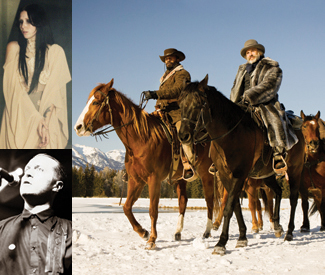
Django Unchained Quentin Tarantino’s spaghetti western homage features a cameo by the original Django (Franco Nero, star of the 1966 film), and solid performances by a meticulously assembled cast, including Jamie Foxx as the titular former slave who becomes a badass bounty hunter under the tutelage of Dr. Schultz (Christoph Waltz). Waltz, who won an Oscar for playing the evil yet befuddlingly delightful Nazi Hans Landa in Tarantino’s 2009 Inglourious Basterds, is just as memorable (and here, you can feel good about liking him) as a quick-witted, quick-drawing wayward German dentist. There are no Nazis in Django, of course, but Tarantino’s taboo du jour (slavery) more than supplies motivation for the filmmaker’s favorite theme (revenge). Once Django joins forces with Schultz, the natural-born partners hatch a scheme to rescue Django’s still-enslaved wife, Broomhilda (Kerry Washington), whose German-language skills are as unlikely as they are convenient. Along the way (and it’s a long way; the movie runs 165 minutes), they encounter a cruel plantation owner (Leonardo DiCaprio), whose main passion is the offensive, shocking "sport" of "Mandingo fighting," and his right-hand man, played by Tarantino muse Samuel L. Jackson in a transcendently scandalous performance. And amid all the violence and racist language and Foxx vengeance-making, there are many moments of screaming hilarity, as when a character with the Old South 101 name of Big Daddy (Don Johnson) argues with the posse he’s rounded up over the proper construction of vigilante hoods. It’s a classic Tarantino moment: pausing the action so characters can blather on about something trivial before an epic scene of violence. Mr. Pink would approve. (2:45) Four Star, Metreon, 1000 Van Ness, Presidio, Sundance Kabuki. (Eddy)

Gangster Squad It’s 1949, and somewhere in the Hollywood hills, a man has been tied hand and foot to a pair of automobiles with the engines running. Coyotes pace in the background like patrons queuing up for a table at Flour + Water, and when dinner is served, the presentation isn’t very pretty. We’re barely five minutes into Ruben Fleischer’s Gangster Squad, and fair warning has been given of the bloodletting to come. None of it’s quite as visceral as the opening scene, but Fleischer (2009’s Zombieland) packs his tale of urban warfare with plenty of stylized slaughter to go along with the glamour shots of mob-run nightclubs, leggy pin-curled dames, and Ryan Gosling lounging at the bar cracking wise. At the center of all the gunplay and firebombing is what’s framed as a battle for the soul of Los Angeles, waged between transplanted Chicago mobster Mickey Cohen (Sean Penn) — who wields terms like "progress" and "manifest destiny" as a rationale for a continental turf war — and a police sergeant named John O’Mara (Josh Brolin), tasked with bringing down Cohen’s empire. The assignment requires working under cover so deep that only the police chief (Nick Nolte) and the handpicked members of O’Mara’s "gangster squad" — ncluding Gosling, a half-jaded charmer who poaches Cohen’s arm candy (Emma Stone) — know of its existence. This leaves plenty of room for improvisation, and the film pauses now and again to wonder about what happens when you pit brutal amorality against brutal morality, but it’s a rhetorical question, and no one shows much interest in it. Dragged down by talking points that someone clearly wanted wedged in (as well as by O’Mara’s ponderous voice-overs), the film does better when it abandons gravitas and refocuses on spinning its mythic tale of wilder times in the Golden State. (1:53) Metreon, 1000 Van Ness. (Rapoport)

The Guilt Trip (1:35) Metreon.

A Haunted House (1:25) Metreon, 1000 Van Ness.

Hitchcock On the heels of last year’s My Week With Marilyn comes another biopic about an instantly recognizable celebrity viewed through the lens of a specific film shoot. Here, we have Anthony Hopkins (padded and prosthetic’d) playing the Master of Suspense, mulling over which project to pursue after the success of 1959’s North by Northwest. Even if you’re not a Hitch buff, it’s clear from the first scene that Psycho, based on Robert Bloch’s true crime-inspired pulpy thriller, is looming. We open on "Ed Gein’s Farmhouse, 1944;" Gein (Michael Wincott) is seen in his yard, his various heinous crimes — murder, grave-robbing, body-part hoarding, human-skin-mask crafting, etc. — as yet undiscovered. Hitchcock, portrayed by the guy who also played the Gein-inspired Hannibal Lecter, steps into the frame with that familiar droll greeting: "Guhhd eevvveeeening." And we’re off, following the veteran director as he muses "What if somebody really good made a horror picture?" Though his wife and collaborator, Alma (Helen Mirren), cautions him against doing something simply because everyone tells him not to, he plows ahead; the filmmaking scenes are peppered with behind-the-scenes moments detailed in Stephen Rebello’s Alfred Hitchcock and the Making of Psycho, the source material for John J. McLaughlin’s script. But as the film’s tagline — "Behind every Psycho is a great woman" — suggests, the relationship between Alma and Hitch is, stubbornly, Hitchcock‘s main focus. While Mirren is effective (and I’m all for seeing a lady who works hard behind the scenes get recognition), the Hitch-at-home subplot exists only to shoehorn more conflict into a tale that’s got plenty already. Elsewhere, however, Hitchcock director Sacha Gervasi — making his narrative debut after hit 2008 doc Anvil: The Story of Anvil — shows stylistic flair, working Hitchcock references into the mise-en-scène. (1:32) Embarcadero, New Parkway. (Eddy)

The Hobbit: An Unexpected Journey Make no mistake: the Lord of the Rings trilogy represented an incredible filmmaking achievement, with well-deserved Oscars handed down after the third installment in 2003. If director Peter Jackson wanted to go one more round with J.R.R. Tolkien’s beloved characters for a Hobbit movie, who was gonna stop him? Not so fast. This return to Middle-earth (in 3D this time) represents not one but three films — which would be self-indulgent enough even if part one didn’t unspool at just under three hours, and even if Jackson hadn’t decided to shoot at 48 frames per second. (I can’t even begin to explain what that means from a technical standpoint, but suffice to say there’s a certain amount of cinematic lushness lost when everything is rendered in insanely crystal-clear hi-def.) Journey begins as Bilbo Baggins (a game, funny Martin Freeman) reluctantly joins Gandalf (a weary-seeming Ian McKellan) and a gang of dwarves on their quest to reclaim their stolen homeland and treasure, batting Orcs, goblins, Gollum (Andy Serkis), and other beasties along the way. Fan-pandering happens (with characters like Cate Blanchett’s icy Galadriel popping in to remind you how much you loved LOTR), and the story moves at a brisk enough pace, but Journey never transcends what came before — or in the chronology of the story, what comes after. I’m not quite ready to declare this Jackson’s Phantom Menace (1999), but it’s not an unfair comparison to make, either. (2:50) California, Metreon, 1000 Van Ness, Sundance Kabuki. (Eddy)

Hyde Park on Hudson Weeks after the release of Lincoln, Hyde Park on Hudson arrives with a lighthearted (-ish) take on Franklin D. Roosevelt’s 1939 meeting with King George VI (of stuttering fame) and Queen Elizabeth at FDR’s rural New York estate. Casting Bill Murray as FDR is Hyde Park‘s main attraction, though Olivia Williams makes for a surprisingly effective Eleanor. But the thrust of the film concerns FDR’s relationship with his cousin, Daisy — played by Laura Linney, who’s relegated to a series of dowdy outfits, pouting reaction shots, and far too many voice-overs. The affair has zero heat, and the film is disappointingly shallow — how many times can one be urged to giggle at someone saying "Hot dogs!" in an English accent? — not to mention a waste of a perfectly fine Bill Murray performance. As that sideburned Democrat bellows in Lincoln, "Howwww dare you!" (1:35) Albany, Embarcadero. (Eddy)

The Impossible Spanish director Juan Antonio Bayona (2007’s The Orphanage) directs The Impossible, a relatively modestly-budgeted take on the 2004 Indian Ocean tsunami, based on the real story of a Spanish family who experienced the disaster. Here, the family (Naomi Watts, Ewan McGregor, three young sons) is British, on a Christmas vacation from dad’s high-stress job in Japan. Beachy bliss is soon ruined by that terrible series of waves; they hit early in the film, and Bayona offers a devastatingly realistic depiction of what being caught in a tsunami must feel like: roaring, debris-filled water threatening death by drowning, impalement, or skull-crushing. And then, the anguish of surfacing, alive but injured, stranded, and miles from the nearest doctor, not knowing if your family members have perished. Without giving anything away (no more than the film’s suggestive title, anyway), once the survivors are established (and the film’s strongest performer, Watts, is relegated to hospital-bed scenes) The Impossible finds its way inevitably to melodrama, and triumph-of-the-human-spirit theatrics. As the family’s oldest son, 16-year-old Tom Holland is effective as a kid who reacts exactly right to crisis, morphing from sulky teen to thoughtful hero — but the film is too narrowly focused on its tourist characters, with native Thais mostly relegated to background action. It’s a disconnect that’s not quite offensive, but is still off-putting. (1:54) California, Piedmont, SF Center, Sundance Kabuki. (Eddy)

Jack Reacher (2:10) Metreon, 1000 Van Ness.

Life of Pi Several filmmakers including Alfonso Cuarón, Jean-Pierre Jeunet, and M. Night Shyamalan had a crack at Yann Martel’s "unfilmable" novel over the last decade, without success. That turns out to have been a very good thing, since Ang Lee and scenarist David Magee have made probably the best movie possible from the material — arguably even an improvement on it. Framed as the adult protagonist’s (Irrfan Khan) lengthy reminiscence to an interested writer (Rafe Spall) it chronicles his youthful experience accompanying his family and animals from their just shuttered zoo on a cargo ship voyage from India to Canada. But a storm capsizes the vessel, stranding teenaged Pi (Suraj Sharma) on a lifeboat with a mini menagerie — albeit one swiftly reduced by the food chain in action to one Richard Parker, a whimsically named Bengal tiger. This uneasy forced cohabitation between Hindu vegetarian and instinctual carnivore is an object lesson in survival as well as a fable about the existence of God, among other things. Shot in 3D, the movie has plenty of enchanted, original imagery, though its outstanding technical accomplishment may lie more in the application of CGI (rather than stereoscopic photography) to something reasonably intelligent for a change. First-time actor Sharma is a natural, while his costar gives the most remarkable performance by a wild animal this side of Joaquin Phoenix in The Master. It’s not a perfect film, but it’s a charmed, lovely experience. (2:00) New Parkway, 1000 Van Ness, Presidio, SF Center. (Harvey)

Lincoln Distinguished subject matter and an A+ production team (Steven Spielberg directing, Daniel Day-Lewis starring, Tony Kushner adapting Doris Kearns Goodwin, John Williams scoring every emotion juuust so) mean Lincoln delivers about what you’d expect: a compelling (if verbose), emotionally resonant (and somehow suspenseful) dramatization of President Lincoln’s push to get the 13th amendment passed before the start of his second term. America’s neck-deep in the Civil War, and Congress, though now without Southern representation, is profoundly divided on the issue of abolition. Spielberg recreates 1865 Washington as a vibrant, exciting place, albeit one filled with so many recognizable stars it’s almost distracting wondering who’ll pop up in the next scene: Jared Harris as Ulysses S. Grant! Joseph Gordon-Levitt as Robert Lincoln! Lena Dunham’s shirtless boyfriend on Girls (Adam Driver) as a soldier! Most notable among the huge cast are John Hawkes, Tim Blake Nelson, and a daffy James Spader as a trio of lobbyists; Sally Field as the troubled First Lady; and likely Oscar contenders Tommy Lee Jones (as winningly cranky Rep. Thaddeus Stevens) and Day-Lewis, who does a reliably great job of disappearing into his iconic role. (2:30) 1000 Van Ness, Presidio, SF Center, Shattuck, Sundance Kabuki. (Eddy)

Les Misérables There is a not-insignificant portion of the population who already knows all the words to all the songs of this musical-theater warhorse, around since the 1980s and honored here with a lavish production by Tom Hooper (2010’s The King’s Speech). As other reviews have pointed out, this version only tangentially concerns Victor Hugo’s French Revolution tale; its true raison d’être is swooning over the sight of its big-name cast crooning those famous tunes. Vocals were recorded live on-set, with microphones digitally removed in post-production — but despite this technical achievement, there’s a certain inorganic quality to the proceedings. Like The King’s Speech, the whole affair feels spliced together in the Oscar-creation lab. The hardworking Hugh Jackman deserves the nomination he’ll inevitably get; jury’s still out on Anne Hathaway’s blubbery, "I cut my hair for real, I am so brave!" performance. (2:37) Marina, 1000 Van Ness, SF Center, Shattuck, Sundance Kabuki. (Eddy)

Monsters, Inc. 3D (1:35) Metreon.

My Worst Nightmare First seen locally in the San Francisco Film Society’s 2012 "French Cinema Now" series, My Worst Nightmare follows icy art curator Agathe (Isabelle Huppert) as her airless, tightly-controlled world begins to crumble — thanks in no small part to an exuberantly uncouth, down-on-his-luck Belgian contractor named Patrick (Benoît Poelvoorde). (His obnoxious, freewheeling presence in Agathe’s precision-mapped orbit gives rise to the film’s title.) Director and co-writer Anne Fontaine (2009’s Coco Before Chanel) injects plenty of offbeat, occasionally raunchy humor into what could’ve been a predictable personal-liberation tale — the sight of classy dame Huppert driving through a bikini car wash, for instance. (1:43) Smith Rafael. (Eddy)

Not Fade Away How to explain why the Beatles have been tossed so many cinematic bon mots and not the Stones? The group’s relatively short lifespan — and even the tragic, unexpectedly dramatic passing of John Lennon — seem to have all played into the band’s nostalgia-marinated legend, while the Stones’ profitable tour rotation and shocking physical resilience have lessened their romantic charge. So it reads as a counterintuitive, and a bit random, that Sopranos creator David Chase would open his first feature film with a black and white re-creation of the Mick Jagger and Keith Richards meet-up, before switching to the ’60s coming-of-age of New Jersey teen geek Douglas (John Magaro), trapped in an oppressively whiny nuclear family headed up by his Pep Boy grouch of a dad (James Gandolfini) — at least until rock ‘n’ roll saves his soul and he starts beating the skins. Graduating to better-than-average singer after his band’s frontman Eugene (Boardwalk Empire‘s Jack Huston) inhales a joint, Douglas not only finds his voice, but also wins over dream girl Grace (Bella Heathcote). Sure, Not Fade Away is about sex, drugs, and rock ‘n’ roll — and much attention is dutifully squandered on basement shows, band practice, and politics, and posturing with wacky new haircuts and funny cigarettes, thanks to Chase’s own background in garage bands and executive producer, music supervisor, and true believer Steve Van Zandt’s considerable passion. Yet despite the amount screen time devoted to rock’s rites, those familiar gestures never rise above the clichéd, and Not Fade Away only finds its authentic emotional footing when Gandolfini’s imposing yet trapped patriarch and the rest of Douglas’s beaten-down yet still kicking family enters the picture — they’re the force that refuses to fade away, even after they disappear in the rear view. (1:52) Shattuck. (Chun)

Only the Young First seen locally at the 2012 San Francisco International Film Festival, this documentary from Elizabeth Mims and Jason Tippet is styled like a narrative and often shot like a fine art photograph (or at least a particularly bitchin’ Instagram), with an unexpectedly groovy soundtrack. It follows a pair of high schoolers with ever-changing hairstyles in dried-up Santa Clarita, Calif. — a burg of abandoned mini-golf courses and squatter’s houses, and a place where the owner of the local skate shop seems equally obsessed with tacos and Jesus. It’s never clear where Garrison and Kevin fall on the religious spectrum — though "the church" has a looming importance, influencing relationships if not wardrobe choices — but one gets the feeling all they really care about is skateboarding, with their own friendship a close second. Less certain are Garrison’s feelings about punky, tough-yet-sweet gal pal Skye — especially when they begin spending time with new flames. Only the Young‘s seemingly random choice of subjects works to its advantage, capturing the kids’ unaffected, surprisingly honest point of view on subjects as varied as cars, dating, college, the economy, and Gandalf Halloween costumes. (1:10) Roxie. (Eddy)

Parental Guidance (1:36) Metreon.

The Perks of Being a Wallflower Move over, Diary of a Wimpy Kid series — there’s a new shrinking-violet social outcast in town. These days, life might not suck quite so hard for 90-pound weaklings in every age category, what with so many films and TV shows exposing, and sometimes even celebrating, the many miseries of childhood and adolescence for all to see. In this case, Perks author Stephen Chbosky takes on the directorial duties — both a good and bad thing, much like the teen years. Smart, shy Charlie is starting high school with a host of issues: he’s painfully awkward and very alone in the brutal throng, his only friend just committed suicide, and his only simpatico family member was killed in a car accident. Charlie’s English teacher Mr. Andersen (Paul Rudd) appears to be his only connection, until the freshman strikes up a conversation with feline, charismatic, shop-class jester Patrick (Ezra Miller) and his magnetic, music- and fun-loving stepsister Sam (Emma Watson). Who needs the popular kids? The witty duo head up their gang of coolly uncool outcasts their own, the Wallflowers (not to be confused with the deeply uncool Jakob Dylan combo), and with them, Charlie appears to have found his tribe. Only a few small secrets put a damper on matters: Patrick happens to be gay and involved with football player Brad (Johnny Simmons), who’s saddled with a violently conservative father, and Charlie is in love with the already-hooked-up Sam and is frightened that his fragile equilibrium will be destroyed when his new besties graduate and slip out of his life. Displaying empathy and a devotion to emotional truth, Chbosky takes good care of his characters, preserving the complexity and ungainly quirks of their not-so-cartoonish suburbia, though his limitations as a director come to the fore in the murkiness and choppily handled climax that reveals how damaged Charlie truly is. (1:43) Opera Plaza.. (Chun)

Promised Land Gus Van Sant’s fracking fable — co-written by stars Matt Damon and John Krasinski, from a story by Dave Eggers — offers a didactic lesson in environmental politics, capped off by the earth-shattering revelation that billion-dollar corporations are sleazy and evil. You don’t say! Formulated like a Capra movie, Promised Land follows company man Steve Butler (Matt Damon) as he and sales partner Sue (Frances McDormand) travel to a small Pennsylvania town to convince its (they hope) gullible residents to allow drilling on their land. But things don’t go as smoothly as hoped, when the pair faces opposition from a science teacher with a brainiac past (Hal Holbrook), and an irritatingly upbeat green activist (Krasinski) breezes into town to further monkey-wrench their scheme. That Damon is such a likeable actor actually works against him here; his character arc from soulless salesman to emotional-creature-with-a-conscience couldn’t be more predictable or obvious. McDormand’s wonderfully biting supporting performance is the best (and only) reason to see this ponderous, faux-folksy tale, which targets an audience that likely already shares its point of view. (1:46) 1000 Van Ness, SF Center. (Eddy)

Rise of the Guardians There’s nothing so camp as "Heat Miser" from The Year Without a Santa Claus (1974) in Rise of the Guardians,, but there’s plenty here to charm all ages. The mystery at its center: we open on Jack Frost (voiced by Chris Pine) being born, pulled from the depths of a frozen pond by the Man on the Moon and destined to spread ice and cold everywhere he goes, invisible to all living creatures. It’s an individualistic yet lonely lot for Jack, who’s styled as an impish snowboarder in a hoodie and armed with an icy scepter, until the Guardians — spirits like North/Santa Claus (Alec Baldwin), the Tooth Fairy (Isla Fisher), and the Easter Bunny (Hugh Jackman) — call on him to join them. Pitch the Boogeyman (Jude Law) is threatening to snuff out all children’s hopes and dreams with fears and nightmares, and it’s up to the Guardians must keep belief in magic alive. But what’s in it for Jack, except the most important thing: namely who is he and what is his origin story? Director Peter Ramsey keeps those fragile dreams aloft with scenes awash with motion and animation that evokes the chubby figures and cozy warm tones of ’70s European storybooks. And though Pine verges on blandness with his vocal performance, Baldwin, Jackman, and Fisher winningly deliver the jokes. (1:38) Metreon. (Chun)

Rust and Bone Unlike her Dark Knight Rises co-star Anne Hathaway, Rust and Bone star Marion Cotillard never seems like she’s trying too hard to be sexy, or edgy, or whatever (plus, she already has an Oscar, so the pressure’s off). Here, she’s a whale trainer at a SeaWorld-type park who loses her legs in an accident, which complicates (but ultimately strengthens) her relationship with Ali (Belgian actor Matthias Schoenaerts, so tremendous in 2011’s Bullhead), a single dad trying to make a name for himself as a boxer. Jacques Audiard’s follow-up to 2009’s A Prophet gets a bit overwrought by its last act, but there’s an emotional authenticity in the performances that makes even a ridiculous twist (like, the kind that’ll make you exclaim "Are you fucking kidding me?") feel almost well-earned. (2:00) Embarcadero, Shattuck. (Eddy)

Searching for Sugar Man The tale of the lost, and increasingly found, artist known as Rodriguez seems to have it all: the mystery and drama of myth, beginning with the singer-songwriter’s stunning 1970 debut, Cold Fact, a neglected folk rock-psychedelic masterwork. (The record never sold in the states, but somehow became a beloved, canonical LP in South Africa.) The story goes on to parse the cold, hard facts of vanished hopes and unpaid royalties, all too familiar in pop tragedies. In Searching for Sugar Man, Swedish documentarian Malik Bendjelloul lays out the ballad of Rodriguez as a rock’n’roll detective story, with two South African music lovers in hot pursuit of the elusive musician — long-rumored to have died onstage by either self-immolation or gunshot, and whose music spoke to a generation of white activists struggling to overturn apartheid. By the time Rodriguez himself enters the narrative, the film has taken on a fairy-tale trajectory; the end result speaks volumes about the power and longevity of great songwriting. (1:25) Opera Plaza. (Chun)

The Sessions Polio has long since paralyzed the body of Berkeley poet Mark O’Brien (John Hawkes) from the neck down. Of course his mind is free to roam — but it often roams south of the personal equator, where he hasn’t had the same opportunities as able-bodied people. Thus he enlists the services of Cheryl (Helen Hunt), a professional sex surrogate, to lose his virginity at last. Based on the real-life figures’ experiences, this drama by Australian polio survivor Ben Lewin was a big hit at Sundance this year (then titled The Surrogate), and it’s not hard to see why: this is one of those rare inspirational feel-good stories that doesn’t pander and earns its tears with honest emotional toil. Hawkes is always arresting, but Hunt hasn’t been this good in a long time, and William H. Macy is pure pleasure as a sympathetic priest put in numerous awkward positions with the Lord by Mark’s very down-to-earth questions and confessions. (1:35) New Parkway, Opera Plaza. (Harvey)

Silver Linings Playbook After guiding two actors to Best Supporting Oscars in 2010’s The Fighter, director David O. Russell returns (adapting his script from Matthew Quick’s novel) with another darkly comedic film about a complicated family that will probably earn some gold of its own. Though he’s obviously not ready to face the outside world, Pat (Bradley Cooper) checks out of the state institution he’s been court-ordered to spend eight months in after displaying some serious anger-management issues. He moves home with his football-obsessed father (Robert De Niro) and worrywart mother (Jacki Weaver of 2010’s Animal Kingdom), where he plunges into a plan to win back his estranged wife. Cooper plays Pat as a man vibrating with troubled energy — always in danger of flying into a rage, even as he pursues his forced-upbeat "silver linings" philosophy. But the movie belongs to Jennifer Lawrence, who proves the chops she showcased (pre-Hunger Games megafame) in 2010’s Winter’s Bone were no fluke. As the damaged-but-determined Tiffany, she’s the left-field element that jolts Pat out of his crazytown funk; she’s also the only reason Playbook‘s dance-competition subplot doesn’t feel eye-rollingly clichéd. The film’s not perfect, but Lawrence’s layered performance — emotional, demanding, bitchy, tough-yet-secretly-tender — damn near is. (2:01) Four Star, Piedmont, Presidio, SF Center, Shattuck. (Eddy)

Skyfall Top marks to Adele, who delivers a magnificent title song to cap off Skyfall‘s thrilling pre-credits chase scene. Unfortunate, then, that the film that follows squanders its initial promise. After a bomb attack on MI6, the clock is running out for Bond (Daniel Craig) and M (Judi Dench), accused of Cold War irrelevancy in a 21st century full of malevolent, stateless computer hackers. The audience, too, will yearn for a return to simpler times; dialogue about "firewalls" and "obfuscated code" never fails to sound faintly ridiculous, despite the efforts Ben Whishaw as the youthful new head of Q branch. Javier Bardem is creative and creepy as keyboard-tapping villain Raoul Silva, but would have done better with a megalomaniac scheme to take over the world. Instead, a small-potatoes revenge plot limps to a dull conclusion in the middle of nowhere. Skyfall never decides whether it prefers action, bon mots, and in-jokes to ponderous mythologizing and ripped-from-the-headlines speechifying — the result is a unsatisfying, uneven mixture. (2:23) Metreon, Shattuck, Sundance Kabuki. (Ben Richardson)

Texas Chainsaw 3D (1:32) Metreon, 1000 Van Ness.

This is 40 A spin-off of sorts from 2007’s Knocked Up, Judd Apatow’s This is 40 continues the story of two characters nobody cared about from that earlier film: Debbie (Leslie Mann, Apatow’s wife) and Pete (Paul Rudd), plus their two kids (played by Mann and Apatow’s kids). Pete and Debbie have accumulated all the trappings of comfortable Los Angeles livin’: luxury cars, a huge house, a private personal trainer, the means to throw catered parties and take weekend trips to fancy hotels (and to whimsically decide to go gluten-free), and more Apple products than have ever before been shoehorned into a single film. But! This was crap they got used to having before Pete’s record label went into the shitter, and Debbie’s dress-shop employee (Charlene Yi, another Knocked Up returnee who is one of two people of color in the film; the other is an Indian doctor who exists so Pete can mock his accent) started stealing thousands from the register. How will this couple and their whiny offspring deal with their financial reality? By arguing! About bullshit! In every scene! For nearly two and a half hours! By the time Melissa McCarthy, as a fellow parent, shows up to command the film’s only satisfying scene — ripping Pete and Debbie a new one, which they sorely deserve — you’re torn between cheering for her and wishing she’d never appeared. Seeing McCarthy go at it is a reminder that most comedies don’t make you feel like stabbing yourself in the face. I’m honestly perplexed as to who this movie’s audience is supposed to be. Self-loathing yuppies? Masochists? Apatow’s immediate family, most of whom are already in the film? (2:14) Metreon, 1000 Van Ness, Shattuck, Vogue. (Eddy)

Wreck-It Ralph Wreck-It Ralph cribs directly from the Toy Story series: when the lights go off in the arcade, video game characters gather to eat, drink, and endure existential crises. John C. Reilly is likable and idiosyncratic as Ralph, the hulking, ham-fisted villain of a game called Fix-It-Felix. Fed up with being the bad guy, Ralph sneaks into gritty combat sim Hero’s Duty under the nose of Sergeant Calhoun (Jane Lynch), a blond space marine who mixes Mass Effect‘s Commander Shepard with a PG-rated R. Lee Ermey. Things go quickly awry, and soon Ralph is marooned in cart-racing candyland Sugar Rush, helping Vanellope Von Schweetz (a manic Sarah Silverman), with Calhoun and opposite number Felix (Jack McBrayer) hot on his heels. Though often aggressively childish, the humor will amuse kids, parents, and occasionally gamers, and the Disney-approved message about acceptance is moving without being maudlin. The animation, limber enough to portray 30 years of changing video game graphics, deserves special praise. (1:34) Metreon, Shattuck. (Ben Richardson)

Zero Dark Thirty The extent to which torture was actually used in the hunt for Osama Bin Ladin may never be known, though popular opinion will surely be shaped by this film, as it’s produced with the same kind of "realness" that made Kathryn Bigelow’s previous film, the Oscar-winning The Hurt Locker (2008), so potent. Zero Dark Thirty incorporates torture early in its chronology — which begins in 2003, after a brief opening that captures the terror of September 11, 2001 using only 911 phone calls — but the practice is discarded after 2008, a sea-change year marked by the sight of Obama on TV insisting that "America does not torture." (The "any more" goes unspoken.) Most of Zero Dark Thirty is set in Pakistan and/or "CIA black sites" in undisclosed locations; it’s a suspenseful procedural that manages to make well-documented events (the July 2005 London bombings; the September 2008 Islamabad Marriott Hotel bombing) seem shocking and unexpected. Even the raid on Bin Ladin’s HQ is nail-bitingly intense. The film immerses the viewer in the clandestine world, tossing out abbreviations ("KSM" for al-Qaeda bigwig Khalid Sheikh Mohammed) and jargon ("tradecraft") without pausing for a breath. It is thrilling, emotional, engrossing — the smartest, most tightly-constructed action film of the year. At the center of it all: a character allegedly based on a real person whose actual identity is kept top-secret by necessity. She’s interpreted here in the form of a steely CIA operative named Maya, played to likely Oscar-winning perfection by Jessica Chastain. No matter the film’s divisive subject matter, there’s no denying that this is a powerful performance. "Washington says she’s a killer," a character remarks after meeting this seemingly delicate creature, and he’s proven right long before Bin Ladin goes down. Some critics have argued that character is underdeveloped, but anyone who says that isn’t watching closely enough. Maya may not be given a traditional backstory, but there’s plenty of interior life there, and it comes through in quick, vulnerable flashes — leading up to the payoff of the film’s devastating final shot. (2:39) Balboa, Marina, 1000 Van Ness, SF Center, Sundance Kabuki. (Eddy)


Spies on the corner

23

rebecca@sfbg.com

In the Netherlands city of Eindhoven, the streetlights lining a central commercial strip will glow red if a storm is coming. It’s a subtle cue that harkens back to an old phrase about a red sky warning mariners that bad weather is on the way. The automated color change is possible because satellite weather data flows over a network to tiny processors installed inside the lampposts, which are linked by an integrated wireless system.

Lighting hues reflecting atmospheric changes are only the beginning of myriad functions these so-called “smart streetlights” can perform. Each light has something akin to a smartphone embedded inside of it, and the interconnected network of lights can be controlled by a central command center.

Since they have built-in flexibility for multiple adaptations, the systems can be programmed to serve a wide variety of purposes. Aside from merely illuminating public space, possible uses could include street surveillance with tiny cameras, monitoring pedestrian or vehicle traffic, or issuing emergency broadcasts via internal speaker systems.

The smart streetlights aren’t just streetlights — they’re data collection devices that have the potential to track anything from pedestrian movements to vehicle license plate numbers. And, through a curious process distinctly lacking in transparency, these spylights are on their way to San Francisco.

BIG PLANS

On Minna between Fourth and Sixth streets in downtown San Francisco, the San Francisco Public Utilities Commission has installed a pilot project to test 14 streetlights that are connected by a wireless control system. The city agency plans to gauge how well this system can remotely read city-owned electric meters, wirelessly transmit data from tiny traffic cameras owned by the Municipal Transportation Agency, and transmit data from traffic signals.

The pilot grew out of San Francisco’s participation in an international program called the Living Labs Global Award, an annual contest that pairs technology vendors with officials representing 22 cities from around the world. At a May 2012 LLGA awards summit in Rio de Janeiro, far outside the scope of the city’s normal bidding processes, a Swiss company called Paradox Engineering won the right to start testing the high-tech lights in San Francisco. Within six months, Paradox Engineering and the SFPUC had the Minna streetlights test up and running.

Meanwhile, the city has issued a separate Request for Proposals for a similar pilot, which will test out “adaptive lighting” that can be dimmed or brightened in response to sensors that register pedestrian activity or traffic volume. The city is negotiating contracts with five firms that will test out this technology in three different locations, according to Mary Tienken, Project Manager for LED Streetlight Conversion Project for the SFPUC.

Under the program, five vendors will be chosen to demonstrate their wireless streetlights on 18 city-owned lights at three test sites: Washington Street between Lyon and Maple streets; Irving Street between 9th and 19th avenues; and Pine Street between Front and Stockton streets.

LED streetlights are energy-efficient and could yield big savings — but the lights do far more than shine. The RFP indicates that “future needs for the secure wireless transmission of data throughout the city” could include traffic monitoring, street surveillance, gunshot monitoring and street parking monitoring devices.

So far, the implications of using this technology for such wide-ranging objectives have barely been explored. “San Francisco thought they were upgrading their 18,000 lamps with LEDs and a wireless control system, when they realized that they were in fact laying the groundwork for the future intelligent public space,” LLGA cofounder Sascha Haselmeyer stated in an interview with Open Source Cities. “Eindhoven is pioneering this with … completely new, intelligent lighting concepts that adapt to the citizen not just as a utility, but a cultural and ambient experience. So many questions remain,” he added, and offered a key starting point: “Who owns all that data?”

LUMINARIES IN LIGHTING

Phillips Lighting, which was involved in installing the Eindhoven smart streetlights system, played a role in launching the San Francisco pilot. Paradox Engineering recently opened a local office. Oracle, a Silicon Valley tech giant, is also involved — even though it’s not a lighting company.

“Oracle, of course, manages data,” Haselmeyer explained to the Guardian when reached by phone in his Barcelona office. “They were the first to say, ‘We need to understand how data collected from lampposts will be controlled in the city.'”

According to a press release issued by Paradox Engineering, “Oracle will help managing and analyzing data coming from this ground-breaking system.” Oracle is also a corporate sponsor of the LLGA program. It has been tangentially involved in the pilot project “because of a longstanding relationship we had with the city of San Francisco,” Oracle spokesperson Scott Frendt told us.

Paradox was selected as the winner for San Francisco’s “sustainability challenge” through LLGA, which is now housed under CityMart.com, “a technology start-up offering a professional networking and market exchange platform,” according to the company website.

In May of 2012, the SFPUC sent one of its top-ranking officials, Assistant General Manager Barbara Hale, to Rio for the LLGA awards summit. There, technology vendors of all stripes showcased their products and mingled with local officials from Barcelona, Cape Town, Glasgow, Fukuoka and other international cities. San Francisco was the only US city in attendance. San Francisco will even host the next summit this coming May at Fort Mason.

In Rio, Paradox was lauded as the winning vendor for San Francisco’s LLGA streetlights “challenge.” It didn’t take long for the company to hit the ground running. “Soon after the Rio Summit on Service Innovation in Cities, where we were announced winners for San Francisco, we started discussing with the SFPUC the objectives and features of the pilot project,” Paradox announced on the LLGA website. “Working closely with the SFPUC, we also had the opportunity to build solid partnerships with notable industry players such as Philips Lighting and Oracle.”

WINNERS’ CIRCLE

On Nov. 15, Paradox hosted an invite-only “networking gala” titled “Smart Cities: The Making Of.” The event brought together representatives from Oracle, the SFPUC, Phillips, LLGA, and the Mayor’s Office of Civic Innovation, “to learn about the challenges of urban sustainability in the Internet of Things era,” according to an event announcement.

“The project we’re piloting with the SFPUC is highly innovative since it puts into practice the new paradigm of the ‘Internet of Things,’ where any object can be associated with an IP address and integrated into a wider network to transmit and receive relevant information,” Gianni Minetti, president and CEO at Paradox, stated in a press release.

The event was also meant to celebrate Paradox’s expansion into the North American urban lighting space, a feat that was greatly helped along by the LLGA endeavor. But how did a Swiss company manage to hook up with a San Francisco city agency in the first place — and win a deal without ever going through the normal procurement process?

San Francisco’s involvement in LLGA began with Chris Vein, who served as the city’s Chief Technology Officer under former Mayor Gavin Newsom. (Vein has since ascended to the federal government to serve as Deputy U.S. Chief Technology Officer for Government Innovation for President Barack Obama.)

To find the right fit for San Francisco’s wireless LED streetlights “challenge” under the LLGA program, a judging panel was convened to score more than 50 applicant submissions received through the program framework. Judges were selected “based upon knowledge and contacts of people in the SFPUC Power Enterprise,” Tienken explained. The scoring system, Haselmeyer said, measures sustainability under a rubric developed by the United Nations.

Jurists for San Francisco’s streetlight program were handpicked from the SFPUC, the San Francisco Department of Technology, Phillips, and several other organizations. An international jurist is designated by LLGA for each city’s panel of jurists, Haselmeyer said, “so as to avoid any kind of local stitch-up.”

He stressed that “the city is explicitly not committing to any procurement.” Instead, vendors agree to test out their technology in exchange for cities’ dedication of public space and other resources. Tienken, who manages the city’s LED Streetlight Conversion Project, noted that “Paradox Engineering is not supposed to make a profit” under the LLGA program guidelines. “We’ll pay them a $15,000 stipend,” she said, the same amount that will be awarded to the firms that are now in negotiation for pilot projects of their own.

“San Francisco is using this to learn about the solution,” Haselmeyer added. “This company will not have any advantage,” when it comes time to tap a vendor for the agency’s long-term goal of upgrading 18,500 of its existing streetlights with energy-saving LED lamps and installing a $2 million control system.

At the same time, the program clearly creates an inside track — and past LLGA participants have landed lucrative city contracts. Socrata, a Seattle-based company, was selected as a LLGA winner in 2011 and invited to run a pilot project before being tapped to power data.SFgov.org, the “next-generation, cloud-based San Francisco Open Data site” unveiled by Mayor Ed Lee’s office in March of 2012.

The mayor’s press release, which claimed that the system “underscores the Mayor’s commitment to providing state of the art access to information,” made no mention of LLGA.

PRIVACY AND PUBLIC SPACE

Throughout this process of attending an international summit in Rio, studying applications from more than 50 vendors, selecting Paradox as a winner, and later issuing an RFP, a very basic question has apparently gone unaddressed. Is a system of lighting fixtures that persistently collects data and beams it across invisible networks something San Franciscans really want to be installed in public space?

And, if these systems are ultimately used for street surveillance or traffic monitoring and constantly collecting data, who will have access to that information, and what will it be used for? Haselmeyer acknowledged that the implementation of such a system should move forward with transparency and a sensitivity to privacy implications.

“Many cities are deploying sensors that detect the Bluetooth signal of your mobile phone. So, they can basically track movements through the city,” Haselmeyer explained. “Like anything with technology, there’s a huge amount of opportunity and also a number of questions. … You have movement sensors, traffic sensors, or the color [of a light] might change” based on a behavior or condition. “There’s an issue about who can opt in, or opt out, of what.”

Tienken and Sheehan downplayed the RFP’s reference to “street surveillance” as a potential use of the wireless LED systems, and stressed that the pilot projects are only being used to study a narrow list of features. “The PUC’s interest is in creating an infrastructure that can be used by multiple agencies or entities … having a single system rather than have each department install its own system,” Tienken said. The SFPUC is getting the word out about the next batch of pilots by reaching out to police precinct captains and asking them to announce it in their newsletters, since “streetlighting is a public safety issue,” as Tienken put it.

Haselmeyer acknowledged that public input in such a program is important: “It’s very important to do these pilot projects, because it allows those community voices to be heard. In the end, the city has to say, look — is it really worth all of this, or do we just want to turn our lights on and off?”

LIGHTS, BUT NO SUNSHINE

One company that is particularly interested in San Francisco pilot is IntelliStreets, a Michigan firm that specializes in smart streetlights. IntelliStreets CEO Ron Harwood told the Guardian that his company was a contender for the pilot through LLGA; he even traveled to Rio and delivered a panel talk on urban lighting systems alongside Hale and a representative from Oracle.

A quick Google search for IntelliStreets shows that the company has attracted the attention of activists who are worried that these lighting products represent a kind of spy tool, and a spooky public monitoring system that would strip citizens of their right to privacy and bolster law enforcement activities.

“It’s not a listening device,” Harwood told the Guardian, when asked about speakers that would let operators communicate with pedestrians, and vice-versa. “So you can forget about the Fourth Amendment” issues.

Harwood seemed less concerned about the activists who’ve decried his product as a modern day manifestation of Big Brother, and more worried about why his company was not chosen to provide wireless LED streetlights in San Francisco. After being passed over in the LLGA process, Harwood said IntelliStreets responded to the RFP issued in the weeks following the Rio summit. Once again, Harwood’s firm didn’t make the cut.

Since his company provides very similar services to those described in the RFP, Harwood said he was “confused” by the outcome of the selection process. IntelliStreets’ Chief Administration Officer Michael Tardif was more direct. “Clearly we think this was an inside deal,” Tardif told the Guardian. Tienken, for her part, declined to discuss why San Francisco had rejected IntelliStreets’ application.

And when a public records request was submitted to the agency last August for details on San Francisco’s participation in LLGA, the response was opaque at best. “After a duly diligent search we find that there are no documents responsive to your request,” an SFPUC public records coordinator responded via email. “The San Francisco Public Utilities Commission is not a participant, nor is involved with Living Labs Global Award. Please know that we take our obligations under the Sunshine Ordinance very seriously.” That was just an honest mistake, Sheehan tells the Guardian now by way of explanation. In the public records division, “Clearly, nobody had any familiarity with LLGA.”

Sacred space

5

emilysavage@sfbg.com

MUSIC There will be no bad seats at the new SFJazz Center in Hayes Valley; or at least, that’s the goal.

The brand new jazz venue in the heart of town, a three-story, glass-encased structure with a circular concrete stadium bowl of an auditorium, educational components, rehearsal spaces, a cafe run by the Slanted Door’s Charles Phan, and multiple bars opens Mon/21. It’s a $63 million, 35,000-square-foot addition to Performing Arts Row, near Van Ness-adjacent locations such as the Davies Symphony Hall, and the War Memorial Opera House. It’s the birth of a nonprofit jazz institution.

In the auditorium, 700 seats encircle and hover above a central stage — chairs behind the stage, up in the balcony, and practically up in the artists’ faces on the ground level. Because the room so surrounds the stage, there’s a direct sight line for every instrument being played, every hand grasping a horn, tickling keys, or plucking strings. There are platforms that can accordion and retract, making that enviable space near the stage open up into a temporary dance floor.

And all the seats have cup-holders. We’re a long way from the smoke-filled, underground jazz clubs of the past.


EXCITING AS ALL HELL

And from those seats in the Robert N. Miner auditorium, patrons will see an impressive first season of SF Jazz at its new home. Fans already have high expectations, given SF Jazz’s 30 years of hosting concerts and festivals at other venues like the Paramount in Oakland, and smaller clubs like Amnesia. Now with its own multi-use facility, the nonprofit has taken eclectic routes with its programming and contributions.

“This first season, when you look at some of the things we’re doing here, it’s just exciting as all hell,” says founder and executive artistic director Randall Kline, barely able to contain that excitement, clad in a hardhat and reflective vest on the first level of the still-under-construction building. “[These events] fully take advantage of what we can do with the theater — something we couldn’t do when we didn’t have our own place.”

For starters, there’s a sold-out opening night celebration Jan. 23, hosted by Bill Cosby, along with a grand opening week of shows spotlighting McCoy Tyner, the SFJazz Collective, and more, followed by a week of big band with the Realistic Orchestra (Jan. 31), and swing with Lavay Smith and Her Red Hot Skillet Lickets (Feb. 3).

In March, virtuoso Indian percussionist Zakir Hussain will perform four nights, and in April there will be a Weimar Germany themed weekend with Ute Lemper, Max Raabe and the Palast Orchester, and a screening of the classic Metropolis (1927), with live music by the Clubfoot Orchestra.

But even more to Kline’s point: there will be five resident artistic directors for the 2013 through ’14 season (along with Kline’s overall vision). The five — Jason Moran, Regina Carter, Bill Frisell, John Santos, and Miguel Zenon — are musicians with distinctive backgrounds and viewpoints, programming four days of thematic events.


ENCOMPASSING GEOGRAPHIES

For his days, Santos hand-picked colleagues and artists working and performing in the Caribbean style. He chose De Akokan, a duo made up of Cuban singer-songwriter-composer Pavel Urkiza and Puerto Rican saxophonist-composer Ricardo Pons, because “they’re phenomenal artists…and they rarely come here.” He also invited cutting edge trombonist-composer Papo Vazquez, who lives in New York but is steeped in the Afro-Puerto Rican tradition.

During a phone call a few hours before my hard-hatted venue walk-through with Kline, architect Mark Cavagnero, and Marshall Lamm, who does public relations for the center, Santos discusses his anticipation and interest in the upcoming schedule.

The Bay Area bred percussionist will also be premiering his own Filosofia Caribena II, which refers to Caribbean philosophies and traditions — those that have informed his entire body of work. “[It] blends all the experiences of Black American music with Caribbean traditions, and it goes into the whole socio-political aspect of how the music really represents resistance and the identity of a whole group of people that identify culturally, even though we don’t live in Cuba or Puerto Rico, but we certainly grew up in and maintained those traditions.”

Adding, “Jazz was born in that environment, in New Orleans, in the Caribbean community. We’re making those connections between jazz and the Caribbean roots.”

Frisell’s batch of shows, beginning April 18, will include multimedia pieces with projections and orchestras, readings of Allen Ginsber’s Kaddish, and Hunter S. Thompson’s The Kentucky Derby is Decadent and Depraved (the latter of which is rumored to be narrated by Tim Robbins).

Moran’s residency likely represents the scope of the auditorium’s versatility best: he’ll open with a solo acoustic piano night (May 2), followed by a “Fats Waller Dance Party” with Meshell Ndegeocello that utilizes the dance-floor, then break out the inspired, possibly nutty, concept of a skateboarding jazz piece. There will be an actual half-pipe on the lower level of the room — seats pushed back — with professional skateboarders riding back and forth in the curved structure to Moran’s musical accompaniment.


FOCAL POINT

It’ll be one of many configurations for that striking room. The specifics of the auditorium were big challenges for architect Cavagnero — the acoustics, the balance of sound (such as making sure solo piano and thundering skateboarding dips both fill the space equally), isolating street noise, creating those excellent sight lines from every angle.

“The idea of the building was to make the big concrete room the sacred space for music, the focus space,” says Cavagnero, walking up the stairs in the building’s glass-encased entryway. “That was going to be the closed, sacred space, [and] everything else would wrap around it and be as open and public as we could make it.”

To that end, the rest of the building has floor-to-ceiling glass, and the staircase has no columns supporting it, just thin titanium rods that double as the guardrail. The second floor has bars on either ends and terraces with glass doors that fully open, along with tiled murals representing the history of jazz in the city, with long-gone clubs painted throughout.

It’s clear that this building is meant to be more than a standard music venue, the goal is to be an institution.

“So, if the paradigm is: clubs are harder to run and have live music, well, if we could have the same kind of vibrant music in an institution that supported that kind of thing, to build up a community of people that cared about that kind of thing — which is the gamble I guess we’re making here in this building — we can build it for the jazz community,” says Kline. “[The goal is to have] a great place to hang out and hear live music, where new artists can grow and premiere, and be nurtured.”

And it is hard to run live jazz venues in the city. Nearing the end of 2012, the owners of Oakland’s Yoshi’s filed for involuntary bankruptcy to put its San Francisco location in Chapter 11 if it couldn’t meet an agreement with its partners, the Rrazz Room switched venues under a cloud of controversy stemming from an allegedly racist former manager of its then-location, and Savanna Jazz had to fight off foreclosure.

“We have not seen an increased interest for the art form [recently] primarily because the economy is down significantly and the arts are usually the first to suffer,” says Savanna Jazz co-owner Pascal Bokar.

Because of this, I ask Bokar if other jazz club owners in the city see the center as a contentious new rival. He categorically denies that assertion.

“Jazz is an art form and it has no competition, every club and club owner adds to the fabric of our community and SFJazz is the big brother. I know how hard it is to promote jazz and [Kline] has been working at it for several decades,” he says. “He deserves tremendous credit for bringing this to San Francisco. SFJazz is a very powerful organization and I think that there is an opportunity for [it] to partner with the smaller venues like Savanna Jazz. The smaller venues are the incubators of local talent and I think that they would benefit from a closer relationship, which in turn would solidify community commitment.”

It may be the older sibling to smaller clubs, but given the economy, and the tough climate for all music venues in San Francisco really, the SF Jazz Center does also feel like a gamble itself. But to extend and belabor the metaphor, Kline’s got a good hand.

Santos describes the center to me as a “bold experiment.”

“The amount of money that it has taken to build that place and keep the doors open is phenomenal, and in a lot of ways, it’s a step out into the darkness,” he says. “But I see the potential of it as just limitless. It can be such an incredible thing, if the community supports it. That’s what I’m hoping will happen.”


NATIONAL ART FORM

Santos points out that the jazz center is unique in its fans and patrons differing from the typical performing arts donor, and will have specific obstacles because of that.

“In a way, it’s abstract, when you think of it like, OK, there it is, next door to the symphony hall, to the ballet, to the opera, within one block of those institutions. It’s wonderful to have jazz there, and standing toe-to-toe with those institutions, and getting the respect it deserves. Getting public support from the city and the country and the state, as it should be, because jazz is our national art form. The symphony and the ballet and the opera are not.”

“The difficult part is that the opera and the symphony and the ballet have traditional well-heeled audiences of supporters. Jazz does not. Jazz is grassroots; it’s working class. The audience for jazz and the community from where jazz comes out of is not a deep-pocket kind of community. And that’s where the challenge lies.”

If anyone can face that, it’s Kline. It’s part of his whole bootstrapping essence, how he’s kept SFJazz up, running, and prominent for the better part of three decades. From its humble beginnings as the three-day Jazz in the City festival, promoted solely by Kline, to the Summerfest, the SFJazz High School All-Stars group, the monthly Hotplate series, and finally, the SFJazz Center.

Leaning against the guardrail on the second floor of the building, gazing out through the wall of glass to the greater Hayes Valley neighborhood, Kline smiles as he talks of the city’s history with jazz, his own life mirroring it for quite some time. “I’ve been here since 1976, and I’ve seen a lot of patterns in the scene; it ebbs and flows, the economy changes. This building is a reflection of the sociology; we’re trying to be relevant, so we’ve chosen a different model, we’ve chosen institution.”

It’s one of a few times that will come up in my conversations with those involved with the center.

“Could we apply that older model for culture to a younger, vibrant art form that’s relevant to the city?” he asks, rhetorically. “That’s the aim here, to try something that’s of our time.”

Jazz hands: Some SFJazz season highlights


MCCOY TYNER

A rare old school jazz legend in the center’s inaugural season — stunning and dapper pianist Tyner will “consecrate” the space by performing with the SFJazz house band.

Jan. 24, 7:30pm, $50–$150


MONTCLAIR WOMEN’S BIG BAND

Swing is still huge in SF, and this celebration of the classic big band sound pairs the 17-member Montclair Women with the 20-member Realistic Orchestra (who’ve big-banded Bjork) for a wall of swingin’ sound. The SFJazz High School All-Stars Orchestra opens.

Jan. 31, 7:30pm, $25


AFRO-CUBAN ALL STARS

Oh heck yes.

Feb. 22-24, 7:30pm, $25–$65


MARIZA

The gorgeous longing of Portuguese fado washes over the Bay in the form of the wonderfully voiced Mariza, a spellbinding star whose repertoire spotlights acoustic melancholy melodies from Brazil, Cape Verde, North Africa, and beyond.

Mar. 14-17, 7:30pm, $25–$65


“JOHN SANTOS: FILOSOFÍA CARIBEÑA II”

Beloved Bay Area bandleader and jazz evangelist digs deep in his knowledge of Cuban, Latin, and indigenous Caribbean styles to deliver a heady trip through ancient Iberian influences and contemporary island expressions.

Mar. 23, 7:30pm, $25–$65


METROPOLIS

San Francisco’s Club Foot Orchestra performs its renowned futuristic soundtrack to Fritz Lang’s silent sci-fi masterpiece.

Apr. 14, 7:30pm, $20–$40


“ALLEN GINSBERG’S KADDISH” AND “HUNTER S. THOMPSON’S THE KENTUCKY DERBY

Überhip guitarist Bill Frissell, an SFJazz resident artistic director, applies his downtown cool pedigree to two überhip literary iconoclasts. He’ll be conducting an ace team of musicians for multimedia presentations of Ginsberg’s epic poem of mourning and Thompson’s notorious, uproarious 1970 article about the grand horse race. With visual design by Ralph Steadman for both programs, classic counterculture will be out in force.

Ginsberg: Apr. 18, 7pm and 9:30pm, $35–$80

Thompson: Apr. 20, 7:30pm and Apr. 21, 4pm and 7pm, $35–$80


BANDWAGON AND LIVE SKATEBOARDING

“Jazz wild card” and MacArthur Genius pianist Jason Moran gets contemporary with new trio Bandwagon, performing a rolicking set as a who’s-who of SF skateboarders shows off the flexibility of the new center.

May 4, 7:30pm, $20–$40


Bizarro mainstream SF sweeps Grindr’s “Best of 2012” — pukes us in the mouth a little

14

Dear gay hookup app Grindr,

Maybe it’s just an indication of the type of homosexual who uses your service, and who deigns to participate in surveys like your new “Best of 2012” attempt to broaden your reach into hyperlocalism (soooo 2k9, btw). Or maybe its merely very telling of how you’ve lost any edginess to rivals like Scruff — which, judging from a Scruff glance, is very sad indeed.

But thanks for the violent retch and terrified giggle yesterday when you unveiled the reader-selected wieners  winners of your besties awards. You somehow managed to record every crap gay mainstream stereotype of San Francisco you could, sorry. Also, craaaazy. Scott Wiener as “best community advocate”? Is Pottery Barn a community? 

Anyway, San Francisco itself won every local category of the national survey. Also telling! What uncruisable gym queen with expensive hair is sitting in Badlands right now, possibly Scott Wiener’s best friend, refreshing Grindr and voting wildly? Can someone call their alcoholic Rihanna fan roommate in embroidered jeans and wraparound Gucci shades and find out?

Below is the list of top vote-getters, with commentary

National winners   

    Gay icon of the year: Anderson Cooper
    Straight ally of the year: Barack Obama
     Best TV show: “Modern Family”
    Best TV host: Ellen DeGeneres
    Best source for gossip: TMZ
    TIE for best comedian: Kathy Griffin and Margaret Cho
    Best athlete: Orlando Cruz
    Movie of the year: “Magic Mike”
    Song of the year: “Call Me Maybe” by Carly Rae Jepsen
    Gadget of the year: iPhone 5

Every one of these things is the exact color of water, but somehow boringer.


Grindr users picked these local landmarks to come out on top:

Gym with the hottest guys:

    Fitness SF (San Francisco)

It’s not the winner per se that horrifies — FitnessSF came into being when it cast off the shackles of its homophobic Gold’s Gym franchise early last year. It’s the category itself. Claim that shallowness!

Best place to get a haircut:

    Salon Baobao (San Francisco)

Waxing available!

Best place to take a first date:

    Castro (San Francisco)

… to steal their wallet and leave them there.

Best Sunday funday:

    Jock Sundays at the Lookout (San Francisco)

Cute but meh.

Favorite gay bar/club:

    Badlands (San Francisco)

Fuck noooooo.

Favorite bartender:

     Mike at Lookout (San Francisco)

If they mean our cute and dear friend Michael — we wholeheartedly agree with Grindr on this point. He’s a great argument for why you should just stick to bars for your pickups, maybe.  

Best gay night/party:

    Beatbox (San Francisco)

This is neither a night nor a party.

Best DJ:

    Haute Toddy (San Francisco)

OK they could have done a lot worse than this completely inoffensive fingerful of vanilla frosting.

Fiercest drag queen/nightlife personality:

    Pollo Del Mar (San Francisco)

If anyone deserves the incredibly contemporary gay slang term “fiercest,” it is Pollo for sure.

Local hero/community advocate of the year:

    Scott Wiener (San Francisco)

According to our new sister paper SF Weekly, Wiener said this win finally “put to rest the issue of whether the nudity ban was a gay thing.” That was never the issue. But Scott is the mayor of Grindr!

Best local gay news outlet:

    The Bay Area Reporter (San Francisco)

I am so surprised that GLOSS Magazine did not win this!!!


Eh, maybe we’re not so surprised by this list after all

Gangsters, death, and spaghetti westerns: must be another week of movies!

0

Well, they announced the Oscar nominations yesterday, and much-lauded import Amour is opening today (review below the jump), so if you’re curious about the hype and don’t mind having a downer of a Friday night … you’re set. Other films opening this week include the Robert Carlyle drama California Solo (Dennis Harvey’s review here), Marlon Wayans horror spoof A Haunted House, Ryan Gosling-in-a-fedora cop flick Gangster Squad, and (at the Roxie), teen-skater doc Only the Young.

Also! The Pacific Film Archive’s “The Hills Run Red: Italian Westerns, Leone, and Beyond” series starts this week. Plenty of good spaghetti western action to be had; check out my round-up here. Read on for more short takes on this week’s releases.

Amour Arriving in local theaters atop a tidal wave of critical hosannas, Amour now seeks to tempt popular acclaim — though actually liking this perfectly crafted, intensely depressing film (from Austrian director Michael Haneke) may be nigh impossible for most audience members. Eightysomething former music teachers Georges and Anne (the flawless Jean-Louis Trintignant and Emmanuelle Riva) are living out their days in their spacious Paris apartment, going to classical concerts and enjoying the comfort of their relationship. Early in the film, someone tries to break into their flat — and the rest of Amour unfolds with a series of invasions, with Anne’s declining health the most distressing, though there are also unwanted visits from the couple’s only daughter (an appropriately self-involved Isabelle Huppert), an inept nurse who disrespects Anne and curses out Georges, and even a rogue pigeon that wanders in more than once. As Anne fades into a hollow, twisted, babbling version of her former self, Georges also becomes hollow and twisted, taking care of her while grimly awaiting the inevitable. Of course, the movie’s called Amour, so there’s some tenderness involved. But if you seek heartwarming hope and last-act uplift, look anywhere but here. (2:07) (Cheryl Eddy)

Gangster Squad It’s 1949, and somewhere in the Hollywood hills, a man has been tied hand and foot to a pair of automobiles with the engines running. Coyotes pace in the background like patrons queuing up for a table at Flour + Water, and when dinner is served, the presentation isn’t very pretty. We’re barely five minutes into Ruben Fleischer’s Gangster Squad, and fair warning has been given of the bloodletting to come. None of it’s quite as visceral as the opening scene, but Fleischer (2009’s Zombieland) packs his tale of urban warfare with plenty of stylized slaughter to go along with the glamour shots of mob-run nightclubs, leggy pin-curled dames, and Ryan Gosling lounging at the bar cracking wise. At the center of all the gunplay and firebombing is what’s framed as a battle for the soul of Los Angeles, waged between transplanted Chicago mobster Mickey Cohen (Sean Penn) — who wields terms like “progress” and “manifest destiny” as a rationale for a continental turf war — and a police sergeant named John O’Mara (Josh Brolin), tasked with bringing down Cohen’s empire. The assignment requires working under cover so deep that only the police chief (Nick Nolte) and the handpicked members of O’Mara’s “gangster squad” — ncluding Gosling, a half-jaded charmer who poaches Cohen’s arm candy (Emma Stone) — know of its existence. This leaves plenty of room for improvisation, and the film pauses now and again to wonder about what happens when you pit brutal amorality against brutal morality, but it’s a rhetorical question, and no one shows much interest in it. Dragged down by talking points that someone clearly wanted wedged in (as well as by O’Mara’s ponderous voice-overs), the film does better when it abandons gravitas and refocuses on spinning its mythic tale of wilder times in the Golden State. (1:53) (Lynn Rapoport)

http://www.youtube.com/watch?v=AKooIgzaQMg

Only the Young First seen locally at the 2012 San Francisco International Film Festival, this documentary from Elizabeth Mims and Jason Tippet is styled like a narrative and often shot like a fine art photograph (or at least a particularly bitchin’ Instagram), with an unexpectedly groovy soundtrack. It follows a pair of high schoolers with ever-changing hairstyles in dried-up Santa Clarita, Calif. — a burg of abandoned mini-golf courses and squatter’s houses, and a place where the owner of the local skate shop seems equally obsessed with tacos and Jesus. It’s never clear where Garrison and Kevin fall on the religious spectrum — though “the church” has a looming importance, influencing relationships if not wardrobe choices — but one gets the feeling all they really care about is skateboarding, with their own friendship a close second. Less certain are Garrison’s feelings about punky, tough-yet-sweet gal pal Skye — especially when they begin spending time with new flames. Only the Young‘s seemingly random choice of subjects works to its advantage, capturing the kids’ unaffected, surprisingly honest point of view on subjects as varied as cars, dating, college, the economy, and Gandalf Halloween costumes. (1:10) Roxie. (Cheryl Eddy)

The downside of Jerry Brown’s budget

9

The guv is quite proud of his new budget: He’s eliminated the chronic deficits, he’s giving some more money to the schools, and he’s vowing that the state will live “within its means.” Which sounds like no more taxes. And gee, just about everyone in Sacramento is singing Kumbaya; the praise is coming not just from Democrats but from Republicans.

But there’s a downside to the Brown budget: He has, to his credit, stopped the red ink, and he’s presenting things in a brilliant way that makes him look like the grownup the state has needed for many years — but he’s doing very little to replace the the money that services for the poor have lost in the past five years.

“At first blush, it has some good things,” Assemblymember Tom Ammiano told me. “But I don’t see restoration of the cuts for the disenfranchised.”

Ammiano is calling for closing Prop. 13 loopholes and passing an oil severance tax as part of the budget process. And with Democrats holding a two-thirds majority in both houses, those kinds of changes are possible. At the very least, it seems, the progressives ought to demand from Brown a plan to backfill what social service providers have lost. If it can’t all happen this year, it ought to be part of the future budget process.

State Sen. Mark Leno, who chairs the Senate Budget Commitee, was a bit more politic than Ammiano, but he also is concerned that the budget move the state forward:

“With the improvement of our fiscal outlook comes the opportunity to continue our work to restore California. While our recent efforts have focused largely on making cuts in the least harmful manner possible, we will now have more capacity to refine our work to improve essential programs and analyze the role of government and its effectiveness. I look forward to working with Governor Brown and my colleagues in the Legislature to evaluate this year’s budget to help ensure it is the best possible plan for a state on the mend.”

On the mend is right — because the state of California is in way worse shape than it was when Arnold Schwarzenegger took over and screwed things up, and the goal shoudn’t be to keep at a steady state that’s unacceptable. It ought to be returning California to its role as a leader in progressive policy. Sorry, Jerry: A balanced budget alone isn’t good enough.

Oh, and Californians United for a Reponsible Budget, which seeks to cut prison spending, points out that this budget is hardly tough on the bloated corrections budget:

The administration has deserted plans to shrink California’s over-sized prison population, ignoring clear messages from voters. The proposed budget increases prison spending $250 million including a $52 million General Fund increase, bringing the total Corrections budget over $11 billion. Despite the passage of Prop. 36 and continuing realignment,  It also projects an increase in the prison population by 2,262 people over the 2012 Budget Act projections. ”If the Governor believes that ‘we can’t pour more and more dollars down the rat hole of incarceration’ then why is he increasing spending on Corrections, planning for more prisoners rather than fewer and defying the demands of the Federal Court and the voters to further shrink the prison system?” asked Diana Zuñiga, Field Organizer for Californians United for a Responsible Budget.

It’s no surprise that the prison guards’ union is happy.

UPDATE: An analysis by Ammiano’s office shows a few other lowlights of the budget: It reduced AIDS Drug Assistance Program money by $16.9 million. It doesn’t restore any of the deep cuts to the state’s Welfare to Work Program. It cuts community college funding by tying state money to student completion, not student enrollment. It offers no additional funding for child care programs. It caps the number of courses students are allowed to take if they want to receive Cal Grants.

The Leg needs to take a hard look at this before it signs off on all these cuts.

Honest Abe and everyone else: Oscar nominations

0

Congratulations, Mr. President. Better luck next time, Ms. Bigelow, Mr. Affleck, and Mr. Anderson.

Yep, as you already know, the Oscar nominations were handed down this AM. Like every year, there were some predictable picks and some shocks, snubs, and head-scratchers. The ceremony is Feb. 24; I predict it’ll be a three-way tie for Best Dressed among Jennifer Lawrence, Denzel Washington, and Quvenzhané Wallis. As for the big five categories … let’s discuss. (Full list of nominees here!)

Best Picture: Nine nominees but no spot for The Master or dark horse The Dark Knight Rises. Lincoln, which raked in the highest number of nominations overall, is a shoo-in. Second place: Silver Linings Playbook, followed by upstart indie Beasts of the Southern Wild.

The rest: Amour (will win Best Foreign Language Film); Argo, Django Unchained, Les Miserables, and my original pick to win, Zero Dark Thirty (these all have lesser chances, since their directors weren’t nominated); and Life of Pi (likely to clean up in the technical categories).

Best Actor: Daniel Day-Lewis for Lincoln. Like, duh. Time to start practicing your “Happy for you, bro!” reaction shots, Bradley Cooper (who should really be stoked just for the invitation, what with The Words and multiple Hangover sequels; here, he’s nominated for Silver Linings Playbook); Hugh Jackman (Les Miserables); Joaquin Phoenix (The Master — though I might wager he won’t even show up, Brando-style); and Denzel Washington (Flight).

Best Actress: I was certain before today that Jessica Chastain was a lock for Zero Dark Thirty. But with the snubbing of Kathryn Bigelow in the director category, I’m starting to think the Academy didn’t love the film as much as I did. So Jennifer Lawrence, so good in Silver Linings Playbook (not to mention her Hunger Games-propelled rise to megastardom in 2012), may sneak in instead. Unless, of course, the Academy’s surprising affection for Amour gets Emmanuelle Riva (who turns 86 the day of the ceremony!) in there.

On the other end of the age spectrum, nine-year-old Beasts of the Southern Wild‘s Quvenzhané Wallis, rocking the “Welcome to the club” nomination, is the youngest Best Actress nominee ever. Naomi Watts should have won for 2001’s Mulholland Dr., in my opinion; she spends half of The Impossible in a coma, so this is looking like one of those “It’s nice to be nominated” nominations. Hold fast, Naomi. You’ll get your gold man eventually.

Best Supporting Actor: Still believe Tommy Lee Jones is gonna podium for Lincoln. Alan Arkin (Argo) and Christoph Waltz (Django Unchained) were both the comedic high points of their respective films, but they’ve won in this category fairly recently, for parts not totally unlike the ones they played in 2012. Robert De Niro could sail in on Silver Linings Playbook love — also, he’s Robert Fucking De Niro, which counts for a lot — or, perhaps the Academy will throw a bone to The Master and let Philip Seymour Hoffman in. Doubt it though.

Best Supporting Actress: Love Jacki Weaver, but why is she in here? Can you remember one thing she did in Silver Linings Playbook, other than look nervous and wear sweatshirts? Shoulda nominated Shirley Maclaine for Bernie instead. At any rate, still a two-woman race: Sally Field (Lincoln) and the dreaded Anne Hathaway (Les Miserables). Will the Academy honor weight gain and veteran status, or weight (and hair) loss and ingenue status? Hathaway might have an advantage, since Oscar loves singing. Thank you for playing, Helen Hunt (The Sessions), Amy Adams (aces in The Master), and Weaver.

Best Director: Pick your jaw off the floor, because Zero Dark Thirty‘s Kathryn Bigelow and The Master‘s PT Anderson are both MIA. Hope Lincoln‘s Steven Spielberg has his speech ready … may I suggest “Four score and seven years ago” as an opener?

Also in the mix: Michael Haneke (Amour), Ang Lee (Life of Pi), and David O. Russell (Silver Linings Playbook), plus surprise entry Behn Zeitlin, who wrangled magic, a teeny star, and an even teenier budget for Beasts of the Southern Wild.

**

And for good measure: PARANORMAN for best animated film! Make it happen, voters!

http://www.youtube.com/watch?v=0zIjLA8NGLY

Feds downgrade troubled Housing Authority

9

The federal government has declared the San Francisco Housing Authority a “troubled” agency and dispatched agents to review the agency’s finances and management failures.

The team of experts from the Department of Housing and Urban Development arrived Jan. 7 and has begun poring over the SFHA’s books.

The federal decision came in an October 31 letter to the city’s Housing Authority Board, with a copy to Mayor Ed Lee.

“The Board of Commissioners of the San Francisco Housing Authority should take immediate action to identify the sources of the performance deficiencies and develop and implement a plan to recover” at an “acceptable level of performance,” wrote HUD in its letter.

The troubled ranking is further bad news for Executive Director Henry Alvarez, who was hired in 2008 to help steady the agency’s management. He has since faced allegations of mistreatment and discrimination by some of his top staff, including the agency’s lawyer. He is the target of three lawsuits by his staff.

In addition to the “troubled” status for public housing, SFHA already faced stepped up monitoring if its Section 8 program that provides rental assistance for program participants in privately owned units. The agency scored zero points in its section 8 program because it failed to submit its report.

San Francisco’s “troubled” status was due to low scores for management of the agency and its finances. On financials, SFHA scored five points out of a possible 30, and on management it scored 12 points out of a possible 25. On physical conditions, SFHA squeaked above the cut-off with 27 out of 40 points. The agency’s total score was 54 out of a possible 100.

The score was a drop from score of 75 the prior year. The SFHA explains the change as new scoring criteria by HUD. The looming issue is the lack of effective management at the agency’s top level.

The arrival of a HUD team this week for a week-long examination of the Housing Authority will produce a plan for the agency to correct its management and financial practices with a set of deadlines and specific actions. Failure to implement the plan can bring new consequences with even tighter oversight.

“HUD is at SFHA offices starting today,” said Bill Ford, SFHA attorney speaking for the agency on Monday. “They are reviewing the situation related to the Troubled status. That’s why they are here. They will help develop a plan to pull the agency out of Troubled status.”

The agency had managed to stay off the troubled list — a designation for those scoring under 60 out of 100 points–for the previous two years. A troubled status can make San Francisco ineligible to compete for special funding beyond what it receives by formula.

HUD scoring lags by several months after the agency’s year-end as local officials and federal officials go through appeals and responses before settling on a final outcome. The current troubled status is for the SFHA year that ended September 30, 2011.

SFHA scores for the year ending September 30, 2012 are tentatively estimated also to be in the troubled category or possibly a point or two higher to earn it a “substandard” ranking. Those results are expected shortly to be followed by additional appeals and reviews.

Some one out of 10 San Francisco households receive some form of federal housing aid, not including those who benefit from lower mortgage interest rates under FHA and other federal homeownership mortgage programs.

SFHA earned high marks in the credit market for its HOPESF program that aims to replace decrepit public housing and expand the number if units. That process involves to outside managers to develop and operate and does not rely on SFHA management.

Rep Clock

0

Schedules are for Wed/9-Tue/15 except where noted. Director and year are given when available. Double and triple features marked with a •. All times pm unless otherwise specified.

CASTRO 429 Castro, SF; (415) 621-6120, www.castrotheatre.com. $8.50-11. •Samsara (Fricke, 2011), Wed-Thu, 3, 7, and Beau Travail (Denis, 1999), Wed-Thu, 5, 9. "Midnites for Maniacs:" •Wayne’s World (Spheeris, 1992), Fri, 7:30; Step Brothers (McKay, 2008), Fri, 9:30; Freddy Got Fingered (Green, 2001), Fri, 11:45. •Raiders of the Lost Ark (Spielberg, 1981), Sat, 1:50, 7, and Superman (Donner, 1978), Sat, 4:05, 9:15. Cloud Atlas (Wachowski, Wachowski, and Tykwer, 2012), Sun, 1, 4:30, 8. Argo (Affleck, 2012), Tue, 2, 4:30, 7, 9:20.

CHRISTOPHER B. SMITH RAFAEL FILM CENTER 1118 Fourth St, San Rafael; (415) 454-1222, www.cafilm.org. $6.75-$10.25. My Worst Nightmare (Fontaine, 2012), call for dates and times. "Short Films from the 2012 Sundance Film Festival," call for dates and times. "For Your Consideration: A Selection of Oscar Submissions from Around the World:" Keep Smiling (Chkonia, 2012), Fri, 6:30; Sat, 3; Blancanieves (Berger, 2012), Fri, 8:30; Our Children (Lafosse, 2012), Sat, 6; Pieta (Kim, 2012), Sat, 8:30; The Delay (Pia, 2012), Sun, 4:30; Nairobi Half Life (Gitonga, 2012), Sun, 6:30; War Witch (Nguyen, 2012), Sun, 8:30; The Intouchables (Toledano and Nakache, 2012), Mon, 9; When Day Breaks (Paskaljevic, 2012), Tue, 6:30; The Third Half (Mitrevski, 2012), Tue, 8:30.

INTERSECTION FOR THE ARTS 925 Mission, SF; www.theintersection.org. $10. Follow Me Down: Portraits of Louisiana Prison Musicians (Harbert, 2012), Sat, 7.

MECHANICS’ INSTITUTE 57 Post, SF; www.milibrary.org. $10. "Cinemalit: New Years Revolution Redux 3:" The Year of Living Dangerously (Weir, 1983), Fri, 6.

PACIFIC FILM ARCHIVE 2575 Bancroft, Berk; (510) 642-5249, bampfa.berkeley.edu. $5.50-9.50. "The Hills Run Red: Italian Westerns, Leone, and Beyond:" Duck, You Sucker (Leone, 1971), Thu, 7; The Mercenary (Corbucci, 1968), Sat, 8:10. "Alfred Hitchcock: The Shape of Suspense:" The 39 Steps (1935), Fri, 7; Sabotage (1936), Fri, 8:45; The Man Who Knew Too Much (1934), Sat, 6:30.

ROXIE 3117 and 3125 16th St, SF; (415) 863-1087, www.roxie.com. $6.50-11. Tchoupitoulas (Ross and Ross, 2012), Wed-Thu, 7, 8:45. Only the Young (Mims and Tippet, 2012), Jan 11-17, call for times. *

Film Listings

0

Film listings are edited by Cheryl Eddy. Reviewers are Kimberly Chun, Dennis Harvey, Lynn Rapoport, and Sara Maria Vizcarrondo. For rep house showtimes, see Rep Clock.

OPENING

Amour Arriving in local theaters atop a tidal wave of critical hosannas, Amour now seeks to tempt popular acclaim — though actually liking this perfectly crafted, intensely depressing film (from Austrian director Michael Haneke) may be nigh impossible for most audience members. Eightysomething former music teachers Georges and Anne (the flawless Jean-Louis Trintignant and Emmanuelle Riva) are living out their days in their spacious Paris apartment, going to classical concerts and enjoying the comfort of their relationship. Early in the film, someone tries to break into their flat — and the rest of Amour unfolds with a series of invasions, with Anne’s declining health the most distressing, though there are also unwanted visits from the couple’s only daughter (an appropriately self-involved Isabelle Huppert), an inept nurse who disrespects Anne and curses out Georges, and even a rogue pigeon that wanders in more than once. As Anne fades into a hollow, twisted, babbling version of her former self, Georges also becomes hollow and twisted, taking care of her while grimly awaiting the inevitable. Of course, the movie’s called Amour, so there’s some tenderness involved. But if you seek heartwarming hope and last-act uplift, look anywhere but here. (2:07) Clay. (Eddy)

California Solo Whatever happened to &ldots;? In a sense, Robert Carlyle — lost too long to US movie audiences while marooned on SGU Stargate Universe — might have found the ideal role in this soulful indie turn as a Scottish rock star on the decline. Lachlan (Carlyle) was once the guitarist in a Britpop-band-on-the-verge called the Cranks —now he’s grounding himself by working at a farm outside LA and doing his humble part in the music world with a podcast on spectacular rock ‘n’ roll deaths. But Lachlan’s attempts to hold steady are dashed when he’s slapped with a DUI and his immigration status is threatened. With few bucks saved and a life that has gone strictly solo for far too long, the free spirit is forced to reckon with his past — an old manager (Michael Des Barres), the ex-wife (Kathleen Wilhoite) and daughter (Savannah Lathem) he never sees — in an attempt to avoid getting deported. Echoes of both Dennis Wilson’s and Noel Gallagher’s rock histories reverberate through California Solo, as do 1983’s Tender Mercies, 2009’s Crazy Heart, and other music films about charismatic old reprobates coming to terms with their misdeeds. The intense, sexy Carlyle, however, makes it clear through the specifics of his performance that this story, and these sins, is his extremely flawed, charmingly self-absorbed character’s own. Will he or won’t he fabulously flame out rather than fade away, asks writer-director Marshall Lewy (2007s Blue State)? The more heroic path, according to California Solo, might be waking up to face yet another day. For a longer review of this film, see "The Damage Done." (1:34) Opera Plaza. (Chun)

Gangster Squad Ryan Gosling leads a fedora-wearing cast in this cops ‘n’ mobsters tale set in 1949 Los Angeles. (1:53)

A Haunted House Marlon Wayans stars in this spoof of the Paranormal Activity series and other "found footage" films. Mocking the trend means it’s on its way out, right? (1:25)

Only the Young First seen locally at the 2012 San Francisco International Film Festival, this documentary from Elizabeth Mims and Jason Tippet is styled like a narrative and often shot like a fine art photograph (or at least a particularly bitchin’ Instagram), with an unexpectedly groovy soundtrack. It follows a pair of high schoolers with ever-changing hairstyles in dried-up Santa Clarita, Calif. — a burg of abandoned mini-golf courses and squatter’s houses, and a place where the owner of the local skate shop seems equally obsessed with tacos and Jesus. It’s never clear where Garrison and Kevin fall on the religious spectrum — though "the church" has a looming importance, influencing relationships if not wardrobe choices — but one gets the feeling all they really care about is skateboarding, with their own friendship a close second. Less certain are Garrison’s feelings about punky, tough-yet-sweet gal pal Skye — especially when they begin spending time with new flames. Only the Young‘s seemingly random choice of subjects works to its advantage, capturing the kids’ unaffected, surprisingly honest point of view on subjects as varied as cars, dating, college, the economy, and Gandalf Halloween costumes. (1:10) Roxie. (Eddy)

ONGOING

Anna Karenina Joe Wright broke out of British TV with the 9,000th filmed Pride and Prejudice (2005), unnecessary but quite good. Too bad it immediately went to his head. His increasing showiness as director enlivened the silly teenage-superspy avenger fantasy Hanna (2011), but it started to get in the way of Atonement (2007), a fine book didn’t need camera gymnastics to make a great movie. Now it’s completely sunk a certified literary masterpiece still waiting for a worthy film adaptation. Keira Knightley plays the titular 19th century St. Petersburg aristocrat whose staid, happy-enough existence as a doting mother and dutiful wife (to deglammed Jude Law’s honorable but neglectful Karenin) is upended when she enters a mutually passionate affair with dashing military officer Count Vronsky (Aaron Taylor-Johnson, miscast). Scandal and tragedy ensue. There’s nothing wrong with the screenplay, by Tom Stoppard no less. What’s wrong is Wright’s bright idea of staging the whole shebang as if it were indeed staged — a theatrical production in which nearly everything (even a crucial horse race) takes place on a proscenium stage, in the auditorium, or "backstage" among riggings. Whenever we move into a "real" location, the director makes sure that transition draws attention to its own cleverness as possible. What, you might ask, is the point? That the public social mores and society Anna lives in are a sort of "acting"? Like wow. Add to that another brittle, mannered performance by Wright’s muse Knightley, and there’s no hope of involvement here, let alone empathy — in love with its empty (but very prettily designed) layers of artifice, this movie ends up suffocating all emotion in gilded horseshit. The reversed-fortune romance between Levin (Domhall Gleeson) and Kitty (Alicia Vikander) does work quite well — though since Tolstoy called his novel Anna Karenina, it’s a pretty bad sign when the subsidiary storyline ends up vastly more engaging than hers. (2:10) Albany, Embarcadero. (Harvey)

Argo If you didn’t know the particulars of the 1979 Iranian Revolution, you won’t be an expert after Argo, but the film does a good job of capturing America’s fearful reaction to the events that followed it — particularly the hostage crisis at the US embassy in Tehran. Argo zeroes in on the fate of six embassy staffers who managed to escape the building and flee to the home of the sympathetic Canadian ambassador (Victor Garber). Back in Washington, short-tempered CIA agents (including a top-notch Bryan Cranston) cast about for ways to rescue them. Enter Tony Mendez (Ben Affleck, who also directs), exfil specialist and father to a youngster wrapped up in the era’s sci-fi craze. While watching 1973’s Battle for the Planet of the Apes, Tony comes up with what Cranston’s character calls "the best bad idea we have:" the CIA will fund a phony Canadian movie production (corny, intergalactic, and titled Argo) and pretend the six are part of the crew, visiting Iran for a few days on a location shoot. Tony will sneak in, deliver the necessary fake-ID documents, and escort them out. Neither his superiors, nor the six in hiding, have much faith in the idea. ("Is this the part where we say, ‘It’s so crazy it just might work?’" someone asks, beating the cliché to the punch.) Argo never lets you forget that lives are at stake; every painstakingly forged form, every bluff past a checkpoint official increases the anxiety (to the point of being laid on a bit thick by the end). But though Affleck builds the needed suspense with gusto, Argo comes alive in its Hollywood scenes. As the show-biz veterans who mull over Tony’s plan with a mix of Tinseltown cynicism and patiotic duty, John Goodman and Alan Arkin practically burst with in-joke brio. I could have watched an entire movie just about those two. (2:00) Embarcadero, Castro, Piedmont, Sundance Kabuki. (Eddy)

The Central Park Five Acclaimed documentarian Ken Burns takes on the 1989 rape case that shocked and divided a New York City already overwhelmed by racially-charged violence. The initial crime was horrible enough — a female jogger was brutally assaulted in Central Park — but what happened after was also awful: cops and prosecutors, none of whom agreed to appear in the film, swooped in on a group of African American and Latino teenagers who had been making mischief in the vicinity (NYC’s hysterical media dubbed the acts "wilding," a term that became forever associated with the event). Just 14 to 16 years old, the boys were questioned for hours and intimidated into giving false, damning confessions. Already guilty in the court of public opinion, the accused were convicted in trials — only to see their convictions vacated years after they’d served their time, when the real assailant was finally identified. Using archival news footage (in one clip, Gov. Mario Cuomo calls the crime "the ultimate shriek of alarm that says none of us are safe") and contemporary, emotional interviews with the Five, Burns crafts a fascinating study of a crime that ran away with itself, in an environment that encouraged it, leaving lives beyond just the jogger’s devastated in the process. (1:59) Roxie. (Eddy)

Cirque du Soleil: Worlds Away (1:31) Metreon, 1000 Van Ness, Shattuck.

Cloud Atlas Cramming the six busy storylines of David Mitchell’s wildly ambitious novel into just three hours — the average reader might have thought at least 12 would be required — this impressive adaptation directed (in separate parts) by Tom Twyker (1998’s Run Lola Run) and Matrix siblings Lana and Andy Wachowski has a whole lot of narrative to get through, stretching around the globe and over centuries. In the mid 19th century, Jim Sturgess’ sickly American notory endures a long sea voyage as reluctant protector of a runaway-slave stowaway from the Chatham Islands (David Gyasi). In 1931 Belgium, a talented but criminally minded British musician (Ben Whishaw) wheedles his way into the household of a famous but long-inactive composer (Jim Broadbent). A chance encounter sets 1970s San Francisco journalist Luisa (Halle Berry) on the path of a massive cover-up conspiracy, swiftly putting her life in danger. Circa now, a reprobate London publisher’s (Broadbent) huge windfall turns into bad luck that gets even worse when he seeks help from his brother (Hugh Grant). In the not-so-distant future, a disposable "fabricant" server to the "consumer" classes (Doona Bae) finds herself plucked from her cog-like life for a rebellious higher purpose. Finally, in an indeterminately distant future after "the Fall," an island tribesman (Tom Hanks) forms a highly ambivalent relationship toward a visitor (Berry) from a more advanced but dying civilization. Mitchell’s book was divided into huge novella-sized blocks, with each thread split in two; the film wastes very little time establishing its individual stories before beginning to rapidly intercut between them. That may result in a sense of information (and eventually action) overload, particularly for non-readers, even as it clarifies the connective tissues running throughout. Compression robs some episodes of the cumulative impact they had on the page; the starry multicasting (which in addition to the above mentioned finds many uses for Hugo Weaving, Keith David, James D’Arcy, and Susan Sarandon) can be a distraction; and there’s too much uplift forced on the six tales’ summation. Simply put, not everything here works; like the very different Watchmen, this is a rather brilliant "impossible adaptation" screenplay (by the directors) than nonetheless can’t help but be a bit too much. But so much does work — in alternating currents of satire, melodrama, pulp thriller, dystopian sci-fi, adventure, and so on — that Cloud Atlas must be forgiven for being imperfect. If it were perfect, it couldn’t possibly sprawl as imaginatively and challengingly as it does, and as mainstream movies very seldom do. (2:52) Castro. (Harvey)

Django Unchained Quentin Tarantino’s spaghetti western homage features a cameo by the original Django (Franco Nero, star of the 1966 film), and solid performances by a meticulously assembled cast, including Jamie Foxx as the titular former slave who becomes a badass bounty hunter under the tutelage of Dr. Schultz (Christoph Waltz). Waltz, who won an Oscar for playing the evil yet befuddlingly delightful Nazi Hans Landa in Tarantino’s 2009 Inglourious Basterds, is just as memorable (and here, you can feel good about liking him) as a quick-witted, quick-drawing wayward German dentist. There are no Nazis in Django, of course, but Tarantino’s taboo du jour (slavery) more than supplies motivation for the filmmaker’s favorite theme (revenge). Once Django joins forces with Schultz, the natural-born partners hatch a scheme to rescue Django’s still-enslaved wife, Broomhilda (Kerry Washington), whose German-language skills are as unlikely as they are convenient. Along the way (and it’s a long way; the movie runs 165 minutes), they encounter a cruel plantation owner (Leonardo DiCaprio), whose main passion is the offensive, shocking "sport" of "Mandingo fighting," and his right-hand man, played by Tarantino muse Samuel L. Jackson in a transcendently scandalous performance. And amid all the violence and racist language and Foxx vengeance-making, there are many moments of screaming hilarity, as when a character with the Old South 101 name of Big Daddy (Don Johnson) argues with the posse he’s rounded up over the proper construction of vigilante hoods. It’s a classic Tarantino moment: pausing the action so characters can blather on about something trivial before an epic scene of violence. Mr. Pink would approve. (2:45) Four Star, Metreon, 1000 Van Ness, Presidio, Sundance Kabuki. (Eddy)

The Guilt Trip (1:35) Metreon, 1000 Van Ness, Shattuck.

Hitchcock On the heels of last year’s My Week With Marilyn comes another biopic about an instantly recognizable celebrity viewed through the lens of a specific film shoot. Here, we have Anthony Hopkins (padded and prosthetic’d) playing the Master of Suspense, mulling over which project to pursue after the success of 1959’s North by Northwest. Even if you’re not a Hitch buff, it’s clear from the first scene that Psycho, based on Robert Bloch’s true crime-inspired pulpy thriller, is looming. We open on "Ed Gein’s Farmhouse, 1944;" Gein (Michael Wincott) is seen in his yard, his various heinous crimes — murder, grave-robbing, body-part hoarding, human-skin-mask crafting, etc. — as yet undiscovered. Hitchcock, portrayed by the guy who also played the Gein-inspired Hannibal Lecter, steps into the frame with that familiar droll greeting: "Guhhd eevvveeeening." And we’re off, following the veteran director as he muses "What if somebody really good made a horror picture?" Though his wife and collaborator, Alma (Helen Mirren), cautions him against doing something simply because everyone tells him not to, he plows ahead; the filmmaking scenes are peppered with behind-the-scenes moments detailed in Stephen Rebello’s Alfred Hitchcock and the Making of Psycho, the source material for John J. McLaughlin’s script. But as the film’s tagline — "Behind every Psycho is a great woman" — suggests, the relationship between Alma and Hitch is, stubbornly, Hitchcock‘s main focus. While Mirren is effective (and I’m all for seeing a lady who works hard behind the scenes get recognition), the Hitch-at-home subplot exists only to shoehorn more conflict into a tale that’s got plenty already. Elsewhere, however, Hitchcock director Sacha Gervasi — making his narrative debut after hit 2008 doc Anvil: The Story of Anvil — shows stylistic flair, working Hitchcock references into the mise-en-scène. (1:32) Embarcadero, Four Star. (Eddy)

The Hobbit: An Unexpected Journey Make no mistake: the Lord of the Rings trilogy represented an incredible filmmaking achievement, with well-deserved Oscars handed down after the third installment in 2003. If director Peter Jackson wanted to go one more round with J.R.R. Tolkien’s beloved characters for a Hobbit movie, who was gonna stop him? Not so fast. This return to Middle-earth (in 3D this time) represents not one but three films — which would be self-indulgent enough even if part one didn’t unspool at just under three hours, and even if Jackson hadn’t decided to shoot at 48 frames per second. (I can’t even begin to explain what that means from a technical standpoint, but suffice to say there’s a certain amount of cinematic lushness lost when everything is rendered in insanely crystal-clear hi-def.) Journey begins as Bilbo Baggins (a game, funny Martin Freeman) reluctantly joins Gandalf (a weary-seeming Ian McKellan) and a gang of dwarves on their quest to reclaim their stolen homeland and treasure, batting Orcs, goblins, Gollum (Andy Serkis), and other beasties along the way. Fan-pandering happens (with characters like Cate Blanchett’s icy Galadriel popping in to remind you how much you loved LOTR), and the story moves at a brisk enough pace, but Journey never transcends what came before — or in the chronology of the story, what comes after. I’m not quite ready to declare this Jackson’s Phantom Menace (1999), but it’s not an unfair comparison to make, either. (2:50) California, Metreon, 1000 Van Ness, Sundance Kabuki. (Eddy)

Holy Motors Holy moly. Offbeat auteur Leos Carax (1999’s Pola X) and frequent star Denis Lavant (1991’s Lovers on the Bridge) collaborate on one of the most bizarrely wonderful films of the year, or any year. Oscar (Lavant) spends every day riding around Paris in a white limo driven by Céline (Edith Scob, whose eerie role in 1960’s Eyes Without a Face is freely referenced here). After making use of the car’s full complement of wigs, theatrical make-up, and costumes, he emerges for "appointments" with unseen "clients," who apparently observe each vignette as it happens. And don’t even try to predict what’s coming next, or decipher what it all means, beyond an investigation of identity so original you won’t believe your eyes. This wickedly humorous trip through motion-capture suits, graveyard photo shoots, teen angst, back-alley gangsters, old age, and more (yep, that’s the theme from 1954’s Godzilla you hear; oh, and yep, that’s pop star Kylie Minogue) is equal parts disturbing and delightful. Movies don’t get more original or memorable than this. (1:56) Roxie. (Eddy)

Hyde Park on Hudson Weeks after the release of Lincoln, Hyde Park on Hudson arrives with a lighthearted (-ish) take on Franklin D. Roosevelt’s 1939 meeting with King George VI (of stuttering fame) and Queen Elizabeth at FDR’s rural New York estate. Casting Bill Murray as FDR is Hyde Park‘s main attraction, though Olivia Williams makes for a surprisingly effective Eleanor. But the thrust of the film concerns FDR’s relationship with his cousin, Daisy — played by Laura Linney, who’s relegated to a series of dowdy outfits, pouting reaction shots, and far too many voice-overs. The affair has zero heat, and the film is disappointingly shallow — how many times can one be urged to giggle at someone saying "Hot dogs!" in an English accent? — not to mention a waste of a perfectly fine Bill Murray performance. As that sideburned Democrat bellows in Lincoln, "Howwww dare you!" (1:35) Albany, Embarcadero. (Eddy)

The Impossible Spanish director Juan Antonio Bayona (2007’s The Orphanage) directs The Impossible, a relatively modestly-budgeted take on the 2004 Indian Ocean tsunami, based on the real story of a Spanish family who experienced the disaster. Here, the family (Naomi Watts, Ewan McGregor, three young sons) is British, on a Christmas vacation from dad’s high-stress job in Japan. Beachy bliss is soon ruined by that terrible series of waves; they hit early in the film, and Bayona offers a devastatingly realistic depiction of what being caught in a tsunami must feel like: roaring, debris-filled water threatening death by drowning, impalement, or skull-crushing. And then, the anguish of surfacing, alive but injured, stranded, and miles from the nearest doctor, not knowing if your family members have perished. Without giving anything away (no more than the film’s suggestive title, anyway), once the survivors are established (and the film’s strongest performer, Watts, is relegated to hospital-bed scenes) The Impossible finds its way inevitably to melodrama, and triumph-of-the-human-spirit theatrics. As the family’s oldest son, 16-year-old Tom Holland is effective as a kid who reacts exactly right to crisis, morphing from sulky teen to thoughtful hero — but the film is too narrowly focused on its tourist characters, with native Thais mostly relegated to background action. It’s a disconnect that’s not quite offensive, but is still off-putting. (1:54) California, Piedmont, SF Center, Sundance Kabuki. (Eddy)

Jack Reacher (2:10) Metreon, 1000 Van Ness.

Killing Them Softly Lowest-level criminal fuckwits Frankie (Scoot McNairy) and Russell (Ben Mendelsohn) are hired to rob a mob gambling den, a task which miraculously they fail to blow. Nevertheless, the repercussions are swift and harsh, as a middleman suit (Richard Jenkins) to the unseen bosses brings in one hitman (Brad Pitt), who brings in another (James Gandolfini) to figure out who the thieves are and administer extreme justice. Based on a 1970s novel by George V. Higgins, this latest collaboration by Pitt and director-scenarist Andrew Dominik would appear superficially to be a surer commercial bet after the box-office failure of their last, 2007’s The Assassination of Jesse James By the Coward Robert Ford — one of the great films of the last decade. But if you’re looking for action thrills or even Guy Ritchie-style swaggering mantalk (though there is some of that), you’ll be disappointed to find Killing more in the abstracted crime drama arena of Drive (2011) or The American (2010), landing somewhere between the riveting former and the arid latter. This meticulously crafted tale is never less than compelling in imaginative direction and expert performance, but it still carries a certain unshakable air of so-what. Some may be turned off by just how vividly unpleasant Mendelsohn’s junkie and Gandolfini’s alchie are. Others will shrug at the wisdom of re-setting this story in the fall of 2008, with financial-infrastructure collapse and the hollow promise of President-elect Obama’s "Change" providing ironical background noise. It’s all a little too little, too soon. (1:37) New Parkway. (Harvey)

Life of Pi Several filmmakers including Alfonso Cuarón, Jean-Pierre Jeunet, and M. Night Shyamalan had a crack at Yann Martel’s "unfilmable" novel over the last decade, without success. That turns out to have been a very good thing, since Ang Lee and scenarist David Magee have made probably the best movie possible from the material — arguably even an improvement on it. Framed as the adult protagonist’s (Irrfan Khan) lengthy reminiscence to an interested writer (Rafe Spall) it chronicles his youthful experience accompanying his family and animals from their just shuttered zoo on a cargo ship voyage from India to Canada. But a storm capsizes the vessel, stranding teenaged Pi (Suraj Sharma) on a lifeboat with a mini menagerie — albeit one swiftly reduced by the food chain in action to one Richard Parker, a whimsically named Bengal tiger. This uneasy forced cohabitation between Hindu vegetarian and instinctual carnivore is an object lesson in survival as well as a fable about the existence of God, among other things. Shot in 3D, the movie has plenty of enchanted, original imagery, though its outstanding technical accomplishment may lie more in the application of CGI (rather than stereoscopic photography) to something reasonably intelligent for a change. First-time actor Sharma is a natural, while his costar gives the most remarkable performance by a wild animal this side of Joaquin Phoenix in The Master. It’s not a perfect film, but it’s a charmed, lovely experience. (2:00) 1000 Van Ness, SF Center. (Harvey)

Lincoln Distinguished subject matter and an A+ production team (Steven Spielberg directing, Daniel Day-Lewis starring, Tony Kushner adapting Doris Kearns Goodwin, John Williams scoring every emotion juuust so) mean Lincoln delivers about what you’d expect: a compelling (if verbose), emotionally resonant (and somehow suspenseful) dramatization of President Lincoln’s push to get the 13th amendment passed before the start of his second term. America’s neck-deep in the Civil War, and Congress, though now without Southern representation, is profoundly divided on the issue of abolition. Spielberg recreates 1865 Washington as a vibrant, exciting place, albeit one filled with so many recognizable stars it’s almost distracting wondering who’ll pop up in the next scene: Jared Harris as Ulysses S. Grant! Joseph Gordon-Levitt as Robert Lincoln! Lena Dunham’s shirtless boyfriend on Girls (Adam Driver) as a soldier! Most notable among the huge cast are John Hawkes, Tim Blake Nelson, and a daffy James Spader as a trio of lobbyists; Sally Field as the troubled First Lady; and likely Oscar contenders Tommy Lee Jones (as winningly cranky Rep. Thaddeus Stevens) and Day-Lewis, who does a reliably great job of disappearing into his iconic role. (2:30) 1000 Van Ness, Presidio, SF Center, Shattuck, Sundance Kabuki. (Eddy)

Les Misérables There is a not-insignificant portion of the population who already knows all the words to all the songs of this musical-theater warhorse, around since the 1980s and honored here with a lavish production by Tom Hooper (2010’s The King’s Speech). As other reviews have pointed out, this version only tangentially concerns Victor Hugo’s French Revolution tale; its true raison d’être is swooning over the sight of its big-name cast crooning those famous tunes. Vocals were recorded live on-set, with microphones digitally removed in post-production — but despite this technical achievement, there’s a certain inorganic quality to the proceedings. Like The King’s Speech, the whole affair feels spliced together in the Oscar-creation lab. The hardworking Hugh Jackman deserves the nomination he’ll inevitably get; jury’s still out on Anne Hathaway’s blubbery, "I cut my hair for real, I am so brave!" performance. (2:37) Balboa, Marina, 1000 Van Ness, SF Center, Shattuck, Sundance Kabuki. (Eddy)

Monsters, Inc. 3D (1:35) Metreon.

My Worst Nightmare First seen locally in the San Francisco Film Society’s 2012 "French Cinema Now" series, My Worst Nightmare follows icy art curator Agathe (Isabelle Huppert) as her airless, tightly-controlled world begins to crumble — thanks in no small part to an exuberantly uncouth, down-on-his-luck Belgian contractor named Patrick (Benoît Poelvoorde). (His obnoxious, freewheeling presence in Agathe’s precision-mapped orbit gives rise to the film’s title.) Director and co-writer Anne Fontaine (2009’s Coco Before Chanel) injects plenty of offbeat, occasionally raunchy humor into what could’ve been a predictable personal-liberation tale — the sight of classy dame Huppert driving through a bikini car wash, for instance. (1:43) Smith Rafael. (Eddy)

Not Fade Away How to explain why the Beatles have been tossed so many cinematic bon mots and not the Stones? The group’s relatively short lifespan — and even the tragic, unexpectedly dramatic passing of John Lennon — seem to have all played into the band’s nostalgia-marinated legend, while the Stones’ profitable tour rotation and shocking physical resilience have lessened their romantic charge. So it reads as a counterintuitive, and a bit random, that Sopranos creator David Chase would open his first feature film with a black and white re-creation of the Mick Jagger and Keith Richards meet-up, before switching to the ’60s coming-of-age of New Jersey teen geek Douglas (John Magaro), trapped in an oppressively whiny nuclear family headed up by his Pep Boy grouch of a dad (James Gandolfini) — at least until rock ‘n’ roll saves his soul and he starts beating the skins. Graduating to better-than-average singer after his band’s frontman Eugene (Boardwalk Empire‘s Jack Huston) inhales a joint, Douglas not only finds his voice, but also wins over dream girl Grace (Bella Heathcote). Sure, Not Fade Away is about sex, drugs, and rock ‘n’ roll — and much attention is dutifully squandered on basement shows, band practice, and politics, and posturing with wacky new haircuts and funny cigarettes, thanks to Chase’s own background in garage bands and executive producer, music supervisor, and true believer Steve Van Zandt’s considerable passion. Yet despite the amount screen time devoted to rock’s rites, those familiar gestures never rise above the clichéd, and Not Fade Away only finds its authentic emotional footing when Gandolfini’s imposing yet trapped patriarch and the rest of Douglas’s beaten-down yet still kicking family enters the picture — they’re the force that refuses to fade away, even after they disappear in the rear view. (1:52) Metreon, 1000 Van Ness, Shattuck. (Chun)

Parental Guidance (1:36) Metreon, 1000 Van Ness.

The Perks of Being a Wallflower Move over, Diary of a Wimpy Kid series — there’s a new shrinking-violet social outcast in town. These days, life might not suck quite so hard for 90-pound weaklings in every age category, what with so many films and TV shows exposing, and sometimes even celebrating, the many miseries of childhood and adolescence for all to see. In this case, Perks author Stephen Chbosky takes on the directorial duties — both a good and bad thing, much like the teen years. Smart, shy Charlie is starting high school with a host of issues: he’s painfully awkward and very alone in the brutal throng, his only friend just committed suicide, and his only simpatico family member was killed in a car accident. Charlie’s English teacher Mr. Andersen (Paul Rudd) appears to be his only connection, until the freshman strikes up a conversation with feline, charismatic, shop-class jester Patrick (Ezra Miller) and his magnetic, music- and fun-loving stepsister Sam (Emma Watson). Who needs the popular kids? The witty duo head up their gang of coolly uncool outcasts their own, the Wallflowers (not to be confused with the deeply uncool Jakob Dylan combo), and with them, Charlie appears to have found his tribe. Only a few small secrets put a damper on matters: Patrick happens to be gay and involved with football player Brad (Johnny Simmons), who’s saddled with a violently conservative father, and Charlie is in love with the already-hooked-up Sam and is frightened that his fragile equilibrium will be destroyed when his new besties graduate and slip out of his life. Displaying empathy and a devotion to emotional truth, Chbosky takes good care of his characters, preserving the complexity and ungainly quirks of their not-so-cartoonish suburbia, though his limitations as a director come to the fore in the murkiness and choppily handled climax that reveals how damaged Charlie truly is. (1:43) New Parkway, Opera Plaza.. (Chun)

Promised Land Gus Van Sant’s fracking fable — co-written by stars Matt Damon and John Krasinski, from a story by Dave Eggers — offers a didactic lesson in environmental politics, capped off by the earth-shattering revelation that billion-dollar corporations are sleazy and evil. You don’t say! Formulated like a Capra movie, Promised Land follows company man Steve Butler (Matt Damon) as he and sales partner Sue (Frances McDormand) travel to a small Pennsylvania town to convince its (they hope) gullible residents to allow drilling on their land. But things don’t go as smoothly as hoped, when the pair faces opposition from a science teacher with a brainiac past (Hal Holbrook), and an irritatingly upbeat green activist (Krasinski) breezes into town to further monkey-wrench their scheme. That Damon is such a likeable actor actually works against him here; his character arc from soulless salesman to emotional-creature-with-a-conscience couldn’t be more predictable or obvious. McDormand’s wonderfully biting supporting performance is the best (and only) reason to see this ponderous, faux-folksy tale, which targets an audience that likely already shares its point of view. (1:46) 1000 Van Ness, Presidio, SF Center. (Eddy)

Rise of the Guardians There’s nothing so camp as "Heat Miser" from The Year Without a Santa Claus (1974) in Rise of the Guardians,, but there’s plenty here to charm all ages. The mystery at its center: we open on Jack Frost (voiced by Chris Pine) being born, pulled from the depths of a frozen pond by the Man on the Moon and destined to spread ice and cold everywhere he goes, invisible to all living creatures. It’s an individualistic yet lonely lot for Jack, who’s styled as an impish snowboarder in a hoodie and armed with an icy scepter, until the Guardians — spirits like North/Santa Claus (Alec Baldwin), the Tooth Fairy (Isla Fisher), and the Easter Bunny (Hugh Jackman) — call on him to join them. Pitch the Boogeyman (Jude Law) is threatening to snuff out all children’s hopes and dreams with fears and nightmares, and it’s up to the Guardians must keep belief in magic alive. But what’s in it for Jack, except the most important thing: namely who is he and what is his origin story? Director Peter Ramsey keeps those fragile dreams aloft with scenes awash with motion and animation that evokes the chubby figures and cozy warm tones of ’70s European storybooks. And though Pine verges on blandness with his vocal performance, Baldwin, Jackman, and Fisher winningly deliver the jokes. (1:38) Metreon. (Chun)

Rust and Bone Unlike her Dark Knight Rises co-star Anne Hathaway, Rust and Bone star Marion Cotillard never seems like she’s trying too hard to be sexy, or edgy, or whatever (plus, she already has an Oscar, so the pressure’s off). Here, she’s a whale trainer at a SeaWorld-type park who loses her legs in an accident, which complicates (but ultimately strengthens) her relationship with Ali (Belgian actor Matthias Schoenaerts, so tremendous in 2011’s Bullhead), a single dad trying to make a name for himself as a boxer. Jacques Audiard’s follow-up to 2009’s A Prophet gets a bit overwrought by its last act, but there’s an emotional authenticity in the performances that makes even a ridiculous twist (like, the kind that’ll make you exclaim "Are you fucking kidding me?") feel almost well-earned. (2:00) Embarcadero, Shattuck. (Eddy)

The Sessions Polio has long since paralyzed the body of Berkeley poet Mark O’Brien (John Hawkes) from the neck down. Of course his mind is free to roam — but it often roams south of the personal equator, where he hasn’t had the same opportunities as able-bodied people. Thus he enlists the services of Cheryl (Helen Hunt), a professional sex surrogate, to lose his virginity at last. Based on the real-life figures’ experiences, this drama by Australian polio survivor Ben Lewin was a big hit at Sundance this year (then titled The Surrogate), and it’s not hard to see why: this is one of those rare inspirational feel-good stories that doesn’t pander and earns its tears with honest emotional toil. Hawkes is always arresting, but Hunt hasn’t been this good in a long time, and William H. Macy is pure pleasure as a sympathetic priest put in numerous awkward positions with the Lord by Mark’s very down-to-earth questions and confessions. (1:35) Opera Plaza. (Harvey)

Silver Linings Playbook After guiding two actors to Best Supporting Oscars in 2010’s The Fighter, director David O. Russell returns (adapting his script from Matthew Quick’s novel) with another darkly comedic film about a complicated family that will probably earn some gold of its own. Though he’s obviously not ready to face the outside world, Pat (Bradley Cooper) checks out of the state institution he’s been court-ordered to spend eight months in after displaying some serious anger-management issues. He moves home with his football-obsessed father (Robert De Niro) and worrywart mother (Jacki Weaver of 2010’s Animal Kingdom), where he plunges into a plan to win back his estranged wife. Cooper plays Pat as a man vibrating with troubled energy — always in danger of flying into a rage, even as he pursues his forced-upbeat "silver linings" philosophy. But the movie belongs to Jennifer Lawrence, who proves the chops she showcased (pre-Hunger Games megafame) in 2010’s Winter’s Bone were no fluke. As the damaged-but-determined Tiffany, she’s the left-field element that jolts Pat out of his crazytown funk; she’s also the only reason Playbook‘s dance-competition subplot doesn’t feel eye-rollingly clichéd. The film’s not perfect, but Lawrence’s layered performance — emotional, demanding, bitchy, tough-yet-secretly-tender — damn near is. (2:01) Piedmont, Presidio, SF Center, Shattuck. (Eddy)

Skyfall Top marks to Adele, who delivers a magnificent title song to cap off Skyfall‘s thrilling pre-credits chase scene. Unfortunate, then, that the film that follows squanders its initial promise. After a bomb attack on MI6, the clock is running out for Bond (Daniel Craig) and M (Judi Dench), accused of Cold War irrelevancy in a 21st century full of malevolent, stateless computer hackers. The audience, too, will yearn for a return to simpler times; dialogue about "firewalls" and "obfuscated code" never fails to sound faintly ridiculous, despite the efforts Ben Whishaw as the youthful new head of Q branch. Javier Bardem is creative and creepy as keyboard-tapping villain Raoul Silva, but would have done better with a megalomaniac scheme to take over the world. Instead, a small-potatoes revenge plot limps to a dull conclusion in the middle of nowhere. Skyfall never decides whether it prefers action, bon mots, and in-jokes to ponderous mythologizing and ripped-from-the-headlines speechifying — the result is a unsatisfying, uneven mixture. (2:23) Metreon, 1000 Van Ness, Shattuck, Sundance Kabuki. (Ben Richardson)

Texas Chainsaw 3D (1:32) Metreon, 1000 Van Ness.

Tchopitoulas Three adolescent brothers enjoy a dusk-to-dawn night in the Big Easy — New Orleans, baby — in this impressionistic documentary that blurs the line between staged and sampled lyricism. Bill and Turner Ross’ film sets the trio loose in the French Quarter and beyond, where they sample the company of various drunks, buskers, oyster shuckers, painted ladies, and so forth. No laws are conspicuously broken, though a few get bent — it’s safe to say these kids probably won’t be visiting several environs again until they’re of legal drinking age. The long night is an inebriate dream of color and sound, strange but seldom menacing. Like the "city symphony" movies of the 1920s and 30s, this is less nonfiction cinema in a strict vérité vein than a poetically contrived ode to life — a life that’s sturdier than it looks, since Tchoupitoulas finds NO back to the business of partying like Katrina never happened. If you’re looking for a harder-edged portrait of the burg’s status quo, there are plenty of other documentaries to choose from; the Ross’ provide a woozy mash note rather than a sober pulse-taking. You’ll definitely want to go bar-hopping afterward. (1:20) Roxie. (Harvey)

This is 40 A spin-off of sorts from 2007’s Knocked Up, Judd Apatow’s This is 40 continues the story of two characters nobody cared about from that earlier film: Debbie (Leslie Mann, Apatow’s wife) and Pete (Paul Rudd), plus their two kids (played by Mann and Apatow’s kids). Pete and Debbie have accumulated all the trappings of comfortable Los Angeles livin’: luxury cars, a huge house, a private personal trainer, the means to throw catered parties and take weekend trips to fancy hotels (and to whimsically decide to go gluten-free), and more Apple products than have ever before been shoehorned into a single film. But! This was crap they got used to having before Pete’s record label went into the shitter, and Debbie’s dress-shop employee (Charlene Yi, another Knocked Up returnee who is one of two people of color in the film; the other is an Indian doctor who exists so Pete can mock his accent) started stealing thousands from the register. How will this couple and their whiny offspring deal with their financial reality? By arguing! About bullshit! In every scene! For nearly two and a half hours! By the time Melissa McCarthy, as a fellow parent, shows up to command the film’s only satisfying scene — ripping Pete and Debbie a new one, which they sorely deserve — you’re torn between cheering for her and wishing she’d never appeared. Seeing McCarthy go at it is a reminder that most comedies don’t make you feel like stabbing yourself in the face. I’m honestly perplexed as to who this movie’s audience is supposed to be. Self-loathing yuppies? Masochists? Apatow’s immediate family, most of whom are already in the film? (2:14) Metreon, 1000 Van Ness, Shattuck, Vogue. (Eddy)

Tristana The morality tale rarely gets as twisted as it does in Luis Buñuel’s 1970 late-in-the-day beauty Tristana. Working with Benito Perez Galdos’s novel, the filmmaker gleefully picked up a thread entwining erotic politics and S&M — explored to exquisite effect in 1967’s Belle de Jour and again offset by the immaculate bone structure of anti-heroine Catherine Deneuve — while bringing a corrosive intimacy to his black-humored disembowelment of a self-serving aristocracy, hypocritical church, and Franco-era fascism. Today it feels like one of Buñuel’s most personal and Spanish films, with the director-cowriter basing the impressionable Tristana on his sister Conchita. The starting point is an archetypal innocent "strange flower" clad in black, Tristana (Deneuve). She has been placed in the care of the aristocratic Don Lope (Buñuel regular Fernando Rey), a dissolute "senorito" (akin to Buñuel’s own father) who lives off his inheritance and espouses a kind of anti-clerical, antiauthoritarian, albeit elitist, libertine lifestyle. The patriarch can hardly deny himself anything, let alone his gorgeous ward, who is confined to the house like a prisoner and learns at Don Lope’s feet to despise the man who admits he’s her father or her husband, depending on when it suits him. Enter a dashing young artist Horacio (Franco Nero, the original Django) to spirit the increasingly embittered Tristana away from the battered, mazelike streets of Toledo, Spain. But that feat is far from easy when the "fallen" woman’s daydreams of teaching piano pale in comparison to a recurring nightmare of Don Lope’s head at the end of a rather phallic church bell clapper. What follows — photographed with disciplined, earthy beauty by cinematographer Jose Aguayo and now restored to its dusky, lustrous good looks—is a de-evolution of sorts, as both an innocent and corruptor are defiled, though Tristana‘s psychosexual reverberations, which would have given both Freud and the Marquis de Sade palpitations, echo out beyond the closing montage, its tolling bell, and the repeated heavy thud of a prosthetic slamming into the floor. (1:38) Opera Plaza. (Chun)

Wreck-It Ralph Wreck-It Ralph cribs directly from the Toy Story series: when the lights go off in the arcade, video game characters gather to eat, drink, and endure existential crises. John C. Reilly is likable and idiosyncratic as Ralph, the hulking, ham-fisted villain of a game called Fix-It-Felix. Fed up with being the bad guy, Ralph sneaks into gritty combat sim Hero’s Duty under the nose of Sergeant Calhoun (Jane Lynch), a blond space marine who mixes Mass Effect‘s Commander Shepard with a PG-rated R. Lee Ermey. Things go quickly awry, and soon Ralph is marooned in cart-racing candyland Sugar Rush, helping Vanellope Von Schweetz (a manic Sarah Silverman), with Calhoun and opposite number Felix (Jack McBrayer) hot on his heels. Though often aggressively childish, the humor will amuse kids, parents, and occasionally gamers, and the Disney-approved message about acceptance is moving without being maudlin. The animation, limber enough to portray 30 years of changing video game graphics, deserves special praise. (1:34) Metreon. (Ben Richardson)

Zero Dark Thirty The extent to which torture was actually used in the hunt for Osama Bin Ladin may never be known, though popular opinion will surely be shaped by this film, as it’s produced with the same kind of "realness" that made Kathryn Bigelow’s previous film, the Oscar-winning The Hurt Locker (2008), so potent. Zero Dark Thirty incorporates torture early in its chronology — which begins in 2003, after a brief opening that captures the terror of September 11, 2001 using only 911 phone calls — but the practice is discarded after 2008, a sea-change year marked by the sight of Obama on TV insisting that "America does not torture." (The "any more" goes unspoken.) Most of Zero Dark Thirty is set in Pakistan and/or "CIA black sites" in undisclosed locations; it’s a suspenseful procedural that manages to make well-documented events (the July 2005 London bombings; the September 2008 Islamabad Marriott Hotel bombing) seem shocking and unexpected. Even the raid on Bin Ladin’s HQ is nail-bitingly intense. The film immerses the viewer in the clandestine world, tossing out abbreviations ("KSM" for al-Qaeda bigwig Khalid Sheikh Mohammed) and jargon ("tradecraft") without pausing for a breath. It is thrilling, emotional, engrossing — the smartest, most tightly-constructed action film of the year. At the center of it all: a character allegedly based on a real person whose actual identity is kept top-secret by necessity. She’s interpreted here in the form of a steely CIA operative named Maya, played to likely Oscar-winning perfection by Jessica Chastain. No matter the film’s divisive subject matter, there’s no denying that this is a powerful performance. "Washington says she’s a killer," a character remarks after meeting this seemingly delicate creature, and he’s proven right long before Bin Ladin goes down. Some critics have argued that character is underdeveloped, but anyone who says that isn’t watching closely enough. Maya may not be given a traditional backstory, but there’s plenty of interior life there, and it comes through in quick, vulnerable flashes — leading up to the payoff of the film’s devastating final shot. (2:39) Balboa, Marina, SF Center, Sundance Kabuki. (Eddy)

Write it out

1

culture@sfbg.com

CAREERS AND ED If your New Year’s resolutions include finally finishing that post-apocalyptic S&M fantasy novel, or maybe just starting the memoir about your childhood as the illegitimate offspring of a ’70s soap opera star, you’re in the right place — and time. Here in the Bay Area, you can’t throw a copy of Robert McKee’s literary how-to “Story” without hitting a writing teacher — and January is when most writing classes ramp up. The trick is choosing the right one.

Best to begin with these 3 steps:

DECIDE EXACTLY WHAT KIND OF CLASS YOU WANT

Are you looking for a lot of lecture on writing craft, or would you rather spend more time workshopping your writing? Do you want to be assigned reading homework, or would you prefer writing exercises? All this information should be in the class description, and if it isn’t, email the teacher and ask. You’re allowed, you’re a grown-up now.

ASSESS YOUR MOTIVATION LEVEL

About mid-February it’ll be a cold, rainy night and that TiVoed episode of Downton Abbey and some takeout Indian food will seem more appealing than the experimental fiction course you signed up for. Decide now if you’re better committing to an afternoon class or a weekend workshop. Or if you should sign up with a friend so you’ll have somebody to shame you going.

VET THE INSTRUCTOR

Reading the teacher’s bio is as important as reading the course description. If you’re taking a class in novel-writing, you might want to know if your instructor has actually published (and not self-published) a novel — and if it was in the last couple of decades. This is useful information to have when you’re asking about real-world topics, such as getting an agent or dealing with publishers.

Of course, being published doesn’t necessarily make someone a good teacher. Writing is a profession that attracts people who like to lock themselves up in rooms with imaginary characters. Always check out the Yelp reviews for any place you’re thinking of taking a class. You’ll find plenty of individual teacher comments, pro and con.

*******

While there are other options, here is my personal list of the best places to take writing classes in the Bay Area:

THE WRITING SALON

Started in 1999 by a former newspaper editor, the Writing Salon (www.writingsalons.com)now has two locations, one in Potrero Hill and another in Berkeley. The Writing Salon offers intimate classes, four times a year in all genres (fiction, poetry, playwriting, even erotica) that are real crowd-pleasers. The Writing Salon won the SFBG Best of the Bay Readers’ Poll in Adult Education in 2011 and 2012.

THE SAN FRANCISCO WRITERS’ GROTTO

The Grotto began offering classes in 2008, and has seen their program grow to more than 15 classes per week. Begun in 1994 by Po Bronson, Ethan Canin, and Ethan Watters, the San Francisco Writers’ Grotto (www.sfgrotto.org) is a collective of working writers who share office space South of Market, where classes are held. Grotto classes are taught by Grotto members, as well as visiting colleagues, such as their agents, editors, and author friends. Grotto classes have perhaps the most stringent criteria for their teachers. No instructor can teach a Grotto class in a genre he or she is not published in. The Grotto has recently partnered with Litquake to sponsor the Bay Area’s first juried writers conference, Lit Camp, to be held this April.

BOOK PASSAGE

Easily the best independent bookstore in the country, Book Passage (www.bookpassage.com) in Corte Madera is also an excellent place to take a writing class. Often authors on their way through town on book tour will teach here. Book Passage is justifiably famous for its three big conferences — Children’s Writers and Illustrators, Mystery Writers, and Travel Writers and Photographers — which take place in the spring and summer. Elaine Petrocelli, the brains behind Book Passage, packs these conferences with agents and editors, and then sends them out to mingle with the students. More than one local writer has had his or her career made at a Book Passage conference.

GOING ALL IN — GRADUATE SCHOOL

If attending these writing classes has you thinking about taking your skill set to the next level, you don’t have to leave town. San Francisco State has one of the best, and for California residents, one of the least expensive Creative Writing graduate programs. It’s not easy to get into, but the upside is that once you’re in, reading your fellow students’ work is a pleasure. SF State (creativewriting.sfsu.edu) offers an MA and an MFA program, and you can go part time.

Another good, although pricier, choice is California College of the Arts, which offers a two-year MFA program at its SF campus (www.cca.edu/academics/graduate/writing).

Actual pain

0

emilysavage@sfbg.com

TOFU AND WHISKEY Ah, the tormented love song. Chelsea Wolfe does it well. Vocally, she transfixes, sometimes sounding like she’s calmly wringing every ounce of blood from a relationship totem, at other points whispering cries of help from a enveloping darkness, the vibrations of the plucked-hard guitar strings reverberating in the distance. This rush of gloom and pain, in a genre she’s past described as “doom folk,” came forth in a fierce package in 2011’s electric Apokalypsis, and steadily zigzags beautifully through 2012’s meandering Unknown Rooms: A Collection of Acoustic Songs.

This weekend, the LA-via-Sacramento singer-guitarist comes to SF with a fellow dark folk spirit, King Dude (Fri/11, 9pm, $15. Great American Music Hall, 859 O’Farrell, SF. www.slimspresents.com). The two once recorded a split seven-inch together, and have played a few shows here and there, but this will be their first full tour together, which surprises King Dude, as tells me via phone from his homebase in Seattle, because they’re longtime pals who “got on like a house on fire” when they first met.

They’re both on the spectrum of a bubbling rebirth of neofolk and gothic Americana roots, inspired by acts like Death in June, and seen elsewhere in musicians like Emily Jane White and Father John Misty, but really driven recently by Wolfe and Dude, in unique ways.

Though King Dude — a.k.a Seattle’s T.J. Cowgill of black metal bands Teen Cthulhu and Book of Black Earth, and clothing label Actual Pain — also has some experience with tortured love songs. His baritone vocals often sound as if there’s a gravelly demon inside, clawing to get out. The lyrics of his 2012 release, Burning Daylight, tend to reflect inner, unearthly struggles, the occult, fears of death, and tragic old world tales. Or as he told another publication, he’s inspired by “death, religion, love, Lucifer, nature, primal feelings.” Most of the tracks have fully imagined narratives.

There’s the song “Barbara Anne” in which he growls, “I’ll shoot that man in the head if he hurts you, Barbara Anne” and “I’ll run away with you if you’ll have me, Barbara Anne.” It’s the tale of small-town love, set in 1940s, around two characters — a boy and the girl he wants, who’s been wronged by the town. “I think it’s probably the best love song I’ve ever written,” Cowgill says. “The kid is like: ‘I’ll kill everybody in the town for you, if that’s alright with you.’ That’s the most loving thing I think anybody can say for somebody else.”

In his reality, his allegiances lie with his musician wife, Emily, and their seven-year-old black lab, Pagan, the latter of which is currently at the vet getting checked before King Dude heads out on tour with Wolfe, just to make sure everything is OK.

For the complete King Dude interview, see sfbg.com/noise.


UNCHAINED MELODIES

There have been countless articles dissecting every shot of Quentin Tarantino’s newest revenge fantasy, Django Unchained. From “the Django moment” (when white people laugh) to Kerry Washington’s costume designer’s secrets to “Why Django Had to Be a Spaghetti Western,” bloggers and squawkers have been raising important, sometimes frivolous theories about the controversial, often brutal film, set in an alternate version of the antebellum era of the Deep South. But what stood out to me, was the Django Unchained soundtrack; no big shocker, given the director.

The music takes over and transports immediately, with “Django (Main Theme)” by Luis Bacalov and Rocky Roberts, a powerful, full-throated song that was also the title track to the 1966 Spaghetti Western, Django. The opening credits are startling enough, setting a vividly emotional tone, but the song adds the outlining whomp, the exclamation mark. The dusty plucking and Elvis-like vibrato of “Jane-gooo” just stick in your brain. While on “Little Steven’s Underground Garage” show on Sirius Radio, Tarantino discussed his reasoning behind the music in the film. Of the theme he said, “When I came up with the idea to do Django Unchained, I knew it was imperative to open it with this song.”

The soundtrack weaves through ominous and plucky original Spaghetti Western themes, Brother Dege’s twangy stomper “Too Old To Die Young,” John Legend’s funky blacksploitation-style anthem “Who Did That To You” (which ended up on the soundtrack after Legend recorded it on cassette and mailed it to Tarantino), and pummeling hip-hop bangers, “Unchained (the Payback/Untouchable)” — a mashup of James Brown’s “The Payback” and 2Pac’s unreleased “Untouchable” — and “100 Black Coffins” by Rick Ross and Jamie Foxx.

Tarantino said on the radio show that this was the first time he’d included new music in one of his films, and it was thanks to the star and title character, Jaime Foxx, who ran into rapper Rick Ross at the BET Awards and invited him back to the set to work on a song together. The song is clearly influenced by the surroundings, with a Western whistle underneath a molasses beat and lyrics like “revenge is the sweetest.” and “I need 100 black coffins for 100 bad men/…I need 100 black bibles while we send ’em all to hell.”

There’s also the deceivingly calmer moments thanks to songs like Jim Croce’s “I Got a Name,” as Django is given his freedom, which left another lump in my throat. That track also has the needle drop and minimal fuzz of the record collector nerd Tarantino is. He’ll often use his own vinyl on the soundtracks. It’s a “whole record experience,” as he describes it. “Pops and crackles be damned.”


NEVER SLOWING DOWN?

It’s true, prolific garage rocker Ty Segall has yet another new band. This one’s called Fuzz, and it includes Segall on drums and vocals (just like in his pre-Ty Segall Band band, Traditional Fools!) and longtime collaborator-pal Charlie Moothart on guitar. The dudes just released new single “This Time I Got a Reason,” played Vacation last weekend, and will be a part of Noise Pop 2013: Feb. 28 at the Knockout ($8).


CANNIBAL OX

After a period of moody silence, underground Harlem rap duo Cannibal Ox has returned — to the stage, at least. Vast Aire and Vordul Mega announced a one-off reunion show in NY late last year, and that must have gone well, ’cause now they’re heading our way on a full tour. Also noteworthy: Aire and Mega only put out one album as Cannibal Ox, 2001 indie hit The Cold Vein, produced by El-P. Now they’re working on a 2013 followup on Iron Galaxy Records.

With Keith Masters, Double AB, Kenyattah Black, I Realz

Sun/13, 9pm, $15. Brick and Mortar Music Hall, 1710 Mission, SF. www.brickandmortarmusic.com.

Gascon, Adachi and conviction rates

25

Public Defender Jeff Adachi just released his annual report, and it’s impressive: According to the statistic his office complied, of the 60 felony trials handled by deputy public defenders, 62 percent resulted in acquittals or hung juries. That means that the office of District Attorney George Gascon has a trial conviction rate of just 38 percent when the DA’s office is up against the PD’s office.

That’s a pretty abyssmal conviction rate — and the DA’s office has a different spin. According to DA spokesperson Stephanie Ong Stillman, the overall conviction rate on felonies in 2012 was 67.7 percent. But that includes plea bargains, which officially count as a conviction; she didn’t dispute Adachi’s contention that public defenders win far more than half of their actual trials.

There are a couple of ways to interpret this. Not all criminal trials are handled by public defenders; the better-off defendants hire private counsel. And there’s an old assumtion in the world of criminal justice that rich people get better legal defense because they can hire high-priced private counsel.

But if the DA’s figure are accurate, it’s entirely possible — although nobody has the figures — that the San Francisco PD’s office actually does better in criminal trials than private law firms. Tamara Aparton, spokeperson for Adachi, said she has no data on that, but “I wouldn’t be surprised.”

And there’s no way to dispute the fact that low conviction rates indicate the DA is sending weak cases to trial. If criminal defendants are getting off more than half the time, either the cops are making very bad busts (true all too often) or the DA is trying cases that should have been settled.