SFBG Blogs

Live Shots: The Hush Sound at Great American Music Hall

0

I was introduced to the Hush Sound in high school, when a girlfriend burned “Like Vines” onto a mix CD for me. It was love at first listen. The awkward, adorably fumbling song structures and whimsical lyrics of the Like Vines album were the perfect mirror to my gawky teenage soul. Goodbye Blues, the last album the band released before going on hiatus, showed more advanced songwriting technique and much better production. It was a tragedy. Growing up had made the Hush Sound lose its charm. I kept burning old Hush Sound songs onto mix CDs for a couple of years, and then slowly forgot about it.

You can imagine my surprise when, walking into the Great American last Friday night for a Hush Sound reunion show, I found myself in a nearly sold-out venue. As it turns out, other people had also restlessly waited through the five-year hiatus for this opportunity to relive their youth.

The crowd was predominantly early-20s females — my people. All around me I saw old, faded Hush Sound T-shirts several sizes too small and excited faces screaming at every advancement of set up: drum kit, scream, mic check, scream.

As the Hush Sound took the stage, the energy in the venue was through the roof. To my — and apparently everyone else’s —delight, the first song was “Like Vines.” The floor shook with bouncing bodies and the band nearly drowned out by hundreds of people singing along with every word.

As the set progressed, the audience’s energy plunged ahead undaunted. It screamed for every song, every interlude, and every very bad joke. The band itself was no match for us. Old, beloved songs seemed limp and lifeless. The band seemed tired, and the banter between Greta and Bob was stiff and painfully unfunny.

While the audience clearly had not outgrown its love for the Hush Sound, it seemed as though the band itself has moved on. When the group introduced a few new songs, however, its renewed energy and interest was palpable. Brand new songs like “Scavengers” had a great groove, awesome sing-along vocals, and the kind of enthusiasm that had been missing from the rest of the show.

For the encore, we fans were asked to show out requests. When “Crawling Toward the Sun” was selected, the crowd roared in excitement, to the bands apparent disbelief. As it plunged into one of its oldest songs, everything came together for a brief moment.

The band seemed to enjoy it and the audience was absolutely ecstatic as it sang in chorus and swayed with nostalgia.
This joyful moment was a relief to me. It proved that the Hush Sound is still capable of capturing such moments. I am hopeful that the band’s next album is a return to the simple, earnest melodies its fans will always love it for.

Magic, madness, witches, and holdin’ on to that feeeeeling: new movies!

0

The newly-renamed CAAMfest (the film festival formerly known as the San Francisco International Asian American Film Festival) opens tonight with its own slice of March Madness: basketball-themed doc Linsanity. For more on that film and other CAAMfest documentaries, go here. You’ll find a rundown of films focusing on troubled family ties here.

Also this week: Park Chan-wook’s first English-language film, Stoker, opens tomorrow — it’s a creepy delight, and I spoke with Park about Hitchcock and more in this interview.

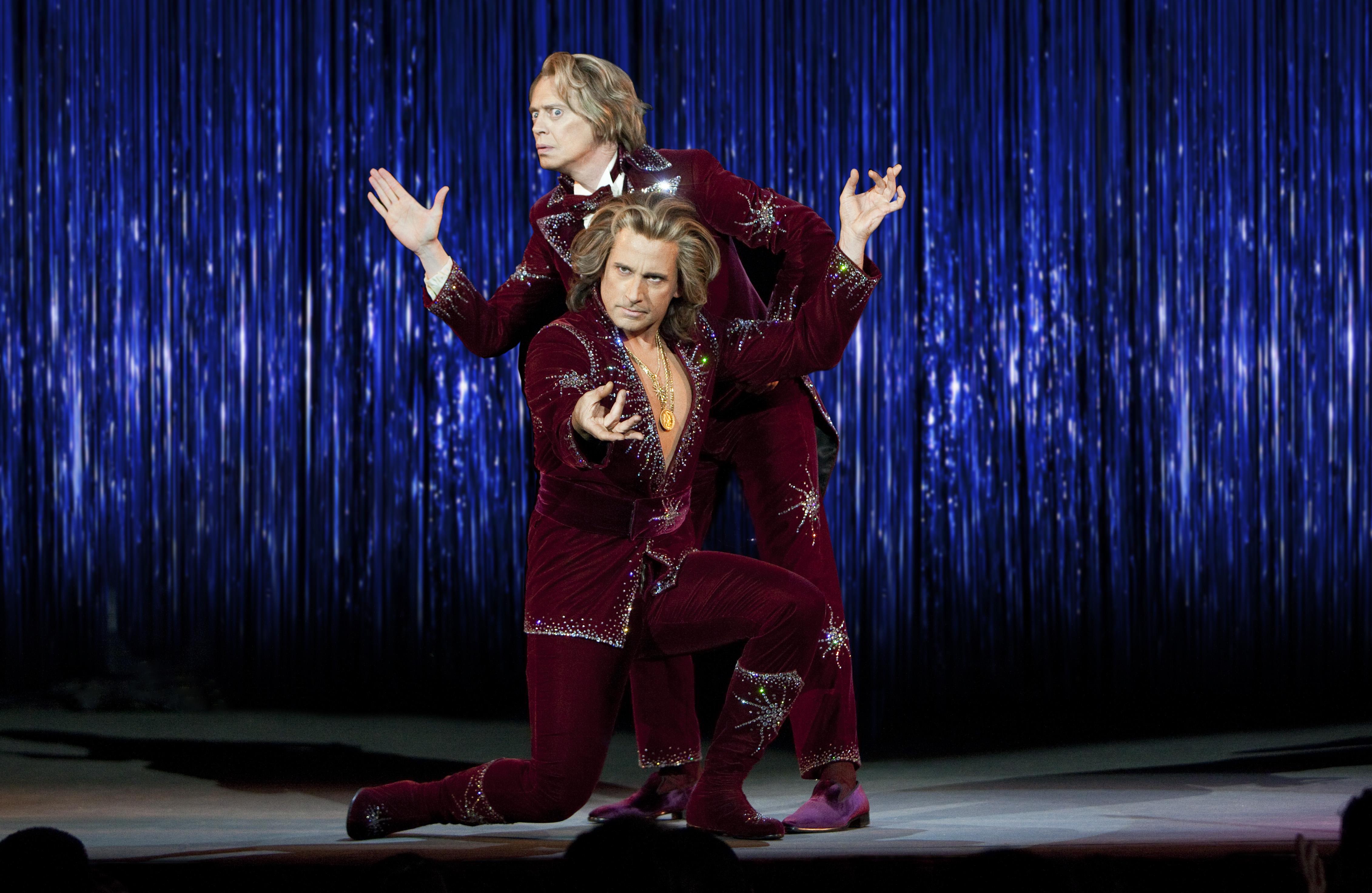
For those so inclined, Hollywood rolls out Halle Berry thriller The Call (make your own “phoning in her performance” joke here) and Steves Carell and Buscemi, plus Jim Carrey, as battling magicians in comedy The Incredible Burt Wonderstone.

Read on for short takes on a new horror omnibus, a stirring tale from Romania, the Oscar-nominated War Witch, two music docs (Journey + Snoop Lion), and more.

http://www.youtube.com/watch?v=LiZr4VFmcpk

The ABCs of Death Variety is the spice of life, yet this international omnibus with 26 directors contributing elaborate micro-shorts on various methods of death — one per alphabetical letter — is like eating dried dill or cilantro for two-plus hours. It’s pungent, but what might color a complex stew proves insufferable in this narrow one. Just why it seems narrow is anyone’s guess — this should have been a genius idea. Yet there are almost no outstanding or memorable contributions, despite the wide-open invitation to extreme content. Filmmakers include Jorge Michel Grau (2010’s We Are What We Are), Simon Rumley (of brilliant 2006 feature The Living and the Dead), Srdjan Spasojevic (2010’s A Serbian Film), cult-favorite actress Angela Bettis, and many more. Nearly all seem to have spent far more than their allotted $5000 budget. There are segments parodying exploitation cinema and video games; offering hyperbolic Terminator-style sci-fi; line-drawing and claymation segments; plus plenty of gross-out narratives. Yet it’s all surprisingly crappy (not least an episode called “Toilet”), with precious few more than halfway decent episodes. The sum impact is of a mean-spirited project that brings out the vacuously shock-value prone worst in everyone involved. (2:03) (Dennis Harvey)

http://www.youtube.com/watch?v=HiJRGbCKCu0

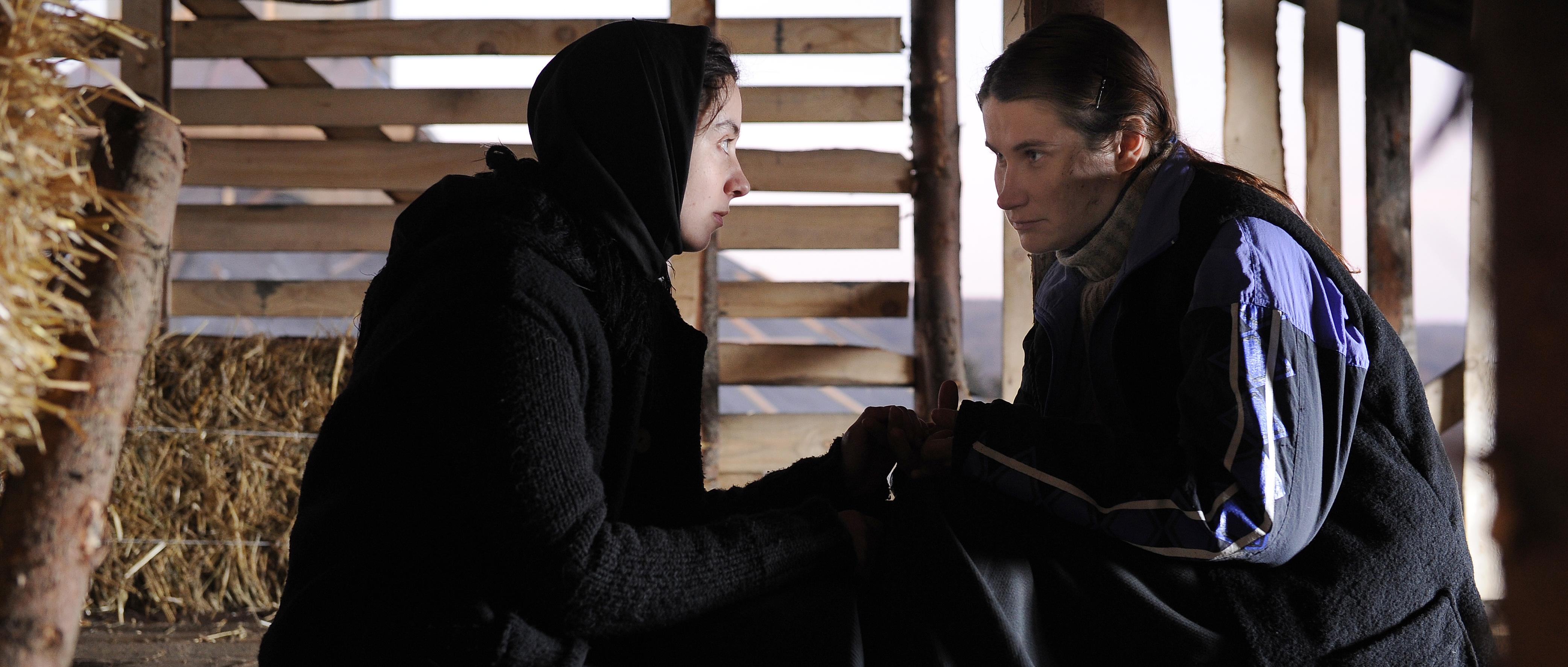
Beyond the Hills Cristian Mungiu — one of the main reasons everyone’s all excited about the Romanian New Wave — follows up his Palme d’Or winner, 2007’s 4 Months, 3 Weeks and 2 Days, with another stark look at a troubled friendship between two women. Beyond the Hills‘ Voichita and Alina (Cosmina Stratan and Cristina Flutur, who shared the Best Actress prize at the 2012 Cannes Film Festival; for his part, Mungiu won Best Screenplay) were BFFs and, we slowly realize, lovers while growing up at a Romanian orphanage. When they aged out of the facility, the reserved Voichita moved to a rural monastery to become a nun, and the outburst-prone Alina pinballed around, doing a stint as a barmaid in Germany before turning up in Voichita’s village, lugging emotional baggage of the jealous, needy, possibly mentally ill, and definitely misunderstood variety. It can’t end well for anyone, as all involved — dismissive local doctors, Alina’s no-longer-accomodating foster family, the priest (Valeriu Andriuta), and the other nuns —  would rather not spend any time or energy caring for a troubled, destitute outsider. Even Voichita can only look on helplessly as an exorcism, a brutal and cruel procedure, is decided upon as Alina’s last, best hope. Based on a real 2005 incident in Moldavia, Mungiu’s unsettling film is a masterpiece of exquisitely composed shots, harsh themes, and naturalistic performances. Check out an interview with Mungiu here. (2:30) (Cheryl Eddy)

http://www.youtube.com/watch?v=Z0cIj3OPM2k

Don’t Stop Believin’: Everyman’s Journey The director of 2003’s Imelda returns with this portrait of a way more sympathetic Filipino celebrity: Arnel Pineda, plucked from obscurity via YouTube after Journey’s Neil Schon spotted him singing with a Manila-based cover band. Don’t Stop Believin’ follows Pineda, who openly admits past struggles with homelessness and addiction, from audition to 20,000-seat arena success as Journey’s charismatic new frontman (he faces insta-success with an endearing combination of nervousness and fanboy thrill). He’s also up-front about feeling homesick, and the pressures that come with replacing one of the most famous voices in rock (Steve Perry doesn’t appear in the film, other than in vintage footage). Especially fun to see is how Pineda invigorates the rest of Journey; as the tour progresses, all involved — even the band’s veteran members, who’ve no doubt played “Open Arms” ten million times — radiate with excitement. (1:45) (Cheryl Eddy)

http://www.youtube.com/watch?v=94zbq5Vaod0

A Fierce Green Fire: The Battle for a Living Planet San Franciscan Mark Kitchell (1990’s Berkeley in the Sixties) directs this thorough, gracefully-edited history of the environmental movement, beginning with the earliest stirrings of the Audubon Society and Aldo Leopold. Pretty much every major cause and group gets the vintage-footage, contemporary-interview treatment: the Sierra Club, Earth Day, Silent Spring, Love Canal, the pursuit of alternative energy, Greenpeace, Chico Mendes and the Amazon rainforests, the greenhouse effect and climate change, the pursuit of sustainable living, and so on. But if its scope is perhaps overly broad, A Fierce Green Fire still offers a valuable overview of a movement that’s remained determined for decades, even as governments and corporations do their best to stomp it out. Celebrity narrators Robert Redford, Ashley Judd, and Meryl Streep add additional heft to the message, though the raw material condensed here would be powerful enough without them. (1:50) (Cheryl Eddy)

http://www.youtube.com/watch?v=MTqyV5Kw9Ss

Reincarnated Reinvention is the name of the game for some mercurial, inventive pop artists, but for rapper Snoop Dogg, now going by the moniker Snoop Lion — you get the scoop on the name change in this doc — transformation turns out to be unexpectedly serious, earnest business. Flirting with Cheech and Chong travelogue comedy, Reincarnated ostensibly spins off the making of the hip-hop artist’s forthcoming 12th album of the same name in Jamaica, with smokin’ production help from Diplo’s Major Lazer gang. The camera is there for many standard behind-the-music moments — sessions with family and adulation in the musical-fertile Trenchtown — along with many not-quite-ready-for-prime-times spent lighting up with other musicians, growers up in the mountains, and reggae forebears like Bunny Wailer. But there’s more going on beneath the billowing smoke: providing the context for today’s high times and ultimately chronicling the rhyme-slinger’s life and times and his path to Jamaica, reggae, and Rastafari spirituality and culture, Vice Films director Andy Capper lays the foundation for Snoop’s shift from rap to Rastafari by revisiting his gangster youth, the rise and fall of Death Row Records, the passing of 2Pac and Nate Dogg, and the music that made the man’s name —and continues to give us a reason to care. The easy, sexy charisma that made Snoop a star is on full display here, and doubtless his latest experiences on reality TV have made Capp’s job that much easier when it came to digging deeper, while the clouds of herb, Cali and Jamaican alike, give viewers a taste of the fun, and possibly healing, attendant with life with the Doggfather. (1:36) (Kimberly Chun)

http://www.youtube.com/watch?v=XtixqUXid9A

Upside Down This sci-fi romance from Argentine-French director Juan Solanas is one of those movies that would look brilliant as a coffee-table photo book — nearly every shot is some striking mix of production design, CGI, color grading, and whatnot. Too bad, though, that it has to open its mouth and ruin everything. Jim Sturgess and Kirsten Dunst play star-crossed lovers who live on adjacent twin planets with their own opposing gravitational forces. Nonetheless, they somehow manage to groove on one another until the authorities — miscegenation between the prosperous residents of “Up Top” and the exploited peasants of “Down Below” being forbidden — interfere, resulting in a ten-year separation and one case of amnesia. But the course of true love cannot be stopped by evil energy conglomerates, at least in the movies. Sturgess’ breathless narration starts things off with “The universe…full of wonders!” and ends with “Our love would change the entire course of history,” so you know Solanas has absolutely no cliché-detecting skills. He does have a great eye — but after a certain point, that isn’t enough to compensate for his awful dialogue, flat pacing, and disinterest in exploring any nuances of plot or character. Dunst is stuck playing a part that might as well simply be called the Girl; Sturgess is encouraged to overact, but his ham is prosciutto beside the thick-cut slabs of thespian pigmeat offered by Timothy Spall as the designated excruciating comic relief. If the fact that our lovers are called “Adam” and “Eden” doesn’t make you groan, you just might buy this ostentatiously gorgeous but grey-matter-challenged eye candy. If you think Tarsem is a genius and 1998’s What Dreams May Come one of the great movie romances, you will love, love, love Upside Down. (1:53) (Dennis Harvey)

http://www.youtube.com/watch?v=BKXEh_kfPCY

War Witch They should give out second-place Oscars. Like, made of silver instead of gold. In that alternate-universe scenario, Canadian writer-director Kim Nguyen’s vivid, Democratic Republic of the Congo-shot drama might’ve picked up some hardware (beyond its many film-fest accolades) to go with its Best Foreign Language Film nomination. War Witch couldn’t stop the march of Amour, but it’s deeply moving in its own way — the story of Komona (played by first-time actor Rachel Mwanza), kidnapped from her village at 12 and forced to join the rebel army that roams the forests of her unnamed African country. Her first task: machine-gunning her own parents. Her ability to see ghosts (portrayed by actors in eerie body paint) elevates her to the status of “war witch,” and she’s tasked with using her sixth sense to aid the rebel general’s attacks against the government army. But even this elevated position can’t quell the physical and spiritual unease of her situation; idyllic love with a fellow teenage soldier (Serge Kanyinda) proves all too brief, and as months pass, Komona remains haunted by her past. The end result is a brutal yet poetic film, elevated by Mwanza’s thoughtful performance. (1:30) (Cheryl Eddy)


Desi Santiago inflates Juanita More’s Pride party plans

0

Does the idea of one of SF’s best-known drag fashionistas rendered in massivem inflatable form excite you? You then, are the target audience for this item of news: Juanita More has announced that multimedia artist Desi Santiago will lend his dark, dramatic style to her yearly Pride party in 2013 as its set designer. 

“Desi is someone with great vision,” More told me in an email. That vision has produced black dogs that swallowed a South Beach hotel whole, outfits that appear to be made from different garments when viewed from various vantage points, atmospheric runway sets, and extravagant works various couture happenings.

After he visited the Jones 620 rooftop where this year’s June 30th party will be held. It was only the Puerto Rican-via-New Jersey artist’s second trip to San Francisco, and my Instagram feed told me that More had celebrated with him over homemade pernil. I chatted with Santiago about what, exactly he means with this plan for balloon Juanita.

“I’m taking her body apart,” he said. “I’m exploding Juanita’s body. I don’t know how much I should give away at this point. But we’re working on an intereactive experience wehere you get to interact with her body.” One of those ways, he said, will be via a “giant” version of the drag queen — reminiscent of his work he did converting the Lords Hotel into “Black Lords,” an installation that saw the hotel morph into a red-eyed black dog. 

“[Juanita] has a heart of gold, and she’s fierce,” he said as towards his motivation for accepting the gig. This isn’t the pair’s first collaboration — More’s played Santiago’s Van Dam party in New York. “I booked her because I loved her but when she spun,” he told me. “She kind of kicked my ass. She really turned it out.” Man can appreciate a good scene-setter.

But who’s to say, really, what the Pride blow-out (tickets available in June) will end up looking like.

“I’m interested in creating completely consuming environments that make you leave the norm,” the artist told me. Santiago’s resume includes work in bondage costume design, metalwork, sculpture, set design. For more on the artist, check out his March 2012 New York Times profile

Severino (Horse Meat Disco, UK), Derek Opperman (Gemini Disco, SF), and Kim Ann Foxman (NYC) have all been announced as DJs for the afternoon party. More was also stoked to tell me about her flyer designer, De La Soul and Snoop Dogg video vet and Bay Area local visual artist Serge Gay Jr.

Tough questions asked on America’s Cup fundraising shortfall

At a March 13 subcommittee hearing called by Sup. John Avalos, representatives from the city’s Office of Economic and Workforce Development (OEWD), the America’s Cup Organizing Committee (ACOC) and others were called upon to explain why coordinators of the prestigious yacht race have failed to reach projected fundraising targets to defray city costs. If the fundraising goals aren’t reached, the city’s General Fund could weather a $13 million hit to cover costs for the sailing event.

San Francisco struck an agreement to host the sailing competition in 2010, following negotiations initiated under former Mayor Gavin Newsom with entities associated with Oracle Racing Team, owned by billionaire Larry Ellison. The events will culminate with a sailing match on the San Francisco Bay this coming summer.

Mark Buell, who chairs the board of ACOC, told supervisors original projections had pegged total event revenue at $300 million, with eight to twelve vessels competing in the race. Those projections have decreased dramatically, with only a handful of teams entering and other “unknowns” amounting to the fact that “revenues are not what we had hoped,” Buell explained. Yet he tried to put a good face on it, saying, “All told, I believe that the city will come out whole.”

Kyri McClellan, who became CEO of ACOC just after helping negotiate the deal to bring the America’s Cup to San Francisco at her previous job with OEWD, told supervisors that ACOC had hired a fundraising expert and launched an initiative called ONESF to kick up the fundraising efforts.

She added that Mayor Ed Lee was helping to secure funding commitments for the race, by “holding breakfasts with CEOs” and asking them to commit funding. Lee is “putting in an incredible amount of energy behind this,” McClellan said, “and people are responding.” She said Sen. Dianne Feinstein had also been involved in helping to secure funding for the sailing competition.

San Francisco Controller Ben Rosenfield provided a breakdown of the funding shortfall so far. An economic analysis conducted a year ago found that ACOC had $12 million cash in hand, he said, less than half the $32 million initially projected as what was needed to defray city costs. Only $13.9 million in pledges and documented cash can be accounted for thus far, Rosenfield added, and the committee has raised around $10 million less than it originally planned for at this stage of the game. “We found they’ve fallen short,” he explained. 

McClellan reported that an additional $1.1 million would be coming in, “from donors and pledges, between now and January of 2014.”

Mike Martin, tasked with leading the city’s involvement in the America’s Cup on behalf of OEWD, displayed a slide that seemed to paint a much rosier picture of the fundraising shortfall than the $20 million cited in recent media reports.

The total city budget projection for covering costs of the race is actually closer to $22 million, lower than the initially projected $32 million, according to his slide. So far the city has been reimbursed for $6.8 million of that, he said. But the next line on Martin’s slide subtracted “projected event-related tax revenues” pegged at around $13 million, apparently suggesting that the city would be made whole by increased tax revenue rather than by receiving an actual reimbursement payment to defray city costs. According to OEWD’s calculation, that makes the “remaining fundraising need” only about $2.67 million, according to Martin’s presentation.

“I don’t think it’s been the intent to say, let’s stop there,” Martin explained. “We have a few months to capitalize on the growing awareness and excitement about the event.”

Reached after the hearing, Sup. Avalos did not sound very excited by what he had heard in response to his inquiries. “It seems that the commitments that were made to the board in 2010 … are not being taken seriously,” Avalos said. “Now that they’re coming up short on fundraising efforts, they’re trying to say the General Fund should be subsidizing the cost of the race.”

Live Shots: K-Pop’s Night Out, Ashley Monroe, and more at SXSW, Day 1

1

Photos and words by Bowerbird Photography

Fans made scrawling lines all through Austin, Texas, waiting to gain access to countless shows, as the SXSW 2013 music festival kicked off on Tuesday night.

Some eager devotees sat cross-legged, tolerating the intense Texas sun since 9am according to a chatty security guard, for the K-Pop Night Out showcase. In the SXSW hierarchy, badges trump wristbands, leaving hardcore fans without tags to load up on patience, scour listings for shows with free access, and pray capacity doesn’t max.

The Geeks, a punk band from Seoul, kicked off the K-Pop lineup — and their music was loud and fast. The lyrics, although mostly screamed in English, were unintelligible. It was all you could want from a punk act. The lead singer’s face-ripping seizures and crotch-grabbing agonies made the perfect counterpoint to his nice boy, real life personality. (He wore cute red Keds and white socks, after all.)

Over at the Empire Control Room, rising star, Ashley Monroe, brought a polished sound and mainstream appeal to SXSW, after appearing on The Tonight Show with Jay Leno Monday night.  We expect to hear her a lot more at weddings, as couples make goo-goo eyes during their first dance.

For those who want to steer clear of the madness, it’s getting real in the Whole Foods parking lot with free preview concerts, clean bathrooms, and healthy samples. Buggaboo, a laid-back, broad strumming, stomp-along Austin band stopped shopping carts in their tracks.

Another act, Mike Love (not to be confused with the Beach Boys singer) came from Hawaii, bringing hippy goodness with reggae flair that paired well with the imported bananas we shared. He whipped out the beatbox, singing along to the loops he laid with lyrics that favored staccato pronunciation of multisyllabic words like “positivity” and “beautiful,” to embrace their full, upbeat, rhythmic potential.

In addition to the music, people watching at SXSW provided its own entertainment. Sitting on the curb on Tuesday’s balmy night, and chatting with eager travelers from Mexico to Australia, felt good enough when standing in another line proved too much.

The Performant: Our selves

1

The body does not lie — Anne Sexton

So often in the arts it seems like we spend an inordinate amount of time focused on how art engages our minds as opposed to our bodies, as if body were a mere vessel whose primary function was to shelter and nourish the brain. In fairness, this is how we treat our bodies in a non-artistic settings too, at best a cumbersome weight which anchors us to the physical world, at worst, a burden we long someday to be free of.

This constant mental disavowal of the body is one of the reasons the art of dance can appear so bold and so transgressive—the encumbrances of the body transformed into its greatest triumphs. In Brontez Purnell Dance Company’s “The Episodes,” playing at the Garage through March 16, everyday routines become ritual, and Purnell, Anthony Lucas, and Sophia Wang explore the mundane with an evening of choreographed mayhem and experiential frolic.

The evening begins with Gary Fembot-Brontez Purnell collaborative dance film “Free Jazz,” a hodge-podge of footage from various dance improvisations and “happenings” organized by Purnell over the course of an unspecified amount of time. In one scene, Punell races shirtless through the city streets carrying an immense tree branch over his head which he lays at the feet of a waiting coterie of fellow dancers, who encircle it solemnly and bend low to the ground.

In another he jumps around, fully clothed, in the midst of a wriggling, ecstatic house party, where dewy youths in hip sunglasses gyrate to the rhythm-heavy soundtrack. Bodies of every shape and size become vehicles of the beat, and the beat becomes a framework to encompass the onslaught of bodies, who strut and leap and cringe and embrace in riotous abandon.

Onstage, seated in galvanized washtubs, the dancers immediately draw attention to their bodies by forcing our brains to imagine the clammy indignity of sitting around in wet jeans. Wordlessly they mimic the functions of cleansing, stripping down and wringing the water out of their sopping denim, before rushing across the stage to put on their dance attire. On the video screen, a hand without a body scrawls chalk circles on the pavement, while the dancers roll deliberately on the ground, contracting and expanding their circle on the floor like breaths. To a cacophony of bells and crashing gongs, they leap into the air and slam themselves back to the ground, embodying the everyday frustration of reaching up only to be dragged back down, the constant tension between the possible versus the probable.

This tension thus established, the piece develops it further in several directions — relationship ruts versus artistic creation, morning rituals versus dreaming, avoidance versus acceptance.

In one scene the stage becomes scattered in drifts of crumpled paper, discarded words, like fallen leaves that can never be completely cleared away. A wave of Sisyphean hopelessness washes over the scene as Lucas doggedly chases every last scrap and Wang continually adds to the disarray. In another, the three sit on a striped couch, stupefied, static playing on the video screen, studio applause ringing hollowly across the stage before they “melt” away from each other and into their own fantasies.

The final scene brings the focus back on human interrelationship, a disembodied voice muses on being “torn between two lovers” while the trio collides in a series of twos and threes on a messy mattress, ending with all of them together in a nurturing cuddle puddle that appears to simultaneously define a connection between the three, without shutting out the oddience which surrounds their stage like a empathetic embrace. A body of bodies in a communion of flesh.

Localized Appreesh: Magic Fight

0

Localized Appreesh is our thank-you column to the musicians that make the Bay. To be considered, contact emilysavage@sfbg.com.

Magic Fight has got fangs. More precisely, the newly formed Oakland “post-indie” band — led by Florida born singer-ukulele player Alex Christopher Haager — just released its very first single, “Fangs” off its forthcoming debut album, Wooden Swords & Stolen Echoes.

And if the first single is any indication of what’s to come (and I think it might be), this record is going to be one to watch. The charming indie pop song begins with a few Casiotone twinkles and a youthful sample, followed by shakers and shimmering harmonies, and the lyrics, “I showed you my fangs and my animal ears/You showed me your scar and your Hollis tattoo/I wanted a bit more than I could chew/So what else is new?”

It’s the kind of song that instantly grabs ahold of your pleasure center, then shakes your shoulders a little to let you know it’s real. 

Magic Fight recently recorded a Daytrotter session (so keep an ear out for that) and will play the Brick and Mortar Music Hall this week, opening for the Lawlands, but first it sprinkled some magic spell dust on Localized Appreesh:

Year and location of origin: 2012 Oakland, California!

Band name origin: I had this name floating around in my head as far back as 2008 but I didn’t have a proper project to put it to. I think it was supposed to be some sort of electro-dance band at some point. Apparently there is still a Myspace page under this name with weird, random demos I made when I was living in Berlin.

Band motto: I wouldn’t say we have a motto as such, but when we are practicing and playing, we end up just saying “Yeah!” a lot. So I suppose that could be a motto of sorts. Constant positive self-affirmation?

Description of sound in 10 words or less: Tender-footed rumblesongs overheard escaping a polychrome cabin overlooking the sea.

Instrumentation: These songs and this band were formed around the combination of sounds produced by amplified ukulele, singing human voices, distorted casiotone keyboards, bass, drums and other random percussive items.

Most recent release: We just released a single called “FANGS” that is taken from a forthcoming seven-song album that will (likely) be called WOODEN SWORDS & STOLEN ECHOES. As of this moment, we are planning on self-releasing the album.

Best part about life as a Bay Area band: Aside from the fact that it simply means that we are living in such a great place on Planet Earth, I would say the best thing about it is that there are actually really great musicians and song-makers doing really great things in the Bay Area.

Worst part about life as a Bay Area band: The worst part is that it is often difficult to find those musicians and song-makers. Also everyone seems to be kind of high most the time, which doesn’t always result in high ambitions.

First album ever purchased: The first cassette I was ever given was the self-titled debut from glam gods Winger. But the first album I remember buying for myself was Sense Field’s 1996 record Building. So I have seen my way around the genre-block a few times, to say the least.

Most recent album purchased/downloaded: A good time for this question, because after personally waiting for about 16 years, I downloaded the new LP from My Bloody Valentine a couple weeks ago. Worth the wait. I think. It’s quite lush and good, in any case.

Favorite local eatery and dish: At this moment, I would say the most exciting food I have had recently was at St. Vincent in the Mission and the most exciting beer I have had was at Social Kitchen & Brewery in the Inner Sunset. 

Magic Fight
With the Lawlands, the Disposition
Thu/14, 9pm, $5-$8
Brick and Mortar Music Hall
1710 Mission, SF
www.brickandmortarmusic.com

Supervisors approve Western SoMa Plan, rejecting expanded office development

145

The Board of Supervisors today approved the Western South of Market Community Plan, the first step to ending a development moratorium that has been in place since the citizen-based planning process that developed the plan began in 2005, but not before some supervisors made a last-ditch effort to allow more office development and nightlife.

“I have real concerns over the plan,” Sup. Scott Wiener said as the plan came before the full board for the first time, continuing an effort to modify the plan that he began a few weeks ago when it was before the Land Use and Economic Development Committee.

While some of Wiener’s colleagues echoed his concerns and those raised by the business and entertainment communities, most decided to defer to the area’s Sup. Jane Kim and the Western SoMa Task Force that developed the plan. It was approved on a 10-1 vote, with Wiener in dissent. It will guide development and set land use rules for the Western SoMa area after being approved on second reading by the board next week.

Wiener led the critique of the plan’s restrictions on office development in most of the plan area, particularly around the transit hub of 4th and King streets, concerns that were echoed by Sups. London Breed and Malia Cohen, likely indicating that the business community has been lobbying supervisors on the issue.

But Kim said she is concerned about the area’s artists, nonprofits, and light industrial businesses – dubbed Production Distribution and Repair (PDR) in the city planning code – being squeezed out if the area is opened up to more office development.

“Office space is hot right now and it’s pushing out PDR uses,” Kim said. “Zoning is an importance tool, otherwise everything will turn into offices in South of Market.”

Wiener, Breed, and other supervisors also sounded their support for the entertainment community that has lobbied for changes in the plan, winning greater protections for nightlife at earlier hearings – including a ban on residential development on the raucous 300 block of 11th Street and persuading owners of “the purple building” to switch from residential to office – pushing for removal of more of the plan’s restrictions on attaining limited live music permits.

“I also have some real concerns with how the plan treats nightlife and entertainment,” Wiener said, while Breed said, “As a big supporter of the arts, I’m concerned there are limited live performances in the plan.”

Kim noted that the plan tried to strike a balance in the conflict between nightlife and housing, and she said that expanding the ability business in areas zoned Regional Commercial District (RCD) shouldn’t be done in just in a part of town where there conflicts have often been difficult to resolve.

“If you’re going to permit it in the RCD areas, it should be citywide rather than just in Western SoMa,” Kim said, noting that she’s open to futher discussions after the plan is approved.

Sup. David Campos and other supervisors urged their colleagues not to tinker with the compromises and hard-won balance in the plan. “I’m not 100 percent happy with every aspect of the plan, but I do think some deference should be given to the district supervisor,” Campos said.

Wiener agreed that deference to the desires of district supervisors is an important consideration, “but there are times when this board does not vote the same as their supervisors,” citing as an example the board’s approval of the controversial 8 Washington luxury condo project over the objections of Board President David Chiu.

Afterward, Terrence Alan of the California Music and Culture Association, which had lobbied for expanded protections of nightlife, told us, “Entertainment as a whole fared well.” But he said that they would continue pushing for greater citywide nightlife protections, including supporting Wiener’s proposal to expand the limited live music permits to include DJs.

Live Shots: The Robert Glasper Experiment at New Parish

3

It really wasn’t a question whether the Robert Glasper Experiment would be any good at the New Parish on Friday night  – but how it would go about replicating the success of Black Radio, which recently won the Grammy for R&B album of the year.

That’s an album that features notable collaborators on each track – Erykah Badu, Lupe Fiasco, Bilal, Mos Def/Yasiin Bey, etc. – which could leave pianist Glasper a lot to make up for live. Going into the show I had a few theories: maybe the group would use pre-recorded vocal tracks in places, maybe up-and-coming vocalists would be pulled on stage from Oakland’s music scene, or maybe some surprise guest would be introduced. (Singer José James was nearby at the San Jose Jazz Winter Fest. Maybe he’d finish in a timely manner over there and stop by?)

Glasper didn’t do any of that. When he came to the stage close to midnight, he quickly* introduced the rest of the Experiment – Casey Benjamin, Chris Dave [Ed. note — the drummer that night was actually Mark Colenburg], and “newly signed Blue Note recording artist” Derrick Hodge – and asked the completely packed crowd “Are there any Radiohead fans in the house tonight?” Keytar-playing Benjamin began singing “as your life passed before your eyes,” his voice given an alien quality via a vocoder, and Glasper began loosening up, playing the keys with occasional Mifune-esque shoulder shrugs, and taking the song further and further beyond the source materials.

Seemingly 10 minutes later, when I assumed the band had transitioned to some other song besides “Packt Like Sardines in a Crushd Tin Box,” the band collectively seemed to hone in on the familiar melody.

And then they stepped back, Glasper and company stood to the side, as Hodge played a hefty bass solo. Glasper has a bold personality and a clever streak, as was evident a year and a half ago at Sketchfest, where he improvised on level with Reggie Watts, musically and comically.** Yet most of the time, he’s not a domineering figure, and doesn’t demand attention.

The band reformed, moving into a spacy version of Coltrane’s “A Love Supreme” and then Sade’s “Cherish the Day,” a song featured on Black Radio with singer Lalah Hathaway. But the charming, beaming Benjamin provided computerized soul and a really smashing and free saxophone solo.*** Increasingly, Glasper and company provided a showcase for the vocalist, as they did on Black Radio.

Covering a lot of musical territory with album tracks like “Ah Yeah”, and more interpretive covers including Bobby Caldwell’s “Open Your Eyes”/Common’s “The Light” and Nirvana’s “Smells Like Teen Spirit,”**** the crowd embraced it, shouting out “Tell Me, Robert!” and other encouragements. The guy who shouted “Take your time!” midset had the right idea, but I think the band already had that in mind.

*Well, after mentioning the after-party at Legionnaire Saloon. Asked for more specific directions, Glasper said “I don’t know where the fuck it is. Just go.”
**Opposed to this year’s Sketchfest event, where Glasper, Watts, and drummer Chris Dave seemed strangely timid and, well, giggly. Maybe having something to do with this.
***Guy in the back, telling his friend that he could totally play that: full of shit or a talented musical unknown? Based on the girl standing next to him, constantly asking if anyone in the group was hungry, probably the former.
****The best surprise for me was the cover of soul jazz classic “Think Twice” by Donald Byrd, who died last month.

The 8 Washington shit show

9

The latest problem with the 8 Washington condo project emerged March 12 when the Chron reported on a new study that shows construction of the most pricey condos in San Francisco history could threaten a major sewer line that serves a quarter of the city. That report, which is pretty scathing, came the same day the SF Public Utilities Commission voted to sign off on environmental approvals and sewage easements that would allow the developer to move forward with preliminary design work — even though the project will be the subject of a voter referendum in November.

The engineering report says, among other things, that construction on the project (involving significant excavation and the driving of 100-foot pilings) could cause the ground around a main sewer pipe to shift by as much as 5 1/2 inches, when “the normally accepted limit for tolerable ground movement is less than an inch.” That’s kind of a problem, since the North Force sewer pipe handles an awful lot of shit, and would be very expensive to repair.

There’s also an underground sewage vault that could be damaged by the construction work.

And the developer isn’t helping much. As Brian Henderson, chief engineer for the PUC, told the commissioners, “we’ve agreed to disagree about these issues.”

In other words, the 8 Washington folks are giving the city a big FU — and still asking for approval to begin work on a project that more than 30,000 voters insisted go on the ballot first.

That ought to be enough reason for the commission to put this whole thing on hold, wait until some more studies are completed (and the PUC engineering staff is satisfied that the developer won’t shatter a sewage main). After all, no construction work can begin until after November anyway; what’s the rush?

Well, Commissioner Francesca Vietor asked that very question: What happens if we say no? General Manager Harlan Kelly hemmed and hawed. Assistant General Manager Mike Carlin said the developer “would have no incentive” to work on a better design. And all of the PUC senior staff said there’s no reason to worry, since this would all come back again once negotiations with the developer are completed.

Oh, and by the way, they said, the Port of San Francisco has asked for this. (Actually, no: According to Sup. David Chiu, Port officials have said they do not intend to push for any preliminary approvals for 8 Washington until after November.)

Carlin insisted that there was no reason to be concenred about the data in the report that the city had commissioned and spent more than $100,000 on. “We are very diligent about protecting our infrastructure,” he said, adding that existing building codes protected the city’s interests anyway. See, if your neighbor digs a new foundation and screws up your foundation, your neighbor has to pay to fix it.

So no worries; about 200,000 San Franciscans might be unable to flush the toilet for a while, but in the end, the developer (a limited liability company controlled by Simon Snellgrove) will be on the hook for the repairs, after the lawyers are all done fighting it out.

In fact, the very concept that the commission might not go along with this deal seemed foreign to Carlin, who from the beginning talked about “what you will be approving today” — as if the votes were already lined up and his job was just to instruct the puppets so they understand what they’re supposed to be doing.

Among the items the commission “would be approving:” a change in the environmental findings related to design changes that, by the way, might make the sewage problem worse. The PUC staff found that the changes would have no impact on the environment; that finding came two days before the sewage report arrived.

And, of course, as land-use lawyer Sue Hestor noted, the environmental documents alone are 125 pages. “When did you get them, and when did you get a chance to read them,” she asked. None of the commissioners answered.

In the end, there were no surprises — Commissioner Ann Moller Caen made the motion to approve, Commissioner Anson Moran seconded, and on a voice vote, the deal was approved.

Now let me predict what’s going to happen. Kelly and the PUC staff will negotiate with Snellgrove and come back and tell the commissioners that they still don’t have the assurances they need, not really, but there’s no choice any more because the PUC already voted to approve the environmental findings and the easements, and the developer has spent millions on design changes, and now it’s too late to go back.

That’s how things work in this city.

And when, as I predict, the voters kill this whole thing in November, the PUC is going to look foolish.


Cristian Mungiu on his stark, stunning ‘Beyond the Hills’

0

Cristian Mungiu — one of the main reasons everyone’s all excited about the Romanian New Wave — follows up his Palme d’Or winner, 2007’s 4 Months, 3 Weeks and 2 Days, with another stark look at a troubled friendship between two women. Beyond the Hills‘ Voichita and Alina (Cosmina Stratan and Cristina Flutur, who shared the Best Actress prize at the 2012 Cannes Film Festival; for his part, Mungiu won Best Screenplay) were BFFs and, we slowly realize, lovers while growing up at a Romanian orphanage.

When they aged out of the facility, the reserved Voichita moved to a rural monastery to become a nun, and the outburst-prone Alina pinballed around, doing a stint as a barmaid in Germany before turning up in Voichita’s village, lugging emotional baggage of the jealous, needy, possibly mentally ill, and definitely misunderstood variety. It can’t end well for anyone, as all involved — dismissive local doctors, Alina’s no-longer-accommodating foster family, the priest (Valeriu Andriuta), and the other nuns — would rather not spend any time or energy caring for a troubled, destitute outsider. Even Voichita can only look on helplessly as an exorcism, a brutal and cruel procedure, is decided upon as Alina’s last, best hope.

Based on a real 2005 incident in Moldavia, Mungiu’s unsettling film is a masterpiece of exquisitely composed shots, harsh themes, and naturalistic performances. I conducted the following email interview with Mungiu ahead of Beyond the Hills‘ Fri/15 Bay Area release.

http://www.youtube.com/watch?v=cL_5U73udXM

San Francisco Bay Guardian Both Beyond the Hills and 4 Months, 3 Weeks and 2 Days are about female friendships — troubled female friendships, to be specific, with shared secrets and repressed emotions. What interests you about these relationships, and telling these kinds of stories?

Cristian Mungiu My films are story-driven rather than character driven and I always start from some true story that I heard about. So, as much as these films could be depicted as films about female relationships, for me the starting points were different. For 4 Months, I mostly wanted to talk about freedom, compromise, responsibility, and circumstances when such an important issue as maternity is involved. In Beyond the Hills I was interested in understanding how violence progresses in a small community and I needed to talk about different kinds of love, social responsibility, and indifference, about the differences between religion and superstition, about the relationship between the level of education and free will.

I don’t think in terms of male/female characters when I think about my characters: I believe that as a storyteller, you either understand the human nature or you don’t — gender is irrelevant.

SFBG Both films also deal with medical issues, though in Beyond the Hills Alina’s suffering is more abstract and seems to be tied into a number of factors: her illness is mental, not physical; also, she is poor and has no family looking out for her. Does the portrayal of doctors and hospitals in Beyond the Hills reflect Romania’s treatment of “outsiders,” and what do you hope audiences take away from this?

CM It would be wrong to consider that the portrayal of the doctors in Beyond the Hills can be generalized to all doctors in Romania nowadays. I don’t think that any film should be taken as a relevant portrait of a country — it would be the same mistake we use to make in the ’80s, thinking about US as being primarily a country of mobsters (after watching The Godfather — that was very popular and highly appreciated).

I would rather say that Beyond the Hills speaks about dysfunctional institutions in general, about the side effects of incompetence and of superstitions in society — and it shows how empathy for the one next to you is influenced by poverty and how the decision to help him is influenced by your level of education.

SFBG Beyond the Hills might show the most realistic (and therefore, probably one of the scariest), take on an exorcism ever filmed. Why did you choose to take on a topic that’s primarily horror-movie element? Is it true the film is based on a true incident, and how did you hear about it?

CM The film is inspired by a couple of non-fictional novels documenting a real incident that happened in Romania in 2005. It was on the first page on the newspapers for weeks and months, it shattered the Romanian public opinion, and it generated a more general debate about the role of religion in the modern society and about some of the rituals in churches.

The film’s the main story line is quite close to what happened in reality so I didn’t choose to bring in an exorcism scene — it was pretty much there already — I just tried to treat it as non-spectacular and as realistic as possible, as it was important for me to avoid the possible tabloid perspective about this issue. It is part of a certain kind of realism that we are looking for in our films — a realism which is present at all levels — from the way of treating the subject to the
way of shooting and to handling filmic time — every scene is depicted in just one continuous shot in the film, no matter how complex or long it is.

SFBG Nuns are another familiar movie element — I’m thinking of everything from The Sound of Music to Sister Act to (most closely) Black Narcissus. How do you go about recreating such a private, closed-off world, and what were the challenges involved in doing that?

CM The greatest challenge always is to fight stereotypes: yours and others. I based my portrayal of the nuns on my observation about religious people, about the psychology of people living in small isolated communities and on my experience of talking to institutionalized children – but at the end of the day, again, we need to understand that nuns are also human beings with emotions, fears, doubts, and so on.

One of the major challenges was to instruct the actresses about the appropriate behavior and attitude their character would have in each given situation and to specifically ask them never to be judgmental about their characters. The screenplay was already depicting in detail most of the monastery routine — and before the shooting we sent the girls to a monastery — to spend some time with some real nuns because there are small things that, as an actor, you need to notice yourself.

SFBG The stark, austere landscape of Beyond the Hills is practically a character in the story. How did you find that location and what approach did you take to filming to heighten the story’s elements? I especially appreciated how key moments — Alina being carried into the church, for instance — happen in the background of long shots.

CM We started by visiting the site of the real incident and then we scouted for a barren hill with some solemnity, no electricity poles around — and having a direct view to a small town. It was quite a complicated scouting and finally we came across this hill — some 100 kilometers up- north Bucharest — where we built the whole Monastery and all the surrounding buildings.

When you decide to only shoot long takes you need to learn how to use the depth of field, the off camera, and the sound. My idea was that it’s more important to show the characters’ reaction to what happens than what happens — and therefore I decided for example that in the most of the violent scenes we’ll be with the camera on the nuns and not on Alina. A crucial decision regards the wideness of the framing — we try to match it always with the content of the scene and with its degree of intimacy. But filmmaking is not a science and you need to keep your mind free and your eyes open, to experiment on the set and to feel which is the most powerful and appropriate way of shooting each moment.

SFBG What does the title mean to you?

CM It refers to realities which are not in full view, which happen somewhere deep down — in our mind or in the world — but I don’t think film titles should be perfectly explicit in connection to the story.

Beyond the Hills opens Fri/15 in Bay Area theaters.

VOWS’ Luke Sweeney on marinating songs, foot prayers, and the gospel of Al Green

3

San Francisco’s VOWS has come a long way from its beginning in 2007. As with many creative enterprises, the band — which plays the Rickshaw Stop Wed/13 — formed out of the ashes of some good old-fashioned turmoil.

Guitarist Luke Sweeney and drummer Scott Tomio Noda, pals since high school, had just broken up with their band, and bassist Jitsun Sandoval, a friend with whom they sometimes played music, had just split with his wife. The three formed a band whose name signaled the start of restored commitment.

Arriving at a cafe on a bike whose tires had deflated with disuse, Sweeney reminisces about the old days of the band. The early period included near-weekly bike collisions and other kinds of upheavals. He recalled sleeping just feet away from Noda in the one bedroom apartment that they shared, as well as the “hippy circus speakeasy space” where Sandoval lived. “That was the first couple years of VOWS,” he tells me. “We were either homeless or living in squalor.”

Since ’07, the trio moved on from the squalor. Sweeney has a seven-month-old baby at home and several musical endeavors underway throughout the Bay Area; Noda and Sandoval have settled down in Los Angeles. But VOWS continues to develop.

https://www.youtube.com/watch?v=Il4AND6Y5v0

When we meet a week before both a VOWS show at the Rickshaw Stop and the band beginning to record its third full-length album (due to drop some time next fall), Sweeney projects an easy confidence as he describes his band.

VOWS has no need to grasp at a formula or a manifesto; its members’ chemistry and experience produce a breed of rock that feels effortless. Part California psych-rock, part pop, and with a bit of something reminiscent of country, its tunes invite head-nodding and that strange sensation of beginning to sing along until you realize you don’t know the words.

Get a better sense of VOWS before its Rickshaw show as Sweeney discusses the band’s development, VOWS’  principles of genre, and the gospel of Al Green:

San Francisco Bay Guardian How have you changed as a band over the past six years?

Luke Sweeney We’ve honed our sound and we’re very comfortable playing with each other. We’ve always been a band that will take a song and play with the arrangement of it. We like to do that a lot for live shows – change things around, keep things exciting. But more than as a band musically, I think it’s about growing as people….I think we’re a little more mature, and I think it’s reflected in our songs.

SFBG What are you working on for the third album?

LS We have a constant problem of having way more music than we could possibly record or keep track of or realistically promote and share with everybody, so we’re actually trying to play catch-up right now. The songs that we’re going to be recording next week are mostly two years old….I mean, it’s a delightful dilemma. With the first two albums, as soon as they were ready, we popped them in the oven  – or maybe we took them out of the oven too fast; they weren’t as developed. These ones have been sitting around for a little while marinating. They’ll be more developed.

SFBG The band is often described as having a “California sound.” Does this fit?
LS I feel like our sound is not just Californian; it’s almost aesthetic-less in a way. In terms of what’s going on now with a lot of music, you have two ends of the spectrum – either this whole  retro-folk scene…or you have this ’80s-referencing chillwave, synth, future-wave. We don’t really have any of that. Our music is based more on packing in as much  melody and lyrics and instrumentation, the three basic colors of music. We try to apply those with a simple palette and don’t try to wash over them with any aesthetic. Although we do dress up ridiculously at our shows.

SFBG Do you have costumes planned for the Rickshaw Stop show?

LS Scott is often our wardrobe coordinator. I don’t know what he’s got in mind yet but he’ll definitely have something special and surprising. It’s all ages, though, so it’ll be tasteful.

SFBG How do you break up responsibility with writing? How does that process look?

LS It’s very collaborative. It’s mostly Jitsun or myself writing a song or a few pieces of a song and then all of us coming together on it….We don’t force anything. I never sit down and say, I have to finish a song. They all come from real moments of feeling, whether that feeling is agony or ecstasy, or just hungover. Everything’s pretty natural as it comes together. I can’t recall any time where we’ve had problems bringing a song into fruition. There might be a couple times where a song is super simple starting out, and it just takes some time to sit with the song and develop melodies. I don’t think I would be able to spend so much time on music if it wasn’t a natural thing.

SFBG Where does the new music video for ‘Temptation?’ come from?

LS At the end of the video are a couple of pictures that Scott took from that same tour. Earlier in that tour, we happened to be playing in Memphis on a Sunday night. It was serendipitous because a couple of days before, we were in Lawrence, Kansas, and a really cool musician we met figured out we were going [to Memphis] on a Sunday and said, ‘get there early so you can go attend Al Green’s Sunday gospel church. ‘ And so we did.

We drove all night from St. Louis. Our first stop in Memphis was at the hospital because I had to get a shot and get my foot cleaned up from a shoe that cut me up [and from not being able to shower for a couple days]. And then right after the hospital we prayed for my foot’s healing and sang along with all the incredible music that was at Al Green’s gospel. It‘s probably the greatest show I’ve ever seen. 

SFBG Did your foot heal?

LS It was healed up enough within the next 48 hours for me to jump off a roof into a swimming pool when we got to Denton, Texas. [Al Green] performs miracles.

VOWS
With Standard Poodle, Goldenhearts
Wed/13, 8pm, $10
Rickshaw Stop
155 Fell, SF
(415) 861-2011
www.rickshawstop.com

From the Rocketship to Bay Lights, “temporary” is the key that unlocked public art in SF

11

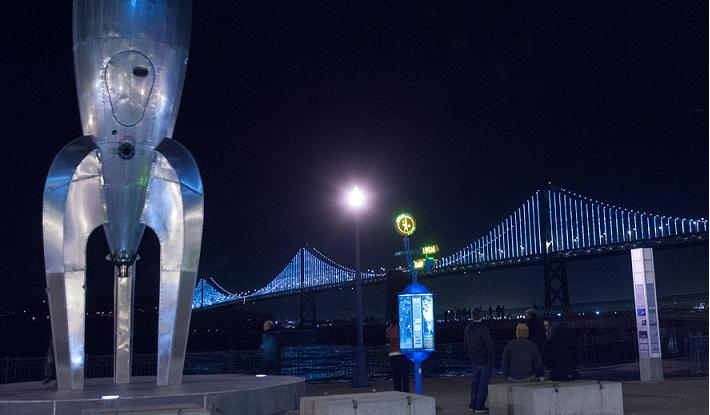
In the wake of The Bay Lights coming on to rave reviews and mesmerized gazes last week, next weekend the Raygun Gothic Rocketship will be taken down from the Pier 14 launch pad it’s occupied since 2010, the latest transitions in San Francisco’s trend of using temporary public art placements to bypass the protracted, emotional, and expensive battles that once defined the siting of sculptures on public lands in San Francisco.

By partnering with private arts organizations and calling the pieces “temporary” – even though almost all of them have been extended past their initial removal deadlines, sometimes by years – the San Francisco Arts Commission, the Port of San Francisco, and other local entities have allowed public art to flourish in the City.

The commission’s longtime public art director Jill Manton told us that temporary public art placements go back to the early ’90s, usually involving smaller pieces while big, years-long controversies continued to rage on over bigger pieces such as “the foot” that never went in on the Embarcadero, the Cupid’s Span piece that Don Fisher did finally place on the waterfront (and which many critics wish had been only a temporary placement), and a big, ill-fated peace sign in Golden Gate Park.

“It’s not as threatening to the public, not as imposing, so it doesn’t seem like a life-or-death decision,” Manton said of the trend toward temporary placements.

But the real turning point came in 2005 when then-Mayor Gavin Newsom, Manton, and other city officials began to embrace the Burning Man art world by bringing a David Best temple into Patricia Green in Hayes Valley, Michael Christian’s Flock into Civic Center Plaza, and Passage by Karen Cusolito and Dan Das Mann onto Pier 14 (a transition point that I chronicle in my book, The Tribes of Burning Man).

Each piece was well-received and had its initial removal deadlines extended. Since then, temporary placements of both original art and pieces that returned from the playa – including Cusolito’s dandelion in UN Plaza, the rocketship, Kate Raudenbush’s Future’s Past in Hayes Valley, and Marco Cochrane’s Bliss Dance on Treasure Island, which is now undergoing a renovation to better protect it against the elements during its longer-than-expected and now open-ended run – have enlivened The City.

“They get to rotate art and people get excited about what’s next,” said Tomas McCabe, director of the Black Rock Arts Foundation, a Burning Man offshoot organization that has helped with fundraising and logistics for most of the burner-built placements.

We spoke by phone on the afternoon of March 8 as he was working with Christian to install The Bike Bridge – a sculpture using recycled bicycle parts that local at-risk teens helped Christian build thanks to a grant from the National Endowment for the Arts – at the intersection of Telegraph and 19th in Oakland as a temporary placement.

The Bike Bridge will officially be unveiled on April 5 during the increasingly popular monthly Art Murmur, and the party will get extra pep from a conference of Burning Man regional representatives that is being held just down the block that day.

McCabe said the connection between Burning Man and the temporary art trend doesn’t just derive from the fact that Bay Area warehouses are filled with cool artwork built for the playa that is now just sitting in storage. It’s also about an artistic style and sensibility that burners have helped to foster.

“We try to help the art pieces have a life after Burning Man, but it’s more the style of community-based art that we promote,” McCabe said, noting that BRAF also helps with fundraising and other tasks needed to support these local art collectives. “We like to see the artists get paid for their work, we’re funny like that.”

Manton said there are currently discussions underway with San Francisco Grants for the Arts (which is funded by the city’s hotel tax) and other parties to put several large pieces built for Burning Man on display in either UN Plaza or Civic Center Plaza, a proposal Manton called UN Playa. “We bring the best of Burning Man to the city,” she said.

Most of the art placements in San Francisco have been labors of love more than anything, and a chance to win over new audiences. When the Five-Ton Crane crew and other artists placed the Raygun Gothic Rocketship on the waterfront in 2010, they had permission from the Port to be there for a year. Then it got extended for another year, and then another six months, and it will finally come down this weekend.

There will be final reception for the Rocketship this Friday evening (with music from the fellow burners in the Space Cowboys’ Unimog) and then the crane will come up on Sunday morning to remove it, in case any Earthlings want to come say hello-goodbye.

“The Rocketship and its crew have had a fantastic 2.5 years on display at Pier 14. Maintenance days were always a pleasure, giving us a chance to talk to people – and see the smiles and joy people got from the installation,” one of its artists, David Shulman, told us. “We’ve had tremendous support from, and would like to thank, the people of San Francisco, the Port of San Francisco, and the Black Rock Arts Foundation. But Pier 14 is intended for rotating displays, and we’re excited to see what comes next.”

Dan Hodapp, a senior waterfront planner for the Port district, said they don’t currently have plans for the site, although he said it will include more temporary art in the future. “The Port Commission and the public are supportive of public art at that location,” Hodapp told us. “But right now, we’re just reveling in the new Bay Lights and we’re not in a hurry to replace the Rocketship.”

Manton said The Bay Lights – the Bay Bridge light sculpture by art Leo Villareal that began what is supposed to be a two-year run (but which Mayor Ed Lee is already publicly talking about extending) on March 5 – has already received overwhelming international media attention and is expected to draw 55 million visitors and $97 million of additional revenue to the city annually.

“It is public art as spectacle. It’s amazing,” Manton said of the piece, which the commission and BRAF played only a small roles in bringing about. “It’s so good for the field of public art.”

She that the success of recent temporary art placements and the role that private foundations have played in funding them have not only caused San Franciscans to finally, truly embrace public art, but it has ended the divisive old debates about whether particular artworks were worth the tradeoff with other city needs and expenditures. And it has allowed the Hayes Valley Neighborhood Association and other neighborhood organizations to curate the art in their public parks.

Meanwhile, even as the Port gives Pier 14 a rest, Hodapp said another temporary artwork will be going up this fall at Pier 92, where old grain silos will be transformed into visual artworks, and that Pier 27 will be turned into a spot for a rotating series of temporary artworks once the Port regains possession of the spot from the America’s Cup in November.

As he told us, “The public really enjoys art on the waterfront, and they’re most supportive when we do temporary art, so there’s a freshness to it.”

Heads Up: 7 must-see concerts this week

0

If you’re avoiding the hype and heat of Austin for that annual indie, not indie music-and-film massacre that is South By Southwest (er, SXSW, nerds), fear not – there are still plenty of acts to catch live in our town this week. That list includes Martha Wainwright, PANTyRAID, Autre Ne Veut, the Dodos, an annual St. Patty’s Day punk blowout, and plenty more.

Here are your must-see Bay Area concerts this week/end:

Music for Adobe Books
This last-minute event is the best kind of fundraiser: it’s for a worthy cause (the Mission’s beloved Adobe Books, which was forced out of business by a large rent increase) and features big name, locals acts including the Dodos, Adam Stephens of Two Gallants, the Tambo Rays, and DJ Andy Cabic of Vetiver. The show is part of the book shop’s Indiegogo campaign to create a new Adobe, with a sustainable plan for small arts and culture businesses such as itself.
Mon/11, 7pm, $25
Public Works
161 Erie, SF
www.publicworkssf.com
https://www.youtube.com/watch?v=1d6IeNpC9p0

Autre Ne Veut
“’Anxiety in children is originally nothing other than an expression of the fact they are feeling the loss of the person they love.’ Sigmund Freud must have been on Arthur Ashin/Autre Ne Veut’s mind as he created his follow up album, appropriately entitled Anxiety. This New York electronic artist chips away at layers of R&B harmonies and futuristic free jazz.” — Ryan Prendiville
With Majical Cloudz, Bago
Mon/11, 9pm, $12
Independent
628 Divisadero, SF
www.theindependentsf.com
https://www.youtube.com/watch?v=_qhHUmL0U6k

VOWS
“The legend of San Francisco band VOWS includes heartbreak, cross-country travel, and a little gambling in Reno. All that occurred nearly six years and a couple of albums ago. Since then, it has more finely tuned its breed of psych-pop comprised of punchy guitar riffs, seamless transitions between raspy yelps and bright three-part harmonies, and depth couched in catchy lyrics that all fits perfectly into a distinctly West Coast tradition. In the midst of recording its third album, VOWS comes to Rickshaw Stop to show it all off.” — Laura Kerry
With Standard Poodle, the Goldenhearts
Wed/13, 8pm, $10
Rickshaw Stop
155 Fell, SF
(415) 861-2011
www.rickshawstop.com

Martha Wainwright
Treasured, delicate folk singer-songwriter Martha Wainwright has had many lives – and they mostly play out in the themes of her personal albums such as 2008’s I Know You’re Married But I’ve Got Feelings Too, her Edith Piaf incarnation (Sans Fusils, Ni Souliers, a Paris, 2009) and most recently, the lovely Come Home to Mama, her 2012 record spurred by both the birth of her first child, and the death of her well-known Canadian folk singer mother, Kate McGarrigle.
With BeRn
Fri/15, 6:30pm, $20
Swedish American Hall
2174 Market, SF
www.cafedunord.com
https://www.youtube.com/watch?v=V4di1pbzveQ

PANTyRAID
Electronic twosome PANTyRAID is broken down into Martin Folb (Marty Party) and Josh Mayer (Ooah of the Glitch Mob), which means An-ten-nae’s “Get Freaky” party is about to get a whole lot freakier. The experimental duo is known for mixing synth-based trip-hop, dubstep, electro, tribal drumming, and “whatever works and causes booty shaking and making out.”
Fri/15, 10pm, $20
1015 Folsom, SF
www.1015folsom.com
http://www.youtube.com/watch?v=oK3L-ZbWHv8

Afrolicious
Is Afrolicious the hardest working world band in the Bay Area? It seems to pop up everywhere. The 12-piece Latin soul-tropical Afrobeat act met at Elbo Room’s energetic weekly Afrolicious party, and is this week playing the Great American Music Hall in celebration of its debut full-length album California Dreaming, released on its own label, Afrolicious Music.
With Midtown Social Band, Afrolicious DJs Pleasure Maker and Senor Oz.
Fri/15, 9pm, $15
Great American Music Hall
850 O’Farrell, SF
www.slimspresents.com
https://www.youtube.com/watch?v=sUZ1qBJI-pI

St. Patty’s Punk Bash XIII
Ay, it’s time yet again to celebrate St. Patrick’s Day with the punks at Thee Parkside, all damn day. This time, there’s Latin American-San Franciscan punk-with-horns act La Plebe, the legendary ’70s-born VKTMS, folk-punk group the Fucking Buckaroos, awesomely named Gorilla Biscuits cover group, Girl-illa Biscuits, Blackbird Raum, Unko Atama, and plenty more. Remember to wear green, drink large mugs of Guinness/shots of Jameson, and all those requisite traditions.
With Ruleta Rusa, Bad Coyotes, Bankrupt District
Sat/16, 3pm, $8-$10
Thee Parkside
1600 17th St., SF
www.theeparkside.com
https://www.youtube.com/watch?v=SoSYwe77_to

Next, the Treasure Island sellout

82

Now that he’s done such a bang-up job negotiating a deal for the CMPC hospital, leaving the supervisors to clean up the mess, does anyone think that the hurry-up-and-finish-in-time-for-a-China-trip talks with Rose Pak and Willie Brown (who has his own interests here, too) will have a good outcome for San Francisco?

Because I don’t.

Nothing the mayor has directly negotiated with private interests has been anything but a disaster for the city. America’s Cup, the Warriors arena, CPMC … the guy just can’t seem to say No. And you really don’t want someone who gives away the story to be representing the city when there are billions of dollars and the future of a huge new neighborhood (on a sinking island in the middle of a rising bay) at stake.

I still don’t see how intense residential and commercial development works on TI, when there’s only one overcrowded artery on and off the island. In New York, people who live on Staten Island are used to using the (free, heavily subsidized)  ferry — 60,000 a day take the boats into Manhattan. That’s going to be a huge stretch for people who live on TI, where there will be limited shopping (even for things like groceries) — and at this point, I don’t see the developer, or the city, purchasing and paying for enough cheap ferry service to make it an effective form of transportation.

That said, if we can make it work as a transit-first community, I have no problem with developing Treasure Island — but I don’t see Lee getting the level of civic benefits out of Lennar and the China Development Corporation that San Francisco needs to make this pencil out. Hasn’t happened yet. 


Live Shots: Passion Pit, Icona Pop, Matt and Kim at the Bill Graham

0

Swedish duo Icona Pop made the typical announcement about being really happy to finish up its tour in San Francisco, last Thursday at the Passion Pit/Icona Pop/Matt and Kim show at the Bill Graham Civic Auditorium.

Things likely have changed for Icona Pop, which specializes in bouncy, dubstep-inflected pop about “heartbreak,” particularly since the song “I Love It”* was appropriately included in the episode of HBO’s Girls where TV’s most self-centered character** goes on a coke binge.

Icona Pop received its biggest, swelling crowd response closing its set with the track, essentially the millionth song to say YOLO in recent memory. I’d say it has the potential to be the “song of its generation,” but only if we can all agree that that whole concept needs revising.***

Matt and Kim played Girl Talk (or at least a mega-mashup-mix of Black Sabbath, Timbaland beats, Jay Z 1.0, etc.) while warming up. Matt wore a Big Freedia t-shirt. Just a couple clues that the pair is similarly oriented towards audience response.

Snippets of familiar hits – Alice DeeJay’s “Do You Think You’re Better Off Alone” comes to mind, as well as Dr.Dre and Snoop**** – were occasionally mixed in with their own music, which most often has the same twinkling piano and rudimentary drum beat. Fun often came at the cost of sticking slavishly to trends, which would explain the “Harlem Shake” section of the show.

I want to dislike the duo, but somehow the two members remain really shiny, seemingly unpretentious musicians who have done their best to scale up from fine china-shattering house parties to festival sized performances and still be engaging. (The equipment mounted cameras they use make them seem slightly less like rockstars and more like contestants on a reality TV show, still slightly shocked by the exposure.) Even slightly criticizing them makes me feel like the time I tossed a kitten down a staircase. (I was 6.)

The last time I went to see Passion Pit – at the Warfield during the Manners tour – well, it was on what would retroactively be a first date, and in part because of the lame soul revue opener and my general nervousness, I drank way too much alcohol and ended high up in my balcony seat, where the show on stage seemed to consist of firing strobes lights directly at the audience. So, yeah, it was a lot of fun.

And, of course, I was very interested to see what a Passion Pit concert is actually like. Well, things started off maximally with “I’ll be Alright,” Manners single “The Reeling”, “Carried Away,” and the pretty “Moth Wings.” Then singer Michael Angelakos moved into a slight lull of twee balladry with “Love Is Greed,” a potentially devastating song for anyone that grew up on watching too many Disney movies*****, and “It’s Not My Fault, I’m Happy”, eventually rising back up to peak with the two best songs from sophomore album Gossamer, the R.Kelly-esque “Constant Conversations” and the politipop masterpiece “Take a Walk”******. It was a good performance, with Angelakos stalking the stage throughout and the band actually jamming a little bit on “Mirrored Sea.”

Passion Pit ended with “Sleepyhead” and “Little Secrets” as the encore. There were bubbles and confetti, but ultimately it all may not have been as memorable as forgetting.

*I like to imagine this song is borrowing the chorus structure of 10cc’s “Dreadlock Holiday,” but somehow I doubt it.
**Besides maybe Walter White.
***How can someone three years younger than me not know of Mr. T?
****Or David Axelrod/David McCallum.
*****At one point in the night, Angelakos began singing slowly and for a split second I was expecting this.
******Also on Girls, last night.

Labor activist urges “innovation” in workers’ rights organizing

Even as renowned labor activist Bill Fletcher Jr. geared up for a talk last Thursday to describe the dire situation he believes the labor movement is facing, local organizers had victories to celebrate.

Fletcher joined organizers from the Filipino Community Center, OUR Walmart, PODER and POWER for a March 7 forum hosted by San Francisco Jobs With Justice, called “Labor at the Crossroads.”

Prior to the discussion, Fletcher told the Guardian he believes the national labor movement is witnessing a “final offensive” from big business and right-wing interests, and “an attempt to destroy unions altogether.” He also criticized a reluctance among national labor leaders to openly recognize the gravity of the situation. Fletcher’s latest book, published last August, is titled They’re Bankrupting Us, and 20 Other Myths About Unions.

Fletcher said he believes labor should place less emphasis on “being invited to this or that social occasion,” and more on reaching out to community-based organizations to foster movement building. He said he thought there was a need for “innovation” by organized labor, such as forging alliances with the unemployed, or reaching out to under-employed workers earning low wages in retail positions. “The labor movement grew by being audacious … by making the comfortable uncomfortable,” he said.

Despite Fletcher’s bleak portrait and the generally discouraging trends of the day, such as the impacts of the sequester, an international move toward austerity and stubbornly high unemployment in the United States, representatives from San Francisco Jobs with Justice nevertheless were able to point to some recent worker victories.

Many San Franciscans who gathered for “Labor at the Crossroads” were encouraged by successful negotiations that resulted in what they viewed as a much-improved deal for the San Francisco CPMC hospital project, which included stronger local hiring requirements and other items labor and community organizers had fought for.

Organizers also applauded last month’s Chinese Progressive Association victory against Dick Lee Pastry on behalf of workers subjected to wage-theft violations. The San Francisco Chinatown restaurant was forced to pay a whopping $525,000 in back wages and penalties.

At the state level, the California Domestic Workers’ Coalition kicked off its mobilization last week in Los Angeles urging passage of the Domestic Workers’ Bill of Rights, authored by Assembly Member Tom Ammiano. The legislation would extend basic labor protections to housekeepers, childcare workers and caregivers, who collectively represent a primarily immigrant workforce. At the national level, momentum is starting to build around the Fair Minimum Wage Act, with supporters calling on lawmakers to raise the minimum wage to $10.10 an hour.

“The union movement should be helping unemployed workers get organized, fight back and fight for jobs,” Fletcher said. “There is no significant organization of the unemployed – no significant force that has taken up this issue and said, we need to build a mass movement around jobs.”

He urged local organizers to identify priorities. “We have to go forward with, what is the vision?” he said. “What do the people of Oakland and San Francisco need?”

Calvin Trillin: Hacker unearths paintings by George W. Bush

0

To new artist George Bush (junior),

We welcome you  Greetings. Salaam.

We’re eager to see your depiction

Of nukes stashed away by Saddam.

Calvin Trillin: Deadline Poet: The Nation 3/4/2013)


Nurses still waiting for CPMC to fully embrace San Francisco

25

Labor and community activists cheered this week’s news of a much-improved deal between the city and California Pacific Medical Center to build two new hospitals in San Francisco, and there are hopeful signs that frosty local relations with this sometimes-stubborn corporate behemoth may improve. But they also say they are withholding full support for the deal until CPMC reaches a contract agreement with the California Nurses Association.

CPMC and its parent, Sutter Health, have had a nasty running battle with CNA over the six years since their last contract expired that has included strikes, lockouts, lawsuits, harsh union-busting tactics, and the pooling of bad blood on both sides. But CPMC announced a labor agreement with its other major union, National Union of Healthcare Workers, on the day after the hospital deal was announced and there are signs that a deal with CNA could also be imminent.

“We’ve made some progress and we have the makings of a settlement on the table, but we’re not there yet. Yet now is the time,” Fernando Losada, CNA’s collective bargaining director for California.

It was CNA and other labor groups that effectively partnered with community organizations and progressive members of the Board of Supervisors last year to kill the hospital deal that CPMC cut with the Mayor’s Office and to force the much-improved agreement that was announced on Tuesday. “It’s all about necessity and their being able to implement their plans,” Losada said of CPMC’s designs on San Francisco. “Obviously, the full of implementation of their plans were thwarted with the help of some good community organizing.”

And Losada said he expects that labor-community coalition to stand firm on expecting CPMC to reach a fair agreement with the nurses, who are seeking more job security and benefit concessions than CPMC has been willing to make so far.

“The successful community organizing that we played an active role in putting together has had a lot to do with them being more forthcoming at the bargaining table,” Losada said. “We like where this has ended up, particularly on the St. Luke’s [Hospital] issue [guaranteeing a larger and more viable new hospital than originally proposed]. But we can’t support this wholeheartedly and we won’t if our nurses are left out in the cold.”

Gordon Mar of San Franciscans for Healthcare, Housing, Jobs, and Justice, which formed up around the CPMC negotiations with the city, said that most community groups will also insist on CPMC reaching an agreement with CNA before the project moves forward.

“A contract for CNA is the last remaining big issue the coalition would like to see resolved,” Mar, who also works with the labor group Jobs With Justice, told us. “We at Jobs With Justice would not support the deal unless the CNA dispute is resolved.”

Paul Kumar, a consultant with NUHW who represented the coalition during the negotiations between CPMC and the city, as represented mostly by Sups. David Campos, David Chiu, and Mark Farrell, said he was happy to see CPMC reach agreements with the city and NUHW, but that it’s too soon to conclude the corporate has turned over a new leaf.

“I think it’s premature because relationships take a long time to transform themselves, but there are transformative moments, and it’s our duty to make the best of them. This may be one of them,” Kumar told us. “They’re obviously now trying to pursue their business interests in alignment with their community instead of without regard to their community, which has characterized their behavior in the past.”

Kumar said the coalition that overcame last year’s aggressive and uncompromising effort by CPMC to push through a deal that was bad for the city has learned a lot from that fight and evened out the playing field. “It’s up to us to try to build on their breakthrough,” Kumar said.

CPMC spokesperson Dean Fryer was unable to put the Guardian on contact with Sutter officials that our sources say may be responsible for the softening of CPMC’s tough negotiating stance in San Francisco, or to offer a comment on the changing dynamics in the company.

He stressed that CPMC has “a lot of interface with various communities in San Francisco” and said the company “does more charity care than anyone in San Francisco.” But he’s only been with CPMC for a few months and was unaware of studies last year showing CPMC actually does the least per-capita charity care of any hospital in San Francisco, a major point of controversy that resulted in improved charity care commitments in the latest agreement.

As for the prospects of an agreement with its nurses, “I can’t address CNA, that has been ongoing and it’s something I can’t comment on.”

NUHW – which represents medical technicians, administrative staff, and hospital workers other than nurses and doctors – announced that it reached a deal with CPMC at 12:30am on Tuesday that includes no labor concessions, retroactive wage increases, job security provisions, fully employer-paid health coverage, an improved pension, and maintenance of retiree health coverage.

Losada said he was happy to see the CPMC agreement with the city include strong local hiring requirements for construction workers, a predominantly male workforce, and now it’s time for CPMC to do right by its nurses, “an overwhelmingly female workforce.”

“As it stands, they have no protections and no guarantees they’ll be hired in the new facilities,” he said, noting how frustrating it’s been to get any assurances from CPMC as it has pursued this hospital deal over many years. “It’s always been about issues of job security, and affordable health care, ironically.”

Workers underpaid by firms renovating fancy mid-Market offices

Union members from San Francisco Carpenters Local 22 were distributing flyers outside a developer’s Bush Street headquarters this week, upset that the company hired contractors who don’t pay union scale wages. “Hurting workers!” The bright orange flyers screamed. “Shame on them!”

The developer is Group I, headed by Joy Ou. In addition to being the CEO of the development firm, Ou is also listed on state licensing records as the principal officer of Construction Studios, Inc., one of the general contracting firms singled out on the flyer. Ou did not return Guardian calls seeking comment.

Group I is conducting office renovations at 988 Market Street, a 1920s-era building located at Sixth and Market streets adjacent to the Warfield Theater. Group I purchased the Warfield office building from David Addington. It is a prominent location: when Mayor Ed Lee ran for election in 2011, his campaign office was headquartered there. The building is also included among mid-Market properties eligible for payroll tax exclusion under a program hashed out in 2011 to revitalize the central Market corridor.

Of the multiple floors under renovation, two will house Benchmark Capital, a venture capital firm that invests in tech startups. Tech startup companies are poised to move in just below. It’s unclear whether these businesses will apply for the payroll tax break.

According to Bill Gerber of Tico Construction Co., a contractor tapped to conduct some of the renovations, the workers he’s hired actually are earning union-scale wages. “Tico is running it as a union job,” he said. “We are paying area wages.”

But Scott Littlehale, a spokesperson for the carpenters’ union, told the Guardian that Gerber never responded when the union asked him if Tico pays area standard wages on all jobs. “What we believe is that the developer in this case, Group I, has not required its contractors to pay area wages all the time on all its jobs,” Littlehale said. “This is a labor market that extends beyond a single job site.”

Under California law, workers employed on city-funded projects must pay the prevailing wage, which is $38.50 an hour for carpenters before benefits are factored in, according to the Department of Industrial Relations. Since 988 Market is not a publicly funded project, it’s not bound to this requirement.

Nevertheless, the idea that construction crews are working for less than the area standard in San Francisco’s burgeoning economic climate – to renovate space for a venture-capital firm that will qualify for a payroll-tax exclusion – raises questions about whether this kind of development is actually helping struggling workers recover from the economic hit of the last several years. Group I stands to make top dollar by renting its office spaces out to tenants heavily invested in the booming tech industry. Meanwhile, San Francisco is becoming increasingly unaffordable for skilled laborers.

Construction gigs are temporary by nature, and Littlehale said many union members earn less than the area median income. “Construction work had been a pathway to fairly stable middle class standards, and that’s under threat,” Littlehale said. “The big picture is: We’re going to hold the folks up the food chain accountable.”