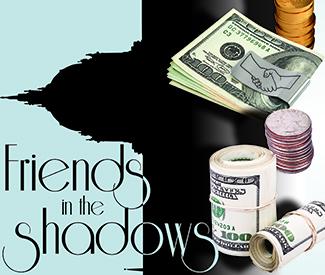
Bay Guardian News Editor Rebecca Bowe and Staff Writer Joe Fitzgerald Rodriguez are being honored by the Society of Professional Journalists with a James Madison Freedom of Information Award for “Friends in the Shadows,” our investigation of the shady ways that developers and other powerful players buy influence at City Hall.
The package of articles, prepared for the Guardian’s 47th anniversary issue of Oct. 6, used extensive public records to show how contributions to the city’s various “Friends Of…” organizations create cozy relationships between regulators and the regulated, donations that are often designed to skirt public disclosure requirements.
“Their detailed and thorough account explored a trail of money through myriad city agencies and departments,” the awards committee wrote, noting how the paper “used public records, interviews and independent research to probe how developers, corporations and city contractors use indirect gifts to city agencies to buy influence.”
The Guardian will profile the other winners in our annual Freedom of Information Issue on March 12, and all the winners will be honored at SPJ’s James Madison Awards banquet on March 20. The full press release follows:
FOR IMMEDIATE RELEASE
JAMES MADISON AWARD WINNERS FOR SUNSHINE AND FIRST AMENDMENT WORK ANNOUNCED BY NORCAL SPJ CHAPTER
SAN FRANCISCO – Retired San Francisco Chronicle editor Peter Sussman, known for histireless pursuit of an end to restrictions on media access to prisoners, his support of the inmate journalists’ rights, and for his many other contributions to journalism, has been named winner of the Norwin S. Yoffie Award for Career Achievement Award by the Society of Professional Journalists Northern California chapter.
Sussman will be honored along with other winners of the chapters’ James Madison Freedom of Information Awards on Thursday, March 20 in San Francisco. Other winners include three high school journalists who honored confidential agreements with sources by beating back a subpoena for their notes, an online newspaper that successfully sued for its right to basic law enforcement information after being blacklisted by a county sheriff it had angered by reporting on his past, and an investigative journalist who used more than 100,000 pages of documents to report on potential structural problems on the new eastern span of the Bay Bridge.
The 29th Annual James Madison Awards will be presented to champions of the First Amendment and freedom of information on Thursday, March 20, 2014, at a banquet at the San Francisco City Club.
Besides Sussman, whose award is named for the late editor of the San Rafael Independent Journal and co-founder of the SPJ NorCal’s Freedom of Information Committee who was a staunch advocate for transparency, the honorees are:
Rob Gunnison, a former instructor and Director of School Affairs at UC Berkeley’s Graduate School of Journalism will be honored with the Beverly Kees Educator Award for his years of mentoring aspiring journalists and for the re-establishment of required course work on access to public records. The award is named for a former SPJ NorCal president who was an educator and nationally recognized journalist.
In a year when whistleblowers have been both applauded and excoriated, Peter Buxton will be honored with the FOI Whistleblower/Source Awardfor his historic 1972 role in exposing to a reporter the evils of the Tuskegee syphilis experiments. From 1932 to 1972 African-American sharecroppers who thought they were getting medical care went untreated for syphilis so the government could study the disease’s progression.
State Senator Leland Yee of San Francisco will receive the Public Official recognition award for his courage to oppose his own Democratic Party leaders and the governor in 2013 with public criticism of efforts to weaken the California Public Records Act by loosening disclosure requirements for local governments.
The Lake County News and its co-foundersElizabeth Larson and John Jensen will receive theNews Media Award, for their successful legal fight to force the county sheriff to end a news blacklist of the paper after a series of hard-hitting, critical articles about his conduct in office.
Attorney Terry Gross of Gross Belsky Alonso, will receive the FOI Legal Counsel Award in recognition of his years of work to expand the rights of online journalists and to protect reporters who were victims of corporate email snooping and to redress the illegal police detention of reporters during protests in Oakland and Berkeley, among many causes.
Freelance journalist Richard Knee will receive a Distinguished Service Award for 12 years of service on San Francisco’s Sunshine Ordinance Task Force, an 11-member body that monitors City Hall’s compliance with open-government laws. He has served two decades on the SPJ NorCal FOI Committee and he helped in a successful ballot-measure campaign to strengthen the Sunshine law in 1998-99.
Reporter Tom Vacar of KTVU Channel 2 will receive a Journalist Award for his story exposing false claims by BART and BART unions that the California Public Utilities Commission certifies BART train operators. Using the California Public Records Act, Vacar forced the CPUC to disclose it does not certify, review, test or train operators, but is no more than a rubber stamp for BART operator certification.
The San Quentin News will be honored with aNews Media Award for accomplishing extraordinary journalism under extraordinary circumstances. In the only inmate-produced paper in California, and under the scrutiny of prison authorities, the inmate journalists and volunteers covered a prison hunger strike, overcrowding and denial of compassionate release for a dying inmate.
Samuel Liu, Sabrina Chen and Cristina Curcelli, reporters at The Saratoga Falcon, at Saratoga High School, will receive the Student Journalist—High School Award for their resistance to subpoenas for their notes and for protecting their sources by invoking California’s reporter shield law as they covered cyberbullying claims and the suicide of a classmate.
Judith Liteky, a former nun, and Theresa Cameranesi, will receive the Citizen Award, for pressing a Freedom of Information Act (FOIA) lawsuit against the Department of Defense to win a precedent-setting ruling that the government may not withhold on national security grounds the names and military unit information of graduates and instructors at the former School of the Americas, now known as the Western Hemisphere Institute for Security Cooperation.
News Editor Rebecca Bowe and staff writerJoe Fitzgerald Rodriguez of the San Francisco Bay Guardian will receive Journalist Awards for extensive use of public records, independent research and interviews to produce a detailed account of financial “gifts” given to some city agencies that are used to curry favor out of the limelight.
Aaron Swartz, a computer programmer who launched a method of secure communication between journalists and their sources, will be honored posthumously with the Public Service Award. Swartz died in January 2013 at the age of 26, but his work on the journalist-source software ‘Strongbox’ has flourished.
Senior investigative reporter Charles Piller ofThe Sacramento Bee will be honored with theJournalist Award for breaking the story that the tendons connecting the skyway portion of the new eastern span of the San Francisco-Oakland Bay Bridge were corroded and could potentially fail. His digging led to the revelation that engineers had warned for two years of the danger.
Columnist and editorial writer Daniel Borenstein of the Bay Area News Group will receive the Editorial & Commentary Award for his strong editorials that helped beat back a legislative attack on California’s Public Records Act. He also produced a string of columns critical of school districts that failed to report suspicious behavior and he challenged the lack of disclosure during BART labor negotiations.
The awards banquet will be held at the City Club of San Francisco, 155 Sansome Street, 9th floor, 1½ blocks from the Montgomery St. BART station. A no-host reception at 5:30 pm will be followed at 6:30pmby the dinner and awards ceremony. Tickets are $50 for SPJ members and students, and $70 for other attendees. Full table hosting opportunities and program sponsorships are also available.
To purchase tickets please go tohttps://www.eventbrite.com/e/29th-annual-james-madison-freedom-of-information-awards-banquet-tickets-10528851077
The James Madison Freedom of Information Award is named for the creative force behind the First Amendment and honors local journalists, organizations, public officials, educators and private citizens who have fought for public access to government meetings and records and promoted the public’s right to know and freedom of expression. The awards dinner is held annually during the week of Madison’s birthday, which was March 16, 1751.
Award winners are selected by SPJ NorCal’s Freedom of Information Committee.
Background information, including a complete list and description of winners is attached. Additional information is available from FOI Committee co-chairs Thomas Peele or Geoffrey King at the email addresses listed above.
###
2014 JAMES MADISON HONOREES
NORWIN S. YOFFIE CAREER ACHIEVEMENT AWARD
Peter Sussman has spent most of his career as a vocal advocate for journalistic ethics and freedom of information, and as an editor for the San Francisco Chronicle. But he is perhaps best known for his dogged advocacy for news media access to prisoners and as an advocate for prisoners’ right to practice journalism. He began pushing for media access to inmates when federal prison officials punished convicted bank robber Dannie “Red Hog” Martin for writing to Sussman in the 1980s. It began an epic fight for freedom of speech, and from 1986 to 1992 the Chronicle, with Sussman as his editor, published Martin’s articles about prison life. Sussman co-authored a book with Martin, “Committing Journalism: The Prison Writings of Red Hog.” During his stint as SPJ chapter president from 1995-1997, state prison officials issued “emergency” restrictions on media interviews with prisoners. During the ensuing national media attention, Sussman became the natural spokesman on the issue. For years after that he helped write and sponsor bills in Sacramento that would overturn the media access limits. He also helped to write the SPJ Code of Ethics. And in his spare time he edited “Decca,” a collection of letters by Jessica Mitford, muckraking journalist and memoirist.
BEVERLY KEES EDUCATOR AWARD
Rob Gunnison spent two decades as a journalist for United Press International and the San Francisco Chronicle, giving him the kind of hands-on experience journalism students covet. Gunnison taught at the UC Berkeley Graduate School of Journalism from 1999 to 2013, mentoring dozens of students in the realities of news gathering. In the years before he left, Gunnison also served as the Director of School Affairs. He guided the school through trying periods of transition and pushed to reinstate requirements that students understand and are able to use public records laws. He has been an outstanding influence to aspiring journalists with his passion for reporting, his humility and approachability. He instilled optimism in the face of a rapidly shifting and often hostile media climate.
.
WHISTLEBLOWER AWARD
Peter Buxton played a historic role as a whistleblower in 1972 by exposing the decades-long experimentation on the effects of untreated syphilis on hundreds of African-American sharecroppers. Although penicillin was a proven cure for syphilis, for 40 years, the government allowed the men to suffer and die, and to expose their wives and children to the disease, and left it untreated to monitor its course. As a young venereal disease researcher for the U.S. Public Health Service in Alabama, Buxton met with doctors and tried to force the issue of treatment, only to be mocked and refused. He left the service for the UC Hastings School of Law but, haunted by the plight of the men, he reached out to a journalist about the government’s experiment. As a result of his action, Congress reformed laws on human research, Medical Ethics Committees were required to have non-physician members and the victims were given $10 million in reparations. In 1997 President Bill Clinton apologized to the victims and their survivors: “The United States Government did something that was profoundly, morally wrong… clearly racist.”
JOURNALIST AWARD
Reporter Tom Vacar of KTVU Channel 2 pursued a critical safety story at the height of the Bay Area Rapid Transit (BART) strike in 2013: Were substitute drivers, drawn from supervisor ranks, qualified to operate the trains? BART and the union told him the California Public Utilities Commission certified the train operators. But he was stonewalled when he asked the CPUC to explain how it certified operators. It was not until Vacar pressed for documentation, using the state Public Records Act, that he learned BART provided no more than a rubber stamp for drivers. He exposed the false claims of certification, showing the CPUC did not certify, review, test or train operators. In fact, after two BART workers were killed on the tracks by a passing train, he discovered the CPUC did not even have copies of training materials.
PUBLIC OFFICIAL AWARD
Despite the risk of infuriating his own Democratic party leadership and Governor Jerry Brown, Senator Leland Yee of San Francisco spoke out early against the governor’s plan to weaken the California Public Records Act. A proposal, slipped into the 2013-2014 state budget would have allowed the open records law to be essentially optional for cities and other local agencies. Yee became the lone Democrat in the state Legislature to cry foul early. With public sentiment on his side, Yee ultimately prevailed. The governor and the legislature backed away from the plan when faced with a flood of opposition from newspaper editorials, environmentalists and conservatives.
DISTINGUISHED SERVICE AWARD
Freelance journalist Richard Knee has been a fixture on the SPJ NorCal’s FOI Committee for more than two decades. He played a major role in the successful effort to strengthen San Francisco’s Sunshine Ordinance in 1998-99. And since 2002 he has served on the city’s Sunshine Ordinance Task Force, an 11-member body that monitors how well (or poorly) City Hall complies with local and state open-government laws. He has not been afraid to lock horns with powerful politicians suspected of sunshine-law violations, including former Board of Supervisors President Aaron Peskin and current Supervisor Scott Wiener.
NEWS MEDIA AWARD
Lake County News co-founder Elizabeth Larson first confronted a candidate for sheriff, Frank Rivero, in 2010, with evidence of his arrest record in Florida. When Rivero won the election, Larson learned he was under investigation for changing a story about shooting a man in 2008 while working as a deputy. His credibility was so undermined from the shooting statements that Rivero could not testify in court, without defendants being informed of his history under a legal precedent called the Brady rule. When Larson used the open-records law to expose Rivero’s status as a Brady violation risk, he retaliated by blacklisting the Lake County News from routine media information. Larson and her husband, John Jensen, took Rivero to court and in March 2013, with the help of attorney Paul Boylan of Davis, they won restoration of access to public media information and the county had to pay $110,000 to cover the pair’s legal fees.
STUDENT JOURNALISTS—HIGH SCHOOL AWARD
Samuel Liu, Sabrina Chen and Cristina Curcelli, reporters for Saratoga High School’s The Saratoga Falcon, questioned the accuracy of news accounts that attributed the tragic suicide of a schoolmate to virulent cyberbullying by fellow students. National headlines said students passed around photos of an alleged sexual assault on the girl during a party. Liu, Chen and Curcelli wanted to discover what was accurate. They interviewed more than 50 people, some on condition of anonymity. In sharp contrast to the national headlines, they reported “roughly 10 people” saw the illicit photos and they “never went on Facebook.” But on the first day back to school in 2013 the three were handed subpoenas demanding their emails, notes and names of sources from a lawyer for the girl’s family, which was suing the school. All three successfully resisted the subpoenas by invoking California’s reporter Shield Law. In so doing, they highlighted that the Shield Law is for all journalists, not just those working for pay. Guylyn Cummins, lawyer for the students, pointed out the Shield Law applies to student journalists, who do not lose their constitutional rights when they step onto campus.
JOURNALIST AWARD
Rebecca Bowe, San Francisco Bay Guardian news editor, and staff writer Joe Fitzgerald Rodriguez used public records, interviews and independent research to probe how developers, corporations and city contractors use indirect gifts to city agencies to buy influence. Their investigation found that donations are not made directly to regulators where disclosure laws would leave them easily tracked. Instead, millions of dollars are funneled through private nonprofits, sometimes dubbed “Friends of” committees, such as Friends of City Planning or Friends of Animal Care and Control. Bowe and Rodriguez found that a mechanism allows large amounts of cash to flow in shadowy donations that make it difficult to see who is behind the money. Their detailed and thorough account explored a trail of money through myriad city agencies and departments.
NEWS MEDIA AWARD
The San Quentin News has accomplished extraordinary journalism under extraordinary circumstances. It is the only inmate-produced newspaper in California, begun in 1940 by warden Clinton Duffy. These prison reporters, along with volunteers from the outside, raise the curtain of secrecy that shrouds those who live behind the walls. Although under the scrutiny of prison authorities, they reported on last year’s prisoners’ hunger strike, prison overcrowding, the controversial handling of a deadly Valley Fever outbreak in the prisons and a feature on the refusal of a Superior Court judge to grant compassionate release to an 81-year-old inmate dying of cancer. They handle reporting with tenacity, sensitivity and thoroughness.
CITIZEN AWARD
Judith Liteky, a former nun, and Theresa Cameranesi, sued in federal court in San Francisco to gain public release of the names of students and instructors at the U.S. military school known for its role in training military officers later linked to human rights abuses. Liteky was a founding member of the non-profit School of Americas Watch, formed after the 1990 murder of six priests and their housekeeper and her daughter in San Salvador. The massacre was linked to 19 Salvadoran military officers trained at the former U.S. Army School of the Americas. The two women sued the Department of Defense to force resumption of what had been routine release of student names. In 2013 they won a significant victory. An Oakland federal judge, in a precedent-setting decision, ruled the government could not withhold the names on a national security basis. Although the legal fight is not over, this ruling alone curbs the government’s ability to restrict access to internationally sensitive information.
LEGAL COUNSEL AWARD
Attorney Terry Gross of Gross Belsky Alonso, in San Francisco, has spent years working to expand the rights of online journalists, to vindicate reporters wrongly arrested during protests and to protect reporters whose phone records were subject to corporate snooping. Last year, Gross secured a $99,000 settlement for photojournalist Jane Tyska after former Oakland Unified School District Police Chief Art Michel detained her while she covered a protest. In 2012, he won a $162,500 settlement and restraining order against the UC Berkeley Police Department for the illegal arrest and search of a camera belonging to Indybay journalist David Morse during a 2009 protest. Gross successfully represented Think Secret in a landmark state appeal court decision that extended California’s journalist Shield Law to online-only publications. In 2008, he sought damages on behalf of The New York Times and several Business Week journalists from Hewlett-Packard, after it was discovered HP obtained the private telephone records of reporters in an attempt to discover a news source from unpublished material.
PUBLIC SERVICE CITATION
Aaron Swartz was, by all accounts, a brilliant and sophisticated young man. Although he died in January 2013 at the age of 26, his work on the journalist-source software “Strongbox” flourished. “Strongbox” — now renamed “SecureDrop” — promises to be a crucial tool for journalists and their sources in the wake of revelations about mass surveillance by the National Security Agency. “Strongbox/SecureDrop” provides a secure system for sources and journalists to receive documents and communicate with each other confidentially in the digital age. Swartz initially conceived of “Strongbox” in San Francisco, where he lived at the time. The New Yorker adopted the secure document submission system in May and it has now been adopted by such publications as Forbes, The Global Mail and ProPublica. At the time of his death, Swartz was under federal indictment for downloading a large number of academic papers via MIT’s network, which he reportedly intended to distribute. He could have been sentenced to as many as 50 years in prison if convicted and many have attributed to his tragic taking of his own life to the government pressure he faced.
JOURNALIST AWARD
Senior investigative reporter Charles Piller of The Sacramento Bee pored over more than 100,000 pages of construction and inspection records to make a troubling discovery: Tendons on the new eastern span of the San Francisco-Oakland Bay Bridge were subject to water-induced corrosion. He broke the story that a comparison of inspection records and a rosy report by the California Department of Transportation showed CalTrans found few significant problems and that its report was littered with misstatements and wrong information. His relentless digging uncovered the failure of CalTrans to protect the “post-tension” tendons on the new spans skyway from water and that the bridge construction violated universally accepted techniques meant to prevent corrosion. He was also able to report that inspectors had warned for at least two years about water leaks and potential corrosion.
EDITORIAL & COMMENTARY AWARD
Columnist and editorial writer Daniel Borenstein of the Bay Area News Group helped beat back a 2013 attack by Governor Jerry Brown and the California Legislature on the California Public Records Act. Borenstein sounded the first alarm in his columns and kept up the attack. He also directly challenged a stonewalling school district attorney over access to documents, including the lawyer’s withholding of his own job contract renewal. This led the district to release them and fire the attorney. His tenacity in seeking out and monitoring of Bay Area Rapid Transit District paperwork during the BART administration’s months-long duel with unions over contract terms prompted him to call for more transparency and disclosure in a series of editorials. Lastly, he pushed for, and obtained, release of documents related to teacher abuse of students in local school districts, which enabled his colleagues to put together stories about the failure of local districts to report suspicious behavior to authorities as required by law.