SFBG Blogs

Uber neighborhood pricing surge charges Marina most

43

Uber charges the Marina and Pacific Heights districts up to three times as much for a ride as the rest of the city in its new “neighborhood surge” program, according to leaked emails and screen captures. 

The surges happen during rush hour, weekend night bar crawls, and also around concerts and other events that would draw riders to Uber’s app. 

Uber has caught a lot of flak for its New Year’s Eve “surge pricing,” a practice where the company raised rates during peak hours. Hell, it even looks like they’ve been raising rates when it rains. Just last month the Wall Street Journal reported that Uber would spike rates in neighborhoods of cities with the most demand, a practice called geo-surging.

The rates seem to go at least as high as $4 per mile in surge times, drivers told us, while SF taxis generally charge about $2.25 per mile. 

marina4

A driver sent a screenshot of a 9am morning surge. This particular morning the Richmond and Mission districts seemed to get a spike in pricing as well.

“If they’re upset about the price they accepted, that’s a different conversation than, say, a driver took a wrong turn,” Uber CEO Travis Kalanick told the Wall Street Journal, about neighborhood pricing in general. “The price must go up for these rides to happen. If surge pricing doesn’t happening, there’s no availability. You can’t get a ride.”

We emailed Uber but did not get a response.

In San Francisco, that demand is apparently highest in the Marina. In the leaked emails, Uber wrote to drivers to explain its reasoning behind the neighborhood pricing:

“Instead of rates being the same everywhere in SF, surge rates will be higher in busier parts of the city. 

Typically, the most demand comes from the Marina (and surge pricing is the highest), with some demand in the Mission neighborhood. 

We’re excited about this change, since this means surge pricing will happen in the areas that need it most.”

A look at their “typical morning rush hour surge pattern” has Uber labeling the Marina “high surge,” the Mission “low surge” and no mention for the rest of the city. Maybe the Outer Sunset and Excelsior folks just don’t use Uber? (Or maybe they’re bigger fans of pink mustaches.)

After we obtained the emails, we verified them with Uber driver Zach Hudson, who’s employed with a private limo company but uses the Uber app to find his riders. 

“The morning rush is in the Marina,” he said. “It’ll be near up to three times the normal rate. I don’t think there’s a limit. But near New Year’s Eve it’s been known to go up to 500 percent.”

marina1

In this screencap of an Uber email, the company advises goign to the “outer” neighborhoods. From the context of the rest of the email, it seems “outer” is anywhere not downtown. 

Uber seems to want to lure more drivers to in-demand areas, but it’s not a total loss for the western and southern neighborhoods, Hudson said. 

 “The avenues are pretty dead most of the time,” he explained. 

And besides, can’t the Marina dwellers afford it? Though the surge pricing may not be great for consumers, Hudson said it was good for drivers.

“After Uber cut fares and essentially our commission by 20 percemt, surge pricing is the only way we can survive,” he said.

http://www.youtube.com/watch?v=wvRuaNr5DKY
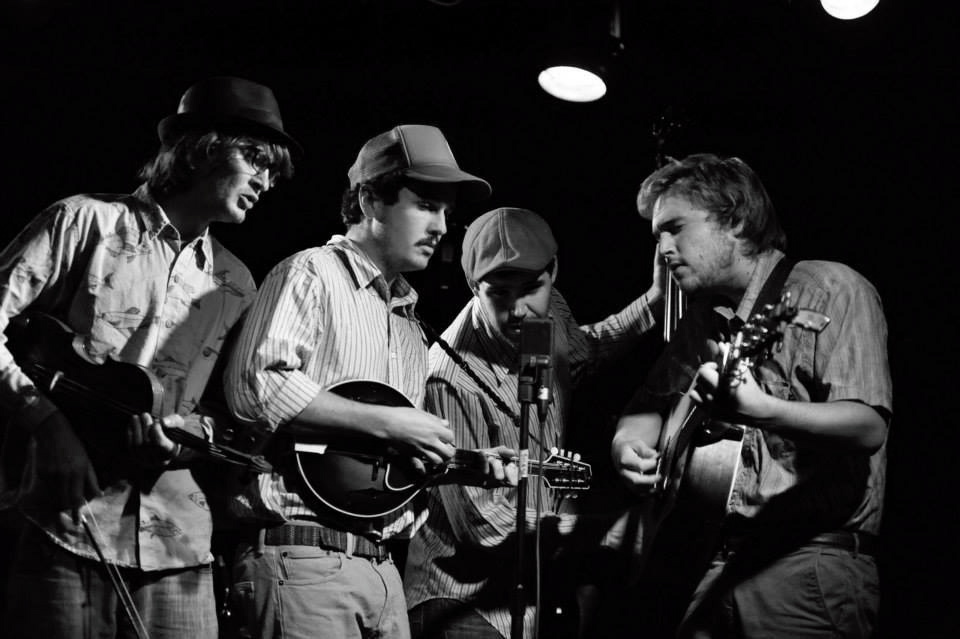
Locals Only: Steep Ravine

0

There’s something in Steep Ravine’s music that sounds older than their (fresh-out-of-college) years: It’s a calmness, a soulfulness, a complete lack of pretention — which is not something that can be said for many bands of young dudes who hope to be the Next Big Thing in bluegrass and Americana. These Bay Area natives (Berkeley, Mill Valley, Menlo Park, and Watsonville, to be specific) are far from over-serious, but they take this music and its history seriously, and the result is pretty sweet. Ahead of their album release show at the Starry Plough this Friday, Feb. 7, we caught up with guitarist and vocalist Simon Linsteadt to hear about their influences, burrito preferences, and the difficulties of starting a band while getting hassled by UCSC security officers.

SF Bay Guardian: How did you all meet and when did the band form?

Simon Linsteadt: [Violinist] Jan Purat and I met in high school, where we first began playing music together. We played Django Reinhardt songs like “Daphne” and “After You’ve Gone,” among other things. It was always acoustic. Then Jan went to UC Santa Cruz, and I followed a couple years later after I graduated high school. By then Jan had already established himself as the go-to fiddle player in Santa Cruz and had a band with Alex, our bass player. We would jam at parties and out in the Porter Quad, which was the big courtyard outside of my dorm where all Porter students would hang out. Sometimes we would play way too late at night and the security officers would have to boot us.

It was at the end of that year that we met Andy, a UCSC graduate who lived in town working as a farmer. He was clearly the most slammin’ mandolinist we had ever met, and it was immediately obvious that he had a rare pair of golden ears. We immediately became friends and started to busk down on Pacific Avenue, and we gained a little bit of recognition among the eclectic group of locals and UCSC students. It was around Christmas of 2012 that Alex started playing with us; we had him join us for a holiday show at the Sweetwater Music Hall in Mill Valley. Alex is one of those few individuals who has an extremely “deep pocket” as we like to say, meaning his sense of time is crystal clear and just perfectly on point. We started playing as a quartet around the Bay Area performing original tunes, our spin on traditional bluegrass, and some gypsy jazz songs. After a year, we all at once recorded our debut album, embarked on a 40-day tour across the US, and in October 2013 we all moved into a house together in Richmond.
 
SFBG: Where does the band name come from?

SL: The name Steep Ravine comes from an amazing spot on Mt. Tamalpais. I personally always liked the name of the Steep Ravine trail, and always saw it as a cool potential band name. A lot of lyrics on our album are inspired by the many excursions I have taken on Mt. Tam. Near the top of the trail is an area called Ridgecrest. When we first got together as a band, we went up there one day to play some music. It is an amazing lookout about 1000 feet up from the ocean and it looks out over the whole Bay Area, out to sea as far as the Farallon islands, and on clear days, all the way north to the lighthouse on the bottom of the Point Reyes Peninsula. Pretty astounding.

https://www.youtube.com/watch?v=lILi3ldsM_g#t=58

SFBG: How would you describe your sound? What did you grow up listening to/playing, and who are some of your mentors?
 

SL: We’re all uniquely inspired by different musical styles, but it’s safe to say that we all come together around the genre of “bluegrass,” and we all love it very much. It’s some of the most energetic, soulful, expressive music out there. It is interesting though how we all found ourselves there. Jan Purat was classically trained from an early age, and can sight-read crazy classical pieces that look like chicken scratch at most to the rest of us. He has also studied his share of jazz. I picked up the guitar around the age of 10 after listening to Neil Young, who is my all-time hero as a songwriter and musical force, and I have studied my share of jazz as well. Andy O’Brien is a fabulous mandolinist who can play solos with the same sheer power and technicality as the greats in traditional bluegrass. He also has a very unique capability of bringing that energy and classic sound into the songs we compose, with very colorful melodic and rhythmic ideas. As I call to him downstairs asking him what his musical influences were growing up, he responds “Jerry, and The Beatles.” Alex grew up playing the drums, and was inspired by the bands like The Meters and the greats of Afrobeat. He also grew up with bluegrass and folk music in his family. He is a rock solid bassist with an explosive rhythmic feel.  In terms of our sound as a band, I don’t really know how to answer that. What we write is not really bluegrass, or jazz, or singer-songwriter, or folk, or whatever you want to call it. Maybe somewhere in between those.

In terms of influences…the obvious ones that come to mind are Bill Monroe, Frank Wakefield, Kenny Baker, Doc Watson, Norman Blake. This is just a small list, but it represents the folks who were true musical forces back in the day, and who inspired many, many musicans through out the years. But just as we came to bluegrass from a range of genres, when we arrange and write music, all of these genres filter though the genre of bluegrass, and we are left with something that is entirely our own. I was personally turned onto bluegrass by Jacob Groopman, who is a fabulous guitarist, mandolinist, and vocalist. He plays with Front Country and Melody Walker, two really hot bluegrass Americana acts from the Bay Area. He taught me to flatpick and showed me the album Manzanita by Tony Rice when I was 16 or 17, and that was the beginning of the end. Andy O’Brien studied mandolin with Jeremy Lampel in Santa Cruz, and Jan has studied with Chad Manning and Evan Price, to name a couple.  We are also very fortunate to live down the road from Bill Evans, banjoist extraordinaire, who has been something of a mentor to us over the past half year or so. There is a rich bluegrass, folk, and jazz scene throughout the Bay Area, and many of these people live right here in the East Bay. We feel very fortunate to be surrounded by such a friendly and talented community of driven musicians.

SFBG: What’s on tap for the band this year?

SL: We have some exciting touring coming up, from spring to fall. We will be playing at the Parkfield Bluegrass Festival, Four Corner Folk Festival in Pagosa Springs, The Redwood Ramble in Mendocino, Pickamania in New Mexico, The Fathers Day bluegrass festival in Nevada City on the Vern Stage, the Folklife Festival in Seattle, and the Cloverdale Fiddle Festival. And we’re always writing new songs and compiling compositional idea for our next album, which we predict that we hope to start recording in the fall of 2014.
 
SFBG: Bay Area food item you couldn’t live without?

SL: Jeez, Jan and I would probably say Gordo’s Taqueria or the Cheeseboard. And I think we all could agree upon the fact that there are some amazing grocery stores especially in Berkeley that have great, fresh produce, such as Berkeley Bowl and Monterey Market. We keep our fridge stocked. Also, Andy and Alex are both very experienced gardeners, farmers, and landscapers, and they have planted a very lush garden at our house in Richmond, which is filled with mustard greens, kale, beets, herbs, and some very heady cacti.


Steep Ravine (CD release party), Fri/7
With McCoy Tyler Band and Windy Hill
8pm, $6
Starry Plough
www.thestarryplough.com

San Francisco landlords targeted for elder abuse

Lisa Gray-Garcia, aka “Tiny,” led a press conference outside the San Francisco Hall of Justice Feb. 5 to announce that she and fellow activists were filing elder abuse charges against San Francisco landlords.

Clad in a gray pantsuit and flanked by activists and senior citizens who were facing eviction or had lost housing in San Francisco, the Poor News Network founder condemned landlords who’ve invoked the Ellis Act as “dangerous criminals.”

Gray-Garcia said criminal charges were being filed against the landlords in accordance with California Penal Code 368, which creates a special category for crimes – such as infliction of pain, injury or endangerment – committed against elders and dependent adults.

The theory is that carrying out an Ellis Act eviction against a senior citizen qualifies as a criminal act under that law, since an elder can suffer physical harm as a result of being turned out of his or her home.

The targeted landlords were taken from a list compiled by the San Francisco Anti Eviction Mapping Project, a volunteer-led group that published names, property ownership, and identifying information of 12 landlords who had repeatedly invoked the Ellis Act in San Francisco. Garcia read out their names as part of the press event.

Beyond that, however, the announcement was short on specifics. Gray-Garcia told the Bay Guardian she did not want to share the names of the affected seniors because she did not feel comfortable exposing the elderly tenants to potential backlash.

Joining the group of activists was an 82-year-old woman who used a walker and declined to share her name. She told the Bay Guardian she had lived in her Richmond District flat for more than 30 years, and had recently received a verbal warning from her landlord that if she did not move out, he would invoke the Ellis Act.

When Gray-Garcia and others filed into the San Francisco District Attorney George Gascon’s office inside the Hall of Justice, however, Chief Assistant District Attorney Sharon Woo first told them that they should complain to the police department, then scheduled a meeting with them at a later date.

Here’s how it went:

Guardian video by Rebecca Bowe

In order of appearance, speakers include Erin McElroy, a tenants’ rights advocate; Gray-Garcia; a District Attorney staff person whose name we didn’t catch; Woo, and Anthony Prince (there because he is campaign manager to Green Party gubernatorial candidate Luis Rodriguez, who spoke at the press conference).

Board of Education president calls out thousands of “invisible suspensions”

39

K-12 student advocates have suspensions in their crosshairs.

At last night’s (Tue/4) Board of Education meeting, young students rallied against suspensions they see as unfair. Advocates negotiated rule changes. San Francisco Unified School District Board of Education commissioners shook their fists at injustice. 

“Willful defiance” suspensions are cited nationwide as a problematic category of suspension because of their subjective nature. Wearing a backwards cap, having a bad day, talking back, all of those fall under the umbrella of willful defiance.

The suspension ban is monumental, SFUSD Superintendent Richard Carranza told the board.

“We’re talking about culture change. A culture where it’s not okay for an adult to say ‘get out,’” Carranza said.

The point of the Board of Ed’s meeting last night was to discuss banning suspensions for willfully defiant behavior, and to refocus SFUSD resources on improving student-teacher relationships instead. 

But new data shows that a different form of punishment, which was previously unrecorded, may cause almost as much harm as suspensions. 

Ever been sent to the principal’s office? That’s a form of referral, and in California it’s enshrined in state education code. Students can be sent to a counselor, principal, or even another classroom. But President Sandra Lee Fewer said the numbers of referrals are getting out of hand, and must be addressed. 

Fewer made an amendment to the controversial resolution to ban suspensions at last night’s meeting, calling for it to also require a reduction of in-school referrals.

The punishment, she said, deprives students of needed classroom time — and is ineffective.

“We can’t pass a resolution like this without including referrals,” Fewer said. “These are in the thousands. Some schools have three times the amount of black children with referrals.”

She called them “invisible suspensions,” because this school year is the first time they’ve been thoroughly tracked, thanks to a new system called the Counselor Online Referral Form. 

The new data shows thousands of middle school students (high school data is still being collected), mostly black and Latino, were sent out of the classroom for “non-compliance” referrals since the last school semester alone. “Non-compliance” referrals are nebulous, advocates allege, a subjective catch-all category for bad behavior. 

referraldata

SFUSD referral data. This is incomplete data collected from the first semester and portion of the second semester of all SFUSD middle schools, but only a few high schools. Completed multi-year data of SFUSD high school suspensions show similar disparities in enforcement of punishments, however.

The board will vote on the proposed amendment and willful defiance resolution at their Feb. 25 meeting.

Fewer’s amendment would not go so far as to eliminate referrals entirely. That would be legally problematic, United Educators of San Francisco President Dennis Kelly said. 

“The teachers have a right under law to send a child to the office if there is a disruption in the classroom,” he said in a phone interview.

“There is a concern that an awful lot is being dumped on teachers and counselors,” Kelly added. “More and more people are having very good ideas and saying ‘you do it now.’” 

Reforms need to be backed by resources that help a teacher enact needed changes, he said. “Without those supplements, this is only so much talk.”

But in the meantime, students are suffering. Many students took to the podium at last night’s meeting, decrying policies they said were detrimental to their education.

Alexandria Berliner, now 22, said suspensions and referrals as a high schooler derailed her education. “I’ve been suspended so many times, I ended up dropping out of high school.”

Laura Faer is an attorney and director of the statewide education rights at the nonprofit Public Counsel. Faer told the Bay Guardian that though referrals could be problematic, it was less clear cut of an issue than suspensions.

“The question is: what is happening to the child who is referred?” she said. “If a referral goes to counseling and it’s productive, that could be a good thing.”

But the non-compliance category of referrals was a red flag for Faer. 

“Noncompliance is not specific, and I would say that’s a huge problem” she said. “It’s entirely subjective, from what we’re looking at right now. It could lead to a child losing instructional time.”

That was commissioner Fewer’s concern as well. At the meeting, she said she’s talked to kids as young as third-grade level who felt school administrators and teachers did not want them there in the schools. She blames policies that send kids out of the classroom. 

“We have a school-to-prison pipeline here, (while) we pat ourselves for our good work,” she said at the end of the meeting. 

“The impact these suspensions have is social isolation. We break spirit, and we are very good at breaking spirit.” 

Live Shots: WATERS is stormier than expected at Brick & Mortar

2

Live shows are an opportunity for musicians and music lovers to share an experience together. After all, you’re standing in the same room. Brick & Mortar Music Hall is a treasure trove for musicians. The small space offers an intimate setting that gives musicians the chance to embrace their audience.

I stood five feet away from WATERS’ lead singer and frontman Van Pierszalowski Monday night and not once did I feel embraced.

Skip the foreplay. WATERS jumped right into a distinctly scruffier and rowdier sound, playing brand-new music from its upcoming album set to be released in April. When two beardy, flannel-sporting men in the audience started running into each other within the first minute of WATERS’ set, I was afraid that this wasn’t my scene. But the two human pinballs quickly stopped before the end of the first song, after fellow audience members ignored the unwelcome cavorting.

“Thank you everybody. The name is WATERS and we’re from San Francisco,” Van said apathetically. After the dissolution of indie rock-folk band Port O’Brien, Van created WATERS. But similarities between the two start and end with the vague nautical allusion. Where Port O’Brien sailed toward hazy folk, WATERS capsized into rowdy rock.

The first half of the rambunctious set consisted of unheard songs off the band’s noisy sophomore LP while the second half was dedicated to the slightly less loud songs from Out In The Light, the band’s debut album; all of it was heavy guitar riffs and booming drums. A somewhat out-of-place female keyboardist played quietly in a dark corner, offering sweet harmonies that added a much-needed contrast to the harshness in Van’s voice.

Bangs calculatingly side-swept over his right eye, Van lightly rocked onto his toes when he sang. It was in those moments that I felt the disconnect melt away. But rather than building on that passion, Van would often sever the mood by rocking out alone on stage— creating an awkward feeling of detachment between the band and the crowd. Seemingly unaware of his relatively mellow audience, Van built up on boisterous vocals and turbulent beats as girls wearing black lipstick and acid-wash jeans swayed in the front row and cute boys with beards and suede jackets bobbed their heads up and down.

“I’m in love with every single one of you people,” Van admitted mid-set. The false grab at intimacy made me feel like a high school girl cornered at her locker by a boy professing his unrequited love. The singer asked if anyone would be coming to the next shows during his month-long Brick & Mortar residency. A few hands flew up, several pathetic howls echoed in the room. He asked again (“Just put your hands up to make me feel better.”) Several additional hands shot into the air.
 
The best part of the WATERS set was the last song, not only because it indicated the end of a generally lackluster show, but also because the acoustic version of “Mickey Mantle” was Van’s first demonstration of genuine emotion. The final song on Out In The Light is a soft, acoustic guitar-driven tune.

Van attempted to quiet the audience and urged us to huddle close to the stage so that he could play without amplification. Welcome to the Van Pierszalowski Show. The other band members sunk into the background as Van balanced on the edge of the stage.

Imploring the audience to shout rather than sing the chorus with him, Van commandeered the audience into enjoying the final song. The lovely female keyboardist chimed in at the chorus and the bassist occasionally strummed his unplugged instrument — two welcome breaks from the shouting. But even Van’s attempt at connecting with the audience was interrupted by accidental microphone feedback mid-song.

I promise I wasn’t in a bad mood before heading to Brick & Mortar. On the contrary, I was rather excited about WATERS. As a fan of Port O’Brien, I had a lot of hope for the local band. The story of how WATERS was born, in particular, intrigued me: Post-breakup and in search of inspiration, Van traveled the world to decidedly graceful landscapes — the ethereal Alaskan coast, the frigid Norwegian fjords, and his seaside hometown in California. With a beautiful name like WATERS, it’s difficult to grasp how such a harsh sound comes out of solitary travels to exquisite coastal settings. Unlike the graceful flow of rushing rivers and crashing waves, WATERS remained detached throughout its first show at Brick & Mortar. Despite the attempt to connect with nature and music, Van just seemed out of place.

Sundance, part five: Swanberg + Ross Perry

1

Missed a previous Sundance post? Check out Pixel Vision for more.

Director and sometimes actor Joe Swanberg is a household name among South by Southwest fest-goers (and mumblecore fans everywhere), with such gems as Nights and Weekends (2009), Marriage Material (2012), All the Light in the Sky (2012), and his segment in V/H/S (2012) entitled “The Sick Thing That Happened to Emily When She Was Younger.” 

More recently, he’s been embraced by the Sundance community with the hilariously sexual Uncle Kent (2011) and last year’s Drinking Buddies, the latter showcasing mainstream stars Olivia Wilde, Jake Johnson, and Anna Kendrick. But now that he has hit parenthood, it seems that Swanberg is maturing into crossover material, and Happy Christmas (US) will make you one happy cinematic camper. Giving Kendrick the most complicated character of her career — as well as memorable roles for Melanie Lynskey and Girls‘ Lena Dunham — Swanberg may be aligning himself with Noah Baumbach and Alex Ross Perry to grab the title of this generation’s Woody Allen. Note: the scenes with Swanberg’s two-year-old baby Jude are worth the admission alone.

Speaking of Alex Ross Perry, he also had a new film at Sundance, and it rivaled Swanberg’s for “most enjoyably unlikable characters:” Listen Up Philip (US). Jason Schwartzman gives a tour-de-force performance in this follow-up to Perry’s debut feature, 2011’s The Color Wheel, helping Philip fulfill the promise hinted at in that earlier film.

Philip explores three sides of an incorrigible coin, embodied by Schwartzman, Mad Men‘s Elisabeth Moss, and the greatest grumpy old man of the year (so far), Jonathan Pryce. The end result exposes the uncomfortable truths of New York neuroses to such a degree that you may feel dirty just to be a human as you leave the theater — it’s both excruciatingly hilarious and unstoppably ruthless. 

Sue Hestor’s 70th birthday party: “We Shall Overcome.”

110

By Bruce B. Brugmann

Plus: Tim Redmond reports on Sue Hestor and her environmental legacy on his new local  website 48 Hills.org.  

How do you say happy birthday to a San Francisco icon like Sue Hestor?

Some 200 of her friends, allies, pro bono legal clients, political heavies, and fellow warriors against big developers and their pals in City Hall gathered Saturday at Delancey Street for a surprise party to celebrate Sue’s 70th birthday.

When she arrived, she was obviously surprised to find a band playing “We shall overcome” and her friends standing, clapping, cheering, and singing  in admiration for a woman who has spent more than four decades as a citizen activist and attorney fighting for one good cause after another, usually at bad odds against the big guys, often for clients without pay. It was truly a historic moment in the history of San Francisco politics. 

I first knew Sue when she popped up as a feisty volunteer in the Alvin Duskin anti-high rise campaign of the the early 1970s. The Bay Guardian was doing an investigative book, “The Ultimate HIghrise,” on the impact of highrises on the city. She pitched in on the project and was in the book’s  staff photo, jauntily wearing her trademark straw hat, standing next to the hole in the ground for the Yerba Buena Center development.

 We billed a central feature of the book as “the world’s first comprehensive study of the true cost of skyscrapers.” Our research group demonstrated that highrises cost much more in services than they bring back in revenue,  a finding that infuriated the Chamber of Commerce because they could never effectively refute it. We also laid out in detail for the first time the power structure behind pellmell Manhattanizaton, how destructive those policies are, how they shift the tax burden from dowotown to neighborhoods and small business, who profits from them, why there are more muckmakers than muckrakers. Our talented art director Louis Dunn provided brilliant graphics that drove home the damaging points about highrises.

Our conclusion was most prophetic: “The most disturbing finding can’t be quantified–but it should be shouted to the heavens.  It is this: unless the city of San Francisco reverses past practice and immediately enacts an ironclad land-use policy such as Duskin’s proposed height limit, the long scoffed at ‘Manhattanization’ of the entire city is a surefire, 100%-guaranteed inevitability.” 

I like to think this project and its results were a fitting start to Sue’s career in land use litigation and terrorizing big developers, City Hall enablers, and their ever more virulent forms of Manhattanization. 

In the early l990s, I called on Sue again, this time to be the founding chair of the spanking new Sunshine Task Force. It was a new task force formed to enforce the Sunshine Ordinance, which gave citizens the right to make complaints about government secrecy and its tradition of keeping City Hall safe for PG&E, big landlords, and developers etal. The task force would, I knew, drive the bureaucrats nuts and  it thus needed a strong attorney as chair who would be smart enough and tough enough to go up against the city attorney and the crocodiles in the back bays of City Hall.

 The neat thing was that nobody could kick Sue off the task force.  She was one of two members who were “grandfathered” in by the ordinance–an attorney (Sue)  and a media rep (B3) –who were selected by the Northern Chapter of the Society of Professional Journalists, not the supervisors. She performed admirably and got the task force on a firm footing as the first and still the best local open government task force in the country, if not the world. 

Through the years of development battles, it was often Sue and Calvin, Calvin and Sue.  Calvin being Calvin Welch, a crafty environmental and neighborhood strategist who worked with Sue and others in developing counters and initiatives and all kinds of hellish moves to beat or slow down and mitigate development.  He said Sue’s career could be summed up in two words: “cumulative impacts.”  The good thing was that we all knew, when the developers brought up their heavy artillery or their sneaky back alley maneuvers, Sue and Calvin would be there to blow the whistle and take on the fight. Call Sue, call Calvin was the watchword but they usually called us first at the Bay Guardian. 

Let me call now on Tim Redmond, a Guardian reporter who covered Sue and Calvin and the highrise battles from 1982 on, to explain what Calvin meant.  Tim laid out the political points in his piece, “Sue Hestor’s birthday and a lesson in SF environmental history,” on his new local  website “48 Hills.org.”  Read Tim’s first paragraphs for the fun stuff on Sue and the last paragraphs for the really important contributions she has made to the city and urban planning, as explained by Calvin.

As Tim concludes, “In 1964, Hestor, representing San Franciscans for Reasonable Growth, sued and won a stunning decision in the California Court of Appeal mandating that the city start studying the cumulative impacts of development. As Welch noted, ‘there was an obligation for developers to prioritize mitigations.’ That’s where the affordable housing program, the transit-impact fees–and the entire concept of analyzing development on the macro, not the micro level emerged.  That was the idea behind the 1986 measure Prop. M, which included no height limits at all–but did include programs and policies designed to protect neighborhoods from the effects of unlimited growth.” 

Well, the Hestor faithful may not have “overcome” the big developers and their latest monstrous Manhattanization plans.   But they have come pretty damn close. On Sunday, the day after Sue’s party, the Warriors caved on its waterfront project and Matier and Ross did a Chronicle column with the head, “Warriors call for timeout on Waterfront arena plan.” And on Monday, the waterfront warriors marched triumphantly into City Hall and, as the  Chronicle’s John Cote reported,  “turned in more than double the number of signatures needed to qualify a measure for the June 3 ballot that would require voter approval for any development on the San Francisco waterfront to exceed existing height limits.”

That could kill the massively inappropriate project.  “If passed,” the Chronicle continued, “the measure would put a check on high-rise hotels and condo towers along the bay and require voter approval for height increases for three major waterfront development plans, the Golden State Warriors’ proposal for an 18,000-seat arena complex, the San Francisco Giants’ plan for an urban neighborhood on what is their main parking lot and the development of the industrial Pier 70 area.”

Whew! That’s what I call a nifty bit of Hestoring and Calvinizing.   b3

If you don’t like the news, go out and make some of your own. (Wes “Scoop” Nisker on KSAN radio during the dark days of the Vietnam War.) 

(The Bruce blog is written and edited by Bruce B. Brugmann, editor at large of the Bay Guardian.  He is the former editor and co-founder and co-publisher of the Bay Guardian with his wife Jean Dibble, from 1966 to 2012.)


Sundance, part four: indie heroes and genre flicks

3

Missed yesterday’s Sundance installment? Right this way!

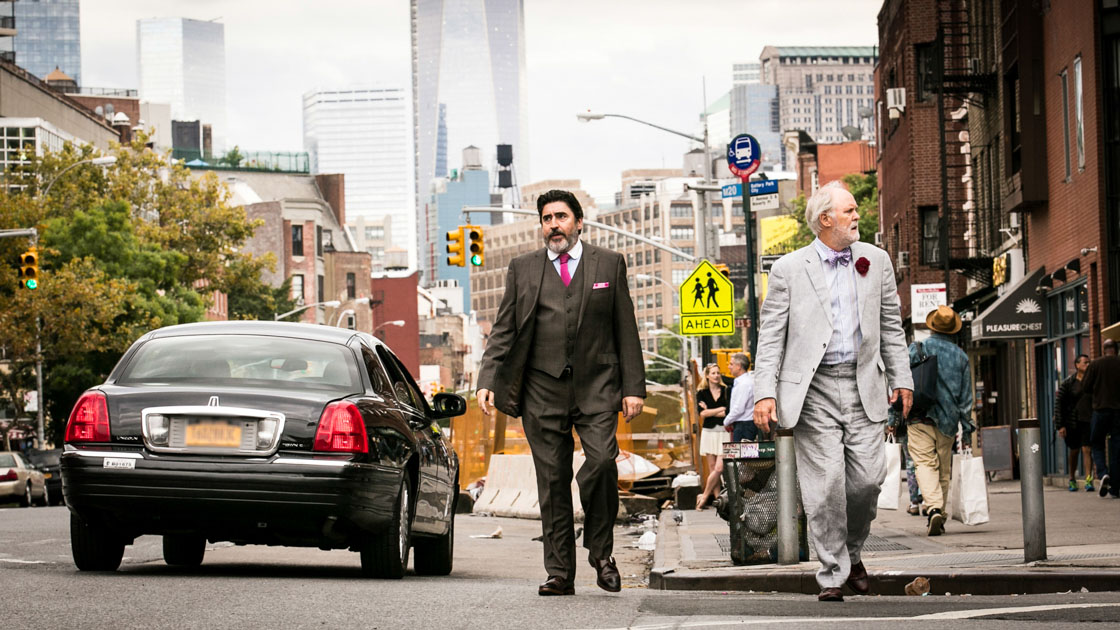
In Ira Sachs’ Love Is Strange (US), Ben (John Lithgow) and George (Alfred Molina) — together for 39 years — are finally married, and suddenly find themselves having to deal with the fallout from an ill-considered world. Both actors are pitch-perfect at portraying longtime lovers, and Marisa Tomei has an intelligent supporting role as a relative of the couple. 

Sundance favorite Sachs (2012’s Keep the Lights On), who debuted with the shockingly memorable The Delta in 1996, treats the material with finesse, and the end result is genuinely earned heartache (and, likely, will yield serious crossover potential). It’s a cliche, but true: at the screening I attended, there was not a dry eye in the house. 

Changing gears … the 1980s-style genre film is back, and both Jim Mickle’s Cold in July (US) and Adam Wingard’s The Guest (US) perfectly capture the necessary nuances (or lack thereof). 

Cold in July‘s Mickle follows his 2013 reimagining of Jorge Michel Grau’s cannibal tale We Are What We Are (2010) by dropping Dexter‘s Michael C. Hall into a web of Texan revenge alongside ruff n’ tuff alpha males Sam Shepard and Don Johnson. Jeff Grace’s synth score punctuates one of the most enjoyable films of Sundance.

Fresh off his horror hit You’re Next (2013); Adam Wingard has concocted 99 minutes of pure John Carpenter-esque euphoria. Incorporating modern politics, crisp cinematography, and shocking violence, Wingard has made his best film to date and proves he is a force to be reckoned with. It pays homage to the bodacious beauty and cool heaven of the 1980s stalker-slasher genre — Joseph Zito’s The Prowler (1981), William Fruet‘s Killer Party (1986), etc. — and boasts yet another glorious synth score, this time by Steve Moore of the band Zombi. Also worth noting: a memorable performance by erstwhile Downton Abbey heir Dan Stevens.

From cult favorites the Zellner Brothers, Kumiko: The Treasure Hunter (US/Japan) takes the unbelievably true story of young woman who becomes obsessed with the Coen Brothers’ Fargo (1996). So obsessed, and believing that it’s based on a true story, she travels to Fargo from Japan to find the forgotten treasure from the movie. Rinko Kikuchi — Oscar-nominated for Alejandro González Iñárritu’s Babel (2006), and last seen rocking robots in Guillermo del Toro’s Pacific Rim (2013) — stars in this inspired tale of hopeless dreams. It mesmerized me from start to finish. And speaking of memorable music, Kumiko was awarded a Special Jury Prize for its score, as performed by the Octopus Project.

Coming tomorrow: the latest from JOE SWANBERG!

Marcus Books approaching landmark status as fundraising continues

It may be a long shot, but there is still time.

Marcus Books, which faces eviction from its Fillmore Street location, seeks to raise $1 million to remain in Jimbo’s Bop City building, the violet-colored Victorian it has operated out of since 1981. If Marcus Books succeeds in its fundraising endeavor, the building will be turned over to the San Francisco Land Trust and the bookstore will remain as a tenant in perpetuity.

Its fundraising campaign is titled Keep It Lit, and co-owners Karen Johnson and Tomiko Johnson have framed it this way: If 50,000 supporters donated $20 apiece, the bookstore could hit its goal by the fast-approaching Feb. 28 deadline. So far, the fundraising website reflects an amount of $5,660 raised so far.

Marcus Books has been doing business for 54 years and is the nation’s oldest continuously operating black-owned, black-themed bookstore.

Today the San Francisco Board of Supervisors is expected to approve historic landmark designation for the bookstore’s Fillmore Street address, on account of “its long-term association with Marcus Books … and for its association with Jimbo’s Bop City, one of the City’s most famous, innovative and progressive jazz clubs.”

The memory of Jimbo’s lives on, as it hosted the likes of John Coltrane, Dizzy Gillespie, Charlie Parker and other jazz greats for after-hours jam sessions.

The Board of Supes’ ordinance also highlights the contributions of Julian and Raye Richardson, Karen Johnson’s parents and the founders of Marcus Books, “who for many years served the city’s rapidly expanding Black community in a myriad of ways, from small-scale publishing and book-selling to academic instruction and mentorship.”

Gimme 5: Must-see shows this week

0

The Bay Area music-related Internets was ablaze this week with the rumor that whiskey-fueled nights at the Mission’s belovedly divey Elbo Room may be numbered, thanks to everyone’s favorite new word to pronounce like it’s an epithet: Condos. The Elbo Room’s current owners and management say they’re just that — rumors — and until we hear more, we refuse to panic. A factual statement, however: If you don’t want your local music venues and endearingly gross watering holes to go the way of the dinosaurs (first victims of the Ellis Act, obviously), you should probably get out and see some live music. Now. Some options:

WED/5

Action Bronson
Action Bronson lives life large. Imposing both physically and lyrically, the Queens native and former gourmet chef draws upon his joys in life — food, drugs, and women — to construct poetically intricate and technically impressive rhymes. His mix tapes are full of love songs, both highly eloquent and frequently offensive, written about the grit or urban life and the beauty of a great meal. Lines about “pissing through your fishnets” are sprinkled among odes to “bone marrow roasted/ spread it on the rosemary bread/ lightly toasted,” all delivered with Bronson’s sure, sharp-tongued talent. At his live shows, Bronson is extremely interactive with his (extremely devoted) fans, passing back and forth joints, liquor, and jokes from the stage to the audience. With the brand new addition of Odd Future thrash punks Trash Talk to the lineup, this show is sure to be insane. (Haley Zaremba)
With Trash Talk
8pm, $25
Slim’s
333 11th Ave, SF
www.slimspresents.com
https://www.youtube.com/watch?v=yfP7qK0khuQ

THU/6

Marcus Shelby
It’s tough to think of a harder working man in the Bay Area’s jazz scene than Marcus Shelby. The upright bassist and 15-piece band-leader is a force to be reckoned with in his own right; the people he surrounds himself with take live shows to the next level. At this special Black History Month performance, the band will be joined by Martin Luther, Kev Choice, Tiffany Austin, Valerie Trout, and Howard Wiley, with legendary, Mississipi-born jazz and blues vocalist Faye Carol in a featured role. The orchestra will draw from past compositions, including “Harriet Tubman,” “Soul of the Movement: Meditations on Dr. Martin Luther King Jr.,” and “Port Chicago,” as well as performing some of a new musical work called “Walls,” which celebrates the 50th anniversary of the Civil Rights Law.
8pm, $20
Yoshi’s SF
1330 Fillmore, SF
www.yoshis.com
https://www.youtube.com/watch?v=UrSBoArCUJ0

Oneohtrix Point Never
Picking up on the ’90s-era abstract, contemplative side of Warp Records, recent signee Oneohtrix Point Never’s R Plus Seven is thoroughly brain busting. The elements are disparate: vocals that begin without reference and depart without finishing, gamelan reminiscent rhythms seemingly performed on the Cosmic Key, and an ever-present effect best described as the stuttering sound of audio on an overburdened CPU. Partly playful, with New Age and stereotypically “world” music samples ripped off of Pirate Bay (where, to be fair, R Plus Seven gets the “plunderphonics” genre tag), the album still manages to sound wholly reverent. To what? Let me get back to you on that. (Ryan Prendiville)
With Holly Herndon (Live A/V), Marco de la Vega, DJ Will, Chad Salty
10pm-3am, $17.50-20
1015 Folsom
1015 Folsom St., SF
www.1015.com

FRI/7

Lucius
Do you ever enjoy feeling like your life is the end credits of a coming-of-age movie, wherein you loved and lost and learned and are now careening down the highway, wind in your hair, on to new adventures? No? Well then don’t go see Lucius, because that’s how this refreshingly earnest, uber professional indie-pop five-piece from Brooklyn makes us feel. Considering how big Lorde got last year, it’s almost confusing that lead vocalists Jess Wolfe and Holly Laessig, with their clear, sweet harmonies and Berklee-bred sensibility aren’t huge yet, but you get the feeling that they’re more concerned with having fun on stage than “blowing up.” Still: Catch ’em before it costs an arm and a leg.
With You Won’t
8:30pm, $16
Independent
628 Divisadero, SF
www.theindependentsf.com

SAT/8

Tony Molina

He’s perhaps still best known as a veteran of SF’s hardcore scene (fronting Caged Animal, among others), so Tony Molina surprised a few people with last October’s Six Tracks EP. Solo, he’s still loud, electric, full of restless energy — but there are also nods here to ’80s hair bands, with a sweet, angsty, hook-heavy frame that riffs off the poppiest Guided By Voices and Dinosaur Jr. songs. It’s no surprise, then, that Molina told Spin: “To me, hardcore is about being in a band, and pop’s more about writing and recording. I’m always going to want to try playing in a new hardcore band. But I also love the idea of trying to make something that gives you the feeling you get when you hear a Teenage Fanclub record.” Mission accomplished.
With Life Stinks, Violent Change, and Swiftumz
9pm, $5
Hemlock Tavern
1131 Polk, SF
www.hemlocktavern.com


Sundance, part three: diamonds in the rough

1

Missed out on last week’s Sundance glee? Part one here; part two here

Malik Vittal’s Imperial Dreams (US) won the Audience Award in the NEXT category, created for films that stretch limited resources to create impactful art. John Boyega (from 2011’s Attack the Block) delivers another complicated and hypnotic performance as a young father trying to make good in the ‘hood. In this spot-on throwback to powerful, low-budget urban films — think the Hughes Brothers’ Menace II Society (1991) and Spike Lee’s Clockers (1995), and even back to Ulu Grosbard’s Straight Time (1978) — director Vittal coaxes some spectacular acting moments, not just from Boyega but also his forlorn friends, played by De’aundre Bonds and R&B singer Rotimi. You don’t want to miss this little treasure.

Pawel Pawlikowski’s Ida (Poland) — pronounced “Eeda”  — is rooted in a formalistic aesthetic, complete with a 1.37 aspect ratio and a profoundly striking black and white palette. While dreary in its location, this character study of a woman in search of her own identity within a nunnery during the 1960s is anything but colorless. As I’ve warned with other films in my Sundance diary — stay away from plot overviews of this film. Just know that Ida has the power to affect you. This is another quiet jewel that you do not want to miss in 2014.

Geetu Mohandas’ Liar’s Dice (India) is as haunting as it is mesmerizing. Hindi superstar Nawazuddin Siddiqui (Gangs of Wasseypur, 2013) helps a young woman, her daughter, and their pet goat on a grueling odyssey, first to the regional capital, Shimla, and eventually to Delhi, in search of the woman’s missing husband. Gripping, difficult, and effectively abstract, this 104-minute debut feature will hopefully open doors for Mohandas to make more alternative films in the future.

Another feature debut: God Help the Girl (UK), from Stuart Murdoch of the Brit-pop sensation Belle and Sebastian; it’s inspired by his 2009 album of the same name. It’s a mix of musical and magical realism, starring the phenomenal Emily Browning (from Zack Snyder’s unfairly dismissed 2011 Suckerpunch), and offers an affectionate, enjoyable coming-of-age story that has shades of Stephen Chbosky’s Perks of Being a Wallflower (2011). If you were 17, this might become your favorite film of all time, and could be the perfect way to get into works like Jacques Demy’s The Umbrellas of Cherbourg (1964). 

Coming tomorrow: indie heroes and genre picks!

Presidio Trust decides on museum proposals

The Presidio museum showdown has come to an end for now, and the winner of the hotly contested mid-Crissy Field site is (drum roll, please) … no one.

Not the Golden Gate National National Park Conservancy. Not the Bridge Institute. And no, not Star Wars creator George Lucas.

At an impromptu press conference this afternoon, Presidio Trust Chair Nancy Hellman Bechtle said the board unanimously voted to not move forward with any of the museum proposals.

“This is the most spectacular site in the country,” Bechtle told reporters. “We simply do not believe any of the projects were right for this location.”

Since November of 2012, The Bridge Institute, the Golden Gate National Parks Conservancy’s Presidio Exchange, and filmmaker and Star Wars creator George Lucas’ personal pop art collection have all competed for a patch of uber-desirable real estate a stone’s throw from the Golden Gate Bridge.

The site is currently occupied by Sports Basement, whose planned move will be unaffected by the decision to reject the museum proposals, a spokesperson for the Presidio told the Guardian.

In January the three teams were made to re-submit their three proposals to the Presidio Trust, which cited Goldilocks reasons for not liking the various proposals. The Lucas Cultural Arts Museum was too big, the Presidio Exchange was too programmatically vague, and the Bridge Institute didn’t have enough of the green stuff (money).

But unlike Goldilocks, in the end the Presidio Trust did not find any porridge that was just right. However, it did offer to assist with finding alternative sites in the Presidio for the museums to find homes.

“There are a number of sites in the Presidio that are possible places to build,” said Presidio Trust Executive Director Craig Middleton. “We are really early in these conversations.”

The Lucas Cultural Arts Museum’s spokesperson, David Perry, said there are many cities vying for Lucas’ pop and cultural art museum.

“We’ve been getting requests to look at other sites for this museum, we’re going to look at those sites,” Perry said. We asked if he was referring to Chicago, where Lucas has expressed interest in building the museum before.

“I’ve heard all kinds of cities,” Perry said.

When we asked Perry how Lucas felt when he heard the news, he answered a bit oddly, if candidly.

“I spoke with George this morning,” he said.  “And as my grandmother used to say, if ‘ifs’ and ‘buts’ were candies and nuts, we’d all have a Merry Christmas.”

Above: Hit “play” to hear Lucas Cultural Arts Museum spokesperson David Perry tell us how his grandmother would have reacted to the Presidio Trust’s decision. 

Okay then.

Notably, the Lucas proposal was endorsed by Mayor Ed Lee, tech venture captalist Ron Conway, and a host of other well-heeled and monied backers. In a letter to the Trust, Congresswoman Nancy Pelosi publicly urged its members to hurry up on a decision, and to choose something that would bring in “a vibrant cross section of visitors to the Presidio, with particular attention to inner-city youth.”

We asked Becthle what influence, if any, opinions from powerful politicians had on the Trust’s ultimate decision.

“They’re very interested in California and the city,” she responded. “Sure I listen to [Sen. Dianne Feinstein], and to Nancy, but I think it was most important to do what was right with the park, and not to please one side or the other.”

The Flaming Lips save Valentine’s Day

0

It doesn’t matter if you’re single, dating, or attached at the hip to your spouse/live-in partner(s)/[insert questionable pet name here] — Valentine’s Day has always presented a veritable Hallmark-sponsored landmine field of ways to screw up, disappoint your loved ones, and/or generally feel terrible about yourself. Until now.

As per the best press release in my inbox this morning: Flaming Lips’ frontman Wayne Coyne will be selling a limited-edition, 12-inch, 20th anniversary reissue of the band’s deliciously scruffy first EP on a handful of select “Record Store Tour” dates on the East Coast next week, and — speaking of delicious — said EP comes packaged with a life-sized, anatomically correct, “hand-crafted, custom-made chocolate skull.” But that’s not all! The skull also contains “a special Gold Coin” that gains the bearer entry to any Flaming Lips show in the world. It’s pretty logical, really. Willy Wonka + (even more) hallucinogens + the ability to just inform your marketing team that you want life-sized, edible skulls to be part of your thing now = Wayne Coyne.

Unfortunately, this little tour will only take our lovably demented hero through a handful of currently snowy cities and nowhere near SF, so if you want to get your hands on one of these bad boys, you’ll need to call an East Coast-based friend and wheedle a bit. Tell them it’s for a special someone. Because nothing says “I love you” like using the money you could have spent on a fancy dinner to ship anatomically correct, promotional chocolate body parts cross-country.

“Record Store Tour” dates to convince your friends to attend for you:
02-08 New York, NY – Other Music (11 a.m.)
02-08 Brooklyn, NY – Rough Trade (4 p.m.)
02-09 Boston, MA – Newbury Comics/Newbury St. Location (1 p.m.)
02-10 Philadelphia, PA – a.k.a music (5 p.m.)
02-11 Baltimore, MD – Sound Garden (5 p.m.)

Monologos de la Vagina finds new actress to replace controversial conservative

62

Following national controversy over the resignation of a politically conservative actress from the local Spanish-language production of The Vagina Monologues, producer Eliana Lopez announced yesterday that the production has found a replacement.

Actress Alba Roversi, a veteran of the Spanish language Monologos de la Vagina, will take the place of Maria Conchita Alonso, whose departure from the play had Fox News crying foul over her being “forced out” for her conservative political views. 

Any chance to needle San Francisco, right? 

Roversi starred in over 20 Spanish language soap operas, though she may not have the same name recognition in the US as Alonso, whose filmography includes Predator 2 and The Running Man (with our former Governator). Roversi is in, and Alonso is out.

Alonso stirred the pot when she backed Tea Party gubernatorial candidate Tim Donnely in an ad on YouTube that garnered just over 100,000 hits. Donnely is running a long-shot campaign to unseat the ever popular Jerry Brown this November on a core right-wing platform.

“We’re Californians, I want a gun in every Californian’s gun safe, I want the government out of our businesses and our bedrooms,” he says in the controversial ad, standing in a cowboy hat next to Alonso. 

“He has ‘big ones,’ and he is angry,” Alonso says in Spanish, by way of translation.

The ad had San Franciscans fired up, diverting attention away from a performance celebrating women to a political shouting match, Lopez told the Guardian. Threats of boycotts put Monologos de la Vagina in the crosshairs. Alonso told media outlets she stepped down from the play to protect her fellow performers.

The video in question, a campaign ad for Donnely starring Alonso and her dog Tequila. 

“The other actors don’t have to go through this,” she said to Fox News & Friends host Clayton Morris. “They don’t deserve this. It’s on me only, they can do whatever they want with me.” 

Why so pissed, San Francisco? Well, the historically Latino Mission district has good reason to not be a fan of Donnely. The Tea Party wunderkind rose to fame as a former member of the gun toting border-patrollers, the Minutemen. From the LA Weekly circa 2010

Tim Donnelly took two handguns on his first tour with the Minutemen, back in ’05. His Colt .45 was photogenic, like that of an Old West gunslinger. But before heading to the Mexico border, Donnelly took it to the range and couldn’t hit the target. So he bought a Model 1911c — a semiautomatic that would shoot straight, if it came to that.

The key to Donnelly’s primary election victory was his pledge to introduce Arizona’s immigration law here. If elected, he will be Sacramento’s leading foe of illegal immigration.

Donnely was geared up to fire off his Colt by the US-Mexico border and essentially promised to bring a culture of fear to California immigrants. Is it a wonder that Eliana Lopez felt that Alonso’s endorsement of him didn’t quite jibe with the politics of San Francisco? 

“Of course she (Alonso) has a right to say whatever she wants. But we’re in the middle of the Mission. Doing what she is doing is against what we believe,” Lopez, who is also starring in the play, said in her most oft-mentioned quote in national media outlets. 

In particular, it didn’t jibe with reasons for bringing the Spanish-language Monologos de la Vagina to the Mission’s Brava Theater, a message that may be lost in the controversy surrounding Alonso’s controversial departure. 

It’s a time of increasing gentrification, when the city’s Latinos/as fear displacement and a loss of their history and esteem. She sees it through the eyes of her young son, Theo, as fewer and fewer Spanish speakers surround his daily life in San Francisco. Lopez wanted to send a clear message: our culture matters. 

Latinas are worthy of celebration.

“I’ve been working on this show for almost a year trying to raise the money, find the venue, the sponsors,” she said. “My feeling was, as Latinas we have such beautiful things to offer. We have great actors and actresses who can bring things to the Mission and feel proud of. Inside me I felt, I want to bring that here, I want to do it. We can bring attention to our culture in a beautiful way, a high quality way.” 

With a new actress in place, she’s ready to move beyond the controversy, she said. 

“How do you say in English? The show must go on.” 

Sundance, part two: Linklater love

5

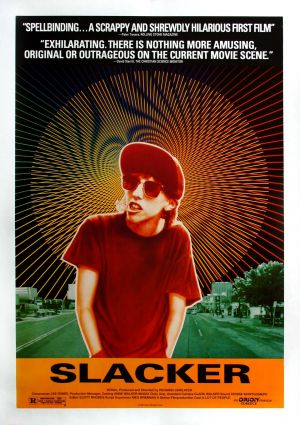
My second year of attending the Sundance Film Festival was at the age of 15; it was 1991 and I took a chance on a film called Slacker by Richard Linklater. 

This is the ticket stub that started my film journals. It’s still taped into a spiral ring notebook that cradles my coming of age, and I have treasured every film of Linklater’s since: his mainstream breakthrough, cult classic Dazed and Confused (1993); his hilarious remake of The Bad News Bears (2005); his underrated adaptation of Fast Food Nation (2006); his overlooked staging of Tape (2001); his pioneering, existentialist, rotoscoped duet Waking Life (2001) and A Scanner Darkly (2006). And, of course, his soul-searching Before trilogy.


I have consistently been amazed by his solid output and the impressive auteurism of his career. And all the while — as he kept delivering works like the unfairly dismissed Me and Orson Welles (2008) or the universally celebrated School of Rock (2004) — Mr. Richard Linklater had his magnus opus, Boyhood, stirring beneath us. Working from an idea concieved immediately after 1998’s The Newton Boys (the only Linklater film I haven’t seen!), the writer-director decided to follow a boy from the age of six to 18 in real time — following the model of Michael Apted’s Up series, which began in 1964 and has since followed the same group of children, checking in every seven years which is currently at 56 Up (2012). 

Linklater cast frequent collaborator Ethan Hawke and Patricia Arquette as the boy’s parents, along with his own daughter Lorelei Linklater, and has filmed them all every year for the past 13 years. The excitement and anticipation I have felt for this epic journey through adolescence has been something of a personal obsession. In fact, I even questioned Linklater after the premiere of Bernie (2011) as to when this damn film was going to be completed, to which he casually responded, “Oh yeah, I should probably finish that someday.” 

It’s truly wondrous to watch Boyhood‘s titular character, Ellar Coltrane, grow up right before your eyes, enhanced by masterful editing of perfectly scripted moments. The end effect is transcendent; it’s as if you are watching your own childhood, combined with the knowledge and experience of being the older characters who often make even more mistakes than the young boy. There is nothing anyone can say that will deter me from defining this film as an undisputed legendary masterpiece on par with The Godfather (1972) and The Godfather II (1974) combined.

CCSF students angered by class cancellations

Despite a day of misty downpours and gray skies, students, faculty members and their supporters gathered in the lobby of the City College of San Francisco’s Conlan Hall on Wed/28 in anticipation of a sit-down with the school’s chancellor, Dr. Arthur Q. Tyler.

The meeting had been requested to discuss increasing displacement at CCSF, with the number of eliminated classes on the rise every day. Yet questions were still swirling about whether college administrators had used much-needed funds to approve higher administrative pay scales without public notice.

Students and faculty delivered a petition signed by nearly 2,500 students opposing the recent course cancellations. When they unrolled the long list of signatures, it reached from the lobby all the way up the stairs to the chancellor’s office door, a physical display of growing dissent. And with the cuts’ affect already resulting in the cancellation of 27 foreign language courses alone, student anger over the course cancellations is building.

Matt Lambert, a CCSF student for several years, said he’d been informed just that morning that his photography class had been cancelled. He said he’d “spent all day this morning talking to people who were in a similar situation as I am, everybody has a class being cut somewhere. So how come classes are being cut, when supposedly City College is getting cash from Proposition A, how come with all that cash classes are still being cut?”

Proposition A, a special tax approved by voters in November of 2012, provides for a new channel of funding for CCSF with a $79 parcel tax. This tax was intended to help the relieve a bit of the struggle that’s burdened the college as of late, but now students and faculty are finding themselves fending off class cuts as enrollment declines under the ongoing threat that the school could lose its accreditation.

The meeting with the chancellor was intended to be an open discussion, but in the end, only three individuals were permitted to speak to Tyler face-to-face. A chancellor’s assistant informed the crowd the only three members–including faculty union AFT 2121 president Alisa Messer–were allowed to enter the office and represent the instructors and staff. While students were told they would have to follow the proper channels in order to arrange a formal meeting, many students regarded the move as a cop-out.

Following the meeting, Messer provided a recap. “They say they’re looking at the class numbers, and looking at what they did cut, and making sure they didn’t make any big mistakes,” she told the Bay Guardian. “And maybe they should reconsider or learn something from what they do cut. They did say that they will be setting up quite a number late start classes, which is all news to us. But we made it really clear about the quality of education, and the trust that students have in getting their education at City College, and that it is not the right time to be cutting classes.”

Despite an agenda item that was hastily withdrawn last week after being up for approval, recommending salary scale increases of 19.25 percent for certain administrative positions, Tyler is said to have denied the amount this increase, telling Messer, along with two colleagues, that “there was no intention to raise salaries by 20 percent,” that there was confusion about the lower approved salary ranges posted on the school’s website, and that Tyler is working to clarify this.

On Monday, AFT 2121 submitted formal records requests to learn the exact amount administrators are being paid.

Live Shots: Yuck finds its voice at The Independent

0

“I remember the last time I was here the room was filled with the smell of weed,” said Yuck’s lead vocalist Max Bloom with his charming British accent, facing yet another thick fog looming over the audience. “I feel like I’m getting high out of proximity.” The herb-filled air wasn’t new to The Independent, and this wasn’t Yuck’s first time in San Francisco. But the band that showed up there Wednesday night [1/30] was a very different band than Yuck has been in the past.

Since April 2013, the London-based indie rock outfit has been forced to regroup and reinvent itself after frontman Daniel Blumberg’s departure. Yuck’s signature lazy ’90s grunge lo-fi sound from its eponymous debut LP has apprently departed with Blumberg; instead, the band has adopted a calmer tone that highlights strong instrumentation as opposed to their earlier focus on smooth vocals. 

Opening the show with the upbeat rock number “Middle Sea,” from its sophomore record Glow & Behold, Yuck started out the show with genuine enthusiasm, matching the stoner crowd’s mood. Like I was, many people seemed anxious to see how well the band would fare sans Blumberg’s Elliott Smith-like voice. If you’ve listened to Glow & Behold, you’ve already noticed the pleasant SoCal intonation in Bloom’s voice. Whether intentional or not, the inconsistency in Bloom’s vocals was amplified during the show, casting an uneven, melancholic tone to both Glow & Behold and Yuck songs. 

Bloom’s promotion to lead vocalist also made room for guitarist Ed Hayes, Yuck’s newest member. Wearing a washed out Pac Man T-shirt, the sprightly guitarist offered backup vocals to Bloom’s deep yet delicate voice and rocked out during “Lose My Breath” — an energetic tune with a soft melody. Bassist Mariko Doi joined in occasionally with backup vocals, offering a contrasting strain to the guitarists’ deep voices.

Throughout the night, Yuck’s vocals remained uneven, with Bloom relying heavily on the backup vocals from Doi and Hayes, despite Doi’s soft — at times inaudible — murmur. Although her instrumentals were perfectly on point, Doi’s solo rendition of “The Wall” seemed lacking in passion and vibrato. Things picked up when drummer Jonny Rogoff began singing along in the back, bringing excitement when it was needed.

While it’s rare for young bands such as Yuck to carry on without one of its founding pillars, the indie rockers don’t seem fazed by the change. Bloom, Hayes, Doi, and Rogoff played in unison with lots of noise and energy, working together rather than as separates. Sure, they’re still working out the kinks with vocals, but overall, the change seems for the better. Even though Bloom has stepped up to the plate as frontman, Doi and Hayes carried their own, shining in the spotlight at various times during the night. Even Rogoff had his moment when fans cheering for the encore began chanting his name. “Jonny, Jonny, Jonny…” The band came back on stage, but only after Rogoff asked to hear the chant again. “You just made his day,” said Bloom before jumping into “Memorial Fields” from Glow & Behold, the closest thing to the band’s old lo-fi.

One major disappointment: Yuck didn’t play one of its most beautiful songs, “Shook Down.” The mellow lyrics and soft beat are a highlight from the band’s debut LP and a major crowd-pleaser. I know I wasn’t the only one who felt like there was something missing at the end of the show. Maybe it was “Shook Down,” maybe it was Blumberg…either way, Yuck’s reinvention is worth appraisal. Despite the band’s recent reformation, Yuck is not lacking in passion. They might still be struggling to find right voice, but the foursome’s trademark ’90s grunge vibe was ever so present, and their future seems promising — as evidenced, especially, by a brilliant cover of New Order’s “Age of Consent.” Blumberg who?

RIP Colonel Meow

0

Alas, minions! Our fearless, fuzzy leader Colonel Meow has passed away. We will always remember him for championing the Cat Pack and sharing his wise words with us. The culling of beloved Internet kitties has begun too soon.

Sundance, part one: crowd-pleasers and dino heists

0

Check out Jesse’s intro to his Sundance Film Festival series here.

This year, there were few films that stood out as across-the-board crowd pleasers. Gareth Evans’ violent, 148-minute The Raid 2: Berandal (UK/Indonesia) — a sequel to his 2011 cult hit — is an absolute must-see, as is the latest from Wet Hot American Summer (2001) director David Wain, They Came Together (US); it’s a comedy spoof that pitches Paul Rudd and Amy Poehler into a slew of rom-com tropes and clichés (delivering some huge laughs in the process).

http://www.youtube.com/watch?v=3MuXrN8L9ro

But the festival’s biggest surprise was perhaps Martha Stephens and Aaron Katz’s Land Ho! (US/Iceland). From the press notes: “A pair of aging ex-brothers-in-law set off to Iceland in an attempt to reclaim their youth through Reykjavik nightclubs, trendy spas, and rugged campsites. This bawdy adventure is a throwback to 1980s road trip comedies, as well as a candid exploration of aging, loneliness, and friendship.” And it really delivered. So it’s no surprise Sony Pictures Classics picked up this hot dog, aiming to bring its magic to audiences beyond Sundance. Stars Paul Eenhoorn (from one of last year’s secret treasures, Chad Hartigan’s This Is Martin Bonner) and relative newcomer Earl Lynn Nelson (who popped up in Martha Stephens’ spellbinding 2012 Pilgrim Song) could be looking at Independent Spirit Award nominations. Yeah, it’s a year away, but I’m calling it now.

Another film that got a distributor at the fest: Todd Miller’s Dinosaur 13 (US), a documentary about a team of independent paleontologists in South Dakota who in 1990 unearthed the largest, most complete Tyrannosaurus rex ever found. What ensues is a twisted and even stomach-churning tale that questions who “Sue” (as the skeleton was dubbed) belongs to. This was one of the most thought-provoking (and, possibly, argument-inducing) films of the fest. Are the paleontologists pirates? Does the government have control of the land, or should the discovery belong to the landowner? And what if those lands are tribal lands? If this sounds intriguing, it is, and you won’t have to wait long to see it for yourself, since Dinosaur 13 was picked up by CNN Films and Lionsgate for a million bucks (or around one-eighth of the value of a T-rex skeleton, as it turns out). 

Along the same lines was Andrew Rossi’s Ivory Tower (US), which does its best to explore the dilemmas facing modern universities — tuition hikes, trillion-dollar debts (did you really need that brand-new swimming pool?), etc. — and what they mean for their students. It poses the modern questions of onsite vs. online, skills vs. information, and most importantly “Is college worth it anymore?” The film feels as confused as the questions it’s attempting to delve into, but I was still deeply affected by many moments. I’d recommend everyone involved with education [ed. note: Ficks is the Film History Coordinator at the Academy of Art University] to jump in.

Stay tuned for more of Jesse Hawthorne Ficks’ Sundance (and Slamdance!) screening adventures, including tomorrow’s look at Richard Linklanter’s epic Boyhood.

The future of civic engagement is here (so far it’s not pretty)

Last week, we wrote about San Francisco City Hall’s foray into “civic innovation,” to foster greater governmental openness through web-based technology.

We spotlighted the OpenGov Foundation’s partnership with the city to upload the entire municipal code to a website, SanFranciscoCode.org, to make local laws readily accessible for anyone (regardless of city of residency, apparently) to comb through, offer comments, or suggest legislative tweaks.

Sup. Mark Farrell trumpeted the open city code website as a great way to incorporate citizen feedback to improve government. It earned a mention the San Francisco Chronicle and other news outlets after Farrell proposed doing away with a silly law that effectively bans bicycle storage in garages, prompted by a comment left on SanFranciscoCode.org.

In and of itself, the idea is not bad – transparency and openness are laudable goals.

That being said, judging by the quality of “civic engagement” happening so far, there’s a long road ahead before this particular experiment in digital democracy takes us anyplace we’d like to go.

There’s the guy who rails against the law about curbing the wheels of your car when parking on an incline, who wants it known, sir, that “I resent and object to getting a near $70 fine for not curbing the wheels on my 2011 Prius.” (He argues that the grade of the incline the rule applies to only made sense in a bygone era, when parking brakes and manual transmissions were more likely to fail.)

Other brilliant insights from cantankerous “innovators”: What do we need San Francisco General Hospital for, anyway?

Another comment calls for writing a new law: “I think news racks should be outlawed as people leave garbage around them, graffiti and vandalize them all the time. I have never seen a group of news boxes / racks that were in a good shape anywhere in the city. They just make the city ugly and cluttered.”

I know, I know – this civic innovation experiment is still in a test phase. And after all, anyone is free to comment, and more stimulating ideas could still be on the horizon. 

But still. This is what citizen empowerment through technology looks like, in San Francisco?

San Francisco and its cycletracks lead the way toward safer biking statewide

39

San Francisco has been blazing the trail toward safer cycling with innovative designs such as cycletracks, or bike lanes that are physically separated from cars, which have been installed on Market Street and JFK Drive. But cycletracks aren’t legal under state law, something that a San Francisco lawmaker and activist are trying to solve so that other California cities can more easily build them.

“Right now, many cities are not putting in cycletracks for fear they don’t conform to the Caltrans manual,” says Assemblymember Phil Ting, whose Assembly Bill 1193 — which would legalize and set design standards for cycletracks — cleared the Assembly yesterday [Wed/29] and is now awaiting action by the Senate.

Ting is working on the issue with the California Bicycle Coalition, whose executive director Dave Snyder is a longtime San Francisco bike activist. Snyder says Caltrans doesn’t allow bike lanes that include physical barriers against traffic, even though they are widely used in other countries and states and considered to be safest design for cyclists.

“San Francisco is technically breaking the law because they have the best traffic engineers in the state and a good City Attorney’s Office and they know they can defend it in court if they have to,” Snyder said. “Most places in the state won’t do that.”

In addition to the direct benefits of the legislation in San Francisco and other cities, Snyder said the legislation seems to be triggering a long-overdue discussion at Caltrans and other agencies about how to encourage more people to see cycling as an attractive transportation option, with all the environmental, public health, and traffic alleviation benefits that brings.

“It’s opened up a conversation about bike lane design and Caltrans’ role in encouraging safe cycling,” Snyder told the Guardian, praising Ting for championing the legislation. “It’s having an impact beyond its immediate impact.”

The Guardian is waiting for a reponse from Caltrans and we’ll update this post if and when we hear back. [UPDATE 1/31: A Caltrans spokesperson got back to us and said, “It’s our policy not to comment on pending legislation.”]

Surveys by the San Francisco Bicycle Coalition have shown safety is the top concern of those considering riding to work or school more often. Ting said he hopes this legislation will address that concern: “By building more cycletracks in California, there will be increased ridership.”

Tee time: a peek inside Urban Putt, the Mission’s indoor mini-golf course

2

On the back wall of the main room of the old Victorian building at 1096 S. Van Ness is a sculpture of two creepy angels. One holds the other in its arms, their wings keeping them up. These angels are part of the original construction of the building, back when it functioned as a mortuary. Perhaps due to the haunting angels, perhaps due to the thought of a dead body storage center, the building has sat empty on the corner of South Van Ness and 22nd Streets for 15 years.

Today, the angels are still there and the building’s new owner has no intention of taking them down. “We will preserve as much as we can from this old look,” says Steve Fox, the man behind San Francisco’s first indoor mini-golf course, Urban Putt, set to open in April. The “high-concept” course will feature a restaurant with “eclectic California comfort cuisine” upstairs and two bars with a “creative bar program,” according to Urban Putt’s most recent press release. 

Urban Putt is not your traditional mini-golf course. The fantastical, technologically advanced, steampunk-y 14-hole course (four short of the customary 18 due to space constraints) will be composed of high-tech gadgets, countless buttons and nobs, and a few obligatory tongue-in-cheek twists (see: the “TransAmerica Windmill”) contained within its homages to San Francisco landmarks. 

A replica of the Painted Ladies shakes in a simulated earthquake at the first hole. At the “Musical” hole, the golf ball is catapulted toward the ceiling before bouncing delicately on drums and a cymbal. A two-hole underwater area pays homage to Jules Verne: an intricate submarine embellished with control panels and levers — although the 150 motion-sensor LED floorboards (imitating the lights of phytoplankton) are exceptionally post-Verne. Next to those wistful angels, the “Day of the Dead” hole honors the building’s previous tenants.

With a name like Urban Putt and its kitschy concept, it’s tempting to call out the spot as yet another example of gentrification in the Mission. Can’t you just see the hordes of trendy techies lining up to play putt-putt before hitting up the Make-Out Room on a Saturday night? (Because you know they will…)

Fox, a longtime mini-golf fanatic, was prepared for the criticism. “The very first note we got was like ‘the nerve of these people.’ It was written up on the Chron that we were doing this,” he says about the initial backlash. “We had signed the lease two days before.”

So Fox put up his phone number outside the building to encourage any and all complaints about Urban Putt. He also set out to connect with the neighborhood, reaching out to the community when he started hiring. “I think they realized that I had every intention of not being some sort of carpet bagger,” says Fox.

For Fox, Urban Putt is a longtime dream. A lousy golf player himself, the former editorial director of PCWorld and editor in chief of InfoWorld is an avid putt putt player. Since the 1990’s Fox and his wife have been hosting mini golf parties at their house. So what happens when you grow old and have a lot of money? Make your dream come true.

“My theory in all of this, having spent years and years running organizations — albeit editorial organizations, not mini golf — is if you don’t have expertise, go out and find the best people you can and have them do it,” says Fox. 

With experience that spans Burning Man, Maker Faire, the Exploratorium, and even MythBusters, the members of the design and construction team have an expansive background in creativity and innovation. “We have a group of people with real expertise in these areas. You can get that in San Francisco. There’s a lot of places you couldn’t find that. There’s that kind of wonderful talent base,” says Fox. At their disposal: the $17,000 3D printing ShopBot. Claiming it as one of their competitive advantages, Fox explains that the in-house printer will help his team can easily innovate, make changes, and repair the course over time.

Despite UrbanPutt’s extravagance, Fox maintains that the wonderland will be accessible to both children and adults, as well as both techy transplants and long-established local residents. His mission to keep games affordable ($8 for kids, $12 for adults) and to retain the vibrant local culture demonstrates his dedication to the city. Much of the building’s original construction will remain the same: the historical exterior, the metal front gate, the Victorian sconces, and the two angels at the back wall.

“People get that I am really of this neighborhood,” says Fox. “I think they’re responding well to that.”