Print sections as they appeared in the early 2010s

To find articles by keyword or author, you may want to use our Search function.

Print Sections

Batter up

1

le.chicken.farmer@gmail.com

CHEAP EATS Hedgehog and me are on the road again. Mount Rushmore, Yellowstone Park, and the Mission lie ahead — by mere days! — and shrinking in the rearview mirror are both our families, several old priced-out-of-SF pals, 10 big states, four or five completely different kinds of barbecue, and many, many baseball games. Including big league ones, a minor league one, a semi-pro one, and a little league all-star game.

The American pastime, you will be happy to know, is alive and well on the other side of the bay. At PNC Park in Pittsburgh, for example, there are Polish Hill dogs, which are hot dogs with pierogi on them.

Earlier today, in a desperate attempt to be healthy, we both ordered grilled tilapia at a little family restaurant in Chenoa, Illinois. Make note, in case you are ever out Chenoa-way: “grilled,” in Chenoese, means breaded and fried.

You know me: I love these kinds of curveballs. But Hedgehog, who is still smoldering from the ears over a grilled pork chop disguised as a fried ham steak that occurred to her in Georgia three years ago, was less amused.

She has antiquated notions about the things she eats. She wants them to be what they are. That’s why I was surprised a couple nights ago in Youngstown, Ohio, my hometown, when she wanted to go to C. Staples barbecue.

The last time we were in Youngstown, a year ago or so, I took Hedgehog to C. Staples so she could experience the barbecue I lost my barbecue virginity to, which (and I warned her) isn’t barbecue so much as fried chicken slathered in a tangy, gritty sauce and served on white bread.

As I recall, she wasn’t amused.

So why did she insist on a do-over this year, on our way to the ballpark (Connecticut Tigers 5, Mahoning Valley Scrappers 4)? And why was C. Staples’ unbarbecued barbecue so freaking delicious this go-round?

I don’t have an answer.

And Youngstown was not the biggest barbecued revelation of our last thousand miles. That would be Pittsburgh, where, before the game, Moonpie and her man took us to Union Pig and Chicken. There, the truly smoked chickens and ribs and ohmigod the pork shoulder rocked my little world harder than it’s been rocked in a long time — by barbecue anyway. The brisket was only so-so, but that’s OK, cow being merely a special guest at Pig and Chicken.

San Francisco Giants 6, Pittsburgh Pirates 5.

We tend to root root root for the home team, so that game was kind of confusing for us. Not so Cleveland, where the Indians spanked the Tampa Bay Devil Rays 7-3. We met Kiz and her man beforehand at Hodge’s — a place fancy enough to bring out amuse bouches and unfancy enough for the amuse bouches to be tater tots. Crème fraiche for dipping.

There were lobster corn dogs with banana ketchup too, but that’s neither here nor there. Well, it’s there.

Here, we have the wonderfully fluorescent and blue collar Vientiane Cafe, on Allendale in East Oakland — which may as well be Des Moines to most City dwellers, I realize. But that’s OK. Go stand in line at San Tung.

We first discovered Vientiane last fall during our desperate search for a replacement for San Tung’s dry fried chicken wings. Angel wings, Vientiane calls them, and they come crispy and piled up on the plate, all second joints — which, as it happens, is both of our favorite joints, mini-drumstick be damned. Speaking for myself, I just like sticking my tongue between those two little bones, and getting the goods.

That joint reminds me of eating crawfish and crabs, and some other things. Vientiane’s dark, sticky sauce, according to Hedgehog, tasted like it belonged on Cracker Jacks.

Berwick 8, Danville 7.

Besides these angelic cracker jack wings, I love the papaya salad, which is almost too spicy and fish saucy, even for me. The menu has probably a hundred Lao, Thai, and Vietnamese dishes, and I hope to eventually try all of them. New favorite restaurant!

VIENTIANE CAFE

Daily 11am-9pm

3801 Allendale Ave., Oakl.

(510) 535-2218

AE,D,MC,V

No alcohol


City College fights back

19

news@sfbg.com

When your options are bad, terrible, and unthinkable, how do you choose which way to go? And should that decision be graded on a curve that takes into account the dire fiscal circumstances facing most public colleges in California these days?

City College of San Francisco (CCSF), which serves more than 90,000 students a year, last year did what some consider unthinkable: laying off administrators and leaving a reserve fund at dangerously low levels in order to save classes and stave off faculty layoffs. The current $187 million operating budget has a reserve of only $2.2 million, or just over 1 percent compared to the state-recommended 5 percent.

Such decisions may cost the college its accreditation and threaten its very existence, but they also represent legitimate differences over what role educational institutions should play in their communities.

In June, the college came under fire for administrative and financial mismanagement by the Accrediting Commission for Community and Junior Colleges, a private organization that evaluates K-12 schools and higher education institutions every six years.

Although the commission applauded the school for its commitment to students, it placed the school under its most severe sanction before accreditation is terminated: “show cause.”

It identified eight problem areas that the college has failed to address since 2006, which include measuring student learning outcomes, attaining financial solvency, and revising the college’s mission statement to reflect current fiscal realities.

“The team finds that the current, ongoing funding for San Francisco City College appears insufficient to fully fund the mission of the college as it is currently conceived,” the commission wrote in its June report. “The team advises the college to assure the mission of the college is obtainable based on accurate short-term and long-term funding assumptions.”

Essentially, the commission is recommending a refocusing of the school’s mission to prioritize college transfer classes. The report went on to say that too many people making decisions through a highly decentralized governance system slowed down or halted altogether the college’s ability to make cuts where it needed to — or where the state and commission thought cuts should be made.

These competing visions of how community colleges should continue to exist have driven a wedge between local college officials and state-level decision makers — a clash made clear through City College’s accreditation woes.

“It’s not that City College isn’t doing a good job, it’s that these are emerging trends we have,” former Student Trustee Jeffrey Fang said. “In the long run, it might actually improve City College. The bad part is that it came at a time when we are so strapped and mired neck deep in political games.”

Those games have starved funding for public education statewide, in the process redefining the role of community colleges.

“City College has a very ambitious mission. Part of that mission is that it’s a true community college,” CCSF spokesperson Larry Kamer said. “Now, decisions are being made de facto by the budget and we need to re-evaluate that mission.”


PUTTING THE “COMMUNITY” IN COLLEGE

Adult education used to be integrated into K-12 districts. But over the years, two-year “junior” colleges took over that responsibility, transforming them into today’s “community” colleges.

The newly minted community colleges began serving thousands of immigrants learning English, job seekers needing new skills, and elderly citizens looking to continue their education. But when California’s budget crisis hit a critical point, that all began to change.

Three years ago, the California Legislature said when the community colleges cut courses, they shouldn’t cut courses involving transfer, career technical education, and basic skills, State Community College Chancellor Jack Scott said in a phone interview.

Scott is responsible for overseeing all 112 community colleges in California, a quarter of all community colleges in the country. He’s on the cusp of retirement, and the end of his tenure has been marked with the changing mission of the colleges he oversees.

“I want it clearly understood that I personally want to see the community colleges offer all the classes it wants to,” he said. “But with scarcity, you have to prioritize. If you offer the same classes you did before, you’ll go bankrupt. Something has to give.”

The state agreed and asked community colleges to prioritize enrollment, with a focus on recent high school graduates who plan to transfer to a university in two years and anyone else seeking a degree or certificate.

If community colleges can’t afford to offer classes sought by their broader communities, and K-12 schools are ill-equipped to plug back into that task, does the notion of continuing adult education just fade away?

David Plank, executive director of policy analysis for California Education, a Stanford University-based research center, says it just may: “I don’t think that responsibility will be reimposed on K-12 districts because it was always seen as a sort of add-on supplementary responsibility.”


BUDGET WOES TRICKLE DOWN

California’s Master Plan for Higher Education — which mandates that community colleges provide classes for everyone — only worked as long as there was money to fund it. But Plank says that money has been steadily shrinking since 1978 when voters passed Proposition 13, which capped property tax increases and raised the voting threshold for the Legislature to increase other taxes.

As funding from Sacramento has been slashed by more than $500 million in the past year alone, California’s 112 community colleges have turned away more than 300,000 students trying to enter the system. If Governor Jerry Brown’s tax proposal wins in November, community college funding will stay at about the same level, but if it fails, the system will see further cuts of more than $340 million.

“The system now is breaking down,” Plank said. “We’ve finally reached a point where the state’s share is too small to hold things together. We see tuition going up at very rapid rates and a substantial deterioration both in access and affordability.”

In flush times, community colleges could serve everyone — rich and poor, those seeking new skills and others working toward a new degree. Now, the community college system faces two choices if it’s unable to find new sources of revenue: continue on the path of deep cuts, or change its priorities altogether.

City College Board member Steve Ngo cites new statistics that show enrollment in English as Second Language (ESL) classes are trending down, a sign that those classes should be cut first. “The community should lead. If the demand is down, you’re not serving your community,” he said.

Yet others say community colleges should strive to serve everyone who needs them.

“Some [classes] are really valued by our Pacific Islander population, but their enrollment may not be as high. Should those classes go away? I don’t think so. It’s something I feel like the whole college community needs to come to grips with” CCSF math instructor Hal Hunstman said.

City College ESL instructor Susan Lopez said her classes have been cut about 29 percent over a decade, which she considers drastic.

“Despite that large and somewhat intentional reduction, we still serve 20,000 annually throughout the city. By comparison with our very large ESL Department, the English Department serves only 7,000,” Lopez said. “How could we abandon those who are most educationally needy and often desperately poor in favor of those who are less needy?

“We need to step up adult education across the board,” she said. “The problem is all the pressure to do less and to fund less of this type of education.”


SMOTHERED ON ALL SIDES

The accreditation commission is an independent body, but it’s been pressured too.

“In the current climate of increased accountability, our regional accrediting associations find that tight spot to be more like a vice,” a commission newsletter said in 2006. “On one side are forces at the national level ready to throw out regional accreditation in favor of a federal approach; while at the local level, they are faced with institutions resistant to rapid change and increased scrutiny.”

In the past year, private entities ponied up thousands of dollars to help usher in a new numbers-based approach to education. In 2011, a 20-member body comprised of public and private representatives was charged with evaluating the community college system.

Called the California Community College Student Success Task Force, its creation was mandated by the state, but to many people it reeked of privatization.

Several private organizations funded the task force’s work, including the Lumina Foundation, an educational research and grant-making institution with ties to the American Legislative Exchange Council (ALEC), a controversial lobbying group for private interests that authored the Stand Your Ground gun law.

By fall 2011, students, faculty, and administrators across the state began to question the task force’s methods and recommendations, which initially included proposals to cut many non-credit and enrichment courses, restrict financial aid, prioritize transfer students, and cap the number of units one person could take.

Under the veil of increasing so-called “student success,” the task force was asking schools to prioritize limited funds and change their missions to once again become “junior” colleges — a fate that City College has refused to accept.

City College’s Board of Trustees passed a resolution in November 2011 opposing the task force, nearly unanimously, with Ngo the sole dissenting vote. Then-Chancellor Don Griffin warned that the task force’s agenda was a transparent attack on open access that would disproportionately affect poor people and people of color, imploring the board to reject its recommendations.

“They’re talking about taking over the vehicle of community colleges and turning it into something else,” Griffin said. “We have to take a hard stand because everybody around the state is watching City College of San Francisco.”

Students and faculty at City College joined the fight. They spoke out at Board of Governors meetings in Sacramento. They wrote letters, emails, and scathing editorials. The school’s student-run school newspaper, The Guardsman, led a statewide campaign opposing the task force.

Despite the public’s concerns, the California Community Colleges Board of Governors adopted the task force’s final report in January.

“As wonderful as open admissions is, if it’s a false promise to an objective, it fails,” Peter MacDougall, Board of Governors member and task force chair, said at the January meeting.

“Our objective is to have that promise realized, that’s what the recommendations are intended to achieve.”

Ultimately, the initiative succeeded, shifting priority enrollment to students who are freshly in the college system. The Task Force report is now Senate Bill 1456, sponsored by Sen. Alan Lowenthal and commonly known as the Student Success Act of 2012.


AHEAD OF THE PACK

As everyone waits with crossed fingers hoping for a favorable outcome at the ballot in November, City College officials are fighting keep the school open.

“Do we alter our mission slightly, or fundamentally? It’s not clear yet what we’re going to do,” Ngo said.

The trustees have until October to present the commission with a plan and then until March to prove they can achieve it. In the meantime, the commission requires that preparations be made for potential closure, which Interim Chancellor Pamila Fisher and other CCSF officials say won’t happen.

Only two other community colleges received a “show cause” order this year: College of the Redwoods and Cuesta College. Yet as of January, 25 percent of California’s community colleges are under sanctions, according to the accreditation commission documents.

Federal funding hinges on the certification and other educational institutions, such as the University of California and the California State University systems, only accept transfer credits from other accredited institutions.

Everyone seems to agree that City College is too big to fail — with more than 90,000 students, it’s the largest community college in the nation — but how it will look and operate in the future remains unknown.

City College already cut dozens of classes this year — including many with students already enrolled after the spring semester began. But City College isn’t alone in its plight.

Santa Monica Community College caused an uproar earlier this year when it proposed charging more for popular classes. As of July 1, classes cost $46 per unit but under Santa Monica’s proposal students would pay $180 per unit for courses in high demand.

When students protested this two-tiered payment system in April, police pepper-sprayed them, just five months after UC Davis students received the same brutal treatment for holding a non-violent Occupy-style action against their own tuition hikes.

“What we see is a move towards privatization, in the sense that we are now expecting students to pay a larger share of the cost,” Plank said. “Over certainly the last 40 years, California has been steadily disinvesting in post secondary education.” Whether tuition increases at the CSUs and UCs in the near future depends on whether voters approve Brown’s tax proposal this November. City College’s financial future hinges not only on the governor’s tax proposal, but a local parcel tax initiative as well. City College needs both to pass in November just to break even. “A lot of San Francisco’s workforce is educated at City College,” City College board member Chris Jackson said, adding that for poor and working class people, it’s the only affordable option. In addition, as veterans return from foreign conflicts, ex-offenders are released from prison and enrollment capped at the state universities, Jackson said, “We need local investment in City College.”

Do not disturb

0

arts@sfbg.com

FILM Todd Solondz elicits a variety of responses, nearly all of them extreme, and nearly all reasonable enough. You can look at his work and find it brilliant, savage, challenging; or show-offy, contrived, fraudulent. The circles of interpersonal (especially familial) hell he describes are simultaneously brutal, banal, and baroque.

But what probably distresses people most is that they’re also funny — raising the issue of whether he trivializes trauma (rape, murder, child abuse, etc.) for the sake of cheap shock-value yuks, or if black comedy is just another valid way of facing the unbearable.

His dialogue is enjoyably snappy, in the sense that the cat doubtlessly enjoys the crunchy snapping of bones in the bird or mouse it’s caught (and which the fox then enjoys in the cat). He’s very good with actors — it’s not easy to draw fully dimensionalized performances from such grotesque material. But these strengths only further muddy the line he walks between a theater of cruel hyper-realism and facile, modishly mean-spirited satire.

After 17 years and six features (excluding 1989’s Fear, Anxiety & Depression, a tampered-with debut he’s disowned), it seems safe to say the truth is somewhere between. While variable, his films have stayed interesting despite their narrow thematic and stylistic range. Life During Wartime (2009), the “sequel” to Happiness (1998), had startlingly good sequences even as it dutifully handed more ammo to the naysayers. No matter how suspect his intentions, it’s difficult to shrug off the alarming punch in reptilian Charlotte Rampling’s pickup of Ciarán Hinds, his tense reunion with the son he’d molested, or Allison Janney’s whole portrait of a hapless “good” mother self-justifying one bad decision after another. It proved, at the very least, that Solondz hadn’t lost his edge.

That’s why Dark Horse is disturbing — because it isn’t, in his usual way, and because it’s such a slight, inconsequential, even soft movie by his standards. This time the sharp edges seem glibly cynical, and the sum ordinary enough to no longer seem unmistakably his.

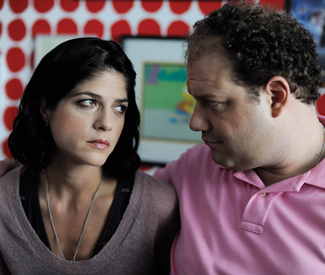
It opens at a wedding reception, always a ghastly ordeal for single people who figure themselves losers. In that regard, Abe (Jordan Gelber) would be right — he is a big fat loser, an obnoxious jerk of about 35 who still lives with his parents (Mia Farrow, Christopher Walken) and works at dad’s office, likely because no one else would employ him.

But Abe doesn’t exactly see himself as a loser. He resents and blames others for being winners, which is different — he sees the inequality as their fault. Spying Miranda (Selma Blair) at the reception, clearly miserable, he perceives someone whose self-esteem is so low she might lack the will or good sense to resist his awful personality when it’s forced upon her.

He’s right. Miranda’s self-loathing is such that after some bewildered and mortified initial resistance, she figures she … deserves him. In the interest of full disclosure, however, she airs some skeletons from the past, and these rattle Abe’s barricade of angry obliviousness. So does getting fired by his fed-up dad, being asked to move out, discovering something weird about the office secretary (Donna Murphy), and so forth. Plus there’s the eternal aggravation of being much less smart, handsome, and successful than his brother Richard (Justin Bartha), whom he thus blames for “ruining my life” — and who doesn’t even lose points with mom and dad for being gay! So unfair.

Dark Horse flirts with something interesting by letting these factors tear at Abe’s deniability until he starts suffering delusional episodes — ones in which people tell him exactly the truth about himself. (Farrow’s simpering voice has seldom been put to better use than a sequence in which her infallibly supportive mother uses just the same sugary tone to inform Abe he’s always been a waste of space.)

But Dark Horse is less of an ensemble piece than most of Solondz’s films, and in hinging on Abe, it diminishes his usual ambivalence toward flawed humanity. Abe is a buffoon, like a particularly unfunny Zach Galifianakis supporting character in a broad commercial comedy inexplicably given center stage in a low-key seriocomedy. The awful people in prior Solondz movies were also repellant, yet partly because we could perceive enough of their pathos to make them even more squirm-inducing. Abe has no pathos, or other redemptive qualities. He’s just an annoyance, one whose mental health issues aren’t clarified enough to induce sympathy. The director’s deliberately crap pop soundtrack choices and tritely ironic ending only further reduce these 86 minutes to a thin, overextended joke.

That’s disappointing for Solondz, though admittedly if Dark Horse were by somebody else its modest virtues might be more easily appreciated. In particular, the erratic Blair is excellent here — she digs into Miranda’s depression so deeply we marvel that the woman can still summon energy to walk and talk.


DARK HORSE screens Thu/19 at San Francisco Film Society Cinema; it opens Fri/20 in Bay Area theaters.

Personal detectives

0

cheryl@sfbg.com

SFJFF This year’s San Francisco Jewish Film Festival includes a trio of documentaries inspired by ephemera: hand-scrawled memoirs and journals, decades-old letters, fading photographs, and yellowing newspapers, long-forgotten and crumpled into attics and storage closets.

Dust be damned, for all three filmmakers — Arnon Goldfinger (The Flat), David Fisher (Six Million and One), and Daniel Edelstyn (How to Re-Establish a Vodka Empire) — become obsessed with these scraps from the past, and with piecing together their family histories, all of which were studded with tragedy and rarely discussed with younger generations. The task requires the kind of determination that can only be mined from a deeply personal place — and it results in some deeply personal films.

The docs are similar, especially when viewed in the short span of a festival, but Goldfinger’s The Flat is the standout. It begins as the filmmaker’s family descends upon the Tel Aviv apartment of his recently-deceased grandmother, “a bit of a hoarder” who lived to 95 and seemingly never got rid of anything. This includes, as Goldfinger discovers, copies of the Joseph Goebbels-founded newspaper Der Angriff, containing articles about “the Nazi who visited Palestine.” The Nazi was Leopold von Mildenstein, an SS officer with an interest in Zionism. Turns out he made the journey in 1933 with his wife and a Jewish couple named Kurt and Gerda Tuchler — Goldfinger’s grandparents.

Understandably intrigued and more than a little baffled, Goldfinger investigates, finding letters and diary entries that reveal the unlikely traveling companions were close friends, even after World War II. His mother, the Tuchler’s daughter, prefers to “keep the past out,” but curiosity (and the pursuit of a good documentary) presses Goldfinger forward; he visits von Mildenstein’s elderly daughter in Germany, digs through German archives, and unearths even more surprises about his family tree. Broader themes about guilt and denial emerge — post-traumatic coping mechanisms that echo through generations.

Family is a favorite subject for fellow Israeli David Fisher (2000’s Love Inventory). For Six Million and One, he rounds up his brothers and sister for a visit to the Austrian concentration camp where their late father was held as a teen. The elder Fisher recorded his thoughts in a memoir that only David can bear to read. As the siblings engage in the odd pursuit of being tourists in a place of brutality — the film illustrates the town’s changing landscape through eerie, before-and-after photos — their playful arguments escalate into legit psychodrama as the camera rolls and four raw nerves react to their intense emotions.

Interspersed with this journey is David Fisher’s visit with some American veterans who saw unimaginable horrors when they arrived to liberate the camps. It becomes clear that post-traumatic stress doesn’t just affect Jewish families grappling with the after effects of the Holocaust. When Fisher wistfully remarks that his father never spoke about his experiences, an elderly solder tells him, “Maybe you’re better off not having heard the stories.”

Lighter in tone, but with an equally serious back story, is Daniel Edelstyn’s How to Re-Establish a Vodka Empire, which follows the British filmmaker’s quest to import the vodka made at the Ukrainian factory once owned by his great-grandfather. The disheveled Edelstyn, who admits he has no business experience, pinballs between charming and exasperating as he fumbles through meetings with distributors and dodges hostile locals in his grandmother’s hometown. Despite the film’s title, Edelstyn’s adventures in booze are less compelling than the tale of that grandmother, whose remarkable life is re-enacted with sepia-toned silent film-style clips (starring Edelstyn’s wife, Hilary Powell, who’s also the film’s cinematographer), and miniature animations.


THE MORE YOU KNOW

There’s more for fans of non-narrative cinema, as SFJFF unspools several biopics that also delve into troubled pasts — with significant triumphs along the way. No one embodies this more than Roman Polanski, subject of Roman Polanski: A Film Memoir, directed by Laurent Bouzereau and structured as a sit-down conversation with longtime Polanski pal and producer Andrew Braunsberg. If you’re hoping for hardball questions or new information on Polanski’s colorful life, prepare for disappointment; the familiar pillars of the Polanski legend (traumatic childhood growing up as a Polish Jew during World War II; filmmaking success with films like 1968’s Rosemary’s Baby and 1974’s Chinatown; wife Sharon Tate’s gruesome death at the hands of Charles Manson’s followers; and that oh-so-inconvenient sexual assault charge, which came back to haunt him 30 years after the fact) are all covered.

If you’ve read Roman By Polanski, the director’s autobiography, or seen the 2008 doc about his struggle with scandal, Roman Polanski: Wanted and Desired, this is familiar turf. But to hear the celebrated director share his memories in his own voice, encouraged by an interviewer he trusts, is a unique experience.

You won’t hear the spoken voice of passionate, patriotic Yoni Netanyahu, the Israeli commando who died leading the 1976 hostage-rescue mission at Uganda’s Entebbe Airport, in Ari Daniel Pinchot and Jonathan Gruber’s Follow Me: The Yoni Netanyahu Story. But Netanyahu — adored older brother of Benjamin Netanyahu, Israel’s current Prime Minister — was prolific letter-writer, and his words (read by actor Marton Csokas) are an invaluable component of this affectionate portrait. But it’s not all heroic platitudes: Netanyahu, who also fought in the Six Day War and the Yom Kippur War, put the military above everything else, including his marriage.

“I don’t ever remember walking as a young person,” jokes sportscasting great Marty Glickman at the start of James Freedman’s upbeat Glickman. “I always ran. It was just my nature to run.” Though he’s referring to his extraordinary sprinting ability, which got him all the way to the 1936 Olympics (where he was denied the chance for certain glory for Hitler-related reasons), it’s also kind of how he lived his life, attacking bigotry and adversity with sunny side-up resilience. Glickman died in 2001, but his life was well-documented — when he wasn’t making sports history, he was doing the play-by-play for it. As an influential broadcaster (basketball fans: he was the first one to say “Swish!”), there’s no shortage of famous fans willing to weigh in: Bob Costas, Bill Bradley, Jerry Stiller, Jim Brown, and Larry King, who has supremely high praise for Glickman’s skills: “It was like his voice was attached to the ball.”

SAN FRANCISCO JEWISH FILM FESTIVAL

July 19-August 6, most shows $12

Various Bay Area venues

www.sfjff.org


Melody machers

0

>>Read Cheryl Eddy’s take on this year’s SFJFF documentaries here.

SFJFF “All greatness comes from pain.” The simple statement comes from Raoul Felder, brother of legendary R&B songwriter Doc Pomus, in the beautiful, crushing mediation on his brother’s life, A.K.A. Doc Pomus, the closing-night film of the San Francisco Jewish Film Festival.

Doc wrote some of the greatest music of a generation: R&B and early rock’n’roll standards such as “This Magic Moment,” “A Teenager in Love,” “Save the Last Dance For Me,” and “Viva Las Vegas” — songs made famous by the likes of Dion, the Drifters, and Elvis Presley. Jewish, debilitated by polio, and vastly overweight, Doc defied expectations while struggling with a lifetime of outsider status and physical pain.

It’s a subject that runs — albeit in far paler shades — throughout many of the fest’s music-filled documentaries. Defying limitations, strength through struggle, alienation, outsiders looking in; these all come up again and again. Tsuris to nachas, struggle to get to joy. All that plays out in the films, along with wildly varying (R&B, hip-hop, classical old world violin, 1990s-era Australian grunge pop) and vibrant music created by the subjects.

In Y-Love, about the gay, formerly Hasidic (still Orthodox) black Jewish rapper, these themes of isolation persist, almost painfully so. Having just come out during the year of filming, Y-Love seems to be smack dab in the midst of his struggle, and not yet capable of showing it all to the cameras following him through performances in Israel, his childhood neighborhood in Baltimore, and a New York recording studio. Most of these scenes are a bit long, focusing intently on Y-Love’s furrowed brow as he talks in great detail about the past without revealing much about how it’s affecting him now.

That’s not to say he hasn’t achieved something notable — we see that part. Y-Love does have followers, his records are starting to gain some traction, his YouTube videos have plenty of hits. He’s an anomaly in the communities he’s chosen (Judaism, the hip-hop scene), and owes his burgeoning artist status to this. He defied an agonizing childhood with an alcoholic, drug-addicted mother by turning to Judaism — a religion he first heard of in a TV commercial, a story he mentions in most interviews — and using word flow to study Torah.

On the other side of the world, and from an entirely different generation, there’s Jascha Heifetz, the gifted subject of God’s Fiddler. Growing up in rural Russia in the early part of the last century (he passed away in 1987), he was attached to the violin nearly since birth — a voice-over tells the story of Heifetz as a baby being soothed by the instrument’s sound — and a prodigy by age 5. Heifetz struggled with a demanding father and rising anti-Semitism, and had to fight to live in Saint Petersburg: the city had a quota for the amount of Jews allowed within its limits, not to mention the amount of Jews allowed to study at its prestigious music conservatory. But his eventual international attention and success led to a period of rebellion; negative reviews led the wunderkind to contemplate suicide. Emerging from the darkness, he re-focused on his instrument — but never again smiled while playing.

Though Ben Lee was born in Sydney, Australia some 77 years later, his musical journey — traced in fun, frenzied, colorful doc Ben Lee: Catch My Disease — mirrors Heifetz’s in certain ways. His first bout with fame also came at an early age, as a precocious tween in ’93 with his band Noise Addict. He went on to achieve higher levels of attention as a solo artist, steadily releasing poppier albums throughout the late ’90s and early ’00s, but never again reached as wide an audience outside of Oz (where he is a bona fide superstar).

Catch My Disease features interviews with ’90s mainstays and enduring entertainers like Thurston Moore (who discovered Lee as a child), Beastie Boy Mike D (who signed him to Grand Royal), actor Winona Ryder, and former girlfriend Claire Danes; Lee emerges as a well-rounded, exuberantly talented musician, always chasing a seemingly unattainable level of success.

SAN FRANCISCO JEWISH FILM FESTIVAL

July 19-August 6, most shows $12

Various Bay Area venues

www.sfjff.org

Retro future

0

arts@sfbg.com

MUSIC The sad truth of dance music is that the party necessarily ends. Tailor a song too much for the floor tonight and it’s lifeless on the street or in the car tomorrow. Factor in the conflation between EDM and electronic music, and the latter can be all too often stuck in the shadow of the club. With his latest solo album, Salton Sea, Danish music producer Tomas Barfod steps out into new territory.

Barfod — a.k.a. Tomboy, also the drummer for electro-rock act WhoMadeWho — has worked on more projects than I could count: producing, running a label, booking Copenhagen’s Distortion festival, and lots of DJing. But tired of nonstop club performances, he recently decided to refocus and moved to LA “It was about getting away from doing gigs and focusing on studio work, that was the main goal of going away,” Barfod said. “But also to start from zero in a totally different — and awesome — environment.”

This environment allowed Barfod to work with Leeor Brown’s burgeoning label Friends of Friends, home of talented producers including Shlohmo, Salva, and Groundislava. “I’ve always had a vision about where I wanted my career to go, and almost always ended there, but never on the path that I expected,” Barfod says. Working with FoF has been an unexpected path. “It started when MySpace was almost dead. I hardly ever checked my messages, but I got one from Leeor. It took us a couple of years to really figure out how to work together, but when I moved to LA there was no question that we should do an album.”

The result is Salton Sea, named after the California lake area that’s now largely an abandoned wasteland. (Imagine the post-apocalyptic setting for a Fallout video game or Mad Max movie.) In the early 1900s, an engineering accident flooded the area and created a lake that was for a few decades rebranded as a utopian resort town.

One track on the album recalls this, consisting of a single repeated lyric: “everybody came to party.” An ecstatic house track? A hedonistic rager anthem? Barfod affects another mood entirely. The voice is robotic, with zero emotion, over a brooding four to the floor bass beat. The lyric is a statement that begs a question: and then what happened?

Saline levels rose. Water became polluted. Fish became infected with botulism and washed up on the beach. In the case of the Salton Sea, the past returned, the party was over, the people left.

Barfod describes himself as a “retro-romantic” for “places where nothing has been touched for ages. It doesn’t need to be pretty, as long as it tells a story about the past.” He was working on music and collecting pictures of abandoned places and things — ships being cut up in India at Alang Beach; empty offices in Detroit — so when Leeor told him about the Salton Sea it was a natural fit. “It’s a really special place,” Barfod says, “the lake is kind of timeless.”

Similarly timeless is Blade Runner, Ridley Scott’s sci-fi classic set against an environmental dystopia. Not wanting to be too influenced by new music, Barfod cites the film, particularly Vangelis’s soundtrack, as something he listened to a lot while making Salton Sea. Its stamp is there, beginning with the racing arpeggio and slow synth chord progressions that open the album on “D.S.O.Y.”

But the influence is beyond references. A video posted by Barfod shows visual designer Syd Mead discussing minute details like parking meters as he creates the futuristic world of Blade Runner. Key to the aesthetic is building on existing layers so that buildings use ceiling fans in an era of flying cars, and a geneticist can create artificial humans but wears coke bottle glasses. It’s a regressive sort of futurism, but ages surprisingly well.

Listening to Barfod there’s a sense of wanting to make something that sounds good now, but will last. “I think it’s very hard to make something timeless. However my way of trying is that I tend to use analog sounds in my drums and synths, and acoustic instruments so it sounds somewhat retro, but on the other hand I use a lot of computer generated effects that are new and almost futuristic. I don’t know if it makes my music timeless but I like it like that.”

The lesson of the Salton Sea is that the future can’t escape the past. The lesson of Blade Runner is that the future can’t escape the past. Tomas Barfod is in a new home, with new collaborators, and a new label, but at the same time it’s not a complete break. (Among the new voices on Salton Sea is his WhoMadeWho bandmate, Jeppe Kjellberg. When we exchanged emails Barfod was back in Europe for gigs.) While he’s moving into the future, Barfod has his eyes and ears on the past.

FORWARD WITH NITIN, TOMAS BARFOD, ADNAN SHARIF, AND MORE

Sat/21, 9pm, $15–$20

Public Works

161 Erie, SF (415) 932-0955

www.publicsf.com

Asylum seekers

1

arts@sfbg.com

THEATER From Broadway blockbuster Les Misérables (at the Orpheum) to offbeat courtly lounge act Her Rebel Highness (at Harlot), 18th-century radical postures are enjoying an unexpected vogue at the moment — as anachronistic and bracing as a pinch of snuff. But let the truly adventurous eat Marat/Sade. In what may be the year’s most felicitous blend of company, producer, and material, Thrillpeddlers and Marc Huestis offer an exuberant, exquisitely trashy, and note-perfect revival of Peter Weiss’s radical 1963 play, permeating the enormous Brava Theatre with an infectious delirium perfectly in sync with restive times.

Helmed with operatic flourishes and insouciant humor by artistic director Russell Blackwood, Marat/Sade unfolds meticulously and vibrantly across an imposing pasteboard set (by James Blackwood) that aptly looks something like a sprawling lavatory with enormous glory holes, covered over in political graffiti (from “El pueblo unido jamás será vencido” to “Ayn Rand fucks you”). Whatever debt it owes to the original legendary production (staged by Peter Brook for the Royal Shakespeare Company, and made into a film in 1967), this Marat/Sade is fully inhabited by the raucous libertine spirit and Grand Guignol aesthetic of Blackwood’s adventurous company and its artistic confreres — including former Cockettes Scrumbly Koldewyn (the show’s astute musical director and pianist) and Rumi Missabu (who excels as the straightjacketed and wild-eyed Jacques Roux, radical upstart priest of the French Revolution).

The play’s full title — The Persecution and Assassination of Jean-Paul Marat as Performed by the Inmates of the Asylum of Charenton Under the Direction of the Marquis de Sade — pretty much says it all, plot-wise. The date is July 13, 1808, 15 years to the day after Girondist partisan Charlotte Corday stabbed Jacobin leader Marat to death as he soaked in his bath. The French Revolution, having since lost many more lives in a tidal wave of bloodshed, has succumbed to Napoleon and the return of the old guard, wrapping themselves in the mantle of 1789. A skeptical, revolution-weary but ever defiant Sade (rivetingly personified by a darkly charming Jeff Garrett) has been granted permission to perform his play in the institution’s bathhouse. There the asylum’s director, quintessential bourgeois twit Coulmier (a comically wound yet nicely restrained Brian Trybom), watches the performance with wife (Lisa Appleyard) and daughter (Carina Lastimosa Salazar), intervening now and then to protest feebly Sade’s reinsertion of some previously censored lines.

Sade (once a real-life inmate at Charenton) meanwhile leads his variously deranged cast in a reenactment of the death of the Jacobin leader. The “actors” (or “patients” to Director Coulmier and his regime of mental hygiene) are made up of political dissenters, social deviants, the desperately poor, the disempowered, the mentally ill — the lines blur pointedly here.

This play-within-the-play unfolds like a comically unhinged historical pageant, with bursts of anarchic energy, high political debate, and low provocation — all amid excellent renderings of composer Richard Peaslee’s wonderfully serrated songs (backed by Koldewyn, Victoria Fraser, Eden Neuendorf, and Birdie-Bob Watt on a mix of keyboard, percussion, brass and wind instruments). Marat (played with a biting intensity by a fine Aaron Malberg) argues with Sade while soaking continually in a bath to assuage the fever and itching from a debilitating skin disease, his wounds attended to by spouse Simonne Evrard (a sure Kära Emry).

Before he dies, Marat suffers three separate visits by Corday (played by a delicately incandescent Bonni Suval, as a narcoleptic and melancholic beauty with volcanic depths). But the real purpose of this thin plotline is the airing of competing viewpoints on the nature of revolution, freedom, power, individuality, social solidarity, authority, and (more implicitly) art’s role as a site of radical alternatives.

To this end, the large and able cast has its say in song and other outbursts, variously hysterical, macabre, louche, and chilling. But the preeminent voices are Sade, Marat, Corday, and Roux — all of whom attack, from competing angles, the problem of resistance in the modern age, where bureaucratic class-rule comes in the name of democracy, liberty, equality, fraternity, and other terms appropriated by the modern state.

Effortlessly recalling recent popular uprisings across a shuddering planet, these archetypal voices of dissent sound as alive as ever in Weiss’s eloquent dialogue — an iridescent mix of the philosophical, poetical, and scatological. As the cast belts out for a final time the show’s blunt refrain, “We want our revolution now!”, the actors spill over the stage and the inmates take over the asylum, enveloping the audience in a coup d’état that is simultaneously a coup de theatre, and a thoroughly carnivalesque upending of norms. It’s enough to make you lose your head.

MARAT/SADE

Through July 29

Wed-Sat, 8pm; Sun, 7pm (also Sun/22, 1:30pm), $20-$38

Brava Theatre

2781 24th St, SF

(415) 863-0611

www.ticketfly.com

NUDE BEACHES 2012

7

Editors Note: Below you’ll find our annual update on the state of nude beaches in the Bay Area, along with detailed guides and directions to several of our favorites. For details on dozens more, please see our complete Nude Beaches Guide, which we are in the process of updating. 

NUDE BEACHES Arrests for being naked on the sand, anti-nudity warning signs going up at previously unthreatened spots, outright threats of beach closures, social activists making their mark on San Francisco’s most well-known clothing-optional beach: this is shaping up to be one of Northern California’s busiest nude beach seasons in recent memory.

Faced with a July 1 deadline, on June 28 Governor Jerry Brown’s administration announced it saved or would stall shutting down all but one of 70 state parks and beaches targeted for closure due to budgetary shortfalls. These include three sites in our annual guide: Montara’s Gray Whale Cove, Carmel’s Garrapata State Park, and Zmudowski State Beach in northern Monterey County.

Officials said they would use $13 million in bond money in the budget to keep the properties running at least through summer. Some 40 parks will remain open for an estimated one to five years, due to temporary funding and support agreements being negotiated with nonprofit foundations and other organizations. More than 25 other properties, including Gray Whale Cove, also known as Devil’s Slide, will keep going while deals are completed.

When asked exactly how long Gray Whale Cove, Garrapata, and Zmudowski would stay open, California State Parks spokesman Dennis Weber told me they could keep going for a month, the entire summer, a year, or even longer. “We don’t know how much time we have,” he said.

Paul Keel, the state parks sector superintendent for the area that includes Gray Whale Cove, was more optimistic. He told me he’s keeping the popular beach open through at least the end of July because while “nothing’s been signed or inked, it’s fair to say we are optimistic” an agreement with a private operator or nonprofit will be finalized before then. Until the state took control, the site was run by a private licensee, San Francisco developer Carl Ernst and his company, Gray Whale Cove Enterprises, Inc.

Ruth Coleman, head of the State Parks and Recreation Department, said the bonds would fund solar power systems, as well as automatic pay machines that take credit and debit cards. And visitors arriving at Devil’s Slide or Garrapata are likely to notice signs that urge them to pay for parking instead of parking outside.

The card machines are likely to be particularly handy at Devil’s Slide after a long-awaited tunnel bypassing rockslide-prone Highway 1, which remains the access point to the beach, is expected to open this fall. Keel suspects the Devil’s Slide Tunnel will bring larger crowds to the beach.

But the news wasn’t all good. Maintenance and garbage pick up operations are likely to remain reduced or eliminated. In late June, Brown partly vetoed a larger, $41 million funding bill that had been OKed by the state legislature. State Senator Joe Simitian (D-Palo Alto), who coauthored the bigger funding plan, criticized the veto, calling it “a lost opportunity to take action.” Another lost opportunity: in November 2010, California voters rejected a ballot initiative that would have raised about $500 million for state parks.

Meanwhile, while Sacramento was cutting back beach services, activists were making additions to the section of San Francisco’s Baker Beach used by nudists. Naturists have erected driftwood art sculptures and tent-like structures without walls, called “dunies,” at the north end of the beach. And they’ve vowed to keep the site free of gawkers by staring them down in what organizers call a non-confrontational approach to self-policing. “They usually decide to leave pretty soon,” says Santosh, 46, an artist and street fair producer.

Speaking of policing, in the past year cops have raided Garrapata and put up signs about nudity at Bonny Doon Beach and at least two other beaches north of Santa Cruz.

At Garrapata, rangers and lifeguards cited over a dozen persons for public nudity last summer and began patrolling the beach at least two times a day after receiving what lifeguard Eric Sturm told the Carmel Pine Cone were reports of “sex acts on the beach.”

And at Bonny Doon, Laguna Creek, and Panther Beach, “Nudity In The State Park System Is Prohibited” signs have been posted, although naturists there remain defiant and are still visiting the sites. “A 50-year tradition (of clothing-optional use at Bonny Doon) cannot be extinguished by a simple sign,” said Rich Pasco, coordinator of the Bay Area Naturists, after the signs went up. He urged nudists to “be polite and respectful” of rangers and suit up “if requested,” but to engage them in “intelligent conversations.” After two months, the signs at Bonny Doon, though, were taken down because, according to Joe Connors, public safety superintendent for state beaches in the Santa Cruz area, “we don’t get a big volume of complaints there.”

Want to join others in having fun at a clothing-optional spot this summer? The USA’s only naked “Full Moon Hikes” will take place in Castro Valley in late July, August, and September (see our listings online at SFBG.com for Last Trampas in Contra Costa County for details). Another idea to meet and socialize with fellow naturists: drop by Bonny Doon on September 15, when fans of the site will be gathering to keep it pristine by finding and removing trash.

Finally, you can aid the naturist community by sending me your new beach discoveries, trip reports, and improved directions (especially road milepost numbers), along with your phone number to garhan@aol.com or Gary Hanauer, c/o San Francisco Bay Guardian, 71 Stevenson, 2nd Floor, San Francisco, CA 94105.

Our ratings: [full moon] signifies a beach that is large or well-established and where the crowd is mostly nude; [half moon] indicates places where fewer than half the visitors are nude; and [quarter moon] means small or emerging nude areas.

SAN FRANCISCO

NORTH BAKER BEACH, SAN FRANCISCO

RATING: A

Social activists have begun streaming onto the sand of America’s biggest urban nude beach, creating what visitor Santosh calls “a tone that’s like Burning Man,” with regulars bringing guitars, drums, and Frisbees to the sand, putting up art work best described as eclectic, and occasionally staring down gawkers.” There’s no requirement that you go nude,” says Santosh, an artist, graphic artist, and producer of San Francisco’s How Weird Street Faire, an outdoor street fair held each year in the SoMa neighborhood as a fundraiser for the World Peace Through Technology Organization. “But if a creeper dude plops down next to a (nude) person or if they are staring at someone’s private parts and it’s happening close to where we are, on the far north end (of North Baker), then they will start being the object of ridicule.

Directions: Take the 29 Sunset bus or go north on 25th Avenue to Lincoln Boulevard. Turn right and take the second left onto Bowley Street. Follow Bowley to Gibson Road, turn right, and follow Gibson to the east parking lot. At the beach, head right to the nude area, which starts at the brown and yellow “Hazardous surf, undertow, swim at your own risk” sign. Some motorcycles in the lot have been vandalized, possibly by car owners angered by bikers parking in car spaces; to avoid trouble, motorcyclists should park in the motorcycle area near the cyclone fence.

LAND’S END BEACH

RATING: A

Considered one of the most beautiful places in the Bay Area to doff your togs, Land’s End should really be called Swimsuit’s End. The reason: although it draws more clothed users than nudists, more than a few swim tops and bottoms magically “disappear” on warm spring, summer, and fall days at the little cove off Geary Boulevard. Come early to grab your share of the sand on this semi-rocky shoreline, which is sometimes dotted with rock-lined windbreaks left by previous sunbathers. Bring a light jacket or sweatshirt in case the weather changes.

Directions: Follow Geary Boulevard to the end, then park in the dirt lot up the road from the Cliff House. Take the trail at the far end of the lot. About 100 yards past a bench and some trash cans, the path narrows and bends, then rises and falls, eventually becoming the width of a road. Don’t take the road to the right, which leads to a golf course. Just past another bench, as the trail turns right, go left toward a group of dead trees where you will see a stairway and a “Dogs must be leashed” sign. Descend and head left to another stairway, which leads to a 100-foot walk to the cove. Or, instead, take the service road below the El Camino del Mar parking lot 1/4 mile until you reach a bench, then follow the trail there. It’s eroded in a few places. At the end, you’ll have to scramble over some rocks. Turn left (west) and walk until you find a good place to put down your towel.

GOLDEN GATE BRIDGE BEACH

RATING: A

On the hottest days, Golden Gate Bridge Beach becomes so packed with people that one visitor describes it as a “gay mob scene.” But the rocky shore, which connects three picturesque coves, also gets its share of straight men and women. Prime, non-cruising activities include sunbathing, enjoying breathtaking views of the Bridge, and even taking some dips in the water. “You can sometimes go out over 100 feet during low tide,” a woman tells me.

Directions: from the toll booth area of Highway 101/1, take Lincoln Boulevard west about a half mile to Langdon Court. Turn right (west) on Langdon and look for space in the parking lots, across Lincoln from Fort Winfield Scott. Park and then take the beach trail, starting just west of the end of Langdon, down its more than 200 steps to Golden Gate Bridge Beach, also known as Marshall’s Beach. Despite recent improvements, the trail to the beach can still be slippery, especially in the spring and winter.

FORT FUNSTON BEACH

RATING: C

What’s the only Golden Gate National Recreation Area park where you can walk your dog without a leash, as well as the spot where the world record for the farthest tossed object (a flying ring sent soaring 1,333 feet by Erin Hemmings) was set in 2003? Answer: Fort Funston, which is affectionately called Fort Fun by its fans. Known for its magnetic sand, steady winds (especially in March and October) that make its cliffs popular for hang gliding, and, in particular, its dogs, who appear here with their human escorts by the hundreds, the area even attracts a few naturists from time to time. Mostly hidden away in the sand dunes on the beach, naked sunbathers usually stay away on the weekends, when families swarm the area. To keep the “fun” in Fort Funston, even on weekdays, be sure to use caution before disrobing.

Directions: From San Francisco, go west to Ocean Beach, then south on the Great Highway. After Sloat Boulevard, the road heads uphill. From there, curve right onto Skyline Boulevard, go past one stoplight, and look for signs for Funston on the right. Turn into the public lot and find a space near the west side. At the southwest end, take the sandy steps to the beach, turn right, and walk to the dunes. Find a spot as far as possible from the parking lot.

CONTRA COSTA COUNTY

LAS TRAMPAS REGIONAL WILDERNESS, CASTRO VALLEY

RATING: C

Want to go walking around nude at night outside without being hauled off to jail? Imagine hiking naked guided only by your flashlight in the East Bay Hills, with the trail silhouetted by a full moon and small herds of horses coming up to greet you.

“It’s absolutely surreal,” says Jurek Zarzycki. “The horses come within inches of you, so close you can feel their breath. It’s like being on a moonscape with aliens. You may be a little afraid at first, but the horses are very friendly.”

America’s only nude “Full Moon Hikes” have been taking place on summer full moon nights in Castro Valley for more than seven years. The next ones will be held July 29, August 31 (arrive by 6pm), and September 28 (starting at 5:15pm) “We start early so that we have the full moon already risen by the time the sun sets,” says San Leandro’s Dave Smith, who leads most of the hikes. “Then we hike up the trail around sunset.”

Coordinated by a partnership between the Sequoians Naturist Club and the Bay Area Naturists, based in San Jose, walkers leave the property of the Sequoians fully clothed at dusk and walk through meadows and up hills until the moon rises, before heading back down the slopes completely nude, with their clothes folded neatly into their backpacks.

After the walk, most hikers shower at The Sequoians, and, for a fee of $5, take a dip in the 86-degree pool there and enjoy a plunge in the facility’s hot tub. “It was fabulous,” says Zarzycki about an earlier trek. “I pitched my tent right there at The Sequoians and then slept under the sky.”

Directions: Contact The Sequoians (www.sequoians.com) or the Bay Area Naturists (www.bayareanaturists.org) for details on how to join a walk. Meet at The Sequoians. To get there, take Highway 580 east to the Crow Canyon Road exit. Or follow 580 west to the first Castro Valley off-ramp. Take Crow Canyon road toward San Ramon .75 mile to Cull Canyon road. Then follow Cull canyon road around 6.5 miles to the end of the paved road. take the dirt road on the right until the “Y” in the road and keep left. Shortly after, you’ll see The Sequoians sign. Proceed ahead for about another .75 mile to The Sequoians front gate.

SAN MATEO COUNTY

DEVIL’S SLIDE, MONTARA

RATING: A

Although Devil’s Slide, also known as Gray Whale Cove, was scheduled to be closed this month by the state due to budget shortfalls, officials plan to keep it open while they negotiate with what Paul Keel, San Mateo coast state parks sector superintendent, calls a prospective “donor to keep it in operation for the coming year.” At press time, Keel told us that although “nothing’s been signed or inked, it’s fair to say we are optimistic, so hopefully we will know more in the next month.” Access to the site, though, is changing: after a long-awaited, voter-approved Devil’s Slide tunnel is completed this fall, Keel and others expect a possible increase in traffic to the beach, as more pedestrians and bicyclists use a nearby section of Highway 1 that is being closed. Meanwhile, rangers say they will allow a long-standing tradition of nudity to continue on the sand unless visitors complain.

Directions: Driving from San Francisco, take Highway 1 south through Pacifica. Three miles south of the Denny’s restaurant in Linda Mar, turn left (inland or east) on an unmarked road, which takes you to the beach’s parking lot and to a 146-step staircase that leads to the sand. Coming from the south on Highway 1, look for a road on the right (east), 1.2 miles north of the Chart House restaurant in Montara. Starting this fall, from the north, take Highway 1 through the Devil’s Slide tunnel and then turn left onto the road described above. From the south, continue using the above directions. Most naturists use the north end of the beach, which is separated by rocks from the rest of the shore.

SAN GREGORIO NUDE BEACH, SAN GREGORIO

RATING: A

Still the USA’s longest continually used nude beach, San Gregorio even has its own web site and live web cam at www.freewebs.com/sangregoriobeach. The privately run operation, which is located next to San Gregorio State Beach, recently began its 46th year of serving the clothing-optional community.

The beach often draws a large gay crowd, along with some nude and suited straight couples, singles, and families. “It’s a really romantic spot,” says a single woman. However, first-timers are sometimes annoyed (as I was, years ago) by the driftwood structures on the sandy slope leading down to the beach, which are used by some visitors as “sex condos.” However, fans of the beach savor San Gregorio’s stunning scenery. It has “awesome natural beauty,” says regular visitor Bob Wood. Attractions of the 120-acre site include two miles of soft sand and tide pools to explore, as well as a lagoon, lava tube, and, if you look closely enough on the cliffs, the remains of an old railroad line.

Directions: From San Francisco, drive south on Highway 1, past Half Moon Bay, and, between mileposts 18 and 19, look on the right side of the road for telephone call box number SM 001 0195, at the intersection of Highway 1 and Stage Road, and near an iron gate with trees on either side. From there, expect a drive of 1.1 miles to the entrance. At the Junction 84 highway sign, the beach’s driveway is just .1 mile away. Turn into a gravel driveway, passing through the iron gate mentioned above, which says 119429 on the gatepost. Drive past a grassy field to the parking lot, where you’ll be asked to pay an entrance fee. Take the long path from the lot to the sand; everything north of the trail’s end is clothing-optional (families and swimsuit using visitors tend to stay on the south end of the beach). The beach is also accessible from the San Gregorio State Beach parking area to the south; from there, hike about a half-mile north. Take the dirt road past the big white gate with the Toll Road sign to the parking lot.

SANTA CRUZ COUNTY

GARDEN OF EDEN, FELTON

RATING: C

Tucked away in Henry Cowell Redwoods State Park, between Santa Cruz and Felton, the Garden Of Eden is a much-used skinny-dipping hole on the San Lorenzo River, which is also visited by clothed families. Some hikers are surprised when they see people nude there and either use the spot anyway or keep walking. Watch out for poison oak and slippery sections on the trail. Eden is one of three clothing-optional swimming holes on the river. To find them, look for cars pulled over on Highway 9, next to the state park, which bans nudity but seldom sends ranger patrols to the creek.

Directions: From Santa Cruz, drive north on Highway 9 and look for turnouts on the right side of the road, where cars are pulled over. The first, a wide turnout with a tree in the middle, is just north of Santa Cruz. Rincon Fire Trail starts about where the tree is, according to reader Robert Carlsen, of Sacramento. The many forks in the trail all lead to the river, down toward Big Rock Hole and Frisbee Beach; Carlsen says the best area off this turnout can be reached by bearing left until the end of the trail. Farther up the highway, 1.3 miles south of the park entrance, is the second and bigger pullout, called the Ox Trail Turnout, leading to Garden of Eden. Park in the turnout and follow the dirt fire road downhill and across some railroad tracks. Head south, following the tracks, for around .5 miles. Look for a “Pack Your Trash” sign with park rules and hours and then proceed down the Eden Trail.

Ox Trail, which can be slippery, and Eden Trail both wind down steeply to the creek. “The path continues to the left, where there are several spots for wading and sunbathing,” Carlsen says. The main beach is only 75 feet long and 30 feet wide, but fairly sandy. Carlsen’s favorite hole is accessible from a trail that starts at the third turnout, a small one on the right side of the road, about 4.5 miles from Highway 1 and just before Felton. A gate marks the start of the path. The trail bends left. When you come to the road again, go right. At the railroad tracks, go right. From here, look for the river down the hill on your left; many paths lead to it. Says Mike: “Within 10 yards, you can be in the water.”

BONNY DOON NUDE BEACH, BONNY DOON

RATING: A

Despite the temporary erection of anti-nudity warning signs at longtime nudie fan favorite Bonny Doon Beach, north of Santa Cruz, officials have told us they have no immediate plans to issue citations at the north end of the site, which has traditionally been occupied by naturists. In fact, the signs were taken down after just two months.

In fact, in June, Pam, of San Mateo, even found a nudist at the main public, south side of the beach, which is used by suited visitors. A 15-foot long rock on the sand, along with a sloping cliff with rocks that jut out, separate the two sides of the cove that form Bonny Doon.

“In the short term, things at Bonny Doon are destined to continue the way they are,” says Kirk Lingenfelter, sector superintendent for Bonny Doon and nearby state beaches. Lingenfelter says he likes Bonny Doon just the way it is. “It’s one of our pocket beaches,” he explains. “They can really give you the feeling of rugged, untouched majesty. I like standing on those beaches. You can sometimes forget that there’s a highway in the distance. It’s a very important feeling to maintain. “The clothing-optional section usually attracts more women and couples than most nude beaches. “Minuses” include occasional vehicle burglaries and gawkers on the bluffs or in the bushes.

Directions: From San Francisco, go south on Highway 1 to the Bonny Doon parking lot at milepost 27.6 on the west side of the road, 2.4 miles north of Red, White, and Blue Beach, and some 11 miles north of Santa Cruz. From Santa Cruz, head north on Highway 1 until you see Bonny Doon Road, which veers off sharply to the right just south of Davenport. The beach is just off the intersection. Park in the paved lot to the west of Highway 1; don’t park on Bonny Doon Road or the shoulder of Highway 1. If the lot is full, drive north on Highway 1, park at the next beach lot, and walk back to the first lot. Or take Santa Cruz Metro Transit District bus route 40 to the lot; it leaves the Metro Center three times a day on Saturdays and takes about 20 minutes. To get to the beach, climb the berm next to the railroad tracks adjacent to the Bonny Doon lot, cross the tracks, descend, and take a recently improved, sign-marked trail to the sand. Walk north past most of the beach to the nude cove on the north end. Alternately, Dusty suggests parking as far north as possible, taking the northern entrance, and, with good shoes, following a “rocky and steep” walk down to the sand.

2222 BEACH, SANTA CRUZ

RATING: A

In late May, when my girlfriend and I visited a little cliffside park above it and peered down on the aptly named 2222 — it’s the number of the house across the street — we discovered that the pocket-size cove looked as beautiful as ever. In fact, America’s smallest nude beach is so small it could probably fit in your yard. And that’s what makes it a magical place. You won’t find crowds at 2222, which takes scrambling to reach and isn’t recommended for children or anyone who isn’t a good hiker. However, those who are agile enough to make it down a steep cliff and over some concrete blocks on the way down will probably be rewarded with an oasis of calm and a good spot to catch some sunrays.

Directions: The beach is a few blocks west of Natural Bridges State Beach and about 2.5 miles north of the Santa Cruz Boardwalk. From either north or south of Santa Cruz, take Highway 1 to Swift Street. Drive .8 miles to the sea, then turn right on West Cliff Drive. 2222 is five blocks away. Past Auburn Avenue, look for 2222 West Cliff on the inland side of the street. Park in the nine-car lot next to the cliff. If it’s full, continue straight and park along Chico Avenue. Bay Area Naturists leader Rich Pasco suggests visitors use care and then follow the path on the side of the beach closest to downtown Santa Cruz and the Municipal Wharf.

PRIVATES BEACH, SANTA CRUZ

RATING: A

“Privates is one of my favorite beaches,” says Brittney Barrios, manager-buyer of Freeline Design Surf Shop, which is located nearby and sells keys to unlock the gate leading to the clean, beautiful cove. “It’s always very peaceful.” Visitors include nudists, surfers, families, and local residents. “Everyone gets along,” adds Barrios. “And it’s never crowded.”

Barrios says many of the naturists, who often visit in groups, like to play Paddle Ball on the sand. As for Barrios, she prefers to “lay out,” as she calls it, in the sun.

There’s almost no litter, wind, noise, or troublemakers — security guards plus a locked gate keep the latter out — and world class surfers, such as those who starred in Endless Summer II, regularly put on a free show for the naked people who share the warm, clean sand with surfers.

“It’s really nice,” says Hunter Young, a former worker at Freeline, which sells up to 600 beach passes a year. “Surfers love it because it has good waves. It’s 100 percent standup surfing, with paddling. Anytime I go to Privates, I can expect a long ride on my longboard.”

“The beach is also very family oriented,” explains Barrios. “And it’s OK for dogs too.”

“There are two different coves on the beach,” says Young. “Clothed families who use the beach know which cove is nude and stay away from it. If you want to play naked Frisbee, at the bottom of the beach stairs you just walk to the left.”

Directions: 1) Some visitors walk north from Capitola Pier in low tide (not a good idea since at least four people have needed to be rescued). 2) Others reach it in low tide via the stairs at the end of 41st Avenue, which lead to a surf spot called the Hook at the south end of a rocky shore known as Pleasure Point. 3) Surfers paddle on boards for a few minutes to Privates from Capitola or the Hook. 4) Most visitors buy a key to the beach gate for $100 a year at Freeline (821 41st Ave., Santa Cruz, 831-476-2950) 1.5 blocks west of the beach. Others go with someone with a key or wait outside the gate until a person with a key goes in, provided a security guard is not present (they often are there). “Most people will gladly hold the gate open for someone behind them whose hands are full,” says Bay Area Naturists leader Rich Pasco. The nude area starts to the left of the bottom of the stairs.

MARIN COUNTY

MUIR NUDE BEACH, MUIR BEACH

RATING: A

Mellow times are continuing at one of the Bay Area’s easiest to reach and most enjoyable nude beaches, the clothing-optional north side of Muir Beach. Also known as Little Beach, it’s separated by the main public beach by a line of large rocks that visitors usually walk over. Says Lucas Valley’s Michael Velkoff, who switched from Red Rock to become a regular at Muir: “This season, there’s plenty of sand. It’s also a great place for women because people leave you alone here. Nobody’s hitting on you. And high tide only comes a third of the way up the beach.” Recent additions include a new bridge over a marshy, lagoon-like area near the parking lot, plus about a half dozen Porta-Potties.

Directions: From San Francisco, take Highway 1 north to Muir Beach, to milepost 5.7. Turn left on Pacific Way and park in the Muir lot (to avoid tickets, don’t park on Pacific). Or park on the long street off Highway 1 across from Pacific and about 100 yards north. From the Muir lot, follow a path and boardwalk to the sand. Then walk north to a pile of rocks between the cliffs and the sea. You’ll need good hiking or walking shoes to cross; in very low tide, try to cross closer to the water. The nude area starts north of it.

RED ROCK BEACH, STINSON BEACH

RATING: B

One of the most popular Bay Area nude beaches, Red Rock has struggled with sand erosion that’s left a smaller site the last few seasons, along with a more crowded feel to it and, perhaps in reaction, fewer overall visitations. Except for being a little overgrown with vegetation in early July and some poison oak on the half nearest the highway, the beach trail, however, is reported in good shape this year. “Just wear shoes with socks, go single file in spots, and you should be okay,” advises Stinson Beach attorney-teacher Fred Jaggi. Rock climbing and various kinds of Frisbee continue to be frequent pastimes at Red Rock — Ultimate Frisbee games there can last as long as three hours. Naked Scrabble and Nude Hearts are among the other games played by sunbathers. “It’s very peaceful at the beach,” says Jaggi. “Nobody ever brings down a large boombox.”

Directions: Go north on Highway 1 from Mill Valley, following the signs to Stinson Beach. At the long line of mailboxes next to the Muir Beach cutoff point, start checking your odometer. Look for a dirt lot full of cars to the left (west) of the highway 5.6 miles north of Muir and a smaller one on east side of the road. The lots are at milepost 11.3, one mile south of Stinson Beach. Limited parking is also available 150 yards to the south on the west side of Highway 1. Or from Mill Valley, take the West Marin/Bolinas Stage toward Stinson Beach and Bolinas. Get off at the intersection of Panoramic Highway and Highway 1. Then walk south .6 mile to the Red Rock lots. Follow the long, steep path to the beach that starts near the Dumpster next to the main parking lot.

BOLINAS, BASS LAKE

After Tracey, of San Anselmo, hiked to what she called “beautiful, clean, sunny” Bass Lake, she went onto a message board in June to urge those who are considering trying the Bolinas attraction to “Go. Go. Go now.” “The trail was a little overgrown. But I had fun swimming nude in the lake,” says regular Dave Smith, of San Leandro, about his adventure last year. “If you want to visit an enchanted lake, Bass is it,” agrees Ryan, also of the East Bay. “Tree branches reach over the water, forming a magical canopy, and huge branches of calla lilies bloom on the shore.” Ryan isn’t kidding: even walking (45-60 minutes from the parking area over 2.8 mostly easy miles) to Bass can be an adventure unlike any other. One time, rangers stopped and cited a clad man with an unleashed dog, but let some passing nudists continue. And Smith, who usually walks naked, has come across bobcats and mountain lions early in the morning. “I came around a corner and there was a mountain lion sitting like Egypt’s Great Sphinx of Giza 50 yards down the path,” he says.

Directions: From Stinson Beach, go north on Highway 1. Just north of Bolinas Lagoon, turn left on the often-unmarked exit to Bolinas. Follow the road as it curves along the lagoon and eventually ends at Olema-Bolinas Road. Continue along Olema-Bolinas Road to the stop sign at Mesa Road. Turn right on Mesa and drive four miles until it becomes a dirt road and ends at a parking lot. On hot days the lot fills quickly. A sign at the trailhead next to the lot will guide you down scenic Palomarin Trail to the lake. For directions to Alamere Falls, 1.5 miles past Bass Lake, please see “Elsewhere In Marin” in our online listings.

RCA BEACH, BOLINAS

RATING: A

Want to recharge your life? A trip to RCA can do just that. And a single stopover at the beautiful beach will probably inspire you to keep coming back. “It hasn’t changed much in 20 years,” says regular visitor Michael Velkoff. “A downside is that it’s very exposed to the wind. The good news is that there are lots of nooks that are sheltered from the wind. And there’s so much driftwood on the sand that many people build windbreaks or even whole forts. You could build a village with all that driftwood. The last time I went, somebody built a 30 foot tall dragon out of it.” Suited and unsuited males and females and families visit the shoreline, which seems even bigger than its one mile length because, adds Velkoff, “we’ll see six people on a beautiful day on a Sunday. Picture [please see next listing] Limantour as far as how people are spread out on the sand. Everybody’s like 100 feet apart. It’s great.”

Directions: From Stinson Beach, take Highway 1 (Shoreline Highway) north toward Calle Del Mar for 4.5 miles. Turn left onto Olema Bolinas Road and follow it 1.8 miles to Mesa Road in Bolinas. Turn right and stay on Mesa until you see cars parked past some old transmission towers. Park and walk .25 miles to the end of the pavement. Go left through the gap in the fence. The trail leads to a gravel road. Follow it until you see a path on your right, leading through a gate. Take it along the cliff top until it veers down to the beach. Or continue along Mesa until you come to a grove of eucalyptus trees. Enter through the gate here, then hike .5 miles through a cow pasture on a path that will also bring you through thick brush. The second route is slippery and eroding, but less steep. “It’s shorter, but toward the end there’s a rope for you to hold onto going down the cliff,” tells Velkoff.

LIMANTOUR BEACH, OLEMA

RATING B

At Limantour, in Point Reyes National Seashore, you can walk a mile wearing nothing but your smile. “I just head away from any people and put my towel down in the dunes or against a wall,” says visitor Michael Velkoff. “Nobody bothers you. Of course, I carry a pair of shorts, just in case I need to put them on. I love it at Limantour. Plus it has tons of nice sand.” You may also want to don a pair of binoculars for watching birds, seals, and other wildlife. This May, Velkoff saw a whale from his vantage point on the sand; he’s also seen porpoises frolicking just offshore. The long shoreline is one of America’s most beautiful beaches, yet few visitors realize the narrow spit of sand is clothing-optional. The site is so big — about 2.5 miles in length — you can wander for hours, checking out ducks and other waterfowl, shorebirds such as snowy plovers, gray whales, and playful harbor seals. Dogs are allowed on six-foot leashes on the south end of the beach. To grab the best parking, arrive by 10:30am.

Directions: Follow Highway 101 north to the Sir Francis Drake Boulevard exit, then follow Sir Francis through San Anselmo and Lagunitas to Olema. At the intersection with Highway 1, turn right onto 1. Just north of Olema, go left on Bear Valley Road. A mile after the turnoff for the Bear Valley Visitor Center, turn left (at the Limantour Beach sign) on Limantour Road and follow it 11 miles to the parking lot at the end. Walk north .5 miles until you see some dunes about 50 yards east of the shore. Nudists usually prefer the valleys between the dunes for sunbathing, which may be nearly devoid of or dotted with users, depending on the day.


Exchange is good

0

MUSIC The heyday of the mixtape was the 1990s, when a mix required a gentle touch with the pause button, careful calculations to make sure the songs fit on the cassette, and a delicate winding of the tape spool with the pinky finger, advancing the clear tape to the magnetic. They took hours to complete. They were fragile, often made in a torrent of teenage lust and given with sweaty palms.

With the San Francisco Mixtape Society, you get a semblance of that experience.

Every few months, the group holds free mixtape exchanges at the Mission District’s Make-Out Room. What happens is this: people come to the event with a mix (cassette, CD, or USB stick), and everyone gets a number. When your number is picked, you give your mix to the person who called your number. Then, you pick a number, and you get a mix in return. Each event has its own theme, to give attendees a spark of inspiration.

Most mixtape exchanges occur by word of mouth, or by invitation-only. Co-founders Annie Lin and John Verrochi, Brooklyn transplants, met by attending similar events in Brooklyn, which were low-key, “just hang outs in bars. We wanted to create an event that could accommodate more people, and make it easier to participate,” Lin said in an interview last week. The two of them started the exchange partly because there weren’t any events like it in San Francisco at the time.

“When I moved here I felt like there wasn’t really a channel for people that like music to meet other people that like music. When you go to a show, you really can’t talk to people. Part of it grew out of wanting to meet cool people as a newcomer to the city with no established clique. The nice thing is that a lot of people have actually come together,” said Lin.

“There’s two connections that you’re forced to have,” explained Ashley Saks, a member and organizer of the society. “One is with the person you’re giving your [mixtape] to, and one is the person you’re getting the mixtape from.”

“There is a dating aspect,” said co-founder Verrochi, “though we don’t promote that. You usually make them for someone you care about, so it kind of has this courting thing to it. People have definitely hooked up.”

The society gives a free beer to those who make a mix on cassette, and awards prizes in categories such as Best Art.

“We were thinking we would get to see cool graphic art, like really cool album covers,” Verrochi said. (He works by day as an art director.) “But it’s turned into these art objects. Tiny sculptures.”

Cases have been hand knit, papier-mâché’d, and encased in world globes. One person made a 3-D dollhouse. Another made a lemonade stand out of Popsicle sticks. The winner of the last event — the theme was “Under the Covers” — made a coffin. Inside was a collection of mixes that together formed a skeleton. The track listing came in a funeral booklet.

“You never know what you’re going to get,” said Lin. “You know you’re going to get something. You might get something huge and crazy, like a Noah’s Ark.”

Besides winsome cover art, coveted mixes are well-sequenced and tell a story. “Editing is the secret,” said Lin. “In this era it’s so easy to say, ‘Let’s get on Spotify and do a search for titles that have the theme in the name.’ With a really good mixtape, someone really thought about the tone or the flavor of the theme, and how the songs come together over all. It’s more than just an algorithmic search for songs, which is easy to do.”

One memorable mixtape was made for a Treasure Island Music Festival event. The theme was “Hidden Treasure,” and the tape was called “Pirate’s Booty.” “Every single song on that mixtape was about ass,” Verrochi said.

Interest in the SF Mixtape Society has grown beyond its own events. Music festivals like SXSW have asked the group to run exchanges, and mixtape enthusiasts in Toronto and San Diego have asked how to start similar groups. It’s a reflection of people’s desire to do more than share music on the internet.

“We live in a curation culture,” said Lin. “People make playlists and share them on Spotify. Like, ‘Here’s all the songs that I’m listening to right now on this playlist in random order.’ A mixtape is sharing, yes, but it’s also selecting exactly what it is you’re going to share.”

“I think why people like our event is you actually have to show up in person, you have to create an object and hand it to them. And there’s this really tangible quality to it,” Verrochi said.

The SF Mixtape Society’s next event, themed “American Summer,” occurs Sun/15 at the Make-Out Room; a smaller exchange will take place as part of the California Academy of Sciences’ “Mixology, Mixtapes and Remixes at NightLife” event July 19. *

Summer Sounds: Exclusive bass-heavy tropical Surya Dub mix (and more)

0

Ahoy, sunshine! In this week’s Super Ego nightlife column, I get all hot an bothered about the upcoming re-appearance of the Surya Dub global dread bass DJ crew at the Non Stop Bhangra monthly party on Sat/14. This installment of this ever-awesome and refreshingly diverse shindig is billed as “Indian-Caribbean tropical summer madness.” Well, what the heck does that sound like? (Answers below.)

The super-productive producer and DJ Kush Arora is letting us drop this exclusive Surya Dub Summer Rewind mix — he had a hand in a few of the tunes himself — to let us hear where his crew is at lately, globalwise. It is a serious jam I highly recommend listening to somewhere you can bounce around. And below the Kush mix track list is a special “Asian dub bass mix” that Maneesh the Twister did for UK website NadaBrahama.co.uk that gets a little more ethereal. And below that? The sounds of Non Stop Bhangra itself, from DJ Jimmy Love. Great stuff, which will sound even better live. Also: catch Kush and Maneesh on the airwaves with their new radio show “The Surya Dub Takeover” Mon 7.23 10pm on KPFA 94.1FM.

TRACKLIST
1. Kush Arora and Mega Banton – Shake Sitten (China White Remix)
2. Violet – Black River
3. Solo Banton – Make you Groove
4. Bongo Chilli -Can’t Touch My Style
5. Dre Skull – Loudspeaker Riddim
6. Popcaan – The System
7. Natalie Storm – Rock The Runway
8. Ghislain Porier – Alert Riddim
9. Ghislain Porier Feat. Natalie Storm – Gal U Good
10. WILDLIFE feat. J Wow – DNO
11. Urban Knightz Feat. Blackout JA- Step On Dem
12. Dinherio Negro (Bumps Bailehall Mix)
13. Rishi Bass – Latin Futura

14. Mak and Pasteman – Jungle Juice ( Pale Remix)
15. LV feat. Okmalumkoolkat – Boomslang
16. Partysquad feat. Baskerville – Gunshot
17. Spoeke Mathambo and Cerebral Vortex – Drunk Like That
17. Mr. Vegas – Bruck it Down ( Kush Arora Remix)
18. Buraka Som Sistema – Rita O Pe (Rob Howle Remix)
19. Astronomar and Wick – WYWD
20. Busy Signal – Doggy Style ( So Shifty Remix)
21. Natalie Storm – Lick it Good
22. Cardopusher – Goldo
23. Maga Bo – Piloto de Fuga feat. Funkero and BNegaeo
24. Zuzuka Poderosa and Kush Arora – Pisicodelia
25. Nego Mozambique – SurfistadoPavaofinal

Mega Millions

0

le.chicken.farmer@gmail.com

CHEAP EATS I still have some Berkeley wonders to tell you about. In fact, I’ve been saving the best for last: fried chicken and donuts at Rainbow Donut, which is my new favorite restaurant — and just down San Pablo from there, my new favorite restaurant: Smoke Berkeley.

Smoke Berkeley, or Berkeley Smoke as I call it for fun, is wedged between a car wash and a piano store. The advantage to which is that one can play a little Brahms while waiting for the line to die down, and, on the other hand, if you eat outside, you might get somewhat misted.

Most times, I know, being sprayed by a car wash during lunch will not seem like an advantage, especially in the Bay Area; but I’ve spent the last couple days driving through a southern-style heatwave and, believe me, I have missed being misted by car washes, even over barbecue.

Especially over barbecue.

So, yes, in Mississippi, Tennessee, and even Virginia, I did: I missed Berkeley Smoke. Strange as that may sound.

The restaurant doesn’t open until noon, and we got there at ten till, the li’l chunks de la Cooter going absolutely batty with excitement and hunger. And they weren’t the only ones.

The place has a following. It’s only about half a year old, but people are onto it. Crawdad and the chunks held down an outdoor table while I stood peering through the door at the menu, committing our order to memory. A line formed behind me. When it finally opened, I was at the front of that line, my nose pressed into the iron-grated screen door, very much enjoying the smell of the place.

Unfortunately, the door that was opened, upon opening, was not the one that I had applied myself to. Fortunately, Mr. Crawdad de la Cooter was waiting first-in-line at the right door. (I had wondered where he’d gotten to.)

Anyway: pulled pork and beef brisket. Normally there are ribs, but the ribs weren’t ready yet. We got pulled pork sliders for the kids. Those were actually pretty good.

The brisket plate was not — surprisingly, given the chef’s Texas connection. Maybe an off day. Maybe the wrong part of Texas. But the meat was dry. It had a nice flavor, the right amount of smoke, and the hot barbecue sauce helped, but — honestly — not oversmoking it would have helped even more.

Unanimously, we preferred the North Carolina pork.

Loved the Cole slaw. The jalapeno cornbread was moist and good, and the jalapeno mac and cheese was great. The mayo eaters loved the potato salad, and the chocolate eaters loved the chocolate pecan pie, but I don’t fall in either of those camps, so . . . can’t say.

As for Rainbow Donuts: new favorite restaurant. Technically, it’s a fried chicken, fried fish, donut, and lottery shop, with an emphasis on the lottery. They have a couple of scratcher machines, a rack of scratchers behind the counter, and stations for Daily 4, Daily Derby, Mega Millions, and Hot Spot.

Fluorescent lights and ceiling fans, dirty red fast food tables . . . Like most donut shops, Rainbow has that down-and-out feel that I so love. There was a table of people sipping Cokes in utter silence and scratching scratchers kind of almost maniacally. And you know me — I eat that shit up!

But speaking of eating stuff up:

The fried chicken was awesome. A crispy, peppery breading with a perfectly succulent inner goodness. You have to specify you want it fried to order, though, or they’ll give you the crusty crap that’s been sitting in the display case.

They were out of biscuits, so she gave me an extra side. I didn’t want fries with my fish (also awesome), so she gave me an extra piece of chicken. And she gave me an extra donut for the hell of it.

You see? You see why I love this place?

And the mac and cheese was decent, the greens were alright, and the shrimp gumbo was good. It wasn’t particularly gumbolike, but I liked it. Probably, if I had that four-block stretch of San Pablo to do over again, I’d get my sides from Smoke, and my meat from Rainbow.

Not to compare fried and barbecue, but . . .

SMOKE BERKELEY

Tue-Sat noon-7pm

2434 San Pablo Ave., Berk.

(510) 548-8801

D,MC,V

No alcohol

RAINBOW DONUT

Mon-Sat 5am-8pm; Sun 6am-8pm

2025 San Pablo Ave., Berk.

(510) 644-2029

Cash only

No alcohol


Back to the land

0

arts@sfbg.com

DANCE What a stellar idea to premiere a work called No Hero the weekend after Independence Day. There are no brass bands, flag waving-exercises, or fireworks in Foundry artistic director-choreographer Alex Ketley’s delightful and at times funny stage and video creation, which returns to Z Space August 1. Yet Hero is piece of pure Americana, a tender and amusing tribute to ordinary people and the role that dance may or may not play in their lives.

Tired of thinking of dance as something larger than life, Ketley set out on a month-long trek, camera in hand and lovely dancer Aline Wachsmuth in tow. They traipsed through dusty Western towns and hamlets from Death Valley to Oregon, talking with folks in RV parks and community halls, inside their homes, and outside some shacks. They met Shirley, who remembered the social dances of her youth; motorcyclist Ava and his dog Spirit, who are on the road trying to forget the death of Ava’s son; Dwight and Dale, who chuckled over the names of the dances they used to know; and widows who get together every afternoon to teach each other steps they learn from YouTube. Ketley and Wachsmuth also encountered the legendary Marta Beckett, who just recently stopped performing six days a week — at the age of 88 — in an old opera house whether anybody was there to watch or not.

And for all of them Wachsmuth danced. Often she looked shadowy on the video but always organic, stretching her limbs like tendrils, scooping space, and opening herself to forces surging from within. It was fascinating to see the reactions (or rather, lack thereof) of each audience: you couldn’t tell whether they were flabbergasted, indifferent, or bemused by this willowy creature in front of them. Ketley kept us guessing.

Back in the decidedly non-rural Bay Area, the two artists took the material and expanded on it for the stage, where Wachsmuth was joined by Sarah Dione Woods. What had been spatially tight but also intimate became expansive and multi-dimensional without losing its rich impulse-driven energy. The choreography often looked as if it had grown out of the screen. A demure waltz exploded into somersaults and exuberant leaps. Mirroring each other, the two women spread out but also intertwined as if trying to morph together. With her back to us, dancing alongside a sunset, Wachsmuth repeated the choreography facing us. But when onscreen a fierce storm kept her off balance, the stage couldn’t compete with that drama.

The video images (post-production by Austin Forbord) had been edited to create both a contextualization for the stage action but also developed an independent rhythm. Ballad and pop singers — ranging from Ben Howard to Patti Page — added their own voices to this poetic evocation of dance as part of the everyday.

THE FOUNDRY AND BOBBY JENE SMITH

August 1, 8pm, $15

Z Space

450 Florida, SF

www.alexketley.com


Now, Monsoon

1

>>LISTEN TO AN EXCLUSIVE KUSH ARORA MIX (AND MORE) HERE

SUPER EGO Hurray, it is not 115 degrees here! I just got a skype from my heatwaved homegirl Googie Santorum in Canton, Ohio, and she said all her wigs had melted into Dynel helmets and that she lost two pairs of kitten heels in the asphalt puddle outside Heggy’s Nut Shop on West Tuskawaras Street. I thought we cured global warming 10 years ago when we sat through that Al Gore movie and quit using Aqua Net? Well, apparently not.

I felt a little guilty reveling in our temperate clime while the rest of America fried — but that all changed when I started instead feeling a little guilty for passing out on the Fourth with two lit sparklers in my hair and a crotchful of spilled PBR. Goddess bless America. And all her bald spots and blackout complications.

In club terms, however, summer’s really steaming up our tails. I especially felt the mercury rising when it was announced that our hometown heroes of “dread bass,” the Surya Dub DJ crew, would be returning to the scene, taking over the second dance floor of the bangin’ Non Stop Bhangra monthly party on Sat/14 (9pm-3am, $10–$15. Public Works, 161 Erie, SF. www.publicsf.com). Bassheads, get ready for a low pressure system no amount of my overheated metaphors can properly describe.

The mega-affair is being billed as “Indian-Caribbean summer tropical bass madness,” and you get mad amounts of hot tropicalia: a main room headlining slot from Portland’s DJ Anjuli and The Incredible Kid, founders of the longest-running bhangra party on the West Coast; guest spots for our main moombahton man, DJ Theory, and Matt Haze of wicked broken bass collective Slayers Club; bhangra dance lessons from the amazing Dholrhythms dance troupe; live drumming ….

And on top of it, Surya Dub’s ever-evolving, deep-global sound, finally back in the spotlight. SF’s musico-cultural cross-currents certainly haven’t flagged in the three years since the South Asian-flavored crew ruled the local bass scene with an irresistible mix of dub floor-droppers, future-bass bangers, ruff riddims, global breaks, and hip-hop bhangra. But when the crew members went on to various projects (including bringing Surya Dub to India and producing some great records), the scene lacked their singular fire.

“We never really went away,” Maneesh the Twister told me on a conference call with fellow Dubbers Kush Arora and Jimmy Love. “But it seemed like the music was changing in the clubs here. We wanted to evolve, to update the dread bass sound, in response to all the dubstep, electronic bass music, UK funky, and bashment that’s come to the fore.”

“We started feeling a wider variety of both New World and traditional sounds,” Kush told me. “African beats like kuduro — Buraka Som Sistema is great — to more post-dubstep tropical sounds. All of these rhythms that are talking to each other around the world. And of course we work in what’s been going on in bhangra as it develops.”

Jimmy, who also runs the Non Stop Bhangra party itself, was the catalyst for the “reunion.”

“We’re don’t just play traditional-sounding Bollywood or bhangra at the NSB parties,” he said. “I love dub reggae and Afrolicious-like funk, and our die-hard Indian crowd has loved when we play more tropical tracks. We always want to stretch the definition, and walking upstairs to Surya’s room will be a seamless experience of global sounds.

“It’s all about bringing communities together on the dance floor. And then heating everything up.”


COSMETICS

Soigné dark synthpop Canadian duo Cosmetics travel musically from Moroder to Siouxsie, charmingly, icily, and will be joined by Portland’s Soft Metals and our own Breakdown Valentine — two more chamber synth duos whose tunes seem intimately crafted just for you — for a catchy Friday the 13th affair. Justin of the Soft Moon, Rachel of the Conversion, and Omar DJ.

http://www.youtube.com/watch?v=MPz2bME4Phg

Fri/13, 9pm, $11–$15. Monarch, 101 Sixth St., SF. www.monarchsf.com


CUBCAKE

The whole gay bear thing kinda lost my interest once many of the hot fat country lumberjacks got replaced by entitled circuity gymrats constantly checking their Scruff apps on the dance floor. YOU’RE NOT A BEAR — YOU’RE JUST MIDDLE-AGED, I cried. (Middle age is a new thing for us post-AIDS era gay men; we’re working it out.) But that was, what, 2010? Time to reappraise. I’ve been hitting up this too-cute pan-musical dance party at Lonestar the past two months, brimming with sexy-goofy young hairies on the hoof and a few zesty chubs, too. Bear Trek: the Next Generation looks pretty damn good.

Fri/13, 9pm, free. Lone Star, 1354 Harrison, SF. www.lonestarsf.com


LEMONADE

The once-local (now Brooklynite) trio sanded off some of its esoteric angles in favor of wistful, Fairlight synth era-referencing pop on new album Diver, but it still retains those breezy percussive touches that made it one of the leaders of the nu-tropicalism underground dance movement a few years ago. With killer DJ and DMC champion Kid Fresh from Hong Kong at the always balmy nu-cumbia Tormenta Tropical monthly.

Sat/14, 10pm, $10. Elbo Room, 647 Valencia, SF. www.elbo.com

The man who made 500 movies

0

arts@sfbg.com

FILM In 1969, a lot of silent films unloaded on the Library of Congress by Paramount Pictures was found to include The Canadian, a little-remembered 1926 drama that proved a major rediscovery when shown to new audiences under the American Film Institute’s banner. Its director, William Beaudine, had never seen it — hustling between assignments at different studios, he’d had no time — and would die at age 78 in March of 1970. But the prior month he managed (just out of the hospital, in a wheelchair) to catch a revival screening. Surprised by both the film and his standing ovation afterward, he admitted “Maybe I wasn’t such a bad director after all.”

That wasn’t just false modesty speaking — over the course of six decades in the business, Beaudine no doubt had been called a bottom-rung director, or worse. This wasn’t due so much to the actual quality of his movies (had anyone bothered to evaluate them as a whole) as the assumption that no one so ludicrously, indiscriminately prolific could possibly be good. Upon retiring a couple years earlier, he’d completed some 500 theatrical films (including shorts) and approximately 350 TV programs. No one even knows the precise numbers, as he occasionally worked under pseudonyms. What could you say about a man credited with such titles as Blonde Dynamite (1950), Tuna Clipper (1949), Billy the Kid vs. Dracula (1966), Voodoo Man (1944), Trick Golf (1934), The Girl from Woolworth’s (1929), and Bela Lugosi Meets A Brooklyn Gorilla (1952)? How could a one-man factory be expected to be an artist, too?

The truth was that Beaudine seldom got the chance to be one, and by being so pliant and efficient at directing low-end commercial product he probably helped ensure those chances would be rare. Still relatively unknown, The Canadian was certainly one such exception. It plays Saturday afternoon as part of the 17th San Francisco Silent Film Festival, on a program that will also see an honorary award go to Telluride Film Festival directors Tom Luddy, Gary Meyer, and Julie Huntsinger for their event’s long-standing efforts at preserving and exhibiting silent cinema.

A working-class Manhattan native infatuated with the movies from childhood — Beaudine and his brother actually acted in a 1900 short for Thomas Edison’s company — he began working in the then-NYC-centered early industry while still a teen, performing nearly every job behind (and a few before) the camera. He apprenticed under pioneers D.W. Griffith and Mack Sennett, graduating to the director’s seat shortly after a second, permanent move to Los Angeles in 1914.

Beaudine quickly acquired a reputation for being fast and funny — comedy was considered his forte, alongside working with child actors. It was the latter talent that won the attention of “America’s Sweetheart,” film industry tycoon Mary Pickford. Grudgingly accepting that the public still only wanted to see her in juvenile roles despite the fact that she was pushing 40, she chose him to direct two “comeback” vehicles after a year’s hiatus. Sentimental 1925 entry Little Annie Rooney was a great hit; the next year’s more Gothic Sparrows is still considered by some her best vehicle.

These prestige assignments and several other box-office successes should have lifted Beaudine to the top tier of Hollywood directors — he was already paid accordingly — yet curiously his self-effacing flexibility and ability to deliver the goods under-budget seemed to work against his acquiring the kind of artistic cred that might have let him choose his projects, or be assigned bigger, A-level ones. Frequently loaned out by whatever studio he was currently contracted to, he invariably did a sound job, even if the material was sub-par.

The Canadian itself was an example of his ability to roll with the punches. Sent east by Paramount to make a football picture, he arrived in New York only to find he was now directing a rural drama instead. Improbably based on a W. Somerset Maugham play, it starred Thomas Meighan as an Alberta farmer who marries his neighbor’s sister — a sort of grudge match, as she (Mona Palma) is a European society snob just recently forced here by dwindling family fortunes, and who proposes marriage herself largely to spite the brother and sister-in-law she’s managed to offend.

Sometimes compared today to Victor Sjöström’s 1928 The Wind with Lillian Gish, The Canadian is much less extreme in its style, melodrama, and emotions. (Its heroine doesn’t nearly go mad, for one thing.) The taming-of the-snoot gist is routine, but played out with charming naturalism and restraint. A somewhat difficult, weather-challenged location shoot near Calgary paid off in admiring reviews and good business, although by then Beaudine was already well into other projects, the most immediate being SF-set Frisco Sally Levy (1927).

Beaudine nimbly transitioned into “talkies,” freelancing rather than tying himself down. Yet perversely his adaptability, and knack for getting the most out of a budget, got him typed as a B-pic director rather than promoted to the front ranks. Wiped out in the 1929 stock market crash, he accepted what turned out to be a very successful stint abroad directing some of the top English comedians (notably Will Hays in 1936’s deliciously titled Windbag the Sailor). But those films weren’t seen in the U.S. When he returned home, Beaudine was — for reasons still murky — shut out at every Hollywood major, despite a long track record and being widely liked by coworkers.

His remaining three decades were a testimony to dogged workaholicism, versatility, and solid craftsmanship under sometimes trying circumstances. He worked for all the low-budget “Poverty Row” studios, as well as companies targeting “Negro-only” cinemas, and Protestant church circuits. He chalked up umpteen bottom-half-of-the-bill features in popular series, including dozens starring those aging adolescent cutups the Bowery Boys. He also directed infamous “sex hygiene” film Mom and Dad (1945), which for years played grindhouses and tent shows while fending off as many legal challenges as Deep Throat (1972) years later. Moving into television, he cranked out episodes of everything from The Mickey Mouse Club and Lassie to The Green Hornet — becoming surely the sole person ever to direct both Mary Pickford and Bruce Lee.

This year’s Silent Film Fest contains many more treasures, from two with the “It Girl” Clara Bow (1926’s Mantrap, 1927’s Wings) to films by Ernst Lubitsch, Josef von Sternberg, Georg Wilhelm Pabst, and Buster Keaton; from China, Russia, and Sweden; and with irrepressible cartoon id Felix the Cat. If you loved The Artist, check out The Mark of Zorro (1920) — its leaping, grinning star Douglas Fairbanks was the unmistakable model for Jean Dujardin’s Oscar-winning turn. *

SAN FRANCISCO SILENT FILM FESTIVAL

Thu/12-Sun/15, free-$42

Castro Theatre

429 Castro, SF

www.silentfilm.org

Rep Clock

0

Schedules are for Wed/11-Tue/17 except where noted. Director and year are given when available. Double and triple features marked with a •. All times pm unless otherwise specified.

ARTISTS’ TELEVISION ACCESS 992 Valencia, SF; www.atasite.org. $10. “Orbit (film): A Program of Short Films About Our Solar System,” Sat, 8. “Collaborations: An Evening of Music and Image,” Tue, 8.

CASTRO 429 Castro, SF; (415) 621-6120, www.castrotheatre.com. $8.50-11. •Thief (Mann, 1981), Wed, 7, and Straight Time (Grosbard, 1978), Wed, 9:15. San Francisco Silent Film Festival: Wings (Wellman, 1927), Thu, 7; “Amazing Tales from the Archives: Into the Digital Frontier,” Fri, 10:30am; Little Toys (Sun, 1933), Fri, 1; The Loves of Pharaoh (Lubitsch, 1922), Fri, 4; Mantrap (Fleming, 1926), Fri, 7; The Wonderful Lie of Nina Petrovna (Schwarz, 1929), Fri, 9:15; “The Irrepressible Felix the Cat!”, Sat, 10am; The Spanish Dancer (Brenon, 1923), Sat, noon; The Canadian (Beaudine, 1926), Sat, 2:30; South (Hurley, 1919), Sat, 5; Pandora’s Box (Pabst, 1926), Sat, 7; The Overcoat (Kozintsev and Trauberg, 1926), Sat, 10; The Mark of Zorro (Niblo, 1920), Sun, 10am; The Docks of New York (von Sternberg, 1928), Sun, noon; Erotikon (Stiller, 1920), Sun, 2; Stella Dallas (King, 1925), Sun, 4:30; The Cameraman (Sedgwick and Keaton, 1928), Sun, 7:30. More info and advance tickets (free-$42) at www.silentfilm.org. Inforum Presents: “Chuck Palahniuk: The Monsters Within,” Mon, 7 (this event, $20-40); “Meghan McCain and Michael Ian Black: Two Slices of American Pie,” Tue, 7 (this event, $25-45).

CHRISTOPHER B. SMITH RAFAEL FILM CENTER 1118 Fourth St, San Rafael; (415) 454-1222, www.cafilm.org. $6.75-$10.25. Bel Ami (Donnellan and Ormerod, 2012), call for dates and times. Bernie (Linklater, 2012), call for dates and times. Peace, Love and Misunderstanding (Beresford, 2011), call for dates and times. Pink Ribbons, Inc. (Pool, 2011), call for dates and times. Take This Waltz (Polley, 2011), call for dates and times. Beasts of the Southern Wild (Zeitlin, 2012), July 13-19, call for times.

“FILM NIGHT IN THE PARK” This week: Creek Park, 451 Sir Francis Drake Blvd, San Anselmo; www.filmnight.org. Donations accepted. Across the Universe (Taymor, 2007), Fri, 8. Union Square, Geary at Powell, SF. The Artist (Hazanavicius, 2011), Sat, 8.

JACK LONDON SQUARE First Street at Broadway, Oakl; www.jacklondonsquare.com. Free. We Bought a Zoo (Crowe, 2011), Thu, sundown.

MECHANICS’ INSTITUTE 57 Post, SF; (415) 393-0100, rsvp@milibrary.org. $10. “CinemaLit Film Series: Music and Nostalgia:” Amélie (Jeunet, 2001), Fri, 6.

MENLO-ATHERTON PERFORMING ARTS CENTER 555 Middlefield, Atherton; www.windriderbayarea.org. $5-15. Windrider Bay Area Third Annual Independent Film Forum, with films from Africa, Australia, and North America, and stars and filmmakers in person, Thu-Sat.

PACIFIC FILM ARCHIVE 2575 Bancroft, Berk; (510) 642-5249, bampfa.berkeley.edu. $5.50-9.50. “Bellissima: Leading Ladies of the Italian Screen:” Nights of Cabiria (Fellini, 1956), Wed, 7; The Leopard (Visconti, 1963), Fri, 7; Juliet of the Spirits (Fellini, 1965), Sat, 6. “Cool World:” The Hustler (Rossen, 1961), Thu, 7; Ed Wood (Burton, 1994), Sat, 8:50. “A Theater Near You:” El velador (Almada, 2011), Sun, 5:30. “Always for Pleasure: The Films of Les Blank:” In Heaven There Is No Beer? (Blank and Gosling, 1984). Sun, 7.

ROXIE 3117 and 3125 16th St, SF; (415) 863-1087, www.roxie.com. $6.50-10. “Au Revoir Béla Tarr:” The Man From London (Tarr and Hranitzky, 2007), Wed, 6:30; The Turin Horse (Tarr and Hranitzky, 2011), Wed, 9:15. “Songs Along a Stony Road: Music Movies by Local Luminaries:” Songs Along a Stony Road (Csicsery and Teerink, 2011) with “Sprout Wings and Fly” (Blank, 1983), Thu, 7 and 9. Filmmakers George Csicsery and Les Blank in person. San Francisco Frozen Film Festival, animation, shorts, and documentaries, Fri-Sat. All-day festival pass, $20; more info at www.frozenfilmfestival.com. Crazy Wisdom (Demetrakas, 2011), July 13-19, 7, 8:45 (also Sat-Sun, 3:15, 5).

SF FILM SOCIETY CINEMA 1746 Post, SF. $10-11. The Story of Film: An Odyssey, Part Seven: New Boundaries: World Cinema in Africa, Asia, and Latin America and New American Independents and the Digital Revolution (Cousins, 2011), Sat, noon. British TV series; new episodes weekly through July 21. Ballplayer: Pelotero (Finkel, Martin, and Paley, 2011), Fri-Sat and Tue, 3, 7; Sun-Mon, and July 18, 5, 9; July 19, 1. Bonsái (Jiménez, 2011), Fri-Sat and Tue, 5, 9; Sun-Mon and July 18, 3, 7; July 19, 3. “Family Screening: The Storytellers Show,” Sat, 10am. Marina Abramovic: The Artist is Present (Akers, 2011), Wed-Thu, 2:45, 5, 7:15, 9:30.

VICTORIA 2961 16th St, SF; www.911expertsspeakout.org. $10. 9/11 Explosive Evidence: Experts Speak Out (Gage, 2012), Wed, 7. Filmmaker Richard Gage in person.

YERBA BUENA CENTER FOR THE ARTS 701 Mission, SF; (415) 978-2787, www.ybca.org. $6-8. “Documentaries By Ai Weiwei:” Disturbing the Peace (2009), Sun, 2. *


Psychic Dream Astrology: July 11-17

0

Mercury goes retrograde on the Sun/15 until August 7. Communicate directly and with care, people.

ARIES

March 21-April 19

No matter how open-minded you think you are, there are more angles to consider, Aries. Don’t look so hard for answers in any one particular corner this week. If you can, find pleasure in your search. You’re in for a long ride, so you might as well get comfortable with this process of growth.

TAURUS

April 20-May 20

If a thing is worth having, then it’s worth taking the time to invest care and time into, Taurus. Allow your relationship to your circumstances to grow and change to accommodate where things seem to be headed. You’re a free agent, so use that freedom wisely this week for best results.

GEMINI

May 21-June 21

There is no need to project into the future just yet, Twin Star. Things are good: you are gaining better perspective on how to be yourself for reals, and how to get your emotional needs addressed. But don’t get lazy. Let this week be a springboard for future success in matters of the heart.

CANCER

June 22-July 22

You are on-call to change how you relate to and participate in your life. Let go of the old baggage you’ve been lugging around with you, Moonchild. If you could be anyone, doing anything, how would your life be different? Embody as much of your ideals as you can, even if that takes a major overhaul.

LEO

July 23-Aug. 22

You are getting a crash course in how to have healthy boundaries. Frustrations and obligations must be dealt with directly. Only commit to what you can sustain, and find a healthy outlet for your overwhelmed feelings before they incite you to make things worse.

VIRGO

Aug. 23-Sept. 22

You don’t need to prove anything, Virgo, so don’t lose energy trying to. This week you would be wise to know your limits before you meet them head-on and get to know them the hard way. "Retreat is not defeat," and sometimes it’s the smartest strategy to success. Don’t let your ego screw things up.

LIBRA

Sept. 23-Oct. 22

Your impatience will get you in a heap of trouble if you don’t find a way to cultivate greater tolerance for the unknown. Things have a way of working themselves out in their own time, and you won’t have as many problems if you find a way to accept and trust that. Move slowly until you’re certain, Libra.

SCORPIO

Oct. 23-Nov. 21

Deep and meaningful growth is trying to happen inside of you, so don’t be scared of taking risks and trying new things. An innovative approach to your problems is your best course this week. You can’t control the future, but you can handle the present with less fear and more faith. Fake it till you make it, Scorpio.

SAGITTARIUS

Nov. 22-Dec. 21

Repression leads to defensiveness, and this week it will multiply your frustrations. Just ’cause you are having a hard time doesn’t entitle you to bring your bad vibes to other peoples table, Sag. Find a safe outlet for your feelings before you act out. Play nicely with others for best results.

CAPRICORN

Dec. 22-Jan. 19

A moderate and metered approach will take you where you want to go, Capricorn. This week you need to warn against obsessions and future tripping. It’s true that you need to go through some difficult transitions, but if you stay committed to what is doable for you it’ll all be okay.

AQUARIUS

Jan. 20-Feb. 18

When things become stagnant it’s easy to get stuck in a rut without even realizing it. This week, take it as a challenge to be creative and to innovate new pathways. You may not be able to change much now, but if you have a vision the wait time won’t be in vain. Don’t lament; instead invent.

PISCES

Feb. 19-March 20

Its time to look at things in a more nuanced way, Pisces. How and why you got here is only important in how it helps you; too much time spent lamenting on the past can keep you blocked. Move boldly forward this week, and prove the patterns of your past wrong.

Jessica Lanyadoo has been a Psychic Dreamer for 18 years. Check out her website at www.lovelanyadoo.com or contact her for an astrology or intuitive reading at (415) 336-8354 or dreamyastrology@gmail.com

A Republican feminist

13

caitlin@sfbg.com

LIT “Do you consider yourself sex-positive?”

If you have a chance to interview John McCain’s daughter, and she identifies as a feminist, and is demonstrably more comfortable in strip clubs than the “liberal comedian” with whom she has embarked on a tour with in promotion of their book America, You Sexy Bitch! (Da Capo Press, $26, 352pp), you have to seize your moment to ask the big questions.

The pause from the other end of the telephone line tells me Meghan McCain, however, does not know what this term refers to. “Do I consider myself sex-positive? I’m not sure what you mean.” See?

She and Michael Ian Black will be in conversation at the Castro Theatre on Tue/17 at an event sponsored by the Commonwealth Club, by the way.

“It’s a term that we use — keep in mind I’m calling from San Francisco,” I say. “To mean not ashamed of sex. Of the opinion that having sex with people is OK. Different kinds of sexualities?” Apparently I don’t know what sex-positive means either, or else I am awkward in explaining the term to Republicans.

McCain, having been raised in the belly of a well-oiled political machine, is wary of potentially loaded questions from reporters. But she has also built her adult career on being a fiscally conservative woman who delights in bucking the social mores of the Republican Party. As such, she is able to compose a categorical response that is still pretty charming to her commieweirdo interviewer.

“I’m a big supporter of the gay community, if that’s what you’re asking me. And when it comes to my personal life, I am not abstinent, if that’s what you’re asking me as well. I am straight, if that’s what you’re asking me. I only date men. But sex and sexuality, I’m not terribly prudish. I think it’s private in nature but as far as I’m concerned, everybody can do whatever they want as long as it’s legal. In the privacy of their own homes, that’s their business, literally. As long as they’re not hurting anybody, I don’t care. Do your thing.”

Despite the many pages McCain and Black spend casting themselves as a “real” conservative and liberal — McCain as a gun-loving war eagle, Black as a snarky priss — the secret-not-secret point made by America, You Sexy Bitch is: politics don’t make the person. To that end, readers are taken on a RV tour of the country with McCain and Black, a trip that threatens to reveal the real America. We learn that McCain is far more comfortable in strip clubs than Black and is happily single at 27, while the Ed veteran has been married since his early 20s, rarely gets drunk, and lives in the suburbs with the wife and kids.

One of my favorite aspects of McCain (and I have many), is the way she speaks out against the treatment of women in the media. Her fervor should come as no surprise: last year, she wrote a scathing open letter to Glenn Beck when he called her fat on his radio show. (“As a person known for his hot body, you must find it easy to judge the weight fluctuations of others, especially young women.”)

“I would have an entirely different career, an entirely different life if I were a man, which I think is just ridiculous,” she tells me. She laments the fact that women politicians have to deal with the “complete BS” that is appearance-driven mainstream media reportage.

She’s great! We’re best friends! Hang out with me, Meghan! But then, this, meant to be completely free of irony: “I hate this idea that the feminist movement has been caught up in the pro-choice movement and somehow the denial of femininity, which is something I don’t understand. For me being a feminist means giving women the choice to do whatever they want.”

Wa-wahhh. Still, I’ll take her over Beck any day.

MEGHAN MCCAIN AND MICHAEL IAN BLACK

Tue/17, 7pm, $15–$45

Castro Theatre

429 Castro, SF

www.commonwealthclub.org


Stage Listings

0

Performance times may change; call venues to confirm. Reviewers are Robert Avila, Rita Felciano, and Nicole Gluckstern. Submit items for the listings at listings@sfbg.com. For further information on how to submit items for the listings, see Picks.

THEATER

OPENING

Marat/Sade Brava Theatre, 2781 24th St, SF; (415) 863-0611, www.ticketfly.com. $20-38. Previews Wed/11-Thu/12, 8pm. Opens Fri/13, 8pm. Runs Wed-Sat, 8pm; Sun, 7pm (also July 22, 1:30pm). Through July 29. Marc Huestis and Thrillpeddlers present Peter Weiss’ macabre Tony-winner.

Sweeney Todd: The Demon Barber of Fleet Street Eureka Theatre, 215 Jackson, SF; www.rayoflighttheatre.com. $25-36. Opens Thu/12, 8pm. Runs Thu-Sat, 8pm (also Sat, 2pm); Sun, 2pm. Through Aug 11. Ray of Light Theatre performs Stephen Sondheim’s sexy, sinister musical.

BAY AREA

Ma Rainey’s Black Bottom Sister Thea Bowman Memorial Theater, 920 Peralta, Oakl; www.lowerbottomplayaz.com. $10-25. Opens Fri/13, 7pm. Runs Fri-Sat, 7pm; Sun, 2pm. Through July 22. Lower Bottom Playaz perform August Wilson’s music-industry expose.

The Marvelous Wonderettes Fox Theatre, 2215 Broadway, Redwood City; www.broadwaybythebay.org. $20-48. Opens Thu/12, 8pm. Runs Thu-Sat, 8pm (also July 21 and 28, 2pm); Sun, 2pm. Through July 29. Broadway By the Bay performs Roger Bean’s retro musical, featuring classic tunes of the 1950s and ’60s.

Roald Dahl’s Willy Wonka and the Chocolate Factory Julia Morgan Theatre, 2640 College, Berk; www.berkeleyplayhouse.org. $17-35. Previews Sat/14, 2pm. Opens Sat/14, 7pm. Runs Thu, Sat, and July 25, 7pm (also Sat, 2pm); Sun, noon and 5pm. Through Aug 19. Berkeley Playhouse performs a musical based on the candy-filled book, with songs from the 1971 movie adaptation.

Upright Grand TheatreWorks at Lucie Stern Theatre, 1305 Middlefield, Palo Alto; www.theatreworks.org. $24-73. Previews Wed/11-Fri/13, 8pm. Opens Sat/14, 8pm. Runs Tue-Wed, 7:30pm; Thu-Sat, 8pm (also Sat, 2pm); Sun, 7pm. Through Aug 10. TheatreWorks launches its 43rd season with the world premiere of Laura Schellhardt’s play about a musical father and daughter.

ONGOING

Absolutely San Francisco Alcove Theater, 414 Mason, Ste 502, SF; www.thealcovetheater.com. $32-50. Thu-Sat, 8pm. Through Aug 18. A multi-character solo show about the characters of San Francisco.

Duck Lake The Jewish Theater, 470 Florida, SF; www.duck-lake.com. $17-35. Fri-Sat, 8pm. Through July 28. By terns gross and engrossing, PianoFight’s Duck Lake — written and produced by associated sketch comedy locals Mission Control — proves a gangling but irresistible flight, a ballet-horror-comedy-musical with fair helpings of each. By the shore of the eponymous watery resort with a mysterious past as an animal testing site, a perennially “up-and-coming” theater director named Barry Canteloupe (poised and sassy Raymond Hobbs) marshals a pair of prosthetic teats and other trust-building paraphernalia in a cultish effort to bring off yet another reimagining of Swan Lake. His cast and crew include a rebounding TV starlet (a sure and winsome Leah Shesky), a lazy leading man (delightfully dude-ish Duncan Wold), a supremely confident and just god-awful tragedian (a duly expansive Alex Boyd), and a gleeful misfit of a tech guy (an innocently inappropriate, very funny Joseph Scheppers). When the thespians come beak-to-beak with a handsome local gang leader (a nicely multifaceted Sean Conroy) and his rowdy band of sun-addled jet-skiers (the awesome posse of Daniel Burke, David Burke, and Meredith Terry), a star-crossed college reunion ensues between the tattooed tough and the hapless production’s white swan. Meanwhile, “scary fucked-up super ducks” go on a killing rampage under tutelage of some cave-bound weirdo (an imposing, web-footed Rob Ready), leading to love, mayhem, and shameless appropriation of timeless musical numbers. It’s all supported by four tutu’d mallards (the po-faced, limber ensemble of Christy Crowley, Caitlin Hafer, Anne Jones, and Emma Rose Shelton) and flocks of murderous fellow fowl (courtesy of Crowley’s fine puppet design). And don’t worry about the convoluted plot, all will be niftily explained by an old codger of a groundskeeper (a hilariously persuasive Evan Winchester). If the action gets attenuated at times across two-plus hours, a beguilingly agile cast and robust concept more than compensate for the loosey-goosey. (Avila)

5 Lesbians Eating a Quiche Phoenix Theatre, 414 Mason, SF; www.tidestheatre.org. $20-38. Thu-Sat, 8pm (also Sat, 10pm). Through July 21. Tides Theatre performs Evan Linder and Andrew Hobgood’s comedy about five women forced into a bomb shelter during a mid-breakfast nuke attack.

Fwd: Life Gone Viral Marsh San Francisco, 1062 Valencia, SF; (415) 282-3055, www.themarsh.org. $20-50. Sat, 8:30pm; Sun, 7pm (Sun/15, show at 7:30pm). Extended through July 22. The internet becomes comic fodder for creator-performers Charlie Varon and Jeri Lynn Cohen, and creator-director David Ford.

Jip: His Story Marsh San Francisco, MainStage, 1062 Valencia, SF; www.themarsh.org. $8-50. Thu/12-Fri/13, 7:30pm; Sat/14, 2pm; Sun/15, 3pm. Marsh Youth Theater remounts its 2005 musical production of Katherine Paterson’s historical novel.

Proof NOHspace, 2840 Mariposa, SF; www.proofsf.com. Wed/11-Sat/14, 8pm. $28. Expression Productions performs David Auburn’s Pulitzer-winning play about a mathematician and his daughter.

“Risk Is This…The Cutting Ball New Experimental Plays Festival” Exit on Taylor, 277 Taylor, SF; (415) 525-1205, www.cuttingball.com. Free ($20 donation for reserved seating; $50 donation for five-play reserved seating pass). Fri/13-Sat/14, 8pm. Cutting Ball’s annual fest of experimental plays features two new works and five new translations in staged readings.

The Scottsboro Boys American Conservatory Theater, 415 Geary, SF; www.act-sf.org. $20-95. Tue-Sat, 8pm (also Wed and Sat, 2pm). Extended through July 22. American Conservatory Theater presents the Kander and Ebb musical about nine African American men falsely accused of a crime they didn’t commit in the pre-civil rights movement South.

Vital Signs Marsh San Francisco, 1062 Valencia, SF; (415) 282-3055, www.themarsh.org. $15-50. Sat, 8:30pm. Through July 21. The Marsh San Francisco presents Alison Whittaker’s behind-the-scenes look at nursing in America.

Waiting… Larkspur Hotel Union Square, 525 Sutter, SF; www.brownpapertickets.com. $49-75. Thu-Sat, 8pm; Sun, 2pm. Through Aug 5. Comedy set behind the scenes at a San Francisco restaurant.

The Waiting Period MainStage, Marsh San Francisco, 1062 Valencia, SF; (415) 282-3055, www.themarsh.org. $15-50. Fri, 8pm; Sat, 5pm. Extended through August 4. Brian Copeland (comedian, TV and radio personality, and creator-performer of the long-running solo play Not a Genuine Black Man) returns to the Marsh with a new solo, this one based on more recent and messier events in Copeland’s life. The play concerns an episode of severe depression in which he considered suicide, going so far as to purchase a handgun — the title coming from the legally mandatory 10-day period between purchasing and picking up the weapon, which leaves time for reflections and circumstances that ultimately prevent Copeland from pulling the trigger. A grim subject, but Copeland (with co-developer and director David Ford) ensures there’s plenty of humor as well as frank sentiment along the way. The actor peoples the opening scene in the gun store with a comically if somewhat stereotypically rugged representative of the Second Amendment, for instance, as well as an equally familiar “doood” dude at the service counter. Afterward, we follow Copeland, a just barely coping dad, home to the house recently abandoned by his wife, and through the ordinary routines that become unbearable to the clinically depressed. Copeland also recreates interviews he’s made with other survivors of suicidal depression. Telling someone about such things is vital to preventing their worst outcomes, says Copeland, and telling his own story is meant to encourage others. It’s a worthy aim but only a fitfully engaging piece, since as drama it remains thin, standing at perhaps too respectful a distance from the convoluted torment and alienation at its center. (Avila)

BAY AREA

Bloody Bloody Andrew Jackson The Stage, 490 S. First St, San Jose; www.thestage.org. $25-$50. Wed-Thu, 7:30pm; Fri-Sat, 8pm; Sun, 2pm. Through July 29. An overrated president and rock musical at once, the 2010 Broadway hit by Alex Timbers (book) and Michael Friedman (music, lyrics) takes its first Bay Area bow in San Jose Stage’s ho-hum production, directed by Rick Singleton. In this proudly irreverent but rarely very witty take on mob-democracy and the pack of jackals that are our illustrious political forefathers, a vicious and ambitious cornpone Jackson (David Colston Corris, subbing for Jonathan Rhys Williams) takes his Indian-hating ways to the top of the political establishment on a wave of backwoods resentments and Tea Party-style populism. Present-day parallels should run deep here, but the play is so shallow in its humor that it feels one-note for the most part, while its South Park-like insouciance has an unintentional way of making jokes about the Trail of Tears feel “too soon.” This American Idiocy and the 13 accompanying musical numbers are gamely if not always smoothly essayed by cast and band alike (under musical direction by Allison F. Rich), but dumb satire lines up with a generally unappealing score, straining after saucy eloquence while sounding derivative of the emo fare served up by the likes of Spring Awakening and that lot. A tack away from sheer vulgarity and buffoonery toward moralizing history lesson comes late in the hour and its guilty pretention — along with earlier gratuitous, vaguely uncomprehending references to Susan Sontag and Michel Foucault — only makes matters worse. (Avila)

Emotional Creature Berkeley Repertory Theatre, Roda Theatre, 2025 Addison, Berk; www.berkeleyrep.org. $14.50-73. Wed/11 and Sun/15, 7pm (also Sun/15, 2pm); Thu/12 and Sat/14, 8pm (also Sat/14, 2pm). It’s not easy being a girl, and Eve Ensler’s newest play Emotional Creature leaves no scenario unexplored: from high school shaming rituals to ritual clitorectomies. If that sounds like a jarring juxtaposition, you’d be right. It’s difficult theatrically to transition seamlessly from a deeply affecting monologue about being a teenage sex slave in the Democratic Republic of Congo to a cute song about wearing miniskirts, and it’s equally difficult for the audience to change emotional gears rapidly enough to be able to adequately absorb the impact of each individual segment. Instead, the play comes off as an earnest but awkward Girl Scout Jamboree variety show — attempting to address as wide a variety of social ills as possible (from teen suicide to industrial pollution) — despite the strong and savvy acting chops of the six performers. In contrast to Ensler’s most popular work, The Vagina Monologues, which effectively “humanized” a part of the body by giving it something highly personal to say, Emotional Creature weirdly depersonalizes its girls by putting lines in their mouths (“I’m not the life you never lived”) that clearly come from an adult perspective. And as for those girls who don’t particularly identify as “emotional creatures” at all? For them, there are no words. (Gluckstern)

For the Greater Good, Or The Last Election This week: Cedar Rose Park, 1300 Rose, Berk; www.sfmt.org. Free (donations accepted). Sat/14-Sun/15, 2pm. Various venues through Sept. 8. SF Mime Troupe launches its annual political musical (this year’s theme: one percenters behaving badly); the show travels around NorCal parks and other venues throughout the summer.

King John Forest Meadows Amphitheater, 890 Belle, Dominican University of California, San Rafael; www.marinshakespeare.org. $20-35. Opens Fri/13, 8pm. Runs Sun/15, July 21, 27, 29, Aug 4, 10-12, 8pm; July 22 and Aug 5, 4pm. Marin Shakespeare Company kicks off its 2012 outdoor summer festival season with this history play.

The Kipling Hotel: True Misadventures of the Electric Pink ’80s New venue: Marsh Berkeley, 2120 Allston, Berk; (415) 282-3055, www.themarsh.org. $20-50. Sat/14, 8:30pm; Sun/15, 7pm. This new autobiographical solo show by Don Reed, writer-performer of the fine and long-running East 14th, is another slice of the artist’s journey from 1970s Oakland ghetto to comedy-circuit respectability — here via a partial debate-scholarship to UCLA. The titular Los Angeles residency hotel was where Reed lived and worked for a time in the 1980s while attending university. It’s also a rich mine of memory and material for this physically protean and charismatic comic actor, who sails through two acts of often hilarious, sometimes touching vignettes loosely structured around his time on the hotel’s young wait staff, which catered to the needs of elderly patrons who might need conversation as much as breakfast. On opening night, the episodic narrative seemed to pass through several endings before settling on one whose tidy moral was delivered with too heavy a hand, but if the piece runs a little long, it’s only the last 20 minutes that noticeably meanders. And even with some awkward bumps along the way, it’s never a dull thing watching Reed work. (Avila)

Salomania Aurora Theatre, 2081 Addison, Berk; www.auroratheatre.org. $30-55. Tue, 7pm; Wed-Sat, 8pm; Sun, 2 and 7pm. Through July 22. The libel trial of a politically opportunistic newspaper publisher (Mark Andrew Phillips) and the private life of a famous dancer of the London stage — San Franciscan Maud Allan (a striking Madeline H.D. Brown) — become the scandalous headline-grabber of the day, as World War I rages on in some forgotten external world. In Aurora’s impressive world premiere by playwright-director Mark Jackson, the real-life story of Allan, celebrated for her risqué interpretation of Oscar Wilde’s Salomé, soon gets conflated with the infamous trial (20 years earlier) of Wilde himself (a shrewdly understated Kevin Clarke). But is this case just a media-stoked distraction, or is there a deeper connection between the disciplining of “sexual deviance” and the ordered disorder of the nation state? Jackson’s sharp if sprawling ensemble-driven exploration brings up plenty of tantalizing suggestions, while reveling in the complexly intermingling themes of sex, nationalism, militarism, women’s rights, and the webs spun by media and politics. A group of trench-bound soldiers (the admirable ensemble of Clarke, Alex Moggridge, Anthony Nemirovsky, Phillips, Marilee Talkington, and Liam Vincent) provide one comedy-lined avenue into a system whose own excesses are manifest in the insane carnage of war — yet an insanity only possible in a world policed by illusions, distractions and the fear of unsettled and unsettling “deviants” of all kinds. In its cracked-mirror portraiture of an era, the play echoes a social and political turmoil that has never really subsided. (Avila)

Truffaldino Says No Ashby Stage, 1901 Ashby, Berk; www.shotgunplayers.org. $18-25. Wed-Thu, 7pm; Fri-Sat, 8pm; Sun, 5pm. Through July 22. For centuries, stock characters have insidiously demonstrated to the working classes the futility of striving against type or station with broadly comedic pratfalls, doomed to play out their already-written destinies with no hope for a change in script. Truffaldino (William Thomas Hodges) is one such pitiable character. Longing for his airheaded mistress, Isabella (Ally Johnson), playing second fiddle to his father, the iconic Commedia dell’Arte fool Arlecchino (Stephen Buescher), Truffaldino becomes increasingly dissatisfied with the monotony of the “old world” and strikes out for the new one — eventually washing up in Venice Beach. Despite their dayglo California veneer and sitcom-appropriate shenanigans, the new world characters he meets quickly come to resemble the stock commedia characters Truffaldino has left behind, and he finds himself similarly trapped in their incessantly recurring cycle — pining predictably for valley girl waitress, Debbie (Johnson again). What thankfully cannot be predicted is how Truffaldino manages to rewrite his destiny after all while reconciling his two worlds in a raucous comedy of errors anchored by the solid physical comedy of its stellar cast, particularly that of Stephen Buescher as both Arlecchino and Hal, who bounces, prances, tumbles, and falls down the stairs with the kind of rubber-jointed dexterity that should come with a “kids, don’t try this at home” warning label. (Gluckstern)

PERFORMANCE/DANCE

“Ballroom With a Twist” Marines’ Memorial Theatre, 609 Sutter, Second Flr, SF; www.marinesmemorialtheatre.com. $49-79. Thu-Sat, 8pm (also Sat, 2pm); Sun, 2 and 6pm. Through July 29. Dancing With the Stars pros and contestants from American Idol and So You Think You Can Dance perform pumped-up ballroom dance and music.

BATS Improv Bayfront Theater, B350 Fort Mason Center, SF; www.improv.org. Fri, 8pm, through July 27: “Naked” Theatresports, $17. Sat, 8pm, through July 28: “Spontaneous Broadway,” $20.

“Elect to Laugh” Studio Theater, Marsh San Francisco, 1062 Valencia, SF; (415) 282-3055, www.themarsh.org. Tue, 8pm. Through Nov 6. $15-50. Veteran political comedian Will Durst emphasizes he’s watching the news and keeping track of the presidential race “so you don’t have to.” No kidding, it sounds like brutal work for anyone other than a professional comedian — for whom alone it must be Willy Wonka’s edible Eden of delicious material. Durst deserves thanks for ingesting this material and converting it into funny, but between the ingesting and out-jesting there’s the risk of turning too palatable what amounts to a deeply offensive excuse for a democratic process, as we once again hurtle and are herded toward another election-year November, with its attendant massive anticlimax and hangover already so close you can touch them. Durst knows his politics and comedy backwards and forwards, and the evolving show, which pops up at the Marsh every Tuesday in the run-up to election night, offers consistent laughs born on his breezy, infectious delivery. One just wishes there were some alternative political universe that also made itself known alongside the deft two-party sportscasting. (Avila)

“Expiration Date: Still Good” Jewish Theater, 470 Florida, SF; www.pianofight.com. Thu, 8pm. Through July 19. $20. PianoFight’s female-driven comedy group ForePlays performs fan-fave sketches.

“The Front Row: Live at the Dark Room!” Dark Room, 2263 Mission, SF; www.thefrontrow4.com. Sat/14, 8:30pm. $8. The all-girl sketch comedy troupe performs.

Keith Lowell Jensen San Francisco Punch Line, 444 Battery, SF; www.punchlinecomedyclub.com. July 17-18, 8pm. $15. The comedian performs and tapes a new CD for Stand Up! Records.

“Jillarious Tuesdays” Tommy T’s Showroom, 1000 Van Ness, SF; www.jillarious.com. Tue, 7:30. Ongoing. $20. Weekly comedy show with Jill Bourque, Kevin Camia, Justin Lucas, and special guests.

“Majestic Musical Review Featuring Her Rebel Highness” Harlot, 46 Minna, SF; www.herrebelhighness.com. Sun, 5pm. Through Aug 12. $25-65. Cocktails and hors d’oeuvres, performers in Baroque-chic gowns, music, and more.

“Mediate presents Soundwave ((5)) Humanities: Human Bionic” Lab, 2948 16th St, SF; www.projectsoundwave.com. Sat/14, 8pm. $12-25. Multimedia and interactive performances by Joe Cantrell, Kadet Kuhne, and Les Struck + Sonsherée Giles.

“Mediate presents Soundwave ((5)) Humanities: Sonicplace Exhibition” Intersection for the Arts, SF Chronicle Building, 925 Mission, SF; www.projectsoundwave.com. Opening night event Fri/16, 6-10pm, free. Exhibit runs Tue-Sat, noon-6pm. Through Sept 28. Innovative sound installations and exhibits presented by UC Santa Cruz’s OpenLab/Mechatronics Group.

“Stripping Down to Story” Garage, 715 Bryant, SF; www.brownpapertickets.com. Fri/13-Sat/14, 8pm. $10-20. Comedian and performance artist Jovelyn Richards performs her solo show.


Film Listings

0

Film listings are edited by Cheryl Eddy. Reviewers are Kimberly Chun, Max Goldberg, Dennis Harvey, and Lynn Rapoport. For rep house showtimes, see Rep Clock. For complete film listings, see www.sfbg.com.

OPENING

Ballplayer: Pelotero With upbeat music, slick editing, and narration by John Leguizamo, Ballplayer: Pelotero is an entertaining, enlightening investigation into exactly why the Dominican Republic produces so many baseball stars. Comparisons to acclaimed sports doc Hoop Dreams (1994) are apt, as filmmakers Ross Finkel, Trevor Martin, and Jonathan Paley travel to the DR to follow a pair of teenage baseball players dreaming of big-league stardom (and big-league paychecks). But the Hoop Dreams kids weren’t being confronted by the shady, sinister, bottom-line-obsessed recruiters working for Major League Baseball, which maintains a pee-wee farm system of sorts in the country to train young prospects — the best of whom are snapped up at the magic age of 16 for bargain-basement (relatively speaking) prices. And in this environment, questions about numbers reign supreme: how much with each kid be signed for? And, more intriguingly, is either kid lying about his true age? (1:12) SF Film Society Cinema. (Eddy)

Bonsái Awkward young love blooms in this Chilean import, a hit at the 2012 San Francisco International Film Festival. (1:35) SF Film Society Cinema.

Crazy Eyes Los Angeles thirtysomething Zach (Lukas Haas, playing a character apparently based on writer-director Adam Sherman — which, if true, yikes) doesn’t do anything but party from the minute he wakes up ’till the moment he passes out. Since he’s conveniently, inexplicably rich, he also has plenty of time to chase tail; occasionally, very occasionally, he’ll make time for his concerned parents and young son, the product of a failed marriage to a woman openly portrayed as a gold digger. Adding to this noxious brew is Rebecca (Madeline Zima), Zach’s vapid drinking buddy; she refuses to have sex with him, so he becomes obsessed with her — see, she’s the one thing the man who has everything can’t have. Deep, man. This is the cinematic equivalent of all that slurring, flailing, late-night drama that goes down outside your local dive bar, amplified to magnificently self-indulgent levels. (1:36) Lumiere, Shattuck. (Eddy)

Crazy Wisdom Not exactly your average Buddhist leader, Chogyam Trungpa was one part monk to two parts rock star. Recognized as a reincarnated master while still an infant, he left Tibet behind to flee Chinese government forces in 1960, eventually landing in the UK, where he founded its first Buddhist center. A decade later he’d move to the US, founding its first Buddhist university. Amidst all that achievement and enlightenment-spreading, however, he also found time to marry a 16-year-old upper-class Brit, have myriad affairs with students, partially paralyze himself driving a car into a shop front, frequently get drunk in public, and so forth — even though, incongruously, he frowned upon marijuana (and rock music). All this made sense in a tradition of Tibetan Buddhist “crazy wisdom” — or so his supporters would (and still) claim in his defense. Having left this life at age 48, his body exhausted by decades of hedonistic excess, he still has a powerful hold over diverse, multi-faith followers and acquaintances who recall his extraordinary spiritual-personal magnetism. Johanna Demetrakas’ entertaining documentary gathers up testimony from a gamut of them, including Ram Dass, Allen Ginsberg, Robert Thurman, and Anne Waldman. (1:26) Roxie. (Harvey)

The Do-Deca-Pentathlon An annual family gathering sets the stage for revival of the poisonously competitive rivalry between two thirty-something siblings. Mark (Steve Zissis) has a devoted wife (Jennifer Lafleur), a teenage son (Red Williams), a home, and steady job, but he can still be easily goaded into a frustrated rage by brother Jeremy (Mark Kelly), who has none of the above but still gloats over his alleged victory in an adolescent fraternal mini-Olympics two decades earlier. Their uncomfortable reunion provides an opportunity to settle that score once and for all — even if they must (not very successfully) try to hide this epic athletic rematch between nearly middle-aged schlubs from their disapproving relatives. Penned by the Duplass Brothers (2011’s Jeff, Who Lives at Home), and shot several years ago, this feels like a Will Ferrell-John C. Reilly (or whoever) comedy writ small, with the variously normal and silly competitive heats only mildly amusing, and the character drama only slightly more depthed than it would be in a more commercial, slapsticky vehicle. Plus, it’s hard to care much about whether the bros achieve reconciliation, since Jeremy is a little too effectively drawn as an annoying, bullying prick in the early going. There’s a clever idea at Pentathlon‘s center, but this just passably diverting feature doesn’t make all that much of it. (1:30) Sundance Kabuki. (Harvey)

“Family Screening: The Storytellers Show” A one-time-only engagement, this cosmopolitan, family-friendly compilation of short films is a mixed bag, both content and quality-wise. Certain selections — the beautifully, imaginatively animated, Storyteller (Kahanikar) of England; the live-action, Aussie Play Lunch — are inhibited by the heavy-handed drive to tell a linear story or push a message, while others (the Tim Burton-ish, Alan Rickman-narrated Boy in the Bubble) put forth compelling narratives, hindered by wishy-washy CGI. Strongest are the visually-driven films (the silent, mixed-media Paper Piano from Venezuela, in which a young girl crosses the “dangerous urban jungle” to get to her music lesson), and those whose stories flow naturally (the live-action, left-field documentary The Vacuum Kid, about a tweenage boy who enthusiastically collects vacuum cleaners). As a whole, “The Storytellers Show” is perfectly viable entertainment — but with competition like A Cat in Paris, it’s not compulsory viewing, either. (1:06) SF Film Society Cinema. (Taylor Kaplan)

Farewell, My Queen (Benoît Jacquot, France, 2012) Opening early on the morning of July 14, 1789, Farewell, My Queen depicts four days at the Palace of Versailles on the eve of the French Revolution, as witnessed by a young woman named Sidonie Laborde (Léa Seydoux) who serves as reader to Marie Antoinette (Diane Kruger). Sidonie displays a singular and romantic devotion to the queen, while the latter’s loyalties are split between a heedless amour propre and her grand passion for the Duchess de Polignac (Virginie Ledoyen). These domestic matters and other regal whims loom large in the tiny galaxy of the queen’s retinue, so that while elsewhere in the palace, in shadowy, candle-lit corridors, courtiers and their servants mingle to exchange news, rumor, panicky theories, and evacuation plans, in the queen’s quarters the task of embroidering a dahlia for a projected gown at times overshadows the storming of the Bastille and the much larger catastrophe on the horizon. (1:39) Embarcadero. (Rapoport)

Ice Age: Continental Drift This time with pirates. (1:27) Presidio.

Magic of Belle Isle Morgan Freeman and Virginia Madsen star in this Rob Reiner-directed drama about an alcoholic writer who gets a new lease on life after befriending the neighbors at his lakeside cabin. (1:49) Opera Plaza.

Patang (The Kite) Loving memories tethered to a place (Ahmedabad, India), moment (the city’s kite festival, the largest of its kind in the country), and season (according to the Hindu calendar, the event coincides with the day that wind direction shifts) beautifully suffuse this first feature film by director and co-writer Prashant Bhargava. Certainly Patang (The Kite) is the story of a family: Delhi businessman Jayesh (Mukund Shukla) has returned with his freewheeling, movie-camera-toting daughter Priya (Sugandha Garg) to his majestically ramshackle family home, where he supports his mother, sister-in-law (Seema Biswas of 1994’s Bandit Queen), and nephew Chakku (Nawazuddin Siddiqui). He’s come to indulge his childhood love of kite flying and to introduce Priya to Ahmedabad’s old-world sights and ways. Entangled among the strands of story are past resentments —harbored by Chakku against his paternalistic uncle — and new hopes, particularly in the form of a budding romance between Priya and Bobby (Aakash Maherya), the son of the kite shop owner. Above all — and as much a presence as any other — is the city, with its fleeting pleasures and memorable faces, captured with vérité verve and sensuous lyricism on small HD cameras by Bhargava and director of photography Shanker Raman. Their imagery imprints on a viewer like an early memory, darting to mind like those many bright kites dancing buoyantly in the city sky. (1:32) Metreon. (Chun)

Red Dog Already a monster hit in Australia, provenance of the Babe movies, this animal-centric charmer comes to the Bay Area as part of the Windrider Bay Area Film Forum in Atherton. It’s based on Louis de Bernières’ collection of tales (and tall tales) about a legendary canine that roamed the country’s Northwestern wilderness in the 1970s. Director Kriv Stenders centers his film in the mining burg that erected a statue to the animal after its death — an event that serves as the movie’s starting point, as the townspeople gather to toast Red Dog’s many contributions to the community (in addition to providing a much-needed source of amusement in a bleak, barren place, he also became a mascot for the local union, match-made multiple couples, prevented a suicide-by-shark attempt, and engaged in epic brawls with his arch-nemesis, Red Cat). It’s a shaggy, sentimental story elevated by some appealing human performances — Josh Lucas is the token American star, though Aussie film fans will recognize Noah Taylor and Keisha Castle-Hughes — and, of course, one very charismatic pooch. If you can’t make the trek down the peninsula for the screening, Red Dog will be available On Demand starting August 14; the DVD will be out September 4. (1:32) Menlo-Atherton Performing Arts Center. (Eddy)

ONGOING

Beasts of the Southern Wild Six months after winning the Grand Jury Prize at Sundance (and a Cannes Camera d’Or), Beasts of the Southern Wild proves capable of enduring a second or third viewing with its originality and strangeness fully intact. Magical realism is a primarily literary device that isn’t attempted very often in U.S. cinema, and succeeds very rarely. But this intersection between Faulkner and fairy tale, a fable about — improbably — Hurricane Katrina, is mysterious and unruly and enchanting. Benh Zeitlin’s film is wildly cinematic from the outset, as voiceover narration from six-year-old Hushpuppy (Quvenzhané Wallis) offers simple commentary on her rather fantastical life. She abides in the Bathtub, an imaginary chunk of bayou country south of New Orleans whose residents live closer to nature, amid the detritus of civilization. Seemingly everything is some alchemical combination of scrap heap, flesh, and soil. But not all is well: when “the storm” floods the land, the holdouts are forced at federal gunpoint to evacuate. With its elements of magic, mythological exodus, and evolutionary biology, Beasts goes way out on a conceptual limb; you could argue it achieves many (if not more) of the same goals Terrence Malick’s 2011 The Tree of Life did at a fraction of that film’s cost and length. (1:31) Bridge, California, Embarcadero, Smith Rafael. (Harvey)

Neil Young Journeys Interested in going back further with Neil Young, back beyond 1969’s Everybody Knows This Is Nowhere? With Neil Young: Heart of Gold (2006) and Neil Young Trunk Show (2009) under his belt, Jonathan Demme has clearly earned the trust of the singer-songwriter, who occasionally likes to flex his multi-hyphenate creative muscles as a director himself, working under the name Bernard Shakey. The music-loving filmmaker tails Young as he drives through his hometown of Omemee, Ontario, shares glimpses of his school, named after his newspaper-man father, his small-town streets, and his home, and then takes it back to the stage and performs at Toronto’s Massey Hall. The stories and sights will interest mostly Young fans — you definitely get a feel for Young’s roots, but the place and its tales won’t jump out dramatically; they merely visualize factoids one can cull from sources like James McDonough’s bio Shakey — but performance dominates this concert film. Playing solo on guitar, harmonica, and in at least one memorable instance, pipe organ (for a hammered-home “After the Gold Rush”), the songs range from the still-moving, sprawling “Ohio” to “Love and War” off 2010’s Le Noise. It’s all love here for the Young diehard, though for an insightful, passionate tour doc, one might look to Shakey’s own CSNY/ Deja Vu (2008) or, for the performer’s finest cinematic performances, to Rust Never Sleeps (1979) and The Last Waltz (1978). (1:27) SF Center, Shattuck. (Chun) *