Print sections as they appeared in the early 2010s

To find articles by keyword or author, you may want to use our Search function.

Print Sections

Meanwhile, in Uruguay

1

caitlin@sfbg.com

HERBWISE Happy Independence Day hangover (yes, still)! I’ll leave aside all discussion regarding the wisdom of the mid-week holiday and head straight into the fact that I spent the evening of the Third of July very, very sadly.

It was for this reason: after work I tore over to my beloved neighborhood dispensary Shambhala Healing Center (www.shambhalasf.com), arriving ten minutes before closing time. It was closed. Peeved, I called in to lightly berate them for shuttering early.

But this was no early start to the staff’s holiday. Just hours after I posted last week’s Herbwise about the Vapor Room going kaput, I found out Shambhala’s brick and mortar location had shut its doors for the last time on June 30.

Now this should not have come as a surprise. I spent time with an indignant Shambhala founder Al Shawa in his dank-smelling dispensary backroom this spring, discussing the letter that US Attorney Melinda Haag sent to his landlord, proclaiming that his storefront was inappropriately close to a playground, and that this landlord faced decades of jail time if he wasn’t evicted (“Shambhala Healing Center next on the federal chopping block,” 3/5/12).

I should have been paying closer attention to Shawa’s predicament, especially since I buy my sativa from him. At least Shambhala will continue to deliver, a move that the last place I used to buy weed from in the Mission, Medithrive, also resorted to when it was forced to close in November. (For the Herbwise column on that mess see “For the kids?” 12/13/11)

For me, the Third of July was a moment when this to-do between the federal government and these local businesses (and more importantly, the patients that depend on cannabis to function) punched me in the gut. My plans for THC consumption over Independence Day had been foiled by the feds, and all at once the sheer idiocy of this whole cannabis crackdown was almost too much to bear. Work on real problems! Go!

(By the way, SF Chronicle columnists Philip Matier and Andrew Ross have it on good authority that Obama is coming back to town on July 23 for his seventh Bay Area fundraising trip this year, who is down for a protest?)

So this week, I’m giving it up for South America. Big ups to Uruguayan president Jose Mujica for proposing a plan to legalize marijuana so that adults could walk into government-run stores and buy weed. He presented it as an anti-crime measure, suggesting that the hundreds of millions of dollars spent on pot by consumers could be better funneled in the government’s pocket than those of illegal drug dealers.

President Mujica is blessed with one of his continent’s most stable countries — plus it’s tiny, at 3.3 million inhabitants — so his plan could prove more manageable to implement than elsewhere in South America. But he’s not the only leader south of Panama to call bullshit on this War on Drugs. This spring at the Summit of the Americas in Cartagena, Colombia, that country’s President Juan Manuel Santos called for an “in-depth discussion” on the War on Drugs’ utility, preferably one “without any biases or dogmas.” He suggested, as many have, that Prohibition has never worked before, and might not be working now.

Our president was there too. “Legalization is not the answer,” said Barack Obama to a conference full of Latin American leaders. Of those who remain focused on this issue, President Obama counseled perspective. He said that this kind of debate seemed “caught in a time warp, going back to the 1950s and gunboat diplomacy, and Yanquis, and the Cold War, and this, and that, and the other. That’s not the world we live in today.”

Anyways, I’m sure that when he gets here — July 23! — he’ll be looking for our opinion on the ways of the world. ¡Hasta pronto!


Caught in the FBI’s net

3

yael@sfbg.com

The mission: Rescuing sexually exploited children. Who can argue with that?

From June 20 through June 23, the FBI and local police departments and district attorney’s offices throughout the United States were engaged in Operation Cross Country, three days of stings targeting pimps for arrest.

According to the FBI, the mission was successful. “Nationwide, 79 children were rescued and 104 pimps were arrested for various state and local charges,” a press statement released the following week reads.

In the Bay Area, the operation resulted in “the recovery of six children, who were being victimized through prostitution, and the arrest of seven individuals, commonly referred to as pimps.”

Also caught up in the Bay Area sweep: 61 adult prostitutes — ten consensual sex workers for every underage victim.

Operation Cross Country was part of an ongoing effort called the Innocence Lost National Initiative, which the FBI describes as beginning in the Bay Area in 2005 with the Bay Area Innocence Lost Working Group. According to FBI spokesperson Julianne Sohn, this June’s crackdown was the sixth Operation Cross Country in the past several years.

“The FBI and our partners are looking for those who are exploiting minors for purposes of prostitution,” Sohn told the Guardian. “But in the process of doing this we also pick up pimps exploiting adults, and adult prostitutes along the way.”

“What we’re looking at are people who traffic children for prostitution and solicitation,” she said. But the pimping arrests under Operation Cross Country don’t necessarily have anything to do with children. “Those are just pimps, generally speaking,” said Sohn.

As Caitlin Manning, a sex workers rights advocate, put it, “This emotionally laden appeal to save children who are forced into sexual slavery is being used to further the criminalization of all sex work, these lines are being blurred. There are always a large number of consensual sex workers involved in these stings.”

The Guardian caught up with one such consensual sex worker swept up in Operation Cross Country. “Maya,” 22, an escort in Richmond, was targeted because officers believed she looked under 18 in her ads. After her entrapment, arrest and interrogation, she convinced them she was older. She says that sex trafficking is a terrible problem, but criminalizing working people like her is no solution.

Bay Guardian: Tell me about the arrest.

Maya: I got a phone call. All he said to me was that he was nervous and had never done this before, and that he was looking for somebody to party with. So I never said anything sexual, and he didn’t either. There was absolutely no premise.

So I went to the hotel room. I walked in the door and I said, I’m glad that I found the right room. I put my bag down. I turned to the side and there was another man standing there, and my immediate thought was that I was going to get taken advantage of by another person. But then- I can’t even, I don’t know how many officers it was. Some came out of the bathroom, and they said Richmond PD, you’re under arrest, put your hands behind your back.

They had me in handcuffs, they questioned me for a while. I was in custody for about six hours. So I guess the way that it works with that is, the phone call is initiation and showing up to the hotel room is an act in furtherance. Entrapment is legal for that in California.

BG: What was the questioning like?

M: You know, I’ve been through a lot of things in my life. Family tragedies. Just like a lot of people. But that was definitely hands down, probably top five most traumatic events in my life. I’ve never felt so degraded. They were sitting there asking me, why do you have condoms in your bag? I had a vibrator, I had lube, and I had condoms with me.

There were four men and one woman in the room, and they were all sitting there making jokes. One of the officers was very adamant about telling me that he would never pay me that much for my services.

BG: You’ve said they lied to you, what did they lie to you about?

M: They told me that that day they had caught an underage girl, but then I read the newspaper article about the sting about it, and they said the youngest girl that they got that day was 20. So they were trying to make it seem like they were helping all these women, helping all these girls get away from this lifestyle, when in reality they’re just busting girls like me.

They looked through my phone and looked through my pictures, and questioned me about every picture in my phone. They were like, is this your pimp? They read my text messages, they listened to voice mails from my family. They don’t care.

BG: The sting was for underage people being trafficked. Do you think that’s a big problem? What do you think about that issue?

M: I do think that it’s a problem, absolutely. But this is the very unfortunate thing about what I do for work. Whether you want to call it prostitution or you want to call it escorting. So I do think absolutely it’s a problem, but it’s very important for people to know that it’s not the same thing, it’s really, really not.

I’m probably going to get two years’ probation, up to 60 days in jail and hundreds of dollars in fines. Now I’m out of work, can’t get a job, and I have prostitution on my record. You know, it’s just … it doesn’t help anybody.

BG: It strikes me what you were saying about the police officer saying I wouldn’t pay that much. Were there other degrading things said?

M: I don’t care if they’re officers, I don’t care what they do for a living. They’re still men. And when you come in and you’re a prostitute, they look you up and down. And they’re thinking about that. And I had the officer asking me questions like oh, how do you clean your vibrator. Just unnecessary questions, where obviously they’re getting some sort of gratification out of it.

BG: Have you ever met people who were forced into what they’re doing?

M: No…I mean, we’ve all done things for money. You know, desperate times. Whether it’s working some shit job. I mean, I look at it as a job. So in the past when I was younger yeah, you know, trying to make rent, maybe I’ll do something that I wouldn’t want to do as much, or not get paid as much for it. But it beats working at Taco Bell.

People sometimes think it’s easy money. It’s not easy money. It takes a certain person, it takes an emotionally stable and sexually stable person to do this work sustainably. It’s definitely tolling. It’s tolling because its therapy. It’s tolling because I listen to people’s problems, it’s not tolling because of the sexual aspect at all.

BG: Have you gotten any help from sex workers rights organizations?

M: I did have a therapist that’s sex-worker friendly offer me free sessions. I might take him up on that, but — you know, the event was traumatizing. I’m not traumatized by my work. I can tell the story and that’s pretty much enough for me. I don’t really need therapy for being a sex worker. I love my job. It makes me happy, its great.

BG: What do you love about it?

M: I love meeting different people, I love the psychological aspects. I just have so many fantastic stories, and amazing people that I’ve met. I saw a guy recently who, after our session he was telling me that his wife had died about six months previous that he had been married to for 42 years, and he started crying. And my mother passed away when I was younger, and so we were able to relate on that. And I gave him my lessons on how I dealt with it, and he had never really had somebody tell him that, and he was very touched. And I know that he will take those lessons that I taught him and use them for his grieving process.

So it’s things like that. People don’t realize how much therapy it really is, how many of these people just want some intimacy…we’re human beings, we need sexual outlets. That’s just the way that we are. “Maya” invites anyone who has been in a similar situation or wants to talk to contact her at mayaarticle8719@yahoo.com. An extended version of this interview can be found at sfbg.com

Black and white and red all over

3

cheryl@sfbg.com

LIT “Death at SeaWorld.” The phrase implies a gruesome demise, combining the man vs. beast connotations of Siegfried and Roy’s last show with the amusement-park horrors of Wikipedia’s “incidents at Disneyland” page. Death isn’t supposed to pop up in environments carefully choreographed for family fun. But as David Kirby’s eye-opening Death at SeaWorld: Shamu and the Dark Side of Killer Whales in Captivity (St. Martin’s Press, 469 pp., $26.99) discovers, the marine-themed attraction has hosted its share of tragedies, and not just of the human variety.

Its most high-profile loss was Orlando employee Dawn Brancheau, killed in 2010 by a 12,000-pound orca named Tilikum. Though SeaWorld has long been a target of animal-rights groups, Brancheau’s death set in motion a rigorous Occupational Safety and Health Administration (OSHA) investigation into whether or not trainers should be allowed to keep performing the spectacular aquatic stunts that SeaWorld has long been famous for. (As of this writing, the case is still in legal-wrangling mode.)

Kirby, a journalist whose previous books include Evidence of Harm and Animal Factory, found the OSHA inquiry — and the fact that it had been met with strong SeaWorld resistance — instantly compelling. He soon understood there was much more to the story.

“I started out to write a book about corporate malfeasance and obstructing a federal investigation,” he remembers. “[Killer whale] captivity had not ever struck me as an issue. But I realized that even though a lot of people were screaming about how safe it was to be in the water during performances, the much larger question was: do these animals belong in captivity at all?”

As a kid in SoCal, Kirby says, he visited SeaWorld and went on whale-watching trips. But until he started writing Death at SeaWorld, “I didn’t know that killer whales are dolphins, that they don’t kill people in the wild, how highly intelligent they are, or that they are so attached to their families,” he says. “When Dawn Brancheau died, I remember feeling very bad for her and her family, but I don’t remember feeling bad for the whale.”

His research made him rethink his ambivalence toward not just Tilikum, but all killer whales in captivity. Very few “display industry representatives” were willing to speak on the record, but Kirby connected with several “anti-cap” figures — including the Humane Society’s Dr. Naomi Rose, a whale expert who was involved in the campaign to return Keiko, star of 1993’s Free Willy, to his native Iceland.

“When you write narrative nonfiction, you really do need one character who is going to carry the reader through the whole story,” Kirby says. “[Rose] was the best person to do that because she started studying these animals in 1985. She spent years doing field research, and [later became] involved in organizing against the industry, starting anti-captivity campaigns, and trying to protect these whales through federal law. She was also involved with the OSHA investigation and the media.”

In addition, “I was so lucky to have ex-trainers who came forward after Dawn died. [They had] come to the same conclusion through different channels [than Rose]: captivity is bad for the whales. I felt super-fortunate to have first-person accounts of whales in nature and whales in captivity,” Kirby says. “I really wanted to bring readers to two different worlds that most people have never been to: the far Northern reaches of Vancouver Island, where these whales live — and then, backstage in Orlando. I felt that juxtaposing them would really show why captivity is inappropriate. I wanted the readers to get to know the whales in the wild, and to appreciate their life in the wild, in order to understand why captivity for this particular species is so wrong.”

Though Brancheau’s death was the impetus for Death at SeaWorld, it is not the book’s sole focus. The “death” referred to in the title has multiple meanings.

“Two people [Brancheau, plus an after-hours trespasser in 1999] have died in SeaWorld pools,” Kirby says. “Two other people have died because of SeaWorld whales: in British Columbia before Tilikum was bought by SeaWorld, and in the Canary Islands by a whale owned by SeaWorld.”

But while human deaths grab headlines, whale deaths are far more common. According to Rose and other experts, orcas live far fewer years in captivity than they would in the wild.

Death at SeaWorld also absolutely refers to all of the orcas who have died at SeaWorld, and continue to die at SeaWorld,” Kirby says. “To me, the whales are as important as any of the people in the book — Tilikum becomes a main character that you get to know. I used to tell people when I was writing the book, it’s like Jaws, only it’s non-fiction, more people die, and you actually care about the whale.”

DAVID KIRBY PRESENTATION AND BOOK SIGNING

July 25, 7pm, free

The Hub

901 Mission, Ste 105, SF

www.deathatseaworld.com

Saving City College

18

By Chris Jackson

Although a recent accreditation report levels a long list of criticisms of City College, some of them legitimate issues that need to be addressed, the real problem is the state’s defunding of public education and its disinvestment in our community-college system.

There’s no question that everyone is going to work to keep City College open and serving our communities.

City College of San Francisco serves more than 90,000 students each year, trains (and retrains) our workforce, teaches English to our immigrant populations, fosters lifelong learning, and provides affordable, accessible pathways into all of higher education’s opportunities. But five years of drastic cuts in state funding has resulted in shrinking programs and overflowing classes; skyrocketing costs to students and families; employee furloughs, pay cuts, and givebacks; shutting the doors on far too many students who are unable to get the classes they need; and an increasing sense that community college education and its mission are wholly threatened for our city’s diverse students.

Overall, if you read the Accrediting Commission for Community and Junior College’s report, the commission is asking City College to shrink its mission of providing a high quality, affordable education to all who come to its doors. The ACCJC wants City College to step away from its San Francisco value of “chopping from the top” — cutting administration instead of teachers.

Let’s be clear, the buck stops with the elected Board of Trustees. We as a board are going to work together with the entire City College family to save the college and its accreditation and look at and resolve all of the issues brought up in the accreditation report.

With that said, it’s important to understand that California’s institutions of higher education have taken huge cuts during our historic recession and subsequent unemployment — a time when more and more people have come to use our educational resources to help in their quest to find jobs.

Over the past four years, the state has cut more than $1 billion from the community college system. That includes a $17 million cut to City College last year — and this year, we’ve worked to close an additional $14 million budget deficit. Last year, more than 10,000 students were unable to attend City College due to lack classes.

While students are scrambling for classroom seats, the commission is arguing that City College has too few administrators. But we’re proud of the fact that every available dollar continues to go to saving City College classes and student access.

City College has spent the last year planning to place a parcel tax on this November’s ballot — to raise funds specifically to address many of the problems cited in the report. If the City College parcel tax and Governor Brown’s tax both pass, City College will have the money to restore many of the classes, services and liabilities that we’ve been unable to address.

As the largest community college in California, our mission and values are to serve all that come to the doors of City College, and let this be clear to our communities: We will never shrink away from that mission.

Chris Jackson is a member of the San Francisco Community College Board of Trustees


What if the mayor lied?

16

EDITORIAL The case Mayor Ed Lee is presenting to the Ethics Commission is no longer about whether Sheriff Ross Mirkarmi injured his wife, Eliana Lopez, or whether his actions were atrocious and unacceptable. Those facts are not in dispute — although Mirkarimi pled guilty to a less-serious misdemeanor, he has not denied that he grabbed Lopez’s arm and squeezed hard enough to leave a bruise. Even his strongest defenders aren’t condoning that or dismissing the seriousness of this incident of domestic violence.

Much of the evidence Lee has presented goes to different issues — for example, the allegation (so far, without any proof) that Mirkarimi sought to dissuade witnesses from coming forward .

And formally, the question Lee is raising is a larger one: Did Mirkarimi’s action rise to the level of official misconduct — or, in the words of Lee’s testimony, did his conduct “fall below the standard of decency, good faith, and right action that is impliedly required of all public officials?”

Now Lee is facing that same question. It’s something the commission needs to address — not only because it goes to the heart of this particular case but because the public has a right to know if the mayor of San Francisco lied under oath on the witness stand.

In fact, now that two credible witnesses — one a city commissioner, the other a former supervisor — have made public statements that indicate Lee was dishonest in his testimony, the District Attorney’s Office should open an investigation. Perjury is a felony crime — and while it’s hard to prove, there are critical facts that are missing. The only witnesses who have direct (non hearsay) corroboration have been unwilling to discuss the matter in detail, and only the DA and Ethics have the ability to issue subpoenas and ask them the key questions under oath.

Lee testified that he hadn’t discussed the case or his deliberations over filing charges with any member of the Board of Supervisors. But Building Inspection Commission member Debra Walker told reporters that her friend and ally, Sup. Christina Olague, had recounted having a conversation with the mayor on that topic right before the charges were filed. Olague denies that, but has declined further comment.

Then Lee testified that he never offered, or authorized anyone in his office to offer, a job to Mirkarimi in exchange for his resignation. Former Sup. Aaron Peskin says Lee ally Walter Wong approached him and asked him to convey exactly such an offer to the sheriff on behalf of the mayor. Peskin recalls the exact date, time and place of his meeting with Wong, and he mentioned the offer to Guardian reporters long before this trial began. Wong has declined to speak to reporters.

So at the very least, there are grounds for the commission members to allow Mirkarimi’s lawyers to question Olague and Wong — and if either of them contradicts the mayor’s sworn statement, it would raise serious doubts about Lee’s credibility. And that’s central to the official misconduct case: Mirkarimi’s lawyers argue that the sheriff was never given due process and that the mayor never tried to learn Mirkarimi’s side of the story. The mayor says Mirkarimi refused to tell that story. The commission vote could hinge on that dispute — and if Lee lied about other parts of his testimony, it would be fair to question everything he said. And if Lee can’t hold himself to the standards of decency and good faith, the voters need to know that.

And whatever the outcome, it’s clearly time for the supervisors to look at the City Charter section on official misconduct. Because the current law allows the mayor to suspend and charge any elected official in the city, entirely on his or her own discretion — but there’s no way (short of a recall election) to charge, impeach, suspend or remove the mayor. It’s an imbalance that gives the chief executive extraordinary powers with little accountability. That’s not good government.

Alerts

0

WEDNESDAY 11

Students organizing for CCSF Student Union upper level lounge, CCSF Ocean Campus, 50 Phelan, SF; www.ccsfwill.blogspot.com. 5-8pm, free. At an emergency community meeting concerning the threatened closure of City College of San Francisco July 9, many meetings were called, including the organizing to form a student union, to campaign for the parcel tax initiative to get money to CCSF, and to organize in solidarity with labor. This meeting is discussing support for the parcel tax, which could send $15 million City Colleges way if it passes in November. Come organize with labor on this issue. This meeting is a working group on student response to the accreditation report.

THURSDAY 12

It calls you back 826 Valencia, SF; www.826valencia.org. A book reading and film screening with Luis Rodriguez, a poet, journalist, and fiction writer and author of the best-selling memoir Always Running, La Vida Loca, Gang Days in L.A. He will read from his new sequel and screen Rushing Waters, Rising Dreams: How the Arts are Transforming a Community, documenting how Tia Chucha’s Centro Cultural and Bookstore is bringing art and community to the once devastated post-industrial San Fernando Valley.

Happiness Happiness Institute, 1720 Market, SF; www.meetup.com/SF-Free-School. An afternoon of yoga and a workshop on community building. This event is presented by a collaboration between the Bay Area Community Exchange Time Bank, the San Francisco Free School, and the Happiness Institute- three of the organizations that work on spending time and energy in the gift economy.

FRIDAY 13

4 days for Kenneth Harding Jr. around Bayview-Hunters Point, July 13-16; www.tinyurl.com/4days4kenny. On July 16, 2011, 19-year-old Kenneth Harding Jr. was killed. He was stopped by police and asked for his transfer when off-boarding the Muni T train—he ran, and police began shooting. As far as the SFPD is concerned, the case is settled; they say Harding drew a gun and shot back at them, and the fatal bullet was his own. His family, friends, and the movement resisting police murder of black youth disagree. On this anniversary of his death, commemorate Kenny with four days of events. On July 13, a community speak out at NOI Mosque at 26a 3rd & Revere at 7pm. On July 14th, a free community hip hop show. On July 15th a free community meal at 3rd and Palou St from 10am-2pm. And on July 16th, join Kenneth Harding’s mother and a broad coalition of community and labor to shut down Muni in honor of Kenneth Harding.

SATURDAY 14

Occupy Bohemian Grove Monte Rio Amphitheater, 9925 Main, Monte Rio; www.occupybohemiangrove.com. Noon, free. What, you’ve never heard of Bohemian Grove? It’s just the private club of CEOs, politicians, and their favorite performers that meet every year for debauchery and rituals such as the “Cremation of Care” at the Owl Shrine. The rich and powerful go camping among the redwoods every year, and although business talk is frowned upon, they often make deals, including, notoriously, a 1942 Manhattan Project planning meeting that led to the atomic bomb. Many anti-war activists and others who are pissed off that the 1 percent meets in this strange private camping party to plot acts of war and environmental destruction will be setting up their own protest encampment outside Bohemian Grove this year. The kick-off on Saturday will include musical performances and speakers, including the Fukushima Mothers and Cindy Sheehan.

Tardeada/ women’s social for women’s rights, 2969 Mission, SF; www.defendwomensrights.org. 2pm, $3-10. Women Organized to Defend and Resist are planning a nationwide protest August 26 to defend women’s rights. This Saturday, come share food, entertainment and political conversation to meet and bond with others who won’t stand for attacks on women’s rights.

Freeing Frank Ocean

0

arts@sfbg.com

MUSIC If there was ever a genre that needed a good kick in the ass, it was R&B. For every Aaliyah, there have been ten J. Holidays, content to toe the party line and continue singing those same ol’ songs. Lucky for us, a slew of exciting artists (the Weeknd, Miguel, How to Dress Well) have revitalized the genre by crafting progressive work and bringing new influences and ideas into the mix. None has shone brighter than Frank Ocean.

After moving to Los Angeles in his late teens with only $1,200 in his pocket, the New Orleans native found work ghostwriting tracks for artists like Justin Bieber and John Legend. He didn’t really start making waves until he joined up with controversial, LA-based hip-hop collective, Odd Future, at the end of 2009. After signing with DefJam as a solo artist, Ocean struggled to get his debut LP nostalgia, ultra released, so he decided to do what many artists do: release it himself.

The free album lapped up critical acclaim and downloads, catapulting the 24-year-old to the upper realm of the blogosphere. It only takes one listen of nostalgia, ultra to see he isn’t your older cousin’s R&B singer. Instead of another disc full of tired come-ons and “I’m sorry baby” slow jams, the record is littered with soul searching, introspection, and fascinating storytelling all delivered in Ocean’s warm and effortless tenor.

The album’s lead singles deal with suicidal fantasies (“Swim Good”) and drug use (“Novacane”) with staggering perspective and clarity, something we aren’t used to hearing in R&B. Though he doesn’t shy away from heavy subject matter, he never lets it weigh down his buoyant, hopeful music. For a lot of artists, music is an escape, but Ocean understands that if you can find beauty in the struggle, there’s no need to search for an escape.

http://www.youtube.com/watch?v=TMfPJT4XjAI

From there, Ocean worked with heavyweights like Kanye West, Jay-Z, Nas, and Beyoncé, while preparing his highly-anticipated proper debut, Channel Orange (due out July 17). Its lovelorn first single, “Thinkin’ ‘Bout You,” was a huge smash, and his first American tour sold out in nanoseconds. So we know the rest of the story right? Star rides his prodigious talent to the top of the charts, and spends the next 30 years counting money, living the dream, and collecting teacup elephants, right? Not so fast.

In the past four weeks, Ocean made two decisions that tell you everything you need to know about what makes him so different. First, on June 8, he released Channel Orange‘s second single, “Pyramids,” the most challenging single a mainstream R&B artist has released in recent memory. It’s an audacious, multi-movement, hook-free epic touching on time-travel, strip clubs, and ancient Egypt. And it is absolutely brilliant, probably the best song of 2012. While I’d imagine that Lyor Cohen and Co. greeted the 10-minute space jam with about as much enthusiasm as a colonic, it shows the scope of Ocean’s vision and his punk rock spirit.

http://www.youtube.com/watch?v=SqEq28LaNlQ

That’s the magic of Frank Ocean; he is completely unafraid to challenge his listeners, and so far, they’ve stuck with him. But, on July 3, he gave them their biggest test yet.

Taking to his Tumblr, Ocean penned an articulate, heartbreaking post about his first love and subsequent heartbreak. The catch? The pronoun.

Quote from statement:

“4 summers ago, I met somebody. I was 19 years old. He was too. We spent that summer, and the summer after, together. Everyday almost. And on the days we were together, time would glide. Most of the day I’d see him, and his smile. I’d hear his conversation and his silence … until it was time to sleep. Sleep I would often share with him. By the time I realized I was in love, it was malignant. It was hopeless. There was no escaping, no negotiation with the feeling. No choice. It was my first love, it changed my life.”

The manner of the statement is pure Frank Ocean. On the eve of what was sure to be his greatest triumph, he risked everything in the name of truth. If you read the entire statement (which you should), he writes about the anguish and confusion he felt at the time, but also emphasizes the inherent beauty and innocence of first love.

In many ways, the statement reads just like a new Frank Ocean song: honest, beautiful, brave, painful, and incredibly emotive. Ocean has always been a hopeless romantic who has never been afraid to tackle heavy subjects with staggering honesty and clarity without regard for the conventions and conservatism of his chosen medium. And he does that here. That’s what makes him so special, as a man and as a singer.

FRANK OCEAN

Mon/16, 9pm, sold out

Regency Ballroom

1290 Sutter, SF

(415) 673-5716

www.theregencyballroom.com


Hot catch

1

le.chicken.farmer@gmail.com

CHEAP EATS Yeah, and part of the idea of going to New York City was to escape New Orleans’s heat, which would best be described (for those who haven’t been) as hot.

Hot hot hot hot hot.

As luck would have it, best laid plans and all, it was even hotter than that in New York while we were there, squeak squeak, fuckity fuck. It was hot hot hot hot hot hot hot. So as soon as we got back home to hot hot hot hot hot, we went camping.

In an air-conditioned camper. With our landlordladypersons, an adorable couple name a Pam and Cindy. Now Cindy, being a tried and true in the wool Cajun, has a brother name a Blaine only everybody calls him Bruno. And this Blaine (only everybody calls him Bruno) is my new favorite person because even though he knew we were crazy for camping on the edge of a swamp during mosquito season, he not only loaned us his trailer but drove it there. And parked it. He’s a truck driver.

Our campsite had been under water the previous weekend, and therefore vacant, so the mosquitos were happy to see us.

We heated our dinner in microwaves that first night. S’mores were not discussed. Next day, though, there was a breeze and we were able to sit outside all day and watch a hawk wrestle with a giant catfish that had been trapped in a puddle.

Hawk won.

Hedgehog took pictures, if anyone wants to see them. She also shot some alligators, and a sweet, tiny red parrot that had fallen in love with our friend Cherry’s roof rack.

I went around pulling dead sticks out of trees, and that night’s dinner happened over a fire. Here’s what I grilled: salmon, swordfish, boudin, turnips, tomatoes, peppers, pineapple, peaches, and garlic. The corn I soaked in its husks and threw on the coals.

On Sunday Blaine Only Bruno (or Bob, as I call him for short) came back and took me, Hedgehog, and Cindy to his crawfish pond. So, yeah, so that was how I spent the last part of my last weekend in Louisiana: having a complete pond-to-table crawfish experience.

We piled into this patchy li’l boat and sat on upside-down buckets. The traps are baited with sweet potatoes! Bob putt-putted us around the pond, pulling them up and dumping the crawfish onto a stainless steel sorting table, where we took turns wiping the angry ones through the square hole into net bags, and tossing the half-eaten or otherwise at-peace ones back into the water.

After, driving along the levee in his pickup truck with probably 50 pounds of crawfish for our dinner and then some, Bob told us about his friend’s crawfishing brother who looks like Z.Z. Top and had recently “caught a heart attack.”

Moments later, we ran into him, sitting in a pick-up truck of his own, eating a bag of potato chips and looking indeed like Z.Z. Top — the whole band. Pleasantries were exchanged. Potato chips were not.

Nevertheless, when we got to Bob and Cindy’s mama’s house, where the crawfish were to be boiled, I caught a stomachache — which is a horrible thing to have when you are about to eat 50 pounds of crawfish.

In a desperate attempt to get good again, I guzzled ginger ale. I ate a piece of dry toast. I sat in a recliner and closed my eyes, and missed the part where we boiled them to death.

Hedgehog was there. She said the secret was to not only add the seasoning to the pot, but to plaster them with it afterwards.

Well, they were spicy, and the best crawfish ever. Once I started eating them, I couldn’t stop. In fact, I’m still eating them. Packing up for the long road ahead: New Orleans to Frisco, by way of Pennsylvania and Ohio, or home to home, via home and home.

When I was there — home home — last time, Crawdad de la Cooter kept wanting to go to all these new Cajun restaurants popping up all over the Bay Area, even in Fairfax. I suppose after I’ve been back for a few months I will need these places, but for now I’d rather be eating pho and watching soccer at my new favorite Vietnamese restaurant and sports bar:

ANH HONG

Lunch: Mon-Sat 11am-2pm; Dinner: Mon-Sun 5-10:30pm

2067 University Ave., Berk.

(510) 981-1789

MC,V

Full bar


Five for summer

2

virginia@sfbg.com

APPETITE Time to dive into summer — at least nominally. These five playful dishes recently made an impression, and brought a little sunshine to the table.


BREAKFAST BISCUIT SANDWICH AT 15 ROMOLO

Brunch at one of the city’s best bars, 15 Romolo, is a pleasure, and blessedly unmobbed. Arrive at opening (11:30am), and you’re likely to secure a table instantly. Greeted with complimentary waffle shots — yes, rounds of waffle bites resting in a mini-pool of maple syrup and boozy rum — you’re then guaranteed impeccable mid-day cocktails ($9–$10), like zippy, frothy absinthe showcase (not for the anise or licorice averse) Famous Fizz, made with St. George absinthe, shaken with strawberry-thyme shrub, cream, egg white, finished with seltzer. Or try a Breakfast of Champions # 2, rich with Manzanilla sherry, Nocino walnut liqueur, maple syrup, coffee tincture and house banana cordial — warmly gratifying, not cloying. Exciting drinks are a given here, but the menu’s no slouch. This has been true at night and it’s likewise true at brunch. The one that makes me salivate is the breakfast biscuit sando ($9). In keeping with other brunch dishes, portions are generous: a moist, green chile biscuit filled with crispy fried chicken, the perfect kind of bacon (not too crispy, fatty), fried egg, house pickles, and a vivid arugula walnut pesto. Hash browns accompany, and after adding on a hefty, savory house rye sausage patty ($3), I practically rolled out post-meal, blissfully fattened.

15 Romolo Pl., SF. (415) 398-1359, www.15romolo.com


SMOKED BRISKET MEATLOAF AT PICAN

Though one can experience both highs and lows at downtown Oakland’s upscale Southern sanctuary Pican (like uneven desserts or cocktails — oh, would that that sweet Mint Julep be less syrupy and served in a proper Julep cup), staff are eager to please and the American whiskey list is extensive. New executive chef Sophina Uong (Waterbar, 900 Grayson) continues introducing vibrant dishes to the menus. Even as I begin digging into new menu items like playful blue crab profiteroles, my heart belongs to classic smoked brisket meatloaf ($21). It’s genius, really: shaved slices of Creekstone natural beef brisket are baked into a meaty-yet-light loaf, served with BBQ tomato jam, on roasted sweet corn salad with Cajun cheddar aioli. Mom’s home cooking, upscale Southern treatment, California creative-fresh spin — a veritable mash-up of cuisines.

2295 Broadway, Oakl. (510) 834-1000, www.picanrestaurant.com


MANGO SALAD AT RANGOON RUBY

Merely a couple weeks old, downtown Palo Alto’s Rangoon Ruby boasts chefs Win Aye and Win Tin, formerly of Burma Superstar, serving fresh, vivid Burmese dishes. The chic, clean space boasts a nice spirits collection (all three St. George gins can be found here, along with Camus Cognac) and tiki-focused cocktail menu, including lava and scorpion bowls for two or four. While still working out opening and service kinks, owner and Burma native John Lee presents a gracious, hard-working aesthetic grown from his own experience working in the restaurant at San Francisco’s Fairmont. Beloved Burmese salads ($10-13), from tea leaf to ginger, are done right here — brightly generous and served in its superior version: strips of mango atop greens, that fantastic hint of savory imparted by fried onions and garlic, accented with cucumber and dried shrimp. Also try nan gyi nok ($12), a heartwarming mound of rice noodles doused in coconut milk chicken and yellow bean powder, accented with a squeeze of lemon and a hard-boiled egg.

445 Emerson, Palo Alto. (650) 323-6543 www.rangoonruby.com


PICKLED HOT LINK AT SHOWDOGS

Showdogs corners dogs in a space that continues to improve Market Street’s less culinary-inclined blocks, adding on old school sign and sidewalk seating enclosed by hedges since they opened. I have a number of go-to sausages (plus a rocked-out corn dog), but it’s the pickled hot link ($6.95) that remains truly different. A hot link, plump and pickled in apple-cider vinegar for a couple weeks: it’s tangy, slightly blackened as it’s grilled to order, topped with Crater Lake blue cheese sauce and arugula leaves.

1020 Market, SF. (415) 558-9560, www.showdogssf.com


CHAWAN MUSHI AT NOMBE

As part of an affordable seven-course Kaiseki dinner ($39.95) at Nombe, chawan mushi or Japanese savory egg custard has been prfected by chef Noriyuki Sugie. Though numerous izakayas, particularly Nojo, make memorable versions, I was recently hooked on Sugie’s uni chawan mushi, lush with uni’s seaworthy, umami notes, woven into a silky, custard, topped with more fresh uni, served traditionally in a covered dish. Order a pour from Nombe’s impressive sake list — ask co-owner and sake sommelier Gil Payne to recommend a pairing for you — and settle into black booths in the quirky, comfy Mission diner space.

2491 Mission, SF. (415) 681-7150, www.nombesf.com

Subscribe to Virgina’s twice-monthly newsletter, The Perfect Spot, www.theperfectspotsf.com


Faces of feminism

7

Is San Francisco still on the cutting edge of women’s issues? I recently spent a sunny Saturday morning buried in the radical archives of Bolerium Books (www.bolerium.com) — which is by the way, an amazing resource for anyone researching labor, African American, First Peoples, and queer history, among other things. Me, I was looking into our city’s rich history of feminist activism, inspiration for our upcoming Guardian “Bay Area Feminism Today” panel discussion. The event will unite amazing females from across the city who have but one thing in common: they’re pushing the envelope when it comes to the definition of what a “women’s issue” is, in a time when very few people claim feminism as their primary crusade. We’ll be talking more about their exciting projects –- but also touching on more universal issues. What is San Francisco’s role in fighting the nationwide attack on reproductive rights? How is our progressive community doing in terms of supporting women and maintaining a feminist perspective on issues?

Women’s work: it’s alive and kicking, and it deserves its moment in the spotlight. Meet our panelists here, in preparation for the real deal. 

THE GUARDIAN PRESENTS: “BAY AREA FEMINISM TODAY”

Wed/11 6-8pm, free

City College of San Francisco Mission campus

1125 Valencia, SF

www.sfbg.com/bayareafeminismtoday


STEPHANY ASHLEY

St. James Infirmary programs director, ex-president of Harvey Milk LGBT Democratic Club


For me, sex worker rights are a feminist issue because they are about body autonomy. As much as reproductive choice is a feminist issue, so too is the right to determine the ways in which we use our bodies, change our bodies, and take care of our bodies. When people are criminalized for their HIV status, denied access to hormones and safe gender transitions, or are afraid to carry condoms because it might lead to police harassment or arrest — these are all feminist issues. At St. James Infirmary (www.stjamesinfirmary.org), we provide healthcare and social services from a peer-based model, so community is really the central aspect of the project. I was excited to chair the Harvey Milk LGBT Democratic Club (www.milkclub.org) last year, because I wanted to keep raising sex workers rights issues as part of the LGBT agenda. At St. James, nearly 70 percent of our community members are LGBTQ, so it’s really critical that sex workers rights are treated as a queer issue, a feminist issue, and a labor issue.

CELESTE CHAN

Artist and founder of Queer Rebels

My partner KB Boyce and I started our production company Queer Rebels (www.queerrebels.com) to honor the feminist and queer of color artists and elders who paved the way. Our main project is “Queer Rebels of the Harlem Renaissance,” a performance extravaganza which took place June 28-30. Such an exciting time! The Harlem Renaissance legacy remains with us to this day. It was an explosion of art, intellect, and sexual liberation led by queer Black artists. I’m also a board member at Community United Against Violence (www.cuav.org). CUAV was formed in the wake of Harvey Milk’s assassination and the White Night riots, and does incredible work to address violence within and against the LGBTQ community. Another way I’m involved with women’s issues is through Femme Conference (www.femme2012.com). In a culture where femininity is both de-valued and the expected norm, Femme Con creates a vital feminist space — this year it takes place in Baltimore, Maryland.

EDAJ

DJ and promoter of queer nightlife

I work in nightlife to provide space for communities that often don’t have spaces to come together. For 15 years, I have been providing music for women as the resident DJ at Mango (every fourth Sunday at El Rio, www.elriosf.com). I also work to support my fellow LGBT veterans by promoting their visibility through my nightlife projects. Ex-Filipino Marine and two-spirit drag king Morningstar Vancil’s story has inspired me to work on creating a space that raises awareness about LGBT veterans, especially women living with disabilities. I also think it’s important to do outreach in the Black LGBT community to help strengthen support for organizations such as the Bayard Rustin LGBT Coalition (www.bayardrustincoalition.com), a group that is not only fighting for Black LGBT equality, but is focused on social change for all oppressed people. After 10 years of executive producing the Women’s Stage at SF Pride, I was honored as a grand marshal this year at an event hosted by the BRC and Soul of Pride. It was beautiful to see so many Black LGBT people dedicated to moving global equality forward. Although there is a need to reach out to everyone in the Black LGBT community, naturally my goal is to first focus on connecting more women, a group that has always been less visible.

JUANA FLORES

Co-director of Mujeres Unidas y Activas

My organization Mujeres Unidas y Activas (www.mujeresunidas.net) is based on a double mission: personal transformation and community power for social justice. MUA is a place where women arrive through different challenges in their lives. We try to provide emotional support and references so that they don’t feel like they’re alone, so that they have strength to begin the process of healing and making changes. Those can include issues of domestic violence, problems with teenage children, labor or housing issues — when they arrive at MUA they begin the process of developing their self esteem and becoming stronger. They also begin to participate in trainings and making changes in their community and to the system through civic and political participation. At MUA, women find a home. They feel comfortable because they’re always welcome. We’re developing strong leadership, leadership that is at the table when it comes to making decisions about our campaigns, like our letter of labor rights and the help we give to victims of domestic violence through our crisis line. Every day our members are developing their ability to be involved in the organization and community, and making changes in their personal and familial lives.

ALIX ROSENTHAL

Attorney and elected member of the SF Democratic County Central Committee

As an elected member of the SF DCCC (www.sfdemocrats.org), the governing body of the SF Democratic Party, I am working to involve the party in recruiting more women to run for political office locally. In the June 2012 election, I assembled a slate of the female candidates for DCCC — we called ourselves “Elect Women 2012.” It was a controversial effort, because it included both progressives and moderates. In the wake of a highly contentious and factional term on the DCCC, we hoped to prove that moderates and progressives can work together to re-energize Democrats in this important presidential election cycle. Running for office in San Francisco is a high stakes game; it is costly and requires an extensive political network. And so the DCCC is where many future candidates get their start — it is where they build the connections necessary to run for higher office, and where they hone their fundraising abilities. By recruiting and supporting women candidates for the DCCC, I am hoping to build a “farm team” of female candidates within the party. This year, I am proud that the seven women incumbents on the DCCC retained our seats in the June election, and that we achieved parity by electing four new women to the party’s governing board. I look forward to seeing what these women can accomplish together.

LAURA THOMAS

Deputy state director of Drug Policy Alliance

Ending the failed war on drugs is a women’s issue because women are far too often bearing the brunt of that failure, losing their freedom, children, economic independence, safety, health, and sometimes their lives as victims of the war on drugs. Women in prison in California can be shackled during childbirth, lose custody of their children because they use legal medical marijuana. They’re vulnerable to HIV and hepatitis C because they or their partners don’t have access to sterile syringes for injecting drugs. My major project for the Drug Policy Alliance (www.drugpolicy.org) is mobilizing San Francisco to show the rest of the world how effective progressive drug policy can be. I want to see San Francisco open the first supervised injection facility in the United States, to end new HIV and hepatitis C infections among people who use drugs. I want us to truly have effective, culturally appropriate substance use treatment for everyone who requests it. I want San Francisco to end the cycle of undercover drug buys-incarceration-recidivism. I want us to address the appalling racial disparities in who gets arrested, convicted, and incarcerated for drug offenses here. I want us to aggressively defend our ground-breaking, well-regulated medical cannabis dispensary system against all federal intervention. San Francisco is leading the way in the United States in addressing the harms of drug use and drug prohibition but we have a lot more we can do.

MIA TU MUTCH

Transgender activist and SF Youth Commission officer

I’ve worked for a plethora of LGBTQ organizations and have been on several national speaking tours. I currently serve as media and public relations officer of the San Francisco Youth Commission, and use my position to promote LGBTQ safety and overall health. I’ve partnered with several city departments in order to create a cultural competency video that will train all service providers on best practices for working with LGBTQ youth. As a vocal advocate against hate crimes and sexual assaults, I’m working with local groups to create a community patrol in the Mission to prevent violence against women and transgender people. I’m also the founder of Fundraising Everywhere for All Transitions: a Health Empowerment Revolution! (FEATHER), a collective aimed at making gender-affirming transitions more affordable for low income transgender people. I work to create avenues of equality for those who benefit the least from patriarchy by creating a culture of safety and support for people of all genders.

Delta delight

1

arts@sfbg.com

FILM In the annual hothouse atmosphere of Sundance, even mediocre or bad new American narrative features are cocooned in an atmosphere of self-congratulation — at least until the reviews come out a few hours later. Movies that are actually pretty good invariably become “great” for the duration of the festival; with everyone searching for something to hyperventilate about, one need only light a birthday candle to set off a roman candle of hyperbole. Most of these movies come out a few months, waving their festival awards, only to look significantly diminished in the sober light of day (and decreased altitude). Suddenly they’re, well, just pretty good.

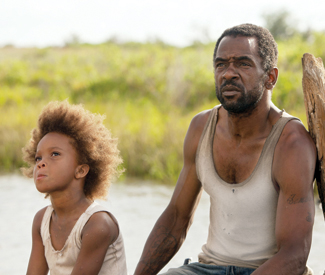
With the occasional exception, of course. Six months after winning the Grand Jury Prize at Sundance (and a Cannes Camera d’Or), Beasts of the Southern Wild proves capable of enduring a second or third viewing with its originality and strangeness fully intact. Magical realism is a primarily literary device that isn’t attempted very often in U.S. cinema, and succeeds very rarely. But this intersection between Faulkner and fairy tale, a fable about — improbably — Hurricane Katrina, is mysterious and unruly and enchanting, an imaginative leap of unusual ambition and accomplishment for a first feature.

Ostensibly based on a stage play — co-scenarist Lucy Alibar’s Juicy and Delicious, said to be a bluegrass musical — Benh Zeitlin’s film is wildly cinematic from the outset, as voiceover narration from six-year-old Hushpuppy (Quvenzhané Wallis) offers simple commentary on her rather fantastical life. She abides in the Bathtub, an imaginary chunk of bayou country south of New Orleans whose residents live closer to nature, amid the detritus of civilization. Seemingly everything is some alchemical combination of scrap heap, flesh, and soil. What might look like an unhygienic, frightening, child-abusive nightmare to any Social Services authority is to Hushpuppy a constant playground, and to her elders a sort of pagan-libertarian utopia.

http://www.youtube.com/watch?v=Wqt5m0OBkjE

Before the story has gotten properly started there’s a community celebration with fireworks, music, guns fired into the air, babies crawling everywhere — a celebration of nothing in particular, at least that we can tell. But as our heroine says, “The Bathtub has more holidays than the rest of the world.” It is clear that, for that and many other reasons, its citizens have no use for the rest of the world.

She lives with her father Wink (Dwight Henry) — albeit in separate ramshackle trailers on stilts — a fierce, erratic man with unknown demons who’s seldom outright unkind but acts less like a father than an Outward Bound coach, teaching his charge the tools to survive on her own. (In addition to slopping the livestock and pets, she can already make dinner for herself, lighting the stove with a blowtorch.) But one day he disappears, leaving Hushpuppy without human company beyond the memory of a long-absent mother she nonetheless frequently talks to. When Wink returns, it’s in a hospital gown and bracelet; whatever happened, he doesn’t want to discuss it.

Soon they have bigger things to worry about, anyway, as “the storm” is coming — prompting all but a few stubborn holdouts (well-fortified by alcohol) to evacuate the Bathtub. Wink and child aren’t going anywhere, waiting it out instead in a shack then floating to safety in their boat (a decapitated truck bed).

The area is fully flooded, however, and an illegal breach of a remaining levee drains it but can’t repair the devastation wrought on plants, animals, and homes. The holdouts are forced at federal gunpoint to evacuate at last, sequestered in a relief shelter-hospital whose sterility and order is as alien to them as the surface of Mars. Worse, this exile hastens the serious illness Wink was able to keep (mostly) at bay in the Bathtub — as the wary say, hospitals are where sick people go to die.

With its elements of magic (or at least the illustration of a child’s belief in such), mythological exodus, and evolutionary biology — Gina Montana’s Amazonian schoolmarm Miss Bathsheeba defines her eat-or-be-eaten perspective with “Everything is part of the buffet of the universe” — Beasts goes way out on a conceptual limb. Particularly for a low-budget movie with non-professional actors; you could argue it achieves many (if not more) of the same goals Terrence Malick’s 2011 The Tree of Life did at a fraction of that film’s cost and length. Its messiness is an organic virtue, with grainy imagery whose hand-held spastic camerawork (by Ben Richardson) is for once much more than a trendy stylistic choice; the instability feels in synch with Hushpuppy’s world, in vibrates with the slightest clue provided by glance, weather, or instinct.

The frenetic yet amorphous atmosphere might on a first viewing make you question whether there’s really much story beneath the busy aesthetic surface, but in fact for all its freely digressive air Beasts is pretty tightly constructed. (Nonetheless, you can imagine the editors scratching their heads initially over how this footage might possibly cut together, unless they were in on the project from the start.) Adding to that spectral, hyperreal effect is a score by Dan Zomer and Zeitlin that combines keening or plucked strings with the ethereal chime of a glockenspiel, at times sounding like a Sufjan Stevens instrumental.

There are moments of real enchantment, like an all-girls’ side trip to a floating bordello whose bosomy ladies surrender to their maternal instincts, or the recurrent glimpses that see Hushpuppy’s hog gradually morph into a thundering pack of tusked, primeval wild boars. (Toward the end especially, this latter effect underlines the notion that the film’s closest recent antecedent is Spike Jonze’s 2009 Where the Wind Things Are, another child’s feral fantasy.)

Through it all the pint-sized Wallis (who was just five when she was chosen from some 4000 auditioning kids) strides with astonishing alertness and confidence, a vulnerable minor one minute, as regally self-possessed as Pam Grier in Coffy (1973) the next.

It would almost be a shame if she did anything else — this performance would be best preserved as a mysterious lone bolt from the blue, just as the movie itself seems to capture unrepeatable lightning in a bottle.


BEASTS OF THE SOUTHERN WILD opens Fri/6 in San Francisco.

Rep Clock

0

Schedules are for Wed/4-Tue/10 except where noted. Director and year are given when available. Double and triple features marked with a •. All times pm unless otherwise specified.

CASTRO 429 Castro, SF; (415) 621-6120, www.castrotheatre.com. $8.50-11. Grease (Kleiser, 1978), Thu, 5, 7. Presented sing-along style; this event, $10-15. “Midnites for Maniacs: BFFs Triple Bill:” •Clueless (Heckerling, 1995), Fri, 7:30; Mean Girls (Waters, 2004), Fri, 9:45; Heavenly Creatures (Jackson, 1994), Fri, 11:45. This event, one or all three films for $13. “Scary Cow Short Film Festival,” Sat, 3. More info at www.scarycow.com. •The Muppet Movie (Frawley, 1979), Sun, noon, 3:15, 7, and Phantom of the Paradise (De Palma, 1974), Sun, 5:05, 8:50.

CHRISTOPHER B. SMITH RAFAEL FILM CENTER 1118 Fourth St, San Rafael; (415) 454-1222, www.cafilm.org. $6.75-$10.25. Bel Ami (Donnellan and Ormerod, 2012), call for dates and times. Bernie (Linklater, 2012), call for dates and times. Oslo, August 31st (Trier, 2011), call for dates and times. Peace, Love and Misunderstanding (Beresford, 2011), call for dates and times. Pink Ribbons, Inc. (Pool, 2011), call for dates and times. Take This Waltz (Polley, 2011), July 6-12, call for times.

PACIFIC FILM ARCHIVE 2575 Bancroft, Berk; (510) 642-5249, bampfa.berkeley.edu. $5.50-9.50. “Bellissima: Leading Ladies of the Italian Screen:” Le Amiche (Antonioni, 1955), Fri, 7; La strada (Fellini, 1954), Sat, 8:30. “A Theater Near You:” Weekend (Godard, 1967), Fri, 9:05; Gerhard Richter Painting (Belz, 2011), Sat, 6:30; This Is Not a Film (Mirtahmasb and Panahi, 2011), Sun, 5:15. “Always for Pleasure: The Films of Les Blank:” Always for Pleasure (Blank, 1978) with “Dry Wood” (Blank and Gosling, 1973) and “Running Around Like a Chicken With Its Head Cut Off” (Blank, Blank, and Van Deusen, 1960), Sun, 7.

ROXIE 3117 and 3125 16th St, SF; (415) 863-1087, www.roxie.com. $6.50-10. Beyond the Black Rainbow (Cosmatos, 2011), Wed-Thu, 7:15. 9:30. The Connection (Clarke, 1962), Wed-Thu, 7, 9:15. “Kung Fu Double Feature:” •Five Element Ninjas (a.k.a. Chinese Super Ninjas) (Chang, 1982), Fri, 7:30, and The Mystery of Chess Boxing (Kuo, 1979), Fri, 9:30. “Au Revoir Béla Tarr:” The Man From London (Tarr and Hranitzky, 2007), July 7-11, 6:30 (also Sat-Sun, 1); The Turin Horse (Tarr and Hranitzky, 2011), July 7-11, 9:15 (also Sat-Sun, 3:45).

SF FILM SOCIETY CINEMA 1746 Post, SF. $10-11. The Story of Film: An Odyssey, Part Six: The Arrival of Multiplexes and Asian Mainstream (1970s); Fight the Power: Protest in Films (1980s), (Cousins, 2011), Sat, noon. British TV series; new episodes weekly through July 21. Corpo Celeste (Rohrwacher, 2011), Wed-Thu, 2:30, 4:30, 6:30. Marina Abramovic: The Artist is Present (Akers, 2011), July 6-12, 2:45, 5, 7:15, 9:30.

SF STATE UNIVERSITY Coppola Theatre, 1600 Holloway, SF; www.legacyfilmfestivalonaging.org. $12. “Legacy Film Festival on Aging,” co-presented by the Osher Lifelong Learning Institute, Fri-Sun.

YERBA BUENA CENTER FOR THE ARTS 701 Mission, SF; (415) 978-2787, www.ybca.org. $6-8. “Documentaries By Ai Weiwei:” Fairytale (2008), Sun, 2.

Psychic Dream Astrology: July 4-10

0

ARIES

March 21-April 19

Change tends to be hard because the unknown is unsettling, even when you believe things are improving. Something new is entering your life, and in order to make the most of it, you’ll need an open heart and interested state of mind. Focus on the potential in front of you instead of what seems implausible.

TAURUS

April 20-May 20

You cannot go on with such a heavy load, Taurus. You are meant to stride forward, but you don’t have to bring all your baggage with you! Let go of the relationships or attachments you have that are draining you, pal. Value love over obligation this week to create the kind of life that you truly want to be living.

GEMINI

May 21-June 21

Stress and anxiety is just a part of life, Gemini, and learning to cope with it when it comes up is invaluable. This week you may feel your grasp on stability is being tested, so instead of crumbling in the face of your demons, trust that you’ve got the tools to battle them, and the balls to use ’em.

CANCER

June 22-July 22

Repressing painful truths has a way of creating rot inside of you, which corrodes other stuff. This week you must consciously deal with the things you’ve been sweeping under the rug, Cancer. You don’t have to fix or understand everything, but accepting the truth of your situations is the right place to start.

LEO

July 23-Aug. 22

Love is so valuable that it deserves all the work and care that it tends to require. This week you should not shy away from improving or strengthening the things and relationships you most love. Balance, patience and joyfulness are meant to be yours, so let them guide you as you put your energy where it’s best deserved.

VIRGO

Aug. 23-Sept. 22

Your independence is the key to keeping your equilibrium this week, Virgo. Isolating yourself is not independence, BTW. Trusting in your right and ability to connect or separate as you see fit is foundational to being authentically free. Embody your truth and “walk your talk.”

LIBRA

Sept. 23-Oct. 22

Having healthy boundaries around others means that while you have compassion for them regarding their hardships, you don’t take them on and make them your own. Make every effort to enjoy all that is wonderful in your world, even if there are difficulties surrounding you. Stay present with your own experience, pal.

SCORPIO

Oct. 23-Nov. 21

It’s over, so stop repressing or regressing, Scorpio. Embody the potential inherent in your present life, and stop looking backwards. This week you are capable of moving ahead, and to do so you need to be willing to set up a new camp, in a new part of town. Learn from your past, but don’t re-live it.

SAGITTARIUS

Nov. 22-Dec. 21

There are so many things you can choose to focus your energy on, so you may as well concentrate on the good stuff. Share your successes with others, as it’ll help to bring more warmth to them. You will catch more flies with honey than vinegar, as they say, so when in doubt this week, choose kindness.

CAPRICORN

Dec. 22-Jan. 19

The very worst move you can make is to try and figure everything out or to foresee the future. This week content yourself with finding value in whatever is in front of you, and bringing your best to it. You will get more from dealing with what is than speculating and driving yourself (and everyone around you) bonkers.

AQUARIUS

Jan. 20-Feb. 18

Confidence and strength of conviction will take you where you want to go this week, Aquarius. Your relationships need tending to, and it’s important that you don’t let your insecurities get in the mix of how you want to be with them. Reach forward with love, and trust that things will go exactly as they are meant to.

PISCES

Feb. 19-March 20

Having an open heart is wonderful, but you needn’t be open to all people and all things, Pisces. Be careful about who you trust this week, as you are extra sensitive. Self-preservation will go a long way if you use it to stay grounded and aware. Slow down and consider what you’re doing for best results.

Jessica Lanyadoo has been a Psychic Dreamer for 18 years. Check out her website at www.lovelanyadoo.com or contact her for an astrology or intuitive reading at (415) 336-8354 or dreamyastrology@gmail.com


Stage Listings

0

Stage listings are compiled by Guardian staff. Performance times may change; call venues to confirm. Reviewers are Robert Avila, Rita Felciano, and Nicole Gluckstern. Submit items for the listings at listings@sfbg.com. For further information on how to submit items for the listings, see Picks.

THEATER

OPENING

Duck Lake The Jewish Theater, 470 Florida, SF; www.duck-lake.com. $17-35. Opens Fri/6, 8pm. Runs Fri-Sat, 8pm. Through July 28. PianoFight’s resident sketch comedy group, Mission CTRL, performs its new "ballet-horror-comedy."

For the Greater Good, Or The Last Election This week: Dolores Park, 18th St at Dolores, SF; www.sfmt.org. Free (donations accepted). Opens Wed/4, 2pm. Runs Sat/7-Sun/8, 2pm. Various venues through Sept. 8. SF Mime Troupe launches its annual political musical (this year’s theme: one percenters behaving badly); the show travels around NorCal parks and other venues throughout the summer.

BAY AREA

King John Forest Meadows Amphitheater, 890 Belle, Dominican University of California, San Rafael; www.marinshakespeare.org. $20-35. Previews Fri/6-Sun/8, 8pm. Opens July 13, 8pm. Runs July 15, 21, 27, 29, Aug 4, 10-12, 8pm; July 22 and Aug 5, 4pm. Marin Shakespeare Company kicks off its 2012 outdoor summer festival season with this history play.

ONGOING

Absolutely San Francisco Alcove Theater, 414 Mason, Ste 502, SF; www.thealcovetheater.com. $32-50. Thu-Sat, 8pm (no show Fri/6). Through Aug 18. A multi-character solo show about the characters of San Francisco.

5 Lesbians Eating a Quiche Phoenix Theatre, 414 Mason, SF; www.tidestheatre.org. $20-38. Thu-Sat, 8pm (also Sat, 10pm). Through July 21. Tides Theatre performs Evan Linder and Andrew Hobgood’s comedy about five women forced into a bomb shelter during a mid-breakfast nuke attack.

Fwd: Life Gone Viral Marsh San Francisco, 1062 Valencia, SF; (415) 282-3055, www.themarsh.org. $20-50. Sat, 8:30pm; Sun, 7pm (July 15, show at 7:30pm). Extended through July 22. The internet becomes comic fodder for creator-performers Charlie Varon and Jeri Lynn Cohen, and creator-director David Ford.

Hedwig and the Angry Inch Boxcar Playhouse, 505 Natoma, SF; www.boxcartheatre.org. $25. Wed/4-Thu/5, 8pm; Fri/6-Sat/7, 7 and 9:30pm; Sun/8, 5pm. Boxcar Theatre performs John Cameron Mitchell’s musical about a transgendered glam rocker.

Jip: His Story Marsh San Francisco, MainStage, 1062 Valencia, SF; www.themarsh.org. $8-50. Thu-Fri, 7:30pm; Sat, 2pm; Sun, 3pm. Through July 15. Marsh Youth Theater remounts its 2005 musical production of Katherine Paterson’s historical novel.

The Magic Flute War Memorial Opera House, 301 Van Ness, SF; www.sfopera.com. $31-340. Fri/6, 8pm; Sun/8, 2pm. San Francisco Opera adds some unexpected vitality to its new star-studded production of one of the world’s most popular operas, Mozart’s whimsical but philosophical tale of a romance and (Mason-inspired) spiritual evolution. Prince Tamino (poised tenor Alek Shrader) and sidekick Papageno (fine baritone Nathan Gunn in a blithe comedic performance) are on a quest to rescue from sorcerer Sarastro (imposing bass Kristinn Sigmundsson) the lovely Pamina (appealing soprano Heidi Stober), daughter of the Queen of the Night (the rousingly virtuosic Russian soprano Albina Shagimuratova). The battle royal between the Queen and Sarastro is one between darkness and light, but the emphasis of this joyful production is rightly on the latter, even as Tamino and Papageno’s journey takes them through the ritual rite of passage in Sarastro’s order, the Temple of Light. Visual artist Jun Kaneko (responsible for the giant ceramic heads on view outside the War Memorial Opera House until November) marshals a brightly extensive color palette and some state-of-the-art 3D software to create a mise-en-scène out of parallel planes of patterned line and color. These enveloping and fascinating geometric flights of fancy — animated by a drawn, human touch and organic trickles and blushes of color throughout — come complimented by wildly playful costumes, including a host of wonderfully oddball brightly painted birds, that make for some pleasantly cackling entrances. David Gockley’s English-language translation of the libretto, meanwhile, adds a zesty colloquial freshness whose tinge of irony contributes to an intellectual roominess that matches the aesthetic one, both together offering some necessary reflective space to the contemporary audience vis-à-vis the certainties of this Enlightenment fairytale. (Avila)

Proof NOHspace, 2840 Mariposa, SF; www.proofsf.com. Wed-Sat, 8pm. Through July 14. $28. Expression Productions performs David Auburn’s Pulitzer-winning play about a mathematician and his daughter.

"Risk Is This…The Cutting Ball New Experimental Plays Festival" Exit on Taylor, 277 Taylor, SF; (415) 525-1205, www.cuttingball.com. Free ($20 donation for reserved seating; $50 donation for five-play reserved seating pass). Fri-Sat, 8pm. Through July 14. Cutting Ball’s annual fest of experimental plays features two new works and five new translations in staged readings.

The Scottsboro Boys American Conservatory Theater, 415 Geary, SF; www.act-sf.org. $20-95. Tue-Sat, 8pm (also Wed and Sat, 2pm; no matinee Wed/4); Sun/8, 7pm. Extended through July 22. American Conservatory Theater presents the Kander and Ebb musical about nine African American men falsely accused of a crime they didn’t commit in the pre-civil rights movement South.

Vital Signs Marsh San Francisco, 1062 Valencia, SF; (415) 282-3055, www.themarsh.org. $15-50. Sat, 8:30pm. Through July 21. The Marsh San Francisco presents Alison Whittaker’s behind-the-scenes look at nursing in America.

Waiting… Larkspur Hotel Union Square, 525 Sutter, SF; www.brownpapertickets.com. $69-75. Thu-Sat, 8pm; Sun, 2pm. Through Aug 5. Comedy set behind the scenes at a San Francisco restaurant.

The Waiting Period MainStage, Marsh San Francisco, 1062 Valencia, SF; (415) 282-3055, www.themarsh.org. $15-50. Fri, 8pm; Sat, 5pm. Extended through August 4. Brian Copeland (comedian, TV and radio personality, and creator-performer of the long-running solo play Not a Genuine Black Man) returns to the Marsh with a new solo, this one based on more recent and messier events in Copeland’s life. The play concerns an episode of severe depression in which he considered suicide, going so far as to purchase a handgun — the title coming from the legally mandatory 10-day period between purchasing and picking up the weapon, which leaves time for reflections and circumstances that ultimately prevent Copeland from pulling the trigger. A grim subject, but Copeland (with co-developer and director David Ford) ensures there’s plenty of humor as well as frank sentiment along the way. The actor peoples the opening scene in the gun store with a comically if somewhat stereotypically rugged representative of the Second Amendment, for instance, as well as an equally familiar "doood" dude at the service counter. Afterward, we follow Copeland, a just barely coping dad, home to the house recently abandoned by his wife, and through the ordinary routines that become unbearable to the clinically depressed. Copeland also recreates interviews he’s made with other survivors of suicidal depression. Telling someone about such things is vital to preventing their worst outcomes, says Copeland, and telling his own story is meant to encourage others. It’s a worthy aim but only a fitfully engaging piece, since as drama it remains thin, standing at perhaps too respectful a distance from the convoluted torment and alienation at its center. (Avila)

BAY AREA

Emotional Creature Berkeley Repertory Theatre, Roda Theatre, 2025 Addison, Berk; www.berkeleyrep.org. $14.50-73. Tue and Thu-Sat, 8pm (also Sat, 2pm; no show July 13); Wed, 7pm (no show Wed/4); Sun, 2 and 7pm. Through July 15. It’s not easy being a girl, and Eve Ensler’s newest play Emotional Creature leaves no scenario unexplored: from high school shaming rituals to ritual clitorectomies. If that sounds like a jarring juxtaposition, you’d be right. It’s difficult theatrically to transition seamlessly from a deeply affecting monologue about being a teenage sex slave in the Democratic Republic of Congo to a cute song about wearing miniskirts, and it’s equally difficult for the audience to change emotional gears rapidly enough to be able to adequately absorb the impact of each individual segment. Instead, the play comes off as an earnest but awkward Girl Scout Jamboree variety show — attempting to address as wide a variety of social ills as possible (from teen suicide to industrial pollution) — despite the strong and savvy acting chops of the six performers. In contrast to Ensler’s most popular work, The Vagina Monologues, which effectively "humanized" a part of the body by giving it something highly personal to say, Emotional Creature weirdly depersonalizes its girls by putting lines in their mouths ("I’m not the life you never lived") that clearly come from an adult perspective. And as for those girls who don’t particularly identify as "emotional creatures" at all? For them, there are no words. (Gluckstern)

The Kipling Hotel: True Misadventures of the Electric Pink ’80s New venue: Marsh Berkeley, 2120 Allston, Berk; (415) 282-3055, www.themarsh.org. $20-50. Sat, 8:30pm; Sun, 7pm. Extended through July 15. This new autobiographical solo show by Don Reed, writer-performer of the fine and long-running East 14th, is another slice of the artist’s journey from 1970s Oakland ghetto to comedy-circuit respectability — here via a partial debate-scholarship to UCLA. The titular Los Angeles residency hotel was where Reed lived and worked for a time in the 1980s while attending university. It’s also a rich mine of memory and material for this physically protean and charismatic comic actor, who sails through two acts of often hilarious, sometimes touching vignettes loosely structured around his time on the hotel’s young wait staff, which catered to the needs of elderly patrons who might need conversation as much as breakfast. On opening night, the episodic narrative seemed to pass through several endings before settling on one whose tidy moral was delivered with too heavy a hand, but if the piece runs a little long, it’s only the last 20 minutes that noticeably meanders. And even with some awkward bumps along the way, it’s never a dull thing watching Reed work. (Avila)

Salomania Aurora Theatre, 2081 Addison, Berk; www.auroratheatre.org. $30-55. Tue, 7pm; Wed-Sat, 8pm; Sun, 2 and 7pm. Through July 22. The libel trial of a politically opportunistic newspaper publisher (Mark Andrew Phillips) and the private life of a famous dancer of the London stage — San Franciscan Maud Allan (a striking Madeline H.D. Brown) — become the scandalous headline-grabber of the day, as World War I rages on in some forgotten external world. In Aurora’s impressive world premiere by playwright-director Mark Jackson, the real-life story of Allan, celebrated for her risqué interpretation of Oscar Wilde’s Salomé, soon gets conflated with the infamous trial (20 years earlier) of Wilde himself (a shrewdly understated Kevin Clarke). But is this case just a media-stoked distraction, or is there a deeper connection between the disciplining of "sexual deviance" and the ordered disorder of the nation state? Jackson’s sharp if sprawling ensemble-driven exploration brings up plenty of tantalizing suggestions, while reveling in the complexly intermingling themes of sex, nationalism, militarism, women’s rights, and the webs spun by media and politics. A group of trench-bound soldiers (the admirable ensemble of Clarke, Alex Moggridge, Anthony Nemirovsky, Phillips, Marilee Talkington, and Liam Vincent) provide one comedy-lined avenue into a system whose own excesses are manifest in the insane carnage of war — yet an insanity only possible in a world policed by illusions, distractions and the fear of unsettled and unsettling "deviants" of all kinds. In its cracked-mirror portraiture of an era, the play echoes a social and political turmoil that has never really subsided. (Avila)

PERFORMANCE/DANCE

"Channels: An Evening of Cross-Disciplinary Performance" Shotwell Studios, 3252-A 19th St, SF; www.ftloose.org. Fri/6-Sun/7, 8pm. $10-20. Dancers Daria Kaufman, Bianca Brzezinski, and musician-composer Richard Warp perform Arti Ulate, a dance-theater piece; Brzezinski also performs a solo, Non-self.

"Comedy Bodega" Esta Noche Nightclub, 3079 16th St, SF; www.comedybodega.com. Thu/5, 8pm. Free (one drink minimum). Weekly free stand-up show. This week: Yayne Abeba, David Hawkins, Anna Seregina, Veronica Porras, Baruch P. Hernandez, and George Chen.

"Comedy Returns to El Rio" El Rio, 3158 Mission, SF; www.brownpapertickets.com. Mon/9, 8pm. $7-20. With Joe Klocek, Josh Healey, Regina Stoops, Johan Miranda, Shanti Charan, and Lisa Geduldig.

"Elect to Laugh" Studio Theater, Marsh San Francisco, 1062 Valencia, SF; (415) 282-3055, www.themarsh.org. Tue, 8pm. Through Nov 6. $15-50. Will Durst and friends perform in this weekly political humor show that focuses on the upcoming presidential election.

"The Eric Andre Show" Rickshaw Stop, 155 Fell, SF; www.rickshawstop.com. Mon/9, 8pm. $10. Adult Swim-spawned, SF Sketchfest-presented faux-cable access variety show with musical guests and "real and fake celebrity appearances," hosted by actor Eric André.

"The Fag Hag Comedy Show" Deco Lounge, 510 Larkin, SF; www.brownpapertickets.com. Sun/8, 8pm. $10. Charlie Ballard hosts this stand-up comedy extravaganza, with headliner Glamis Rory and more.

"A Funny Night for Comedy" Actors Theatre of San Francisco, 855 Bush, SF; www.natashamuse.com. Sun/8, 7pm. $10. Natasha Muse and Ryan Cronin host stand-up comedians, including headliner Jason Wheeler, at their monthly talk show.

"Jillarious Tuesdays" Tommy T’s Showroom, 1000 Van Ness, SF; www.jillarious.com. Tue, 7:30. Ongoing. $20. Weekly comedy show with Jill Bourque, Kevin Camia, Justin Lucas, and special guests.

Carolina Lugo and Carolé Acuña’s Café Flamenco Peña Pachamama, 1630 Powell, SF; www.carolinalugo.com. Sun/8, 6:15pm. $15-19. Mother-daughter flamenco dance and music company.

"Majestic Musical Review Featuring Her Rebel Highness" Harlot, 46 Minna, SF; www.herrebelhighness.com. Sun, 5pm. Through Aug 12. $25-65. Cocktails and hors d’oeuvres, performers in Baroque-chic gowns, music, and more.

"Schwabacher Summer Concert" Herbst Theatre, 401 Van Ness, SF; www.sfopera.com. Thu/5, 7:30pm. $25-40. The young talent of the Merola Opera Program performs scenes from works by Bizet, Stravinsky, and more.

Film Listings

0

Film listings are edited by Cheryl Eddy. Reviewers are Kimberly Chun, Max Goldberg, Dennis Harvey, and Lynn Rapoport. For rep house showtimes, see Rep Clock. For complete film listings, see www.sfbg.com.

OPENING

Beasts of the Southern Wild See "Delta Delight." (1:31) Embarcadero.

Katy Perry: Part of Me The candy-colored pop star makes the logical leap to big-screen 3D. (1:57) Metreon.

Marina Abramovic: The Artist is Present Matthew Akers’ sleek and telling doc explores the career and motivations of the legendary Serbian-born, New York-based performance artist on the occasion of 2010’s major retrospective and new work at the New York Museum of Modern Art. Abramovic, self-styled the "grandmother of performance art" at an eye-catching 63, steels herself with rare energy — and a determination to gain equal status for performance in the world of fine art — for an incredibly demanding new piece, The Artist Is Present, a quasi-mystical encounter between herself and individual museum patrons that takes the form of a three-month marathon of silent one-on-one gazing. Meanwhile, 30 young artists re-perform pieces from her influential career. Akers gains intimate access throughout, including Abramovic’s touching reunion with longtime love and artistic collaborator Ulay, while providing a steady pulse of suspense as the half-grueling, half-ecstatic performance gets underway. A natural charmer, Abramovic’s charismatic presence at MoMA is no act but rather a focused state in which audiences are drawn into — and in turn shape — powerful rhythms of consciousness and desire. (1:45) SF Film Society Cinema. (Robert Avila)

Nobody Else But You The Marilyn Monroe pop-culture resurgence continues with director and co-writer Gérald Hustache-Mathieu’s appealingly low-key mystery, which pays homage to the iconic blonde while borrowing liberally from a pair of noir Lauras: Vera Caspary’s back-from-the-dead heroine, and Twin Peaks‘ unfortunate Ms. Palmer. Fortunately, Nobody Else But You is original enough to remain both suspenseful and highly entertaining. David (Jean-Paul Rouve), a detective novelist with writer’s block, travels from Paris to a small village where a Monroe-esque local beauty named Candice (Sophie Quinton) has just been found dead in a snowdrift. The official word is suicide, but David suspects something more sinister. With the help of a local cop (Guillaume Gouix), the newly inspired author investigates, urged onward by Candice’s evocative diary entries. Though it tries a little hard at times (drinking game: keep track of how many times the number five appears onscreen), Nobody Else But You is well worth seeking out; it layers European flair (translation: lots of casual nudity) over a plot that wouldn’t be out of place in an American indie — but relocated, memorably, to "the coldest town in France." (1:42) Lumiere, Shattuck. (Eddy)

Savages Weed dudes (Aaron Johnson and Taylor Kitsch) break bad, bro, by taking on a Mexican cartel in Oliver Stone’s latest. (1:57) Four Star, Marina.

Take this Waltz See "Sad Romance." (1:56) Embarcadero, Shattuck, Smith Rafael.

ONGOING

The Amazing Spider-Man A mere five years after Sam Raimi and Tobey Maguire’s Spider-Man 3 — forgettable on its own, sure, but 2002’s Spider-Man and especially 2004’s Spider-Man 2 still hold up — Marvel’s angsty web-slinger returns to the big screen, hoping to make its box-office mark before The Dark Knight Rises opens in a few weeks. Director Marc Webb (2009’s 500 Days of Summer) and likable stars Andrew Garfield (as the skateboard-toting hero) and Emma Stone (as his high-school squeeze) offer a competent reboot, but there’s no shaking the feeling that we’ve seen this movie before, with its familiar origin story and with-great-power themes. A little creativity, and I don’t mean in the special effects department, might’ve gone a long way to make moviegoers forget this Spidey do-over is, essentially, little more than a soulless cash grab. Not helping matters: the villain (Rhys Ifans as the Lizard) is a snooze. (2:18) Metreon, 1000 Van Ness, Presidio. (Eddy)

The Connection The first re-release in a project to restore all of quintessential 1960s American independent director Shirley Clarke’s features, this 1961 vérité-style drama was adapted from a controversial off-Broadway play by Jack Gelber. Set exclusively in a dingy Greenwich Village crash pad, it captures a little time in the lives of several junkies there — many off-duty jazz musicians — listlessly waiting for the return of their dealer, Cowboy. To mimic the stage version’s breaking of the fourth wall between actors and spectators, Clarke added the device of two fictive filmmakers who are trying to record this "shocking" junkie scene, yet grow frustrated at their subjects’ levels of cooperation and resistance. With actors often speaking directly to the camera, and all polished stage language and acting preserved, The Connection offers a curious, artificial realm that is nonetheless finally quite effective and striking. A prize-winner at Cannes, it nonetheless had a very hard time getting around the censors and into theaters back home. Hard-won achievement followed by frustration would be a frequent occurrence for the late Clarke, who would only complete one more feature (a documentary about Ornette Coleman) after 1964’s Cool World and 1967’s Portrait of Jason, before her 1997 demise. She was a pioneering female indie director — and her difficulty finding projects unfortunately
also set a mold for many talented women to come. (1:50) Roxie. (Harvey)

Magic Mike Director Steven Soderbergh pays homage to the 1970s with the opening shot of his male stripper opus: the boxy old Warner Bros. logo, which evokes the gritty, sexualized days of Burt Reynolds and Joe Namath posing in pantyhose. Was that really the last time women, en masse, were welcome to ogle to their heart’s content? That might be the case considering the outburst of applause when a nude Channing Tatum rises after a hard night in a threesome in Magic Mike‘s first five minutes. Ever the savvy film historian, Soderbergh toys with the conventions of the era, from the grimy quasi-redneck realism of vintage Reynolds movies to the hidebound framework of the period’s gay porn, almost for his own amusement, though the viewer might be initially confused about exactly what year they’re in. Veteran star stripper Mike (Tatum) is working construction, stripping to the approval of many raucous ladies and their stuffable dollar bills. He decides to take college-dropout blank-slate hottie Adam (Alex Pettyfer) under his wing and ropes him into the strip club, owned by Dallas (Matthew McConaughey, whose formidable abs look waxily preserved) and show him the ropes of stripping and having a good time, much to the disapproval of Adam’s more straight-laced sister Brooke (Cody Horn). Really, though, all Mike wants to do is become a furniture designer. Boasting Foreigner’s "Feels like the First Time" as its theme of sorts and spot-on, hot choreography by Alison Faulk (who’s worked with Madonna and Britney Spears), Magic Mike takes off and can’t help but please the crowd when it turns to the stage. Unfortunately the chemistry-free budding romance between Mike and Brooke sucks the air out of the proceedings every time it comes into view, which is way too often. (1:50) 1000 Van Ness, Presidio, SF Center. (Chun)

Ted Ah, boys and their toys — and the imaginary friends that mirror back a forever-after land of perpetual Peter Pans. That’s the crux of the surprisingly smart, hilarious Ted, aimed at an audience comprising a wide range of classes, races, and cultures with its mix of South Park go-there yuks and rom-commie coming-of-age sentiment. Look at Ted as a pop-culture-obsessed nerd tweak on dream critter-spirit animal buddy efforts from Harvey (1950) to Donnie Darko (2001) to TV’s Wilfred. Of course, we all know that the really untamable creature here wobbles around on two legs, laden with big-time baggage about growing up and moving on from childhood loves. Young John doesn’t have many friends but he is fortunate enough to have his Christmas wish come true: his beloved new teddy bear, Ted (voice by director-writer Seth MacFarlane), begins to talk back and comes to life. With that miracle, too, comes Ted’s marginal existence as a D-list celebrity curiosity — still, he’s the loyal "Thunder Buddy" that’s always there for the now-grown John (Mark Wahlberg), ready with a bong and a broheim-y breed of empathy that involves too much TV, an obsession with bad B-movies, and mock fisticuffs, just the thing when storms move in and mundane reality rolls through. With his tendency to spew whatever profanity-laced thought comes into his head and his talents are a ladies’ bear, Ted is the id of a best friend that enables all of John’s most memorable, un-PC, Hangover-style shenanigans. Alas, John’s cool girlfriend Lori (Mila Kunis) threatens that tidy fantasy setup with her perfectly reasonable relationship demands. Juggling scary emotions and material that seems so specific that it can’t help but charm — you’ve got to love a shot-by-shot re-creation of a key Flash Gordon scene — MacFarlane sails over any resistance you, Lori, or your superego might harbor about this scenario with the ease of a man fully in touch with his inner Ted. (1:46) California, Four Star, Marina, Metreon, 1000 Van Ness, Sundance Kabuki. (Chun)

To Rome with Love Woody Allen’s film legacy is not like anybody else’s. At present, however, he suffers from a sense that he’s been too prolific for too long. It’s been nearly two decades since a new Woody Allen was any kind of "event," and the 19 features since Bullets Over Broadway (1994) have been hit and-miss. Still, there’s the hope that Allen is still capable of really surprising us — or that his audience might, as they did by somewhat inexplicably going nuts for 2011’s Midnight in Paris. It was Allen’s most popular film in eons, if not ever, probably helped by the fact that he wasn’t in it. Unfortunately, he’s up there again in the new To Rome With Love, familiar mannerisms not hiding the fact that Woody Allen the Nebbish has become just another Grumpy Old Man. There’s a doddering quality that isn’t intended, and is no longer within his control. But then To Rome With Love is a doddering picture — a postcard-pretty set of pictures with little more than "Have a nice day" scribbled on the back in script terms. Viewers expecting more of the travelogue pleasantness of Midnight in Paris may be forgiving, especially since it looks like a vacation, with Darius Khondji’s photography laying on the golden Italian light and making all the other colors confectionary as well. But if Paris at least had the kernel of a good idea, Rome has only several inexplicably bad ones; it’s a quartet of interwoven stories that have no substance, point, credibility, or even endearing wackiness. The shiny package can only distract so much from the fact that there’s absolutely nothing inside. (1:52) Albany, Balboa, Embarcadero, Sundance Kabuki. (Harvey)

Under oath

19

steve@sfbg.com

Mayor Ed Lee and suspended Sheriff Ross Mirkarimi each took some lumps on June 29 as they were cross-examined by opposing attorneys in front the Ethics Commission, which is conducting the official misconduct case that Lee brought against Mirkarimi over a Dec. 31 domestic violence incident. But the hearings proved unexpectedly dramatic when the room was suddenly cleared for an undisclosed security threat — following testimony by Lee that a city commissioner alleges included perjury.

The incident raises a number of issues that officials hadn’t yet answered by Guardian press time. Was the security threat real? If so, why wasn’t the room or the rest of City Hall properly secured after the mayor was whisked away? If not, who ordered the room cleared and why?

Undersheriff Paul Miyamoto, who ran against Mirkarimi last year, told the Guardian that the San Francisco Police Department notified his office that a caller claimed to have planted bombs outside of City Hall and on the Golden Gate Bridge. Deputies conducted a search and found nothing, and his office didn’t order the recess of the hearing. “We did not evacuate anyone,” he told us.

Speculation about the incident was heightened during the break when Debra Walker, a Mirkarimi supporter and longtime member of the city’s Building Inspection Commission, told the Guardian that Lee committed perjury when he denied speaking with any members of the Board of Supervisors before filing official misconduct charges. Lee was responding to a direct and pointed question from Mirkarimi attorney Shepherd Kopp — one that that Lee’s attorneys had unsuccessfully objected to.

Specifically, Walker said that her longtime friend and political ally Sup. Christina Olague — who Lee appointed to serve the last year of Mirkarimi’s term for the District 5 seat — had told her repeatedly that Lee had asked her advice before filing the charges against Mirkarimi, and that Olague’s advice was that Lee should ask for Mirkarimi’s resignation but drop the matter if he refused.

That allegation, which was first reported on the Guardian’s Politics blog shortly after the commission went into recess (Olague had not yet returned a call from the Guardian asking whether she had spoken to Lee about Mirkarimi), prompted reporters to confront Olague in the hallway outside her supervisorial office, where she tersely denied the allegation and then took refuge behind closed doors.

When the reporters lingered and persisted, waiting for a more complete answer, Olague finally emerged, reiterated her denial, refused to speculate about why her friend Walker would make that claim, and said, “We’re not allowed to discuss this matter with anyone before it comes to the board…I may have to recuse myself from voting on this.”

It was unclear why she thought recusal might be necessary, but if she does disqualify herself from voting on Mirkarimi’s removal later this summer after Ethics completes its investigation and makes its recommendations to the board, that would hurt Lee’s effort to get the nine votes needed to remove Mirkarimi.

When the Ethics Commission hearing resumed after a couple hours, Lee was again placed in a position of denying specific factual allegations that others have made, again raising the possibility that he committed perjury in his sworn testimony, which could expose him to felony criminal charges while undercutting his moral authority to remove Mirkarimi over the single misdemeanor count of false imprisonment that he pleaded guilty to in March.

The second instance was when Kopp asked Lee, “Did you ever extend any offer through third parties that you would find him another job if he resigned?”

“I don’t recall offering Sheriff Mirkarimi any job,” Lee replied.

Kopp specifically asked whether that job offer had been extended on Lee’s behalf by permit expediter Walter Wong or by San Francisco Democratic Party Chair Aaron Peskin, to which Lee replied, “Absolutely not.”

Mirkarimi supporters have told the Guardian that Peskin had made that offer, which Mirkarimi refused, shortly before the party chair publicly called for Mirkarimi’s resignation. The outgoing message on Peskin’s cell phone said he was unavailable and wouldn’t be checking his messages until July 5. Mirkarimi’s attorneys said they’re still figuring out how to respond to the developments and had no comment, but Walker said she’s willing to testify under oath.

But the dramas underscore the treacherous grounds opened up by these unprecedented proceedings, the first involving the Ethics Commission and the broadened definition of official misconduct placed into the City Charter in 1996. As baseball great Barry Bonds and former President Bill Clinton learned, being forced to testify under oath about sensitive topics can be a tough trap to negotiate.


MIRKARIMI TESTIMONY

Deputy City Attorney Peter Keith also seemed to be trying to spring that perjury trap on Mirkarimi as he took the stand on the morning of June 29 following an hour on the stand at the previous night’s hearing. Keith reminded Mirkarimi that he was advised not to discuss his testimony with anyone and asked, “Who have you spoken to since last night?”

“My attorneys,” Mirkarimi answered.

“What did you say to them?” Keith asked, drawing objections about attorney-client privilege that Commission Chair Benedict Hur sustained.

“Did you stop for coffee?” Keith then asked, seemingly concerned that Mirkarimi may have discussed his testimony with someone at the coffee shop that morning, which Mirkarimi denied. Keith let the allegation go but maintained an accusatory, hectoring tone throughout the next three hours that he had Mirkarimi on the stand, two more hours than he had told the commission he would need.

Much of the time was spent trying to establish support for the allegation that Mirkarimi had dissuaded witnesses and sought to thwart the police investigation, which was triggered by a call from Ivory Madison, a neighbor to whom Mirkarimi’s wife, Eliana Lopez, had confided. But the testimony yielded little more than the city’s unsupported inference that Mirkarimi must have directed Lopez and his campaign manager, Linnette Peralta Haynes, to contact Madison after she had called the police and urged her to stop cooperating with them.

Mirkarimi has maintained that he did nothing to dissuade Madison or anyone from talking to police, and that he wasn’t aware of the investigation or that Madison had made a videotape of Lopez showing a bruise on her arm until hours after the police were involved. He even sent a text to Lopez saying there was nothing he could do, as he noted.

“It was after 4pm on January 4 when I first learned of any of this,” Mirkarimi testified, later adding, “I was very clear to her in saying you can’t unring the bell, we have to follow through with this.”

Yet Lee and the deputy city attorneys who are representing him also maintain that they needn’t prove witness dissuasion or other allegations they have made, and that the Dec. 31 incident and Mirkarimi’s guilty plea to a single misdemeanor count of false imprisonment are enough to constitute official misconduct and warrant his removal, an interpretation that Mirkarimi’s attorneys dispute.

Keith sought to hammer home how Mirkarimi should have admitted to and publicly atoned for his crime right away rather than telling reporters it was a “private family matters” (which Mirkarimi admitted was a mistake) or fighting the charges by trying to discredit Madison publicly, an allegation he denies.

After unsuccessfully trying to get Mirkarimi to admit to directing efforts to question Madison’s credibility in local media accounts, Keith asked, “Did you ever direct anyone not to attack Ivory Madison?”

“I never directed anyone to attack or not attack,” Mirkarimi replied.

Keith also clarified that Mirkarimi denies the allegation Madison made that the physical abuse on Dec. 31 went beyond grabbing Lopez’s arm once in the car, as the couple has maintained. “It’s your testimony there was no punching, pulling, or grabbing in the house?” Keith asked, which Mirkarimi confirmed.

Yet Keith said that given the totality of what happened, Mirkarimi should have known he couldn’t continue on as sheriff. “Under those circumstances, wouldn’t resigning be the honorable thing to do?” Keith said, to which Mirkarimi replied that it’s a hard question and that he’s doing what he thinks is right.

Faced with friendlier questions from his own attorney, David Waggoner, Mirkarimi apologized for his actions, saying “I feel horrible and ashamed,” but that he was “sad and scared” to have his family torn apart against their will. He also said that he believes he can still be effective as sheriff because “what makes San Francisco special is our forward-thinking approach to criminal justice.”

Longtime Sheriff Michael Hennessey — who endorsed Mirkarimi and continues to support him — established a variety of programs emphasizing redemption and rehabilitation, hiring former convicts into top jobs in the department to emphasize a belief in restorative justice that Mirkarimi ran a campaign promising to continue.

“Never in my wildest dreams did I think I would be an example of what this redemption process looks like,” Mirkarimi said, choking back tears.

But Keith had the last word before Mirkarimi left the stand, belittling the idea that Mirkarimi offers an example to follow by noting how much probation time and court-ordered counseling he still has to undergo and asking, “The process of redemption doesn’t happen overnight, right?”


LEE ON THE STAND

Under questioning by Kopp, Mayor Lee admitted that he doesn’t have a written policy on what constitutes official misconduct, that his decisions are made on “a case by case basis,” and that he’s not sure whether conviction of a crime would always constitute official misconduct “because I’ve never confronted this before.”

“Were you aware that many members of the Sheriff Department have criminal convictions?” Kopp asked. Lee said he was not aware. Asked whether he was aware that Sheriff Hennessey had hired a convicted murderer into a top command staff position (see “The unlikely sheriff,” 12/21/11), Lee said he wasn’t.

Lee’s insistence that Mirkarimi’s crime makes him unable to deal effectively with other officials was also attacked by Kopp, who asked, “Isn’t it true that people get elected who have disagreements with other city officials?” He pointed out that City Attorney Dennis Herrera had nasty conflicts with Lee when they ran against each other for mayor last year, but that they’re working well together now.

Kopp also drilled into Lee about his decision to bring official misconduct charges before conducting an investigation or speaking with any witnesses besides Madison — an answer Lee blurted out just as city attorneys objected to the question. Much of Madison’s written testimony has been rejected by the commission as prejudicial hearsay evidence (see “Mayor vs. Mirkarimi,” July 27).

But the public’s perception of this case, if not it’s outcome, could turn on whether Lee is holding Mirkarimi to standards that he himself — as someone appointed mayor on a later-broken promise not to run for a full term — couldn’t meet. It was what Kopp seemed to be driving at before the bomb scare.

“You have asserted in your written charges that Sheriff Mirkarimi’s conduct fell below the standard of decency, good faith, and right action that is impliedly required of all public officials, correct?” Kopp asked.

“Yes,” Lee replied.

“We expect certain things of our elected officials, right?” Kopp asked.

After a long pause, in which Lee appeared to be thinking through his answer, he replied, “That’s generally true, yes.”

“And when the charter speaks of official misconduct, it doesn’t say we expect a certain standard for the sheriff, a different standard for the mayor, a different standard for the DA, a separate standard for the assessor, it just speaks in general terms about official misconduct for public officials, right?” Kopp asked.

Kaiser objected to the question on three counts, sustained on the grounds that it calls for a legal conclusion.

“Do you yourself believe there’s a separate standard for sheriff than for other elected officials?” Kopp asked, and this time the city’s objection was overruled and Lee replied, “It should be the same standard.”

“And would you agree with me that one of the things that is expected of elected officials is for them to be honest and forthright when dealing not only with their constituents, but with other elected officials?” Kopp asked, his final question before Chair Benedict Hur announced that the hearing would be suspended and the room would need to be cleared.

After the hearing reconvened, Kopp drew parallels to other city officials who remained on job after scandals, including former Mayor Gavin Newsom (who had an affair with a subordinate who was married to his campaign manager), former Sheriff Dick Hongisto (who was jailed for refusing to carry out a court’s eviction order), and current Fire Chief Joanne Hayes White (whose husband reported that she hit him in the head with a pint glass).

Asked about the latter case, Lee responded, “I don’t know all the circumstances around that and I don’t believe I was mayor at the time.”


The People’s School

0

yael@sfbg.com

Oakland elementary schools that were packed with kids until a few weeks ago are now closed for the summer — and five are closed for good. In October the school board voted to close them in a move that would save about $2 million per year.

But many Oakland Unified School District (OUSD) residents are not pleased. At the Oct. 26 meeting where the vote was cast, 500 protested. Concerned parents and teachers have been petitioning and meeting with school board members and Superintendent Tony Smith for months, trying to reverse the decision.

“No one wants to close schools, but the OUSD made this difficult decision because it’s in the best long-term interest of students,” reads a June 22 press release.

Resistance to that decision now continues at one school that was supposed to close June 18. To the dismay of the district, it remains open. Lakeview Elementary is the site of a sit-in and free school, orchestrated by parents and teachers.

“Lakeview has strengths,” the June 22 press release goes on to say. “It has shown improved academic performance in recent years and, boasts a strong sense of community and close alignment with its afterschool programs.” But low rankings in attendance and test scores overshadowed those strengths in the decision to close the school.

Yet it seems that “strong sense of community” seems to be more powerful than the school board thought.

SENSE OF COMMUNITY

Joel Velasquez, a parent of three and PTA member who has had children at Lakeview for 10 years, didn’t think it would come to this.

“I’ve watched everything that went on as a parent here for 10 years,” Velasquez said. When the school was threatened, “I probably spent 20 hours a week meeting, talking, emailing, researching, sending, forwarding — I mean, this is something that has been ongoing.”

“I met with Tony Smith for an hour,” Velasquez said. “I sat with board members.”

But as the end of the school year approached, he was growing more desperate, so he ended up making an announcement: “On the last day of school, I’m not going to leave. And I hope that people join me.”

They did. Lakeview’s building is slated to be turned into administrative offices, and that process was scheduled to begin two weeks ago.

Now, the school that should be filling up with district employees’ office supplies still has children running around its grounds. Organizers opened the People’s School for Public Education, and classes, taught by an army of credentialed teachers and qualified volunteers, run from 9am to 3pm, Monday through Friday.

At a June 27 visit, I toured the school and sat in during a Social Justice class. In the People’s School’s organic garden, a smiling gardening teacher had to stop an overzealous six-year-old from drowning the kale. “They love watering!” he shrugged. Another child, still mesmerized 30 minutes after the official end of music class, improvised on the djembe along with the drumming teacher. From a balcony, a volunteer called to him: “There’s ice cream!” he looked up, considered, and then kept drumming.

The group of kids has grown since the school opened June 15, as parents hear about the summer school and come see it for themselves. The Lakeview sit-in is unlike other recent occupations in the careful vetting process each visitor gets. After all, protecting the kids and their education is the most important goal of the project. But during school hours, parents are permitted to come inside and stay with their children as long as they want, seeing what the school is like.

Still, getting parents to send their children to a summer camp that isn’t technically legal isn’t always easy. “I think our society, not just parents, are really reluctant to do something like this,” Velasquez said. “But I see it as a positive service to the community. We’re using the building for what it’s intended to be used for.”

Julia Fernandez, a high school math teacher, got involved with the effort to save the schools through the Occupy Oakland Education Committee, and her two children, ages 2 and 4, are enrolled in the summer school.

As a nine-year resident of Oakland, Fernandez says, the cuts affect her and her family. She’s taking part in the demonstration partly “for my own kids,” Fernandez said. She said the cuts “affect the school where my kids would go. It’s likely that it’s going to be closed or turned into a charter school.”

“But the thing that motivates me the most is all these attacks that are happening against people,” Fernandez said. She guessed that it was adversity of many kinds, not just school closures, that motivated many parents to join the protest and send their kids to the People’s School.

“People are really upset about all the attacks that are being done on regular working class people. People are losing their homes, they’re getting laid off, and now their schools are closing. It just seems like all these services, all these rights people should have, are being taken away”

MORE THAN MONEY

Organizers emphasize that the money saved seems paltry, just $2 million for five functioning schools.

“Think about it, this is not very much,” Velasquez said. “And they’re wasting almost $4 million to do these transitions to close the schools. They’re spending more than the savings.”

OUSD spokesperson Troy Flint confirmed that the savings will be “in the $2 million range,” and that the total cost of the transition is about $3.7 million.

These expenses include about $117,000 one-time moving related costs and about $200,000 in staffing, including paying a transition director.

They also include $95,000 in transportation costs, which may not be one-time expenditures; they may “as needed for an additional year or more,” Flint said in an email.

Meanwhile, about 1,000 students will be displaced by the move. Many will move to Grass Valley and Burckhalter, and these school’s capacities will be expanded with portable classrooms.

“The promise that we made to students was that we would guarantee students at the closing school a place at a school that was higher performing than the one we were leaving. We were able to live up to that promise,” Flint said.

However, there was a problem: “Most of the schools that perform in the top tier are already subscribed to capacity, so we had to expand the capacity using portables.”

Will these high performing schools remain high-performing as an influx of new students show up at their doors in the fall? After all, Oakland has many more elementary schools than comparable districts, a result of the small schools movement, a policy adopted in 2000 that led to the closure of some larger schools, which were replaced by smaller ones. According to a study conducted by Brown University’s Annenburg Institute for Education Reform, Oakland small schools are “safer, calmer, and more welcoming to families” than the schools they replaced.

But as private donations from those excited about small schools, notably the Bill and Melinda Gates Foundation, run out — along with federal and state money — Oakland may be reverting to larger institutions.

And as the OUSD sees it, that may not be a bad thing.

“To build toward the day when every OUSD school is a high-quality school, we need to concentrate our time, attention and resources in a manageable number of sites instead of spreading ourselves too thin,” he said in an email. “Quality over quantity is the goal when we can’t do both and the current financial environment prevents us from properly caring for 101 schools.

THE NEIGHBORHOOD PROBLEM

One of the reasons for the stated school closure is that it ranked in “the bottom quarter of elementary schools in terms of the number of children living within a half-mile of the school or within the attendance area” and the “lowest percentage of neighborhood students attending the school (30 percent).”

The school is also 99 percent children of color.

As Oakland Tribune education reporter Katy Murphy has written, about half of students in Oakland attend schools outside their district. As a statement from the group Decolonize Oakland points out, “We have to question why the families of black and brown students who live outside of Adams Point have chosen Lakeview.”

Maybe it’s that strong sense of community? All of the other schools slated for closure are also in the flatlands and serve mostly African American and Latino students.

Root, formerly Occupy the Hood Oakland, has played a big part in the organizing. So has Education for the 99 Percent, Occupy Oakland’s education working group, and other Occupy Oakland volunteers.

“A lot of people from Occupy have been extremely supportive and we wouldn’t be able to do this action without that support,” Velasquez said. “For example, the food, they have come every single day to feed, not just breakfast, lunch and dinner, but snacks and drinks.”

The sit-in has also received support from labor groups. A letter signed by more than 50 teachers’ union leaders and local school employees declares, “An injury to one is an injury to all. Let’s seize this opportunity to fight alongside parents, students, and community. We will mobilize our members to support this struggle.”

LEADERSHIP?

The demonstration has not, however, received support from the city of Oakland. Officers from the OUSD Police Service has visited the school several times (and Velasquez says they have done so without warning, despite agreeing to call first to avoid scaring children). Oakland police have been on site as well, and the protesters have received warnings to leave.

“I still remain hopeful that the protesters will see that the most forward-looking resolution to the standoff is to disperse peacefully and to concentrate their efforts on improving the school district for the year 2012/2013 and beyond,” Flint told me. “Right now we still believe that if there’s a relatively prompt resolution to the standoff, we’ll be able to meet our targets to get the facilities ready.”

“It’s not clear why they’re doing this sit-in in Oakland, an overwhelmingly Democratic district where Republicans can’t get elected,” Flint said. “The fundamental problem with this issue is all the Republicans have taken a no taxes pledge.”

Velasquez agrees. “It’s criminal what the state of California is doing right now,” he said. “But we’re focusing our attention on Tony Smith and the board because they’re accepting these conditions, and they shouldn’t…So if they feel that way, why are they not doing something about it, instead of accepting the conditions, and hurting the families and the students? Most importantly the kids.” Flint said the board would be willing to work with the group, but that the sit-in is pointless. “I don’t view this current action as something that is providing us any additional leverage,” he said, though he noted that his office had not attempted to use the sit-in to pressure the state. “We’ve coordinated people across the state, sending in postcards and petitions,” he explained. But when asked what worked best, he said nothing has. “I can’t name a time we’ve been successful,” he said, “because I don’t think we’ve been successful.” As budget cuts sweep the country many governments are feeling this kind of defeatism. The Peoples School for Public Education may not last forever. But they’ve taught 30 kids for free for more than two weeks now, and despite limited time and resources, show no sign of stopping.

Cash your bowl

0

caitlin@sfbg.com

HERBWISE It’s time to get a Discover card. As of July 1, you can no longer use your Visa or Mastercard credit or debit card to buy medical marijuana. And of course, American Express cards have been out of the question since spring 2011. Electronic Merchant Systems, which handles card processing for most of the nation, sent out an announcement last month to its vendors, raising the stakes for dispensaries across the country that seem to be coming under a coordinated federal attack. Cash-only cannabis? That’s pretty bad, maybe just as bad as the next thing I have to tell you about…

MORE BAD NEWS

The Vapor Room is closing. Yes, the perennial Best of the Bay-winning, nine-year old Lower Haight dispensary-lounge (607 Haight, SF. www.vaporroom.com) will be closing its doors as of July 31, according to the nonprofit’s executive director Martin Olive. Olive told the Guardian in a phone interview that the dispensary learned an undisclosed amount of time ago that its landlord had received one of the doom-bearing letters now so familiar to San Francisco dispensaries from US Attorney Melinda Haag declaring that the dispensary was within 1,000 feet of Duboce Park. The city’s permitting laws, Olive told us, are concerned with how far cannabis clubs are from playgrounds, not park grounds. Vapor Room has a long-standing relationship with the Harvey Milk Rec Center that anchors the park — the nonprofit actually sponsors free yoga classes and health counseling that take place in the center itself. Olive wouldn’t confirm rumors that Vapor Room’s stock will continue to be available for delivery, but that’s the word on the street.

PLEASE NO MUNCHIES JOKES

The “bath salts” face-eater didn’t have any bath salts in his system. In fact, the only drug authorities uncovered through post-humous tests was cannabis.

UNDISCLOSED THING

As an events editor, organizations that don’t send us the vital information we need to cover their event are the bane of my existence. It is another thing entirely, however, when an organization requests that vital information be kept out of the newspaper. A sign of the times when it comes to cannabis journalism, I’m afraid. And as such: check out a happy hour benefit at El Rio for “an organization supporting low-income, AIDS-HIV, and cancer patients with free medicine.” Sigh. It’ll be running semi-concurrently with pop-up Mugsy Wine Bar’s hat-tip to Bastille Day (5:30pm-8:30pm). Drown your frustrations with some nice sparkling Blanc de Noir Cremant de Bourgnone, why don’t you.

Fri/13 4pm-6pm, free. El Rio, 3158 Mission, SF. www.elriosf.com

AND FINALLY

Search YouTube for “Conan O’Brien and Martha Stewart Get Crafty with Pot.” Discussion question: for all the weirdness that you just read, is marijuana becoming more or less accepted in mainstream culture?

Real swell year

0

emilysavage@sfbg.com

MUSIC In Jimmie Rodgers’ 1930s-era song “The One Rose,” the country music pioneer wistfully croons “So blue, so lonesome too, but still true/Rosie haunts me, makes me think of you/You’re the one rose that’s left in my heart.”

Midway through Mornin’ Old Sport’s surreptitiously upbeat, plucky country-folk ditty “Katie” — off the contemporary band’s debut self-titled full-length, released July 10 on Misery Loves Co. — singer-guitarist Scott Nanos harmonizes with fiance-bandmate Kate Smeal about their complex love story. “The shadows are calling my number/I know I’m just waiting in line/but I’ll sing my vows as I’m pulled underground/I’m Katie’s and Katie is mine.”

Complicated love, it seems, is universal. While the song is toe-tapping fun, like a candlelit county fair square dance with checkered tablecloths and corked bottles of homemade moonshine at the ready, the message is a bit deeper: I’m in burning love, but eternal commitment could drag me to an untimely death of spirits.

And yet, “It is very loving,” Nanos insists over a pitcher of beer near Embarcadero, mere weeks before the band’s summer tour. “It doesn’t really sound that happy to me,” Smeal laughs after repeating the hook. “Fatalism and love are the same,” Nanos returns.

“It’s just a really sad love song,” Smeal concedes.

Mornin’ Old Sport is not solely based on this core romantic relationship, there are other types of connections in the now-Oakland based band, those of the blood-brother variety. Like the one between Nanos and fellow Berklee College of Music classmate Jeff Price — the band’s drummer who helped produce the album, which Price’s real brother mastered in their parent’s Colorado recording studio. The Price family runs the small Misery Loves Co. record label (the father was a session musician beginning in the 1960s).

Nanos and Price have been making music together since the first day of college in Boston in 2006, and have been living together just as long. There, at the Massachusetts music school, the band began in earnest — but with a twist. While it started with a few more members, the name Wiffle Bat, and a wholly different sound (Smeal describes it as “circus indie rock”), it eventually whittled to the Mornin’ Old Sport trio.

The three say they organically fell into the music they make now, which is reminiscent of pre-war Americana, early country, jazzy standards, the vaudevillian spirit of Tin Pan Alley, and twangy folk, with influences like Gene Autry, June Carter and Johnny Cash, Lefty Frizzell, Doris Day, the aforementioned Jimmie Rodgers, and Hank Williams. But have they wedged themselves into a vintage corner?

“I was thinking about this the other day, because it is something that mentally I’ve confronted within myself,” says Nanos. “But everything that’s coming out right now is derivative; it’s derivative of the ’80s, or chillwave is slightly derivative of the late ’70s psychedelia, and late ’60s. It’s just a matter of what you’re using as a jumping-off point.”

Nanos’ major at Berklee — music therapy — was one factor leading to these earlier eras as jumping points.

“My field work in music therapy stirred up a romance with 1930s, ’40s, and even ’50s music because I was doing a lot of work with older adults, ages 60 to 90. So I’d do Tin Pan Alley songs, and maybe some Hank Williams, Patsy Cline, Ella Fitzgerald,” says Nanos. “I really started to fall in love with those styles, of which Kate was already a huge, avid fan.”

Adds Smeal, “My parents always sang to me, and then I started studying jazz in early high school — that lead the way for me because I really enjoy old throwback country music that has jazz elements to it.”

“I think our relationship and also music therapy made me enamored with vintage music,” Nanos concludes.

Now there’s yet another relationship to take into consideration: Mornin’ Old Sports’ new connection with the Bay Area. Nanos, Smeal, and Price moved out West this February and fell in love with Oakland. “We moved for romantic reasons…” Nanos says. Smeal smiles, “and now we’re staying for the same.” They tend to do that, finish each other thoughts. Price often laughs, nodding along.

In playing Oakland and Berkeley co-ops, house parties, and warehouses, they’ve just begun absorbing the local scene, and through the shows recently added two new members to the group — bassist Jack Kodros and guitarist Mike Schlenoff. Currently, the five musicians are out on the road for their first big tour, lugging those brand new vinyl records in the hot van. The debut was officially released this week, while the band makes its way through the Midwest.

Recorded mostly live in Price’s family studio just north of Aspen last year, the record is a promising and pleasurable debut, straddling vintage genres, and mixing up vocal duties. Nanos often leads, but Smeal shines on jazzy torch songs, “Over the Moon” and “My Lips,” along with swooshing if maudlin country track “Clementine.”

Standout track, “When the Bomb” boasts some icky lyrical imagery “when the bomb finally drops/I’ll splatter on the wall/But when that bomb finally drops/It won’t hurt me at all,” yet musically remains sticky-lemonade-sweet and cheery.

There’s a timelessness to all this. “When the Bomb” has such a nostalgic tug, it’s difficult to believe it’s not a cover. But that’s part of the charm in these songs, the reverence to the past and the relative simplicity of those feisty chords.

“If you took a Beach House song or something and wrote out chord changes for it, melody line, someone would [still] have a really tough time recreating it,” says Nanos. “Whereas I feel like the kind of song we’re aiming to write, we can write a chart for someone and be like, ‘here you go, just go play it.’ I like the social values of that.”

As for band hopes of that nature, Smeal has a lofty one: “The ultimate goal of the band is to make art that will stay alive years and years after we’re dead.”

“And that will most likely never happen,” Nanos interjects as Price chuckles, “but that’s the goal.” *

Stop ‘stop and frisk’

4

EDITORIAL If the San Francisco Police Department put up checkpoints and metal detectors all along lower Market Street and stopped and searched every person who walked by, they’d find some contraband. No question — a certain percentage of people on the city’s main downtown artery are carrying drugs or weapons. Some have warrants out. There would be multiple arrests and criminals taken off the streets.

And it’s hard to imagine that anyone would consider that a good idea.

So how about moving those checkpoints to the Mission and Bayview-Hunters Point? You might get even more weapons and drugs. And it would still be a profound violation of the civil liberties of every San Franciscan.

But what Mayor Ed Lee is now talking about — instituting some version of the notorious New York City “stop and frisk” law — isn’t much different. Under New York Mayor Michael Bloomberg, the police have been given the authority to search, without cause or a warrant, anyone who looks suspicious. The goal is to get guns off the street.

The result: The vast majority of people stopped are African American or Latino — and 88 percent are totally innocent.

It is, in other words, a huge waste of police resources as well as a systematic program or racial profiling and harassment.

Lee told the San Francisco’ Chronicle’s editorial board that he realized the problems with the New York system and wants a better model. And he said, correctly, that there are serious problems with gun violence, particularly in Bayview-Hunters Point. “I think we have to get to the guns,” Lee said. “I know we have to find a different way to get to these weapons, and I’m very willing to consider what other cities are doing.”

But San Francisco has spent huge amounts of time and resources trying (not always successfully) to build a community policing program that would increase trust between the police and communities of color — and any version of “stop and frisk” would instantly undermine that effort. It’s a terrible idea, and Lee should make it clear that he is dropping any discussion or consideration of it.

The mayor and his supporters insist that they’ll only pursue this approach if it can be done without profiling. But that’s almost impossible and it’s a fantasy to think the San Francisco cops, once empowered to stop anyone for any reason, would target white people the same way they do blacks and Latinos. There’s never been an example anywhere in the country where this kind of law was anything but a case study in racial profiling. Even Police Chief Greg Suhr sounds dubious.

The fact that Lee would even suggest this is a sign of how far he’s moved from his progressive roots. Moving even a step further toward this sort of wholesale civil-liberties violation would be a disaster for San Francisco.