Bay Guardian Archives

Polly’s sexual (r)evolution

0

steve@sfbg.com

There’s been more than one Polly, the author and namesake of the new memoir Polly: Sex Culture Revolutionary. That may be true for each of us as we engage with different interests and identities during our sexual development, but Polly has distilled her psychosexual journey down to three distinct personas that she assumed along the way.

The Polly I’ve known for years is Polly Superstar, the fabulous hostess of Kinky Salon parties in her luscious and sprawling former Mission Control pad, community-minded sparkle pony in the Burning Man world, and a mindful feminist promoter of various sex-positive entrepreneurial ventures in San Francisco (including this independently published book, which took a massive Kickstarter campaign to get into print).

But the Polly I know passed through two previous Pollys — the Polly Whittaker she was born as in London in 1974 and the Polly Pandemonium that she became when she arrived in San Francisco 15 years ago on Folsom Street Fair weekend — on the way to becoming the woman she is today. And that woman was feeling very vulnerable as we met for lunch recently.

“I’m terrified,” she told me as she prepared to speak at Bawdy Storytelling that night and anticipated the general release of her book on Sept. 22. “I feel really exposed, I wonder what my motivation was to be so raw and open with this.”

A book that began four years ago as essentially a sassy guidebook for the Kinky Salon events that have now spread to another half-dozen cities around the world at some point turned far more serious and personal. Sure, we get to follow Polly through her crazy sexual antics, soaking in the sexy world of Mission Control.

“The crisp silhouettes of their bodies showed every detail: how the woman on all fours took his cock in her mouth, how the second guy traced his finger around his lover’s nipple, how the woman tucked underneath gently explored the body above her,” Polly wrote about a scene from Kinky Salon. “There were no wanted wandering hands, no staring eyes making me self-conscious. I became overwhelmed with a sense of pride. Fuck yes. This feels right. It feels good. These are my tribe — these crazy pleasure seekers. These brave pioneers of love.”

But those aren’t the “raw” bits that Polly referred to. No, as she wrote this book, Polly came to place her father’s slow and painful death from a brain tumor while she was a teenager at the center of the narrative, an event that propelled her subsequent sexual journey, for good or ill. She sought comfort and pleasure in the pain of the London BDSM scene, continuing that path here in San Francisco before morphing her fetish parties into sex parties that were more artsy and playful. Yet this sexual superstar still couldn’t achieve orgasms with her partners, a secret source of shame before she dealt with it more openly and honestly, helping other women along the way.

This memoir is less a wild tell-all by a high-profile libertine than intensely human story about a woman raised in a sexually liberated household (her mom was a sex therapist, her dad a hot-air balloonist, many of their friends swingers) who nonetheless struggles with her own sexual identity and ambitions against the backdrop of personal tragedy and smaller set-backs.

Polly relays and celebrates San Francisco’s storied history as the center of the American sexual revolution, from the old Barbary Coast days through the North Beach strips club, free love in the Haight-Ashbury, and gay liberation in the Castro, to the AIDS crisis, rise of BDSM, and creative ways of expressing sexuality.

But even for Polly and others who make their sexuality such a central part of their lives and personal identities, sexuality is still a nuanced, evolving continuum that regularly raises challenging questions and issues.

“It’s a complicated, really complicated, issue, and it’s at the core of the cultural shift that is happening around sexuality,” Polly said of the delicate balance between female sexual empowerment — which she’s all about — and sexual objectification, which this feminist strongly resists.

Growing up in the fetish scene and becoming a latex fashion designer, Polly can happily play the alluring sex kitten, as long as it feels playful and fun. But she’s quick to tear into scenes or situations that display women as sexual objects just to turn the boys on or sell products.

“I think one of the biggest problems on the planet is the sexual objectification of women,” she told us, noting the fine line she’s walking as she promotes a sex book with deeper themes. For example, at her book launch party, “We’re going to have a burlesque show, but you’re also going to get the lecture about sexual objectification.”

And even today, with her Kinky Salon community taking center-stage in her book, that community has been uprooted by the same forces of gentrification and displacement that are roiling the rest of the city (the monthly rent for their Mission Control space tripled after they got ousted).

“The sexual revolution didn’t happen in Oakland, it happened in San Francisco, and we are part of that lineage,” Polly tells us, noting that Kinky Salon, now rotating among temporary underground spaces, is still having a hard time finding a new home.

“If Kinky Salon has to move to Oakland, that will be telling of the state of San Francisco sex culture.”

UP THE REVOLUTION: LAUNCH PARTY FOR POLLY. With Porn Clown Posse, Trash Kan Marchink Band, DJ Fact50, and more Oct. 4, 9pm, Venue 550, 550 15th St., SF, www.pollysuperstar.com

Good bad things

0

arts@sfbg.com

SEX Most of the college-aged gay guys I’ve met aren’t terribly into music, so I’m generally the one to pick the sexy-time jams. Toward the beginning of my sophomore year, I finally met a dude who was at least something of a music geek, at least in the sense that his music taste resembled that of a reasonably hip and musically open-minded straight guy. I was thrilled — until one night he had the bright idea to put his “chill mix” on shuffle while we were getting it on. The results were, to say the least, interesting. Here’s how it went, um, down.

Toro Y Moi – “Blessa.” Toro Y Moi’s Causers Of This is an album I generally associate with comfortable situations, such as walking through a park or sitting quietly on a couch in some comfy stoner den. It was the first song to appear on shuffle, and though it was awesome for when we were tearing each other’s clothes off, it honestly could have worked at any point throughout the night.

Flying Lotus – “Physics For Everyone!” I don’t know what this song was doing in a “chill mix,” but I’m (mostly) glad it was there. With its high-energy rhythm and weird, suction-y effects, it’s practically the sonic equivalent of a good blowjob, and as such, I gave the best head of my life as it was playing. I got the sense he was slightly turned off by the fact that I was doing it to the rhythm, but how could I not?

Madvillain – “Raid.” This is where things started to get really wacky. Madvillain’s MF Doom is one of those artists I generally associate with straight guys, and a very particular set of straight guys at that — the ones in my high school math class, almost all of whom I wanted to fuck and many of whom thought of me as the class “retard.” If only they could see me now, I thought as my partner went down on me and the rapper who once devoted an entire song to dissing gay superheroes spat fire from the dorm-room speakers.

Bon Iver – “Holocene.” For the duration of Bon Iver’s slowest, most starry-eyed ballad, we consciously trying to avoid one of those cheesy “moments” where we lock eyes and think about how much we like each other. Maybe if we were actually a couple I might have been OK with it, but we were strictly fuckbuddies and content to keep it that way. On the bright side, at least it wasn’t “Skinny Love.”

Wu-Tang Clan – “C.R.E.A.M.” I hear “C.R.E.A.M.” at parties so much I barely even noticed what was playing for about two minutes. When I finally processed what we were listening to, I found it hilarious — not only because it might be the all-time Straight College Boy Anthem (give or take “’93 ‘Til Infinity”), but because it was one of the best songs I’ve ever fucked to. Good sex music should be unobtrusive but still set the mood, and “C.R.E.A.M.” was the perfect accoutrement to my environment. I was on a college campus — why wouldn’t I be listening to “C.R.E.A.M.?”

Andrew Jackson Jihad – “Bad Bad Things.” If you haven’t heard “Bad Bad Things” (or are unfamiliar with Andrew Jackson Jihad and the band’s typical subject matter), it’s a song about a dude killing another dude’s family. I’ll never forget how awkwardly his boner flopped around as he ran across the room to change the song.


Waltz work

0

cheryl@sfbg.com

FILM The New York Times called Col. Hans Landa — the sinister yet gleefully polite Nazi played by Christoph Waltz in Quentin Tarantino’s 2009 Inglourious Basterds — “the ultimate Tarantino creation.” In the same article, Tarantino admitted that if he hadn’t found the perfect person to play Landa, he wouldn’t have made the film at all. (Can you blame him?) The supremely likable Waltz’s elevation from German TV regular to movie star was cemented when he won Best Supporting Actor for the role. Three years later, he picked up a matching statuette for Tarantino’s Django Unchained. (In his acceptance speech, he called Tarantino a “hero” — can you blame him?)

Waltz’s ability to play loquacious characters — some evil, some crusading for justice on horseback — is undeniable. But how has this actor, having been handpicked to portray characters tailored to his strengths, fared beyond Tarantino? It’s been a mixed bag. In 2011, he did bad guys three ways, in three forgettable films (The Green Hornet, Water for Elephants, and The Three Musketeers). His best that year was Roman Polanski’s Carnage, as a tightly-wound father who’d rather check his BlackBerry than worry about his son.

His next test comes with Terry Gilliam’s The Zero Theorem. The script was penned over a decade ago by Pat Rushin, a Florida creative writing professor. Its dystopian themes mirror Gilliam’s Brazil (1985) and 12 Monkeys (1995); an overt dig at The Matrix (1999) reflects the era in which it was written, although it’s presumably been updated to include more current-day themes, like technology’s ability to foster faux relationships and extreme loneliness.

Waltz, as gleamingly bald as his Oscars, plays computer whiz Qohen, one of “the most productive number crunchers” at mega-corp Mancom. Qohen is a stress case who dreams about black holes and refers to himself using plural pronouns, as in “We are dying.” (The affectation is as annoying to Theorem‘s other characters as it is to the viewer.) His immediate supervisor (a bewigged David Thewlis) refers him to the enigmatic “Management” (a bewigged Matt Damon), who allows Qohen to work from his home — an old church quirked up to the extreme, because, as the film’s press notes hilariously understate, “a very high standard of production design is expected from every Terry Gilliam film.” (The film’s slender budget means that most of the film takes place in this location.)

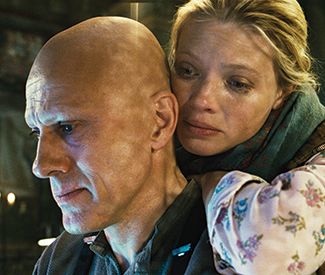
This privilege comes with a price, and Qohen is tasked with a “special project:” solving the titular theorem, a maddening beast that would drive even a stable person insane. His madness is in no way assuaged by “Dr. Shrink Rom,” his virtual psychiatrist (a bewigged Tilda Swinton), though he does get some help from Management’s genius teenage son (Lucas Hedges), who shows up at Qohen’s man cave of despair to eat pizza and share his own thoughts on the “Zip-Tee.” There’s also a romance — with Mélanie Thierry, resplendent in virtual-reality beachwear — though it proves no more “real” than anything else in Qohen’s world. Ultimately, despite Waltz’s heavy lifting (and not-infrequent nudity), Theorem sputters to sustain all its many whirring parts, including those that attempt to convey deep thoughts about the meaning of life. Maybe the meaning is “don’t overthink it.”

As for Waltz, his future slate contains a few worrisome choices (the fifth Pirates of the Caribbean movie? Nein!), but also some intriguing ones. This Christmas brings Tim Burton’s Big Eyes, scripted by the duo who penned Burton’s 1994 Ed Wood, in which Waltz and Amy Adams play kitsch-art impresarios Walter and Margaret Keane. To paraphrase Waltz’s Django Unchained character, how could you resist? *


THE ZERO THEOREM opens Fri/19 in Bay Area theaters.

Joyous blues

0

By Nicole Gluckstern

arts@sfbg.com

FILM In an early scene from Maureen Gosling and Chris Simon’s documentary on the life and musical obsessions of their mutual friend Chris Strachwitz of Arhoolie Records, we see Strachwitz behind the wheel of his car, struggling to explain the common thread that joins his wide-ranging musical tastes, from country blues to Cajun Zydeco to bordertown conjunto.

“It’s just got some guts to it. It ain’t wimpy, that’s for sure. It ain’t no mouse music.”

Mouse music? In a later scene, some of his friends attempt to define the term.

“It’s music that’s cheap and not real.”

“Music that is popular.”

“Inauthentic.”

“Anything that Chris Strachwitz doesn’t like.”

Taking their documentary title (This Ain’t No Mouse Music!) from their subject, Gosling and Simon make their own attempt to define the term, following Strachwitz from the crowded warren of his brick-and-mortar, El Cerrito shop, Down Home Music, to the sultry backyards of the Louisiana bayou, where making music is just “a pure joy” — and recording it is Strachwitz’s fondest obsession.

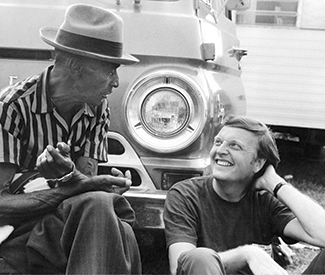
This Ain’t No Mouse Music! is a fascinating road trip through the dusty back roads and anonymous beer joints of “the music of your neighbors.” It follows its subject from his early associations with iconic blues men Lightnin’ Hopkins and Mance Lipscomb; his subsequent work with Mississippi Fred McDowell and the powerful Big Mama Thornton; his serendipitous acquisition of the publishing rights to Country Joe McDonald’s “I-Feel-Like-I’m-Fixin’-To-Die Rag”; his decades-long record-collecting habit (his renowned Frontera collection alone tops over 40,000 albums); his love of New Orleans jazz and Louisiana Zydeco; and his explorations of Tex-Mex conjunto and Appalachian country.

The filmmakers don’t skimp on the soundtrack. There are close to 70 songs used in the 91-minute doc, including historically important recordings — such as Lightnin’ Hopkins’ version of Mance Lipscomb’s “Tom Moore’s Farm,” which led Strachwitz and music historian Mack McCormick (who deserves a documentary of his own) to Lipscomb’s front door in Navasota, Texas, a key discovery for all parties concerned. Taking a page from Strachwitz’s own playbook, the directors are also on hand to record a wealth of vernacular music being played on the spot: the Treme Brass Band on a New Orleans street corner; members of the musical Savoy family playing a backyard barbecue in southwest Louisiana; a front-porch accordion performance in Texas with Santiago Jimenez Jr.; and a raucous Zydeco sing-along in Strachwitz’s kitchen with youthful standard-bearers the Pine Leaf Boys. Throughout, Strachwitz appears most often in his preferred habitat, fiddling with mics and levels and capturing, for posterity, the living breathing music he deliberately surrounds himself with.

Dedicated to the late Les Blank, with whom Gosling, Simon, and Strachwitz all collaborated with over the years (Gosling and Simon as assistant filmmakers; Strachwitz as co-director and producer of several music films, including the 1976 classic, Chulas Fronteras), This Ain’t No Mouse Music! makes good use of footage from several of his films. These include 1970’s The Blues Accordin’ to Lightnin’ Hopkins, and the 1973 Clifton Chenier biography Hot Pepper. Strachwitz even echoes a popular Blank sentiment in a moment when he explains his recording process: “My stuff isn’t produced, I just catch it like it is.”

Gosling and Simon, who became filmmakers directly through Blank — Gosling was his assistant for 20 years, starting in the early ’70s, while Simon was married to him for 20 years and began working with him in a variety of capacities, because “otherwise I’d never see the guy” — credit him for teaching them the importance of approaching a subject with curiosity. They were also inspired by the principle of going in “not knowing anything,” and allowing the story to emerge in its own time, creating a gentle meander through certain key moments rather than a tightly-controlled, connect-the-dots narrative.

Keeping the focus on the music and musicians Strachwitz adores rather than the man himself may be the greatest homage Gosling and Simon can offer their subject. However, this choice leaves a sometimes distracting gap at its center, not quite filled by flashes of Strachwitz’s interior world that do find screen time: a moment of pained disgust at being asked for five dollars for a lemonade made with “just one lemon;” a shame-faced recollection of not taking a stand on behalf of Lipscomb in a segregated Southern café.

Approximately 30 seconds of the film are dedicated to the fact that he never married, another 60 to his family’s flight from Silesia, East Germany (now Poland) in 1945. But never far from the foreground are the many moments that cement Strachwitz’s role as a conduit through which so many overlooked, homegrown genres and musicians have been passed through to the American public, from the days when he drove his inventory around in the trunk of his car, to the present, when he can call business manager Tom Diamant with news of his latest discovery.

“Whether we make money on it or not, we put the records out,” Diamant observes somewhat wryly, a testament not just to the current challenges facing the music industry as a whole, but to Strachwitz’s still-boundless enthusiasm for his profession that supercedes the kind of business “sense” that focuses narrowly on dollars and cents.

Despite his admitted initial reluctance to be the subject of a documentary rather than the producer, sound engineer, or “song-and-dance man” glad-handing the performers before their sets, Strachwitz emerges as a character in his own right — a “classic record man” who entered the music business with the purest of intentions, to make the records he wanted to hear. And 54 years on, we see him doing just exactly that: no compromises, no bullshit, and, most especially, no mouse music. *


THIS AIN’T NO MOUSE MUSIC! opens Fri/19 in Bay Area theaters.

Stream of movement

0

arts@sfbg.com

DANCE Liss Fain borrowed the title of her most recent installation — the wondrous The Imperfect is Our Paradise, Sept. 11-14 at ODC Theaterfrom Wallace Stevens. But the work’s inspiration was William Faulkner’s 1929 novel The Sound and the Fury, an often stream-of-consciousness study of the Compson family in Jefferson, Miss. She employed fragments of the text, not unlike previous works in which she explored the words of Jamaica Kincaid, Virginia Woolf, and Lydia Davis.

For Imperfect, Fain turned again to previous collaborators Matthew Antaky (installation design), Frédéric Boulay (projection design), and Mary Domenico (costume design — great, ratty overalls), as well as composer Dan Wool, who has a lovely habit of including into his own scores a quote from classical music. They feel like nods to another world.

Fain now also has a fine, stable ensemble that beautifully realizes her strong, formally contained choreography. Returning dancers Jeremiah Crank, Katharine Hawthorne, sisters Megan and Shannon Kurashige, and Carson Stein were joined by Gregory DeSantis and Aidan DeYoung. They lent a workmanlike, stoic sense of inevitability to their performances, whether staring into the void or ensnaring partners every which way. This was true ensemble work.

Imperfect communicates with its intelligence, clarity of purpose, and rich, tight choreography. Antaky added his magic by designing 12 panels that hung high above the audience on all four sides. They first suggested a sense of enclosure with brick walls, then threats from nature, stockade-like fences, and finally a dead house on a hill. The stage floor looked like dry dirt, or as if covered with leaves. It made me think of Benjy, the Compsons’ disabled son, who loved the smell of trees.

About the use of Faulkner’s text, I am of two minds. In voiceover, it was often more difficult to decipher than, for instance, actor Val Sinckler’s live performance in the Kincaid-inspired work. If text is used, it should be comprehensible. That’s why it’s there. At the same time, those fragments I did catch — primarily those from Quentin, the book’s most contemporary and most tragic character — pulled me away from Fain toward Faulkner’s narrative, such as it is. I thought it distracting rather then illuminating.

Since Fain encourages audiences to walk around the perimeter of the stage, though few people do, she meticulously designed her choreography from the periphery, into and out of the center space. In the beginning, the dancers stood immobile, staring into the void, before slowly coming to life and offering us different perspectives of themselves. I expected characters to emerge, but they didn’t.

With the exception of Hawthorne, who throughout remained something of a wild card, this was a homogenous group that was caught in what was perhaps a common dilemma. The title’s slippery Imperfect refers to something flawed, but grammatically, it also references past actions that are finished in some languages; in others, they project into the present. If Fain had overreaching themes in mind, they might have been time and memory, past and present.

The choreography asks for strength with lots of elaborate partnering — mostly male to female, yet without a trace of romantic intent. These dancers engage each other almost impersonally as something that is inevitable and that will be repeated for who knows how long. Despite the few unisons — some triple duets, a few one-on-ones — Imperfect has a churning sense of commonality about it. An arabesque can turn into a backward somersault and end between a partner’s leg. The dancers engage each other by rearranging body parts — an elbow here, a foot there — and flipping in every direction. They entangle their bodies, lift and drop them. Often they sink to the floor but pneumatically rise again.

As she has in the past, Fain makes prominent use of the arms. People yank and pull at them like tug of wars. But they also lock elbows, as if going for a stroll, but then immediately slip out of this companionship into more robust moves, becoming burdens which can be dropped or gently let go.

When Wool introduces Bach, the tall and elegant Hawthorne and Crank look like they remember the ballroom decorum of an earlier era. If there is one “character” it is Hawthorne, an astoundingly versatile and detailed dancer. She can stand on the sidelines as if watching for a prey, with a single gesture break up a couple, and again and again tear across the space sweeping the floor clean with her tornado-like whipping turns, pleading arms reaching for the light.

With Hawthorne in control, you get the sense that Imperfect contemplates time — past and time as it is passing. It may all stem from Faulkner, and the watch that the Compson family patriarch gives to Quentin, his oldest son. *

www.lissfaindance.org

Water with a price tag

0

Rebecca@sfbg.com

At the tail end of a dry, dusty summer, California continues to weather the effects of an extraordinary drought.

Wildfires have swept through forestlands in the Sierra Nevada foothills, Mendocino County, and near Yosemite recently, making for smoky skies and glaring red sunsets. Meanwhile, shrinking reservoirs have prompted the state to issue formal crackdowns on watering lawns and washing cars.

These extreme circumstances may be linked to why voter support for Proposition 1, a $7.5 billion general obligation bond for water-related projects, has initially registered high. Elected officials have trumpeted Prop. 1 as a measure that will alleviate the worst impacts of the drought.

In the Bay Area, 62 percent of likely voters said they’d vote in favor Prop. 1, while that support came in at 52 percent statewide, according to a recent Field Poll. The bill that became Prop. 1 won bipartisan support in the Legislature after lawmakers struck a deal to kill an earlier $11 billion proposal and replace it instead with the slimmed-down version.

Despite the rare consensus, opponents charge that Prop. 1 won’t actually address the water crisis.

“We really don’t deal with the drought here,” said Connor Everts, executive director of the California Watershed Alliance, after reviewing the details.

Everts spoke during a Sept. 11 conference call organized by opponents of Prop. 1. They reject the water bond mainly because it dedicates a significant chunk of funding, $2.7 billion, toward new dam projects. They view this as an unacceptable tradeoff.

“We can’t conjure water out of thin air with new dams,” pointed out Barbara Barrigan-Parilla, the opposition campaign director, who runs a grassroots organization advocating for sustainable management of the Sacramento-San Joaquin Delta. More should go toward conservation measures, she said.

The Delta has suffered hefty ecological impacts from freshwater pumping to feed the state’s water-delivery system. “Protect the Sacramento-San Joaquin Delta” is the first guiding principle to appear in a policy document establishing the basis for Prop. 1, but Barrigan-Parilla and others remain skeptical. Friends of the River has also come out against Prop. 1, as have many members the Environmental Water Caucus, a statewide coalition of grassroots organizations.

State lawmakers have been trying to pass a water bond since 2009, but earlier versions were shot down as bloated and pork-laden, failing to gain traction.

In June, Gov. Jerry Brown called for a $6 billion bond that would throw $2 billion toward dam projects, but the needle moved after Republicans — taking advantage of the fact that it needed a two-thirds majority vote to pass — withheld support unless they were promised more money for dams.

Water storage is a high priority for agribusiness farmers, whose sprawling croplands soak up vast quantities of water. A whopping 70 percent of all water rights claims issued by the State Water Resources Control Board are for agriculture, according to a University of California at Davis study.

“If these dams actually get built, we believe they will take more water out of the rivers that are dammed, and there will be less to come out of all of the environmental benefits,” envisioned by other provisions in the bill, said Carolee Krieger, executive director of the California Water Impact Network (C-WIN). “In the long run, we believe it would be way worse for the environment.”

Adam Scow, speaking during the conference call on behalf of San Francisco-based Food and Water Watch, pointed out that California desperately needs to invest in basic water needs, like fixing old leaky pipes. Nevertheless, Prop. 1 is “just prolonging these fights over new, silly dam projects,” Scow said.

Significant Prop. 1 funds would also be committed toward cleaning up groundwater, restoring damaged watersheds, advancing water-treatment technology, and ensuring safe drinking water access for low-income communities. The Sierra Club issued a statement announcing that while it’s supportive of these good programs, its official stance on Prop. 1 is “no position.”

Opponents of Prop. 1 noted during the call that California faces a fundamental problem that won’t be addressed by the water bond: The amount of water allocated by water rights claims is five times higher than what actual river flows provide in an average year.

“The one thing that must be done is to balance water rights claims to actual supplies,” Krieger said. The difference between real supplies and what’s promised in a contract, she added, is called “paper water.” This means many users receive less water in practice than what they’re technically promised, but those unrealistic promises make for confusing and conflict-heavy management of scarce water resources. The bizarre dysfunction is well-documented in a UC Davis study published in February. Of 27 major rivers, the study found, 16 had allocation levels “greater than 100 percent of natural supplies.”

The state “simply does not have accurate knowledge of how much water is being used by most water rights holders,” the UC Davis study noted, making it “nearly impossible” to reduce consumption or manage water supplies in a way that’s more equitable and environmentally responsible.

If voters grant their stamp of approval for the $7.5 billion water bond, the state may well move forward with important environmental initiatives, as well as multi-billion dollar dam projects that will take decades to build.

But no matter what happens, money still can’t buy snowfall in the Sierras, and it’s going to take more than cash to get to the root of California’s water woes.

Reform BART’s approach to labor

0

By Christina Olague

OPINION If BART is part of your daily commute, you know how critical a reliable system is to Bay Area working people. If you don’t ride BART, all you have to do it think about all the cars that the system keeps off the road every day.

That’s why everyone — most of all the BART unions and their supporters — found last year’s strike so upsetting. And now, a new report commissioned in part by BART Board member James Fang shows how unnecessary it was for management to drive workers to walk off the job.

In fact, the report says, hiring a union-busting outside negotiator was a serious mistake. Allowing that hired gun to pursue an extremist bargaining strategy was a major cause of the labor unrest.

The report, conducted by an outside consultant, involved interviews with dozens of workers, managers, and negotiators. The document is riddled with references to war: Bomb-throwing, Vietnam, a labor “massacre.” It shows how badly the executive management at BART allowed the climate for negotiations to deteriorate — and how hard it will be to repair the damage.

Here’s how one manager put it: “This strike was not productive. We never did a course correction and then there was another strike. Two people got killed. We spent millions to end up getting creamed, and engendering hate.”

The report notes how BART executive management and their notorious chief negotiator refused to take seriously the concerns workers expressed about safety.

“Key points made about safety in bargaining sessions fell on deaf ears…because management thought the unions were just posturing and the unions thought the management was refusing to engage,” it states.

Safety concerns were a central part of the negotiations from the workers’ perspective, and by dismissing those concerns as a tactic, BART’s consultant not only made an agreement more difficult but gambled with the safety of workers and riders in order get concessions from workers.

Fang, head of the BART Board’s Labor Negotiation Review Committee, is asking that the board adopt the report’s recommendations to prevent this from happening again. These recommendations include more transparency around the agency’s finances, a much earlier start to negotiations — and if needed, bringing in mediators, not outside anti-union consultants.

Once the rest of our elected BART Board of Directors became more involved, management found a reasonable solution that both sides could live with. Why didn’t that happen at the beginning of negotiations?

That’s what the BART Board needs to be asking itself. A fair post-mortem puts much of the blame on management — a general manager who had little experience in labor negotiations and a board that failed to show leadership and independence.

Fang, who is the one board member who joined workers on the picket lines, says it’s time for management to change its approach. He’s calling for a strike-prevention plan that starts with honest, fair labor relations.

We’ve heard from some politicians looking to score easy points from frustrated riders that BART strikes ought to be banned. And it’s easy to imagine frustrated commuters, stuck far from work when the trains weren’t running, feeling sympathetic.

But if workers don’t have the right to strike, they are powerless to speak out against dangerous working conditions to a recalcitrant and, in this case, misdirected management. That leads to a more dangerous system for all of us.

Recognizing this, BART Board President Joel Keller just withdrew his suggestion that strikes be banned.

The much better approach for riders like me is to follow Fang’s prevention plan: Hold management accountable for its failures and to make sure that both sides can work together better in the future.

BART is a phenomenally successful system. Ridership has doubled in recent years, to 440,000 trips a day. With trained and experienced BART workers, the system’s on-time performance has risen to 95 percent. That’s not the result of some high-paid labor negotiator — it’s the work of a dedicated and hard-working staff.

If you ride BART every day, you deserve to know that the trains will be running, that you can count on the system to get you to work on time. Between now and 2017, when the next contract will be negotiated, the BART Board needs to learn from its past mistakes and find a different, more collaborative approach. Christina Olague is a community activist and former member of the San Francisco Board of Supervisors.

Bridge the housing-Muni divide

0

EDITORIAL One the most frustrating political conflicts in San Francisco this election season is the schism between sustainable transportation activists and affordable housing advocates, a split that unnecessarily divides the progressive movement and one that has been cynically manipulated by the Mayor’s Office and its political allies.

We at the Bay Guardian haven’t yet decided what position we’ll take on Props. A and B — both of which would give more money to the San Francisco Municipal Transportation Agency for Muni and other transportation needs — or Prop. K, the affordable housing measure that was heavily watered down by the Mayor’s Office. Our endorsements come out Oct. 8.

But we can say that we’ve been concerned with how housing and transportations needs have been pitted against one another — and by the political tactics that are being used to create that false choice in the minds of voters, often by those who have a financial self-interest in making misleading arguments.

San Francisco needs more affordable housing, a robust public transit system, and fully funded social services if it is to remain an efficient, diverse, compassionate city. We need all of those things, now, before we experience even more impacts from the rapid growth now underway.

Mayor Ed Lee chose to break his promise to place a local vehicle license fee increase on the fall ballot, so Sup. Scott Wiener and others placed Prop. B on the ballot instead. It would tie the city’s General Fund contributions to Muni to city population growth, but it would also allow the mayor to end that subsidy if voters approve the VLF increase in a future election.

Several local journalists have reported on the carrots and sticks that members of the Mayor’s Office have used to try to sink Prop. B and maintain affordable housing advocates’ support for Prop. K (see “Mayoral meltdown,” Aug. 5), pitting transportation and housing activists against one another, either by accident or design.

But San Francisco can’t afford this false dichotomy, and it’s high time to finally have this discussion openly and honestly. So the next Bay Guardian Community Forum — on Oct. 9 from 6-8pm in the LGBT Center, 1800 Market Street — will focus on bridging this gap. We’ll be inviting key players on both sides and we hope that you, dear readers, will join us as well.

The same players in this city who are urging San Francisco to rapidly grow as an economic and population center are sabotaging the political alliances and funding mechanisms that we need to handle that growth. It’s time for a forthright, public discussion about the city’s many long-term needs and how to finance them.


Deadly gamble

0

joe@sfbg.com

As BART management and unions were locked in dysfunctional contract negotiations that would result in two strikes and two deaths last year, the district and the media scoffed at workers safety concerns and waged a media campaign demonizing the unions. Now, a new report commissioned by the district calls that strategy a horrible mistake.

The report from independent investigators Agreement Dynamics Inc., “Bay Area Rapid Transit Collective Bargaining Report and Recommendations,” reveals BART management perceived the Bay Area as anti-union. This guided its decision to hire Tom Hock as a contract negotiator and adopt a union-bashing public relations strategy that was then amplified by most local mainstream media outlets.

“In interviews, Tom Hock said he believed the strike would be very short and the unions would have to come back and reach an agreement,” the report, which was based on more than 200 hours of interviews of 60 BART employees, managers, and contractors, found. “He said media reports also heavily favored the management perspective.”

The San Francisco Chronicle and the San Jose Mercury News attacked BART’s workers in their news and editorial pages, stoking the flames of anger. “As to union claims that this is all about safety — how stupid do they think the public is?” the Merc opined in a July 2013 editorial. The Chronicle struck a similar tone in its Oct. 18 editorial, blaming workers and writing “the walkout is the height of irresponsibility.”

The unions warned management not to run the trains during the second strike, but those safety warnings went unheeded. A contract deal was reached only after two men working on the tracks during the strike, Laurence Daniels and Christopher Sheppard, were accidentally run down during what was later revealed as a replacement driver training exercise — warnings be damned.

“Some in management believed they had a good media strategy that put the public on their side,” the report found. Therefore, “the public was angry with the unions for demanding too much in their contracts.”

BART approved a contract from big-time public relations firm Singer Associates in April last year. Sam Singer and his firm are well-known for pulling the strings of local journalists and using scorched-earth tactics. As a result, articles highlighted riders woes and selected employee salaries while discounting safety and other concerns raised by workers.

But BART management and its board had longstanding CAL-OSHA violations, some of which were the subject of labor negotiations leading up to the strike. Notably, BART’s now-defunct “simple approval” policy, by which workers verbally notified management they would be working on the tracks, was one that both workers and state regulators long urged the district to change. The two deaths were linked to that controversial practice, which BART has since ended (see “Tragedy follows strike,” 10/23/13).

State regulators have fined BART for that fatal misjudgment and a final report from the National Transportation Safety Board is expected in the coming months. Only The Nation, East Bay Express, and Bay Guardian covered BART safety concerns with any depth or gravity before the two workers’ deaths. It’s hard to tell who led the dance — did the mainstream media embolden management, or did management lead on the media? Either way, safety was not a priority for BART managers during negotiations.

“Key points made about safety in bargaining sessions, as reported to us, fell on deaf ears,” the report’s authors noted. “Management thought the unions were just posturing, and the unions thought management was refusing to engage.”

The unions, the report found, “voiced frustration that they have raised these issues repeatedly, and management was not responsive…The ‘simple approval’ policy was seen as indicative of management’s unwillingness to deal with safety concerns until two workers were killed during the second strike in 2013.”

BART’s next contract negotiation is set for 2017. The transit agency has much work to do to repair its lingering culture of distrust, but so-called unbiased media need to cop to their anti-union slants. It took two deaths to show how relevant safety concerns really were.

Still not sharing

0

news@sfbg.com

As controversial legislation to legalize and regulate Airbnb and other short-term housing rental services operating in San Francisco headed for another contentious City Hall hearing on Sept. 15, the San Francisco Treasurer & Tax Collector’s Office quietly unveiled new policies and mechanisms for hosts to finally start paying long-overdue local taxes on their rentals.

Board of Supervisors President David Chiu’s legislation attempts to strike a balance between protecting housing for permanent city residents — including tenants in rent-controlled units who are being displaced in favor of visiting tourists — and allowing San Franciscans to sometimes rent out rooms through companies such as Airbnb. That practice has mushroomed during the Great Recession even though such short-term rentals of residential units have long been illegal in San Francisco (see “Into thin air,” 8/20/13).

Among other provisions, Chiu’s legislation would require hosts to register with the city and live in their units for at least 275 days per year (thus limiting rental nights to 90), create enforcement procedures for city agencies, and protect below-market-rate and single-room occupancy units from being used as short-term rentals.

But Airbnb has also been snubbing the city for more than two years since the Tax Collector’s Office held public hearings and concluded that short-term rental companies and their hosts are required to collect and pay the city’s Transient Occupancy Tax (aka, the hotel tax), a surcharge of about 15 percent on room rentals usually paid by visiting guests (see “Airbnb isn’t sharing,” 3/19/13).

After other media outlets finally joined the Bay Guardian in raising questions about the impact that Airbnb and other companies was having on San Francisco — and with cities New York City, Berlin, and other cities taking steps to ban short-term rentals — Airbnb announced in March that it would begin collecting and paying the TOT in San Francisco sometime this summer.

But that still hasn’t happened, even though Tax Collector Jose Cisneros recently unveiled a new website clarifying that Airbnb hosts must register as businesses and pay taxes and created a streamlined system for doing so. The office is even allowing Airbnb and other companies to register as “qualified website companies” that collect and pay these taxes on behalf of hosts.

“The law does apply to these transactions,” Cisneros told us. “And the set of requirements are the same for the hosts and the website companies.”

Airbnb didn’t respond to Guardian inquiries for this story.

Meanwhile, an unusually diverse coalition of critics continues to raise concerns about Airbnb and the regulatory legislation, including renter and landlord groups, neighborhood and affordable housing activists, labor leaders, and former members of the Board of Supervisors (including Chiu predecessor, Aaron Peskin) and Planning Commission. They penned a Sept. 15 to Chiu calling for him to delay the legislation.

“Individually and collectively, we have advanced nearly two dozen additional amendments that address the issues raised by short-term residential rentals. While we are not of one mind on every issue or every suggested amendment, we are unanimous in our belief that the process you are pursuing is rushed,” they wrote. “The City will live with the intended (and unintended) consequences of your legislation for many, many years.”

Sources in Chiu’s office had already told the Guardian that he planned to keep the legislation in committee for at least one more hearing so the myriad details can be worked out, as Chiu said at the hearing as well.

“We want to have the time to continue to vet and hear all of the perspectives, and at the end of the day what I hope to do is to be able to move forward and build incentives around something that is far better than our current status quo,” Chiu said at the hearing. “This is a very complicated issue, and we all know that we need to get this policy as right as we can.”

Planning Director John Rahaim conveyed concerns from the Planning Commission that the legislation beef up the city’s ability to regulate short-term rentals.

“The commission does believe that the law should be updated to create a legal avenue for those who do want to host,” Rahaim said. “However, currently there are about 5,000 units in the city engaging in short-term rentals. It’s very difficult to know if there are units not being lived in by a full-time resident.”

A long line of speakers wound completely around the packed chamber in City Hall, awaiting their turn to speak publicly to supervisors and city residents, from 20-somethings making a lives renting out their homes to longtime tenants fearing that home-sharing will hurt city’s character.

Airbnb was represented at the hearing by David Owen, a former City Hall staffer who is now director of public policy for the company, and he was publicly confronted by Chiu on the tax issue. Chiu criticized Airbnb for failing to start collecting those taxes as promised.

“As of now, we are extremely close and you will be hearing from us about that in the near future,” Owen said, provoking audible disbelief from many in the crowd. “We have been working diligently alongside the city. This is a complicated set of issues and those involved have all worked in earnest to facilitate this request.”

When Owen was asked about enforcement of the maximum number of nights a tenant has rented out his unit, he said Airbnb’s cooperation is “akin to the city asking Home Depot.com for a list of home care purchases to see if anyone had illegally renovated their bathroom.” But city officials say they need the company’s cooperation to address its impacts. “We don’t want data, just the number of nights per permanent resident so that we can ensure that the bad outcomes of this setup aren’t occurring,” Sup. Jane Kim said. “Airbnb profits from this industry, and therefore [is] accountable to the city.”

Supervisor Mar calls for more bike access on Muni

0

With racks that can hold only two bikes on the front of most Muni buses, and no bike access on Muni’s light rail fleet, Sup. Eric Mar is calling on Muni to look at improving its bike-access. At today’s Board of Supervisors meeting, he called for a hearing to explore what can be done to address the problem.

We’re looking at expanding the capacity of Muni for those that ride their bikes,” Mar told the board.

Currently Muni vehicles can carry two bikes at the front of each vehicle on its racks, which Mar called inadequate. Notably, only folding bikes are allowed on any Muni vehicle, which means light-rail riding bicyclists are left in the dust, bike grips in hand. 

A hearing on increased bus-bike capacity is especially timely, as Gov. Jerry Brown just signed AB 2707 into law last Tuesday, allowing transit agencies to increase the bike rack capacity on some buses to three bikes, instead of two. Also, San Francisco is anticipating a new fleet of buses, Mar noted, which may be a ripe opportunity to increase bike access. 

We contacted the San Francisco Municipal Transit Agency for comment on the cost and feasibility of any such bike improvements, and spokesperson Paul Rose said the agency is in the process of gathering that data.

San Francisco Bicycle Coalition Executive Director Leah Shahum said this was a good step for the city to take, but one that’s taken years to come to fruition.

“We’re really thrilled to see Supervisor Mar on the forefront of bike access, but this is also not a new idea,” Shahum said. “This was laid out in our bike plan years ago. We’ve seen advances in this regionally with BART lifting its ban on bikes.” 

Caltrain has also grown its bike access in recent years. “It’s exciting to see San Francisco able to do the same,” Shahum said.

The bike plan really highlights the opportunity for bikes on light rail vehicles, she added. But she wants to encourage the SFMTA to consider less busy times, like weekends or off-peak hours to bend those rules.

“Consider a family going to the Beach Chalet or someone who wants to enjoy Sunday Streets on the weekend,” she said. “Weekends could be an ideal time, (for bikes on light rail), especially for families.”

We need to start with what San Francisco State University Professor and Bay Guardian columnist Jason Henderson calls automobility, the feeling where everyone feels they need to drive in the city,” Mar said. “We need to encourage people to walk bike or take transit.”

Mar’s office told the Guardian they’re anticipating the hearing would take place in November, after the frenzy of the upcoming election. 

Locals only: Split Screens

0

There’s something overwhelmingly dreamlike about Jessie Cafiero’s songwriting, to the point that it makes a listener feel like they’re sleepwalking: The ebbs and flows of cinematic, orchestral pop conjure a surreal sense of nearly floating around one’s city. It’s not surprising, then, to hear that the singer-guitarist often draws inspiration from walking around these foggy hills of ours.

Though Cafiero released a debut EP as Split Screens two years ago, Before The Storm, out Sept. 9, showcases a fuller band, a more confident, brighter sound, and a more lush dreamscape in which Cafiero’s words create an airtight, contemplative mood; this is the perfect sonic accompaniment for a Sunday afternoon, cruising around the city in the early fall air, seeing where the day takes you.

Cafiero released an accordingly pretty, otherworldly video for the LP’s first horn-punctuated single, “Stand Alone.” Check it below, and catch the band’s record release show at Bottom of the Hill Sat/20.

San Francisco Bay Guardian How and when did the band form? I understand it was mostly a solo project to begin with — how is this new record different, and what made you decide to bring in more members of the live band?

Jesse Cafiero The band formed a little over two years ago. I had already written and recorded my self-titled EP under the name Split Screens, but when I got my first show it was time to move the studio solo project into a live setting. With the new record, Before The Storm, I had already started playing a few shows in the area so I could bring members of the band into the studio, which was great!

SFBG What’s your songwriting process like?

JC It depends, I play guitar and piano so I like to write on both to have a little more variety. Since I started writing Split Screens material I’ve always had my phone around to record ideas on the fly, that’s definitely helped. I also love writing in the studio, usually I’ll have the main form of the song together by that point but writing particular parts in that setting is an amazing feeling.

SFBG You’re from the East Coast originally, yeah? How did you wind up in the Bay Area? How do you think it shapes/affects your music?

JC Yeah, I’m from a small town in upstate NY called Pine Plains and I moved to the Bay Area five years ago. It was just a good time to move, I was just out of a long term relationship at that point and had fell in love with California the year before when I visited for the first time. If anything, the natural beauty of the city is inspiring and I’ve found myself coming up with some of my best lyrical ideas just taking walks up in the hills around Sutro Tower.

SFBG I love the “Stand Alone” video. What made you decide to go with stop-motion for this song?

JC I’ve always been a huge fan of animation and for “Stand Alone” the song has this lifting quality that seemed to be a great fit with the kind of movement stop-motion creates. Also the idea that I could create a piece of visual art on my own time on an incredibly small budget was really appealing to me. This was my first time attempting stop-motion so there was a freshness of creativity that I haven’t felt in a while!

SFBG Other Bay Area bands/artists you love?

JC Waterstrider, St. Tropez, Black Cobra Vipers, Doncat, Debbie Neigher, Guy Fox, Bells Atlas, Quinn Deveaux, Lee Gallagher & The Hallelujah…I know I’m leaving some people out. The list goes on.

SFBG Plans for the coming year after the record is released?

JC I’m gonna take a well-needed breather and start writing some new material. After that I’d love to do another little West Coast tour in 2015 and begin working on another music video!

SFBG Where in the Bay do you live? What’s the Bay Area food/meal you think you couldn’t live without?

JC I recently moved to the Castro. I had never had a Vietnamese sandwich until I moved to the West Coast, and the first one I ever had on Clement Street kind of changed my life. Thankfully I live around the corner from Dinosaurs so I’m pretty set on that front!

Split Screens LP Release
With Yassou Benedict and New Spell
Sat/20, 9:30pm, $12
Bottom of the Hill
1233 17th St, SF
www.bottomofthehill.com

Grassroots campaigns work to counter the influence of big donors

0

Big money is pouring into a few campaign committees for the fall election, with Big Soda targeting the soda tax, Realtors gunning for the anti-speculation tax, and the Fisher family last week giving $500,000 to promote artificial turf playing fields in SF (Yes on I, No on H), according to campaign filings. But low-budget grassroots campaigns are still having a strong presence at public events like the Sept. 14 Sunday Streets in Western Addition.

San Franciscans Against Real Estate Speculation, Yes on G, had activists out in force even though it has only raised a few thousand dollars. Its biggest contribution so far is $5,000 from attorney Dean Preston of Tenants Together, who was out there spreading the word near Alamo Square Park, along with campaign consultant Quintin Mecke, the runner-up in the 2007 mayor’s race.

One of the more surprising grassroots campaign of the season is No on L, San Franciscans Against Gridlock, which is campaigning against the pro-motorist Restore Transportation Balance initiative, a measure aimed at undermining the city’s transit-first policy and promoting more free parking.

The Yes on L campaign hasn’t shown much sign of life since the summer when it spent nearly $50,000 on its signature-gathering effort out of about $83,000 raised (including $49,000 from tech titan Sean Parker), but it was sitting on nearly $35,000 in the bank as of July 16.

But the No on L crowd is taking this attack on sustainable transportation policies seriously, and it’s hoping to fill its fairly meager coffers ($5,000 from Daniel Murphy on Sept. 6 is its biggest donation) this evening [Tues/16] from 6-8pm with a fundraiser at Public Bikes, 549 Hayes Street.

That event is hosted by a bevy of transportation activists and Sup. Scott Wiener, David Chiu, and Jane Kim. As the campaign says, “If you care about helping to build a better transit system, a more walkable and bicycle-friendly city, and reducing car congestion in San Francisco, the No on Gridlock, No on L campaign needs your support to raise money to educate voters.”  

Toronto International Film Festival report: in defense of the long, long movie

0

The unstoppable Jesse Hawthorne Ficks keeps his eyes open 24/7 through another Toronto International Film Festival, and lives to tell the tale (but shares no spoilers!) Read on for the first in several reports back from the 39th TIFF.

Starting on a high note: Nuri Bilge Ceylan’s Winter Sleep (Turkey/France/Germany) won the Palme d’Or at the Cannes Film Festival earlier this year, so it arrived in Toronto with its share of hype. I can report Sleep is the director’s funniest and most satisfying film to date. That said, it does run 196 minutes, and more than a few critics walked out early, which poses an ever-important question about the current trend toward slow-moving, observational, and meditative narratives: Who’s actually watching ’em? 

With characters that come together through long sequences in which intense emotions are slowly drawn out through passive aggressive actions, this immersive class study — similar to Akira Kurosawa’s High & Low (1963) — clearly polarized audiences’ immediate interests. My own interests lead me to wonder what long-term effects that this type of cinema will have on contemporary audiences. Has it always been this divided? If TIFF critics don’t have the energy or enough time to experience this masterpiece, how will it come up in conversation when Oscar fans are debating which film had the best acting? What about those more mainstream moviegoers who went to see Guardians of the Galaxy more than once? 

Looking back 40 years, Milos Forman swept the Oscars with One Flew Over the Cuckoo’s Nest, and Steven Spielberg’s Jaws (1975) was luring in audiences for second and third helpings. Meanwhile, an Algerian master named Mohammed Lakhdar-Hamina won the Palme d’Or at Cannes with his 177 minute Chronicle of the Years of Fire, an exploration of the Algerian War of Independence as seen through the eyes of a peasant. I guess there has always been a cultural gap between Oscar-bait, popcorn entertainment, and political art cinema … and there probably always will be.

Also relevent to any discussion of very, very long films: Lav Diaz’s follow-up to last year’s 250-minute Norte, the End of History is yet another long-form master work — and in my opinion, the best film at this year’s Toronto Film Festival. The Filipino director made a surprise appearance to introduce his 338-minute From What Is Before. TIFF programmer Andréa Picard seemed even more surprised than the audience when Diaz’s humble introduction consisted of  “I hope you brought a pillow and some blankets.” 

Committing to a Diaz film is comparable to joining a motion picture religion. Not just due to the length of his films, but because of his conviction in delivering something truly profound. Like some of his own characters, Diaz has the power to astral project the viewer into another world. From What Is Before takes place in 1972, just before President Ferdinand Marcos’ announcement that he was putting the entire country under martial law. A forgotten farming community in the provinces must immediately shift its focus to survival. 

As the story unfolds much like the chapters of a novel, each character (and the dilemmas he or she faces) slowly comes into focus, sequence by sequence. Many of the film’s most devastating scenes featured Itang (Hazel Orencio), a young woman taking care of her mentally challenged sister. At the Switzerland’s Locarno Film Festival, Orencio rightfully won Best Actress, and From What is Before took home the top award, the Golden Leopard. 

For TIFF audiences and beyond, the biggest question is: Will you take the time to learn Diaz’s artistic language? His films blend the convoluted past of the Philippines with the mysterious depths of human beings. Yeah, 338 minutes is long. But like Ingmar Bergman, Andrei Tarkovsky, and Claire Denis, Lav Diaz is speaking a cinematic vocabulary unique to the world. Don’t let your laziness get in the way.

Golden Gate Bridge strikes won’t effect commuters…yet

0

Golden Gate Bridge iron workers are on strike today [Tues/16], protesting retiree healthcare issues their union says were not addressed in 2012. Commuters will not be affected during the strike, however. Machinists Local 1414 made that choice consciously, its representative told us. 

The machinists purposefully made a decision to not impact services,” said Alex Tonisson, co-chair of the Golden Gate Bridge Labor Coalition. The coalition is comprised of the 13 various unions that work on the Golden Gate Bridge, all of whom negotiate with the district together. “We want the public to understand how serious things have gotten.” 

The strike started early this morning and is scheduled to end at 3:30pm. Though the strike is not directly related to current labor negotiations for health care with the district, at this point those negotiations could best be described as… rocky.

The sticking points are health care and living wages. The Golden Gate Bridge District, with a board with nine San Francisco representatives and members spanning the Bay Area, said the increases in health care costs are still competitive in the Bay Area.

The District has sought modest increases to the amount that Coalition employees have been contributing to their health benefits,” the Golden Gate Bridge District said, in a press statement. “District employees enjoy world class health benefits.”

But the unions noted that the cost of living in the Bay Area has skyrocketed. Housing prices are up, gas prices are up, everything is up. Though the district’s offer includes a 3 percent wage increase next year, and further increases in subsequent years, the new health care plan would cost 2 percent of workers’ wages, largely nullifying any increases. And the workers gave up much ground during the worst of the Great Recession.

We bargained significant concessions and changes,” in previous years, Tonisson told us. 

Strikes from the Golden Gate Bridge’s ferry workers could potentially impact thousands of Bay Area commuters. The labor coalition seemingly took lessons to heart from last year’s BART strike, when the public’s support of strikers waned in the face of nearly impossible commutes.

Tonisson didn’t directly comment on the BART strikes, but said “we’re definitely aware how any strike that shuts down the bridge or ferries impacts the lives of residents.”

To keep the commuting public aware of an impending strike, the coalition took out radio and newspaper ads, and passed out leaflets on ferry commutes. 

We’re hoping we don’t have to take further action,” Tonisson said. “We want them to understand it’s a possibility. The public should take that seriously.” 

Tenants face absurd lawsuits as “low-fault” evictions increase

0

An annual report issued by the Eviction Defense Collaborative (EDC) highlights some of the outrageous reasons landlords use to evict tenants. Since 2009, EDC reported, there’s been a 62 percent increase in the number of breach-of-lease cases citywide.

Violations cited in the report included offenses such as “parking outside the parking lines,” or even cooking during nighttime hours.

One tenant, Clifton Reed, was evicted along with his young family after a sudden $1,000-per-month rent increase, which the landlord claimed was for storing construction equipment in the garage of their Bernal Heights home, something they’d previously done without a problem. “We were tenants living in the neighborhood for 20 years,” Reed told the Guardian.

The family sought assistance from EDC, who fought the eviction charges and negotiated a settlement with the landlord.

The drawn-out eviction case eventually ended with an $8,500 settlement and a 90-day timeframe for him and his family to move out, Reed said. After evicting the other tenants in the building following Reed’s eviction, the landlord eventually sold the property for approximately $1.8 million. 

Reed, who now lives in Vallejo but still commutes to the city, said the recent wave of evictions in San Francisco has particularly impacted artists and musicians from his old neighborhood. “They’re targeting income levels, and musicians don’t make a lot of money,” he said. “It’s really a shame.”

According to the EDC report, 20 percent of evicted households assisted by the nonprofit legal aid group – which represented 94 percent of San Francisco tenants facing just-cause eviction lawsuits in 2013 – had at least one child under 18 years old.

Families weren’t the only disproportionately impacted group, as 88 percent of total tenant households targeted with eviction lawsuits were also low-income, defined as making at or less than $36,950 per year for an individual. And 29 percent of the eviction cases concerned tenants housed in units owned by landlords who receive city funding, such as supportive housing in single-room occupancy hotels.

The EDC report also signaled that San Francisco’s communities of color remain at the forefront of the eviction crisis. According to the report, although San Francisco’s black population is only 6 percent, people who identify as African American represented 29 percent of those impacted by eviction in 2013. Additionally, 40 percent of tenants evicted from the Bayview neighborhood identified as black or African American.

Non-English speakers were also targeted, as 22 percent of evictions from the Mission District impacted households who spoke a language other than English.

The rise in “low-fault” evictions in 2013 occurred on a parallel track with no-fault evictions, which have received a great deal of media attention. Evictions that are based on an alleged action or violation by a tenant, as opposed to no-fault evictions initiated under the Ellis Act, for instance, grant less time for a tenant to vacate their unit. They’re easier on landlord’s wallets and don’t restrict subsequent use of a unit.

Low-fault evictions, or minor breach-of-lease cases, are providing the ideal platform for landlords to oust their tenants while still claiming some type of violation, the report indicates. The lengthy, complicated suits are often difficult for tenants to defend themselves against.

The EDC report showed an absence of court appearances in 38 percent of the 3,423 Residential Unlawful Detainers cases in 2013, demonstrating that tenants did not respond to the eviction notice in within the five-day deadline. 

“Tenants just miss this narrow window,” said Tyler McMillan, executive director of the EDC. “It’s one of the shortest timelines in the court system.”

Eviction notices have demanded tenants leave in as little as 10 days, as was the case of EDC client Joann Agnew-Porter. Agnew-Porter’s daughter, who lived in the unit, was laid off her job and scraping by on a fixed income. Their rental building, Friendship Village, an affordable housing community in the Western Addition, had been paying back-rent, when suddenly the mother and daughter pair received an eviction notice, giving them 10 days to come up with $2,100 of back-rent or leave the premises.

“I couldn’t come up with that,” Agnew-Porter said. “We’ve always been good tenants; we’re working people, we haven’t had loud music or people hanging out outside, none of that,” she added. After receiving assistance from EDC, a court determined that the apartment manager had mistakenly charged them that amount of back-rent.

“The story of increasing “low-fault” evictions is one that impacts some of San Francisco’s most vulnerable communities and ultimately threatens the diversity that makes San Francisco so unique,” the EDC report said.

The full report is available online at the EDC website here.

It’s sexy time on this week’s Alternative Ink

0

We talked sex and summertime during last night’s installment of Alternative Ink, the Bay Guardian’s biweekly radio show on BFF.fm, along with money in politics, the tech perspective, what’s being done to help child refugees, and the explosive new report on BART’s bungled approach to last year’s labor contract negotiations.

But mostly, we talked about sex, listened to sexy music, and danced and had a good time in BFF’s Secret Alley studio. No, it wasn’t just that we had sex on the brain after a beautiful weekend in the warm San Francisco sunshine (yes, it’s true). We were also plugging our upcoming annual Sex Issue and the shenanigans therein, including Joe’s foray into virtual reality sex and the debut of the Bay Guardian’s hot new sex columnist, Krissy Eliot, who will be exposing herself to y’all quite a bit this week. And we even offered some gratuitious digs at our corporate overlords, and that’s always fun and cathartic.

So give it a listen on this (ugh!) busy Monday morning, or whenever you can get around to it, and it’ll be like the weekend never ended.