Bay Guardian Archives

Silicon-centric proposal to split California fails to make ballot

0

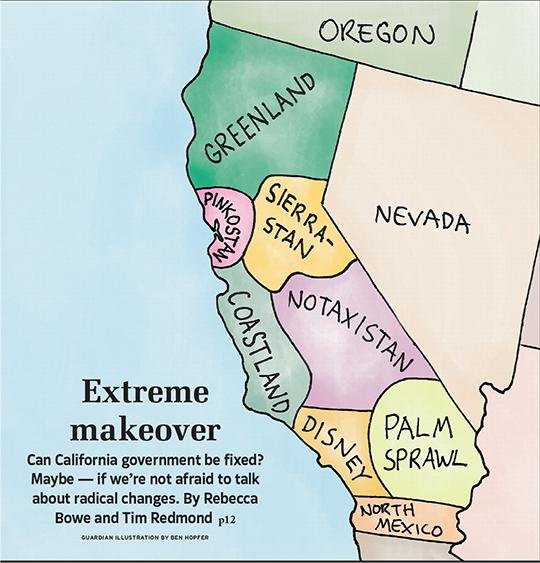
While we at the Bay Guardian have long been intrigued by the possibilities of splitting California up into several states — the Bay Area could be an economic powerhouse with compassionate social services and modern infrastructure, while conservative counties would have low taxes but crumbling roads and bridges — we’re happy to hear the news that venture capitalist Tim Draper’s proposed six-state solution has failed to qualify for the ballot.

The most ridiculous part of Drapers’ initiative, which he spent more than $5 million on but fell short of the requisite number of signatures from registered voters, was his plan to call the Bay Area’s state “Silicon Vally” — showing just how arrogant and out-of-touch these tech titans can be. Hey buddy, I hate to break it to you, but the world doesn’t really revolve the tech industry, and it’s just stupid to name a state after a chemical element.  

Personally, I have a long history of covering the idea for splitting up California, starting in 1991 when I covered Lassen County’s threat to secede from California because of its difference with urban areas for the Lassen County Times, a story that then made international news.

Then-Assemblymember Stan Statham used that media spotlight to introduce advisory measures on the question of splitting California up into three states, an idea that voters in 31 counties in the state voted on in election of 1992, most of them approving of the idea.

But unlike the dozens of other times in California history when the idea of splitting up the state was raised — the most serious effort coming in 1941 when the rural northern California counities declared themselves Jefferson State and set up a highway checkpoint, only to have the movement lose stream when Pearl Harbor was bombed three days later — Draper’s measure just seemed like a vanity project from a clueless rich dude. 

Viracocha is legit! Here are five things from the past five years that we wish we could’ve written about

0

As you may have heard by now, Viracocha — everyone’s favorite Never-Never Land of a music venue/spoken word performance space/speakeasy/antiques store/beautiful place to stop and use the bathroom should you find yourself having to pee on Valencia — has gone legit.

After nearly a year of fundraising, inspections, and meetings with the city’s Entertainment Commission, the dreamily lit basement stage that has played host to so many awesome events will now be operating with an official venue permit.

No longer working under the veil of semi-secrecy, the folks who run the space (the tireless founder Jonathan Siegel, with help from new business partner Norah Hoover and a slew of local artists and musician employees) have spent the last six months renovating the space to meet city standards, and will now be free to actually publicize the venue’s shows. They’ll celebrate tonight with a free little gathering/party at Viracocha from 8pm to midnight — open to the public, legally, for the first time. [See a note Siegel sent to supporters early this morning at the end of this post.]

The booking process is also on the up-and-up, so bands, bookers — if you’ve always wanted to play that room but were unsure about the logistics of setting up a show you weren’t allowed to promote? Drop ’em a line.

Now, full disclosure: Roughly half the people I love in the SF arts scene have at one time or another played there, worked there, or lived there. I’ve watched Siegel give jobs to kids who arrived in San Francisco with very little, and then watched those kids make it a home. If employees or event attendees are there late and anyone seems drunk, he’ll order five pizzas. It’s been problematic, it’s seemed improbable, it has at times appeared to almost be a parody of itself and/or San Francisco. There’s a goddamn lending library in the back room that looks like it was built by whimsical 19th century fairies and chipmunks. But I adore Viracocha, and have wanted it to thrive the way you fall for the runt of any litter, the way you root for any underdog.

What this has meant, practically, as a music journalist, is that while the place is very close to my heart, it’s also been exceedingly frustrating to watch awesome shit happen there and not be able to write about it. Especially since the illegality meant that all things were basically equal and welcome — if that tame poetry reading you want to host is illegal, and so is the free workshop on tenants’ rights? Well, there’s nothing really more illegal about an aerial dance performance/dinner party/burlesque show. It was anything goes, and truly, anything went.

In closing: Congrats, Viracocha. And here are five-plus things that may or not have happened there that I really wish I could’ve written about.

1. The week after Amy Winehouse died, a bunch of local cats (many of whom normally command a pretty penny for live shows) got together to throw a last-minute tribute night revue of sorts. Folks dressed up. There was much sad drinking.

2. Jolie Holland played a week-long residency there, living in the tiny attic apartment attached to the store, and playing shows every night, lulling the packed room into a breathless trance.

3. That there video above (which is not great in visual quality I realize…but oh man, that voice) is also from a regular poetry/music/anything-goes revue called You’re Going to Die, started by writer Ned Buskirk, which continues to bring out some of the city’s finest writers and spoken word artists in addition to musicians. See SF writer and Rumpus film editor Anisse Gross reading at another one here:

4. A staged reading of an early, weird, rarely performed play by Louis CK, starring The Coup‘s Boots Riley as a dumb cop.

5. Hella music video shoots, with both local and big-name folks. Below: Wolf Larsen, and  Atmosphere.

6. Porn. (Supposedly.) (Did not see with own eyes.) (Unfortunately do not have video.)

Viracocha’s at 998 Valencia.

See you tonight?

Dear Steadfast Supporters, Family & Friends,

Viracocha is now open to the public, as a live venue in San Francisco!

Through many a trial — months of obstacles, pitfalls, setbacks, missteps, and hard choices — and by the unwavering energy, dedication and resolve of our staff & crew…we finally made it!

Five years ago, Viracocha began as space where creative people and their work could find advocacy. Our contributors arrived from many walks of life and varied circles within the local arts and performing community. That is, until December 2013, when we closed our doors, temporarily, to begin the process of legalizing our venue with the city. We created this underground space, despite the risk, because we felt that San Francisco needed a cultural anchor for its diverse artistic community  a place to gather and express who we are. There is a voice within each of us that yearns to be heard. In a city like ours, it’s easy to feel reduced to a face in a crowd, a point on a graph, a nameless number. We built our venue to become an intimate, welcoming place, where people can feel understood, connect, and feel less alone.

At times, Viracocha seemed to exist beyond the parameters of logic and pragmatism. We’ve had to be discreet when we talk about our space, and at times we’ve been misunderstood, misinterpreted, or misquoted.  When people asked “What is Viracocha, exactly? Who, actually, is behind it?” — the answers were as varied as the items in our shop.  Does secrecy create it’s own allure?  Perhaps so…but now’s the time to put secrets to rest, and open our doors to you! Come and meet the people who call Viracocha home — the poets, artists, and musicians who have worked and played here, laughed and cried, performed and shared. This place was built for you (yes you!) and for all of us — come on by!!

— Jonathan Siegel

Disrupting Disrupt

0

A friend and I made a spur-of-the-moment decision to hit the final TechCrunch Disrupt after-party last night. Because, sheer curiosity. So here comes one of those borderline journalistic essays where, no, I didn’t actually formally interview anyone. But a conversation we had offered a fascinating glimpse into attitudes held by folks working in the tech startup sector, so I’m blogging it.

My friend and I just went in (I was allowed in as press after being obnoxious about it; his borrowed badge had a girl’s name on it), drank free Coronas, and talked to people. Unsurprisingly, we soon found ourselves in a heated discussion as we sat in a booth on the top floor of Mezzanine, across from a young, well-dressed tech worker with ties to the venture capitalist world. I’m relaying what he said here without using his name. Is that disruptive or something? Well, fuck it, here goes.

As a San Francisco resident who works at a company at the heart of the tech startup world, he had very strong opinions about tech’s influence on the city’s housing market. He and others were in full agreement that rental prices in San Francisco are utterly ridiculous and out of hand.

But he dismissed critics who single out tech workers as agents of gentrification, calling them unrealistic and out-of-touch. The only way to respond to the crisis is to build taller buildings and increase density, he insisted. But those critics from the far left are just too stubbornly resistant to change, making it impossible to build anything. As he saw it, those shrill critics and their penchant for protesting everything were the reason the housing crisis is as bad as it is.

The techie we met was an impassioned speaker, his face muscles tightening and eyes fixed upon us with intensity as he informed us that change is inevitable. It’s just the way things go, he said. You can’t expect to stop it. For example, it’s unpopular to say that the Tenderloin should be made better, he told us – the critics would just howl about removing poor people – but that location is so critical, given where it is! And even if tech did make a concerted effort to find a solution to the housing crisis, he added, it would never be enough to satisfy those critics, who would only dismiss it. “They would just say, ‘oh look, now the techies are getting their way,’” he practically exploded. “‘Now the city is just going to be just like Manhattan.’”

I started to dig in, pointing out that the city was dotted with construction cranes building mostly market-rate housing that no one with an ordinary income could possibly afford. But my friend kept his cool. He calmly asked the techie if he really wanted to live in a city where everything resembled the Financial District.

Financial districts in nearly every city in America are practically identical to one another, my friend pointed out. “It’s like an algal bloom. It sucks the life out of everything.” The difference between living in a culturally diverse metropolis, and a “company town,” where just about everyone has some financial connection with the venture capitalists who are running the show, is the difference between living in a vibrant city and one where that dead-zone effect extends to every corner. Is that really what we want?

Upon hearing that, our techie softened, and grew a little more contemplative. And he made some remarkably candid remarks about tech culture, something he eats, sleeps, and breathes.

It’s all so “hyperactive,” he told us. He regularly sees people who come to San Francisco and try to accomplish as much as possible, with the greatest expediency, so they can cash in and get out. “It’s not like you’re going to stay here,” he said. Startups come and go literally in a matter of weeks, he added, so you never have a chance to get to know people. “It’s transient,” he acknowledged, but a common refrain is that that’s precisely what makes it so “dynamic.” Yet he acknowledged that at the end of the day, it all amounted to a situation where practically nobody has any lasting connection to the community.

No, a bland, boring, monocultural city isn’t what anybody wants, the techie told us, once we really got into it. To the contrary, he said, people in tech would rather be exposed to art and culture. “I’m an optimist,” he insisted. He’d like to believe that the tech community would never allow that sort of outcome, he added sincerely, that they’d come together to find some solution, for “the greater good.” But I pressed him on this point, asking if he was willing to advance that conversation. Would he warn people that something had to change? “In order to do that,” he said, “I’d have to grow a serious pair!”

I blurted out, “But you’re supposed to disrupt!

It was the comic relief we all needed in what was becoming a seriously emotional exchange, and we all started cracking up. Soon after, we were interrupted by some performance on the main stage, where a guy wearing a gigantic yellow smiley face on his head – like a spherical, 3D emoticon – was lighting the globular thing ablaze. The cartoonish smiley face went sideways while sparks spewed out from it, while blaring techno music thumped along with the spectacle. Applause and hollers arose from the crowd.

Then, promptly at midnight, the lights came on, and any sexy veneer that might have exuded from a gathering of VCs and startup founders faded instantly. Suddenly it was all just tired conference-goers, mostly men, who’d been showered with free beer and wine while continuing to network late into the night, many of them still wearing enormous printed badges that said, “DISRUPT.” Many of the out-of-towners were probably starting to wonder where exactly in San Francisco they even were, and how long it would take for an Uber to show up and ferry them away.

Rising tenant buyouts in SF targeted by new legislation and map

0

A new interactive map published today by the Anti Eviction Mapping Project shows the spike in tenancy buyouts over the last year in San Francisco, just in time to raise awareness for Sup. David Campos’ proposed legislation to document and regulate tenant buyouts, which has a hearing later this month.

The map only records buyouts reported to the San Francisco Tenants Union, up 126 percent from 2012 to 2013 and expected to be even higher when data for 2014 is collected, but the Tenants Union estimates the number to be only about one-third of the buyouts actually taking place.

Campos’s legislation, which will go before the Board of Supervisors Land Use Committee on Sept. 22, seeks to record any buyout taking place in San Francisco with the rent board, and to guarantee the information of tenants rights to the tenant being bought out. [UPDATE: Because of the likely fiscal impacts of the legislation, it has been moved to the Budget & Finance Committee for its first hearing, with no hearing date scheduled yet]. 

“Regulating and recording buyouts isn’t going to stop them, we don’t believe that’s something within our power or within our rights,” Erin McElroy, a member of the Anti Eviction Mapping Project, told us.

The legislation will, however, impose the same condo conversion prohibitions that are already in place for no-fault evictions. The buyouts were virtually nonexistent before 2006, when San Francisco passed legislation severely limiting the conversion to condos of units that had been cleared of tenants use no-fault evictions.

“Buyouts are really the main way that landlords are evicting tenants,” Ted Gullickson, executive director of the Tenants Union, told us. “They threaten them with an Ellis Act eviction, then come in sweet with a buyout. We need legislation that takes away the incentive for one of the biggest methods of displacement in the city.”

“There are just so many components to the housing crisis [in San Francisco] that we need to know all that we can,” McElroy said. “Most tenants don’t know their rights and they often aren’t being offered enough.”

But groups with opposing views don’t believe that keeping a public record of a private contract is legal.

“Buyouts are mutually beneficial for both landlords and tenants. A tenant can get the money they need so that they can put down a mortgage on their own home,” Charlie Goss from the San Francisco Apartment Association told us. “It’s also a private contract. At face value, there is nothing wrong with recording buyouts, it just may not be constitutional.”

Both sides of the aisle are heated, and Gullickson expects a long fight before the legislation makes any progress, but he thinks that if the tenants side can persuade the more moderate supervisors, it can go through.

New SFBG columnist dives into SF sex culture head first

0

[Editor’s Note: The Bay Guardian welcomes and presents our new sex columnist, Krissy Eliot, whose columns you can find here every Thursday and in our print edition on an occasional basis, including in next week’s Sex Issue. Enjoy.]

I moved to the Bay Area seven months ago to escape my repressed, small town life on the East Coast and learn what it’s like to live in a sexually liberated culture. I intended to bump elbows and uglies with sex educators and activists and get a job writing about those experiences. I fantasized about becoming a sexual avenger for the oppressed millennial women being churned out of the small towns in America. I came here to make a difference.

And I’ve gotten off to a good start.

I’ve had a stranger stroke my clitoris at an orgasmic meditation conference, attended a lesbian sex party, shared a sexy tale on stage at Bawdy Storytelling, experimented with THC lube, and gone to a cuddle therapy session (and these are just some of my adventures). 

These activities may seem normal to a born and bred San Franciscan, but this place is like another dimension for me.

I lived in rural Maryland for most of my life. Unlike SF, we didn’t have orgasmic meditation or diverse lifestyles. We had churches, liquor stores, and a Wal Mart. I lived in a suburban area that was surrounded by farmland (I’ll never forget the acrid stench of cow poop every morning as I rode the bus through the winding country roads of my youth, Walkman clutched in my sweaty teen fingers).

There were about five black people in my high school, one Asian person, and two lesbians (who were basically the school pariahs). The rest of the students were hillbillies, stoners who loathed hillbillies, or members of the marching band. And no matter what group you belonged to, there was a 99 percent chance that you had conservative, religious parents who believed sex out of wedlock made you a heathen. (Reading the Scarlet Letter in 10th grade reinforced these life lessons). I was no exception to the status quo — with a God-fearing mother and a socially suicidal spot in the marching band’s color guard squad. 

I had no sexual prospects.

That’s not to say I didn’t experiment as a little kid. My girl friends and I were licking each other’s vulvas in my parents’ basement when I was 7 years old — cuddled together on pillows inside forts my older brother built with his Mickey Mouse blankets. I think I realized sex acts were condemned when my brother told my parents that I’d flashed my coochie at his friends. I remember hiding at the top of the stairs, tears running down my cheeks, shaking — as I was called down to the living room where my father was seated on a chair, waiting to bend me over his knee. 

For me, SF is such a strange place not because of the abundance of sex, but because of the blasé attitudes towards it. 

A popular local host and MC told me that none of my ideas on sex would shock anyone because the locals here have “seen and heard it all” and plenty of people in SF already write about sex. An editor of a local newspaper told me that I couldn’t possibly “out sex” anyone in my writing. And while I was sitting in the corner of a bohemian tea party in the city, I rattled off my desire for coital adventure to some hippie who told me that I “possess a curiosity and perspective on sex that most San Franciscans don’t.”

It seems that the sex scene in SF has taken on air of cockiness. A “we’re the big dogs” point of view. And since I’m a small town pup, it seems people expect me to earn my place in the pack, conform, and fade into the background.

I’m not trying to forge new ground with a freakier sex act (it might literally kill me with the shit San Franciscans do), and I’m certainly not calling myself a sexpert. I’m just want to filter a culture through a fresh lens. Why do the people of SF seem to think this isn’t valuable? Has America’s fabled sexual utopia grown into an old dog unwilling to learn new tricks? Or more importantly — new perspectives?

The fact that the people here seem so jaded makes me wonder if there’s an entirely different sexual dysfunction here — one of boredom or arrogance. Have I escaped one oppressive place to fall victim to another? Has living in a sexually charged bubble over the years caused the locals to be less open to the ideas of outsiders?

I guess I’ll find out.


Readers can contact Krissy and view her previous work at www.krissyeliot.com.

Bombshell BART report slams hiring of union-busting negotiator Tom Hock

0

Independent investigators analyzing BART’s recent turmultuous, rollercoaster-ride labor negotiations issued their report yesterday, concluding that last year’s pair of damaging strikes could and should been avoided. The opinions that the analysts collected from the unions, management, and BART’s Board of Directors covered a wide spectrum, but there were a couple of common themes. 

First, the strikes and the death of two BART workers who were killed on the tracks when BART management ran scab-run trains while the workers were on strike, were devastating to the district and its personnel.

“We just walked out of a war,” one anonymous BART employee (or manager) told the report authors. Other anonymous quotes follow a similar theme: “It was like Vietnam… Labor massacare… The bloodiest strike ever… He was our hired gun… They threw bombs.” 

The second thing everyone agreed on, from management to the unions, was that hiring union-buster labor consultant Tom Hock as a negotiator was a bad idea

I think a lot of the stakeholders involved and unions have identified that Tom Hock was the problem,” Tom Radulovich, a BART board director, told the Guardian. “This (report) validates my concerns. They talked to everybody.”

Agreement Dynamics Inc., who conducted the investigation on behalf of the BART board, did in-depth interviews with a multitude of BART union representatives, employees, managers, and labor negotiators. Through the report, Agreement Dynamics found a culture of distrust between labor and management that they described as entrenched and multi-generational. On top of that already potent powder-keg, Hock was hired as a negotiator. Seven board directors cast “aye” votes to hire Hock, including Radulovich. Directors Fang and Murray were absent from the room at the time of the vote.

According to the report, Hock came in with guns blazing. Mixing that attitude with what the report describes as BART General Manager Grace Crunican’s lack of experience in labor negotiations, and there was a perfect recipe for conflict. 

“When Tom Hock took over as chief negotiator, Grace had become hard line,” one source told Agreement Dynamics. “There wasn’t enough trust built… Tom Hock thought a strike was inevitable. I don’t know how we thought we could win. We did not even have the whole board supporting this.”

But despite the lack of groundswell support, Hock perpetuated a strategy to push the unions to strike, according to the source. 

“Tom pushed it to strike because Grace would not budge financially,” the source said. “So Tom said to Grace, ‘You will have to strike with your position.’ Management thought we could win the PR battle and the unions would cave. But the unions had politicians. The press can turn on a dime. They did and our strategy backfired.”

Two managers told Agreement Dynamics that lack of planning exacerbated this problem.

“We did not have a Plan B to prevent a strike,” one manager told the investigators. Another told them, “This strike was not productive. We never did a course correction and then there was another strike. Two people got killed. We spent millions to end up getting creamed, and engendering hate.”

In interviews with the investigators, Hock told them he believed the strike would be very short and the unions would “have to come back and reach an agreement” before management would have to give in. He based this on the Bay Area’s sentiment against the unions, the report wrote. He told investigators that media reports also heavily favored management’s perspective. (The report also outlines how management believed their ‘good strategy’ helped sway big media, like the San Francisco Chronicle, to take their side. Good job, guys.)

The negotiators were told by Hock that a number of factors led to the strike, as he tried to deflect blame. But the report’s analysis said “the conditions cited by Tom Hock (elected board, politically strong unions, ineperience in labor negotiations) have existed in prior negotiations when no strike resulted.” 

So Hock pushed the unions to strike, the same strike that led to two workers’ deaths, the report seemingly implies. But that was not his only misstep, according to the report. He also didn’t read the contract he signed off on.

After labor negotiations concluded, BART management brought celebrations to a screeching halt. For those that remember, a provision on family medical leave, section 4.8 of the labor contract, was disputed by BART management. They said they never signed that provision, which could cost BART upwards of $40 million in sick leave, if approved. 

BART management said it signed the provision due to a “clerical error,” which BART board director Zachary Mallet confirmed to the San Jose Mercury News. “The cause of this incident has been confirmed as a miscommunication-based clerical error during the write-up of a tentative agreement,” Mallet told the Merc. 

But Hock and district negotiators Paul Oversier and Rudy Medina all told Agreement Dynamics that they signed it without reading it. “If Tom Hock had read it before he signed it, 4.8 would not have happened,” one BART staff member told the investigators. 

But as much as Hock comes under fire in this report, the report also found that he came at a time of deep division between labor and management. The report shows a way out for that: leadership from the BART Board of Directors. Radulovich told the Guardian he agrees. The board must take the reins in righting the historic bad blood between all sides at BART. 

A lot of it is the culture of your organization,” he said. “When I was a baby BART director, [employees and management] were complaining about things that happened back in 1979. You do feel like you’re walking in on a fight going on long before you got there, and going on long after you leave.”

“That antagonism has been there from the beginning,” he told us. “The question I ask myself is: how can I change that?”

Tomorrow morning at a press conference at 9am, some of the BART board will present the report and talk about its findings. Maybe we’ll find those answers then. 

Legal aid funding for undocumented youth clears board committee

0

Brian, who is 12, came to the United States from Guatemala with his younger brother, Edwin, who is seven. They arrived in a car driven by a coyote, an adult who ferried them across in an arrangement made with their family. But the brothers were quickly detained by Border Patrol agents.

When they were taken into custody, Brian explained through a translator, they heard sirens and went running into a field. The coyote ran in the other direction, leaving them alone. Brian said that when border agents shouted “stop!” he couldn’t understand what they were saying. But when Edwin tripped and fell, they both came to a halt, and were soon apprehended. They spent the next month in a Texas facility, where other Central American youth were also being held.

Brian and Edwin spoke to the Bay Guardian just before a Sept. 10 committee hearing of the San Francisco Board of Supervisors, concerning a proposal to provide emergency legal aid for undocumented youth. Just before the interview, the brothers stood on the grand marble staircase in San Francisco City Hall, surveying the stately surroundings with wide eyes. But when asked what life was like in Guatemala, where they had stayed with their grandmother, Brian’s face got very serious. 

“It was bad,” he said. “We couldn’t live in peace. There were too many gang members. They often killed children and young teenage boys.”


Brian and Edwin. GUARDIAN PHOTO BY REBECCA BOWE

The brothers are relatively lucky – they have legal counsel provided by Dolores Street Community Services, and their parents are here with them in San Francisco – yet they are both in deportation proceedings, and could still end up being sent back to Guatemala.

During the hearing at today’s Budget & Finance Committee meeting, more youth shared stories of their own harrowing journeys to the United States and asked the supervisors to approve funding to provide legal counsel for undocumented kids facing deportation proceedings in San Francisco immigration court.

A girl named Natalie, who is 10, described being held in a detention facility she called the “freezer” because of the uncomfortable temperature. “It was unbearably cold. It was freezing,” she said during testimony. “We had to cover ourselves with aluminum foil.”

Others described horrific violence in their home countries in Central America, and spoke about their journeys to the United States on a dangerous freight train that’s earned the nickname The Beast.

Lawyers and advocates weighed in, too. One speaker read a prepared statement from Dana Leigh Marks, president of the National Association of Immigration Judges, who wrote that due to violence and instability in Central America, “The cases we deal with are often in effect death penalty cases.”

As the Guardian previously reported, the supplemental funding request was proposed by Sup. David Campos, who noted during the hearing that he felt a personal connection with the kids because he himself was once an undocumented youth arriving to the United States from Central America.

Yet when Campos introduced the budget supplemental proposal at last week’s Board of Supervisor’s meeting, Board President David Chiu – Campos’ opponent in the race to represent District 17 in the California Assembly – noted that he had secured funding during the budget process for the expansion of a legal aid program to ensure immigrant youth would have access to pro bono legal counsel.

“Unless we actually fund nonprofits to provide that support, pro bono counsel cannot help in the way that we need them to,” Campos said during the Sept. 10 hearing.

Chiu suggested at last week’s full board meeting that a grant awarded to the Lawyer’s Committee for Civil Rights of the Bay Area, for $100,000, was intended to aid unaccompanied youth and could leverage pro bono legal representation valued at some $8 million. But Oren Sellstrom, legal director at the Lawyer’s Committee, said during the Sept. 10 hearing, “The grant we received is not focused either on unaccompanied youth or on the rocket docket,” referring to expedited immigration court proceedings. Sellstrom said he thought the additional funding proposed by Campos was needed.

In the end, the members of the Budget & Finance Committee – Sups. John Avalos, Eric Mar, and Mark Farrell – voted unanimously to recommend approval of $1.063 million per year for two years, slightly less than the $1.2 million per year Campos had originally sought.

After the hearing, Campos told the Bay Guardian he was “cautiously optimistic” that the full board, which votes on the supplemental on Tue/16, would approve the funding. His office is working with the Mayor’s Office on Housing and Community Development to expedite the process of securing contracts if it wins full approval.

Farrell, the more conservative member of the committee, said he’d had concerns walking into the hearing but was struck by youth’s accounts of their experiences. He said he had previously represented undocumented immigrants as an attorney and was sympathetic to their cases. “I had some concerns about the fact that during our own budget process, every year, we cannot fund enough services,” he told the Bay Guardian.

But at the end of the day, Farrell said, “This is a situation we cannot turn our back on in San Francisco.”

The funkmaestro of Vulfpeck on gaming Spotify, German pronunciation mishaps, and Google search optimization

0

By Jonathan Kirchner

Members of the band Vulfpeck describe themselves as a “half-Jewish German-American rhythm section.” Creators of severely catchy, mostly-instrumental grooves, the four-piece — who first met in a German literature class at the University of Michigan — have built a following with their quirky YouTube videos: Each album track is accompanied by a cleverly shot and edited video of its recording. The videos not only capture the band’s camaraderie, loose attitude, and sense of humor, but also their musical cohesion as a group. Each song is endlessly and effortlessly funky.

As we listened to their fourth EP, Fugue State, released last week, a passerby commented on how their music has a distinctly familiar quality. This makes sense, for a group modeled after the great rhythm sections of the ’60s and ’70s: tight-knit groups of studio players like those in Detroit (Motown), Memphis (Stax) and Muscle Shoals (Atlantic, Chess) that played on not only countless soul and R&B hits, but on classic pop and rock records as well.

The LA-based band created a bit of a stir earlier this year with their Sleepify album — a collection of 31-second-long silent tracks that they told their fans to stream on Spotify, on repeat, as they slept. (That’s the minimum song length after which the music streaming service pays bands a small fee.) The group promised to use the Spotify proceeds to fund a tour of free shows, booked around the cities where the album was streamed the most — and that’s just what they did, after raising about $20,000. (Spotify has since removed the album.)

We spoke over the phone with Jack Stratton, multi-instrumentalist, audio/video engineer, and mastermind for the band, ahead of their upcoming performance at Brick & Mortar Music Hall on Mon/15. It’s a free show, of course. Frequent Vulfpeck collaborator Joey Dosik opens.

San Francisco Bay Guardian Do you want to talk a little about Sleepify and how it came about?

Jack Stratton The first time we had talked about touring, we were trying to play live, because there’s somewhat of a demand from our fans of the YouTube videos. So we were just talking about ways to do that, and get information from other groups about what it costs, and it seemed like a losing-money venture.

So we were trying to think up ways for it to make sense, because really we enjoy playing live, and simultaneously we were talking about this demand-funded tour, where you say: If 100 people in any given place say they’ll go, we’ll show up. And we talk about Spotify all the time when we release stuff — whether it hurts sales or has no effect. It’s hard to judge. So all of those conversations kind of collided into this demand-funded Spotify tour.

SFBG Would you consider it a success so far?

JS Oh, absolutely, yeah. Especially since our last release, it’s hard to say how many fans came in from Sleepify. Probably the majority of people were just interested in the Sleepify part of it, but people did end up checking out the band and enjoying it. I think it almost doubled our fanbase since then, so there’s no way to spin it negative, really.

SFBG I know you’re based in LA. Are all the members there these days?

JS No, not right now; we’re all scattered.

SFBG How do you find time to get together and make music?

JS Vulfpeck is a strict Monday-through-Friday workweek, once a year. Our last album we did in a week in Ann Arbor, and definitely the eventual goal is to be doing that way more often, with other artists, like a classic rhythm section. That’s the vision.

SFBG Do you seek out freelance work backing up other singers? It seems like your records could serve as a great demo tape.

JS Yeah, we’ve done a little bit of that. That’s definitely the vision for it, because you can put out a lot more material. Like, you watch any documentary about [classic soul/R&B rhythm sections], and they played on so many hits. Because with any single artist, there’s just a limit to how much new material you want to hear in a year, [but a rhythm section] can just crank it out — and we’re very fast.

The larger concept to start a rhythm section was that — name a band. If you name any band, I could name their dramatic falling out, but all the rhythm sections, they just kinda do their thing. And then there’s a documentary 50 years later and they’re all still hanging out.

SFBG Fugue State is your fourth EP; how would you say the band’s sound has evolved?

JS Well, I’ve gotten better at mixing, we’ve all gotten better at playing, we’ve gotten better as an ensemble…so those are hard to quantify. The team is improving. We’ve had a mastering engineer since the second album, Devin Kerr, and that’s really helped the overall sound.

SFBG I saw that you and Devin released a Vulf compressor plugin for other musicians to use. Not a lot of bands can say that. How did that come about?

JS Yeah, I’m very excited about that. That was, man, a long time in the works. Not heavy duty work, but I was really into, at one point, this sound of Madlib and Flying Lotus and J Dilla. Whatever that sound was, that pumping, where the whole track pumps — I was like “What the hell is that?”

And I did some research, and the Internet is a magical thing, and I was directed to these late 90s/early 2000s digital samplers. And the compressors on those, certainly Madlib was using them, so I went to Devin and was like, “Check out these sounds I’m getting with these digital compressors.” And he was trying to replicate it with his plugins and he couldn’t do it at all, so he just did a ton of listening to these characteristics, that were not, I think, programmed.

SFBG Right, they might have been bugs or imperfections…

JS Yeah, and actually they were, because [the manufacturers] started phasing out certain effects that were classics. They just didn’t know. [Devin’s] a dangerous dude because he’s very good at DSP [Digital Single Processing] and he’s a mastering engineer, so he’s very musical and has this very technical side. So he did his thing and we would test it out and it was really thrilling. And then our friend Rob Stenson did the interface with Devin and now its in beta and eventually it’ll be out. 

SFBG Do you have a take on analog vs. digital recording?

JS We’re fans of both. We’ll do stuff to tape; we’ll use a nice mixing board and go into the computer or some funky cassette preamp. We’ll do it all — no hangups.

SFBG A lot of your videos are shot in living rooms and bedrooms and they look pretty impromptu. 

JS Yeah, I was kind of all about building a nice tricked-out studio for us. But Theo [Katzman, drummer-guitarist] mentioned part of the charm is all of these different locations and how rugged the setups are.

SFBG The last couple records have each featured a song with Antwaun Stanley [on vocals]. Do you envision more collaboration with him in the future?

JS Oh yeah, I mean, he rules. It’s really fun to work with him. Honestly, not many people could [with us]. It’s not just picking a good voice with us; the person has to be a really good improvisor, like Antwaun, because they have to make it happen on the spot, and there’s no overdubs or background vocals. It’s not just a nice timbre; you have to be a really talented singer and improvisor — a performer.

SFBG Did you write the lyrics or did he?

JS I wrote those. That is one of the greatest joys I wish everyone could experience is having Antwaun Stanley sing your lyrics. Because they go from, like, ridiculousness, to sounding like they were meant to be.

SFBG In general, do you write all of the parts for the band or is it more of a collaborative process as far as the arrangements go?

JS Depends on the tune. I like how versatile everyone is: We’ve done tunes where it’s completely arranged, we’ve done tunes where it’s like: “Do your thing.” Generally, one person comes in with the nugget and they’ll kind of be producer on that track and get to call the shots, but it’s collaborative within that.

SFBG You’ve got some multi-instrumentalists in the band. [Theo Katzman doubles on drums and guitar and Jack plays drums, various keyboards and guitar.] How do you choose who’s going to be on drums, and who’s on keys, etc., for each song?

JS It’s mostly a decision of who will be able to pick up the parts fastest, because it’s all on-the-spot — there’s no rehearsal. Theo’s got a really good ear harmonically. I don’t really, I can’t pick up tunes that quick. If I’ve written the tune on keyboards, I’ll play keyboards, but if it’s someone else’s tune and it’s difficult, he’ll play guitar [and I’ll play drums].

SFBG What does Vulfpeck mean?

JS That was kind of the earliest part of it: It’s “wolfpack,” pronounced by a German, but phonetically spelled out in English. So, if a German saw the word wolfpack, it would probably come out “vulf-pock,” which I screwed up at the time. I thought it would be “peck,” but apparently it’s “pock.”

But that’s the whole idea, and it’s endless joy, because I love the name and it’s great for the Internet, you know? Getting all the [web] addresses. I think there was one military dating profile — that was it — when I first Googled it. I was like “Alright, I think this is open.”

SFBG Search engine optimized…

JS Our Google splash page is — I mean you can’t control these things — but nice, man, it’s all us.

VULFPECK
With Joey Dosik
9pm, free
Brick & Mortar Music Hall
1710 Mission, SF
www.brickandmortarmusic.com


Lee and UC Berkeley institute take on income inequality

0

Rep. Barbara Lee (D-Oakland) and U.C. Berkeley’s Haas Institute for a Fair and Inclusive Society are teaming up today [Wed/10] in Washington DC to release and discuss the institute’s first policy prescriptions for reducing inequality.

The policy brief—the first to be issued by the Haas Institute—will introduce research-based approaches suggested by a diverse array of economists looking at inequality through different lenses.

The policy brief calls for the integration of regions through land use rezoning to decrease inequality, an increase in public investments in preschool programs, raising the minimum wage, and the reformation of unfair tax policy that favors the wealthiest 1 percent.

“Inequality is a defining issue for America’s future,” John Powell, director of the Haas Institute, said in a press statement. “The good news is that we know variation in inequality and mobility imply that local, state, and federal policies can have an impact. Therefore, the solution is within reach, but only if policymakers learn from and apply researched based initiatives.”

While this is the Haas institute’s first policy brief, it is far from being Lee’s first foray into the issues of inequality. In fact, it’s become an area of her expertise. Lee, will give this morning’s keynote address, has been introduced two bills to curb the growth of inequality.

The first, the Income Equity Act (H.R. 199), would limit the tax deductibility of executive compensation packages. Currently, the more a firm pays its CEO, the more the firm can deduct from its taxes, leaving “cash-strapped taxpayers picking up the tab,” said Lee in a 2013 blog post.

“Despite record corporate profits, none of it is being shared with the American working class—the strongest work force in the world,” Jim Lewis, Lee’s press director, told the Guardian. “We’re pushing for research-based initiatives that are realistic when implemented.”

Locally, state Sens. Mark DeSauliner (D-Concord) and Loni Hancock (D-Oakland) introduced a pay-disparity bill (SB 1372) in April, which would tax companies with a wide income gap between CEOs and workers, and give tax breaks to companies with lower income disparities.

The second, Lee’s Pathways Out of Poverty Act (H.R. 5352), addresses unemployment in minority communities, namely African Americans and Latinos. It aims to create good-paying jobs and increase social mobility while strengthening the social net for those still struggling.

Research based solutions seem like a perfectly practical way to go about solving our evident wealth gap, but “1 percenter” and “the 99 percent” have only been part of the national lexicon since 2011’s Occupy protests.

A Gallup poll from January this year revealed that Democrats and independents are overwhelmingly dissatisfied with income and wealth distribution, as well as a majority of Republicans. The poll also found that only slightly about half of Americans are satisfied with the opportunity to get ahead by working hard.

“For many years, income inequality was viewed as an important factor and byproduct of growth,” said Powell. “That has been largely discredited by economists. It’s not a necessary byproduct of technological advances and globalization.”

All of this comes at a time when the wealth gap in the United States—and especially in the Bay Area—is reaching exorbitant proportions.

In June, the San Francisco Human Services Agency released a report stating that while the rich get richer and the poor get poorer, the city’s middle class—those earning around the median household income of $72,500—is disappearing altogether.

A recent study by the Brookings Institution revealed that between 1990 and 2012, the city’s middle class has shrunk from 45 percent of the population to 34 percent.

“There’s no need for this kind of gap, it’s unsustainable,” Powell said. “We need to work on a local level, especially when we have a more liberal legislature in California. Closing the gap can enhance economic growth. It can bring the country together.”

Deal reached in Transbay Tower tax district showdown

0

The deal almost sounds too good to be true. After threats of lawsuits, frantic backdoor dealmaking and a very harried week for the Board of Supervisors, a deal was finally reached yesterday on a dispute over taxes in the area around the new Transbay Terminal and the Salesforce Tower. 

The initial dispute started over the amount of taxes devlelopers around the new Transbay Terminal were required to pay for the project. A special tax district established in the area would require the developers to pay up to $1.4 billion for public infrastructure in the area, including San Francisco’s high-speed rail connection, in exchange for upzonings that allow them to exceed city building height limits.

This was a critical deal. That $1.4 billion sticker-shock is based on recent property values, which as any San Franciscan not living under a rock knows, have shot up with our housing boom. But the developers balked at the numbers, saying the higher taxes were not part of the original deal. The city, the supervisors, and the mayor disagreed, saying the original agreement was clear. At yesterday’s hearing, Sup. Jane Kim repeatedly hinted at a deal they had reached, saying “I’m excited for what we’ll be able to announce after the closed session.”

The stakes were high. If the developers managed to stall the deal, they may have managed to not pay any of these taxes at all.

“When I woke up this morning, I said there’s no way I’d let this stall,” Sup. Scott Wiener, who has taken the lead on trying to hold the developers to the original deal, told us.

But the deal actually turned out to be pretty rosy for the city, he said, at least at first blush.

The developers will still end up paying up to $1.4 billion (officials say the actual figure will be closer to $1 billion) in the special tax district, but now will pay over 37 years instead of 30, allowing them to make smaller payments. The developers would also be bound to a later vote, further cementing the tax deal. The developers may also forefit their right to sue the city over the negotiations. 

Pressure on the supervisors was strong. At yesterday’s hearing on the tax deal, advocates and developers alike showed up in force. Patrick Valentino, a staunch advocate of market-rate housing development in the city, reminded the supervisors that the initial agreement wasn’t exactly mystifying.

“It was made very clear in (the initial contract) that the fees could go up and down based on the market,” he said. “We certainly aren’t spending millions of dollars for just a bus station.”

Tom Radulovich, executive director of Livable City, threw some barbs the supervisors’ way as well. There’s no time for waffling,” he told them, in public comment. He then made an argument for the high developer fees. “Why don’t people make 1,000-foot skyscrapers in the Nevada desert? There’s no society there, no infrastructure, no water. The value for the land is created by the infrastructure from the Bay Area’s pockets, which added billions of dollars to downtown land. We need more capacity.”

But supervisors didn’t waffle, and a deal was reached.  But to be clear, it is still preliminary, with the devil in the myriad details.

The Board of Supervisors issued a continuance on the final vote for the deal for two weeks, in order to give Mayor Ed Lee and the developers time to cement all the details. 

So far, the deal looks great, Wiener said. “It’s not even a compromise,” he told us. “The phrase I used was, ‘this is too good to be true.'”

But, he said, “We’ll learn new details in two weeks.”

SOS: A bill to protect oil refineries also threatens public access rights

0

Gov. Brown. Veto SB 1300

This bill would establish a stealth template for how to gut the California Public Records Act one economic and political sector at a time. 

By Bruce B. Brugmann (with a First Amendment Coalition emergency message and a button for readers to request a Gov. Brown veto) 

Possibly the bill most damaging to the public interest in years is sitting on Gov. Jerry Brown’s desk for signature. It is SB 1300, which amounts to an oil refinery protection bill proposed by Sen. Loni Hancock (D-Berkeley) and Assemblyperson Nancy Skinner (D-Berkeley), two legislators living in the shadow of the East Bay oil refineries who ought to know better. It was supported by oil companies, organized labor, and the California’s Division of Occupational Safety and Health (DOSH)  and was passed by the Assembly on a 68-5 vote and by the Senate on a 34-0 vote. No debate, no discussion, no questions asked. 

The gist of the damage is that SB 1300 was amended at the last minute to force a CPRA requester to pay fees if a court rules against disclosure. As the California Newspaper Publishers Association explained in its current legislative bulletin, SB 1300 “would expand the definition of what constitutes a trade secret and erect an insurmountable barrier to any effort by a member of the public to obtain information about DOSH’s performance in its role as a consumer watchdog over a refiner’s conduct.”

Peter Scheer, executive director of the First Amendment Coalition (FAC), warned in a special message that “it’s safe to say that no one will ever file a CPRA request for refinery information once it becomes known that a mere request may thrust the requester involuntarily into a costly battle against oil companies.” But just to be sure no one even contemplates filing a CPRA request, Scheer noted that the last minute amendments to the legislation also provide that the requester will have to pay his/her own fees as well as the fees of the oil company’s lawyers if he/she loses the suit. 

CNPA General Counsel Jim Ewert and Staff Attorney Scott Merrill worked furiously to try to  negotiate with Hancock’s staff and DOSH representatives to eliminate the toxic effect on CPRA requesters. But all CNPA amendments were rejected before the bill was taken up by both houses. Hancock told the CNPA advocates repeatedly that she would rather have the information in DOSH’s hands even if that meant that the public wouldn’t have access to it. 

Scheer wrote that “some may say that these changes to existing law, while terrible, are not such a big deal since they only curtail access to information about refineries. (This is presumably the view of organized labor, which cynically backs SB 1300 after getting a special carveout for refineries’ employment and financial data that unions want.)

“Try telling that to the families who live downwind of refineries.  But more than that, SB 1300 establishes a template for how to gut the CPRA one economic and political sector at a time. First, it’s information about oil companies; next it will be information about schools or about law enforcement or about water supplies. SB 1300 creates a dangerous precedent for other industries and special interets to follow.

“Don’t let that happen. Tell Governor Brown to veto SB 1300.”  

Below is the full text of Scheer’s message on the FAC website with a response button to email, fax, or phone requesting Gov. Brown to veto SB 1300.  CNPA is emailing Scheer’s message to its member papers in its Sept.12 Legislative Bulletin, several are preparing stories and editorials, and public access activists are mobilizing opposition across the state. Brown was expected to sign the bill, until CNPA and FAC blew the bugles and started blasting away.

 Meanwhile, ask Hancock and Skinner and DOSH how they came up with this abomination and ask your local senators and assemblypersons why they voted for it without gulping. You can start with the San Francisco delegation, all of whom voted for the bill (Assemblymen Ammiano and Ting and Sen. Leno). On guard, b3

Gov Brown, Veto SB 1300. Ostensibly about oil refineries, SB 1300 threatens public access rights.

P.S. CNPA laid out this Kafkaesque scenario for people who have the gall to request information on emissions from a nearby oil refinery fire: 

 “ A mother and her family driven from her home by the emissions from a fire at a nearby refinery submits a CPRA request to DOSH for information that she believes is disclosable about the next turnaround at the refinery to determine how safe the refinery is. Because her request could include trade secret information as now defined, DOSH notifies the refinery that a request for the refiner’s information has been received.

“The refinery files an action against DOSH for injunctive relief to prevent the disclosure of the information and, since the bill requires the refiner to name the requester as a real party in interest, the requester is named as a party in the lawsuit filed by the refinery.The requester, who may or may not have been willing to go to court to enforce her rights under the CPRA, now finds that she is an unwilling party in a lawsuit.

” If she decides to participate in the action to pursue the information she believes she has a right to obtain she will have to pay her own expenses for a lawyer and the costs associated with the action. If she decides not to pursue her rights she risks that a default judgment could nonetheless be entered against her.

 “If the court denies her request, or a default judgment is entered against her, the court would be required to order her to pay the refinery’s attorney’s fees and costs.

 “SB 1300 was also amended to provide ‘the public agency shall not bear the court costs for any party named in litigation filed pursuant to this section.'”  Incredible. Simply incredible.  b3

For the  CNPA letter asking Gov.Brown to veto the bill, click the link below

https://docs.google.com/file/d/0B8sxRIlFa7G4Ql8xRExkT095cU1tbzdOeHRNLTZaRDIwUkMw/edit

(The Bruce blog is written and edited by Bruce B. Brugmann, editor at large of the San Francisco Bay Guardian. He was the editor and he and his wife Jean Dibble co-founded and co-published the Guardian, 1966-2012.) 


Mayor Lee: Welcome Fleet Week, prepare for disaster UPDATED

0

San Francisco Mayor Ed Lee’s daily announcement of public events today included a strange pairing for tomorrow [Wed/10]: the Blue Angels will return to perform dangerous maneuvers over this densely populated city…and we need to prepare for a disaster.  

More specifically, his Press Office wrote: 

11:00 AM

Mayor Lee to kick off return of Fleet Week to San Francisco Bay Area & announce events, activities & disaster preparedness exercises.

Marines Memorial Club Library, 11th Floor

609 Sutter Street

Well, as the editor of a newspaper that has long raised concerns about Fleet Week, we’re happy to see Mayor Lee raising the issue and we’ll be there tomorrow to see what he says. Check back. 

UPDATE: So now that I attended the press conference, I’ve learned that Fleet Week isn’t just about displaying this country’s military might, celebrating soldiers as defenders of our “freedom,” or having the Blue Angels do dangerous stunts over a densely populated city — it’s really about disaster preparedness.

Or as Mayor Lee said, “Fleet Week is not only a time when we pay tribute to our women and men in uniform, but it is also an opportunity to improve the way we provide humanitarian assistance and educate ourselves about disaster preparedness.”

Lee told the Guardian that “the show” is less important than all the multi-agency training exercises that happen in the run-up to Fleet Week (which is Oct. 6-13), and he dismissed any danger that the Blue Angels pose by telling us “everyone practices very carefully” and that our safety concerns are “like saying that Muni presents a disaster.”

Police Chief Greg Suhr told us the emphasis on disaster preparedness has “always been so,” and that celebrating the military is important because “they are owed our appreciation.”

Marine Brigadier General Joaquin F. Malavet also reassured us that the maneuvers were safe, that “we’re very sensitive to the type of training events that we practice,” and that Fleet Week is important to San Franciscans: “We want them to be exposed to who we are, what we do, and the capabilities that we have.”

So if one of these babies crashes, as they sometimes do, we can all rest assured that the resources are here to deal with that or other disasters. Don’t you feel better?

Internet Slowdown marks fight on net neutrality

0

Don’t be surprised if you go online tomorrow [Wed/10] and see a “loading” symbol – aka the proverbial “spinning wheel of death” – staring you in the face. No, that isn’t actually a technical problem – that’s what happens when geeks organize an online campaign.

Wed/10 marks the Internet Slowdown Day, in which sites across the web, many of which are based in San Francisco, will display the loading sign as a way to encourage web users to fight back against proposed rules that threaten net neutrality. Websites of companies and organizations ranging from Netflix to the Sierra Club will be participating in the digital show of opposition, to send a signal to the Federal Communications Commission, Congress, and the White House that the Internet should remain a level playing field.

In May, the FCC issued a proposal to allow Internet service providers to charge major companies, such as Amazon and Netflix, for faster access to consumers, creating so-called “Internet fast lanes.”

But as Evan Greer, a spokesperson for digital rights advocacy organization Fight for the Future, told the Bay Guardian, “We know that inherently that means there’s also a slow lane.”

The federal agency is now soliciting public comment on that proposal, with a deadline of Sept. 15.

Internet activists fear that as deep-pocketed companies seeking prioritized consumer access pile into the fast lanes, those without the ability to pay a premium will be relegated to the slow lane. And that sets a very bad precedent for the future of the Internet overall.

“Slowing down content is really tantamount to censorship,” Greer said. “What’s at stake here isn’t just about how fast or slow our videos load – it’s about the future of our democracy and the Internet’s role in it.”

The “spinning wheel of death” symbols won’t actually slow down access to participating websites, but the widgets will feature links allowing web users to send a petition to the FCC, Congress, and the White House.

“Everyone has a role in this, and everyone’s trying to pass the buck,” Greer noted. “Obama is saying, oh look, the FCC is an independent agency. Everyone is taking money from the telecom industry. Comcast has been donating to Republicans and Democrats across the aisle, and they’re gaining political influence because of it.”

Making matters worse, Greer said, is that Tom Wheeler, the chair of the FCC, was formerly a lobbyist for the National Cable and Telecom Association – the industry association that’s on the side of the companies advocating against the proposal that threatens net neutrality.

Other organizations involved in organizing the Internet Slowdown Day include Demand Progress, Free Press and Engine Advocacy.

And if you’re curious to learn more about net neutrality, no explanation is more fun to watch than John Oliver’s.

Realtors give $600,000 to defeat anti-speculation tax

0

Two Realtor groups have dumped nearly $600,000 into the campaign against Prop. G, the tax on flipping properties to discourage real estate speculation and evictions in San Francisco, a massive early donation that could signal the beginning of a campaign onslaught by the Realtors.

A campaign group calling itself Stop the Housing Tax, No on G, and Coalition of Homeowner, Renter, and Real Estate Organizations received a $425,000 donation from the California Association of Realtors Issues Mobilization PAC on Sept. 4 and $170,000 from the San Francisco Association of Realtors on Aug. 26, according to filings with the Ethics Commission.

Apparently, the Realtors recognize they have a strong financial stake in encouraging the flipping of houses within one to five years of being sold, on which the measure would levy a graduated tax of 24-14 percent in order to discourage. Such quick turnarounds often involve evicting tenants in order to increase a home’s market value.

Representatives for the Realtors didn’t immediately return our calls, but Sara Shortt, executive director of the Housing Rights Committee of San Francisco and a supporter of Prop. G, told us the huge donations indicate what’s really driving opposition to the measure.

“Make no mistake: the polished No on G mailer you receive spouting lies such as ‘G will hurt homeowners’ is coming directly from the mouths of the Realtors, the very people who have the most to gain by continuing to allow for evictions and flipping of apartments,” Shortt told the Guardian. “These are the same players who dumped piles of money to kill Ellis Act reform in Sacramento. And these are the same people who are making windfall profits by evicting low income tenants in San Francisco and wreaking havoc on our neighborhoods.”

UPDATE: Jay Cheng with the SF Association of Realtors just sent us an email that said, “We are working to raise funds to defeat the tax on housing, which will make San Francisco even less affordable to middle class families. We’re proud the people who know the most about housing are stepping up to defeat this tax, which will only backfire and make housing more expensive.”

Know the most, or profit the most? We asked a follow-up question about whether financial self-interest prompted the donations, and we’ll update this post if and when we hear back.  

On the fringe

0

arts@sfbg.com

THEATER The first show of the first night of this year’s San Francisco Fringe Festival was a local story, a confessional by a man who’s spent 27 years “irritating” his wife and “annoying” his children as a workaday clown. If this isn’t what the Fringe is all about, it’s pretty close.

As a non-curated, lottery-based affair where the artist keeps all proceeds from ticket sales (host Exit Theatre collects donations toward the larger effort, and hopes you’ll buy a beer or two to wash down the Exit Café’s always complimentary bowl of pretzels), the Fringe is a magnet for the tell-all and tawdry solo outing. This is a good part of why we like it. Technically anyone can get in, with presumably almost anything they’d like to stage for a live audience, and, as a result, shamelessness of different sorts abounds. And despite the wide net of possibility cast by the proceedings, a hefty percentage of shows tend to converge around this redoubtable — or is it doubtful? — formula, turning the theater into a kind of confession booth where, if you want to be absolved of anything, you better make it good.

Through the Eyes of a Clown is a heartfelt and not unsympathetic instance of this compulsion. It’s an “apology” by David Magidson, aka Boswick the Clown, unfolding on a small stage lightly cluttered with the paraphernalia of the profession. Using his inside clown voice, the longtime licensed balloon-tier and pratfaller speaks of getting his first laugh at a tender age and never looking back. While self-effacingly frank about the culturally suspect side of his chosen obsession, Magidson, a graduate of Ringling Brothers Clown College, also offers an implicit defense of the calling, pointing to contemporary heroes like Pickle Family alum Bill Irwin (as chance would have it, right then only a couple of blocks away preparing to open at the Geary) and Stephen Colbert (a clown by definition, according to Magidson, because, rather than merely rendering comic critique from outside, his satirical right-wing persona invites you to see the world through his own eyes).

The mix of personal and observational detail can be interesting, and probably has more potential than is admittedly realized here. There are also some intriguing admissions around Magidson’s distance from his audience, his inability to always sympathize with them, even when they’re children in hospitals. It’s the laughs he’s after, and the laughs he needs. This realization stirs an unrest or discomfort in him, but it’s mingled with a specialized solipsism that’s almost clinical.

This confusion and paradox is maybe the heart of this rambling piece — although also impressive are the few (too few) passages of deft physical comedy that show off the highly tuned wackiness and balletic precision of the professional. The writing, however, is a mishmash that needs editing to bring out a stronger arc. More urgently, Magidson could use a directorial hand, since too often the show feels rudderless and his delivery off-kilter. At the same time, the ingenuousness of his account and the boyish enthusiasm middle-aged Magidson still generates for a career choice most people would politely call ill-advised are the real thing, and they suggest that, along with the clown, there’s a better, stronger show lurking somewhere inside.

The second show of the night was a second clown, albeit in gumshoe drag. In 2 Ruby Knockers, 1 Jaded Dick, Melbourne’s Tim Motley fires a volley of one-liners in a hardboiled accent vaguely tinged with an Aussie drawl — a veritable taxonomy of the corny, bawdy similes of the iconic private eye delivered in trademark trench coat, his eyes a band of shadow beneath a well-molded fedora.

For Motley, the PI shtick is a ready vehicle for a little mind reading and a card trick or two as the lights go up on his unsuspecting audience, which gets worked into a convoluted plot involving a (titular) sinister mastermind. Off-the-cuff smarts make the quick-witted Motley’s unabashedly hokey offering an enjoyable as well as somewhat unruly ride, as he does his best to shepherd clueless audience members — themselves doing their best to play along — through a zany caper. *

SF FRINGE FESTIVAL

Through Sept 20 (no shows Mon/15), $10 or less at the door; $12.99 or less online (passes, $45-75)

Exit Theatreplex

156 Eddy, SF

www.sffringe.org


Rep Clock: September 10 – 16, 2014

0

Schedules are for Wed/10-Tue/16 except where noted. Director and year are given when available. Double features marked with a •. All times pm unless otherwise specified.

ARTISTS’ TELEVISION ACCESS 992 Valencia, SF; www.atasite.org. $7-10. “ATA Lives!”: “Mission Eye & Ear #6,” live music and film, Fri, 8. “Other Cinema,” works by Bryan Boyce, James T. Hong, and Sylvia Schedelbauer, Sat, 8. “Paper Circus,” animation by Luca Dipierro with a live soundtrack, Sun, 8.

BALBOA 3630 Balboa, SF; cinemasf.com/balboa. $10. Duran Duran: Unstaged (Lynch, 2011), Wed, 7:30. “Thursday Night Rock Docs:” Under African Skies (Berlinger, 2012), Thu, 7:30. The 78 Project Movie (Steyermark, 2014), Fri, 10.

CASTRO 429 Castro, SF; (415) 621-6120, www.castrotheatre.com. $8.50-11. •If … (Anderson, 1968), Wed, 7, and The Chocolate War (Gordon, 1988), Wed, 9:05. •The Dog (Berg and Keraudren, 2013), Thu, 7, and Dog Day Afternoon (Lumet, 1975), Thu, 8:55. California Independent Film Festival, Fri, 1pm; Sat, 11am. For complete schedule, including screenings in Orinda and Moraga, visit www.caiff.org. Frozen (Buck and Lee, 2013), Sun, 1. Presented sing-along style. •The Fisher King (Gilliam, 1991), Sun, 7, and Good Morning, Vietnam (Levinson, 1987), Sun, 4:45, 9:30. •Alive Inside (Rossato-Bennett, 2014), Tue, 7, and One Flew Over the Cuckoo’s Nest (Forman, 1975), Tue, 8:30.

COURTHOUSE SQUARE 2200 Broadway, Redwood City; www.redwoodcity.org. Free. Spaceballs (Brooks, 1987), Thu, 8:45.

FINNISH KALEVA HALL 1970 Chestnut, Berk; www.paratheatrical.com. $10. Dreambody/Earthbody (Alli, 2012), Thu, 8:30.

GOETHE-INSTITUT SF 530 Bush, SF; www.goethe.de/ins/us/saf/enindex.htm. $5 suggested donation. “100 Years After WWI:” The White Ribbon (Haneke, 2009), Wed, 6:30.

GRAND LAKE 3200 Grand Lake, Oakl; www.sf911truth.org. $15. “9/11 Truth Film Festival,” films and speakers, Thu, 1-11.

MECHANICS’ INSTITUTE 57 Post, SF; milibrary.org/events. $10. “CinemaLit Film Series: Critics’ Choice, Classic and Quirky Americana:” M (Losey, 1951), Fri, 6. With critic David Thomson in person.

NEW PEOPLE CINEMA 1746 Post, SF; http://legacyfilmfestivalonaging.org. $12 (all-fest pass, $50). “Legacy Film Festival on Aging,” shorts, features, and documentaries from around the world that take on “the challenges and triumphs of aging,” Fri-Sun.

PACIFIC FILM ARCHIVE 2575 Bancroft, Berk; (510) 642-5249, bampfa.berkeley.edu. $5.50-9.50. “Alternative Visions:” Big Joy: The Adventures of James Broughton (Silha, Slade, and Logsdon, 2011), Wed, 7. “Activate Yourself: The Free Speech Movement at Fifty:” Berkeley in the Sixties (Kitchell, 1990), Thu, 7. “Jean-Luc Godard: Expect Everything from Cinema:” Sympathy for the Devil (1968), Fri, 7. “James Dean, Restored Classics from Warner Bros.:” Rebel Without a Cause (Ray, 1955), Fri, 9:10. “Eyes Wide: The Films of Stanley Kubrick:” Spartacus (1960), Sat, 7. “Banjo Tales and Musical Holdouts:” Banjo Tales (Aginsky, 2014), Tue, 7:30.

ROXIE 3117 and 3125 16th St, SF; (415) 863-1087, www.roxie.com. $6.50-11. The Longest Week (Glanz, 2014), Wed-Thu, 7, 9. No No: A Dockumentary (Radice, 2014), Wed, 7, 9:15; Thu, 9:45. Forward 13: Waking Up the American Dream (Lovell), Thu, 5. Free screening. Metro Manila (Ellis, 2013), Thu, 7. God Help the Girl (Murdoch, 2014), Sept 12-18, 9:30 (also Fri-Sat and Mon-Tue, 7). Second Opinion: Laetrile at Sloan-Kettering (Merola, 2014), Sept 12-18, 7, 8:45 (also Sat-Sun, 3:30, 5:15). All This Mayhem (Martin, 2014), Sun, 7.

SMITH RAFAEL FILM CENTER 1118 Fourth St, San Rafael; (415) 454-1222, www.cafilm.org. $6.50-$10.75. The Notebook (Szász, 2013), Wed-Thu, call for times. Take Me to the River (Shore, 2014), Sept 12-18, call for times. “Alec Guinness at 100:” Our Man in Havana (Reed, 1959), Sun, 4:30, 7:30.

TEMESCAL ART CENTER 511 48th St, Oakl; www.shapeshifterscinema.com. Free. Works by Tommy Becker, Sun, 8.

YERBA BUENA CENTER FOR THE ARTS 701 Mission, SF; www.ybca.org. $8-10. San Francisco Cinematheque presents: “Life is An Opinion: Films by Mary Helena Clark and Karen Yaskinsky,” Sat, 7:30. Filmmakers in person. *


Psychic Dream Astrology: September 10 – 16, 2014

0

Sept. 10-16, 2014

ARIES

March 21-April 19

The problem with insecurity is that it can spawn all kinds of defensive and aggressive behaviors. Even if you have innocent motives, if you’re defensive it can result in an avalanche of crappy consequences. Don’t let that happen to you! Process your self-protective feelings before you act on them, Aries.

TAURUS

April 20-May 20

The only way out is through it, Taurus. This is an awful week to evade your worries, no matter how gnarly they seem. Communicate, evaluate, and even debate, my friend. You need to better understand what’s going on in your head to figure your way out of the pickle that you’re in. Here’s a hint: the truth will set you free.

GEMINI

May 21-June 21

You’re doing a great job of confronting your fears and laying down the kinds of roots that you want to take hold in your life. Huzzah! Why is it, then, that you have this persistent sadness? You’ve worked hard to get to this place; let yourself mourn the loss of whatever you’re leaving behind so you can move upward and onward, Twin Star.

CANCER

June 22-July 22

True strength is not about being pushy and having all bow to your will (as nice as that may sound). Be strong enough to know your limits, and the boundaries of your situation, Moonchild. Move slowly enough through whatever is important to you, so that you can make the best choices possible.

LEO

July 23-Aug. 22

If you’re too exhausted to know whether you’re coming or going, you’re likely to make mountains out of molehills. This week you may find yourself making connections that aren’t true because your thinking is frazzled. There are creative solutions to your problems, if you only calm down and look for them, Leo.

VIRGO

Aug. 23-Sept. 22

You can indulge immediate impulses, or you can go for long-term gains, but it’s likely to take a very different course of action, whichever you choose. Get clear about the why in what you’re doing this week, Virgo. If you align your actions with your intentions you will be happy with your results.

LIBRA

Sept. 23-Oct. 22

This is a great week to better understand what lies beneath your indecision. You’ve been making some real determinations lately and it’s bringing up old worries and fears. Instead of undermining yourself, investigate what you’re so uncomfortable with. Be humble and brave, and you can handle anything, Libra.

SCORPIO

Oct. 23-Nov. 21

It’s all about your relationships this week. How do you connect to the people you’re close to? Don’t walk away from problems without advocating for yourself, and please be open to hearing where others are coming from, too, Scorpio. If you want real intimacy you need to be willing to be vulnerable, even if it’s awkward.

SAGITTARIUS

Nov. 22-Dec. 21

Be the boss, Sag. You need to reorganize yourself this week, and if you wait for someone else to tell you what to do, or how to do it, you’ll fall into trouble. This is not the time to shy away from responsibility. Identify what you want and the clearest path to making it happen so you can set a course to get there, stat.

CAPRICORN

Dec. 22-Jan. 19

Embrace abundance, Capricorn! There’s no productive reason to focus on what you don’t have, because you can multiply your blessings by investing in what is going for you. Look up, literally; notice the sky, look for birds, and generally get inspired by what’s above you, because it’s totally awesome, my friend.

AQUARIUS

Jan. 20-Feb. 18

If you let your worries get the better of you, you’ll lose perspective and undo the excellent foundations you’ve been building, Aquarius. You need a time-out; take a break, whatever that means for you. Find a way to unplug from other people’s voices, and you’ll find some much-needed rejuvenation, pal.

PISCES

Feb. 19-March 20

This week will give you lots of opportunities for coping with your old anxieties in new ways (aka, make you super anxious). If you’re going to make assumptions, why not presume things will go well for you? Use the support you’ve worked so hard to build, Pisces. Adjust your attitude and the rest will follow.

Want more in-depth, intuitive or astrological advice from Jessica? Schedule a one-on-one reading that can be done in person or by phone. Visit www.lovelanyadoo.com.


The Breeders barrel on

0

esilvers@sfbg.com

LEFT OF THE DIAL The first rule of interviewing former Pixies bassist Kim Deal is that you do not say the word “Pixies” while speaking to Kim Deal.

After it has been made clear to you, multiple times and in no uncertain terms, that you are forbidden from asking her about the iconic rock band she co-founded in 1986, quit, re-joined, and then quit again in 2013, it would be understandable if you were slightly apprehensive about said phone interview — worried, perhaps, that Deal might be cranky or unpleasant regardless of your following the rules, or else that you might suddenly develop a very specific and unfortunate case of Tourette’s that leads to you uncontrollably shouting Frank Black’s name or Pixies album titles into the phone as epithets.

All of this anxiety would be for naught. Kim Deal, 53, is in great spirits when she picks up the phone at home in her native Dayton, Ohio. She’s hilarious, actually. “Hellooo, how are you?” she drawls in an overly perky telemarketer accent of sorts. Then, laughing, before switching into her unmistakable real voice: “Sorry, I don’t know why I’m talking like that.”

If anything, she’s in a bit of a silly mood because she’s been cooped up in rehearsals. It’s about two weeks before she heads out on tour with The Breeders, the band she co-leads with her twin sister Kelley, whose nearly identical voice blends with Kim’s sultry, sharp-edged alto in a way that creates addictively salty-sweet harmonies — and a band whose chart-topping contributions to the Steve Albini era of early ’90s alt-rock are so significant that only co-founding a band like the Pixies, as Kim did, could relegate it to “secondary reason for fame” status.

Anyway: The Breeders have been rehearsing in Deal’s basement, like old times. Getting on each other’s nerves, like old times. Bassist Josephine Wiggs was convinced there was a weird sound coming out of her amp last night when they were practicing. “I swear I can’t hear what she’s hearing,” says Deal, like a stand-up comedian launching into a routine about his wife’s cooking. “It’s an 810 SVT bass amp, so it sounds like a big fucking bass amp. It’s distracting you? Scoot over and you won’t hear it anymore.”

“She’s British, though,” concludes Deal with a sigh.

And how about working with her twin sister day in, day out?

“I love her more than anything in the world, but she was bothering me so much at practice the other day that I took a lamp and put it between us so I didn’t have to look at her while we were playing,” Deal says cheerfully. “Once somebody starts doing something that annoys me I kind of get a red light around them. The lamp has moved around each day as we all [get annoyed at each other]. It’s subtle.”

They might piss each other off from time to time, but if there were any doubts about the place the Breeders still occupy in their fans’ hearts, last year’s wholly sold-out 60-date tour, in honor of the 20th anniversary of the band’s biggest commercial success, Last Splash, should have laid them to rest. (Two nights at The Fillmore last August saw the band playing the entirety of that album – which was recorded in San Francisco, then rode the same angsty wave to national fame Nirvana saw that year, propelled by its most catchy and most delightfully inane song, “Cannonball.” Then they left the stage for 10 minutes before coming back to play the entirety of Pod, the band’s 1990 Kurt Cobain-influencing debut, as an encore. Deal, who had just quit the power play of the Pixies for the second time, was noticeably exuberant as a frontwoman, and seemingly could not stop smiling.)

Still, not counting last year’s 20th anniversary reissue of Last Splash (LSXX), it’s been five years since the Breeders put out new material (though it’s been a much less dramatic break than the seven-year hiatus between Last Splash and Title TK, during which time the band famously imploded in part due to Kelley Deal’s heroin use).

In lieu of new Breeders records, however — and in lieu of, er, bringing up her most recent few years with the Pixies, which, it could be noted, some of us were excited about mostly because of the chance to hear “Gigantic,” which she wrote, which is arguably the best song in the entire decades-spanning Pixies catalog — Deal has quietly issued eight 7-inch singles of solo material since January 2013. It’s something she began doing when she “couldn’t find anybody who could be in a band” with her, she says, especially living in Ohio.

“The industry dropped out of the music,” she says simply. “Musicians need jobs now. There used to be enough money in music that people who played in bands could actually make their rent. Maybe they’d sling weed on the side or do some pizza delivery, but they could hit their rent. Now that’s just not possible. Even bands that people know pretty well, they need real jobs — they design websites, then they go home to their band. Unless you’re [at the star status] where you’re, like, making perfume.”

So she started making music by herself. Though she’s brought in old friends and bandmates to play along (Slint drummer Britt Walford, whom Deal ran into at Steve Albini’s 50th birthday party, makes an appearance), the songs are unmistakably hers. Their moods shift from volatile bass-driven fuzz (“Walking With a Killer”) to cooing sing-song with an almost creepy Velvet Underground edge (“Are You Mine?”).

In an age when we’re used to artists simply throwing up a SoundCloud link and announcing “I have a new single,” she’s done something increasingly rare, as well: She released each song as an old-school single with an A and a B side, a physical product, each with its own album art. Long known for her perfectionism and attention to detail when it comes to gear and a studio’s technical specs, 2013 and 2014 were the years when Deal became entranced by the physical process of distributing music.

“It makes it more real to me,” she explains. “If I just put it out as a download, I feel like I just emailed my sister the song. Nothing even happens, it doesn’t make sense to me — I’m like, ‘Where do I put the title, the song name?'” Plus, since she self-issued Fate to Fatal in 2009, she realized she enjoyed the process of calling around to research manufacturers, assigning ISRC codes (kind of like serial numbers for songs), getting physical mail back when she sent something out.

She has no current plans to compile the tracks into an album, however — for one, each has “really different levels of production.” She feels a little like she’d be ripping people off, since the songs are all out already. And somehow she doesn’t expect “normal people” to be interested in buying these tracks, anyway, though a large portion of the Internet (and the majority of music critics) might disagree with that.

At the moment, though, Deal is in full-band mode. This current Breeders tour came about when Neutral Milk Hotel asked them to join a bill at the Hollywood Bowl; the Breeders structured the rest of the three-week tour around the gig. (In San Francisco, the band will play The Fillmore this Saturday, Sept. 13.) The tour will be a chance to try out new material, though Deal seems a little nervous about that.

“We have about four new songs right now that we can really play, and I’m working on the words for this other song Josephine wrote,” she explains. “She seems so smart, and she’s English, so I can’t just go, like, ‘ooga chooga,'” you know? I want to really say something with it.” Deal’s been reading The Power of Myth, the anthology of conversations between scholar Joseph Campbell and Bill Moyers, and thinking a lot on the hero’s journey. Specifically, what would happen if the hero completely ignored the advice of the gatekeeper/mentor character at the beginning of the arc.

“We’ve been working on this stuff all year, so when [Neutral Milk Hotel] asked us, even though it’s way out there, we thought ‘Hey, let’s give it a shot. And hope to hell nobody records on cell phones,'” she says.

And then there’s the act of traveling together at this stage in the game, with bandmates she’s known for 20-plus years. (After a decade or so of other members, the current lineup is the original Last Splash crew: Wiggs on bass, Jim McPherson on drums, and the inimitable sisters Deal in the center ring on vocals and guitars.)

People can get snippy on tour, says Kim — especially in Florida, “things get weird…but we get along for the most part, no one’s an asshole, that’s important. There’s just really not a rude person in this bunch.”

In the van, especially, you can always put on headphones. And if all else fails, “You get lamped,” she says. “There’s always the lamp.”

https://www.youtube.com/watch?v=PghwbxtcJo8

THE BREEDERS

With Kelley Stoltz
9pm, $28.50
The Fillmore
1805 Geary, SF
(415) 346-3000
www.thefillmore.com

Under fire

0

culture@sfbg.com

FOOD AND DRINK If you’ve ever tasted a fine mezcal, you know it’s a special thing. Bright, complex, spicy, smooth, smoky, minerally — mezcal is a spirit bursting with character. So it’s no wonder that after more than four centuries of distillation, it’s picked up its share of catchphrases. “Para todo mal, mezcal; para todo bien, también.” (For everything bad, mezcal; for everything good, the same.”) “Sip it, don’t shoot it.” “You don’t find mezcal; mezcal finds you.”

Mezcal seems to be finding a lot of people these days. In San Francisco, restaurants like Loló, La Urbana, and Nopalito — even Magnolia’s Smokestack, a brewery and BBQ spot — have lengthy lists of some of the world’s best mezcals, while cocktail bars would be hard-pressed to not have at least one mezcal drink on the menu. “It’s slow food, made the artisanal way, the way it’s always been made,” says Judah Kuper, a Coloradan who runs the brand Mezcal Vago with his friend and his father-in-law in Oaxaca, the southern Mexican state in which the bulk of all mezcal is made.

Produced in the traditional manner, the way Kuper’s fifth-generation maestro mezcalero father-in-law makes it, mezcal is an expression of true beauty—its basic ingredients quite literally earth, fire, and water. A predecessor to tequila (which is technically a type of mezcal, with its own protected denomination of origin), mezcal is essentially any distillate of the agave plant — although it can only be labeled as such if it’s made in one of eight designated Mexican states.

Its makers (mezcaleros) hand-harvest the heart (piña) of the agave (maguey, as it’s more commonly known in Mexico), roast it underground in earthen pits, crush it by hand or with a beast-drawn millstone, ferment its fibers and juices in wooden vats with airborne yeasts and water, and distill it in clay or copper stills, where it eventually drips off at about 45-55 percent alcohol by volume. These farmyard palenques are small operations, and many of their mezcaleros produce only a few hundred liters per year, making for a very unique and rare product, each batch different from the last.

Today, you can still buy extremely complex, completely organic, artisanally crafted mezcal on the roadside in Oaxaca for a few dollars a bottle. But that may not last forever.


GROWING PAINS

San Francisco’s Raza Zaidi has only been selling his Wahaka Mezcal brand since 2010, yet he’s seen his sales double year over year, and now he can hardly keep up with the demand. His spirits come in at an easier-to-imbibe 40-42 percent alcohol, making them a smooth entry point for those just dipping their toes into the mezcal world, but they still handily hold their own against the more potent stuff.

In the next year, he expects to ship about 32,000 bottles of five different types of mezcal from Wahaka’s palenque in San Dionisio Ocotepec, Oaxaca, all overseen by one maestro mezcalero, an equal partner in the company, who also grows all of his own maguey. Demand outpacing supply is a good problem for any business to have, but Zaidi is concerned nonetheless.

“There’s definitely [an agave] crisis right now. So at the end of this year, we’re going to have to buy from other farmers,” he admits. “The demand and growth was way larger than we expected.”

Mezcal is artisanal by nature, so it isn’t easy scale up. Agave — even its most common, cultivatable espadín variety — needs a minimum of seven years to mature. Some wild species can take upwards of 25 years to ripen, and their management and harvest-rights allocation usually fall to the tiny rural communities on whose property those plants lie.

Over centuries, mezcal’s legacy has been sustainably built around a spiritual and ecological balance of only harvesting what you need, when you need it (for weddings, festivals, funerals, the todo bien and the todo mal) — not for industrial production. But that hasn’t stopped large-scale spirits companies from trying. Bacardi just added Zignum, Oaxaca’s biggest factory producer of mezcal, to its distribution portfolio. Jose Cuervo is rumored to be following suit. And if that doesn’t sound bad enough, Toby Keith (who presumably didn’t get the “sip it, don’t shoot it” memo) has his own mezcal brand called Wild Shot, whose marketing team frequently employs the hashtag #BLAMEITONTHEWORM.


THIRSTY FOR MAGUEY

Drive through the mountains an hour or two outside of Oaxaca City, and you wouldn’t know that an agave shortage is afoot. Agave is seemingly everywhere — lining the roads in clusters, poking out of craggy hillsides, and planted row upon row in fields. But people on the ground there tell a different story.

My tour guide described how each week more and more trucks from the country’s tequila-producing region have been coming down and carting away whatever maguey they can get their hands on, no matter the type or age. This practice not only defies tequila’s own rules and legal standards for production (that it only be made from blue Weber agave, and that it’s grown in Jalisco and some small areas of nearby states), it ravages many Oaxacans’ livelihoods and taxes the region’s immensely complex ecosystem, maybe irrevocably so.

Mezcal’s uptick in popularity isn’t insignificant to its own future, by any means, but the spirit only represents a one percent drip in the still of tequila’s massive 300 million-liter-per-year output. And last year China lifted its ban on tequila importation, spurring even more demand for the mystical maguey.

On a recent trip to visit his uncle, Salomon Rey Rodriguez, who employs an ancestral method of hand-mashing agave and distilling in small clay pots, Kuper noted, “I came around the corner and saw a whole mountainside of agave that had been wiped out by Jalisco the day before. The agave wasn’t even ripe, and that hillside represented what would have been five years of work for Tío Rey.”

While mezcal has made huge strides to shed its reputation as tequila’s “poor country cousin,” in the socio-political sense it still is. Oaxaca is one of Mexico’s poorest states, and the agave shortfall is pitting farmers and mezcaleros against themselves and their communities, forcing them to choose between selling off their agave to tequileros long before it should be harvested or letting their families go hungry.

“There is a nest of issues that boil down to the question of whether Mexico wants to copy the industrialized tequila industry or foster the growth of an industry and product line that expresses the diversity of the agriculture at its base, the many different ideas of the people making the mezcal, and provides a living to a wide swath of society,” says Max Garrone, who co-authors a blog called Mezcalistas with Susan Coss. On Sun/14 at Public Works, Garrone and Coss will host Mezcal: Mexico in a Bottle, which will serve as a tasting extravaganza and summit for all matters mezcal.

“We try to tell [mezcal’s] story on several levels,” says Coss, “How it is produced, the stories of the people producing it, what issues there are impacting the industry — all in the hope to get people to love mezcal and everything it stands for as much as we do.”


MEZCAL AT A CROSSROADS

So what can be done to combat the crisis? Reforestation seems like an obvious place to start. Wahaka not only bought a plot of land for that purpose, but also started a nonprofit, Fundación Agaves Silvestres (Foundation for Wild Agave), to further the cause. “Our philosophy is, if we’re taking away from the land, then let’s give back,” says Zaidi, who’ll be both pouring his mezcal and speaking about the spirit’s history on one of many panels at Mexico in a Bottle. Wahaka grows its typically wild madrecuixe and tobalá varieties from seed, and after a couple of years, replants them in the mountains during the rainy season, in accordance with the strict environmental conditions under which these plants naturally flourish.

“What this comes down to is supporting the artisanal producers,” says Rachel Glueck, a former San Francisco resident and Nopa employee, who is in the process of starting a socially conscious mezcal brand with her husband in Mexico. “Finding a way to help these small mezcaleros register their product and sell it would be huge, because if they’re doing that, then they’re not going to feel like they need to sell their maguey to these industrial companies to make some money.”

Mezcal is really at a crossroads, she says. “Tequila was originally an artisanal product, but it became industrialized, and you look at the quality of tequila — it’s mono-cropped, it’s full of pesticides, it’s cloned from clones of clones of clones, and now the agave is really weak.”

But for all of these artisanal producers, there’s still a kernel of hope when it comes to building a new model for mezcal’s sustainability. “We’re kind of fortunate to have the tequila industry to study,” says Kuper. “But at the same time, never have consumers been more aware of what they’re putting in their bodies and where it comes from.”

Mezcal: Mexico In a Bottle Sun/14, 3pm-7pm, $60. Public Works, 161 Erie, SF. www.publicsf.com