Bay Guardian Archives

A pair of Spades wins

8

A strong showing by small businesses and activists concerned about chain stores and gentrification in the Mission won over a 3-2 majority on the Board of Appeals on Aug. 21, but their appeal of a city ruling that Jack Spade isn’t a formula retail business was denied anyway because it needed four votes.

The Valencia Corridor Merchants’ Association challenged the Planning Department’s June decision to issue a building permit to Jack Spade, a men’s clothing chain moving into the old Adobe Bookstore location on 16th Street. Officials ruled that chain has fewer than 11 locations, so it wasn’t required to go through the conditional use hearing required of “formula retail” businesses.

Though it indeed has only 10 locations, Jack Spade “has a complete imbalance of power and resources, which is exactly what the formula retail legislation aimed to remedy in the first place,” Mission activist Kyle Smeallie told the Guardian. Jack Spade is owned by Fifth & Pacific (aka Liz Claiborne), which also owns the Kate Spade women’s clothing chain. “We’re going to make the case that, since it’s named Spade, it has benefitted from the association with Kate Spade,” Smeallie explained. “Legally, we have a case to say a Spade is Spade and they should be considered one and same.”

Local business owners fear that an influx of chain stores will drive up commercial rents in the Mission and force them out of business. “I’m strongly opposed because of its potential to destroy the culture of this area,” Michael Katz, owner of Katz Bagels across 16th Street from the site, told the Guardian. “If they start allowing chains to come, it will be one chain store after another.”

Activists say they’re considering their options and not yet ready to give up.

Uber sued for denying drivers tips

25

A class action lawsuit filed against Uber, a tech-based service that connects riders to drivers and has filled San Francisco streets with sleek black town cars, alleges that the company is cheating its drivers out of tips.

The suit also charges that drivers have been misclassified as independent contractors under California law.

Uber’s website tells customers there is “no need to tip,” and drivers are prohibited from accepting any extra cash. The complaint alleges that “drivers do not receive the tips that are customary in the car service industry and that they would otherwise receive were it not for Uber’s communication to customers that they do not need to tip.”

The lawsuit was filed in San Francisco’s Northern District on Aug. 16. Attorney Shannon Liss-Riordan told us that by withholding tips, “Uber is artificially trying to make the total price look lower — and in doing so, they’re hurting the drivers.”

Douglas O’Connor, named as a plaintiff in the lawsuit, said that when he started working as an Uber driver in San Francisco about 10 months ago, he was told not to accept tips because they were included in the service fees automatically charged to customers’ credit cards. But there’s nothing in his paycheck to indicate whether he has received a gratuity or for what amount, O’Connor said.

“For some of the drivers there has been a line item, but that line item that’s called the gratuity has not gone to the drivers,” Liss-Riordan explained. In those cases, it appears Uber takes half, she said. And in cases like O’Connor’s, “There is no separate gratuity that’s going to the drivers,” Liss-Riordan said, so the representation that any tip was included in the first place is “a lie.”

Uber spokesperson Andrew Noyes told the Guardian, “While we have not yet been served with this complaint, the allegations made against our company are entirely without merit and we will defend ourselves vigorously… Frivolous lawsuits like this cost valuable time, money, and resources that are better spent making cities more accessible.”

Memorial for cyclist marred by SFPD harassment

4

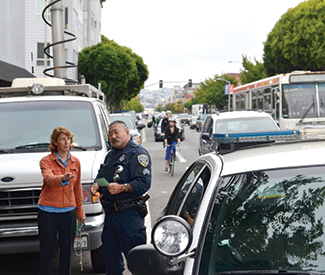
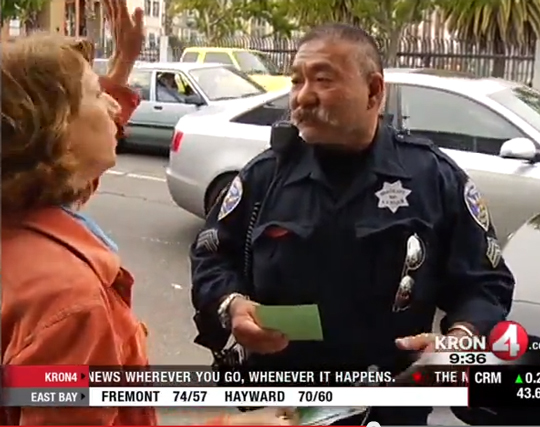
A memorial and informational event on Aug. 21 at the Sixth and Folsom corner where a bicyclist was fatally run over by a delivery truck a week earlier was marred by a tense and unsettling confrontation with an SFPD sergeant who showed up to block the bike lane with his cruiser, lecture the cyclists, and blame the victim.

The event was organized by the San Francisco Bicycle Coalition to raise awareness of the incident and that dangerous intersection and to call for the city to make improvements. It included friends and co-workers of 24-year-old Amelie Le Moullac, who was riding in the Folsom Street bike lane on the morning of Aug. 14 when an unidentified truck driver turned right onto Sixth Street, across her path, and ran her over.

SFPD Sgt. Dennis Toomer tells the Guardian that the department has completed the traffic incident report, information from which can only be shared with the parties involved, but that the investigation of the fatality is still ongoing and will be forwarded to the District Attorney’s Office for review once it’s done.

But SFBC Executive Director Leah Shahum said that SFPD Sgt. Richard Ernst, who showed up at the event a little before 9am, had already drawn his own conclusions about the crash and showed up to make his apparent disdain for “you people,” bicyclists, disturbingly clear.

Shahum said that she tried to be diplomatic with Ernst and asked him to please move his patrol car out of the bike lane and into an available parking space that was right next to it, saying that it presented an unnecessary hazard to bicyclists riding past.

But she said Ernst refused to do so for almost 10 minutes, telling the group that he has “a right” to leave his car there and that he was “making the point that bicyclists need to move around” cars parked in bike lanes, according to Shahum’s written account, which she prepared to file about the incident with the Office of Citizens Complaints.

“He then told me explicitly that he ‘would not leave until’ I ‘understood’ that ‘it was the bicyclist’s fault.’ This was shocking to hear, as I was told just a day ago by Commander [Mikail] Ali that the case was still under investigation and no cause had yet been determined,” Shahum wrote.

And apparently Ernst didn’t stop at denouncing Le Moullac for causing her own death, in front of people who are still mourning that death. Shahum said Ernst also blamed the other two bicyclist deaths in SF this year on the cyclists, and on “you people” in the SFBC for not teaching cyclists how to avoid cars.

“I told him the SF Bicycle Coalition does a significant amount of safety work educating people biking and driving about sharing the road, and that I’d be happy to share more information with him. I again urged him to move his car out of the bike lane. He again refused, saying it was his right and he wasn’t moving until I ‘understood,'” Shahum wrote.

Shahum said there were multiple witnesses to the incident, including three television reporters who were there to cover the event.

“In addition to the Sgt’s inappropriate and dangerous behavior of parking his car in the bike lane and blocking safe passage for people bicycling by, it was deeply upsetting to see him unnecessarily disrupt and add tension to what was already an emotional and difficult time for many people who lamented this sad loss of life,” Shahum wrote.

Asked about the actions and attitudes expressed by Ernst, who we could not reach for comment, Toomer told us he “cannot talk about personnel issues.”

Compounding Ernst’s insensitive and judgmental approach, it also appears the SFPD may have failed to properly investigate this incident, which Shahum and the SFBC have been tracking closely, and she said the SFPD told her that there were no video surveillance tapes of the collision.

After the event, SFBC’s Marc Caswell decided to check in at businesses on the block to see if they had any video cameras aimed at the intersection, and he found an auto body business at the intersection whose workers said they did indeed have revealing footage of the crash that the SFPD hasn’t requested, but which SFBC delivered to investigators.

“He had the time to come harass us at a memorial, but he didn’t have the time to see if anyone had footage of this incident,” Shahum told us. “It’s very unsettling.”

Fulfill MLK’s dream of a guaranteed income

34

OPINION Today, Aug. 28, we mark the 50th anniversary of Martin Luther King’s I Have a Dream speech at the March on Washington. But we are sobered by the fact that 46 million citizens are living in poverty and that we have become two Americas — one for the rich and one for the rest of us.  

Dr. King had a solution to poverty and to the bleak economic conditions faced by many Americans today. “I am now convinced that the simplest solution to poverty is to abolish it directly by a new widely discussed measure: the guaranteed income,” he wrote in his 1967 book, Where Do We Go From Here: Chaos or Community? “A host of psychological changes inevitably will result from widespread economic security.”  

In 1969, a presidential commission recommended, 22-0, that the United States adopt a guaranteed annual income, with no mandatory work requirements, for all citizens in need. The report was buried and forgotten, even though the National Council of Churches, by a vote of 107-1, agreed. So did the Kerner Commission, the California Democratic Council, the Republican Ripon Society, and the 1972 Democratic Party platform.  

Fast forward 50 years and the concept of a guaranteed income — or Basic Income Guarantee — is not discussed much anymore. But it remains, as even the late economist Milton Friedman always maintained, the most practical and sensible way to end poverty in America and provide economic security to all Americans.  

Today we have more than 14 million Americans unemployed with no evidence to back up the claim that we can create jobs for everyone who wants one. Machines are doing work people used to do. Jobs are not coming back and many families teeter on the brink of poverty.  

Relying on jobs and economic growth does not work. Job creation is a completely wrong approach because the world doesn’t need everyone to have a job in order to produce what is needed. We need to rethink the concept of having a job. When we say we need more jobs, what we really mean is we need more money to live on.  

Today there are more than 300 income-tested federal social programs costing more than $400 billion a year. Much of that money goes for administrative expenses, not to the needy.  

Charles Murray, a conservative author whose 1984 book Losing Ground claimed that welfare was doing more harm than good, now agrees with the Rev. King’s approach. Murray calls for giving an annual cash grant of $10,000 — with no work requirement — to every adult over age 21.  

“We still have millions of people without comfortable retirements, without adequate health care, and living in poverty. Only a government can spend so much money so ineffectively. The solution is to give the money to the people,” Murray writes in his book: In Our Hands.  

Indeed, the state of Alaska has given an annual cash grant to its people for the past 30 years of between $800 and $2,000, with no work requirements, reducing poverty and the inequality of income in Alaska.  

The U.S. is a wealthy nation. Our net worth is $58 trillion. That’s an average of $185,000 for each man, woman, and child in the country. A basic income guarantee would establish economic security as a universal right. It will give all of us the assurance that, no matter what happens, we won’t go hungry.  

This year, as we celebrate the March on Washington, the adoption of a basic income guarantee would help to fulfill the Rev. King’s dream of economic security as a universal right of all Americans.  

Allan Sheahen is the author the new book: Basic Income Guarantee: Your Right to Economic Security. He is a board member of the U.S. Basic Income Guarantee (USBIG) Networks (www.basicincomneguarantee.com).

Live nude girls say goodnight

11

rebecca@sfbg.com

When we caught up with Prince$$, who has spent more than a decade at the Lusty Lady — not just as a dancer but in roles ranging from marketing guru to shop steward for the peep show’s unionized dancers — she wasn’t in her favorite over-the-knee platform boots or a classic burlesque getup.

Instead, her dyed-purple hair was tied back, and she was taking a moment to catch her breath between organizing a hasty archiving project, pulling together the Lusty’s final farewell bash, and absorbing the earth shattering news that the famed North Beach strip club would be closing its doors for good on Sept. 2 after a storied 37-year run in San Francisco.

What’s the difference between the Lusty Lady and any other strip club in the city? For one, it’s earned a political rep with its co-op ethos, feminist vibe, and array of dancers showcasing all shapes, sizes, colors, aesthetics, tattoos, and body piercings. It was even the subject of a 2000 documentary, Live Nude Girls Unite!, which chronicled the mid-1990s unionization effort.

“Without the Lusty, there’s no alternative, non-homogenized club,” says Prince$$, who never leaves home without fliers promoting the peep show and even carries around a Lusty Lady pen in her purse. “It would be like if every restaurant in San Francisco was shut down and all you got was TGI Friday’s. It’s like comparing Zeitgeist to Ruby Skye.”

With a dingier interior than its flashy counterparts, the Lusty is a place that might stage such events as a (sexy) May the Fourth Star Wars themed bash, a (sexy) Fleet Week celebration with pirates and singing mermaids, or a (sexy) Kiss-themed holiday blowout. This isn’t your black-tie, $50-cover, arrive-in-a-limo sort of establishment, observes Prince$$, who has also worked in other clubs and said she chose her name because “that was the silliest stripper name I could think of.”

A little over a year ago, she found herself shouldering the Lusty’s legacy after nearly everyone else split, because it looked like the peep show might be toast. “I was literally left holding a handful of keys. I was left just holding this thing. No one would take it, and I said, I will. It was my life for most of last year. You make a promise, and you keep it,” she added.

But the Lusty’s ship was already listing dangerously then, and now it has finally capsized. And of course it all comes down to money, honey. In an odd twist, the Lusty’s landlord, Roger Forbes, also happens to own every other strip club in San Francisco through his parent company, Déjà Vu Entertainment. That includes The Hustler Club, a strip joint sandwiched up against the iconic Lusty in the city’s red light district on Kearny and Broadway streets.

“For about 10 years now, the Lusty Lady has been paying twice market value for our property here,” explained Scott Farrell, who stepped in as a management consultant earlier this year in a last-ditch effort to help save the club, which he’d initially had an eye toward buying. “When I came into the picture, the rent was $16,500” per month for the 3,423 square foot nightclub, he explained. Yet he’d seen similar properties rent nearby for $8,400.

A porn actor and member of the BDSM community himself, Farrell said he’d engaged in negotiations with Forbes to reduce the rent, which he says would have allowed the club to launch a webcam project to bring in extra revenue, spruce up the interior, and get back on track financially. But unpaid back rent and a lengthy back-and-forth eventually resulted in Forbes cutting off the dialogue.

“I called him and said, ‘can we sit down and talk?'” Farrell recalled. “His words were: ‘I don’t care anymore. I just want you guys out.” Forbes could not be reached for comment.

You might call the loss of the Lusty another nail in the coffin for San Francisco’s famously freakish wild side, an element that feels thinner with each passing day.

“People have this vision, where they’re trying to turn San Francisco into a cross between Los Angeles and New York, and trying to make the clubs ‘pure,'” Prince$$ reflected. “We weren’t trying to be that. We were trying to be different.” Now faced with the end of an era, Prince$$ said she felt as if she’d just stepped off a rollercoaster. But she had one more task: preparation for the world’s only unionized worker-owned peep show co-op’s last lascivious hurrah on Sept. 1, the Lusty’s last night. From there, it will be a matter of sorting out the fate of the famed neon pink sign and other historic components after it’s all been dismantled. “Everyone is going to want to buy a piece,” she said, “and all the dancers are going to want to keep a piece.”

Anti-cyclist bias must stop

478

EDITORIAL The streets of San Francisco can be dangerous enough for their most vulnerable users — pedestrians and bicyclists — without the aggressive, insensitive, and judgmental attitudes that have recently been expressed toward those who choose to get around this city by bike.

The Guardian’s Politics blog exploded with caustic comments last week after a pair of reports related to the death of bicyclist Amelie Le Moullac. Among the worst of these blame-the-victim attitudes was expressed by SFPD Sgt. Richard Ernst, who showed up Aug. 21 at an event at the site where Le Moullac died to lecture those mourning her death and make a series of unfounded, irrelevant, and thoughtless accusations (for details, see “Shit Happened”).

These attitudes have no place in a civilized debate over how we share the roadways of this city, and they are particularly reprehensible coming from someone in a position of public trust and authority, validating the dangerous view that violence is an acceptable response to bicyclists who don’t obey traffic laws to the letter.

Compounding the anti-cyclist bias of the SFPD and other police agencies — which routinely fail to cite motorists even when their inattention or negligence results in the loss of life — is the revelation that SFPD misrepresented its efforts to seek video surveillance of the collision, which activists easily found from a neighboring business.

We call on the SFPD to fully investigate Le Moullac’s death, two similar cyclist fatalities earlier this year, and the actions of Ernst, who clearly abused his authority and misrepresented the results of an open investigation in order to make political points against a class of road users that he doesn’t like or understand, needlessly creating a safety hazard in the process. Perhaps temporary reassignment to bike patrol would give Ernst a clearer perspective on the entire community that he’s supposed to be protecting and serving.

The city should also do a public outreach campaign to improve the awareness and safety of all road users, particularly targeting commercial truck drivers, who have now fatally run over three bicyclists this year. The weight and poor driver visibility of these vehicles make them particularly dangerous, and they must drive them in a cautious and predictable manner. The city should also have clearer road markings to encourage safe merging at problematic intersections like Folsom and Sixth streets.

We all need to learn to safely share this city’s roadways, which starts with simply slowing down and paying attention. To focus exclusively on the behavior of cyclists is like blaming a rape victim for wearing a short skirt. Those with the most power to kill or maim need to be held accountable when they blow through red lights or drive unpredictably, and that should be a higher priority for the SFPD than to piously lecture those mourning a tragic death.

Changing the narrative

45

news@sfbg.com

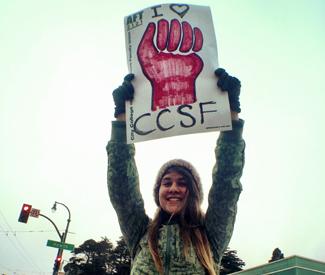
Three distinct players with three distinct strategies for saving City College of San Francisco showed their hands last week, all centered around the Accrediting Commission of Community and Junior Colleges, which plans to revoke City College’s accreditation in less than a year.

City Attorney Dennis Herrera filed a lawsuit against the ACCJC, state lawmakers are revving up to investigate it, and City College Super Trustee Bob Agrella is doing his best to quietly meet the accreditor’s standards.

Whether any of the approaches will save the school is anyone’s guess, but one thing’s for sure: In the process of saving City College, its accreditation agency has gone from an unknown bureaucracy to a polarizing political punching bag.


HERRERA FILES SUIT

Herrera threw a right hook at the ACCJC on Aug. 22, announcing his lawsuit to stop them from closing City College. It offers a scathing critique of the accreditation agency and those whose agenda it is pushing.

The ACCJC said City College failed to meet certain standards by its deadline last July, leading the agency to order its closure in exactly one year. Since then, enrollment at the college of 85,000 students plummeted and the school is fighting for its very existence. Now Herrera is saying that closure action was improper, unwarranted, and out of line with the agency’s prior actions.

Herrera’s suit alleges the ACCJC unlawfully allowed its advocacy and political bias to prejudice its evaluation of college accreditation standards. “It is a matter of public record that the ACCJC has been an advocate to reshape the mission of California community colleges,” Herrera said at a press conference.

The agenda he said it was advocating for is the completion agenda, which was the focus of our July 9 cover story, “Who Killed City College?” Essentially, it’s the move to force community colleges to focus on only two-year transfer students at the expense of so-called “non-credit” classes, which can be lifelong learning skills or English as Second Language classes.

“There’s a reason judges aren’t advocates and advocates aren’t judges,” Herrera said. “We should have a problem when an entity charged with evaluation engages in political advocacy.”


City College avoided those reform efforts from the state for years, and Herrera alleges that the ACCJC tried to sanction City College because of that resistance.

ACCJC President Barbara Beno was not available for comment. In a statement, the agency said it was surprised to learn Herrera filed a suit against the ACCJC, and that the suit appears to be “without merit” and an attempt to “politicize and interfere with the ongoing accreditation review process.”

Herrera may be playing cowboy, guns aimed right at the ACCJC, but he also said he doesn’t want the agency to close, just to clean up its act and be accountable. But on the other side of the OK Corral, an investigation by the California Legislature is under way — and it may be sizing up a coffin for the ACCJC.


JLAC VS. ACCJC

Just a day before Herrera announced his lawsuit, the California Joint Legislative Audit Committee voted to investigate the accrediting commission. The audit committee is a legislative fact-finding body usually staffed by former investigative journalists, and the senators who asked for the hearing were out for the ACCJC’s blood.

“The stakes are high and the commission’s power is absolute,” Sen. Jim Beall, D-San Jose, told the audit committee. He then outlined the danger of losing community colleges that faced closure at the hand of the ACCJC.

Sen. Jim Nielsen, R-Gerber, was much more direct. “Sen. Beall and I met with (ACCJC) President Barbara Beno in my office,” he said. “In all my career, in my thousands of meetings with agency individuals, representatives, secretaries, etcetera, I have never met with such an arrogant, condescending individual in her response to Sen. Beall and I. That attitude reflected in such a senior person raised huge red flags for me.”


In public comment, Assemblymember Tom Ammiano, D-SF, noted that recently the U.S. Department of Education upheld the California Federation of Teachers’ complaints that the ACCJC process “is guilty of no transparency, little accountability, and conflict of interest.”

Then it was the ACCJC’s turn to defend itself. Beno was unable to attend, but ACCJC Vice President Krista Johns and Commissioner Frank Gornick were there instead.

Gornick defended the accrediting commission, saying it was “rigorously” evaluated every six years. Ultimately, the committee voted 10-1 to investigate a number of mysteries regarding the ACCJC: how it stacks up to the five other accrediting bodies nationwide, determining the ACCJC’s compliance with open meeting laws (it denied public access to a recent “public meeting,” also barring a San Francisco Chronicle reporter), and an evaluation of the fairness in how the agency issues sanctions.


MEET THE NEW BOSS

Amid the state and city level battles over City College, one key player prefers to work quietly. Super Trustee Bob Agrella, tasked by the state to take over the power of City College’s Board of Trustees and save the college, feels his hands are tied.

“My job is to play within the rules and regulations of the ACCJC,” Agrella told the Guardian. Sitting in his office at City College’s Ocean Campus, he pointed out that the accreditation agency actually has a rule that says colleges have to be on amicable terms with the ACCJC — or else.

“One of the eligibility requirements is the college maintains good relationship with the commission,” Agrella said. Notably, if City College fails to meet its requirements, it won’t be able to keep its accreditation in its evaluation next July.

So while Herrera and JLAC can blast the ACCJC, Agrella feels like he needs to remain neutral or he could blow City College’s chances at staying open.

If he were to try battling the commission on its rules, Agrella told us, he would do it within the framework of the ACCJC’s own policies. But it’s exactly those policies that Herrera said the ACCJC is violating.

The lawsuit from Herrera’s office alleges, among other things, that the evaluating team that ACCJC sent to review City College was stacked with the school’s political enemies from a body called the California Community College Student Success Task Force, which City College loudly and publicly opposed (full disclosure: as a former City College student, I spoke against the Task Force at a hearing in January 2012, and that public testimony is cited in Herrera’s lawsuit).

The ACCJC’s president, Beno, wrote multiple letters to state agencies in support of the Task Force’s recommendations, the suit alleges. This action contradicts the ACCJC’s conflict of interest policy, according to the suit, which defines a conflict as including “any personal or professional connections that would create either a conflict or the appearance of conflict of interest.”

So if the ACCJC won’t play by the rules, shouldn’t Agrella support the actions of Herrera and JLAC to resist the ACCJC’s decree?

“In fairness to the people taking these actions, they feel time is of the essence,” Agrella said. “I just happen to, respectfully, disagree with it, because my job is not to push the (ACCJC). My job is to try to retain accreditation.”

But it’s becoming increasingly clear that the ACCJC may not be the only body that will decide the fate of City College.

Alerts: August 28 – September 3, 2013

0

FRIDAY 30

Pre-Labor Day breakfast Hilton San Francisco, 333 O’Farrell Street, SF. www.sflaborcouncil.org. 8am, $75. Join the San Francisco Labor Council for an annual event, the Pre-Labor Day Breakfast. The keynote speaker will be Assemblyman Tom Ammiano and guests will also hear from Executive Secretary Treasurer of the California Labor Federation, Art Pulaski. Mix around, sip coffee, and get updates on worker campaigns. RSVP to Emily Nelson at emily@sflaborcouncil.org.


Summer of Solidarity concert and forum ILWU Local 34, 801 2nd St, SF. www.summerofsolidarity.org. 4:30-10pm, donation. The Summer of Solidarity tour is a 17-day, 13-city nationwide tour of local union activists and community allies aimed at supporting local struggles and connecting them with the broader fight against corporate power. Cosponsored by Laborfest, the event will begin with a forum on labor journalism at 4:30pm, followed by a forum on labor and community struggles at 6pm and a concert at 7:30pm featuring Anne Feeney, Michael O’Brien and others. For more visit www.laborfest.net.

SAT 31

Community forum on transit workers Unitarian Universalists’ Hall, 1924 Cedar, Berk. www.bfuu.org, workweek@kpfa.org. 2-4pm, $5–$10 donation. Join KPFA for a town hall style labor community meeting. The talk will include the voices of transit workers, riders, and researchers about what is happening with our transit systems, and how to solve problems facing workers, communities and the public. Sponsored by KPFA WorkWeek, and the BFUU Social Justice Committee.


SUNDAY 1

San Francisco Zinefest 2013 County Fair Building, Golden Gate Park, 1199 9th Ave, SF. sfzinefest.org. 11-5pm, free. This year’s Zinefest convenes over 140 creators of art, comic, and writing zines packed into two exhibition halls, including workshops with local and national zinesters and artists, plus a reading room and library. Off-site poetry readings and post-festival party are open to all. Japan Dolphins Day Fisherman’s Wharf, between Piers 41 and 43, SF. japandolphinsday.net. 11am-2pm, free. Activists will gather to call attention to the slaughter of dolphins in Japan, a cruel practice that was exposed by the award-winning documentary, The Cove. This peaceful gathering will coincide with Japan Dolphins Day, an annual event created by activist Ric O’Barry, who has gathered more than 2 million petitions to put a stop to the dolphin slaughter.

North Beach conflict-of-interest zone

It’s been over a year since North Beach’s Piazza Market closed its doors – but nothing has come along to take its place. The property, boasting 12,000 square feet at $4 per square foot, has attracted plenty of interest yet still remains empty.

“There’s been strong activity on the space – we’ve had several offers,” notes realtor Jeremy Blateis. “If there were less restrictions this place would have been sold already.”

According to Blateis, the place has not been leased to prospective renters because of zoning issues. Though the ad for the building says that it’s zoned for retail and restaurant use, potential owners would have to go through “lots of red tape” to have it used as a restaurant – which North Beach doesn’t have a shortage of.

This is where Claudine Cheng, recently resigned member of the Treasure Island Authority Board, comes in. According to a San Francisco Chronicle report, as a public figure she was paid money to influence decisions of city officers. And a company by the name of 627 Vallejo LLC – the owners of 627 Vallejo – paid Cheng $10,000 in hopes that she would smooth out the zoning situation.

According to the same report, she had been emailing Board of Supervisors President David Chiu seeking amendments to existing legislation in order to change the zoning of the area. Former Board President Aaron Peskin authored that legislation to prevent North Beach retail stores from being transformed into restaurants and chain stores.

Asked whether Chiu would have been open to a possible legislative amendment, legislative aide Judson True responded, “Supervisor Chiu would be open to making legislative changes that have community support,” but added that “the issue was whether or not Claudine Cheng was a lobbyist.” Judson noted that Chiu “also understands that there are laws that should match particular circumstances in neighborhoods like North Beach.”

Peskin, who filed complaints against her with the Ethics Commission and Fair Political Practices Commission, didn’t mince words.

“What she did was illegal,” Peskin said of Cheng’s decision to accept the $10,000. “What should fill 627 Vallejo is something that would further serve the community. Not another restaurant.”

SF water unaffected by wildfire – so far

The giant rim fire raging through Yosemite has tripled in size since Aug. 21, burning about 149,000 acres and approaching the vicinity of the Hetch Hetchy Reservoir, the source of San Francsico’s water supply, according to the San Francisco Public Utilities Commission.

In an update, the SFPUC noted that the city’s water system has not been impacted but is being closely monitored for changes to water quality.

“Currently, some ash has fallen onto the surface of the reservoir, but there has been no impact to the quality of water, which is being withdrawn from the reservoir at a depth of 260 feet,” The SFPUC noted in an update on Aug. 27. “All turbidity (the amount of suspended particles in the water) instrumentation continues to be within normal operating parameters.”

There has been no interruption to municipal electric service – although two hydroelectric powerhouses, Holm and Kirkwood, have been out of commission since last Monday due to the rim fire. Crews succeeded in making some repairs on Kirkwood Aug. 26 in preparation for power restoration.

The SFPUC has been making up the difference in power generation by tapping a power bank and making supplemental power purchases on the open market – a pricey alternative that’s cost the city around $600,000 so far, according to an Aug. 26 update.

A video of the rim fire shot from a Cal FIRE plane. The blaze has increased considerably in size since Aug. 22 when this footage was captured.

Just a pipe dream? SF’s Whirr gets ‘Around’

8

In the cyclical nature of sonic trends, shoegaze has risen from the grave and out of obscurity again. With old guard bands such as My Bloody Valentine and Mazzy Star releasing new material, acts from this generation are following in their footsteps, reviving what was once out of vogue.

And in the midst of this comes Whirr, a dichotomy of sound, layered and simplistic at the same time, wrapped up in a tight package. Formed in San Francisco in 2011, through what guitarist and founding member Nick Bassett describes as basic boredom, the six-piece outfit decries its shoegaze leanings, searching for a heavier sound.

Bassett cites Whirr’s influences as former SST power trio Dinosaur Jr. and European shoegaze band Nightblooms. Despite these influences, critics have been quick to point out that the band also sounds like My Bloody Valentine. Slowdive, and the like. And why not? Much like those forefathers of sound, Whirr has heavy instrumentals that overpower dreamy female vocals. It’s an easy comparison, but also accurate.

http://www.youtube.com/watch?v=bx1D8vwyc9o

And it’s easy to tell that Bassett isn’t exactly thrilled about that comparison. In response, he takes the path of resistance to these accusations.

“We’re louder than them, and I don’t think we really sound like them,” says Bassett.

But the statement that Whirr is louder than MBV is entirely disputable. Known for being the “loudest band on earth” to some, MBV was accused of being criminally negligent by the press while touring to promote Loveless in 1991.

Admittedly, Whirr is also very loud live — and the band has met opposition from venues and crowd goers alike throughout the course of its month-long tour with doom metal band Lycus and shoegaze group Nothing.

“The worst location we played was in Midland, Texas,” says Bassett. “They were blocking their ears and stuff because they thought we were too loud — they probably didn’t get it. Also Washington DC [was bad] because the sound guy wouldn’t let us play loud.”

Formerly of San Francisco black metal band, Deafheaven, Basset is no stranger to playing deafening music. And it seems that references and comparisons to Slowdive are something that have followed Bassett throughout his career as a musician — Deafheaven’s band name came as an homage to the English band.

But in the pursuit of maximum volume, some locations along the way have met Whirr’s arduous expectations. According to Bassett, Tampa, Fla. was the best stop on the road.

Why? “Because we were really loud and got a lot of money,” he says, concisely.

Aside from getting the chance to make lots of noise and get paid, Whirr has had a productive year with the release of a new EP this summer, which was the followup to last year’s LP Pipe Dreams (Tee Pee, 2012). 

Pipe Dreams
is an album of many layers, tossing together slow and kicky uptempo tunes. Some of the guitar riffs on the album, found in tracks like “Toss,” are downright pop-punk. But the band’s newest EP, Around (Grave Face), released in July, goes for a decidedly different temperament. There’s a slowed down pace.

Around
also steps away from Pipe Dreams with its far longer tracks (not one under five minutes) though maintains a heavy, funeral dirge-like sound.

“These songs sound better when we play them live,” Bassett says.

If you’re interested in seeing if Bassett’s claim is accurate (or you just want to damage your hearing, if only momentarily) you can see Whirr at Bottom of the Hill this week. Oh, and bring earplugs just in case. Things might get loud.

Whirr
With Nothing, Lycus
Wed/28, 9pm, $10
Bottom of the Hill
1233 17th Street, SF
(415) 626-4455
www.bottomofthehill.com


The Performant: Fringe Dwellers

2

It’s hard to believe, but the 32nd annual Edmonton Fringe is already over and touring companies like Naked Empire Bouffon are packing their bags to move on to the next festival, while artists who have finished their runs head for home — whether that’s Australia, the UK, or just North of the High Level Bridge. As at every Fringe, my goal has been to see just as many shows as I can, and in between stage-managing Naked Empire’s run and feverishly making deadlines, I saw 35, which ranged in content and execution from the merely mundane to the inarguably sublime. Here’s a roundup of my personal favorites and companies I recommend watching out for should they make over to San Francisco.

1) Best Interpretation of “…the rest is silence:” Grim and Fischer, by the Wonderheads. Haunting, heartfelt, and humorous, Grim and Fischer unfolds on the stage like beautiful French animation, with nary a spoken word passing between the three meticulously-masked characters: the sepulchral Grim, the feisty Mrs. Fischer, and the frustrated Nurse Doug. A classic struggle against the inevitability of death told in movement, allusion, and fart jokes, to a soundtrack of Mozart and Survivor, the impact of the imagery lingers long after the show is over.

2) Best Surrealist Ensemble: The Tenant Haimowitz, by Zygota Theatre. Penned by Israeli playwright Ariel Bronz, this abstract journey through the purgatory of one poet’s worldview is both complex and confounding, but absolutely mesmerizing. Bullied into renting a cheap flat only to discover five unexpected roommates after he signs on the dotted line, Daniel Haimovitz is sucked into a whirlpool of situational farce, at one moment being literally wrapped in bureaucratic red tape, at another forced to play a word association game the rules of which seem not to apply equally to all the participants as the tight-knit, highly-kinetic ensemble alternately defies gravity and gravitas.

3) Best Lo-Budget, Hi-Voltage Costume Concept: Moby Alpha, by Charles Comedy. The staging of this quirky mashup between science-fiction serial drama and Herman Melville is pure fringe, with the two actors (Charlie Stockman and Chuck Armstrong) illuminated only by their inventive space helmets, with switches that allow them to change colors for each character and transporter sequence, while they float through the vastness of space, represented by the otherwise dark stage.

4) Best Canada-centric History Lesson: Jake’s Gift, by Juno Productions. Unless you travel to Canada, chances are you won’t get a chance to see this show about a Canadian WWII vet returning to Juno Beach for the first time in 60 years. While somewhat predictably staged, in a manner most likely to inspire unabashed sniffling from the audience, the script reveals an interesting chapter in Canadian military history, one completely subsumed in the states by our own.

5) Best Whimsical Literary Reimaginings: Poe and Mathews, by Grumble Productions, Innocent When You Dream, by Zeb L. West. What if Edgar Allan Poe was washed up on a deserted island with the now-forgotten author Cornelius Mathews with only a rock to keep them company and a sandwich to stave off the hunger? What if the bulk of the action of Moby Dick took place inside the whale including a long diversion in the guise of Don Quixote? Physical comedy, puppetry, and ukulele tunes take us down those quirky rabbit holes.

6) Best Unscripted Fringe Experiences: Late Night Cabaret, Truth or Dare With Strangers, “The Zackie Awards.” Sorry improv groups, the best unscripted performances are almost always those tackled by the unsuspecting in moments of nervous anticipation and heightened awareness. I loved the randomness of the Late Night Cabaret once the “Wheel of Desire” was spun and whoever the night’s special guests were had to perform the action dictated by random chance; the sweet-natured experiment of Tasha Hickie’s “Truth or Dare With Strangers” where, for two Canadian dollars, you could huddle in a tent with people you’d never met and reveal yourself without inhibition; and the slap-happy hilarity of the performer-centric Zackies after a long hard Fringe.

Next stop, Vanvouver. Stay tuned.

Wanna Fringe vicariously through us? Follow @enkohl and @NakdEmprBouffon on the twit-thing for updates and gossip.

“Refeeding” is prison authorities’ new word for force-feeding

The practice of force-feeding inmates has a branding problem.

The issue first came to light after a U.S. District Judge last week granted the California Department of Rehabilitation and Corrections, or CDRC, the ability to feed inmates who are hunger striking even if they signed “Do Not Resuscitate” waivers, commonly known as DNR’s. The order called any DNR granted during the beginning of the hunger strike 50 days ago as invalid.

As the negotiations wind on, it’s looking more inevitable that the hunger strike holdouts will soon be near death. But when the prisons start force-feeding inmates, a whole new problem will arise: image.

The CDRC have given all the concessions they’re willing to give, they said, and if an inmate dies while fasting they’d become a martyr. At some point, the prisons may have to feed the inmates via liquid in an IV, or even via tubes.

The tubes are inserted through the nose and directly into their stomachs, and conjure images of alleged terrorists at Guantanamo Bay. 

In a video made by musician Mos Def, aka Yasiin Bey, Bey allowed himself to be force fed to bring attention to Guantanamo’s detainees. Bey is strapped to a chair, and a clear plastic tube is inserted through his nose as he screams, writhes, and begs for it to stop.

“The tube went in and the first part of it is not that bad, but then you get this burning,” he said in the video. “It starts to be like really unbearable, like something is reaching into the back of my brain…. I really couldn’t take it.”

For Mos Def, the feeding was brief. For inmates, the process can take two hours.

To address that issue the California Department of Corrections and Rehabilitation (CDCR) has taken to calling force feeding “refeeding,” which is term that already has a definition: feeding someone who has recently ended a fast. It has medical significance because a whole host of ailments can occur when someone who is ending a fast is fed the wrong foods, or fed too quickly. They can even die. 

But now the CDCR has used the word “refeeding” to mean feeding inmates who have already signed DNRs and are fed to prevent death. The word was in every major news report on the court’s recent decision, from Democracy Now to Al Jazeera.

“Refeeding” is the new force-feeding. 

Joyce Hayhoe, legislative director of California Correctional Health Care Services, wanted to make it clear that no one has been force-fed yet, and that refeeding was not force feeding.

“What I would like to say is we’re not force-feeding anybody,” she told the Guardian. “When doctors do not have a valid DNR, in the absence of any other information, when we have an inmate we cannot communicate with, we’re going to save their lives.”

But the sticking point in her statement is the word “valid,” advocates say. What is a valid DNR? The health care providers allege that some inmates began the hunger strike because of intimidation by senior gang members in the jails. Hayhoe said one inmate hid food so his fellow hunger strikers would not know, and that “implied something” to her.

There were 12,000 inmates who started the hunger strike on July 8, according to counts by the prisons themselves. Of those, it’s entirely conceivable that a few were coerced, said Dr. Ronald Ahnen, a politics professor at Saint Mary’s College focusing on prison reform.

“Is it possible some prisoners were coerced,” due to the sheer number of inmates involved, he said in an interview. But, “if you read the call from the hunger strike forward, and you heard from the reps in Pelican Bay (Prison), they have always stated emphatically and clearly that the hunger strike is voluntary. They have said no one should continue with the hunger strike longer than they were willing or able to do.”

Now the number of inmates in the hunger strike is down to 92, according to the CDRC. Of those, 41 have been on a hunger strike continuously since it began on July 8.

Hayhoe said there are only a handful of strikers with DNRs left, but would not reveal specific numbers. 

Ahnen, who is affiliated with the hunger strikers as a reform advocate but did not speak as their spokesperson, said that though those numbers have dwindled, they’re still significant.

“What amazes me is, 41 people who have been without food for 50 days. I think the major media is missing the importance of that,” he said. “When you think of the Irish hunger strike that we all think of from 1980, that’s 23 individuals who all died. We now have 42, risking their lives to have humane conditions in their confinement. Its very, very historic.”

Lost in the debate over food are the actual reasons for striking. The inmates have five core issues which you can see at their website here, but mostly they revolve around quality of life in Segregated Housing Units, commonly referred to as the SHU. The prisoners say it is solitary confinement, and they can be thrown in there easily by being told they have affiliations with gangs.

“I’ve had prisoners tell me their investigators say they can use any evidence and implicate anyone (as a gang member),” Ahnen said.

And the inmates have little recourse once they’ve been labeled a gang member and thrown in the SHU. Toshio Meronek covered this for Bay Guardian last month (“Hungry for Reform,” 7/3/13), saying it would take nearly 20 years to conduct reviews of the over 10,000 inmates presently held in solitary confinement in California.

In a statement circulated shortly after the CDCR’s on Thursday, State Senator Mark Leno wrote, “I have concerns that this review process is moving too slowly and I would like to see it accelerated.”

The hunger strike is one of the inmate’s last tools to reform that system. Now, in a cell that strips away most all human freedoms, “refeeding” may take away an inmate’s choice to die.

The federal judge’s decision to strip away that right reverberated across the world. The United Nations Special Rapporteur on torture, Juan E. Méndez, issued a statement saying “it is not acceptable to use threats of forced feeding or other types of physical or psychological coercion against individuals who have opted for the extreme recourse of a hunger strike.”

Hayhoe, from the prison’s health services, said there is some wiggle room in having your request to not be resuscitated honored.

“If a person has signed a DNR during the hunger strike, the best thing they can do is start having discussions with his primary care physician and expressing their need,” she said. The inmates have been sustained on Gatorade and vitamins, she said, and are not yet at the point of needing resuscitation.

Ahnen also clarified that the violent method of force-feeding may not be used. Another way to do it, he said, is to feed patients through an IV should they lapse into unconsciousness.

“This is a more likely scenario,” he said, but it is still force-feeding. Hayhoe said she would contact a doctor to see when each method would be used, but did not have the information immediately available.

These inmates are close to dehydration, close to organ failure, and close to death for their principles, Ahnen said, and now their political stand won’t be honored. They’ll be force-fed, no matter what terminology is used to describe it.

“Make no mistake about it, if a prisoner is being fed against their will, this is force feeding,” he said.

And with the flip of a word, the inmates have lost their right to die.

To learn see future actions on the hunger strike, visit http://prisonerhungerstrikesolidarity.wordpress.com/take-action-2/ .


Solomon: You failed to break the spirit of Bradley Manning: An open letter to President Obama

12

Norman Solomon is co-founder of RootsAction.org and founding director of the Institute for Public Accuracy. His books include “War Made Easy: How Presidents and Pundits Keep Spinning Us to Death.” Information on the documentary based on the book is at WarMadeEasyTheMovie.org.

Dear President Obama:

As commander in chief, you’ve been responsible for the treatment of the most high-profile whistleblower in the history of the U.S. armed forces. Under your command, the United States military tried — and failed — to crush the spirit of Bradley Manning.

Your failure became evident after the sentencing on Wednesday, when a statement from Bradley Manning was read aloud to the world. The statement began: “The decisions that I made in 2010 were made out of a concern for my country and the world that we live in. Since the tragic events of 9/11, our country has been at war. We’ve been at war with an enemy that chooses not to meet us on any traditional battlefield, and due to this fact we’ve had to alter our methods of combating the risks posed to us and our way of life. I initially agreed with these methods and chose to volunteer to help defend my country.”

From the outset, your administration set out to destroy Bradley Manning. As his biographer Chase Madar wrote in The Nation, “Upon his arrest in May 2010, he was locked up in punitive isolation for two months in Iraq and Kuwait, then nine more months at the Marine Corps brig in Quantico, Virginia. Prohibited from lying down during the day or exercising, he was forced to respond every five of his waking minutes to a guard’s question: ‘Are you OK?’ In his final weeks of isolation, Manning was deprived of all clothing beyond a tear-proof smock and forced to stand at attention every night in the nude.”

More than nine months after Manning’s arrest, at a news conference you defended this treatment — which the State Department’s chief spokesman, P.J. Crowley, had just lambasted as “ridiculous, counterproductive and stupid.” (Crowley swiftly lost his job.) Later, the UN special rapporteur on torture issued a report on the treatment of Manning: “at a minimum cruel, inhuman and degrading.”

At a fundraiser on April 21, 2011, when asked about Manning, you flatly said: “He broke the law.” His trial would not begin for two more years.

Bradley Manning’s statement after sentencing on Wednesday said: “It was not until I was in Iraq and reading secret military reports on a daily basis that I started to question the morality of what we were doing. It was at this time I realized that (in) our efforts to meet the risk posed to us by the enemy, we have forgotten our humanity. We consciously elected to devalue human life both in Iraq and Afghanistan. When we engaged those that we perceived were the enemy, we sometimes killed innocent civilians. Whenever we killed innocent civilians, instead of accepting responsibility for our conduct, we elected to hide behind the veil of national security and classified information in order to avoid any public accountability.”

Public accountability is essential to democracy. We can’t have meaningful “consent of the governed” without informed consent. We can’t have moral responsibility without challenging official hypocrisies and atrocities.

Bradley Manning clearly understood that. He didn’t just follow orders or turn his head at the sight of unconscionable policies of the U.S. government. Finding himself in a situation where he could shatter the numbed complacency that is the foundation of war, he cared — and he took action as a whistleblower.

After being sentenced to many years in prison, Manning conveyed to the American public an acute understanding of our present historic moment: “In our zeal to kill the enemy, we internally debated the definition of torture. We held individuals at Guantanamo for years without due process. We inexplicably turned a blind eye to torture and executions by the Iraqi government. And we stomached countless other acts in the name of our war on terror.

“Patriotism is often the cry extolled when morally questionable acts are advocated by those in power. When these cries of patriotism drown out any logically based dissension, it is usually the American soldier that is given the order to carry out some ill-conceived mission.”

Clearly, Mr. President, you have sought to make an example of Bradley Manning with categorical condemnation and harsh punishment. You seem not to grasp that he has indeed become an example — an inspiring example of stellar courage and idealism, which millions of Americans now want to emulate.

From the White House, we continue to get puffed-up sugar-coated versions of history, past and present. In sharp contrast, Bradley Manning offers profound insights in his post-sentencing statement: “Our nation has had similar dark moments for the virtues of democracy — the Trail of Tears, the Dred Scott decision, McCarthyism, and the Japanese-American internment camps — to mention a few. I am confident that many of the actions since 9/11 will one day be viewed in a similar light. As the late Howard Zinn once said, ‘There is not a flag large enough to cover the shame of killing innocent people.’”

Imagine. After more than three years in prison, undergoing methodical abuse and then the ordeal of a long military trial followed by the pronouncement of a 35-year prison sentence, Bradley Manning has emerged with his solid humanistic voice not only intact, but actually stronger than ever!

He acknowledged, “I understand that my actions violated the law; I regret if my actions hurt anyone or harmed the United States. It was never my intent to hurt anyone. I only wanted to help people. When I chose to disclose classified information, I did so out of a love for my country and a sense of duty to others.”

And then Bradley Manning concluded his statement by addressing you directly as president of the United States: “If you deny my request for a pardon, I will serve my time knowing that sometimes you have to pay a heavy price to live in a free society. I will gladly pay that price if it means we could have a country that is truly conceived in liberty and dedicated to the proposition that all women and men are created equal.”

You failed to break the spirit of Bradley Manning. And that spirit will continue to inspire.

Norman Solomon is co-founder of RootsAction.org and founding director of the Institute for Public Accuracy. His books include “War Made Easy: How Presidents and Pundits Keep Spinning Us to Death.” Information on the documentary based on the book is at WarMadeEasyTheMovie.org.

(Bruce B. Brugmann edits and writes the Bruce blog on the Bay Guardian website at sfbg.com.  He is the editor at large of the Bay Guardian and former editor and co-founder and co-publisher with his wife Jean Dibble, 1966-2012.)


How I learned to stop worrying and just trust Larry

8

As I leave for Burning Man, I wanted to share an article that I wrote for the on-playa BRC Weekly. Enjoy, and I’ll see you all on the on the other side:

This is as good as it gets, burners, right here and right now in beautiful, bountiful Black Rock City. And this is the way it’s always going be, year after year, like a dusty Groundhog Day on acid. Only the numbers and faces of the citizens and the things we create for one another will change.

It’s perfect, right? No reason to change a thing. What God (or, rather, Larry Harvey) has created, let no burner presume to alter.

That’s an idea that most burners seem to embrace, despite the beloved pastime of veteran burners to kvetch and celebrate some storied golden age, whether it be 1986, 1996, or 2006. We all just appreciate the chance to build a city for ourselves each year and the leaders of Burning Man for giving us that opportunity, again and again.

And I’m now joining those who accept Burning Man as it is, hereby officially dropping my struggles against Larry, Maid Marian, and the rest of Black Rock City LLC board to create some form of representative or democratic leadership for the Burning Man and its culture.

It’s been a lonely and frustrating crusade anyway, so I’m happy to be done with it (as I’m sure they are). I’ve been regularly covering Burning Man for my newspaper, the San Francisco Bay Guardian, since 2004. My reportage formed the basis of my book, The Tribes of Burning Man, which came out in 2011 just as the LLC board was being torn apart by internal divisions that they resolved by deciding to turn control of Burning Man over to a new nonprofit they were creating, The Burning Man Project.

“Why not act to change the world, a world that you won’t be in? And that’s what we want to do,” Larry told a roomful of grateful burners when he announced the plan in April 2011. “We want to get out of running Burning Man. We want to move on.”

The prospects of that change in leadership seemed exciting, and I imagined a council of veteran burners representing our community’s constituent communities – artists, DPW, sound camps, volunteers, art car makers, regional leaders, maybe the biggest villages – gathering around a table to plan the future of Burning Man. It might get messy, but things worth doing usually are.  

First, I took issue with Larry’s announced plans to create secret payouts for the six board members, but nobody except Chicken John seemed to care about that. The predominant view seemed to be that they had done us all a great service and they deserved whatever it was they wanted to pay themselves.

Fine, so then I publicly questioned the hand-picked nonprofit board, which seemed chosen for their fundraising ability more than the communities they represented. Again, no resonance, so I accepted it and moved on. Maybe money was what was important in the early stages, and new leadership would come later.

And I was totally willing to just let it go and move on, until earlier this year when I watched the new documentary, “Spark: A Burning Man Story,” which concludes with the claim “the organization is transitioning into a nonprofit to ‘gift’ the event back to the community.”

So I decided to plug back into covering Burning Man to check on the status of this gift with just a year to go until Larry had said that control of the event would be transferred to the new nonprofit. But rather than relaxing their grip on the event and entrusting it to the community, I learned that they consider their leadership “more important than ever,” as Marian put it.

Not only are The Burning Man Project board members still not representative of the overall community, but they have no authority over the event, which Larry wants to continue as is “without being unduly interfered with by the nonprofit organization.”

Sure, the LLC and its various fiefdoms can unilaterally change its contracts with artists, its policy on what kinds and how many art cars to license, its ticket pricing structure, and size of the city (the max population this year jumped to 68,000 from 60,000 last year), all without any input from the community. It can cut lucrative side deals with corporations and propagandists. But we can’t have the new nonprofit board making these sorts of decisions, that would be unthinkable. 

“The nonprofit is going well, and then we have to work out the terms of the relationship between the event and the nonprofit. We want the event to be protected from undue meddling and we want it to be a good fit,” Larry told me.

And when I wrote about these issues in the Guardian, where they were read by tens of thousands of people, few people seemed to care. Two articles I wrote on these issues this year got two online comments each, comparing to the 259 comments and vigorous public discussion that ensued after I wrote “Burning Man ticket fiasco creates uncertain future” in February of last year.

The lesson: as long as we can get to Black Rock City, we don’t really care who’s calling the shots. After all, it’s really all of us who create the city each year for our own enjoyment, and that’s what matters, not the six people who control the $23 million we all spent on tickets this year.

So I’m just going to enjoy myself this year and forever after, safe in the faith that “participation” and “radical self-reliance” are things I do in my own camp and immediate surroundings, and that the larger Burning Man project itself is in the same safe and benevolent hands that it’s always been and always will be.

Amen.


Manning contingent wins Pride award

25

Ah, the sweet rainbow flavor of comeuppance. As the fascinating and part-tragic, part-inspiring saga of Chelsea Manning continues to unfold, at least one portion of the struggle has reached a satisfying conclusion.

The disastrous move by this year’s Pride Board to negate the election of Bradley Manning as a community grand marshal in the parade — locking out press and protestors, canceling meetings, and kicking up a general shitstorm in the process — only served to bring out three blocks’ worth of marching supporters in the Bradley Manning Supprt Network Contingent this year. Now, that contingent has won the “Best Overall Pride Contingent Award,” voted on by the public.

Sorry, Pride Board :/

Here’s the press release from Grand Marshal, Not Court Martial, a related group:

This past June 30, the Bradley Manning Support Network (BMSN) marched for its third consecutive year in San Francisco’s Pride Parade.

The BMSN was the largest non-corporate contingent in this year’s parade and was named by judges, along with four other groups, as an “Absolutely Fabulous Marching Contingent.” In addition, at last night’s SF Pride’s Check Granting Party, it also won the award for “Absolutely Fabulous Overall Contingent.”

The vote for the “Absolutely Fabulous Overall Contingent” was put out to the community on SF Pride’s web site. BMSN was up against three other groups: Abada Capoeira, Bay Area Youth Summit, and Mormons for Marriage Equality.

The winning of these awards comes on the heels of a two-month debacle in which SF Pride rescinded the nomination of Bradley (now Chelsea) Manning as a Community Grand Marshal. Local LGBT and veteran activists held demonstrations and a teach-in (as well as a Community Meeting called by Pride at the urging of SF Supervisor David Campos) to try to get Manning reinstated.

The contingent featured former military strategist, 82 year old Daniel Ellsberg, who in 1971 leaked secret documents known as the Pentagon Papers to the New York Times. Ellsberg, adorned with a pink boa around his neck, was accompanied in the parade by his wife, Patricia.

Manning was sentenced this past Wednesday to 35 years in prison for releasing thousands of classified documents including the infamous “Collateral Murder” video, which shows a U.S. Army helicopter gunning down Iraqi civilians and two Reuters journalists. This sentence will automatically be sent to the Army Court of Criminal Appeals. Manning’s lawyer and numerous organizations are calling on President Obama to pardon Manning, who could be paroled after 10 years, three of which have already been served.

Following the sentencing, Manning issued a public statement declaring: “As I transition into this next phase of my life, I want everyone to know the real me. I am Chelsea Manning. I am a female. Given the way that I feel, and have felt since childhood, I want to begin hormone therapy as soon as possible. I hope that you will support me in this transition. I also request that, starting today, you refer to me by my new name and use the feminine pronoun (except in official mail to the confinement facility). I look forward to receiving letters from supporters and having the opportunity to write back.”    

The internet reacts to Sgt. Ernst’s bicyclist memorial tantrum

140

A memorial (and informational event) at the 6th and Folsom corner where bicyclist 24-year-old Amelie Le Moullac was fatally run over by a truck last week was interrupted by a tense confrontation with SFPD Sgt. Richard Ernst, when he showed up to block the bike lane with his cruiser to lecture the cyclists.

SFBC Executive Director Leah Shahum told the Guardian in a story Wednesday that SFPD Sgt. Richard Ernst showed up to make his apparent disdain for “you people,” bicyclists.

From that story: “He then told me explicitly that he ‘would not leave until’ I ‘understood’ that ‘it was the bicyclist’s fault.’ This was shocking to hear, as I was told just a day ago by Commander [Mikail] Ali that the case was still under investigation and no cause had yet been determined,” Shahum wrote in a report to the Office of Citizen Complaints. Below are a few reactions from the Twitterverse to Sgt. Ernst’s actions.

Below are a few reactions from the Twitterverse to Sgt. Ernst’s actions.  


Cyclist Patrick Traughber then rode a route spelling out the victim’s name, in tribute and memoriam. Special software tracked his route and displayed her name via the software. 

Cyclist Patrick Traughber rides a route to spell out the accident victim's name

The robot apocalypse, Mr. Darcy, outlaws, and revolutionaries: new movies!

4

Let’s Boo-Boo! Edgar Wright’s latest bromance-in-genre-clothing, The World’s End, opens today, and it’s a riot. Elsewhere, there’s a rom-com about Jane Austen obsessives, Hollywood’s latest supernatural-teen fantasy, and an indie horror flick critic Dennis Harvey calls “a very bloody good ride.” (Check out those reviews below).

Longer features this week include my interview with director David Lowery about his neo-Western Ain’t Them Bodies Saints, and Harvey’s take on artist-couple doc Cutie and the Boxer. http://www.youtube.com/watch?v=KbHr8YyjSlg

Austenland Jane (Keri Russell) is a Jane Austen fanatic who finds real-life modern romance highly lacking as compared to the fictive Regency Era variety — though having a life-sized cutout of Colin Firth as Mr. Darcy in her bedroom surely didn’t help recent relationships. After yet another breakup, she decides to live her fantasy by flying to England to vacation at the titular theme park-fantasy role play establishment, where guests and staff meticulously act out Austen-like scenarios of well-dressed upper class leisure and chaste courtship. Upon arriving, however, Jane discovers she’s very much a second-class citizen here, not having been able to afford the “platinum premium” package purchased by fellow guests. Thus cast by imperious proprietor Mrs. Wattlesbrook (Jane Seymour) as the unmarriageable “poor relation,” she gets more flirtatious vibes from the actor cast as sexy stable boy (Bret McKenzie) than the one playing a quasi-Darcy (JJ Feild), at least initially. Adapting Shannon Hale’s novel, Jerusha Hess (making her directorial bow after several collaborations with husband Jared Hess, of 2004’s Napoleon Dynamite) has delightfully kitsch set and costume designs and a generally sweet-natured tone somewhat let down by the very broad, uninspired humor. Even wonderful Jennifer Coolidge can’t much elevate the routine writing as a cheerfully vulgar Yank visitor. The rich potential to cleverly satirize all things Austen is missed. Still, the actors are charming and the progress lively enough to make Austenland harmless if flyweight fun. (1:37) (Dennis Harvey)

Long Distance Revolutionary: A Journey with Mumia Abu-Jamal Or, almost everything you ever wanted to know about the guy who inspired all those “Free Mumia” rallies, though Abu-Jamal’s status as a cause célèbre has become somewhat less urgent since his death sentence — for killing a Philadelphia police officer in 1981 — was commuted to life without parole in 2012. Stephen Vittoria’s doc assembles an array of heavy hitters (Alice Walker, Giancarlo Esposito, Cornel West, Angela Davis, Emory Douglas) to discuss Abu-Jamal’s life, from his childhood in Philly’s housing projects, to his teenage political awakening with the Black Panthers, to his career as a popular radio journalist — aided equally by his passion for reporting and his mellifluous voice. Now, of course, he’s best-known for the influential, eloquent books he’s penned since his 1982 incarceration, and for the worldwide activists who’re either convinced of his innocence or believe he didn’t receive a fair trial (or both). All worthy of further investigation, but Long Distance Revolutionary is overlong, fawning, and relentlessly one-sided — ultimately, a tiresome combination. (2:00) Roxie. (Cheryl Eddy)

The Mortal Instruments: City of Bones Adapted from the first volume of Cassandra Clare’s bestselling YA urban fantasy series, The Mortal Instruments: City of Bones follows young Clary Fray (Lily Collins) through her mother’s disappearance, the traumatic discovery of her supernatural  heritage, and her induction into the violent demon-slaying world of Shadowhunters.  This franchise-launching venture is unlikely to win any new converts with its flimsy acting, stilted humor, and clichéd action. It will probably also disappoint diehard fans, since it plays fast and loose with the mythology and plot of the novel, with crucial details and logical progressions left by the wayside for no clear reason. It’s never particularly awful — except for a few plot twists that fall wincingly, hilariously flat — but it’s hard to care about the perfectly coiffed, emotionally clueless protagonists. Fantastic character actors Jared Harris, Lena Headey, and Jonathan Rhys Meyers are all dismally underused, though at least Harris gets to exercise a bit of his vaguely irksome British charm. (2:00) (Sam Stander)

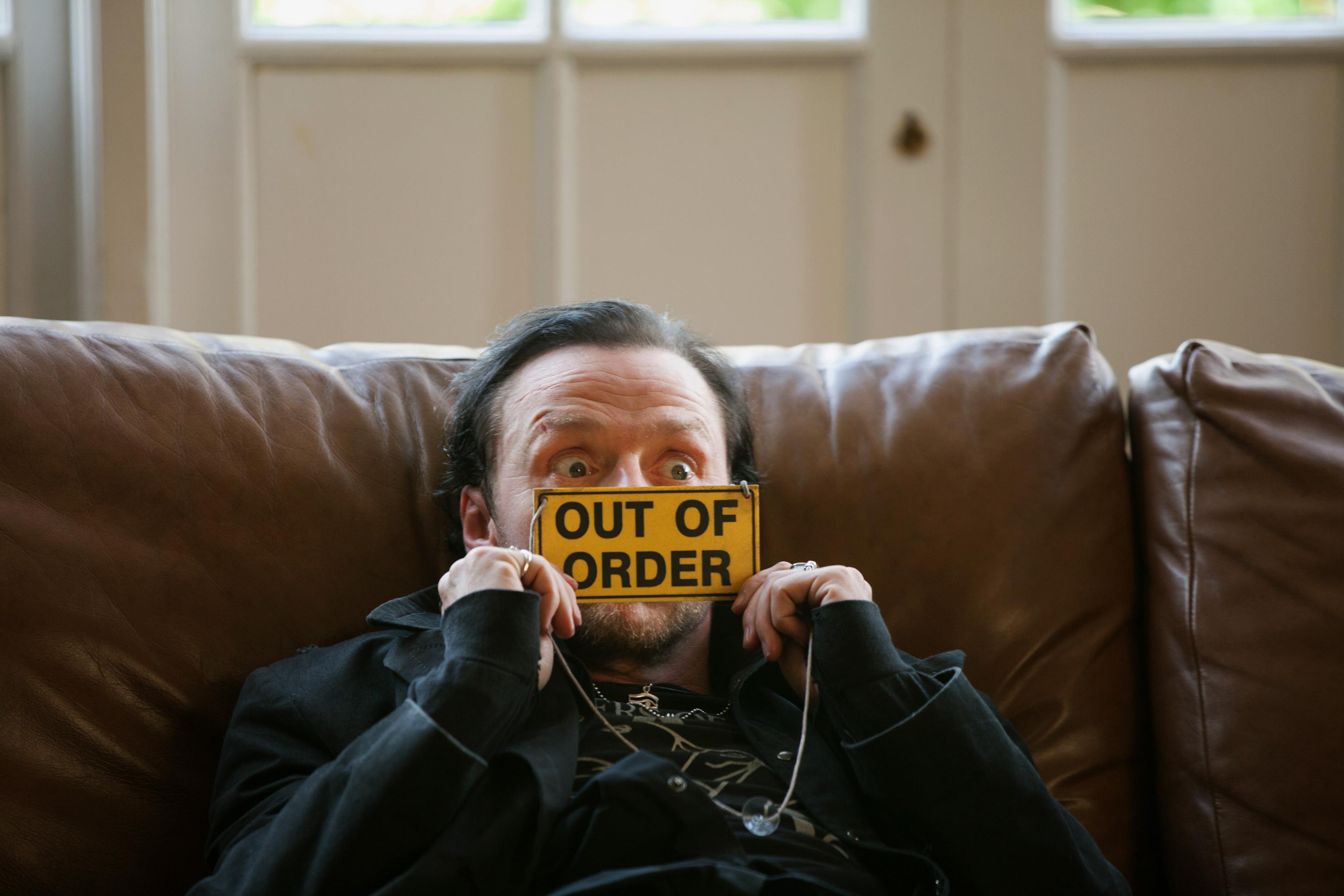
The World’s End The final film in Edgar Wright’s “Blood and Ice Cream Trilogy” finally arrives, and the TL:DR version is that while it’s not as good as 2004’s sublime zombie rom-com Shaun of the Dead, it’s better than 2007’s cops vs. serial killers yarn Hot Fuzz. That said, it’s still funnier than anything else in theaters lately. Simon Pegg returns to star and co-write (with Wright); this time, the script’s sinister bugaboo is an invasion of body snatchers — though (as usual) the conflict is really about the perils of refusing to actually become an adult, the even-greater perils of becoming a boring adult, and the importance of male friendships. Pegg plays rumpled fuck-up Gary, determined to reunite with the best friends he’s long since alienated for one more crack at their hometown’s “alcoholic mile,” a pub crawl that ends at the titular beer joint. The easy chemistry between Pegg and the rest of the cast (Nick Frost, Paddy Considine, Martin Freeman, and Eddie Marsan) elevates what’s essentially a predictable “one crazy night” tale, with a killer soundtrack of 1990s tunes, slang you’ll adopt for your own posse (“Let’s Boo-Boo!”), and enough hilarious fight scenes to challenge This is the End to a bro-down of apocalyptic proportions. (1:49) (Cheryl Eddy)

You’re Next The hit of the 2011 Toronto Film Festival’s midnight section — and one that’s taken its sweet time getting to theaters — indie horror specialist (2010’s A Horrible Way to Die, 2007’s Pop Skull, 2012’s V/H/S) Adam Wingard’s feature isn’t really much more than a gussied-up slasher. But it’s got vigor, and violence, to spare. An already uncomfortable anniversary reunion for the wealthy Davison clan plus their children’s spouses gets a lot more so when dinner is interrupted by an arrow that sails through a window, right into someone’s flesh. Immediately a full on siege commences, with family members reacting with various degrees of panic, selfishness. and ingenuity, while an unknown number of animal-masked assailants prowl outside (and sometimes inside). Clearly fun for its all-star cast and crew of mumblecore-indie horror staples, yet preferring gallows’ humor to wink-wink camp, it’s a (very) bloody good ride. (1:36) (Dennis Harvey)

Chronicle: Don’t question the City College takeover, just submit to the flawed ACCJC

71

I have very low expectations from editorials in the San Francisco Chronicle, which generally share a worldview with the Chamber of Commerce and carry water for some powerful Establishment figure or another. But today’s editorial on City Attorney Dennis Herrera’s lawsuit defending City College is so bad and illogical that it reads like an Onion parody of a Chronicle editorial.

Clearly put up to it by some of the most reactionary figures in the Mayor’s Office, Chronicle Editorial Page Editor John Diaz or one his lackeys parrot the submissive stance that Mayor Ed Lee has taken toward outsiders with corporatist agenda that have seized control of City College and sought to make a high-profile example of it.

“The city’s leaders should be calling for tough love, not coddling dysfunction. Fortunately, Mayor Ed Lee has done just that – but, regrettably, the city attorney is going in the opposite direct [sic],” the Chronicle wrote.

And by “tough love,” they apparently mean obedient and unquestioning compliance with an obscure accrediting agency’s demand that City College slash community-based curriculum; close facilities relied on by both students and local nonprofit groups; rip up contracts with faculty and force instructors to live on part-time wages; distill course offerings down to just what serve corporations, universities, and banking interests; and other aspects of an educational agenda that hasn’t been properly vetted in public hearings or approved by any elected body.

Herrera is to be applauded for pointing out the overreach and conflicts-of-interest on the Accrediting Commission of Community and Junior Colleges, which were also recently criticized by the US Department of Education. And we’re excited to see what Herrera uncovers during the discovery process in his lawsuit against a secretive, corporate-connected, document-shredding agency that broke its own internal rules in its treatment of City College.

The Chronicle graciously refers to these unavoidable facts in a brief paragraph, writing that the ACCJC “is not without flaws. It’s secretive, and its internal policies drew a rebuke from the U.S. Department of Education after City College faculty filed complaints about its conduct.”

But then it dimisses that and shows a suspicious incuriosity about why the ACCJC is being so secretive and what its agenda might be, instead doubling down on criticizing City College in a way that is so over-the-top that this fine institution is unrecognizable to anyone who is actually familiar with it, which Diaz and company clearly aren’t.   

“The needed changes include hiring a comptroller to organize financial controls, making sure students pay for classes, and overhauling a loose-fit governance system that puts faculty, students and staff in charge of operations with inadequate administrative controls. Lee has strongly endorsed an overhaul of City College’s ramshackle operations,” the Chronicle writes.

Unlike us here at the Guardian, where I’ve written two recent editorials in support of democracy and local control and critical of Lee and others who have been too quick to cooperate with the toppling of the locally elected Board of Trustees, the Chronicle apparently believe in more authoritarian methods of governance.

“The first repairs are now under way. The powers of the elected community college board are on hold, and a special trustee dispatched by state Community College Chancellor Brice Harris is in charge,” the Chronicle writes.

And as we report in our upcoming issue, that special trustee also has no interest in questioning the ACCJC’s process or methods or even allowing the public to review internal communications. It’s a shame that bootlickers like Lee and the Chronicle have sold out such an important local institution to their corporate masters, but luckily for San Francisco, Herrera, the California Federation of Teachers, the Guardian, other progressive media voices, and hundreds of our community partners aren’t giving up so easily, instead pushing for an open, truthful, democratic, and transparent discussion about City College’s mission and its future.

Scenes from a marriage

4

FILM At least since Grey Gardens in 1975 provided a peek at mother-and daughter eccentrics living in squalor — distinguished from your average crazy cat ladies by being closely related to Jacqueline Kennedy Onassis — there’s been a documentary subgenre devoted to, well, weirdos. Errol Morris and Werner Herzog have devoted a sizable chunk of their output to them, those people who might make you nervous or annoyed if they lived next door but are fascinating to gawk at for 90 minutes or so. Like Cate Blanchett’s fictional wack job in Blue Jasmine, their dysfunctionality is entertaining at a safe distance.

The protagonists in Zachary Heinzerling’s Cutie and the Boxer aren’t nuts, but they’ve been together over four decades without their problems really changing or getting any better. Ushio “Gyu-Chan” Shinohara was a somewhat notorious artist in Japan’s fertile avant-garde scene of the 1960s — we see footage of him sporting a Mohawk early in that decade, non-conformity already in full flower. His “neo-Dadaist” work already consisted largely of grotesque pop-art sculptures made out of found junk and large-scale canvases that, in a variation on Pollock’s action painting, he executed by battering paint onto them with boxing gloves. (When he finishes one, he raises his aims in triumph, like Rocky Balboa.)

In 1969 this wild man decided he needed a bigger stage, so he moved to New York. An early 1970s TV documentary excerpted here calls him perhaps “the most famous of the poor and struggling artists in the city,” noting that while his often outsized work gets a lot of attention, people seldom actually want to buy it. This is a situation that, we soon learn, hasn’t altered much since.

Gyu-Chan was 41 when he met wife Noriko, a 19-year-old art student also from Japan. She was swept up in the “purity” of his art and lifestyle; within six months she was pregnant with their only child, Alex (also a talented visual artist). In hindsight, she flatly tells us “I should have married a guy who made a secure living and took responsibility for what he did.”

We first meet the duo on his 80th birthday. It’s hardly a conventionally comfortable old age — in a tone so weary it can hardly be classified as nagging, Noriko reminds him that they’re late with the rent on their fairly large yet cluttered Brooklyn apartment-studio, and the utilities are about to be cut off for lack of payment. You get the feeling all this is business-as usual, and that the cheerful, oblivious, still-energetic Ushio would’ve been out on the street years ago if not for her insistence that he actually make some money once in a while.

It’s a classic dysfunctional-yet-still maintaining marital dynamic: the easygoing, charming, eternal bad boy herded about as successfully as a cat on a leash by the long-suffering wife. He no longer drinks — having stopped on doctor’s orders just a few years ago — but he’s still a manboy making junk-art mock motorcycles and pounding large canvases … and not making much money. His reputation remains incongruously far greater than his means, even if we see a Guggenheim representative ponder making a purchase of one of his “historical” pieces.

Meanwhile Noriko, who one senses has long resented living under the shadow of this larger-than-life figure, feels she’s finally escaped his influence in her own work. (It doesn’t help that, when acknowledging that she’s his occasional, reluctant assistant, Gyu-Chan confides “The average one has to support the genius.”) She’s working on a series of narrative, cartoon-like drawings depicting the titular “Cutie” and “Bullie” — blatant stand-ins for herself and Ushio, chronicling her long saga of disillusionment as a classic “good girl” who married a bad boy, to the detriment of her own art and the child she had to raise with “drunk adults hanging around him all the time.” (It is one of the film’s frustrations that we never really get Alex’s perspective on this, though he’s clearly a wary veteran of his parents’ misbehaviors and judgments.)

If her husband is discomfited by this exposure of their private life — even when the “Cutie” series (which is turned into simple animation throughout the documentary) is exhibited in conjunction with his own latest gallery show — he doesn’t show it. But then, she does the fretting for both of them.

A quiet, almost meditative portrait of messy lives, Cutie and the Boxer doesn’t really answer the question of why these two remained together despite all (her) dissatisfaction. When he accepts an invitation to go to Japan — cramming a couple of small sculptures carelessly in his suitcase to sell while there — she says “suddenly the air clears” whenever he’s gone, and we see her lighten up considerably while showing a fellow Japanese expat friend her latest work. But you get the feeling Noriko, while hardly an emotional open book, loves her burdensome, unruly spouse more than she’d admit. Or at least she’s accepted the “struggle” of life with him as her own goading raison d’être. You know the saying: life is short, art is long. *


CUTIE AND THE BOXER opens Fri/23 in San Francisco.

The other thing Chelsea Manning said, and more updates

By now, we all now that Pfc. Bradley Manning, who was sentenced to 35 years on Aug. 21 for leaking classified U.S. government documents, would like to enter the next phase of her life as a woman named Chelsea. “I want everyone to know the real me,” Manning said in a statement. “I am Chelsea Manning. I am a female.”

But the message on gender identity wasn’t Manning’s only public statement the day the sentencing was decided. There was also this, a heartfelt explanation of why the whistleblower did what she did, titled, “Sometimes you have to pay a heavy price to live in a free society.” Manning writes:

“It was not until I was in Iraq and reading secret military reports on a daily basis that I started to question the morality of what we were doing. It was at this time I realized in our efforts to meet this risk posed to us by the enemy, we have forgotten our humanity. We consciously elected to devalue human life both in Iraq and Afghanistan. When we engaged those that we perceived were the enemy, we sometimes killed innocent civilians. Whenever we killed innocent civilians, instead of accepting responsibility for our conduct, we elected to hide behind the veil of national security and classified information in order to avoid any public accountability.”

Meanwhile, Bay Area supporters who rallied for Manning at the San Francisco Pride Parade and every other juncture – including attending the trial in Fort Meade, gathering on the day verdict was announced and most recently launching a campaign calling for the WikiLeaker’s pardon – also gathered at Justin Hermann Plaza Aug. 21 in response to the sentence.

The SFPD and CCTV


Yesterday, we told you about CommunityCam, a new online mapping platform that displays surveillance camera locations throughout San Francisco. We’d placed a phone call to Sgt. Dennis Toomer of the San Francisco Police Department’s Media Relations Unit to ask whether SFPD has an eye toward collaboration on this effort, but didn’t hear back until after publishing the post. In a voice message, Toomer explained the manner in which SFPD utilizes CCTV footage to investigate crimes. He said:

“The SFPD does not own or operate any [permanently installed] cameras. There are some cameras throughout the city, but those are operated by the Department of Emergency Management. Consequently, we don’t monitor cameras either. At events like the Pride Parade, Bay to Breakers, we have put up our own cameras along the parade routes, or along the race routes, just for the purpose of deploying resources.

“As soon as the event is over, those cameras come back down, and we don’t store any kind of video footage. What we do is, we rely on the public, the commercial businesses, banks, stores, you name it, to provide us with video if a crime occurs in that area – but it’s not something that we monitor. We ask the public to provide us with any kind of video tape, or cameras or surveillance that they operate. We don’t maintain our own system. Again, the city cameras that are around in certain areas – like the Tenderloin, Bayview, I believe out in Ingleside – those are all operated and managed by DEM.”

Where the Uber meets the road 

We recently reported that Uber, the smartphone-enabled ride service that does not wish to be lumped in with rideshares or taxis, is facing a class action lawsuit from drivers who claim they were cheated out of hard-earned tips.

Uber spokesperson Andrew Noyes initially declined to comment, but has since emailed an official response (which does not actually contain any answers to the Guardian’s questions). Here is what Noyes had to say about the lawsuit, which Uber has not yet received:

“While we have not yet been served with this complaint, the allegations made against our company are entirely without merit and we will defend ourselves vigorously. Uber values its partners above all else and our technology platform has allowed thousands of drivers to generate an independent wage and build their own small businesses on their own time. Frivolous lawsuits like this cost valuable time, money and resources that are better spent making cities more accessible, opening up more possibilities for riders and providing more business for drivers.”

SF City Attorney Dennis Herrera sues to keep City College open

49

City Attorney Dennis Herrera filed a suit today to block City College of San Francisco’s accreditation agency from closing down the school.

The accreditation agency, the Association of California Community and Junior Colleges, moved to put City College on a sanction last July that would lead to its closure in exactly one year. Since then, enrollment at the college has plummeted and the school has been in the fight for its very existence. Now Herrera is saying that closure action was improper, unwarranted, and out of line with the agency’s prior actions.

Herrera’s suit alleges the ACCJC unlawfully allowed its advocacy and political bias to prejudice its evaluation of college accreditation standards, he said. “It is a matter of public record that the ACCJC has been an advocate to reshape the mission of California community colleges,” Herrera said, and that was the basis of his suit.

The ACCJC cannot be advocates for change in the higher education system, he said. “There’s a reason judges aren’t advocates and advocates aren’t judges,” he said. “Now we have no problem with the right of others to advocate an agenda against the open access mission… but we should have a problem with an entity charged with evaluation engages in political advocacy.”

Notably, the ACCJC wanted City College to shrink its mission, concentrating its money on students who could transfer easily to four year institutions from City College, which many advocates say would leave students learning trades, new English learners, and other disenfranchised students in the dust. You can see our coverage on that here.

Above: Text of Herrera’s suit and a press release with more information, courtesy of Sara Bloomberg, reporter for City College’s newspaper The Guardsman.


Herrera also filed an administrative action against the California Community College Board of Governors, saying they had abandoned their role as the check and balance on community colleges, and left it to a private institution that was unaccountable to the public (for full disclosure, I am named in Herrera’s suit on pages 16 and 18 for my role advocating against the Student Success Act of 2012 to the Board of Governors. I was a student at the time, not a professional reporter, and I have no personal stance on the future of the ACCJC). The Board of Governors oversees the 112 community colleges in California, the largest body of community colleges in the country. 

Alisa Messer, the faculty union president of City College, agreed that the Board of Governors should not be abdicating its policy and oversight role. 

“No outside, unaccountable agency should be making up its own rules or setting policy for our state’s colleges,” she said. 

City College Trustee Rafael Mandelman applauded action against the ACCJC.

“At this point I think it absolutely critical the ACCJC is not in the driver’s seat making these decisions, they’re not fit to do that,” he told the Guardian.

This past Tuesday City College submitted review documents to the ACCJC attesting to why it should be allowed to stay open and accredited, and Therese M. Stewart, the chief deputy city attorney, said that while they sent an order to ACCJC not to destroy documents, they had not yet obtained any documents yet. “We haven’t actually sought documents yet from the ACCJC, we asked them to not destroy documents so that we may seek them later,” she said. “Eventually we will get them.”