Volumes

Sushi east and west

0

virginia@sfbg.com

APPETITE Despite the countless lauded sushi restaurants I’ve eaten at in NY and LA, I find San Francisco more than keeps up, whether due to the staggering range of fish (and lovably surly attitude) Roger delivers at Zushi Puzzle (www.zushipuzzle.com) (pencilfish or flying fish, anyone?), the sustainable efforts of Tataki (www.tatakisushibar.com) and Sebo (www.sebosf.com), or the pristine precision of Sausalito stalwart Sushi Ran (www.sushiran.com), which tops overrated Nobu (www.noburestaurants.com) restaurants, in my book.

Here is one new SF spot and one revamped Berkeley restaurant adding more welcome sushi diversity to the Bay Area.


SARU SUSHI BAR

Why couldn’t Saru Sushi Bar have been in Noe Valley all the years I lived right by this 24th Street storefront? The space’s original two sushi incarnations were less than desirable, where I was once subjected to smelly, rubbery fish. The closet-sized restaurant is completely revamped to the unrecognizable point. Still tiny, it feels roomier with large front windows and sleek brown color scheme. Cheery service pleasantly elevates the experience, particularly on a sunny day at lunch.

I’d claim the space has finally arrived. There’s not just the usual hamachi and sake (salmon), but rather playful, unique bites prepared with care. “Spicy cracker” ($7) is a sheet of seaweed fried in tempura, topped with spicy tuna and avocado — a textural bite. Bright halibut tartare is drizzled in lime zest, yuzu juice, and Japanese sea salt. Though I ever appreciate sampling options, some tasting spoons ($7) work better than others. One that worked: young yellowtail (kanpachi) in truffle oil and ponzu sauce, with garlic chips and scallions.

I know I’m good hands if raw spot prawns (amaebi) are on the nigiri menu ($7 two pieces). Bright and firm, they taste as if they were caught fresh that morning. Snappy rolls (maki) are not overwrought. Quality raw scallops are a favorite, so I appreciate Naked Scallop ($12), a roll wrapped in light green soy paper, filled with snow crab, avocado, masago (smelt roe), and, of course, scallop. Not near as junk-food-sushi as it sounds, is the fresh, fun, subtly crispy Popcorn Tuna roll ($10): panko-crusted spicy tuna is topped with masago (smelt roe), scallions, spicy mayo, and a sweet soy glaze.

Noe Valley finally has a destination sushi bar.

3856 24th St., SF. (415) 400-4510, www.akaisarusf.com


JOSHU-YA BRASSERIE

At first glance, Joshu-ya Brasserie could be another hip Berkeley student hang-out: a funky, converted old house with red-gated front patio. But step inside the recently remodeled space and bamboo and dark wood exude an Old World Zen. A fountain out front murmurs soothingly while the sun warms the partially covered patio.

A chalkboard lists fish specials, but also rabbit tacos and Kobe kimchi sliders (the latter cooked too medium-well for me). One immediately realizes this is no typical sushi or even Japanese restaurant. Young executive chef-owner Jason Kwon’s vision is bigger. Yes, he is going for the Bay Area standard of seasonal, sustainable, locally-sourced ingredients — after all, he founded Couteaux Review (www.couteauxreview.com), a culinary organization promoting sustainable agriculture. But French influence and unique twists keep things interesting, with dishes like pan-roasted rib-eye medallions in blackberry balsamic reduction, or duck confit with buckwheat noodles, nori and bonito flakes. In some ways, the vision feels beyond what the restaurant has yet fully grown into, but the intriguing elements hold promise.

The $35 omakase is a steal, particularly when chef Kwon informs you his fish supplier is the same one that French Laundry and Morimoto buy from. After a starter of seared albacore, fresh and bright, if a little too doused in fried onions and ponzu sauce, a giant, artistic sashimi platter hits a number of high notes with actual fresh wasabi (always a good sign), aji tataki (horse mackerel) from Japan, kanpachi (young yellowtail) from Hawaii, hirame (halibut) from Korea, and chu-toro (bluefin tuna) from Spain. Only one fish on the platter arrived too cold and firm. The rest were silky and satisfying.

Being less of a sweet tooth, I’d rather have finished the omakase with another savory dish than tempura red bean ice cream. Generous scoops of fried ice cream and pound cake were a little weighted after such a refreshing meal. Seared salmon in truffle creme sounds like a fine dessert to me.

2441 Dwight Way, Berk. (510) 848-5260, www.joshu-ya.com

Subscribe to Virgina’s twice-monthly newsletter, The Perfect Spot, www.theperfectspotsf.com

How dark was my alley

0

arts@sfbg.com

FILM The word that comes to mind when thinking of Elliot Lavine’s semiannual film noir programs at the Roxie is inexhaustible. With 30 films packed into 14 days, “I Wake up Dreaming” wisely takes a pass on questions of noir’s quintessence in favor of open-ended research into the mutations and paroxysms of mid-century malaise.

There’s no mistaking genuine masterpieces like The Big Combo (1955) and In a Lonely Place (1950), to say nothing of a still unfathomable crossover work like Detour (1945), but Lavine’s series conspires to induce the genre delirium that first inspired the French critics to call a noir a noir. In spite of the preponderance of dead ends and blind alleys, there’s always a trap door leading into the next movie. So this time around we get Shadow of Terror (1945) rather than Reign of Terror (1949), The Underworld Story (1950) instead of Underworld U.S.A. (1961), Killer’s Kiss (1955) instead of The Killers (versions 1946 or 1964) or Kubrick’s own follow-up The Killing (1956), Shoot to Kill (1947) instead of Born to Kill (1947). Chronologies matter less than interchangeability. You watch Lee Van Cleef’s icy professional in opening night’s The Big Combo (sparkling in a 35mm restoration by UCLA) return as a foaming killer in closing night’s Guns, Girls, and Gangsters (1959). His kind never has time to develop a character on the margins of these already marginal films, but with repetition comes iconography.

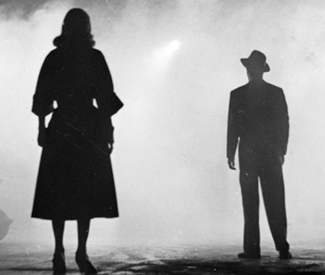
John Alton’s rhapsodic cinematography threads four of this year’s selections (The Big Combo; 1948’s Hollow Triumph; 1947’s The Pretender; 1944’s Storm Over Lisbon; and 1948’s He Walked By Night). In the famous finale of Joseph H. Lewis’ The Big Combo, which audaciously sets out to improve upon 1942’s Casablanca‘s even more famous conclusion on the tarmac, the plot seems to exist primarily for the lighting. Cops emerge out of the fog and Jean Wallace’s trophy girl freezes Richard Conte’s sociopath in a spotlight — as pure an effect as anything in F.W. Murnau and in this case providing a perfect echo of an earlier scene of killing as silence rather than light.

Nicholas Ray and Val Lewton protégé Mark Robson lead Saturday’s bill with message movies impugning society’s guilt for a young man’s sins. As with many of the era’s social problem pictures, miles of speechifying script and awkward narrative frames make Knock on Any Door (1949) and Edge of Doom (1950) tough going if still interesting in the particulars. Knock on Any Door is timid next to Ray’s subsequent study in juvenile delinquency, Rebel Without a Cause (1955), but there are premonitions of what’s to come in those moments when the director fully engages his actors’ bodies: when Humphrey Bogart’s world-wary defense lawyer hauls Nick “Pretty Boy” Romano (John Derek) into a back alley to reclaim a debt, for instance, and in the passage when Romano’s wife slumps against the stove after he blows for a robbery. You’re so focused on her balletic movement to the floor that you hardly notice that she’s reaching for the gas.

There’s a similar fascination to Farley Granger performance as a loose cannon in Edge of Doom, lashing out at a world that doesn’t forget about money even when you’re trying to bury your poor mother. As in Ray’s indelible They Live by Night (1949), Granger’s palpable insecurity makes him a key figure for the melancholy shading of noir anxiety.

Prolific director Edward L. Cahn’s Guns, Girls, and Gangsters is the kind of red meat B movie that manages some genuinely weird flourishes in spite of its undeniable limitations as a factory-line commodity. The Vegas heist plot is barely motivation for Mamie Van Doren’s curves, and the film itself blends right in with the roadside motels and cheap nightclubs. It’s a particularly egregious offender in the redundant voice-over category (“It was a moment of great tension for Wheeler”), but then Van Cleef shows up — fresh out of prison with Mamie on the mind. The sight of him lurking outside a motel window at night in his sunglasses is something to remember. Van Doren may be the “merchandise,” as her character says, but Van Cleef conjures noir’s actual libido: leering, desperate, and unpredictable.

The same cheap thrills that Cahn serves up with gusto come under close scrutiny in Stanley Kubrick’s Killer’s Kiss: here we find pulp as object d’art. Made when Kubrick was 27, the film emulates its Times Square setting in its barrage of perceptual jolts — like a Weegee photograph sprung to life. Plenty of noirs delineate capitalist degradations of the city, but rarely with a cleanness of line as the sequence in which Kubrick cuts between a man being prepped for the boxing ring and a woman making herself up for her nightshift as a dancing partner.

It’s all so much meat in Kubrick’s unsparing view, and one might add here that the rain of footsteps trailing down a New York canyon is more eloquent than any of the human dialogue (call it an anti-social problem picture). Kubrick acts as his own cinematographer, making great use of his chops as a magazine photographer to scavenge bitter ironies from street locations. His editing knocks things further lopsided, revealing only mirrors where you expect to find character. You know the hour is late watching Killer’s Kiss and The Big Combo, both of them released in 1955 and both advancing a self-conscious apotheosis of the style in the ruins of its bygone glamour — in a word, modernism. 


“I WAKE UP DREAMING: THE FRENCH HAVE A NAME FOR IT!”

May 11-24, $11

Roxie Theater

3117 16th St., SF

www.roxie.com

Love on wheels

2

In honor of our annual bike issue, we wanted to highlight a few of the free-wheeling people that polished our spokes this year. Keep on pumpin’!

KAREN WEINER AND BRETT THURBER, NEW WHEEL

On a family-oriented strip of Cortland Avenue perched halfway up the precipitous heights of Bernal Hill, husband-wife team Karen Weiner and Brett Thurber have invested their all in an enterprise some would deem experimental: the first electric bike shop in San Francisco.

Photo by Mirissa Neff

“San Francisco is really the perfect place for these bikes,” said Thurber when we went on a test ride with him and Weiner around the city. Iron-thighed fixie fans notwithstanding, he’s right — there are some neighborhoods in this city where the average bear will only be able to bring a bike if he or she pushes it up the final blocks of incline. For older bikers, the e-bikes (as they are lovingly dubbed by their adherents) make it possible to zip around town, car and fancy-free. Plus, they are disturbingly fun — when else can you cruise up Twin Peaks and still be breathing easy when you reach that panoramic view?

Other stores around town do sell certain models of e-bikes, but Thurber and Weiner’s new New Wheel is the first place to specialize in them. It stocks European and Canadian-made models in addition to retrofitting kits so that normie bikes can be tricked out with motors capable of doubling one’s pedaling power.

Thurber says business has been steadily growing, and that he’s noticed that the electric bike is not a purchase taken lightly by consumers — often times a customer will come by the store six or seven times before taking that heady ride into pedal power (perhaps indicative of the bikes’ spendy pricetags.)

“People are really making this mindful shift instead of listening to us be like ‘just do it,'” says the man who hopes to be SF’s e-bike proselytizer. (Caitlin Donohue)

New Wheel, 420 Cortland, SF. (415) 524-7362, www.newwheel.net


PAUL JORDAN’S BIKE CAVALRY

Twenty years ago, Critical Mass began demonstrating the power and potential of mass bike rides to make a political statement by seizing space from cars and confounding the authorities. Almost 10 years ago, anti-war cyclists in San Francisco borrowed Critical Mass tactics to interfere with business as usual on daily Bikes Not Bombs rides that also proved effective and hard to police. Today, as the tides of protest again rise with the Occupy Wall Street and related movements, Paul Jordan and other founders of the new collective SF Bike Cavalry ( sfbikecavalry.org) are reviving and expanding the concept.

Photo by Tim Daw

“It’s all kinda new, definitely more of a buzzword at this point,” Jordan, a 38-year-old painting contractor, said when we caught up with him and his cycling comrades during last week’s May Day marches. “But the idea is to use bicycles for activism.”

As they demonstrated on May Day, even a dozen or so cyclists can send loud messages to passersby or nimbly create opportunities for marchers to safely seize the streets, all while riding more-or-less legally. And they can use whimsy — silly costumes, funny signs, big smiles, blowing bubbles — to defuse any tensions.

“It’s hard to be mad when you’re stuck in traffic if you see bubbles,” Jordan said as he reloaded the bubble machine on the back of his bike. “I see bubbles as a very good activist tool.”

The Cavalry is a fairly new venture, which Jordan first displayed for big Jan. 20 protests, but he sees it as something with enormous potential: “We want to figure out how to grow this bigger.” (Steven T. Jones)

SAM KROYER AND RENITA TAYLOR, ROLL SF

Sometimes it seems like the Mission has as many bike shops as taquerias, but the neighborhoods east of Potrero lacks the same double-wheelin’ bounty. Sam Kroyer and Renita Taylor met in their Bernal Heights neighborhood, where Kroyer used to run a repair shop out of his garage. Taylor is an avid biker, and the two decided to meld their respective strengths — Kroyer’s mechanical prowess and Taylor’s business know-how — and create a service-oriented shop near Potrero Hill for every type of rider.

Photo by Mirissa Neff

“We’re really trying to make it for everybody, from entry-level commuter bikers to bikers with really crazy exotic $20,000+ bikes,” Kroyer says. Kroyer has 25 year of experience as a bike mechanic, and Taylor is a sharp businesswoman who spent several years working in the entertainment industry.

Roll SF seems like an outpost in an area not known, for now, as a cycling nexus, but its atmosphere is friendly and accessible. A long wooden table runs through the center of the shop, welcoming guests to sit down and stay awhile — to use the shop’s free wi-fi while they wait, watch and ask questions, or eat dinner. Kroyer provides you with his utmost attention and quickly diagnoses your bike. If it’s a fast fix, he’ll handle it promptly with the grace cultivated by years spent engaging with a multifaceted machine. “We’re trying to make sure you come away with a great experience — that you feel like you’ve really gotten something taken care of properly,” Kroyer says. (Mia Sullivan)

275 Rhode Island, SF. (415) 701-ROLL, www.rollsanfrancisco.com


SONS OF SCIENCE

Are you on a motherfucking bike? Tell me you’re reading this on a motherfucking bike, doing the Tour de Fuck You. Sing with me, “No greenhouse gas! A tiny carbon footprint up your ass!” Then launch into the wickedest bike horn solo ever.

You know what I’m talking about. “Motherfucking Bike” by Sons of Science (sonsofscience.bandcamp.com), the profane viral hymn to SF peddlin’ that’s closing in on a million YouTube views and has been Tweeted liberally by the likes of Russell Crowe and Juliette Lewis. Sure it plays on every fixie hipster stereotype you can image — it’s the “Shit San Franciscans Say” for mutton-chopped, skinny-pantsed, non-fat latte-quaffing riders — but it’s pretty damn funny. (And catchy. It is maniacally catchy. So be warned.)

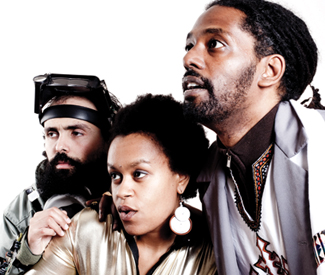
Sons of Science are a freewheeling trio: Ward Evans and John Benson, who direct for Sausage Films (www.sausagefilms.com), and Hector Perez, a.k.a. Horn Solo. “We’ve known each other for years and just recently decided to collaborate for fun, and it clicked. It was a great excuse to do a video. For this track we were also very lucky to feature Tim Brooks, formerly of the Young Offenders, who plays the ‘Angry Commuter’. He brought a pantsload of energy and genuine cyclist cred,” Evan told me. Also featured: the guys from that delicious new MASH shop (www.mashsf.com) near Duboce Park.

When asked about his own motherfucking bike heroes, Evans replied, “A guy named Joff Summerfield rode a penny farthing around the globe. He’d be right up there.” (Marke B.)


Who is the brick thrower?

14

Yael@sfbg.com

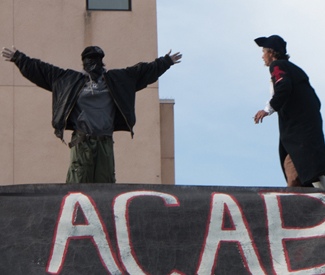
The brick-throwing man whose projectiles hit two protesters at the Occupy San Francisco takeover of a Turk Street building on May Day has helped spark intense internal debates in the movement about the use of violence.

But nobody has heard the alleged hurler’s side of the story.

Jesse Nesbitt, 34, was arrested on the scene, and is accused of felony assault, assault on a police officer, and vandalism. I interviewed Nesbitt in San Francisco County Jail May 3. He spoke of his associations with drug addicts and revolutionaries; his previous stints in jails, prisons and psych wards; and his countless arrests on the streets of San Francisco for illegal lodging.

What emerged was a picture of a homeless Army veteran who suffers from untreated mental illness and substance-abuse issues — someone who found a degree of help and solace in the Occupy movement but has never fully escaped his problems. His story is, unfortunately, not unusual — there are many thousands of vets who the system has utterly failed.

Nesbitt told me he was diagnosed as schizophrenic at 16. “From bad things happening, my mental illness has snowballed since then,” he explained.

Nesbitt said he grew up in the projects outside Pittsburgh, Pennsylvania during the 1980s. “It wasn’t too nice,” he explained. When he was 18, he joined the Army.

“I wanted to join the military all my life. That’s what I wanted to do,” he said. The schizophrenia could have stopped him — but “I lied my way in.”

His tour in Korea was during peace time, but he says he still saw combat. “We were supposed to be at peace with North Korea, in a ceasefire. But whenever they got a chance, they shot at us. And whenever we got a chance, we shot at them.

“It hardened my heart. And it gave me a sense of duty to uphold our Constitution.”

Nesbitt returned from South Korea in 1996. Afterward, “I hitchhiked from coast to coast twice. I got married three times. I have a kid in Pennsylvania. I went to jail in Pennsylvania for — being young and stupid,” he said.

Later in the interview, he expanded on his prison time in Pennsylvania. “I did four years and eight months for aggravated assault, theft, and possession of an instrument of crime,” said Nesbitt. “I also did time in Georgia for assault. And I did time in Alameda County for vandalism and weapons.”

In fact, as he tells it, Nesbitt’s time in Berkeley was spent mainly in jail, before he got involved with Occupy Berkeley.

“I don’t know how much time I did in total in Alameda County. I’d be in jail two, three weeks, get out five, six days, then get arrested again. That was from last April to July,” he says.

On the days when he was free, “I was doing what I normally do,” said Nesbitt. “I’d squat somewhere. In the daytime I’d panhandle, go to the library. I was doing a lot of drinking. Then I started getting arrested a lot when I started doing meth.”

That was his life before joining Occupy. “A friend of mine who was shooting heroin at the time said, let’s go join the revolution. It will help clean you up. It helped pull me out of a drug addiction and keep me healthy,” said Nesbitt.

But that wasn’t the only reason he joined.

“I’ve always had revolutionary beliefs,” he says. He spoke of his friends in Pittsburgh. They wouldn’t let him go the G20 protests in 2009, fearing he would be incited to violence.

“I’ve been involved with anarchists for a long time. They pointed out documentaries I should watch, things I should read,” said Nesbitt.

But the example he gave me isn’t your classic Emma Goldman. Nesbitt remembered “The Esoteric Agenda” — a conspiracy-theory film that connects stories about corporate greed with apocalyptic prophecies.

“The education was getting me ready for something,” he said.

At Occupy Berkeley, even while Nesbitt recovered from his meth addiction, he continued to live in a cycle of violence.

“It was in Berkeley out at the Occupy camp. I got into a fight with somebody, I was in a black out. It took six cops to hogtie 135-pound me, so I was talking shit. While I was hogtied, they dropped me on my head. I went from talking shit to unconscious. I slept for the next two weeks,” Nesbitt told me.

His involvement with Occupy San Francisco increased after the Occupy Berkeley encampment was taken down.

Occupy San Francisco, however, didn’t quite progress the way he had hoped. “When they started raiding us in December, I was hoping the numbers would go up. Instead they dwindled,” said Nesbitt.

He was part of a small group of people continuing the “occupation” tactic outside the Federal Reserve Building at 101 Market St. Back in the fall, that sidewalk was a spot where dozens of people held protest signs and meetings all day and many slept throughout the night. After a series of police raids, and as most of those organizing with Occupy moved on to different tactics and projects, some decided to remain there.

Even when the Justin Herman Plaza camp was in full functional form, it was derided as “nothing but a homeless camp.” There were homeless people there, but many found food and other resources, as well as security from both police and other people they feared on the street, leading many to devote themselves to the goals of the protest movement.

The 101 Market camp that emerged in February was mostly a homeless camp — and, although the people there remained fiercely political in their convictions, they certainly didn’t enjoy the safety that the Justin Herman camp once provided.

Nesbitt was one of those people. “The SFPD not letting us sleep, telling us sitting on cardboard was lodging, sitting under a blanket to stay warm was lodging, you can only take so much of it,” he said. “They slammed my head against the back of a paddy wagon last time they arrested me for sitting underneath a blanket.”

His story is not unusual.

“Veterans continue to lead the nation in homelessness,” explained Colleen Corliss, spokesperson for the veterans-aid nonprofit Swords to Plowshares. “There are a lot of factors at play. Those who go to war have a higher instance of mental illness and substance abuse, which ultimately can lead to a vicious cycle of homelessness,” she said. “Even if you serve during peace time, you can still have really traumatic experiences.”

Nesbitt’s experience with the city’s mental health facilities wasn’t enough to break this cycle. “I did get 5150-ed,” he said, describing the term for involuntary psychiatric commitment. “I was in the hospital less than 24 hours, they kicked me out.”

Why? “I threatened to kill a doctor,” said Nesbitt.

Nesbitt’s 24-hour stay was in the overburdened, short-staffed psych ward at San Francisco General Hospital. When the psych wards began closing beds in 2007, it was comprised of four units, each with 30 beds; it is now down to one unit, according to Ed Kinchley, a social worker in the medical emergency department at General.

There’s also a floor in the behavioral health center for psychiatric patients with 59 beds, but “they told the staff last week that they’re planning to close 29 of those beds.”

“Since [the beds] are full almost every day, the bar or the standard for who stays there or who goes in-patient is a lot higher than it used to be,” said Kinchley.

Whatever the reason, Nesbitt was not getting treatment the day of the alleged brick-throwing — and he was having problems. “I was getting an episode the day before it all happened,” he said. “I was afraid to go by myself to sleep because I was hearing voices. Normally those voices tell me to hurt people. I try to keep around people I love and trust that wouldn’t let me do anything.”

Mixed with his schizophrenia is a brand of Constitutionalism that’s not common on the left.

“When you join the military or the police department, you take an oath swearing to defend the United States Constitution against all enemies foreign and domestic,” Nesbitt said. “Now they’re passing the NDAA, Patriot Act, and other bills I don’t know about. They’re intentionally taking away our constitutional rights. We’re supposed to defend those rights, not lie down and take it.

“I think Abraham Lincoln said, if the government betrays us, we’re supposed to take them out.” Nesbitt insists he’s “not a terrorist. No matter what they might say about me in the Chronicle or whatnot, I’m not a terrorist. What is he, then? “I’m a freedom fighter,” said Nesbitt. “I’m fighting for the freedom of everyone.”

Obama’s mistake

4

By Gabriel Haaland and Laura Thomas

Last month, Obama came out swinging against medical marijuana in an interview, defended his raids of law-abiding clubs, and is currently positioning himself to the right of former President George Bush — despite the fact that nearly 75 percent of Americans support legalized medical marijuana.

In Northern California, Melinda Haag, Obama’s US Attorney for the Northern District of California, is resolutely determined to shut down medical marijuana access. Her district starts in the Bay Area and runs up the California coast to the Oregon border. Ironically, her district may have the strongest support in the entire country for medical marijuana, from voters, law enforcement, elected officials, businesses, and community members. Why is she so obsessed with shutting down the clubs? She claims that it’s because she is protecting the children of California. Really. So the next time someone is dying of cancer and they don’t have legal access to medical marijuana, we will be sure to remember that the children of California are safe. And let’s be clear: She is going after regulated clubs and the idea of a regulated industry — regulations that communities, sheriffs, Boards of Supervisors, and health departments have built.

Haag is targeting community leaders, such as Richard Lee, the chief promoter of California’s effort to legalize marijuana, and Oaksterdam, the area where most of the medical dispensaries are in Oakland. She also shut down Mendocino’s ground-breaking regulation of marijuana growers — literally driving past illegal grows to one recently inspected and certified by Mendocino sheriff’s deputies. She subpoenaed Department of Public Health records used to issue licenses for dispensaries here. She is going after dispensaries in San Francisco that are in full compliance with local and state law, merely because they are within an arbitrary distance from a school or park, even if the park is unused, or the school opened after the dispensary did.

Her actions are not protecting children from the harms of marijuana. She states that dispensaries attract crime, which is not proven by any evidence. What does cause crime is the black market, especially the black market for marijuana imported from Mexico, where 50,000 people have been lost in prohibition-related violence. The less people can produce, purchase, and consume marijuana grown here in California, the worse things get for Mexico. She also seems oddly concerned about the evils of capitalism, worried that people may be making a living from the medical marijuana industry. While we may not be the biggest fans of capitalism, we don’t think closing small businesses (or even large ones) in these economic times is a great idea. Haag’s actions have put thousands out of work and eliminated tax revenues for localities and the state. She’s using taxpayer resources to make the local economy a little bit worse. Thanks.

In San Francisco, elected officials including the mayor, the Board of Supervisors, the district attorney, the city attorney, Assemblymember Tom Ammiano, State Senator Mark Leno, the Democratic County Central Committee, and most recently, Democratic Congressional Leader Nancy Pelosi, have all spoken out against Obama’s efforts to undermine legal, regulated medical marijuana in California. The San Francisco Chronicle has run not one, but two editorials in the last month on the topic, plus a column from conservative columnist Deb Saunders. There have been rallies, protests, petitions, meetings, and letters asking her to stop going after medical marijuana.

What will it take to get Obama to wake up to the fact that his effort are not supported by three quarters of the country and that, in particular, Melinda Haag is obsessed with shutting down any regulated medical marijuana business? She is making things worse: leaving patients to the black market to find their medication, undermining law enforcement efforts to work with medical marijuana producers, and exacerbating the violence in Mexico.

But instead of reining her in, Obama is doubling down one of the most popular causes in America.. Medical marijuana is far more popular in the U. S. right now than Congress, the president, or Republican candidate Mitt Romney. The most serious moment at the Correspondents Dinner in Washington, DC last week was when comedian Jimmy Kimmel asked Obama point-blank why he was going after medical marijuana. None of it makes much sense. How much evidence is needed to convince Obama and Haag that their actions are creating harm, not eliminating it? How much evidence is needed that this is not what the voters and taxpayers want? What kind of data do they need that regulation reduces crime? How many patients need to tell their stories? What will it take to change her actions?

And when will Obama wake up to the fact that he is making a huge mistake? 

Gabriel Haaland is a member of the San Francisco Democratic County Central Committee. Laura Thomas works with the Drug Policy Alliance.

20 percent by 2020

52

steve@sfbg.com

There’s no doubt that San Francisco is one of the best cities in the United States for bicyclists, a place where near universal support in City Hall has translated into regular cycling infrastructure improvements and pro-cyclist legislation, as a slew of activists and politicians will attest to on May 10 after dismounting from their Bike to Work Day morning rides.

But even the most bike-friendly U.S. cities — including Portland, Ore., Davis, Chicago, and New York City — are still on training wheels compared to our European counterparts, such as Amsterdam and Copenhagen, where around 30 percent of all vehicle trips are by bike. By comparison, even the best U.S. cities are still in the low single digits. [Correction: Davis, which stands alone among U.S. cities, is actually at about 15 percent bike mode share]

Board President David Chiu and other city officials proposed to aggressively address that gap two years ago after returning from a fact-finding trip to Europe that also included Ed Reiskin, executive director of the San Francisco Municipal Transportation Agency (SFMTA), the agency charged with implementing city policies that favor transit riders, cyclists, and pedestrians over motorists.

Chiu sponsored legislation setting the goal of having 20 percent of all vehicle trips in San Francisco be by bike by the year 2020 and calling for the SFMTA to do a study on how to meet that goal. It was overwhelmingly approved by the Board of Supervisors and signed by Mayor Ed Lee, who has regularly cited it and proclaimed his support for what it now official city policy.

But the city will fail to meet that goal, probably by a significant amount, unless there is a radical change on our roadways.

The latest SFMTA traffic survey, released in February, showed that bikes represent about 3.5 percent of vehicle trips, a 71 percent increase in five years. While the San Francisco Bicycle Coalition (SFBC) lauded that gain as “impressive,” it would mean a 571 percent increase in the next seven years to meet the 2020 goal.

The SFMTA study on how to meet the goal is long overdue, with sources telling us its potentially controversial conclusions have it mired by internal concerns and divisions. SFMTA spokesperson Paul Rose told us in March that it was coming out in April, and now he won’t say when to expect it and he won’t even make its authors available to answer our questions.

“We want to make sure everything is addressed before the plan is finalized,” he told us, acknowledging that it’s been a difficult process. “The challenge of reaching the goal is ambitious.”

Chiu acknowledges that the goal he set probably won’t be met and expressed frustration with the SFMTA. “I’m disappointed that two years after we set that goal, there is still no plan,” he told us, adding that to make major gains “will take leadership at the top” and a greater funding commitment to this cost-effective transportation option: “We’re spending budget dust on something that we say is a priority for the city.”

Reiskin also seemed to acknowledge the difficulty in meeting the goal when we asked him about it and he told us, “To get to 20 percent would be a quantum leap, no question, but the good news is there’s strong momentum in the right direction.”

Yet on Bike to Work Day, it’s worth exploring why we’re failing to meet our goal and how we might achieve it. What would have to happen, and what would it look like, to have 20 percent of traffic be people on bikes?


CLOSING THE GAP

SFBC Executive Director Leah Shahum said that all the group’s studies show safety concerns are by far the biggest barrier to getting more people on bikes. Most people are simply scared to share space with automobiles, so SFBC’s top priority has been creating more bikes lanes, particularly lanes that are physically separated from traffic, known as cycletracks, like those on a portion of Market Street.

“We’ve seen it time and again, when you build, they will come,” Shahum said. “People want to feel safe. They want dedicated space on the roadways.”

SFBC’s Connecting the City proposal calls for the creation of four crosstown colored cycletracks totaling 100 miles. Other bike activists emphasize the importance of projects that close key gaps in the current bike network, such as the dangerous section along Oak and Fell streets that separates the Panhandle from the Wiggle, scary spots that deter people from cycling.

That safety concern — and the possibilities for making cycling a more attractive option to more people — extends to neighborhood streets that don’t have bike lanes, where Shahum said measures to slow down automobile traffic and increase motorist awareness of cyclists would help. “What we’re talking about is a calmer, safer, greener, neighborhood-focused street,” she said.

Bike advocates say the goal is to make cycling a safe and attractive option for those 8 to 80 years old, a goal that will require extensive new bike infrastructure — not just new bike lanes, but also more dedicated bike parking — as well as education programs for all road users.

“What I hope is on the drawing board is infrastructure that will make more people feel safe riding, particularly women,” SFMTA board member Cheryl Brinkman, a regular cyclist, told us.

Shahum also praised the Bay Area Rapid Transit District’s new Bike Plan, which seeks to double the percentage of passengers who bike to stations (from 4 percent now up to 8 percent in 10 years), saying Muni should also take steps to better accommodate cyclists. And she praised the city’s bike-sharing program that will debut in August, making 1,000 bikes available to visitors.

But to realize the really big gains San Francisco would need to hit 20 percent by 2020 would take more than just steadily increasing the mileage of bike lanes, says Jason Henderson, a San Francisco State University geography professor who is writing a book on transportation politics. It would take a systemic, fundamental shift, one either deliberately chosen or forced on the city by dire circumstances.

“If gasoline goes to $10 per gallon, sure, we’ll get to 20 percent just because of austerity,” Henderson said. But unless energy prices experience that kind of sudden shock, which would idle cars and overwhelm public transit, thus forcing people onto bikes, getting to 20 percent would take smart planning and political will. In fact, it will require the city to stop catering to drivers and accommodating cars.

Henderson noted that bicycle mode share is as high as 10 percent in some eastern neighborhoods, such as the Mission District, Lower Haight, and in some neighborhoods near Civic Center. “In this part of the city, Muni is crowded and young people get tired of Muni being such a slow option,” Henderson said. “If you live within a certain radius of downtown, it’s easier to bike.”

To build on that, he said the city needs to limit the number of parking spaces built in residential projects in the city core even more than it does now, as well as adding substantially more affordable units. “The most bikeable parts of the city have massive rent increases,” he said. “We have to make sure affordable housing is wrapped around downtown.”

Henderson said city leaders need to show more courage in converting car lanes and street parking spaces into bike lanes, creating bike corridors that parallel those focused on cars or transit, and exempting most bike projects from the detailed environment review that slow their implementation. At the same time, he said the city needs to drastically expand Muni’s capacity to give people more options and compensate for bike improvements that may make driving slower.

“If you want 20 percent bike mode share, you need 30 percent on transit,” he said, noting that public transit ridership in San Francisco is now about 17 percent, far less than in the great bike cities of Amsterdam and Copenhagen, which made a commitment to reducing reliance on the automobile starting in the 1970s. “It’s like a puzzle.”


BARRIERS AND BACKLASH

The kind of active urban planning that Henderson advocates would be anathema to many San Franciscans, particularly people like Rob Anderson, the blogger and activist who sued San Francisco over the lack of studies supporting its Bike Plan and created a four-year court injunction against bike projects that just ended two years ago.

“The only way you could get to 20 percent is creating gridlock in San Francisco. I don’t think it’s going to happen. City Hall is adopting a slogan as transportation policy,” he told us. “It’s a statement of pro-bike, anti-car principle, but it’s not a realistic transportation policy.”

Anderson considers bicycles to be dangerous toys that will never be used by more than a small minority of city residents, believing the majority will always rely on automobiles and there will be a huge political backlash if the city continues to take space from cars for bikes or open space.

Many city officials and cycling advocates say making big gains means convincing people like Anderson that bicycles are not just a viable transportation option, but an important one to facilitate given global warming, oil wars, public health issues, and traffic congestion that will only worsen as the population increases.

“We need to help all San Franciscans see cycling as a legitimate transportation option,” Chiu said. Or as Shahum put it, “It’s prioritizing space for biking, walking, and transit over driving.”

Shahum said the city’s political leaders seem to get it, but she doesn’t feel the same sense of urgency from the city’s planners.

“I feel like the bureaucracy needs to get on board. We have strong political support and the public support is growing,” Shahum said. “We’ve set ambitious, worthwhile, and I think achievable goals, yet nobody is holding the city accountable….It can’t just be a political platitude, it needs to be an actual plan with measureables and people held accountable.”

She cited studies showing that the most bike-friendly cities in the U.S. are spending between $8 million and $40 million a year on bike infrastructure and education programs, “but San Francisco is spending more like $2-3 million, which is peanuts…San Francisco has got to start putting its money where its mouth is to improve biking numbers.”

It’s cheap and easy to stripe new bike lanes. “It’s one of the best investments we can make in terms of mode share,” Reiskin said. That makes cycling advocates question the city’s true commitment to goals like the 2020 policy. “We will need more investment,” Chiu said, “but compared to other modes of transportation, it is far cheaper per mile.”


POLITICAL WILL

So why then has San Francisco slipped back into a slow pace for doing bike projects following a year of rapid improvements after the bike injunction was lifted? And why does the city set arbitrary goals that it doesn’t know how to meet? The answer seems to lie at the intersection of the political and the practical.

“We need a more detailed and comprehensive strategy that says this is where we need to be in five years and this is how we get there,” Sup. David Campos, who chairs the San Francisco Transportation Authority, told us. “I feel like the commitment is there, but it’s a question of what resources you have to devote to that goal.”

But it’s also a question of how those resources are being used, and whether political leaders are grabbing at low-hanging fruit rather than making the tough choices to complete the city’s bike network and weather criticisms like those offered by Anderson.

It often seems as if SFMTA is still prioritizing political projects or experimenting in ways that waste time and money. For example, the most visible improvement to the bike network in the last year, and the one most often cited by Mayor Lee, is the new cycletracks on JFK Drive in Golden Gate Park. But they do little to make cycling more attractive and they may even exacerbate tensions between cyclists and drivers.

It was one of two major bike projects that Mayor Lee announced on Bike to Work Day last year, and it seemed to have more to do with politicians announcing more bike lane mileage that with actually improving the bike network.

The other project Lee announced, just a few blocks of bike lanes on Fell and Oak streets, really was a significant bike safety advance that SFBC has been seeking for several years. But Lee failed to live up to his pledge to install them by the end of 2011 after neighbors complained about the lost parking spots, and the project was pushed back to next year at the earliest.

“We’re talking about three blocks. It’s relatively small in scope but huge in impacts,” Shahum said of the project. “If the pace of change on these three blocks is replicated through the city, it’ll take hundreds of years to meet the [20 percent] goal.” But Lee Press Secretary Christine Falvey said: “The mayor is very much committed to the aggressive goals set to get to 20 percent by 2020 and the city is moving in the right direction. He has also always supported the Oak Fell project and we’re seeing progress.” Yes, but not the kind of progress the city would need to make to meet its own goal. “Chicago is really the leader right now,” Shahum said, noting Chicago Mayor Rahm Emanuel’s commitment to building 25 miles a year of new cycletracks and the city’s advocacy for getting more federal transportation money devoted to urban cycling improvements. “Where does San Francisco fit in this? Do we want to be at that level or not?”


Cartoonist confidential

1

VISUAL ART Daniel Clowes draws eyes that are eerily human. Dotting the pages of his well-regarded graphic novels, they are by turns embittered, despairing, and vulnerable. So it’s fitting that the Clowes’ first major retrospective is at the Oakland Museum of California. Oakland is an underdog city, and Clowes — a longtime resident — champions underdogs.

After its Bay Area run, the exhibition will go on to major cities in the U.S. and Europe. It spans his career to date, with panels from Ghost World and Wilson, as well as work for the New York Times and the New Yorker. A book, The Art of Daniel Clowes: Modern Cartoonist, was recently published in conjunction with the show, and is already in reprint.

I recently spoke with Clowes about the dream-like experience of seeing his subconscious from 20 feet away.

San Francisco Bay Guardian Comic book art goes through cycles of popularity. Where do you think we’re at right now?

Daniel Clowes It’s always like I’m at the eye of the hurricane. I can’t see what the zeitgeist is in terms of how comics are being taken by the public, you know? The feeling that people are going to inherently dismiss comics because they’re comics seems to be evaporating. People who 20 years ago would have nothing but disdain or horror if you told them that you drew comics are now sort of interested and see that as a viable means of expression. But I can’t tell if we’re in a bubble and it’s all going to disappear, or if it’s just going to get bigger.

SFBG Do you experience your own art differently at the museum?

DC I never see my artwork from a distance. The farthest I can get from my artwork in my studio is like 10 feet at the most, and I wouldn’t even do that. And so to see it on a wall, you see it in a very different way. You see the way it works compositionally. It’s just an abstract grouping of black shapes on a page. If I were intending work to go on a wall, I would do it very differently: it would be all about making those black shapes appealing from 20 feet away. And now it’s just sort of luck if that happens or not. It doesn’t have anything to do with what I’m trying to do.

SFBG The panels get larger as you progress through the show from the early work to the later work. They seemed more dense with subtext but with fewer lines.

DC That’s something I’m working toward. A certain kind of efficiency. I feel like any extra line distracts from the reading of a comic. I really want the reader to feel immersed in the story. I think the reason why the artwork got bigger over the years is, when I started, I couldn’t afford the paper. I had to try to squeeze like four pages onto one big sheet of paper. Also I used to have to send my artwork to the publisher — this was all before scanning. And so, if the artwork was really big it would cost a lot more money to send and it would get bent in half in the mail.

SFBG What’s the process you go through when you draw the eyes of your characters?

DC That’s always the last thing I do on a drawing. I leave the eyes blank. And people have come over and seen my work on the drawing board and found it very disconcerting and very weird that there are these faces with no eyes. But [the eyes are] the key to the drawing. That’s by far the most important part. And the eyes have to show some humanity behind them — even if they’re very simple circles. That’s how you can tell if a character is alive or not. It’s not something you can consciously do. I don’t really know what the secret to that is, except you have to sort of believe that they’re alive.

SFBG How do you feel about having your work preserved in a museum?

DC I think of the museum iteration of this work as being a temporary thing. I don’t see that as being where this work would end up. I would hope that [in the distant future] it would end up in book form, that people [will] still knew how to manipulate the pages of books and read them.

SFBG Has anything about the show surprised you?

DC Walking into that room was a strange experience. I really felt claustrophobic, like I was trapped in my own brain somehow. It was very dream-like. Last week was the most dream-like week I’ve had. Right after I went to the opening the other night, I came home and my son and I were out on our porch and we saw a car going 90 miles an hour. It hit the median right in front of the house, flew through the air, turned upside-down, and landed on its roof. It was the most horrific thing I’ve ever seen. And then, miraculously — there were little kids [inside], and [they] crawled out of this broken car. The next day I was like, was all that a dream? I was in a room with all my artwork and then I saw a car fly through the air. It was just so odd.

SFBG It was the same week as that thunderstorm.

DC Yes, it was all that stuff. It was very surreal. *

MODERN CARTOONIST: THE ART OF DANIEL CLOWES

Through Aug. 12

Oakland Museum of California

1000 Oak, Oakl.

(510) 318-8400

www.museumca.org

I’m not there

0

THEATER Political borders have their way with the bodies of ordinary people, but ideas are harder to stop at an airport or checkpoint. So when Iranian playwright Nassim Soleimanpour found himself unable to leave Iran (having demurred from mandatory military service, the state demurred in providing him a passport), he decided to send on a play that would stand in for him, and maybe stand for something more.

A group of local theater and performance artists have gamely joined in the endeavor, as yet unsure of exactly what they’re taking on. Such is the design of White Rabbit, Red Rabbit — which premieres this week as one of several tantalizing international theater productions at this year’s San Francisco International Arts Festival — that a different artist will deliver a completely unrehearsed performance of the play each night over the course of the run.

White Rabbit, Red Rabbit is a humorously sly piece of meta-theater, half allegory and half action, meant to incite a spontaneous collaboration between performer and audience without need of a director or a set, let alone rehearsals. Audiences wary of so cavalier a lack of structure, however, will be reassured by a lineup that includes many astute local artists of a decidedly political bent, among them San Francisco Mime Troupe’s Velina Brown and Michael Gene Sullivan, self-titled Red Diaper Baby Josh Kornbluth, performer-choreographer Keith Hennessy, and Campo Santo’s Sean San José.

Soleimanpour, who comes from a literary family, originally studied theater in school and now teaches scenic design at Tehran University. Born in 1981, he is part of a generation that has grown up since the 1978–79 revolution that put clerical authority in power. Soleimanpour expressed to me his delight with the Bay Area premiere and gave some insight into the genesis and purpose of his unusual play in a recent email exchange.

San Francisco Bay Guardian Where did the play first premiere outside Iran and how was it received? How did you receive news of its reception?

Nassim Soleimanpour A very early version of Rabbit was performed in New York. In March 2011, the Brick Theater [in Brooklyn] sponsored an Iranian Theater Festival that included it. The new version of the play premiered simultaneously at the Edinburgh Fringe Festival and the Toronto SummerWorks Theatre Festival on August 5, 2011. Winning awards in both festivals was a good start in marketing the show. Our spreadsheet for next year shows productions in more than 20 cities and 15 counties in more than seven languages. We are getting used to performing simultaneously in different countries and languages.

I was lucky to receive thousands of touching emails from my audiences, actors, and producers. People send me photos of the show or report to me what has happened in my absence. I also read reviews.

SFBG What makes theater compelling to you as an artist?

NS To me theater is/was never a way to represent my understanding of things. Instead, it is/was the best way to understand. I guess I will continue making theater as long as I have questions, or as long as I don’t find a better way to look for answers in my life.

SFBG Audiences here are more likely to be familiar with Iranian cinema, which travels widely. Is there much connection between the stage and film in Iran/Tehran today?

NS Sort of, but we have to remember that cinema can easily travel to different worlds. Even ordinary people know most cinema actors and directors in Iran. Theater cannot travel that easily. We rarely see well-made domestic or international theater productions in Iran. We don’t have nonprofit theater companies in Iran. We don’t have national theater in Iran.

SFBG Do you know any of the people involved with the San Francisco production?

NS I never contact my performers before their performance. That’s a rule. The play asks them not even to see the show or read about the play beforehand. Local producers who have been in contact with play rights holders invite actors to read the play. It’s always fun for me to check the list of actors who are going to perform the show. Sometimes actors write me emails. It’s the same story in SF. I have just seen the names and read about them. I wish them all success. And I hope they enjoy their performance. *

SAN FRANCISCO INTERNATIONAL ARTS FESTIVAL

May 2-20, free-$70

Various venues, SF

www.sfiaf.org


Star search

0

arts@sfbg.com

MUSIC Singer-songwriter Meklit Hadero’s album On a Day Like This garnered tons of praise and cemented her status as SF’s flower-adorned local celebrity. As a TED fellow and the Red Poppy Art House’s former artistic director, Hadero also established an ability to cross-pollinate her far-reaching talents.

But with her latest project, Copperwire (www.copperwiremusic.com), it now appears that the chanteuse is ready to cross into music’s final frontier. Copperwire’s music tells stories about connection and distance through cosmic metaphors. The group just released its debut album Earthbound and is currently bringing its hip-hop space opera to life-forms across the country.

[You can have a listen to exerpts from the album and more from Hadero on the creative process here.]

SFBG: What is Copperwire?

MEKLIT HADERO: Copperwire is myself and two Ethiopian-American emcees, Gabriel Teodros and Burntface. The whole project started with a song called “Phone Home.” We were sitting on a couch and we just looked at each other and suddenly put our index fingers out, and when they touched we all said “phone home.” We were like wait a minute, because ET also stands for Ethiopia. It started from that spark, and we ended up writing the song in two to three hours.

SFBG: From there you decided to make a full-length album?

MH: Well, we didn’t want to just make a record. We wanted to tell a story in a way that felt relevant and fresh to all of us. Earthbound uses metaphors of intergalactic distances to talk about diaspora and cultural connection and disconnection.

Last December I became a member of the SF Amateur Astronomers. I was hosting the deYoung’s Van Gogh Starry Night event and the Amateur Astronomers were around the pond outside. They had about nine or 10 different telescopes that you could look through. I saw the moon, but I also saw Jupiter and four of its moons. It was an incredibly impactful moment for me, especially since I’d been thinking about the reality of these distances that we talk about.

Gabriel had been reading a book by Neti Okorafor, who’s a Nigerian science fiction writer who wrote a book about the Sudan in the future. And all three of us are total science fiction buffs. I love Star Trek.

SFBG: You’re a Trekkie?

MH: The Next Generation… TNG, that’s my era. Yes, I know that I’m revealing my inner dorkiness. Anyway we’d been talking about making a record together for years, and after being in Ethiopia together we were just like it’s time. Crossing that distance while these metaphors were churning kind of came out in the story.

SFBG: Do you relate Copperwire to intergalactic ’70s acts like Funkadelic?

MH: Definitely. It’s also in the line of Outkast, Janelle Monae, David Bowie. It definitely feels like it’s in an intergalactic lineage.

SFBG: Tell me about the star sounds that factor into Earthbound.

MH: While we were recording I saw a posting by one of my fellow TED fellows about an installation in the Bavarian forest that had been done with star sounds. I sent her an email asking “What are these star sounds and how can I get some?” We figured out how to use them in our beats using a program called the isotope spectrum, and used the star sounds in combination with a whole bunch of instruments.

SFBG: What about the star guitar?

MH: The idea for the star guitar came after we’d stopped recording and I’d been wanting to figure out how to do it live. Jon Jenkins from NASA’s Keppler Mission made the star sounds based on their oscillations of light. You can say I want 50 percent star and 50 percent guitar, or you can say I want 30 percent star and 70 percent guitar. You can also hybridize just the highs or just the lows. I’m still experimenting. There are a bunch of different sounds, but I’ve chosen a few that I particularly like.

SFBG: How many different stars are you working with?

MH: Right now I’m working with two stars.

SFBG: Do you know their names?

MH: I don’t and I don’t know where they are, that’s one thing I want to talk with Jon about. But he’s also posting a whole host of new star sounds so I’ll have a lot more to choose from pretty soon. *

COPPERWIRE

With Bocafloja

Sat/5, 9pm, $12

Rickshaw Stop

155 Fell, SF

(415) 861-2011

www.rickshawstop.com

A seat in Congress for the 99 percent

0

For the first time in two decades, voters north of the Golden Gate will choose a new member of Congress. Given the overwhelming party registration, a Democrat will fill the open seat. But what kind of Democrat?

We need a truly independent, progressive Democrat — determined to support the party leadership when it upholds our principles, and just as willing to challenge when it doesn’t.

We can’t defeat a heartless Republican agenda by being spineless. Rather than letting the reactionary GOP define “national security” or “fiscal responsibility,” we’ve got to stand tall for our core beliefs.

That’s why I’m running for Congress.

The retirement of Lynn Woolsey, a stalwart champion for peace and social justice, means that an open seat is up for grabs — and corporate interests are eager to grab it.

I’m convinced that the only way to beat corporate AstroTurf is genuine grassroots. And that’s the ongoing commitment of the Solomon for Congress campaign in this new North Coast district, which stretches from Marin County to the Oregon border.

Our campaign has become the grassroots leader in the race. While refusing to accept a penny from corporate PACs or lobbyists, we’ve relied on thousands of individuals to build our campaign from the ground up.

That’s why more than 1,000 volunteers are engaged in our campaign, why more than 5,100 individuals have contributed — and why the latest poll shows me on track to advance to the general election under California’s new top-two primary system.

This is a deep-blue, very progressive district. We can — and must — do much better than just sending a check-the-box Democrat to Washington.

Like so many in our district, I’m outraged at perpetual war and misplaced federal priorities that bail out Wall Street banks while pushing millions of homeowners into foreclosure.

I insist that we must fully uphold habeas corpus and other precious civil liberties, not throw them under the bus.

Nuclear power plants, including Diablo Canyon and San Onofre, must be closed. We can’t afford a wait-and-see approach. Nuclear energy isn’t safe or green; it’s not sustainable, and its radioactive waste is not an acceptable legacy for future generations.

We need a serious commitment to conservation and renewable energy sources like wind and solar.

And we must reject the austerity program that has wrecked budgets and ripped vast holes in safety nets from Sacramento to Washington.

We need a Green New Deal that combines job-creating public investment with a deep commitment to sustainability — while defending the ecosystem instead of big corporations.

North of San Francisco, with an open congressional seat at stake, wealthy interests have put big money on my main opponents.

While I’m outpolling her, multimillionaire Stacey Lawson is dumping huge quantities of money into TV and radio commercials touting her “middle class” values — while declining to mention her enormous wealth, much less the fact that she couldn’t be bothered to vote in two-thirds of a dozen elections.

The elections when Lawson failed to vote included the historic November 2008 contest that decided on the presidency and the anti-gay-marriage Prop 8 as well as a state measure seeking to undermine young women’s right to choose — requiring parental consent, waiting periods and penalties for doctors.

Genuine social change requires fighting for our ideals. Please help me occupy a seat in Congress for the 99 percent. Let’s work together to make it happen. *


Norman Solomon is a candidate for Congress in the new North Coast district that stretches from the Golden Gate Bridge to the Oregon border. A longtime activist, educator and policy advocate, he’s the author of a dozen books including “War Made Easy: How Presidents and Pundits Keep Spinning Us to Death.” For more information: www.SolomonForCongress.com.

Big trouble in old China

0

cheryl@sfbg.com

LIT It was a cold, windy January morning in 1937 when a horrifically mutilated body was found sprawled at the base of a rumored-to-be-haunted watchtower in what was then called Peking.

Intrigued yet? Paul French’s Midnight in Peking: How the Murder of a Young Englishwoman Haunted the Last Days of Old China (Penguin Books, 260 pp., $26) reads like a mystery thriller, with its dramatic cast of characters (a Chinese-British detective team, a cranky old father with something to prove, a budding beauty filled with secrets, and multiple sinister figures with shadowy pasts) and exotic setting (Peking’s fusty, foreigners-only Legation Quarter — and utterly lawless Badlands district — on the eve of China’s occupation by Japan).

As he wrote Midnight, the Shanghai-based Brit was able to solve the long-cold case — or at least present a rather convincing theory about who killed 19-year-old Pamela Werner. Satisfying closure in a true-crime book about an unsolved murder? Read it and weep, Black Dahlia obsessives. I caught up with French amid his tour to promote Midnight‘s American release.

San Francisco Bay Guardian How did you research what it would have been like to live in 1937 Peking?

Paul French There are quite a lot of both Chinese and foreign memoirs — all of the diplomats, and a lot of the journalists, scholars, and missionaries wrote them. People wrote travel guides. There’s a lot of Chinese literature from that time, too.

SFBG Was the story of Pamela’s murder mentioned in one of the memoirs?

PF I was reading a biography of [journalist] Edgar Snow, which was very dry and boring. The first time I saw the Pamela story was in a little footnote: “and then this girl was murdered, and there was a British detective who worked with a Chinese detective.” There was a whiff of opium, and a bit of sex floating around it, and scandal, and I just thought, “Wow! That sounds really interesting.”

SFBG Was it difficult to dig up more information?

PF At first, I was able to dive in and get all the newspaper reports and the autopsy. I was doing quite well. Then I sort of hit a wall, and thought, “This is all I’m gonna get. I’m going to write a book, but it’s not really going to have an ending. It’ll just be lots of atmosphere, hopefully, and at the end I’ll just say, murders don’t always get solved.” Right on the brink of this collapse of civilization to barbarism, this one girl briefly becomes a kind of symbol of the horrors that China’s about to go into.

So I thought I’d get away with that. But I was in the National Archives in London, and that’s when I completely stumbled across these 150 pages of evidence that Pamela’s father [a former diplomat named E.T.C. Werner] had put together for his own investigation. It had been filed and forgotten for 75 years.

At that moment, the project moved to a whole other level. I looked through everything, and — of course the official line is that I solved the crime, but the truth is, her father really solved it. I compared [his findings] with what the police knew at the time, what the newspapers reported at the time, and the autopsy, and I managed to find four or five people still alive who knew Pamela.

When you cross-reference all of that, I think that it stacks up, which is why I footnoted the back of the book. If people want to have a look at the documents themselves, they’re more than welcome to. And since the book came out — it came out in Australia and Asia first — I have had a few people come to me with new bits of information that sort of confirm what Pamela’s father discovered. Werner was cold, unemotional, and wrapped up in his scholarship; he didn’t pay enough attention to Pamela [while she was alive]. But in the end, he dedicated his whole life, all of his money, and all of his health, to try and track down some kind of justice for her. I came to admire him in the end. *

PAUL FRENCH

May 9, 7 pm, free

Books Inc.

1760 Fourth St., Berk.

(510) 525-7777


May 10, 7pm, free

Book Passage

51 Tamal Vista, Corte Madera

(415) 927-0960

www.midnightinpeking.com

The Katz correlations

0

le.chicken.farmer@gmail.com

CHEAP EATS Bagels aren’t my favorite thing. Maybe you’ve noticed. I haven’t new-favorite-restauranted a lot of bagel places, if any, through the years. But then one day I was on my way to BART, very much in need of caffeination, and Cafe Petra was, to my surprise, all boarded up.

So the next possibility was Katz Bagels, around the corner on 16th Street. I stood outside, looking in, but had a hard time pulling the trigger. You know how it is, sometimes, when you are too uncaffeinated to make a decision — even a no-brainer, like whether or not to get a cup of coffee. Or pull the trigger.

Trouble was, I needed a bite, too, and bagels are not my thing. I mean, given butter and jam, or lox, or cheese, I like bagels fine. It’s just: If I am totally honest with myself, I don’t think I’ll ever be able to forgive them for not being donuts.

But I was standing there trying to decide if now was the time to try, when a happyish fellow came caffeining out, noted my attitude of indecision and said, “They’re good. Good bagels.”

So, OK. Went in. And then was faced with a whole new problem: what to get.

What I really want (if I can’t have donuts), is a cinnamon-raisin bagel, or blueberry one, with butter and/or bacon all over it. But I’m too ashamed to order it because, what will the Jews think?

San Francisco is not New York. Go ahead, little hippie, and have your toasted cinnamon-raisin swirl, or your blueberry bonnet with bows of bacon, you rube.

I couldn’t. I can’t. Stop taunting me, me!

This sounded good: the number three sandwich on the menu board — egg with spinach, tomato, onion, and Swiss cheese. Yeah, I could do that, and live with myself, for breakfast. Probably.

And coffee.

“Small coffee,” I said, because it was my turn. And I still didn’t know. So I said small coffee real slow.

“And a sesame seed bagel,” I said, “with eggs,” I said, “spinach,” I said, “hmm, tomato, onion, and . . . yeah, Swiss.”

“Number 3?” the woman said.

“Yeah. A Number 3,” I said, “would be another way of looking at it.”

She laughed, hurried to get me my coffee, and from that point on whenever she looked at me she laughed again. I had made a friend behind the counter! Which helps, where bagels are concerned. Because now, I’m thinking, I can probably go in there any time and order my bagel with ham, pineapple, and sprinkles on top. It doesn’t matter. She’s going to laugh at me anyway. With me.

For coffee, they serve Rodger’s individually dripped brews. No idea who Rodger is, but I do like his work. One sip, sitting at the end of the counter there, and my head cleared all up.

But I still didn’t know why Petra was closed. Or when. I had taken it for a neighborhood mainstay. Not that I ever went there. I mean, I did, for meeting people, when I used to date, because — even though it was only a block and a bit from my place — I never saw anyone I knew in there. Unlike, say, Java Supreme.

Petra was a nice place to sit. A nice place to, you know, get to know someone, A little. Without any fear whatsoever that Earl Butter would show up with a wooden tennis racket and/or Tupperware.

Wow, maybe my dating days coming to an abrupt end, thanks to Hedgehog, contributed to the downfall of the second-closest coffeehouse to my house, I thought, while waiting for my bagel at Katz’s. And I didn’t care what he was carrying, if Earl Butter came in here, I thought, I would buy him a bagel. Now that I am “in” with the counter woman.

Then I had another sip of Rodger, bless him.

My bagel came, and required salt and pepper, but was otherwise what else the doctor ordered. Delicious. Nutritious. There . . .

My new favorite restaurant is Katz. It’s just a nice, comfy bagel bar, with good bagels. Great coffee. A fine place to stop, on your way to BART, and think stupid things.

KATZ

Mon.-Fri. 6:30am-1pm; Sat.-Sun. 7am-2pm.

3147 16th St., SF.

(415) 552-9050

Cash only

No alcohol 


This is your brain on Zulawski

0

arts@sfbg.com

FILM To the extent he’s known at all, Polish director Andrzej Zulawski is known in the U.S. for the only movie of his that’s gotten any real exposure here: Possession, a scandalous 1981 Cannes prize-winner considered to have some commercial potential due to its “horror” elements, including a creature designed by FX master Carlo Rambaldi. Its American distributor cut the film from 127 to 80 minutes, radical surgery turning an already logic-defying narrative into a complete madhouse abstraction with its own considerable charms — though don’t tell that to Zulawski, who hated the truncated results.

Thrown into 1983 grindhouse bills, this version flummoxed mainstream horror fans (too arty) and critics (too distasteful), but earned a cult following eventually surprised to learn there was a very different, longer, at-least somewhat-coherent Possession also in existence. One making it clear that for all its bloody, fantastical, even mystical flights, this movie was what Zulawski claimed all along: a portrait of a marriage in painful dissolution, with Isabelle Adjani and Sam Neill standing in for the director and his first wife (Polish actress Malgorzata Braunek). Even if dramatizing that relationship’s collapse somehow required such metaphorical leaps as Adjani keeping dismembered body parts in her refrigerator and being fucked (happily!) by a tentacled slime monster.

Repaying endless viewings (bonus: after a few you can actually decipher Adjani’s impenetrably accented English), brilliantly acted, and oddly touching despite its myriad outrages, Possession is like nothing else — except, that is, the director’s other films. Five will be shown in the Yerba Buena Center for the Arts series “From A Whisper to a Scream: Discovering Andrzej Zulawski” this week and next. Watching more than one in close proximity may be hazardous to your mental health, but what the hell.

Now apparently retired at 71, Zulawski was born in Lvov, educated all over Europe thanks to his intellectual family’s diplomatic ties, and assisted Andrzej Wajda on several 1960s films. His first feature, The Third Part of the Night (1971), set the precedent: it was as fevered as its hero, already fragile when the senseless murder of his wife (Braunek) and child by Nazi occupiers turns him into a dervish of frantic motion and impulse. Is he mad? Hallucinating? Already dead? “You behave like the wind,” a friend tells him, a judgment applicable to almost any Zulawski feature or character. This debut won acclaim, but was warily viewed by the Polish government. His next, 1972’s The Devil, an even more berserk Pilgrim’s Progress through war-torn 18th century Poland, was banned outright.

http://www.youtube.com/watch?v=J_YOfyMcIwM

Zulawski responded by moving to France, where 1975’s The Most Important Thing: Love, a heated cry against (and of) present-day orgiastic perversity — “Force yourself to look at what revolts you the most,” as one participant puts it — was a success. As a result, Polish authorities invited him back to adapt a great-uncle’s literary sci-fi epic. An allegorical tale of Earth’s civilization grotesquely recreated on another planet, On the Silver Globe was two years into production and 80 percent shot in 1977 when the same authorities shut it down, destroying sets and costumes for good measure. A decade later, Zulawski turned the striking extant footage into both a semi-realized spectacular and a chronicle of its own undoing — 166 minutes’ auto archaeology.

These films are screening at YBCA, though unfortunately the director’s eight French ventures (apart from French-German co-production Possession, showing in an uncut, new 35mm print) were unavailable for inclusion. Most starring subsequent on and off-screen partner Sophie Marceau, they range from 1985’s astonishing Parisian-gangster Dostoyevsky update L’amour Braque to the overblown soap operatics of 2000’s Fidelity, his last work to date.

A sole later Polish endeavor completes YBCA’s quintet. Szamanka‘s sheer extremity — of cinematic and performance frenzy, of often literal wrestling with sex, violence, religion, philosophy, and politics — crystallizes the best, worst, and most purely Zulawskienne (an actual French coinage meaning “over the top”) of this singular career. An older anthropology prof (Bouguslaw Linda) and gorgeous, unlikely engineering student (Iwona Petry) fuck, fuck, fuck around Warsaw, as compulsively and destructively as the duo in 1976’s In the Realm of the Senses, with an endpoint anticipating Hannibal’s cannibal-licious last supper.

Reviled in Poland, barely glimpsed elsewhere, the 1996 film was notorious before it was finished, with Zulawski accused of wildly mistreating 20-year-old “discovery” Petry. She refused to comment, but immediately abandoned acting and reportedly sought spiritual succor in India. Even the sturdier Adjani said it took her years to get over making Possession. What to say about a director who drives actors over the brink? Only that the emotions — as is sometimes said of the millions spent on lavish productions — are all right up there on screen.

“FROM A WHISPER TO A SCREAM: DISCOVERING ANDRZEJ ZULAWSKI”

May 3-13, $6-$8

Yerba Buena Center for the Arts

701 Mission, SF

(415) 978-2878

www.ybca.org

A teachable moment

2

caitlin@sfbg.com

HERBWISE On the occasion of leaving our gentle green bubble in the Bay, I often find myself in the position of explaining what it is I write about. Sometimes I am satisfied with focusing on my federally legal interests as the Guardian’s culture editor. But other times I am compelled to stretch the limits of my extended family’s imagination, which usually leads to some pretty interesting conversations.

I’m sure I’m not the only person interested in demystifying cannabis issues to their loved ones. Which is why I’m happy to introduce you to a 2011 documentary that might prove useful: Lynching Charlie Lynch, a DVD release you can find on Amazon or director Rick Ray’s website (www.rickrayfilms.com). The film even starts with a world history of cannabis usage: look guys, early Mormons used the stuff!

Charlie Lynch is a total goober (a word I use lovingly.) A suburbanite from Arroyo Grande, Calif., Lynch takes pleasure in winning stuffed animals from claw machines and rocking out to self-penned anti-drunk driving ballads in his DIY home studio. When he began medicating for his atrocious migraines with cannabis, Lynch decided to open a dispensary close to his home town, eventually starting one in 10,000-person Morro Bay. It was the only dispensary in San Luis Obispo County.

http://www.youtube.com/watch?v=ZzFsSx84EE4

Ray shows us Lynch’s adorably earnest and thorough process of setting up shop. Lynch goes so far as to call the DEA office, and is directed to four different numbers before an agent gruffly tells him that cities and counties are tasked with “dealing” with such enterprises. Thus enthused, Lynch obtains proper permitting from city and county administrations and holds a ribbon-cutting ceremony. The mayor and other city officials attend, the chamber of commerce is represented in cheerful photos from that day.

At this point one might pause the film and explain to friends and family that the California medical marijuana industry is not without its complicated issues, and that despite his phone calls, Lynch might have expected trouble from the federal government. But these caveats aside, what happens next is awful enough that “might-haves” and “could-dos” will probably dissipate from their minds.

A San Luis Obispo sheriff’s RV surveils patients and staff coming and going from Central Coast Compassionate Caregivers until sufficient evidence is gathered to obtain a federal search warrant. Your educational audience will cringe as law enforcement raids not just Lynch’s dispensary, but his home. He is taken into federal custody and released only when his family posts $400,000 in bail. There’s a media storm, the feds threaten his landlord, the business is ruined, and finally, Lynch puts his house — the same one where he once warbled cautionary notes to drunk drivers — on the market.

It is worthwhile to note that the Morro Bay raid occurred in 2007, and as an update to the fam you might want to mention the Oaksterdam debacle last month. (A scene from the Oakland cannabis school is included in Lynching Charles Lynch — prophetically, it is an in-class roleplay meant to teach students how to interact with federal agents.)

We say in the Bay Area that we are the epicenter of the cannabis movement, which in some senses may be true. But in some ways it’s not. Regardless of how conscious we are in Oakland, Marin, and San Jose of the hypocrisy of the federal government, national change is not going to take place until awareness of the issue is raised nationally.

Or maybe I’m just trying to justify that post-Lynching joint with my aunt in Maryland. Meh!

East Bay Endorsements for the June 5 election

0

There aren’t a lot of contested races in the Oakland/Berkeley area. Every member of the county Board of Supervisors is running essentially unopposed. When termed-out Assemblymember Sandra Swanson decided not to challenge state Senator Loni Hancock, the East Bay left avoided a bruising primary fight. In essence, voters will be addressing a series of no-contest primaries and two statewide ballot measures. So there’s not a lot to drive the voters to the polls.

But there are two important races — a contest for Swanson’s 18th Assembly seat and a rare election for an open seat on the Alameda County bench. Our recommendations follow.

STATE SENATOR, 9TH DISTRICT

LONI HANCOCK

Always solid on the issues, Hancock has taken a lead role in fighting bogus foreclosures and takes on the often-challenging job of killing bad bills as chair of the Public Safety Committee. She’s been a strong advocate for ending the death penalty.

STATE ASSEMBLY, 15TH DISTRICT

NANCY SKINNER

Another strong progressive, she’s currently pushing to preserve affordable education in the UC system. She’s also a leader in the campaign to tax online sales.

STATE ASSEMBLY, DISTRICT 18

ABEL GUILLEN

Several strong candidates are seeking this seat, which represents one of the most progressive districts in the state. Our choice is Abel Guillen, a member of the Peralta College Board. Guillen has a strong record in the progressive community and the support of the teacher’s and nurse’s unions. He’s a strong advocate for education and speaks about aggressively seeking new revenue (including a split-role modification of Prop. 13). We were a little concerned about his reluctance to support state Sen. Mark Leno’s efforts to allow local government more authority to raise revenue (Guillen’s worried about statewide equity) but on balance, he’s the best candidate.

We were also impressed with Rob Bonta, vice-mayor of Alameda, who is strong on transit issues and understands the needs of local government. But although he told us he would support repeal of the “three-strikes” law, he’s the candidate of law-enforcement and has the support of the Peace Officers Research Association of California, the dangerous statewide cop union that tries to block nearly every piece of progressive criminal-justice reform. He told us that in the past he’s supported the death penalty because “it’s the voters’ choice.” On the relatively simple question of legalizing pot, he said he “probably” would vote for it.

Thanks to the two-two primary system, it’s likely these two will be facing off again in November. Vote for Guillen.

SUPERIOR COURT, OFFICE NUMBER 20

TARA FLANAGAN

Three East Bay lawyers are running for this rare open seat. Our choice is Flanagan, whose progressive credentials and background make her the strongest candidate.

A former prosecutor in Los Angeles who now does civil litigation and family law, Flanagan is a supporter of open courtrooms and told us she would have no objections to cameras and tape recorders. She agreed that the administrative meetings of the county judges should be open to the public. She’s served as a temporary judge, so already has courtroom experience.

The Alameda bench is still mostly a boy’s club — only 30 percent of the judges are women, and a dismal 1.4 percent come from the LGBT community. Flanagan would bring some needed diversity to the court.

COUNTY SUPERVISOR, 5TH DISTRICT

KEITH CARSON

Incumbent Keith Carson has been a stalwart in the Oakland and Berkeley progressive communities for decades. He’s running unopposed.

Upper highs, Valley loves

0

virginia@sfbg.com

APPETITE I’m constantly asked what my favorite restaurant is. It’s an impossible question. Inquire about my favorite taqueria, German spot, tea house, French bistro, and I’m ready to talk. There’s a favorite for every style and mood in a metropolitan city such as ours. My current home is on the cusp of Haight-Ashbury and Cole Valley, which, like every neighborhood in our food-rich city, has its treasures. We’ll breeze past the touristy swill and explore its best here. Find more of my picks in this neighborhood, from coffee to cocktails, here.


ALEMBIC

Thank God for The Alembic. The bar has been one of SF’s best since it opened, thanks to bar manager Daniel Hyatt, whose expertise in American whiskeys equals an ahead-of-the-curve selection. Alembic claims many gifted bartenders, like Danny Louie and Janiece Gonzalez, and I’m never disappointed when asking for an off-menu cocktail creation. The food is destination-worthy in its own right — maybe the best in the Haight. Whether at the bar with jerk-spiced duck hearts and a bowl of shishito peppers, or dining on caramelized scallops and sweetbreads over kabocha squash spaetzle, I continue to be satisfied.

1725 Haight, SF. (415) 666-0822, www.alembicbar.com


MAGNOLIA PUB AND BREWERY

Owner and brewmaster Dave McLean opened Magnolia Brewery more than 14 years ago, brewing the best beers in SF (in my humble opinion). Magnolia’s space has Old World, gastropub charm in black leather and wood booths and antique floor tiles. It serves the best brunch in the area — sorry, Zazie and Pork Store — which includes BBQ belly over Anson Mills cheddar grits, or quinoa hash and eggs if you want to cut down the fat quotient. For lunch and dinner, house sausages delight (rabbit currywurst!) as does savory mushroom bread pudding or a near-perfect Magnolia pub burger.

1398 Haight, SF. (415) 864-7468, www.magnoliapub.com


GIOVANNI’S PIZZA AT CLUB DELUXE

Upper Haight’s best hidden gem is Giovanni’s, a pizza kitchen in the back of Club Deluxe (eat in the bar or take-out). Giovanni’s pies aren’t so much Neapolitan perfection as a mix between Italian and East Coast styles, with a classic margherita and spicy Diavola, laden with pepperoncini, salami, Parmigiano, and a Belizean hot sauce. Save room for a West Coast rarity: a fresh cannoli, sweet ricotta stuffing brightened with orange blossom oil. Club Deluxe’s drinks are of the mojito, greyhound kind. Not exactly a cocktailian destination. What makes Deluxe special? Nightly live jazz in a well-loved bar that thankfully hasn’t changed decor for decades, with a 1950s, cozy bar feel. Bands rotate: trios, duos, quartets, even organ acts, providing some of the best jazz in the city, usually free. If only, like New Orleans, our neighborhoods were lined with such clubs.

1511 Haight, SF. (415) 552-6948, www.sfclubdeluxe.com


ICE CREAM BAR AND SODA FOUNTAIN

I wrote much of Ice Cream Bar back in February, so I’ll send you to the review detailing my fascination with this one-of-a-kind, 1930s-era soda fountain. It’s my top pick for dessert.

815 Cole, SF. (415) 742-4932, www.theicecreambarsf.com


PARADA 22

Parada 22 is a vibrant little space with aquamarine walls and vintage South American food products lining the shelves. The casual eatery feels vacation-like, offering Puerto Rican food. My favorite dish here is camarones a la Criolla: sauteed shrimp, tomato and onions in a dreamy-light cream sauce. Sides like plantains and red or white beans in sofrito-based sauces, are fresh and appealing. The restaurant has recently joined forces with sister restaurant Boogaloos (www.boogaloossf.com) in the Mission, serving Boogaloos’ brunch menu every weekend.

1805 Haight, SF. (415) 750-1111, www.parada22.com


THAI DUO: PLOY II AND SIAM LOTUS

Haight-Ashbury has two unexpectedly strong Thai spots serving authentic dishes. Ploy II is upstairs in an old Victorian space, with weathered carpet and decor (elephants, tapestries) straight out of Chang Mai’s Night Bazaar. It does standards well, and I crave the mango panang curry: spicy, creamy with coconut milk and peanut sauce. Siam Lotus also is reliable on Thai classics, though it’s the daily changing chef’s special board that sets it apart. Thankfully on the permanent menu, the Thai tacos are a must. Though the paper thin crepes fall apart at the touch, a filling of ground chicken, shredded coconut, mini-shrimp, and peanuts makes for one of the more fun Thai dishes anywhere.

Ploy II: 1770 Haight, SF. (415) 387-9224, www.ployii.com

Siam Lotus: 1705 Haight, SF. www.siamlotussf.com


HAMA-KO

Hama-Ko husband-and-wife owners Tetsuo and Junko Kashiyama open only when they feel ready and usually treat regulars best, service is slow, and certainly there are no California rolls. But this nearly 30-year-old classic is one of those neighborhood secrets that locals return to and sushi devotees enjoy. It’s straightforward sushi: silky scallops, bright-as-the-sea tai (red snapper), melt-in-your-mouth unagi avocado maki. You won’t find the variety of rare fish found at Zushi Puzzle (www.zushipuzzle.com), but you will find impeccable freshness — Tetsuo sources his fish from the same place The French Laundry and Chez Panisse gets theirs, he proudly tells me — from a couple who cares.

108 Carl, SF. (415) 753-6808

Subscribe to Virgina’s twice-monthly newsletter, The Perfect Spot, www.theperfectspotsf.com 


International movement

0

arts@sfbg.com

DANCE How do you keep a performance festival alive in a city known for its fractured arts community? A place where officialdom is not exactly ready to jump on the bandwagon, especially when belt-tightening by cutting the arts has become a national sport? Simple. You enlist the people who have always been the arts’ biggest supporters — the artists themselves. They know how to work with limited resources; they are risk-takers and have accepted that what they love to do will never make them rich.

The approach seems to work. “This year, we have had the biggest advance ticket sales ever,” says Andrew Wood, executive director of the San Francisco International Arts Festival. What Wood has done since 2003 is develop his own version of “think globally, act locally.”

The British-born impresario has programmed discoveries from around the world that often erase traditional boundaries between theater and dance. They bring a whiff of global artistic trade winds and broaden our sometimes narrow perspectives. In 2009 it was South Korea’s stunning Cho-In Theatre, which performed The Angel and the Woodcutter without speaking a single word. Last year, Polish import Teatr Zar’s multi-venue performance of The Gospels of Childhood Triptych seared itself into memory. Sometimes, glimpses into non-American cultural productions can look eerily prescient, as with 2006’s The Solitary — an exchange between a prisoner and his jailer — by Syria’s Al-Khareef Theatre Troupe.

Engagements by international companies are only possible because they bring a lot of their own funding, either from their own governments or cultural organizations in this country. Sasha Waltz and Guests’ 2009 Travelogue I, for instance, would not have been possible without the Goethe-Institut’s support.

“Most people [abroad] don’t realize how under-resourced we are in this country,” Wood explains. In terms of performance fees he tells the artists that “this is what I can offer if we get the money, otherwise I’ll pay you what I can.”

One of Wood’s biggest challenges, besides patching together the money for the companies he wants to present, is getting them here at all. The State Department has its own ideas of who should be seen by Bay Area audiences. Last year an Iraqi group’s engagement fell short when only two of its company members received visas. This year the “permission slips” for Cuba’s Raices Profundas, SFIAF’s opening act, came through at the last minute.

Raices’ mixed program will offer a perspective on Afro-Cuban dance grounded in both its ritualistic and popular social dance traditions. While he greatly admires the breath and depth of their artistry, bringing this company to the fest “is as much a political act as any thing else,” Wood says. “We have to maintain the human connection [with these artists]. They are in such difficult positions, and they work so hard living in a kind of netherworld where rules don’t work.”

One of the festival’s hallmarks has become the shared programs between local and guest dancers. One can only image the backstage cross-cultural fertilizations that must take place between artists that previously may have known very little of each other.

This year the Swiss company Cie 7273’s Listen and Watch is sharing an evening with Thieves by Oakland’s Dance Elixir. Both works are based on the intimate relationships with music performed live on stage. Two first US showings and a world premiere (created in Tallinn, Estonia; San Francisco; and Helsinki) are on a triple bill with Cid Pearlman Performance Project, Post: Ballet’s Robert Dekkers, and Susanna Leinonen Company.

A welcome opportunity to see two previously shown pieces will come from AXIS Dance Company’s astounding 2011 collaboration with Marc Brew Company, Full of Words. Brew will also dance the American premiere of his solo Remember When. In 2010, inkBoat’s The Crazy Cloud Collection, named after a 15th century Zen monk — the purported subject of this astounding collaboration with Butoh artist Ko Murobushi — looked anarchic, maddeningly obscure, and totally mesmerizing. I’ll attend this encore performance for sure. *

SAN FRANCISCO INTERNATIONAL ARTS FESTIVAL

May 2-20, free-$70

Various venues, SF

www.sfiaf.org


Check it out! With John C. Reilly

0

MUSIC He’s an actor so versatile he can handle serious drama (2011’s Carnage and We Need to Talk About Kevin) and screamingly hilarious comedy (especially, but not necessarily, when paired with Will Ferrell). But John C. Reilly is also an accomplished musician, a talent he’s turned into a flourishing side gig that’s now on tour. Read on for Reilly’s best (so far!) musical moments to date.


Feel My Heat,” Boogie Nights (1997) With a candy apple red leather get-up and an iconic Flying V guitar resting casually on his sturdy thigh, Reilly (as porn star-budding musician Reed Rothchild) matches wits and near notes with Mark Wahlberg’s well-endowed aspiring coke head Dirk Diggler on their own ’80s power ballad creation, “Feel My Heat.” The result is shaky at best. But Reilly’s character feels it’s good enough to print and asks the recording engineer if he was “rolling on that rehearsal.”

Mr. Cellophane,” Chicago (2002) This is where Reilly’s perfectly sculpted, rounded-scoops-of-sherbet cheeks get to shine. They’re buffed up with rosy pink as a dusty clown of a man — poor Amos — makes his way to the spotlight with some downtrodden vaudeville jazz. It’s one of the few slower paced songs in the production — that is, until that fantastic orchestral swell at the climax, Reilly’s voice rising “never even know I’m there…” Not true. Chicago, the musical-turned-movie-turned musical, is likely when mainstream audiences first recognized his true vocal ability.

Walk Hard: The Dewey Cox Story (2007) The whole movie really is Reilly performing music, lampooning dramatic biopics (with particular relish in sending up 2005’s Walk the Line). He does so with humorous aplomb, letting his greasy curled pomp shake vigorously with each Elvis-esque guitar-and-hips swing. The star was even nominated for a Grammy for his performance of the titular song, “Walk Hard.” The lampooner becomes the lampoonee. In an interesting coincidence, songwriter Marshall Crenshaw, who was nominated for a Golden Globe for Best Original Song for writing the “Walk Hard” track — and who years before portrayed Buddy Holly in 1987’s La Bamba — is also in town this week, at Yoshi’s SF Mon/30.

79th Annual Academy Awards, with Jack Black and Will Ferrell (2007) Opening with the tinkling of piano and frequent Reilly co-star Ferrell (holding a rose) crooning “A comedian at the Oscars/is the saddest man of all” alongside Jack Black. More sad clown. Then from the crowd, in a low octave, Reilly sweetly sings back, “You can have your cake and eat it too. Just look at my career!”

Prop 8 — The Musical (2008) Reilly portrays a slick-haired Bible-thumper (“Sodomyyyyy!”) in Marc Shaiman’s mini-musical, a star-studded protest posted to Funny Or Die after the passage of Proposition 8.

Step Brothers (2008) “Boats n’ hos!” Also, don’t you dare touch his drum set.

John C. Reilly and Friends Despite all the jests and subtle winks, the man can sing. And with his John C. Reilly and Friends group, including Tom Brosseau and Becky Stark (a.k.a. Lavender Diamond), he harmonizes on lovely old-timey country folk. As a true-blue artist, Reilly recently released a few Third Man singles — produced by entrepreneurial troubadour Jack White — including a plucky duet with Brosseau (a cover of the Delmore Brothers’ “Gonna Lay Down My Old Guitar”) and a satisfying match-up with Stark on “I’ll Be There If You Ever Want.” So sweet and twangy, it goes down like cool spiked lemonade on a sticky summer afternoon.

http://www.youtube.com/watch?v=d6uuFVOD5gg

JOHN C. REILLY AND FRIENDS

Sat/28, 9pm, $20

Bimbo’s 365 Club

1025 Columbus, SF www.bimbos365club.com

Soul to solo

1

DANCE David Zambrano: never heard of him? That just means you’re not a member of the international dance community, where he is a superstar. Accolades, particularly about his teaching, flood the internet; phrases like “genius,” “not to be missed,” and “has changed my life” abound. The only complaint I could find was from a disgruntled student who said “the class was so full that I could barely see the teacher.”

So who is this Venezuelan-born, Amsterdam-based, globe-trotting dancer-choreographer-teacher who engenders such enthusiasm and yet is so little-known in this country? Starting this weekend, Zambrano (re)introduces himself with the West Coast premiere of Soul Project, a series of solos, each one based on an American blues song. They will be performed — in a sequence to be determined just before each show — to an audience seeking out the dancers.

Zambrano is best known for re-thinking improvisation as a tool to freshly connect dancers to the physics of their bodies — and its relationship to the environment. In the process, he developed a technique he calls “flying low,” which examines dance’s unavoidable partner, the floor, in order to find efficient ways for giving into and rebounding from the ground. Fundamental questions Zambrano asks revolve around essential concepts: how do two dancing bodies change the space on a stage? What is the relationship between intimacy and community? How can movement be best used as a means of transmitting information?

If these topics sound esoteric and theoretical to most of us, to dancers they embody the core of what they do. One admirer is San Francisco dancer-choreographer Keith Hennessy, himself no slouch in the thinking-about-the-fundamentals-of-performance department. He first took a workshop with Zambrano at Dancers’ Group in the mid-1990s and has watched his work ever since.

“I’m a huge fan of his teaching,” says Hennessy. “His classes are a kind of inspirational ritual. He teaches dancers to circulate energy with the earth and the other dancers, through their own bodies and then through space.”

He appreciates Zambrano as a performer “who loves dancing, moving, flying. He travels through space quickly, with the fastest of small precise steps — running and running, before diving or sliding into rolling on the floor, and always spiraling up and down and around.”

Hennessey, who has seen a fair amount of Zambrano’s work, including four improvised duets in 2010 which he describes as “truly joyful,” is looking forward to the upcoming performances because “I haven’t seen him do anything like this before.”

One who has already seen Soul Project is choreographer Ralph Lemon, who remembers Zambrano as a major force in New York’s Downtown improvisation scene until his move to Amsterdam in 2000.

“I hadn’t seen his work for years,” Lemon explains. “I saw Soul Project in 2008 at a summer dance festival outside Paris. I saw a lot of work at the time, yet this is the one that made me want to dance. I was so moved by the project because this is music I grew up with.”

He adds, “For me as a black American this was curious, particularly since there were no black Americans in the cast. There was only one American — and she was a white woman who had moved to Brussels.”

So when, in 2010, New York’s Dancespace asked Lemon to organize their first dance platform (i.e., artist-curated program), he immediately thought of Soul Project.

“It is such an American work,” he says, “and I knew that in terms of its cultural implications it was important that it come to the states. Audiences here will see it so differently from those in other places.”

So how was it? “It was fantastic, but also frustrating, because you want to dance. But David makes it clear that he knows that we want to dance, but we can’t because ‘the dancing is for us.’ It creates a very nice tension: you feel the dance internally but the dancing is happening with his performers.”

DAVID ZAMBRANO’S SOUL PROJECT

Fri/27-Sat/28, 8pm, $20

Yerba Buena Center for the Arts

701 Mission, SF

(415) 978-2787

www.ybca.org


May 3, noon, 6pm, 9pm (Stanford students only), free (advance reservations required)

Cantor Arts Center

328 Lomita, Stanford

(650) 725-2787

livelyarts.stanford.edu

A dog’s life

1

arts@sfbg.com

THEATER There’s a clipped Spanish twang in the roughhewn but lucid English of George Milton (Jos Viramontes) and Lennie Small (A.J. Meijer), the iconic bindlestiff protagonists in Of Mice and Men. It’s the only obvious bit of updating in TheatreWorks’ and artistic director Robert Kelley’s generally faithful rendering of the 1937 John Steinbeck classic (a stage adaptation penned by the author himself for a Broadway premiere the same year).

Shoehorning two Latin ranch hands (whose ethnic identity is not remarked upon) into so casually racist an environment naturally demands a little lenience in terms of verisimilitude. But it’s a worthy nod to the overwhelmingly Latino population of migrant farm laborers otherwise crowded out of this tragic if colorful drama of working lives set in the Depression-era Salinas Valley. And it also sets a subtle present-minded tone for a play that, for all its unfashionably heavy dramatic underscoring, probably resonates more strongly with the general plight of working people than at any time since the 1930s.

George and Lennie, social realist cousins of Vladimir and Estragon, are on a migrants’ trail that leads nowhere, while pining for salvation just out of reach: a plot of land to call their own. Their dream is the only respite they’ll get from a desperate system of labor that chews up the bodies it needs and in most cases leaves nothing behind.

An appealing Viramontes plays George, the brains of the pair, as a man a bit too intelligent and proud to stomach this lot easily, but whose world-weariness is kept in check by a compassionate regard for his charge, the overgrown man-child Lennie, imbued by Meijer with the proper balance of childish timidity and wild enthusiasm. Playing ego to Lennie’s id, George uses the tenderly embellished dream of a proper home (with, famously, a rabbit hutch for Lennie to tend) to temper his volatile sidekick, whose innocent propensity to let his sensual appetites run away with him already has them on the run from trouble at their last job in Weed.

Scenic designer Tom Langguth’s silhouette of low rolling hills against a fuchsia sky, fronted by a field of tall grass burned a golden brown by the California sun, provides an initial atmosphere of possibility and, just vaguely, of desolation (the later gently heightened by Jeff Mockus’s spare and spacious sound design). The stage evokes a near Eden, such that we can easily imagine the stream George and Lennie scoop their palms into, just off the lip of the stage, as they prepare to camp for the night in the warm open air. That scene transitions a moment later to the rugged timber construction of the sleeping quarters on a working ranch near Soledad, where George and Lennie join up with a crew of characters lovingly drawn and expertly realized by a fine ensemble cast.

This dip back into society from the trail vexes George and Lennie almost immediately, as the owner’s pugnacious son Curley (Harold Pierce) vies for dominance over the newcomers and everyone else, while chasing endlessly after his desperately lonely new bride (Lena Hart). Even without the threat posed by the local bully — or his wife’s dangerously familiar manner and unstoppable need to find someone to talk to — the men living and working here too readily submit to an everyday pettiness, racism, and sexism that divides natural allies in an exploitative system.

Steinbeck the onetime migrant and journalist informs Steinbeck the artist as a brutish reality becomes a knowing drama — still affecting in its details, if finally watery in its contrived, loudly broadcasted tragedy. Significantly, George and Lennie’s partnership immediately arouses suspicion among the other hired hands. Even for Slim (a sure and compelling Chad Deverman), the ranch’s gracious cowboy hero, two men traveling together is at the very least a source of wonder, so unexpected is the show of mutual support along the otherwise solitary, competitive labor circuit.

But when aging and maimed worker Candy (an excellent Gary Martinez) accepts the mercy killing of his beloved old dog, he and we know the operative social compact isn’t much better: those who have only their usefulness to sell have no foothold when its gone. Candy accordingly latches onto George and Lennie’s scheme, followed soon by another desperate outsider, African American worker Crooks (a wonderfully measured Charles Branklyn). It may prove a pipe dream, but the lure of escape from hopeless drudgery produces a powerful impetus to solidarity that is the play’s enduring hope. 


OF MICE AND MEN

Wed/25, 7:30pm; Thu/26-Sat/28, 8pm (also Sat/28, 2pm); Sun/29, 2pm, $19-$69

Mountain View Center for the Performing Arts

500 Castro, Mtn. View

(650) 463-1960

www.theatreworks.org