Volumes

Survival mode

0

cheryl@sfbg.com.

FILM Eye of the tiger, baby. The fight for survival is a dominant theme this season at the movies, with astronaut Sandra Bullock grappling for her life in Gravity; lone sailor Robert Redford piloting a leaky boat in All Is Lost; and Tom Hanks battling Somali pirates in Captain Phillips. (More on that film — directed with trademark urgency by Paul Greengrass — in a moment.)

No movie stars appear in The Summit, a documentary from Irish filmmaker Nick Ryan, but that doesn’t lessen its power. In fact, this tale of a staggeringly tragic mountaineering accident — in which 11 people perished in a 48-hour period atop K2, the second-highest peak in the world — might be the most terrifying of the bunch. Along with the expected historical context, talking heads, and some stunning aerial footage, The Summit crafts its tale using a seamless blend of re-enactments and archival footage shot during the deadly 2008 expedition. Editor Ben Stark picked up two awards at the 2013 Sundance Film Festival, and you can see why — it’s difficult at times to pick out what’s real and what’s not.

“Only 18 percent of the footage is reconstructed. I actually did the calculation, because it was coming up a lot,” Ryan explained on a recent visit to San Francisco. In this era of obsessive self-documentation, it’s not surprising that many of the climbers happened to be carrying cameras. “I was always aware, though, that perhaps once things started to go bad, there wasn’t going to be much footage there. People were going to be too busy surviving, and filming was probably the last thing on their minds. As a director, the reconstructions were a very conscious choice — I knew how complex the story was. The best method would be to tie [its fragments] together with a strong narrative structure.”

Accompanying Ryan to SF was Pemba Gyalje Sherpa, a professional climber who was a hero amid the chaos in 2008. Though K2 claimed the life of his teammate and close friend, charismatic Irishman Ger McDonnell, he didn’t hesitate when Ryan asked him to participate in the film.

“The documentary allowed us to show the public what happened on the mountain,” Sherpa explained. “But the reconstructions did bring up some difficult feelings.”

The Summit has been compared to Kevin Macdonald’s 2003 Touching the Void — a documentary enhanced by re-enactments that’s also about a controversial climb. Ryan said he saw the movie when it came out, but he’s avoided other obvious touchstones, like Jon Krakauer’s Into Thin Air, about the 1996 Mount Everest disaster. “You don’t want to be influenced. But though they’re substantially different, I was always envious of the simplicity of Touching the Void as a story. The Summit was the polar opposite of that, because of its complexity.”

The Summit also delves into the more metaphysical aspects of climbing, including “summit fever” — sharing the startling statistic that for every four people who attempt K2, one will die. “As a non-climber, I was fascinated by that,” Ryan said. “Why would anyone take worse odds than Russian roulette?”

Those who do must understand the sport’s unwritten rule of self-preservation. “Morality is skewed when you get above the [high-altitude] death zone. The morally right thing to do isn’t necessarily the actual right thing to do,” Ryan said. “If you climb these mountains, I think you have to realize that when things go wrong you can only rely on yourself. You can’t expect anyone to help you — when you’re stuck there, you might as well be stuck on the moon. Nobody is coming to help you.”

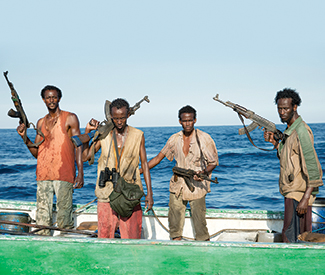
Fortunately for cargo ship captain Richard Phillips, the Gulf of Aden is neither K2 nor the moon. In 2009, Phillips was taken hostage by pirates who’d hijacked the Kenya-bound Maersk Alabama. His subsequent rescue by Navy SEALs came after a standoff that ended in the death of three pirates; a fourth, Abduwali Abdukhadir Muse, surrendered and is serving a hefty term in federal prison.

A year later, Phillips penned a book about his ordeal, and Hollywood pounced. Hanks is perfectly cast as Phillips, an everyman who runs a tight ship but displays an admirable ability to improvise under pressure.

“He was essentially trying anything to shake them off his path. [The pirates] let him hold onto his radio, and he was able to communicate with everybody else on the ship that way,” Hanks said, in town to promote the film with Greengrass and co-star Barkhad Abdi. “[Phillips] had so much knowledge as a merchant mariner. Prior in his career, he’d been in a hurricane in the middle of the Pacific, in which he was helpless — so he’d experienced a different type of terror at sea. With [the pirates], he had somebody he could interact with. It was a different type of fear and anxiety.”

Abdi, cast from an open call among Minneapolis’ large Somali community, plays pirate leader Muse. Captain Phillips focuses mostly on Hanks’ character, but it takes the time to emphasize that piracy is one of few grim career options for Somali youths. The first-time actor, who left Somalia at a young age, brings nuance to what could’ve been a one-note villain.

“I relate to that character, because that could have been me,” he said. “I was lucky enough to have parents that took me to another country, where I could be a better person. But what if my parents had been killed? I don’t excuse [Muse’s] actions, but I understand his motives.”

With a résumé full of intelligent, doc-inspired thrillers (2006’s United 93, 2007’s The Bourne Ultimatum), director Greengrass has mastered the art of fast-paced action filmmaking. He’s especially known for his use of handheld cameras, and Captain Phillips is no exception.

“Ships rock around. How do you shoot on a lifeboat and keep it steady? It’s impossible. You want the images that you’re capturing to authentically arise out of the environment that you’re shooting in,” Greengrass explained, with a caveat. “The faster-moving your sequence, and the more intensely complicated your action is, it [becomes] imperative to render detail. Detail is what gives you acceleration and focus. You’ve got to be inside the action, and your filmmaking must unlock the inner dynamics in a way that’s clear. With this film, you’ve got a very simple, unbelievably dramatic, stark story. If we render it as authentically as we can, we’ll find out what it means — which you couldn’t have found from the news, because you’re looking at it from the outside. You can only find out by being in it.” *


THE SUMMIT and CAPTAIN PHILLIPS open Fri/11 in Bay Area theaters.

Legacy of rhythm

0

arts@sfbg.com

DANCE Has there ever been a celebration at Yerba Buena Center for the Arts quite as exuberant, layered, and embracing of a people, a period, and a place as Dimensions Dance Theater’s 40th anniversary show? Not as far as I know. Despite a timing hitch at the end, probably due to the exigencies of costume changes, Dimensions offered a one of a kind evening of glorious dancing. It was a long program — but then, why can’t some events keep going so that they spill deep into the night and the dreams beyond?

The three-hour show opened on a ceremonial note with thank-yous — not to deep-pocketed donors, but to the ancestors both dead and those present who have made Dimensions possible. Poet Marvin White was the griot who poured libations and repeatedly returned to reset the company’s focus on a trajectory of kindness, strength, and love, ending with a promise of a state of being in which earthly limitations will have fallen by the wayside.

Artistic director and Dimensions founder Deborah Vaughan’s vision for the program was both intimate and grand. In the first section, the dancers revisited excerpts of works in the company’s repertoire. If there is one theme that travels through Dimensions’ history, it’s dancing that embodies strength, courage, and joy. In the excerpts of Fly and Catalyst: One by One, the very diverse bodies of Dimensions’ women took to the air with silken buoyancy. Breaking out of unisons, their individuality was still carried by a common impetus. Even the trio of youngsters from the Dimensions youth program danced with that kind of personalized discipline. Young Micaiah Bell’s initial solo just about burned itself into my mind.

In the excerpt from Project Panther, Dimensions’ trio of male dancers (Erik Lee, Justin Sharlman, and Noah James III) proved themselves fierce warriors and fierce dancers in the way they dived over each other and hurled themselves through space. Lee’s exquisitely nuanced solo from Garth Fagan’s Yesterday/Yesternow made you want to see the whole work again — as was, actually, the case with many of the glances in this retrospective, which closed with spitfire ensemble takes on South African boot and can dances.

For the world premiere of Rhythms of Life: Down the Congo Line, Vaughan invited choreographers from the Republic of Congo, Cuba, and Brazil to set works drawn from their traditions on her remarkable dancers. The piece opened with the evening’s pied pipers, MJ’s Brass Boppers, who had led the initial procession into the theater. Latanya d. Tigner choreographed a witty, yet not ironic The Last Dance/St. Ann and Rampart, inspired by New Orleans funeral traditions. With the dancers in brilliant white, they shook their hands, bowed their torsos, and stepped in and out of line, making sure that they were noticed. They were mourning but also celebrating because they were not about to be overcome.

In Palo, the Cuban section, backed by strong singer Sulkary Valverde, dancers used poles as a practice of self-defense but also to demonstrate precision ensemble work. Lovely to see how Sharlman moved through the group and slowly replaced the “weapons” with hooked drumming sticks.

From Brazil, choreographer Isaura Oliveira showcased the Dimensions men in low-to-the-ground feats, that constant shift of weight and direction that we recognize from capoeira. Despite their being filled with an inherent sense of danger, these dances also mesmerize. Danilo Portugal deserved all the applause he got for his chanting and haunting birimbau playing.

I wish the lovely, sexy, and sassy couple dances — inherited from a colonial past though they were — could have been extended before leading into a skirt-swirling, intoxicating carnival. The section ended with a celebration of the end of colonialism with a lilting King (Sharlman) and Queen (Laura Elaine Ellis), and Tigner as an Elder who deposited a totemic doll on the altar.

The after-intermission Vulkana squarely threw the spotlight on the drum, without which African dance — whether in the Congo or in the Diaspora — would not exist. To have these different traditions come together proved both exhilarating and a little messy. Yet it was one of the evening’s highlights to have Kiazi Malonga in a friendly competition with tiny Congolese firecracker Hervé Makaya and his cohort Teber Milandou. They set not only the makuta drums but also costume parts flying.

Vukana also paid tribute to these brave Dimensions performers who, whether chanting in a sitting circle or swiveling their hips so that the energy rose up through the torso and sailed through the arms, looked at home. Whatever the specifics of the wide-ranging demands made on them, Dimensions looked as if born into them. *


Keep choppin’

0

arts@sfbg.com

CULTURE It’s 6:35pm in Hunters Point and Poll Brown is about to be late to a documentary about himself. The puckish man from South End, Essex, and a small crew of bikers are scrambling to fix a snapped throttle cable. This is a way of life for them: always under the gun, always fixing things, always a little behind. Like a rag-tag task force, they rip a cable out of one bike and marry it to another. There’s not enough time.

At 7pm, after a hairy ride up the 101, lane-splitting between Google buses on Van Ness, Poll is inside the Opera Plaza Cinema for the premiere of Dirtbag.

“We had a bet — just between four buddies,” Brown says in the film, with his gravelly English accent. “It got to be who could build a custom motorcycle for the least money.”

And thus was born the Dirtbag Challenge, which marks its 10th year this Sunday with more rock music, BBQ, and custom motorcycles doing burnouts than is healthy for any person’s ears, lungs, cholesterol, or psyche. The rules have changed a bit since 2003, but here’s the way they currently stand: 1) build a motorcycle in one month; 2) spend less than $1,000; 3) no Harley-Davidsons; 4) the bike must complete a 60- to 100-mile ride.

The restrictions are designed to bring out the creativity and ingenuity of the builders. The first few years without the 100-mile ride rule attracted several very artistic bikes — some more sculpture than road-ready. (One year, a bike with a partially wooden frame went home in splinters.) As for the no-Harley rule, “the quintessential chopper will always be a Harley-Davidson,” explains Poll. “No matter how bad, if a Harley shows up, it still might win.”

Director Paolo Asuncion’s doc chronicles the 2009 Dirtbag Challenge. “When we started, we were going to do ‘This is about the industry’,” he says. He went so far as to interview bike-building royalty like Arlen Ness. “But by the end of filming, all those high-dollar guys didn’t really belong to the story we were trying to tell.”

Overall, the film is a fun look at a unique subculture of motorcycling. By its end, you get a sense that the Dirtbag is more than just a biker build-off — it’s an idea with a spirit behind it. Asuncion drives the point home with the final word of the film, which was met with roars of approval from the crowd: “This documentary was edited in under a month. And making this entire film cost under a thousand dollars.”

After the screening, Brown says, “I’m blown away. It’s interesting to watch something you’ve created have such a positive influence on so many people.”

Pinky McQueen, longtime organizer of the event, has one honest critique. “I realize the movie was spotlighting the builders in particular, but as far as the [Dirtbag Challenge] party goes, there are so many people who selflessly put in countless hours for free to make sure the event [goes] off without a hitch.”

A few days later, one such volunteer, Emily Wakeman, says, “The movie inspired me to just go with our skill set.” With 16 days to go until this year’s event, she and her friends have a running bike and are getting ready to mount a brake light in an old, mud-filled trombone — donated from the Great Guerneville Flood of ’86.

“We’ve spent more money on beer than we have on parts,” confesses fellow builder Shannon Jones.

In Bayview, master fabricator Turk is exactly $521 into his Yamaha-powered, side-car equipped dragster bike. He enjoys the educational side of the Dirtbag Challenge. “It shows that if you want to build a motorcycle, you can,” he says. “If you don’t know how, you can get help.”

Jason Pate is working against the clock in Fremont. Having spent around $800, he has a running bike constructed from no less than six different motorcycles. His son, Jason Pate II, says Brown was here yesterday and showed him how to clean out carburetors. Meanwhile, San Jose resident Alex “Koska” Verbisky — originally from Moldova — is at exactly $1,000. His 1969 Honda CB450 has a wacky new set of handlebars made from Suzuki shock parts and a Volkswagen camshaft.

Up in Orland, Casey Anderson, a professional chopper builder featured in the film, is about $580 into his build, converting a 1979 Honda touring bike to look like a 1928 BMW R62. Thirty minutes south through walnut and olive orchards, in Willows, Kyle Cannon’s son Michael is building a bike for credit in shop class with his pals Joseph and Jake Martin. And down the road, Josh Stine is overcoming his muscular dystrophy, building a bike he hopes he will sell to supplement his Social Security check.

It’s inspiring — a quality that’s fitting for a volunteer-run event that promotes creativity, self-expression, and self-reliance, and encourages learning and community. Participants build strange, mutant vehicles. And it all started as a small gathering of friends near the waters of San Francisco. Sound like any other event you know?

“At first begrudgingly and now gratefully, I accept comparisons to Burning Man,” says Brown.

Of course, that doesn’t mean he likes it. The biggest difference between the Burn and the Dirtbag is that there’s simply no way to throw money at the Dirtbag. Ten years in, the event is still free and no one is getting paid. Brown even recently sold his van to finance a cross-country motorcycle trip.

“If I did want to make this a money-making enterprise, the potential is there,” says Brown toward the end of the film. “[But] I’m not sure if I’m ever gonna actually do that, because that might remove the soul from it.” *

DIRTBAG CHALLENGE

Sun/13, 2pm, free

End of Quesada St, SF

www.dirtbagchallenge.comwww.rattlerproductions.com

Supervisors examine anti-cyclist bias at SFPD

17

The Board of Supervisors Neighborhood Services and Safety Committee held a high-profile and well-attended hearing Oct. 3 to examine how the San Francisco Police Department investigates motorist versus bicyclist collisions. Sup. Jane Kim called the hearing following revelations about shoddy police work and anti-cyclist bias in the Aug. 14 death of cyclist Amelie Le Moullac.

Dozens of cyclists told horror stories of being hit by cars and then treated badly by police, which routinely absolves motorists of responsibility even in cases where they are clearly at fault.

Deputy Police Chief Mike Biel admitted some shortcomings in their investigations and promised to do better, and he apologized for the absence of Police Chief Greg Suhr and Sgt. Richard Ernst, who showed up at an Aug. 21 memorial event for Le Moullac to make inaccurate and insensitive comments criticizing cyclists. Kim had requested testimony from both men. Sup. David Campos pledged to hold another hearing on the issue, this time at a rare joint hearing of the Board of Supervisors and Police Commission.

San Francisco Bicycle Coalition Executive Director Leah Shahum urged the SFPD to, “Focus limited traffic enforcement resources on known dangerous intersections and known dangerous behaviors.” (Read Shahum’s op-ed on the hearing.)

Concerns about selective enforcement and anti-cyclist bias by the SFPD were heightened in the week before the hearing when officers started enforcement stings focused on stop sign-running cyclists riding the Wiggle, one of the city’s most popular and heavily traveled bike routes.

Among those stopped and given a written warning — one of 534 written warnings and 16 citations the SFPD reported giving out to cyclists in September — was Guardian Editor Steven T. Jones, whose Oct. 1 blog post on whether SFPD should strictly enforce laws requiring cyclist to completely stop at stop signs was the most commented SFBG.com post of the last week.

Shahum told us that the Bike Coalition has done education campaigns urging cyclists to yield to pedestrians on the Wiggle, but that none of the seven intersections on the Wiggle meet the SFPD’s own stated goals of focusing enforcement on the five most dangerous intersections in each police district. “When you look at the data on the Wiggle,” Shahum said, “it’s not a high collision area.”

Airbnb says its hosts should pay taxes

7

Under pressure in San Francisco and New York City for violating local tenant and land use laws and refusing to pay local taxes, Airbnb has finally acknowledged that transient occupancy taxes apply to the room rentals it facilitates. But the company still hasn’t taken any steps to collect the tax or admitted that it shares this tax debt with its hosts.

“Our hosts are not hotels, but we believe that it makes sense for our community to pay occupancy tax, with limited exemptions for those who earn under certain thresholds,” CEO Brian Chesky wrote on the Airbnb blog on Oct. 3, addressing the post to New York City and not San Francisco, where it is headquartered and where we have shown the company is shirking an annual tax debt of nearly $2 million.

Contacted by the Guardian, a company spokesperson extended the pledge to San Francisco, writing, “Yesterday, our CEO Brian Chesky announced that we believe it makes sense for our community of hosts to pay occupancy tax to the cities in which they live, with exceptions under certain thresholds, and we are eager to discuss how this might be made possible. We have been in substantive discussions with Board President David Chiu on these issues for some time, and we’d like to thank him for the open dialogue that helped lead to today’s announcement. We look forward to continuing our work with him and others in San Francisco to set forth clear, fair laws that allow regular people to rent out their own homes, while giving back to the city that makes it possible.”

As the Guardian has repeatedly reported, most recently in our Aug. 6 cover story “Into Thin Air,” the San Francisco Treasurer/Tax Collectors Office has ruled that the city’s TOT of about 15 percent applies to Airbnb guests, and that Airbnb shares that joint tax liability with its hosts.

The ability of individual hosts to receive business licenses for renting out rooms and to collect and remit the TOT is complicated by the fact that such rentals violate land use, tenant, and other city laws — and Chiu has been developing legislation that would legalize and regulate the stays.

Airbnb could easily collect the TOT on each San Francisco transaction, as some of its online competitors have already been doing, but it has so far refused to do so. And when the Guardian asked Airbnb whether it now plans to include the tax in its transactions, the company ignored the question.

In fact, Airbnb’s public statements and private communications indicate its intention to pass the buck to its hosts rather that paying the tax liability itself, and several hosts who commented on Chesky’s blog post expressed hopes they would get more support from the company.

Nonetheless, Chiu took the Airbnb’s statement yesterday as a positive sign, telling us, “I am pleased to hear that Airbnb has acknowledged the need for their users to pay the occupancy tax. This policy was developed as a result of discussions that I’ve led in the past year to regulate and tax shareable housing activity in San Francisco. While we continue to negotiate with shareable housing companies, housing advocates, and the Mayor’s Office to find sensible solutions, I am confident that we will be able to move forward on a regulatory framework that provides flexibility to residents, protects our affordable housing stock, and collects the fair share of taxes for the City. I look forward to introducing legislation in the coming months.”

Justice for cyclists

54

OPINION

It was heartbreaking to hear their stories.

Sarah was hit while riding her bike. Then she was wrongly faulted for the collision, despite multiple witnesses’ testimony and photo evidence to the contrary. A police officer verbally harassed her after the incident.

“The crash was awful,” she said. “But the way I was treated by the police … absolutely compounded the trauma. I was treated, at every turn, like a criminal.”

Dorie was hit from behind while biking in Golden Gate Park with her son in a rear child seat. Thankfully he was fine, but she was injured seriously enough to spend two weeks in the hospital. She was blamed for the incident, despite witnesses’ statements claiming otherwise.

And after Sandrine was hit while biking, she was treated with hostility by police officers while she lay in pain at the hospital. She was shocked to learn witness statements were not included in her incident report, which faulted her. Thousands of dollars in debt later, Sandrine says she is “disheartened and completely disgusted with the attitude and bias of the police” toward people on bikes.

Nearly 40 people spoke up last Thursday at a Board of Supervisors committee hearing into the SF Police Department’s response to traffic incidents involving people biking and walking.

The spotlight is on the SFPD after it botched an investigation last month of a 24-year-old woman who was hit and killed while biking to work on Folsom Street. Police failed to look for video footage in the area, and a police sergeant blocked the bike lane at the memorial to publicly blame the victim for her own death, while forcing bike riders into high speed traffic.

I’m sorry to say that I was not surprised by the sergeant’s “blame the victim” attitude in that recent tragedy. Nor in the dozens of cases people shared at last week’s hearing.

Sadly, we regularly hear about experiences like these: people refused incident reports, despite injuries. Reports being taken inaccurately or incompletely, time and time again blaming the person biking, despite witness statements to the contrary. And officers being ignorant of the law, such as not understanding that people can leave a bike lane to avoid an obstruction or to make a turn.

I believe our police chief when he insists that all road users should be treated fairly, but that message is not being heard by all in the force.

The chief needs to make certain that all collisions resulting in injuries are fully and fairly documented; that training is significantly stepped up to ensure officers’ understanding of bicyclists’ rights and responsibilities on the road; and, finally, that the SFPD uses a data-driven approach to focus limited traffic enforcement resources on the locations and behaviors that are most dangerous.

We are not asking for special treatment for the growing number of people on bikes, but rather fair and equal treatment for all road users.

Leah Shahum is executive director of the San Francisco Bicycle Coalition.

Friends in the shadows

36

rebecca@sfbg.com, joe@sfbg.com

It’s a simple fact of life: Money buys influence. But in San Francisco, despite strict sunshine laws to illuminate donations to city agencies and gifts to the regulators from the regulated, money still circulates in the shadows when it flows through the coffers of “Friends” in high places.

Major real estate developers, city contractors, and large corporations often lend financial support to San Francisco city departments, to the tune of millions of dollars every year. But the money doesn’t just flow directly to city agencies, where it’s easily tracked by disclosure laws. Instead, it goes through private nonprofits that sometimes label themselves as “Friends Of…” these departments.

They include Friends of City Planning, Friends of the Library, a foundation formerly known as Friends of the San Francisco Department of Public Health, Friends of SF Environment, and Friends of San Francisco Animal Care and Control.

The Friends pay for programs the departments supposedly cannot cover on their own. Bond money can build a skyscraper, but sometimes not fill it with furniture. Agencies are barred by law from funding an employee mixer or a conference trip, so departments turn to their Friends to fill in the gaps. Adding bells and whistles to city websites, holding lunchtime lectures, hiring a grant writer — or, in the case of the Department of Public Health, bolstering health services for vulnerable populations — these are all examples of what gets funded.

The extra help can clearly be a good thing, but the lack of transparency around who’s giving money raises questions — especially if it’s a business gunning for a major contract or a permit to build a high-rise.

City agencies receive outside funding from a wide variety of sources. Sometimes grants are made by the federal government, or a well-established philanthropic foundation — and according to city law, gifts of $10,000 or higher must be approved by the Board of Supervisors. But in the case of organizations like Friends, which are created specifically to assist city government agencies, the original funders aren’t always identifiable. And the collaboration is frequently much closer, with city staff members serving on Friends boards in a few cases.

the circle of donations to "friends of" foundations

Friends board members told the Guardian that their partnership with government helps bolster city agencies in a time of increasing austerity, in service of the public good. But do the special relationships these influential insiders hold with high-ranking city officials come into play when awarding a contract, issuing a permit, making a hiring decision, or determining whether a developer’s request for a rule exemption should be honored? Without more transparency, it’s tough to tell.

City disclosure rules state that any gift to a department must be prominently displayed on that department’s website, along with any financial interest the donor has involving the city. But Friends and other outside funders are under no obligation to share their supporters’ names, much less financial ties, when they distribute grants. Meanwhile, the disclosure rules that are on the books seem to be frequently ignored, misunderstood, or unenforced, our investigation discovered.

How are donors repaid for their support? Consider the controversy earlier this year around Pet Food Express, which won approval in June for another store in the Marina District despite opposition from four locally owned pet stores in the area that fear competing with a large national chain. Pet Food Express won the unlikely support of the city’s Small Business Commissioners, some of whom reversed their 2009 positions opposing the chain’s previous application.

SF Animal Care and Control Director Rebecca Katz personally lobbied the commission to support Pet Food Express, at least partially because the company has donated pet supplies valued at $50,000 to $70,000 per year to the department. That’s a lot of money for a cash-strapped city department, but a pittance compared to the profits of an expanding national chain.

It’s moments of clarity like those, when the public can easily trace the line from donations to political influence, that show why disclosure is so crucial. But those moments are few and far between when trying to trace the funders of private foundations and Friends organizations, where deals often happen in the dark.


WHEN DEVELOPERS ARE FRIENDS

At the Merchant Exchange Building in May, a crowd of high-profile real-estate developers mixed and mingled with city planners, commissioners, and even Mayor Ed Lee, wine glasses in hand. Sources told the Guardian that most of the planning staff was present, and not all were happy about having ribbons and name tags affixed to their shirts, as if they were being auctioned off.

With around 500 in attendance, the event was an annual fundraiser hosted by the Friends of San Francisco City Planning, a nonprofit organization that accepts contributions of up to $2,500 per individual to lend a helping hand to the Planning Department. This year’s event was titled “Incubator Startups, New Jobs for the Future,” hinting that the development community shares the mayor’s affinity for new tech startups and the droves of high-salaried IT professionals they’ve attracted to the city.

Some Friends of City Planning board members are major real-estate developers who routinely seek approval for major construction projects. Others are former planning commissioners, or have a background in community advocacy.

Amid widespread concern about displacement, gentrification, and the overall character of San Francisco’s built environment, no city department has greater influence than Planning. An individual’s interpretation of the Planning Code can carry tremendous weight; it’s a series of small decisions that shape a project’s profits and the look and feel of San Francisco’s future. And with cranes dotting the city’s skyline and market-rate construction catering to the wealthy while middle income residents get priced out, the amount of capital flowing through the development sector these days is astonishing.

In this dizzy climate, there might seem to be something askew about affluent developers and land-use attorneys rubbing elbows with city regulators, all eager to pass the hat for the Planning Department. Whiff of impropriety or no, the fundraiser appears to be totally legal.

“We aren’t violating the law — that I know,” Friends of City Planning Chair Dennis Antenore told the Guardian. “We’ve had legal advice on that for years.”

There is close collaboration between Friends of San Francisco City Planning and the Planning Department — a partnership so entrenched that it’s almost as if the nonprofit is an unofficial, private-sector branch of the agency.

“We are certainly thankful and appreciative,” Planning spokesperson Joanna Linsangan told the Guardian. “They’ve helped us for many, many years.” The additional funding is needed, she said, because “there isn’t a lot of wiggle room” in the departmental budget.

Each year, Planning Director John Rahaim submits a wish list to the Friends, outlining projects he wants funding for. This year, he requested $122,000 for a variety of initiatives, including training support to help planners assess proposals for formula retail (read: chain stores). That’s a hot-button issue lately, and one that shows how seemingly small decisions by planners can have big impacts.

When the department’s zoning administrator ruled that Jack Spade, a high-end clothing chain that opened up in the old Adobe Books location on 16th Street, wasn’t considered formula retail and therefore didn’t need a conditional use permit, neither widespread community outrage nor a majority vote by the Board of Appeals could reverse that flawed decision. It was a similar story with the Planning Commission’s Oct. 3 approval of the 555 Fulton mixed use project, where Planning Department support for exempting the grocery store for the area’s formula retail ban made it happen, to the delight of that developer.

Even though the planning director makes specific funding requests each year to the Friends and pitches the projects in person at their meetings — and the Friends publishes a list of the grants it awards to the department online — the Planning Department is not reporting those gifts to the Board of Supervisors.

“I confirm that the Planning Department did not receive any gifts,” Finance and IT Manager Keith DeMartini wrote in official gift reports submitted to the Board of Supervisors for the years 2011-12 and 2012-13. Those reports were sent to the board on Oct. 7 and Oct. 4, respectively, well after the July filing deadline and after the Guardian requested the missing reports.

The Friends typically funds two-thirds of the requests, said board member Alec Bash, totaling around $80,000 a year. In 2012, the Friends awarded a $25,000 grant to make the department’s new online permit-tracking system more user-friendly, making life a lot easier for developers.

When asked what safeguards are in place to prevent undue influence when the director is soliciting funding from a nonprofit partially controlled by developers, Linsangan responded, “those are two very separate things. One does not influence the other.”

She stated repeatedly that planners are not privy to information about individual contributors — but the fundraisers are organized by a board that includes identifiable developers, and anyone who attends can plainly see the donors in attendance. Nevertheless, Linsangan insisted that planners would not be swayed by this special relationship, saying, “That’s simply not the way we do things around here. We do things according to the Planning Code.”

But as the ruling on Jack Spade shows, as well as countless rulings by planners on whether a project is categorically exempt from the California Environmental Quality Act, interpreting the codes can involve considerable discretion.

The public can’t review a list of who wrote checks to the Friends of San Francisco City Planning for the May fundraiser. Since the organization waits a year between collecting the money and disbursing grants, donors stay shielded from required annual disclosures in tax filings.

But Antenore says the system was established with the public interest in mind. “We don’t reveal the contributors, because we don’t want anybody to have increased influence by a donation,” he insisted. Bash echoed this idea, saying the delay was to “allow for some breathing room.”

Unlike some of his fellow board members from the high-end development sector, Antenore has a history of being aligned with neighborhood interests on planning issues, helping author a 1986 ballot measure limiting downtown high-rise development. He emphasized that the developers on the Friends board are balanced out by more civic-minded individuals.

Still, developers who regularly submit permit applications for major construction projects sit on the Friends board. Among them are Larry Nibbi, a partial owner of Nibbi Bros.; Clark Manus, CEO of Heller Manus Architects; and Oz Erikson, CEO of the Emerald Fund development firm.

“We’re not making use of [the funding] in a way that benefits these people,” Antenore said. “I wouldn’t do this if I thought otherwise. I have been careful to maintain the integrity of this organization.” The money is meant to facilitate better planning, he added. “I don’t think there’s any conspiracy,” he said. “We’re not financing anything evil.”

Both the Planning Department and its Friends dismissed the idea that the donations could open the door to favoritism or undue influence. So why isn’t the department reporting gifts it receives from the Friends to the Board of Supervisors, or disclosing them on its website, as required by city law?

According to a 2008 City Attorney memo on reporting gifts to city departments, when an agency receives a gift of $100 or more, it “must report the gift in a public record and on the department’s website. The public disclosure must include the name of the donor(s) and the amount of the gift [and] a statement as to any financial interest the contributor has involving the city.”

John St. Croix, director of the San Francisco Ethics Commission, confirmed that’s the current standard, telling us, “The actual disclosure should be on the website of the department that received the gift.”

Linsangan said records of the gifts are indeed available — listed as “grants” in the department’s Annual Report. But while the 2011-12 report lists grants from sources such as the Metropolitan Transportation Commission and the Environmental Protection Agency, there was no mention of Friends of City Planning.

The memo also says any gift of $10,000 and above must first be approved by a resolution of the Board of Supervisors. But last year, when the Friends provided $25,000 to upgrade the permit-tracking system, it wasn’t sanctioned by a board resolution. Asked why, Linsangan made it clear that she was not aware of any such requirement.

As is common, when it comes to adhering to disclosure laws, confusion abounds. And sometimes, only sometimes, politicos get caught.


READING UP ON DISCLOSURE LAWS

When the head of a city agency fails to report gifts totaling $130,000, how much do you think he is fined?

City Librarian Luis Herrera failed to report receiving that amount in gifts and he was fined exactly $600 by the California Fair Political Practices Commission on Sept. 19. Specifically, Herrera had to file a form 700 with the FPPC to state the gifts he received. From 2008-2010, the forms he turned in had the “no reportable interests” box checked.

The money was used in what he calls the City Librarian’s Fund, which is the money he keeps on hand to pay for office parties and giving honorariums to poets and speakers who perform at the library’s branches, money that wasn’t disclosed on the very forms designed for reporting it.

There are two stories of how the fine came about. Longtime library advocate James Chaffee said that it was the result of a complaint he filed with the FPPC in April, and indeed, he sought and obtained many public documents revealing the money trail. San Francisco Public Library spokesperson Michelle Jeffers disagreed, saying that the fine was the result of an ongoing conversation with the FPPC to figure how exactly to file the gifts appropriately.

“The law wasn’t clear around these forms and it wasn’t clear if he had to report them,” she told the Guardian. “For amending the reports you have to pay a $200 fine for every year it was proposed. We keep scrupulous records on every pizza party we have.”

When government officials receive “gift of cash or goods,” they must report them annually in statements of economic interest, known as a Form 700, to the city Controller’s Office. The form is kind of a running tally of who is receiving gifts from whom, a way for the public to track money’s influence in government.

The gifts came from the Friends of the San Francisco Public Library, another nonprofit that bolsters city agency funding. Now Herrera has to list the $130,000 gifts from fiscal years 2008-09 and 2009-10 on his website.

What exactly does that accomplish? As it turns out, not a whole lot.

City Administrative Code 67.29-6 defines the reporting of gifts to city departments, and one of those requirements is to make a statement of “any financial interest the contributor has involving the city.” Now that Herrera lists the Friends of the San Francisco Public Library as donors on the department website, the statement of financial interest by the friends group is this: “none.”

There are myriad donors to the Friends of the SFPL, and the group doesn’t have to state the economic interests of its donors, or even mention who its donors are. The code requires gifts be reported to the controller, and the deputy city controller told us this doesn’t apply to the “friends of” organizations, or any nonprofit foundation arms of city departments.

“If gifts are made to a department, yes, they have to disclose, so people don’t get preferential interest in getting city contracts,” Deputy Controller Monique Zmuda told us. “I know it’s a fine line. The foundations don’t provide us with anything.”

Friends of the SFPL doesn’t provide money just for pizza parties. A breakdown of a funding request from the library to its Friends shows requests up to $750,000 to advertise the library on Muni and in newspapers, funding for permanent exhibits, and the City Librarian’s personal fund. That’s just the money it gives to the library. Other monies are spent directly on activities supporting the library.

As Jeffers pointed out to the Guardian, the money isn’t spent on “trips to Tahiti.” Friends of the SPL do good city works, from a neighborhood photo project in the Bayview branch library to providing books for children. But the question is: Who’s buying that goodwill and why?

The millions of dollars in donations made to the Friends of the SFPL don’t need to be approved by the Board of Supervisors, like gifts to departments do. They’re not checked for conflicts of interest or financial interest by any governmental body. Donors give and the Friends of SFPL spend freely, financial interest or not.

When our research for this story began, no financial statements were available of the Friends of the SFPL website. After a few days of inquiries, the most recent year’s financial statements from 2011-12 were posted to the website.

Ultimately, the San Francisco Public Library is one of the smaller city departments, with an annual budget that hovers around $86 million. The Department of Public Health is a much bigger beast, with a 2011-12 budget of around $1.5 billion.

One of its main foundations, the San Francisco General Hospital Foundation, is also one of the largest nonprofits that supplements city spending. In many ways, it could be described as the model of disclosure for city foundations, although its disclosures are not by law, but by choice.


FOUNDATION OF FRIENDS

The Department of Public Health relies on a few entities that fundraise on its behalf: the San Francisco Public Health Foundation, the Friends of Laguna Honda Hospital, and the San Francisco General Hospital Foundation.

“They’re private nonprofit entities that are separate from the department,” CFO Greg Wagner told us. “But their roles are to support the department in its efforts.” He cited examples such as sending its staff to conferences or hosting meetings, “things that we don’t have the budget for or don’t have the staff or resources.”

The lion’s share of the DPH’s gifts are funneled through the SFGHF. Unlike many of the assorted Friends groups or foundations that support city services, the SFGHF extensively reports the sources of its $5 million in donations. The donors include a veritable who’s who of San Francisco: the Giants, Sutter Health, Xerox, Pacific Union, and Kohl’s all donated between $1,000 and $10,000 in the past two years.

But the largest gifts to the SFGHF came from Kaiser Permanente, and its financial interests in the city run deep. Kaiser came into the city’s crosshairs in July, when the Board of Supervisors passed a resolution calling on Kaiser to disclose its pricing model after a sudden, unexplained increase in health care costs for city employees. Kaiser holds a $323 million city contract to provide health coverage, and supervisors took the healthcare giant to task for failing to produce data to back up its rate hikes.

In the meantime, Kaiser has also been a generous donor. It contributed $364,950 toward SFGHF and another $25,000 to SFPHF in fiscal year 2011-12.

The funding from Kaiser and a host of other contributors — which include Chevron, Intel, Genentech, Macy’s, Wells Fargo (another city contractor), and a pharmaceutical company called Vertex — does support needed programs. They include research into the health of marginalized communities, services through Project Homeless Connect, screening for HIV, and immunization shots for travelers.

But because DPH doesn’t count much of this support as “gifts” formally received by the city, it isn’t subject to prior approval by the Board of Supervisors, or posted on the department’s website along with the contributors’ financial interests. Major contributions are disclosed in a report to the Health Commission, something Wagner described as a voluntary gesture in response to commissioners’ requests.

“Most gifts to foundations are donations to a nonprofit and do not come through the city or DPH at all,” he noted.

This distance is maintained on paper despite close collaboration with the department. In the case of Project Homeless Connect, a program that holds a bimonthly event to aid the homeless, it supports programs headquartered in city facilities. Penny Eardley, executive director of SFPHF— which used to be called Friends of San Francisco Public Health — noted that her organization occasionally makes grants or seeks funding in response to department requests. And Deputy Director of Health Colleen Chawla is a foundation board member. It’s almost like these foundations are extensions of the department, except they’re not.

SFPHF also earns revenue as a city contractor. When DPH received a grant from the Centers for Disease Control, it contracted with SFPHF to manage subcontracts with about a dozen community-based organizations.

The web gets even more tangled. The president of SFPHF is Randy Wittorp — who’s also Director of Public Affairs for Kaiser Permanente’s San Francisco Service Area. It’s a similar story with SFGHF, whose board includes several General Hospital administrators, including CEO Susan Currin.

Former Health Commissioner James Illig said people shouldn’t worry, that hospital the staff would never direct foundation funds to pet projects or mishandle funds. They maintain a separation and a firewall,” he said, for example noting, “Sue Currin is not directing funds to her own hospital.”

But he did admit that since SFGHF’s minutes are not public documents, that “raises a few concerns,” arguing the public should be able to inspect financial documents to decide if the foundations are directing funds lawfully to city departments.

Even when the public by law has a right to access financial records of a city department, rooting out corruption can be like pushing a boulder up a San Francisco hill.


FROM PATIENTS TO PARTIES

In 2010 and 2011, Laguna Honda Hospital administrators and staff used money from the hospital’s patient gift fund to throw a party. And then they spent it on airfare. And then they gave laser-engraved pedometers to the staff. All told, they spent nearly $350,000 meant for the dying and the infirm, nearly half of the total funds.

The incident was big, messy, and out in the public eye. It was an all-too-rare glimpse into the shady use of public funds by public officials. But when hospital staff members Dr. Derek Kerr and Dr. Maria Rivero blew the whistle on Laguna Honda’s misuse of patient funds in 2010, they were drummed out of their jobs.

Eventually litigation on behalf of the whistleblowers and their complaints of corruption were found to have merit.

Kerr’s vindication came at a meeting of the Health Commission in April 2013. In the packed City Hall meeting room, the public watched as Laguna Honda Executive Director Mivic Hirose read her apology to Kerr and Rivero aloud, even announcing a plaque in Kerr’s honor.

“The hospital will install the plaque in the South 3 Hospice,” she read, stiltedly, from a written statement, surrounded by microphones at the podium. “The plaque will say: In recognition of Derek Kerr MD of his contributions to the Laguna Honda’s hospice and palliative care program 1989-2010.”

Kerr received a settlement of $750,000 and something more important: His good name cleared.

But that conflict of interest was rooted out only after years of litigation that revealed the financial abuse through legal discovery of the department’s documents — documents that should’ve been public in the first place. ABC 7’s I-Team broke the story and did much of the reporting at the time, otherwise the entire affair may have been swept under the rug.

The misuse of funds was only brought to light with the revelation of public documents — revelations not possible with most Friends groups. The Laguna Honda Hospital Foundation has also had financial dealings with potential conflicts and a lack of transparency.

The now-defunct LHHF’s board chair, former City Attorney Louise Renne, made an interesting choice for her vice chair after she formed the nonprofit in 2003. Derek Parker was vice chair of the LHHF while simultaneously heading architecture firm Anshen-Allen, with a $585 million city contract to rebuild the hospital.

So he was not only rebuilding Laguna Honda under city contract, but soliciting and spending donations meant to supplement his project. Renne wrote to the Health Commission in December 2011 that LHHF’s purpose was to manage over $15 million in donations meant to furnish the hospital with beds, chairs, and other necessities. Eventually, then-Mayor Willie Brown found funding for the hospital, reducing the foundation’s role.

In a phone interview with the Guardian, Renne said the goals of the LHHF were only ever to furnish the newly christened hospital. “Our purpose was to fill the void, if you will, for what the city and its services could not do,” she said.

But in her letter, Renne advocated for LHHF to take an active role in fundraising for the hospital for years to come. “Today, the members of the Board of Directors of the Foundation continue to assist the hospital in various phases of its new projects and operations with projects approved by the City and/or the hospital administration,” she wrote to the Health Commission.

And Parker would have potentially managed millions of dollars flowing through donations for countless other hospital projects, while heading an architectural firm with contracts to build in San Francisco. We were unable to reach Parker for comment.

“I never saw Derek use his position as an architect or position for any political gain, I never saw it,” Renne told us. But no one else would see it either, because organizations like the now closed Laguna Honda Hospital Foundation operate without public oversight.

The Health Commission itself even noted this in its March 2012 meeting, the minutes describing then-commissioner James Illig as critiquing the foundation for not being open about its source of funding.

“Commissioner Illig thanks Ms. Renne and Mr. Parker for coming to the Commission,” the minutes read. “Because (LHHF) is a project of Community Initiatives, a fiscal sponsor for nonprofits, it is not possible to find basic financial information about the Foundation or its activities.”

Divided interests on hospital board

Due to a quirk of her foundation being under the “umbrella” of a separate entity, Community Initiatives, Illig was never able to even get the LHHF’s IRS forms, he told us. “We tried to get information and reports, and the Community Initiatives [Form] 990 was giant,” Illig said. “It didn’t separate anything out.”

Illig told us that it made sense to have Parker on the board because he is monied and well connected, making it easier to solicit donations. But insiders close to the board told us that Parker’s position may have made it easier to swing getting other contracts for his firm.

Parker got another city contract building the UCSF Benioff Children’s Hospital at Mission Bay, slated to open in 2015. No doubt his firm got the job partly due to his reputation as pioneering architecture that leads to healthy patient outcomes — but then again, the board he served on also approved donations to research at UCSF.

Laguna Honda Hospital Foundation may now be defunct, but it serves to illustrate the lack of controls and oversight of the foundations beyond even gift disclosure.


OFF THE BOOKS

It might be characterized as a web of influence, cronyism, or just the way business is done. But is there something improper about all of this?

Private funding often represents a needed boost that allows for important work to take place beyond what could happen under ordinary budgeting. At the same time, it smacks of privatization. While departments and funders point to lean times in the public sector to justify the need for this help, the funding continues to flow whether it’s a good year or a bad year for city government. And at the end of the day, the most glaring issue of all seems to be the lack of transparency.

Are city departments ever tempted to bend the rules to lend a little help to their Friends? As long as the funding is in the dark, the public has no way of knowing.

Ethics chief St. Croix told us his office lacks the resources to visit every city website and check up on whether departments are following the disclosure rules. “If someone brought it to my attention that a department received a gift and didn’t post it [on the website],” he said, “we would look into it.”

But if the watchdogs need watchdogs, citizens who can’t even review documents that should be publicly available, then these quasi-governmental functions and the people who fund them will remain in the shadows.  

Danielle Parenteau contributed to this report.  

ADDENDUM  

When city funders operate in the dark, one of the best ways to learn about corrupt influence, misuse of funds, and other transgressions is from whistleblowers. If you have a tip for us, send us snail mail at SAN FRANCISCO BAY GUARDIAN, 225 Bush, 17th Floor, San Francisco, CA 94104. Or email us at news@sfbg.com. Just make sure not to use an email address provided by your workplace, which is less secure.


Help us keep raising hell

70

EDITORIAL The last couple years have been some of the most difficult and precarious in the Guardian’s 47 years of printing the news and raising hell in San Francisco. We’ve been struggling to survive and thrive, both the newspaper and the larger progressive political and alternative arts communities the Guardian is a part of, at a moment when this city needs us more than ever.

But the good news is that people are awakening to what has been lost as our resources have waned. We see it in the resurgent movements against evictions and gentrification and for better transit and bike lanes, in a rare referendum campaign challenging the 8 Washington project and its lies, in the lively online discussions we facilitate, and in the community support that the Guardian and other nascent progressive media projects are receiving.

Most people don’t trust the mainstream political, economic, and media institutions to understand or explain what’s happening to San Francisco and the greater Bay Area. Technology has created an explosion of new media outlets, but it’s come at the price of common narratives and gathering places where we can join together, discuss the issues, and then assert our collective will.

This is where the Guardian comes in, and it’s why we must find the way to grow through these tough years and regain our standing as the premier forum for discussing and promoting San Francisco’s values and needs. And for that, we need your help and support.

In some ways, it’s a situation similar to when Bruce B. Brugmann and Jean Dibble started the Bay Guardian in October 1966, when San Francisco was at the epicenter of social movements and technological innovation that were challenging entrenched economic interests and the inertia of the status quo.

The Guardian gave voice to new ideas about human rights and responsibilities, sexuality and identity, art and expression, diversity and tolerance, and many of the other issues and values that have animated San Francisco for the last half-century. Along with papers such as the Village Voice, Boston Phoenix, and Chicago Reader, the Guardian helped create the model for alternative newsweeklies that came to proliferate in every major US city, expanding the political and cultural dialogue in the country.

But that model is faltering. The Phoenix, which was founded the same year as the Guardian, closed its doors earlier this year, falling victim to the same economic pressures that are plaguing the entire newspaper industry. And the Voice soldiers on as a relatively apolitical corporate clone of its former feisty self after being bought out by a Phoenix-based chain driven by the kind of bottom-line Wall Street values that alt-weeklies were originally launched to oppose.

Regular readers of the Guardian know how we’ve fought for our independence and sustainability over the last year (see “On Guard,” June 19, and “New Guardian leadership wants your input,” July 23), and that we’ve approached it in a way that was consistent with our values on transparency, fearless truth-telling, and partnership with our progressive community.

And now, on the Guardian’s anniversary, we are recommitting to the mission stated on our masthead, “to print the news and raise hell,” while updating that mission for the digital age in myriad ways, some of which we’ll be announcing soon. This region is at a crossroads, choosing between greedy, myopic elitism and egalitarian sustainability, and we need strong media voices like the Guardian to clarify that choice.

For that, we need your help. Read the paper and then pass it to a friend. Post our stories to your favorite online forum. Buy an ad to promote your business, event, or cause. Participate in our community forums, including our Oct. 23 discussion of high-rises and waterfront development at the LGBT Center. Send us good story tips. And, most importantly, help us promote the idea that an informed and engaged citizenry is the foundation of democracy — and the only way to save the soul of San Francisco.


Hearts on fire

0

arts@sfbg.com

THEATER An actor rakes a thick piece of chalk across the floor with a few swift, violent strokes, transforming a bare stage into the layout of an apartment or the plan of a Polish street. Three more actors join him in filling out the scenes, uprooted from time and rearranged in a deliberate design of their own — scenes erased and redrawn with practically every shift in a fluid, snaking narrative that joins the present day with World War II, the Warsaw Ghetto, and the career of a young Jewish woman named Izolda, who passes herself off as an Aryan in a heroic attempt to save herself and her husband from an apocalyptic night.

If the ghostly chalk outlines of the set morph with a brusqueness that suggests the ferocity of both war and time to remake the world, Izolda’s story of love and determination offers an agency of its own. Wrenched from the daunting numbers and general darkness of the Holocaust, they come into mesmerizing focus in The King of Hearts is Off Again, a barebones yet highly evocative piece of physical theater by Warsaw’s Studium Teatralne, which adapts Polish journalist-turned-author Hanna Krall’s internationally acclaimed 2006 novel, Chasing the King of Hearts (now available in an English translation from Peirene Press).

This week, in Studium Teatralne’s Bay Area debut, the San Francisco International Arts Festival presents The King of Hearts is Off Again in both San Francisco and the East Bay. Performed in Polish with English supertitles, the piece showcases the work of a company grounded in the influential career of Polish director Jerzy Grotowski (1933–1999), world-renowned innovator and practical theoretician of “poor theater.”

Piotr Borowski, who directed the production, was an actor and musician with Poland’s famed experimental company Teatr Gardzienice in the 1970s and ’80s. After that he joined the Workcenter of Jerzy Grotowski in Pantedera, Italy, where he stayed until 1994, when he became artistic director of Studium Teatralne.

“Mainly what I’ve acquired from working with Grotowski is a constant, systematic work on the harmony of three things: body, feelings, and intellect,” relates Borowski in a recent email exchange. “Incidentally, this idea is few thousand years old. On the other hand, the topics for my dramatic work flow directly from the circumstances of our contemporary times.”

The details and lacunae of Izolda’s dramatized but true story emerge from the ghostly outlines of a past now barely visible in Poland, suspended somewhere between blissful ignorance and perturbing rumination.

“In Poland, before World War II, Jews were about 10 percent of the population,” continues Borowski, “about three million people. The ones that were left numbered 20,000. We have struggled to convey this emptiness through the empty stage, minimal props, a small number of actors, in order to focus on the main idea. One of the most important things in the set is the floor. It is an old Synagogue’s polychrome. We are stepping on it, symbolically ruining it. The world’s culture of sacral paintings is being destroyed. There are hardly any Jews in Poland anymore. Most of all, there are hardly any traces of their culture left. Our viewers in Poland can feel that, and we talk about it a lot, especially with the younger generation.”

Grotowski and the refined aesthetics of poor theater grew in the 1960s in part as a response to the lavish spectacle offered by cinema, but also in a politically repressive period in which metaphor was key to discussing the lived reality shared by artists and their audience. Today’s Polish stage has evolved in strikingly different directions since 1989 and the fall of communism. The avant-garde today — in the work of Krystian Lupa or Krzysztof Warlikowski, for example — tends toward work of monumental proportions, as Borowski readily admits.

“When it comes to the direction of the Polish theater today I am not the go-to expert. I am still representing the off-center of theater whose significance is marginal today. It used to have a clear role in times of a system where censorship existed. But now, when we have freedom and a fierce market economy, the big productions and money become more important to people.”

Borowski adds that it is not a question of one approach or another, but rather of making work that confronts contemporary reality.

“It is essential that we create performances that are relevant for today. That has always been hard to do, as far as I can remember. The main goal that I had set out for myself is the goal towards human development, and what I’m trying to show on stage is the [way] beyond simple acceptance and habitual perception of so many things. Not a rebellion but an alternate perception.” *

THE KING OF HEARTS IS OFF AGAIN

Wed/2-Fri/4, 8pm, $18-25

Joe Goode Performance Annex

401 Alabama, SF

Sat/5, 8pm

University Theatre

CSU East Bay, 25800 Carlos Bee, Hayward

www.sfiaf.org


Drive time

0

arts@sfbg.com

GAMER Yes, it’s time to talk again about the game in which you steal cars and kill prostitutes. And it’s another chance for the national news media to organize roundtables to discuss violence in video games, and the effects it might be having on the nation’s youth.

Let’s be honest: You know right now, before reading this article, whether or not the Grand Theft Auto series — which released GTA V (Rockstar North, Rockstar Games; PS3, Xbox 360) last month, and made a cool $1 billion in its first three days on sale — is something you want to play. And for developer Rockstar North, that’s both a blessing and a curse.
Perhaps surprising for those who haven’t played a game in the GTA series, the biggest draw isn’t the rampant violence but the experience of exploring a carnival funhouse version of present-day America.

GTA V’s look-alike setting of contemporary Los Angeles and its surrounding countryside, including windmill-strewn hills, mountain ranges, and a great salt sea is more than scenery. Billboards for fake reality shows and overwrought radio commercials shilling products like lap-band surgery and bottled water serve to drive home the absurdity of modern life. Buildings don’t just give the impression of a real city; each one has character, and often times a backstory. It is a city that feels alive. Amid the hail of gunfire, it’s easy to forget that Rockstar consistently pushes the limits of what a sandbox world can look like, with a level of detail that is unprecedented in a game of this size.

The story is divided among three protagonists: Michael, the ex-criminal trying to enjoy retirement in a posh house in the hills; Franklin, the hungry young gangster who dreams of making the big time; and Trevor, the lunatic. Though he is by far the most compelling character, it’s easy to see why Trevor isn’t the star of his own game — his complete lack of respect for human life or the rules of society make him an untenable prospect for a lead character in a title of this visibility. But, while his morals are despicable, he possesses a code of honor that’s difficult not to respect on some level.

Eventually, the three characters meet and perform heists and other criminal activities, and you are often allowed to switch from one character to another on the fly. Compared to GTA IV, the narrative — concerning a betrayal nine years previous and a number of government blackmail schemes — is wound much more tightly around the gameplay, and the draw of completing missions is in fleshing out the characters, rather than performing chores (something players have harped on in the past). However, the game does sometimes struggle, as if almost too big for its current-generation breeches. Pop-in and frame rate drops and ultra-compressed video prove that GTA V unfortunately is still working within the strict limits of the PlayStation 3 and Xbox 360.

Is it the biggest and best Grand Theft Auto game ever? Absolutely, but such a feat is no surprise considering the legacy the series has developed. And, being aware of that legacy is paramount to tempering your expectations; as much as the GTA series is targeted for being controversial and edgy, the formula isn’t exactly risky. People want to be told they can do anything they want. Buy a yacht. Do yoga. Trade on the stock market. Shop for cargo shorts. Drive a car out of an airplane and take a selfie to post on the internet when you land. For all its little refinements, GTA V doesn’t stray far from its roots as an over-the-top pastiche of crime movies and low-brow comedy.

Community reaction to 2008’s ambitious-but-flawed GTA IV has shifted so dramatically since its release that it’s tempting to be overly critical of GTA V’s more grating or game-y elements rather than risk being out-of-touch a year on. Ultimately this is a game that gives you exactly what you came for. But you knew that already.

Eat your meat

0

cheryl@sfbg.com

FILM The title of Jim Mickle’s latest film sums up the attitude of the Parker family: We Are What We Are. We eat people. Our human-flesh cravings go back generations. Our dietary habits have become our religion. And that’s just the way it is — until teen sisters Iris (Ambyr Childers) and Rose (Julia Garner) start to have some doubts.

As We Are (a remake of Mexican director Jorge Michel Grau’s 2010 film) begins, the girls’ mother has suddenly died amid a punishing rainstorm — and their grief-stricken Dad (Bill Sage) has become awfully twitchy. As the local police, a suspicious doctor (Michael Parks), and a curious neighbor (Kelly McGillis) begin to poke into their business, the Parkers prep for “Lambs Day,” a feast that most definitely involves whoever is chained up in the basement.

Next up for Mickle and his co-writer Nick Damici — they’re best-known for 2010’s Stake Land, which starred Damici — is Cold in July, an actual non-horror film (though it is based on a novel by Bubba Ho-Tep author Joe R. Lansdale). But first: who’s hungry?

http://www.youtube.com/watch?v=KXKogr0O-Zc

SF Bay Guardian How did the success of Stake Land affect your career?

Jim Mickle We Are What We Are is really more non-horror than it is horror, and I think Stake Land gave us the confidence to do that — to explore within the genre and try new things.

SFBG Can you expand on why you think We Are is more “non-horror”?

JM To me, it’s more of a dark story about faith and religion, even though the word “cannibal” is a horror idea, and there are obviously scenes that hit that. Stake Land is a vampire-apocalypse story with action scenes, but the heart of it was the orphaned [lead character] coming of age in a destroyed world. The horror elements are just kind of the sprinkles on the ice cream.

It was the same thing here. I was much more interested in the girls’ story, and the story of a family trying to hold together after a tragic event.

SFBG This film is a remake, but it seems you were pretty intent on putting your own stamp on the story.

JM Yeah, definitely. I’m one of the biggest haters of remakes. It’s funny, because I’ll see people online going, “Why did they redo this?” And usually, that’s me complaining. I’m a fan of so many of the horror movies that then get butchered by Hollywood. So when I was first [asked to do] an American version of this, I kind of rolled my eyes a little bit. And when [Damici] and I first watched the movie, we were like, “Why redo this? It’s a good movie!”

But then, over a couple of days, we started to sort of brainstorm ideas. The first thing was taking it out of a Mexican city and putting it into rural upstate New York. Instantly it’s very different, but it’s also something that I know very well and can talk about personally and uniquely.

Still, we wanted to hang onto [certain things] about the original. I loved what [Grau] did with the tone, and its restraint and simplicity.

SFBG Kelly McGillis was so memorable in Stake Land, and it’s great to see her back for We Are. What’s your relationship with her like?

JM I think she had a great time on Stake Land — she hadn’t done a movie in years before that. I like shoots that are fun, and I try to remember that getting to make movies is a privilege and that we should enjoy it as we go, and I think she has the same sense. We clicked instantly.

[Damici] wrote this character specifically for her. She’s very goofy in real life, and we wanted to play that up. It’s the perfect role for her, the wise-but-also-nosy neighbor. We called her about it, and before we had even said anything she said “I’ll do it! I can’t wait!” *


WE ARE WHAT WE ARE opens Fri/4 in San Francisco.

Go north, film fan

0

If you’re gonna make the journey across the Golden Gate Bridge, the movie better be worth it, right? Fortunately, the 2013 Mill Valley Film Festival boasts a stellar schedule. Read on for our top picks.

Run & Jump (Steph Green, Ireland/Germany) San Francisco-born director Steph Green’s first feature is a likable seriocomedy about an Irish family trying to adjust to some drastic, unforeseen changes. After suffering a stroke and coming out of a coma, Conor Casey (Edward MacLiam) is a changed man — uncommunicative, sometimes volatile, seldom at all like the beloved husband and father he was. As wife Venetia (Maxine Peake) and their two kids tiptoe around him, they get a houseguest in the form of American neurologist Ted (Will Forte), who’s here to study Conor’s recovery (or lack thereof) with clinical detachment. The reserved, emotionally withdrawn Yank finds himself drawn into the Caseys’ shared warmth, particularly in its current need for a fill-in adult male — opening up to the children and, more riskily, striking romantic sparks with the Mrs. A bit formulaic but a crowd-pleaser nonetheless, the film is perhaps most notable for its winning dramatic turn by Saturday Night Live alum Forte, also at MVFF in Alexander Payne’s Nebraska. Fri/4, 9:15pm, and Sun/6, 1pm, Sequoia. (Dennis Harvey)

Imagine (Andrzej Jakimowski, Poland) Andrzej Jakimowski’s quiet yet sometimes exhilaratingly original film manages to make blindness relatable as perhaps never before in a primarily visual medium. Ian (Edward Hogg) is an enigmatic Englishman who shakes up a Lisbon facility for his fellow sightless with radical ideas and an insistence that residents push their limits — throwing away their canes, moving about more boldly in the world via developing almost superhuman attentiveness to sound reverberation as their guide. There are a couple astounding (and hair-raising) sequences where the viewer’s own sensory intake is focused in unfamiliar ways. Mysterious, peculiar, and wistful, Imagine is uneven but often arrestingly memorable, its biggest minus being a musical score that mistakenly thinks this is an antic comedy. Sat/5, 6:15pm, and Sun/6, 6:30pm, Smith Rafael. (Harvey)

Desert Runners (Jennifer Steinman, US) It’s appropriate that Mill Valley, starting point of the legendary Dipsea Race, hosts the US premiere of this doc about a group of runners who attempt to complete the 4 Deserts Race Series, which stages ultramarathons across unforgiving terrain in Chile, China, Egypt, and Antarctica. Each athlete has his or her own stirring backstory, and each shows incredible grit in the face of injuries and intense dehydration. Darker moments come courtesy of petite Aussie Samantha’s mid-race encounter with a would-be rapist, and the news that a competitor (not featured in the film) has died along the trail. But Desert Runners is ultimately an admiring portrait of its charismatic subjects (all white, all presumably able to afford the $20,000-plus total cost of entering all four races) who willingly subject themselves to extreme bodily harm. It’s up to the viewer to decide if they’re inspirational, or kinda nuts. Or both. Sun/6, 2:15pm, Sequoia; Oct 12, 5:45pm, 142 Throckmorton. (Cheryl Eddy)

Le Week-End (Roger Michell, UK) Director Roger Michell and writer Hanif Kureishi first collaborated two decades ago on The Buddha of Suburbia, when the latter was still in the business of being Britain’s brashest multiculti hipster voice. But in the last 10 years they’ve made a habit of slowing down to sketching portraits of older lives — and providing great roles for the nation’s bottomless well of remarkable veteran actors. Here Lindsay Duncan and Jim Broadbent play a pair of English academics trying to re-create their long-ago honeymoon’s magic on an anniversary weekend in Paris. They love each other, but their relationship is thorny and complicated in ways that time has done nothing to smooth over. This beautifully observed duet goes way beyond the usual adorable-old-coot terrain of such stories on screen; it has charm and humor, but these are unpredictable, fully rounded characters, not comforting caricatures. Briefly turning this into a seriocomedy three-way is Most Valuable Berserker Jeff Goldblum as an old friend encountered by chance. It’s not his story, but damned if he doesn’t just about steal the movie anyway. Mon/7, 6:30pm, and Oct 11, 5:15pm, Sequoia. (Harvey)

Like Father, Like Son (Hirokazu Kore-eda, Japan) A yuppie Tokyo couple are raising their only child in workaholic dad’s image, applying the pressure to excel at an early age. Imagine their distress when the hospital phones with some unpleasant news: It has only just been learned that a nurse mixed up their baby with another baby, with the result that both families have been raising the “wrong” children these six years. Polite, forced interaction with the other clan — a larger nuclear unit as warm, disorganized, and financially hapless as the first is formal, regimented, and upwardly mobile — reveals that both sides have something to learn about parenting. This latest from Japanese master Hirokazu Kore-eda (1998’s After Life, 2004’s Nobody Knows, 2008’s Still Walking) is, as usual, low-key, beautifully observed, and in the end deeply moving. Oct 9, 2:30pm, Smith Rafael; Oct 12, 8pm, Lark. (Harvey)

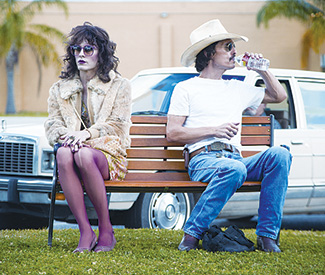
Dallas Buyers Club (Jean-Marc Vallée, US) Jared Leto appears in person for this screening of Jean-Marc Vallée’s well-crafted, based-on-true events drama about the early days of the AIDS epidemic, specifically focusing on the struggles patients faced in getting safe, effective medication. Leto, who has lately been focusing on his music career, has a standout supporting turn as Rayon, a transgender woman who loves Marc Bolan, gowns, and sparring with business partner Ron Woodroof (Matthew McConaughey). Look for Leto and McConaughey — the best he’s ever been, as a good ol’ boy and confirmed homophobe who becomes an activist and agitator after contracting HIV — to earn plenty of notice come awards season. Oct 10, 6:30pm, Smith Rafael. (Eddy)

At Middleton (Adam Rodgers, US) Star and co-producer Andy Garcia will be on hand for the local premiere of this romantic comedy co-starring Vera Farmiga. They play strangers paying introductory visits to the titular (fictive) college with offspring on the brink of leaving home and starting independent adult lives. Everyone is temperamentally ill-matched — jokester mom with humorless daughter, persnickety dad with laid-back son — but during the course of the day strolling around campus, frissons of romance and new self knowledge occur on both sides of the generation gap. Adam Rodgers’ feature is pleasant but a little too pat, relying overmuch on the appeal of lead actors who’ve been better served elsewhere. Oct 12, 5pm, and Oct 13, 11:15am, Sequoia. (Harvey)

All is Lost (J.C. Chandor, US) As other reviewers have pointed out, All is Lost‘s nearly dialogue-free script (OK, there is one really, really well-placed “Fuuuuuck!”) is about as far from J.C. Chandor’s Oscar-nominated script for 2011’s Margin Call as possible. Props to the filmmaker, then, for crafting as much pulse-pounding magic out of austerity as he did with that multi-character gabfest. Here, Robert Redford plays “Our Man,” a solo sailor whose race to survive begins along with the film, as his boat collides with a hunk of Indian Ocean detritus. Before long, he’s completely adrift, yet determined to outwit the forces of nature that seem intent on bringing him down. The 77-year-old Redford turns in a surprisingly physical performance that’s sure to be remembered as a late-career highlight. Oct 12, 3:30pm, Smith Rafael; Oct 13, 8:15pm, Sequoia. (Eddy)

The Missing Picture (Rithy Panh, Cambodia/France) Rithy Panh’s latest film about the homeland he fled as a teenager is atypically, directly autobiographical, and most unusually crafted. He re-creates his once comfortable Phnom Penh family’s grim fate after Pol Pot and company seized control of Cambodia in 1975 — as all fell prey to the starvation, forced labor, and other privations suffered by perceived “enemies” of the new regime — not by any conventional means but via elaborate dioramas of handmade clay figures depicted in prison camp life (and death). There’s also ample surviving propagandic footage of the Khmer Rouge trumpeting its “model society” that was in reality little more than an experiment in mass execution and torture. The result is a unique and powerful take on one of the 20th century’s worst crimes against humanity. Oct 12, 4:45pm, Lark; Oct 13, 5:30pm, Smith Rafael. (Harvey) *

The 36th Mill Valley Film Festival runs Oct. 3-13 (most shows $12.50-$14). Major venues are the Christopher B. Smith Rafael Film Center, 1118 Fourth St, San Rafael; Cinéarts@Sequoia, 25 Throckmorton, Mill Valley; Lark Theater, 549 Magnolia, Larkspur; and 142 Throckmorton Theater, 142 Throckmorton, Mill Valley. Complete schedule at www.mvff.com.

City chicken

0

marke@sfbg.com

SUPER EGO Where are the monkeys? Where are all the freakin’ monkeys?

If you’re a fan of Claude Vonstroke and his prolific dirtybird label — and there are millions of us now — that question might come howling to the fore after your first listen to nifty new album Urban Animal, his third. Vonstroke’s subversively relatable sound is so distinct that as soon as one of the tones of his sui generis sonic palette drops out — hooting monkeys, timpani rolls, zippy whistles, jungle beats, brass interjections, goofy bird puns, calliope synths, sly drops — you begin to wonder if bass music’s über-huggable jester has gotten all introspective on us.

No fear of that, although he has adopted a new way of working: “I didn’t even notice the chimps were missing,” Claude told me with a laugh on the phone from LA, where he’s currently staying (although he still considers SF his home). “But I did make this album in different way in general. Before, I would obsess about one track at a time until it was finished. But now I put down ideas as they come to me and mix them all together — a bass line from here, a drum track from there — from about 20 open folders. It worked out so much better that way.”

Thanks goddess for Vonstroke: he’s our biggest DJ export after Kaskade and Bassnectar — huge enough to play more mainstream gigs like Electric Daisy and HARD, yet his sound is so singular (and brilliant) that massive fest promoters don’t quite know what to do with him. “They usually give us our own space,” Vonstroke chuckles. “So much better than being sandwiched between a post-dubstep duo and a pop-EDM act and wondering what the hell to play.”

But more than that, he and his dirtybird crew bring an almost perfect version of the one thing dance music often gets horribly wrong: wit. They have an endlessly inventive way of mixing booty music’s delicious vulgarity with gorgeous production and a smart dose of melancholy to create a thoughtful, monumental running joke on the dance floor.

The sense of humor remains intact on Urban Animal. Despite lovely cover art collaging the industrial buildings of his Detroit youth into beautiful beasts, and pretty, spaced-out tracks like “The Bridge” and “Can’t Wait,” Vonstroke still buffs your funny bone.

Consider the pumping, woozy, operatic chipmunk-climaxing “Dood”: “I wanted to make a stoned California surfer track, but then the aliens got in there, and it went this kind of ‘beam me up’ way. Like that one friend on the couch at parties always saying ‘Dude, you won’t believe this thing that happened…’ and it’s actually a crazy thing that happened,” Claude told me.

Even the lilting, expansive “Can’t Wait” has its origins in a funny, familiar club moment. “I was outside a party in Ibiza” — where dirtybird just wrapped up a longtime party residency — “and this absolutely breathtaking track started to play as the sun came up. I still don’t know, don’t really want to know, the name of the track. But I resolved I would create something like it if I could. Kind of as a way of passing on that feeling.” (If it weren’t such a part of his DJ repertoire, I’d say that track was Andre Lodemann’s “Where Are You Now?”)

After wrapping up in Ibiza — an endeavor which, added to his monthly parties here at Mezzanine, a hectic appearance schedule, label duties, and mucho recording, sounds exhausting — Claude’s taking a break with his new family down south before hitting town to kick off the Urban Animal tour Fri/4 at the Regency Ballroom (9pm-late, $25–$30. 1290 Sutter, SF. www.theregencyballroom.com), and to spin at SF’s first installment of the great Boiler Room streaming live DJ series.

Expect no bells and whistles beyond those found in the stunning music, however. “Don’t worry, I’m not going to parachute in during a storm of lasers and fire canons,” Claude assures me. “We’re not the kind of ‘big DJs’ who have all these ’90s cartoons or my own name scrolling across humungous screens. I never really understood why you would want to make your party like watching a giant television. It should be about dancing.”


Quiet powerful

1

arts@sfbg.com

DANCE Considering its name — Hush — it should have come as no surprise that Joe Goode’s latest look at the ultimate loneliness that infects us all, whether imposed or self-inflicted, is a very quiet piece. Being hushed is something we learn as babies, at the family table, in school, and at the movies. But more seriously, it becomes an essential tool for survival for those who may be perceived as “different.”

At barely an hour, Hush is another variation on a theme that has threaded itself through Goode’s works since the beginning. Unfortunately, unless you are a romantic or naïve, being on the outside happens to be a quintessential human condition. Goode approaches it from the particular perspective of a gay man. It’s his genius that he manages to frequently mine that driving concern for new and convincing theatrical expressions — a quality that distinguishes art from advocacy.

Hush feels like chamber music. It’s condensed, tight, and weaves a spell like a spider’s web. The tone is subdued, and there’s a film noir quality to Erik Flatmo’s set, with its half-empty bar. You can practically smell stale beer. Foley artist Sudhu Tewari’s brilliant sound effects suffuse this environment with a hyper-real vibe — somewhere between a comic strip and the proverbial nails on a chalkboard board.

While Goode doesn’t perform himself, you can hear him in the language for his characters, which is drawn from interviews with him (a practice he already used in last year’s When We Fall Apart). His own voice comes through most explicitly in Hush’s songs, some of whose lyrics were printed in the program. I do wish we had been given access to all of them.

But Hush can also feel like a musical in which dance stays subsidiary to other theatrical aspects. At its strongest, it takes over in ways that words cannot.

The piece focuses on two characters, portrayed by Melecio Estrella as a “sissy boy,” and Damara Vita Ganley, as a woman whose “body got touched on places I didn’t want to.” Neither of these creations accept victimhood. They refuse to be hushed. Both performers are accomplished actor-dancers who were a joy to watch every second they were on stage, and they happen to also be the company’s best singers. At first Estrella is hardly able to get a sound out in the bar’s open mic, but he learns quickly. Finally, he stands up to his bullying tormentors and spits out a lengthy scholarly disquisition on sexuality and asexuality that sounded like it was straight out of an academic paper. I have no idea whether this was science or imagination, but Estrella was magnificent in a feat of rhetoric that could not be ignored and ultimately empowered him.

Putting a rape scene on stage is probably the most daring thing Goode has done. I dreaded the prospect. On her way home — the road she follows looks like something out of The Wizard of Oz — Ganley drops her purse, stops to pick up a flower (a sentimental touch), and is attacked by three hooded individuals. In the choreography, performed in silence if I remember correctly, she gets lifted, pulled, yanked, and stretched for a considerable amount of time. In the end she picks up her purse and walks home, her heels clacking in the night. Later on, the laconic give-and-takes between her and Andrew Ward, who tries to help, beautifully suggests a relationship based on mutual respect.

Elsewhere, a gorgeous duet between Estrella and Felipe Barrueto-Cabello called up an increasingly passionate love affair. It started out with almost accidental touches and withdrawals — Barrueto-Cabello is a master of reticence — but gradually built into a tempestuous encounter when, the men having stripped off their undershirts, you couldn’t quite tell any more who was who.

If I have one regret about Hush is that the stories of the other characters were not more developed: Jessica Swanson as the driven career woman, Ward’s sympathetic bartender-listener, Alexander Zendzian’s vegetable lover, and Barrueto-Cabello’s moonstruck lover. The scene between the careerist Swanson and the pickle-making Zendzian — thank you, sound designer Tewari — sparkled with humor, but it just was too cartoonish to become emotionally resonant.

Hush ends with a rousing, operatic finale, a song-and-dance number in which the cast proclaimed its determination to be silenced no longer. No question that’s a welcome thought — but given the complexities of the issues involved, it also felt a little too much like Broadway. *

HUSH

Thu/3-Fri/4, 8pm; Sat/5, 7 and 9pm, $15-$70

Z Space

450 Florida, SF

www.joegoode.org


Whales protected from ships in SF Bay

0

Whales and marine mammals in the San Francisco Bay and along the California coast are being protected by new policies that will help prevent them from being struck by ships, including new shipping policies and a whale tracker application.

An increasing number of deadly interactions between whales and ships drew attention in 2010 when at least five whales that had been struck by ships beached themselves and died. But that is thought to be only a small indicator of a much larger problem.

“According to experts, only about 10 percent of whales killed by strikes show up on beaches,” lead researcher Dr. Jamie Jahncke of Point Blue Conservation Society, which has been working with the Coast Guard on ways to make the bay safer for whales, told us.

The Coast Guard implemented narrower and longer shipping lanes beginning June 1 in San Francisco Bay, as well as in Los Angeles and Long Beach, in an attempt to reduce the number of whale strikes in these regions. The Coast Guard has also begun directing ships to reduce their speed when entering and exiting the bay to no more than 10 knots.

The purpose of the change in the shipping lanes is to keep ships out of primary whale habitats and other areas where they are typically found. Jahncke believes these changes will reduce the interaction between whales and ships by 70 percent.

Both Jahncke and Melissa Pitkin, also of Point Blue, see these new policies as a good thing.

Jahncke called the changes “very positive” and added they are good “for human safety and benefit wildlife as well.”

Pitkin says the Coast Guard “has been a great participant” and part of a “great collaborative effort” to make waters like San Francisco Bay safer for the whales.

While the new shipping lanes keep ships out of areas in which whales are most commonly found, the animals do not confine themselves to only those parts of the bay. Researchers go out on the bay to collect information on where the whales go and congregate, but they are only out there three to five weeks out of the year.

This is why, Jahncke says, they “need additional help… [and] eyes out on the water.”

Researchers have been seeking ways to further reduce the chances of ships striking whales in San Francisco Bay. They have recently decided to enlist the public’s help with the implementation of the new Whale Spotter app, which will allow anyone out on the water to report where they see whales.

The hope is that whale watchers, recreational fishers, and others will use the app to report any whale sightings. Point Blue will then be able to use the information provided via the app to “make maps and represent the data in a way NOAA can use it,” says Jahncke.

Pitkin said, “The goal is to get information available in real-time to mariners about where whale concentrations are so they know” how to alter their course or speed.

The app is not the only way members of the public can join in the efforts to protect local whales. Point Blue is seeking financial contributions to aid its effort to raise funds for the app and ongoing marine research. People can visit www.prbo.org to make a donation.

Meanwhile, on Sept. 25, a federal judge ruled the National Marine Fisheries Service failed to protect thousands of whales, dolphins, sea lions, seals, and porpoises from US Navy training exercises along the Pacific coast. It requires the agency to reconsider permits and whether exercises violated the Endangered Species Act. The case was filed by Earthjustice, whose attorney Steve Mashuda said, “This is a victory for dozens of protected species of marine mammals, including critically endangered Southern Resident orcas, blue whales, humpback whales, dolphins, and porpoises.”

Industrial hemp legalized in California

0

After being stuck in legislative limbo for 14 years, industrial hemp will soon be a legally sanctioned agricultural crop in the state of California.

The California Industrial Hemp Farming Act (SB 566) was signed into law by Gov. Jerry Brown on Sept. 25, ending years of deliberation dating back to 1999, a process that included multiple gubernatorial vetoes. The freshly signed law will allow approved California residents to grow hemp for industrial purposes by reclassifying the once-felonious plant as a “fiber or oilseed crop.”

SB 566, a bill championed since 2005 by Sen. Mark Leno (D-SF), defines industrial hemp as the “nonpsychoactive types of the plant Cannabis saliva L. and the seed produced therefrom, having no more than 3/10 of 1 percent of tetrahydrocannabinol (THC) contained in the dried flowering tops.”

In simpler terms: It doesn’t protect marijuana, but rather marijuana’s less mind-bending cousin, which is far more useful as a raw industrial material.

“We are very pleased to have the signature,” Sen. Leno told the Guardian. “It’s been a 10-year effort to get here. It’s a job still, but [the passing of SB 566] will help sustain family farms in California for the future and likely create more job opportunities. Hemp is a $500 million a year industry in California, and it’s growing at 10 percent annually.”

California now follows in the footsteps of nine other states and 30 other countries that have reclassified the innocuous plant as a crop with agricultural and commercial value. And it is quite valuable.

“This is a miracle plant that has served the planet Earth well for, literally, millennia, and that we currently legally manufacture and sell thousands of hemp products including food, clothing, shelter, paper, fuel, all biodegradable products,” said Leno. “It’s renewable every 90 days, grows without herbicides, pesticides and fungicides, and needs less water than corn. It is the definition of sustainability.”

But the reputation of hemp hasn’t always had champions like Leno. Since the initial proposal of Assembly House Resolution 32 back in 1999, the legislation has been vetoed four times by three different governors. Former Gov. Arnold Schwarzenegger cited a “false sense of security” he feared would be cultivated among the growers of the crop, due to its illegality at a federal level.

Gov. Brown had previously shot down the proposed legislation in 2011, citing a gap in state and federal law as the reason. However, he did remark in his veto message at the time that “it is absurd that hemp is being imported into the state, but our farmers cannot grow it.”

And it would seem that Brown’s recognition of hemp’s merits finally outweighed his concern over the potential for California growers to face federal prosecution, which is a major relief for the architects of SB 566. Now Californians can stop relying on imported hemp from Mexico and Canada (among other places) and start legally manufacturing their own.

“We currently manufacture literally thousands of [hemp] products — legally — and sell them,” said Leno. “This is why this issue has been so nonsensical.”

The “nonsensical” issue has had deep roots, given hemp’s historically ambiguous federal standing. As Brown’s 2011 veto message noted, “federal law clearly establishes that all cannabis plants, including industrial hemp, are marijuana, which is a federally regulated controlled substance.”

But that isn’t a universally held assertion. Back in 1970, the Ninth Circuit Court of Appeals ruled that the federal Controlled Substances Act of 1970 “explicitly excludes nonpsychoactive hemp from the definition of marijuana,” a decision that the federal government never appealed. It’s a decision that Leno agrees with.

“We’ve always believed that there is no federal preemption, because we believe that that court case ruled that Congress had knowingly exempted industrial hemp from the Controlled Substances Act of 1970 –because it’s not a drug,” said Leno.

Now the state of California can do what more than 30 countries (including Canada, Great Britain, France, Germany, and China) and nine states are already doing: cultivating and processing a plant that many have touted as the “miracle plant.”

Now that SB 566 has passed, however, the looming question still remains as to how the federal government will respond. But Leno is confident that it will respect the will of California lawmakers.

“I have great confidence in a recent statement by Attorney General Eric Holder,” said Leno. “He’s said that if a state puts into place a legal allowance and regulatory scheme, that the federal government would not interfere with marijuana. Now, we need clarification between hemp and marijuana, but there’s no sensical way that that could be interpreted that hemp is excluded, given that hemp’s not a drug.”

Either way, hemp is on the horizon here in California.

Community not criminalization

8


By María Poblet

OPINION San Francisco is poised to break ground in defense of immigrants, an important step towards turning the tide against the criminalization of communities of color.

In a unanimous vote on September 24, the Board of Supervisors supported a due process ordinance that, after final approval, will reduce deportations by setting strict limits on collaboration between federal immigration enforcement and local authorities. Our city will make history by refusing to implement the federal Secure Communities program, which allows US Immigration and Customs Enforcement (ICE) to request an immigration hold detention without cause, regardless of immigration status, at local expense.

This victory didn’t trickle down like fog from the “progressive Bay Area bubble.” It was hard fought, from the bottom up. Immigrant and undocumented people most impacted by the problems led the fight, and they built a movement too strong to ignore. Causa Justa::Just Cause helped organize the groundswell, as part of the San Francisco Immigrant Rights Defense Committee, a broad grassroots collaboration. We had support from progressive champions John Avalos, Eric Mar, David Campos, and five additional co-sponsors on the board.

This movement builds on the fights in the 1980s to make San Francisco a Sanctuary City, welcoming survivors of the wars in Central America. We build on the fights in the ’90s to re-commit to those values in the face of a new wave of migration, when economic refugees arrived, fleeing the hunger caused by US-imposed Free Trade Agreements. We build on the very personal fights of everyday people, like a woman we’ll call Silvia, a domestic violence survivor who met with the District Attorney repeatedly, demanded that he lead those meetings in Spanish so she could participate fully, advocated for herself and her community, and ultimately won his commitment of support for this ordinance. This victory belongs to the hundreds of community leaders who, like Silvia, overcame intimidation, organized their families and neighbors, and showed our elected officials the way forward.

In a national context, where states like Georgia, Alabama and Arizona hunt down immigrants, we in California, a majority immigrant, majority people of color state, have the opportunity, and the responsibility, to follow Silvia’s leadership. It’s time to reject criminalization, and build community.

Every time there’s a new way to label someone a “criminal,” more families and communities are torn apart. Millions of black and Latino people are behind bars already, thanks to criminalization policies like the war on drugs, structural unemployment, decades of divestment from working class communities, and racial discrimination. Creating new immigration violations only makes that problem worse, trapping whole new sectors of our society in the prison dragnet. This advance in San Francisco should inspire our state as a whole not only to reject S-Comm, but also to take bold action to address the profoundly problematic prison system, and challenge the racism and poverty it depends on.

But, for our state to stand up like that is going to take a serious transformation. Gov. Jerry Brown recently announced plans to expand the prison system with revenues from Prop. 30 — the grassroots progressive tax passed last year to support public schools and social services. Causa Justa::Just Cause, as part of California Calls, through SF Rising and Oakland Rising, was one of hundreds of community groups that helped pass this progressive tax. We are outraged to see the governor literally betting on the criminalization of the next generation, with money that was supposed to support their success.

Policies like S-Comm manufacture the need for more detention facilities, ultimately benefitting corporate interests like the GEO private prison group. Its lucrative business depends on criminalization, and a culture of fear. If politicians aren’t brave enough to survive the accusation that they are “soft on crime” in order to champion real change, then we the people will have to take it into our own hands. Immigrant communities, black communities, communities of color, and poor communities need to keep building the solidarity and the movement that will allow us to win, from San Francisco to Sacramento to DC. There is much more to be done, and we can only do it together.  

María Poblet is executive director of Causa Justa::Just Cause.

Rights and wrongs

11

news@sfbg.com

On a February evening in 2011, Derrick Walls ran into a friend at a bus stop near Third Street and Palou Avenue in the Bayview. Walls was headed to view a used car he thought he might be interested in buying. The men chatted briefly and, as the 44 bus rolled into sight, Walls shook his friend’s hand to say goodbye.

Seconds after they parted ways, a police cruiser passing on the other side of the street pulled a U-turn, screeched to a halt, and discharged police officers who quickly apprehended both men.

“I guess they thought they saw something,” recalled 43-year-old Walls. “I was just talking to my friend. I was going to leave because the bus was coming and I shook his hand to say ‘see you later’ and I guess the cops saw that and thought it was a transaction.”

The officers searched both men at the site. Their discovery of cash on Walls and drugs on the other man seemed to confirm that they had just witnessed a drug deal. The $1,680 Walls had saved up for a new car was alleged to be the sale’s proceeds and confiscated on the spot as evidence.

Later on at the station, a strip search of Walls yielded no evidence of drug possession or intent to sell. His friend copped to the drug charge but confessed that he’d purchased his stash elsewhere — not from Walls.

Three days later, Walls was released from custody and all charges against him were dropped. Two and a half years later, however, the city still has his money.

“I never went to court or anything,” recalled Walls. “You would think they would just give my money back right then. But they told me to go to [the civil courthouse on] McAllister Street to some other people.”


TWICE WRONGED

How assets seized in a criminal investigation migrate from the jailhouse to the civil courthouse — and how those wrongfully accused of crimes can get their money back — is not always clear.

“The state has such incredible power to wield and people have very little recourse,” says attorney Nick Gregoratos with Prisoner Legal Services, a division of the San Francisco Sheriff’s Department that helps the accused assert their rights.

San Francisco Police Department spokesperson Gordon Shyy would say only that the police follow the Department of Justice’s Asset Forfeiture Policy Manual and that they “don’t seize assets on the street, they take things as evidence.”

But that “evidence” often stays in the bank accounts of police or prosecutors, subsidizing their operations. DOJ guidelines say that when assets from a criminal investigation cease to have evidentiary value, they can be returned through an administrative or civil process.

“Approximately half the time, people contest the amount or contest it in its entirety,” said Assistant District Attorney Alex Bastian, who estimates that the San Francisco District Attorney’s Office handles 200 to 250 asset forfeiture cases per year.

“There are certain situations where if a charge is dropped, there is still, in fact, a forfeiture proceeding that goes forward,” Bastian explained. “There’s a criminal proceeding beyond a reasonable doubt and the civil [case] is a preponderance of evidence and the burden of proof is on the party contesting the forfeiture.”

Contesting an asset seizure can be difficult if the claimant is incarcerated or poor. Regulations seem designed to induce fatigue and resignation in those without a lawyer and the costs associated with retaining a lawyer often exceed the amount of money seized in the first place. In some cases, claimants have a right to court-appointed counsel, but they aren’t made aware of that fact.

Gregoratos represented Walls and has, over the years, worked with many others like him who have been deprived of their property without due process.

Gregoratos described another client who had cash seized by police as she was on her way to purchase a money order in SoMa to pay her rent. She was arrested on suspicion of drug sales, but there wasn’t enough evidence to support any charges against her.

The woman was instructed to file a claim within a month to get her money back. But she filed at the criminal rather than the civil court and administrators there waited until just before 30 days were up to notify the woman of her error.

The following morning, her $1,500 was considered officially forfeited because she had statutorily defaulted on her right to file claim.

“There would have been no way that they could have taken her money other than that she couldn’t figure out how to navigate the system and didn’t know her rights,” said Gregoratos, who later filed a motion opposing the default. “Essentially, she’s being precluded from having any judicial review.”


STACKED DECK

Many forfeiture cases unfold similarly, with the government capturing assets through a series of bureaucratic mechanisms stacked against individuals. Claimants are faced unexpectedly with the burden of proof that assets were lawfully obtained, even when law enforcement wasn’t able to meet that burden against them.

Often “the case is handled completely by the [prosecutorial] agency. There’s no judge, no hearing, no evidence, no appeal. So many people still lose by default,” commented Brenda Grantland, a Marin attorney who has fought government seizures for more than 30 years.

Civil asset forfeiture has a long and controversial history in the United States. In the Revolutionary War era, the British were known to impound the property of colonists who had fallen out of favor with the crown, without proof of guilt.

In the War on Drugs, forfeiture gained popularity as a way to strangle the financial channels underlying trafficking operations while providing a funding source for the law enforcement agencies that waged that war.

“The law is so complicated and the agencies are motivated to win these cases because it brings in money to their bank accounts. And they’re hooked on the money now. And the more money they get, the more corrupt they get,” said Grantland, who is president of the Forfeiture Endangers American Rights (FEAR) Foundation.

In 2010, the most recent year for which the California Department of Justice reported asset forfeiture statistics, San Francisco seized $391,643 in 115 separate actions completed in the city. Between 2002 and 2010, it seized nearly $6.5 million.

In most states, asset forfeitures follow federal regulations. In California, the Health and Safety Code dictates that 65 percent of assets forfeited are distributed to the local law enforcement agency responsible for the seizure, while 10 percent go to the prosecuting agency that processed the action and 1 percent go to train those who profit from forfeitures in the ethical application of related laws.

But Grantland says that training has done little to deter a “grab first, ask questions later,” approach. Critics have argued that the practice presents challenges to both the Fourth and 14th Amendments.


SCAMMING THE POOR

Police “don’t have to find any evidence of crime,” Grantland told us. “They have dogs that pretend to be clairvoyant. It’s all a hoax. I don’t care how much they’ve tested and trained those dogs, they can’t possibly know that’s drug money.”

Contrary to its original purpose, civil forfeitures at the local level tend to disproportionately target small-time offenders. Of the seizures completed in San Francisco in 2010, nearly half yielded under $1,000 and one as little as $242. More than three-quarters of forfeitures involved less than $2,000.

“They’re getting money from the weakest, poorest class of people,” Grantland said. “When you seize $500 or $600 every few minutes, it adds up pretty quickly.”

Though the San Francisco Police Department was the beneficiary of $254,568 in 2010 alone, SFPD’s Shyy denied that revenue from forfeitures — which funds equipment purchases, education, and training — influences its policies or tactics.

“If someone has a large amount of cash, we can’t just take it from them. That’s considered robbery,” Shyy said. But that’s pretty much what happened to Walls. “If I did that to somebody on street like that, I’d be in jail,” he said. “But they can just do it to me.”

In the last two years, Walls has complied with all the court’s discovery requests to prove the cash taken from him was lawfully obtained. He has provided paystubs from a longshoreman’s job he has held for eight years at the Port of Oakland.

Gregoratos said that the court “has people over a barrel” and will likely hold Walls’ cash for a full three years. The District Attorney has the option of re-filing a notice of forfeiture until the statute of limitations on the original criminal action is up.

“How are you going to re-file on something that was thrown out? That’s just an excuse to keep my money for a whole ‘nother year,” Walls argued. “I did everything I was supposed to do and they still haven’t given back my money.”

Endorsements 2013

125

We’re heading into a lackluster election on Nov. 5. The four incumbents on the ballot have no serious challengers and voter turnout could hit an all-time low. That’s all the more reason to read up on the issues, show up at the polls, and exert an outsized influence on important questions concerning development standards and the fate of the city’s waterfront, the cost of prescription drugs, and the long-term fiscal health of the city.


PROP. A — RETIREE HEALTH CARE TRUST FUND

YES

Note: This article has been corrected from an earlier version, which incorrectly stated that Prop A increases employee contributions to health benefits.

Throughout the United States, the long-term employee pension and health care obligations of government agencies have been used as wedge issues for anti-government activists to attack public employee unions, even in San Francisco. The fiscal concerns are real, but they’re often exaggerated or manipulated for political reasons.

That’s one reason why the consensus-based approach to the issue that San Francisco has undertaken in recent years has been so important, and why we endorse Prop. A, which safeguards the city’s Retiree Health Care Trust Fund and helps solve this vexing problem.

Following up on the consensus pension reform measure Prop. B, which increased how much new city employees paid for lifetime health benefits, this year’s Prop. A puts the fund into a lock-box to ensure it is there to fund the city’s long-term retiree health care obligations, which are projected at $4.4 billion over the next 30 years.

“The core of it says you can’t touch the assets until it’s fully funded,” Sup. Mark Farrell, who has taken a lead role on addressing the issue, told us. “The notion of playing political football with employee health care will be gone.”

The measure has the support of the entire Board of Supervisors and the San Francisco Labor Council. Progressive Sup. David Campos strongly supports the measure and he told us, “I think it makes sense and is something that goes beyond political divides.”

There are provisions that would allow the city to tap the fund in emergencies, but only after it is fully funded or if the mayor, controller, the Trust Board, and two-thirds of the Board of Supervisors signs off, a very high bar. So vote yes and let’s put this distracting issue behind us.


PROP. B — 8 WASHINGTON SPECIAL USE DISTRICT

NO, NO, NO!

Well-meaning people can arrive at different conclusions on the 8 Washington project, the waterfront luxury condo development that was approved by the Board of Supervisors last year and challenged with a referendum that became Prop. C. But Prop. B is simply the developer writing his own rules and exempting them from normal city review.

We oppose the 8 Washington project, as we explain in our next endorsement, but we can understand how even some progressive-minded people might think the developers’ $11 million affordable housing and $4.8 million transit impact payments to the city are worth letting this project slide through.

But Prop. B is a different story, and it’s something that those who believe in honesty, accountability, and good planning should oppose on principle, even if they support the underlying project. Contrary to the well-funded deceptions its backers are circulating, claiming this measure is about parks, Prop. B is nothing more than a developer and his attorneys preventing meaningful review and enforcement by the city of their vague and deceptive promises.

It’s hard to know where to begin to refute the wall of mendacity its backers have erected to fool voters into supporting this measure, but we can start with their claim that it will “open the way for new public parks, increased access to the Embarcadero Waterfront, hundreds of construction jobs, new sustainable residential housing and funding for new affordable housing.”

There’s nothing the public will get from Prop. B that it won’t get from Prop. C or the already approved 8 Washington project. Nothing. Same parks, same jobs, same housing, same funding formulas. But the developer would get an unprecedented free pass, with the measure barring discretionary review by the Planning Department — which involves planners using their professional judgment to decide if the developer is really delivering what he’s promising — forcing them to rubber-stamp the myriad details still being developed rather than acting as advocates for the general public.

“This measure would also create a new ‘administrative clearance’ process that would limit the Planning Director’s time and discretion to review a proposed plan for the Site,” is how the official ballot summary describes that provision to voters.

Proponents of the measure also claim “it empowers voters with the decision on how to best utilize our waterfront,” which is another deception. Will you be able to tweak details of the project to make it better, as the Board of Supervisors was able to do, making a long list of changes to the deal’s terms? No. You’re simply being given the opportunity to approve a 34-page initiative, written by crafty attorneys for a developer who stands to make millions of dollars in profits, the fine details of which most people will never read nor fully understand.

Ballot box budgeting is bad, but ballot box regulation of complex development deals is even worse. And if it works here, we can all expect to see more ballot measures by developers who want to write their own “special use district” rules to tie the hands of planning professionals.

When we ask proponents of this measure why they needed Prop. B, they claimed that Prop. C limited them to just talking about the project’s building height increases, a ridiculous claim for a well-funded campaign now filling mailers and broadcast ads with all kinds of misleading propaganda.

With more than $1 million and counting being funneled into this measure by the developer and his allies, this measure amounts to an outrageous, shameless lie being told to voters, which Mayors Ed Lee and Gavin Newsom have shamefully chosen to align themselves with over the city they were elected to serve.

As we said, people can differ on how they see certain development deals. But we should all agree that it’s recipe for disaster when developers can write every last detail of their own deals and limit the ability of professional planners to act in the public interest. Don’t just vote no, vote hell no, or NO, No, no!


PROPOSITION C — 8 WASHINGTON REFERENDUM

NO

San Francisco’s northeastern waterfront is a special place, particularly since the old Embarcadero Freeway was removed, opening up views and public access to the Ferry Building and other recently renovated buildings, piers, and walkways along the Embarcadero.

The postcard-perfect stretch is a major draw for visiting tourists, and the waterfront is protected by state law as a public trust and overseen by multiple government agencies, all of whom have prevented development of residential or hotel high-rises along the Embarcadero.

Then along came developer Simon Snellgrove, who took advantage of the Port of San Francisco’s desperate financial situation, offered to buy its Seawall Lot 351 and adjacent property from the Bay Club at 8 Washington St., and won approval to build 134 luxury condos up to 12 stories high, exceeding the city’s height limit at the site by 62 percent.

So opponents challenged the project with a referendum, a rarely used but important tool for standing up to deep-pocketed developers who can exert an outsized influence on politicians. San Franciscans now have the chance to demand a project more in scale with its surroundings.

The waterfront is supposed to be for everyone, not just those who can afford the most expensive condominiums in the city, costing an average of $5 million each. The high-end project also violates city standards by creating a parking space for every unit and an additional 200 spots for the Port, on a property with the best public transit access and options in the city.

This would set a terrible precedent, encouraging other developers of properties on or near the waterfront to also seek taller high-rises and parking for more cars, changes that defy decades of good planning work done for the sensitive, high-stakes waterfront.

The developers would have you believe this is a battle between rival groups of rich people (noting that many opponents come from the million-dollar condos adjacent to the site), or that it’s a choice between parks and the surface parking lot and ugly green fence that now surrounds the Bay Club (the owner of which, who will profit from this project, has resisted petitions to open up the site).

But there’s a reason why the 8 Washington project has stirred more emotion and widespread opposition that any development project in recent years, which former City Attorney Louise Renne summed up when she told us, “I personally feel rich people shouldn’t monopolize the waterfront.”

A poll commissioned by project opponents recently found that 63 percent of respondents think the city is building too much luxury housing, which it certainly is. But it’s even more outrageous when that luxury housing uses valuable public land along our precious waterfront, and it can’t even play by the rules in doing so.

Vote no and send the 8 Washington project back to the drawing board.


PROP. D — PRESCRIPTION DRUG PURCHASING

YES

San Francisco is looking to rectify a problem consumers face every day in their local pharmacy: How can we save money on our prescription drugs?

Prop. D doesn’t solve that problem outright, but it mandates our politicians start the conversation on reducing the $23 million a year the city spends on pharmaceuticals, and to urge state and federal governments to negotiate for better drug prices as well.

San Francisco spends $3.5 million annually on HIV treatment alone, so it makes sense that the AIDS Healthcare Foundation is the main proponent of Prop. D, and funder of the Committee on Fair Drug Pricing. Being diagnosed as HIV positive can be life changing, not only for the health effects, but for the $2,000-5,000 monthly drug cost.

Drug prices have gotten so out-of-control that many consumers take the less than legal route of buying their drugs from Canada, because our neighbors up north put limits on what pharmaceutical companies can charge, resulting in prices at least half those of the United States.

The high price of pharmaceuticals affects our most vulnerable, the elderly and the infirm. Proponents of Prop. D are hopeful that a push from San Francisco could be the beginning of a social justice movement in cities to hold pharmaceutical companies to task, a place where the federal government has abundantly failed.

Even though Obamacare would aid some consumers, notably paying 100 percent of prescription drug purchases for some Medicare patients, the cost to government is still astronomically high. Turning that around could start here in San Francisco. Vote yes on D.


ASSESSOR-RECORDER

CARMEN CHU

With residential and commercial property in San Francisco assessed at around $177 billion, property taxes bring in enough revenue to make up roughly 40 percent of the city’s General Fund. That money can be allocated for anything from after-school programs and homeless services to maintaining vital civic infrastructure.

Former District 4 Sup. Carmen Chu was appointed by Mayor Ed Lee to serve as Assessor-Recorder when her predecessor, Phil Ting, was elected to the California Assembly. Six months later, she’s running an office responsible for property valuation and the recording of official documents like property deeds and marriage licenses (about 55 percent of marriage licenses since the Supreme Court decision on Prop. 8 have been issued to same-sex couples).

San Francisco property values rose nearly 5 percent in the past year, reflecting a $7.8 billion increase. Meanwhile, appeals have tripled from taxpayers disputing their assessments, challenging Chu’s staff and her resolve. As a district supervisor, Chu was a staunch fiscal conservative whose votes aligned with downtown and the mayor, so our endorsement isn’t without some serious reservations.

That said, she struck a few notes that resonated with the Guardian during our endorsement interview. She wants to create a system to automatically notify homeowners when banks begin the foreclosure process, to warn them and connect them with helpful resources before it’s too late. Why hasn’t this happened before?

She’s also interested in improving system to capture lost revenue in cases where property transfers are never officially recorded, continuing work that Ting began. We support the idea of giving this office the tools it needs to go out there and haul in the millions of potentially lost revenue that property owners may owe the city, and Chu has our support for that effort.


CITY ATTORNEY

DENNIS HERRERA

Dennis Herrera doesn’t claim to be a progressive, describing himself as a good liberal Democrat, but he’s been doing some of the most progressive deeds in City Hall these days: Challenging landlords, bad employers, rogue restaurants, PG&E, the healthcare industry, opponents of City College of San Francisco, and those who fought to keep same-sex marriage illegal.

The legal realm can be more decisive than the political, and it’s especially effective when they work together. Herrera has recently used his office to compel restaurants to meet their health care obligations to employees, enforcing an earlier legislative gain. And his long court battle to defend marriage equality in California validated an act by the executive branch.

But Herrera has also shown a willingness and skill to blaze new ground and carry on important regulation of corporate players that the political world seemed powerless to touch, from his near-constant legal battles with PG&E over various issues to defending tenants from illegal harassment and evictions to his recent lawsuit challenging the Accreditation Commission of Community and Junior Colleges over its threats to CCSF.

We have issues with some of the tactics his office used in its aggressive and unsuccessful effort to remove Sheriff Ross Mirkarimi from office. But we understand that is was his obligation to act on behalf of Mayor Ed Lee, and we admire Herrera’s professionalism, which he also exhibited by opposing the Central Subway as a mayoral candidate yet defending it as city attorney.

“How do you use the power of the law to make a difference in people’s lives every single day?” was the question that Herrera posed to us during his endorsement interview, one that he says is always on his mind.

We at the Guardian have been happy to watch how he’s answered that question for nearly 11 years, and we offer him our strong endorsement.


TREASURER/TAX COLLECTOR

JOSE CISNEROS

It’s hard not to like Treasurer/Tax Collector Jose Cisneros. He’s charming, smart, compassionate, and has run this important office well for nine years, just the person that we need there to implement the complicated, voter-approved transition to a new form of business tax, a truly gargantuan undertaking.

Even our recent conflicts with Cisneros — stemming from frustrations that he won’t assure the public that he’s doing something about hotel tax scofflaw Airbnb (see “Into thin air,” Aug. 6) — are dwarfed by our understanding of taxpayer privacy laws and admiration that Cisneros ruled against Airbnb and its ilk in the first place, defying political pressure to drop the rare tax interpretation.

So Cisneros has the Guardian’s enthusiastic endorsement. He also has our sympathies for having to create a new system for taxing local businesses based on their gross receipts rather than their payroll costs, more than doubling the number of affected businesses, placing them into one of eight different categories, and applying complex formulas assessing how much of their revenues comes from in the city.

“This is going to be the biggest change to taxes in a generation,” Cisneros told us of the system that he will start to implement next year, calling the new regime “a million times more complicated than the payroll tax.”

Yet Cisneros has still found time to delve into the controversial realm of short-term apartment sublets. Although he’s barred from saying precisely what he’s doing to make Airbnb pay the $1.8 million in Transient Occupancy Taxes that we have shown the company is dodging, he told us, “We are here to enforce the law and collect the taxes.”

And Cisneros has continued to expand his department’s financial empowerment programs such as Bank on San Francisco, which help low-income city residents establish bank accounts and avoid being gouged by the high interest rates of check cashing outlets. That and similar programs are now spreading to other cities, and we’re encouraged to see Cisneros enthusiastically exporting San Francisco values, which will be helped by his recent election as president of the League of California Cities.


SUPERVISOR, DIST. 4

KATY TANG

With just six months on the job after being appointed by Mayor Ed Lee, Sup. Katy Tang faces only token opposition in this race. She’s got a single opponent, accountant Ivan Seredni, who’s lived in San Francisco for three years and decided to run for office because his wife told him to “stop complaining and do something,” according to his ballot statement.

Tang worked in City Hall as a legislative aide to her predecessor, Carmen Chu, for six years. She told us she works well with Sups. Mark Farrell and Scott Wiener, who help make up the board’s conservative flank. In a predominantly Chinese district, where voters tend to be more conservative, Tang is a consistently moderate vote who grew up in the district and speaks Mandarin.

Representing the Sunset District, Tang, who is not yet 30 years old, faces some new challenges. Illegal “in-law” units are sprouting up in basements and backyards throughout the area. This presents the thorny dilemma of whether to crack down on unpermitted construction — thus hindering a source of housing stock that is at least within reach for lower-income residents — look the other way, or “legalize” the units in an effort to mitigate potential fire hazards or health risks. Tang told us one of the greatest concerns named by Sunset residents is the increasing cost of living in San Francisco; she’s even open to accepting a little more housing density in her district to deal with the issue.

Needless to say, the Guardian hasn’t exactly seen eye-to-eye with the board’s fiscally conservative supervisors, including Tang and her predecessor, Chu. We’re granting Tang an endorsement nevertheless, because she strikes us as dedicated to serving the Sunset over the long haul, and in touch with the concerns of young people who are finding it increasingly difficult to gain a foothold in San Francisco.

Project Censored

17

joe@sfbg.com

This year’s annual Project Censored list of the most underreported news stories includes the widening wealth gap, the trial of Pfc. Bradley Manning for leaking classified documents, and President Obama’s war on whistleblowers — all stories that actually received considerable news coverage.

So how exactly were they “censored” and what does that say of this venerable media watchdog project?

Project Censored isn’t only about stories that were deliberately buried or ignored. It’s about stories the media has covered poorly through a sort of false objectivity that skews the truth. Journalists do cry out against injustice, on occasion, but they don’t always do it well.

That’s why Project Censored was started back in 1976: to highlight stories the mainstream media missed or gave scant attention to. Although the project initially started in our backyard at Sonoma State University, now academics and students from 18 universities and community colleges across the country pore through hundreds of submissions of overlooked and underreported stories annually. A panel of academics and journalists then picks the top 25 stories and curates them into themed clusters. This year’s book, Censored 2014: Fearless Speech in Fearful Times, hits bookstores this week.

What causes the media to stumble? There are as many reasons as there are failures.

Brooke Gladstone, host of the radio program On the Media and writer of the graphic novel cum news media critique, The Influencing Machine, said the story of Manning (who now goes by the first name Chelsea) was the perfect example of the media trying to cover a story right, but getting it mostly wrong.

“The Bradley Manning case is for far too long centered on his personality rather than the nature of his revelations,” Gladstone told us. Manning’s career was sacrificed for sending 700,000 classified documents about the Iraq war to WikiLeaks. But the media coverage focused largely on Manning’s trial and subsequent change in gender identity.

Gladstone said that this is part of the media’s inability to deal with vast quantities of information which, she said, “is not what most of our standard media does all that well.”

The media mangling of Manning is number one on the Project Censored list, but the shallow coverage this story received is not unique. The news media is in a crisis, particularly in the US, and it’s getting worse.


WATCHING THE WATCHDOGS

The Project for Excellence in Journalism, which conducts an annual analysis of trends in news, found that as revenue in journalism declined, newsrooms have shed 30 percent of their staff in the last decade. In 2012, the number of reporters in the US dipped to its lowest level since 1978, with fewer than 40,000 reporters nationally. This creates a sense of desperation in the newsroom, and in the end, it’s the public that loses.

“What won out is something much more palpable to the advertisers,” says Robert McChesney, an author, longtime media reform advocate, professor at University of Illinois, and host of Media Matters from 2000-2012. Blandness beat out fearless truth-telling.

Even worse than kowtowing to advertisers is the false objectivity the media tries to achieve, McChesney told us, neutering its news to stay “neutral” on a topic. This handcuffs journalists into not drawing conclusions, even when they are well-supported by the facts.

In order to report a story, they rely on the words of others to make claims, limiting what they can report.

“You allow people in power to set the range of legitimate debate, and you report on it,” McChesney said.

Project Censored stories reflect that dynamic — many of them require journalists to take a stand or present an illuminating perspective on a set of dry facts. For example, reporting on the increasing gulf between the rich and the poor is easy, but talking about why the rich are getting richer is where journalists begin to worry about their objectivity, Gladstone said.

“I think that there is a desire to stay away from stories that will inspire rhetoric of class warfare,” she said.

Unable to tell the story of a trend and unable to talk about rising inequality for fear of appearing partisan, reporters often fail to connect the dots for their readers.

One of Project Censored stories this year, “Bank Interests Inflate Global Prices by 35 to 40 Percent,” is a good example of the need for a media watchdog. Researchers point to interest payments as the primary way wealth is transferred from Main Street to Wall Street.

It’s how the banks are picking the pockets of the 99 percent. But if no politician is calling out the banks on this practice, if no advocacy group is gaining enough traction, shouldn’t it be the media’s role to protect the public and sound the battle cry?

“So much of media criticism is really political commentary squeezed through a media squeezer,” Gladstone said, “and it comes out media shaped.”


SHAPING THE MEDIA

McChesney says journalism should be a proactive watchdog by independently stating that something needs to be done. He said there’s more watchdog journalism calling out inequity in democracies where there is a more robust and funded media.

And they often have one thing we in US don’t — government subsidies for journalism.

“All the other democracies in the world, there are huge subsidies for public media and journalism,” McChesney said. “They not only rank ahead of us in terms of being democratic, they also rank ahead of us in terms of having a free press. Our press is shrinking.”

No matter what the ultimate economic solution is, the crisis of reporting is largely a crisis of money. McChesney calls it a “whole knife in the heart of journalism.”

For American journalism to revive itself, it has to move beyond its corporate ties. It has to become a truly free press. It’s time to end the myth that corporate journalism is the only way for media to be objective, monolithic, and correct.

The failures of that prescription are clear in Project Censored’s top 10 stories of the year:

1. Manning and the Failure of Corporate Media

Untold stories of Iraqi civilian deaths by American soldiers, US diplomats pushing aircraft sales on foreign royalty, uninvestigated abuse by Iraqi allies, the perils of the rise in private war contractors — this is what Manning exposed. They were stories that challenge the US political elite, and they were only made possible by a sacrifice.

Manning got a 35-year prison sentence for the revelation of state secrets to WikiLeaks, a story told countless times in corporate media. But as Project Censored posits, the failure of our media was not in the lack of coverage of Manning, but in its focus.

Though The New York Times partnered with WikiLeaks to release stories based on the documents, many published in 2010 through 2011, news from the leaks have since slowed to a trickle — a waste of over 700,000 pieces of classified intelligence giving unparalleled ground level views of America’s costly wars.

The media quickly took a scathing indictment of US military policy and spun it into a story about Manning’s politics and patriotism. As Rolling Stone pointed out (“Did the Media Fail Bradley Manning?”), Manning initially took the trove of leaks to The Washington Post and The New York Times, only to be turned away.

Alexa O’Brien, a former Occupy activist, scooped most of the media by actually attending Manning’s trial. She produced tens of thousands of words in transcriptions of the court hearings, one of the only reporters on the beat.

2. Richest Global 1 Percent Hide Billions in Tax Havens

Global corporate fatcats hold $21-32 trillion in offshore havens, money hidden from government taxation that would benefit people around the world, according to findings by James S. Henry, the former chief economist of the global management firm McKinsey & Company.

The International Consortium of Investigative Journalists obtained a leak in April 2013, revealing how widespread the buy-in was to these tax havens. The findings were damning: government officials in Canada, Russia, and other countries have embraced offshore accounts, the world’s top banks (including Deutsche Bank) have worked to maintain them, and the tax havens are used in Ponzi schemes.

Moving money offshore has implications that ripped through the world economy. Part of Greece’s economic collapse was due to these tax havens, ICIJ reporter Gerard Ryle told Gladstone on her radio show. “It’s because people don’t want to pay taxes,” he said. “You avoid taxes by going offshore and playing by different rules.”

US Senator Carl Levin, D-Michigan, introduced legislation to combat the practice, SB1533, The Stop Tax Haven Abuse Act, but so far the bill has had little play in the media.

Researcher James Henry said the hidden wealth was a “huge black hole” in the world economy that has never been measured, which could generate income tax revenues between $190-280 billion a year.

3. Trans-Pacific Partnership

Take 600 corporate advisors, mix in officials from 11 international governments, let it bake for about two years, and out pops international partnerships that threaten to cripple progressive movements worldwide.

The Trans-Pacific Partnership is a trade agreement, but leaked texts show it may allow foreign investors to use “investor-state” tribunals to extract extravagant extra damages for “expected future profits,” according to the Public Citizen’s Global Trade Watch.

The trade watch group investigated the TPP and is the main advocate in opposition of its policies. The AFL-CIO, Sierra Club, and other organizations have also had growing concerns about the level of access granted to corporations in these agreements.

With extra powers granted to foreign firms, the possibility that companies would continue moving offshore could grow. But even with the risks of outsized corporate influence, the US has a strong interest in the TPP in order to maintain trade agreements with Asia.

The balancing act between corporate and public interests is at stake, but until the US releases more documents from negotiations, the American people will remain in the dark.

4. Obama’s War on Whistleblowers

President Obama has invoked the Espionage Act of 1917 more than every other president combined. Seven times, Obama has pursued leakers with the act, against Thomas Drake, Shamai Leibowitz, Bradley Manning, Stephen Kim, Jeffrey Sterling, John Kiriakou and most recently, Edward Snowden. All had ties to the State Department, FBI, CIA, or NSA, and all of them leaked to journalists.

“Neither party is raising hell over this. This is the sort of story that sort of slips through the cracks,” McChesney said. And when the politicians don’t raise a fuss, neither does the media.

Pro Publica covered the issue, constructing timelines and mapping out the various arrests and indictments. But where Project Censored points out the lack of coverage is in Obama’s hypocrisy — only a year before, he signed The Whistleblower Protection Act.

Later on, he said he wouldn’t follow every letter of the law in the bill he had only just signed.

“Certain provisions in the Act threaten to interfere with my constitutional duty to supervise the executive branch,” Obama said. “As my Administration previously informed the Congress, I will interpret those sections consistent with my authority.”

5. Hate Groups and Antigovernment Groups on Rise across US

Hate groups in the US are on the rise, according to a report by the Southern Poverty Law Center. There are 1,007 known hate groups operating across the country, it wrote, including neo-Nazis, Ku Klux Klan, white nationalists, neo-Confederates, racist skinheads, black separatists, border vigilantes, and others.

Since 2000, those groups have grown by over half, and there was a “powerful resurgence” of Patriot groups, the likes of which were involved in the Oklahoma City bombing in 1995. Worst of all, the huge growth in armed militias seems to have conspicuous timing with Obama’s election.

“The number of Patriot groups, including armed militias, has grown 813 percent since Obama was elected — from 149 in 2008 to 1,360 in 2012,” the SPLC reported.

Though traditionally those groups were race motivated, the report noted that now they are gunning for government. There was a smattering of news coverage when the SPLC released its report, but not much since.

6. Billionaires’ Rising Wealth Intensifies Poverty and Inequality

The world’s billionaires added $241 billion to their collective net worth in 2012. That’s an economic recovery, right?

That gain, coupled with the world’s richest peoples’ new total worth of $1.9 trillion (more than the GDP of Canada), wasn’t reported by some kooky socialist group, but by Bloomberg News. But few journalists are asking the important question: Why?

Project Censored points to journalist George Monbiot, who highlights a reduction of taxes and tax enforcement, the privatization of public assets, and the weakening of labor unions.

His conclusions are backed up by the United Nations’ Trade and Development Report from 2012, which noted how the trend hurts everyone: “Recent empirical and analytical work reviewed here mostly shows a negative correlation between inequality and growth.”

7. Merchant of Death and Nuclear Weapons

The report highlighted by Project Censored on the threat of nuclear war is an example not of censorship, strictly, but a desire for media reform.

Project Censored highlighted a study from the The Physicians for Social Responsibility that said 1 billion people could starve in the decade after a nuclear detonation. Corn production in the US would decline by an average of 10 percent for an entire decade and food prices would make food inaccessible to hundreds of millions of the world’s poorest.

This is not journalism in the classic sense, Gladstone said. In traditional journalism, as it’s played out since the early 20th century, news requires an element of something new in order to garner reporting — not a looming threat or danger.

So in this case, what Project Censored identified was the need for a new kind of journalism, what it calls “solutions journalism.”

“Solutions journalism,” Sarah van Gelder wrote in the foreword to Censored 2014, “must investigate not only the individual innovations, but also the larger pattern of change — the emerging ethics, institutions, and ways of life that are coming into existence.”

8. Bank Interests Inflate Global Prices by 35 to 40 Percent

Does 35 percent of everything bought in the United States go to interest? Professor Margrit Kennedy of the University of Hanover thinks so, and she says it’s a major funnel of money from the 99 percent to the rich.

In her 2012 book, Occupy Money, Kennedy wrote that tradespeople, suppliers, wholesalers, and retailers along the chain of production rely on credit. Her figures were initially drawn from the German economy, but Ellen Brown of the Web of Debt and Global Research said she found similar patterns in the US.

This “hidden interest” has sapped the growth of other industries, she said, lining the pockets of the financial sector.

So if interest is stagnating so many industries, why would journalists avoid the topic?

Few economists have echoed her views, and few experts emerged to back up her assertions. Notably, she’s a professor in an architectural school, with no formal credentials in economics.

From her own website, she said she became an “expert” in economics “through her continuous research and scrutiny.”

Without people in power pushing the topic, McChesney said that a mainstream journalist would be seen as going out on a limb.

“The reporters raise an issue the elites are not raising themselves, then you’re ideological, have an axe to grind, sort of a hack,” he said. “It makes journalism worthless on pretty important issues.”

9. Icelanders Vote to Include Commons in Their Constitution

In 2012, Icelandic citizens voted in referendum to change the country’s 1944 constitution. When asked, “In the new constitution, do you want natural resources that are not privately owned to be declared national property?” its citizens voted 81 percent in favor.

Project Censored says this is important for us to know, but in the end, US journalism is notably American-centric. Even the Nieman Watchdog, a foundation for journalism at Harvard University, issued a report in 2011 citing the lack of reporting on a war the US funneled over $4 trillion into over the past decade, not to mention the cost in human lives.

If we don’t pay attention to our own wars, why exactly does Project Censored think we’d pay attention to Iceland?

“The constitutional reforms are a direct response to the nation’s 2008 financial crash,” Project Censored wrote, “when Iceland’s unregulated banks borrowed more than the country’s gross domestic product from international wholesale money markets.”

Solutions-based journalism rears its head again, and the idea is that the US has much to learn from Iceland, but even Gladstone was dubious.

“Iceland is being undercovered, goddamnit! Where is our Iceland news?” she joked with us. Certainly I agree with some of this list, Bradley Manning was covered badly, I was sad the tax haven story didn’t get more coverage. But when has anyone cared about Iceland?”

10. A “Culture of Cruelty” along Mexico–US Border

The plight of Mexican border crossings usually involves three types of stories in US press: deaths in the stretch of desert beyond the border, the horrors of drug cartels, and heroic journeys of border crossings by sympathetic workers. But a report released a year ago by the organization No More Deaths snags the 10th spot for overlooked stories in Project Censored.

The report asserts that people arrested by Border Patrol while crossing were denied water and told to let their sick die. No More Deaths conducted more than 12,000 interviews to form the basis of its study in three Mexican cities: Nacos, Nogales and Agua Prieta. The report cites grossly ineffective oversight from the Department of Homeland Security. This has received some coverage, from Salon showcasing video of Border Patrol agents destroying jugs of water meant for crossers to a recent New York Times piece citing a lack of oversight for Border Patrol’s excessive force.

The ACLU lobbied the United Nations High Commissioner for Human Rights to call international attention to the plight of these border crossers at the hands of US law enforcement.

If ever an issue flew under the radar, this is it.

Bedroom jams

1

Are you in the mood for love? Do you need a bubble bath first? Are you down with hot (but safe) stranger sex? Follow our handy flow chart, learn which tracks will best set your love-making mood.