Volume 48 [2013–14]

Goldies 2014 Comedy: Sean Keane

4

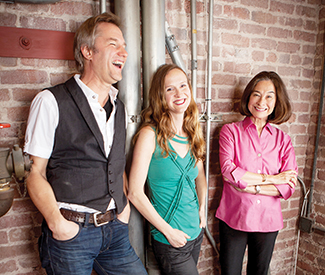
GOLDIES At a recent edition of the Business — his weekly comedy showcase at the Dark Room Theater — Sean Keane is fulfilling one of stand-up’s most cherished rituals: skewering the absurdities that inconvenience our daily lives.

Like BART seats, for instance. “Who’s the person with the bright idea of making BART seats out of carpet?” Keane asks, before re-creating one possible scenario for an uproariously-laughing audience: “Sir, I think we should use carpet, as much carpet as possible, carpet on the floor, carpet on the seats, carpet that we scavenge from an elementary school in the ’70s. And it should be as absorbent as a sponge. Every spill, every odor, every terrible thing that happens on a BART train should be preserved for eternity. And for cleaning we’ll shut down the whole system for six hours a night and lightly sweep it with a broom.”

Keane’s specialty is the observation beat. The self-described “baby-faced man with the body of a dad” deftly riffs on the various mishaps and oddities he encounters. With his sports-announcer voice, he spins comedy gold from that time he ate at an Ethiopian-Irish food truck, or witnessed the announcement of Osama bin Laden’s death on ESPN, or found himself having to react to a stranger’s curiosity about his “I’ve Got Beaver Fever!” T-shirt (true story: he used to coach a middle school swim team with a beaver mascot).

It’s no surprise that a unique city like San Francisco has produced such an effective observational comic. “It’s interesting how what’s unacceptable in SF is acceptable in other places,” Keane says. “The worst thing you can do is use a plastic bag. At the Folsom Street Fair, you can see guy in a full leather outfit just sitting on a street corner jacking off, but if he was jacking off into a single-use plastic bag, he’s a monster.”

Keane is also a sports fanatic. Stories from one of his blogs, sportscentr.tumblr.com, have been picked up by Deadspin and other mainstream outlets. Though he avoids incorporating wonky inside-baseball jokes into his comedy act, he’s able to combine his two passions by regaling crowds with hilarious sports-related happenings. (Like, say, his ejection from a bar after accosting someone clad in a 49ers pajama onesie.) His best sports-related gag is his hilariously accurate impression of a British commentator covering the NFL draft, and the inevitable culture clash that follows.

Keane comes from a humor-loving family that encouraged his performing ambitions. In high school, he was involved in musical theater, which he credits for helping him overcome a speech impediment and learning to properly enunciate. At UC Berkeley, he started doing stand-up, opening for touring acts like Dave Attell.

seancomedy

Guardian photo by Saul Bromberger and Sandra Hoover

Cal is also where he developed his material-generating process. “We had a big white board in our living room where I would write ideas down,” he recalls. “The key is to write things down everywhere. When I’m driving, I record voice memos. You kind of feel like a crazy person when you do that, and duck to the side of the street and just start dictating something into the phone. I write things out like they’re lecture notes, with a subject and heading. Jokes comes first and then wording gets fixed later.”

After doing a lot of writing and improv, Keane fully committed himself to stand-up in late 2005 and early 2006. In 2009, he co-founded the Business, which has become a popular fixture on the local comedy scene.

“The Business helped with developing our style and skills due to the regular 20-25 minute sets,” says Keane. Of his fellow Business comics — including Caitlin Gill, Nato Green, and Bucky Sinister — Keane says, “When you perform with people every week, you pick up on stuff from them and you get pushed by seeing someone go out and kill.”

“Sean is someone who makes stand up look easy,” Gill says. “He is impossibly likable, endlessly witty, and incredibly fun to watch, even more fun to be around.” One of Gill’s most memorable moments with Keane was the “Competitive Erotic Fan Fiction” show, in which Keane performed bits entitled “Riding Miss Daisy” and “Zero Dark 69.”

Sadly for San Francisco comedy fans, Keane is at that point in his career where a move may soon be necessary. “SF is a great place, but I need to get to the next level and there’s no comedy industry here,” he points out. “Your ceiling as a SF comic is two weekends a year at the Punchline, and two weekends a year at Cobb’s. To become a headliner, you have to be famous. To be famous you have to get on TV. And it’s hard to get on TV in a place that does not produce many TV shows.”

Until then, Keane’s Business is booming on Mission Street, delighting audiences every week — even those who have to ride those carpeted BART seats to get home. Catch him while you can.
www.seankeanecomedy.com

Goldies 2014 Lifetime Achievement: Sara Shelton Mann

5

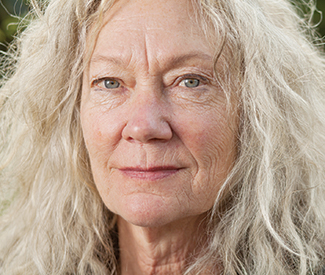
GOLDIES In 1979, Sara Shelton Mann — the farm girl from the wilds of Tennessee who ended up studying with such greats as Alwin Nikolais, Erick Hawkins, and Merce Cunningham — moved to San Francisco. Earthquake country. And did she ever shake up the place. With Contraband, the collective of performers she directed until 1996, she reconfigured what the dancing body can be. Their aim, she has said, was to “make bold live theater with an aggressive, lyric physicality.”

But why San Francisco? “I was lonely in those cold winters in Nova Scotia,” she recalls; she’d been working there with a support of a Canadian arts support program. So she jumped at the chance when Mangrove (the all-male troupe that grew into Mixed Bag Productions) invited her to join it. It was here where she translated concepts like “improv-based,” “collaborative,” “interdisciplinary,” and “dance theater” into vital, raucous, and highly effective performances that inspired a whole generation of artists to wander into unknown territory. The Bay Area would not be as welcoming and supportive of experimentation in dance were it not for the ongoing presence of Sara Shelton Mann.

With Contraband, she staged pieces in theaters, warehouses, the pit of a former apartment building, an abandoned public housing project, under bridges, and on the streets, both in this country and abroad. The troupe described itself as wanting to “manifest joyous creation — reclaiming the flight of the imagination, laughter, love, truth, and evolutionary impulse.”

The works were irresistible because of the daring, the force, and the integrity of the processes that made them possible. “We believed that art could change the world,” Shelton Mann says. At the height of the AIDS crisis, Evol turned the concept of love inside out. Religare honored the people who died or became homeless after the 1975 arson fire that gutted the Mission District’s Gartland Apartments. Oracle was a painful examination of the burdens of the past. The Mira Cycles and Monk at the Met dug deep into spirituality, both individual and communal.

sheltonmann

Guardian photo by Saul Bromberger and Sandra Hoover

“I had only one rule,” she explains. “Everybody does personal inquiry, everybody does contact, everybody sings, everybody dances, everybody writes, everybody makes images, everybody works outdoors.”

This process encouraged individual voices to emerge, allowing members of the group to go on to substantial careers of their own. Besides designers and musicians, there were, among others, Rinde Eckert; Jess Curtis (“Contraband was an amazing laboratory of group process and collaboration, always with Sara at the center,” he says); Keith Hennessey (“Working with Sara revealed me to myself, and revealed me to the worlds around me”); Nina Haft (“I like to think my work is better for having been part of that wild soup of training in the ’80s. Sara still amazes me with what she does”); and Kim Epifano (“We learned from each other as we created with Sara’s thrust of topic and mastery of metaphor. It was a place where gender did not define the physicality but a common ground of athletic love”).

Indeed, in addition to her formidable reach as an artist, Shelton Mann’s role as a teacher has been immense. The latest wave of artists to find Shelton Mann and the rare degree of mutual inspiration she offers includes many of the most persuasive dance makers in the Bay Area.

“When you’ve trained with Sara, and you’ve worked with Sara, your idea of dance really explodes,” says Jesse Hewit. “You identify what your dance is in your body.” Hewit explains the difference as distinct from a focus on mere technical perfection. “The dancing is crazy virtuosic,” he notes, “but not virtuosic in the high-kick, pointed-toe sense; virtuosic in that it’s infused with an intense energetic focus.”

Shelton Mann celebrated her 70th birthday in December, and her work shows no signs of dimming. Even in the smaller, minimalist dances of recent months she proves riveting: a lovingly rowdy duet with Hewit at Z Space during the 2013 West Wave Dance Festival; a reading at Kunst-Stoff in January for Fresh Festival — delivering a slipstream rumination on time, decay, and memory in the body, the body social, the body politic. More recently still, she had a cameo during a comic-chaotic conversation about contemporary dance in Guillermo Gomez-Peña, Saul Garcia Lopez, and Esther Baker Tarpaga’s Part 1: Dancing with Fear at Galería de la Raza.

In the last two years, Shelton Mann has been at work on a set of extraordinary solos, a series she calls The Eye of Leo. Each has been made on a different dancer, and each one thus far has premiered in the plain white box of the Joe Goode Annex.

In October 2012, the first, featuring Jorge De Hoyos, was a revelation. The limpidness of these works, their spare quality — in contrast to the exuberant sumptuousness of Contraband or even recent Shelton Mann work like 2011’s Zeropoint, made with regular collaborator David Szlasa — combined with a quivering field of contact between dancer and choreographer, represents a powerful shift in focus.

The Leo series culminates outdoors and downtown this April, in a simultaneous unfolding she calls a “mandala of magic,” The Eye of Horus. The project is more proof that Shelton Mann is working at the height of her powers. One of the country’s supreme artists, she continues to evolve — moving more than the land she adopted back in 1979, and more sensitive to the tremors beneath our feet than a Richter scale.

“She’s a very strong conduit now. A very strong conduit. I mean, I think she’s a goddess,” says Kathleen Hermesdorf, another Contraband veteran who has gone onto a formidable career of her own. “I can’t help but deify her a bit. I can’t pigeonhole her. She’s still an iconoclast; she’s still part of the avant-garde. And it still comes from so deep inside her.”

Goldies 2014 Performance: SALTA

0

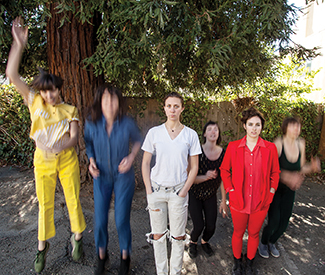
GOLDIES Creating a space for experimental contemporary dance and performance in Oakland, outside of the usual channels and roadblock$, has been an instigating, galvanizing mission for SALTA. The collective — a sharp and motivated group of seven women, all Oakland-based choreographers and dancers under 30 — has made a scene, built an audience, developed a network, enlarged an ethic, and opened up horizons in a beleaguered arts ecosystem.

They also know how to party.

SALTA was born at the same time as its monthly curated performance series, a spirited affair known during its first year as PPP (apropos of nothing), which rides high on a principle of serious experimentation in an utterly laid-back, strictly noncommercial setting.

A roving event that settles wherever the keys are handed over gratis (a surprising number of places), PPP and its progeny have showcased ragtag and newer pieces by a range of young, mid-career, and senior artists whose only brief is that they try something. While such a platform naturally embraces failure in the cause of exploration, the results have held many surprises and epiphanies.

A few dancer-choreographers spotted at past SALTA evenings: Mary Armentrout, Christine Bonansea, Abby Crain, Hana Erdman and Allison Lorenzen, Keith Hennessy, Kathleen Hermesdorf and Albert Mathias, Monique Jenkinson, and fellow Goldies 2014 honoree Brontez Purnell.

Meanwhile, an open-door policy and community-stocked bar and boutique contribute to the lighthearted, well-oiled mingling of a crowd that often goes beyond dance initiates to embrace artists, bohos, and travelers of many kinds. (The first installment, at poet Zach Houston’s space downtown back in June 2012, was already bringing together normally discrete artistic milieus. As much a social experiment as an artistic one, it’s set the tone for those that have followed.)

salta

Guardian photo by Saul Bromberger and Sandra Hoover

SALTA has ambitions beyond the performance series. Back in June 2013, when the collective was celebrating its first birthday with the 11th installment of PPP, its members decided to take a summer hiatus from the performance series to concentrate on other projects. The plan was to reinstate it in the fall at a slower clip. But the momentum proved hard to deny, as the seven members of SALTA (who prefer to speak as a collective rather than use their individual names) recently explained.

“I think after we last talked to you in [June 2013] we were going to do our anniversary performance, and then we were going to do less. We were going to do one every three months or something. But we had people contact us. And people really followed through who wanted us in their spaces. So we couldn’t say no, in a way.”

“We got swept up.”

“Yeah, it was really great, because with some — like Transmission Gallery [last December] — there was that intent, an invitation to collaborate with the space. People were interested in what we were doing in this different way. And that just provides us with food for thought, as far as how we then invite artists to be in that space in a particular way.”

“It’s kept us interested and engaged doing these events.”

“We’ve been talking more about finding some permanent space as well.”

A permanent space?

“We aren’t going to go into details because it’s still in the works, but let’s just say we’re looking at a space in the Temescal area to do more curation, and hopefully be able to invite more people from out of town.”

“The other exciting thing for us about this opportunity is that it is a collective of collectives, here in Oakland. So it’s not just us who would be in the space but several other groups.”

“It still reflects our spirit, how we intend to be in spaces, engaging alternatively, without a big output of money. We found freedom in not doing that. It’s very specific to this opportunity, which is not set at all, but it’s a nice thing to think about.”

Among the advantages of such a move, they say, is the chance to become part of a touring network, while providing ongoing workshops and rehearsal room — “affordable open space for people to not just show work but develop.”

With or without a permanent space, SALTA’s second year is poised to expand. In April, the collective travels to the East Coast to co-curate an evening with New York’s AUNTS, another dance-performance collective (and an early inspiration), and to take part in an international symposium in Montreal on alternative models of curation in the performing arts. They’re already networking with other likeminded groups along the route, like Montreal’s Wants&Needs and the Centre for Feminist Pedagogy.

And, for the first time, they’re making a piece of their own together: an experience they call “pretty amazing and crazy.” As a process it’s also, needless to say, “as collaborative as possible.” SALTA moves in collaboration.

“Somehow we end up having this momentum. There’s this ease that just happens. We definitely work hard but with joy, I think. All of a sudden we’re rolling really fast.”

Goldies 2014 Dance: RAWdance

0

GOLDIES “Anybody want more popcorn? How about coffee?”

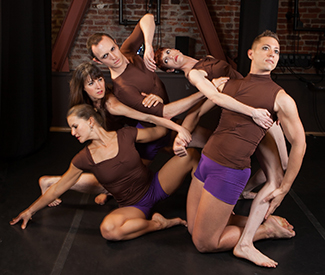
Ryan T. Smith is calling out to a packed audience in the oddest-shaped dance studio in San Francisco — long and narrow, like a bowling alley. The occasion is the latest installment in RAWdance’s popular bi-annual CONCEPT series, started in 2007 by Smith and partner Wendy Rein in their Duboce Triangle neighborhood.

CONCEPT is an occasion where dance watching and socializing go hand in hand. You pay what you can … and you pitch in with moving the furniture. An old-fashioned salon of serious fun but also serious art, the series has become one of the most congenial places to watch dance in SF.

And yet the project started as something like a self-help group. When Smith and Rein moved to the city, they came into an environment rich in dance theater, multimedia, text-based dance, and identity- and gender-inspired material. “This is not who we are,” Rein explains while sitting at their kitchen table. “Our dances are abstract.” And, continues Smith, “We also didn’t know anybody [at the time].”

Looking around, however, they found artists who — like themselves — had pieces that had been seen only once, or were works in progress. Artists who wanted to rework something, or just try out new material. Today, over 60 choreographers have shown at CONCEPT; anyone can apply, though the team curates the show lightly to ensure a good mix.

Another reason behind CONCEPT arises from the duo’s desire to make dance more generally accessible. “We are so tired of going to dance concerts and seeing the same people all the time,” they agree. Rein remembered a couple who just walked into CONCEPT off the street. “I just loved that.”

rawdance

Guardian photo by Saul Bromberger and Sandra Hoover

They don’t complain about the lack of attention paid to theatrically demanding dance. They don’t wait for audiences — they go to them. Locally, they have performed in public spaces like Union Square and beneath the SF City Hall Rotunda.

The duo calls its choreography “abstract;” in truth, that’s something of a misnomer since there is no such thing as abstract dance. When you put a human being on a stage, abstraction goes out the back door. RAWdance derives its strength from the fact that the pieces tell stories without relying on explicit narratives. “We don’t spoon-feed our audiences. We just want to go so deep that the experience becomes visceral,” they agree.

For Two by Two: Love on Loop, they created a 20-minute dance on themselves, and then taught it to 12 very different couples who performed it over an eight-hour period in the middle of the UN Plaza. For A Public Affair, a 10-minute duet performed at the height of the dinner hour at the now closed Orson Restaurant, they condensed gestures and movements that would have looked familiar to the patrons. The Beauty Project, first performed in an empty storefront, eventually made it into a theater — but its inspirations (mannequins, a fashion-show runway) remained unmistakable.

In their own duets — still their preferred way of working — Smith and Rein often move like liquid sculptures; we see them as one even as they strive to pull apart. They were at first drawn to each other in college because choreographers so frequently paired them together. It makes sense.

Both of them are tall and long-limbed, with superb techniques. Rein looks fragile but she is fierce. “I feel more comfortably working with Wendy, trying out things that are physically bizarre, than with anybody else in a studio,” Smith says. “I trust her with my weight.”

Rein feels the same way but explains the trust also comes from the fact that “we create everything together, so we are interested in seeing the interactions between us.” Chatting with them in their kitchen, you get the sense that they are completely in tune with each other. They finish each other’s sentences like an old married couple (which they are not).

At the most recent CONCEPT series last August, RAWdance showed the beginnings of new piece, Turing’s Appel, inspired by Alan Turing, the pioneering British scientist who was driven to suicide because of his homosexuality. (The piece is set to premiere this summer at Z Space.) Dance critic Heather Desaulniers described the excerpt in terms of the questions she saw the choreographers raising: “How do constraints affect physicality; how do situations differ when change is purposeful or accidental; what circumstances make the most sense in the body?”

Goldies 2014 Music: DJ NEBAKANEZA

0

marke@sfbg.com

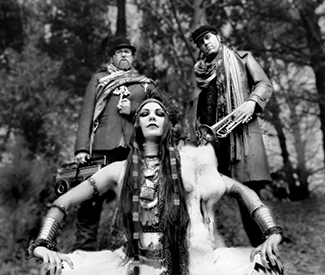
GOLDIES “I don’t care how much equipment you have, how many laptops you’ve got hooked together — if you’re just making a bunch of trendy electronic sounds, if you don’t know melody or dynamics or how to really play an instrument… you aren’t making any music.”

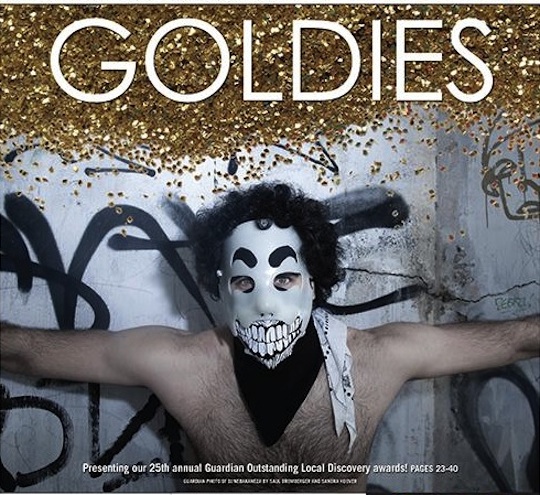
The masked man known as DJ Nebakaneza is notorious for his dazzling and unsettling outfits, gonzo energy, brain-scrambling bass, and rollicking social media presence. He isn’t afraid to court controversy or speak his mind about what’s going on in dance music, either. But dig a little beneath the flash and bombast and a portrait of an artist as a young bass maven emerges, one brimming with deep musical knowledge, canny intellectual vision, disarming charm, and inspiring faith in his hometown scene.

It’s almost impossible to talk about Neb without including the rest of his Irie Cartel DJ crew — JohnnyFive, Mr. Kitt, Miss Haze, and Danny Weird. Irie Cartel has had a profound effect on the San Francisco dance music scene. But to understand just how much of an effect, we’ll need to run down a little history of what didn’t happen in the San Francisco clubs.

In the early 2000s a deep and throbbing apocalyptic sound from the grimier neighborhoods of London called dubstep started shaking the bass bins of the underground. By 2007, it was seeping into club nights here like Grime City, Brap Dem, and Full Melt, drawing critical interest and providing a nice complement to the minimal techno and disco revivalism that was also happening at the time.

But then a funny thing happened: mainstream America, apparently looking for a new arena-style rockout, hijacked dubstep, gutting it of all but its deep bass and catchy name. Pop artists adopted the sound, twisting it into a series of bowel-rumbling bass drops (nothing wrong with those, really), and it became known more for its fist-pumping frat party reputation than a reflection of the more angsty corners of urbanity. A wave of bro-step began washing over US clubs, threatening to wash out more subtle party expressions with its macho aggression.

DJneb

Guardian photo by Saul Bromberger and Sandra Hoover

That onslaught was stopped at our borders, thanks to Irie Cartel, whose weekly Ritual dubstep nights kept the fun factor high (and the bass extremely low), but also made room for classic bass music sounds, experimental electronic showcases, and flights of melodic beauty. It still melted your face, but poetically. Irie also emphasized old school rave community spirit: At its height, in the basement of club Temple, the Ritual party included a community marketplace for people to sell their handmade wares and food. It was like a cosmic bass bazaar full of beautiful bass faces. “We’re all musically nerdy,” Neb says of his crew. “But we strip out all the ‘look at me’ ego that came with the mainstream dubstep scene.”

DJ Neb got into dubstep, in fact, as a fresh-faced youth who wandered into Grime City one night. “I spotted this flyer pasted to a wall and decided to check it out — it was at the old Anu club on Sixth Street at the time. And when I walked in, I was blown away by this wave of bass, these awesome sounds that seemed to be pulling me apart. I never looked back from there,” he told me over the phone, as he prepared to leave for a gig in Uruguay. “It seemed to pull together something that had been brewing in me somewhere. I’d always been into music. I started working at Rasputin Records as soon as I could, and would spend all my free time in there, too — just digging through bins and listening to music. My paycheck would go right back into those records. They used to pay me in music, essentially.

“As a kid, I played percussion. I went through a Janet Jackson and New Jack Swing phase, got really into hip-hop. I was deep into downtempo, trip hop, and rare groove when I started DJing. It was the whole ‘lounge era’ of nightlife, so I started getting a lot of gigs as a cocktail hour DJ. I even had a chillout show on KKSF, the smooth jazz radio station,” he laughed.

“But when the dubstep thing started blowing up for me, I realized it was time to create a new persona, and that’s when DJ Nebakaneza was born. I had to delete my previous existence. I made a ceremonial sacrifice of that guy.” Neb went on to host the Wobble Wednesdays show on Live 105 and rise to the forefront of forward-thinking yet accessible bass purveyors.

But now it’s 2014, dubstep has almost completely played itself out — bro-step wiz Skrillex’s latest shows have been billed as “playing the classics” — and Ritual is on hold. (“When dubstep became popular, Ritual suddenly had this massive influx of people who were drawn to the sound but had never been in a club before, didn’t know how to act,” Neb said. “They were spurned by a lot of our regulars, who closed ranks. But I was like, ‘We were all new at the party at one point, wouldn’t it be better to connect with these people?’ It was sad that our scene got so defensive. I wish we could have embraced the fear a little more. But we’re just giving everything a time out. Ritual will be back.”)

If dubstep is no longer an option, what’s a dubstep DJ to do?

Go back to the drawing board, of course. Last year, DJ Nebakaneza started releasing a series of exquisite mixes tapping into his vast knowledge banks. Each month he would take on a new, unexpected genre — yacht rock, rare disco, Dirty South hip-hop, instrumental funk, even emerging ones like half-time — and weave something magical from his roots. The Expansion Series is one of the most ambitious things I’ve heard a Bay Area DJ attempt, and it comes off pretty flawless.

“I was having an identity crisis,” Neb said. “Dubstep had kind of moved on, and I missed my crate-digging days. Playing those lounge sets — some of them were four or more hours long. That’s a lot of music. I missed being able to sneak all kinds of colors into it. I also missed playing the music that’s closest to my heart: Isley Brothers, James Brown, all that beautiful old funk and soul. I needed to break myself down a little to see how to move ahead.”

Currently, Neb is throwing a bass-oriented monthly party called Paradigm with fellow head Lud Dub. But he’s still planning his next sonic move. “I want something sexy, still with the bass, but a more ‘purple’ feel. Not the trap sound that’s been happening, but something deep and hot.”

Heavens, does that mean the edgy Nebakaneza persona will be tossed to the wind? “Don’t worry, Nebakaneza’s not going anywhere. And I’m still keeping the mask.”


Goldies 2014 Film: Malic Amalya

0

GOLDIES If you want to see a filmmaker light up brighter than a brand-new projector bulb, ask him about his camera.

“For my 30th birthday, my cousin, Peter Miller, who’s also a filmmaker, sent me this big box,” Malic Amalya says of his Krasnogorsk-3, or K-3, camera. “As soon as I saw it, I was like, ‘The best present that could be in there is a 16mm camera.’ And it was! And it’s wonderful. It has different lenses, it can go at different speeds. I’ve been working with 16mm since 2006, and the process is so different than video. You have to set the focus, set the aperture. And it’s so heavy, and so expensive. Every shot that you take matters. That slowing-down really changed my practice, in making every shot intentional.”

That love of 16mm entered Amalya’s life while he was earning a filmmaking MFA from the University of Illinois at Chicago. After graduating in 2009, he spent a few years in Seattle (he’s been the Experimental Film Curator for the city’s Lesbian and Gay Film Festival since 2010) before the San Francisco Art Institute’s MA program lured him south. “I wanted to be re-engaged in the theory process,” he says.

At SFAI, he fell under the spell of legendary underground filmmaking brothers Mike and the late George Kuchar. “When I started there, I had known their work, but not super in-depth,” Amalya says. “Claire Daigle, the director of the MA program, was like, ‘You have to take a Kuchar class!’ So I took a class with Mike, and that informed my thesis in a lot of ways.”

He graduated in 2013, and his graduate thesis, “Divine Abjection,” explores the idea that artists like George Kuchar and John Waters “deploy the grotesque and the titillating to confront the violence targeted at queer bodies,” Amalya explains. “Building on psychoanalytic feminist theorist Julia Kristeva’s work on the subject, I assert that these filmmakers command their audience to either find elation within queer ‘perversion’ or eject themselves from the narrative via nausea.”

malic

Guardian photo by Saul Bromberger and Sandra Hoover

Given his enthusiastic pursuit of education, Amalya’s career goal is no surprise. “I would love to teach experimental filmmaking or queer filmmaking. I’d like to bring in a lot of theory and academic texts into my production classes.” And he’s on his way; this summer, he’ll be teaching Kuchar films, among others, in “Transgressive Transmissions: The Art of Lo-Fi and High-Horror,” offered as part of SFAI’s public education program.

But don’t get Amalya the film scholar (interested in “messy-grotesque” work) confused with Amalya the artist (who makes what he describes as “quiet-formal” films). “The films I write about are quite different from the work I’m making,” he says. “While my interest in film theory inspires my films, and my knowledge of filmmaking informs my analysis, the distinction in genre helps separate my working styles. My writing process is analytical, while my filmmaking process is very intuitive.”

“A lot of times, my process is filming things that I’m visually interested in. A gesture that I’m interested in capturing, or colors and movement. I’m always filming different things and then sitting with them. I still have rolls of film from years ago, where I’m like, ‘Someday this is going to come together.’ And then, in the editing process, it does.”

Local filmgoers have had a chance to see Amalya’s work at venues like Periwinkle Cinema at Artists’ Television Access and San Francisco Cinematheque’s Crossroads Festival. The latter’s 2013 incarnation is where I caught Amalya’s Gold Moon, Sharp Arrow, a 12-minute exploration of social psychologist Stanley Milgram’s 1963 obedience experiment; it interweaves a re-creation of the experiment (in which participants, asked to administer electric shocks to subjects who faltered in a word game, followed instructions all too well) with shots of nature and decay — a bee’s nest, a chicken coop, smashed windows, an abandoned house. The film was created with Max Garnet, a performance artist and makeup artist Amalya shared a house with in Seattle.

“Max had the idea of working with the Milgram experiment. So I started reading up on it. On YouTube, you can watch the original footage,” he says. “We were interested in the power relationships that were played out in this experiment, and we were talking a lot about the different power engagements in our queer community in Seattle, and in the greater culture. What really captivated me was the word pairings they used in the original experiment and how seemingly arbitrary they were, but how loaded they were as far as gender norms and cultural expectations.”

Though Amalya enjoys working with others, “A lot of my filmmaking practice is me with a camera exploring different places,” he says. “My process of writing scripts, setting up shots, and editing feels very internal, and at times almost private.”

The theories of another experimental artist — musician Michel Chion — have provided further inspiration. “In his book, Audio Vision, Chion argues that sound never replicates an image, but rather adds a another dimension to the picture. [His notion of] ‘added value’ has become a mantra of sorts while I’m working. In my films, I work against illustration, as well as music videos and didactic polemics. Rather, I strive for movement, light, dialogue, and text to ricochet off each other, forging new and unforeseen connections.” *

www.malicamalya.com

Goldies 2014

4

The Goldies are silver! The San Francisco Bay Guardian celebrates the 25th annual Goldies — if you’re new here, that stands for Guardian Outstanding Local Discovery Awards — with a special issue celebrating nine emerging Bay Area artists and groups who’re producing exciting, intelligent, provocative work. Gazing into our glittery crystal ball, we predict great things ahead for their careers. And that’s not all: We also honor one veteran performer whose wide-reaching influence has been a beacon of inspiration for over three decades.

Join us and the 2014 winners Fri/21 at a GOLDIES PARTY ($10 gets you all the Lagunitas you can guzzle!) benefiting grassroots arts and culture venue CounterPULSE. Wear gold, because it’s time to shine! 

GOLDIES 2014

DANCE: RAWdance

COMEDY: Sean Keane

DANCE/FILM: San Francisco Dance Film Festival

MUSIC: The Seshen

PERFORMANCE: SALTA

PERFORMANCE/MUSIC: Brontez Purnell

VISUAL ART: Michelle Ramin

FILM: Malic Amalya

MUSIC: DJ Nebakaneza

LIFETIME ACHIEVEMENT: Sara Shelton Mann

All photos by Saul Bromberger and Sandra Hoover


GOLDIES AFTERPARTY AND FUNDRAISER FOR COUNTERPULSE

With DJ Primo Pitino and DJ Wam Bam Ashleyanne

Fri/21, 8-11pm, $10

Folsom Street Foundry 1425 Folsom, SF

www.sfbg.comwww.getwillcall.com 

Goldies 2014 Dance/Film: San Francisco Dance Film Festival

0

GOLDIES Greta Schoenberg founded the San Francisco Dance Film Festival in 2008, but she didn’t realize it at the time. It began as “Motion Pictures,” a gallery show combining dance photography with screenings of Schoenberg’s “screen dance” films — short works she’d made specifically for the camera.

It was a success, so the next year, she asked other artists who were making dance films to contribute. (The dance-film genre also includes staged performances filmed for archival purposes and dance-themed documentaries, in addition to more experimental works.) The 2009 event was also a hit; it attracted the interest of the Ninth Street Independent Film Center, which was searching for a way to celebrate Bay Area National Dance Week. Schoenberg’s shorts program was a perfect fit.

“Skye Christensen — who was the director [at Ninth Street], and is now on our board — suggested that we make it into a real festival,” remembers Schoenberg. “It was her idea to call it the San Francisco Dance Film Festival, which was a little daunting. But I’m so glad I did, because I think that leap forward was just the risk somebody needed to take, and it happened to be me.”

With help from Christensen and other community arts organizations, Schoenberg assembled a volunteer staff and launched the first official San Francisco Dance Film Festival in 2010. The DIY effort worked. “We had people sitting on the floor in the lobby in our rush ticket line. We had already outgrown the [Ninth Street] space.”

An evolution into something even bigger seemed inevitable. Enter Judy Flannery, who was looking for a way to bring Dance Screen — the prestigious dance film and video competition presented by the Vienna-based International Music + Media Centre, or IMZ — to San Francisco.

“When I was first asked by this European organization if I could help them collaborate with a US dance film festival, I said the only two I knew of were in LA and New York,” recalls Flannery — until she learned about Schoenberg’s fledgling enterprise.

Guardian photo by Saul Bromberger and Sandra Hoover
dance

“I made this proposition to Greta that it would be great to get the San Francisco festival better-known. I felt she’d done this amazing thing, which was to identify a need. There wasn’t anything in Northern California that allowed filmmakers to show dance films,” Flannery says. “Plus, this is one of the most vibrant dance communities in the country, and we’re also renowned for having a super independent film community. So why hadn’t they gotten together to make dance films? This was a golden opportunity to make this a more established festival.”

She adds with a laugh, “I basically said I’d like to put it on steroids.”

Initially, Schoenberg hesitated — but Flannery won her over.

“I made this Faustian deal with Greta that I would do a big chunk of the work, alongside Greta and a lot of volunteers, to help establish the fourth festival, in 2013, as a collaboration between the San Francisco Dance Film Festival and the European Dance Screen,” she says. “I was also able to get some other artistic organizations involved, like the San Francisco Ballet and the San Francisco Film Society.”

The SFDFF’s newly heightened profile allowed for an expanded program beyond screenings, with panel presentations (on topics like digital distribution and music-rights issues) and the “Co-Laboratory” program, which paired local choreographers with local filmmakers and gave them a compressed window of time (one week!) to create a short dance film together.

“We wanted to encourage local dancers and filmmakers — who are very busy doing their own things — to go, ‘Look what happens if we work together!’,” Flannery says. “It was a wonderful way to engage the very communities we want to celebrate. This year, we want to build on what we were able to pull off last year.”

And the SFDFF’s upward trajectory shows no sign of leveling off. Plans for the future include, of course, the 2014 festival (calling all filmmakers: submissions are open through May 1), which takes place in November and will include a tribute to veteran documentarian Frederick Wiseman. Eventually, the SFDFF hopes to become a year-round organization. Expanding its audience is a key goal.

“This genre is not new — it’s been around since the early days of cinema,” Schoenberg says, citing the works of Muybridge and Maya Deren as examples. “What is new is the technology that’s available for the average dancer. Now, you can make a film on your iPhone. That’s exciting! And through these works, you can expose somebody to dance in a way that they’re comfortable with. They might not inclined to go to a live performance of an unknown contemporary dance company, but if they’ve seen a shorts program of contemporary dance works, maybe they would. As a dancer, I don’t feel like dance films can ever replace live performance. That would never be the goal. But using these films as ambassadors, and getting people to understand dance a little bit more — I think they’re an amazing tool for outreach.”

Goldies 2014 Performance/Music: Brontez Purnell

0

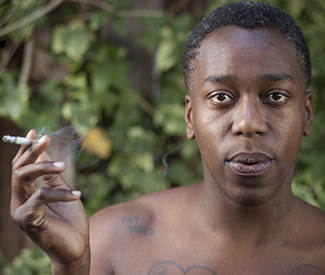
GOLDIES After being informed that Bay Guardian editors and a theater critic vetted his Goldie nomination, Brontez Purnell reacts. “I think it’s fuckin’ rad. I’m pretty into it. A theater critic? Was I criticized?”

Sitting in the backyard of his Mission District apartment, braced leg extended with crutches at his side, Purnell reflects on roughly 12 years of living in the Bay Area (his Mission digs are temporary; he’s about to move back to Oakland). A storyteller of many mediums, his injury prevents him from dancing until mid-March, which is no good since he’s the founder of the Brontez Purnell Dance Company. If you’ve lived here a minute, you might recognize him as a former Sparky’s Diner waiter, working the “drunk tank” every Saturday night.

“When I was 24, my entire dating pool had seen me dance naked or in my underwear — literally get fingered at a Gravy Train!!!! show. They’d see [me] there and think they could be mean to me like, ‘Gimmie my fries!'” He recalls this, along with other illicit memories from his time in the Oakland-based, exclamation point-loving electro clash band.

But like fans of that fad, he’s moved on. He’s 31 now and for the past 10 years the music he writes, records, and performs live is for his band Younger Lovers. Its newest record, Sugar In My Pocket, recently came out on Southpaw Records.

“I don’t think anyone knew I had this background of a punk that had been playing in bands since I was a teenager,” he says, explaining there was overlap between the two music projects with distinctly different flavors, though Younger Lovers’ first album initially received a “hateful response from a lot of the gay boys around.

Everyone thought it was this flash-in-the-pan thing, but it’s something I was actually working on for a long time. It was cool to smash a lot of assumptions with Younger Lovers. People would say, ‘Wow, we didn’t know you played an instrument. We thought you were just kind of drunk and danced around.'”

Guardian photo by Saul Bromberger and Sandra Hoover
brontez

People still ask him about those old shows, but he admits to not

remembering a lot of it and that some of that life bleeds over to now. “I would call myself an alcoholic.

I would never call myself a drug addict. I feel like the next set of Younger Lovers’ songs will probably be about addiction.”

Purnell is nothing if not self-aware; he points out his own patterns of over-consumption, whether it be food, men, drugs, or alcohol. But his ability to turn weakness into strength is artistry in itself. In his dance company’s The Episodes, universal themes of struggling with identity and finding oneself are apparent, but being black and gay only makes the search for acceptance that much harder.

“I romanticize the outsider. There’s always going to be this running theme of me versus the world, but it’s never so personal to me because I feel like I’m embodying the story of 100 of my friends in one voice.”

In one sequence, “Tub,” Purnell soaks a new pair of jeans while talking on the phone to a friend. The veil of humor is used to deal with heavier topics, as he segues from commentary on butch gays (or “bearded ladies,” as he likes to call them) with their trendy “Hitler Youth haircuts” and how he’s disappointed when they think he’s too effeminate for them, to his own T-cell count, to some suspiciously descriptive-drug scenarios that involve snorting heroin. Another segment recalls a “redneck teacher bitch” from his home state of Alabama, giving the class scientifically incorrect and insensitive, to say the least, explanations of where AIDS comes from.

“I never let humor interfere with what is definitely a message,” Purnell says. “Underneath it all, there is going to be that point where somebody is like, ‘Oh shit. He’s not joking. He’s joking, but he’s totally not joking.’ Humor is actually a really dangerous tool.”

His truth, he says doesn’t always set him free, but as the saying goes — sometimes it hurts. And that’s the beauty of what Purnell does: He looks at his reality, his disappointments, and his personal achievements, and he’s able to persist. He remains one of the more resilient creative forces on the scene he helped make, despite oftentimes receiving second-tier ranking to some of his contemporaries.

Does he play the victim? Well, he gets accused of it a lot, but that’s because of “people’s fucked-up views on what a victim is.” He recites a James Baldwin quote he loves: “The victim who is able to articulate the situation of the victim has ceased to be a victim: he or she has become a threat.”

In short: Purnell is not a victim — he’s a fighter. And as a singer, songwriter, musician, choreographer, dancer, and performer, he proves himself by doing all these things … and then some.

Guardian investigation honored

0

Bay Guardian News Editor Rebecca Bowe and Staff Writer Joe Fitzgerald Rodriguez are being honored by the Society of Professional Journalists of Northern California with a James Madison Freedom of Information Award for “Friends in the Shadows,” our investigation of the shady ways that developers and other powerful players buy influence at City Hall.

The package of articles, prepared for the Guardian’s 47th anniversary issue of Oct. 6, used extensive public records to show how contributions to the city’s various “Friends Of…” organizations create cozy relationships between regulators and the regulated, donations that are often designed to skirt public disclosure requirements.

“Their detailed and thorough account explored a trail of money through myriad city agencies and departments,” the awards committee wrote, noting how the paper “used public records, interviews and independent research to probe how developers, corporations and city contractors use indirect gifts to city agencies to buy influence.”

The Guardian will profile the other winners in our annual Freedom of Information Issue on March 12, and all the winners will be honored at SPJ’s James Madison Awards banquet on March 20.

Who influenced the Google-bus policy?

7

On SFBG.com last week, we published a list of the attendees (and corporate affiliations) who were recorded as having attended stakeholder meetings with the San Francisco Municipal Transportation Agency to discuss that private shuttle pilot program that caused such a dustup last month. The list is a matter of public record and was submitted to the Bay Guardian by a source who wished to remain anonymous.

Google was in the room, of course, but not all attendees were affiliated with corporate shuttle providers who bus employees to their workplaces. One company, called Leap Transit, has started a private luxury bus in San Francisco that is not affiliated with any particular employer.

“Our buses are clean and our staff is friendly,” according to Leap’s website. “Sip your morning coffee in peace.” (Leap did not respond to our request for an interview about its future plans.)

Another participant who seemed a bit far afield from the transportation sector was a representative from TMG Partners, a real-estate developer. Also included in the meeting was a representative from a law firm called Morrison Foerster which has represented major tech investors such as Kleiner Perkins, according to its website, which can be found at mofo.com.

How did these individuals manage to get invites? We emailed SFMTA spokesperson Paul Rose to ask that question. He told us, “When we started the work, we received a set of shuttle sector contacts from the [San Francisco County Transportation Authority], who started looking at this issue. One of the first things we did was reach out to these companies and confirm the right contact people. We also reached out to companies who we’d heard had shuttles.”

He added, “Over time, additional shuttle service providers and companies that offer shuttles for their employees contacted the agency to let us know that they were either providing service or considering to provide shuttle service and wanted to know about our policy development process. This also grew our list. And, as we heard about new shuttle programs, we reached out the companies to make contact. Also, at meetings with shuttle providers, we also asked if there were other providers we should include. Some members of the shuttle sector brought their legal or PR reps with them to the meetings — they were not on our list.”

Two views of sex work

20

news@sfbg.com

There are two starkly different ways to look at prostitution in the Bay Area. One view sees sex workers as victims, not just those exploited by the horrible practices of human trafficking and child prostitution, but all sex workers. The other view accepts that sex work can be a legitimate choice made by consenting adults, a job less demeaning and more empowering than many low-wage service jobs.

Those divergent perspectives clashed on the streets of San Francisco on Feb. 11 when the San Francisco Commission on the Status of Women hosted a panel discussion in the Main Public Library on "discouraging demand" for prostitution, a goal that prostitutes trying to cover their rising rents don’t share, as they said outside while protesting the event.

In the spotlight at the forum was San Francisco’s First Offender Prostitution Program, also known as "John School," which was first implemented in 1995 to curb the commercial sex trade and provide an alternative to criminal charges for those caught soliciting prostitution, much like traffic school for bad drivers.

A March 2008 study, "Final Report on the Evaluation of the First Offender Program," by researcher Michael Shively, hailed the program as a success, with claims of vastly reduced rearrest rates and high attendance numbers. In 1999, 822 people qualified to enter the program, and that had dropped to 333 participants in 2007.

Fees generated by the program totaled $3.1 million from 1999 through 2007, which was split among the District Attorney’s Office, San Francisco Police Department, and the anti-prostitution group Standing Against Global Exploitation (SAGE).

But human trafficking and sex work have shown few signs of abating in the Bay Area, where law enforcement sources say Alameda County is one of the state’s biggest prostitution hot spots. And groups like SAGE say all sex work abuses women, whereas rival groups like the Sex Workers Outreach Project (SWOP) say it is the criminalization of prostitution that drives it underground and allows heinous practices like child prostitution to flourish.

Christina Deangelo says she’s been a sex worker since the late 1970s, and she showed up at the event to criticize its judgmental and one-sided program. "Without having even one of us on the panel, who can actually tell you [what is going on], you are killing us," she said.

The sex workers who showed up were particularly critical of panelist Melissa Farley, a controversial psychologist and researcher who spent years studying prostitution and sex trafficking. As an advocate of abolishing prostitution and a proponent of the "Discouraging Demand" strategy, Farley has been met with much criticism in the past.

Ontario Superior Court Justice Susan Himel disqualified Farley as a witness in 2010, ruling that "Dr. Farley’s unqualified assertion in her affidavit that prostitution is inherently violent appears to contradict her own findings that prostitutes who work from indoor locations generally experience less violence."

Sex worker advocates have also slammed Farley, such as blogger and activist Jessica Nicole, who says Farley "makes further manipulative and disturbing language decisions in her research of clients of sex workers," saying that Farley doesn’t "understand the complexities of the industries she is researching."

Farley has argued that prostitution is "inherently violent," and harmful both physically and mentally to the women involved. She says that her research shows that "89% [of sex workers] I spoke to want to get out of prostitution. Most see it as a last ditch effort for survival."

But many sex workers disagree, and they have grown more vocal about their stance on the business. Rather than a profession dominated by victims of forced trafficking and exploitation, they say that a large number of women and men actually like the job. But public and legal condemnation of the profession often prevents sex workers from getting help when they need it.

Workers acknowledge the dangers that go along with their profession, which they see as a major reason to at least decriminalize it and improve methods to protect workers from abusive pimps and clients.

Various studies on the subject have concluded how much more likely sex workers are to be victims of sexual and physical abuse, and have a high chance of drug addiction, more than any group of women in the world.

Sex workers spoke of the need to differentiate between indoor workers (high class call girls) and street walkers, different worlds entirely. They’re critical of Dr. Farley for writing, "while the women in street prostitution work the fields, call girls, escorts and massage parlor workers are the house niggers of this system."

The panel event showed the deep division between law enforcement and sex workers. The government’s ideal method of prosecuting what it deems indecent has not cured most vice businesses, even Casey Bates for the Alameda County District Attorney’s Office’s human trafficking division admitted at the event.

"We cannot arrest our way out of this problem," he said.

Though hardly an advocate of decriminalization or legalization of sex work, Bates does acknowledge that the issue can’t be tackled in the one-dimensional fashion as it is now. And sex workers say they need to be included in discussions about problems in their industry.

Suspension reform isn’t so simple

6

OPINION I wish I could get behind the current campaign to limit public school suspensions (“Suspending judgment, 12/3/13).

The intent is honorable. Any additional attention to the plight of black kids within our schools is laudable. But I’ve always suspected that some would think they’d accomplished something if suspension rates were evened across races, although this would have no more impact on any underlying problems than mandating racially equal grade ratios would eliminate an educational achievement gap.

I’ve also never been confident that all involved understood that removing a disruptive student from a classroom is not done primarily for that student’s benefit, but to allow the rest of the class to carry on without disruption. Unfortunately, I’m now certain that this basic understanding is not shared on the highest levels of the San Francisco Unified School District.   Nationally, the Department of Education finds black students three times more likely to be suspended than whites. Why? An influential 2010 Southern Poverty Law Center publication, Suspended Education: Urban Middle Schools in Crisis, suggested “the possibility of conscious or unconscious racial and gender biases at the school level.”

That’s hardly surprising, given the long history of racial prejudice in this country. But is this what’s actually going on?   San Francisco, with a suspension rate mirroring the national, gave an African American 84 and 83 percent of its vote in the last two presidential elections. Comparable statistics are not available for the city’s teachers, but it seems likely they’re at least as liberal as the electorate as a whole. This, and years of experience as a substitute teacher in virtually every subject on every grade level, tells me it’s not teachers’ racial prejudice that’s the issue here, but something much larger — and harder to tackle.   Last December, the San Francisco Chronicle reported the city’s black infant mortality rate was six times that of whites (a figure not totally reliable due to the shrinkage of the city’s black population). Other markers of well-being show similar numbers. In short, the black community in San Francisco — and the nation — lives under considerable stress and, as anyone familiar with schools knows, kids don’t leave their problems at home.  But causes aside, I’ve hoped that the anti-suspension efforts might at least promote useful alternatives. After all, no one sends disruptive kids home because they think it makes them better students; they do it because few schools have the resources to do anything else. An “in-school suspension” would likely be a far better alternative in most cases, but it requires people and space available to deal with those students.  Unfortunately, while focusing on the vagueness of causes for suspensions such as “disrespect, excessive noise, threat, and loitering,” which the SPLC study called “behaviors that would seem to require more subjective judgment on the part of the referring agent,” the current effort seemingly ignores the need for a classroom free of things like “excessive noise” and “threat.” And it ignores the right of other students to learn in one — students likely from similar circumstances as the kids teachers feel they have to remove.  San Francisco School Board President Sandra Lee Fewer is amending a proposal to ban “willful defiance” suspensions with a mandate to reduce the use of referrals — removing a student from class, but not sending them home — calling them “invisible suspensions.” And SFUSD Superintendent Richard Carranza says, “We’re talking about culture change. A culture where it’s not okay for an adult to say ‘get out.'”

I think the people at the top might benefit from a little more real life classroom face time.

There is great hesitancy around this issue, probably because of fear that protesting too loudly might mark you as part of the problem — perhaps as a racist. But if we allow an ill-considered effort to become a juggernaut, in the end it will be the most vulnerable students who will suffer.

Tom Gallagher is a substitute teacher who has served on the executive board of the United Educators of San Francisco.

The price of growth

20

joe@sfbg.com

San Francisco is booming, but will its infrastructure be able to keep up with its population growth?

The problem is acutely illustrated in the southeast part of San Francisco, where long-stalled development plans were finally greenlit by the adoption of the Eastern Neighborhoods Community Plan a few years ago.

The Mission, Potrero Hill, Dogpatch, and Mission Bay districts have attracted more attention from developers than any other sector of San Francisco, according to the Planning Department. Bayview and Hunters Point are also now attracting lots of investment and building by developers.

But when development projects don’t pay the full cost of the infrastructure needed to serve those new residents — which is often the case in San Francisco and throughout California, with its Prop. 13 cap on property tax increases — then that burden gets passed on the rest of us.

Mayor Ed Lee’s recent call to build 30,000 new housing units by 2020 and the dollar sign lures of waterfront development have pressed the gas pedal on construction, while giving short shrift to corresponding questions about how the serve that growth.

growthimage

Infrastructure needs — such as roads, public transit, parks, and the water and sewer systems — aren’t as sexy as other issues. But infrastructure is vital to creating a functional city.

That kind of planning (or lack thereof) impacts traffic congestion, public safety, and the overall livability of the city. And right now, the eastern neighborhoods alone face a funding gap as high as $274 million, according to city estimates highlighted by area Sup. Malia Cohen.

That’s why Cohen went looking for help, though that’s not exactly what she found.


MEETING DEMAND

Cohen has asked Mayor Lee about the lack of adequate investment in critical infrastructure again and again. She asked his staffers, she asked his aides. At the Feb. 11 Board of Supervisors meeting, during the mayor’s question time, she was determined to ask one more time.

Cohen asked the mayor about how to fund infrastructure needs in the eastern neighborhoods and whether the city should use a new, rarely used fundraising option called an Infrastructure Financing District, or IFD.

“When the city adopted the Eastern Neighborhoods Plan, we were aware of a significant funding gap that existed for infrastructure improvement,” she said to the mayor. She asked if he would slow down development while the city caught up with infrastructure improvements, or commit more funding.

Cohen asked pointedly, “Would you support an IFD for the eastern neighborhoods?”

The mayor’s answer was in the foreign language known as bureaucratese, offering a firm “only if we have to.”

“Strategically planning for growth means making long-term investments in infrastructure,” he said. “And the most important thing that we can do right now is to work together to place and pass two new revenue generating bonds measures on the November 2014 ballot.”

But his proposed $500 million general obligation bond and $1 billion local vehicle license fee increase would just go to citywide transportation projects, where the city faces $6 billion in capital needs over the next 15 years, according to a task force formed by the mayor.

That’s small comfort for the people of the eastern neighborhoods, who are already ill-served by Muni and will have other needs as well. It’s a situation likely to get worse as the population there increases, unless the city finds a way to make serious new investments.


CITY VS. NEIGHBORHOOD

Development impact fees go to the city’s General Fund, paying for the planning work, building inspections, and a share of citywide infrastructure improvements. The problem with that strategy, opponents say, is that there are then no promises that the money will make its way back to the neighborhood that generated the funding in the first place.

Neighborhood advocates see a need to address the problems created by new development by capturing fees before they get to the General Fund. IFDs do just that. Though the nuts and bolts of how an IFD works are complex, the gist is this: Once implemented, an IFD sets up a special area in a neighborhood where a portion of developer impact fees are captured to exclusively fund infrastructure where the development is.

“So the idea that growth should pay for growth was the notion,” Tom Radulovich, executive director of the nonprofit group Livable City, told us. But with money flowing into the General Fund rather than being earmarked for specific neighborhoods, Radulovich said,the infrastructure is going to come much later than the development. (The city) delivers projects slowly, if at all.”

IFDs are largely untested in California, and have only one recent use in San Francisco, on Rincon Hill, where a deal with developers cut by then-Sup. Chris Daly has morphed into an IFD created by his successor, Sup. Jane Kim. The neighborhood will now see new funding, and a new park, as a result of development there.

“This is a HUGE step towards getting the public infrastructure improvements needed to correct livability deficiencies in Rincon Hill,” read a newsletter from the Rincon Hill Neighborhood Association in 2011. “What does this mean for those of us living (here)? It means the Caltrans property at 333 Harrison Street has a short future as a commuter parking lot, because the front portion will become our first neighborhood park.”

The benefits are tangible, but putting an IFD into action is onerous. California Senate documents describe the hurdles involved: The county (or city) needs an infrastructure plan, it must hold public hearings, every local agency that will contribute property tax revenue must approve the plan, and the IFD needs to go to ballot and obtain two-thirds voter approval, a high mountain to climb.

Gov. Jerry Brown has called for lowering the voter threshold for IFDs to 55 percent in his newest budget. The mayor used the governor’s rationale as reason to avoid an IFD for the eastern neighborhoods when speaking on the topic last week. But that may not be his only reason.

“Even if we get the changes that we seek, it’s important to point out that IFDs don’t create more money for our city, they fund specific capital improvements by earmarking money in the General Fund for a particular purpose,” Lee said.

In other words, IFDs take money from a city that is already wrestling with underfunded citywide infrastructure needs. “Earmarking general funds isn’t something that we do lightly,” Lee told Cohen.

But Peter Cohen, co-director of the Council of Community Housing Organizations, put it this way to us: “Should the eastern neighborhoods be the cash cow for the General Fund?”


BOOMTOWN

With more than 10,000 housing entitlements, the eastern neighborhoods are where San Francisco will experience its biggest growing pangs.

“The eastern neighborhoods are ground zero for development in San Francisco,” Keith Goldstein, a long time member of the Eastern Neighborhoods Citizens Advisory Committee, told a Nov. 14 Board of Supervisors Government Oversight Committee hearing on the issue.

Sups. Cohen and David Campos spent the majority of the meeting trying to find solutions, but none were forthcoming. Instead they were met with presentations on the neighborhood’s myriad needs, but few on how they would be funded.

Muni is also starved for resources in the area, where the T-line is notorious for its “switchbacks” that leave riders stranded before completing its run.

“This is a topic I’ve advocated a lot,” Sup. Scott Wiener told us. “When you have a growing population, these folks absolutely have to have service.”

At the meeting, Planning Director John Rahaim put the problem simply: “There’s a lack of development fee funding.” The officials that day from the SFMTA, Planning Department, and the Department of Public Works presented plans that relied heavily on state and federal funding to meet the new construction and infrastructure needs, a funding gap of $274 million.

“We’re really struggling to maintain the infrastructure the city has,” Brian Strong, director of capital planning, said at the meeting. “For the General Fund itself, we’re deferring $3.9 billion in capital projects the city deemed high priority. We just don’t have the funds.”

The Mayor’s Office didn’t respond to our questions about how to solve the problem, but Sup. Cohen said she’s hopeful he’ll support an IFD in her district.

“When we introduced the plan five years ago, we knew there was a gap in terms of what we expected to collect. In terms of development impact fees, we’re still in that place,” she told us. “I just want to get shit done.”

One report seems to agree with Cohen on the importance of IFDs. In 2009, a major report on development in the eastern neighborhoods was filed to then-Mayor Gavin Newsom. It recommended the city “commission a consultant study to inform the formation of an IFD,” saying it was the best tool available to fund infrastructure in the eastern districts.

The top signature on the report belonged to then-City Administrator Ed Lee. Now that he’s mayor, a mayor calling for rapid growth, can he find a way to pay for the infrastructure to serve those new residents?

Introducing BayLeaks

3

rebecca@sfbg.com

From time to time, sources have told us at the Bay Guardian that they would love to share sensitive information for news articles, but fear they would be retaliated against or even terminated from employment if they were to do so.

We have found a way around that.

Sources who wish to retain their anonymity while sharing information they believe the public has a right to know now have the option of using an encrypted submission system to anonymously send documents to our news team.

Created by Bay Area technologists in partnership with the San Francisco Bay Guardian, BayLeaks uses the latest cryptography software to protect the identities of our sources. This is a secure, anonymous way for concerned citizens to communicate with journalists to release information.

“Politically, economically, and socially, it is becoming increasingly clear that the Bay Area is at a crossroads. We see BayLeaks as a critical first step in securing radical transparency in public discourse as the region charts its future,” said T.R. Hwang, a BayLeaks partner and deputy director of the San Francisco Committee of Vigilance, a citizens’ alliance dedicated to enhancing the public sphere through technology.

Our system uses SecureDrop, a whistleblowing platform managed by the Freedom of the Press Foundation, and Tor, an online anonymity network that has gained the trust of Internet users around the world.

The SecureDrop program originated with the late Aaron Swartz, who developed it in collaboration with Wired Editor Kevin Poulson. Swartz was an Internet activist and programmer known for hashing out inventive ways to fight corruption and promote transparency. He’s remembered, among other things, for cofounding Reddit, the online news site; and for founding Demand Progress, an online activism group known for its 2012 campaign against the Stop Online Piracy Act.

To access BayLeaks once you have logged onto Tor, type this URL into the browser: l7rt5kabupal7eo7.onion.

Now SecureDrop is managed by the Freedom of the Press Foundation, a nonprofit organization founded in 2012 that is “dedicated to helping support and defend public-interest journalism focused on exposing mismanagement, corruption, and law-breaking in government.”

To provide maximum security, BayLeaks is only accessible over the Tor anonymity network.

When connecting to Tor in order to submit documents through SecureDrop, the Freedom of the Press Foundation recommends first going to a public location, such as a library or a café, rather than using one’s home or work station where it would be easier for a third party to detect you as a Tor user.

The Tor Browser is as easy to use as other browsers. But once you have downloaded it, it masks the IP address of the computer you are working on by sending your requests through a set of computer relays to keep anyone from tracing communications back to you.

Using the Tor Browser allows you to access Tor Hidden Services like BayLeaks, which are only available over Tor and can be much more secure than ordinary websites. These hidden services have .onion Web addresses (the .com of the digital anonymity world). After you’ve submitted something to BayLeaks, journalists can use the SecureDrop system to communicate securely and anonymously with you. Once you’ve sent all documents to BayLeaks, the Freedom of the Press Foundation recommends deleting the Tor Browser Bundle, destroying any recorded copies of your codename (see “A Low Tech How-To”), and erasing or destroying any media (CD-ROMs, USB sticks) used to copy the leaked documents.

“As the old adage goes, ‘Sunlight is the best disinfectant,'” said J.D. Shutt, a BayLeaks partner and Special Initiatives director of the SF Committee of Vigilance. “We’re excited to provide a technologically robust means of bringing this basic rule of civics into the 21st century.”

A feast for the nonsenses

0

arts@sfbg.com

THEATER Alfred Jarry’s Ubu Roi is probably better known for its riotous Parisian opening (back in 1896) than for the play itself. The profanity it leveled against the city’s crème de la crème, beginning with its famous opening incantation, “Merdre!” — not exactly a word but dirty-sounding enough to precipitate a violent revolt long before the final curtain — broke open the doors of the WC on so-called polite society. As it turned out, no one was really keen or able to close them again.

Jarry, a papa of Dada, died desperately poor and unknown a decade later, but his work and life remained an inspiration and touchstone to the avant-garde. Indeed, his best known work, Ubu Roi, is an absurdist play avant la lettre, as the French say, anticipating the luminous assaults on convention by Beckett, Ionesco, Dürrenmatt, Albee, Havel, and others. Ultimately, it is surely Ubu‘s willful nonsense — a refusal to accept the strictures not just of traditional drama, or the mores of the time, but of the very sense of reality propagated and regimented by the dominant society — that made the play (and Jarry) so deeply offensive to most, and so deeply exciting to some.

Still, it isn’t clear what the merits of a play like Ubu might be for a contemporary audience, culturally steeped in merdre of all kinds and pretty blasé about it. The Cutting Ball Theater’s current production, based on a new translation by artistic director Rob Melrose, offers some tantalizing suggestions in its detailed take on Jarry’s comical excesses. Helmed by Moscow-born, Baltimore-based director Yury Urnov, the dream world of the play comes slyly refracted through a decidedly contemporary San Francisco lens, in the form of a sleekly stylish modern-day kitchen (designed by Cutting Ball associate Michael Locher), in and from which all the action arises.

Arranged in the semi-round, with the audience on three sides, the kitchen setting makes an immediate sense as the center of the gluttonous bourgeois world, and not least because the playful dialogue, alternately grand and obtuse, suggests it already with its saucy mixing of food and fecal language. Urnov and cast have great fun in exploring the place, manipulating the mobile islands and cabinets, searching out its nooks and corners, and reveling in the foodie possibilities it presents (to the occasional light splattering of those audience members seated nearest).

Played with a robust appetite, devil-may-care insouciance, and artful humor by Cutting Ball’s David Sinaiko, the titular Father Ubu is a scatological rogue, a loving husband, a pitiless plotter, and naturally enough an esteemed state official: high-ranking officer and right hand to Polish King Wenceslas (a duly puffed up William Boynton). In the role of Lady Macbeth to her too contented, weak-livered husband, Mother Ubu (played with a persuasive mix of impetuous greed and voluptuous innocence by Ponder Goddard) convinces him to set his sights a little higher than the refrigerator. Ubu soon obliges, drawing a small band of conspirators (ensemble members Boynton, Nathaniel Justiniano, Marilet Martinez, and Andrew P. Quick) into his gamesmanship — with help from Mother Ubu, who anoints each co-conspirator solemnly with a dash of water from the tip of a toilet brush.

The coup succeeds initially but things soon go awry, as the deposed Queen (a scrappy Martinez) and her intrepid son, the heretofore sulky Bougrelas (a bounding, amusingly campy Justiniano), fight back.

While the kitchen theme develops rather organically (if also in unexpected ways) from the text, it also stands as a kind of stylistic conceit — a small but deliberate dose of realism in a fantastical comedy of outrageous, yet also domestic, proportions. Its surfaces may shine with the absurdity of a geopolitical food fight, but the motivations and details of the plot are very much in sync with an everyday ruthlessness and regret.

Meanwhile, the plot itself fractures by the second half of the play, as things get truly surreal, abandoning all pretense to linear storytelling. This tonal and aesthetic shift comes nicely registered in the flexible playing style, as Father and Mother Ubu discover they have inherited a realm after all — one they would have thought unreal only a short time before. *

UBU ROI

Through March 9

Thu, 7:30pm; Fri-Sat, 8pm (also Sat, 2pm); Sun, 5pm, $10-50

Exit on Taylor

277 Taylor, SF

www.cuttingball.com


Pixies 2.0

0

There’s something to be said for recording four great, distinctive albums, and quitting while you’re ahead. This live-fast/die-fast approach worked wonders for the Velvet Underground’s legacy and influence, and one might say it served the Pixies’ notoriously frenetic rock explorations equally well.

While the renowned Boston group has been on the reunion circuit for nearly a decade now, coasting on the fumes of its brief, yet potent, back-catalogue, the prospect of new material has always seemed like an improbable dream of overeager fans. (After all, their last record, Trompe Le Monde, saw its release on the same day as Nirvana’s earthshaking Nevermind in 1991.)

But then, out of nowhere, one day last September, came EP-1, a self-released, digitally distributed four-song set that the blogosphere proceeded to pounce on and dissect instantaneously. While Pitchfork, among other tastemakers, complained of dubious quality, it was clear: With one bold move, the Pixies were no longer mere revivalists, but a full-on band once again.

Next Friday, at Oakland’s Fox Theater, will mark the Pixies’ first Bay Area show in support of fresh material in over two decades, in a performance that should test the band’s ability to blend the old and the new convincingly.

Characterized by the erratic vocals and twisty songwriting of bandleader Black Francis, the angular guitar-work of Joey Santiago, the rock-solid drumming of David Lovering, and the alternately sweet and snarly backing vocals of bassist Kim Deal (who left the band last year, without warning, during the EP-1 sessions), the Pixies remain one of the most impactful, singular groups from the transitional period between rock’s punk and indie movements.

From the initial jolt of the Come On Pilgrim EP (1987), to the devastating four-album punch of Surfer Rosa (1988), Doolittle (1989), Bossanova (1990), and Trompe Le Monde (1991), the band’s signature balance of abrasion and tenderness continues to permeate the rock world incalculably. Radiohead has repeatedly admitted their indebtedness to the Pixies’ sound, while Kurt Cobain contended that “Smells Like Teen Spirit” might not have been written without it. As Deerhunter, TV on the Radio, and the end credits to Fight Club continue to prove, the Pixies’ influence remains powerful as ever.

After calling it quits in ’92, the band regrouped in 2004 (to many a fan’s surprise) for a reunion tour that was only to last a year. After one year turned to five, and a front-to-back Doolittle tour stretched the revival to the seven-year mark, the four members came to a realization.

“We all looked at ourselves and said, ‘Wait a minute, hold on. We’ve been a band longer during this reunion than we were initially,'” Lovering told the Bay Guardian from a tour stop in Washington, D.C.

“There was talk of doing new material, but with all this nonstop touring, nothing came to fruition until maybe about two years ago. We stopped touring, started writing stuff, and then we went and did it.”

Just last month, the Pixies landed another sucker punch with EP-2, the band’s second release since last September, while rumors of an impending EP-3 have begun to circulate since then. Produced by Gil Norton, who’s worked on every Pixies release since Surfer Rosa, the newly released EPs bear a fuller, rounder, warmer sound than any of the band’s past work, while leaving Francis’ erratic songwriting and the group’s off-kilter dynamics largely intact.

“Blue Eyed Hexe” strongly recalls the cowbell-addled thump of “U-Mass,” while “Greens and Blues” brings to mind the zigzagging chord progressions of “Where Is My Mind?”. “What Goes Boom” evokes the surfy explorations of Bossanova, while “Indie Cindy” and “Andro Queen” approach the jangly sensibility of “Here Comes Your Man,” before going unpredictably down their respective paths.

“We just like to drop surprises, I guess,” Santiago explains, while on tour in Durham, N.C. “We just try and do something different out there. And I think we might be one of the first ones to do this…you know, doing a series of EPs.”

Speaking of surprises, the band was dealt a serious blow during the sessions for the EP series, when Deal left the band unexpectedly, for reasons she has declined to elaborate on in the months since. The former bandleader of the Breeders, whose bass lines and soft backing vocals proved integral to the Pixies equation in their contrast to Francis’ manic wail, Deal left a sizable void behind upon departing the group.

“When Kim did leave, we didn’t know what to do,” Lovering explains. “We were in a lurch, and we were thinking, should we get a guy bass player? Or should we quit the band? Or whatever. But, what the Pixies is is a masculine/feminine thing. It’s always been that yin and yang, especially with the vocals. That’s just part of the Pixies. So that’s what we had to do. We had to get a female, you know? We’re keeping with that.”

After hiring Kim Shattuck of the Muffs to assume Deal’s spot for a brief European tour, the three core members made the decision to move forward with Paz Lenchantin, the former bassist for A Perfect Circle.

“Paz is fantastic,” Lovering mentions. “She’s so good, she’s making me play better. I really have to watch how I’m playing, and keep it up. But it’s wonderful; it just sounds very powerful and precise. And her vocals are incredible, as well.”

“Not to diminish Kim,” Santiago says. “We miss her very dearly, but after a while, you know, life goes on. The hard reality is, good is good, and Paz is a real bass player. She’s a pro.” So how might Lenchantin approach Deal’s signature tracks like “Gigantic,” “Silver,” and “Havalina”? How keenly will Deal’s absence be felt? Aside from the prospect of hearing new material played live, Lenchantin’s introduction to the Pixies leaves more questions to be answered than any other element surrounding next Friday’s show.

Faced with a lineup change that smacks of uncertainty and transition, and the mixed critical response to their first new music in 22 years, Francis, Lovering, and Santiago have more to prove this time around than ever before. Yet Lovering contends that this unstable territory is just what the Pixies need after a decade of celebrating  past glories.

“I don’t think we could’ve toured anymore, just going on this reunion kind of stuff. We just needed to do something new.”

Fri/21: Pixies

With Best Coast

8pm, $55 (sold out)

Fox Theater

1807 Telegraph, Oak.

(510) 302-2250

www.thefoxoakland.com

A very Indy decade

0

esilvers@sfbg.com

LEFT OF THE DIAL If there’s one thing Allen Scott remembers from opening the Independent 10 years ago, it’s the rush. Not the emotional high (though surely that was a factor too), but the literal rushing around that was necessary to open a state-of-the-art live concert space with a capacity of 500 “on a shoestring budget.”

“We barely got open on time,” recalls Scott, the managing owner of the venue at 628 Divisadero — the latest in a long line of storied San Francisco clubs that have shared that address. “We had friends painting it right up until about the day before we opened. We’d moved the sound system in but didn’t have alarms set up, so we were taking turns sleeping on the stage overnight. People would come by and say ‘When are you opening?’ and we’d say ‘In a couple days,’ and they’d laugh, like ‘Good luck with that.’ The night we opened, the fire department signing everything off while the band was sound-checking.”

That band was I Am Spoonbender, and that show was the first of more than 2,500 that have taken place within the Independent’s walls since February 2004. If the space feels like it has a deeper history than that, it’s for good reason: In the late 1960s, it was home to the Half Note, a popular jazz club that saw the likes of Miles Davis and Thelonius Monk; the house band featured George Duke and a young Al Jarreau. In the early ’80s it became the VIS Club, and served as a hub for local punk, new wave, and experimental bands; by the late ’80s it was the Kennel Club, and hosted up-and-comers like Nirvana and Janes Addiction. In the mid-’90s, it was reborn as the Justice League, nurturing burgeoning electronic and hip-hop acts — Fat Boy Slim, Jurassic 5, the Roots, and plenty others all found enthusiastic crowds. To put it mildly, if those walls could talk, they’d tell a lot of good party stories. Next week’s lineup of shows will only add to the vault: From Feb. 19 through Feb. 26, the Independent will host Allen Stone, John Butler Trio, Beats Antique, DJ Shadow, Two Gallants (below), Rebelution, and Girl Talk in a series of special performances to celebrate the club’s 10th anniversary.

Two Gallants play The Indepednent Feb. 23

As the club has changed, San Francisco — as it is wont to do — changed around it. The formerly gritty Western Addition is now shiny NoPa (at least according to real estate agents); what was once a bustling center for the city’s African-American population and jazz scene is now more of a bustling dining destination for the upper-middle-class. Regardless, says Scott, there’s no question that the Independent is “in the heart of the city…being part of this neighborhood, this community, is so important to us.”

Scott was just a young San Francisco promoter with an impressive track record when he was approached in 2003 by Gregg Perloff and Sherry Wasserman — proteges of Bill Graham and owners of the scrappy, barely-year-old concert promotion/marketing team Another Planet Entertainment — to run booking and promotions at the unopened venue.

“The name ‘The Independent’ came up through some discussions with music industry friends,” Scott told SF Weekly at the time of the club’s opening. “The whole idea of the Wal-Marting of America applies to the music industry as well. We wanted to stand alone: independent thinking, independent music. We’re an independent company. Of course, it was also an elbow in the side of the corporate giant out there.” (Perloff had just parted ways with Clear Channel under less-than-friendly circumstances.)

A decade later, of course, APE runs a couple of the biggest festivals in Northern California, and functions as the exclusive promoter for Berkeley’s Greek Theatre, Oakland’s Fox Theater, and the Bill Graham Civic Auditorium in San Francisco, among others. And Scott’s now the vice president of APE. But The Independent, now the smallest APE operation, is still his baby.

“We wanted a utilitarian room that had great sound, great lights, and perfect sight lines,” he says. “And because it’s a box, the sight lines there really are perfect — no matter where you’re standing in the room, you can make eye contact with the performers and vice-versa. I think it’s the best-sounding room in the city. And I’d say it has the best lights of any venue underneath the size of the Fillmore.”

Nicki Bluhm is among the local artists who now regularly pack larger venues (see: her sold-out Fillmore show Jan. 25) but maintain a soft spot for the Independent. “[The club] treats their artists with so much respect,” she says, adding that the atmosphere there has led to some of her band’s most memorable shows. Also memorable, says Scott: Obama’s first presidential win, when the club held a free results-viewing party with live music. “When he won, the place erupted, and everyone spilled out into the streets…so there was a band playing inside and people just raging outside,” he recalls. “Very San Francisco.”


What does a quintessentially Brooklyn-loft-party-post-punk band sound like when two of its principal members relocate to LA? Judging by VoyAager, the lush, layered, immersively and epically spacey new album from experimental stalwarts Aa (“big A, little a”), it sounds like someone sent an assortment of synthesizers, samplers, and drum sets into the future, and the future is an industrial cityscape full of curiously advanced life forms who don’t communicate in a narrative sense, but they sure have lots of energy, and they like writing melodies (though not the kind you’ll likely hear on the radio anytime soon). Life sounds rough around the edges on this planet, but you kinda don’t ever want to leave. (Give the first track a listen at the end of this story.)

John Atkinson, the drummer-heavy band’s main vocalist and one of said members who relocated to the West Coast about three years ago, said the album — the band’s first in seven years — is actually the culmination of nearly seven years of recording. “We all work on songs together even when we’re not in the same place,” explains Atkinson, who lived (and recorded some of his parts) in France in the mid-aughts. Though Aa’s lineup and instrumentation seem to be constantly in flux (at this point, says Atkinson, there’s something of an East Coast lineup and a West Coast one), the band’s sound is distinctly more cohesive and melodic than on its 2007 debut, gAame.

Aa perform, with Lil B looking on.

“We don’t want to be making straight-ahead pop songs, but at the same time, I’d say the sounds of pop music have broadened our palette, while sticking to the way we like to put songs together,” says Atkinson. The changing lineup has helped the band’s sound evolve, as well: “Everyone listens to different music…dark industrial heavy stuff, electronic stuff, metal, punk, another drummer is into Samba, world music and jazz…everyone brings something different, so it’s great to watch that kind of stew congeal into something that still sounds like us.”

Playing the Hemlock on Feb. 15 will be the second stop on a weeklong West Coast tour that will take the guys up to Seattle, after which Atkinson will be making a point to stop at every basketball stadium he can on the way back down — the Jersey native is a fairly new appreciator (not a bandwagon fan, he wants to be clear) of California basketball.

As for the NYC/LA transition in general: “New York’s always gonna be home to me, but every time I go back, so much has changed about Brooklyn — all these condos, cookie-cutter new restaurants, and the vibe of the city is just not what it used to be,” he says, “LA is a really hard city to get to know, but that also means there’s a ton of interesting new stuff to discover all the time. It’s starting to feel like home.”

Last but definitely not least: Don’t forget to check out the first Bay Area Record Label Fair, (or B.A.R.F., which is funny whether or not you are 12, admit it), at Thee Parkside on Feb. 15, the brainchild of SF promoters Professional Fans and the city’s own Father/Daughter Records. Some 18 different labels will be represented at the daylong affair, plus live performances from Cocktails, Dog Party, and others TBD. Oh yeah, and it’s free — so bite your tongue the next time you find yourself saying that everything in this city has gotten too expensive.


The Independent’s 10th Anniversary Celebration
Feb. 19 – Feb. 26, show times and prices vary
Independent
628 Divisadero, SF
www.theindependentsf.com

Aa
With Alan Watts, Wand, and Violent Vickie
Saturday, Feb. 15 9pm, $8
Hemlock Tavern 1131 Polk, SF
www.hemlocktavern.com

B.A.R.F.
Saturday, Feb. 15 12pm – 5pm, free
Thee Parkside
1600 17th Street, SF
www.theeparkside.com

Full steam ahead

0

arts@sfbg.com

BEER Just across McCovey Cove from AT&T Park, the San Francisco Giants and Anchor Brewing Company are concocting a beer-filled future for Pier 48. As part of the Mission Rock development project, the new Anchor brewery, slotted to break ground in late 2015, would allow Anchor to quadruple production and remain in San Francisco.

The proposed brewery will eventually contain a restaurant, museum, educational space, and distillery. It’s being designed with giant windows that will offer an unprecedented view of operations. Brewing would be transparent enough to be observed while casually strolling the pier or even from certain seats inside the ballpark.

“As you come in and you look into the brewery, the first thing you’ll see will be one of the cold fermentors,” says architect Olle Lundberg, referring to the large cooling pans or “cool ships” Anchor still uses to chill its boiled beer batches. “The bar for the restaurant will look out over that, so you’ll be looking out over this kind of sea of beer into the brewery. If that doesn’t inspire you to drink, I don’t know what will.”

Anchor has been poised to expand for years. It even has a copper German brewhouse ready to install in the new facility. It’s been sitting in storage since it was purchased in the early 1990s by then-CEO Fritz Maytag. He left the collection of kettles, mash tuns, and fermentors unused when his plans for a new brewery were sidelined by that rarest of business concerns: happiness.

“In 1990 the brewery was doing about 100,000 barrels, which made it the number one craft brewery in the country,” says CEO Keith Greggor in his cheery British accent. “Further expansion was going to be very difficult, very costly. At the same time, [Maytag] got very interested in distilling and he decided, ‘You know what? I’m number one. I don’t need to focus on being the biggest and the baddest. I’m happy with what I’m doing and I’m going to focus on distilling now.’ And he was one of the first in that kind of craft distilling revolution that’s happened.”

This was the second craft revolution that Maytag, the great-grandson of Maytag Appliance founder Frederick Maytag, helped to ignite. In 1965, he was enjoying a “Steam Beer” at a North Beach restaurant when he was told it would be the last he would ever have: the brewery, which had survived Prohibition decades earlier, was closing. Hearing this, he purchased a controlling share of the company, saving from extinction not only a brewery in operation since 1896, but one of the only known styles of beer to have originated in America. “Steam Beer,” technically classified as “California Common Beer,” is a lager fermented at ale temperatures.

But times have changed since 1965. Craft brewing has been revived in America to the point that decorative plastic hops are A Thing. And competition demands more than being the only kid on the block with flavorful barley-pop. So in addition to the new brewery plans, Anchor will be discontinuing its bock beer and Humming Ale, while offering a new saison and an IPA.

“We like to say that we’re resting those beers,” says Greggor of the discontinued lines. “We have to respond to the consumer and retail demand for beer. And the demand for today is: ‘I want new. I want new.'”

And new it will be. Since 2010, when Maytag sold the brewery to the Griffin Group of Novato, most noted for their work with Skyy Vodka, Anchor has introduced several new beers to its regular line, including Brekle’s Brown, California Lager, and Big Leaf Maple. One the most recent is Small Beer, which draws from well-trod brewing techniques, making a lighter, more session-able ale from the mash of Old Foghorn — a more robust, flavorful brew.

And the Mission Rock development hopes to get even more out of those spent grains. As part of a proposed district-wide energy management facility, Anchor’s waste and run-off could be used to create methane for heating, and gray-water for toilets and sprinklers.

“We’re looking at all kinds of crazy, fun ideas for waste recapture,” says Fran Weld, director of real estate for the Giants. (The team, which is partnered with the Port of San Francisco on the project, asked Anchor to be the first tenant.) “The idea of looking at a district-wide solution is you can consolidate all of those chilling towers and boilers that the developers would otherwise build. You can do fewer of them because of the fact that you’re meeting the demands of the site as a whole — so your baseline of required energy is much lower.”

Still awaiting final approval from city agencies, the Mission Rock plan also includes mixed-use office, retail, restaurant, and manufacturing spaces, as well as affordable housing. But perhaps most remarkable is the development will enable San Francisco’s oldest and largest manufacturer to remain within the city, though at no small cost.

“You can imagine there are much, much cheaper places for them to build this facility,” says Lundberg, whose design firm is joint-venturing the project with Bohlin Cywinski Jackson. “They could just keep Potrero Hill as a kind of, you know, boutique signature facility and then make most of their product in Chico or somewhere. But instead they’ve decided that they really want to be here and they want to do it all here and there’s a big number attached to that.”

When asked if he has considered a opening an additional brewery elsewhere (as Petaluma-based Lagunitas has done in Chicago), Greggor is almost offended.

“I believe that Anchor belongs in San Francisco. That’s our history, that’s our heritage,” says Greggor. “People have an affinity to us, whether they drink beer or not, they like us being part of the city. They applaud our efforts to stay on in the city and make beer here even though it’s a very expensive environment to do so. And we ourselves are all committed personally and passionately to the city. And we don’t want to go anywhere else! We’ll make less money and live here, please.” *

Thirsty for more? Check out all the sudsy goings-on at SF Beer Week (www.sfbeerweek.org), including events featuring Anchor beers, now through Sun/16.