Volume 46 [2011–12]

Alter egos

13

arts@sfbg.com

MUSIC At first blush the music of St. Vincent, the alter-ego of accomplished guitar hero Annie Clark, and that of live looping sensation tUnE-yArDs, born Merrill Garbus, don’t appear to have a lot in common.

Sure, they share a gender, a label, and an impulse for quirky alias and chimerical shape-shifting, but Clark’s complex guitar-and-synth driven compositions and Garbus’ polyrhythmic ukulele and percussion spree emerge from completely different musical impulses and backgrounds.

Even so, their upcoming double-header at the Fox Theater promises to be a thrilling combination, as both ladies share a reputation for explosive stagecraft and are currently creating some of the most uniquely stylized pop music in the country.

Annie Clark aka St. Vincent, may have hit the cover of Spin‘s “Style” issue, but in interviews Clark is more likely to refer to herself not as fashionista but as a “nerd”. As in, a prog-rock-loving, guitar-shredding, architecture of music kind of nerd.

Her third solo album Strange Mercy (4AD, 2011), an oblique reflection on old traumas and fresh starts is characterized by contrast. Bell-clear vocals edging towards the ethereal, meaty guitar riffs ricocheting in from unexpected directions, and soaring organ and mini-Moog fills contributed by acclaimed gospel musician, Bobby Sparks, (easily the second most striking musician on the album).

http://www.youtube.com/watch?v=6eOt1GWD7gU

A study in contraposition both as a musician and as a media personality,Clark admits to a fondness for playing with character — further evidenced by her stage alias and deceptively delicate off-stage physicality, which belies the raw power of her live performances — but is equally quick to assert ownership of all of her public faces.

“Whenever you walk onto a stage you are fundamentally yourself,” she explains over email. “It’s just that you hold a mixing board to your personality and turn up some aspects and turn down others.”

http://www.youtube.com/watch?v=sB3dBiD5Bj4

It’s almost impossible to speak of Oakland-dwelling Merrill Garbus, or tUnE-yArDs, without referencing the time she spent studying Taarab music in Kenya. The frenetic, border-blending polyrhythms on w ho k i l l (4AD, 2011) transport the listener into an experiential space in which music and body are inextricably enmeshed.

In the current ranks of American pop-makers it’s difficult to find an act to compare her to, though TV on the Radio’s Tunde Adebimpe does occasionally rise to mind, particularly in the context of vocal phrasing and politicized lyrical content.

No less of an onstage powerhouse than labelmate Clark, Garbus’ personal aesthetic skews more towards that of performance artist than rock star. With a fondness for facepaint, explosive vocalization techniques, and the rubber-mask facial tics of Lily Tomlin, Garbus’ previous training in the theater arts still serve as a springboard for her approach to performance, as well as composition.

“The music stems from how I can envision myself performing it,” she explains. “I like to think of the music in terms of…altering space, and transformation, and the experience of the group.”

Whether onstage or in the studio, Garbus flows smoothly between laying her own rhythm tracks, pounding fiercely on her uke, and charging into the musical fray with her battle cry vocals, but her personal fascination is with uncomfortable moments — highlighting them as absurdities and working thorough them with her audiences. Her other proclivity — that of an almost exaggerated playfulness — is less a spontaneous expression of id than an intentional construction of a persona who unifies the many strands of Garbus’ transcontinental influences and obsessions into one cohesive force.

“There is power in the facepaint, and in the performance, and of a warrior stance of sorts,” she opines. “I’m not using ‘tribal fashion’ in an ironic, disconnected and aloof way. I’m a freaking badass. And I wear face paint.” *


Can’t get enough of that tUnE-yArDs character? Look for extended interview highlights with Merrill Garbus online at sfbg.com


MERRILL GARBUS OF TUNE-YARDS WITH BUSTER KEATON SHORTS

Mon/23, 8pm, $20–<\d>$25

Castro Theatre

429 Castro, SF

(415) 621-6120

www.sffs.org


ST. VINCENT/TUNE-YARDS

With Kapowski Tue/24, 7:30pm, $29.50

Fox Theater

1807 Telegraph, Oakl. (510) 548-3010 www.thefoxoakland.com

7 pretty tea parties

0

caitlin@sfbg.com

Unbeknownst to those whose primary haunt is dingy dive bars and the bottom of a margarita glass, there are as many kinds of tea houses in San Francisco as one-night stands.

There are the futsy Anglo types: all frill, pastel snack-treats, and delicate china. The hippie tea shacks, where you can order “half of an avocado” without going off the menu. There are borscht-and-herring Russian places, like Katia’s in the Richmond (600 Fifth Ave., SF. (415) 668-9292, www.katias.com). Of course, the real-deal knowledgeable Chinatown shops with blends to spare and free tastings like Red Blossom Tea Company (831 Grant, SF. (415) 395-0868, www.redblossomtea.com).

But none will leave you with a hangover, or linger awkwardly as you get ready for work — and most provide a slow-paced, table service setting perfect for making sober-eyes at the hottie you may be lugging home afterwards. 

OM SHAN TEA

This cozy Mission room may just have the healthiest meal options in the neighborhood — salads to rice bowls and the aforementioned avo half. If you come on Mondays from 7 to 10pm you’ll find yourself in the womb of Open Heart Poetry night, a soul-searching open mic with featured poets that draws a packed house (there’s also weekly temple dancer and live music evenings.) Like the other shops on in this roundup, the menu of teas here can be a little intimidating to a newbie, but in this hand-holding environment an ask for guidance to your server will go a long way.

233 14th St., SF. (415) 747-8327, www.omshantea.com

LOVEJOY’S

Nuzzled into the bosom of Noe Valley, Lovejoy’s can at first be overwhelming — my god, the doilies! Just embrace the chintz, you’ll be glad you did. This is the most perfect pinky-up spot in town, and it stocks the traditional menu of sweets and scones in addition to heartier fare like shepard’s pies and the Ploughman’s Lunch — a platter of artichoke hummus, fruit, greens, and vinegar crisps. Suggestion: go for afternoon tea and order the tallest multi-tier tray of petit fours you can manage. And don’t mind the flocks of MILFs.

1351 Church, SF. (415) 648-5895, www.lovejoystearoom.com

TASTE

Had a rough weekend? Taste awaits to aide in your detoxification and mental clarification. A serene spot in Hayes Valley where one orders at the counter, Taste prides itself on serving tea the traditional Chinese way. That means a tableside lesson on how to drink your brew, pouring out the first cup onto the slotted platform provided before decanting and then tipping the hot liquid into your teeny-tiny cup. Side dishes to all the Zen-like ceremony include dim sum-style buns filled with red bean paste and vegetable curry. Like many tea rooms, you’re also welcome to buy your favorite blend to take home.

535 Octavia, SF. (415) 552-5668, www.tasteteasf.com

TAL Y TARA

It is testament to the misty wonder of the Richmond District that such a place as Tal Y Tara is not overrun with fashionistas seeking authentic British ridingwear and a picturesque place to Instagram themselves drinking a cup of PG Tips. Actually a clothing store hawking everything from longer-in-the-back pastel polo shirts to horse bridles, the back of Tal Y Tara houses a handful of tables with polo-patterned coverings. Snack on a Picadilly (a toasted crumpet with a slice of tomato and Dubliner cheese) while you sip your cuppa and stare at the vintage show pony photos on the walls.

6430 California, SF. (415) 751-9275, www.talytara.com

SECRET GARDEN TEA HOUSE

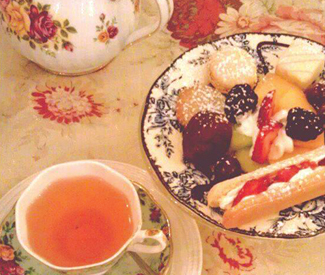
There are so many bric-a-brac shelves in Secret Garden that some of them are brac-less: they exist only to be shelves. Such is the décor reasoning at this parkside parlor, where pastel-colored church hats hang from the walls for insta in-house cred. Upon my visit to Secret Garden I sipped lemon chiffon tea and consumed the Sweet Surrender plate: an ungodly amount of lady fingers, French macaroons, petit fours, and powdered sugar-dusted fruit slices. I also heard the next table over in raptures over glimpsing the royal family on a recent London vacation. Bring your grandma, or a small royal-watcher: there is an ample kid’s menu here.

721 Lincoln, SF. (415) 702-0398, www.secretgardenteahouse.com

DARTEALING

You will undoubtedly be distracted by the fetching jars of pink malt balls and rooster-decorated Sriracha truffles that greet you upon entry into this hideout from the bustling tech world of SoMa. But push on past the retail space: rewards await in the form of comfy sofas be-pillowed with intricately embroidered soft things. Once settled in the space, choose a tea service (blends include cheekily named flavors like “Cabana Boy,” with a sweet tropical fruit taste) that includes options from the sandwich menu: Dartealing has a vast array of crustless wonders, the tofu-and-citrus ginger-soy glazed option being a favorite. Just make sure you leave room for dessert — the lavender-dusted scones that arrive with a ramekin of clotted cream are the dreamiest.

470 Third St., SF. (415) 644-0142, www.dartealing.com

4 Spanish treats

0

A year ago, Hunky Beau and I were tootling wantonly around the Iberian peninsula, from San Sebastiàn and Vitoria-Gasteiz in the Basque north to Sevilla and Tarifa in the Andalucian south, leaving a trail of licked little plates in our wake. We dove into exquisitely stacked two-bite prawn pintxos in Bilbao, leafy salads piled high with tiny, transparent angulas (eels) in Barcelona, rabbit paella in Valencia …

Claro, you don’t need me waggling my delectable Spanish gustation in your face. So let me offer you instead a quartet of recos in SF. There’s been a diverse boom of Spanish spots lately, from gypsy-flavored Gitane to meaty Basque outpost Txoko — both raved about in recent Guardian reviews. Here are four perhaps lesser-known Spanish gems that have tugged at my tongue. 

BOCADILLOS

Don’t let the sandwich-y name fool you, this well-appointed Financial District spot is on the classier end. Absolutely lovely tuna-ventresca salad with miso-lemon vinaigrette and grilled prawns a la plancha provide flavor thrills; the palatial Scientology HQ across the street takes care of the people-watching. Another glass of rich, plummy Arretxia Irouleguy, please. Be warned: Bubble Lounge next door sometimes uncorks a wave of the over-giggly into Bocadillo’s loud space.

710 Montgomery, SF. (415) 982-2622, www.bocasf.com

CANELA

The Castro has suffered its lion’s share of culinary misfortune of late, so how awesome is it that there’s suddenly a tasty, homestyle Spanish joint in that legendary foodie-uninspiring hood? “Bring joy” is the motto: amazing coca flatbreads with farmer’s cheese; hearty, tomato-y albondigas (meatballs) and lamb guisado (stew), and a super-friendly atmosphere make it happen. Bacalao (salt cod) salad with orange, spicy gambas (shrimp) and a tangy chilled gazpacho soup will get me through the summer, I’m guessing.

2272 Market, SF. (415) 552-3000, www.canelasf.com

LALOLA

In my opinion the most authentic bar-style Spanish tapas experience I’ve found in SF — albeit without my cherished vermouth, but with plenty of wine choices to suffice. (Full disclosure: one of the owners has become my real estate agent.) Sidle up to the no-reservation bar or grab a table in the bright, window-laden space with almost-secret flamenco performance room below, and order some perfectly familiar boquerones (anchovies in vinegar), espinacas (spinach sauteed with pine nuts and raisins, croquetas (bechamel croquettes) or that famous heavy Madrid bar-snack mainstay, patatas bravas — potatoes topped with zesty romanesco sauce.

1358 Mason, SF. (415) 981-5652, www.lalolasf.com

THIRSTY BEAR

Come for the wonderful array of local microbrews (Valencia Wheat = light bliss) — treated with wine-like reverence here in terms of kicky pairings with piquant escabeche (pickled vegetables), pollo al vino tinto (chicken in red wine) and bright octopus terrine. But do stay for the fabulous flamenco performances on Sunday evening, when a crowd of the city’s more adventurous culinary explorers watch expertly dramatic dancers kick up their heels.

661 Howard, SF. (415) 974-0905, www.thirstybear.com

Truth or consequences

0

arts@sfbg.com

SFIFF It’s possible to have an almost perfect Sundance Film Festival viewing experience if you hew to one simple rule: only go to the documentaries. Sure, see some of the dramatic entries too, after the 40th person has told you such-and-such title is great. But you can rarely go far wrong with the documentaries. Sundance has its pick of the annual crème de la crème in that genre (among U.S. if not necessarily international films).

As pretty much a “best of other festivals” festival taking place in late spring — thus perfectly situated to grab the best docs not just from Sundance, but also Berlin, Rotterdam, South by Southwest and elsewhere — the San Francisco International Film Festival can potentially offer the crème de la crème de la crème. Thank god documentaries, unlike that imaginary dairy substance, are not high in saturated fat or cholesterol. You can consume them for SFIFF’s entire span and remain your slim, lovely self, mentally refreshed by enormous quantities of new information ingested the fun and easy way.

Actually, a portrait of conspicuous consumption in its most corpulent form was among Sundance’s opening night films this January, and will duly boggle your mind at SFIFF. Lauren Greenfield’s obscenely entertaining The Queen of Versailles takes a long, turbulent look at the lifestyles lived by David and Jackie Siegel. He is the 70-something undisputed king of timeshares; she is his 40-something (third) wife, a former beauty queen with the requisite blonde locks and major rack, both probably not entirely Mother Nature-made. He’s so compulsive that he’s never saved, instead plowing every buck back into the business.

When the recession hits, that means this billionaire is — in ready-cash as opposed to paper terms — suddenly sorta kinda broke, just as an enormous Las Vegas project is opening and the family’s stupefyingly large new “home” (yep, modeled after Versailles) is mid-construction. Plugs must be pulled, corners cut. Never having had to, the Siegels discover (once most of the servants have been let go) they have no idea how to run a household. Worse, they discover that in adversity they have a very hard time pulling together — in particular, David is revealed as a remote, cold, obsessively all-business person who has no use for getting or giving “emotional support;” not even for being a husband or father, much.

http://www.youtube.com/watch?v=DM43Wyulc7w

What ultimately makes Queen poignantly more than a reality-TV style peek at the garishly wealthy is that Jackie, despite her incredibly vulgar veneer (she’s like a Jennifer Coolidge character, forever squeezed into loud animal prints), is at heart just a nice girl from hicksville who really, really wants to make this family work.

Other docs pipelined from Sundance to SF include acclaimed ones about dissident Chinese artist Ai Weiwei (Ai Weiwei: Never Sorry), Ethel (as in Kennedy), pervasive rape in the U.S. military (The Invisible War), and the Israeli military legal system that governs civilian Palestinians under occupation (The Law in These Parts). Of particular local interest is David France’s excellent How to Survive a Plague, about how ACT UP virtually forced the medical and pharmacological establishments into speeded-up drug trials and development that drastically reduced the AIDS epidemic’s U.S. fatalities within a decade. Don’t expect much about SF activism, though — like so many gay docs on national issues, this one barely sets foot outside Manhattan.

Of actual local origin are several SFIFF nonfiction highlights, not least festival closing nighter Don’t Stop Believin’: Everyman’s Journey, Ramona Diaz’s film about the incredible journey of Filipino superfan Arnel Pineda, from fronting a Journey cover band to fronting the actual Bay Area outfit itself as its latest lead vocalist. There’s also Micha X. Peled’s last globalization trilogy entry Bitter Seeds, focusing on hitherto self-sufficient farmers in India increasingly driven toward bankrupting debt (and widespread suicides) by costly biotech “advances;” Peter Nicks’ The Waiting Room, which sits us right there at Highland Hospital in Oakland, illustrating the heroically coping status quo and desperate need for improvement in a microcosm of U.S. healthcare; and Jamie Meltzer’s world premiere Informant. The latter’s subject is activist-turned-FBI snitch Brandon Darby, whose testimony got two anarchists imprisoned — and who fully participated in this portrait, even its re-enactments of his protest-group infiltration. Darby is expected to attend the festival; given this town’s political leanings, he might want to wear a raincoat.

Speaking of audiences hurling things — abuse, at the least — Caveh Zahedi (plus his lawyer) was evidently met with a shitstorm after the SXSW premiere of The Sheik and I. You, too, may feel the spasmodic urge to throttle him during this latest naughty-boy’s own adventure, in which he accepts a commission to make work for a biennial perversely themed around “art as subversive act” in the far-from-liberal United Arab Emirates. Professed fans, the curators had duly seen his prior work; surely they knew they were inviting trouble in these circumstances?

Nonetheless, they play perfectly into his hands, expressing dismay and barely masked fear as Zahedi faux-naively proceeds to do everything he shouldn’t. That includes ridiculing Islam and the host sheik, stereotyping Arabs in general, putting everyone (including himself and his two-year-old son) in potential danger, all the while claiming his aim is “a critique of imperialism.” Is he really the very model of the privileged Western artist, railing about artistic freedom while ignorant that sometimes, some places, some things (like blasphemy, and prison) must take precedent? Or is the whole act just a deliberate provocation (hardly his first), albeit one with disturbingly dire potential consequences? Alternately very funny and completely infuriating, The Sheik and I is one movie you might want to attend just for the Q&A afterward. Odds are, it’s gonna get ugly. 

www.sffs.org


A hundred visions and revisions

0

arts@sfbg.com

SFIFF R. Buckminster Fuller was born before the turn of the last century, and died before the start of this one. But place his philosophical and practical output next to any contemporary thinker, and something seems a bit off.

“He was totally out of sync with his time,” says SF-based documentarian Sam Green (2004’s The Weather Underground). “He was talking about green building in the 1930s or ’40s.”

You might know Fuller as the designer of the geodesic dome or the namesake of buckyball molecules, but Green, in conjunction with a new exhibit at the San Francisco Museum of Modern Art, is working to establish his reputation as a precursor to modern progressive-tech culture. On May 1, as part of the San Francisco International Film Festival, Green will regale audiences at the SFMOMA with a “live documentary” presentation, The Love Song of R. Buckminster Fuller, featuring a live score by Yo La Tengo.

The exhibit, “The Utopian Impulse: Buckminster Fuller and the Bay Area,” is already open, and features an installation called Buckminster Fuller and the Bay Area: A Relationship in 12 Fragments (inspired by the Dymaxion Chronofile), a collaboration between Green and SF projection-design firm Obscura Digital. The installation is a collage-like film projected on a sculpture inspired by Fuller’s “Dymaxion Map” of the world; the film is an exploration of Fuller’s maddeningly comprehensive personal archive, acquired by Stanford University in 1999.

“Fuller never built anything in the Bay Area, although he proposed a couple projects, and he never lived in the Bay Area, but his influence actually is pretty profound,” notes Green. “Especially on the counterculture, and specifically on the part of the counterculture that eventually morphed into early computer and Silicon Valley culture.” His drive to create efficient, waste-free systems through design and architecture inspired information technology as much as it foreshadowed the green movement.

So what makes Fuller anything more than just a fascinating mad scientist? “We’re not driving the [Dymaxion Car], and most of us are not living in domes or the Dymaxion House. So in some sense you could say he didn’t succeed,” admits Green. “But to me, what’s most relevant and most valuable about him really is that he was inspired to do everything he did by a belief that, through [better design], one could solve the problems of the world.”

“At the heart of all of his activities was a really simple idea, and he was saying this since the ’20s: there’s more than enough resources in the world so that everybody on the planet could have a very comfortable life,” Green muses. “And he really passionately believed that was possible. In some ways, to me, that’s the love song of R. Buckminster Fuller — love of humanity — which sounds a little corny but I really do feel like that was what drove him. He was a person of incredible energy and was on a mission for 50 years, and at the heart of it, I think, was that.”

This is Green’s second foray into the format he innovated with Utopia in Four Movements for SFIFF in 2010, which featured music by Brooklyn band the Quavers and is still touring around the world. “I’m charmed by the format and feel like there’s a lot of potential, a lot more I want to try with it,” Green says of this return to live documentary. “It also seems very appropriate for Fuller; he was somebody who was just a phenomenal speaker. So there seemed to be something about him that fit with this idea of a live documentary, the performative aspects of who he was.”

“It’s only through doing a live piece that you learn what works and what doesn’t. It’s almost like a comedy routine,” Green observes. “You do it and you feel that people respond to certain parts, they don’t respond to other parts, and you grow it and edit it and shape it based on that.”

As to whether or not he thinks there’s more to explore in the world of Bucky Fuller, he says, “With this I’m doing a live piece and an installation, and I may at some point do just a regular documentary about Fuller. I’m open. I’m certainly not done with him yet.”

www.sffs.org


Into new territory

2

arts@sfbg.com

SFIFF How to account for the desire for difficult terrain that runs through so much contemporary art cinema? Exploring the margins and crevices of what’s readily visible is just what good filmmakers do, but extremes have become commonplace. The irony that these far-flung films live on in the cosmopolitan vapors of the festival circuit cannot be lost on the filmmakers themselves. Remoteness may be a relative matter, with patience revealing islands everywhere, but inaccessible landscapes nonetheless guide a handful of interesting features showing at this year’s San Francisco International Film Festival.

>> Read our complete coverage of the San Francisco International Film Festival here.

The bourgeois couple stripped bare by vacation is a standby of modernist cinema, with Roberto Rossellini’s Viaggio in Italia (1954) still the gold standard and Maren Ade’s Everyone Else (2009) the best in recent memory. Julia Loktev’s The Loneliest Planet is an almost classical work in this mode. An engaged couple (Gael García Bernal and Hani Furstenberg) hire a local guide (Bidzina Gujabidze) to lead them through the magnificent Georgian steppe, and so the psychological roundelay begins. Fraught staging, language difficulties, Gerry-rigged tracking shots, and significant pocks in the Caucasus landscape are all worked out with great expertise but little verve.

Where The Loneliest Planet draws on landscape to reveal repressed instincts, Ulrich Köhler’s Sleeping Sickness drifts towards further occlusion. Joseph Conrad’s Heart of Darkness is the obvious reference point, though here it’s a black European who pursues a white man gone native. In the film’s first half we watch as rueful Dr. Ebbo Velten (Pierre Bokma) prepares to leave Cameroon’s lush danger with his wife and daughter. The imminent departure emboldens him to accuse the local authorities of bilking international aid donors for a nonexistent sleeping sickness crisis. Then Alex Nzila (Jean-Cristophe Folly) arrives in Cameroon to evaluate the medical program and finds Velten changed: he’s in a business partnership with a man he openly despised in the first half of the film, and we hardly hear any mention of his European family. Berlin School director Köhler works displacement as a figure of psychology, politics, and narrative and smartly uses the international aid question as a frame to plunge deeper mysteries of identity.

Conrad is a significant presence in The Rings of Saturn, the peripatetic novel by W.G Sebald that’s also the focus of Grant Gee’s suitably oblique documentary portrait. Patience (After Sebald) offers astute commentary on the moods of Sebald’s prose from thinkers like Adam Phillips, Robert Macfarlane, and Tacita Dean, though Gee succumbs to the spectacle of Google Earth mapping of the novel and some decidedly sub-Sebaldian spiritualism. Still, hearing the author speak his own mind on Virginia Woolf’s moth and the phenomenology of walking is worth the price of admission for fans.

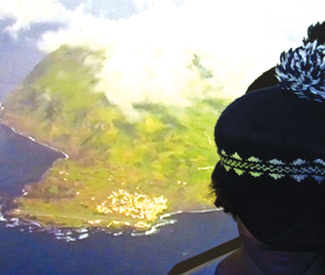
Gonçalo Tocha eschews the Google’s eye view in It’s the Earth Not the Moon, his resplendent study of Corvo (the tiny northernmost island of the Azores, close enough to being in the middle of the ocean and a far outlier of European Union). Tocha and his sound man Dídio Pestana dropped anchor there to capture every face, bird, and rock on the island — a self-consciously grandiose goal with something of the 19th century about it. The film first approaches Corvo with statistical lyricism: dimensions, number of residents, number of roads, and so on. The notion that you could hold the entire island in your head at once is an illusion, of course, but a sustaining one. Corvo is an island such as you might have imagined as a child, which is not to say that It’s the Earth is innocent of the world. As economic math and electoral politics sweep the second part of the film, Tocha proves himself an inheritor of the French essay-film tradition of Chris Marker and Agnès Varda. The film’s three hours pass easily in the intimacy of encounter, but one still admires the desire to give the film experience some qualitative measure of being marooned.

Corvo’s aging population might well feel at home in the timeless Brazilian village of Found Memories, the fable of a young woman born in the wrong time coming to a community of people who have forgotten to die. Along with It’s the Earth and other SFIFF selections Palaces of Pity and Neighboring Sounds, Júlia Murat’s first narrative feature seals a particularly strong year of Portuguese-language films. She delineates time and space through routine, patiently unfolding characterization in the adjoining repetitions. Lucio Bonelli’s cinematography is beautiful work in itself, fearlessly embracing darkness and shadow (the rural village must have seemed like easy street after lensing Lisandro Alonso’s formidable landscapes). Found Memories doesn’t break the mold of slow cinema — its melancholy mingling of photography and myth is especially reminiscent of Manoel de Oliveira’s The Strange Case of Angelica (2010) — but a late passage of clipped post-punk demonstrates that Murat can handle a sudden swerve.

That leaves little space for Davy Chou’s assured debut, Golden Slumbers, and it deserves an article of its own. The remoteness we experience here is that of phantoms: Chou’s film excavates the thriving Cambodian cinema that was rubbed out by the Khmer Rouge. All that remains are fugitive traces of printed ephemera and soundtracks of curling orchestral ballads and psychedelic nuggets — and the memories of those people who made or relished the films and survived Pol Pot. Most of the films discussed in this article use offscreen sound to develop a sense of place beyond the frame, but Golden Slumbers is a special case, with the poverty of archival materials turned to an advantage as elegy. Chou’s gliding Phnom Penh interludes and spaciously staged interviews reflect the influence of Jia Zhangke and Tsai Ming-liang’s Goodbye, Dragon Inn (2003), but these cinephilic touchstones never overwhelm the personal, defiant accounts of moviemaking at the heart of the film. Ever after is the tragic refrain of Chou’s film, but the once upon a time is as golden as he says. 


www.sffs.org

The hunt for authentic Bay BBQ

2

virginia@sfbg.com

For a child of East, West, and Middle America, I have an unexpected and profound affinity for the music and food of the South. Traveling in the region, my love grows. Florida conch and stone crab, Tex-Mex and Texas brisket. But when I dream of the South, I think Deep South. Start talking low country and Gullah cuisine, or Cajun and Creole cooking, and I become brutally homesick for a home I never had.

Then there is the barbecue. And by barbecue, I mean pulled pork, those words being synonymous in the Deep South. Texas brisket? Naturally. Memphis ribs? Hell yeah. But pulled pork, that tender, shredded, fatty mound of piggy goodness, for me, is the pinnacle of BBQ. Don’t even get me started on sauces. South Carolina mustard or thick, sweet Kansas City sauce? I’ll take it all, thank you. A proper sauce turns impeccable meat into ecstasy.

One of the more memorable journeys the Renaissance Man and I ever took was a two-week road trip through four Southern states for BBQ, music, and food. Though I’ve been a California girl for the larger part of my life, in this glorious state of endless riches I rarely find barbecue comparable to that of my Southern exploits — even coming from those who claim to be Southern natives. There are whispers of true BBQ here, but often something indefinable is lacking. The problem commonly lies in sauces, smoking techniques and woods used, or the meat’s tenderness (I’m sorry: it ain’t real BBQ if it’s not fatty). Even delicious ‘que is missing a certain raw, gut-level sense of place outside the South.

Regardless, some worthy Bay Area spots have emerged to satisfy ‘que cravings. Uncle Frank’s was the best BBQ I’ve had in California, until it tragically closed last fall. Frank’s brisket was thick with fat, served in the back of a dodgy dive bar in suburban, staid Mountain View.

Bo’s Barbecue (3422 Mount Diablo Boulevard, Lafayette. (925) 283-7133, www.bosbarbecue-catering.com) specializes in solid brisket. Golden Gate Park golf course houses an unexpected gem, Ironwood BBQ (around 47th Ave., SF. (415) 751-8987, www.ironwoodbbq.com) which is strong on pulled pork. Years ago, Brother-in-Law’s BBQ morphed to Lilly’s and became Da Pitt (705 Divisadero, SF. (415) 440-7427, www.dapittbbq.com). Though past its glory days, it’s still a worthy detour, wafting glorious smoke aromas down the street. What of ever-popular Memphis Minnie’s (576 Haight, SF. (415) 864-7675, www.memphisminnies.com)? I must admit that despite a love for their rowdy Southern tunes and spirit, I can’t get behind the lackluster meats and watery sauces.

We go through waves of ‘que openings and we’re in the midst of another now. Here are five recent BBQ openings.

SNEAKY’S BBQ

From Wednesday to Sunday, this pop-up kitchen in Rebel steps outside tradition with items like Kurobuta pork belly. But more than any of the other newer ‘que joints on this list, it gets Carolina-style pulled pork right — Sneaky’s is among the best in town. Only downside is the price — a single platter of meat and two sides is $17, a two meat combo $26, compared to $12 and $18 for the same options at CatHead’s BBQ.

Sauces: Vinegar BBQ, spicy jalapeno-habanero, South Carolina mustard, Rooster (a creamy version of spicy sauce)

Stand-outs: Aforementioned pulled pork is tops here, as is South Carolina mustard sauce (and they’re perfection together). Sneaky’s brings it with Creekstone Farms brisket and baby-back ribs. The outfit is to be commended for using all natural, hormone-free meats, smoked with locally-cut almond wood. Sides ($4) include a classic coleslaw, and fresh — not soggy or overcooked — collard greens. Cheeky points for Rebel’s fancified gay biker bar setting, and the majestic motorcycle that serves as the room’s centerpiece.

1760 Market, SF. (415) 431-4200, sneakysbbq.blogspot.com

CATHEAD’S BBQ

Nate’s BBQ had quite a following — not to mention coveted home delivery. It recently morphed into CatHead’s BBQ under the direction of Tennessee native Richard Park and Pamela Schafer, and has become one of the city’s best BBQ options. Thankfully, it still offers delivery. Vegetarians get a nod with cornmeal-crusted BBQ tofu. Mains are wonderfully priced at $7 with a mini-biscuit and pickles, while a platter with two sides is $12. Of note: large biscuits are aptly described as having the size of a cat’s head

Sauces: Mustard, ketchup-based BBQ sauce, North Carolina finishing sauce, habanero, CatHead’s catsup, pepper vinegar

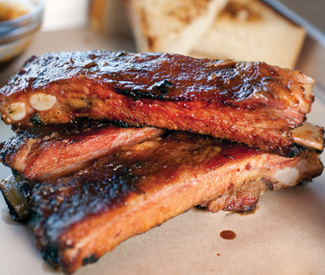
Stand-outs: They had me with Coca Cola-smoked brisket. A subtle sweetness permeates the über-smoky beef. Ribs are also strong, the best of any place listed. The secret is extra fat, rendering the meat fall-apart tender. All sides ($4 each) are vegetarian, including mustard or spicy habanero slaw. Collard greens taste healthy, a fresh change of pace from traditional collards. Though I miss the ham hocks.

1665 Folsom, SF. (415) 861-4242, www.catheadsbbq.com

B SIDE BBQ

Tanya Holland of West Oakland’s beloved Brown Sugar Kitchen opened B Side Barbeque a few months ago, a hip, comfortable space lined with photos of African American cowboys. Look closely through the smoky, rich air and you’ll see Tanya and her husband in one of the old-timey shots on the walls.

Sauces: Hot vinegar, Carolina mustard, or traditional

Stand-outs: Pulled pork is tender and lush in Carolina mustard sauce, but they shine with smoked brown sugar-rubbed brisket ($9 half order; $16 full order). Fatty beef sings with sugary crust. Ribs are succulent. A side of fresh, spicy coleslaw ($4), light on the mayo, is a happy companion. Food is prepared with care, a step above many East Bay ‘que joints.

3303 San Pablo, Oakl. (510) 595-0227, www.bsidebbq.com

CEDAR HILL

The Marina has itself a BBQ restaurant. Small, welcoming, and lined with rustic artwork and paraphernalia from Texas to the Carolinas, Cedar Hill is a big win for the neighborhood to the north. The ‘que is not as soul-satisfying as it is in the South, but has plenty to offer with dishes like Cajun shrimp on Anson Mills grits topped with andouille sausage and piquillo peppers ($17), or sweet tea-fried chicken ($7.50–$19 for a quarter to whole chicken).

Sauces: Texas red, KC BBQ, South Carolina mustard, North Carolina vinegar

Stand-outs: Tender smoked pork ($4.50-16) wins out over Texas beef brisket ($4.50-16), while Memphis baby back ribs ($5-25) are a little dry. Worthy sides ($3.50–$11.50, portion to quart) include a fresh, bright coleslaw, or pit beans glorified with burnt tips. Ruth’s buttermilk pie ($5) with graham cracker crust is a creamy delight. Extra points: Cedar Hill serves bottles of North Carolina’s classic wild cherry soda, Cheerwine.

3242 Scott, SF. (415) 934-5403, www.cedarhillsf.com

SOUTHPAW BBQ

Southpaw BBQ has the most welcoming, festive atmosphere of any of the new ‘que joints, with beer brewed right in the dining room, additional beers on draft (like Bruery Mischief, Brother Thelonious, and Deschutes Green Lakes), and a playful cocktail menu offering sazeracs made with Germain-Robin craft brandy and tea syrup.

Sauces: Alabama white sauce, Eastern North Carolina, South Carolina mustard, sweet potato habanero, sweet chili vinegar, Memphis

Stand-outs: Slightly smoky Honey Bunny cocktail (blanco tequila, red pepper, orange and carrot juice, agave) is lively and fun. Platters ($14-19) come with cornbread and two sides. As much as I wanted to love the ribs, brisket and pulled pork, they bordered on being either dry or not as flavorful as other ‘que joints. Though not barbecue, fresh, flaky catfish ($14) from Louisiana is my favorite here: comfortingly fried and not at all fishy.

2170 Mission, SF. (415) 934-9300, www.southpawbbqsf.com

In city workers’ shoes

6

We both work under City Hall’s iconic dome as civil servants. While I often work late into the evening hours as a supervisor, Robert’s back-breaking work as a janitor is often done past the midnight hour, five nights a week.

I had the opportunity to meet Robert last week, as part of the “Walk A Day In Our Shoes” program of Service Employees International Union, Local 1021.

Robert is 52 years old. He’s worked for the city since 1999. Before that, he worked for San Francisco Unified School District. He sweeps and mops the floors and stairs of the famous rotunda and cleans 150 cubicles.

Last week, Robert had me take off my jacket and tie, roll up my sleeves and do his job for a while. I swept the marble floors, which are truly unending. I mopped the grand marble staircase behind happy couples exchanging wedding vows. He let me attempt to push a gigantic whirring machine that felt more like a Zamboni than a vacuum.

When I was younger, I had a summer job as a janitor at a public high school, so I know how truly strenuous Robert’s job is.

Robert injured his spine as a result of pushing that heavy vacuum for years. When he was in the hospital treating his spinal injury, the doctors discovered cancer. While in chemotherapy, he didn’t miss a day of work. He lives cancer-free today.

Robert is also a green pioneer at City Hall — he started a recycling program here before it was popular to do so. After that, the rest of the city caught on. He has photos of himself and the past four mayors in his home. He offers directions to visitors. He has a son, and they both live in his sister’s home. He speaks lovingly of his wife, who he lost to diabetes several years ago.

As our economy evolves, we can’t leave people like Robert — those who support our world-class city —behind. While we court businesses who create new jobs in our city, we also need to reinvest in the people who do the important work that often goes unnoticed.

Hospital workers are up at 4am, preparing meals for patients. Library technicians provide bilingual translation for our children. Others, like Robert, are up until 1am, making sure we have a clean and safe environment to work every day.

After years of concessions to balance deep budget deficits, city workers experienced ongoing cuts to their wages and benefits. In current contract negotiations, they are being asked to give hundreds more each month in healthcare costs to insure their children.

We appreciate all they have done to help our city in times of need. As our city recovers economically, it’s time to thank them, to ask others to help shoulder the costs for affordable housing, parks and recreation facilities and schools, and to reform our local business tax — which is paid by only 10% of our city’s companies.

Last week, I got to know a fellow civil servant whose work we need to remember to value. Which is why I will stand alongside Robert, labor unions, nonprofits, community members and neighbors on Wednesday, April 18, in front of City Hall from 4pm to 7pm. Please join us in supporting the workforce that supports us all, 24 hours a day. 

David Chiu is president of the Board of Supervisors.Thousands of community allies, elected officials, and SEIU 1021 members will rally on Wednesday, April 18 to close tax loopholes on mega banks and corporations from 4pm to 7pm at City Hall.

Pushing back

0

Dexter Cato has no right to be here.

He’s standing on the corner outside the house he bought in 1990. His four kids, still teenagers, grew up here. He was living here when his wife, Christina, passed away following a car accident in 2009. Next door is the house he grew up in, having spent all his life on Quesada Avenue, in the wide streets and residential friendliness of the Bayview.

Still, the bank says Cato doesn’t belong here anymore, evicting him when his home went into foreclosure in August 2010. Yet Cato and his community not only fought back and reoccupied the home last month, they have turned it into a community center and base of operations from which to fight other foreclosures in the area.

The house, at the corner of Quesada and Jenning, is draped with banners, such as “Banks: no foreclosures!” and “keep families in our homes!” In the rain on March 16, when they were unfurled on the property that has remained vacant for nearly two years, surrounded by neighbors and friends, Cato moved back in. It was a gamble and an act of civil disobedience. Now they feel festive; it’s been a month, and no one has shown up to tell Cato he has to leave.

It has become a home base for a who’s who list of “foreclosure fighters,” the name taken on by Cato and others who have, in recent months, gone to extreme means to prevent banks from foreclosing on their homes. There’s Vivian Richardson, who got her foreclosure rescinded after 1,400 emails to her loan servicer. There’s Alberto Del Rio, who was ignored and told that his paperwork was lost during a Kafka-esque two-year loan modification attempt, only to win a meeting with top Wells Fargo executives last month after Occupy Bernal got behind his cause. There’s Carolyn Gage, who took a cue from protesters downtown and occupied her Bayview home in November.

Those taking on the foreclosure crisis certainly have a big task ahead of them. Since the market collapsed in 2008, there have been 12,410 foreclosures in San Francisco, according to data from RealtyTrac as compiled by the Alliance of Californians for Community Empowerment (ACCE). The neighborhoods with the most foreclosures are Ingleside-Excelsior/Crocker Amazon, Visitacion Valley/Sunnydale, and Bayview-Hunters Point, with more than 1,000 in each neighborhood. But the number of home foreclosures are in the hundreds in every neighborhood in San Francisco.

Despite the pandemic, many San Francisco residents say they felt distinctly alone in the events surrounding receiving notice of default.

“I’ve lived in Noe Valley since 1972,” said Kathy Galvess, an activist we spoke to Cato’s basement. “I didn’t know anybody who had been foreclosed on.”

When she got her eviction notice and, hooking up with ACCE and Occupy Bernal, faced her situation and the extent of the crisis, she wondered if her neighbors knew something she didn’t.

“I asked around the neighborhood, no one had any idea,” she said. “That’s how the banks get away with it. We suffer in silence.”

Carolyn Gage echoed that sentiment. “A while ago, foreclosure was shameful. But now it shouldn’t be. It’s happening in a systemic way, so people are getting over that shame,” she told me and several neighbors March 24 during a barbecue at Cato’s house.

This shame came in part from the illusion that the onslaught of seemingly affordable home loans from the housing bubble’s height were, in fact, affordable.

“The easy money fueled the ability for people to refinance every one or two years. A lot of people did that and just lived on it. Certain people used it, some abused it, others got caught up in it,” said CJ Holmes, a real estate broker in Santa Rosa who became interested in understanding the meanings of the crisis when the value of property she owned plummeted in 2008.

While President Bush signed on to Troubled Asset Relief Program (TARP) in 2008, and bailouts to Fannie Mae and Freddie Mac continued to roll out well into the Obama presidency, foreclosures were steadily clearing San Francisco of longtime residents, not to mention property tax and home values on foreclosure-stricken blocks.

There were advocates working on the behalf of those getting evicted. The Alliance of Californians for Community Empowerment looked into cases and worked to discern the complex chain of entitlement, talk to the right people, and try to get loans modified. HUD-certified organizations like the Mission Economic Development Agency (MEDA) and the San Francisco Housing Development Corporation (SFHDC) counseled homeowners and waded through paperwork.

“The modification process takes an average of 12 months to complete,” said Jose Luis Rodriguez, a foreclosure counselor with MEDA, in an email. The loan modification process can make or break a homeowners chances of keeping their home, leaving them in what he called “purgatory.”

Assessor-Recorder Phil Ting later concluded that in 84 percent of foreclosure cases, there was some kind of faulty paperwork.

“We’d fax documents to banks and they would habitually lose documents. We’d have to fax them sometimes up to 10 times,” said Jonathan Segarra, director of communications for MEDA.

Alberto Del Rio had the same issue. During his loan modification struggle, “we kept having to sign up for a new case,” Del Rio told me. “About every three months. Generally because they lost paperwork, or paperwork wasn’t properly transmitted.”

“There was no callback on their part,” he said. “We would have to call to get updates and they would say: oh, it’s closed, you have to start over with the paperwork now.”

But this lost paperwork epidemic, an emblem of the carelessness that ran rampant through the mad expansion of the subprime mortgage industry, has more than one face. It is likely due to lost paperwork, for example, that Cato has been living in the home that is, technically, no longer his.

No one seems to have the title.

At the time of sale, it was owned by Wells Fargo. According to transaction records, the foreclosure is being serviced by American Home Mortgage Servicers; they get a portion of the money, but do not own it. According to Wells Fargo representatives, that bank is now the trustee of the mortgage, also known as the beneficiary.

ACCE has claimed that Wells Fargo “sold the house back to itself,” and that American Home Mortgage Services, the company currently servicing the loan, is a subsidiary of Wells Fargo. Ruben Pulido, a Wells Fargo spokesperson, denies this.

“That’s incorrect. American Home mortgage services is completely different and separate from Wells Fargo,” Pulido told us.

But Martinez believes that “they’re different entities in that they work separately, but they’re the main servicer for Wells Fargo, they only service for Wells Fargo.”

Calls and emails to American Home Mortgage Services went unanswered.

Last fall, as an angry mass suddenly emerged from the American public, cries of “banks got bailed out, we got sold out” rang through the streets. Occupy Bernal and ACCE have had success in the city government, gaining support from Sups David Campos and John Avalos, who represent some of the hardest hit districts, helping facilitate meetings between Wells Fargo representatives and homeowners with foreclosure horror stories, with some success.

Activists also went for more civil disobedience-style tactics. These were on display Feb. 22, when dozens of supporters showed up at Monica Kenney’s Excelsior home. Kenney was in the midst of dealing with a foreclosure that didn’t seem right. She had received a forbearance agreement and made the first payment on it June 27, then was surprised to learn that, June 28, her house had been sold at auction.

“At this point I wrote Wells Fargo and I said, I have this paperwork, and I want you to honor it and rescind the foreclosure,” Kenney explained when she came to speak with us at the Guardian offices. She gave us copies of the forbearance agreement.

“Their response was, we did nothing wrong and the foreclosure will stand,” she said. “So at that point I decided I would fight to retain my home.”

After dishing out most of her savings in a lawsuit and eviction stays, the fight looked grim, and her house was slated for eviction. The plan — the last line of defense — was to simply bring as many people as possible to Kenney’s home and hope they could fend off eviction. Kenney remembers her nerves, huddled up that cold morning with veteran foreclosure fighter Vivian Richardson, worried that no one would show up.

“Then, at six in the morning, I had foreclosure fighters, neighbors, friends, Occupy Bernal, Occupy folks period, they just started showing up at the house, and just sat down, hunkered down with me and said, we’ll do whatever we can to at least dissuade the sheriff,” she recalls

It worked. And it hasn’t stopped working. Many people who have joined with Occupy Bernal and ACCE are still in their homes thanks to everything from lobbying politicians to civil disobedience. Some were evicted despite the protest movement’s best efforts but, thanks to newfound community, they avoided homelessness.

Kathy Galvess wasn’t able to keep her home, but her experience was made much more pleasant by Occupy Bernal. “Stardust got the moving truck and helped me move, out of the goodness of his heart,” she told me. “And if it wasn’t for Vivian, me and my sister would be wandering the streets in these storms we’ve been having.”

It’s that community, it’s that tireless work, it’s that victory in the midst of a sea of ongoing challenges that was celebrated at the barbecue at Cato’s house. It’s hard to know the future of the occupied home. The goal of the coalition supporting it was to keep it until April 24, the day of a Wells Fargo shareholders meeting that a large coalition of advocates are determined to shut down.

But for now, the place has become a community center and a symbol of hope and defiance. Politicians have certainly taken note. The Board of Supervisors passed a resolution last week urging banks to suspend foreclosures in San Francisco.

“It’s great,” Cato said. “That’s what the house is useful for right now. Everyone’s coming in and asking, how can we be a part of this, how can we help.”


Free Muni for kids makes sense

0

EDITORIAL San Francisco is a transit-first city that has spent millions of dollars over the years trying to convince people to ride Muni. And yet, one of the best and most effective ways to get people out of their cars is facing surprising opposition.

Sup. David Campos has been pushing for months to get Muni to allow young people to ride free. It makes immediate sense: The school district, perpetually short on funds, is cutting back bus service (which is preferable to cutting back classroom instruction). For low-income families, the disappearance of a yellow school bus, which offered transportation free of charge, is a financial obstacle — and the last thing anyone needs is another obstacle to keep kids out from coming to school.

Reduced-fare youth passes are already available — but they aren’t easy to get. Parents need to show up in person, during the day, with a birth certificate, passport or other government ID; that’s hard for a lot of working parents. The school district ought to be able to sell the passes, but right now nobody has the resources to make that happen.

It’s possible to create a system to identify and offer free service to low-income families, but again, unless it’s done through the schools, where that data is already kept (for reduced-price lunches), we’re talking about creating a complicated bureaucracy that isn’t remotely necessary.

According to Campos, the cost of providing free service for all youth is only $8 million a year — and he’s identified regional transit funds to pay for much of it. Muni has a deep budget deficit already, and anything that costs more money has to be carefully evaluated, but there are so many ways to cover the price tag. (Why is Muni still paying the Police Department tens of millions of dollars to get cops on the buses when that’s part of the department’s job already?)

And this goes beyond Ethe very clear needs of low-income families. Getting young people onto the buses is an excellent way to convince the next generation of San Franciscans that it’s not necessary to own and operate a motor vehicle in the city. The message is already getting out — according to an April 5, 2012 study by the Frontier Group, the number of car miles driven by people between 16 and 34 dropped 23 percent between 2001 and 2009. That trend crosses class lines — in fact, among young people who earned more than $70,000 a year, public transit use rose 100 percent over the decade and biking by 122 percent.

In other words, it’s proving to be a massive challenge to get older people out of their cars, but the kids are already moving in that direction. With a little help and push, San Francisco could make giant strides in the next few years.

And a significant reduction in car use would more than pay for the cost of free Muni for youth. Every car off the road means less road maintenance, less air pollution — and perhaps more important, less congestion to slow down the buses. Faster buses means more riders and more fares (and less money spent paying drivers to sit in traffic).

So it’s a great idea that pays for itself and helps the environment. And yet some city officials (led by Sup. Scott Wiener) still resist. They should back off; the city should move to approve this plan immediately.

I get by with the help of my local DIY classes

0

What would the ultimate DIY day look like? There’s heaps of classes you can take in the Bay Area to make yourself more handy and sustainability-minded. Here’s a hypothetical 24 hours using the skills you can cull from those courses — scroll to the end of the article for details on where you can take each class concerned.

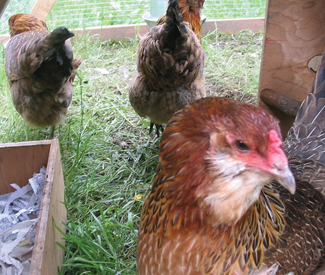
It’s Saturday! Wake up to the smell of coffee you roasted yourself (“Home Coffee Roasting”). Pour in your homemade almond milk for a nutty kick. (“Everyday Nut Milks and Cheeses”) For breakfast, you’re having toast with the jam you preserved (“Basics of Food Preservation and Jam-Making”) and fresh honey from your backyard beehive. (“Backyard Beekeeping”) Say hello to the chicken peeping outside, and thank your favorite hen as you enjoy that plate of scrambled eggs. (“Intro to Backyard Chickens”)

Mosey out to your freshly-landscaped garden, picking your way past the brand-new bank of sprightly succulents. (“Strategies in Urban Permaculture”) Admire your new water-saving irrigation system — she’s a real looker. (“Greywater, Rainwater Catchment, Earthworks”)

Time to primp for your day. Wash your body with the soap you made from scratch (“Cold Process Soap Making”) and afterwards, spritz yourself with handcrafted perfume. (“Making Natural Perfumes”) Head to your closet and pick out the fresh new frock you sewed (“Patternmaking and Design”), adorning yourself with those homemade earrings and pendant. (“Stitch DIY Class: Jewelry Making”)

After running a few errands around town, return to your garden to enjoy a cup of seasonal tea. It’s perfectly steeped — no need for artificial sweeteners. (“Tea and Food Pairing”) For lunch, you’re thinking crab ravioli with tomato cream sauce. (“Using Your Noodle”) Sprinkle fresh herbs gathered from your garden onto your plate for that extra kick. (“Starting an Herb Garden”)

Your out-of-town friends have been eating out every day of their trip, so you invite them over for a home-cooked meal. You remember hearing one of them saying that he craved sushi — sounds like the perfect night for nigiri and maki. (“We Be Sushi Workshop”) The handsome wooden table you built last weekend (“Wood and Metal”) makes the perfect centerpiece over which to catch up on each other’s lives.

The evening is going smoothly. Until, that is, one of your guests bumps into a burning candle on her way to the bathroom. The fire spreads quickly, but what do you know, those skills you copped from San Francisco’s firefighters save the day. (“Disaster Preparedness Training”)

Singe avoided, you and your friends get in the car to head to a mutual friend’s art show. Snap — the car sputters out! But you dodge an evening of tow trucks and mechanics’ waiting rooms. That auto repair class (“Essentials of Auto Maintenance”) taught you everything you need to save the day. Again.

You drift off to a deep sleep wrapped in a warm nest of your favorite knitted blankets. (“Knitting 101”) Sweet dreams, most capable person ever. 

“Home Coffee Roasting” May 3, 6pm-9pm, $30–$60. Modern Coffee, 411 13th St., Oakl. (510) 927-3252, www.iuhoakland.com

“Everyday Nut Milks and Cheeses” May 2, 6pm-8:30pm, $40-65. Instructor’s private home in Oakland, www.rawbayarea.com

“Basics of food preservation and jam-making” Fri/20, 6:30pm-8pm, $10. Pot and Pantry, 593 Guerrero, SF. (415) 206-1134, www.potandpantry.com

“Backyard beekeeping” Tue/24, 6pm-9pm, $35. Sticky Art Lab, 1682 University, Berk. (510) 655-5509, www.biofueloasis.com

“Intro to Backyard Chickens” Sun/15, 2pm, $35. Mill Valley Chickens, 106 Lomita, Mill Valley. (415) 389-8216, www.millvalleychickens.com

“Strategies in Urban Permaculture” Sun/15, noon-5pm, $25. Hayes Valley Farm, 450 Laguna, SF. (415) 753-7645, www.hayesvalleyfarm.com

“Greywater, Rainwater Catchment, Earthworks” basics of home irrigation Sun/29, 10am-1pm, $15. EcoHouse, 1305 Hopkins, Berk. (510) 548-2220, www.ecologycenter.org

“Cold Process Soap Making” Fri/20, 6pm-9pm, $65. Nova Studio, 24 West Richmond, Point Richmond. (510) 234-5700, www.thenovastudio.com

“Making Natural Perfumes” May 6, 10 am-5 p.m., $125. Nova Studio, 24 West Richmond, Point Richmond. (510) 234-5700, www.thenovastudio.com

“Patternmaking and Design” Four weekly classes, $175. Apparel Arts, 2325 Third St. Suite No. 406, SF. (415) 436-9738, www.apparel-arts.com

“Stitch DIY Class: Jewelry Making” Sat/14, 2:30pm-3:30pm, free. Indie Industries Castro Store, 2352 Market, SF. (415) 861-1150, 5titch.eventbrite.com

“Tea and Food Pairing” Tue/17, 7pm-8:30pm, $85. Tea Time Room, 542 Ramona, Palo Alto. (650) 328-2877, www.tea-time.com

“Using Your Noodle” 5/1, 6:30pm-9:30pm, $45-60. Marina Middle School,104A, 3500 Fillmore, SF. (415) 749-3495, www.ccsf.edu/continEd

“Starting an Herb Garden” May 5, 10:30am, $39. Common Ground Organic Garden Supply and Education Center, 559 College, Palo Alto. (650) 493-6072, www.commongroundinpaloalto.org

“We Be Sushi Workshop” Sat/14 and Sat/21, 10am-1pm, $65-80. We Be Sushi, 538 Valencia, SF. (415) 565-0749, www.ccsf.edu/continEd

“Wood and Metal” April 23 through July 2, Mon. 6pm-9pm, 10 sessions for $520. The Crucible, 1260 Seventh St., Oakl. (510) 444-0919, www.thecrucible.org

“Disaster preparedness training” Tues/17, 6:30pm-9:30pm, free. Valencia Gardens Community Room, 390 Valencia, SF. (415) 970-2024, www.sf-fire.org

“Essentials of Auto Maintenance” Sat/14, 11am, $60. Metric Motors, 1480 Howard, SF. (415) 295-4486, www.thedistilledman.com

“Knitting 101” Weekly instruction hours Mon. and Wed., 7 p.m.-9pm; Sat., 8:30am-10:30am, $66. Imagiknit, 3897 18th St., SF. (415) 621-6642, www.imagiknit.com


Bon voyage

0

THEATER Bay Area audiences set off for The Coast of Utopia with Shotgun Players’ production of Voyage, the first play in Tom Stoppard’s celebrated 2002 trilogy based on the lives and careers of certain radical Russian émigrés in 19th century Europe. With artistic director Patrick Dooley at the helm of a large cast, the local launch of Stoppard’s sweeping, pageant-like history play proves a smooth and articulate one, although so much is being set up in Voyage — which takes place inside Russia ahead of a departure to revolutionary Europe by one of its principal characters, future anarchist Mikhail Bakunin (an exuberantly confident Joe Salazar) — that the dramatic ball feels like it’s just getting rolling. (Unfortunately, audiences will have to wait until 2014 before Shotgun has all three plays, including Shipwreck and Salvage, up and running in repertory).

Stoppard’s play is both consistently witty and a bit glossy — in the sense of being both too sleek and too superficial to feel very deep. But it is not without a political point of its own. Here, the heady ideas and exchanges of real historical actors like Bakunin or literary critic Vissarion Belinsky (Nick Medina) mingle with family tensions, romantic entanglements, careerism, and political intrigues, all amid some seismic shifting of history. That the ideas in play are often fodder for comedy underscores the discrepancy here between high ideals and lived experience — and the emphasis on a compromised but happy present over long-term struggle for a new society. The trilogy will make the deeply interesting figure of Alexander Herzen (played in Voyage by an able Patrick Jones) the charmingly sympathetic carrier of this not very satisfying liberal through line.

Funny the work comedy can do. A few days and two pretty long plane rides after seeing Voyage, I arrived in Moscow in time to see some real Russians pretending to be from Belarus, in a theater production that also leveraged comedy to explore urgent political themes. Two in Your House, which is among the 15 productions making up the Russia Case program of the 2012 Golden Mask theater festival, is smart, dead-pan absurdist theater based on actual events and documents stemming from the 2010 house arrest of Belarusian poet, activist, and presidential candidate Vladimir Neklyaev.

http://www.youtube.com/watch?v=CiGbfNz3IyY

The action unfolds on a small stage in front of an audience crammed into a house with maybe 60 seats in all. Five actors recreate a situation in which Neklyaev (played with a gentle, almost serene philosophical air by a Russian actor who is himself a writer in real life) and his wife must share their small apartment with two KGB officers. The set is minimal, though a backdrop giving the diagram and dimensions of the actual flat neatly underscores both the fidelity to details and the suffocating invasion of intimate space suffered by the couple. Their vulnerability before two male strangers (and a third who rotates in during shift changes) comes across viscerally at the outset, but the tables are soon turned as Mrs. Neklyaev begins a fearless (and frankly hilarious) campaign of harassment to retake her home from the invaders — thus dissolving once and for all the illusory line between public and private spheres in the face of an invasive authoritarian regime.

Even without benefit of the simultaneous translation offered English speakers in the audience, the deft physical comedy and its Mrozek-like humor in the face of an outrageous as well as preposterous situation speaks volumes about political realities, the web of systemic violence that ultimately snares everyone, including the KGB agents (here played not unsympathetically as reluctant and increasingly miserable lackeys of the state). The comedy in this way comes as illuminating, subversive gloss on the hard facts of the case.

The company responsible for this unexpectedly wry bit of documentary theater is named Teatr.doc (pronounced “Theater Doc”). Led and financed by Elena Gremina, it’s one of Moscow’s scrappy independent theaters (as opposed to the state-subsidized repertory theaters employing full ensembles of actors and theater artists).

There are still several days of plays ahead at the time of this writing, but it’s clear already that the independent theater has an important presence in this festival. Of the 15 productions selected for the 2012 Russia Case by curator and critic Elena Kovalskaya, the majority tends toward the experimental and more politically outspoken fare of the small independents. Three come from Teatr.doc; two more come from Moscow’s Praktika Theatre, devoted exclusively to new drama. Other noteworthy names in the lineup include St. Petersburg’s AKHE Engineering Theatre (two-time guests of the San Francisco International Arts Festival, who are currently collaborating with SF’s own Nanos Operetta on a new work to premiere at SFIAF next year).

That evening after Two in Your House came an off-program production of famed director Dmitry Krymov’s Ta-Ra-Ra Boom-De-Boom. Krymov (whose In Paris, featuring Mikhail Baryshnikov, opens at the Berkeley Rep this month) offered up a spectacular, carnivalesque processional employing 80 actors in resplendent, sometimes wild costumes and a very long conveyor-belt stage to meditate on Chekhov and the impossible century since his death, as well as a kind of relentless attempt to grapple with or transcend both.

Moscow alone has something like 115 theaters, and the variety of work on display is predictably large. Only a handful of independent theaters take on overtly political subject matter, but these have a disproportionate influence today. The premiere of Two in Your House, for example, coincided with the recent massive street protests against Putin in the wake of elections overwhelmingly perceived as rigged. Its Belarusian subject matter thus chimed effortlessly with this political moment in Russia, especially for the younger 20-something Muscovites who are the bulk of the audiences for independent theater as well as the vast majority making up the recent street demonstrations.

THE COAST OF UTOPIA: VOYAGE

Through April 29

Wed-Thu, 7pm; Fri-Sat, 8pm; Sun, 5pm, $20-$30

Ashby Stage, 1901 Ashby, Berk.

www.shotgunplayers.org


Dancing in the deep

0

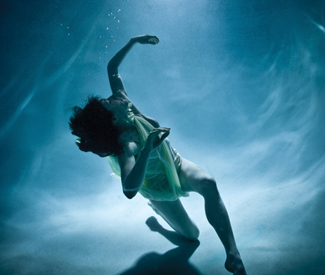
DANCE Jodi Lomask has always been comfortable with both science and art. Perhaps that’s not surprising for someone who grew up with a physicist father and a visual artist mother — hanging around with his friends who would came to visit in Connecticut, and going with her to galleries and openings. Still, it’s not every child who, when trying to make sense of the world, was also “making dances” in her mind.

For the last 15 years, Lomask and her Capacitor collaborators (whose new work Okeanoswill be performed this weekend) have translated the dances in her head onto the stage. It’s a rather unusual way to establish an intimate human connection with the big world out there. Within Outer Spaces looked at our planet in context of the other heavenly bodies; Digging in the Dark examined Earth’s layers down to the molten core; futurespecies investigated reproduction in the past and the future.

For biome Lomask and her collaborators went to Costa Rica’s Monteverde Cloud Forest to study symbiotic relationships. For the upcoming premiere Okeanos, Lomask had herself certified as a diver and went to Bali to study marine protectorates and coral restoration projects.

Debunking the clichés of free-and-wild artists and right-brain-only scientists, she calls on the latter as essential collaborators and advisors.

“My personal theory is that art and science are at the bottom of a circle. As [their practitioners] get better, they separate for a while, but when they are very good they meet again,” she says. “The most successful scientists I know are also the most creative people I know. The most successful artists I know are the people who are very precise and rigorous in their craft; they have a lot of factual information that goes into their work.” It’s this kind of thinking that has made Lomask and Capacitor a regular participant at TED conferences.

In order to ground each work in “fact rather than fantasy,” in 2000 Lomask started a formal process consisting of six months of meetings between scientists and her creative team.

“A scientist makes a 20 minute presentation, then someone from our team — a designer, a musician — does the same,” she explains. “Then we have a show-and-tell about the specifics about what we are working on.” This way of working guides but also liberates the art-making because “we then can take off from factual information.”

At a late-stage rehearsal at Zaccho Dance Theatre’s whitewashed, concrete-walled studio, Okeanos‘ art and science elements were very much in evidence. Against the starkness of that environment, periodically punctuated by the rattling of a passing CalTrain, the stunning underwater videos by Australian cinematographer David Hannan suggested an unearthly yet innate beauty. Seahorses gave birth, an octopus explored its environment, schools of tiny fishes surrounded floating whales, and sharks shot by like torpedoes. Throughout, you got the sense that these creatures communicate with each other.

In addition to choreographing the movement vocabulary for the four dancers and five circus artists, Lomask also designed interactive physical structures that echo the natural world. One set calls up vortexes; another is an earth-like globe with many points of entry; yet another suggests a curtain of kelp. Lead science advisors Sylvia Earle and Tierney Thys provided taped narration. While helpful for its information, it’s most moving for the awe and love that is apparent in their voices.

As mentioned above, like many of Lomask’s works, Okeanos commingles circus artists and dancers. “It doesn’t make any difference to me whether a body is a trained dancer’s or a contortionist’s,” she says. “I am really interested in how the human body acts with the [sculptural] forms I have created. A contortionist can interact in a way a dancer cannot, but a dancer can embody an emotion or a concept that circus artists don’t have the training to do.”

Each Okeanos performance will be preceded by a different set of (separately ticketed) panel discussions surrounding issues of human interaction with the deep. The post-performance “Ocean Solutions Cafés” offer opportunities for continuing the conversation.

CAPACITOR: OKEANOS

Thu/12-Sun/15

Pre-show talks, 6:30pm, $20 (with show ticket); performances, 8pm, $25-$35

Herbst Pavilion

Fort Mason Center

Marina at Laguna, SF

www.capacitor.org


Heading East: Artists in flux

28

San Francisco isn’t an easy place to live for artists and others who choose to fill their souls at the expense of their bank accounts, particularly with the comparatively cheap and sunny East Bay so close. And with more of these creative types being lured eastward, Oakland and its surroundings are getting ever more hip and attractive — just as San Francisco is being gentrified by dot-com workaholics.

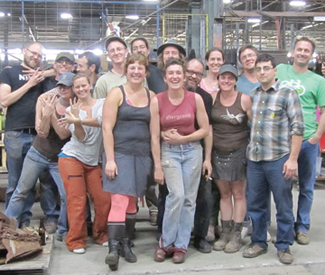
It’s a trend I’ve been noticing in recent years, one that I saw embodied during regular trips to make Burning Man art with the Flux Foundation (see “Burners in Flux,” 8/31/10) and hundreds of others who work out of the massive American Steel warehouse.

At least once a week, I would take BART to the West Oakland station and cycle up Mandela Parkway, a beautiful and inviting boulevard, riding in the wide bike lane past evocative public art projects in weather that was always warmer than my neighborhood in San Francisco.

Since then, I’ve watched waves of my Flux friends moving from San Francisco to the East Bay, pushed by the high cost of living and pulled by the allure of a better and more sustainable lifestyle, a migration of some of the most interesting and creative people I know, some of the very people that have made San Francisco so cool.

“I love San Francisco, but it’s just not an affordable place anymore,” said Jessica Hobbs, one of the Flux founders who last year moved with two other women from the crew into what they call the Flux Meow House in a neighborhood near the intersection of Oakland, Berkeley, and Emeryville.

Hobbs has long worked in the East Bay and “I’ve never been one of those who has that bridge-phobia” — that resistance to cross over into other cities for social gatherings — “but the most interesting culture of San Francisco is starting to move to the East Bay.”

In the last 10 years, workspaces for burners and other creative types have proliferated in the East Bay — including the Shipyard, the Crucible, NIMBY Warehouse, Xian, Warehouse 416, and American Steel — while the number in San Francisco has stayed static or even shrunk. That’s partly a result of SF’s dwindling number of light industrial spaces, but Hobbs said the influx of artists in the East Bay supported and populated these new workspaces and fed the trend.

“They were making space for that to happen, so we came over here,” Hobbs said. “There’s more willingness to experiment over here.”

There have been code-compliance conflicts between these boundary-pushing art spaces and civic officials, including Berkeley’s threats to shut down the Shipyard and Oakland’s issues with NIMBY, but Hobbs said both were resolved in ways that legitimized the spaces. And then events such as Art Murmur, a monthly art walk in downtown Oakland, put these artists and their creations on proud display.

“Oakland and the East Bay have been very welcoming,” Hobbs said. “They want us.”

As we all talked on April 5, Karen Cusolito was throwing a party celebrating the third anniversary of American Steel, a massive workspace she formed for hundreds of artists and a gathering space for her extended community. Cusolito had working in the East Bay since 2005, commuting from Hunters Point before finally moving to Oakland in 2010.

“I moved here with such great trepidation because I thought I’d be bored,” she said. “But I’ve found a more vibrant community than I could have imagined, along with an unexpected sense of calm.”

Reflecting on the third anniversary of American Steel, Cusolito said, “On one hand, I’m astonished that it’s been three years. On the other hand, I’m surprised that this hasn’t always existed,” she said. “I have an amazing community here. I’m very blessed.”

Hobbs’ roommate, Rebecca Frisch, lost her apartment in Hayes Valley last year and decided to seek some specific things that she felt her soul seeking. “I wanted more light and space and a garden. I had a long wish list and nearly all of it came true,” she said. “I cast my net as far north as Petaluma and even Sebastapol. It’s really about a home and setting that felt good and suited my wish list.”

The space they found was spacious and airy, almost suburban but in a neighborhood that is lively and being steadily populated with other groups of their friends who have also been moving from San Francisco, gathered into three nearby homes.

“It was a great space with this huge yard. It’s got sun all day long, fruit trees everywhere, and we now have an art fireplace. You don’t find that in San Francisco,” Hobbs said.

As much as Hobbs and Frisch have been pleased with East Bay living, they each felt finally pressured to leave San Francisco, which makes them wonder what the future holds for the city.

“It’s made me sad because it’s apparent there’s no room for quirky, creative individuals. It’s only for the super rich,” Frisch said. “I feel horrible for families and people with fewer options that I have. I wondered if I would mourn the city I loved, and it’s been just the opposite. I really love it here.”

There have been a few challenges and tradeoffs to living in the East Bay, Hobbs said, including a lack of late-night food offerings and after hours clubs. “With anything, there will be a balance between positives and convenience,” she said.

Not everyone from Flux is flowing east — that balance tips in different ways for different people at different times. Monica Barney recently moved to San Francisco from Oakland and she’s enjoying the more dense urban living.

“I got sick of living in the East Bay,” she said. “I didn’t like that you have to drive everywhere. It changes the tone of the neighborhood when you can get around without a car.”

Yet for most of the couple hundred artsy people in the Flux Foundation’s orbit, the East Bay is drawing more and more people. Jonny Poynton moved to West Oakland three years ago after living in San Francisco for nine. He appreciates the sense of community he’s found in Oakland, and he doesn’t feel like he’s given up much to attain it.

“One of the things I like about West Oakland is how close it is to the city,” he said.

Flux’s latest transplant is Jason DeCook, who works in the building trades and moved from San Francisco to just down the street from Poynton on April 7.

“I moved because of the usual reasons that most have, larger space for the same rent, but also the sunshine and proximity. I’ve been hella reluctant to do this for the past few years but thought about it a couple of times. Now the issue has been forced with all the art this year,” DeCook said.

In addition to working on art at American Steel, DeCook says he’s excited to have a yard and storage areas to work on his own projects.

“I’m a blue collar, hands-on kind of guy and it’s easy for me to feel connected to a lot of the people that live around me or are beginning to visit the area. It’s exciting to be in a place that has been ignored for so long by money, because a group of us can come up with a project or I can on my own and get to doing it with little red tape and it will be appreciated by the neighbors for making the place a little bit better,” DeCook said.

In many ways, he thinks that West Oakland and other East Bay pockets are on a similar trajectory as many of San Francisco’s coolest neighborhoods decades ago, many of which are now getting too expensive for the artists to live.

“Earlier today I was considering how, in the past, like the early ’60s when so many artists and musicians were drawn to the Haight and other places, they did so because it was cheap and close to opportunity,” he said. “I think West Oakland is seeing that happen to it. It is a furnace of creativity, and I am helping however I can to stoke that.

Found in translation

4

Ludwig Wittgenstein once said “the limits of my language mean the limits of my world.” So for the sake of expanded horizons, let’s say thank you to professional translators, the diligent souls who dedicate their lives to the subtleties of language. When interpreters dissolve linguistic barriers, we are able to peer into the worlds articulated in literature of distant lands to understand them as our own.

But how do they do it? Surrealist Japanese author Haruki Murakami’s translators Jay Rubin and J. Philip Gabriel have taken apart prose, sentence by sentence. Without their efforts, Murakami’s mystic, cryptic worlds could not have become available to audiences in the United States and elsewhere. Rubin and Gabriel spoke with the Guardian in a phone interview preceding their Center for the Art of Translation presentation on the art of translation last week at 111 Minna.

San Francisco Bay Guardian: How were you introduced to Haruki Murakami?

Jay Rubin: By an American publisher in 1989. I was absolutely knocked out by him and stopped reading everyone else for a good 10 years after that. I was just so swept up in Murakami’s world.

J. Philip Gabriel: I was living in Japan and a friend recommended his work. I became interested in translating his short stories, and one of the translations was published in The New Yorker a few years later. I became a regular translator from then on.

SFBG: How do you align yourself with the author so that even the subtlest aspects of their work are communicated?

JR: Maybe I’m not doing that. You never know, do you? I’m always saying that people shouldn’t read translated literature, they should learn the language themselves. One way you can build up trust is by reading the translation and feeling to see if it moves you in the same recognizable ways as reading in your native language. There’s never a guarantee that you’re getting the unalloyed original. But if a piece of literature is able to make you afraid or delighted in some way, it’s fairly likely that there’s something in the original that does that too.

JPG: I work with writers who are fortunately still alive. I have the option of asking a question for clarification. Murakami’s English is really good, and he is a translator himself, so he understands the challenges at hand and is happy to give suggestions.

SFBG: Humor often becomes diluted between languages, especially since a lot of humor is word-based. How do you retain the original comic flow?

JR: When you have languages as different as Japanese and English, it’s virtually impossible to preserve a pun. You just simply have to make up wordplay that seems to work in a similar way. And since Murakami has obviously been influenced by Western literature, his humor is not too hard to convey.

JPG: Japanese culture has a huge appreciation for humor, but translated literature often ends up being serious or dark. You do the best you possibly can when translating humor, but it’s difficult. In Kafka on the Shore, there’s a set expression in Japanese, which means, “I’m so busy I would like a cat to lend a hand.” This is especially funny because the story is about a guy who has the ability to talk to cats. I came up with a pun by using the word “paws” instead of “pause,” and saying, “I would like you to take a paws in your busy schedule.”

SFBG: One challenge in translating East Asian languages to English is that there are certain expressions that could be said more concisely in the former than in the latter. How do you overcome linguistic differences without compromising style?

JR: Brevity is a problem because you’re so tempted to explain things the reader might miss. You always have to engage in a judgment to keep the verbiage as tight as it is in the original, and try not to overwhelm your reader with explanatory prose. After all, you’re not trying to explain the original, but recreate it so that it works in all the same gut levels.

JPG: I try to preserve the basic rhythm of the prose, alternating between long and short sentences. But the sentence structure itself is so different — verbs are at the end of a sentence in Japanese — and when you move the verb to the front, it’s like giving away the punch line.

SFBG: How was your experience translating 1Q84 together?

JR: 1Q84 was so damn long. Sheer stamina was what I needed, above all. I was so grateful when Phil decided to translate the last volume. The editor spent months going through in extreme detail to give it consistency, and there wasn’t a huge gap in style because we both kept close to the original.

JPG: Any two translators, like any two writers, are going to have a different style, and it’s hard to go beyond that. But the editor did a great job to have the final translation read smoothly.

SFBG: Did you face any challenges when conveying cultural differences in a text?

JR: Murakami actually references a lot of American and European culture, so he’s very approachable for someone with a fairly normal American background.

JPG: Stoicism in Japanese culture causes certain climaxes to be very low-key, and I had to underscore scenes for an American audience. We go through the trouble of translating works because we want to learn about the culture, but it turns out that culture is the hardest thing to translate.

Weird me out

0

emilysavage@sfbg.com

MUSIC Here is a partial list of not quite idioms, butchered sayings, and quasi heartfelt beliefs the Melvins’ Buzz “King Buzzo” Osborne peppered throughout a conversation during a phone call last week from his home in Hollywood.

“We can’t be lion tamers all the time.” “You can accuse me of a lot of things, being lazy isn’t one of them.” “When in fear, or in doubt, run in circles, scream and shout.” “Treat me right, I’ll be your best friend. Treat me wrong, you don’t exist.”

At least one of those deserves to be crocheted on a throw pillow. Or screenprinted on a Melvins backpatch.

“WE CAN’T BE LION TAMERS ALL THE TIME.”

Singer-guitarist Osborne met his longtime collaborator, drummer Dale Crover, in 1984, Aberdeen, Wash., one year after the Melvins had formed and were performing mostly Cream covers. Crover was also in a bad cover band, but Osborne knew he could play well, so he invited him to join his band.

“There’s a fine line between genius and stupidity for both of us. I like playing with him, one way or another,” Osborne says of their continued relationship. “And it seems to work, no reason to quit — until he gives me a reason, then that will be it.” Osborne’s speech patterns raise often with sarcasm; in person that signature fuzzy grey ‘fro of his is likely shaking, punctuating each joke.

After that first shaky year, the Melvins got an early foothold in the blending of punk and metal, influenced by first round Black Flag (The band would go on to influence scores of musicians itself, recently, Mastodon).

“Somehow I realized even then that I needed to work on writing my own music, not relying on playing cover songs — even though we love to play cover songs, and we still do. But I started writing music pretty quickly. Sometimes we still play those first songs I ever wrote.”

“YOU CAN ACCUSE ME OF A LOT OF THINGS, BEING LAZY ISN’T ONE OF THEM.”

In the past some 29 years, the Melvins — which is made up of a rotating lineup, save for Osborne and Crover — have recorded 19 full-length albums, and that’s not counting countless other releases (singles, EPs, comps).

Since the end of December, the band recorded more than 50 songs, Osborne notes proudly as his Jack Russell Terriers scream in the background. Included in that batch is The Bulls & the Bees EP, released for free download through Scion last month and the Freak Puke LP, which will be out in June on Ipecac.

“WHEN IN FEAR, OR IN DOUBT, RUN IN CIRCLES, SCREAM AND SHOUT.”

The head bang-worthy The Bulls & the Bees is five classic Melvins cuts, thundering drums, doomy guitar, and Osborne’s low octave howl, it’s drum-happy sludge rounded out by frequent Melvins players Jared Warren and Coady Willis from stoney LA band Big Business.

Up next, there’s the upcoming Freak Puke, which is being touted as Melvins Lite. In this record, the band is a trio: Osborne, Crover, and Trevor Dunn of Mr. Bungle and Fantomas fame on stand-up bass.

Freak Puke is similarly dense and dark, so that’s not the reason for the ‘Lite’ attached to the name. Is it? Osborne explains: “You be the judge. We’ve always done lighter stuff. I’ll just say it’s Melvins lighter in weight, as in, our weight is less with three guys in it, as opposed to four. That record just has a different vibe.”

He’s, of course, right, it’s more the vibe of the record that sets it apart. The frenzied plucking of strings that kick off “Baby, Won’t You Weird Me Out” take the Melvins even further down the strange hybrid wormhole they’ve long been building out of mud — yet not so far that we can’t recognize their inimitable sound.

“TREAT ME RIGHT, I’LL BE YOUR BEST FRIEND. TREAT ME WRONG, YOU DON’T EXIST.”

After Osborne moved from Aberdeen, but before his trek to LA to be with his wife (and now, their many dogs), he lived for seven years in the Richmond District of San Francisco, near the Presidio. And while he claims to not be sentimental about the past (“I’m more of a ‘what have you done lately’ type of person”) he mentions that he remains loyal to the promoters at Slim’s and Great American Music Hall, where the Melvins four-piece/non-lite will be performing all the tracks off the new EP later this week. “As long as those people want to continue doing shows with us, we’re there.” 

MELVINS

With Unsane

Thu/12, 9pm, sold out

Great American Music Hall

859 O’Farrell, SF

(415) 885-0750

www.slimspresents.com

Oh high!

1

caitlin@sfbg.com

HERBWISE Say “cannabis,” not “weed.” Couch discussion in the language of medicine, not intoxication. There are a lot of rules when it comes to talking about marijuana — and the country’s most beloved cannabis publication breaks most of them.

That’s because at High Times magazine, the general take is that herb should be legal across the board, not just for consumption by the verifiably sick. “Until it’s legal for all adults, medical marijuana patients are going to be regarded as second class citizens,” said Elise McDonough, who besides having worked as a graphic designer with the magazine for 10 years is the author of the brand-new-for-420 Official High Times Cannabis Cookbook (Chronicle Books, 160pp, $18.95).

>>Join the Guardian and a stellar lineup this Friday 4/20 at El Rio for the Stoned Soul Picnic party!

In her Guardian phone interview, McDonough pointed out that eating may be the first way human beings consumed cannabis. She’s certainly done her part to give us options beyond the basic brownie — the book includes recipes for “psychedelic” spanikopita, tamales, cocktails, holiday feasts, and a host of canna-bases, from dosed butter to olive oil. McDonough wrote many, but also gets help from other High Times luminaries, like the dearly departed Chef Ra, who contributed to the rag’s recipe column for 15 years.

Interest, ahem, sparked? The following recipes from the book will make a stellar foundation for next week’s holiday festivities, medicinal or not. 


SIMPLE CANNABUTTER

Makes 1/2 cup

1/2 cup (1 stick) salted butter*

1/4 ounce cannabis buds, finely ground

*To make cannamargarine, simply substitute margarine for butter in this recipe

1. Melt the butter on low heat in a saucepan. Add the ground buds, and simmer on low heat for 45 minutes, stirring frequently.

2. Strain the butter into a glass dish with a tight-fitting lid. Push the back of a spoon against the plant matter and smash it against the strainer to squeeze out every drop of butter available. When you’re done, discard the plant matter.

3. Use your cannabutter immediately, or refrigerate or freeze until it is time to use. You can easily scale this recipe up for larger batches of cannabutter. One pound of butter (4 sticks) can absorb 1 ounce of cannabis, but you may want to simmer for up to 60 minutes.

Drizzle this cannabutter over freshly cooked pasta or popcorn for instant satisfaction. Reserve large batches in the fridge or freezer for use in recipes.


GREEN GANJA GARLIC SMASHED POTATOES

Stones 4

1 1/2 pounds potatoes, unpeeled and cut into chunks (Yukon Gold potatoes are great)

1 pound parsnips, peeled and cut into chunks

1 head garlic, cloves separated and peeled

1 1/2 tablespoons salt, plus more as needed

4 tablespoons Simple Cannabutter

Black pepper

1. Put the potatoes, parsnips, and garlic in a large pot and cover them with water. Bring to a boil over high heat and then add the salt. Reduce the heat to medium-low and simmer for about 15 minutes. The potatoes, parsnips and garlic should be tender and easy to smash. Drain the vegetables and reserve 1/2 cup of the cooking water.

2. In a small saucepan over medium heat, melt the cannabutter.

3. Return the vegetables to the pot or a large serving bowl, and begin to smash them with a potato masher, slowly adding the melted cannabutter a little at a time. Use spoonfuls of the reserved cooking water to thin the mixture if the smashed veggies are too thick. Season with black pepper and more salt and serve.


Diva in the headlights

0

arts@sfbg.com

FILM It’s a bit difficult from hereabouts to get a hold on what kind of star Paprika Steen is in Denmark, beyond being a kinda huge one. Here, she’s at most a familiar face from the Dogme 95 movies of a decade or more ago, having appeared in such significant entries as Thomas Vinterberg’s The Celebration (1998), Lars von Trier’s The Idiots (1998), and Susanne Bier’s Open Hearts (2002), as well as subsequent non-Dogme films by those and other leading directors. From those you might figure she’s a leading light in a sort of loose stock company of people who constantly work in each others’ emotionally unruly, sometimes outrageous, usually satisfying movies.

But at home it seems she’s more ubiquitous, in various media and as an all around personality. There they’ve gotten to see her in films we haven’t (particularly envied is 2007’s The Substitute, in which she plays a space monster posing as the world’s worst elementary school teacher), in TV series, as a skit comic, stage actress, and god knows what else — there’s a mystifying YouTube clip of her gyrating through a “Single Ladies” cover on some awards show, and it does not appear intended as a joke.

The new-ish (it’s taken its sweet time crossing the Atlantic) Applause distills what we might already know and guess at about this skillful, somewhat larger-than-life actress. She plays Thea Barfoed, a duly larger than-life actress undeniably skillful at her job — a flunky gushes she’s “one of the best in the whole country,” causing Thea to bristle not just at “one of,” but at the dinkiness of said country — but a floundering mess everywhere else.

We first see her playing Martha, natch, in Who’s Afraid of Virginia Woolf? onstage (sequences shot during a real-life production of the Albee play Steen starred in), boozing and yelling, reeling and lashing about. It’s typecasting: offstage, Thea is just out of rehab, having hit a bottom that ended her marriage and handed her husband (Michael Falch) sole child custody. Yet she’s still sneaking booze, even during performances; attending AA meetings she yawns and smokes through while others bare their souls. Snapping “I hate ordinary people” — no one is convinced when she claims that was a joke — she has that unpleasant brat-egomaniac’s manner of suggesting everyone else is wasting her time with their stupidity, and that any attempts to be civil on her part require a Herculean exercise in acting. It’s hard to pity her evident self-loathing when she’s such a complete asshole.

Still, she wants to be better, sort of, and others are trying to help. Ex spouse Michael and his infuriatingly reasonable new partner (Sara-Marie Maltha) have decided it’s best for all that she have visitation rights to her young sons, despite the past (which included unspecified maternal physical violence). When Thea sees the boys for the first time in 18 months, they’re understandably skittish. Struck by their fearful distance, she goes home and pours every intoxicant down the drain. But she still has the overpowering and impulsive needs of an addict — whether exercised in her way-too-soon demands for custody, a weird and unwise bar pickup (Shanti Roney), or the rant directed at a dim Toys R Us salesgirl who momentarily gets between Thea and the impossible dangling carrot of happiness.

Rather incongruously nostalgic in its Dogme-style aesthetic of shaky camera and jump cuts (editor-turned-director Martin Zandvliet has since made a much more classically polished second feature), Applause is a good movie that’s unimaginable without Steen. Yet it might have been better still if less overwhelmed by her. Like a salad plate supporting an entire roast turkey, its narrative framework is underscaled for such a glistening mass of banquet-sized acting meat.

With her great mane of hair looking magnificent one minute and Medusa-like the next, she’s a glam gorgon, both utterly credible and nearly Joan Crawford-esque in determination to stare the medium down. Paprika Steen is the kind of actress who revels in making herself unattractive, though the ravaged result is less “plain” than its own kind of masochistic spectacle. (Thea is the very picture of a proud 25-year-old beauty two decades and umpteen cosmos later.) It’s a flamboyant, arresting, faultless star turn — even if Applause itself is finally just a vehicle. To really gauge what she’s capable of, we’d probably need to see that Virginia Woolf? in its entirety. 

APPLAUSE opens Fri/13 in Bay Area theaters.

If I could do it all over

2

If had to re-start your academic career today, what would you study? In this era of budget cuts to education and general economic miasma, some Bay Area academics would be reconsidering their options, some would stay their course — and some have important advice for today’s budding scholars. 

MELINDA STONE, UNIVERSITY OF SAN FRANCISCO ASSOCIATE PROFESSOR

FILM STUDIES

I would first take some time off from school, jump into the world, and try it out for a year or two. I would WWOOF (Willing Workers on Organic Farms) around the country and around the world. Once I had some out of school experience, I would be ready and willing to pursue a higher education — not just because my parents or society said it was the thing to do, but because I was excited and eager to learn more. I would study urban agriculture — funnily enough, my colleagues and I just created an urban agriculture program at USF. We need to be thinking and engaging critically and creatively to shape our urban spheres into sustainable systems. Programs like urban agriculture are doing just that.

JAMES MARTEL, SAN FRANCISCO STATE UNIVERSITY PROFESSOR

POLITICAL SCIENCE

I’d ideally do exactly what I am doing now: studying political theory. I really love my job and feel very grateful that I get paid to do this. However, I don’t think that I could have had the career I had if I was starting out today.

What I’d probably do is to bolster my study of political theory with more courses in continental philosophy and critical thinking, that way I could present myself to more kinds of jobs and broaden my reach. I also think it would help to focus on something concrete — an area study, a specific tradition, a specific thinker, because I think generalists don’t do so well these days. In graduate school I would concentrate more on publishing and going to conferences than I did when I was getting my own Ph.D.

When I was in grad school, the belief was that we lived in a meritocracy and good work would get good jobs; even then (the mid-’90s), the profession was changing, but I didn’t pay any attention and got lucky. Not that I had it that easy, I was a visiting professor at three universities before I got a tenure track job. Even so, I don’t think a newly minted Ph.D. can have the same luxury anymore. Today you can’t hide in your ivory tower. My younger peers are much less starry-eyed about academia than I was at their age. Maybe that is one small silver lining to the horrendous academic job market.

VINCENT BARLETTA, STANFORD UNIVERSITY ASSOCIATE PROFESSOR

IBERIAN AND LATIN AMERICAN CULTURES

At the end of Don Quijote, the eponymous main character emerges from his book-induced delirium, renounces chivalry, and dies. I’m not ready to die, so I’m reluctant to imagine a career course other than the wholly quixotic, book-filled one that I chose over two decades ago. The Quijote teaches us that all imagining has consequences. If I begin to imagine another less difficult life, what will become of me? Will this life begin to crack and splinter? While I’m not simple enough to believe that flirtations and daydreams can hasten death, why tempt fate?

If imagination is a lethal pin, history is a cushion. When I was a kid growing up in the East Bay, an aluminum bat under my bed and a stack of bootlegged Elvis Costello cassettes in a shoebox, I dreamed of being lots of things: a private eye in Honolulu, a blade runner, the president. I dreamed of a playing guitar like Marc Ribot. Of being rich. Does Barack Obama play guitar? If so, he’s realized all of my adolescent dreams, and I hope they make him happy. As for my life, Don Quijote was born only for me, and I for him.

DINA IBRAHIM, SAN FRANCISCO STATE UNIVERSITY ASSOCIATE PROFESSOR

BROADCAST AND ELECTRONIC COMMUNICATION ARTS

If I were starting my career all over again, I would still get a bachelor’s degree in journalism with a minor in international relations. I would also get a master’s degree in Middle East studies, followed by a Ph.D. in journalism. The only thing I would change is making up my mind a little faster. I was undeclared during my freshman year, with no clue what I wanted to study. I met a bunch of cool kids who were working at the college newspaper and as I began hanging out in the newsroom, suddenly it all made sense. I was naturally nosy, I love writing, and get a huge kick out of talking to strangers and telling stories. Journalism was the perfect career for me. I always had a fascination with global politics so I looked forward to attending every IR class. I’m glad I didn’t get a master’s in journalism, because I don’t think that would have advanced my career at all. But the Middle East studies degree gave me an in-depth understanding of the region’s history, societies, economies and political systems. It was an excuse to read a lot about subjects I was passionately interested in, and being required to read and write papers kept me in line and gave me the discipline I needed. I got the Ph.D. because I wanted to teach at the university level, and I enjoyed learning to do research. 

I tell my students all the time that it is really important to study what you love, but I know it isn’t easy to figure out what that is, and whether they can actually make a decent living out of it. I often begin advising sessions by asking my student “what’s your dream job?” and if they give me a specific answer, it makes it much easier to help them pick the right classes that they are paying a lot of money for. I knew I wouldn’t necessarily get rich as a journalist, but I knew it would be fun and rewarding. My parents are both medical doctors and wanted me to be a physician as well. I have no regrets whatsoever, because I know I would have made a great doctor, and definitely made more money than I do now, but I would have been miserable. A college degree is increasingly expensive, and it is crucial that a lot of thought and consideration goes into choosing a field of study that is a good investment. A good degree of study should train you to acquire actual skills that you can use to market yourself in today’s competitive job market.

Two on the rise

0

virginia@sfbg.com

APPETITE Age is good thing: for wine, whiskey, cheese, wisdom, sense of self… Age deepens, fills out, matures. In the scheme of things, these two restaurants are youngsters — Bar Tartine has been successful since opening in 2005, Txoko was the new kid on the block in 2011. But they’ve steadily improved: what was exceptional at times last year is now more consistently so. 

BAR TARTINE

Bar Tartine has long been notable. Now it has become exciting. Last year I wrote of new chef Nick Balla, fresh from Nombe, who launched a Hungarian-influenced menu acknowledging his roots. Eastern European touches render the food unique yet exude down-home goodness.

Tripe strikes fear in the hearts of many. I don’t mind it, but only at Oliveto’s 2010 Whole Hog dinner had I found it delicious. Balla’s grilled tripe ($12) stands as the best tripe dish I’ve ever tasted. Silky (not slimy) strips of tripe fill a bowl aromatically entwined with fennel, cabbage and paprika. Beets, an ingredient we’ve been inundated with in recent years, are electrifying in an ensalada rusa ($12) with celery root, dill, chili, peppercress, and plenty of lime. This invigorating expression stands above the best beet dishes. An entree winner is Hungarian farmer’s cheese dumplings, nokedli ($17). Sunchoke (Jerusalem artichoke) and wild onion meld with doughy, slightly cheesy, dumplings: sheer comfort.

Puffy, fried Hungarian potato bread, langos ($10), remains the must-order menu item upon every visit, drizzled with sour cream and dill — it is blissfully garlicky. Not since my travels through the Hungarian countryside have I seen this addictive bread. Here’s hoping when cherry season hits, we’ll witness the return of Balla’s fantastic version of Hungarian chilled sour cherry soup, meggyleves.

The wine list persists in quality, a recent example being two Riesling beauties set in contrast: a dry, elegant, German 2009 Keller Von der Fels Trocken Riesling alongside a lively, unusual-but-refined Santa Barbara 2008 Tatomer Vandenberg Riesling.

Balla’s proven addition to Bar Tartine’s expanded, inviting, glowing space, confirms the restaurant as a personal favorite — and one of the best in town.

8561 Valencia, SF. (415) 487-1600, www.bartartine.com

TXOKO

With so little Basque cuisine in our city, I was delighted when Txoko (pronounced “choko”) opened in the spacious space that was once home to Enrico’s, promising Basque influence. (See Paul Reidinger’s August 2011 review.) Lots of small plates and just a few larger ones appealed with an opportunity to try more. Early visits last year yielded delectable small bites, while I found larger plates less exciting. When the menu recently changed to a more traditional appetizer and entree format, I feared it would lose its uniqueness. Pleasingly, however, Txoko’s menu has been rounded out, entrees keeping pace with starters. I do sense the Basque influence is looser than it was before, however, and would rather not see that aspect fade.

Txoko’s Wednesday night, four-course foie gras dinners ($55) are arguably the best way to ride out the remaining months until June when the California foie gras ban takes effect (Txoko owner Ryan Maxey is a foie defender.) The menu varies weekly though typically finishes with buttery foie gras ice cream. One week I savored silky foie gras torchon on a flaky puff pastry, in a lavender golden raisin sauce redolent with thyme. My main was a gorgeous foie gras a la plancha (grilled), savory and meaty on a mound of beluga lentils, mirepoix, and chorizo, surrounded by strips of duck jamon, topped with crispy chicharrones.

On the regular menu, two dishes left an impression. Warm lamb’s tongue salad ($11) is a surprisingly light salad of lamb mixed with poached potatoes, manchego cheese, shishito peppers and frisee, surrounded by smoked tomatoes. Different and delightful. A heartwarming dish of grilled venison Denver leg ($29) is served medium rare, draped over mashed yams in blood orange endive marmelata, dotted with crispy sage leaves and pine nuts. Each dish is artfully presented and generously portioned.

Drink options are vibrantly varied, with choices like a bone dry 2009 Isastegi Basque cider ($6) and wines like an earthy, plum and berry-inflected 2001 Senorio de P. Pecina Reserva Rioja. Txoko has a full bar with commendable cocktails ($10), such as a playful, refreshing Cool Hand Luke Fizz utilizing Fighting Cock bourbon, Peychaud’s bitters, and egg whites for froth, made vivacious with Mexican Coke.

Finishing the evening with moist, Spanish-style bread pudding ($8), sweetened with prunes, olive caramel, and candied marcona almonds is a pleasure. I look forward to Txoko’s continued evolution, keeping up its refreshing change of pace in North Beach, and, indeed, the city.

504 Broadway, SF. (415) 500-2744, www.txokosf.com

Subscribe to Virgina’s twice-monthly newsletter, The Perfect Spot, www.theperfectspotsf.com


Heading East: The musician

0

This week’s Guardian takes a look at San Francisco versus Oakland — and asks whether the big city may have lost its caché to the East Bay

tredmond@sfbg.com

Andy Duvall arrived in San Francisco in 1995, moved with some friends into a flat where his rent was $250 a month. It was a great town for musician, and for 15 years, he was part of the local scene.

Then he looked around in 2010 and realized that he was paying $750 a month for a tiny room with a housemate he barely knew. “It was so hard to find a place I could afford,” Duvall, the former Zen Guerilla drummer who is now part of the experimental band Carleton Melton, told us.

So he packed up and moved across the Bay — and he’s never looked back. “When I moved out, I was afraid I’d totally miss SF,” he said. “But I got to Oakland, and now even if I could I wouldn’t move back.”

Duvall lives in a 900-square-foot place off 40th Street with his girlfriend; they split the $900 rent. “It just seems like there are more artistic and musical people around here,” he said. “I’m surrounded by musicians, instead of worrying that the person downstairs is going to try to get me kicked out of the building.”

Duvall’s main worry now? He sees the pattern that drove him out of San Francisco happening again. “In five years, the same thing is going to happen to Oakland,” he said. “This neighborhood is just exploding. It’s good, I guess — but it’s bad for the artists and musicians.”